Cambridge IGCSE Computer Science (9-1) 0984 — 2022 May/June Paper 1 · Variant 1
0984/11/M/J/22 · 75 marks · ≈84 min
The question paper and its mark scheme, free to read here and free to download. This is Cambridge’s own paper, exactly as it was sat.
Question paper12 pages

Mark scheme13 pages
Answers below. Sit the paper first if you are practising.
Paper as text
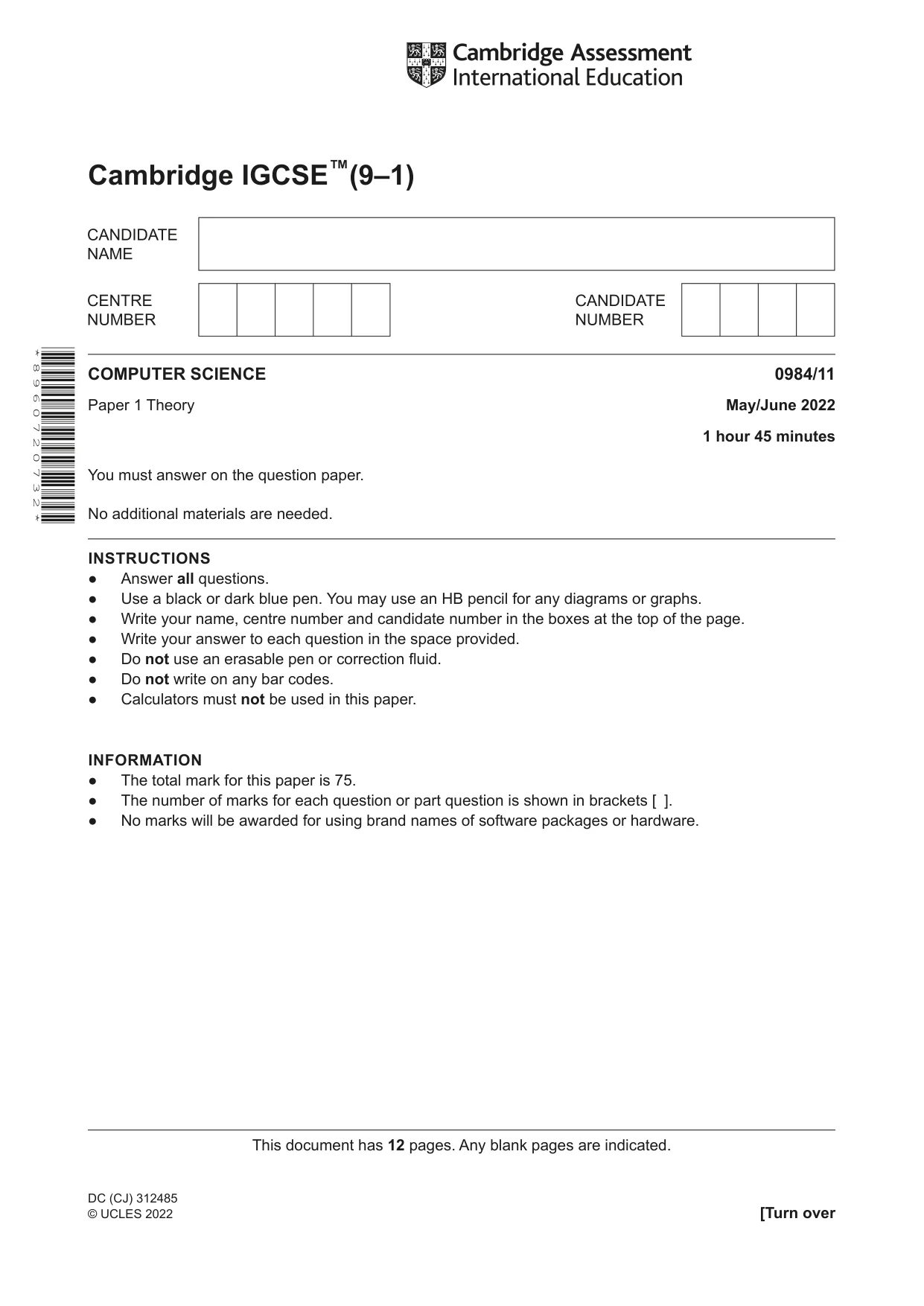
Question paper, page 1
This document has 12 pages. Any blank pages are indicated. [Turn over Cambridge IGCSE™(9–1) * 8 9 6 0 7 2 0 7 3 2 * DC (CJ) 312485 © UCLES 2022 COMPUTER SCIENCE 0984/11 Paper 1 Theory May/June 2022 1 hour 45 minutes You must answer on the question paper. No additional materials are needed. INSTRUCTIONS ● Answer all questions. ● Use a black or dark blue pen. You may use an HB pencil for any diagrams or graphs. ● Write your name, centre number and candidate number in the boxes at the top of the page. ● Write your answer to each question in the space provided. ● Do not use an erasable pen or correction fluid. ● Do not write on any bar codes. ● Calculators must not be used in this paper. INFORMATION ● The total mark for this paper is 75. ● The number of marks for each question or part question is shown in brackets [ ]. ● No marks will be awarded for using brand names of software packages or hardware.
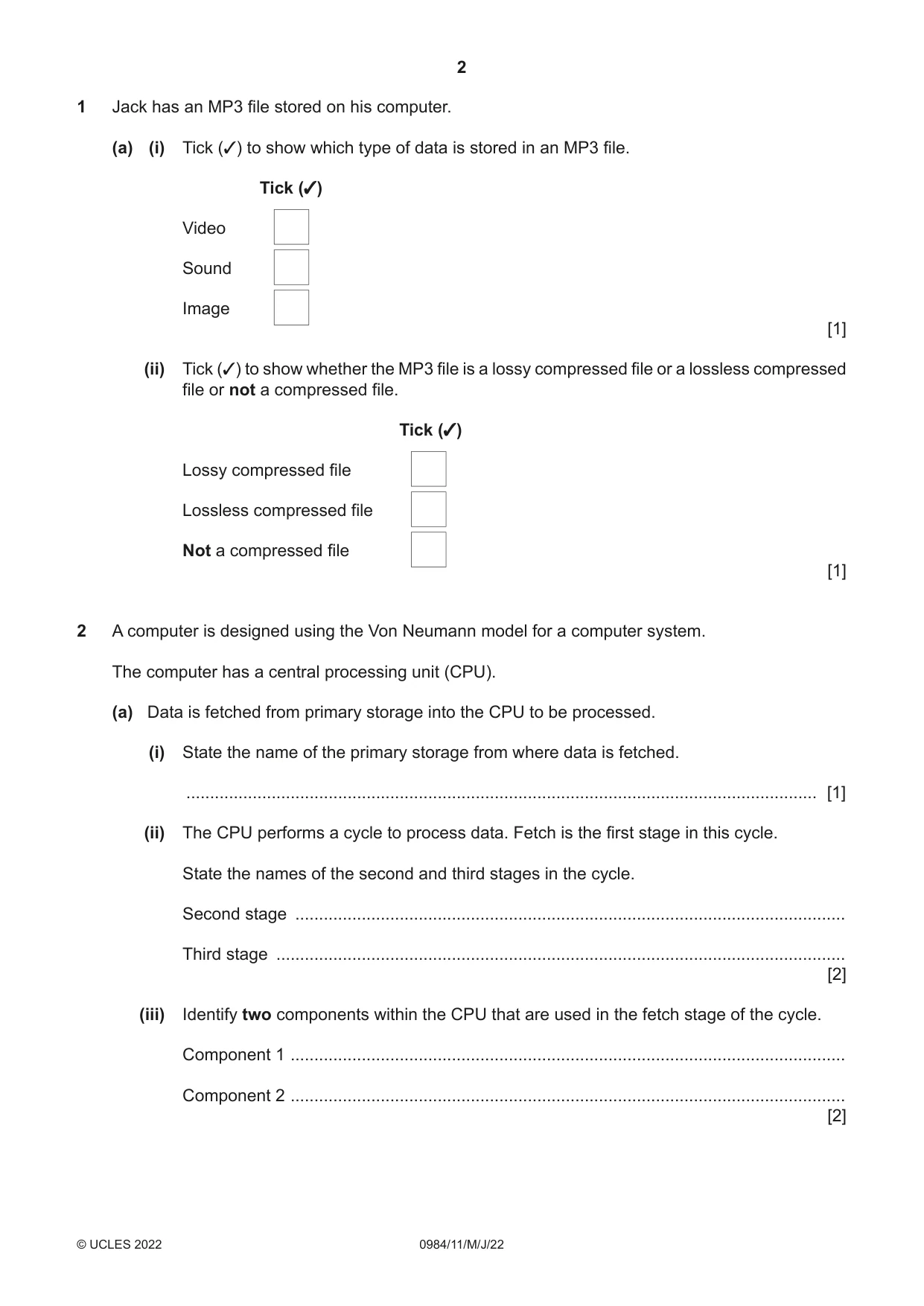
Question paper, page 2
2 0984/11/M/J/22 © UCLES 2022 1 Jack has an MP3 file stored on his computer. (a) (i) Tick (3) to show which type of data is stored in an MP3 file. Tick (3) Video Sound Image [1] (ii) Tick (3) to show whether the MP3 file is a lossy compressed file or a lossless compressed file or not a compressed file. Tick (3) Lossy compressed file Lossless compressed file Not a compressed file [1] 2 A computer is designed using the Von Neumann model for a computer system. The computer has a central processing unit (CPU). (a) Data is fetched from primary storage into the CPU to be processed. (i) State the name of the primary storage from where data is fetched. … [1] (ii) The CPU performs a cycle to process data. Fetch is the first stage in this cycle. State the names of the second and third stages in the cycle. Second stage … Third stage … [2] (iii) Identify two components within the CPU that are used in the fetch stage of the cycle. Component 1 … Component 2 … [2]
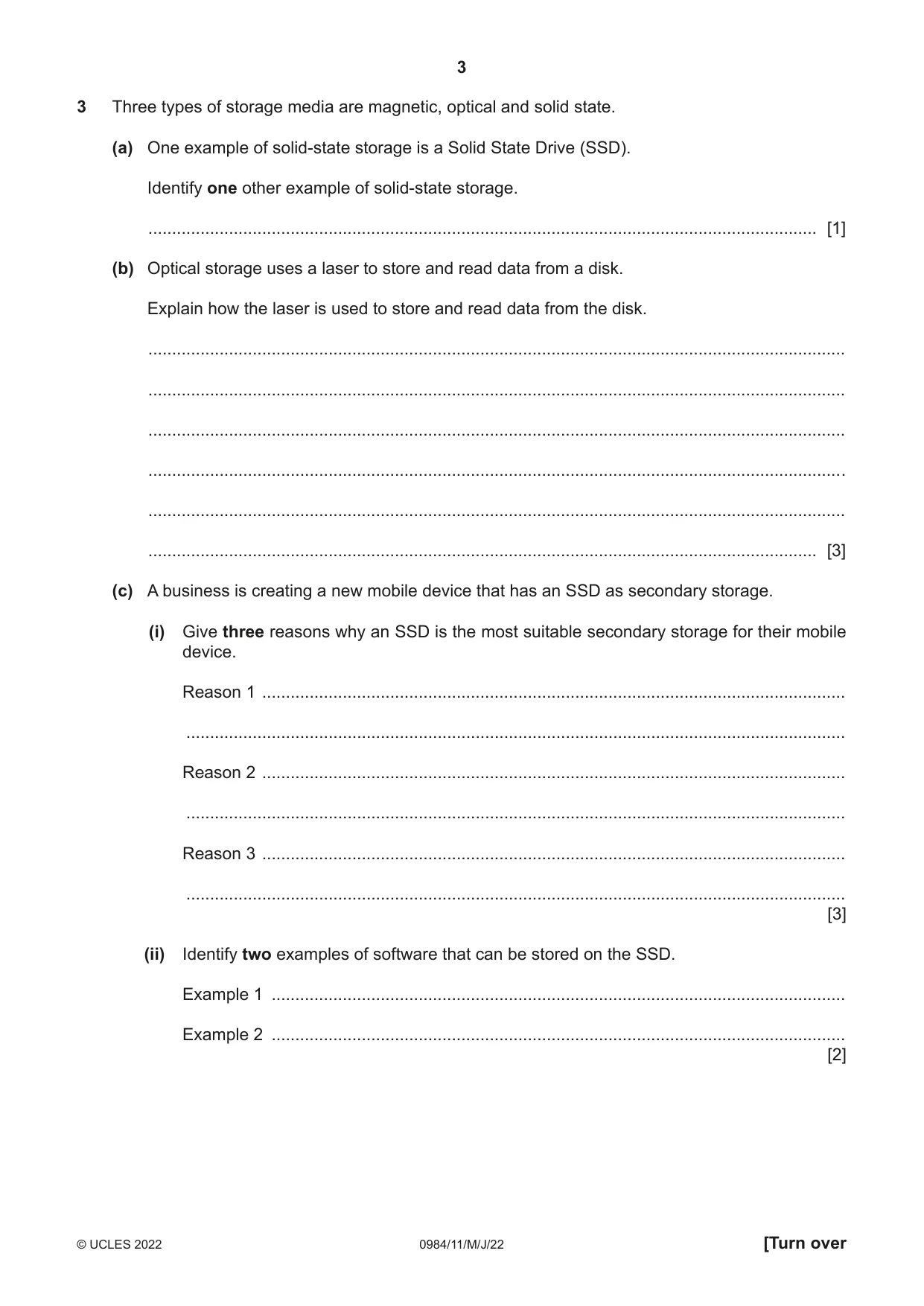
Question paper, page 3
3 0984/11/M/J/22 © UCLES 2022 [Turn over 3 Three types of storage media are magnetic, optical and solid state. (a) One example of solid‑state storage is a Solid State Drive (SSD). Identify one other example of solid‑state storage. … [1] (b) Optical storage uses a laser to store and read data from a disk. Explain how the laser is used to store and read data from the disk. … … … … … … [3] (c) A business is creating a new mobile device that has an SSD as secondary storage. (i) Give three reasons why an SSD is the most suitable secondary storage for their mobile device. Reason 1 … … Reason 2 … … Reason 3 … … [3] (ii) Identify two examples of software that can be stored on the SSD. Example 1 … Example 2 … [2]
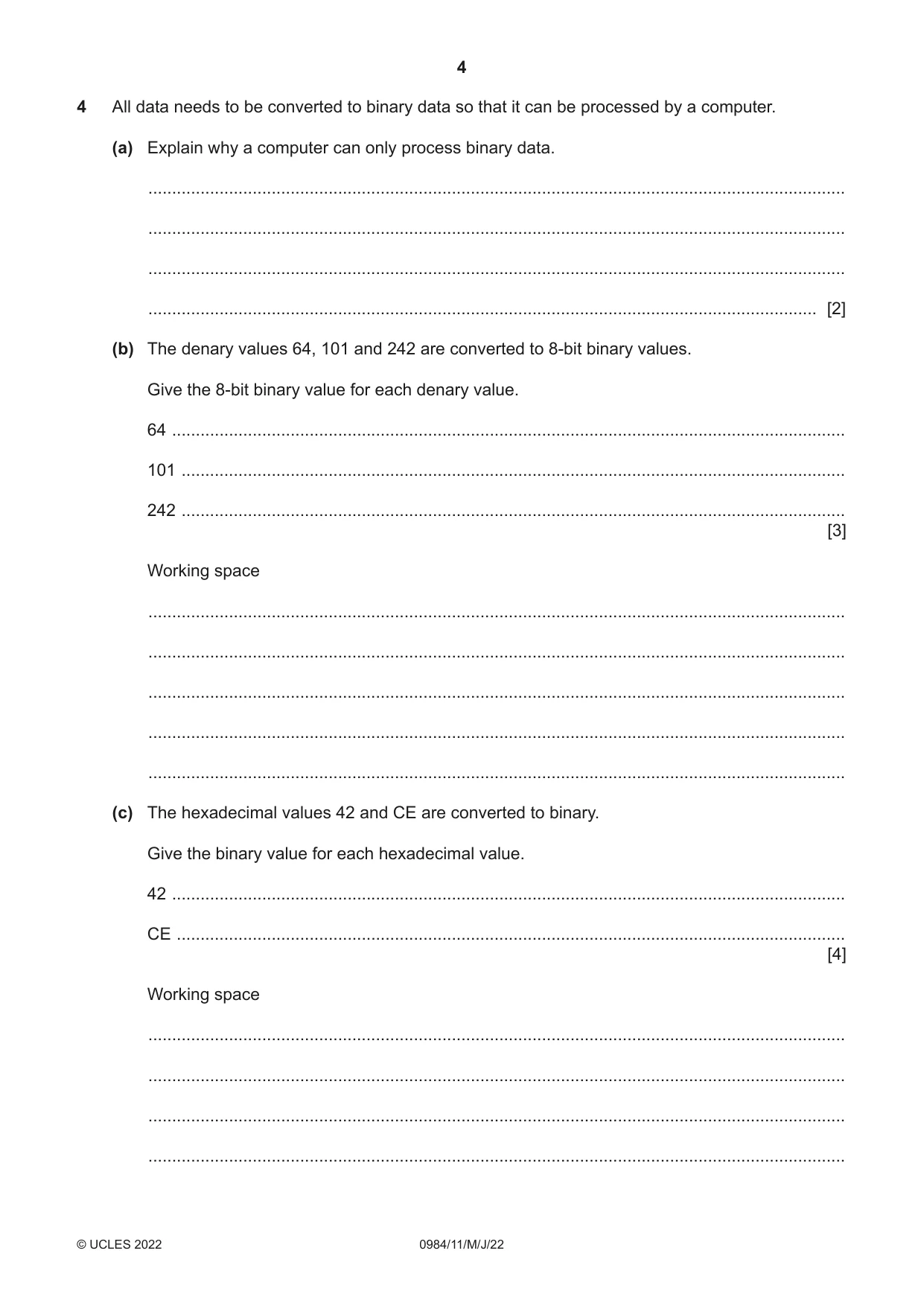
Question paper, page 4
4 0984/11/M/J/22 © UCLES 2022 4 All data needs to be converted to binary data so that it can be processed by a computer. (a) Explain why a computer can only process binary data. … … … … [2] (b) The denary values 64, 101 and 242 are converted to 8‑bit binary values. Give the 8‑bit binary value for each denary value. 64 … 101 … 242 … [3] Working space … … … … … (c) The hexadecimal values 42 and CE are converted to binary. Give the binary value for each hexadecimal value. 42 … CE … [4] Working space … … … …
Question paper, page 5
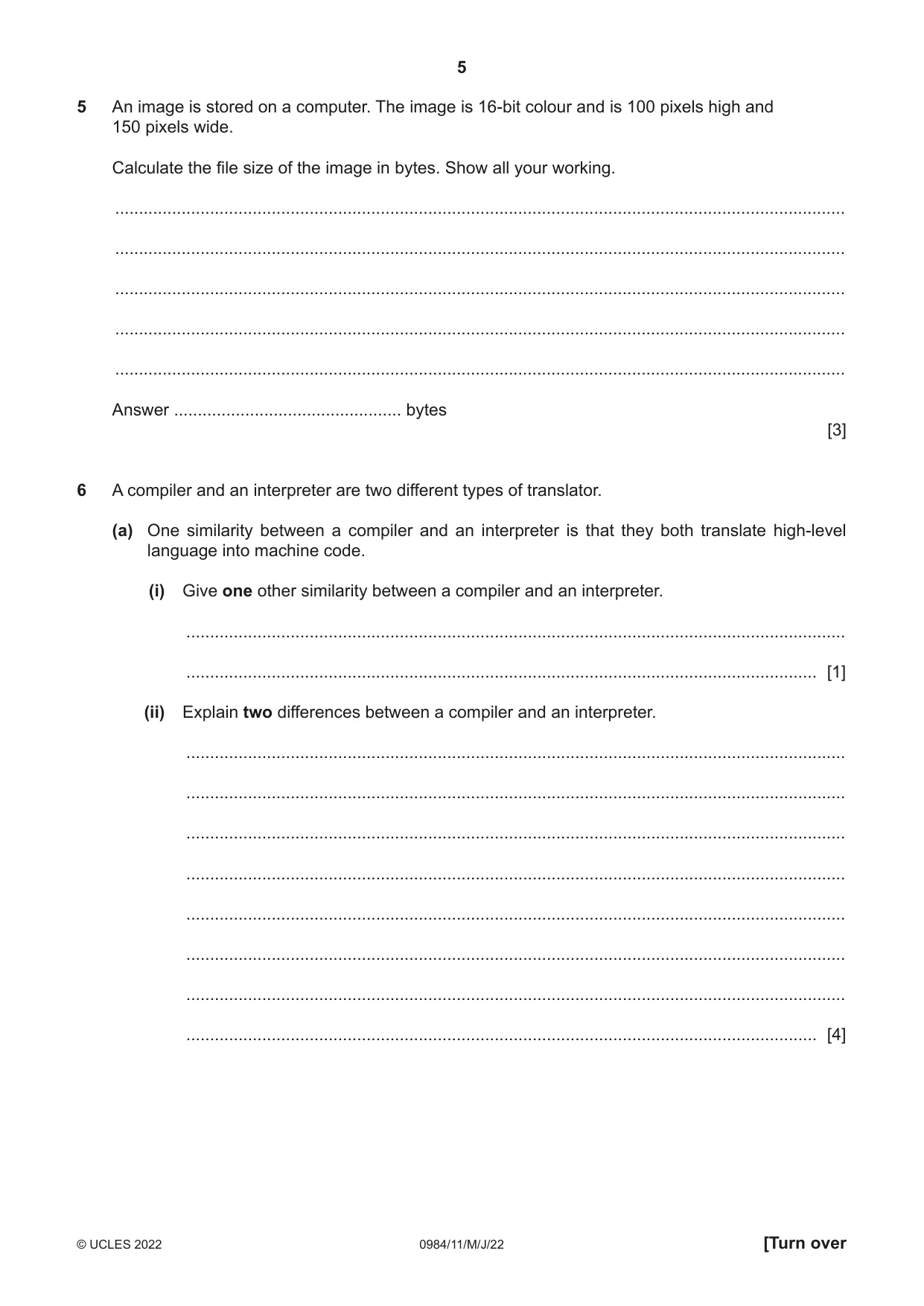
5 0984/11/M/J/22 © UCLES 2022 [Turn over 5 An image is stored on a computer. The image is 16‑bit colour and is 100 pixels high and 150 pixels wide. Calculate the file size of the image in bytes. Show all your working. … … … … … Answer … bytes [3] 6 A compiler and an interpreter are two different types of translator. (a) One similarity between a compiler and an interpreter is that they both translate high‑level language into machine code. (i) Give one other similarity between a compiler and an interpreter. … … [1] (ii) Explain two differences between a compiler and an interpreter. … … … … … … … … [4]
Question paper, page 6
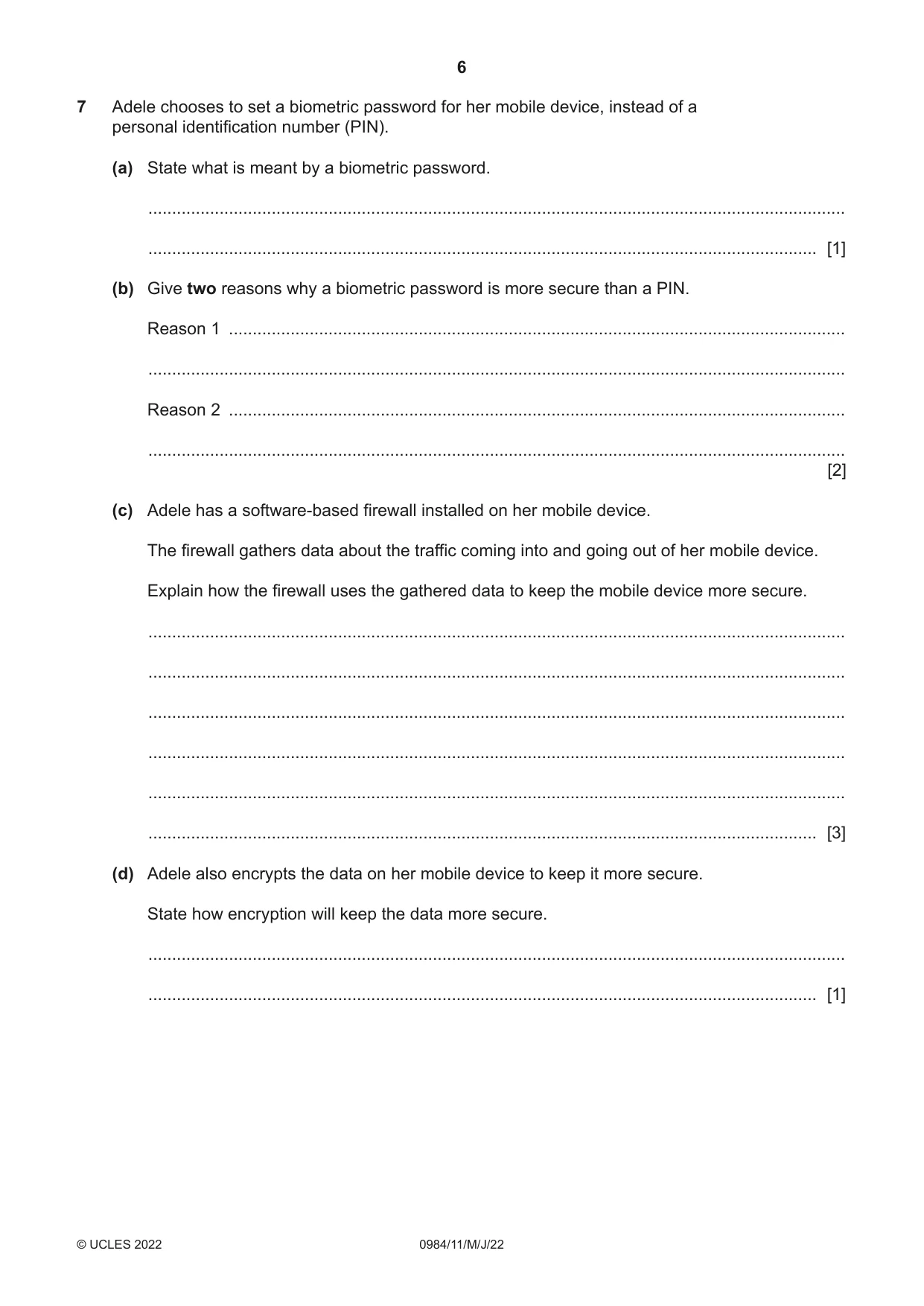
6 0984/11/M/J/22 © UCLES 2022 7 Adele chooses to set a biometric password for her mobile device, instead of a personal identification number (PIN). (a) State what is meant by a biometric password. … … [1] (b) Give two reasons why a biometric password is more secure than a PIN. Reason 1 … … Reason 2 … … [2] (c) Adele has a software‑based firewall installed on her mobile device. The firewall gathers data about the traffic coming into and going out of her mobile device. Explain how the firewall uses the gathered data to keep the mobile device more secure. … … … … … … [3] (d) Adele also encrypts the data on her mobile device to keep it more secure. State how encryption will keep the data more secure. … … [1]
Question paper, page 7
7 0984/11/M/J/22 © UCLES 2022 [Turn over BLANK PAGE
Question paper, page 8
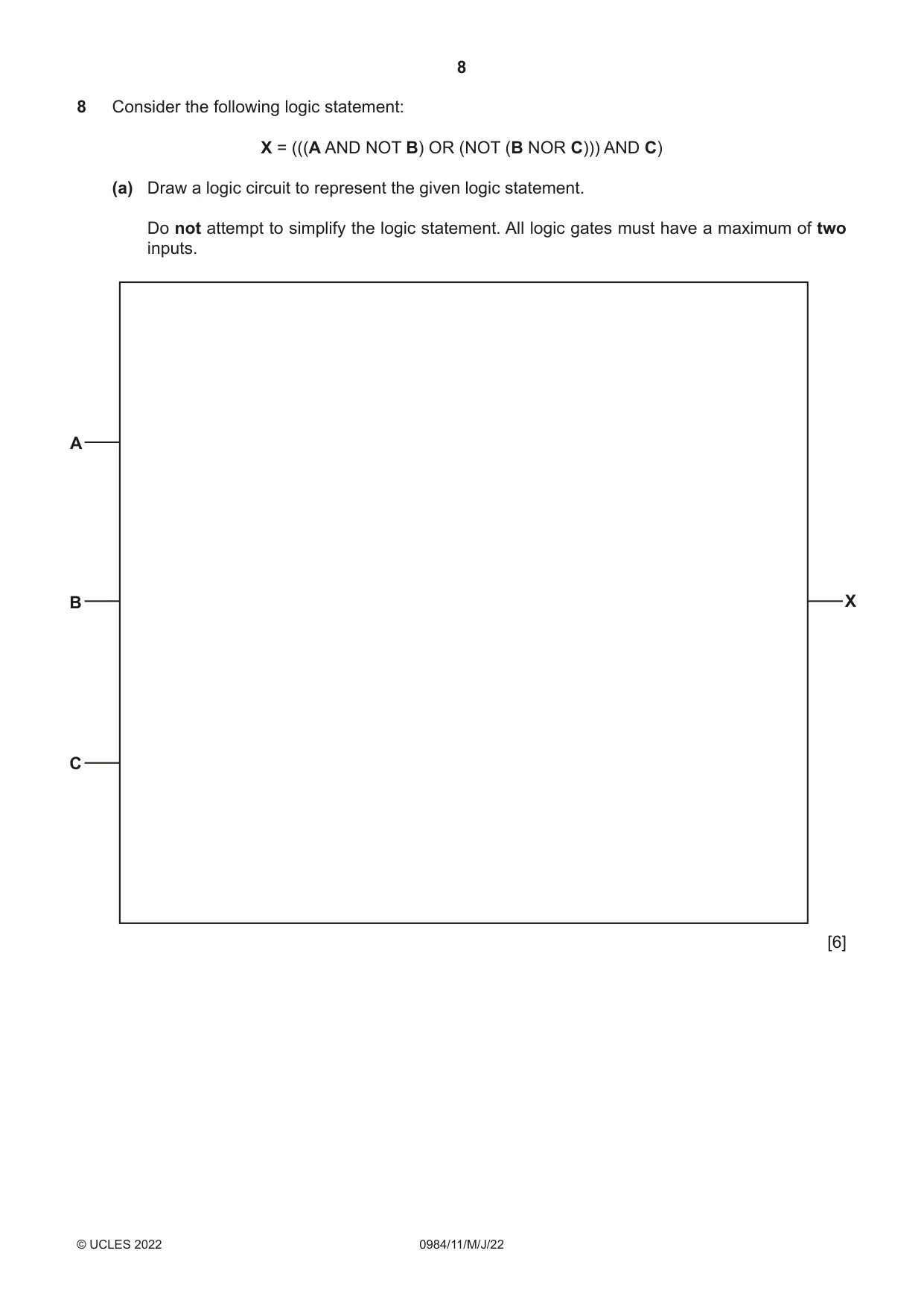
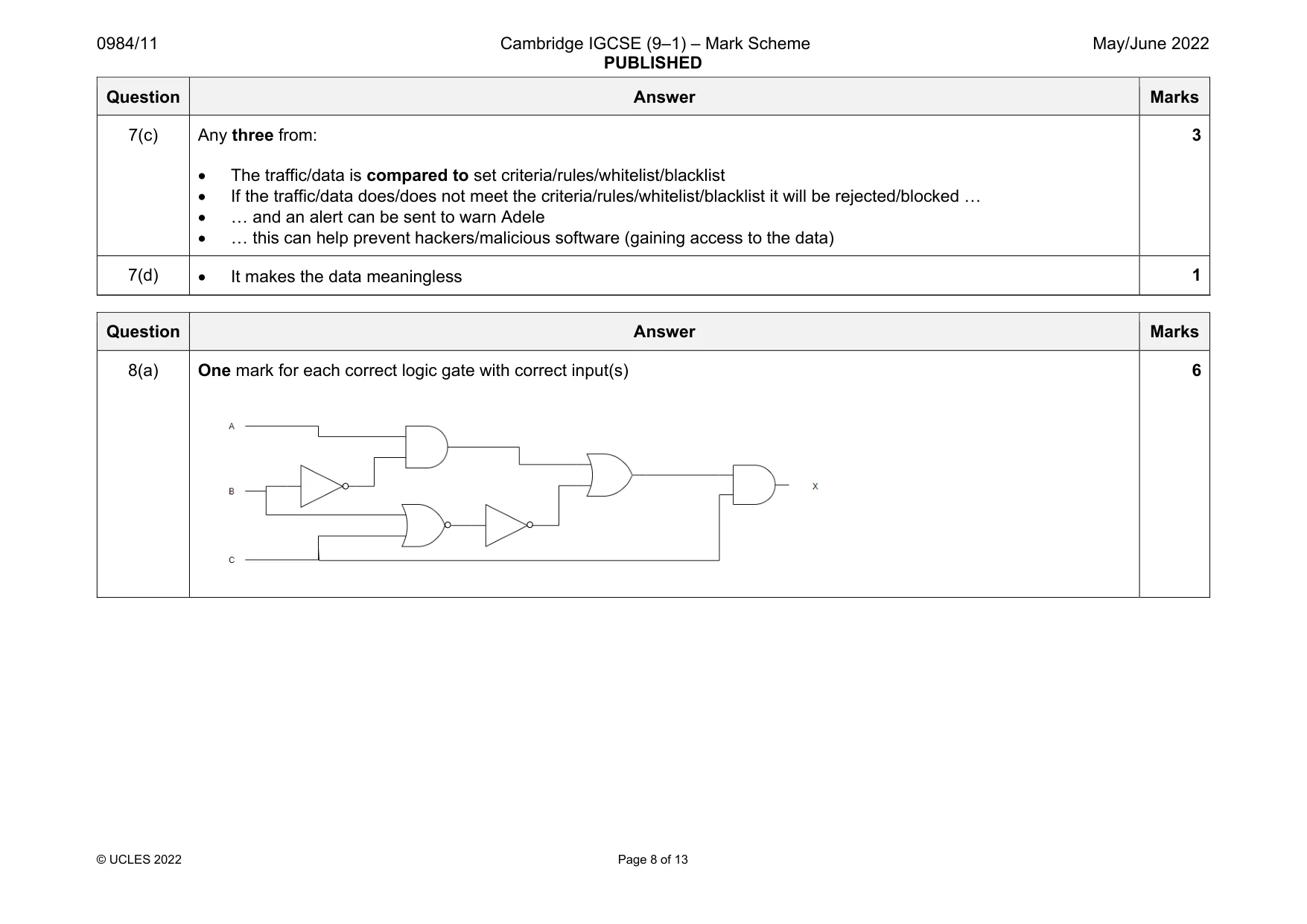
8 0984/11/M/J/22 © UCLES 2022 8 Consider the following logic statement: X = (((A AND NOT B) OR (NOT (B NOR C))) AND C) (a) Draw a logic circuit to represent the given logic statement. Do not attempt to simplify the logic statement. All logic gates must have a maximum of two inputs. X B A C [6]
Question paper, page 9
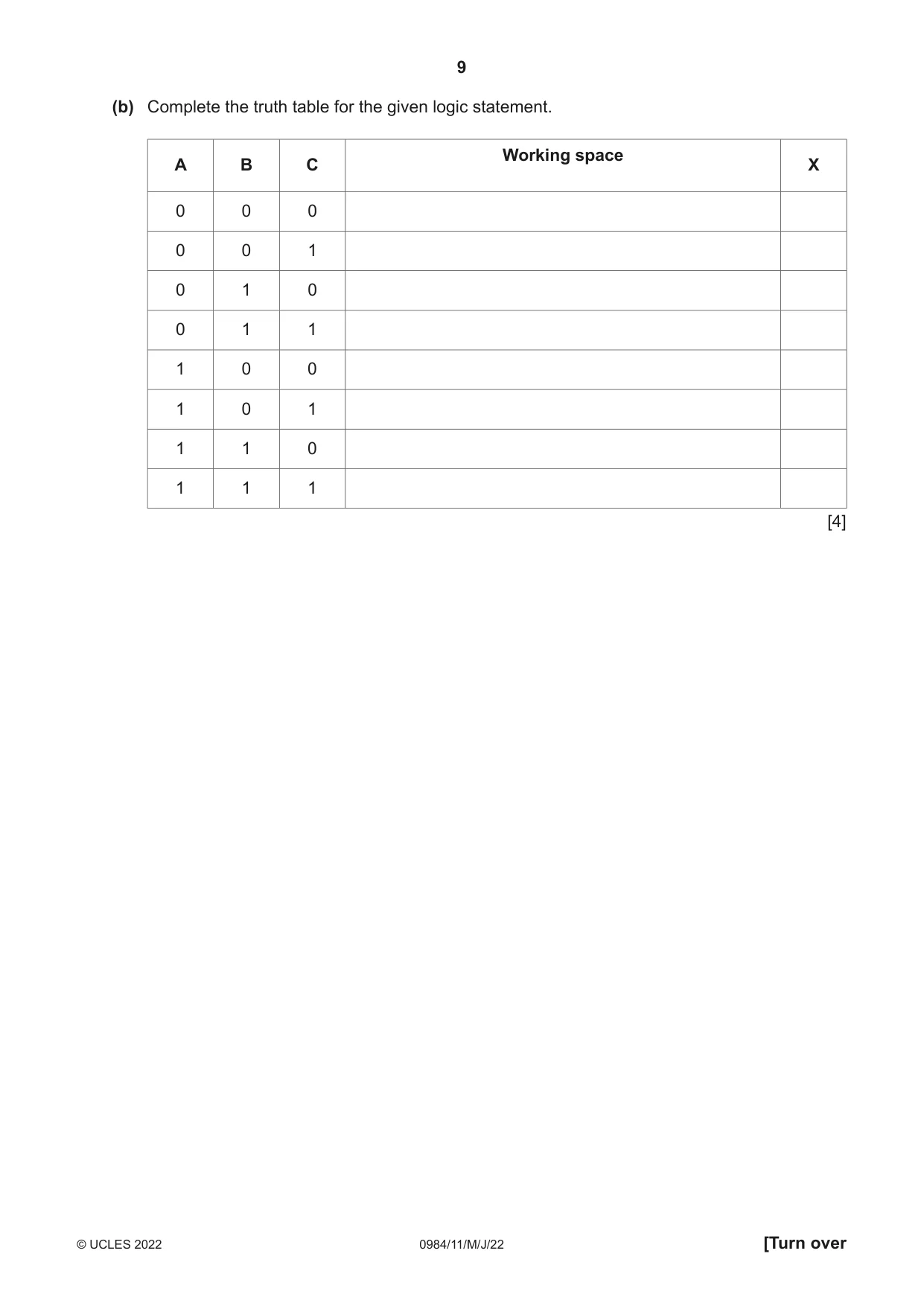
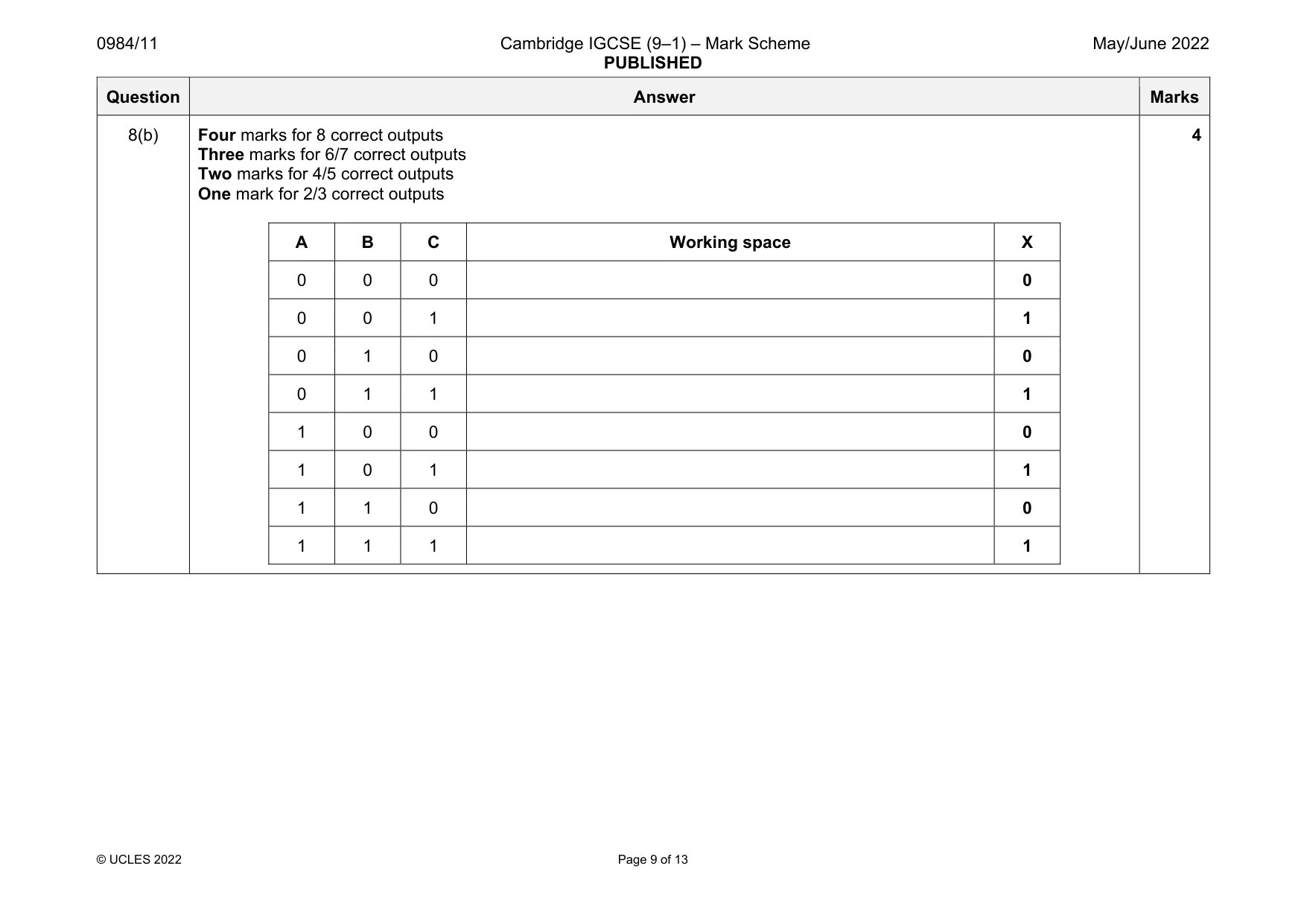
9 0984/11/M/J/22 © UCLES 2022 [Turn over (b) Complete the truth table for the given logic statement. A B C Working space X 0 0 0 0 0 1 0 1 0 0 1 1 1 0 0 1 0 1 1 1 0 1 1 1 [4]
Question paper, page 10
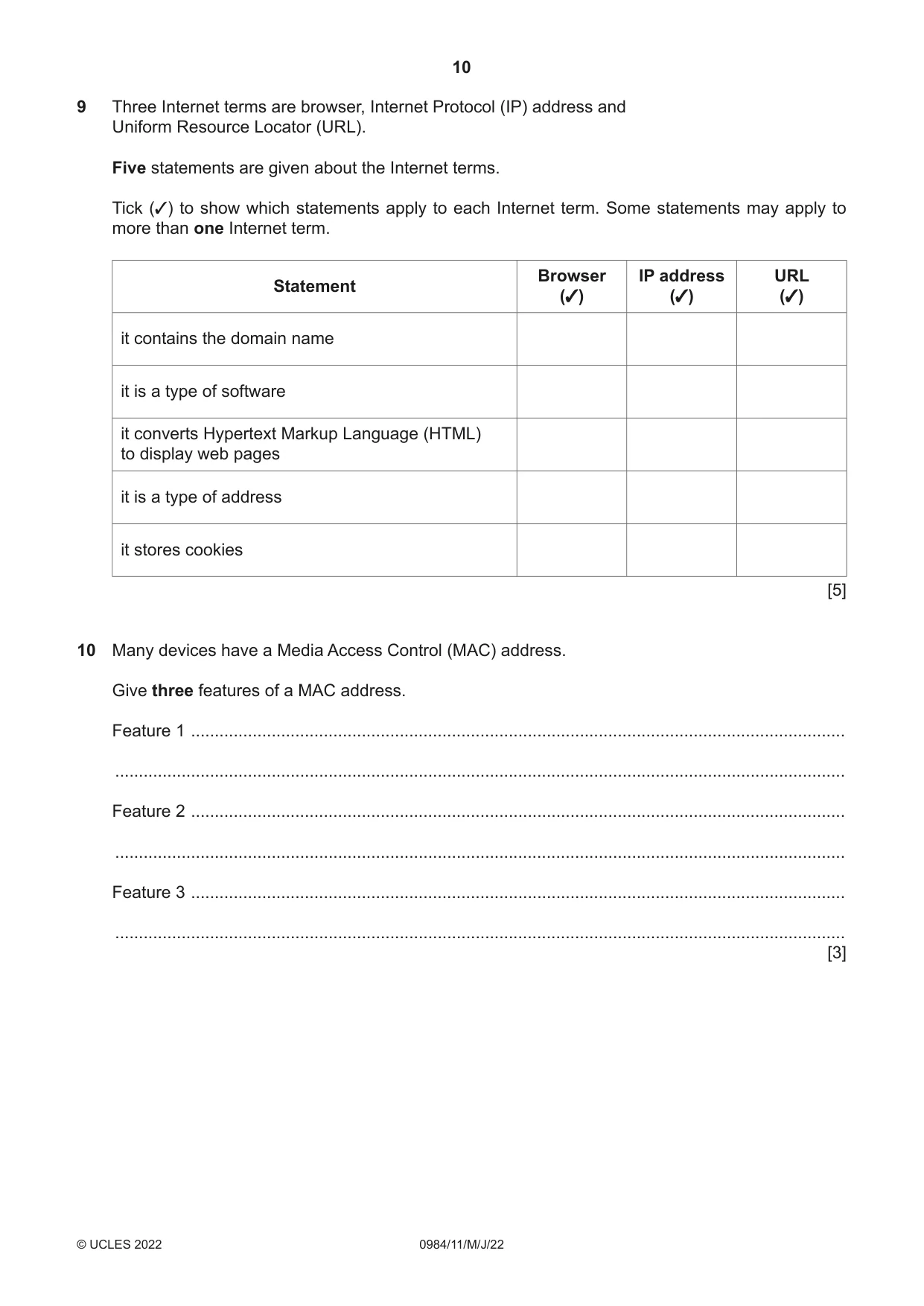
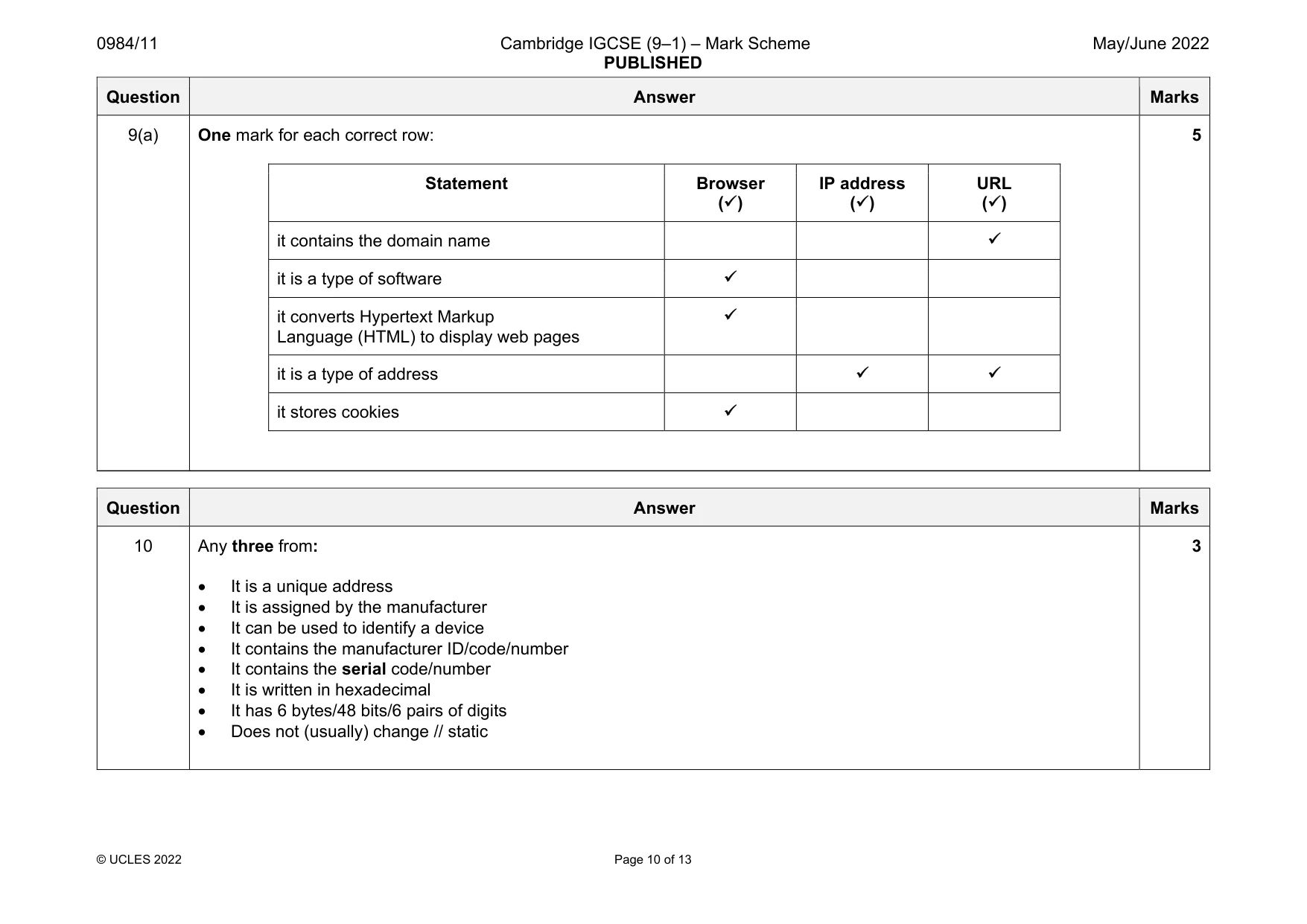
10 0984/11/M/J/22 © UCLES 2022 9 Three Internet terms are browser, Internet Protocol (IP) address and Uniform Resource Locator (URL). Five statements are given about the Internet terms. Tick (3) to show which statements apply to each Internet term. Some statements may apply to more than one Internet term. Statement Browser (3) IP address (3) URL (3) it contains the domain name it is a type of software it converts Hypertext Markup Language (HTML) to display web pages it is a type of address it stores cookies [5] 10 Many devices have a Media Access Control (MAC) address. Give three features of a MAC address. Feature 1 … … Feature 2 … … Feature 3 … … [3]
Question paper, page 11
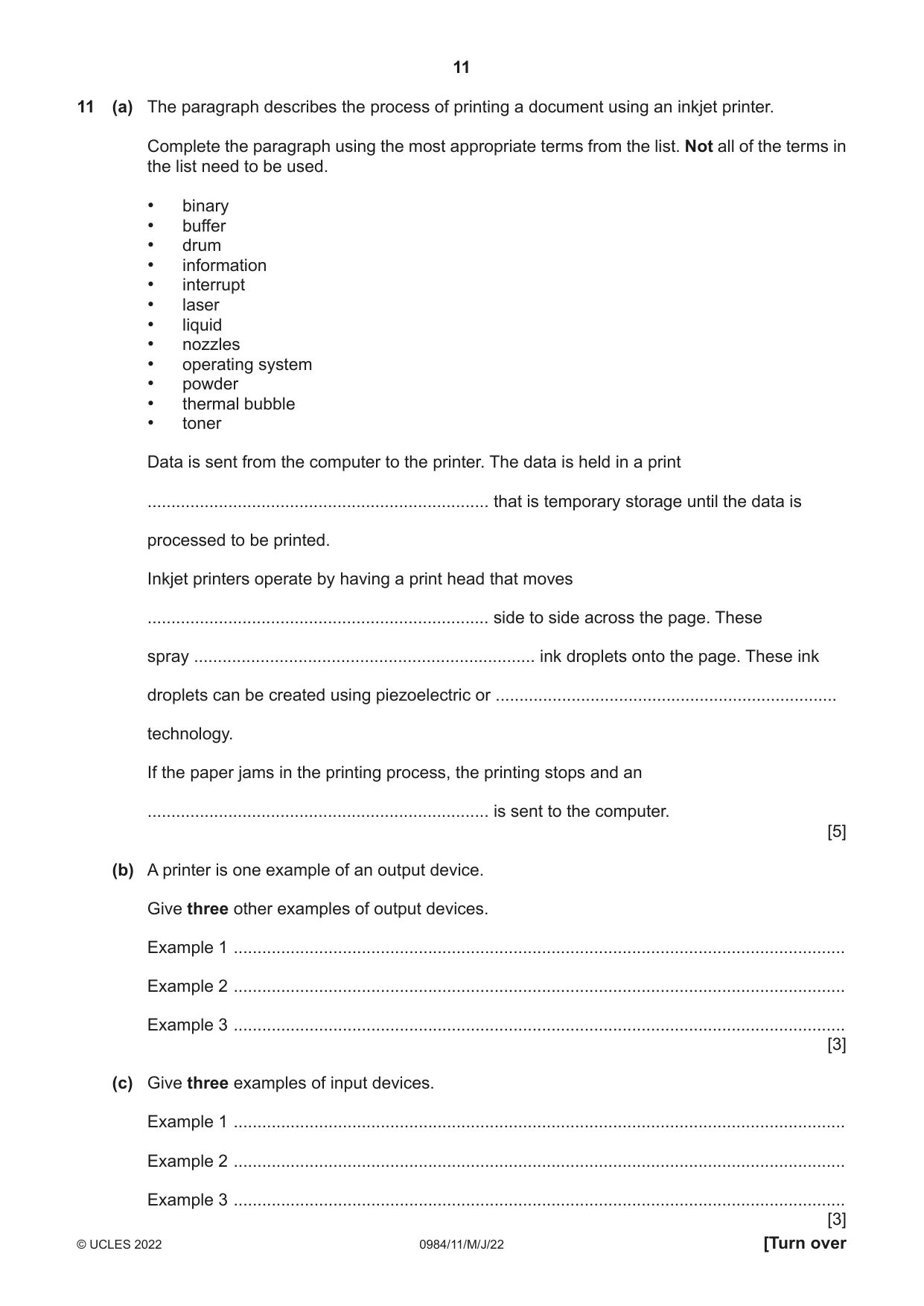
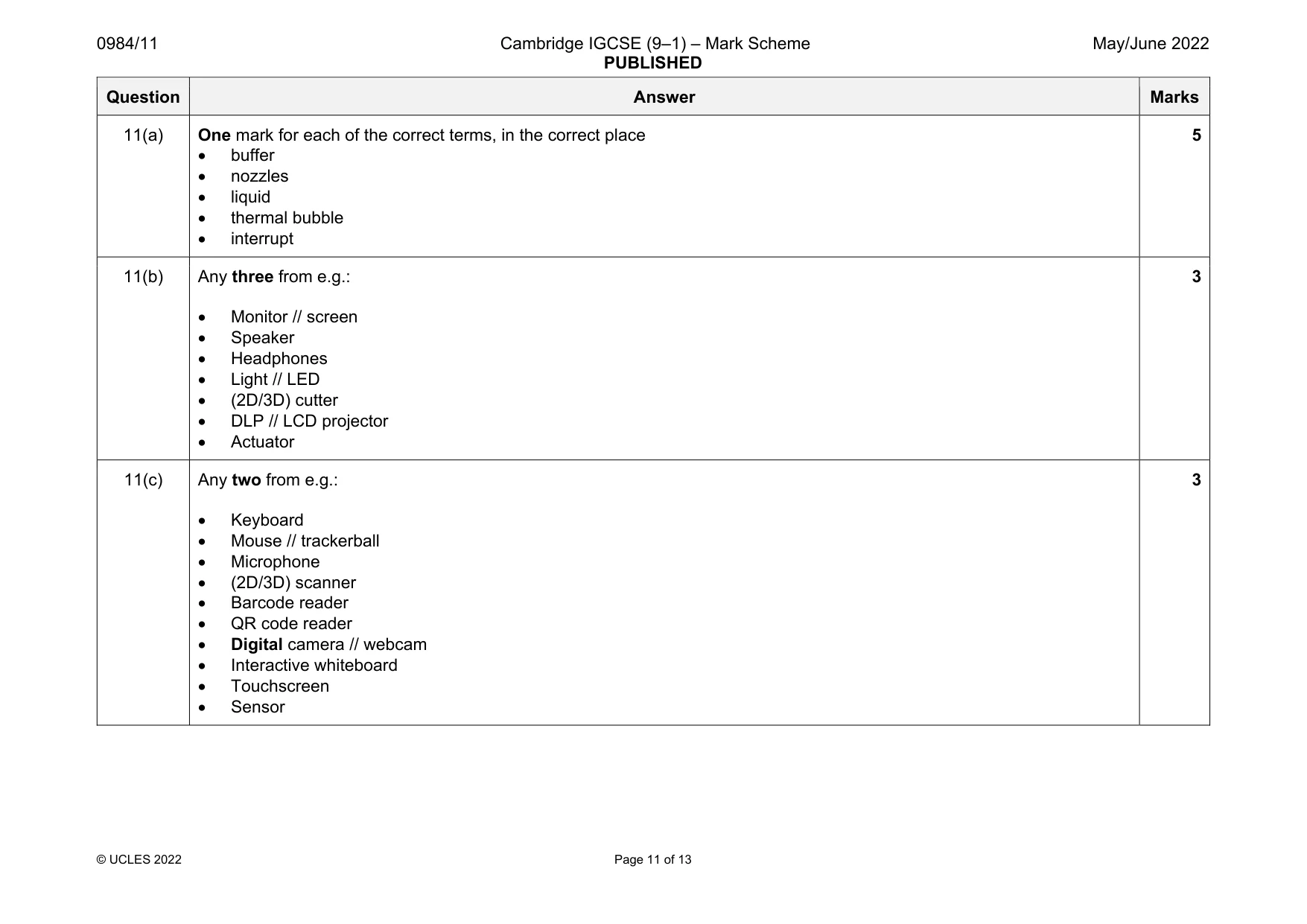
11 0984/11/M/J/22 © UCLES 2022 [Turn over 11 (a) The paragraph describes the process of printing a document using an inkjet printer. Complete the paragraph using the most appropriate terms from the list. Not all of the terms in the list need to be used. • binary • buffer • drum • information • interrupt • laser • liquid • nozzles • operating system • powder • thermal bubble • toner Data is sent from the computer to the printer. The data is held in a print … that is temporary storage until the data is processed to be printed. Inkjet printers operate by having a print head that moves … side to side across the page. These spray … ink droplets onto the page. These ink droplets can be created using piezoelectric or … technology. If the paper jams in the printing process, the printing stops and an … is sent to the computer. [5] (b) A printer is one example of an output device. Give three other examples of output devices. Example 1 … Example 2 … Example 3 … [3] (c) Give three examples of input devices. Example 1 … Example 2 … Example 3 … [3]
Question paper, page 12
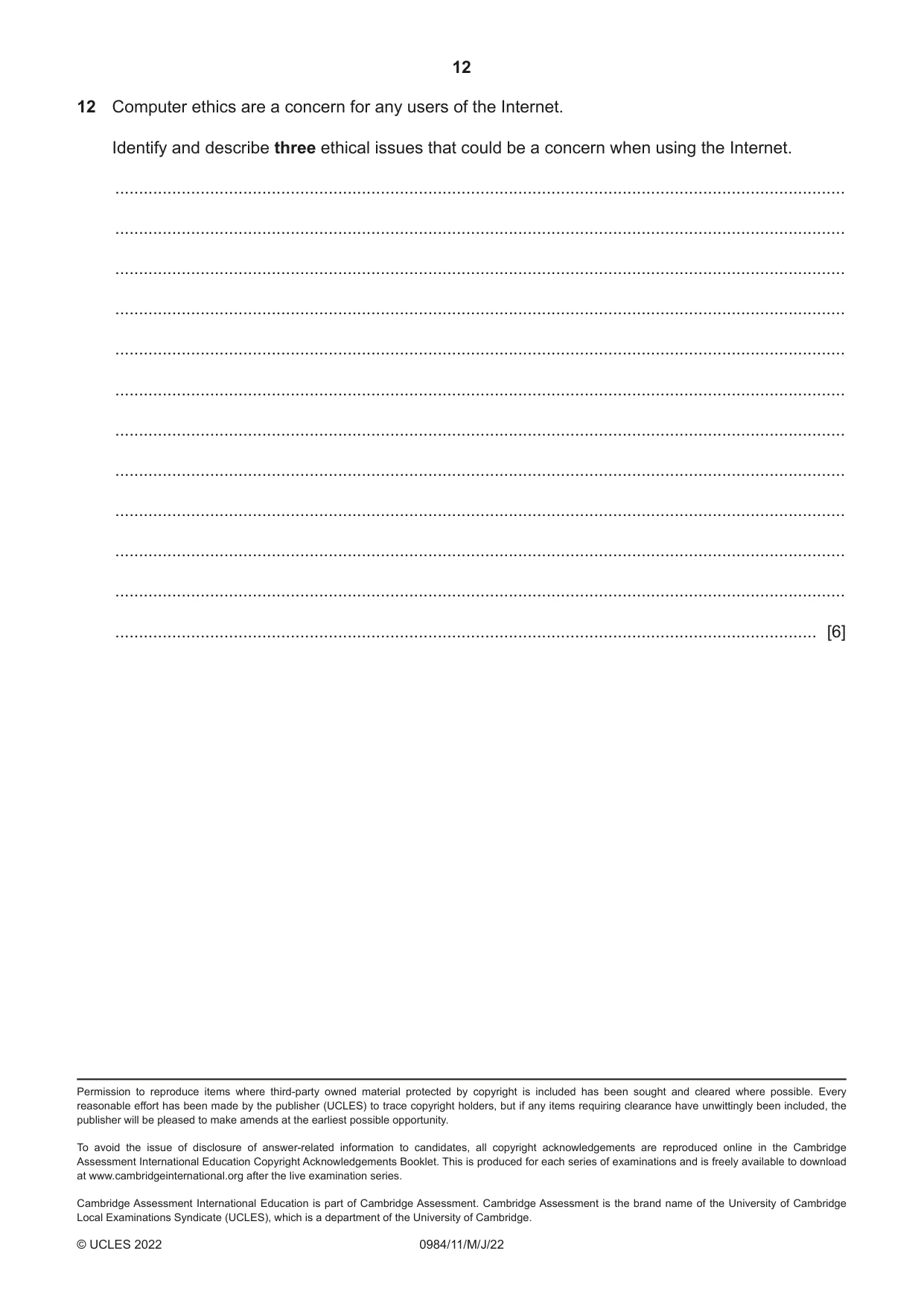
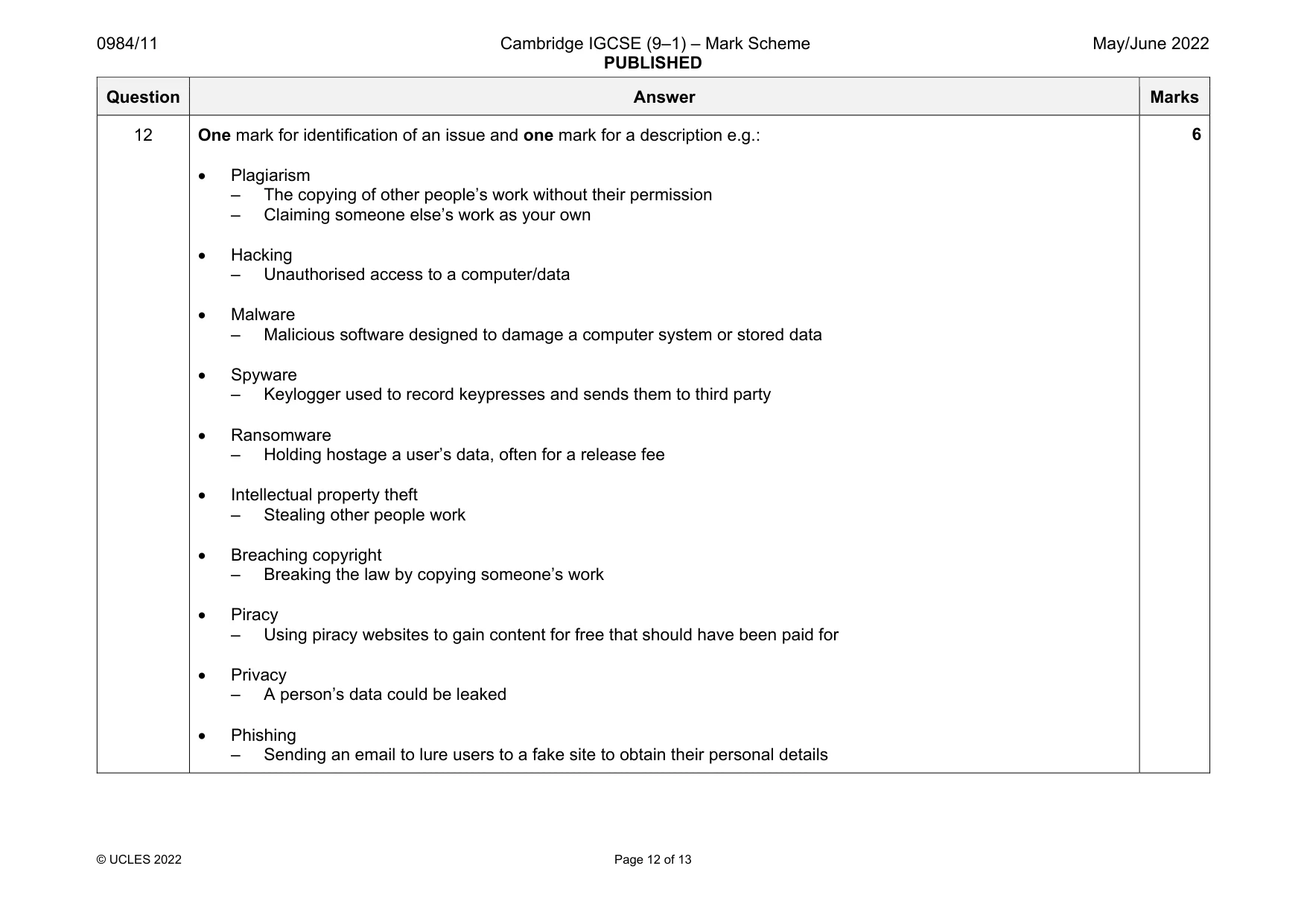
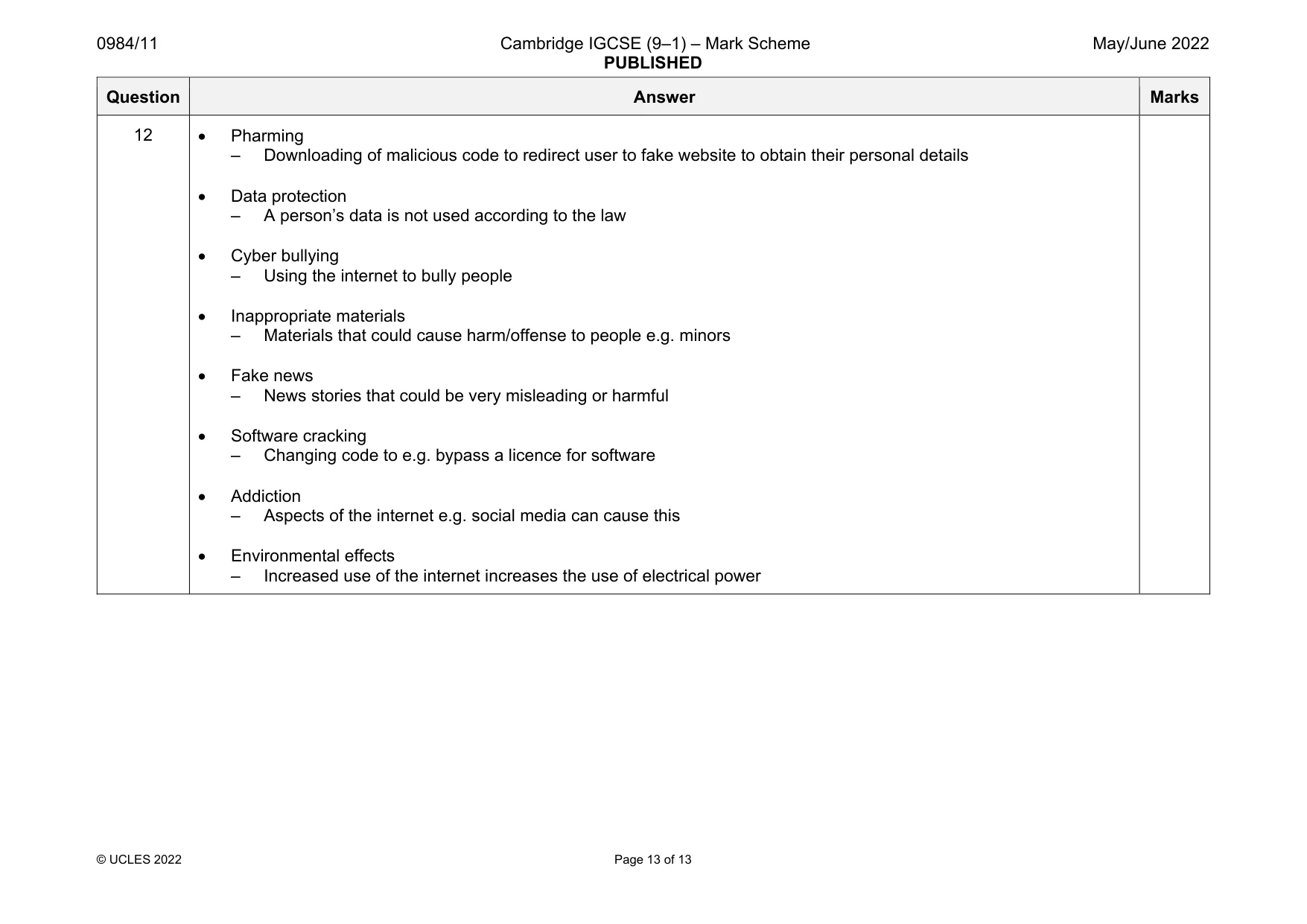
12 0984/11/M/J/22 © UCLES 2022 Permission to reproduce items where third‑party owned material protected by copyright is included has been sought and cleared where possible. Every reasonable effort has been made by the publisher (UCLES) to trace copyright holders, but if any items requiring clearance have unwittingly been included, the publisher will be pleased to make amends at the earliest possible opportunity. To avoid the issue of disclosure of answer‑related information to candidates, all copyright acknowledgements are reproduced online in the Cambridge Assessment International Education Copyright Acknowledgements Booklet. This is produced for each series of examinations and is freely available to download at www.cambridgeinternational.org after the live examination series. Cambridge Assessment International Education is part of Cambridge Assessment. Cambridge Assessment is the brand name of the University of Cambridge Local Examinations Syndicate (UCLES), which is a department of the University of Cambridge. 12 Computer ethics are a concern for any users of the Internet. Identify and describe three ethical issues that could be a concern when using the Internet. … … … … … … … … … … … … [6]
Mark scheme, page 1
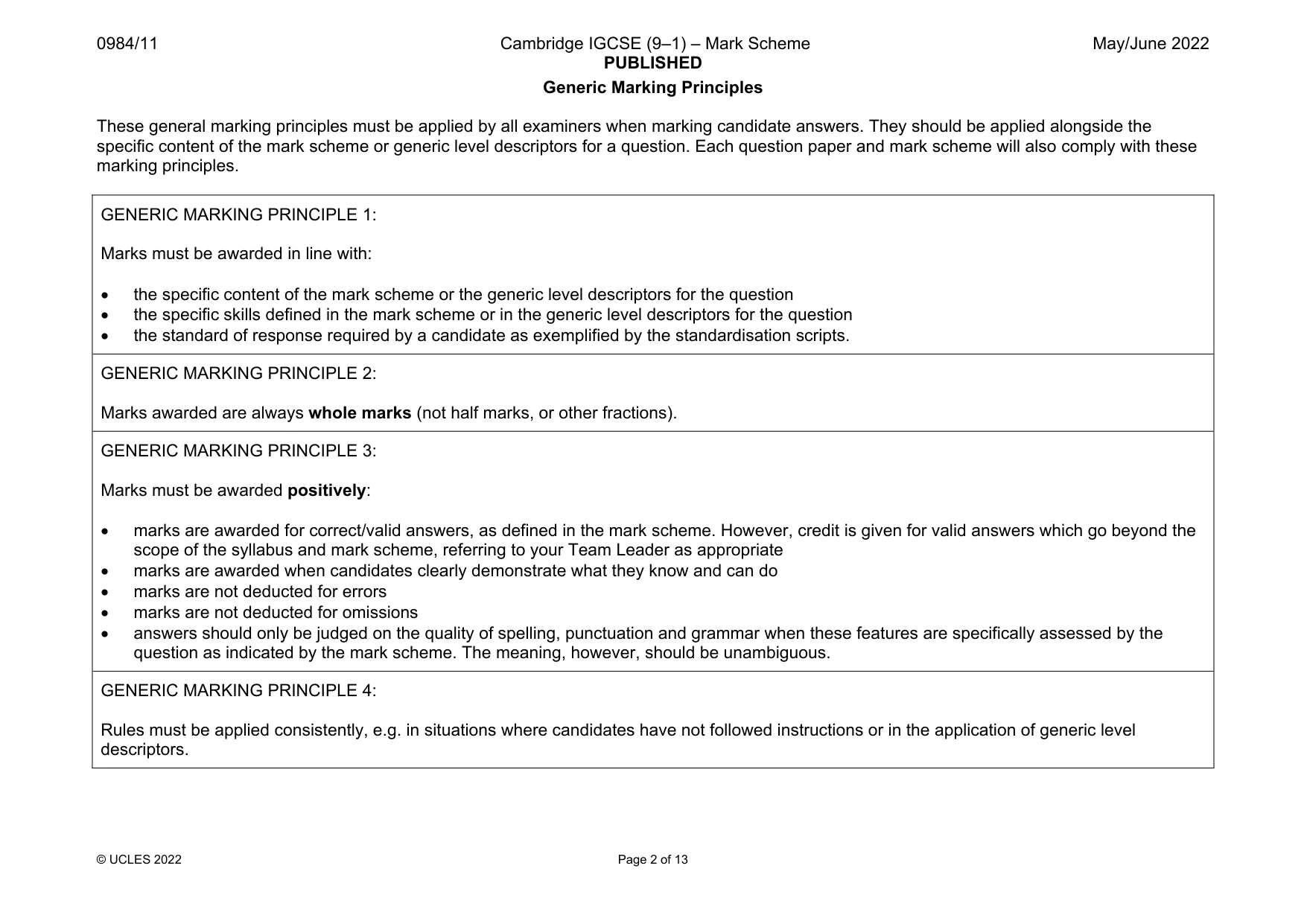
This document consists of 13 printed pages. © UCLES 2022 [Turn over Cambridge IGCSE™ (9–1) COMPUTER SCIENCE 0984/11 Paper 1 Theory May/June 2022 MARK SCHEME Maximum Mark: 75 Published This mark scheme is published as an aid to teachers and candidates, to indicate the requirements of the examination. It shows the basis on which Examiners were instructed to award marks. It does not indicate the details of the discussions that took place at an Examiners’ meeting before marking began, which would have considered the acceptability of alternative answers. Mark schemes should be read in conjunction with the question paper and the Principal Examiner Report for Teachers. Cambridge International will not enter into discussions about these mark schemes. Cambridge International is publishing the mark schemes for the May/June 2022 series for most Cambridge IGCSE, Cambridge International A and AS Level and Cambridge Pre-U components, and some Cambridge O Level components.
Mark scheme, page 2
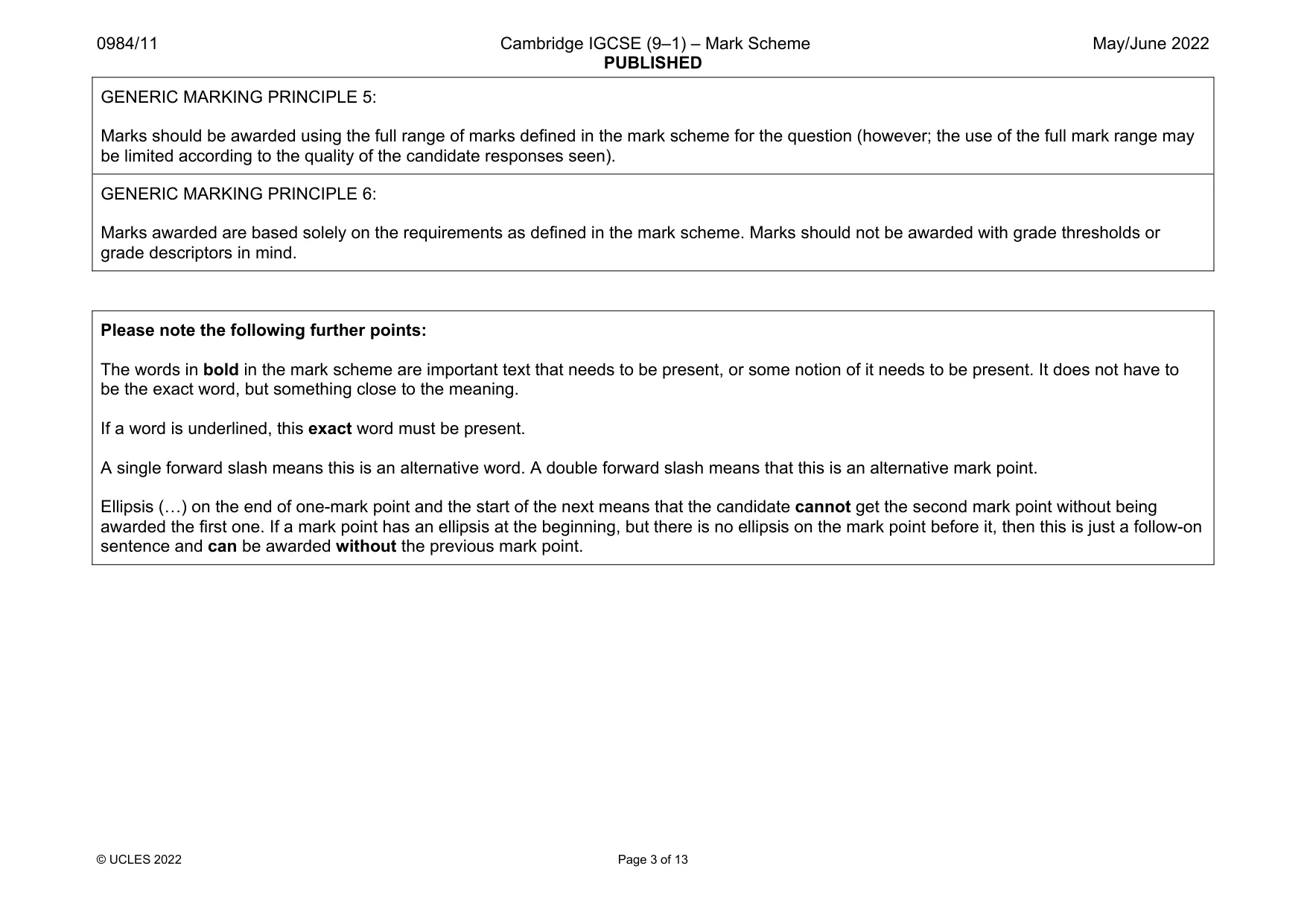
0984/11 Cambridge IGCSE (9–1) – Mark Scheme PUBLISHED May/June 2022 © UCLES 2022 Page 2 of 13 Generic Marking Principles These general marking principles must be applied by all examiners when marking candidate answers. They should be applied alongside the specific content of the mark scheme or generic level descriptors for a question. Each question paper and mark scheme will also comply with these marking principles. GENERIC MARKING PRINCIPLE 1: Marks must be awarded in line with: the specific content of the mark scheme or the generic level descriptors for the question the specific skills defined in the mark scheme or in the generic level descriptors for the question the standard of response required by a candidate as exemplified by the standardisation scripts. GENERIC MARKING PRINCIPLE 2: Marks awarded are always whole marks (not half marks, or other fractions). GENERIC MARKING PRINCIPLE 3: Marks must be awarded positively: marks are awarded for correct/valid answers, as defined in the mark scheme. However, credit is given for valid answers which go beyond the scope of the syllabus and mark scheme, referring to your Team Leader as appropriate marks are awarded when candidates clearly demonstrate what they know and can do marks are not deducted for errors marks are not deducted for omissions answers should only be judged on the quality of spelling, punctuation and grammar when these features are specifically assessed by the question as indicated by the mark scheme. The meaning, however, should be unambiguous. GENERIC MARKING PRINCIPLE 4: Rules must be applied consistently, e.g. in situations where candidates have not followed instructions or in the application of generic level descriptors.
Mark scheme, page 3
0984/11 Cambridge IGCSE (9–1) – Mark Scheme PUBLISHED May/June 2022 © UCLES 2022 Page 3 of 13 GENERIC MARKING PRINCIPLE 5: Marks should be awarded using the full range of marks defined in the mark scheme for the question (however; the use of the full mark range may be limited according to the quality of the candidate responses seen). GENERIC MARKING PRINCIPLE 6: Marks awarded are based solely on the requirements as defined in the mark scheme. Marks should not be awarded with grade thresholds or grade descriptors in mind. Please note the following further points: The words in bold in the mark scheme are important text that needs to be present, or some notion of it needs to be present. It does not have to be the exact word, but something close to the meaning. If a word is underlined, this exact word must be present. A single forward slash means this is an alternative word. A double forward slash means that this is an alternative mark point. Ellipsis (…) on the end of one-mark point and the start of the next means that the candidate cannot get the second mark point without being awarded the first one. If a mark point has an ellipsis at the beginning, but there is no ellipsis on the mark point before it, then this is just a follow-on sentence and can be awarded without the previous mark point.
Mark scheme, page 4
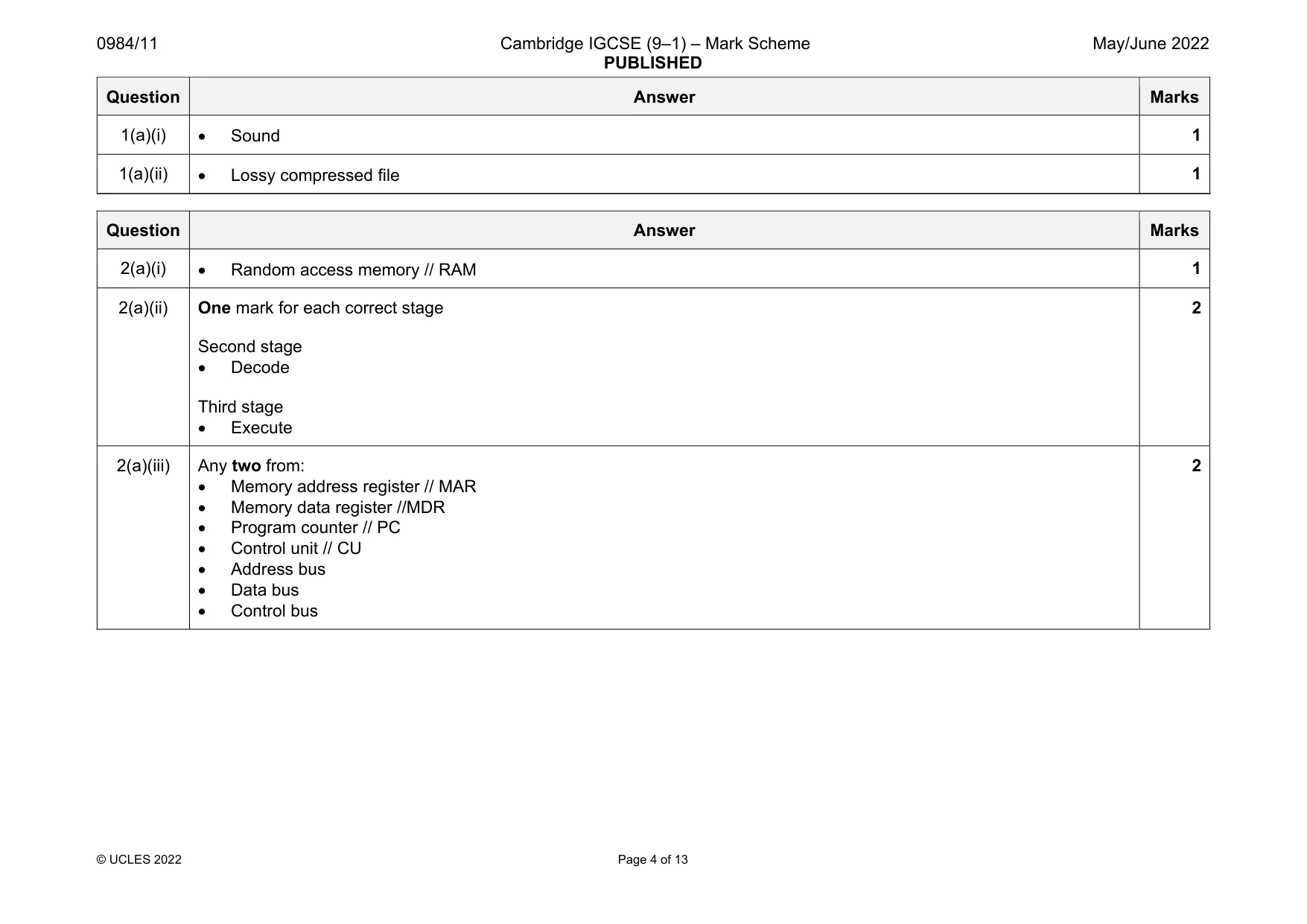
0984/11 Cambridge IGCSE (9–1) – Mark Scheme PUBLISHED May/June 2022 © UCLES 2022 Page 4 of 13 Question Answer Marks 1(a)(i) Sound 1 1(a)(ii) Lossy compressed file 1 Question Answer Marks 2(a)(i) Random access memory // RAM 1 2(a)(ii) One mark for each correct stage Second stage Decode Third stage Execute 2 2(a)(iii) Any two from: Memory address register // MAR Memory data register //MDR Program counter // PC Control unit // CU Address bus Data bus Control bus 2
Mark scheme, page 5
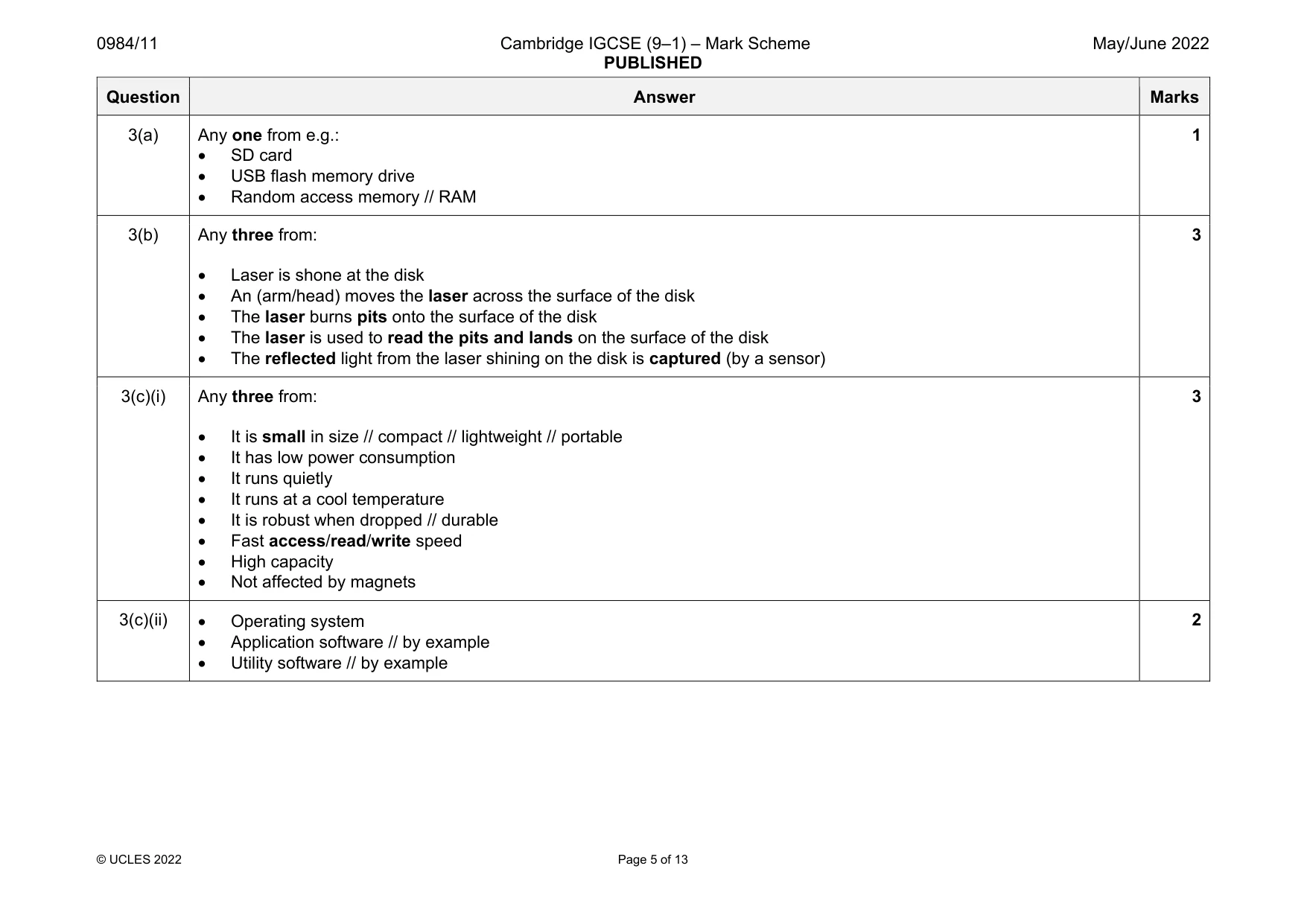
0984/11 Cambridge IGCSE (9–1) – Mark Scheme PUBLISHED May/June 2022 © UCLES 2022 Page 5 of 13 Question Answer Marks 3(a) Any one from e.g.: SD card USB flash memory drive Random access memory // RAM 1 3(b) Any three from: Laser is shone at the disk An (arm/head) moves the laser across the surface of the disk The laser burns pits onto the surface of the disk The laser is used to read the pits and lands on the surface of the disk The reflected light from the laser shining on the disk is captured (by a sensor) 3 3(c)(i) Any three from: It is small in size // compact // lightweight // portable It has low power consumption It runs quietly It runs at a cool temperature It is robust when dropped // durable Fast access/read/write speed High capacity Not affected by magnets 3 3(c)(ii) Operating system Application software // by example Utility software // by example 2
Mark scheme, page 6
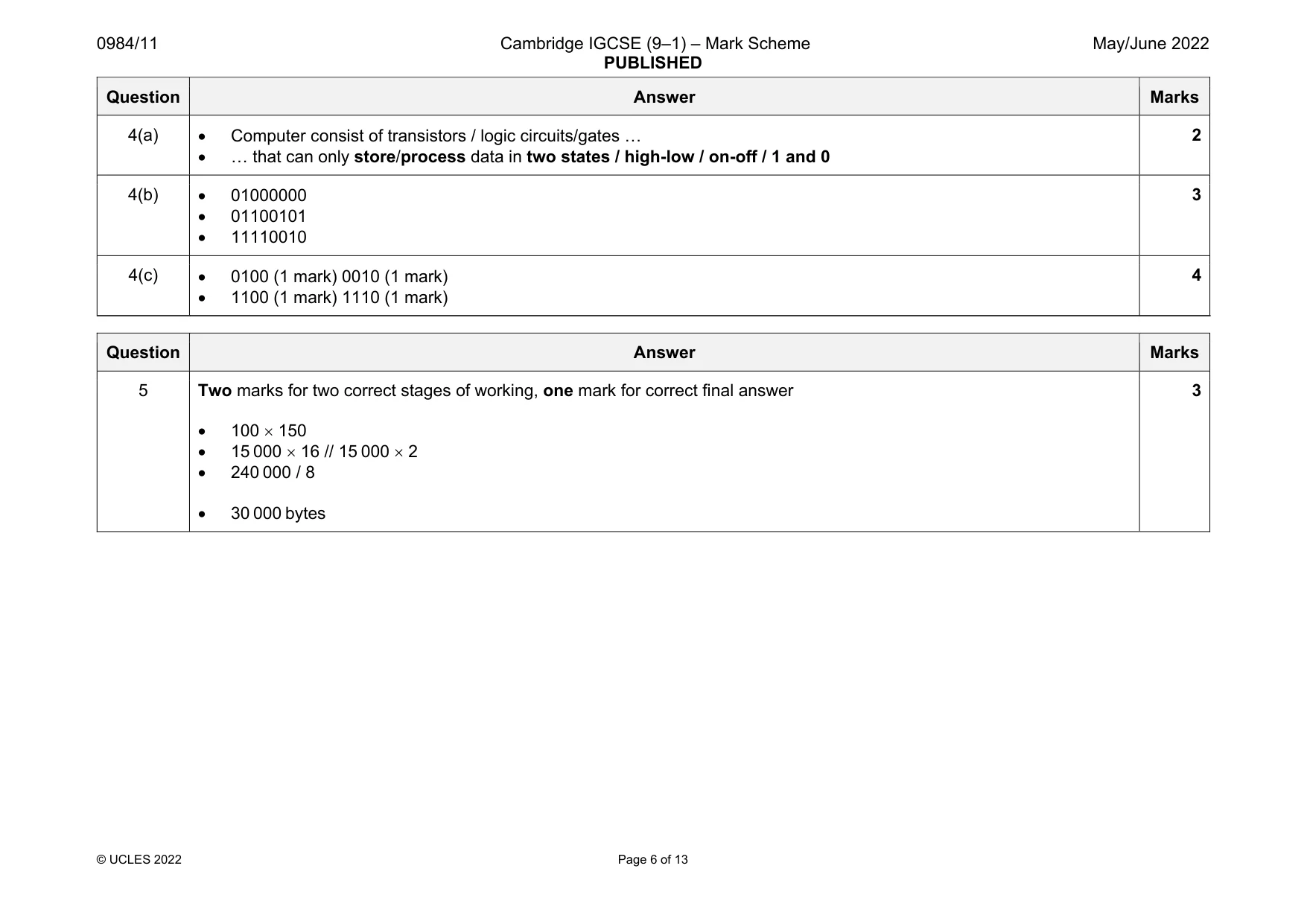
0984/11 Cambridge IGCSE (9–1) – Mark Scheme PUBLISHED May/June 2022 © UCLES 2022 Page 6 of 13 Question Answer Marks 4(a) Computer consist of transistors / logic circuits/gates … … that can only store/process data in two states / high-low / on-off / 1 and 0 2 4(b) 01000000 01100101 11110010 3 4(c) 0100 (1 mark) 0010 (1 mark) 1100 (1 mark) 1110 (1 mark) 4 Question Answer Marks 5 Two marks for two correct stages of working, one mark for correct final answer 100 150 15 000 16 // 15 000 2 240 000 / 8 30 000 bytes 3
Mark scheme, page 7
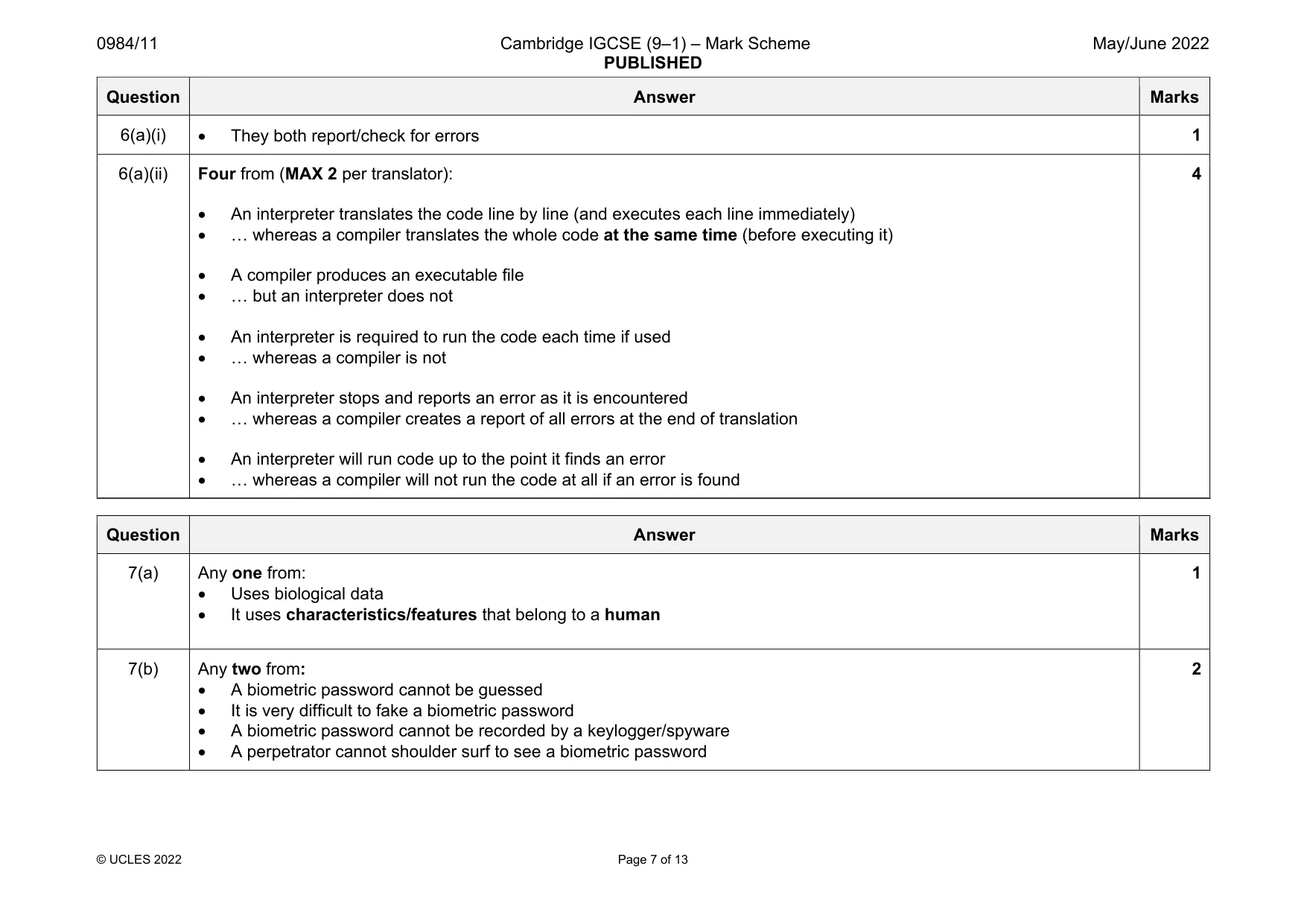
0984/11 Cambridge IGCSE (9–1) – Mark Scheme PUBLISHED May/June 2022 © UCLES 2022 Page 7 of 13 Question Answer Marks 6(a)(i) They both report/check for errors 1 6(a)(ii) Four from (MAX 2 per translator): An interpreter translates the code line by line (and executes each line immediately) … whereas a compiler translates the whole code at the same time (before executing it) A compiler produces an executable file … but an interpreter does not An interpreter is required to run the code each time if used … whereas a compiler is not An interpreter stops and reports an error as it is encountered … whereas a compiler creates a report of all errors at the end of translation An interpreter will run code up to the point it finds an error … whereas a compiler will not run the code at all if an error is found 4 Question Answer Marks 7(a) Any one from: Uses biological data It uses characteristics/features that belong to a human 1 7(b) Any two from: A biometric password cannot be guessed It is very difficult to fake a biometric password A biometric password cannot be recorded by a keylogger/spyware A perpetrator cannot shoulder surf to see a biometric password 2
Mark scheme, page 8
0984/11 Cambridge IGCSE (9–1) – Mark Scheme PUBLISHED May/June 2022 © UCLES 2022 Page 8 of 13 Question Answer Marks 7(c) Any three from: The traffic/data is compared to set criteria/rules/whitelist/blacklist If the traffic/data does/does not meet the criteria/rules/whitelist/blacklist it will be rejected/blocked … … and an alert can be sent to warn Adele … this can help prevent hackers/malicious software (gaining access to the data) 3 7(d) It makes the data meaningless 1 Question Answer Marks 8(a) One mark for each correct logic gate with correct input(s) 6
Mark scheme, page 9
0984/11 Cambridge IGCSE (9–1) – Mark Scheme PUBLISHED May/June 2022 © UCLES 2022 Page 9 of 13 Question Answer Marks 8(b) Four marks for 8 correct outputs Three marks for 6/7 correct outputs Two marks for 4/5 correct outputs One mark for 2/3 correct outputs A B C Working space X 0 0 0 0 0 0 1 1 0 1 0 0 0 1 1 1 1 0 0 0 1 0 1 1 1 1 0 0 1 1 1 1 4
Mark scheme, page 10
0984/11 Cambridge IGCSE (9–1) – Mark Scheme PUBLISHED May/June 2022 © UCLES 2022 Page 10 of 13 Question Answer Marks 9(a) One mark for each correct row: Statement Browser () IP address () URL () it contains the domain name it is a type of software it converts Hypertext Markup Language (HTML) to display web pages it is a type of address it stores cookies 5 Question Answer Marks 10 Any three from: It is a unique address It is assigned by the manufacturer It can be used to identify a device It contains the manufacturer ID/code/number It contains the serial code/number It is written in hexadecimal It has 6 bytes/48 bits/6 pairs of digits Does not (usually) change // static 3
Mark scheme, page 11
0984/11 Cambridge IGCSE (9–1) – Mark Scheme PUBLISHED May/June 2022 © UCLES 2022 Page 11 of 13 Question Answer Marks 11(a) One mark for each of the correct terms, in the correct place buffer nozzles liquid thermal bubble interrupt 5 11(b) Any three from e.g.: Monitor // screen Speaker Headphones Light // LED (2D/3D) cutter DLP // LCD projector Actuator 3 11(c) Any two from e.g.: Keyboard Mouse // trackerball Microphone (2D/3D) scanner Barcode reader QR code reader Digital camera // webcam Interactive whiteboard Touchscreen Sensor 3
Mark scheme, page 12
0984/11 Cambridge IGCSE (9–1) – Mark Scheme PUBLISHED May/June 2022 © UCLES 2022 Page 12 of 13 Question Answer Marks 12 One mark for identification of an issue and one mark for a description e.g.: Plagiarism – The copying of other people’s work without their permission – Claiming someone else’s work as your own Hacking – Unauthorised access to a computer/data Malware – Malicious software designed to damage a computer system or stored data Spyware – Keylogger used to record keypresses and sends them to third party Ransomware – Holding hostage a user’s data, often for a release fee Intellectual property theft – Stealing other people work Breaching copyright – Breaking the law by copying someone’s work Piracy – Using piracy websites to gain content for free that should have been paid for Privacy – A person’s data could be leaked Phishing – Sending an email to lure users to a fake site to obtain their personal details 6
Mark scheme, page 13
0984/11 Cambridge IGCSE (9–1) – Mark Scheme PUBLISHED May/June 2022 © UCLES 2022 Page 13 of 13 Question Answer Marks 12 Pharming – Downloading of malicious code to redirect user to fake website to obtain their personal details Data protection – A person’s data is not used according to the law Cyber bullying – Using the internet to bully people Inappropriate materials – Materials that could cause harm/offense to people e.g. minors Fake news – News stories that could be very misleading or harmful Software cracking – Changing code to e.g. bypass a licence for software Addiction – Aspects of the internet e.g. social media can cause this Environmental effects – Increased use of the internet increases the use of electrical power
What you needed in this session
Cambridge’s own grade thresholds for 2022 May/June, Paper 1 · Variant 1. A higher threshold means an easier paper — the bar moves with how the cohort did.