Cambridge IGCSE Computer Science (9-1) 0984 — 2024 May/June Paper 1 · Variant 1
0984/11/M/J/24 · 75 marks · ≈84 min
The question paper and its mark scheme, free to read here and free to download. This is Cambridge’s own paper, exactly as it was sat.
Question paper12 pages



Mark scheme12 pages
Answers below. Sit the paper first if you are practising.

Paper as text
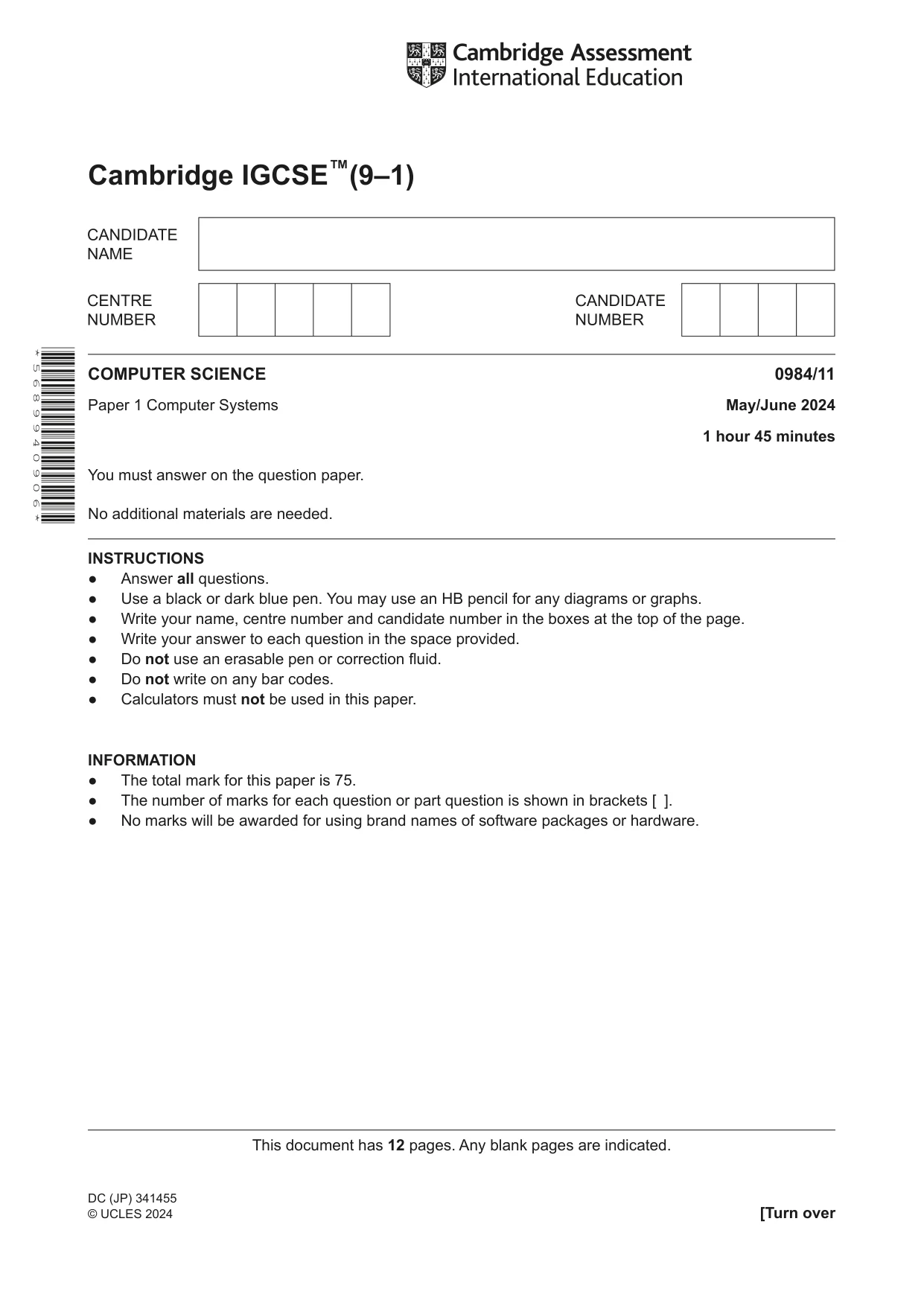
Question paper, page 1
This document has 12 pages. Any blank pages are indicated. [Turn over Cambridge IGCSE™(9–1) COMPUTER SCIENCE 0984/11 Paper 1 Computer Systems May/June 2024 1 hour 45 minutes You must answer on the question paper. No additional materials are needed. INSTRUCTIONS ● Answer all questions. ● Use a black or dark blue pen. You may use an HB pencil for any diagrams or graphs. ● Write your name, centre number and candidate number in the boxes at the top of the page. ● Write your answer to each question in the space provided. ● Do not use an erasable pen or correction fluid. ● Do not write on any bar codes. ● Calculators must not be used in this paper. INFORMATION ● The total mark for this paper is 75. ● The number of marks for each question or part question is shown in brackets [ ]. ● No marks will be awarded for using brand names of software packages or hardware. * 5 6 8 9 9 4 0 9 0 6 * DC (JP) 341455 © UCLES 2024
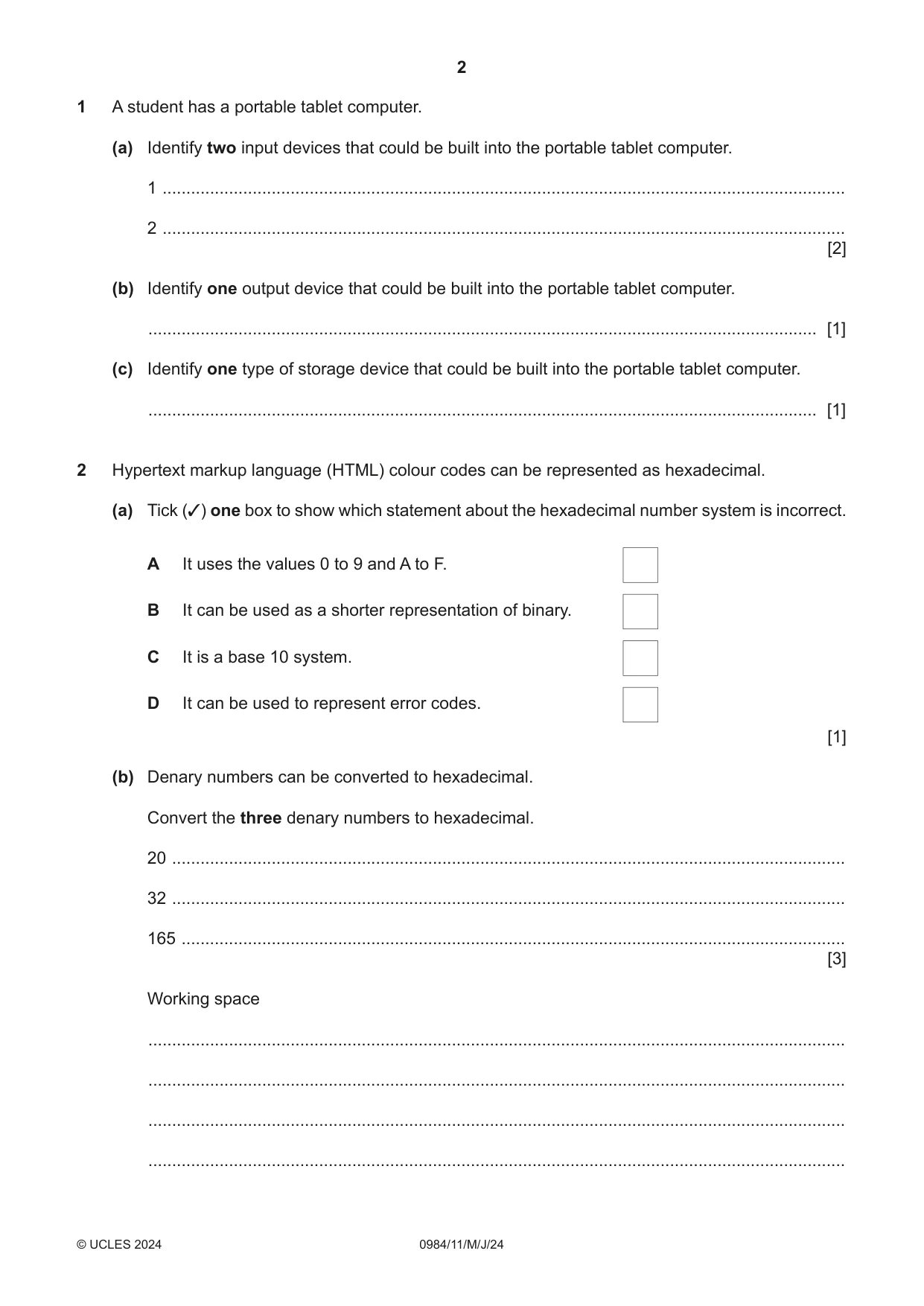
Question paper, page 2
2 0984/11/M/J/24 © UCLES 2024 1 A student has a portable tablet computer. (a) Identify two input devices that could be built into the portable tablet computer. 1 … 2 … [2] (b) Identify one output device that could be built into the portable tablet computer. … [1] (c) Identify one type of storage device that could be built into the portable tablet computer. … [1] 2 Hypertext markup language (HTML) colour codes can be represented as hexadecimal. (a) Tick (3) one box to show which statement about the hexadecimal number system is incorrect. A It uses the values 0 to 9 and A to F. B It can be used as a shorter representation of binary. C It is a base 10 system. D It can be used to represent error codes. [1] (b) Denary numbers can be converted to hexadecimal. Convert the three denary numbers to hexadecimal. 20 … 32 … 165 … [3] Working space … … … …
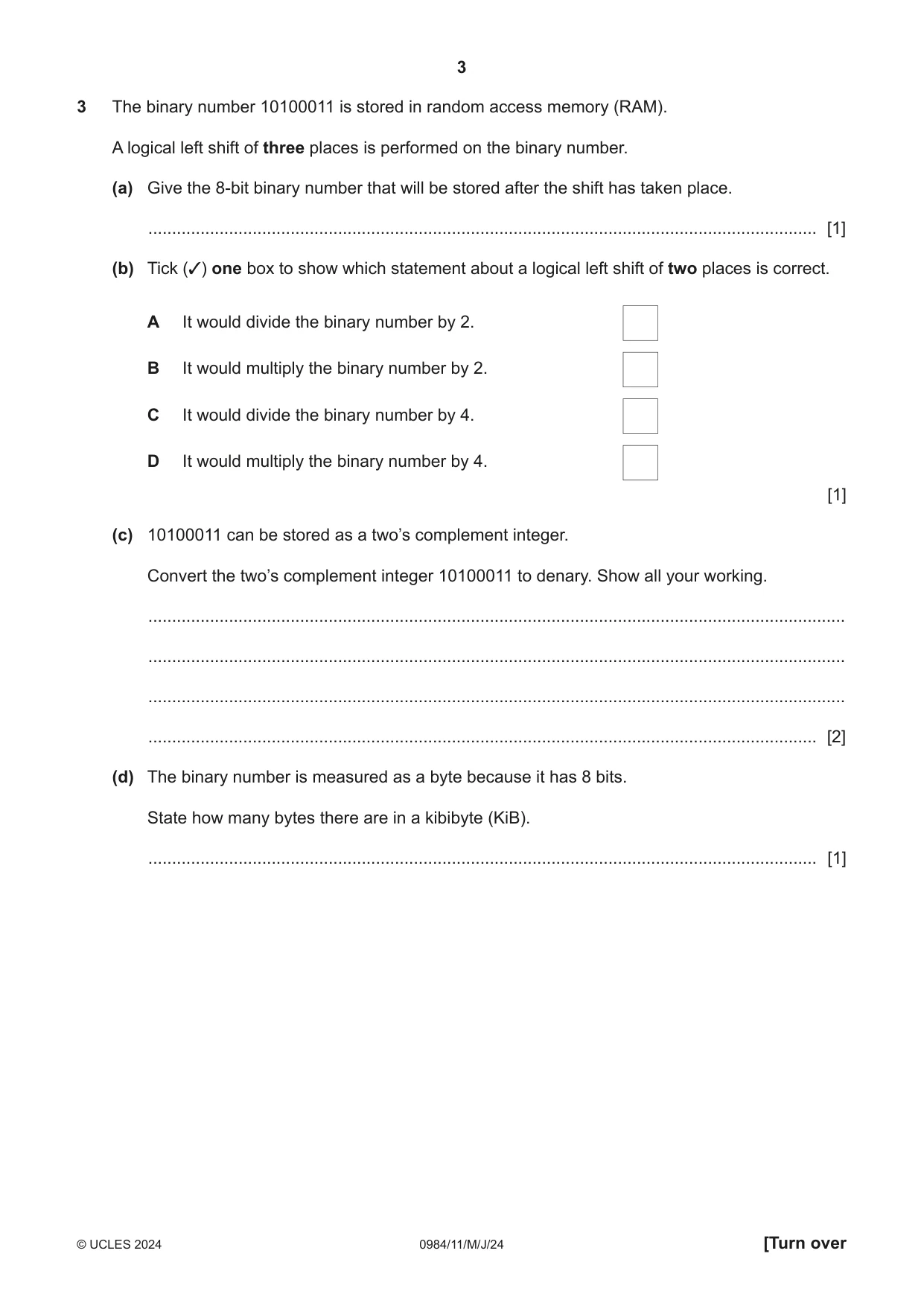
Question paper, page 3
3 0984/11/M/J/24 © UCLES 2024 [Turn over 3 The binary number 10100011 is stored in random access memory (RAM). A logical left shift of three places is performed on the binary number. (a) Give the 8-bit binary number that will be stored after the shift has taken place. … [1] (b) Tick (3) one box to show which statement about a logical left shift of two places is correct. A It would divide the binary number by 2. B It would multiply the binary number by 2. C It would divide the binary number by 4. D It would multiply the binary number by 4. [1] (c) 10100011 can be stored as a two’s complement integer. Convert the two’s complement integer 10100011 to denary. Show all your working. … … … … [2] (d) The binary number is measured as a byte because it has 8 bits. State how many bytes there are in a kibibyte (KiB). … [1]
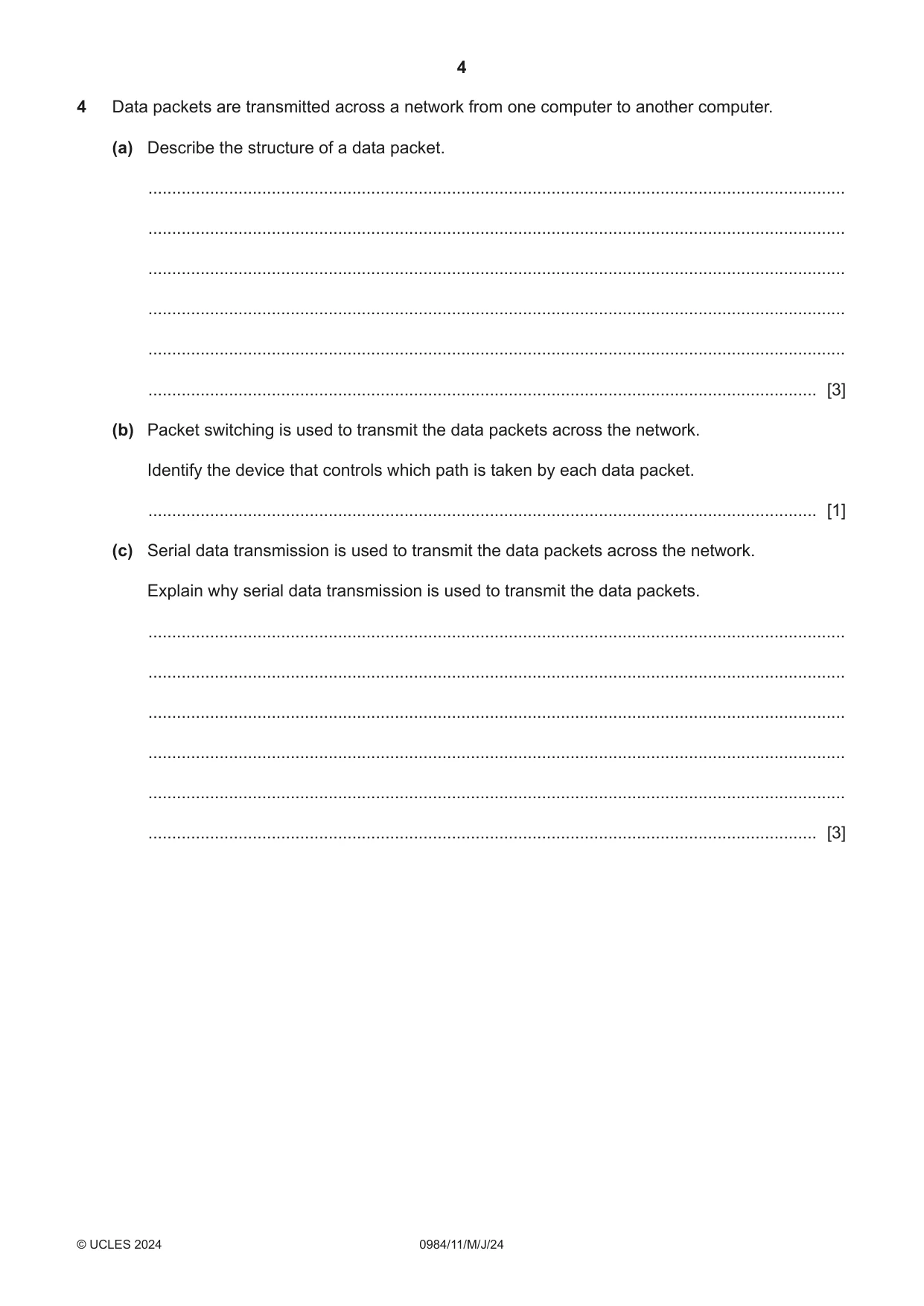
Question paper, page 4
4 0984/11/M/J/24 © UCLES 2024 4 Data packets are transmitted across a network from one computer to another computer. (a) Describe the structure of a data packet. … … … … … … [3] (b) Packet switching is used to transmit the data packets across the network. Identify the device that controls which path is taken by each data packet. … [1] (c) Serial data transmission is used to transmit the data packets across the network. Explain why serial data transmission is used to transmit the data packets. … … … … … … [3]
Question paper, page 5
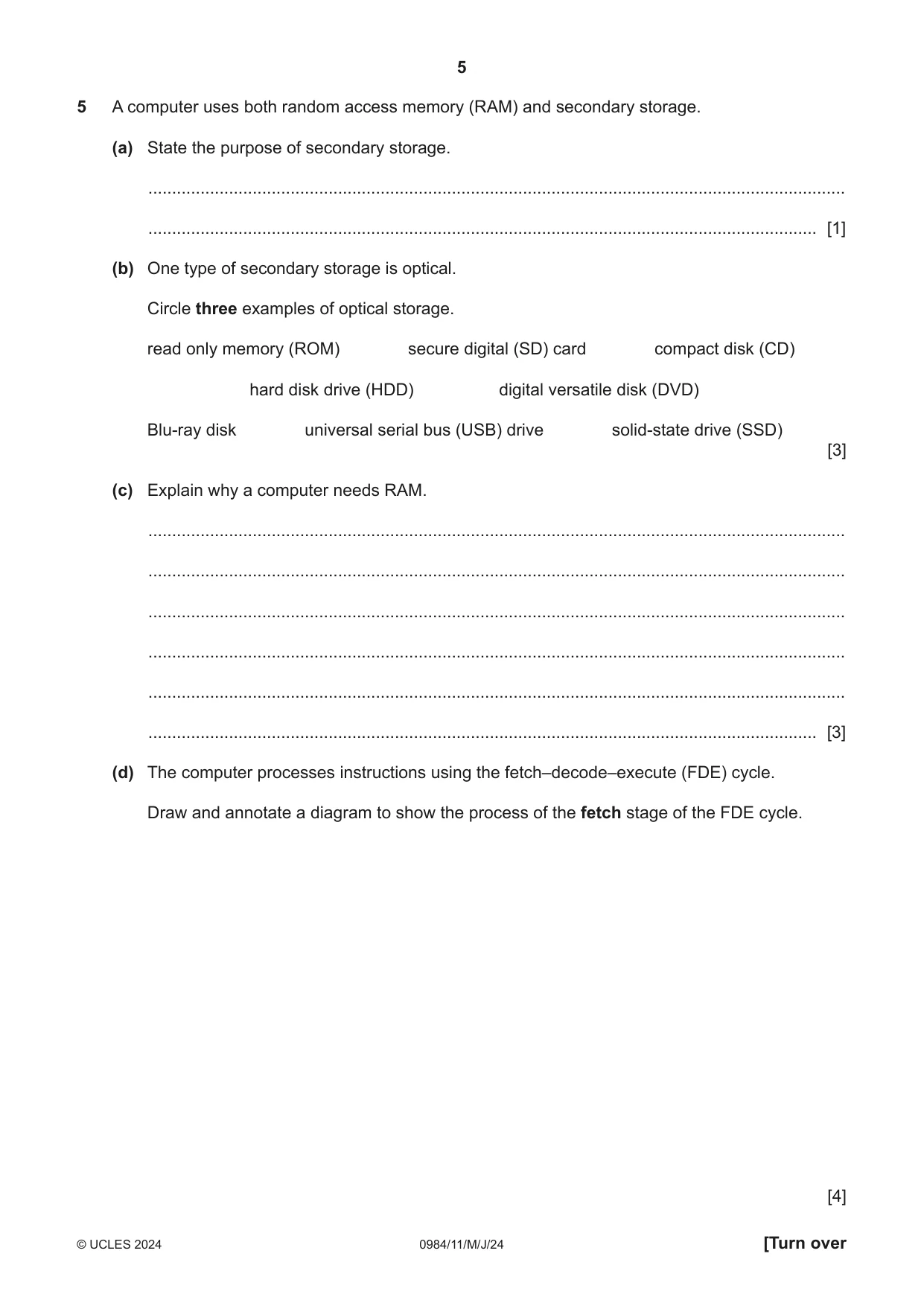
5 0984/11/M/J/24 © UCLES 2024 [Turn over 5 A computer uses both random access memory (RAM) and secondary storage. (a) State the purpose of secondary storage. … … [1] (b) One type of secondary storage is optical. Circle three examples of optical storage. read only memory (ROM) secure digital (SD) card compact disk (CD) hard disk drive (HDD) digital versatile disk (DVD) Blu-ray disk universal serial bus (USB) drive solid-state drive (SSD) [3] (c) Explain why a computer needs RAM. … … … … … … [3] (d) The computer processes instructions using the fetch–decode–execute (FDE) cycle. Draw and annotate a diagram to show the process of the fetch stage of the FDE cycle. [4]
Question paper, page 6
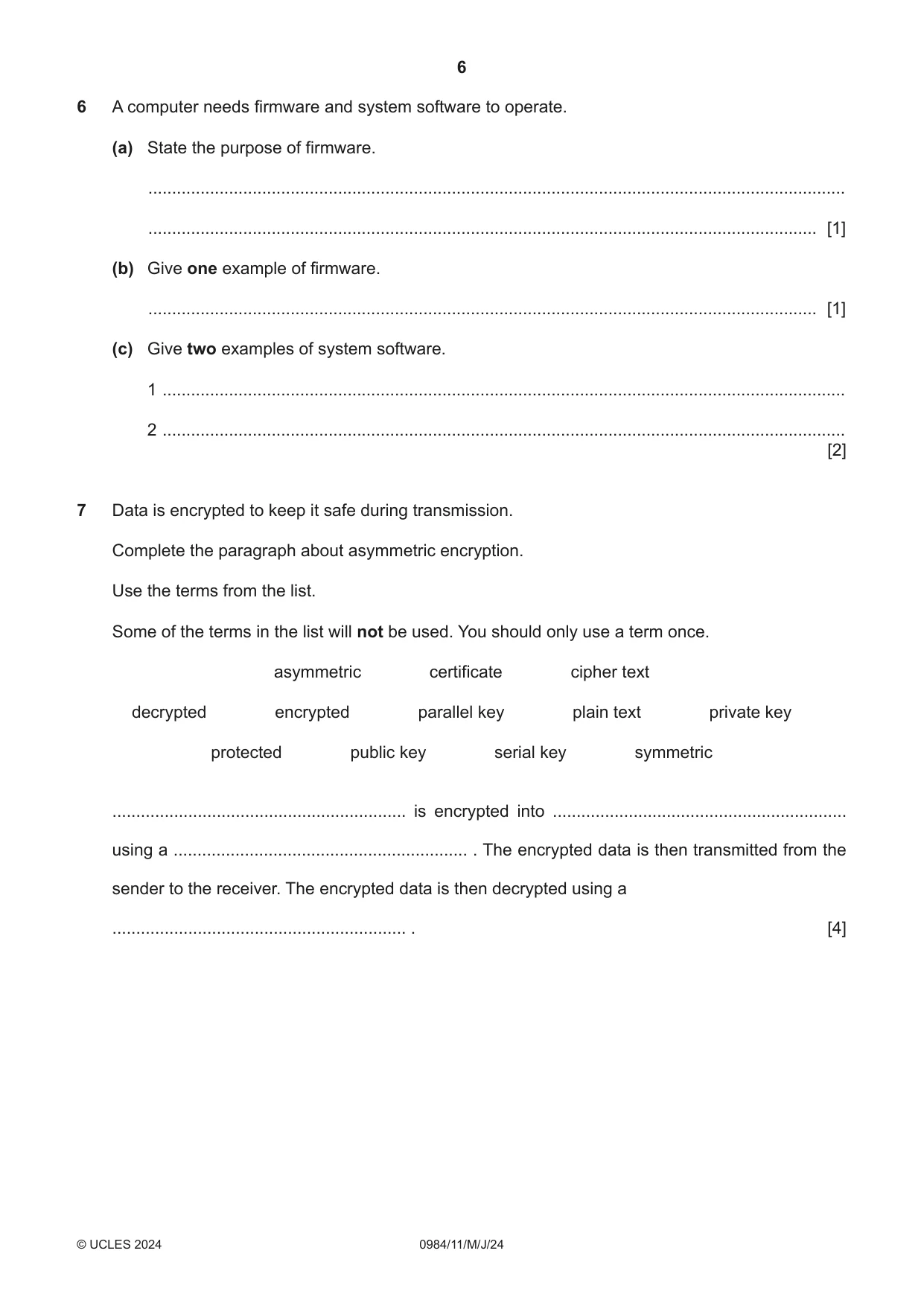
6 0984/11/M/J/24 © UCLES 2024 6 A computer needs firmware and system software to operate. (a) State the purpose of firmware. … … [1] (b) Give one example of firmware. … [1] (c) Give two examples of system software. 1 … 2 … [2] 7 Data is encrypted to keep it safe during transmission. Complete the paragraph about asymmetric encryption. Use the terms from the list. Some of the terms in the list will not be used. You should only use a term once. asymmetric certificate cipher text decrypted encrypted parallel key plain text private key protected public key serial key symmetric … is encrypted into … using a … . The encrypted data is then transmitted from the sender to the receiver. The encrypted data is then decrypted using a … . [4]
Question paper, page 7
7 0984/11/M/J/24 © UCLES 2024 [Turn over BLANK PAGE
Question paper, page 8
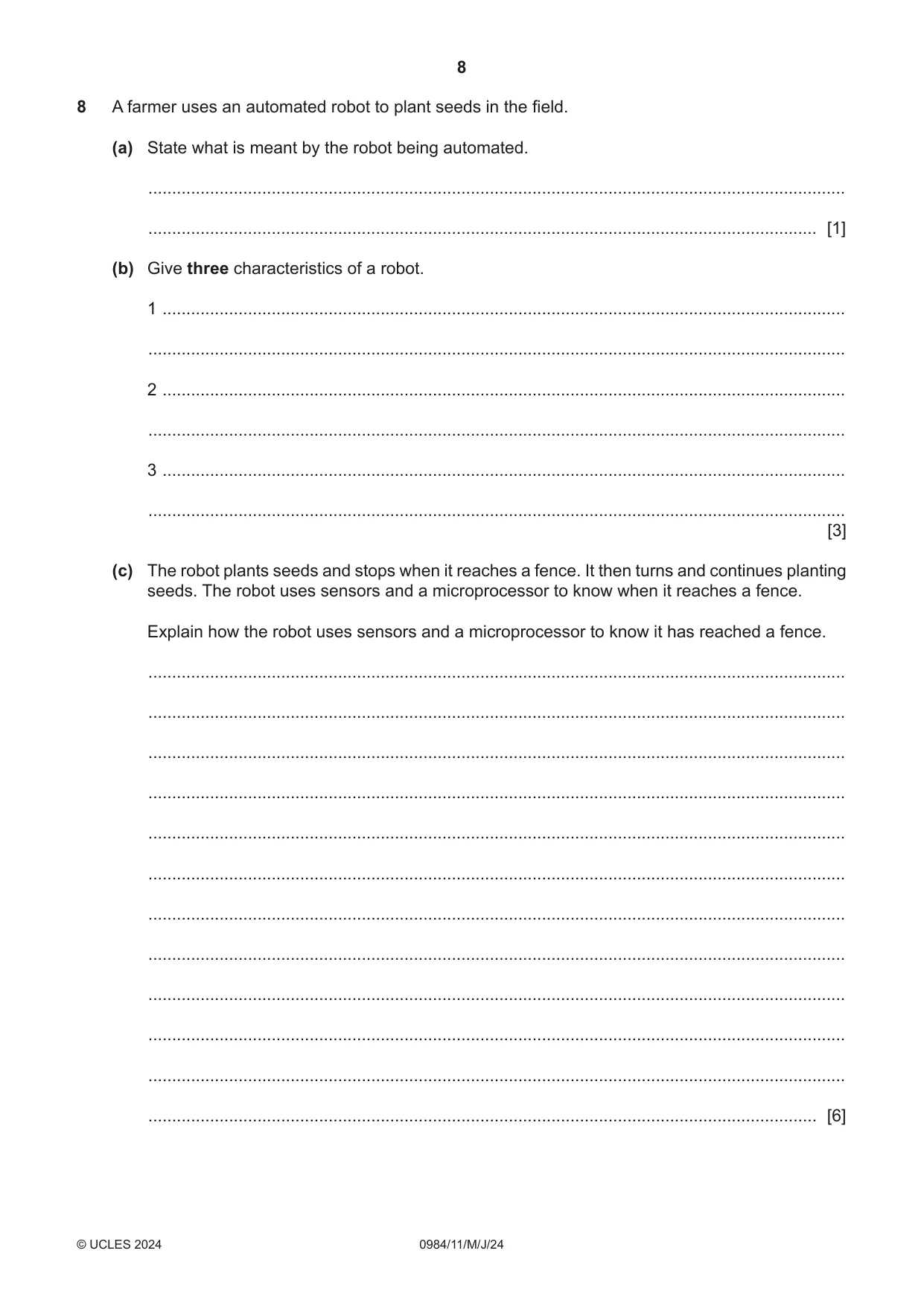
8 0984/11/M/J/24 © UCLES 2024 8 A farmer uses an automated robot to plant seeds in the field. (a) State what is meant by the robot being automated. … … [1] (b) Give three characteristics of a robot. 1 … … 2 … … 3 … … [3] (c) The robot plants seeds and stops when it reaches a fence. It then turns and continues planting seeds. The robot uses sensors and a microprocessor to know when it reaches a fence. Explain how the robot uses sensors and a microprocessor to know it has reached a fence. … … … … … … … … … … … … [6]
Question paper, page 9
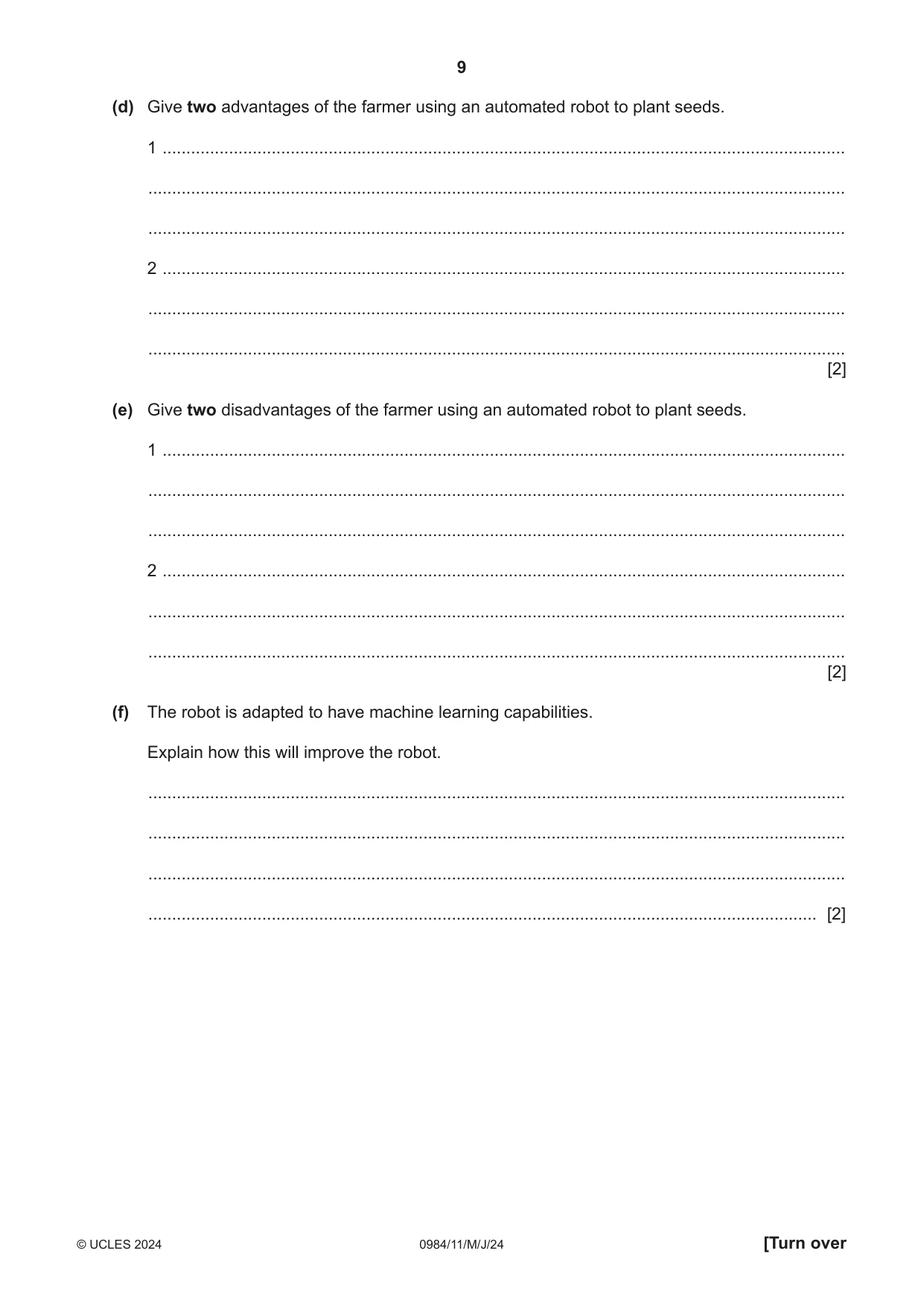
9 0984/11/M/J/24 © UCLES 2024 [Turn over (d) Give two advantages of the farmer using an automated robot to plant seeds. 1 … … … 2 … … … [2] (e) Give two disadvantages of the farmer using an automated robot to plant seeds. 1 … … … 2 … … … [2] (f) The robot is adapted to have machine learning capabilities. Explain how this will improve the robot. … … … … [2]
Question paper, page 10
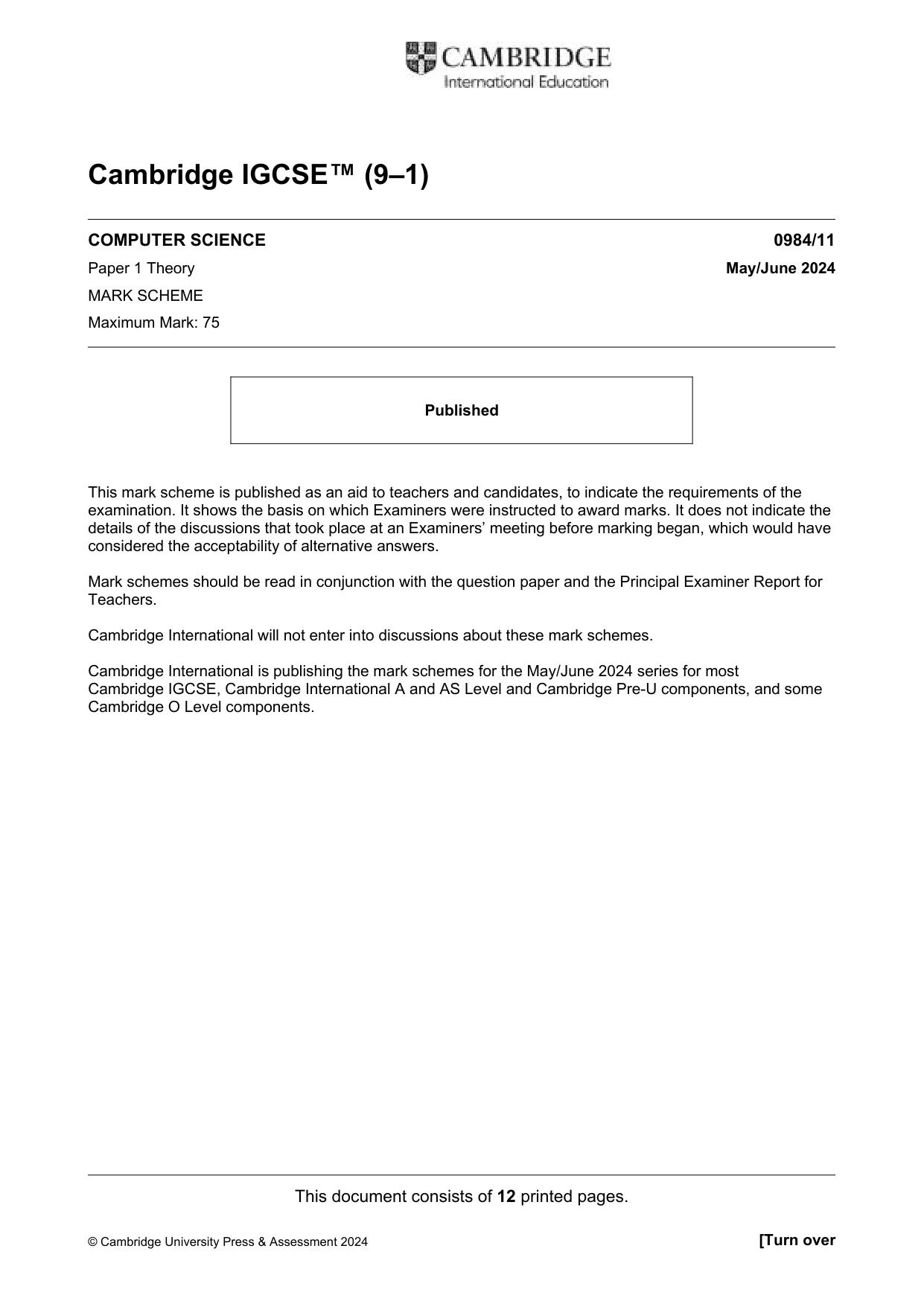
10 0984/11/M/J/24 © UCLES 2024 9 A company owner has installed a new network. Data is correct before it is transmitted across the network. The company owner is concerned that data might have errors after transmission. (a) Explain how the data might have errors after transmission. … … … … … … [3] (b) The company owner decides to introduce an error detection system to check the data for errors after transmission. The error detection system uses an odd parity check and a positive automatic repeat query (ARQ). (i) Describe how the error detection system operates to check for errors. … … … … … … … … … … … … … … … … [8]
Question paper, page 11
11 0984/11/M/J/24 © UCLES 2024 (ii) Give two other error detection methods that could be used. 1 … 2 … [2] (c) The company owner also installs a firewall to help protect the network from hackers and malware. (i) Explain how the firewall operates to help protect the network. … … … … … … … … … … [5] (ii) Give two examples of malware that the firewall can help protect the network from. 1 … 2 … [2]
Question paper, page 12
12 0984/11/M/J/24 © UCLES 2024 Permission to reproduce items where third-party owned material protected by copyright is included has been sought and cleared where possible. Every reasonable effort has been made by the publisher (UCLES) to trace copyright holders, but if any items requiring clearance have unwittingly been included, the publisher will be pleased to make amends at the earliest possible opportunity. To avoid the issue of disclosure of answer-related information to candidates, all copyright acknowledgements are reproduced online in the Cambridge Assessment International Education Copyright Acknowledgements Booklet. This is produced for each series of examinations and is freely available to download at www.cambridgeinternational.org after the live examination series. Cambridge Assessment International Education is part of Cambridge Assessment. Cambridge Assessment is the brand name of the University of Cambridge Local Examinations Syndicate (UCLES), which is a department of the University of Cambridge. BLANK PAGE
Mark scheme, page 1
This document consists of 12 printed pages. © Cambridge University Press & Assessment 2024 [Turn over Cambridge IGCSE™ (9–1) COMPUTER SCIENCE 0984/11 Paper 1 Theory May/June 2024 MARK SCHEME Maximum Mark: 75 Published This mark scheme is published as an aid to teachers and candidates, to indicate the requirements of the examination. It shows the basis on which Examiners were instructed to award marks. It does not indicate the details of the discussions that took place at an Examiners’ meeting before marking began, which would have considered the acceptability of alternative answers. Mark schemes should be read in conjunction with the question paper and the Principal Examiner Report for Teachers. Cambridge International will not enter into discussions about these mark schemes. Cambridge International is publishing the mark schemes for the May/June 2024 series for most Cambridge IGCSE, Cambridge International A and AS Level and Cambridge Pre-U components, and some Cambridge O Level components.
Mark scheme, page 2
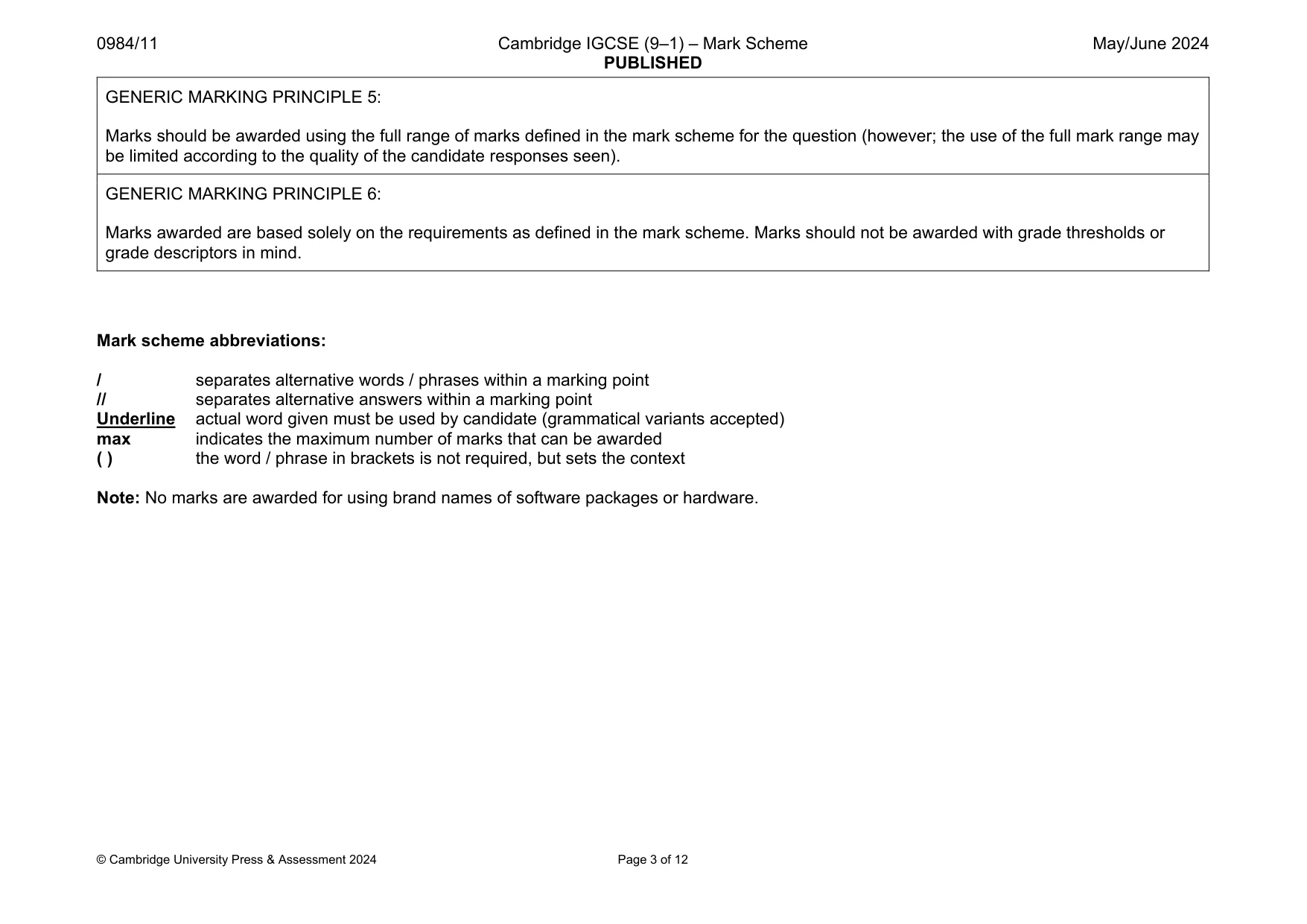
0984/11 Cambridge IGCSE (9–1) – Mark Scheme PUBLISHED May/June 2024 © Cambridge University Press & Assessment 2024 Page 2 of 12 Generic Marking Principles These general marking principles must be applied by all examiners when marking candidate answers. They should be applied alongside the specific content of the mark scheme or generic level descriptions for a question. Each question paper and mark scheme will also comply with these marking principles. GENERIC MARKING PRINCIPLE 1: Marks must be awarded in line with: the specific content of the mark scheme or the generic level descriptors for the question the specific skills defined in the mark scheme or in the generic level descriptors for the question the standard of response required by a candidate as exemplified by the standardisation scripts. GENERIC MARKING PRINCIPLE 2: Marks awarded are always whole marks (not half marks, or other fractions). GENERIC MARKING PRINCIPLE 3: Marks must be awarded positively: marks are awarded for correct/valid answers, as defined in the mark scheme. However, credit is given for valid answers which go beyond the scope of the syllabus and mark scheme, referring to your Team Leader as appropriate marks are awarded when candidates clearly demonstrate what they know and can do marks are not deducted for errors marks are not deducted for omissions answers should only be judged on the quality of spelling, punctuation and grammar when these features are specifically assessed by the question as indicated by the mark scheme. The meaning, however, should be unambiguous. GENERIC MARKING PRINCIPLE 4: Rules must be applied consistently, e.g. in situations where candidates have not followed instructions or in the application of generic level descriptors.
Mark scheme, page 3
0984/11 Cambridge IGCSE (9–1) – Mark Scheme PUBLISHED May/June 2024 © Cambridge University Press & Assessment 2024 Page 3 of 12 GENERIC MARKING PRINCIPLE 5: Marks should be awarded using the full range of marks defined in the mark scheme for the question (however; the use of the full mark range may be limited according to the quality of the candidate responses seen). GENERIC MARKING PRINCIPLE 6: Marks awarded are based solely on the requirements as defined in the mark scheme. Marks should not be awarded with grade thresholds or grade descriptors in mind. Mark scheme abbreviations: / separates alternative words / phrases within a marking point // separates alternative answers within a marking point Underline actual word given must be used by candidate (grammatical variants accepted) max indicates the maximum number of marks that can be awarded ( ) the word / phrase in brackets is not required, but sets the context Note: No marks are awarded for using brand names of software packages or hardware.
Mark scheme, page 4
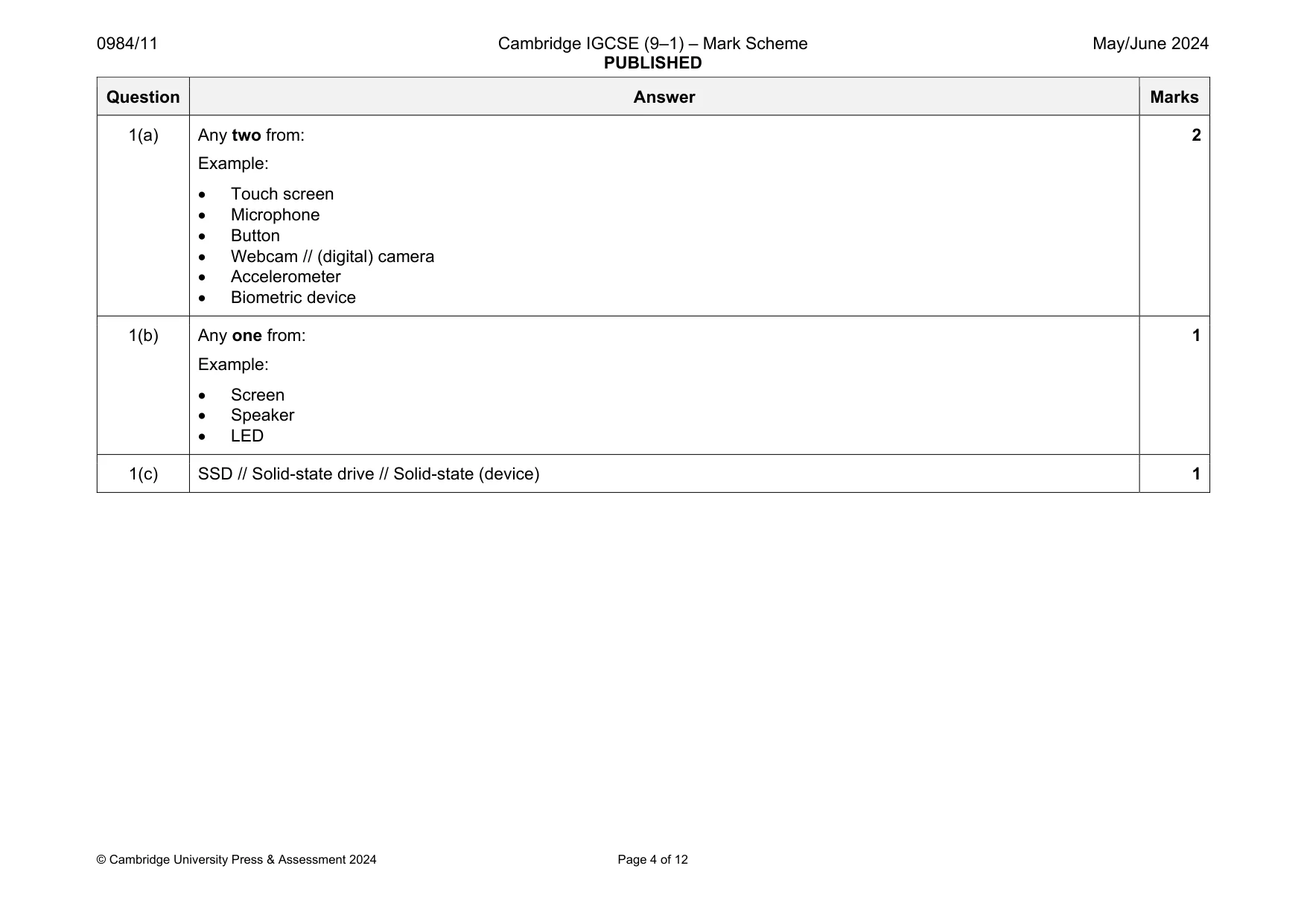
0984/11 Cambridge IGCSE (9–1) – Mark Scheme PUBLISHED May/June 2024 © Cambridge University Press & Assessment 2024 Page 4 of 12 Question Answer Marks 1(a) Any two from: Example: Touch screen Microphone Button Webcam // (digital) camera Accelerometer Biometric device 2 1(b) Any one from: Example: Screen Speaker LED 1 1(c) SSD // Solid-state drive // Solid-state (device) 1
Mark scheme, page 5
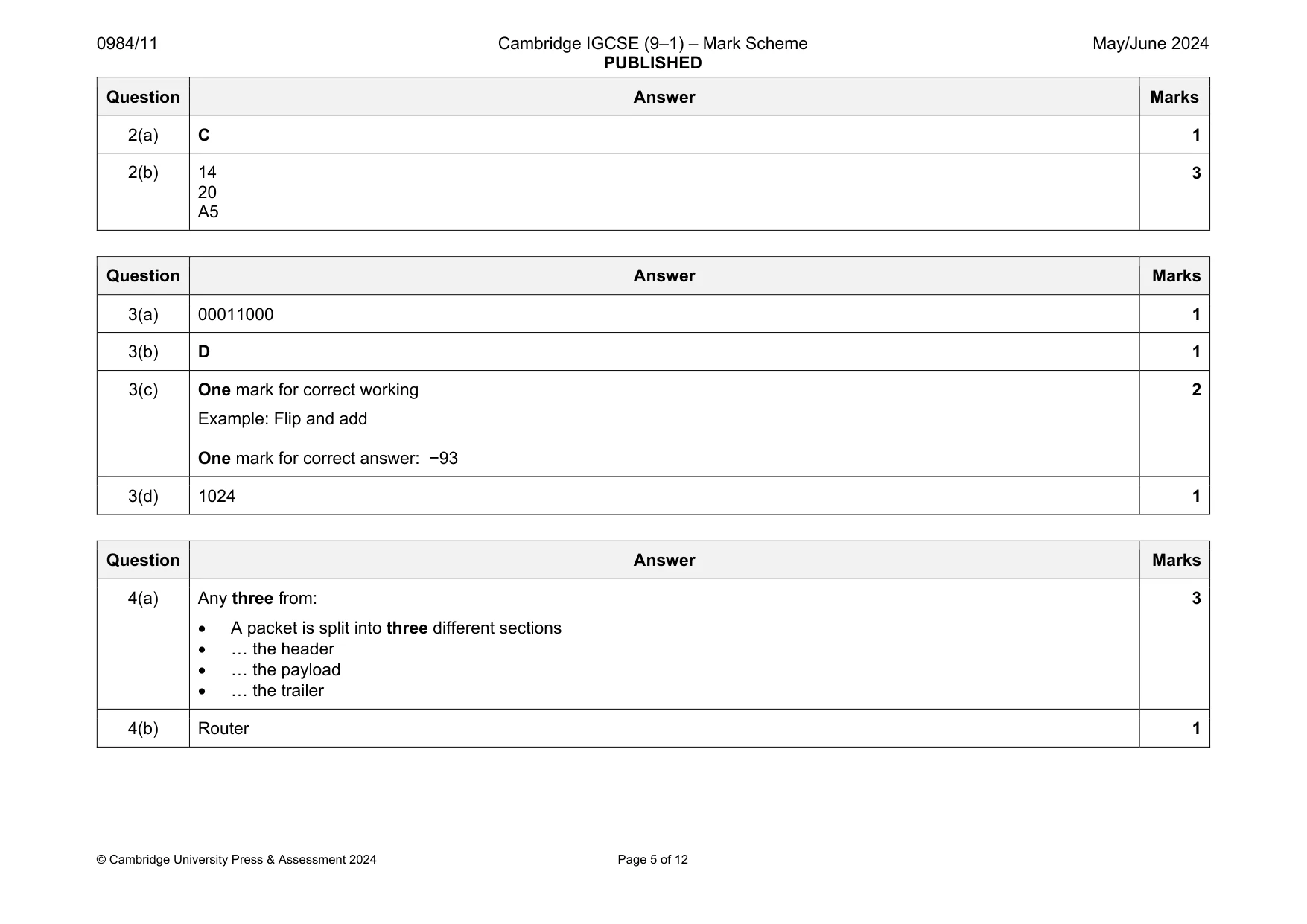
0984/11 Cambridge IGCSE (9–1) – Mark Scheme PUBLISHED May/June 2024 © Cambridge University Press & Assessment 2024 Page 5 of 12 Question Answer Marks 2(a) C 1 2(b) 14 20 A5 3 Question Answer Marks 3(a) 00011000 1 3(b) D 1 3(c) One mark for correct working Example: Flip and add One mark for correct answer: −93 2 3(d) 1024 1 Question Answer Marks 4(a) Any three from: A packet is split into three different sections … the header … the payload … the trailer 3 4(b) Router 1
Mark scheme, page 6
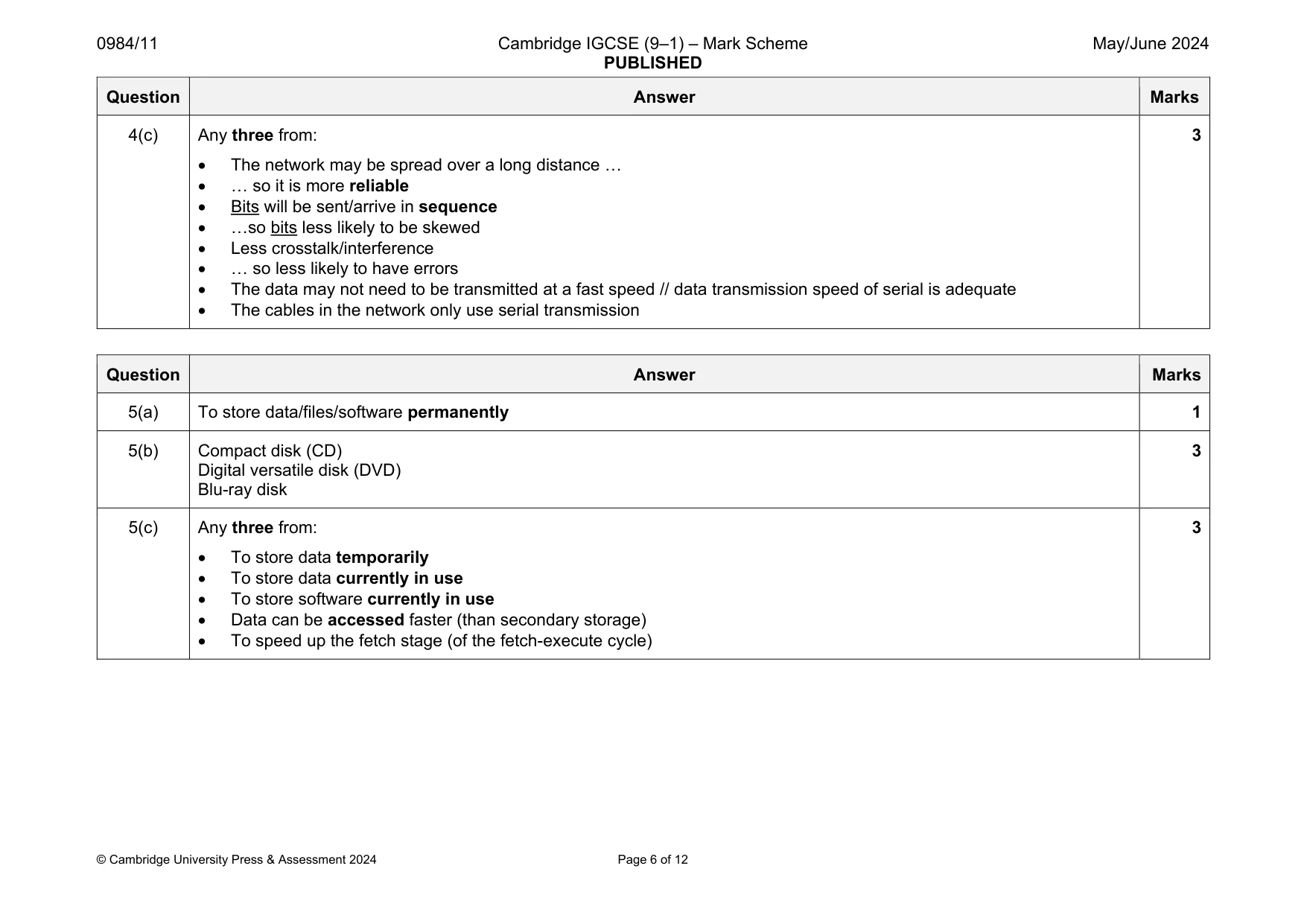
0984/11 Cambridge IGCSE (9–1) – Mark Scheme PUBLISHED May/June 2024 © Cambridge University Press & Assessment 2024 Page 6 of 12 Question Answer Marks 4(c) Any three from: The network may be spread over a long distance … … so it is more reliable Bits will be sent/arrive in sequence …so bits less likely to be skewed Less crosstalk/interference … so less likely to have errors The data may not need to be transmitted at a fast speed // data transmission speed of serial is adequate The cables in the network only use serial transmission 3 Question Answer Marks 5(a) To store data/files/software permanently 1 5(b) Compact disk (CD) Digital versatile disk (DVD) Blu-ray disk 3 5(c) Any three from: To store data temporarily To store data currently in use To store software currently in use Data can be accessed faster (than secondary storage) To speed up the fetch stage (of the fetch-execute cycle) 3
Mark scheme, page 7
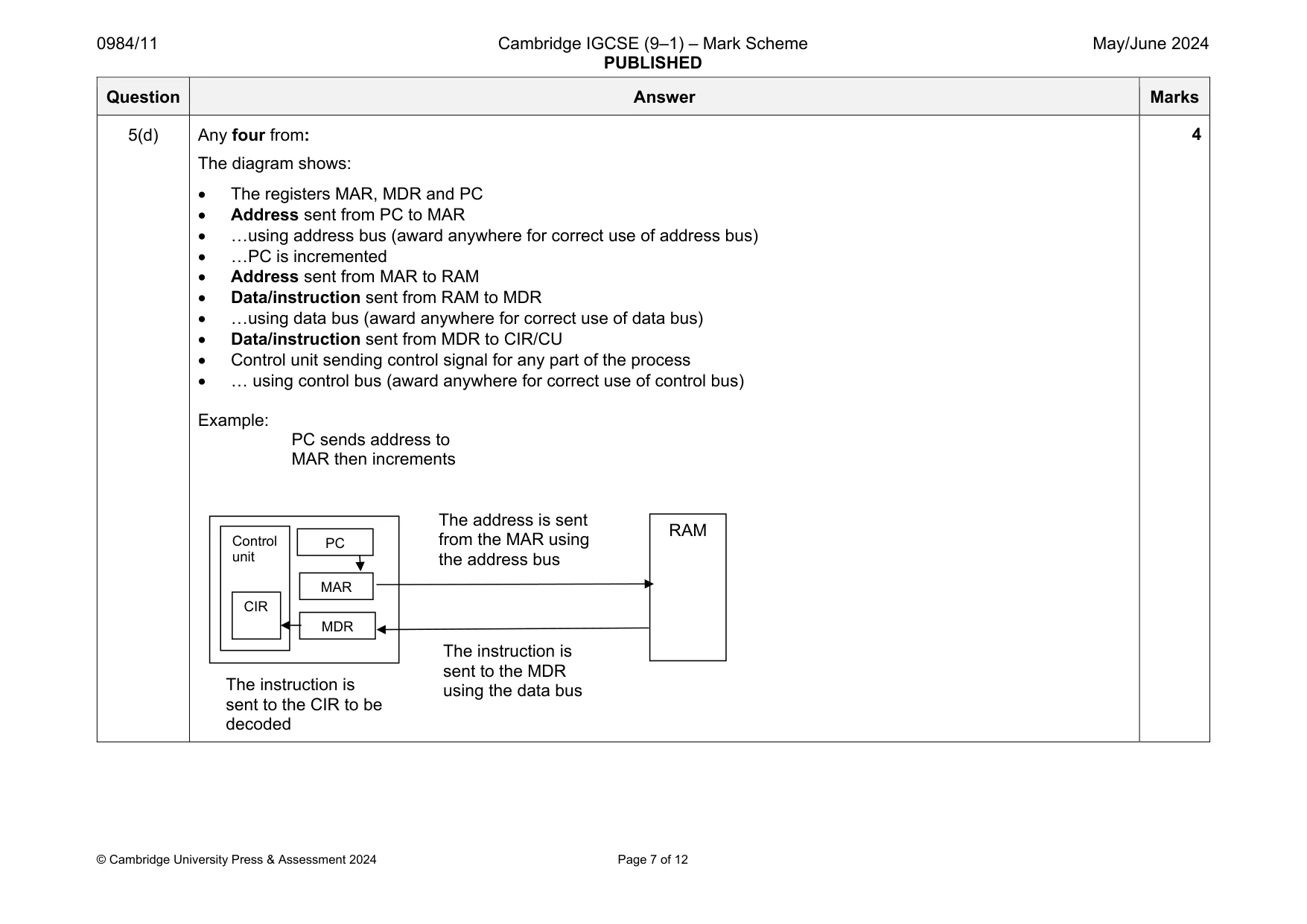
0984/11 Cambridge IGCSE (9–1) – Mark Scheme PUBLISHED May/June 2024 © Cambridge University Press & Assessment 2024 Page 7 of 12 Question Answer Marks 5(d) Any four from: The diagram shows: The registers MAR, MDR and PC Address sent from PC to MAR …using address bus (award anywhere for correct use of address bus) …PC is incremented Address sent from MAR to RAM Data/instruction sent from RAM to MDR …using data bus (award anywhere for correct use of data bus) Data/instruction sent from MDR to CIR/CU Control unit sending control signal for any part of the process … using control bus (award anywhere for correct use of control bus) Example: 4 PC MDR MAR Control unit CIR RAM PC sends address to MAR then increments The address is sent from the MAR using the address bus The instruction is sent to the MDR using the data bus The instruction is sent to the CIR to be decoded
Mark scheme, page 8
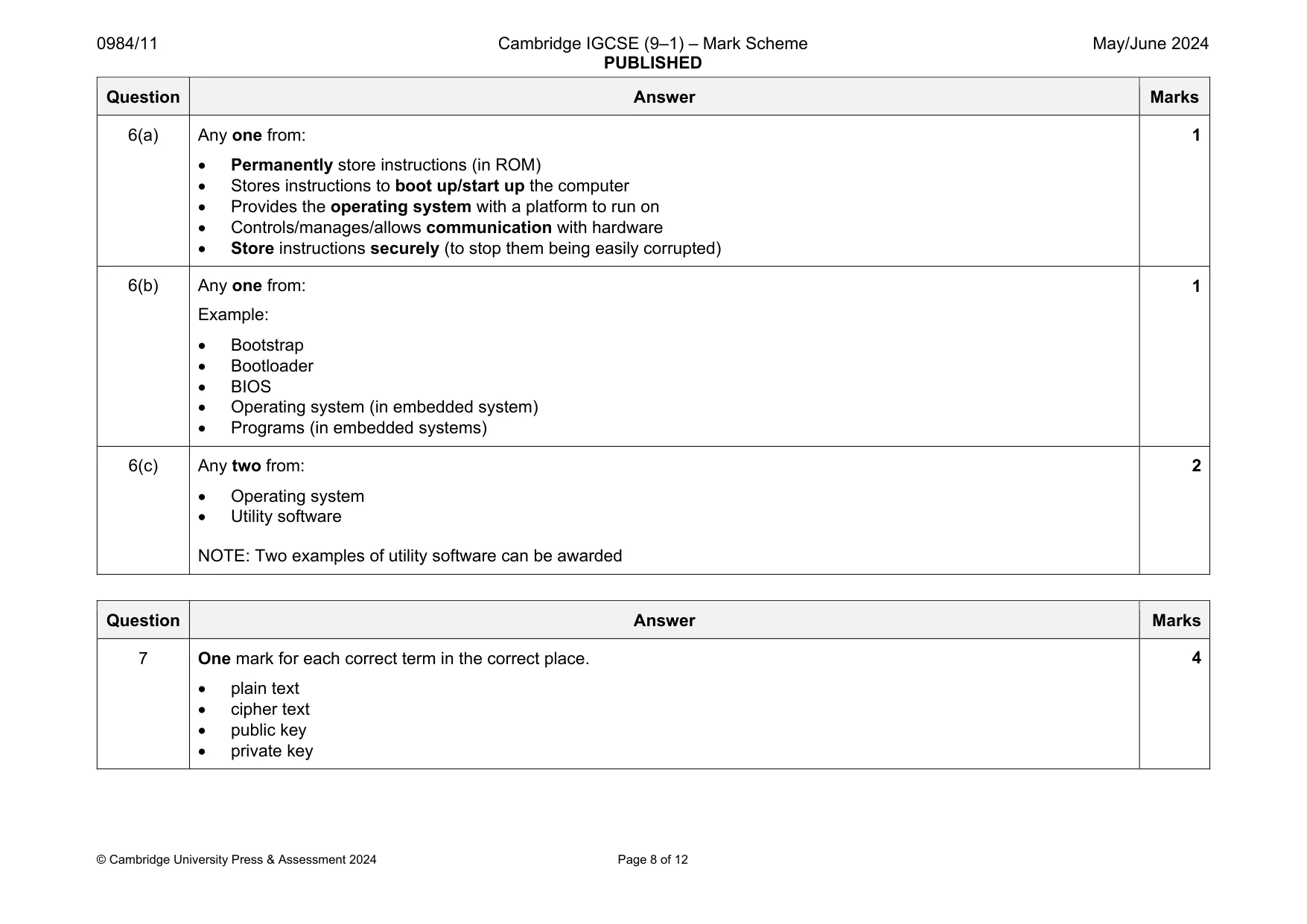
0984/11 Cambridge IGCSE (9–1) – Mark Scheme PUBLISHED May/June 2024 © Cambridge University Press & Assessment 2024 Page 8 of 12 Question Answer Marks 6(a) Any one from: Permanently store instructions (in ROM) Stores instructions to boot up/start up the computer Provides the operating system with a platform to run on Controls/manages/allows communication with hardware Store instructions securely (to stop them being easily corrupted) 1 6(b) Any one from: Example: Bootstrap Bootloader BIOS Operating system (in embedded system) Programs (in embedded systems) 1 6(c) Any two from: Operating system Utility software NOTE: Two examples of utility software can be awarded 2 Question Answer Marks 7 One mark for each correct term in the correct place. plain text cipher text public key private key 4
Mark scheme, page 9
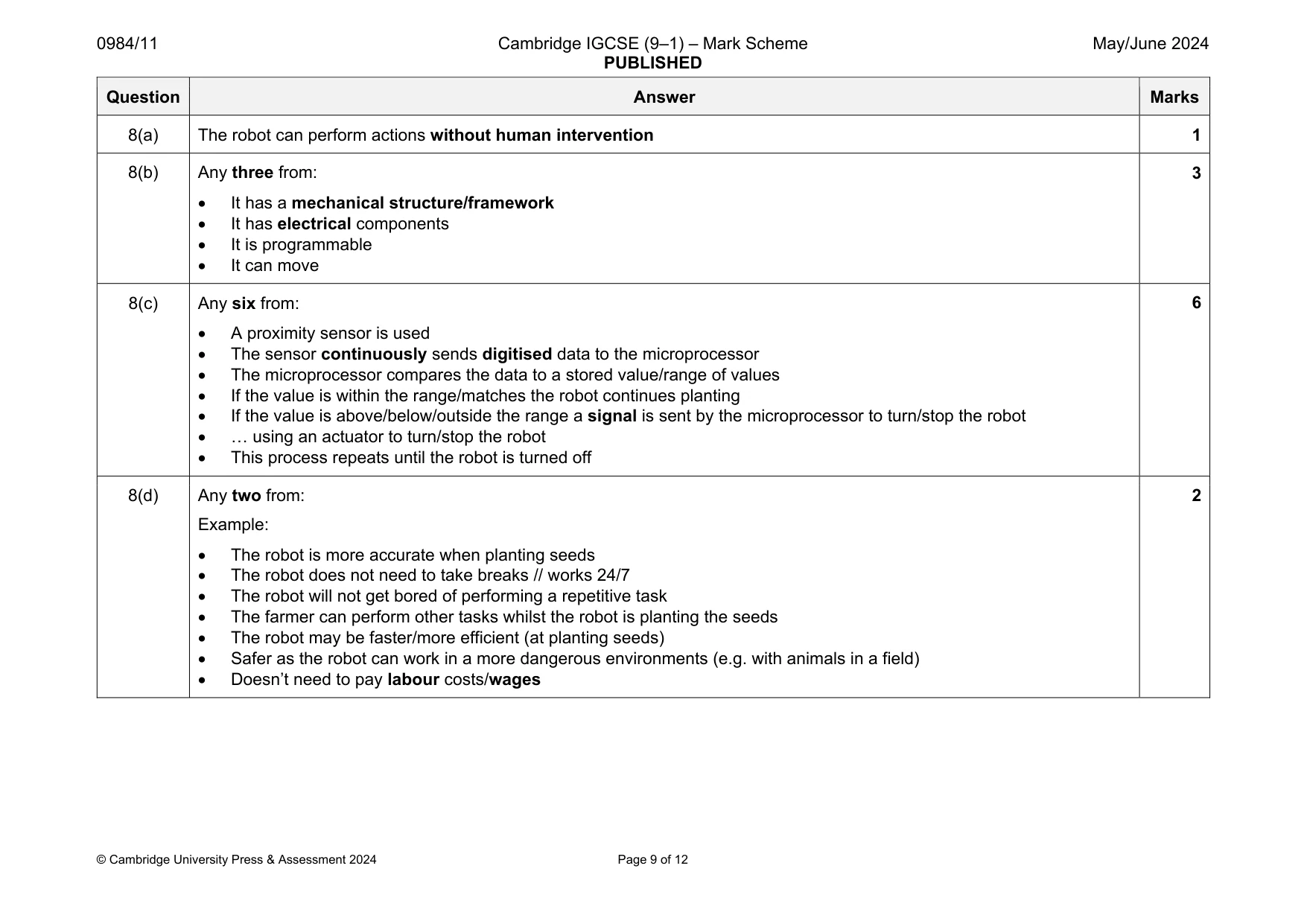
0984/11 Cambridge IGCSE (9–1) – Mark Scheme PUBLISHED May/June 2024 © Cambridge University Press & Assessment 2024 Page 9 of 12 Question Answer Marks 8(a) The robot can perform actions without human intervention 1 8(b) Any three from: It has a mechanical structure/framework It has electrical components It is programmable It can move 3 8(c) Any six from: A proximity sensor is used The sensor continuously sends digitised data to the microprocessor The microprocessor compares the data to a stored value/range of values If the value is within the range/matches the robot continues planting If the value is above/below/outside the range a signal is sent by the microprocessor to turn/stop the robot … using an actuator to turn/stop the robot This process repeats until the robot is turned off 6 8(d) Any two from: Example: The robot is more accurate when planting seeds The robot does not need to take breaks // works 24/7 The robot will not get bored of performing a repetitive task The farmer can perform other tasks whilst the robot is planting the seeds The robot may be faster/more efficient (at planting seeds) Safer as the robot can work in a more dangerous environments (e.g. with animals in a field) Doesn’t need to pay labour costs/wages 2
Mark scheme, page 10
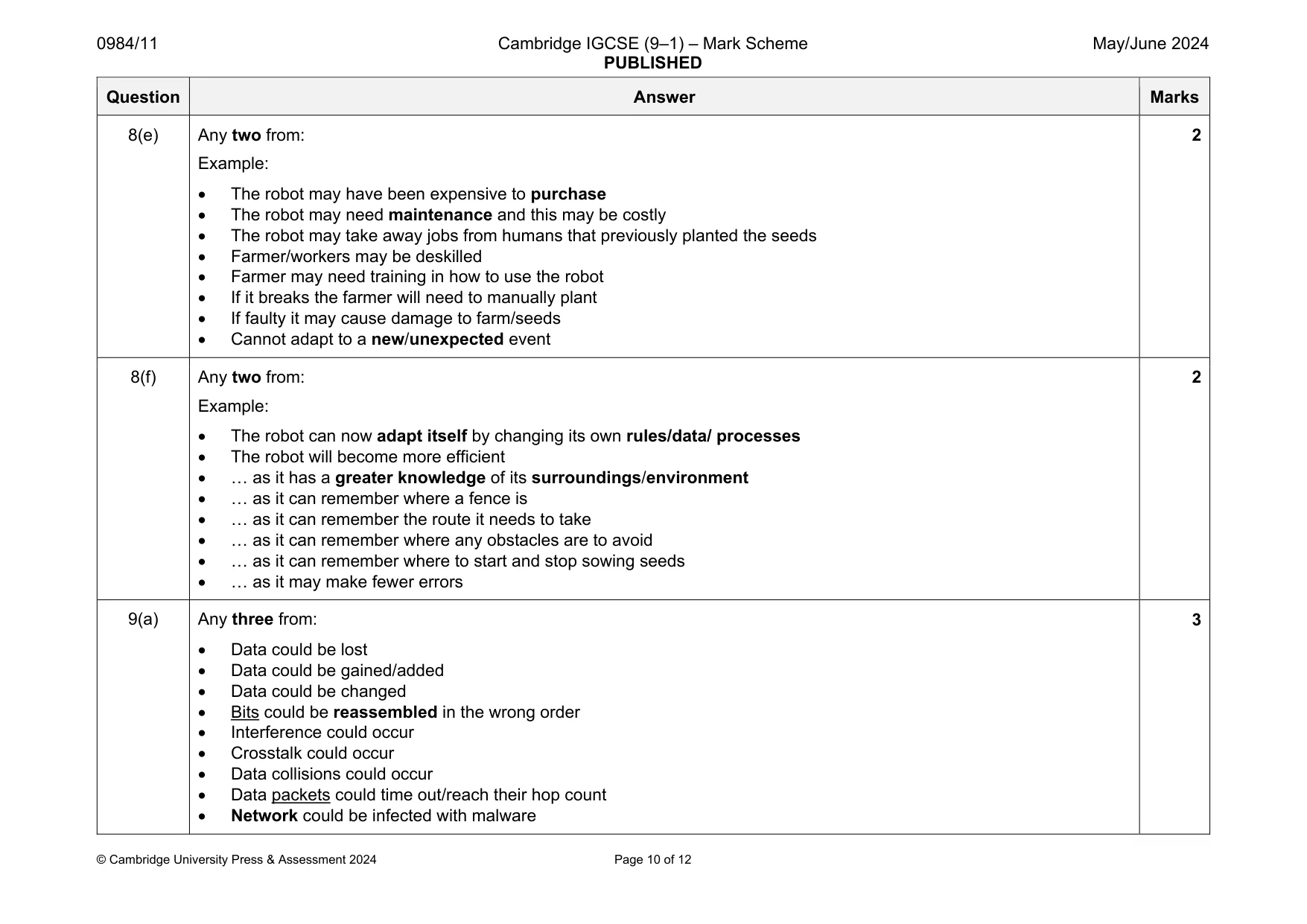
0984/11 Cambridge IGCSE (9–1) – Mark Scheme PUBLISHED May/June 2024 © Cambridge University Press & Assessment 2024 Page 10 of 12 Question Answer Marks 8(e) Any two from: Example: The robot may have been expensive to purchase The robot may need maintenance and this may be costly The robot may take away jobs from humans that previously planted the seeds Farmer/workers may be deskilled Farmer may need training in how to use the robot If it breaks the farmer will need to manually plant If faulty it may cause damage to farm/seeds Cannot adapt to a new/unexpected event 2 8(f) Any two from: Example: The robot can now adapt itself by changing its own rules/data/ processes The robot will become more efficient … as it has a greater knowledge of its surroundings/environment … as it can remember where a fence is … as it can remember the route it needs to take … as it can remember where any obstacles are to avoid … as it can remember where to start and stop sowing seeds … as it may make fewer errors 2 9(a) Any three from: Data could be lost Data could be gained/added Data could be changed Bits could be reassembled in the wrong order Interference could occur Crosstalk could occur Data collisions could occur Data packets could time out/reach their hop count Network could be infected with malware 3
Mark scheme, page 11
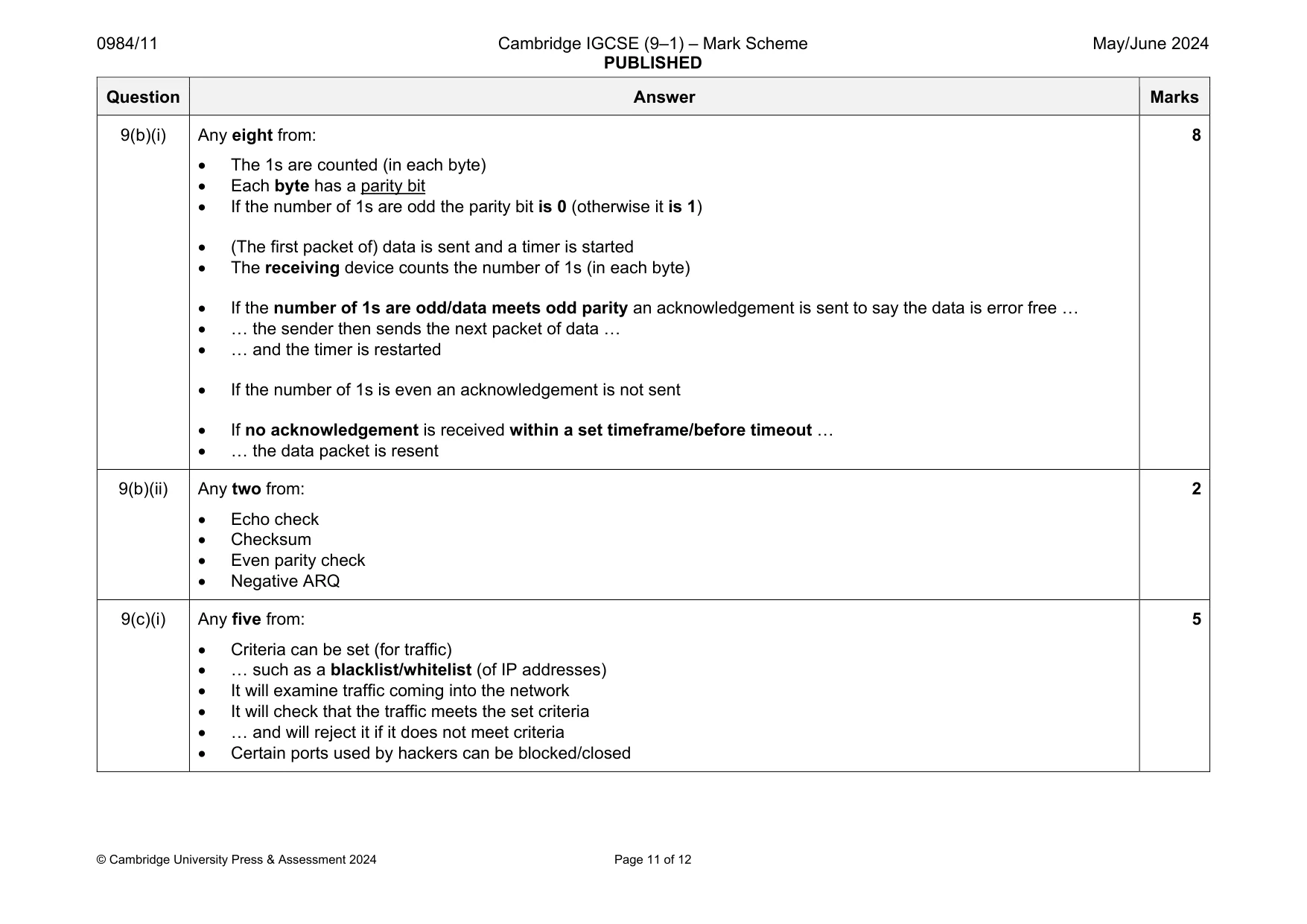
0984/11 Cambridge IGCSE (9–1) – Mark Scheme PUBLISHED May/June 2024 © Cambridge University Press & Assessment 2024 Page 11 of 12 Question Answer Marks 9(b)(i) Any eight from: The 1s are counted (in each byte) Each byte has a parity bit If the number of 1s are odd the parity bit is 0 (otherwise it is 1) (The first packet of) data is sent and a timer is started The receiving device counts the number of 1s (in each byte) If the number of 1s are odd/data meets odd parity an acknowledgement is sent to say the data is error free … … the sender then sends the next packet of data … … and the timer is restarted If the number of 1s is even an acknowledgement is not sent If no acknowledgement is received within a set timeframe/before timeout … … the data packet is resent 8 9(b)(ii) Any two from: Echo check Checksum Even parity check Negative ARQ 2 9(c)(i) Any five from: Criteria can be set (for traffic) … such as a blacklist/whitelist (of IP addresses) It will examine traffic coming into the network It will check that the traffic meets the set criteria … and will reject it if it does not meet criteria Certain ports used by hackers can be blocked/closed 5
Mark scheme, page 12
0984/11 Cambridge IGCSE (9–1) – Mark Scheme PUBLISHED May/June 2024 © Cambridge University Press & Assessment 2024 Page 12 of 12 Question Answer Marks 9(c)(ii) Any two from: Example: Virus Worm Trojan horse Spyware Adware Ransomware 2
What you needed in this session
Cambridge’s own grade thresholds for 2024 May/June, Paper 1 · Variant 1. A higher threshold means an easier paper — the bar moves with how the cohort did.