Cambridge IGCSE Computer Science (9-1) 0984 — 2019 May/June Paper 1 · Variant 1
0984/11/M/J/19 · 75 marks · ≈84 min
The question paper and its mark scheme, free to read here and free to download. This is Cambridge’s own paper, exactly as it was sat.
Question paper12 pages

Mark scheme14 pages
Answers below. Sit the paper first if you are practising.
Paper as text
Question paper, page 1
This document consists of 11 printed pages and 1 blank page. DC (RW) 193318/1 © UCLES 2019 [Turn over * 5 1 2 3 1 3 2 7 3 2 * COMPUTER SCIENCE 0984/11 Paper 1 Theory May/June 2019 1 hour 45 minutes Candidates answer on the Question Paper. No Additional Materials are required. No calculators allowed. READ THESE INSTRUCTIONS FIRST Write your centre number, candidate number and name in the spaces at the top of this page. Write in dark blue or black pen. You may use an HB pencil for any diagrams, graphs or rough working. Do not use staples, paper clips, glue or correction fluid. DO NOT WRITE IN ANY BARCODES. Answer all questions. No marks will be awarded for using brand names of software packages or hardware. Any businesses described in this paper are entirely fictitious. At the end of the examination, fasten all your work securely together. The number of marks is given in brackets [ ] at the end of each question or part question. The maximum number of marks is 75. Cambridge Assessment International Education Cambridge International General Certificate of Secondary Education (9–1)
Question paper, page 2
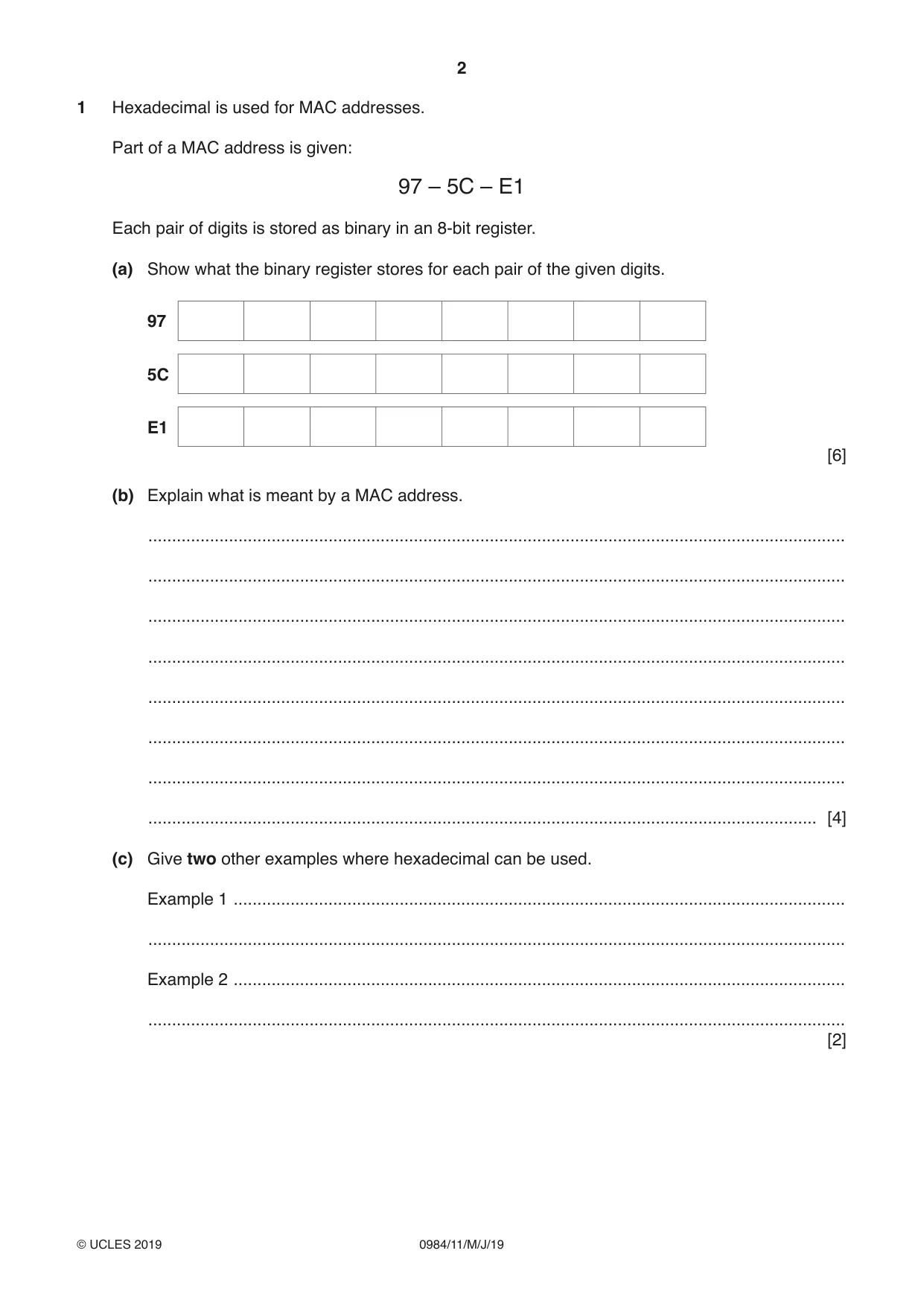
2 0984/11/M/J/19 © UCLES 2019 1 Hexadecimal is used for MAC addresses. Part of a MAC address is given: 97 – 5C – E1 Each pair of digits is stored as binary in an 8-bit register. (a) Show what the binary register stores for each pair of the given digits. 97 5C E1 [6] (b) Explain what is meant by a MAC address. … … … … … … … … [4] (c) Give two other examples where hexadecimal can be used. Example 1 … … Example 2 … … [2]
Question paper, page 3
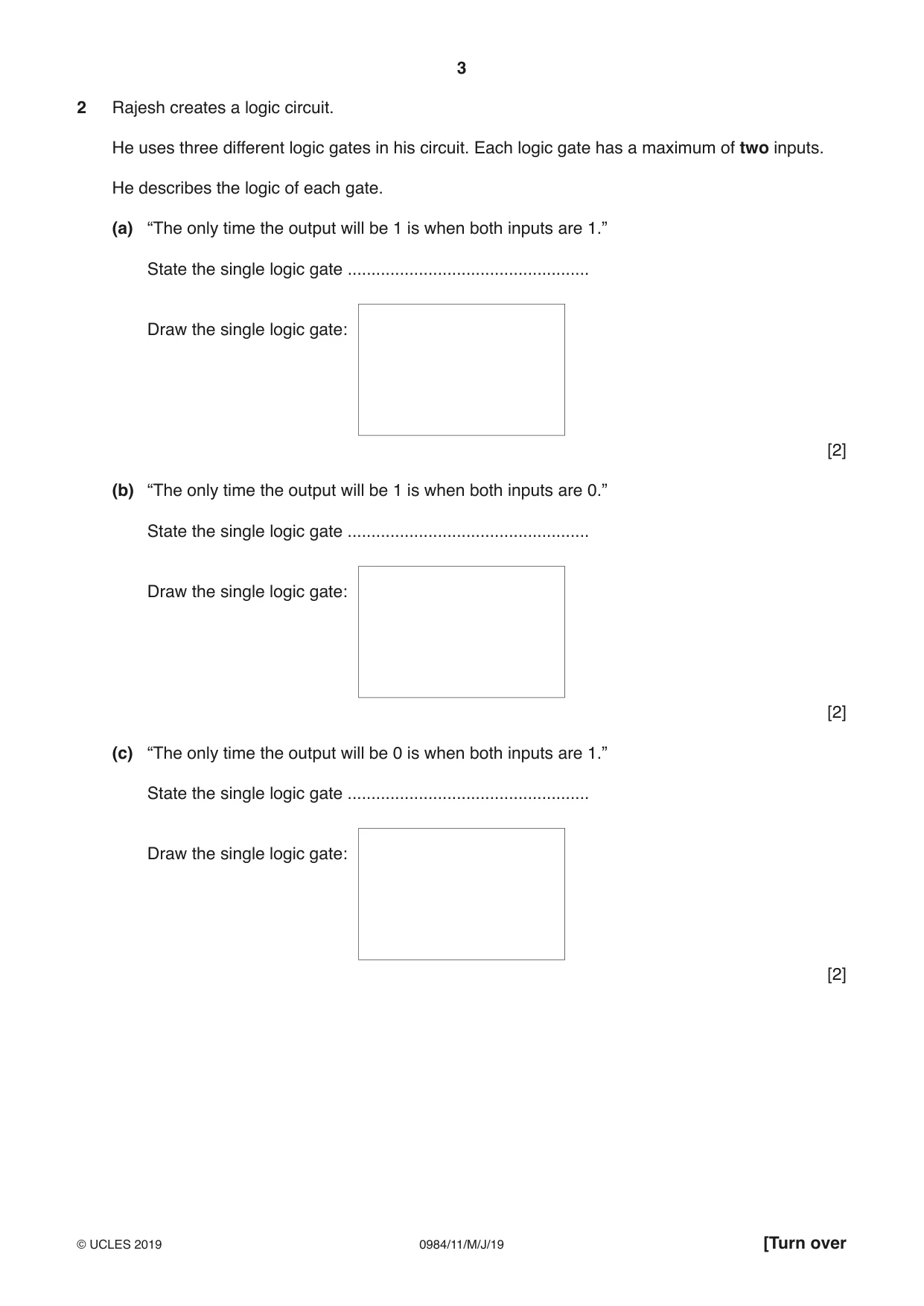
3 0984/11/M/J/19 © UCLES 2019 [Turn over 2 Rajesh creates a logic circuit. He uses three different logic gates in his circuit. Each logic gate has a maximum of two inputs. He describes the logic of each gate. (a) “The only time the output will be 1 is when both inputs are 1.” State the single logic gate … Draw the single logic gate: [2] (b) “The only time the output will be 1 is when both inputs are 0.” State the single logic gate … Draw the single logic gate: [2] (c) “The only time the output will be 0 is when both inputs are 1.” State the single logic gate … Draw the single logic gate: [2]
Question paper, page 4
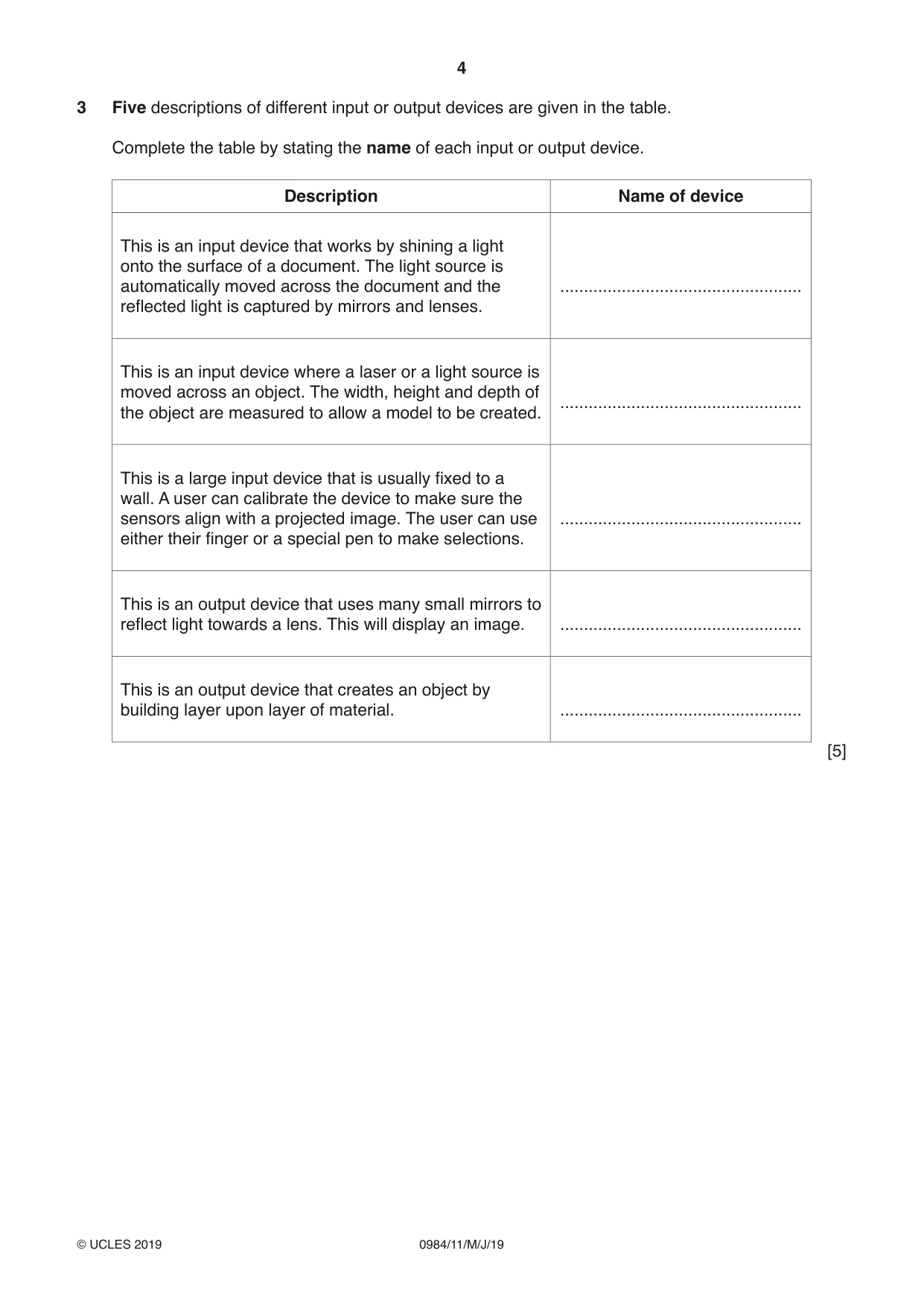
4 0984/11/M/J/19 © UCLES 2019 3 Five descriptions of different input or output devices are given in the table. Complete the table by stating the name of each input or output device. Description Name of device This is an input device that works by shining a light onto the surface of a document. The light source is automatically moved across the document and the reflected light is captured by mirrors and lenses. … This is an input device where a laser or a light source is moved across an object. The width, height and depth of the object are measured to allow a model to be created. … This is a large input device that is usually fixed to a wall. A user can calibrate the device to make sure the sensors align with a projected image. The user can use either their finger or a special pen to make selections. … This is an output device that uses many small mirrors to reflect light towards a lens. This will display an image. … This is an output device that creates an object by building layer upon layer of material. … [5]
Question paper, page 5
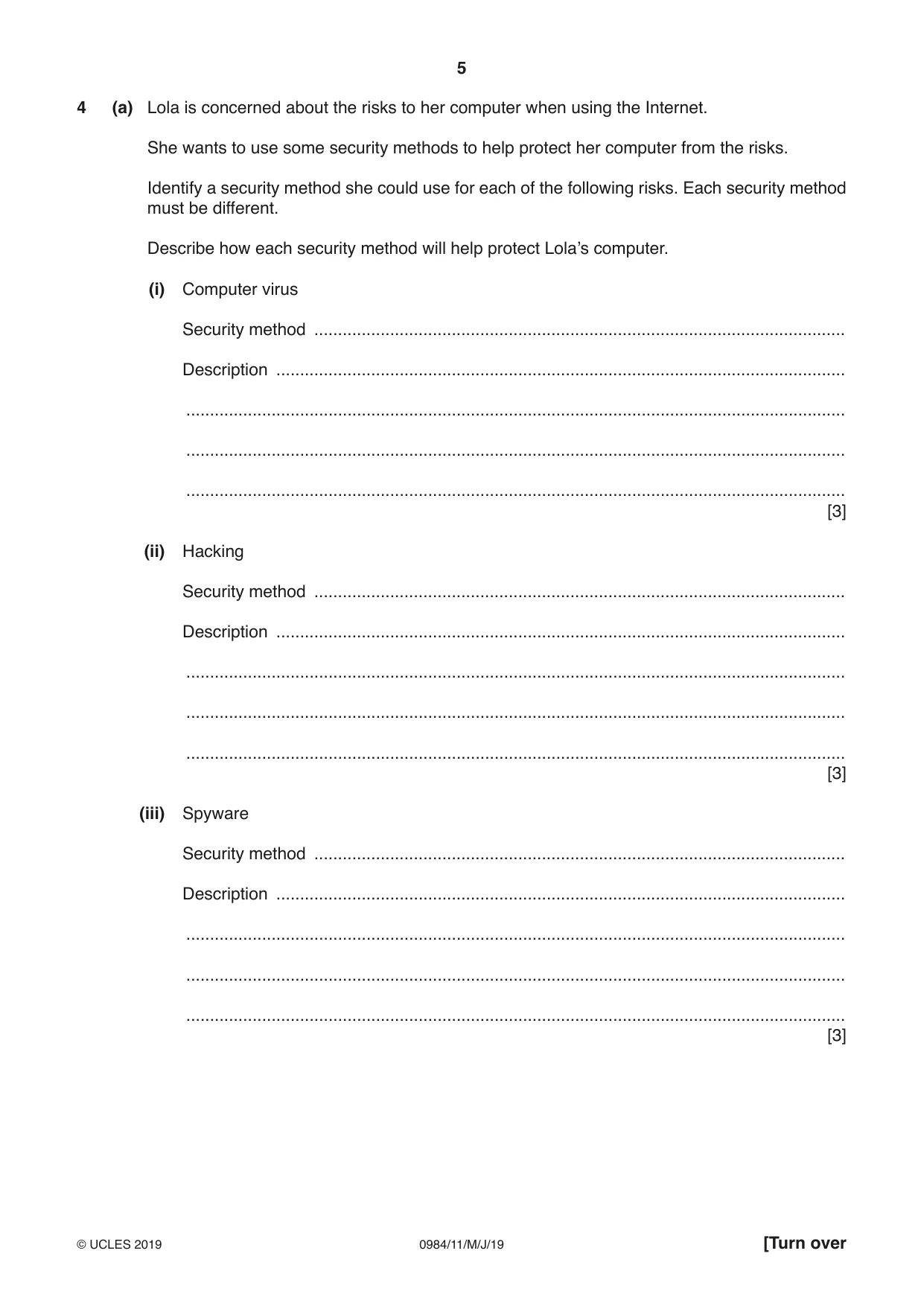
5 0984/11/M/J/19 © UCLES 2019 [Turn over 4 (a) Lola is concerned about the risks to her computer when using the Internet. She wants to use some security methods to help protect her computer from the risks. Identify a security method she could use for each of the following risks. Each security method must be different. Describe how each security method will help protect Lola’s computer. (i) Computer virus Security method … Description … … … … [3] (ii) Hacking Security method … Description … … … … [3] (iii) Spyware Security method … Description … … … … [3]
Question paper, page 6
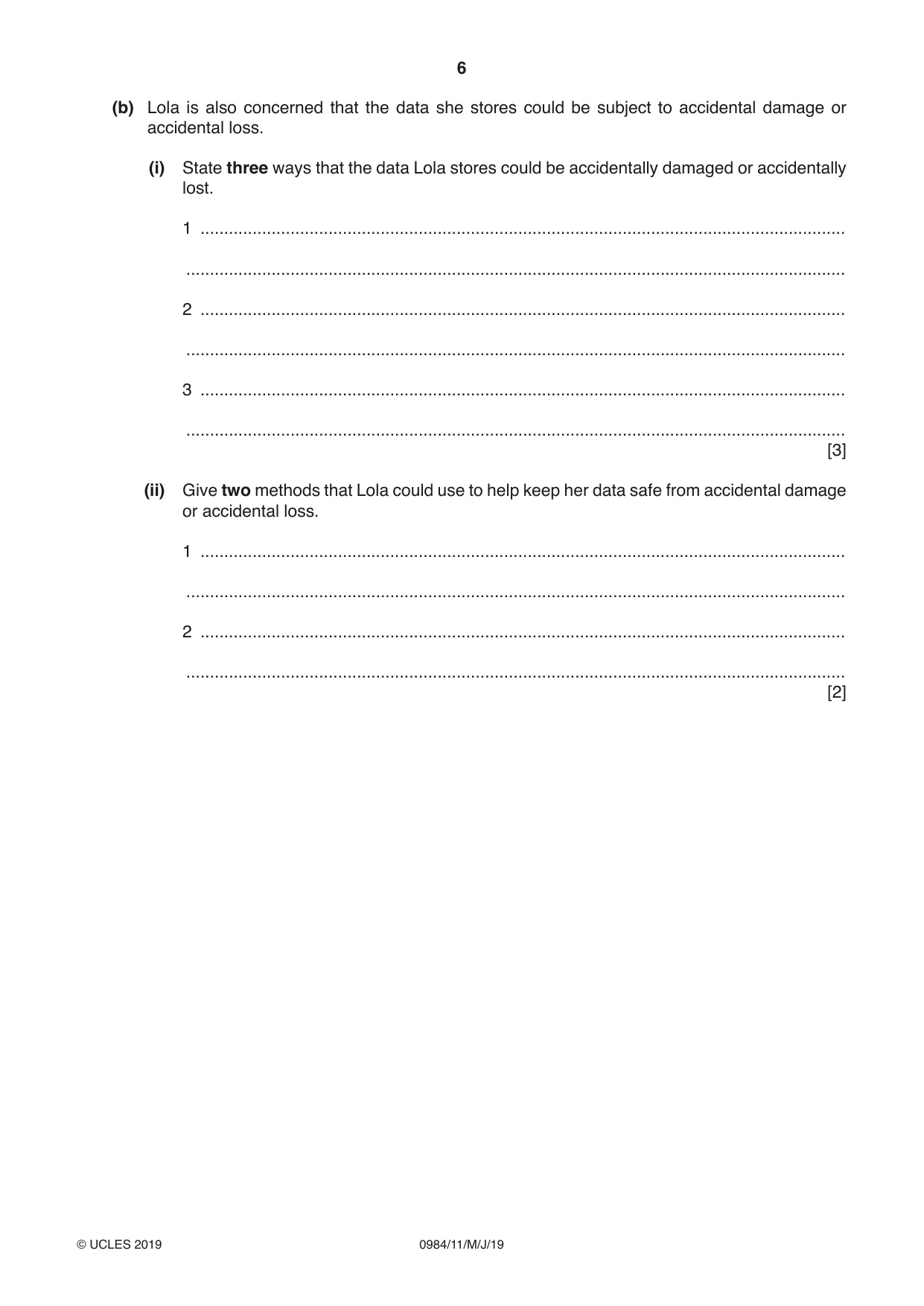
6 0984/11/M/J/19 © UCLES 2019 (b) Lola is also concerned that the data she stores could be subject to accidental damage or accidental loss. (i) State three ways that the data Lola stores could be accidentally damaged or accidentally lost. 1 … … 2 … … 3 … … [3] (ii) Give two methods that Lola could use to help keep her data safe from accidental damage or accidental loss. 1 … … 2 … … [2]
Question paper, page 7
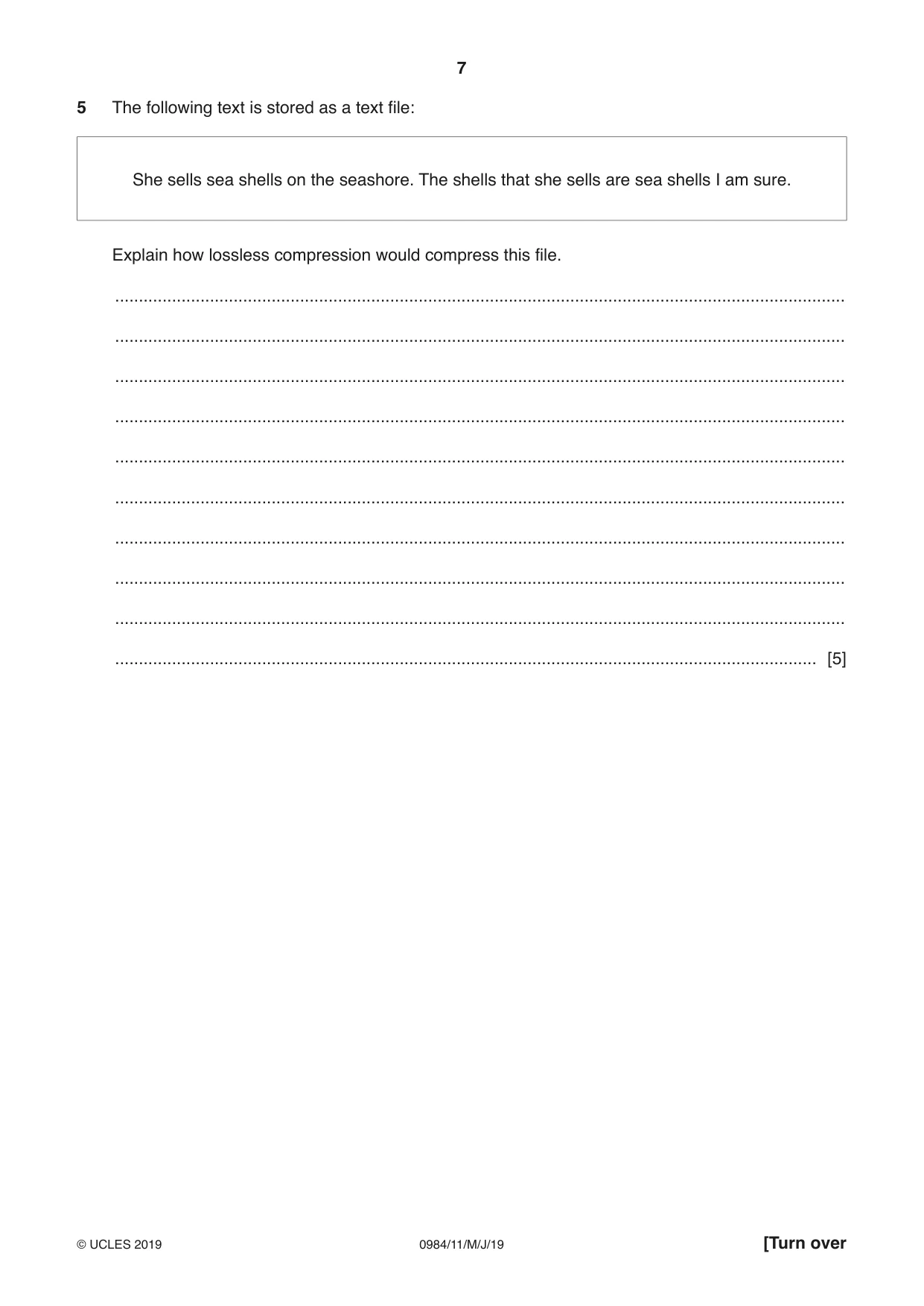
7 0984/11/M/J/19 © UCLES 2019 [Turn over 5 The following text is stored as a text file: She sells sea shells on the seashore. The shells that she sells are sea shells I am sure. Explain how lossless compression would compress this file. … … … … … … … … … … [5]
Question paper, page 8
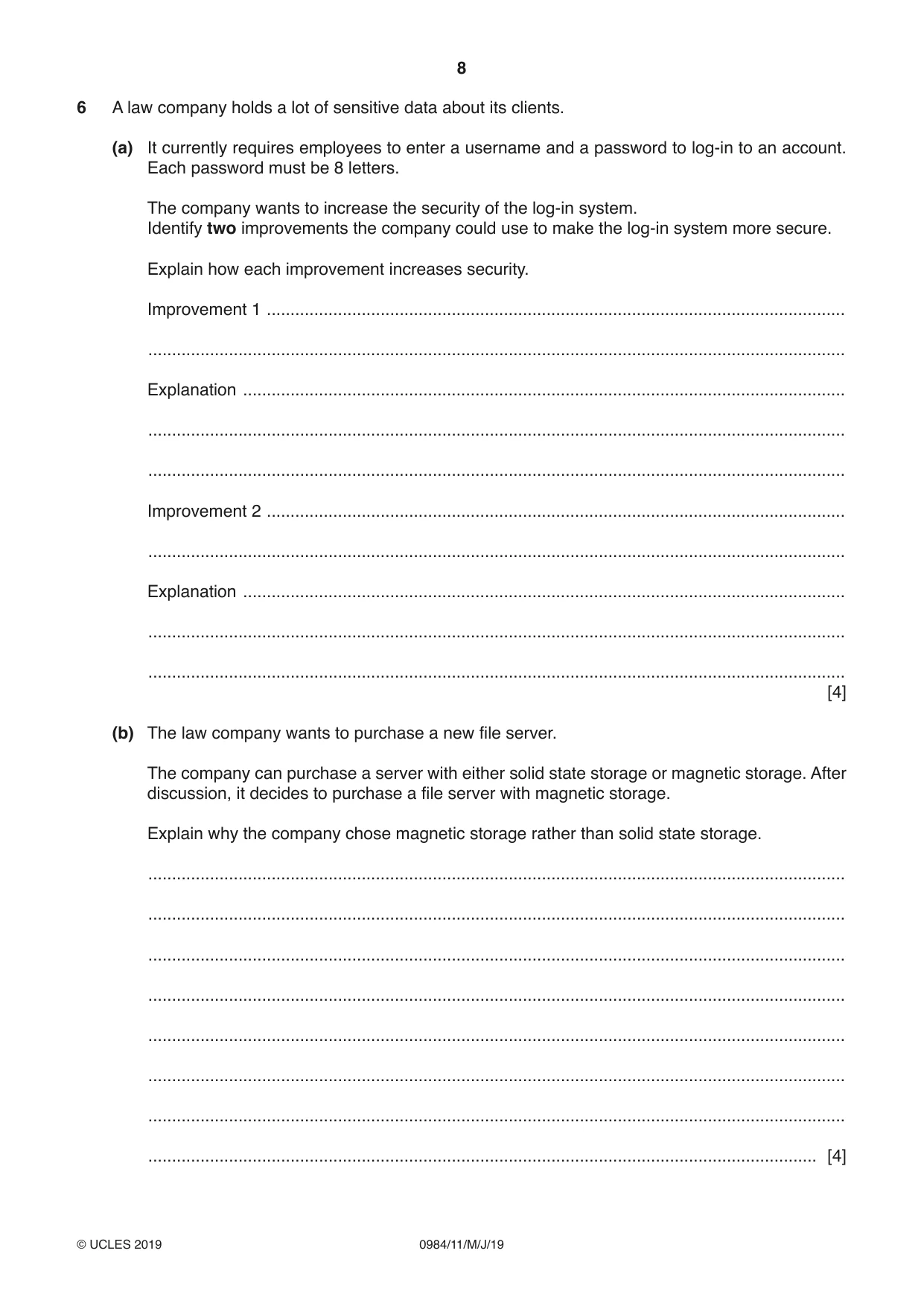
8 0984/11/M/J/19 © UCLES 2019 6 A law company holds a lot of sensitive data about its clients. (a) It currently requires employees to enter a username and a password to log-in to an account. Each password must be 8 letters. The company wants to increase the security of the log-in system. Identify two improvements the company could use to make the log-in system more secure. Explain how each improvement increases security. Improvement 1 … … Explanation … … … Improvement 2 … … Explanation … … … [4] (b) The law company wants to purchase a new file server. The company can purchase a server with either solid state storage or magnetic storage. After discussion, it decides to purchase a file server with magnetic storage. Explain why the company chose magnetic storage rather than solid state storage. … … … … … … … … [4]
Question paper, page 9
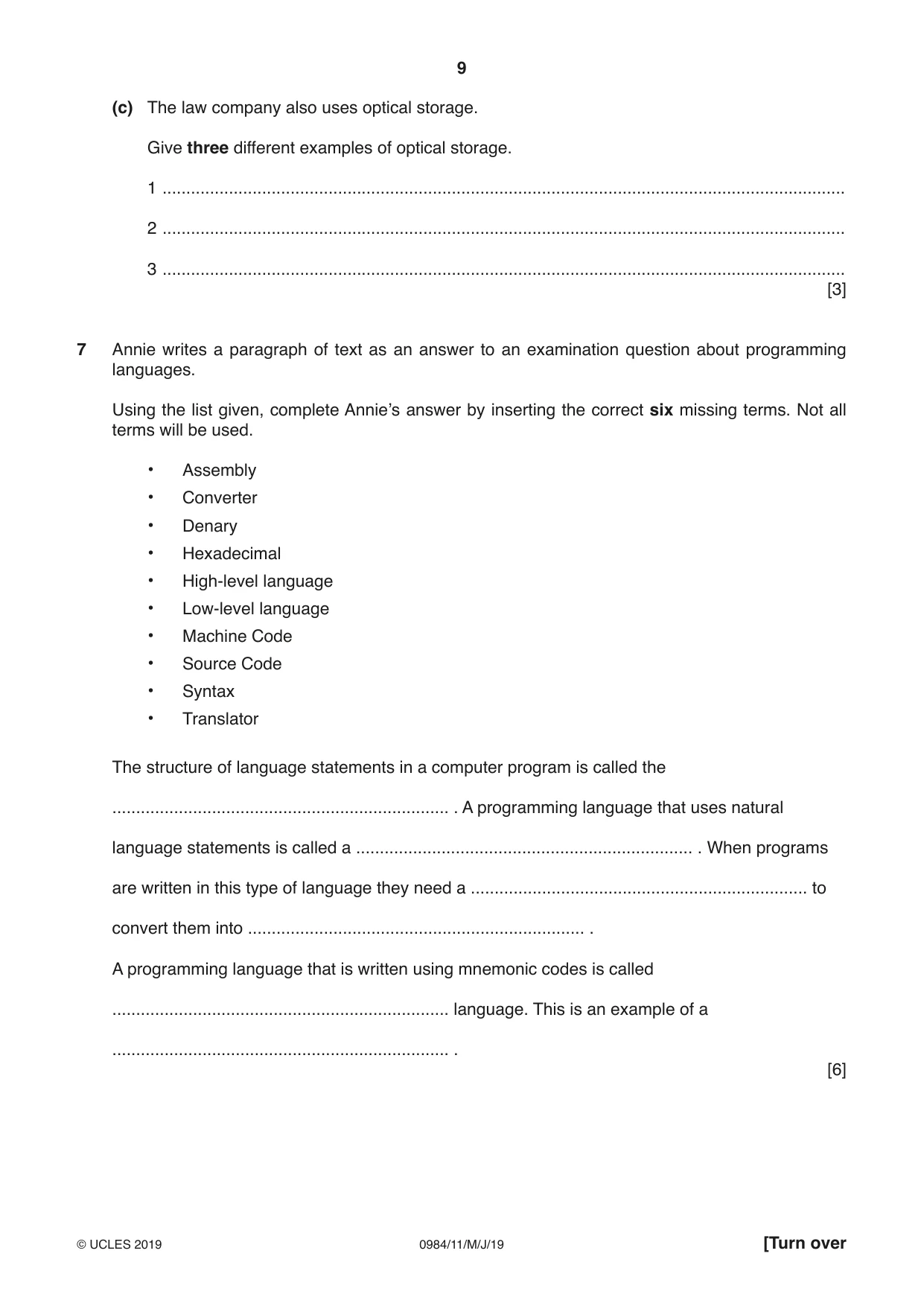
9 0984/11/M/J/19 © UCLES 2019 [Turn over (c) The law company also uses optical storage. Give three different examples of optical storage. 1 … 2 … 3 … [3] 7 Annie writes a paragraph of text as an answer to an examination question about programming languages. Using the list given, complete Annie’s answer by inserting the correct six missing terms. Not all terms will be used. • Assembly • Converter • Denary • Hexadecimal • High-level language • Low-level language • Machine Code • Source Code • Syntax • Translator The structure of language statements in a computer program is called the … . A programming language that uses natural language statements is called a … . When programs are written in this type of language they need a … to convert them into … . A programming language that is written using mnemonic codes is called … language. This is an example of a … . [6]
Question paper, page 10
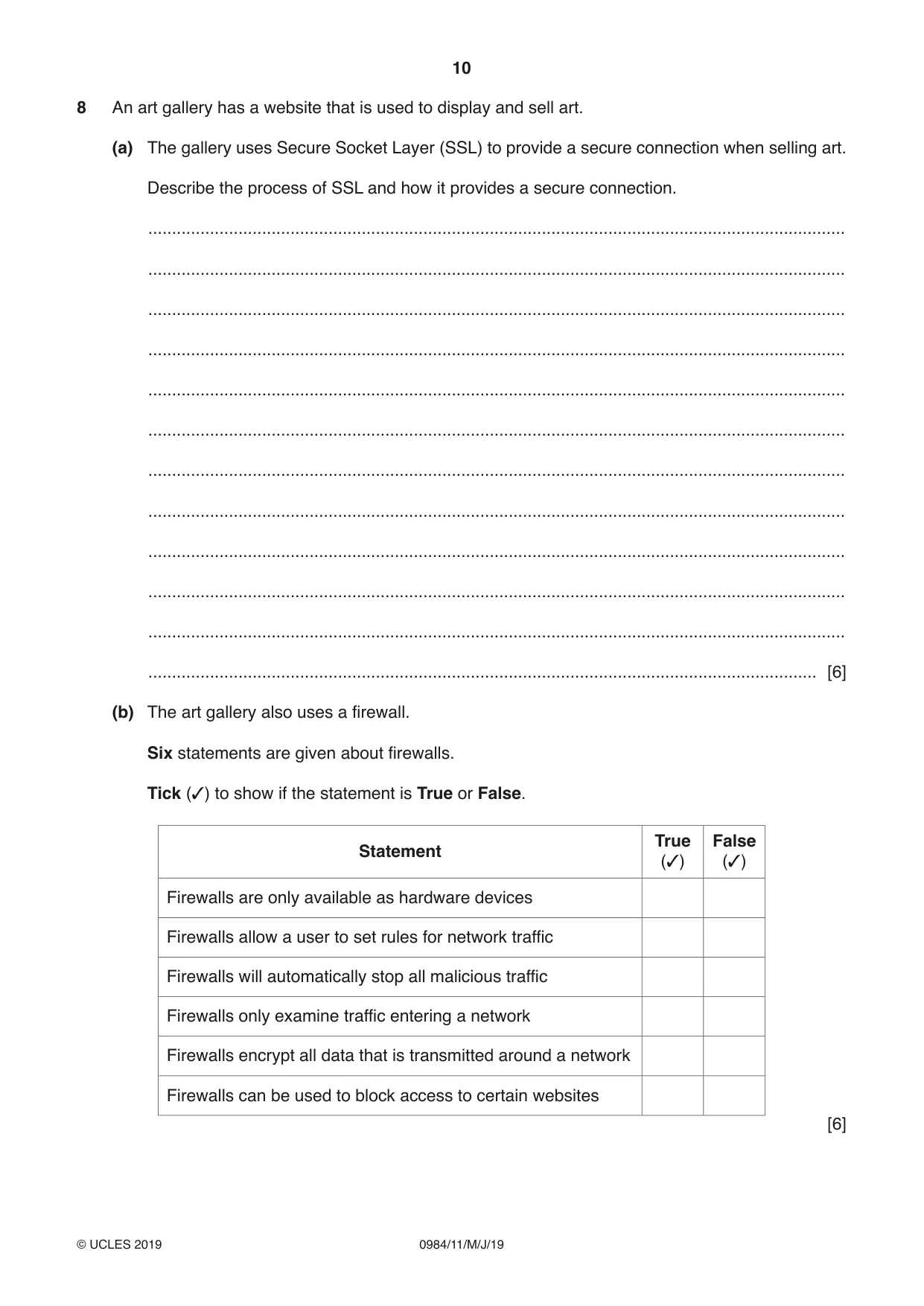
10 0984/11/M/J/19 © UCLES 2019 8 An art gallery has a website that is used to display and sell art. (a) The gallery uses Secure Socket Layer (SSL) to provide a secure connection when selling art. Describe the process of SSL and how it provides a secure connection. … … … … … … … … … … … … [6] (b) The art gallery also uses a firewall. Six statements are given about firewalls. Tick (3) to show if the statement is True or False. Statement True (3) False (3) Firewalls are only available as hardware devices Firewalls allow a user to set rules for network traffic Firewalls will automatically stop all malicious traffic Firewalls only examine traffic entering a network Firewalls encrypt all data that is transmitted around a network Firewalls can be used to block access to certain websites [6]
Question paper, page 11
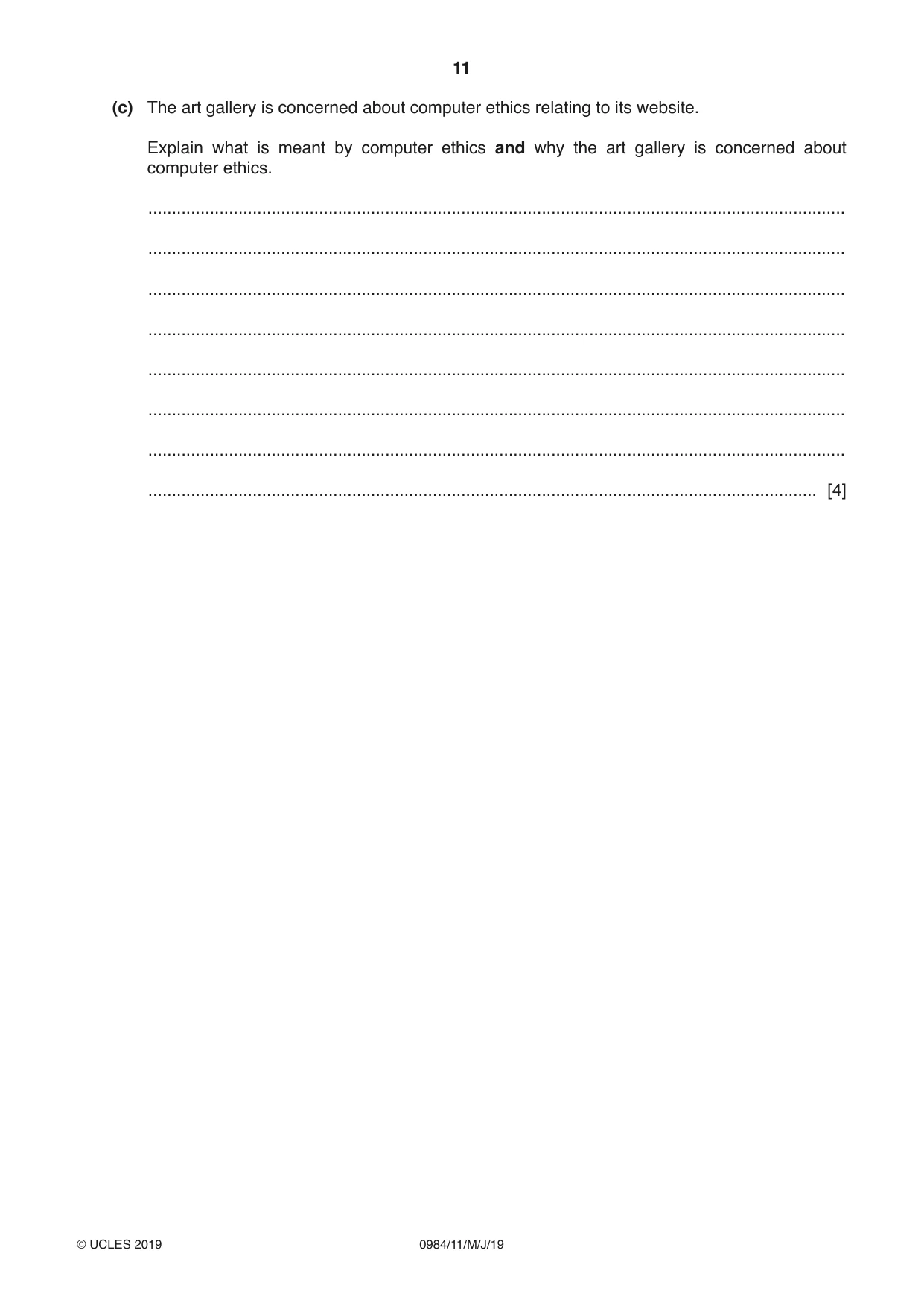
11 0984/11/M/J/19 © UCLES 2019 (c) The art gallery is concerned about computer ethics relating to its website. Explain what is meant by computer ethics and why the art gallery is concerned about computer ethics. … … … … … … … … [4]
Question paper, page 12
12 0984/11/M/J/19 © UCLES 2019 Permission to reproduce items where third-party owned material protected by copyright is included has been sought and cleared where possible. Every reasonable effort has been made by the publisher (UCLES) to trace copyright holders, but if any items requiring clearance have unwittingly been included, the publisher will be pleased to make amends at the earliest possible opportunity. To avoid the issue of disclosure of answer-related information to candidates, all copyright acknowledgements are reproduced online in the Cambridge Assessment International Education Copyright Acknowledgements Booklet. This is produced for each series of examinations and is freely available to download at www.cambridgeinternational.org after the live examination series. Cambridge Assessment International Education is part of the Cambridge Assessment Group. Cambridge Assessment is the brand name of the University of Cambridge Local Examinations Syndicate (UCLES), which itself is a department of the University of Cambridge. BLANK PAGE
Mark scheme, page 1
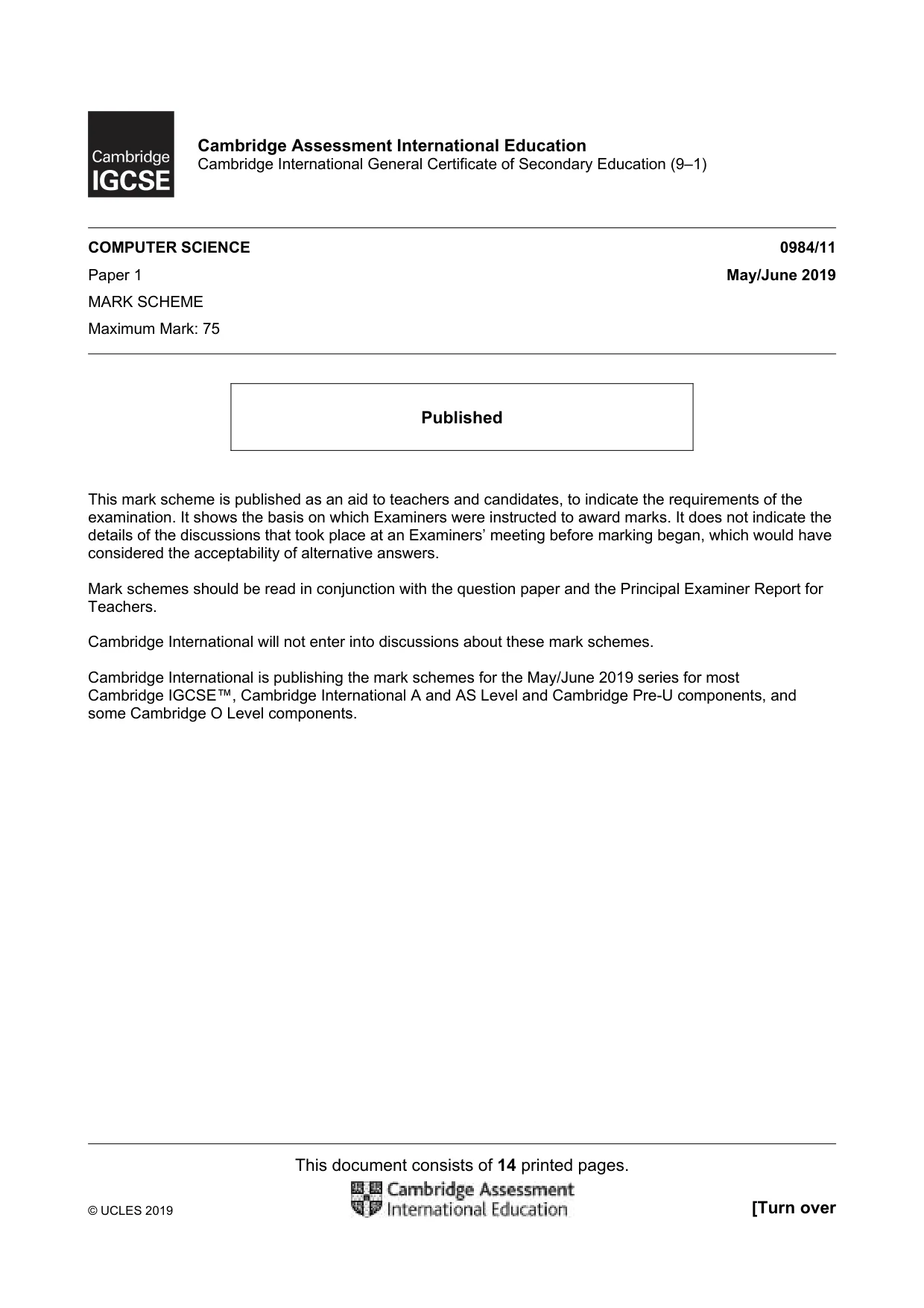
This document consists of 14 printed pages. © UCLES 2019 [Turn over Cambridge Assessment International Education Cambridge International General Certificate of Secondary Education (9–1) COMPUTER SCIENCE 0984/11 Paper 1 May/June 2019 MARK SCHEME Maximum Mark: 75 Published This mark scheme is published as an aid to teachers and candidates, to indicate the requirements of the examination. It shows the basis on which Examiners were instructed to award marks. It does not indicate the details of the discussions that took place at an Examiners’ meeting before marking began, which would have considered the acceptability of alternative answers. Mark schemes should be read in conjunction with the question paper and the Principal Examiner Report for Teachers. Cambridge International will not enter into discussions about these mark schemes. Cambridge International is publishing the mark schemes for the May/June 2019 series for most Cambridge IGCSE™, Cambridge International A and AS Level and Cambridge Pre-U components, and some Cambridge O Level components.
Mark scheme, page 2
0984/11 Cambridge IGCSE (9–1) – Mark Scheme PUBLISHED May/June 2019 © UCLES 2019 Page 2 of 14 Generic Marking Principles These general marking principles must be applied by all examiners when marking candidate answers. They should be applied alongside the specific content of the mark scheme or generic level descriptors for a question. Each question paper and mark scheme will also comply with these marking principles. GENERIC MARKING PRINCIPLE 1: Marks must be awarded in line with: • the specific content of the mark scheme or the generic level descriptors for the question • the specific skills defined in the mark scheme or in the generic level descriptors for the question • the standard of response required by a candidate as exemplified by the standardisation scripts. GENERIC MARKING PRINCIPLE 2: Marks awarded are always whole marks (not half marks, or other fractions). GENERIC MARKING PRINCIPLE 3: Marks must be awarded positively: • marks are awarded for correct/valid answers, as defined in the mark scheme. However, credit is given for valid answers which go beyond the scope of the syllabus and mark scheme, referring to your Team Leader as appropriate • marks are awarded when candidates clearly demonstrate what they know and can do • marks are not deducted for errors • marks are not deducted for omissions • answers should only be judged on the quality of spelling, punctuation and grammar when these features are specifically assessed by the question as indicated by the mark scheme. The meaning, however, should be unambiguous. GENERIC MARKING PRINCIPLE 4: Rules must be applied consistently e.g. in situations where candidates have not followed instructions or in the application of generic level descriptors.
Mark scheme, page 3
0984/11 Cambridge IGCSE (9–1) – Mark Scheme PUBLISHED May/June 2019 © UCLES 2019 Page 3 of 14 GENERIC MARKING PRINCIPLE 5: Marks should be awarded using the full range of marks defined in the mark scheme for the question (however; the use of the full mark range may be limited according to the quality of the candidate responses seen). GENERIC MARKING PRINCIPLE 6: Marks awarded are based solely on the requirements as defined in the mark scheme. Marks should not be awarded with grade thresholds or grade descriptors in mind.
Mark scheme, page 4
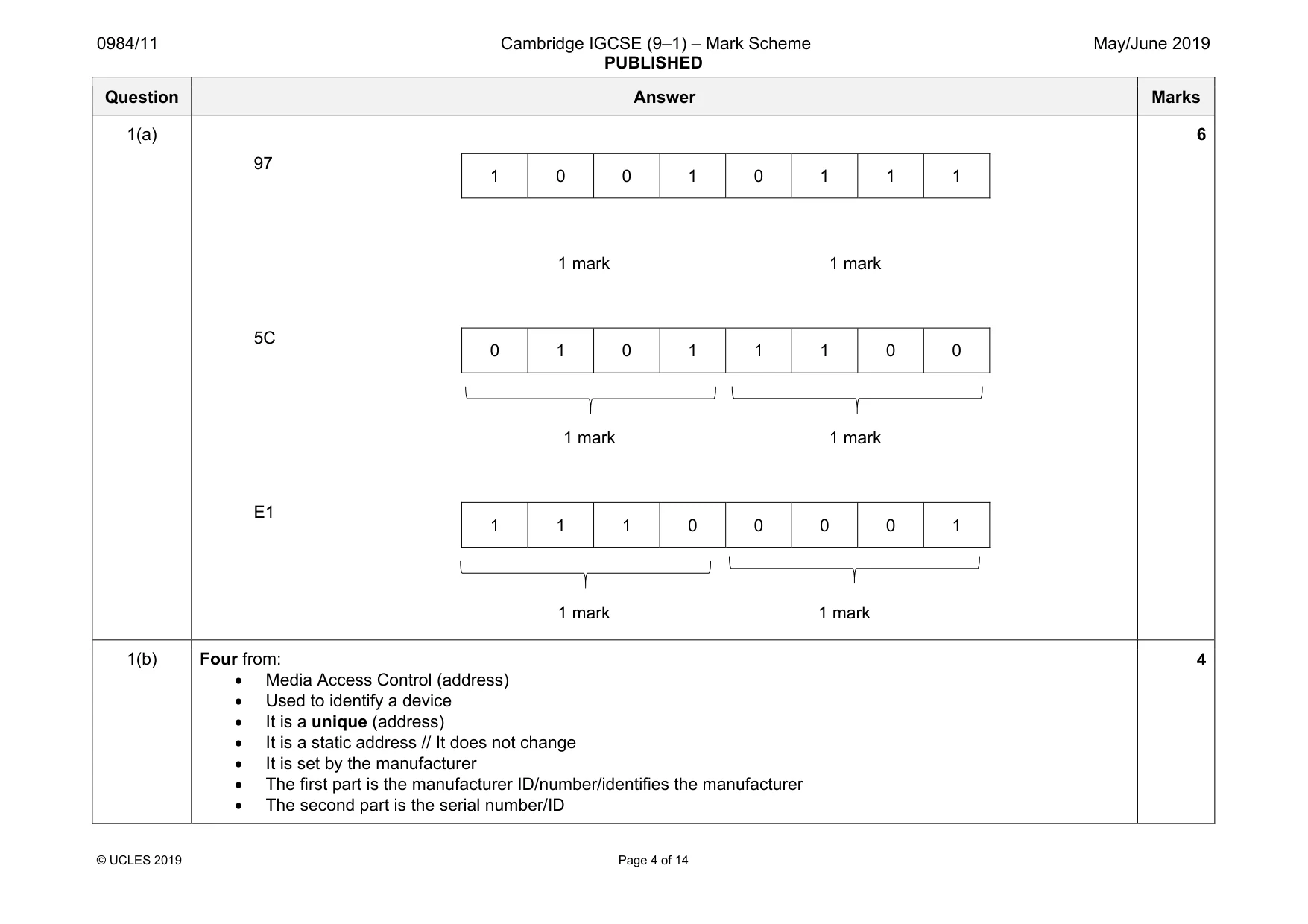
0984/11 Cambridge IGCSE (9–1) – Mark Scheme PUBLISHED May/June 2019 © UCLES 2019 Page 4 of 14 Question Answer Marks 1(a) 97 1 0 0 1 0 1 1 1 1 mark 1 mark 5C 0 1 0 1 1 1 0 0 1 mark 1 mark E1 1 1 1 0 0 0 0 1 1 mark 1 mark 6 1(b) Four from: • Media Access Control (address) • Used to identify a device • It is a unique (address) • It is a static address // It does not change • It is set by the manufacturer • The first part is the manufacturer ID/number/identifies the manufacturer • The second part is the serial number/ID 4
Mark scheme, page 5
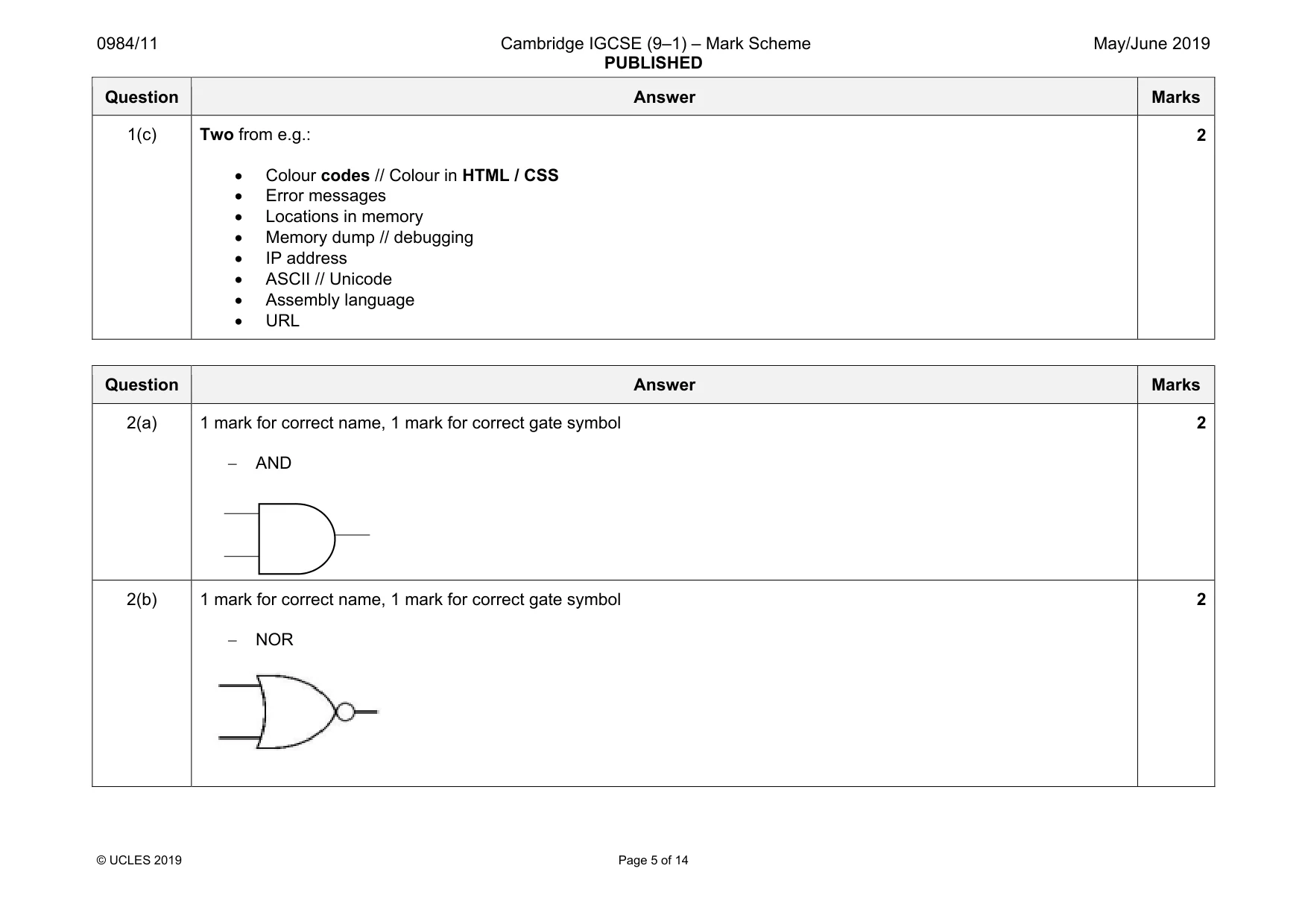
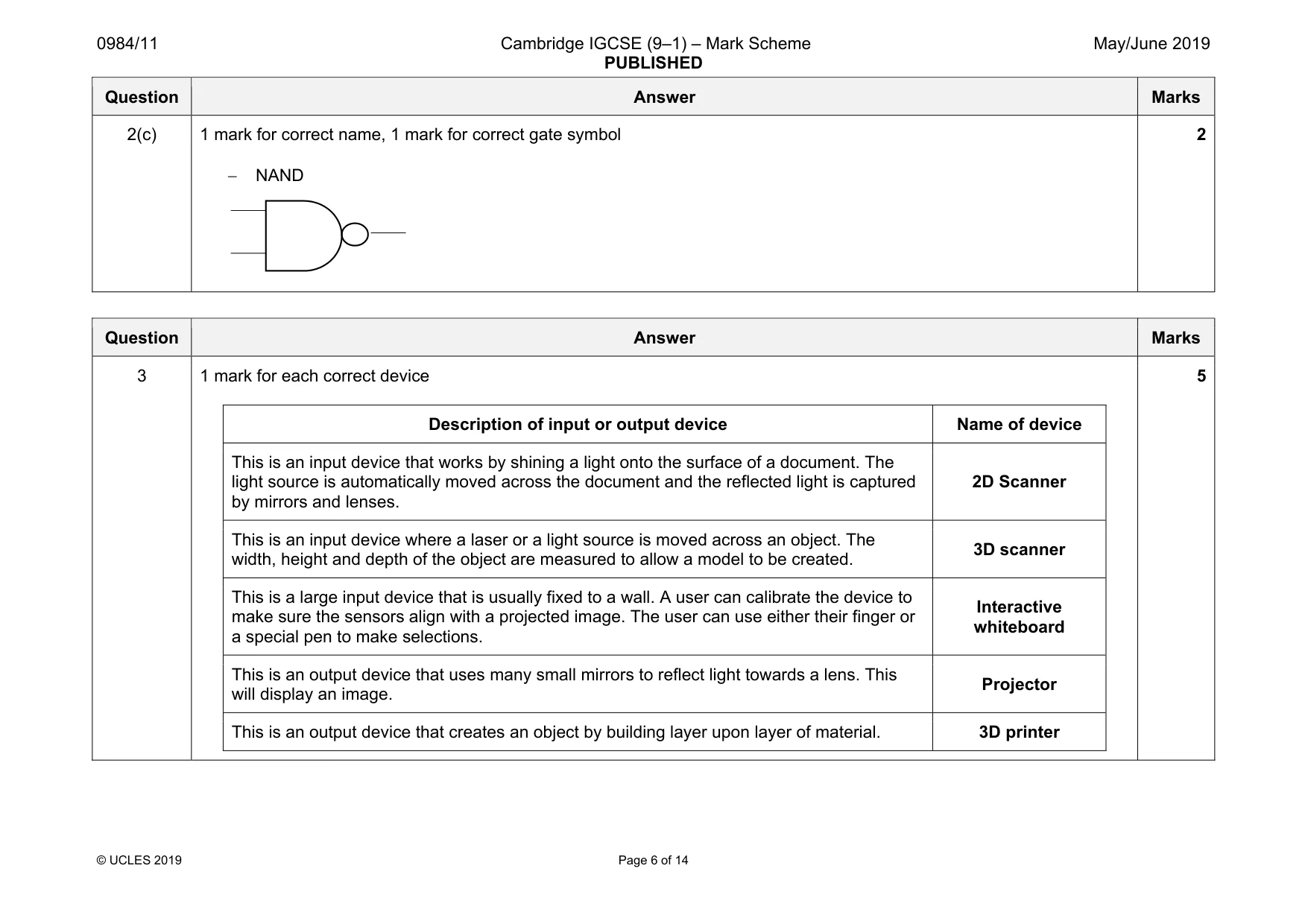
0984/11 Cambridge IGCSE (9–1) – Mark Scheme PUBLISHED May/June 2019 © UCLES 2019 Page 5 of 14 Question Answer Marks 1(c) Two from e.g.: • Colour codes // Colour in HTML / CSS • Error messages • Locations in memory • Memory dump // debugging • IP address • ASCII // Unicode • Assembly language • URL 2 Question Answer Marks 2(a) 1 mark for correct name, 1 mark for correct gate symbol − AND 2 2(b) 1 mark for correct name, 1 mark for correct gate symbol − NOR 2
Mark scheme, page 6
0984/11 Cambridge IGCSE (9–1) – Mark Scheme PUBLISHED May/June 2019 © UCLES 2019 Page 6 of 14 Question Answer Marks 2(c) 1 mark for correct name, 1 mark for correct gate symbol − NAND 2 Question Answer Marks 3 1 mark for each correct device Description of input or output device Name of device This is an input device that works by shining a light onto the surface of a document. The light source is automatically moved across the document and the reflected light is captured by mirrors and lenses. 2D Scanner This is an input device where a laser or a light source is moved across an object. The width, height and depth of the object are measured to allow a model to be created. 3D scanner This is a large input device that is usually fixed to a wall. A user can calibrate the device to make sure the sensors align with a projected image. The user can use either their finger or a special pen to make selections. Interactive whiteboard This is an output device that uses many small mirrors to reflect light towards a lens. This will display an image. Projector This is an output device that creates an object by building layer upon layer of material. 3D printer 5
Mark scheme, page 7
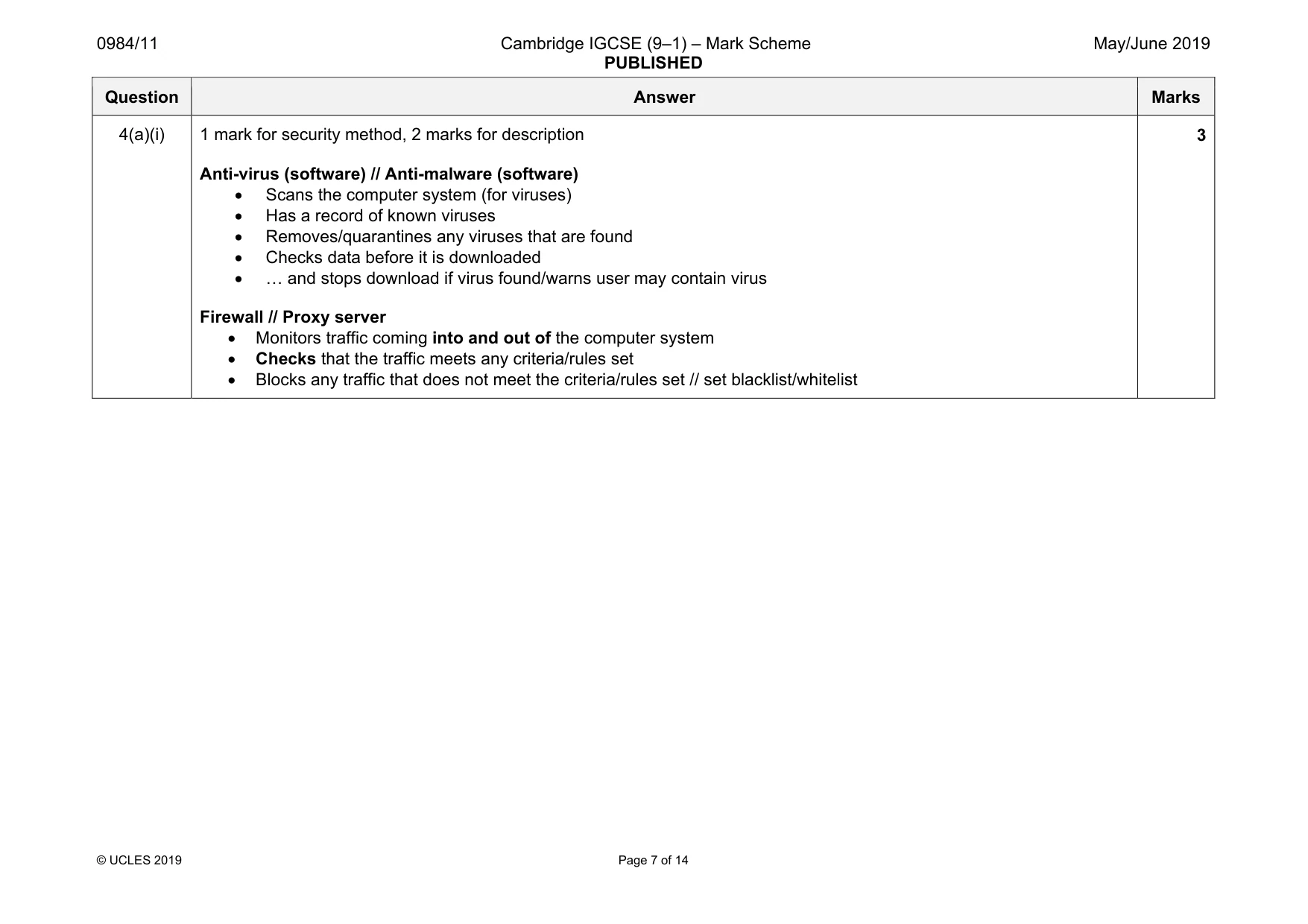
0984/11 Cambridge IGCSE (9–1) – Mark Scheme PUBLISHED May/June 2019 © UCLES 2019 Page 7 of 14 Question Answer Marks 4(a)(i) 1 mark for security method, 2 marks for description Anti-virus (software) // Anti-malware (software) • Scans the computer system (for viruses) • Has a record of known viruses • Removes/quarantines any viruses that are found • Checks data before it is downloaded • « and stops download if virus found/warns user may contain virus Firewall // Proxy server • Monitors traffic coming into and out of the computer system • Checks that the traffic meets any criteria/rules set • Blocks any traffic that does not meet the criteria/rules set // set blacklist/whitelist 3
Mark scheme, page 8
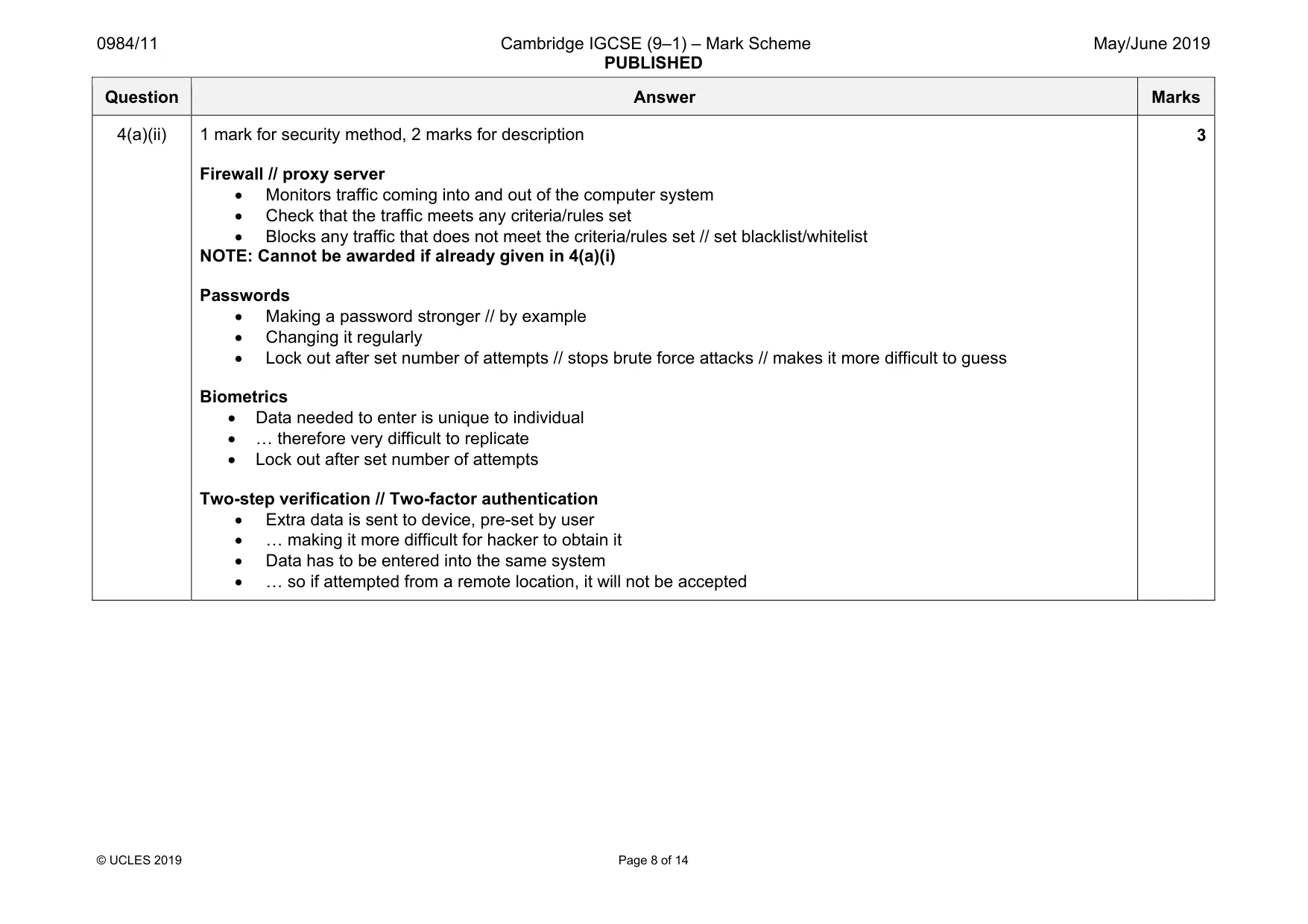
0984/11 Cambridge IGCSE (9–1) – Mark Scheme PUBLISHED May/June 2019 © UCLES 2019 Page 8 of 14 Question Answer Marks 4(a)(ii) 1 mark for security method, 2 marks for description Firewall // proxy server • Monitors traffic coming into and out of the computer system • Check that the traffic meets any criteria/rules set • Blocks any traffic that does not meet the criteria/rules set // set blacklist/whitelist NOTE: Cannot be awarded if already given in 4(a)(i) Passwords • Making a password stronger // by example • Changing it regularly • Lock out after set number of attempts // stops brute force attacks // makes it more difficult to guess Biometrics • Data needed to enter is unique to individual • « therefore very difficult to replicate • Lock out after set number of attempts Two-step verification // Two-factor authentication • Extra data is sent to device, pre-set by user • « making it more difficult for hacker to obtain it • Data has to be entered into the same system • « so if attempted from a remote location, it will not be accepted 3
Mark scheme, page 9
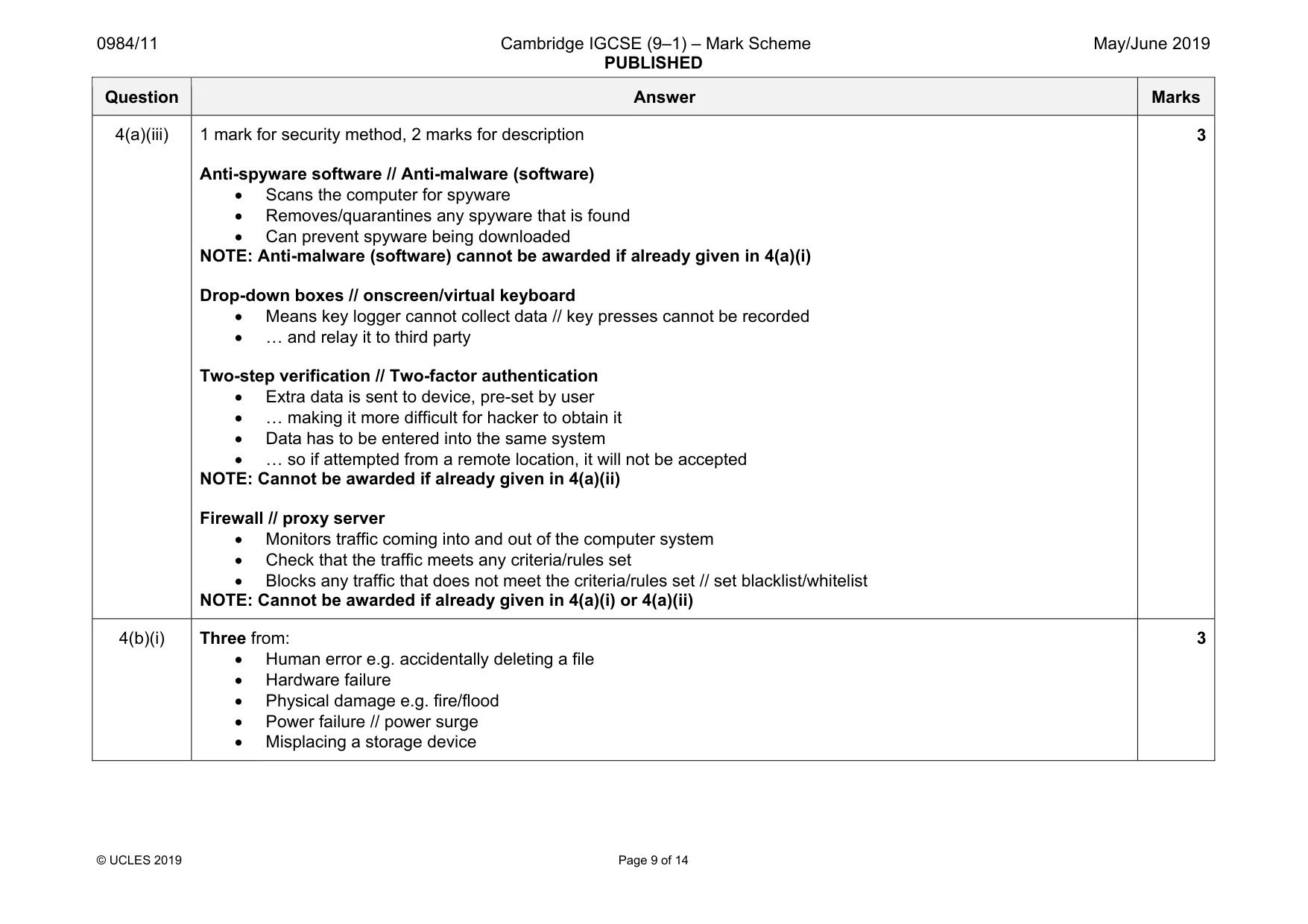
0984/11 Cambridge IGCSE (9–1) – Mark Scheme PUBLISHED May/June 2019 © UCLES 2019 Page 9 of 14 Question Answer Marks 4(a)(iii) 1 mark for security method, 2 marks for description Anti-spyware software // Anti-malware (software) • Scans the computer for spyware • Removes/quarantines any spyware that is found • Can prevent spyware being downloaded NOTE: Anti-malware (software) cannot be awarded if already given in 4(a)(i) Drop-down boxes // onscreen/virtual keyboard • Means key logger cannot collect data // key presses cannot be recorded • « and relay it to third party Two-step verification // Two-factor authentication • Extra data is sent to device, pre-set by user • « making it more difficult for hacker to obtain it • Data has to be entered into the same system • « so if attempted from a remote location, it will not be accepted NOTE: Cannot be awarded if already given in 4(a)(ii) Firewall // proxy server • Monitors traffic coming into and out of the computer system • Check that the traffic meets any criteria/rules set • Blocks any traffic that does not meet the criteria/rules set // set blacklist/whitelist NOTE: Cannot be awarded if already given in 4(a)(i) or 4(a)(ii) 3 4(b)(i) Three from: • Human error e.g. accidentally deleting a file • Hardware failure • Physical damage e.g. fire/flood • Power failure // power surge • Misplacing a storage device 3
Mark scheme, page 10
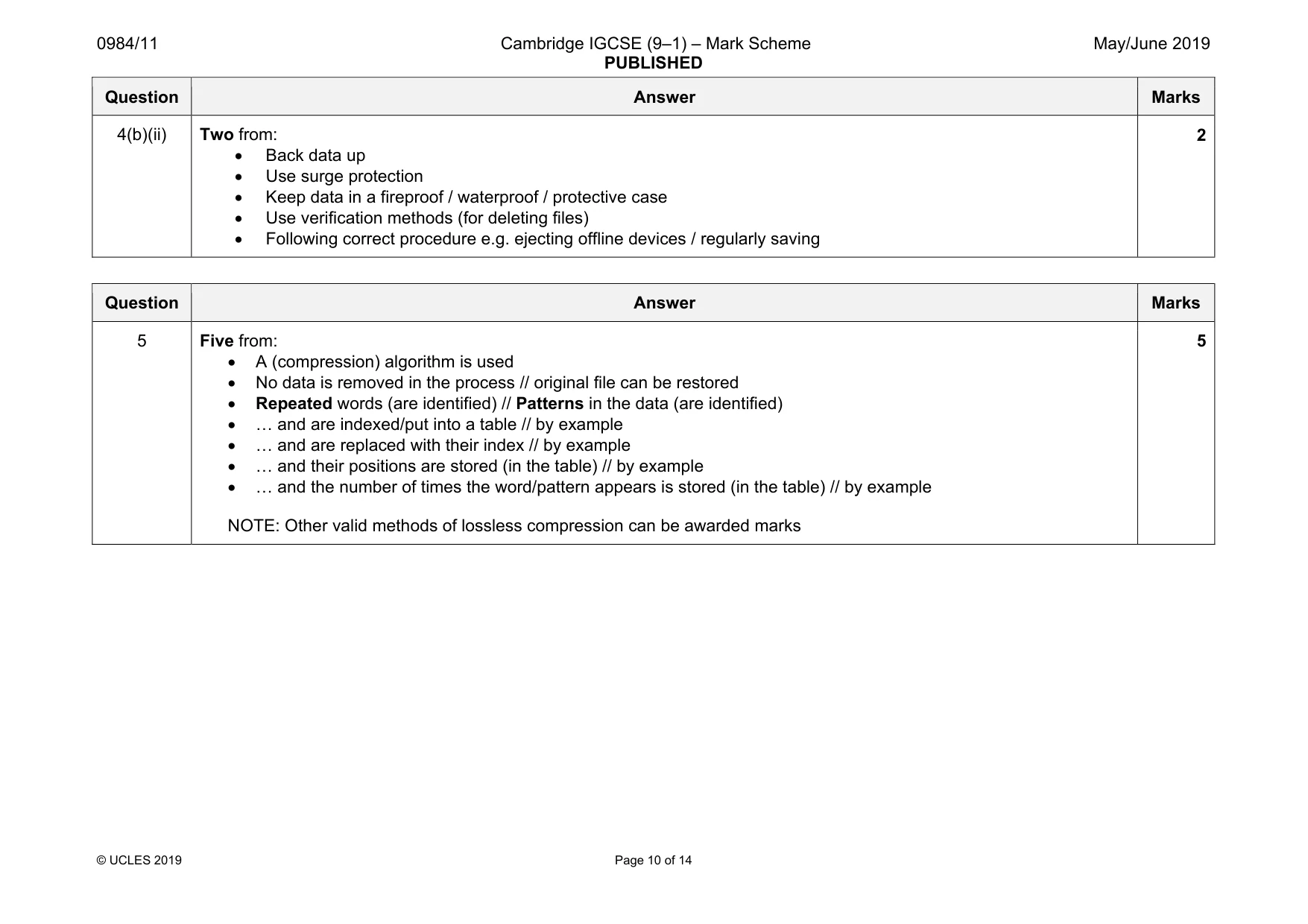
0984/11 Cambridge IGCSE (9–1) – Mark Scheme PUBLISHED May/June 2019 © UCLES 2019 Page 10 of 14 Question Answer Marks 4(b)(ii) Two from: • Back data up • Use surge protection • Keep data in a fireproof / waterproof / protective case • Use verification methods (for deleting files) • Following correct procedure e.g. ejecting offline devices / regularly saving 2 Question Answer Marks 5 Five from: • A (compression) algorithm is used • No data is removed in the process // original file can be restored • Repeated words (are identified) // Patterns in the data (are identified) • « and are indexed/put into a table // by example • « and are replaced with their index // by example • « and their positions are stored (in the table) // by example • « and the number of times the word/pattern appears is stored (in the table) // by example NOTE: Other valid methods of lossless compression can be awarded marks 5
Mark scheme, page 11
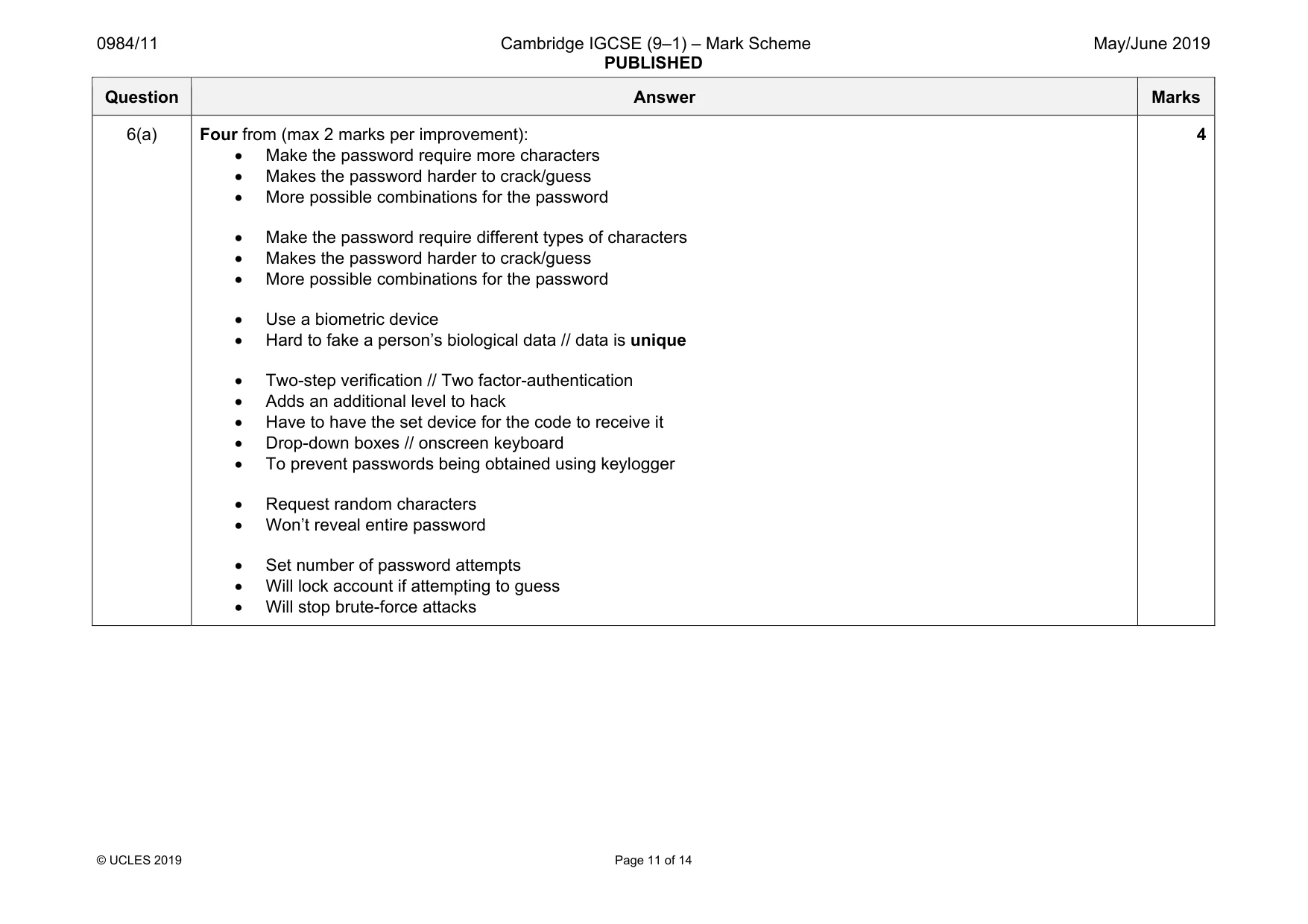
0984/11 Cambridge IGCSE (9–1) – Mark Scheme PUBLISHED May/June 2019 © UCLES 2019 Page 11 of 14 Question Answer Marks 6(a) Four from (max 2 marks per improvement): • Make the password require more characters • Makes the password harder to crack/guess • More possible combinations for the password • Make the password require different types of characters • Makes the password harder to crack/guess • More possible combinations for the password • Use a biometric device • Hard to fake a person’s biological data // data is unique • Two-step verification // Two factor-authentication • Adds an additional level to hack • Have to have the set device for the code to receive it • Drop-down boxes // onscreen keyboard • To prevent passwords being obtained using keylogger • Request random characters • Won’t reveal entire password • Set number of password attempts • Will lock account if attempting to guess • Will stop brute-force attacks 4
Mark scheme, page 12
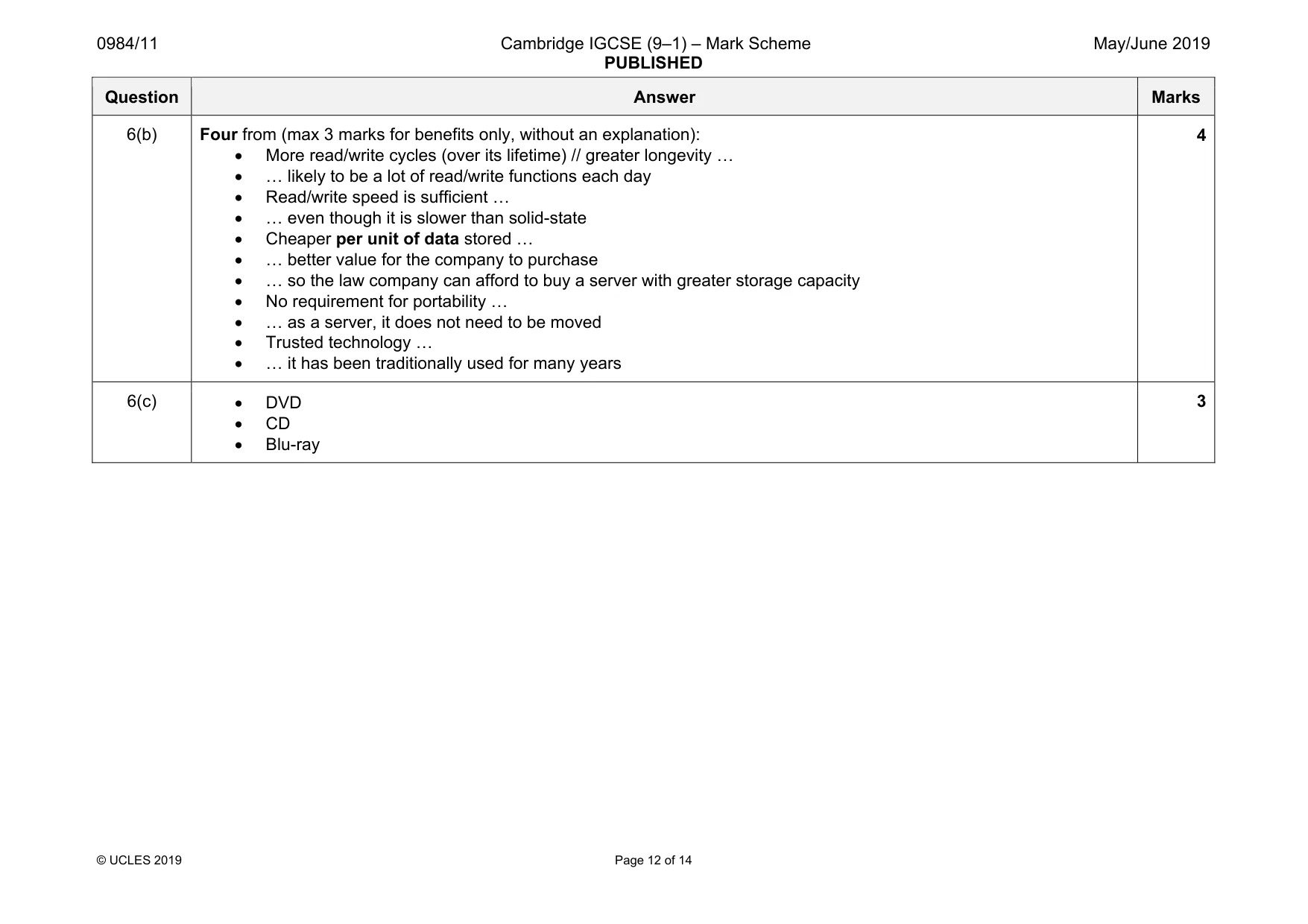
0984/11 Cambridge IGCSE (9–1) – Mark Scheme PUBLISHED May/June 2019 © UCLES 2019 Page 12 of 14 Question Answer Marks 6(b) Four from (max 3 marks for benefits only, without an explanation): • More read/write cycles (over its lifetime) // greater longevity « • « likely to be a lot of read/write functions each day • Read/write speed is sufficient « • « even though it is slower than solid-state • Cheaper per unit of data stored « • « better value for the company to purchase • « so the law company can afford to buy a server with greater storage capacity • No requirement for portability « • « as a server, it does not need to be moved • Trusted technology « • « it has been traditionally used for many years 4 6(c) • DVD • CD • Blu-ray 3
Mark scheme, page 13
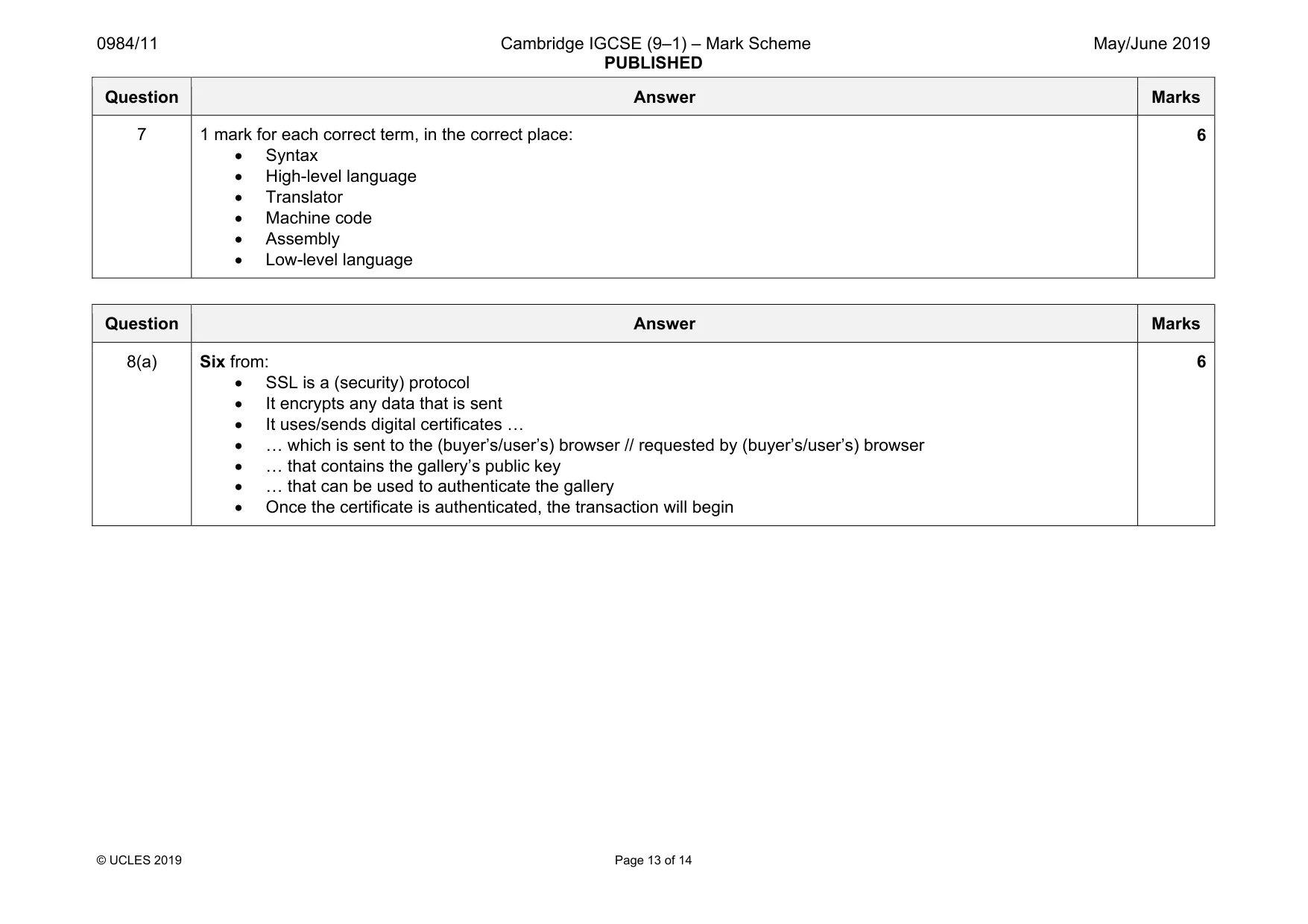
0984/11 Cambridge IGCSE (9–1) – Mark Scheme PUBLISHED May/June 2019 © UCLES 2019 Page 13 of 14 Question Answer Marks 7 1 mark for each correct term, in the correct place: • Syntax • High-level language • Translator • Machine code • Assembly • Low-level language 6 Question Answer Marks 8(a) Six from: • SSL is a (security) protocol • It encrypts any data that is sent • It uses/sends digital certificates « • « which is sent to the (buyer’s/user’s) browser // requested by (buyer’s/user’s) browser • « that contains the gallery’s public key • « that can be used to authenticate the gallery • Once the certificate is authenticated, the transaction will begin 6
Mark scheme, page 14
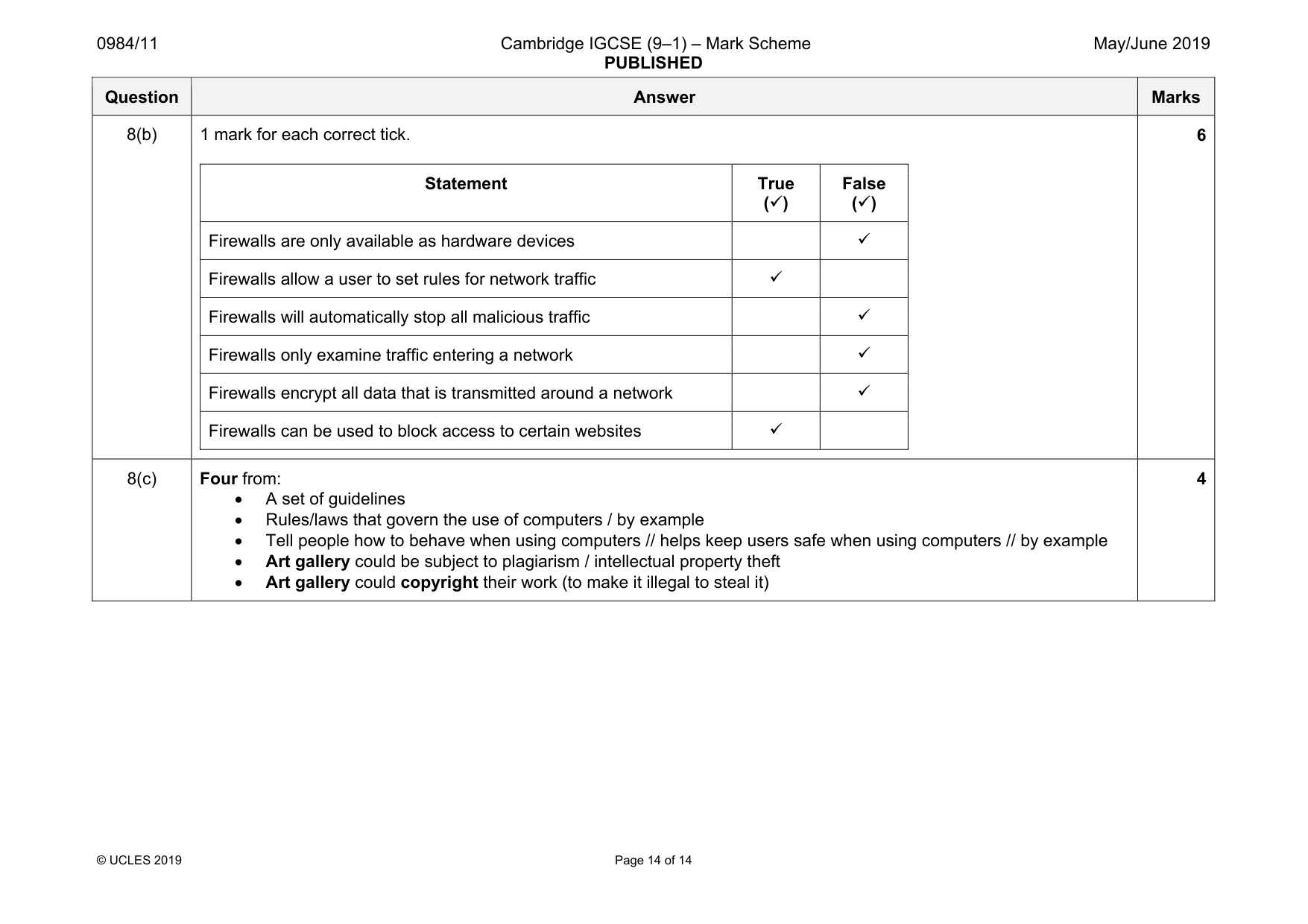
0984/11 Cambridge IGCSE (9–1) – Mark Scheme PUBLISHED May/June 2019 © UCLES 2019 Page 14 of 14 Question Answer Marks 8(b) 1 mark for each correct tick. Statement True (9) False (9) Firewalls are only available as hardware devices 9 Firewalls allow a user to set rules for network traffic 9 Firewalls will automatically stop all malicious traffic 9 Firewalls only examine traffic entering a network 9 Firewalls encrypt all data that is transmitted around a network 9 Firewalls can be used to block access to certain websites 9 6 8(c) Four from: • A set of guidelines • Rules/laws that govern the use of computers / by example • Tell people how to behave when using computers // helps keep users safe when using computers // by example • Art gallery could be subject to plagiarism / intellectual property theft • Art gallery could copyright their work (to make it illegal to steal it) 4
What you needed in this session
Cambridge’s own grade thresholds for 2019 May/June, Paper 1 · Variant 1. A higher threshold means an easier paper — the bar moves with how the cohort did.