Cambridge IGCSE Computer Science (9-1) 0984 — 2019 May/June Paper 1 · Variant 2
0984/12/M/J/19 · 75 marks · ≈84 min
The question paper and its mark scheme, free to read here and free to download. This is Cambridge’s own paper, exactly as it was sat.
Question paper12 pages

Mark scheme12 pages
Answers below. Sit the paper first if you are practising.
Paper as text
Question paper, page 1
This document consists of 11 printed pages and 1 blank page. DC (MM) 181135 © UCLES 2019 [Turn over * 3 8 8 9 0 6 7 8 3 7 * Cambridge Assessment International Education Cambridge International General Certificate of Secondary Education (9–1) COMPUTER SCIENCE 0984/12 Paper 1 Theory May/June 2019 1 hour 45 minutes Candidates answer on the Question Paper. No Additional Materials are required. No calculators allowed. READ THESE INSTRUCTIONS FIRST Write your centre number, candidate number and name in the spaces at the top of this page. Write in dark blue or black pen. You may use an HB pencil for any diagrams, graphs or rough working. Do not use staples, paper clips, glue or correction fluid. DO NOT WRITE IN ANY BARCODES. Answer all questions. No marks will be awarded for using brand names of software packages or hardware. Any businesses described in this paper are entirely fictitious. At the end of the examination, fasten all your work securely together. The number of marks is given in brackets [ ] at the end of each question or part question. The maximum number of marks is 75.
Question paper, page 2
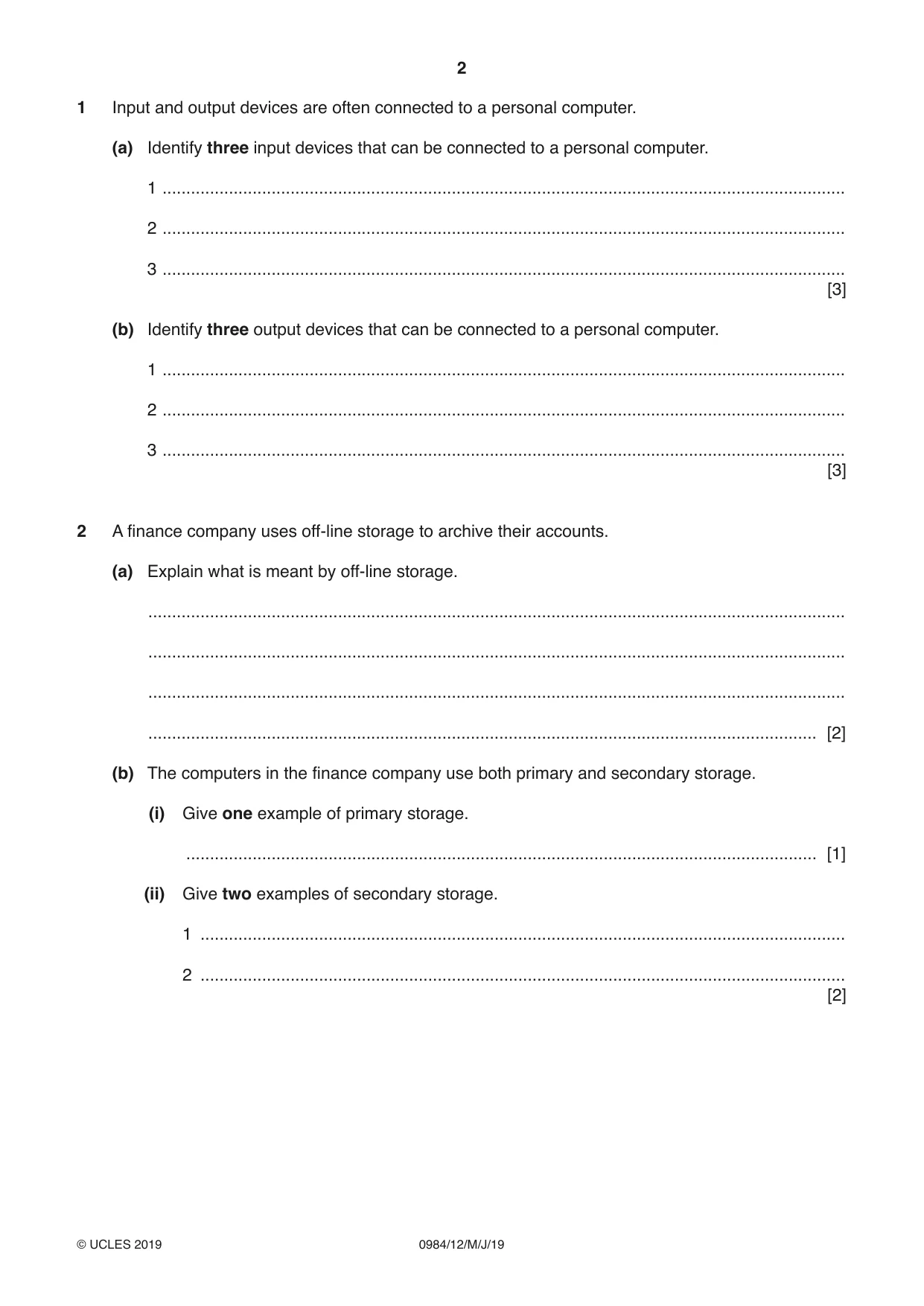
2 0984/12/M/J/19 © UCLES 2019 1 Input and output devices are often connected to a personal computer. (a) Identify three input devices that can be connected to a personal computer. 1 … 2 … 3 … [3] (b) Identify three output devices that can be connected to a personal computer. 1 … 2 … 3 … [3] 2 A finance company uses off-line storage to archive their accounts. (a) Explain what is meant by off-line storage. … … … … [2] (b) The computers in the finance company use both primary and secondary storage. (i) Give one example of primary storage. … [1] (ii) Give two examples of secondary storage. 1 … 2 … [2]
Question paper, page 3
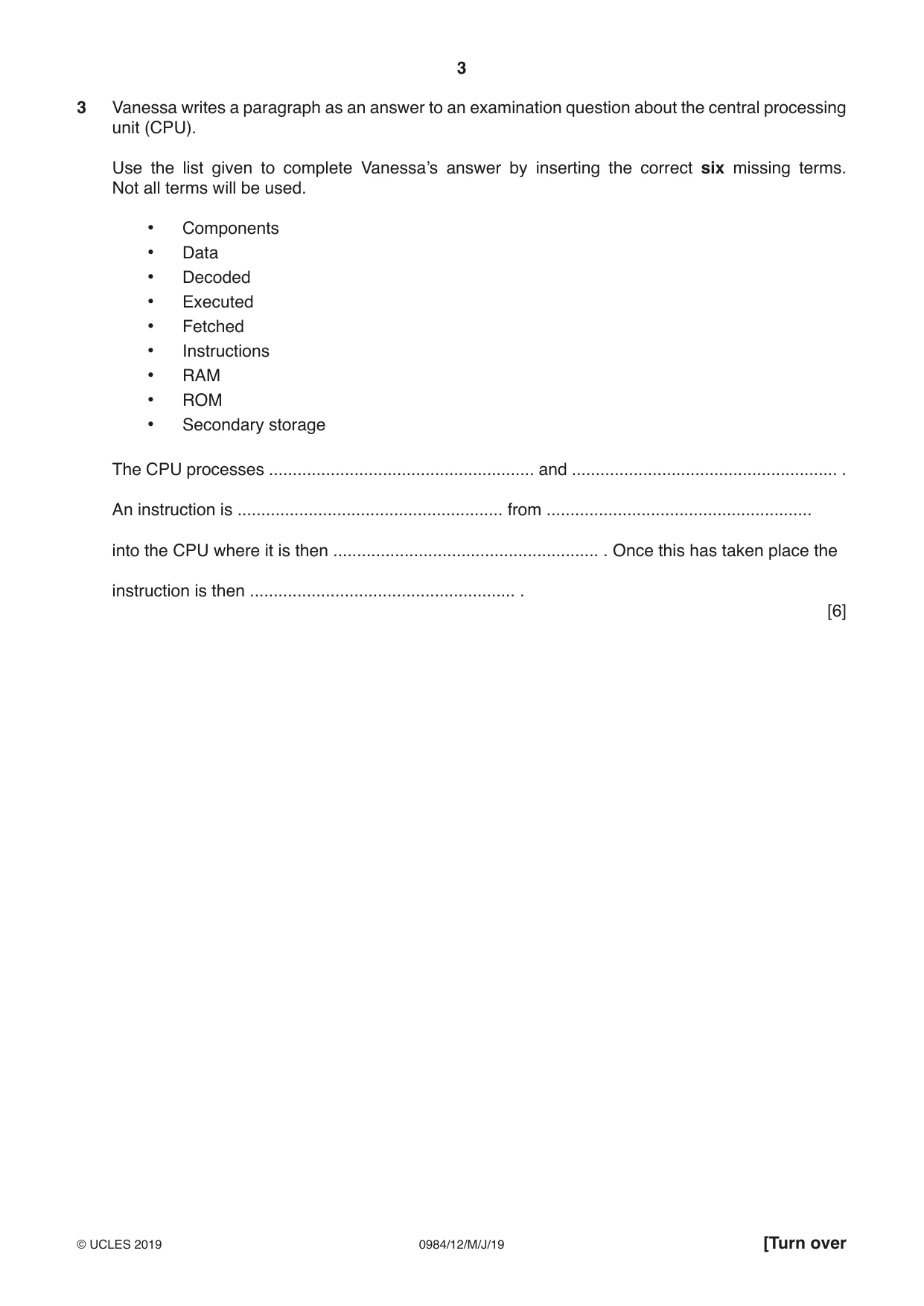
3 0984/12/M/J/19 © UCLES 2019 [Turn over 3 Vanessa writes a paragraph as an answer to an examination question about the central processing unit (CPU). Use the list given to complete Vanessa’s answer by inserting the correct six missing terms. Not all terms will be used. • Components • Data • Decoded • Executed • Fetched • Instructions • RAM • ROM • Secondary storage The CPU processes … and … . An instruction is … from … into the CPU where it is then … . Once this has taken place the instruction is then … . [6]
Question paper, page 4
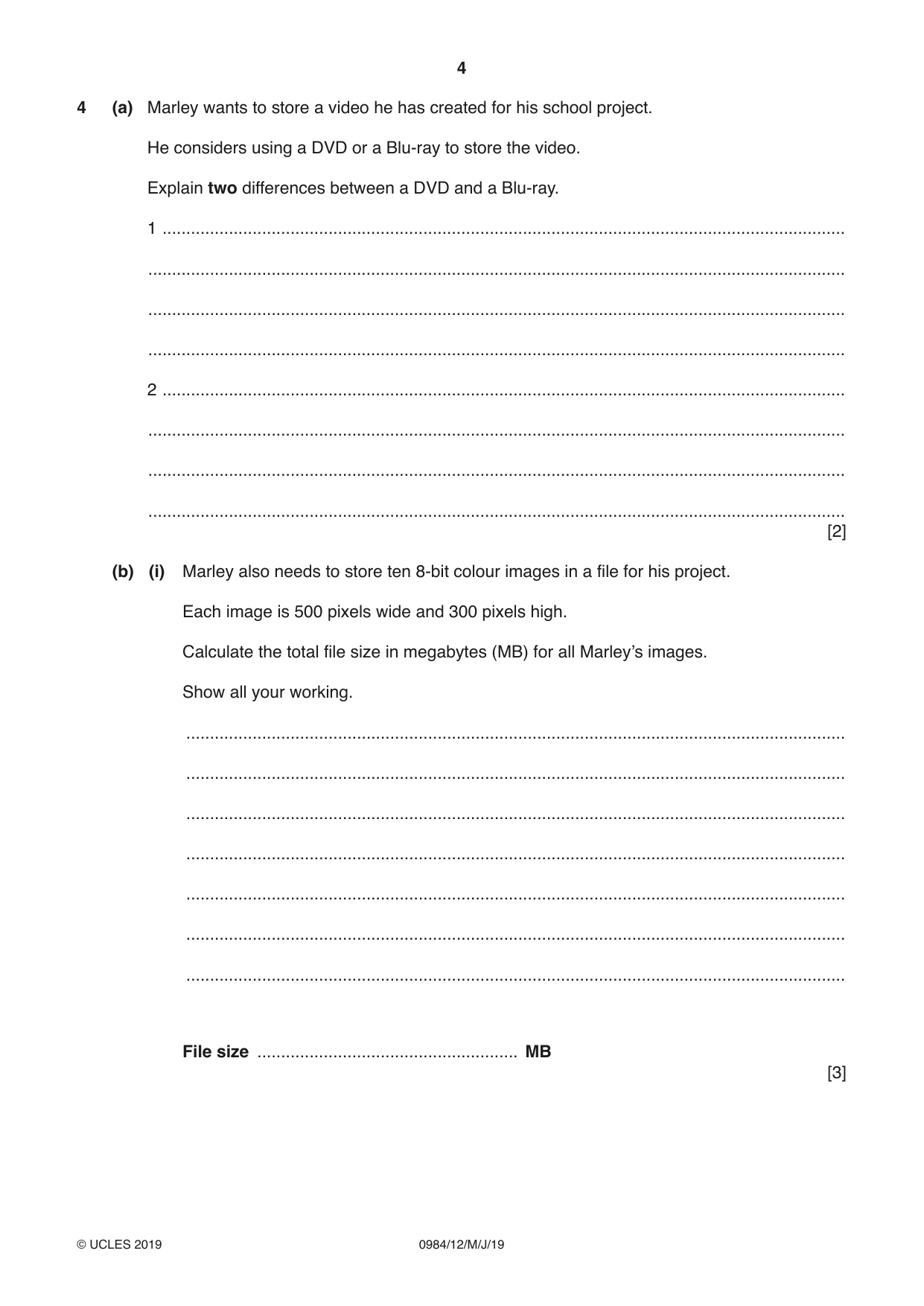
4 0984/12/M/J/19 © UCLES 2019 4 (a) Marley wants to store a video he has created for his school project. He considers using a DVD or a Blu-ray to store the video. Explain two differences between a DVD and a Blu-ray. 1 … … … … 2 … … … … [2] (b) (i) Marley also needs to store ten 8-bit colour images in a file for his project. Each image is 500 pixels wide and 300 pixels high. Calculate the total file size in megabytes (MB) for all Marley’s images. Show all your working. … … … … … … … File size … MB [3]
Question paper, page 5
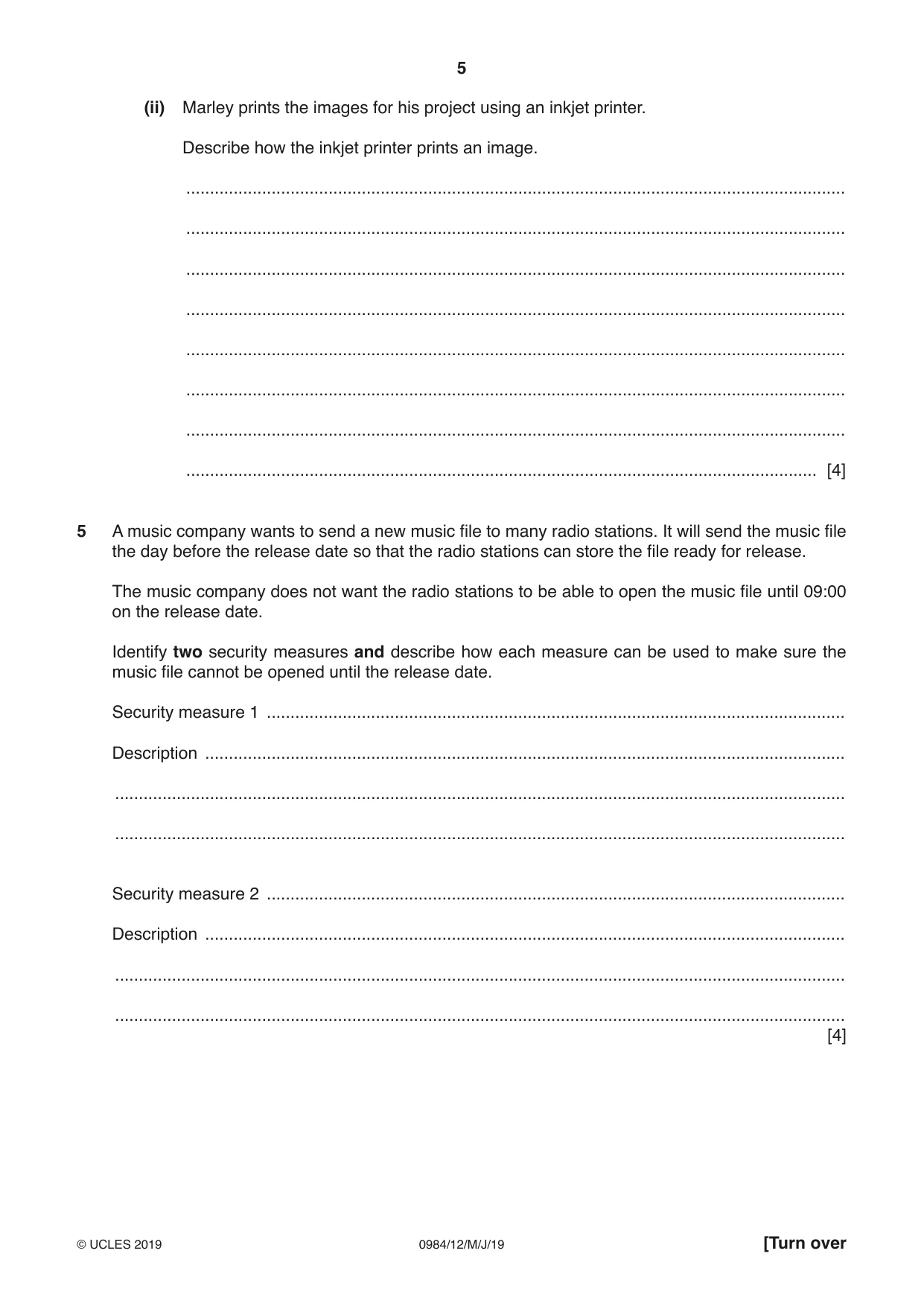
5 0984/12/M/J/19 © UCLES 2019 [Turn over (ii) Marley prints the images for his project using an inkjet printer. Describe how the inkjet printer prints an image. … … … … … … … … [4] 5 A music company wants to send a new music file to many radio stations. It will send the music file the day before the release date so that the radio stations can store the file ready for release. The music company does not want the radio stations to be able to open the music file until 09:00 on the release date. Identify two security measures and describe how each measure can be used to make sure the music file cannot be opened until the release date. Security measure 1 … Description … … … Security measure 2 … Description … … … [4]
Question paper, page 6
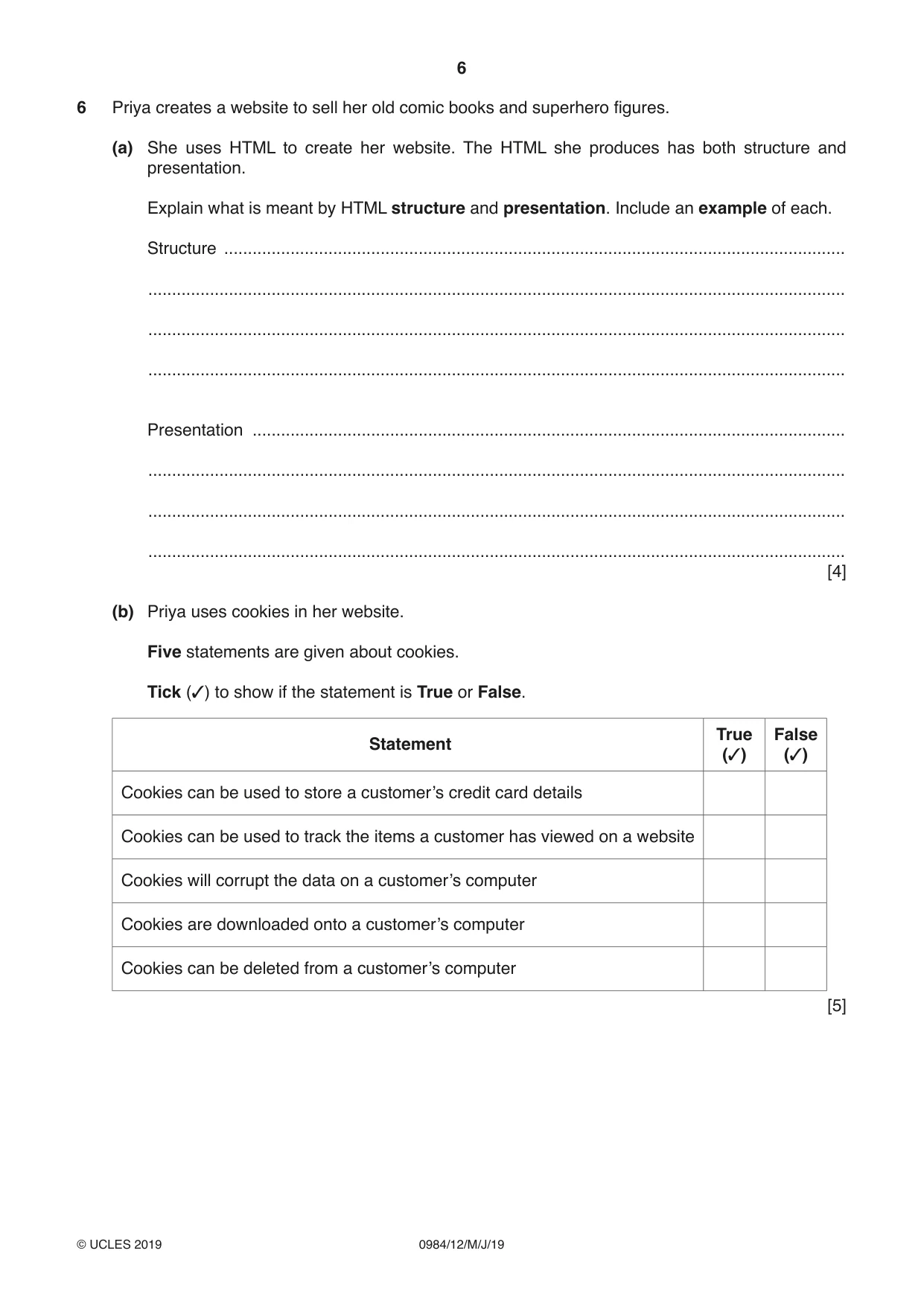
6 0984/12/M/J/19 © UCLES 2019 6 Priya creates a website to sell her old comic books and superhero figures. (a) She uses HTML to create her website. The HTML she produces has both structure and presentation. Explain what is meant by HTML structure and presentation. Include an example of each. Structure … … … … Presentation … … … … [4] (b) Priya uses cookies in her website. Five statements are given about cookies. Tick (✓) to show if the statement is True or False. Statement True (✓) False (✓) Cookies can be used to store a customer’s credit card details Cookies can be used to track the items a customer has viewed on a website Cookies will corrupt the data on a customer’s computer Cookies are downloaded onto a customer’s computer Cookies can be deleted from a customer’s computer [5]
Question paper, page 7
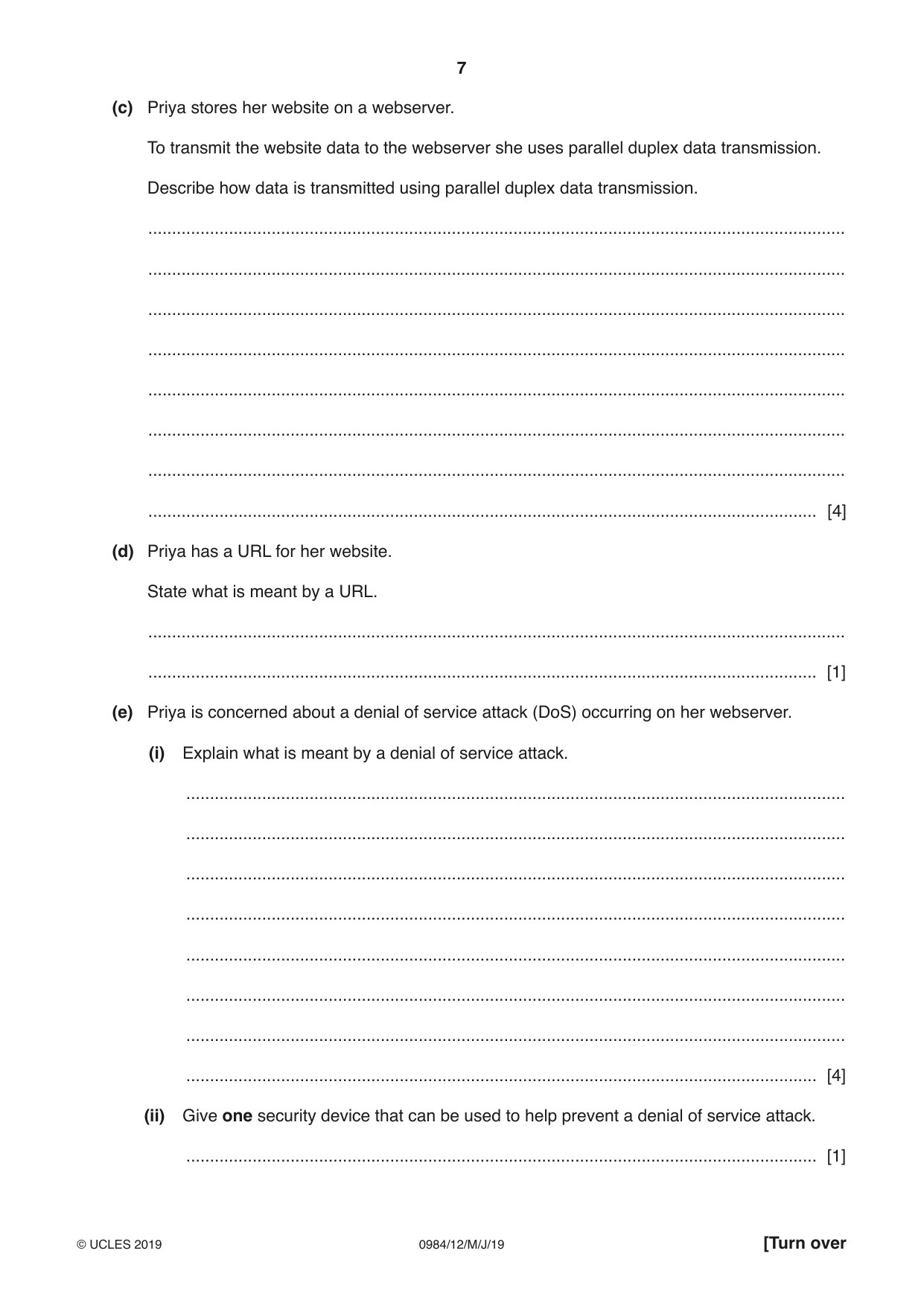
7 0984/12/M/J/19 © UCLES 2019 [Turn over (c) Priya stores her website on a webserver. To transmit the website data to the webserver she uses parallel duplex data transmission. Describe how data is transmitted using parallel duplex data transmission. … … … … … … … … [4] (d) Priya has a URL for her website. State what is meant by a URL. … … [1] (e) Priya is concerned about a denial of service attack (DoS) occurring on her webserver. (i) Explain what is meant by a denial of service attack. … … … … … … … … [4] (ii) Give one security device that can be used to help prevent a denial of service attack. … [1]
Question paper, page 8
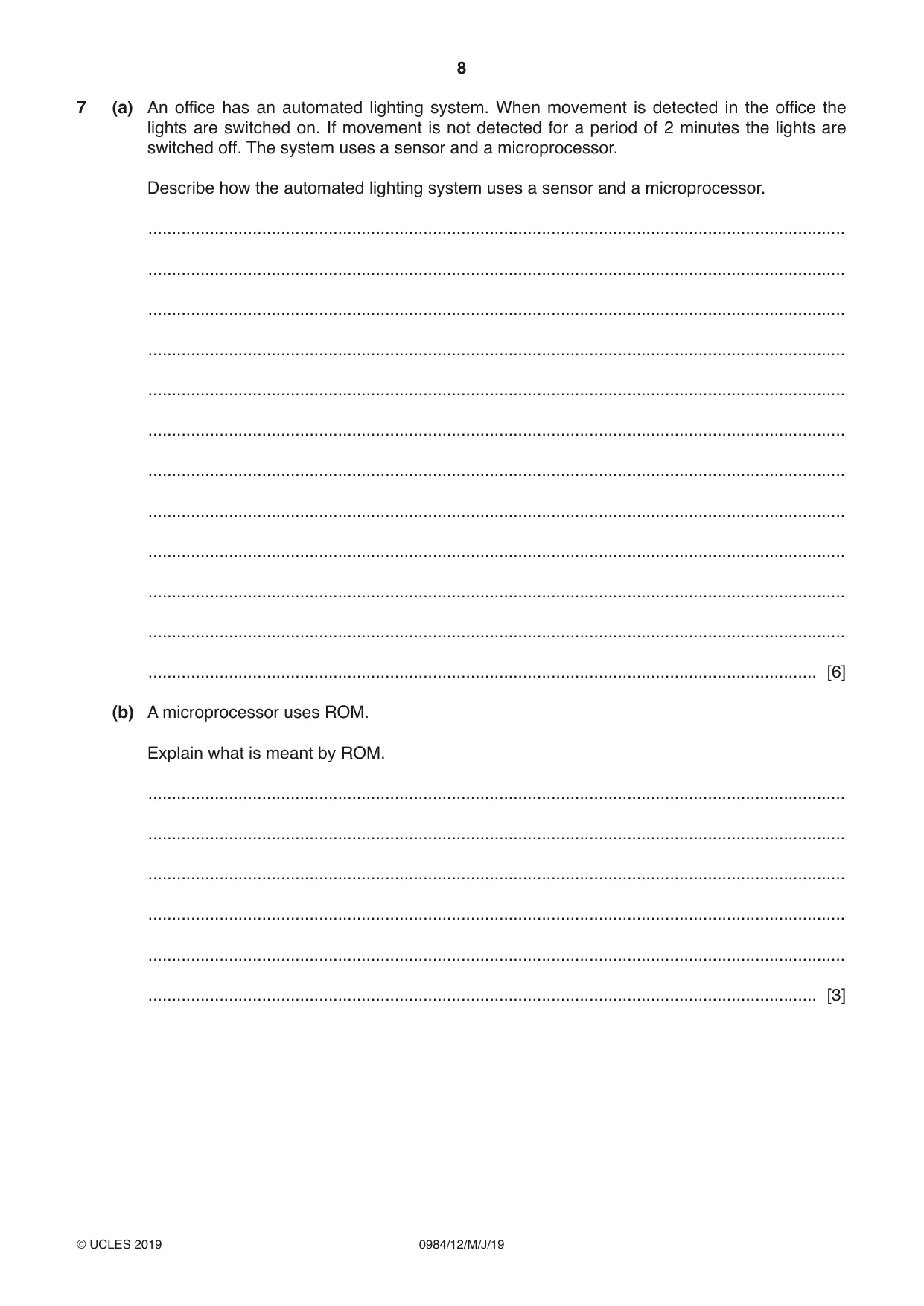
8 0984/12/M/J/19 © UCLES 2019 7 (a) An office has an automated lighting system. When movement is detected in the office the lights are switched on. If movement is not detected for a period of 2 minutes the lights are switched off. The system uses a sensor and a microprocessor. Describe how the automated lighting system uses a sensor and a microprocessor. … … … … … … … … … … … … [6] (b) A microprocessor uses ROM. Explain what is meant by ROM. … … … … … … [3]
Question paper, page 9
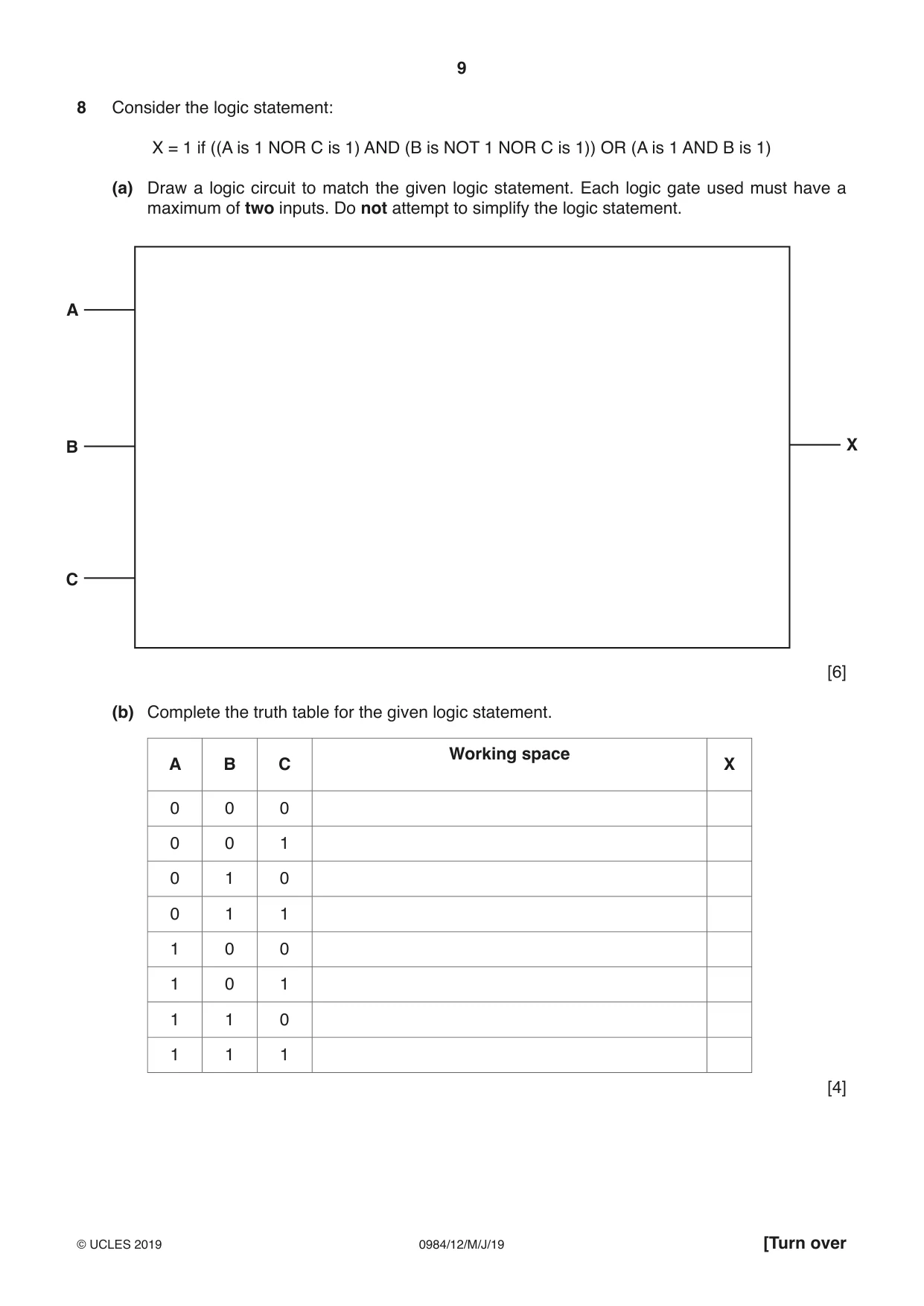
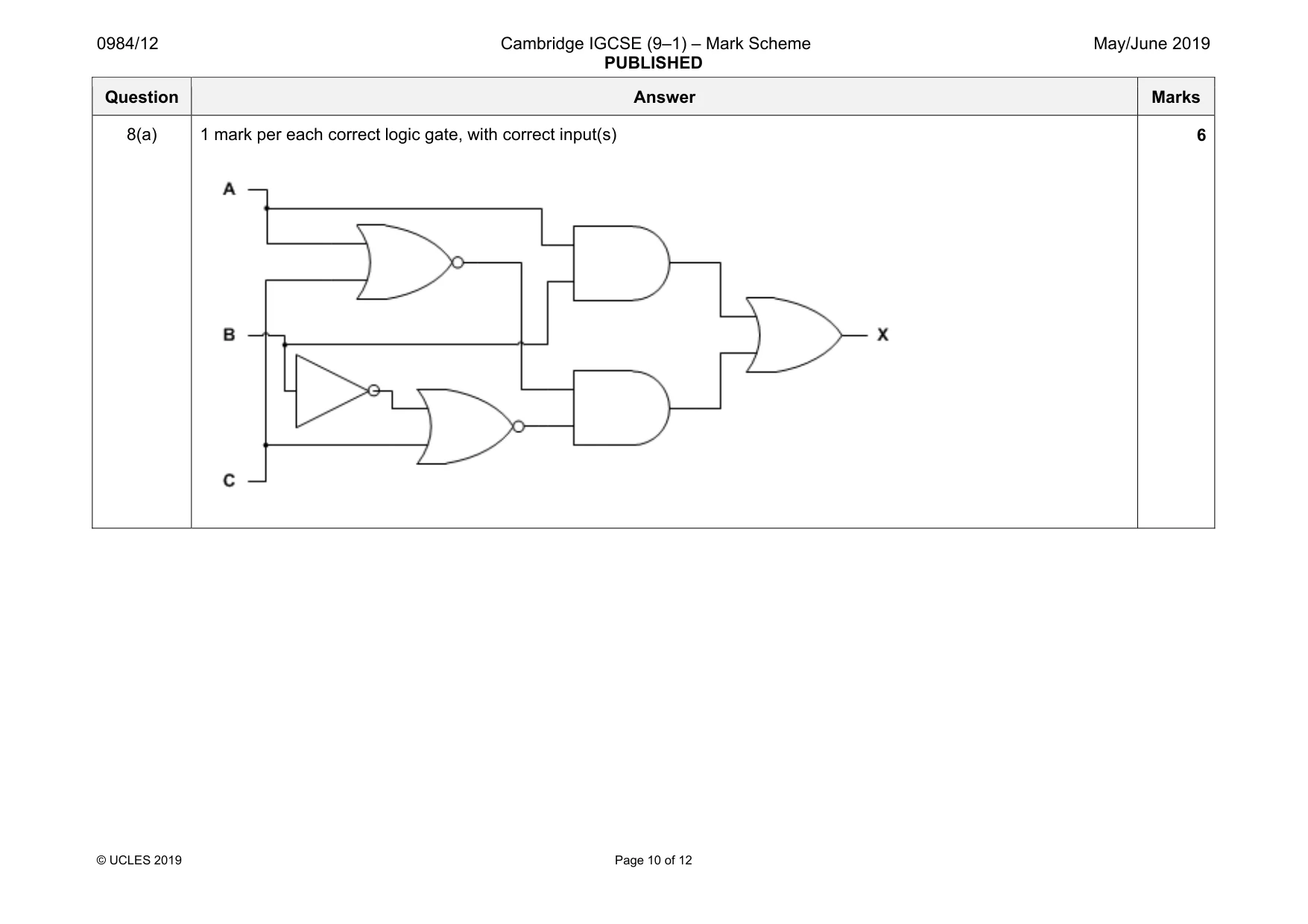
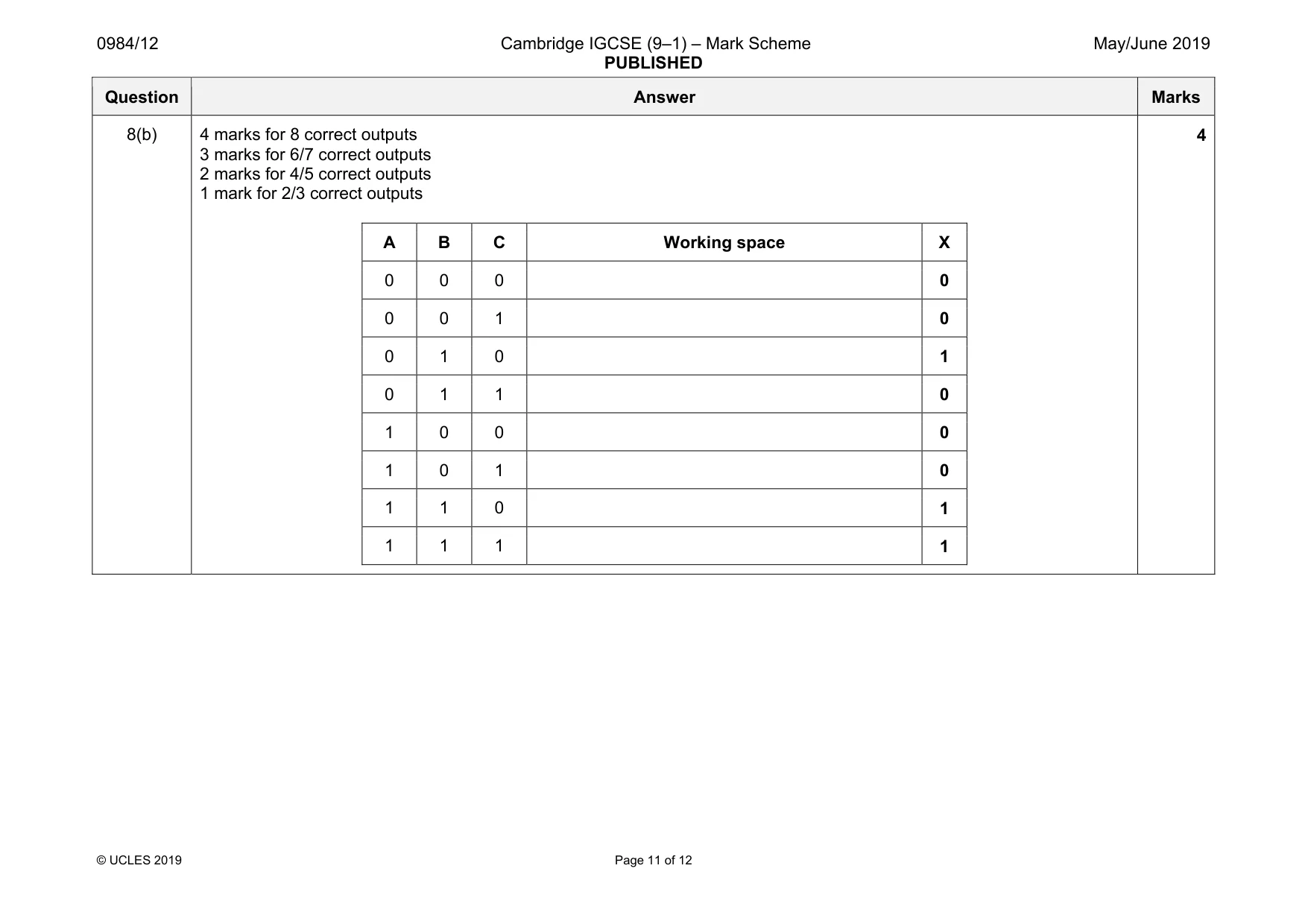
9 0984/12/M/J/19 © UCLES 2019 [Turn over 8 Consider the logic statement: X = 1 if ((A is 1 NOR C is 1) AND (B is NOT 1 NOR C is 1)) OR (A is 1 AND B is 1) (a) Draw a logic circuit to match the given logic statement. Each logic gate used must have a maximum of two inputs. Do not attempt to simplify the logic statement. A B C X [6] (b) Complete the truth table for the given logic statement. A B C Working space X 0 0 0 0 0 1 0 1 0 0 1 1 1 0 0 1 0 1 1 1 0 1 1 1 [4]
Question paper, page 10
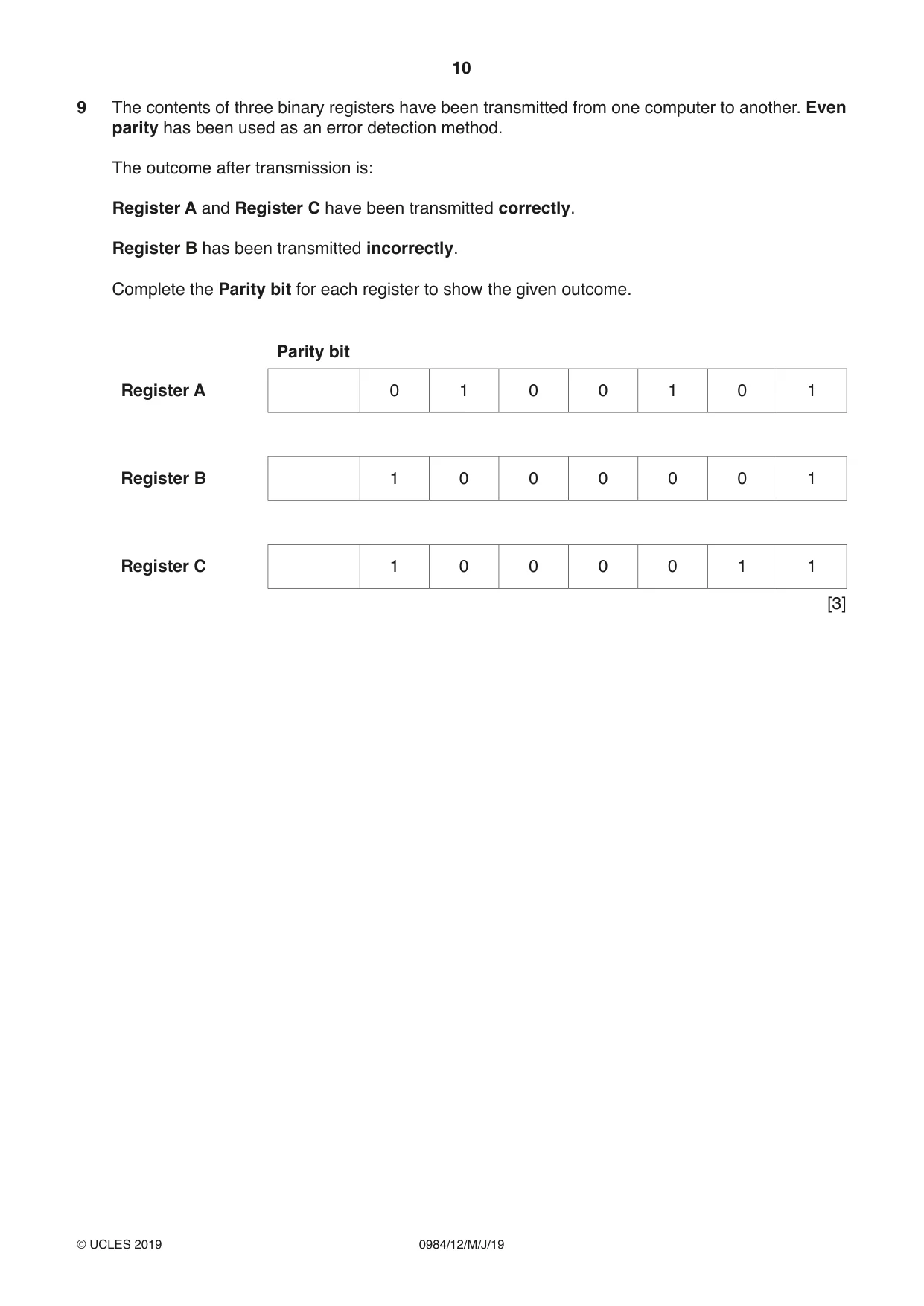
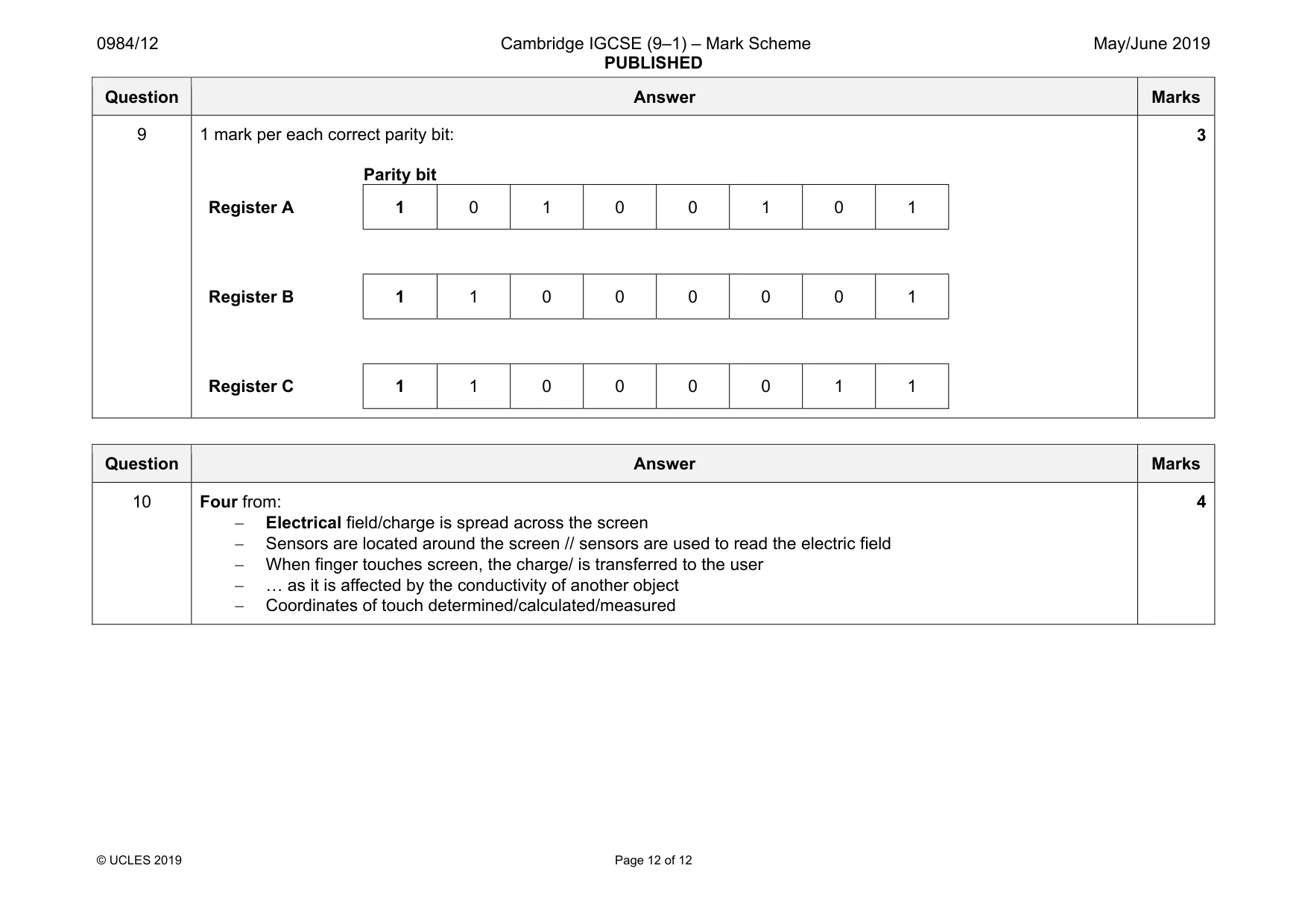
10 0984/12/M/J/19 © UCLES 2019 9 The contents of three binary registers have been transmitted from one computer to another. Even parity has been used as an error detection method. The outcome after transmission is: Register A and Register C have been transmitted correctly. Register B has been transmitted incorrectly. Complete the Parity bit for each register to show the given outcome. Parity bit Register A 0 1 0 0 1 0 1 Register B 1 0 0 0 0 0 1 Register C 1 0 0 0 0 1 1 [3]
Question paper, page 11
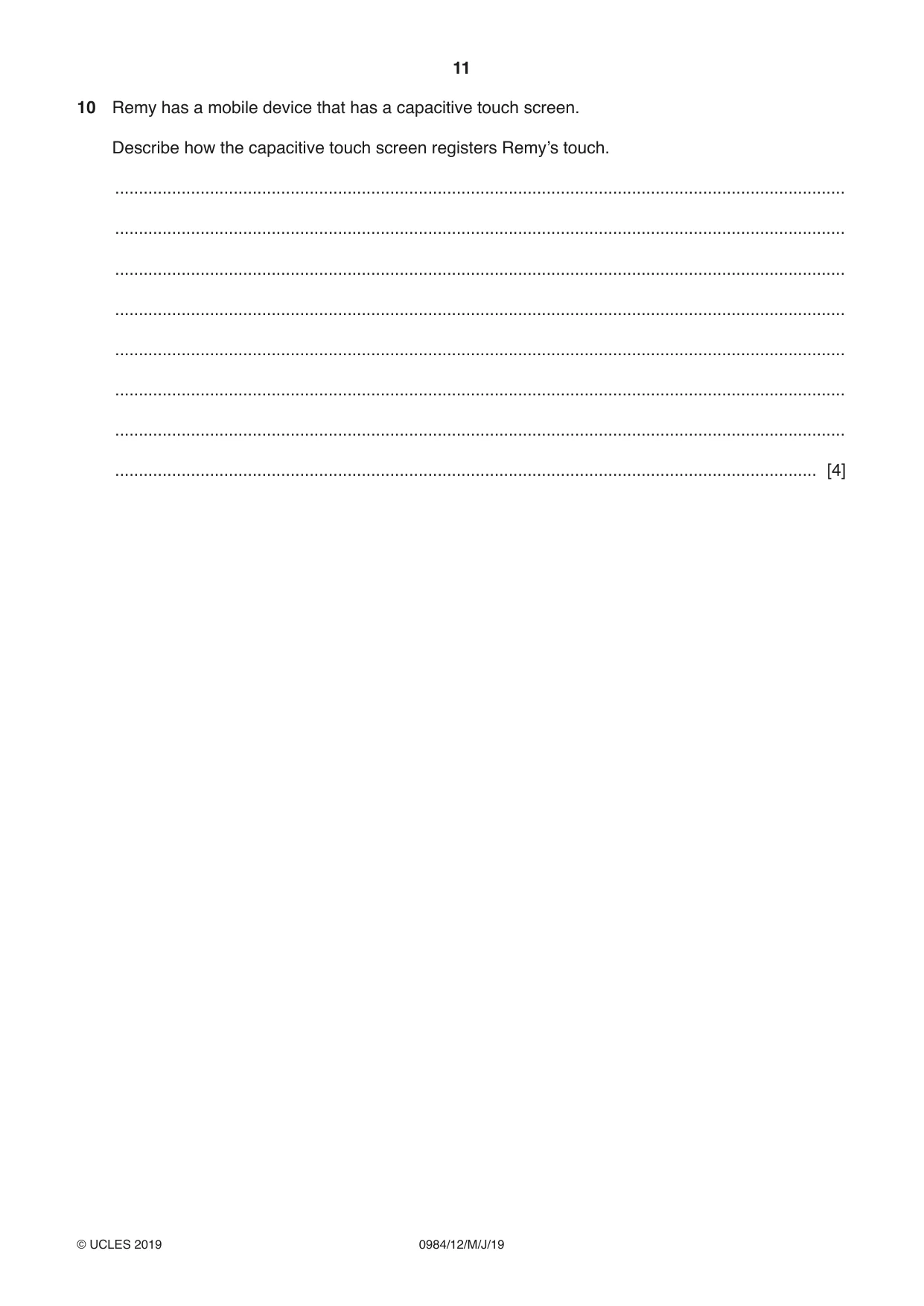
11 0984/12/M/J/19 © UCLES 2019 10 Remy has a mobile device that has a capacitive touch screen. Describe how the capacitive touch screen registers Remy’s touch. … … … … … … … … [4]
Question paper, page 12
12 0984/12/M/J/19 © UCLES 2019 Permission to reproduce items where third-party owned material protected by copyright is included has been sought and cleared where possible. Every reasonable effort has been made by the publisher (UCLES) to trace copyright holders, but if any items requiring clearance have unwittingly been included, the publisher will be pleased to make amends at the earliest possible opportunity. To avoid the issue of disclosure of answer-related information to candidates, all copyright acknowledgements are reproduced online in the Cambridge Assessment International Education Copyright Acknowledgements Booklet. This is produced for each series of examinations and is freely available to download at www.cambridgeinternational.org after the live examination series. Cambridge Assessment International Education is part of the Cambridge Assessment Group. Cambridge Assessment is the brand name of the University of Cambridge Local Examinations Syndicate (UCLES), which itself is a department of the University of Cambridge. BLANK PAGE
Mark scheme, page 1
This document consists of 12 printed pages. © UCLES 2019 [Turn over Cambridge Assessment International Education Cambridge International General Certificate of Secondary Education (9–1) COMPUTER SCIENCE 0984/12 Paper 1 May/June 2019 MARK SCHEME Maximum Mark: 75 Published This mark scheme is published as an aid to teachers and candidates, to indicate the requirements of the examination. It shows the basis on which Examiners were instructed to award marks. It does not indicate the details of the discussions that took place at an Examiners’ meeting before marking began, which would have considered the acceptability of alternative answers. Mark schemes should be read in conjunction with the question paper and the Principal Examiner Report for Teachers. Cambridge International will not enter into discussions about these mark schemes. Cambridge International is publishing the mark schemes for the May/June 2019 series for most Cambridge IGCSE™, Cambridge International A and AS Level and Cambridge Pre-U components, and some Cambridge O Level components.
Mark scheme, page 2
0984/12 Cambridge IGCSE (9–1) – Mark Scheme PUBLISHED May/June 2019 © UCLES 2019 Page 2 of 12 Generic Marking Principles These general marking principles must be applied by all examiners when marking candidate answers. They should be applied alongside the specific content of the mark scheme or generic level descriptors for a question. Each question paper and mark scheme will also comply with these marking principles. GENERIC MARKING PRINCIPLE 1: Marks must be awarded in line with: • the specific content of the mark scheme or the generic level descriptors for the question • the specific skills defined in the mark scheme or in the generic level descriptors for the question • the standard of response required by a candidate as exemplified by the standardisation scripts. GENERIC MARKING PRINCIPLE 2: Marks awarded are always whole marks (not half marks, or other fractions). GENERIC MARKING PRINCIPLE 3: Marks must be awarded positively: • marks are awarded for correct/valid answers, as defined in the mark scheme. However, credit is given for valid answers which go beyond the scope of the syllabus and mark scheme, referring to your Team Leader as appropriate • marks are awarded when candidates clearly demonstrate what they know and can do • marks are not deducted for errors • marks are not deducted for omissions • answers should only be judged on the quality of spelling, punctuation and grammar when these features are specifically assessed by the question as indicated by the mark scheme. The meaning, however, should be unambiguous. GENERIC MARKING PRINCIPLE 4: Rules must be applied consistently e.g. in situations where candidates have not followed instructions or in the application of generic level descriptors.
Mark scheme, page 3
0984/12 Cambridge IGCSE (9–1) – Mark Scheme PUBLISHED May/June 2019 © UCLES 2019 Page 3 of 12 GENERIC MARKING PRINCIPLE 5: Marks should be awarded using the full range of marks defined in the mark scheme for the question (however; the use of the full mark range may be limited according to the quality of the candidate responses seen). GENERIC MARKING PRINCIPLE 6: Marks awarded are based solely on the requirements as defined in the mark scheme. Marks should not be awarded with grade thresholds or grade descriptors in mind.
Mark scheme, page 4
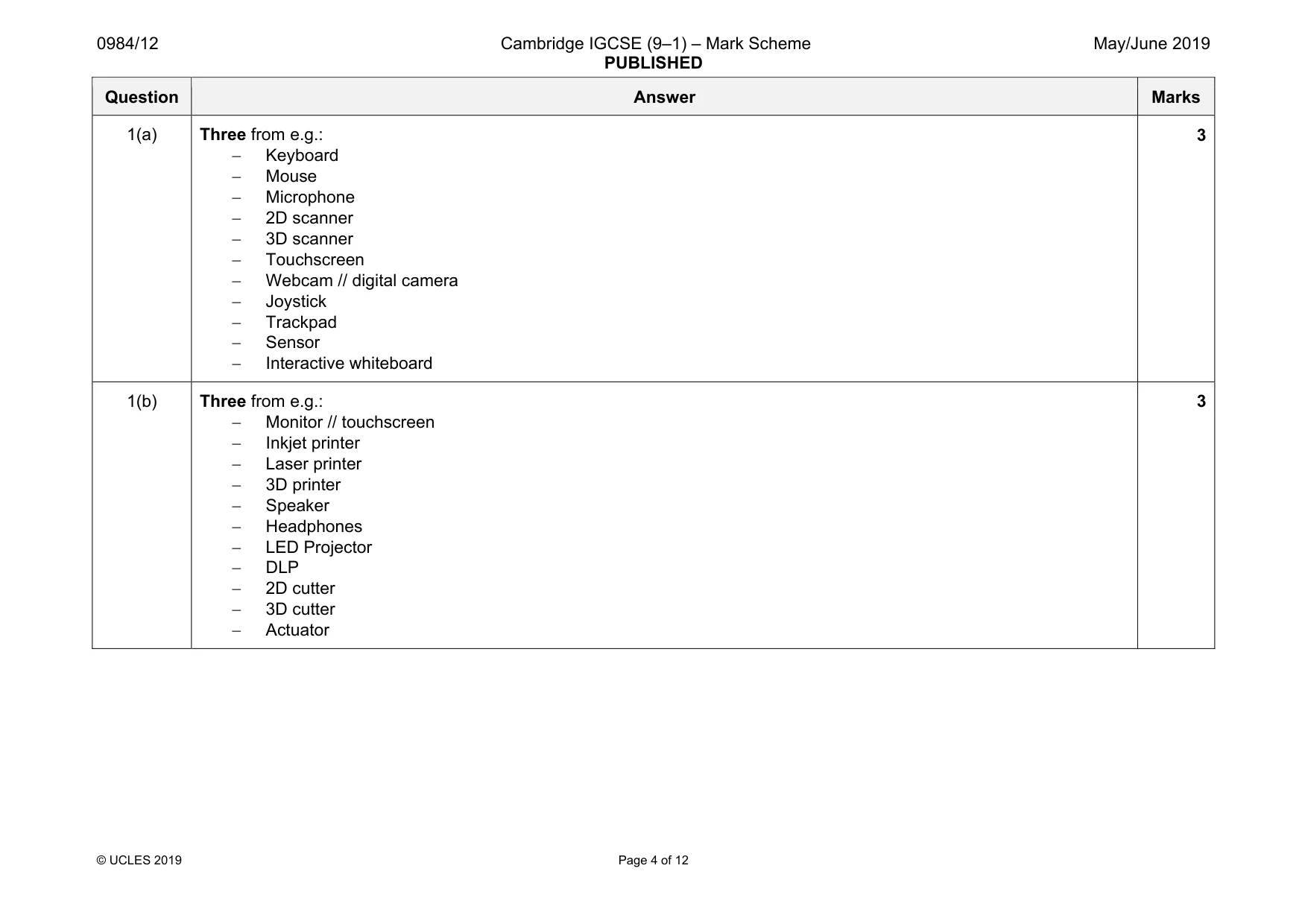
0984/12 Cambridge IGCSE (9–1) – Mark Scheme PUBLISHED May/June 2019 © UCLES 2019 Page 4 of 12 Question Answer Marks 1(a) Three from e.g.: − Keyboard − Mouse − Microphone − 2D scanner − 3D scanner − Touchscreen − Webcam // digital camera − Joystick − Trackpad − Sensor − Interactive whiteboard 3 1(b) Three from e.g.: − Monitor // touchscreen − Inkjet printer − Laser printer − 3D printer − Speaker − Headphones − LED Projector − DLP − 2D cutter − 3D cutter − Actuator 3
Mark scheme, page 5
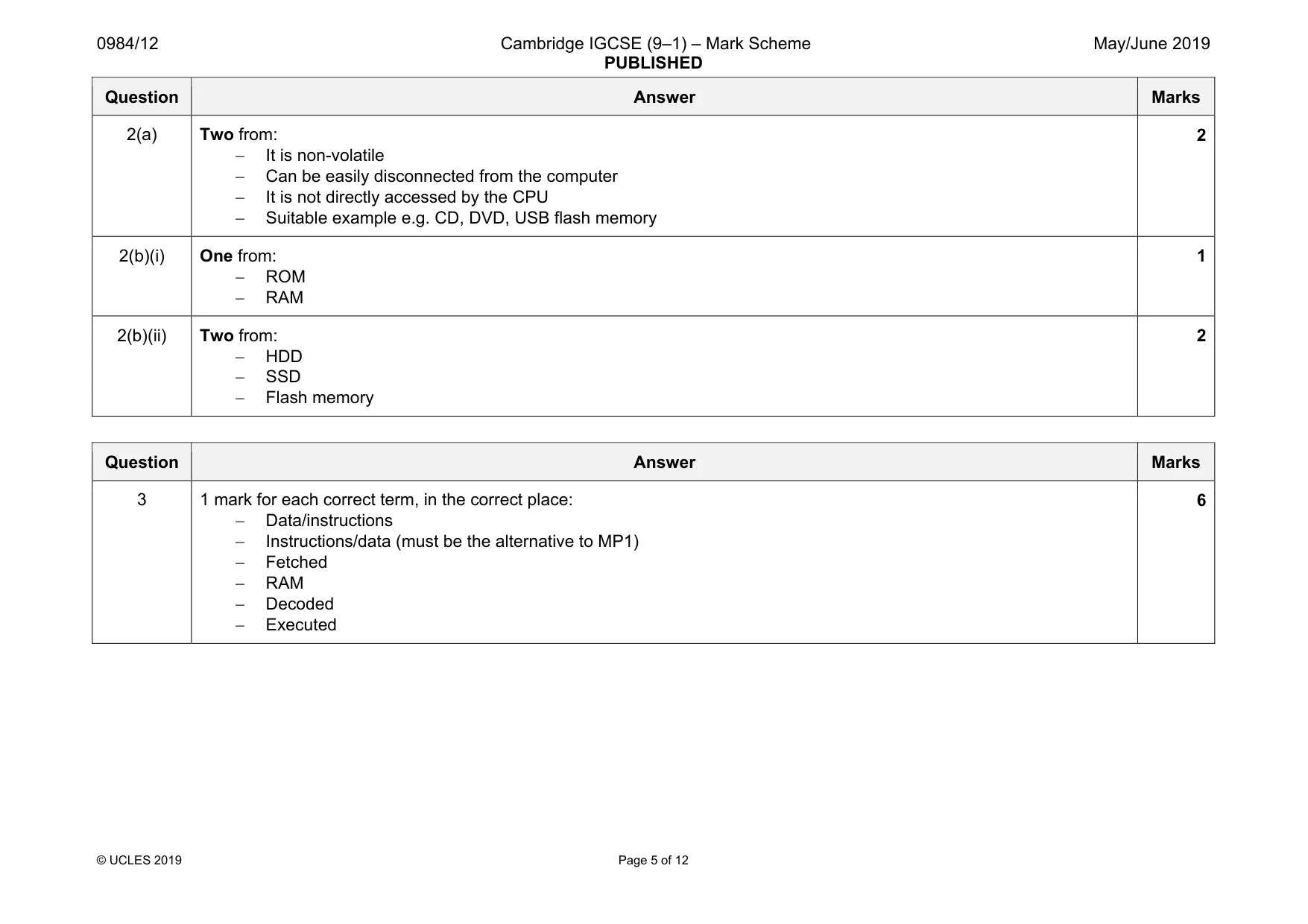
0984/12 Cambridge IGCSE (9–1) – Mark Scheme PUBLISHED May/June 2019 © UCLES 2019 Page 5 of 12 Question Answer Marks 2(a) Two from: − It is non-volatile − Can be easily disconnected from the computer − It is not directly accessed by the CPU − Suitable example e.g. CD, DVD, USB flash memory 2 2(b)(i) One from: − ROM − RAM 1 2(b)(ii) Two from: − HDD − SSD − Flash memory 2 Question Answer Marks 3 1 mark for each correct term, in the correct place: − Data/instructions − Instructions/data (must be the alternative to MP1) − Fetched − RAM − Decoded − Executed 6
Mark scheme, page 6
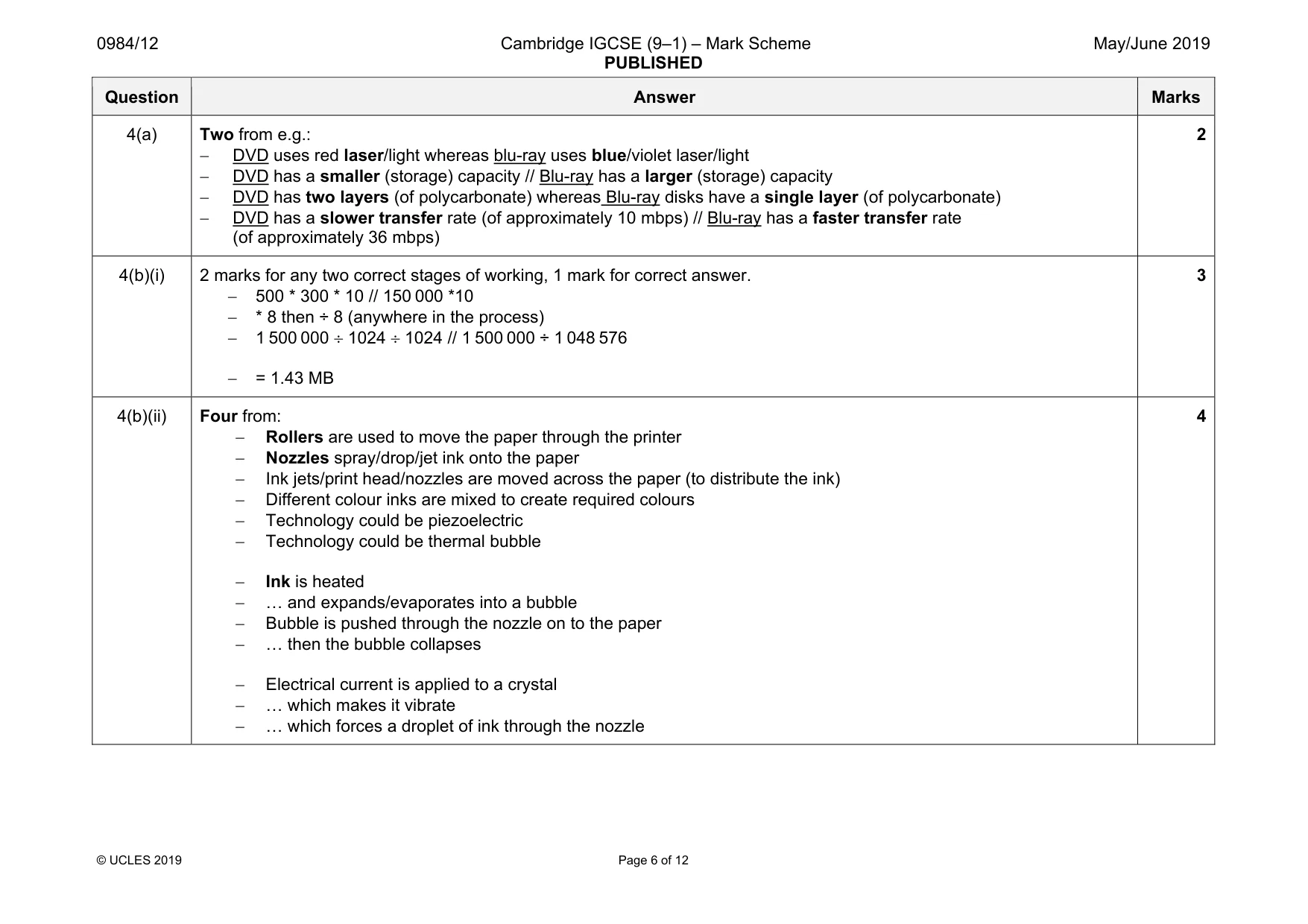
0984/12 Cambridge IGCSE (9–1) – Mark Scheme PUBLISHED May/June 2019 © UCLES 2019 Page 6 of 12 Question Answer Marks 4(a) Two from e.g.: − DVD uses red laser/light whereas blu-ray uses blue/violet laser/light − DVD has a smaller (storage) capacity // Blu-ray has a larger (storage) capacity − DVD has two layers (of polycarbonate) whereas Blu-ray disks have a single layer (of polycarbonate) − DVD has a slower transfer rate (of approximately 10 mbps) // Blu-ray has a faster transfer rate (of approximately 36 mbps) 2 4(b)(i) 2 marks for any two correct stages of working, 1 mark for correct answer. − 500 * 300 * 10 // 150 000 *10 − * 8 then ÷ 8 (anywhere in the process) − 1 500 000 ÷ 1024 ÷ 1024 // 1 500 000 ÷ 1 048 576 − = 1.43 MB 3 4(b)(ii) Four from: − Rollers are used to move the paper through the printer − Nozzles spray/drop/jet ink onto the paper − Ink jets/print head/nozzles are moved across the paper (to distribute the ink) − Different colour inks are mixed to create required colours − Technology could be piezoelectric − Technology could be thermal bubble − Ink is heated − « and expands/evaporates into a bubble − Bubble is pushed through the nozzle on to the paper − « then the bubble collapses − Electrical current is applied to a crystal − « which makes it vibrate − « which forces a droplet of ink through the nozzle 4
Mark scheme, page 7
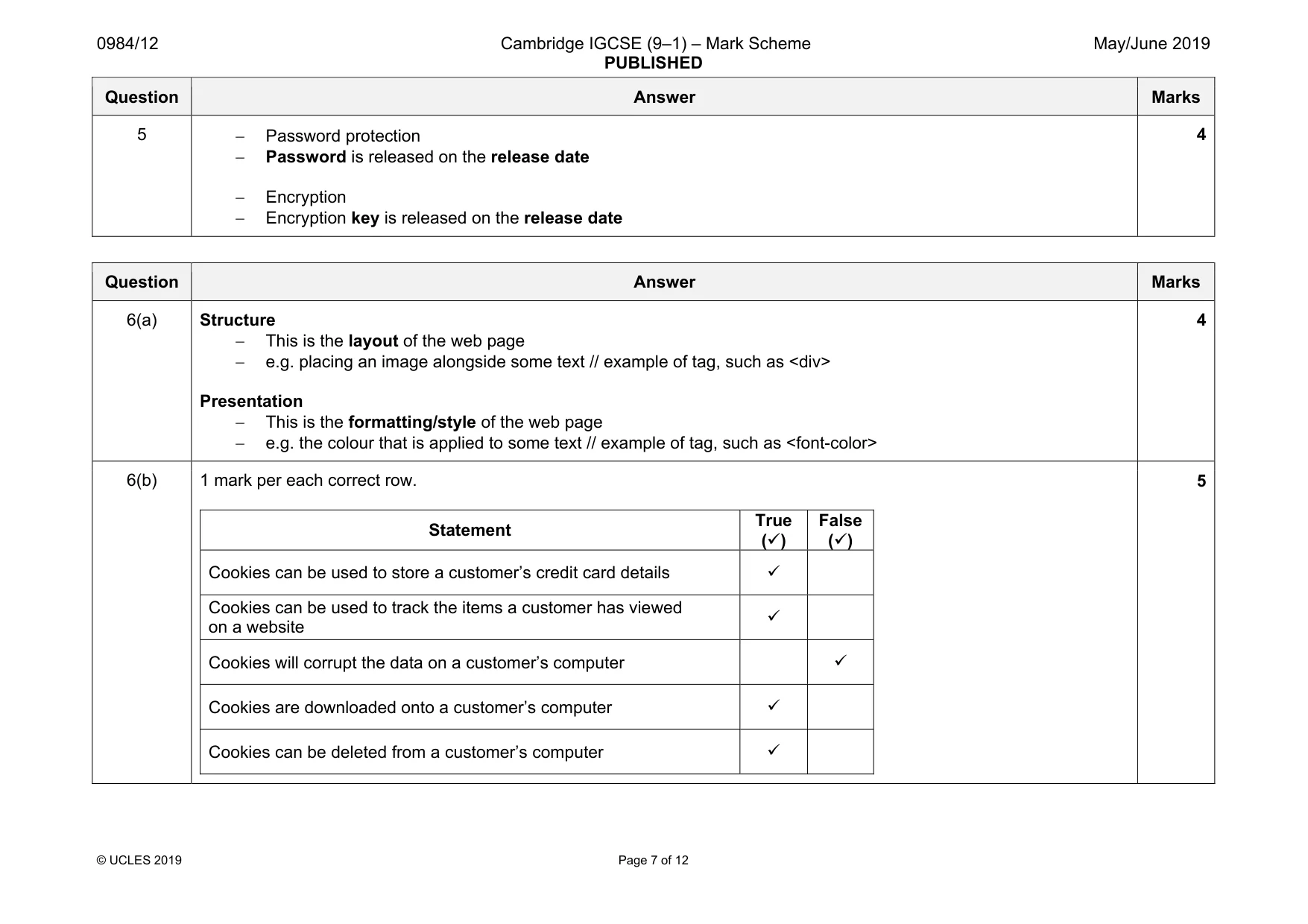
0984/12 Cambridge IGCSE (9–1) – Mark Scheme PUBLISHED May/June 2019 © UCLES 2019 Page 7 of 12 Question Answer Marks 5 − Password protection − Password is released on the release date − Encryption − Encryption key is released on the release date 4 Question Answer Marks 6(a) Structure − This is the layout of the web page − e.g. placing an image alongside some text // example of tag, such as <div> Presentation − This is the formatting/style of the web page − e.g. the colour that is applied to some text // example of tag, such as <font-color> 4 6(b) 1 mark per each correct row. Statement True (9) False (9) Cookies can be used to store a customer’s credit card details 9 Cookies can be used to track the items a customer has viewed on a website 9 Cookies will corrupt the data on a customer’s computer 9 Cookies are downloaded onto a customer’s computer 9 Cookies can be deleted from a customer’s computer 9 5
Mark scheme, page 8
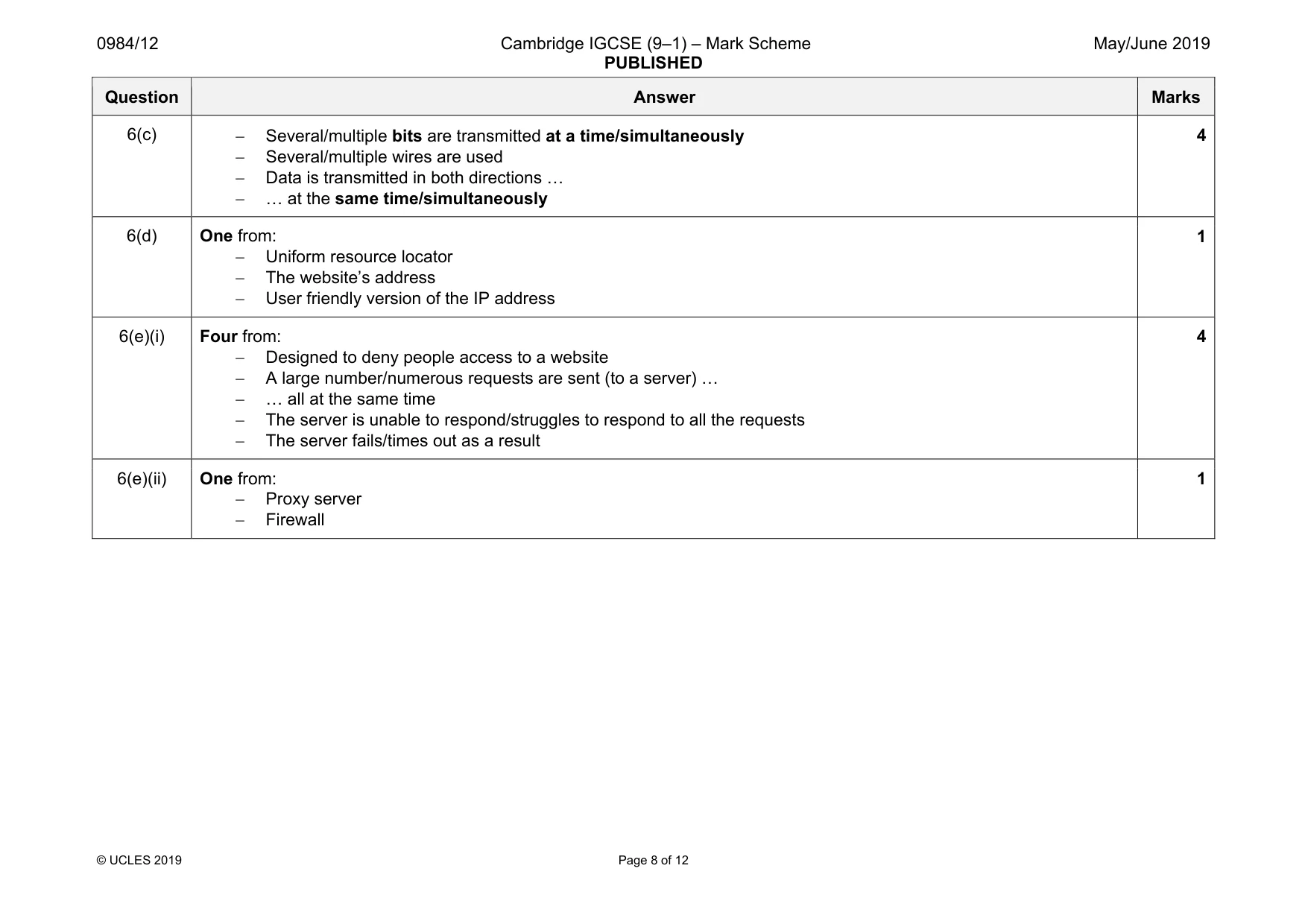
0984/12 Cambridge IGCSE (9–1) – Mark Scheme PUBLISHED May/June 2019 © UCLES 2019 Page 8 of 12 Question Answer Marks 6(c) − Several/multiple bits are transmitted at a time/simultaneously − Several/multiple wires are used − Data is transmitted in both directions « − « at the same time/simultaneously 4 6(d) One from: − Uniform resource locator − The website’s address − User friendly version of the IP address 1 6(e)(i) Four from: − Designed to deny people access to a website − A large number/numerous requests are sent (to a server) « − « all at the same time − The server is unable to respond/struggles to respond to all the requests − The server fails/times out as a result 4 6(e)(ii) One from: − Proxy server − Firewall 1
Mark scheme, page 9
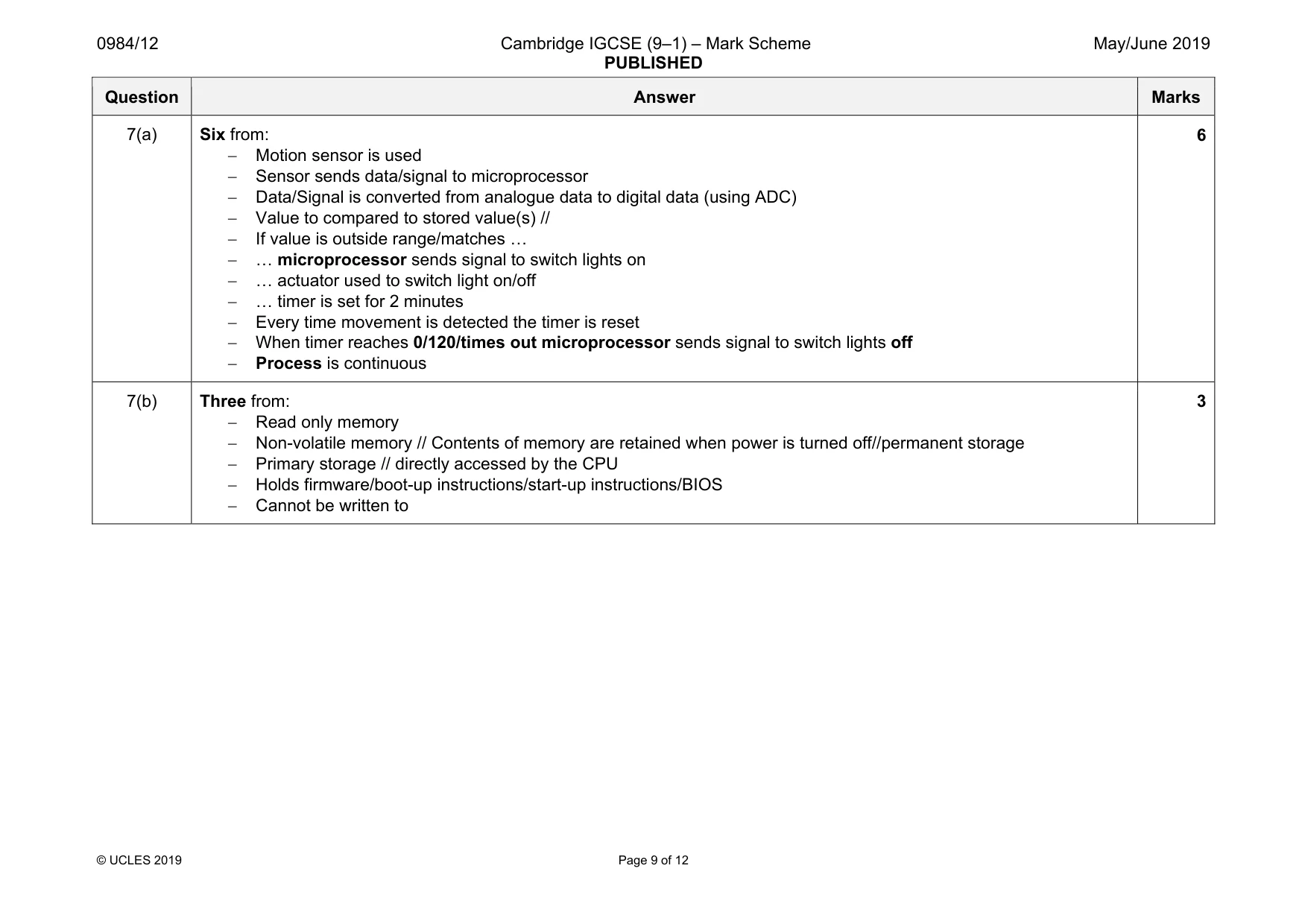
0984/12 Cambridge IGCSE (9–1) – Mark Scheme PUBLISHED May/June 2019 © UCLES 2019 Page 9 of 12 Question Answer Marks 7(a) Six from: − Motion sensor is used − Sensor sends data/signal to microprocessor − Data/Signal is converted from analogue data to digital data (using ADC) − Value to compared to stored value(s) // − If value is outside range/matches « − « microprocessor sends signal to switch lights on − « actuator used to switch light on/off − « timer is set for 2 minutes − Every time movement is detected the timer is reset − When timer reaches 0/120/times out microprocessor sends signal to switch lights off − Process is continuous 6 7(b) Three from: − Read only memory − Non-volatile memory // Contents of memory are retained when power is turned off//permanent storage − Primary storage // directly accessed by the CPU − Holds firmware/boot-up instructions/start-up instructions/BIOS − Cannot be written to 3
Mark scheme, page 10
0984/12 Cambridge IGCSE (9–1) – Mark Scheme PUBLISHED May/June 2019 © UCLES 2019 Page 10 of 12 Question Answer Marks 8(a) 1 mark per each correct logic gate, with correct input(s) 6
Mark scheme, page 11
0984/12 Cambridge IGCSE (9–1) – Mark Scheme PUBLISHED May/June 2019 © UCLES 2019 Page 11 of 12 Question Answer Marks 8(b) 4 marks for 8 correct outputs 3 marks for 6/7 correct outputs 2 marks for 4/5 correct outputs 1 mark for 2/3 correct outputs A B C Working space X 0 0 0 0 0 0 1 0 0 1 0 1 0 1 1 0 1 0 0 0 1 0 1 0 1 1 0 1 1 1 1 1 4
Mark scheme, page 12
0984/12 Cambridge IGCSE (9–1) – Mark Scheme PUBLISHED May/June 2019 © UCLES 2019 Page 12 of 12 Question Answer Marks 9 1 mark per each correct parity bit: Parity bit Register A 1 0 1 0 0 1 0 1 Register B 1 1 0 0 0 0 0 1 Register C 1 1 0 0 0 0 1 1 3 Question Answer Marks 10 Four from: − Electrical field/charge is spread across the screen − Sensors are located around the screen // sensors are used to read the electric field − When finger touches screen, the charge/ is transferred to the user − « as it is affected by the conductivity of another object − Coordinates of touch determined/calculated/measured 4
What you needed in this session
Cambridge’s own grade thresholds for 2019 May/June, Paper 1 · Variant 2. A higher threshold means an easier paper — the bar moves with how the cohort did.