Cambridge IGCSE Chinese (Mandarin) - Foreign Language 0547 — 2016 May/June Paper 2 · Variant 2
0547/22/M/J/16 · 36 marks · ≈41 min
The question paper and its mark scheme, free to read here and free to download. This is Cambridge’s own paper, exactly as it was sat.
Question paper16 pages
Mark scheme9 pages
Answers below. Sit the paper first if you are practising.
Paper as text
Question paper, page 1
MANDARIN CHINESE 0547/22 Paper 2 Reading May/June 2016 1 hour 15 minutes Candidates answer on the Question Paper. No Additional Materials are required. READ THESE INSTRUCTIONS FIRST Write your Centre number, candidate number and name on all the work you hand in. Write in dark blue or black pen. Do not use staples, paper clips, glue or correction fluid. DO NOT WRITE IN ANY BARCODES. Answer all questions. The number of marks is given in brackets [ ] at the end of each question or part question. Cambridge International Examinations Cambridge International General Certificate of Secondary Education This document consists of 12 printed pages and 4 blank pages. NL (SG) 114363/3 © UCLES 2016 [Turn over The syllabus is approved for use in England, Wales and Northern Ireland as a Cambridge International Level 1/Level 2 Certificate. * 3 8 5 8 4 5 0 3 3 8 *
Question paper, page 2
2 © UCLES 2016 0547/22/M/J/16 BLANK PAGE
Question paper, page 3
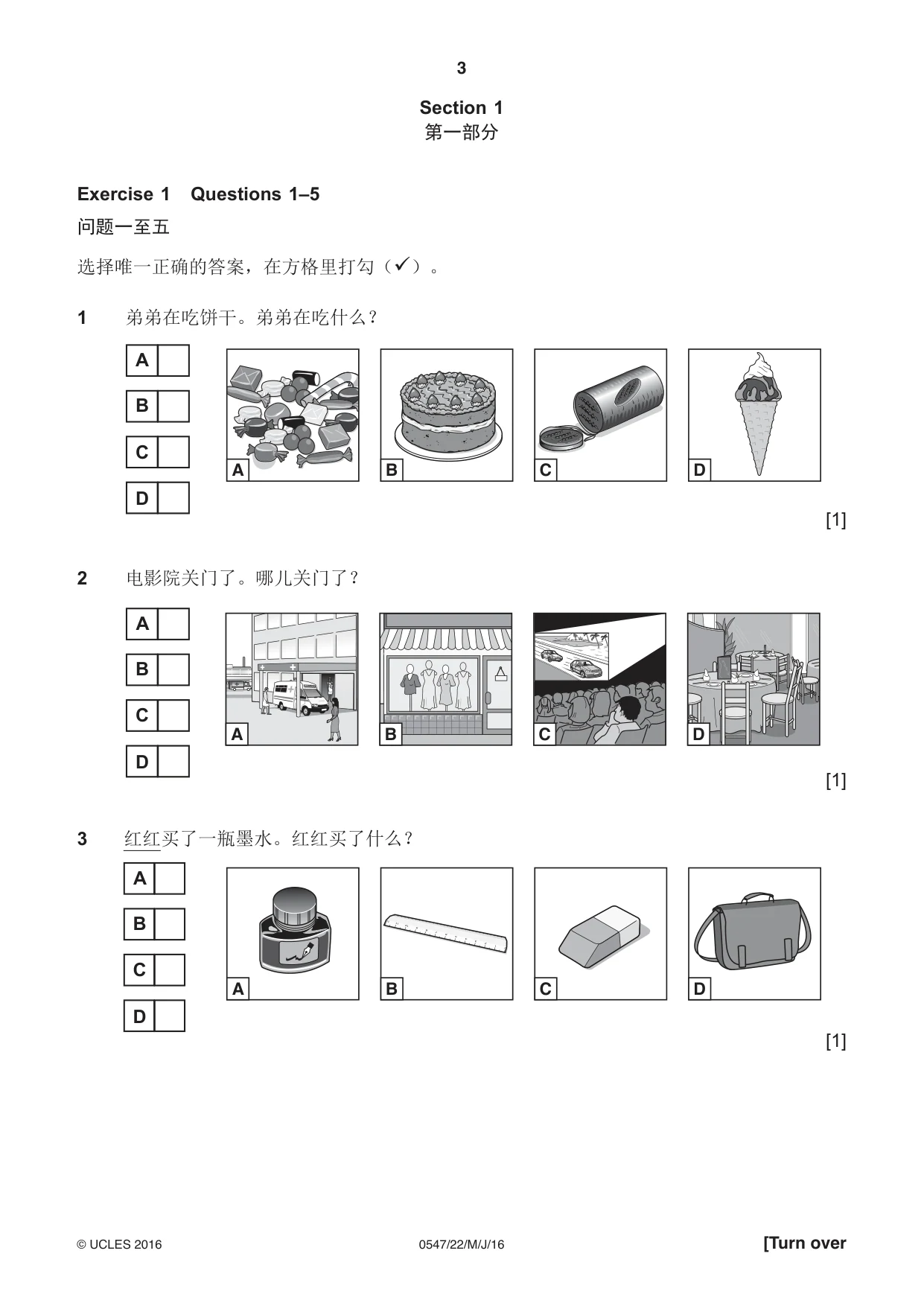
3 [Turn over 0547/22/M/J/16 © UCLES 2016 Section 1 第一部分 Exercise 1 Questions 1–5 问题一至五 选择唯一正确的答案,在方格里打勾()。 1 弟弟在吃饼干。弟弟在吃什么? [1] 2 电影院关门了。哪儿关门了? [1] 3 红红买了一瓶墨水。红红买了什么? [1] A B C D A B C D A B C D A B C D A B C D A B C D
Question paper, page 4
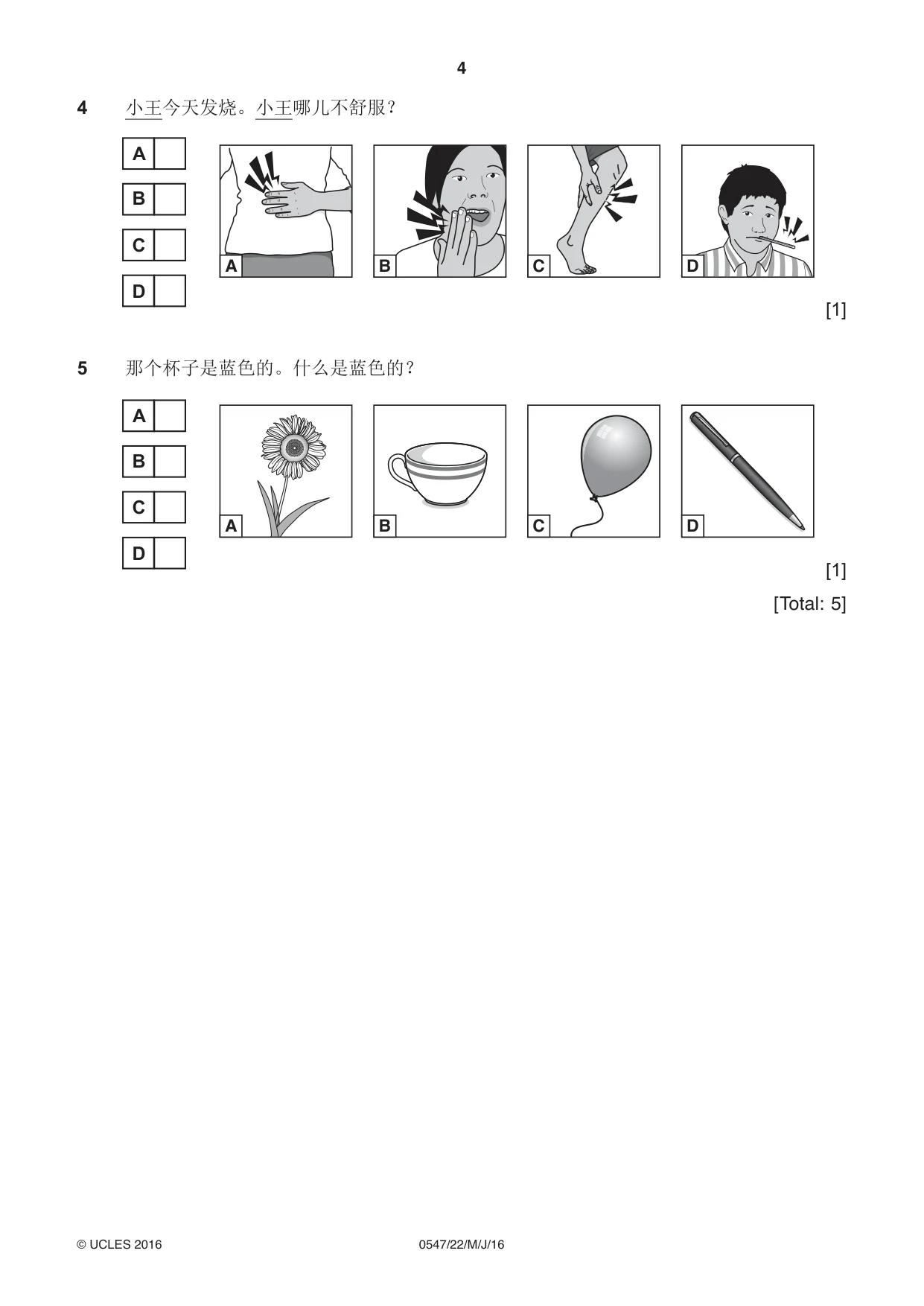
4 © UCLES 2016 0547/22/M/J/16 4 小王今天发烧。小王哪儿不舒服? [1] 5 那个杯子是蓝色的。什么是蓝色的? [1] [Total: 5] A B C D A B C D A B C D A B C D
Question paper, page 5
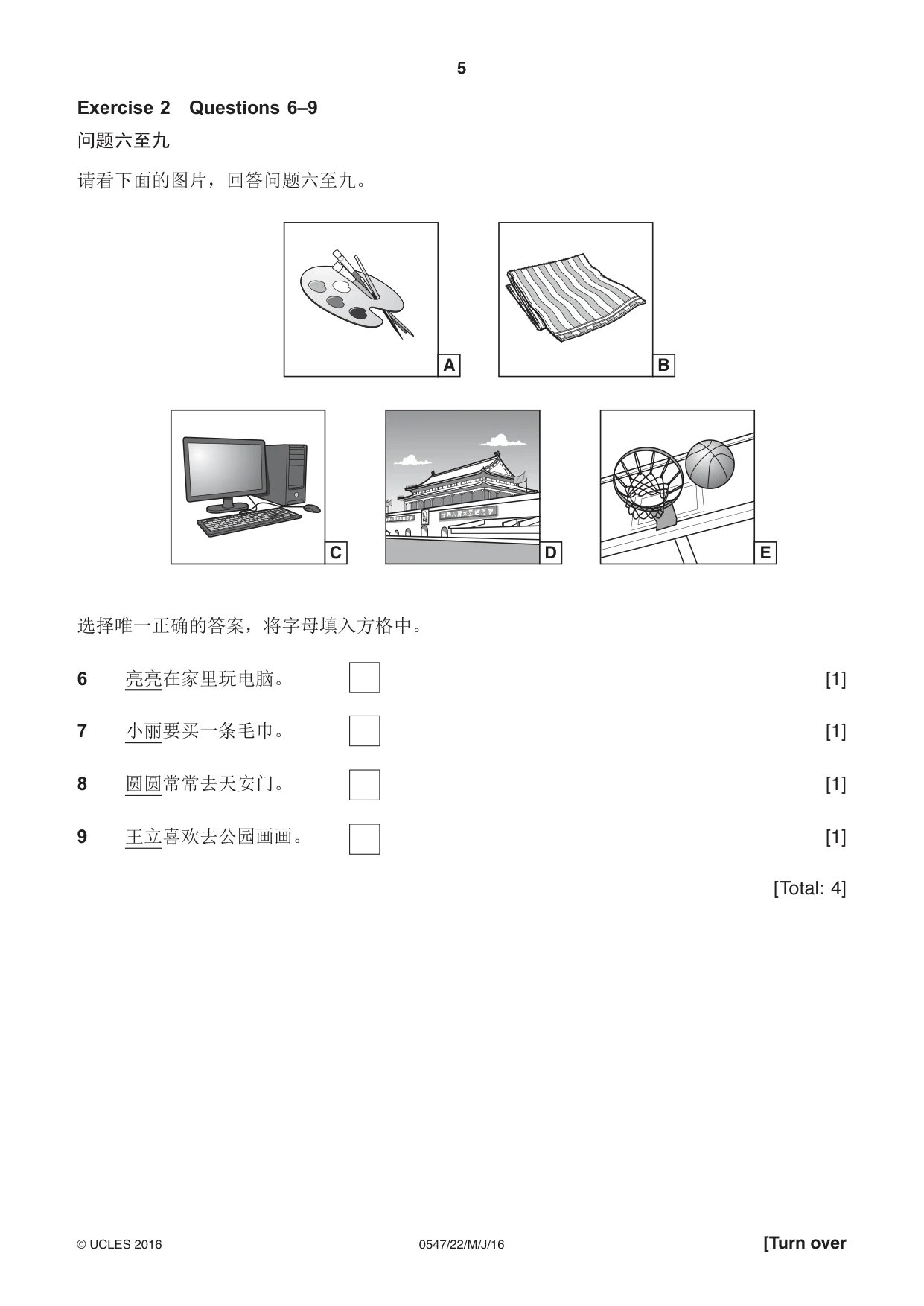
5 [Turn over 0547/22/M/J/16 © UCLES 2016 Exercise 2 Questions 6–9 问题六至九 请看下面的图片,回答问题六至九。 选择唯一正确的答案,将字母填入方格中。 6 亮亮在家里玩电脑。 [1] 7 小丽要买一条毛巾。 [1] 8 圆圆常常去天安门。 [1] 9 王立喜欢去公园画画。 [1] [Total: 4] A B C D E
Question paper, page 6
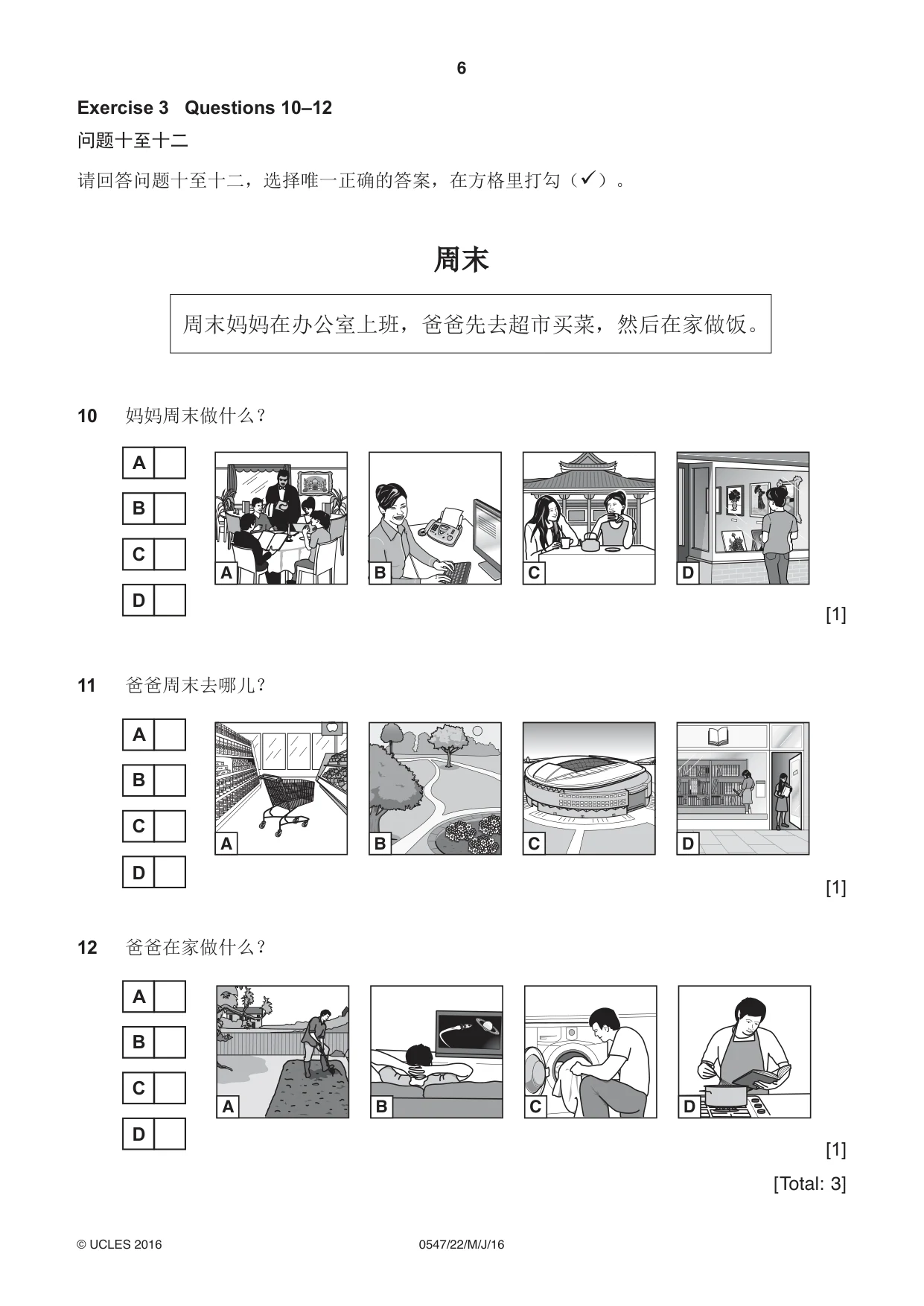
6 © UCLES 2016 0547/22/M/J/16 Exercise 3 Questions 10–12 问题十至十二 请回答问题十至十二,选择唯一正确的答案,在方格里打勾()。 周末 周末妈妈在办公室上班,爸爸先去超市买菜,然后在家做饭。 10 妈妈周末做什么? [1] 11 爸爸周末去哪儿? [1] 12 爸爸在家做什么? [1] [Total: 3] A B C D A B C D A B C D A B C D A B C D A B C D
Question paper, page 7
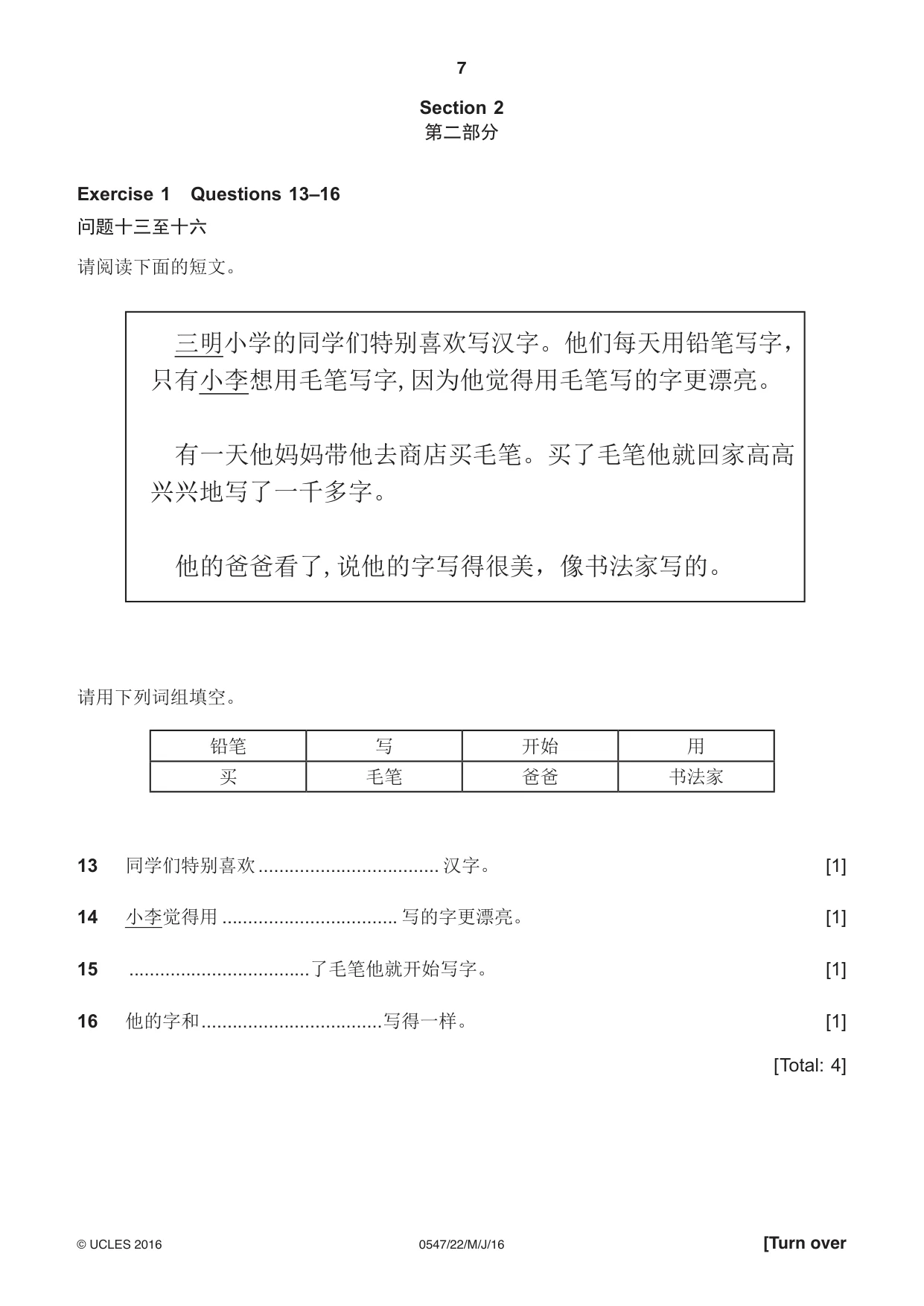
7 [Turn over 0547/22/M/J/16 © UCLES 2016 Section 2 第二部分 Exercise 1 Questions 13–16 问题十三至十六 请阅读下面的短文。 三明小学的同学们特别喜欢写汉字。他们每天用铅笔写字, 只有小李想用毛笔写字,因为他觉得用毛笔写的字更漂亮。 有一天他妈妈带他去商店买毛笔。买了毛笔他就回家高高 兴兴地写了一千多字。 他的爸爸看了,说他的字写得很美,像书法家写的。 请用下列词组填空。 铅笔 写 开始 用 买 毛笔 爸爸 书法家 13 同学们特别喜欢 … 汉字。 [1] 14 小李觉得用 … 写的字更漂亮。 [1] 15 …了毛笔他就开始写字。 [1] 16 他的字和 …写得一样。 [1] [Total: 4]
Question paper, page 8
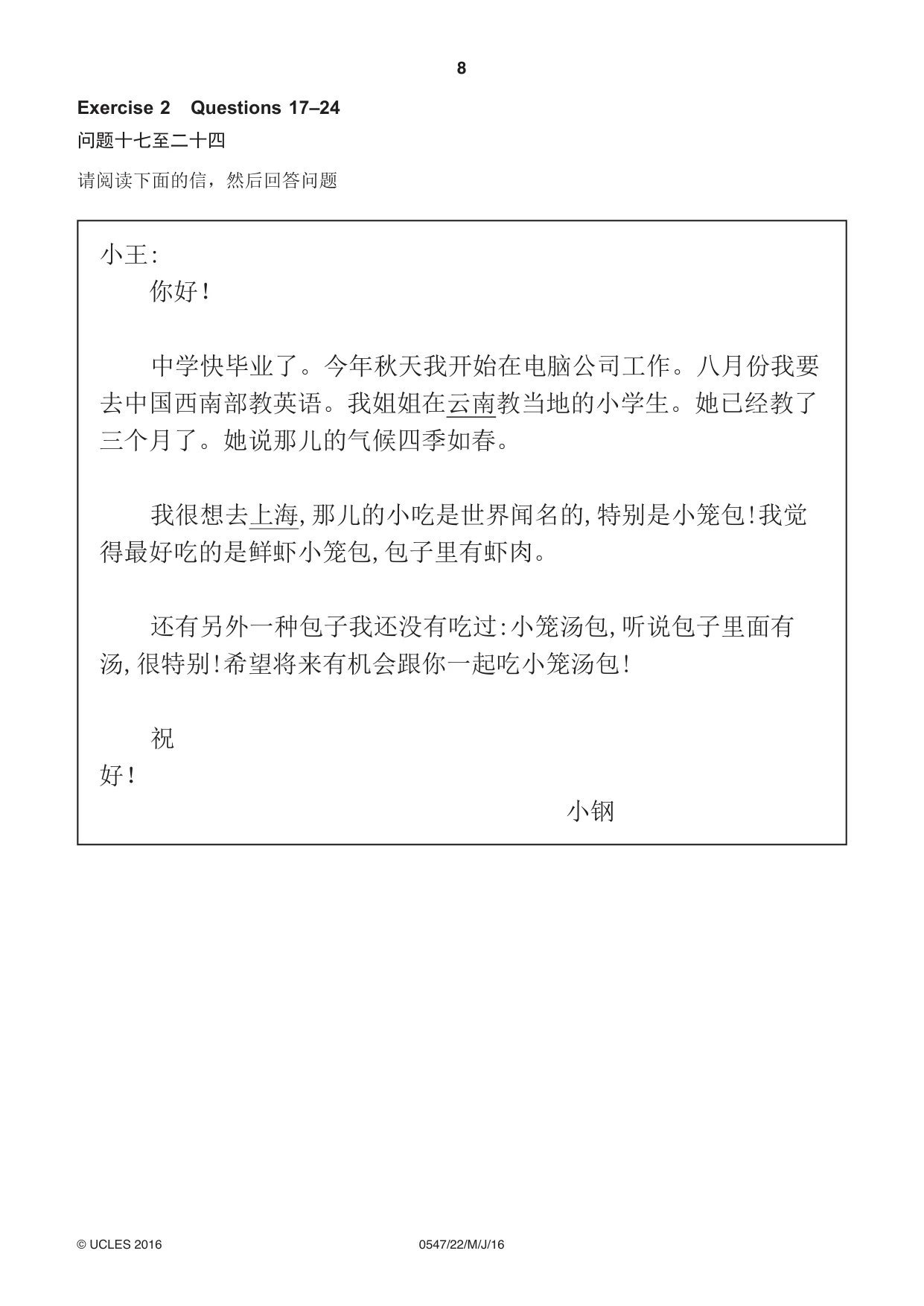
8 © UCLES 2016 0547/22/M/J/16 Exercise 2 Questions 17–24 问题十七至二十四 请阅读下面的信,然后回答问题 小王: 你好! 中学快毕业了。今年秋天我开始在电脑公司工作。八月份我要 去中国西南部教英语。我姐姐在云南教当地的小学生。她已经教了 三个月了。她说那儿的气候四季如春。 我很想去上海,那儿的小吃是世界闻名的,特别是小笼包!我觉 得最好吃的是鲜虾小笼包,包子里有虾肉。 还有另外一种包子我还没有吃过:小笼汤包,听说包子里面有 汤,很特别!希望将来有机会跟你一起吃小笼汤包! 祝 好! 小钢
Question paper, page 9
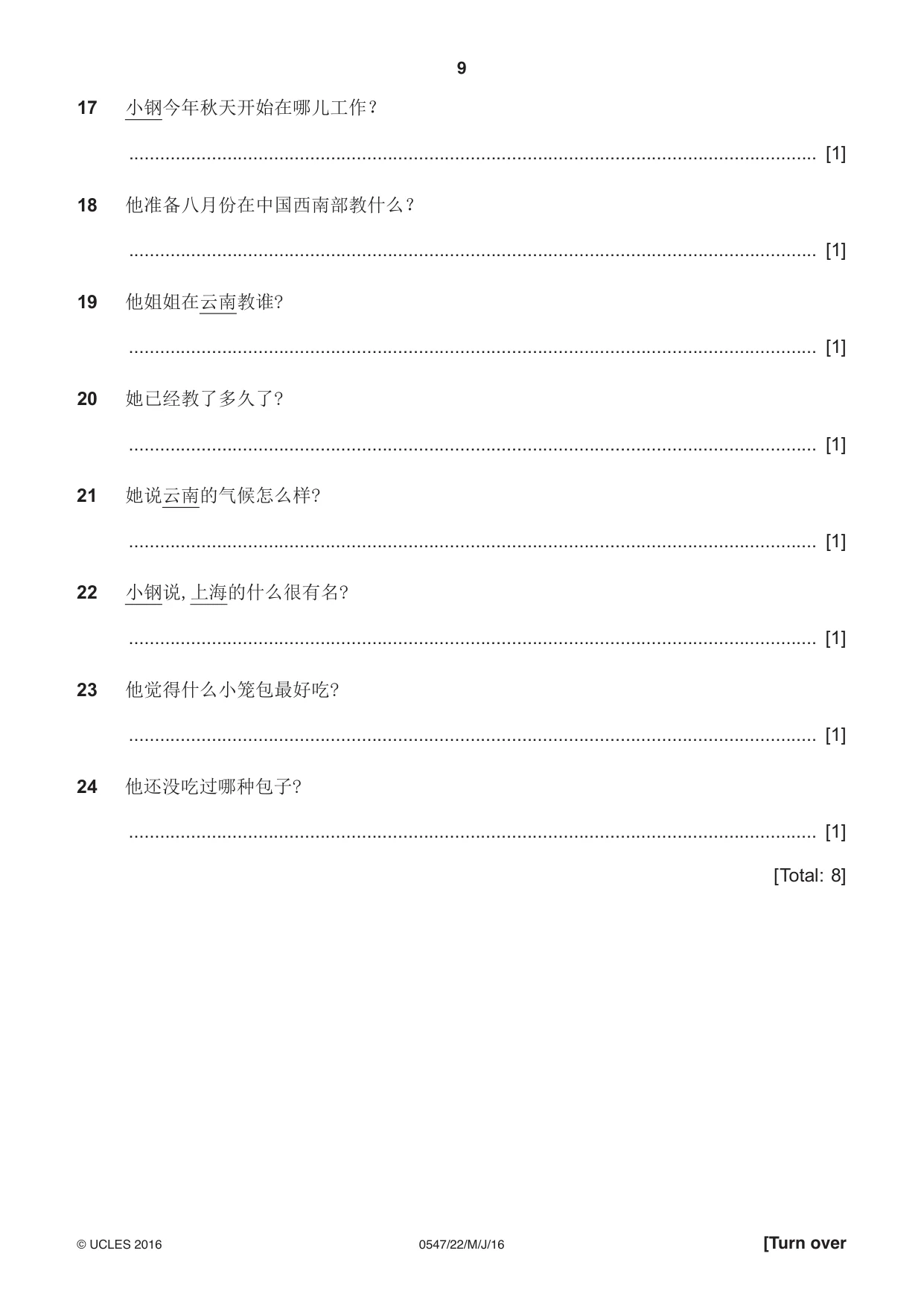
9 [Turn over 0547/22/M/J/16 © UCLES 2016 17 小钢今年秋天开始在哪儿工作? … [1] 18 他准备八月份在中国西南部教什么? … [1] 19 他姐姐在云南教谁? … [1] 20 她已经教了多久了? … [1] 21 她说云南的气候怎么样? … [1] 22 小钢说,上海的什么很有名? … [1] 23 他觉得什么小笼包最好吃? … [1] 24 他还没吃过哪种包子? … [1] [Total: 8]
Question paper, page 10
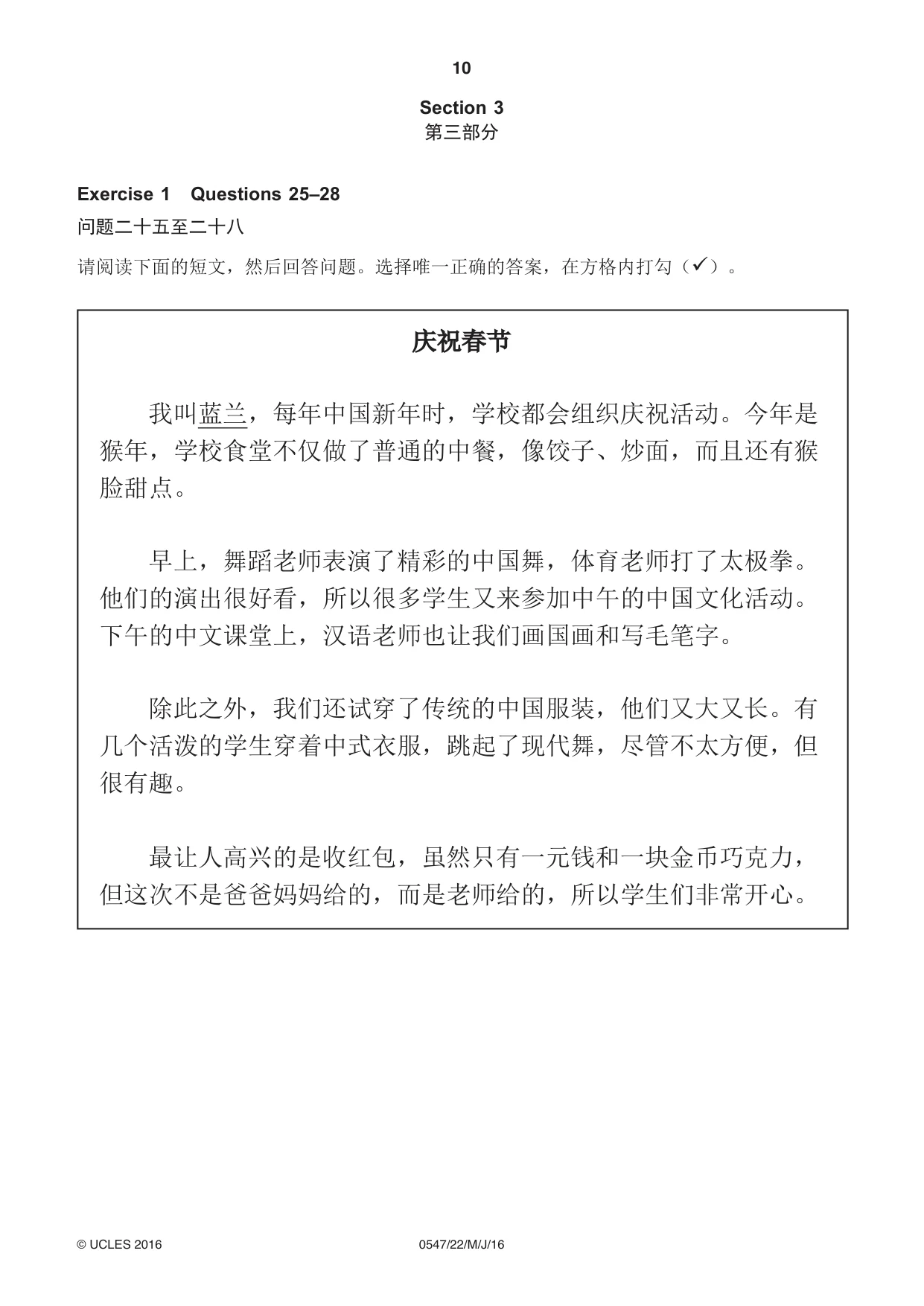
10 © UCLES 2016 0547/22/M/J/16 Section 3 第三部分 Exercise 1 Questions 25–28 问题二十五至二十八 请阅读下面的短文,然后回答问题。选择唯一正确的答案,在方格内打勾()。 庆祝春节 我叫蓝兰,每年中国新年时,学校都会组织庆祝活动。今年是 猴年,学校食堂不仅做了普通的中餐,像饺子、炒面,而且还有猴 脸甜点。 早上,舞蹈老师表演了精彩的中国舞,体育老师打了太极拳。 他们的演出很好看,所以很多学生又来参加中午的中国文化活动。 下午的中文课堂上,汉语老师也让我们画国画和写毛笔字。 除此之外,我们还试穿了传统的中国服装,他们又大又长。有 几个活泼的学生穿着中式衣服,跳起了现代舞,尽管不太方便,但 很有趣。 最让人高兴的是收红包,虽然只有一元钱和一块金币巧克力, 但这次不是爸爸妈妈给的,而是老师给的,所以学生们非常开心。
Question paper, page 11
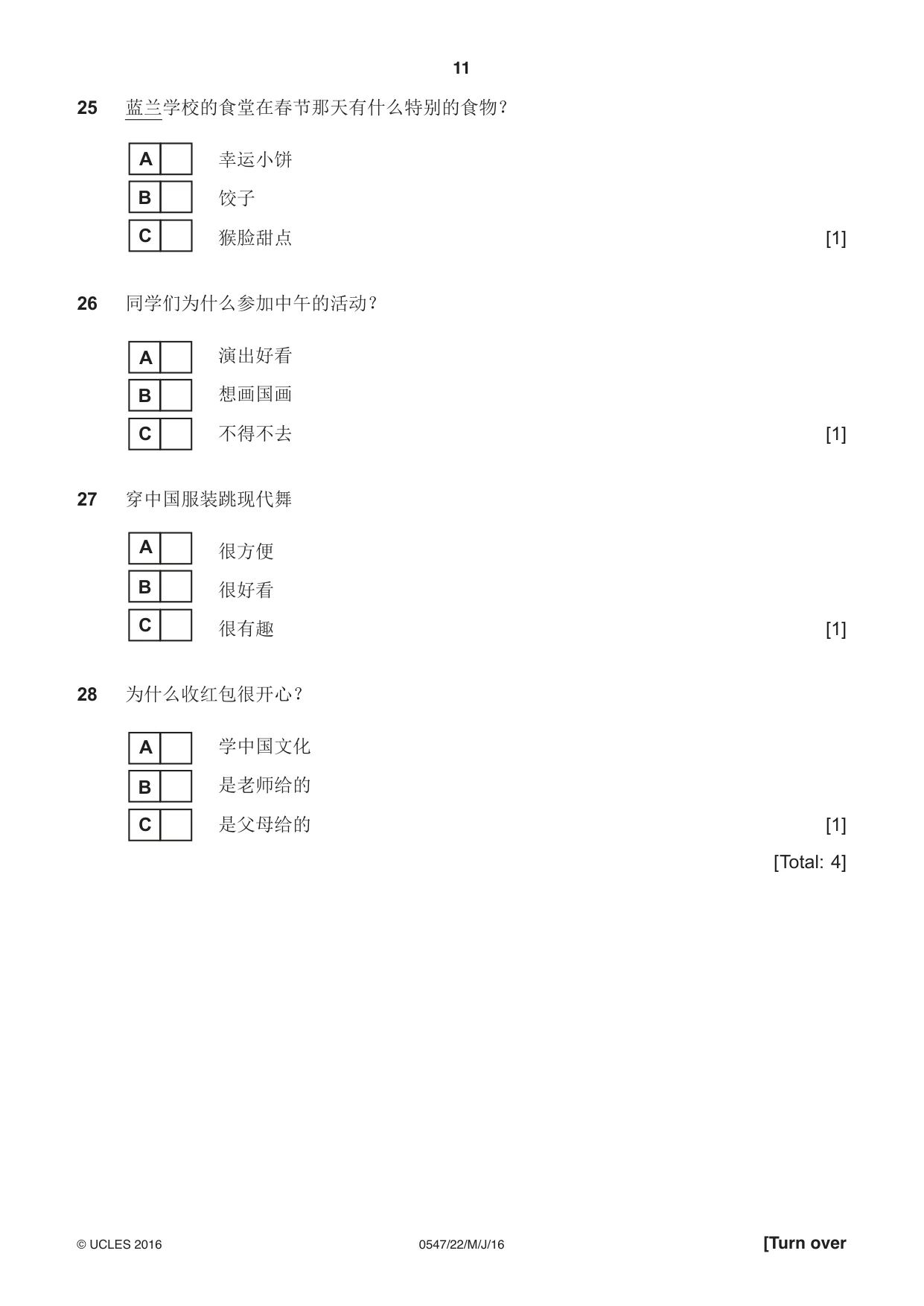
11 [Turn over 0547/22/M/J/16 © UCLES 2016 25 蓝兰学校的食堂在春节那天有什么特别的食物? 幸运小饼 饺子 猴脸甜点 [1] 26 同学们为什么参加中午的活动? 演出好看 想画国画 不得不去 [1] 27 穿中国服装跳现代舞 很方便 很好看 很有趣 [1] 28 为什么收红包很开心? 学中国文化 是老师给的 是父母给的 [1] [Total: 4] C A B C A B C A B C A B C
Question paper, page 12
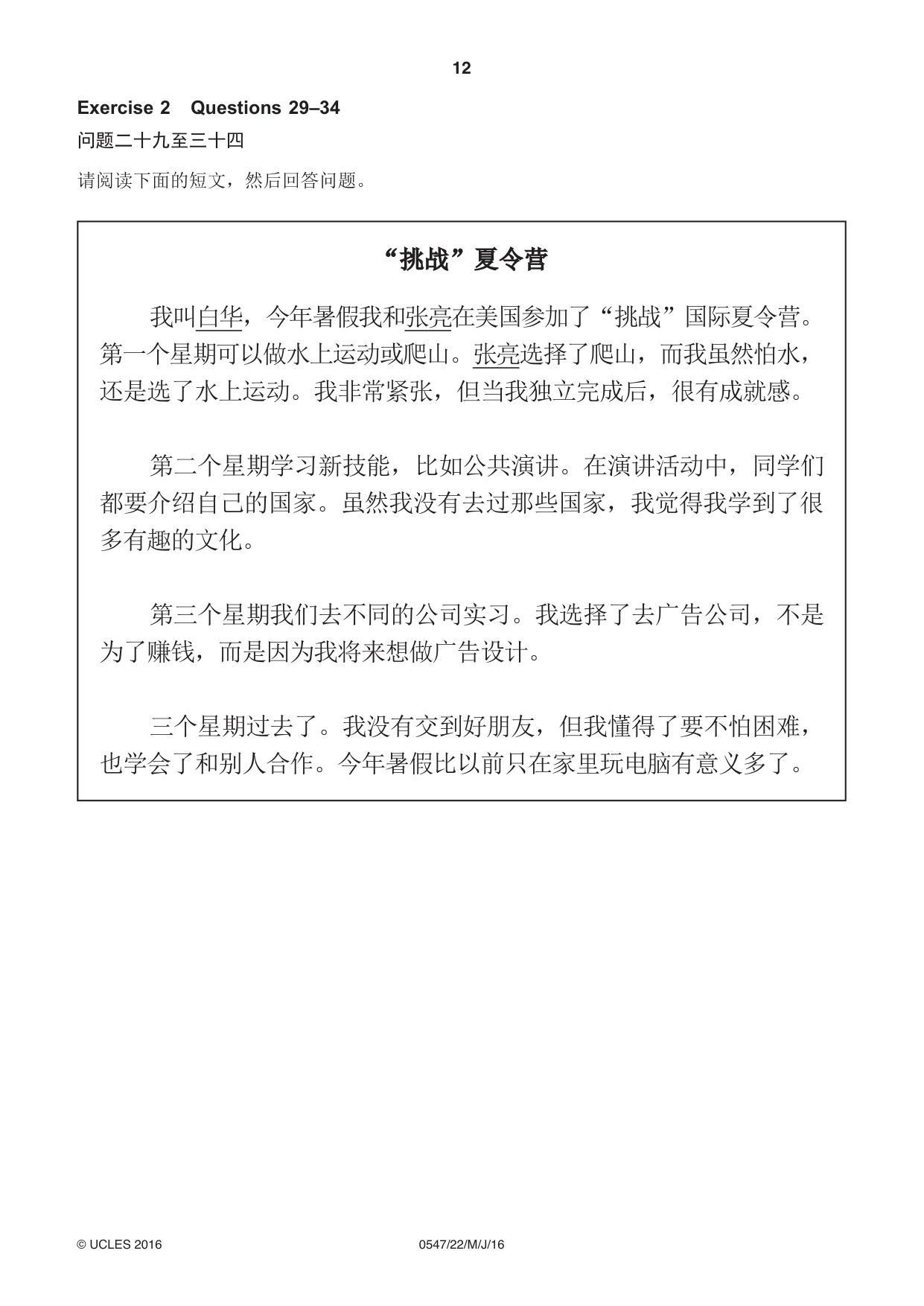
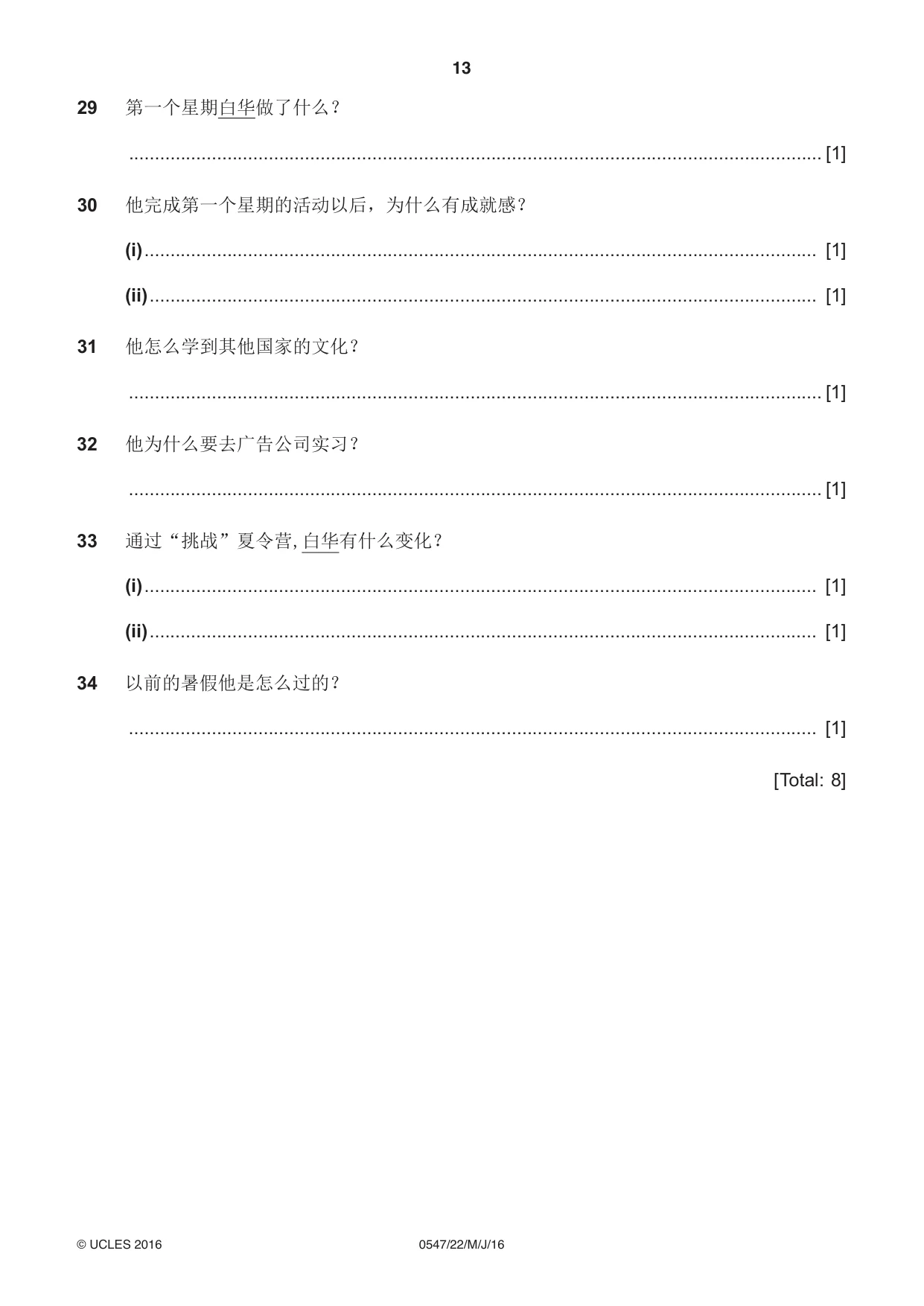
12 © UCLES 2016 0547/22/M/J/16 Exercise 2 Questions 29–34 问题二十九至三十四 请阅读下面的短文,然后回答问题。 “挑战”夏令营 我叫白华,今年暑假我和张亮在美国参加了“挑战”国际夏令营。 第一个星期可以做水上运动或爬山。张亮选择了爬山,而我虽然怕水, 还是选了水上运动。我非常紧张,但当我独立完成后,很有成就感。 第二个星期学习新技能,比如公共演讲。在演讲活动中,同学们 都要介绍自己的国家。虽然我没有去过那些国家,我觉得我学到了很 多有趣的文化。 第三个星期我们去不同的公司实习。我选择了去广告公司,不是 为了赚钱,而是因为我将来想做广告设计。 三个星期过去了。我没有交到好朋友,但我懂得了要不怕困难, 也学会了和别人合作。今年暑假比以前只在家里玩电脑有意义多了。
Question paper, page 13
13 0547/22/M/J/16 © UCLES 2016 29 第一个星期白华做了什么? … [1] 30 他完成第一个星期的活动以后,为什么有成就感? (i) … [1] (ii) … [1] 31 他怎么学到其他国家的文化? … [1] 32 他为什么要去广告公司实习? … [1] 33 通过“挑战”夏令营,白华有什么变化? (i) … [1] (ii) … [1] 34 以前的暑假他是怎么过的? … [1] [Total: 8]
Question paper, page 14
14 © UCLES 2016 0547/22/M/J/16 BLANK PAGE
Question paper, page 15
15 [Turn over 0547/22/M/J/16 © UCLES 2016 BLANK PAGE
Question paper, page 16
16 © UCLES 2016 0547/22/M/J/16 BLANK PAGE Permission to reproduce items where third-party owned material protected by copyright is included has been sought and cleared where possible. Every reasonable effort has been made by the publisher (UCLES) to trace copyright holders, but if any items requiring clearance have unwittingly been included, the publisher will be pleased to make amends at the earliest possible opportunity. To avoid the issue of disclosure of answer-related information to candidates, all copyright acknowledgements are reproduced online in the Cambridge International Examinations Copyright Acknowledgements Booklet. This is produced for each series of examinations and is freely available to download at www.cie.org.uk after the live examination series. Cambridge International Examinations is part of the Cambridge Assessment Group. Cambridge Assessment is the brand name of University of Cambridge Local Examinations Syndicate (UCLES), which is itself a department of the University of Cambridge.
Mark scheme, page 1
® IGCSE is the registered trademark of Cambridge International Examinations. This syllabus is approved for use in England, Wales and Northern Ireland as a Cambridge International Level 1/Level 2 Certificate. This document consists of 9 printed pages. © UCLES 2016 [Turn over Cambridge International Examinations Cambridge International General Certificate of Secondary Education MANDARIN CHINESE (FOREIGN LANGUAGE) 0547/22 Paper 2 Reading May/June 2016 MARK SCHEME Maximum Mark: 36 Published This mark scheme is published as an aid to teachers and candidates, to indicate the requirements of the examination. It shows the basis on which Examiners were instructed to award marks. It does not indicate the details of the discussions that took place at an Examiners’ meeting before marking began, which would have considered the acceptability of alternative answers. Mark schemes should be read in conjunction with the question paper and the Principal Examiner Report for Teachers. Cambridge will not enter into discussions about these mark schemes. Cambridge is publishing the mark schemes for the May/June 2016 series for most Cambridge IGCSE®, Cambridge International A and AS Level components and some Cambridge O Level components.
Mark scheme, page 2
Page 2 Mark Scheme Syllabus Paper Cambridge IGCSE – May/June 2016 0547 22 © Cambridge International Examinations 2016 General Marking Notes 2 General Marking Principles 2.1 Please note that it is not possible to list all acceptable alternatives in the Detailed Mark Scheme provided in Section 3. You will need to consider all alternative answers and unexpected approaches in candidates’ scripts, make a decision on whether they communicate the required elements, in consultation with your Principal Examiner if necessary (or with your Product Manager if you are a single Examiner), and award marks accordingly. The following marking principles underpin the detailed instructions provided in Section 3 of the Mark Scheme. Where a decision is taken to deviate from these principles for a particular question, this will be specified in the Mark Scheme. 2.2 Crossing out: (a) If a candidate changes his/her mind over an answer and crosses out an attempt, award a mark if the final attempt is correct. (b) If a candidate crosses out an answer to a whole question but makes no second attempt at it, mark the crossed out work. 2.3 Reading tasks: more than the stipulated number of boxes ticked/crossed by the candidate: (a) If more than one attempt is visible, but the candidate has clearly indicated which attempt is his/her final answer (e.g. by crossing out other attempts or by annotating the script in some way), mark in the usual way. (b) If two attempts are visible (e.g. two boxes ticked instead of the 1 box stipulated), and neither has been crossed out/discounted by the candidate, no mark can be awarded. 2.4 Reading tasks: for questions requiring more than one element for the answer, (i) and (ii), where the answers are interchangeable: Both correct answers on line 1 and line 2 blank = 2 Both correct answers on line 1 and line 2 wrong = 1 (or vice-versa) 2.5 Reading tasks: answers requiring the use of Chinese (rather than a non-verbal response) should be marked for communication. Tolerate inaccuracies provided the message is clear. (a) ‘If in doubt, sound it out’: if you read what the candidate has written, does it sound like the correct answer? (b) Look-alike test: does what the candidate has written look like the correct answer? (c) Accept incorrect person unless Mark Scheme specifies otherwise. (d) Accept incorrect possessive adjectives unless Mark Scheme specifies otherwise (in general, Section 2 accept, Section 3 consult Mark Scheme carefully). 2.6 Unless the Mark Scheme specifies otherwise, do not accept incorrect Chinese if the word given means something else in Chinese.
Mark scheme, page 3
Page 3 Mark Scheme Syllabus Paper Cambridge IGCSE – May/June 2016 0547 22 © Cambridge International Examinations 2016 2.7 Annotation used in the Mark Scheme: (a) INV = Invalidation and is used when additional material included by the candidate is judged to invalidate an otherwise correct answer thus preventing him/her from scoring the mark (INV = 0). (b) tc = ‘tout court’ and means that on its own the material is not sufficient to score the mark. (c) HA = harmless additional material which in conjunction with the correct answer does not prevent the candidate from scoring the mark. (d) BOD = Benefit of the Doubt and is used to indicate material considered by the Examiner and judged to be more correct than incorrect: the benefit of the doubt is given to the candidate and the mark is awarded. 2.8 No response and ‘0’ marks Award NR (No Response): • If there is nothing written at all in the answer space or • If there is only a comment which does not in any way relate to the question being asked (e.g. ‘can’t do’ or ‘don’t know’) or • If there is only a mark which isn’t an attempt at the question (e.g. a dash, a question mark). Award 0: If there is any attempt that earns no credit. This could, for example, include the candidate copying all or some of the question, or any working that does not earn any marks, whether crossed out or not. 2.9 Extra material: Section 2, Exercise 2 In Section 2, Exercise 2, reward the candidate for being able to locate the answer in the passage. Do not worry about lifting unless a lift is specifically rejected in the mark scheme. Unless the mark scheme states otherwise, ignore extra material given in an answer.
Mark scheme, page 4
Page 4 Mark Scheme Syllabus Paper Cambridge IGCSE – May/June 2016 0547 22 © Cambridge International Examinations 2016 2.10 Extra material: Section 3 In Section 3 it is the candidate’s responsibility to answer questions in such a way as to demonstrate to the Examiner that s/he has understood the texts/questions. Where candidates introduce extra, irrelevant material to an otherwise correct answer the danger is that the Examiner is being forced to ‘choose’ the correct answer and s/he cannot be certain that the candidate has shown understanding. Where the Examiner is put in this position the mark cannot be awarded. In Section 3, look for signs of genuine comprehension. Usually, candidates who lift indiscriminately fail to demonstrate comprehension and will not score the mark. However, careful lifting of the details required to answer the question does demonstrate comprehension and should be rewarded. The Detailed Mark Scheme provides specific guidance but in cases not covered, the following general rules apply: (a) Extra material, mentioned in the Mark Scheme, which reinforces the correct answer or in itself constitutes an alternative correct answer: this is acceptable and is not penalised (b) Extra material which constitutes an alternative answer, but which is not explicitly mentioned in the Mark Scheme: the Examiner needs to decide, by consulting the text and the Team Leader if necessary whether the alternative answer constitutes: (i) an alternative correct answer, in which case this falls into category (a) and the answer should be rewarded or (ii) an answer which on its own would be refused, in which case this falls into category (c) and the answer should be refused (c) Extra material which constitutes an alternative answer specifically refused in the Mark Scheme: this puts the Examiner in the position of having to ‘choose’ which is the candidate’s ‘final’ answer – the Examiner cannot be sure what the candidate has understood – and the mark cannot be awarded (d) Extra material which distorts or contradicts the correct answer: this affects communication – the Examiner cannot be sure what the candidate has understood – and the mark cannot be awarded (e) Extra material introduced by the candidate and which does not feature in the text: this affects communication – the Examiner cannot be sure what the candidate has understood – and the mark cannot be awarded. It can sometimes be difficult to draw the line between what is a deduction made by an able candidate on the basis of what they have read and pure guesswork. Therefore where an answer of this sort occurs which is not covered in the Mark Scheme, Examiners should consult their Team Leader
Mark scheme, page 5
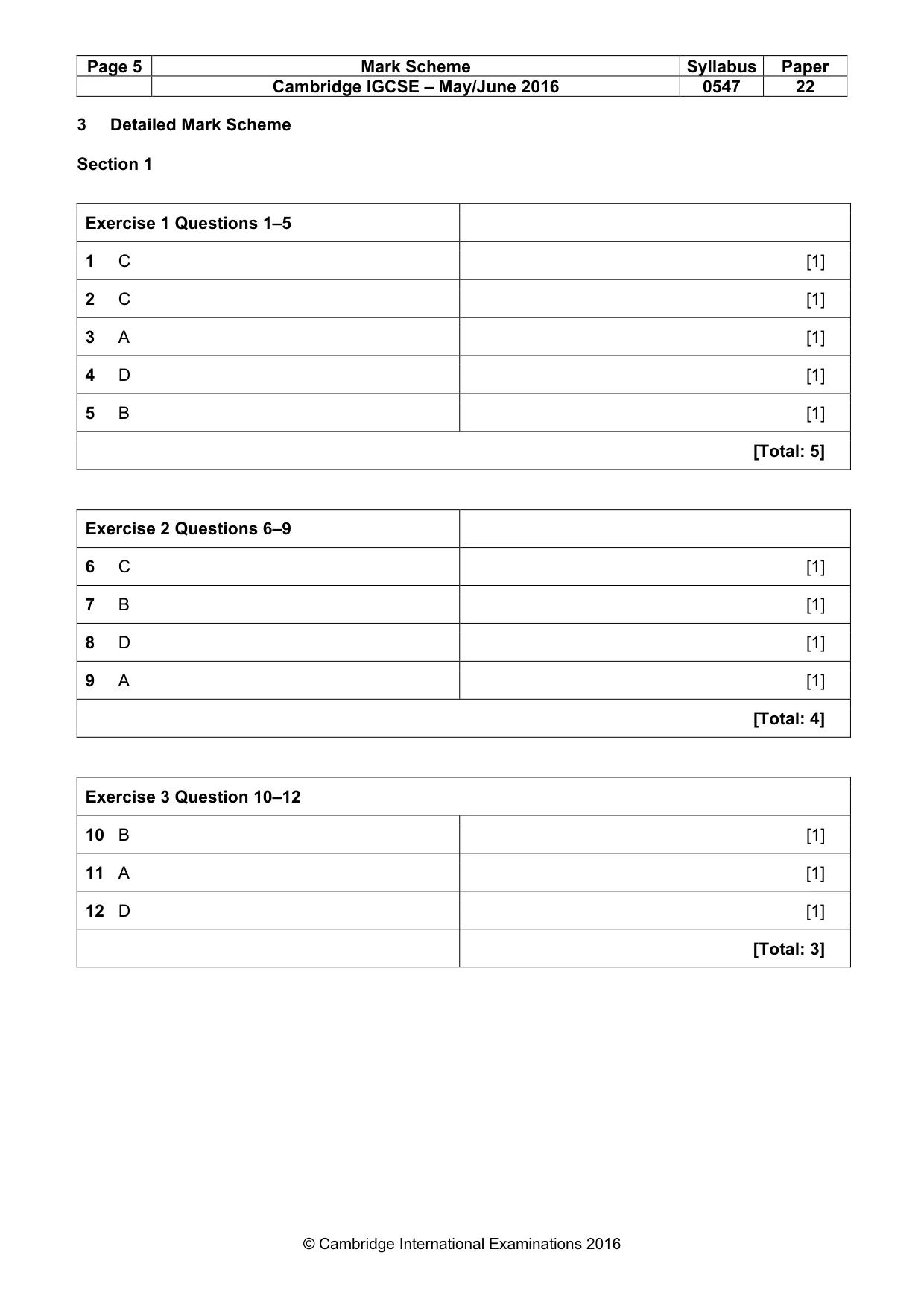
Page 5 Mark Scheme Syllabus Paper Cambridge IGCSE – May/June 2016 0547 22 © Cambridge International Examinations 2016 3 Detailed Mark Scheme Section 1 Exercise 1 Questions 1–5 1 C [1] 2 C [1] 3 A [1] 4 D [1] 5 B [1] [Total: 5] Exercise 2 Questions 6–9 6 C [1] 7 B [1] 8 D [1] 9 A [1] [Total: 4] Exercise 3 Question 10–12 10 B [1] 11 A [1] 12 D [1] [Total: 3]
Mark scheme, page 6
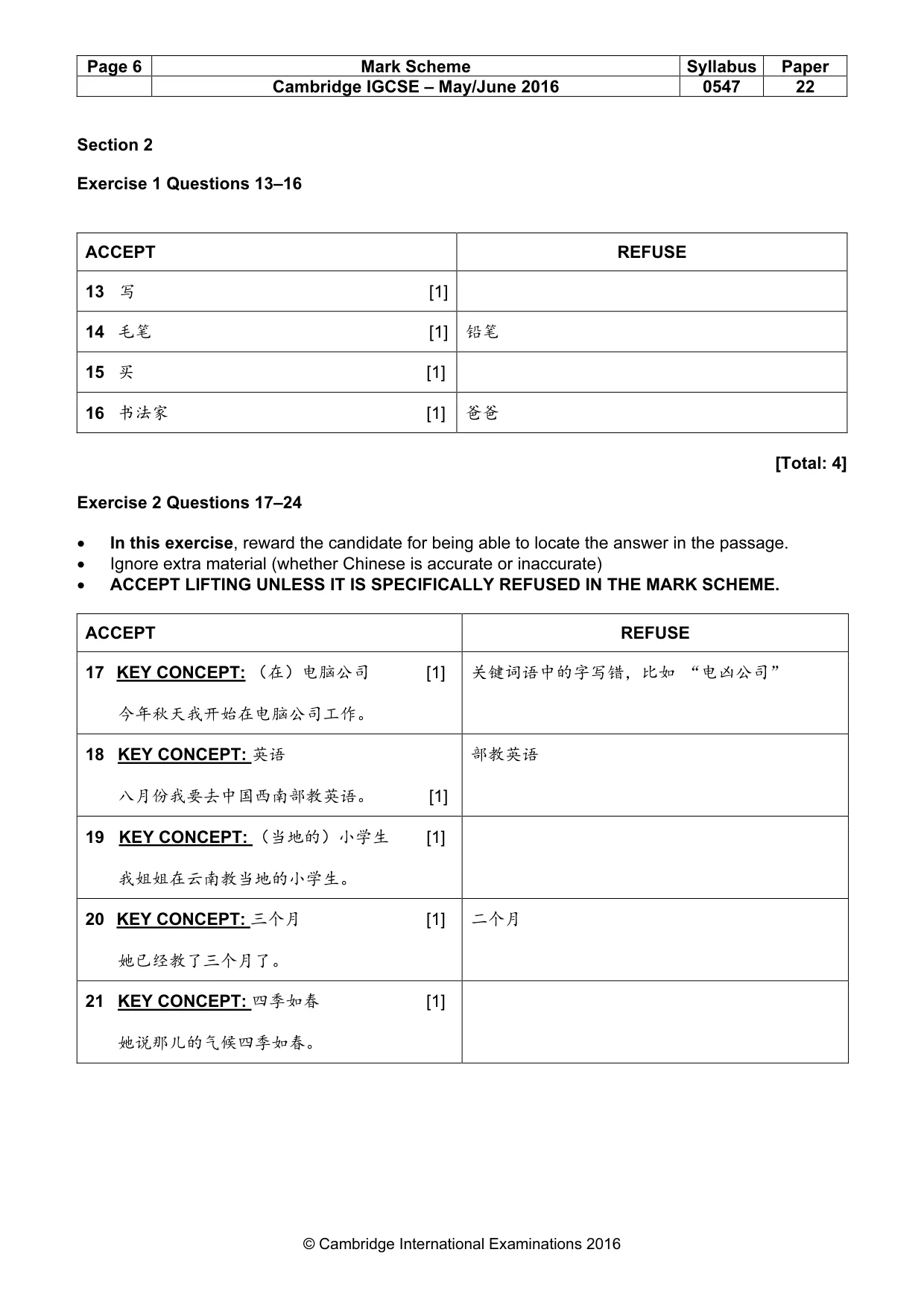
Page 6 Mark Scheme Syllabus Paper Cambridge IGCSE – May/June 2016 0547 22 © Cambridge International Examinations 2016 Section 2 Exercise 1 Questions 13–16 ACCEPT REFUSE 13 写 [1] 14 毛笔 [1] 铅笔 15 买 [1] 16 书法家 [1] 爸爸 [Total: 4] Exercise 2 Questions 17–24 • In this exercise, reward the candidate for being able to locate the answer in the passage. • Ignore extra material (whether Chinese is accurate or inaccurate) • ACCEPT LIFTING UNLESS IT IS SPECIFICALLY REFUSED IN THE MARK SCHEME. ACCEPT REFUSE 17 KEY CONCEPT: (在)电脑公司 [1] 今年秋天我开始在电脑公司工作。 关键词语中的字写错,比如 “电凶公司” 18 KEY CONCEPT: 英语 八月份我要去中国西南部教英语。 [1] 部教英语 19 KEY CONCEPT: (当地的)小学生 [1] 我姐姐在云南教当地的小学生。 20 KEY CONCEPT: 三个月 [1] 她已经教了三个月了。 二个月 21 KEY CONCEPT: 四季如春 [1] 她说那儿的气候四季如春。
Mark scheme, page 7
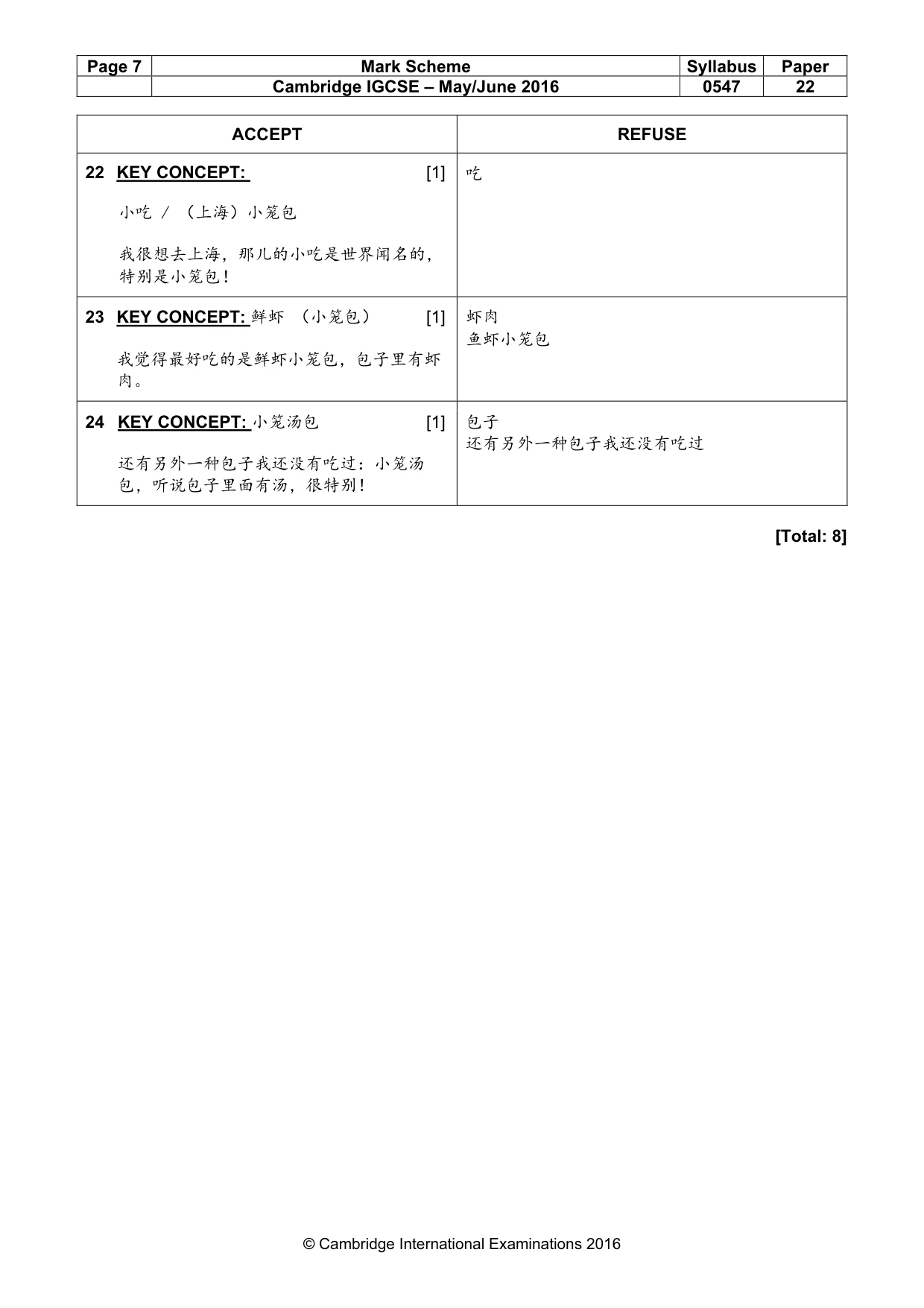
Page 7 Mark Scheme Syllabus Paper Cambridge IGCSE – May/June 2016 0547 22 © Cambridge International Examinations 2016 ACCEPT REFUSE 22 KEY CONCEPT: [1] 小吃 / (上海)小笼包 我很想去上海,那儿的小吃是世界闻名的, 特别是小笼包! 吃 23 KEY CONCEPT: 鲜虾 (小笼包) [1] 我觉得最好吃的是鲜虾小笼包,包子里有虾 肉。 虾肉 鱼虾小笼包 24 KEY CONCEPT: 小笼汤包 [1] 还有另外一种包子我还没有吃过:小笼汤 包,听说包子里面有汤,很特别! 包子 还有另外一种包子我还没有吃过 [Total: 8]
Mark scheme, page 8
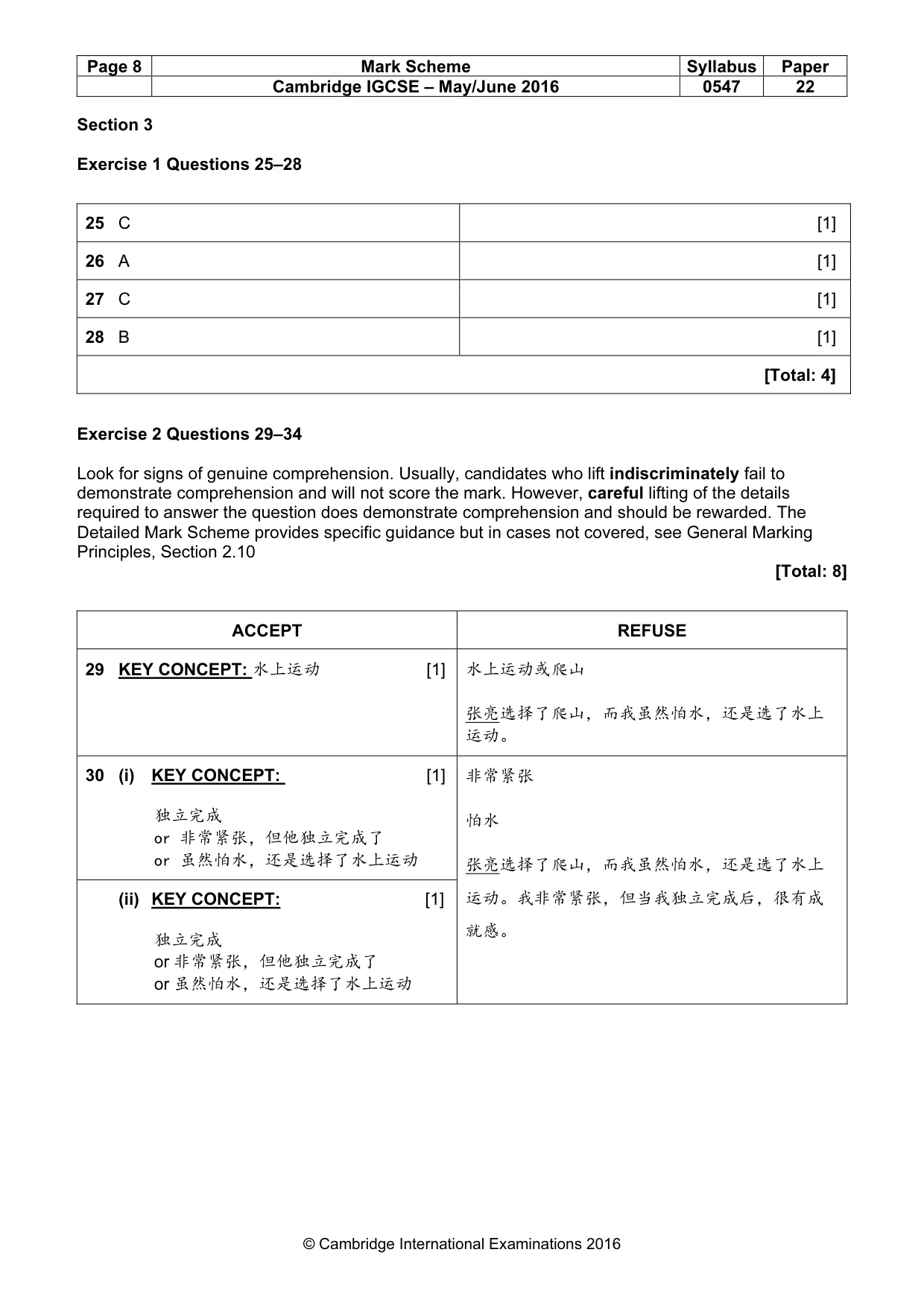
Page 8 Mark Scheme Syllabus Paper Cambridge IGCSE – May/June 2016 0547 22 © Cambridge International Examinations 2016 Section 3 Exercise 1 Questions 25–28 25 C [1] 26 A [1] 27 C [1] 28 B [1] [Total: 4] Exercise 2 Questions 29–34 Look for signs of genuine comprehension. Usually, candidates who lift indiscriminately fail to demonstrate comprehension and will not score the mark. However, careful lifting of the details required to answer the question does demonstrate comprehension and should be rewarded. The Detailed Mark Scheme provides specific guidance but in cases not covered, see General Marking Principles, Section 2.10 [Total: 8] ACCEPT REFUSE 29 KEY CONCEPT: 水上运动 [1] 水上运动或爬山 张亮选择了爬山,而我虽然怕水,还是选了水上 运动。 30 (i) KEY CONCEPT: [1] 独立完成 or 非常紧张,但他独立完成了 or 虽然怕水,还是选择了水上运动 非常紧张 怕水 张亮选择了爬山,而我虽然怕水,还是选了水上 运动。我非常紧张,但当我独立完成后,很有成 就感。 (ii) KEY CONCEPT: [1] 独立完成 or 非常紧张,但他独立完成了 or 虽然怕水,还是选择了水上运动
Mark scheme, page 9
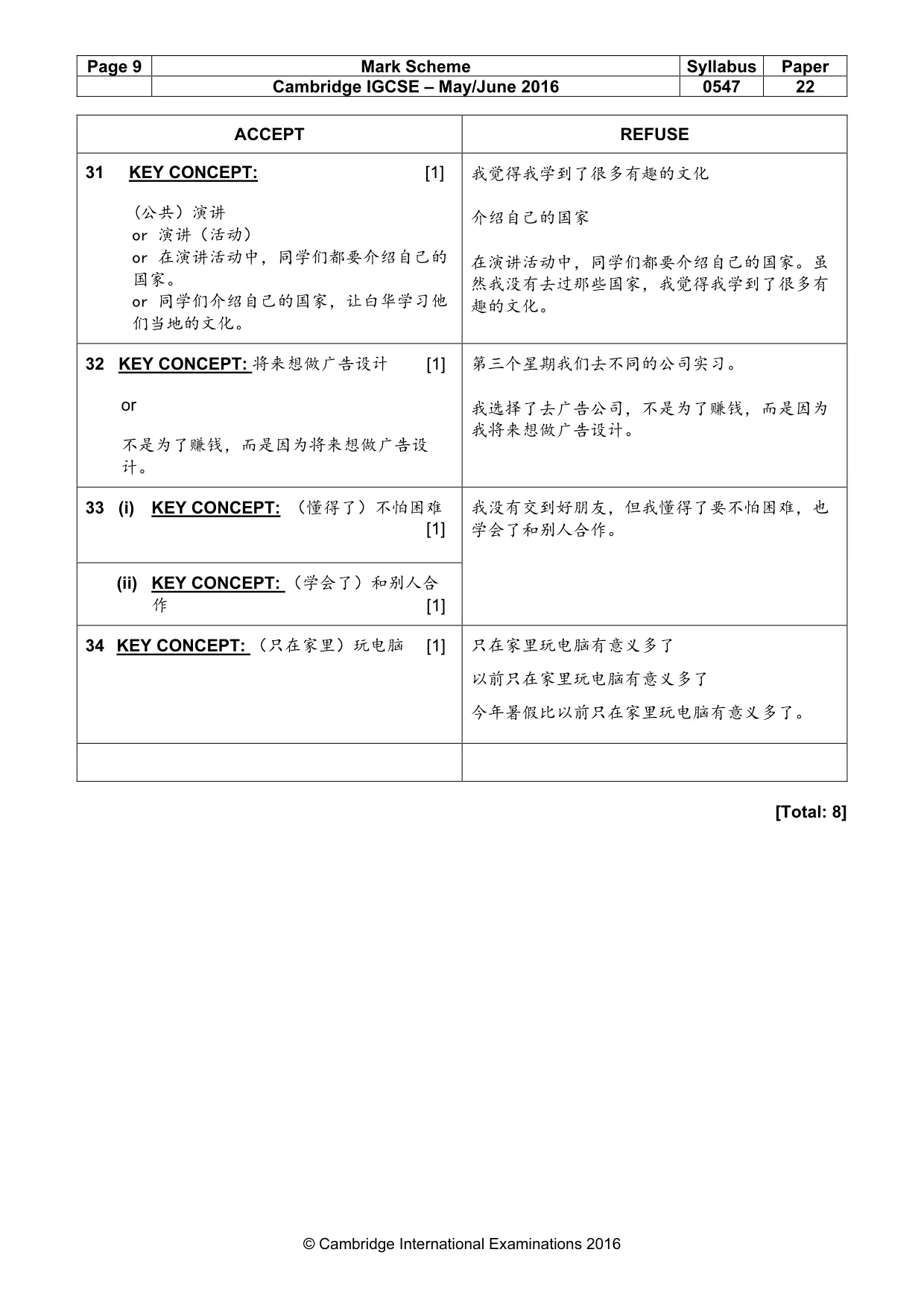
Page 9 Mark Scheme Syllabus Paper Cambridge IGCSE – May/June 2016 0547 22 © Cambridge International Examinations 2016 ACCEPT REFUSE 31 KEY CONCEPT: [1] (公共)演讲 or 演讲(活动) or 在演讲活动中,同学们都要介绍自己的 国家。 or 同学们介绍自己的国家,让白华学习他 们当地的文化。 我觉得我学到了很多有趣的文化 介绍自己的国家 在演讲活动中,同学们都要介绍自己的国家。虽 然我没有去过那些国家,我觉得我学到了很多有 趣的文化。 32 KEY CONCEPT: 将来想做广告设计 [1] or 不是为了赚钱,而是因为将来想做广告设 计。 第三个星期我们去不同的公司实习。 我选择了去广告公司,不是为了赚钱,而是因为 我将来想做广告设计。 33 (i) KEY CONCEPT: (懂得了)不怕困难 [1] 我没有交到好朋友,但我懂得了要不怕困难,也 学会了和别人合作。 (ii) KEY CONCEPT: (学会了)和别人合 作 [1] 34 KEY CONCEPT: (只在家里)玩电脑 [1] 只在家里玩电脑有意义多了 以前只在家里玩电脑有意义多了 今年暑假比以前只在家里玩电脑有意义多了。 [Total: 8]
What you needed in this session
Cambridge’s own grade thresholds for 2016 May/June, Paper 2 · Variant 2. A higher threshold means an easier paper — the bar moves with how the cohort did.