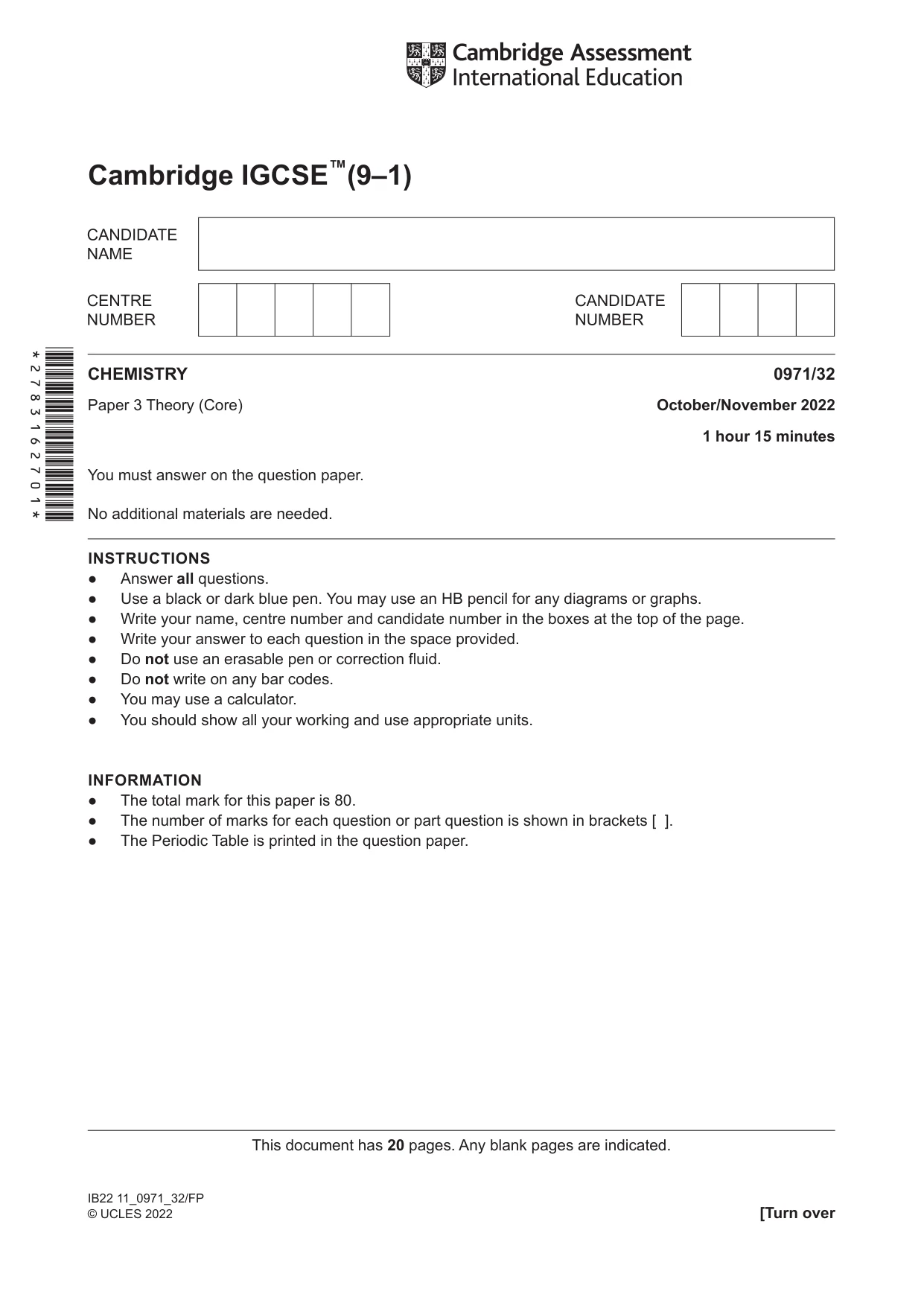
Cambridge IGCSE Chemistry (9-1) 0971 — 2022 Oct/Nov Paper 3 · Variant 2
0971/32/O/N/22 · 8 questions · 80 marks · ≈90 min
The question paper and its mark scheme, free to read here and free to download. This is Cambridge’s own paper, exactly as it was sat.
Question paper20 pages


Mark scheme11 pages
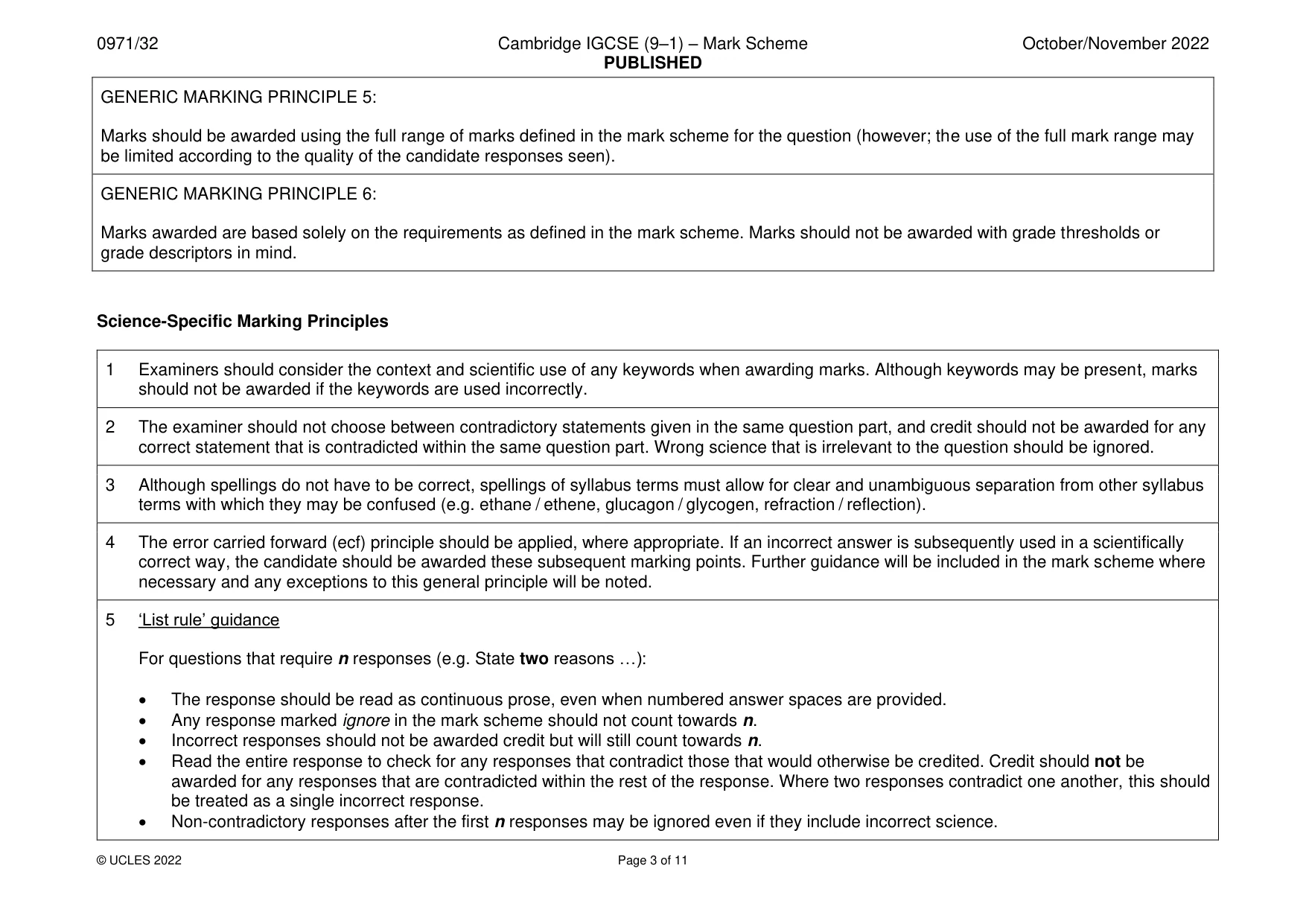
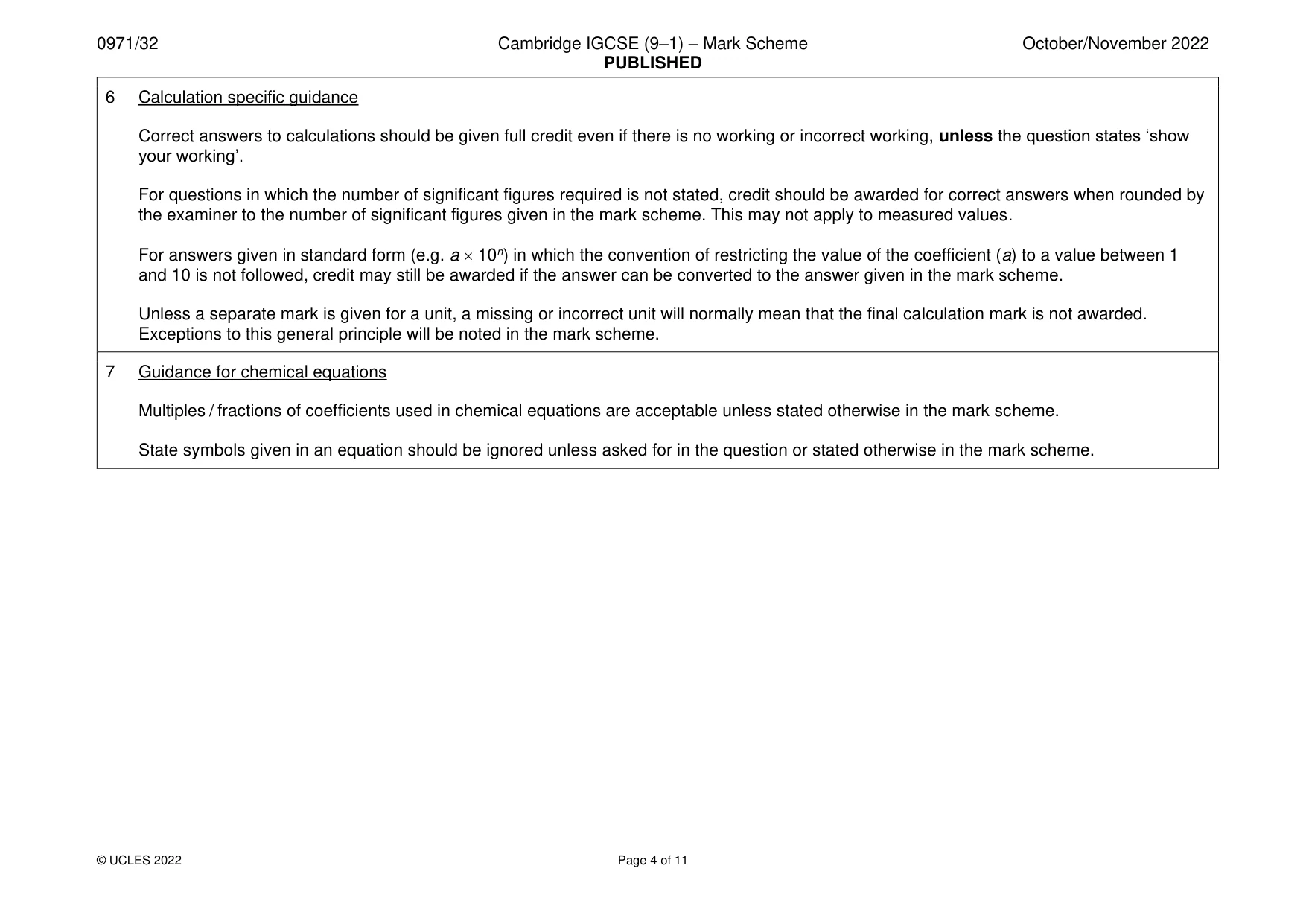
Answers below. Sit the paper first if you are practising.
Questions as text
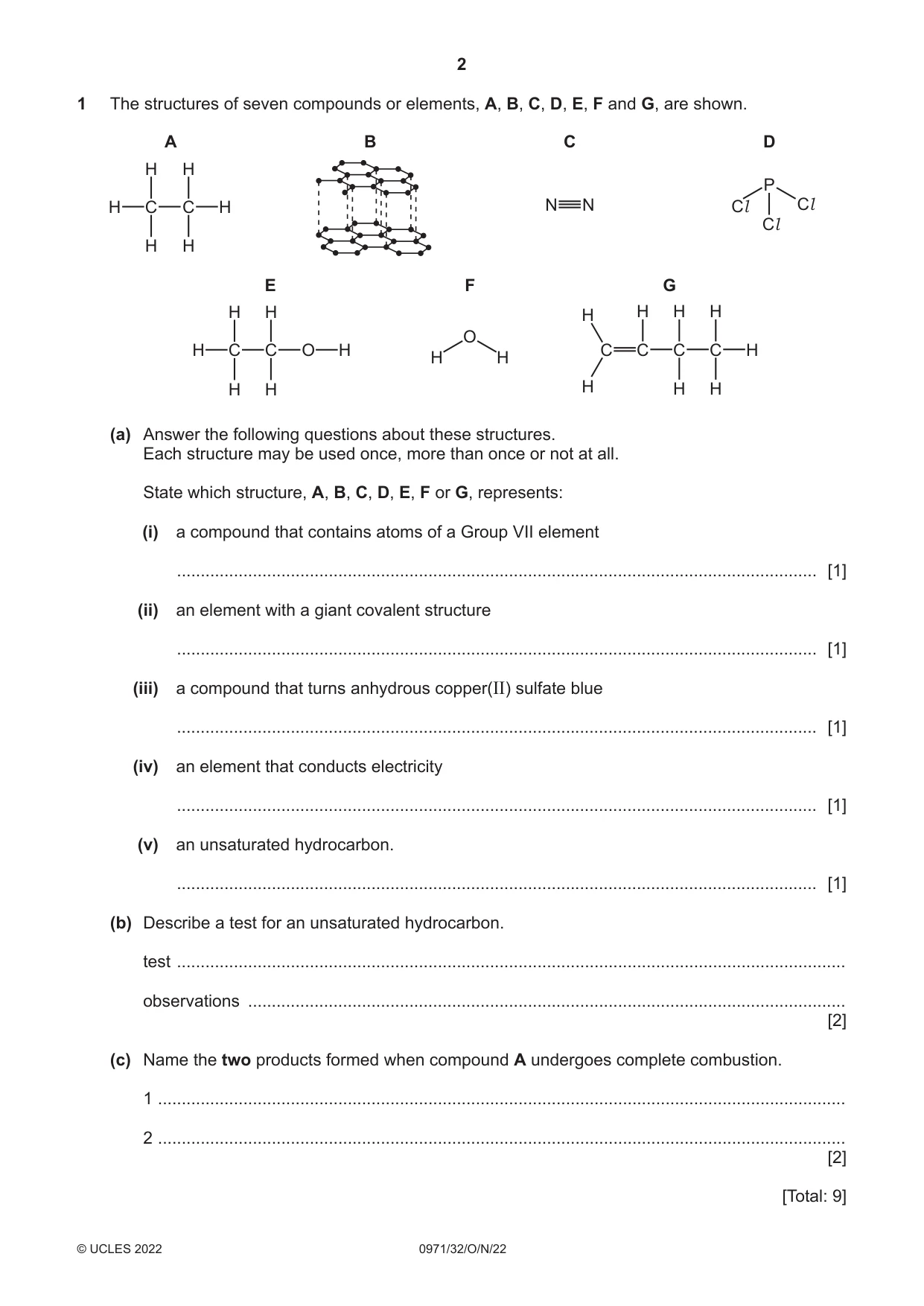
Q1 · The structures of seven compounds or elements, A, B, C, D, E, F and G, are shown
1 The structures of seven compounds or elements, A, B, C, D, E, F and G, are shown. A B C D H H P H C C H N N Cl Cl Cl H H E F G H H H H H H O H C C O H C C C C H H H H H H H H (a) Answer the following questions about these structures. Each structure may be used once, more than once or not at all. State which structure, A, B, C, D, E, F or G, represents: (i) a compound that contains atoms of a Group VII element ....................................................................................................................................... [1] (ii) an element with a giant covalent structure ....................................................................................................................................... [1] (iii) a compound that turns anhydrous copper(II) sulfate blue ....................................................................................................................................... [1] (iv) an element that conducts electricity ....................................................................................................................................... [1] (v) an unsaturated hydrocarbon. ....................................................................................................................................... [1] (b) Describe a test for an unsaturated hydrocarbon. test ............................................................................................................................................. observations ............................................................................................................................... [2] (c) Name the two products formed when compound A undergoes complete combustion. 1 ................................................................................................................................................. 2 ................................................................................................................................................. [2] [Total: 9]
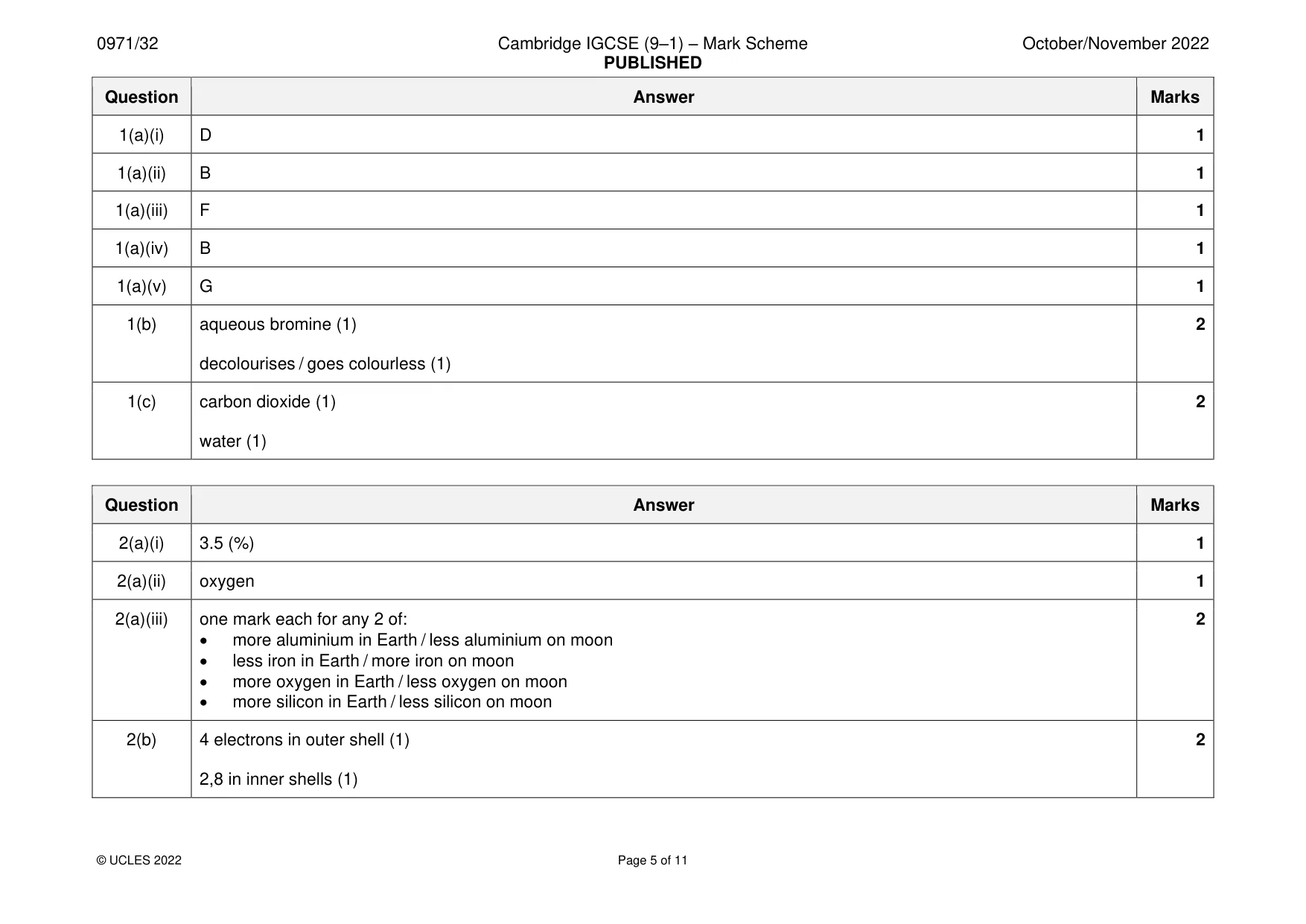
Mark scheme: Question Answer Marks 1(a)(i) D 1 1(a)(ii) B 1 1(a)(iii) F 1 1(a)(iv) B 1 1(a)(v) G 1 1(b) aqueous bromine (1) 2 decolourises / goes colourless (1) 1(c) carbon dioxide (1) 2 water (1)
Q2 · The table compares the percentage by mass of the elements in the Earth’s crust and in the…
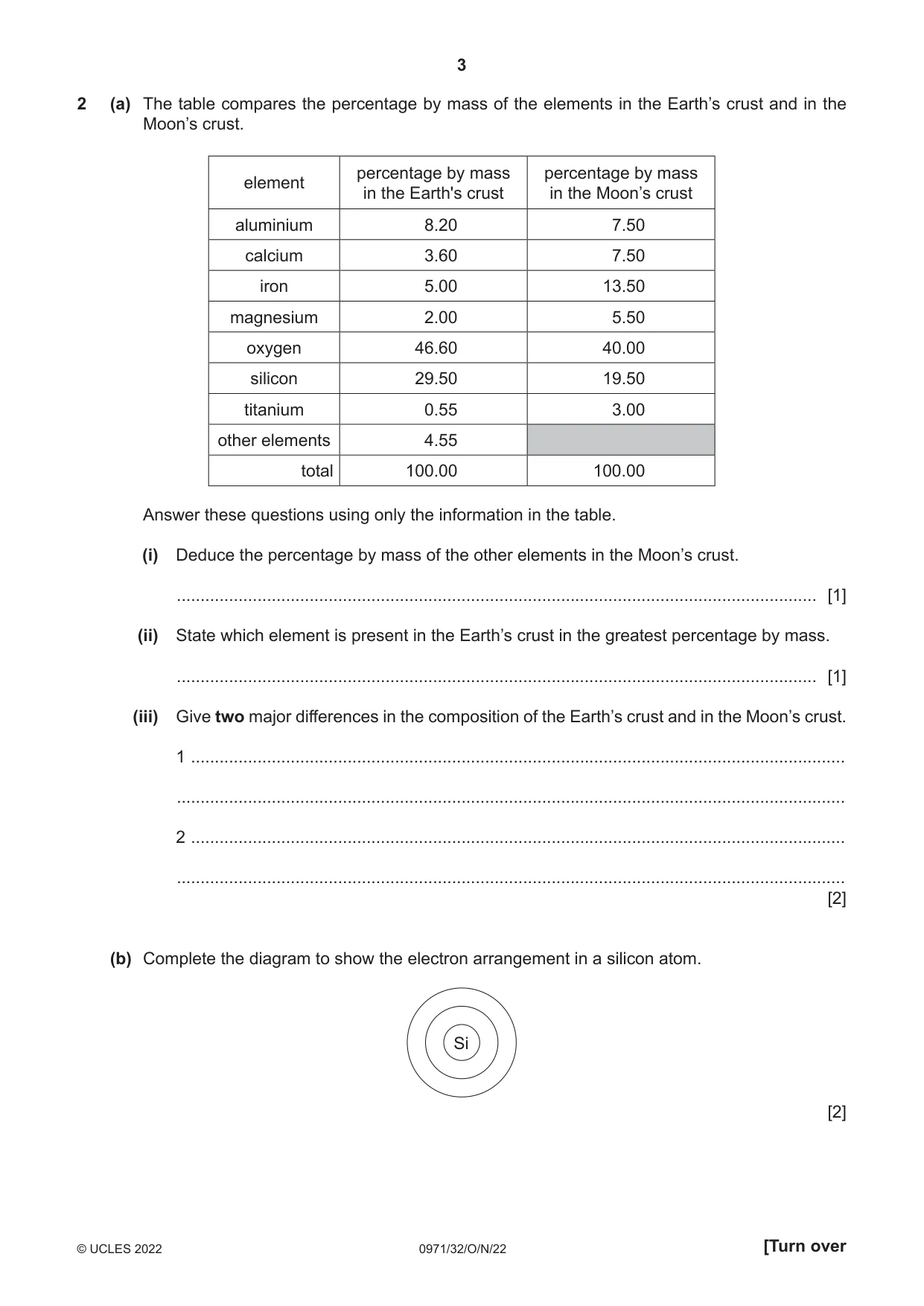
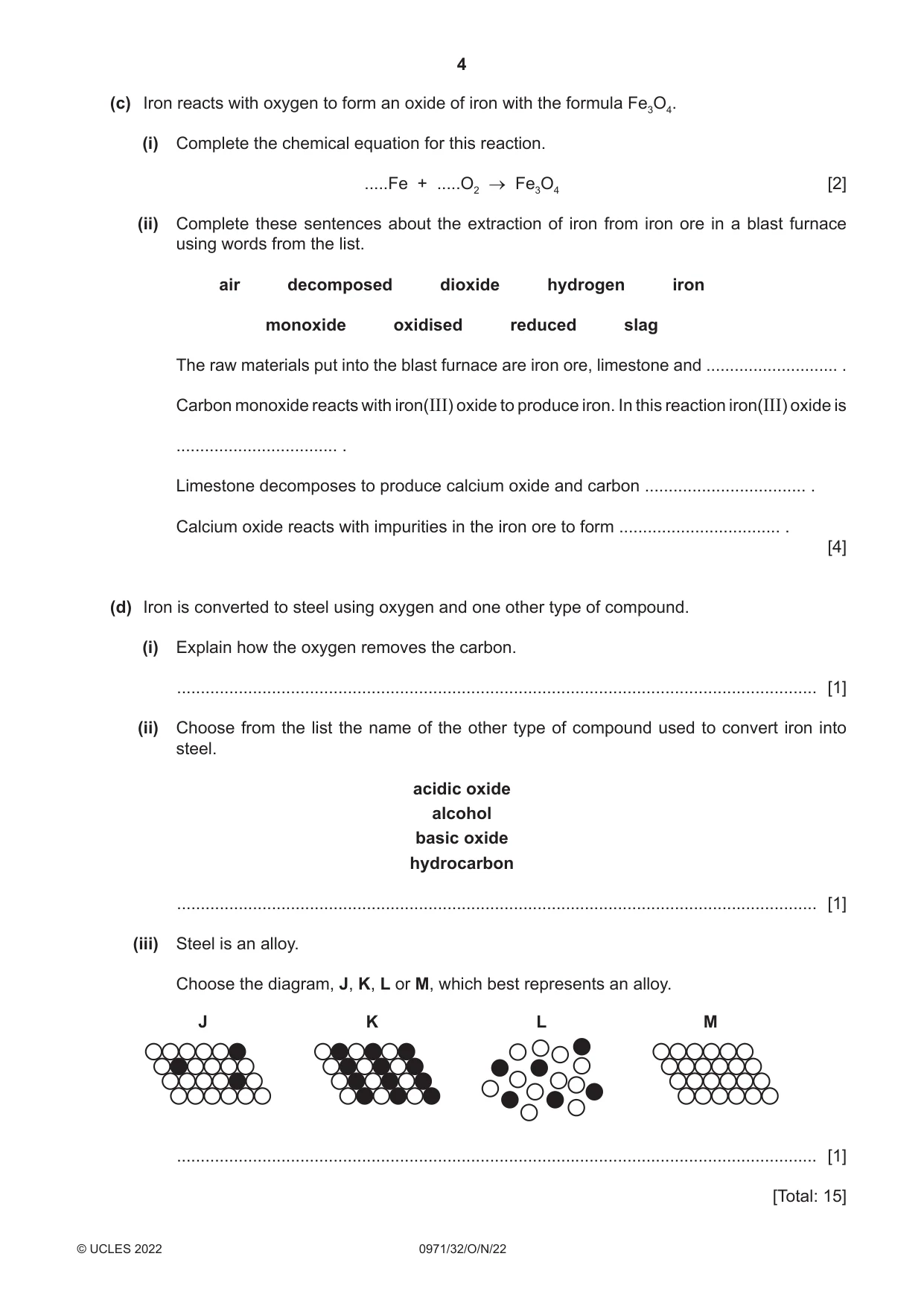
2 (a) The table compares the percentage by mass of the elements in the Earth’s crust and in the Moon’s crust. percentage by mass percentage by mass element in the Earth's crust in the Moon’s crust aluminium 8.20 7.50 calcium 3.60 7.50 iron 5.00 13.50 magnesium 2.00 5.50 oxygen 46.60 40.00 silicon 29.50 19.50 titanium 0.55 3.00 other elements 4.55 total 100.00 100.00 Answer these questions using only the information in the table. (i) Deduce the percentage by mass of the other elements in the Moon’s crust. ....................................................................................................................................... [1] (ii) State which element is present in the Earth’s crust in the greatest percentage by mass. ....................................................................................................................................... [1] (iii) Give two major differences in the composition of the Earth’s crust and in the Moon’s crust. 1 .......................................................................................................................................... ............................................................................................................................................. 2 .......................................................................................................................................... ............................................................................................................................................. [2] (b) Complete the diagram to show the electron arrangement in a silicon atom. Si [2] (c) Iron reacts with oxygen to form an oxide of iron with the formula Fe3O4. (i) Complete the chemical equation for this reaction. .....Fe + .....O2 → Fe3O4 [2] (ii) Complete these sentences about the extraction of iron from iron ore in a blast furnace using words from the list. air decomposed dioxide hydrogen iron monoxide oxidised reduced slag The raw materials put into the blast furnace are iron ore, limestone and ............................ . Carbon monoxide reacts with iron(III) oxide to produce iron. In this reaction iron(III) oxide is .................................. . Limestone decomposes to produce calcium oxide and carbon .................................. . Calcium oxide reacts with impurities in the iron ore to form .................................. . [4] (d) Iron is converted to steel using oxygen and one other type of compound. (i) Explain how the oxygen removes the carbon. ....................................................................................................................................... [1] (ii) Choose from the list the name of the other type of compound used to convert iron into steel. acidic oxide alcohol basic oxide hydrocarbon ....................................................................................................................................... [1] (iii) Steel is an alloy. Choose the diagram, J, K, L or M, which best represents an alloy. J K L M ....................................................................................................................................... [1] [Total: 15]
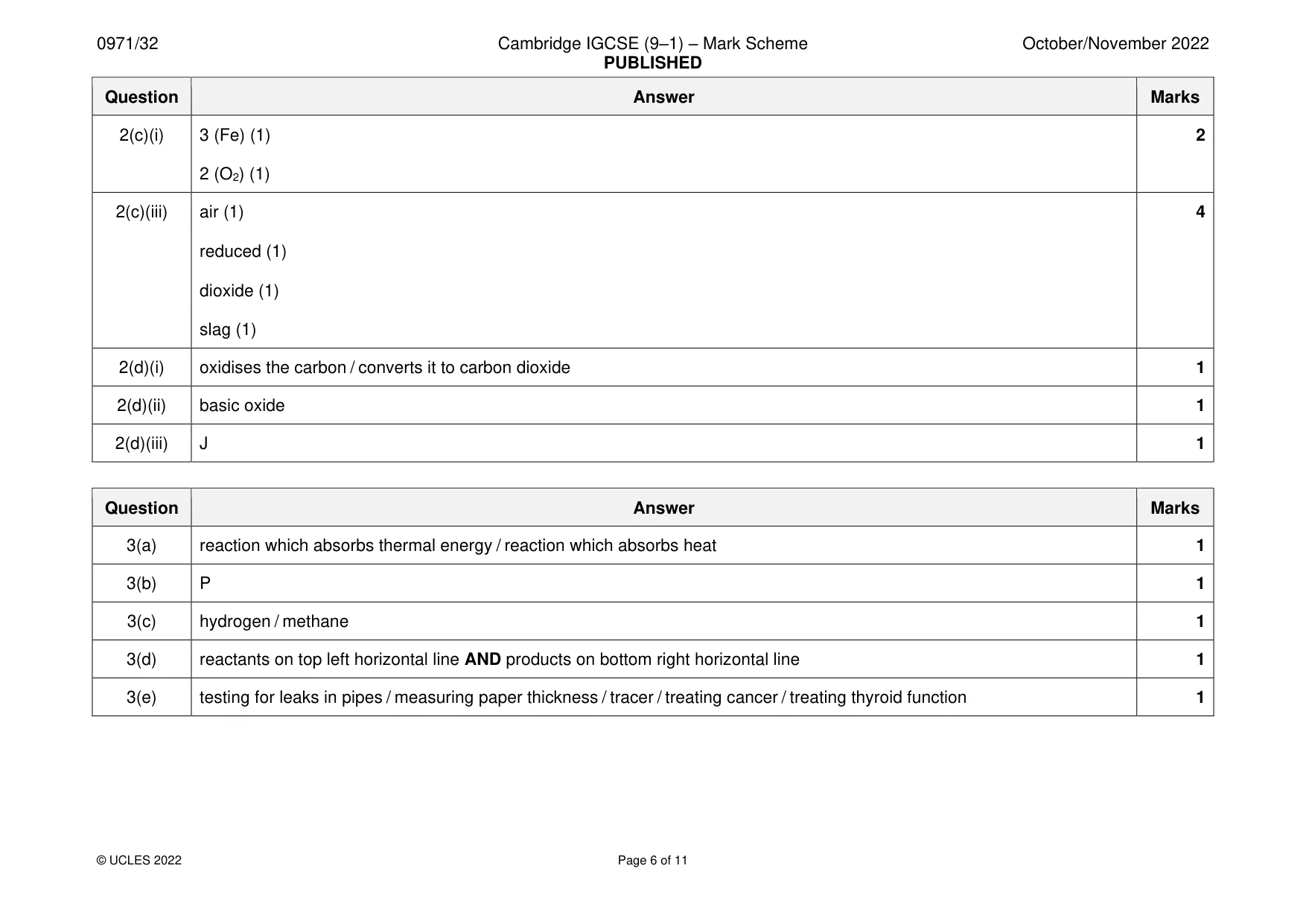
Mark scheme: 2(a)(i) 3.5 (%) 1 2(a)(ii) oxygen 1 2(a)(iii) one mark each for any 2 of: 2 • more aluminium in Earth / less aluminium on moon • less iron in Earth / more iron on moon • more oxygen in Earth / less oxygen on moon • more silicon in Earth / less silicon on moon 2(b) 4 electrons in outer shell (1) 2 2,8 in inner shells (1) 2(c)(i) 3 (Fe) (1) 2 2 (O2) (1) 2(c)(iii) air (1) 4 reduced (1) dioxide (1) slag (1) 2(d)(i) oxidises the carbon / converts it to carbon dioxide 1 2(d)(ii) basic oxide 1 2(d)(iii) J 1
Q3 · This question is about fuels and energy production
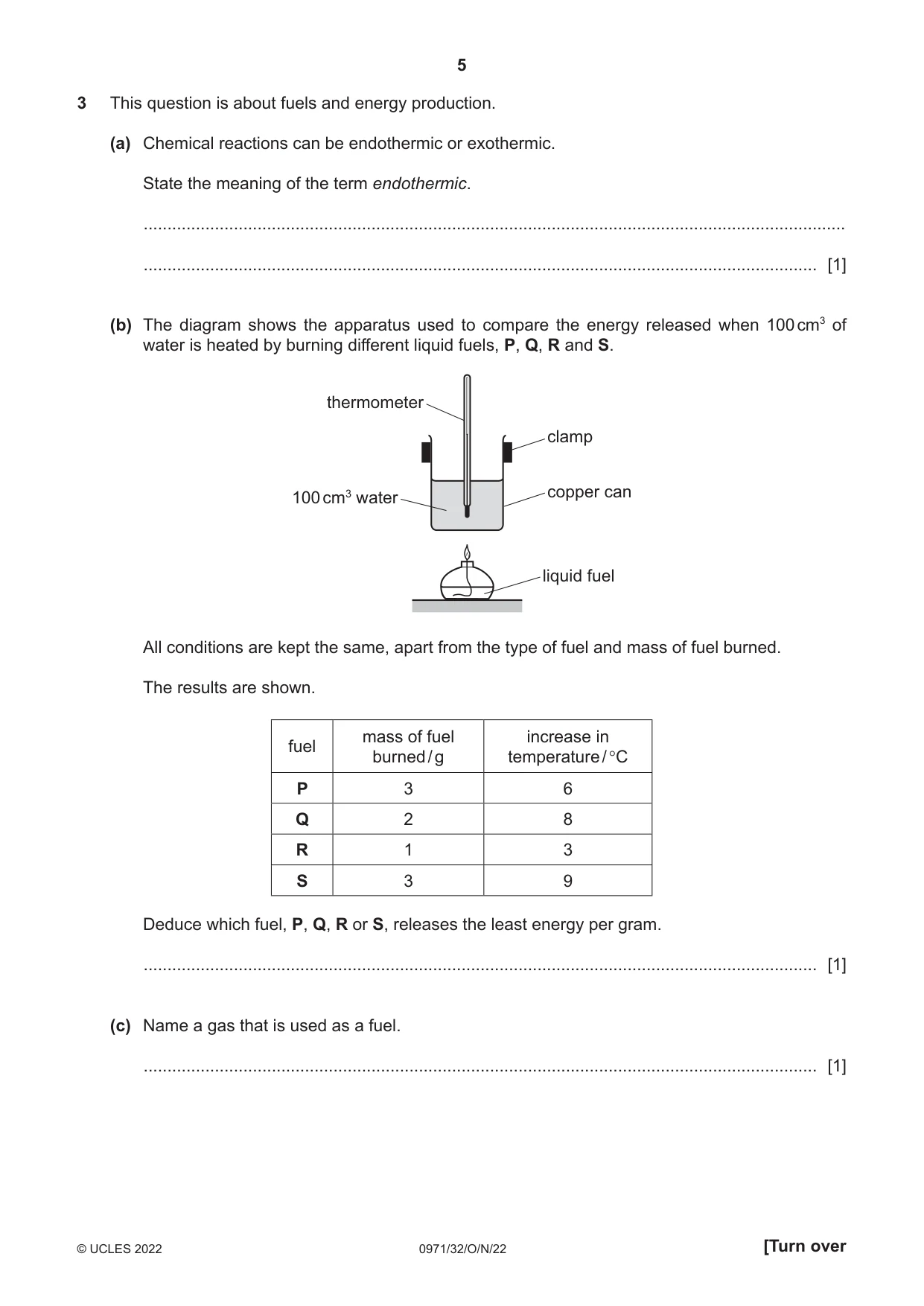
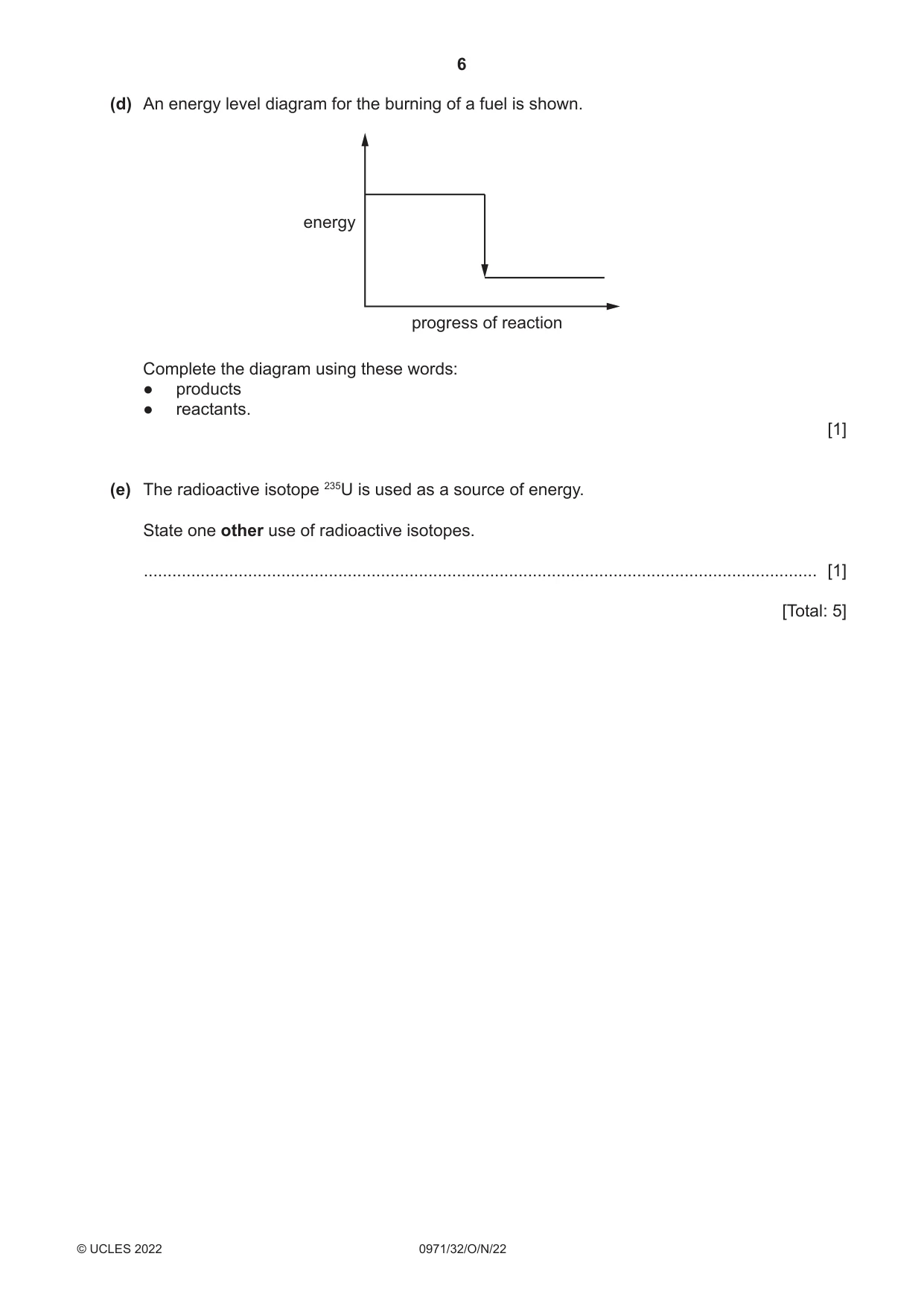
3 This question is about fuels and energy production. (a) Chemical reactions can be endothermic or exothermic. State the meaning of the term endothermic. .................................................................................................................................................... .............................................................................................................................................. [1] (b) The diagram shows the apparatus used to compare the energy released when 100 cm3 of water is heated by burning different liquid fuels, P, Q, R and S. thermometer clamp copper can 100 cm3 water liquid fuel All conditions are kept the same, apart from the type of fuel and mass of fuel burned. The results are shown. mass of fuel increase in fuel burned / g temperature / °C P 3 6 Q 2 8 R 1 3 S 3 9 Deduce which fuel, P, Q, R or S, releases the least energy per gram. .............................................................................................................................................. [1] (c) Name a gas that is used as a fuel. .............................................................................................................................................. [1] (d) An energy level diagram for the burning of a fuel is shown. energy progress of reaction Complete the diagram using these words: ● products ● reactants. [1] (e) The radioactive isotope 235U is used as a source of energy. State one other use of radioactive isotopes. .............................................................................................................................................. [1] [Total: 5]
Mark scheme: 3(a) reaction which absorbs thermal energy / reaction which absorbs heat 1 3(b) P 1 3(c) hydrogen / methane 1 3(d) reactants on top left horizontal line AND products on bottom right horizontal line 1 3(e) testing for leaks in pipes / measuring paper thickness / tracer / treating cancer / treating thyroid function 1
Q4 · This question is about halogens
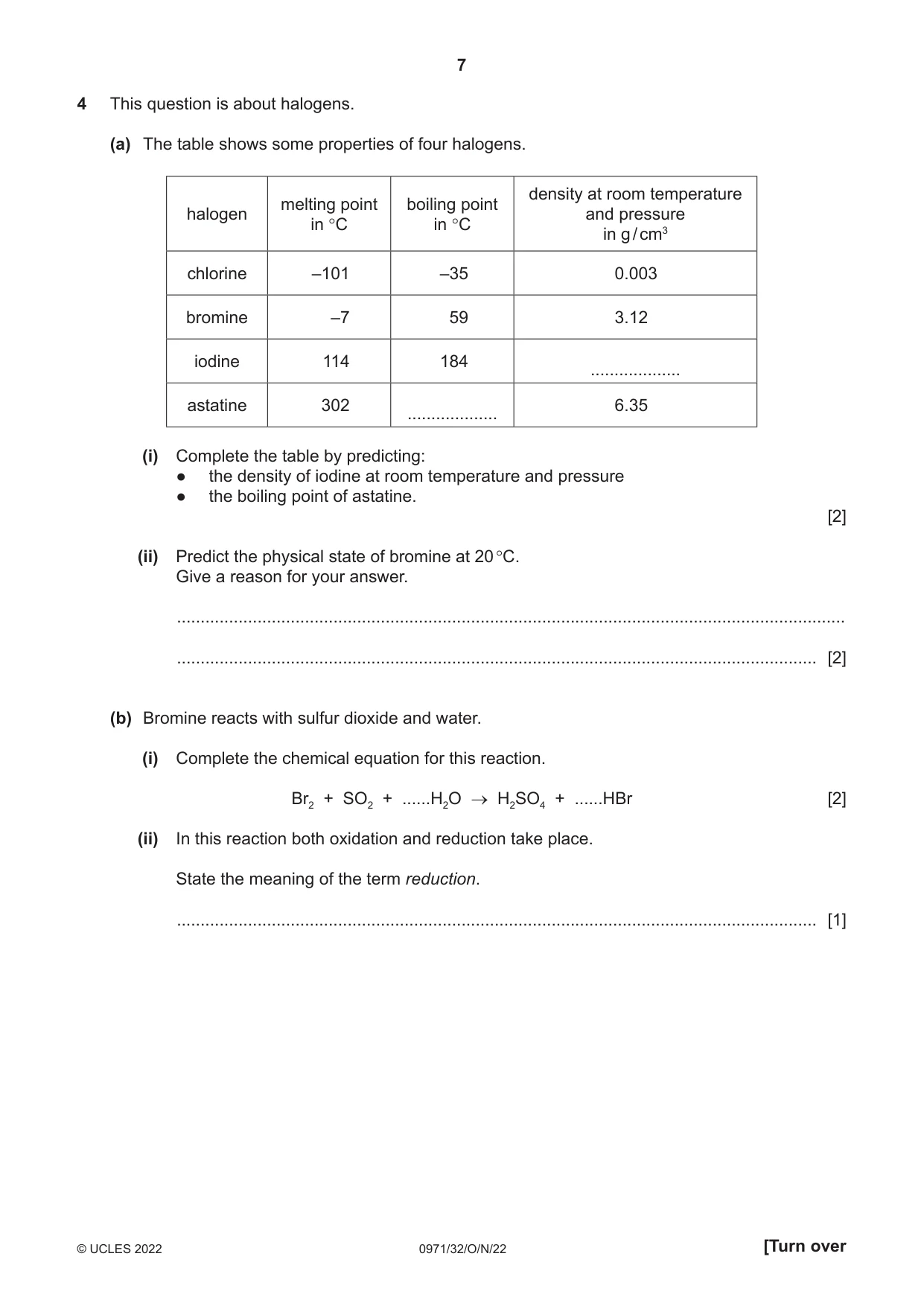
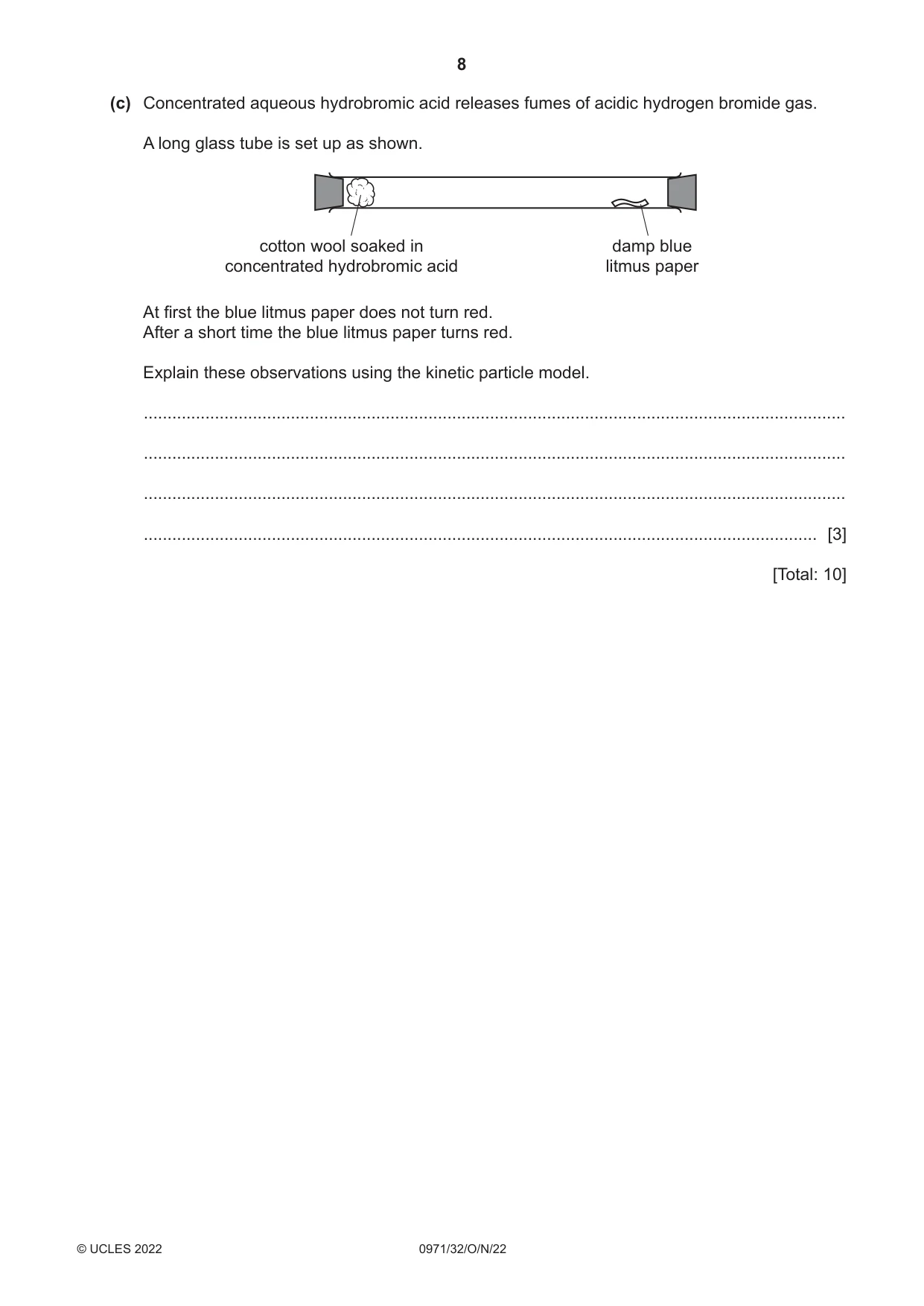
4 This question is about halogens. (a) The table shows some properties of four halogens. density at room temperature melting point boiling point halogen and pressure in °C in °C in g / cm3 chlorine –101 –35 0.003 bromine –7 59 3.12 iodine 114 184 ................... astatine 302 6.35 ................... (i) Complete the table by predicting: ● the density of iodine at room temperature and pressure ● the boiling point of astatine. [2] (ii) Predict the physical state of bromine at 20 °C. Give a reason for your answer. ............................................................................................................................................. ....................................................................................................................................... [2] (b) Bromine reacts with sulfur dioxide and water. (i) Complete the chemical equation for this reaction. Br2 + SO2 + ......H2O → H2SO4 + ......HBr [2] (ii) In this reaction both oxidation and reduction take place. State the meaning of the term reduction. ....................................................................................................................................... [1] (c) Concentrated aqueous hydrobromic acid releases fumes of acidic hydrogen bromide gas. A long glass tube is set up as shown. cotton wool soaked in damp blue concentrated hydrobromic acid litmus paper At first the blue litmus paper does not turn red. After a short time the blue litmus paper turns red. Explain these observations using the kinetic particle model. .................................................................................................................................................... .................................................................................................................................................... .................................................................................................................................................... .............................................................................................................................................. [3] [Total: 10]
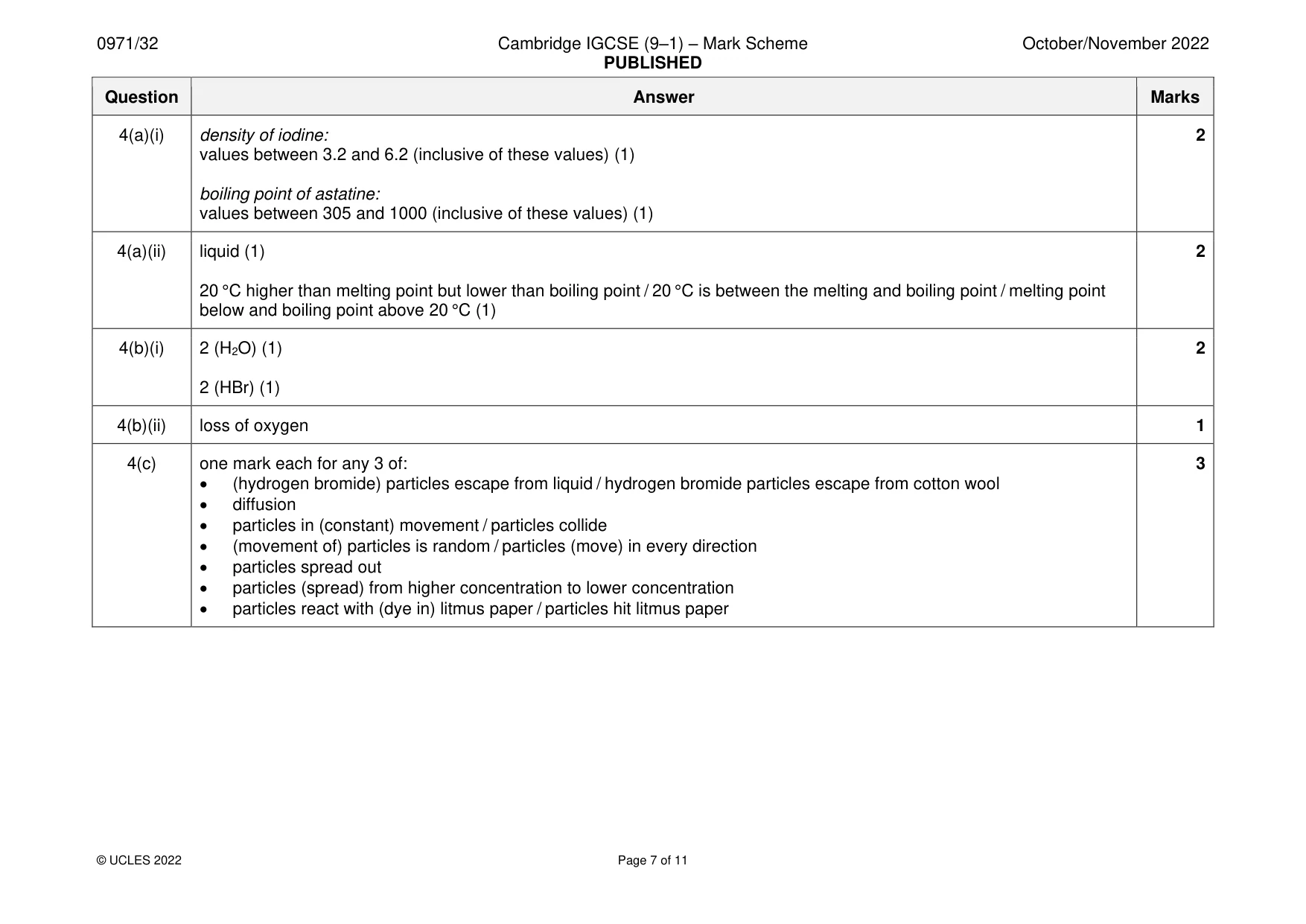
Mark scheme: 4(a)(i) density of iodine: 2 values between 3.2 and 6.2 (inclusive of these values) (1) boiling point of astatine: values between 305 and 1000 (inclusive of these values) (1) 4(a)(ii) liquid (1) 2 20 °C higher than melting point but lower than boiling point / 20 °C is between the melting and boiling point / melting point below and boiling point above 20 °C (1) 4(b)(i) 2 (H2O) (1) 2 2 (HBr) (1) 4(b)(ii) loss of oxygen 1 4(c) one mark each for any 3 of: 3 • (hydrogen bromide) particles escape from liquid / hydrogen bromide particles escape from cotton wool • diffusion • particles in (constant) movement / particles collide • (movement of) particles is random / particles (move) in every direction • particles spread out • particles (spread) from higher concentration to lower concentration • particles react with (dye in) litmus paper / particles hit litmus paper
Q5 · This question is about air and fertilisers
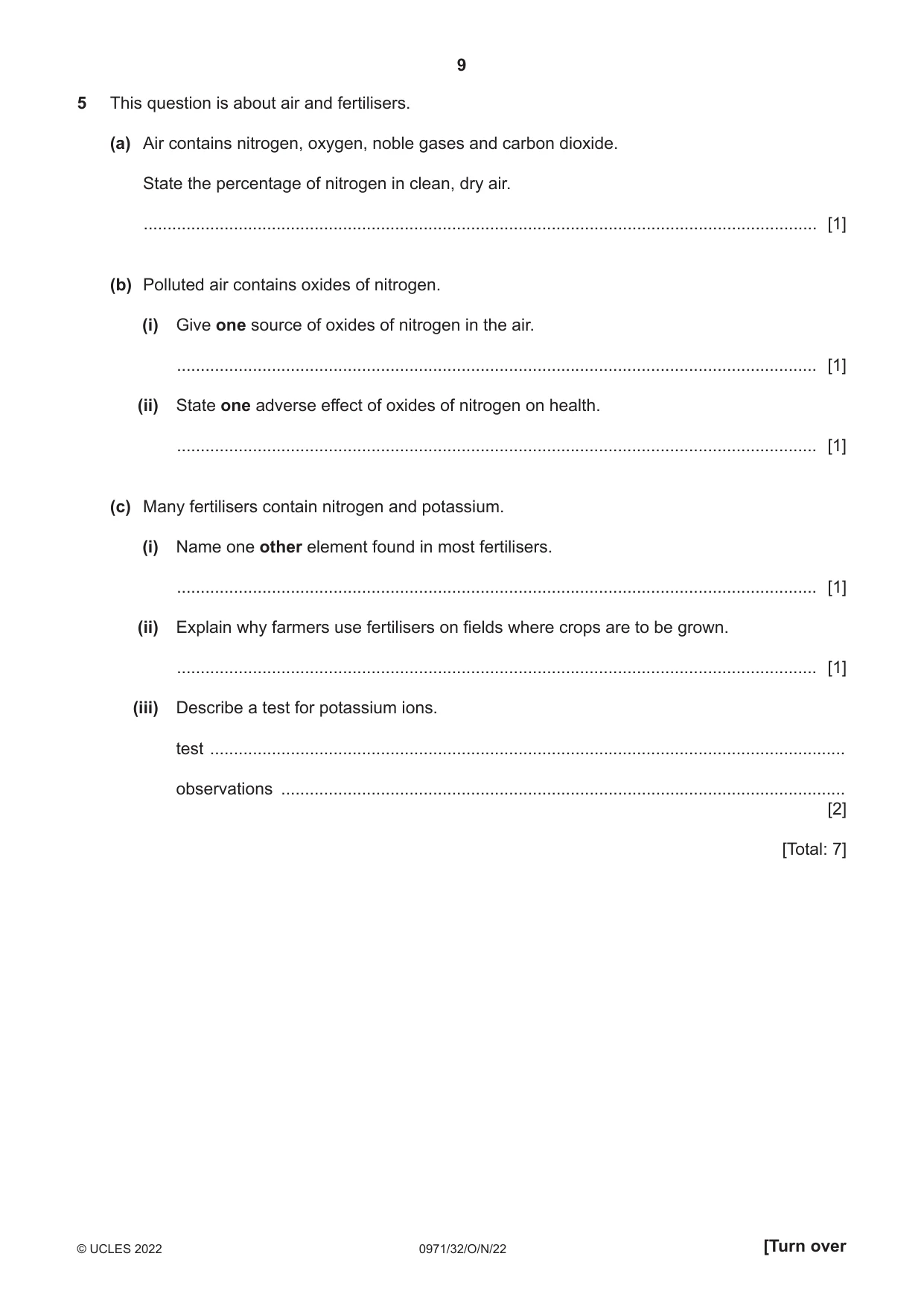
5 This question is about air and fertilisers. (a) Air contains nitrogen, oxygen, noble gases and carbon dioxide. State the percentage of nitrogen in clean, dry air. .............................................................................................................................................. [1] (b) Polluted air contains oxides of nitrogen. (i) Give one source of oxides of nitrogen in the air. ....................................................................................................................................... [1] (ii) State one adverse effect of oxides of nitrogen on health. ....................................................................................................................................... [1] (c) Many fertilisers contain nitrogen and potassium. (i) Name one other element found in most fertilisers. ....................................................................................................................................... [1] (ii) Explain why farmers use fertilisers on fields where crops are to be grown. ....................................................................................................................................... [1] (iii) Describe a test for potassium ions. test ...................................................................................................................................... observations ........................................................................................................................ [2] [Total: 7]
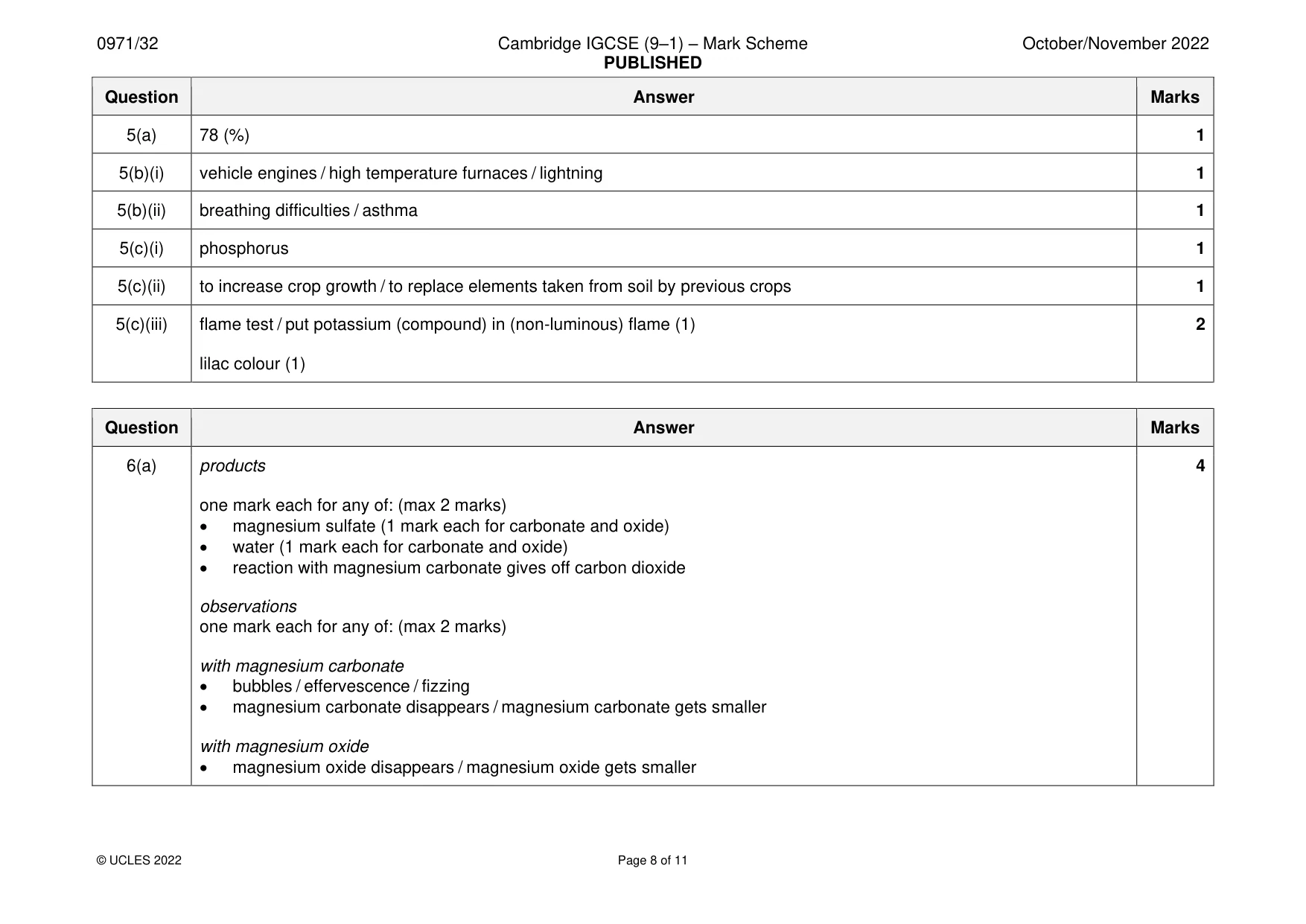
Mark scheme: 5(a) 78 (%) 1 5(b)(i) vehicle engines / high temperature furnaces / lightning 1 5(b)(ii) breathing difficulties / asthma 1 5(c)(i) phosphorus 1 5(c)(ii) to increase crop growth / to replace elements taken from soil by previous crops 1 5(c)(iii) flame test / put potassium (compound) in (non-luminous) flame (1) 2 lilac colour (1)
Q6 · This question is about acids, bases and salts
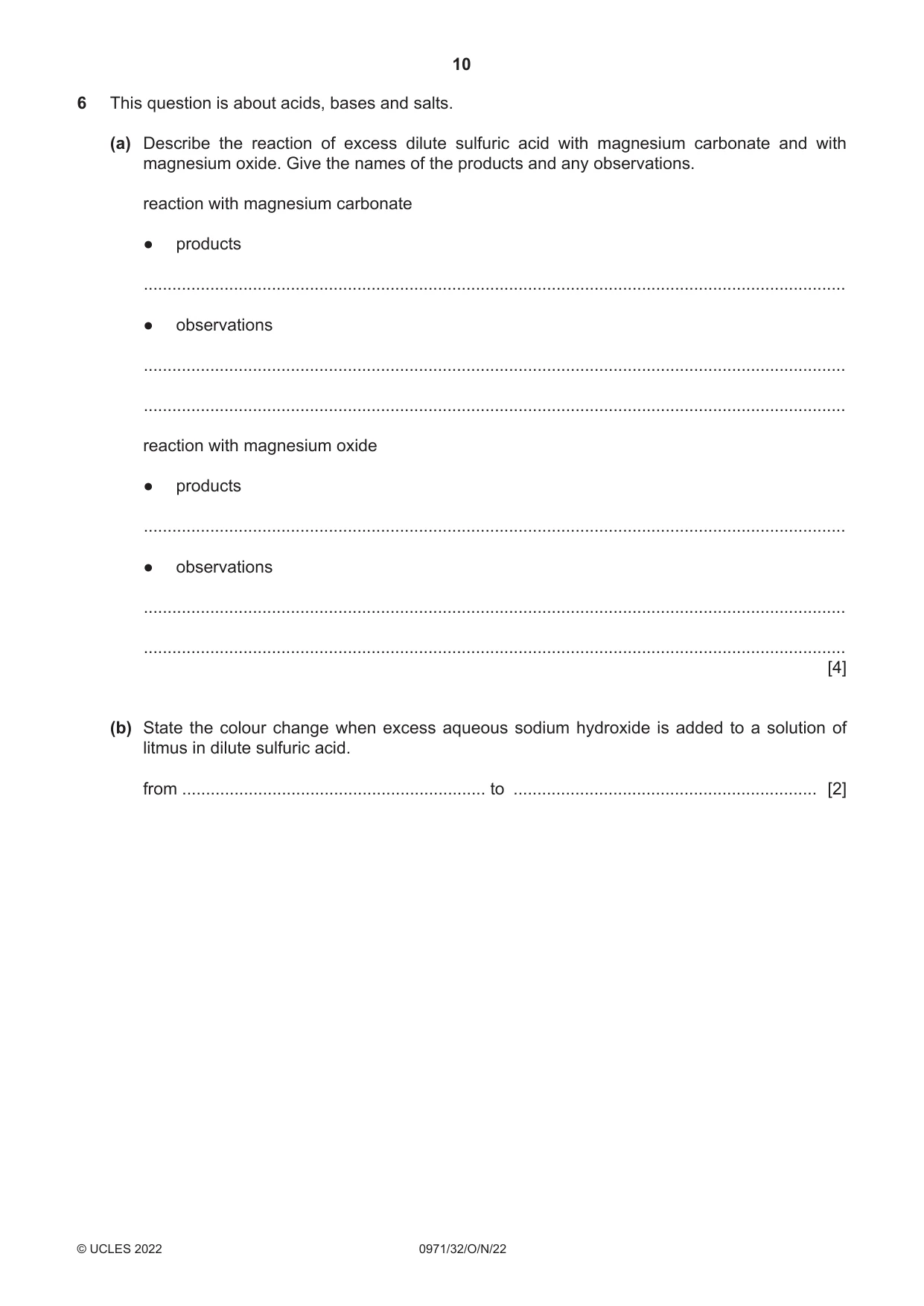
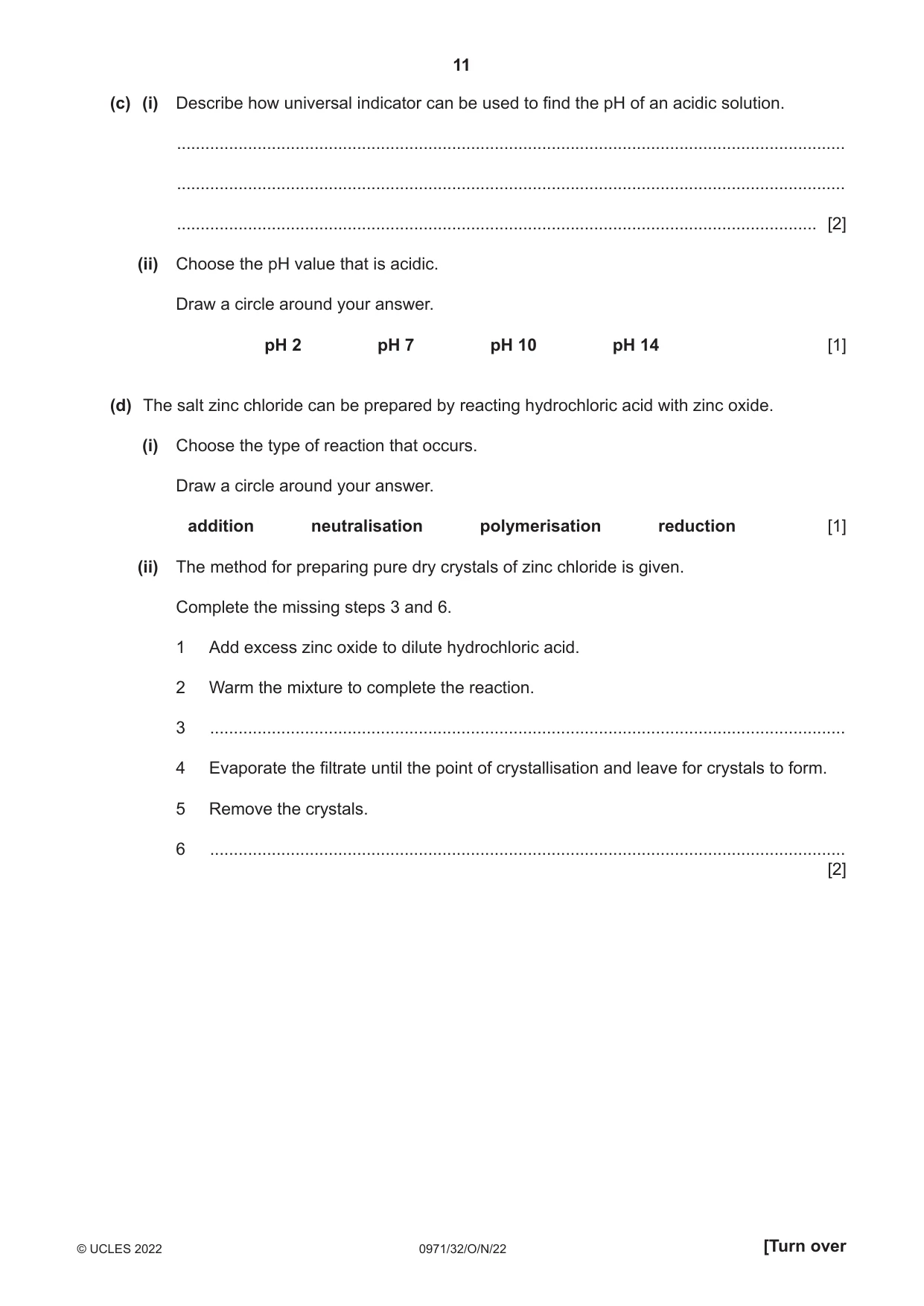
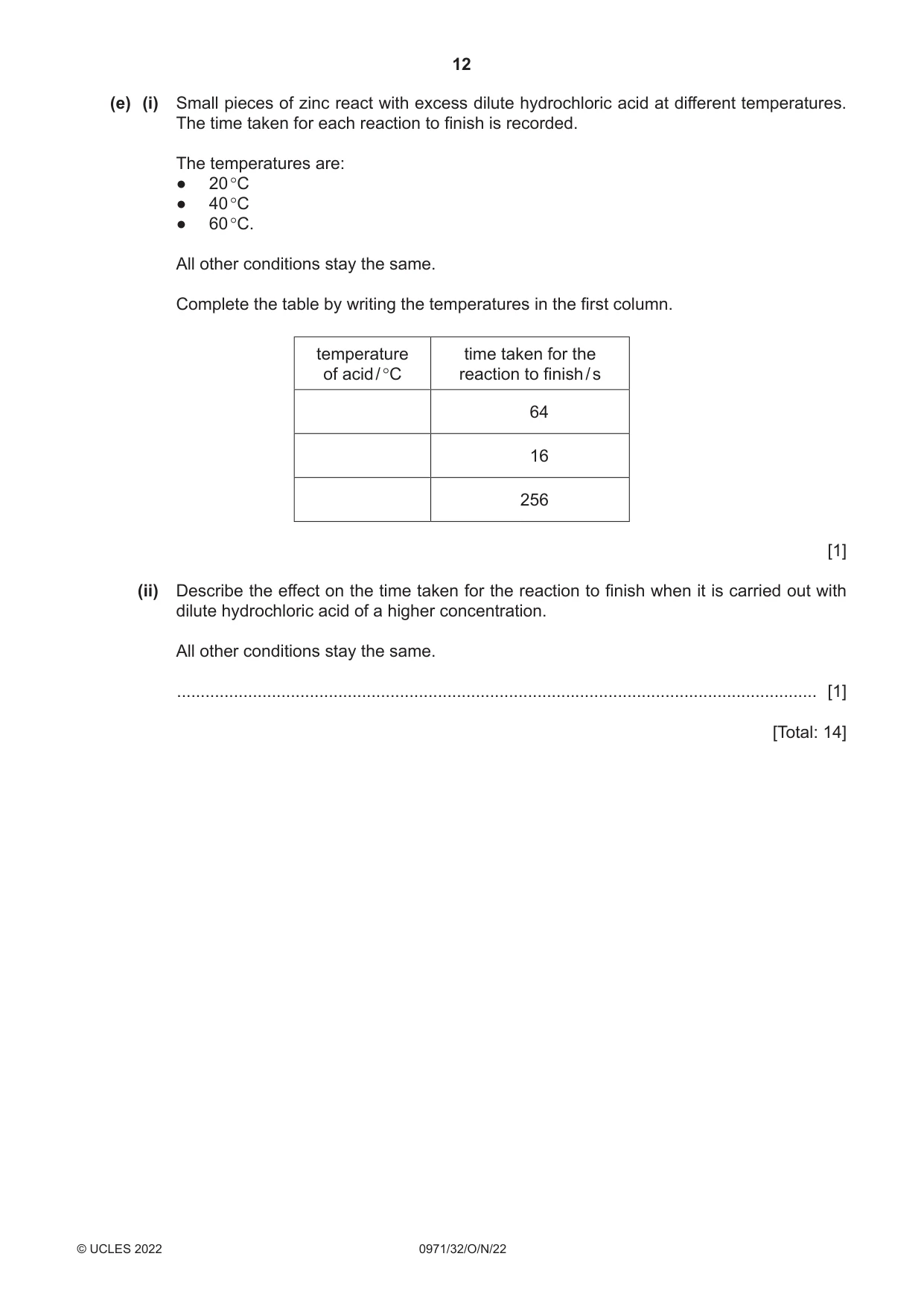
6 This question is about acids, bases and salts. (a) Describe the reaction of excess dilute sulfuric acid with magnesium carbonate and with magnesium oxide. Give the names of the products and any observations. reaction with magnesium carbonate ● products .................................................................................................................................................... ● observations .................................................................................................................................................... .................................................................................................................................................... reaction with magnesium oxide ● products .................................................................................................................................................... ● observations .................................................................................................................................................... .................................................................................................................................................... [4] (b) State the colour change when excess aqueous sodium hydroxide is added to a solution of litmus in dilute sulfuric acid. from ................................................................ to ���������������������������������������������������������������� [2] (c) (i) Describe how universal indicator can be used to find the pH of an acidic solution. ............................................................................................................................................. ............................................................................................................................................. ....................................................................................................................................... [2] (ii) Choose the pH value that is acidic. Draw a circle around your answer. pH 2 pH 7 pH 10 pH 14 [1] (d) The salt zinc chloride can be prepared by reacting hydrochloric acid with zinc oxide. (i) Choose the type of reaction that occurs. Draw a circle around your answer. addition neutralisation polymerisation reduction [1] (ii) The method for preparing pure dry crystals of zinc chloride is given. Complete the missing steps 3 and 6. 1 Add excess zinc oxide to dilute hydrochloric acid. 2 Warm the mixture to complete the reaction. 3 ...................................................................................................................................... 4 Evaporate the filtrate until the point of crystallisation and leave for crystals to form. 5 Remove the crystals. 6 ...................................................................................................................................... [2] (e) (i) Small pieces of zinc react with excess dilute hydrochloric acid at different temperatures. The time taken for each reaction to finish is recorded. The temperatures are: ● 20 °C ● 40 °C ● 60 °C. All other conditions stay the same. Complete the table by writing the temperatures in the first column. temperature time taken for the of acid / °C reaction to finish / s 64 16 256 [1] (ii) Describe the effect on the time taken for the reaction to finish when it is carried out with dilute hydrochloric acid of a higher concentration. All other conditions stay the same. ....................................................................................................................................... [1] [Total: 14]
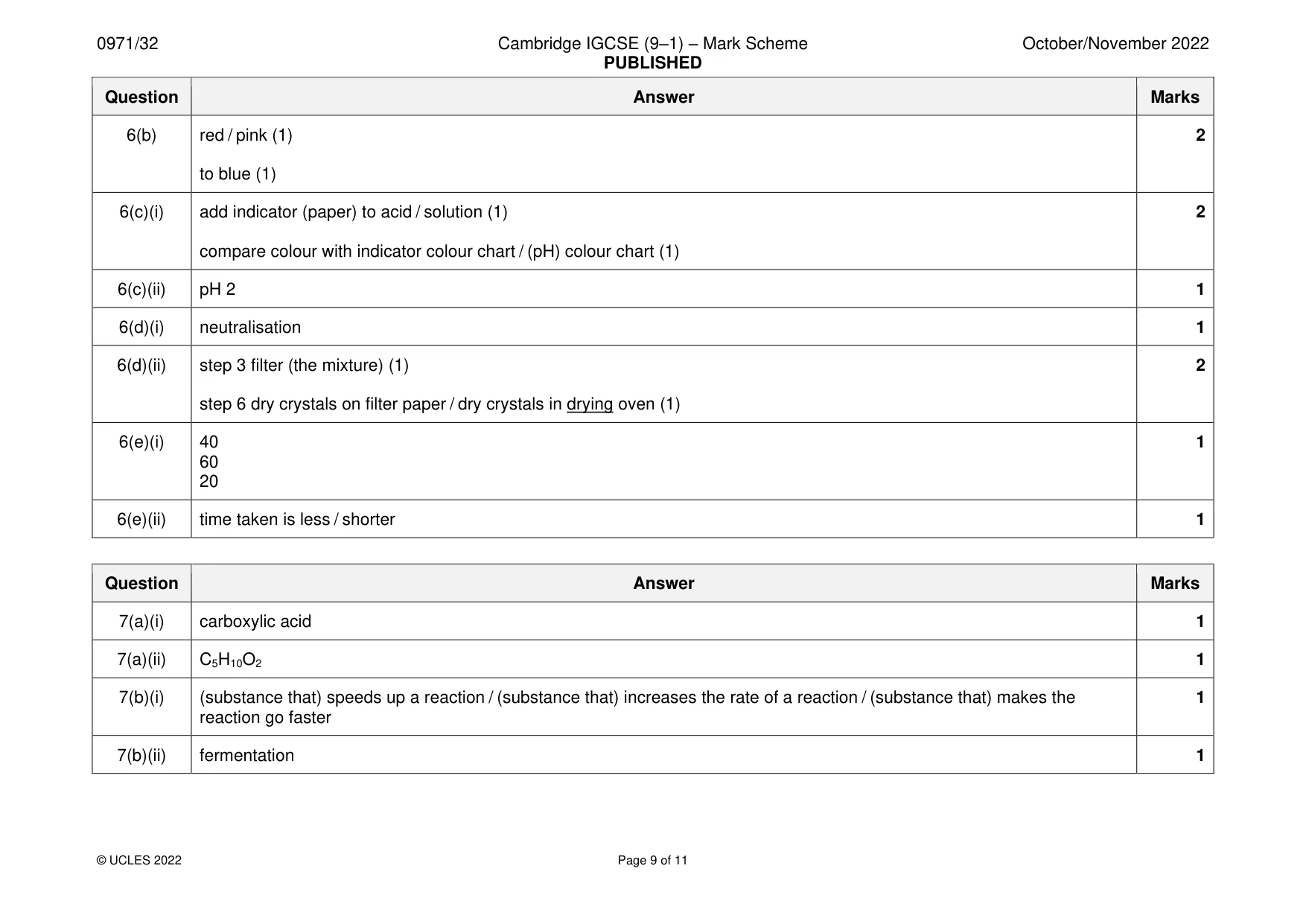
Mark scheme: 6(a) products 4 one mark each for any of: (max 2 marks) • magnesium sulfate (1 mark each for carbonate and oxide) • water (1 mark each for carbonate and oxide) • reaction with magnesium carbonate gives off carbon dioxide observations one mark each for any of: (max 2 marks) with magnesium carbonate • bubbles / effervescence / fizzing • magnesium carbonate disappears / magnesium carbonate gets smaller with magnesium oxide • magnesium oxide disappears / magnesium oxide gets smaller 6(b) red / pink (1) 2 to blue (1) 6(c)(i) add indicator (paper) to acid / solution (1) 2 compare colour with indicator colour chart / (pH) colour chart (1) 6(c)(ii) pH 2 1 6(d)(i) neutralisation 1 6(d)(ii) step 3 filter (the mixture) (1) 2 step 6 dry crystals on filter paper / dry crystals in drying oven (1) 6(e)(i) 40 1 60 20 6(e)(ii) time taken is less / shorter 1
More questions on The characteristic properties of acids and bases
Q7 · The structure of compound T is shown
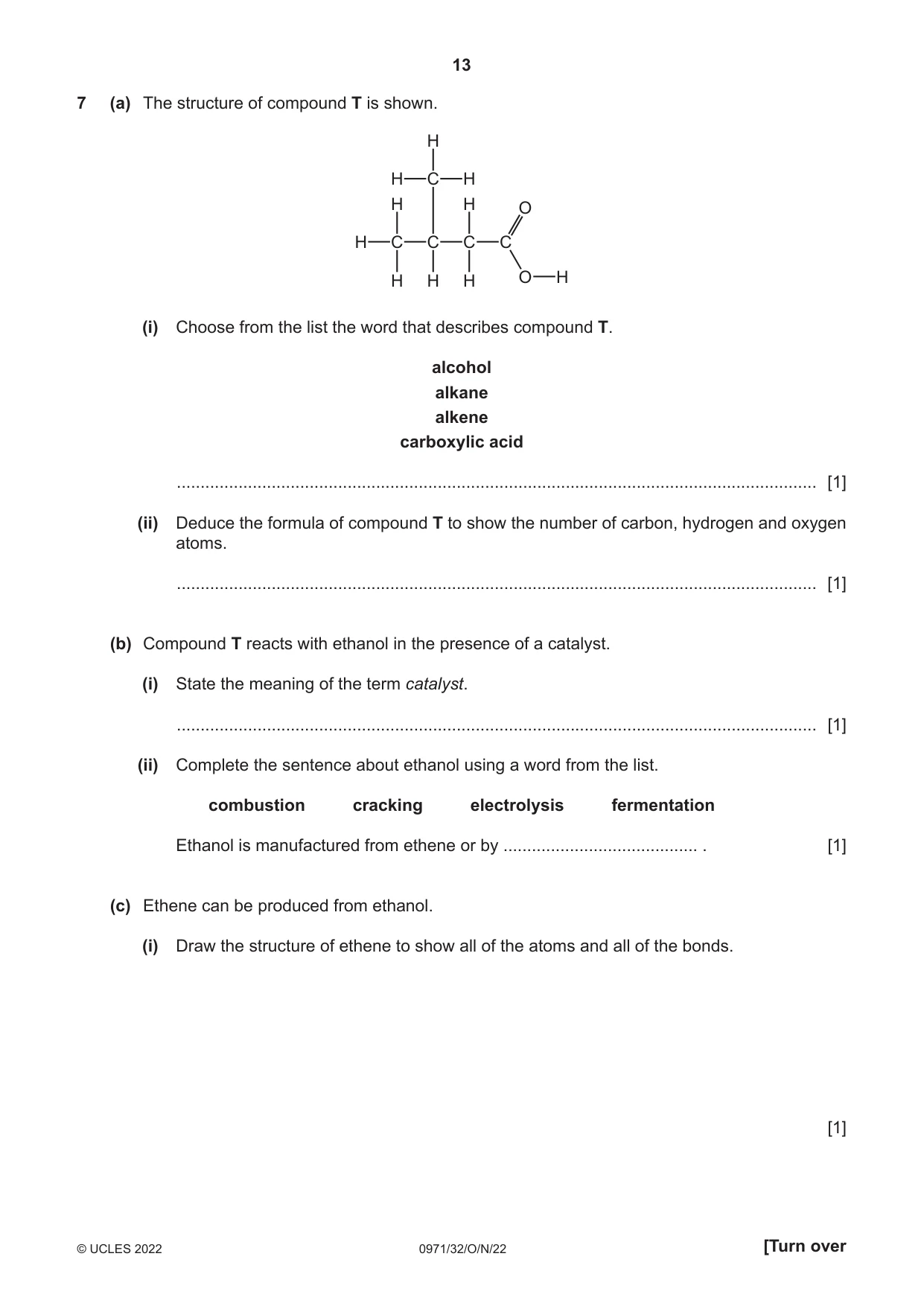
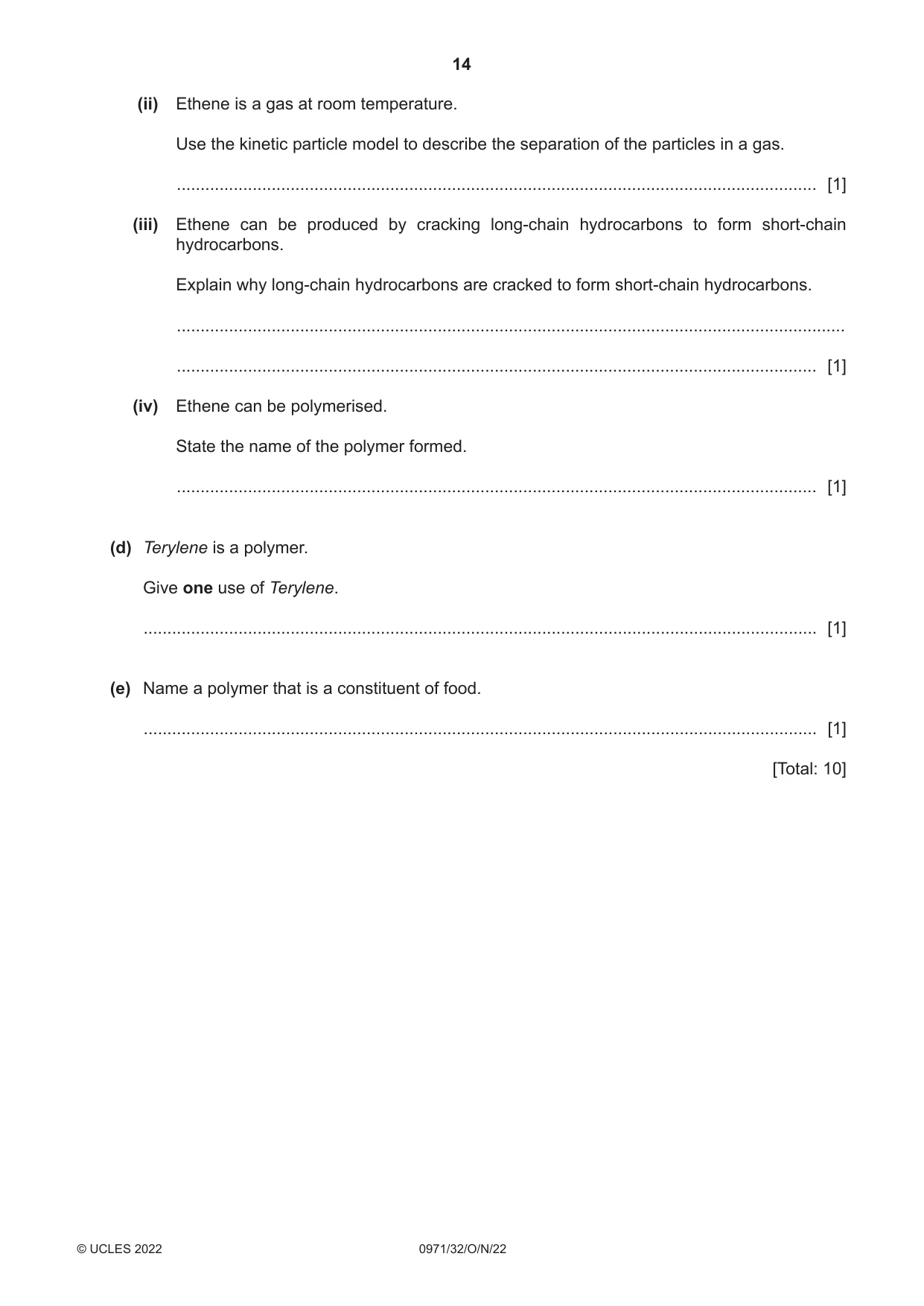
7 (a) The structure of compound T is shown. H H C H H H O H C C C C H H H O H (i) Choose from the list the word that describes compound T. alcohol alkane alkene carboxylic acid ....................................................................................................................................... [1] (ii) Deduce the formula of compound T to show the number of carbon, hydrogen and oxygen atoms. ....................................................................................................................................... [1] (b) Compound T reacts with ethanol in the presence of a catalyst. (i) State the meaning of the term catalyst. ....................................................................................................................................... [1] (ii) Complete the sentence about ethanol using a word from the list. combustion cracking electrolysis fermentation Ethanol is manufactured from ethene or by ......................................... . [1] (c) Ethene can be produced from ethanol. (i) Draw the structure of ethene to show all of the atoms and all of the bonds. [1] (ii) Ethene is a gas at room temperature. Use the kinetic particle model to describe the separation of the particles in a gas. ....................................................................................................................................... [1] (iii) Ethene can be produced by cracking long-chain hydrocarbons to form short-chain hydrocarbons. Explain why long-chain hydrocarbons are cracked to form short-chain hydrocarbons. ............................................................................................................................................. ....................................................................................................................................... [1] (iv) Ethene can be polymerised. State the name of the polymer formed. ....................................................................................................................................... [1] (d) Terylene is a polymer. Give one use of Terylene. .............................................................................................................................................. [1] (e) Name a polymer that is a constituent of food. .............................................................................................................................................. [1] [Total: 10]
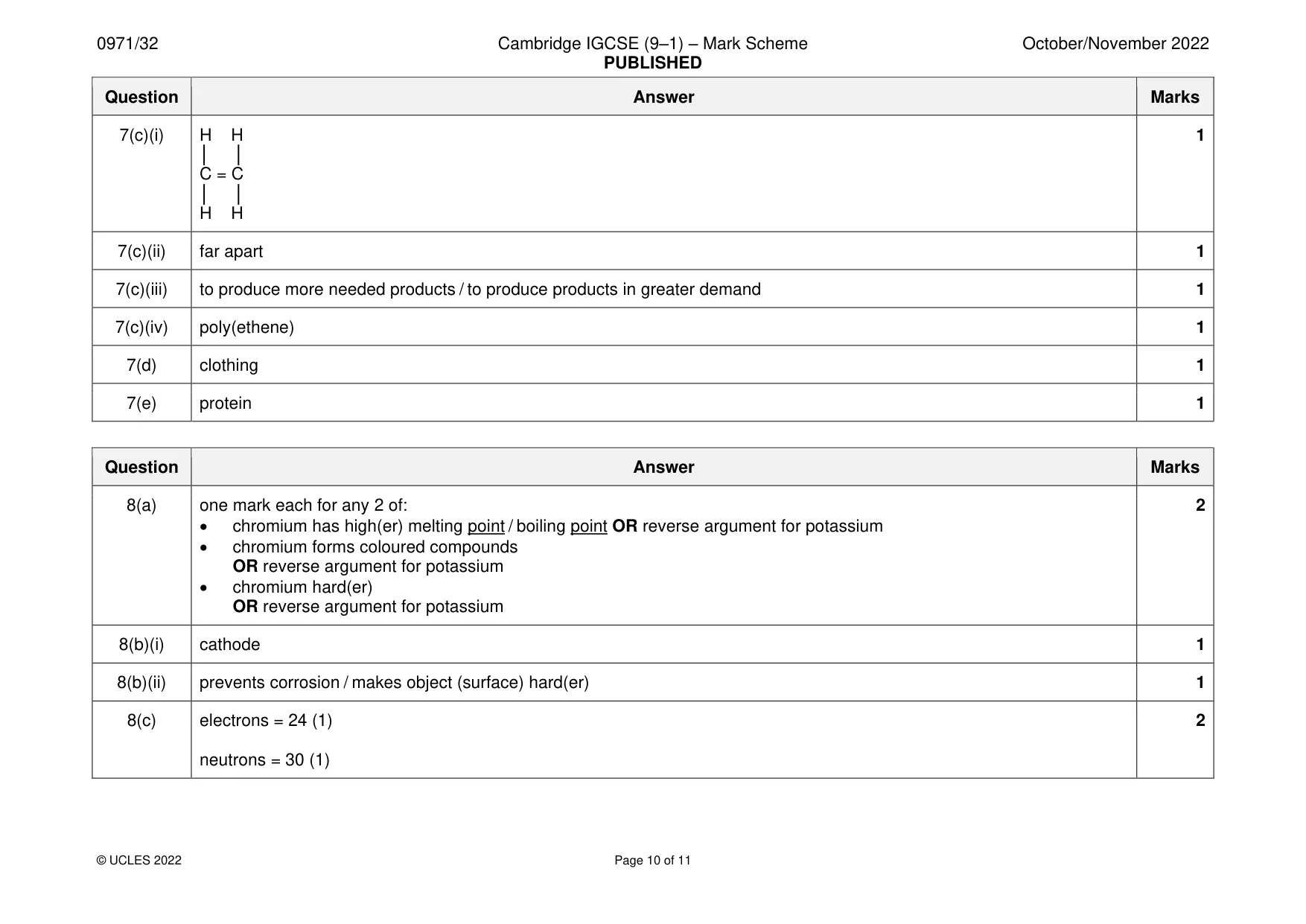
Mark scheme: 7(a)(i) carboxylic acid 1 7(a)(ii) C5H10O2 1 7(b)(i) (substance that) speeds up a reaction / (substance that) increases the rate of a reaction / (substance that) makes the 1 reaction go faster 7(b)(ii) fermentation 1 7(c)(i) H H 1 │ │ C = C │ │ H H 7(c)(ii) far apart 1 7(c)(iii) to produce more needed products / to produce products in greater demand 1 7(c)(iv) poly(ethene) 1 7(d) clothing 1 7(e) protein 1
Q8 · This question is about metals
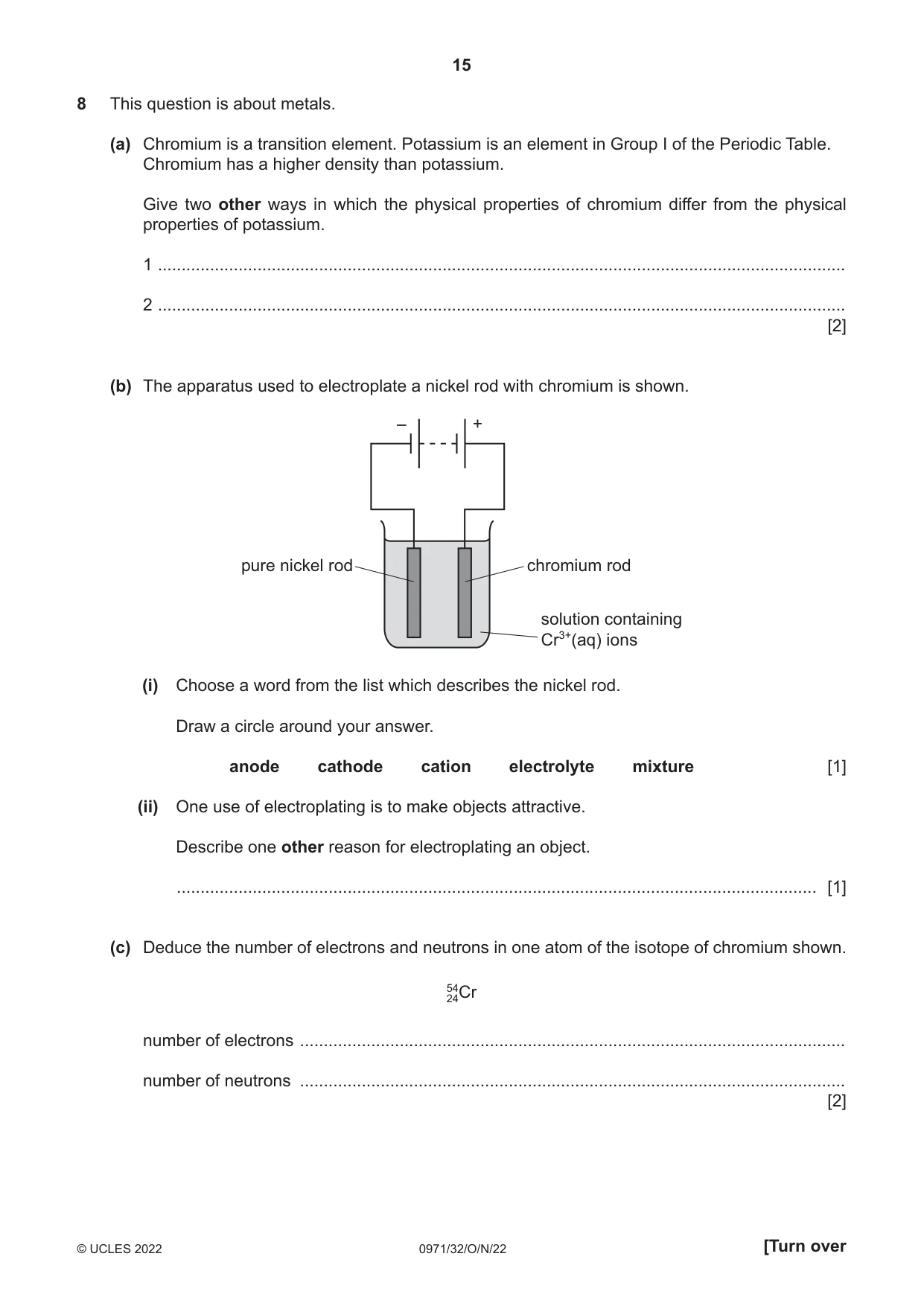
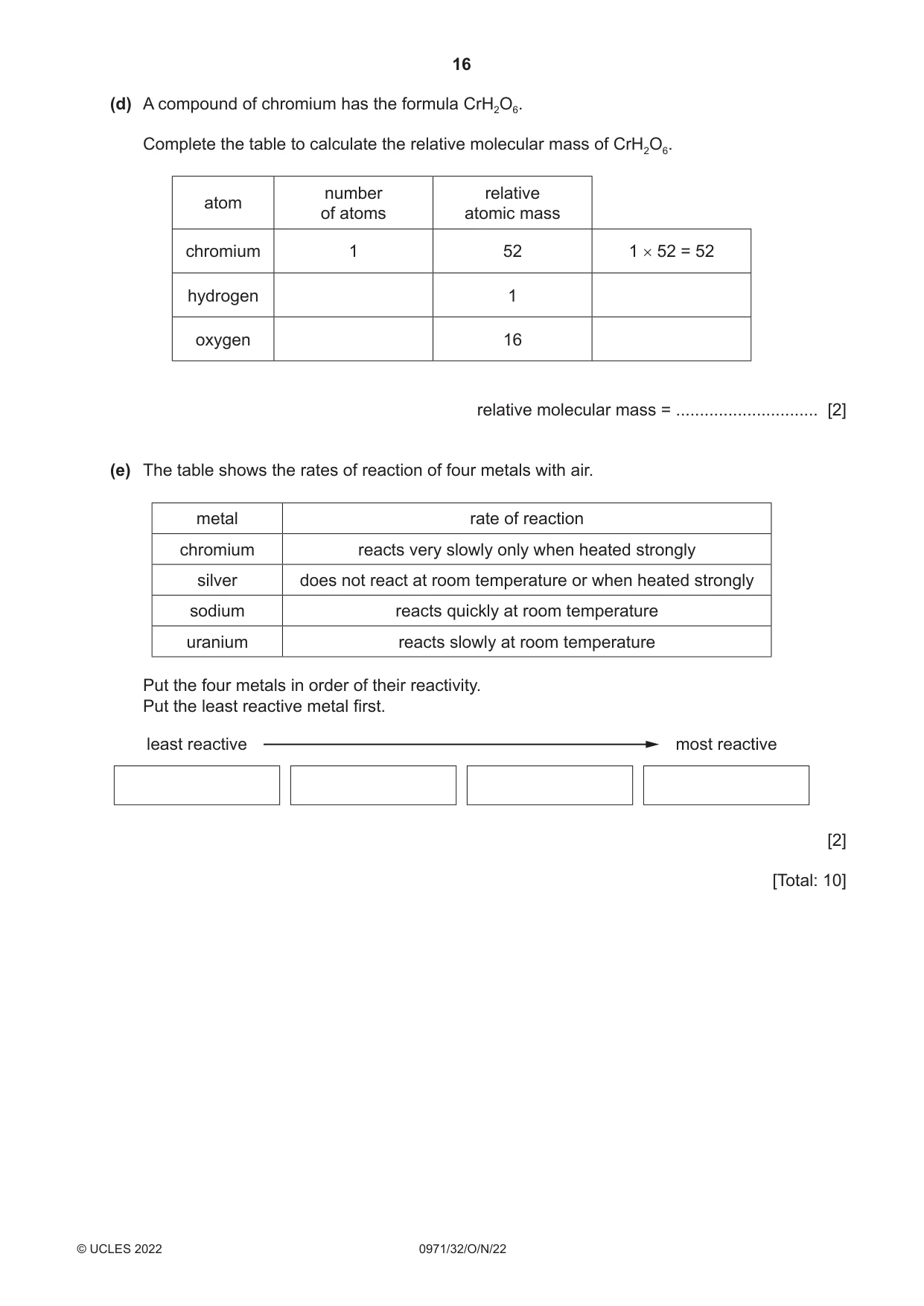
8 This question is about metals. (a) Chromium is a transition element. Potassium is an element in Group I of the Periodic Table. Chromium has a higher density than potassium. Give two other ways in which the physical properties of chromium differ from the physical properties of potassium. 1 ................................................................................................................................................. 2 ................................................................................................................................................. [2] (b) The apparatus used to electroplate a nickel rod with chromium is shown. – + pure nickel rod chromium rod solution containing Cr3+(aq) ions (i) Choose a word from the list which describes the nickel rod. Draw a circle around your answer. anode cathode cation electrolyte mixture [1] (ii) One use of electroplating is to make objects attractive. Describe one other reason for electroplating an object. ....................................................................................................................................... [1] (c) Deduce the number of electrons and neutrons in one atom of the isotope of chromium shown. 2454Cr number of electrons ................................................................................................................... number of neutrons .................................................................................................................... [2] (d) A compound of chromium has the formula CrH2O6. Complete the table to calculate the relative molecular mass of CrH2O6. number relative atom of atoms atomic mass chromium 1 52 1 × 52 = 52 hydrogen 1 oxygen 16 relative molecular mass = .............................. [2] (e) The table shows the rates of reaction of four metals with air. metal rate of reaction chromium reacts very slowly only when heated strongly silver does not react at room temperature or when heated strongly sodium reacts quickly at room temperature uranium reacts slowly at room temperature Put the four metals in order of their reactivity. Put the least reactive metal first. least reactive most reactive [2] [Total: 10]
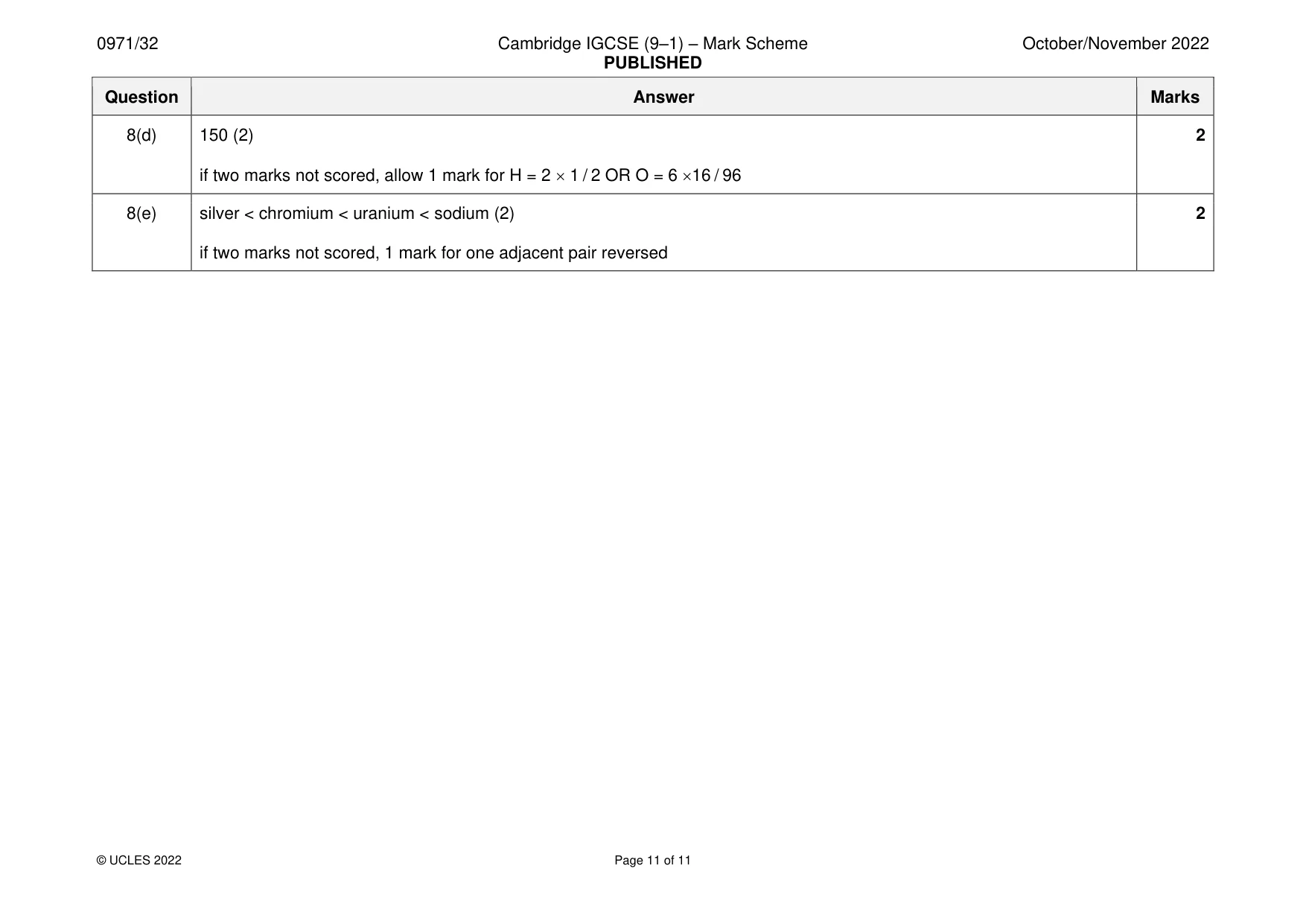
Mark scheme: 8(a) one mark each for any 2 of: 2 • chromium has high(er) melting point / boiling point OR reverse argument for potassium • chromium forms coloured compounds OR reverse argument for potassium • chromium hard(er) OR reverse argument for potassium 8(b)(i) cathode 1 8(b)(ii) prevents corrosion / makes object (surface) hard(er) 1 8(c) electrons = 24 (1) 2 neutrons = 30 (1) 8(d) 150 (2) 2 if two marks not scored, allow 1 mark for H = 2 1 / 2 OR O = 6 16 / 96 8(e) silver < chromium < uranium < sodium (2) 2 if two marks not scored, 1 mark for one adjacent pair reversed
What was in this paper
The subtopics covered by these 8 questions, and how many questions each got. Open one in a new tab to see every Cambridge question on it.
What you needed in this session
Cambridge’s own grade thresholds for 2022 Oct/Nov, Paper 3 · Variant 2. A higher threshold means an easier paper — the bar moves with how the cohort did.