Cambridge IGCSE Chemistry (9-1) 0971 — 2022 May/June Paper 6 · Variant 2
0971/62/M/J/22 · 4 questions · 40 marks · ≈45 min
The question paper and its mark scheme, free to read here and free to download. This is Cambridge’s own paper, exactly as it was sat.
Question paper12 pages
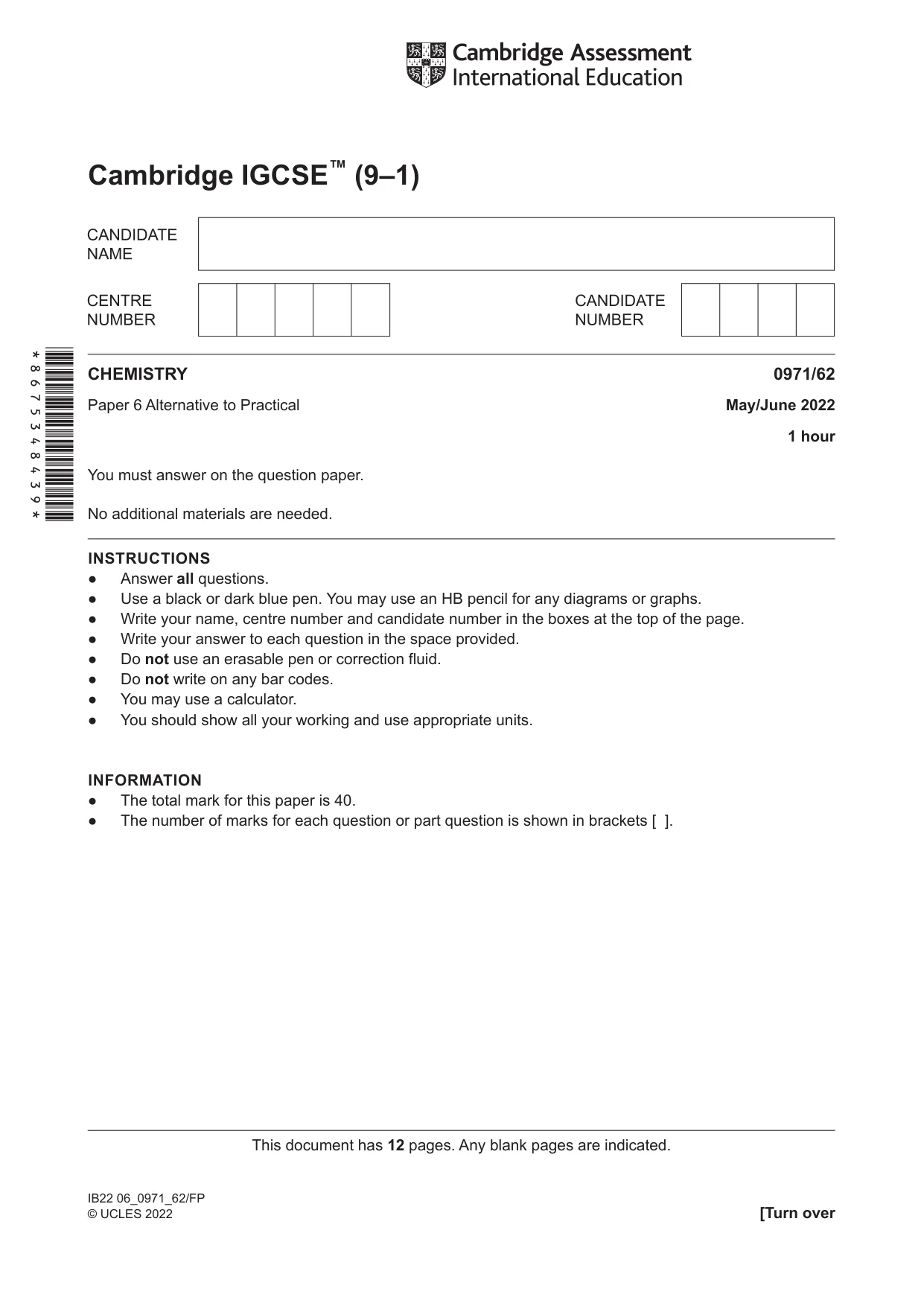

Mark scheme7 pages
Answers below. Sit the paper first if you are practising.
Questions as text
Q1 · Sodium hydrogencarbonate decomposes when heated
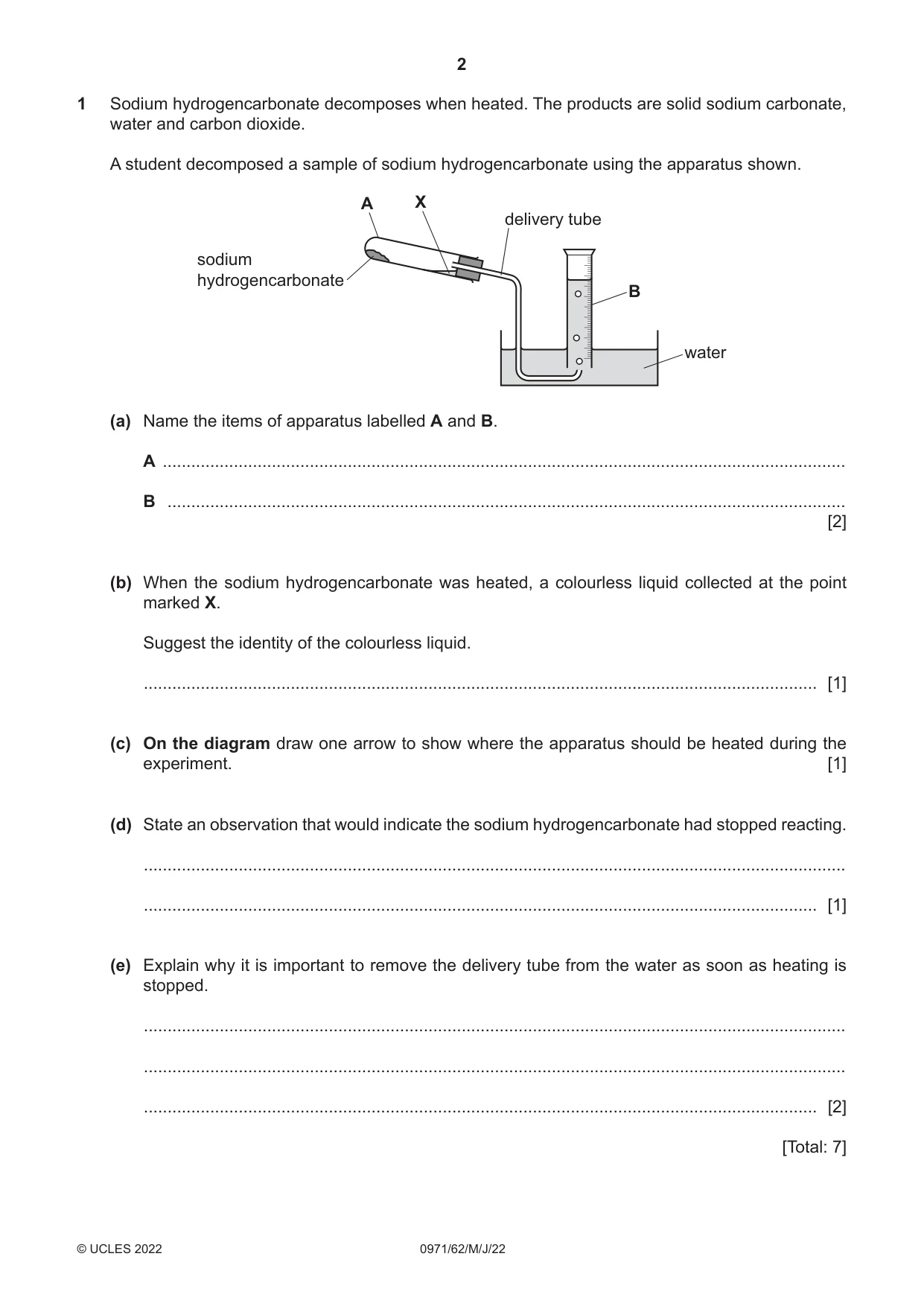
1 Sodium hydrogencarbonate decomposes when heated. The products are solid sodium carbonate, water and carbon dioxide. A student decomposed a sample of sodium hydrogencarbonate using the apparatus shown. A X delivery tube sodium hydrogencarbonate B water (a) Name the items of apparatus labelled A and B. A ................................................................................................................................................. B ................................................................................................................................................ [2] (b) When the sodium hydrogencarbonate was heated, a colourless liquid collected at the point marked X. Suggest the identity of the colourless liquid. .............................................................................................................................................. [1] (c) On the diagram draw one arrow to show where the apparatus should be heated during the experiment. [1] (d) State an observation that would indicate the sodium hydrogencarbonate had stopped reacting. .................................................................................................................................................... .............................................................................................................................................. [1] (e) Explain why it is important to remove the delivery tube from the water as soon as heating is stopped. .................................................................................................................................................... .................................................................................................................................................... .............................................................................................................................................. [2] [Total: 7]
Mark scheme: 1(a) A boiling tube / test-tube 1 B measuring cylinder 1 1(b) water / H2O 1 1(c) arrow to show heating must have head pointing towards the tube and the arrowhead must be between the two lines shown 1 1(d) no more bubbles / volume of gas stops changing 1 1(e) test-tube / boiling tube breaks / cracks 1 suck back / water goes into tube 1
Q2 · A student investigated the reaction between two different solutions of aqueous sodium…
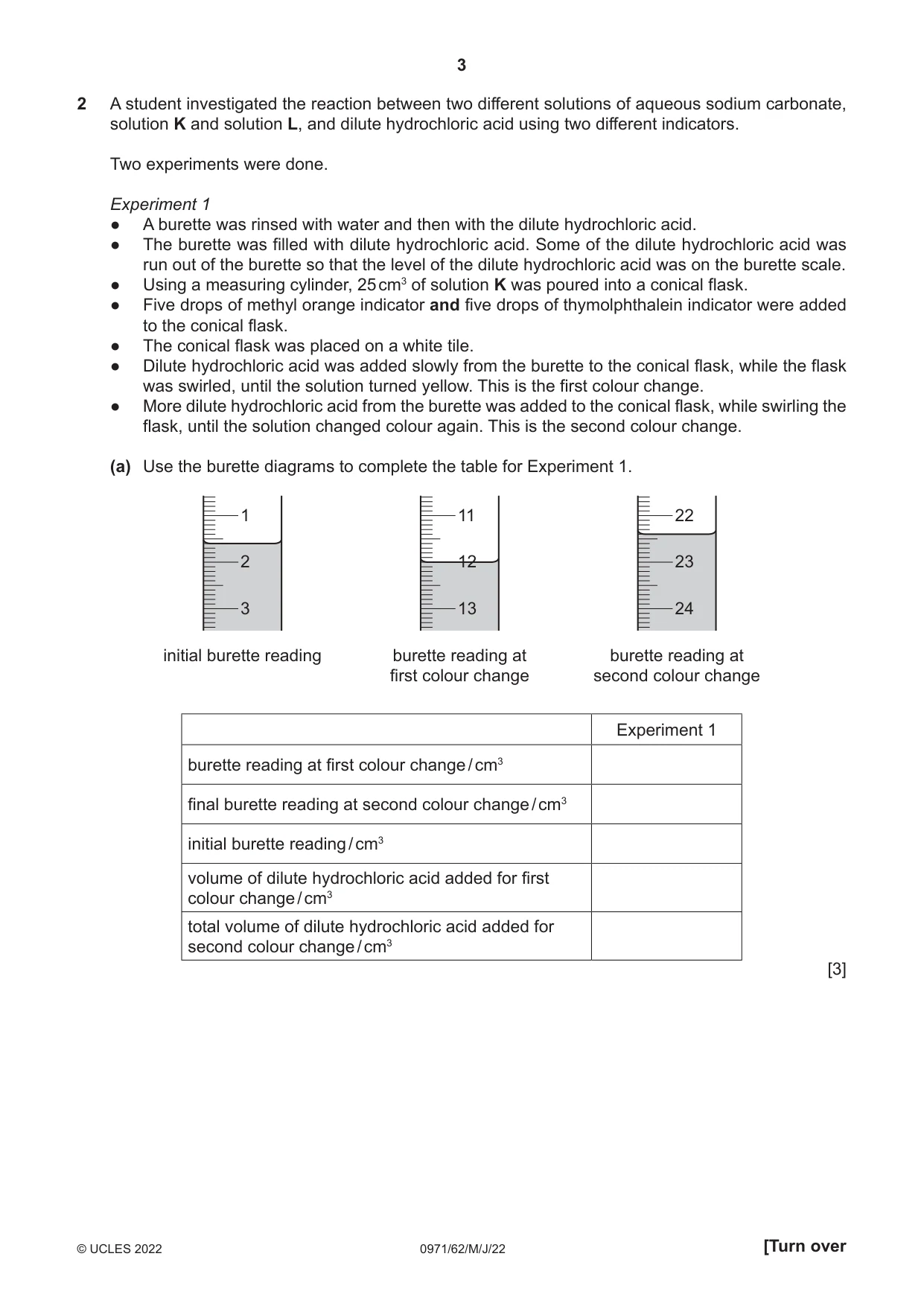
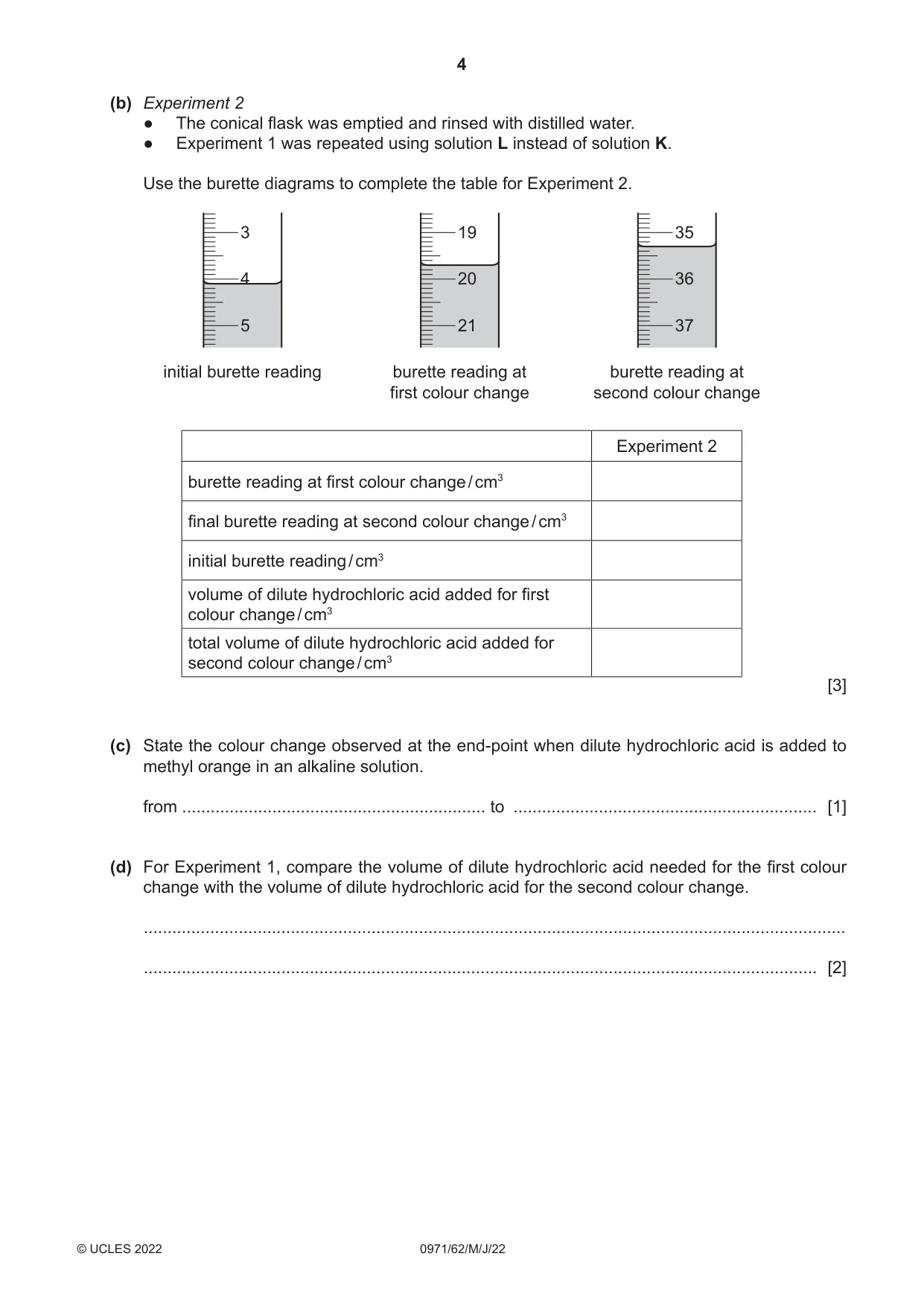
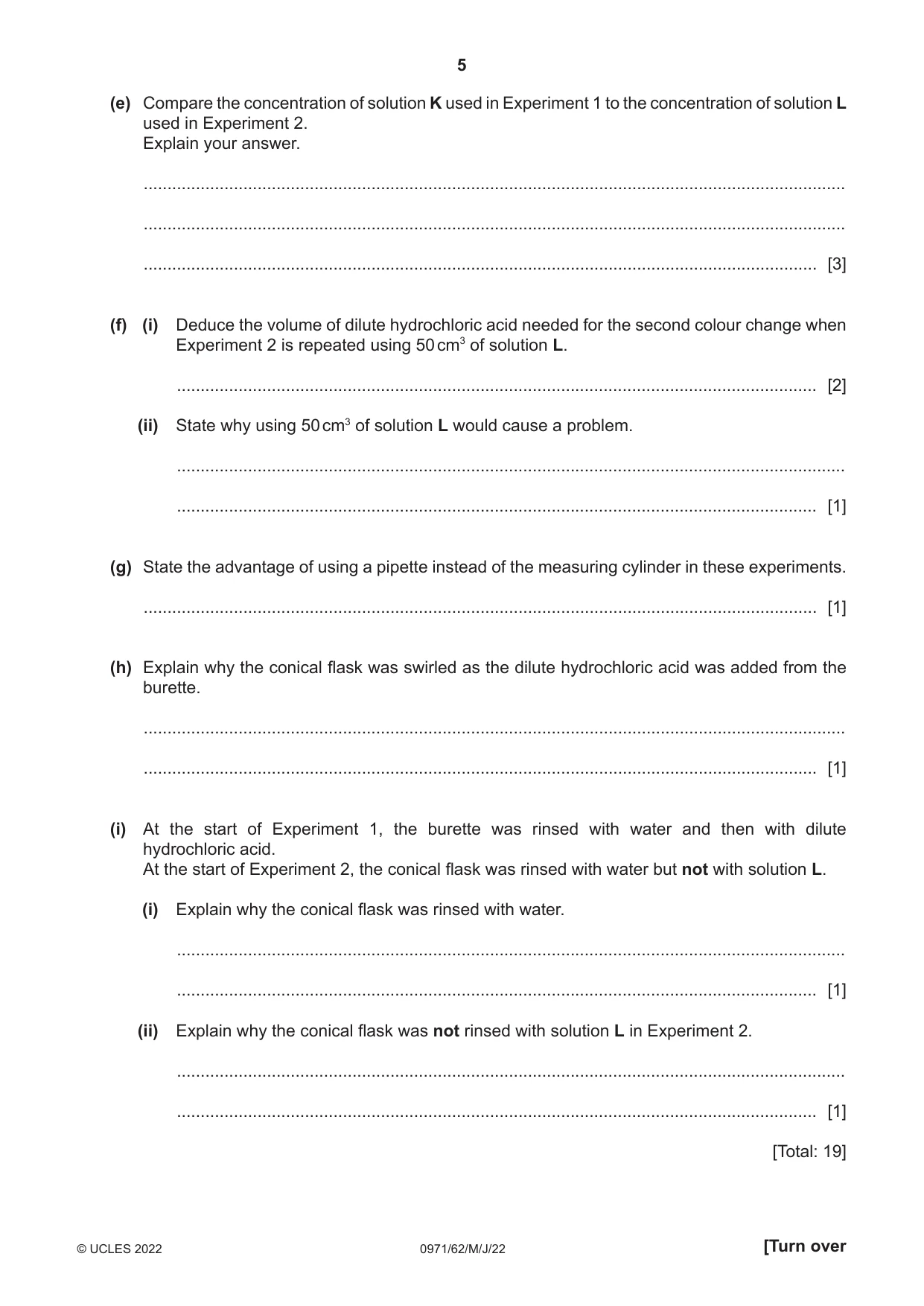
2 A student investigated the reaction between two different solutions of aqueous sodium carbonate, solution K and solution L, and dilute hydrochloric acid using two different indicators. Two experiments were done. Experiment 1 ● A burette was rinsed with water and then with the dilute hydrochloric acid. ● The burette was filled with dilute hydrochloric acid. Some of the dilute hydrochloric acid was run out of the burette so that the level of the dilute hydrochloric acid was on the burette scale. ● Using a measuring cylinder, 25 cm3 of solution K was poured into a conical flask. ● Five drops of methyl orange indicator and five drops of thymolphthalein indicator were added to the conical flask. ● The conical flask was placed on a white tile. ● Dilute hydrochloric acid was added slowly from the burette to the conical flask, while the flask was swirled, until the solution turned yellow. This is the first colour change. ● More dilute hydrochloric acid from the burette was added to the conical flask, while swirling the flask, until the solution changed colour again. This is the second colour change. (a) Use the burette diagrams to complete the table for Experiment 1. 1 11 22 2 12 23 3 13 24 initial burette reading burette reading at burette reading at first colour change second colour change Experiment 1 burette reading at first colour change / cm3 final burette reading at second colour change / cm3 initial burette reading / cm3 volume of dilute hydrochloric acid added for first colour change / cm3 total volume of dilute hydrochloric acid added for second colour change / cm3 [3] (b) Experiment 2 ● The conical flask was emptied and rinsed with distilled water. ● Experiment 1 was repeated using solution L instead of solution K. Use the burette diagrams to complete the table for Experiment 2. 3 19 35 4 20 36 5 21 37 initial burette reading burette reading at burette reading at first colour change second colour change Experiment 2 burette reading at first colour change / cm3 final burette reading at second colour change / cm3 initial burette reading / cm3 volume of dilute hydrochloric acid added for first colour change / cm3 total volume of dilute hydrochloric acid added for second colour change / cm3 [3] (c) State the colour change observed at the end-point when dilute hydrochloric acid is added to methyl orange in an alkaline solution. from ................................................................ to ................................................................. [1] (d) For Experiment 1, compare the volume of dilute hydrochloric acid needed for the first colour change with the volume of dilute hydrochloric acid for the second colour change. .................................................................................................................................................... .............................................................................................................................................. [2] (e) Compare the concentration of solution K used in Experiment 1 to the concentration of solution L used in Experiment 2. Explain your answer. .................................................................................................................................................... .................................................................................................................................................... .............................................................................................................................................. [3] (f) (i) Deduce the volume of dilute hydrochloric acid needed for the second colour change when Experiment 2 is repeated using 50 cm3 of solution L. ....................................................................................................................................... [2] (ii) State why using 50 cm3 of solution L would cause a problem. ............................................................................................................................................. ....................................................................................................................................... [1] (g) State the advantage of using a pipette instead of the measuring cylinder in these experiments. .............................................................................................................................................. [1] (h) Explain why the conical flask was swirled as the dilute hydrochloric acid was added from the burette. .................................................................................................................................................... .............................................................................................................................................. [1] (i) At the start of Experiment 1, the burette was rinsed with water and then with dilute hydrochloric acid. At the start of Experiment 2, the conical flask was rinsed with water but not with solution L. (i) Explain why the conical flask was rinsed with water. ............................................................................................................................................. ....................................................................................................................................... [1] (ii) Explain why the conical flask was not rinsed with solution L in Experiment 2. ............................................................................................................................................. ....................................................................................................................................... [1] [Total: 19]
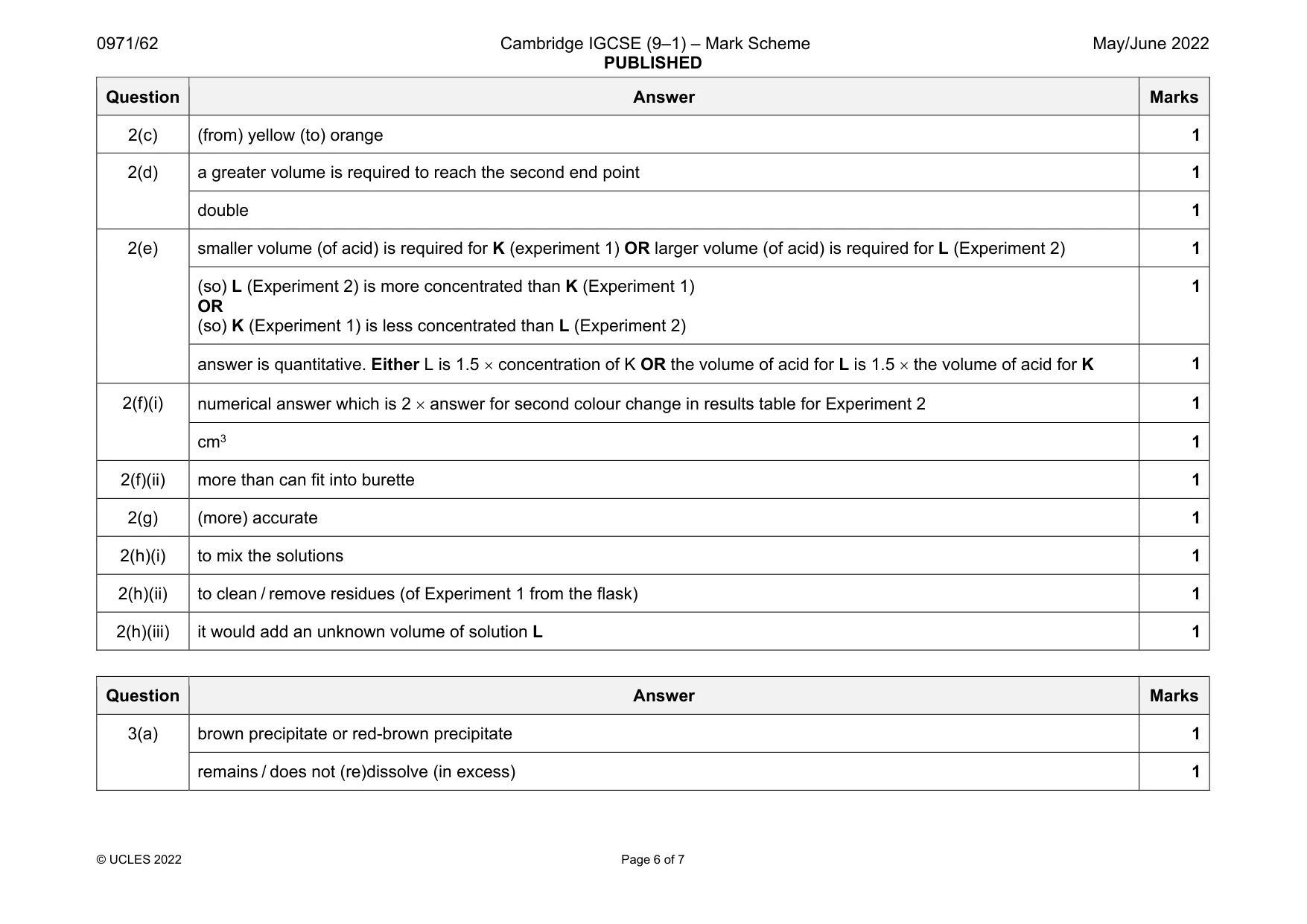
Mark scheme: 2(a) all values in (a) to 1 dp or better and to a consistent number of dp 1 all burette reading correct (12.0/12, 22.4, 1.6) 1 both titres correct (10.4, 20.8) 1 2(b) all burette readings correct (19.7 35.3, 4.1) 1 all readings in the correct cells (initial reading is the smallest and second colour change is the largest) 1 both titres correct (15.6, 31.2) 1 Question Answer Marks 2(c) (from) yellow (to) orange 1 2(d) a greater volume is required to reach the second end point 1 double 1 2(e) smaller volume (of acid) is required for K (experiment 1) OR larger volume (of acid) is required for L (Experiment 2) 1 (so) L (Experiment 2) is more concentrated than K (Experiment 1) OR (so) K (Experiment 1) is less concentrated than L (Experiment 2) 1 answer is quantitative. Either L is 1.5 concentration of K OR the volume of acid for L is 1.5 the volume of acid for K 1 2(f)(i) numerical answer which is 2 answer for second colour change in results table for Experiment 2 1 cm3 1 2(f)(ii) more than can fit into burette 1 2(g) (more) accurate 1 2(h)(i) to mix the solutions 1 2(h)(ii) to clean / remove residues (of Experiment 1 from the flask) 1 2(h)(iii) it would add an unknown volume of solution L 1
Q3 · Solid M and solid N were analysed
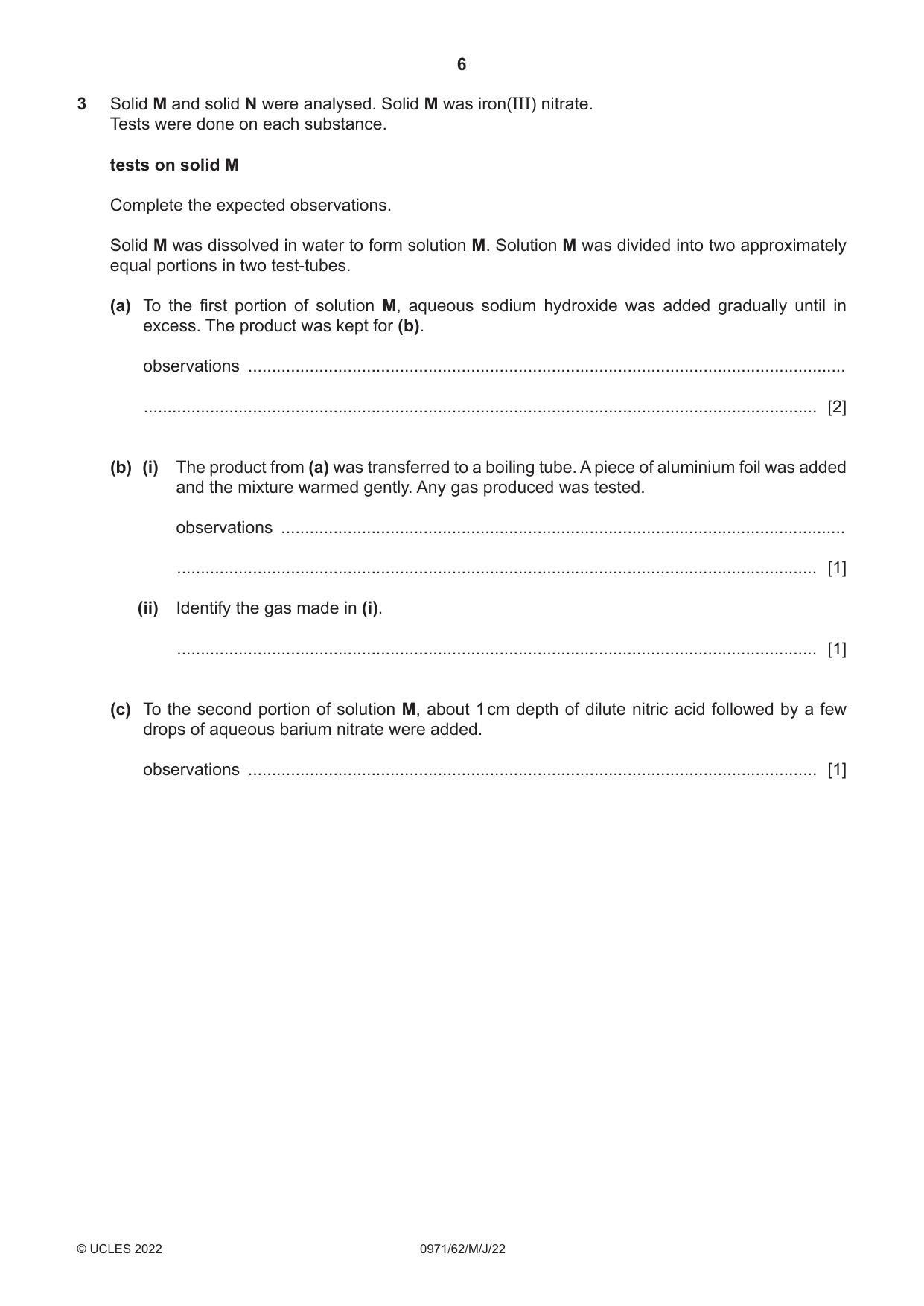
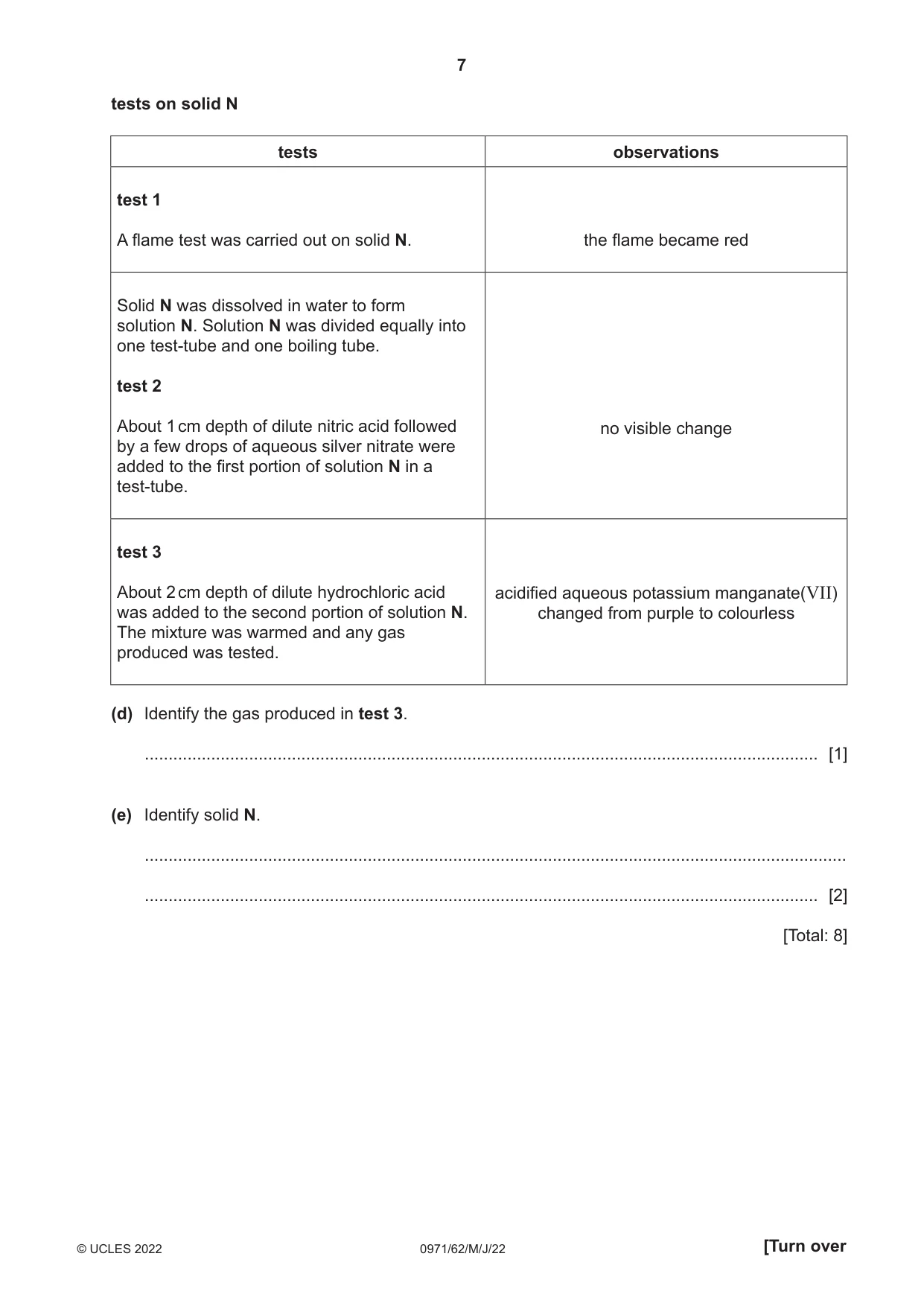
3 Solid M and solid N were analysed. Solid M was iron(III) nitrate. Tests were done on each substance. tests on solid M Complete the expected observations. Solid M was dissolved in water to form solution M. Solution M was divided into two approximately equal portions in two test-tubes. (a) To the first portion of solution M, aqueous sodium hydroxide was added gradually until in excess. The product was kept for (b). observations ............................................................................................................................... .............................................................................................................................................. [2] (b) (i) The product from (a) was transferred to a boiling tube. A piece of aluminium foil was added and the mixture warmed gently. Any gas produced was tested. observations ........................................................................................................................ ....................................................................................................................................... [1] (ii) Identify the gas made in (i). ....................................................................................................................................... [1] (c) To the second portion of solution M, about 1 cm depth of dilute nitric acid followed by a few drops of aqueous barium nitrate were added. observations ......................................................................................................................... [1] tests on solid N tests observations test 1 A flame test was carried out on solid N. the flame became red Solid N was dissolved in water to form solution N. Solution N was divided equally into one test-tube and one boiling tube. test 2 About 1 cm depth of dilute nitric acid followed no visible change by a few drops of aqueous silver nitrate were added to the first portion of solution N in a test‑tube. test 3 About 2 cm depth of dilute hydrochloric acid acidified aqueous potassium manganate(VII) was added to the second portion of solution N. changed from purple to colourless The mixture was warmed and any gas produced was tested. (d) Identify the gas produced in test 3. .............................................................................................................................................. [1] (e) Identify solid N. .................................................................................................................................................... .............................................................................................................................................. [2] [Total: 8]
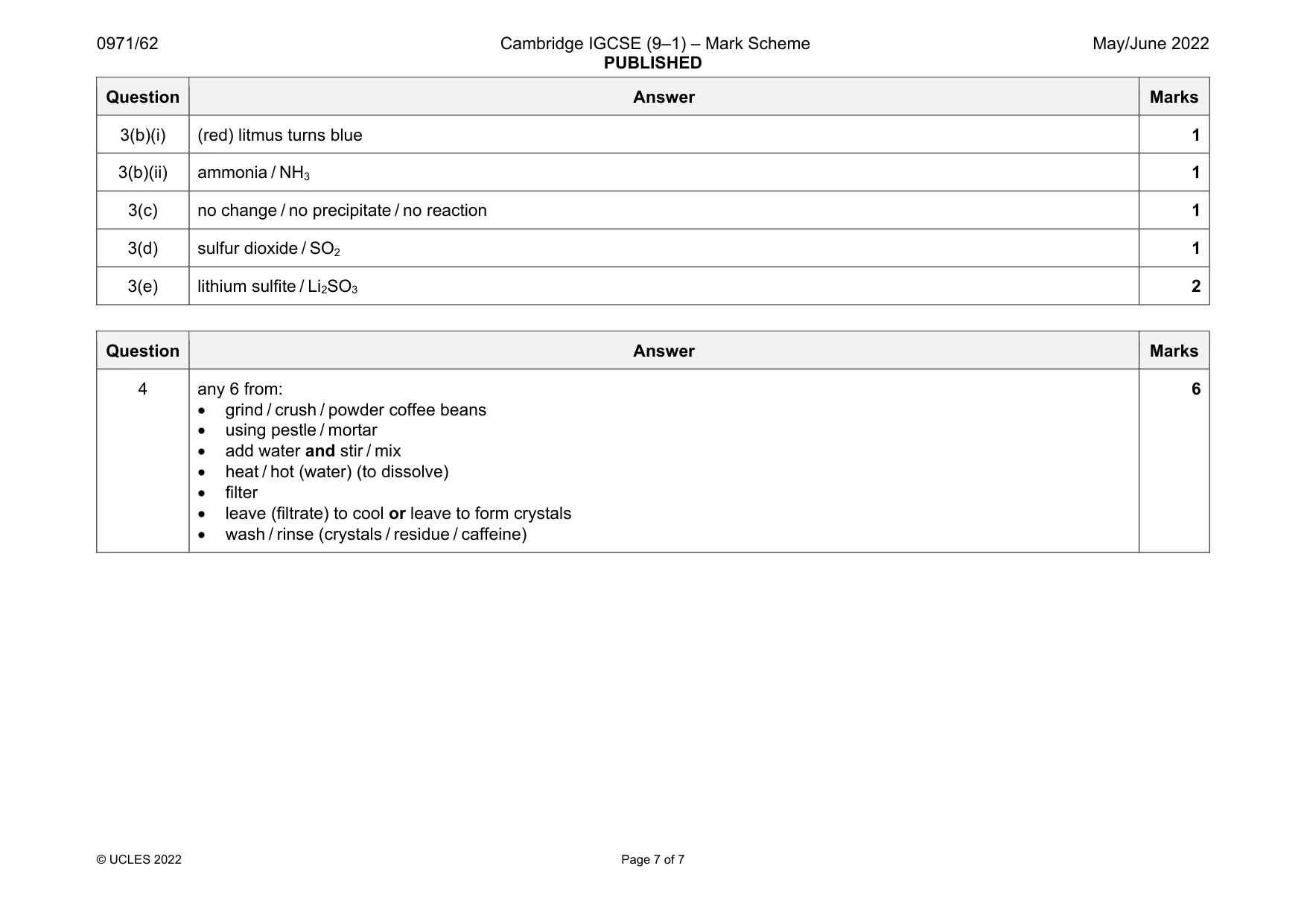
Mark scheme: 3(a) brown precipitate or red-brown precipitate 1 remains / does not (re)dissolve (in excess) 1 Question Answer Marks 3(b)(i) (red) litmus turns blue 1 3(b)(ii) ammonia / NH3 1 3(c) no change / no precipitate / no reaction 1 3(d) sulfur dioxide / SO2 1 3(e) lithium sulfite / Li2SO3 2
Q4 · The diagram shows some coffee beans
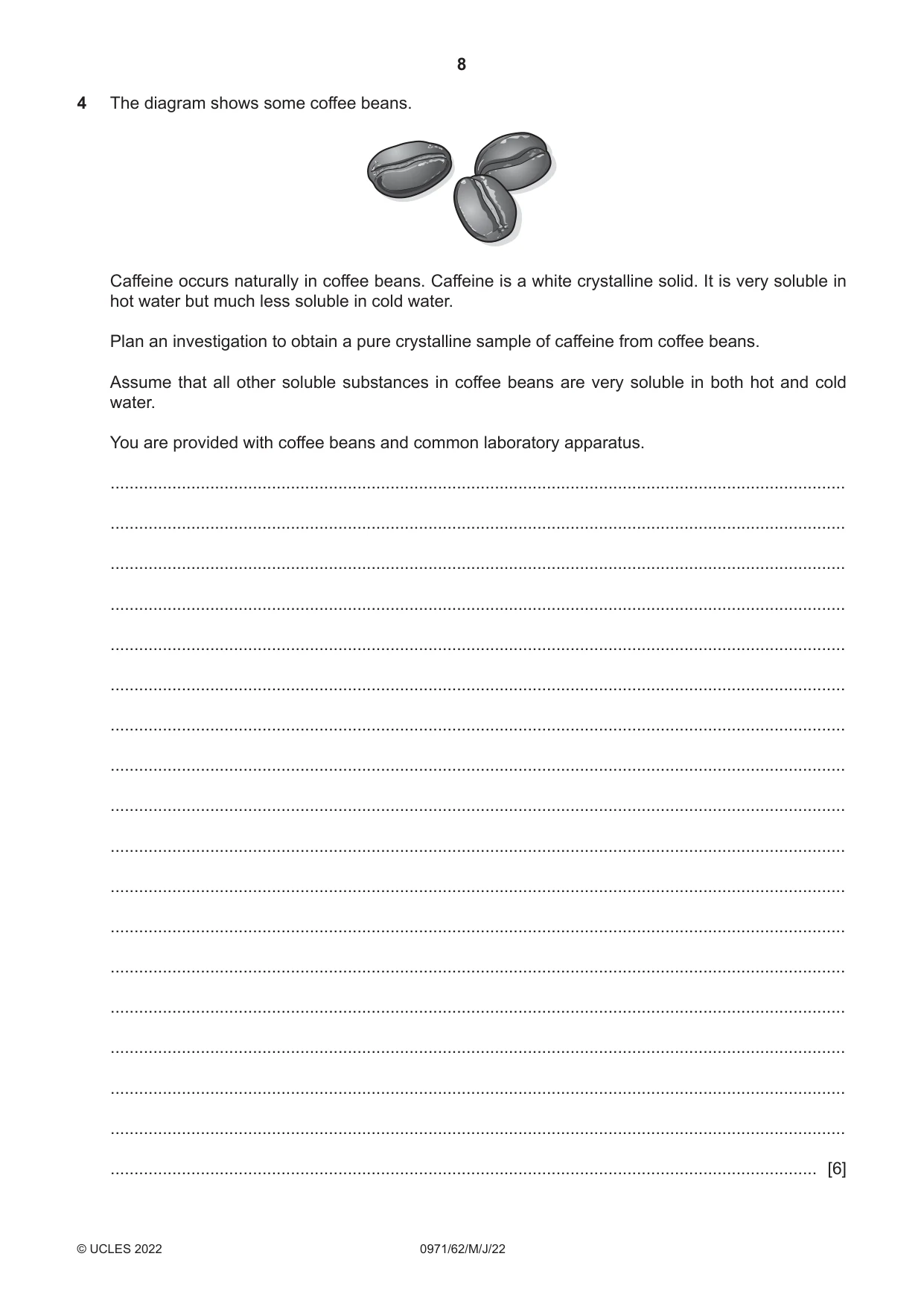
4 The diagram shows some coffee beans. Caffeine occurs naturally in coffee beans. Caffeine is a white crystalline solid. It is very soluble in hot water but much less soluble in cold water. Plan an investigation to obtain a pure crystalline sample of caffeine from coffee beans. Assume that all other soluble substances in coffee beans are very soluble in both hot and cold water. You are provided with coffee beans and common laboratory apparatus. ........................................................................................................................................................... ........................................................................................................................................................... ........................................................................................................................................................... ........................................................................................................................................................... ........................................................................................................................................................... ........................................................................................................................................................... ........................................................................................................................................................... ........................................................................................................................................................... ........................................................................................................................................................... ........................................................................................................................................................... ........................................................................................................................................................... ........................................................................................................................................................... ........................................................................................................................................................... ........................................................................................................................................................... ........................................................................................................................................................... ........................................................................................................................................................... ........................................................................................................................................................... ..................................................................................................................................................... [6]
Mark scheme: 4 any 6 from: grind / crush / powder coffee beans using pestle / mortar add water and stir / mix heat / hot (water) (to dissolve) filter leave (filtrate) to cool or leave to form crystals wash / rinse (crystals / residue / caffeine) 6
What was in this paper
The subtopics covered by these 4 questions, and how many questions each got. Open one in a new tab to see every Cambridge question on it.
What you needed in this session
Cambridge’s own grade thresholds for 2022 May/June, Paper 6 · Variant 2. A higher threshold means an easier paper — the bar moves with how the cohort did.