Cambridge IGCSE Chemistry (9-1) 0971 — 2025 Oct/Nov Paper 6 · Variant 2
0971/62/O/N/25 · 4 questions · 40 marks · 60 min
The question paper and its mark scheme, free to read here and free to download. This is Cambridge’s own paper, exactly as it was sat.
Question paper16 pages

Mark scheme10 pages
Answers below. Sit the paper first if you are practising.
Questions as text
Q1 · Eggshells are made from a mixture of calcium carbonate and other insoluble substances
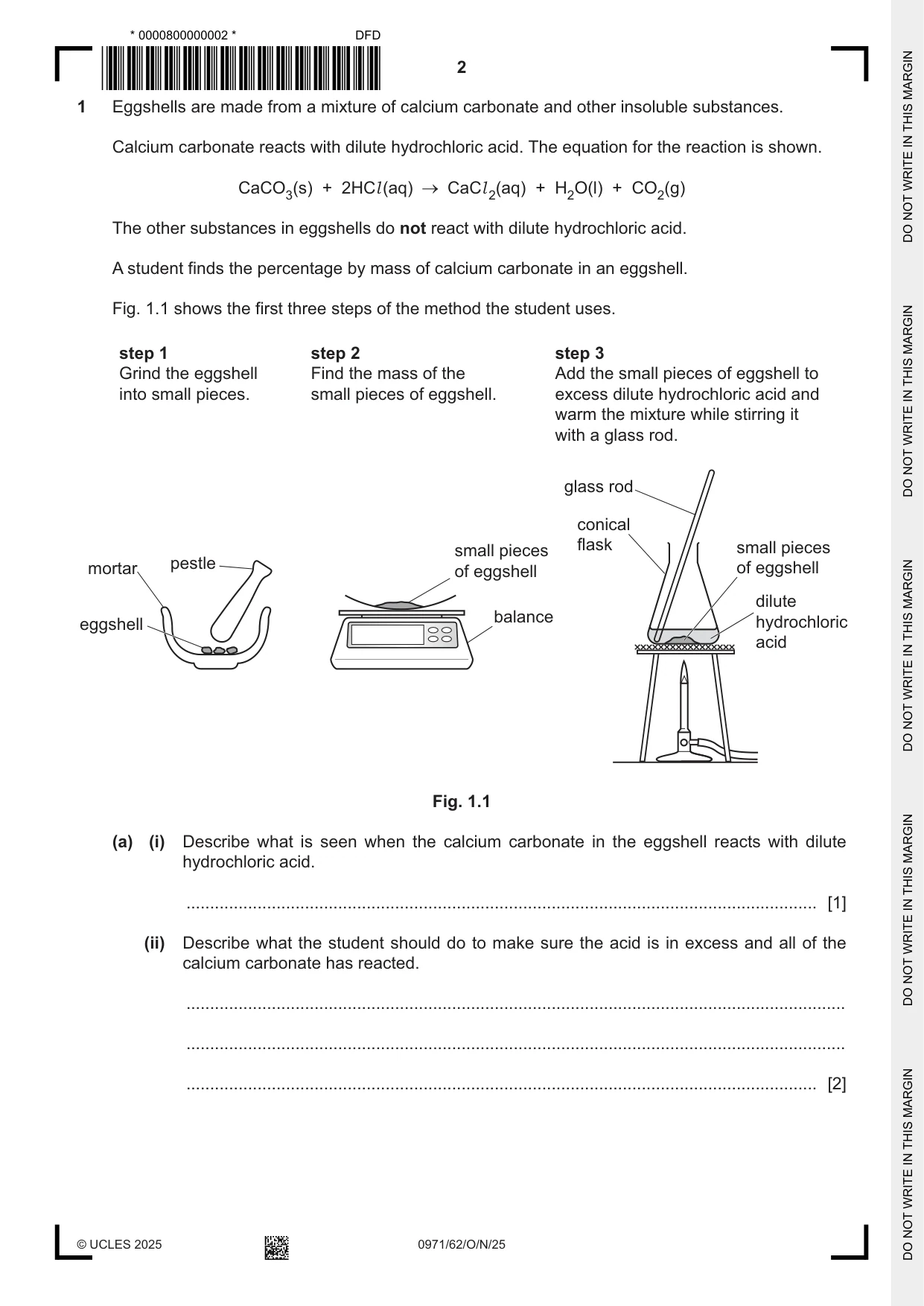
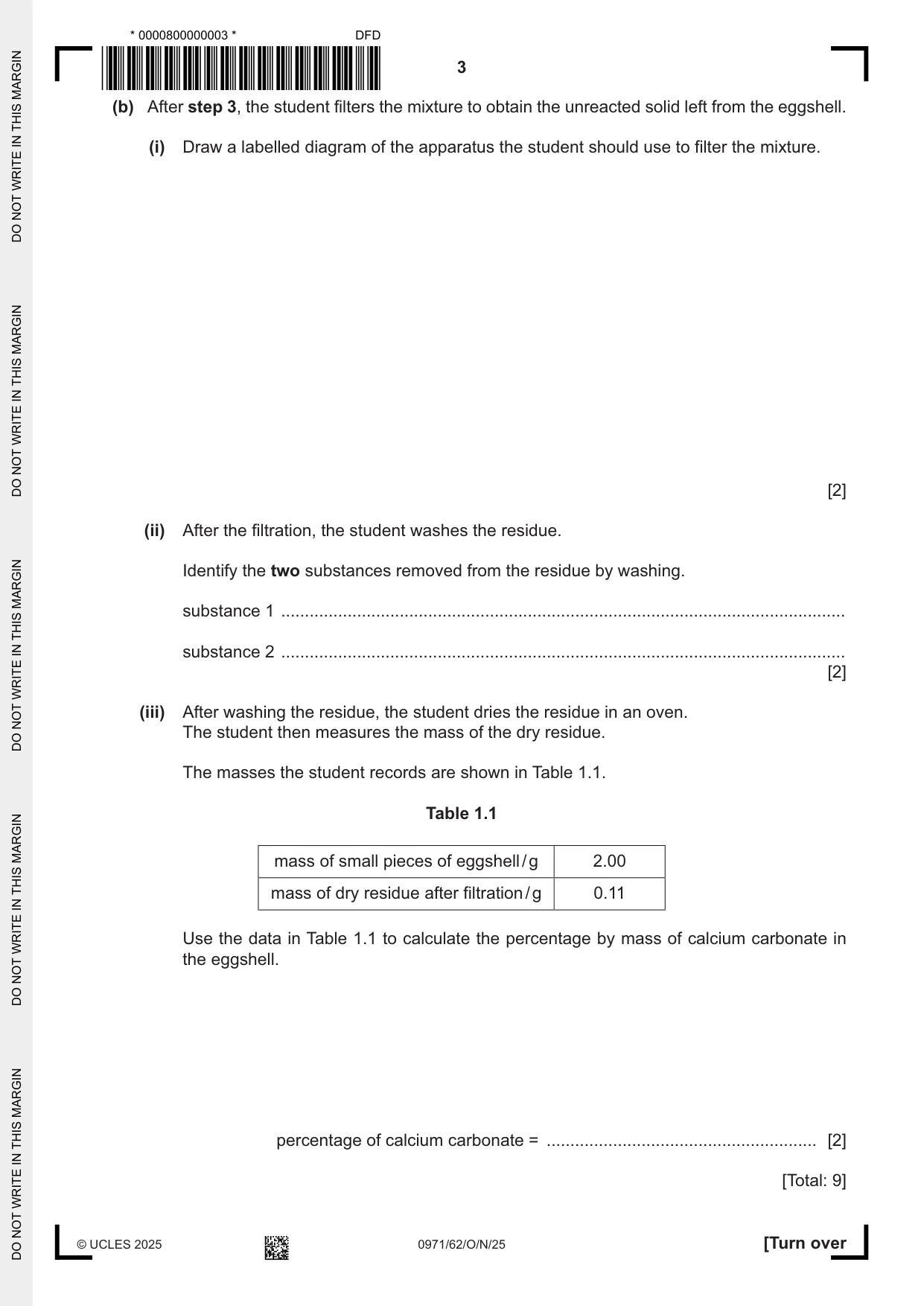
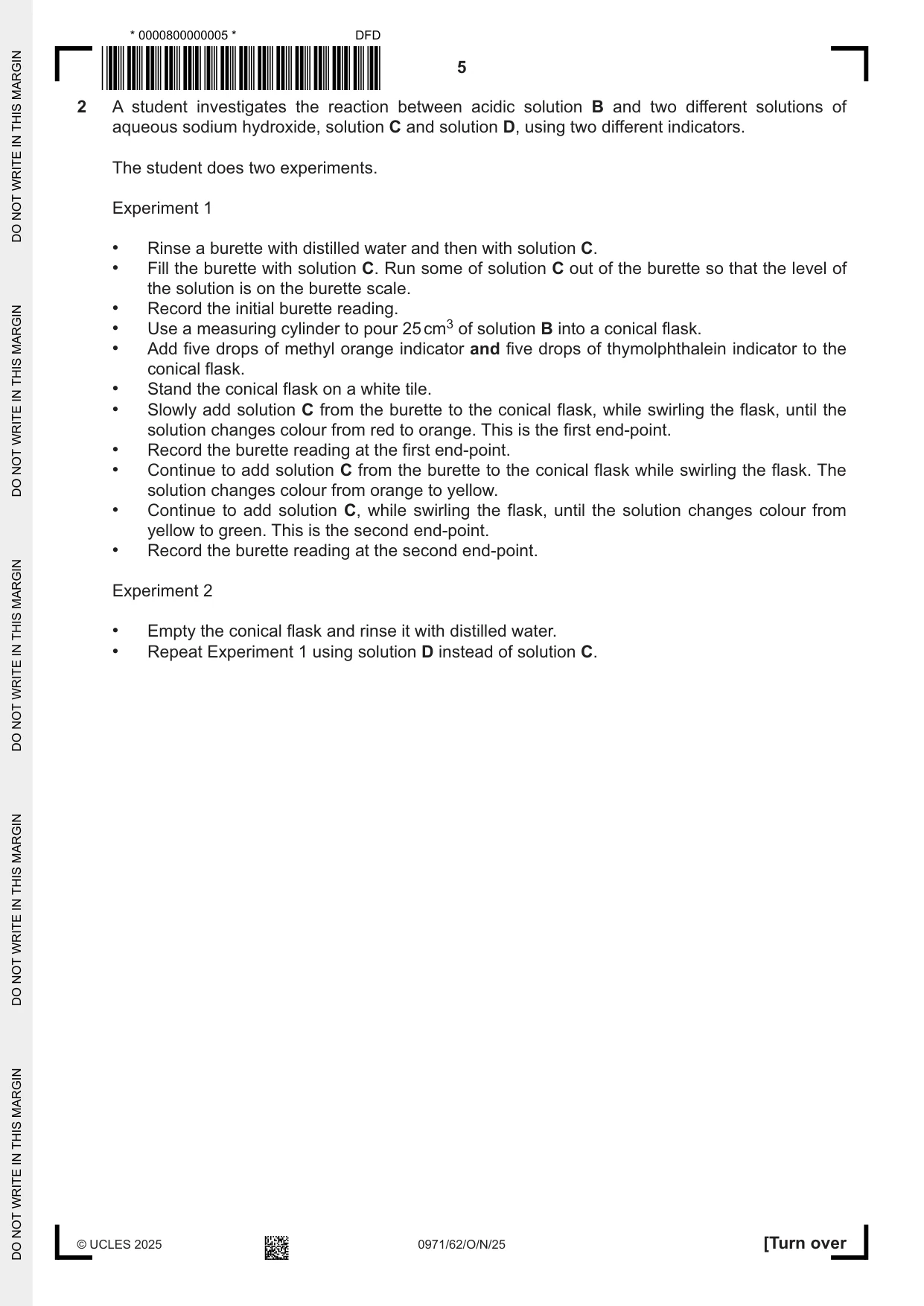
1 Eggshells are made from a mixture of calcium carbonate and other insoluble substances. Calcium carbonate reacts with dilute hydrochloric acid. The equation for the reaction is shown. CaCO3(s) + 2HCl (aq) CaCl 2(aq) + H2O(l) + CO2(g) The other substances in eggshells do not react with dilute hydrochloric acid. A student finds the percentage by mass of calcium carbonate in an eggshell. Fig. 1.1 shows the first three steps of the method the student uses. step 1 step 2 step 3 Grind the eggshell Find the mass of the Add the small pieces of eggshell to into small pieces. small pieces of eggshell. excess dilute hydrochloric acid and warm the mixture while stirring it with a glass rod. glass rod conical flask small pieces small pieces pestle mortar of eggshell of eggshell dilute balanceeggshell hydrochloric acid Fig. 1.1 (a) (i) Describe what is seen when the calcium carbonate in the eggshell reacts with dilute hydrochloric acid. ..................................................................................................................................... [1] (ii) Describe what the student should do to make sure the acid is in excess and all of the calcium carbonate has reacted. ........................................................................................................................................... ........................................................................................................................................... ..................................................................................................................................... [2] (b) After step 3, the student filters the mixture to obtain the unreacted solid left from the eggshell. (i) Draw a labelled diagram of the apparatus the student should use to filter the mixture. [2] (ii) After the filtration, the student washes the residue. Identify the two substances removed from the residue by washing. substance 1 ....................................................................................................................... substance 2 ....................................................................................................................... [2] (iii) After washing the residue, the student dries the residue in an oven. The student then measures the mass of the dry residue. The masses the student records are shown in Table 1.1. Table 1.1 mass of small pieces of eggshell / g 2.00 mass of dry residue after filtration / g 0.11 Use the data in Table 1.1 to calculate the percentage by mass of calcium carbonate in the eggshell. percentage of calcium carbonate = ......................................................... [2] [Total: 9]
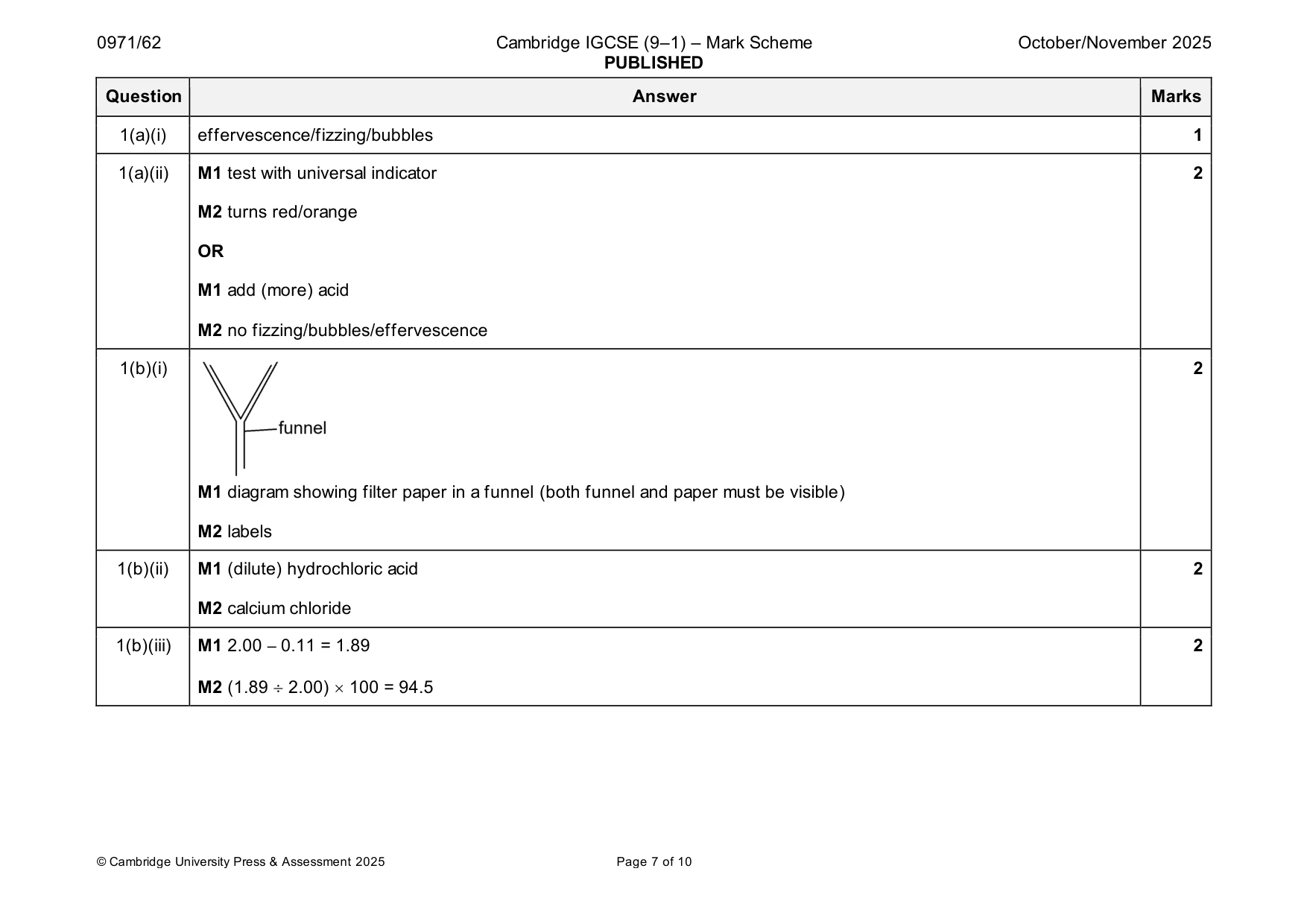
Mark scheme: Question Answer Marks 1(a)(i) effervescence/fizzing/bubbles 1 1(a)(ii) M1 test with universal indicator 2 M2 turns red/orange OR M1 add (more) acid M2 no fizzing/bubbles/effervescence 1(b)(i) 2 M1 diagram showing filter paper in a funnel (both funnel and paper must be visible) M2 labels 1(b)(ii) M1 (dilute) hydrochloric acid 2 M2 calcium chloride 1(b)(iii) M1 2.00 – 0.11 = 1.89 2 M2 (1.89 2.00) 100 = 94.5
Q2 · A student investigates the reaction between acidic solution B and two different solutions…
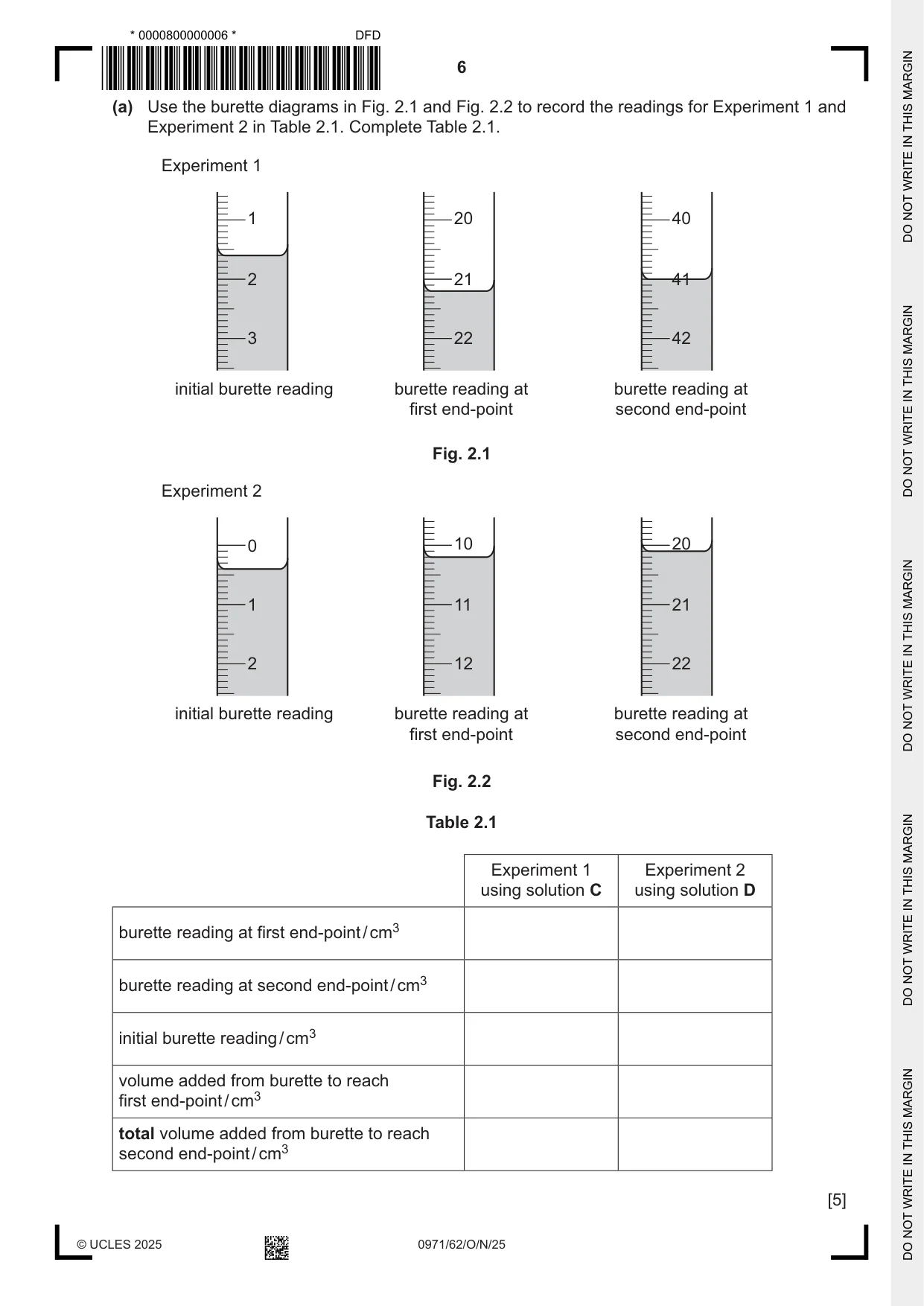
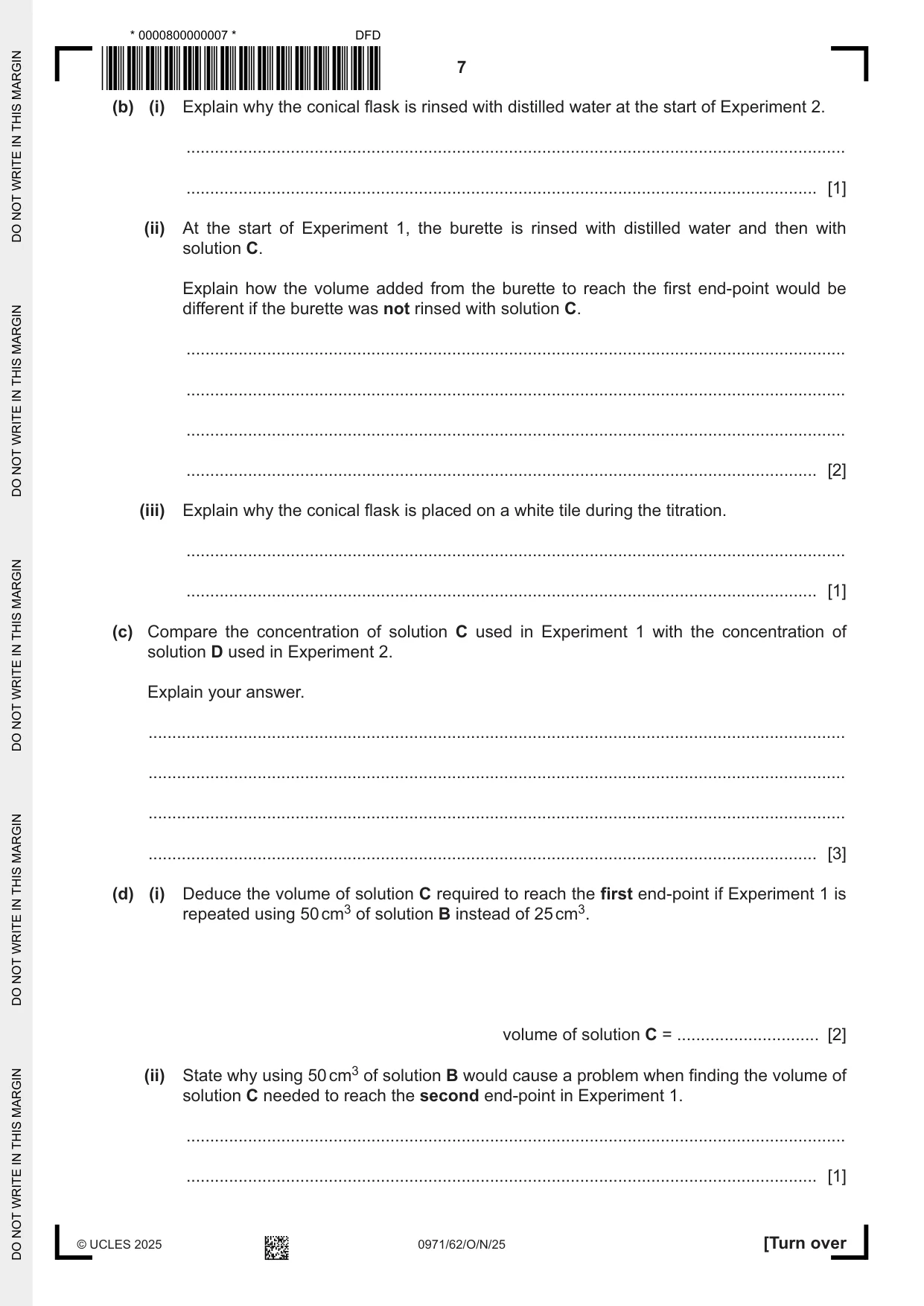
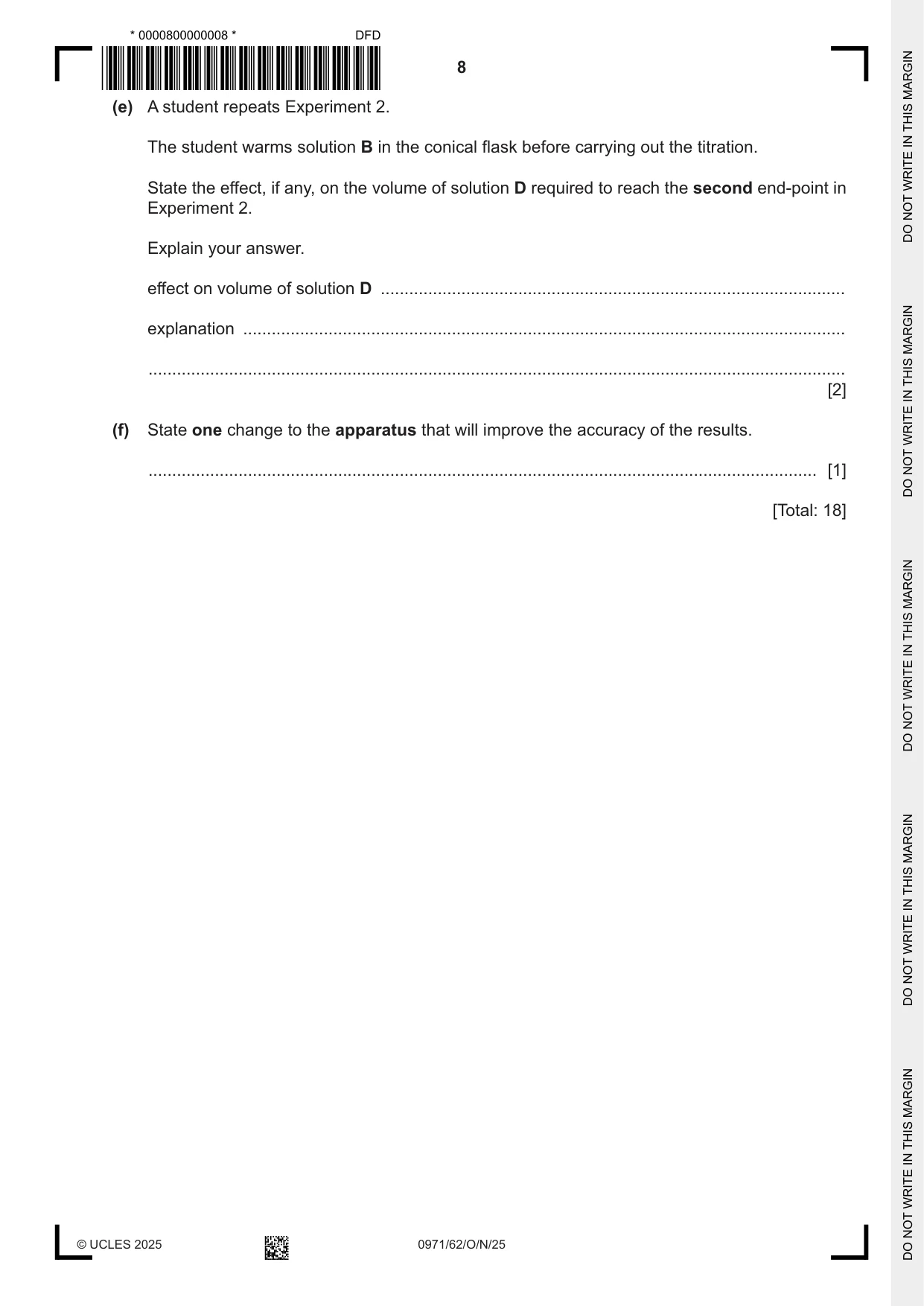
2 A student investigates the reaction between acidic solution B and two different solutions of aqueous sodium hydroxide, solution C and solution D, using two different indicators. The student does two experiments. Experiment 1 • Rinse a burette with distilled water and then with solution C. • Fill the burette with solution C. Run some of solution C out of the burette so that the level of the solution is on the burette scale. • Record the initial burette reading. • Use a measuring cylinder to pour 25 cm3 of solution B into a conical flask. • Add five drops of methyl orange indicator and five drops of thymolphthalein indicator to the conical flask. • Stand the conical flask on a white tile. • Slowly add solution C from the burette to the conical flask, while swirling the flask, until the solution changes colour from red to orange. This is the first end-point. • Record the burette reading at the first end-point. • Continue to add solution C from the burette to the conical flask while swirling the flask. The solution changes colour from orange to yellow. • Continue to add solution C, while swirling the flask, until the solution changes colour from yellow to green. This is the second end-point. • Record the burette reading at the second end-point. Experiment 2 • Empty the conical flask and rinse it with distilled water. • Repeat Experiment 1 using solution D instead of solution C. (a) Use the burette diagrams in Fig. 2.1 and Fig. 2.2 to record the readings for Experiment 1 and Experiment 2 in Table 2.1. Complete Table 2.1. Experiment 1 1 20 40 2 21 41 3 22 42 initial burette reading burette reading at burette reading at first end-point second end-point Fig. 2.1 Experiment 2 0 10 20 1 11 21 2 12 22 initial burette reading burette reading at burette reading at first end-point second end-point Fig. 2.2 Table 2.1 Experiment 1 Experiment 2 using solution C using solution D burette reading at first end-point / cm3 burette reading at second end-point / cm3 initial burette reading / cm3 volume added from burette to reach first end-point / cm3 total volume added from burette to reach second end-point / cm3 [5] (b) (i) Explain why the conical flask is rinsed with distilled water at the start of Experiment 2. ........................................................................................................................................... ..................................................................................................................................... [1] (ii) At the start of Experiment 1, the burette is rinsed with distilled water and then with solution C. Explain how the volume added from the burette to reach the first end-point would be different if the burette was not rinsed with solution C. ........................................................................................................................................... ........................................................................................................................................... ........................................................................................................................................... ..................................................................................................................................... [2] (iii) Explain why the conical flask is placed on a white tile during the titration. ........................................................................................................................................... ..................................................................................................................................... [1] (c) Compare the concentration of solution C used in Experiment 1 with the concentration of solution D used in Experiment 2. Explain your answer. ................................................................................................................................................... ................................................................................................................................................... ................................................................................................................................................... ............................................................................................................................................. [3] (d) (i) Deduce the volume of solution C required to reach the first end-point if Experiment 1 is repeated using 50 cm3 of solution B instead of 25 cm3. volume of solution C = .............................. [2] (ii) State why using 50 cm3 of solution B would cause a problem when finding the volume of solution C needed to reach the second end-point in Experiment 1. ........................................................................................................................................... ..................................................................................................................................... [1] (e) A student repeats Experiment 2. The student warms solution B in the conical flask before carrying out the titration. State the effect, if any, on the volume of solution D required to reach the second end-point in Experiment 2. Explain your answer. effect on volume of solution D .................................................................................................. explanation ............................................................................................................................... ................................................................................................................................................... [2] (f) State one change to the apparatus that will improve the accuracy of the results. ............................................................................................................................................. [1] [Total: 18]
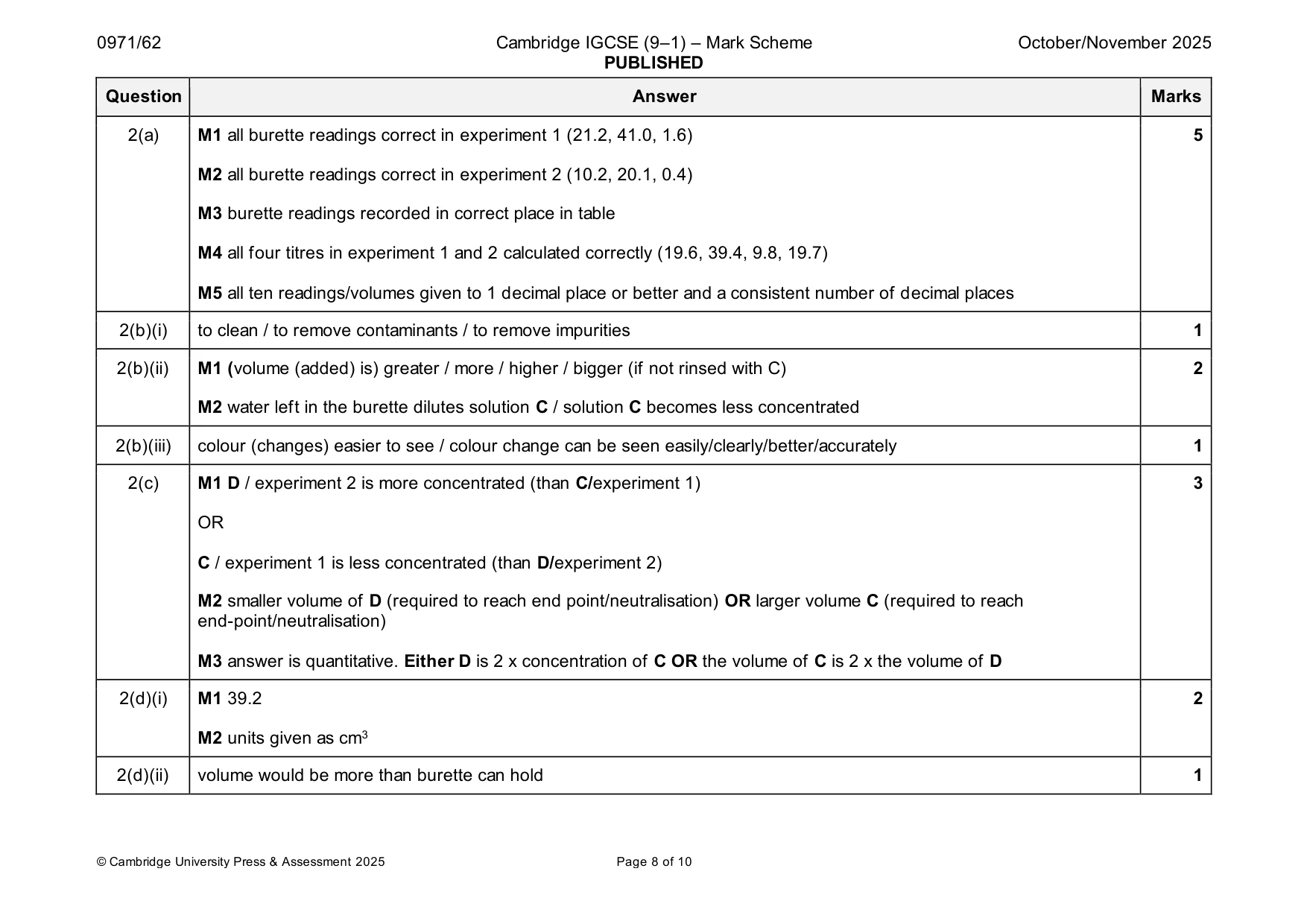
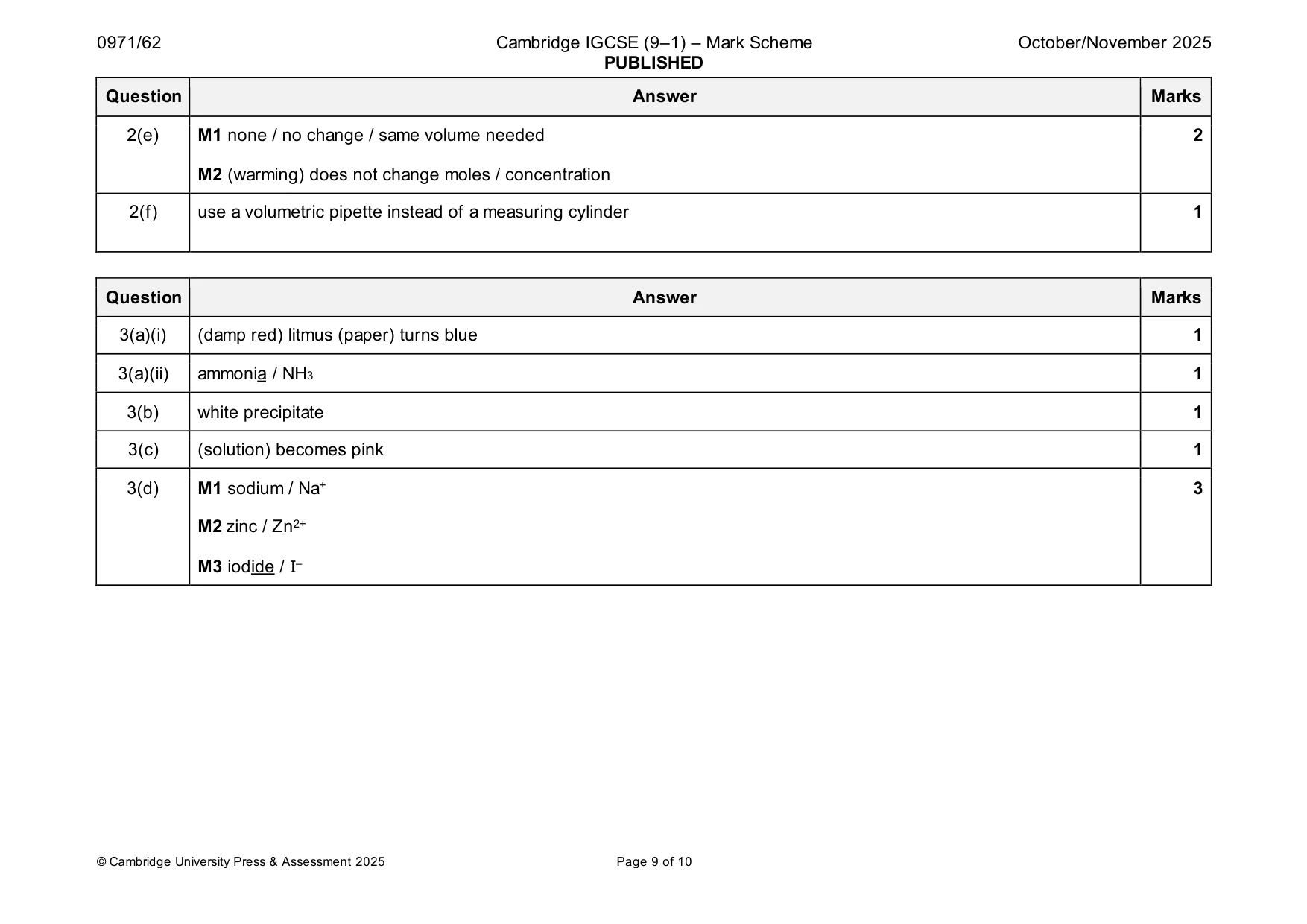
Mark scheme: 2(a) M1 all burette readings correct in experiment 1 (21.2, 41.0, 1.6) 5 M2 all burette readings correct in experiment 2 (10.2, 20.1, 0.4) M3 burette readings recorded in correct place in table M4 all four titres in experiment 1 and 2 calculated correctly (19.6, 39.4, 9.8, 19.7) M5 all ten readings/volumes given to 1 decimal place or better and a consistent number of decimal places 2(b)(i) to clean / to remove contaminants / to remove impurities 1 2(b)(ii) M1 (volume (added) is) greater / more / higher / bigger (if not rinsed with C) 2 M2 water left in the burette dilutes solution C / solution C becomes less concentrated 2(b)(iii) colour (changes) easier to see / colour change can be seen easily/clearly/better/accurately 1 2(c) M1 D / experiment 2 is more concentrated (than C/experiment 1) 3 OR C / experiment 1 is less concentrated (than D/experiment 2) M2 smaller volume of D (required to reach end point/neutralisation) OR larger volume C (required to reach end-point/neutralisation) M3 answer is quantitative. Either D is 2 x concentration of C OR the volume of C is 2 x the volume of D 2(d)(i) M1 39.2 2 M2 units given as cm3 2(d)(ii) volume would be more than burette can hold 1 2(e) M1 none / no change / same volume needed 2 M2 (warming) does not change moles / concentration 2(f) use a volumetric pipette instead of a measuring cylinder 1
Q3 · A student tests two solids: solid E and solid F
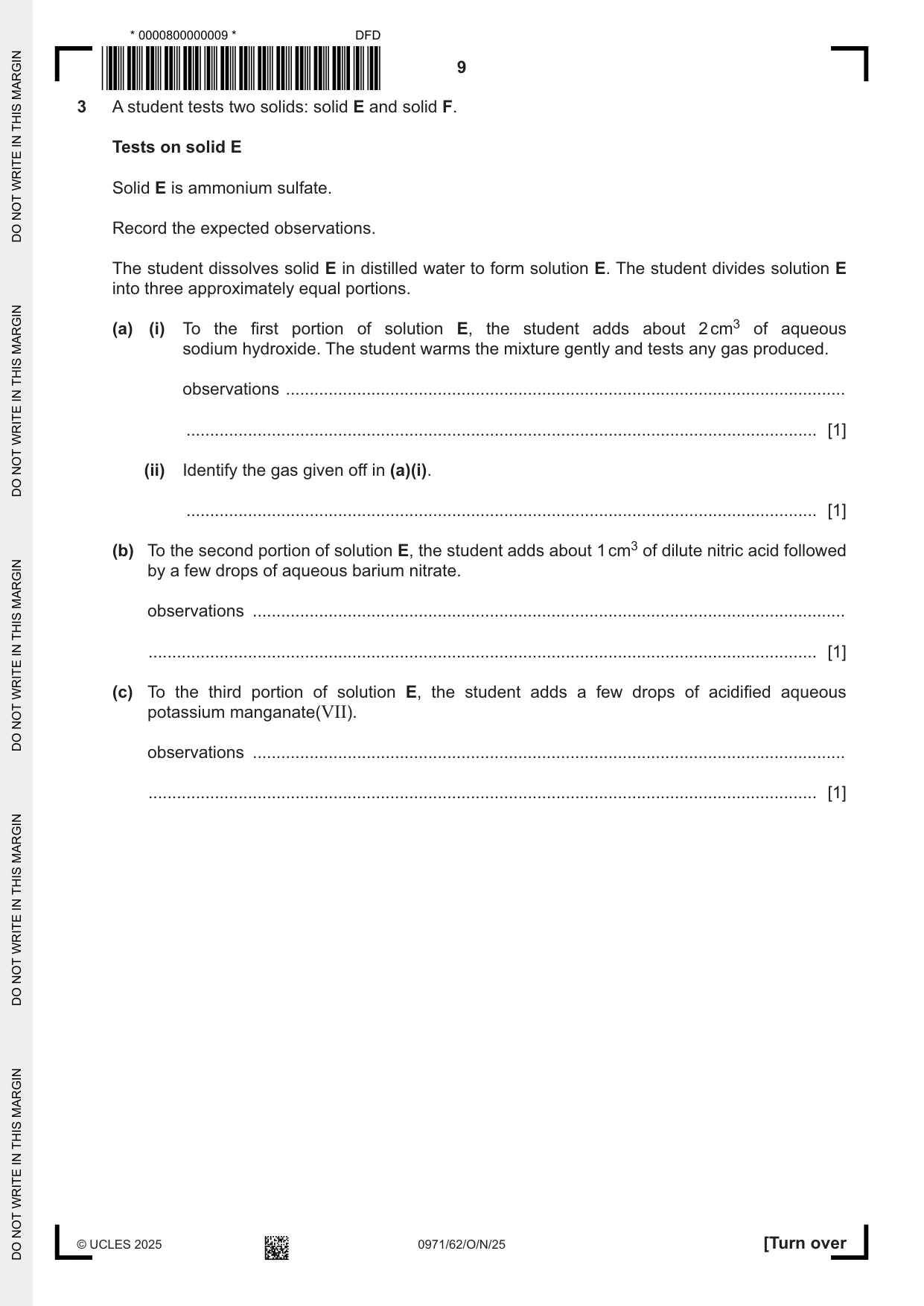
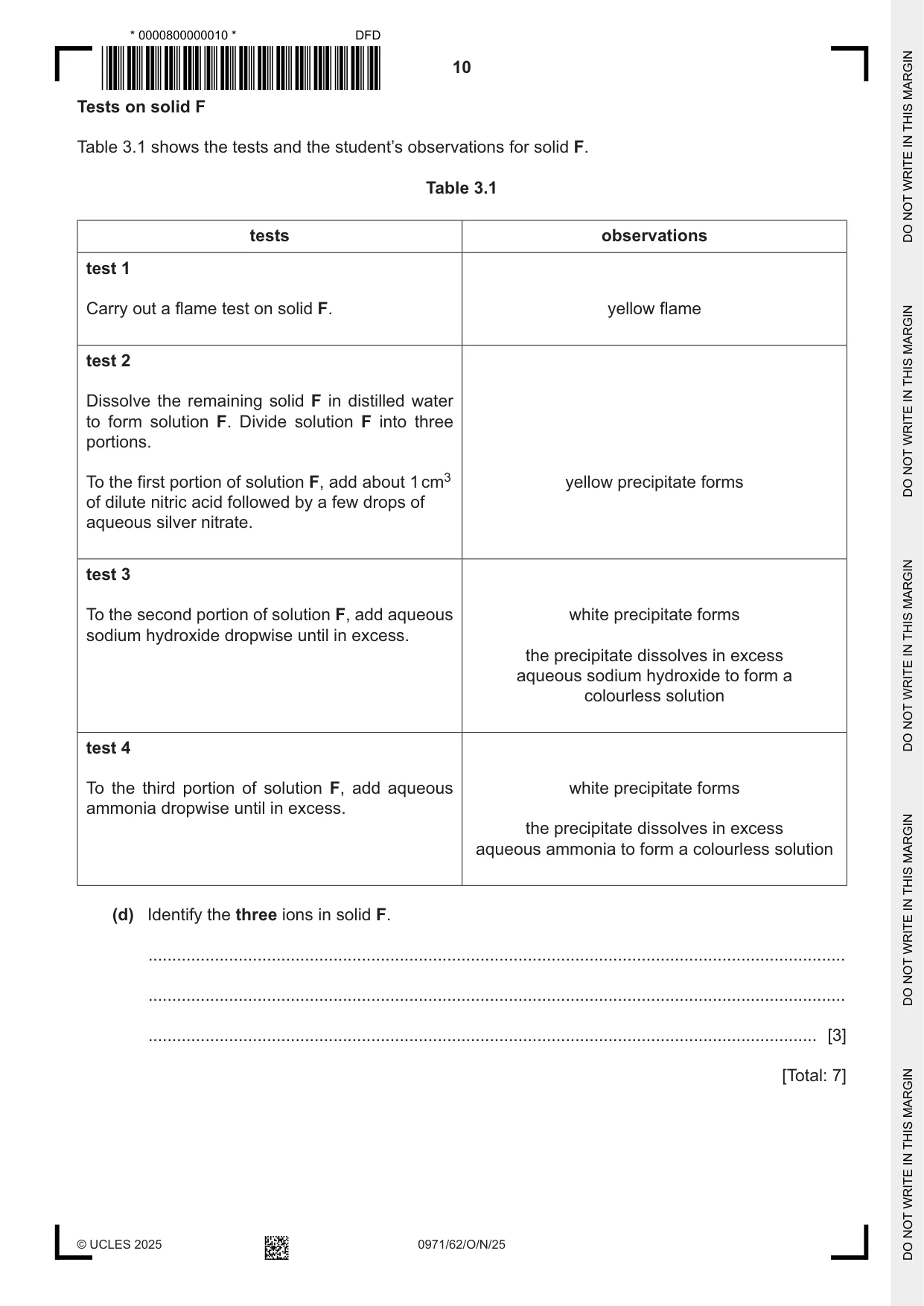
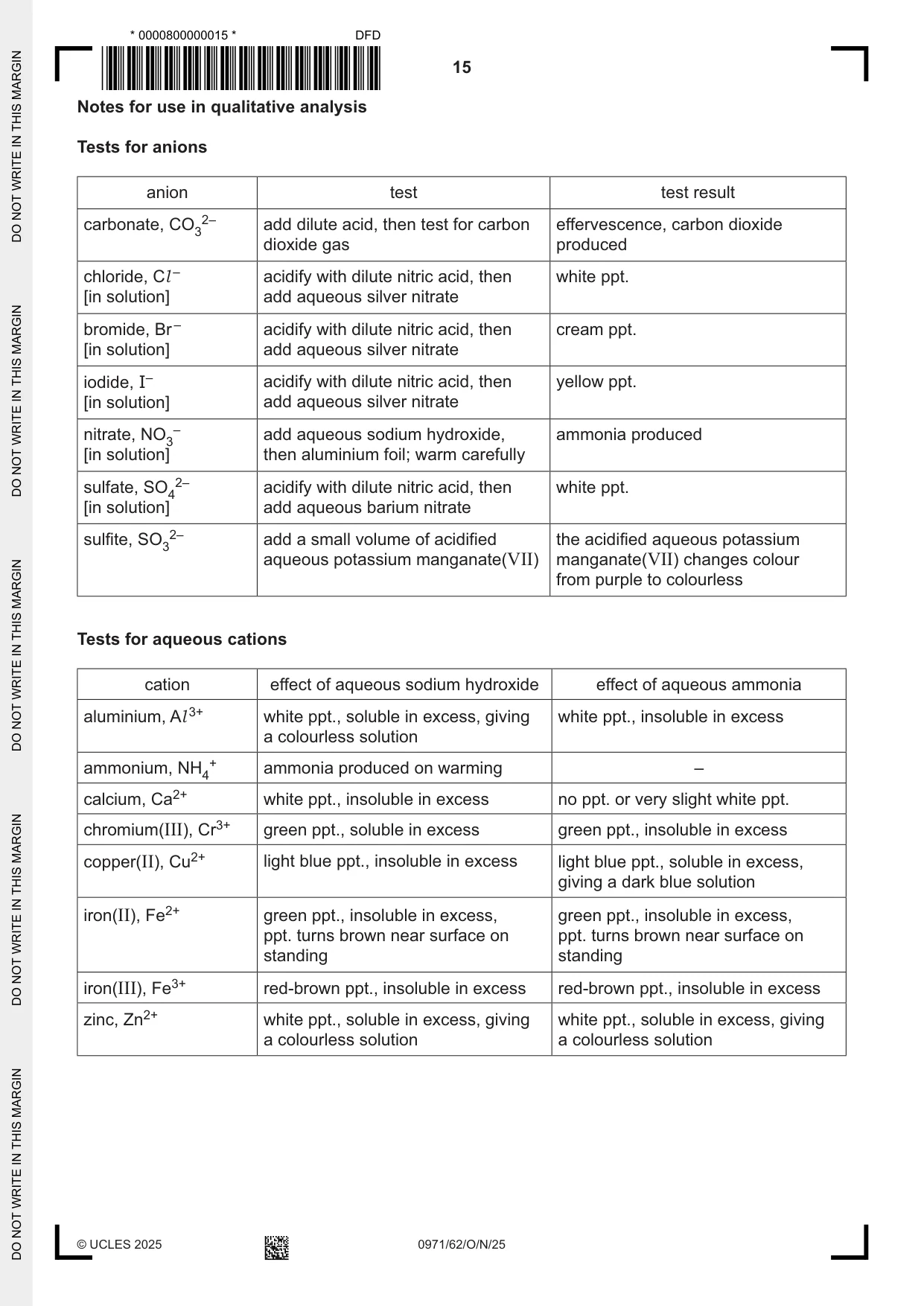
3 A student tests two solids: solid E and solid F. Tests on solid E Solid E is ammonium sulfate. Record the expected observations. The student dissolves solid E in distilled water to form solution E. The student divides solution E into three approximately equal portions. (a) (i) To the first portion of solution E, the student adds about 2 cm3 of aqueous sodium hydroxide. The student warms the mixture gently and tests any gas produced. observations ...................................................................................................................... ..................................................................................................................................... [1] (ii) Identify the gas given off in (a)(i). ..................................................................................................................................... [1] (b) To the second portion of solution E, the student adds about 1 cm3 of dilute nitric acid followed by a few drops of aqueous barium nitrate. observations ............................................................................................................................. ............................................................................................................................................. [1] (c) To the third portion of solution E, the student adds a few drops of acidified aqueous potassium manganate(VII). observations ............................................................................................................................. ............................................................................................................................................. [1] Tests on solid F Table 3.1 shows the tests and the student’s observations for solid F. Table 3.1 tests observations test 1 Carry out a flame test on solid F. yellow flame test 2 Dissolve the remaining solid F in distilled water to form solution F. Divide solution F into three portions. To the first portion of solution F, add about 1 cm3 yellow precipitate forms of dilute nitric acid followed by a few drops of aqueous silver nitrate. test 3 To the second portion of solution F, add aqueous white precipitate forms sodium hydroxide dropwise until in excess. the precipitate dissolves in excess aqueous sodium hydroxide to form a colourless solution test 4 To the third portion of solution F, add aqueous white precipitate forms ammonia dropwise until in excess. the precipitate dissolves in excess aqueous ammonia to form a colourless solution (d) Identify the three ions in solid F. ................................................................................................................................................... ................................................................................................................................................... ............................................................................................................................................. [3] [Total: 7]
Mark scheme: 3(a)(i) (damp red) litmus (paper) turns blue 1 3(a)(ii) ammonia / NH3 1 3(b) white precipitate 1 3(c) (solution) becomes pink 1 3(d) M1 sodium / Na+ 3 M2 zinc / Zn2+ M3 iodide / I–
Q4 · Liquid alcohols can be burned as fuels in spirit burners
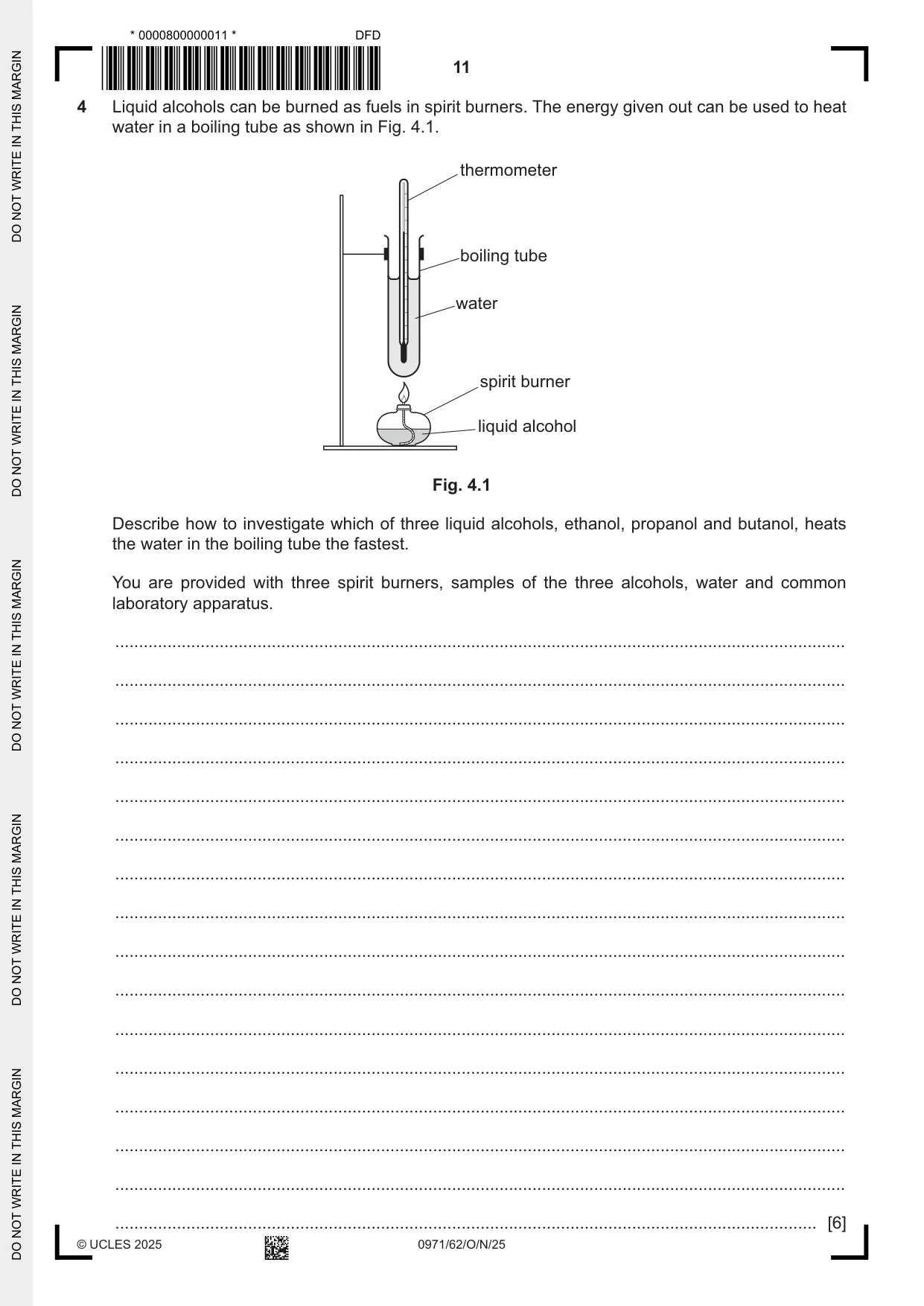
4 Liquid alcohols can be burned as fuels in spirit burners. The energy given out can be used to heat water in a boiling tube as shown in Fig. 4.1. thermometer boiling tube water spirit burner liquid alcohol Fig. 4.1 Describe how to investigate which of three liquid alcohols, ethanol, propanol and butanol, heats the water in the boiling tube the fastest. You are provided with three spirit burners, samples of the three alcohols, water and common laboratory apparatus. .......................................................................................................................................................... .......................................................................................................................................................... .......................................................................................................................................................... .......................................................................................................................................................... .......................................................................................................................................................... .......................................................................................................................................................... .......................................................................................................................................................... .......................................................................................................................................................... .......................................................................................................................................................... .......................................................................................................................................................... .......................................................................................................................................................... .......................................................................................................................................................... .......................................................................................................................................................... .......................................................................................................................................................... .......................................................................................................................................................... ............................... ............................................................................................................... [6]
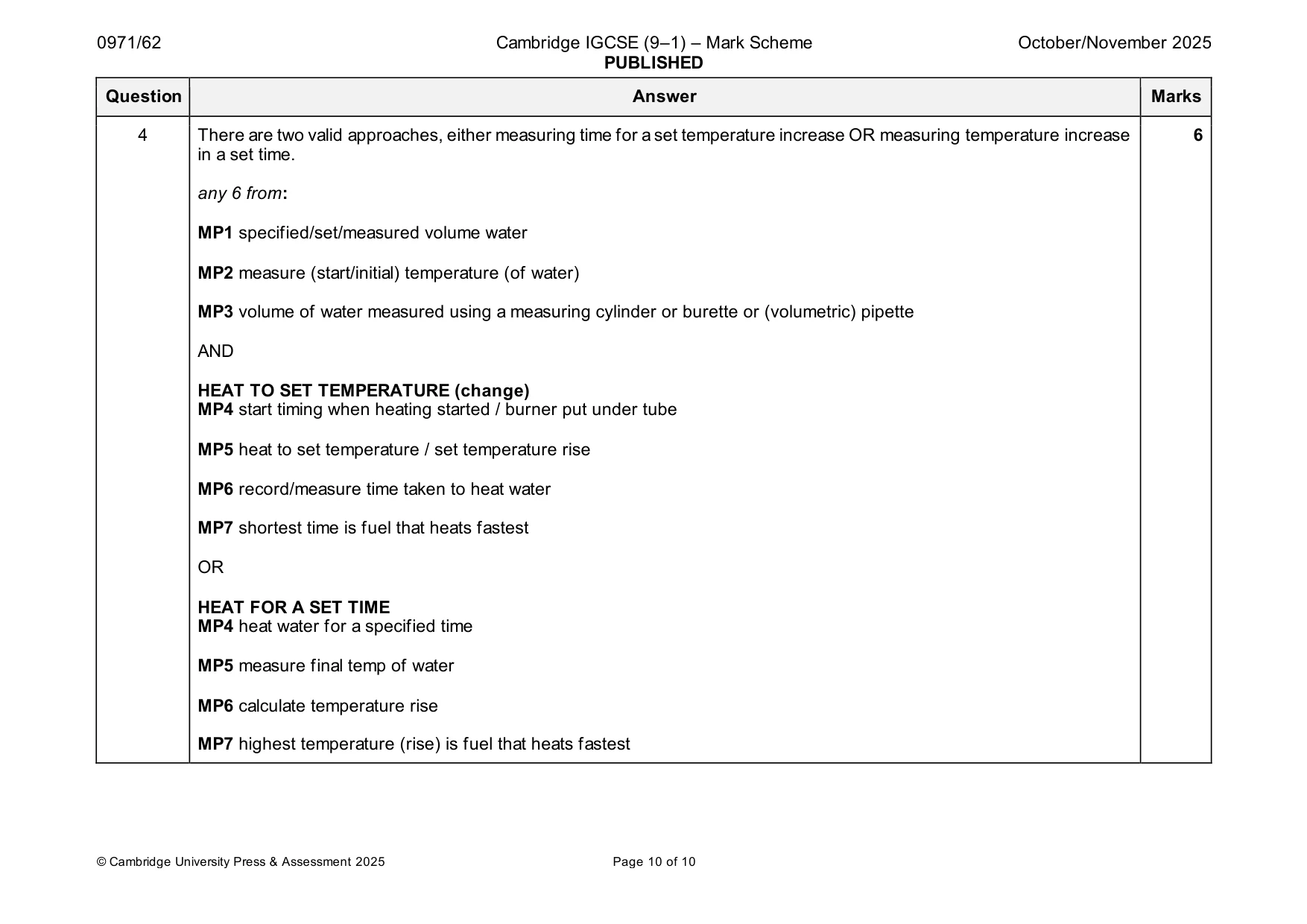
Mark scheme: 4 There are two valid approaches, either measuring time for a set temperature increase OR measuring temperature increase 6 in a set time. any 6 from: MP1 specified/set/measured volume water MP2 measure (start/initial) temperature (of water) MP3 volume of water measured using a measuring cylinder or burette or (volumetric) pipette AND HEAT TO SET TEMPERATURE (change) MP4 start timing when heating started / burner put under tube MP5 heat to set temperature / set temperature rise MP6 record/measure time taken to heat water MP7 shortest time is fuel that heats fastest OR HEAT FOR A SET TIME MP4 heat water for a specified time MP5 measure final temp of water MP6 calculate temperature rise MP7 highest temperature (rise) is fuel that heats fastest
What was in this paper
The subtopics covered by these 4 questions, and how many questions each got. Open one in a new tab to see every Cambridge question on it.
What you needed in this session
Cambridge’s own grade thresholds for 2025 Oct/Nov, Paper 6 · Variant 2. A higher threshold means an easier paper — the bar moves with how the cohort did.