Cambridge IGCSE Chemistry (9-1) 0971 — 2022 May/June Paper 6 · Variant 1
0971/61/M/J/22 · 4 questions · 40 marks · ≈45 min
The question paper and its mark scheme, free to read here and free to download. This is Cambridge’s own paper, exactly as it was sat.
Question paper12 pages


Mark scheme7 pages
Answers below. Sit the paper first if you are practising.
Questions as text
Q1 · The apparatus in the diagram was used to show that when a candle is burned both water and…
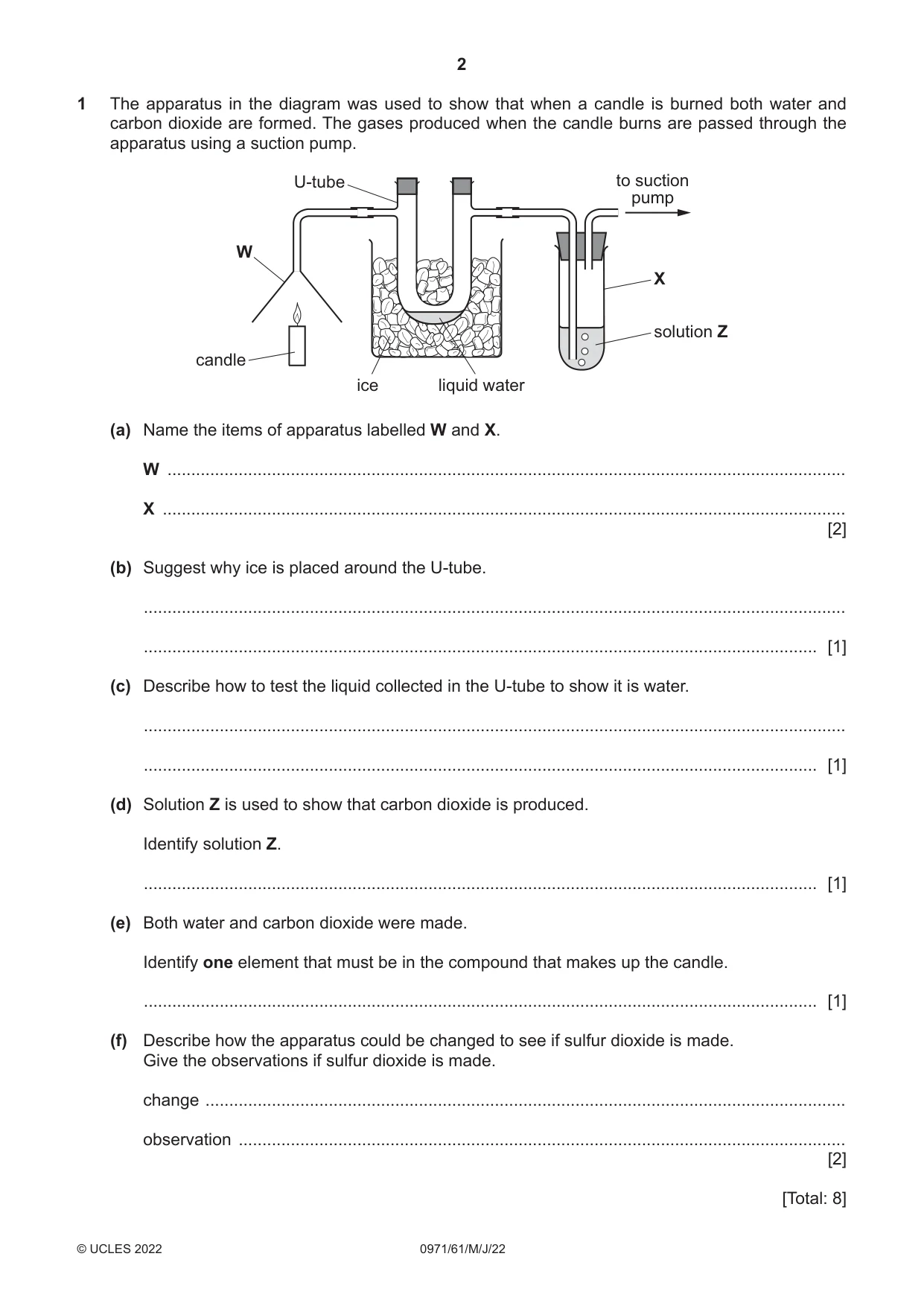
1 The apparatus in the diagram was used to show that when a candle is burned both water and carbon dioxide are formed. The gases produced when the candle burns are passed through the apparatus using a suction pump. U-tube to suction pump W X solution Z candle ice liquid water (a) Name the items of apparatus labelled W and X. W ................................................................................................................................................ X ................................................................................................................................................. [2] (b) Suggest why ice is placed around the U-tube. .................................................................................................................................................... .............................................................................................................................................. [1] (c) Describe how to test the liquid collected in the U-tube to show it is water. .................................................................................................................................................... .............................................................................................................................................. [1] (d) Solution Z is used to show that carbon dioxide is produced. Identify solution Z. .............................................................................................................................................. [1] (e) Both water and carbon dioxide were made. Identify one element that must be in the compound that makes up the candle. .............................................................................................................................................. [1] (f) Describe how the apparatus could be changed to see if sulfur dioxide is made. Give the observations if sulfur dioxide is made. change ....................................................................................................................................... observation ................................................................................................................................. [2] [Total: 8]
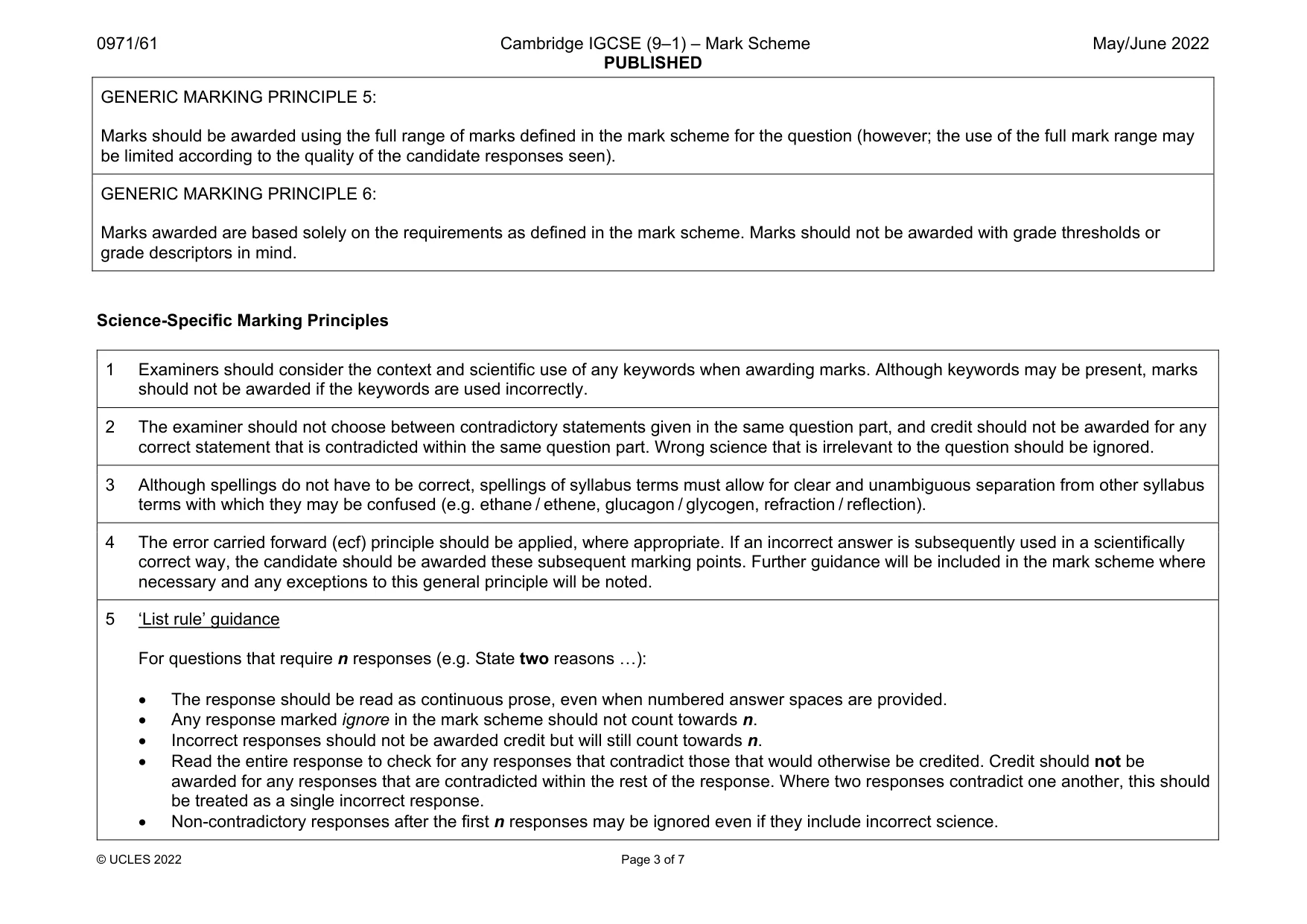
Mark scheme: 1(a) W (filter) funnel 1 X test-tube / boiling tube 1 1(b) to cool (the steam to form water) / to turn steam to water / to condense (the steam) / so water condenses 1 1(c) measure boiling point = 100 (°C) or measure freezing point = 0 (°C) 1 1(d) limewater / calcium hydroxide (solution) 1 1(e) contains carbon or hydrogen 1 1(f) use (acidified) potassium manganate(VII) 1 changes from purple to colourless 1
Q2 · A student investigated the rate at which hydrogen gas is made when magnesium reacts with…
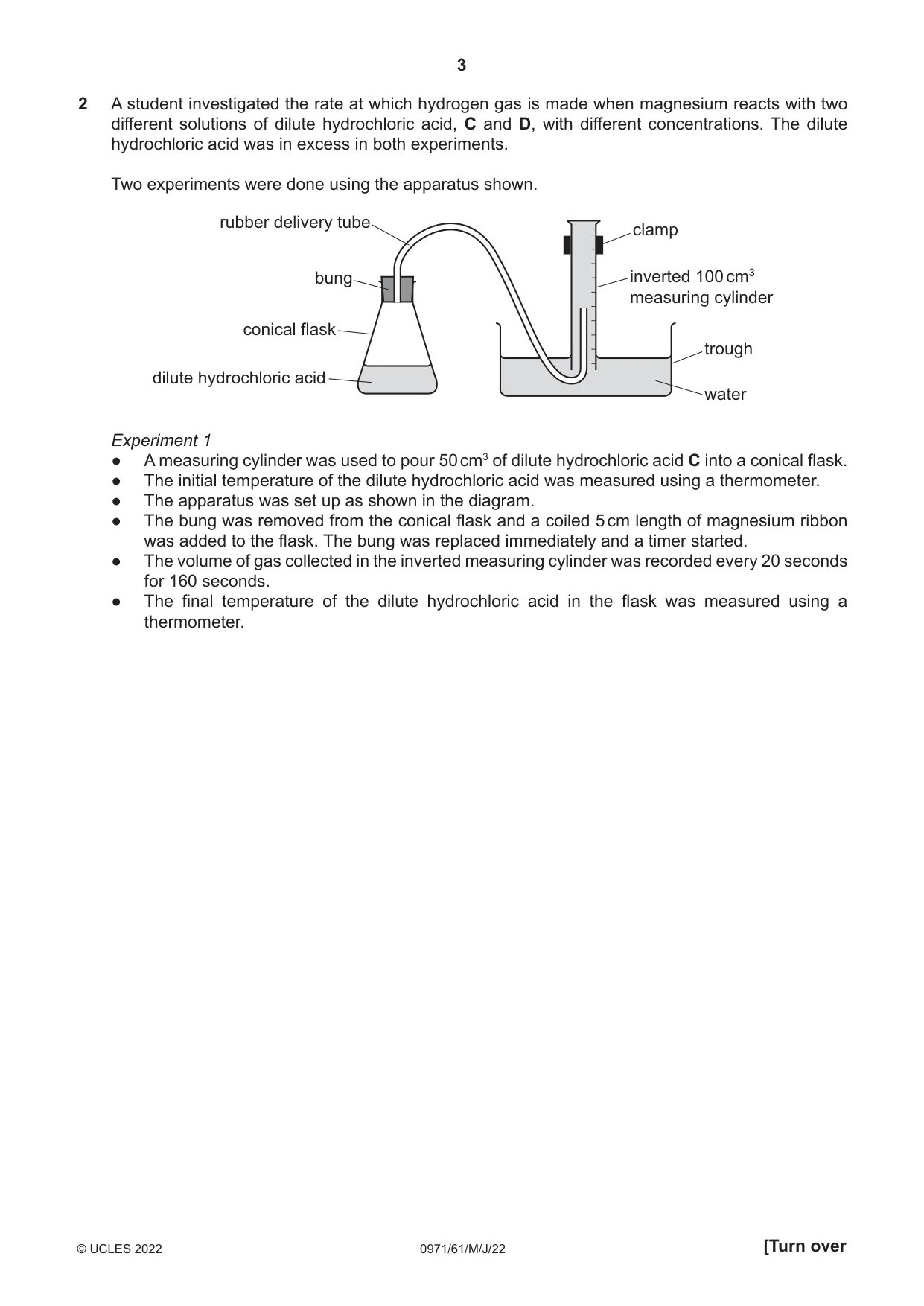
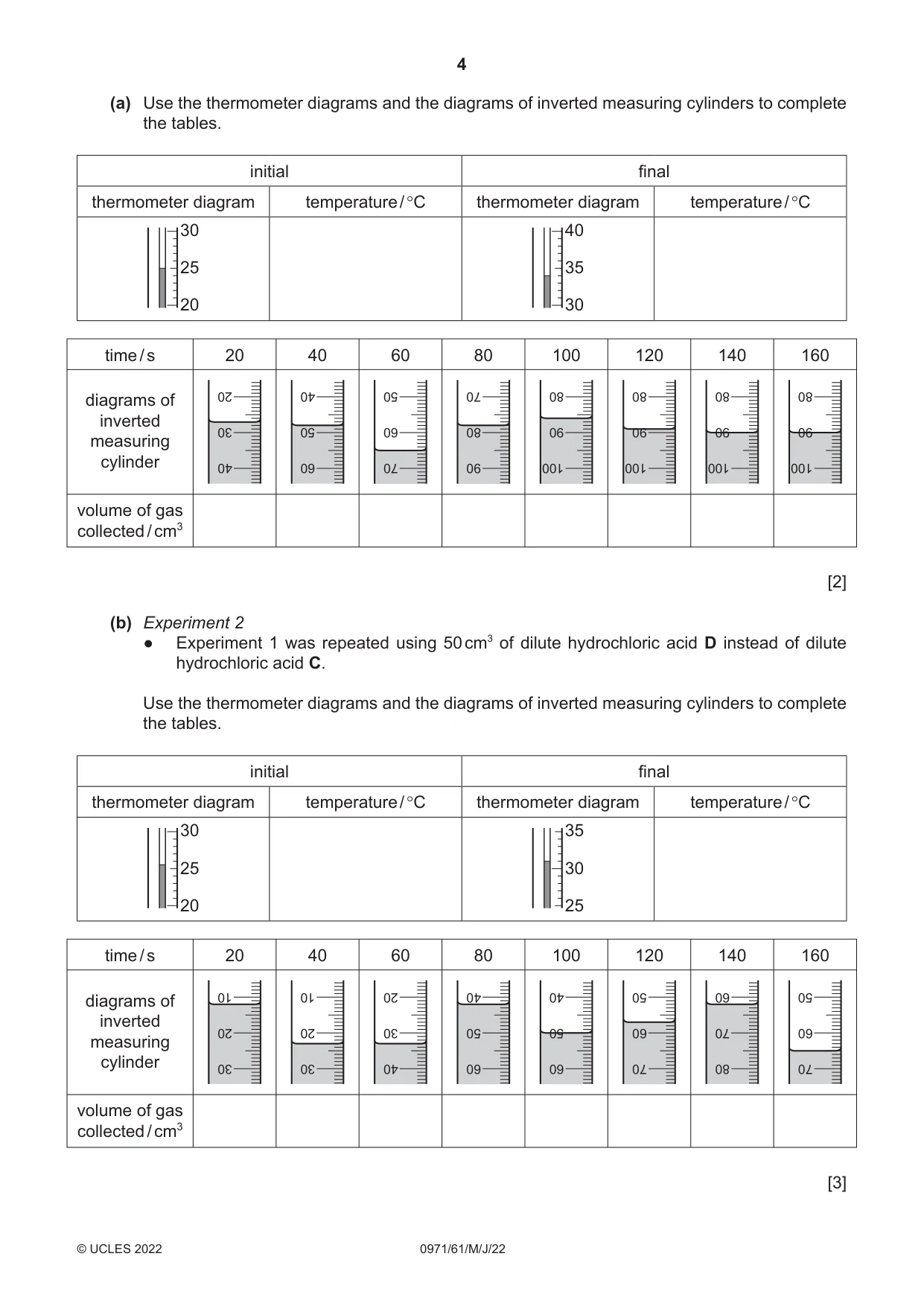
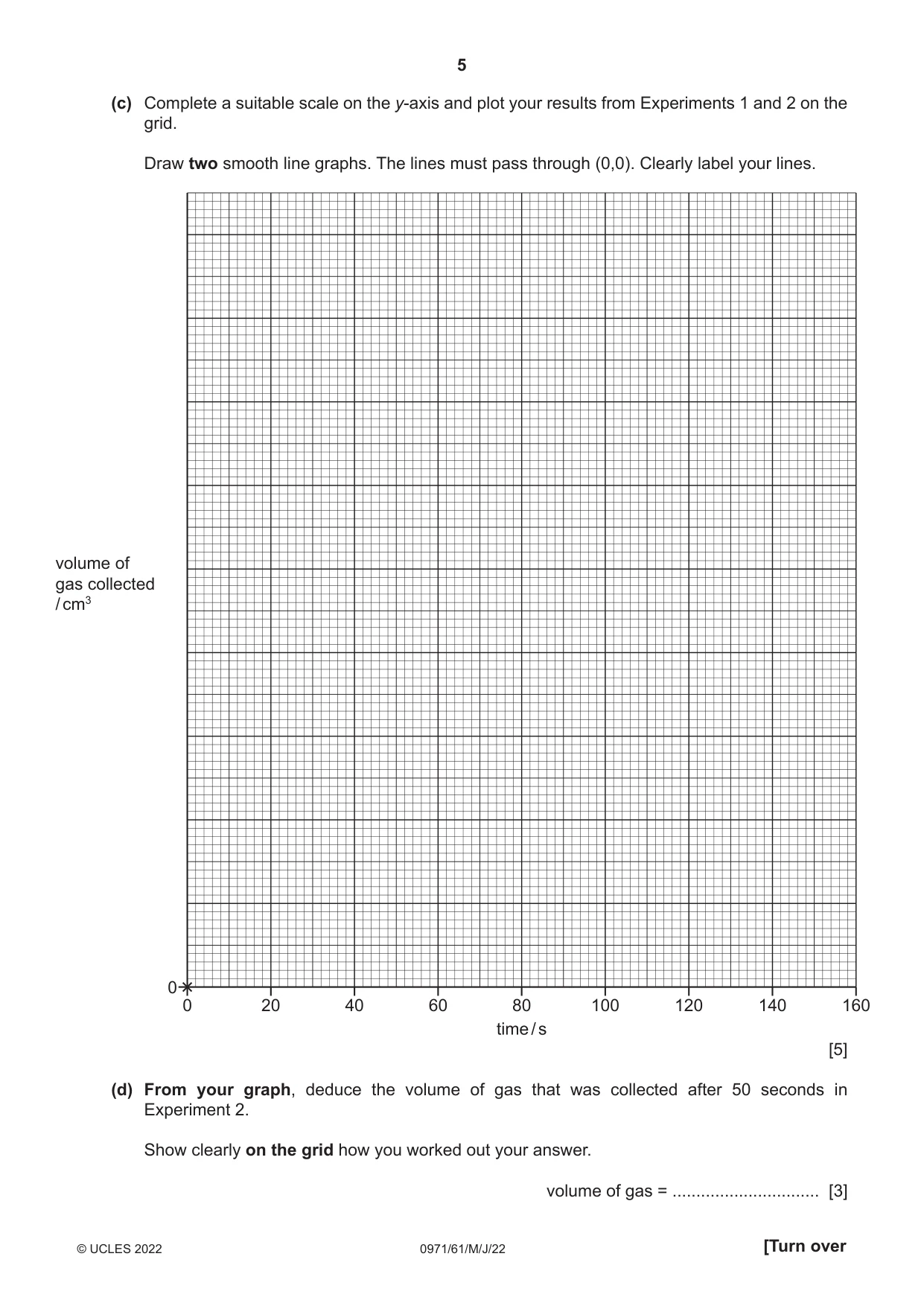
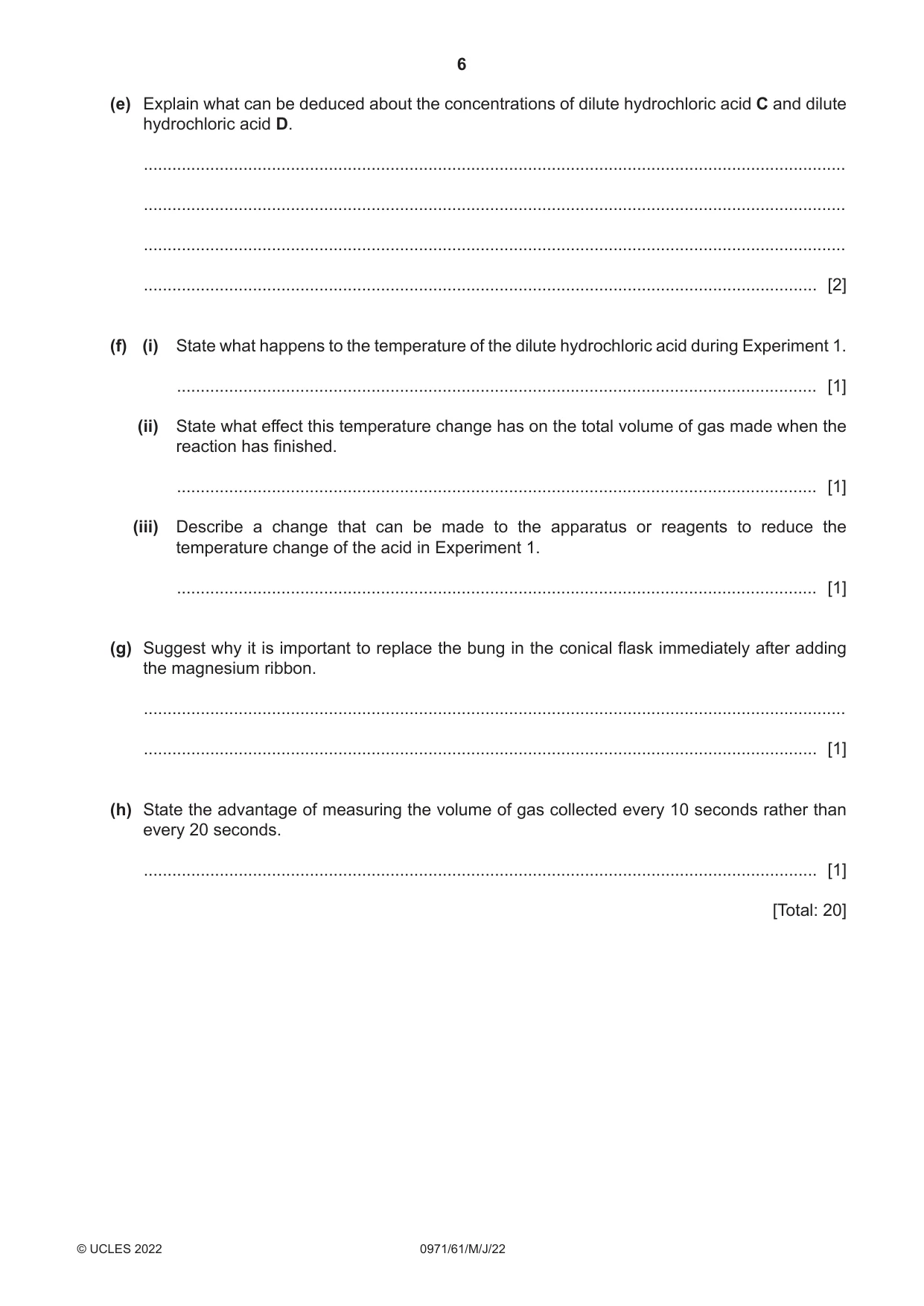
2 A student investigated the rate at which hydrogen gas is made when magnesium reacts with two different solutions of dilute hydrochloric acid, C and D, with different concentrations. The dilute hydrochloric acid was in excess in both experiments. Two experiments were done using the apparatus shown. rubber delivery tube clamp bung inverted 100 cm3 measuring cylinder conical flask trough dilute hydrochloric acid water Experiment 1 ● A measuring cylinder was used to pour 50 cm3 of dilute hydrochloric acid C into a conical flask. ● The initial temperature of the dilute hydrochloric acid was measured using a thermometer. ● The apparatus was set up as shown in the diagram. ● The bung was removed from the conical flask and a coiled 5 cm length of magnesium ribbon was added to the flask. The bung was replaced immediately and a timer started. ● The volume of gas collected in the inverted measuring cylinder was recorded every 20 seconds for 160 seconds. ● The final temperature of the dilute hydrochloric acid in the flask was measured using a thermometer. (a) Use the thermometer diagrams and the diagrams of inverted measuring cylinders to complete the tables. initial final thermometer diagram temperature / °C thermometer diagram temperature / °C 30 40 25 35 20 30 time / s 20 40 60 80 100 120 140 160 diagrams of 20 40 50 70 80 80 80 80 inverted 30 50 60 80 90 90 90 90 measuring cylinder 40 60 70 90 100 100 100 100 volume of gas collected / cm3 [2] (b) Experiment 2 ● Experiment 1 was repeated using 50 cm3 of dilute hydrochloric acid D instead of dilute hydrochloric acid C. Use the thermometer diagrams and the diagrams of inverted measuring cylinders to complete the tables. initial final thermometer diagram temperature / °C thermometer diagram temperature / °C 30 35 25 30 20 25 time / s 20 40 60 80 100 120 140 160 diagrams of 10 10 20 40 40 50 60 50 inverted 20 20 30 50 50 60 70 60 measuring cylinder 30 30 40 60 60 70 80 70 volume of gas collected / cm3 [3] (e) Explain what can be deduced about the concentrations of dilute hydrochloric acid C and dilute hydrochloric acid D. .................................................................................................................................................... .................................................................................................................................................... .................................................................................................................................................... .............................................................................................................................................. [2] (f) (i) State what happens to the temperature of the dilute hydrochloric acid during Experiment 1. ....................................................................................................................................... [1] (ii) State what effect this temperature change has on the total volume of gas made when the reaction has finished. ....................................................................................................................................... [1] (iii) Describe a change that can be made to the apparatus or reagents to reduce the temperature change of the acid in Experiment 1. ....................................................................................................................................... [1] (g) Suggest why it is important to replace the bung in the conical flask immediately after adding the magnesium ribbon. .................................................................................................................................................... .............................................................................................................................................. [1] (h) State the advantage of measuring the volume of gas collected every 10 seconds rather than every 20 seconds. .............................................................................................................................................. [1] [Total: 20]
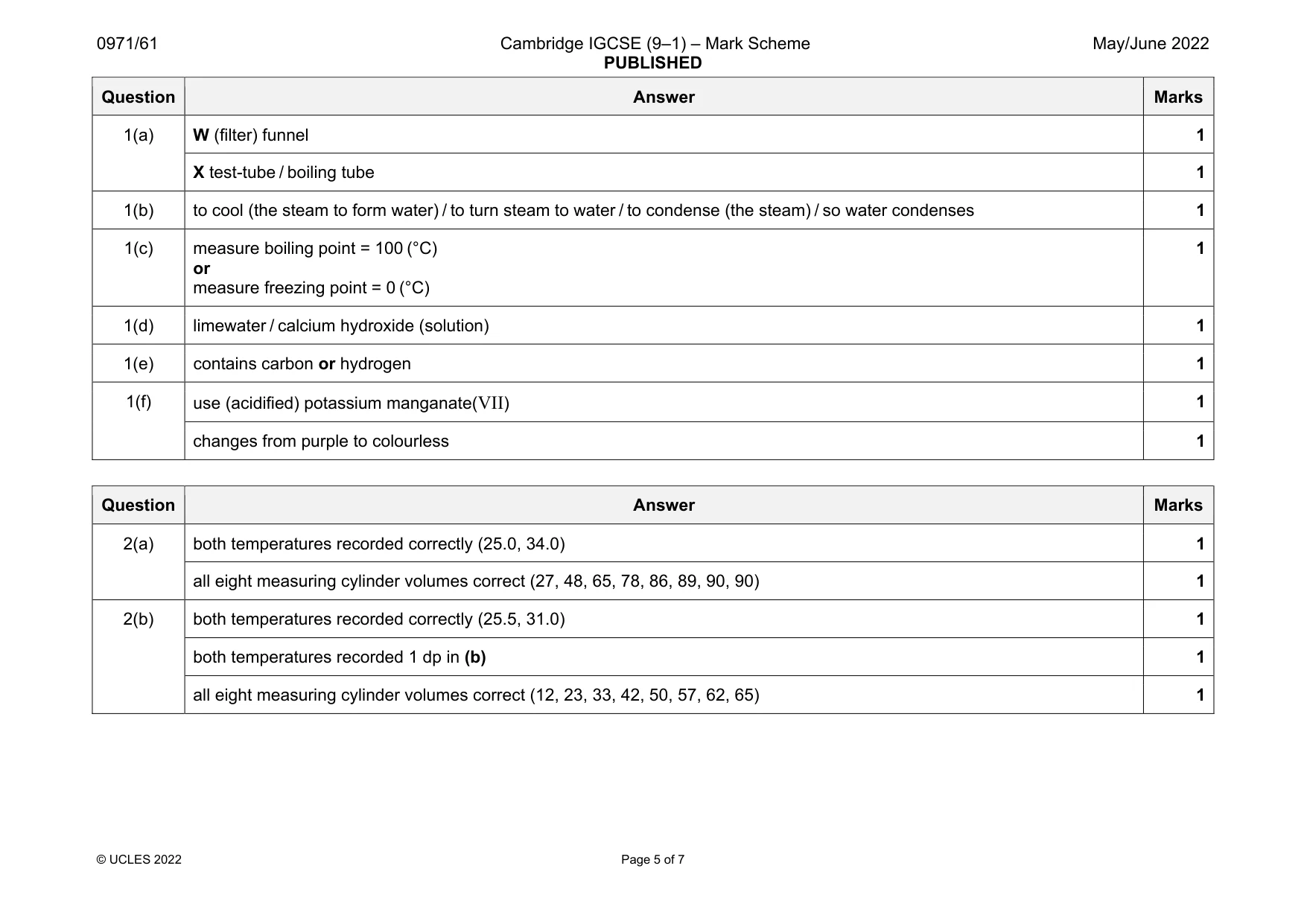
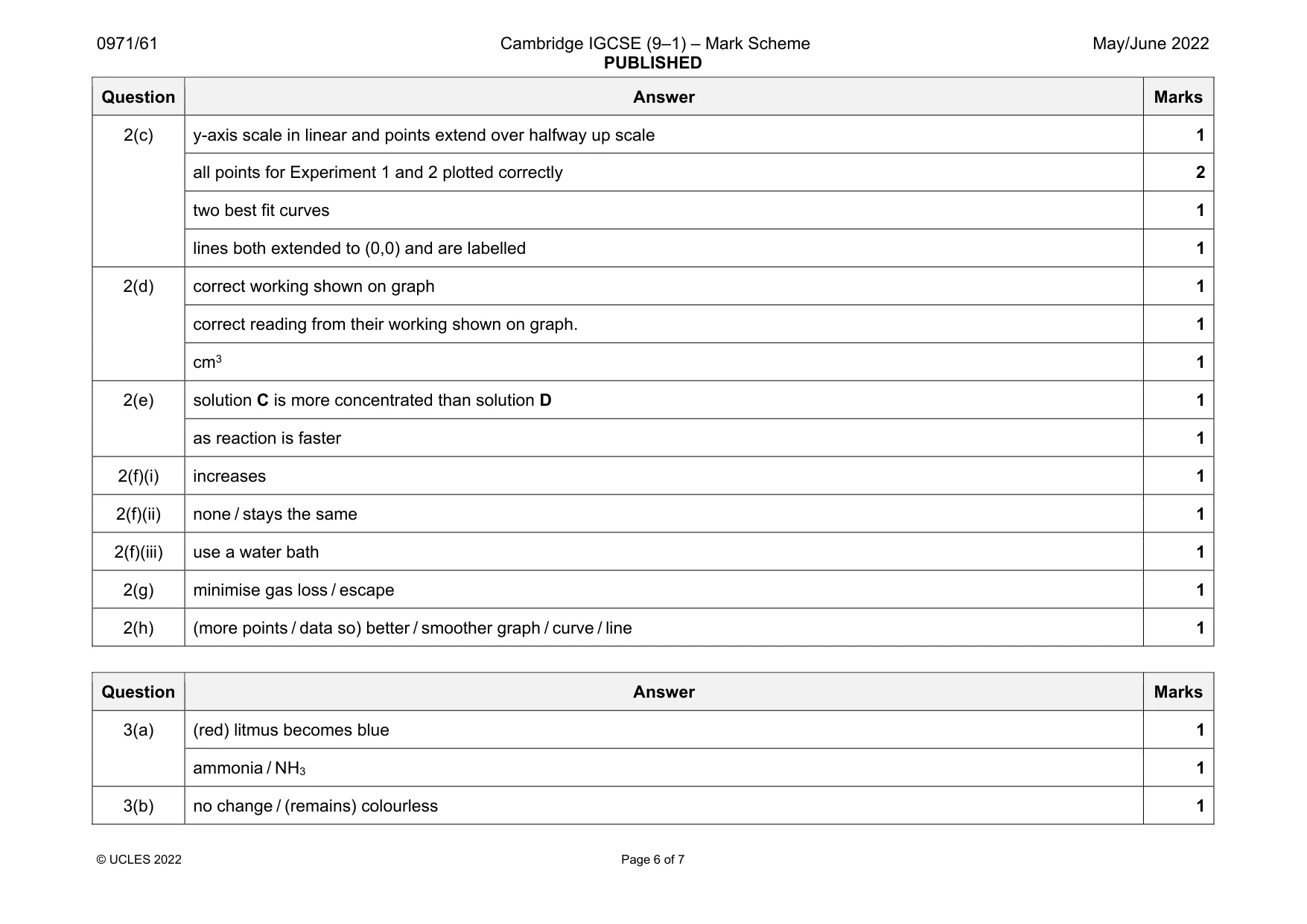
Mark scheme: 2(a) both temperatures recorded correctly (25.0, 34.0) 1 all eight measuring cylinder volumes correct (27, 48, 65, 78, 86, 89, 90, 90) 1 2(b) both temperatures recorded correctly (25.5, 31.0) 1 both temperatures recorded 1 dp in (b) 1 all eight measuring cylinder volumes correct (12, 23, 33, 42, 50, 57, 62, 65) 1 Question Answer Marks 2(c) y-axis scale in linear and points extend over halfway up scale 1 all points for Experiment 1 and 2 plotted correctly 2 two best fit curves 1 lines both extended to (0,0) and are labelled 1 2(d) correct working shown on graph 1 correct reading from their working shown on graph. 1 cm3 1 2(e) solution C is more concentrated than solution D 1 as reaction is faster 1 2(f)(i) increases 1 2(f)(ii) none / stays the same 1 2(f)(iii) use a water bath 1 2(g) minimise gas loss / escape 1 2(h) (more points / data so) better / smoother graph / curve / line 1
Q3 · Solid E and solution F were analysed
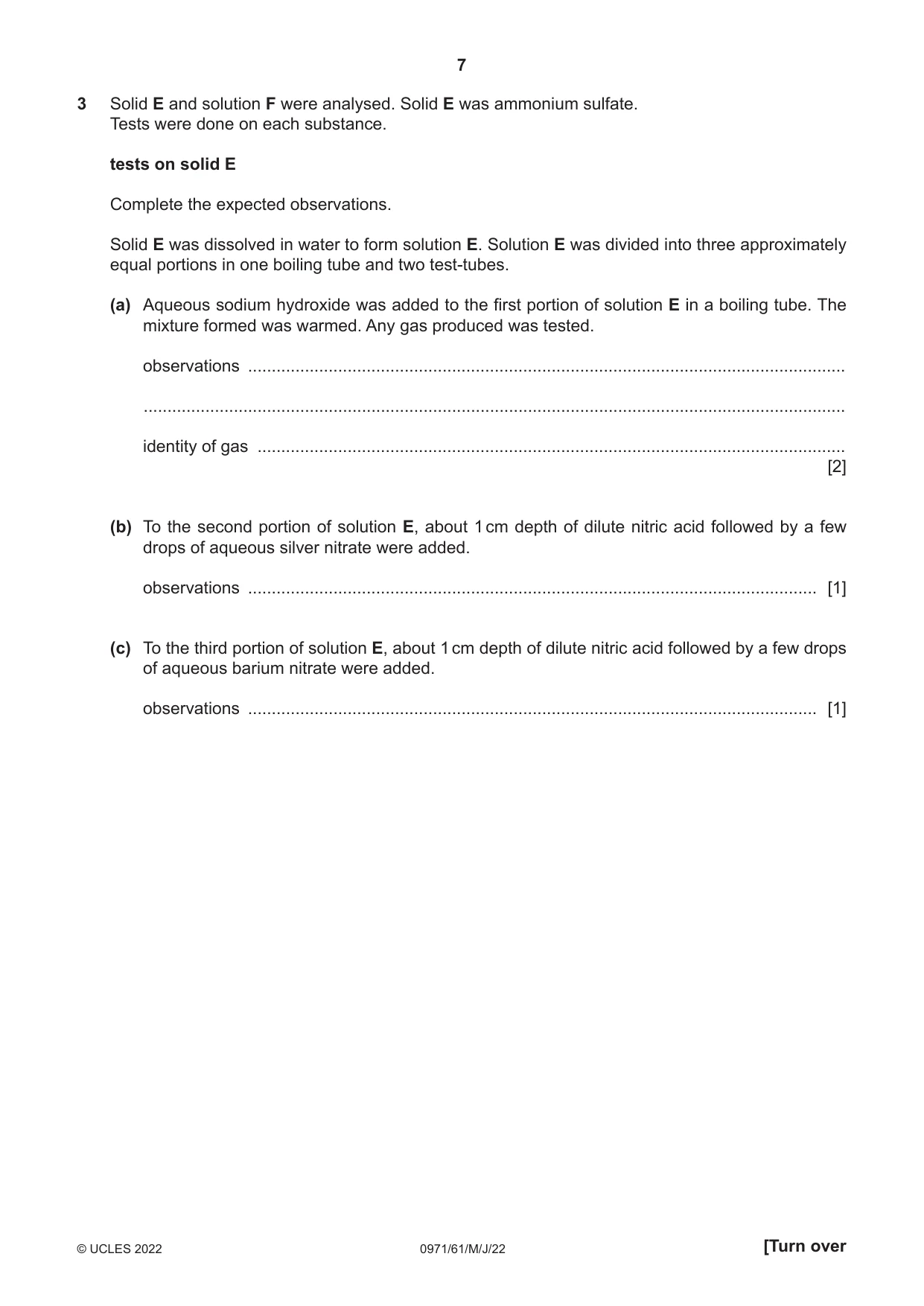
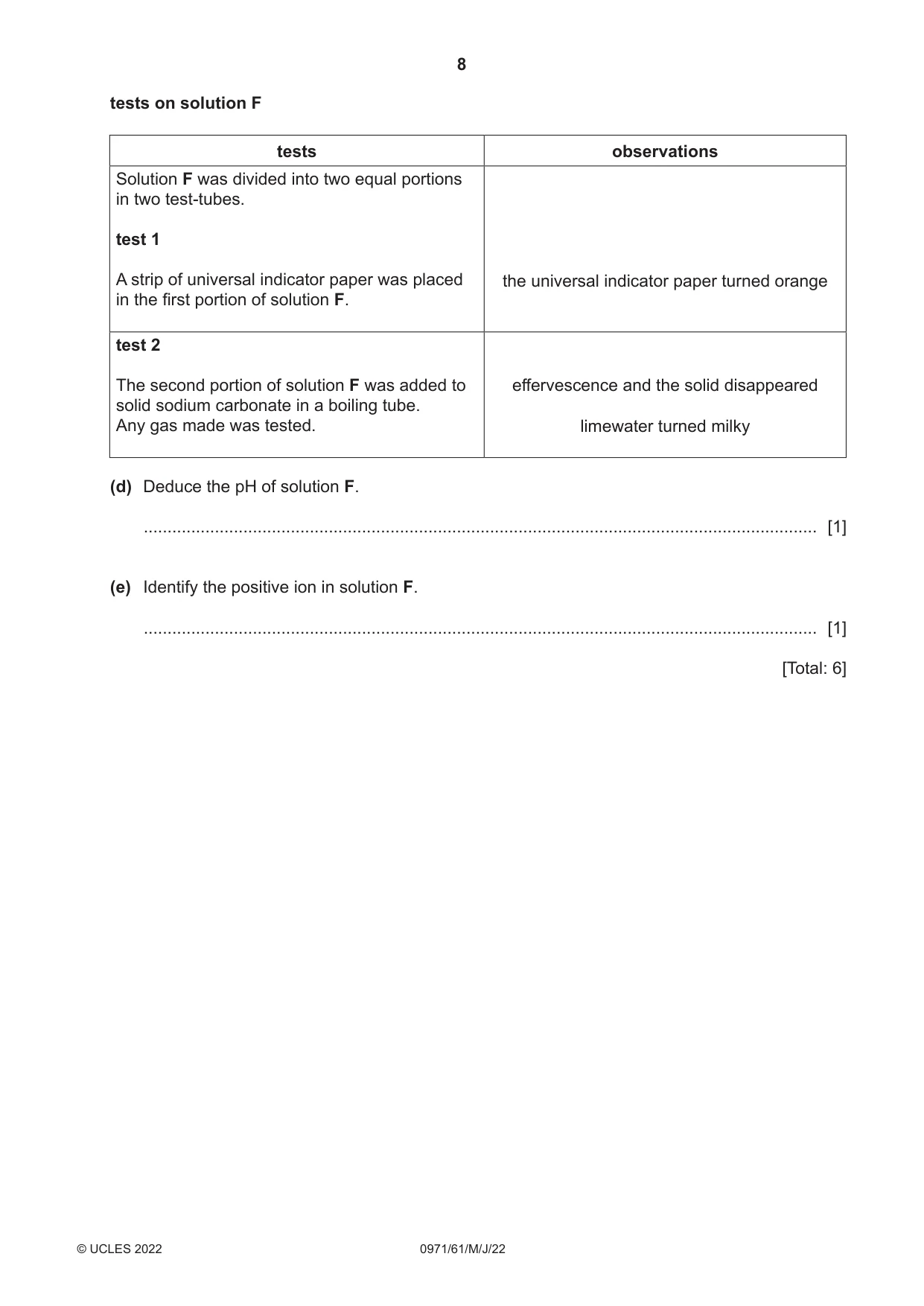
3 Solid E and solution F were analysed. Solid E was ammonium sulfate. Tests were done on each substance. tests on solid E Complete the expected observations. Solid E was dissolved in water to form solution E. Solution E was divided into three approximately equal portions in one boiling tube and two test-tubes. (a) Aqueous sodium hydroxide was added to the first portion of solution E in a boiling tube. The mixture formed was warmed. Any gas produced was tested. observations ............................................................................................................................... .................................................................................................................................................... identity of gas ............................................................................................................................. [2] (b) To the second portion of solution E, about 1 cm depth of dilute nitric acid followed by a few drops of aqueous silver nitrate were added. observations ......................................................................................................................... [1] (c) To the third portion of solution E, about 1 cm depth of dilute nitric acid followed by a few drops of aqueous barium nitrate were added. observations ......................................................................................................................... [1] tests on solution F tests observations Solution F was divided into two equal portions in two test-tubes. test 1 A strip of universal indicator paper was placed the universal indicator paper turned orange in the first portion of solution F. test 2 The second portion of solution F was added to effervescence and the solid disappeared solid sodium carbonate in a boiling tube. Any gas made was tested. limewater turned milky (d) Deduce the pH of solution F. .............................................................................................................................................. [1] (e) Identify the positive ion in solution F. .............................................................................................................................................. [1] [Total: 6]
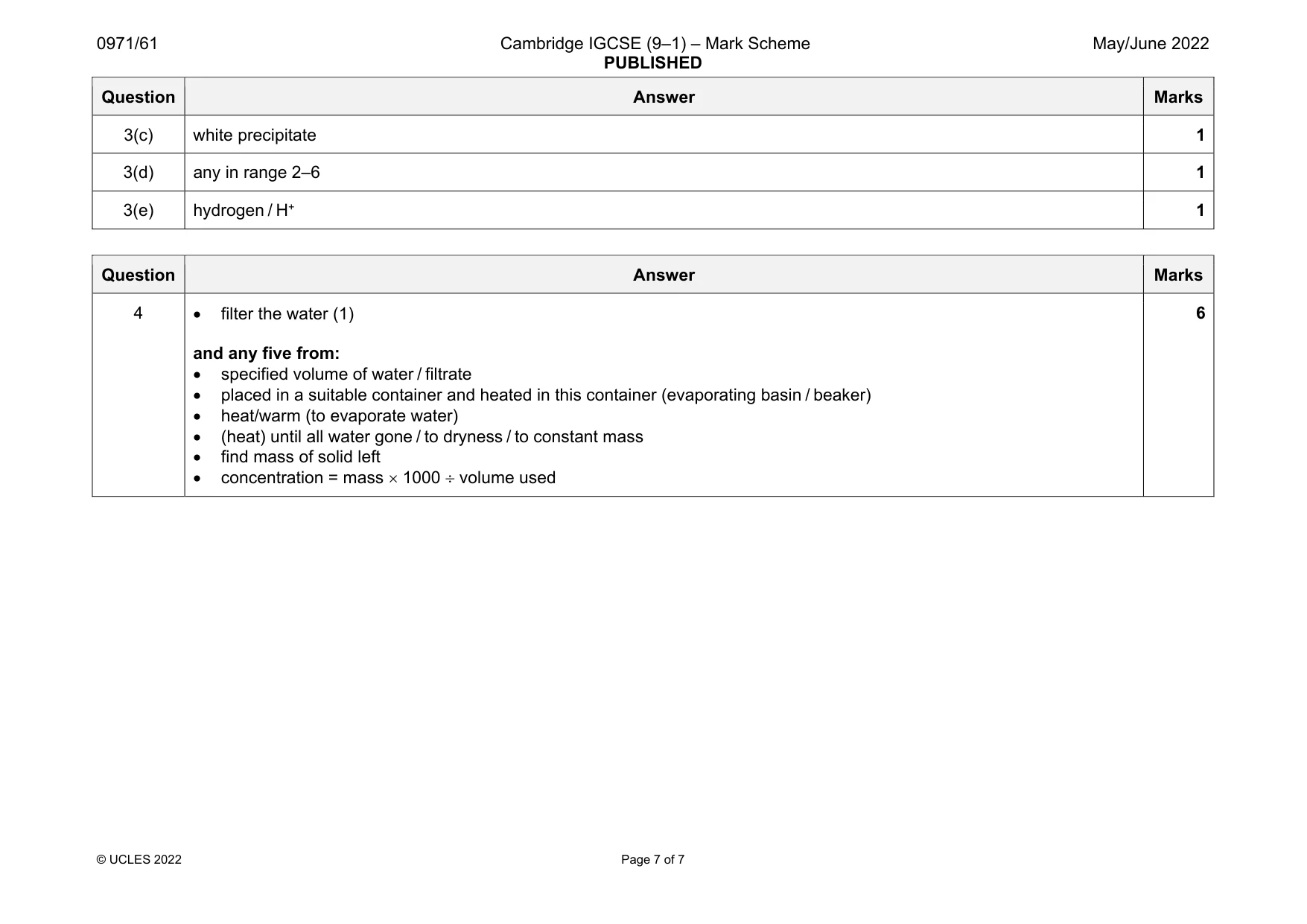
Mark scheme: 3(a) (red) litmus becomes blue 1 ammonia / NH3 1 3(b) no change / (remains) colourless 1 Question Answer Marks 3(c) white precipitate 1 3(d) any in range 2–6 1 3(e) hydrogen / H+ 1
Q4 · A sample of muddy river water contains water, dissolved solids and insoluble solid mud
4 A sample of muddy river water contains water, dissolved solids and insoluble solid mud. Plan an investigation to find the concentration of dissolved solids, in g / dm3, in the river water. In your answer state how you will work out the concentration of the dissolved solids in g / dm3. You are provided with a small sample (less than 1 dm3) of muddy river water and common laboratory apparatus. (1 dm3 = 1000 cm3) ........................................................................................................................................................... ........................................................................................................................................................... ........................................................................................................................................................... ........................................................................................................................................................... ........................................................................................................................................................... ........................................................................................................................................................... ........................................................................................................................................................... ........................................................................................................................................................... ........................................................................................................................................................... ........................................................................................................................................................... ........................................................................................................................................................... ........................................................................................................................................................... ........................................................................................................................................................... ........................................................................................................................................................... ........................................................................................................................................................... ........................................................................................................................................................... ........................................................................................................................................................... ........................................................................................................................................................... ........................................................................................................................................................... ........................................................................................................................................................... ........................................................................................................................................................... ..................................................................................................................................................... [6]
Mark scheme: 4 filter the water (1) and any five from: specified volume of water / filtrate placed in a suitable container and heated in this container (evaporating basin / beaker) heat/warm (to evaporate water) (heat) until all water gone / to dryness / to constant mass find mass of solid left concentration = mass 1000 volume used 6
What was in this paper
The subtopics covered by these 4 questions, and how many questions each got. Open one in a new tab to see every Cambridge question on it.
What you needed in this session
Cambridge’s own grade thresholds for 2022 May/June, Paper 6 · Variant 1. A higher threshold means an easier paper — the bar moves with how the cohort did.