Cambridge IGCSE Chemistry (9-1) 0971 — 2024 Oct/Nov Paper 6 · Variant 2
0971/62/O/N/24 · 4 questions · 40 marks · 60 min
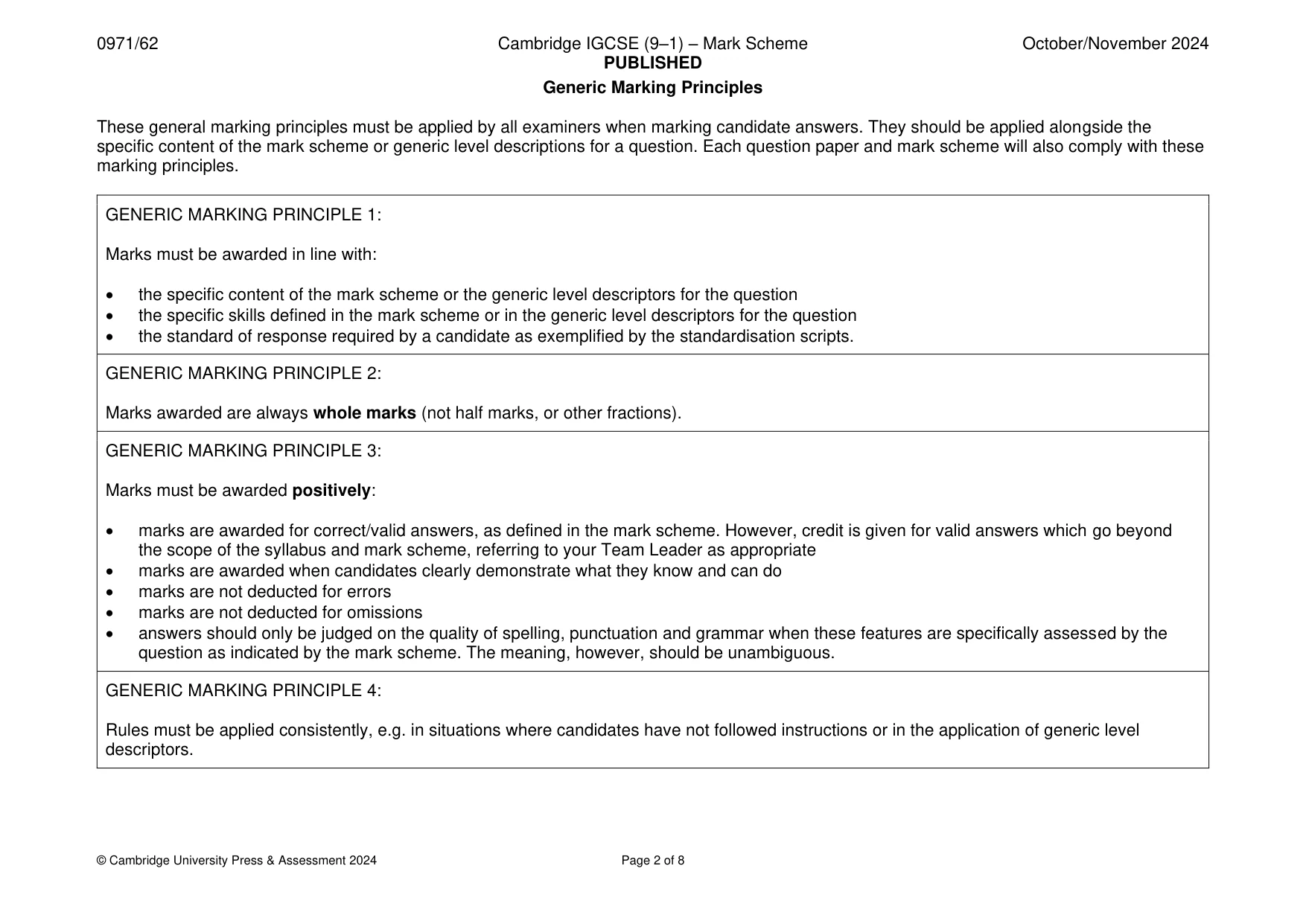
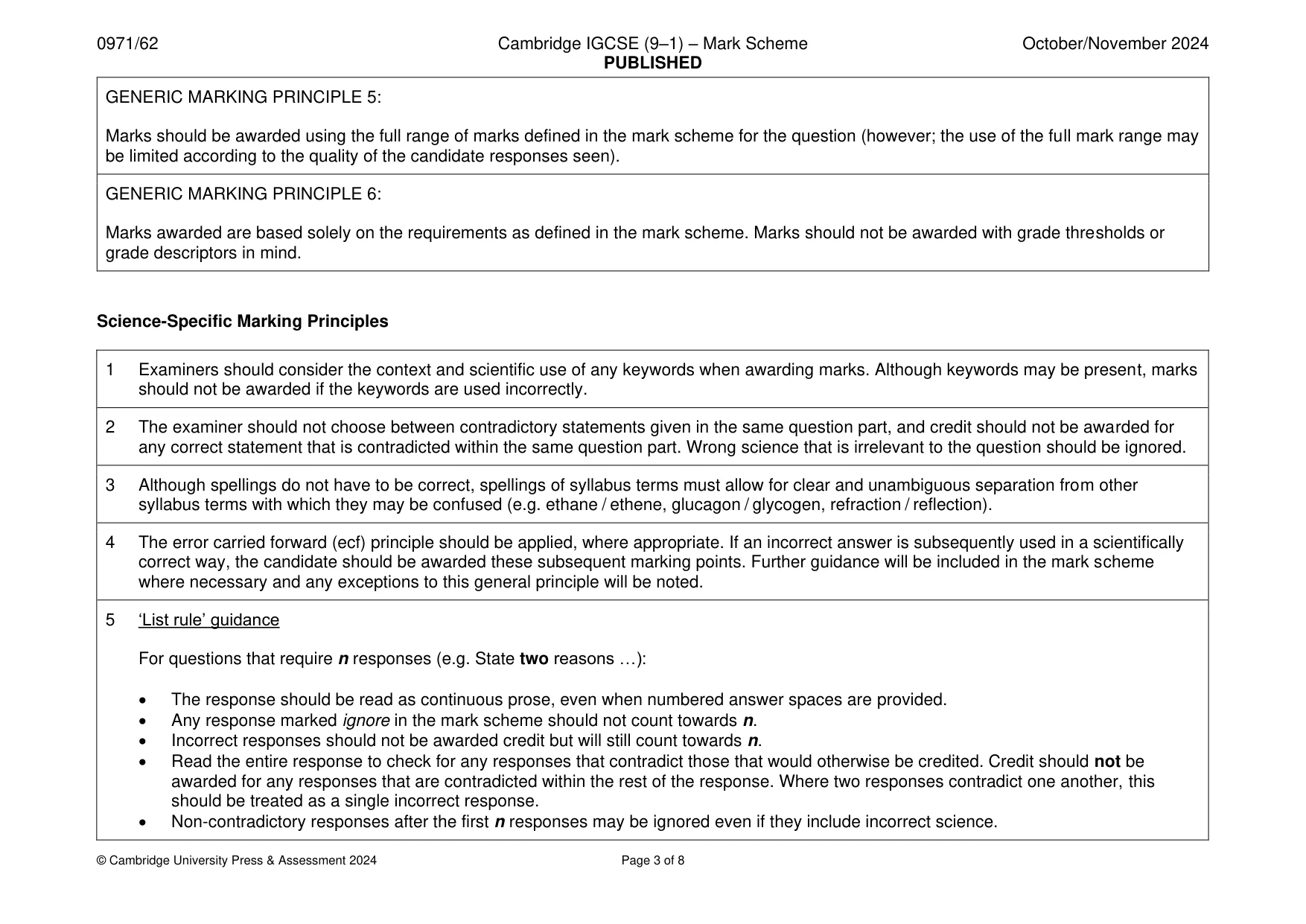
The question paper and its mark scheme, free to read here and free to download. This is Cambridge’s own paper, exactly as it was sat.
Question paper16 pages

Mark scheme8 pages
Answers below. Sit the paper first if you are practising.
Questions as text
Q1 · A teacher uses the apparatus shown in Fig
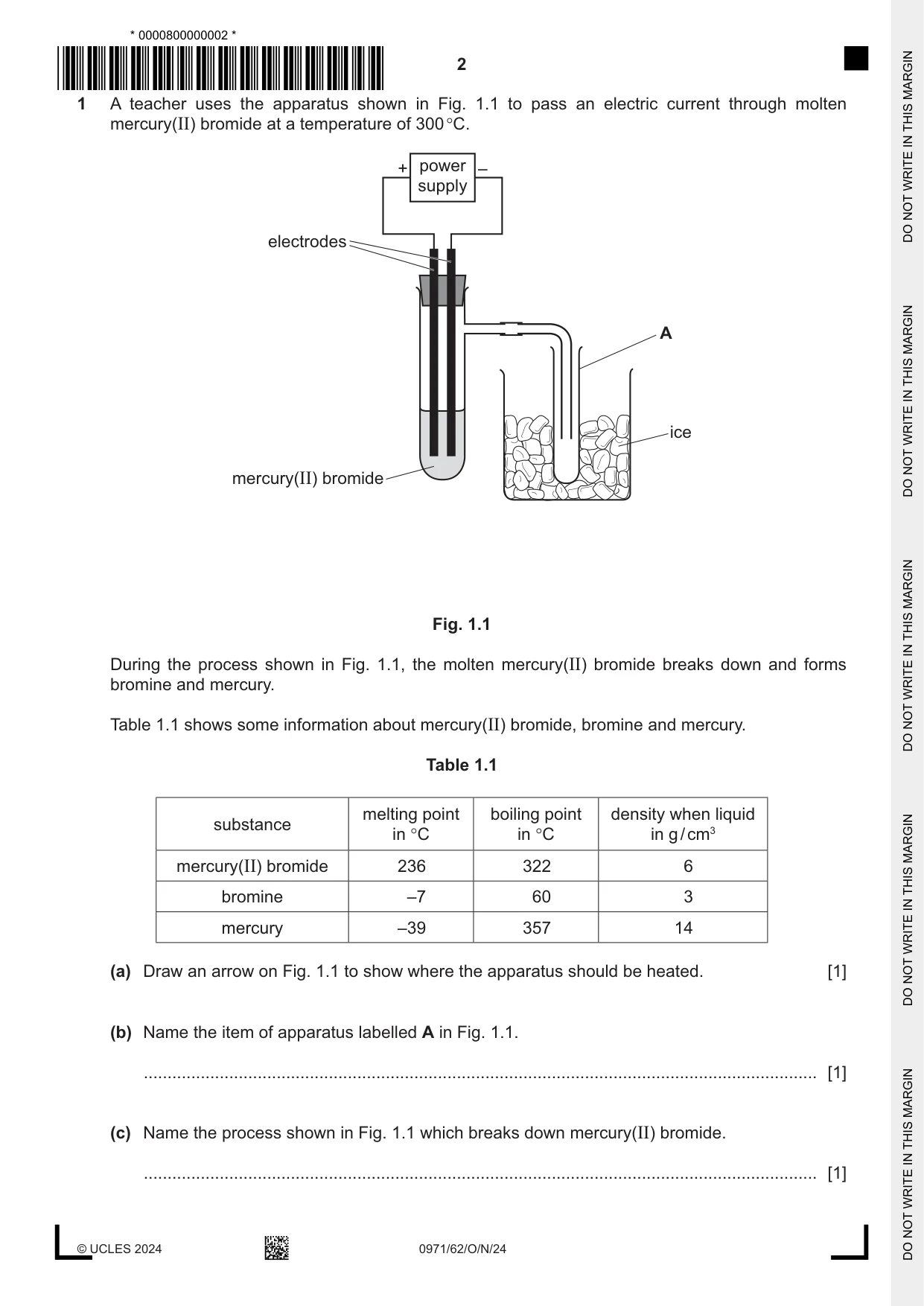
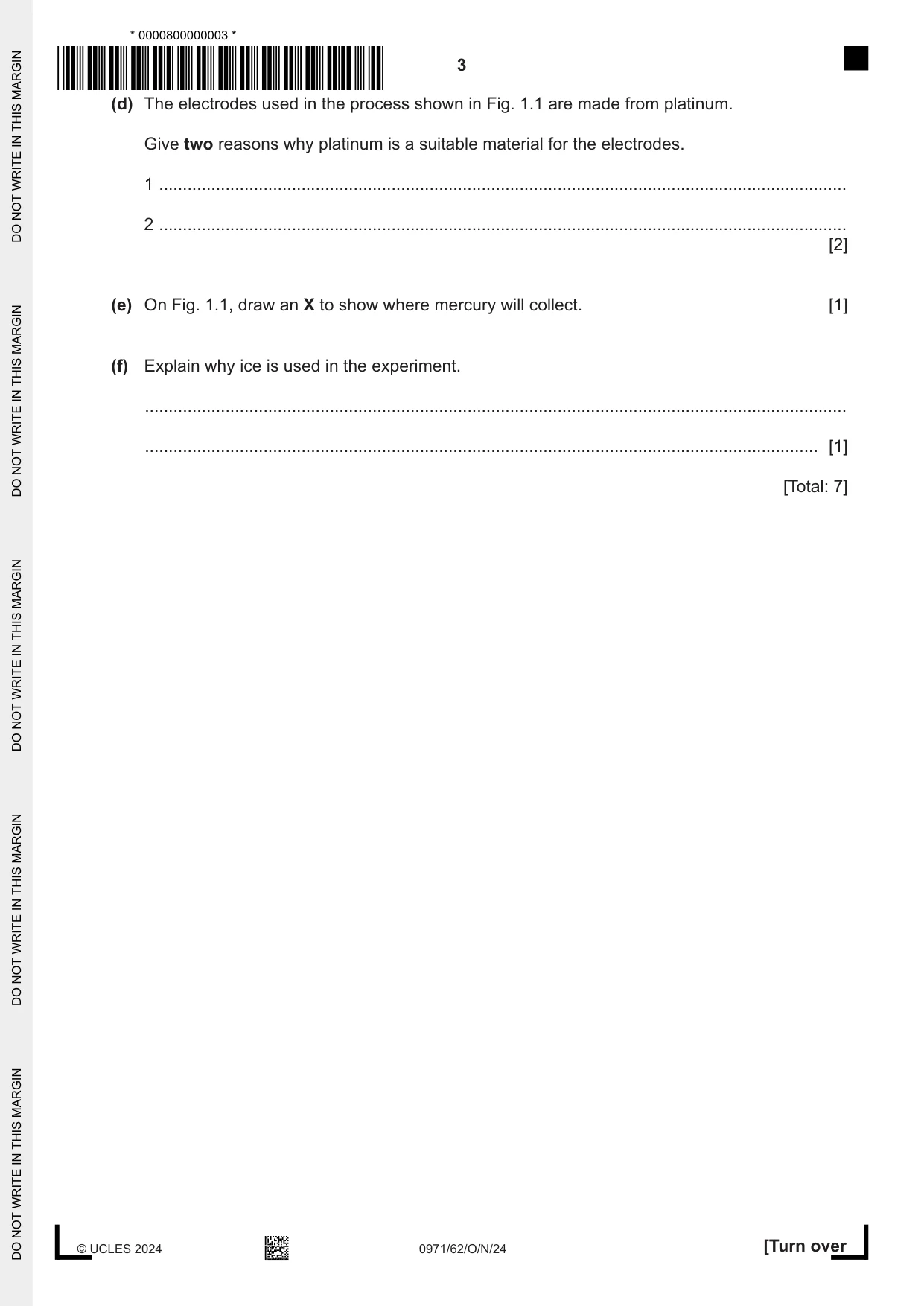
1 A teacher uses the apparatus shown in Fig. 1.1 to pass an electric current through molten mercury(II) bromide at a temperature of 300 °C. + power – supply electrodes A ice mercury(II) bromide Fig. 1.1 During the process shown in Fig. 1.1, the molten mercury(II) bromide breaks down and forms bromine and mercury. Table 1.1 shows some information about mercury(II) bromide, bromine and mercury. Table 1.1 melting point boiling point density when liquid substance in °C in °C in g / cm3 mercury(II) bromide 236 322 6 bromine –7 60 3 mercury –39 357 14 (a) Draw an arrow on Fig. 1.1 to show where the apparatus should be heated. [1] (b) Name the item of apparatus labelled A in Fig. 1.1. .............................................................................................................................................. [1] (c) Name the process shown in Fig. 1.1 which breaks down mercury(II) bromide. .............................................................................................................................................. [1] (d) The electrodes used in the process shown in Fig. 1.1 are made from platinum. Give two reasons why platinum is a suitable material for the electrodes. 1 ................................................................................................................................................. 2 ................................................................................................................................................. [2] (e) On Fig. 1.1, draw an X to show where mercury will collect. [1] (f) Explain why ice is used in the experiment. .................................................................................................................................................... .............................................................................................................................................. [1] [Total: 7]
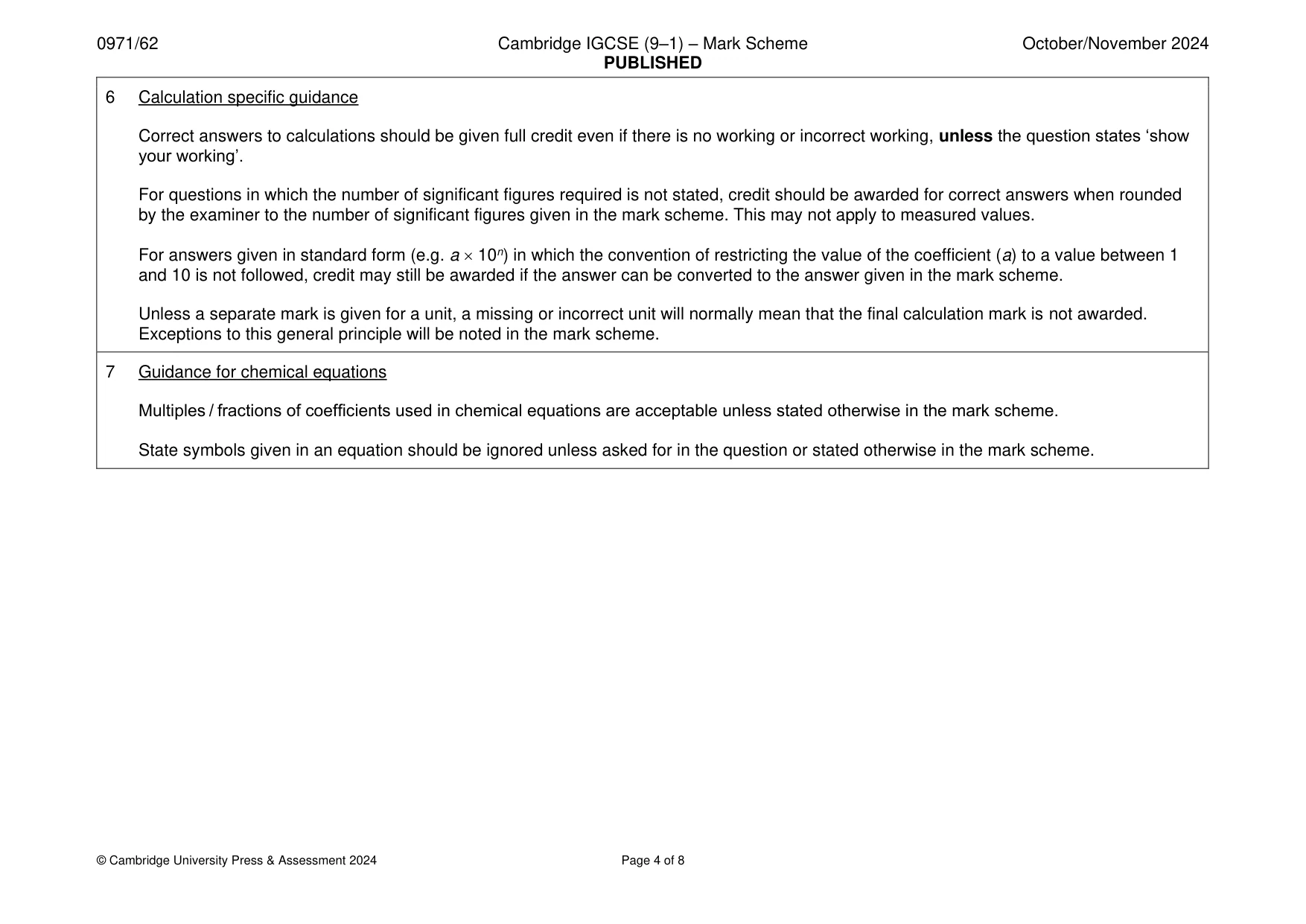
Mark scheme: Question Answer Marks 1(a) an arrow pointing to the bottom of the left-hand tube 1 1(b) test-tube / boiling tube 1 1(c) electrolysis 1 1(d) any two from: 2 • conducts electricity • high melting point / melts above 322 C • does not react (with bromine / mercury(II) bromide / mercury / salt / compound) / inert 1(e) X drawn in tube under the electrodes inside the left-hand tube 1 1(f) condenses (the bromine / the gas / vapour) 1
Q2 · A student investigates the rate of the reaction between aqueous iron(III) nitrate and…
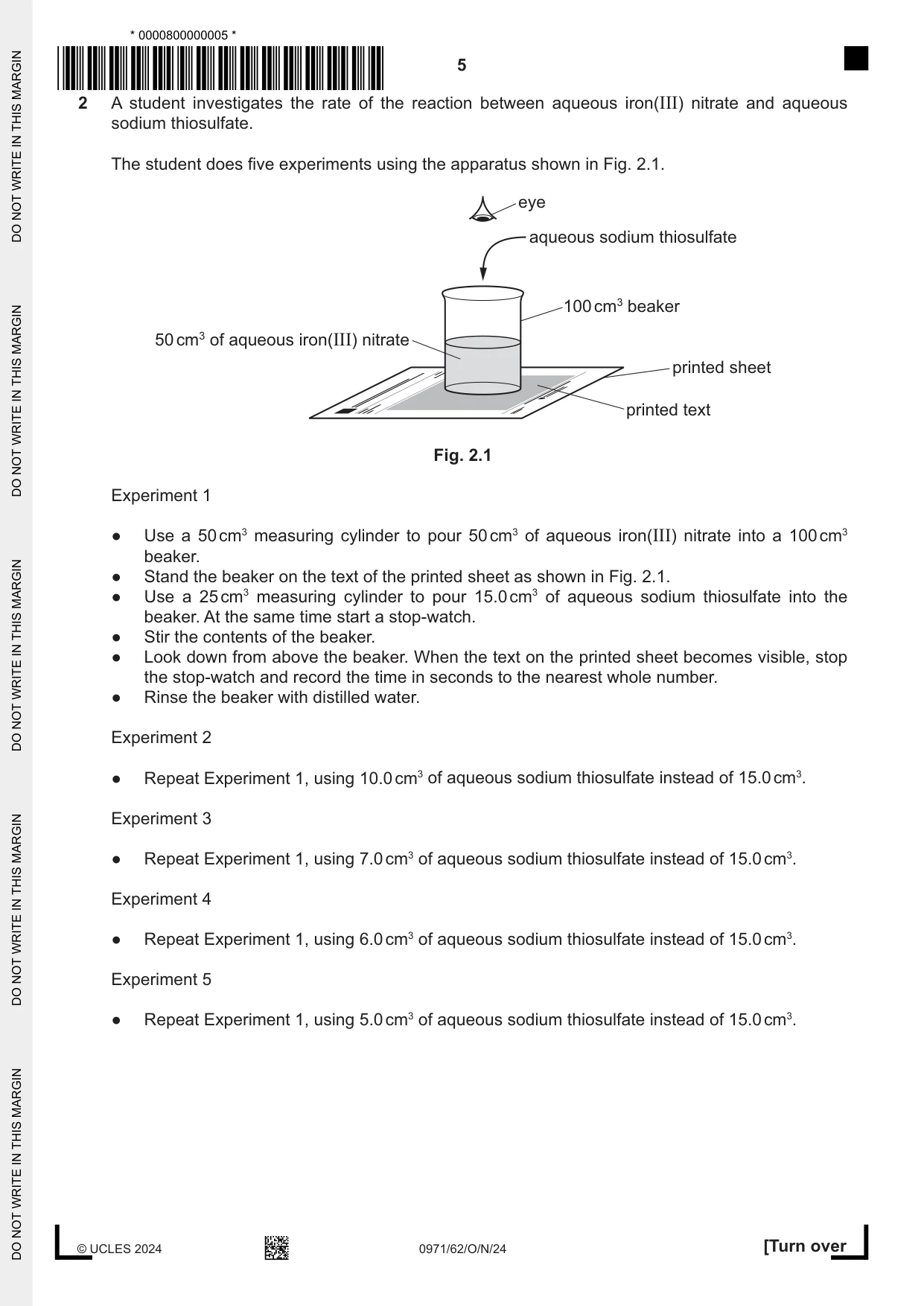
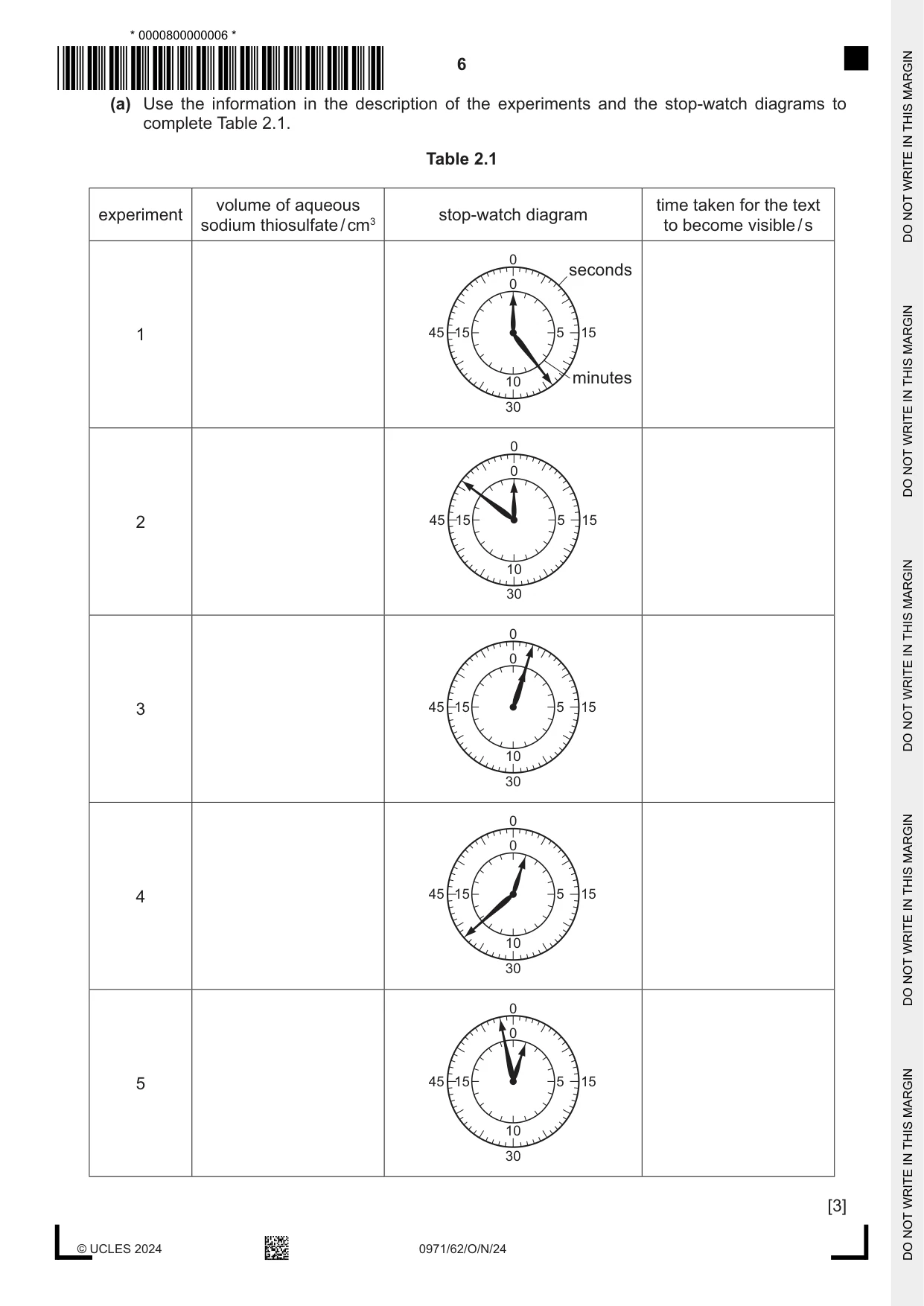
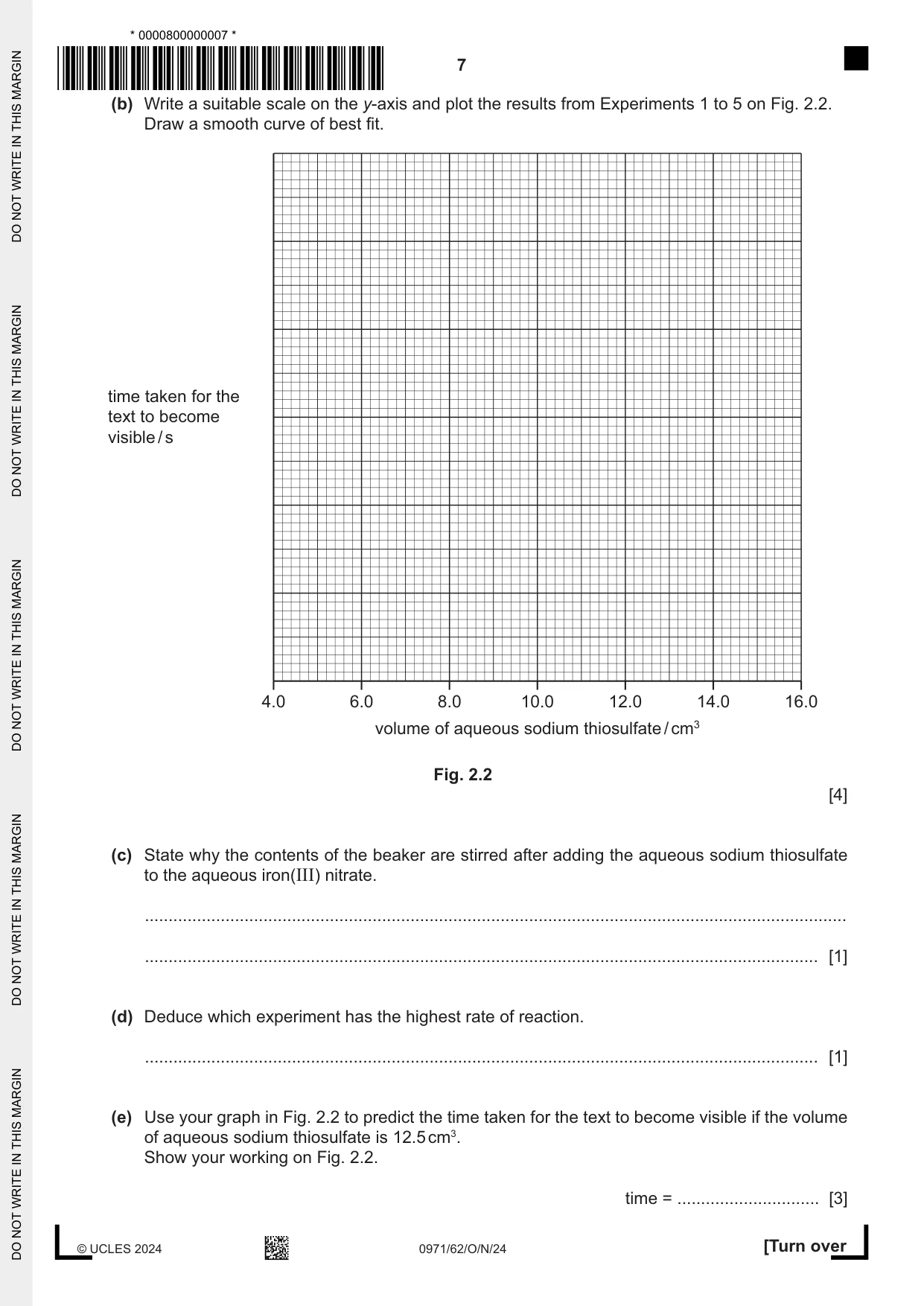
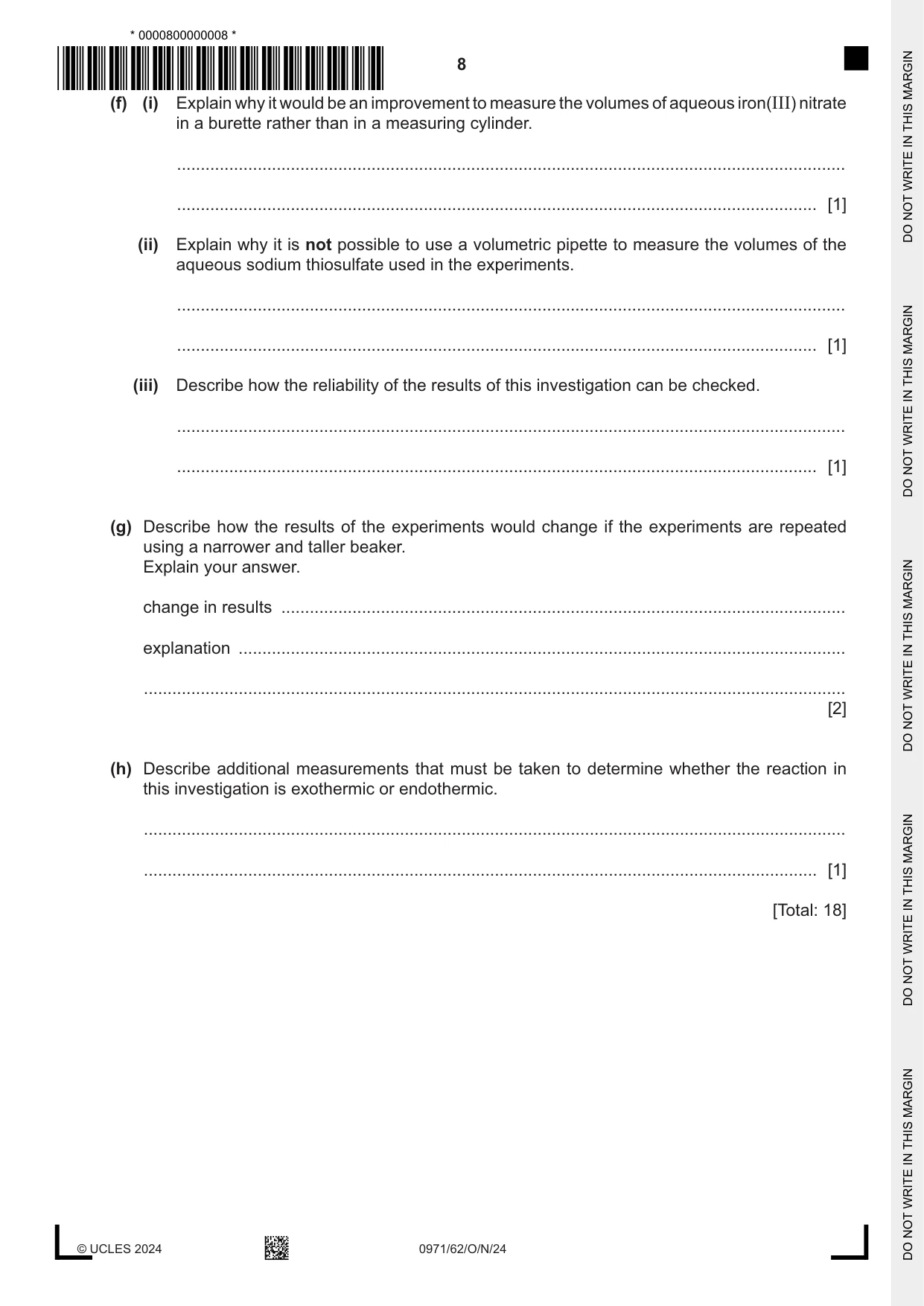
2 A student investigates the rate of the reaction between aqueous iron(III) nitrate and aqueous sodium thiosulfate. The student does five experiments using the apparatus shown in Fig. 2.1. eye aqueous sodium thiosulfate 100 cm3 beaker 50 cm3 of aqueous iron(III) nitrate printed sheet printed text Fig. 2.1 Experiment 1 ● Use a 50 cm3 measuring cylinder to pour 50 cm3 of aqueous iron(III) nitrate into a 100 cm3 beaker. ● Stand the beaker on the text of the printed sheet as shown in Fig. 2.1. ● Use a 25 cm3 measuring cylinder to pour 15.0 cm3 of aqueous sodium thiosulfate into the beaker. At the same time start a stop-watch. ● Stir the contents of the beaker. ● Look down from above the beaker. When the text on the printed sheet becomes visible, stop the stop-watch and record the time in seconds to the nearest whole number. ● Rinse the beaker with distilled water. Experiment 2 ● Repeat Experiment 1, using 10.0 cm3 of aqueous sodium thiosulfate instead of 15.0 cm3. Experiment 3 ● Repeat Experiment 1, using 7.0 cm3 of aqueous sodium thiosulfate instead of 15.0 cm3. Experiment 4 ● Repeat Experiment 1, using 6.0 cm3 of aqueous sodium thiosulfate instead of 15.0 cm3. Experiment 5 ● Repeat Experiment 1, using 5.0 cm3 of aqueous sodium thiosulfate instead of 15.0 cm3. (a) Use the information in the description of the experiments and the stop-watch diagrams to complete Table 2.1. Table 2.1 volume of aqueous time taken for the text experiment stop-watch diagram sodium thiosulfate / cm3 to become visible / s 0 seconds 0 1 45 15 5 15 10 minutes 30 0 0 2 45 15 5 15 10 30 0 0 3 45 15 5 15 10 30 0 0 4 45 15 5 15 10 30 0 0 5 45 15 5 15 10 30 [3] (b) Write a suitable scale on the y-axis and plot the results from Experiments 1 to 5 on Fig. 2.2. Draw a smooth curve of best fit. time taken for the text to become visible / s 4.0 6.0 8.0 10.0 12.0 14.0 16.0 volume of aqueous sodium thiosulfate / cm3 Fig. 2.2 [4] (c) State why the contents of the beaker are stirred after adding the aqueous sodium thiosulfate to the aqueous iron(III) nitrate. .................................................................................................................................................... .............................................................................................................................................. [1] (d) Deduce which experiment has the highest rate of reaction. .............................................................................................................................................. [1] (e) Use your graph in Fig. 2.2 to predict the time taken for the text to become visible if the volume of aqueous sodium thiosulfate is 12.5 cm3. Show your working on Fig. 2.2. time = .............................. [3] (f) (i) Explain why it would be an improvement to measure the volumes of aqueous iron(III) nitrate in a burette rather than in a measuring cylinder. ............................................................................................................................................. ....................................................................................................................................... [1] (ii) Explain why it is not possible to use a volumetric pipette to measure the volumes of the aqueous sodium thiosulfate used in the experiments. ............................................................................................................................................. ....................................................................................................................................... [1] (iii) Describe how the reliability of the results of this investigation can be checked. ............................................................................................................................................. ....................................................................................................................................... [1] (g) Describe how the results of the experiments would change if the experiments are repeated using a narrower and taller beaker. Explain your answer. change in results ....................................................................................................................... explanation ................................................................................................................................ .................................................................................................................................................... [2] (h) Describe additional measurements that must be taken to determine whether the reaction in this investigation is exothermic or endothermic. .................................................................................................................................................... .............................................................................................................................................. [1] [Total: 18] Question 3 starts on the next page.
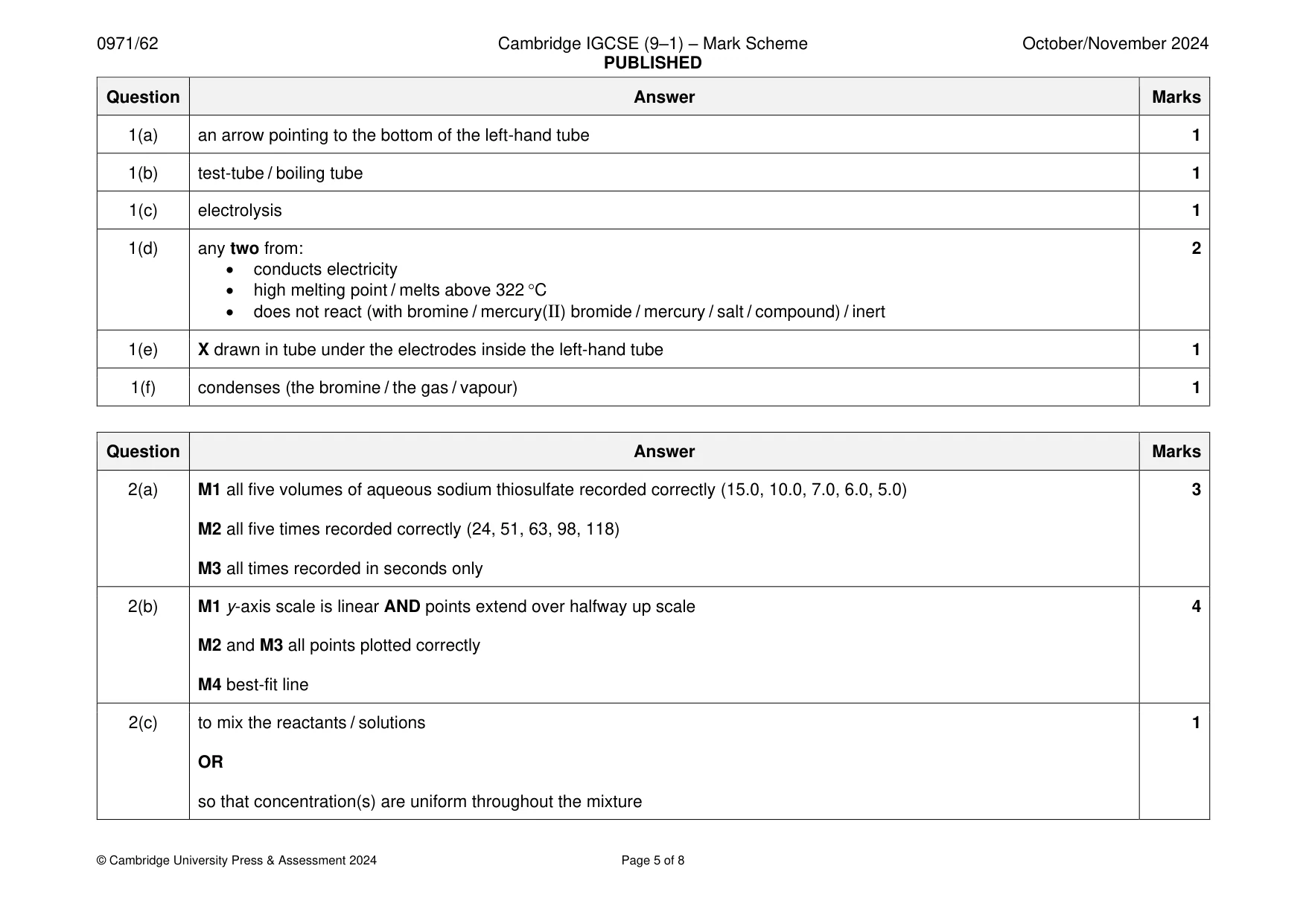
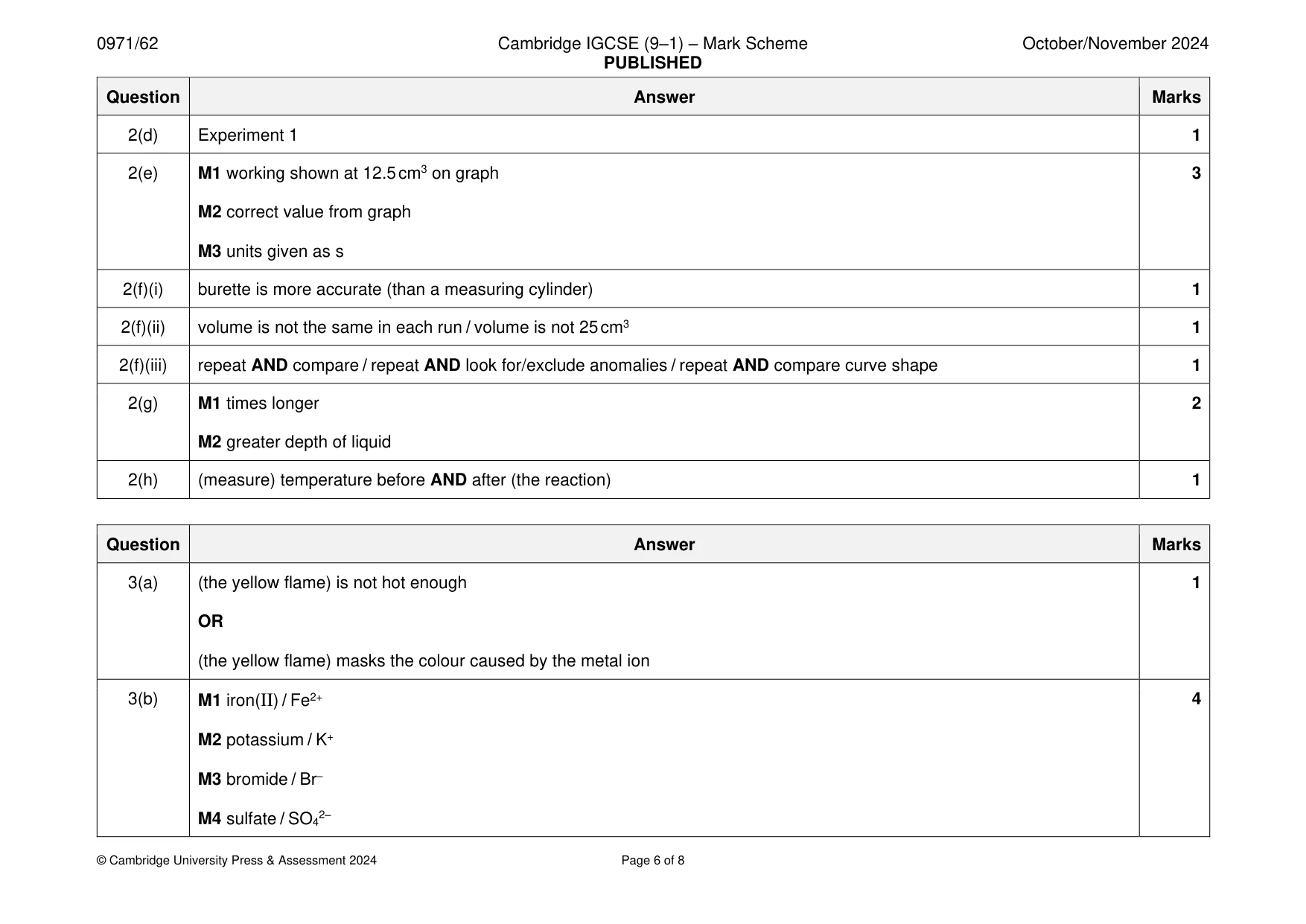
Mark scheme: 2(a) M1 all five volumes of aqueous sodium thiosulfate recorded correctly (15.0, 10.0, 7.0, 6.0, 5.0) 3 M2 all five times recorded correctly (24, 51, 63, 98, 118) M3 all times recorded in seconds only 2(b) M1 y-axis scale is linear AND points extend over halfway up scale 4 M2 and M3 all points plotted correctly M4 best-fit line 2(c) to mix the reactants / solutions 1 OR so that concentration(s) are uniform throughout the mixture 2(d) Experiment 1 1 2(e) M1 working shown at 12.5 cm3 on graph 3 M2 correct value from graph M3 units given as s 2(f)(i) burette is more accurate (than a measuring cylinder) 1 2(f)(ii) volume is not the same in each run / volume is not 25 cm3 1 2(f)(iii) repeat AND compare / repeat AND look for/exclude anomalies / repeat AND compare curve shape 1 2(g) M1 times longer 2 M2 greater depth of liquid 2(h) (measure) temperature before AND after (the reaction) 1
Q3 · A student tests two substances: solid M and solid N
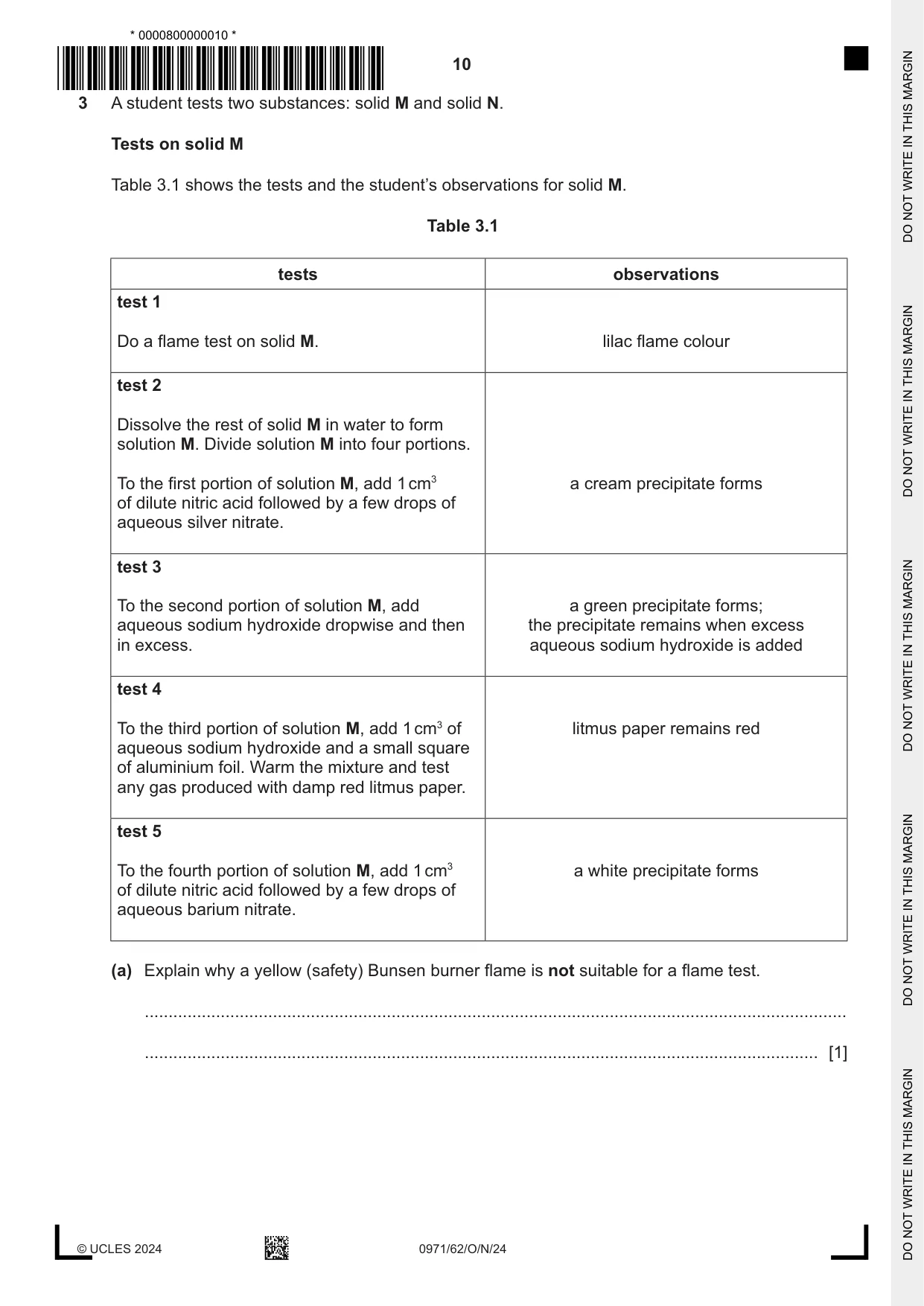
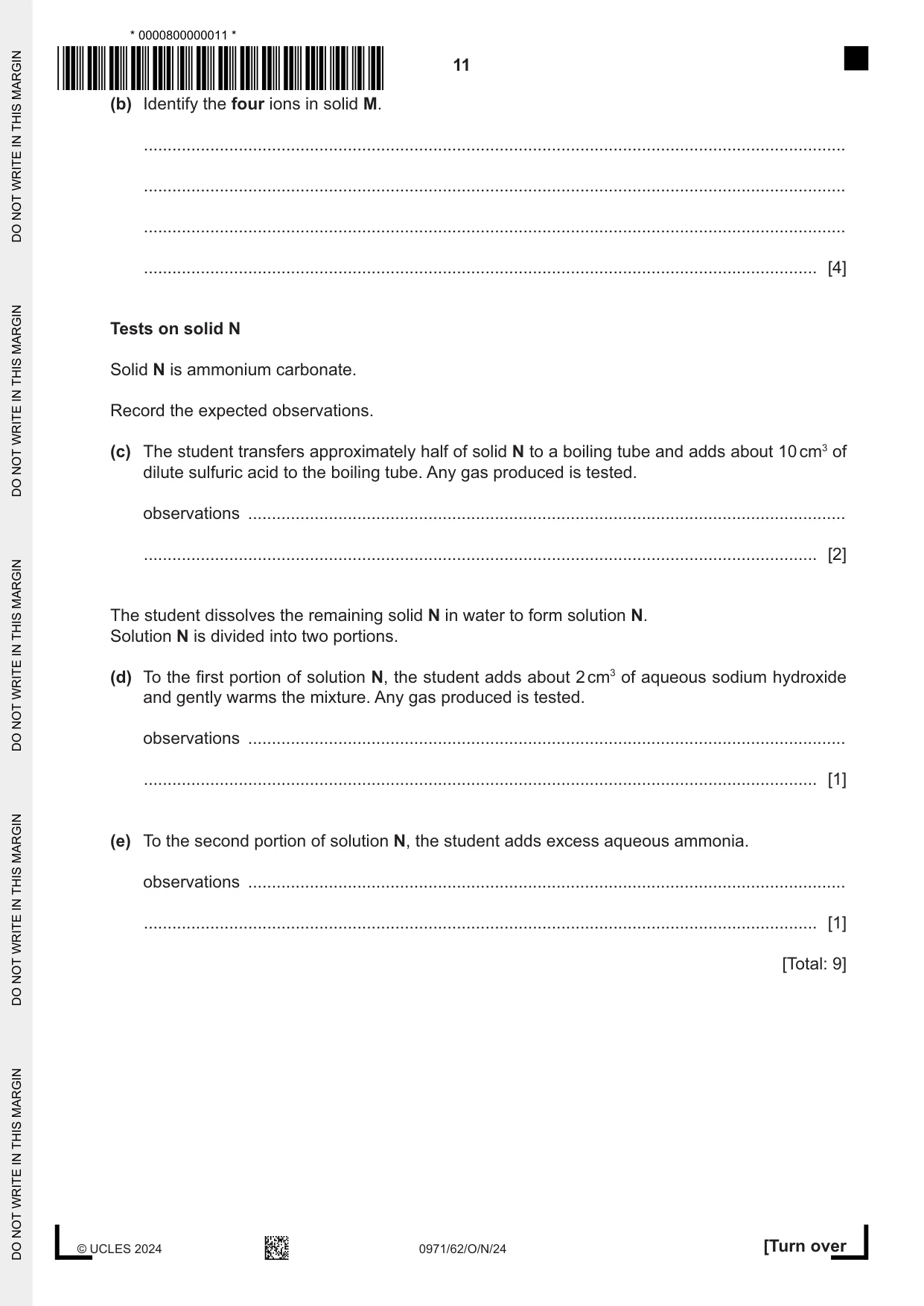
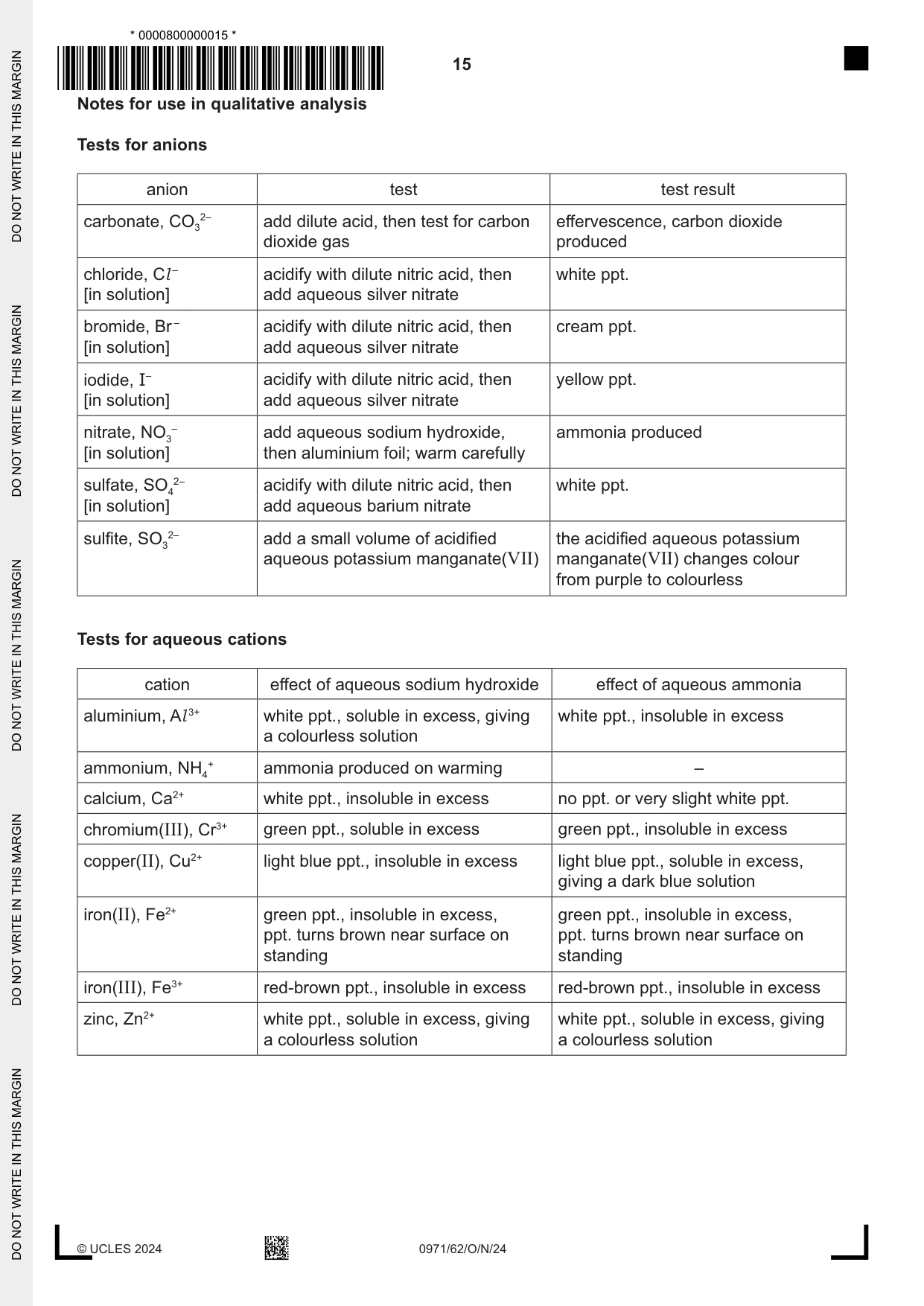
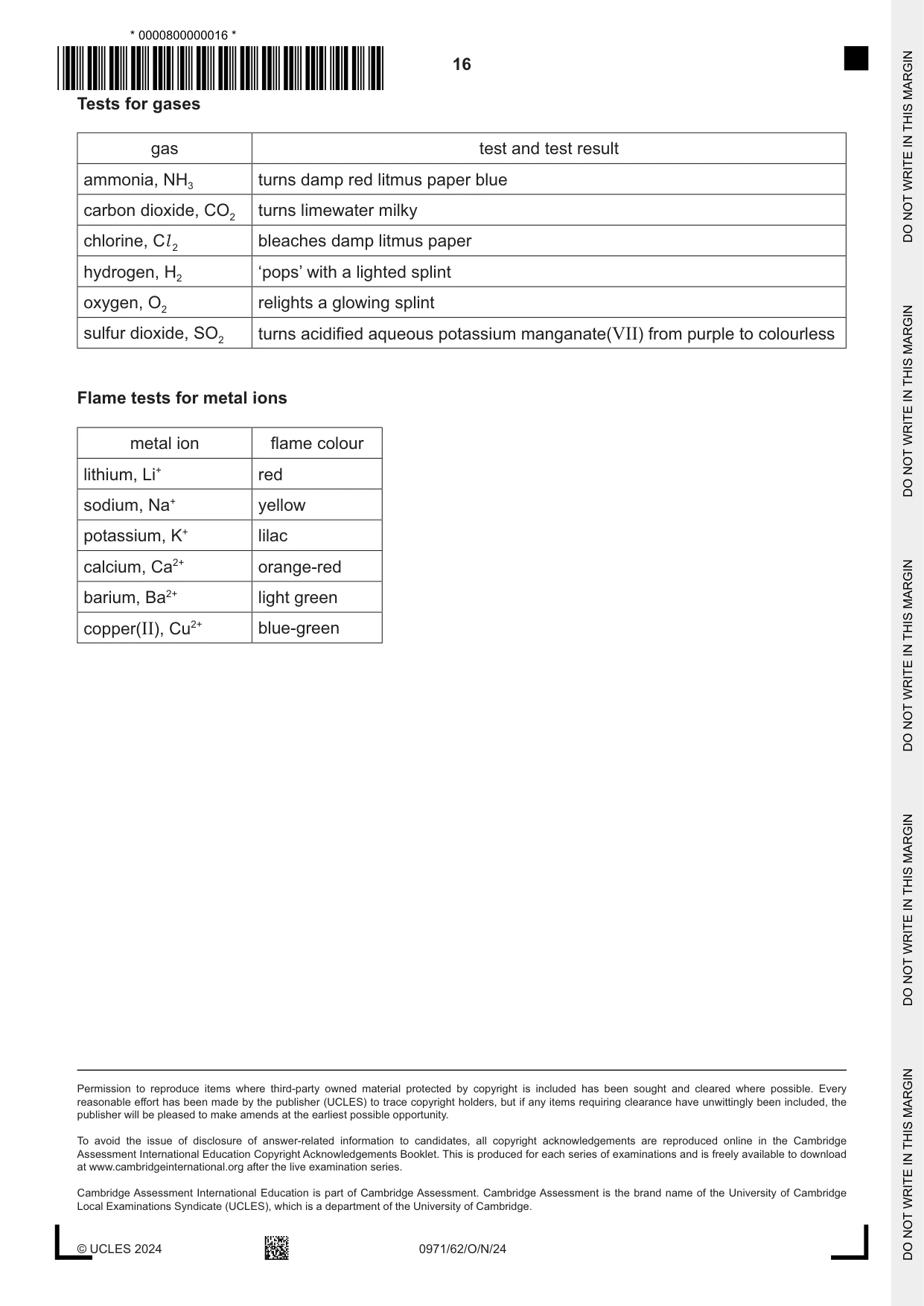
3 A student tests two substances: solid M and solid N. Tests on solid M Table 3.1 shows the tests and the student’s observations for solid M. Table 3.1 tests observations test 1 Do a flame test on solid M. lilac flame colour test 2 Dissolve the rest of solid M in water to form solution M. Divide solution M into four portions. To the first portion of solution M, add 1 cm3 a cream precipitate forms of dilute nitric acid followed by a few drops of aqueous silver nitrate. test 3 To the second portion of solution M, add a green precipitate forms; aqueous sodium hydroxide dropwise and then the precipitate remains when excess in excess. aqueous sodium hydroxide is added test 4 To the third portion of solution M, add 1 cm3 of litmus paper remains red aqueous sodium hydroxide and a small square of aluminium foil. Warm the mixture and test any gas produced with damp red litmus paper. test 5 To the fourth portion of solution M, add 1 cm3 a white precipitate forms of dilute nitric acid followed by a few drops of aqueous barium nitrate. (a) Explain why a yellow (safety) Bunsen burner flame is not suitable for a flame test. .................................................................................................................................................... .............................................................................................................................................. [1] (b) Identify the four ions in solid M. .................................................................................................................................................... .................................................................................................................................................... .................................................................................................................................................... .............................................................................................................................................. [4] Tests on solid N Solid N is ammonium carbonate. Record the expected observations. (c) The student transfers approximately half of solid N to a boiling tube and adds about 10 cm3 of dilute sulfuric acid to the boiling tube. Any gas produced is tested. observations .............................................................................................................................. .............................................................................................................................................. [2] The student dissolves the remaining solid N in water to form solution N. Solution N is divided into two portions. (d) To the first portion of solution N, the student adds about 2 cm3 of aqueous sodium hydroxide and gently warms the mixture. Any gas produced is tested. observations .............................................................................................................................. .............................................................................................................................................. [1] (e) To the second portion of solution N, the student adds excess aqueous ammonia. observations .............................................................................................................................. .............................................................................................................................................. [1] [Total: 9]
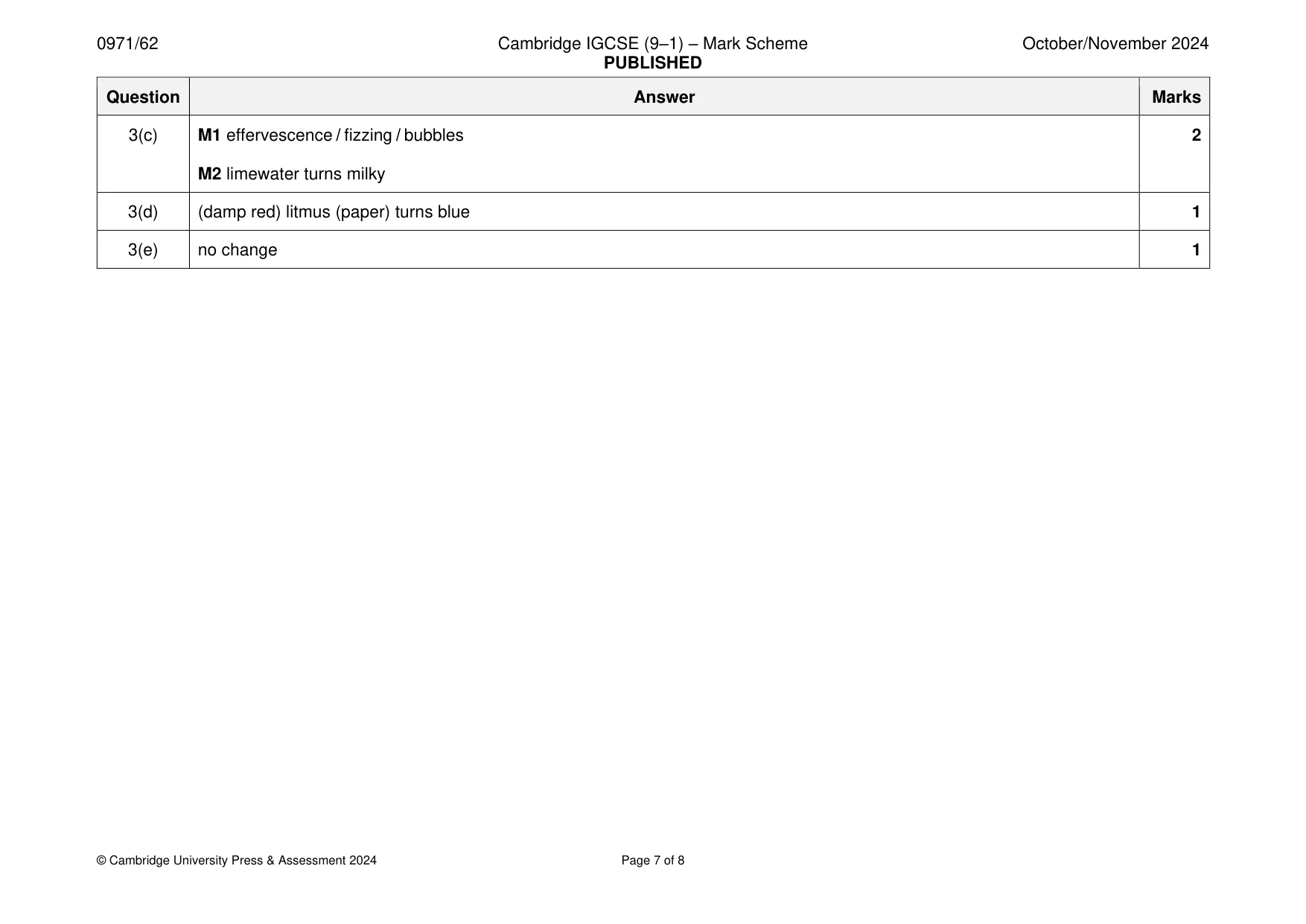
Mark scheme: 3(a) (the yellow flame) is not hot enough 1 OR (the yellow flame) masks the colour caused by the metal ion 3(b) M1 iron(II) / Fe2+ 4 M2 potassium / K+ M3 bromide / Br– M4 sulfate / SO42– 3(c) M1 effervescence / fizzing / bubbles 2 M2 limewater turns milky 3(d) (damp red) litmus (paper) turns blue 1 3(e) no change 1
Q4 · Limes and lemons are citrus fruits which contain aqueous citric acid in their juice
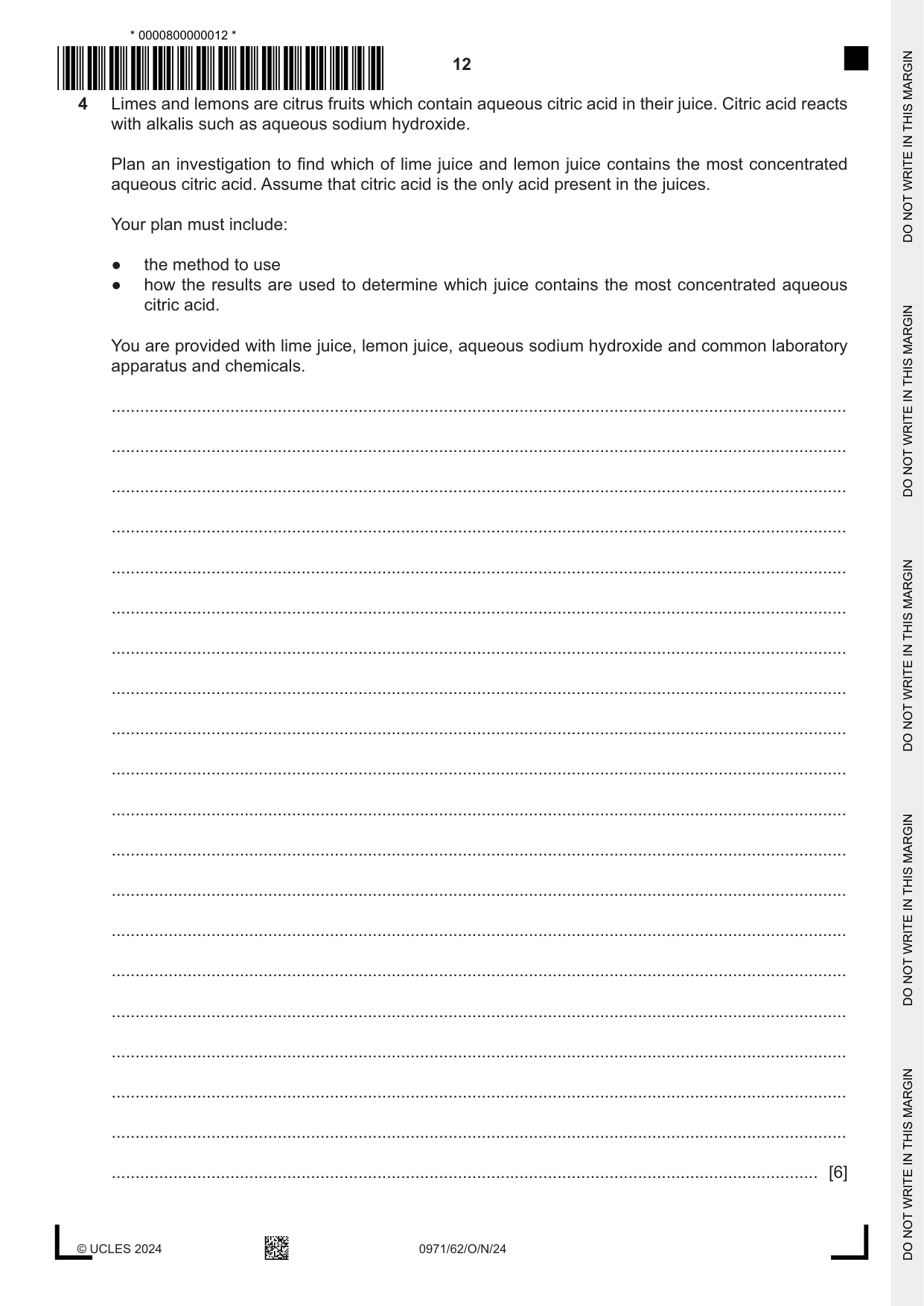
4 Limes and lemons are citrus fruits which contain aqueous citric acid in their juice. Citric acid reacts with alkalis such as aqueous sodium hydroxide. Plan an investigation to find which of lime juice and lemon juice contains the most concentrated aqueous citric acid. Assume that citric acid is the only acid present in the juices. Your plan must include: ● the method to use ● how the results are used to determine which juice contains the most concentrated aqueous citric acid. You are provided with lime juice, lemon juice, aqueous sodium hydroxide and common laboratory apparatus and chemicals. ........................................................................................................................................................... ........................................................................................................................................................... ........................................................................................................................................................... ........................................................................................................................................................... ........................................................................................................................................................... ........................................................................................................................................................... ........................................................................................................................................................... ........................................................................................................................................................... ........................................................................................................................................................... ........................................................................................................................................................... ........................................................................................................................................................... ........................................................................................................................................................... ........................................................................................................................................................... ........................................................................................................................................................... ........................................................................................................................................................... ........................................................................................................................................................... ........................................................................................................................................................... ........................................................................................................................................................... ........................................................................................................................................................... ..................................................................................................................................................... [6]
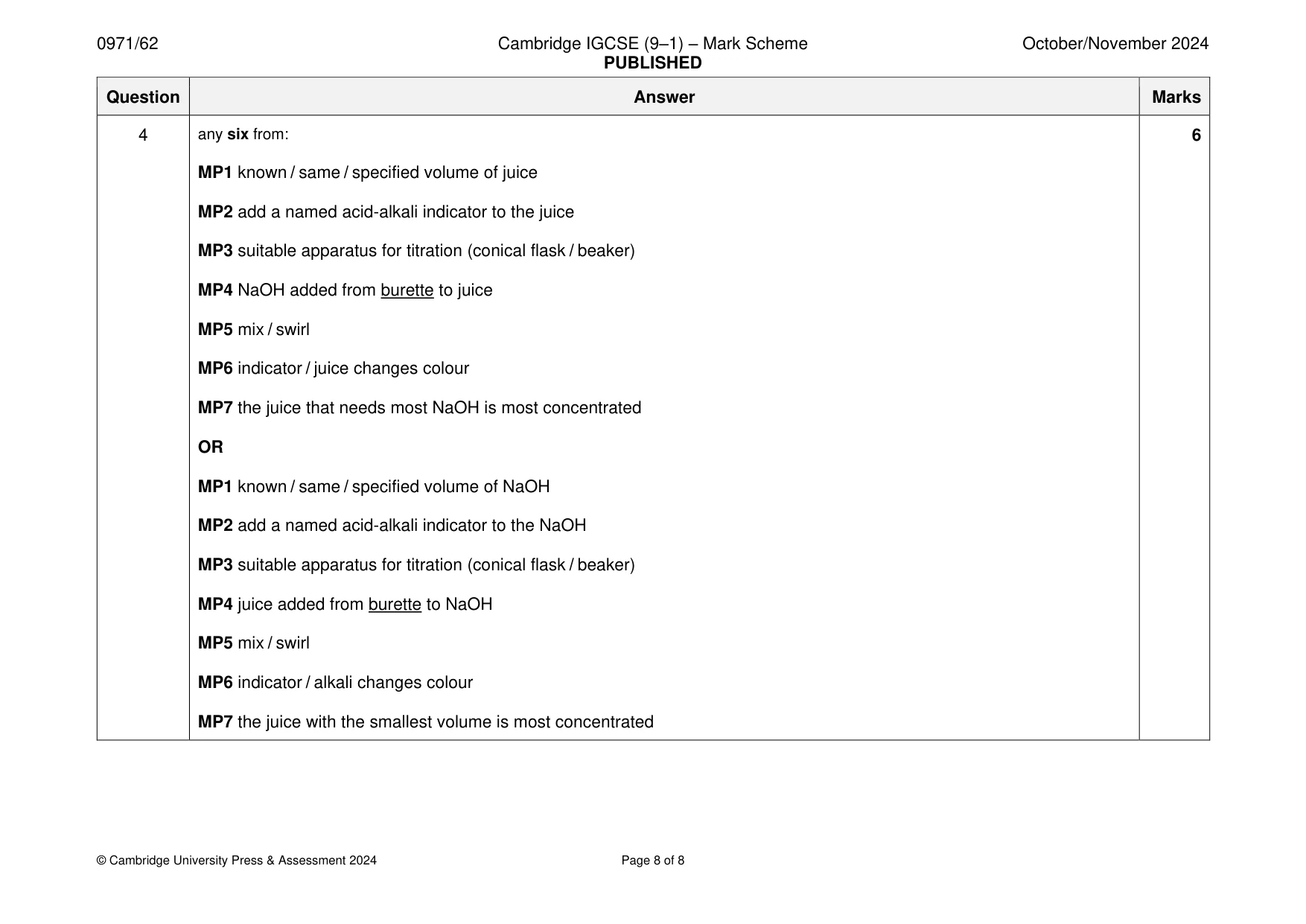
Mark scheme: 4 any six from: 6 MP1 known / same / specified volume of juice MP2 add a named acid-alkali indicator to the juice MP3 suitable apparatus for titration (conical flask / beaker) MP4 NaOH added from burette to juice MP5 mix / swirl MP6 indicator / juice changes colour MP7 the juice that needs most NaOH is most concentrated OR MP1 known / same / specified volume of NaOH MP2 add a named acid-alkali indicator to the NaOH MP3 suitable apparatus for titration (conical flask / beaker) MP4 juice added from burette to NaOH MP5 mix / swirl MP6 indicator / alkali changes colour MP7 the juice with the smallest volume is most concentrated
What was in this paper
The subtopics covered by these 4 questions, and how many questions each got. Open one in a new tab to see every Cambridge question on it.
What you needed in this session
Cambridge’s own grade thresholds for 2024 Oct/Nov, Paper 6 · Variant 2. A higher threshold means an easier paper — the bar moves with how the cohort did.