Cambridge IGCSE Chemistry (9-1) 0971 — 2023 Oct/Nov Paper 6 · Variant 2
0971/62/O/N/23 · 4 questions · 40 marks · 60 min
The question paper and its mark scheme, free to read here and free to download. This is Cambridge’s own paper, exactly as it was sat.
Question paper16 pages




Mark scheme10 pages
Answers below. Sit the paper first if you are practising.
Questions as text
Q1 · Some seashells contain a mixture of the insoluble compounds calcium carbonate and…
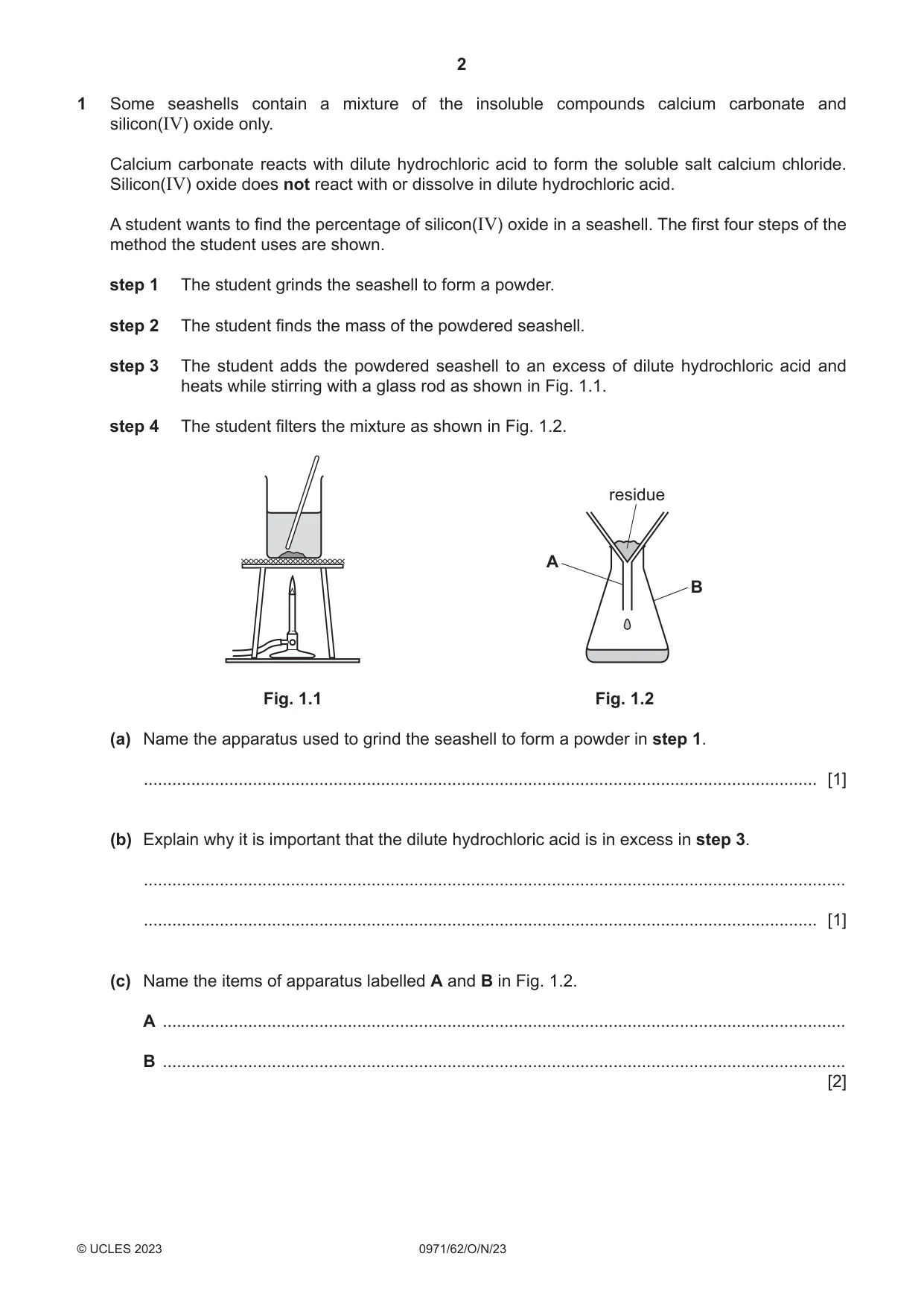
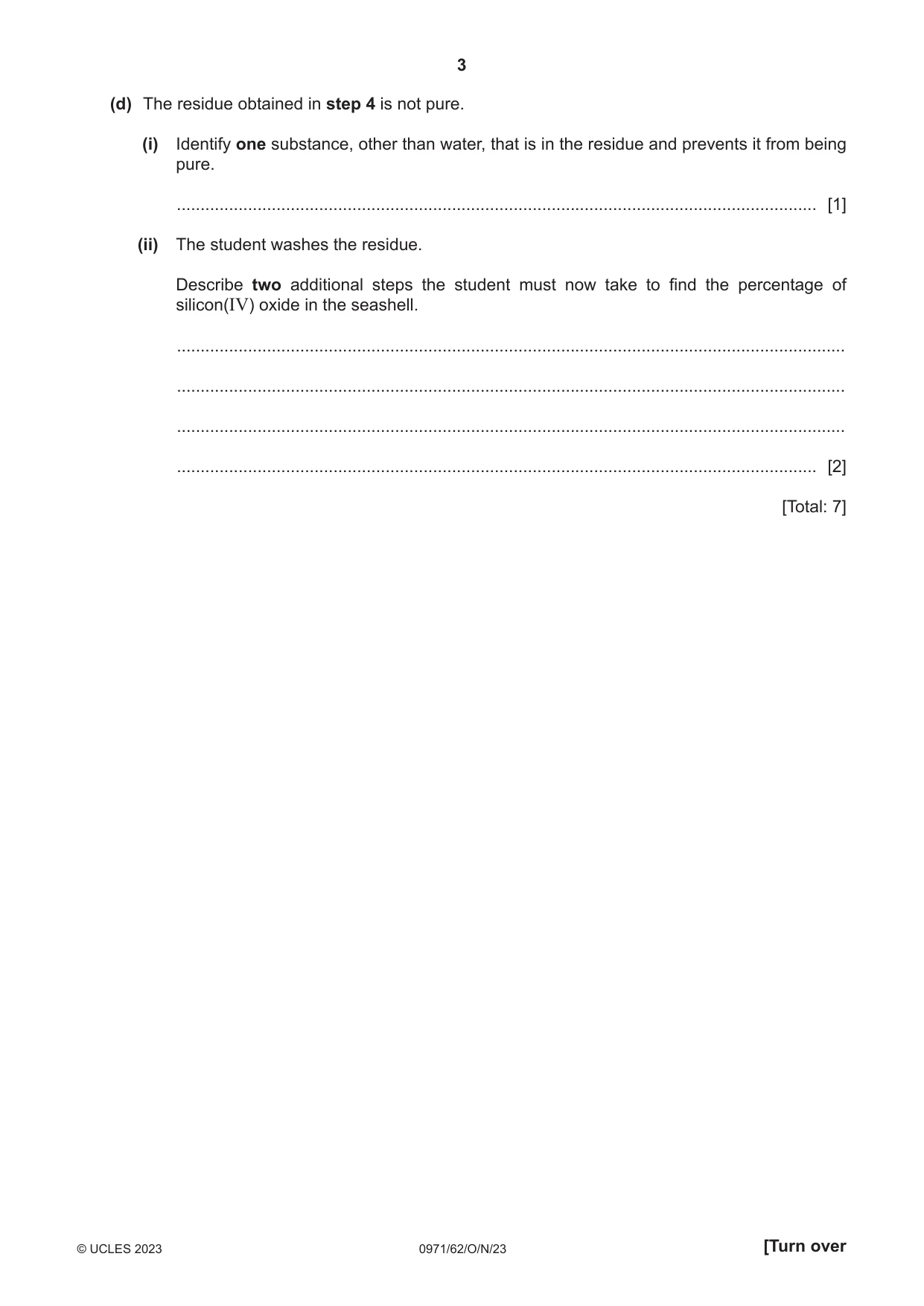
1 Some seashells contain a mixture of the insoluble compounds calcium carbonate and silicon(IV) oxide only. Calcium carbonate reacts with dilute hydrochloric acid to form the soluble salt calcium chloride. Silicon(IV) oxide does not react with or dissolve in dilute hydrochloric acid. A student wants to find the percentage of silicon(IV) oxide in a seashell. The first four steps of the method the student uses are shown. step 1 The student grinds the seashell to form a powder. step 2 The student finds the mass of the powdered seashell. step 3 The student adds the powdered seashell to an excess of dilute hydrochloric acid and heats while stirring with a glass rod as shown in Fig. 1.1. step 4 The student filters the mixture as shown in Fig. 1.2. residue A B Fig. 1.1 Fig. 1.2 (a) Name the apparatus used to grind the seashell to form a powder in step 1. .............................................................................................................................................. [1] (b) Explain why it is important that the dilute hydrochloric acid is in excess in step 3. .................................................................................................................................................... .............................................................................................................................................. [1] (c) Name the items of apparatus labelled A and B in Fig. 1.2. A ................................................................................................................................................. B ................................................................................................................................................. [2] (d) The residue obtained in step 4 is not pure. (i) Identify one substance, other than water, that is in the residue and prevents it from being pure. ....................................................................................................................................... [1] (ii) The student washes the residue. Describe two additional steps the student must now take to find the percentage of silicon(IV) oxide in the seashell. ............................................................................................................................................. ............................................................................................................................................. ............................................................................................................................................. ....................................................................................................................................... [2] [Total: 7]
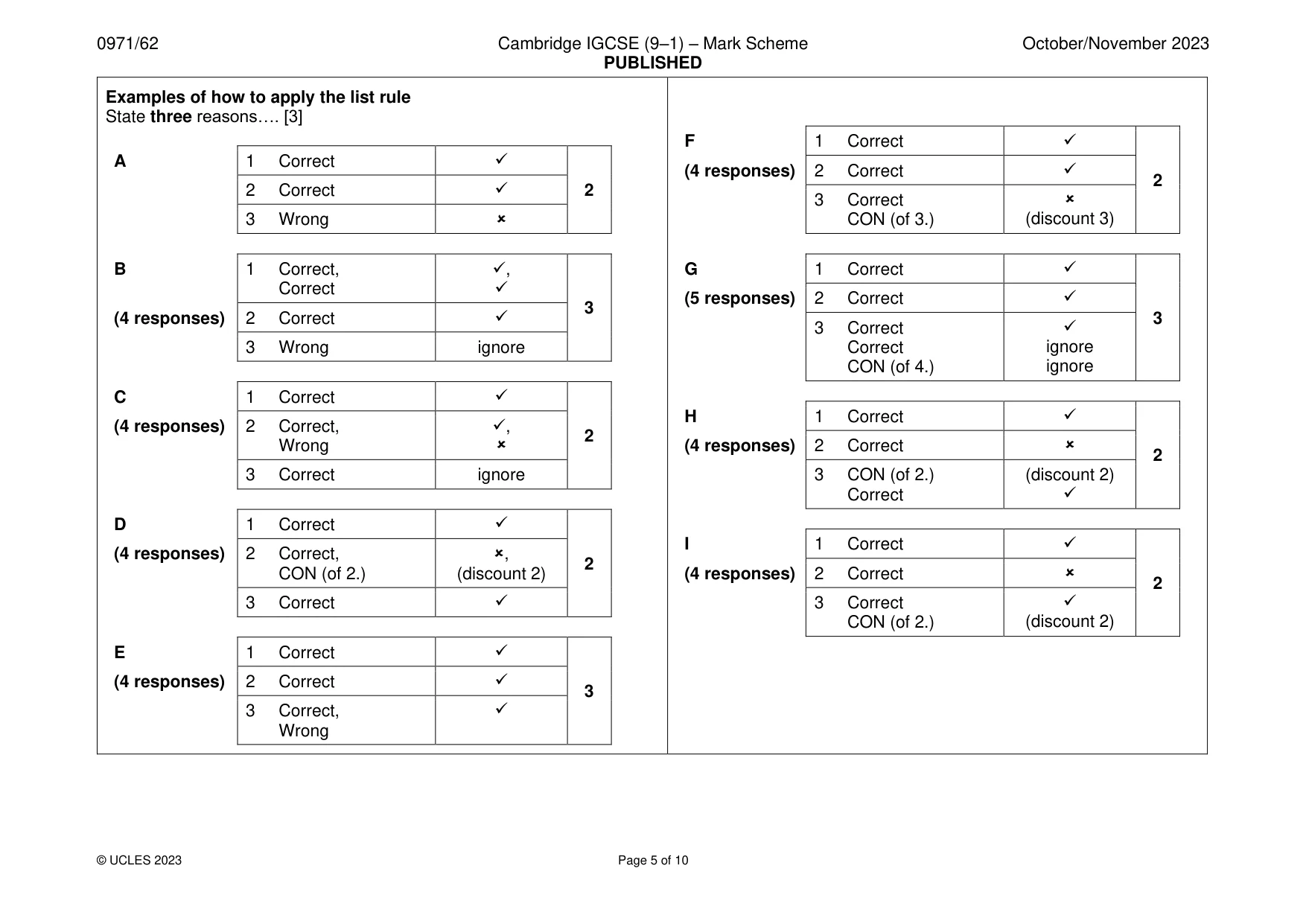
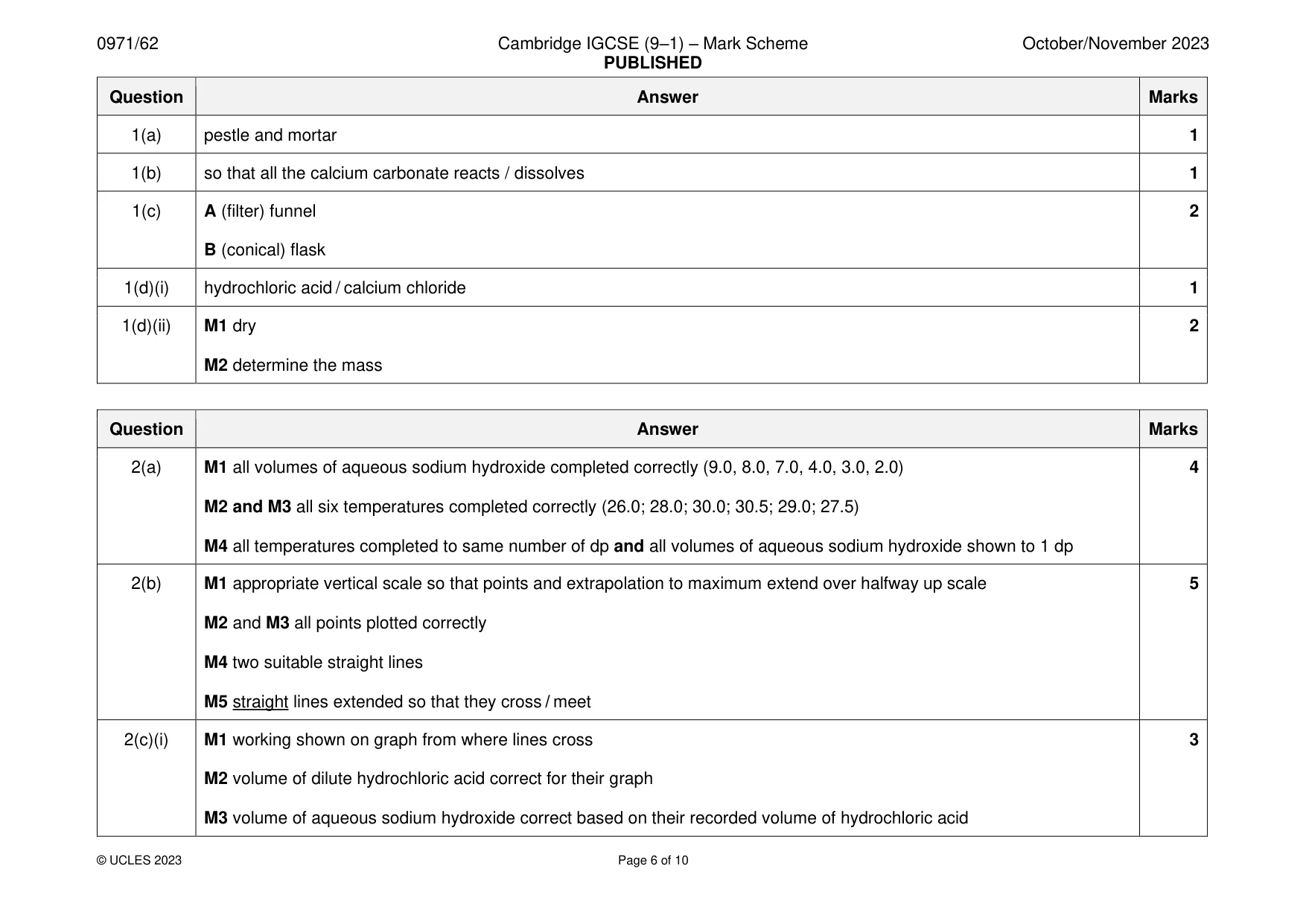
Mark scheme: Question Answer Marks 1(a) pestle and mortar 1 1(b) so that all the calcium carbonate reacts / dissolves 1 1(c) A (filter) funnel 2 B (conical) flask 1(d)(i) hydrochloric acid / calcium chloride 1 1(d)(ii) M1 dry 2 M2 determine the mass
Q2 · A student investigates the temperature change when aqueous sodium hydroxide neutralises…
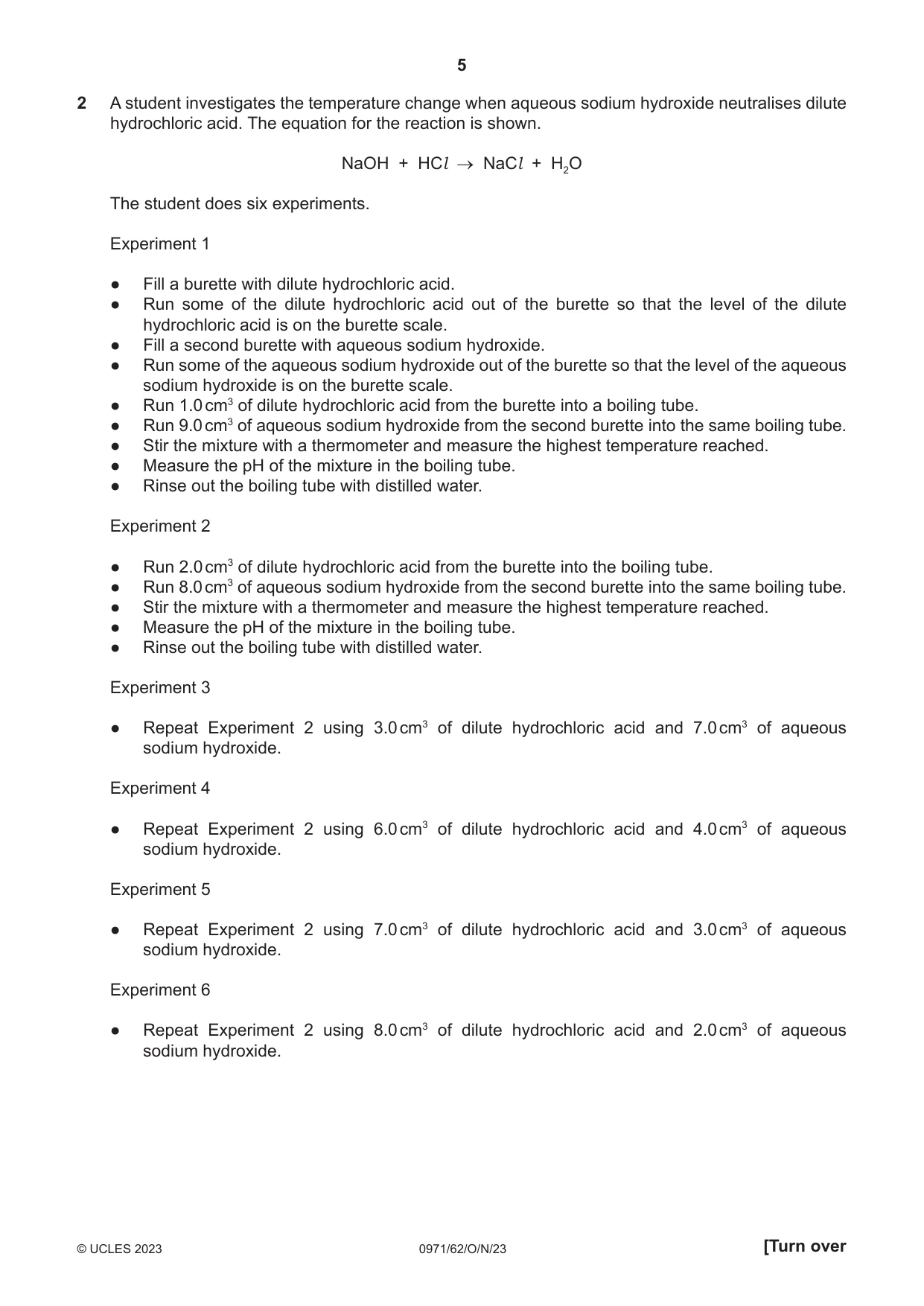
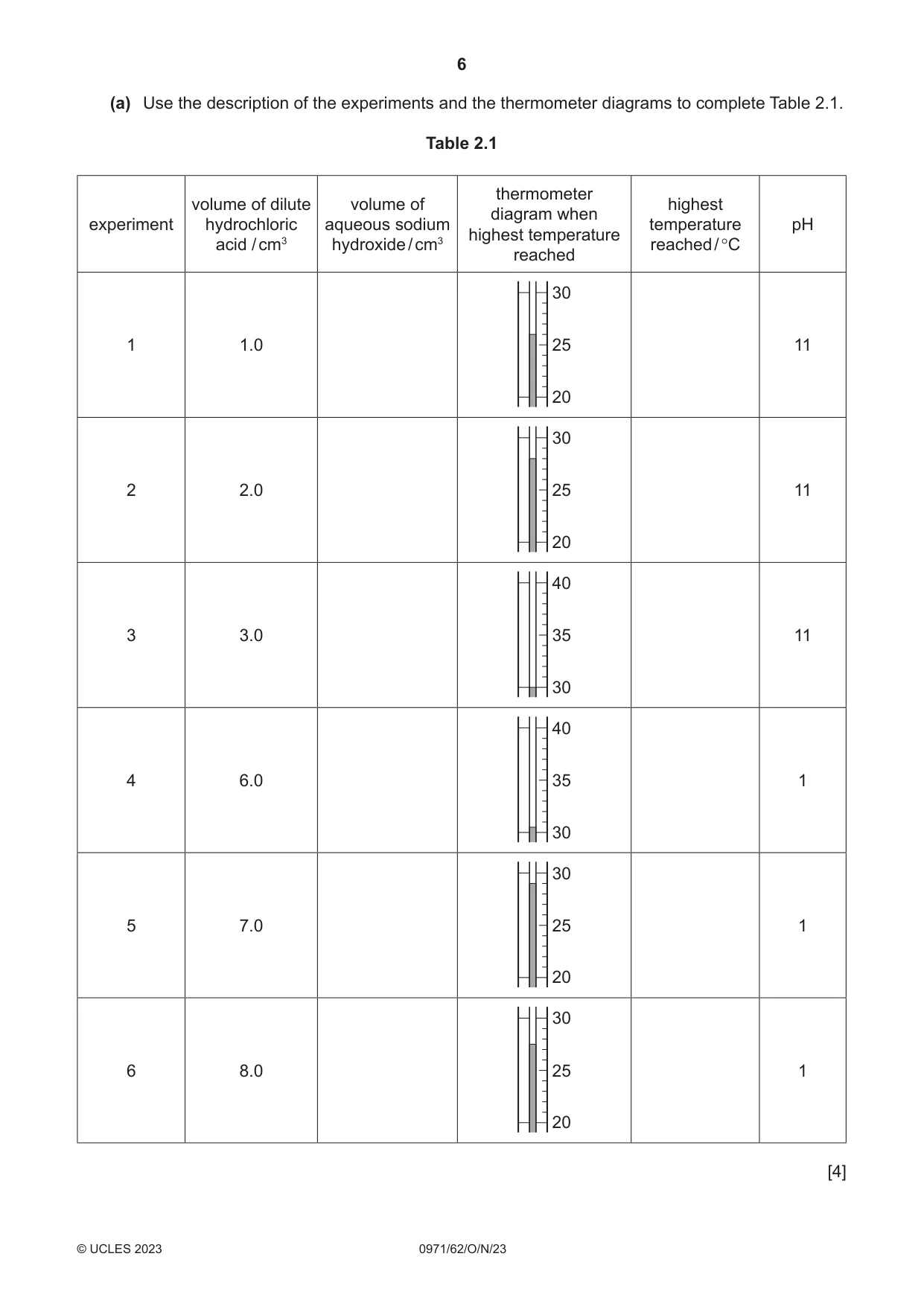
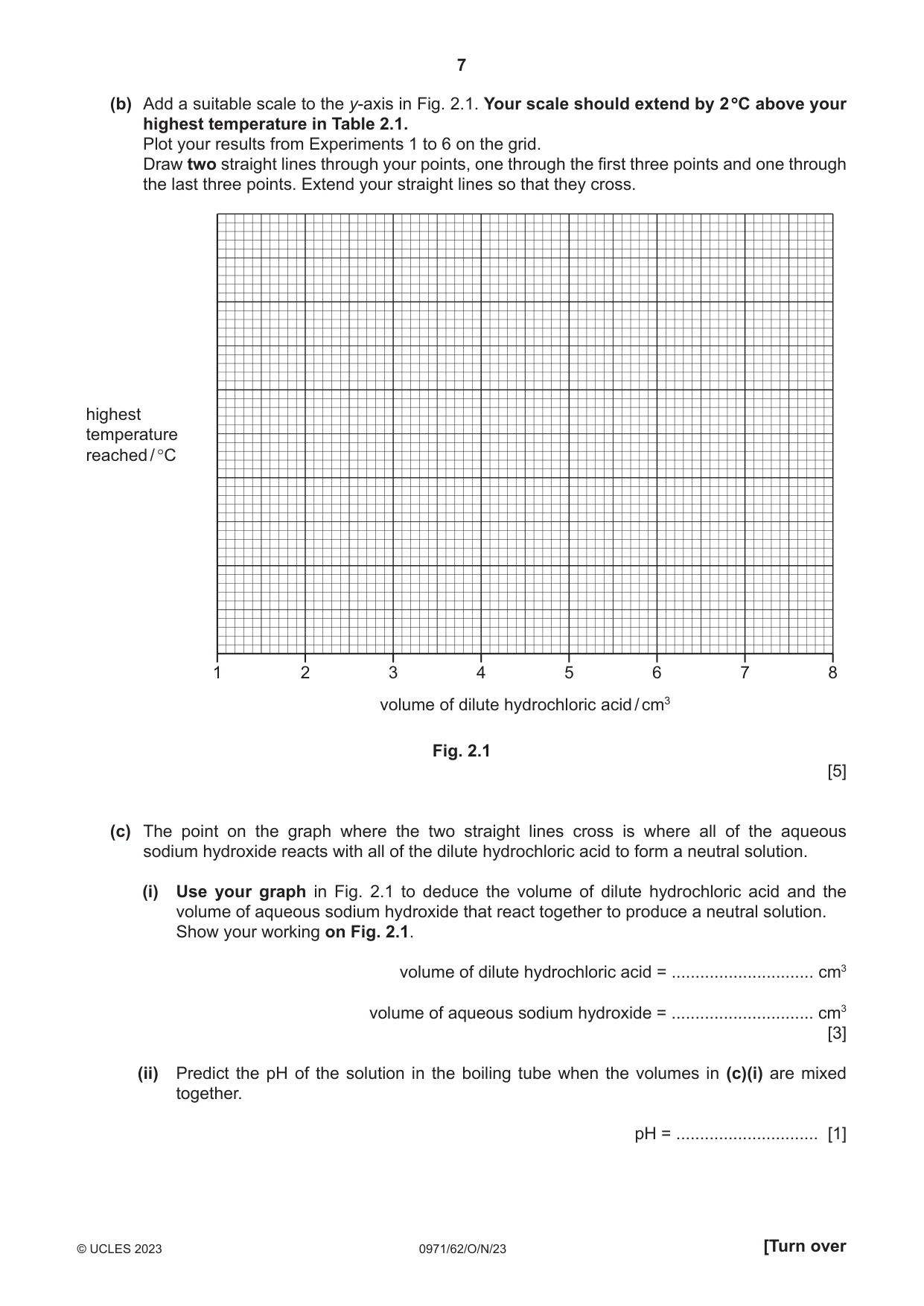
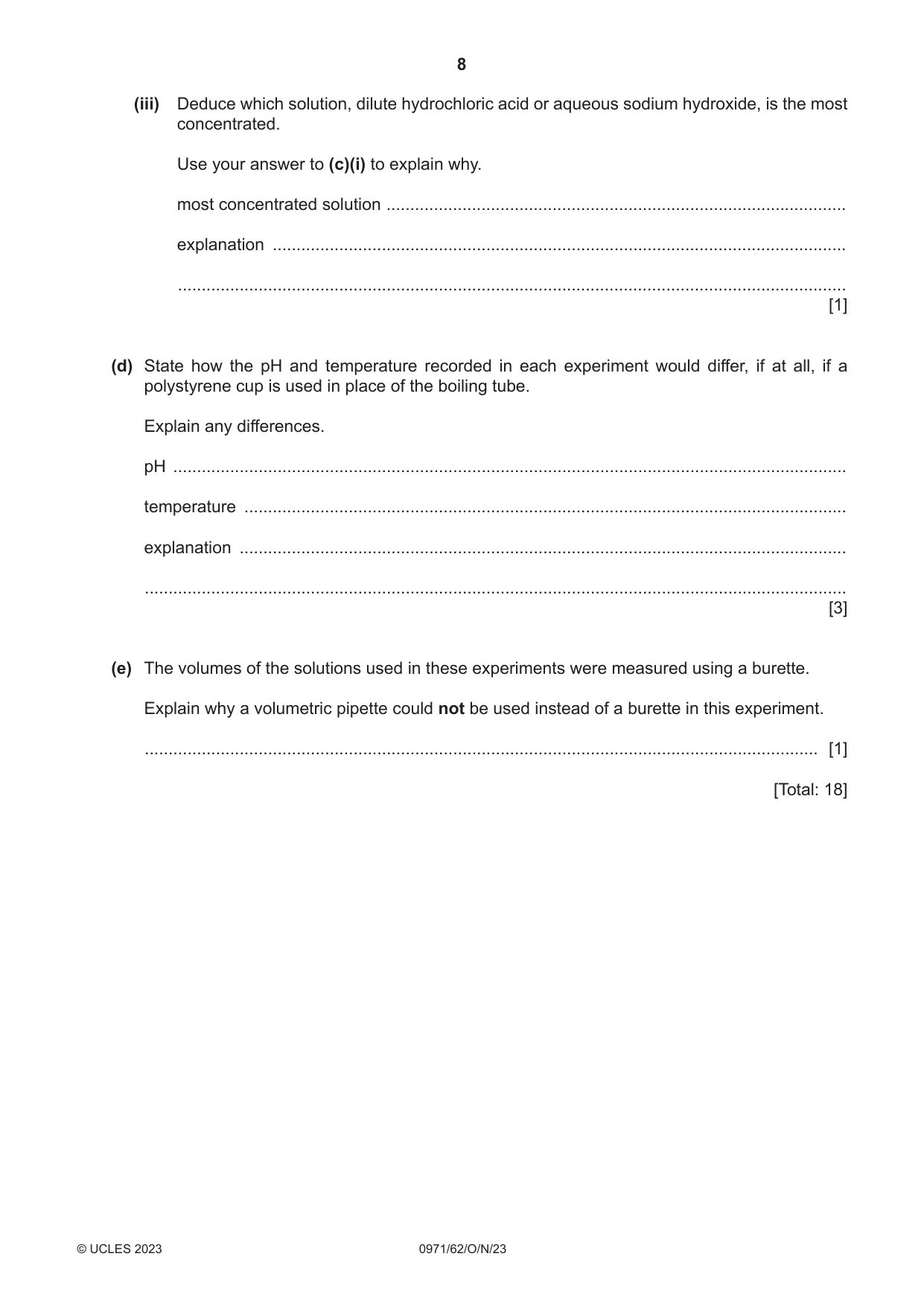
2 A student investigates the temperature change when aqueous sodium hydroxide neutralises dilute hydrochloric acid. The equation for the reaction is shown. NaOH + HCl → NaCl + H2O The student does six experiments. Experiment 1 ● Fill a burette with dilute hydrochloric acid. ● Run some of the dilute hydrochloric acid out of the burette so that the level of the dilute hydrochloric acid is on the burette scale. ● Fill a second burette with aqueous sodium hydroxide. ● Run some of the aqueous sodium hydroxide out of the burette so that the level of the aqueous sodium hydroxide is on the burette scale. ● Run 1.0 cm3 of dilute hydrochloric acid from the burette into a boiling tube. ● Run 9.0 cm3 of aqueous sodium hydroxide from the second burette into the same boiling tube. ● Stir the mixture with a thermometer and measure the highest temperature reached. ● Measure the pH of the mixture in the boiling tube. ● Rinse out the boiling tube with distilled water. Experiment 2 ● Run 2.0 cm3 of dilute hydrochloric acid from the burette into the boiling tube. ● Run 8.0 cm3 of aqueous sodium hydroxide from the second burette into the same boiling tube. ● Stir the mixture with a thermometer and measure the highest temperature reached. ● Measure the pH of the mixture in the boiling tube. ● Rinse out the boiling tube with distilled water. Experiment 3 ● Repeat Experiment 2 using 3.0 cm3 of dilute hydrochloric acid and 7.0 cm3 of aqueous sodium hydroxide. Experiment 4 ● Repeat Experiment 2 using 6.0 cm3 of dilute hydrochloric acid and 4.0 cm3 of aqueous sodium hydroxide. Experiment 5 ● Repeat Experiment 2 using 7.0 cm3 of dilute hydrochloric acid and 3.0 cm3 of aqueous sodium hydroxide. Experiment 6 ● Repeat Experiment 2 using 8.0 cm3 of dilute hydrochloric acid and 2.0 cm3 of aqueous sodium hydroxide. (a) Use the description of the experiments and the thermometer diagrams to complete Table 2.1. Table 2.1 thermometer volume of dilute volume of highest diagram whenexperiment hydrochloric aqueous sodium temperature pH highest temperature acid / cm3 hydroxide / cm3 reached / °C reached 30 1 1.0 25 11 20 30 2 2.0 25 11 20 40 3 3.0 35 11 30 40 4 6.0 35 1 30 30 5 7.0 25 1 20 30 6 8.0 25 1 20 [4] (b) Add a suitable scale to the y-axis in Fig. 2.1. Your scale should extend by 2 °C above your highest temperature in Table 2.1. Plot your results from Experiments 1 to 6 on the grid. Draw two straight lines through your points, one through the first three points and one through the last three points. Extend your straight lines so that they cross. highest temperature reached / C 1 2 3 4 5 6 7 8 volume of dilute hydrochloric acid / cm3 Fig. 2.1 [5] (c) The point on the graph where the two straight lines cross is where all of the aqueous sodium hydroxide reacts with all of the dilute hydrochloric acid to form a neutral solution. (i) Use your graph in Fig. 2.1 to deduce the volume of dilute hydrochloric acid and the volume of aqueous sodium hydroxide that react together to produce a neutral solution. Show your working on Fig. 2.1. volume of dilute hydrochloric acid = .............................. cm3 volume of aqueous sodium hydroxide = .............................. cm3 [3] (ii) Predict the pH of the solution in the boiling tube when the volumes in (c)(i) are mixed together. pH = .............................. [1] (iii) Deduce which solution, dilute hydrochloric acid or aqueous sodium hydroxide, is the most concentrated. Use your answer to (c)(i) to explain why. most concentrated solution ................................................................................................. explanation .......................................................................................................................... ............................................................................................................................................. [1] (d) State how the pH and temperature recorded in each experiment would differ, if at all, if a polystyrene cup is used in place of the boiling tube. Explain any differences. pH ............................................................................................................................................... temperature ................................................................................................................................ explanation ................................................................................................................................. .................................................................................................................................................... [3] (e) The volumes of the solutions used in these experiments were measured using a burette. Explain why a volumetric pipette could not be used instead of a burette in this experiment. .............................................................................................................................................. [1] [Total: 18]
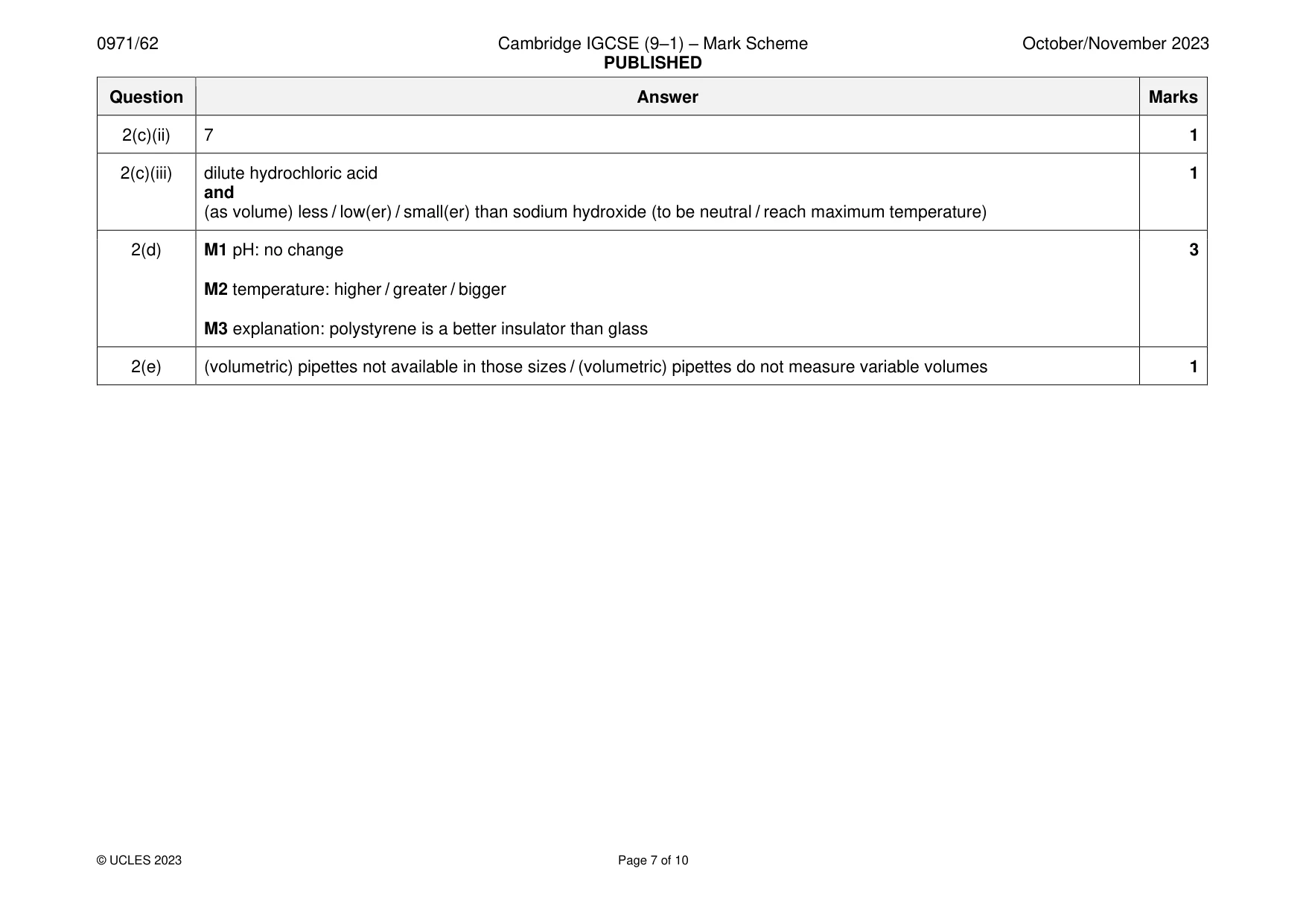
Mark scheme: 2(a) M1 all volumes of aqueous sodium hydroxide completed correctly (9.0, 8.0, 7.0, 4.0, 3.0, 2.0) 4 M2 and M3 all six temperatures completed correctly (26.0; 28.0; 30.0; 30.5; 29.0; 27.5) M4 all temperatures completed to same number of dp and all volumes of aqueous sodium hydroxide shown to 1 dp 2(b) M1 appropriate vertical scale so that points and extrapolation to maximum extend over halfway up scale 5 M2 and M3 all points plotted correctly M4 two suitable straight lines M5 straight lines extended so that they cross / meet 2(c)(i) M1 working shown on graph from where lines cross 3 M2 volume of dilute hydrochloric acid correct for their graph M3 volume of aqueous sodium hydroxide correct based on their recorded volume of hydrochloric acid 2(c)(ii) 7 1 2(c)(iii) dilute hydrochloric acid 1 and (as volume) less / low(er) / small(er) than sodium hydroxide (to be neutral / reach maximum temperature) 2(d) M1 pH: no change 3 M2 temperature: higher / greater / bigger M3 explanation: polystyrene is a better insulator than glass 2(e) (volumetric) pipettes not available in those sizes / (volumetric) pipettes do not measure variable volumes 1
Q3 · A student tests two substances: solid K and solid L
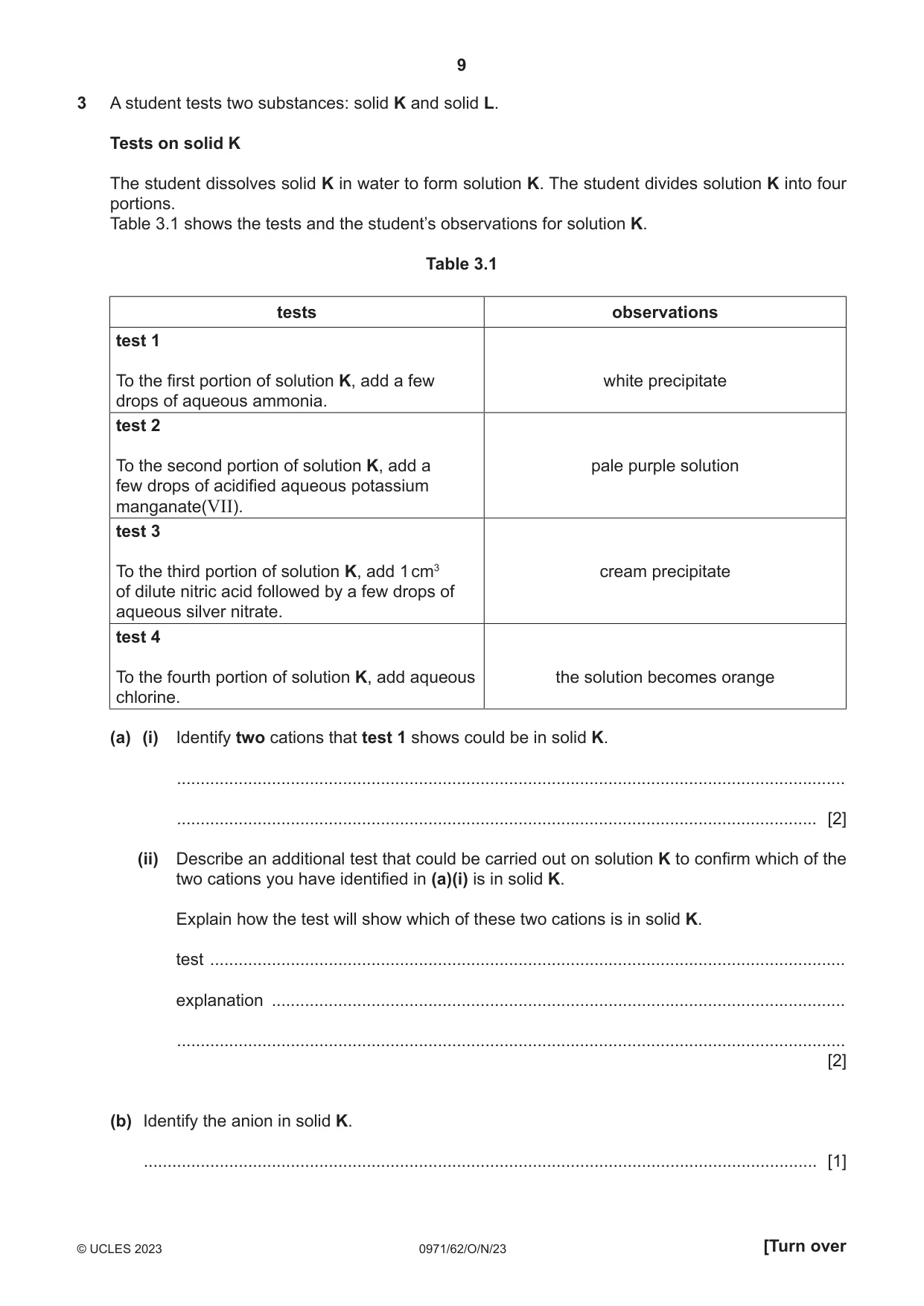
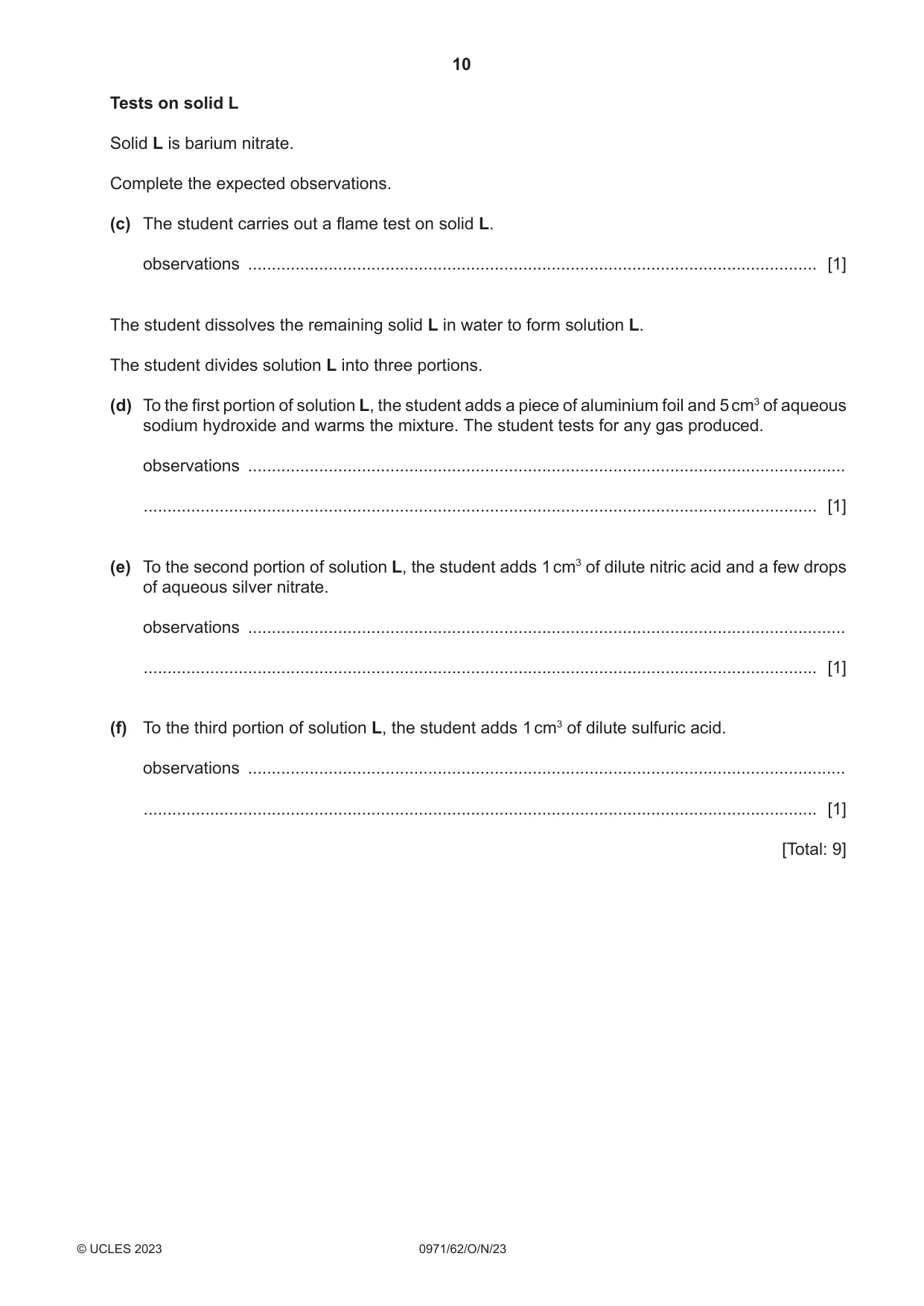
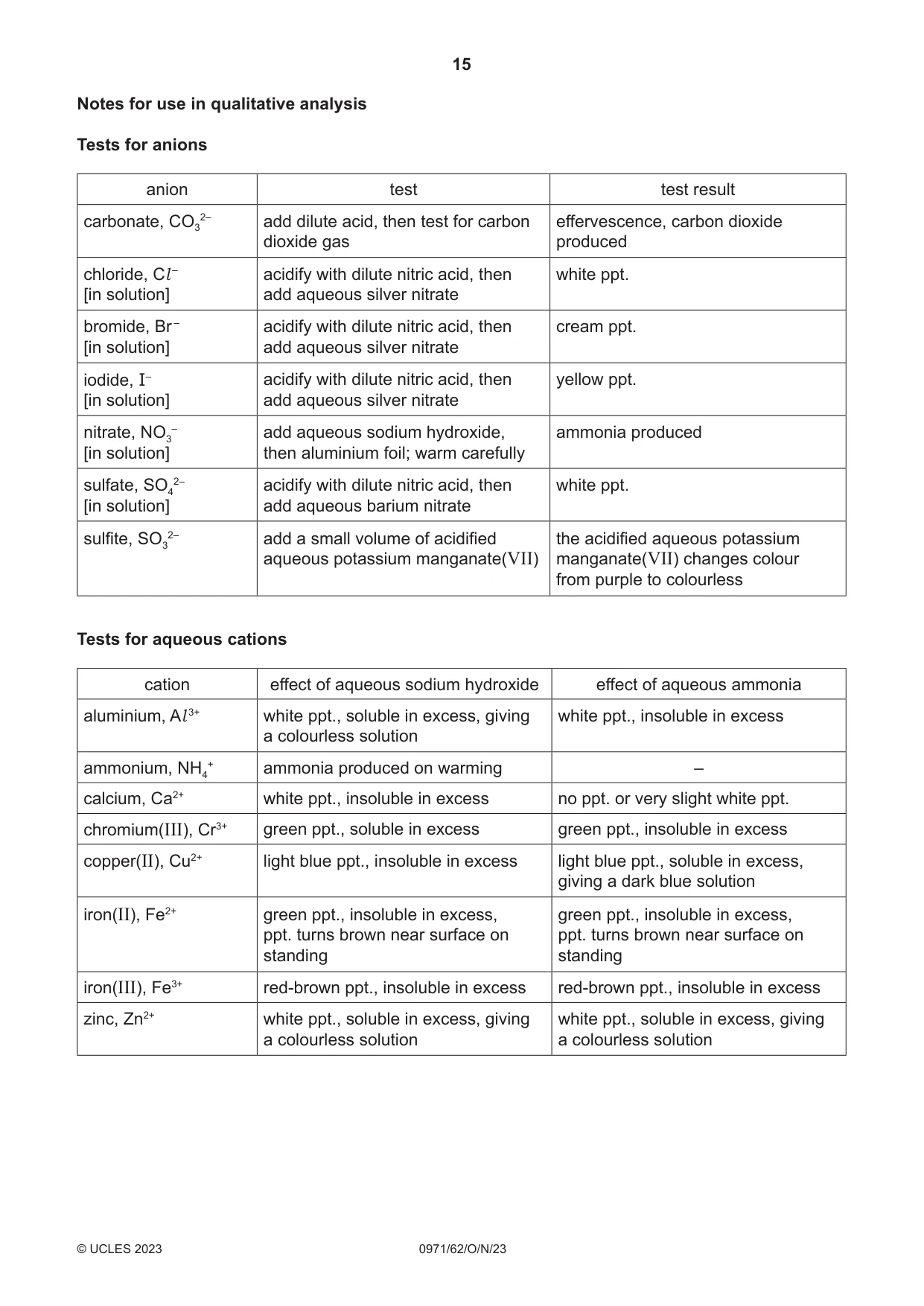
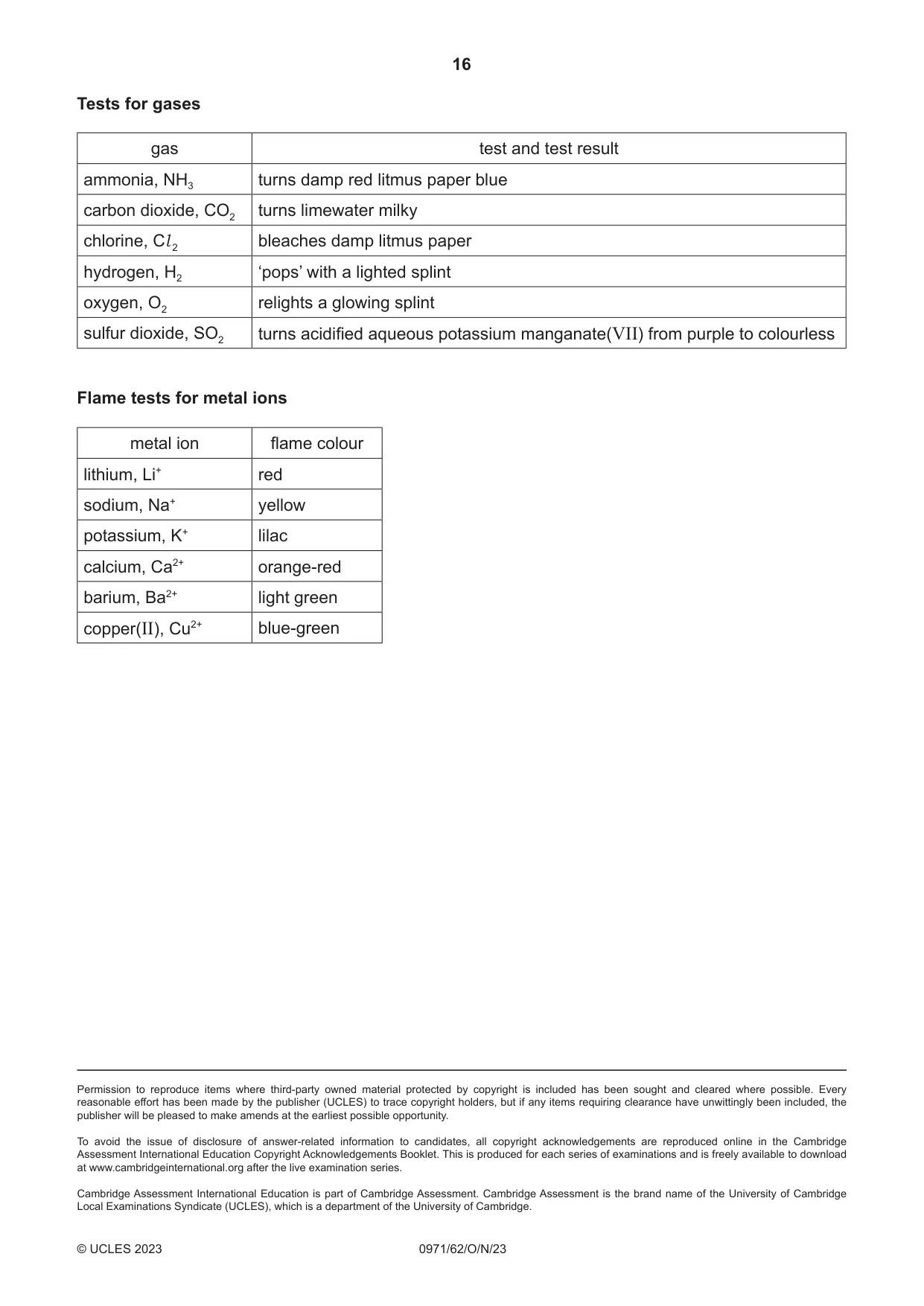
3 A student tests two substances: solid K and solid L. Tests on solid K The student dissolves solid K in water to form solution K. The student divides solution K into four portions. Table 3.1 shows the tests and the student’s observations for solution K. Table 3.1 tests observations test 1 To the first portion of solution K, add a few white precipitate drops of aqueous ammonia. test 2 To the second portion of solution K, add a pale purple solution few drops of acidified aqueous potassium manganate(VII). test 3 To the third portion of solution K, add 1 cm3 cream precipitate of dilute nitric acid followed by a few drops of aqueous silver nitrate. test 4 To the fourth portion of solution K, add aqueous the solution becomes orange chlorine. (a) (i) Identify two cations that test 1 shows could be in solid K. ............................................................................................................................................. ....................................................................................................................................... [2] (ii) Describe an additional test that could be carried out on solution K to confirm which of the two cations you have identified in (a)(i) is in solid K. Explain how the test will show which of these two cations is in solid K. test ...................................................................................................................................... explanation .......................................................................................................................... ............................................................................................................................................. [2] (b) Identify the anion in solid K. .............................................................................................................................................. [1] Tests on solid L Solid L is barium nitrate. Complete the expected observations. (c) The student carries out a flame test on solid L. observations ......................................................................................................................... [1] The student dissolves the remaining solid L in water to form solution L. The student divides solution L into three portions. (d) To the first portion of solution L, the student adds a piece of aluminium foil and 5 cm3 of aqueous sodium hydroxide and warms the mixture. The student tests for any gas produced. observations ............................................................................................................................... .............................................................................................................................................. [1] (e) To the second portion of solution L, the student adds 1 cm3 of dilute nitric acid and a few drops of aqueous silver nitrate. observations ............................................................................................................................... .............................................................................................................................................. [1] (f) To the third portion of solution L, the student adds 1 cm3 of dilute sulfuric acid. observations ............................................................................................................................... .............................................................................................................................................. [1] [Total: 9]
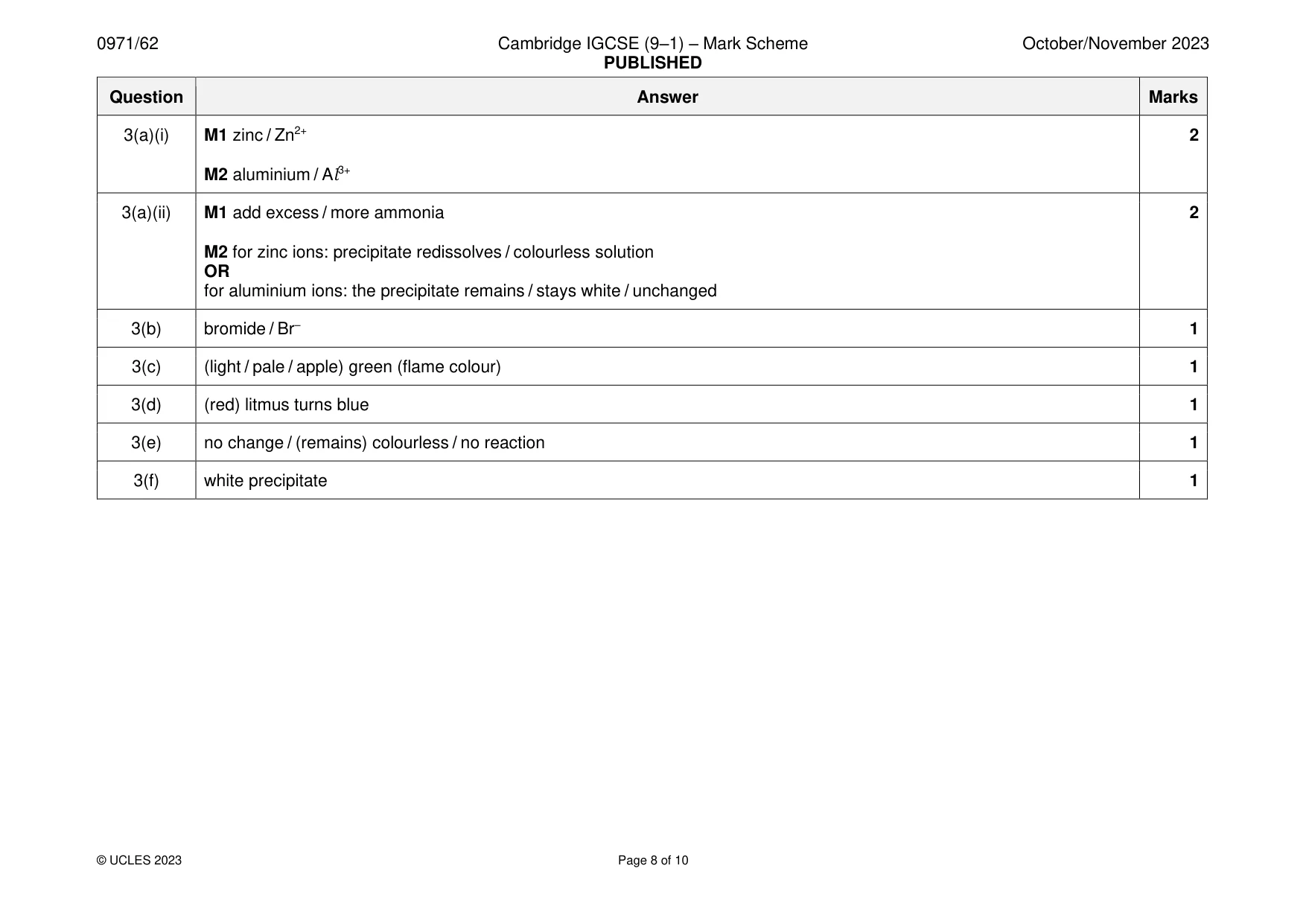
Mark scheme: 3(a)(i) M1 zinc / Zn2+ 2 M2 aluminium / Al3+ 3(a)(ii) M1 add excess / more ammonia 2 M2 for zinc ions: precipitate redissolves / colourless solution OR for aluminium ions: the precipitate remains / stays white / unchanged 3(b) bromide / Br– 1 3(c) (light / pale / apple) green (flame colour) 1 3(d) (red) litmus turns blue 1 3(e) no change / (remains) colourless / no reaction 1 3(f) white precipitate 1
Q4 · The solubility of solid sodium sulfate in water changes as the temperature of the water…
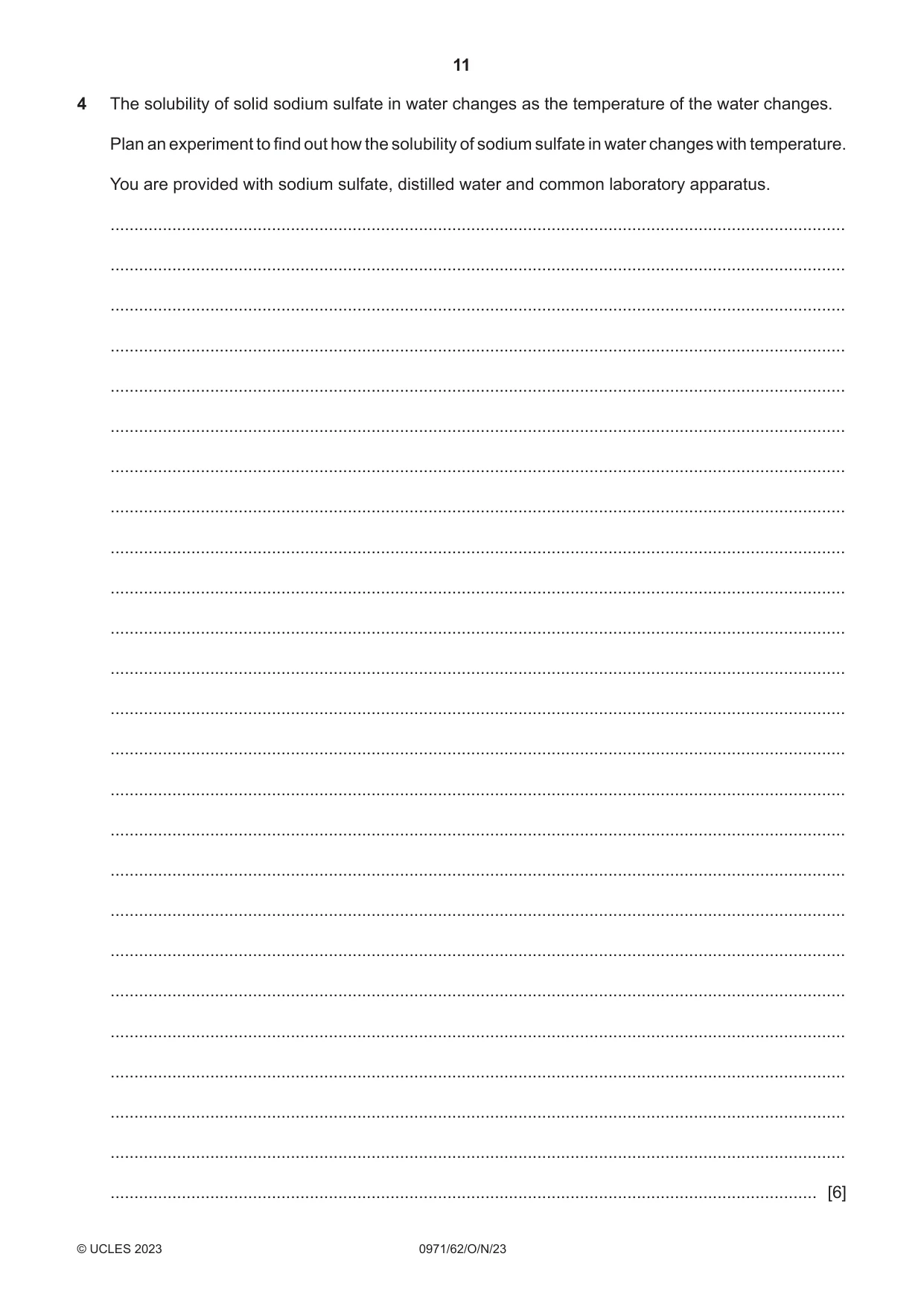
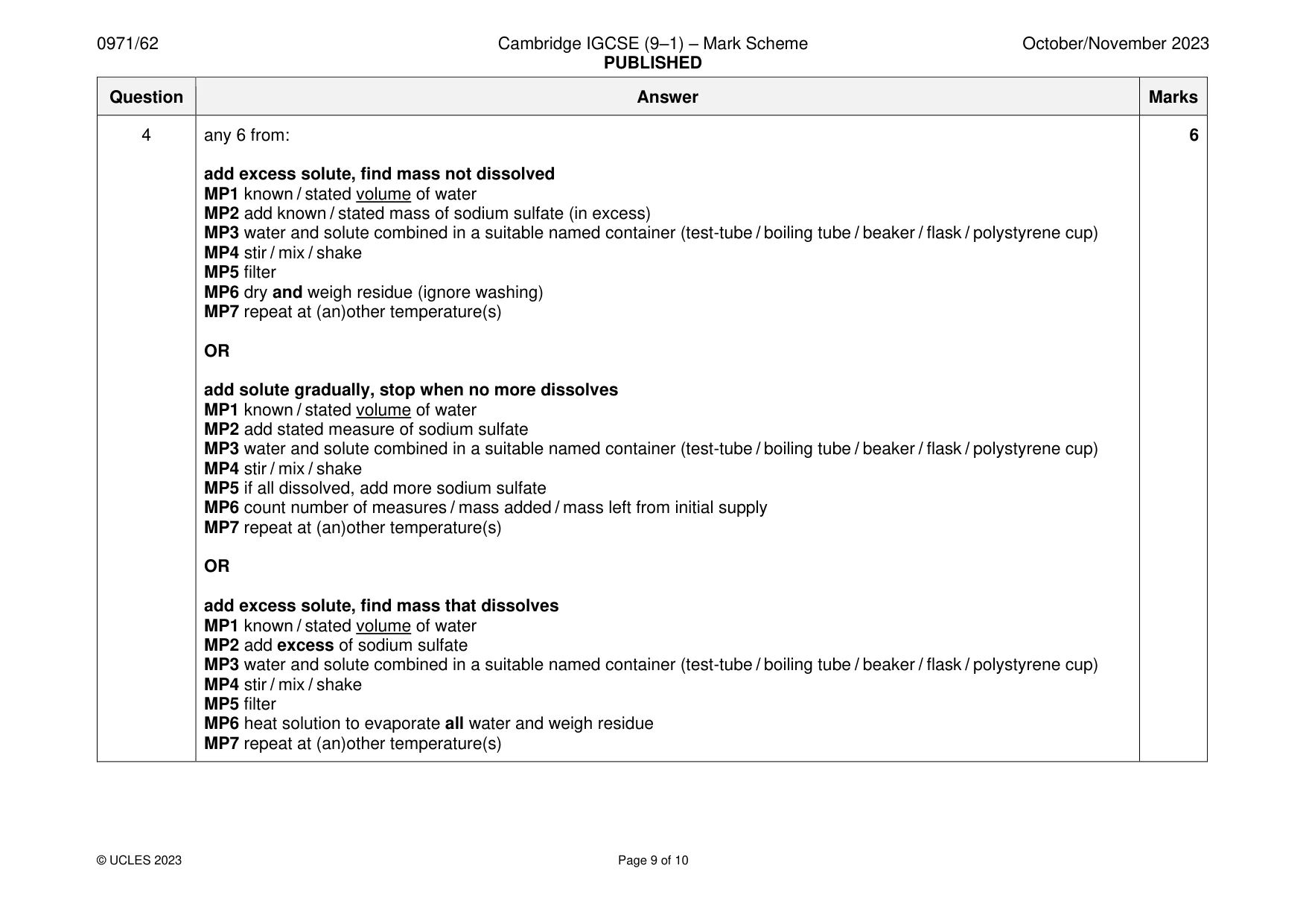
4 The solubility of solid sodium sulfate in water changes as the temperature of the water changes. Plan an experiment to find out how the solubility of sodium sulfate in water changes with temperature. You are provided with sodium sulfate, distilled water and common laboratory apparatus. ........................................................................................................................................................... ........................................................................................................................................................... ........................................................................................................................................................... ........................................................................................................................................................... ........................................................................................................................................................... ........................................................................................................................................................... ........................................................................................................................................................... ........................................................................................................................................................... ........................................................................................................................................................... ........................................................................................................................................................... ........................................................................................................................................................... ........................................................................................................................................................... ........................................................................................................................................................... ........................................................................................................................................................... ........................................................................................................................................................... ........................................................................................................................................................... ........................................................................................................................................................... ........................................................................................................................................................... ........................................................................................................................................................... ........................................................................................................................................................... ........................................................................................................................................................... ........................................................................................................................................................... ........................................................................................................................................................... ........................................................................................................................................................... ..................................................................................................................................................... [6]
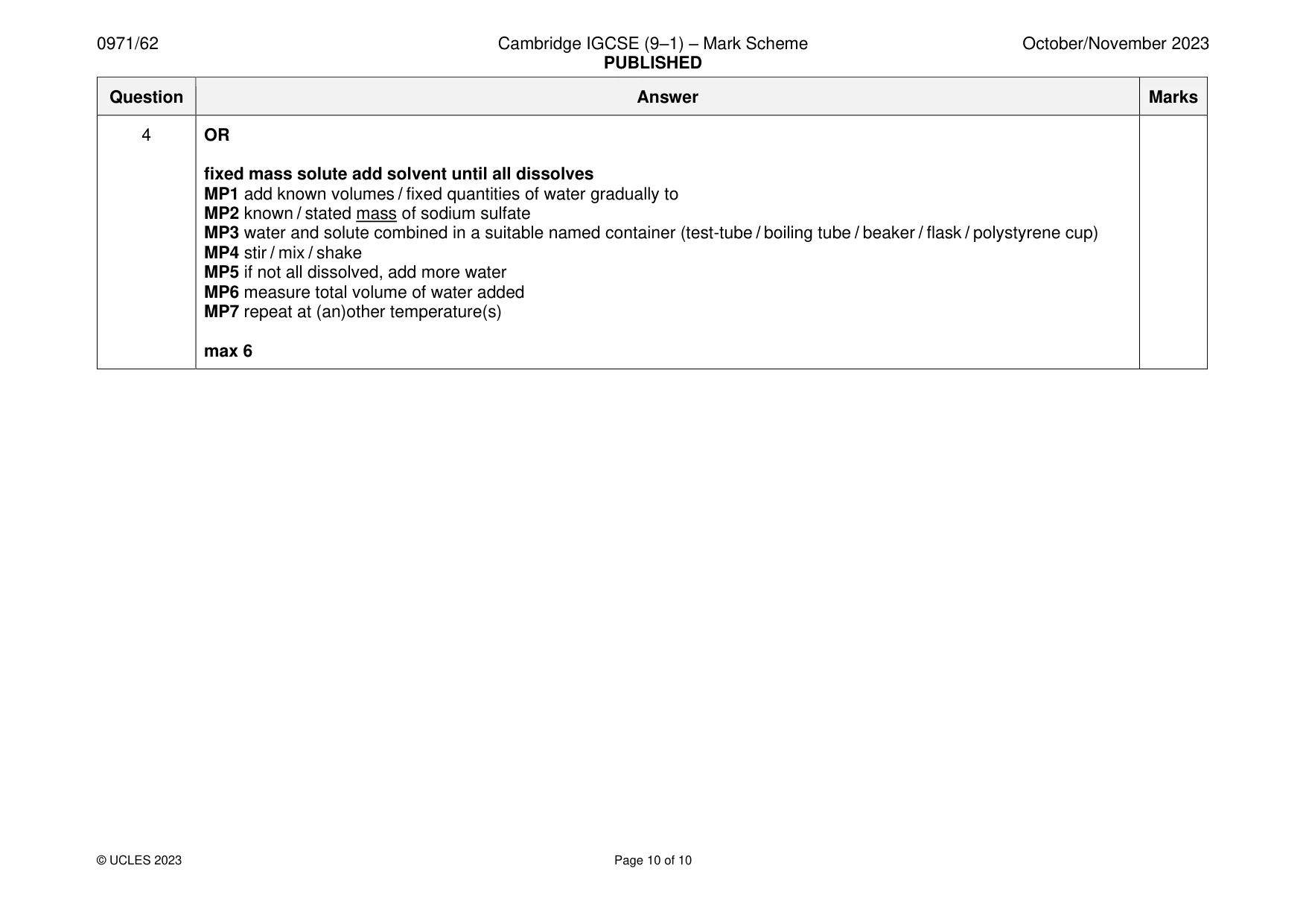
Mark scheme: 4 any 6 from: 6 add excess solute, find mass not dissolved MP1 known / stated volume of water MP2 add known / stated mass of sodium sulfate (in excess) MP3 water and solute combined in a suitable named container (test-tube / boiling tube / beaker / flask / polystyrene cup) MP4 stir / mix / shake MP5 filter MP6 dry and weigh residue (ignore washing) MP7 repeat at (an)other temperature(s) OR add solute gradually, stop when no more dissolves MP1 known / stated volume of water MP2 add stated measure of sodium sulfate MP3 water and solute combined in a suitable named container (test-tube / boiling tube / beaker / flask / polystyrene cup) MP4 stir / mix / shake MP5 if all dissolved, add more sodium sulfate MP6 count number of measures / mass added / mass left from initial supply MP7 repeat at (an)other temperature(s) OR add excess solute, find mass that dissolves MP1 known / stated volume of water MP2 add excess of sodium sulfate MP3 water and solute combined in a suitable named container (test-tube / boiling tube / beaker / flask / polystyrene cup) MP4 stir / mix / shake MP5 filter MP6 heat solution to evaporate all water and weigh residue MP7 repeat at (an)other temperature(s) 4 OR fixed mass solute add solvent until all dissolves MP1 add known volumes / fixed quantities of water gradually to MP2 known / stated mass of sodium sulfate MP3 water and solute combined in a suitable named container (test-tube / boiling tube / beaker / flask / polystyrene cup) MP4 stir / mix / shake MP5 if not all dissolved, add more water MP6 measure total volume of water added MP7 repeat at (an)other temperature(s) max 6
What was in this paper
The subtopics covered by these 4 questions, and how many questions each got. Open one in a new tab to see every Cambridge question on it.
What you needed in this session
Cambridge’s own grade thresholds for 2023 Oct/Nov, Paper 6 · Variant 2. A higher threshold means an easier paper — the bar moves with how the cohort did.