Cambridge IGCSE Chemistry (9-1) 0971 — 2023 May/June Paper 6 · Variant 1
0971/61/M/J/23 · 4 questions · 40 marks · 60 min
The question paper and its mark scheme, free to read here and free to download. This is Cambridge’s own paper, exactly as it was sat.
Question paper12 pages

Mark scheme8 pages
Answers below. Sit the paper first if you are practising.
Questions as text
Q1 · Ethanol can be made by fermentation of sugars found in plants
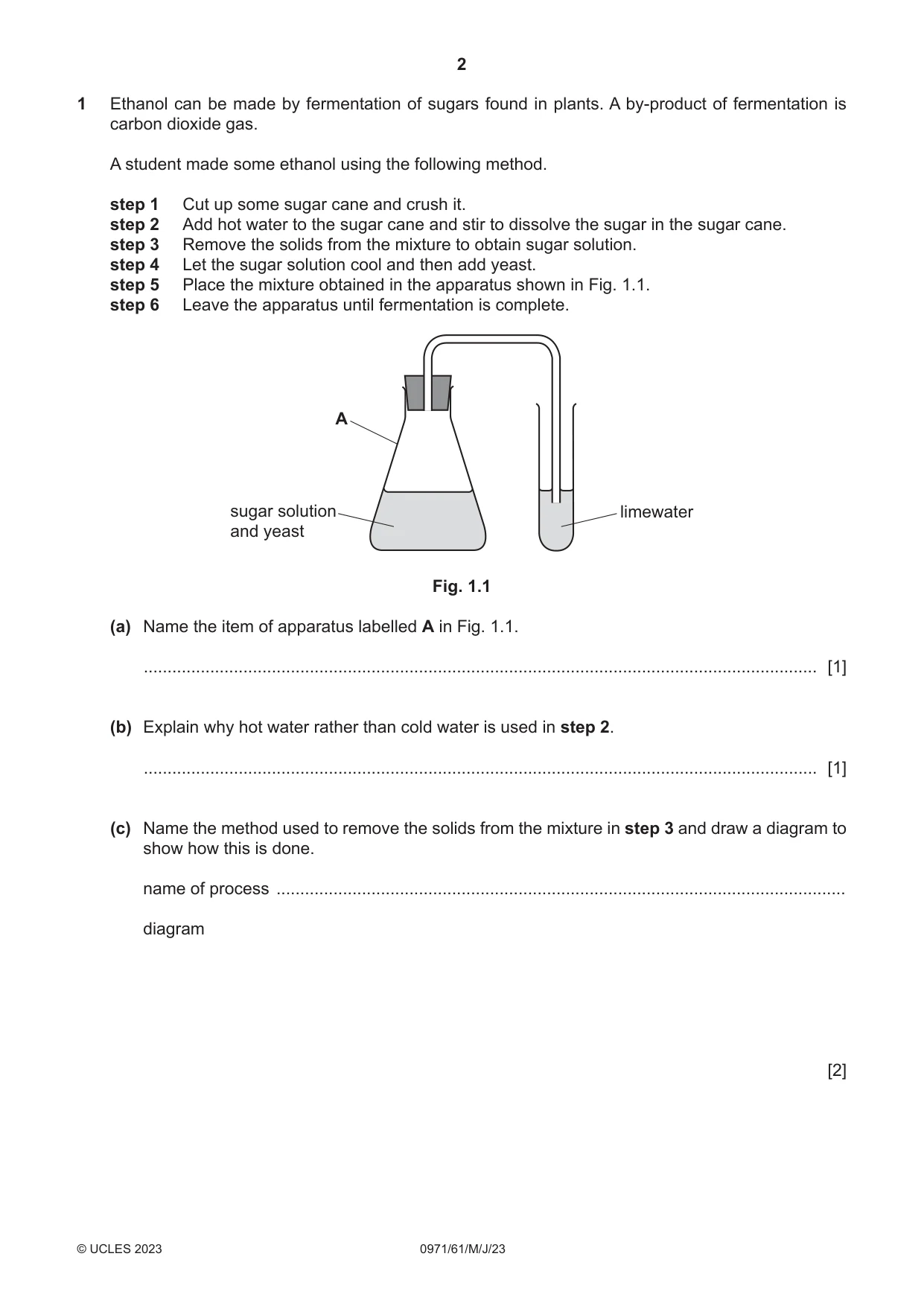
1 Ethanol can be made by fermentation of sugars found in plants. A by-product of fermentation is carbon dioxide gas. A student made some ethanol using the following method. step 1 Cut up some sugar cane and crush it. step 2 Add hot water to the sugar cane and stir to dissolve the sugar in the sugar cane. step 3 Remove the solids from the mixture to obtain sugar solution. step 4 Let the sugar solution cool and then add yeast. step 5 Place the mixture obtained in the apparatus shown in Fig. 1.1. step 6 Leave the apparatus until fermentation is complete. A sugar solution limewater and yeast Fig. 1.1 (a) Name the item of apparatus labelled A in Fig. 1.1. .............................................................................................................................................. [1] (b) Explain why hot water rather than cold water is used in step 2. .............................................................................................................................................. [1] (c) Name the method used to remove the solids from the mixture in step 3 and draw a diagram to show how this is done. name of process ......................................................................................................................... diagram [2] (d) State why the sugar solution is allowed to cool before the yeast is added in step 4. .................................................................................................................................................... .............................................................................................................................................. [1] (e) Describe how the appearance of the limewater changes as fermentation takes place. .............................................................................................................................................. [1] (f) Describe how the student could tell that fermentation is complete. .................................................................................................................................................... .............................................................................................................................................. [1] (g) Name the process used to separate ethanol from the mixture obtained by fermentation. .............................................................................................................................................. [1] [Total: 8]
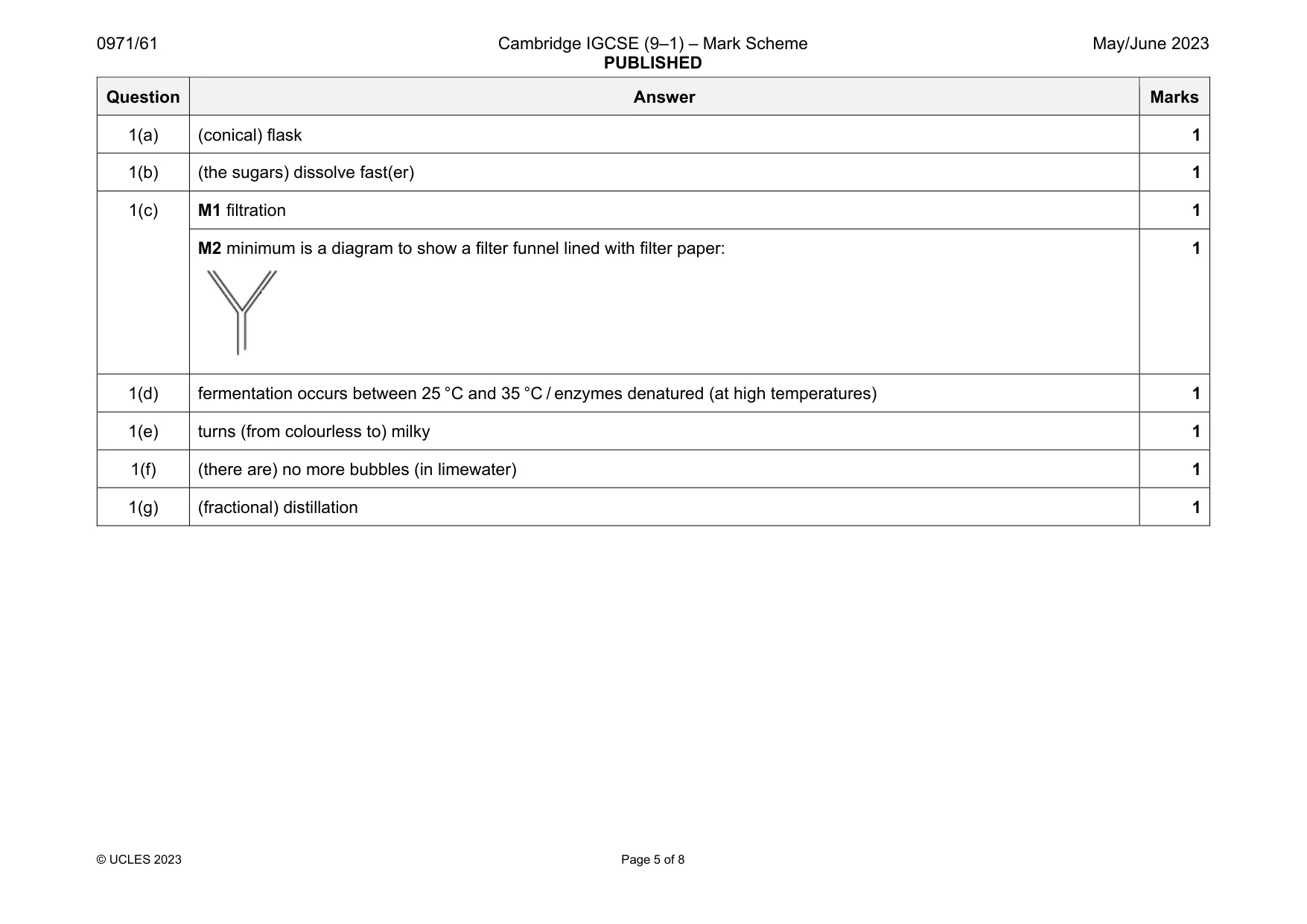
Mark scheme: 1(a) (conical) flask 1 1(b) (the sugars) dissolve fast(er) 1 1(c) M1 filtration 1 M2 minimum is a diagram to show a filter funnel lined with filter paper: 1 1(d) fermentation occurs between 25 °C and 35 °C / enzymes denatured (at high temperatures) 1 1(e) turns (from colourless to) milky 1 1(f) (there are) no more bubbles (in limewater) 1 1(g) (fractional) distillation 1
Q2 · A student investigates the reaction between aqueous ammonia and two different aqueous…
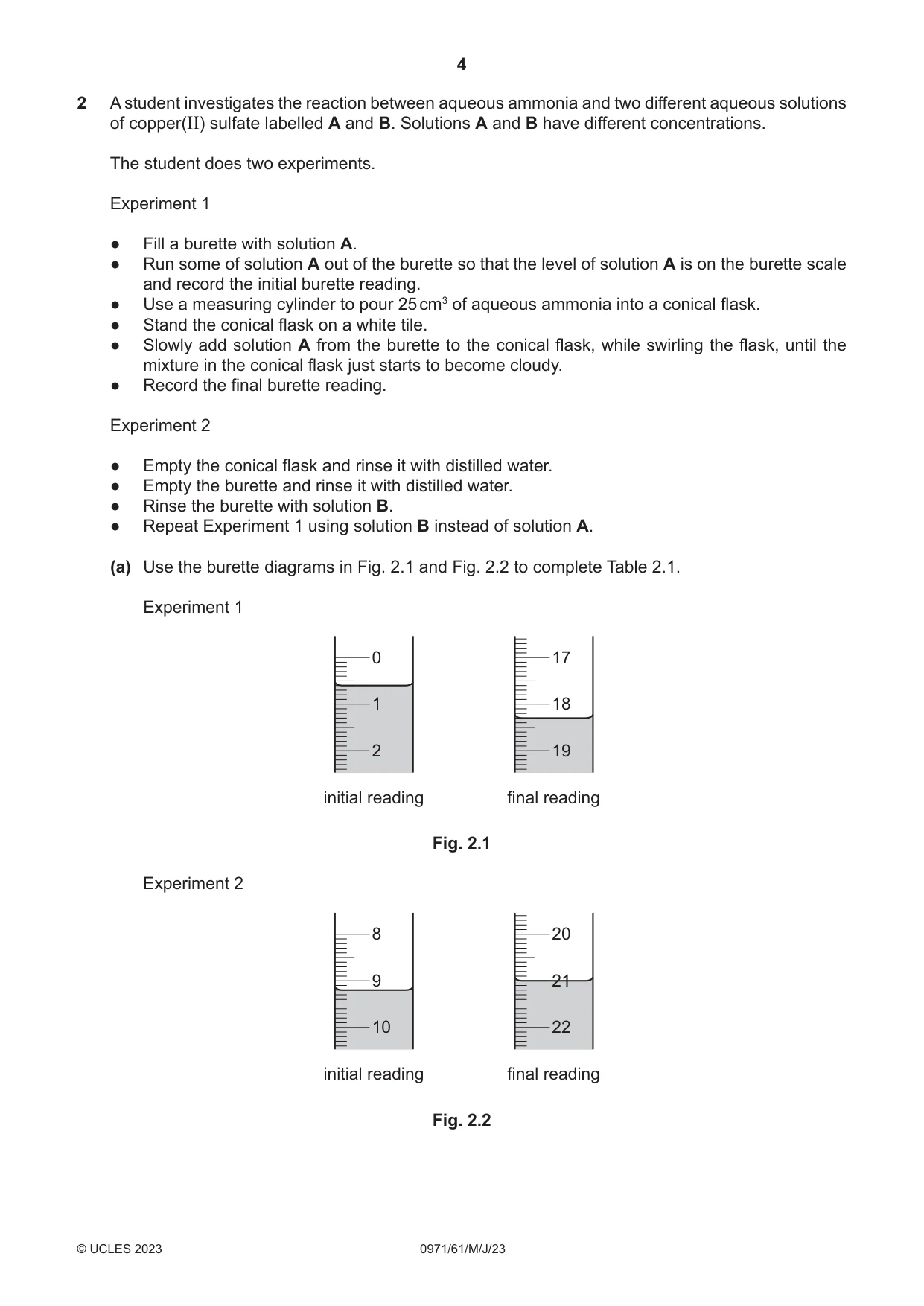
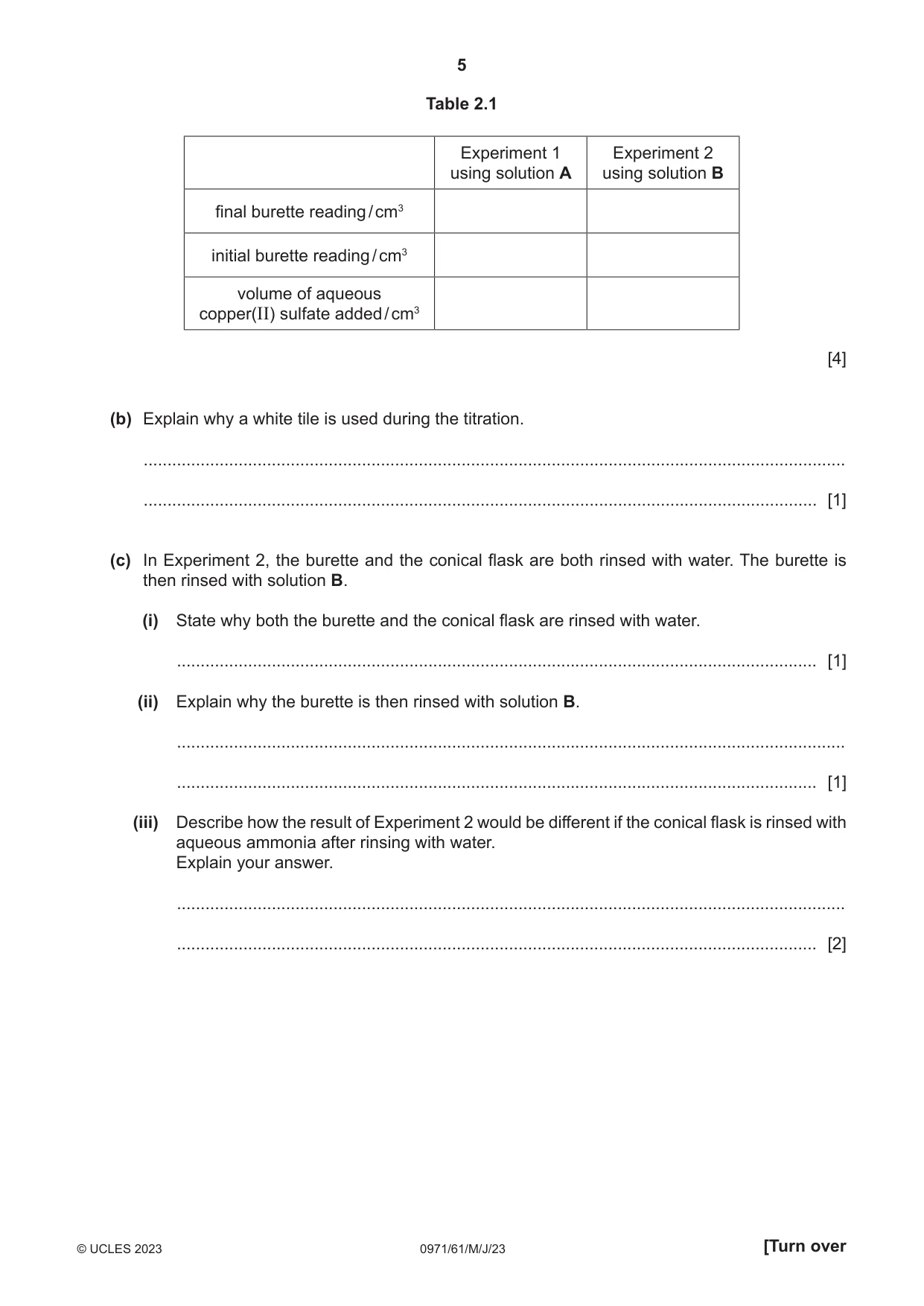
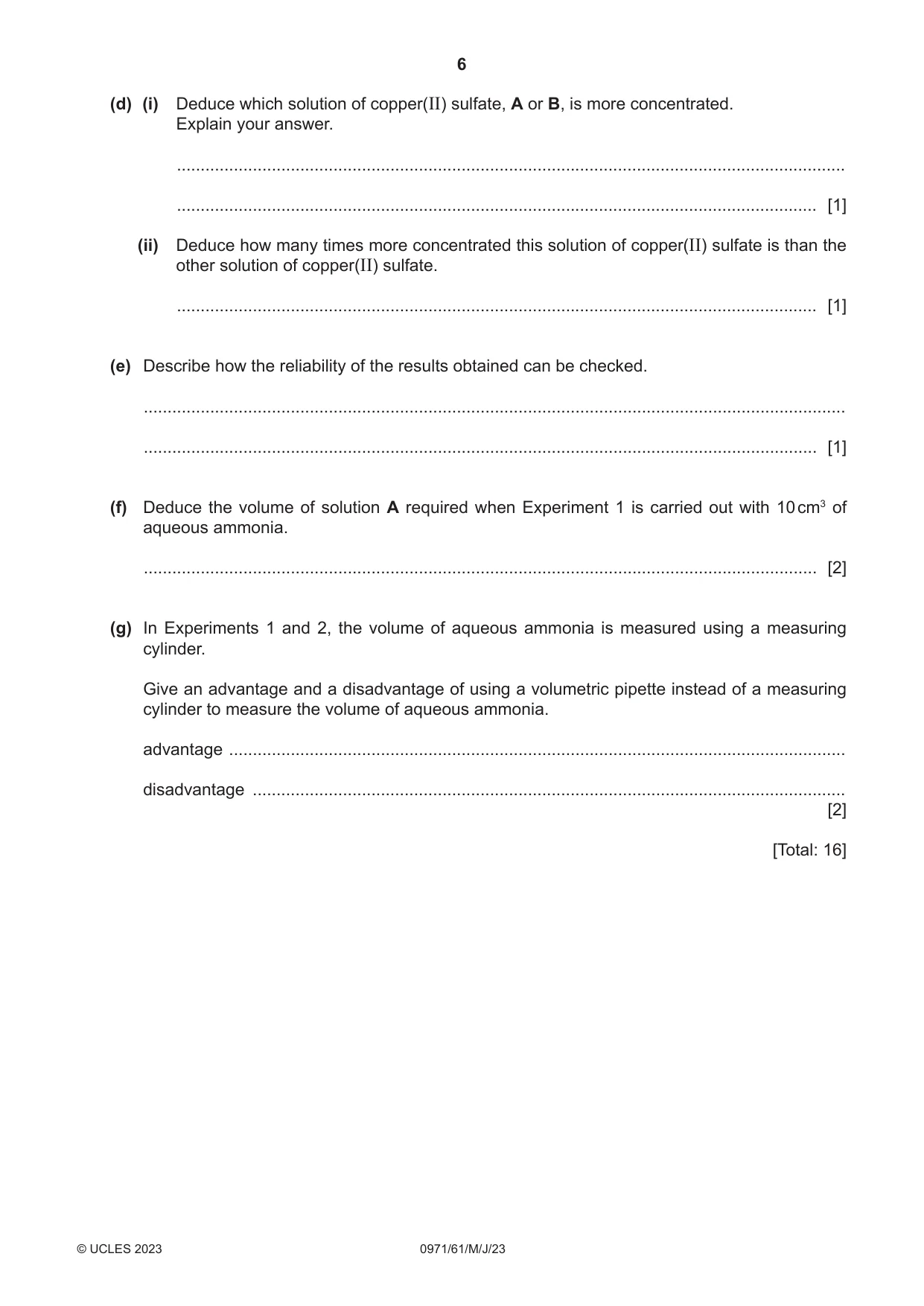
2 A student investigates the reaction between aqueous ammonia and two different aqueous solutions of copper(II) sulfate labelled A and B. Solutions A and B have different concentrations. The student does two experiments. Experiment 1 ● Fill a burette with solution A. ● Run some of solution A out of the burette so that the level of solution A is on the burette scale and record the initial burette reading. ● Use a measuring cylinder to pour 25 cm3 of aqueous ammonia into a conical flask. ● Stand the conical flask on a white tile. ● Slowly add solution A from the burette to the conical flask, while swirling the flask, until the mixture in the conical flask just starts to become cloudy. ● Record the final burette reading. Experiment 2 ● Empty the conical flask and rinse it with distilled water. ● Empty the burette and rinse it with distilled water. ● Rinse the burette with solution B. ● Repeat Experiment 1 using solution B instead of solution A. (a) Use the burette diagrams in Fig. 2.1 and Fig. 2.2 to complete Table 2.1. Experiment 1 0 17 1 18 2 19 initial reading final reading Fig. 2.1 Experiment 2 8 20 9 21 10 22 initial reading final reading Fig. 2.2 Table 2.1 Experiment 1 Experiment 2 using solution A using solution B final burette reading / cm3 initial burette reading / cm3 volume of aqueous copper(II) sulfate added / cm3 [4] (b) Explain why a white tile is used during the titration. .................................................................................................................................................... .............................................................................................................................................. [1] (c) In Experiment 2, the burette and the conical flask are both rinsed with water. The burette is then rinsed with solution B. (i) State why both the burette and the conical flask are rinsed with water. ....................................................................................................................................... [1] (ii) Explain why the burette is then rinsed with solution B. ............................................................................................................................................. ....................................................................................................................................... [1] (iii) Describe how the result of Experiment 2 would be different if the conical flask is rinsed with aqueous ammonia after rinsing with water. Explain your answer. ............................................................................................................................................. ....................................................................................................................................... [2] (d) (i) Deduce which solution of copper(II) sulfate, A or B, is more concentrated. Explain your answer. ............................................................................................................................................. ....................................................................................................................................... [1] (ii) Deduce how many times more concentrated this solution of copper(II) sulfate is than the other solution of copper(II) sulfate. ....................................................................................................................................... [1] (e) Describe how the reliability of the results obtained can be checked. .................................................................................................................................................... .............................................................................................................................................. [1] (f) Deduce the volume of solution A required when Experiment 1 is carried out with 10 cm3 of aqueous ammonia. .............................................................................................................................................. [2] (g) In Experiments 1 and 2, the volume of aqueous ammonia is measured using a measuring cylinder. Give an advantage and a disadvantage of using a volumetric pipette instead of a measuring cylinder to measure the volume of aqueous ammonia. advantage .................................................................................................................................. disadvantage .............................................................................................................................. [2] [Total: 16] Question 3 starts on the next page.
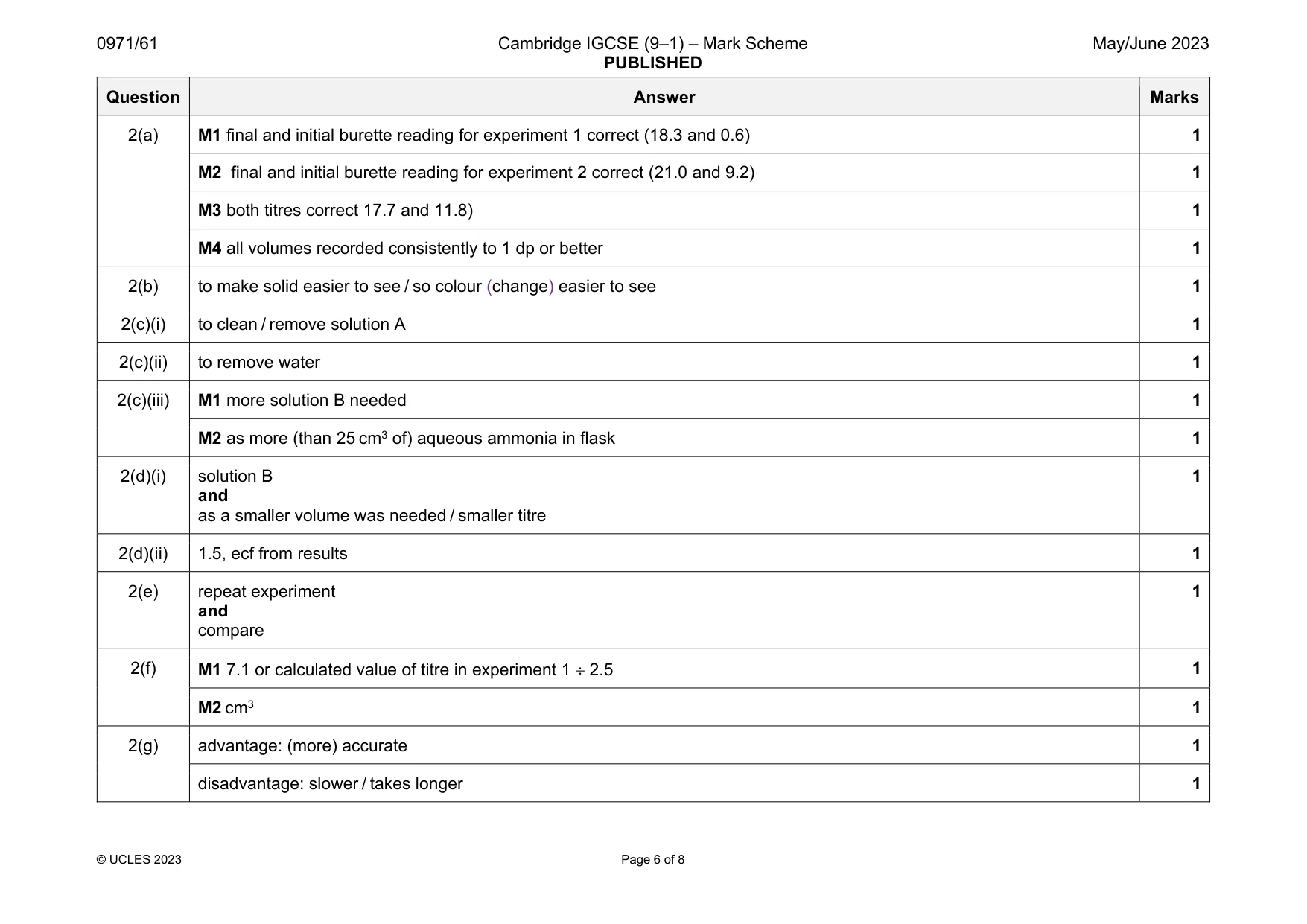
Mark scheme: 2(a) M1 final and initial burette reading for experiment 1 correct (18.3 and 0.6) 1 M2 final and initial burette reading for experiment 2 correct (21.0 and 9.2) 1 M3 both titres correct 17.7 and 11.8) 1 M4 all volumes recorded consistently to 1 dp or better 1 2(b) to make solid easier to see / so colour (change) easier to see 1 2(c)(i) to clean / remove solution A 1 2(c)(ii) to remove water 1 2(c)(iii) M1 more solution B needed 1 M2 as more (than 25 cm3 of) aqueous ammonia in flask 1 2(d)(i) solution B and as a smaller volume was needed / smaller titre 1 2(d)(ii) 1.5, ecf from results 1 2(e) repeat experiment and compare 1 2(f) M1 7.1 or calculated value of titre in experiment 1 2.5 1 M2 cm3 1 2(g) advantage: (more) accurate 1 disadvantage: slower / takes longer 1
Q3 · A student tests two solids: solid E and solid F
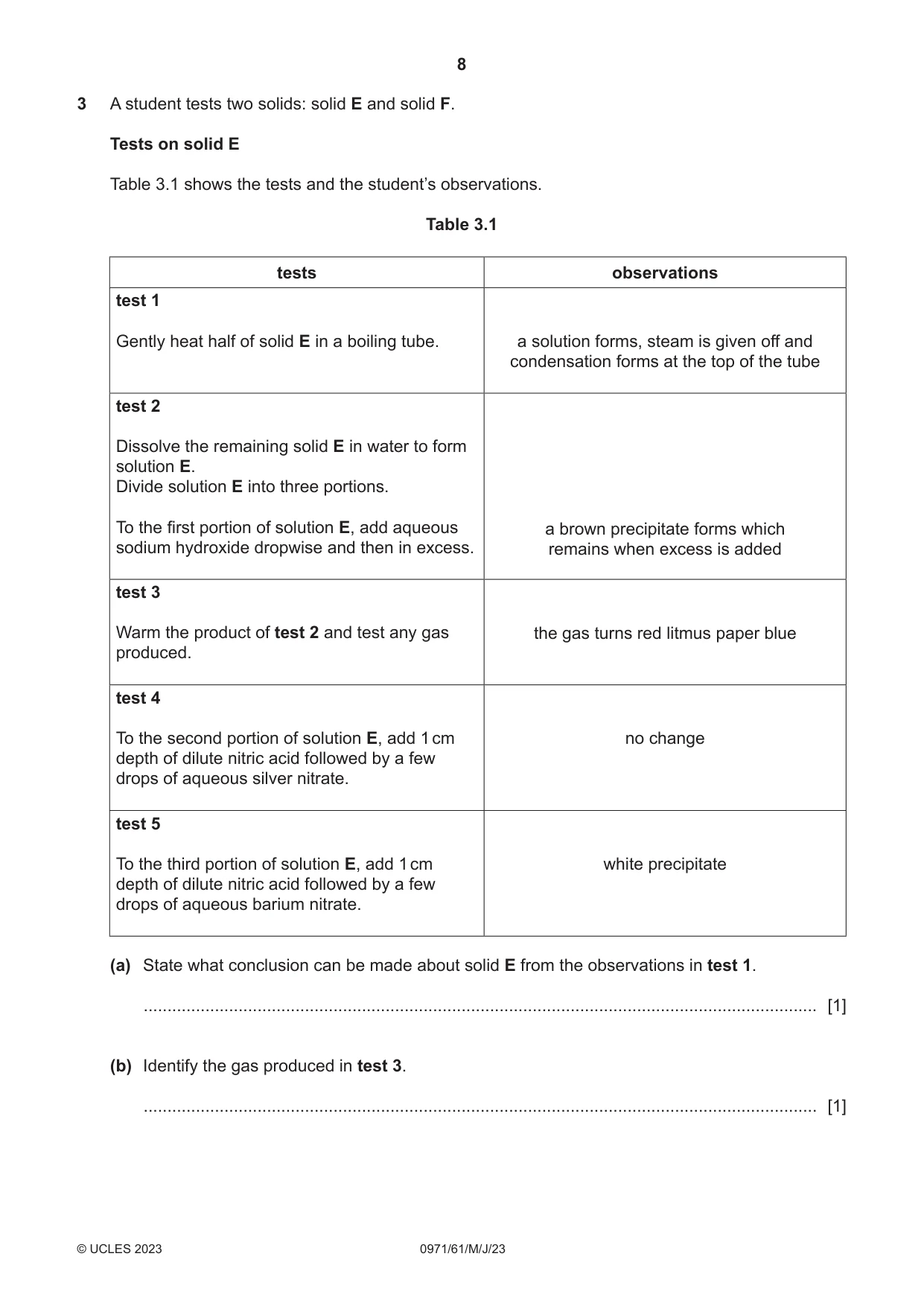
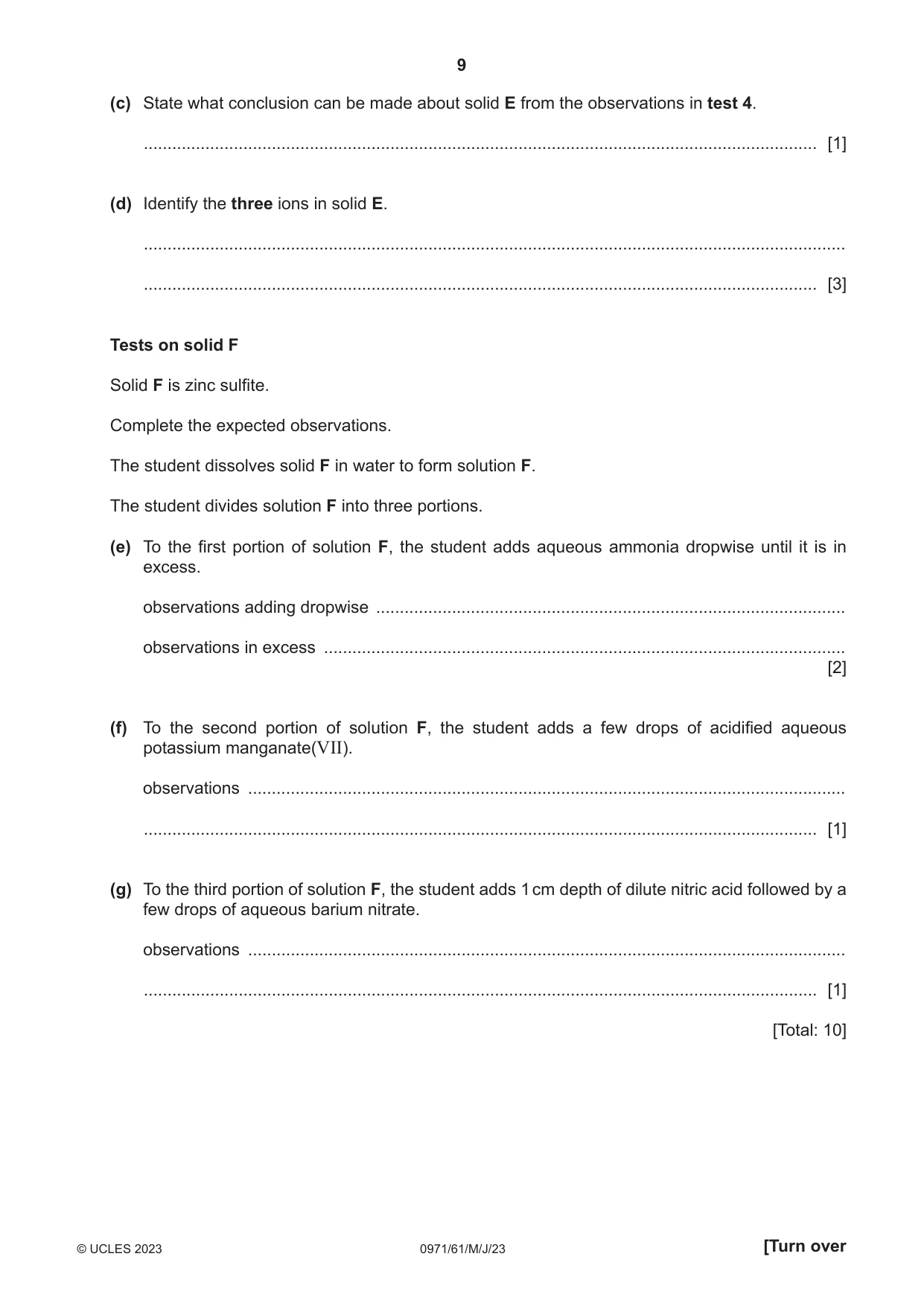
3 A student tests two solids: solid E and solid F. Tests on solid E Table 3.1 shows the tests and the student’s observations. Table 3.1 tests observations test 1 Gently heat half of solid E in a boiling tube. a solution forms, steam is given off and condensation forms at the top of the tube test 2 Dissolve the remaining solid E in water to form solution E. Divide solution E into three portions. To the first portion of solution E, add aqueous a brown precipitate forms which sodium hydroxide dropwise and then in excess. remains when excess is added test 3 Warm the product of test 2 and test any gas the gas turns red litmus paper blue produced. test 4 To the second portion of solution E, add 1 cm no change depth of dilute nitric acid followed by a few drops of aqueous silver nitrate. test 5 To the third portion of solution E, add 1 cm white precipitate depth of dilute nitric acid followed by a few drops of aqueous barium nitrate. (a) State what conclusion can be made about solid E from the observations in test 1. .............................................................................................................................................. [1] (b) Identify the gas produced in test 3. .............................................................................................................................................. [1] (c) State what conclusion can be made about solid E from the observations in test 4. .............................................................................................................................................. [1] (d) Identify the three ions in solid E. .................................................................................................................................................... .............................................................................................................................................. [3] Tests on solid F Solid F is zinc sulfite. Complete the expected observations. The student dissolves solid F in water to form solution F. The student divides solution F into three portions. (e) To the first portion of solution F, the student adds aqueous ammonia dropwise until it is in excess. observations adding dropwise .................................................................................................... observations in excess ............................................................................................................... [2] (f) To the second portion of solution F, the student adds a few drops of acidified aqueous potassium manganate(VII). observations ............................................................................................................................... .............................................................................................................................................. [1] (g) To the third portion of solution F, the student adds 1 cm depth of dilute nitric acid followed by a few drops of aqueous barium nitrate. observations ............................................................................................................................... .............................................................................................................................................. [1] [Total: 10]
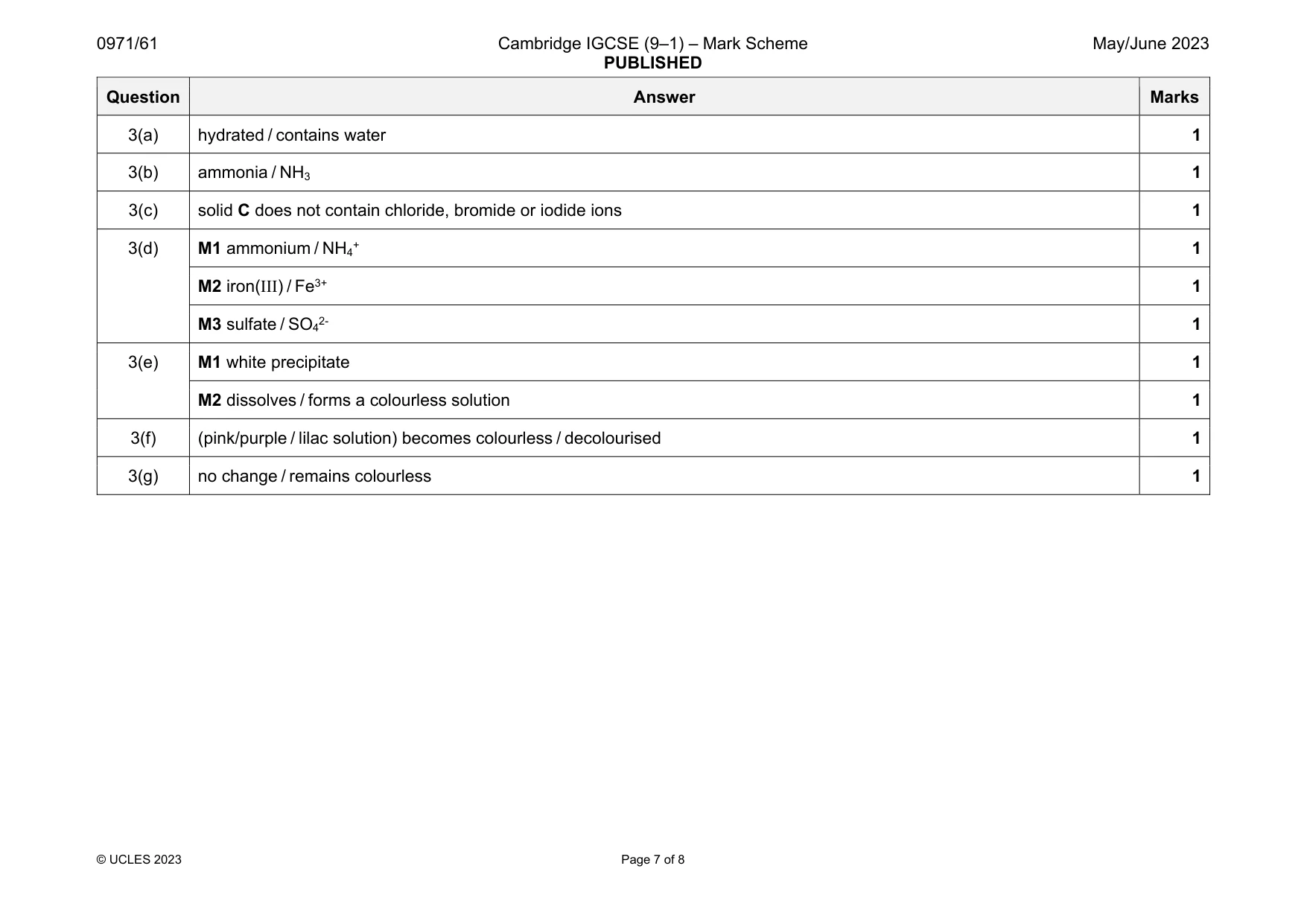
Mark scheme: 3(a) hydrated / contains water 1 3(b) ammonia / NH3 1 3(c) solid C does not contain chloride, bromide or iodide ions 1 3(d) M1 ammonium / NH4+ 1 M2 iron(III) / Fe3+ 1 M3 sulfate / SO42- 1 3(e) M1 white precipitate 1 M2 dissolves / forms a colourless solution 1 3(f) (pink/purple / lilac solution) becomes colourless / decolourised 1 3(g) no change / remains colourless 1
Q4 · Solid cobalt(II) oxide is a base which is insoluble in water
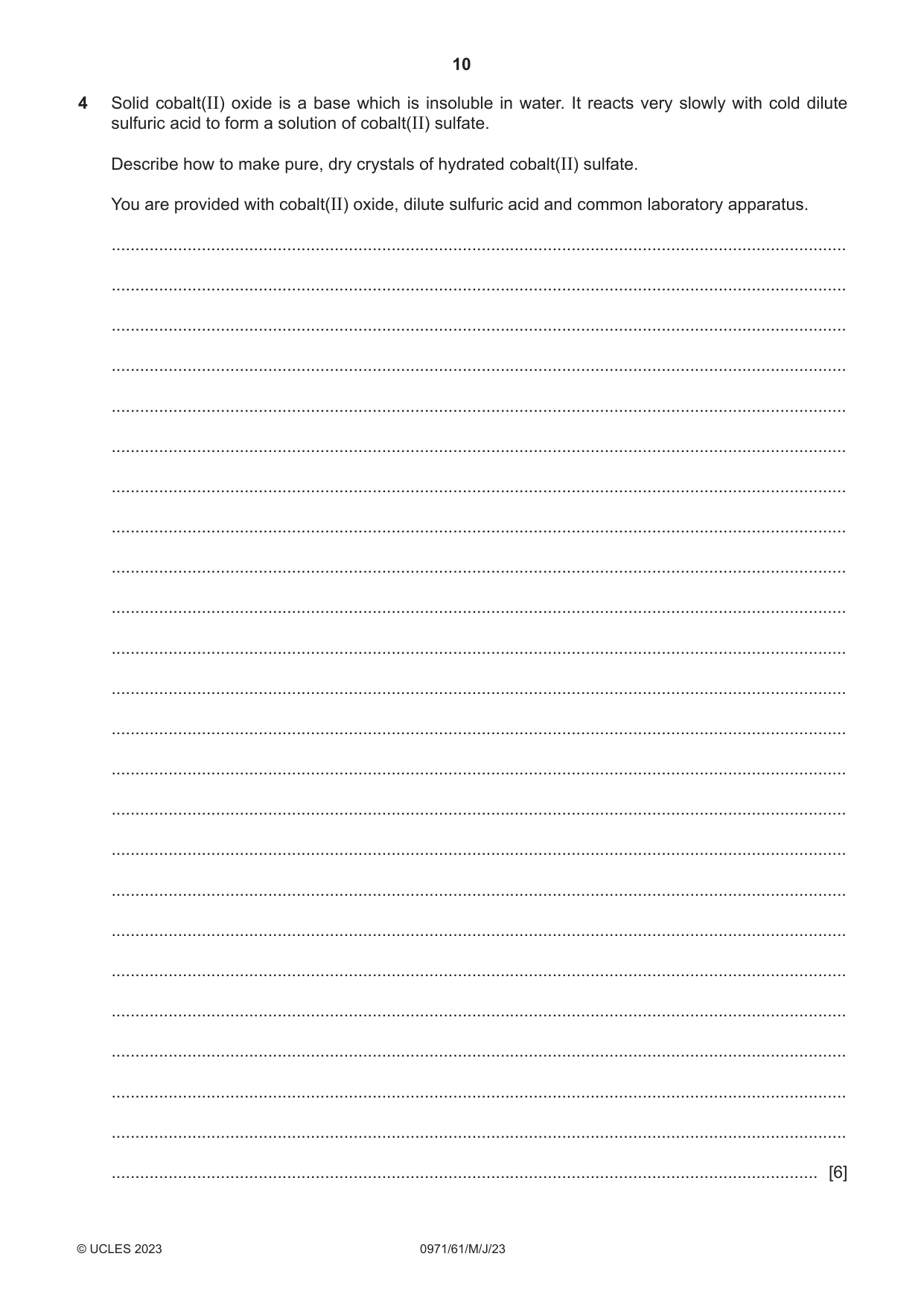
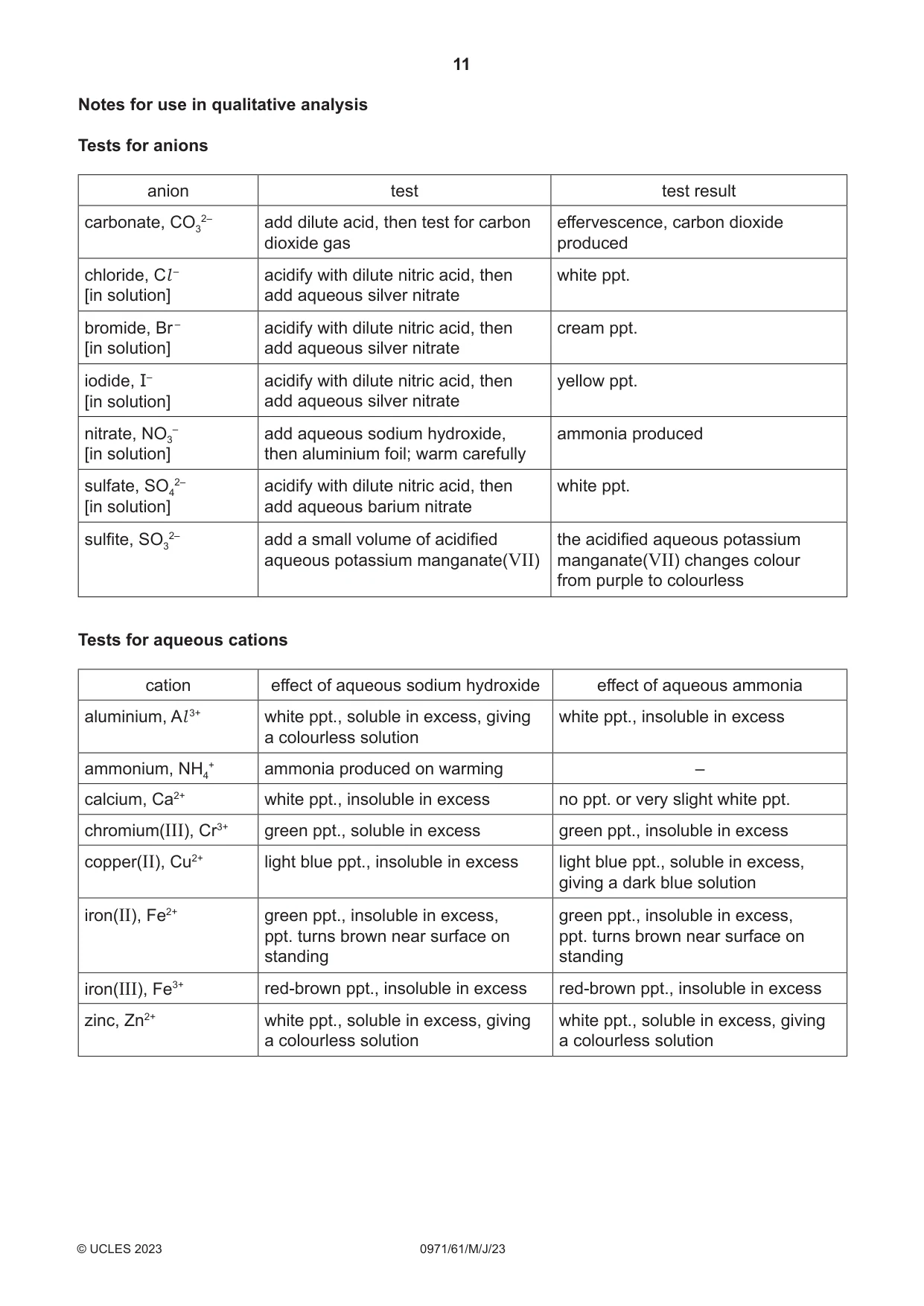
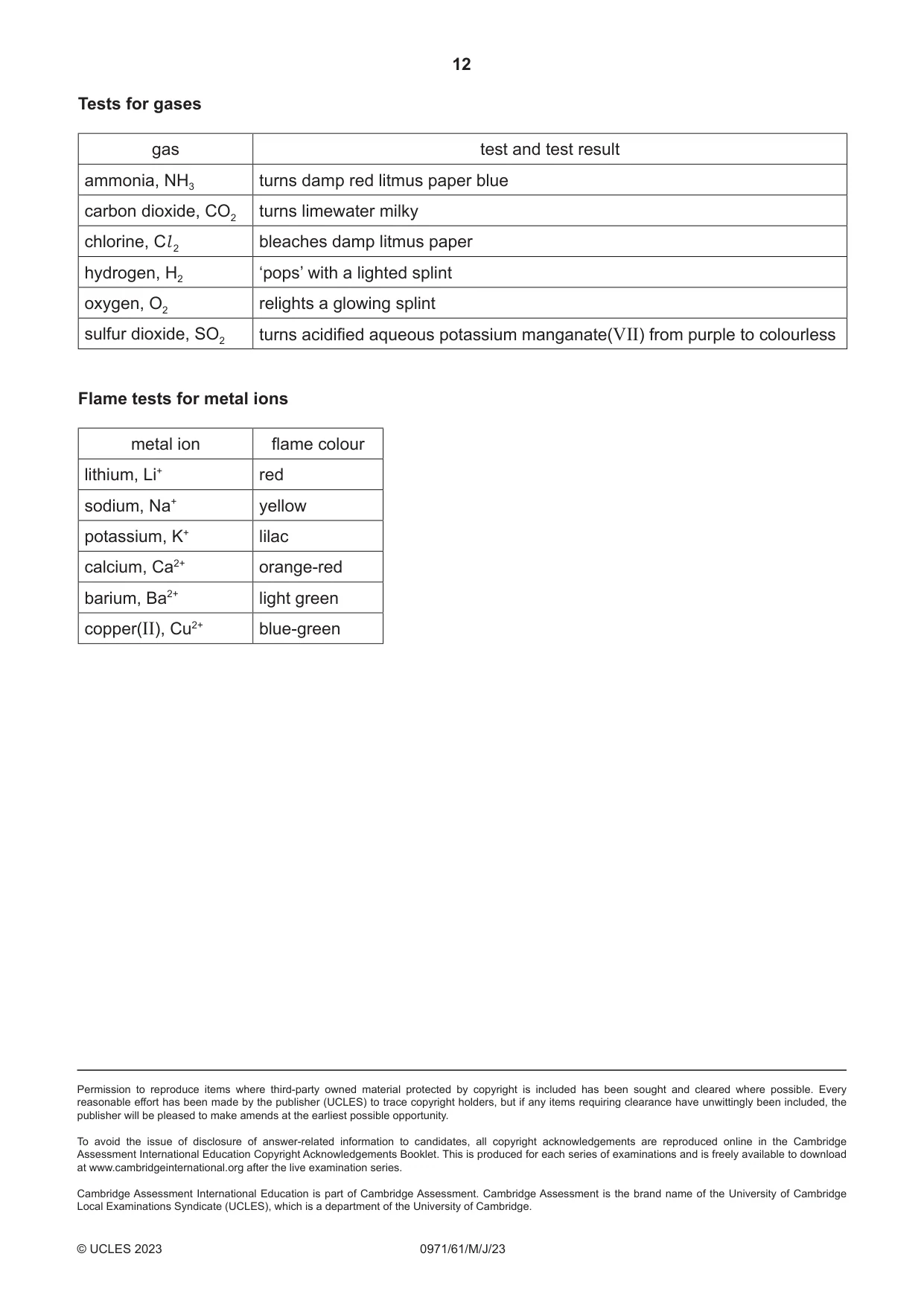
4 Solid cobalt(II) oxide is a base which is insoluble in water. It reacts very slowly with cold dilute sulfuric acid to form a solution of cobalt(II) sulfate. Describe how to make pure, dry crystals of hydrated cobalt(II) sulfate. You are provided with cobalt(II) oxide, dilute sulfuric acid and common laboratory apparatus. ........................................................................................................................................................... ........................................................................................................................................................... ........................................................................................................................................................... ........................................................................................................................................................... ........................................................................................................................................................... ........................................................................................................................................................... ........................................................................................................................................................... ........................................................................................................................................................... ........................................................................................................................................................... ........................................................................................................................................................... ........................................................................................................................................................... ........................................................................................................................................................... ........................................................................................................................................................... ........................................................................................................................................................... ........................................................................................................................................................... ........................................................................................................................................................... ........................................................................................................................................................... ........................................................................................................................................................... ........................................................................................................................................................... ........................................................................................................................................................... ........................................................................................................................................................... ........................................................................................................................................................... ........................................................................................................................................................... ..................................................................................................................................................... [6] Notes for use in qualitative analysis Tests for anions anion test test result carbonate, CO32– add dilute acid, then test for carbon effervescence, carbon dioxide dioxide gas produced chloride, Cl – acidify with dilute nitric acid, then white ppt. [in solution] add aqueous silver nitrate bromide, Br – acidify with dilute nitric acid, then cream ppt. [in solution] add aqueous silver nitrate iodide, I– acidify with dilute nitric acid, then yellow ppt. [in solution] add aqueous silver nitrate nitrate, NO3– add aqueous sodium hydroxide, ammonia produced [in solution] then aluminium foil; warm carefully sulfate, SO42– acidify with dilute nitric acid, then white ppt. [in solution] add aqueous barium nitrate sulfite, SO32– add a small volume of acidified the acidified aqueous potassium aqueous potassium manganate(VII) manganate(VII) changes colour from purple to colourless Tests for aqueous cations cation effect of aqueous sodium hydroxide effect of aqueous ammonia aluminium, Al 3+ white ppt., soluble in excess, giving white ppt., insoluble in excess a colourless solution ammonium, NH4+ ammonia produced on warming – calcium, Ca2+ white ppt., insoluble in excess no ppt. or very slight white ppt. chromium(III), Cr3+ green ppt., soluble in excess green ppt., insoluble in excess copper(II), Cu2+ light blue ppt., insoluble in excess light blue ppt., soluble in excess, giving a dark blue solution iron(II), Fe2+ green ppt., insoluble in excess, green ppt., insoluble in excess, ppt. turns brown near surface on ppt. turns brown near surface on standing standing iron(III), Fe3+ red-brown ppt., insoluble in excess red-brown ppt., insoluble in excess zinc, Zn2+ white ppt., soluble in excess, giving white ppt., soluble in excess, giving a colourless solution a colourless solution Tests for gases gas test and test result ammonia, NH3 turns damp red litmus paper blue carbon dioxide, CO2 turns limewater milky chlorine, Cl 2 bleaches damp litmus paper hydrogen, H2 ‘pops’ with a lighted splint oxygen, O2 relights a glowing splint sulfur dioxide, SO2 turns acidified aqueous potassium manganate(VII) from purple to colourless Flame tests for metal ions metal ion flame colour lithium, Li+ red sodium, Na+ yellow potassium, K+ lilac calcium, Ca2+ orange-red barium, Ba2+ light green copper(II), Cu2+ blue-green
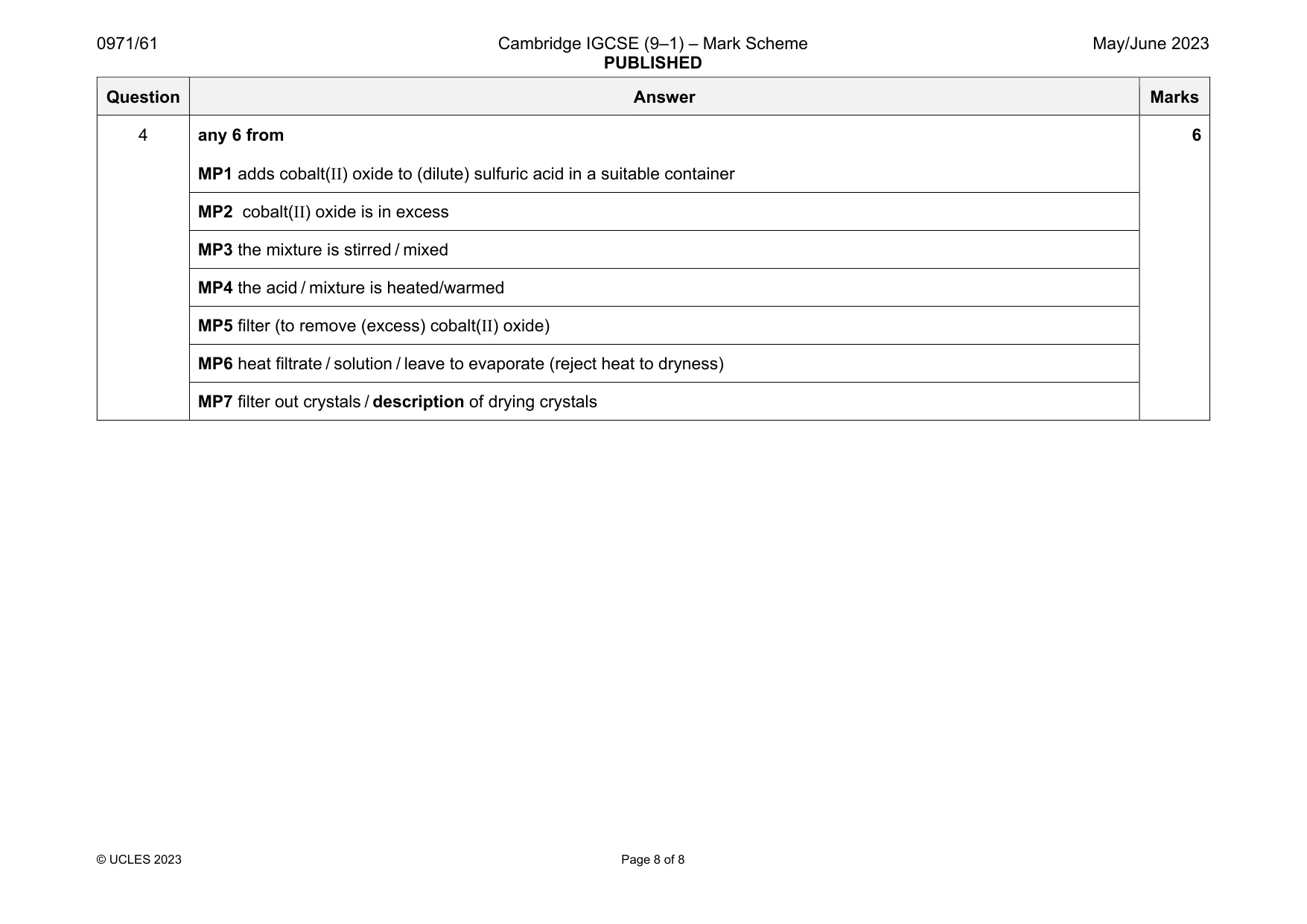
Mark scheme: 4 any 6 from MP1 adds cobalt(II) oxide to (dilute) sulfuric acid in a suitable container 6 MP2 cobalt(II) oxide is in excess MP3 the mixture is stirred / mixed MP4 the acid / mixture is heated/warmed MP5 filter (to remove (excess) cobalt(II) oxide) MP6 heat filtrate / solution / leave to evaporate (reject heat to dryness) MP7 filter out crystals / description of drying crystals
What was in this paper
The subtopics covered by these 4 questions, and how many questions each got. Open one in a new tab to see every Cambridge question on it.
What you needed in this session
Cambridge’s own grade thresholds for 2023 May/June, Paper 6 · Variant 1. A higher threshold means an easier paper — the bar moves with how the cohort did.