Cambridge IGCSE Chemistry (9-1) 0971 — 2019 May/June Paper 6 · Variant 1
0971/61/M/J/19 · 4 questions · 40 marks · ≈45 min
The question paper and its mark scheme, free to read here and free to download. This is Cambridge’s own paper, exactly as it was sat.
Question paper12 pages



Mark scheme7 pages
Answers below. Sit the paper first if you are practising.
Questions as text
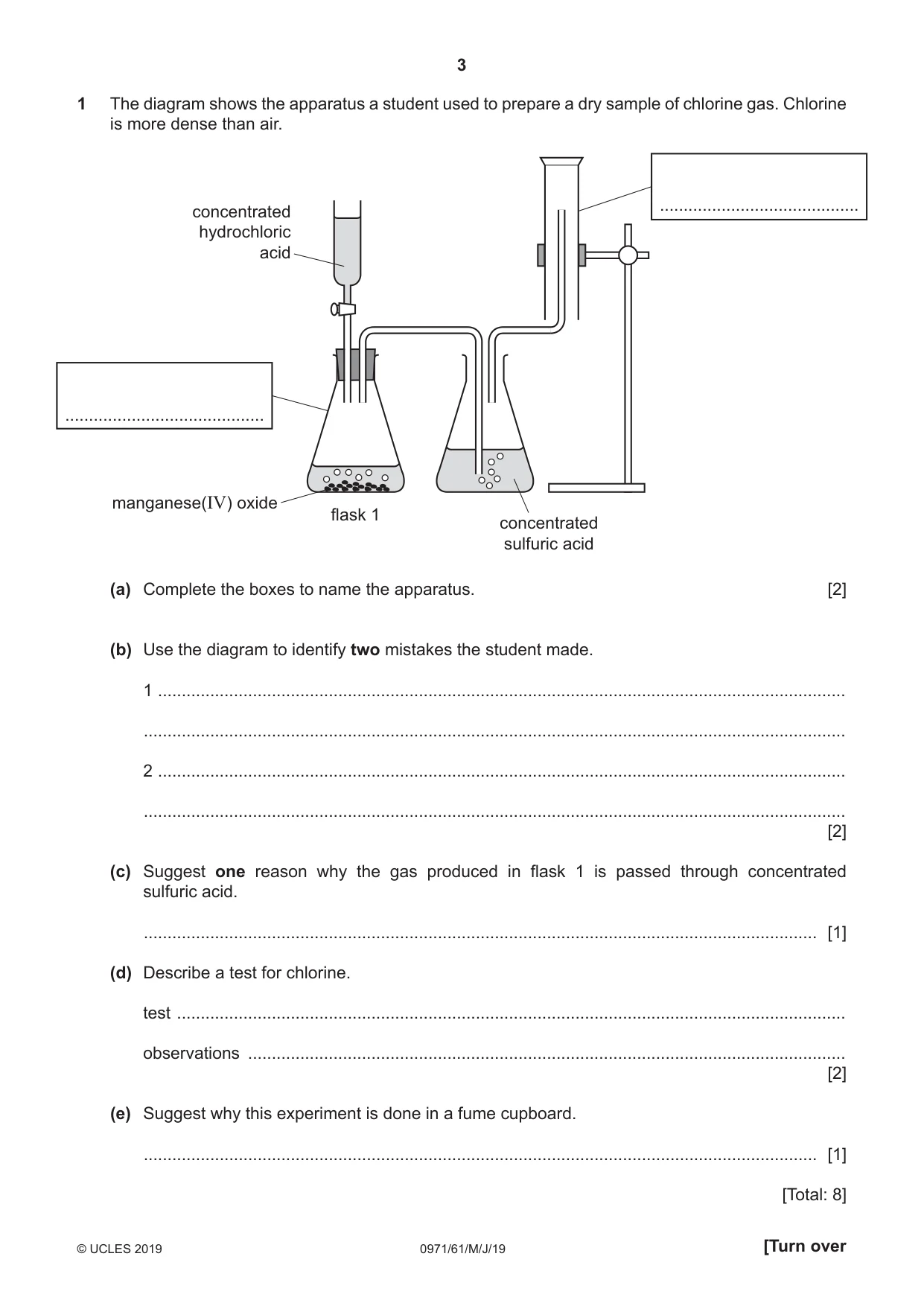
Q1 · The diagram shows the apparatus a student used to prepare a dry sample of chlorine gas
1 The diagram shows the apparatus a student used to prepare a dry sample of chlorine gas. Chlorine is more dense than air. .......................................... concentrated hydrochloric acid .......................................... manganese(IV) oxide flask 1 concentrated sulfuric acid (a) Complete the boxes to name the apparatus. [2] (b) Use the diagram to identify two mistakes the student made. 1 ................................................................................................................................................. .................................................................................................................................................... 2 ................................................................................................................................................. .................................................................................................................................................... [2] (c) Suggest one reason why the gas produced in flask 1 is passed through concentrated sulfuric acid. .............................................................................................................................................. [1] (d) Describe a test for chlorine. test ............................................................................................................................................. observations ............................................................................................................................... [2] (e) Suggest why this experiment is done in a fume cupboard. .............................................................................................................................................. [1] [Total: 8]
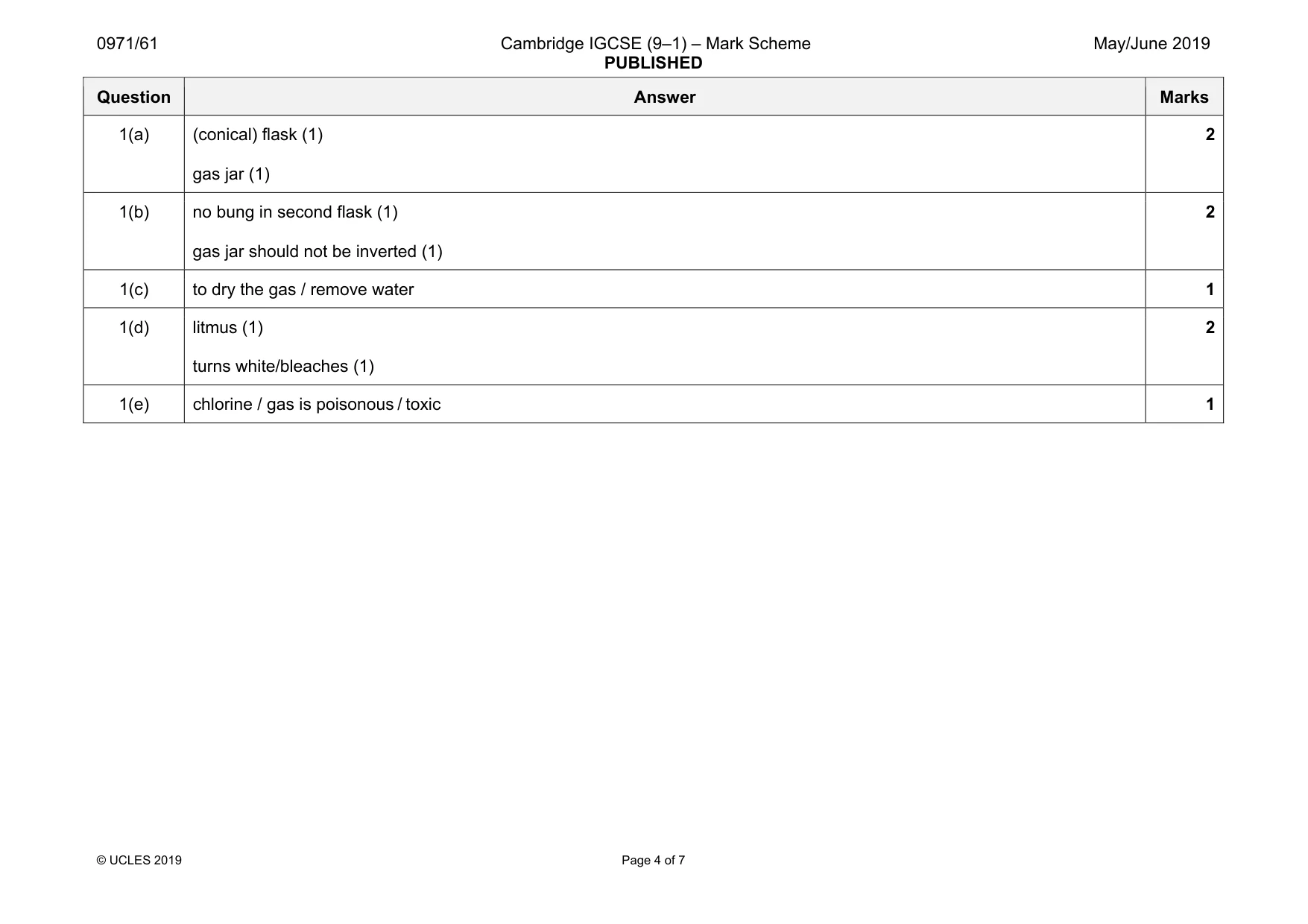
Mark scheme: 1(a) (conical) flask (1) gas jar (1) 2 1(b) no bung in second flask (1) gas jar should not be inverted (1) 2 1(c) to dry the gas / remove water 1 1(d) litmus (1) turns white/bleaches (1) 2 1(e) chlorine / gas is poisonous / toxic 1
Q2 · A student investigated the reaction between aqueous sodium carbonate and aqueous barium…
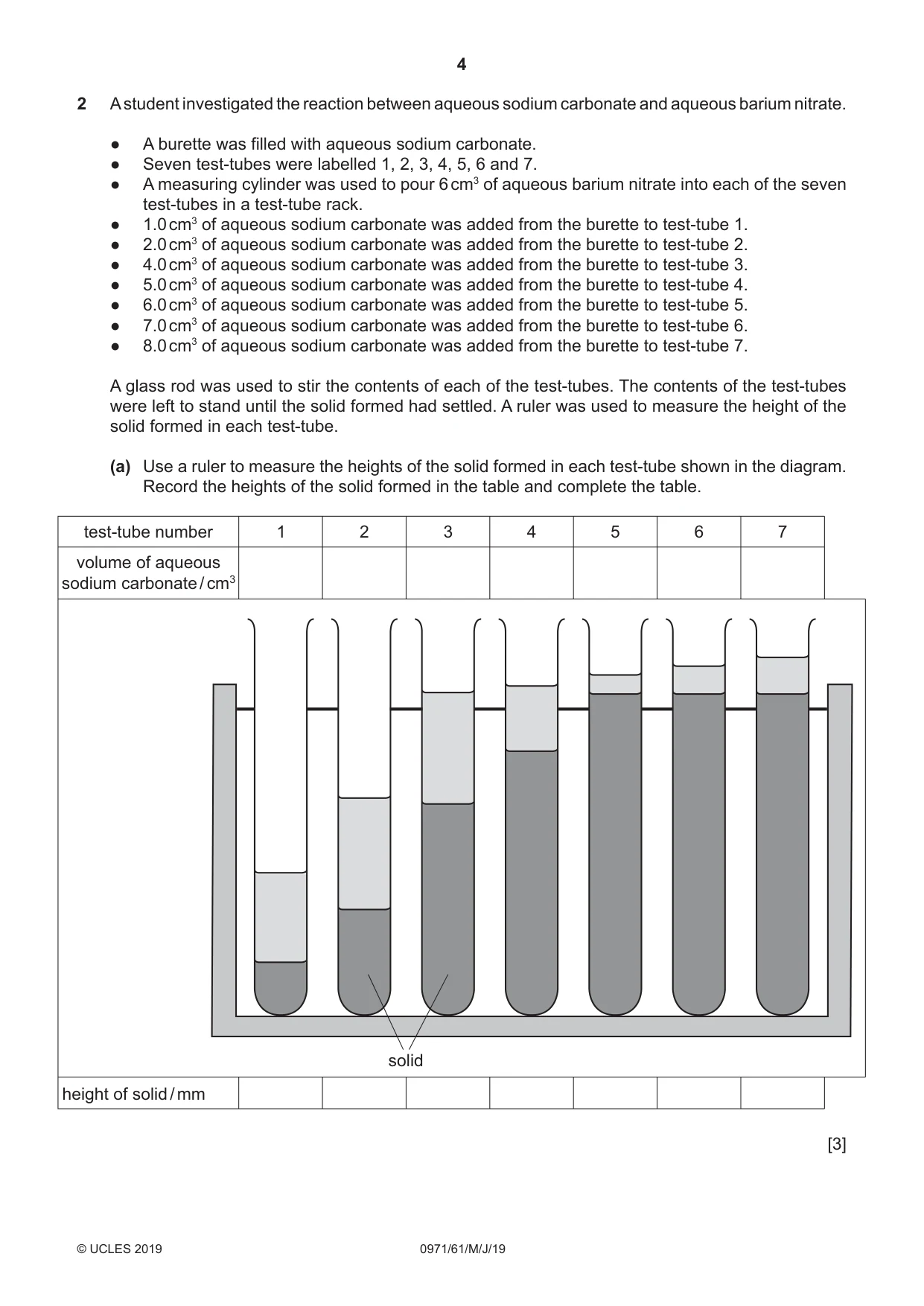
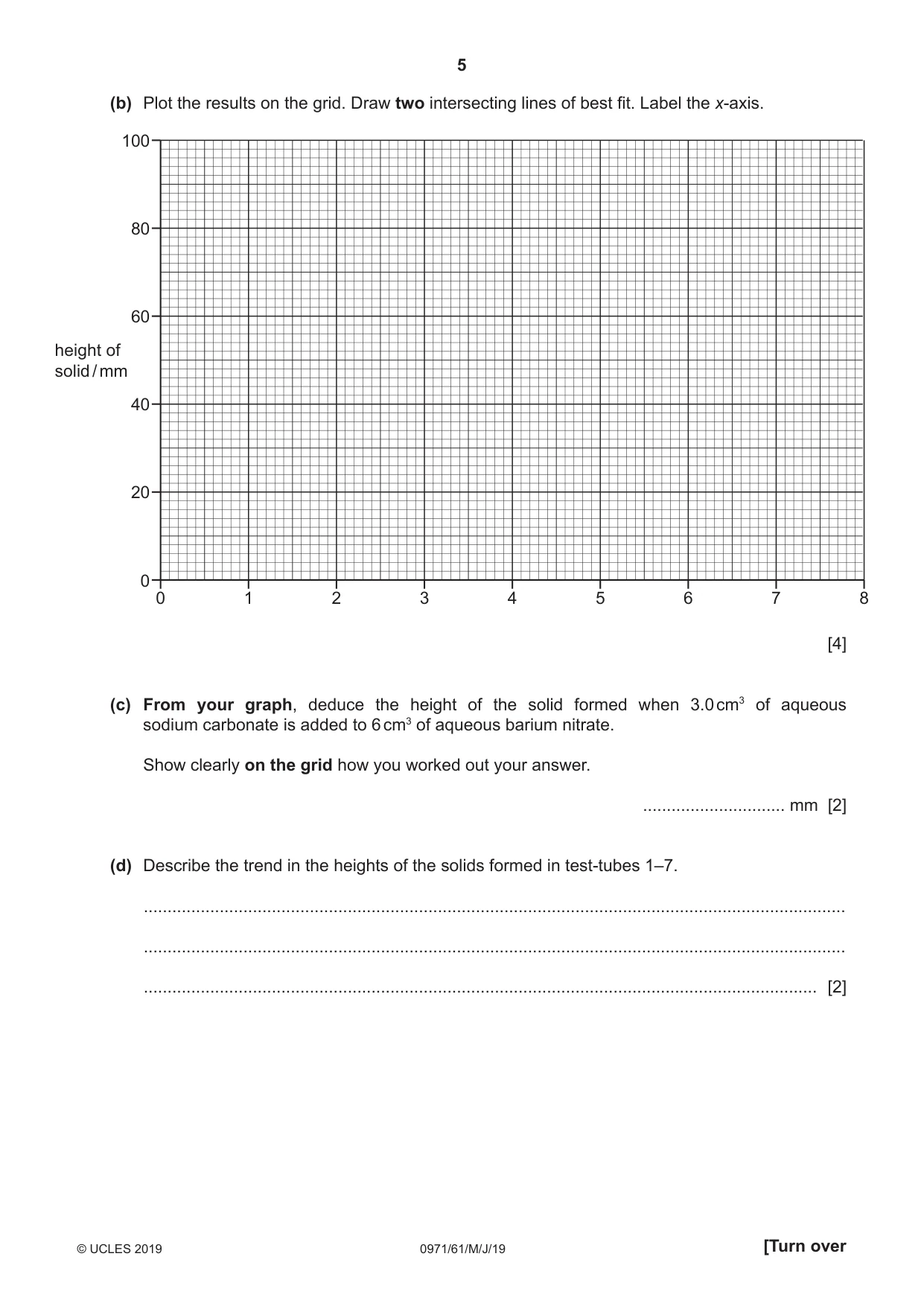
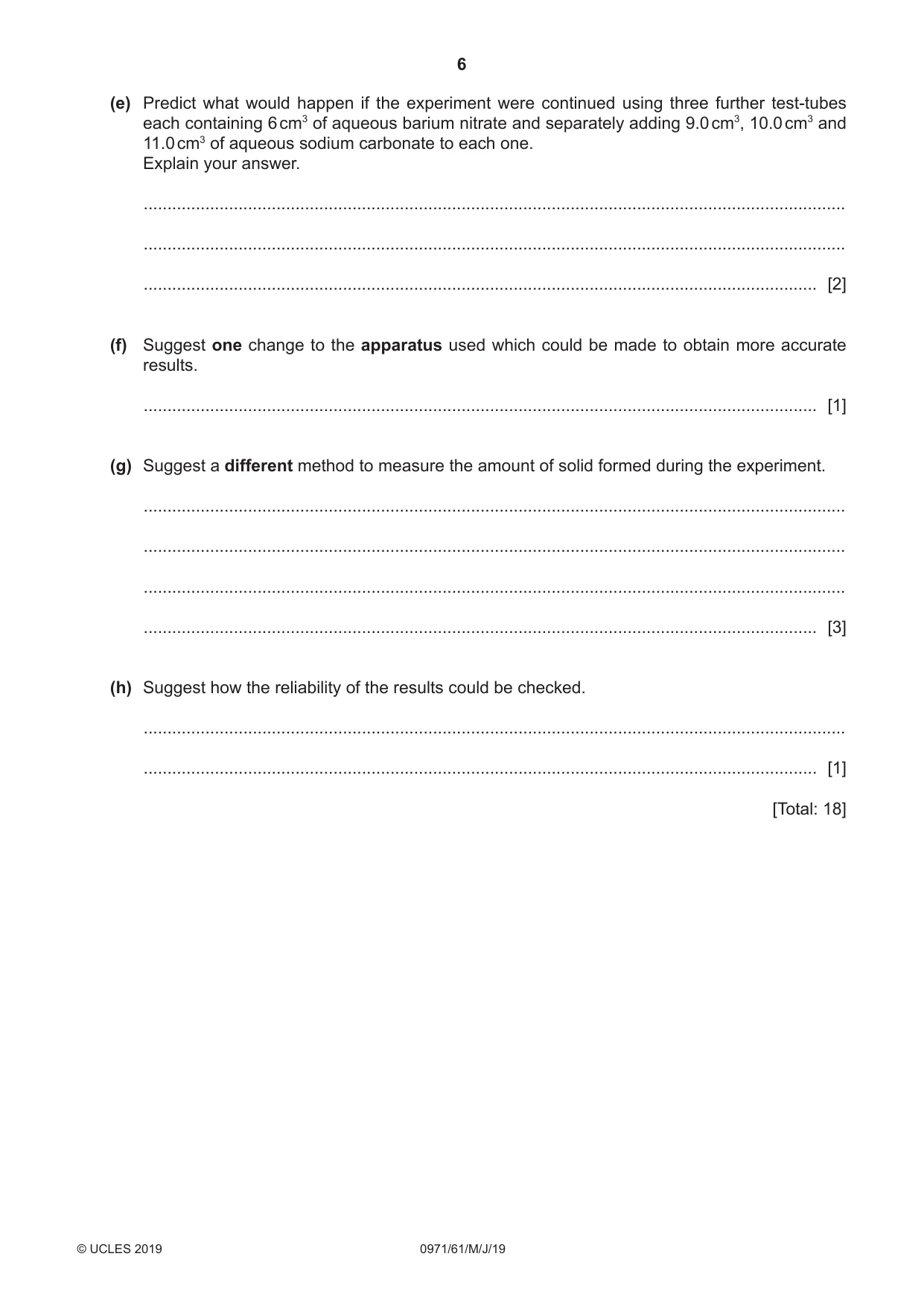
2 A student investigated the reaction between aqueous sodium carbonate and aqueous barium nitrate. ●● A burette was filled with aqueous sodium carbonate. ●● Seven test-tubes were labelled 1, 2, 3, 4, 5, 6 and 7. ●● A measuring cylinder was used to pour 6 cm3 of aqueous barium nitrate into each of the seven test‑tubes in a test‑tube rack. ●● 1.0 cm3 of aqueous sodium carbonate was added from the burette to test-tube 1. ●● 2.0 cm3 of aqueous sodium carbonate was added from the burette to test-tube 2. ●● 4.0 cm3 of aqueous sodium carbonate was added from the burette to test-tube 3. ●● 5.0 cm3 of aqueous sodium carbonate was added from the burette to test-tube 4. ●● 6.0 cm3 of aqueous sodium carbonate was added from the burette to test-tube 5. ●● 7.0 cm3 of aqueous sodium carbonate was added from the burette to test-tube 6. ●● 8.0 cm3 of aqueous sodium carbonate was added from the burette to test-tube 7. A glass rod was used to stir the contents of each of the test‑tubes. The contents of the test‑tubes were left to stand until the solid formed had settled. A ruler was used to measure the height of the solid formed in each test‑tube. (a) Use a ruler to measure the heights of the solid formed in each test‑tube shown in the diagram. Record the heights of the solid formed in the table and complete the table. test-tube number 1 2 3 4 5 6 7 volume of aqueous sodium carbonate / cm3 solid height of solid / mm [3] (b) Plot the results on the grid. Draw two intersecting lines of best fit. Label the x-axis. 100 80 60 height of solid / mm 40 20 0 0 1 2 3 4 5 6 7 8 [4] (c) From your graph, deduce the height of the solid formed when 3.0 cm3 of aqueous sodium carbonate is added to 6 cm3 of aqueous barium nitrate. Show clearly on the grid how you worked out your answer. .............................. mm [2] (d) Describe the trend in the heights of the solids formed in test‑tubes 1–7. .................................................................................................................................................... .................................................................................................................................................... .............................................................................................................................................. [2] (e) Predict what would happen if the experiment were continued using three further test‑tubes each containing 6 cm3 of aqueous barium nitrate and separately adding 9.0 cm3, 10.0 cm3 and 11.0 cm3 of aqueous sodium carbonate to each one. Explain your answer. .................................................................................................................................................... .................................................................................................................................................... .............................................................................................................................................. [2] (f) Suggest one change to the apparatus used which could be made to obtain more accurate results. .............................................................................................................................................. [1] (g) Suggest a different method to measure the amount of solid formed during the experiment. .................................................................................................................................................... .................................................................................................................................................... .................................................................................................................................................... .............................................................................................................................................. [3] (h) Suggest how the reliability of the results could be checked. .................................................................................................................................................... .............................................................................................................................................. [1] [Total: 18]
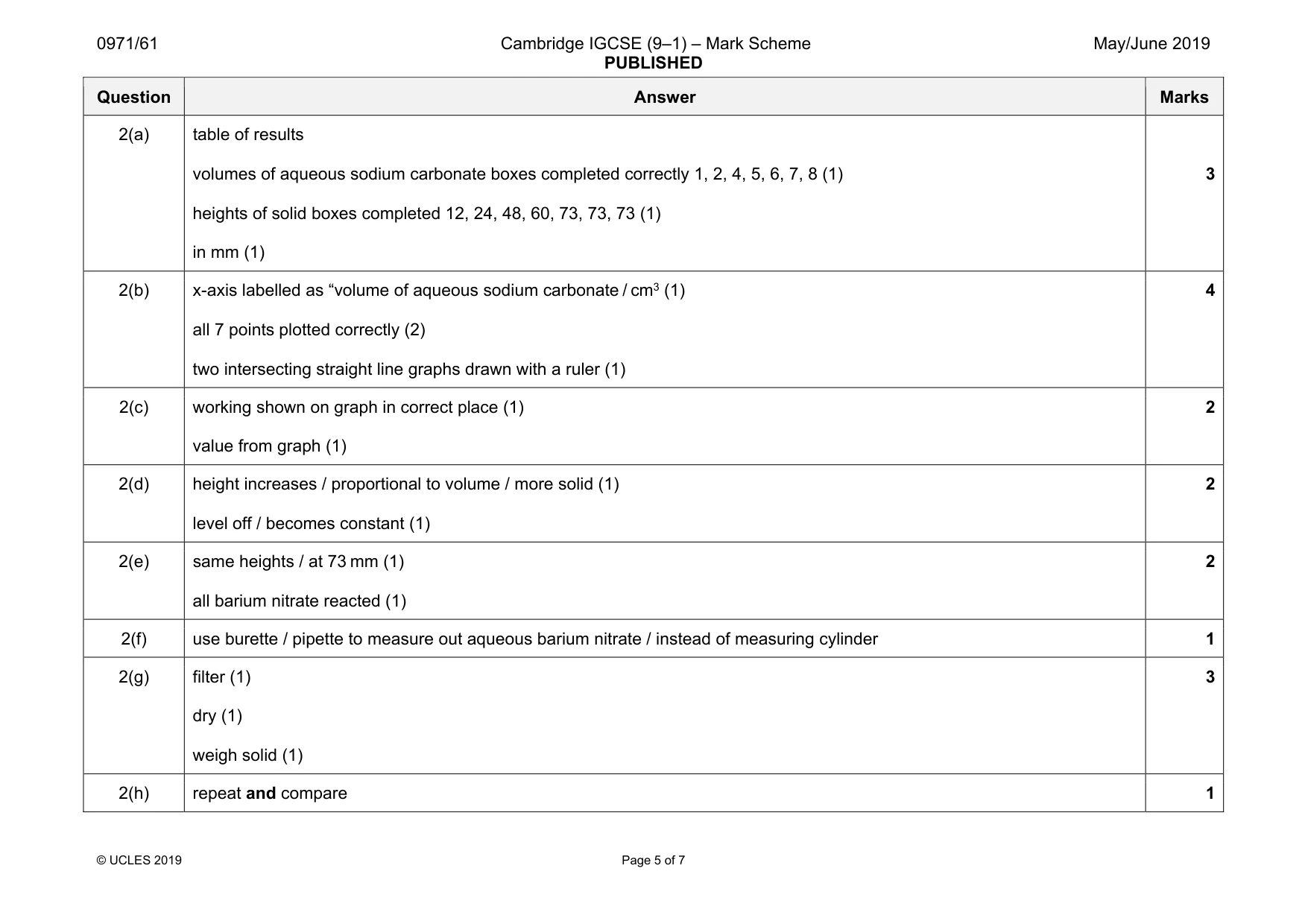
Mark scheme: 2(a) table of results volumes of aqueous sodium carbonate boxes completed correctly 1, 2, 4, 5, 6, 7, 8 (1) heights of solid boxes completed 12, 24, 48, 60, 73, 73, 73 (1) in mm (1) 3 2(b) x-axis labelled as “volume of aqueous sodium carbonate / cm3 (1) all 7 points plotted correctly (2) two intersecting straight line graphs drawn with a ruler (1) 4 2(c) working shown on graph in correct place (1) value from graph (1) 2 2(d) height increases / proportional to volume / more solid (1) level off / becomes constant (1) 2 2(e) same heights / at 73 mm (1) all barium nitrate reacted (1) 2 2(f) use burette / pipette to measure out aqueous barium nitrate / instead of measuring cylinder 1 2(g) filter (1) dry (1) weigh solid (1) 3 2(h) repeat and compare 1
Q3 · Two substances, solution F and solid G, were analysed
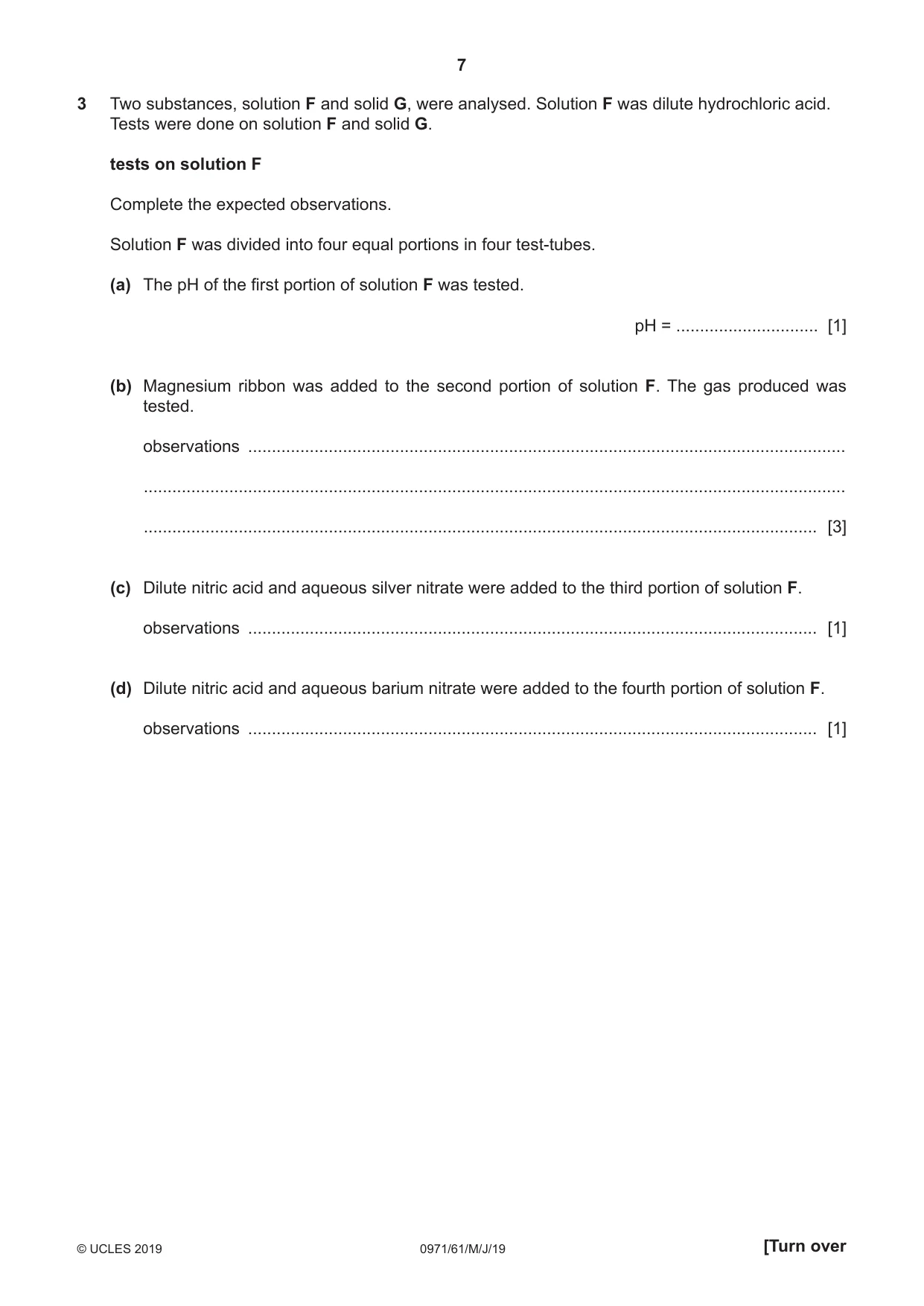
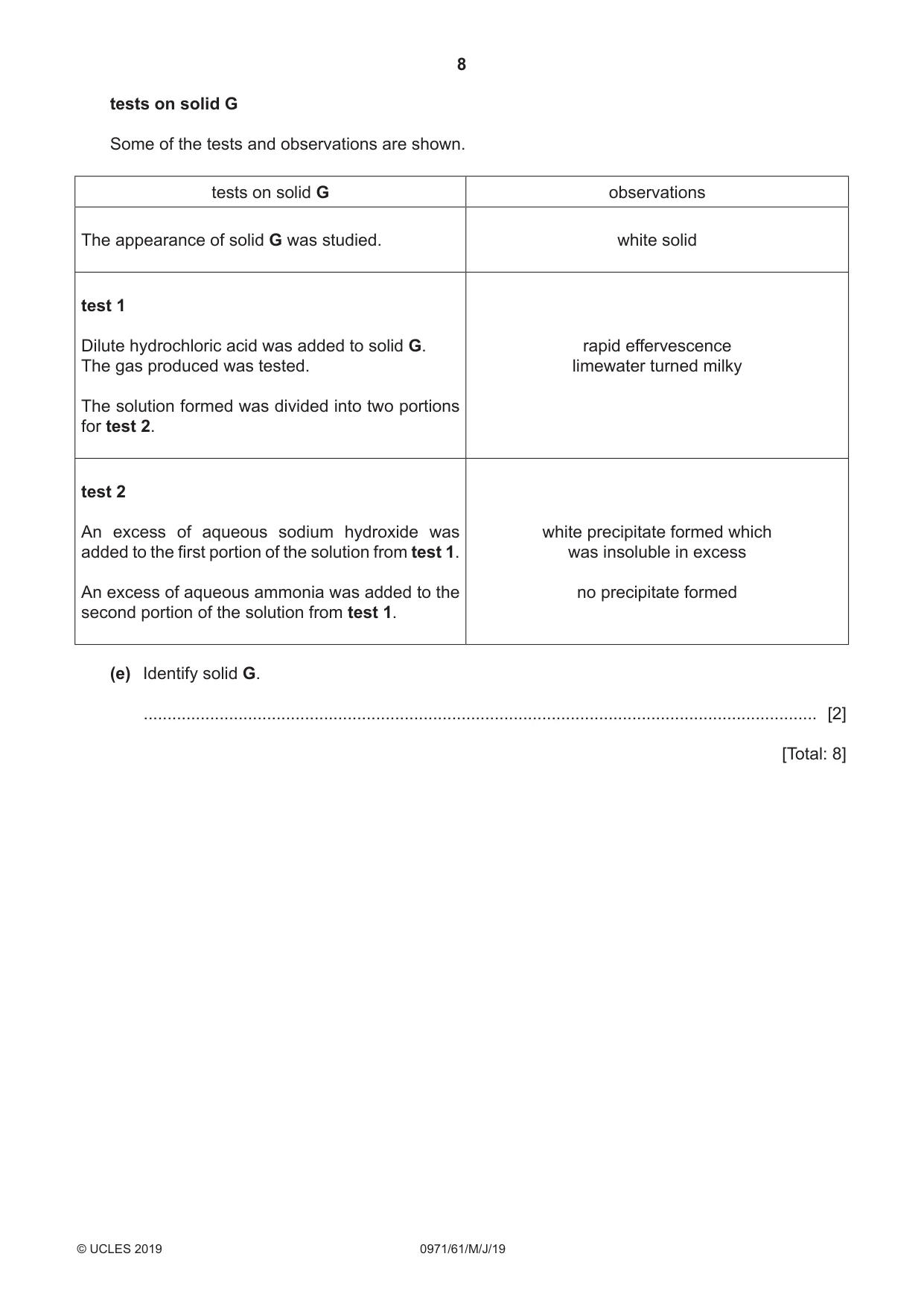
3 Two substances, solution F and solid G, were analysed. Solution F was dilute hydrochloric acid. Tests were done on solution F and solid G. tests on solution F Complete the expected observations. Solution F was divided into four equal portions in four test‑tubes. (a) The pH of the first portion of solution F was tested. pH = .............................. [1] (b) Magnesium ribbon was added to the second portion of solution F. The gas produced was tested. observations ............................................................................................................................... .................................................................................................................................................... .............................................................................................................................................. [3] (c) Dilute nitric acid and aqueous silver nitrate were added to the third portion of solution F. observations ......................................................................................................................... [1] (d) Dilute nitric acid and aqueous barium nitrate were added to the fourth portion of solution F. observations ......................................................................................................................... [1] tests on solid G Some of the tests and observations are shown. tests on solid G observations The appearance of solid G was studied. white solid test 1 Dilute hydrochloric acid was added to solid G. rapid effervescence The gas produced was tested. limewater turned milky The solution formed was divided into two portions for test 2. test 2 An excess of aqueous sodium hydroxide was white precipitate formed which added to the first portion of the solution from test 1. was insoluble in excess An excess of aqueous ammonia was added to the no precipitate formed second portion of the solution from test 1. (e) Identify solid G. .............................................................................................................................................. [2] [Total: 8]
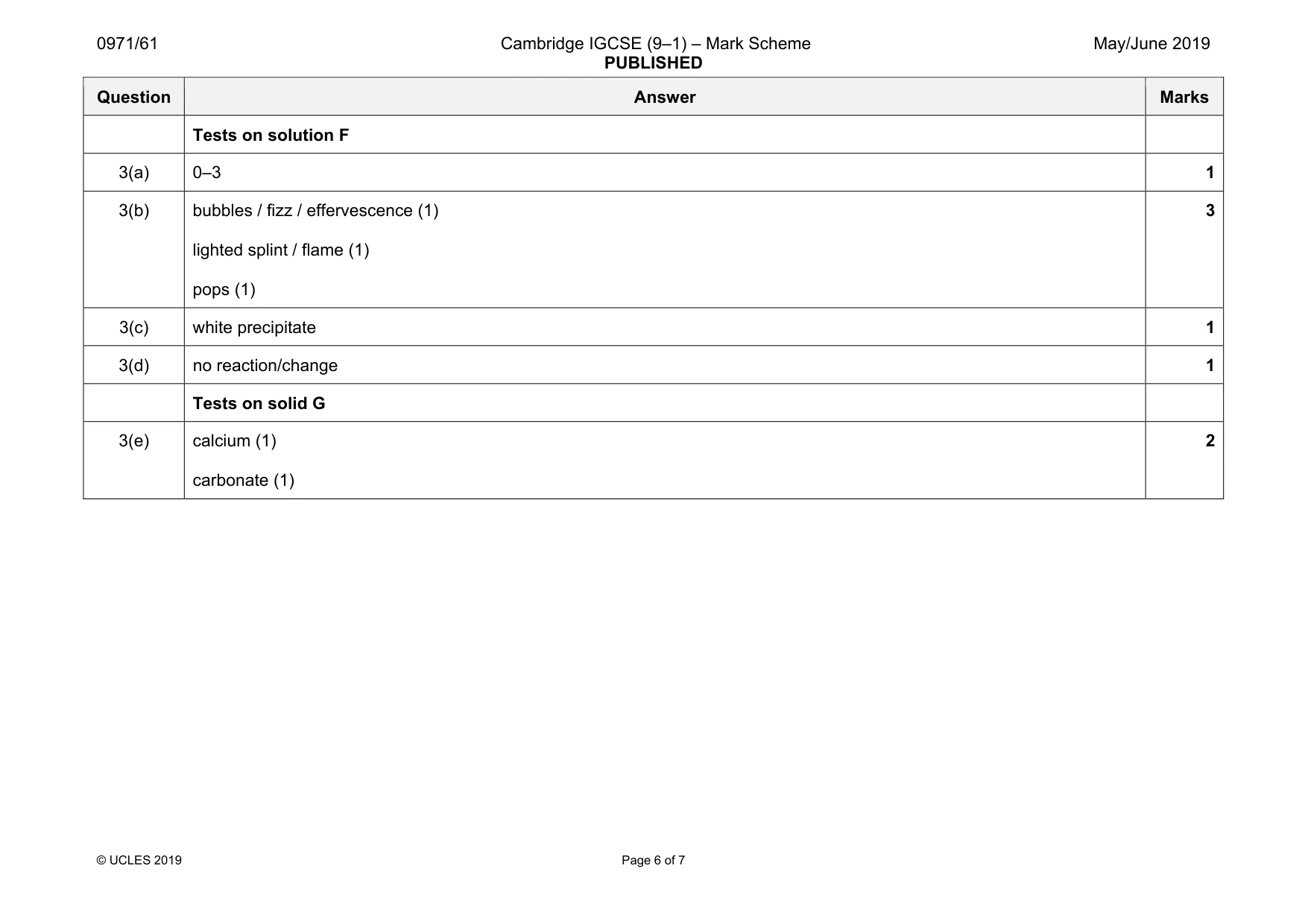
Mark scheme: 3(a) 0–3 1 3(b) bubbles / fizz / effervescence (1) lighted splint / flame (1) pops (1) 3 3(c) white precipitate 1 3(d) no reaction/change 1 Tests on solid G 3(e) calcium (1) carbonate (1) 2
Q4 · Steel nails rust in the presence of air and water
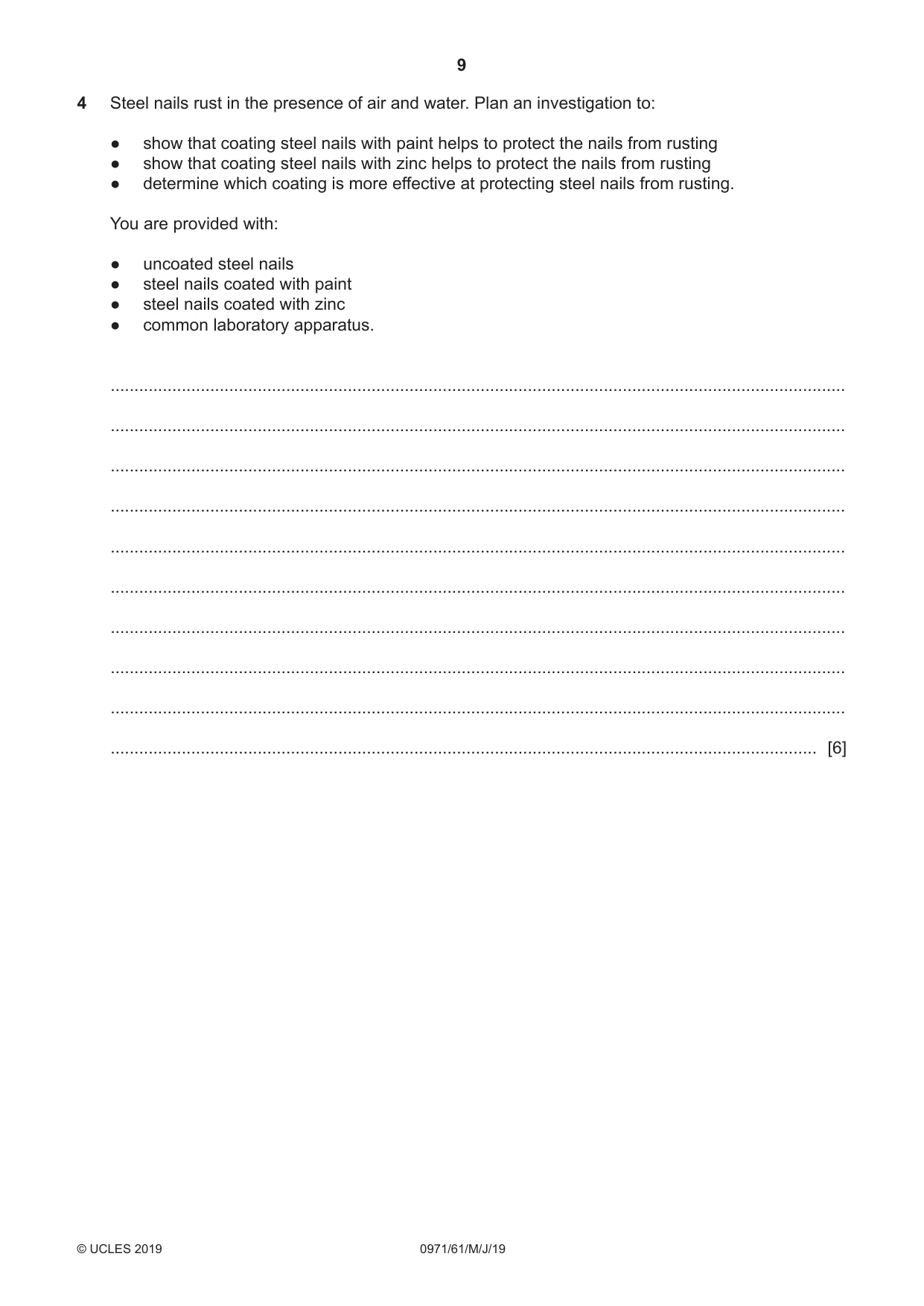
4 Steel nails rust in the presence of air and water. Plan an investigation to: ●● show that coating steel nails with paint helps to protect the nails from rusting ●● show that coating steel nails with zinc helps to protect the nails from rusting ●● determine which coating is more effective at protecting steel nails from rusting. You are provided with: ●● uncoated steel nails ●● steel nails coated with paint ●● steel nails coated with zinc ●● common laboratory apparatus. ........................................................................................................................................................... ........................................................................................................................................................... ........................................................................................................................................................... ........................................................................................................................................................... ........................................................................................................................................................... ........................................................................................................................................................... ........................................................................................................................................................... ........................................................................................................................................................... ........................................................................................................................................................... ..................................................................................................................................................... [6]
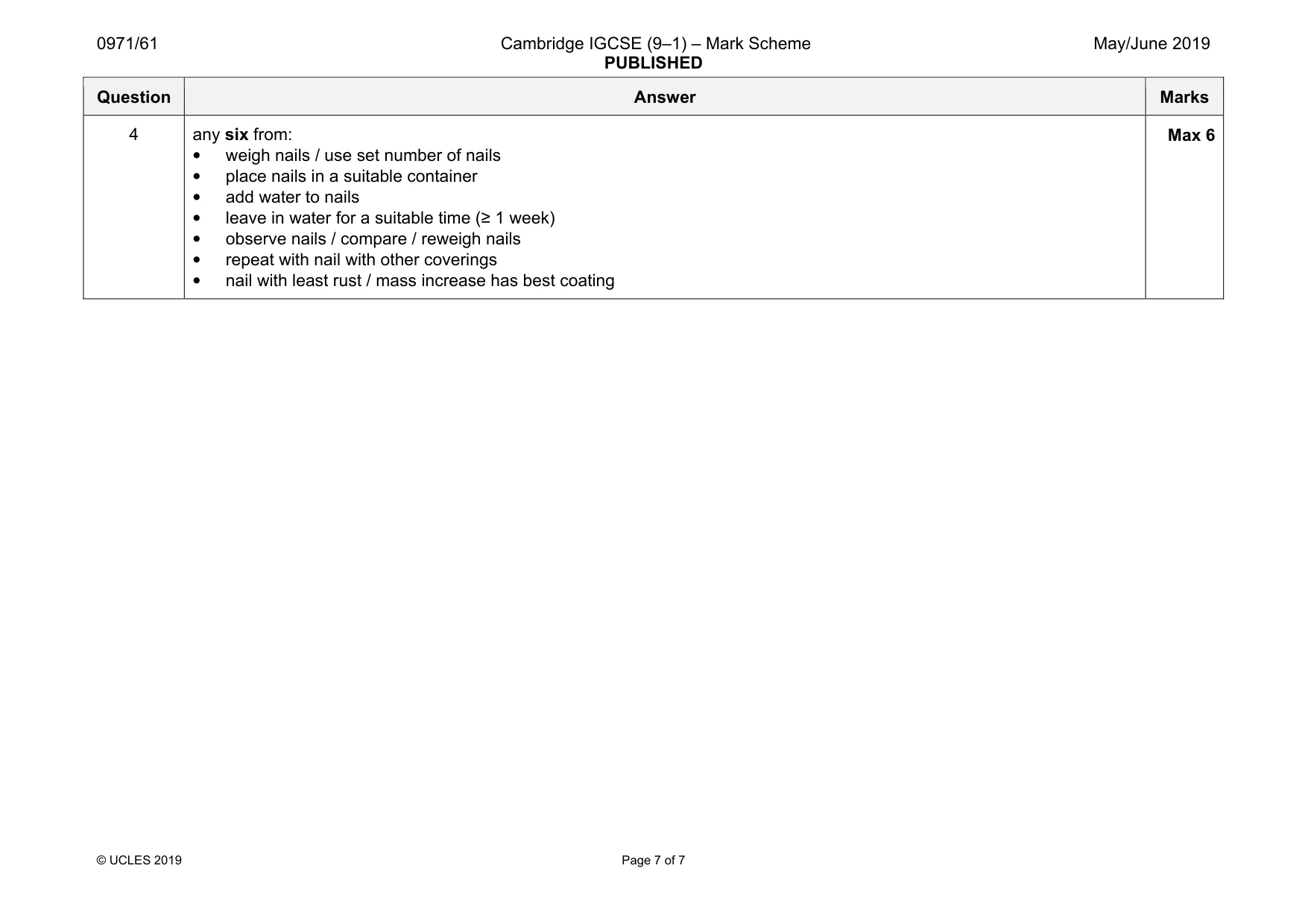
Mark scheme: 4 any six from: • weigh nails / use set number of nails • place nails in a suitable container • add water to nails • leave in water for a suitable time (≥ 1 week) • observe nails / compare / reweigh nails • repeat with nail with other coverings • nail with least rust / mass increase has best coating Max 6
What was in this paper
The subtopics covered by these 4 questions, and how many questions each got. Open one in a new tab to see every Cambridge question on it.
What you needed in this session
Cambridge’s own grade thresholds for 2019 May/June, Paper 6 · Variant 1. A higher threshold means an easier paper — the bar moves with how the cohort did.