Cambridge IGCSE Chemistry (9-1) 0971 — 2021 Oct/Nov Paper 3 · Variant 2
0971/32/O/N/21 · 8 questions · 80 marks · ≈90 min
The question paper and its mark scheme, free to read here and free to download. This is Cambridge’s own paper, exactly as it was sat.
Question paper20 pages




Mark scheme11 pages
Answers below. Sit the paper first if you are practising.
Questions as text
Q1 · A list of formulae is shown
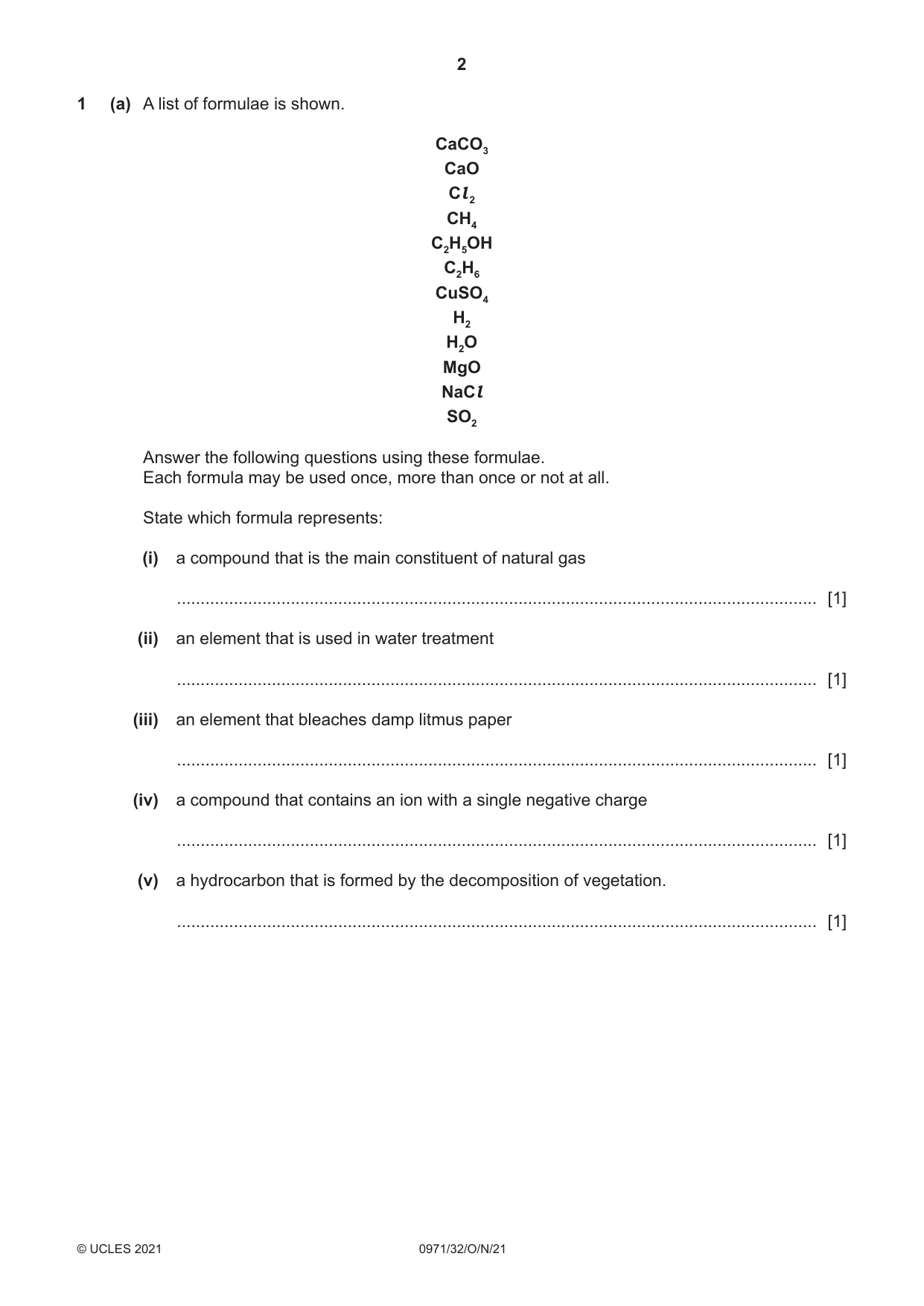
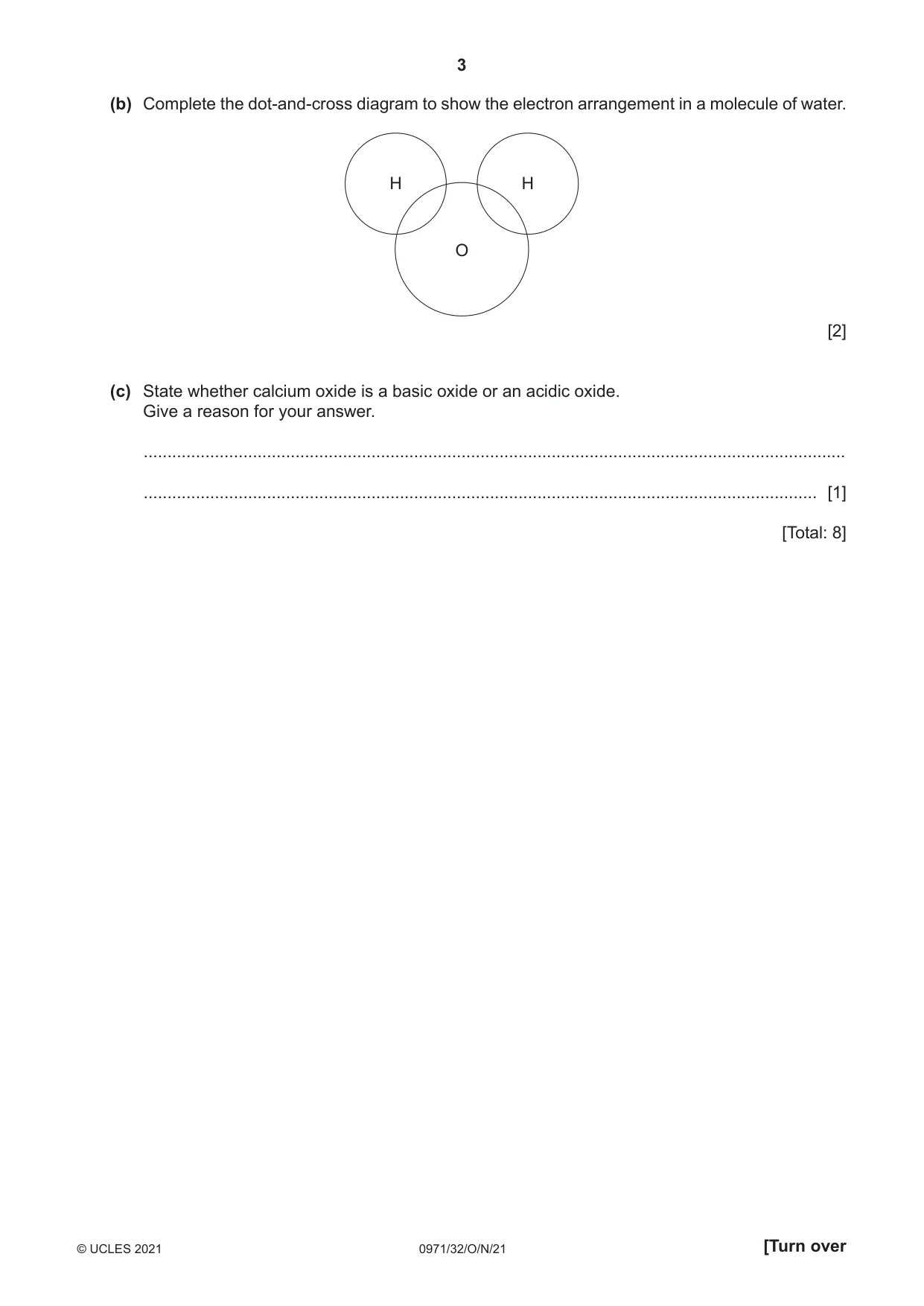
1 (a) A list of formulae is shown. CaCO3 CaO Cl 2 CH4 C2H5OH C2H6 CuSO4 H2 H2O MgO NaCl SO2 Answer the following questions using these formulae. Each formula may be used once, more than once or not at all. State which formula represents: (i) a compound that is the main constituent of natural gas ....................................................................................................................................... [1] (ii) an element that is used in water treatment ....................................................................................................................................... [1] (iii) an element that bleaches damp litmus paper ....................................................................................................................................... [1] (iv) a compound that contains an ion with a single negative charge ....................................................................................................................................... [1] (v) a hydrocarbon that is formed by the decomposition of vegetation. ....................................................................................................................................... [1] (b) Complete the dot-and-cross diagram to show the electron arrangement in a molecule of water. H H O [2] (c) State whether calcium oxide is a basic oxide or an acidic oxide. Give a reason for your answer. .................................................................................................................................................... .............................................................................................................................................. [1] [Total: 8]
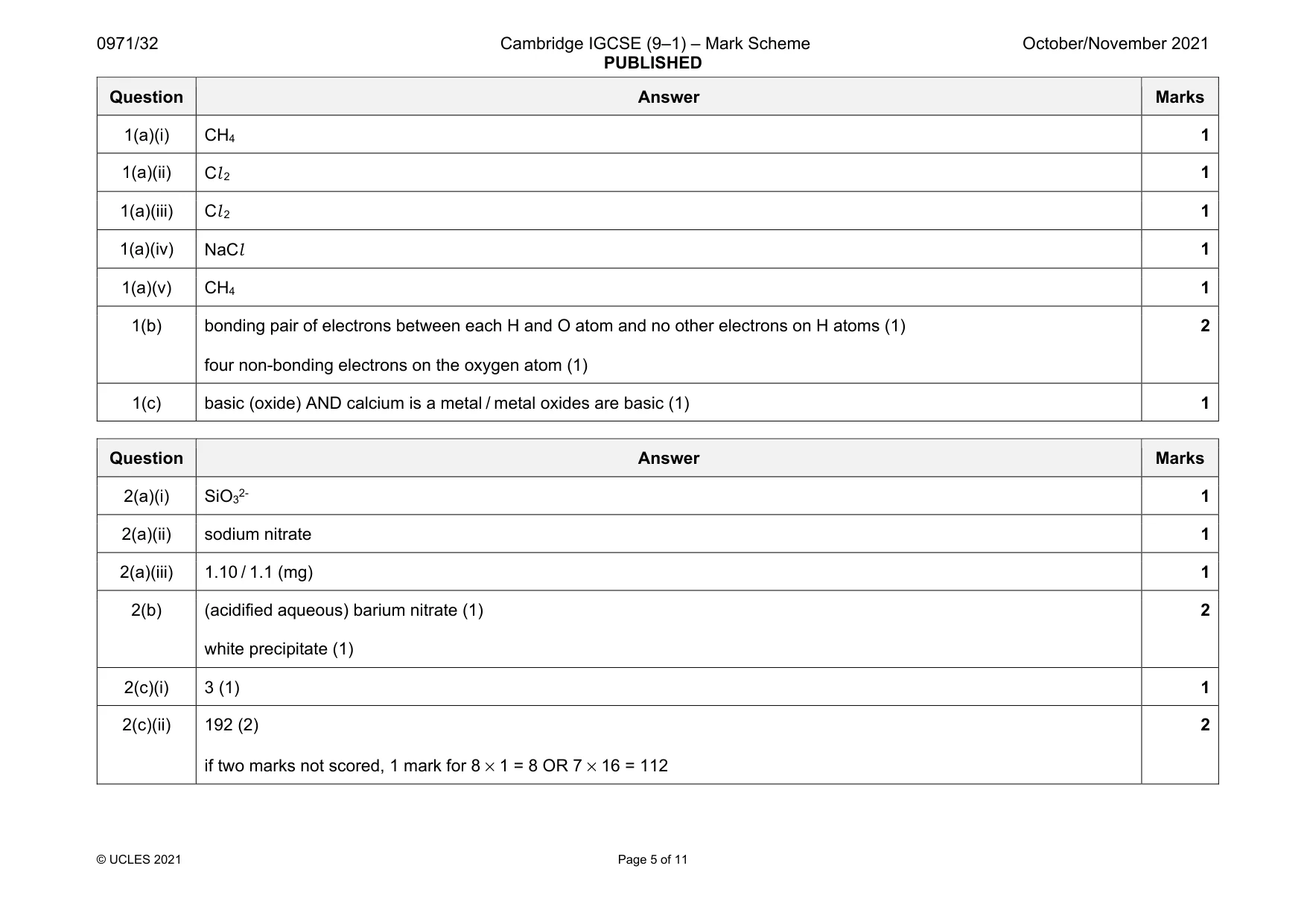
Mark scheme: 1(a)(i) CH4 1 1(a)(ii) Cl 2 1 1(a)(iii) Cl 2 1 1(a)(iv) NaCl 1 1(a)(v) CH4 1 1(b) bonding pair of electrons between each H and O atom and no other electrons on H atoms (1) four non-bonding electrons on the oxygen atom (1) 2 1(c) basic (oxide) AND calcium is a metal / metal oxides are basic (1) 1
Q2 · The table shows the masses of some of the ions in 1000 cm3 of water taken from a lake
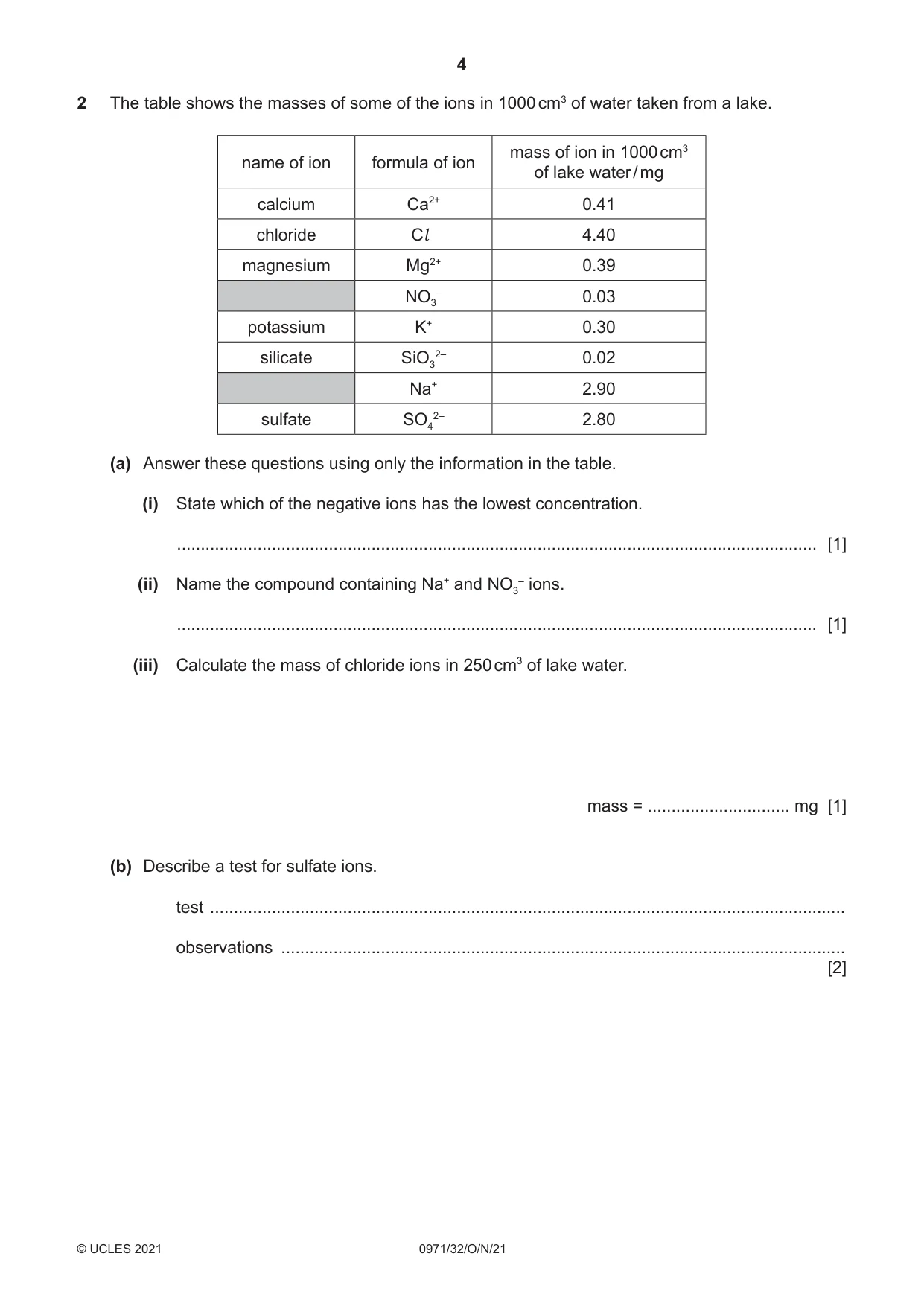
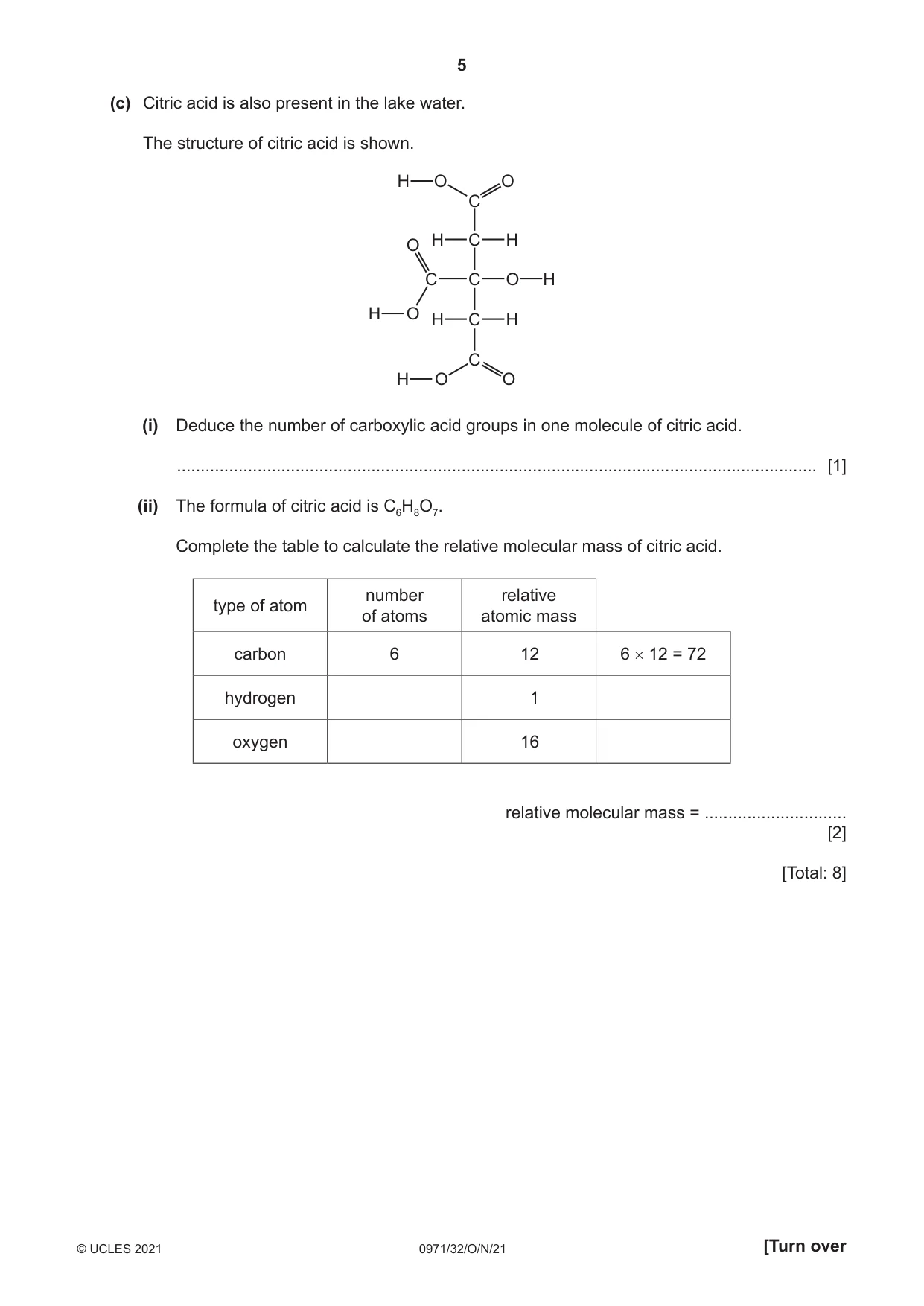
2 The table shows the masses of some of the ions in 1000 cm3 of water taken from a lake. mass of ion in 1000 cm3 name of ion formula of ion of lake water / mg calcium Ca2+ 0.41 chloride Cl – 4.40 magnesium Mg2+ 0.39 NO3– 0.03 potassium K+ 0.30 silicate SiO32– 0.02 Na+ 2.90 sulfate SO42– 2.80 (a) Answer these questions using only the information in the table. (i) State which of the negative ions has the lowest concentration. ....................................................................................................................................... [1] (ii) Name the compound containing Na+ and NO3– ions. ....................................................................................................................................... [1] (iii) Calculate the mass of chloride ions in 250 cm3 of lake water. mass = .............................. mg [1] (b) Describe a test for sulfate ions. test ...................................................................................................................................... observations ........................................................................................................................ [2] (c) Citric acid is also present in the lake water. The structure of citric acid is shown. H O O C H C H O C C O H H O H C H C H O O (i) Deduce the number of carboxylic acid groups in one molecule of citric acid. ....................................................................................................................................... [1] (ii) The formula of citric acid is C6H8O7. Complete the table to calculate the relative molecular mass of citric acid. number relative type of atom of atoms atomic mass carbon 6 12 6 × 12 = 72 hydrogen 1 oxygen 16 relative molecular mass = .............................. [2] [Total: 8]
Mark scheme: 2(a)(i) SiO32- 1 2(a)(ii) sodium nitrate 1 2(a)(iii) 1.10 / 1.1 (mg) 1 2(b) (acidified aqueous) barium nitrate (1) white precipitate (1) 2 2(c)(i) 3 (1) 1 2(c)(ii) 192 (2) if two marks not scored, 1 mark for 8 × 1 = 8 OR 7 × 16 = 112 2
Q3 · Iron is extracted from iron ore in a blast furnace
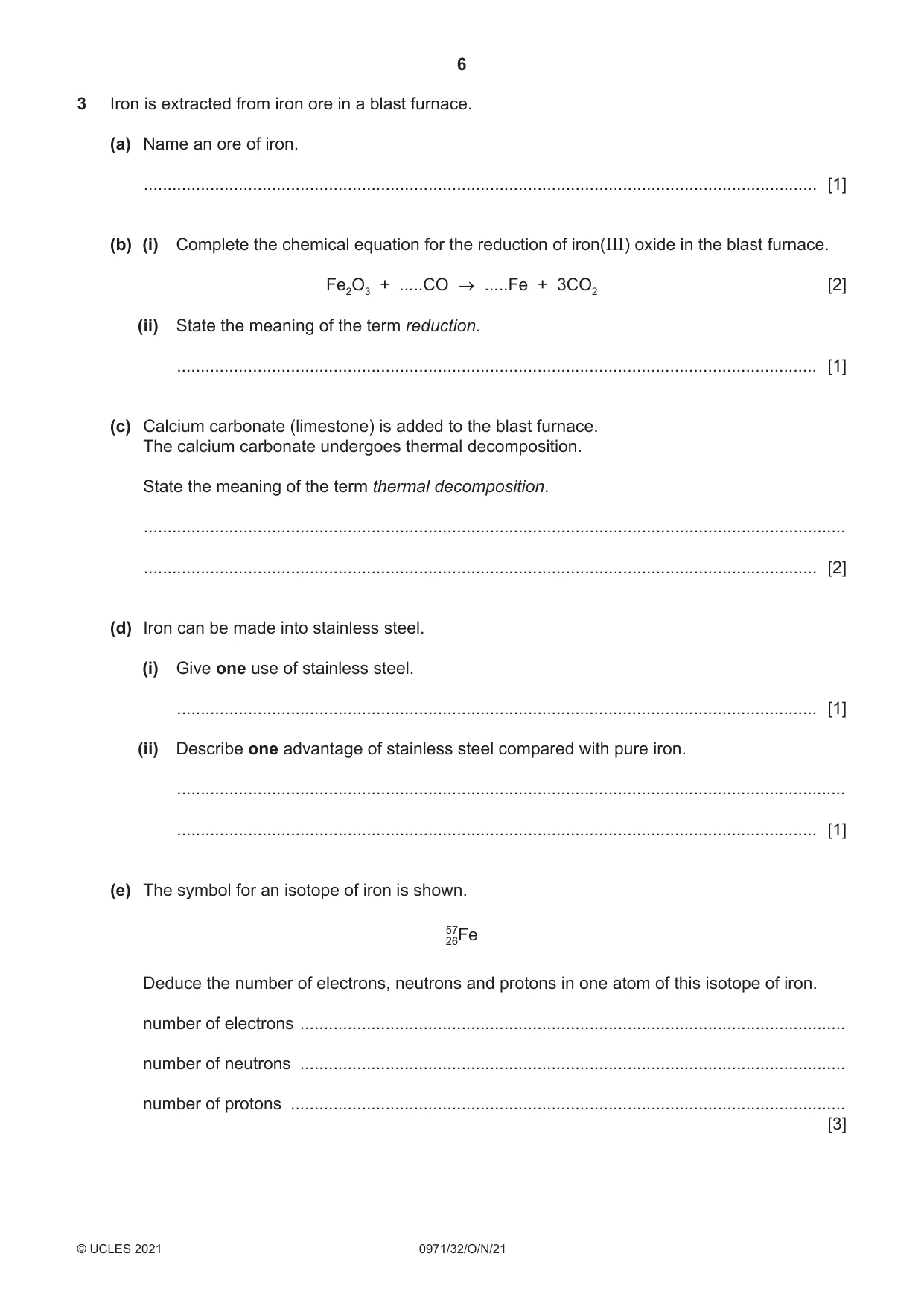
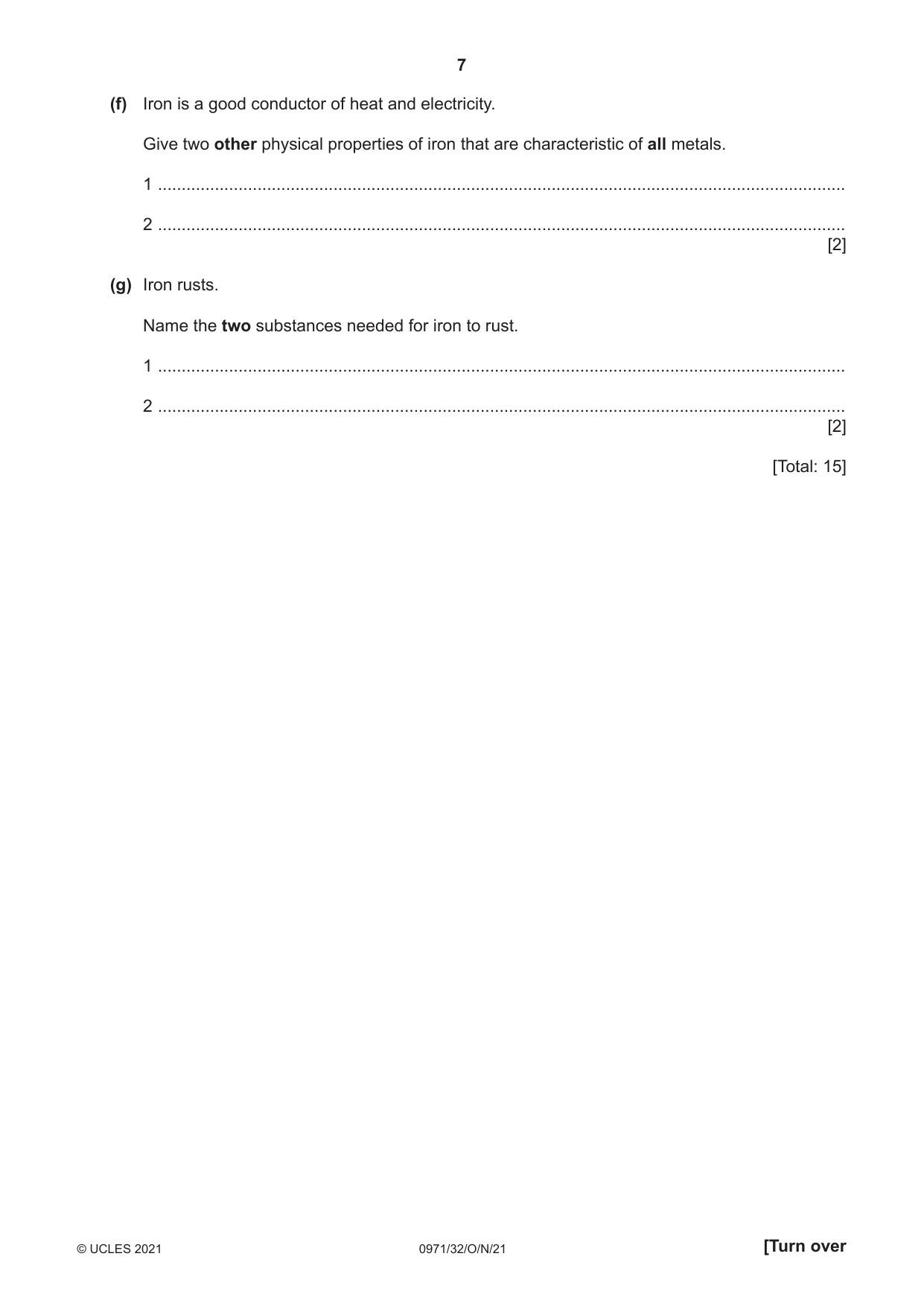
3 Iron is extracted from iron ore in a blast furnace. (a) Name an ore of iron. .............................................................................................................................................. [1] (b) (i) Complete the chemical equation for the reduction of iron(III) oxide in the blast furnace. Fe2O3 + .....CO → .....Fe + 3CO2 [2] (ii) State the meaning of the term reduction. ....................................................................................................................................... [1] (c) Calcium carbonate (limestone) is added to the blast furnace. The calcium carbonate undergoes thermal decomposition. State the meaning of the term thermal decomposition. .................................................................................................................................................... .............................................................................................................................................. [2] (d) Iron can be made into stainless steel. (i) Give one use of stainless steel. ....................................................................................................................................... [1] (ii) Describe one advantage of stainless steel compared with pure iron. ............................................................................................................................................. ....................................................................................................................................... [1] (e) The symbol for an isotope of iron is shown. 2657Fe Deduce the number of electrons, neutrons and protons in one atom of this isotope of iron. number of electrons ................................................................................................................... number of neutrons .................................................................................................................... number of protons ...................................................................................................................... [3] (f) Iron is a good conductor of heat and electricity. Give two other physical properties of iron that are characteristic of all metals. 1 ................................................................................................................................................. 2 ................................................................................................................................................. [2] (g) Iron rusts. Name the two substances needed for iron to rust. 1 ................................................................................................................................................. 2 ................................................................................................................................................. [2] [Total: 15]
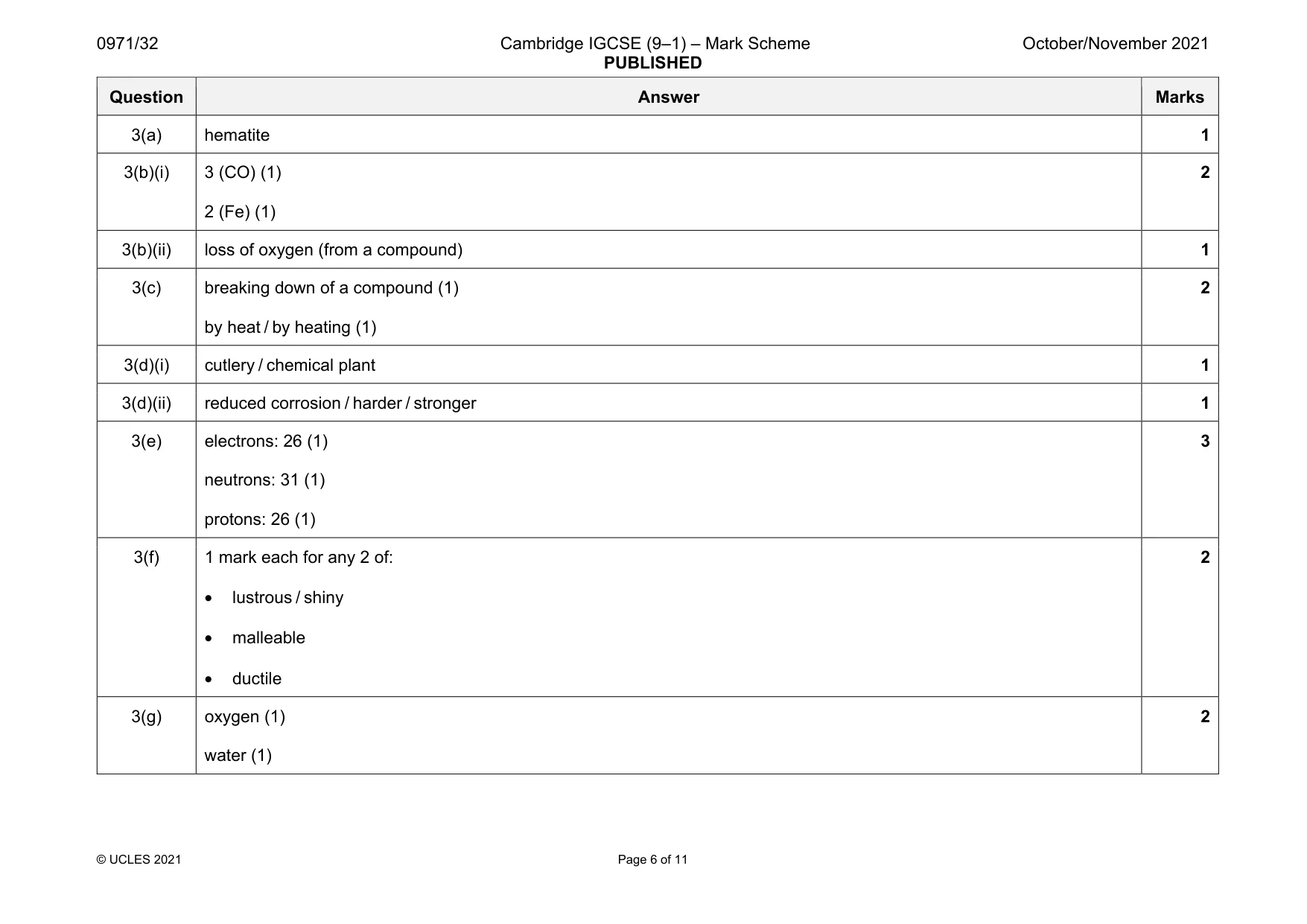
Mark scheme: 3(a) hematite 1 3(b)(i) 3 (CO) (1) 2 (Fe) (1) 2 3(b)(ii) loss of oxygen (from a compound) 1 3(c) breaking down of a compound (1) by heat / by heating (1) 2 3(d)(i) cutlery / chemical plant 1 3(d)(ii) reduced corrosion / harder / stronger 1 3(e) electrons: 26 (1) neutrons: 31 (1) protons: 26 (1) 3 3(f) 1 mark each for any 2 of: • lustrous / shiny • malleable • ductile 2 3(g) oxygen (1) water (1) 2
Q4 · The table shows some properties of the Group I elements
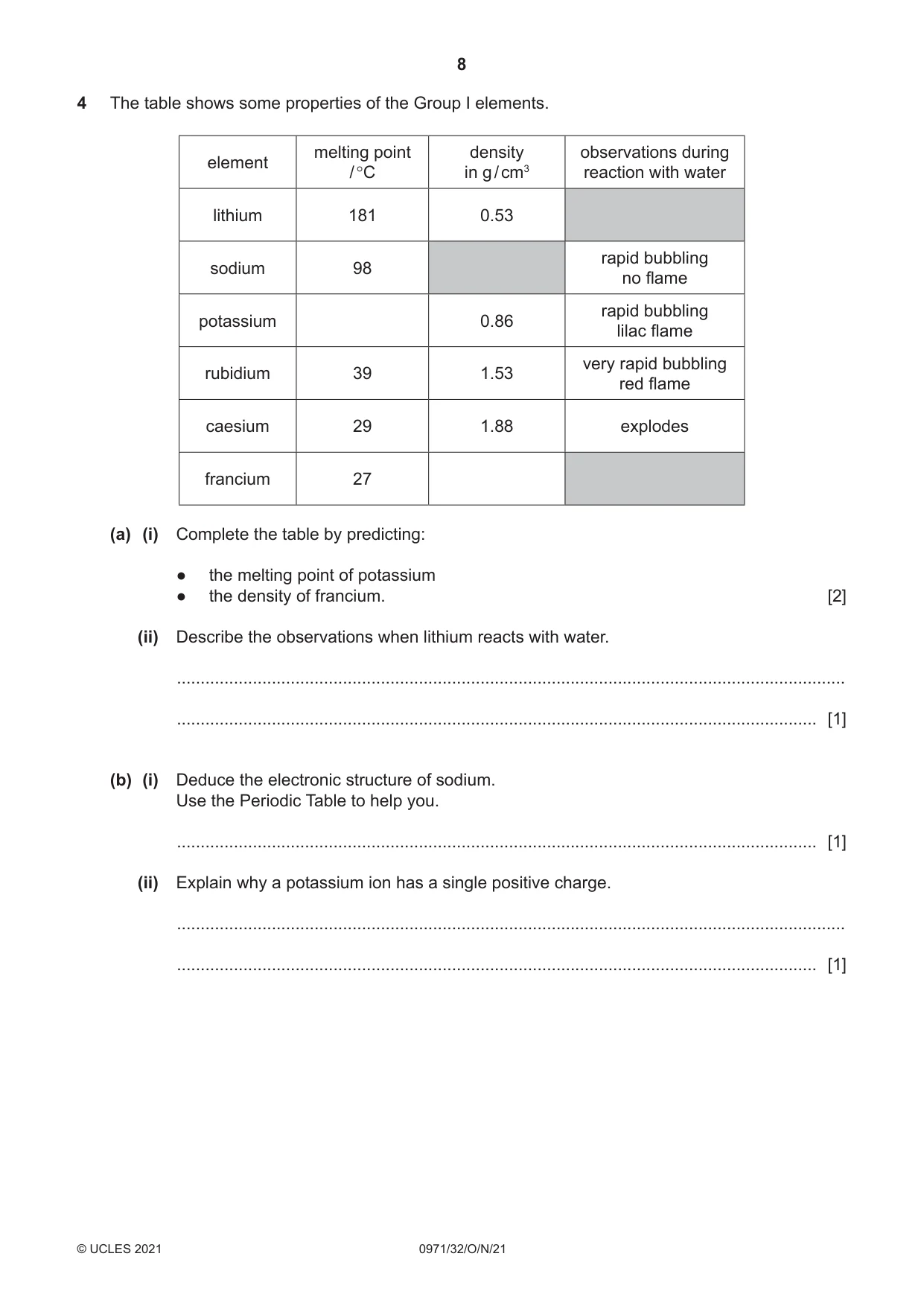
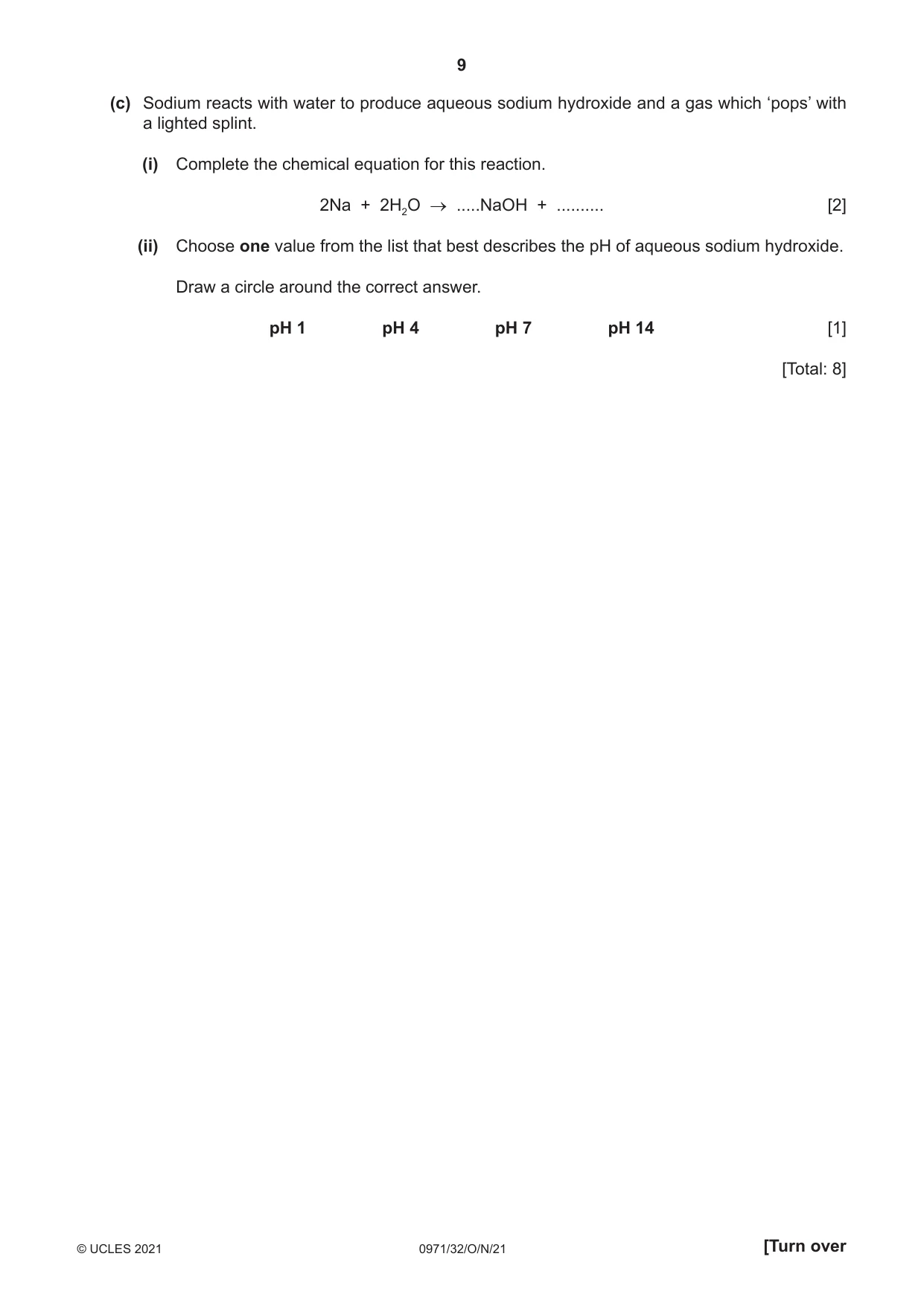
4 The table shows some properties of the Group I elements. melting point density observations during element / °C in g / cm3 reaction with water lithium 181 0.53 rapid bubbling sodium 98 no flame rapid bubbling potassium 0.86 lilac flame very rapid bubbling rubidium 39 1.53 red flame caesium 29 1.88 explodes francium 27 (a) (i) Complete the table by predicting: ● the melting point of potassium ● the density of francium. [2] (ii) Describe the observations when lithium reacts with water. ............................................................................................................................................. ....................................................................................................................................... [1] (b) (i) Deduce the electronic structure of sodium. Use the Periodic Table to help you. ....................................................................................................................................... [1] (ii) Explain why a potassium ion has a single positive charge. ............................................................................................................................................. ....................................................................................................................................... [1] (c) Sodium reacts with water to produce aqueous sodium hydroxide and a gas which ‘pops’ with a lighted splint. (i) Complete the chemical equation for this reaction. 2Na + 2H2O → .....NaOH + .......... [2] (ii) Choose one value from the list that best describes the pH of aqueous sodium hydroxide. Draw a circle around the correct answer. pH 1 pH 4 pH 7 pH 14 [1] [Total: 8]
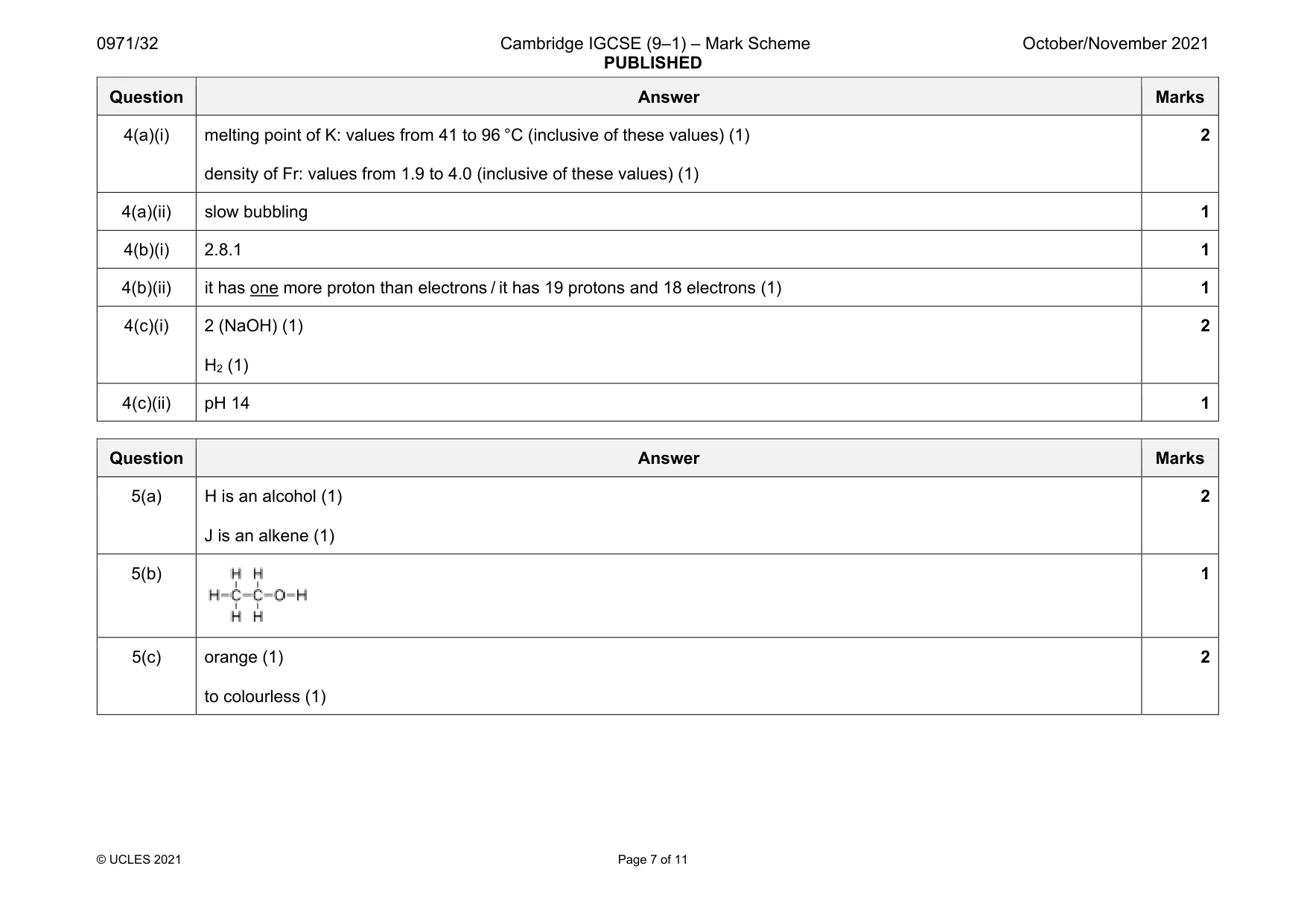
Mark scheme: 4(a)(i) melting point of K: values from 41 to 96 °C (inclusive of these values) (1) density of Fr: values from 1.9 to 4.0 (inclusive of these values) (1) 2 4(a)(ii) slow bubbling 1 4(b)(i) 2.8.1 1 4(b)(ii) it has one more proton than electrons / it has 19 protons and 18 electrons (1) 1 4(c)(i) 2 (NaOH) (1) H2 (1) 2 4(c)(ii) pH 14 1
Q5 · The table shows the structures of some organic compounds
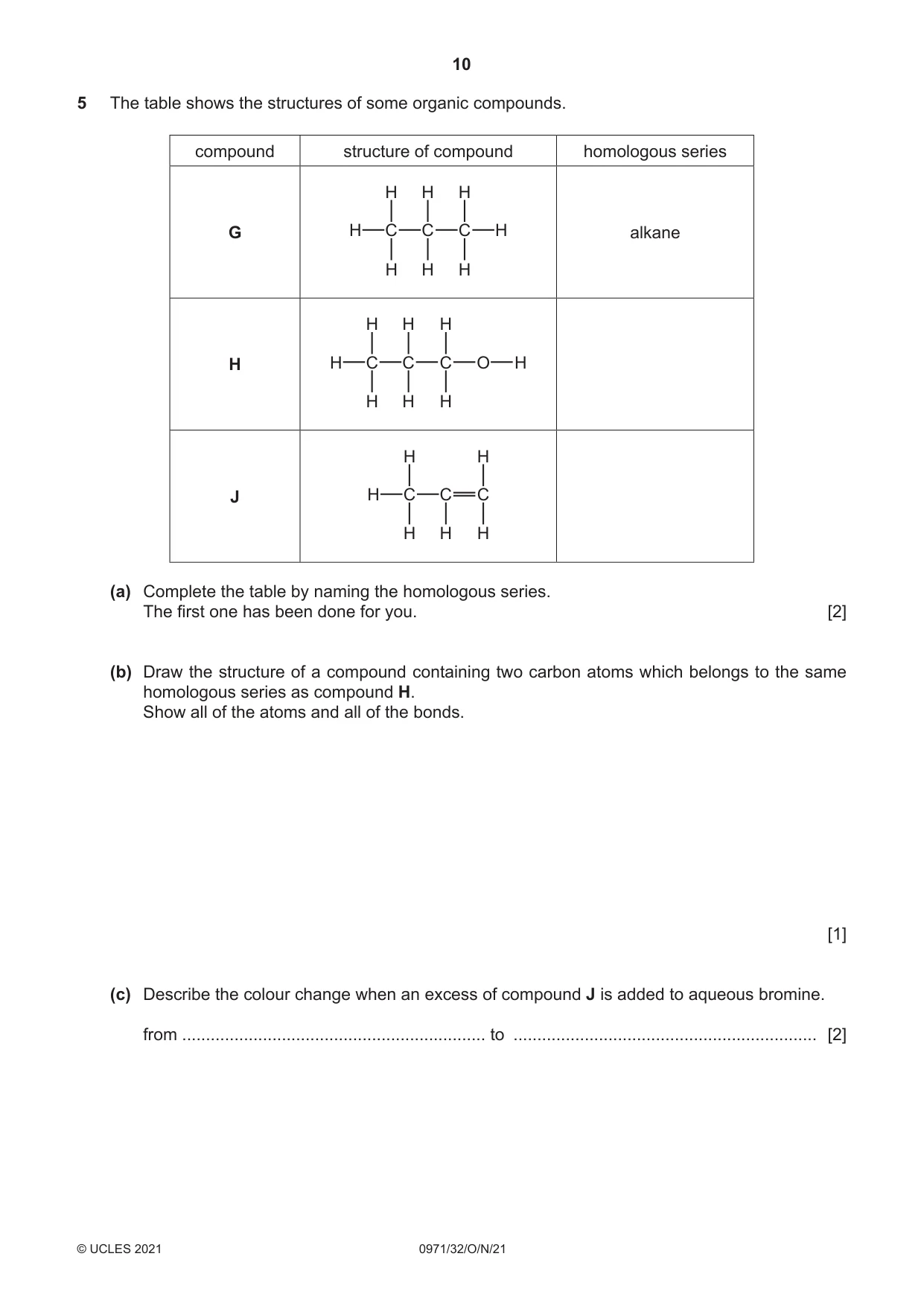
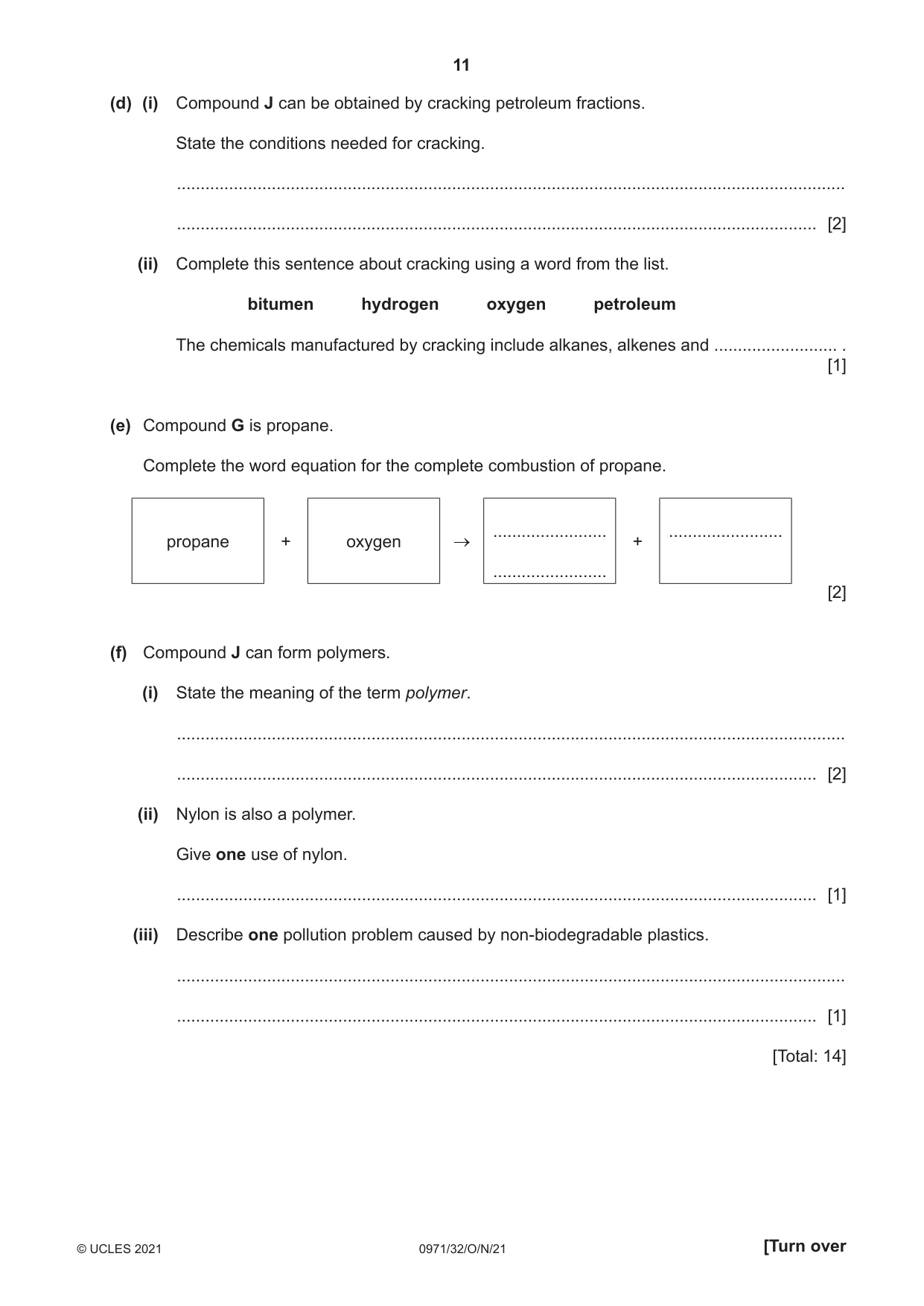
5 The table shows the structures of some organic compounds. compound structure of compound homologous series H H H G H C C C H alkane H H H H H H H H C C C O H H H H H H J H C C C H H H (a) Complete the table by naming the homologous series. The first one has been done for you. [2] (b) Draw the structure of a compound containing two carbon atoms which belongs to the same homologous series as compound H. Show all of the atoms and all of the bonds. [1] (c) Describe the colour change when an excess of compound J is added to aqueous bromine. from ................................................................ to ................................................................. [2] (d) (i) Compound J can be obtained by cracking petroleum fractions. State the conditions needed for cracking. ............................................................................................................................................. ....................................................................................................................................... [2] (ii) Complete this sentence about cracking using a word from the list. bitumen hydrogen oxygen petroleum he chemicals manufactured by cracking include alkanes, alkenes and .......................... . [1] (e) Compound G is propane. Complete the word equation for the complete combustion of propane. ........................ ........................ propane + oxygen → + ........................ [2] (f) Compound J can form polymers. (i) State the meaning of the term polymer. ............................................................................................................................................. ....................................................................................................................................... [2] (ii) Nylon is also a polymer. Give one use of nylon. ....................................................................................................................................... [1] (iii) Describe one pollution problem caused by non-biodegradable plastics. ............................................................................................................................................. ....................................................................................................................................... [1] [Total: 14]
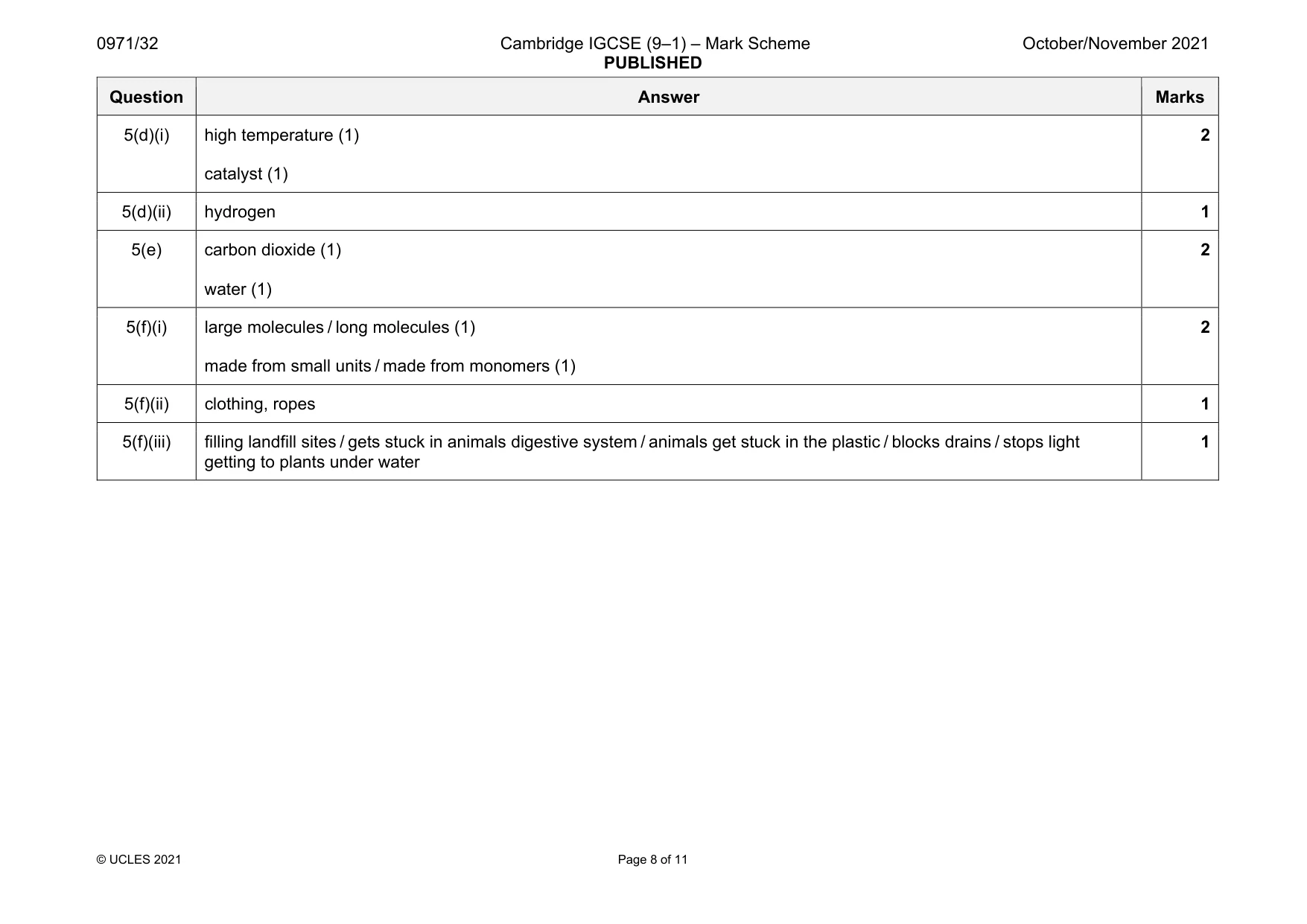
Mark scheme: 5(a) H is an alcohol (1) J is an alkene (1) 2 5(b) 1 5(c) orange (1) to colourless (1) 2 Question Answer Marks 5(d)(i) high temperature (1) catalyst (1) 2 5(d)(ii) hydrogen 1 5(e) carbon dioxide (1) water (1) 2 5(f)(i) large molecules / long molecules (1) made from small units / made from monomers (1) 2 5(f)(ii) clothing, ropes 1 5(f)(iii) filling landfill sites / gets stuck in animals digestive system / animals get stuck in the plastic / blocks drains / stops light getting to plants under water 1
Q6 · The diagrams show part of the structures of potassium iodide and bromine at room…
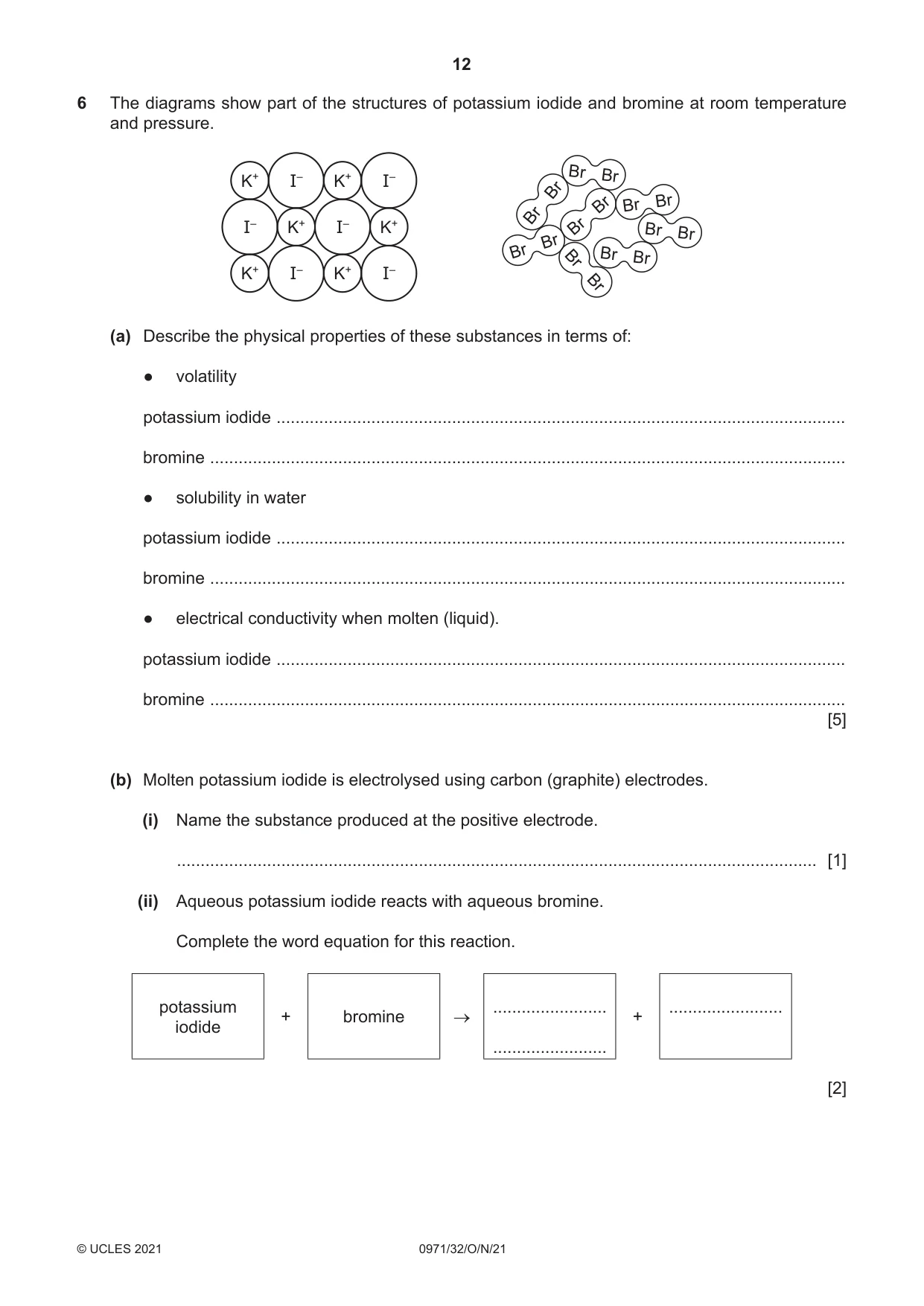
6 The diagrams show part of the structures of potassium iodide and bromine at room temperature and pressure. Br Br K+ I– K+ I– Br Br Br Br Br I– K+ I– K+ Br Br Br Br Br Br Br Br K+ I– K+ I– Br (a) Describe the physical properties of these substances in terms of: ● volatility potassium iodide ........................................................................................................................ bromine ...................................................................................................................................... ● solubility in water potassium iodide ........................................................................................................................ bromine ...................................................................................................................................... ● electrical conductivity when molten (liquid). potassium iodide ........................................................................................................................ bromine ...................................................................................................................................... [5] (b) Molten potassium iodide is electrolysed using carbon (graphite) electrodes. (i) Name the substance produced at the positive electrode. ....................................................................................................................................... [1] (ii) Aqueous potassium iodide reacts with aqueous bromine. Complete the word equation for this reaction. potassium ........................ ........................ + bromine → + iodide ........................ [2] (iii) Explain in terms of the reactivity of the halogens why aqueous potassium chloride does not react with aqueous bromine. ............................................................................................................................................. ....................................................................................................................................... [1] (c) Name the change of state when liquid bromine changes to solid bromine. .............................................................................................................................................. [1] [Total: 10]
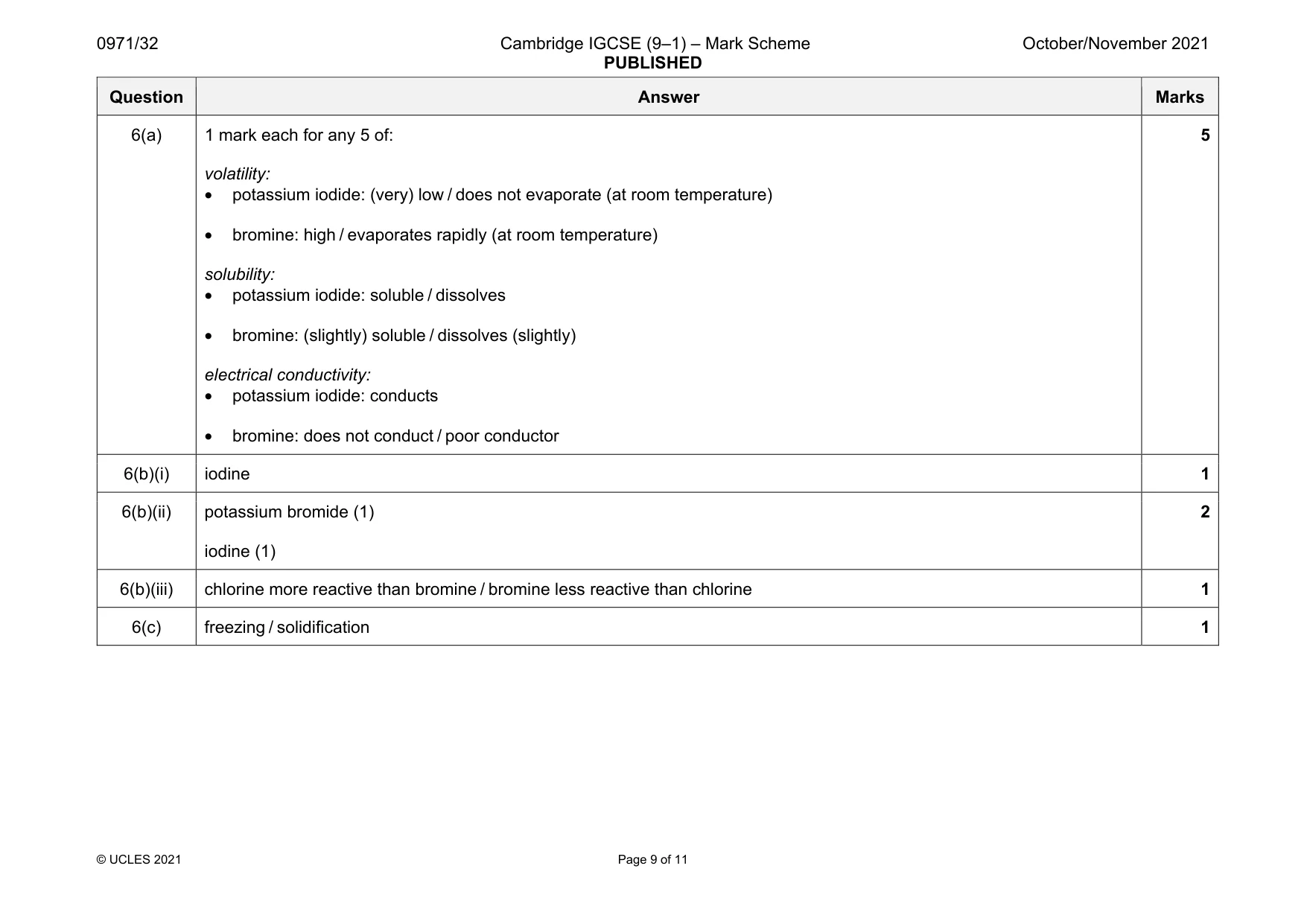
Mark scheme: 6(a) 1 mark each for any 5 of: volatility: • potassium iodide: (very) low / does not evaporate (at room temperature) • bromine: high / evaporates rapidly (at room temperature) solubility: • potassium iodide: soluble / dissolves • bromine: (slightly) soluble / dissolves (slightly) electrical conductivity: • potassium iodide: conducts • bromine: does not conduct / poor conductor 5 6(b)(i) iodine 1 6(b)(ii) potassium bromide (1) iodine (1) 2 6(b)(iii) chlorine more reactive than bromine / bromine less reactive than chlorine 1 6(c) freezing / solidification 1
Q7 · This question is about sulfur and compounds of sulfur
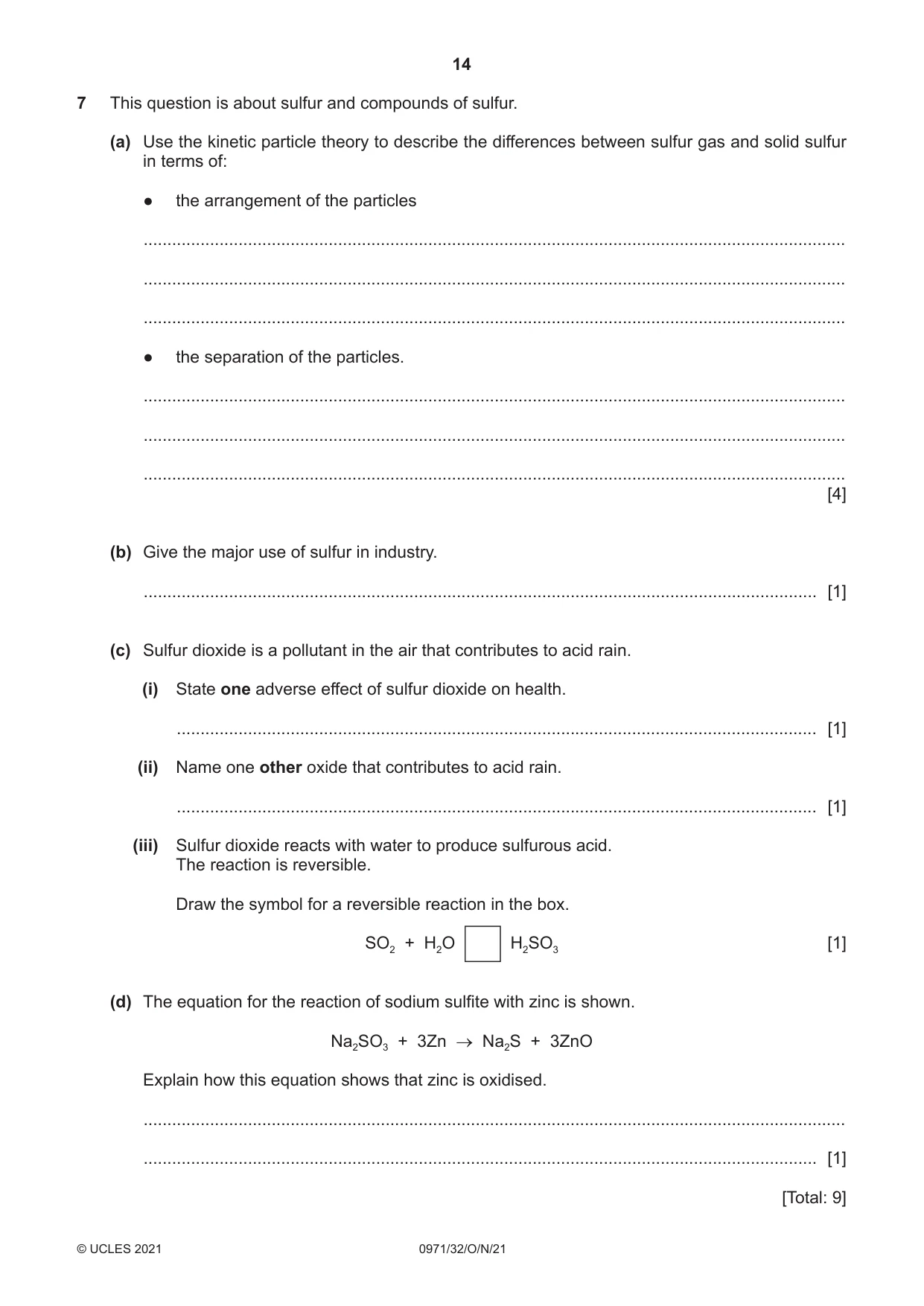
7 This question is about sulfur and compounds of sulfur. (a) Use the kinetic particle theory to describe the differences between sulfur gas and solid sulfur in terms of: ● the arrangement of the particles .................................................................................................................................................... .................................................................................................................................................... .................................................................................................................................................... ● the separation of the particles. .................................................................................................................................................... .................................................................................................................................................... .................................................................................................................................................... [4] (b) Give the major use of sulfur in industry. .............................................................................................................................................. [1] (c) Sulfur dioxide is a pollutant in the air that contributes to acid rain. (i) State one adverse effect of sulfur dioxide on health. ....................................................................................................................................... [1] (ii) Name one other oxide that contributes to acid rain. ....................................................................................................................................... [1] (iii) Sulfur dioxide reacts with water to produce sulfurous acid. The reaction is reversible. Draw the symbol for a reversible reaction in the box. SO2 + H2O H2SO3 [1] (d) The equation for the reaction of sodium sulfite with zinc is shown. Na2SO3 + 3Zn → Na2S + 3ZnO Explain how this equation shows that zinc is oxidised. .................................................................................................................................................... .............................................................................................................................................. [1] [Total: 9]
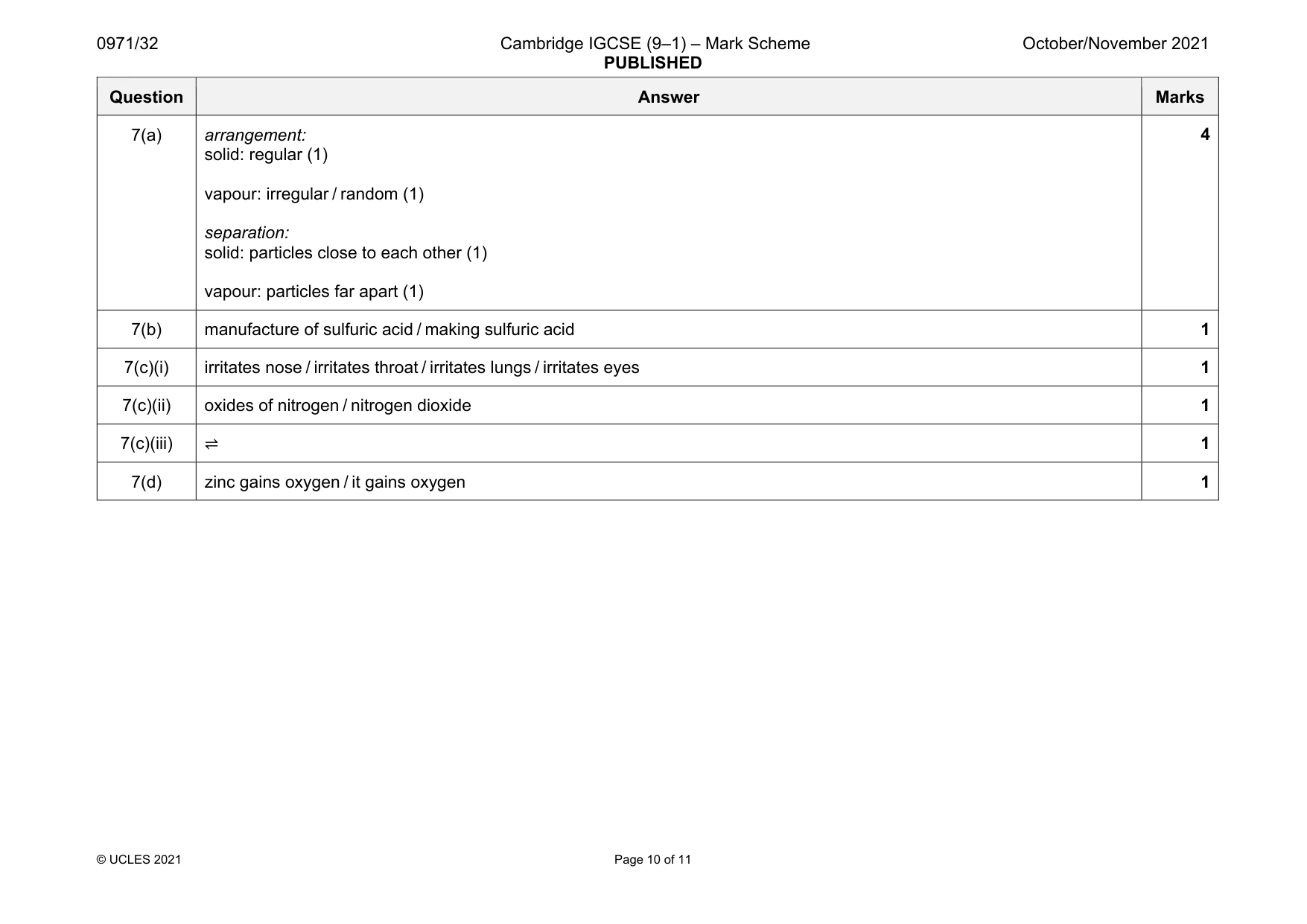
Mark scheme: 7(a) arrangement: solid: regular (1) vapour: irregular / random (1) separation: solid: particles close to each other (1) vapour: particles far apart (1) 7(b) manufacture of sulfuric acid / making sulfuric acid 1 7(c)(i) irritates nose / irritates throat / irritates lungs / irritates eyes 1 7(c)(ii) oxides of nitrogen / nitrogen dioxide 1 7(c)(iii) ⇌ 1 7(d) zinc gains oxygen / it gains oxygen 1
Q8 · A student investigated the reaction of small pieces of calcium carbonate with dilute…
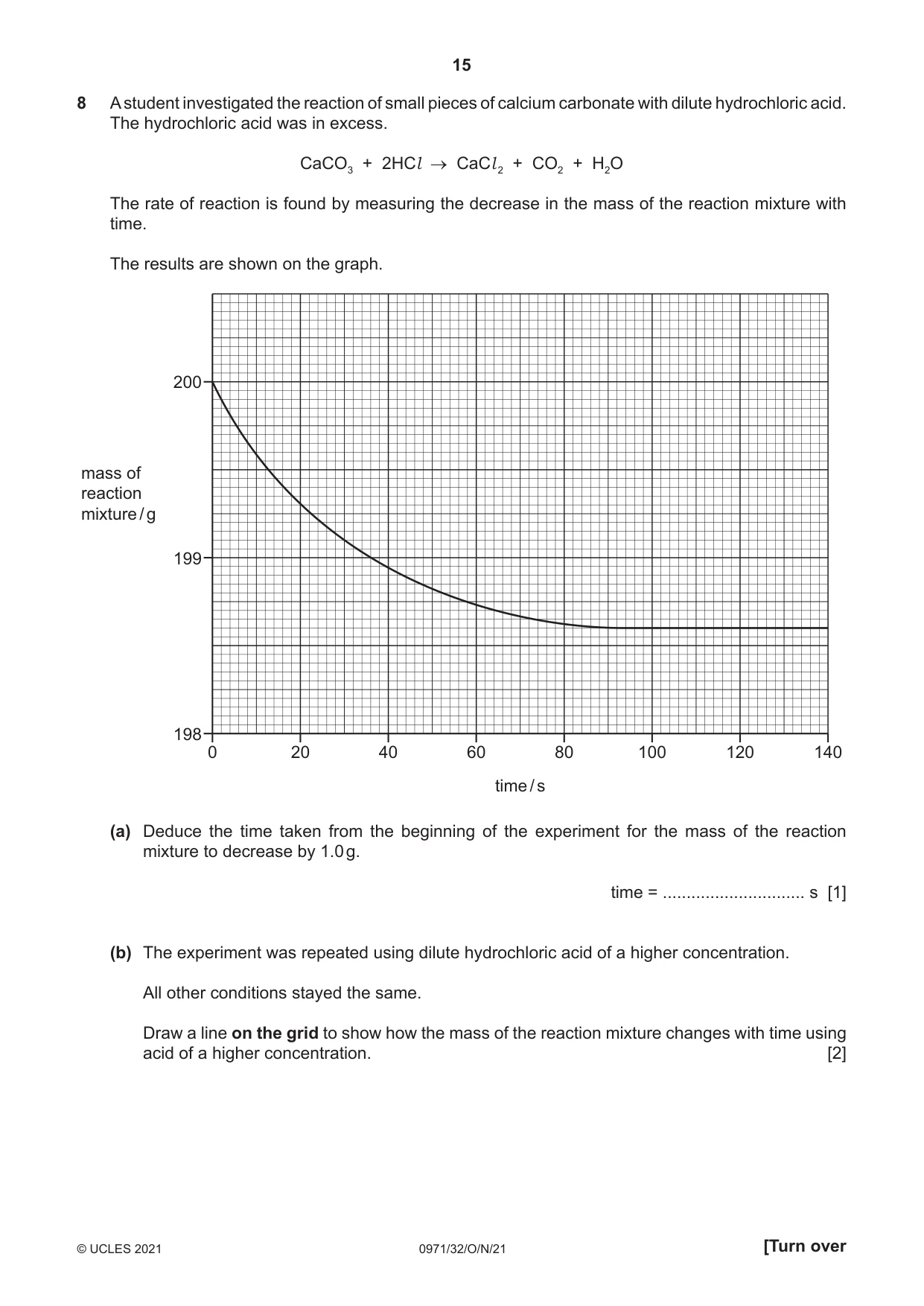
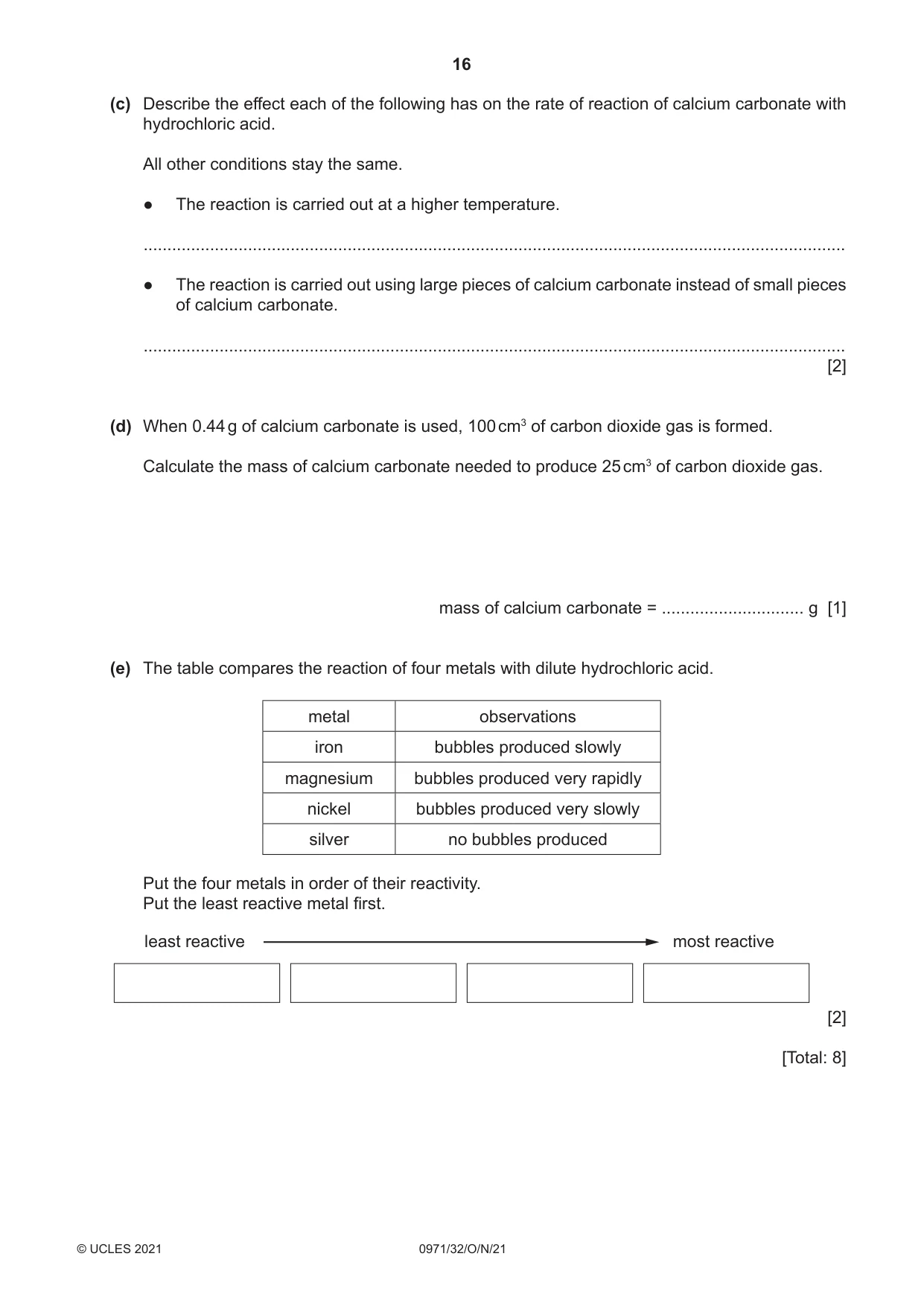
8 A student investigated the reaction of small pieces of calcium carbonate with dilute hydrochloric acid. The hydrochloric acid was in excess. CaCO3 + 2HCl → CaCl 2 + CO2 + H2O The rate of reaction is found by measuring the decrease in the mass of the reaction mixture with time. The results are shown on the graph. 200 mass of reaction mixture / g 199 198 0 20 40 60 80 100 120 140 time / s (a) Deduce the time taken from the beginning of the experiment for the mass of the reaction mixture to decrease by 1.0 g. time = .............................. s [1] (b) The experiment was repeated using dilute hydrochloric acid of a higher concentration. All other conditions stayed the same. Draw a line on the grid to show how the mass of the reaction mixture changes with time using acid of a higher concentration. [2] (c) Describe the effect each of the following has on the rate of reaction of calcium carbonate with hydrochloric acid. All other conditions stay the same. ● The reaction is carried out at a higher temperature. .................................................................................................................................................... ● The reaction is carried out using large pieces of calcium carbonate instead of small pieces of calcium carbonate. .................................................................................................................................................... [2] (d) When 0.44 g of calcium carbonate is used, 100 cm3 of carbon dioxide gas is formed. Calculate the mass of calcium carbonate needed to produce 25 cm3 of carbon dioxide gas. mass of calcium carbonate = .............................. g [1] (e) The table compares the reaction of four metals with dilute hydrochloric acid. metal observations iron bubbles produced slowly magnesium bubbles produced very rapidly nickel bubbles produced very slowly silver no bubbles produced Put the four metals in order of their reactivity. Put the least reactive metal first. least reactive most reactive [2] [Total: 8]
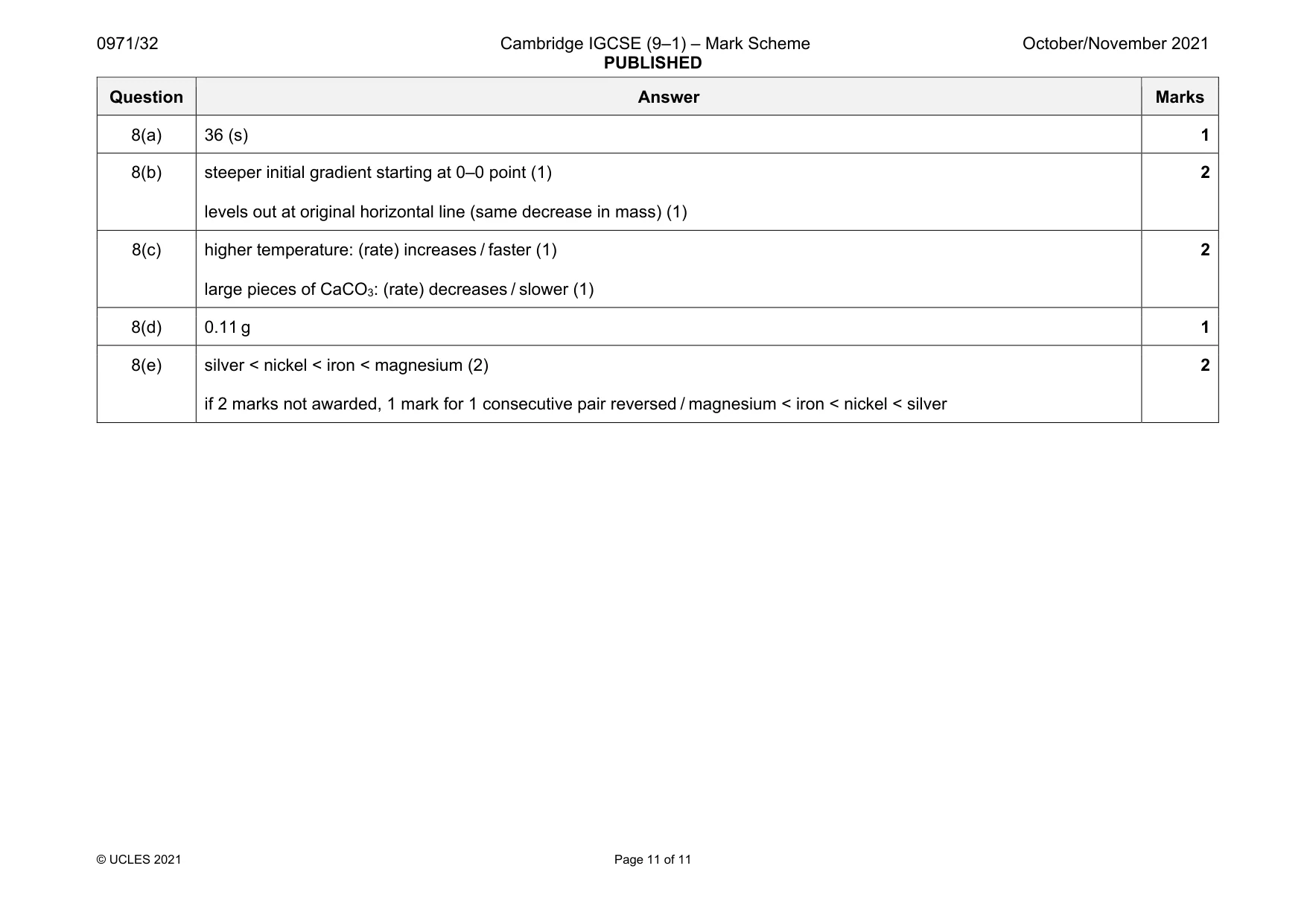
Mark scheme: 8(a) 36 (s) 1 8(b) steeper initial gradient starting at 0–0 point (1) levels out at original horizontal line (same decrease in mass) (1) 2 8(c) higher temperature: (rate) increases / faster (1) large pieces of CaCO3: (rate) decreases / slower (1) 2 8(d) 0.11 g 1 8(e) silver < nickel < iron < magnesium (2) if 2 marks not awarded, 1 mark for 1 consecutive pair reversed / magnesium < iron < nickel < silver 2
What was in this paper
The subtopics covered by these 8 questions, and how many questions each got. Open one in a new tab to see every Cambridge question on it.
What you needed in this session
Cambridge’s own grade thresholds for 2021 Oct/Nov, Paper 3 · Variant 2. A higher threshold means an easier paper — the bar moves with how the cohort did.