Cambridge IGCSE Chemistry (9-1) 0971 — 2021 May/June Paper 6 · Variant 2
0971/62/M/J/21 · 4 questions · 40 marks · ≈45 min
The question paper and its mark scheme, free to read here and free to download. This is Cambridge’s own paper, exactly as it was sat.
Question paper12 pages

Mark scheme8 pages
Answers below. Sit the paper first if you are practising.
Questions as text
Q1 · Barium sulfate is an insoluble salt
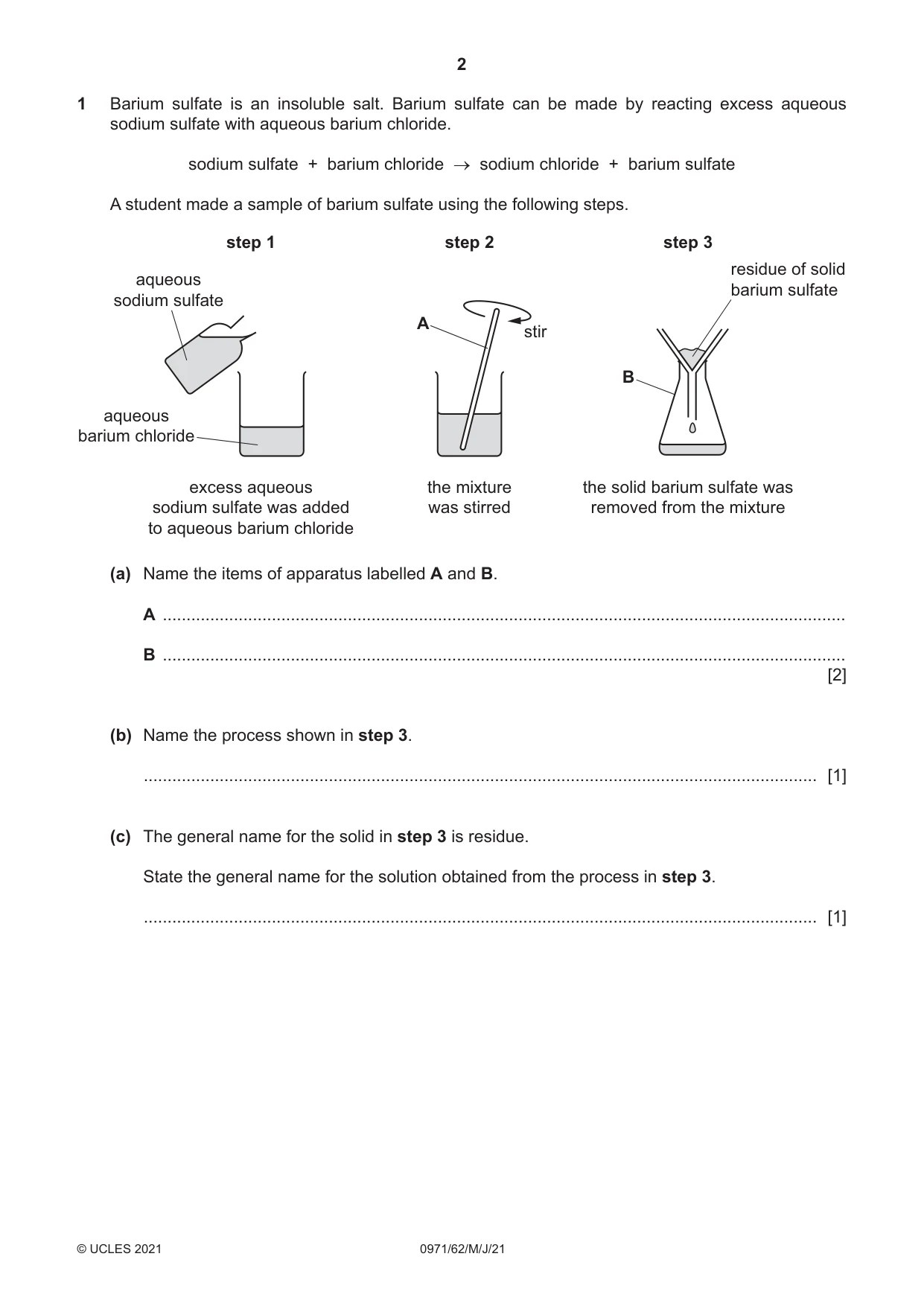
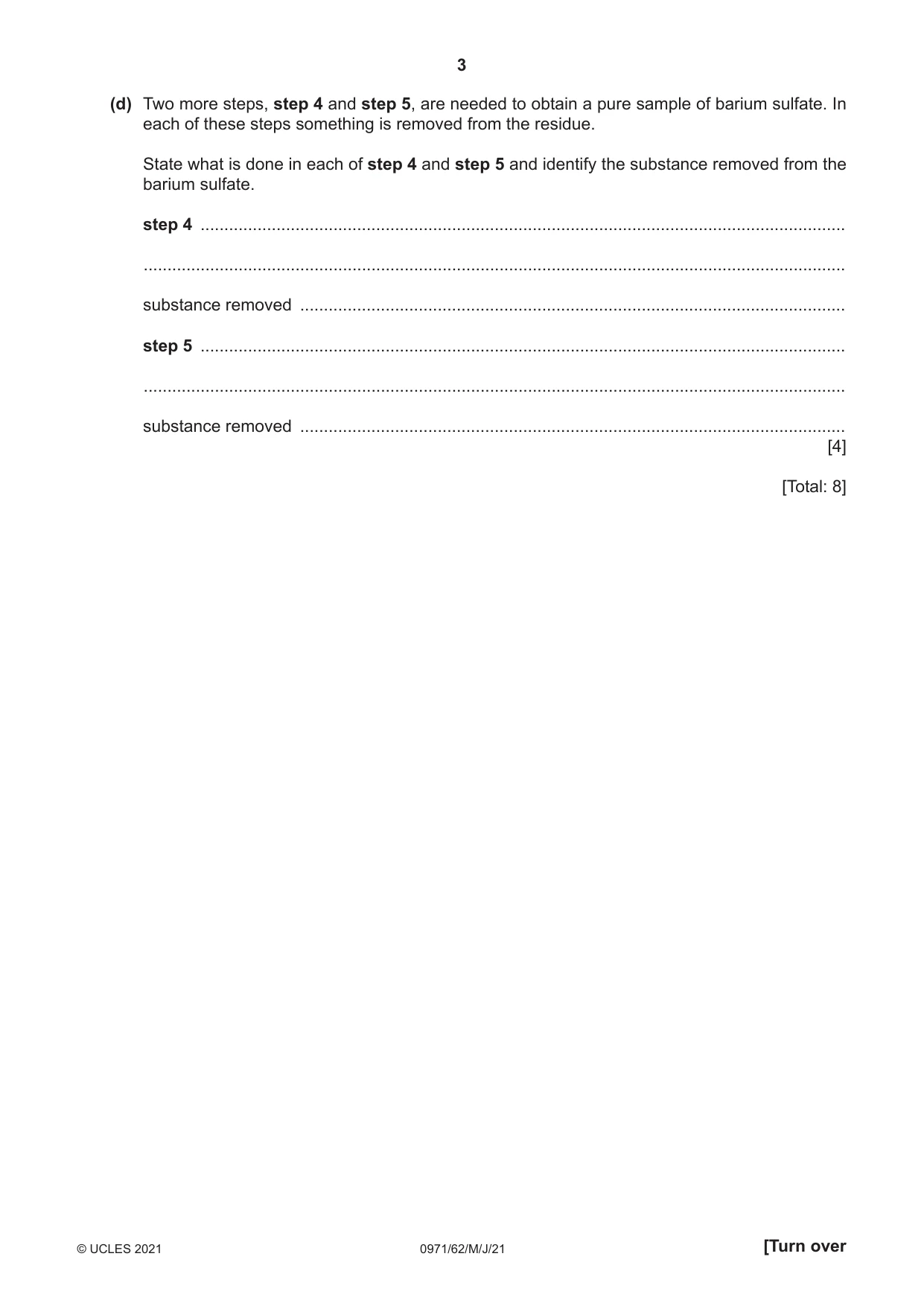
1 Barium sulfate is an insoluble salt. Barium sulfate can be made by reacting excess aqueous sodium sulfate with aqueous barium chloride. sodium sulfate + barium chloride → sodium chloride + barium sulfate A student made a sample of barium sulfate using the following steps. step 1 step 2 step 3 residue of solid aqueous barium sulfate sodium sulfate A stir B aqueous barium chloride excess aqueous the mixture the solid barium sulfate was sodium sulfate was added was stirred removed from the mixture to aqueous barium chloride (a) Name the items of apparatus labelled A and B. A ................................................................................................................................................. B ................................................................................................................................................. [2] (b) Name the process shown in step 3. .............................................................................................................................................. [1] (c) The general name for the solid in step 3 is residue. State the general name for the solution obtained from the process in step 3. .............................................................................................................................................. [1] (d) Two more steps, step 4 and step 5, are needed to obtain a pure sample of barium sulfate. In each of these steps something is removed from the residue. State what is done in each of step 4 and step 5 and identify the substance removed from the barium sulfate. step 4 ......................................................................................................................................... .................................................................................................................................................... substance removed .................................................................................................................... step 5 ......................................................................................................................................... .................................................................................................................................................... substance removed .................................................................................................................... [4] [Total: 8]
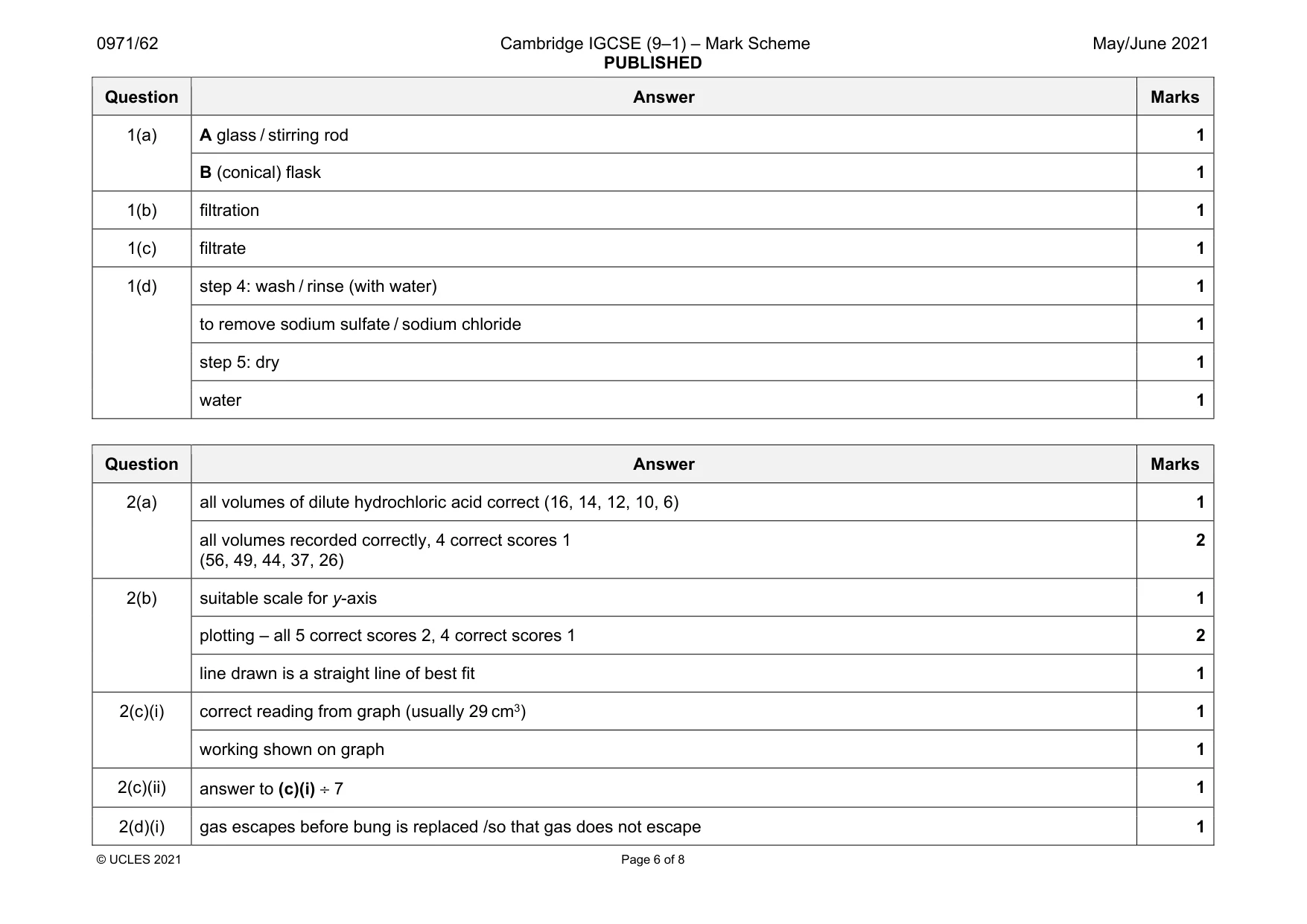
Mark scheme: 1(a) A glass / stirring rod 1 B (conical) flask 1 1(b) filtration 1 1(c) filtrate 1 1(d) step 4: wash / rinse (with water) 1 to remove sodium sulfate / sodium chloride 1 step 5: dry 1 water 1
Q2 · A student investigated the volume of gas made when sodium carbonate reacts with dilute…
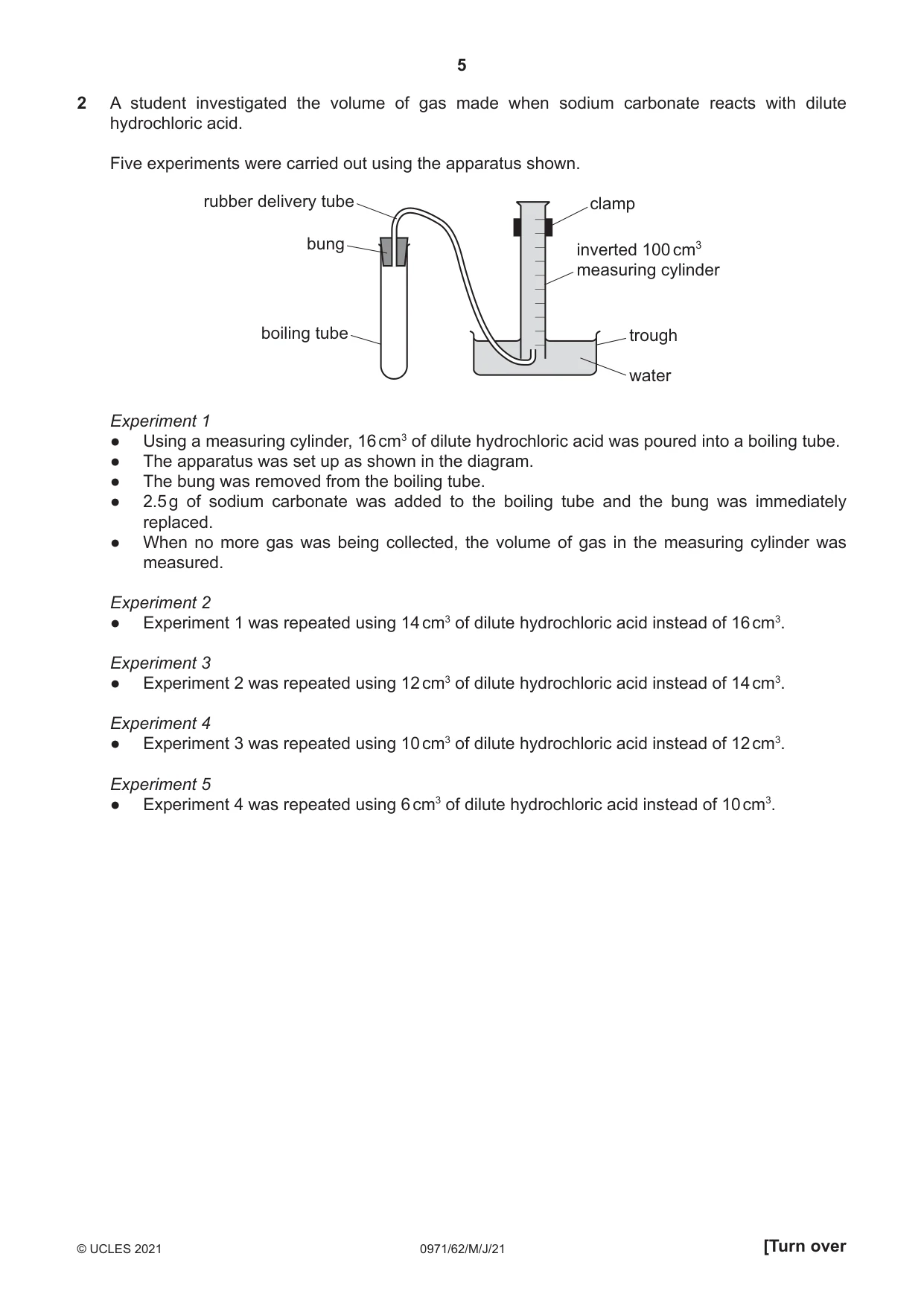
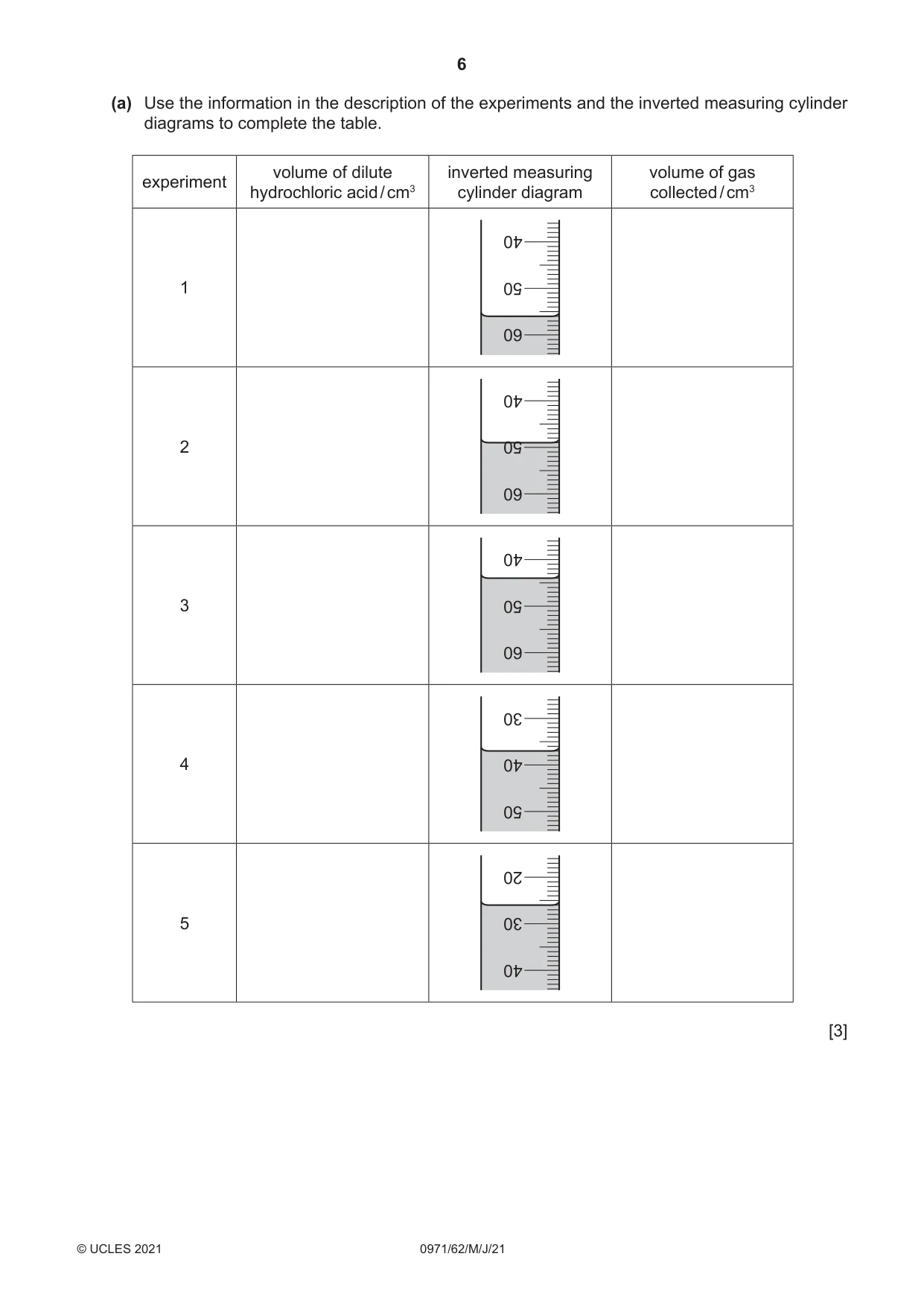
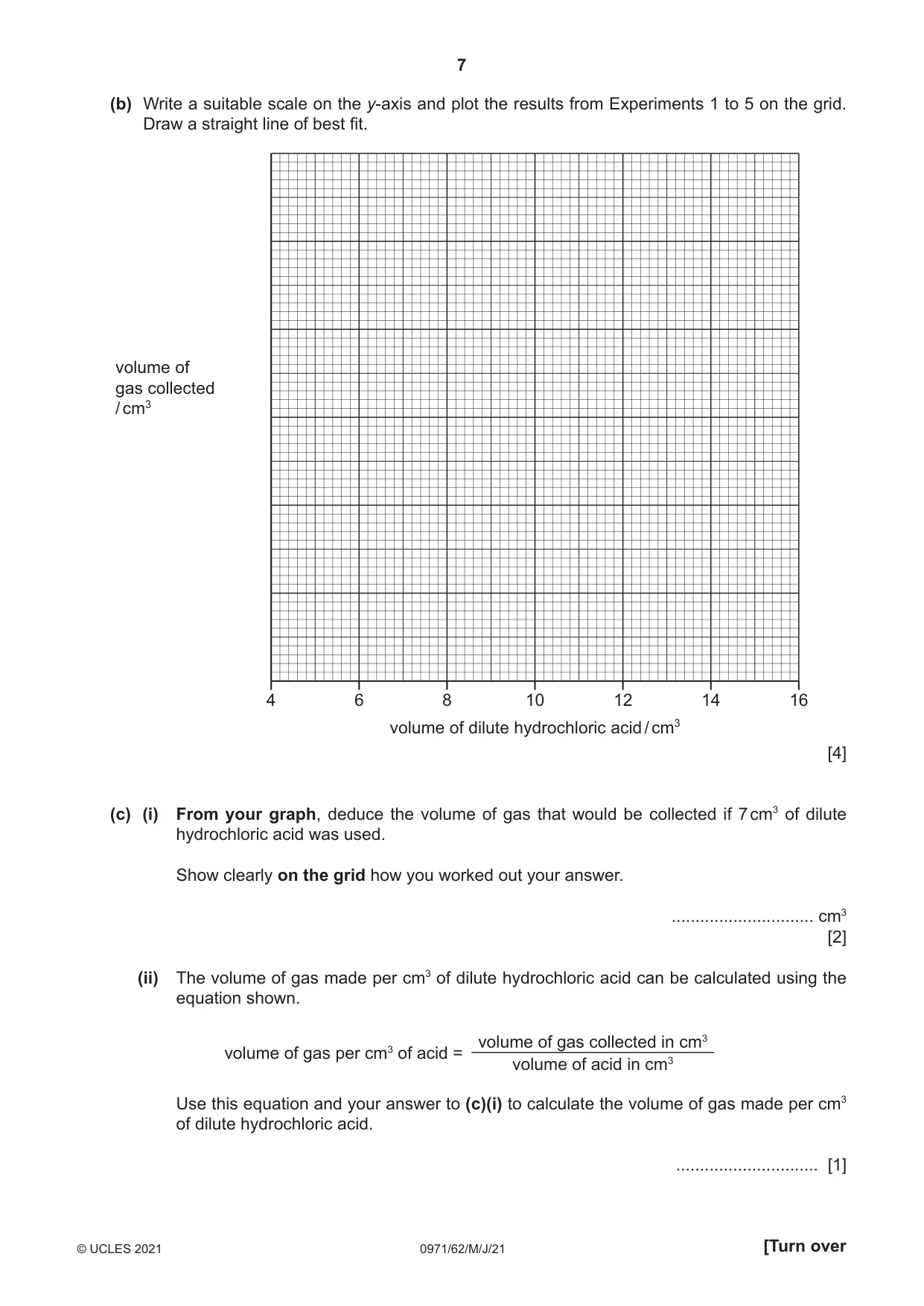
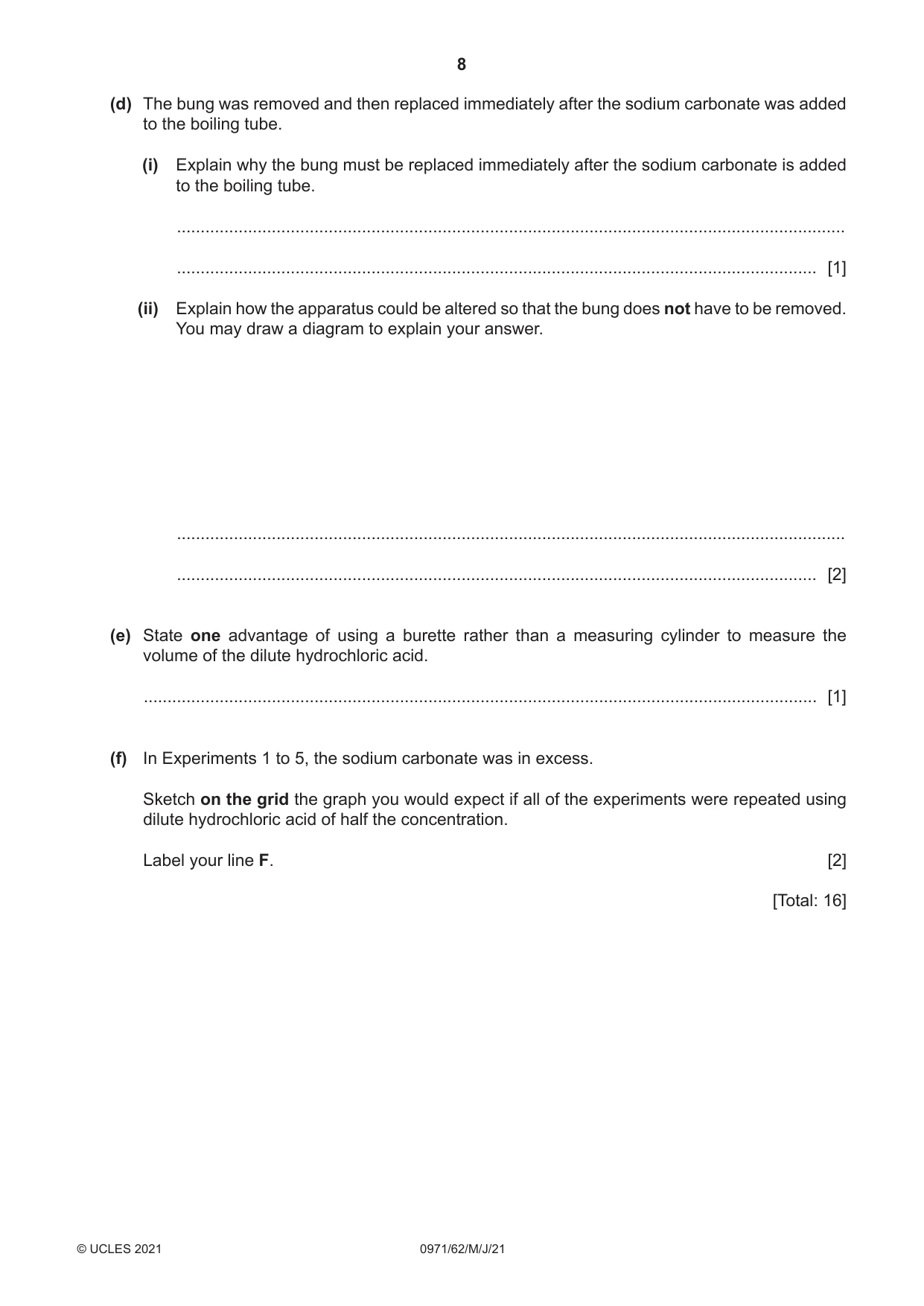
2 A student investigated the volume of gas made when sodium carbonate reacts with dilute hydrochloric acid. Five experiments were carried out using the apparatus shown. rubber delivery tube clamp bung inverted 100 cm3 measuring cylinder boiling tube trough water Experiment 1 ● Using a measuring cylinder, 16 cm3 of dilute hydrochloric acid was poured into a boiling tube. ● The apparatus was set up as shown in the diagram. ● The bung was removed from the boiling tube. ● 2.5 g of sodium carbonate was added to the boiling tube and the bung was immediately replaced. ● When no more gas was being collected, the volume of gas in the measuring cylinder was measured. Experiment 2 ● Experiment 1 was repeated using 14 cm3 of dilute hydrochloric acid instead of 16 cm3. Experiment 3 ● Experiment 2 was repeated using 12 cm3 of dilute hydrochloric acid instead of 14 cm3. Experiment 4 ● Experiment 3 was repeated using 10 cm3 of dilute hydrochloric acid instead of 12 cm3. Experiment 5 ● Experiment 4 was repeated using 6 cm3 of dilute hydrochloric acid instead of 10 cm3. (a) Use the information in the description of the experiments and the inverted measuring cylinder diagrams to complete the table. volume of dilute inverted measuring volume of gas experiment hydrochloric acid / cm3 cylinder diagram collected / cm3 40 1 50 60 40 2 50 60 40 3 50 60 30 4 40 50 20 5 30 40 [3] (b) Write a suitable scale on the y-axis and plot the results from Experiments 1 to 5 on the grid. Draw a straight line of best fit. volume of gas collected / cm3 4 6 8 10 12 14 16 volume of dilute hydrochloric acid / cm3 [4] (c) (i) From your graph, deduce the volume of gas that would be collected if 7 cm3 of dilute hydrochloric acid was used. Show clearly on the grid how you worked out your answer. .............................. cm3 [2] (ii) The volume of gas made per cm3 of dilute hydrochloric acid can be calculated using the equation shown. volume of gas collected in cm3 volume of gas per cm3 of acid = volume of acid in cm3 Use this equation and your answer to (c)(i) to calculate the volume of gas made per cm3 of dilute hydrochloric acid. .............................. [1] (d) The bung was removed and then replaced immediately after the sodium carbonate was added to the boiling tube. (i) Explain why the bung must be replaced immediately after the sodium carbonate is added to the boiling tube. ............................................................................................................................................. ....................................................................................................................................... [1] (ii) Explain how the apparatus could be altered so that the bung does not have to be removed. You may draw a diagram to explain your answer. ............................................................................................................................................. ....................................................................................................................................... [2] (e) State one advantage of using a burette rather than a measuring cylinder to measure the volume of the dilute hydrochloric acid. .............................................................................................................................................. [1] (f) In Experiments 1 to 5, the sodium carbonate was in excess. Sketch on the grid the graph you would expect if all of the experiments were repeated using dilute hydrochloric acid of half the concentration. Label your line F. [2] [Total: 16]
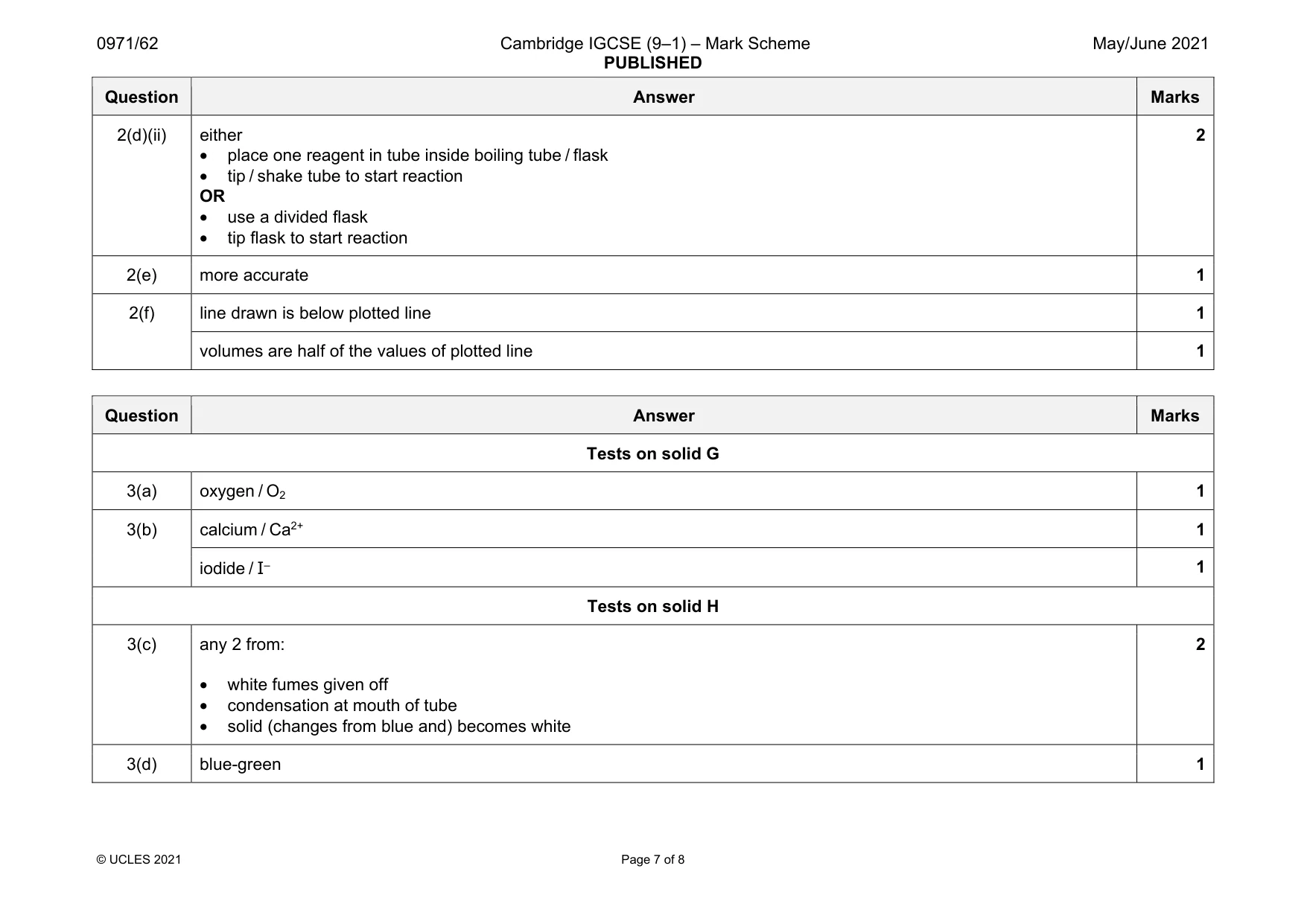
Mark scheme: 2(a) all volumes of dilute hydrochloric acid correct (16, 14, 12, 10, 6) 1 all volumes recorded correctly, 4 correct scores 1 (56, 49, 44, 37, 26) 2 2(b) suitable scale for y-axis 1 plotting – all 5 correct scores 2, 4 correct scores 1 2 line drawn is a straight line of best fit 1 2(c)(i) correct reading from graph (usually 29 cm3) 1 working shown on graph 1 2(c)(ii) answer to (c)(i) ÷ 7 1 2(d)(i) gas escapes before bung is replaced /so that gas does not escape 1 Question Answer Marks 2(d)(ii) either • place one reagent in tube inside boiling tube / flask • tip / shake tube to start reaction OR • use a divided flask • tip flask to start reaction 2 2(e) more accurate 1 2(f) line drawn is below plotted line 1 volumes are half of the values of plotted line 1
Q3 · Solution G and solid H were analysed
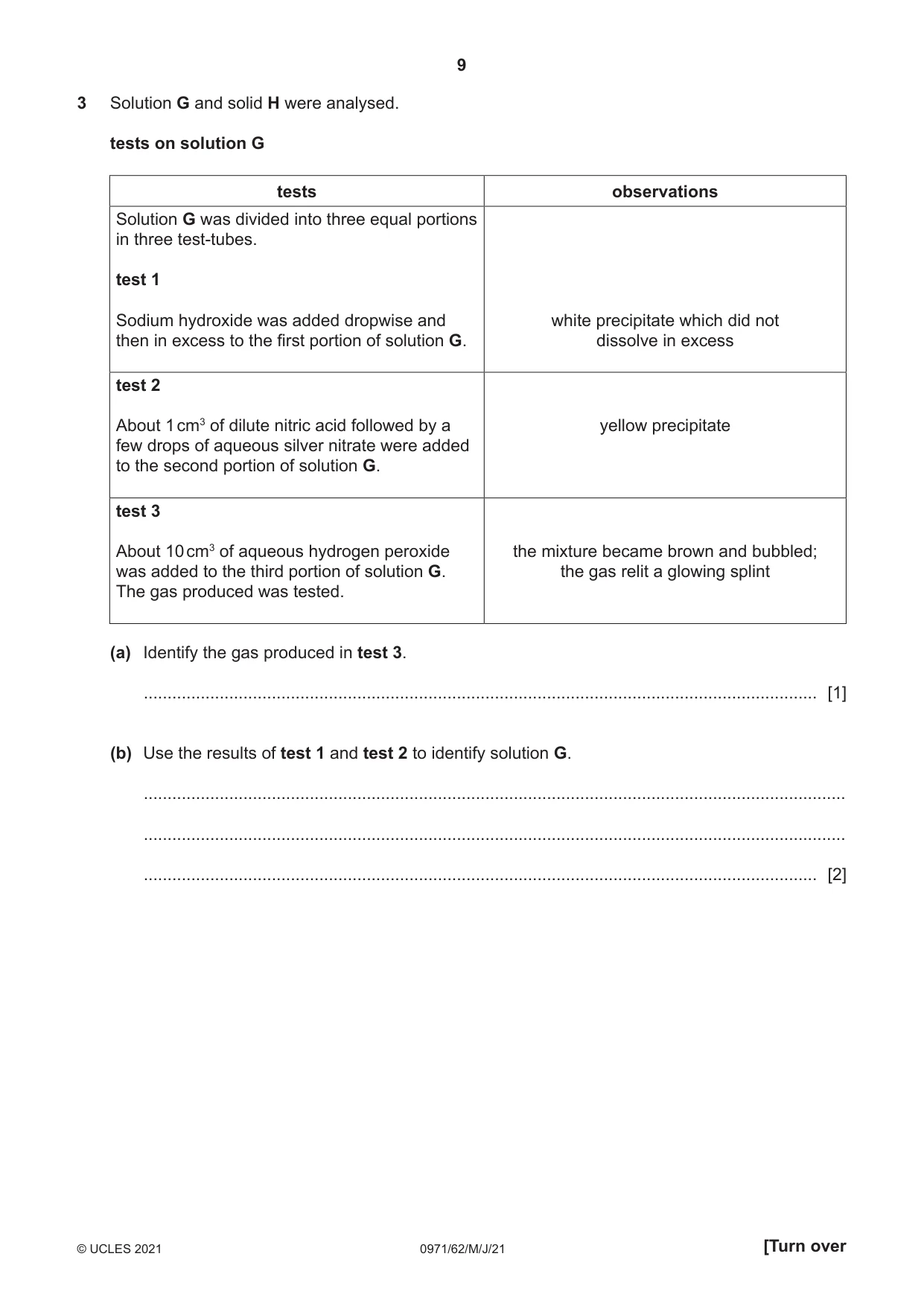
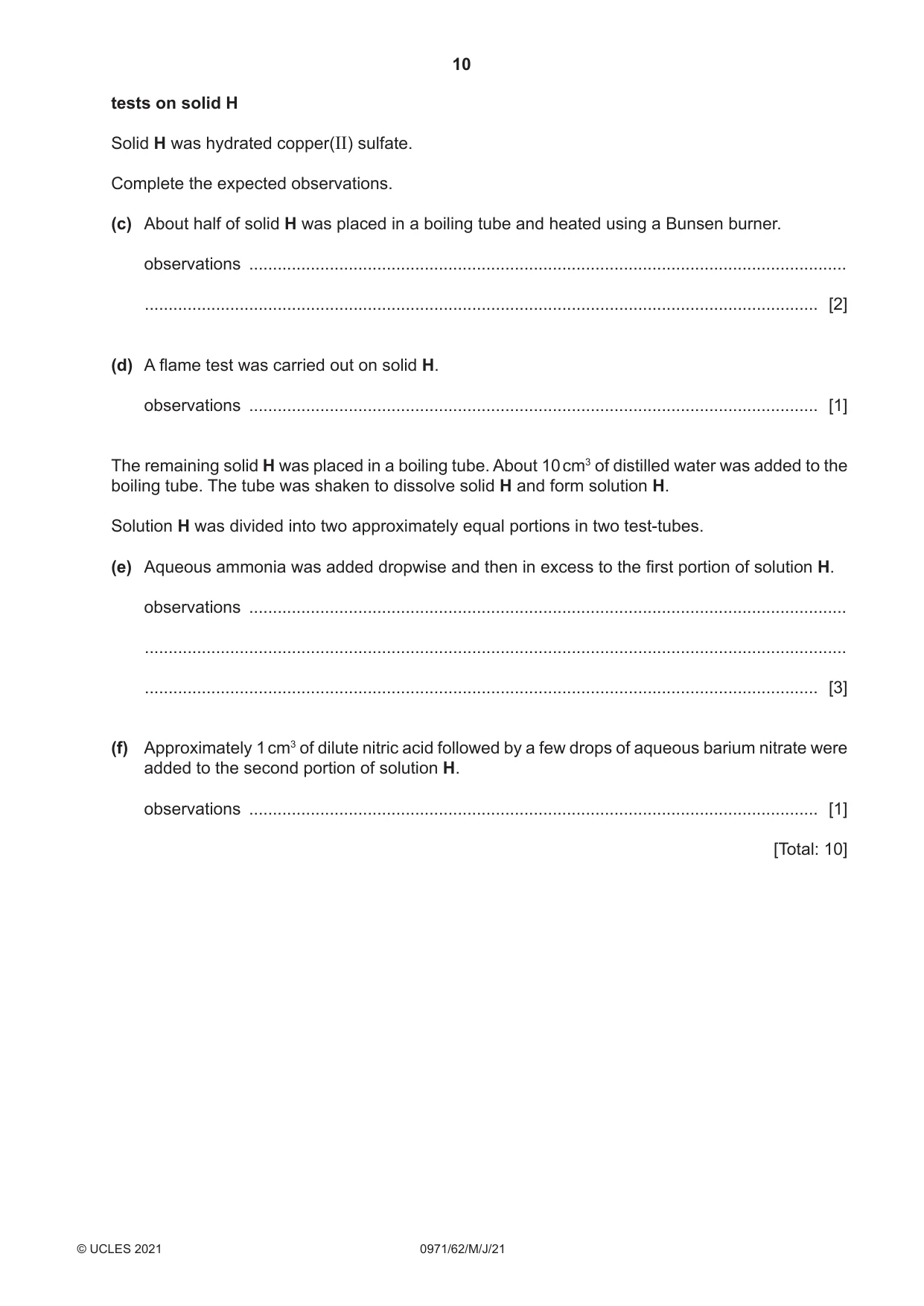
3 Solution G and solid H were analysed. tests on solution G tests observations Solution G was divided into three equal portions in three test‑tubes. test 1 Sodium hydroxide was added dropwise and white precipitate which did not then in excess to the first portion of solution G. dissolve in excess test 2 About 1 cm3 of dilute nitric acid followed by a yellow precipitate few drops of aqueous silver nitrate were added to the second portion of solution G. test 3 About 10 cm3 of aqueous hydrogen peroxide the mixture became brown and bubbled; was added to the third portion of solution G. the gas relit a glowing splint The gas produced was tested. (a) Identify the gas produced in test 3. .............................................................................................................................................. [1] (b) Use the results of test 1 and test 2 to identify solution G. .................................................................................................................................................... .................................................................................................................................................... .............................................................................................................................................. [2] tests on solid H Solid H was hydrated copper(II) sulfate. Complete the expected observations. (c) About half of solid H was placed in a boiling tube and heated using a Bunsen burner. observations ............................................................................................................................... .............................................................................................................................................. [2] (d) A flame test was carried out on solid H. observations ......................................................................................................................... [1] The remaining solid H was placed in a boiling tube. About 10 cm3 of distilled water was added to the boiling tube. The tube was shaken to dissolve solid H and form solution H. Solution H was divided into two approximately equal portions in two test‑tubes. (e) Aqueous ammonia was added dropwise and then in excess to the first portion of solution H. observations ............................................................................................................................... .................................................................................................................................................... .............................................................................................................................................. [3] (f) Approximately 1 cm3 of dilute nitric acid followed by a few drops of aqueous barium nitrate were added to the second portion of solution H. observations ......................................................................................................................... [1] [Total: 10]
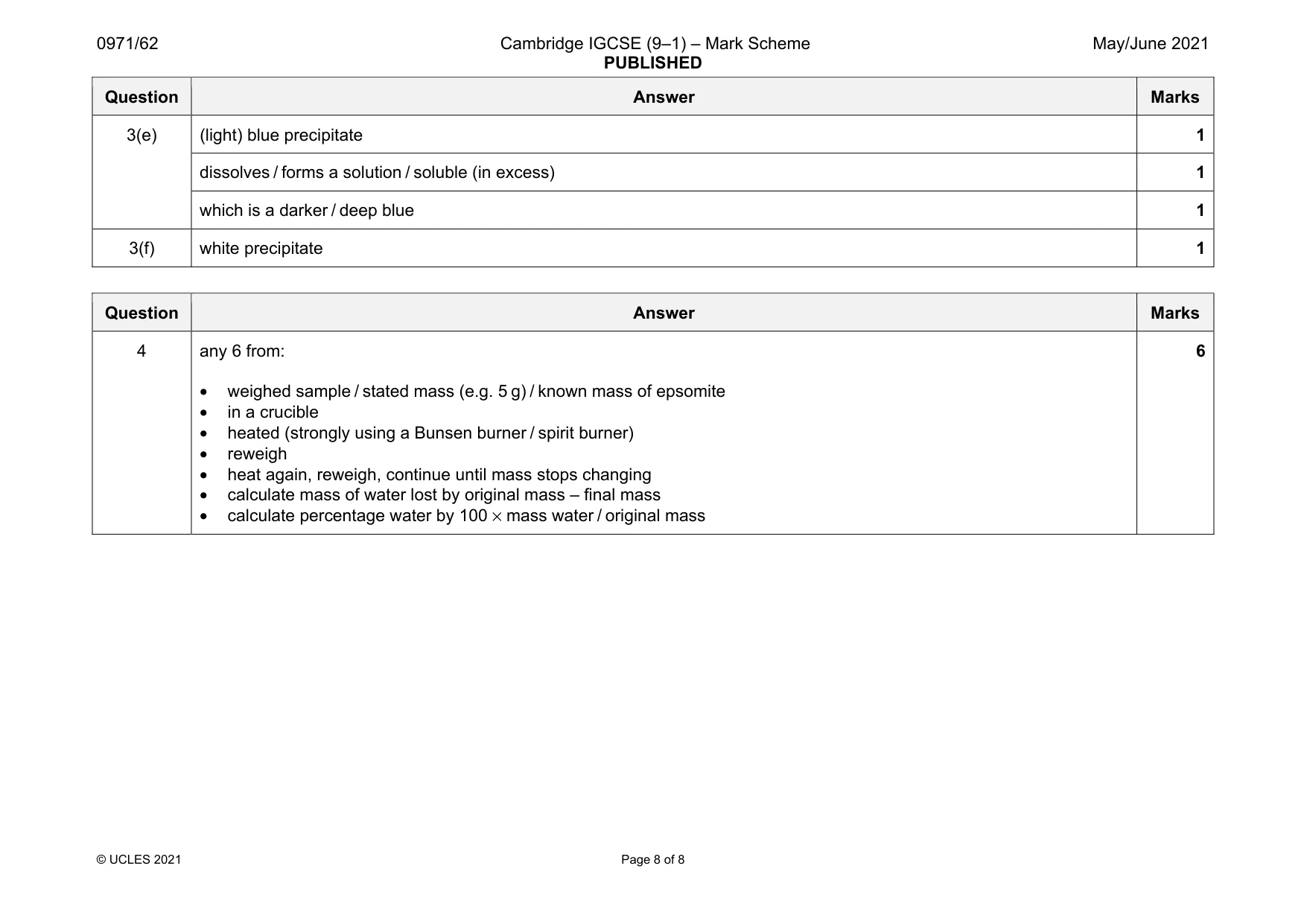
Mark scheme: 3(a) oxygen / O2 1 3(b) calcium / Ca2+ 1 iodide / I– 1 Tests on solid H 3(c) any 2 from: • white fumes given off • condensation at mouth of tube • solid (changes from blue and) becomes white 2 3(d) blue-green 1 Question Answer Marks 3(e) (light) blue precipitate 1 dissolves / forms a solution / soluble (in excess) 1 which is a darker / deep blue 1 3(f) white precipitate 1
Q4 · The mineral epsomite contains hydrated magnesium sulfate
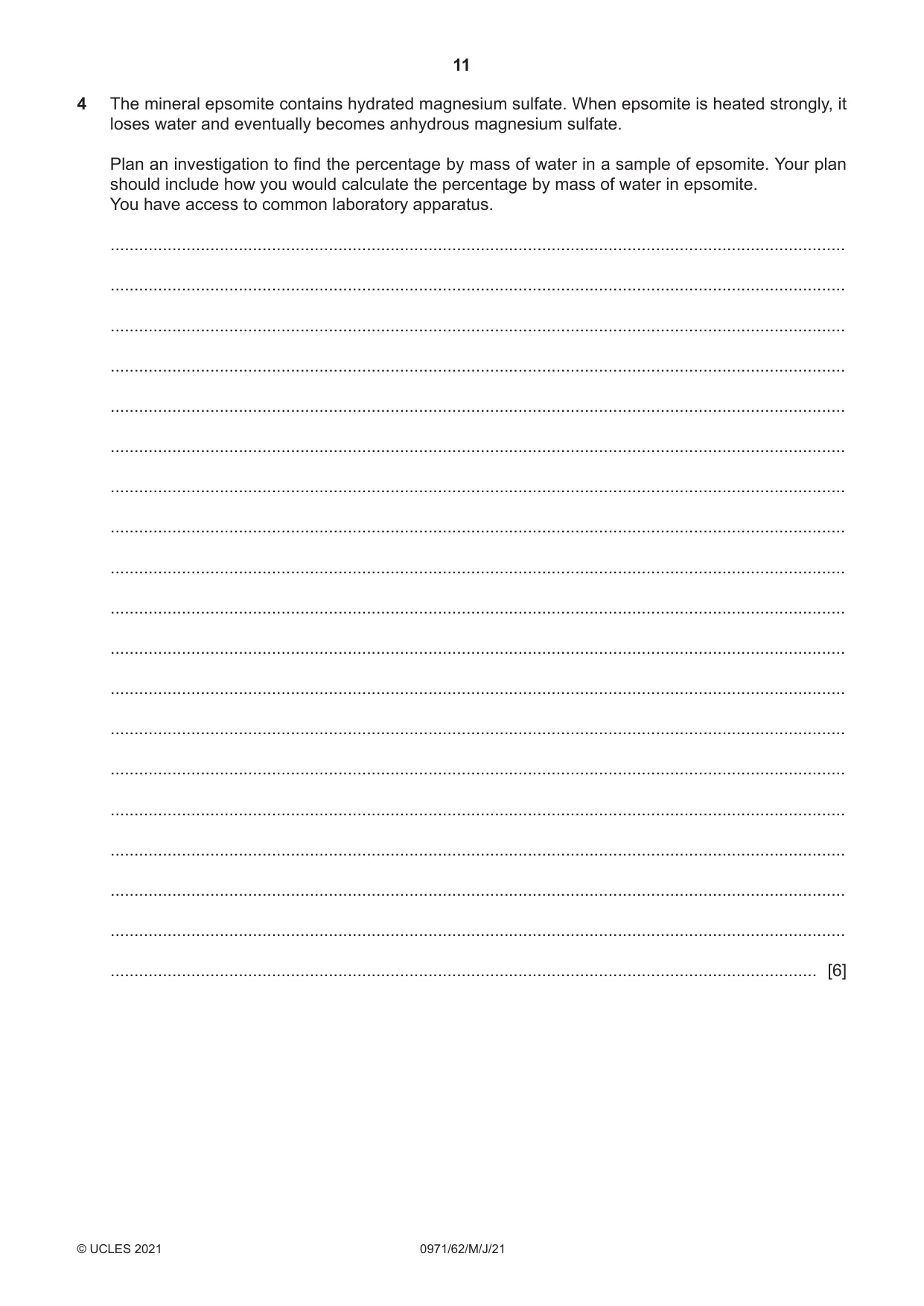
4 The mineral epsomite contains hydrated magnesium sulfate. When epsomite is heated strongly, it loses water and eventually becomes anhydrous magnesium sulfate. Plan an investigation to find the percentage by mass of water in a sample of epsomite. Your plan should include how you would calculate the percentage by mass of water in epsomite. You have access to common laboratory apparatus. ........................................................................................................................................................... ........................................................................................................................................................... ........................................................................................................................................................... ........................................................................................................................................................... ........................................................................................................................................................... ........................................................................................................................................................... ........................................................................................................................................................... ........................................................................................................................................................... ........................................................................................................................................................... ........................................................................................................................................................... ........................................................................................................................................................... ........................................................................................................................................................... ........................................................................................................................................................... ........................................................................................................................................................... ........................................................................................................................................................... ........................................................................................................................................................... ........................................................................................................................................................... ........................................................................................................................................................... ..................................................................................................................................................... [6]
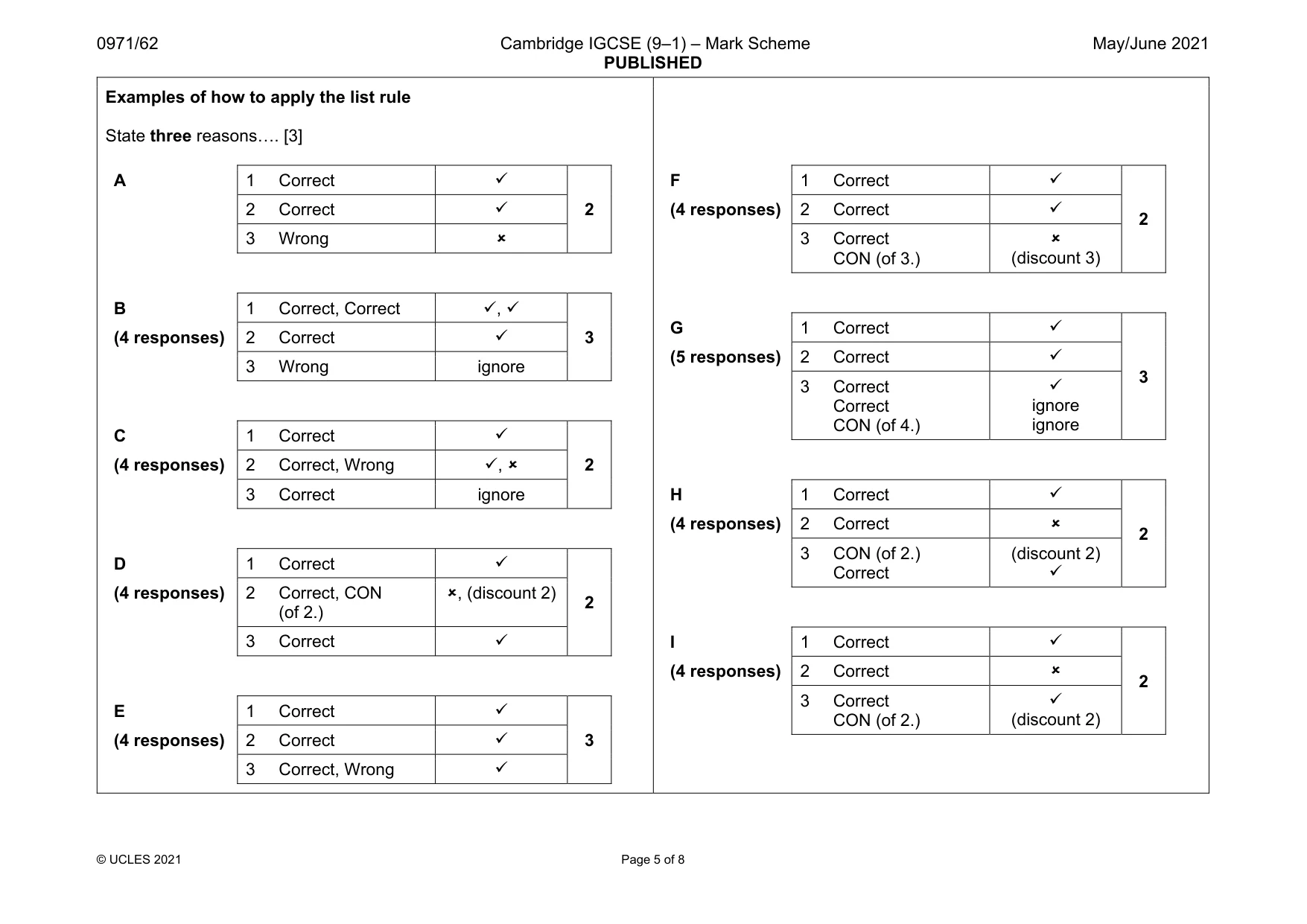
Mark scheme: 4 any 6 from: • weighed sample / stated mass (e.g. 5 g) / known mass of epsomite • in a crucible • heated (strongly using a Bunsen burner / spirit burner) • reweigh • heat again, reweigh, continue until mass stops changing • calculate mass of water lost by original mass – final mass • calculate percentage water by 100 × mass water / original mass
What was in this paper
The subtopics covered by these 4 questions, and how many questions each got. Open one in a new tab to see every Cambridge question on it.
What you needed in this session
Cambridge’s own grade thresholds for 2021 May/June, Paper 6 · Variant 2. A higher threshold means an easier paper — the bar moves with how the cohort did.