Cambridge IGCSE Chemistry (9-1) 0971 — 2020 Oct/Nov Paper 3 · Variant 2
0971/32/O/N/20 · 8 questions · 80 marks · ≈90 min
The question paper and its mark scheme, free to read here and free to download. This is Cambridge’s own paper, exactly as it was sat.
Question paper20 pages
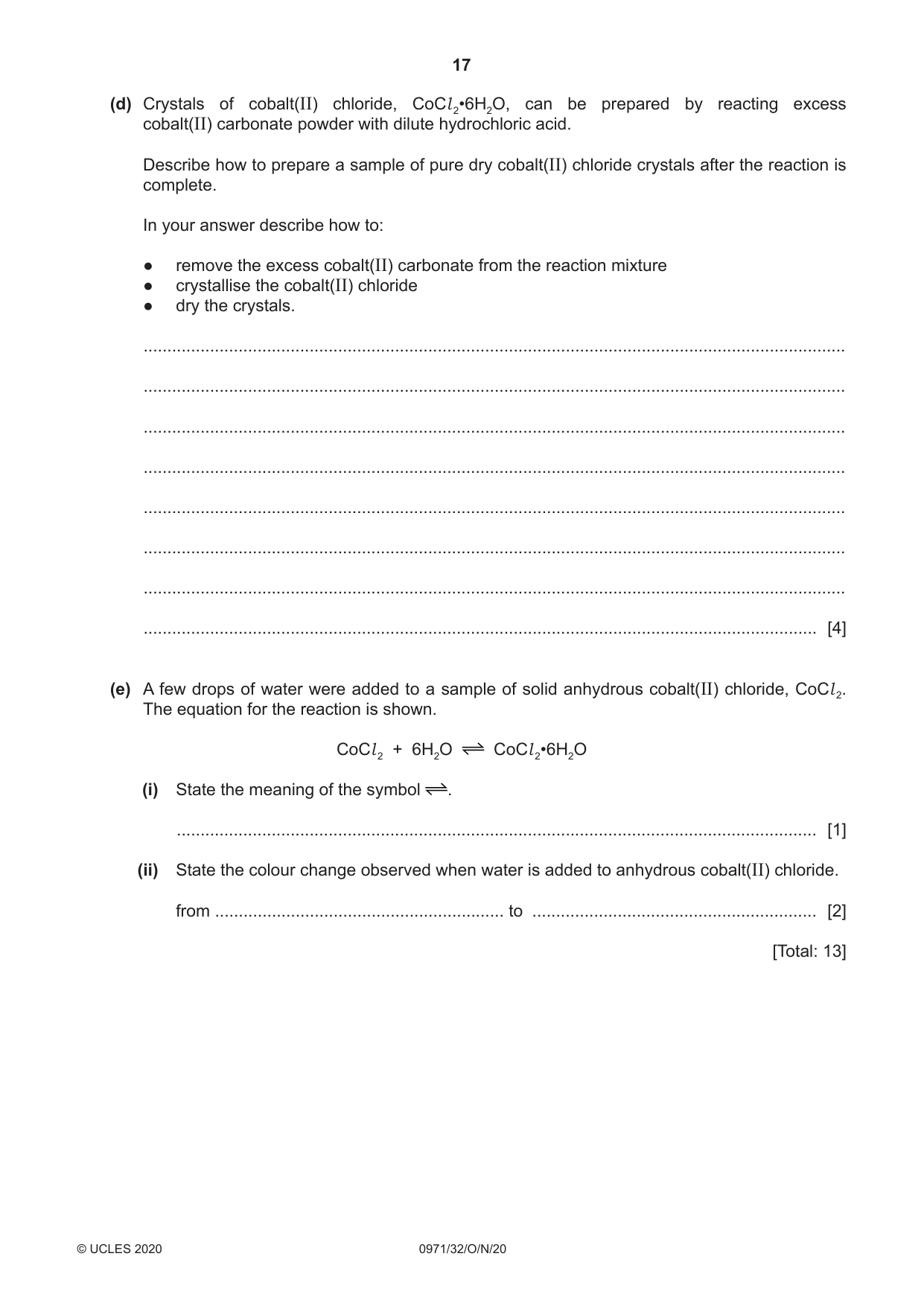


Mark scheme9 pages
Answers below. Sit the paper first if you are practising.
Questions as text
Q1 · The diagram shows part of the Periodic Table
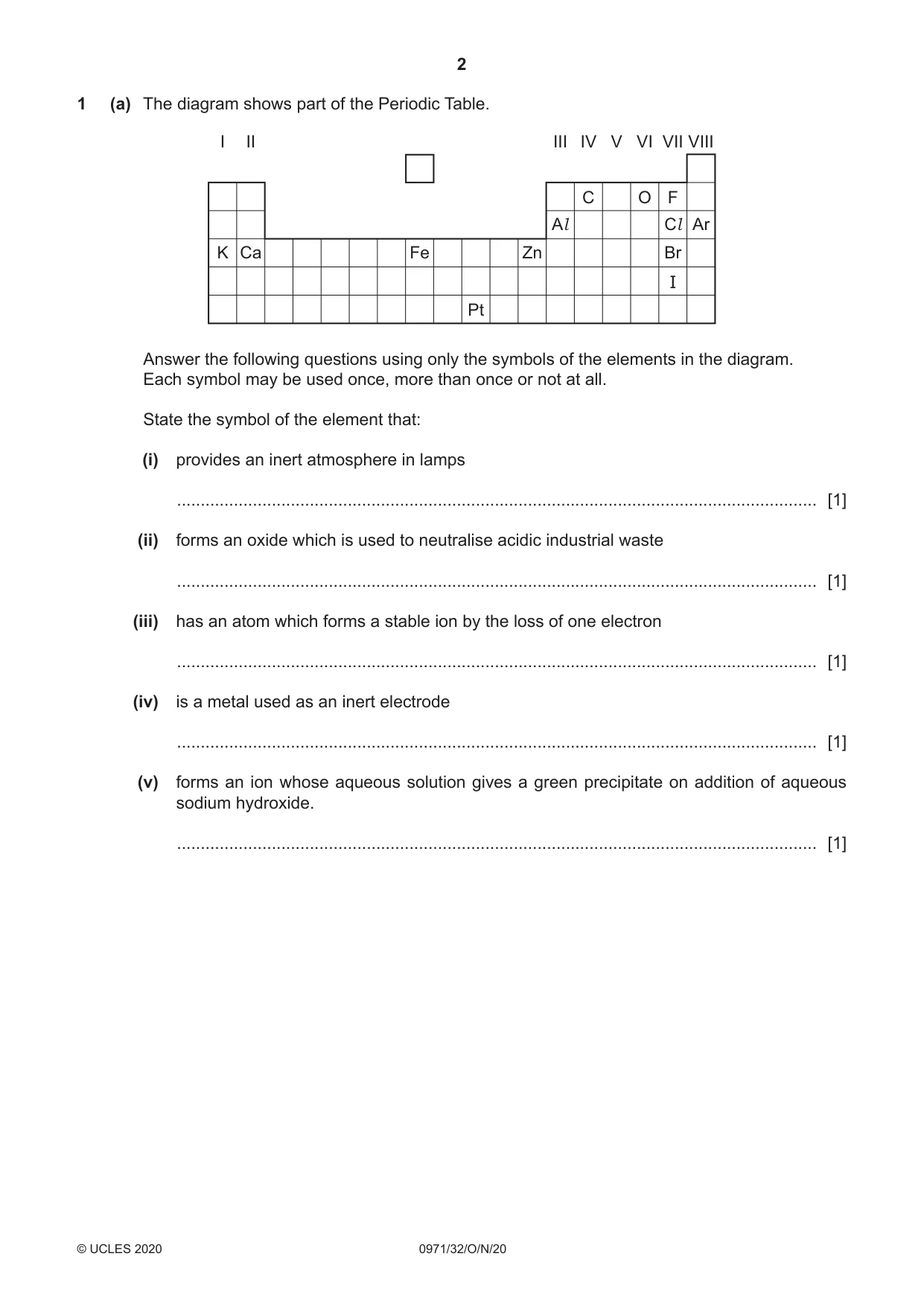
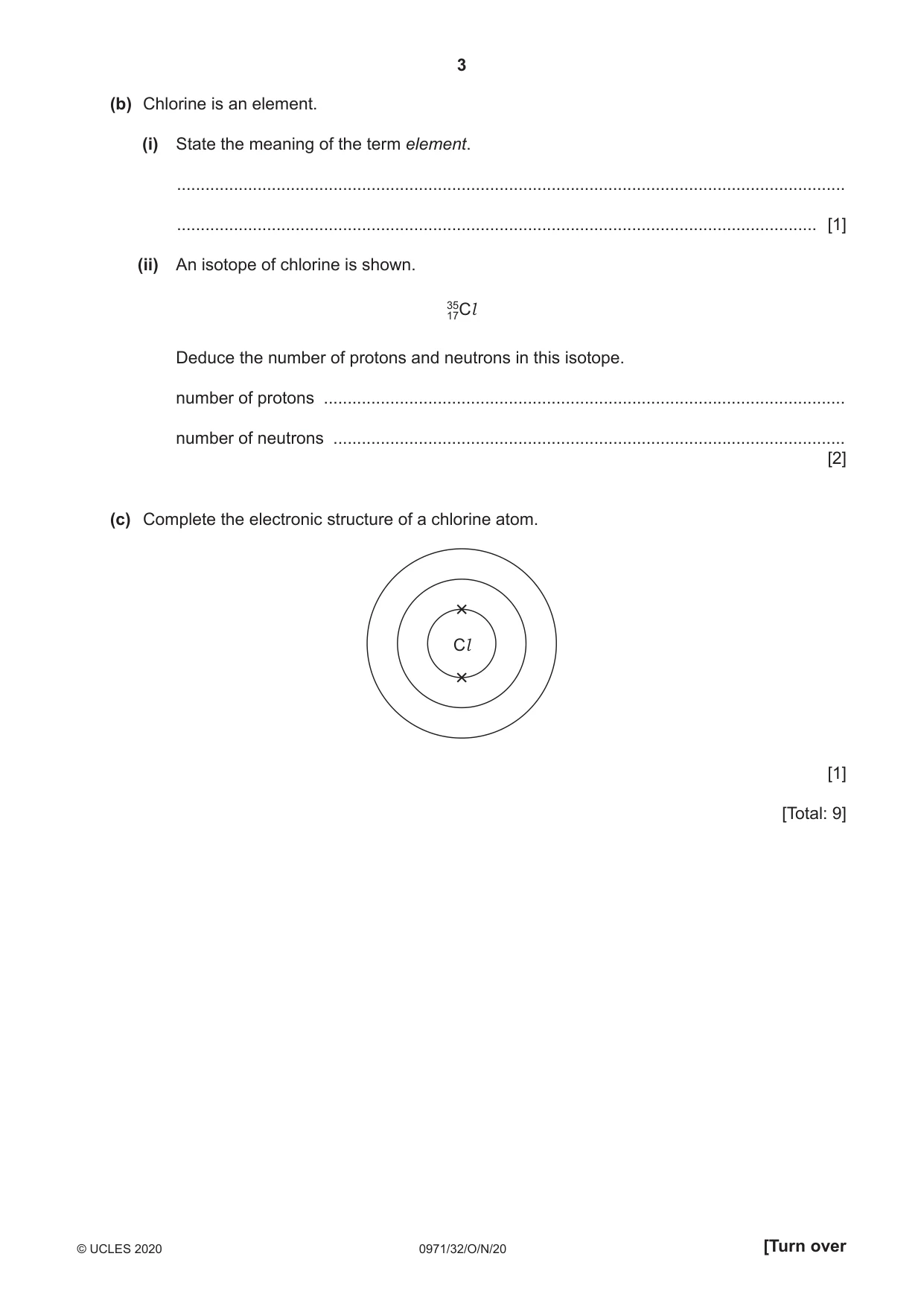
1 (a) The diagram shows part of the Periodic Table. I II III IV V VI VII VIII C O F Al Cl Ar K Ca Fe Zn Br I Pt Answer the following questions using only the symbols of the elements in the diagram. Each symbol may be used once, more than once or not at all. State the symbol of the element that: (i) provides an inert atmosphere in lamps ....................................................................................................................................... [1] (ii) forms an oxide which is used to neutralise acidic industrial waste ....................................................................................................................................... [1] (iii) has an atom which forms a stable ion by the loss of one electron ....................................................................................................................................... [1] (iv) is a metal used as an inert electrode ....................................................................................................................................... [1] (v) forms an ion whose aqueous solution gives a green precipitate on addition of aqueous sodium hydroxide. ....................................................................................................................................... [1] (b) Chlorine is an element. (i) State the meaning of the term element. ............................................................................................................................................. ....................................................................................................................................... [1] (ii) An isotope of chlorine is shown. 1735Cl Deduce the number of protons and neutrons in this isotope. number of protons ............................................................................................................... number of neutrons ............................................................................................................. [2] (c) Complete the electronic structure of a chlorine atom. Cl [1] [Total: 9]
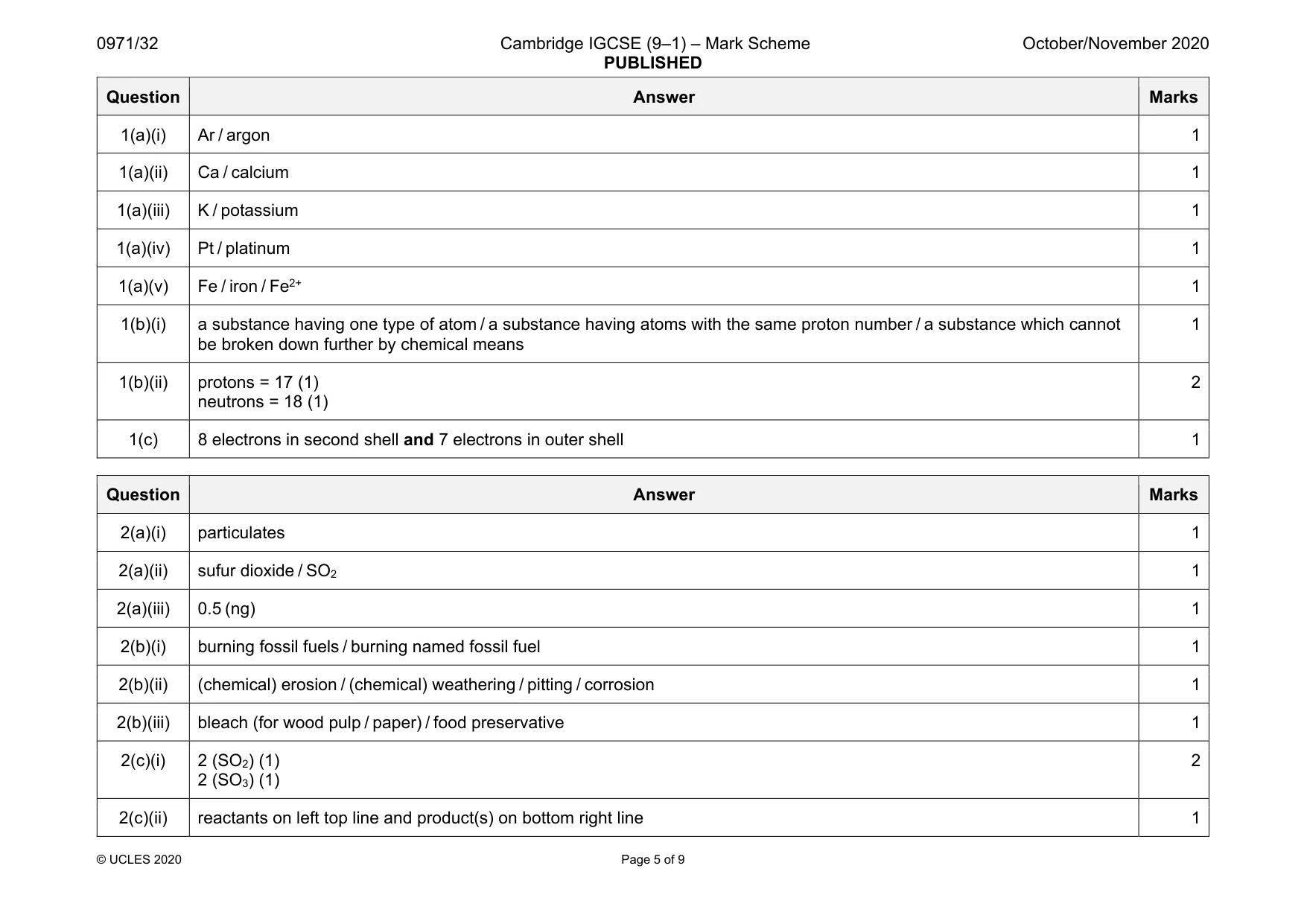
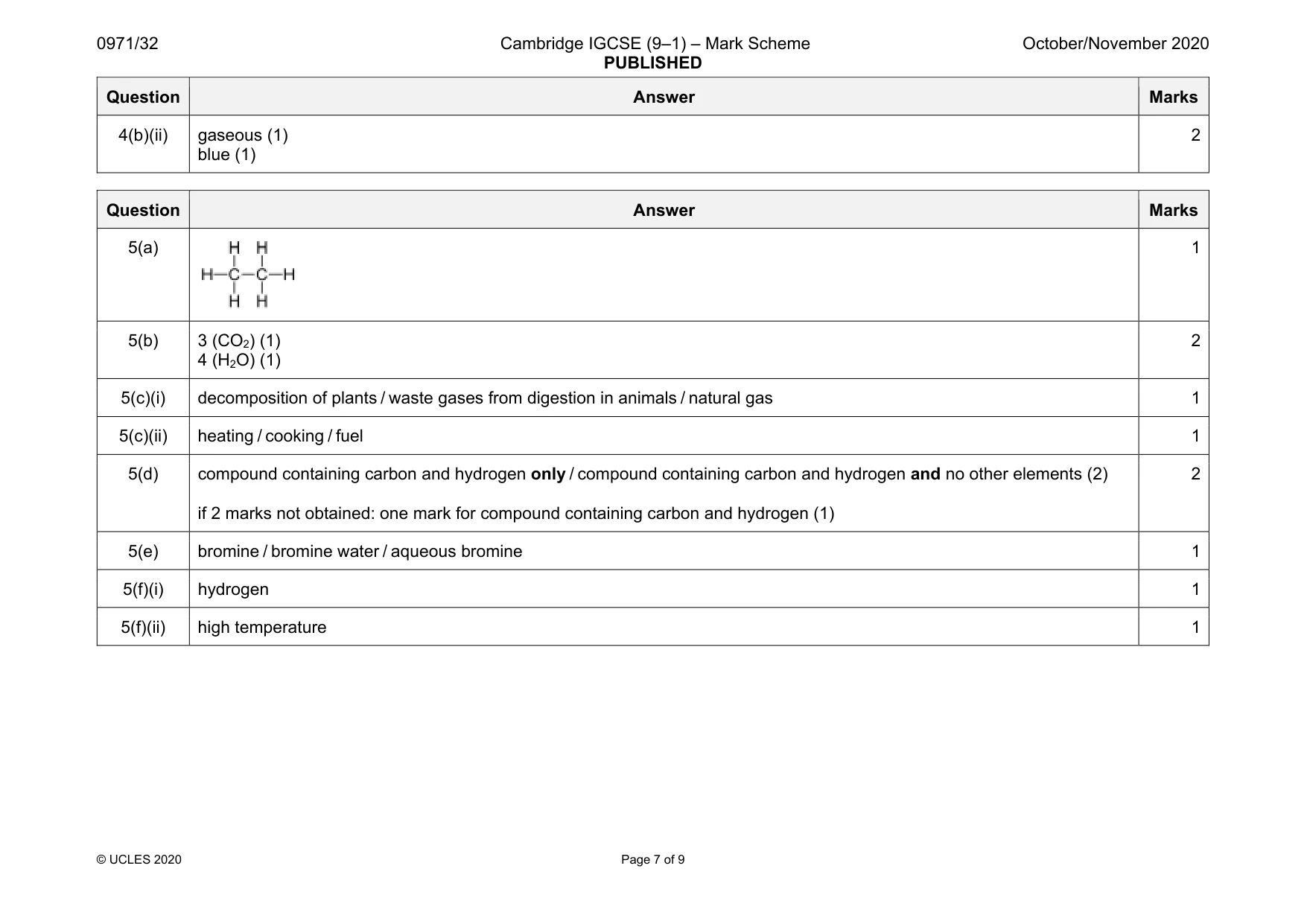
Mark scheme: 1(a)(i) Ar / argon 1 1(a)(ii) Ca / calcium 1 1(a)(iii) K / potassium 1 1(a)(iv) Pt / platinum 1 1(a)(v) Fe / iron / Fe2+ 1 1(b)(i) a substance having one type of atom / a substance having atoms with the same proton number / a substance which cannot be broken down further by chemical means 1 1(b)(ii) protons = 17 (1) neutrons = 18 (1) 2 1(c) 8 electrons in second shell and 7 electrons in outer shell 1
Q2 · The table shows the mass of air pollutants, in nanograms, in 1000 cm3 samples of air…
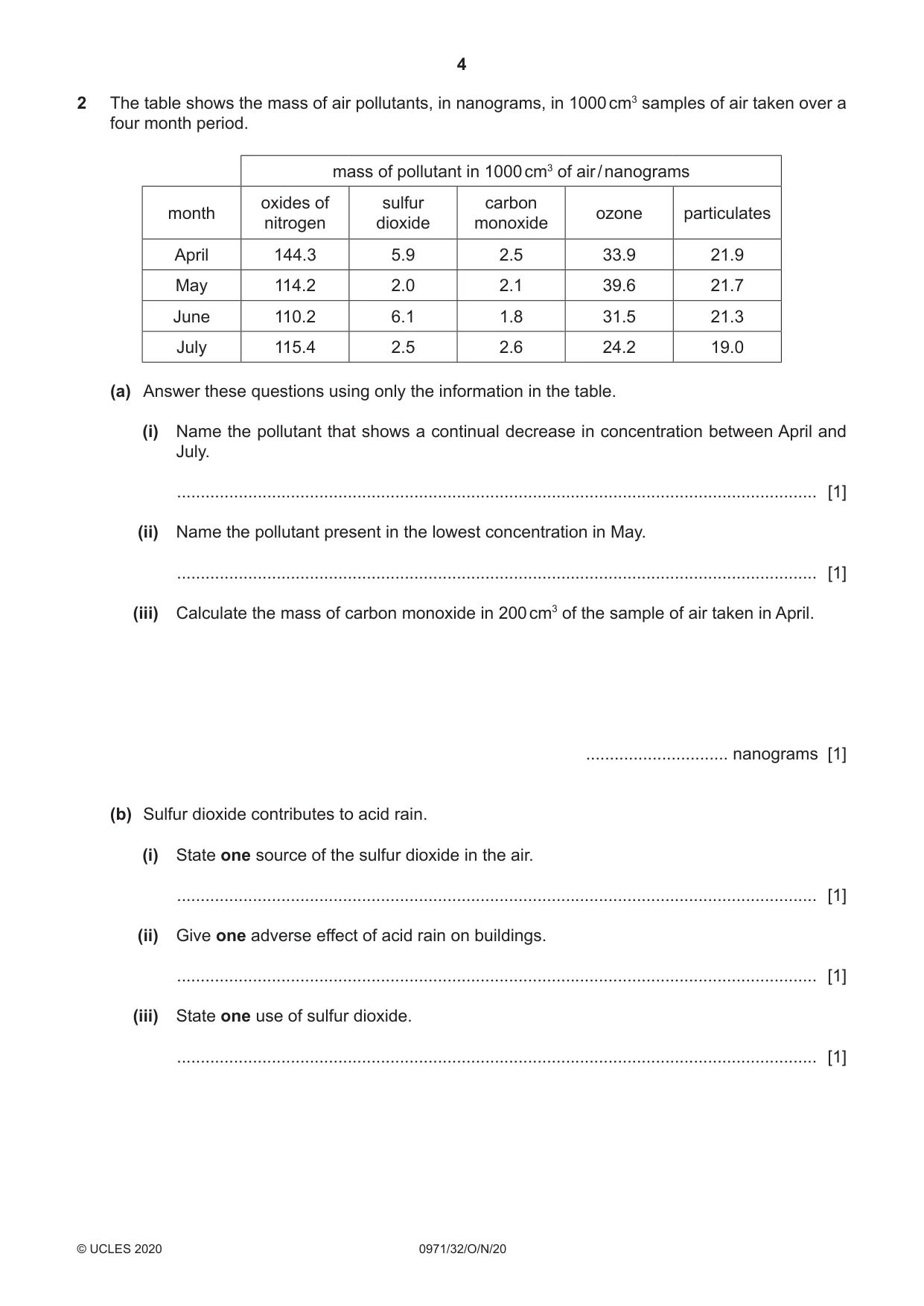
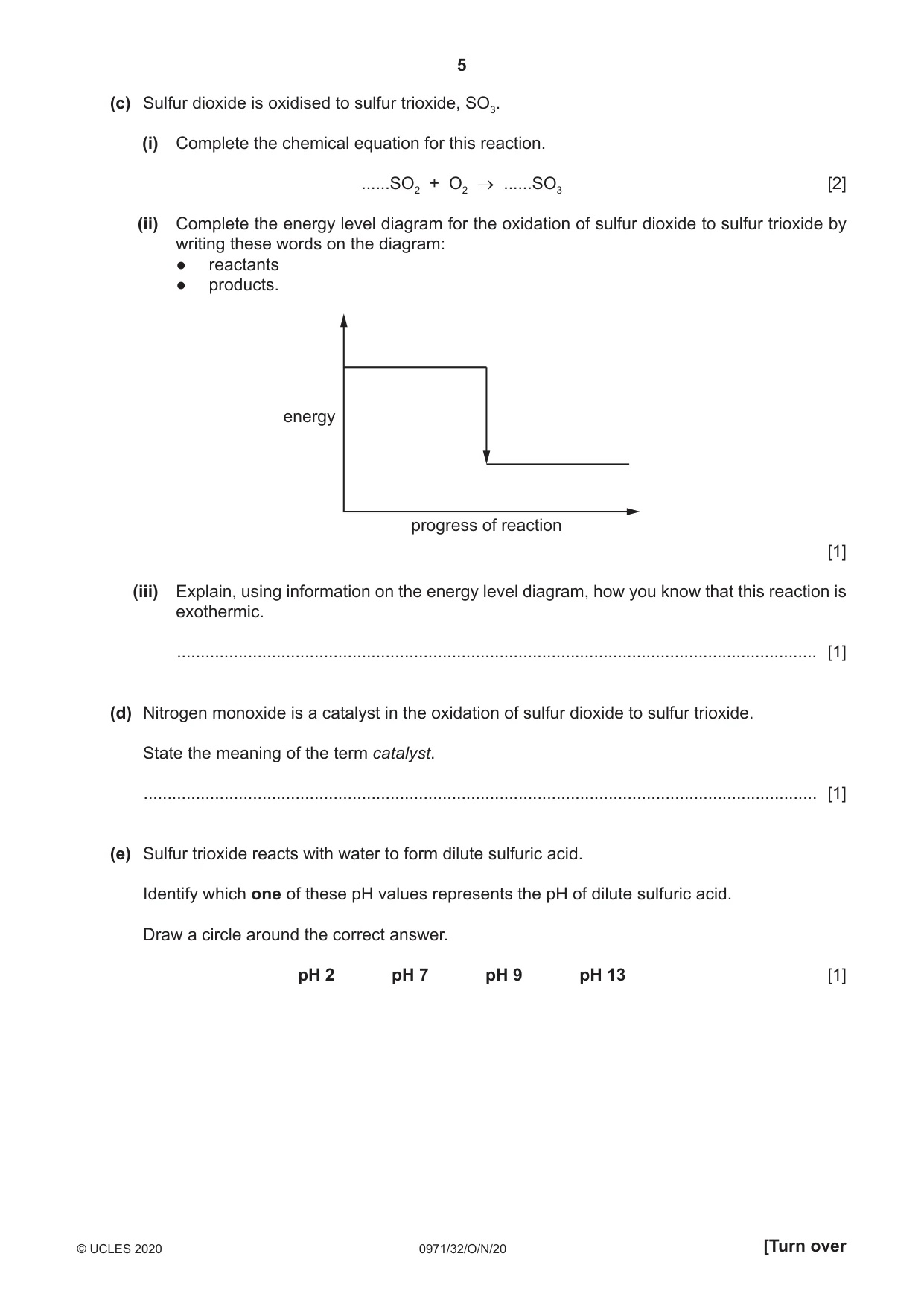
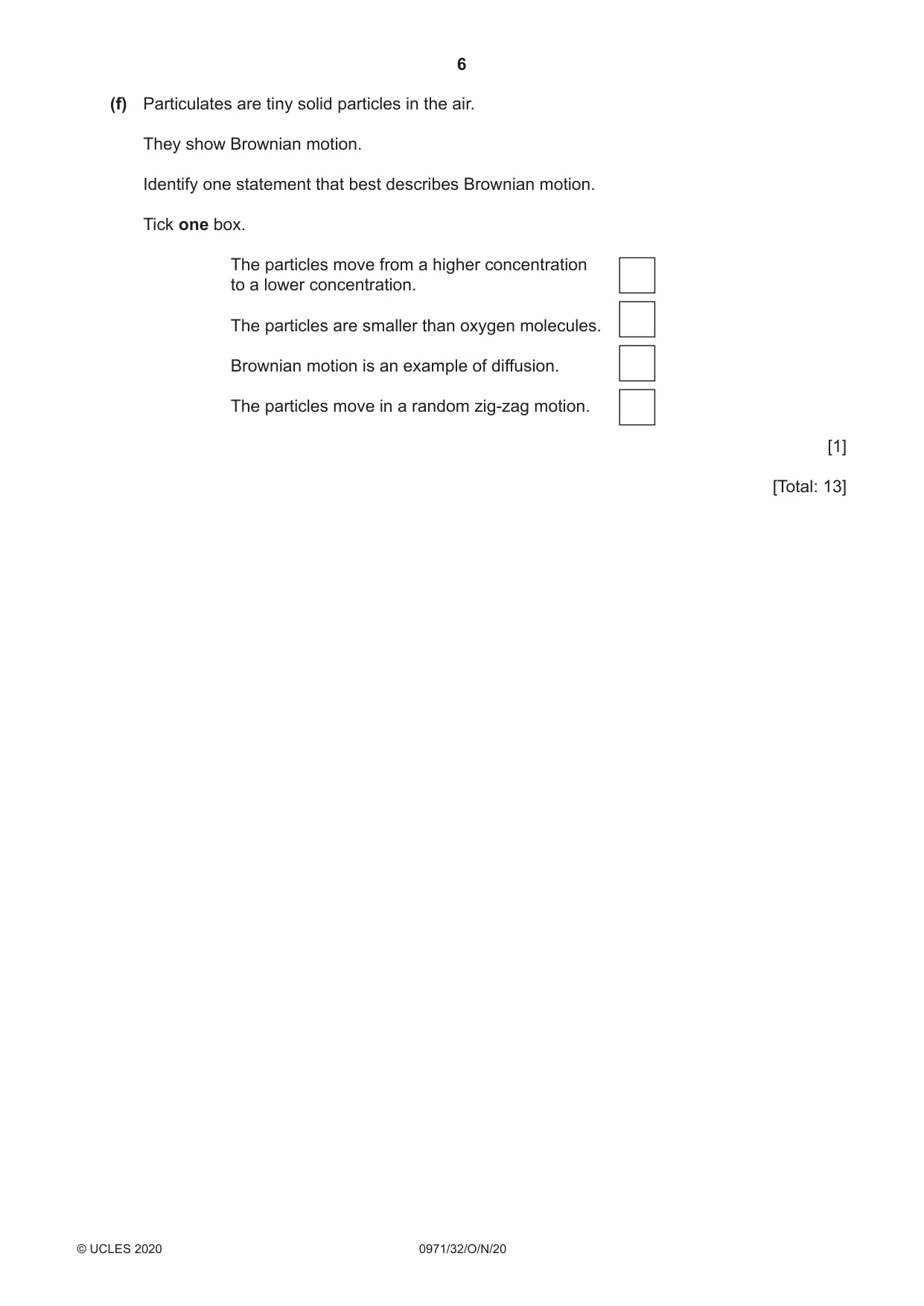
2 The table shows the mass of air pollutants, in nanograms, in 1000 cm3 samples of air taken over a four month period. mass of pollutant in 1000 cm3 of air / nanograms oxides of sulfur carbon month ozone particulates nitrogen dioxide monoxide April 144.3 5.9 2.5 33.9 21.9 May 114.2 2.0 2.1 39.6 21.7 June 110.2 6.1 1.8 31.5 21.3 July 115.4 2.5 2.6 24.2 19.0 (a) Answer these questions using only the information in the table. (i) Name the pollutant that shows a continual decrease in concentration between April and July. ....................................................................................................................................... [1] (ii) Name the pollutant present in the lowest concentration in May. ....................................................................................................................................... [1] (iii) Calculate the mass of carbon monoxide in 200 cm3 of the sample of air taken in April. .............................. nanograms [1] (b) Sulfur dioxide contributes to acid rain. (i) State one source of the sulfur dioxide in the air. ....................................................................................................................................... [1] (ii) Give one adverse effect of acid rain on buildings. ....................................................................................................................................... [1] (iii) State one use of sulfur dioxide. ....................................................................................................................................... [1] (c) Sulfur dioxide is oxidised to sulfur trioxide, SO3. (i) Complete the chemical equation for this reaction. ......SO2 + O2 → ......SO3 [2] (ii) Complete the energy level diagram for the oxidation of sulfur dioxide to sulfur trioxide by writing these words on the diagram: ●● reactants ●● products. energy progress of reaction [1] (iii) Explain, using information on the energy level diagram, how you know that this reaction is exothermic. ....................................................................................................................................... [1] (d) Nitrogen monoxide is a catalyst in the oxidation of sulfur dioxide to sulfur trioxide. State the meaning of the term catalyst. .............................................................................................................................................. [1] (e) Sulfur trioxide reacts with water to form dilute sulfuric acid. Identify which one of these pH values represents the pH of dilute sulfuric acid. Draw a circle around the correct answer. pH 2 pH 7 pH 9 pH 13 [1] (f) Particulates are tiny solid particles in the air. They show Brownian motion. Identify one statement that best describes Brownian motion. Tick one box. The particles move from a higher concentration to a lower concentration. The particles are smaller than oxygen molecules. Brownian motion is an example of diffusion. The particles move in a random zig-zag motion. [1] [Total: 13]
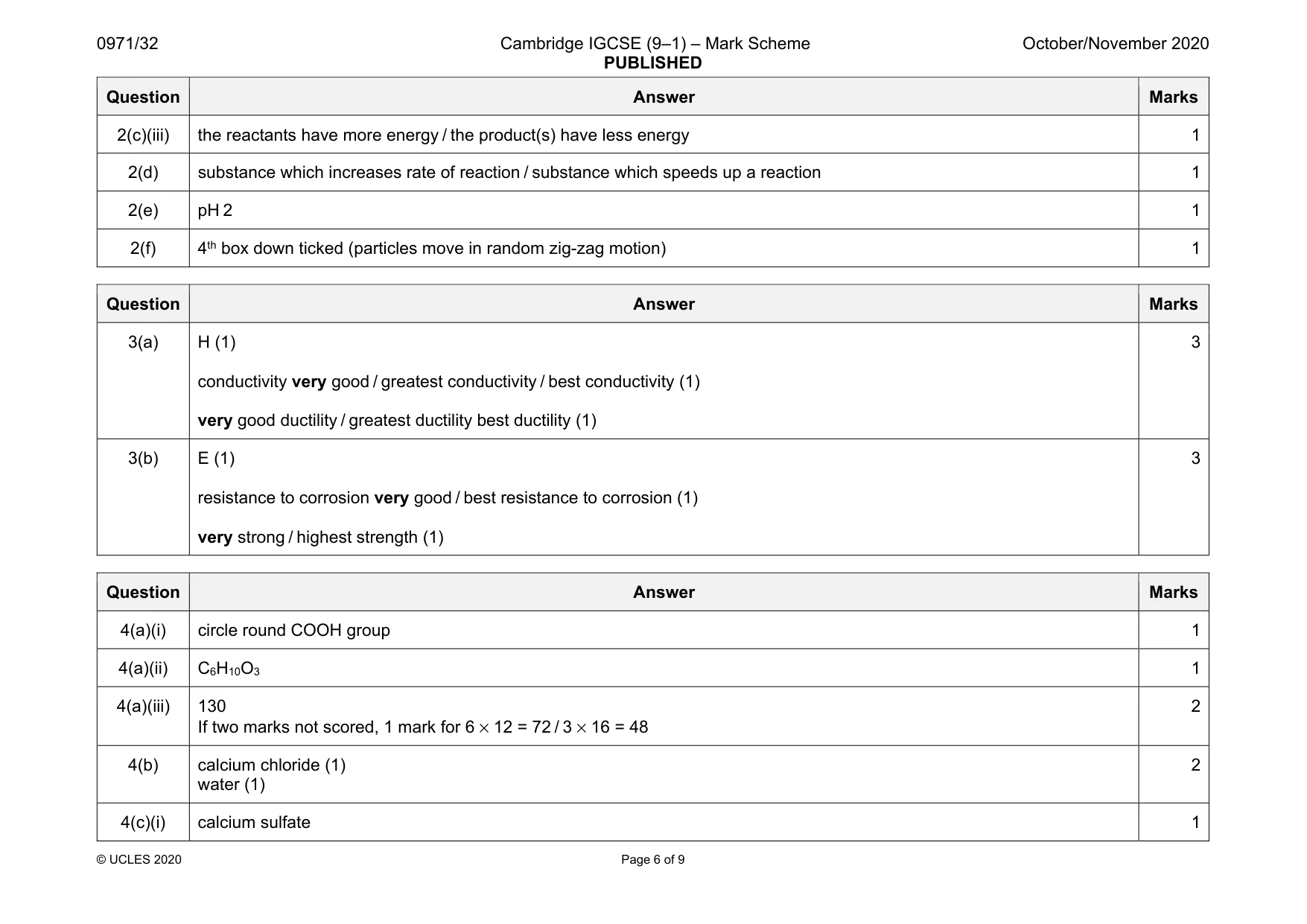
Mark scheme: 2(a)(i) particulates 1 2(a)(ii) sufur dioxide / SO2 1 2(a)(iii) 0.5 (ng) 1 2(b)(i) burning fossil fuels / burning named fossil fuel 1 2(b)(ii) (chemical) erosion / (chemical) weathering / pitting / corrosion 1 2(b)(iii) bleach (for wood pulp / paper) / food preservative 1 2(c)(i) 2 (SO2) (1) 2 (SO3) (1) 2 2(c)(ii) reactants on left top line and product(s) on bottom right line 1 Question Answer Marks 2(c)(iii) the reactants have more energy / the product(s) have less energy 1 2(d) substance which increases rate of reaction / substance which speeds up a reaction 1 2(e) pH 2 1 2(f) 4th box down ticked (particles move in random zig-zag motion) 1
Q3 · Some properties of four substances, E, F, G and H, are shown in the table
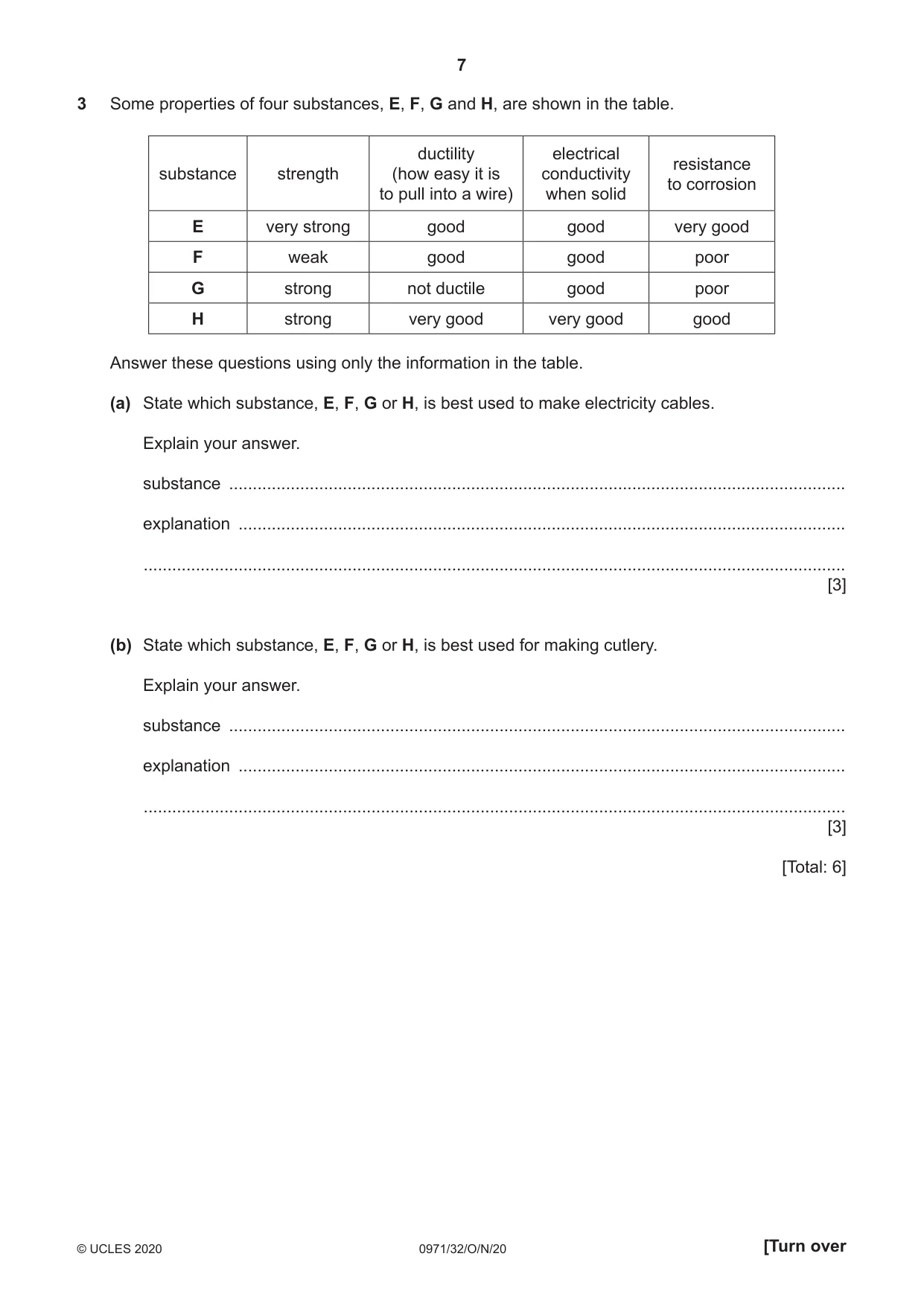
3 Some properties of four substances, E, F, G and H, are shown in the table. ductility electrical resistance substance strength (how easy it is conductivity to corrosion to pull into a wire) when solid E very strong good good very good F weak good good poor G strong not ductile good poor H strong very good very good good Answer these questions using only the information in the table. (a) State which substance, E, F, G or H, is best used to make electricity cables. Explain your answer. substance ................................................................................................................................... explanation ................................................................................................................................. .................................................................................................................................................... [3] (b) State which substance, E, F, G or H, is best used for making cutlery. Explain your answer. substance ................................................................................................................................... explanation ................................................................................................................................. .................................................................................................................................................... [3] [Total: 6]
Mark scheme: 3(a) H (1) conductivity very good / greatest conductivity / best conductivity (1) very good ductility / greatest ductility best ductility (1) 3(b) E (1) resistance to corrosion very good / best resistance to corrosion (1) very strong / highest strength (1) 3
Q4 · The structure of compound J is shown
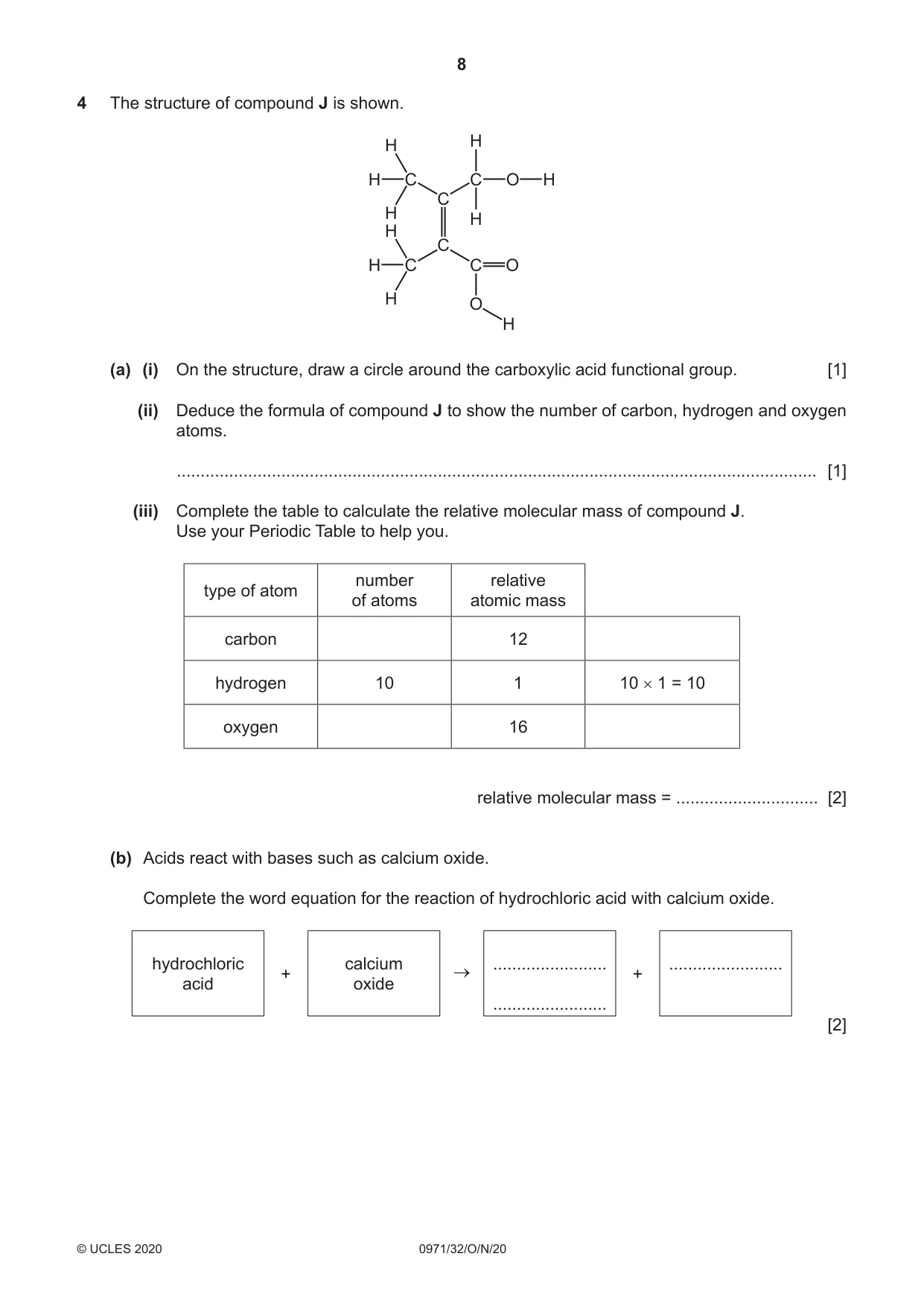
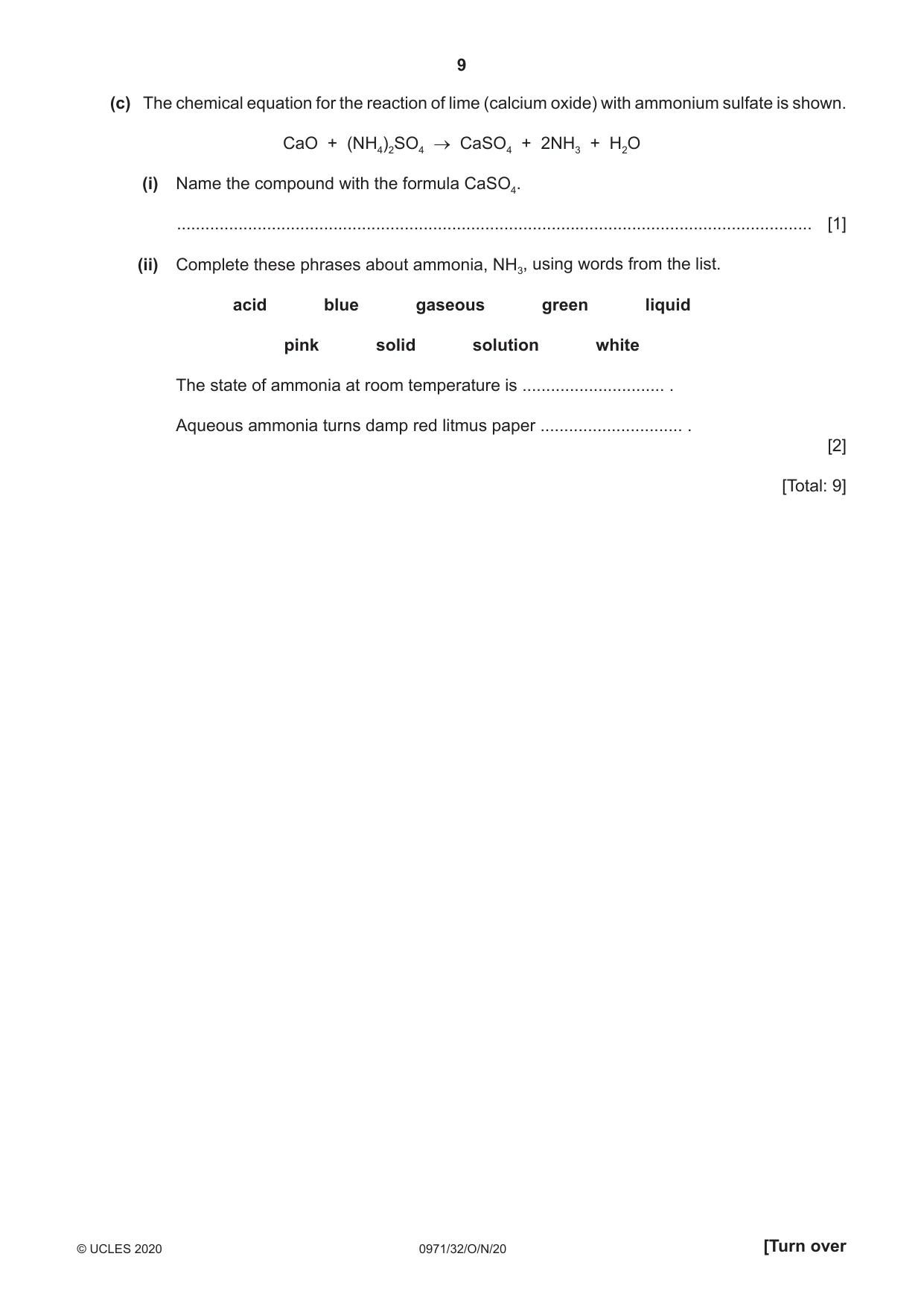
4 The structure of compound J is shown. H H H C C O H C H H H C H C C O H O H (a) (i) On the structure, draw a circle around the carboxylic acid functional group. [1] (ii) Deduce the formula of compound J to show the number of carbon, hydrogen and oxygen atoms. ....................................................................................................................................... [1] (iii) Complete the table to calculate the relative molecular mass of compound J. Use your Periodic Table to help you. number relative type of atom of atoms atomic mass carbon 12 hydrogen 10 1 10 × 1 = 10 oxygen 16 relative molecular mass = .............................. [2] (b) Acids react with bases such as calcium oxide. Complete the word equation for the reaction of hydrochloric acid with calcium oxide. hydrochloric calcium ........................ ........................ + + acid oxide ........................ [2] (c) The chemical equation for the reaction of lime (calcium oxide) with ammonium sulfate is shown. CaO + (NH4)2SO4 → CaSO4 + 2NH3 + H2O (i) Name the compound with the formula CaSO4. ...................................................................................................................................... [1] (ii) Complete these phrases about ammonia, NH3, using words from the list. acid blue gaseous green liquid pink solid solution white The state of ammonia at room temperature is .............................. . Aqueous ammonia turns damp red litmus paper .............................. . [2] [Total: 9]
Mark scheme: 4(a)(i) circle round COOH group 1 4(a)(ii) C6H10O3 1 4(a)(iii) 130 If two marks not scored, 1 mark for 6 × 12 = 72 / 3 × 16 = 48 2 4(b) calcium chloride (1) water (1) 2 4(c)(i) calcium sulfate 1 Question Answer Marks 4(b)(ii) gaseous (1) blue (1) 2
Q5 · Ethane is an alkane
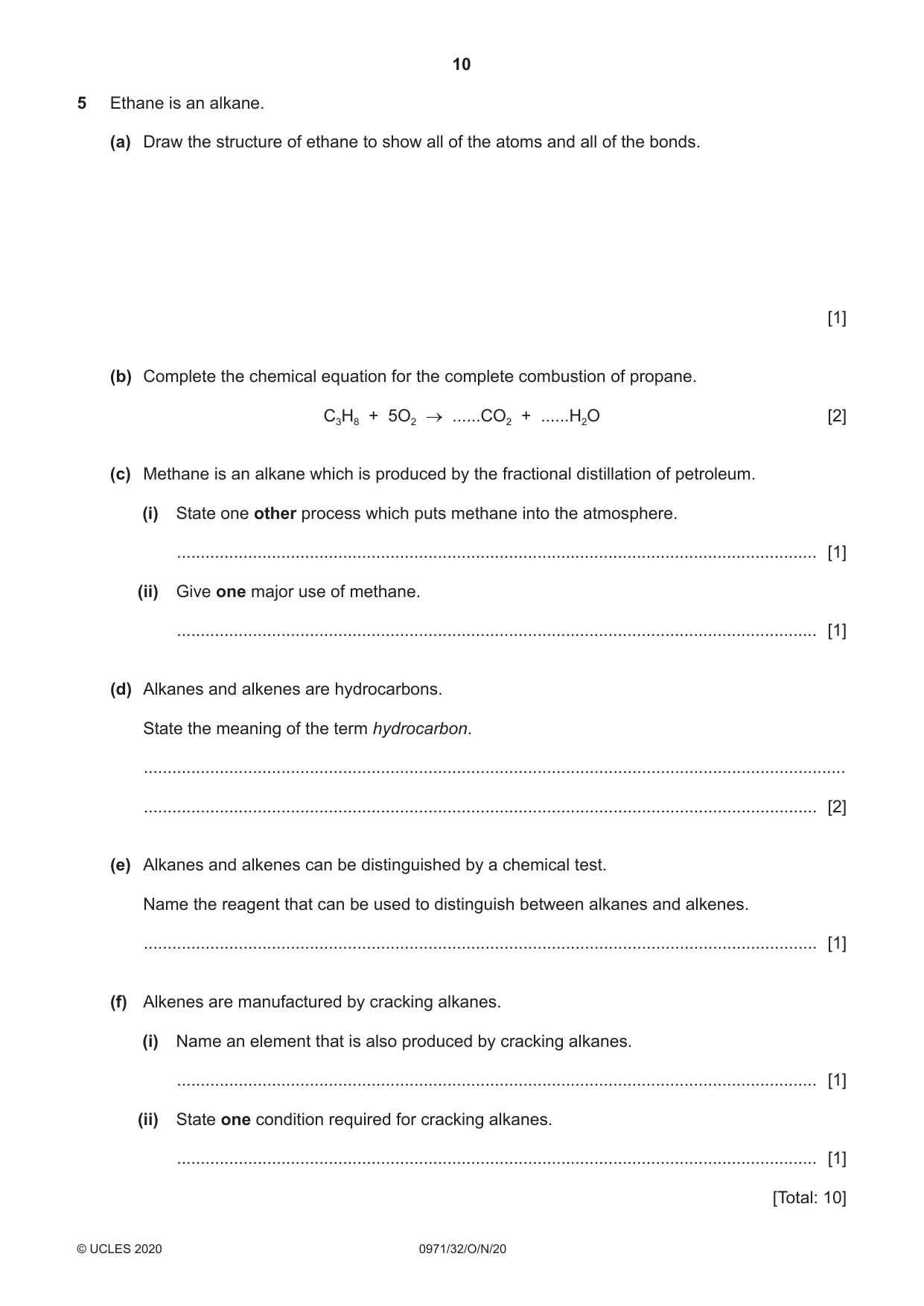
5 Ethane is an alkane. (a) Draw the structure of ethane to show all of the atoms and all of the bonds. [1] (b) Complete the chemical equation for the complete combustion of propane. C3H8 + 5O2 → ......CO2 + ......H2O [2] (c) Methane is an alkane which is produced by the fractional distillation of petroleum. (i) State one other process which puts methane into the atmosphere. ....................................................................................................................................... [1] (ii) Give one major use of methane. ....................................................................................................................................... [1] (d) Alkanes and alkenes are hydrocarbons. State the meaning of the term hydrocarbon. .................................................................................................................................................... .............................................................................................................................................. [2] (e) Alkanes and alkenes can be distinguished by a chemical test. Name the reagent that can be used to distinguish between alkanes and alkenes. .............................................................................................................................................. [1] (f) Alkenes are manufactured by cracking alkanes. (i) Name an element that is also produced by cracking alkanes. ....................................................................................................................................... [1] (ii) State one condition required for cracking alkanes. ....................................................................................................................................... [1] [Total: 10]
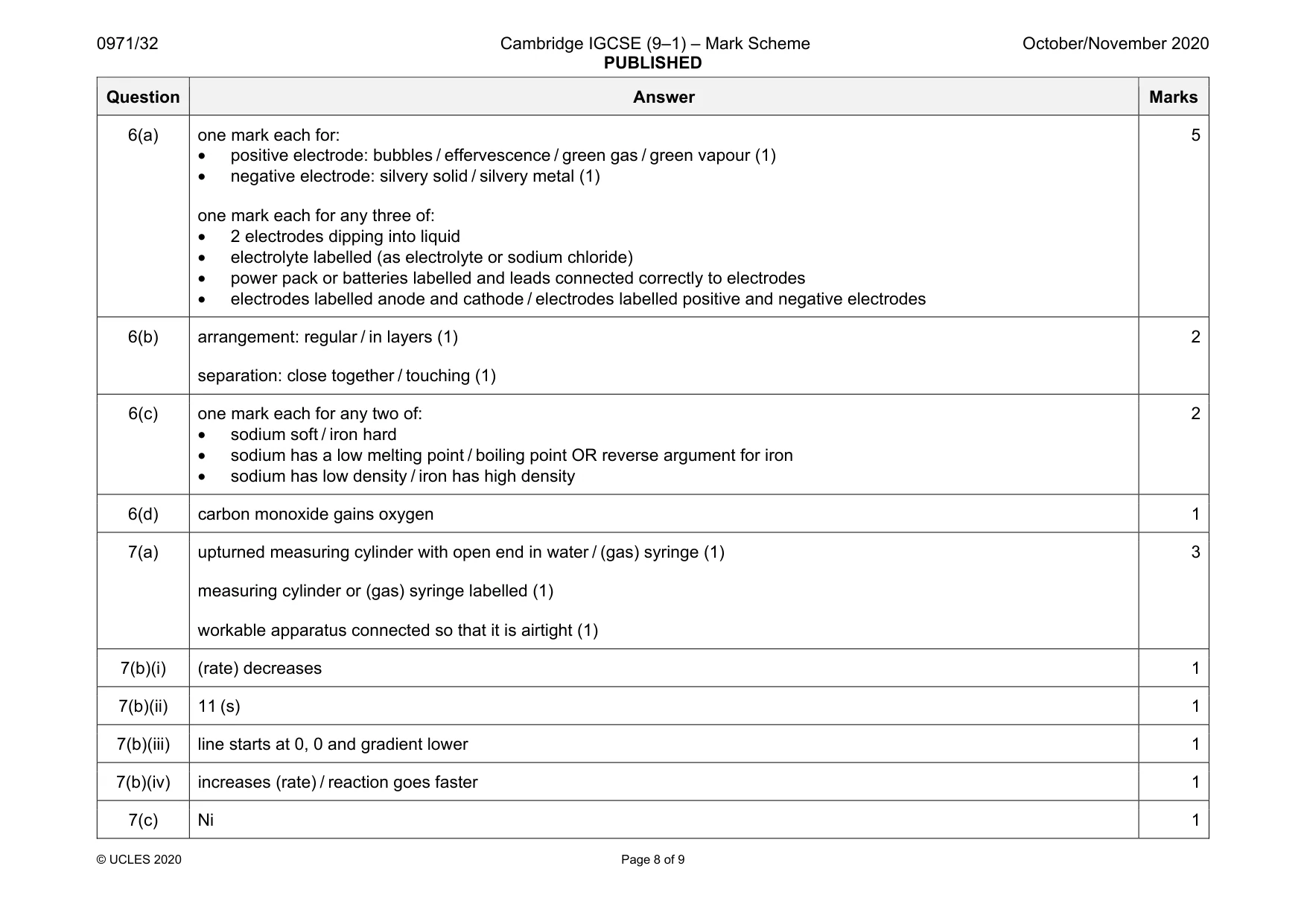
Mark scheme: 5(a) 1 5(b) 3 (CO2) (1) 4 (H2O) (1) 2 5(c)(i) decomposition of plants / waste gases from digestion in animals / natural gas 1 5(c)(ii) heating / cooking / fuel 1 5(d) compound containing carbon and hydrogen only / compound containing carbon and hydrogen and no other elements (2) if 2 marks not obtained: one mark for compound containing carbon and hydrogen (1) 2 5(e) bromine / bromine water / aqueous bromine 1 5(f)(i) hydrogen 1 5(f)(ii) high temperature 1
Q6 · Electrolysis is used to extract reactive metals from metal compounds
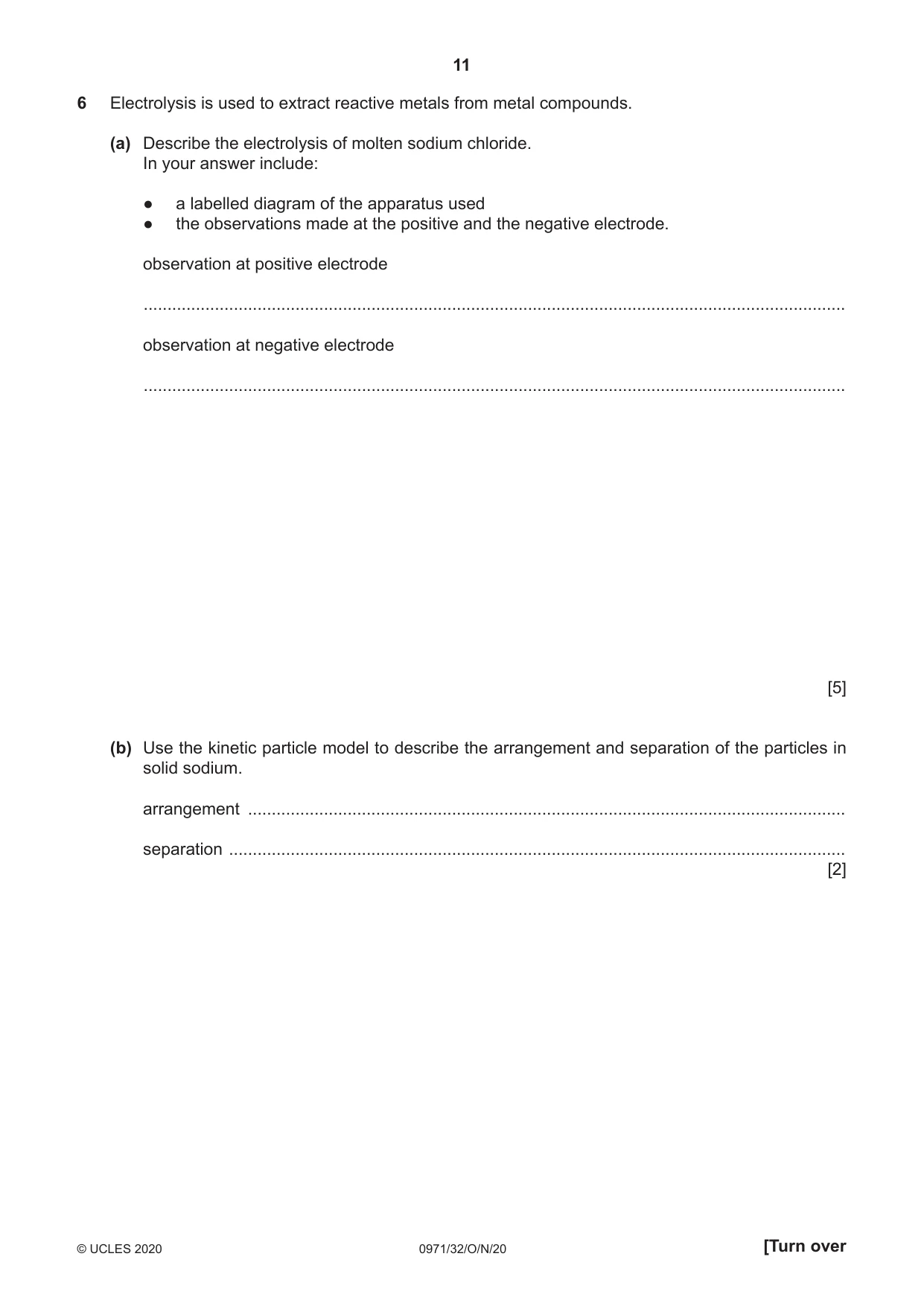
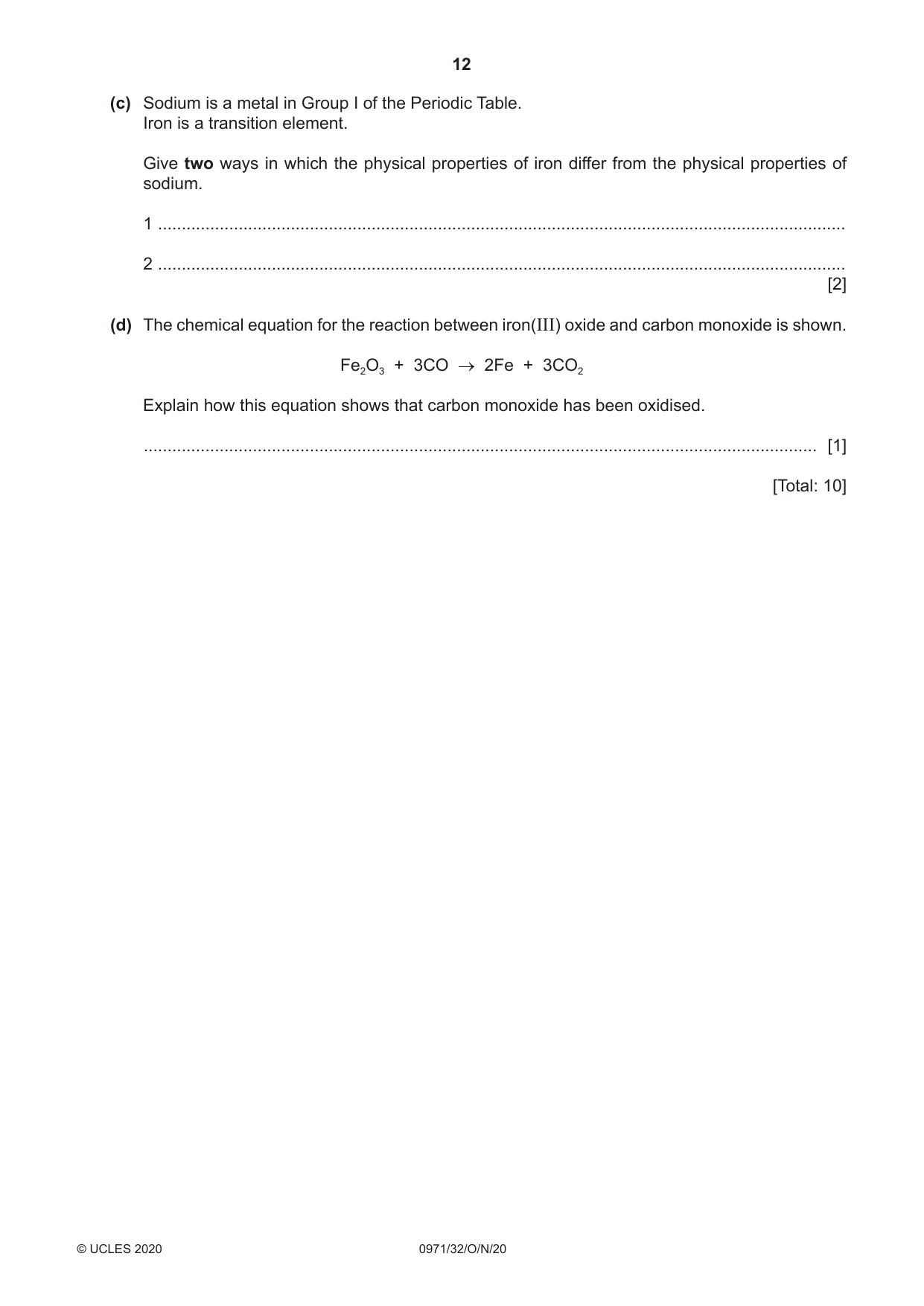
6 Electrolysis is used to extract reactive metals from metal compounds. (a) Describe the electrolysis of molten sodium chloride. In your answer include: ●● a labelled diagram of the apparatus used ●● the observations made at the positive and the negative electrode. observation at positive electrode .................................................................................................................................................... observation at negative electrode .................................................................................................................................................... [5] (b) Use the kinetic particle model to describe the arrangement and separation of the particles in solid sodium. arrangement ............................................................................................................................... separation .................................................................................................................................. [2] (c) Sodium is a metal in Group I of the Periodic Table. Iron is a transition element. Give two ways in which the physical properties of iron differ from the physical properties of sodium. 1 ................................................................................................................................................. 2 ................................................................................................................................................. [2] (d) The chemical equation for the reaction between iron(III) oxide and carbon monoxide is shown. Fe2O3 + 3CO → 2Fe + 3CO2 Explain how this equation shows that carbon monoxide has been oxidised. .............................................................................................................................................. [1] [Total: 10]
Mark scheme: 6(a) one mark each for: • positive electrode: bubbles / effervescence / green gas / green vapour (1) • negative electrode: silvery solid / silvery metal (1) one mark each for any three of: • 2 electrodes dipping into liquid • electrolyte labelled (as electrolyte or sodium chloride) • power pack or batteries labelled and leads connected correctly to electrodes • electrodes labelled anode and cathode / electrodes labelled positive and negative electrodes 5 6(b) arrangement: regular / in layers (1) separation: close together / touching (1) 2 6(c) one mark each for any two of: • sodium soft / iron hard • sodium has a low melting point / boiling point OR reverse argument for iron • sodium has low density / iron has high density 2 6(d) carbon monoxide gains oxygen 1 3
Q7 · A student investigated the rate of decomposition of hydrogen peroxide, H2O2, in the…
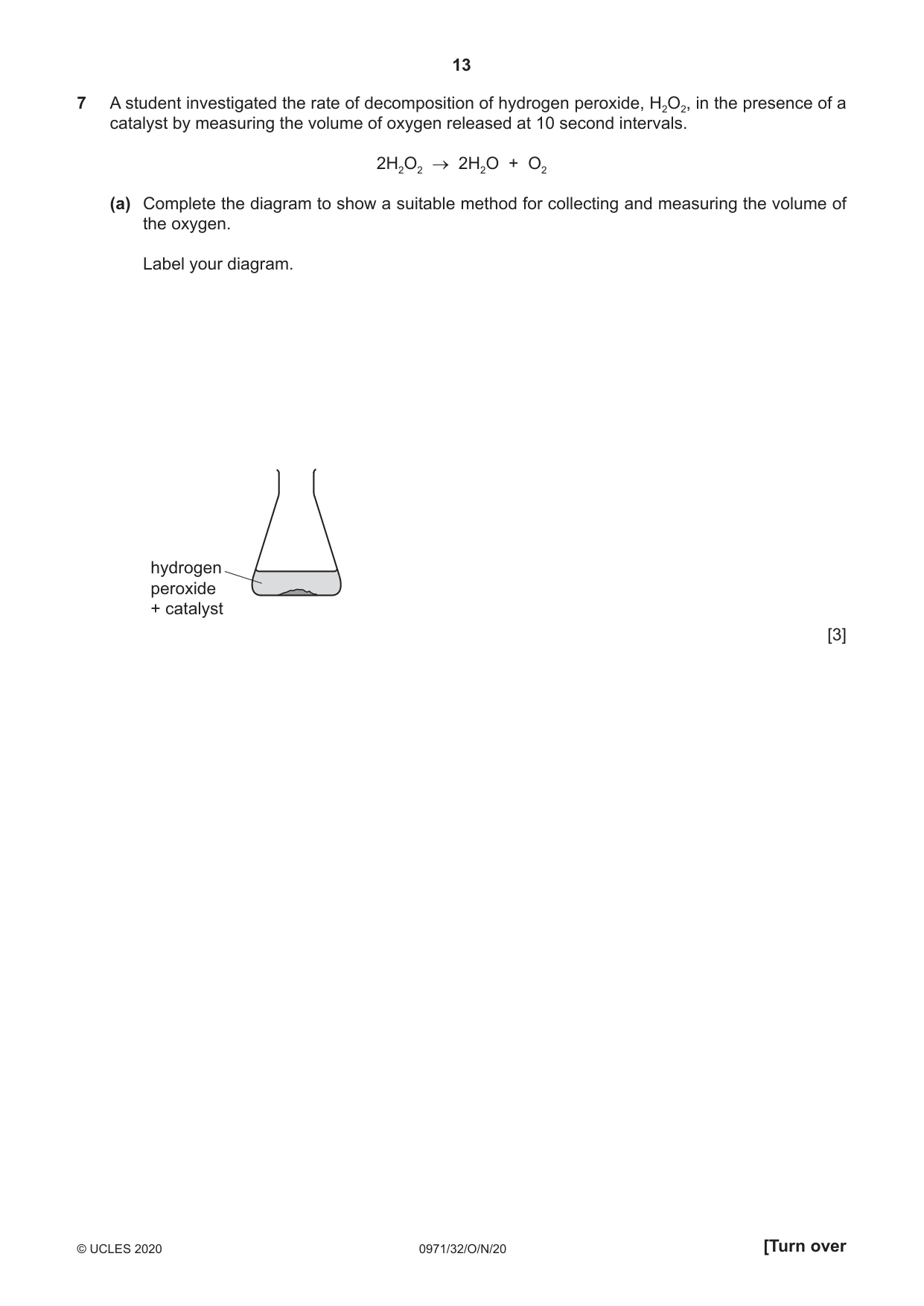
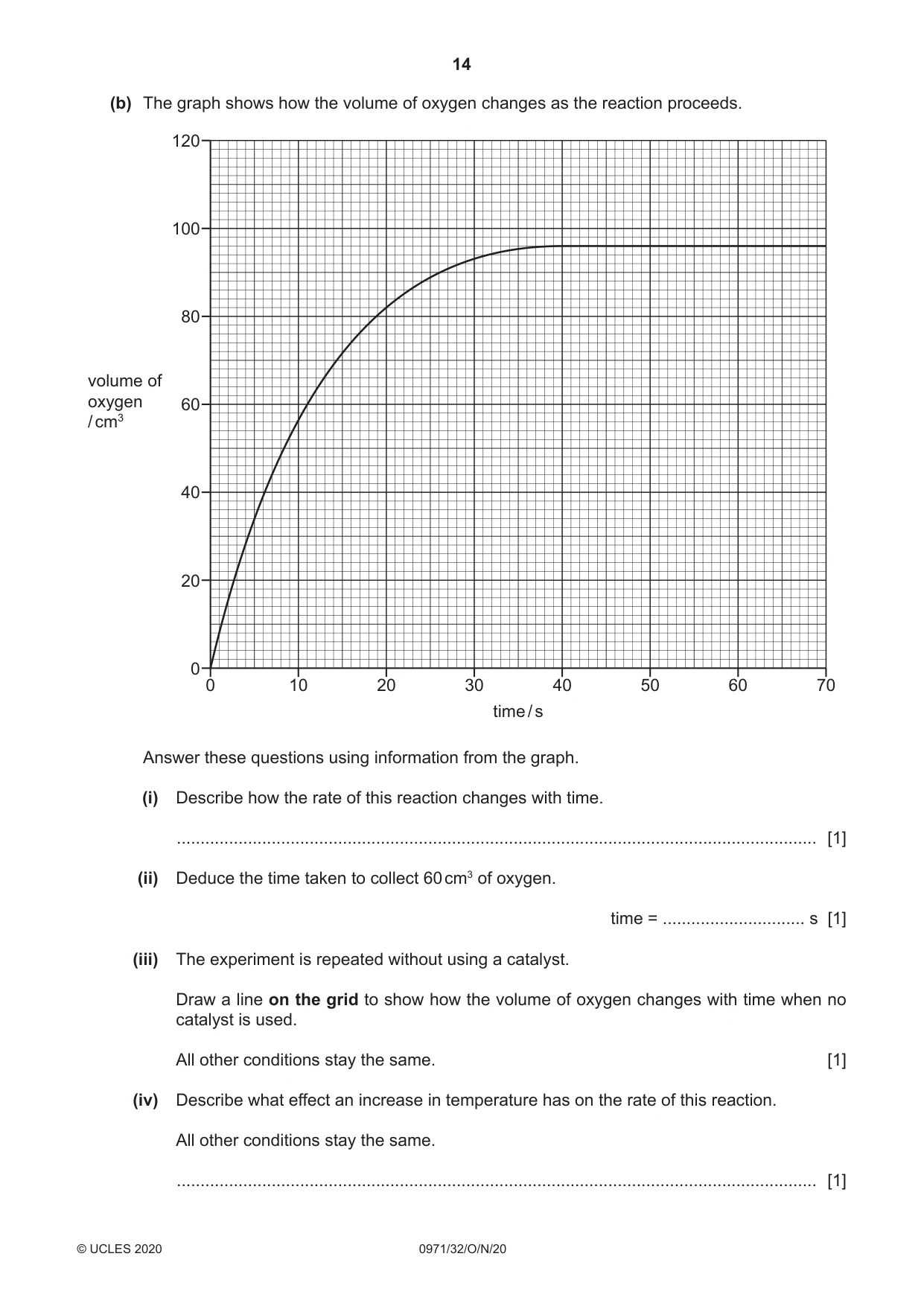
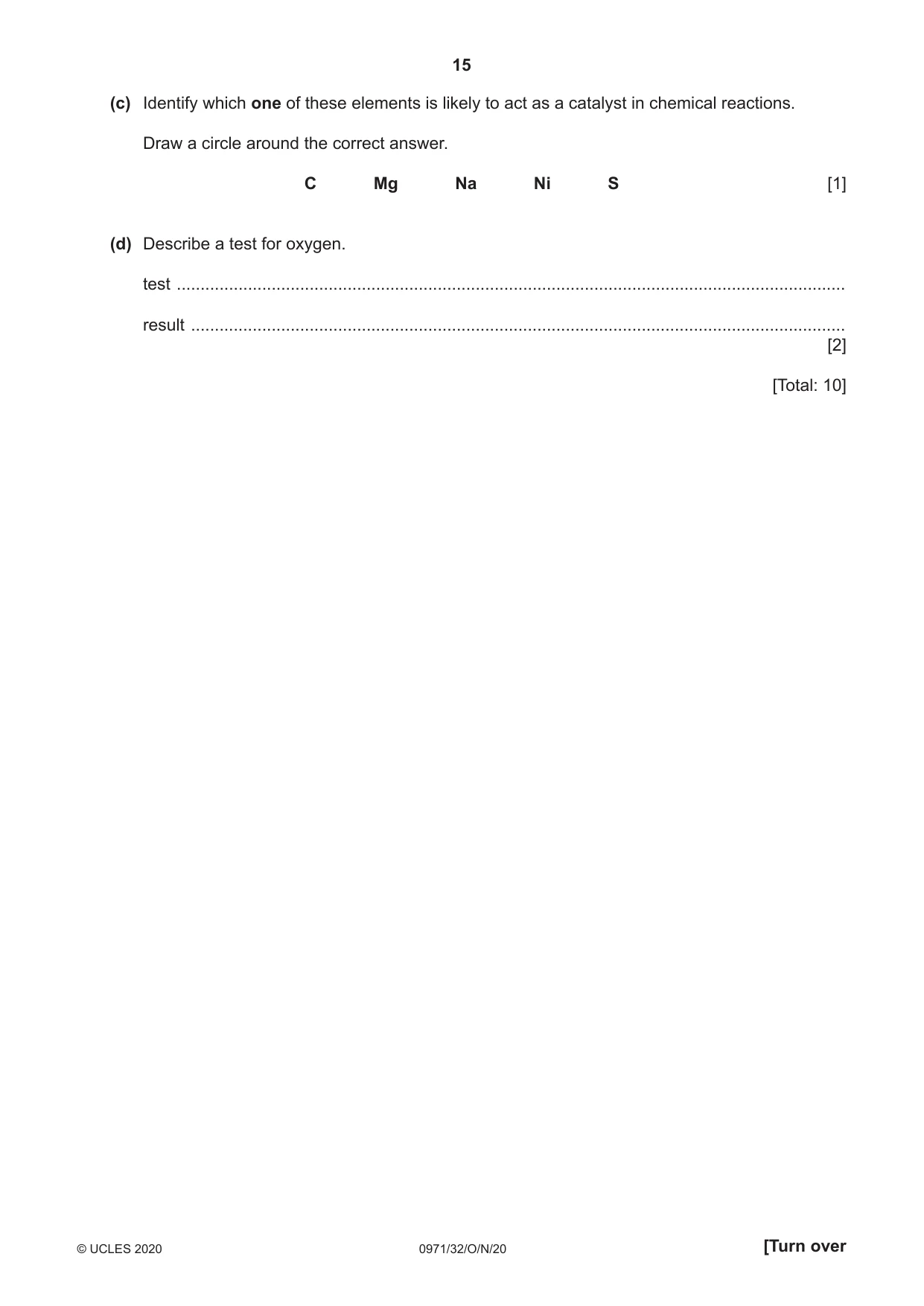
7 A student investigated the rate of decomposition of hydrogen peroxide, H2O2, in the presence of a catalyst by measuring the volume of oxygen released at 10 second intervals. 2H2O2 → 2H2O + O2 (a) Complete the diagram to show a suitable method for collecting and measuring the volume of the oxygen. Label your diagram. hydrogen peroxide + catalyst [3] (b) The graph shows how the volume of oxygen changes as the reaction proceeds. 120 100 80 volume of oxygen 60 / cm3 40 20 0 0 10 20 30 40 50 60 70 time / s Answer these questions using information from the graph. (i) Describe how the rate of this reaction changes with time. ....................................................................................................................................... [1] (ii) Deduce the time taken to collect 60 cm3 of oxygen. time = .............................. s [1] (iii) The experiment is repeated without using a catalyst. Draw a line on the grid to show how the volume of oxygen changes with time when no catalyst is used. All other conditions stay the same. [1] (iv) Describe what effect an increase in temperature has on the rate of this reaction. All other conditions stay the same. ....................................................................................................................................... [1] (c) Identify which one of these elements is likely to act as a catalyst in chemical reactions. Draw a circle around the correct answer. C Mg Na Ni S [1] (d) Describe a test for oxygen. test ............................................................................................................................................. result .......................................................................................................................................... [2] [Total: 10]
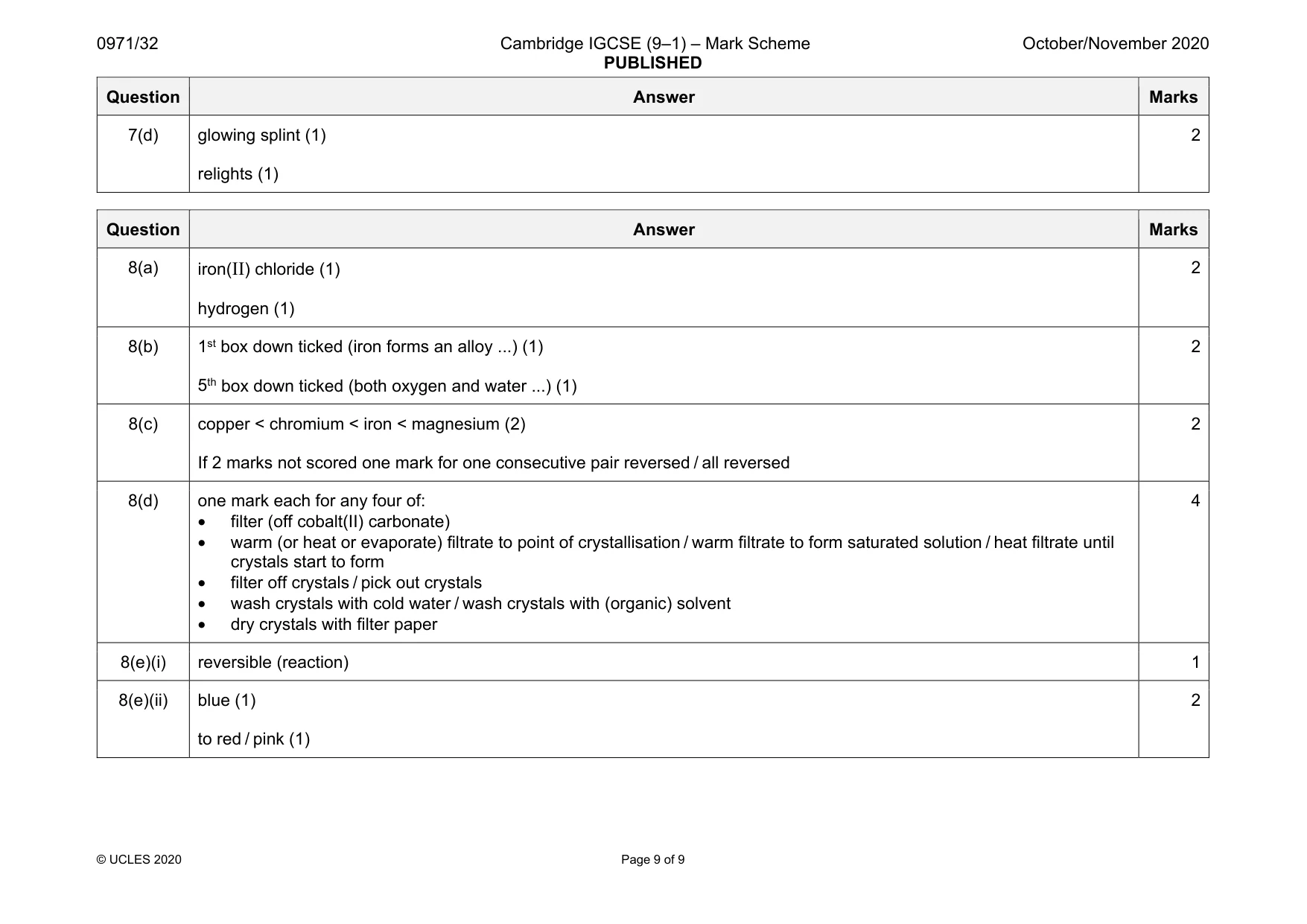
Mark scheme: 7(a) upturned measuring cylinder with open end in water / (gas) syringe (1) measuring cylinder or (gas) syringe labelled (1) workable apparatus connected so that it is airtight (1) 7(b)(i) (rate) decreases 1 7(b)(ii) 11 (s) 1 7(b)(iii) line starts at 0, 0 and gradient lower 1 7(b)(iv) increases (rate) / reaction goes faster 1 7(c) Ni 1 Question Answer Marks 7(d) glowing splint (1) relights (1) 2
Q8 · This question is about metals and compounds of metals
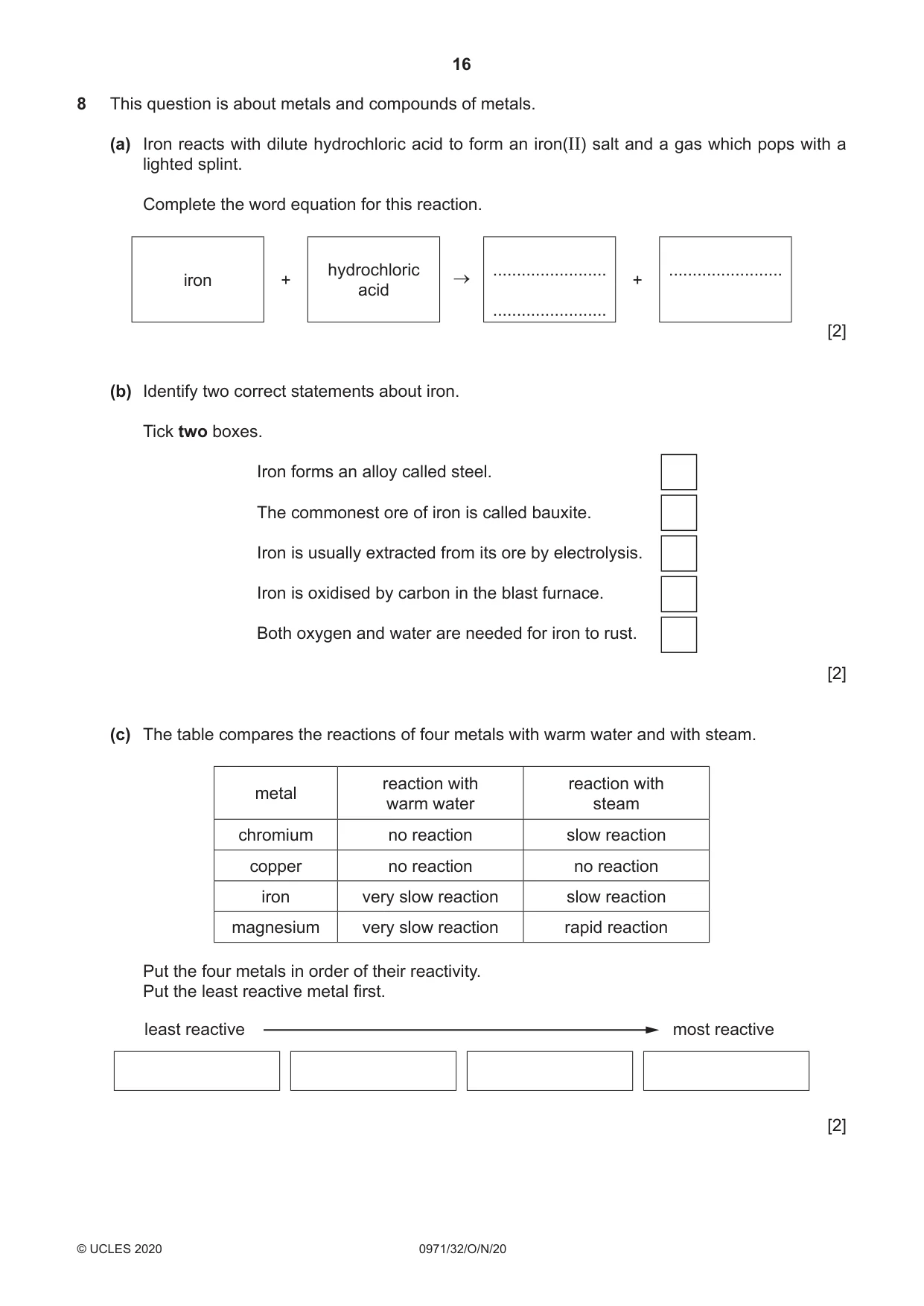
8 This question is about metals and compounds of metals. (a) Iron reacts with dilute hydrochloric acid to form an iron(II) salt and a gas which pops with a lighted splint. Complete the word equation for this reaction. hydrochloric ........................ ........................ iron + + acid ........................ [2] (b) Identify two correct statements about iron. Tick two boxes. Iron forms an alloy called steel. The commonest ore of iron is called bauxite. Iron is usually extracted from its ore by electrolysis. Iron is oxidised by carbon in the blast furnace. Both oxygen and water are needed for iron to rust. [2] (c) The table compares the reactions of four metals with warm water and with steam. reaction with reaction with metal warm water steam chromium no reaction slow reaction copper no reaction no reaction iron very slow reaction slow reaction magnesium very slow reaction rapid reaction Put the four metals in order of their reactivity. Put the least reactive metal first. least reactive most reactive [2] (d) Crystals of cobalt(II) chloride, CoCl 2•6H2O, can be prepared by reacting excess cobalt(II) carbonate powder with dilute hydrochloric acid. Describe how to prepare a sample of pure dry cobalt(II) chloride crystals after the reaction is complete. In your answer describe how to: ●● remove the excess cobalt(II) carbonate from the reaction mixture ●● crystallise the cobalt(II) chloride ●● dry the crystals. .................................................................................................................................................... .................................................................................................................................................... .................................................................................................................................................... .................................................................................................................................................... .................................................................................................................................................... .................................................................................................................................................... .................................................................................................................................................... .............................................................................................................................................. [4] (e) A few drops of water were added to a sample of solid anhydrous cobalt(II) chloride, CoCl 2. The equation for the reaction is shown. CoCl 2 + 6H2O CoCl 2•6H2O (i) State the meaning of the symbol . ....................................................................................................................................... [1] (ii) State the colour change observed when water is added to anhydrous cobalt(II) chloride. from ............................................................. to ............................................................. [2] [Total: 13]
Mark scheme: 8(a) iron(II) chloride (1) hydrogen (1) 2 8(b) 1st box down ticked (iron forms an alloy ...) (1) 5th box down ticked (both oxygen and water ...) (1) 2 8(c) copper < chromium < iron < magnesium (2) If 2 marks not scored one mark for one consecutive pair reversed / all reversed 2 8(d) one mark each for any four of: • filter (off cobalt(II) carbonate) • warm (or heat or evaporate) filtrate to point of crystallisation / warm filtrate to form saturated solution / heat filtrate until crystals start to form • filter off crystals / pick out crystals • wash crystals with cold water / wash crystals with (organic) solvent • dry crystals with filter paper 4 8(e)(i) reversible (reaction) 1 8(e)(ii) blue (1) to red / pink (1) 2
What was in this paper
The subtopics covered by these 8 questions, and how many questions each got. Open one in a new tab to see every Cambridge question on it.
What you needed in this session
Cambridge’s own grade thresholds for 2020 Oct/Nov, Paper 3 · Variant 2. A higher threshold means an easier paper — the bar moves with how the cohort did.