Cambridge IGCSE Chemistry (9-1) 0971 — 2019 Oct/Nov Paper 3 · Variant 2
0971/32/O/N/19 · 7 questions · 80 marks · ≈90 min
The question paper and its mark scheme, free to read here and free to download. This is Cambridge’s own paper, exactly as it was sat.
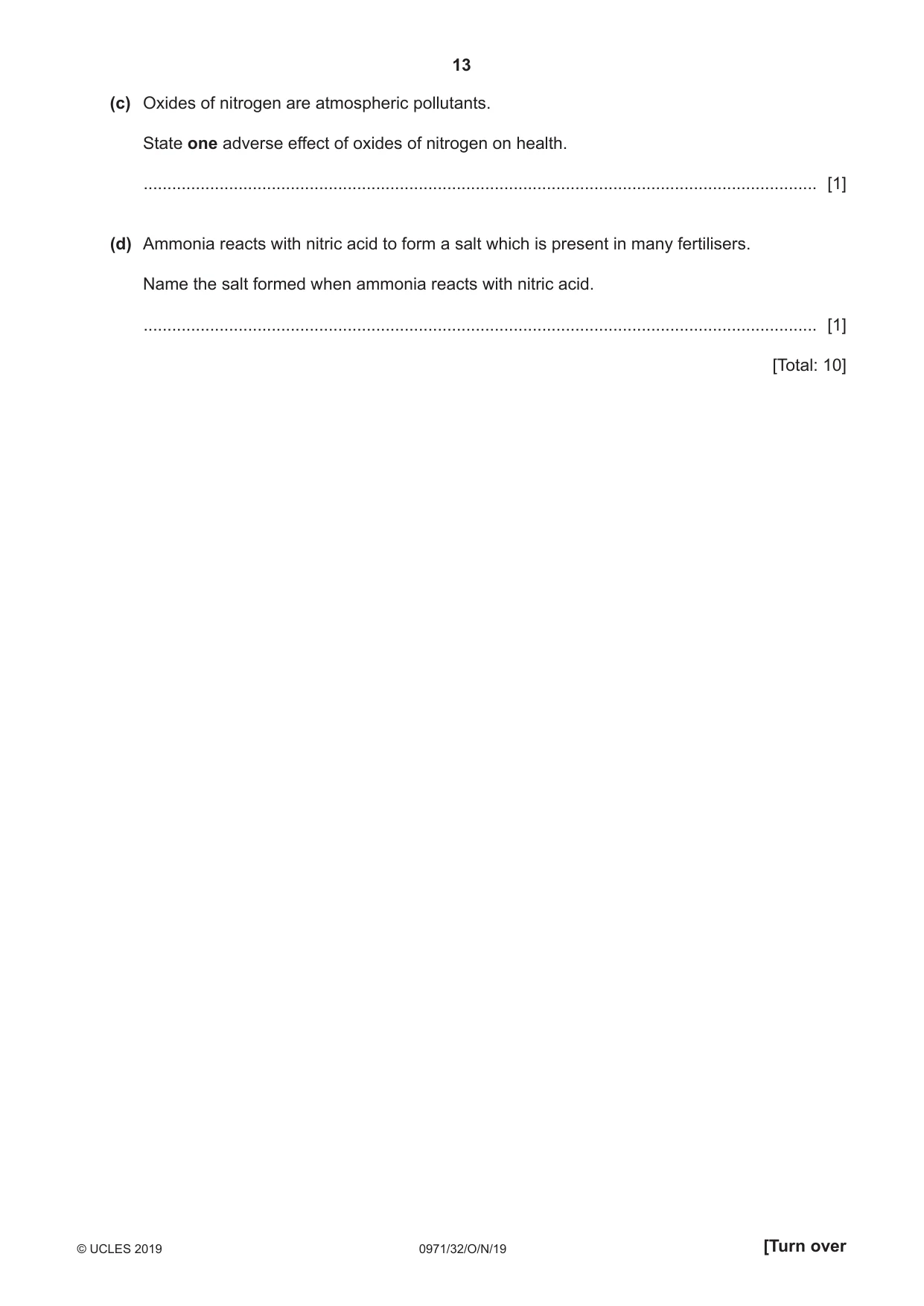
Question paper16 pages
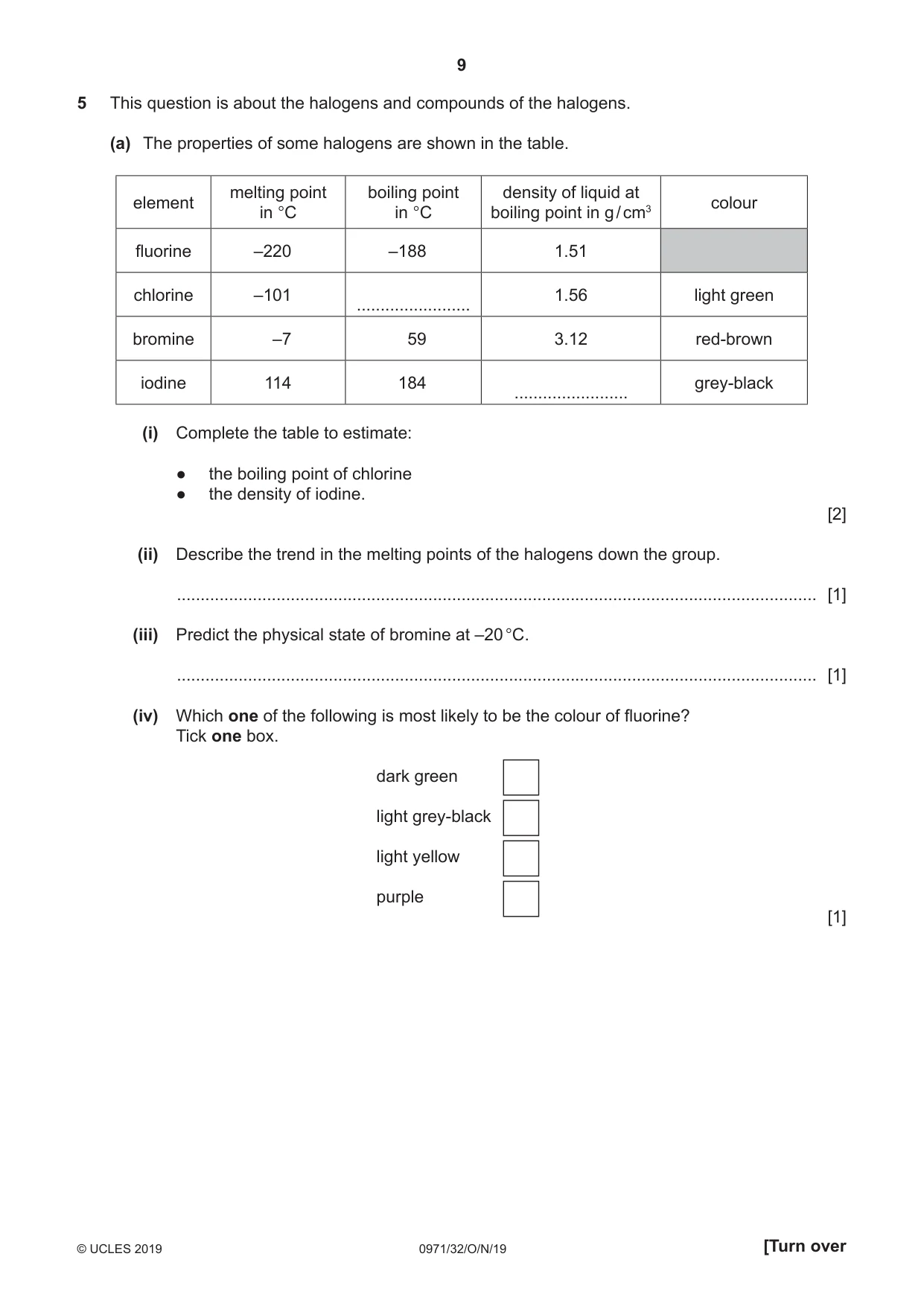
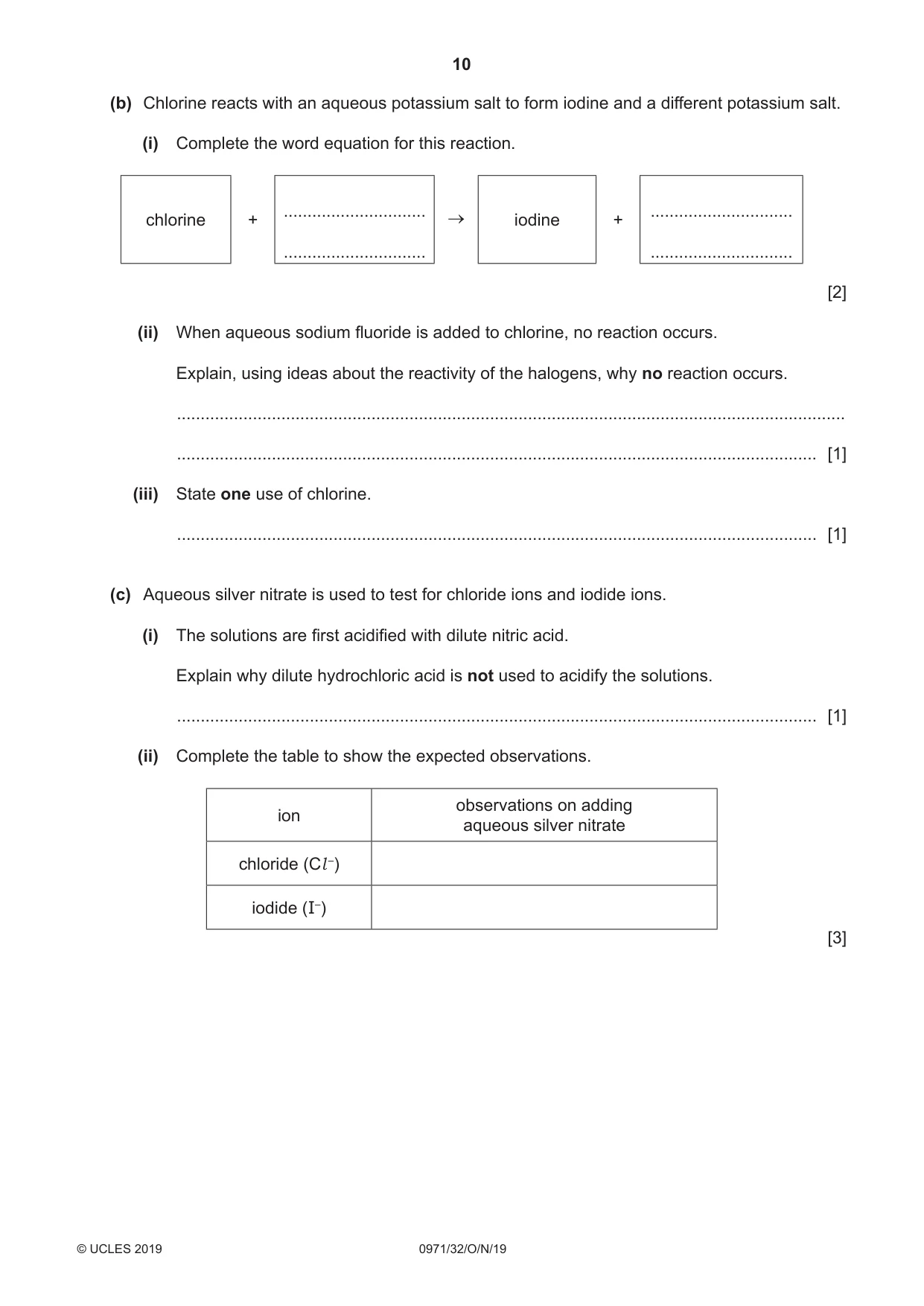
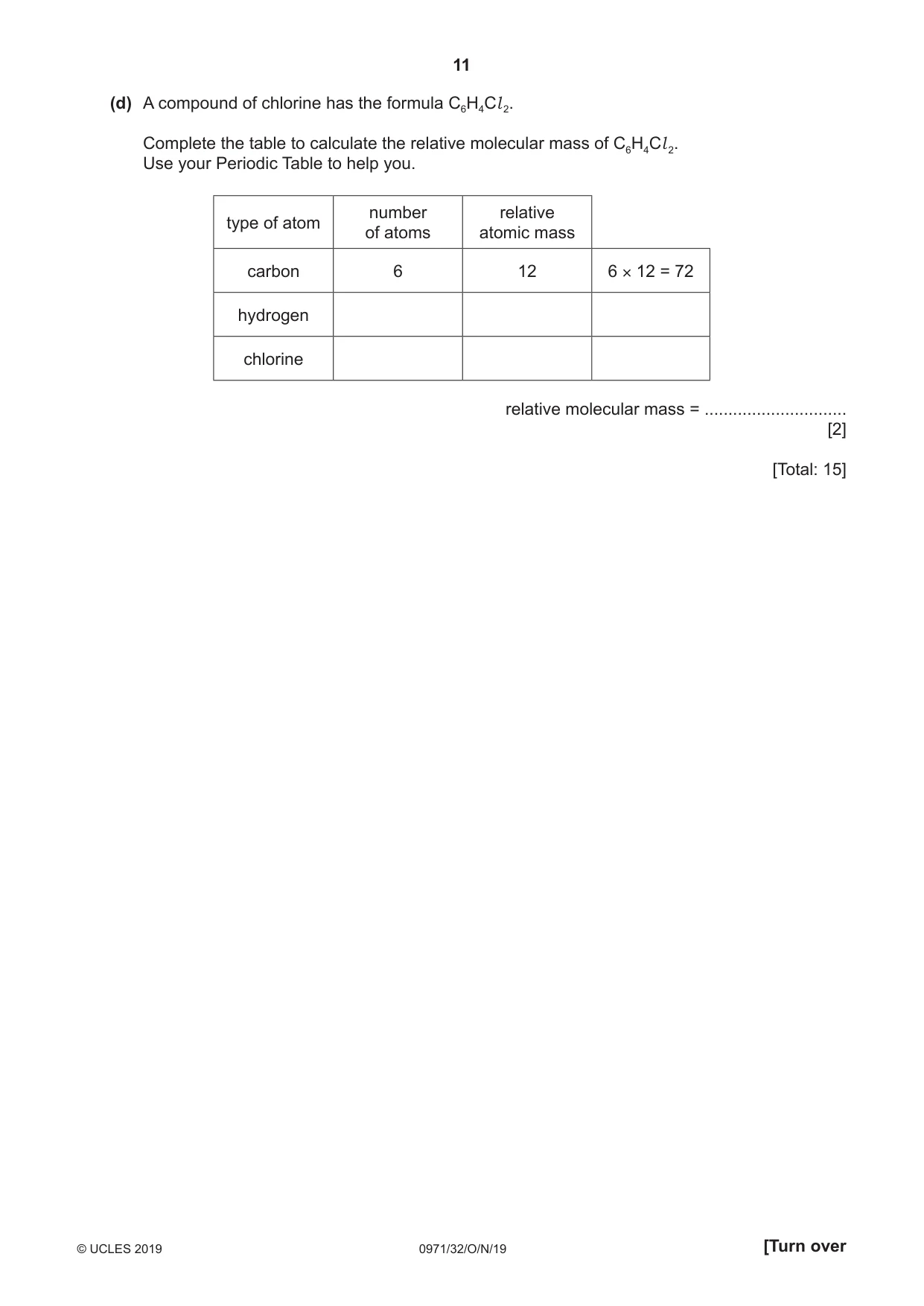
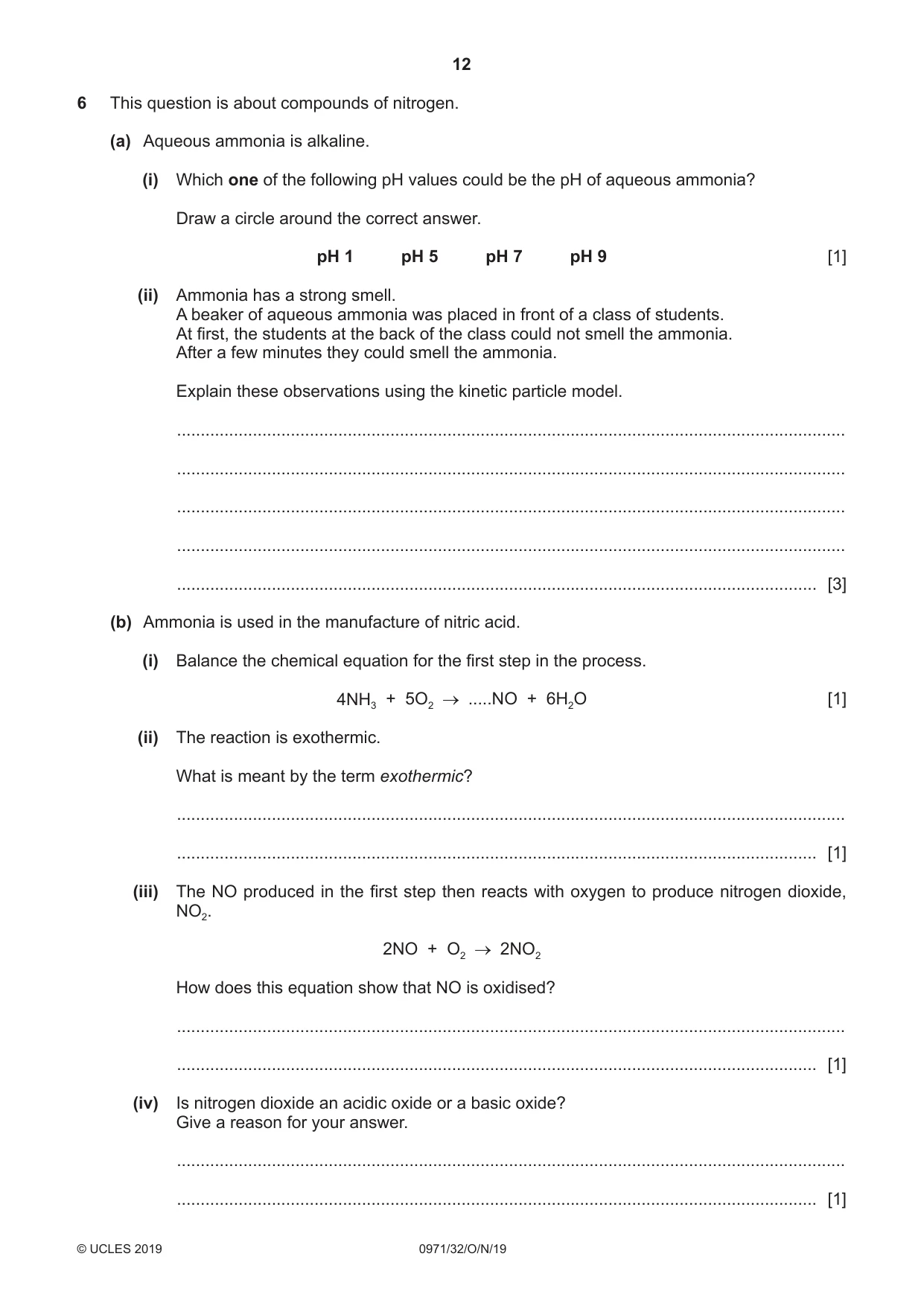
Mark scheme10 pages
Answers below. Sit the paper first if you are practising.
Questions as text
Q1 · This question is about solids, liquids and gases
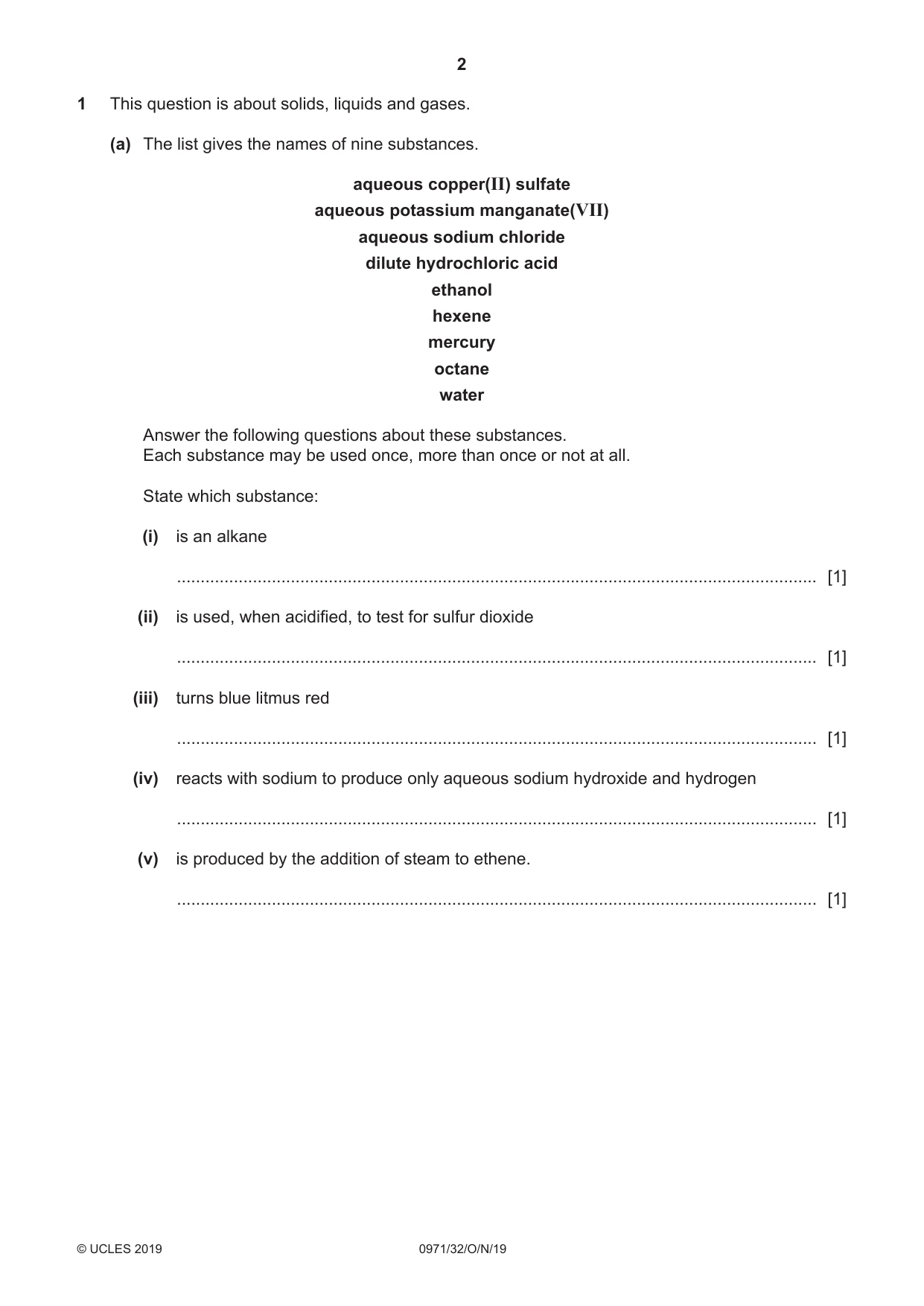
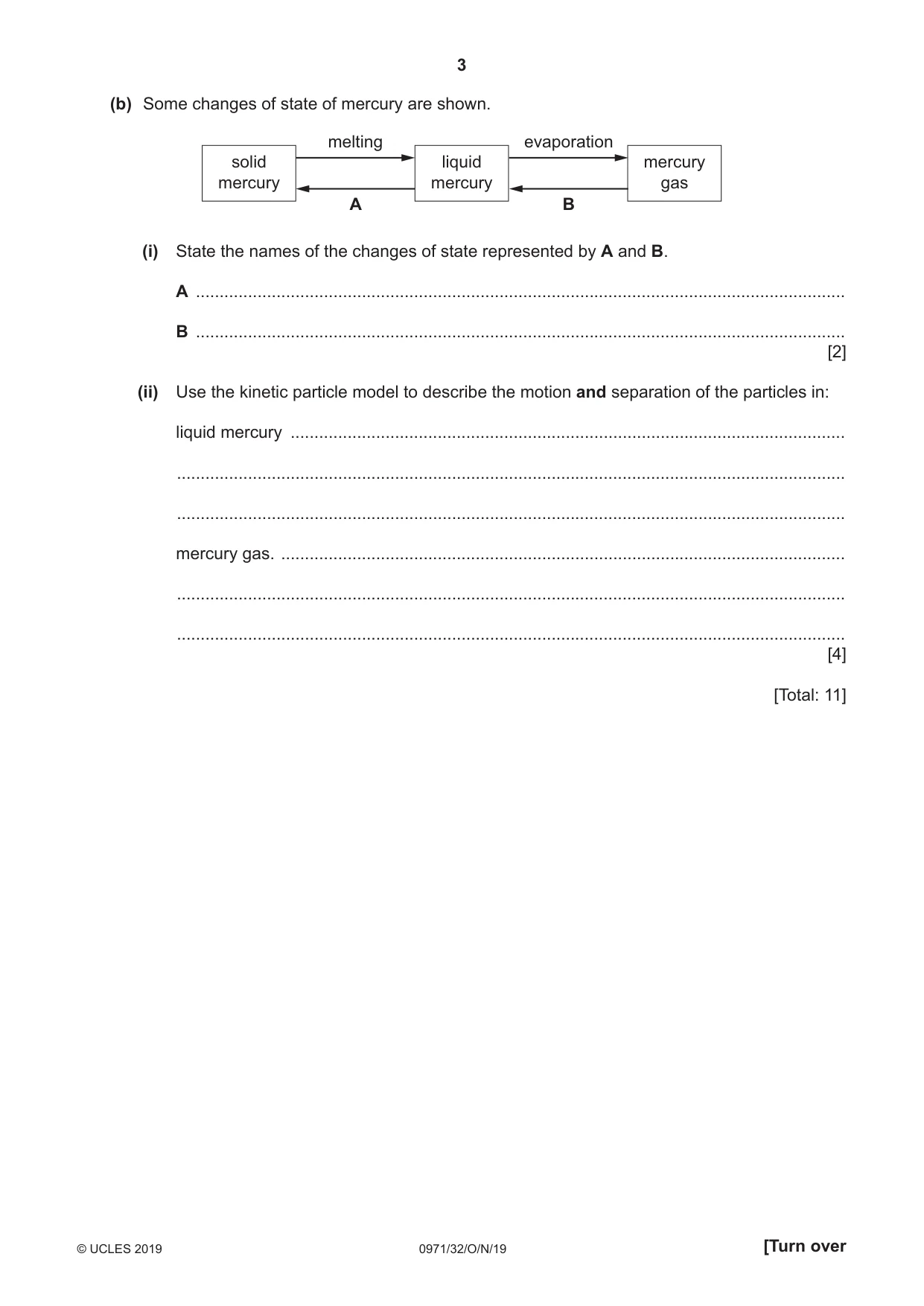
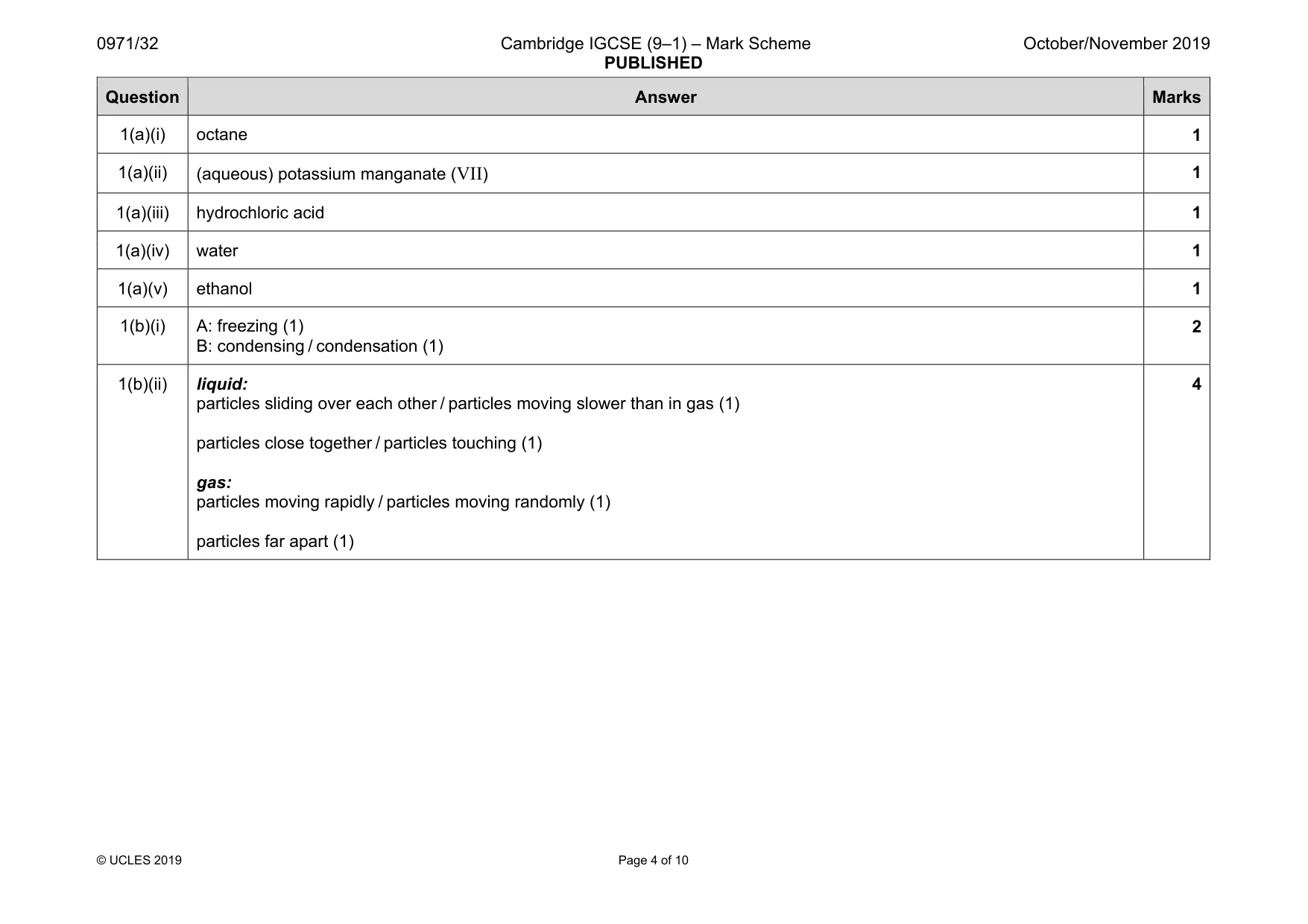
1 This question is about solids, liquids and gases. (a) The list gives the names of nine substances. aqueous copper(II) sulfate aqueous potassium manganate(VII) aqueous sodium chloride dilute hydrochloric acid ethanol hexene mercury octane water Answer the following questions about these substances. Each substance may be used once, more than once or not at all. State which substance: (i) is an alkane ....................................................................................................................................... [1] (ii) is used, when acidified, to test for sulfur dioxide ....................................................................................................................................... [1] (iii) turns blue litmus red ....................................................................................................................................... [1] (iv) reacts with sodium to produce only aqueous sodium hydroxide and hydrogen ....................................................................................................................................... [1] (v) is produced by the addition of steam to ethene. ....................................................................................................................................... [1] (b) Some changes of state of mercury are shown. melting evaporation solid liquid mercury mercury mercury gas A B (i) State the names of the changes of state represented by A and B. A .......................................................................................................................................... B .......................................................................................................................................... [2] (ii) Use the kinetic particle model to describe the motion and separation of the particles in: liquid mercury ...................................................................................................................... ............................................................................................................................................. ............................................................................................................................................. mercury gas. ....................................................................................................................... ............................................................................................................................................. ............................................................................................................................................. [4] [Total: 11]
Mark scheme: 1(a)(i) octane 1 1(a)(ii) (aqueous) potassium manganate (VII) 1 1(a)(iii) hydrochloric acid 1 1(a)(iv) water 1 1(a)(v) ethanol 1 1(b)(i) A: freezing (1) B: condensing / condensation (1) 2 1(b)(ii) liquid: particles sliding over each other / particles moving slower than in gas (1) particles close together / particles touching (1) gas: particles moving rapidly / particles moving randomly (1) particles far apart (1) 4
Q2 · Biogas is made by fermenting animal and vegetable waste
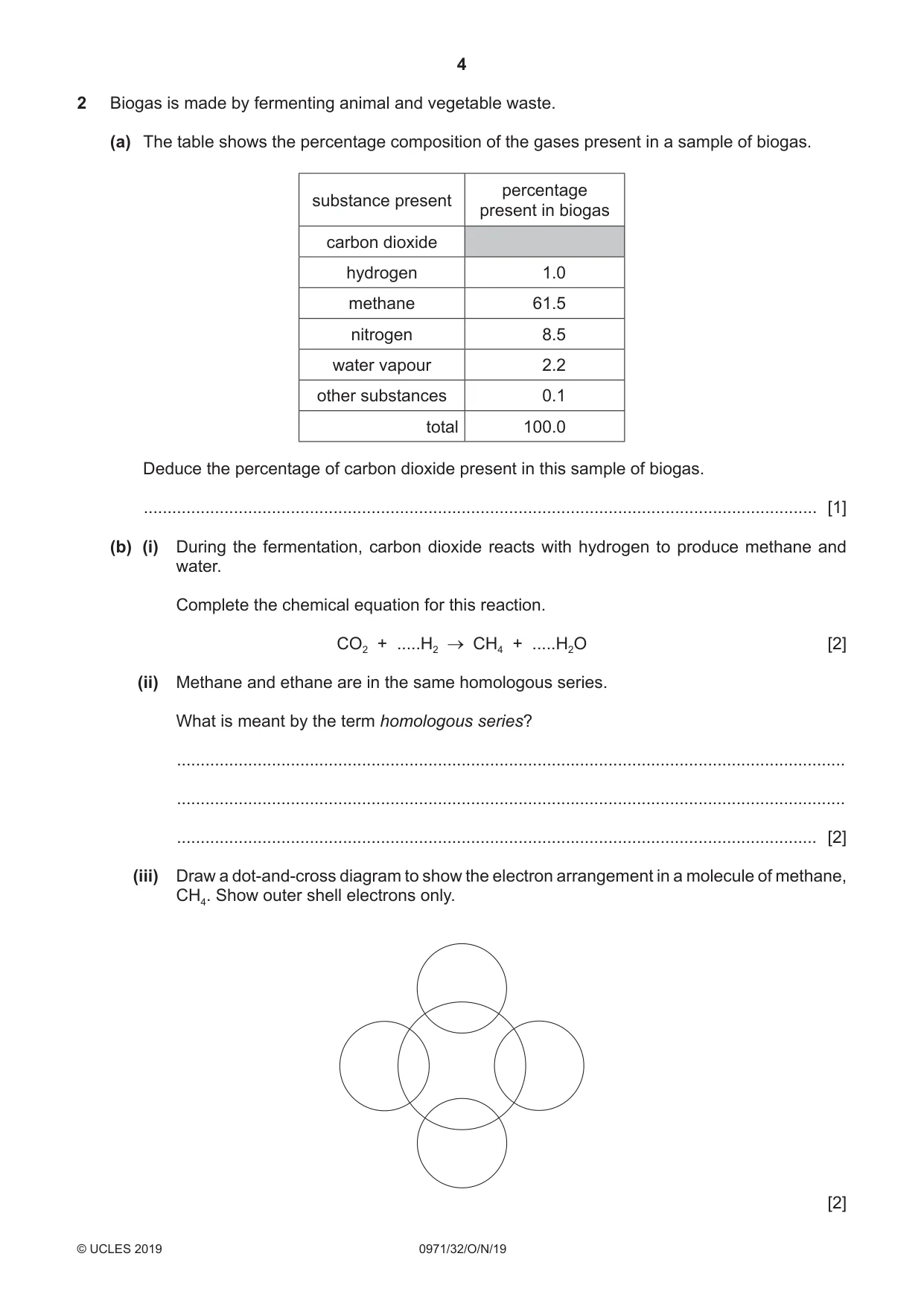
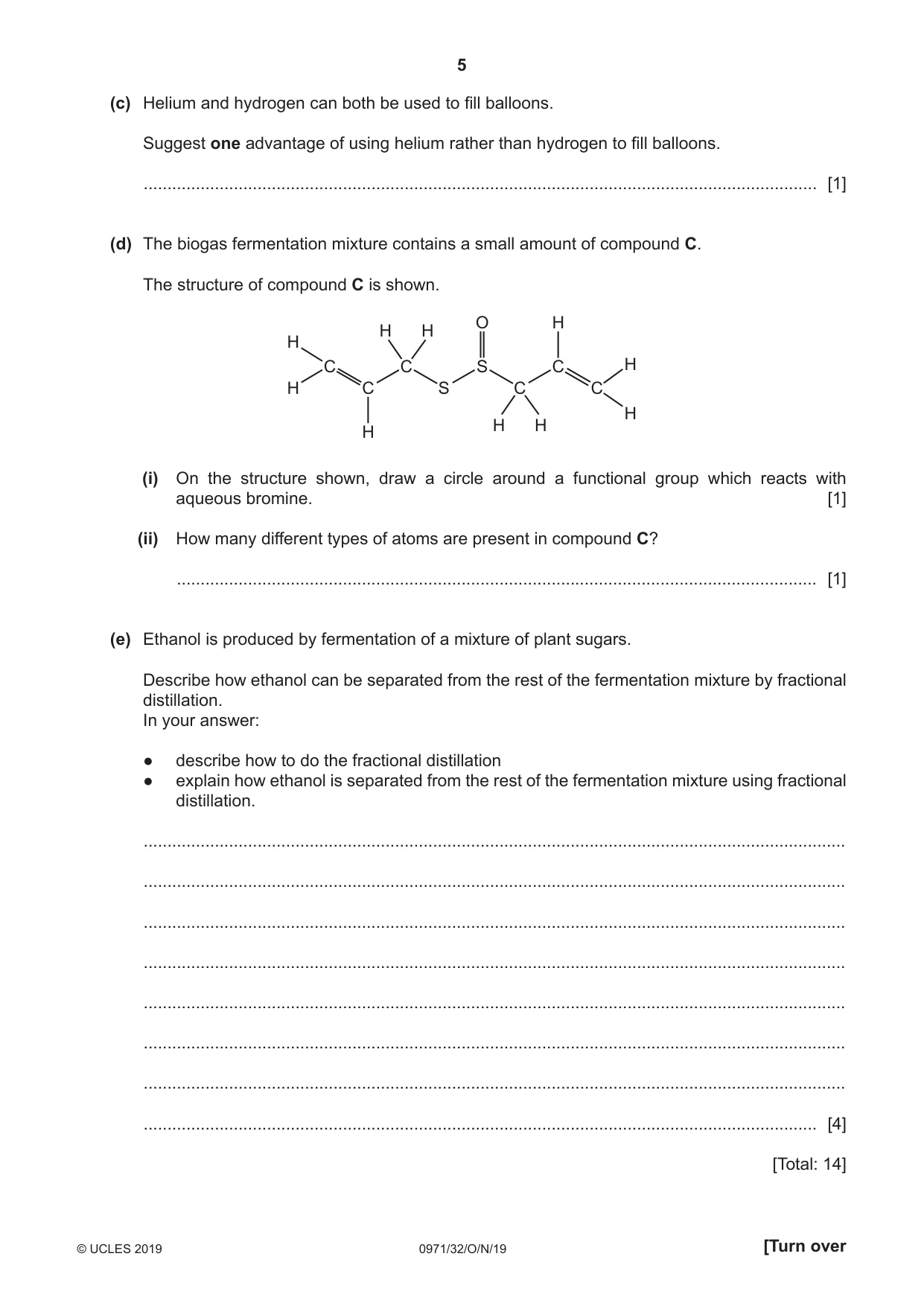
2 Biogas is made by fermenting animal and vegetable waste. (a) The table shows the percentage composition of the gases present in a sample of biogas. percentage substance present present in biogas carbon dioxide hydrogen 1.0 methane 61.5 nitrogen 8.5 water vapour 2.2 other substances 0.1 total 100.0 Deduce the percentage of carbon dioxide present in this sample of biogas. .............................................................................................................................................. [1] (b) (i) During the fermentation, carbon dioxide reacts with hydrogen to produce methane and water. Complete the chemical equation for this reaction. CO2 + .....H2 CH4 + .....H2O [2] (ii) Methane and ethane are in the same homologous series. What is meant by the term homologous series? ............................................................................................................................................. ............................................................................................................................................. ....................................................................................................................................... [2] (iii) Draw a dot-and-cross diagram to show the electron arrangement in a molecule of methane, CH4. Show outer shell electrons only. [2] (c) Helium and hydrogen can both be used to fill balloons. Suggest one advantage of using helium rather than hydrogen to fill balloons. .............................................................................................................................................. [1] (d) The biogas fermentation mixture contains a small amount of compound C. The structure of compound C is shown. O H H H H C C S C H H C S C C H H H H (i) On the structure shown, draw a circle around a functional group which reacts with aqueous bromine. [1] (ii) How many different types of atoms are present in compound C? ....................................................................................................................................... [1] (e) Ethanol is produced by fermentation of a mixture of plant sugars. Describe how ethanol can be separated from the rest of the fermentation mixture by fractional distillation. In your answer: ●● describe how to do the fractional distillation ●● explain how ethanol is separated from the rest of the fermentation mixture using fractional distillation. .................................................................................................................................................... .................................................................................................................................................... .................................................................................................................................................... .................................................................................................................................................... .................................................................................................................................................... .................................................................................................................................................... .................................................................................................................................................... .............................................................................................................................................. [4] [Total: 14]
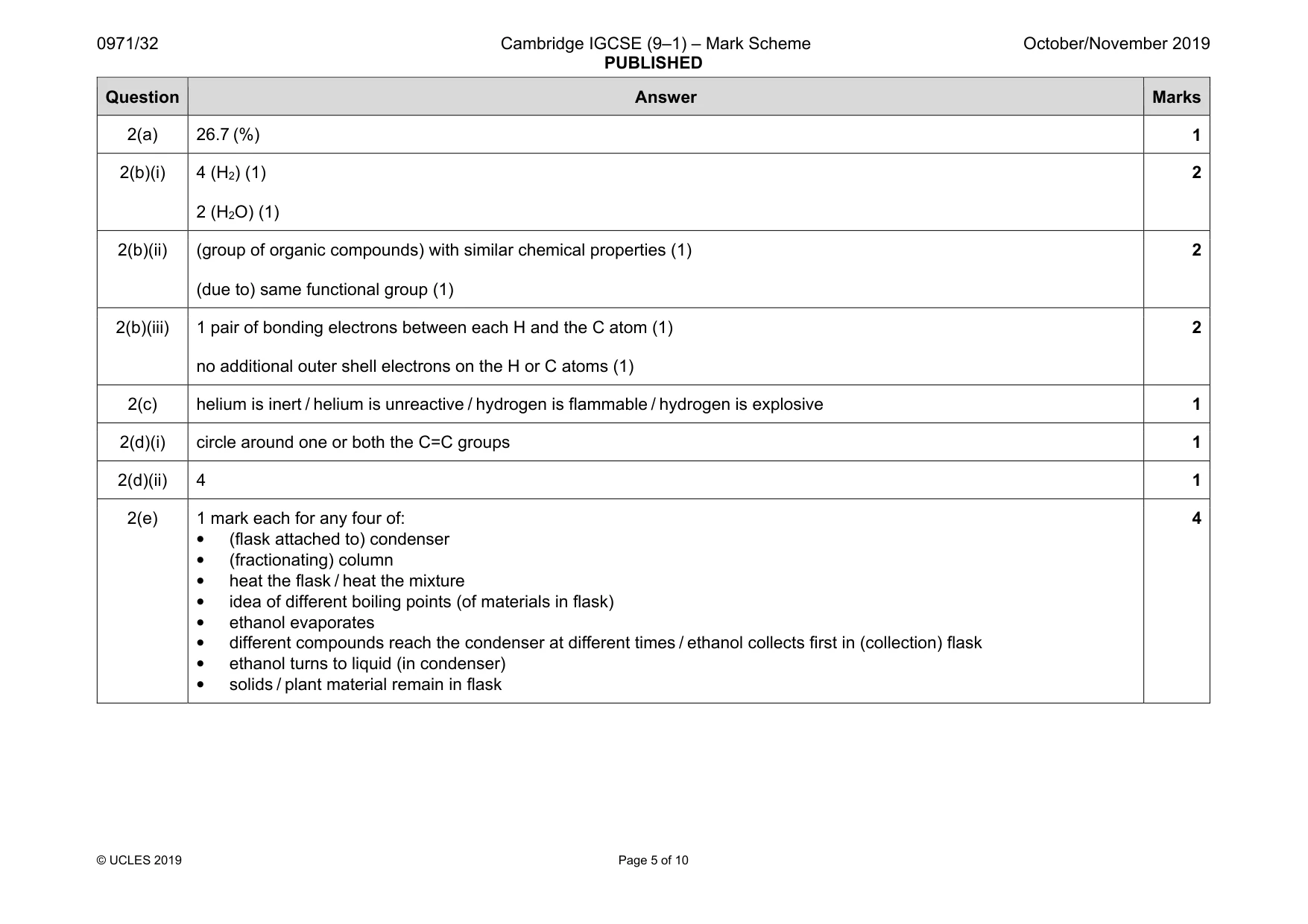
Mark scheme: 2(a) 26.7 (%) 1 2(b)(i) 4 (H2) (1) 2 (H2O) (1) 2 2(b)(ii) (group of organic compounds) with similar chemical properties (1) (due to) same functional group (1) 2 2(b)(iii) 1 pair of bonding electrons between each H and the C atom (1) no additional outer shell electrons on the H or C atoms (1) 2 2(c) helium is inert / helium is unreactive / hydrogen is flammable / hydrogen is explosive 1 2(d)(i) circle around one or both the C=C groups 1 2(d)(ii) 4 1 2(e) 1 mark each for any four of: • (flask attached to) condenser • (fractionating) column • heat the flask / heat the mixture • idea of different boiling points (of materials in flask) • ethanol evaporates • different compounds reach the condenser at different times / ethanol collects first in (collection) flask • ethanol turns to liquid (in condenser) • solids / plant material remain in flask 4
Q3 · A student investigated the reaction of calcium carbonate with an excess of dilute…
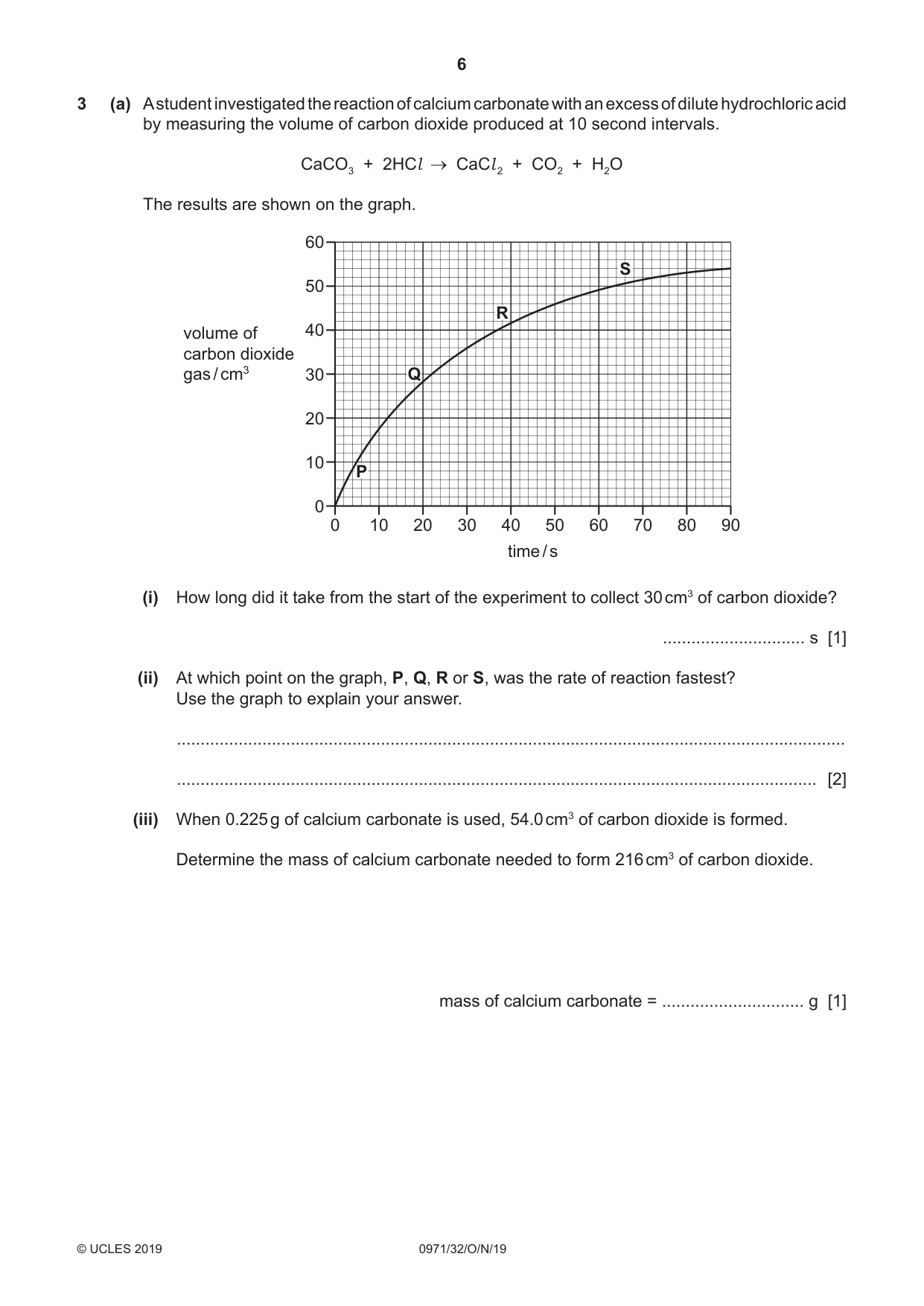
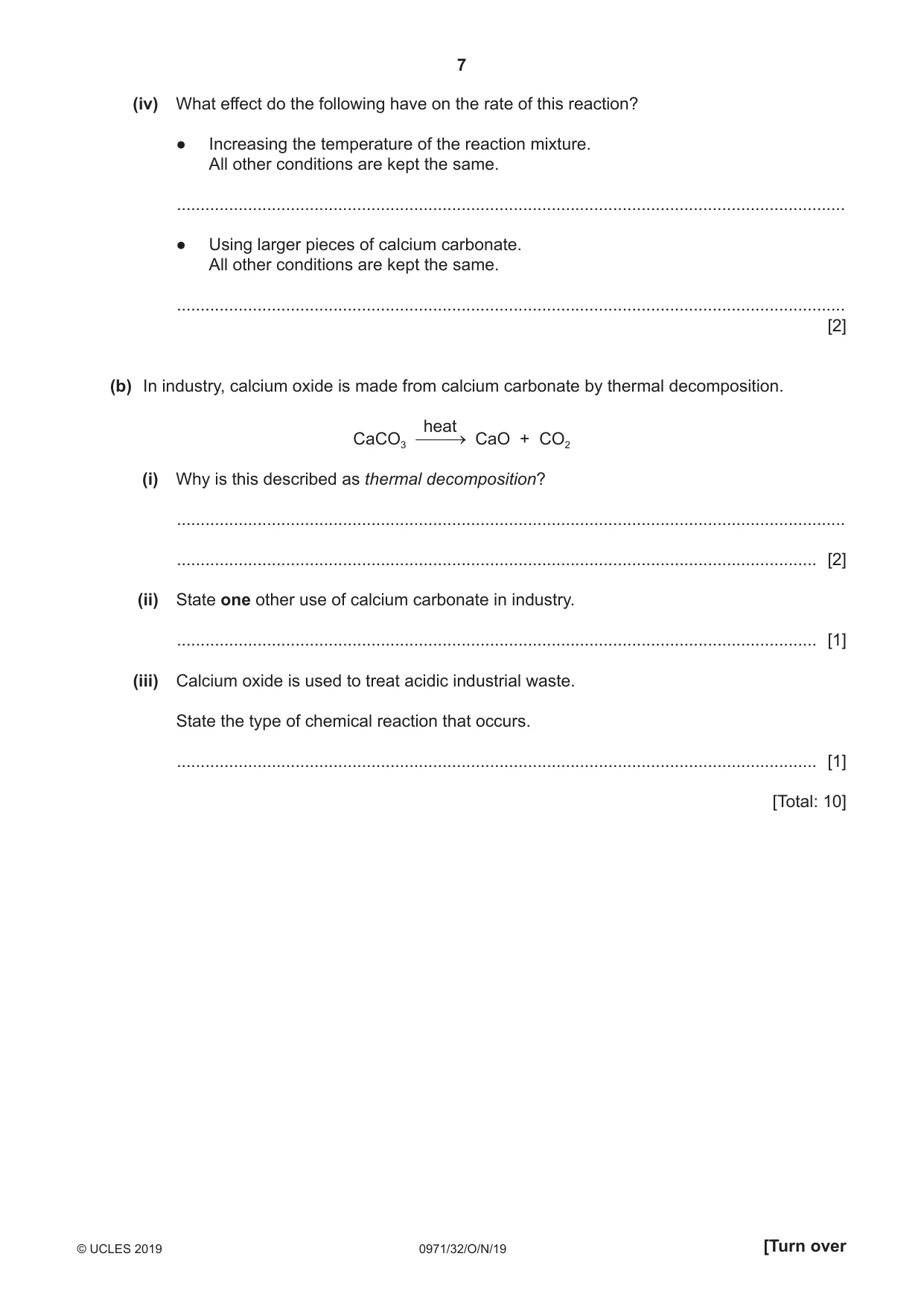
3 (a) A student investigated the reaction of calcium carbonate with an excess of dilute hydrochloric acid by measuring the volume of carbon dioxide produced at 10 second intervals. CaCO3 + 2HCl CaCl 2 + CO2 + H2O The results are shown on the graph. 60 S 50 R volume of 40 carbon dioxide gas / cm3 30 Q 20 10 P 0 0 10 20 30 40 50 60 70 80 90 time / s (i) How long did it take from the start of the experiment to collect 30 cm3 of carbon dioxide? .............................. s [1] (ii) At which point on the graph, P, Q, R or S, was the rate of reaction fastest? Use the graph to explain your answer. ............................................................................................................................................. ....................................................................................................................................... [2] (iii) When 0.225 g of calcium carbonate is used, 54.0 cm3 of carbon dioxide is formed. Determine the mass of calcium carbonate needed to form 216 cm3 of carbon dioxide. mass of calcium carbonate = .............................. g [1] (iv) What effect do the following have on the rate of this reaction? ● Increasing the temperature of the reaction mixture. All other conditions are kept the same. ............................................................................................................................................. ● Using larger pieces of calcium carbonate. All other conditions are kept the same. ............................................................................................................................................. [2] (b) In industry, calcium oxide is made from calcium carbonate by thermal decomposition. heat CaCO3 CaO + CO2 (i) Why is this described as thermal decomposition? ............................................................................................................................................. ....................................................................................................................................... [2] (ii) State one other use of calcium carbonate in industry. ....................................................................................................................................... [1] (iii) Calcium oxide is used to treat acidic industrial waste. State the type of chemical reaction that occurs. ....................................................................................................................................... [1] [Total: 10]
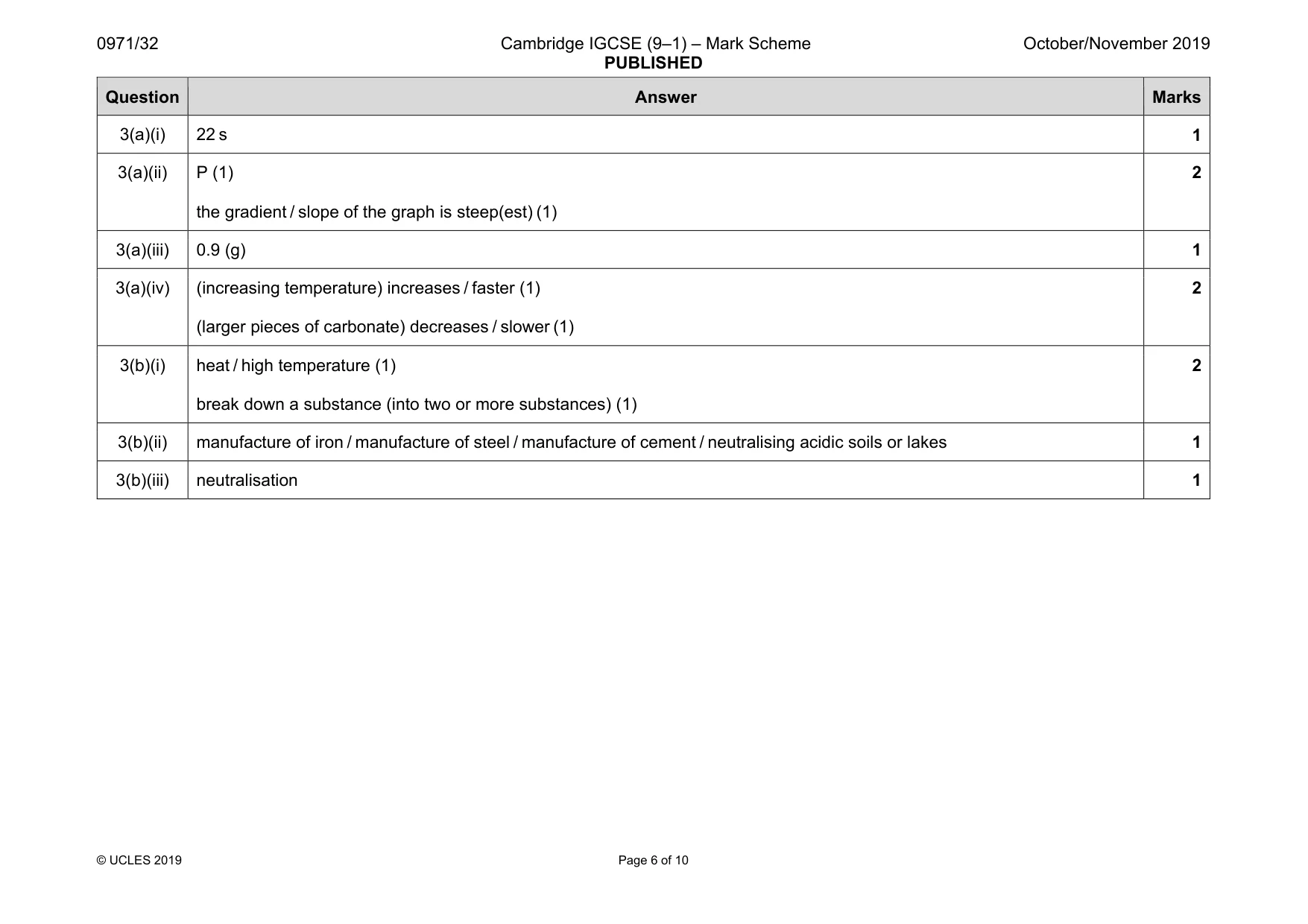
Mark scheme: 3(a)(i) 22 s 1 3(a)(ii) P (1) the gradient / slope of the graph is steep(est) (1) 2 3(a)(iii) 0.9 (g) 1 3(a)(iv) (increasing temperature) increases / faster (1) (larger pieces of carbonate) decreases / slower (1) 2 3(b)(i) heat / high temperature (1) break down a substance (into two or more substances) (1) 2 3(b)(ii) manufacture of iron / manufacture of steel / manufacture of cement / neutralising acidic soils or lakes 1 3(b)(iii) neutralisation 1
Q4 · An isotope of calcium is written as shown
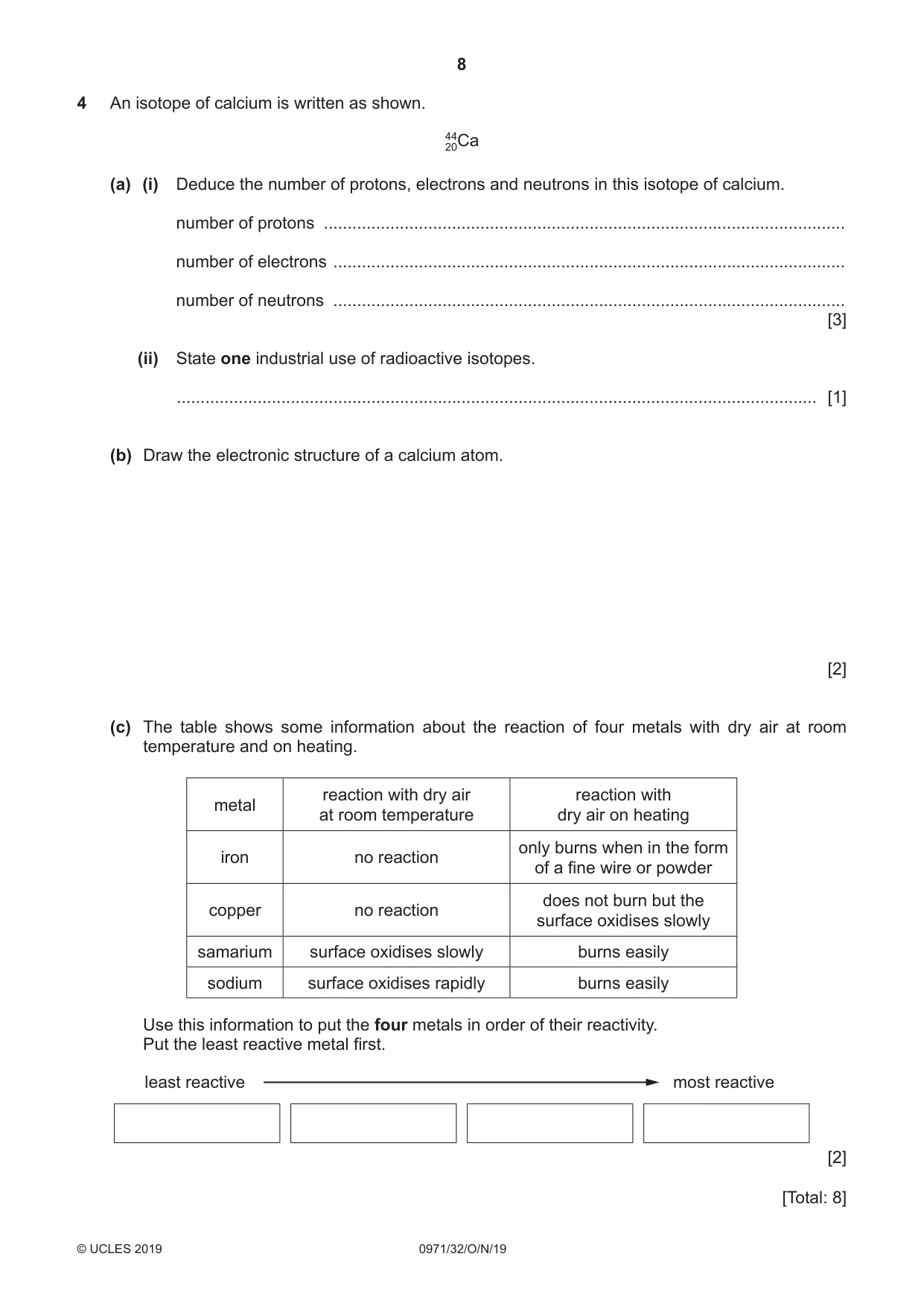
4 An isotope of calcium is written as shown. (a) (i) Deduce the number of protons, electrons and neutrons in this isotope of calcium. number of protons ............................................................................................................... number of electrons ............................................................................................................ number of neutrons ............................................................................................................. [3] (ii) State one industrial use of radioactive isotopes. ....................................................................................................................................... [1] (b) Draw the electronic structure of a calcium atom. [2] (c) The table shows some information about the reaction of four metals with dry air at room temperature and on heating. reaction with dry air reaction with metal at room temperature dry air on heating only burns when in the form iron no reaction of a fine wire or powder does not burn but the copper no reaction surface oxidises slowly samarium surface oxidises slowly burns easily sodium surface oxidises rapidly burns easily Use this information to put the four metals in order of their reactivity. Put the least reactive metal first. least reactive most reactive [2] [Total: 8]
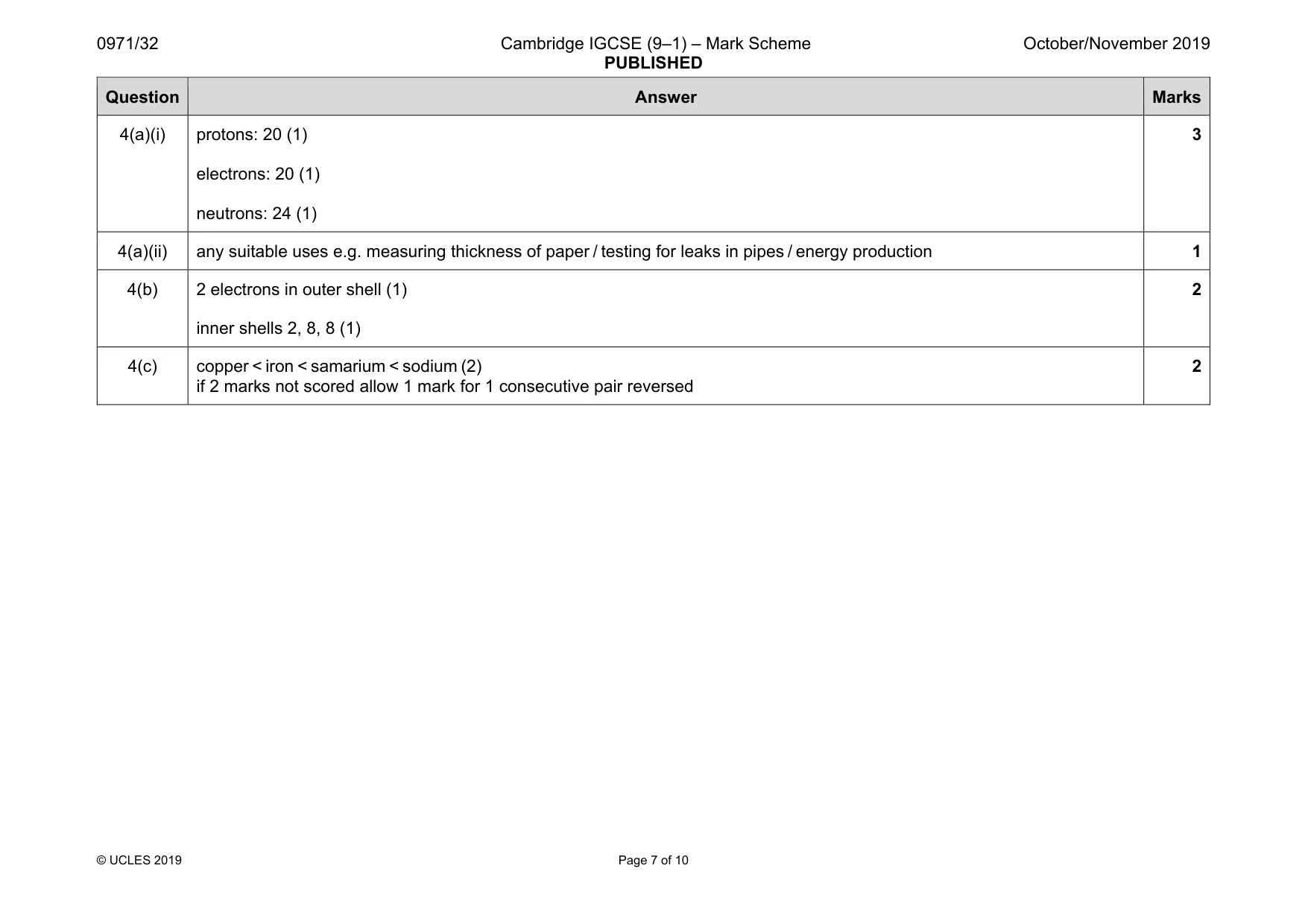
Mark scheme: 4(a)(i) protons: 20 (1) electrons: 20 (1) neutrons: 24 (1) 3 4(a)(ii) any suitable uses e.g. measuring thickness of paper / testing for leaks in pipes / energy production 1 4(b) 2 electrons in outer shell (1) inner shells 2, 8, 8 (1) 2 4(c) copper < iron < samarium < sodium (2) if 2 marks not scored allow 1 mark for 1 consecutive pair reversed 2
Q5 · This question is about the halogens and compounds of the halogens
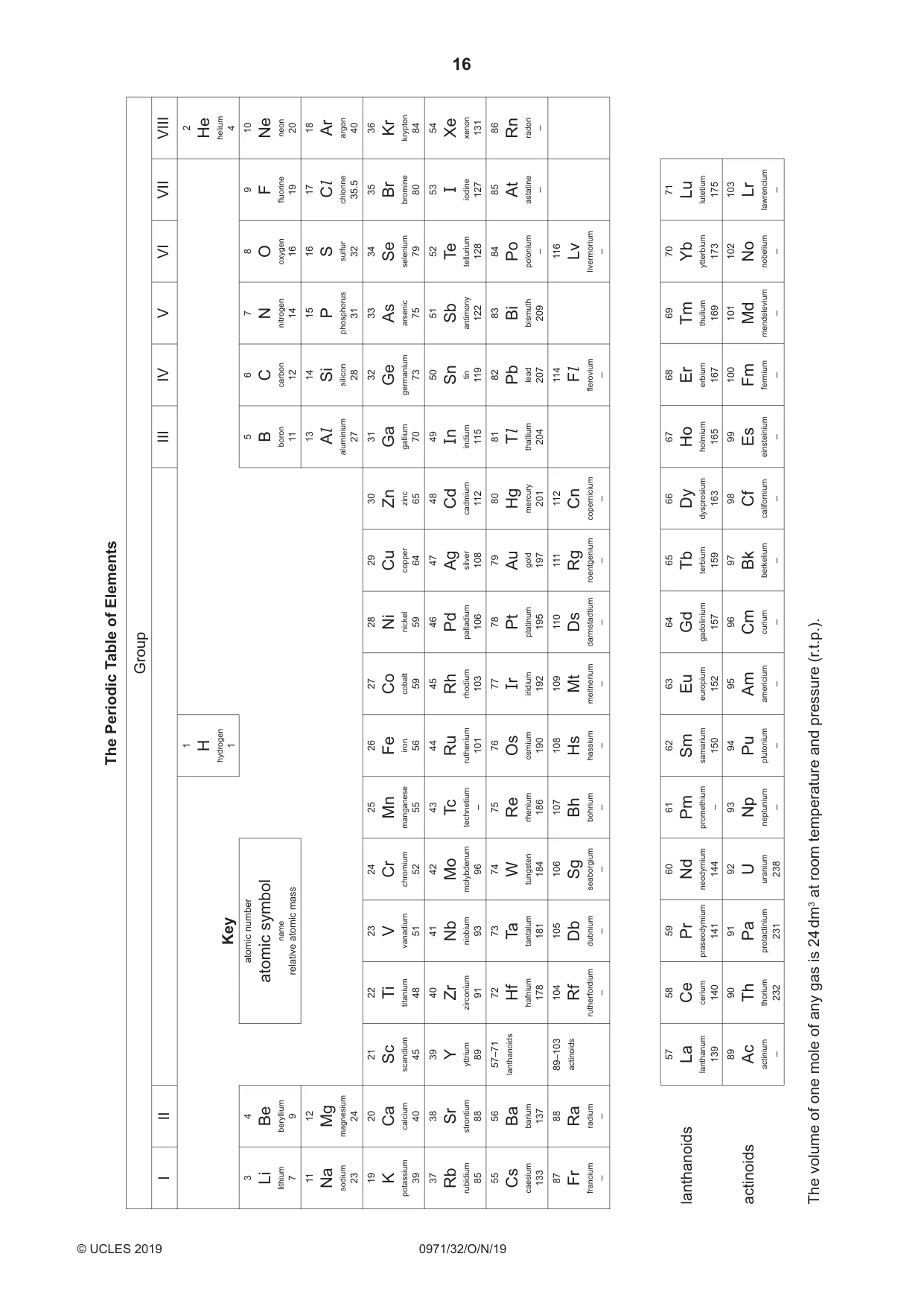
5 This question is about the halogens and compounds of the halogens. (a) The properties of some halogens are shown in the table. melting point boiling point density of liquid at element colour in °C in °C boiling point in g / cm3 fluorine –220 –188 1.51 chlorine –101 1.56 light green ........................ bromine –7 59 3.12 red-brown iodine 114 184 grey-black ........................ (i) Complete the table to estimate: ●● the boiling point of chlorine ●● the density of iodine. [2] (ii) Describe the trend in the melting points of the halogens down the group. ....................................................................................................................................... [1] (iii) Predict the physical state of bromine at –20 °C. ....................................................................................................................................... [1] (iv) Which one of the following is most likely to be the colour of fluorine? Tick one box. dark green light grey-black light yellow purple [1] (b) Chlorine reacts with an aqueous potassium salt to form iodine and a different potassium salt. (i) Complete the word equation for this reaction. .............................. .............................. chlorine + iodine + .............................. .............................. [2] (ii) When aqueous sodium fluoride is added to chlorine, no reaction occurs. Explain, using ideas about the reactivity of the halogens, why no reaction occurs. ............................................................................................................................................. ....................................................................................................................................... [1] (iii) State one use of chlorine. ....................................................................................................................................... [1] (c) Aqueous silver nitrate is used to test for chloride ions and iodide ions. (i) The solutions are first acidified with dilute nitric acid. Explain why dilute hydrochloric acid is not used to acidify the solutions. ....................................................................................................................................... [1] (ii) Complete the table to show the expected observations. observations on adding ion aqueous silver nitrate chloride (Cl –) iodide (I–) [3] (d) A compound of chlorine has the formula C6H4Cl 2. Complete the table to calculate the relative molecular mass of C6H4Cl 2. Use your Periodic Table to help you. number relative type of atom of atoms atomic mass carbon 6 12 6 × 12 = 72 hydrogen chlorine relative molecular mass = .............................. [2] [Total: 15]
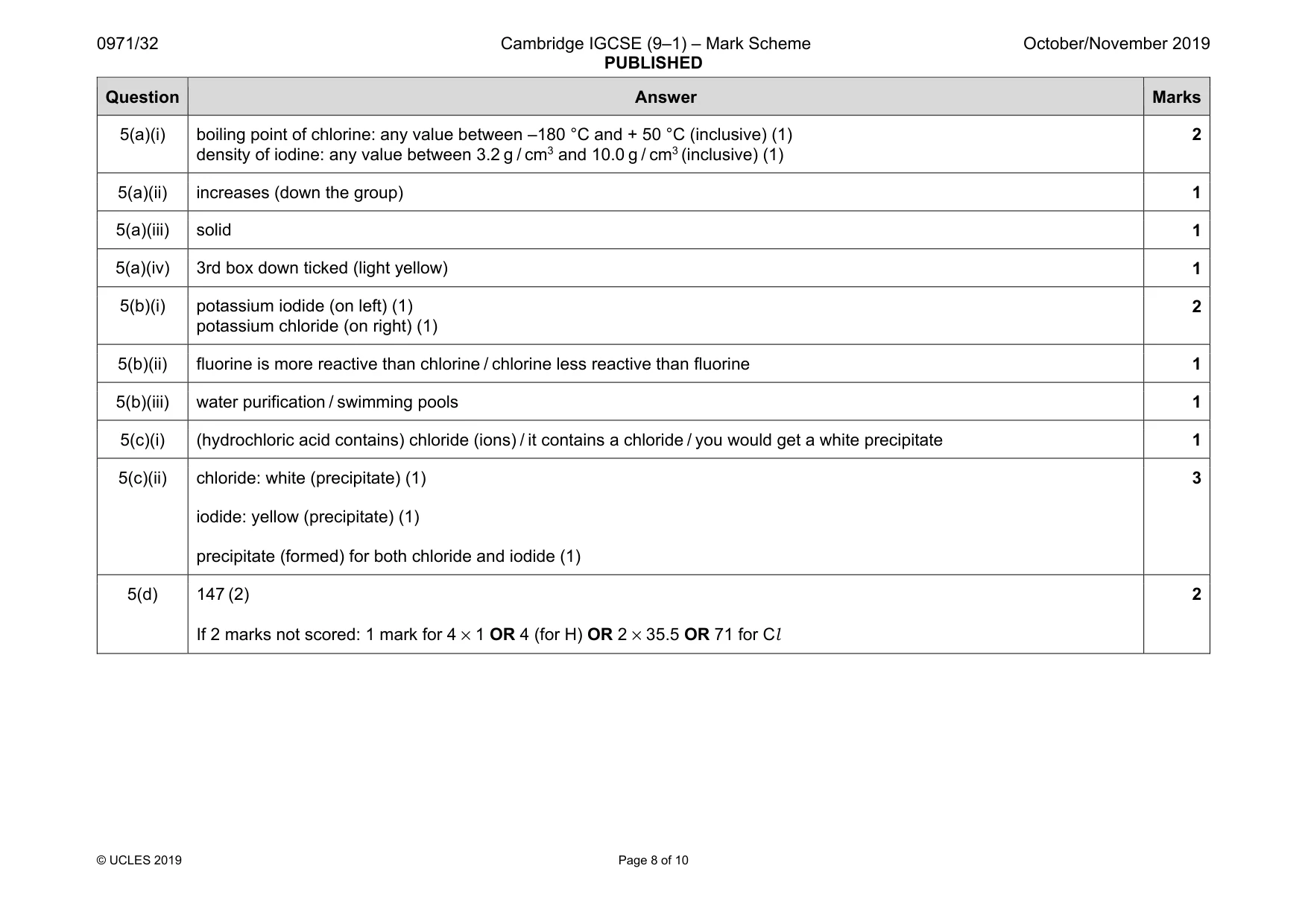
Mark scheme: 5(a)(i) boiling point of chlorine: any value between –180 °C and + 50 °C (inclusive) (1) density of iodine: any value between 3.2 g / cm3 and 10.0 g / cm3 (inclusive) (1) 2 5(a)(ii) increases (down the group) 1 5(a)(iii) solid 1 5(a)(iv) 3rd box down ticked (light yellow) 1 5(b)(i) potassium iodide (on left) (1) potassium chloride (on right) (1) 2 5(b)(ii) fluorine is more reactive than chlorine / chlorine less reactive than fluorine 1 5(b)(iii) water purification / swimming pools 1 5(c)(i) (hydrochloric acid contains) chloride (ions) / it contains a chloride / you would get a white precipitate 1 5(c)(ii) chloride: white (precipitate) (1) iodide: yellow (precipitate) (1) precipitate (formed) for both chloride and iodide (1) 3 5(d) 147 (2) If 2 marks not scored: 1 mark for 4 × 1 OR 4 (for H) OR 2 × 35.5 OR 71 for Cl 2
Q6 · This question is about compounds of nitrogen
6 This question is about compounds of nitrogen. (a) Aqueous ammonia is alkaline. (i) Which one of the following pH values could be the pH of aqueous ammonia? Draw a circle around the correct answer. pH 1 pH 5 pH 7 pH 9 [1] (ii) Ammonia has a strong smell. A beaker of aqueous ammonia was placed in front of a class of students. At first, the students at the back of the class could not smell the ammonia. After a few minutes they could smell the ammonia. Explain these observations using the kinetic particle model. ............................................................................................................................................. ............................................................................................................................................. ............................................................................................................................................. ............................................................................................................................................. ....................................................................................................................................... [3] (b) Ammonia is used in the manufacture of nitric acid. (i) Balance the chemical equation for the first step in the process. 4NH3 + 5O2 .....NO + 6H2O [1] (ii) The reaction is exothermic. What is meant by the term exothermic? ............................................................................................................................................. ....................................................................................................................................... [1] (iii) The NO produced in the first step then reacts with oxygen to produce nitrogen dioxide, NO2. 2NO + O2 2NO2 How does this equation show that NO is oxidised? ............................................................................................................................................. ....................................................................................................................................... [1] (iv) Is nitrogen dioxide an acidic oxide or a basic oxide? Give a reason for your answer. ............................................................................................................................................. ....................................................................................................................................... [1] (c) Oxides of nitrogen are atmospheric pollutants. State one adverse effect of oxides of nitrogen on health. .............................................................................................................................................. [1] (d) Ammonia reacts with nitric acid to form a salt which is present in many fertilisers. Name the salt formed when ammonia reacts with nitric acid. .............................................................................................................................................. [1] [Total: 10]
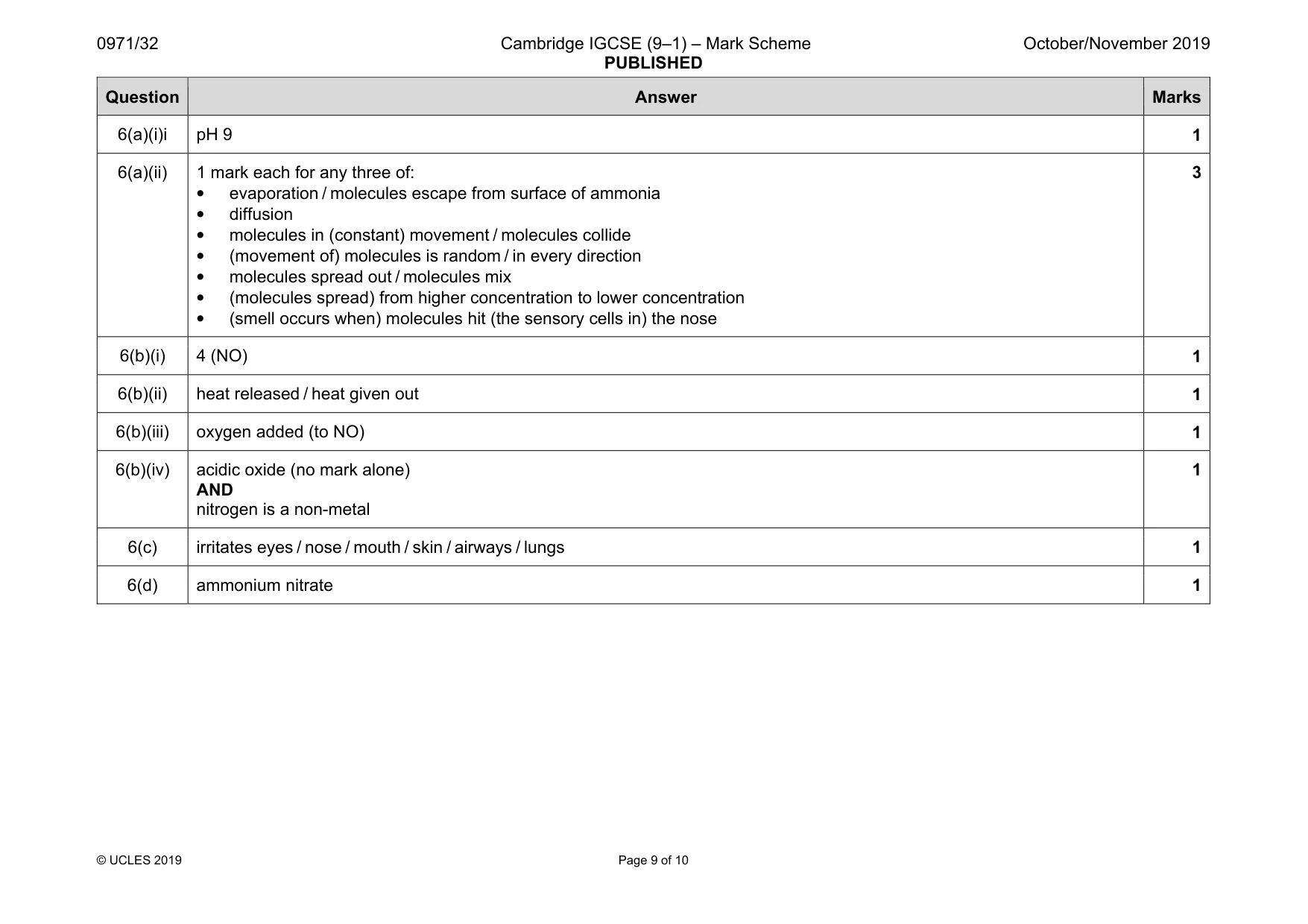
Mark scheme: 6(a)(i)i pH 9 1 6(a)(ii) 1 mark each for any three of: • evaporation / molecules escape from surface of ammonia • diffusion • molecules in (constant) movement / molecules collide • (movement of) molecules is random / in every direction • molecules spread out / molecules mix • (molecules spread) from higher concentration to lower concentration • (smell occurs when) molecules hit (the sensory cells in) the nose 3 6(b)(i) 4 (NO) 1 6(b)(ii) heat released / heat given out 1 6(b)(iii) oxygen added (to NO) 1 6(b)(iv) acidic oxide (no mark alone) AND nitrogen is a non-metal 1 6(c) irritates eyes / nose / mouth / skin / airways / lungs 1 6(d) ammonium nitrate 1
More questions on The characteristic properties of acids and bases
Q7 · Concentrated hydrochloric acid is electrolysed using graphite electrodes
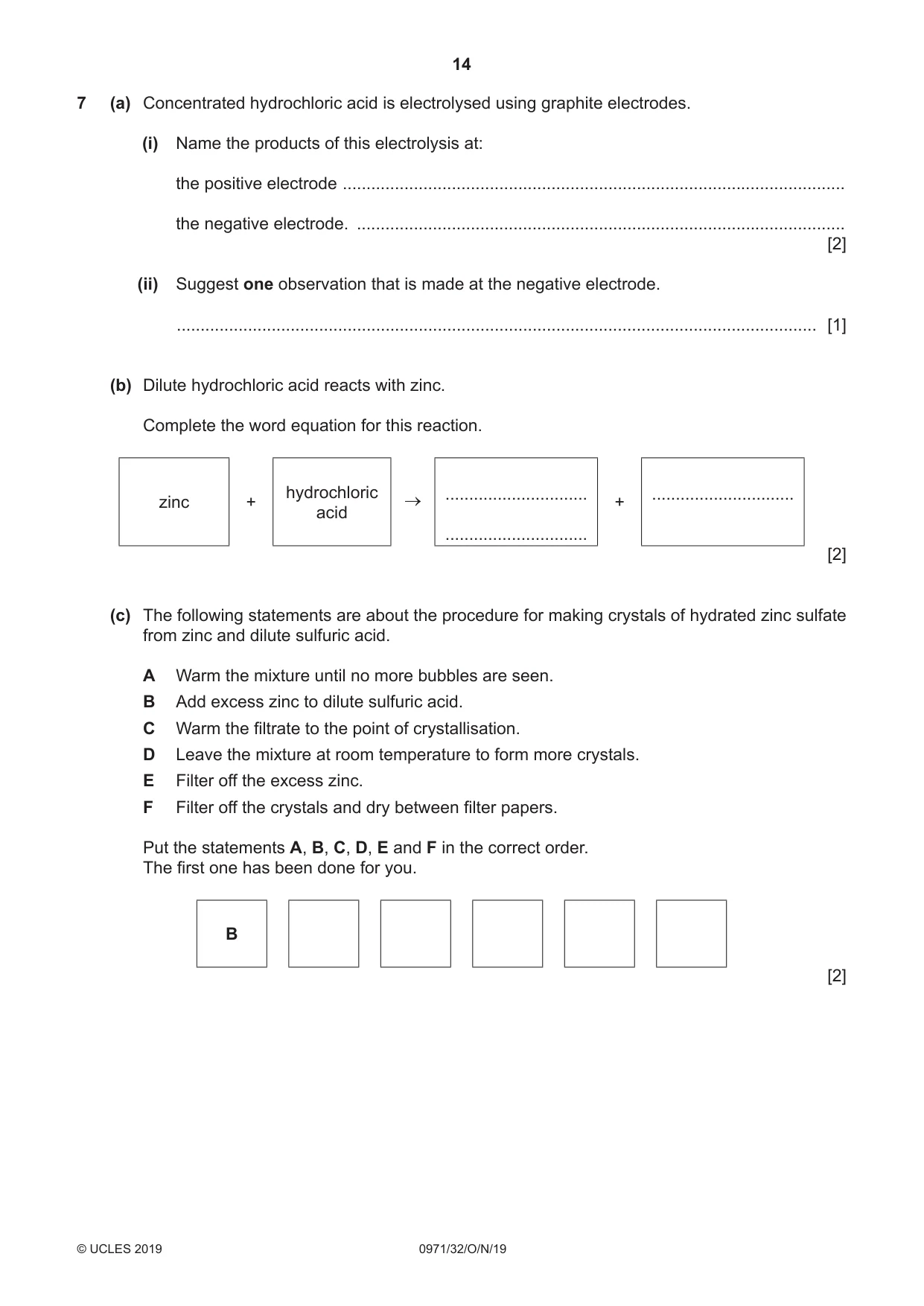
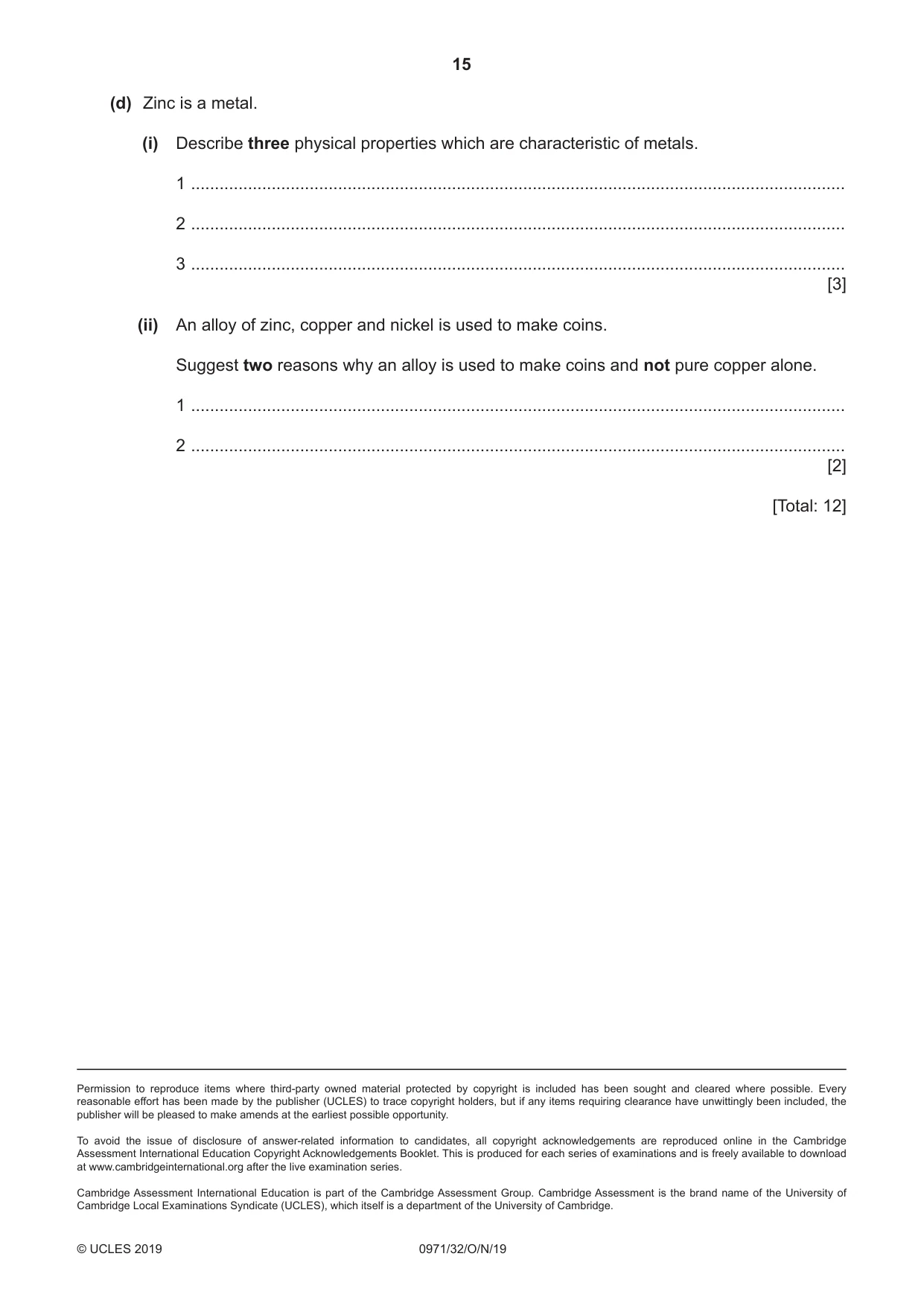
7 (a) Concentrated hydrochloric acid is electrolysed using graphite electrodes. (i) Name the products of this electrolysis at: the positive electrode .......................................................................................................... the negative electrode. ........................................................................................................ [2] (ii) Suggest one observation that is made at the negative electrode. ....................................................................................................................................... [1] (b) Dilute hydrochloric acid reacts with zinc. Complete the word equation for this reaction. hydrochloric .............................. .............................. zinc + + acid .............................. [2] (c) The following statements are about the procedure for making crystals of hydrated zinc sulfate from zinc and dilute sulfuric acid. A Warm the mixture until no more bubbles are seen. B Add excess zinc to dilute sulfuric acid. C Warm the filtrate to the point of crystallisation. D Leave the mixture at room temperature to form more crystals. E Filter off the excess zinc. F Filter off the crystals and dry between filter papers. Put the statements A, B, C, D, E and F in the correct order. The first one has been done for you. B [2] (d) Zinc is a metal. (i) Describe three physical properties which are characteristic of metals. 1 .......................................................................................................................................... 2 .......................................................................................................................................... 3 .......................................................................................................................................... [3] (ii) An alloy of zinc, copper and nickel is used to make coins. Suggest two reasons why an alloy is used to make coins and not pure copper alone. 1 .......................................................................................................................................... 2 .......................................................................................................................................... [2] [Total: 12]
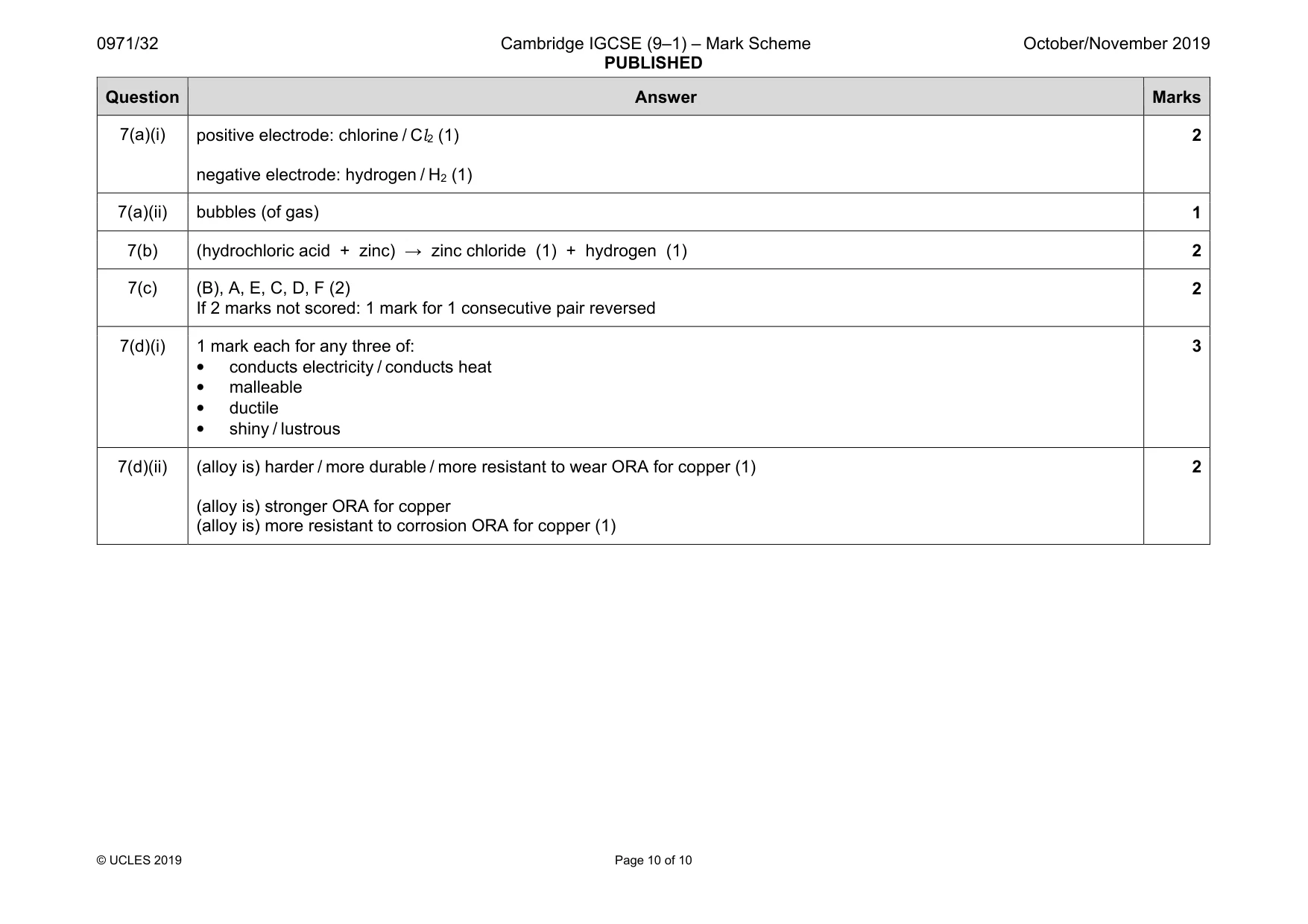
Mark scheme: 7(a)(i) negative electrode: hydrogen / H2 (1) 2 7(a)(ii) bubbles (of gas) 1 7(b) (hydrochloric acid + zinc) → zinc chloride (1) + hydrogen (1) 2 7(c) (B), A, E, C, D, F (2) If 2 marks not scored: 1 mark for 1 consecutive pair reversed 2 7(d)(i) 1 mark each for any three of: • conducts electricity / conducts heat • malleable • ductile • shiny / lustrous 3 7(d)(ii) (alloy is) harder / more durable / more resistant to wear ORA for copper (1) (alloy is) stronger ORA for copper (alloy is) more resistant to corrosion ORA for copper (1) 2
What was in this paper
The subtopics covered by these 7 questions, and how many questions each got. Open one in a new tab to see every Cambridge question on it.
What you needed in this session
Cambridge’s own grade thresholds for 2019 Oct/Nov, Paper 3 · Variant 2. A higher threshold means an easier paper — the bar moves with how the cohort did.