Cambridge IGCSE Chemistry (9-1) 0971 — 2019 May/June Paper 6 · Variant 2
0971/62/M/J/19 · 4 questions · 40 marks · ≈45 min
The question paper and its mark scheme, free to read here and free to download. This is Cambridge’s own paper, exactly as it was sat.
Question paper12 pages

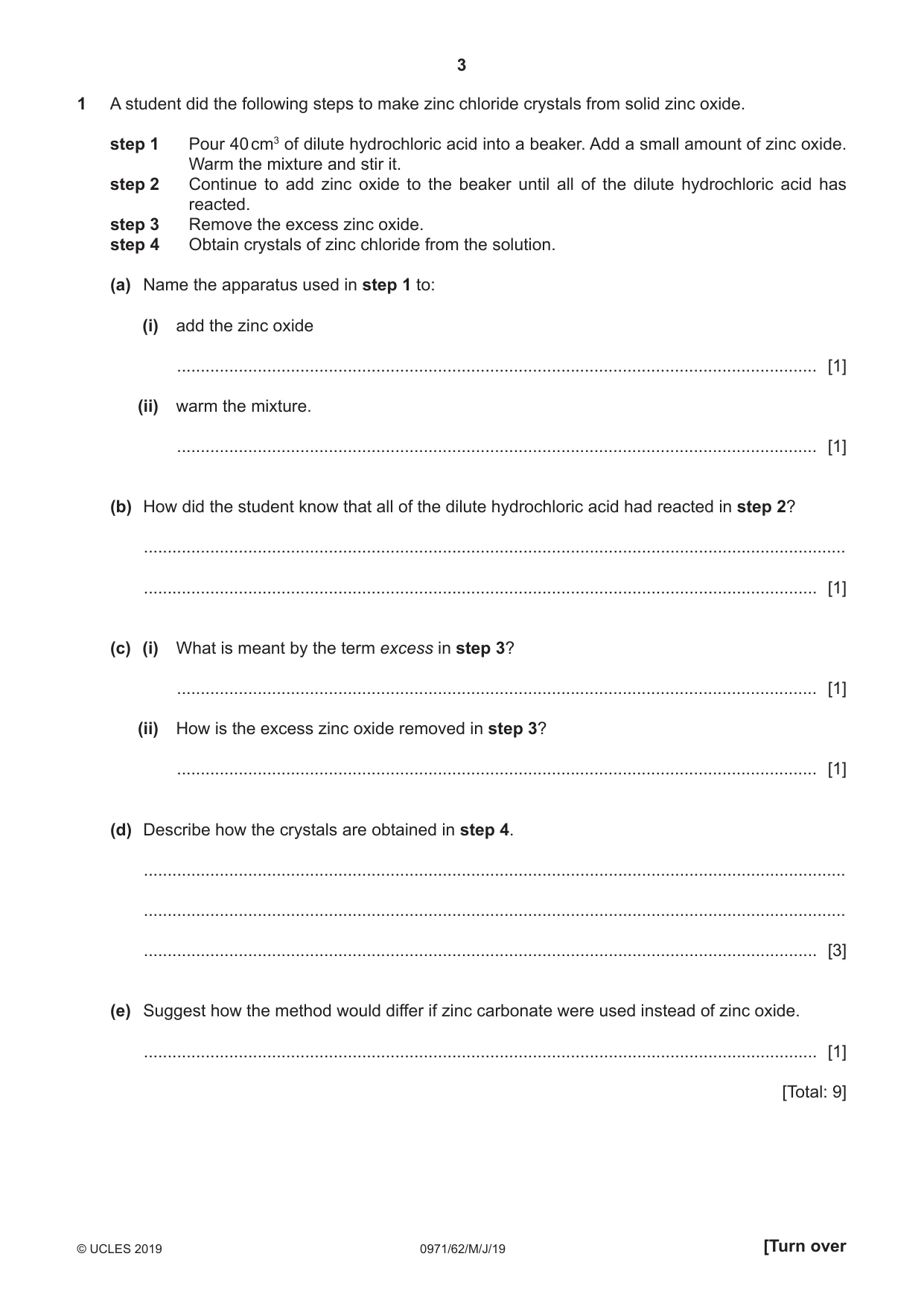


Mark scheme8 pages
Answers below. Sit the paper first if you are practising.
Questions as text
Q1 · A student did the following steps to make zinc chloride crystals from solid zinc oxide
1 A student did the following steps to make zinc chloride crystals from solid zinc oxide. step 1 Pour 40 cm3 of dilute hydrochloric acid into a beaker. Add a small amount of zinc oxide. Warm the mixture and stir it. step 2 Continue to add zinc oxide to the beaker until all of the dilute hydrochloric acid has reacted. step 3 Remove the excess zinc oxide. step 4 Obtain crystals of zinc chloride from the solution. (a) Name the apparatus used in step 1 to: (i) add the zinc oxide ....................................................................................................................................... [1] (ii) warm the mixture. ....................................................................................................................................... [1] (b) How did the student know that all of the dilute hydrochloric acid had reacted in step 2? .................................................................................................................................................... .............................................................................................................................................. [1] (c) (i) What is meant by the term excess in step 3? ....................................................................................................................................... [1] (ii) How is the excess zinc oxide removed in step 3? ....................................................................................................................................... [1] (d) Describe how the crystals are obtained in step 4. .................................................................................................................................................... .................................................................................................................................................... .............................................................................................................................................. [3] (e) Suggest how the method would differ if zinc carbonate were used instead of zinc oxide. .............................................................................................................................................. [1] [Total: 9]
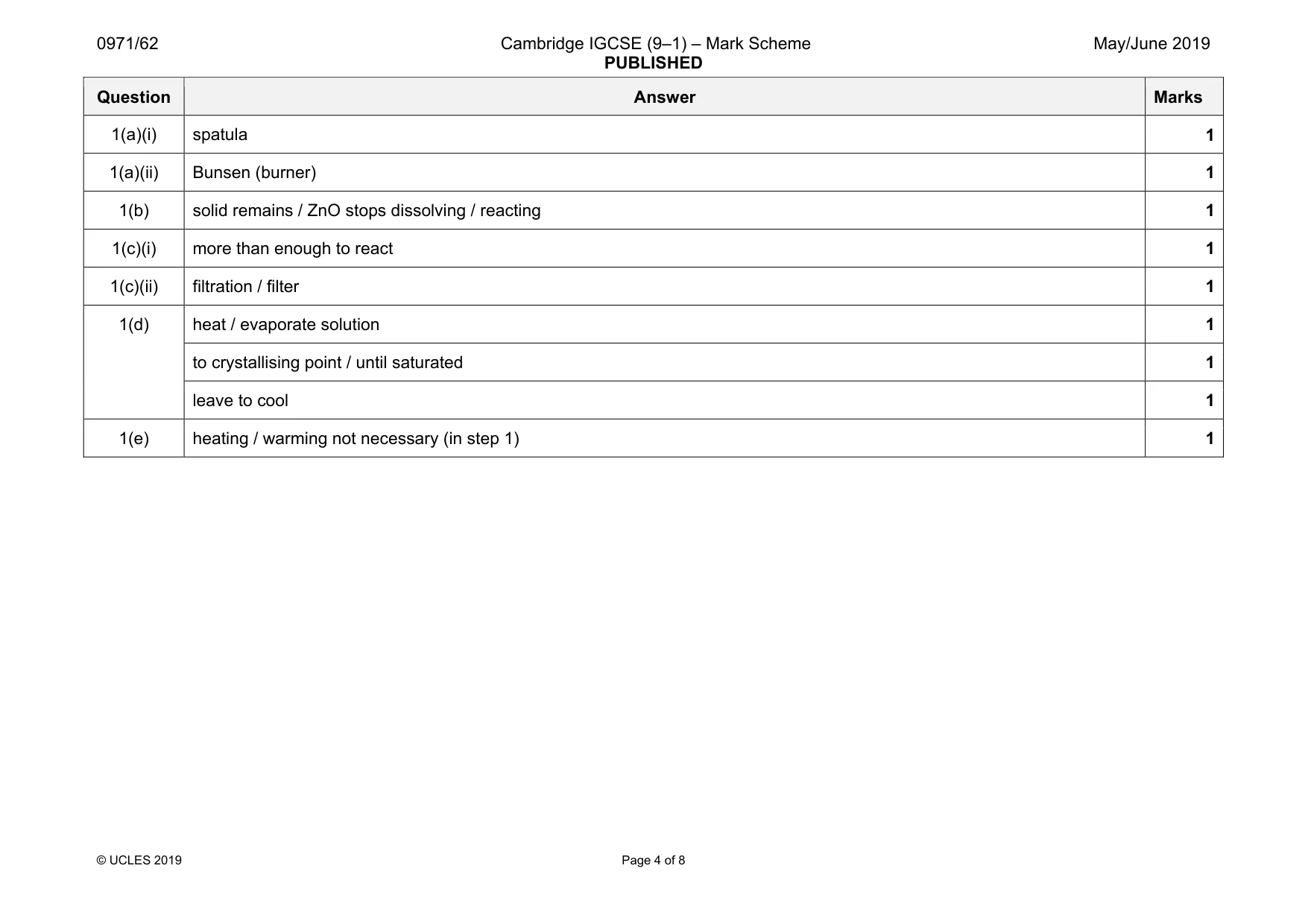
Mark scheme: 1(a)(i) spatula 1 1(a)(ii) Bunsen (burner) 1 1(b) solid remains / ZnO stops dissolving / reacting 1 1(c)(i) more than enough to react 1 1(c)(ii) filtration / filter 1 1(d) heat / evaporate solution 1 to crystallising point / until saturated 1 leave to cool 1 1(e) heating / warming not necessary (in step 1) 1
Q2 · A student investigated the rate of reaction between magnesium ribbon and solutions of…
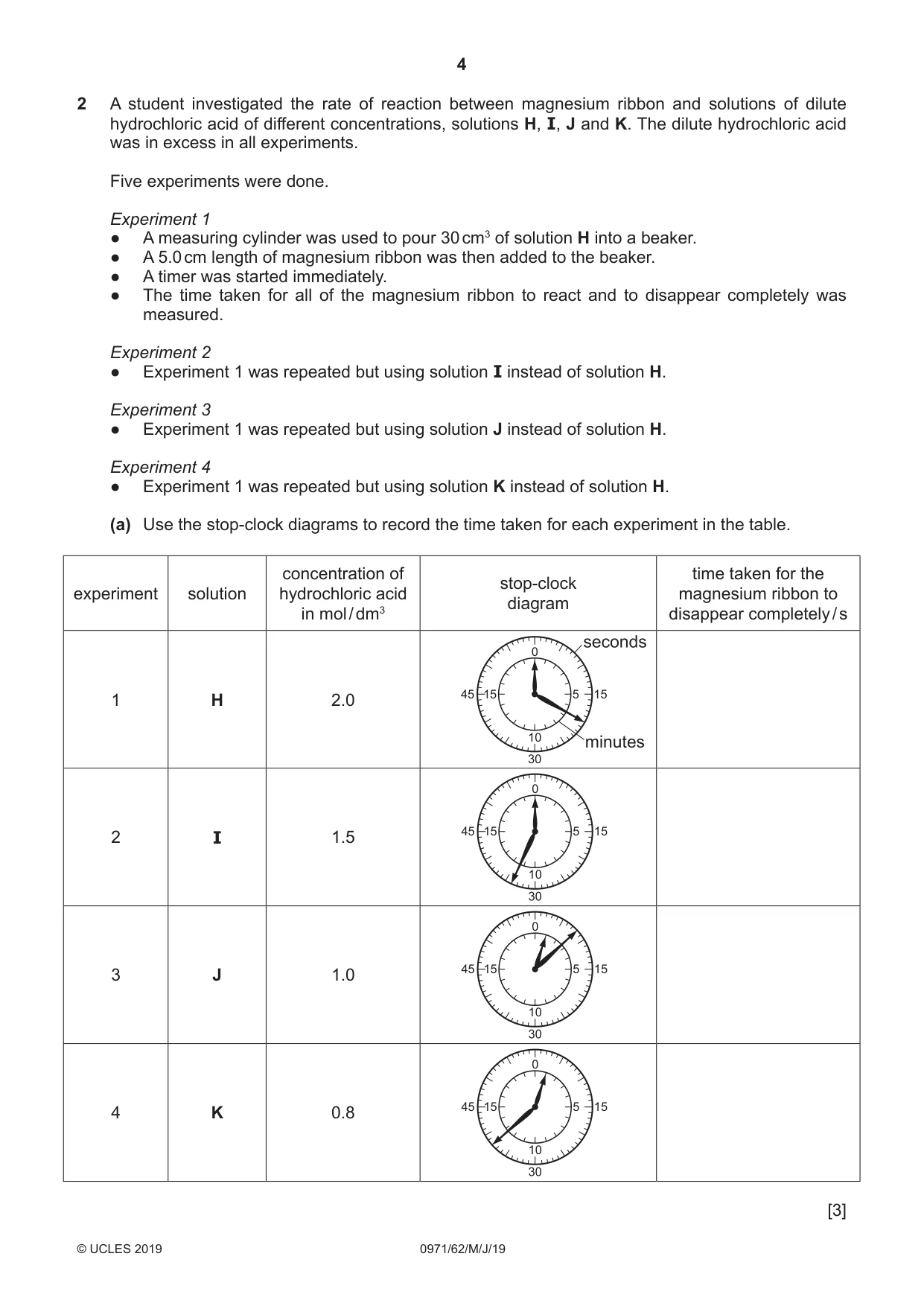
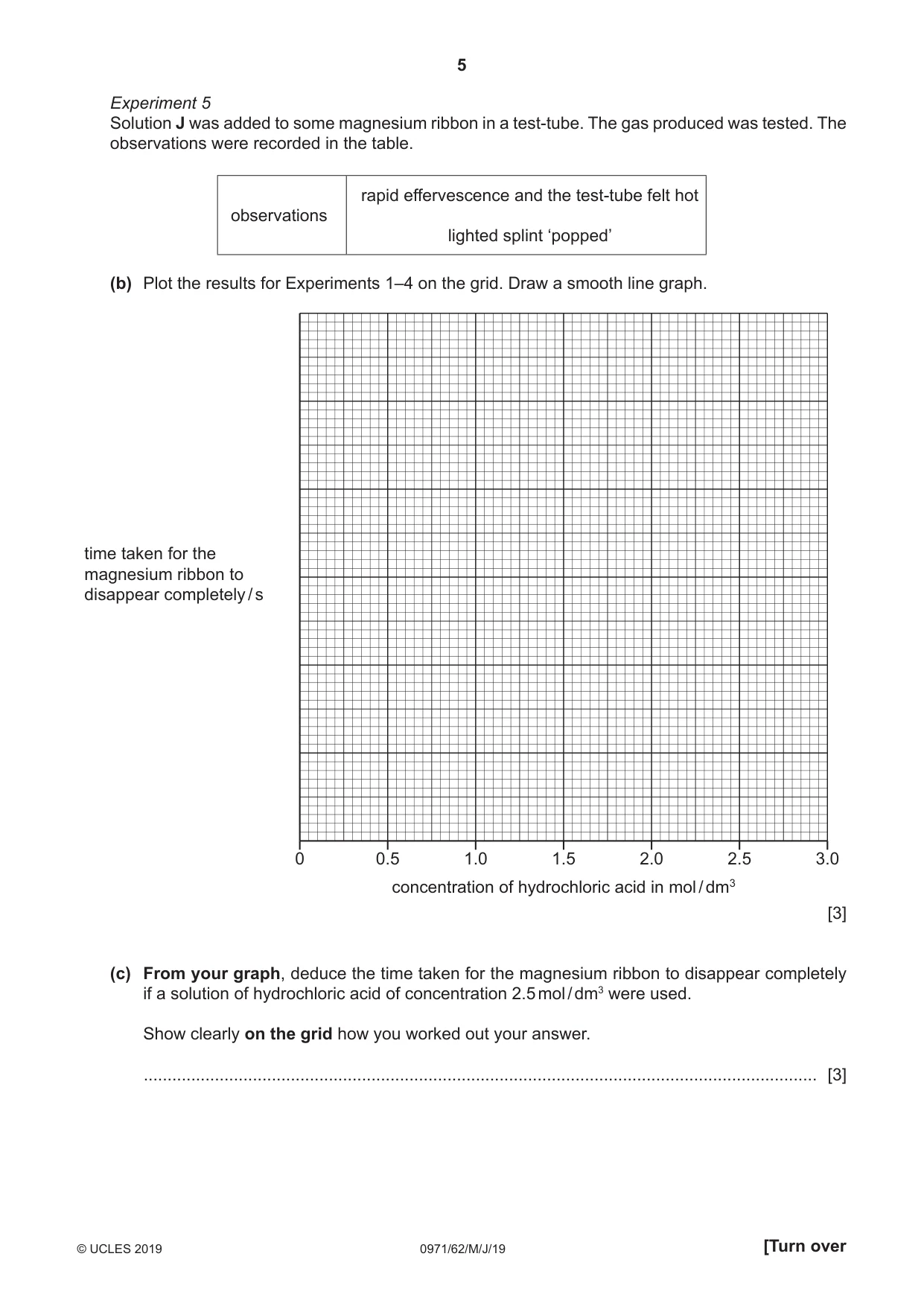
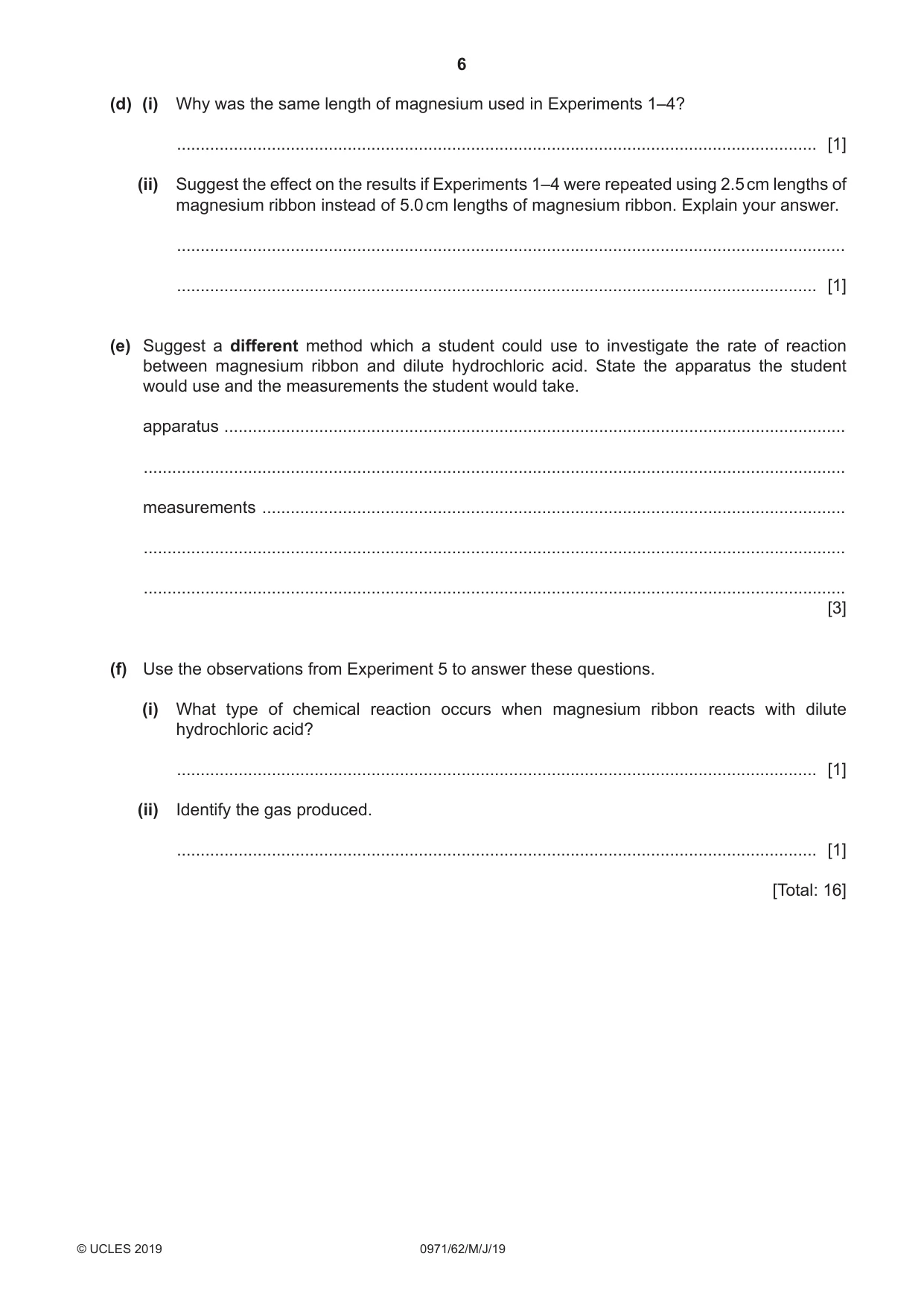
2 A student investigated the rate of reaction between magnesium ribbon and solutions of dilute hydrochloric acid of different concentrations, solutions H, I, J and K. The dilute hydrochloric acid was in excess in all experiments. Five experiments were done. Experiment 1 ●● A measuring cylinder was used to pour 30 cm3 of solution H into a beaker. ●● A 5.0 cm length of magnesium ribbon was then added to the beaker. ●● A timer was started immediately. ●● The time taken for all of the magnesium ribbon to react and to disappear completely was measured. Experiment 2 ●● Experiment 1 was repeated but using solution I instead of solution H. Experiment 3 ●● Experiment 1 was repeated but using solution J instead of solution H. Experiment 4 ●● Experiment 1 was repeated but using solution K instead of solution H. (a) Use the stop-clock diagrams to record the time taken for each experiment in the table. concentration of time taken for the stop-clockexperiment solution hydrochloric acid magnesium ribbon to diagram in mol / dm3 disappear completely / s 0 1 H 2.0 45 15 5 15 10 minutes 0 2 I 1.5 45 15 5 15 10 0 3 J 1.0 45 15 5 15 10 0 4 K 0.8 45 15 5 15 10 [3] Experiment 5 Solution J was added to some magnesium ribbon in a test‑tube. The gas produced was tested. The observations were recorded in the table. rapid effervescence and the test-tube felt hot observations lighted splint ‘popped’ (b) Plot the results for Experiments 1–4 on the grid. Draw a smooth line graph. time taken for the magnesium ribbon to disappear completely / s 0 0.5 1.0 1.5 2.0 2.5 3.0 concentration of hydrochloric acid in mol / dm3 [3] (c) From your graph, deduce the time taken for the magnesium ribbon to disappear completely if a solution of hydrochloric acid of concentration 2.5 mol / dm3 were used. Show clearly on the grid how you worked out your answer. .............................................................................................................................................. [3] (d) (i) Why was the same length of magnesium used in Experiments 1–4? ....................................................................................................................................... [1] (ii) Suggest the effect on the results if Experiments 1–4 were repeated using 2.5 cm lengths of magnesium ribbon instead of 5.0 cm lengths of magnesium ribbon. Explain your answer. ............................................................................................................................................. ....................................................................................................................................... [1] (e) Suggest a different method which a student could use to investigate the rate of reaction between magnesium ribbon and dilute hydrochloric acid. State the apparatus the student would use and the measurements the student would take. apparatus ................................................................................................................................... .................................................................................................................................................... measurements ........................................................................................................................... .................................................................................................................................................... .................................................................................................................................................... [3] (f) Use the observations from Experiment 5 to answer these questions. (i) What type of chemical reaction occurs when magnesium ribbon reacts with dilute hydrochloric acid? ....................................................................................................................................... [1] (ii) Identify the gas produced. ....................................................................................................................................... [1] [Total: 16]
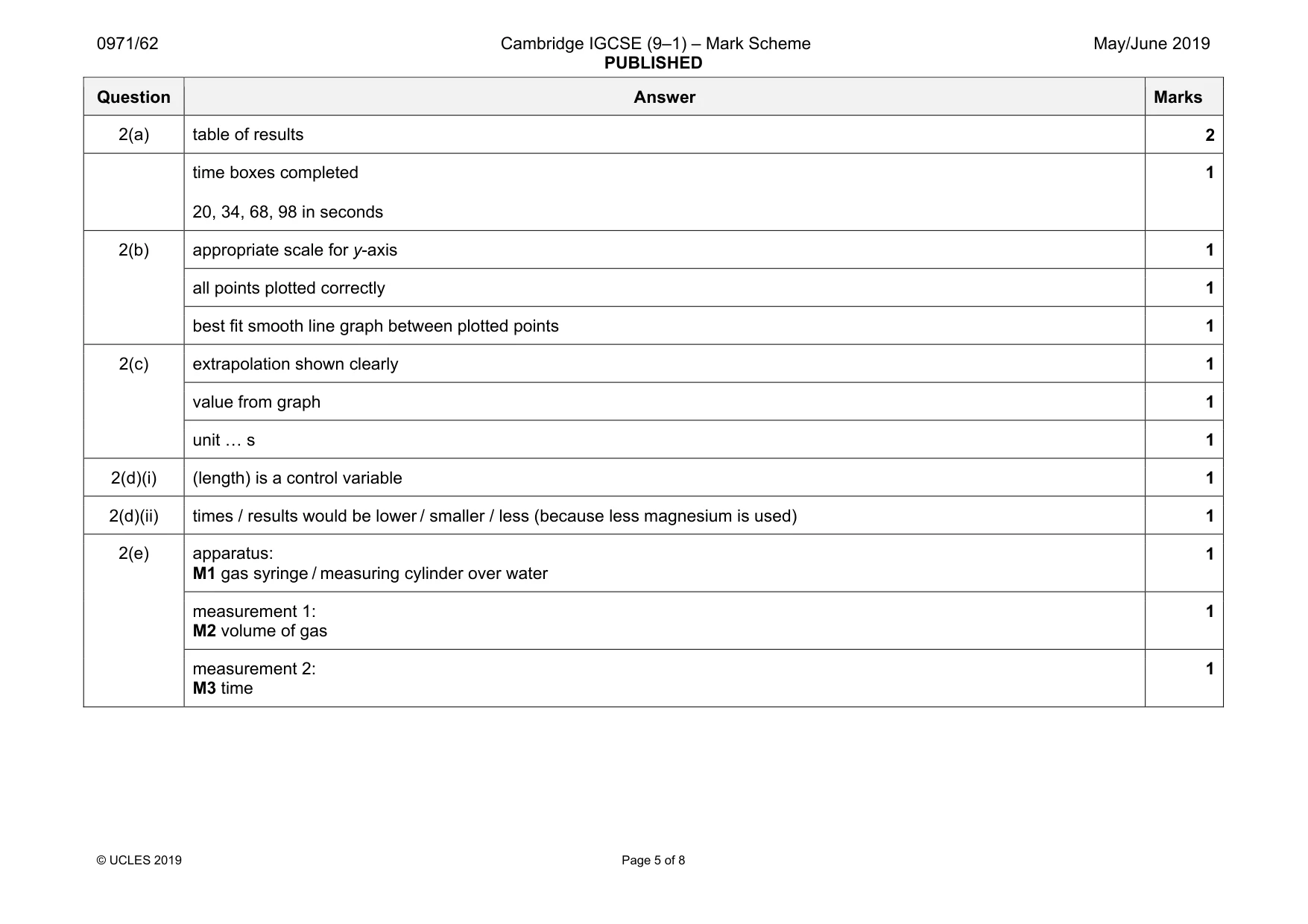
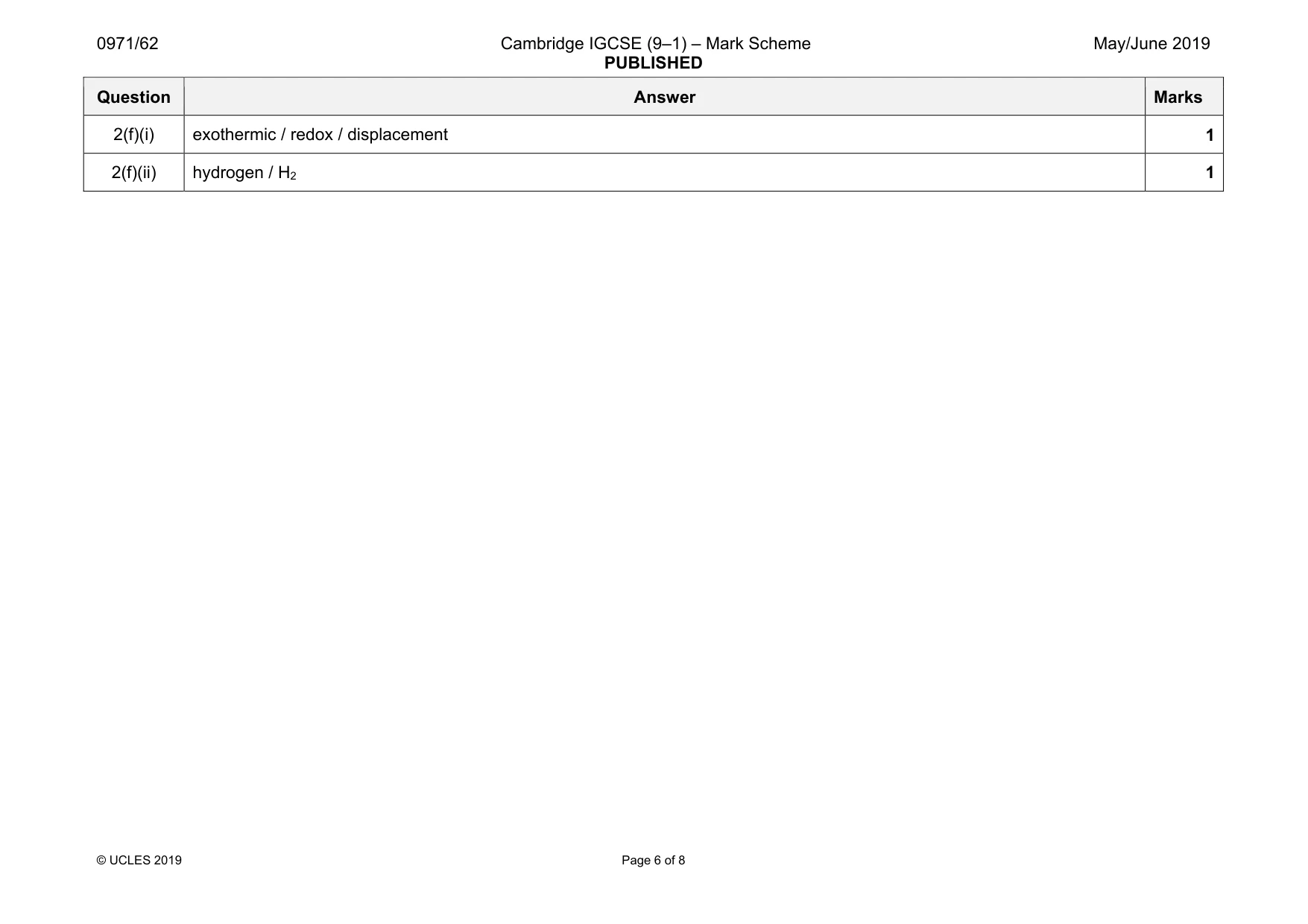
Mark scheme: 2(a) table of results 2 time boxes completed 20, 34, 68, 98 in seconds 1 2(b) appropriate scale for y-axis 1 all points plotted correctly 1 best fit smooth line graph between plotted points 1 2(c) extrapolation shown clearly 1 value from graph 1 unit « s 1 2(d)(i) (length) is a control variable 1 2(d)(ii) times / results would be lower / smaller / less (because less magnesium is used) 1 2(e) apparatus: M1 gas syringe / measuring cylinder over water 1 measurement 1: M2 volume of gas 1 measurement 2: M3 time 1 Question Answer Marks 2(f)(i) exothermic / redox / displacement 1 2(f)(ii) hydrogen / H2 1
Q3 · Two substances, solid L and solid M, were analysed
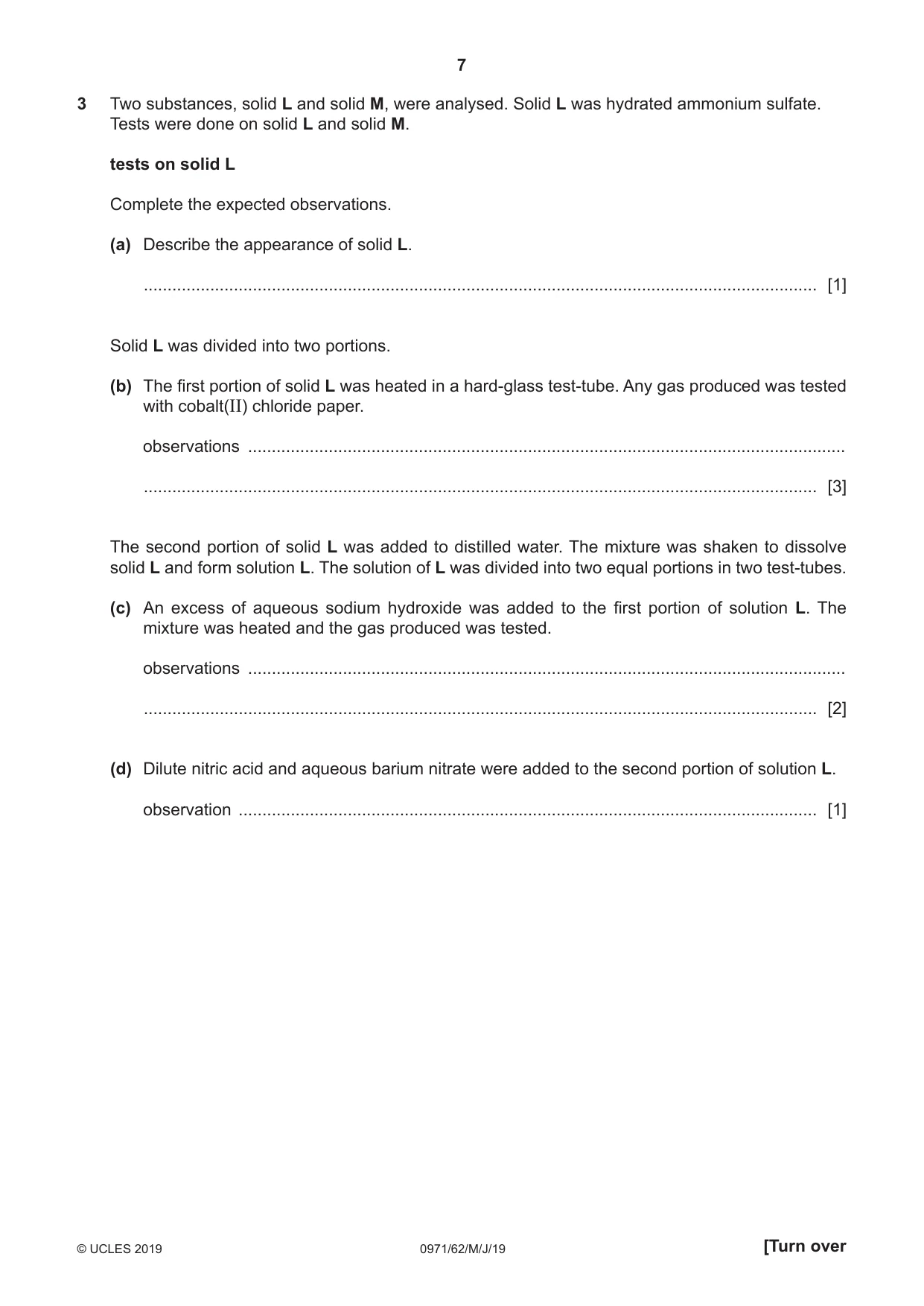
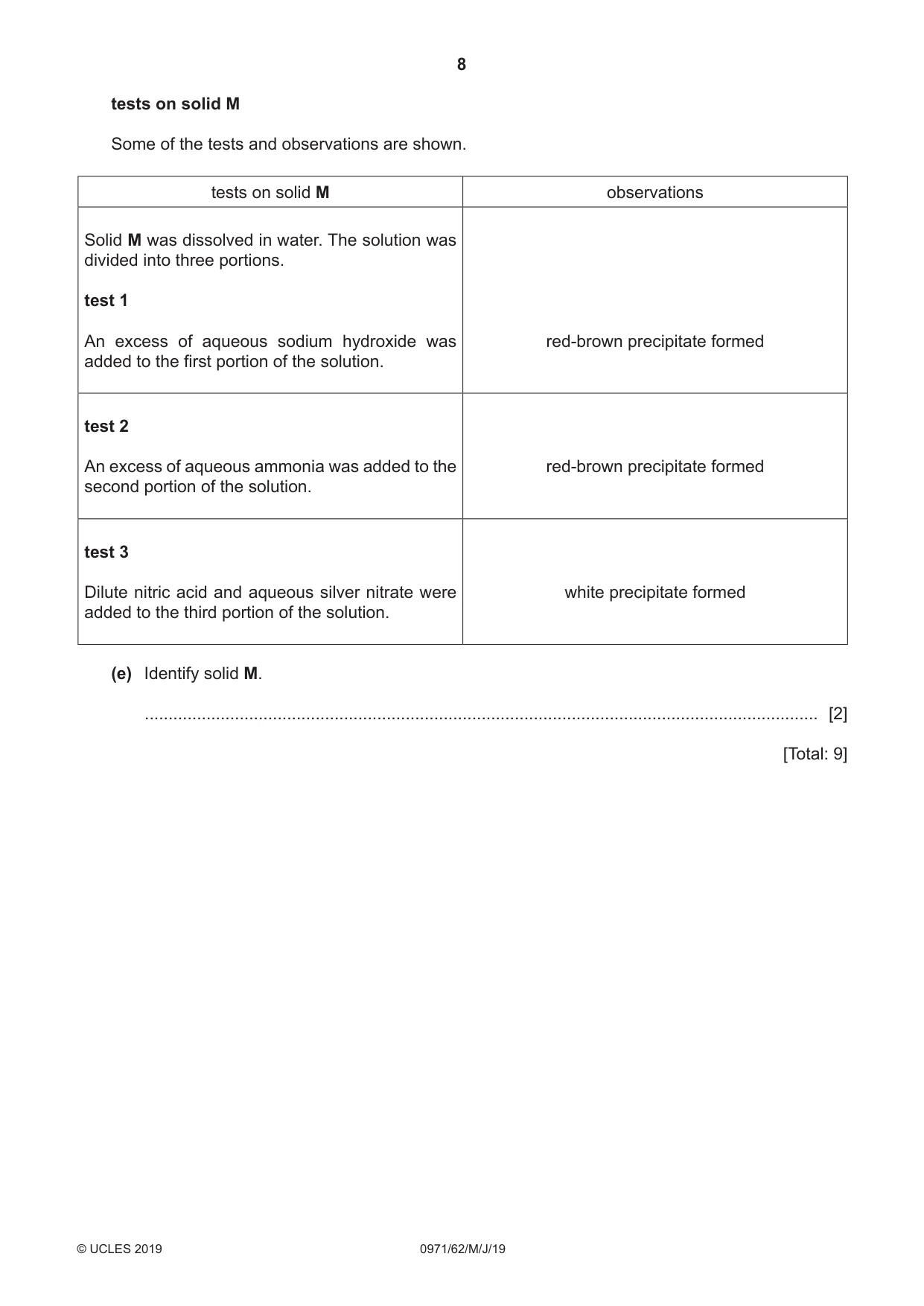
3 Two substances, solid L and solid M, were analysed. Solid L was hydrated ammonium sulfate. Tests were done on solid L and solid M. tests on solid L Complete the expected observations. (a) Describe the appearance of solid L. .............................................................................................................................................. [1] Solid L was divided into two portions. (b) The first portion of solid L was heated in a hard-glass test-tube. Any gas produced was tested with cobalt(II) chloride paper. observations ............................................................................................................................... .............................................................................................................................................. [3] The second portion of solid L was added to distilled water. The mixture was shaken to dissolve solid L and form solution L. The solution of L was divided into two equal portions in two test‑tubes. (c) An excess of aqueous sodium hydroxide was added to the first portion of solution L. The mixture was heated and the gas produced was tested. observations ............................................................................................................................... .............................................................................................................................................. [2] (d) Dilute nitric acid and aqueous barium nitrate were added to the second portion of solution L. observation ........................................................................................................................... [1] tests on solid M Some of the tests and observations are shown. tests on solid M observations Solid M was dissolved in water. The solution was divided into three portions. test 1 An excess of aqueous sodium hydroxide was red-brown precipitate formed added to the first portion of the solution. test 2 An excess of aqueous ammonia was added to the red-brown precipitate formed second portion of the solution. test 3 Dilute nitric acid and aqueous silver nitrate were white precipitate formed added to the third portion of the solution. (e) Identify solid M. .............................................................................................................................................. [2] [Total: 9]
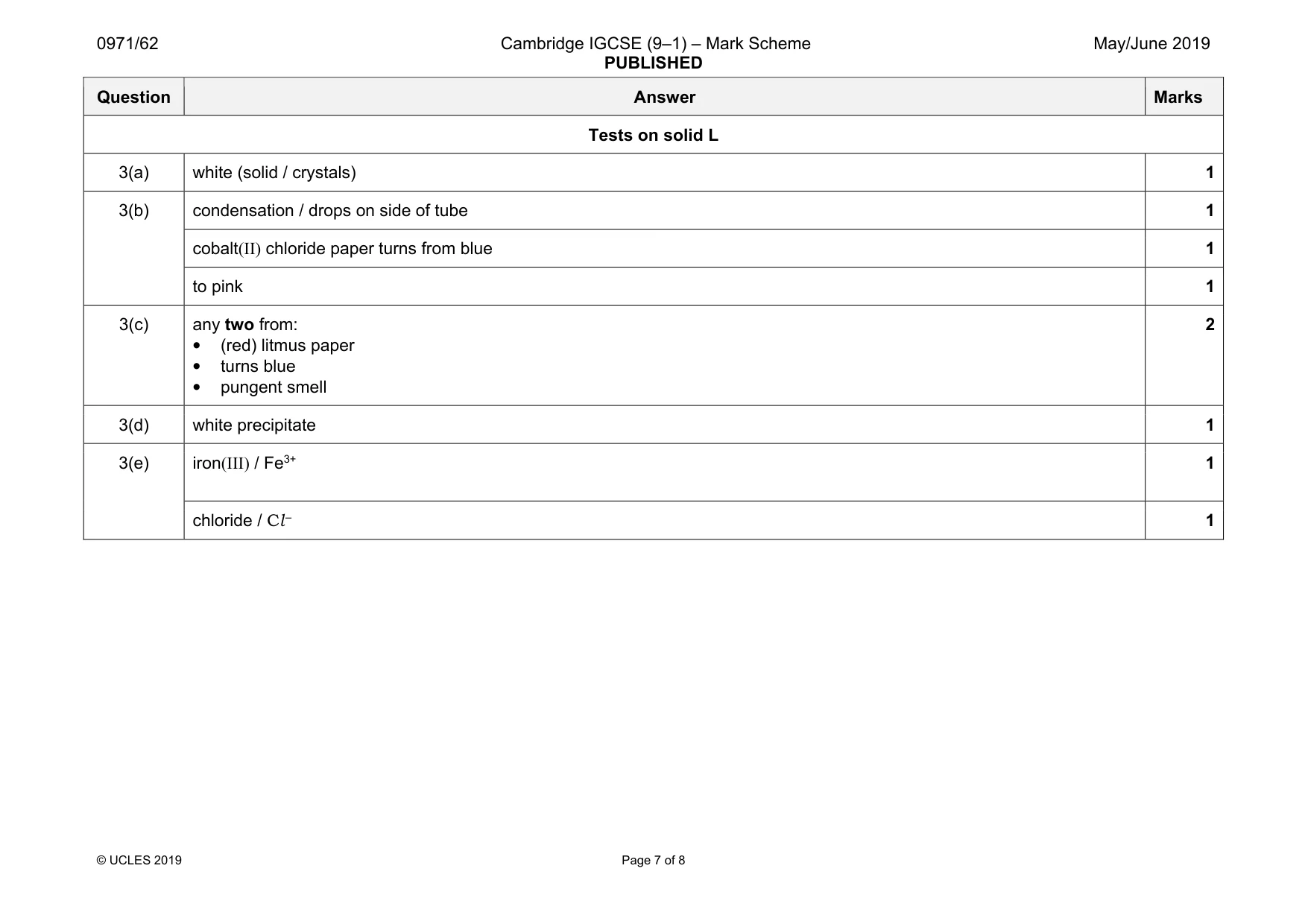
Mark scheme: 3(a) white (solid / crystals) 1 3(b) condensation / drops on side of tube 1 cobalt(II) chloride paper turns from blue 1 to pink 1 3(c) any two from: • (red) litmus paper • turns blue • pungent smell 2 3(d) white precipitate 1 3(e) iron(III) / Fe3+ 1 chloride / Cl – 1
Q4 · Azurite is an ore of copper which contains copper(II) carbonate
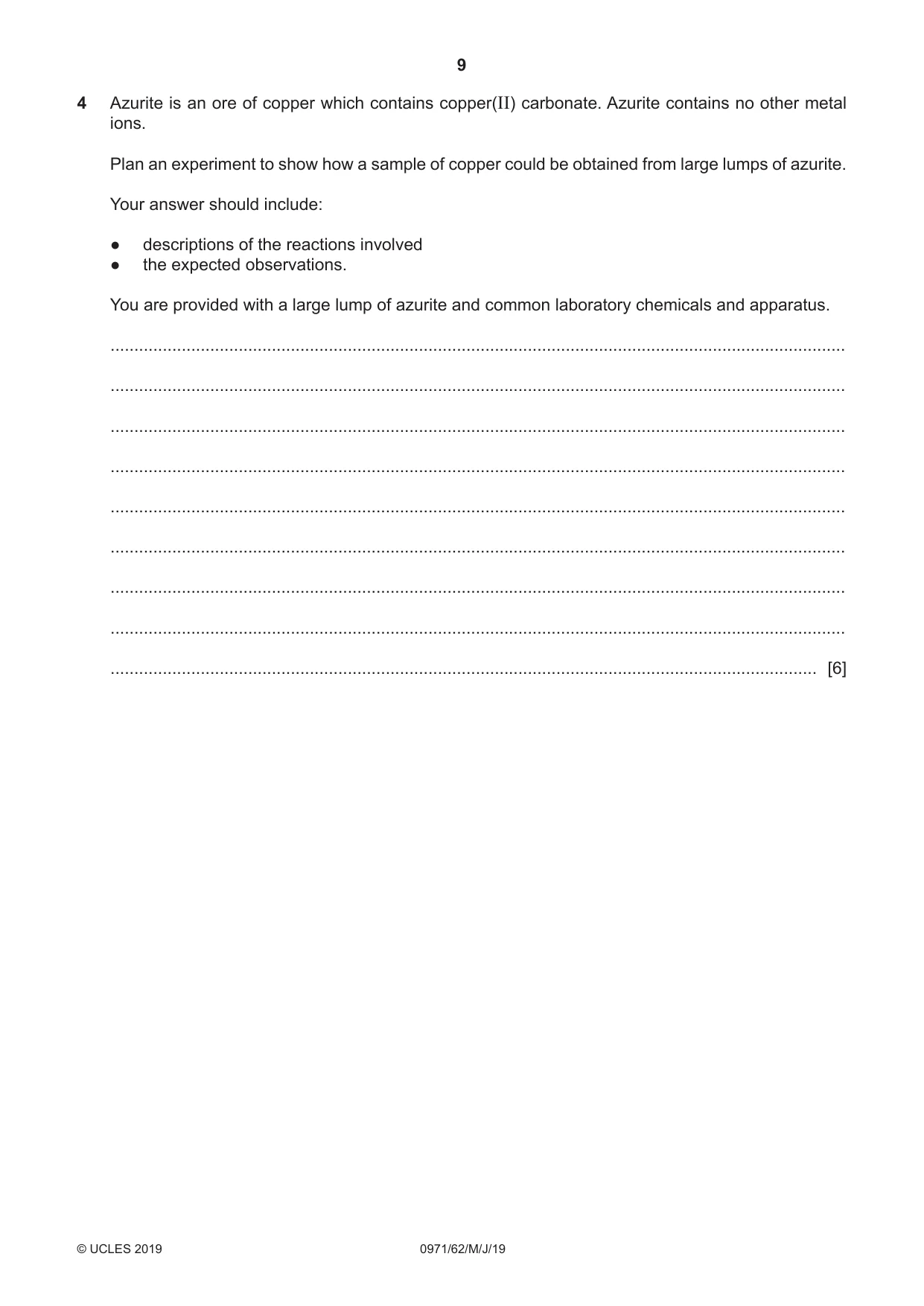
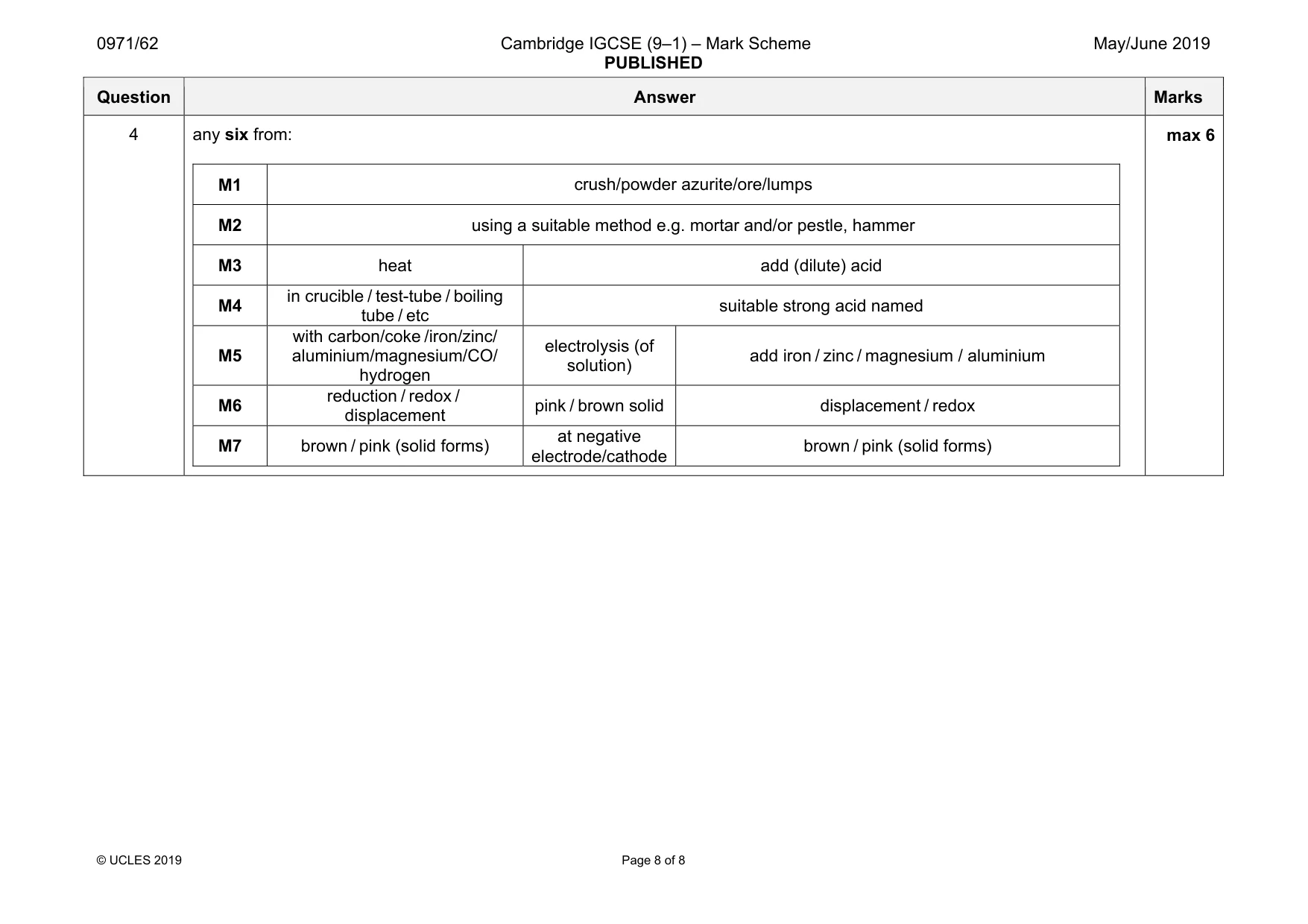
4 Azurite is an ore of copper which contains copper(II) carbonate. Azurite contains no other metal ions. Plan an experiment to show how a sample of copper could be obtained from large lumps of azurite. Your answer should include: ●● descriptions of the reactions involved ●● the expected observations. You are provided with a large lump of azurite and common laboratory chemicals and apparatus. ........................................................................................................................................................... ........................................................................................................................................................... ........................................................................................................................................................... ........................................................................................................................................................... ........................................................................................................................................................... ........................................................................................................................................................... ........................................................................................................................................................... ........................................................................................................................................................... ..................................................................................................................................................... [6]
Mark scheme: 4 any six from: M1 crush/powder azurite/ore/lumps M2 using a suitable method e.g. mortar and/or pestle, hammer M3 heat add (dilute) acid M4 in crucible / test-tube / boiling tube / etc suitable strong acid named M5 with carbon/coke /iron/zinc/ aluminium/magnesium/CO/ hydrogen electrolysis (of solution) add iron / zinc / magnesium / aluminium M6 reduction / redox / displacement pink / brown solid displacement / redox M7 brown / pink (solid forms) at negative electrode/cathode brown / pink (solid forms) max 6
What was in this paper
The subtopics covered by these 4 questions, and how many questions each got. Open one in a new tab to see every Cambridge question on it.
What you needed in this session
Cambridge’s own grade thresholds for 2019 May/June, Paper 6 · Variant 2. A higher threshold means an easier paper — the bar moves with how the cohort did.