Cambridge IGCSE Chemistry (9-1) 0971 — 2018 May/June Paper 4 · Variant 1
0971/41/M/J/18 · 6 questions · 80 marks · ≈90 min
The question paper and its mark scheme, free to read here and free to download. This is Cambridge’s own paper, exactly as it was sat.
Question paper12 pages
Mark scheme10 pages
Answers below. Sit the paper first if you are practising.
Questions as text
Q1 · Substances can be classified as elements, compounds or mixtures
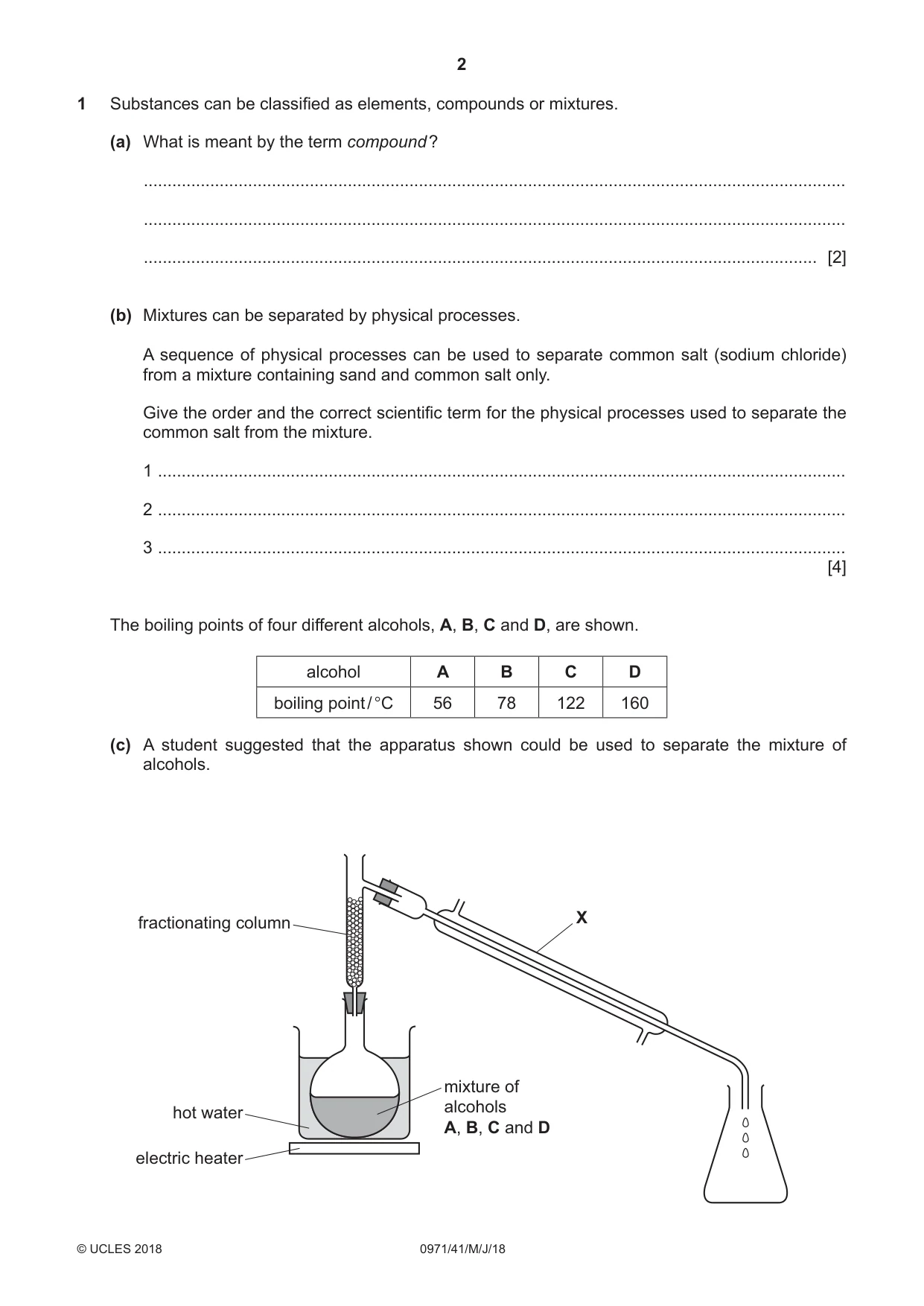
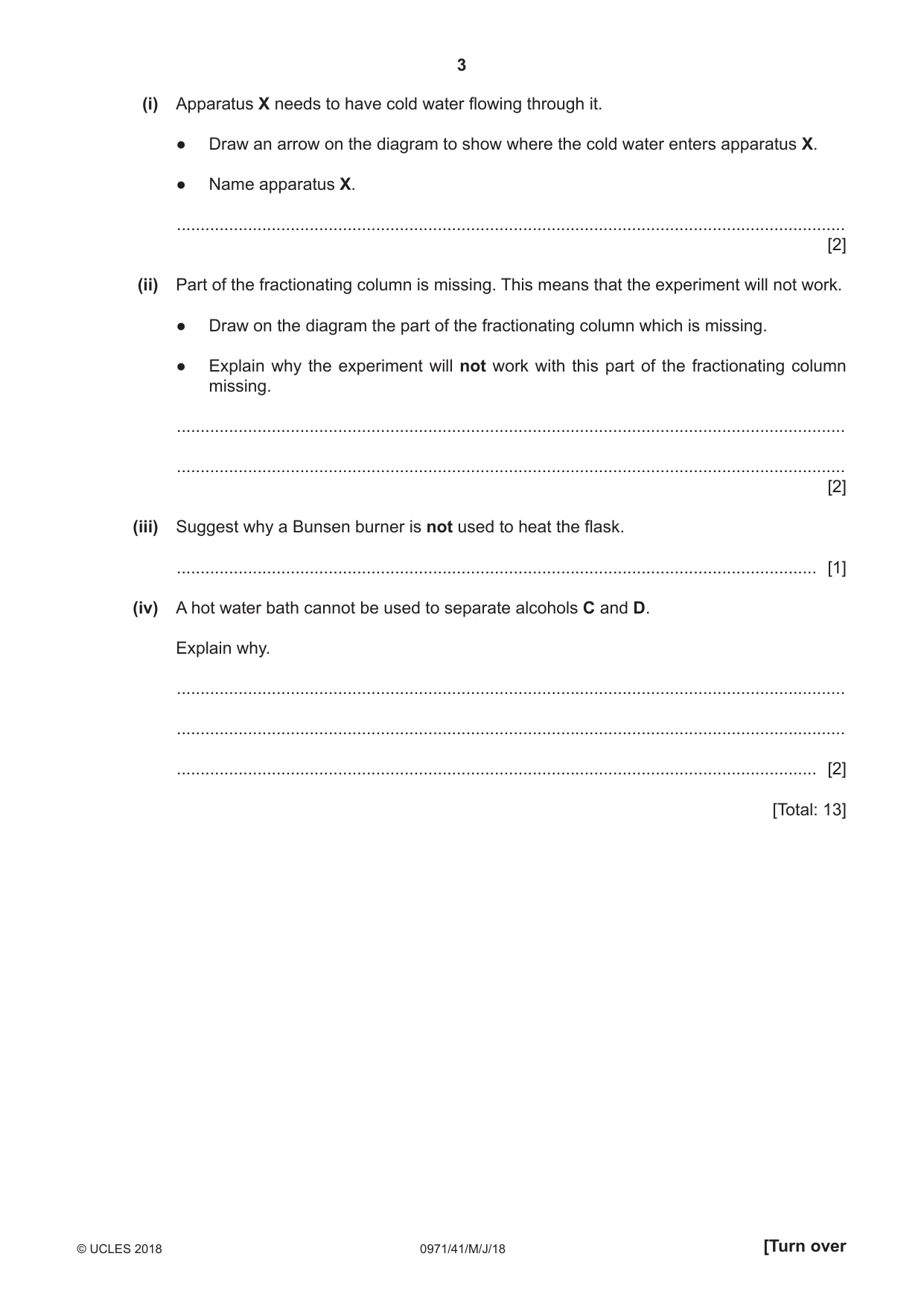
1 Substances can be classified as elements, compounds or mixtures. (a) What is meant by the term compound ? .................................................................................................................................................... .................................................................................................................................................... .............................................................................................................................................. [2] (b) Mixtures can be separated by physical processes. A sequence of physical processes can be used to separate common salt (sodium chloride) from a mixture containing sand and common salt only. Give the order and the correct scientific term for the physical processes used to separate the common salt from the mixture. 1 ................................................................................................................................................. 2 ................................................................................................................................................. 3 ................................................................................................................................................. [4] The boiling points of four different alcohols, A, B, C and D, are shown. alcohol A B C D boiling point / °C 56 78 122 160 (c) A student suggested that the apparatus shown could be used to separate the mixture of alcohols. fractionating column X mixture of alcohols hot water A, B, C and D electric heater (i) Apparatus X needs to have cold water flowing through it. ● Draw an arrow on the diagram to show where the cold water enters apparatus X. ● Name apparatus X. ............................................................................................................................................. [2] (ii) Part of the fractionating column is missing. This means that the experiment will not work. ● Draw on the diagram the part of the fractionating column which is missing. ● Explain why the experiment will not work with this part of the fractionating column missing. ............................................................................................................................................. ............................................................................................................................................. [2] (iii) Suggest why a Bunsen burner is not used to heat the flask. ....................................................................................................................................... [1] (iv) A hot water bath cannot be used to separate alcohols C and D. Explain why. ............................................................................................................................................. ............................................................................................................................................. ....................................................................................................................................... [2] [Total: 13]
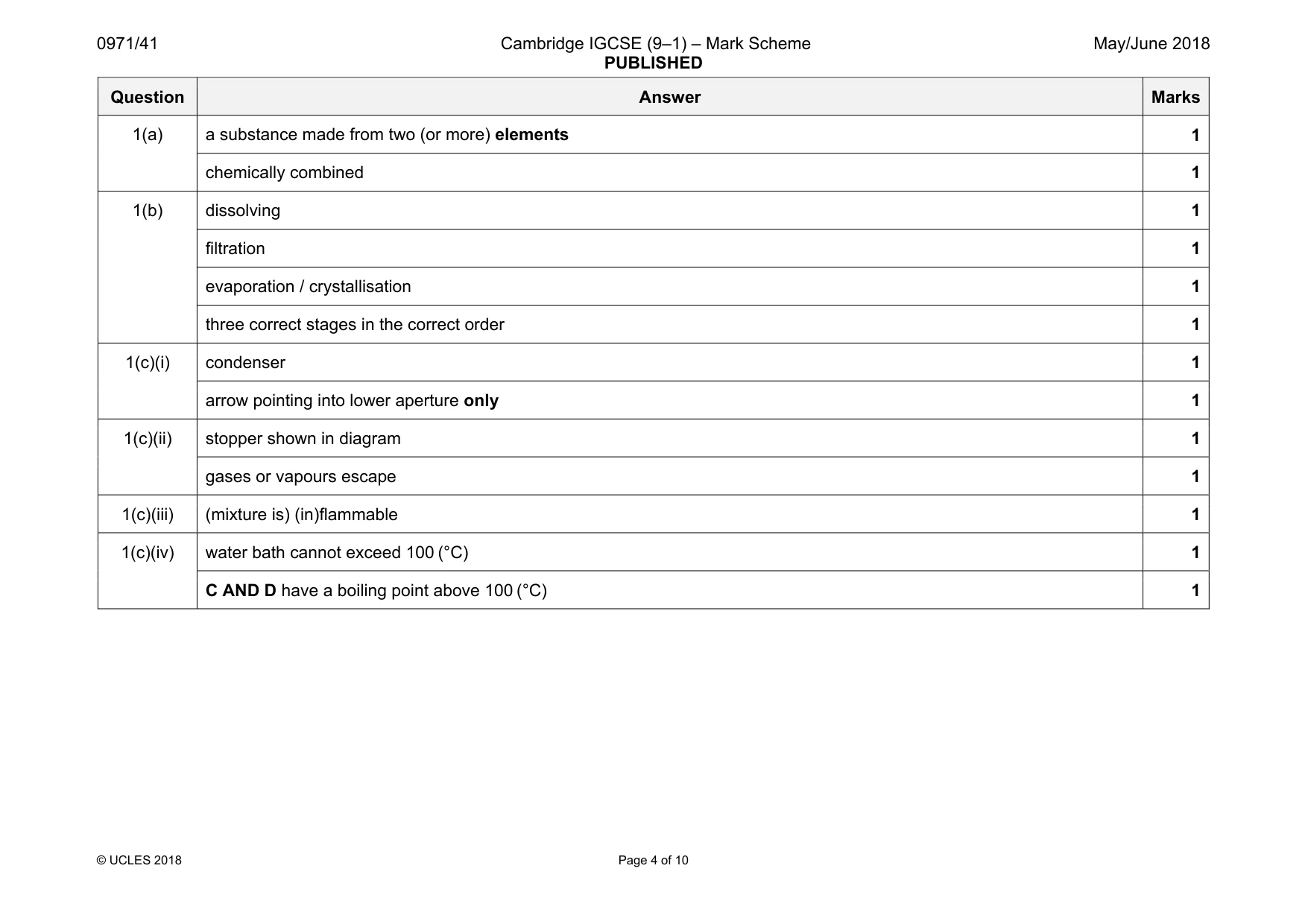
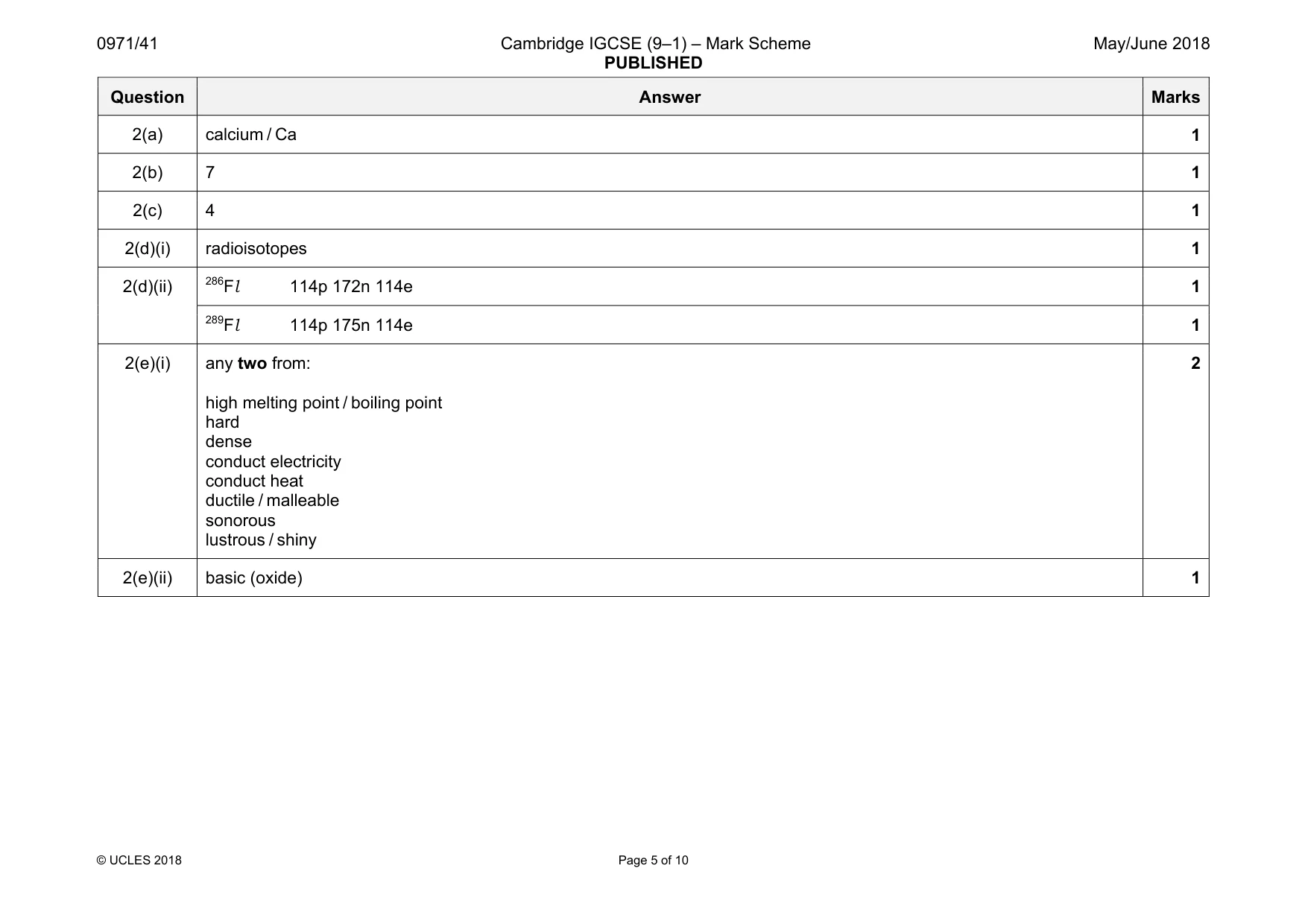
Mark scheme: 1(a) a substance made from two (or more) elements 1 chemically combined 1 1(b) dissolving 1 filtration 1 evaporation / crystallisation 1 three correct stages in the correct order 1 1(c)(i) condenser 1 arrow pointing into lower aperture only 1 1(c)(ii) stopper shown in diagram 1 gases or vapours escape 1 1(c)(iii) (mixture is) (in)flammable 1 1(c)(iv) water bath cannot exceed 100 (°C) 1 C AND D have a boiling point above 100 (°C) 1
Q2 · Flerovium, Fl, atomic number 114, was first made in research laboratories in 1998
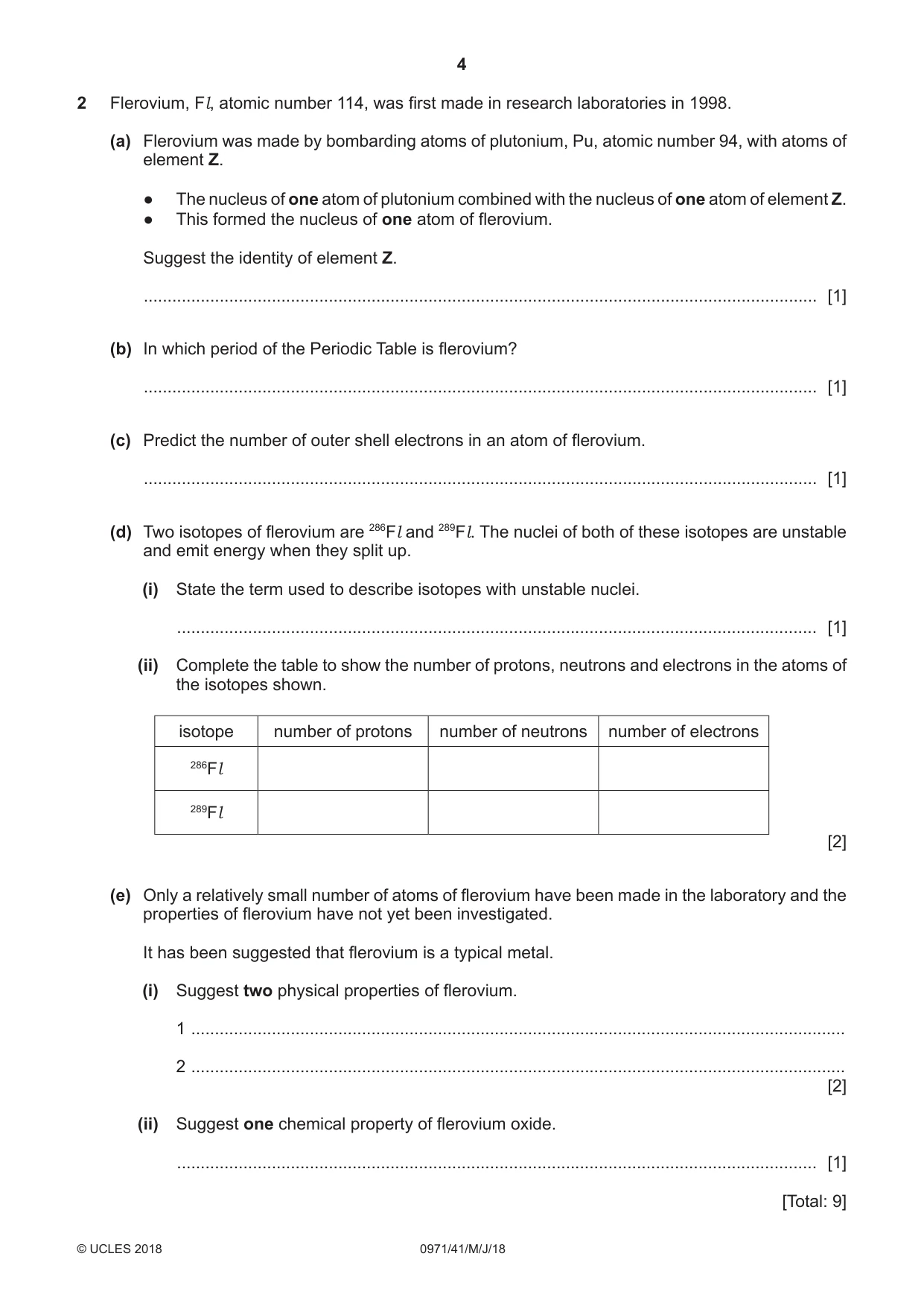
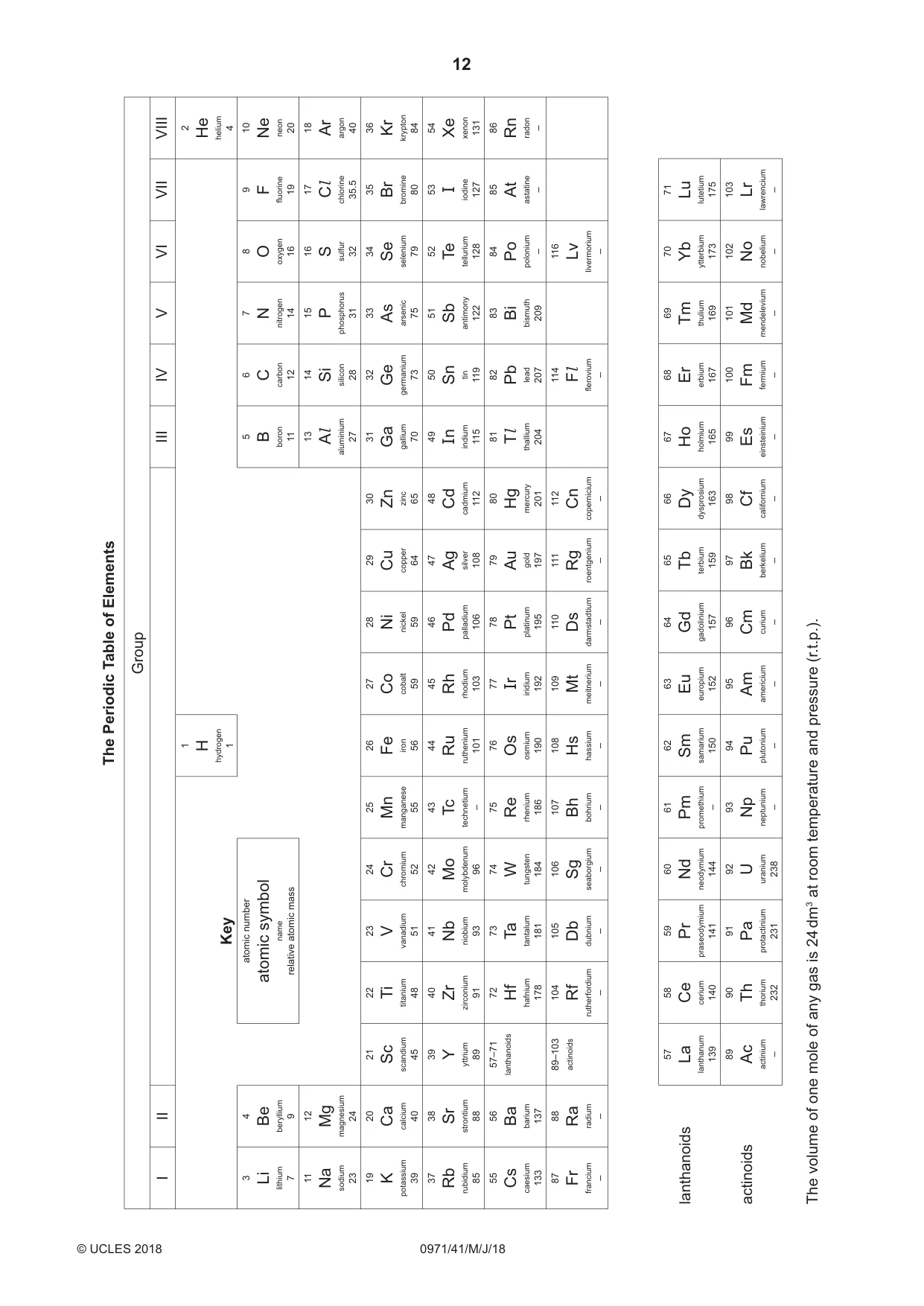
2 Flerovium, Fl, atomic number 114, was first made in research laboratories in 1998. (a) Flerovium was made by bombarding atoms of plutonium, Pu, atomic number 94, with atoms of element Z. ●● The nucleus of one atom of plutonium combined with the nucleus of one atom of element Z. ●● This formed the nucleus of one atom of flerovium. Suggest the identity of element Z. .............................................................................................................................................. [1] (b) In which period of the Periodic Table is flerovium? .............................................................................................................................................. [1] (c) Predict the number of outer shell electrons in an atom of flerovium. .............................................................................................................................................. [1] (d) Two isotopes of flerovium are 286Fl and 289Fl. The nuclei of both of these isotopes are unstable and emit energy when they split up. (i) State the term used to describe isotopes with unstable nuclei. ....................................................................................................................................... [1] (ii) Complete the table to show the number of protons, neutrons and electrons in the atoms of the isotopes shown. isotope number of protons number of neutrons number of electrons 286Fl 289Fl [2] (e) Only a relatively small number of atoms of flerovium have been made in the laboratory and the properties of flerovium have not yet been investigated. It has been suggested that flerovium is a typical metal. (i) Suggest two physical properties of flerovium. 1 .......................................................................................................................................... 2 .......................................................................................................................................... [2] (ii) Suggest one chemical property of flerovium oxide. ....................................................................................................................................... [1] [Total: 9]
Mark scheme: 2(a) calcium / Ca 1 2(b) 7 1 2(c) 4 1 2(d)(i) radioisotopes 1 2(d)(ii) 286Fl 114p 172n 114e 1 289Fl 114p 175n 114e 1 2(e)(i) any two from: high melting point / boiling point hard dense conduct electricity conduct heat ductile / malleable sonorous lustrous / shiny 2 2(e)(ii) basic (oxide) 1
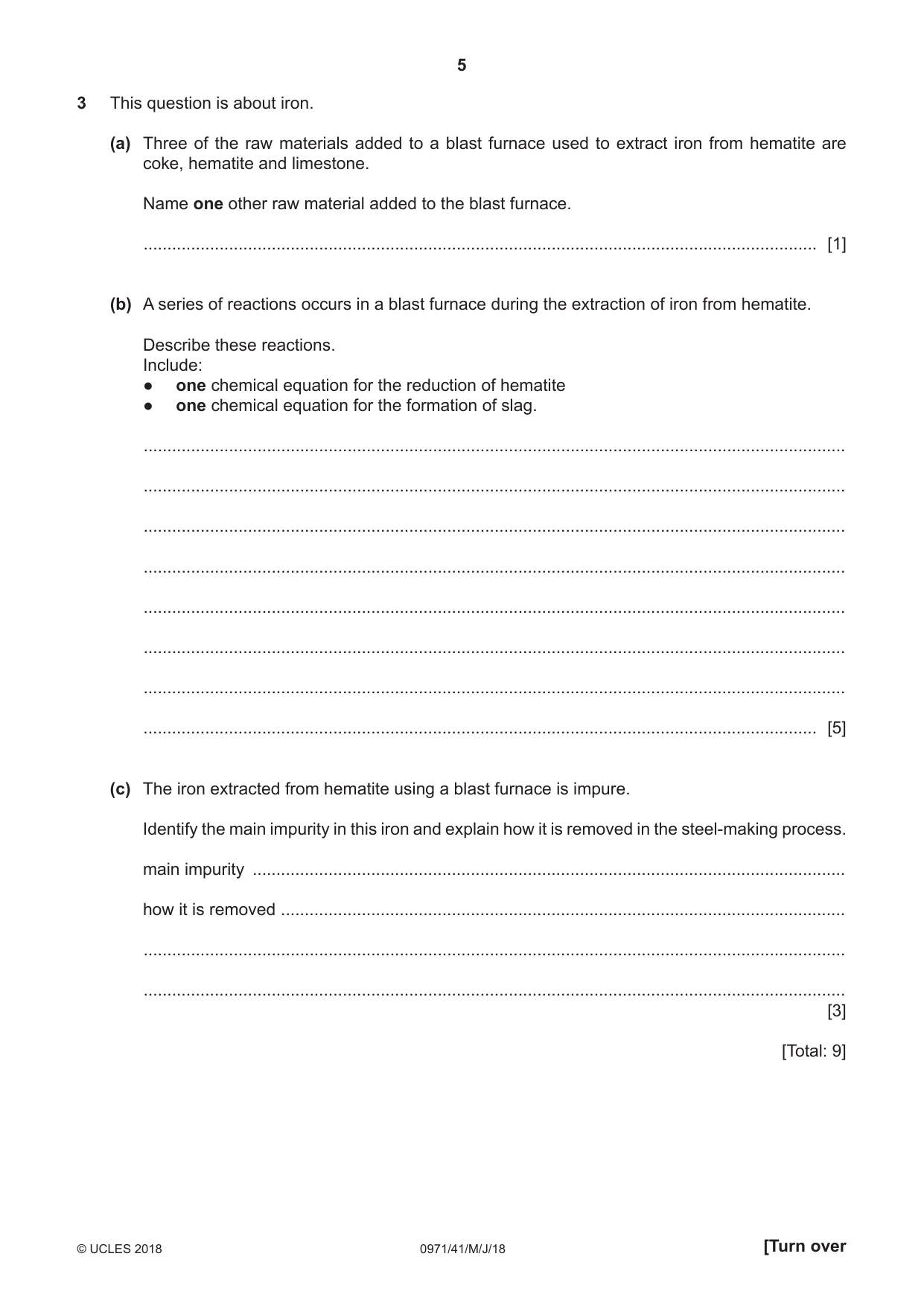
Q3 · This question is about iron
3 This question is about iron. (a) Three of the raw materials added to a blast furnace used to extract iron from hematite are coke, hematite and limestone. Name one other raw material added to the blast furnace. .............................................................................................................................................. [1] (b) A series of reactions occurs in a blast furnace during the extraction of iron from hematite. Describe these reactions. Include: ●● one chemical equation for the reduction of hematite ●● one chemical equation for the formation of slag. .................................................................................................................................................... .................................................................................................................................................... .................................................................................................................................................... .................................................................................................................................................... .................................................................................................................................................... .................................................................................................................................................... .................................................................................................................................................... .............................................................................................................................................. [5] (c) The iron extracted from hematite using a blast furnace is impure. Identify the main impurity in this iron and explain how it is removed in the steel‑making process. main impurity .............................................................................................................................. how it is removed ....................................................................................................................... .................................................................................................................................................... .................................................................................................................................................... [3] [Total: 9]
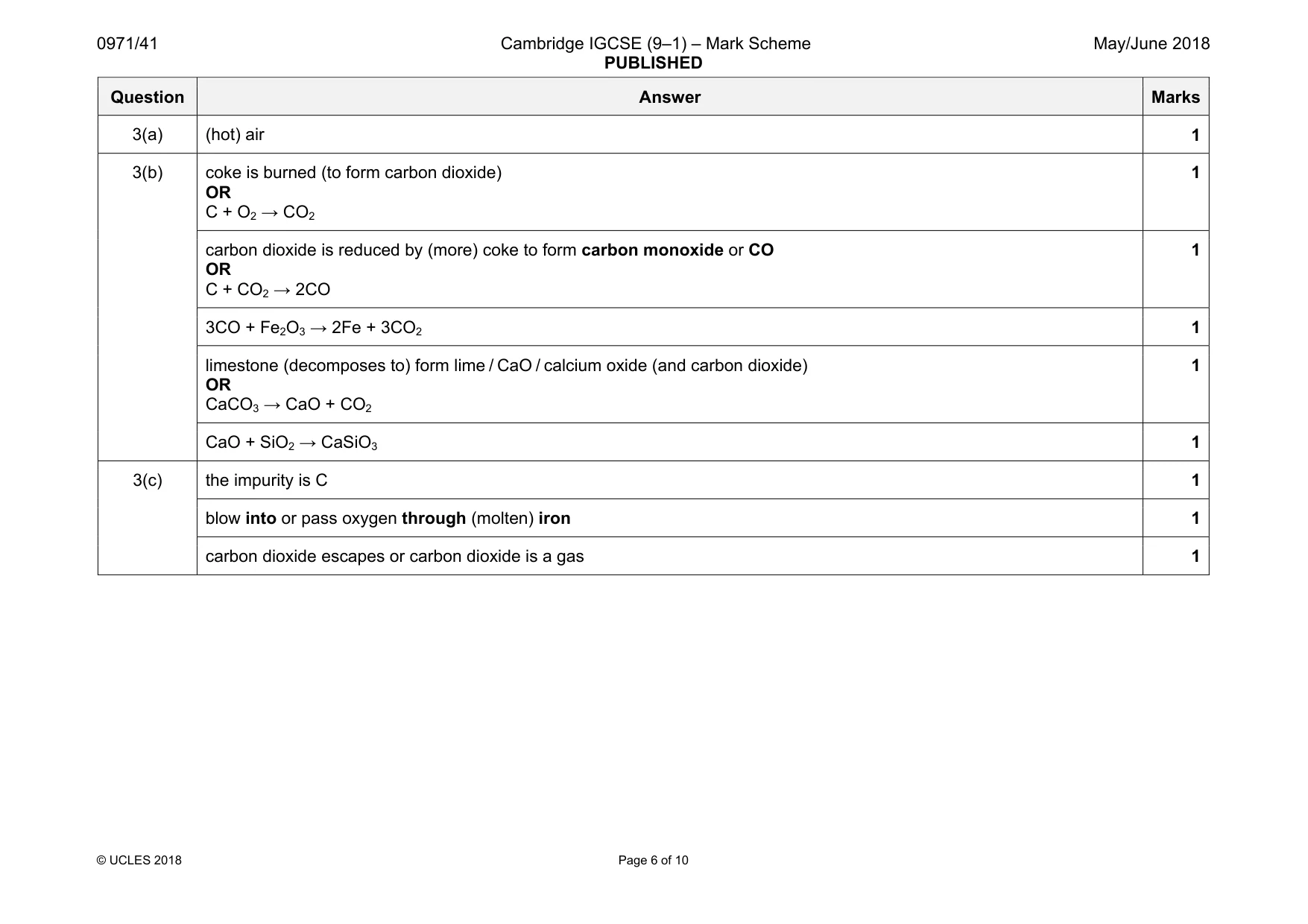
Mark scheme: 3(a) (hot) air 1 3(b) coke is burned (to form carbon dioxide) OR C + O2 → CO2 1 carbon dioxide is reduced by (more) coke to form carbon monoxide or CO OR C + CO2 → 2CO 1 3CO + Fe2O3 → 2Fe + 3CO2 1 limestone (decomposes to) form lime / CaO / calcium oxide (and carbon dioxide) OR CaCO3 → CaO + CO2 1 CaO + SiO2 → CaSiO3 1 3(c) the impurity is C 1 blow into or pass oxygen through (molten) iron 1 carbon dioxide escapes or carbon dioxide is a gas 1
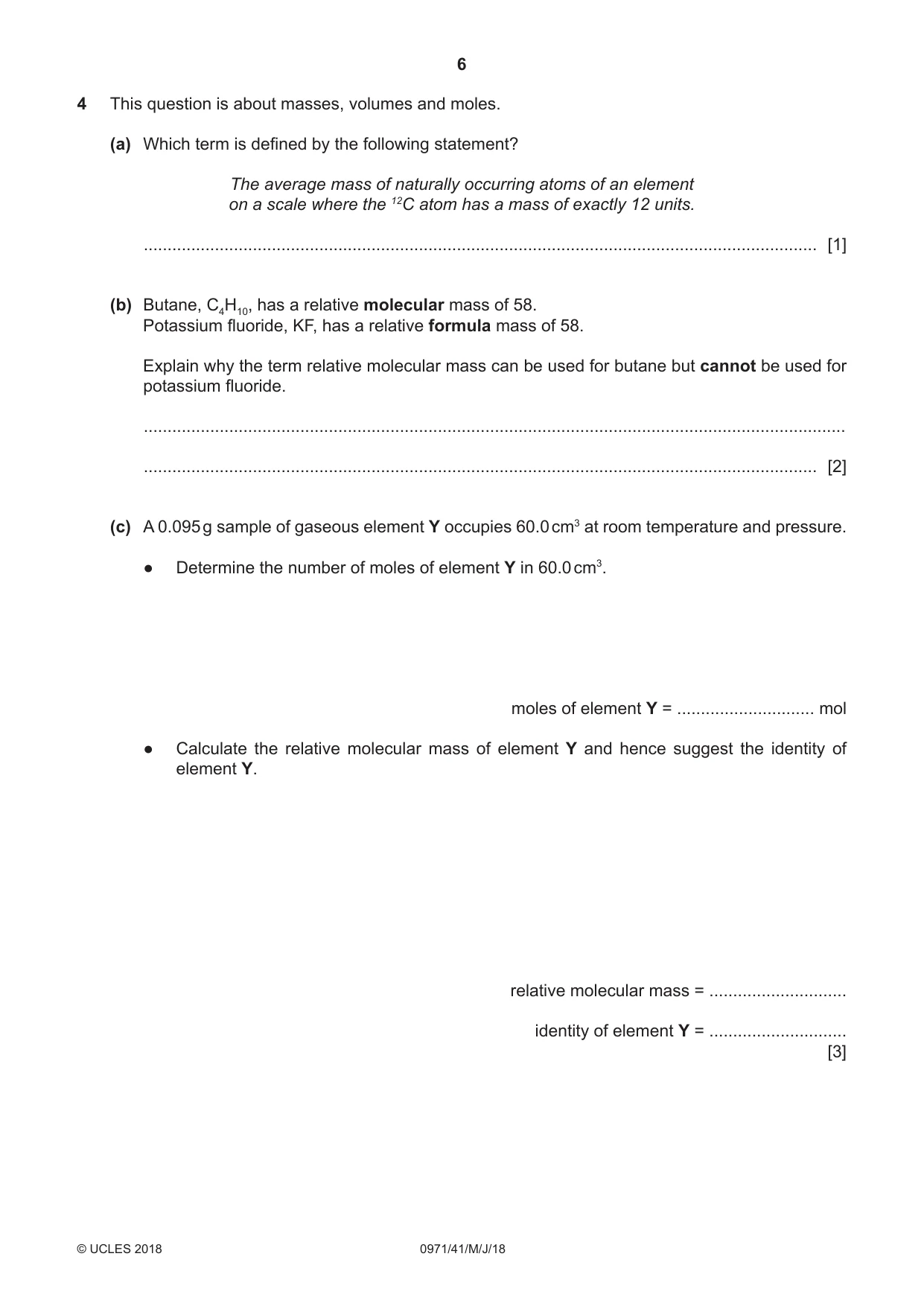
Q4 · This question is about masses, volumes and moles
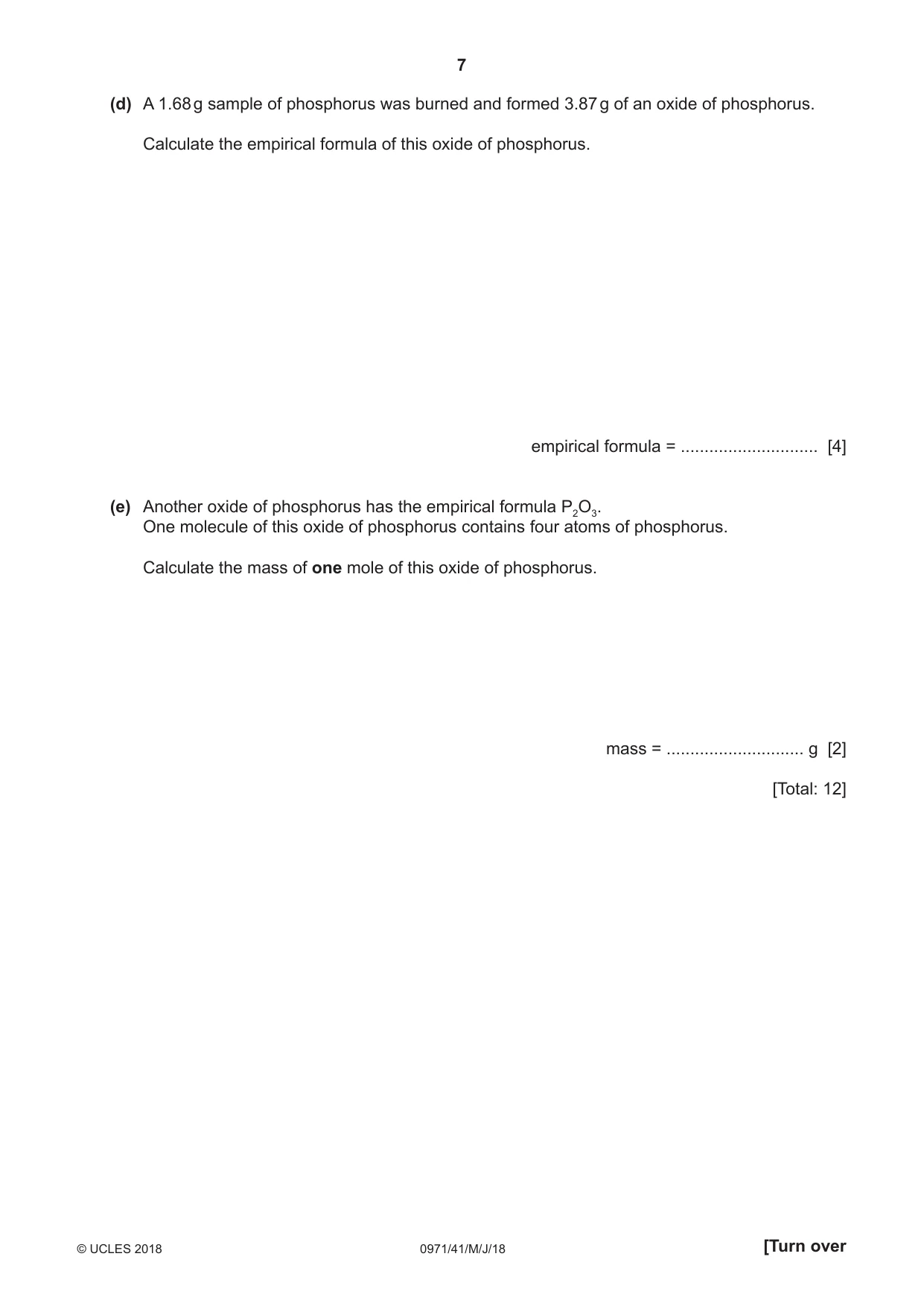
4 This question is about masses, volumes and moles. (a) Which term is defined by the following statement? The average mass of naturally occurring atoms of an element on a scale where the 12C atom has a mass of exactly 12 units. .............................................................................................................................................. [1] (b) Butane, C4H10, has a relative molecular mass of 58. Potassium fluoride, KF, has a relative formula mass of 58. Explain why the term relative molecular mass can be used for butane but cannot be used for potassium fluoride. .................................................................................................................................................... .............................................................................................................................................. [2] (c) A 0.095 g sample of gaseous element Y occupies 60.0 cm3 at room temperature and pressure. ●● Determine the number of moles of element Y in 60.0 cm3. moles of element Y = ............................. mol ●● Calculate the relative molecular mass of element Y and hence suggest the identity of element Y. relative molecular mass = ............................. identity of element Y = ............................. [3] (d) A 1.68 g sample of phosphorus was burned and formed 3.87 g of an oxide of phosphorus. Calculate the empirical formula of this oxide of phosphorus. empirical formula = ............................. [4] (e) Another oxide of phosphorus has the empirical formula P2O3. One molecule of this oxide of phosphorus contains four atoms of phosphorus. Calculate the mass of one mole of this oxide of phosphorus. mass = ............................. g [2] [Total: 12]
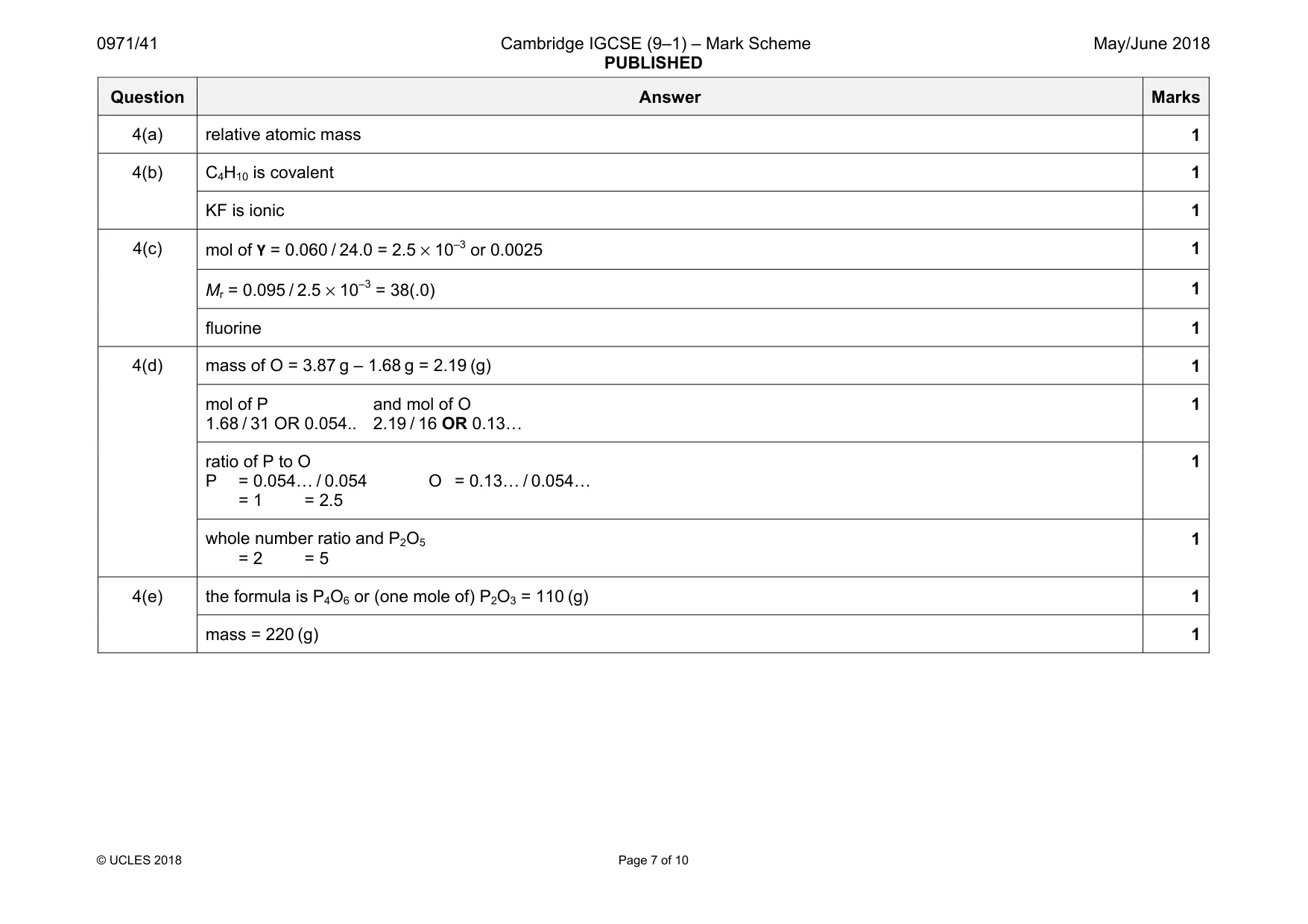
Mark scheme: 4(a) relative atomic mass 1 4(b) C4H10 is covalent 1 KF is ionic 1 4(c) mol of Y = 0.060 / 24.0 = 2.5 × 10⁻³ or 0.0025 1 Mr = 0.095 / 2.5 × 10–3 = 38(.0) 1 fluorine 1 4(d) mass of O = 3.87 g – 1.68 g = 2.19 (g) 1 mol of P and mol of O 1.68 / 31 OR 0.054.. 2.19 / 16 OR 0.13« 1 ratio of P to O P = 0.054« / 0.054 O = 0.13« / 0.054« = 1 = 2.5 1 whole number ratio and P2O5 = 2 = 5 1 4(e) the formula is P4O6 or (one mole of) P2O3 = 110 (g) 1 mass = 220 (g) 1
Q5 · The table gives some chemical properties of transition elements and their compounds, and…
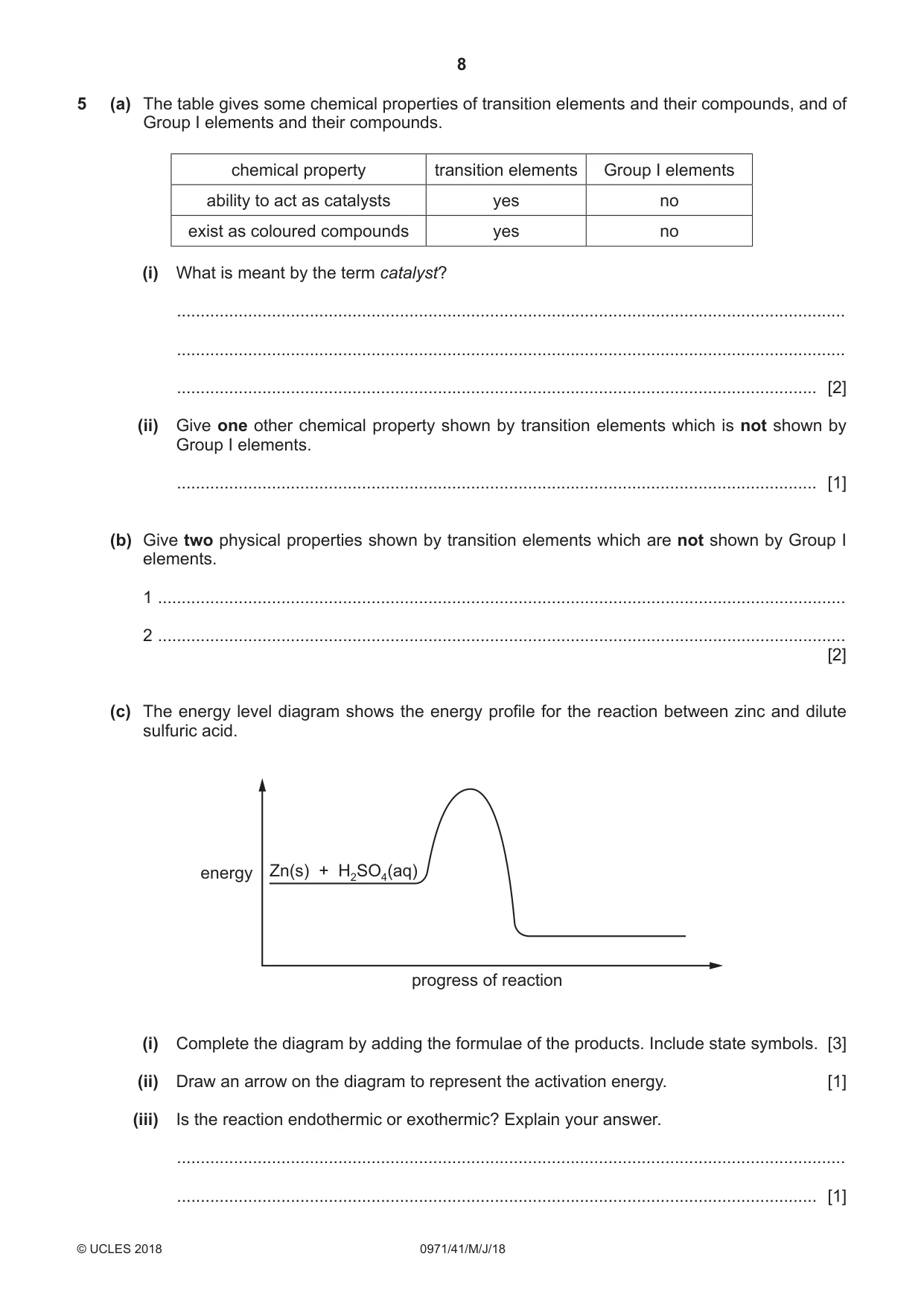
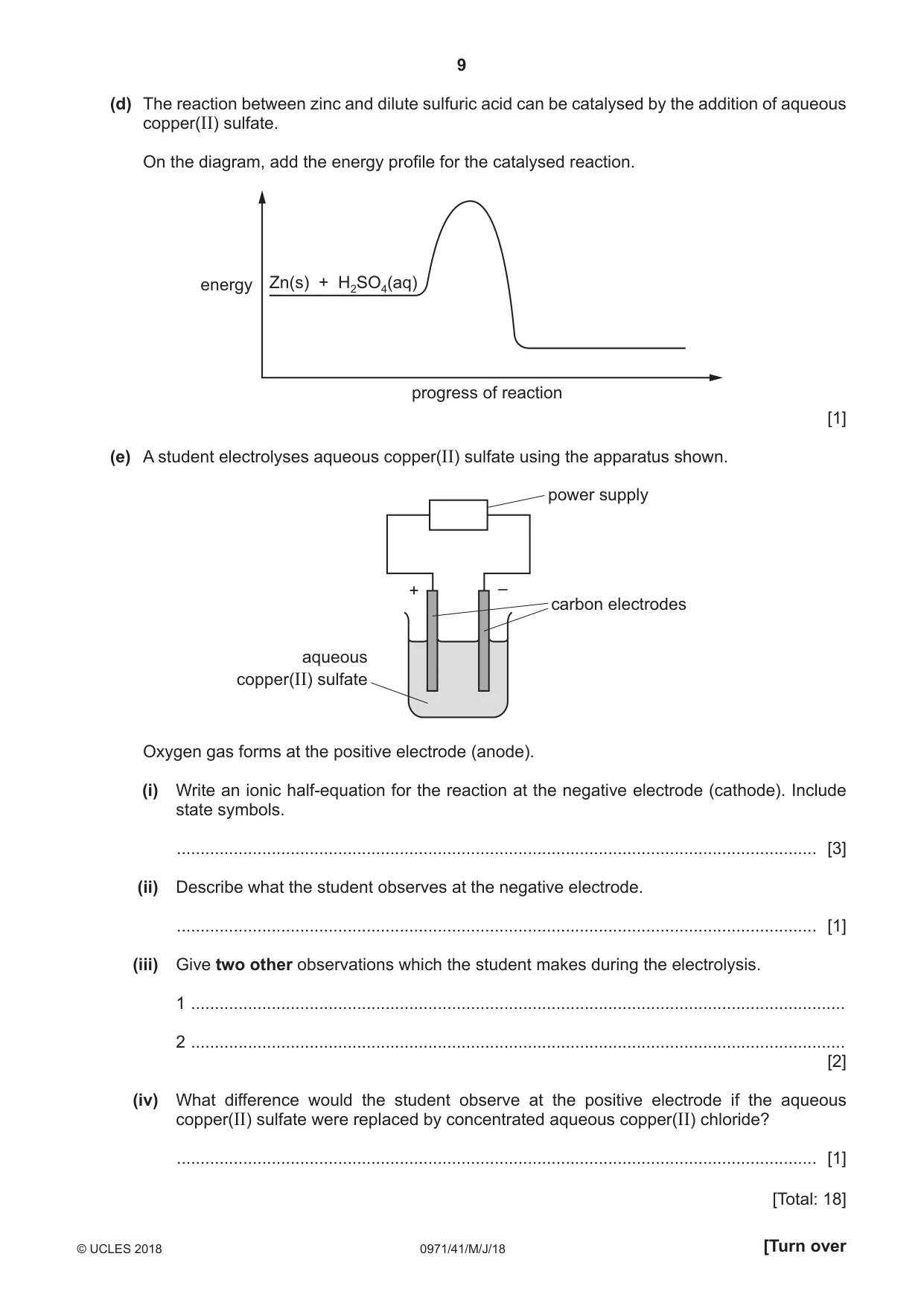
5 (a) The table gives some chemical properties of transition elements and their compounds, and of Group I elements and their compounds. chemical property transition elements Group I elements ability to act as catalysts yes no exist as coloured compounds yes no (i) What is meant by the term catalyst? ............................................................................................................................................. ............................................................................................................................................. ....................................................................................................................................... [2] (ii) Give one other chemical property shown by transition elements which is not shown by Group I elements. ....................................................................................................................................... [1] (b) Give two physical properties shown by transition elements which are not shown by Group I elements. 1 ................................................................................................................................................. 2 ................................................................................................................................................. [2] (c) The energy level diagram shows the energy profile for the reaction between zinc and dilute sulfuric acid. energy Zn(s) + H2SO4(aq) progress of reaction (i) Complete the diagram by adding the formulae of the products. Include state symbols. [3] (ii) Draw an arrow on the diagram to represent the activation energy. [1] (iii) Is the reaction endothermic or exothermic? Explain your answer. ............................................................................................................................................. ....................................................................................................................................... [1] (d) The reaction between zinc and dilute sulfuric acid can be catalysed by the addition of aqueous copper(II) sulfate. On the diagram, add the energy profile for the catalysed reaction. energy Zn(s) + H2SO4(aq) progress of reaction [1] (e) A student electrolyses aqueous copper(II) sulfate using the apparatus shown. power supply + – carbon electrodes aqueous copper(II) sulfate Oxygen gas forms at the positive electrode (anode). (i) Write an ionic half‑equation for the reaction at the negative electrode (cathode). Include state symbols. ....................................................................................................................................... [3] (ii) Describe what the student observes at the negative electrode. ....................................................................................................................................... [1] (iii) Give two other observations which the student makes during the electrolysis. 1 .......................................................................................................................................... 2 .......................................................................................................................................... [2] (iv) What difference would the student observe at the positive electrode if the aqueous copper(II) sulfate were replaced by concentrated aqueous copper(II) chloride? ....................................................................................................................................... [1] [Total: 18]
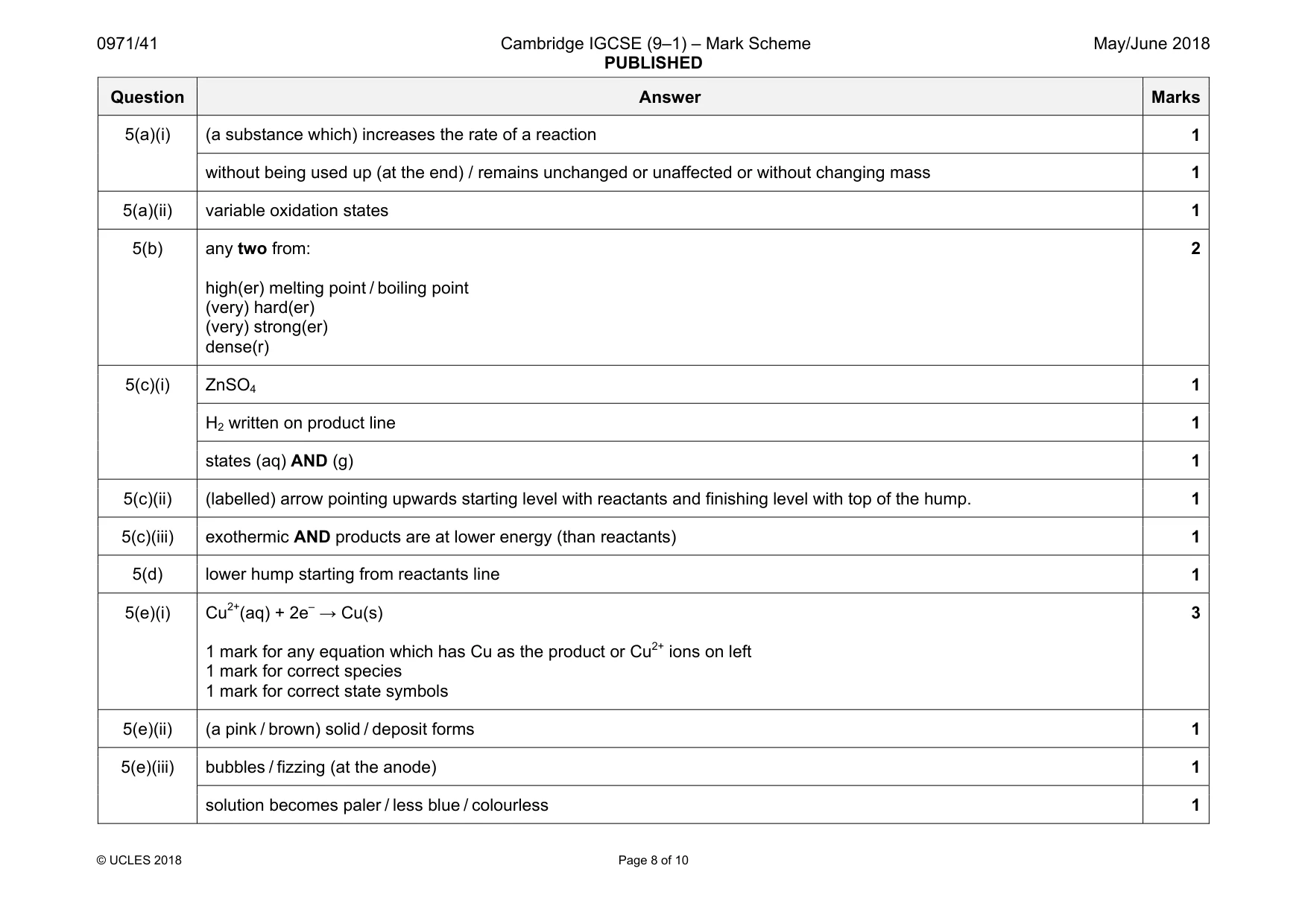
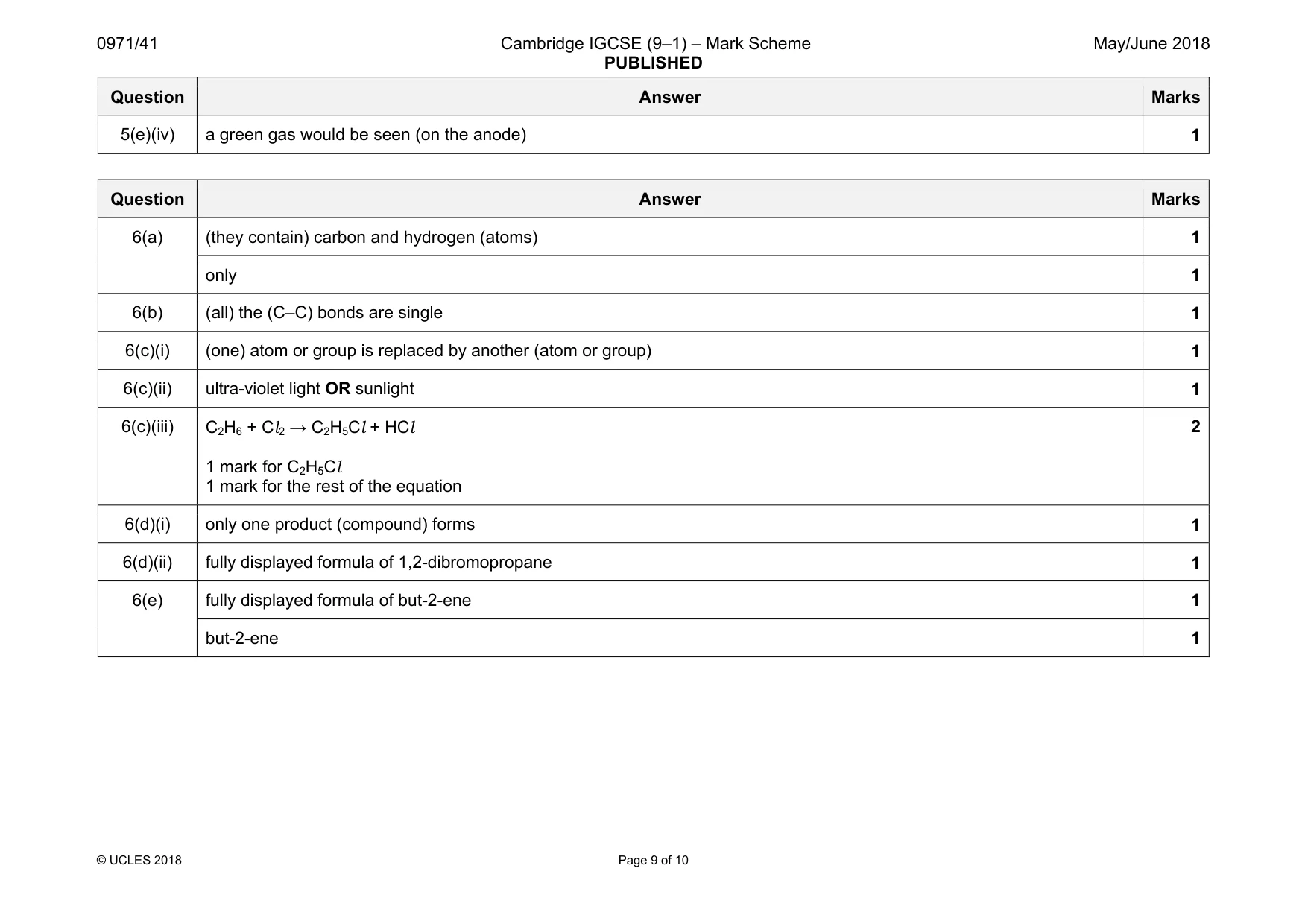
Mark scheme: 5(a)(i) (a substance which) increases the rate of a reaction 1 without being used up (at the end) / remains unchanged or unaffected or without changing mass 1 5(a)(ii) variable oxidation states 1 5(b) any two from: high(er) melting point / boiling point (very) hard(er) (very) strong(er) dense(r) 2 5(c)(i) ZnSO4 1 H2 written on product line 1 states (aq) AND (g) 1 5(c)(ii) (labelled) arrow pointing upwards starting level with reactants and finishing level with top of the hump. 1 5(c)(iii) exothermic AND products are at lower energy (than reactants) 1 5(d) lower hump starting from reactants line 1 5(e)(i) Cu2+(aq) + 2e– → Cu(s) 1 mark for any equation which has Cu as the product or Cu2+ ions on left 1 mark for correct species 1 mark for correct state symbols 3 5(e)(ii) (a pink / brown) solid / deposit forms 1 5(e)(iii) bubbles / fizzing (at the anode) 1 solution becomes paler / less blue / colourless 1 Question Answer Marks 5(e)(iv) a green gas would be seen (on the anode) 1
Q6 · The table shows the structures of four hydrocarbons
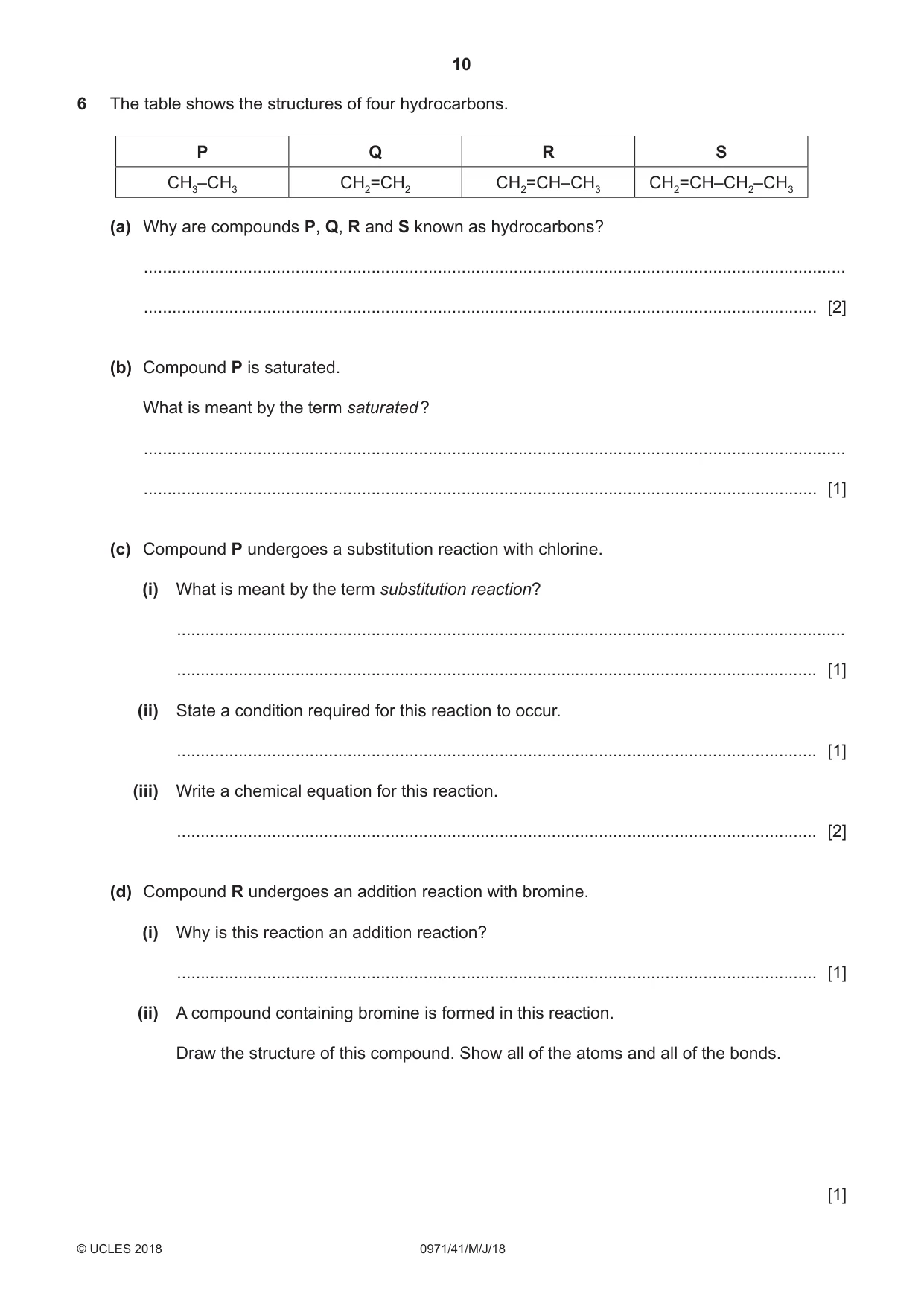
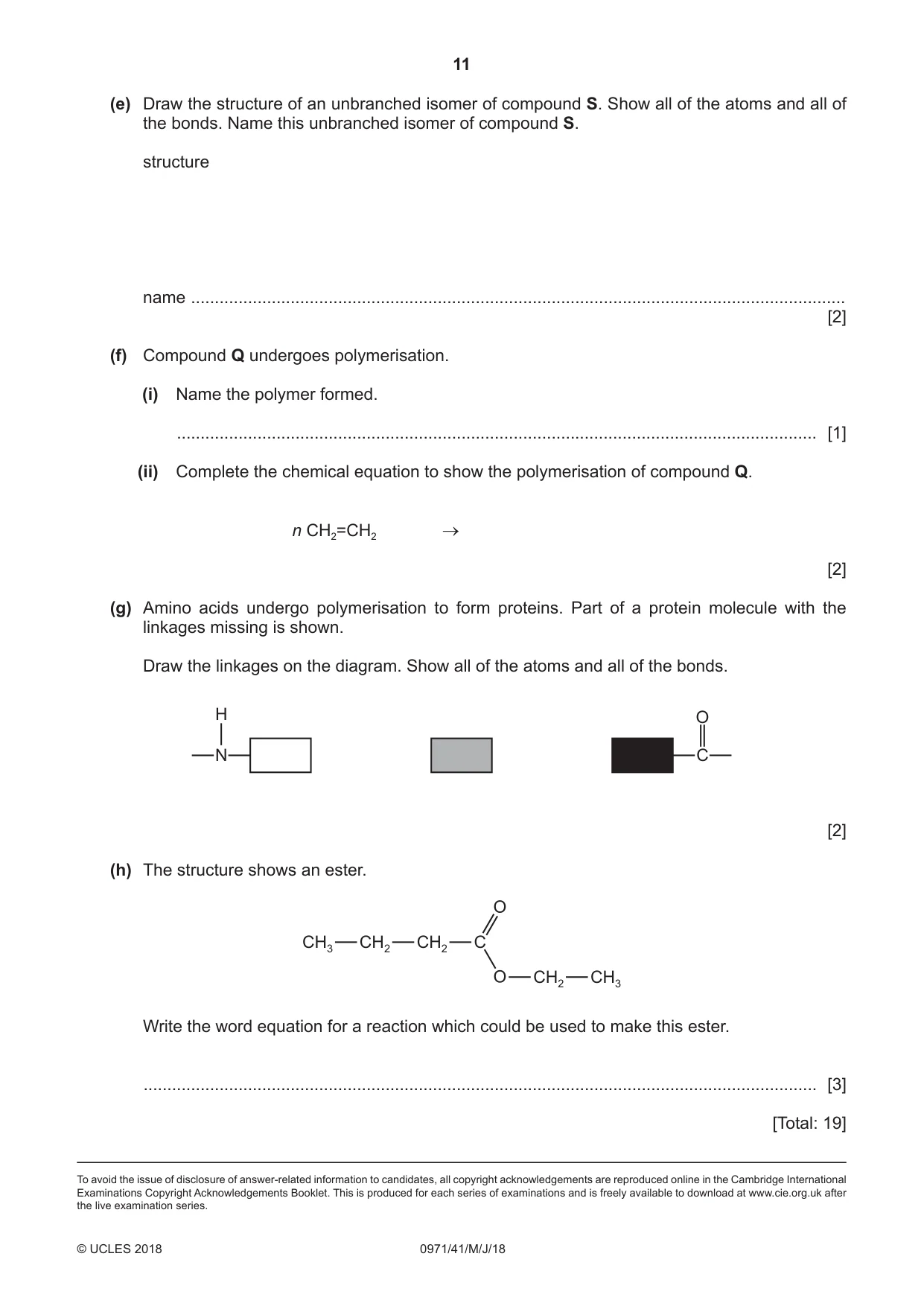
6 The table shows the structures of four hydrocarbons. P Q R S CH3–CH3 CH2=CH2 CH2=CH–CH3 CH2=CH–CH2–CH3 (a) Why are compounds P, Q, R and S known as hydrocarbons? .................................................................................................................................................... .............................................................................................................................................. [2] (b) Compound P is saturated. What is meant by the term saturated ? .................................................................................................................................................... .............................................................................................................................................. [1] (c) Compound P undergoes a substitution reaction with chlorine. (i) What is meant by the term substitution reaction? ............................................................................................................................................. ....................................................................................................................................... [1] (ii) State a condition required for this reaction to occur. ....................................................................................................................................... [1] (iii) Write a chemical equation for this reaction. ....................................................................................................................................... [2] (d) Compound R undergoes an addition reaction with bromine. (i) Why is this reaction an addition reaction? ....................................................................................................................................... [1] (ii) A compound containing bromine is formed in this reaction. Draw the structure of this compound. Show all of the atoms and all of the bonds. [1] (e) Draw the structure of an unbranched isomer of compound S. Show all of the atoms and all of the bonds. Name this unbranched isomer of compound S. structure name .......................................................................................................................................... [2] (f) Compound Q undergoes polymerisation. (i) Name the polymer formed. ....................................................................................................................................... [1] (ii) Complete the chemical equation to show the polymerisation of compound Q. n CH2=CH2 [2] (g) Amino acids undergo polymerisation to form proteins. Part of a protein molecule with the linkages missing is shown. Draw the linkages on the diagram. Show all of the atoms and all of the bonds. H O N C [2] (h) The structure shows an ester. O CH3 CH2 CH2 C O CH2 CH3 Write the word equation for a reaction which could be used to make this ester. .............................................................................................................................................. [3] [Total: 19]
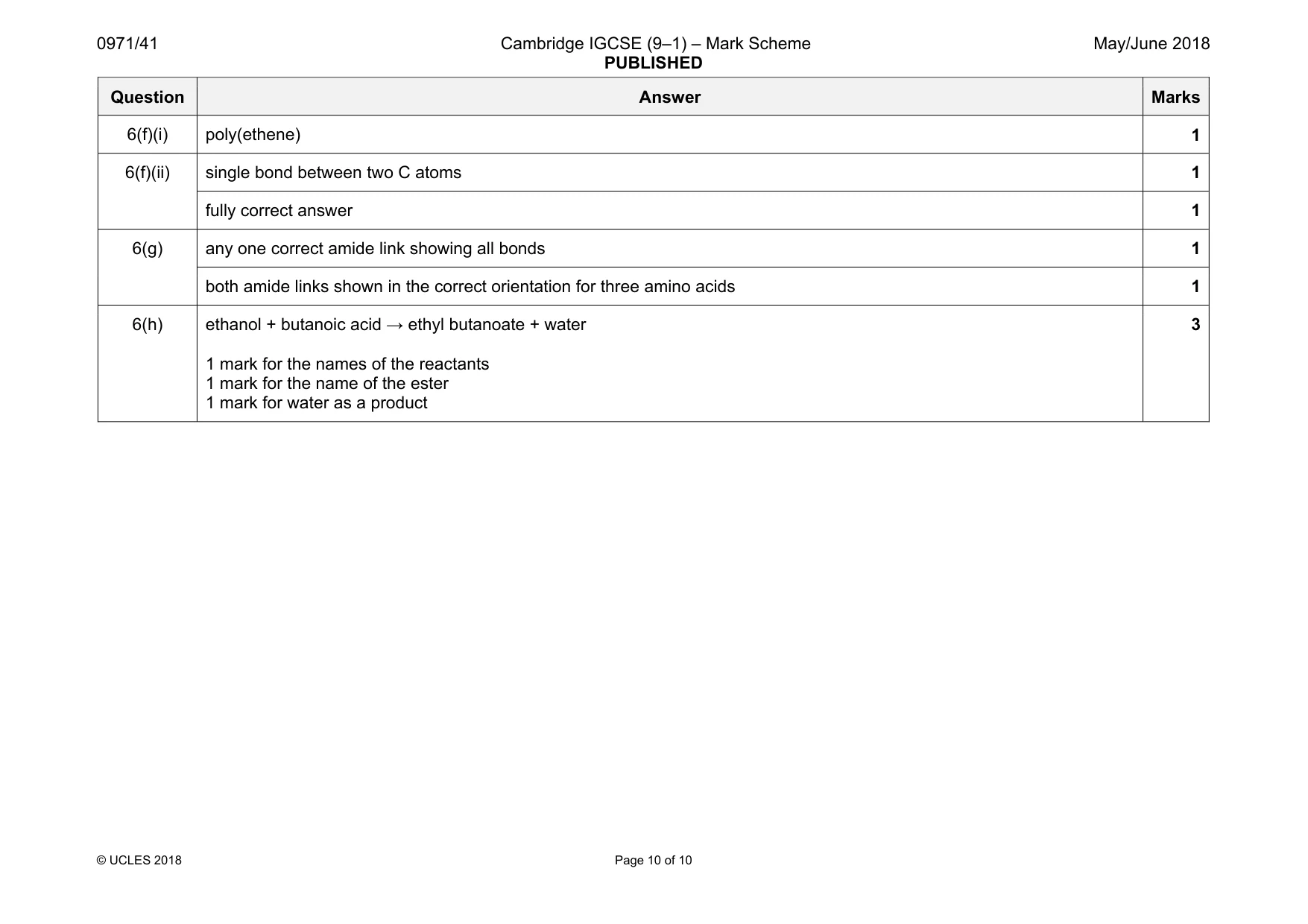
Mark scheme: 6(a) (they contain) carbon and hydrogen (atoms) 1 only 1 6(b) (all) the (C–C) bonds are single 1 6(c)(i) (one) atom or group is replaced by another (atom or group) 1 6(c)(ii) ultra-violet light OR sunlight 1 6(c)(iii) C2H6 + Cl2 → C2H5Cl + HCl 1 mark for C2H5Cl 1 mark for the rest of the equation 2 6(d)(i) only one product (compound) forms 1 6(d)(ii) fully displayed formula of 1,2-dibromopropane 1 6(e) fully displayed formula of but-2-ene 1 but-2-ene 1 Question Answer Marks 6(f)(i) poly(ethene) 1 6(f)(ii) single bond between two C atoms 1 fully correct answer 1 6(g) any one correct amide link showing all bonds 1 both amide links shown in the correct orientation for three amino acids 1 6(h) ethanol + butanoic acid → ethyl butanoate + water 1 mark for the names of the reactants 1 mark for the name of the ester 1 mark for water as a product 3
What was in this paper
The subtopics covered by these 6 questions, and how many questions each got. Open one in a new tab to see every Cambridge question on it.
What you needed in this session
Cambridge’s own grade thresholds for 2018 May/June, Paper 4 · Variant 1. A higher threshold means an easier paper — the bar moves with how the cohort did.