Cambridge IGCSE Biology (9-1) 0970 — 2021 Oct/Nov Paper 3 · Variant 2
0970/32/O/N/21 · 8 questions · 80 marks · ≈90 min
The question paper and its mark scheme, free to read here and free to download. This is Cambridge’s own paper, exactly as it was sat.
Question paper20 pages

Mark scheme12 pages
Answers below. Sit the paper first if you are practising.
Questions as text
Q1 · A diagram of the parts of the eye
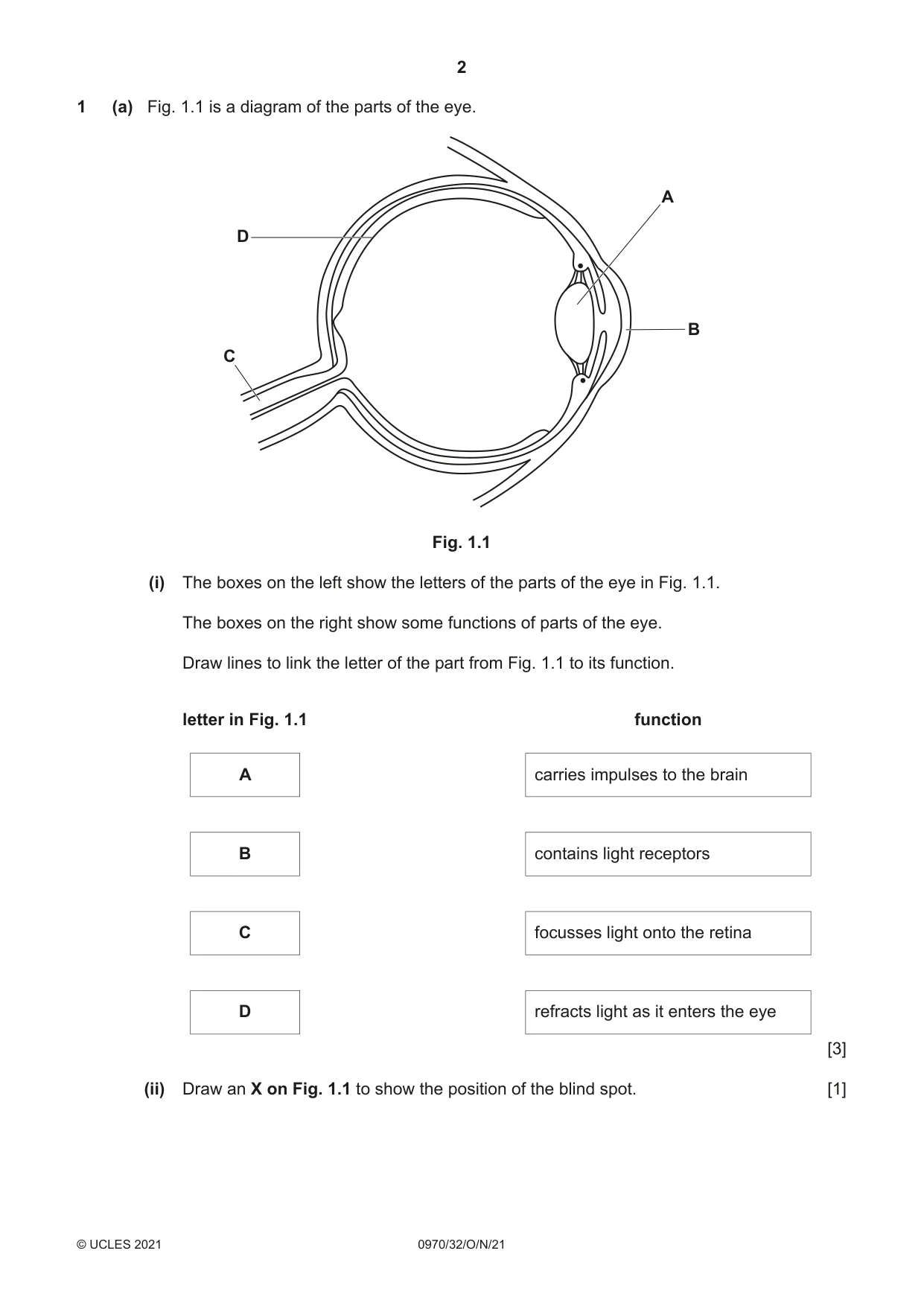
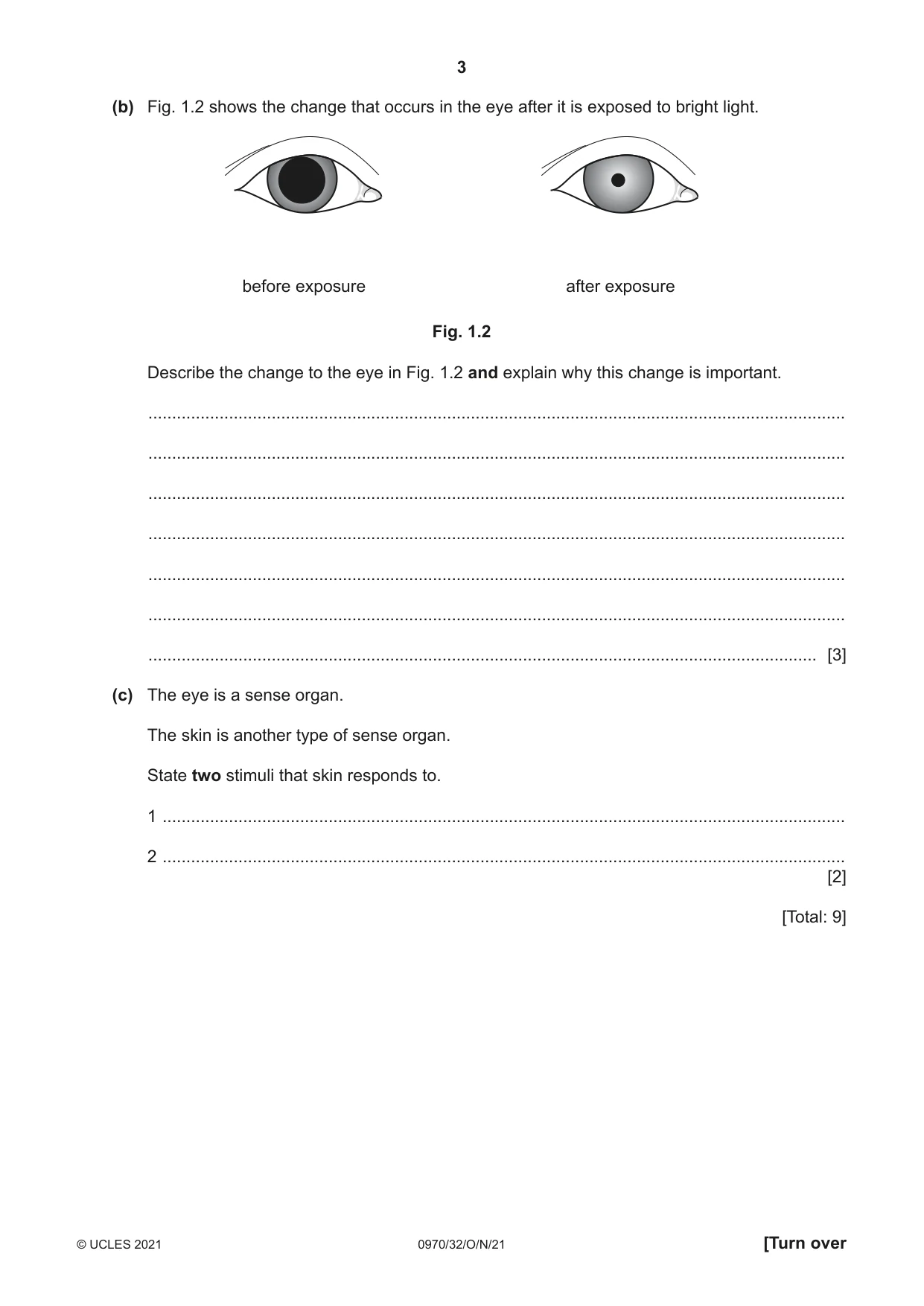
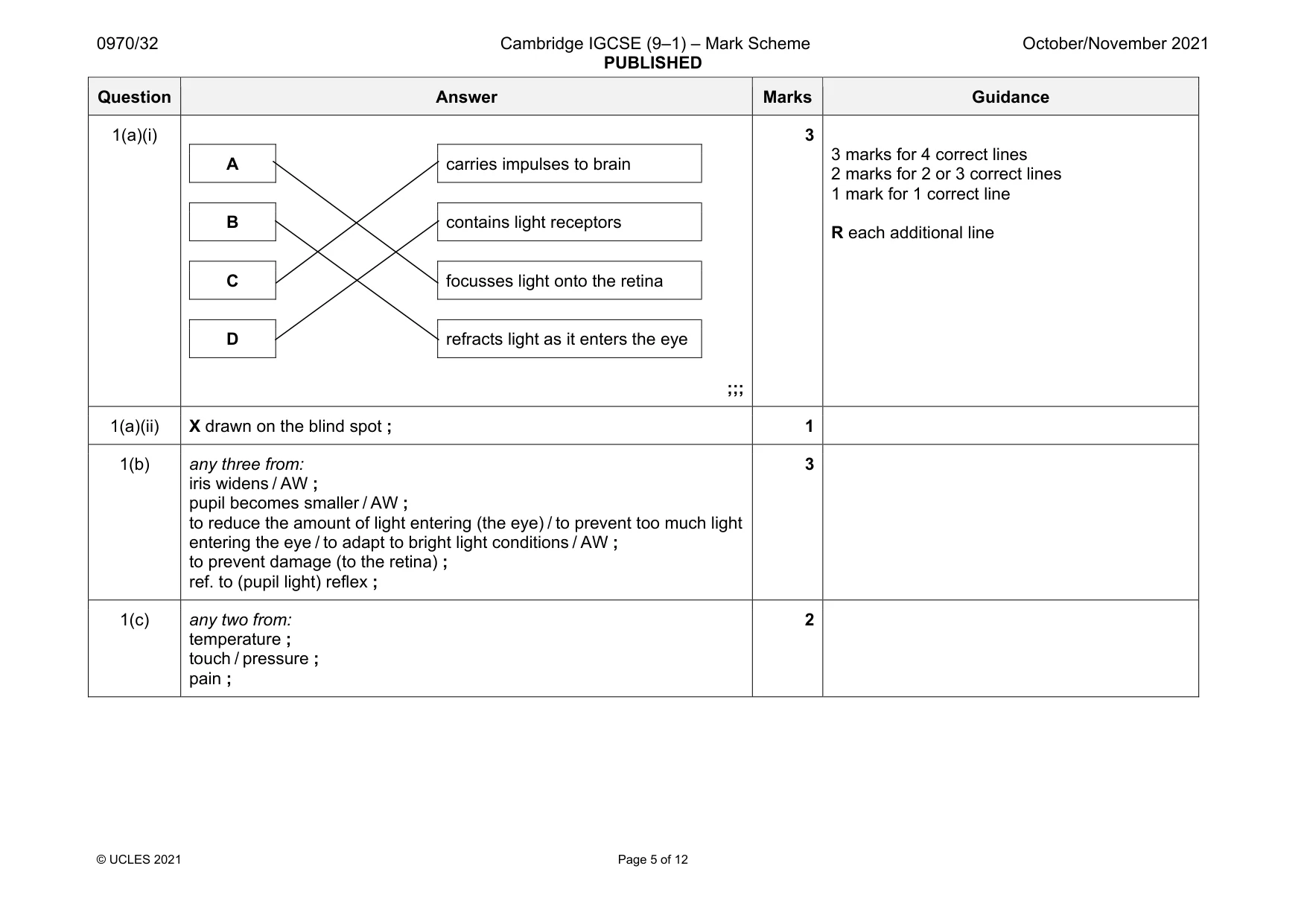
1 (a) Fig. 1.1 is a diagram of the parts of the eye. A D B C Fig. 1.1 (i) The boxes on the left show the letters of the parts of the eye in Fig. 1.1. The boxes on the right show some functions of parts of the eye. Draw lines to link the letter of the part from Fig. 1.1 to its function. letter in Fig. 1.1 function A carries impulses to the brain B contains light receptors C focusses light onto the retina D refracts light as it enters the eye [3] (ii) Draw an X on Fig. 1.1 to show the position of the blind spot. [1] (b) Fig. 1.2 shows the change that occurs in the eye after it is exposed to bright light. before exposure after exposure Fig. 1.2 Describe the change to the eye in Fig. 1.2 and explain why this change is important. ................................................................................................................................................... ................................................................................................................................................... ................................................................................................................................................... ................................................................................................................................................... ................................................................................................................................................... ................................................................................................................................................... ............................................................................................................................................. [3] (c) The eye is a sense organ. The skin is another type of sense organ. State two stimuli that skin responds to. 1 ................................................................................................................................................ 2 ................................................................................................................................................ [2] [Total: 9]
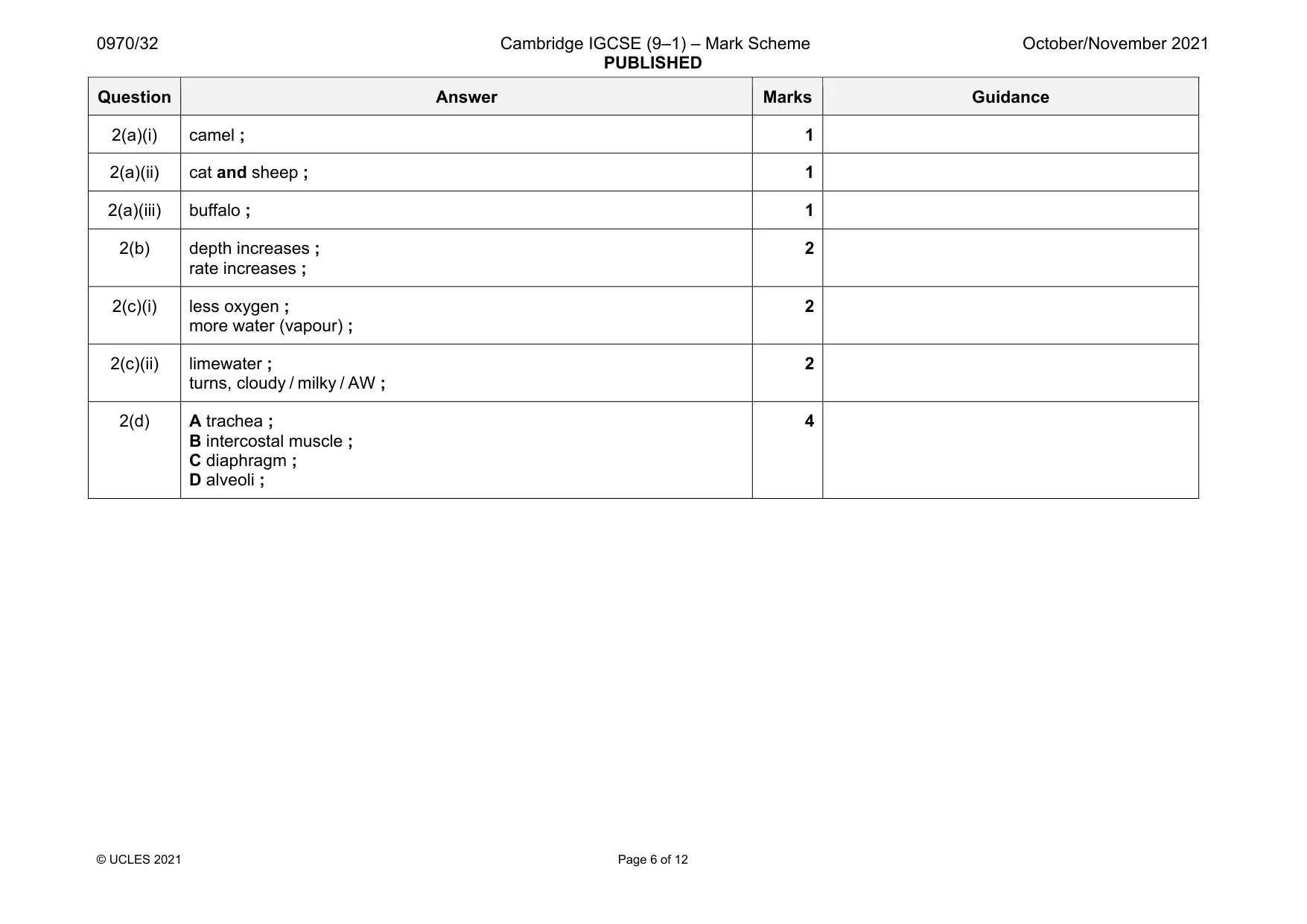
Mark scheme: 1(a)(i) A carries impulses to brain B contains light receptors C focusses light onto the retina D refracts light as it enters the eye ;;; 3 3 marks for 4 correct lines 2 marks for 2 or 3 correct lines 1 mark for 1 correct line R each additional line 1(a)(ii) X drawn on the blind spot ; 1 1(b) any three from: iris widens / AW ; pupil becomes smaller / AW ; to reduce the amount of light entering (the eye) / to prevent too much light entering the eye / to adapt to bright light conditions / AW ; to prevent damage (to the retina) ; ref. to (pupil light) reflex ; 3 1(c) any two from: temperature ; touch / pressure ; pain ; 2
Q2 · The breathing rate of different organisms
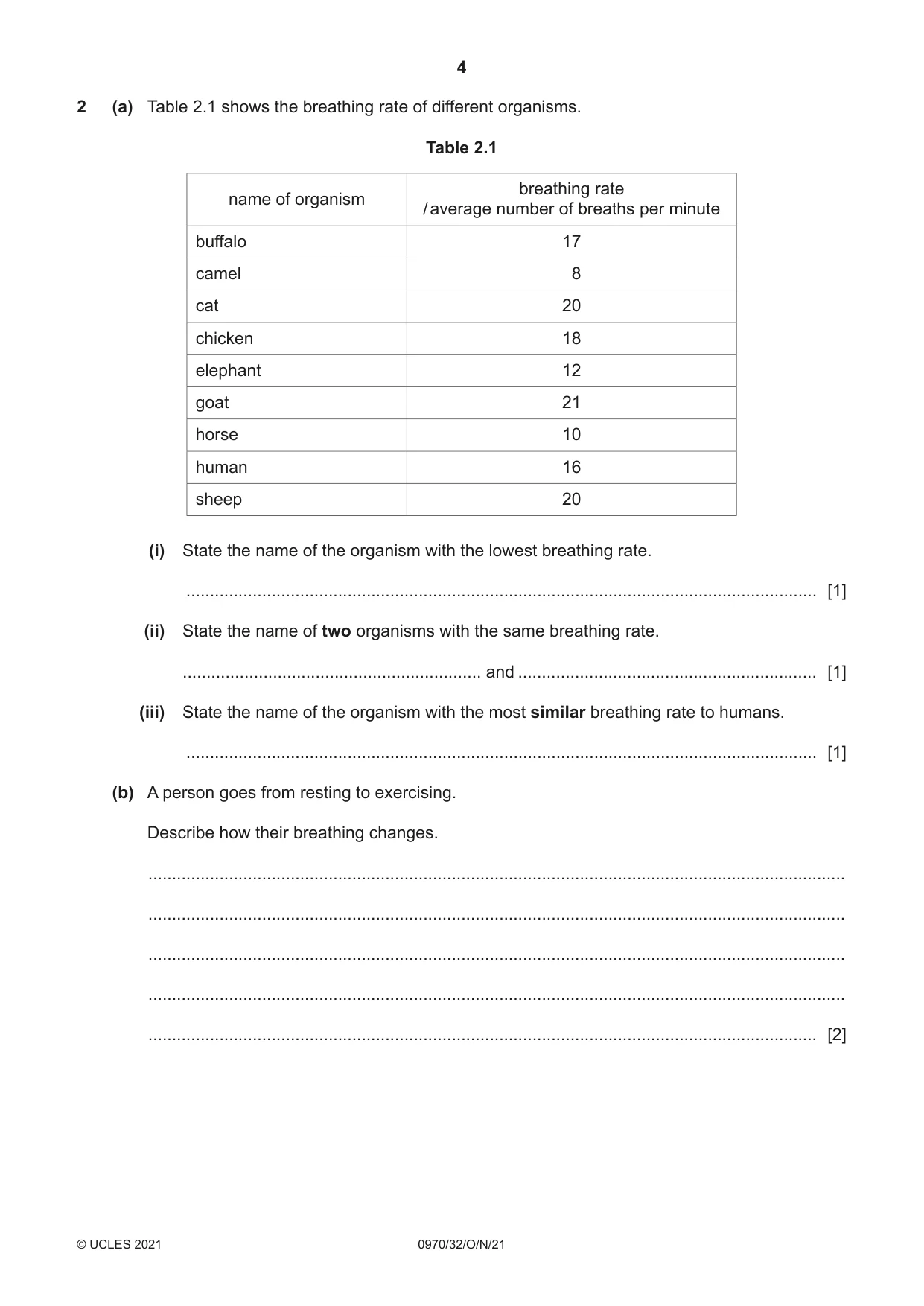
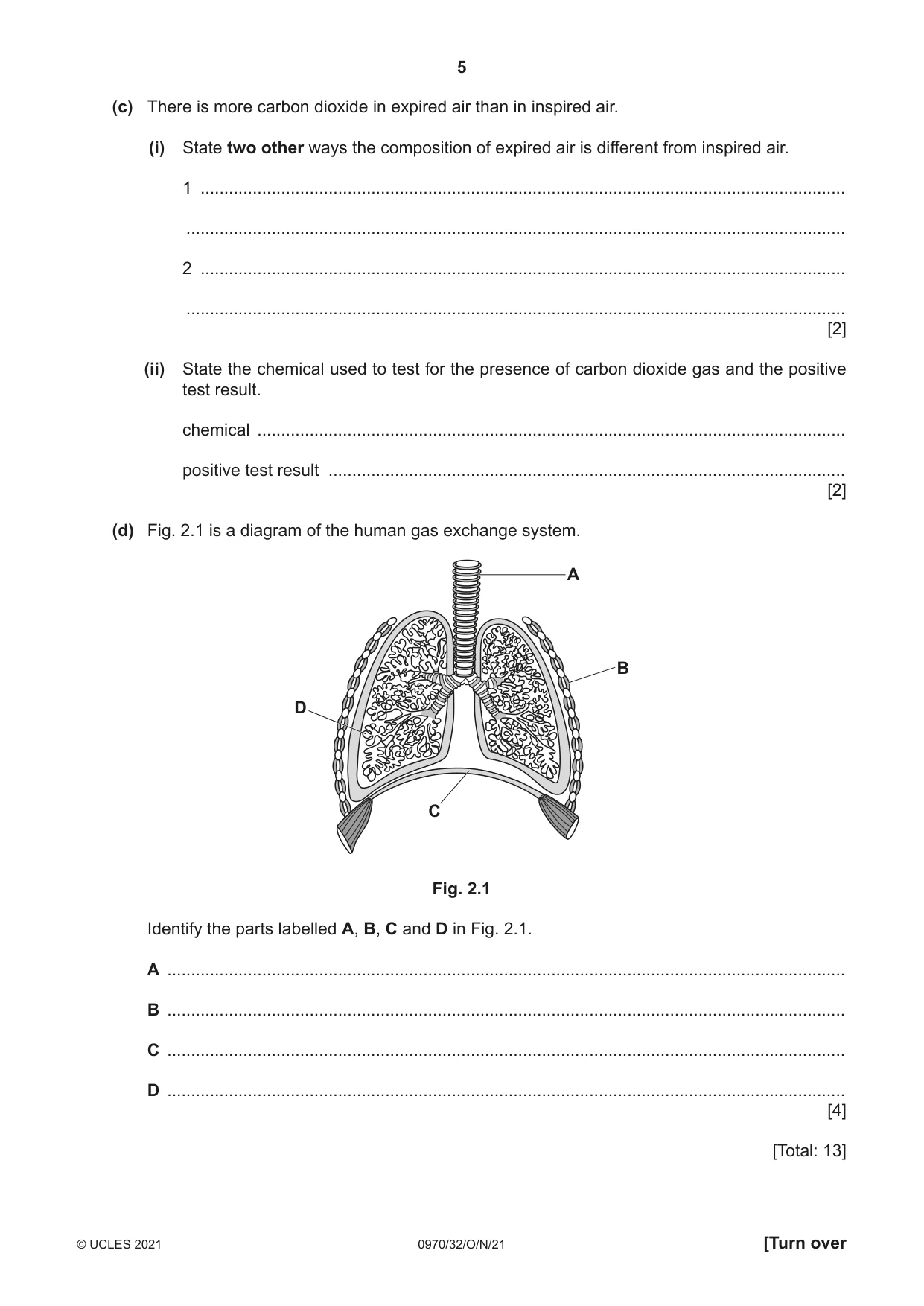
2 (a) Table 2.1 shows the breathing rate of different organisms. Table 2.1 breathing rate name of organism / average number of breaths per minute buffalo 17 camel 8 cat 20 chicken 18 elephant 12 goat 21 horse 10 human 16 sheep 20 (i) State the name of the organism with the lowest breathing rate. ..................................................................................................................................... [1] (ii) State the name of two organisms with the same breathing rate. ............................................................... and ............................................................... [1] (iii) State the name of the organism with the most similar breathing rate to humans. ..................................................................................................................................... [1] (b) A person goes from resting to exercising. Describe how their breathing changes. ................................................................................................................................................... ................................................................................................................................................... ................................................................................................................................................... ................................................................................................................................................... ............................................................................................................................................. [2] (c) There is more carbon dioxide in expired air than in inspired air. (i) State two other ways the composition of expired air is different from inspired air. 1 ........................................................................................................................................ ........................................................................................................................................... 2 ........................................................................................................................................ ........................................................................................................................................... [2] (ii) State the chemical used to test for the presence of carbon dioxide gas and the positive test result. chemical ............................................................................................................................ positive test result ............................................................................................................. [2] (d) Fig. 2.1 is a diagram of the human gas exchange system. A B D C Fig. 2.1 Identify the parts labelled A, B, C and D in Fig. 2.1. A ............................................................................................................................................... B ............................................................................................................................................... C ............................................................................................................................................... D ............................................................................................................................................... [4] [Total: 13]
Mark scheme: 2(a)(i) camel ; 1 2(a)(ii) cat and sheep ; 1 2(a)(iii) buffalo ; 1 2(b) depth increases ; rate increases ; 2 2(c)(i) less oxygen ; more water (vapour) ; 2 2(c)(ii) limewater ; turns, cloudy / milky / AW ; 2 2(d) A trachea ; B intercostal muscle ; C diaphragm ; D alveoli ; 4
Q3 · A species of pea plant can produce green or yellow peas
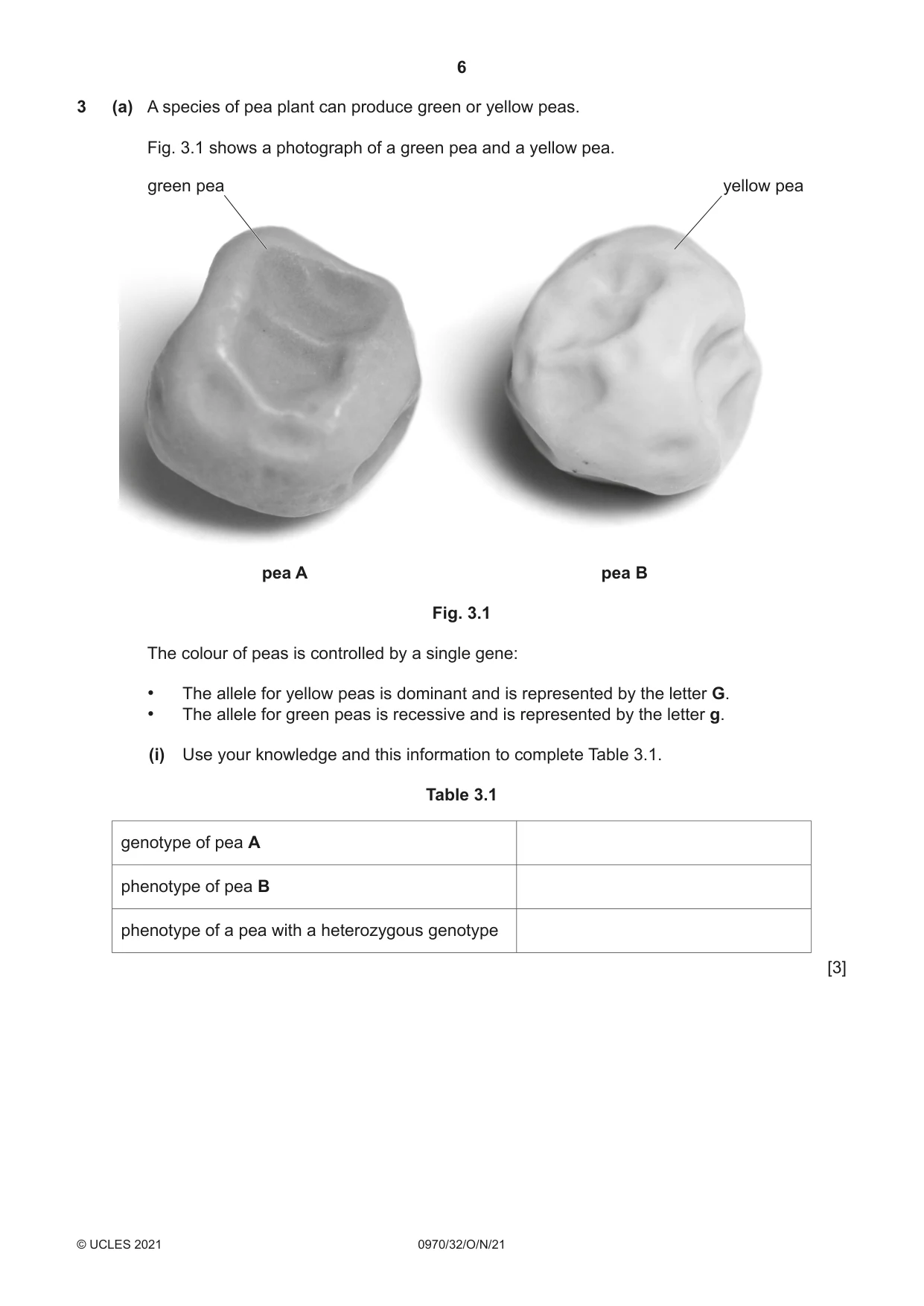
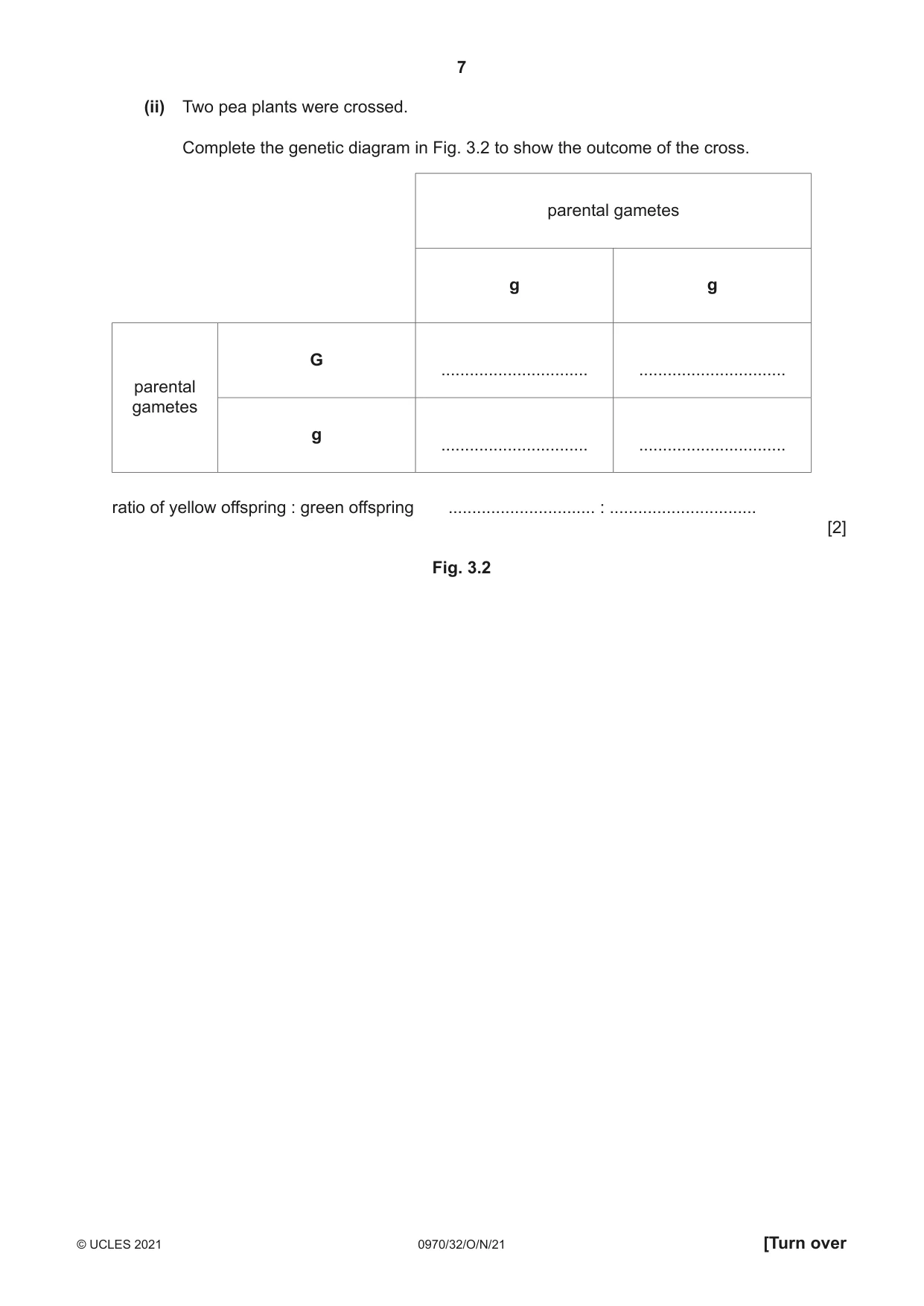
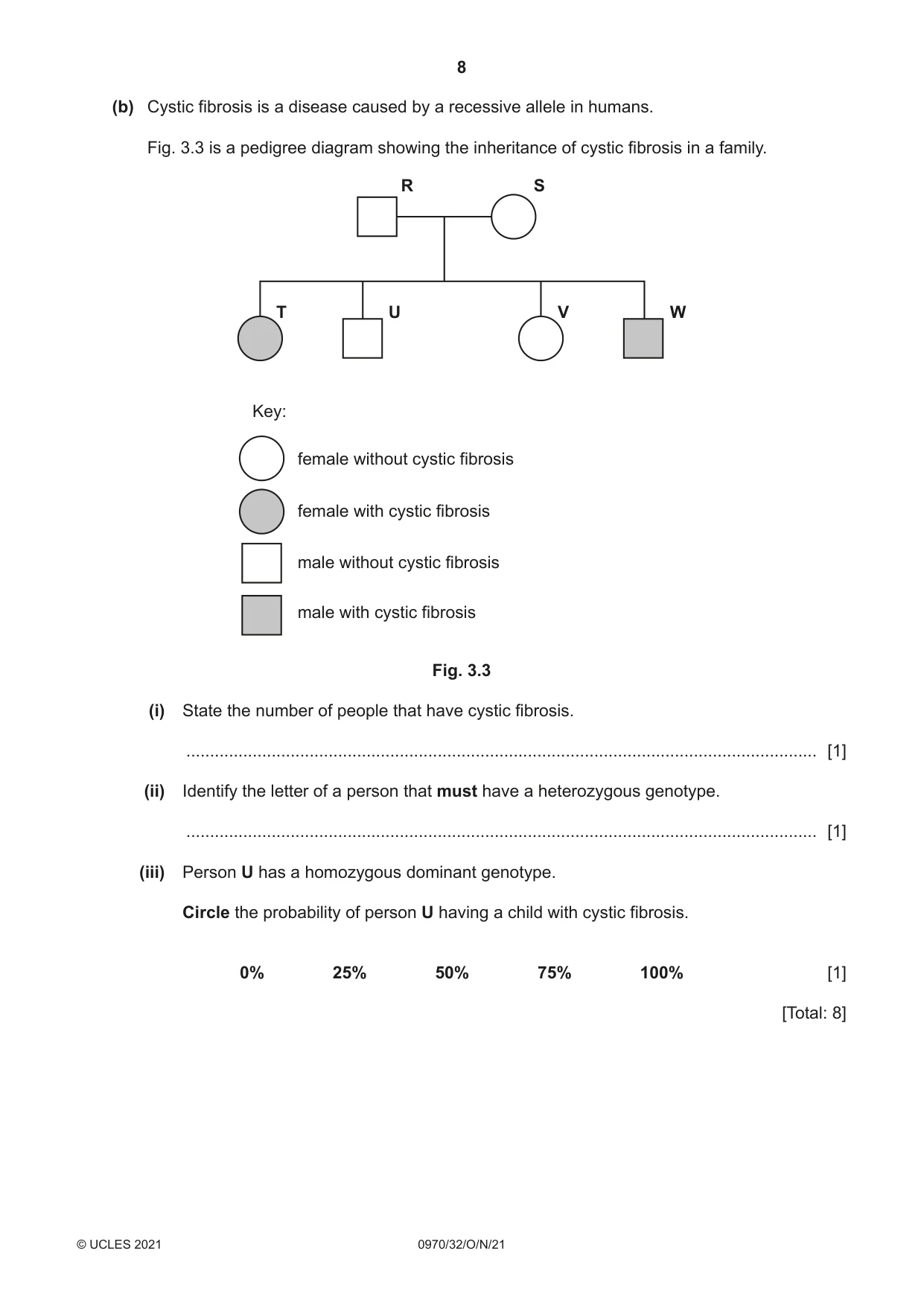
3 (a) A species of pea plant can produce green or yellow peas. Fig. 3.1 shows a photograph of a green pea and a yellow pea. green pea yellow pea pea A pea B Fig. 3.1 The colour of peas is controlled by a single gene: • The allele for yellow peas is dominant and is represented by the letter G. • The allele for green peas is recessive and is represented by the letter g. (i) Use your knowledge and this information to complete Table 3.1. Table 3.1 genotype of pea A phenotype of pea B phenotype of a pea with a heterozygous genotype [3] (ii) Two pea plants were crossed. Complete the genetic diagram in Fig. 3.2 to show the outcome of the cross. parental gametes g g G ............................... ............................... parental gametes g ............................... ............................... ratio of yellow offspring : green offspring ............................... : ............................... [2] Fig. 3.2 (b) Cystic fibrosis is a disease caused by a recessive allele in humans. Fig. 3.3 is a pedigree diagram showing the inheritance of cystic fibrosis in a family. R S T U V W Key: female without cystic fibrosis female with cystic fibrosis male without cystic fibrosis male with cystic fibrosis Fig. 3.3 (i) State the number of people that have cystic fibrosis. ..................................................................................................................................... [1] (ii) Identify the letter of a person that must have a heterozygous genotype. ..................................................................................................................................... [1] (iii) Person U has a homozygous dominant genotype. Circle the probability of person U having a child with cystic fibrosis. 0% 25% 50% 75% 100% [1] [Total: 8]
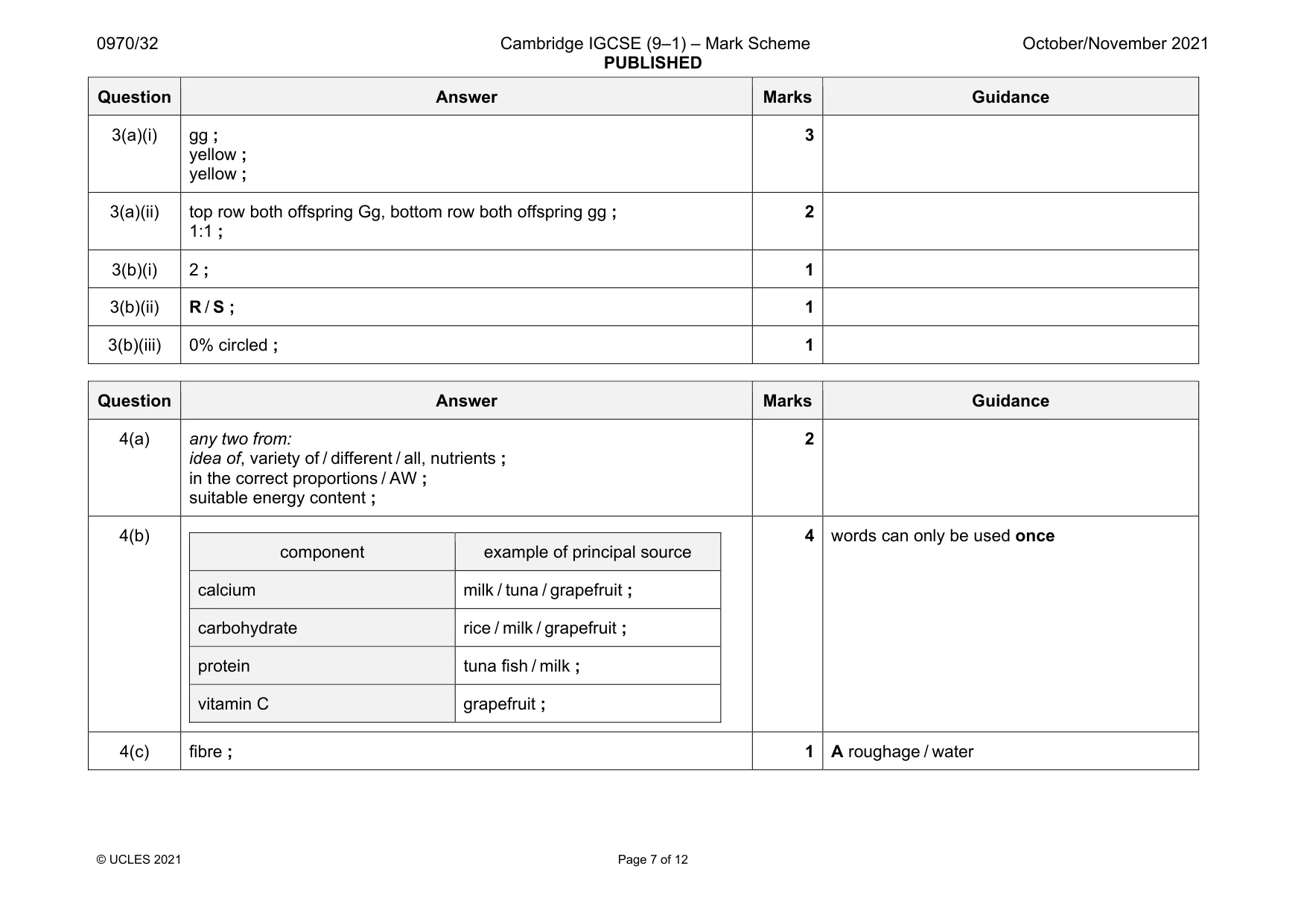
Mark scheme: 3(a)(i) gg ; yellow ; yellow ; 3 3(a)(ii) top row both offspring Gg, bottom row both offspring gg ; 1:1 ; 2 3(b)(i) 2 ; 1 3(b)(ii) R / S ; 1 3(b)(iii) 0% circled ; 1
Q4 · It is important for humans to consume a balanced diet
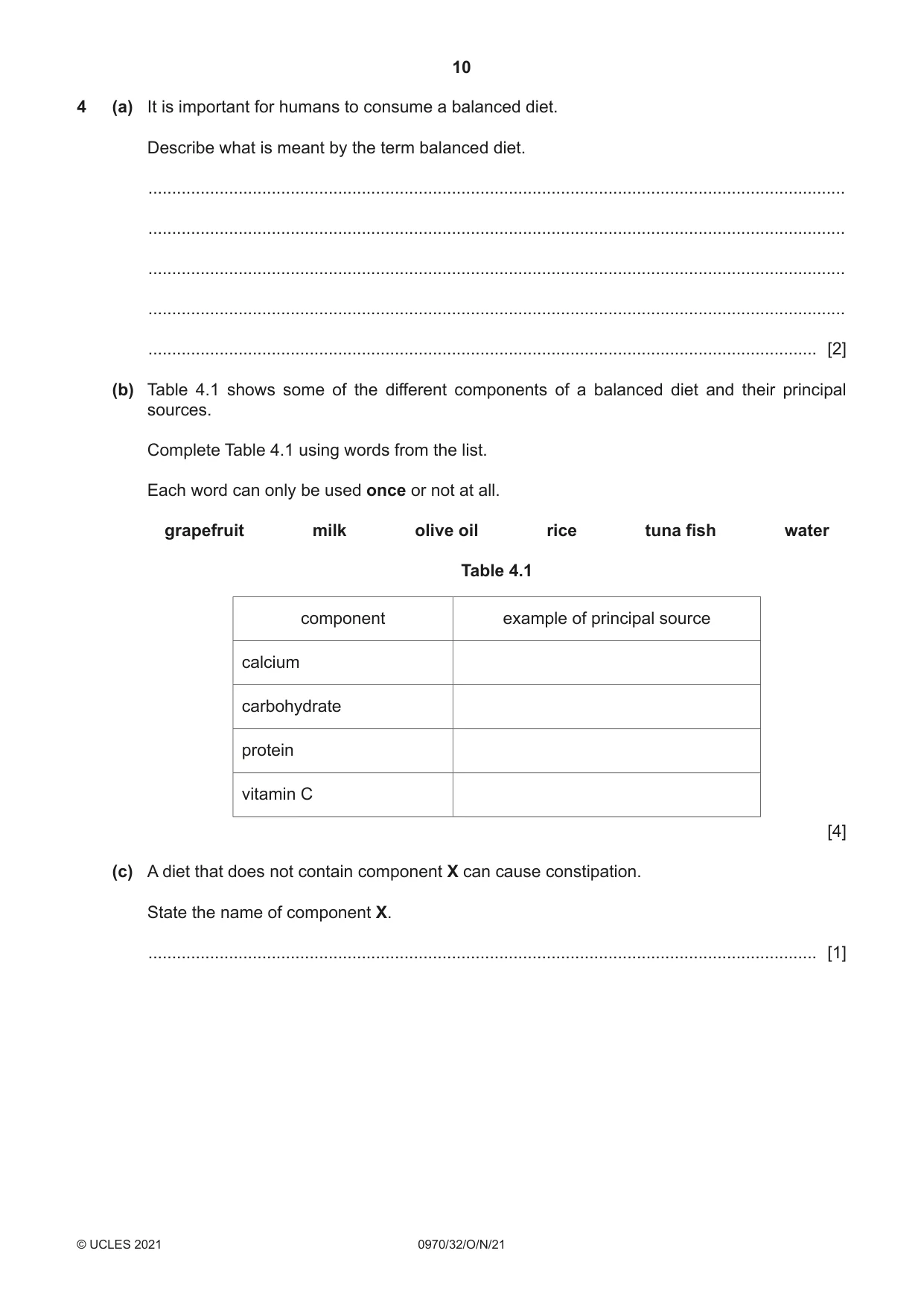
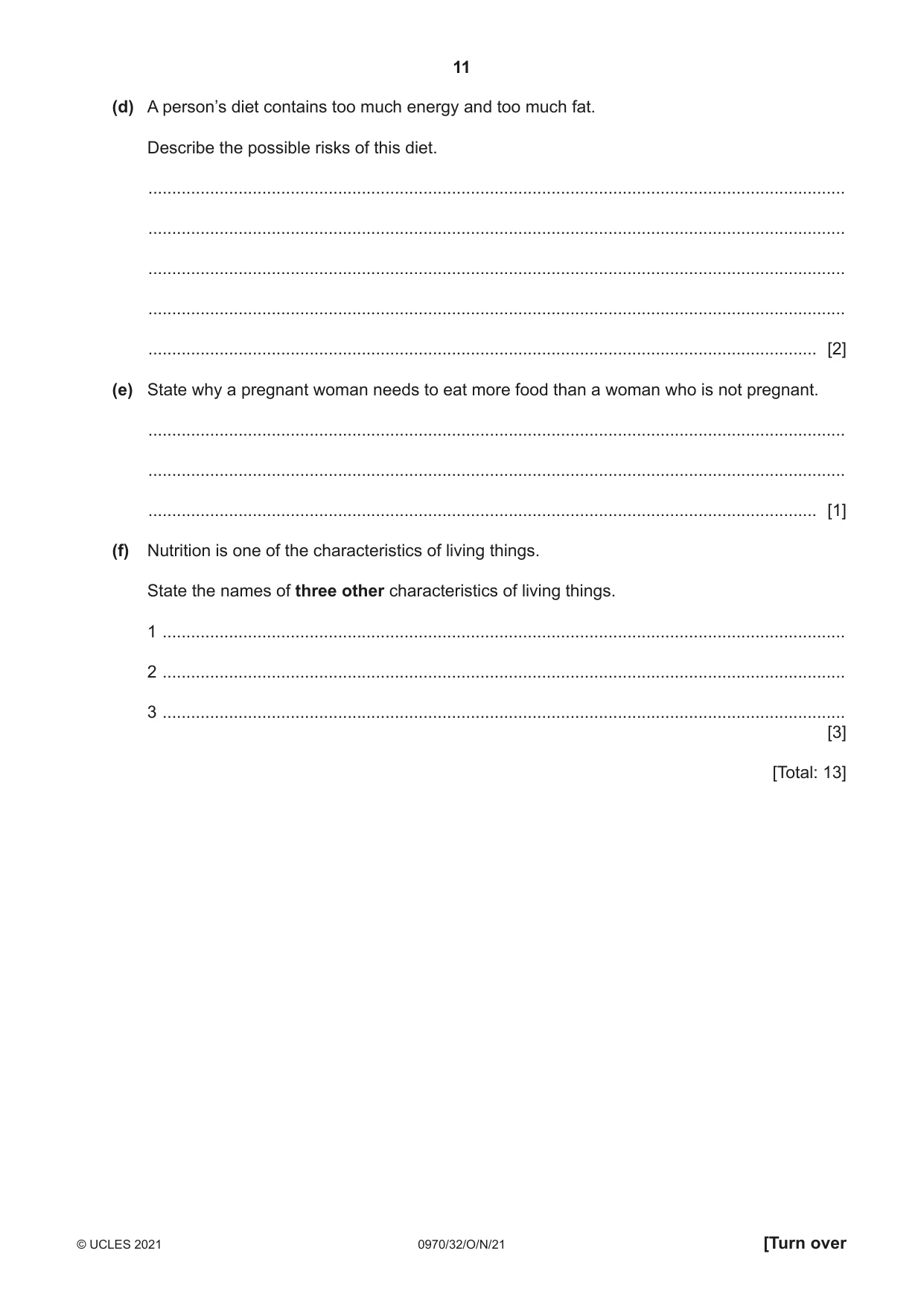
4 (a) It is important for humans to consume a balanced diet. Describe what is meant by the term balanced diet. ................................................................................................................................................... ................................................................................................................................................... ................................................................................................................................................... ................................................................................................................................................... ............................................................................................................................................. [2] (b) Table 4.1 shows some of the different components of a balanced diet and their principal sources. Complete Table 4.1 using words from the list. Each word can only be used once or not at all. grapefruit milk olive oil rice tuna fish water Table 4.1 component example of principal source calcium carbohydrate protein vitamin C [4] (c) A diet that does not contain component X can cause constipation. State the name of component X. ............................................................................................................................................. [1] (d) A person’s diet contains too much energy and too much fat. Describe the possible risks of this diet. ................................................................................................................................................... ................................................................................................................................................... ................................................................................................................................................... ................................................................................................................................................... ............................................................................................................................................. [2] (e) State why a pregnant woman needs to eat more food than a woman who is not pregnant. ................................................................................................................................................... ................................................................................................................................................... ............................................................................................................................................. [1] (f) Nutrition is one of the characteristics of living things. State the names of three other characteristics of living things. 1 ................................................................................................................................................ 2 ................................................................................................................................................ 3 ................................................................................................................................................ [3] [Total: 13]
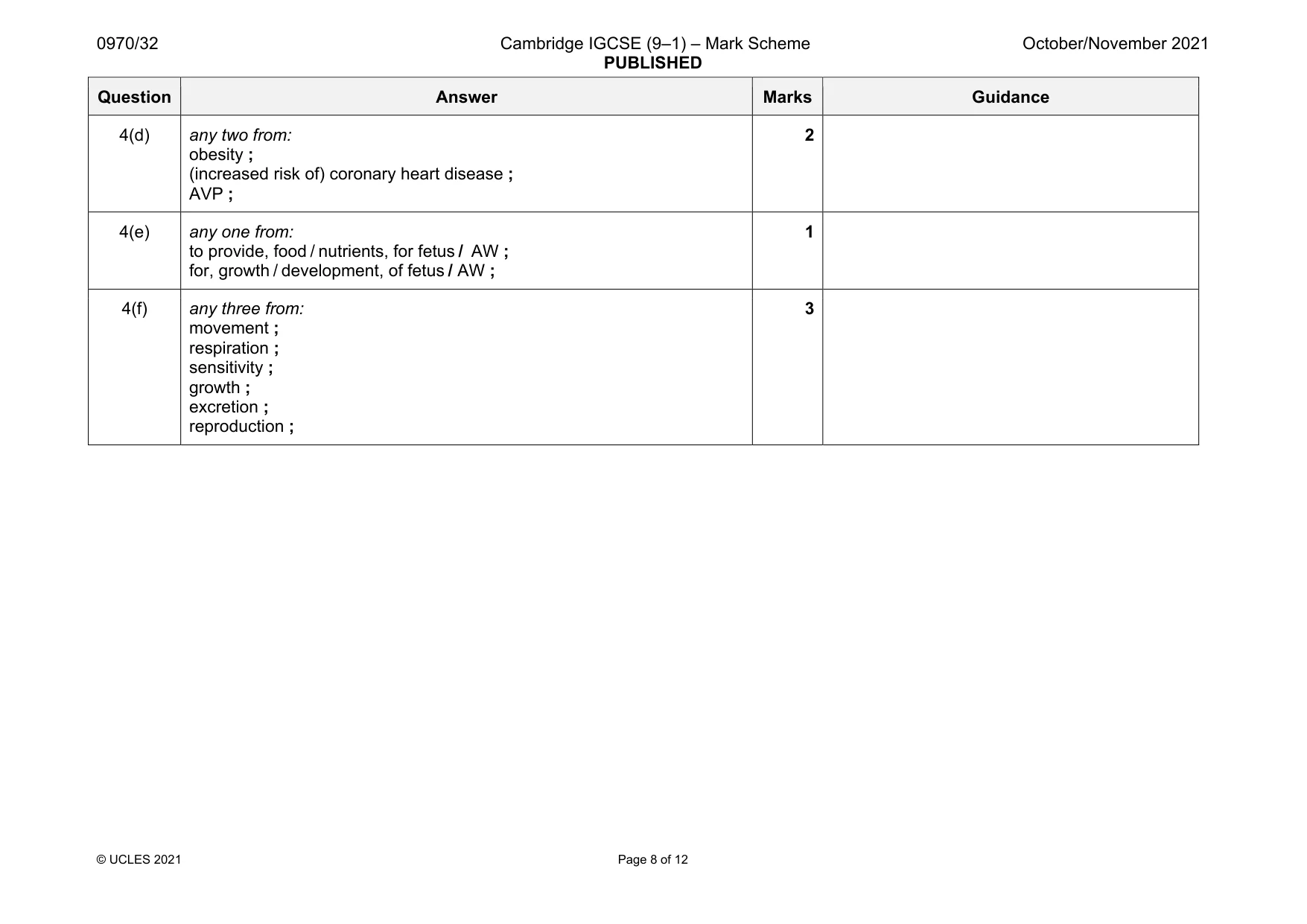
Mark scheme: 4(a) any two from: idea of, variety of / different / all, nutrients ; in the correct proportions / AW ; suitable energy content ; 4(b) component example of principal source calcium milk / tuna / grapefruit ; carbohydrate rice / milk / grapefruit ; protein tuna fish / milk ; vitamin C grapefruit ; 4 words can only be used once 4(c) fibre ; 1 A roughage / water Question Answer Marks Guidance 4(d) any two from: obesity ; (increased risk of) coronary heart disease ; AVP ; 2 4(e) any one from: to provide, food / nutrients, for fetus / AW ; for, growth / development, of fetus / AW ; 1 4(f) any three from: movement ; respiration ; sensitivity ; growth ; excretion ; reproduction ; 3
Q5 · Define the term transpiration by completing the sentences
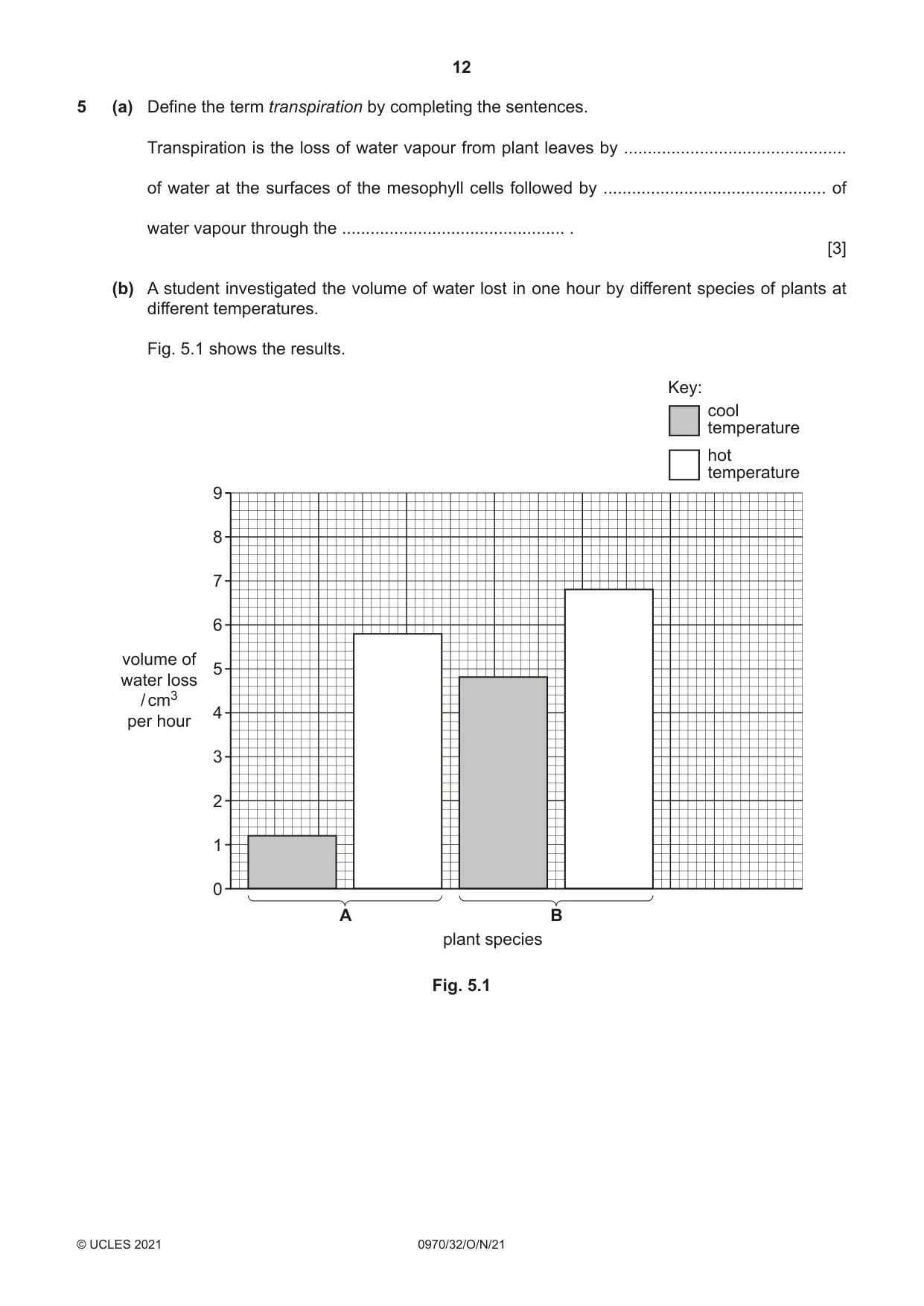
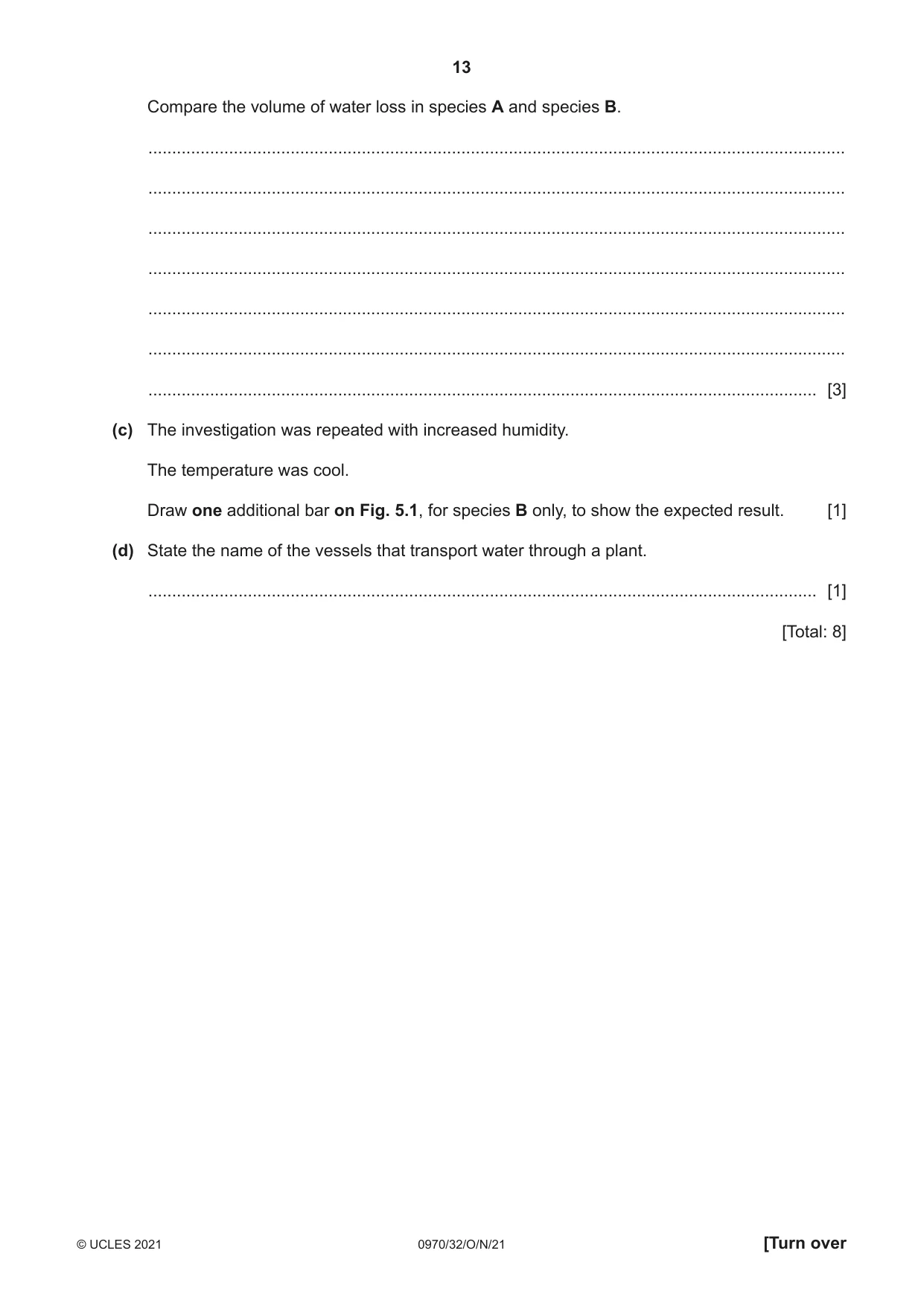
5 (a) Define the term transpiration by completing the sentences. Transpiration is the loss of water vapour from plant leaves by ............................................... of water at the surfaces of the mesophyll cells followed by ............................................... of water vapour through the ............................................... . [3] (b) A student investigated the volume of water lost in one hour by different species of plants at different temperatures. Fig. 5.1 shows the results. Key: cool temperature hot temperature 9 8 7 6 volume of 5 water loss / cm3 4 per hour 3 2 1 0 A B plant species Fig. 5.1 Compare the volume of water loss in species A and species B. ................................................................................................................................................... ................................................................................................................................................... ................................................................................................................................................... ................................................................................................................................................... ................................................................................................................................................... ................................................................................................................................................... ............................................................................................................................................. [3] (c) The investigation was repeated with increased humidity. The temperature was cool. Draw one additional bar on Fig. 5.1, for species B only, to show the expected result. [1] (d) State the name of the vessels that transport water through a plant. ............................................................................................................................................. [1] [Total: 8]
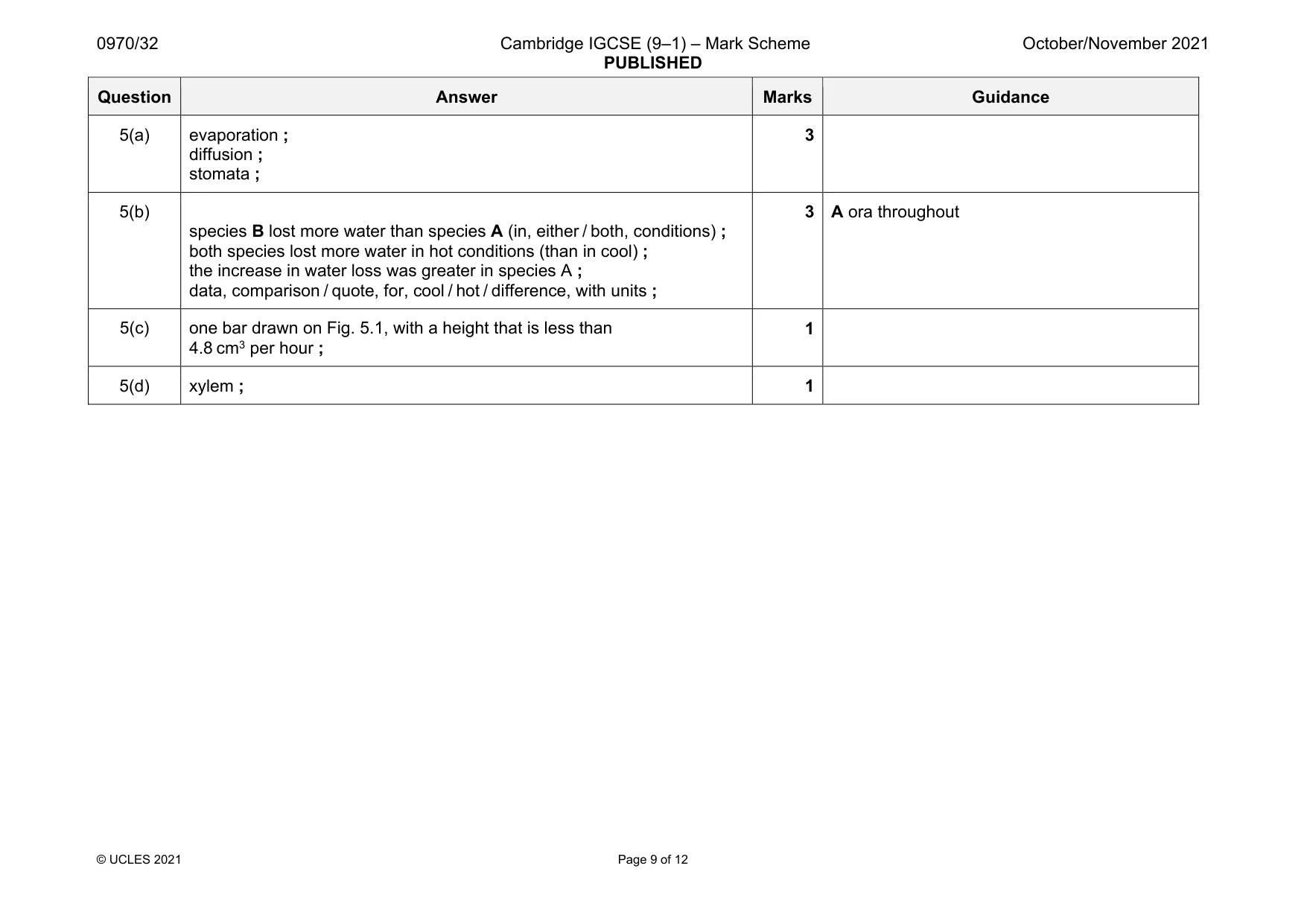
Mark scheme: 5(a) evaporation ; diffusion ; stomata ; 3 5(b) species B lost more water than species A (in, either / both, conditions) ; both species lost more water in hot conditions (than in cool) ; the increase in water loss was greater in species A ; data, comparison / quote, for, cool / hot / difference, with units ; 3 A ora throughout 5(c) one bar drawn on Fig. 5.1, with a height that is less than 4.8 cm3 per hour ; 1 5(d) xylem ; 1
Q6 · The changes that happen to the thickness of the uterus lining during the menstrual cycle
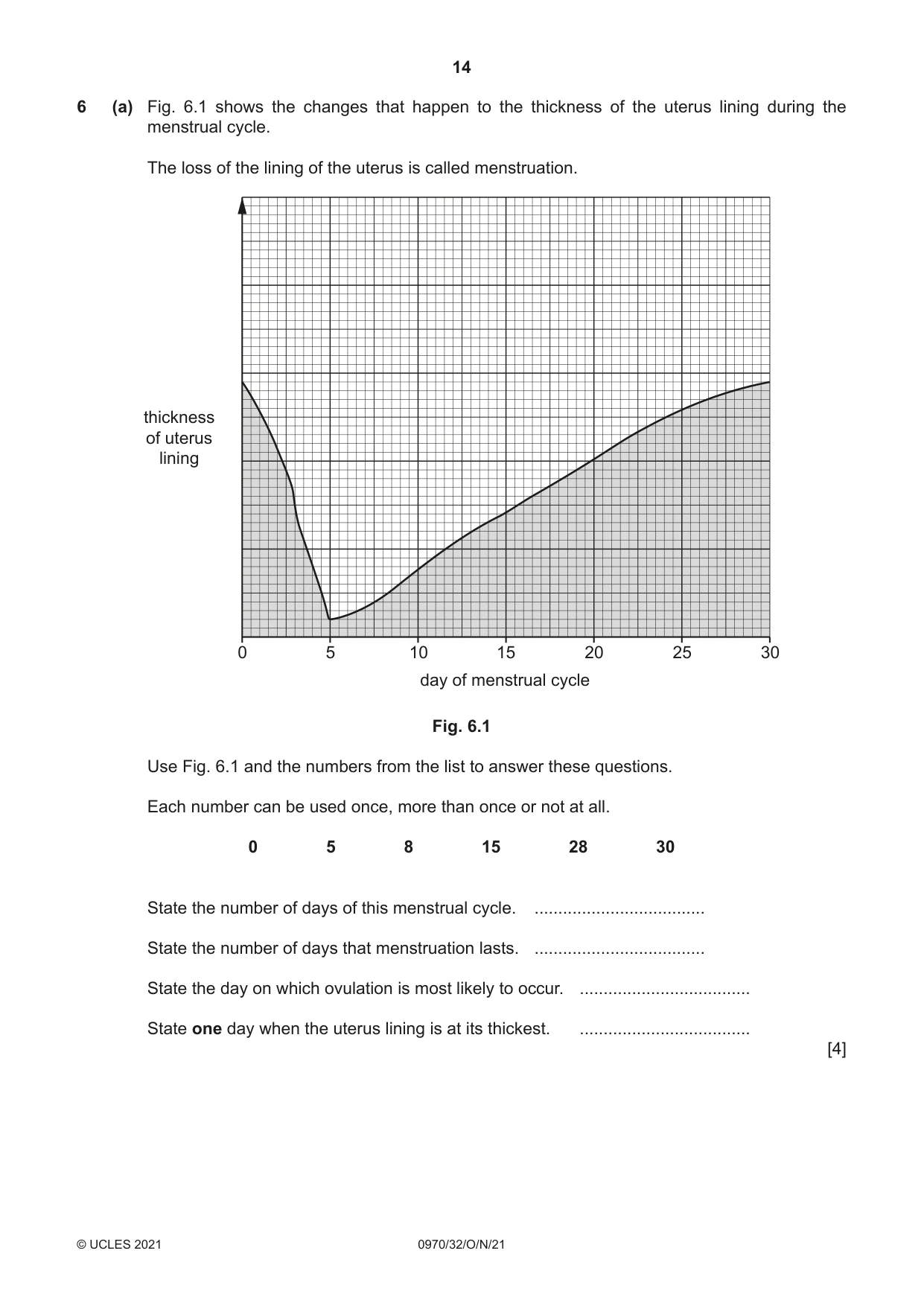
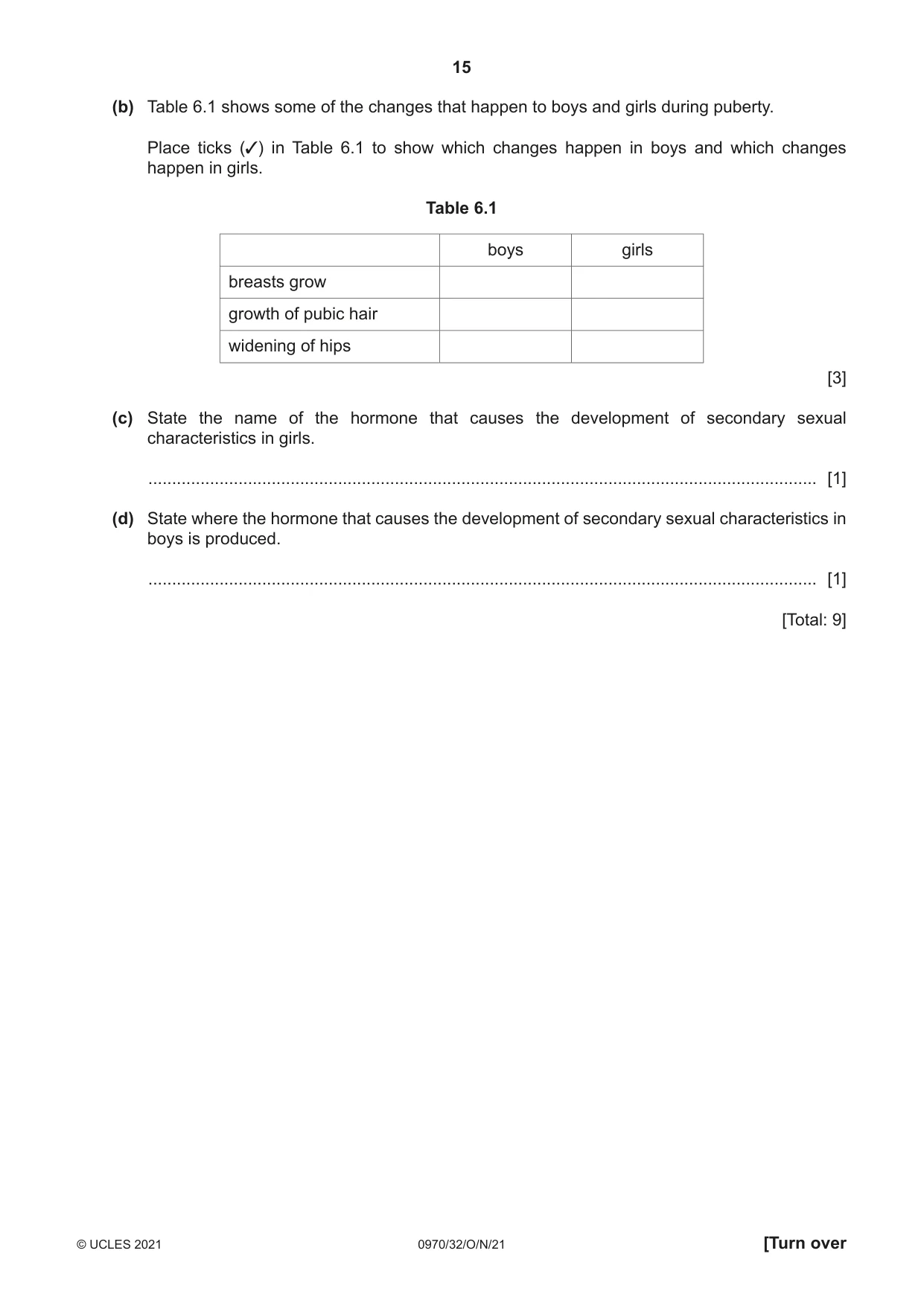
6 (a) Fig. 6.1 shows the changes that happen to the thickness of the uterus lining during the menstrual cycle. The loss of the lining of the uterus is called menstruation. thickness of uterus lining 0 5 10 15 20 25 30 day of menstrual cycle Fig. 6.1 Use Fig. 6.1 and the numbers from the list to answer these questions. Each number can be used once, more than once or not at all. 0 5 8 15 28 30 State the number of days of this menstrual cycle. .................................... State the number of days that menstruation lasts. .................................... State the day on which ovulation is most likely to occur. .................................... State one day when the uterus lining is at its thickest. .................................... [4] (b) Table 6.1 shows some of the changes that happen to boys and girls during puberty. Place ticks (3) in Table 6.1 to show which changes happen in boys and which changes happen in girls. Table 6.1 boys girls breasts grow growth of pubic hair widening of hips [3] (c) State the name of the hormone that causes the development of secondary sexual characteristics in girls. ............................................................................................................................................. [1] (d) State where the hormone that causes the development of secondary sexual characteristics in boys is produced. ............................................................................................................................................. [1] [Total: 9]
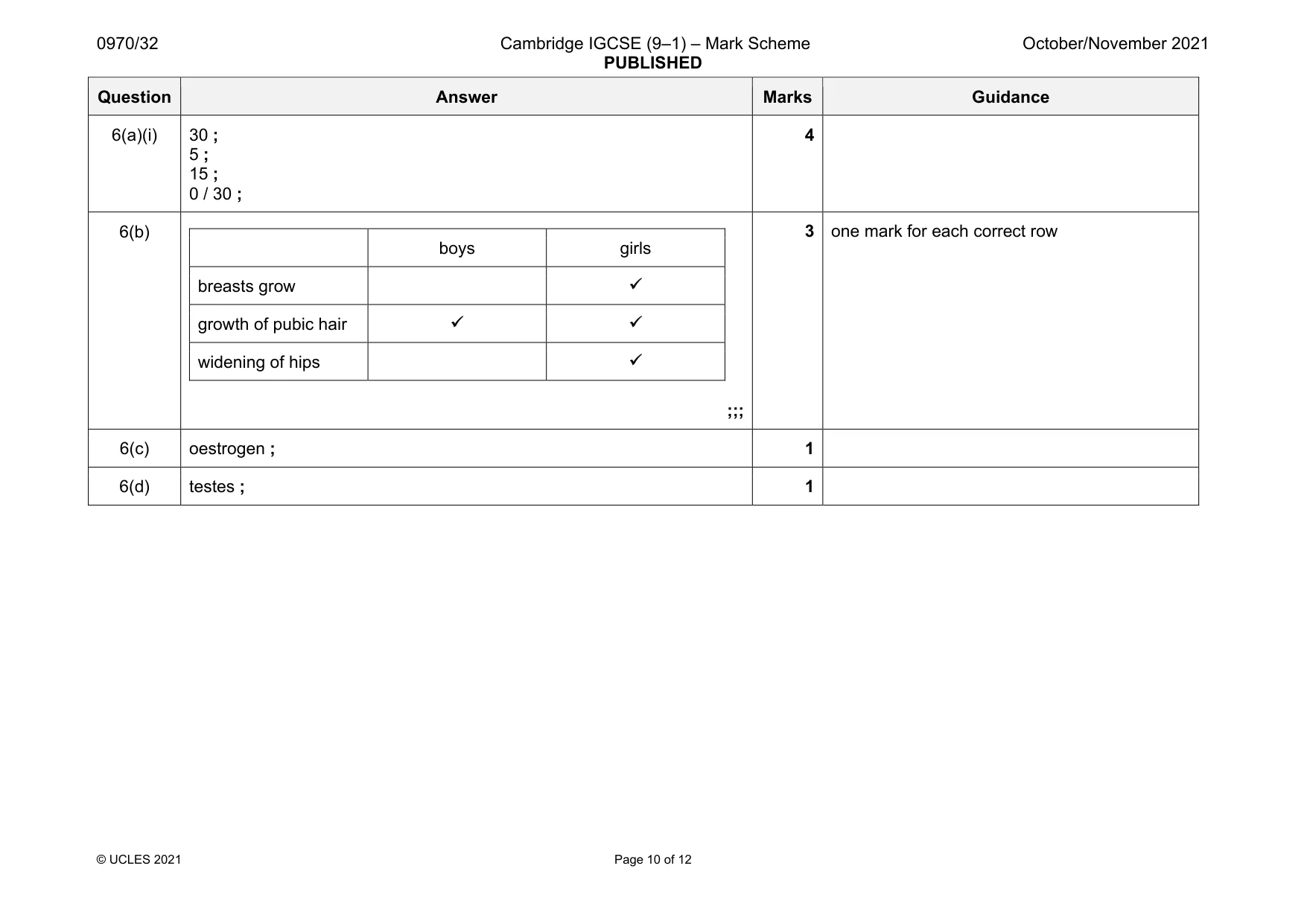
Mark scheme: 6(a)(i) 30 ; 5 ; 15 ; 0 / 30 ; 4 6(b) boys girls breasts grow growth of pubic hair widening of hips ;;; 3 one mark for each correct row 6(c) oestrogen ; 1 6(d) testes ; 1
Q7 · A student investigated the effect of different concentrations of pectinase on the volume…
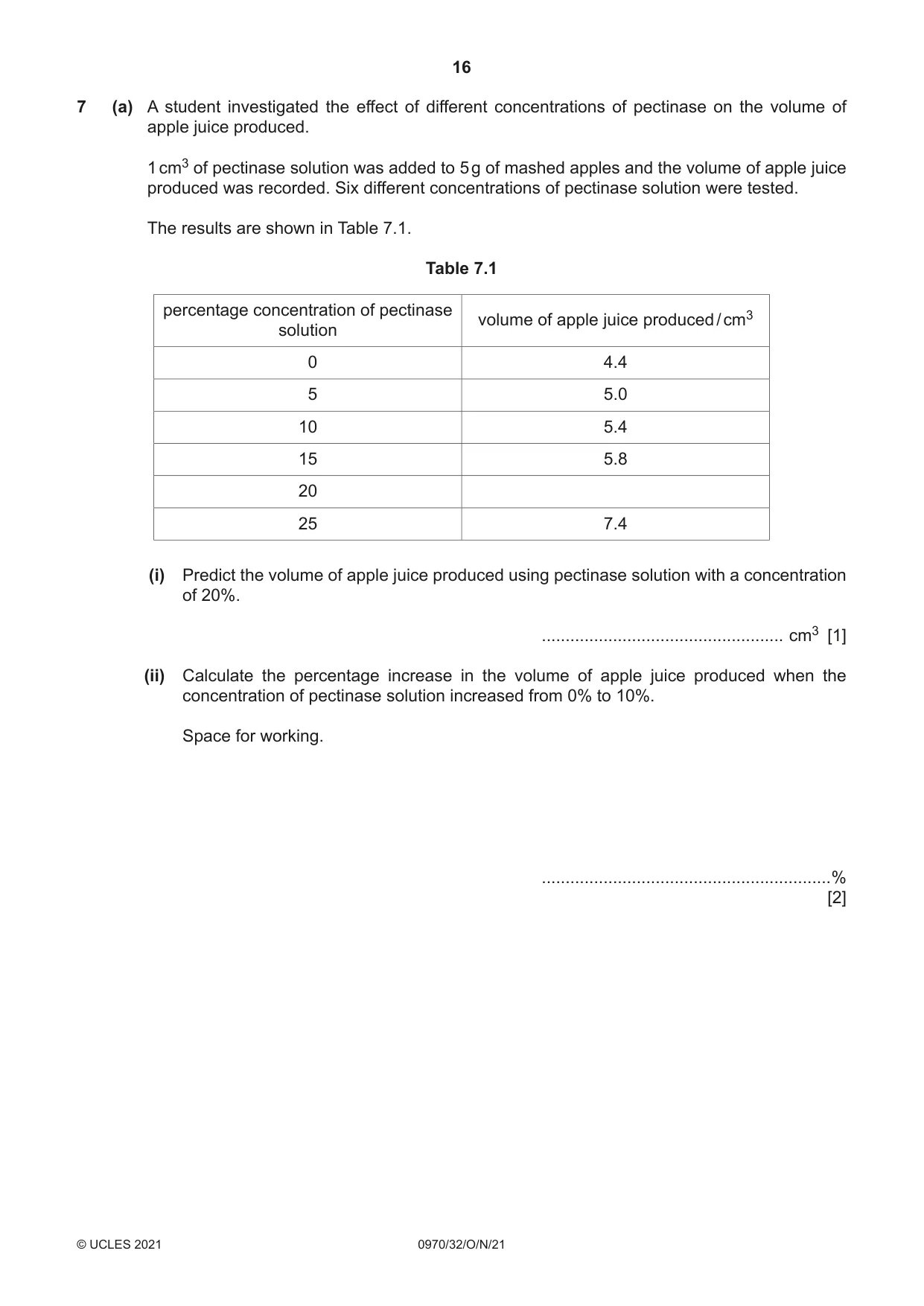
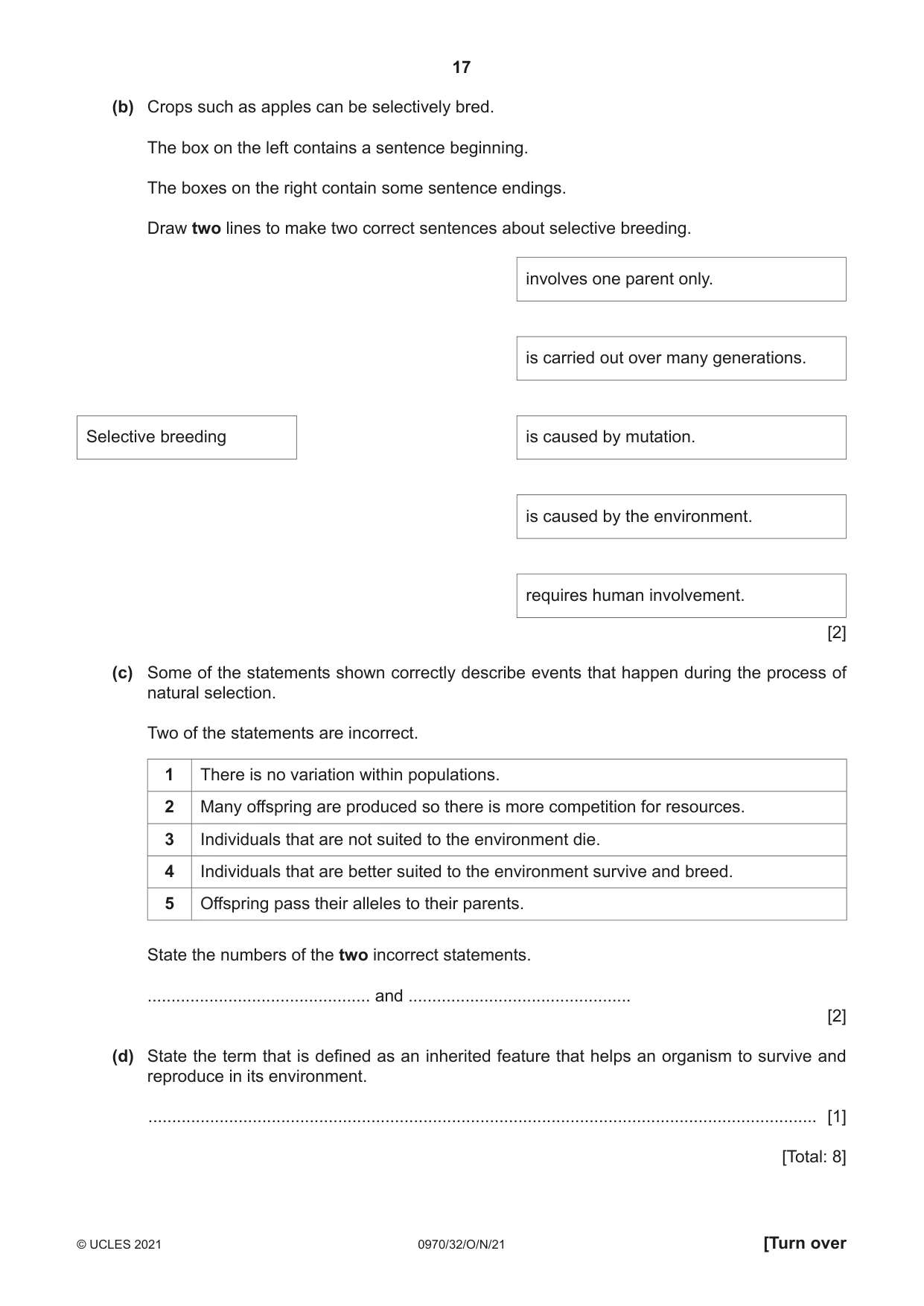
7 (a) A student investigated the effect of different concentrations of pectinase on the volume of apple juice produced. 1 cm3 of pectinase solution was added to 5 g of mashed apples and the volume of apple juice produced was recorded. Six different concentrations of pectinase solution were tested. The results are shown in Table 7.1. Table 7.1 percentage concentration of pectinase volume of apple juice produced / cm3 solution 0 4.4 5 5.0 10 5.4 15 5.8 20 25 7.4 (i) Predict the volume of apple juice produced using pectinase solution with a concentration of 20%. ................................................... cm3 [1] (ii) Calculate the percentage increase in the volume of apple juice produced when the concentration of pectinase solution increased from 0% to 10%. Space for working. .............................................................% [2] (b) Crops such as apples can be selectively bred. The box on the left contains a sentence beginning. The boxes on the right contain some sentence endings. Draw two lines to make two correct sentences about selective breeding. involves one parent only. is carried out over many generations. Selective breeding is caused by mutation. is caused by the environment. requires human involvement. [2] (c) Some of the statements shown correctly describe events that happen during the process of natural selection. Two of the statements are incorrect. 1 There is no variation within populations. 2 Many offspring are produced so there is more competition for resources. 3 Individuals that are not suited to the environment die. 4 Individuals that are better suited to the environment survive and breed. 5 Offspring pass their alleles to their parents. State the numbers of the two incorrect statements. ............................................... and ............................................... [2] (d) State the term that is defined as an inherited feature that helps an organism to survive and reproduce in its environment. ............................................................................................................................................. [1] [Total: 8]
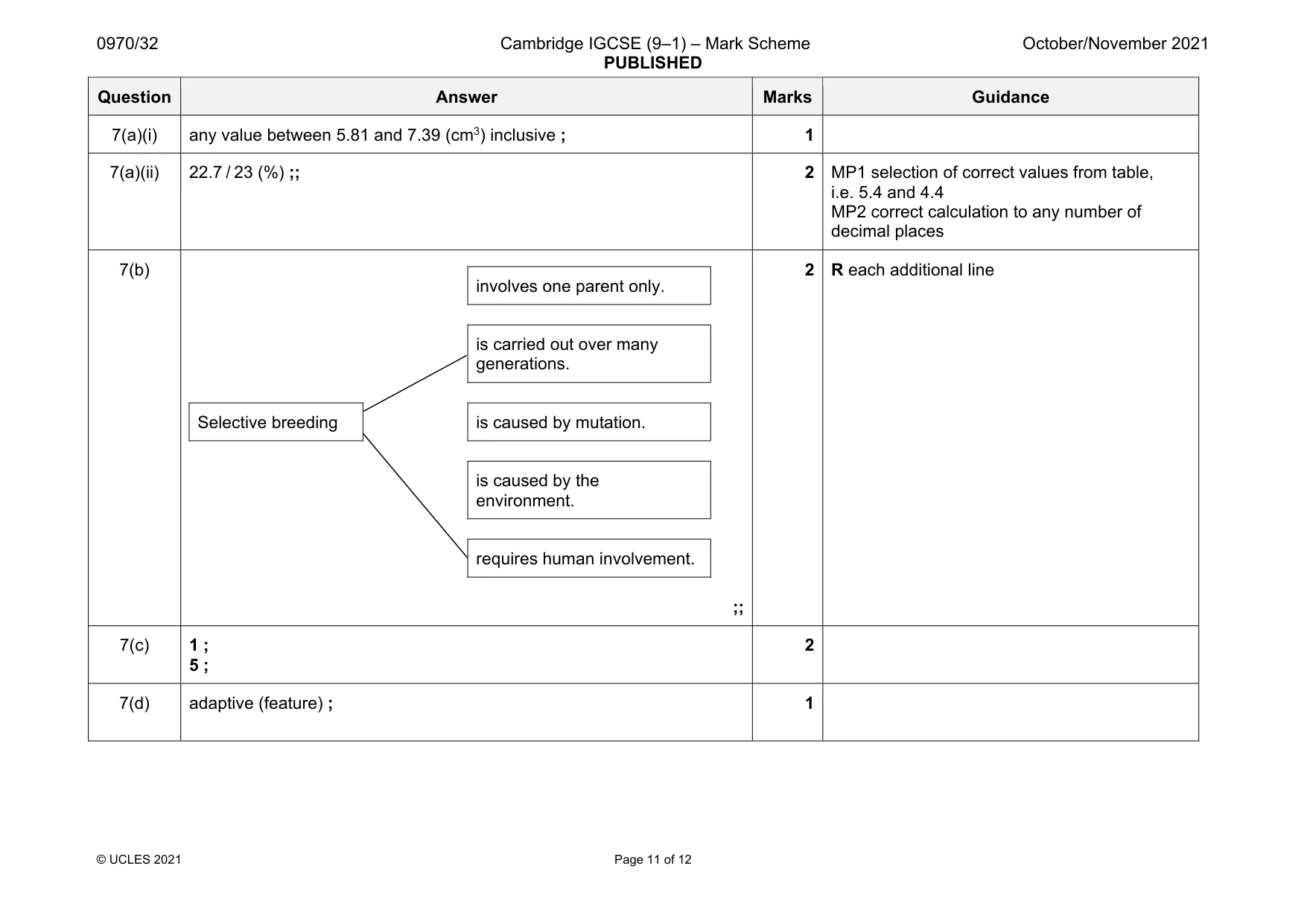
Mark scheme: 7(a)(i) any value between 5.81 and 7.39 (cm3) inclusive ; 1 7(a)(ii) 22.7 / 23 (%) ;; 2 MP1 selection of correct values from table, i.e. 5.4 and 4.4 MP2 correct calculation to any number of decimal places 7(b) involves one parent only. is carried out over many generations. Selective breeding is caused by mutation. is caused by the environment. requires human involvement. ;; 2 R each additional line 7(c) 1 ; 5 ; 2 7(d) adaptive (feature) ; 1
Q8 · Define the term population by completing the sentence
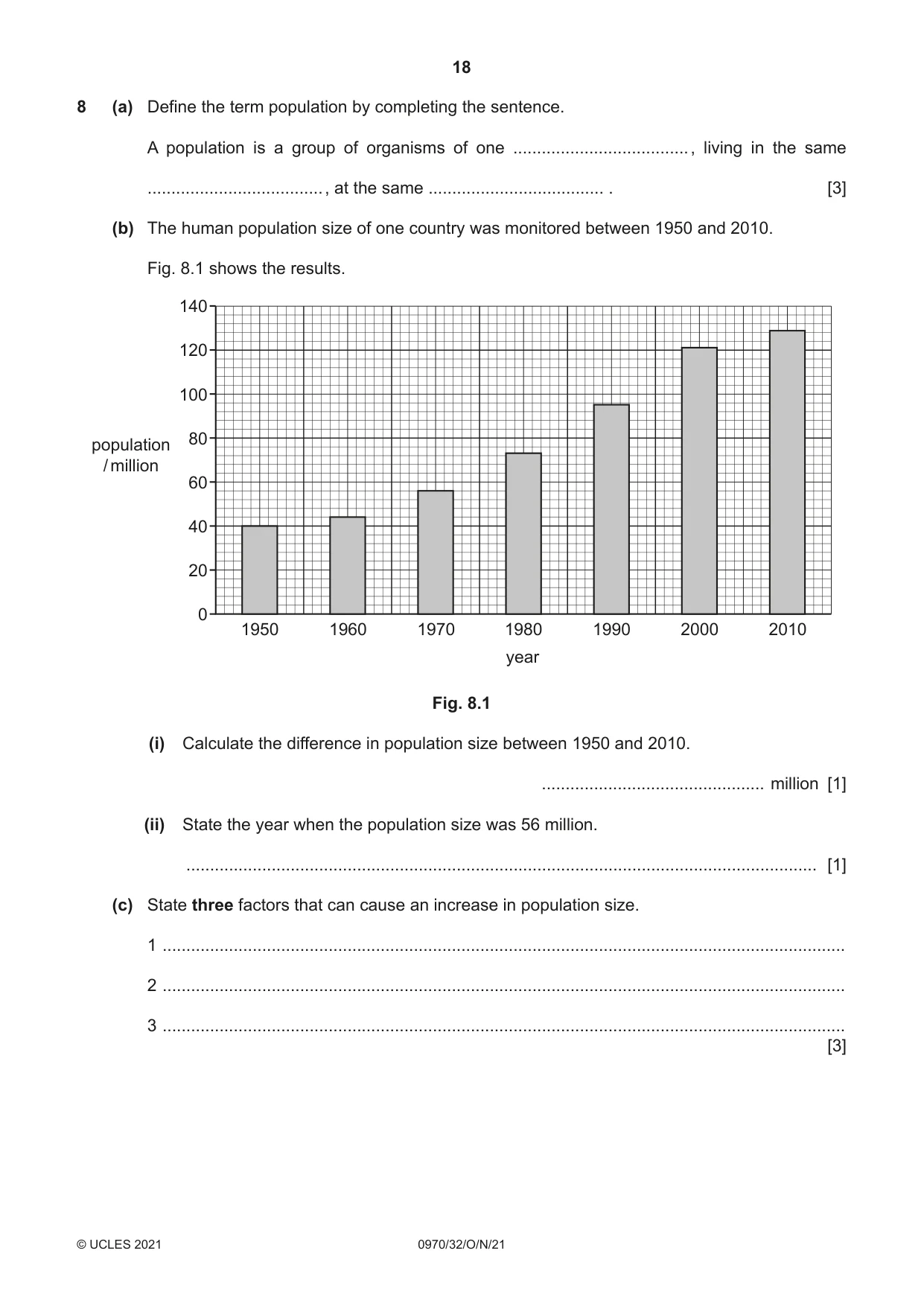
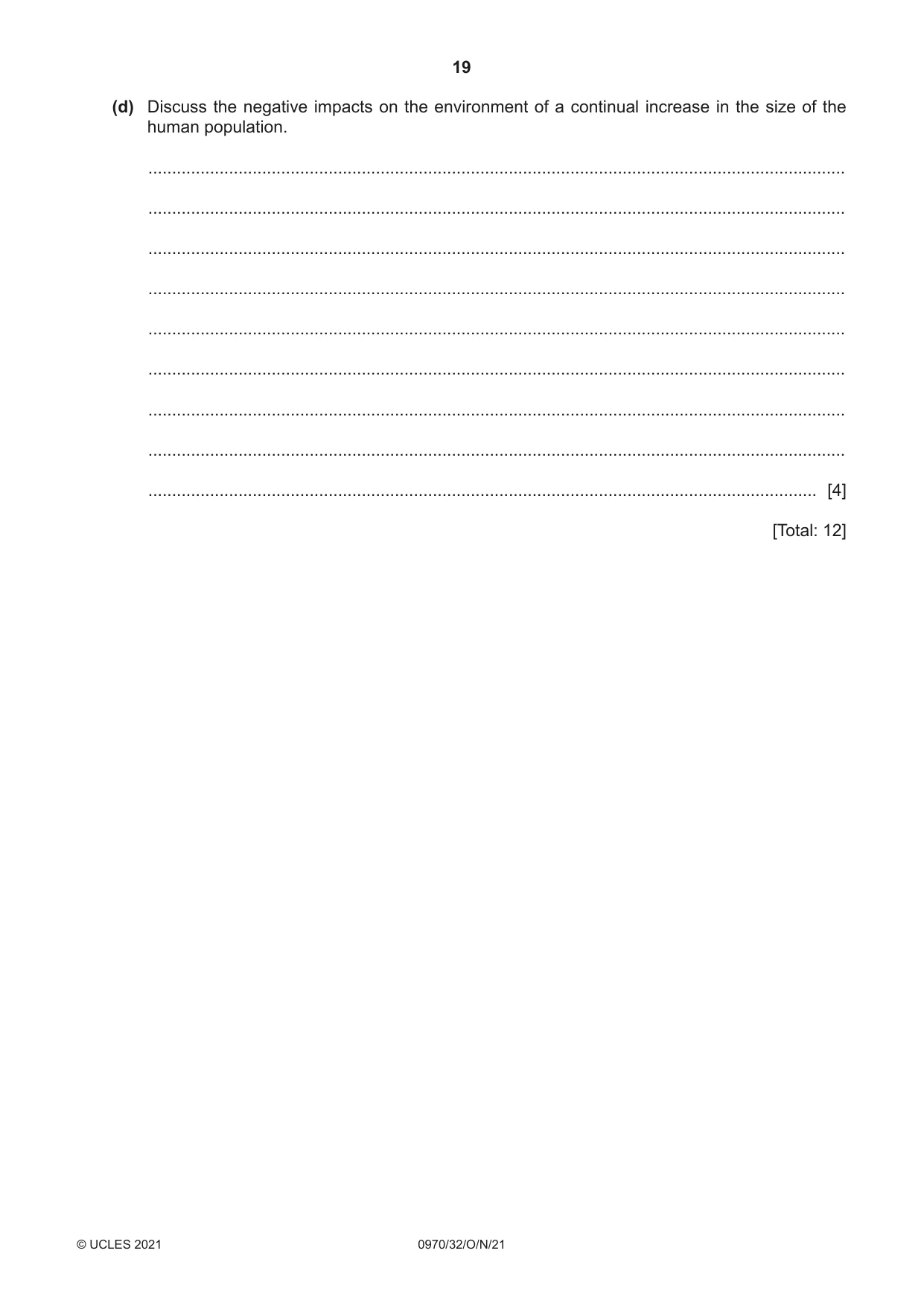
8 (a) Define the term population by completing the sentence. A population is a group of organisms of one ..................................... , living in the same ..................................... , at the same ..................................... . [3] (b) The human population size of one country was monitored between 1950 and 2010. Fig. 8.1 shows the results. 140 120 100 80 population / million 60 40 20 0 1950 1960 1970 1980 1990 2000 2010 year Fig. 8.1 (i) Calculate the difference in population size between 1950 and 2010. ............................................... million [1] (ii) State the year when the population size was 56 million. ..................................................................................................................................... [1] (c) State three factors that can cause an increase in population size. 1 ................................................................................................................................................ 2 ................................................................................................................................................ 3 ................................................................................................................................................ [3] (d) Discuss the negative impacts on the environment of a continual increase in the size of the human population. ................................................................................................................................................... ................................................................................................................................................... ................................................................................................................................................... ................................................................................................................................................... ................................................................................................................................................... ................................................................................................................................................... ................................................................................................................................................... ................................................................................................................................................... ............................................................................................................................................. [4] [Total: 12]
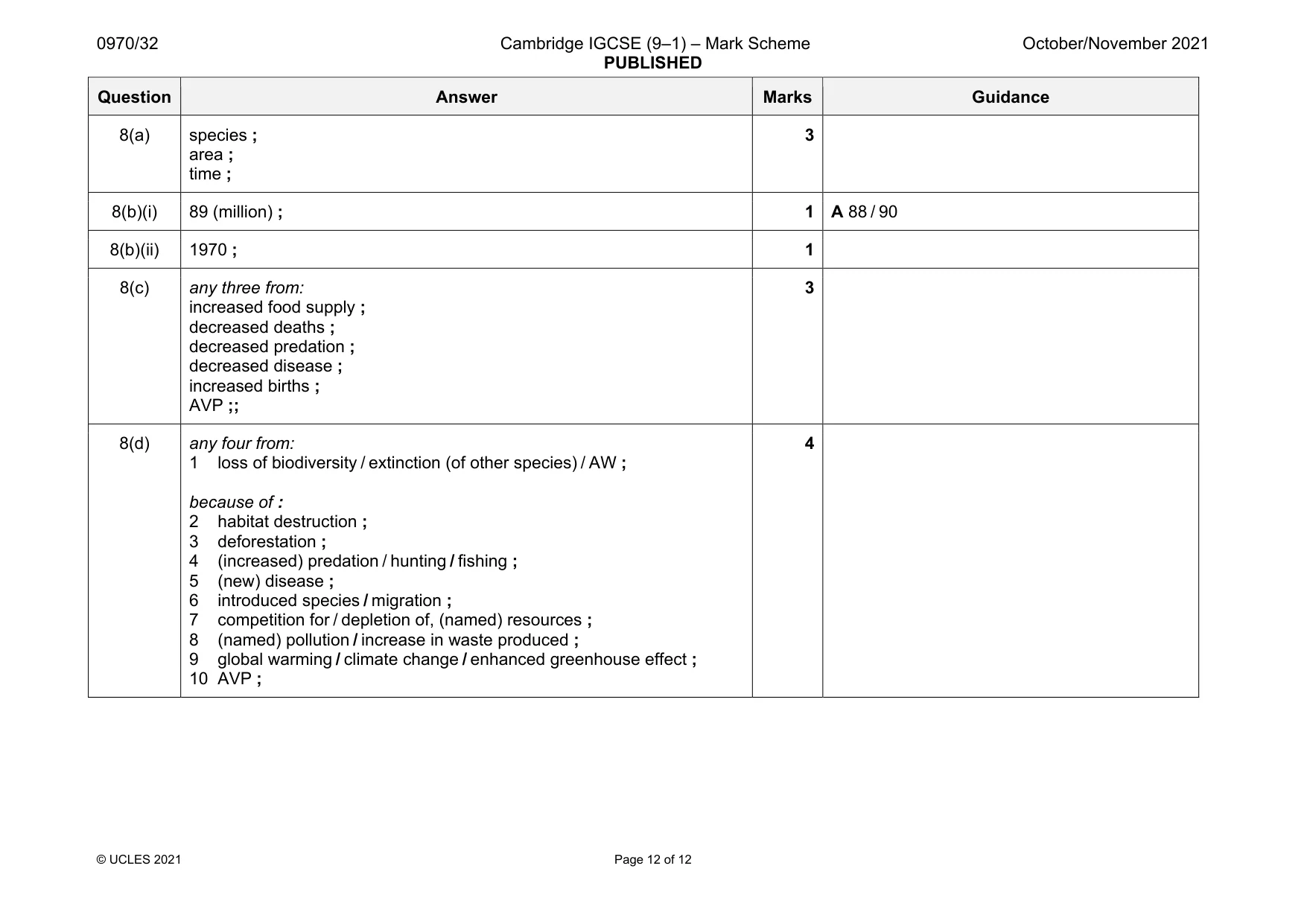
Mark scheme: 8(a) species ; area ; time ; 3 8(b)(i) 89 (million) ; 1 A 88 / 90 8(b)(ii) 1970 ; 1 8(c) any three from: increased food supply ; decreased deaths ; decreased predation ; decreased disease ; increased births ; AVP ;; 3 8(d) any four from: 1 loss of biodiversity / extinction (of other species) / AW ; because of : 2 habitat destruction ; 3 deforestation ; 4 (increased) predation / hunting / fishing ; 5 (new) disease ; 6 introduced species / migration ; 7 competition for / depletion of, (named) resources ; 8 (named) pollution / increase in waste produced ; 9 global warming / climate change / enhanced greenhouse effect ; 10 AVP ; 4
What was in this paper
The subtopics covered by these 8 questions, and how many questions each got. Open one in a new tab to see every Cambridge question on it.
What you needed in this session
Cambridge’s own grade thresholds for 2021 Oct/Nov, Paper 3 · Variant 2. A higher threshold means an easier paper — the bar moves with how the cohort did.