Cambridge IGCSE Biology (9-1) 0970 — 2020 Oct/Nov Paper 3 · Variant 2
0970/32/O/N/20 · 8 questions · 80 marks · ≈90 min
The question paper and its mark scheme, free to read here and free to download. This is Cambridge’s own paper, exactly as it was sat.
Question paper20 pages


Mark scheme12 pages
Answers below. Sit the paper first if you are practising.
Questions as text
Q1 · All living organisms have the same characteristics
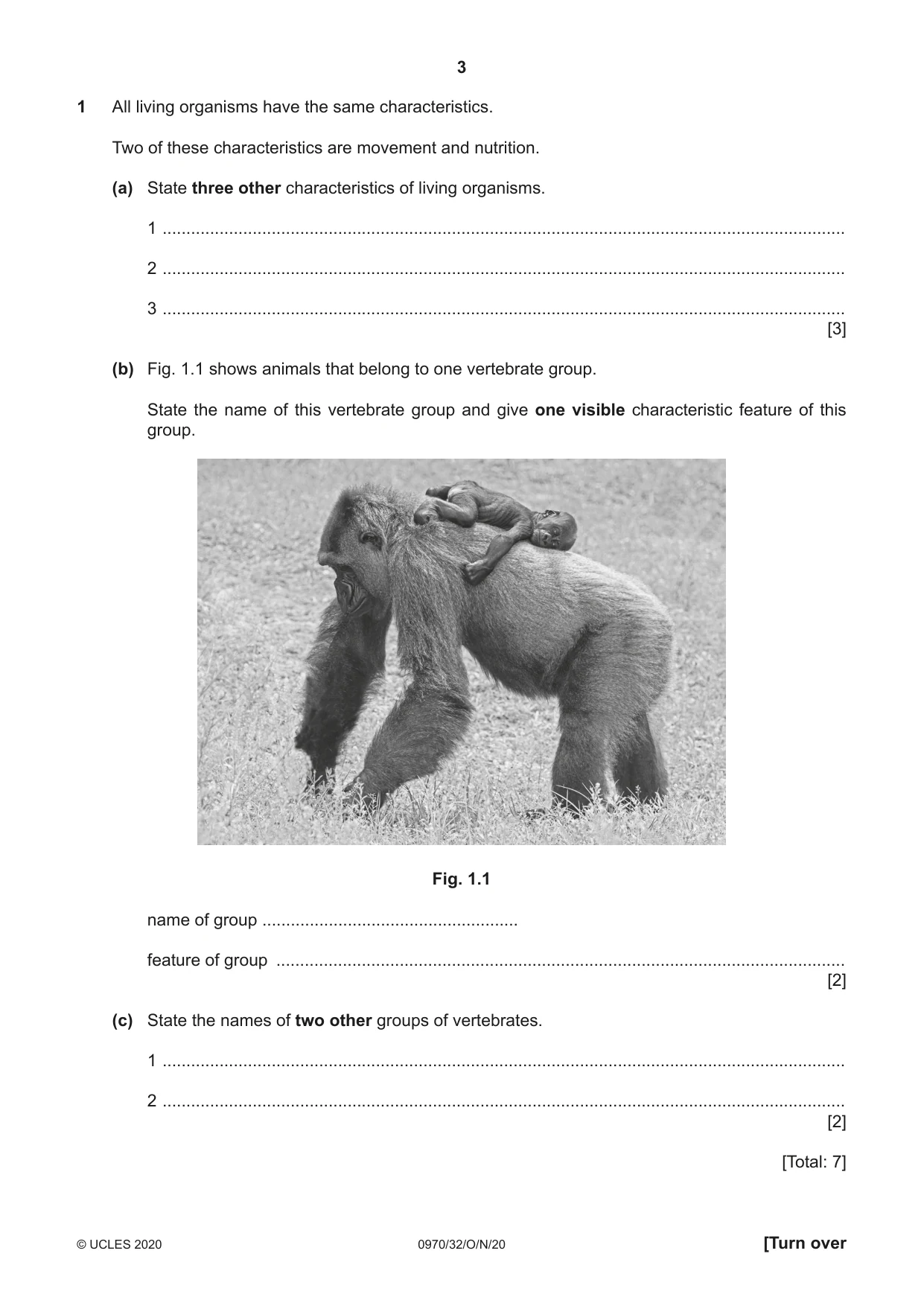
1 All living organisms have the same characteristics. Two of these characteristics are movement and nutrition. (a) State three other characteristics of living organisms. 1 ................................................................................................................................................ 2 ................................................................................................................................................ 3 ................................................................................................................................................ [3] (b) Fig. 1.1 shows animals that belong to one vertebrate group. State the name of this vertebrate group and give one visible characteristic feature of this group. Fig. 1.1 name of group ...................................................... feature of group ........................................................................................................................ [2] (c) State the names of two other groups of vertebrates. 1 ................................................................................................................................................ 2 ................................................................................................................................................ [2] [Total: 7]
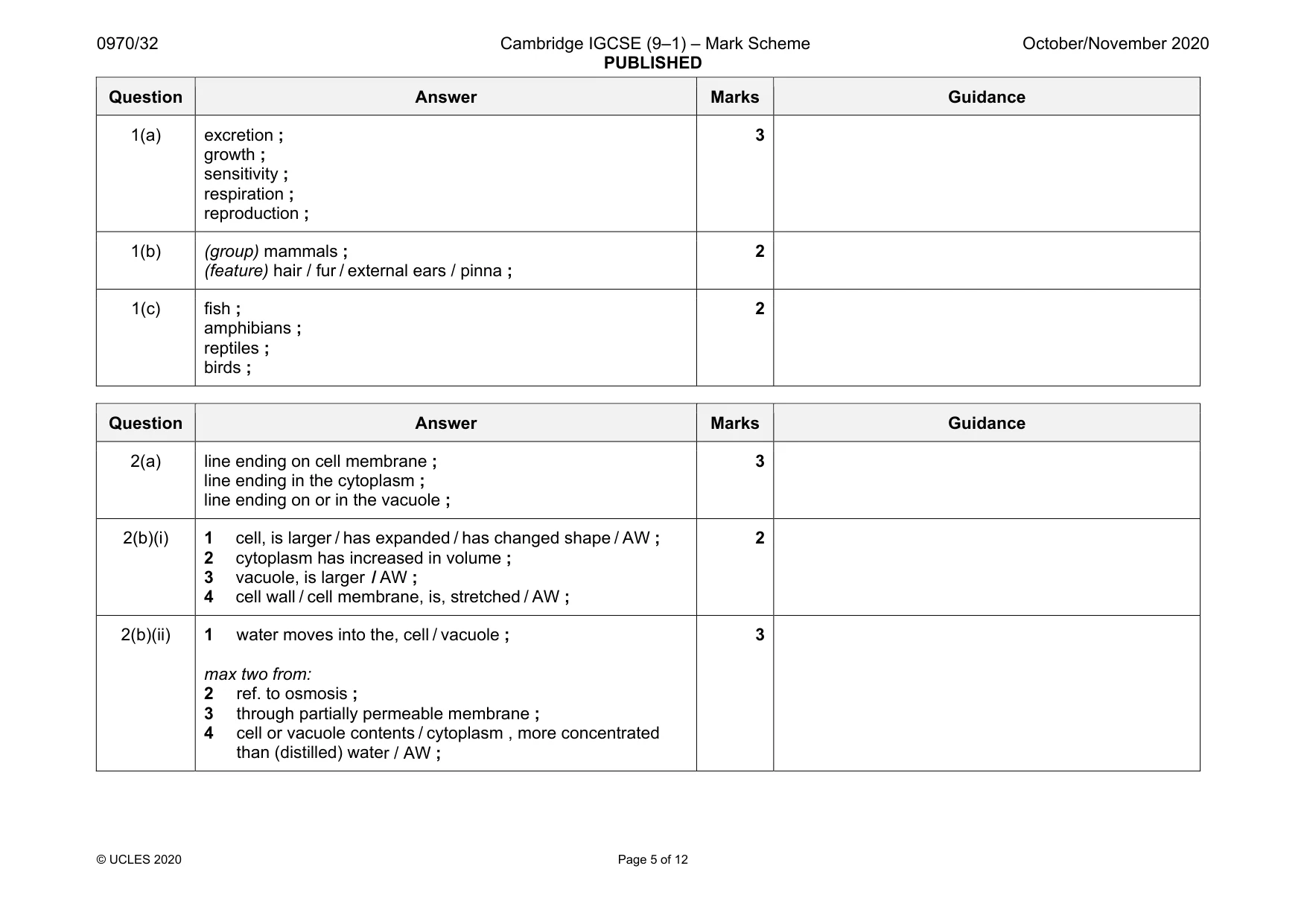
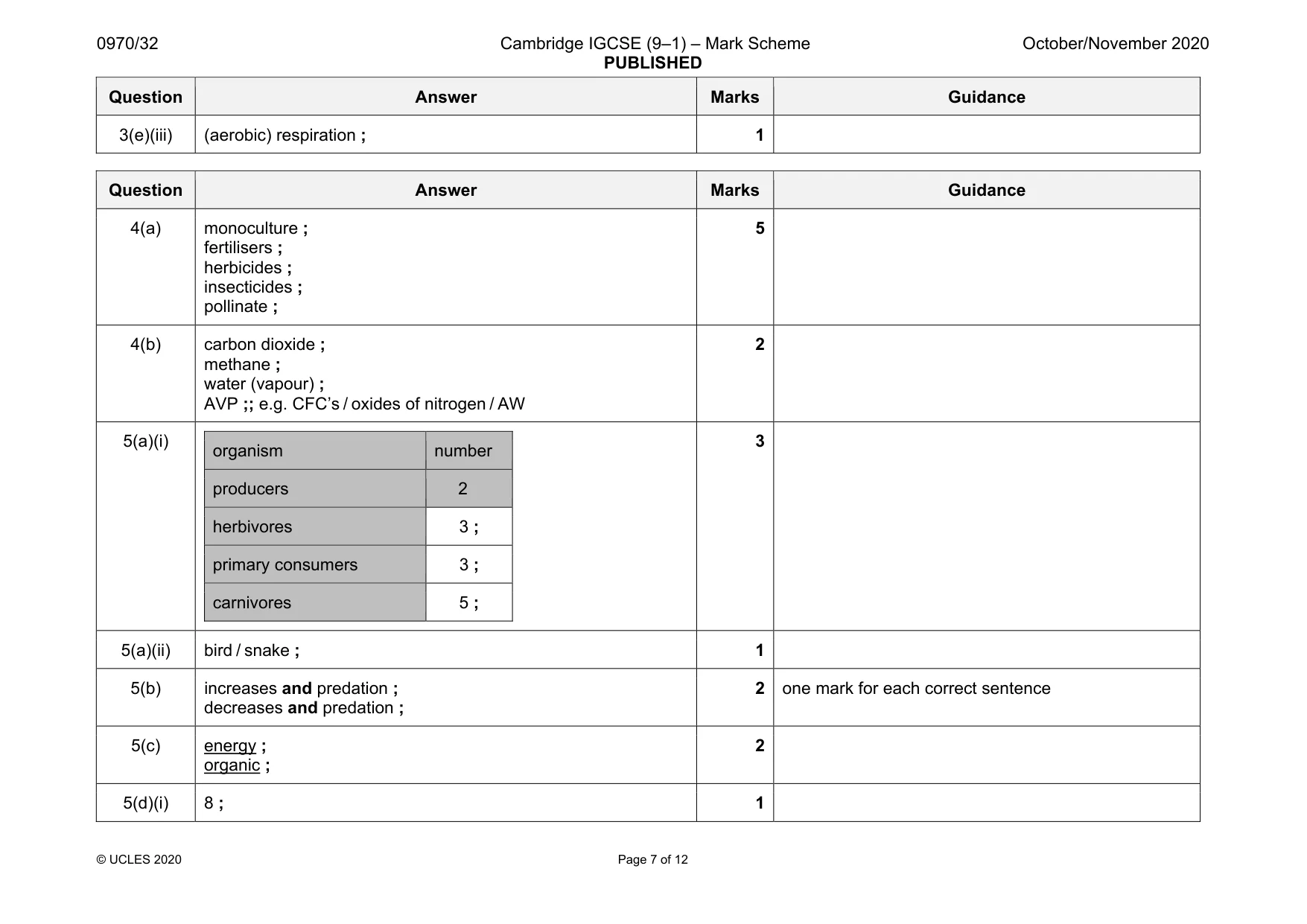
Mark scheme: 1(a) excretion ; growth ; sensitivity ; respiration ; reproduction ; 3 1(b) (group) mammals ; (feature) hair / fur / external ears / pinna ; 2 1(c) fish ; amphibians ; reptiles ; birds ; 2
Q2 · A plant cell after it has been in a solution of glucose for fifteen minutes
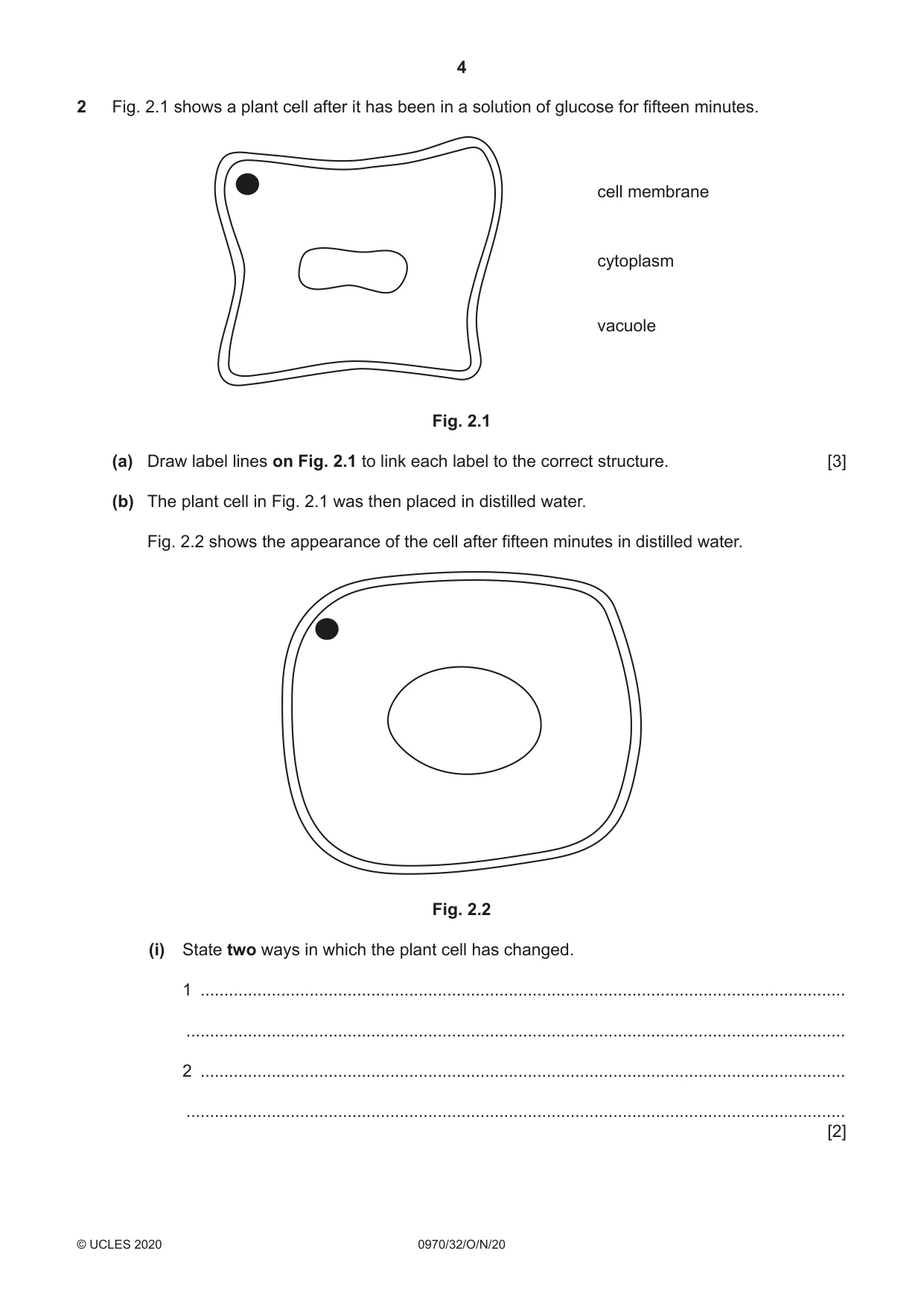
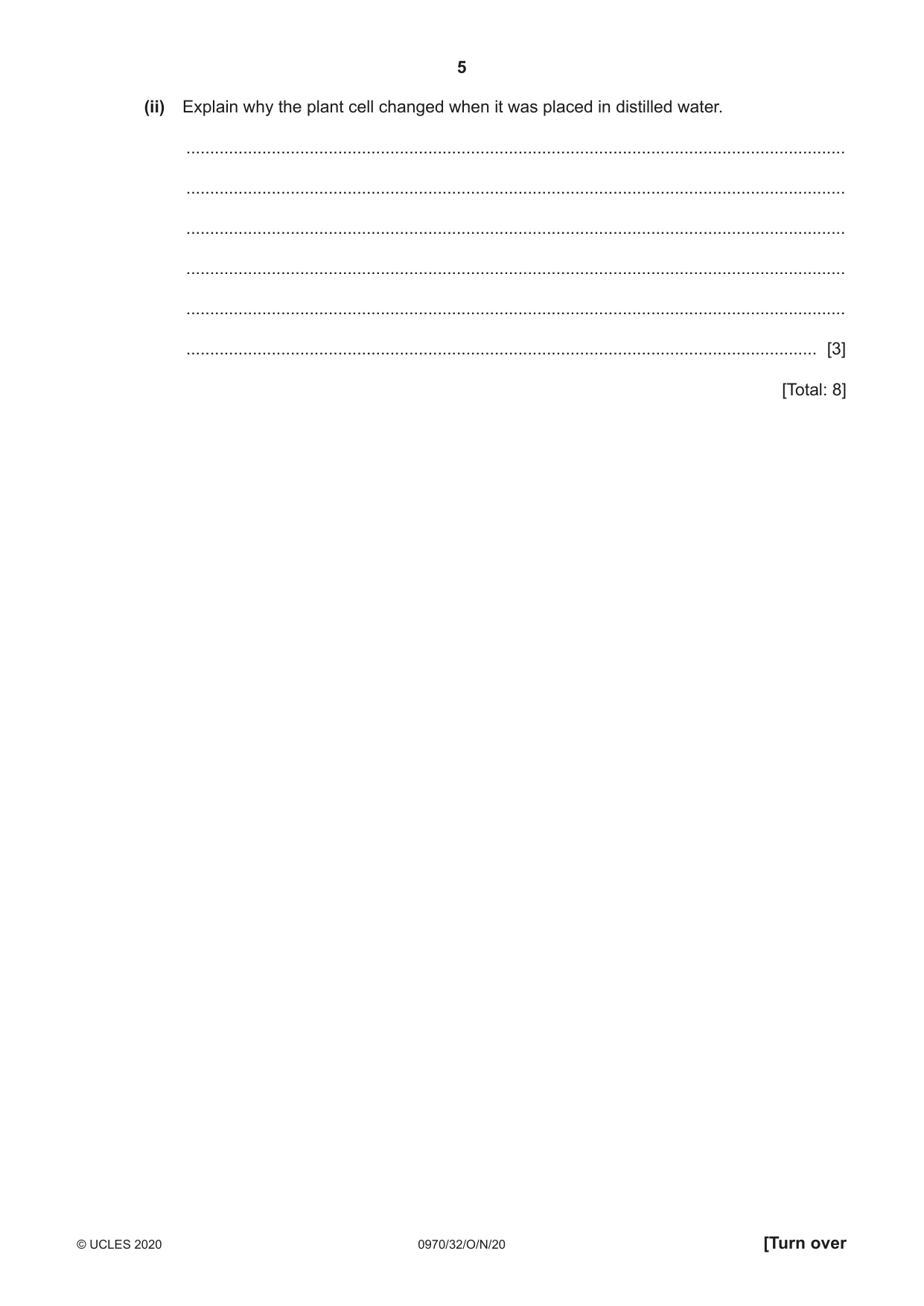
2 Fig. 2.1 shows a plant cell after it has been in a solution of glucose for fifteen minutes. cell membrane cytoplasm vacuole Fig. 2.1 (a) Draw label lines on Fig. 2.1 to link each label to the correct structure. [3] (b) The plant cell in Fig. 2.1 was then placed in distilled water. Fig. 2.2 shows the appearance of the cell after fifteen minutes in distilled water. Fig. 2.2 (i) State two ways in which the plant cell has changed. 1 ........................................................................................................................................ ........................................................................................................................................... 2 ........................................................................................................................................ ........................................................................................................................................... [2] (ii) Explain why the plant cell changed when it was placed in distilled water. ........................................................................................................................................... ........................................................................................................................................... ........................................................................................................................................... ........................................................................................................................................... ........................................................................................................................................... ..................................................................................................................................... [3] [Total: 8]
Mark scheme: 2(a) line ending on cell membrane ; line ending in the cytoplasm ; line ending on or in the vacuole ; 3 2(b)(i) 1 cell, is larger / has expanded / has changed shape / AW ; 2 cytoplasm has increased in volume ; 3 vacuole, is larger / AW ; 4 cell wall / cell membrane, is, stretched / AW ; 2 2(b)(ii) 1 water moves into the, cell / vacuole ; max two from: 2 ref. to osmosis ; 3 through partially permeable membrane ; 4 cell or vacuole contents / cytoplasm , more concentrated than (distilled) water / AW ; 3
Q3 · The boxes on the left contain the names of components of the diet
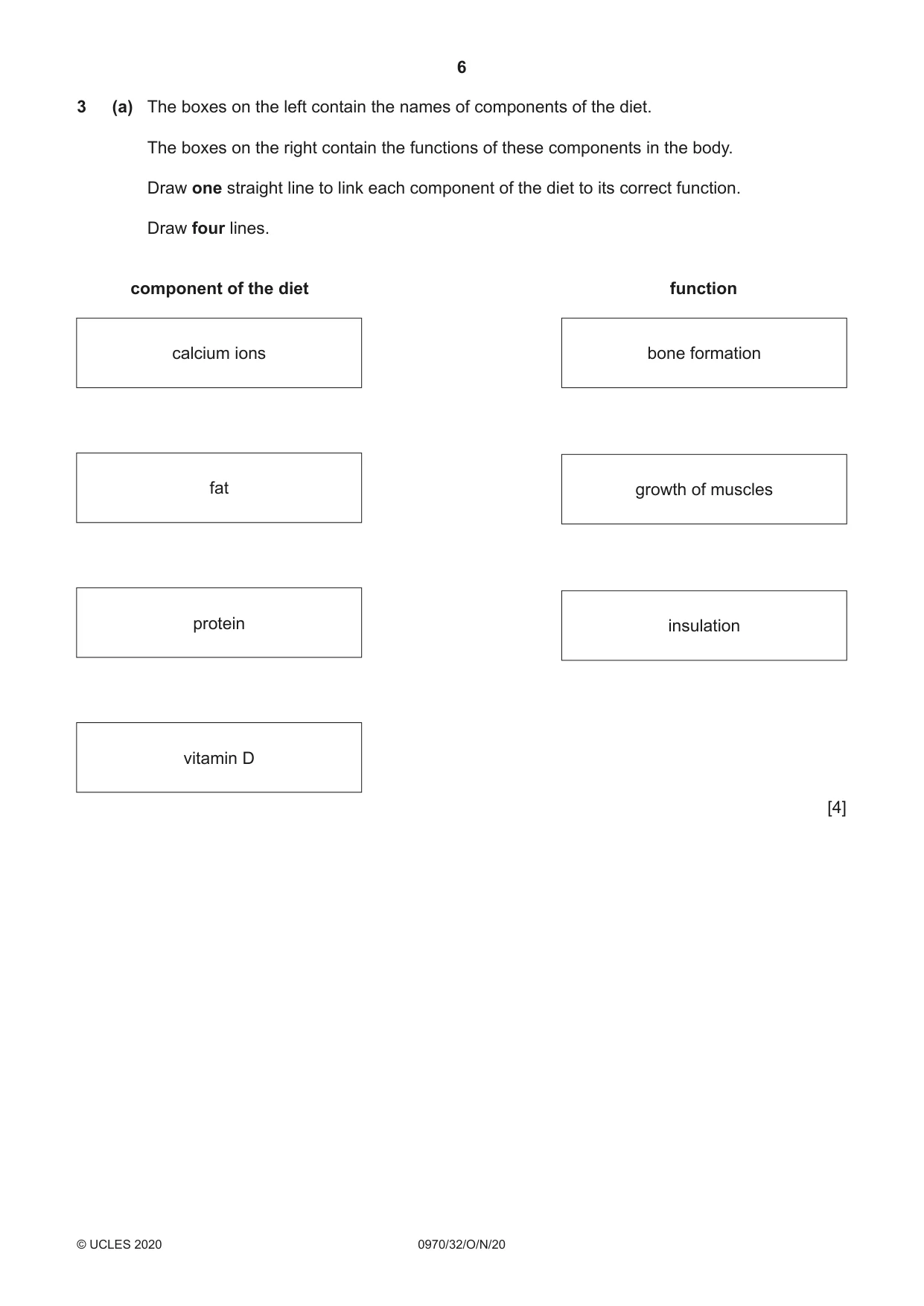
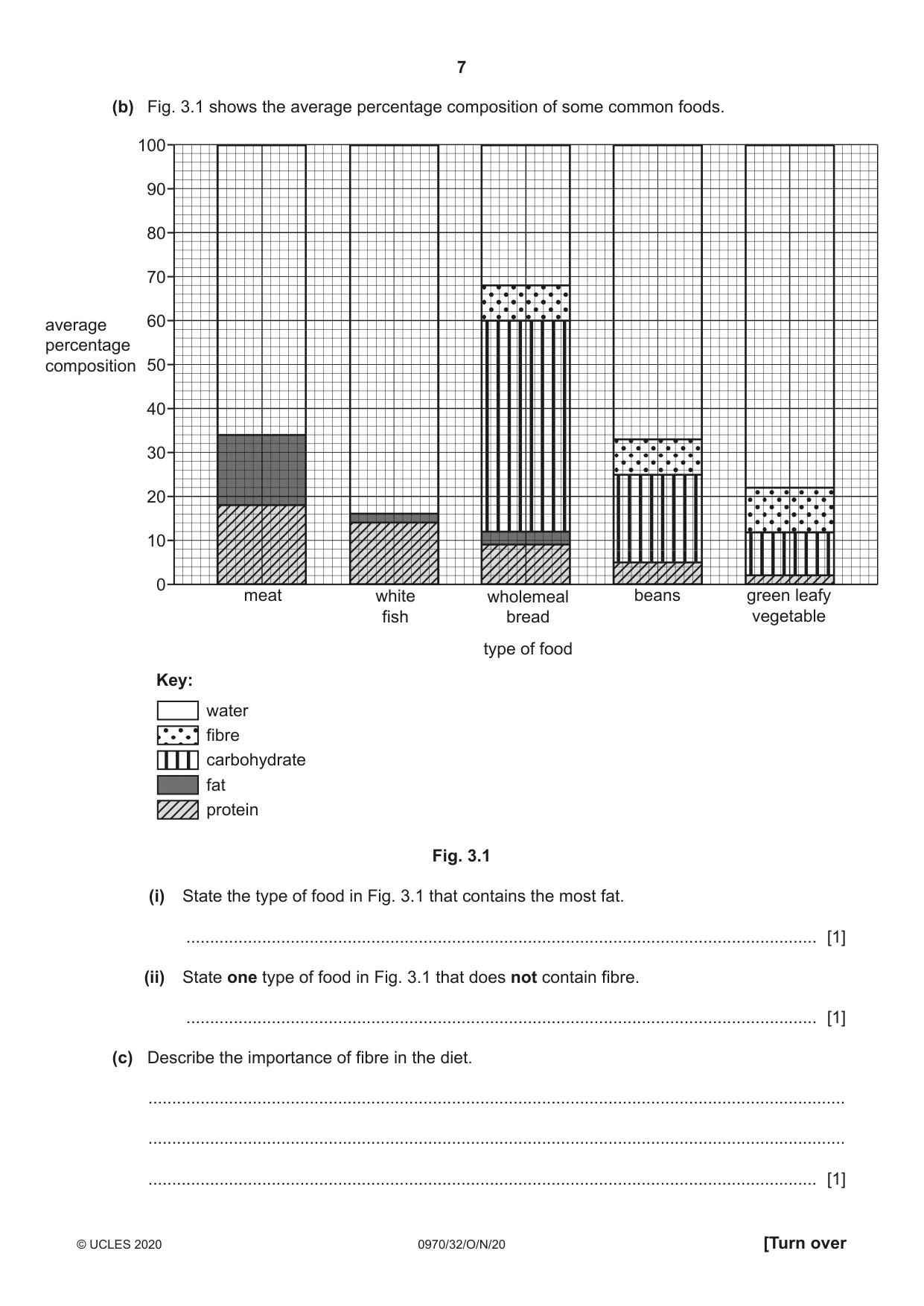
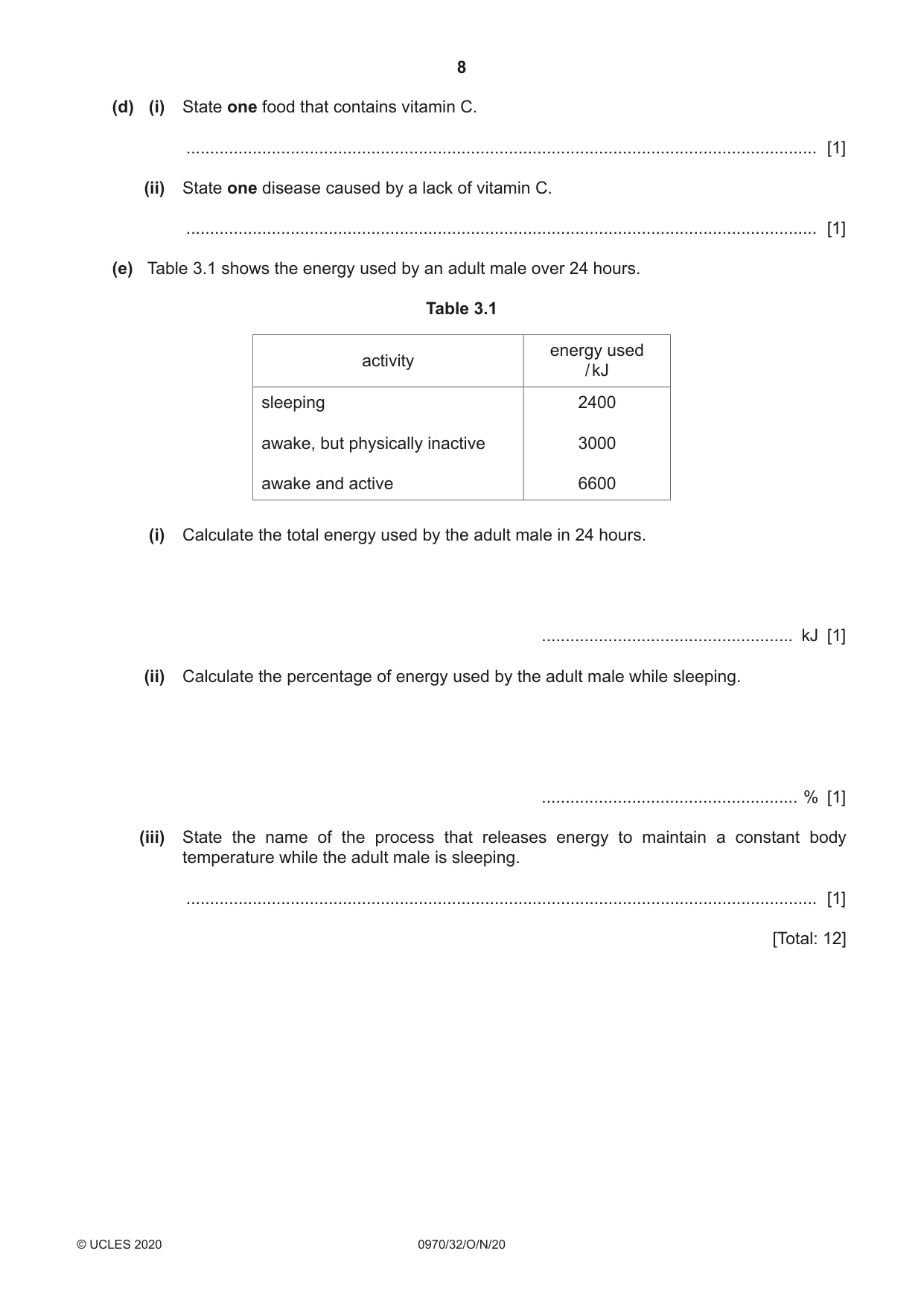
3 (a) The boxes on the left contain the names of components of the diet. The boxes on the right contain the functions of these components in the body. Draw one straight line to link each component of the diet to its correct function. Draw four lines. component of the diet function calcium ions bone formation fat growth of muscles protein insulation vitamin D [4] (b) Fig. 3.1 shows the average percentage composition of some common foods. 100 90 80 70 average 60 percentage composition 50 40 30 20 10 0 meat white wholemeal beans green leafy fish bread vegetable type of food Key: water fibre carbohydrate fat protein Fig. 3.1 (i) State the type of food in Fig. 3.1 that contains the most fat. ..................................................................................................................................... [1] (ii) State one type of food in Fig. 3.1 that does not contain fibre. ..................................................................................................................................... [1] (c) Describe the importance of fibre in the diet. ................................................................................................................................................... ................................................................................................................................................... ............................................................................................................................................. [1] (d) (i) State one food that contains vitamin C. ..................................................................................................................................... [1] (ii) State one disease caused by a lack of vitamin C. ..................................................................................................................................... [1] (e) Table 3.1 shows the energy used by an adult male over 24 hours. Table 3.1 energy used activity / kJ sleeping 2400 awake, but physically inactive 3000 awake and active 6600 (i) Calculate the total energy used by the adult male in 24 hours. ..................................................... kJ [1] (ii) Calculate the percentage of energy used by the adult male while sleeping. ...................................................... % [1] (iii) State the name of the process that releases energy to maintain a constant body temperature while the adult male is sleeping. ..................................................................................................................................... [1] [Total: 12]
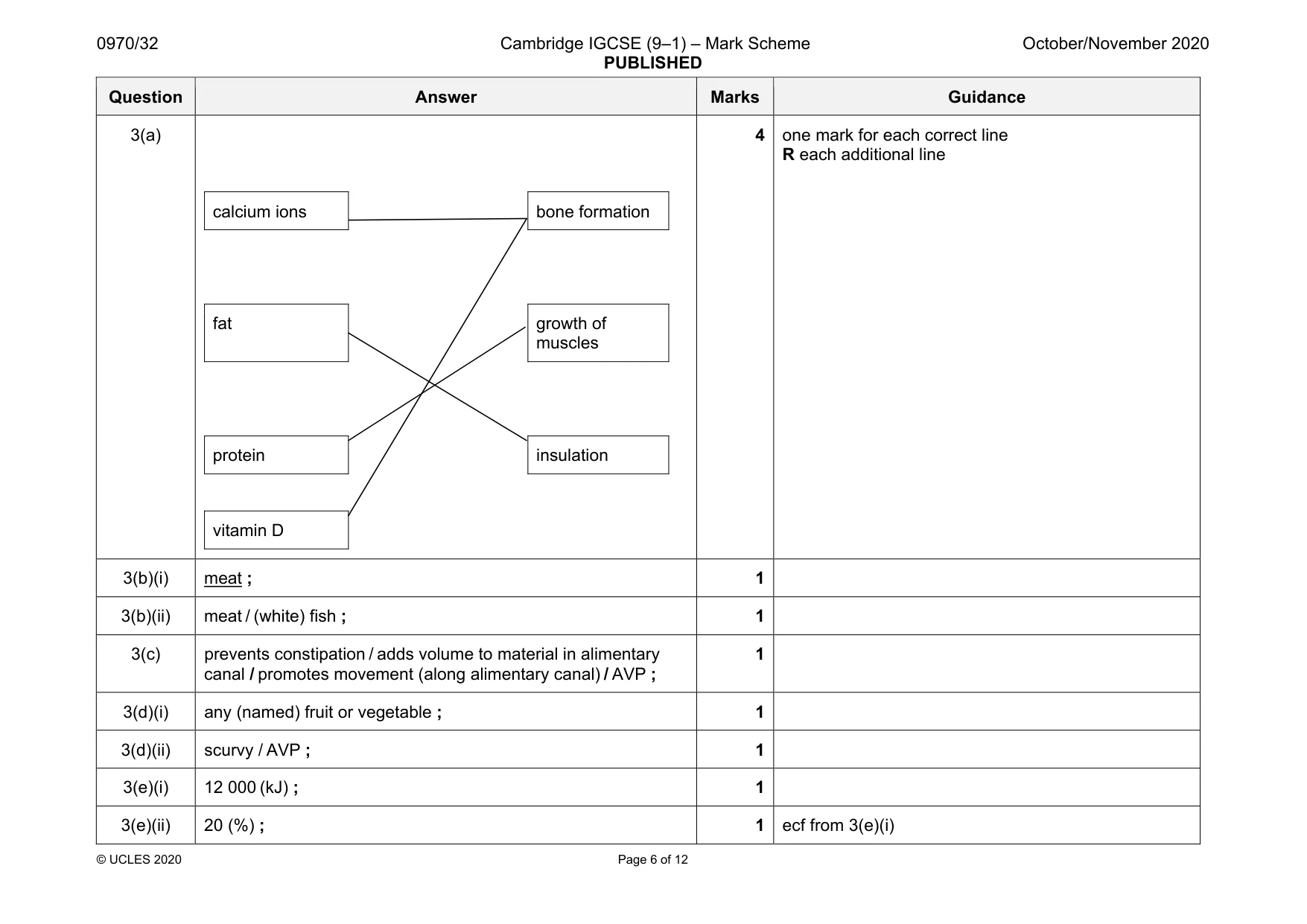
Mark scheme: 3(a) calcium ions bone formation fat growth of muscles protein insulation vitamin D 4 one mark for each correct line R each additional line 3(b)(i) meat ; 1 3(b)(ii) meat / (white) fish ; 1 3(c) prevents constipation / adds volume to material in alimentary canal / promotes movement (along alimentary canal) / AVP ; 1 3(d)(i) any (named) fruit or vegetable ; 1 3(d)(ii) scurvy / AVP ; 1 3(e)(i) 12 000 (kJ) ; 1 3(e)(ii) 20 (%) ; 1 ecf from 3(e)(i) Question Answer Marks Guidance 3(e)(iii) (aerobic) respiration ; 1
Q4 · Complete the sentences about human influences on ecosystems
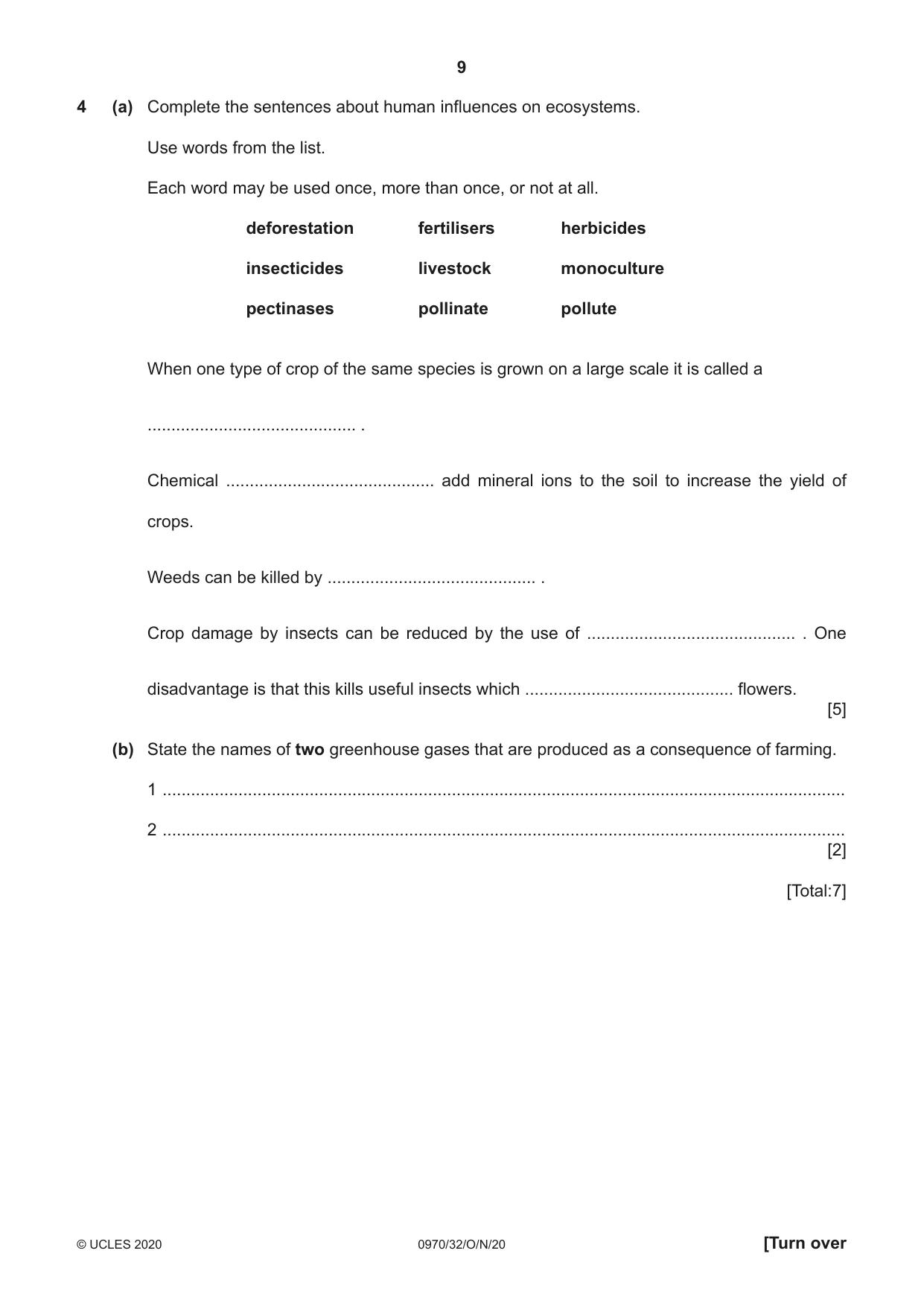
4 (a) Complete the sentences about human influences on ecosystems. Use words from the list. Each word may be used once, more than once, or not at all. deforestation fertilisers herbicides insecticides livestock monoculture pectinases pollinate pollute When one type of crop of the same species is grown on a large scale it is called a ............................................ . Chemical ............................................ add mineral ions to the soil to increase the yield of crops. Weeds can be killed by ............................................ . Crop damage by insects can be reduced by the use of ............................................ . One disadvantage is that this kills useful insects which ............................................ flowers. [5] (b) State the names of two greenhouse gases that are produced as a consequence of farming. 1 ................................................................................................................................................ 2 ................................................................................................................................................ [2] [Total:7]
Mark scheme: 4(a) monoculture ; fertilisers ; herbicides ; insecticides ; pollinate ; 4(b) carbon dioxide ; methane ; water (vapour) ; AVP ;; e.g. CFC’s / oxides of nitrogen / AW 2
Question 5
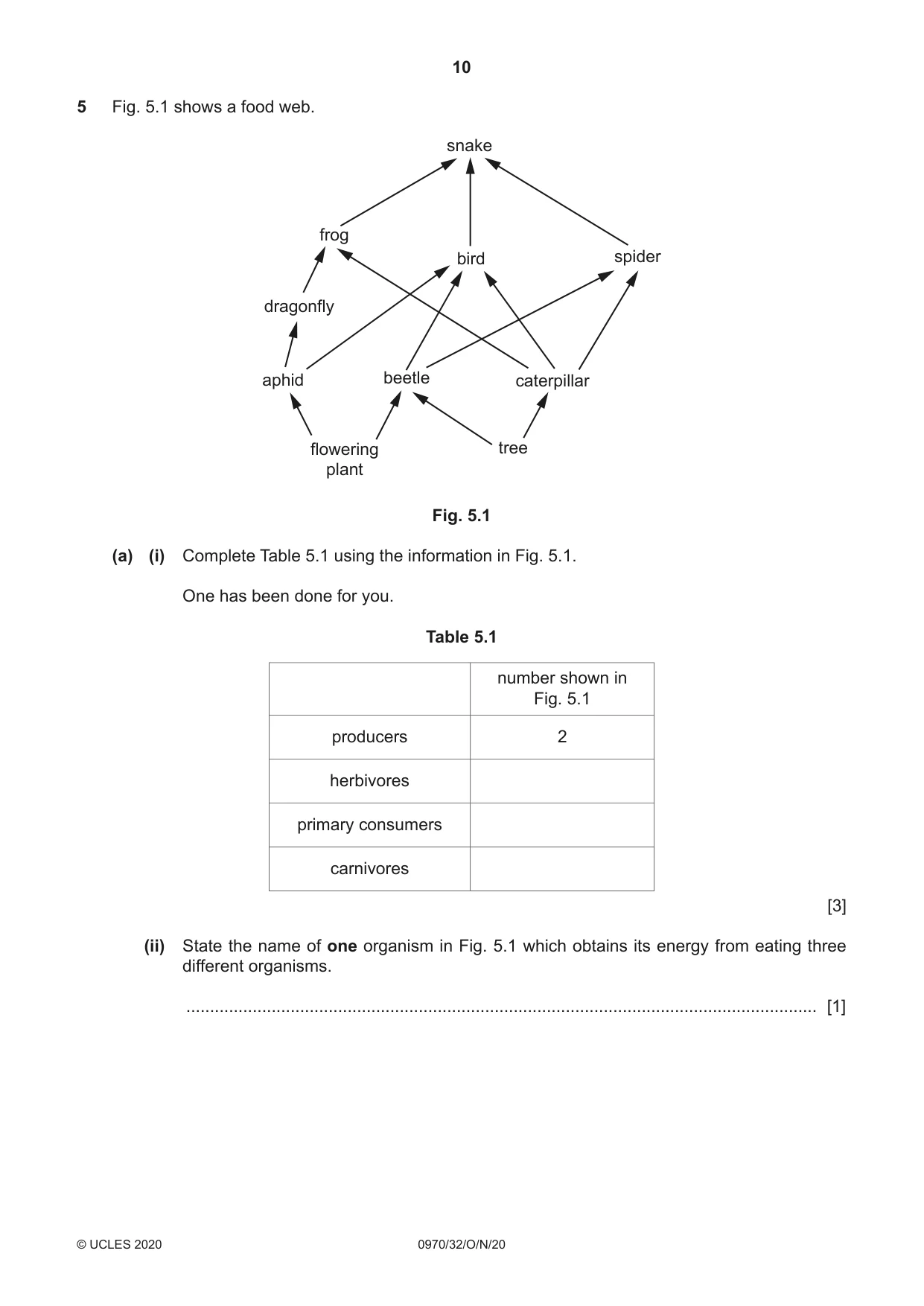
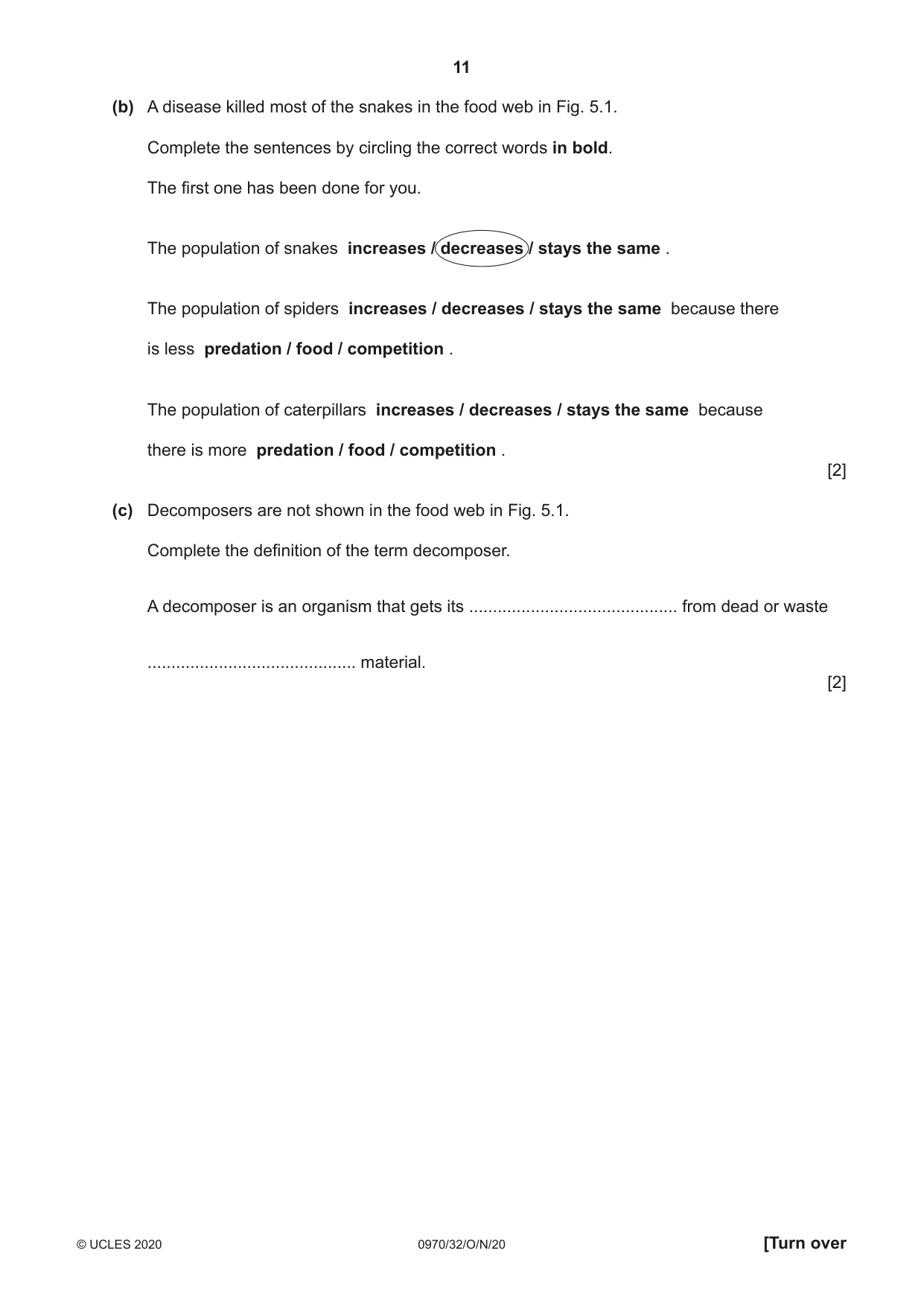
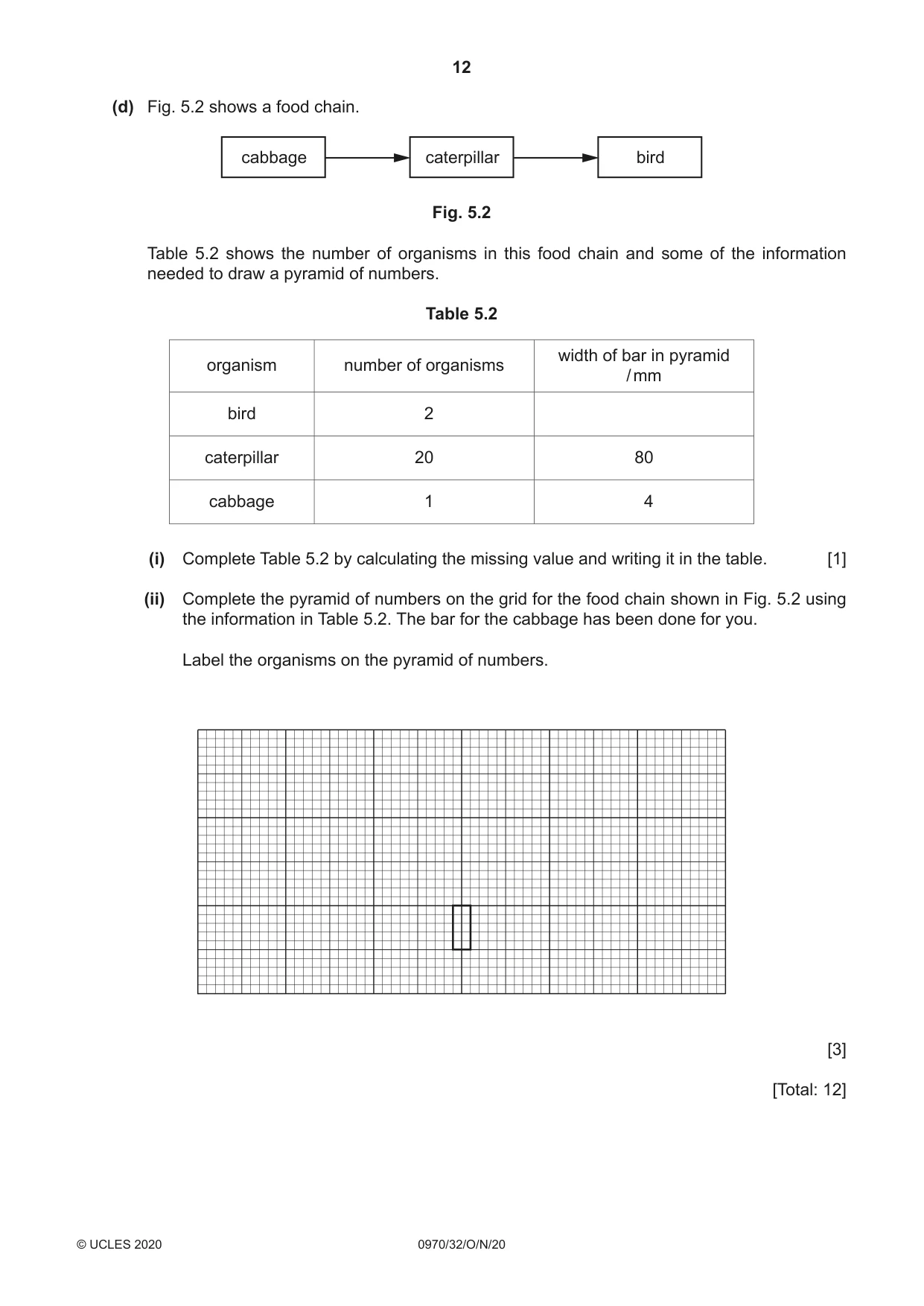
5 Fig. 5.1 shows a food web. snake frog bird spider dragonfly aphid beetle caterpillar flowering tree plant Fig. 5.1 (a) (i) Complete Table 5.1 using the information in Fig. 5.1. One has been done for you. Table 5.1 number shown in Fig. 5.1 producers 2 herbivores primary consumers carnivores [3] (ii) State the name of one organism in Fig. 5.1 which obtains its energy from eating three different organisms. ..................................................................................................................................... [1] (b) A disease killed most of the snakes in the food web in Fig. 5.1. Complete the sentences by circling the correct words in bold. The first one has been done for you. The population of snakes increases / decreases / stays the same . The population of spiders increases / decreases / stays the same because there is less predation / food / competition . The population of caterpillars increases / decreases / stays the same because there is more predation / food / competition . [2] (c) Decomposers are not shown in the food web in Fig. 5.1. Complete the definition of the term decomposer. A decomposer is an organism that gets its ............................................ from dead or waste ............................................ material. [2] (d) Fig. 5.2 shows a food chain. cabbage caterpillar bird Fig. 5.2 Table 5.2 shows the number of organisms in this food chain and some of the information needed to draw a pyramid of numbers. Table 5.2 width of bar in pyramid organism number of organisms / mm bird 2 caterpillar 20 80 cabbage 1 4 (i) Complete Table 5.2 by calculating the missing value and writing it in the table. [1] (ii) Complete the pyramid of numbers on the grid for the food chain shown in Fig. 5.2 using the information in Table 5.2. The bar for the cabbage has been done for you. Label the organisms on the pyramid of numbers. [3] [Total: 12]
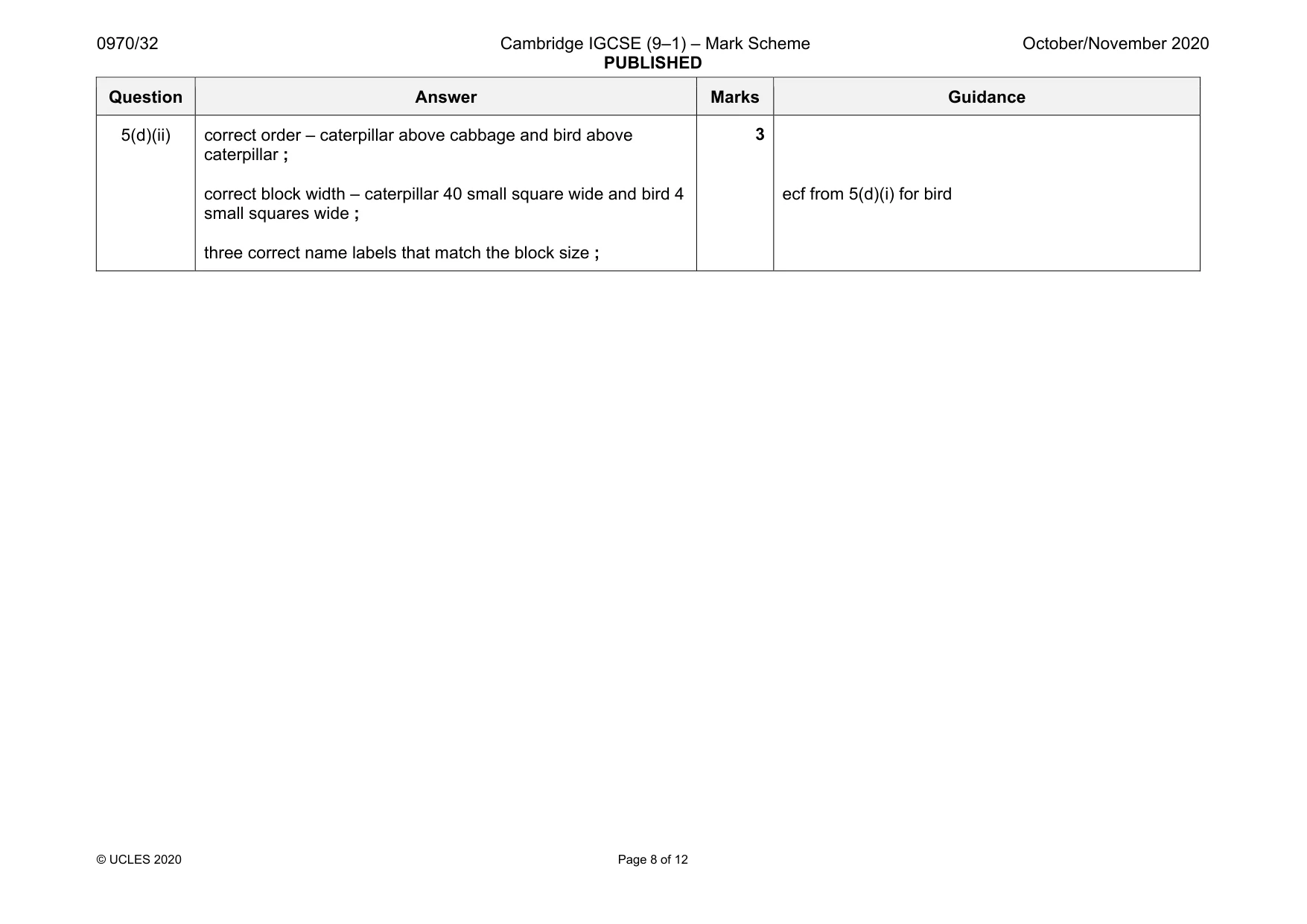
Mark scheme: 5(a)(i) organism number producers 2 herbivores 3 ; primary consumers 3 ; carnivores 5 ; 3 5(a)(ii) bird / snake ; 1 5(b) increases and predation ; decreases and predation ; 2 one mark for each correct sentence 5(c) energy ; organic ; 2 5(d)(i) 8 ; 1 Question Answer Marks Guidance 5(d)(ii) correct order – caterpillar above cabbage and bird above caterpillar ; correct block width – caterpillar 40 small square wide and bird 4 small squares wide ; three correct name labels that match the block size ; 3 ecf from 5(d)(i) for bird
Q6 · Define the term drug
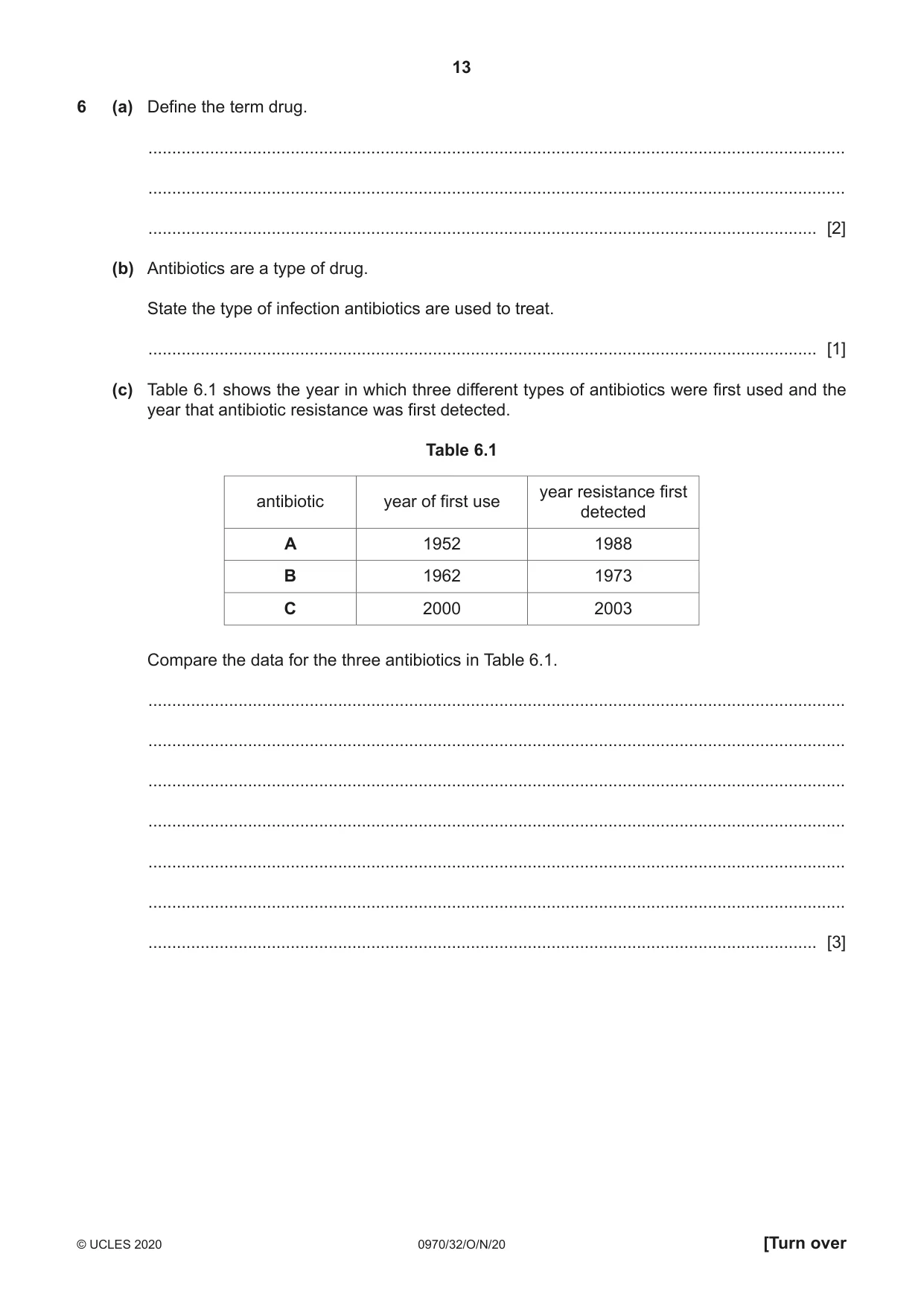
6 (a) Define the term drug. ................................................................................................................................................... ................................................................................................................................................... ............................................................................................................................................. [2] (b) Antibiotics are a type of drug. State the type of infection antibiotics are used to treat. ............................................................................................................................................. [1] (c) Table 6.1 shows the year in which three different types of antibiotics were first used and the year that antibiotic resistance was first detected. Table 6.1 year resistance first antibiotic year of first use detected A 1952 1988 B 1962 1973 C 2000 2003 Compare the data for the three antibiotics in Table 6.1. ................................................................................................................................................... ................................................................................................................................................... ................................................................................................................................................... ................................................................................................................................................... ................................................................................................................................................... ................................................................................................................................................... ............................................................................................................................................. [3] (d) The body has defences against infections caused by pathogens. State three body defences that prevent pathogens from entering the body. 1 ................................................................................................................................................ 2 ................................................................................................................................................ 3 ................................................................................................................................................ [3] [Total: 9]
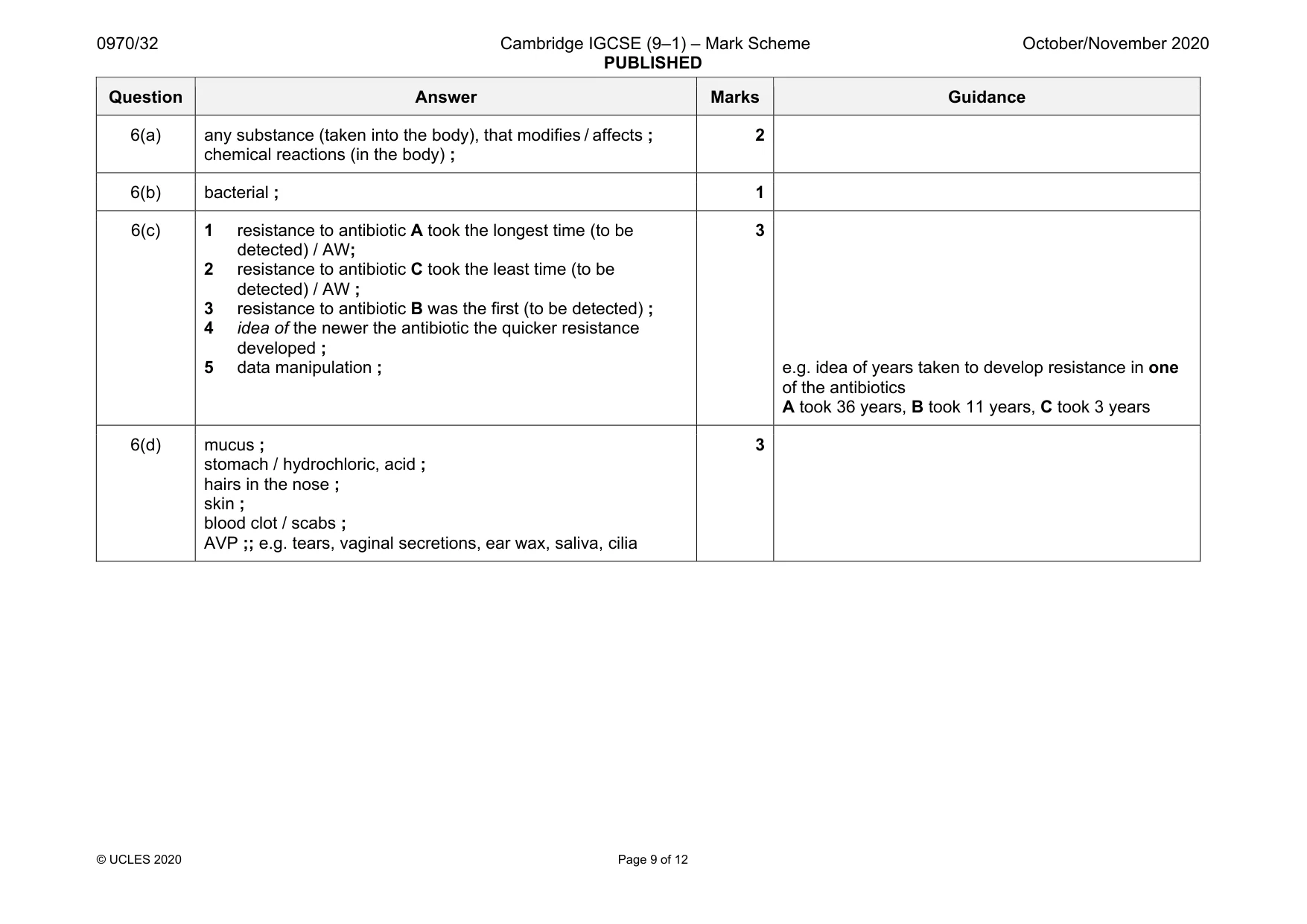
Mark scheme: 6(a) any substance (taken into the body), that modifies / affects ; chemical reactions (in the body) ; 2 6(b) bacterial ; 1 6(c) 1 resistance to antibiotic A took the longest time (to be detected) / AW; 2 resistance to antibiotic C took the least time (to be detected) / AW ; 3 resistance to antibiotic B was the first (to be detected) ; 4 idea of the newer the antibiotic the quicker resistance developed ; 5 data manipulation ; 3 e.g. idea of years taken to develop resistance in one of the antibiotics A took 36 years, B took 11 years, C took 3 years 6(d) mucus ; stomach / hydrochloric, acid ; hairs in the nose ; skin ; blood clot / scabs ; AVP ;; e.g. tears, vaginal secretions, ear wax, saliva, cilia 3
Q7 · Part of the female human reproductive system
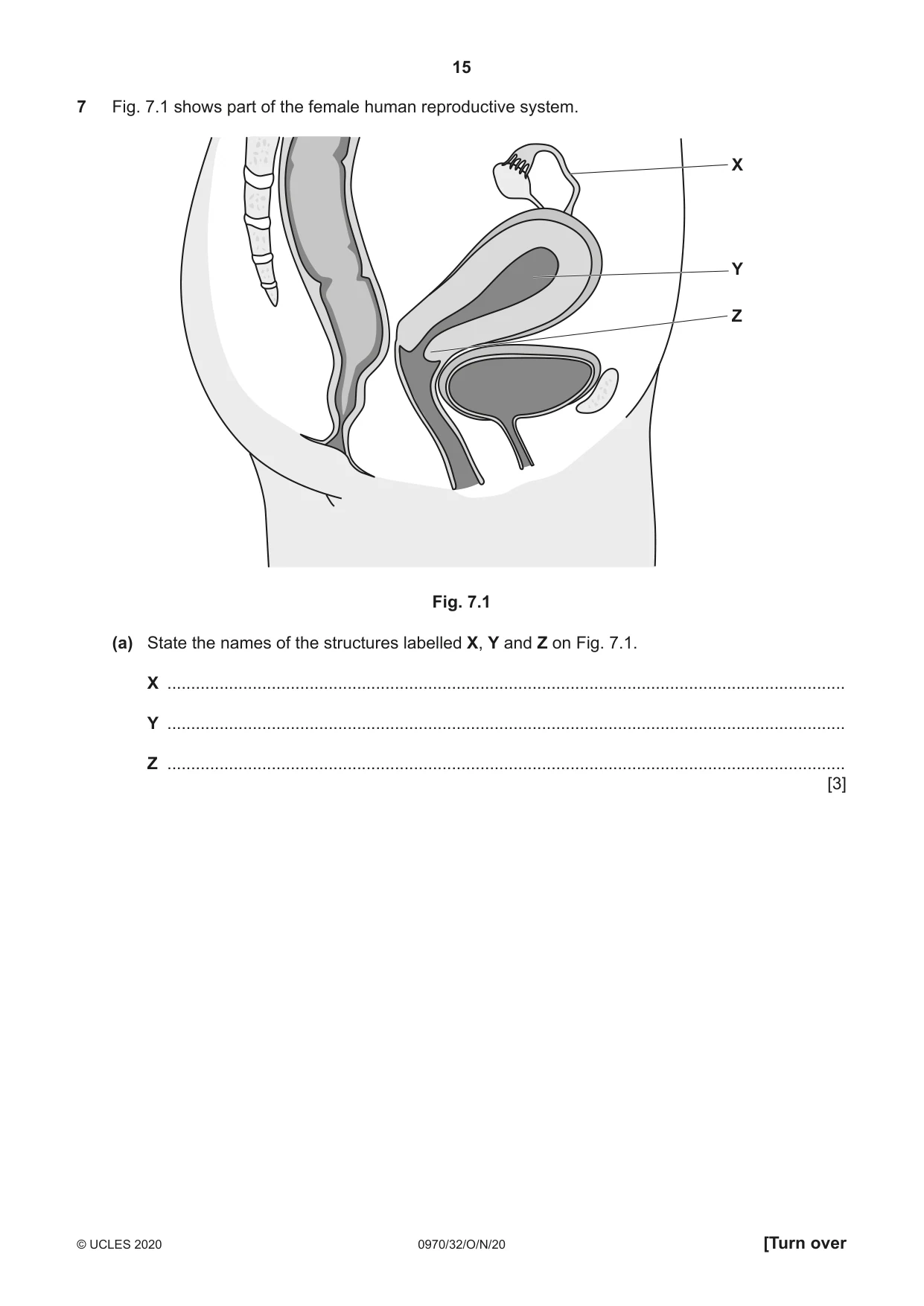
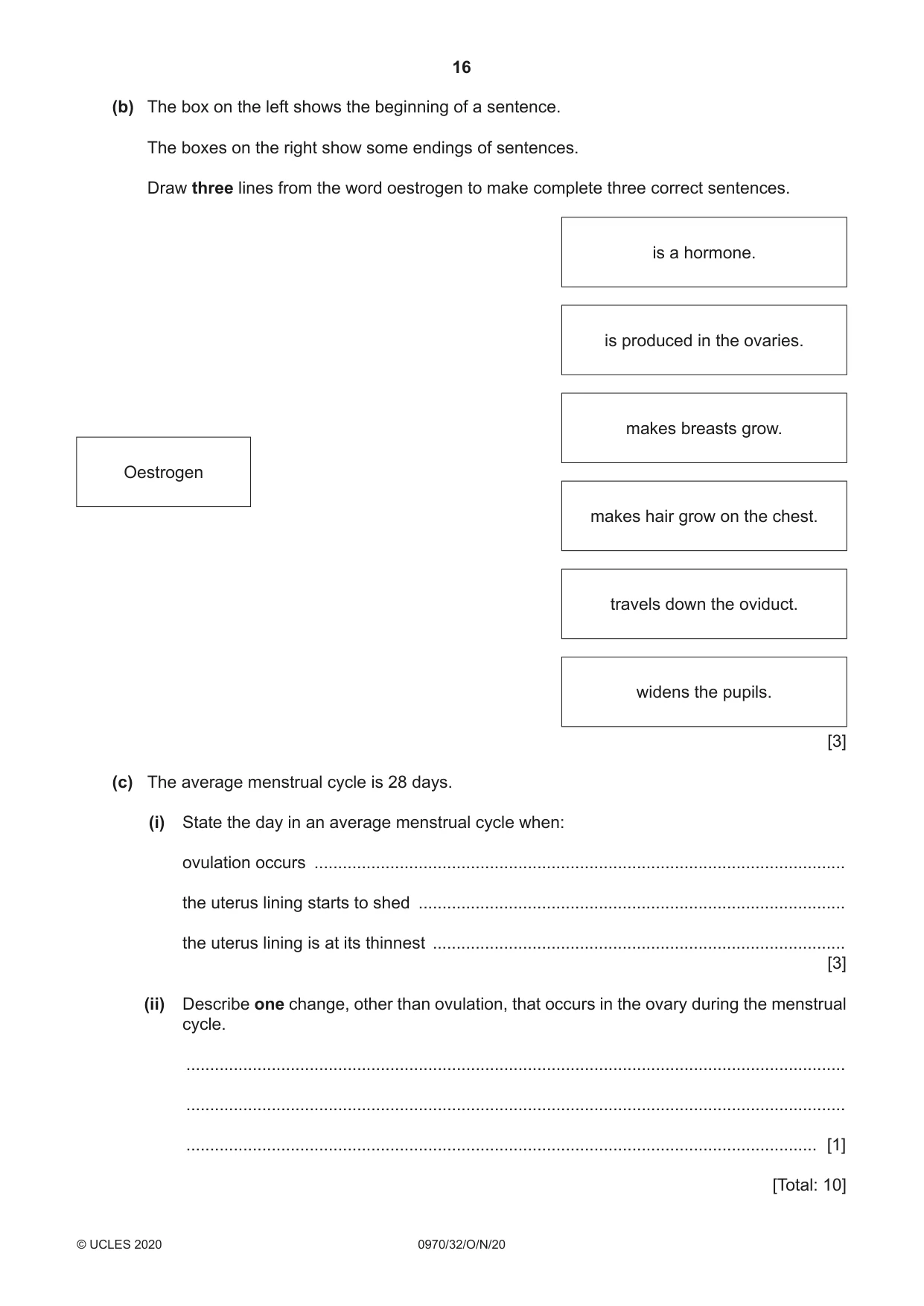
7 Fig. 7.1 shows part of the female human reproductive system. X Y Z Fig. 7.1 (a) State the names of the structures labelled X, Y and Z on Fig. 7.1. X ............................................................................................................................................... Y ............................................................................................................................................... Z ............................................................................................................................................... [3] (b) The box on the left shows the beginning of a sentence. The boxes on the right show some endings of sentences. Draw three lines from the word oestrogen to make complete three correct sentences. is a hormone. is produced in the ovaries. makes breasts grow. Oestrogen makes hair grow on the chest. travels down the oviduct. widens the pupils. [3] (c) The average menstrual cycle is 28 days. (i) State the day in an average menstrual cycle when: ovulation occurs ................................................................................................................ the uterus lining starts to shed .......................................................................................... the uterus lining is at its thinnest ....................................................................................... [3] (ii) Describe one change, other than ovulation, that occurs in the ovary during the menstrual cycle. ........................................................................................................................................... ........................................................................................................................................... ..................................................................................................................................... [1] [Total: 10]
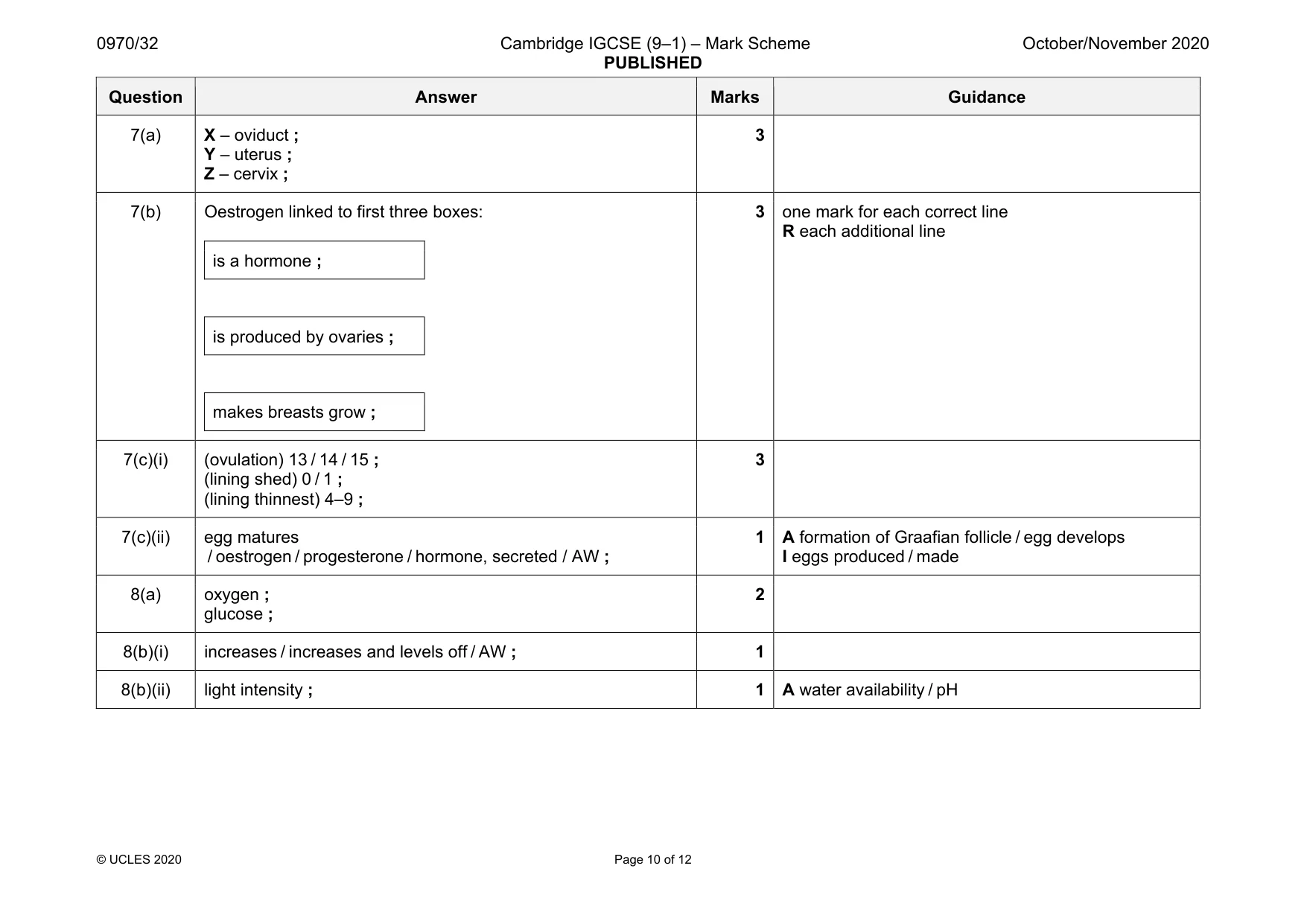
Mark scheme: 7(a) X – oviduct ; Y – uterus ; Z – cervix ; 3 7(b) Oestrogen linked to first three boxes: is a hormone ; is produced by ovaries ; makes breasts grow ; 3 one mark for each correct line R each additional line 7(c)(i) (ovulation) 13 / 14 / 15 ; (lining shed) 0 / 1 ; (lining thinnest) 4–9 ; 3 7(c)(ii) egg matures / oestrogen / progesterone / hormone, secreted / AW ; 1 A formation of Graafian follicle / egg develops I eggs produced / made
Q8 · Plants carry out photosynthesis
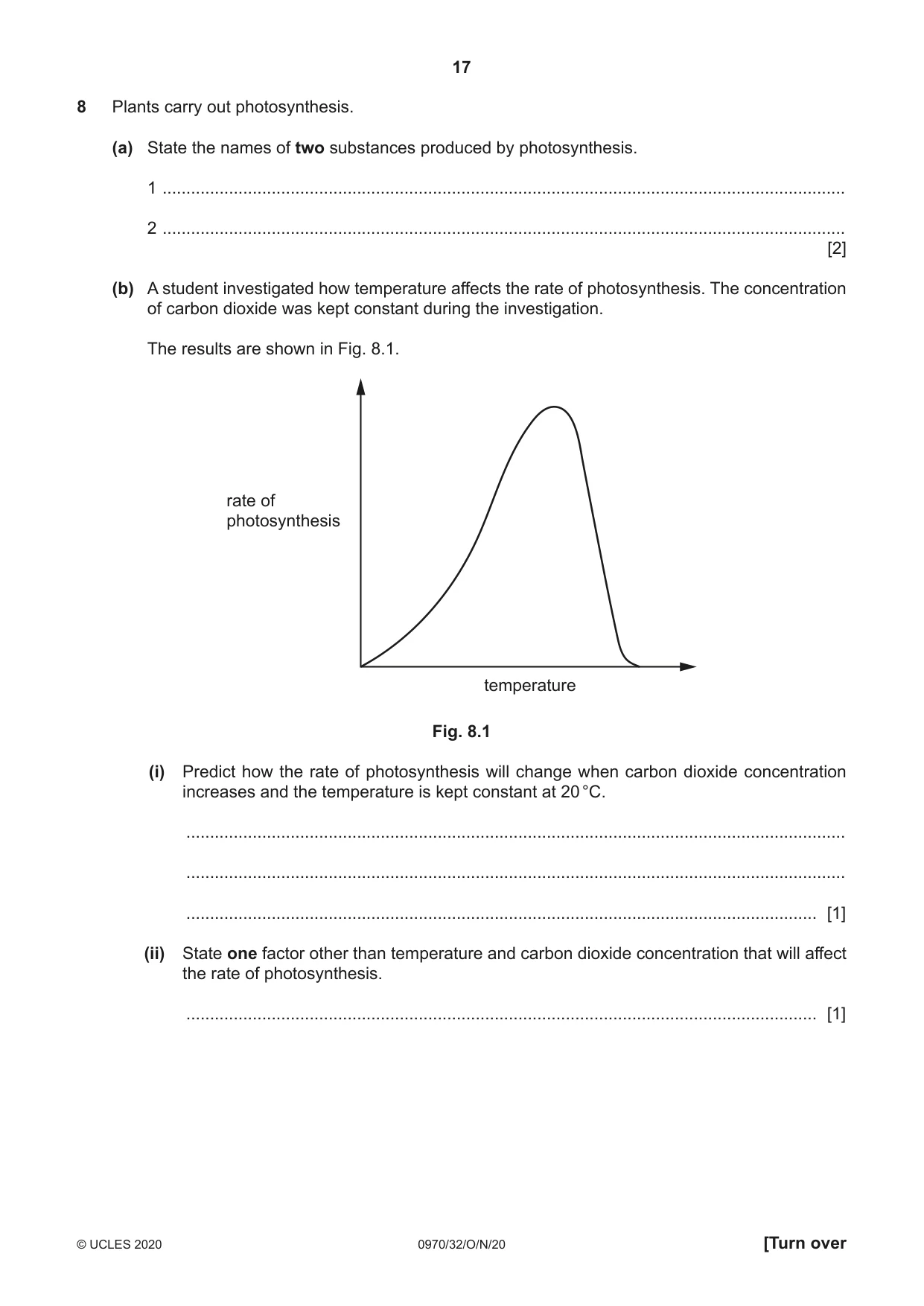
8 Plants carry out photosynthesis. (a) State the names of two substances produced by photosynthesis. 1 ................................................................................................................................................ 2 ................................................................................................................................................ [2] (b) A student investigated how temperature affects the rate of photosynthesis. The concentration of carbon dioxide was kept constant during the investigation. The results are shown in Fig. 8.1. rate of photosynthesis temperature Fig. 8.1 (i) Predict how the rate of photosynthesis will change when carbon dioxide concentration increases and the temperature is kept constant at 20 °C. ........................................................................................................................................... ........................................................................................................................................... ..................................................................................................................................... [1] (ii) State one factor other than temperature and carbon dioxide concentration that will affect the rate of photosynthesis. ..................................................................................................................................... [1] (c) In another investigation students used a plant which had variegated leaves. One of the leaves from this plant is shown in Fig. 8.2. A white: chloroplasts absent B green: chloroplasts present Fig. 8.2 Complete Table 8.1 to show where the processes of photosynthesis and respiration occurred in this variegated leaf when the plant was in the light. Place a tick (3) in each correct box. Table 8.1 process area A area B photosynthesis respiration [2] (d) Cells in the mesophyll layers of a leaf carry out photosynthesis. State the names of two leaf layers that light must pass through to reach the spongy mesophyll cells. 1 ................................................................................................................................................ 2 ................................................................................................................................................ [2] (e) Plants absorb mineral ions from the soil. (i) State the name of the tissue that transports mineral ions in plants. ..................................................................................................................................... [1] (ii) State the name of the mineral ion that is used to make chlorophyll. ..................................................................................................................................... [1] (iii) State the name of the mineral ion that is used to make amino acids. ..................................................................................................................................... [1] (f) Plants are involved in nutrient cycles in ecosystems. Describe the role of plants in the carbon cycle and the water cycle. ................................................................................................................................................... ................................................................................................................................................... ................................................................................................................................................... ................................................................................................................................................... ................................................................................................................................................... ................................................................................................................................................... ................................................................................................................................................... ................................................................................................................................................... ............................................................................................................................................. [4] [Total: 15]
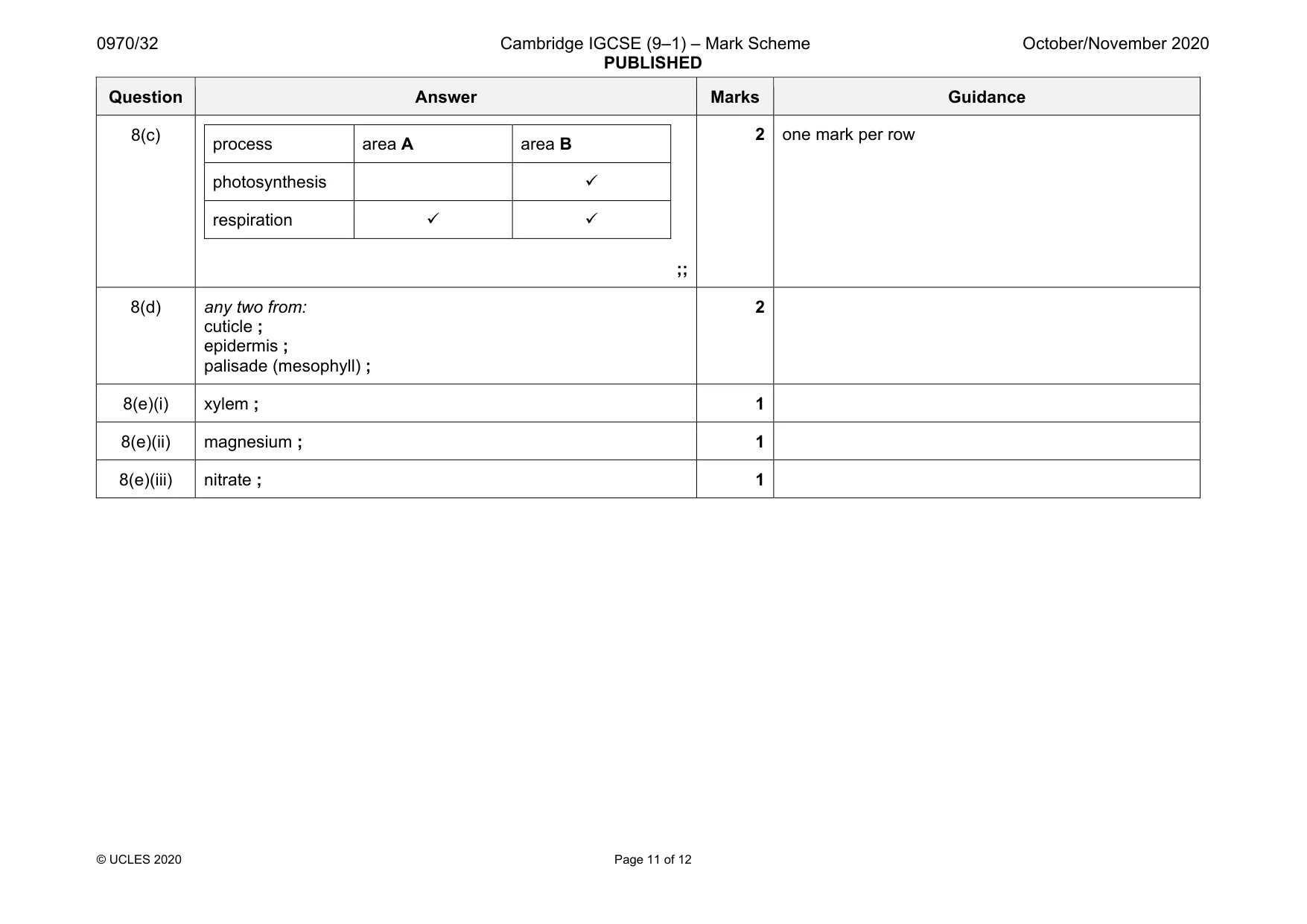
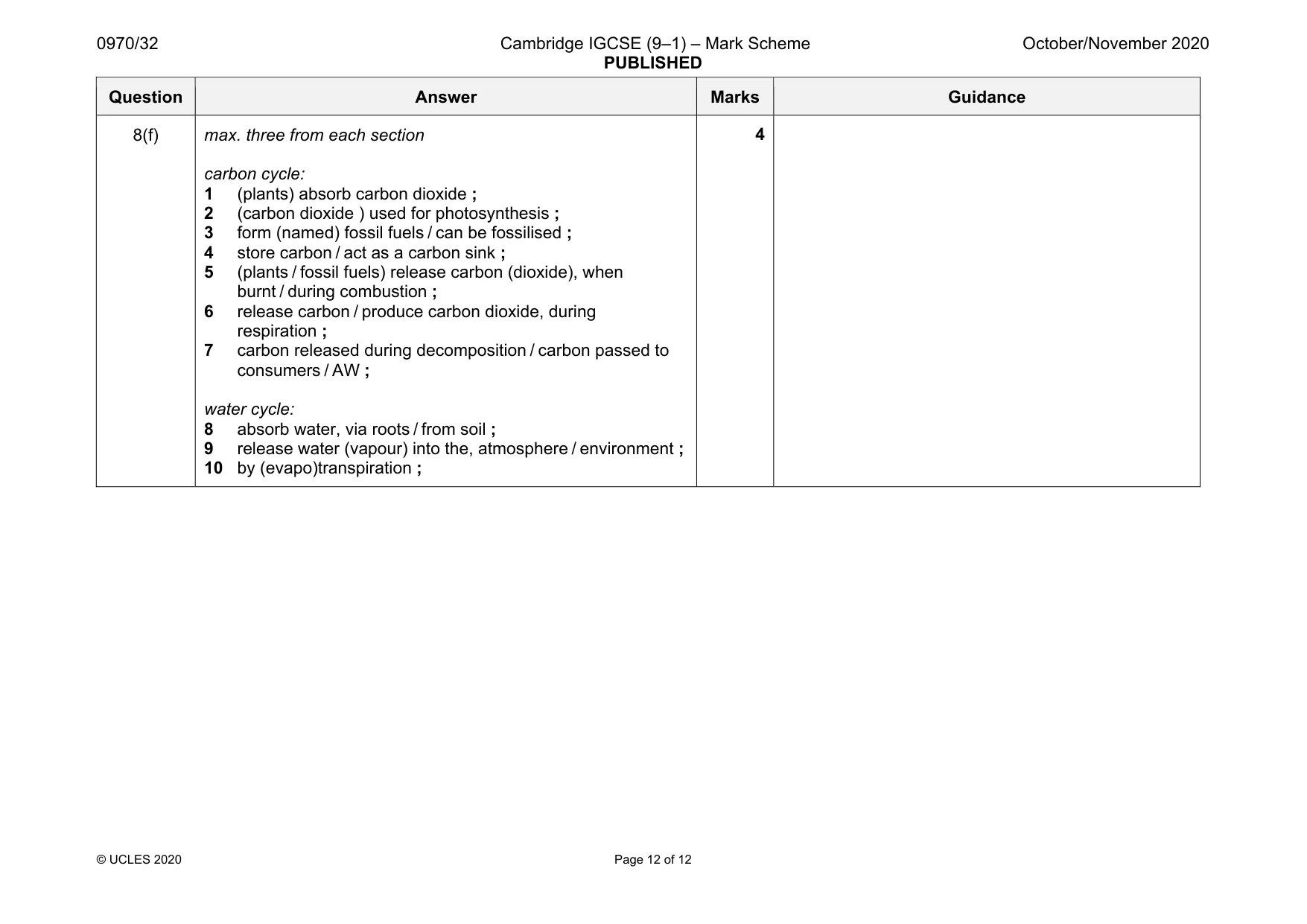
Mark scheme: 8(a) oxygen ; glucose ; 2 8(b)(i) increases / increases and levels off / AW ; 1 8(b)(ii) light intensity ; 1 A water availability / pH Question Answer Marks Guidance 8(c) process area A area B photosynthesis respiration ;; 2 one mark per row 8(d) any two from: cuticle ; epidermis ; palisade (mesophyll) ; 2 8(e)(i) xylem ; 1 8(e)(ii) magnesium ; 1 8(e)(iii) nitrate ; 1 Question Answer Marks Guidance 8(f) max. three from each section carbon cycle: 1 (plants) absorb carbon dioxide ; 2 (carbon dioxide ) used for photosynthesis ; 3 form (named) fossil fuels / can be fossilised ; 4 store carbon / act as a carbon sink ; 5 (plants / fossil fuels) release carbon (dioxide), when burnt / during combustion ; 6 release carbon / produce carbon dioxide, during respiration ; 7 carbon released during decomposition / carbon passed to consumers / AW ; water cycle: 8 absorb water, via roots / from soil ; 9 release water (vapour) into the, atmosphere / environment ; 10 by (evapo)transpiration ; 4
What was in this paper
The subtopics covered by these 8 questions, and how many questions each got. Open one in a new tab to see every Cambridge question on it.
What you needed in this session
Cambridge’s own grade thresholds for 2020 Oct/Nov, Paper 3 · Variant 2. A higher threshold means an easier paper — the bar moves with how the cohort did.