Cambridge IGCSE Biology (9-1) 0970 — 2019 Oct/Nov Paper 3 · Variant 2
0970/32/O/N/19 · 10 questions · 80 marks · ≈90 min
The question paper and its mark scheme, free to read here and free to download. This is Cambridge’s own paper, exactly as it was sat.
Question paper20 pages


Mark scheme11 pages
Answers below. Sit the paper first if you are practising.
Questions as text
Q1 · Complete the sentences about food and digestion using words from the list
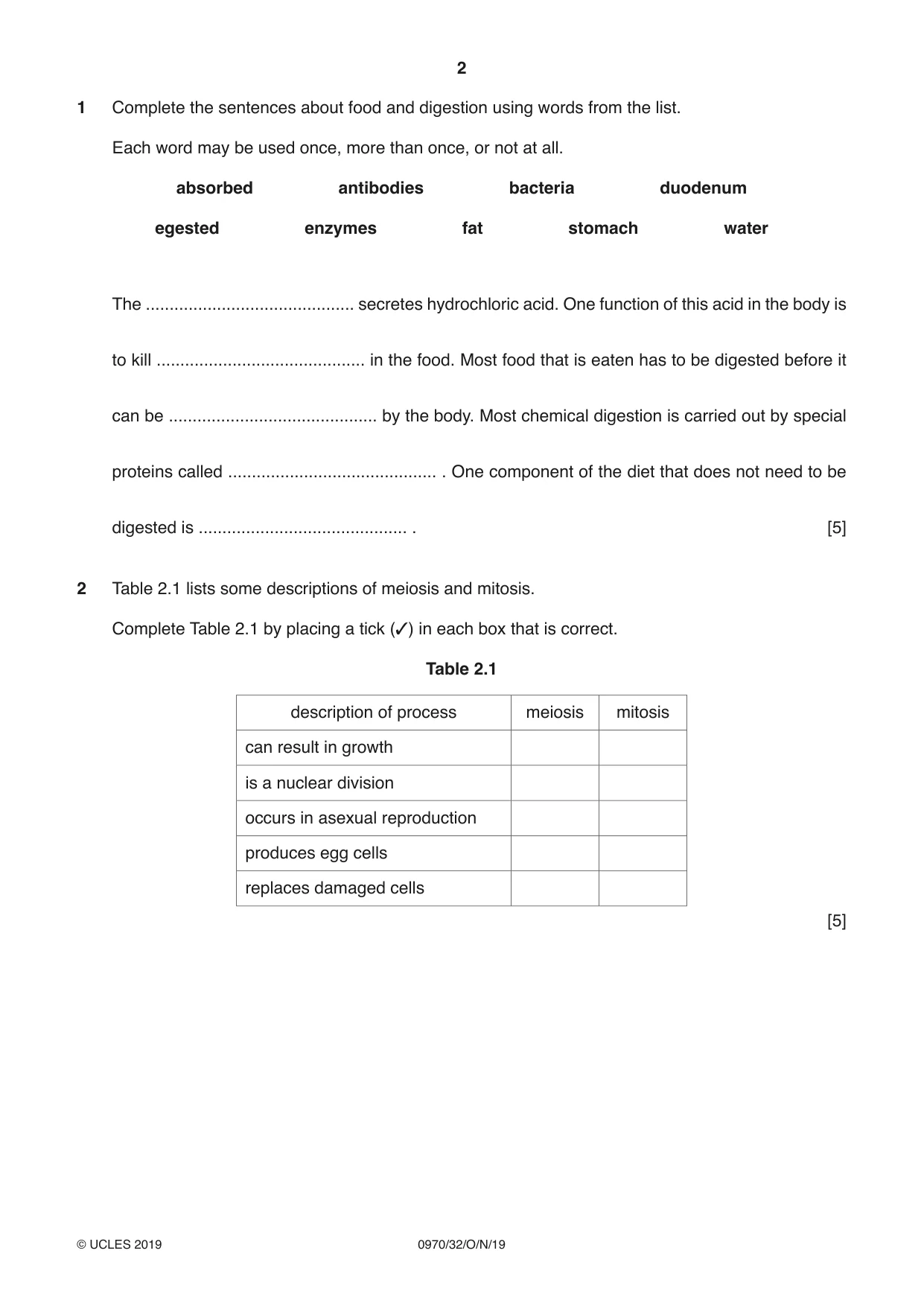
1 Complete the sentences about food and digestion using words from the list. Each word may be used once, more than once, or not at all. absorbed antibodies bacteria duodenum egested enzymes fat stomach water The ............................................ secretes hydrochloric acid. One function of this acid in the body is to kill ............................................ in the food. Most food that is eaten has to be digested before it can be ............................................ by the body. Most chemical digestion is carried out by special proteins called ............................................ . One component of the diet that does not need to be digested is ............................................ . [5]
Mark scheme: 1 stomach ; bacteria ; absorbed ; enzymes ; water ; 5
Q2 · Table 2.1 lists some descriptions of meiosis and mitosis
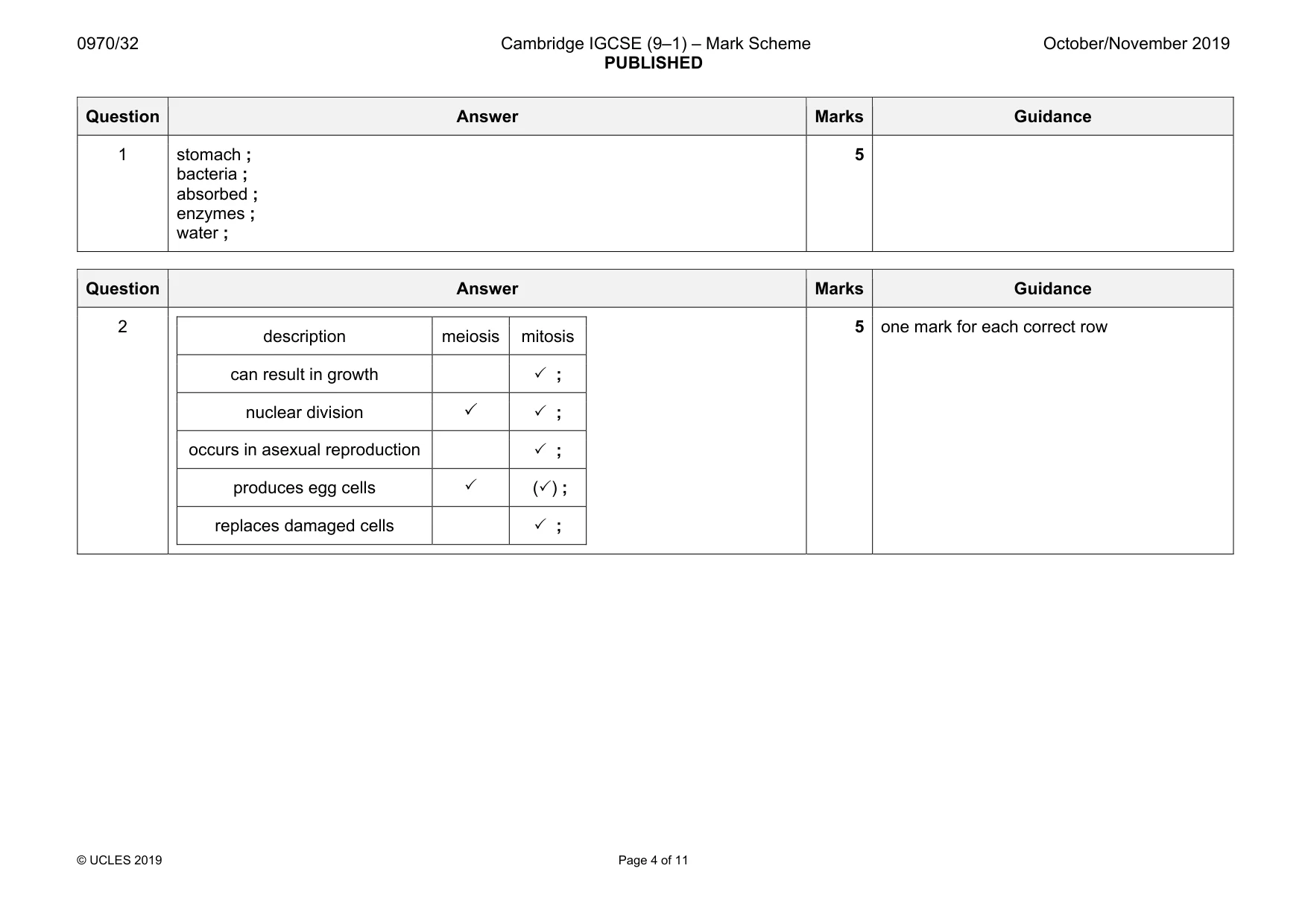
2 Table 2.1 lists some descriptions of meiosis and mitosis. Complete Table 2.1 by placing a tick (3) in each box that is correct. Table 2.1 description of process meiosis mitosis can result in growth is a nuclear division occurs in asexual reproduction produces egg cells replaces damaged cells [5]
Mark scheme: 2 description meiosis mitosis can result in growth 3 ; nuclear division 3 3 ; occurs in asexual reproduction 3 ; produces egg cells 3 (3) ; replaces damaged cells 3 ; 5
Q3 · A cross-section of a vein and Fig
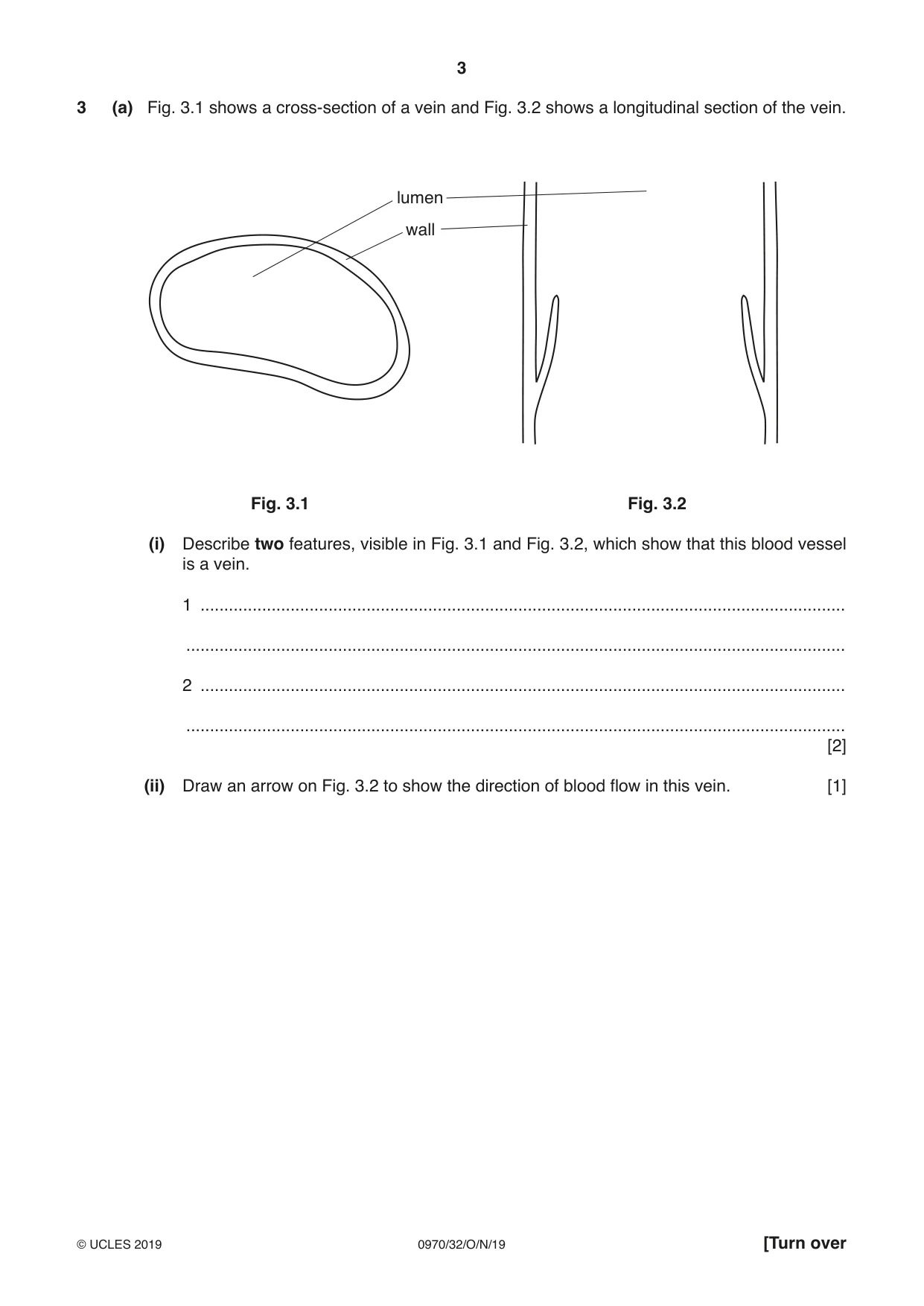
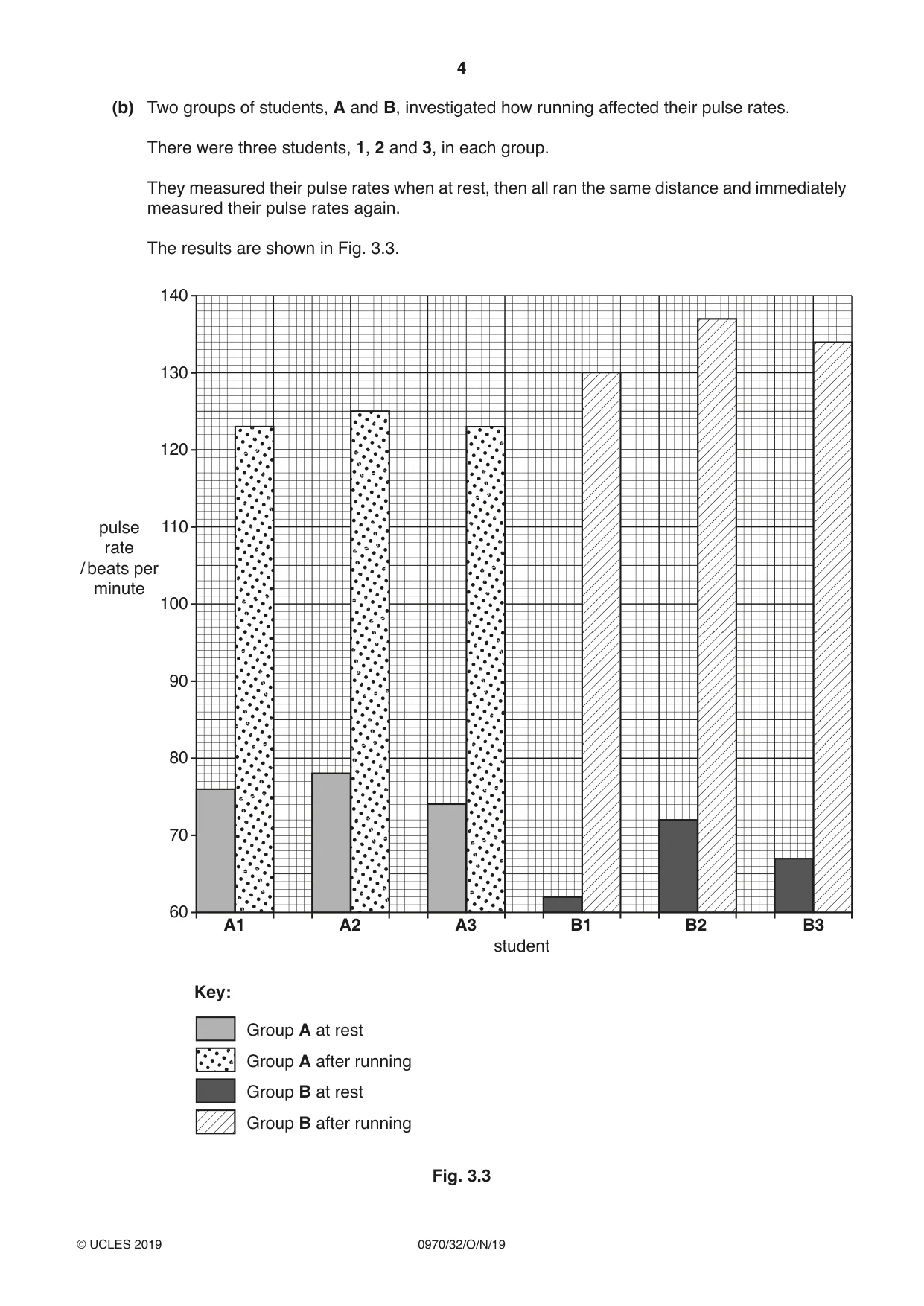
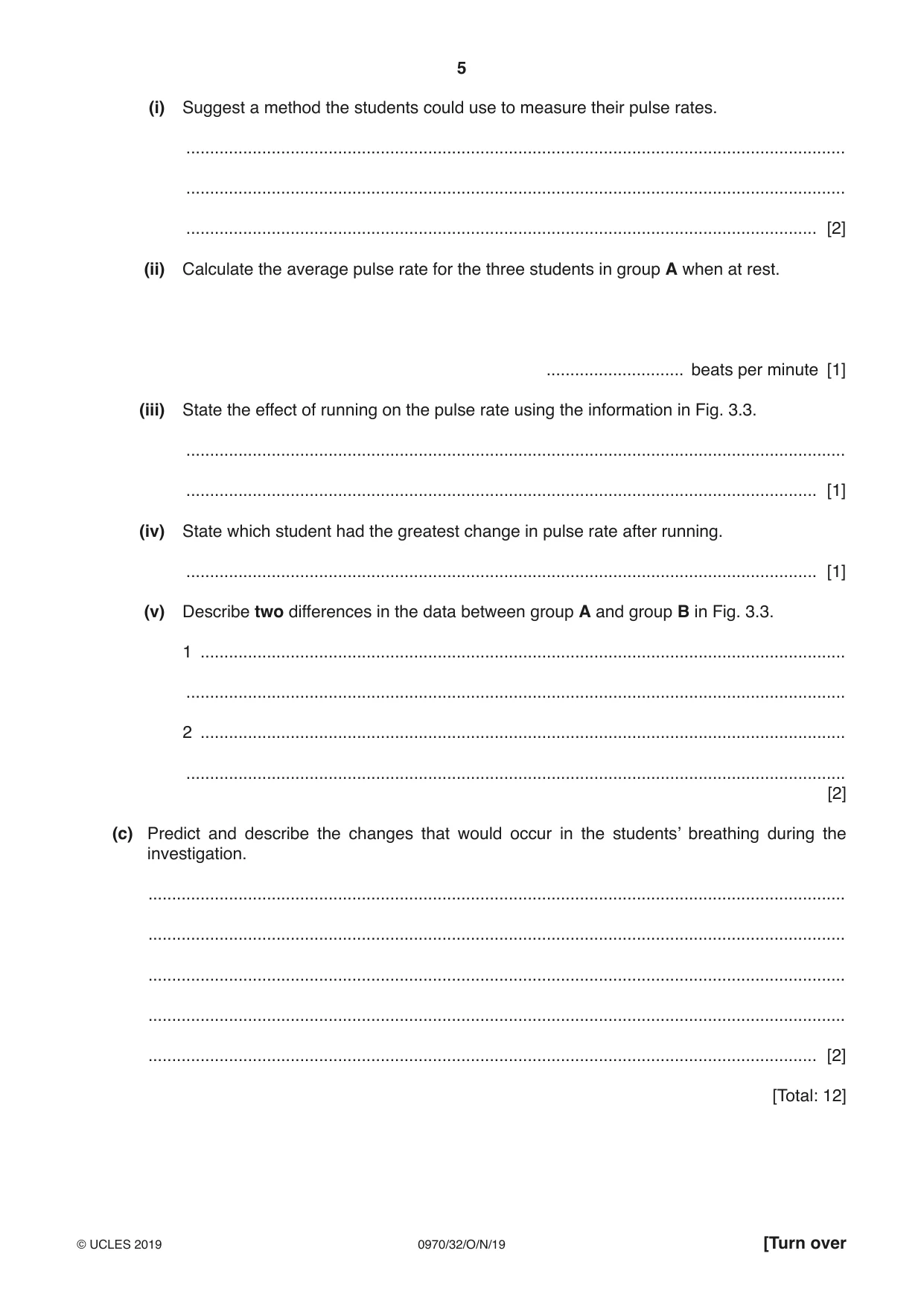
3 (a) Fig. 3.1 shows a cross-section of a vein and Fig. 3.2 shows a longitudinal section of the vein. lumen wall Fig. 3.1 Fig. 3.2 (i) Describe two features, visible in Fig. 3.1 and Fig. 3.2, which show that this blood vessel is a vein. 1 ........................................................................................................................................ ........................................................................................................................................... 2 ........................................................................................................................................ ........................................................................................................................................... [2] (ii) Draw an arrow on Fig. 3.2 to show the direction of blood flow in this vein. [1] (b) Two groups of students, A and B, investigated how running affected their pulse rates. There were three students, 1, 2 and 3, in each group. They measured their pulse rates when at rest, then all ran the same distance and immediately measured their pulse rates again. The results are shown in Fig. 3.3. 140 130 120 pulse 110 rate / beats per minute 100 90 80 70 60 A1 A2 A3 B1 B2 B3 student Key: Group A at rest Group A after running Group B at rest Group B after running Fig. 3.3 (i) Suggest a method the students could use to measure their pulse rates. ........................................................................................................................................... ........................................................................................................................................... ..................................................................................................................................... [2] (ii) Calculate the average pulse rate for the three students in group A when at rest. ............................. beats per minute [1] (iii) State the effect of running on the pulse rate using the information in Fig. 3.3. ........................................................................................................................................... ..................................................................................................................................... [1] (iv) State which student had the greatest change in pulse rate after running. ..................................................................................................................................... [1] (v) Describe two differences in the data between group A and group B in Fig. 3.3. 1 ........................................................................................................................................ ........................................................................................................................................... 2 ........................................................................................................................................ ........................................................................................................................................... [2] (c) Predict and describe the changes that would occur in the students’ breathing during the investigation. ................................................................................................................................................... ................................................................................................................................................... ................................................................................................................................................... ................................................................................................................................................... ............................................................................................................................................. [2] [Total: 12]
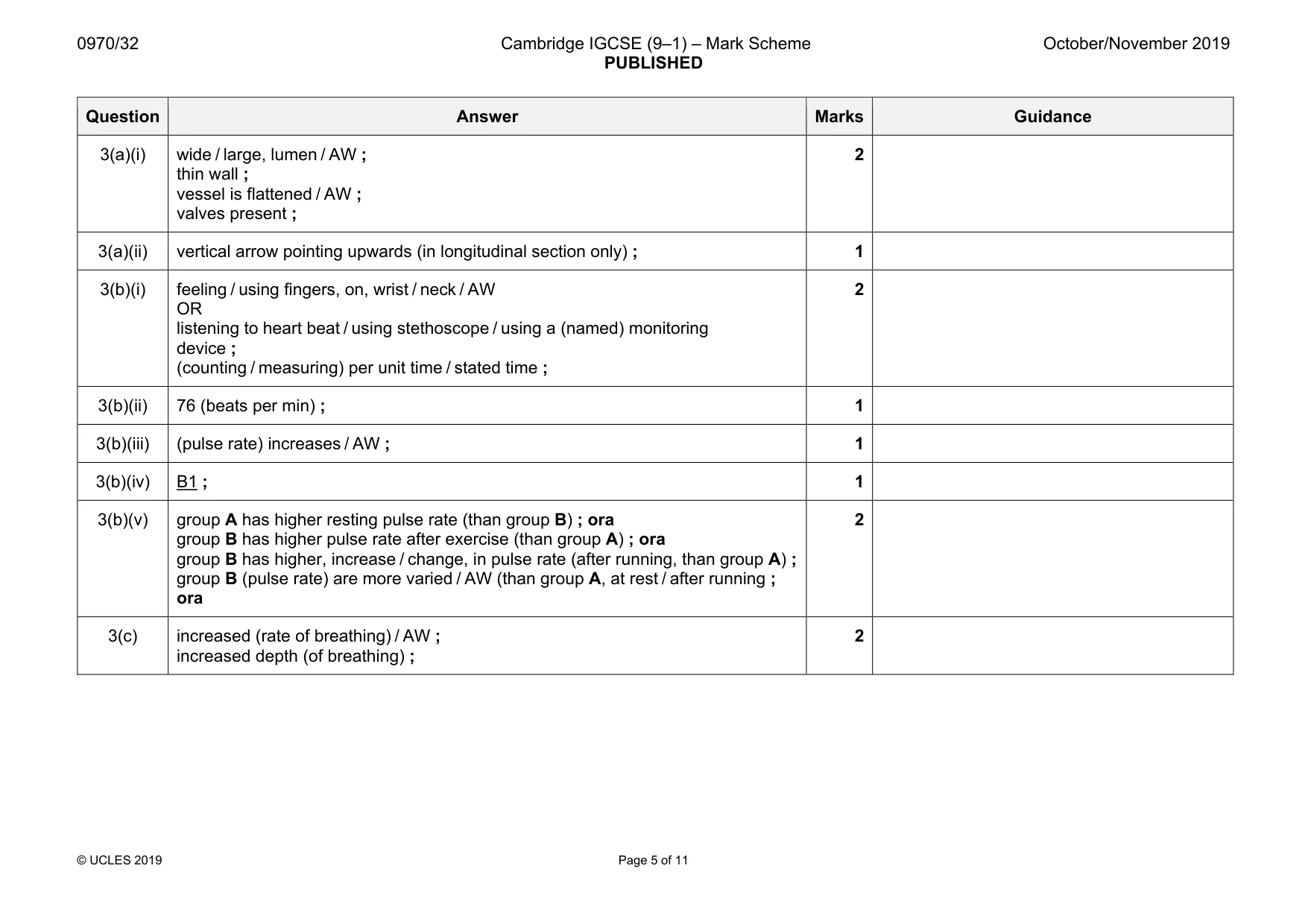
Mark scheme: 3(a)(i) wide / large, lumen / AW ; thin wall ; vessel is flattened / AW ; valves present ; 2 3(a)(ii) vertical arrow pointing upwards (in longitudinal section only) ; 1 3(b)(i) feeling / using fingers, on, wrist / neck / AW OR listening to heart beat / using stethoscope / using a (named) monitoring device ; (counting / measuring) per unit time / stated time ; 2 3(b)(ii) 76 (beats per min) ; 1 3(b)(iii) (pulse rate) increases / AW ; 1 3(b)(iv) B1 ; 1 3(b)(v) group A has higher resting pulse rate (than group B) ; ora group B has higher pulse rate after exercise (than group A) ; ora group B has higher, increase / change, in pulse rate (after running, than group A) ; group B (pulse rate) are more varied / AW (than group A, at rest / after running ; ora 2 3(c) increased (rate of breathing) / AW ; increased depth (of breathing) ; 2
Q4 · The boxes on the left contain the functions of some plant cell structures
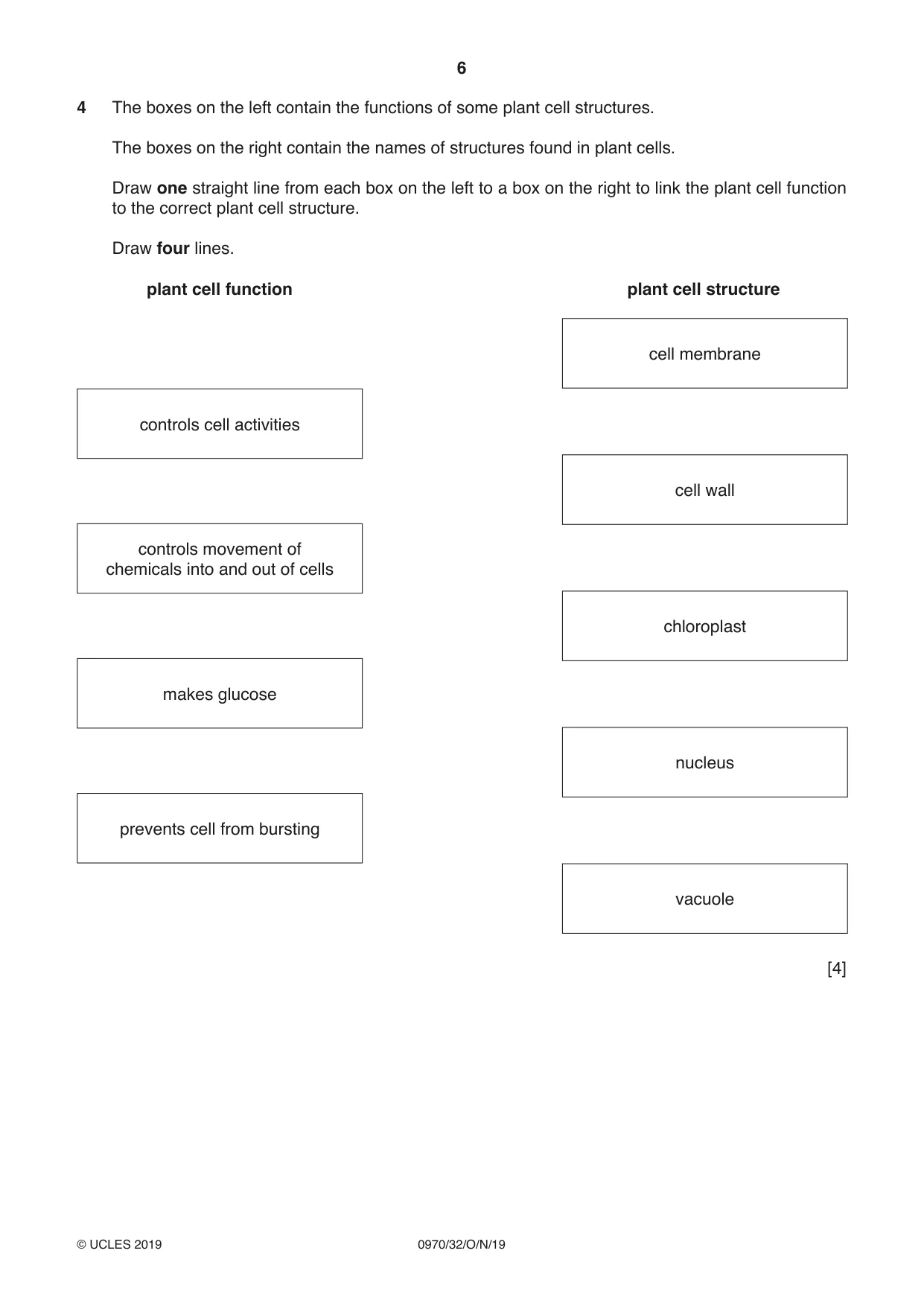
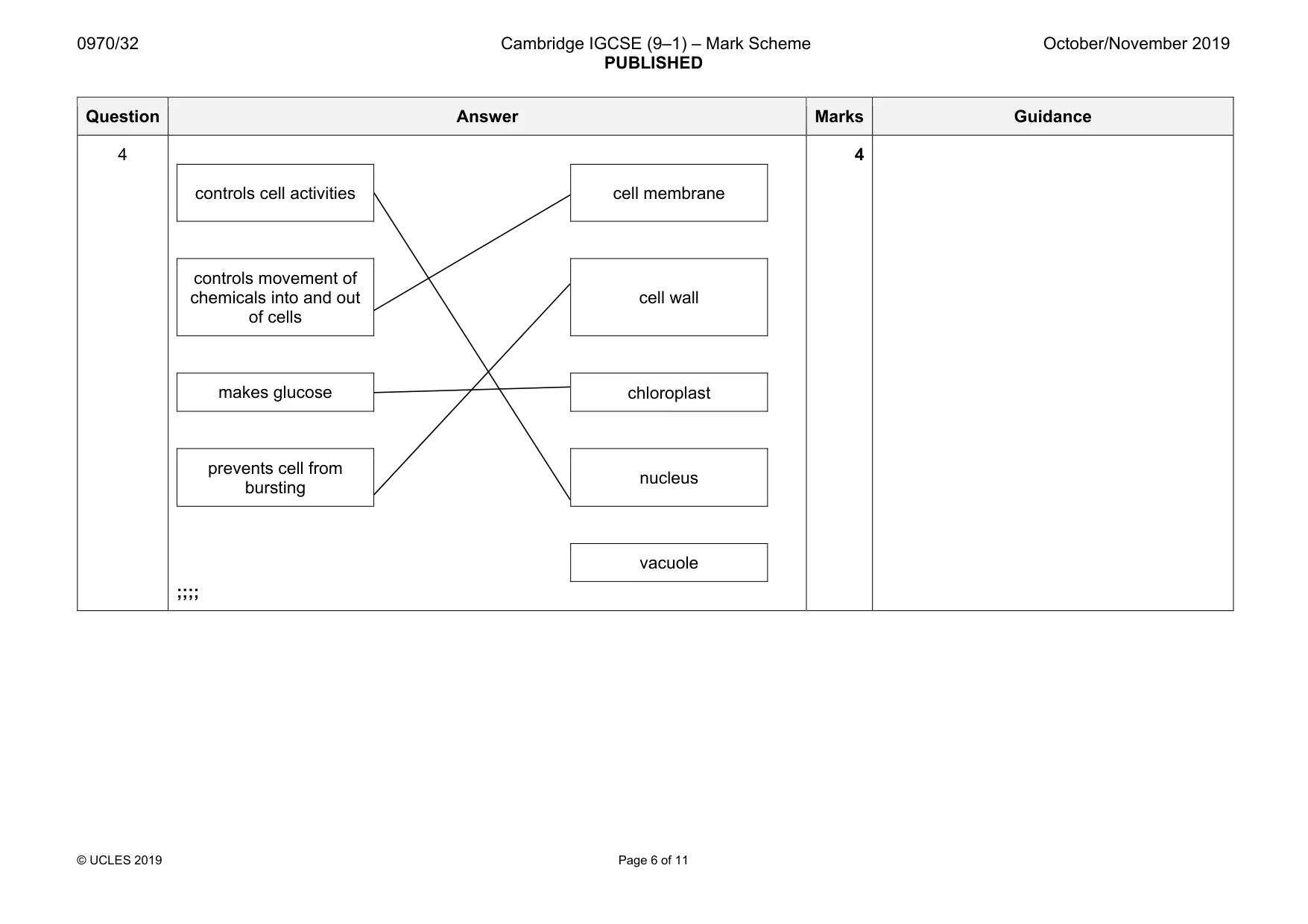
4 The boxes on the left contain the functions of some plant cell structures. The boxes on the right contain the names of structures found in plant cells. Draw one straight line from each box on the left to a box on the right to link the plant cell function to the correct plant cell structure. Draw four lines. plant cell function plant cell structure cell membrane controls cell activities cell wall controls movement of chemicals into and out of cells chloroplast makes glucose nucleus prevents cell from bursting vacuole [4]
Mark scheme: 4 controls cell activities cell membrane controls movement of chemicals into and out of cells cell wall makes glucose chloroplast prevents cell from bursting nucleus vacuole ;;;; 4
Q5 · A seed that has germinated
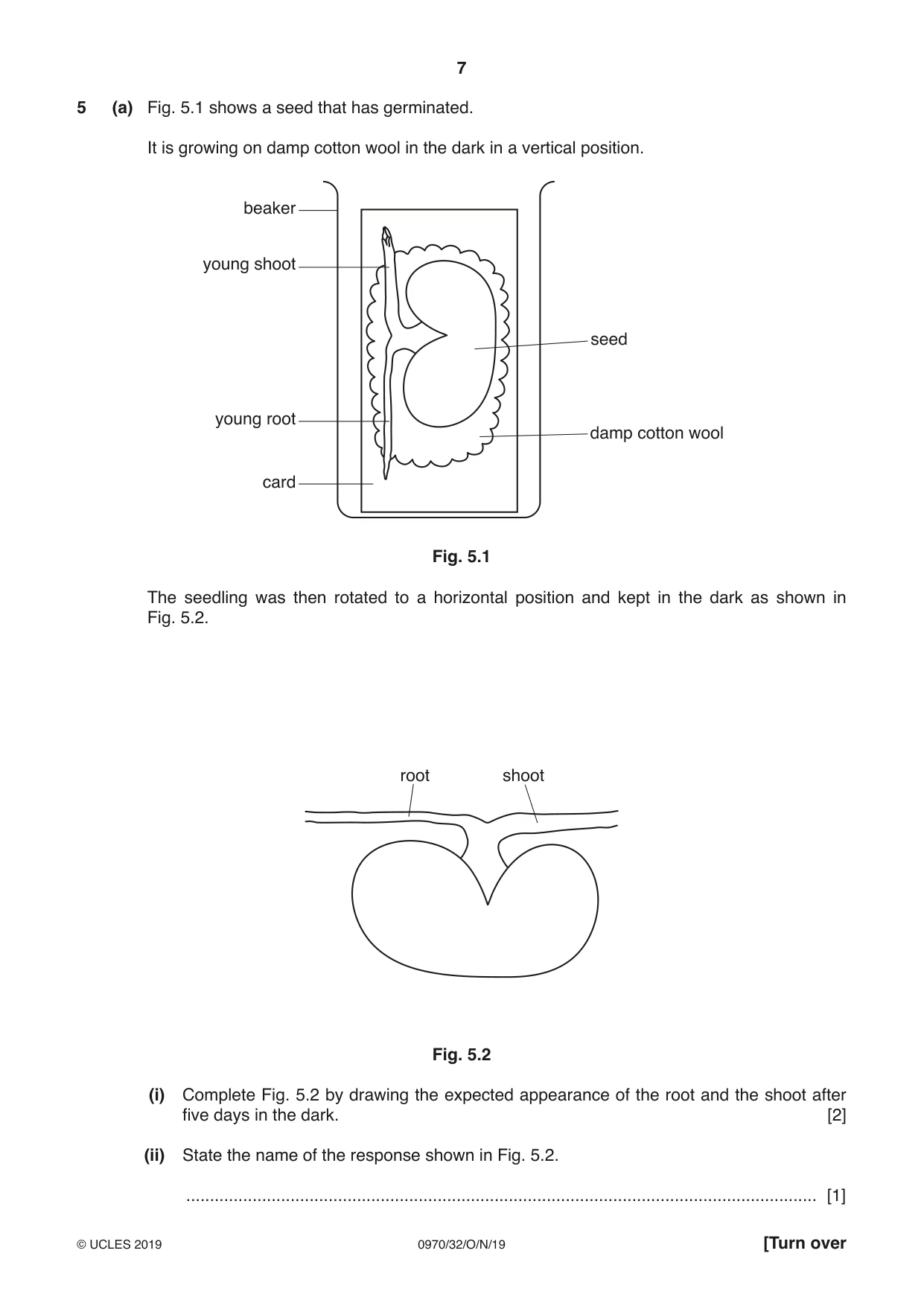
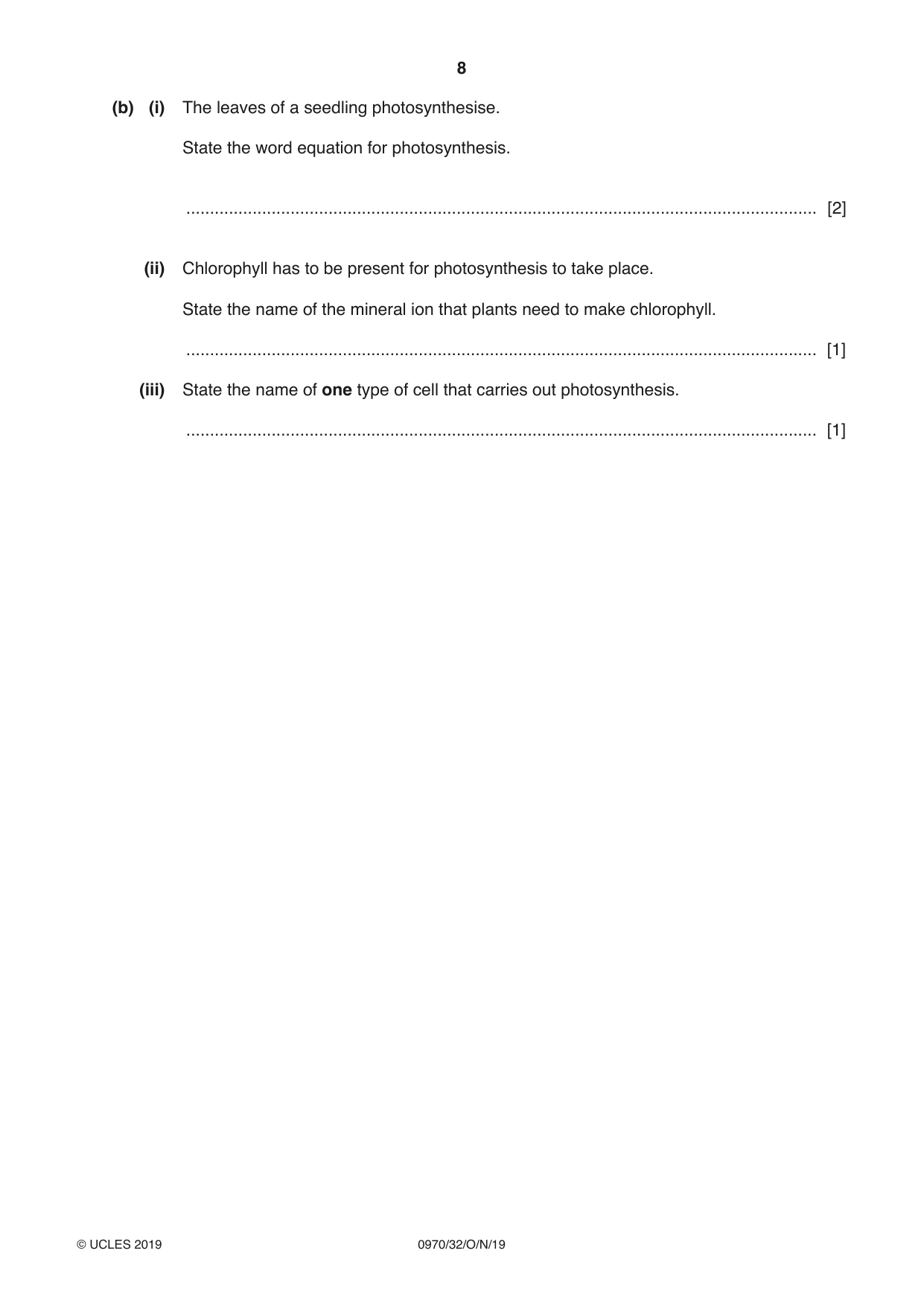
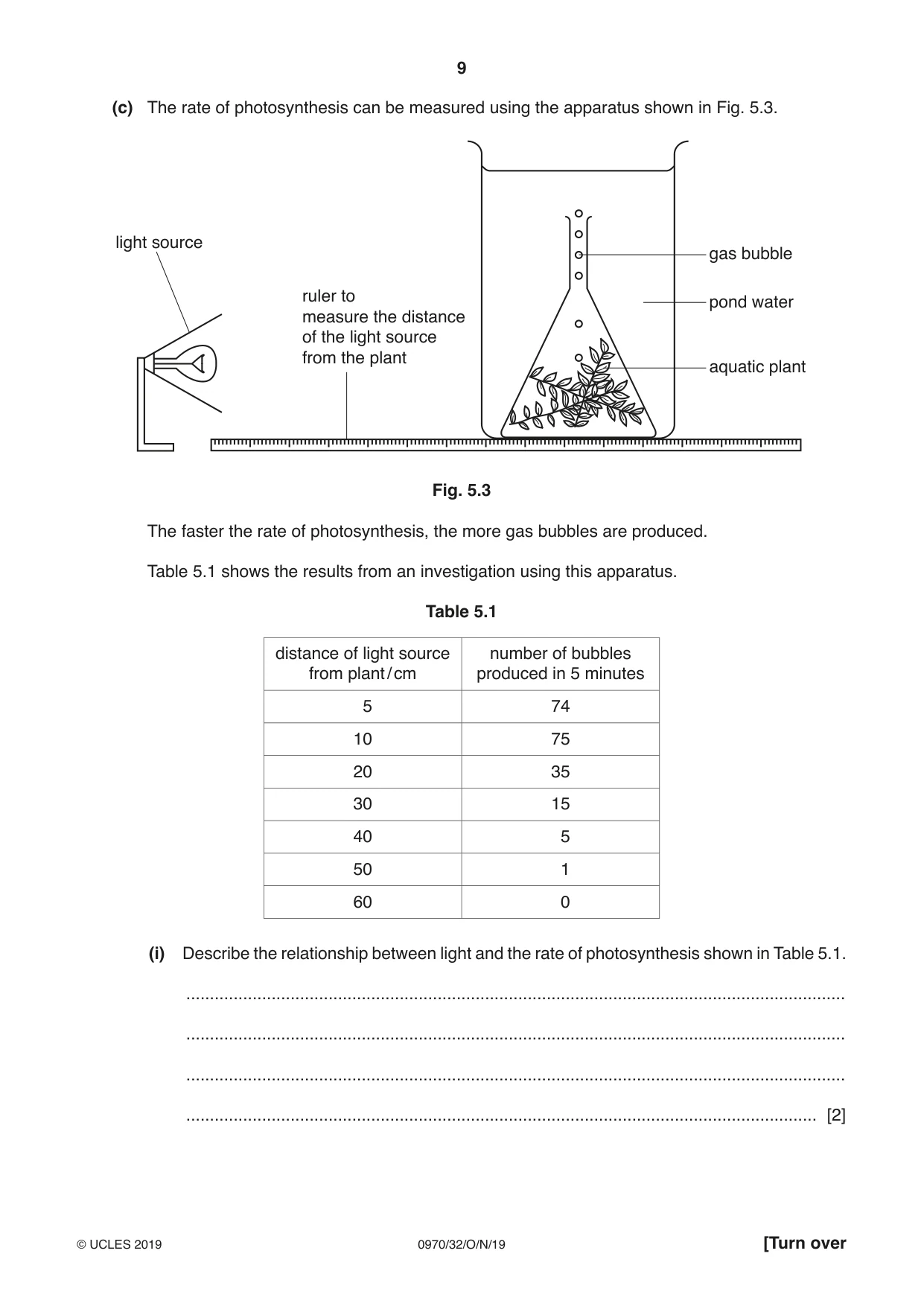
5 (a) Fig. 5.1 shows a seed that has germinated. It is growing on damp cotton wool in the dark in a vertical position. beaker young shoot seed young root damp cotton wool card Fig. 5.1 The seedling was then rotated to a horizontal position and kept in the dark as shown in Fig. 5.2. root shoot Fig. 5.2 (i) Complete Fig. 5.2 by drawing the expected appearance of the root and the shoot after five days in the dark. [2] (ii) State the name of the response shown in Fig. 5.2. ..................................................................................................................................... [1] (b) (i) The leaves of a seedling photosynthesise. State the word equation for photosynthesis. ..................................................................................................................................... [2] (ii) Chlorophyll has to be present for photosynthesis to take place. State the name of the mineral ion that plants need to make chlorophyll. ..................................................................................................................................... [1] (iii) State the name of one type of cell that carries out photosynthesis. ..................................................................................................................................... [1] (c) The rate of photosynthesis can be measured using the apparatus shown in Fig. 5.3. light source gas bubble ruler to pond water measure the distance of the light source from the plant aquatic plant Fig. 5.3 The faster the rate of photosynthesis, the more gas bubbles are produced. Table 5.1 shows the results from an investigation using this apparatus. Table 5.1 distance of light source number of bubbles from plant / cm produced in 5 minutes 5 74 10 75 20 35 30 15 40 5 50 1 60 0 (i) Describe the relationship between light and the rate of photosynthesis shown in Table 5.1. ........................................................................................................................................... ........................................................................................................................................... ........................................................................................................................................... ..................................................................................................................................... [2] (ii) State two factors, other than light, that will affect the rate of photosynthesis in this investigation. 1 ........................................................................................................................................ 2 ........................................................................................................................................ [2] (d) Suggest one use of glucose in a plant. ................................................................................................................................................... ............................................................................................................................................. [1] [Total: 12]
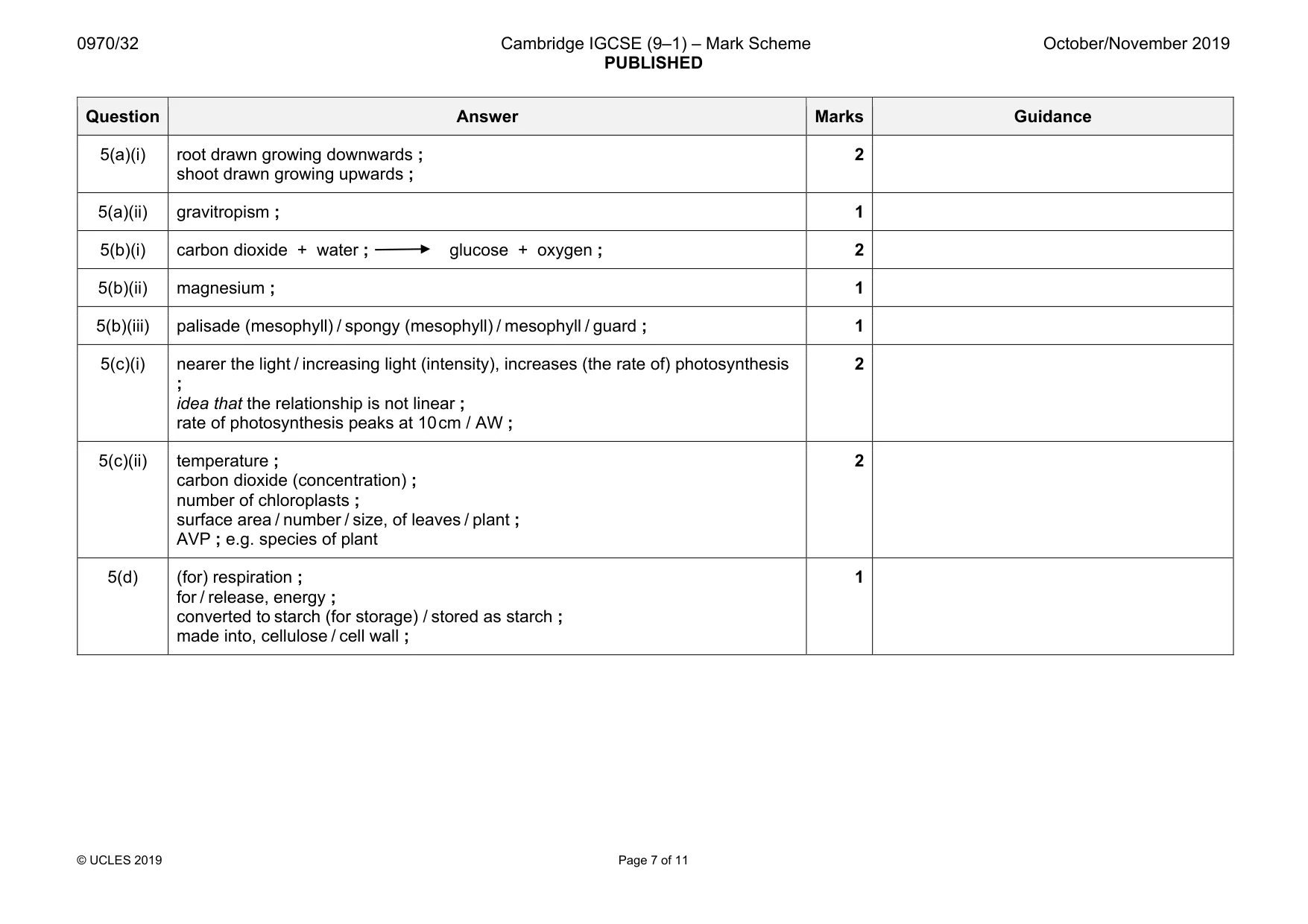
Mark scheme: 5(a)(i) root drawn growing downwards ; shoot drawn growing upwards ; 2 5(a)(ii) gravitropism ; 1 5(b)(i) carbon dioxide + water ; glucose + oxygen ; 2 5(b)(ii) magnesium ; 1 5(b)(iii) palisade (mesophyll) / spongy (mesophyll) / mesophyll / guard ; 1 5(c)(i) nearer the light / increasing light (intensity), increases (the rate of) photosynthesis ; idea that the relationship is not linear ; rate of photosynthesis peaks at 10 cm / AW ; 2 5(c)(ii) temperature ; carbon dioxide (concentration) ; number of chloroplasts ; surface area / number / size, of leaves / plant ; AVP ; e.g. species of plant 2 5(d) (for) respiration ; for / release, energy ; converted to starch (for storage) / stored as starch ; made into, cellulose / cell wall ; 1
Q6 · Part of the human gas exchange system
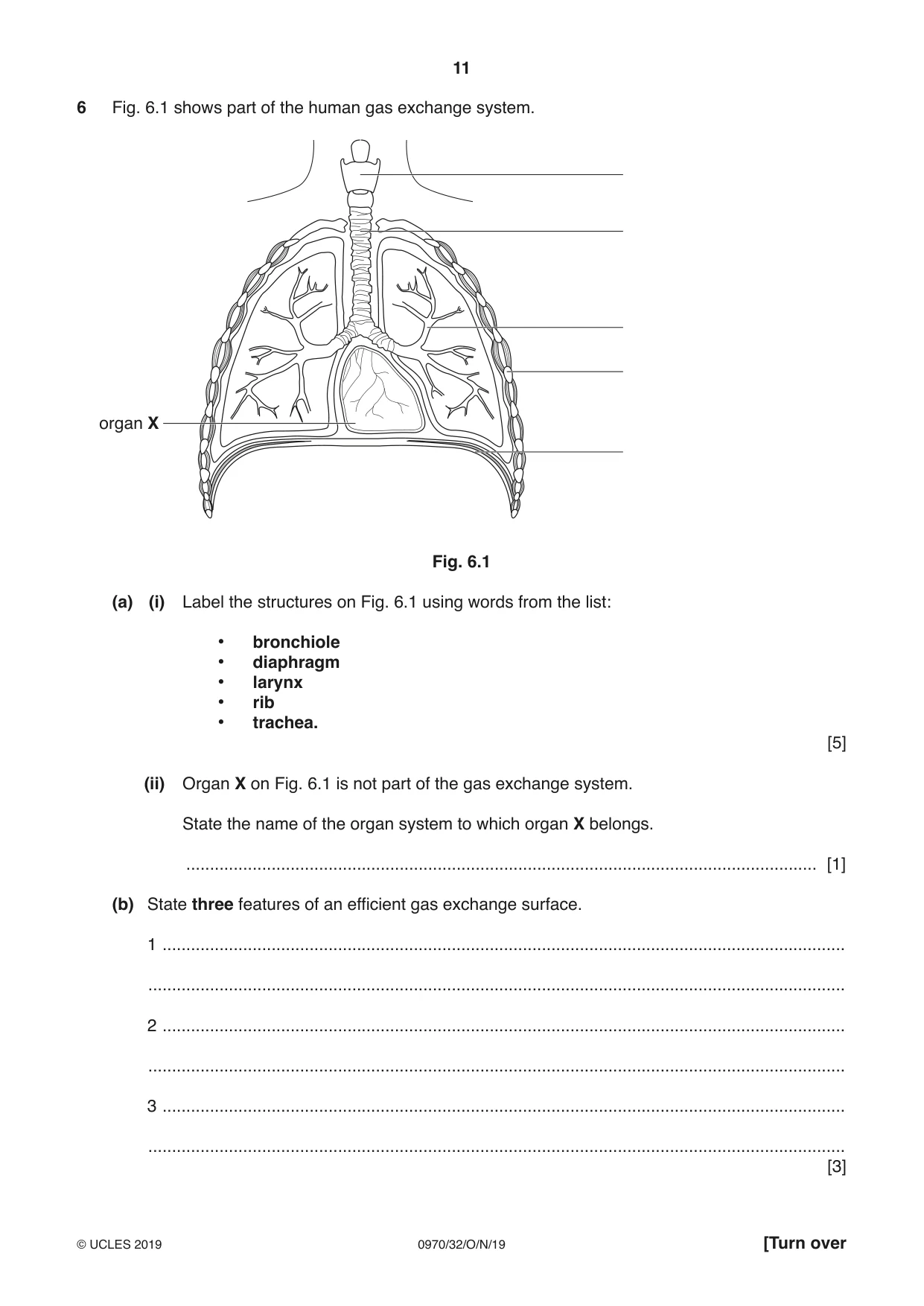
6 Fig. 6.1 shows part of the human gas exchange system. organ X Fig. 6.1 (a) (i) Label the structures on Fig. 6.1 using words from the list: • bronchiole • diaphragm • larynx • rib • trachea. [5] (ii) Organ X on Fig. 6.1 is not part of the gas exchange system. State the name of the organ system to which organ X belongs. ..................................................................................................................................... [1] (b) State three features of an efficient gas exchange surface. 1 ................................................................................................................................................ ................................................................................................................................................... 2 ................................................................................................................................................ ................................................................................................................................................... 3 ................................................................................................................................................ ................................................................................................................................................... [3] (c) Describe the harmful effects of tobacco smoke on the body. ................................................................................................................................................... ................................................................................................................................................... ................................................................................................................................................... ................................................................................................................................................... ................................................................................................................................................... ................................................................................................................................................... ................................................................................................................................................... ................................................................................................................................................... ............................................................................................................................................. [4] [Total: 13]
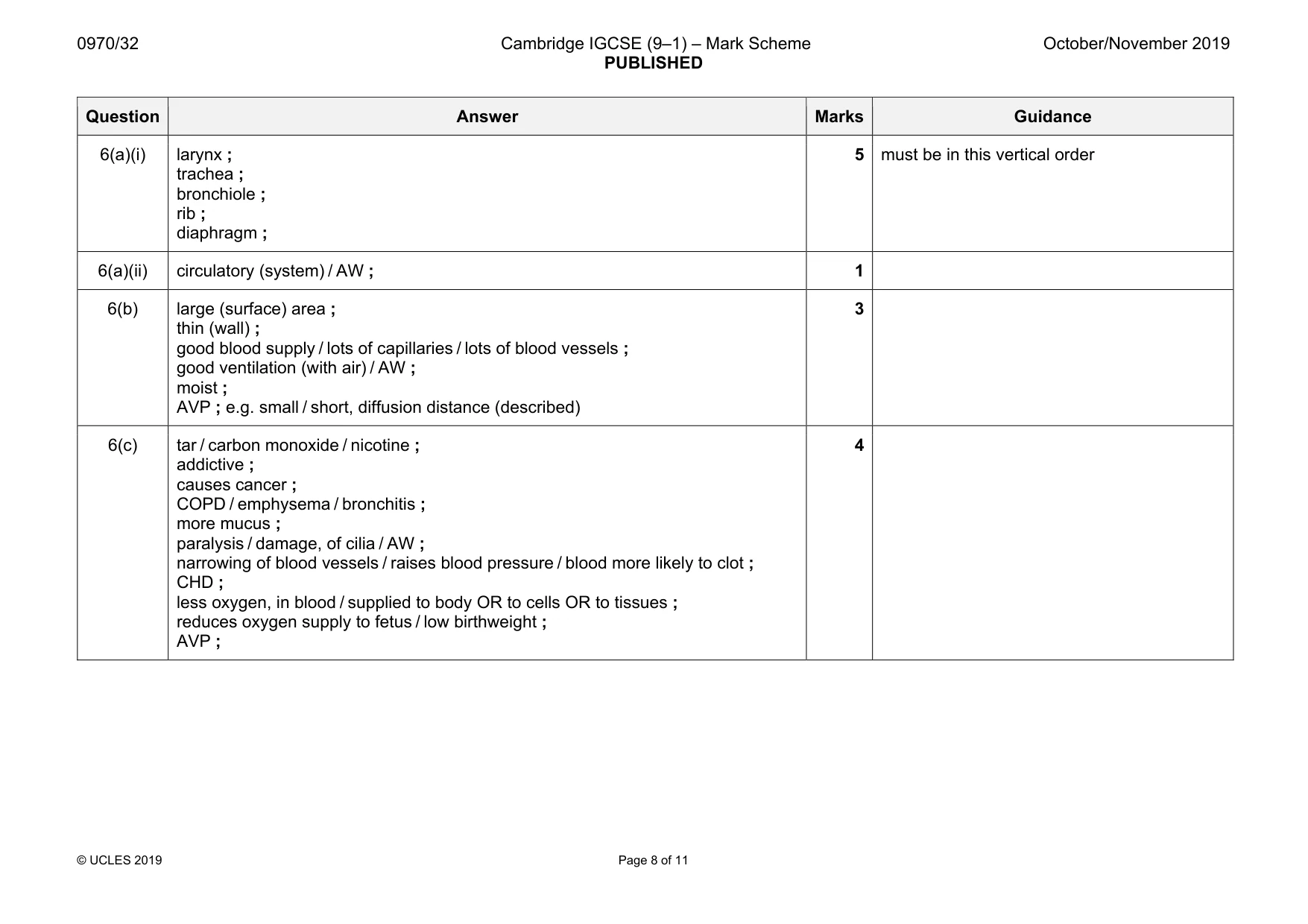
Mark scheme: 6(a)(i) larynx ; trachea ; bronchiole ; rib ; diaphragm ; 5 6(a)(ii) circulatory (system) / AW ; 1 6(b) large (surface) area ; thin (wall) ; good blood supply / lots of capillaries / lots of blood vessels ; good ventilation (with air) / AW ; moist ; AVP ; e.g. small / short, diffusion distance (described) 3 6(c) tar / carbon monoxide / nicotine ; addictive ; causes cancer ; COPD / emphysema / bronchitis ; more mucus ; paralysis / damage, of cilia / AW ; narrowing of blood vessels / raises blood pressure / blood more likely to clot ; CHD ; less oxygen, in blood / supplied to body OR to cells OR to tissues ; reduces oxygen supply to fetus / low birthweight ; AVP ; 4
Q7 · Table 7.1 contains the definitions of terms used in genetics
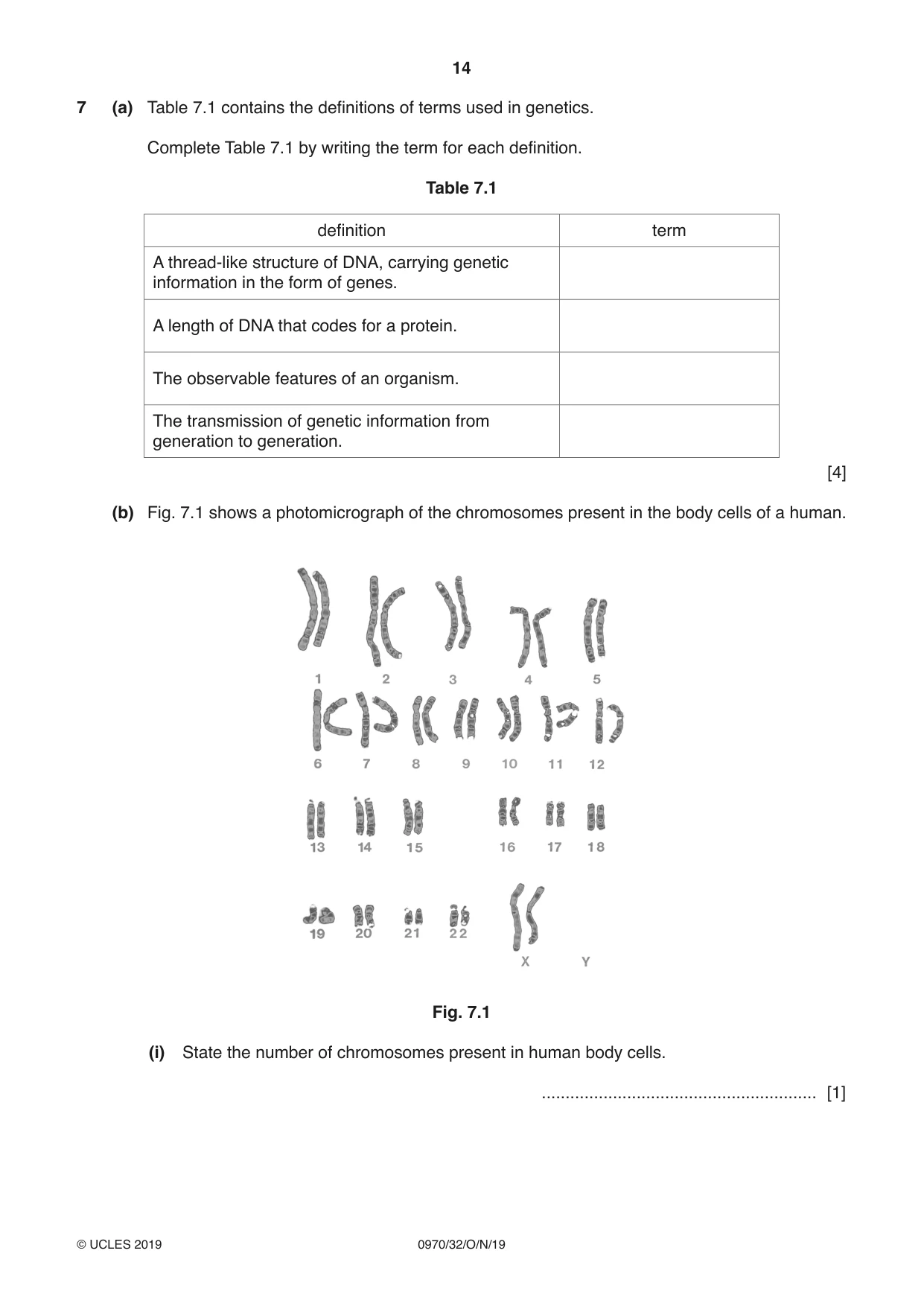
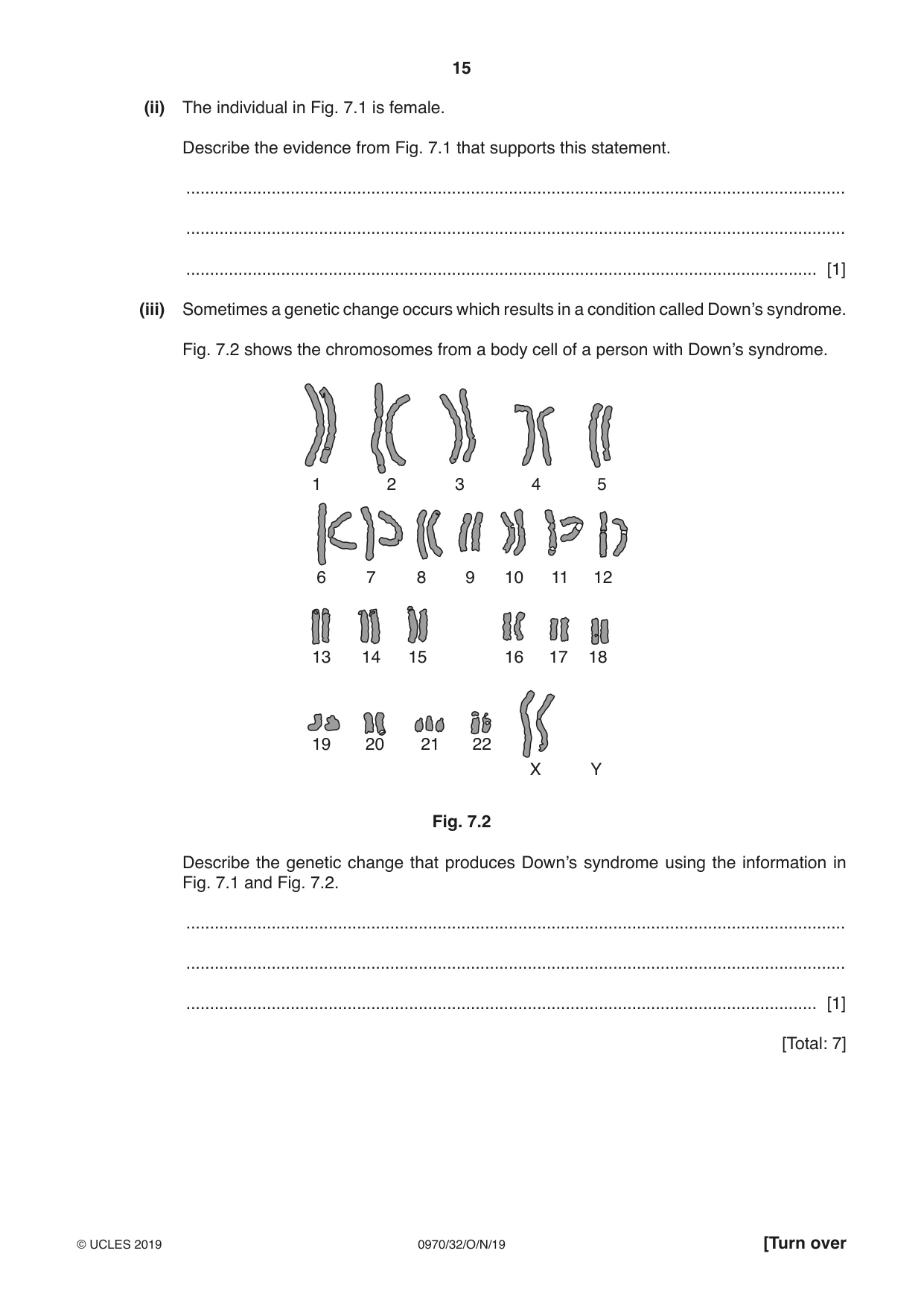
7 (a) Table 7.1 contains the definitions of terms used in genetics. Complete Table 7.1 by writing the term for each definition. Table 7.1 definition term A thread-like structure of DNA, carrying genetic information in the form of genes. A length of DNA that codes for a protein. The observable features of an organism. The transmission of genetic information from generation to generation. [4] (b) Fig. 7.1 shows a photomicrograph of the chromosomes present in the body cells of a human. Fig. 7.1 (i) State the number of chromosomes present in human body cells. .......................................................... [1] (ii) The individual in Fig. 7.1 is female. Describe the evidence from Fig. 7.1 that supports this statement. ........................................................................................................................................... ........................................................................................................................................... ..................................................................................................................................... [1] (iii) Sometimes a genetic change occurs which results in a condition called Down’s syndrome. Fig. 7.2 shows the chromosomes from a body cell of a person with Down’s syndrome. 1 2 3 4 5 6 7 8 9 10 11 12 13 14 15 16 17 18 19 20 21 22 X Y Fig. 7.2 Describe the genetic change that produces Down’s syndrome using the information in Fig. 7.1 and Fig. 7.2. ........................................................................................................................................... ........................................................................................................................................... ..................................................................................................................................... [1] [Total: 7]
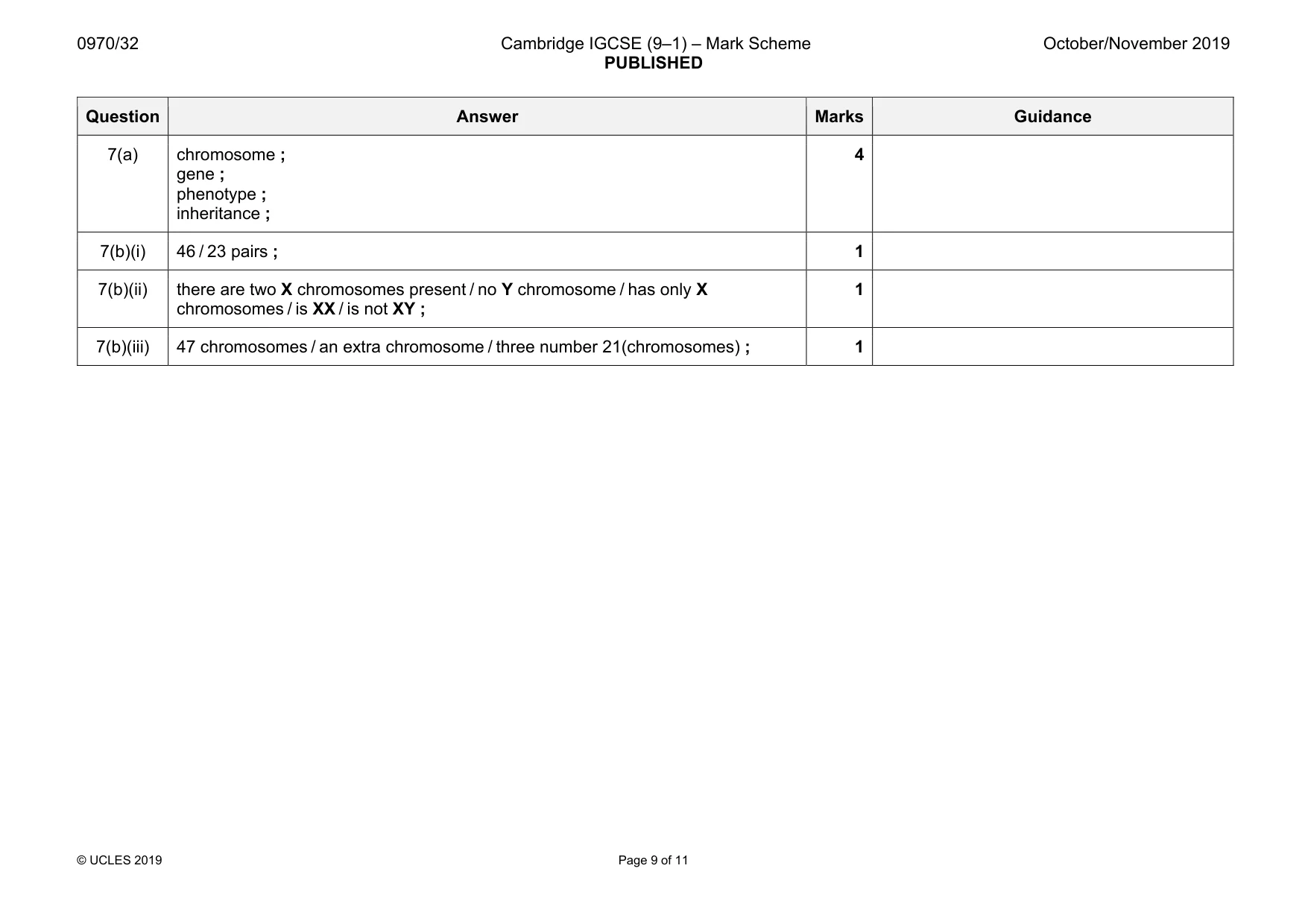
Mark scheme: 7(a) chromosome ; gene ; phenotype ; inheritance ; 4 7(b)(i) 46 / 23 pairs ; 1 7(b)(ii) there are two X chromosomes present / no Y chromosome / has only X chromosomes / is XX / is not XY ; 1 7(b)(iii) 47 chromosomes / an extra chromosome / three number 21(chromosomes) ; 1
Q8 · Table 8.1 contains three descriptions of nervous system terms
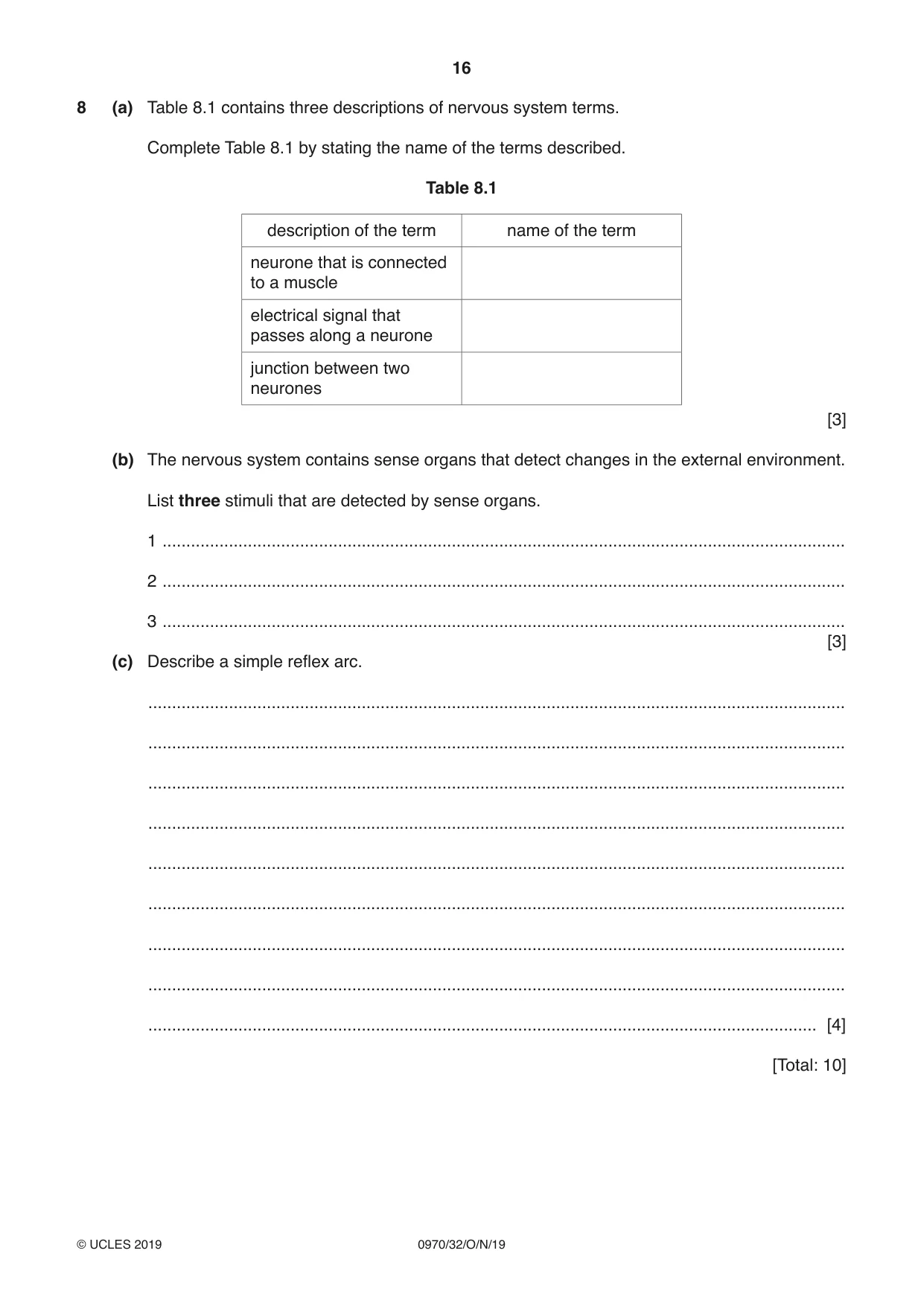
8 (a) Table 8.1 contains three descriptions of nervous system terms. Complete Table 8.1 by stating the name of the terms described. Table 8.1 description of the term name of the term neurone that is connected to a muscle electrical signal that passes along a neurone junction between two neurones [3] (b) The nervous system contains sense organs that detect changes in the external environment. List three stimuli that are detected by sense organs. 1 ................................................................................................................................................ 2 ................................................................................................................................................ 3 ................................................................................................................................................ [3] (c) Describe a simple reflex arc. ................................................................................................................................................... ................................................................................................................................................... ................................................................................................................................................... ................................................................................................................................................... ................................................................................................................................................... ................................................................................................................................................... ................................................................................................................................................... ................................................................................................................................................... ............................................................................................................................................. [4] [Total: 10]
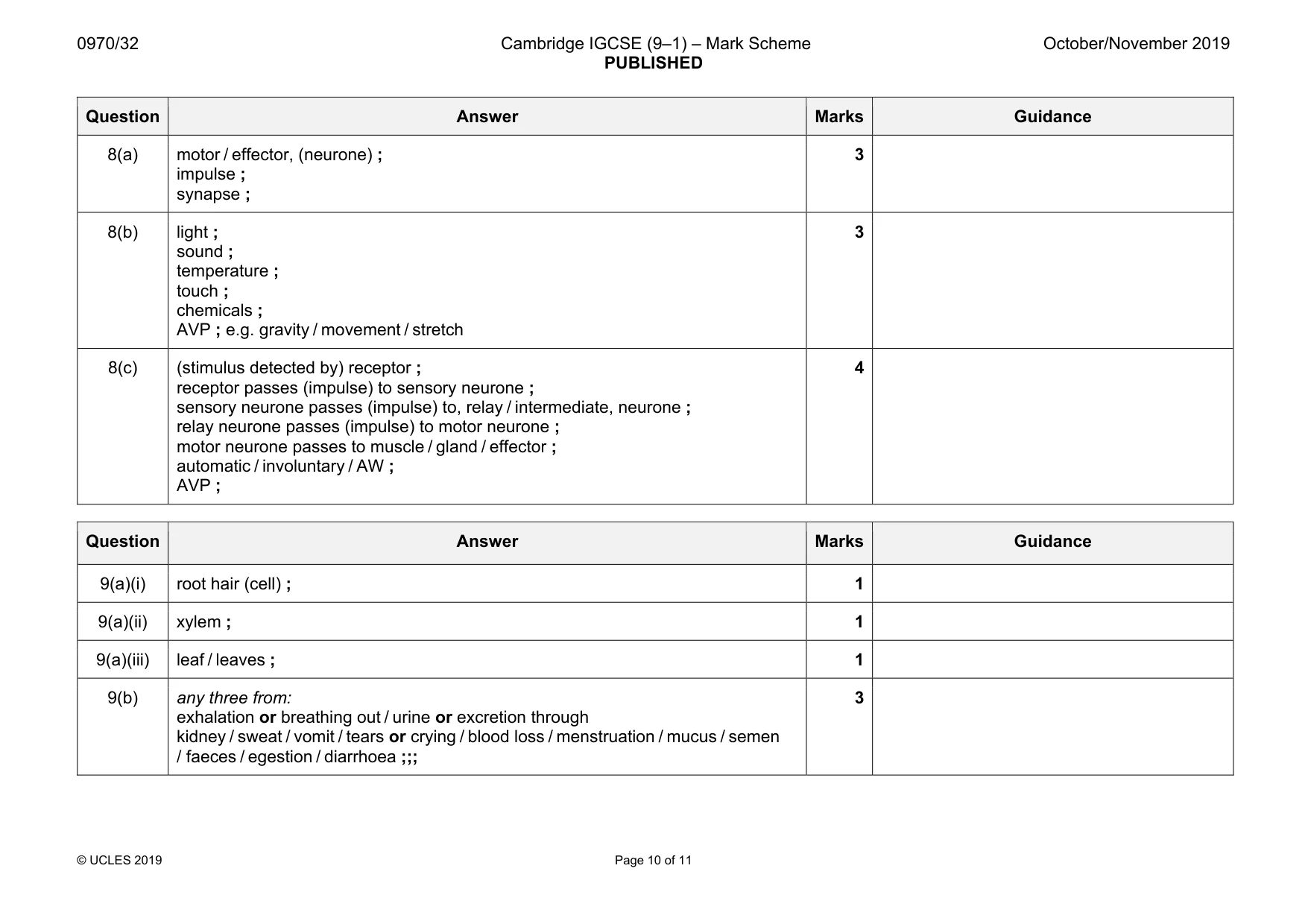
Mark scheme: 8(a) motor / effector, (neurone) ; impulse ; synapse ; 3 8(b) light ; sound ; temperature ; touch ; chemicals ; AVP ; e.g. gravity / movement / stretch 3 8(c) (stimulus detected by) receptor ; receptor passes (impulse) to sensory neurone ; sensory neurone passes (impulse) to, relay / intermediate, neurone ; relay neurone passes (impulse) to motor neurone ; motor neurone passes to muscle / gland / effector ; automatic / involuntary / AW ; AVP ; 4
Q9 · All organisms must maintain a balance between water gain and water loss
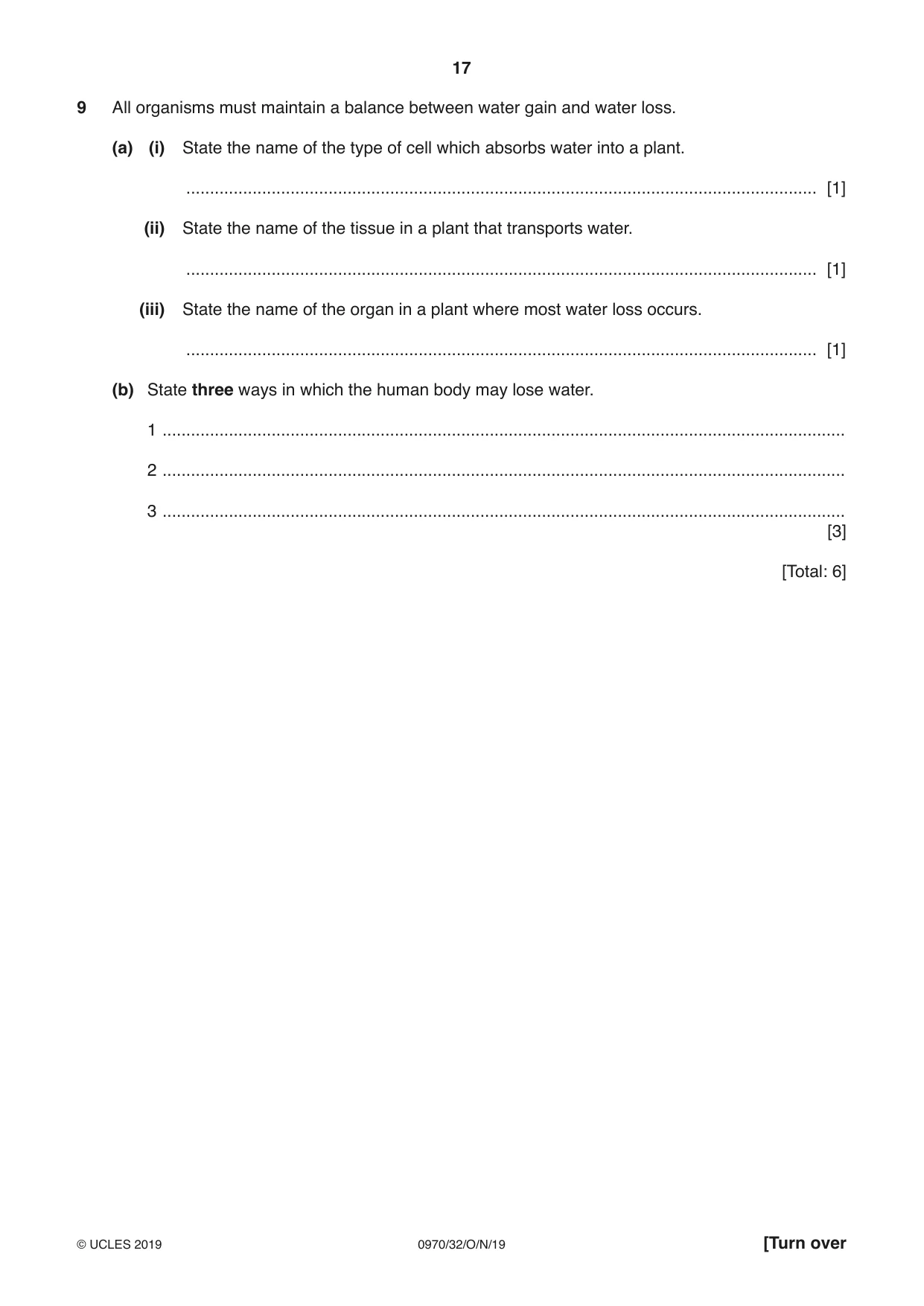
9 All organisms must maintain a balance between water gain and water loss. (a) (i) State the name of the type of cell which absorbs water into a plant. ..................................................................................................................................... [1] (ii) State the name of the tissue in a plant that transports water. ..................................................................................................................................... [1] (iii) State the name of the organ in a plant where most water loss occurs. ..................................................................................................................................... [1] (b) State three ways in which the human body may lose water. 1 ................................................................................................................................................ 2 ................................................................................................................................................ 3 ................................................................................................................................................ [3] [Total: 6]
Mark scheme: 9(a)(i) root hair (cell) ; 1 9(a)(ii) xylem ; 1 9(a)(iii) leaf / leaves ; 1 9(b) any three from: exhalation or breathing out / urine or excretion through kidney / sweat / vomit / tears or crying / blood loss / menstruation / mucus / semen / faeces / egestion / diarrhoea ;;; 3
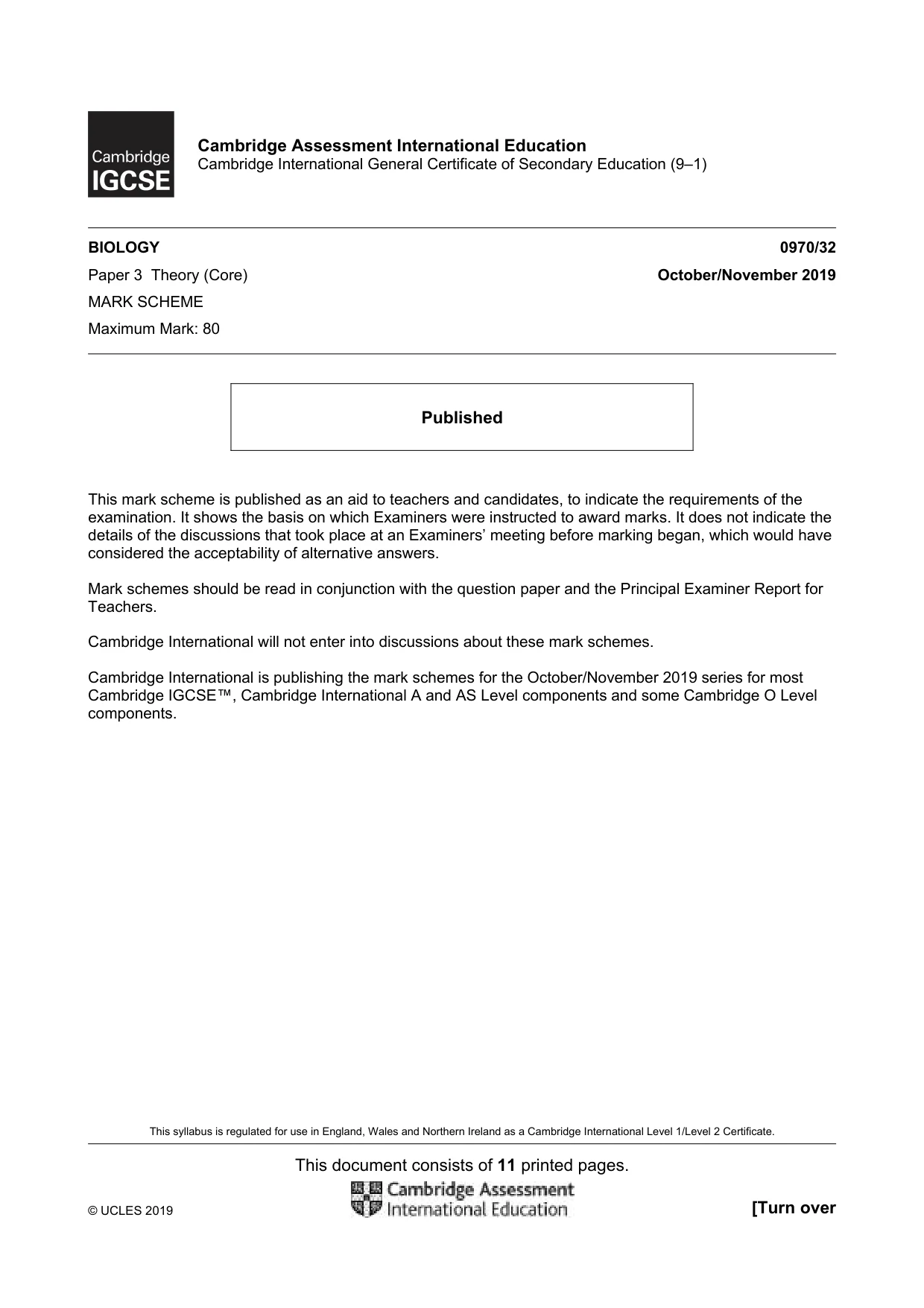
Q10 · In an investigation, the uptake of water into a plant and the loss of water from the same…
10 In an investigation, the uptake of water into a plant and the loss of water from the same plant were measured. Measurements were taken over an 18-hour period. The results are shown in Fig. 10.1. 35 35 30 30 25 25 20 20 water uptake water loss / g per hour / g per hour 15 15 10 10 5 5 0 0 00:00 04:00 08:00 12:00 16:00 20:00 24:00 midnight midday midnight time of day Key: water uptake water loss Fig. 10.1 (a) Use the information in Fig. 10.1 to answer these questions: (i) State the rate of water uptake at 12:00 (midday). ......................................... g per hour [1] (ii) State the time when the water uptake was 10 g per hour. .......................................................... [1] (iii) State one time during the day when the water uptake and the water loss were equal. .......................................................... [1] (b) Describe how changes in temperature and changes in humidity affect the rate of water loss in a plant. ................................................................................................................................................... ................................................................................................................................................... ................................................................................................................................................... ................................................................................................................................................... ............................................................................................................................................. [2] (c) State the name of the process that results in water loss from plants. ............................................................................................................................................. [1] [Total: 6]
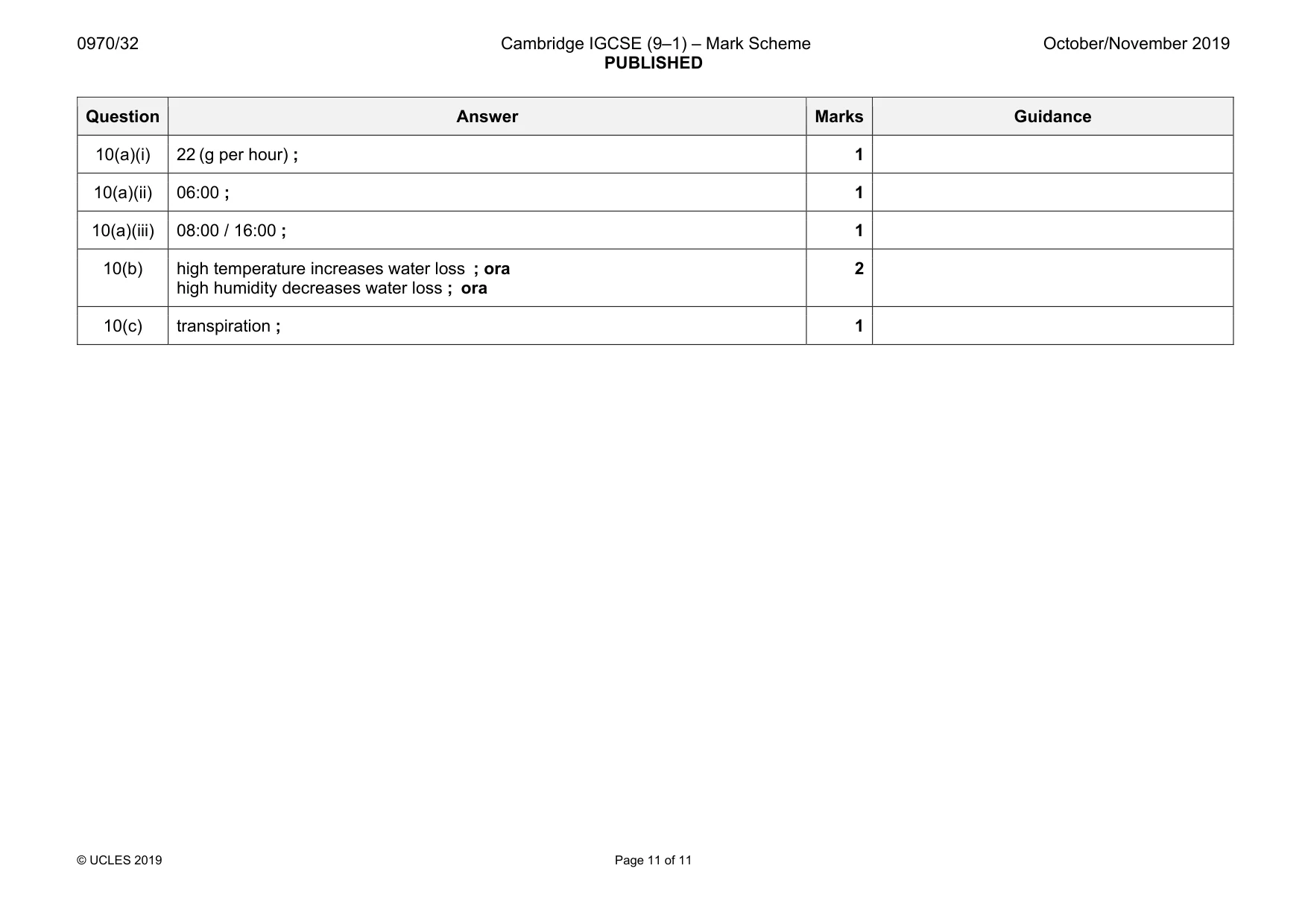
Mark scheme: 10(a)(i) 22 (g per hour) ; 1 10(a)(ii) 06:00 ; 1 10(a)(iii) 08:00 / 16:00 ; 1 10(b) high temperature increases water loss ; ora high humidity decreases water loss ; ora 2 10(c) transpiration ; 1
What was in this paper
The subtopics covered by these 10 questions, and how many questions each got. Open one in a new tab to see every Cambridge question on it.
What you needed in this session
Cambridge’s own grade thresholds for 2019 Oct/Nov, Paper 3 · Variant 2. A higher threshold means an easier paper — the bar moves with how the cohort did.