Cambridge IGCSE Biology (9-1) 0970 — 2018 Oct/Nov Paper 3 · Variant 2
0970/32/O/N/18 · 9 questions · 80 marks · ≈90 min
The question paper and its mark scheme, free to read here and free to download. This is Cambridge’s own paper, exactly as it was sat.
Question paper20 pages


Mark scheme12 pages
Answers below. Sit the paper first if you are practising.
Questions as text
Q1 · The boxes on the left contain the names of processes from the carbon cycle
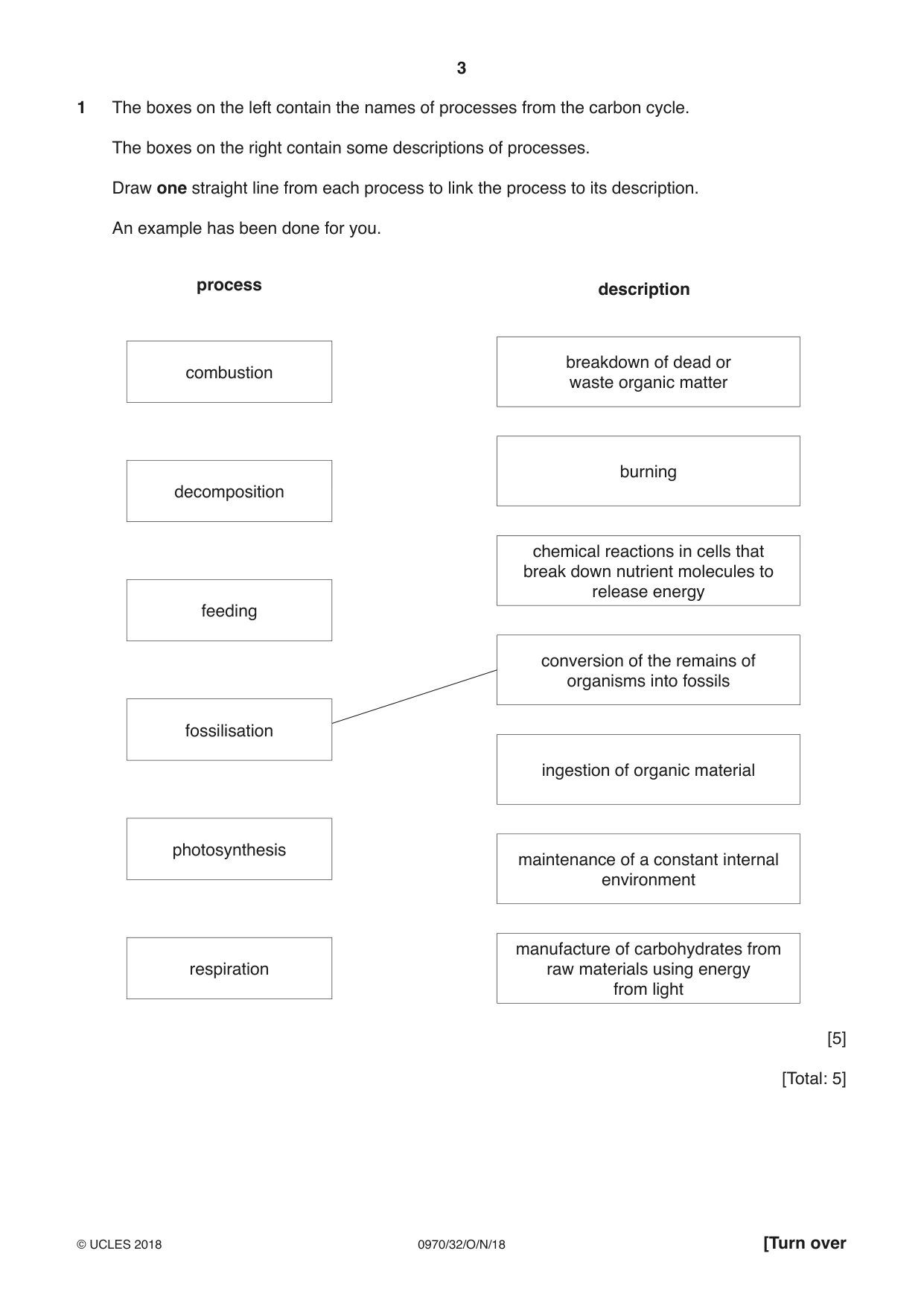
1 The boxes on the left contain the names of processes from the carbon cycle. The boxes on the right contain some descriptions of processes. Draw one straight line from each process to link the process to its description. An example has been done for you. process description breakdown of dead or combustion waste organic matter burning decomposition chemical reactions in cells that break down nutrient molecules to release energy feeding conversion of the remains of organisms into fossils fossilisation ingestion of organic material photosynthesis maintenance of a constant internal environment manufacture of carbohydrates from respiration raw materials using energy from light [5] [Total: 5]
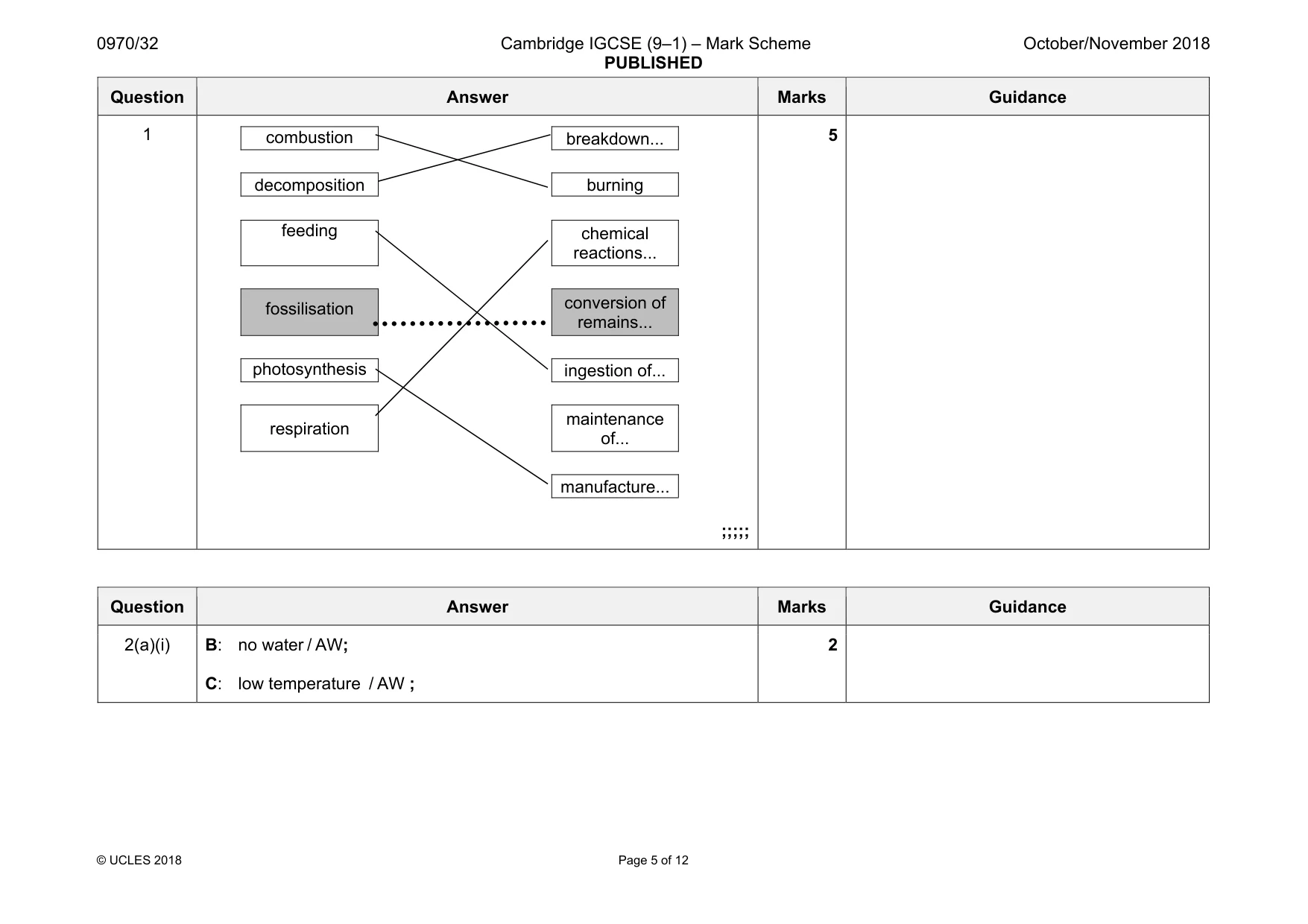
Mark scheme: 1 combustion breakdown... decomposition burning feeding chemical reactions... fossilisation conversion of remains... photosynthesis ingestion of... respiration maintenance of... manufacture... ;;;;; 5
Q2 · Some students investigated the conditions needed for the germination of maize seeds
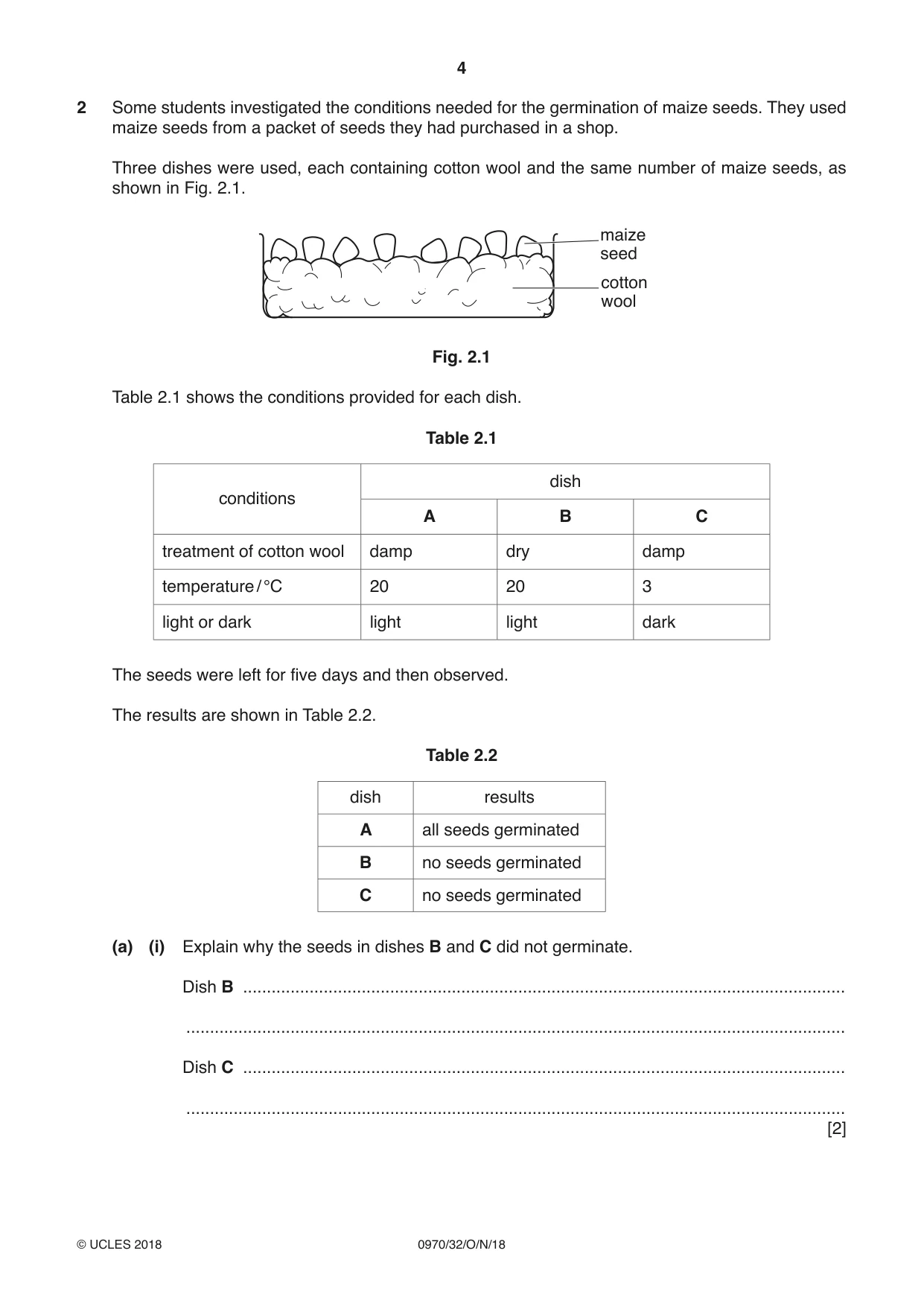
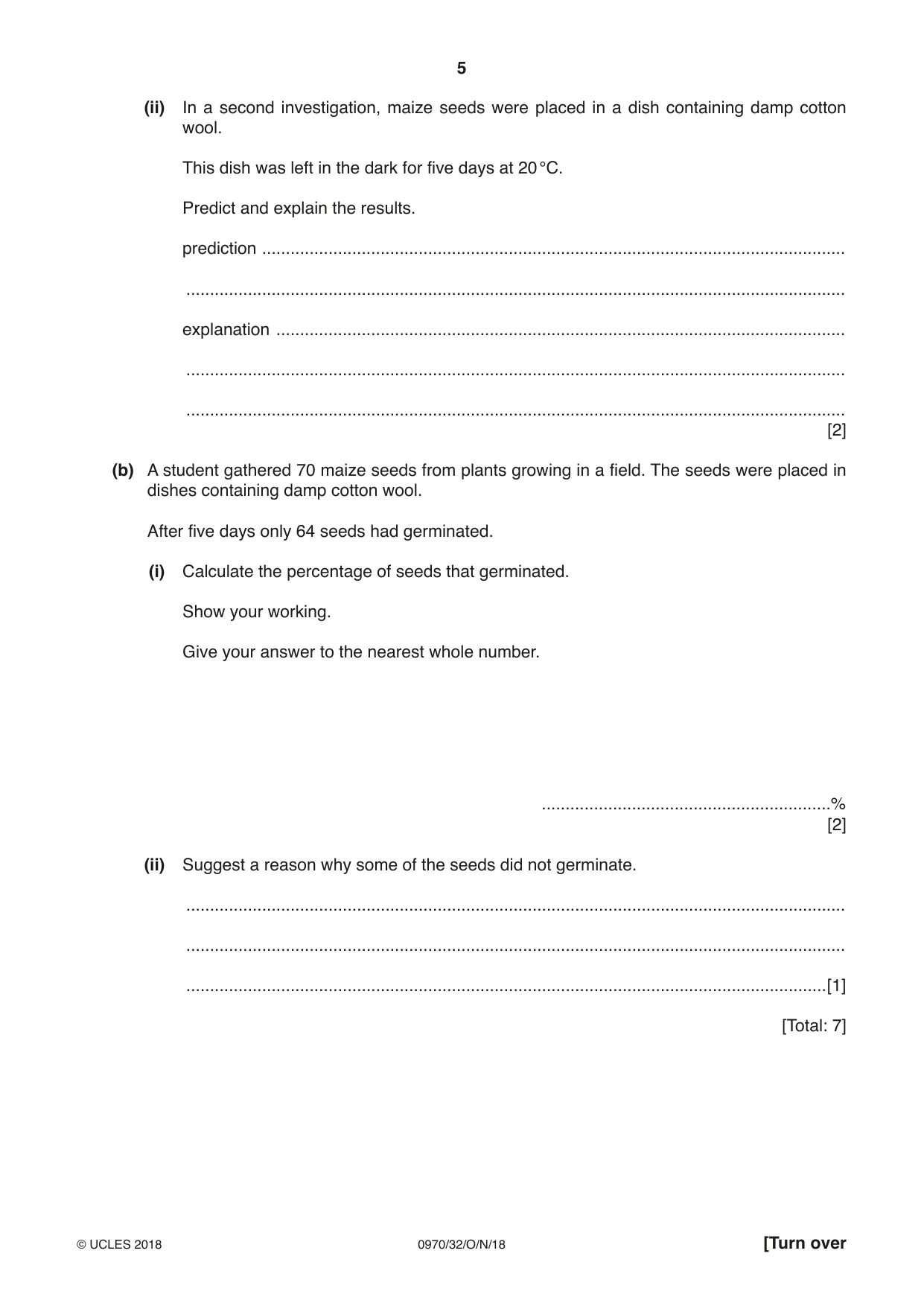
2 Some students investigated the conditions needed for the germination of maize seeds. They used maize seeds from a packet of seeds they had purchased in a shop. Three dishes were used, each containing cotton wool and the same number of maize seeds, as shown in Fig. 2.1. maize seed cotton wool Fig. 2.1 Table 2.1 shows the conditions provided for each dish. Table 2.1 dish conditions A B C treatment of cotton wool damp dry damp temperature / °C 20 20 3 light or dark light light dark The seeds were left for five days and then observed. The results are shown in Table 2.2. Table 2.2 dish results A all seeds germinated B no seeds germinated C no seeds germinated (a) (i) Explain why the seeds in dishes B and C did not germinate. Dish B ............................................................................................................................... ........................................................................................................................................... Dish C ............................................................................................................................... ........................................................................................................................................... [2] (ii) In a second investigation, maize seeds were placed in a dish containing damp cotton wool. This dish was left in the dark for five days at 20 °C. Predict and explain the results. prediction ........................................................................................................................... ........................................................................................................................................... explanation ........................................................................................................................ ........................................................................................................................................... ........................................................................................................................................... [2] (b) A student gathered 70 maize seeds from plants growing in a field. The seeds were placed in dishes containing damp cotton wool. After five days only 64 seeds had germinated. (i) Calculate the percentage of seeds that germinated. Show your working. Give your answer to the nearest whole number. .............................................................% [2] (ii) Suggest a reason why some of the seeds did not germinate. ........................................................................................................................................... ........................................................................................................................................... .......................................................................................................................................[1] [Total: 7]
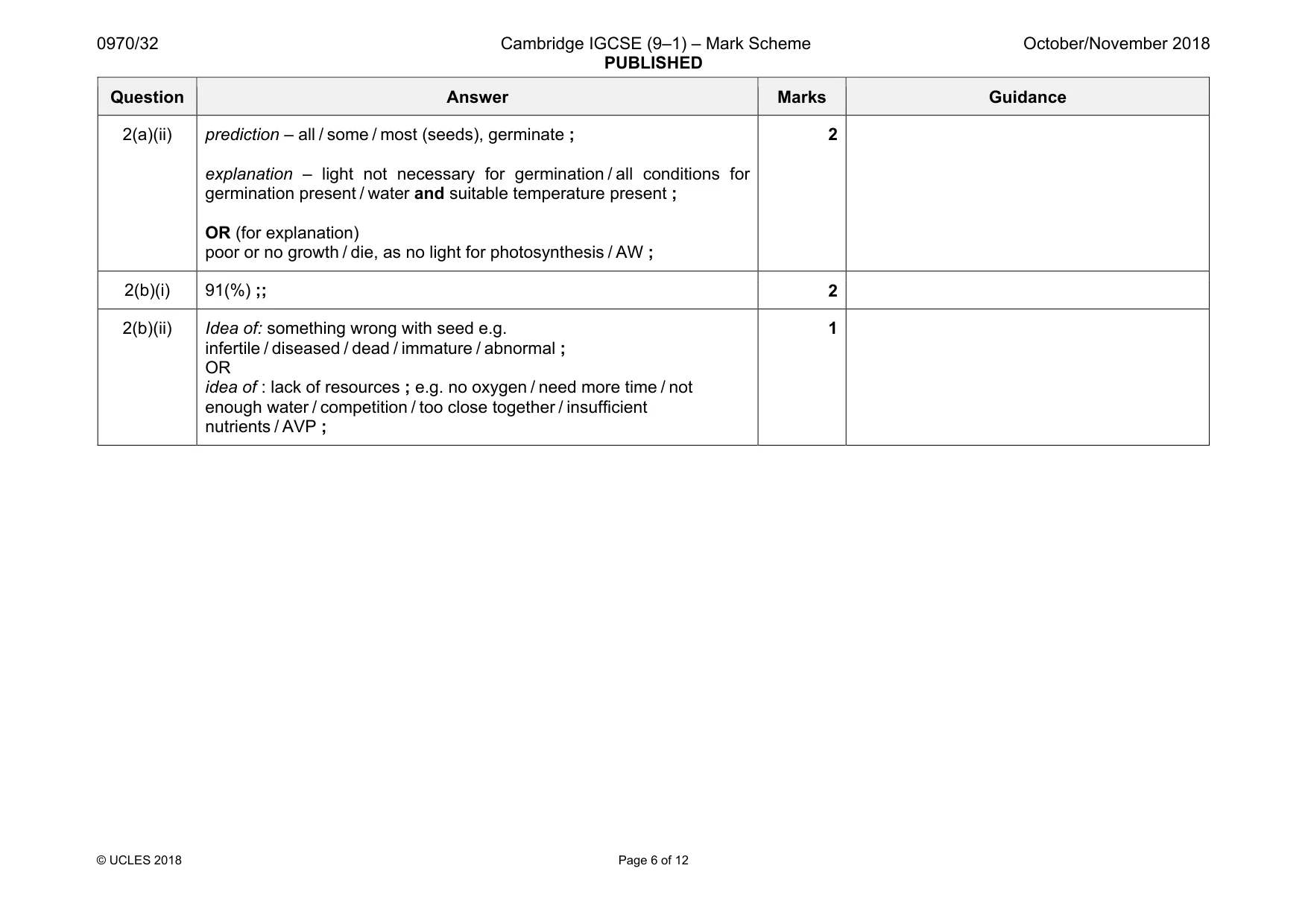
Mark scheme: 2(a)(i) B: no water / AW; C: low temperature / AW ; 2 Question Answer Marks Guidance 2(a)(ii) prediction – all / some / most (seeds), germinate ; explanation – light not necessary for germination / all conditions for germination present / water and suitable temperature present ; OR (for explanation) poor or no growth / die, as no light for photosynthesis / AW ; 2 2(b)(i) 91(%) ;; 2 2(b)(ii) Idea of: something wrong with seed e.g. infertile / diseased / dead / immature / abnormal ; OR idea of : lack of resources ; e.g. no oxygen / need more time / not enough water / competition / too close together / insufficient nutrients / AVP ; 1
Q3 · This question is about biological molecules
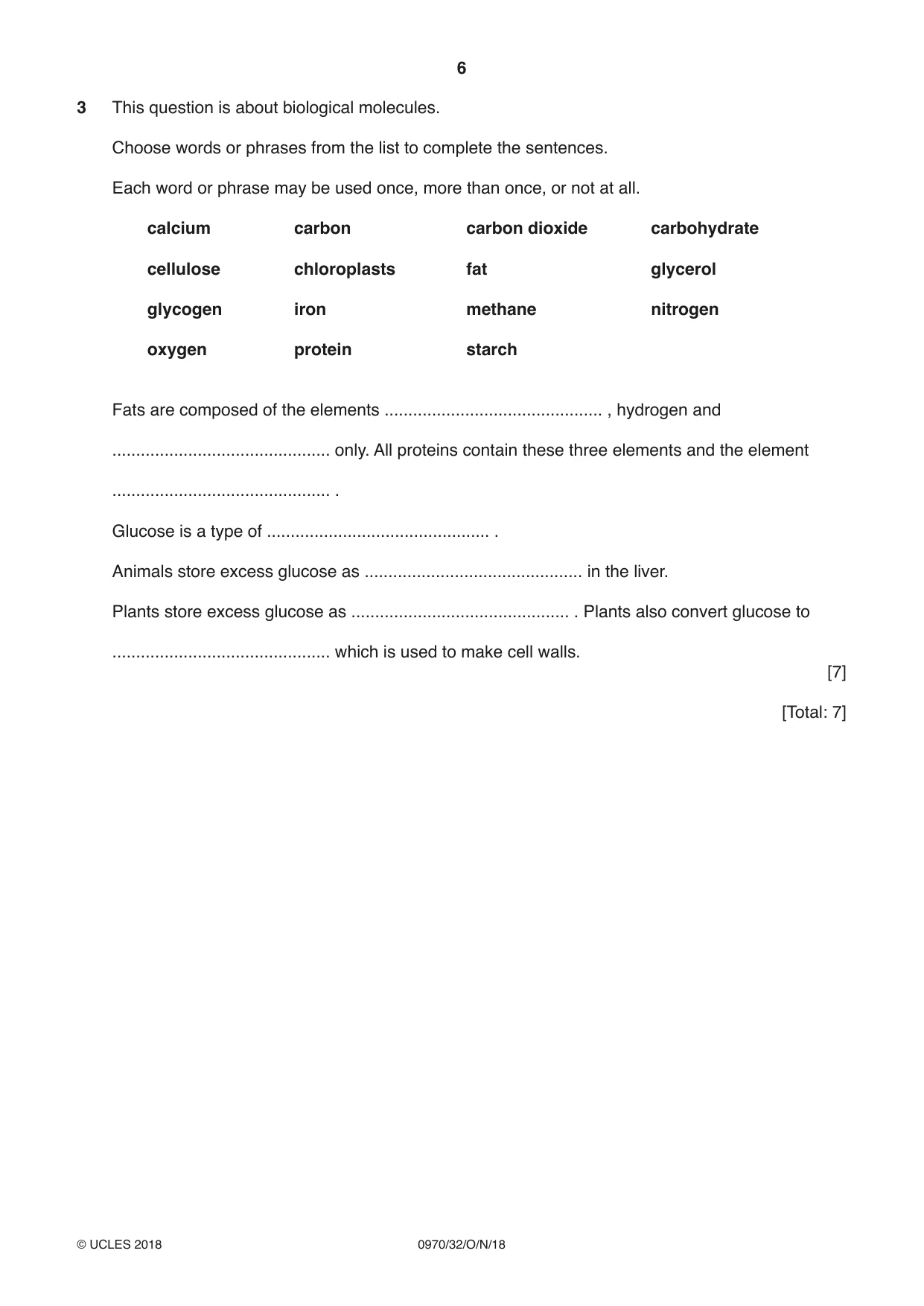
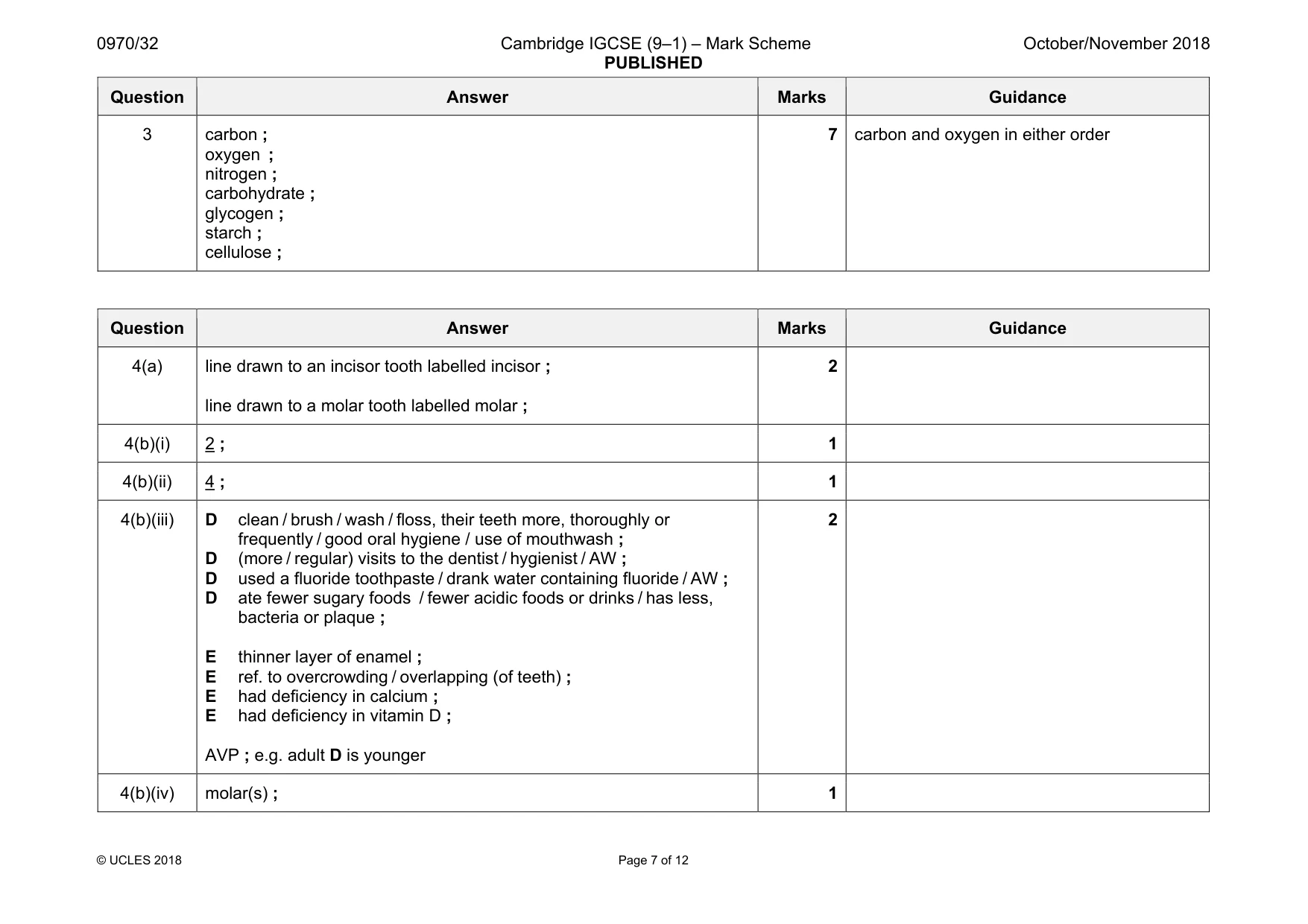
3 This question is about biological molecules. Choose words or phrases from the list to complete the sentences. Each word or phrase may be used once, more than once, or not at all. calcium carbon carbon dioxide carbohydrate cellulose chloroplasts fat glycerol glycogen iron methane nitrogen oxygen protein starch Fats are composed of the elements .............................................. , hydrogen and .............................................. only. All proteins contain these three elements and the element .............................................. . Glucose is a type of ............................................... . Animals store excess glucose as .............................................. in the liver. Plants store excess glucose as .............................................. . Plants also convert glucose to .............................................. which is used to make cell walls. [7] [Total: 7]
Mark scheme: 3 carbon ; oxygen ; nitrogen ; carbohydrate ; glycogen ; starch ; cellulose ; 7
Q4 · Teeth in a human skull
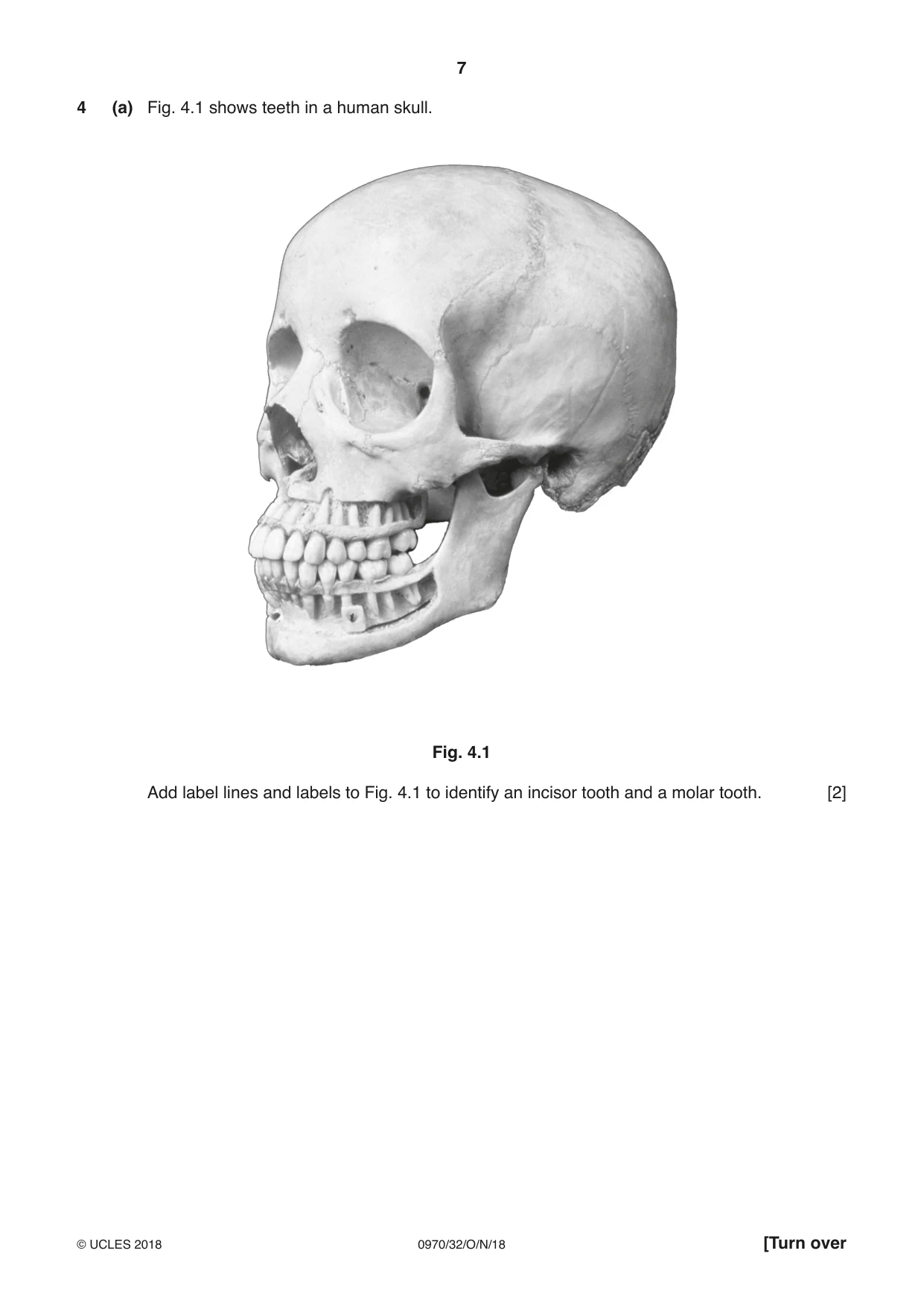
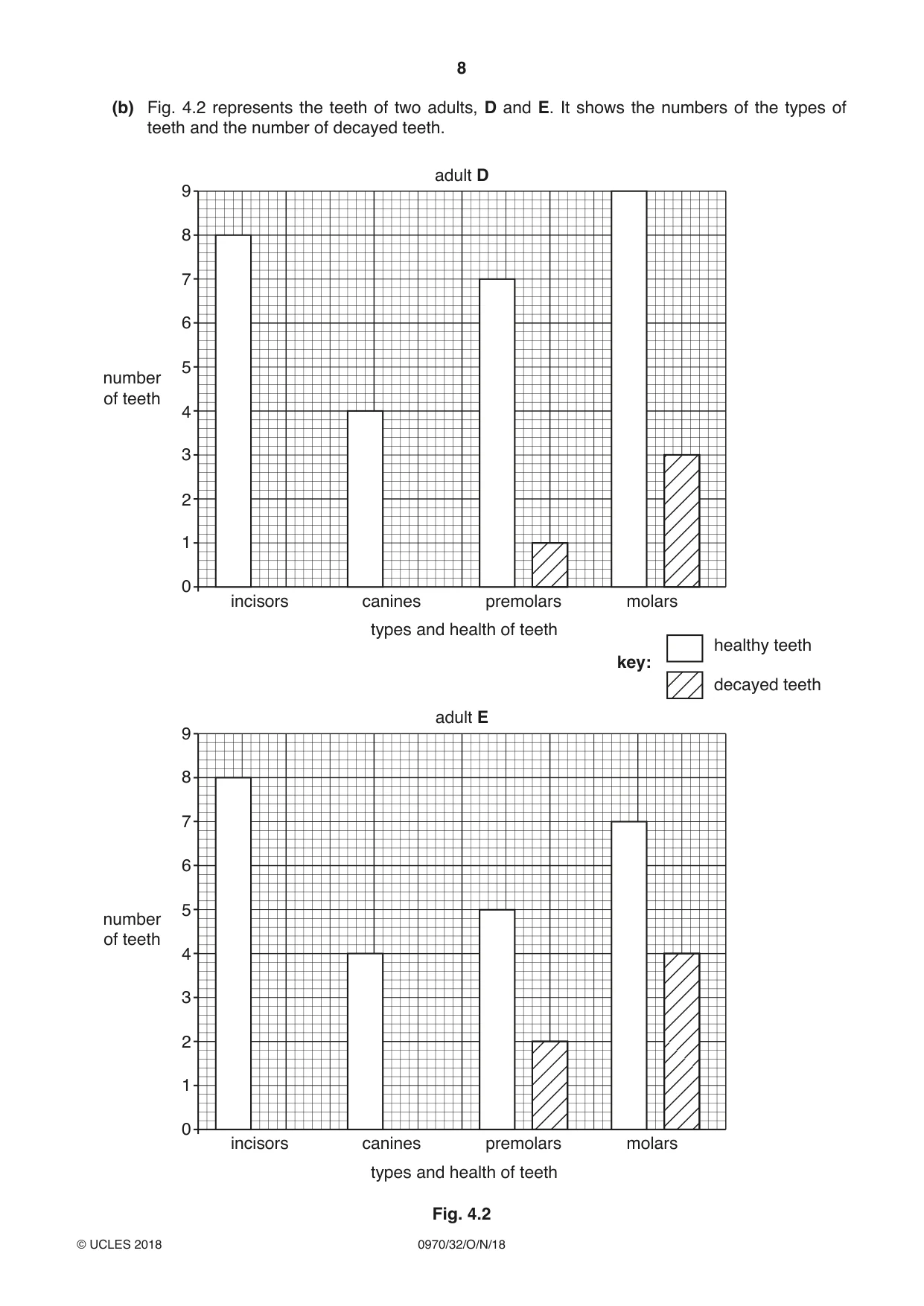
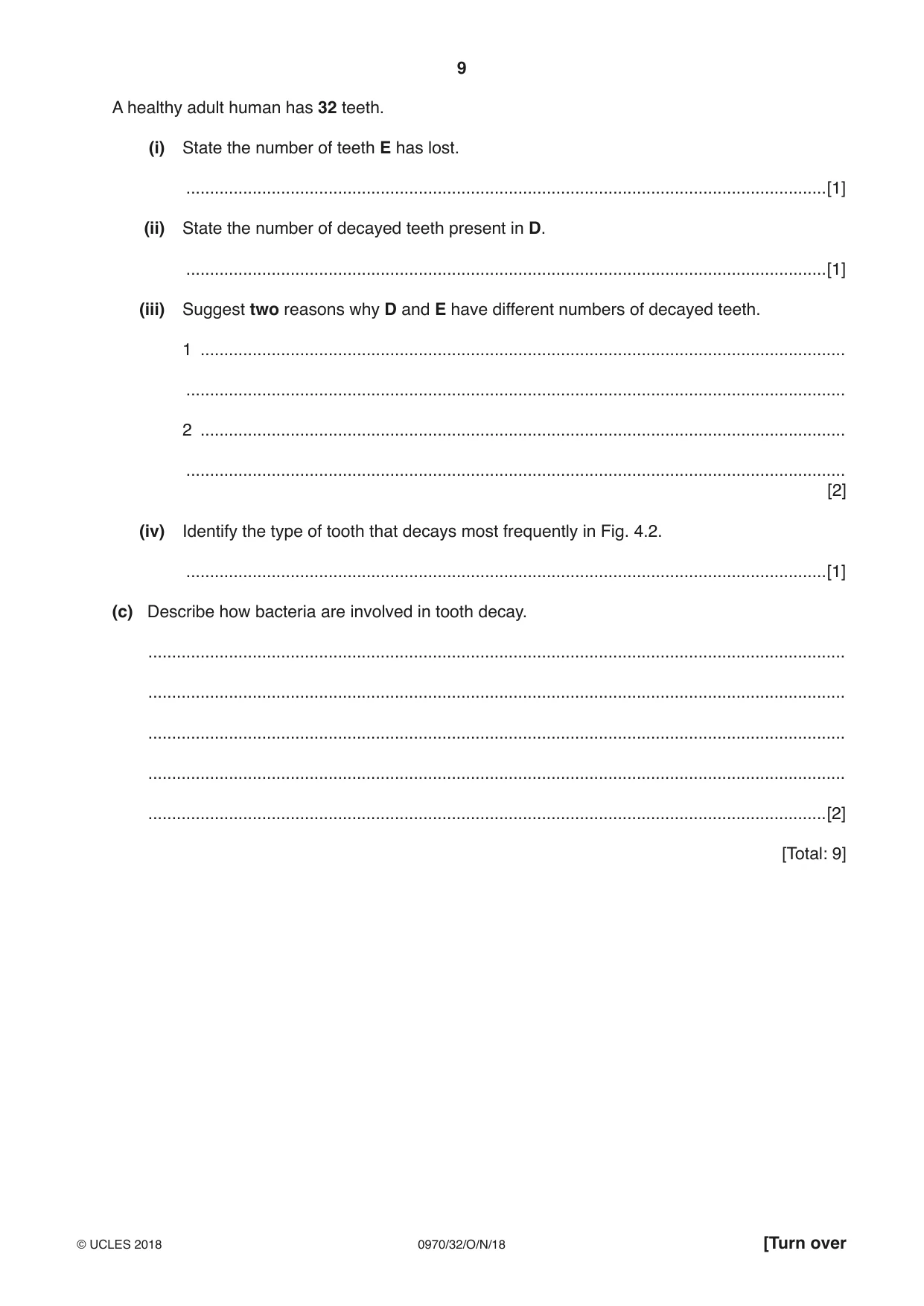
4 (a) Fig. 4.1 shows teeth in a human skull. Fig. 4.1 Add label lines and labels to Fig. 4.1 to identify an incisor tooth and a molar tooth. [2] (b) Fig. 4.2 represents the teeth of two adults, D and E. It shows the numbers of the types of teeth and the number of decayed teeth. adult D 9 8 7 6 5number of teeth 4 3 2 1 0 incisors canines premolars molars types and health of teeth healthy teeth key: decayed teeth adult E 9 8 7 6 5number of teeth 4 3 2 1 0 incisors canines premolars molars types and health of teeth Fig. 4.2 A healthy adult human has 32 teeth. (i) State the number of teeth E has lost. .......................................................................................................................................[1] (ii) State the number of decayed teeth present in D. .......................................................................................................................................[1] (iii) Suggest two reasons why D and E have different numbers of decayed teeth. 1 ........................................................................................................................................ ........................................................................................................................................... 2 ........................................................................................................................................ ........................................................................................................................................... [2] (iv) Identify the type of tooth that decays most frequently in Fig. 4.2. .......................................................................................................................................[1] (c) Describe how bacteria are involved in tooth decay. ................................................................................................................................................... ................................................................................................................................................... ................................................................................................................................................... ................................................................................................................................................... ...............................................................................................................................................[2] [Total: 9]
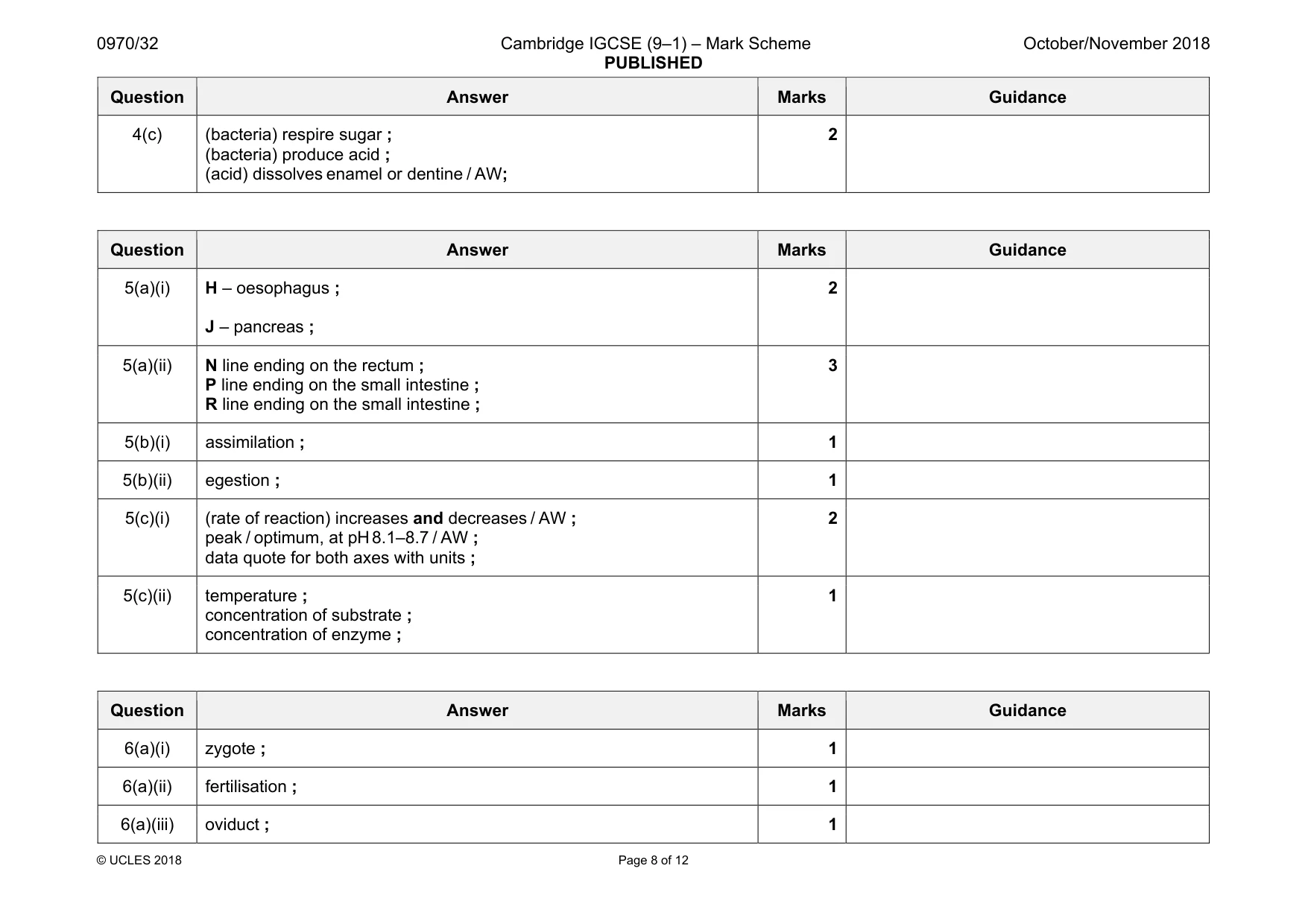
Mark scheme: 4(a) line drawn to an incisor tooth labelled incisor ; line drawn to a molar tooth labelled molar ; 2 4(b)(i) 2 ; 1 4(b)(ii) 4 ; 1 4(b)(iii) D clean / brush / wash / floss, their teeth more, thoroughly or frequently / good oral hygiene / use of mouthwash ; D (more / regular) visits to the dentist / hygienist / AW ; D used a fluoride toothpaste / drank water containing fluoride / AW ; D ate fewer sugary foods / fewer acidic foods or drinks / has less, bacteria or plaque ; E thinner layer of enamel ; E ref. to overcrowding / overlapping (of teeth) ; E had deficiency in calcium ; E had deficiency in vitamin D ; AVP ; e.g. adult D is younger 2 4(b)(iv) molar(s) ; 1 Question Answer Marks Guidance 4(c) (bacteria) respire sugar ; (bacteria) produce acid ; (acid) dissolves enamel or dentine / AW; 2
Q5 · A diagram of part of the alimentary canal and associated structures
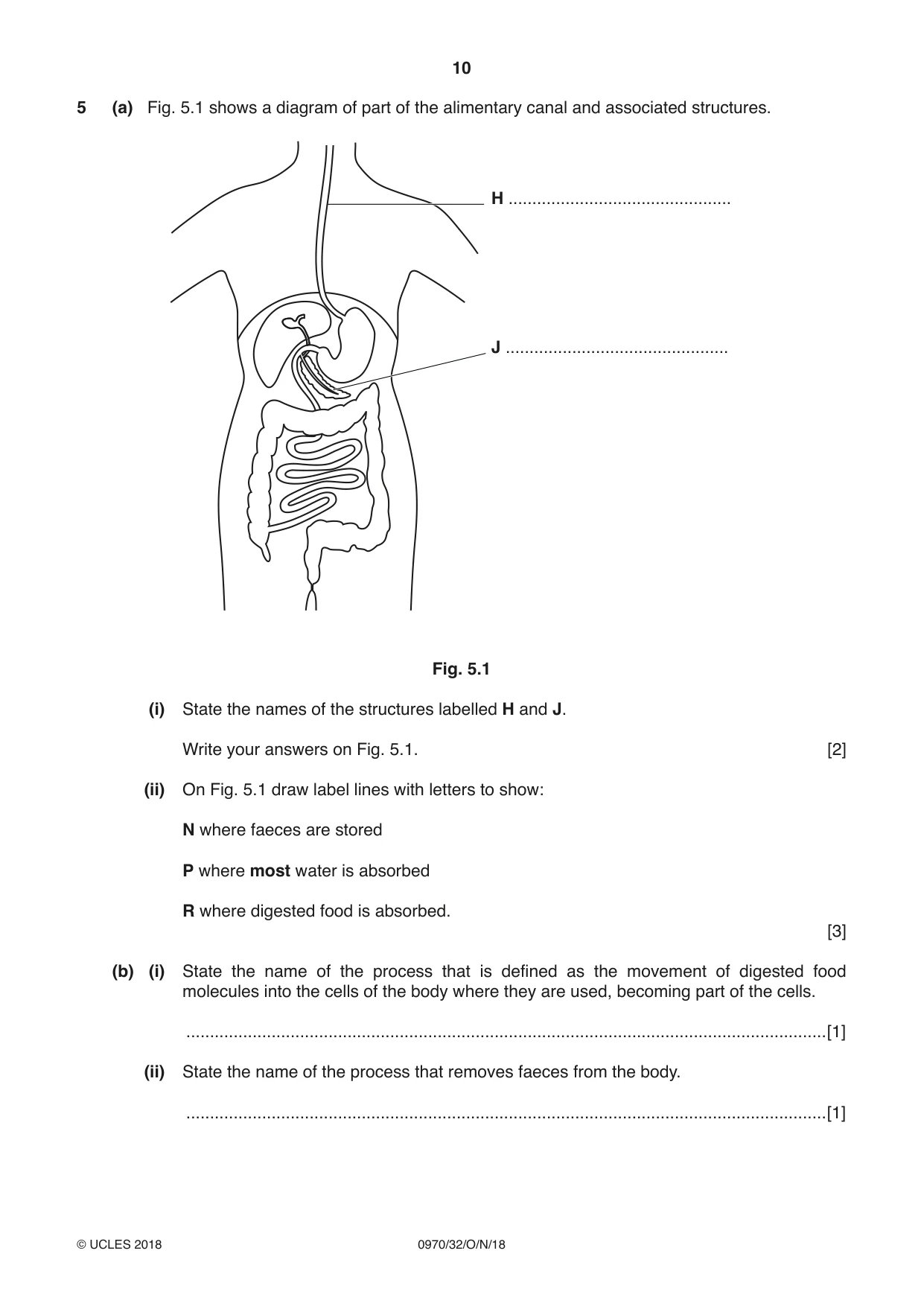
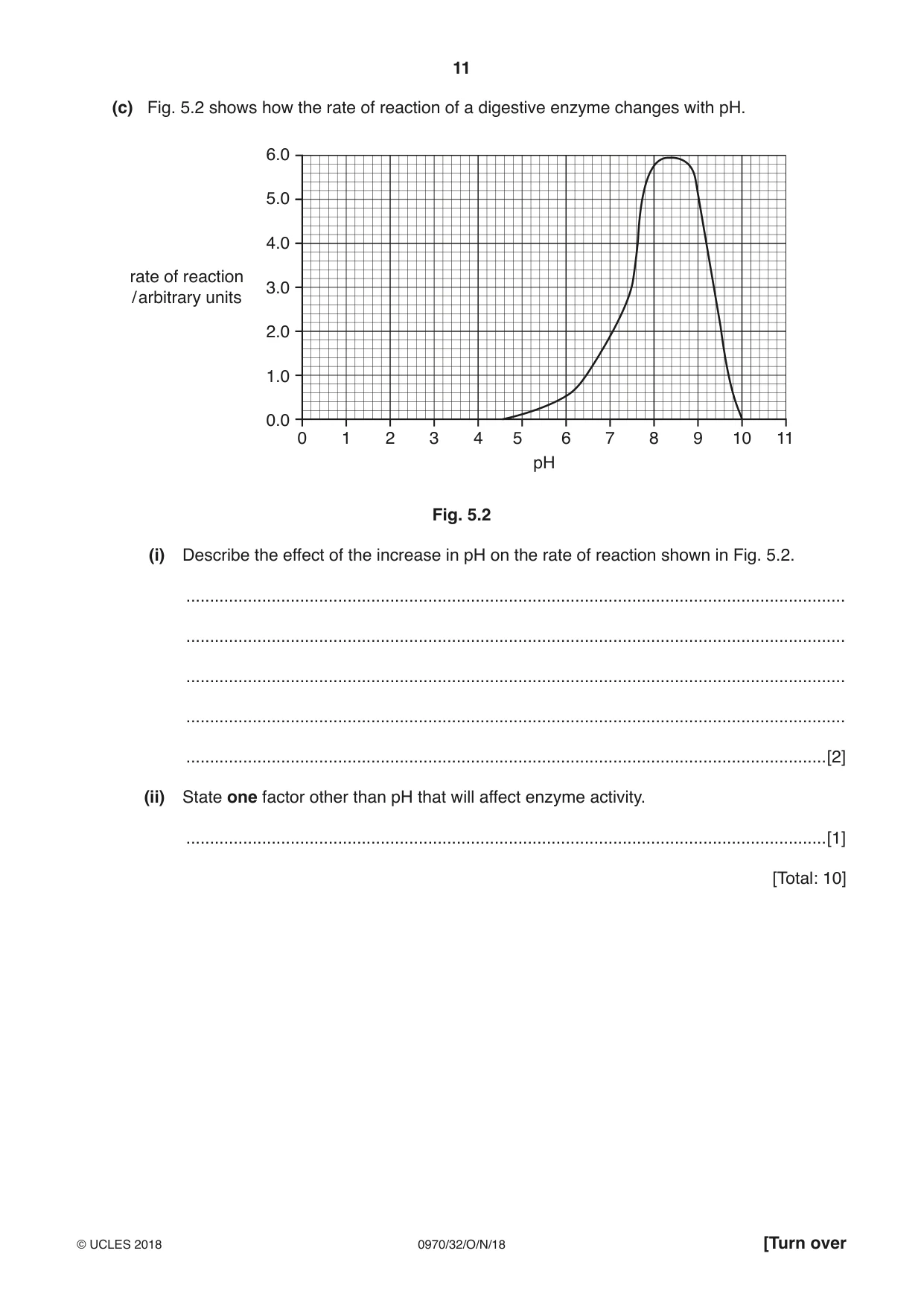
5 (a) Fig. 5.1 shows a diagram of part of the alimentary canal and associated structures. H ............................................... J ............................................... Fig. 5.1 (i) State the names of the structures labelled H and J. Write your answers on Fig. 5.1. [2] (ii) On Fig. 5.1 draw label lines with letters to show: N where faeces are stored P where most water is absorbed R where digested food is absorbed. [3] (b) (i) State the name of the process that is defined as the movement of digested food molecules into the cells of the body where they are used, becoming part of the cells. .......................................................................................................................................[1] (ii) State the name of the process that removes faeces from the body. .......................................................................................................................................[1] (c) Fig. 5.2 shows how the rate of reaction of a digestive enzyme changes with pH. 6.0 5.0 4.0 rate of reaction 3.0 / arbitrary units 2.0 1.0 0.0 0 1 2 3 4 5 6 7 8 9 10 11 pH Fig. 5.2 (i) Describe the effect of the increase in pH on the rate of reaction shown in Fig. 5.2. ........................................................................................................................................... ........................................................................................................................................... ........................................................................................................................................... ........................................................................................................................................... .......................................................................................................................................[2] (ii) State one factor other than pH that will affect enzyme activity. .......................................................................................................................................[1] [Total: 10]
Mark scheme: 5(a)(i) H – oesophagus ; J – pancreas ; 2 5(a)(ii) N line ending on the rectum ; P line ending on the small intestine ; R line ending on the small intestine ; 3 5(b)(i) assimilation ; 1 5(b)(ii) egestion ; 1 5(c)(i) (rate of reaction) increases and decreases / AW ; peak / optimum, at pH 8.1–8.7 / AW ; data quote for both axes with units ; 2 5(c)(ii) temperature ; concentration of substrate ; concentration of enzyme ; 1
Q6 · The sequence of events that occur in sexual reproduction
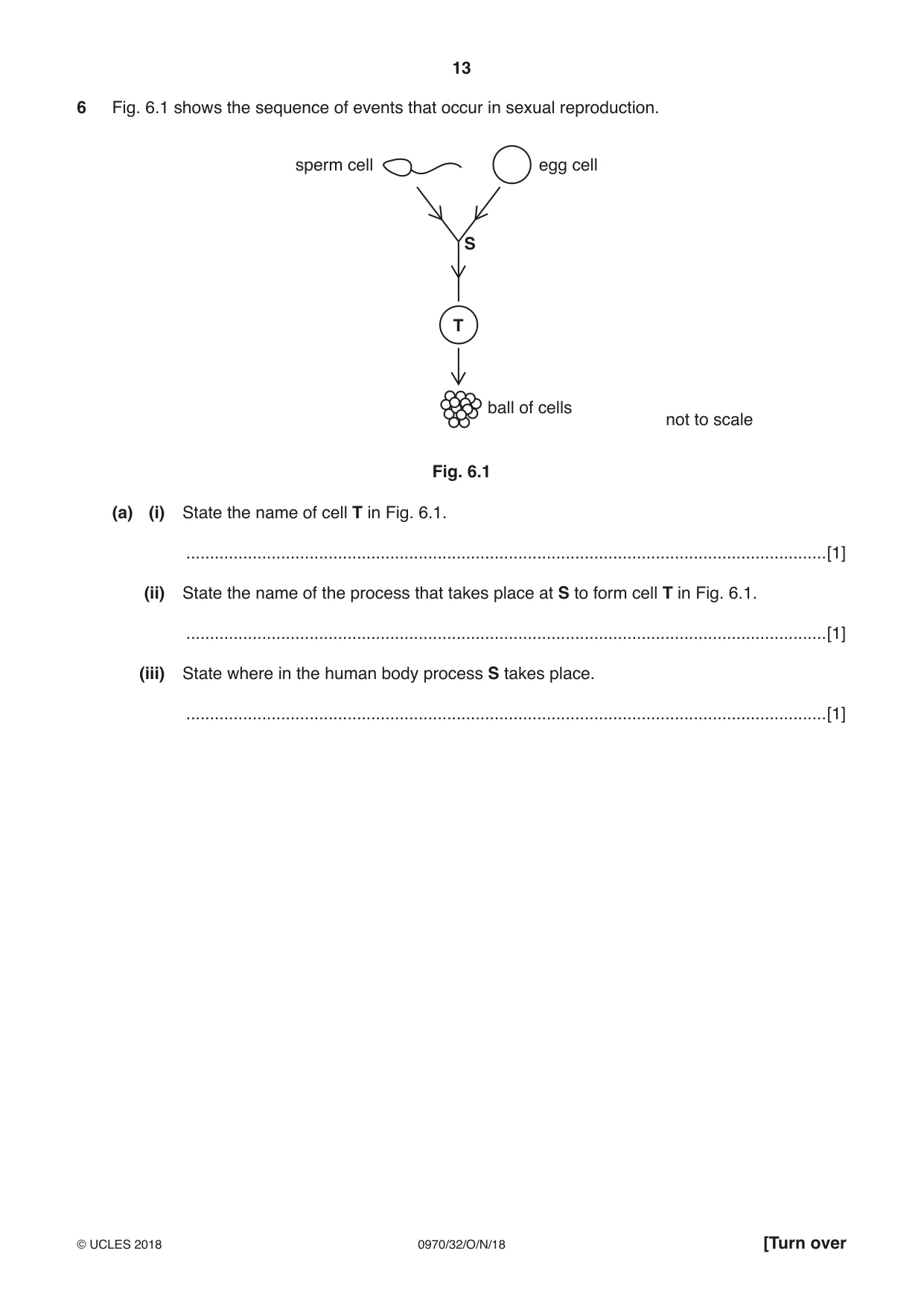
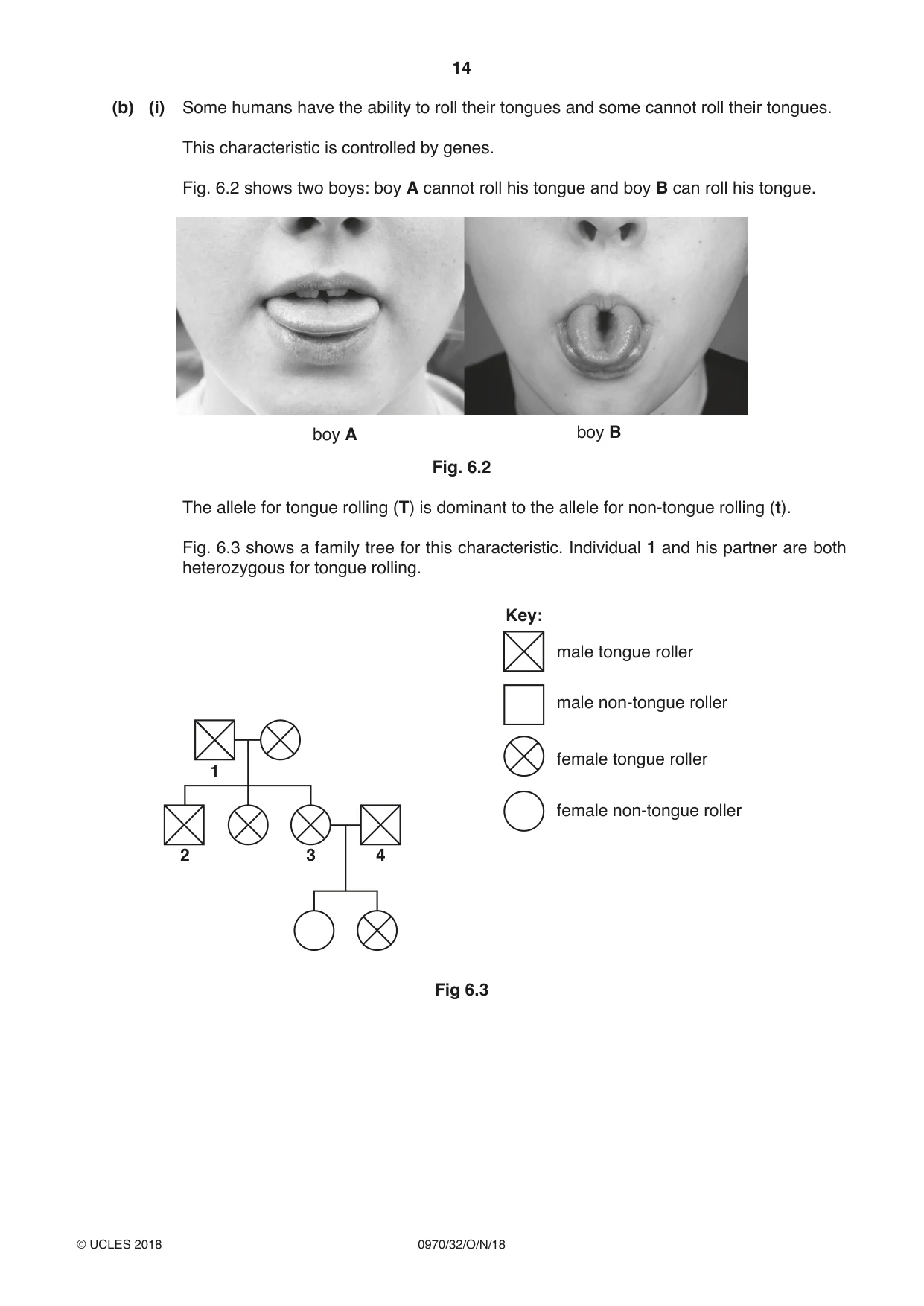
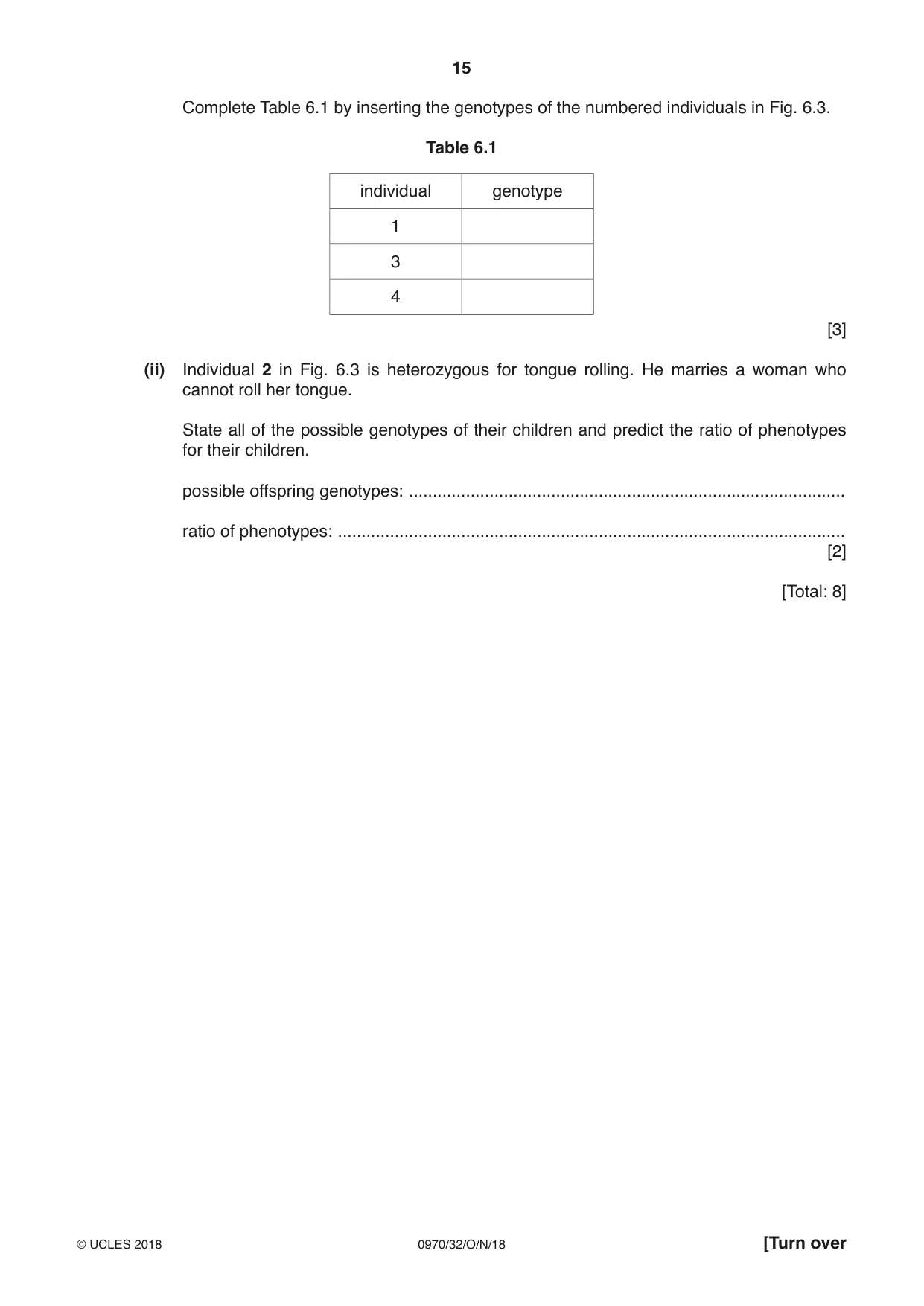
6 Fig. 6.1 shows the sequence of events that occur in sexual reproduction. sperm cell egg cell S T ball of cells not to scale Fig. 6.1 (a) (i) State the name of cell T in Fig. 6.1. .......................................................................................................................................[1] (ii) State the name of the process that takes place at S to form cell T in Fig. 6.1. .......................................................................................................................................[1] (iii) State where in the human body process S takes place. .......................................................................................................................................[1] (b) (i) Some humans have the ability to roll their tongues and some cannot roll their tongues. This characteristic is controlled by genes. Fig. 6.2 shows two boys: boy A cannot roll his tongue and boy B can roll his tongue. boy A boy B Fig. 6.2 The allele for tongue rolling (T) is dominant to the allele for non-tongue rolling (t). Fig. 6.3 shows a family tree for this characteristic. Individual 1 and his partner are both heterozygous for tongue rolling. Key: male tongue roller male non-tongue roller female tongue roller 1 female non-tongue roller 2 3 4 Fig 6.3 Complete Table 6.1 by inserting the genotypes of the numbered individuals in Fig. 6.3. Table 6.1 individual genotype 1 3 4 [3] (ii) Individual 2 in Fig. 6.3 is heterozygous for tongue rolling. He marries a woman who cannot roll her tongue. State all of the possible genotypes of their children and predict the ratio of phenotypes for their children. possible offspring genotypes: ............................................................................................ ratio of phenotypes: ........................................................................................................... [2] [Total: 8]
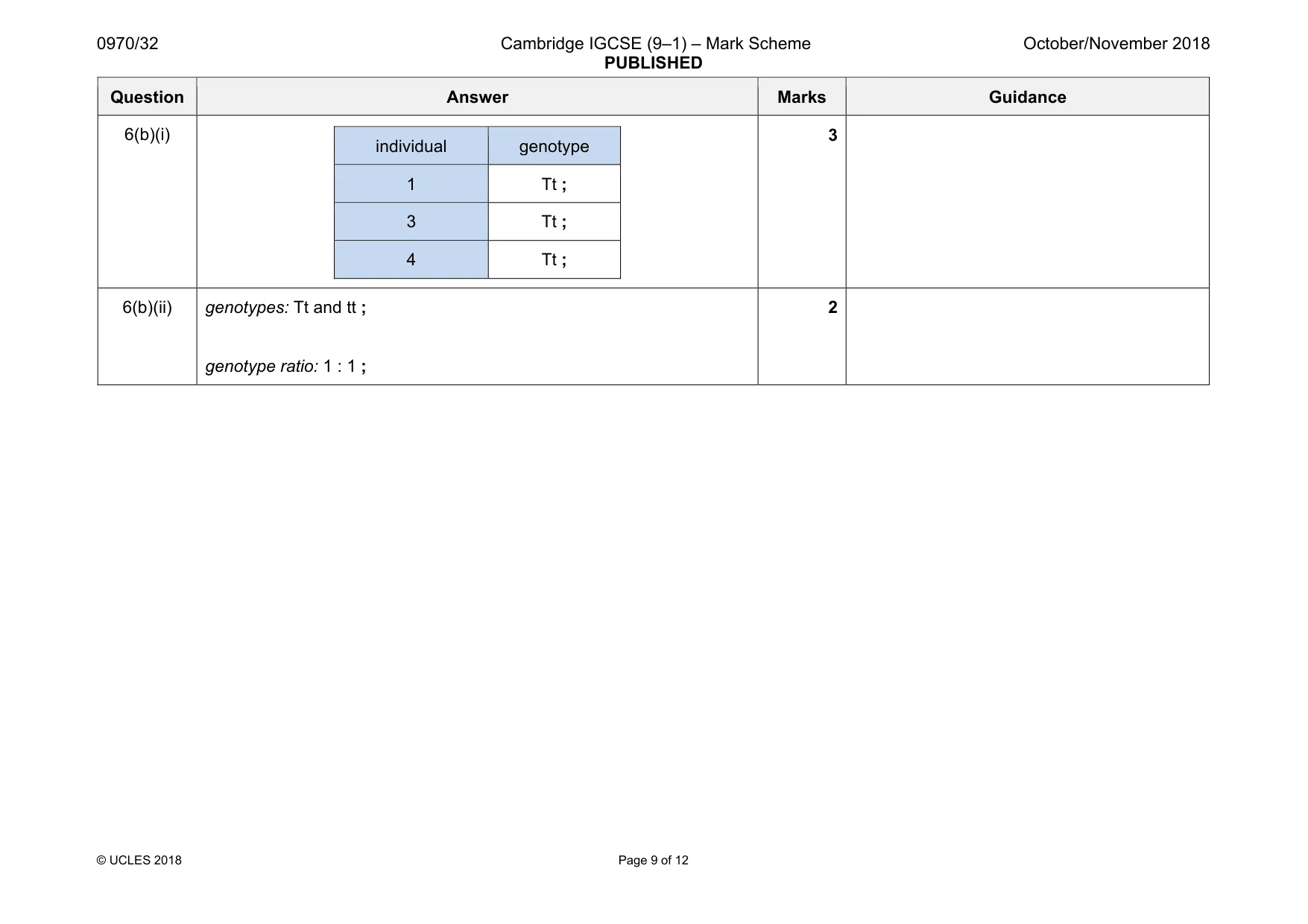
Mark scheme: 6(a)(i) zygote ; 1 6(a)(ii) fertilisation ; 1 6(a)(iii) oviduct ; 1 Question Answer Marks Guidance 6(b)(i) individual genotype 1 Tt ; 3 Tt ; 4 Tt ; 3 6(b)(ii) genotypes: Tt and tt ; genotype ratio: 1 : 1 ; 2
Q7 · Complete the sentences by placing appropriate words in the spaces to give a definition of…
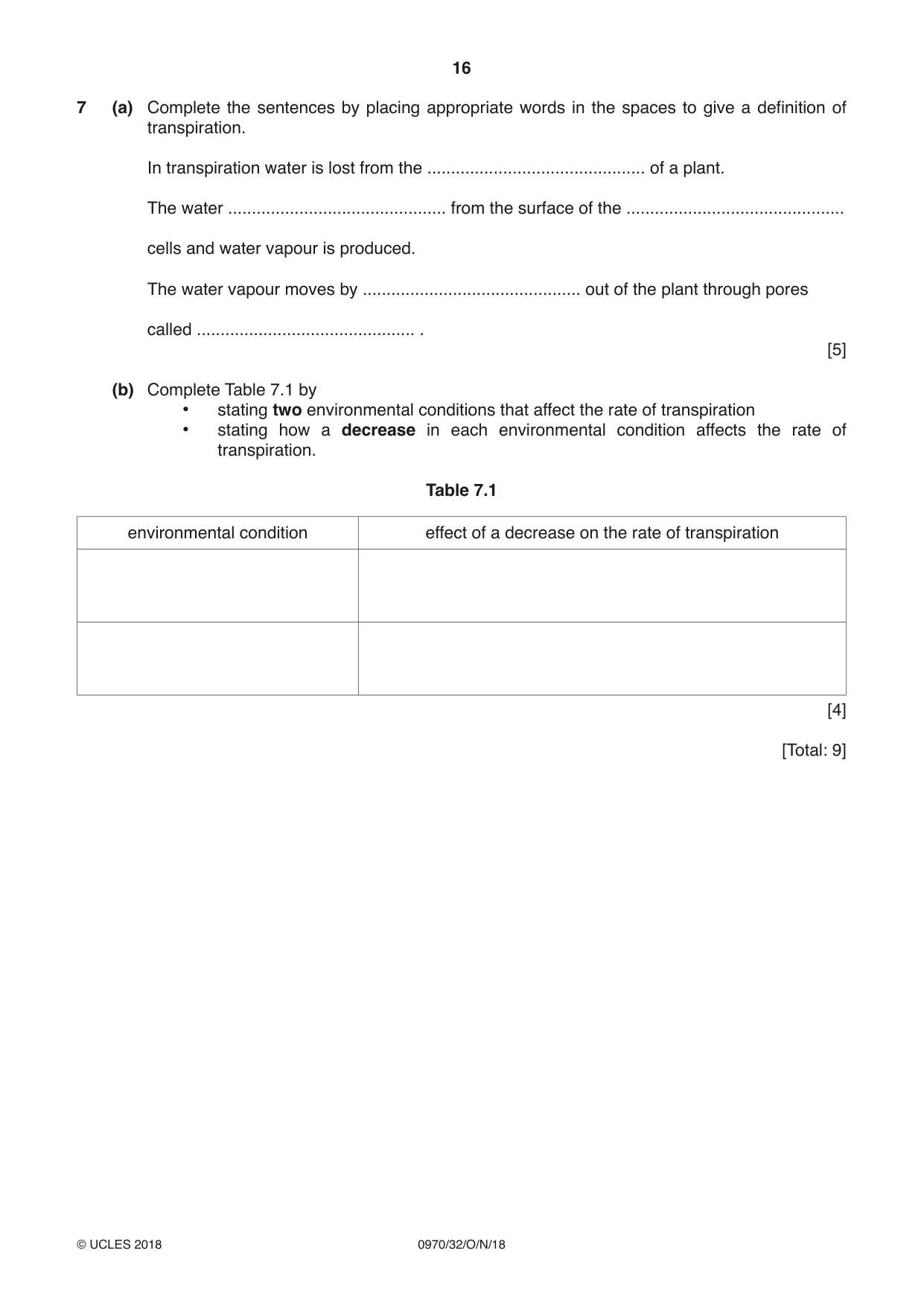
7 (a) Complete the sentences by placing appropriate words in the spaces to give a definition of transpiration. In transpiration water is lost from the .............................................. of a plant. The water .............................................. from the surface of the .............................................. cells and water vapour is produced. The water vapour moves by .............................................. out of the plant through pores called .............................................. . [5] (b) Complete Table 7.1 by • stating two environmental conditions that affect the rate of transpiration • stating how a decrease in each environmental condition affects the rate of transpiration. Table 7.1 environmental condition effect of a decrease on the rate of transpiration [4] [Total: 9]
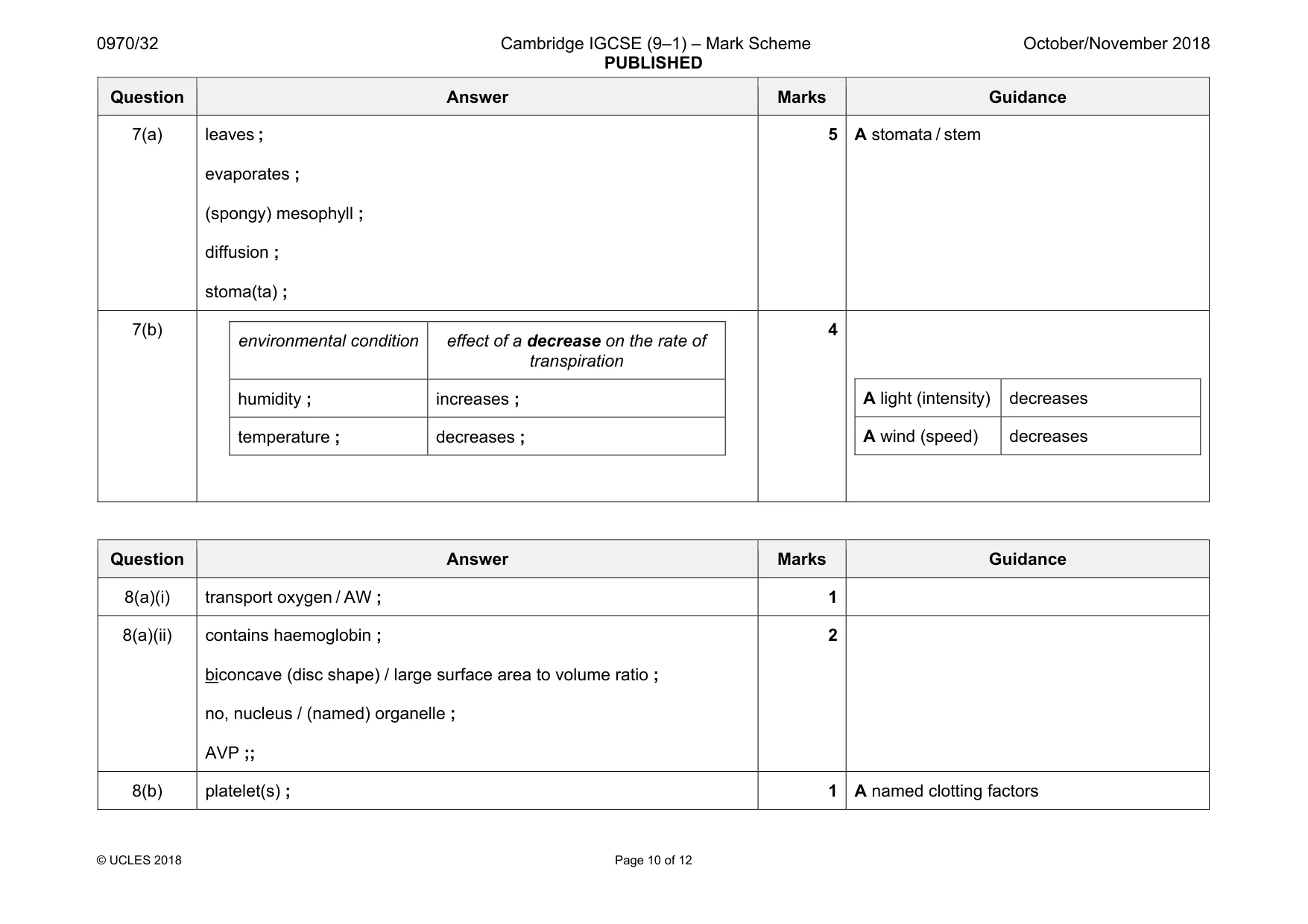
Mark scheme: 7(a) leaves ; evaporates ; (spongy) mesophyll ; diffusion ; stoma(ta) ; 5 7(b) environmental condition effect of a decrease on the rate of transpiration humidity ; increases ; temperature ; decreases ; 4 A light (intensity) decreases A wind (speed) decreases
Q8 · A photomicrograph of some red blood cells
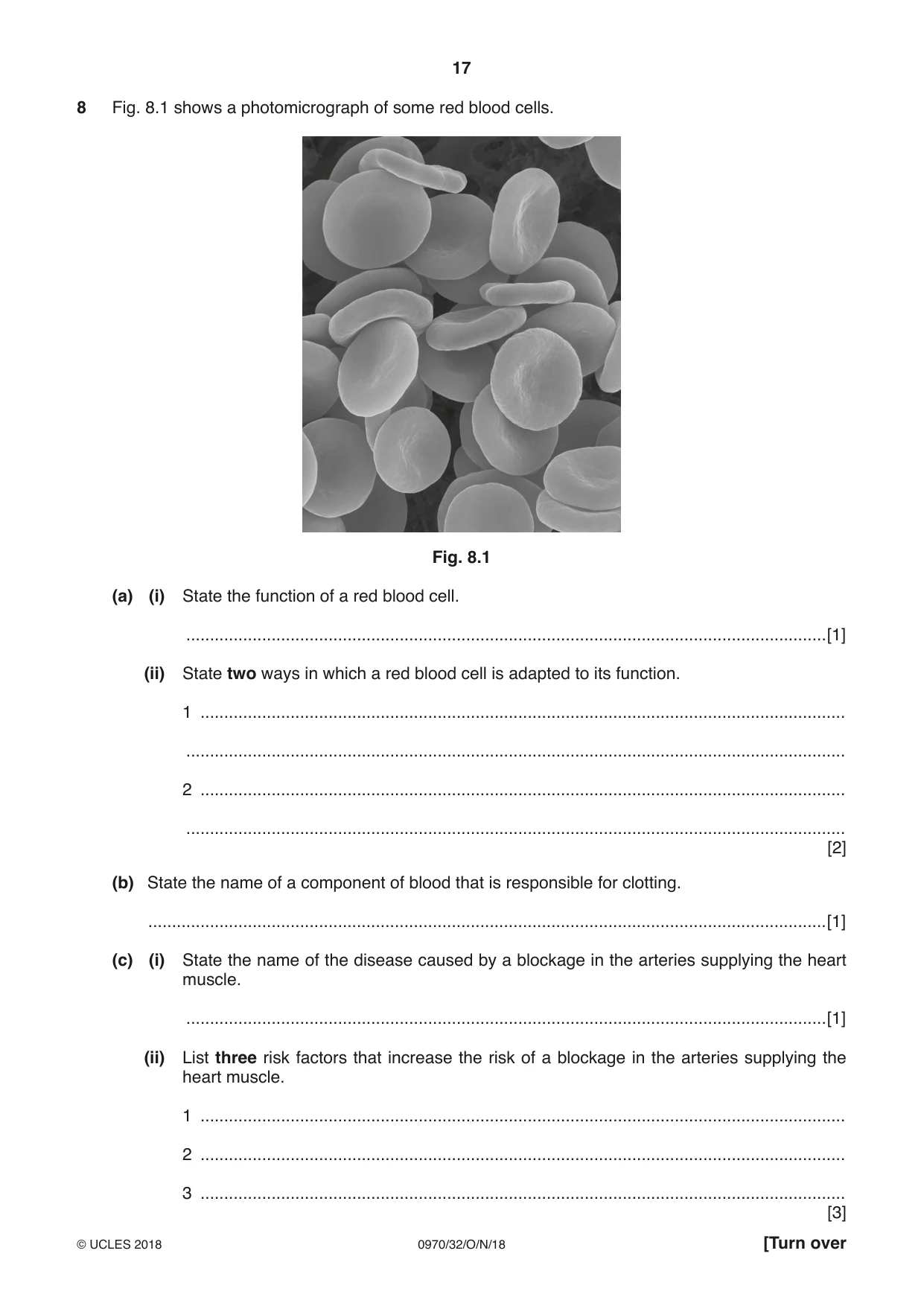
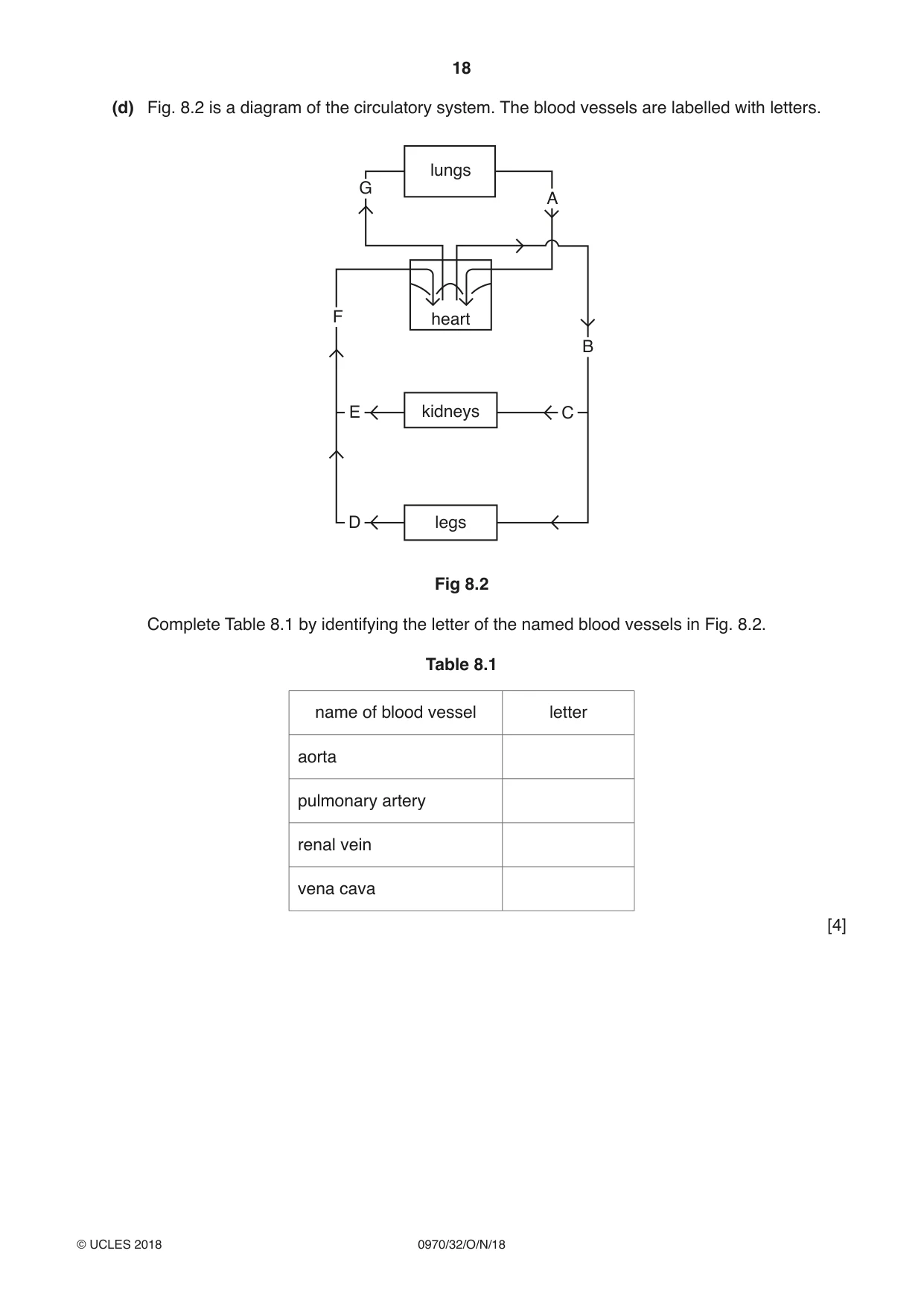
8 Fig. 8.1 shows a photomicrograph of some red blood cells. Fig. 8.1 (a) (i) State the function of a red blood cell. .......................................................................................................................................[1] (ii) State two ways in which a red blood cell is adapted to its function. 1 ........................................................................................................................................ ........................................................................................................................................... 2 ........................................................................................................................................ ........................................................................................................................................... [2] (b) State the name of a component of blood that is responsible for clotting. ...............................................................................................................................................[1] (c) (i) State the name of the disease caused by a blockage in the arteries supplying the heart muscle. .......................................................................................................................................[1] (ii) List three risk factors that increase the risk of a blockage in the arteries supplying the heart muscle. 1 ........................................................................................................................................ 2 ........................................................................................................................................ 3 ........................................................................................................................................ [3] (d) Fig. 8.2 is a diagram of the circulatory system. The blood vessels are labelled with letters. lungs G A F heart B E kidneys C D legs Fig 8.2 Complete Table 8.1 by identifying the letter of the named blood vessels in Fig. 8.2. Table 8.1 name of blood vessel letter aorta pulmonary artery renal vein vena cava [4] (e) Describe how the structures of the circulatory system maintain a one-way flow of blood. ................................................................................................................................................... ................................................................................................................................................... ................................................................................................................................................... ................................................................................................................................................... ................................................................................................................................................... ................................................................................................................................................... ................................................................................................................................................... ................................................................................................................................................... ...............................................................................................................................................[4] [Total: 16]
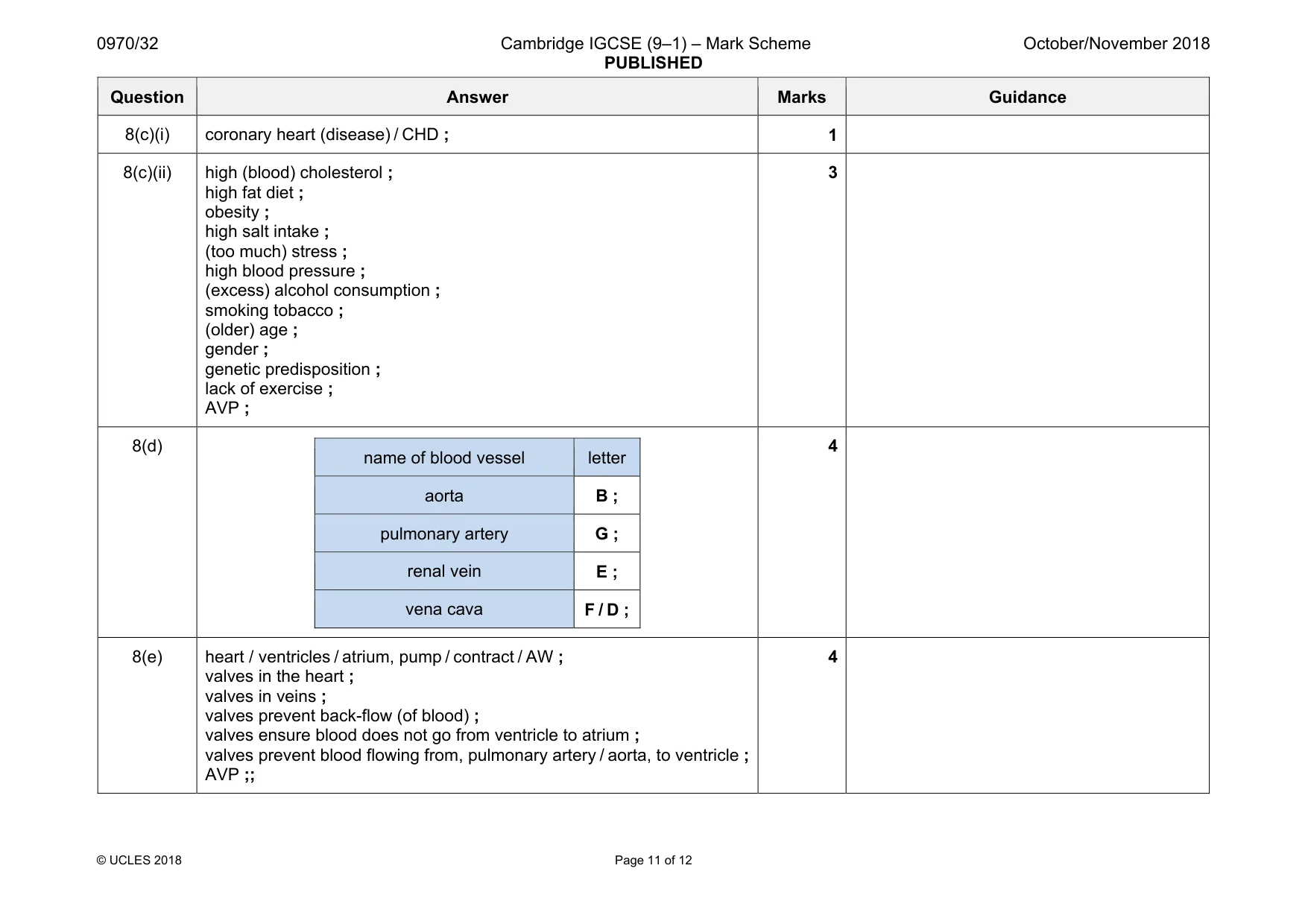
Mark scheme: 8(a)(i) transport oxygen / AW ; 1 8(a)(ii) contains haemoglobin ; biconcave (disc shape) / large surface area to volume ratio ; no, nucleus / (named) organelle ; AVP ;; 2 8(b) platelet(s) ; 1 A named clotting factors Question Answer Marks Guidance 8(c)(i) coronary heart (disease) / CHD ; 1 8(c)(ii) high (blood) cholesterol ; high fat diet ; obesity ; high salt intake ; (too much) stress ; high blood pressure ; (excess) alcohol consumption ; smoking tobacco ; (older) age ; gender ; genetic predisposition ; lack of exercise ; AVP ; 3 8(d) name of blood vessel letter aorta B ; pulmonary artery G ; renal vein E ; vena cava F / D ; 4 8(e) heart / ventricles / atrium, pump / contract / AW ; valves in the heart ; valves in veins ; valves prevent back-flow (of blood) ; valves ensure blood does not go from ventricle to atrium ; valves prevent blood flowing from, pulmonary artery / aorta, to ventricle ; AVP ;; 4
Q9 · Some animals are farmed intensively
9 (a) Some animals are farmed intensively. Describe the negative impacts to an ecosystem of intensive livestock production. ................................................................................................................................................... ................................................................................................................................................... ................................................................................................................................................... ................................................................................................................................................... ................................................................................................................................................... ................................................................................................................................................... ................................................................................................................................................... ................................................................................................................................................... .............................................................................................................................................. [4] (b) State why fertilisers, herbicides and insecticides are used in farming. fertilisers ................................................................................................................................... ................................................................................................................................................... herbicides ................................................................................................................................. ................................................................................................................................................... insecticides ............................................................................................................................... ................................................................................................................................................... [3] (c) Fertilisers, herbicides and insecticides can all pollute water. List two other sources of water pollution. 1 ................................................................................................................................................ 2 ................................................................................................................................................ [2] [Total: 9]
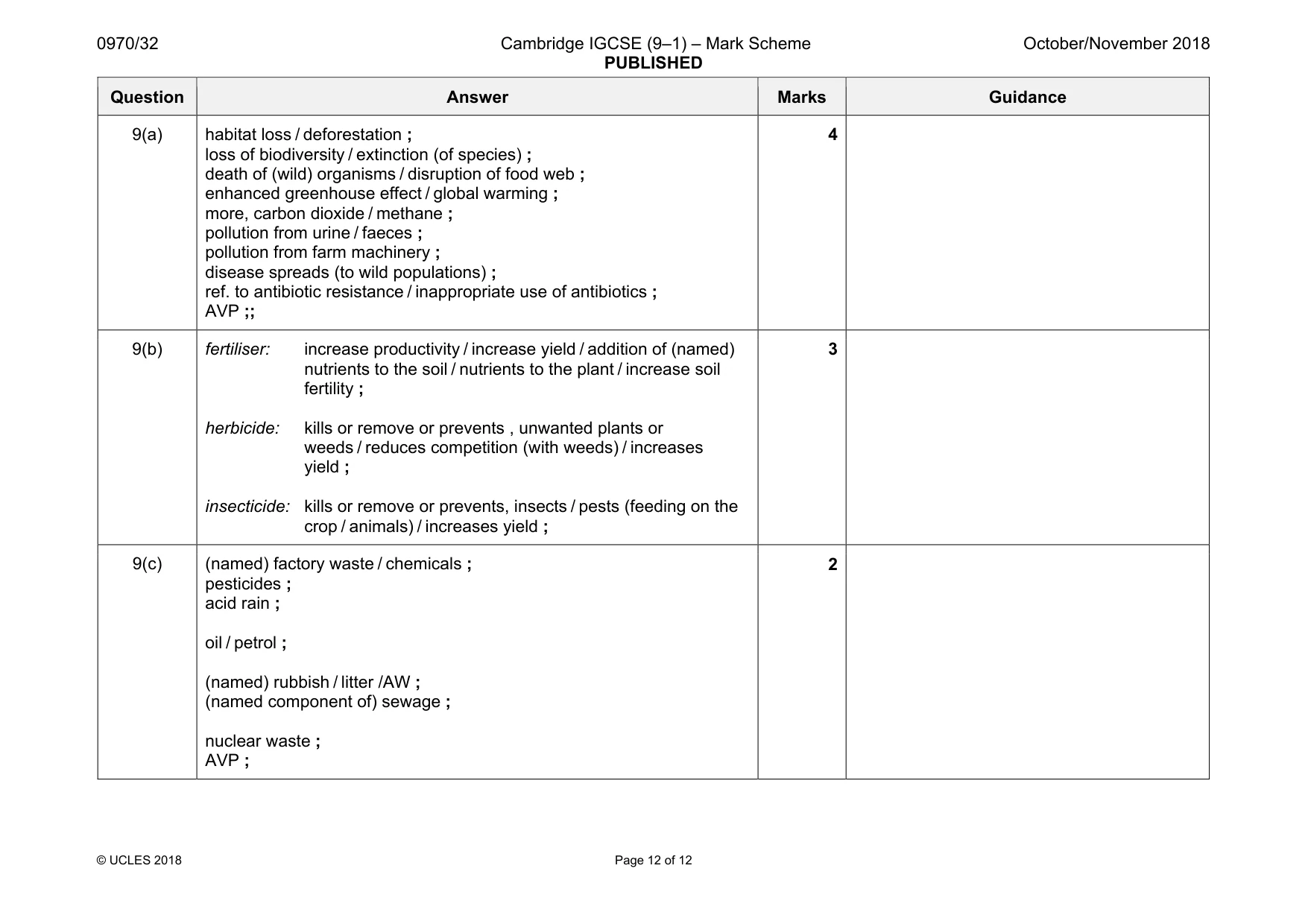
Mark scheme: 9(a) habitat loss / deforestation ; loss of biodiversity / extinction (of species) ; death of (wild) organisms / disruption of food web ; enhanced greenhouse effect / global warming ; more, carbon dioxide / methane ; pollution from urine / faeces ; pollution from farm machinery ; disease spreads (to wild populations) ; ref. to antibiotic resistance / inappropriate use of antibiotics ; AVP ;; 4 9(b) fertiliser: increase productivity / increase yield / addition of (named) nutrients to the soil / nutrients to the plant / increase soil fertility ; herbicide: kills or remove or prevents , unwanted plants or weeds / reduces competition (with weeds) / increases yield ; insecticide: kills or remove or prevents, insects / pests (feeding on the crop / animals) / increases yield ; 3 9(c) (named) factory waste / chemicals ; pesticides ; acid rain ; oil / petrol ; (named) rubbish / litter /AW ; (named component of) sewage ; nuclear waste ; AVP ; 2
What was in this paper
The subtopics covered by these 9 questions, and how many questions each got. Open one in a new tab to see every Cambridge question on it.
What you needed in this session
Cambridge’s own grade thresholds for 2018 Oct/Nov, Paper 3 · Variant 2. A higher threshold means an easier paper — the bar moves with how the cohort did.