Cambridge IGCSE Bangladesh Studies 0449 — 2017 May/June Paper 1 · Variant 1
0449/11/M/J/17 · 75 marks · ≈84 min
The question paper and its mark scheme, free to read here and free to download. This is Cambridge’s own paper, exactly as it was sat.
Question paper12 pages



Mark scheme13 pages
Answers below. Sit the paper first if you are practising.
Paper as text
Question paper, page 1
Cambridge International Examinations Cambridge International General Certificate of Secondary Education 0449/01 May/June 2017 1 hour 30 minutes BANGLADESH STUDIES Paper 1 History and Culture of Bangladesh Additional Materials: Answer Booklet/Paper READ THESE INSTRUCTIONS FIRST An answer booklet is provided inside this question paper. You should follow the instructions on the front cover of the answer booklet. If you need additional answer paper ask the invigilator for a continuation booklet. Answer three questions. Answer Question 1 and two other questions. You are advised to spend about 30 minutes on each question. The number of marks is given in brackets [ ] at the end of each question or part question. This document consists of 9 printed pages and 3 blank pages. [Turn over 06_0449_01_2017_1.29 © UCLES 2017 *7870866679*
Question paper, page 2
You must answer all parts of Question 1. Question 1 The Culture and Heritage of Bangladesh You are advised to spend about 30 minutes on this question. This question tests your knowledge. (a) Which of the following recognises Zainul Abedin’s contributions to the culture of Bangladesh? A He wrote a journal about changes in farming B A school of agriculture was set up in his name C He was given the title Shilpacharya D The library he established in Dhaka carries his name [1] (i) Mir Mosharraf Hossain is best known for writing about which of the following? A Education B Sufism C Town growth and development D The lives of zamindars [1] (ii) What did Kazi Nazrul Islam encourage through his writings? A That people should stay out of politics B That people should struggle against colonial rule C That people should be involved in acting and plays D That people should spread Islam [1] (iii) Which of the following is true of the early life of Alaol? A His family was poor B He became a poet at the royal court C He became familiar with a range of European languages D He was born in the 18th Century [1] (iv) Which of the following explains why Lalon Shah’s work is remembered? A It was made up of decorated writing B It took the form of poetry C It showed his belief in equality D It demonstrated his passion for music [1] (v) This question tests your knowledge and understanding. (b) Describe the life and work of Jasimuddin. [5] (i) Explain Jasimuddin’s importance to our knowledge of society in Bangladesh. [3] (ii) 06_0449_01_2017_1.29 © UCLES 2017 2
Question paper, page 3
This question tests your understanding and judgement. (c) Explain the importance of each of the following to the culture of Bangladesh: • architecture of the British period • literature of the British period [8] (i) Which of these two do you think has made the more important contribution to our knowledge of the history of Bangladesh? Explain your answer. [4] (ii) [Total: 25] [Turn over 06_0449_01_2017_1.29 © UCLES 2017 3
Question paper, page 4
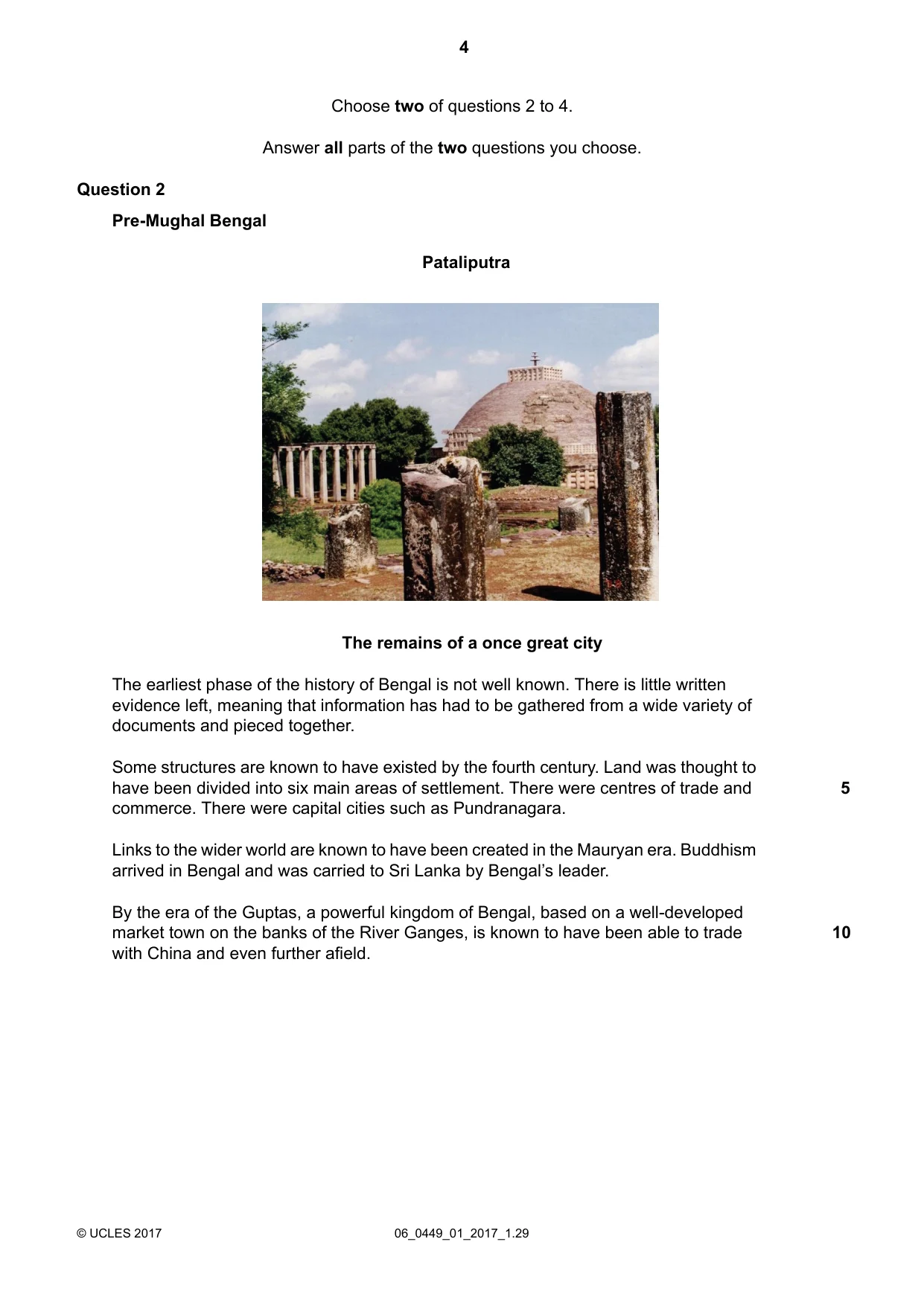
10 5 Choose two of questions 2 to 4. Answer all parts of the two questions you choose. Question 2 Pre-Mughal Bengal Pataliputra The remains of a once great city The earliest phase of the history of Bengal is not well known. There is little written evidence left, meaning that information has had to be gathered from a wide variety of documents and pieced together. Some structures are known to have existed by the fourth century. Land was thought to have been divided into six main areas of settlement. There were centres of trade and commerce. There were capital cities such as Pundranagara. Links to the wider world are known to have been created in the Mauryan era. Buddhism arrived in Bengal and was carried to Sri Lanka by Bengal’s leader. By the era of the Guptas, a powerful kingdom of Bengal, based on a well-developed market town on the banks of the River Ganges, is known to have been able to trade with China and even further afield. 06_0449_01_2017_1.29 © UCLES 2017 4
Question paper, page 5
This question tests your knowledge. (a) What were the areas of settlement known as? (line 5) [1] (i) Which area had important centres of trade and commerce? (line 5) [1] (ii) Of which area was Pundranagara the capital city? (line 6) [1] (iii) Which Bengal leader carried the message of Buddhism to Sri Lanka? (line 8) [1] (iv) Which market town was the capital of the kingdom of Bengal? (line 10) [1] (v) This question tests your knowledge and understanding. (b) Describe the Guptas’ attitude to religion. [5] (i) Explain how the Guptas developed an Empire. [5] (ii) This question tests your understanding and judgement. (c) Explain the importance of the following aspects of Gupta rule: • strong central control • art and artworks [8] (i) Which of these aspects earned the Gupta period the title of ‘The Golden Age of India’? Explain your answer. [2] (ii) [Total: 25] [Turn over 06_0449_01_2017_1.29 © UCLES 2017 5
Question paper, page 6
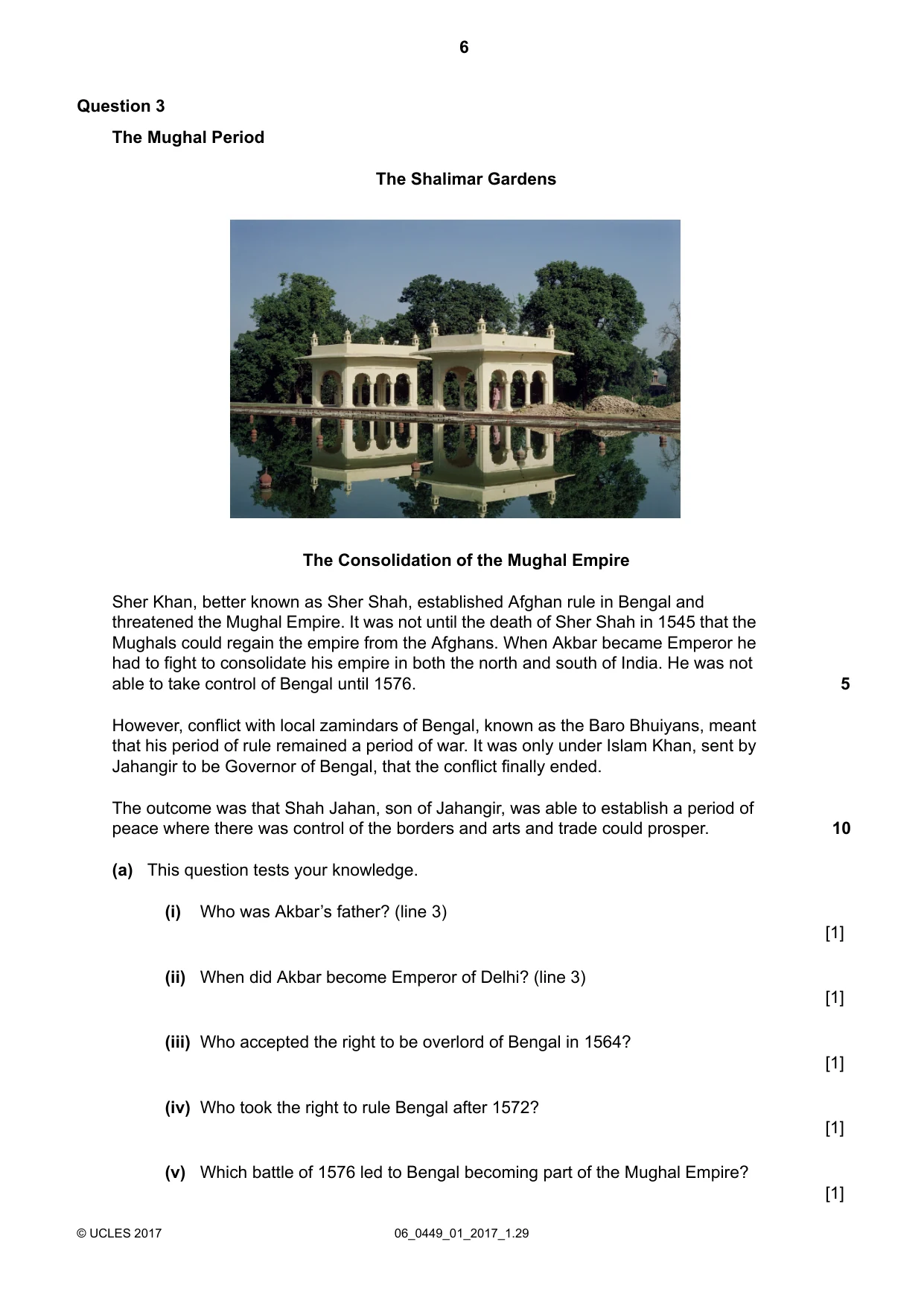
10 5 Question 3 The Mughal Period The Shalimar Gardens The Consolidation of the Mughal Empire Sher Khan, better known as Sher Shah, established Afghan rule in Bengal and threatened the Mughal Empire. It was not until the death of Sher Shah in 1545 that the Mughals could regain the empire from the Afghans. When Akbar became Emperor he had to fight to consolidate his empire in both the north and south of India. He was not able to take control of Bengal until 1576. However, conflict with local zamindars of Bengal, known as the Baro Bhuiyans, meant that his period of rule remained a period of war. It was only under Islam Khan, sent by Jahangir to be Governor of Bengal, that the conflict finally ended. The outcome was that Shah Jahan, son of Jahangir, was able to establish a period of peace where there was control of the borders and arts and trade could prosper. This question tests your knowledge. (a) Who was Akbar’s father? (line 3) [1] (i) When did Akbar become Emperor of Delhi? (line 3) [1] (ii) Who accepted the right to be overlord of Bengal in 1564? [1] (iii) Who took the right to rule Bengal after 1572? [1] (iv) Which battle of 1576 led to Bengal becoming part of the Mughal Empire? [1] (v) 06_0449_01_2017_1.29 © UCLES 2017 6
Question paper, page 7
This question tests your knowledge and understanding. (b) Describe how Prince Suja changed the way that Viceroys ruled Bengal. [5] (i) Explain how the Viceroys handled challenges to their rule during the reign of Shah Jahan. [5] (ii) This question tests your understanding and judgement. (c) Explain the importance of the following aspects of Shah Jahan’s rule: • architecture • religious tolerance [8] (i) Which of these aspects most earned Shah Jahan’s rule its reputation as the era of the arts? Explain your answer. [2] (ii) [Total: 25] [Turn over 06_0449_01_2017_1.29 © UCLES 2017 7
Question paper, page 8
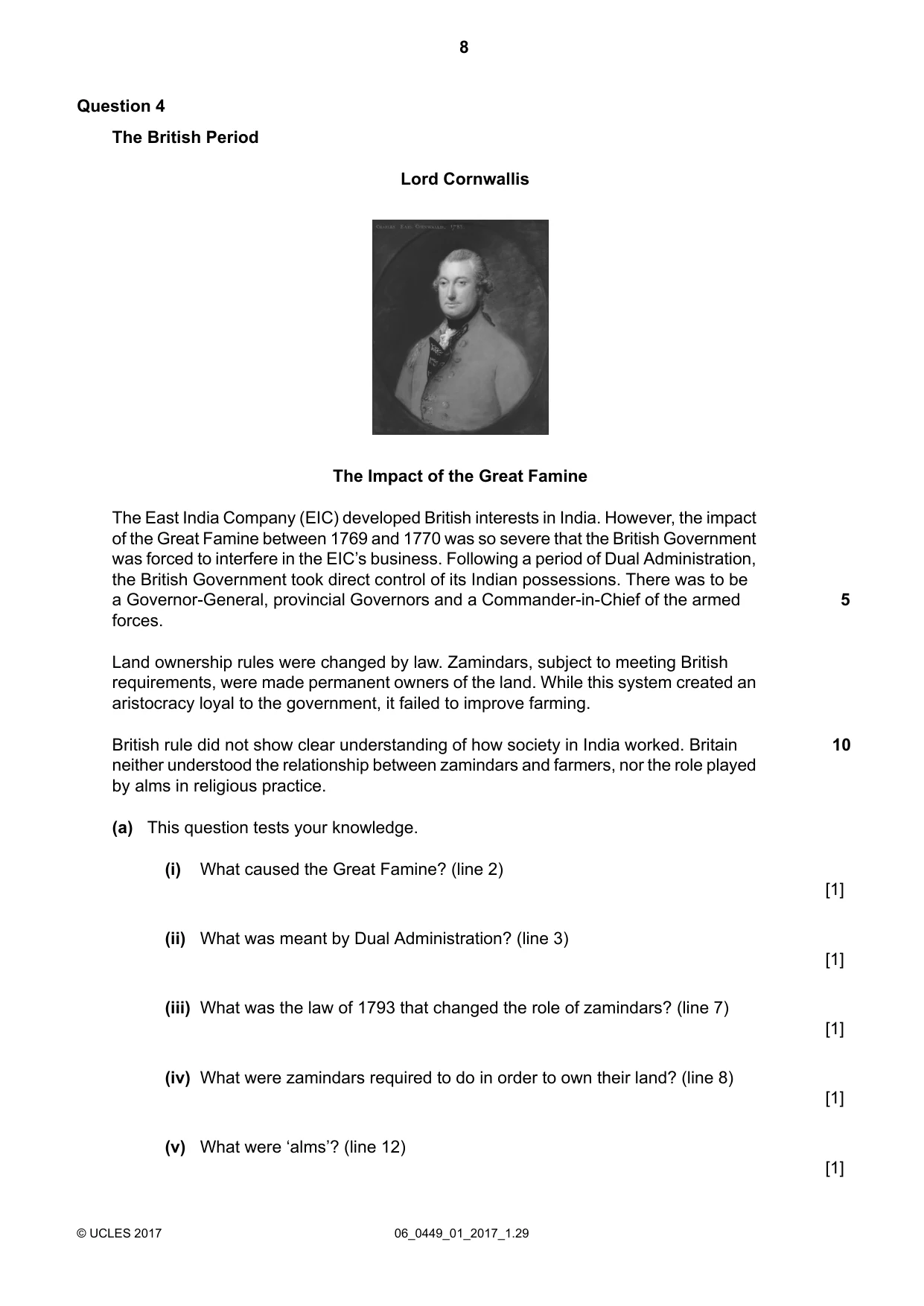
10 5 Question 4 The British Period Lord Cornwallis The Impact of the Great Famine The East India Company (EIC) developed British interests in India. However, the impact of the Great Famine between 1769 and 1770 was so severe that the British Government was forced to interfere in the EIC’s business. Following a period of Dual Administration, the British Government took direct control of its Indian possessions. There was to be a Governor-General, provincial Governors and a Commander-in-Chief of the armed forces. Land ownership rules were changed by law. Zamindars, subject to meeting British requirements, were made permanent owners of the land. While this system created an aristocracy loyal to the government, it failed to improve farming. British rule did not show clear understanding of how society in India worked. Britain neither understood the relationship between zamindars and farmers, nor the role played by alms in religious practice. This question tests your knowledge. (a) What caused the Great Famine? (line 2) [1] (i) What was meant by Dual Administration? (line 3) [1] (ii) What was the law of 1793 that changed the role of zamindars? (line 7) [1] (iii) What were zamindars required to do in order to own their land? (line 8) [1] (iv) What were ‘alms’? (line 12) [1] (v) 06_0449_01_2017_1.29 © UCLES 2017 8
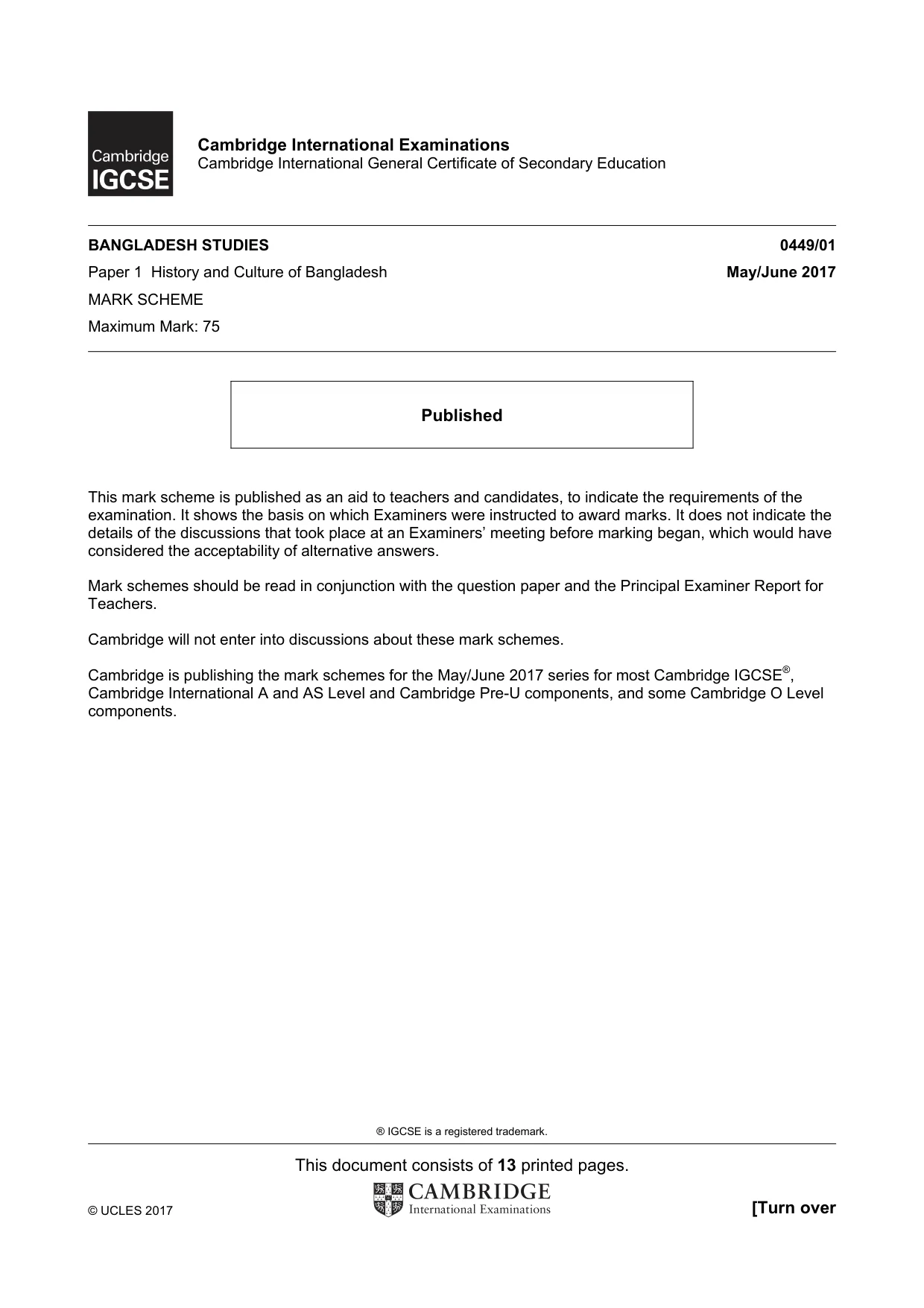
Question paper, page 9
This question tests your knowledge and understanding. (b) Describe the work of Robert Clive in India between 1757 and 1773. [5] (i) How did the way that Britain ruled India change under Lord Cornwallis? [5] (ii) This question tests your understanding and judgement. (c) Explain how each of the following opposed the British: • the Fakir-Sanyasi movement • the Faraizi movement [8] (i) Which of these two had more impact on the British? Explain your answer. [2] (ii) [Total: 25] 06_0449_01_2017_1.29 © UCLES 2017 9
Question paper, page 10
BLANK PAGE 06_0449_01_2017_1.29 © UCLES 2017 10
Question paper, page 11
BLANK PAGE 06_0449_01_2017_1.29 © UCLES 2017 11
Question paper, page 12
BLANK PAGE Permission to reproduce items where third-party owned material protected by copyright is included has been sought and cleared where possible. Every reasonable effort has been made by the publisher (UCLES) to trace copyright holders, but if any items requiring clearance have unwittingly been included, the publisher will be pleased to make amends at the earliest possible opportunity. To avoid the issue of disclosure of answer-related information to candidates, all copyright acknowledgements are reproduced online in the Cambridge International Examinations Copyright Acknowledgements Booklet. This is produced for each series of examinations and is freely available to download at www.cie.org.uk after the live examination series. Cambridge International Examinations is part of the Cambridge Assessment Group. Cambridge Assessment is the brand name of University of Cambridge Local Examinations Syndicate (UCLES), which is itself a department of the University of Cambridge. 06_0449_01_2017_1.29 © UCLES 2017 12
Mark scheme, page 1
® IGCSE is a registered trademark. This document consists of 13 printed pages. © UCLES 2017 [Turn over Cambridge International Examinations Cambridge International General Certificate of Secondary Education BANGLADESH STUDIES 0449/01 Paper 1 History and Culture of Bangladesh May/June 2017 MARK SCHEME Maximum Mark: 75 Published This mark scheme is published as an aid to teachers and candidates, to indicate the requirements of the examination. It shows the basis on which Examiners were instructed to award marks. It does not indicate the details of the discussions that took place at an Examiners’ meeting before marking began, which would have considered the acceptability of alternative answers. Mark schemes should be read in conjunction with the question paper and the Principal Examiner Report for Teachers. Cambridge will not enter into discussions about these mark schemes. Cambridge is publishing the mark schemes for the May/June 2017 series for most Cambridge IGCSE®, Cambridge International A and AS Level and Cambridge Pre-U components, and some Cambridge O Level components.
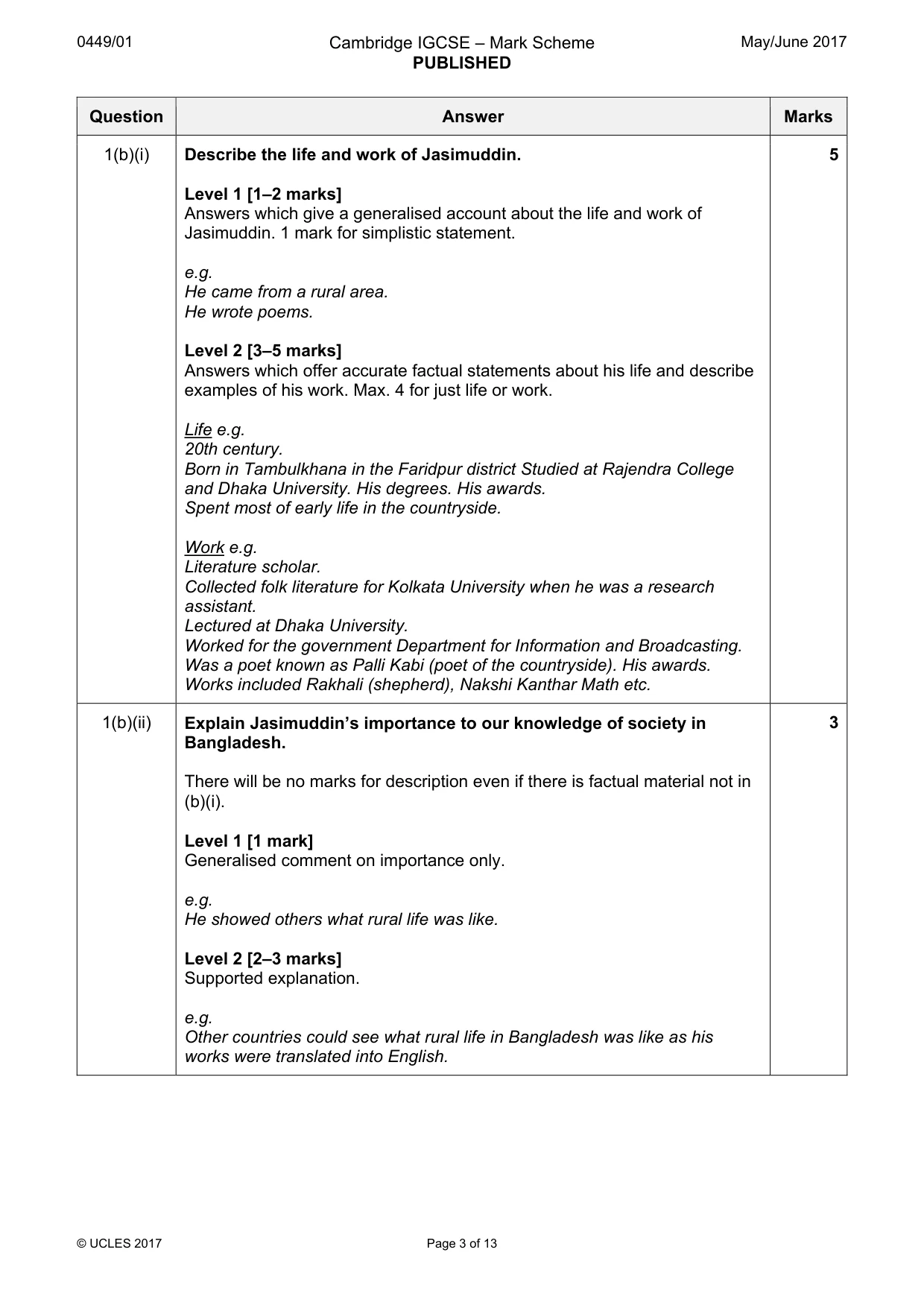
Mark scheme, page 2
0449/01 Cambridge IGCSE – Mark Scheme PUBLISHED May/June 2017 © UCLES 2017 Page 2 of 13 Question Answer Marks 1(a)(i) Which of the following recognises Zainul Abedin’s contributions to the culture of Bangladesh? C He was given the title Shilpacharya 1 1(a)(ii) Mir Mosharraf Hossain is best known for writing about which of the following? D The lives of zamindars 1 1(a)(iii) What did Kazi Nazrul Islam encourage through his writings? B That people should struggle against colonial rule 1 1(a)(iv) Which of the following is true of the early life of Alaol? B He became a poet at the royal court 1 1(a)(v) Which of the following explains why Lalon Shah’s work is remembered? C It showed his belief in equality 1
Mark scheme, page 3
0449/01 Cambridge IGCSE – Mark Scheme PUBLISHED May/June 2017 © UCLES 2017 Page 3 of 13 Question Answer Marks 1(b)(i) Describe the life and work of Jasimuddin. Level 1 [1–2 marks] Answers which give a generalised account about the life and work of Jasimuddin. 1 mark for simplistic statement. e.g. He came from a rural area. He wrote poems. Level 2 [3–5 marks] Answers which offer accurate factual statements about his life and describe examples of his work. Max. 4 for just life or work. Life e.g. 20th century. Born in Tambulkhana in the Faridpur district Studied at Rajendra College and Dhaka University. His degrees. His awards. Spent most of early life in the countryside. Work e.g. Literature scholar. Collected folk literature for Kolkata University when he was a research assistant. Lectured at Dhaka University. Worked for the government Department for Information and Broadcasting. Was a poet known as Palli Kabi (poet of the countryside). His awards. Works included Rakhali (shepherd), Nakshi Kanthar Math etc. 5 1(b)(ii) Explain Jasimuddin’s importance to our knowledge of society in Bangladesh. There will be no marks for description even if there is factual material not in (b)(i). Level 1 [1 mark] Generalised comment on importance only. e.g. He showed others what rural life was like. Level 2 [2–3 marks] Supported explanation. e.g. Other countries could see what rural life in Bangladesh was like as his works were translated into English. 3
Mark scheme, page 4
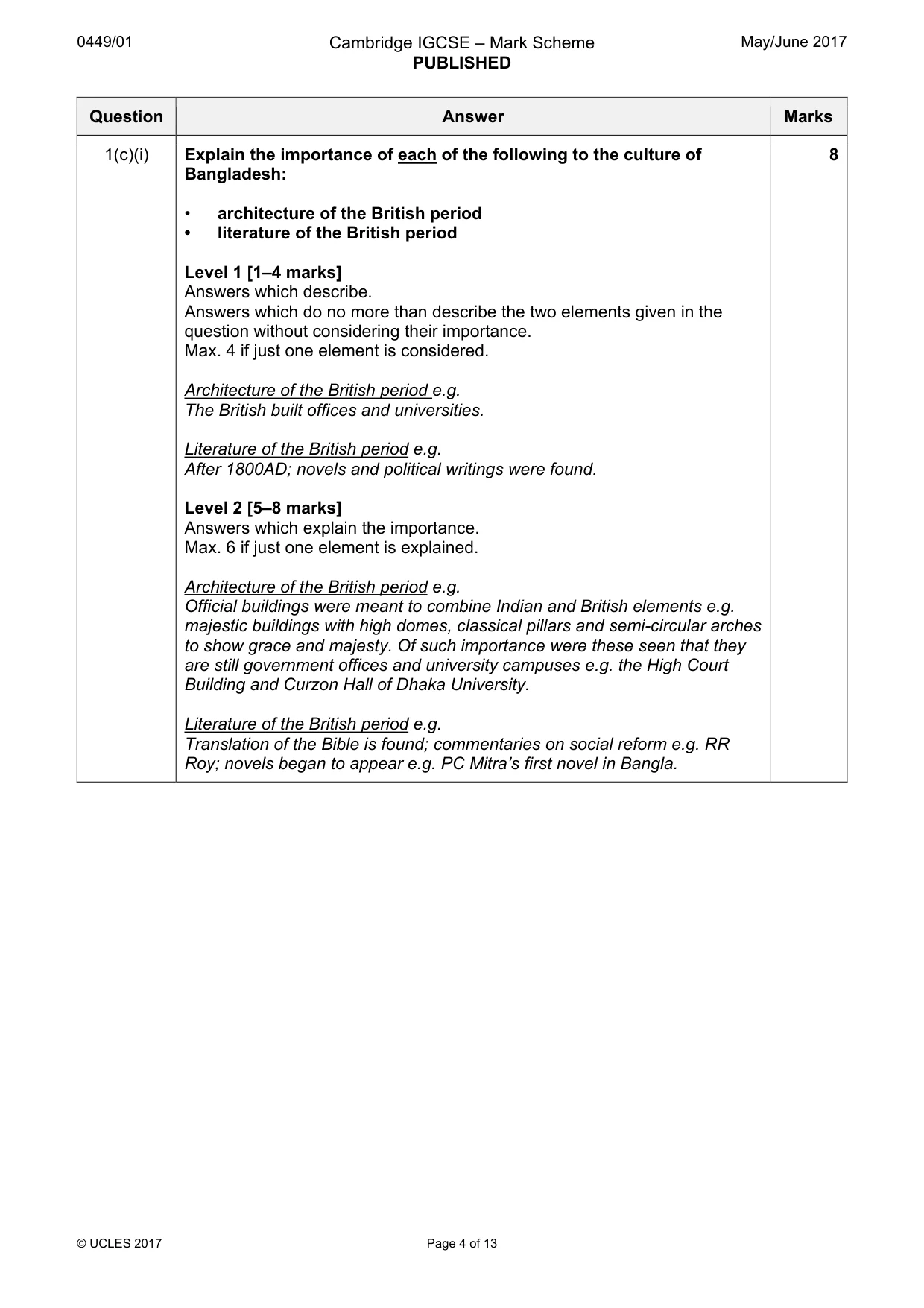
0449/01 Cambridge IGCSE – Mark Scheme PUBLISHED May/June 2017 © UCLES 2017 Page 4 of 13 Question Answer Marks 1(c)(i) Explain the importance of each of the following to the culture of Bangladesh: • architecture of the British period • literature of the British period Level 1 [1–4 marks] Answers which describe. Answers which do no more than describe the two elements given in the question without considering their importance. Max. 4 if just one element is considered. Architecture of the British period e.g. The British built offices and universities. Literature of the British period e.g. After 1800AD; novels and political writings were found. Level 2 [5–8 marks] Answers which explain the importance. Max. 6 if just one element is explained. Architecture of the British period e.g. Official buildings were meant to combine Indian and British elements e.g. majestic buildings with high domes, classical pillars and semi-circular arches to show grace and majesty. Of such importance were these seen that they are still government offices and university campuses e.g. the High Court Building and Curzon Hall of Dhaka University. Literature of the British period e.g. Translation of the Bible is found; commentaries on social reform e.g. RR Roy; novels began to appear e.g. PC Mitra’s first novel in Bangla. 8
Mark scheme, page 5
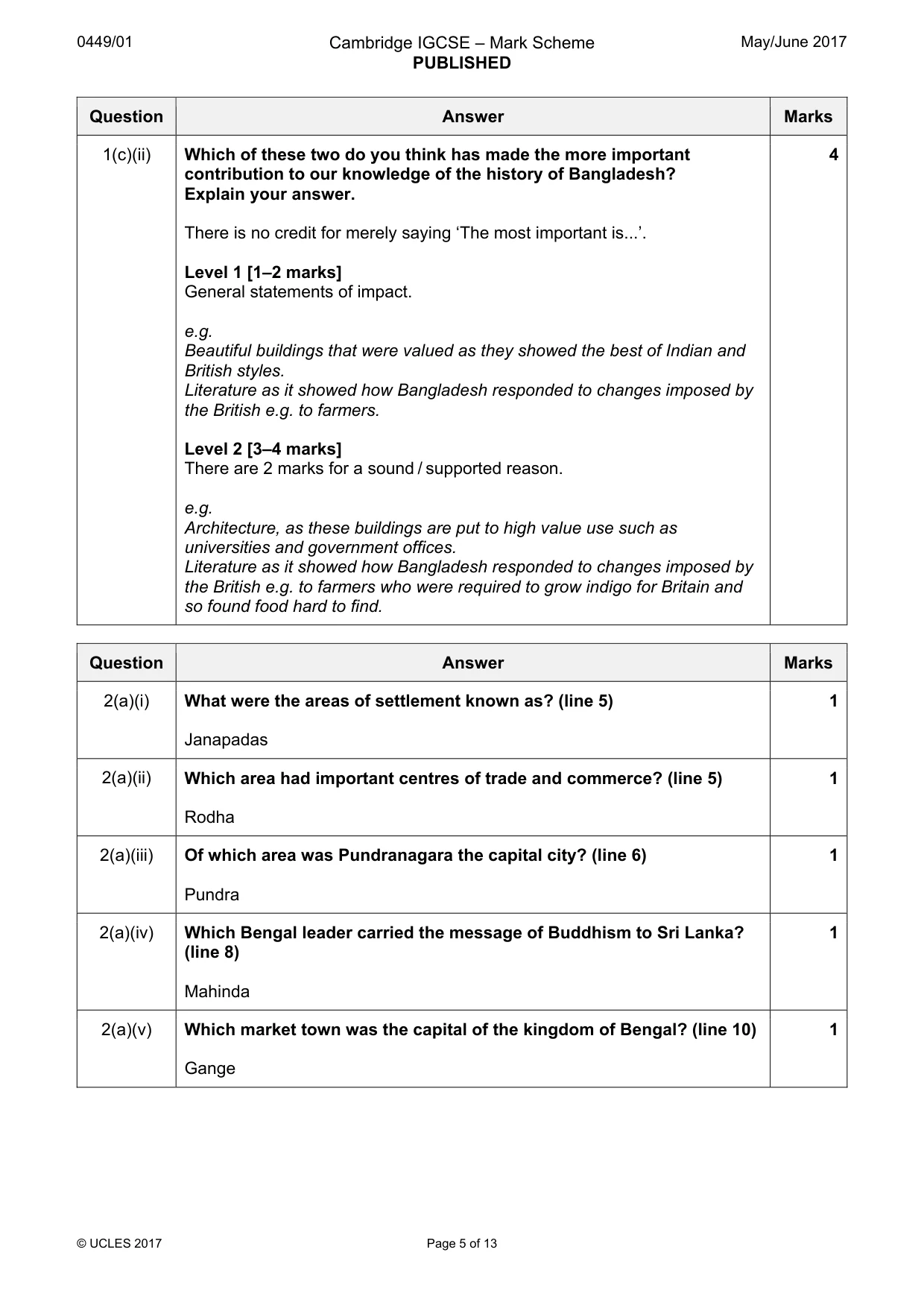
0449/01 Cambridge IGCSE – Mark Scheme PUBLISHED May/June 2017 © UCLES 2017 Page 5 of 13 Question Answer Marks 1(c)(ii) Which of these two do you think has made the more important contribution to our knowledge of the history of Bangladesh? Explain your answer. There is no credit for merely saying ‘The most important is...’. Level 1 [1–2 marks] General statements of impact. e.g. Beautiful buildings that were valued as they showed the best of Indian and British styles. Literature as it showed how Bangladesh responded to changes imposed by the British e.g. to farmers. Level 2 [3–4 marks] There are 2 marks for a sound / supported reason. e.g. Architecture, as these buildings are put to high value use such as universities and government offices. Literature as it showed how Bangladesh responded to changes imposed by the British e.g. to farmers who were required to grow indigo for Britain and so found food hard to find. 4 Question Answer Marks 2(a)(i) What were the areas of settlement known as? (line 5) Janapadas 1 2(a)(ii) Which area had important centres of trade and commerce? (line 5) Rodha 1 2(a)(iii) Of which area was Pundranagara the capital city? (line 6) Pundra 1 2(a)(iv) Which Bengal leader carried the message of Buddhism to Sri Lanka? (line 8) Mahinda 1 2(a)(v) Which market town was the capital of the kingdom of Bengal? (line 10) Gange 1
Mark scheme, page 6
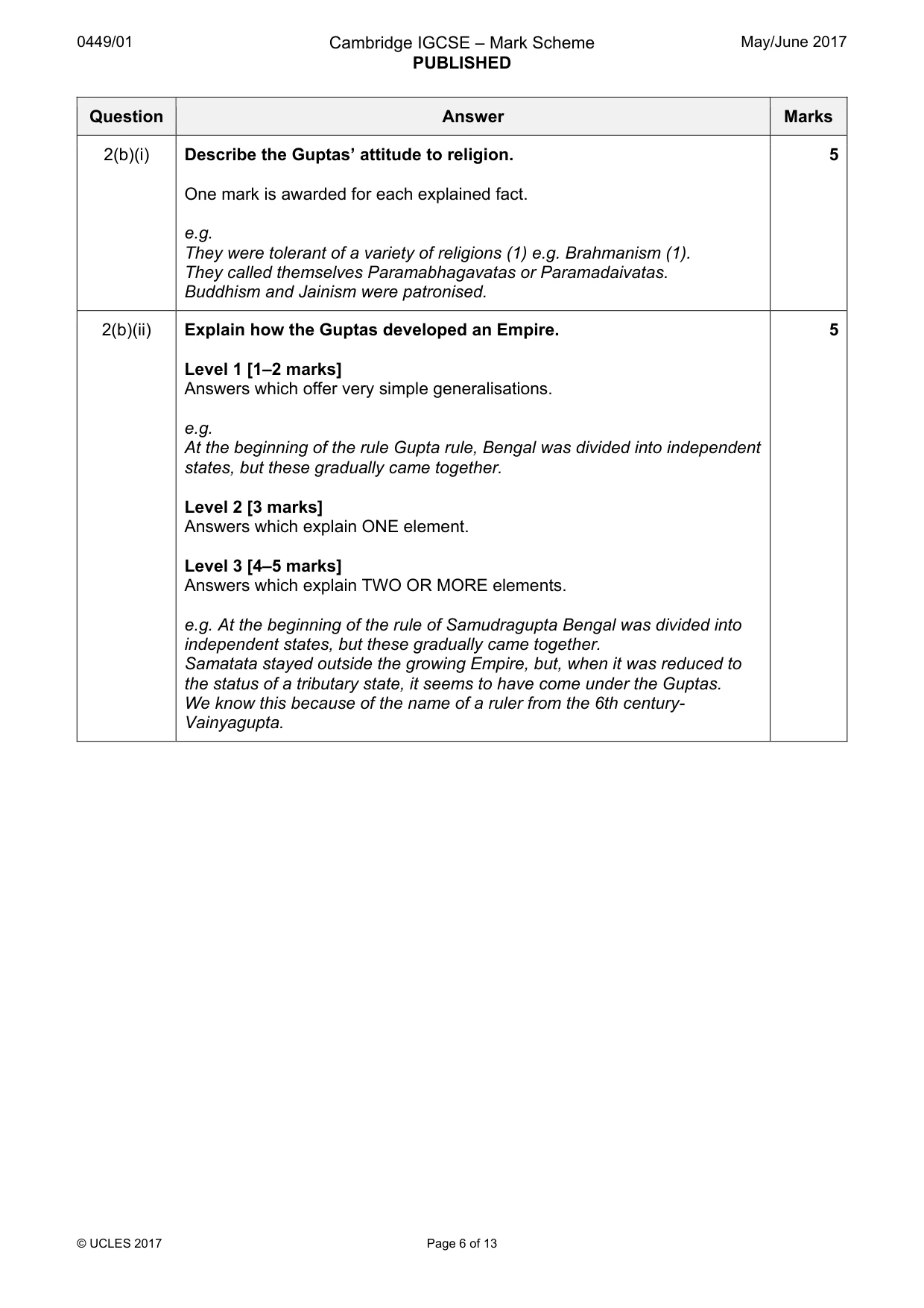
0449/01 Cambridge IGCSE – Mark Scheme PUBLISHED May/June 2017 © UCLES 2017 Page 6 of 13 Question Answer Marks 2(b)(i) Describe the Guptas’ attitude to religion. One mark is awarded for each explained fact. e.g. They were tolerant of a variety of religions (1) e.g. Brahmanism (1). They called themselves Paramabhagavatas or Paramadaivatas. Buddhism and Jainism were patronised. 5 2(b)(ii) Explain how the Guptas developed an Empire. Level 1 [1–2 marks] Answers which offer very simple generalisations. e.g. At the beginning of the rule Gupta rule, Bengal was divided into independent states, but these gradually came together. Level 2 [3 marks] Answers which explain ONE element. Level 3 [4–5 marks] Answers which explain TWO OR MORE elements. e.g. At the beginning of the rule of Samudragupta Bengal was divided into independent states, but these gradually came together. Samatata stayed outside the growing Empire, but, when it was reduced to the status of a tributary state, it seems to have come under the Guptas. We know this because of the name of a ruler from the 6th century- Vainyagupta. 5
Mark scheme, page 7
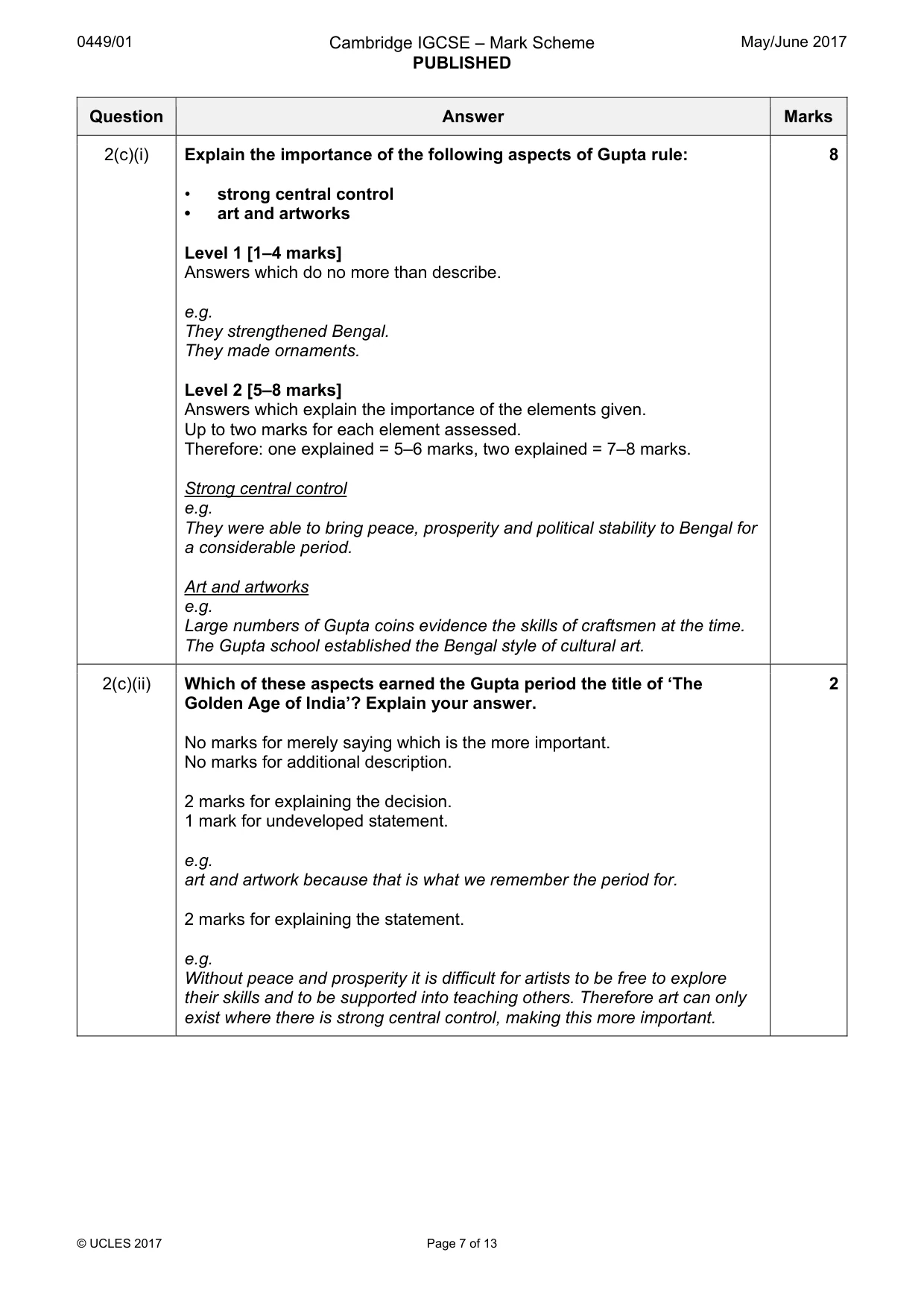
0449/01 Cambridge IGCSE – Mark Scheme PUBLISHED May/June 2017 © UCLES 2017 Page 7 of 13 Question Answer Marks 2(c)(i) Explain the importance of the following aspects of Gupta rule: • strong central control • art and artworks Level 1 [1–4 marks] Answers which do no more than describe. e.g. They strengthened Bengal. They made ornaments. Level 2 [5–8 marks] Answers which explain the importance of the elements given. Up to two marks for each element assessed. Therefore: one explained = 5–6 marks, two explained = 7–8 marks. Strong central control e.g. They were able to bring peace, prosperity and political stability to Bengal for a considerable period. Art and artworks e.g. Large numbers of Gupta coins evidence the skills of craftsmen at the time. The Gupta school established the Bengal style of cultural art. 8 2(c)(ii) Which of these aspects earned the Gupta period the title of ‘The Golden Age of India’? Explain your answer. No marks for merely saying which is the more important. No marks for additional description. 2 marks for explaining the decision. 1 mark for undeveloped statement. e.g. art and artwork because that is what we remember the period for. 2 marks for explaining the statement. e.g. Without peace and prosperity it is difficult for artists to be free to explore their skills and to be supported into teaching others. Therefore art can only exist where there is strong central control, making this more important. 2
Mark scheme, page 8
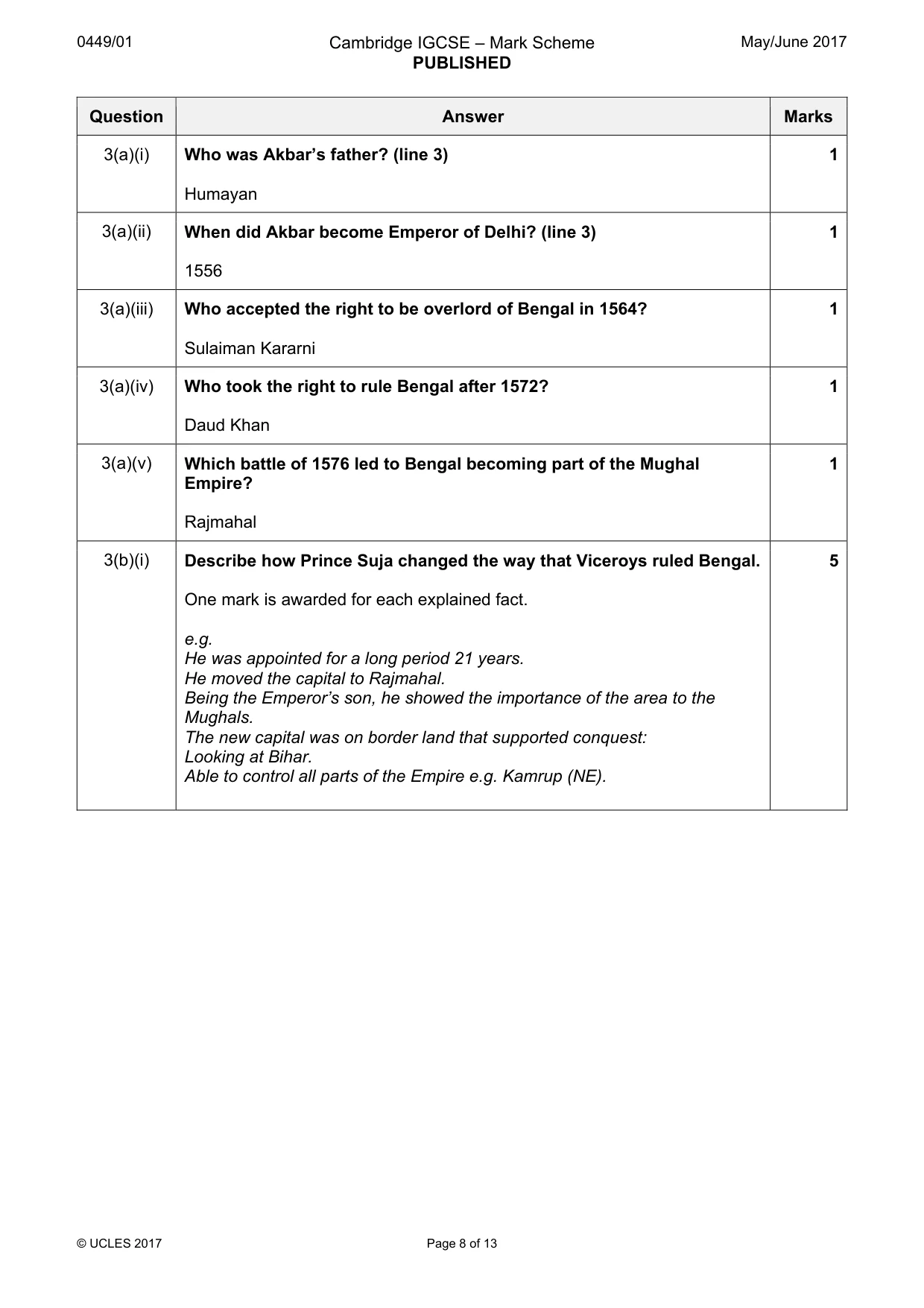
0449/01 Cambridge IGCSE – Mark Scheme PUBLISHED May/June 2017 © UCLES 2017 Page 8 of 13 Question Answer Marks 3(a)(i) Who was Akbar’s father? (line 3) Humayan 1 3(a)(ii) When did Akbar become Emperor of Delhi? (line 3) 1556 1 3(a)(iii) Who accepted the right to be overlord of Bengal in 1564? Sulaiman Kararni 1 3(a)(iv) Who took the right to rule Bengal after 1572? Daud Khan 1 3(a)(v) Which battle of 1576 led to Bengal becoming part of the Mughal Empire? Rajmahal 1 3(b)(i) Describe how Prince Suja changed the way that Viceroys ruled Bengal. One mark is awarded for each explained fact. e.g. He was appointed for a long period 21 years. He moved the capital to Rajmahal. Being the Emperor’s son, he showed the importance of the area to the Mughals. The new capital was on border land that supported conquest: Looking at Bihar. Able to control all parts of the Empire e.g. Kamrup (NE). 5
Mark scheme, page 9
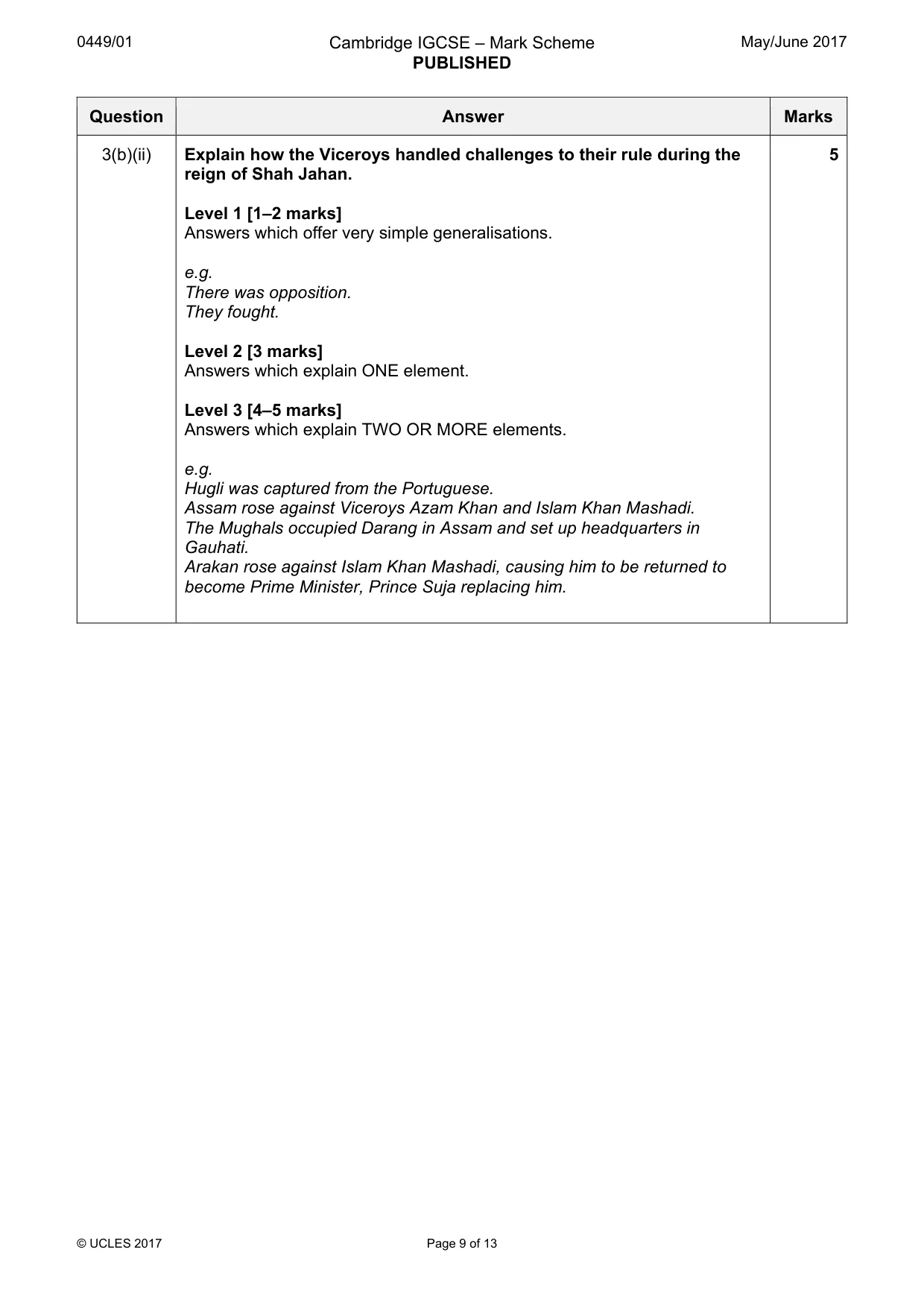
0449/01 Cambridge IGCSE – Mark Scheme PUBLISHED May/June 2017 © UCLES 2017 Page 9 of 13 Question Answer Marks 3(b)(ii) Explain how the Viceroys handled challenges to their rule during the reign of Shah Jahan. Level 1 [1–2 marks] Answers which offer very simple generalisations. e.g. There was opposition. They fought. Level 2 [3 marks] Answers which explain ONE element. Level 3 [4–5 marks] Answers which explain TWO OR MORE elements. e.g. Hugli was captured from the Portuguese. Assam rose against Viceroys Azam Khan and Islam Khan Mashadi. The Mughals occupied Darang in Assam and set up headquarters in Gauhati. Arakan rose against Islam Khan Mashadi, causing him to be returned to become Prime Minister, Prince Suja replacing him. 5
Mark scheme, page 10
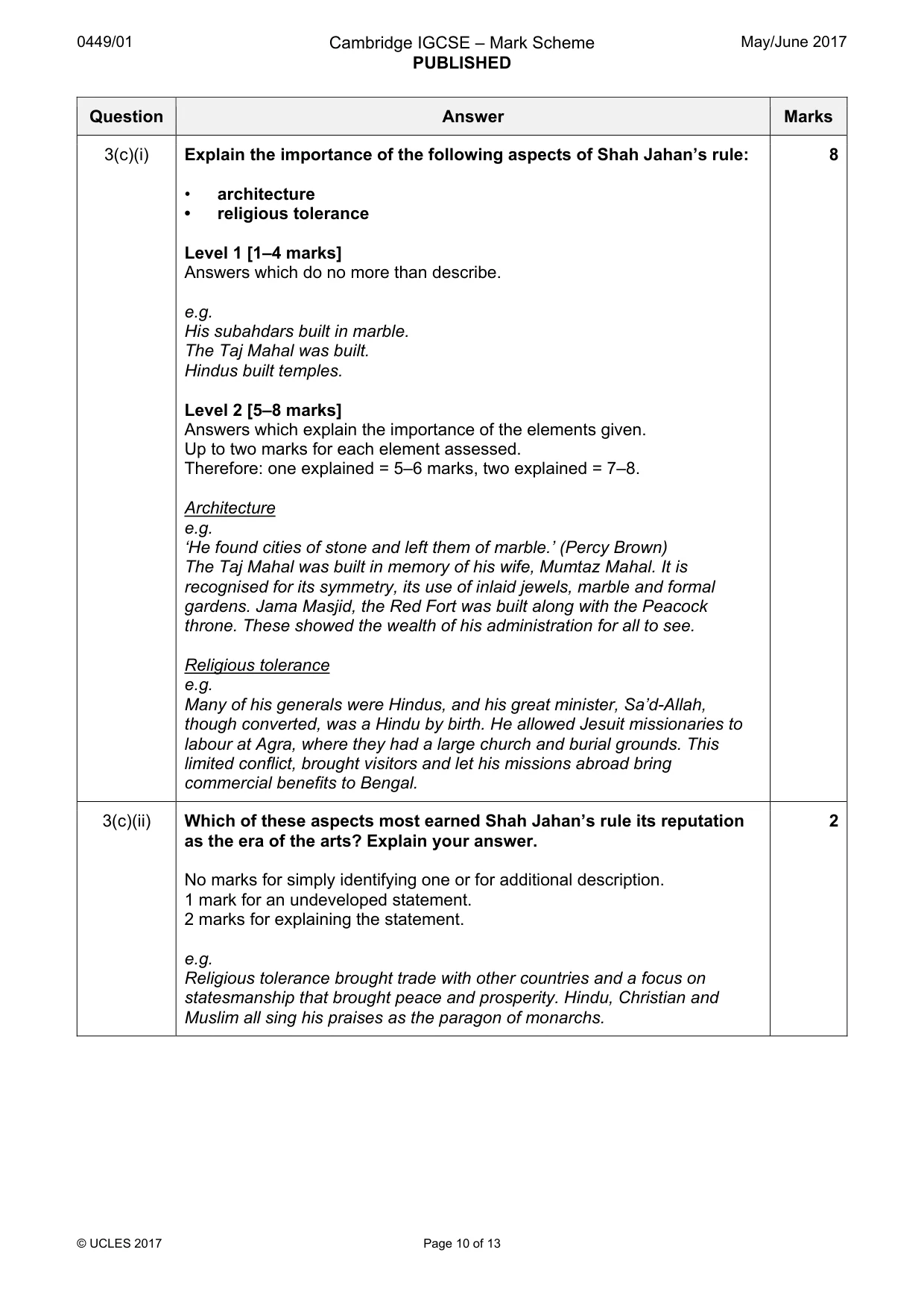
0449/01 Cambridge IGCSE – Mark Scheme PUBLISHED May/June 2017 © UCLES 2017 Page 10 of 13 Question Answer Marks 3(c)(i) Explain the importance of the following aspects of Shah Jahan’s rule: • architecture • religious tolerance Level 1 [1–4 marks] Answers which do no more than describe. e.g. His subahdars built in marble. The Taj Mahal was built. Hindus built temples. Level 2 [5–8 marks] Answers which explain the importance of the elements given. Up to two marks for each element assessed. Therefore: one explained = 5–6 marks, two explained = 7–8. Architecture e.g. ‘He found cities of stone and left them of marble.’ (Percy Brown) The Taj Mahal was built in memory of his wife, Mumtaz Mahal. It is recognised for its symmetry, its use of inlaid jewels, marble and formal gardens. Jama Masjid, the Red Fort was built along with the Peacock throne. These showed the wealth of his administration for all to see. Religious tolerance e.g. Many of his generals were Hindus, and his great minister, Sa’d-Allah, though converted, was a Hindu by birth. He allowed Jesuit missionaries to labour at Agra, where they had a large church and burial grounds. This limited conflict, brought visitors and let his missions abroad bring commercial benefits to Bengal. 8 3(c)(ii) Which of these aspects most earned Shah Jahan’s rule its reputation as the era of the arts? Explain your answer. No marks for simply identifying one or for additional description. 1 mark for an undeveloped statement. 2 marks for explaining the statement. e.g. Religious tolerance brought trade with other countries and a focus on statesmanship that brought peace and prosperity. Hindu, Christian and Muslim all sing his praises as the paragon of monarchs. 2
Mark scheme, page 11
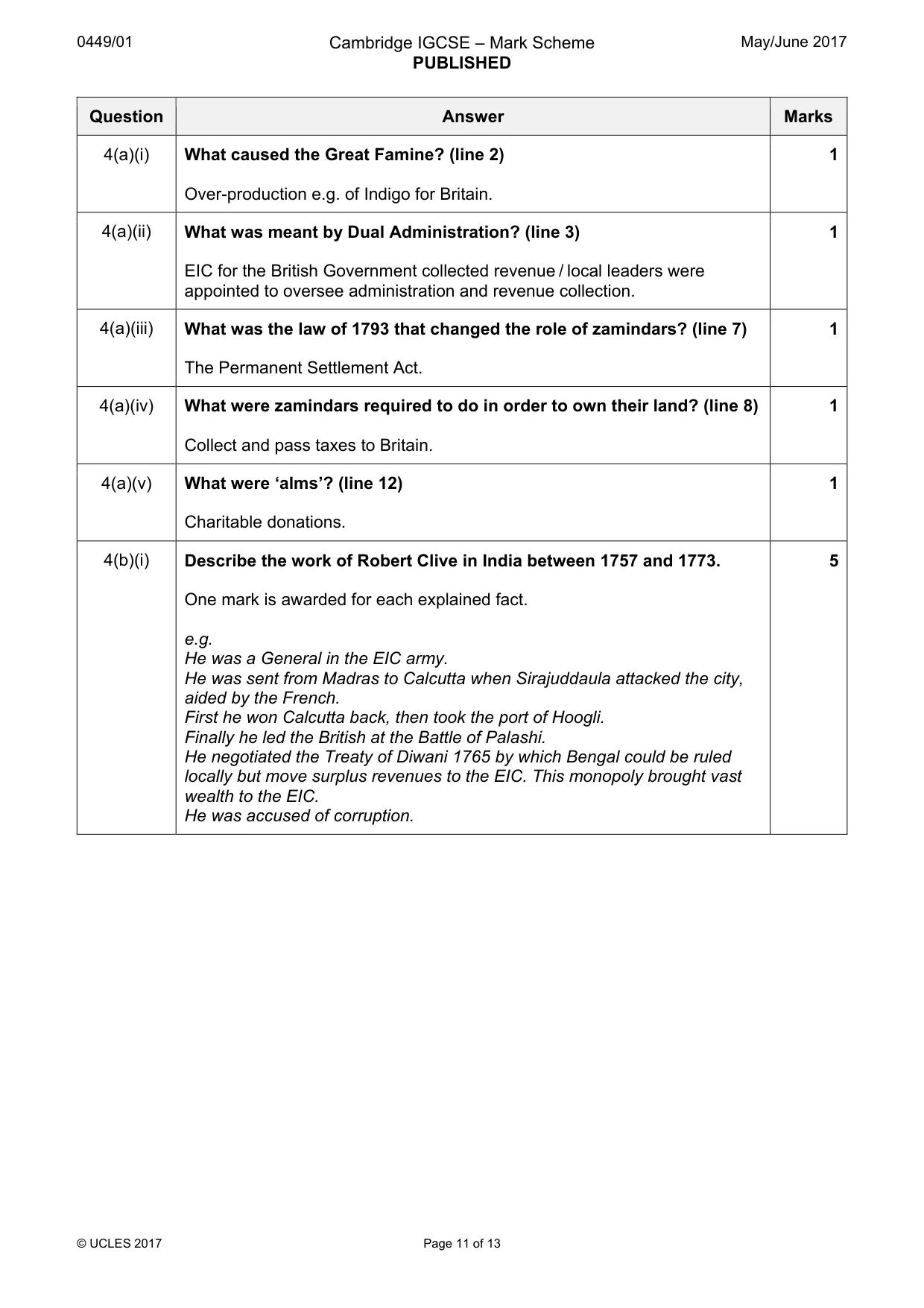
0449/01 Cambridge IGCSE – Mark Scheme PUBLISHED May/June 2017 © UCLES 2017 Page 11 of 13 Question Answer Marks 4(a)(i) What caused the Great Famine? (line 2) Over-production e.g. of Indigo for Britain. 1 4(a)(ii) What was meant by Dual Administration? (line 3) EIC for the British Government collected revenue / local leaders were appointed to oversee administration and revenue collection. 1 4(a)(iii) What was the law of 1793 that changed the role of zamindars? (line 7) The Permanent Settlement Act. 1 4(a)(iv) What were zamindars required to do in order to own their land? (line 8) Collect and pass taxes to Britain. 1 4(a)(v) What were ‘alms’? (line 12) Charitable donations. 1 4(b)(i) Describe the work of Robert Clive in India between 1757 and 1773. One mark is awarded for each explained fact. e.g. He was a General in the EIC army. He was sent from Madras to Calcutta when Sirajuddaula attacked the city, aided by the French. First he won Calcutta back, then took the port of Hoogli. Finally he led the British at the Battle of Palashi. He negotiated the Treaty of Diwani 1765 by which Bengal could be ruled locally but move surplus revenues to the EIC. This monopoly brought vast wealth to the EIC. He was accused of corruption. 5
Mark scheme, page 12
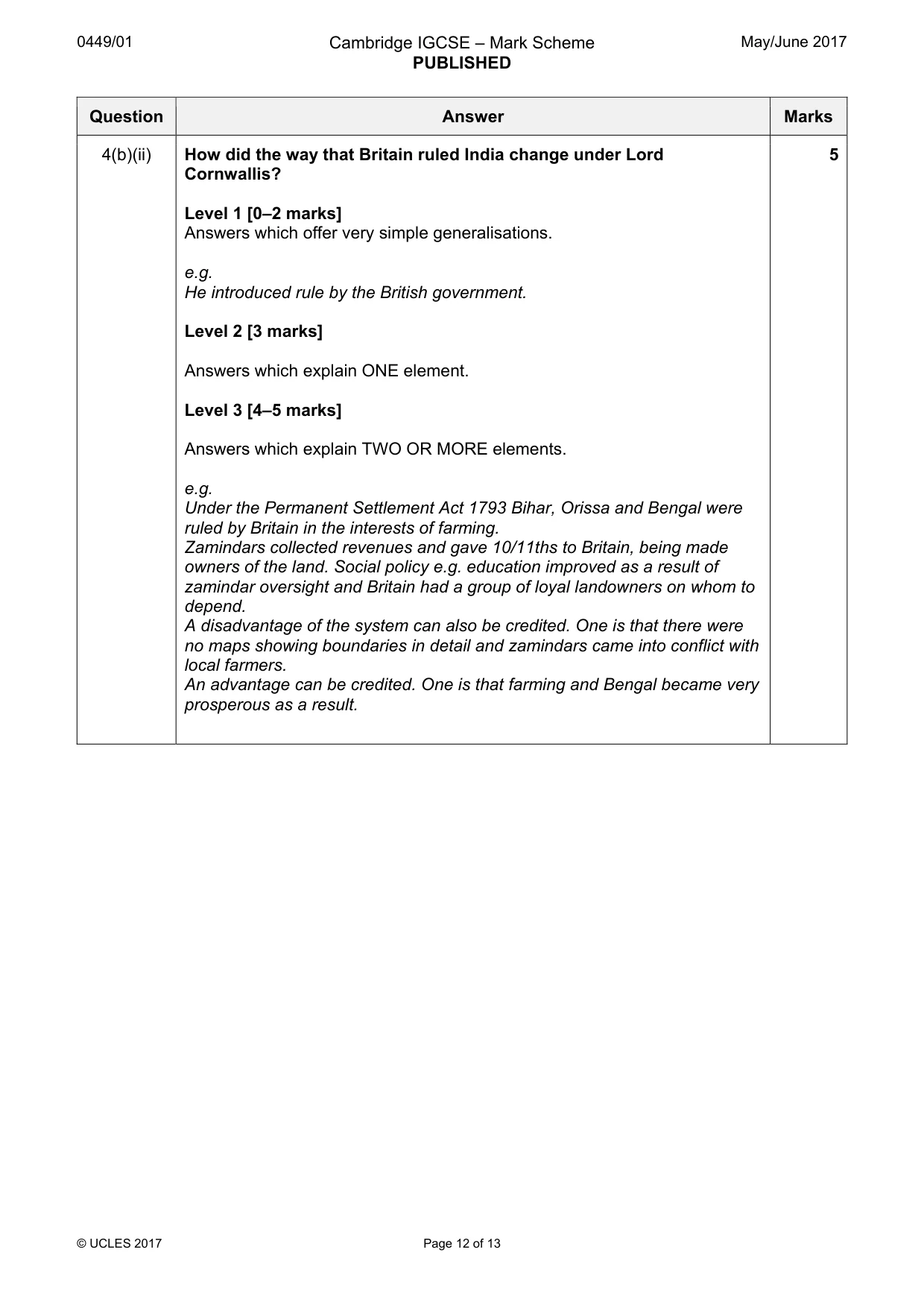
0449/01 Cambridge IGCSE – Mark Scheme PUBLISHED May/June 2017 © UCLES 2017 Page 12 of 13 Question Answer Marks 4(b)(ii) How did the way that Britain ruled India change under Lord Cornwallis? Level 1 [0–2 marks] Answers which offer very simple generalisations. e.g. He introduced rule by the British government. Level 2 [3 marks] Answers which explain ONE element. Level 3 [4–5 marks] Answers which explain TWO OR MORE elements. e.g. Under the Permanent Settlement Act 1793 Bihar, Orissa and Bengal were ruled by Britain in the interests of farming. Zamindars collected revenues and gave 10/11ths to Britain, being made owners of the land. Social policy e.g. education improved as a result of zamindar oversight and Britain had a group of loyal landowners on whom to depend. A disadvantage of the system can also be credited. One is that there were no maps showing boundaries in detail and zamindars came into conflict with local farmers. An advantage can be credited. One is that farming and Bengal became very prosperous as a result. 5
Mark scheme, page 13
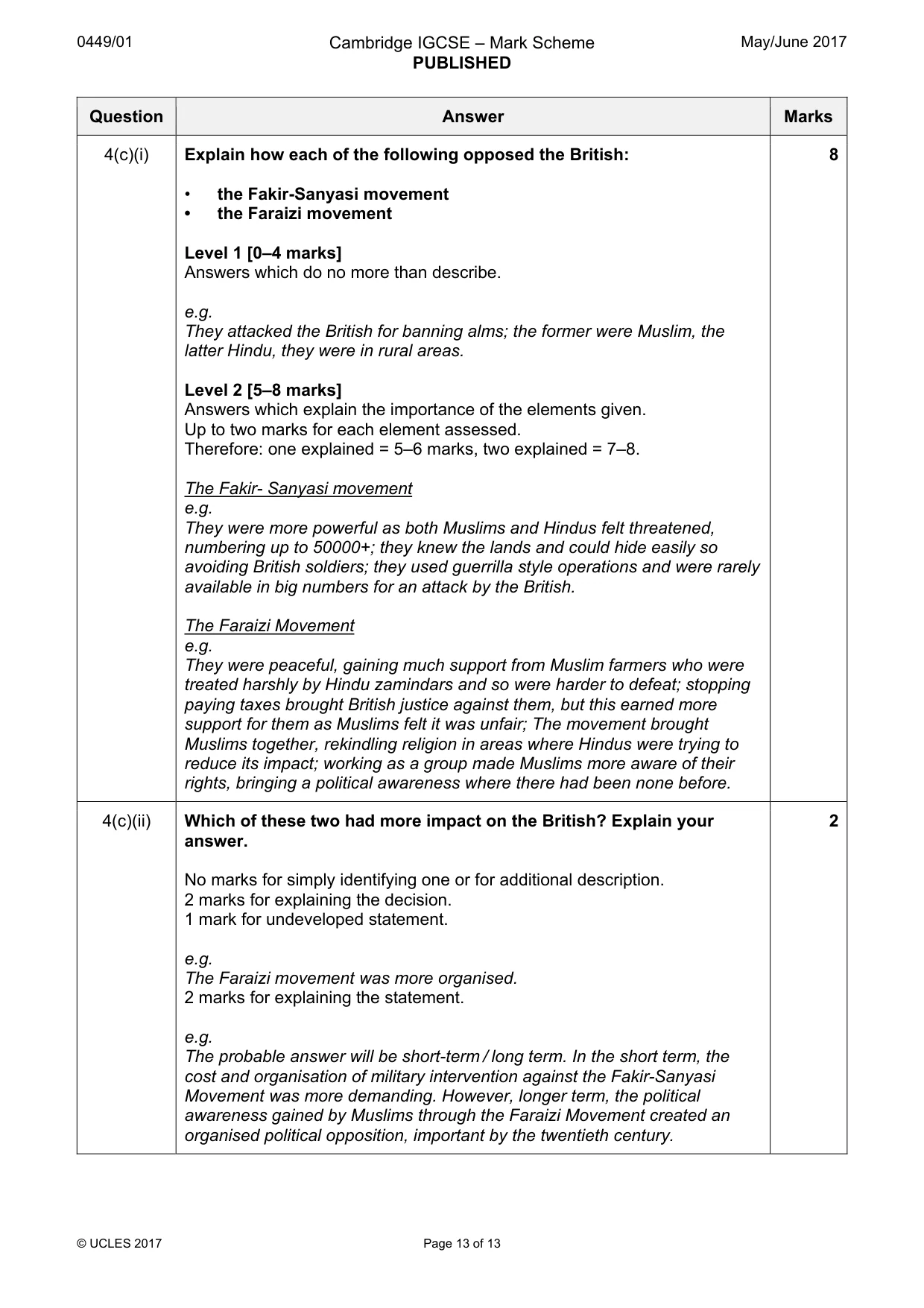
0449/01 Cambridge IGCSE – Mark Scheme PUBLISHED May/June 2017 © UCLES 2017 Page 13 of 13 Question Answer Marks 4(c)(i) Explain how each of the following opposed the British: • the Fakir-Sanyasi movement • the Faraizi movement Level 1 [0–4 marks] Answers which do no more than describe. e.g. They attacked the British for banning alms; the former were Muslim, the latter Hindu, they were in rural areas. Level 2 [5–8 marks] Answers which explain the importance of the elements given. Up to two marks for each element assessed. Therefore: one explained = 5–6 marks, two explained = 7–8. The Fakir- Sanyasi movement e.g. They were more powerful as both Muslims and Hindus felt threatened, numbering up to 50000+; they knew the lands and could hide easily so avoiding British soldiers; they used guerrilla style operations and were rarely available in big numbers for an attack by the British. The Faraizi Movement e.g. They were peaceful, gaining much support from Muslim farmers who were treated harshly by Hindu zamindars and so were harder to defeat; stopping paying taxes brought British justice against them, but this earned more support for them as Muslims felt it was unfair; The movement brought Muslims together, rekindling religion in areas where Hindus were trying to reduce its impact; working as a group made Muslims more aware of their rights, bringing a political awareness where there had been none before. 8 4(c)(ii) Which of these two had more impact on the British? Explain your answer. No marks for simply identifying one or for additional description. 2 marks for explaining the decision. 1 mark for undeveloped statement. e.g. The Faraizi movement was more organised. 2 marks for explaining the statement. e.g. The probable answer will be short-term / long term. In the short term, the cost and organisation of military intervention against the Fakir-Sanyasi Movement was more demanding. However, longer term, the political awareness gained by Muslims through the Faraizi Movement created an organised political opposition, important by the twentieth century. 2
What you needed in this session
Cambridge’s own grade thresholds for 2017 May/June, Paper 1 · Variant 1. A higher threshold means an easier paper — the bar moves with how the cohort did.