Cambridge IGCSE Bangladesh Studies 0449 — 2010 May/June Paper 1 · Variant 1
0449/11/M/J/10 · 75 marks · ≈84 min
The question paper and its mark scheme, free to read here and free to download. This is Cambridge’s own paper, exactly as it was sat.
Question paper8 pages



Mark scheme6 pages
Answers below. Sit the paper first if you are practising.
Paper as text
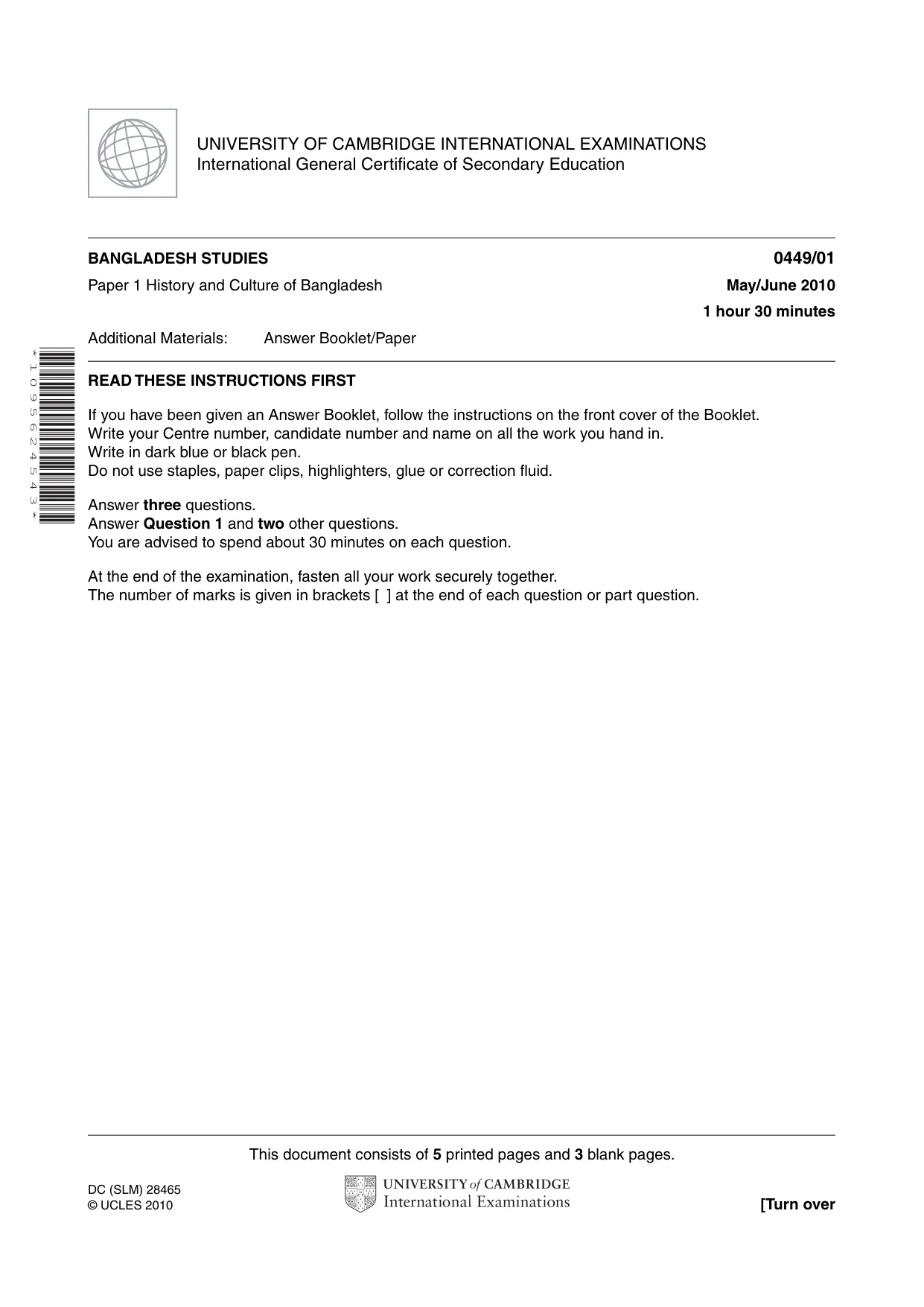
Question paper, page 1
This document consists of 5 printed pages and 3 blank pages. DC (SLM) 28465 © UCLES 2010 [Turn over UNIVERSITY OF CAMBRIDGE INTERNATIONAL EXAMINATIONS International General Certificate of Secondary Education * 1 0 9 5 6 2 4 5 4 3 * BANGLADESH STUDIES 0449/01 Paper 1 History and Culture of Bangladesh May/June 2010 1 hour 30 minutes Additional Materials: Answer Booklet/Paper READ THESE INSTRUCTIONS FIRST If you have been given an Answer Booklet, follow the instructions on the front cover of the Booklet. Write your Centre number, candidate number and name on all the work you hand in. Write in dark blue or black pen. Do not use staples, paper clips, highlighters, glue or correction fluid. Answer three questions. Answer Question 1 and two other questions. You are advised to spend about 30 minutes on each question. At the end of the examination, fasten all your work securely together. The number of marks is given in brackets [ ] at the end of each question or part question.
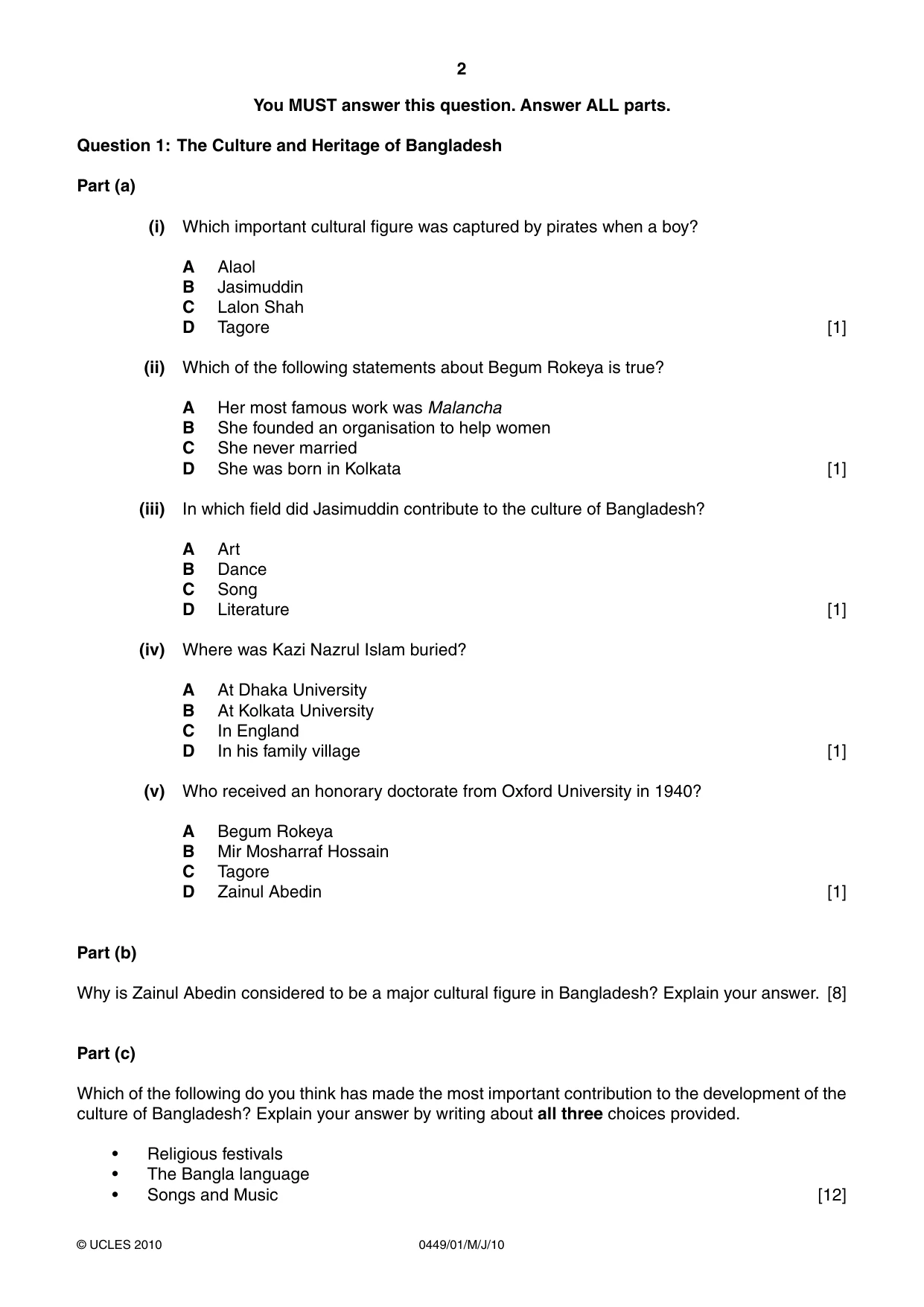
Question paper, page 2
2 0449/01/M/J/10 © UCLES 2010 You MUST answer this question. Answer ALL parts. Question 1: The Culture and Heritage of Bangladesh Part (a) (i) Which important cultural figure was captured by pirates when a boy? A Alaol B Jasimuddin C Lalon Shah D Tagore [1] (ii) Which of the following statements about Begum Rokeya is true? A Her most famous work was Malancha B She founded an organisation to help women C She never married D She was born in Kolkata [1] (iii) In which field did Jasimuddin contribute to the culture of Bangladesh? A Art B Dance C Song D Literature [1] (iv) Where was Kazi Nazrul Islam buried? A At Dhaka University B At Kolkata University C In England D In his family village [1] (v) Who received an honorary doctorate from Oxford University in 1940? A Begum Rokeya B Mir Mosharraf Hossain C Tagore D Zainul Abedin [1] Part (b) Why is Zainul Abedin considered to be a major cultural figure in Bangladesh? Explain your answer. [8] Part (c) Which of the following do you think has made the most important contribution to the development of the culture of Bangladesh? Explain your answer by writing about all three choices provided. • Religious festivals • The Bangla language • Songs and Music [12]
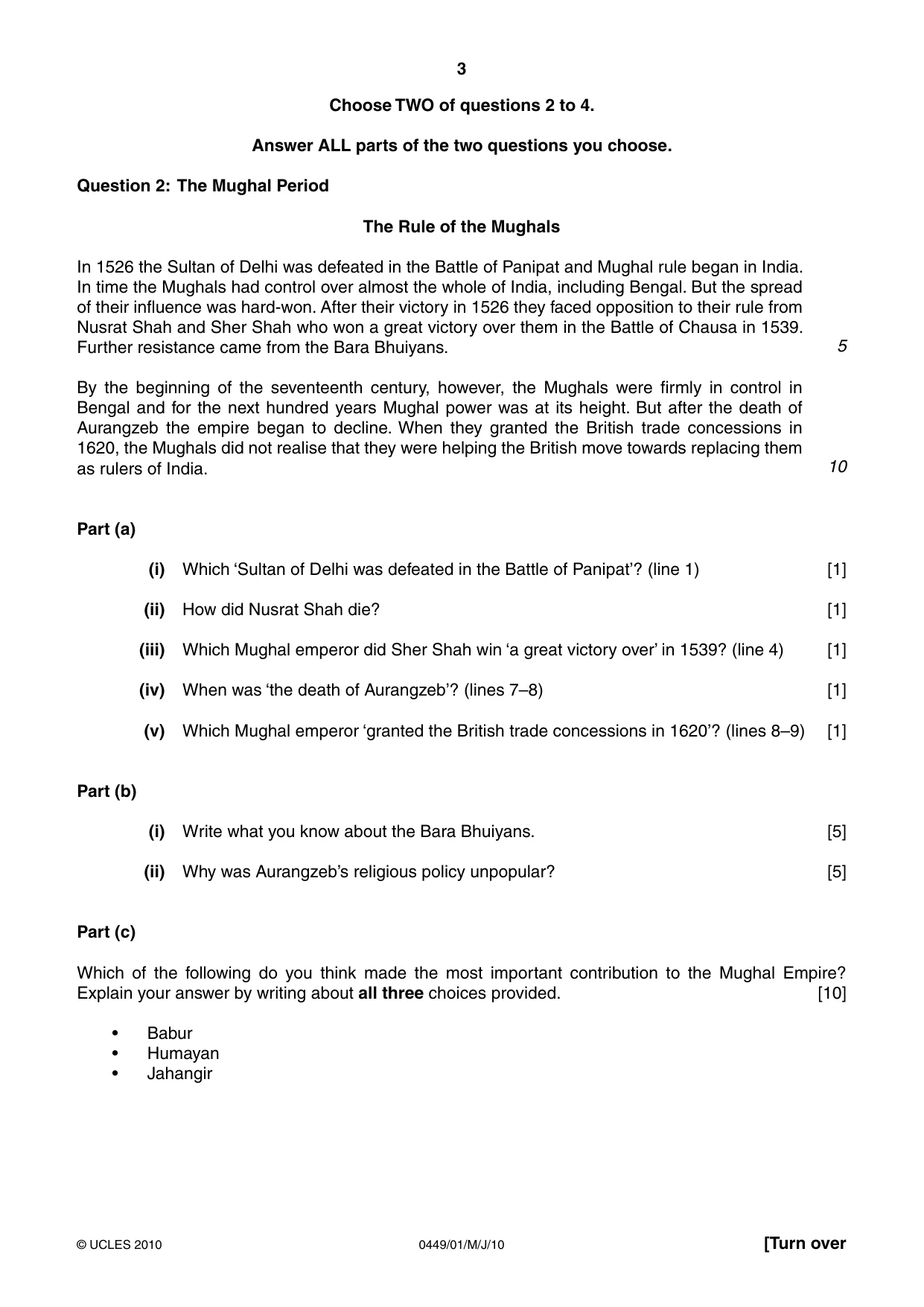
Question paper, page 3
3 0449/01/M/J/10 © UCLES 2010 [Turn over Choose TWO of questions 2 to 4. Answer ALL parts of the two questions you choose. Question 2: The Mughal Period The Rule of the Mughals In 1526 the Sultan of Delhi was defeated in the Battle of Panipat and Mughal rule began in India. In time the Mughals had control over almost the whole of India, including Bengal. But the spread of their influence was hard-won. After their victory in 1526 they faced opposition to their rule from Nusrat Shah and Sher Shah who won a great victory over them in the Battle of Chausa in 1539. Further resistance came from the Bara Bhuiyans. By the beginning of the seventeenth century, however, the Mughals were firmly in control in Bengal and for the next hundred years Mughal power was at its height. But after the death of Aurangzeb the empire began to decline. When they granted the British trade concessions in 1620, the Mughals did not realise that they were helping the British move towards replacing them as rulers of India. Part (a) (i) Which ‘Sultan of Delhi was defeated in the Battle of Panipat’? (line 1) [1] (ii) How did Nusrat Shah die? [1] (iii) Which Mughal emperor did Sher Shah win ‘a great victory over’ in 1539? (line 4) [1] (iv) When was ‘the death of Aurangzeb’? (lines 7–8) [1] (v) Which Mughal emperor ‘granted the British trade concessions in 1620’? (lines 8–9) [1] Part (b) (i) Write what you know about the Bara Bhuiyans. [5] (ii) Why was Aurangzeb’s religious policy unpopular? [5] Part (c) Which of the following do you think made the most important contribution to the Mughal Empire? Explain your answer by writing about all three choices provided. [10] • Babur • Humayan • Jahangir 5 10
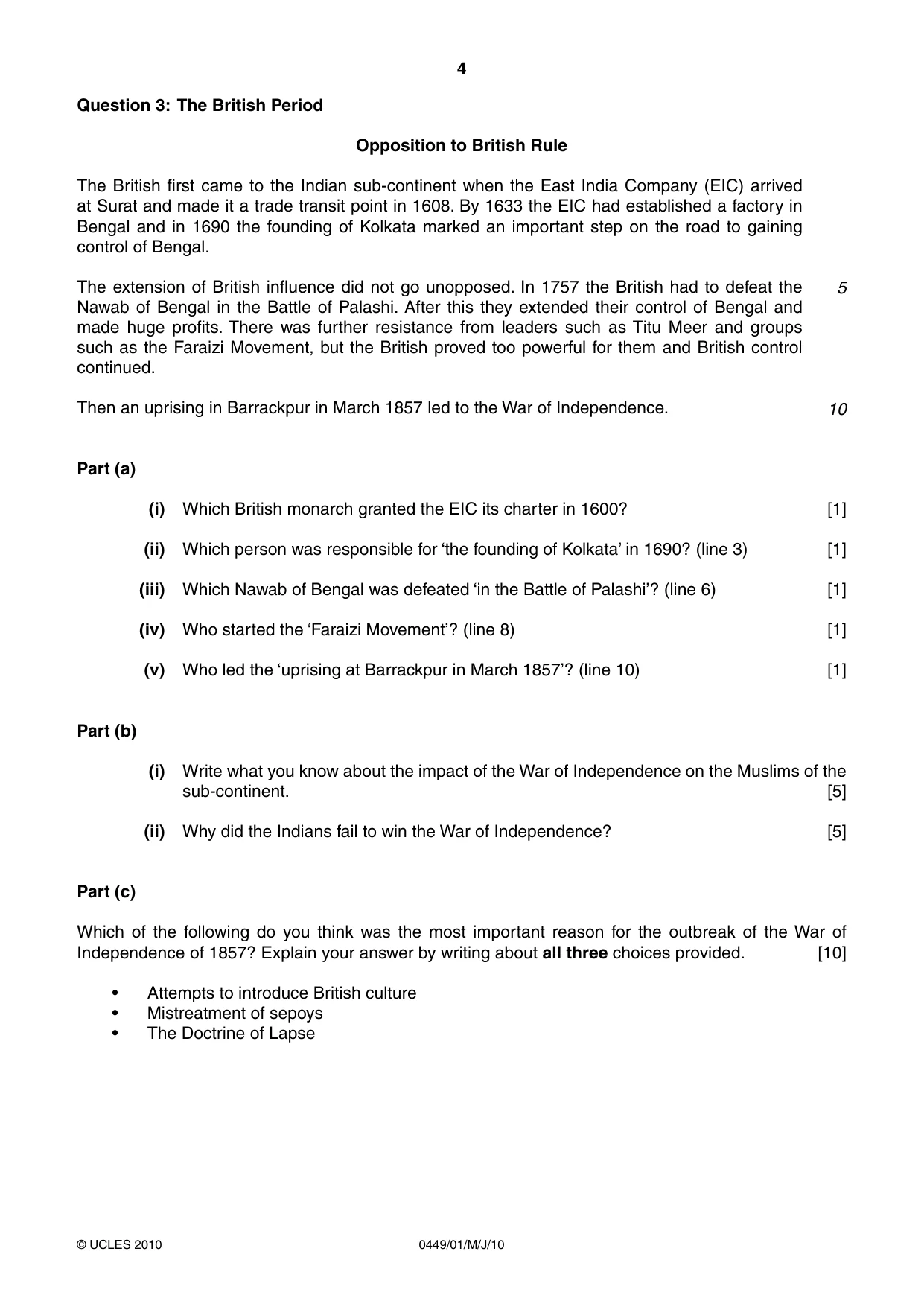
Question paper, page 4
4 0449/01/M/J/10 © UCLES 2010 Question 3: The British Period Opposition to British Rule The British first came to the Indian sub-continent when the East India Company (EIC) arrived at Surat and made it a trade transit point in 1608. By 1633 the EIC had established a factory in Bengal and in 1690 the founding of Kolkata marked an important step on the road to gaining control of Bengal. The extension of British influence did not go unopposed. In 1757 the British had to defeat the Nawab of Bengal in the Battle of Palashi. After this they extended their control of Bengal and made huge profits. There was further resistance from leaders such as Titu Meer and groups such as the Faraizi Movement, but the British proved too powerful for them and British control continued. Then an uprising in Barrackpur in March 1857 led to the War of Independence. Part (a) (i) Which British monarch granted the EIC its charter in 1600? [1] (ii) Which person was responsible for ‘the founding of Kolkata’ in 1690? (line 3) [1] (iii) Which Nawab of Bengal was defeated ‘in the Battle of Palashi’? (line 6) [1] (iv) Who started the ‘Faraizi Movement’? (line 8) [1] (v) Who led the ‘uprising at Barrackpur in March 1857’? (line 10) [1] Part (b) (i) Write what you know about the impact of the War of Independence on the Muslims of the sub-continent. [5] (ii) Why did the Indians fail to win the War of Independence? [5] Part (c) Which of the following do you think was the most important reason for the outbreak of the War of Independence of 1857? Explain your answer by writing about all three choices provided. [10] • Attempts to introduce British culture • Mistreatment of sepoys • The Doctrine of Lapse 5 10
Question paper, page 5
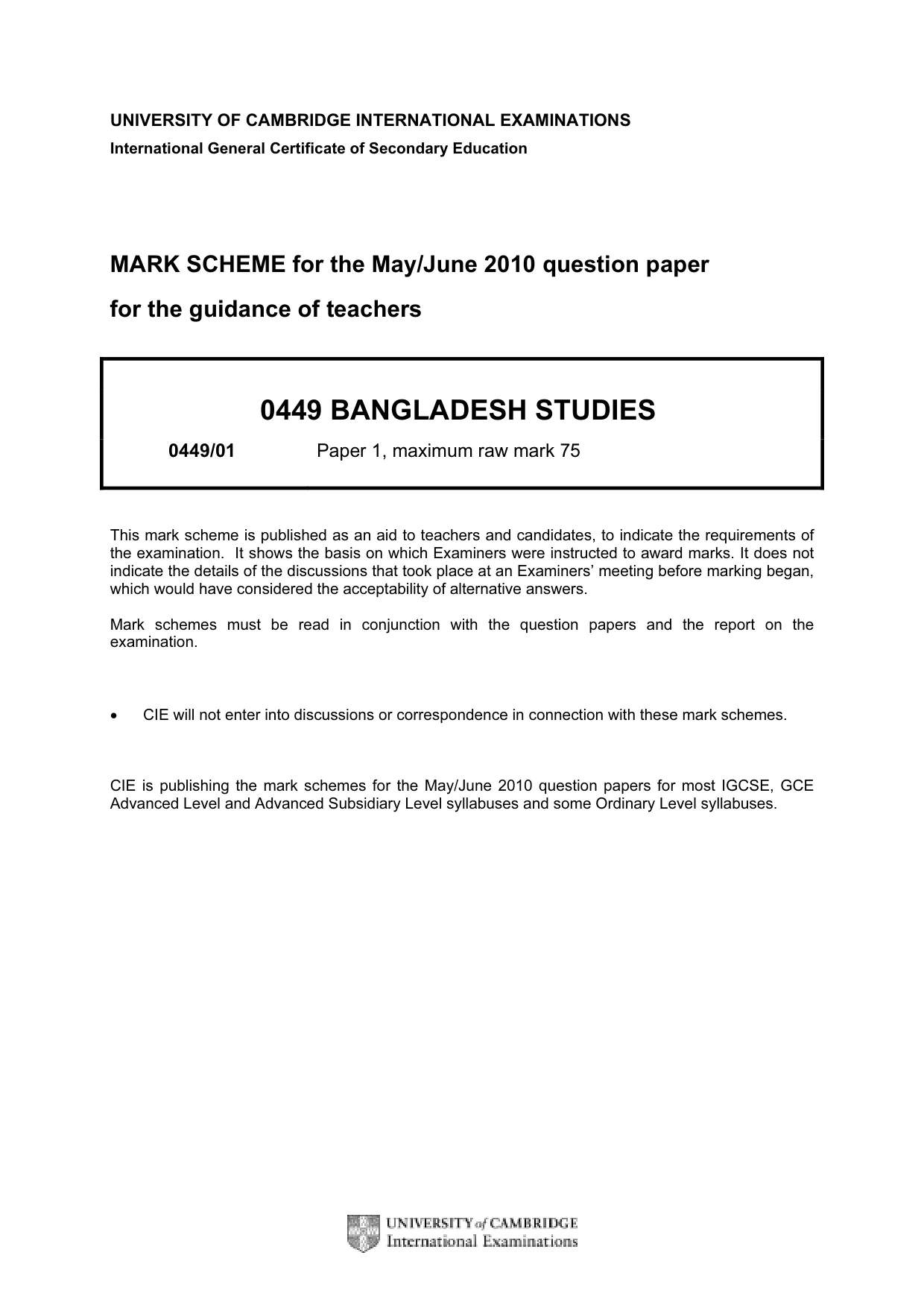
5 0449/01/M/J/10 © UCLES 2010 Question 4: From Pakistan to Bangladesh The Move to Independence When Pakistan achieved independence in 1947 it faced serious problems. It faced a dispute with its neighbour, India, over the division of assets, the ownership of disputed territories and even the use of water from the rivers. Pakistan also faced a huge influx of refugees from India. East Pakistan was almost a thousand miles from West Pakistan and there were many differences between the people in each territory. Politicians in East Pakistan often disagreed with decisions made by the government (which was based in West Pakistan). Resentment grew as the people of East Pakistan became increasingly aware of the favouritism being shown by the government towards West Pakistan. After the Awami League won the 1970 elections to the National Assembly, a war of independence broke out when West Pakistan refused to allow the League to take power. In December 1971 the Republic of Bangladesh was officially declared. Part (a) (i) Which city became Pakistan’s new capital in 1947? [1] (ii) Who led Pakistan’s government from August 1947? [1] (iii) What ratio was used to decide ‘the division of assets’ between Pakistan and India? (line 2) [1] (iv) Who led the Awami League when it ‘won the 1970 elections’? (line 10) [1] (v) Who ‘refused to allow the League to take power’? (line 11) [1] Part (b) (i) Write what you know about the difficulties created by the influx of refugees into Pakistan in 1947. [5] (ii) Why was the Canal Water Dispute of 1947–48 an important issue in the history of Pakistan? [5] Part (c) Study the two statements below: A ‘Bangladesh was created because of the dispute over the national language.’ B ‘Bangladesh was created because of economic disparities between East and West Pakistan.’ How far do you agree with each statement? Explain your answer. [10] 5 10
Question paper, page 6
6 0449/01/M/J/10 © UCLES 2010 BLANK PAGE
Question paper, page 7
7 0449/01/M/J/10 © UCLES 2010 BLANK PAGE
Question paper, page 8
8 0449/01/M/J/10 © UCLES 2010 Permission to reproduce items where third-party owned material protected by copyright is included has been sought and cleared where possible. Every reasonable effort has been made by the publisher (UCLES) to trace copyright holders, but if any items requiring clearance have unwittingly been included, the publisher will be pleased to make amends at the earliest possible opportunity. University of Cambridge International Examinations is part of the Cambridge Assessment Group. Cambridge Assessment is the brand name of University of Cambridge Local Examinations Syndicate (UCLES), which is itself a department of the University of Cambridge. BLANK PAGE
Mark scheme, page 1
UNIVERSITY OF CAMBRIDGE INTERNATIONAL EXAMINATIONS International General Certificate of Secondary Education MARK SCHEME for the May/June 2010 question paper for the guidance of teachers 0449 BANGLADESH STUDIES 0449/01 Paper 1, maximum raw mark 75 This mark scheme is published as an aid to teachers and candidates, to indicate the requirements of the examination. It shows the basis on which Examiners were instructed to award marks. It does not indicate the details of the discussions that took place at an Examiners’ meeting before marking began, which would have considered the acceptability of alternative answers. Mark schemes must be read in conjunction with the question papers and the report on the examination. • CIE will not enter into discussions or correspondence in connection with these mark schemes. CIE is publishing the mark schemes for the May/June 2010 question papers for most IGCSE, GCE Advanced Level and Advanced Subsidiary Level syllabuses and some Ordinary Level syllabuses.
Mark scheme, page 2
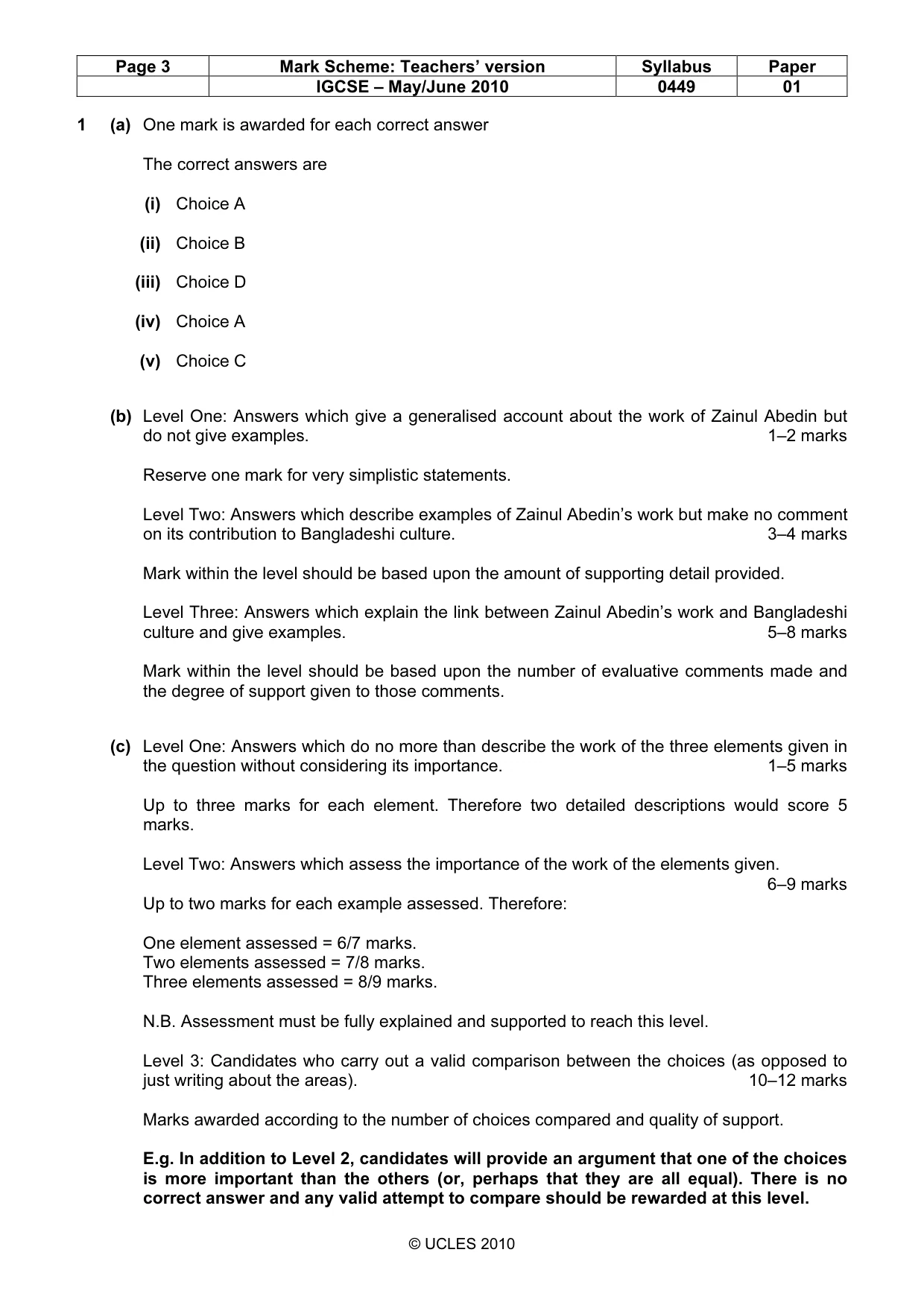
Page 2 Mark Scheme: Teachers’ version Syllabus Paper IGCSE – May/June 2010 0449 01 © UCLES 2010 Introduction The questions on Paper 1 divide into several distinct types: * questions which are either correct (and score one mark) or are incorrect (and score zero). These can be found in Part (a) of each of the four questions on the paper. * questions which require candidates to relate historical information without analysis. These will usually be found in Part (b) (i) of Questions 2 to 4 and will be marked on a ‘one point = one mark basis’. * questions where there is a hierarchy of correct responses, as in Part (b) of Question 1, Part (b) (ii) of Questions 2 to 4 and in all Part (c) questions. For such answers, a ‘levels of response’ mark scheme is used. The candidate’s response is placed in a level according to the best part of the answer and the mark within that level is awarded according to the criteria set out in the mark scheme.
Mark scheme, page 3
Page 3 Mark Scheme: Teachers’ version Syllabus Paper IGCSE – May/June 2010 0449 01 © UCLES 2010 1 (a) One mark is awarded for each correct answer The correct answers are (i) Choice A (ii) Choice B (iii) Choice D (iv) Choice A (v) Choice C (b) Level One: Answers which give a generalised account about the work of Zainul Abedin but do not give examples. 1–2 marks Reserve one mark for very simplistic statements. Level Two: Answers which describe examples of Zainul Abedin’s work but make no comment on its contribution to Bangladeshi culture. 3–4 marks Mark within the level should be based upon the amount of supporting detail provided. Level Three: Answers which explain the link between Zainul Abedin’s work and Bangladeshi culture and give examples. 5–8 marks Mark within the level should be based upon the number of evaluative comments made and the degree of support given to those comments. (c) Level One: Answers which do no more than describe the work of the three elements given in the question without considering its importance. 1–5 marks Up to three marks for each element. Therefore two detailed descriptions would score 5 marks. Level Two: Answers which assess the importance of the work of the elements given. 6–9 marks Up to two marks for each example assessed. Therefore: One element assessed = 6/7 marks. Two elements assessed = 7/8 marks. Three elements assessed = 8/9 marks. N.B. Assessment must be fully explained and supported to reach this level. Level 3: Candidates who carry out a valid comparison between the choices (as opposed to just writing about the areas). 10–12 marks Marks awarded according to the number of choices compared and quality of support. E.g. In addition to Level 2, candidates will provide an argument that one of the choices is more important than the others (or, perhaps that they are all equal). There is no correct answer and any valid attempt to compare should be rewarded at this level.
Mark scheme, page 4
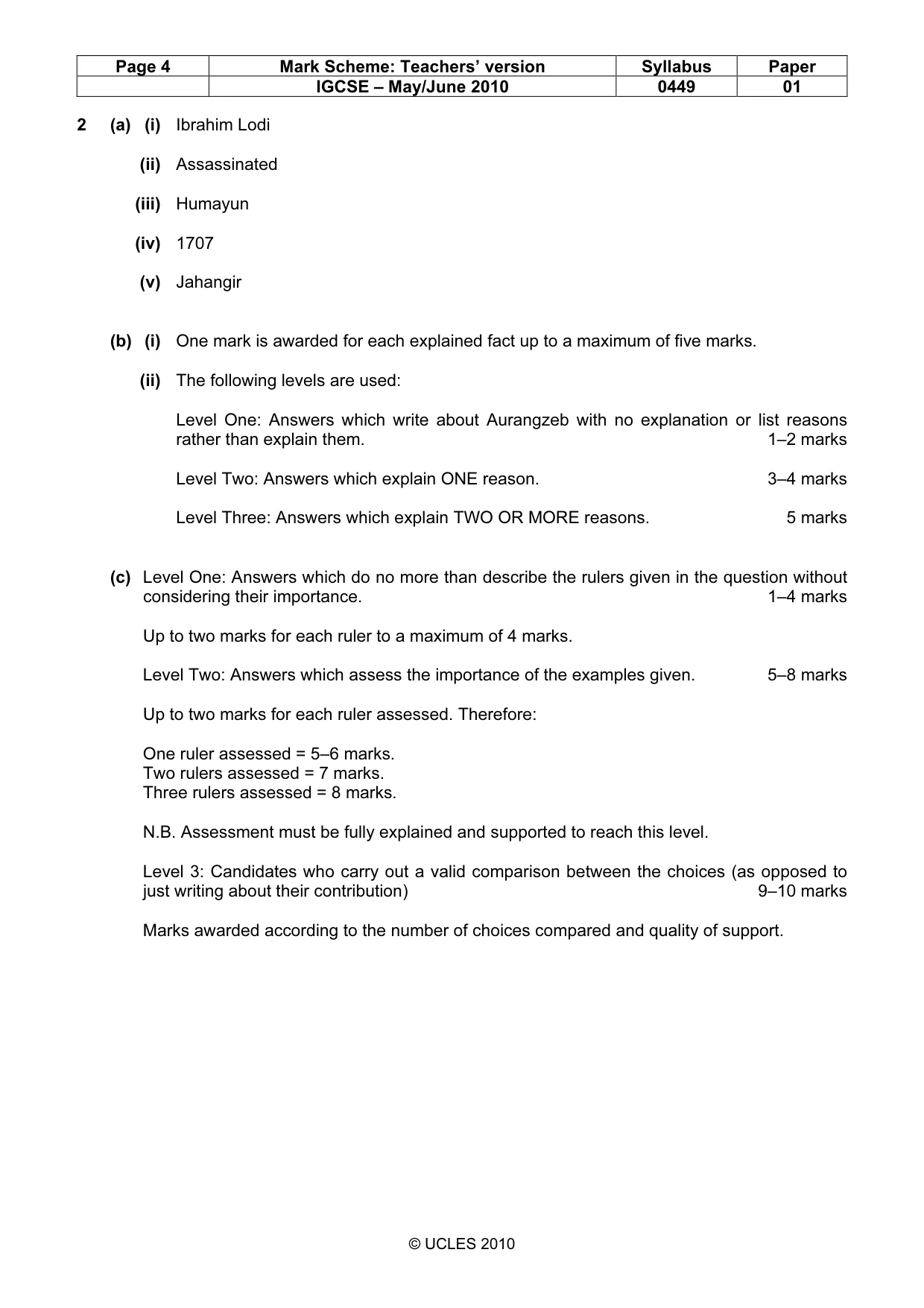
Page 4 Mark Scheme: Teachers’ version Syllabus Paper IGCSE – May/June 2010 0449 01 © UCLES 2010 2 (a) (i) Ibrahim Lodi (ii) Assassinated (iii) Humayun (iv) 1707 (v) Jahangir (b) (i) One mark is awarded for each explained fact up to a maximum of five marks. (ii) The following levels are used: Level One: Answers which write about Aurangzeb with no explanation or list reasons rather than explain them. 1–2 marks Level Two: Answers which explain ONE reason. 3–4 marks Level Three: Answers which explain TWO OR MORE reasons. 5 marks (c) Level One: Answers which do no more than describe the rulers given in the question without considering their importance. 1–4 marks Up to two marks for each ruler to a maximum of 4 marks. Level Two: Answers which assess the importance of the examples given. 5–8 marks Up to two marks for each ruler assessed. Therefore: One ruler assessed = 5–6 marks. Two rulers assessed = 7 marks. Three rulers assessed = 8 marks. N.B. Assessment must be fully explained and supported to reach this level. Level 3: Candidates who carry out a valid comparison between the choices (as opposed to just writing about their contribution) 9–10 marks Marks awarded according to the number of choices compared and quality of support.
Mark scheme, page 5
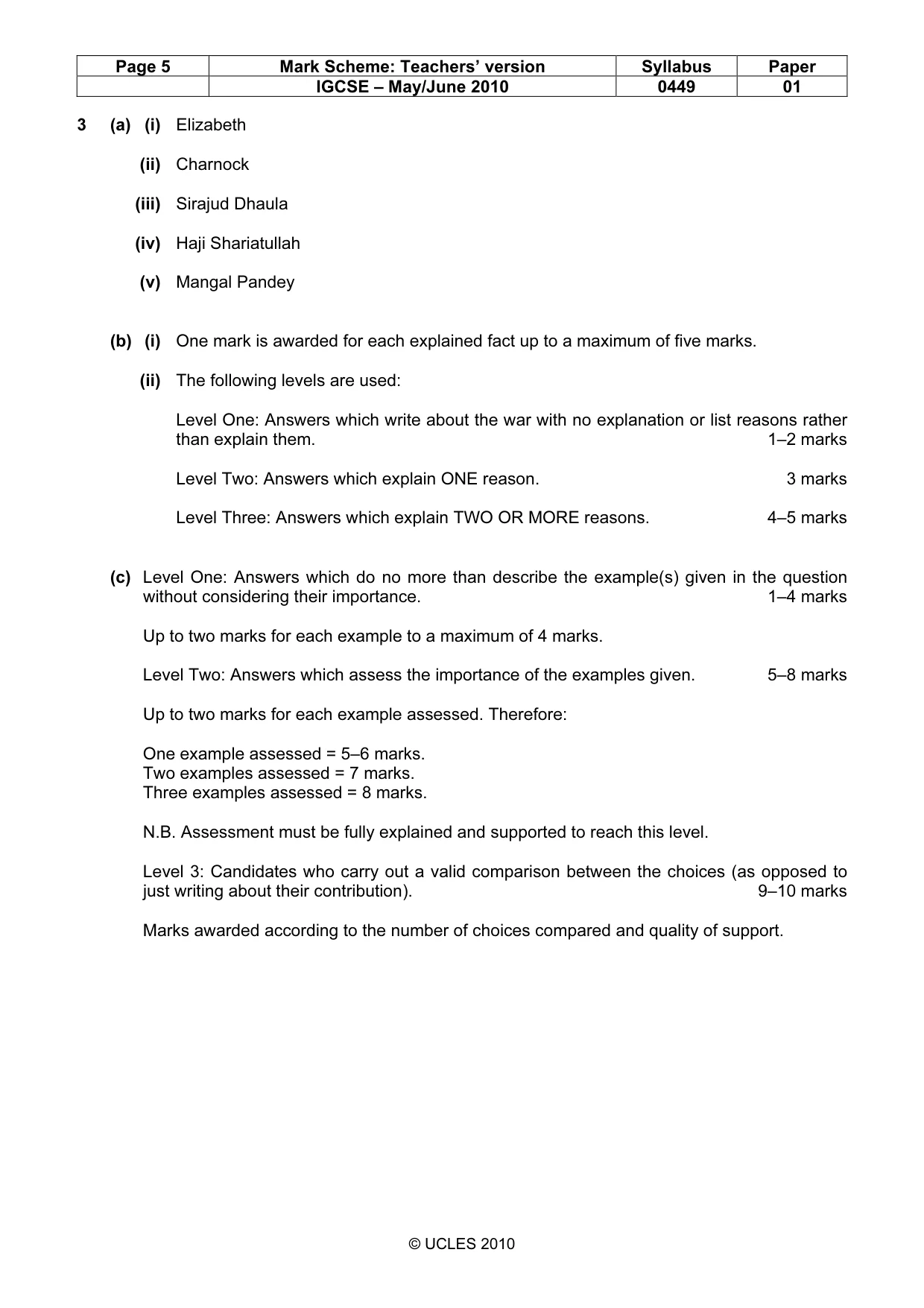
Page 5 Mark Scheme: Teachers’ version Syllabus Paper IGCSE – May/June 2010 0449 01 © UCLES 2010 3 (a) (i) Elizabeth (ii) Charnock (iii) Sirajud Dhaula (iv) Haji Shariatullah (v) Mangal Pandey (b) (i) One mark is awarded for each explained fact up to a maximum of five marks. (ii) The following levels are used: Level One: Answers which write about the war with no explanation or list reasons rather than explain them. 1–2 marks Level Two: Answers which explain ONE reason. 3 marks Level Three: Answers which explain TWO OR MORE reasons. 4–5 marks (c) Level One: Answers which do no more than describe the example(s) given in the question without considering their importance. 1–4 marks Up to two marks for each example to a maximum of 4 marks. Level Two: Answers which assess the importance of the examples given. 5–8 marks Up to two marks for each example assessed. Therefore: One example assessed = 5–6 marks. Two examples assessed = 7 marks. Three examples assessed = 8 marks. N.B. Assessment must be fully explained and supported to reach this level. Level 3: Candidates who carry out a valid comparison between the choices (as opposed to just writing about their contribution). 9–10 marks Marks awarded according to the number of choices compared and quality of support.
Mark scheme, page 6
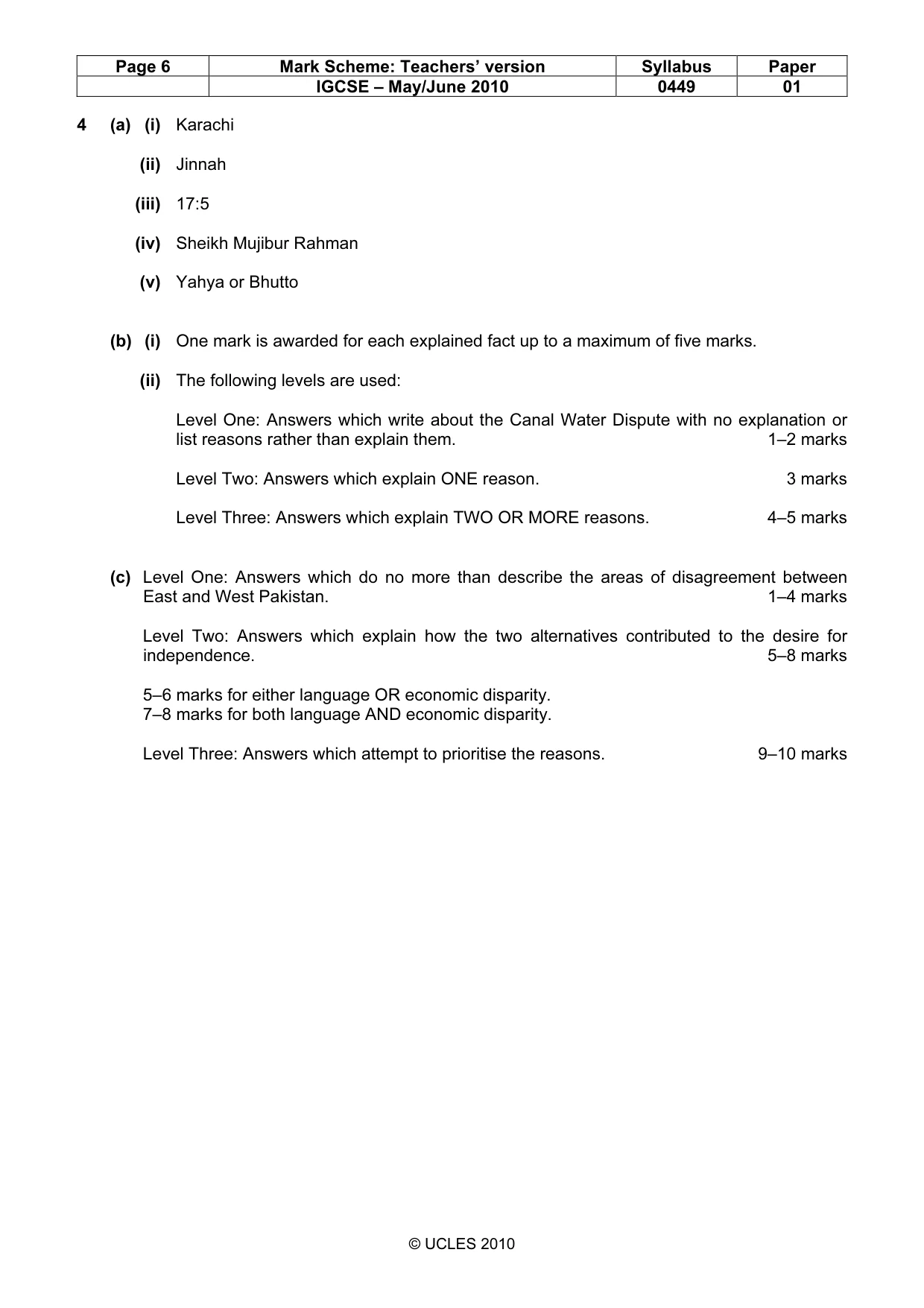
Page 6 Mark Scheme: Teachers’ version Syllabus Paper IGCSE – May/June 2010 0449 01 © UCLES 2010 4 (a) (i) Karachi (ii) Jinnah (iii) 17:5 (iv) Sheikh Mujibur Rahman (v) Yahya or Bhutto (b) (i) One mark is awarded for each explained fact up to a maximum of five marks. (ii) The following levels are used: Level One: Answers which write about the Canal Water Dispute with no explanation or list reasons rather than explain them. 1–2 marks Level Two: Answers which explain ONE reason. 3 marks Level Three: Answers which explain TWO OR MORE reasons. 4–5 marks (c) Level One: Answers which do no more than describe the areas of disagreement between East and West Pakistan. 1–4 marks Level Two: Answers which explain how the two alternatives contributed to the desire for independence. 5–8 marks 5–6 marks for either language OR economic disparity. 7–8 marks for both language AND economic disparity. Level Three: Answers which attempt to prioritise the reasons. 9–10 marks
What you needed in this session
Cambridge’s own grade thresholds for 2010 May/June, Paper 1 · Variant 1. A higher threshold means an easier paper — the bar moves with how the cohort did.