Cambridge IGCSE Bangladesh Studies 0449 — 2013 May/June Paper 1 · Variant 1
0449/11/M/J/13 · 75 marks · ≈84 min
The question paper and its mark scheme, free to read here and free to download. This is Cambridge’s own paper, exactly as it was sat.
Question paper8 pages

Mark scheme11 pages
Answers below. Sit the paper first if you are practising.
Paper as text
Question paper, page 1
This document consists of 6 printed pages and 2 blank pages. DC (SJF/JG) 66366/3 © UCLES 2013 [Turn over UNIVERSITY OF CAMBRIDGE INTERNATIONAL EXAMINATIONS International General Certificate of Secondary Education * 3 9 4 5 3 3 5 2 1 8 * BANGLADESH STUDIES 0449/01 Paper 1 History and Culture of Bangladesh May/June 2013 1 hour 30 minutes Additional Materials: Answer Booklet/Paper READ THESE INSTRUCTIONS FIRST If you have been given an Answer Booklet, follow the instructions on the front cover of the Booklet. Write your Centre number, candidate number and name on all the work you hand in. Write in dark blue or black pen. Do not use staples, paper clips, highlighters, glue or correction fluid. Answer three questions. Answer Question 1 and two other questions. You are advised to spend about 30 minutes on each question. At the end of the examination, fasten all your work securely together. The number of marks is given in brackets [ ] at the end of each question or part question.
Question paper, page 2
2 0449/01/M/J/13 © UCLES 2013 You MUST answer this question. Answer ALL parts. Question 1: The Culture and Heritage of Bangladesh Part (a): This question tests your knowledge. (i) Lalon Shah was a legendary baul. What were bauls? A Groups of warriors who composed chants B Artists working in villages C Musicians who composed and sang devotional folk songs D Groups of dancers [1] (ii) What was Begum Rokeya’s first story, written in 1905? A Nurse Nelly B Padmadvati C Sultana’s Dream D The Secluded Women [1] (iii) What did Zainul Abedin receive in 1967? A The title of Great Master of the Arts (Shilpacharya) B The title of Hilal-i-Imtaz C The Governor’s Gold Medal D The Nobel Prize [1] (iv) What weekly publication did Kazi Nazrul Islam start in 1925? A Langal B Chittanama C Mukhti D Nabajug [1] (v) Why did Rabindranath Tagore give up his knighthood in 1919? A Because of Indian losses in the First World War B Because of events at Amritsar C Because he wanted to lead a simple life D Because he disliked the Government of India Act [1] Part (b): This question tests your knowledge and understanding. (i) Describe the life and work of Alaol. [5] (ii) Explain why he is so important in the culture of Bangladesh. [3] Part (c): This question tests your understanding and judgement. (i) Explain why each of the following is important in the cultural life of Bangladesh • Religious festivals • Folk culture [10] (ii) Which of these has made the more important contribution? Explain why. [2] [Total: 25]
Question paper, page 3
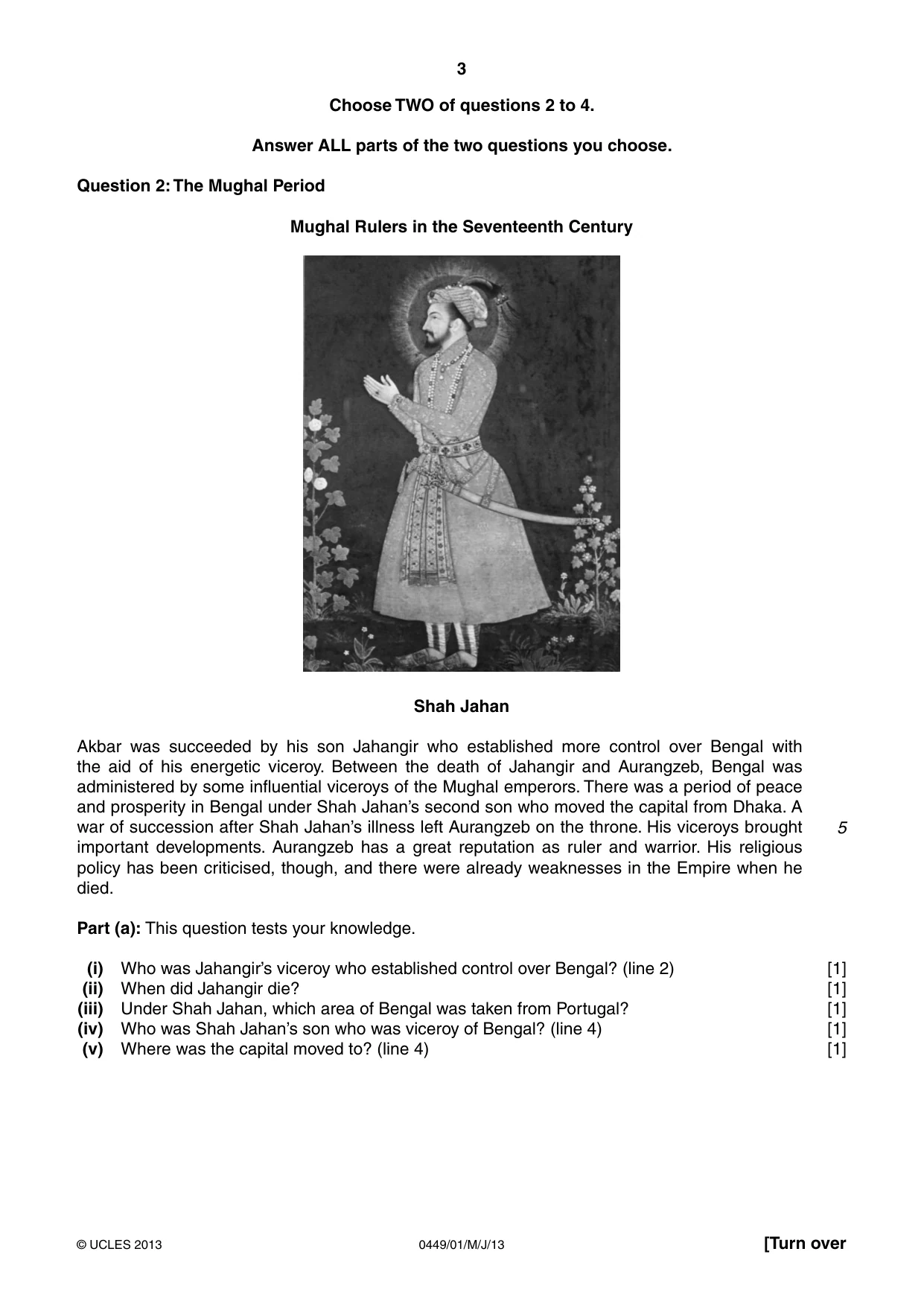
3 0449/01/M/J/13 © UCLES 2013 [Turn over Choose TWO of questions 2 to 4. Answer ALL parts of the two questions you choose. Question 2: The Mughal Period Mughal Rulers in the Seventeenth Century Shah Jahan Akbar was succeeded by his son Jahangir who established more control over Bengal with the aid of his energetic viceroy. Between the death of Jahangir and Aurangzeb, Bengal was administered by some influential viceroys of the Mughal emperors. There was a period of peace and prosperity in Bengal under Shah Jahan’s second son who moved the capital from Dhaka. A war of succession after Shah Jahan’s illness left Aurangzeb on the throne. His viceroys brought important developments. Aurangzeb has a great reputation as ruler and warrior. His religious policy has been criticised, though, and there were already weaknesses in the Empire when he died. Part (a): This question tests your knowledge. (i) Who was Jahangir’s viceroy who established control over Bengal? (line 2) [1] (ii) When did Jahangir die? [1] (iii) Under Shah Jahan, which area of Bengal was taken from Portugal? [1] (iv) Who was Shah Jahan’s son who was viceroy of Bengal? (line 4) [1] (v) Where was the capital moved to? (line 4) [1] 5
Question paper, page 4
4 0449/01/M/J/13 © UCLES 2013 Part (b): This question tests your knowledge and understanding. (i) Describe the succession struggle which brought Aurangzeb to the throne. [5] (ii) Explain how Bengal developed under Aurangzeb’s viceroy Mir Jumla. [5] Part (c): This question tests your understanding and judgement. (i) Explain why each of the following was important for the Mughal Empire. • Aurangzeb’s religious policies • Aurangzeb’s policies in the Deccan [8] (ii) Explain which of these was more important, and why. [2] [Total: 25]
Question paper, page 5
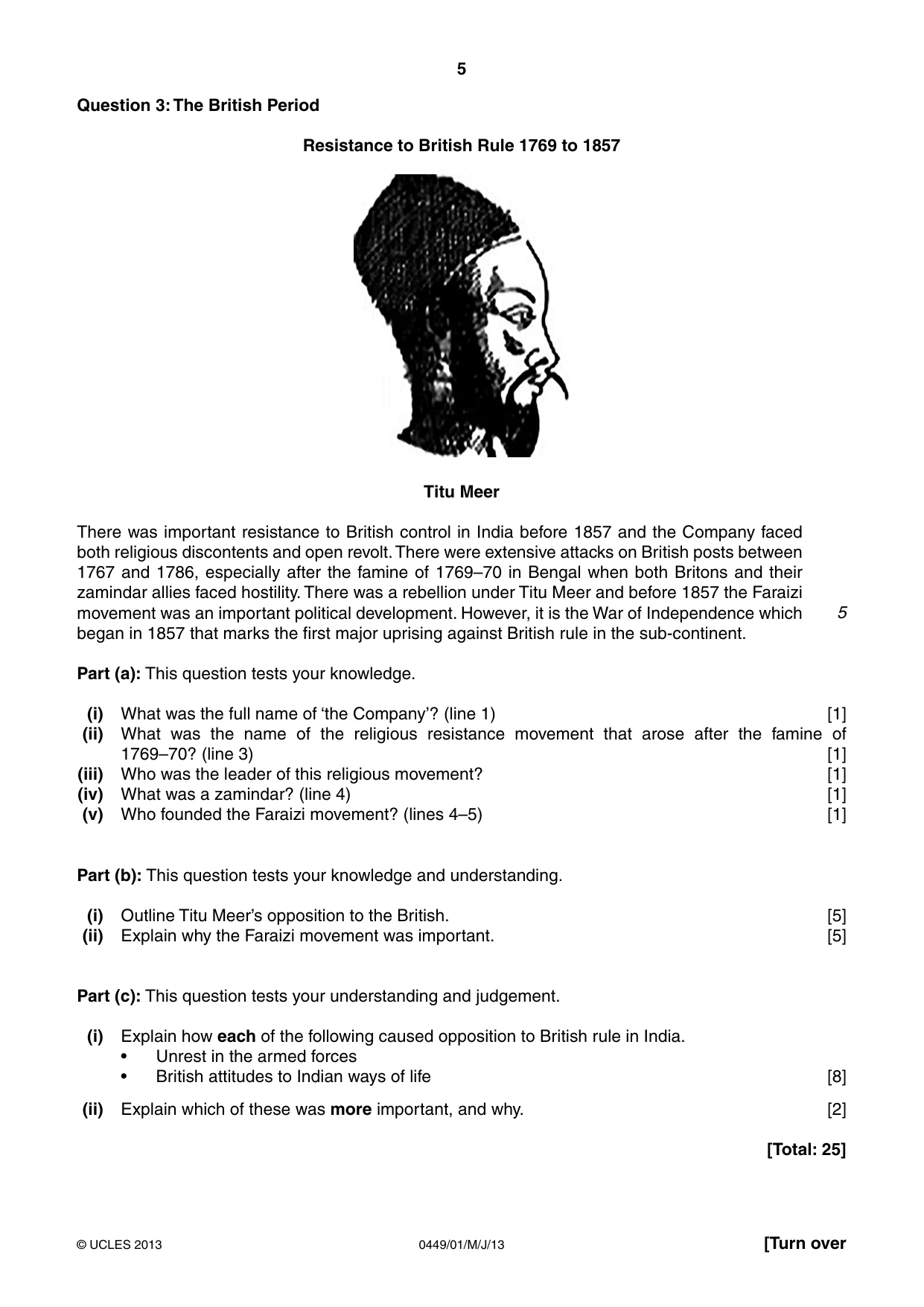
5 0449/01/M/J/13 © UCLES 2013 [Turn over Question 3: The British Period Resistance to British Rule 1769 to 1857 Titu Meer There was important resistance to British control in India before 1857 and the Company faced both religious discontents and open revolt. There were extensive attacks on British posts between 1767 and 1786, especially after the famine of 1769–70 in Bengal when both Britons and their zamindar allies faced hostility. There was a rebellion under Titu Meer and before 1857 the Faraizi movement was an important political development. However, it is the War of Independence which began in 1857 that marks the first major uprising against British rule in the sub-continent. Part (a): This question tests your knowledge. (i) What was the full name of ‘the Company’? (line 1) [1] (ii) What was the name of the religious resistance movement that arose after the famine of 1769–70? (line 3) [1] (iii) Who was the leader of this religious movement? [1] (iv) What was a zamindar? (line 4) [1] (v) Who founded the Faraizi movement? (lines 4–5) [1] Part (b): This question tests your knowledge and understanding. (i) Outline Titu Meer’s opposition to the British. [5] (ii) Explain why the Faraizi movement was important. [5] Part (c): This question tests your understanding and judgement. (i) Explain how each of the following caused opposition to British rule in India. • Unrest in the armed forces • British attitudes to Indian ways of life [8] (ii) Explain which of these was more important, and why. [2] [Total: 25] 5
Question paper, page 6
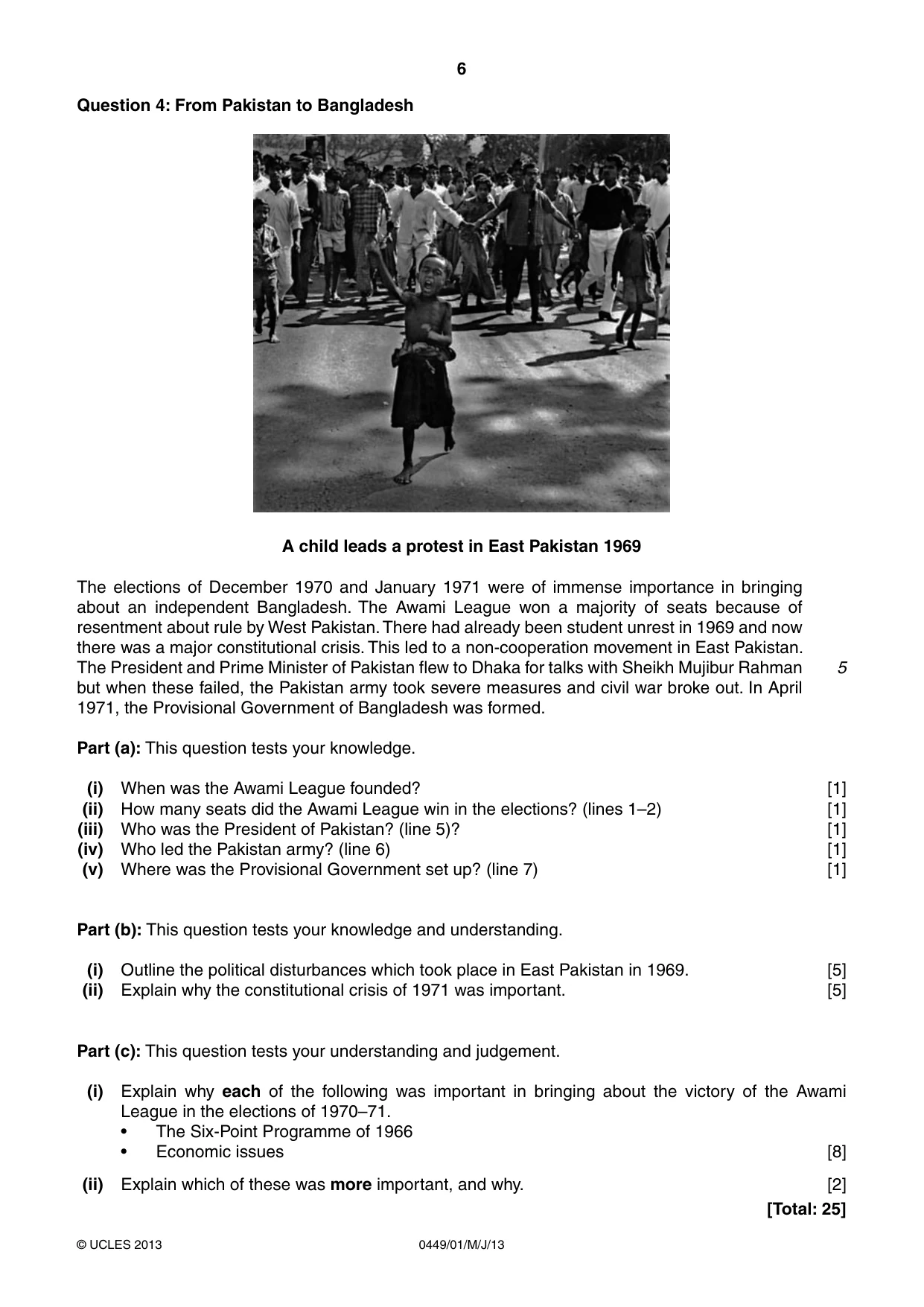
6 0449/01/M/J/13 © UCLES 2013 Question 4: From Pakistan to Bangladesh A child leads a protest in East Pakistan 1969 The elections of December 1970 and January 1971 were of immense importance in bringing about an independent Bangladesh. The Awami League won a majority of seats because of resentment about rule by West Pakistan. There had already been student unrest in 1969 and now there was a major constitutional crisis. This led to a non-cooperation movement in East Pakistan. The President and Prime Minister of Pakistan flew to Dhaka for talks with Sheikh Mujibur Rahman but when these failed, the Pakistan army took severe measures and civil war broke out. In April 1971, the Provisional Government of Bangladesh was formed. Part (a): This question tests your knowledge. (i) When was the Awami League founded? [1] (ii) How many seats did the Awami League win in the elections? (lines 1–2) [1] (iii) Who was the President of Pakistan? (line 5)? [1] (iv) Who led the Pakistan army? (line 6) [1] (v) Where was the Provisional Government set up? (line 7) [1] Part (b): This question tests your knowledge and understanding. (i) Outline the political disturbances which took place in East Pakistan in 1969. [5] (ii) Explain why the constitutional crisis of 1971 was important. [5] Part (c): This question tests your understanding and judgement. (i) Explain why each of the following was important in bringing about the victory of the Awami League in the elections of 1970–71. • The Six-Point Programme of 1966 • Economic issues [8] (ii) Explain which of these was more important, and why. [2] [Total: 25] 5
Question paper, page 7
7 0449/01/M/J/13 © UCLES 2013 BLANK PAGE
Question paper, page 8
8 0449/01/M/J/13 © UCLES 2013 BLANK PAGE Copyright Acknowledgements: Question 2 © Image of Shah Jahan; Islamic Arts and Architecture Organization; http://islamicart.com. Question 3 © Image of Titu Meer; www.indianetzone.com. Question 4 Photograph © A child leads a protest in East Pakistan, 1969; Guardian News & Media Ltd; 10 April 2008. Permission to reproduce items where third-party owned material protected by copyright is included has been sought and cleared where possible. Every reasonable effort has been made by the publisher (UCLES) to trace copyright holders, but if any items requiring clearance have unwittingly been included, the publisher will be pleased to make amends at the earliest possible opportunity. University of Cambridge International Examinations is part of the Cambridge Assessment Group. Cambridge Assessment is the brand name of University of Cambridge Local Examinations Syndicate (UCLES), which is itself a department of the University of Cambridge.
Mark scheme, page 1
CAMBRIDGE INTERNATIONAL EXAMINATIONS International General Certificate of Secondary Education MARK SCHEME for the May/June 2013 series 0449 BANGLADESH STUDIES 0449/01 Paper 1 (History and Culture of Bangladesh), maximum raw mark 75 This mark scheme is published as an aid to teachers and candidates, to indicate the requirements of the examination. It shows the basis on which Examiners were instructed to award marks. It does not indicate the details of the discussions that took place at an Examiners’ meeting before marking began, which would have considered the acceptability of alternative answers. Mark schemes should be read in conjunction with the question paper and the Principal Examiner Report for Teachers. Cambridge will not enter into discussions about these mark schemes. Cambridge is publishing the mark schemes for the May/June 2013 series for most IGCSE, GCE Advanced Level and Advanced Subsidiary Level components and some Ordinary Level components.
Mark scheme, page 2
Page 2 Mark Scheme Syllabus Paper IGCSE – May/June 2013 0449 01 © Cambridge International Examinations 2013 Introduction The questions on Paper 1 divide into several distinct types: * Questions which are either correct (or score one mark) or are incorrect (and score zero). These can be found in Part (a) of each of the four questions on the paper. * Questions which require candidates to relate historical information without analysis. These will usually be found in Part (b) (i) of Questions 2 to 4 and will be marked on a ‘one point = one mark basis’. * Questions where there is a hierarchy of correct responses, as in Part (b) of Question 1, Part (b) (ii) of Questions 2 to 4 and in all Part (c) questions. For such answers, a ‘levels of response’ mark scheme is used. The candidate’s response is placed in a level according to the best part of the answer and the mark within that level is awarded according to the criteria set out in the mark scheme.
Mark scheme, page 3
Page 3 Mark Scheme Syllabus Paper IGCSE – May/June 2013 0449 01 © Cambridge International Examinations 2013 1 (a) 1 mark for each correct answer: (i) C (ii) C (iii) A (iv) A (v) B (b) (i) Level 1: A generalised account about the life and work of Alaol. 1–2 marks Reserve one mark for very simplistic statements, e.g. He was a famous writer. Level 2: Answers which offer accurate factual statements about his life and describe examples of Alaol’s work. (Just life or just work – max 4) 3–5 marks He was born in 1607 to an aristocratic family. His father was a minister who ensured that he had a strong education and knew different languages. He was captured by Portuguese pirates and taken to Arakan. He worked as a teacher in a wealthy family. He was patronised by members of the Arakan court and became known as a poet and writer. He is known for translations into Bangla, for example the Hindi poem Padmadvat. He translated Persian masterpieces, but also wrote original works. He wrote songs and a book on music. He also wrote on moral and religious issues. He died in 1673. Mark within the level should be based upon the amount of supporting detail provided. (ii) Level 1: Generalised comment on importance only. 1 mark e.g. He wrote important works on music. He has a literary prize named after him so is important. Level 2: Supported explanation. 2–3 marks There will be no marks for description even if there is factual material not in (b) (i). e.g. He translated important works from other languages into Bangla and so allowed Bangla speakers to appreciate other cultures. By doing this he extended the style and vocabulary of Bangla literature. He linked Bangla speakers to a wider cultural world. He developed Bangla poetry by introducing romantic themes.
Mark scheme, page 4
Page 4 Mark Scheme Syllabus Paper IGCSE – May/June 2013 0449 01 © Cambridge International Examinations 2013 (c) (i) Level 1: Answers which do no more than describe the two elements given in the question without considering their importance. 1–6 marks (max 4 if just one element is considered) e.g. may describe Muslim, Hindu, Buddhist, Christian, Tribal and common festivals with examples. May describe some elements of these festivals. May describe elements of folk culture such as making of ornaments, clothes, toys, tapestry and may describe materials used e.g. clay pottery or tapestry. Level 2: Answers which explain the importance. 7–10 marks (max 8 if just one element is explained) Religious festivals = inspirational and a link to the past; different festivals a sign of religious toleration and diversity; marking key points in the year; common festivals encourage unity. Folk festivals preserve the different aspects of rural life; they represent skills which are passed on and the work of people with little formal training or education but who gain status and have creative outlet by their work. Preserve high levels of craftsmanship which gives rural Bangladesh special artistic identity. Important for women who are prominent in pottery and tapestry. (ii) There are 2 marks for explaining the choice made. There is no credit for merely saying ‘The most important is ...’ If the answer is that they are interlinked because folk art is part of the festival culture, that would be acceptable. Folk Culture is important for spreading Bangladesh culture to a wider world through exports. The religious festivals mark out the year and encourage spiritual reflection so could be seen as more significant that the products of folk culture. No set explanation is expected.
Mark scheme, page 5
Page 5 Mark Scheme Syllabus Paper IGCSE – May/June 2013 0449 01 © Cambridge International Examinations 2013 2 (a) 1 mark for each correct answer: (i) Islam Khan (ii) 1627 (iii) Hugli (iv) Prince Suja or Suja (v) Rajmahal (b) (i) 1 mark for each explained fact about the struggle for succession (to max of 5). One mark is awarded for each explained fact about the struggle for succession, up to a maximum of five marks. • Shah Jehan fell ill in September 1657 and this caused a struggle for power between his four sons. • Dara Shiko, Suja, Aurangzeb and Murad. The main contest was between Aurangzeb and Dara. • On 29 May 1658, Dara was defeated at Samugar. • Aurangzeb occupied Agra and imprisoned his father in Agra Fort and also imprisoned Murad. • At Khajwa, Aurangzeb’s army defeated that of Suja. • Aurangzeb had his brother Dara beheaded. • In 1660, Suja was defeated by Aurangzeb’s general Mir Jumla. • Suja and his family were killed by the ruler of Arakan. (ii) Level 1: Answers which write about Mir Jumla generally without reference to Bengal’s development or offer very simple generalisations. 1–2 marks e.g. He was a very important viceroy who became a powerful ruler. He expanded Bengal. He is important for the development of Dhaka. Level 2: Answers which explain ONE development. 3 marks Level 3: Answers which explain TWO OR MORE developments. 4–5 marks He moved the capital from Rajmahal to Dhaka to emphasise a new authority over Bengal. He extended the territory of Bengal by adding Kuch Bihar and Assam and for a while was in charge of Orissa. He raised the authority of the Viceroy’s position and was awarded the title Khan-e-Khanam. It was Mir Jumla who contributed greatly towards development of Dhaka. He built Mir Jamal's Gate. Two important roads, Dhaka-Tongi and Dhaka-Fatulla, were laid out.
Mark scheme, page 6
Page 6 Mark Scheme Syllabus Paper IGCSE – May/June 2013 0449 01 © Cambridge International Examinations 2013 (c) (i) Level 1: Answers which do no more than describe the policies given in the question without considering their importance. 1–4 marks Up to 2 marks for each policy. Religious Policies: He reimposed the Jizia on non-believers. He rejected the idea of joining hands with the Hindus. He banned Sati. He favoured Muslims and caused discontent. Aurangzeb was much more orthodox than Shah Jahan, going so far as to outlaw music and other performances in 1668. Hindus were forbidden to sing, play musical instruments or to dance – Aurangzeb also ordered the destruction of Hindu temples. In addition, he ordered Christian missionaries to be enslaved. Policies in the Deccan: Aurangzeb was driven into increasingly extensive military commitment in the Deccan in response to opposition by the Maratha clans. In 1657, Aurangzeb attacked Golconda and Bijapur. The Hindu leader Shivaji, using guerrilla tactics, took control of three key forts. Shivaji took the leadership of many independent Maratha clans. In 1659, Aurangzeb sent a force to the Deccan to recover lost forts occupied by the Marathas. Shivaji drove the Muslims out. Aurangzeb ignored the rise of the Marathas for the next few years as he was occupied with the rise of Sikhism. At last, Aurangzeb sent forces to attack the Marathas. His Rajput general Jai Singh won the fort of Purandar. Shivaji agreed to meet Aurangzeb but was imprisoned and then escaped and was crowned Emperor of the Maratha Empire in 1674. While Aurangzeb continued to send troops against him, Shivaji expanded Maratha control throughout the Deccan until his death in 1680. Shivaji was succeeded by his son Sambhaji. Militarily and politically, Mughal efforts to control the Deccan failed. He sent forces into the Deccan to annex Golconda in 1686 and Bijapur in 1687. These were Shia states which had been supportive to the Marathas. He did not attempt a friendly policy towards them. His efforts to control the Deccan continued to fail. Aurangzeb was forced to contest every inch of territory, at great cost in lives and treasure against organized forces. Even as Aurangzeb drove west, deep into Maratha territory, the Marathas expanded their attacks further into Mughal lands. Aurangzeb lost about a fifth of his army fighting in the Deccan. Level 2: Answers which explain the importance of the policies given. 5–8 marks Up to 2 marks for each policy assessed. Therefore: One explained = 5–6 marks Two explained = 7–8 marks. e.g. The religious policies threatened traditional Hindu practices and increased the financial burdens on non-Muslims, alienating them and dividing the Empire. The Deccan policy adopted a forceful solution in the Deccan rather than a diplomatic one and deprived Aurangzeb of potential allies against the Marathas who developed as the strongest power in northern India and accelerated the disintegration of the Empire. Both policies tended to divide and weaken the empire and the Deccan over-extended military resources.
Mark scheme, page 7
Page 7 Mark Scheme Syllabus Paper IGCSE – May/June 2013 0449 01 © Cambridge International Examinations 2013 (ii) There are 2 marks for explaining the choice made. There is no credit for merely saying ‘The most important is ...’ e.g. The Deccan policies could be seen as more important because they weaken the political power of the Mughal Empire. The religious policies could be seen as more important because they created serious internal divisions in the Mughal Empire. Answers might point to the links between intolerant internal policies and the determination to crush the Marathas. No set explanation is expected.
Mark scheme, page 8
Page 8 Mark Scheme Syllabus Paper IGCSE – May/June 2013 0449 01 © Cambridge International Examinations 2013 3 (a) 1 mark for each correct answer: (i) East India Company (ii) Fakir-Sanyari (iii) Majnu Shah (iv) Landowner (v) Haji Shariatullah (b) (i) 1 mark for each explained fact about the struggle for succession (to max of 5). • Titu Meer was a Muslim religious leader concerned about British power eroding the faith of Muslims. • He opposed the treatment of Muslims by Hindu landowners. • He formed a makeshift army. He armed it with lathis and improvised weapons. • He made his nephew Ghulam Masum the commander. • He had initial victories against the British commander (Davis) and killed a leading zamindar. • He then defeated a force sent against him under Alexander, the Collector of Barasat. • He built a strong bamboo fort near Narkelbaria in October 1831 and his army rose to 5000. • He declared himself king and controlled a large area. • A force of 100 horsemen and 300 infantry with two cannon commanded by Stewart defeated Titu Meer and destroyed his fort in November 1831. • Titu Meer was killed and his nephew executed. (ii) Level 1: Answers which write about the movement with no explanation. 1–2 marks e.g. It was set up to protect the peasants. It was started by Haji Shariatullah. It was non- violent. Level 2: Answers which explain ONE reason for importance. 3 marks Level 3: Answers which explain TWO OR MORE reasons. 4–5 marks The scale of the movement was greater than that of the earlier revolt and it united the Muslim peasants in a campaign of disobedience about taxpaying and cow slaughtering (ordered by Hindu landlords). It also lasted longer and the work was carried on by Shariahtullah’s son. It was still going in the 1880s. It led to more than protests. It produced a spiritual revival of Islam in east Bengal. It encouraged a sense of political, cultural and religious unity. Some may link it to non-violent civil disobedience in the twentieth century. It was not something which could be crushed by military force. Arrest and imprisonment made its leaders and the movement gain prestige.
Mark scheme, page 9
Page 9 Mark Scheme Syllabus Paper IGCSE – May/June 2013 0449 01 © Cambridge International Examinations 2013 (c) (i) Level 1: Answers which do no more than describe the factors given in the question without considering their importance. 1–4 marks Up to 2 marks for each factor. Unrest in the armed forces: Sepoys from Oudh and the North West Frontier were paid as well as the British troops and they had few chances of promotion. They had fought in what they saw as foreign lands – like Sindh – but had not been paid extra. In January 1857, rumours spread about the new Enfield rifle having cartridges that were greased in beef and pork fat. British attitudes to Indian ways of life: Many of the British in India showed a lack of respect for Indian culture and traditions, seeing their own ways as much ‘superior’. The abolition of Satidaha and introduction of remarriage for widows was seen as attacking Indian beliefs and values. New technology such as the railways and the telegraph seemed alien and a threat to India’s traditions. Missionary schools teaching Christianity seemed to threaten Islam. Level 2: Answers which explain the importance of the factors given. 5–8 marks Up to 2 marks for each factor explained. Therefore: One explained= 5–6 marks Two explained = 7–8 marks. N.B. Assessment must be fully explained and supported to reach this level. Military grievances were a trigger for more general concerns about British rule. Indicative of British lack of understanding of and concern for Indian traditions, values and concerns e.g. travelling over water, contact with animal fat. Traditional caste and religion were threatened by expanding British power. Unlike landowning grievances and unrest among some princes, these discontents went right though society. (ii) There are 2 marks for explaining the choice made. There is no credit for merely saying ‘The most important is ...’ Unrest in the armed forces: Military grievances a key trigger – rebels had arms and organization through their army to challenge British authority in key areas. However, these were part of broader grievances against British rule and attitudes. Candidates might offer the view that the two are profoundly linked. No set explanation is expected.
Mark scheme, page 10
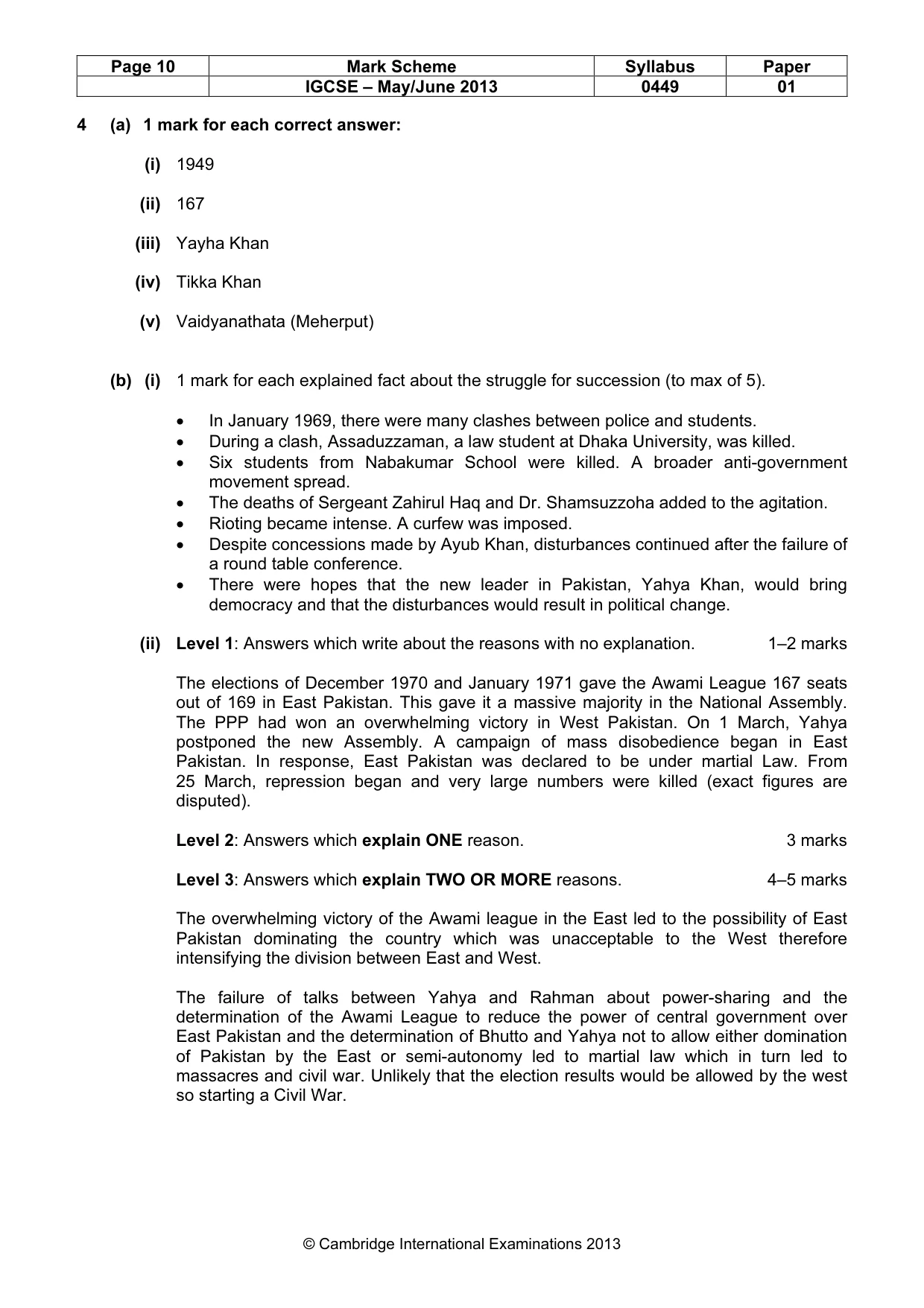
Page 10 Mark Scheme Syllabus Paper IGCSE – May/June 2013 0449 01 © Cambridge International Examinations 2013 4 (a) 1 mark for each correct answer: (i) 1949 (ii) 167 (iii) Yayha Khan (iv) Tikka Khan (v) Vaidyanathata (Meherput) (b) (i) 1 mark for each explained fact about the struggle for succession (to max of 5). • In January 1969, there were many clashes between police and students. • During a clash, Assaduzzaman, a law student at Dhaka University, was killed. • Six students from Nabakumar School were killed. A broader anti-government movement spread. • The deaths of Sergeant Zahirul Haq and Dr. Shamsuzzoha added to the agitation. • Rioting became intense. A curfew was imposed. • Despite concessions made by Ayub Khan, disturbances continued after the failure of a round table conference. • There were hopes that the new leader in Pakistan, Yahya Khan, would bring democracy and that the disturbances would result in political change. (ii) Level 1: Answers which write about the reasons with no explanation. 1–2 marks The elections of December 1970 and January 1971 gave the Awami League 167 seats out of 169 in East Pakistan. This gave it a massive majority in the National Assembly. The PPP had won an overwhelming victory in West Pakistan. On 1 March, Yahya postponed the new Assembly. A campaign of mass disobedience began in East Pakistan. In response, East Pakistan was declared to be under martial Law. From 25 March, repression began and very large numbers were killed (exact figures are disputed). Level 2: Answers which explain ONE reason. 3 marks Level 3: Answers which explain TWO OR MORE reasons. 4–5 marks The overwhelming victory of the Awami league in the East led to the possibility of East Pakistan dominating the country which was unacceptable to the West therefore intensifying the division between East and West. The failure of talks between Yahya and Rahman about power-sharing and the determination of the Awami League to reduce the power of central government over East Pakistan and the determination of Bhutto and Yahya not to allow either domination of Pakistan by the East or semi-autonomy led to martial law which in turn led to massacres and civil war. Unlikely that the election results would be allowed by the west so starting a Civil War.
Mark scheme, page 11
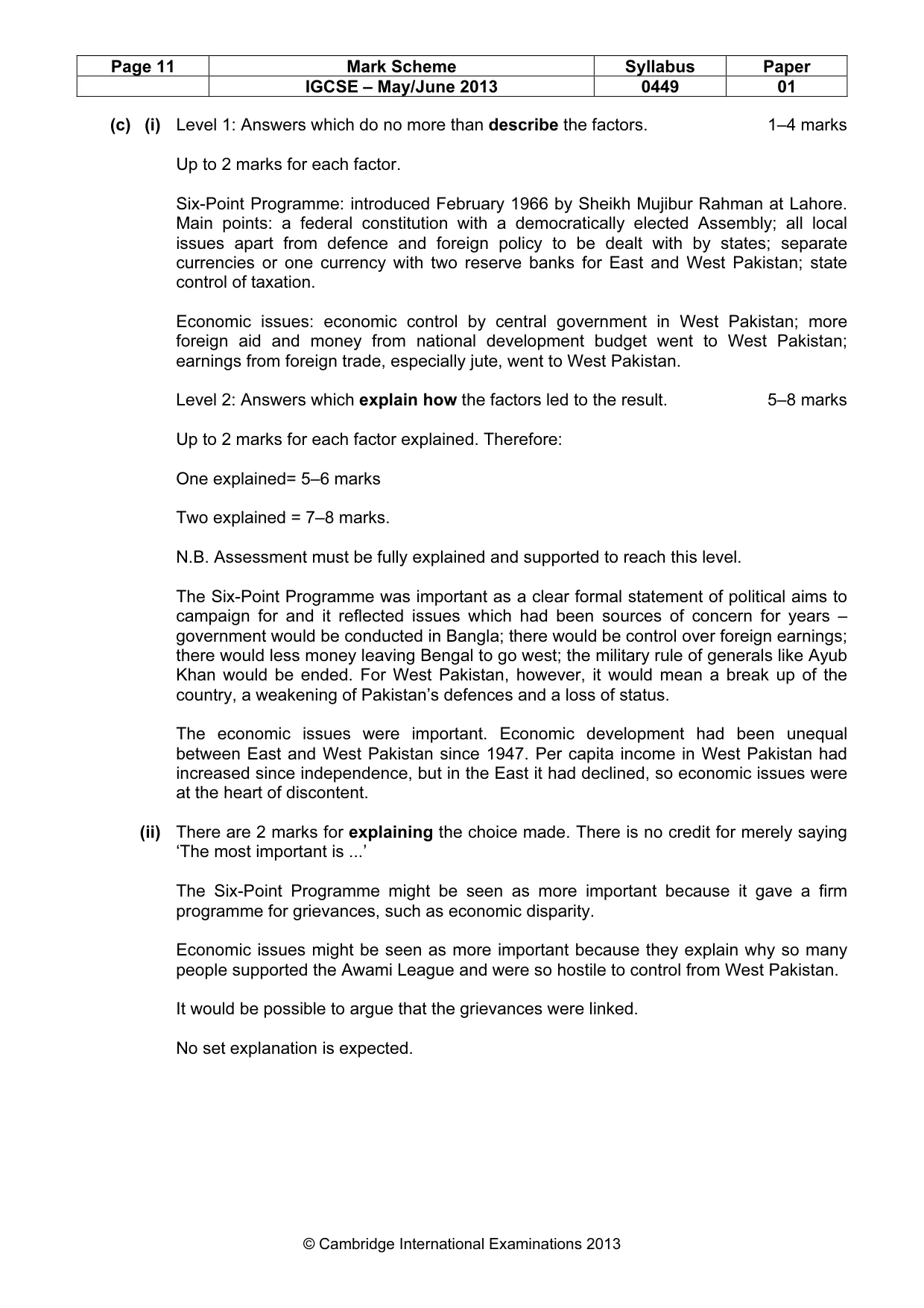
Page 11 Mark Scheme Syllabus Paper IGCSE – May/June 2013 0449 01 © Cambridge International Examinations 2013 (c) (i) Level 1: Answers which do no more than describe the factors. 1–4 marks Up to 2 marks for each factor. Six-Point Programme: introduced February 1966 by Sheikh Mujibur Rahman at Lahore. Main points: a federal constitution with a democratically elected Assembly; all local issues apart from defence and foreign policy to be dealt with by states; separate currencies or one currency with two reserve banks for East and West Pakistan; state control of taxation. Economic issues: economic control by central government in West Pakistan; more foreign aid and money from national development budget went to West Pakistan; earnings from foreign trade, especially jute, went to West Pakistan. Level 2: Answers which explain how the factors led to the result. 5–8 marks Up to 2 marks for each factor explained. Therefore: One explained= 5–6 marks Two explained = 7–8 marks. N.B. Assessment must be fully explained and supported to reach this level. The Six-Point Programme was important as a clear formal statement of political aims to campaign for and it reflected issues which had been sources of concern for years – government would be conducted in Bangla; there would be control over foreign earnings; there would less money leaving Bengal to go west; the military rule of generals like Ayub Khan would be ended. For West Pakistan, however, it would mean a break up of the country, a weakening of Pakistan’s defences and a loss of status. The economic issues were important. Economic development had been unequal between East and West Pakistan since 1947. Per capita income in West Pakistan had increased since independence, but in the East it had declined, so economic issues were at the heart of discontent. (ii) There are 2 marks for explaining the choice made. There is no credit for merely saying ‘The most important is ...’ The Six-Point Programme might be seen as more important because it gave a firm programme for grievances, such as economic disparity. Economic issues might be seen as more important because they explain why so many people supported the Awami League and were so hostile to control from West Pakistan. It would be possible to argue that the grievances were linked. No set explanation is expected.
What you needed in this session
Cambridge’s own grade thresholds for 2013 May/June, Paper 1 · Variant 1. A higher threshold means an easier paper — the bar moves with how the cohort did.