Cambridge IGCSE Bangladesh Studies 0449 — 2009 May/June Paper 1 · Variant 1
0449/11/M/J/09 · 75 marks · ≈84 min
The question paper and its mark scheme, free to read here and free to download. This is Cambridge’s own paper, exactly as it was sat.
Question paper8 pages



Mark scheme6 pages
Answers below. Sit the paper first if you are practising.
Paper as text
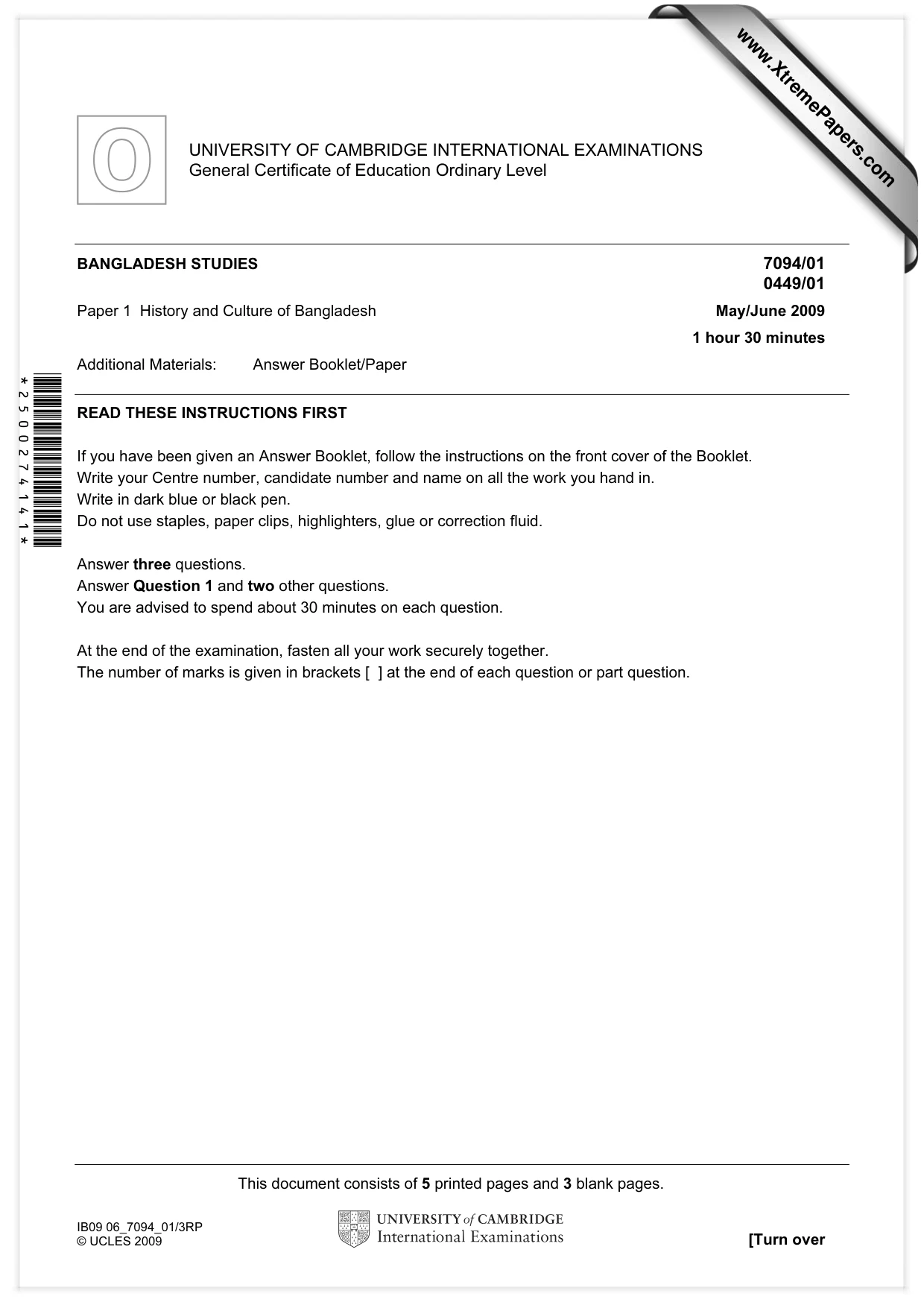
Question paper, page 1
This document consists of 5 printed pages and 3 blank pages. IB09 06_7094_01/3RP © UCLES 2009 [Turn over *2500274141* UNIVERSITY OF CAMBRIDGE INTERNATIONAL EXAMINATIONS General Certificate of Education Ordinary Level BANGLADESH STUDIES 7094/01 0449/01 Paper 1 History and Culture of Bangladesh May/June 2009 1 hour 30 minutes Additional Materials: Answer Booklet/Paper READ THESE INSTRUCTIONS FIRST If you have been given an Answer Booklet, follow the instructions on the front cover of the Booklet. Write your Centre number, candidate number and name on all the work you hand in. Write in dark blue or black pen. Do not use staples, paper clips, highlighters, glue or correction fluid. Answer three questions. Answer Question 1 and two other questions. You are advised to spend about 30 minutes on each question. At the end of the examination, fasten all your work securely together. The number of marks is given in brackets [ ] at the end of each question or part question. www.XtremePapers.com
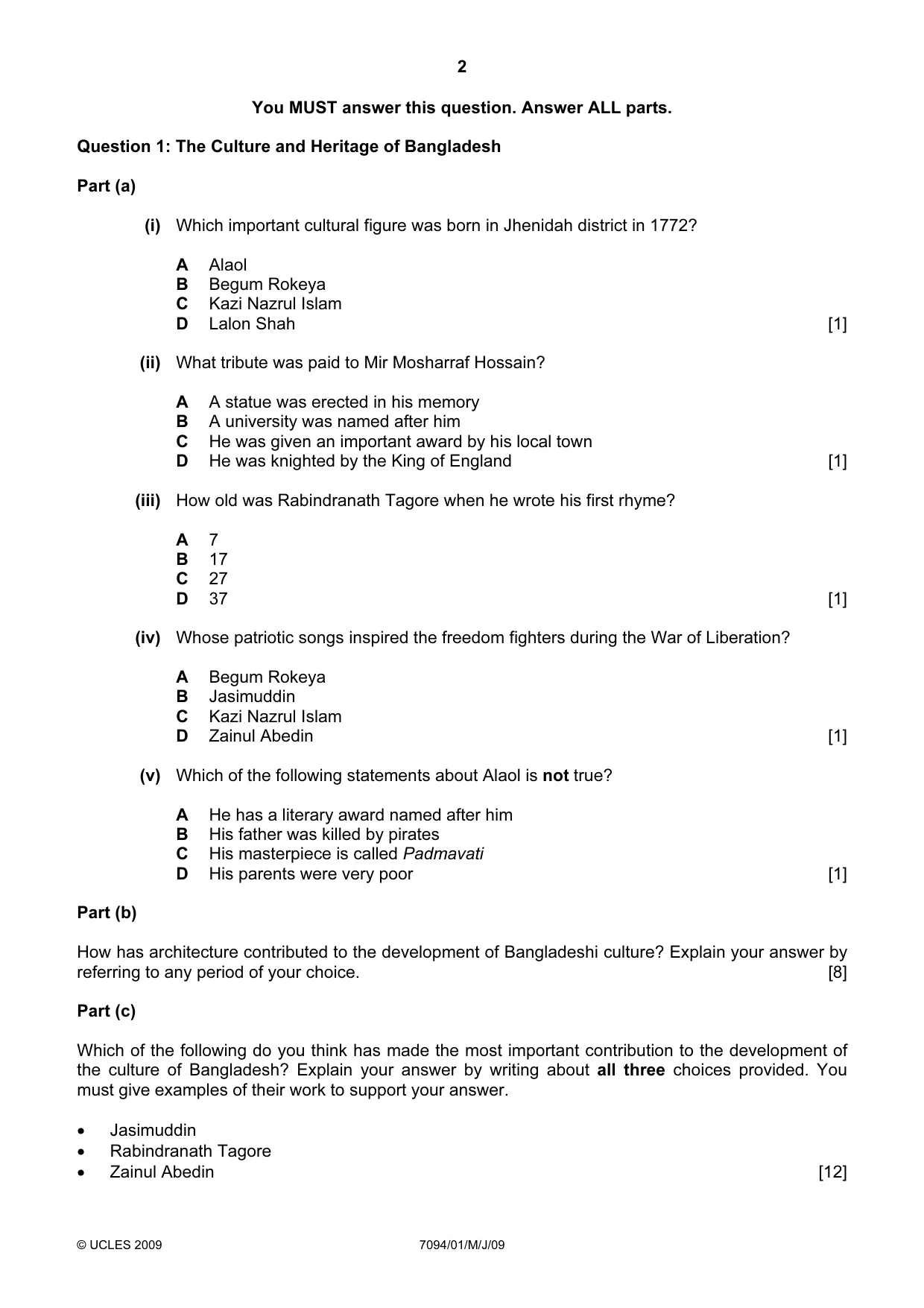
Question paper, page 2
2 © UCLES 2009 7094/01/M/J/09 You MUST answer this question. Answer ALL parts. Question 1: The Culture and Heritage of Bangladesh Part (a) (i) Which important cultural figure was born in Jhenidah district in 1772? A Alaol B Begum Rokeya C Kazi Nazrul Islam D Lalon Shah [1] (ii) What tribute was paid to Mir Mosharraf Hossain? A A statue was erected in his memory B A university was named after him C He was given an important award by his local town D He was knighted by the King of England [1] (iii) How old was Rabindranath Tagore when he wrote his first rhyme? A 7 B 17 C 27 D 37 [1] (iv) Whose patriotic songs inspired the freedom fighters during the War of Liberation? A Begum Rokeya B Jasimuddin C Kazi Nazrul Islam D Zainul Abedin [1] (v) Which of the following statements about Alaol is not true? A He has a literary award named after him B His father was killed by pirates C His masterpiece is called Padmavati D His parents were very poor [1] Part (b) How has architecture contributed to the development of Bangladeshi culture? Explain your answer by referring to any period of your choice. [8] Part (c) Which of the following do you think has made the most important contribution to the development of the culture of Bangladesh? Explain your answer by writing about all three choices provided. You must give examples of their work to support your answer. • Jasimuddin • Rabindranath Tagore • Zainul Abedin [12]
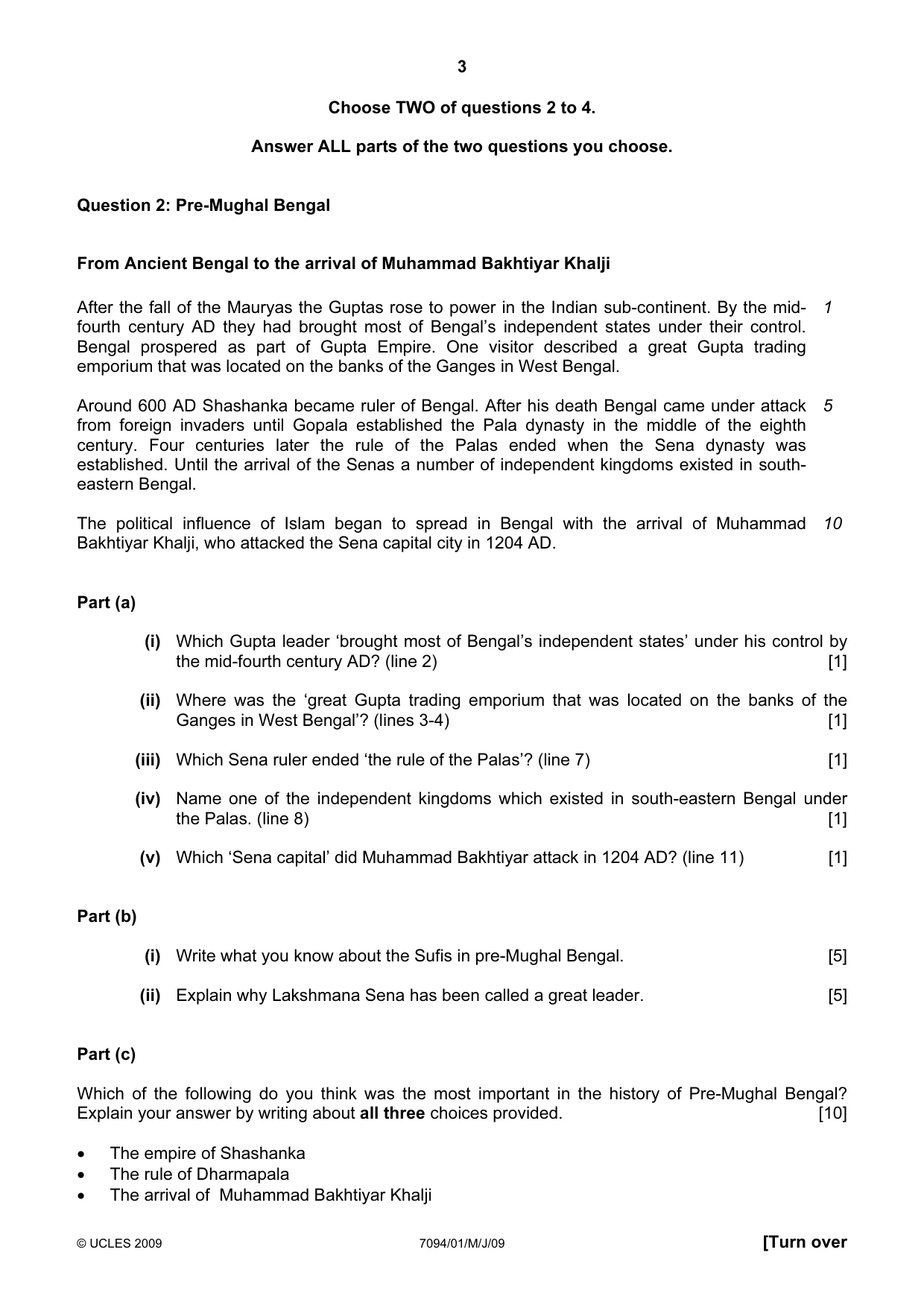
Question paper, page 3
3 © UCLES 2009 7094/01/M/J/09 [Turn over Choose TWO of questions 2 to 4. Answer ALL parts of the two questions you choose. Question 2: Pre-Mughal Bengal From Ancient Bengal to the arrival of Muhammad Bakhtiyar Khalji After the fall of the Mauryas the Guptas rose to power in the Indian sub-continent. By the mid- fourth century AD they had brought most of Bengal’s independent states under their control. Bengal prospered as part of Gupta Empire. One visitor described a great Gupta trading emporium that was located on the banks of the Ganges in West Bengal. Around 600 AD Shashanka became ruler of Bengal. After his death Bengal came under attack from foreign invaders until Gopala established the Pala dynasty in the middle of the eighth century. Four centuries later the rule of the Palas ended when the Sena dynasty was established. Until the arrival of the Senas a number of independent kingdoms existed in south- eastern Bengal. The political influence of Islam began to spread in Bengal with the arrival of Muhammad Bakhtiyar Khalji, who attacked the Sena capital city in 1204 AD. 1 5 10 Part (a) (i) Which Gupta leader ‘brought most of Bengal’s independent states’ under his control by the mid-fourth century AD? (line 2) [1] (ii) Where was the ‘great Gupta trading emporium that was located on the banks of the Ganges in West Bengal’? (lines 3-4) [1] (iii) Which Sena ruler ended ‘the rule of the Palas’? (line 7) [1] (iv) Name one of the independent kingdoms which existed in south-eastern Bengal under the Palas. (line 8) [1] (v) Which ‘Sena capital’ did Muhammad Bakhtiyar attack in 1204 AD? (line 11) [1] Part (b) (i) Write what you know about the Sufis in pre-Mughal Bengal. [5] (ii) Explain why Lakshmana Sena has been called a great leader. [5] Part (c) Which of the following do you think was the most important in the history of Pre-Mughal Bengal? Explain your answer by writing about all three choices provided. [10] • The empire of Shashanka • The rule of Dharmapala • The arrival of Muhammad Bakhtiyar Khalji
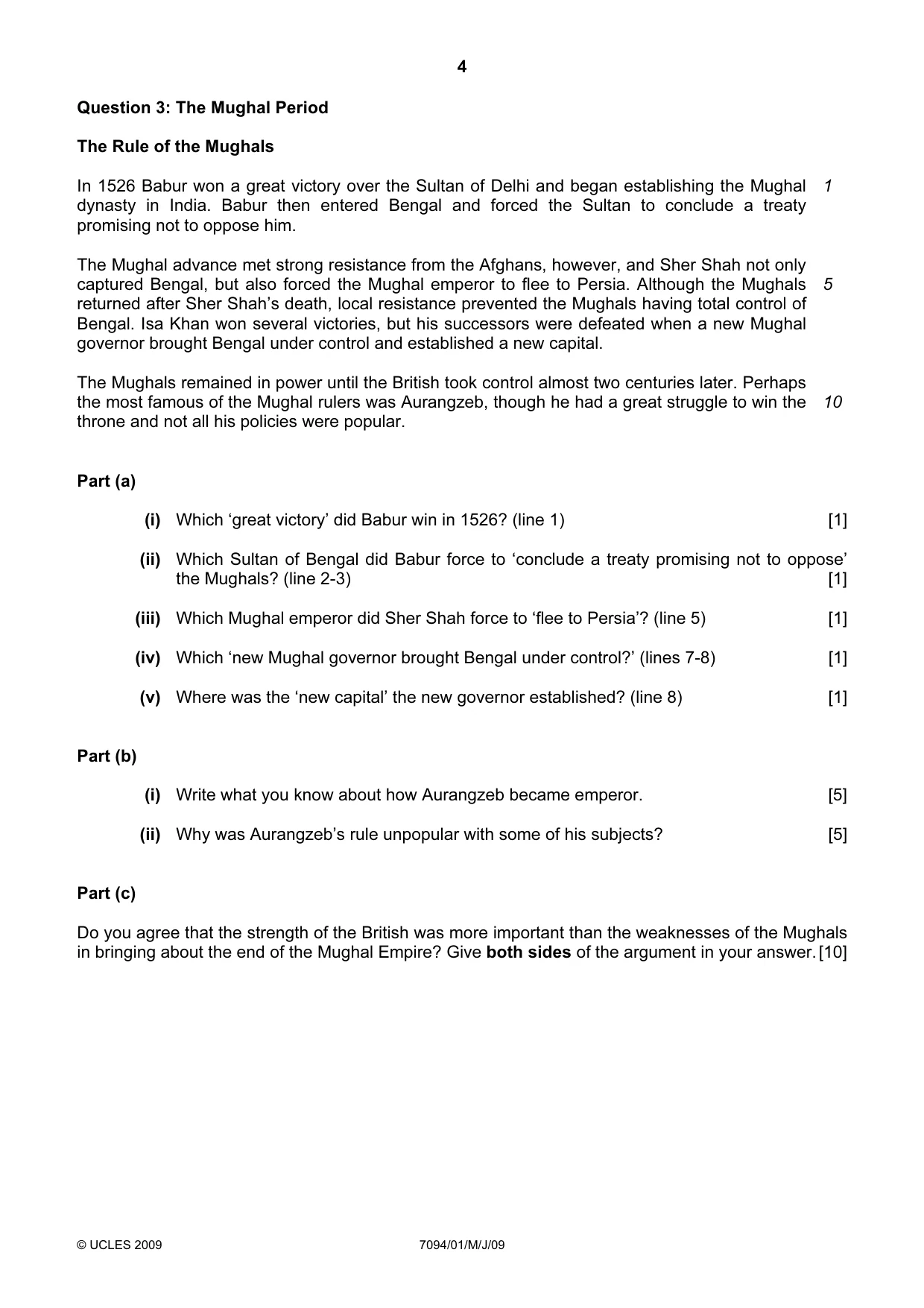
Question paper, page 4
4 © UCLES 2009 7094/01/M/J/09 Question 3: The Mughal Period The Rule of the Mughals In 1526 Babur won a great victory over the Sultan of Delhi and began establishing the Mughal dynasty in India. Babur then entered Bengal and forced the Sultan to conclude a treaty promising not to oppose him. The Mughal advance met strong resistance from the Afghans, however, and Sher Shah not only captured Bengal, but also forced the Mughal emperor to flee to Persia. Although the Mughals returned after Sher Shah’s death, local resistance prevented the Mughals having total control of Bengal. Isa Khan won several victories, but his successors were defeated when a new Mughal governor brought Bengal under control and established a new capital. The Mughals remained in power until the British took control almost two centuries later. Perhaps the most famous of the Mughal rulers was Aurangzeb, though he had a great struggle to win the throne and not all his policies were popular. 1 5 10 Part (a) (i) Which ‘great victory’ did Babur win in 1526? (line 1) [1] (ii) Which Sultan of Bengal did Babur force to ‘conclude a treaty promising not to oppose’ the Mughals? (line 2-3) [1] (iii) Which Mughal emperor did Sher Shah force to ‘flee to Persia’? (line 5) [1] (iv) Which ‘new Mughal governor brought Bengal under control?’ (lines 7-8) [1] (v) Where was the ‘new capital’ the new governor established? (line 8) [1] Part (b) (i) Write what you know about how Aurangzeb became emperor. [5] (ii) Why was Aurangzeb’s rule unpopular with some of his subjects? [5] Part (c) Do you agree that the strength of the British was more important than the weaknesses of the Mughals in bringing about the end of the Mughal Empire? Give both sides of the argument in your answer. [10]
Question paper, page 5
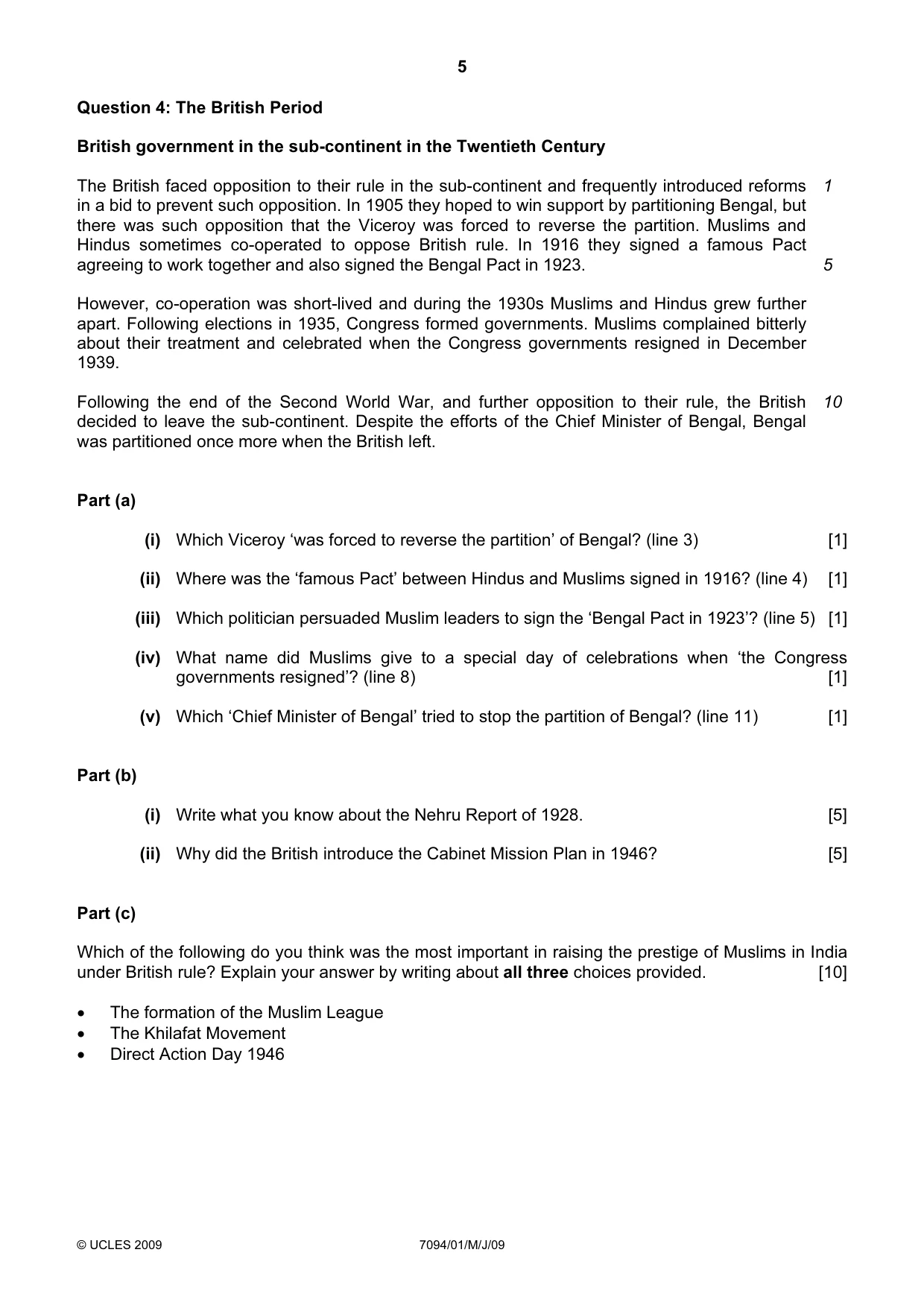
5 © UCLES 2009 7094/01/M/J/09 Question 4: The British Period British government in the sub-continent in the Twentieth Century The British faced opposition to their rule in the sub-continent and frequently introduced reforms in a bid to prevent such opposition. In 1905 they hoped to win support by partitioning Bengal, but there was such opposition that the Viceroy was forced to reverse the partition. Muslims and Hindus sometimes co-operated to oppose British rule. In 1916 they signed a famous Pact agreeing to work together and also signed the Bengal Pact in 1923. However, co-operation was short-lived and during the 1930s Muslims and Hindus grew further apart. Following elections in 1935, Congress formed governments. Muslims complained bitterly about their treatment and celebrated when the Congress governments resigned in December 1939. Following the end of the Second World War, and further opposition to their rule, the British decided to leave the sub-continent. Despite the efforts of the Chief Minister of Bengal, Bengal was partitioned once more when the British left. 1 5 10 Part (a) (i) Which Viceroy ‘was forced to reverse the partition’ of Bengal? (line 3) [1] (ii) Where was the ‘famous Pact’ between Hindus and Muslims signed in 1916? (line 4) [1] (iii) Which politician persuaded Muslim leaders to sign the ‘Bengal Pact in 1923’? (line 5) [1] (iv) What name did Muslims give to a special day of celebrations when ‘the Congress governments resigned’? (line 8) [1] (v) Which ‘Chief Minister of Bengal’ tried to stop the partition of Bengal? (line 11) [1] Part (b) (i) Write what you know about the Nehru Report of 1928. [5] (ii) Why did the British introduce the Cabinet Mission Plan in 1946? [5] Part (c) Which of the following do you think was the most important in raising the prestige of Muslims in India under British rule? Explain your answer by writing about all three choices provided. [10] • The formation of the Muslim League • The Khilafat Movement • Direct Action Day 1946
Question paper, page 8
8 BLANK PAGE Permission to reproduce items where third-party owned material protected by copyright is included has been sought and cleared where possible. Every reasonable effort has been made by the publisher (UCLES) to trace copyright holders, but if any items requiring clearance have unwittingly been included, the publisher will be pleased to make amends at the earliest possible opportunity. University of Cambridge International Examinations is part of the Cambridge Assessment Group. Cambridge Assessment is the brand name of University of Cambridge Local Examinations Syndicate (UCLES), which is itself a department of the University of Cambridge. 7094/01/M/J/09
Mark scheme, page 1
UNIVERSITY OF CAMBRIDGE INTERNATIONAL EXAMINATIONS International General Certificate of Secondary Education MARK SCHEME for the May/June 2009 question paper for the guidance of teachers 0449 BANGLADESH STUDIES 0449/01 Paper 1 (History and Culture of Bangladesh), maximum raw mark 75 This mark scheme is published as an aid to teachers and candidates, to indicate the requirements of the examination. It shows the basis on which Examiners were instructed to award marks. It does not indicate the details of the discussions that took place at an Examiners’ meeting before marking began, which would have considered the acceptability of alternative answers. Mark schemes must be read in conjunction with the question papers and the report on the examination. • CIE will not enter into discussions or correspondence in connection with these mark schemes. CIE is publishing the mark schemes for the May/June 2009 question papers for most IGCSE, GCE Advanced Level and Advanced Subsidiary Level syllabuses and some Ordinary Level syllabuses. www.XtremePapers.com
Mark scheme, page 2
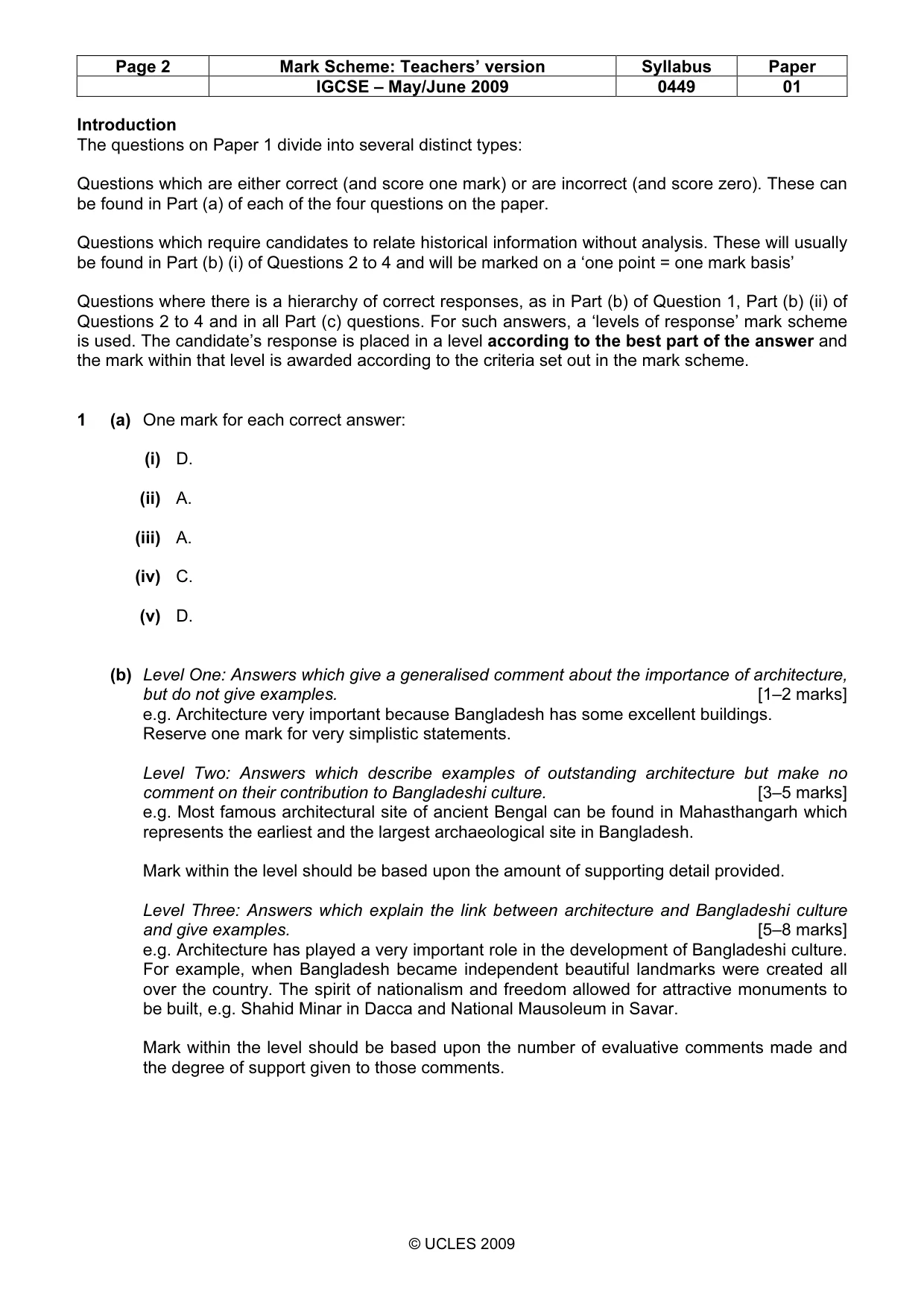
Page 2 Mark Scheme: Teachers’ version Syllabus Paper IGCSE – May/June 2009 0449 01 © UCLES 2009 Introduction The questions on Paper 1 divide into several distinct types: Questions which are either correct (and score one mark) or are incorrect (and score zero). These can be found in Part (a) of each of the four questions on the paper. Questions which require candidates to relate historical information without analysis. These will usually be found in Part (b) (i) of Questions 2 to 4 and will be marked on a ‘one point = one mark basis’ Questions where there is a hierarchy of correct responses, as in Part (b) of Question 1, Part (b) (ii) of Questions 2 to 4 and in all Part (c) questions. For such answers, a ‘levels of response’ mark scheme is used. The candidate’s response is placed in a level according to the best part of the answer and the mark within that level is awarded according to the criteria set out in the mark scheme. 1 (a) One mark for each correct answer: (i) D. (ii) A. (iii) A. (iv) C. (v) D. (b) Level One: Answers which give a generalised comment about the importance of architecture, but do not give examples. [1–2 marks] e.g. Architecture very important because Bangladesh has some excellent buildings. Reserve one mark for very simplistic statements. Level Two: Answers which describe examples of outstanding architecture but make no comment on their contribution to Bangladeshi culture. [3–5 marks] e.g. Most famous architectural site of ancient Bengal can be found in Mahasthangarh which represents the earliest and the largest archaeological site in Bangladesh. Mark within the level should be based upon the amount of supporting detail provided. Level Three: Answers which explain the link between architecture and Bangladeshi culture and give examples. [5–8 marks] e.g. Architecture has played a very important role in the development of Bangladeshi culture. For example, when Bangladesh became independent beautiful landmarks were created all over the country. The spirit of nationalism and freedom allowed for attractive monuments to be built, e.g. Shahid Minar in Dacca and National Mausoleum in Savar. Mark within the level should be based upon the number of evaluative comments made and the degree of support given to those comments.
Mark scheme, page 3
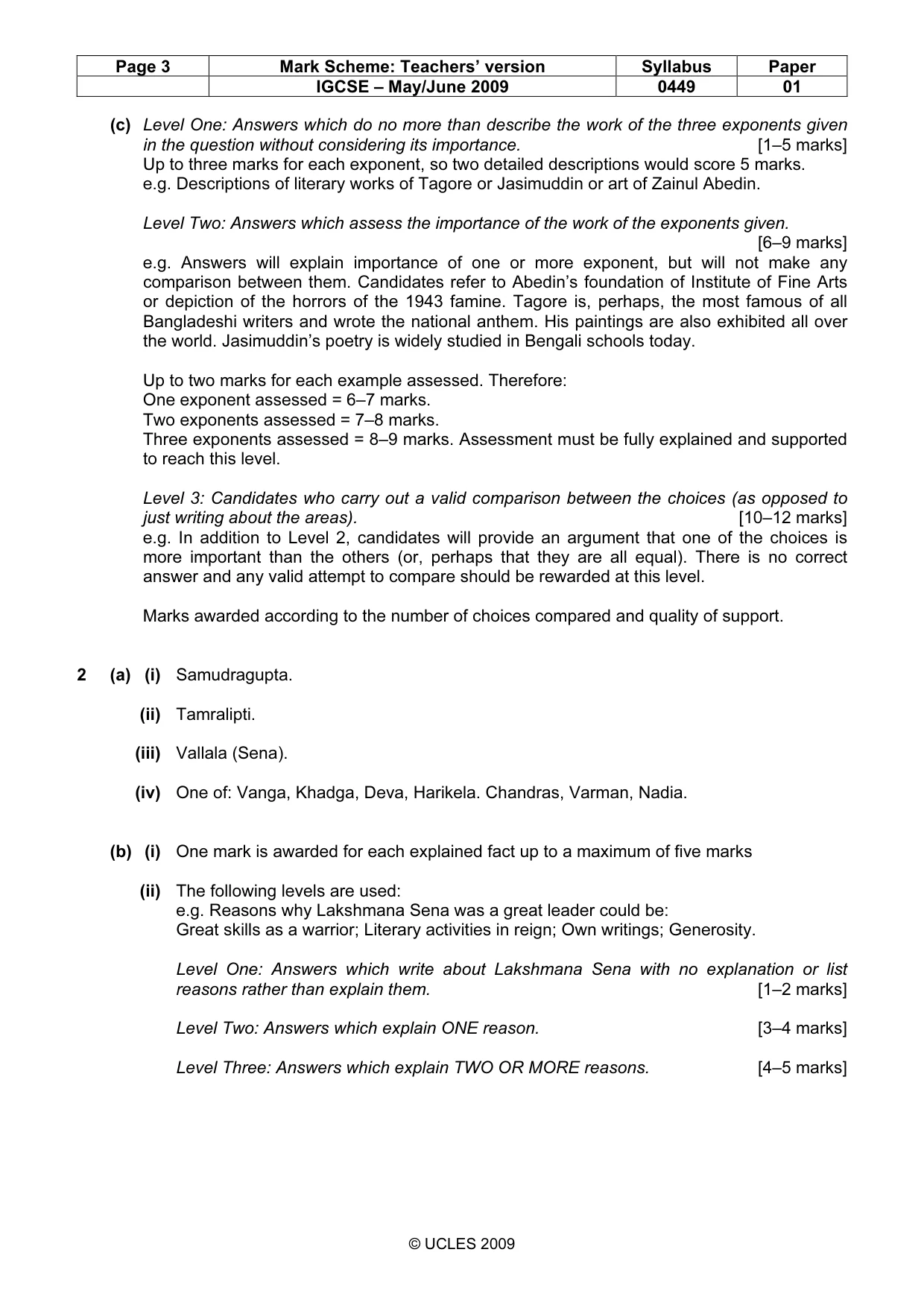
Page 3 Mark Scheme: Teachers’ version Syllabus Paper IGCSE – May/June 2009 0449 01 © UCLES 2009 (c) Level One: Answers which do no more than describe the work of the three exponents given in the question without considering its importance. [1–5 marks] Up to three marks for each exponent, so two detailed descriptions would score 5 marks. e.g. Descriptions of literary works of Tagore or Jasimuddin or art of Zainul Abedin. Level Two: Answers which assess the importance of the work of the exponents given. [6–9 marks] e.g. Answers will explain importance of one or more exponent, but will not make any comparison between them. Candidates refer to Abedin’s foundation of Institute of Fine Arts or depiction of the horrors of the 1943 famine. Tagore is, perhaps, the most famous of all Bangladeshi writers and wrote the national anthem. His paintings are also exhibited all over the world. Jasimuddin’s poetry is widely studied in Bengali schools today. Up to two marks for each example assessed. Therefore: One exponent assessed = 6–7 marks. Two exponents assessed = 7–8 marks. Three exponents assessed = 8–9 marks. Assessment must be fully explained and supported to reach this level. Level 3: Candidates who carry out a valid comparison between the choices (as opposed to just writing about the areas). [10–12 marks] e.g. In addition to Level 2, candidates will provide an argument that one of the choices is more important than the others (or, perhaps that they are all equal). There is no correct answer and any valid attempt to compare should be rewarded at this level. Marks awarded according to the number of choices compared and quality of support. 2 (a) (i) Samudragupta. (ii) Tamralipti. (iii) Vallala (Sena). (iv) One of: Vanga, Khadga, Deva, Harikela. Chandras, Varman, Nadia. (b) (i) One mark is awarded for each explained fact up to a maximum of five marks (ii) The following levels are used: e.g. Reasons why Lakshmana Sena was a great leader could be: Great skills as a warrior; Literary activities in reign; Own writings; Generosity. Level One: Answers which write about Lakshmana Sena with no explanation or list reasons rather than explain them. [1–2 marks] Level Two: Answers which explain ONE reason. [3–4 marks] Level Three: Answers which explain TWO OR MORE reasons. [4–5 marks]
Mark scheme, page 4
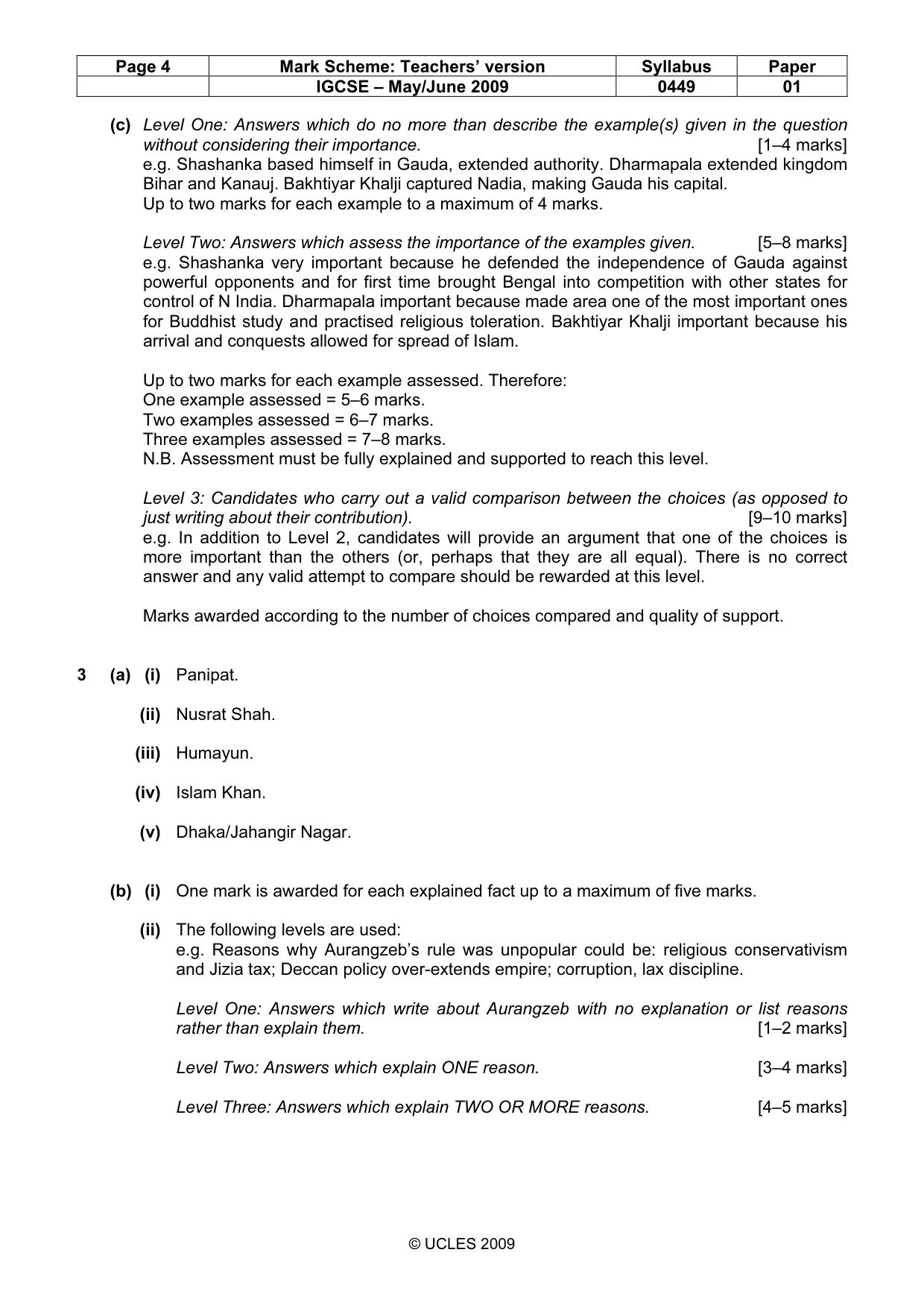
Page 4 Mark Scheme: Teachers’ version Syllabus Paper IGCSE – May/June 2009 0449 01 © UCLES 2009 (c) Level One: Answers which do no more than describe the example(s) given in the question without considering their importance. [1–4 marks] e.g. Shashanka based himself in Gauda, extended authority. Dharmapala extended kingdom Bihar and Kanauj. Bakhtiyar Khalji captured Nadia, making Gauda his capital. Up to two marks for each example to a maximum of 4 marks. Level Two: Answers which assess the importance of the examples given. [5–8 marks] e.g. Shashanka very important because he defended the independence of Gauda against powerful opponents and for first time brought Bengal into competition with other states for control of N India. Dharmapala important because made area one of the most important ones for Buddhist study and practised religious toleration. Bakhtiyar Khalji important because his arrival and conquests allowed for spread of Islam. Up to two marks for each example assessed. Therefore: One example assessed = 5–6 marks. Two examples assessed = 6–7 marks. Three examples assessed = 7–8 marks. N.B. Assessment must be fully explained and supported to reach this level. Level 3: Candidates who carry out a valid comparison between the choices (as opposed to just writing about their contribution). [9–10 marks] e.g. In addition to Level 2, candidates will provide an argument that one of the choices is more important than the others (or, perhaps that they are all equal). There is no correct answer and any valid attempt to compare should be rewarded at this level. Marks awarded according to the number of choices compared and quality of support. 3 (a) (i) Panipat. (ii) Nusrat Shah. (iii) Humayun. (iv) Islam Khan. (v) Dhaka/Jahangir Nagar. (b) (i) One mark is awarded for each explained fact up to a maximum of five marks. (ii) The following levels are used: e.g. Reasons why Aurangzeb’s rule was unpopular could be: religious conservativism and Jizia tax; Deccan policy over-extends empire; corruption, lax discipline. Level One: Answers which write about Aurangzeb with no explanation or list reasons rather than explain them. [1–2 marks] Level Two: Answers which explain ONE reason. [3–4 marks] Level Three: Answers which explain TWO OR MORE reasons. [4–5 marks]
Mark scheme, page 5
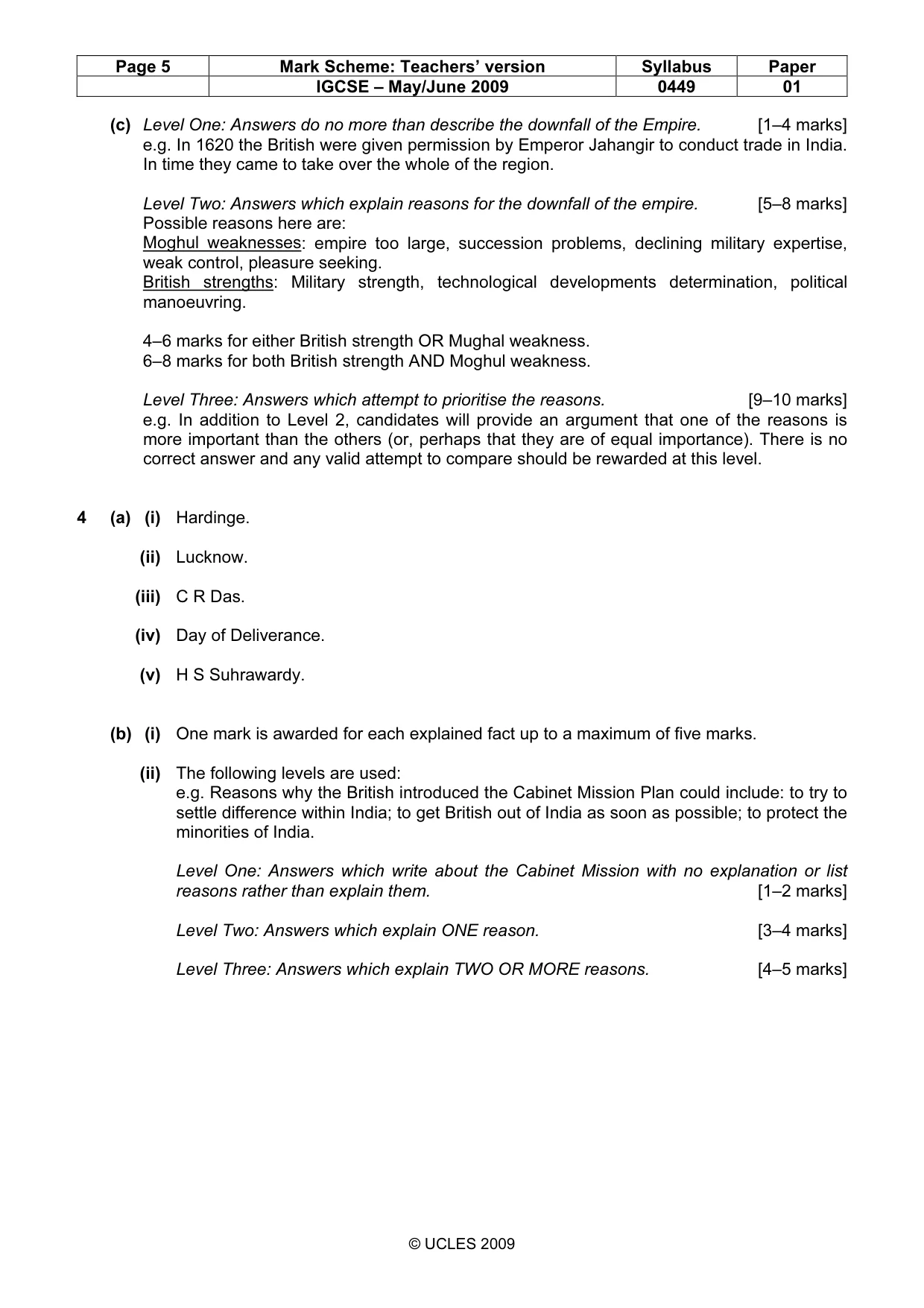
Page 5 Mark Scheme: Teachers’ version Syllabus Paper IGCSE – May/June 2009 0449 01 © UCLES 2009 (c) Level One: Answers do no more than describe the downfall of the Empire. [1–4 marks] e.g. In 1620 the British were given permission by Emperor Jahangir to conduct trade in India. In time they came to take over the whole of the region. Level Two: Answers which explain reasons for the downfall of the empire. [5–8 marks] Possible reasons here are: Moghul weaknesses: empire too large, succession problems, declining military expertise, weak control, pleasure seeking. British strengths: Military strength, technological developments determination, political manoeuvring. 4–6 marks for either British strength OR Mughal weakness. 6–8 marks for both British strength AND Moghul weakness. Level Three: Answers which attempt to prioritise the reasons. [9–10 marks] e.g. In addition to Level 2, candidates will provide an argument that one of the reasons is more important than the others (or, perhaps that they are of equal importance). There is no correct answer and any valid attempt to compare should be rewarded at this level. 4 (a) (i) Hardinge. (ii) Lucknow. (iii) C R Das. (iv) Day of Deliverance. (v) H S Suhrawardy. (b) (i) One mark is awarded for each explained fact up to a maximum of five marks. (ii) The following levels are used: e.g. Reasons why the British introduced the Cabinet Mission Plan could include: to try to settle difference within India; to get British out of India as soon as possible; to protect the minorities of India. Level One: Answers which write about the Cabinet Mission with no explanation or list reasons rather than explain them. [1–2 marks] Level Two: Answers which explain ONE reason. [3–4 marks] Level Three: Answers which explain TWO OR MORE reasons. [4–5 marks]
Mark scheme, page 6
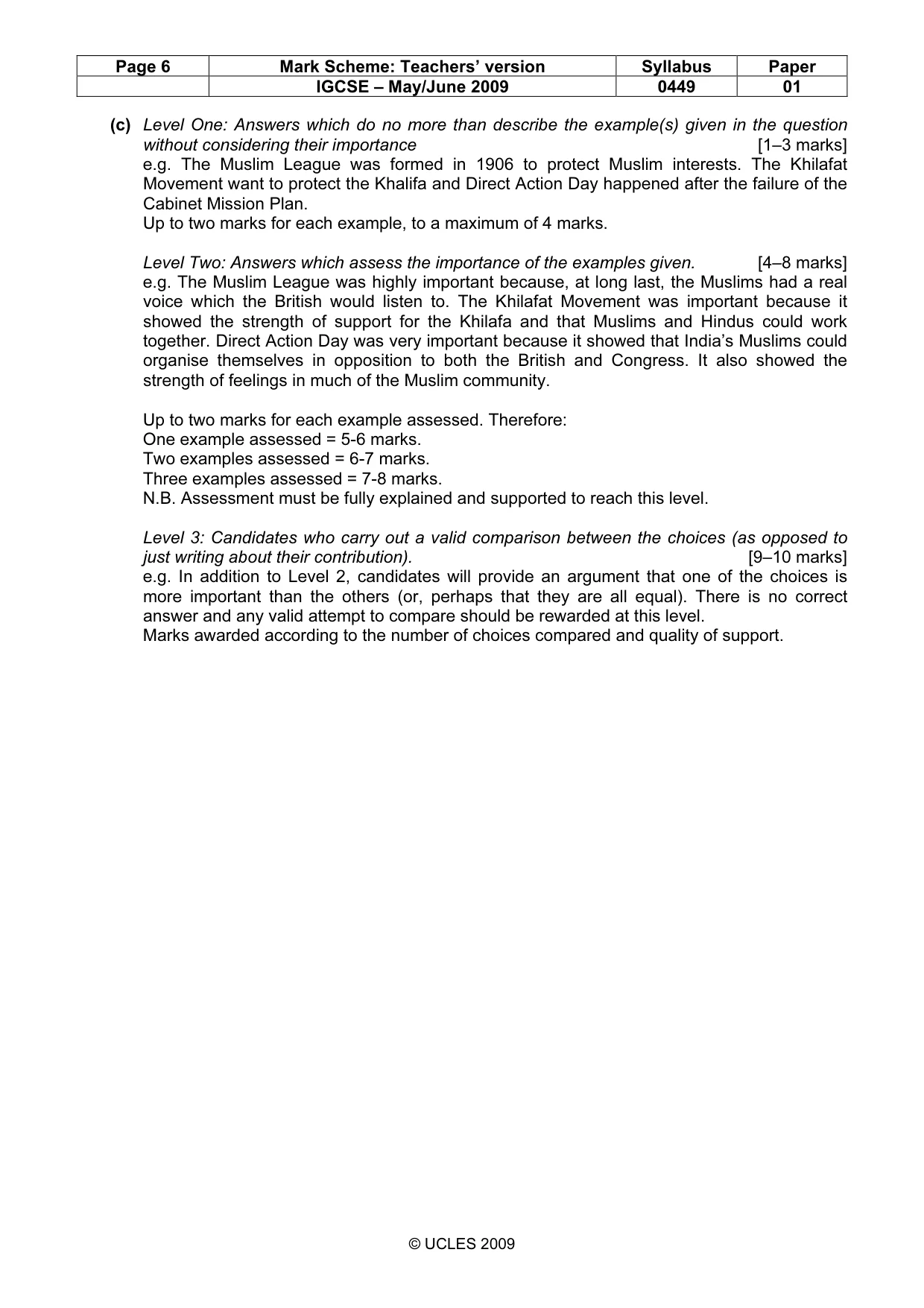
Page 6 Mark Scheme: Teachers’ version Syllabus Paper IGCSE – May/June 2009 0449 01 © UCLES 2009 (c) Level One: Answers which do no more than describe the example(s) given in the question without considering their importance [1–3 marks] e.g. The Muslim League was formed in 1906 to protect Muslim interests. The Khilafat Movement want to protect the Khalifa and Direct Action Day happened after the failure of the Cabinet Mission Plan. Up to two marks for each example, to a maximum of 4 marks. Level Two: Answers which assess the importance of the examples given. [4–8 marks] e.g. The Muslim League was highly important because, at long last, the Muslims had a real voice which the British would listen to. The Khilafat Movement was important because it showed the strength of support for the Khilafa and that Muslims and Hindus could work together. Direct Action Day was very important because it showed that India’s Muslims could organise themselves in opposition to both the British and Congress. It also showed the strength of feelings in much of the Muslim community. Up to two marks for each example assessed. Therefore: One example assessed = 5-6 marks. Two examples assessed = 6-7 marks. Three examples assessed = 7-8 marks. N.B. Assessment must be fully explained and supported to reach this level. Level 3: Candidates who carry out a valid comparison between the choices (as opposed to just writing about their contribution). [9–10 marks] e.g. In addition to Level 2, candidates will provide an argument that one of the choices is more important than the others (or, perhaps that they are all equal). There is no correct answer and any valid attempt to compare should be rewarded at this level. Marks awarded according to the number of choices compared and quality of support.
What you needed in this session
Cambridge’s own grade thresholds for 2009 May/June, Paper 1 · Variant 1. A higher threshold means an easier paper — the bar moves with how the cohort did.