Cambridge IGCSE Bangladesh Studies 0449 — 2008 May/June Paper 2 · Variant 1
0449/21/M/J/08 · 75 marks · ≈84 min
The question paper and its mark scheme, free to read here and free to download. This is Cambridge’s own paper, exactly as it was sat.
Question paper16 pages





Mark scheme10 pages
Answers below. Sit the paper first if you are practising.
Paper as text
Question paper, page 1
This document consists of 12 printed pages and 4 blank pages. IB08 06_7094_02/2RP © UCLES 2008 [Turn over *4612932258* UNIVERSITY OF CAMBRIDGE INTERNATIONAL EXAMINATIONS General Certificate of Education Ordinary Level International General Certificate of Secondary Education BANGLADESH STUDIES 7094/02 0449/02 Paper 2 Environment and Development of Bangladesh May/June 2008 1 hour 30 minutes Additional Materials: Answer Booklet/Paper READ THESE INSTRUCTIONS FIRST If you have been given an Answer Booklet, follow the instructions on the front cover of the Booklet. Write your Centre number, candidate number and name on all the work you hand in. Write in dark blue or black pen. You may use a soft pencil for any diagrams, graphs or rough working. Do not use staples, paper clips, highlighters, glue or correction fluid. Answer three questions. Sketch maps and diagrams may be drawn to illustrate an answer. You are advised to spend about 30 minutes on each question. At the end of the examination, fasten all your work securely together. The number of marks is given in brackets [ ] at the end of each question or part question. www.XtremePapers.com
Question paper, page 2
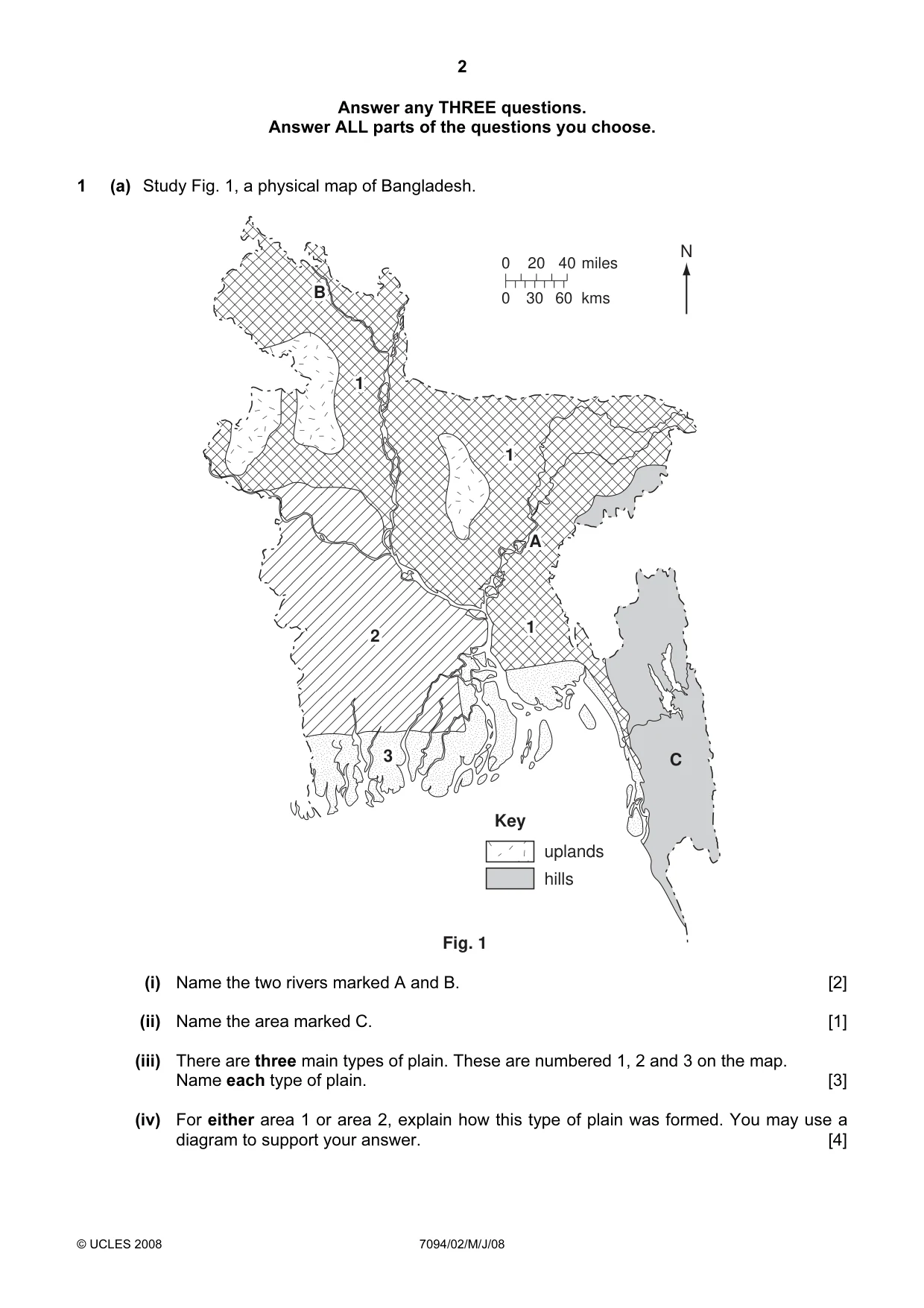
2 © UCLES 2008 7094/02/M/J/08 Answer any THREE questions. Answer ALL parts of the questions you choose. 1 (a) Study Fig. 1, a physical map of Bangladesh. 2 A 1 1 3 0 20 40 0 30 60 miles kms C A Fig. 1 B 1 1 1 2 3 B 1 N uplands hills Key (i) Name the two rivers marked A and B. [2] (ii) Name the area marked C. [1] (iii) There are three main types of plain. These are numbered 1, 2 and 3 on the map. Name each type of plain. [3] (iv) For either area 1 or area 2, explain how this type of plain was formed. You may use a diagram to support your answer. [4]
Question paper, page 3
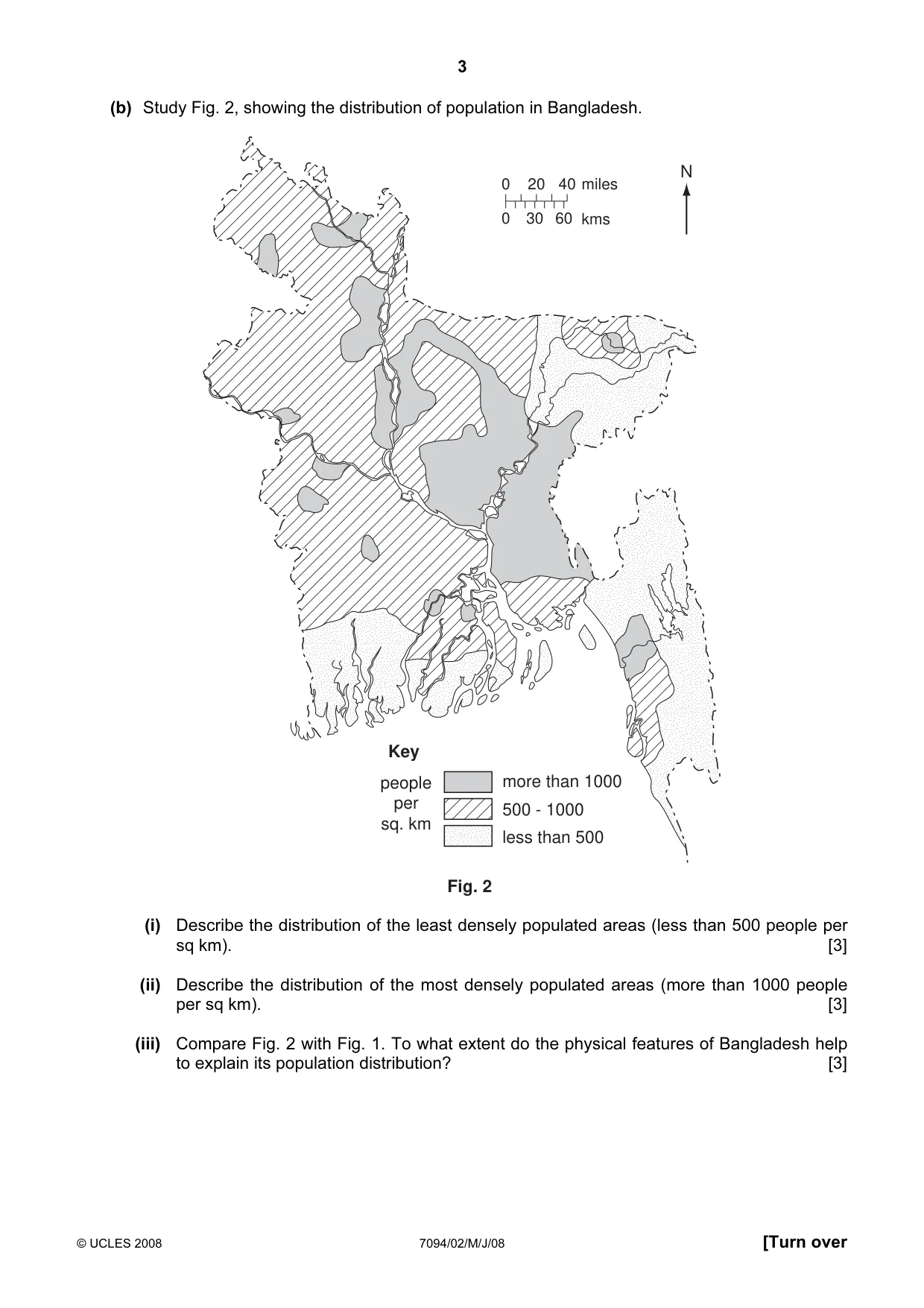
3 © UCLES 2008 7094/02/M/J/08 [Turn over (b) Study Fig. 2, showing the distribution of population in Bangladesh. 0 20 40 0 30 60 miles kms Fig. 2 N more than 1000 500 - 1000 less than 500 Key people per sq. km (i) Describe the distribution of the least densely populated areas (less than 500 people per sq km). [3] (ii) Describe the distribution of the most densely populated areas (more than 1000 people per sq km). [3] (iii) Compare Fig. 2 with Fig. 1. To what extent do the physical features of Bangladesh help to explain its population distribution? [3]
Question paper, page 4
4 © UCLES 2008 7094/02/M/J/08 (c) Consider these two opinions about flooding in Bangladesh: A. Flooding causes many problems for the country. B. Flooding brings many benefits to the country. (i) State two pieces of evidence which support opinion A. [2] (ii) State two pieces of evidence which support opinion B. [2] (iii) Which of the two opinions do you agree with the most? Give reasons for your answer. [2] [Total: 25]
Question paper, page 6
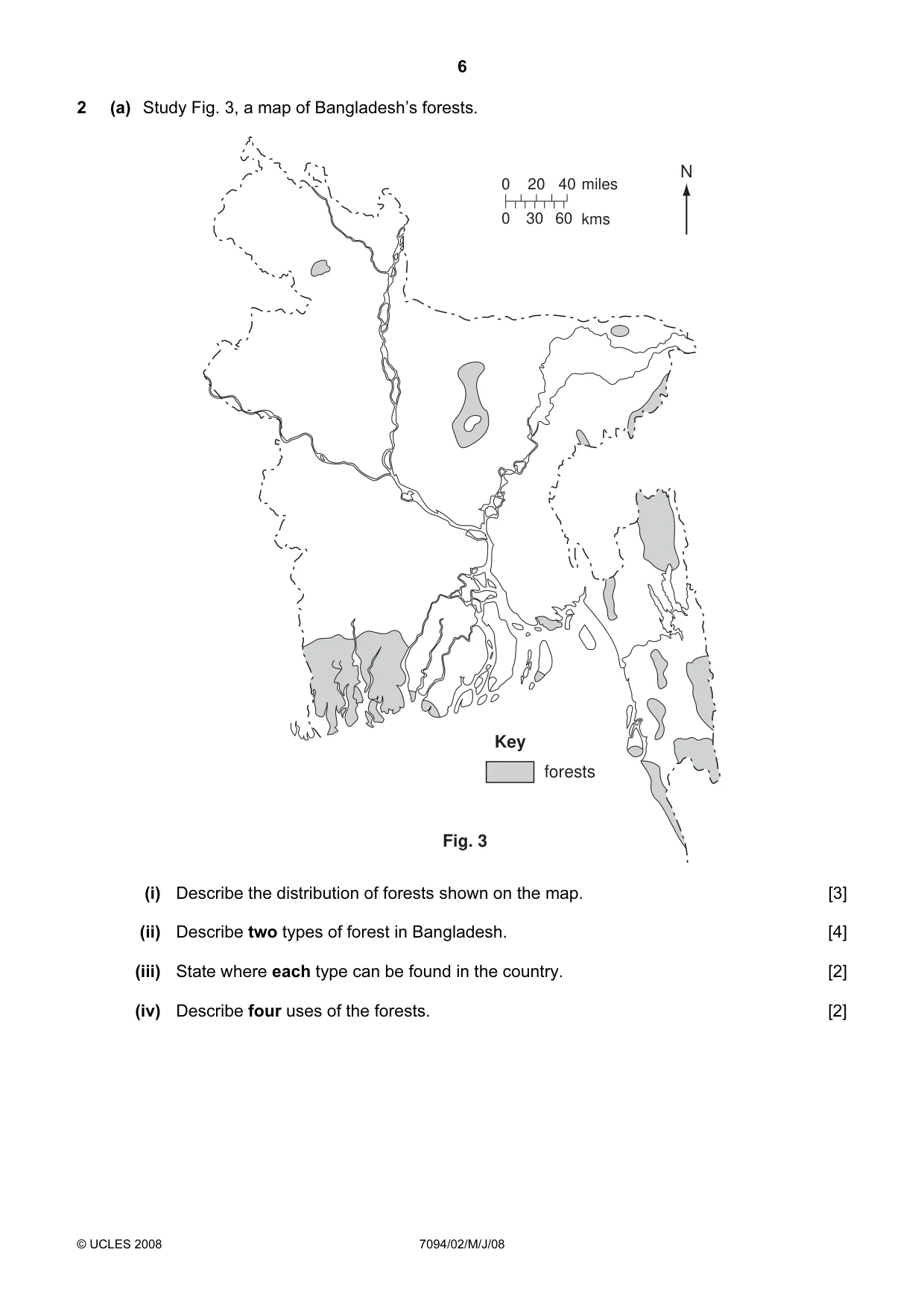
6 © UCLES 2008 7094/02/M/J/08 2 (a) Study Fig. 3, a map of Bangladesh’s forests. 0 20 40 0 30 60 miles kms Fig. 3 N forests Key (i) Describe the distribution of forests shown on the map. [3] (ii) Describe two types of forest in Bangladesh. [4] (iii) State where each type can be found in the country. [2] (iv) Describe four uses of the forests. [2]
Question paper, page 7
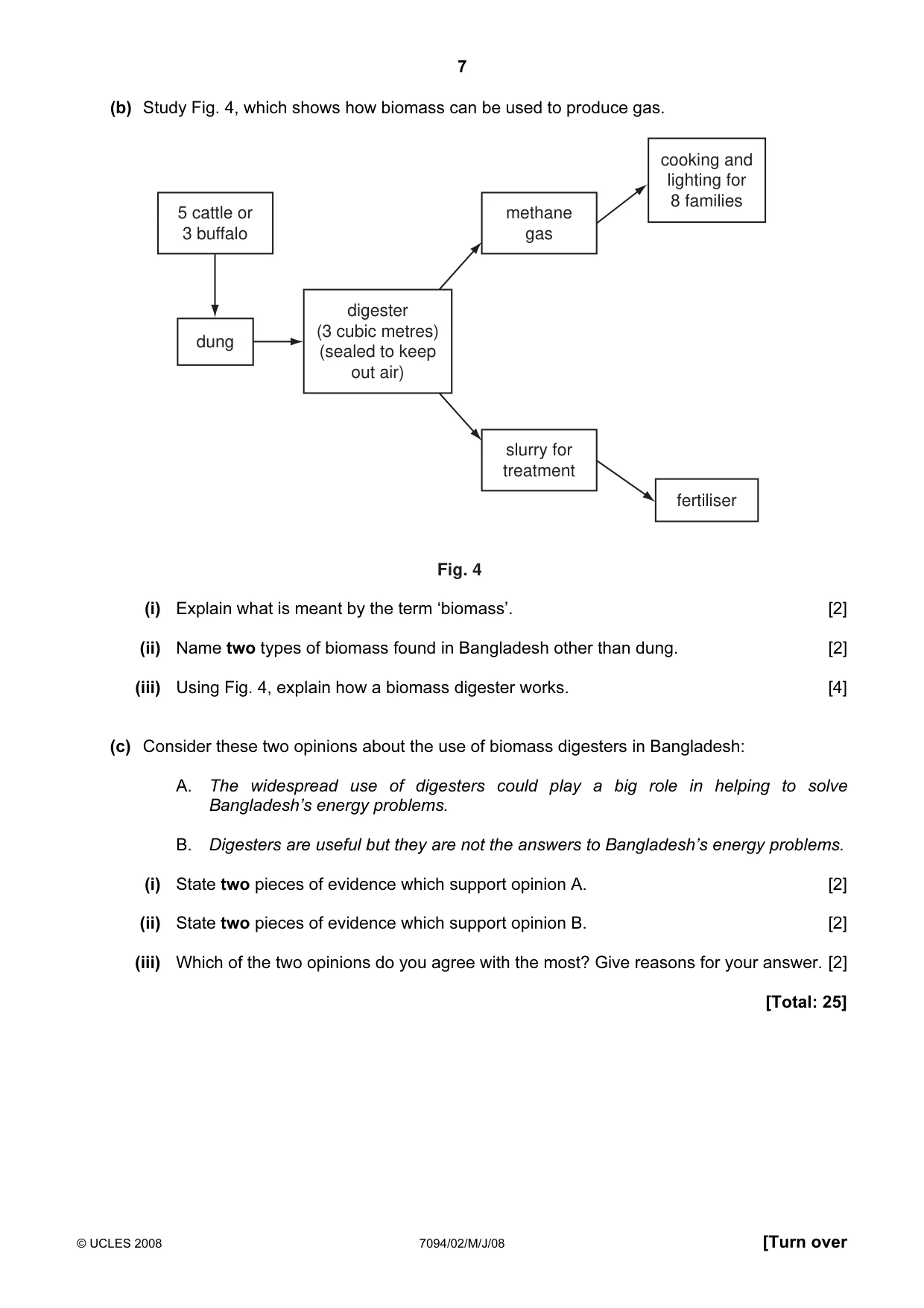
7 © UCLES 2008 7094/02/M/J/08 [Turn over (b) Study Fig. 4, which shows how biomass can be used to produce gas. 5 cattle or 3 buffalo dung methane gas slurry for treatment fertiliser cooking and lighting for 8 families digester (3 cubic metres) (sealed to keep out air) Fig. 4 (i) Explain what is meant by the term ‘biomass’. [2] (ii) Name two types of biomass found in Bangladesh other than dung. [2] (iii) Using Fig. 4, explain how a biomass digester works. [4] (c) Consider these two opinions about the use of biomass digesters in Bangladesh: A. The widespread use of digesters could play a big role in helping to solve Bangladesh’s energy problems. B. Digesters are useful but they are not the answers to Bangladesh’s energy problems. (i) State two pieces of evidence which support opinion A. [2] (ii) State two pieces of evidence which support opinion B. [2] (iii) Which of the two opinions do you agree with the most? Give reasons for your answer. [2] [Total: 25]
Question paper, page 8
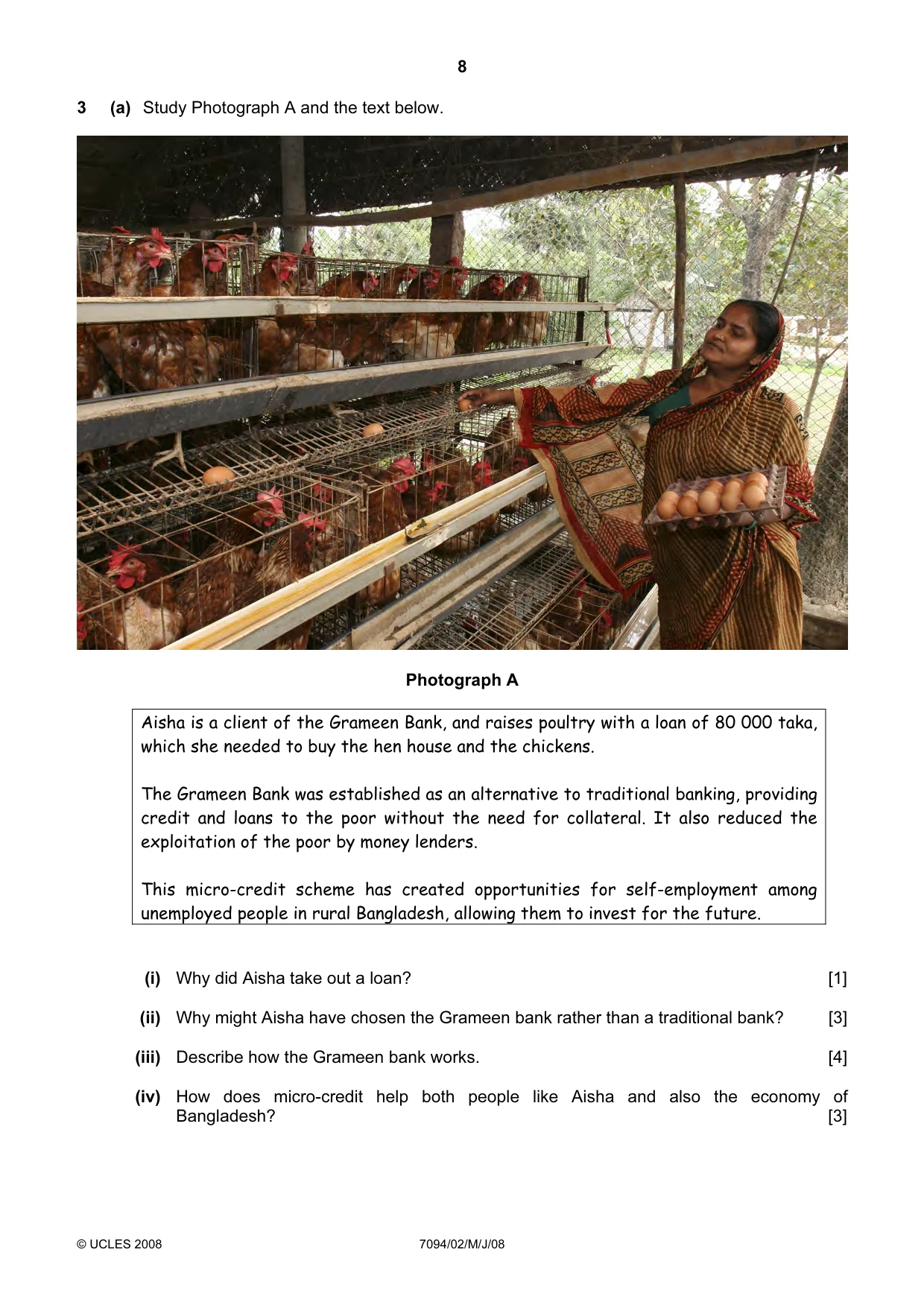
8 © UCLES 2008 7094/02/M/J/08 3 (a) Study Photograph A and the text below. Photograph A Aisha is a client of the Grameen Bank, and raises poultry with a loan of 80 000 taka, which she needed to buy the hen house and the chickens. The Grameen Bank was established as an alternative to traditional banking, providing credit and loans to the poor without the need for collateral. It also reduced the exploitation of the poor by money lenders. This micro-credit scheme has created opportunities for self-employment among unemployed people in rural Bangladesh, allowing them to invest for the future. (i) Why did Aisha take out a loan? [1] (ii) Why might Aisha have chosen the Grameen bank rather than a traditional bank? [3] (iii) Describe how the Grameen bank works. [4] (iv) How does micro-credit help both people like Aisha and also the economy of Bangladesh? [3]
Question paper, page 9
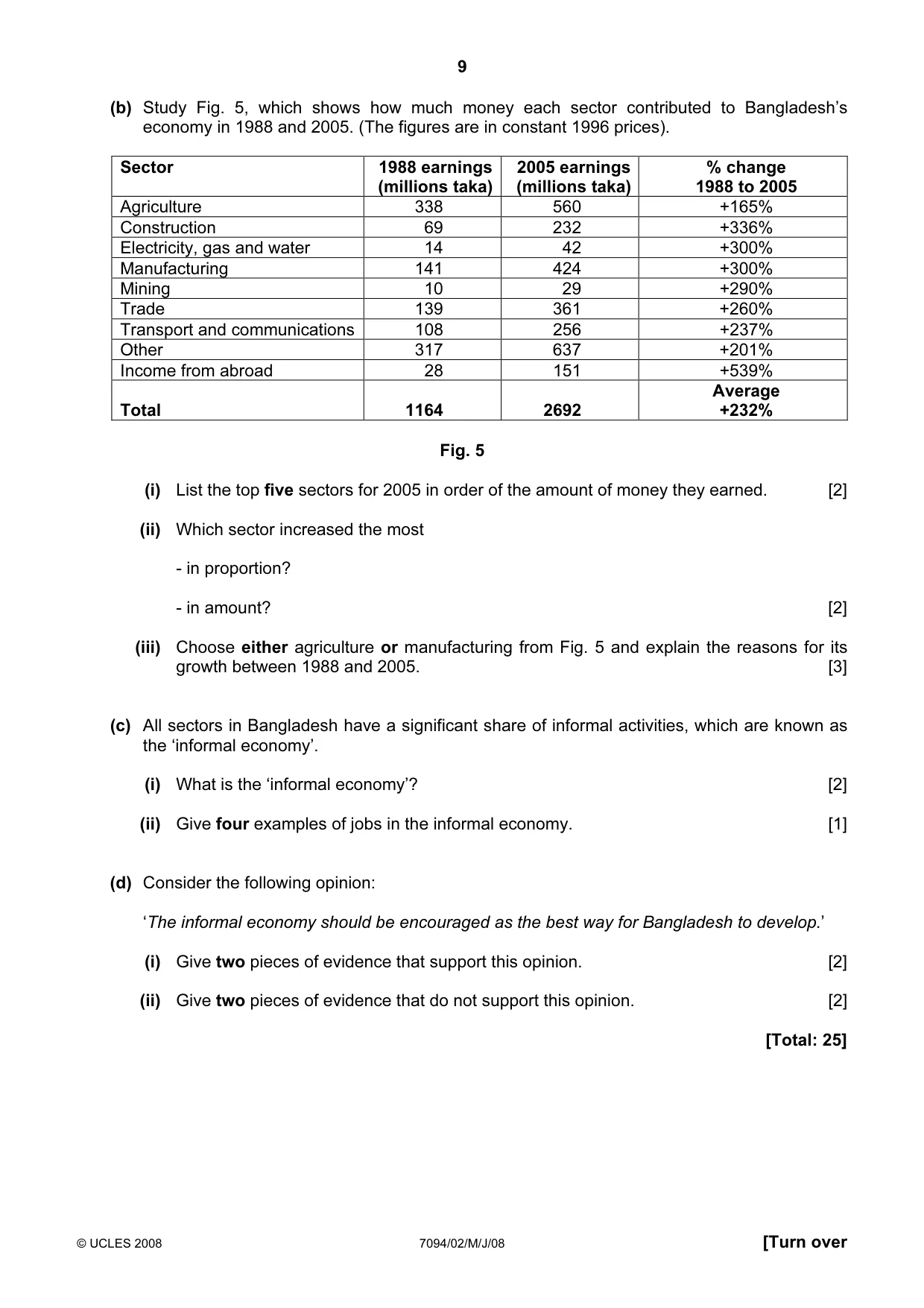
9 © UCLES 2008 7094/02/M/J/08 [Turn over (b) Study Fig. 5, which shows how much money each sector contributed to Bangladesh’s economy in 1988 and 2005. (The figures are in constant 1996 prices). Sector 1988 earnings (millions taka) 2005 earnings (millions taka) % change 1988 to 2005 Agriculture 338 560 +165% Construction 69 232 +336% Electricity, gas and water 14 42 +300% Manufacturing 141 424 +300% Mining 10 29 +290% Trade 139 361 +260% Transport and communications 108 256 +237% Other 317 637 +201% Income from abroad 28 151 +539% Total 1164 2692 Average +232% Fig. 5 (i) List the top five sectors for 2005 in order of the amount of money they earned. [2] (ii) Which sector increased the most - in proportion? - in amount? [2] (iii) Choose either agriculture or manufacturing from Fig. 5 and explain the reasons for its growth between 1988 and 2005. [3] (c) All sectors in Bangladesh have a significant share of informal activities, which are known as the ‘informal economy’. (i) What is the ‘informal economy’? [2] (ii) Give four examples of jobs in the informal economy. [1] (d) Consider the following opinion: ‘The informal economy should be encouraged as the best way for Bangladesh to develop.’ (i) Give two pieces of evidence that support this opinion. [2] (ii) Give two pieces of evidence that do not support this opinion. [2] [Total: 25]
Question paper, page 10
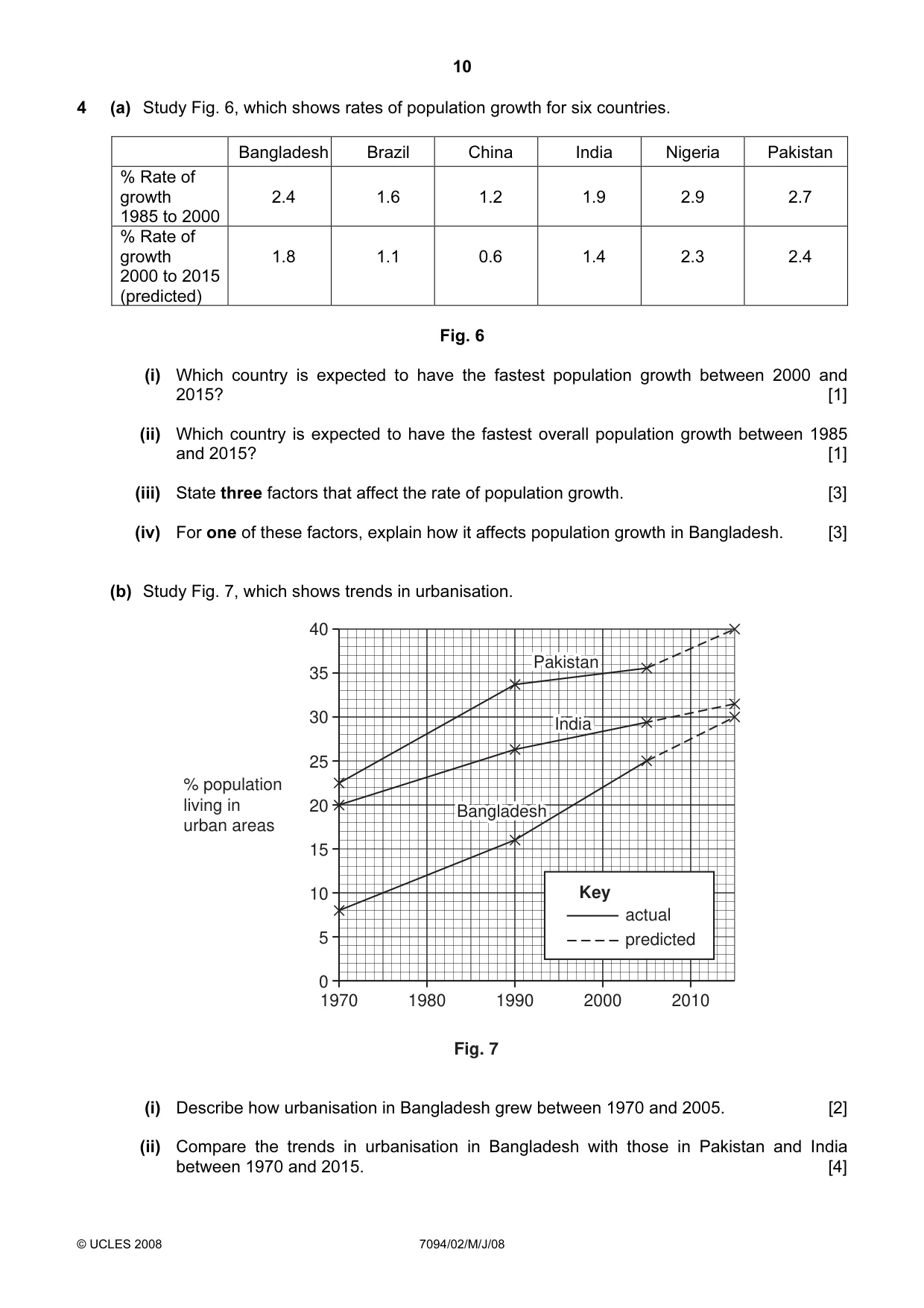
10 © UCLES 2008 7094/02/M/J/08 4 (a) Study Fig. 6, which shows rates of population growth for six countries. Bangladesh Brazil China India Nigeria Pakistan % Rate of growth 1985 to 2000 2.4 1.6 1.2 1.9 2.9 2.7 % Rate of growth 2000 to 2015 (predicted) 1.8 1.1 0.6 1.4 2.3 2.4 Fig. 6 (i) Which country is expected to have the fastest population growth between 2000 and 2015? [1] (ii) Which country is expected to have the fastest overall population growth between 1985 and 2015? [1] (iii) State three factors that affect the rate of population growth. [3] (iv) For one of these factors, explain how it affects population growth in Bangladesh. [3] (b) Study Fig. 7, which shows trends in urbanisation. Pakistan Pakistan India India Bangladesh Bangladesh 1970 1980 1990 2000 2010 40 35 30 25 20 15 10 5 0 % population living in urban areas Pakistan India Bangladesh Key actual predicted Fig. 7 (i) Describe how urbanisation in Bangladesh grew between 1970 and 2005. [2] (ii) Compare the trends in urbanisation in Bangladesh with those in Pakistan and India between 1970 and 2015. [4]
Question paper, page 11
11 © UCLES 2008 7094/02/M/J/08 [Turn over (c) Dhaka had a population of 12 million in 2005. It is predicted to have a population of around 21 million by 2015. This would make Dhaka the fourth biggest city in the world. Explain why Dhaka is growing so fast. [5] (d) Consider these two opinions about the growth of cities in Bangladesh: A. It is good for Bangladesh to have large cities that are rapidly growing. B. It is better for Bangladesh if people stay in the countryside rather than move to cities. (i) Give two arguments that support opinion A. [2] (ii) Give two arguments that support opinion B. [2] (iii) Which of the two opinions do you agree with the most? Give reasons for your answer. [2] [Total: 25]
Question paper, page 12
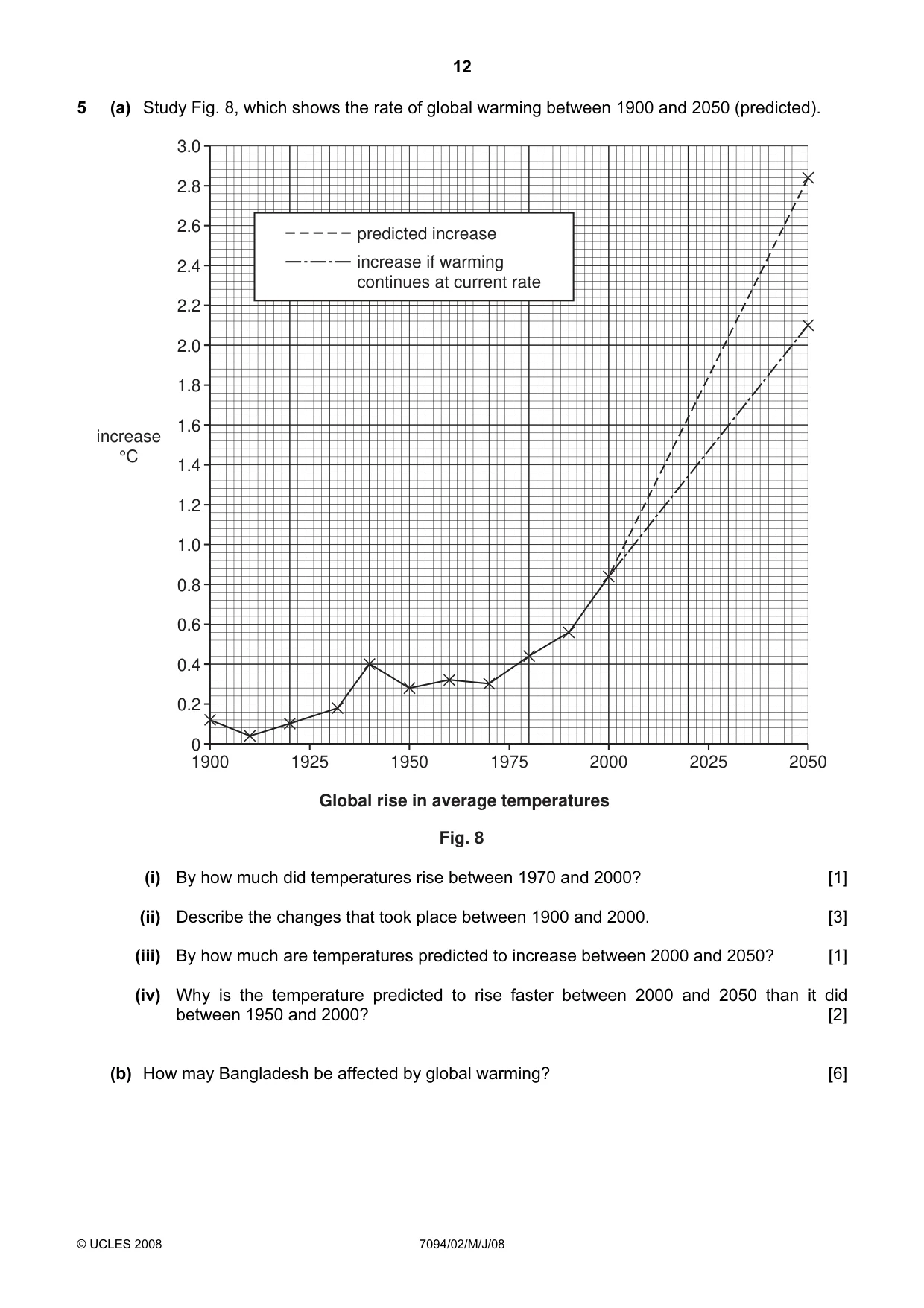
12 © UCLES 2008 7094/02/M/J/08 5 (a) Study Fig. 8, which shows the rate of global warming between 1900 and 2050 (predicted). 1900 1925 1950 1975 2000 2025 2050 3.0 2.8 2.6 2.4 2.2 2.0 1.8 1.6 1.4 1.2 1.0 0.8 0.6 0.4 0.2 0 increase °C predicted increase increase if warming continues at current rate Global rise in average temperatures Fig. 8 (i) By how much did temperatures rise between 1970 and 2000? [1] (ii) Describe the changes that took place between 1900 and 2000. [3] (iii) By how much are temperatures predicted to increase between 2000 and 2050? [1] (iv) Why is the temperature predicted to rise faster between 2000 and 2050 than it did between 1950 and 2000? [2] (b) How may Bangladesh be affected by global warming? [6]
Question paper, page 13
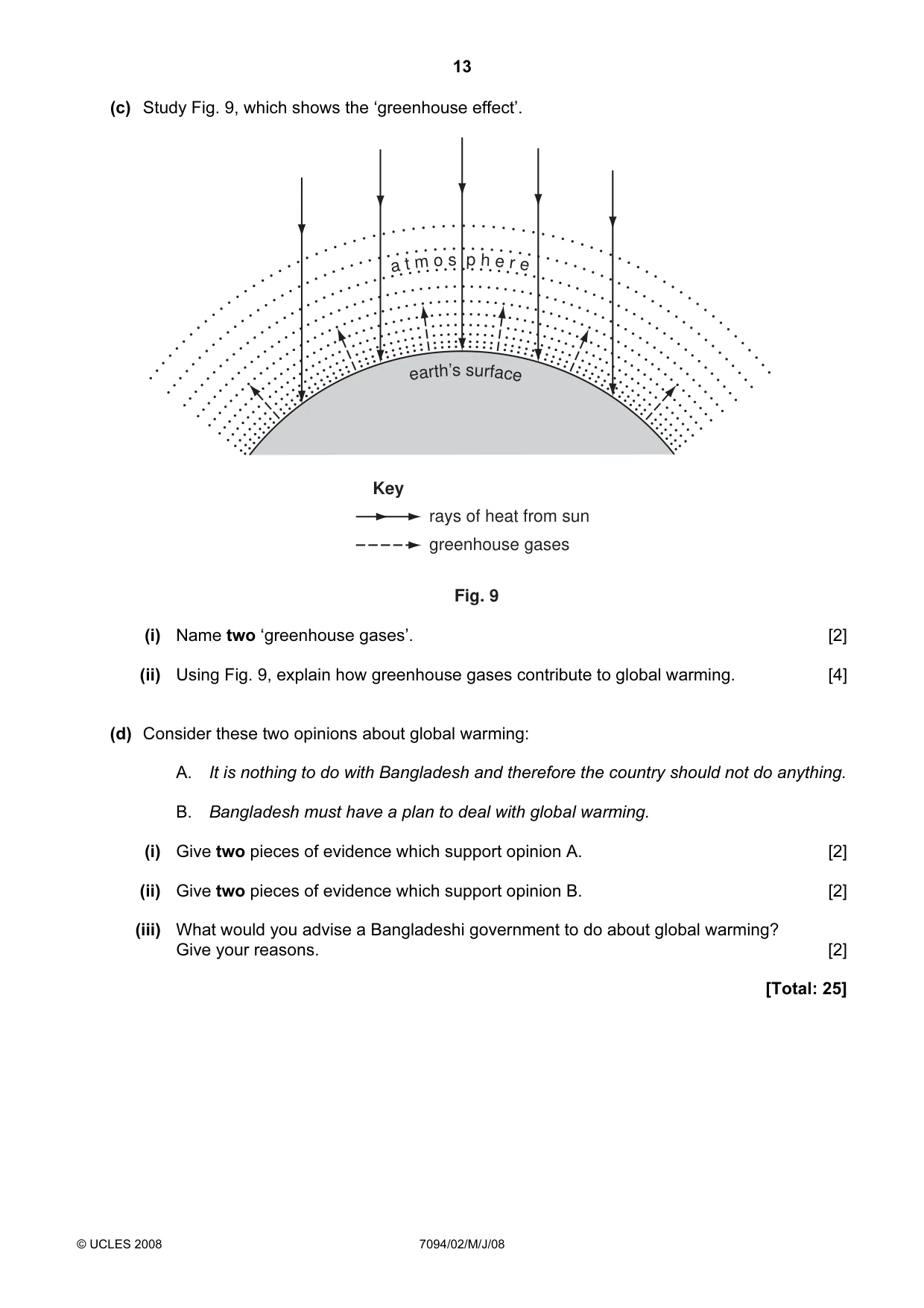
13 © UCLES 2008 7094/02/M/J/08 (c) Study Fig. 9, which shows the ‘greenhouse effect’. ea rth ’s su rfa ce a t m o s p h e r e rays of heat from sun greenhouse gases Key Fig. 9 (i) Name two ‘greenhouse gases’. [2] (ii) Using Fig. 9, explain how greenhouse gases contribute to global warming. [4] (d) Consider these two opinions about global warming: A. It is nothing to do with Bangladesh and therefore the country should not do anything. B. Bangladesh must have a plan to deal with global warming. (i) Give two pieces of evidence which support opinion A. [2] (ii) Give two pieces of evidence which support opinion B. [2] (iii) What would you advise a Bangladeshi government to do about global warming? Give your reasons. [2] [Total: 25]
Question paper, page 16
16 BLANK PAGE Copyright Acknowledgements: Question 3 Photograph A © Philippe Lissac / Panos Pictures. Permission to reproduce items where third-party owned material protected by copyright is included has been sought and cleared where possible. Every reasonable effort has been made by the publisher (UCLES) to trace copyright holders, but if any items requiring clearance have unwittingly been included, the publisher will be pleased to make amends at the earliest possible opportunity. University of Cambridge International Examinations is part of the Cambridge Assessment Group. Cambridge Assessment is the brand name of University of Cambridge Local Examinations Syndicate (UCLES), which is itself a department of the University of Cambridge. 7094/02/M/J/08
Mark scheme, page 1
UNIVERSITY OF CAMBRIDGE INTERNATIONAL EXAMINATIONS International General Certificate of Secondary Education MARK SCHEME for the May/June 2008 question paper 0449 BANGLADESH STUDIES 0449/02 Paper 2 (Environment and Development of Bangladesh), maximum raw mark 75 This mark scheme is published as an aid to teachers and candidates, to indicate the requirements of the examination. It shows the basis on which Examiners were instructed to award marks. It does not indicate the details of the discussions that took place at an Examiners’ meeting before marking began. All Examiners are instructed that alternative correct answers and unexpected approaches in candidates’ scripts must be given marks that fairly reflect the relevant knowledge and skills demonstrated. Mark schemes must be read in conjunction with the question papers and the report on the examination. • CIE will not enter into discussions or correspondence in connection with these mark schemes. CIE is publishing the mark schemes for the May/June 2008 question papers for most IGCSE, GCE Advanced Level and Advanced Subsidiary Level syllabuses and some Ordinary Level syllabuses. www.XtremePapers.com
Mark scheme, page 2
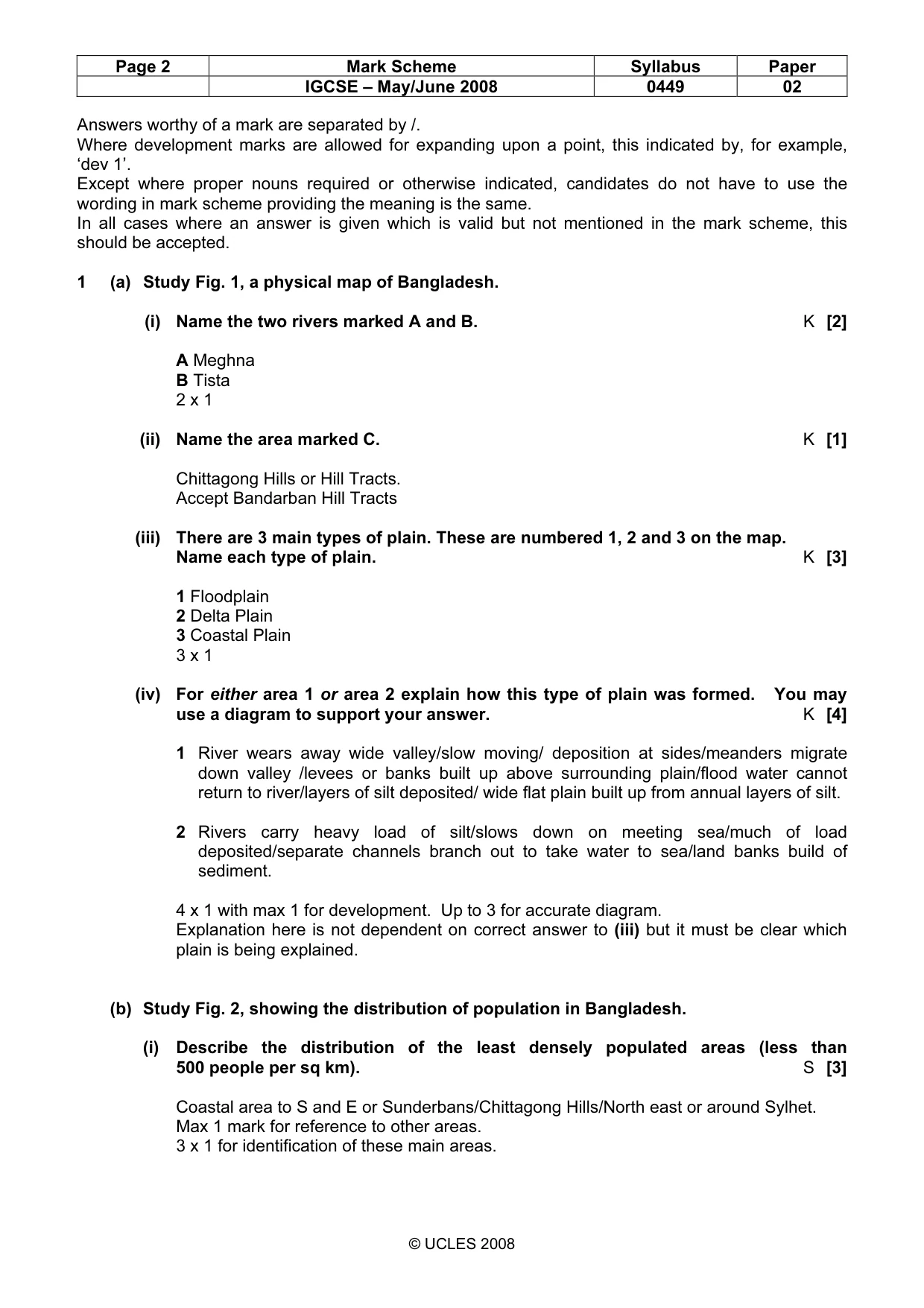
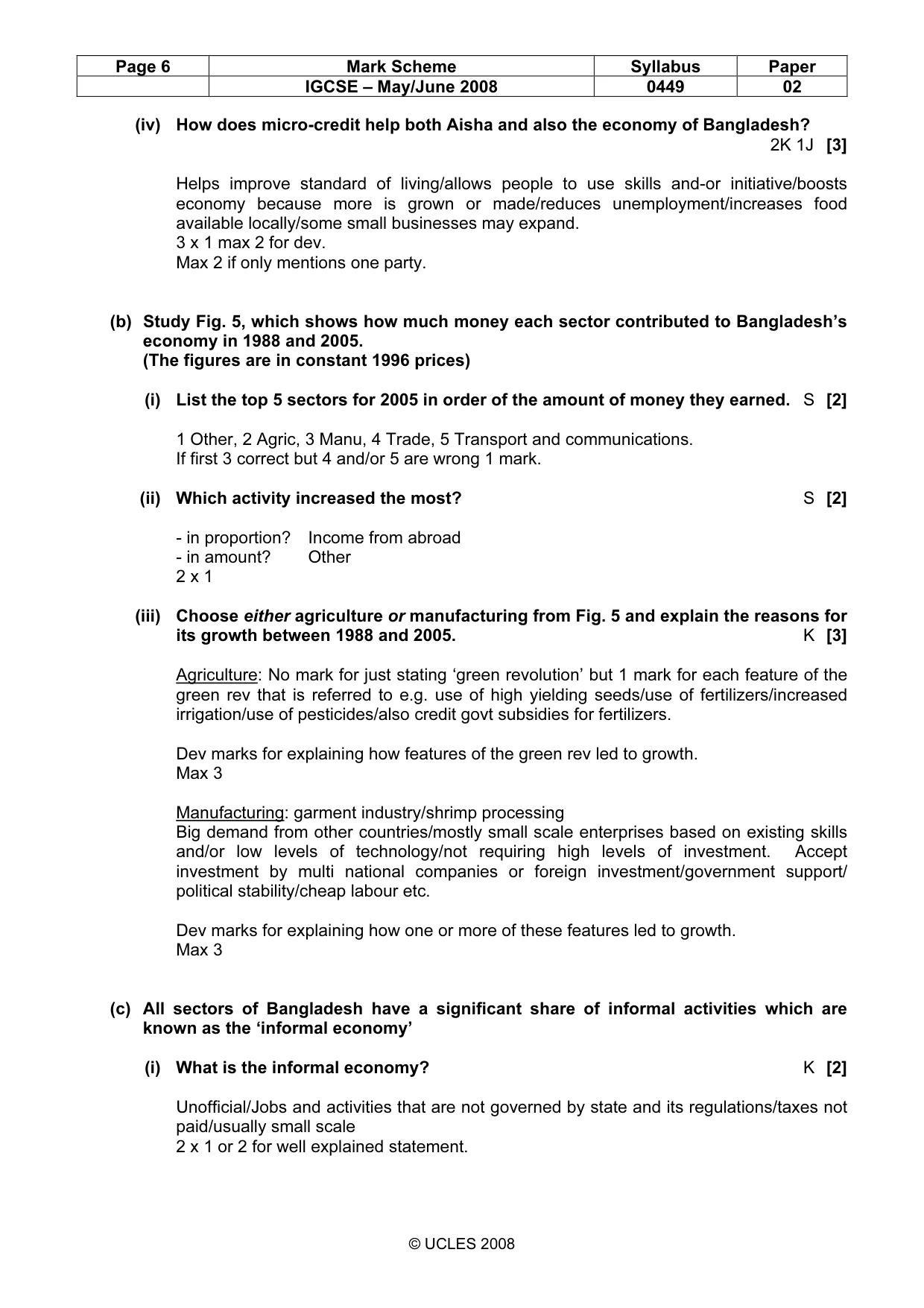
Page 2 Mark Scheme Syllabus Paper IGCSE – May/June 2008 0449 02 © UCLES 2008 Answers worthy of a mark are separated by /. Where development marks are allowed for expanding upon a point, this indicated by, for example, ‘dev 1’. Except where proper nouns required or otherwise indicated, candidates do not have to use the wording in mark scheme providing the meaning is the same. In all cases where an answer is given which is valid but not mentioned in the mark scheme, this should be accepted. 1 (a) Study Fig. 1, a physical map of Bangladesh. (i) Name the two rivers marked A and B. K [2] A Meghna B Tista 2 x 1 (ii) Name the area marked C. K [1] Chittagong Hills or Hill Tracts. Accept Bandarban Hill Tracts (iii) There are 3 main types of plain. These are numbered 1, 2 and 3 on the map. Name each type of plain. K [3] 1 Floodplain 2 Delta Plain 3 Coastal Plain 3 x 1 (iv) For either area 1 or area 2 explain how this type of plain was formed. You may use a diagram to support your answer. K [4] 1 River wears away wide valley/slow moving/ deposition at sides/meanders migrate down valley /levees or banks built up above surrounding plain/flood water cannot return to river/layers of silt deposited/ wide flat plain built up from annual layers of silt. 2 Rivers carry heavy load of silt/slows down on meeting sea/much of load deposited/separate channels branch out to take water to sea/land banks build of sediment. 4 x 1 with max 1 for development. Up to 3 for accurate diagram. Explanation here is not dependent on correct answer to (iii) but it must be clear which plain is being explained. (b) Study Fig. 2, showing the distribution of population in Bangladesh. (i) Describe the distribution of the least densely populated areas (less than 500 people per sq km). S [3] Coastal area to S and E or Sunderbans/Chittagong Hills/North east or around Sylhet. Max 1 mark for reference to other areas. 3 x 1 for identification of these main areas.
Mark scheme, page 3
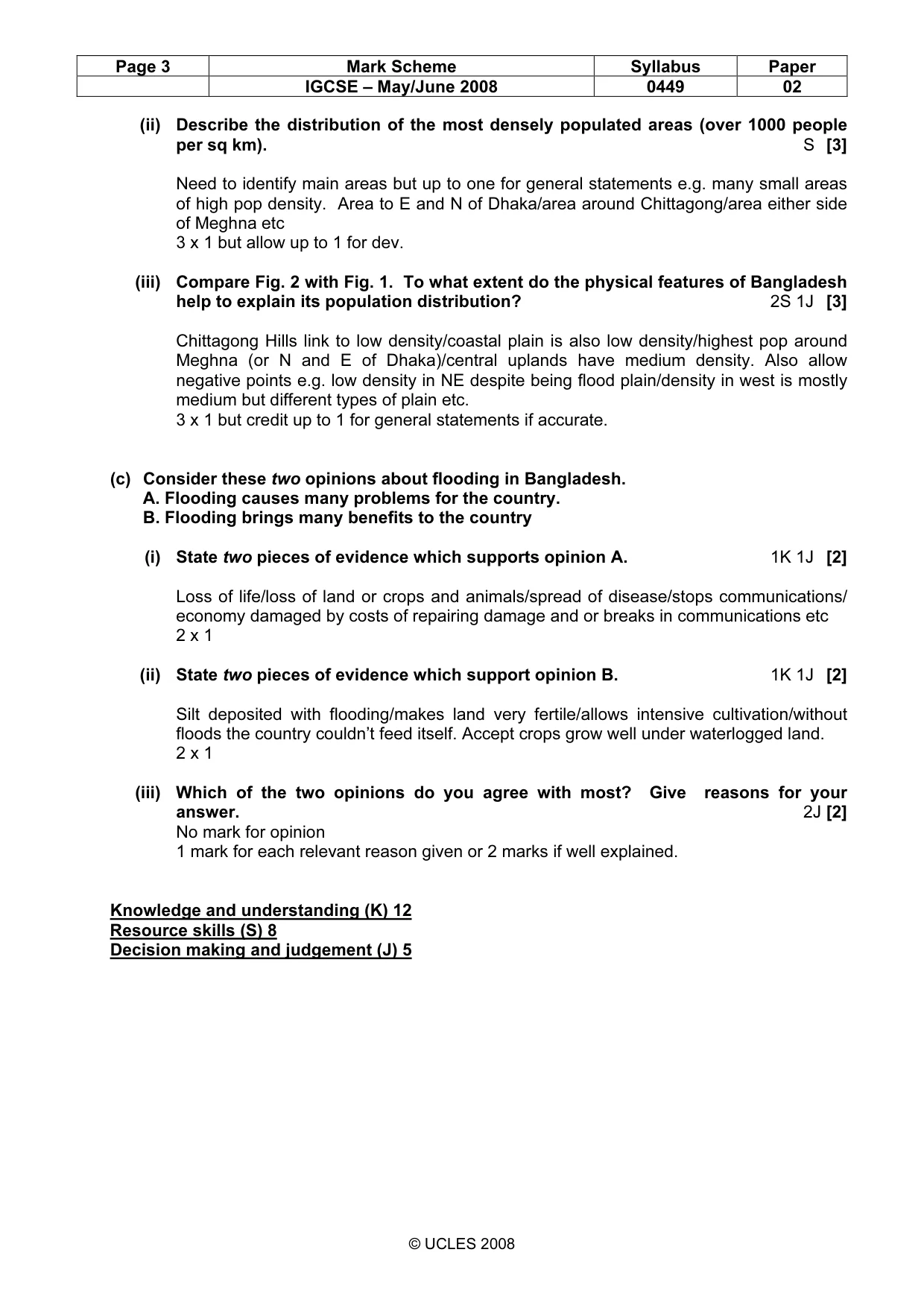
Page 3 Mark Scheme Syllabus Paper IGCSE – May/June 2008 0449 02 © UCLES 2008 (ii) Describe the distribution of the most densely populated areas (over 1000 people per sq km). S [3] Need to identify main areas but up to one for general statements e.g. many small areas of high pop density. Area to E and N of Dhaka/area around Chittagong/area either side of Meghna etc 3 x 1 but allow up to 1 for dev. (iii) Compare Fig. 2 with Fig. 1. To what extent do the physical features of Bangladesh help to explain its population distribution? 2S 1J [3] Chittagong Hills link to low density/coastal plain is also low density/highest pop around Meghna (or N and E of Dhaka)/central uplands have medium density. Also allow negative points e.g. low density in NE despite being flood plain/density in west is mostly medium but different types of plain etc. 3 x 1 but credit up to 1 for general statements if accurate. (c) Consider these two opinions about flooding in Bangladesh. A. Flooding causes many problems for the country. B. Flooding brings many benefits to the country (i) State two pieces of evidence which supports opinion A. 1K 1J [2] Loss of life/loss of land or crops and animals/spread of disease/stops communications/ economy damaged by costs of repairing damage and or breaks in communications etc 2 x 1 (ii) State two pieces of evidence which support opinion B. 1K 1J [2] Silt deposited with flooding/makes land very fertile/allows intensive cultivation/without floods the country couldn’t feed itself. Accept crops grow well under waterlogged land. 2 x 1 (iii) Which of the two opinions do you agree with most? Give reasons for your answer. 2J [2] No mark for opinion 1 mark for each relevant reason given or 2 marks if well explained. Knowledge and understanding (K) 12 Resource skills (S) 8 Decision making and judgement (J) 5
Mark scheme, page 4
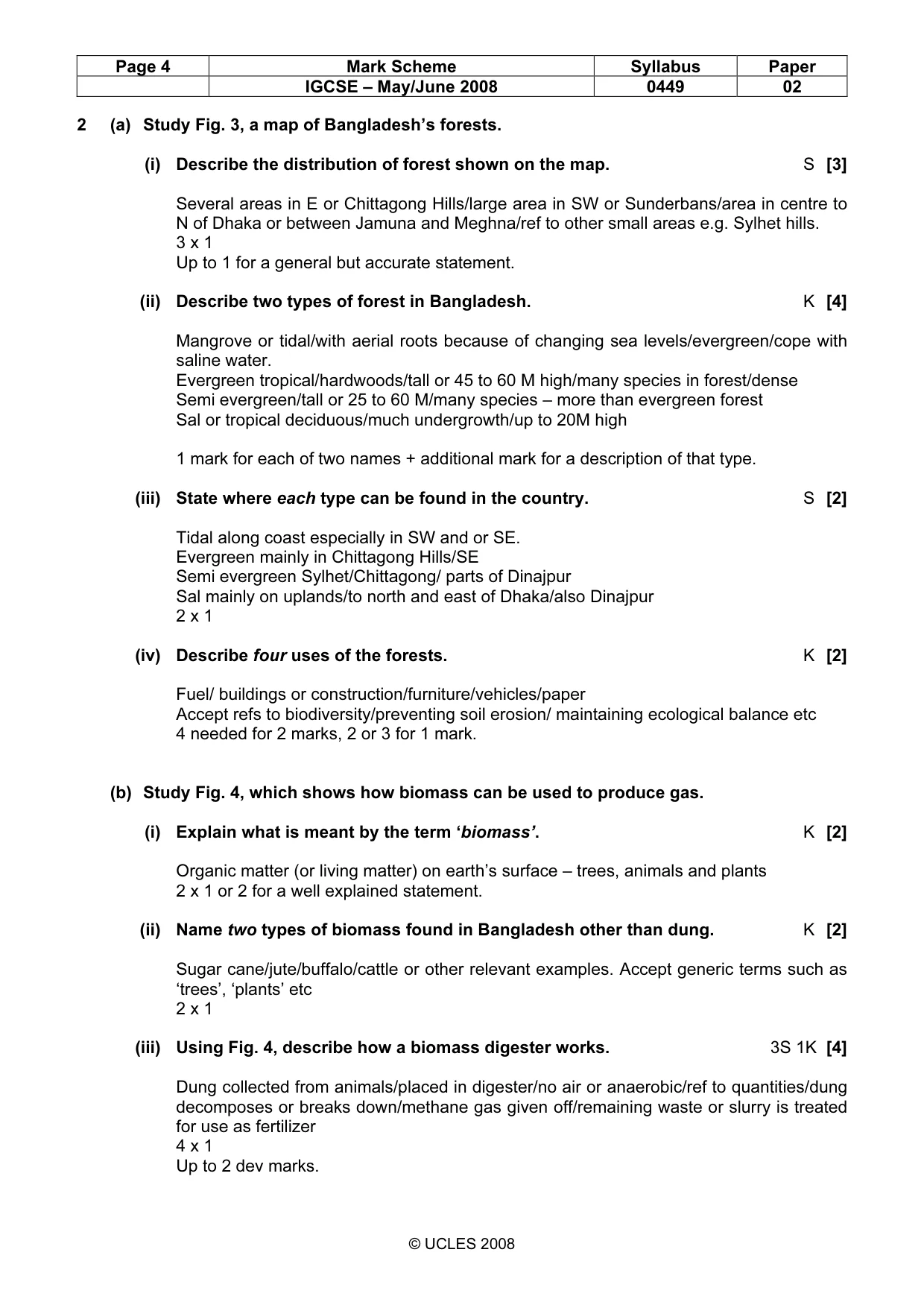
Page 4 Mark Scheme Syllabus Paper IGCSE – May/June 2008 0449 02 © UCLES 2008 2 (a) Study Fig. 3, a map of Bangladesh’s forests. (i) Describe the distribution of forest shown on the map. S [3] Several areas in E or Chittagong Hills/large area in SW or Sunderbans/area in centre to N of Dhaka or between Jamuna and Meghna/ref to other small areas e.g. Sylhet hills. 3 x 1 Up to 1 for a general but accurate statement. (ii) Describe two types of forest in Bangladesh. K [4] Mangrove or tidal/with aerial roots because of changing sea levels/evergreen/cope with saline water. Evergreen tropical/hardwoods/tall or 45 to 60 M high/many species in forest/dense Semi evergreen/tall or 25 to 60 M/many species – more than evergreen forest Sal or tropical deciduous/much undergrowth/up to 20M high 1 mark for each of two names + additional mark for a description of that type. (iii) State where each type can be found in the country. S [2] Tidal along coast especially in SW and or SE. Evergreen mainly in Chittagong Hills/SE Semi evergreen Sylhet/Chittagong/ parts of Dinajpur Sal mainly on uplands/to north and east of Dhaka/also Dinajpur 2 x 1 (iv) Describe four uses of the forests. K [2] Fuel/ buildings or construction/furniture/vehicles/paper Accept refs to biodiversity/preventing soil erosion/ maintaining ecological balance etc 4 needed for 2 marks, 2 or 3 for 1 mark. (b) Study Fig. 4, which shows how biomass can be used to produce gas. (i) Explain what is meant by the term ‘biomass’. K [2] Organic matter (or living matter) on earth’s surface – trees, animals and plants 2 x 1 or 2 for a well explained statement. (ii) Name two types of biomass found in Bangladesh other than dung. K [2] Sugar cane/jute/buffalo/cattle or other relevant examples. Accept generic terms such as ‘trees’, ‘plants’ etc 2 x 1 (iii) Using Fig. 4, describe how a biomass digester works. 3S 1K [4] Dung collected from animals/placed in digester/no air or anaerobic/ref to quantities/dung decomposes or breaks down/methane gas given off/remaining waste or slurry is treated for use as fertilizer 4 x 1 Up to 2 dev marks.
Mark scheme, page 5
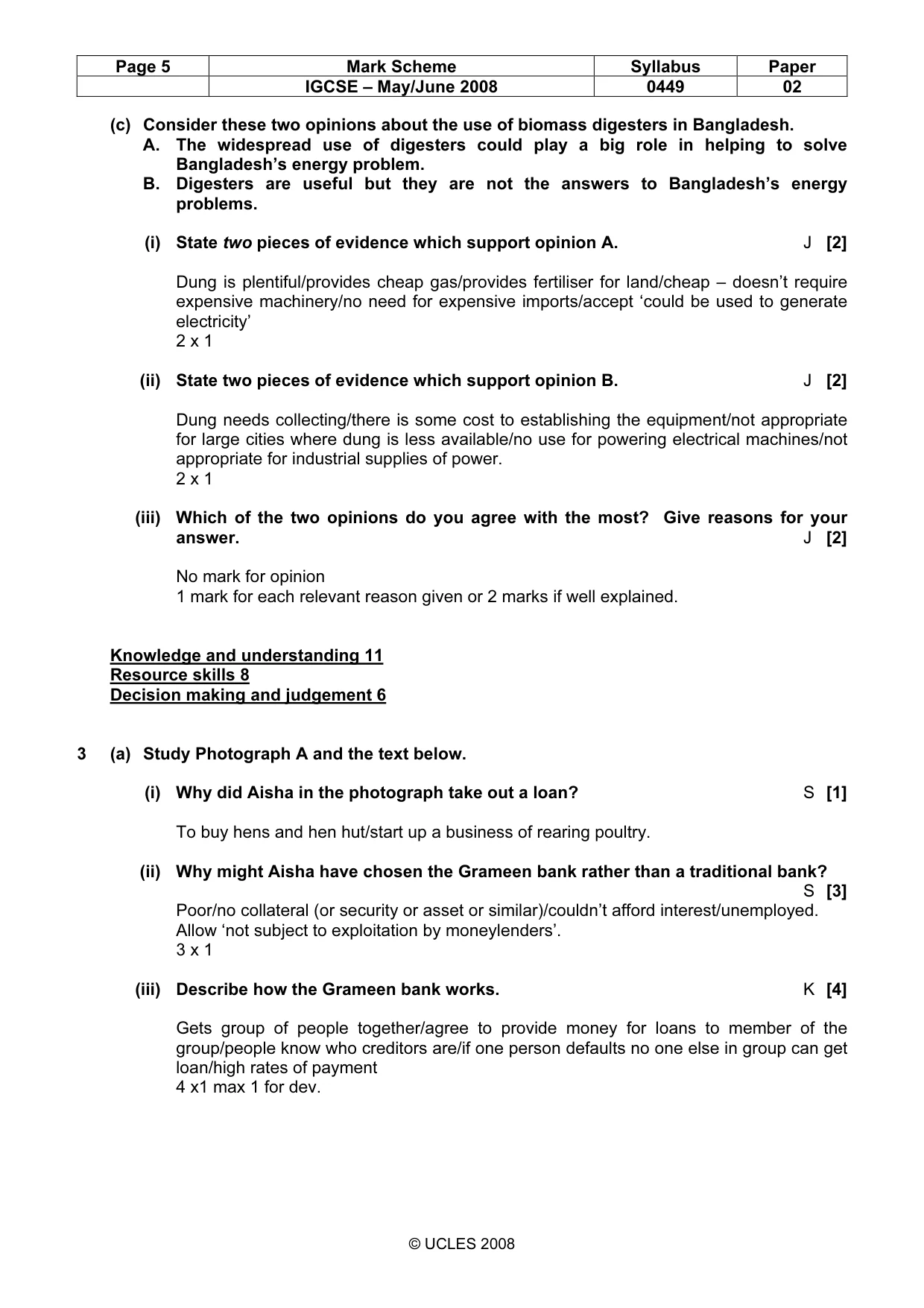
Page 5 Mark Scheme Syllabus Paper IGCSE – May/June 2008 0449 02 © UCLES 2008 (c) Consider these two opinions about the use of biomass digesters in Bangladesh. A. The widespread use of digesters could play a big role in helping to solve Bangladesh’s energy problem. B. Digesters are useful but they are not the answers to Bangladesh’s energy problems. (i) State two pieces of evidence which support opinion A. J [2] Dung is plentiful/provides cheap gas/provides fertiliser for land/cheap – doesn’t require expensive machinery/no need for expensive imports/accept ‘could be used to generate electricity’ 2 x 1 (ii) State two pieces of evidence which support opinion B. J [2] Dung needs collecting/there is some cost to establishing the equipment/not appropriate for large cities where dung is less available/no use for powering electrical machines/not appropriate for industrial supplies of power. 2 x 1 (iii) Which of the two opinions do you agree with the most? Give reasons for your answer. J [2] No mark for opinion 1 mark for each relevant reason given or 2 marks if well explained. Knowledge and understanding 11 Resource skills 8 Decision making and judgement 6 3 (a) Study Photograph A and the text below. (i) Why did Aisha in the photograph take out a loan? S [1] To buy hens and hen hut/start up a business of rearing poultry. (ii) Why might Aisha have chosen the Grameen bank rather than a traditional bank? S [3] Poor/no collateral (or security or asset or similar)/couldn’t afford interest/unemployed. Allow ‘not subject to exploitation by moneylenders’. 3 x 1 (iii) Describe how the Grameen bank works. K [4] Gets group of people together/agree to provide money for loans to member of the group/people know who creditors are/if one person defaults no one else in group can get loan/high rates of payment 4 x1 max 1 for dev.
Mark scheme, page 6
Page 6 Mark Scheme Syllabus Paper IGCSE – May/June 2008 0449 02 © UCLES 2008 (iv) How does micro-credit help both Aisha and also the economy of Bangladesh? 2K 1J [3] Helps improve standard of living/allows people to use skills and-or initiative/boosts economy because more is grown or made/reduces unemployment/increases food available locally/some small businesses may expand. 3 x 1 max 2 for dev. Max 2 if only mentions one party. (b) Study Fig. 5, which shows how much money each sector contributed to Bangladesh’s economy in 1988 and 2005. (The figures are in constant 1996 prices) (i) List the top 5 sectors for 2005 in order of the amount of money they earned. S [2] 1 Other, 2 Agric, 3 Manu, 4 Trade, 5 Transport and communications. If first 3 correct but 4 and/or 5 are wrong 1 mark. (ii) Which activity increased the most? S [2] - in proportion? Income from abroad - in amount? Other 2 x 1 (iii) Choose either agriculture or manufacturing from Fig. 5 and explain the reasons for its growth between 1988 and 2005. K [3] Agriculture: No mark for just stating ‘green revolution’ but 1 mark for each feature of the green rev that is referred to e.g. use of high yielding seeds/use of fertilizers/increased irrigation/use of pesticides/also credit govt subsidies for fertilizers. Dev marks for explaining how features of the green rev led to growth. Max 3 Manufacturing: garment industry/shrimp processing Big demand from other countries/mostly small scale enterprises based on existing skills and/or low levels of technology/not requiring high levels of investment. Accept investment by multi national companies or foreign investment/government support/ political stability/cheap labour etc. Dev marks for explaining how one or more of these features led to growth. Max 3 (c) All sectors of Bangladesh have a significant share of informal activities which are known as the ‘informal economy’ (i) What is the informal economy? K [2] Unofficial/Jobs and activities that are not governed by state and its regulations/taxes not paid/usually small scale 2 x 1 or 2 for well explained statement.
Mark scheme, page 7
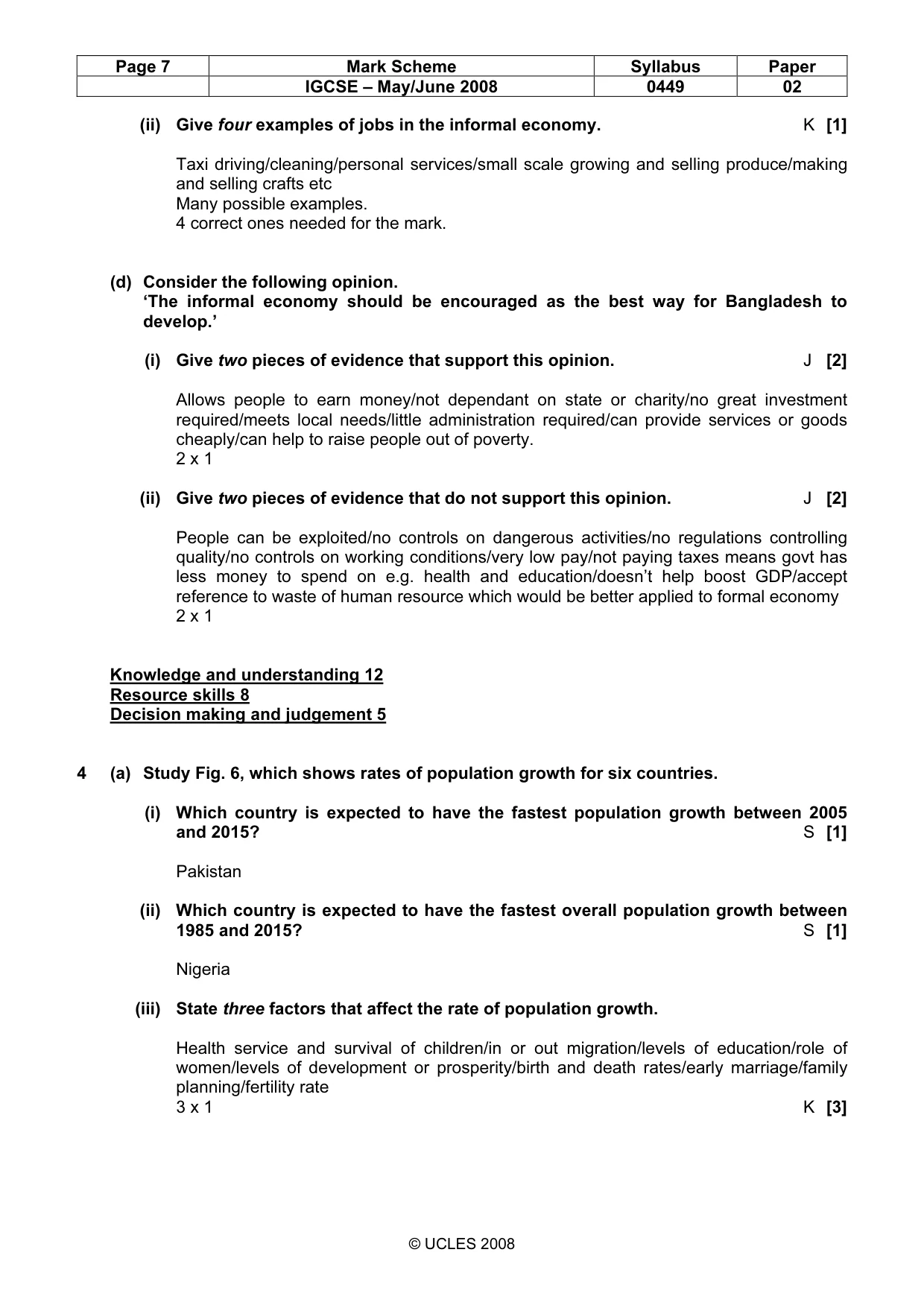
Page 7 Mark Scheme Syllabus Paper IGCSE – May/June 2008 0449 02 © UCLES 2008 (ii) Give four examples of jobs in the informal economy. K [1] Taxi driving/cleaning/personal services/small scale growing and selling produce/making and selling crafts etc Many possible examples. 4 correct ones needed for the mark. (d) Consider the following opinion. ‘The informal economy should be encouraged as the best way for Bangladesh to develop.’ (i) Give two pieces of evidence that support this opinion. J [2] Allows people to earn money/not dependant on state or charity/no great investment required/meets local needs/little administration required/can provide services or goods cheaply/can help to raise people out of poverty. 2 x 1 (ii) Give two pieces of evidence that do not support this opinion. J [2] People can be exploited/no controls on dangerous activities/no regulations controlling quality/no controls on working conditions/very low pay/not paying taxes means govt has less money to spend on e.g. health and education/doesn’t help boost GDP/accept reference to waste of human resource which would be better applied to formal economy 2 x 1 Knowledge and understanding 12 Resource skills 8 Decision making and judgement 5 4 (a) Study Fig. 6, which shows rates of population growth for six countries. (i) Which country is expected to have the fastest population growth between 2005 and 2015? S [1] Pakistan (ii) Which country is expected to have the fastest overall population growth between 1985 and 2015? S [1] Nigeria (iii) State three factors that affect the rate of population growth. Health service and survival of children/in or out migration/levels of education/role of women/levels of development or prosperity/birth and death rates/early marriage/family planning/fertility rate 3 x 1 K [3]
Mark scheme, page 8
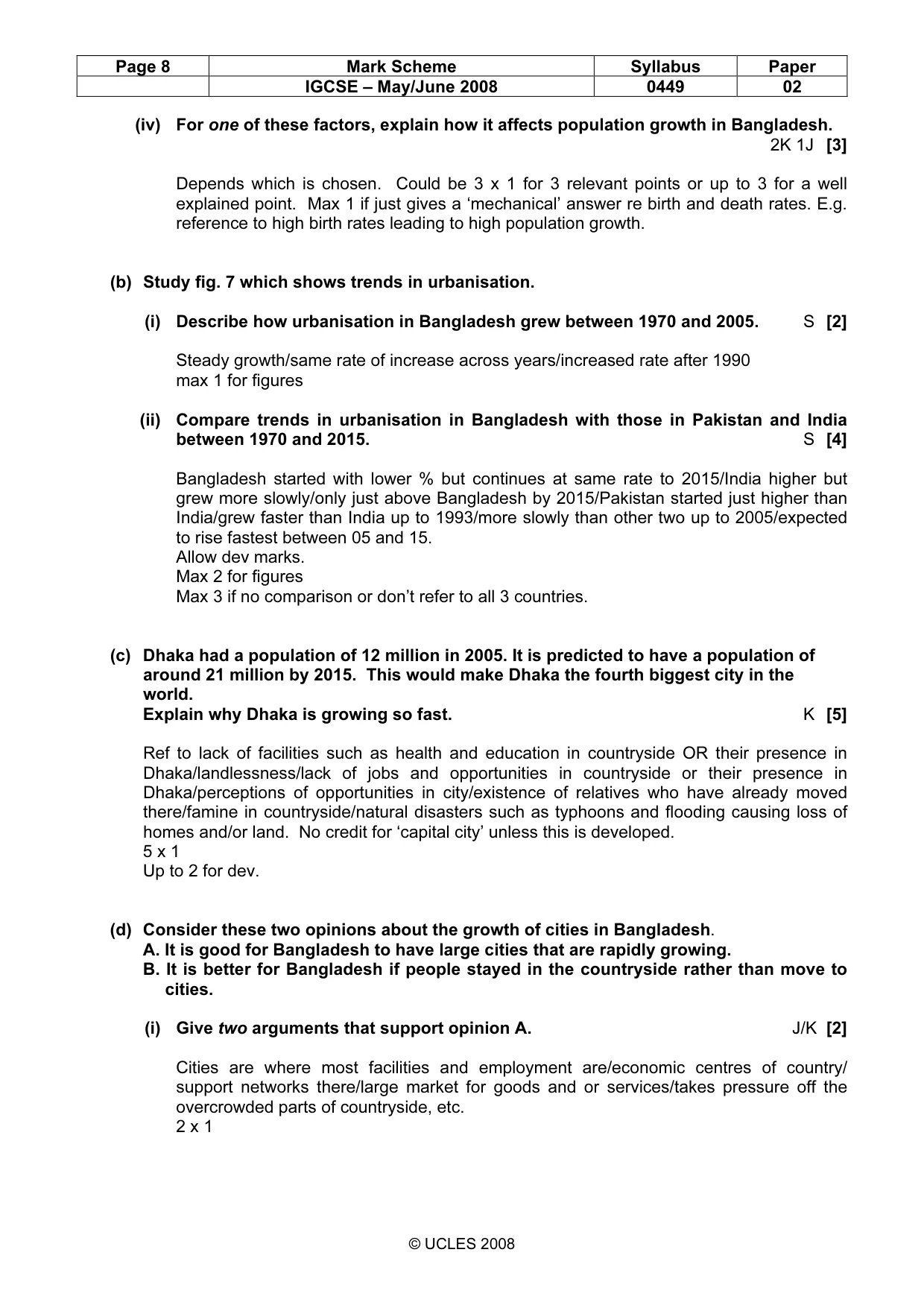
Page 8 Mark Scheme Syllabus Paper IGCSE – May/June 2008 0449 02 © UCLES 2008 (iv) For one of these factors, explain how it affects population growth in Bangladesh. 2K 1J [3] Depends which is chosen. Could be 3 x 1 for 3 relevant points or up to 3 for a well explained point. Max 1 if just gives a ‘mechanical’ answer re birth and death rates. E.g. reference to high birth rates leading to high population growth. (b) Study fig. 7 which shows trends in urbanisation. (i) Describe how urbanisation in Bangladesh grew between 1970 and 2005. S [2] Steady growth/same rate of increase across years/increased rate after 1990 max 1 for figures (ii) Compare trends in urbanisation in Bangladesh with those in Pakistan and India between 1970 and 2015. S [4] Bangladesh started with lower % but continues at same rate to 2015/India higher but grew more slowly/only just above Bangladesh by 2015/Pakistan started just higher than India/grew faster than India up to 1993/more slowly than other two up to 2005/expected to rise fastest between 05 and 15. Allow dev marks. Max 2 for figures Max 3 if no comparison or don’t refer to all 3 countries. (c) Dhaka had a population of 12 million in 2005. It is predicted to have a population of around 21 million by 2015. This would make Dhaka the fourth biggest city in the world. Explain why Dhaka is growing so fast. K [5] Ref to lack of facilities such as health and education in countryside OR their presence in Dhaka/landlessness/lack of jobs and opportunities in countryside or their presence in Dhaka/perceptions of opportunities in city/existence of relatives who have already moved there/famine in countryside/natural disasters such as typhoons and flooding causing loss of homes and/or land. No credit for ‘capital city’ unless this is developed. 5 x 1 Up to 2 for dev. (d) Consider these two opinions about the growth of cities in Bangladesh. A. It is good for Bangladesh to have large cities that are rapidly growing. B. It is better for Bangladesh if people stayed in the countryside rather than move to cities. (i) Give two arguments that support opinion A. J/K [2] Cities are where most facilities and employment are/economic centres of country/ support networks there/large market for goods and or services/takes pressure off the overcrowded parts of countryside, etc. 2 x 1
Mark scheme, page 9
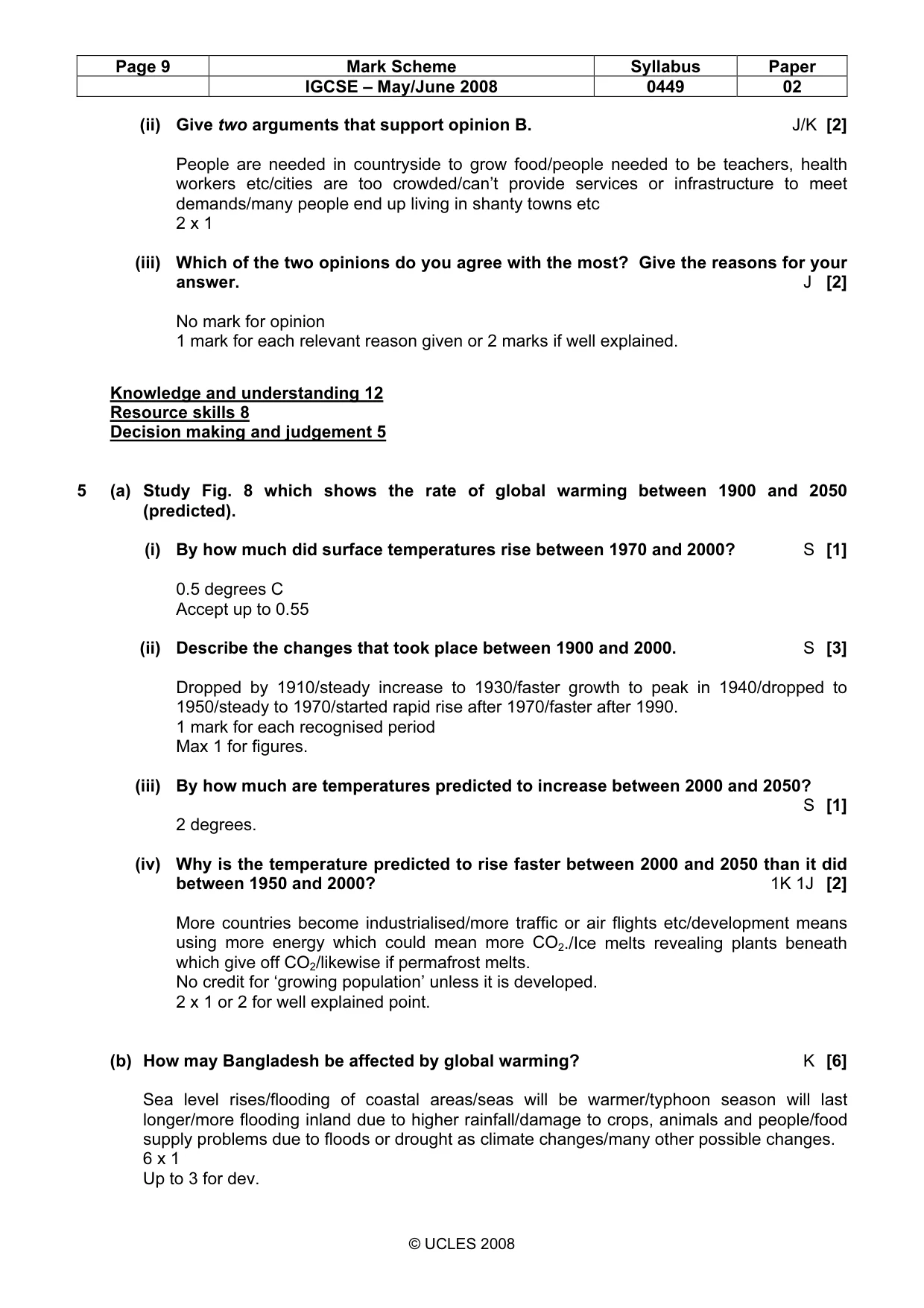
Page 9 Mark Scheme Syllabus Paper IGCSE – May/June 2008 0449 02 © UCLES 2008 (ii) Give two arguments that support opinion B. J/K [2] People are needed in countryside to grow food/people needed to be teachers, health workers etc/cities are too crowded/can’t provide services or infrastructure to meet demands/many people end up living in shanty towns etc 2 x 1 (iii) Which of the two opinions do you agree with the most? Give the reasons for your answer. J [2] No mark for opinion 1 mark for each relevant reason given or 2 marks if well explained. Knowledge and understanding 12 Resource skills 8 Decision making and judgement 5 5 (a) Study Fig. 8 which shows the rate of global warming between 1900 and 2050 (predicted). (i) By how much did surface temperatures rise between 1970 and 2000? S [1] 0.5 degrees C Accept up to 0.55 (ii) Describe the changes that took place between 1900 and 2000. S [3] Dropped by 1910/steady increase to 1930/faster growth to peak in 1940/dropped to 1950/steady to 1970/started rapid rise after 1970/faster after 1990. 1 mark for each recognised period Max 1 for figures. (iii) By how much are temperatures predicted to increase between 2000 and 2050? S [1] 2 degrees. (iv) Why is the temperature predicted to rise faster between 2000 and 2050 than it did between 1950 and 2000? 1K 1J [2] More countries become industrialised/more traffic or air flights etc/development means using more energy which could mean more CO2./Ice melts revealing plants beneath which give off CO2/likewise if permafrost melts. No credit for ‘growing population’ unless it is developed. 2 x 1 or 2 for well explained point. (b) How may Bangladesh be affected by global warming? K [6] Sea level rises/flooding of coastal areas/seas will be warmer/typhoon season will last longer/more flooding inland due to higher rainfall/damage to crops, animals and people/food supply problems due to floods or drought as climate changes/many other possible changes. 6 x 1 Up to 3 for dev.
Mark scheme, page 10
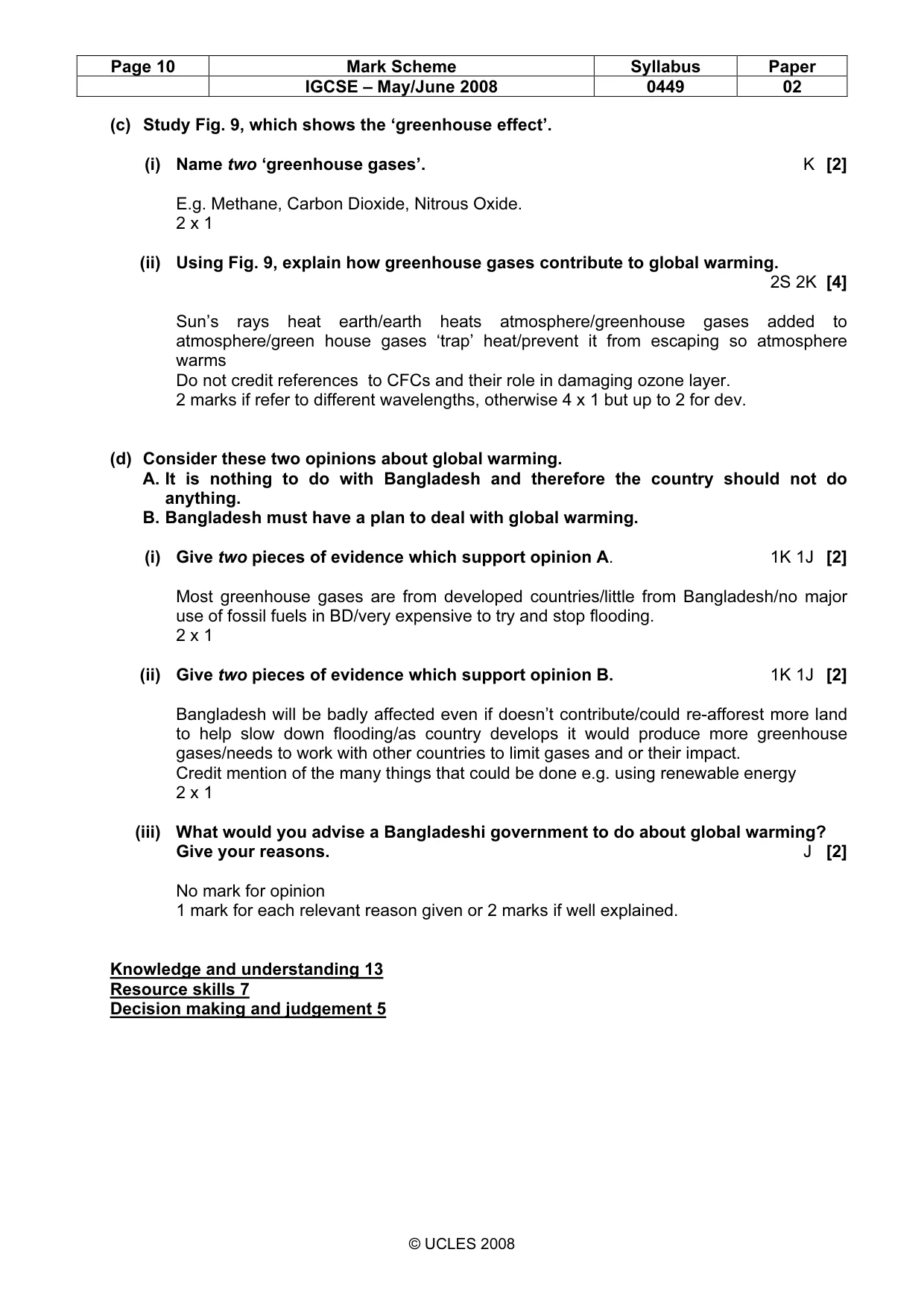
Page 10 Mark Scheme Syllabus Paper IGCSE – May/June 2008 0449 02 © UCLES 2008 (c) Study Fig. 9, which shows the ‘greenhouse effect’. (i) Name two ‘greenhouse gases’. K [2] E.g. Methane, Carbon Dioxide, Nitrous Oxide. 2 x 1 (ii) Using Fig. 9, explain how greenhouse gases contribute to global warming. 2S 2K [4] Sun’s rays heat earth/earth heats atmosphere/greenhouse gases added to atmosphere/green house gases ‘trap’ heat/prevent it from escaping so atmosphere warms Do not credit references to CFCs and their role in damaging ozone layer. 2 marks if refer to different wavelengths, otherwise 4 x 1 but up to 2 for dev. (d) Consider these two opinions about global warming. A. It is nothing to do with Bangladesh and therefore the country should not do anything. B. Bangladesh must have a plan to deal with global warming. (i) Give two pieces of evidence which support opinion A. 1K 1J [2] Most greenhouse gases are from developed countries/little from Bangladesh/no major use of fossil fuels in BD/very expensive to try and stop flooding. 2 x 1 (ii) Give two pieces of evidence which support opinion B. 1K 1J [2] Bangladesh will be badly affected even if doesn’t contribute/could re-afforest more land to help slow down flooding/as country develops it would produce more greenhouse gases/needs to work with other countries to limit gases and or their impact. Credit mention of the many things that could be done e.g. using renewable energy 2 x 1 (iii) What would you advise a Bangladeshi government to do about global warming? Give your reasons. J [2] No mark for opinion 1 mark for each relevant reason given or 2 marks if well explained. Knowledge and understanding 13 Resource skills 7 Decision making and judgement 5
What you needed in this session
Cambridge’s own grade thresholds for 2008 May/June, Paper 2 · Variant 1. A higher threshold means an easier paper — the bar moves with how the cohort did.