Cambridge IGCSE Bangladesh Studies 0449 — 2008 May/June Paper 1 · Variant 1
0449/11/M/J/08 · 75 marks · ≈84 min
The question paper and its mark scheme, free to read here and free to download. This is Cambridge’s own paper, exactly as it was sat.
Question paper8 pages


Mark scheme6 pages
Answers below. Sit the paper first if you are practising.
Paper as text
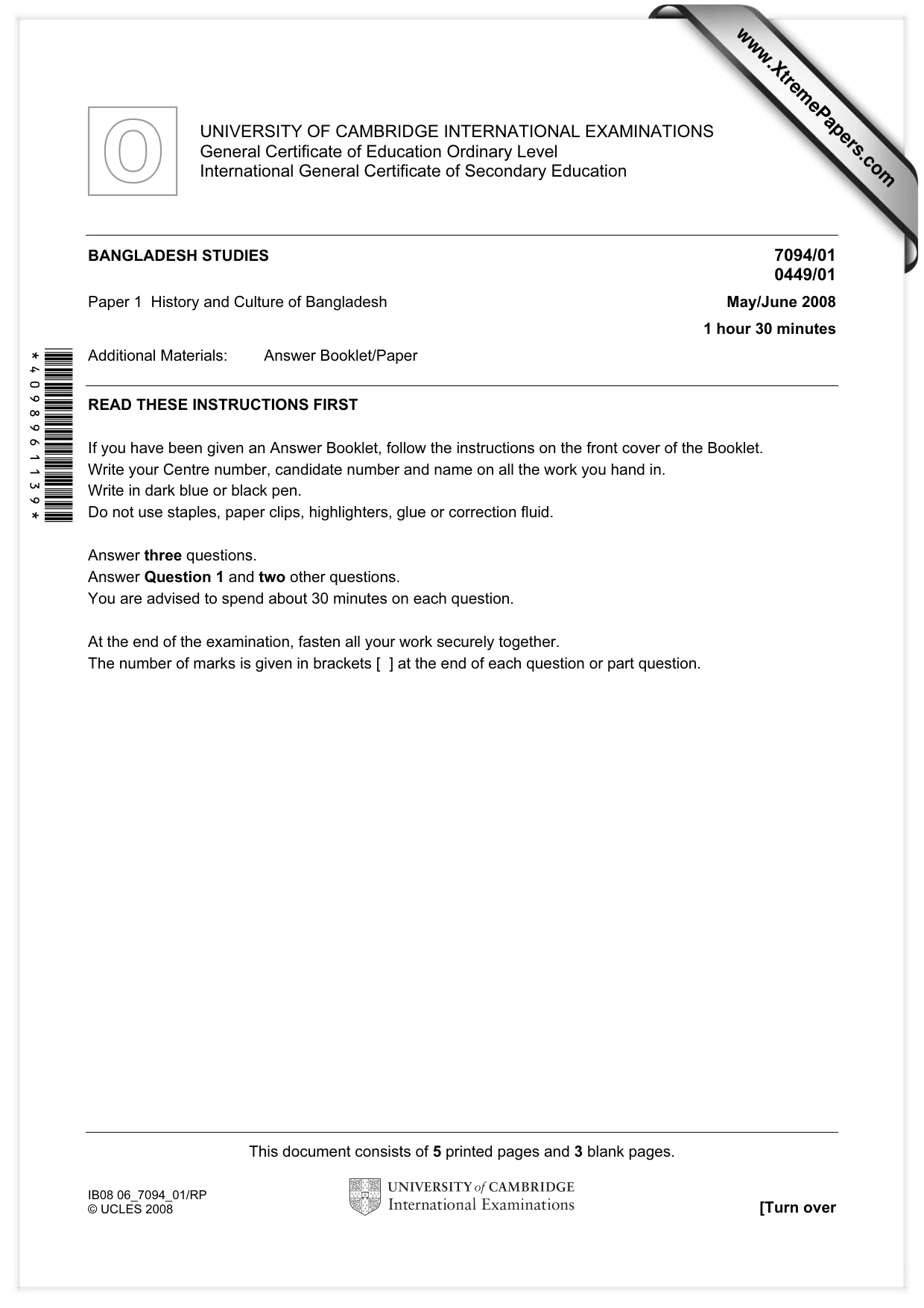
Question paper, page 1
This document consists of 5 printed pages and 3 blank pages. IB08 06_7094_01/RP © UCLES 2008 [Turn over *4098961139* UNIVERSITY OF CAMBRIDGE INTERNATIONAL EXAMINATIONS General Certificate of Education Ordinary Level International General Certificate of Secondary Education BANGLADESH STUDIES 7094/01 0449/01 Paper 1 History and Culture of Bangladesh May/June 2008 1 hour 30 minutes Additional Materials: Answer Booklet/Paper READ THESE INSTRUCTIONS FIRST If you have been given an Answer Booklet, follow the instructions on the front cover of the Booklet. Write your Centre number, candidate number and name on all the work you hand in. Write in dark blue or black pen. Do not use staples, paper clips, highlighters, glue or correction fluid. Answer three questions. Answer Question 1 and two other questions. You are advised to spend about 30 minutes on each question. At the end of the examination, fasten all your work securely together. The number of marks is given in brackets [ ] at the end of each question or part question. www.XtremePapers.com
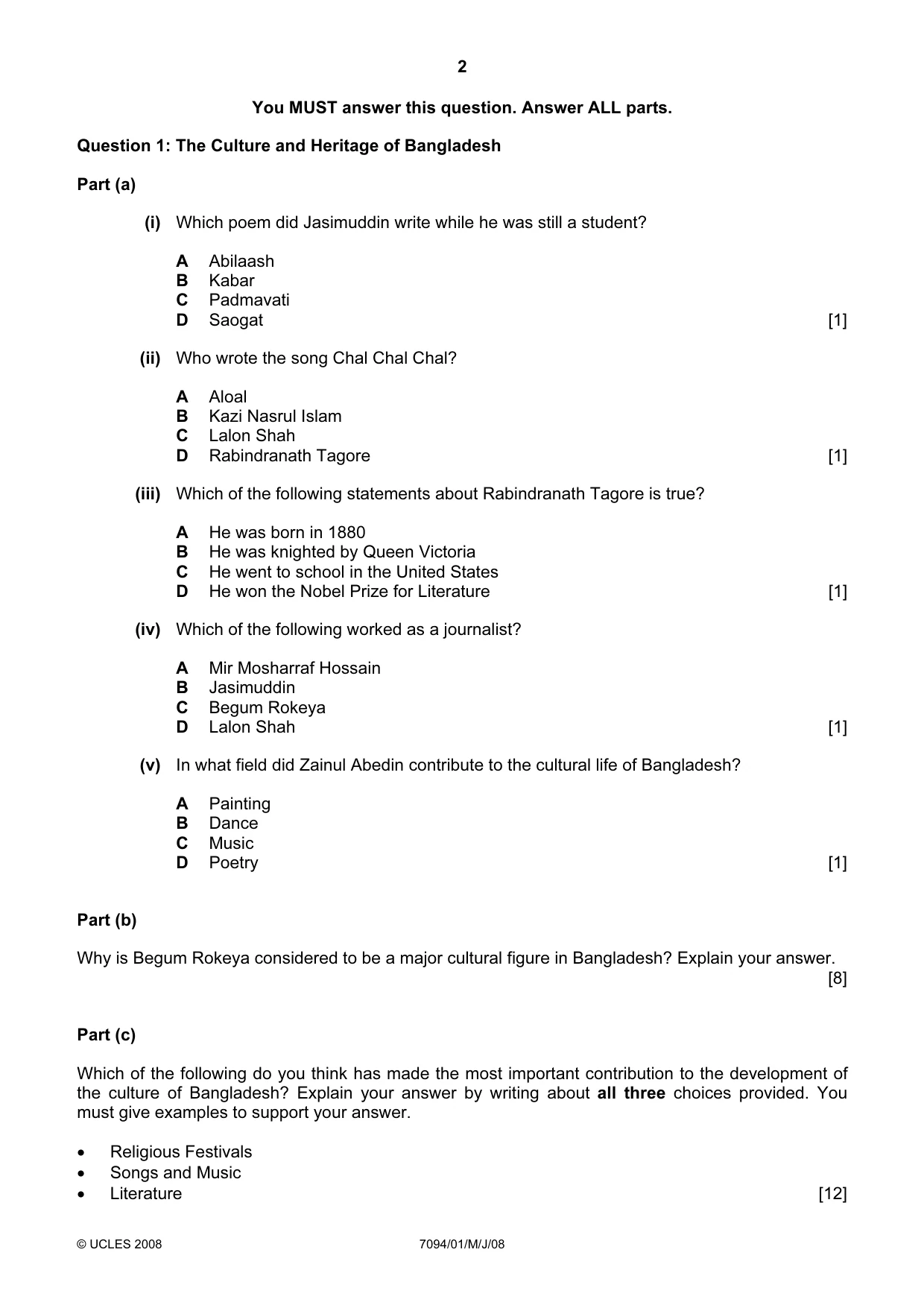
Question paper, page 2
2 © UCLES 2008 7094/01/M/J/08 You MUST answer this question. Answer ALL parts. Question 1: The Culture and Heritage of Bangladesh Part (a) (i) Which poem did Jasimuddin write while he was still a student? A Abilaash B Kabar C Padmavati D Saogat [1] (ii) Who wrote the song Chal Chal Chal? A Aloal B Kazi Nasrul Islam C Lalon Shah D Rabindranath Tagore [1] (iii) Which of the following statements about Rabindranath Tagore is true? A He was born in 1880 B He was knighted by Queen Victoria C He went to school in the United States D He won the Nobel Prize for Literature [1] (iv) Which of the following worked as a journalist? A Mir Mosharraf Hossain B Jasimuddin C Begum Rokeya D Lalon Shah [1] (v) In what field did Zainul Abedin contribute to the cultural life of Bangladesh? A Painting B Dance C Music D Poetry [1] Part (b) Why is Begum Rokeya considered to be a major cultural figure in Bangladesh? Explain your answer. [8] Part (c) Which of the following do you think has made the most important contribution to the development of the culture of Bangladesh? Explain your answer by writing about all three choices provided. You must give examples to support your answer. • Religious Festivals • Songs and Music • Literature [12]
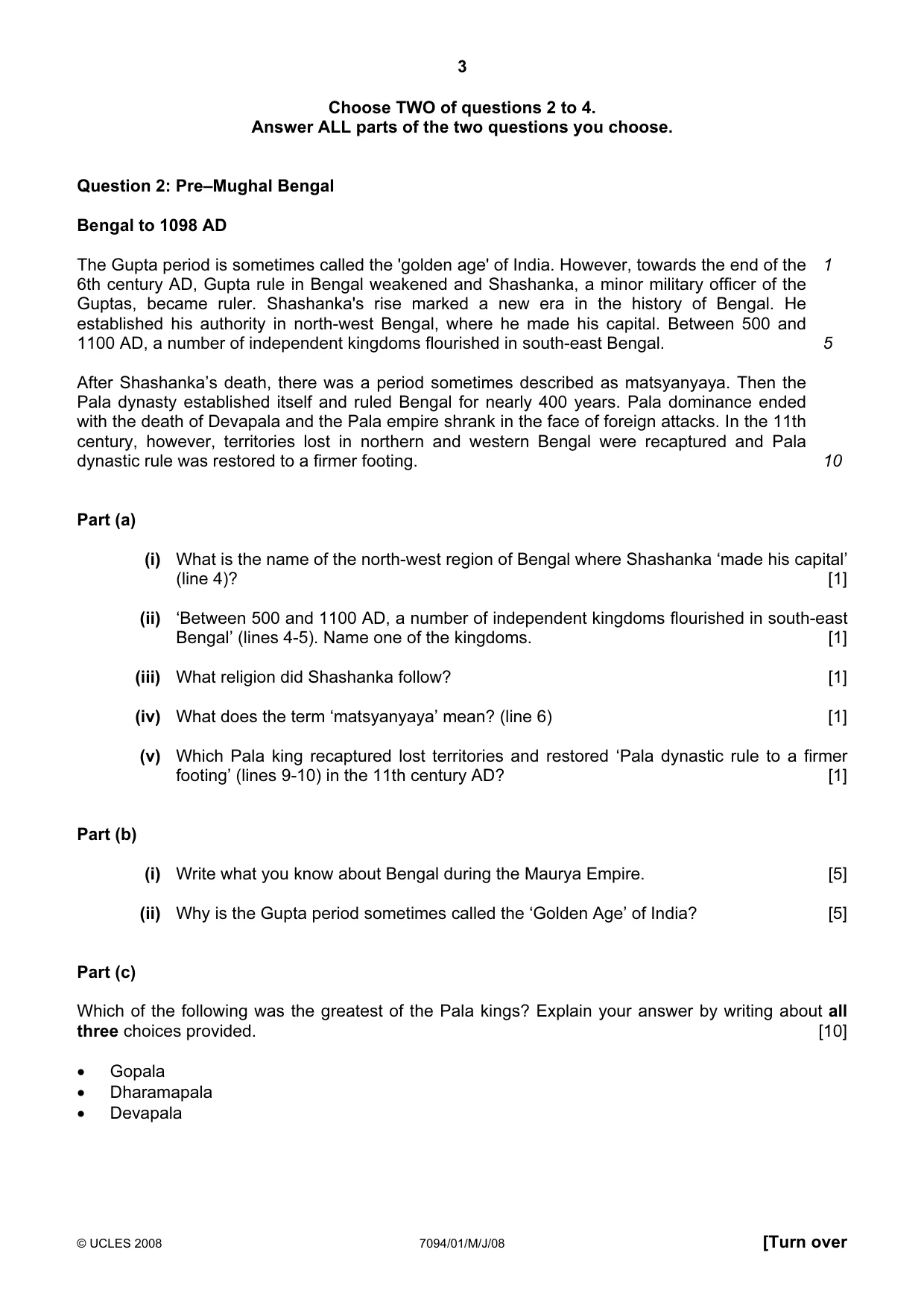
Question paper, page 3
3 © UCLES 2008 7094/01/M/J/08 [Turn over Choose TWO of questions 2 to 4. Answer ALL parts of the two questions you choose. Question 2: Pre–Mughal Bengal Bengal to 1098 AD The Gupta period is sometimes called the 'golden age' of India. However, towards the end of the 6th century AD, Gupta rule in Bengal weakened and Shashanka, a minor military officer of the Guptas, became ruler. Shashanka's rise marked a new era in the history of Bengal. He established his authority in north-west Bengal, where he made his capital. Between 500 and 1100 AD, a number of independent kingdoms flourished in south-east Bengal. 1 5 After Shashanka’s death, there was a period sometimes described as matsyanyaya. Then the Pala dynasty established itself and ruled Bengal for nearly 400 years. Pala dominance ended with the death of Devapala and the Pala empire shrank in the face of foreign attacks. In the 11th century, however, territories lost in northern and western Bengal were recaptured and Pala dynastic rule was restored to a firmer footing. 10 Part (a) (i) What is the name of the north-west region of Bengal where Shashanka ‘made his capital’ (line 4)? [1] (ii) ‘Between 500 and 1100 AD, a number of independent kingdoms flourished in south-east Bengal’ (lines 4-5). Name one of the kingdoms. [1] (iii) What religion did Shashanka follow? [1] (iv) What does the term ‘matsyanyaya’ mean? (line 6) [1] (v) Which Pala king recaptured lost territories and restored ‘Pala dynastic rule to a firmer footing’ (lines 9-10) in the 11th century AD? [1] Part (b) (i) Write what you know about Bengal during the Maurya Empire. [5] (ii) Why is the Gupta period sometimes called the ‘Golden Age’ of India? [5] Part (c) Which of the following was the greatest of the Pala kings? Explain your answer by writing about all three choices provided. [10] • Gopala • Dharamapala • Devapala
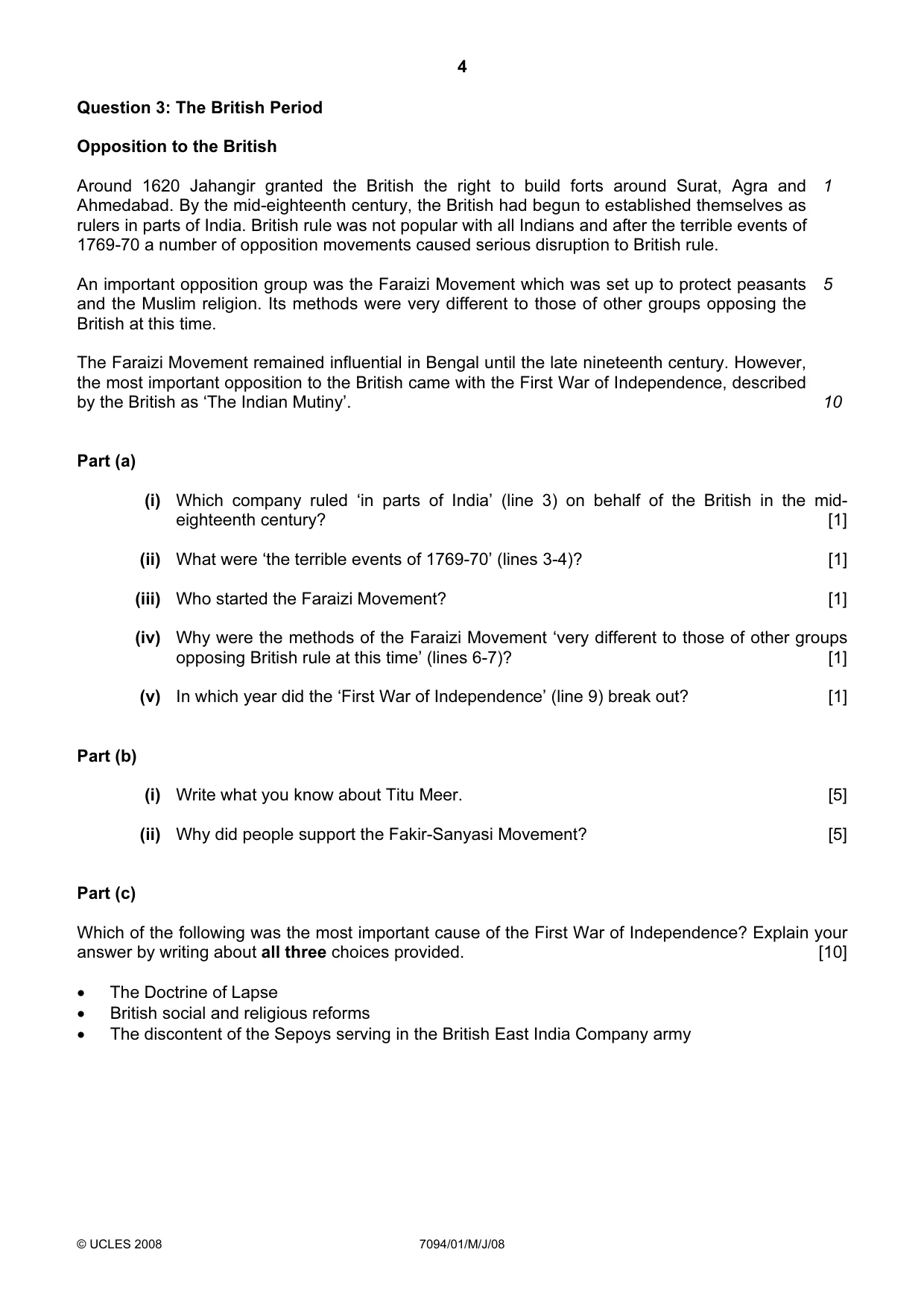
Question paper, page 4
4 © UCLES 2008 7094/01/M/J/08 Question 3: The British Period Opposition to the British Around 1620 Jahangir granted the British the right to build forts around Surat, Agra and Ahmedabad. By the mid-eighteenth century, the British had begun to established themselves as rulers in parts of India. British rule was not popular with all Indians and after the terrible events of 1769-70 a number of opposition movements caused serious disruption to British rule. 1 An important opposition group was the Faraizi Movement which was set up to protect peasants and the Muslim religion. Its methods were very different to those of other groups opposing the British at this time. 5 The Faraizi Movement remained influential in Bengal until the late nineteenth century. However, the most important opposition to the British came with the First War of Independence, described by the British as ‘The Indian Mutiny’. 10 Part (a) (i) Which company ruled ‘in parts of India’ (line 3) on behalf of the British in the mid- eighteenth century? [1] (ii) What were ‘the terrible events of 1769-70’ (lines 3-4)? [1] (iii) Who started the Faraizi Movement? [1] (iv) Why were the methods of the Faraizi Movement ‘very different to those of other groups opposing British rule at this time’ (lines 6-7)? [1] (v) In which year did the ‘First War of Independence’ (line 9) break out? [1] Part (b) (i) Write what you know about Titu Meer. [5] (ii) Why did people support the Fakir-Sanyasi Movement? [5] Part (c) Which of the following was the most important cause of the First War of Independence? Explain your answer by writing about all three choices provided. [10] • The Doctrine of Lapse • British social and religious reforms • The discontent of the Sepoys serving in the British East India Company army
Question paper, page 5
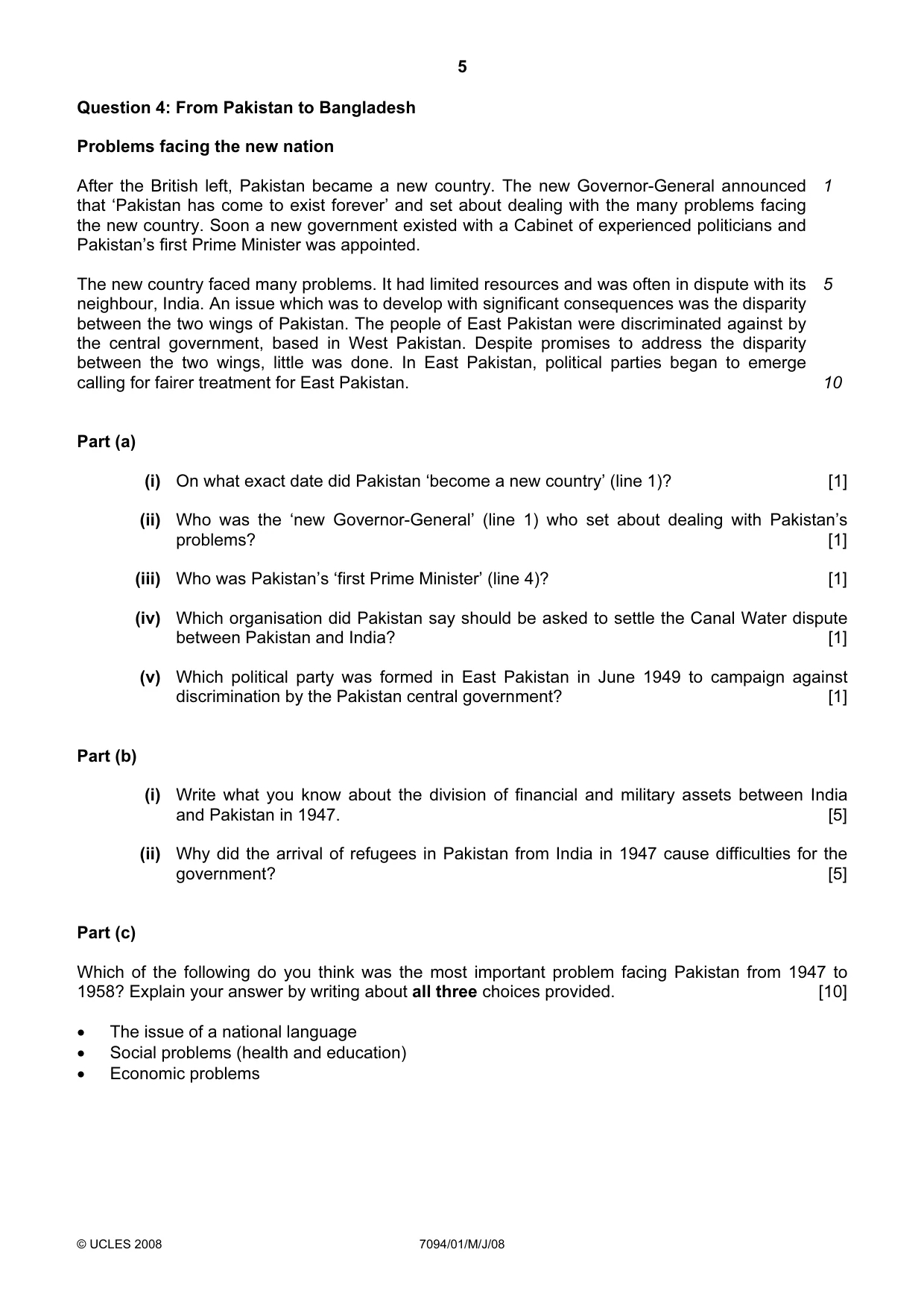
5 © UCLES 2008 7094/01/M/J/08 Question 4: From Pakistan to Bangladesh Problems facing the new nation After the British left, Pakistan became a new country. The new Governor-General announced that ‘Pakistan has come to exist forever’ and set about dealing with the many problems facing the new country. Soon a new government existed with a Cabinet of experienced politicians and Pakistan’s first Prime Minister was appointed. 1 The new country faced many problems. It had limited resources and was often in dispute with its neighbour, India. An issue which was to develop with significant consequences was the disparity between the two wings of Pakistan. The people of East Pakistan were discriminated against by the central government, based in West Pakistan. Despite promises to address the disparity between the two wings, little was done. In East Pakistan, political parties began to emerge calling for fairer treatment for East Pakistan. 5 10 Part (a) (i) On what exact date did Pakistan ‘become a new country’ (line 1)? [1] (ii) Who was the ‘new Governor-General’ (line 1) who set about dealing with Pakistan’s problems? [1] (iii) Who was Pakistan’s ‘first Prime Minister’ (line 4)? [1] (iv) Which organisation did Pakistan say should be asked to settle the Canal Water dispute between Pakistan and India? [1] (v) Which political party was formed in East Pakistan in June 1949 to campaign against discrimination by the Pakistan central government? [1] Part (b) (i) Write what you know about the division of financial and military assets between India and Pakistan in 1947. [5] (ii) Why did the arrival of refugees in Pakistan from India in 1947 cause difficulties for the government? [5] Part (c) Which of the following do you think was the most important problem facing Pakistan from 1947 to 1958? Explain your answer by writing about all three choices provided. [10] • The issue of a national language • Social problems (health and education) • Economic problems
Question paper, page 8
8 BLANK PAGE Permission to reproduce items where third-party owned material protected by copyright is included has been sought and cleared where possible. Every reasonable effort has been made by the publisher (UCLES) to trace copyright holders, but if any items requiring clearance have unwittingly been included, the publisher will be pleased to make amends at the earliest possible opportunity. University of Cambridge International Examinations is part of the Cambridge Assessment Group. Cambridge Assessment is the brand name of University of Cambridge Local Examinations Syndicate (UCLES), which is itself a department of the University of Cambridge. 7094/01/M/J/08
Mark scheme, page 1
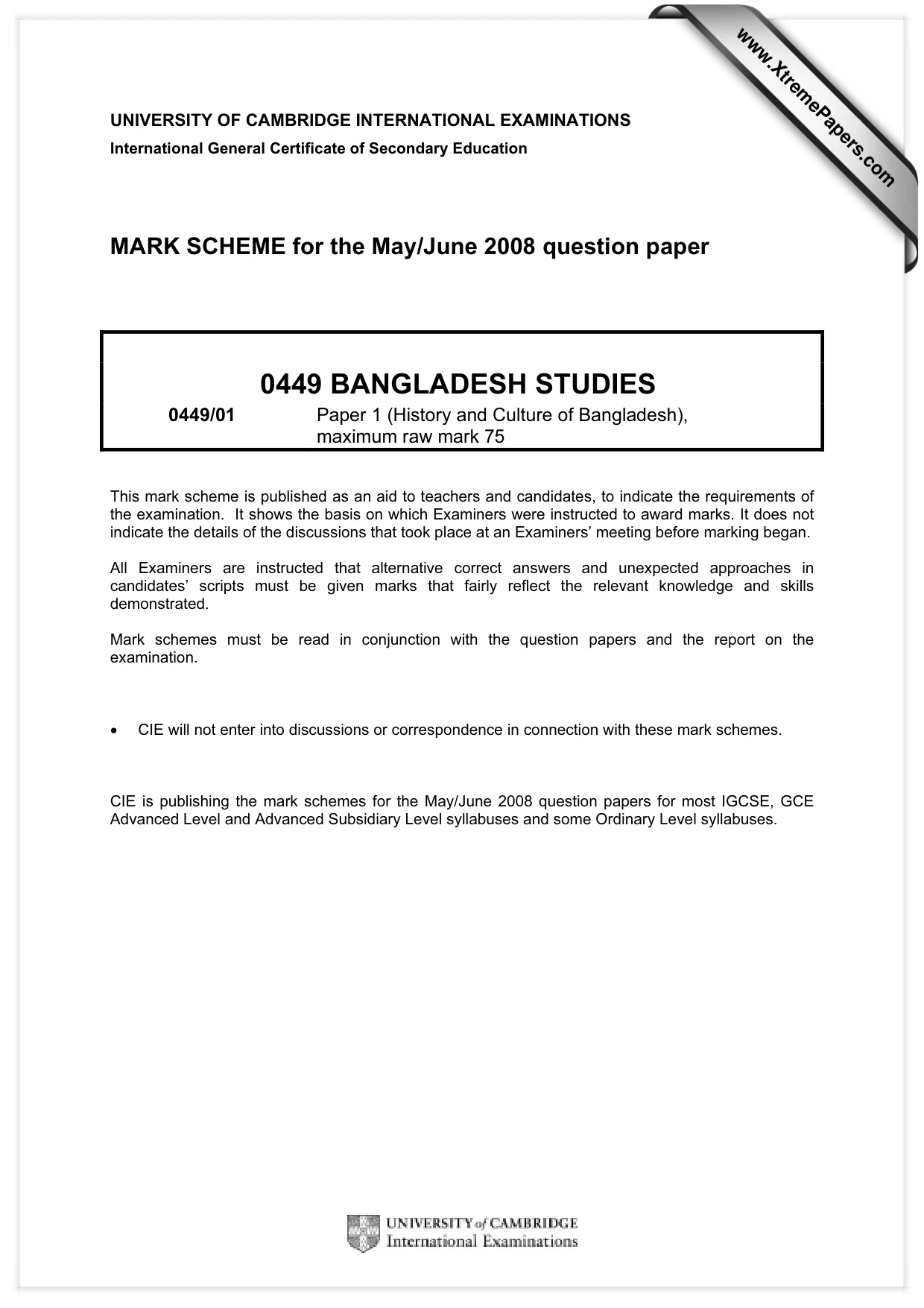
UNIVERSITY OF CAMBRIDGE INTERNATIONAL EXAMINATIONS International General Certificate of Secondary Education MARK SCHEME for the May/June 2008 question paper 0449 BANGLADESH STUDIES 0449/01 Paper 1 (History and Culture of Bangladesh), maximum raw mark 75 This mark scheme is published as an aid to teachers and candidates, to indicate the requirements of the examination. It shows the basis on which Examiners were instructed to award marks. It does not indicate the details of the discussions that took place at an Examiners’ meeting before marking began. All Examiners are instructed that alternative correct answers and unexpected approaches in candidates’ scripts must be given marks that fairly reflect the relevant knowledge and skills demonstrated. Mark schemes must be read in conjunction with the question papers and the report on the examination. • CIE will not enter into discussions or correspondence in connection with these mark schemes. CIE is publishing the mark schemes for the May/June 2008 question papers for most IGCSE, GCE Advanced Level and Advanced Subsidiary Level syllabuses and some Ordinary Level syllabuses. www.XtremePapers.com
Mark scheme, page 2
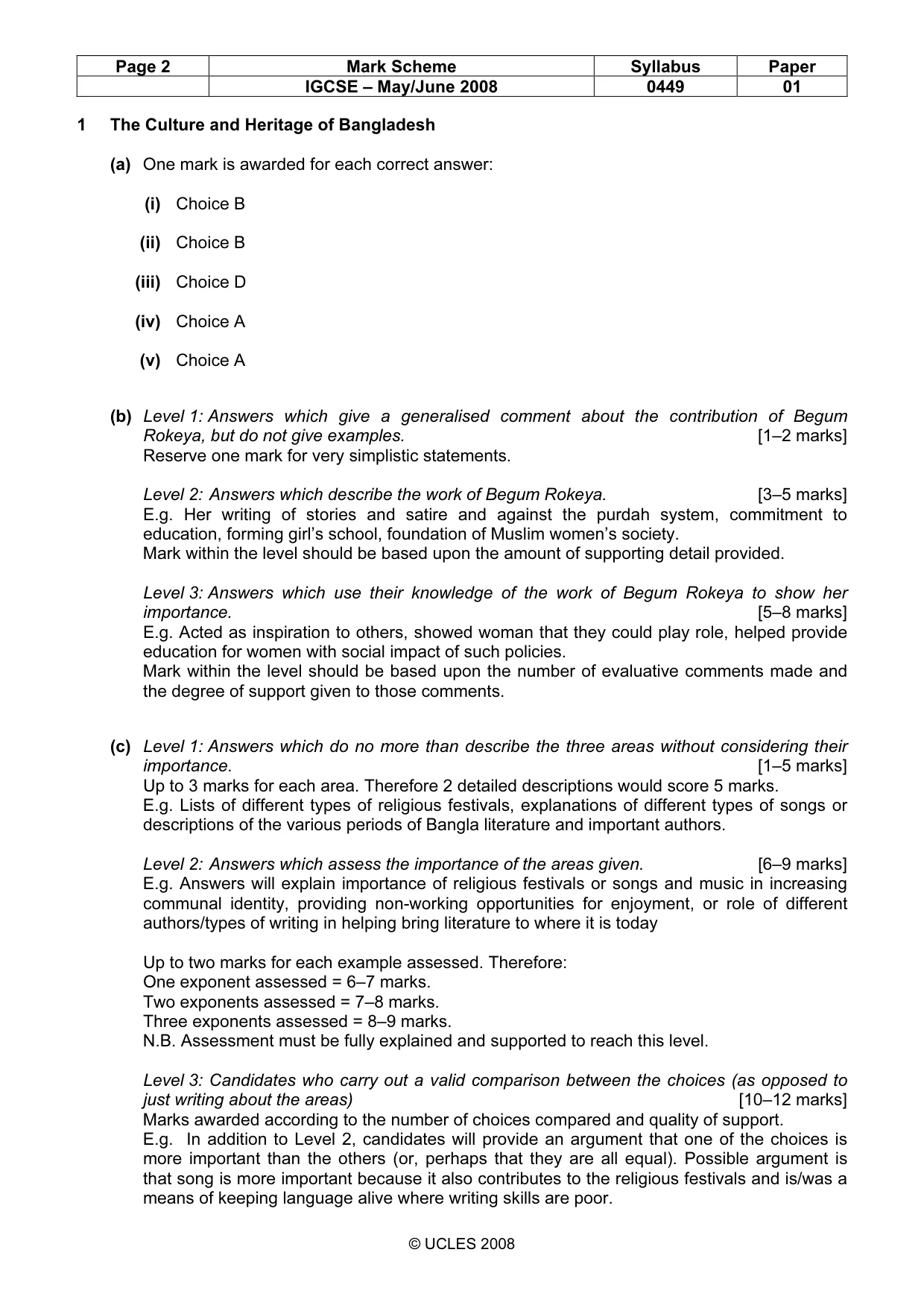
Page 2 Mark Scheme Syllabus Paper IGCSE – May/June 2008 0449 01 © UCLES 2008 1 The Culture and Heritage of Bangladesh (a) One mark is awarded for each correct answer: (i) Choice B (ii) Choice B (iii) Choice D (iv) Choice A (v) Choice A (b) Level 1: Answers which give a generalised comment about the contribution of Begum Rokeya, but do not give examples. [1–2 marks] Reserve one mark for very simplistic statements. Level 2: Answers which describe the work of Begum Rokeya. [3–5 marks] E.g. Her writing of stories and satire and against the purdah system, commitment to education, forming girl’s school, foundation of Muslim women’s society. Mark within the level should be based upon the amount of supporting detail provided. Level 3: Answers which use their knowledge of the work of Begum Rokeya to show her importance. [5–8 marks] E.g. Acted as inspiration to others, showed woman that they could play role, helped provide education for women with social impact of such policies. Mark within the level should be based upon the number of evaluative comments made and the degree of support given to those comments. (c) Level 1: Answers which do no more than describe the three areas without considering their importance. [1–5 marks] Up to 3 marks for each area. Therefore 2 detailed descriptions would score 5 marks. E.g. Lists of different types of religious festivals, explanations of different types of songs or descriptions of the various periods of Bangla literature and important authors. Level 2: Answers which assess the importance of the areas given. [6–9 marks] E.g. Answers will explain importance of religious festivals or songs and music in increasing communal identity, providing non-working opportunities for enjoyment, or role of different authors/types of writing in helping bring literature to where it is today Up to two marks for each example assessed. Therefore: One exponent assessed = 6–7 marks. Two exponents assessed = 7–8 marks. Three exponents assessed = 8–9 marks. N.B. Assessment must be fully explained and supported to reach this level. Level 3: Candidates who carry out a valid comparison between the choices (as opposed to just writing about the areas) [10–12 marks] Marks awarded according to the number of choices compared and quality of support. E.g. In addition to Level 2, candidates will provide an argument that one of the choices is more important than the others (or, perhaps that they are all equal). Possible argument is that song is more important because it also contributes to the religious festivals and is/was a means of keeping language alive where writing skills are poor.
Mark scheme, page 3
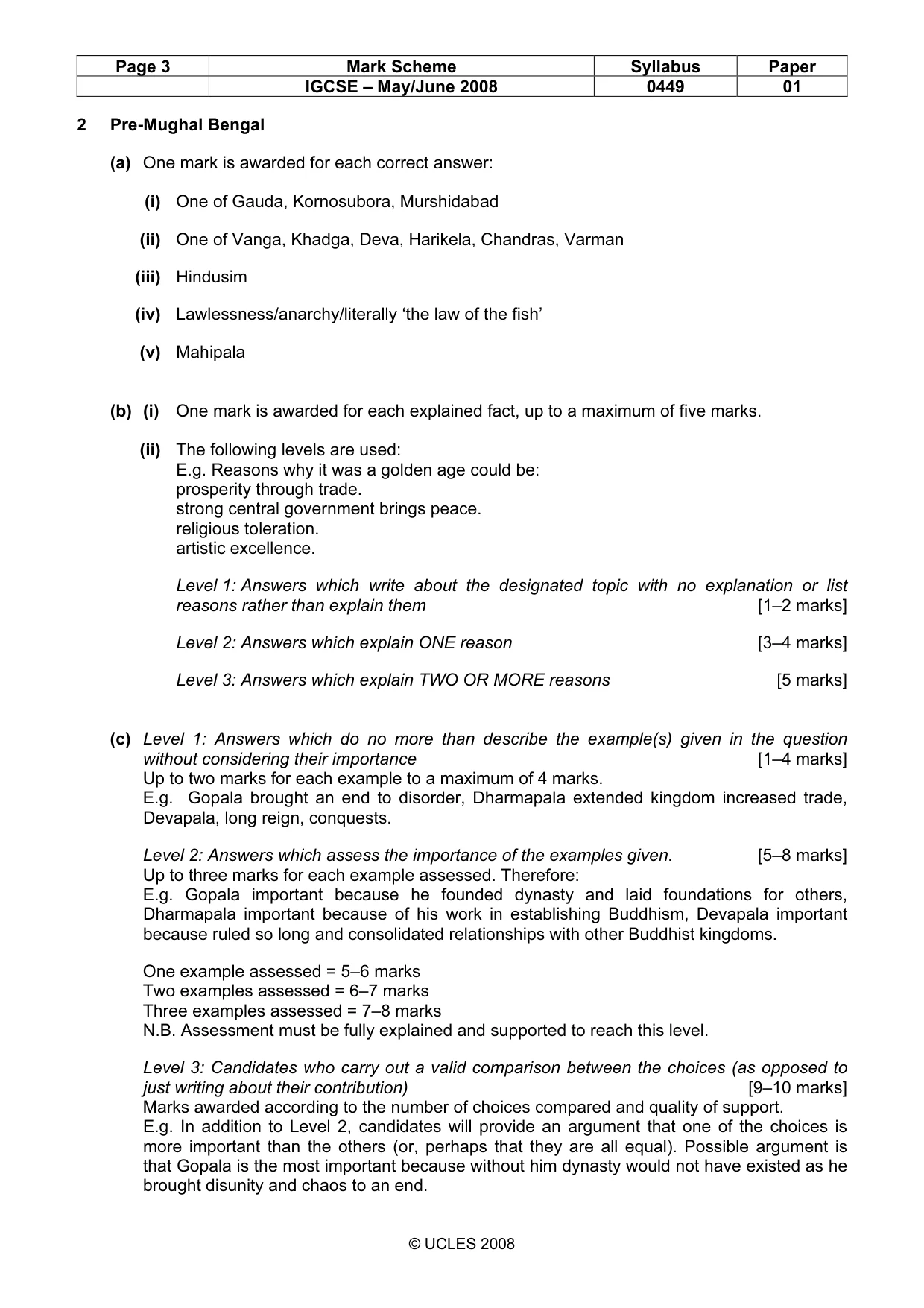
Page 3 Mark Scheme Syllabus Paper IGCSE – May/June 2008 0449 01 © UCLES 2008 2 Pre-Mughal Bengal (a) One mark is awarded for each correct answer: (i) One of Gauda, Kornosubora, Murshidabad (ii) One of Vanga, Khadga, Deva, Harikela, Chandras, Varman (iii) Hindusim (iv) Lawlessness/anarchy/literally ‘the law of the fish’ (v) Mahipala (b) (i) One mark is awarded for each explained fact, up to a maximum of five marks. (ii) The following levels are used: E.g. Reasons why it was a golden age could be: prosperity through trade. strong central government brings peace. religious toleration. artistic excellence. Level 1: Answers which write about the designated topic with no explanation or list reasons rather than explain them [1–2 marks] Level 2: Answers which explain ONE reason [3–4 marks] Level 3: Answers which explain TWO OR MORE reasons [5 marks] (c) Level 1: Answers which do no more than describe the example(s) given in the question without considering their importance [1–4 marks] Up to two marks for each example to a maximum of 4 marks. E.g. Gopala brought an end to disorder, Dharmapala extended kingdom increased trade, Devapala, long reign, conquests. Level 2: Answers which assess the importance of the examples given. [5–8 marks] Up to three marks for each example assessed. Therefore: E.g. Gopala important because he founded dynasty and laid foundations for others, Dharmapala important because of his work in establishing Buddhism, Devapala important because ruled so long and consolidated relationships with other Buddhist kingdoms. One example assessed = 5–6 marks Two examples assessed = 6–7 marks Three examples assessed = 7–8 marks N.B. Assessment must be fully explained and supported to reach this level. Level 3: Candidates who carry out a valid comparison between the choices (as opposed to just writing about their contribution) [9–10 marks] Marks awarded according to the number of choices compared and quality of support. E.g. In addition to Level 2, candidates will provide an argument that one of the choices is more important than the others (or, perhaps that they are all equal). Possible argument is that Gopala is the most important because without him dynasty would not have existed as he brought disunity and chaos to an end.
Mark scheme, page 4
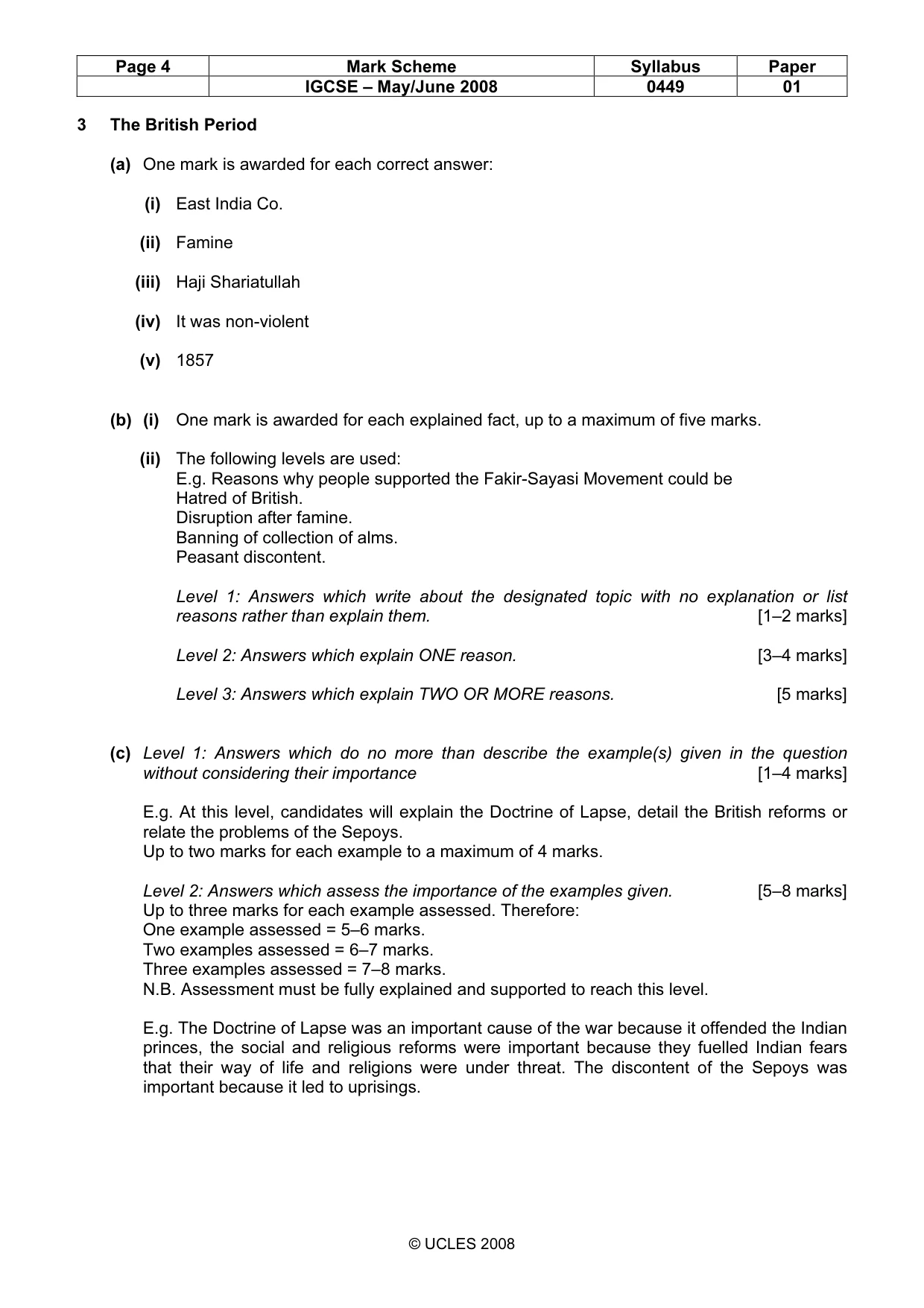
Page 4 Mark Scheme Syllabus Paper IGCSE – May/June 2008 0449 01 © UCLES 2008 3 The British Period (a) One mark is awarded for each correct answer: (i) East India Co. (ii) Famine (iii) Haji Shariatullah (iv) It was non-violent (v) 1857 (b) (i) One mark is awarded for each explained fact, up to a maximum of five marks. (ii) The following levels are used: E.g. Reasons why people supported the Fakir-Sayasi Movement could be Hatred of British. Disruption after famine. Banning of collection of alms. Peasant discontent. Level 1: Answers which write about the designated topic with no explanation or list reasons rather than explain them. [1–2 marks] Level 2: Answers which explain ONE reason. [3–4 marks] Level 3: Answers which explain TWO OR MORE reasons. [5 marks] (c) Level 1: Answers which do no more than describe the example(s) given in the question without considering their importance [1–4 marks] E.g. At this level, candidates will explain the Doctrine of Lapse, detail the British reforms or relate the problems of the Sepoys. Up to two marks for each example to a maximum of 4 marks. Level 2: Answers which assess the importance of the examples given. [5–8 marks] Up to three marks for each example assessed. Therefore: One example assessed = 5–6 marks. Two examples assessed = 6–7 marks. Three examples assessed = 7–8 marks. N.B. Assessment must be fully explained and supported to reach this level. E.g. The Doctrine of Lapse was an important cause of the war because it offended the Indian princes, the social and religious reforms were important because they fuelled Indian fears that their way of life and religions were under threat. The discontent of the Sepoys was important because it led to uprisings.
Mark scheme, page 5
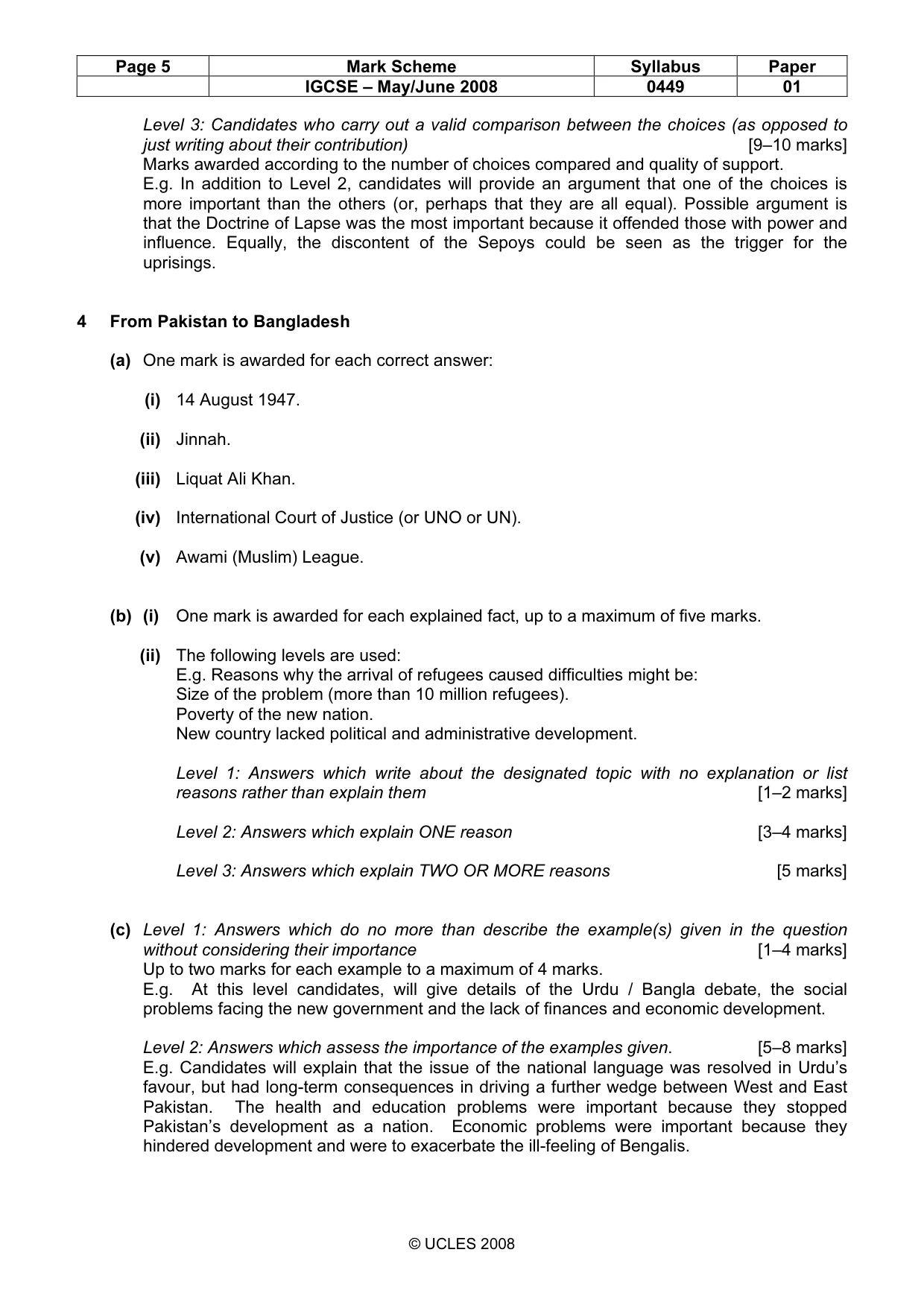
Page 5 Mark Scheme Syllabus Paper IGCSE – May/June 2008 0449 01 © UCLES 2008 Level 3: Candidates who carry out a valid comparison between the choices (as opposed to just writing about their contribution) [9–10 marks] Marks awarded according to the number of choices compared and quality of support. E.g. In addition to Level 2, candidates will provide an argument that one of the choices is more important than the others (or, perhaps that they are all equal). Possible argument is that the Doctrine of Lapse was the most important because it offended those with power and influence. Equally, the discontent of the Sepoys could be seen as the trigger for the uprisings. 4 From Pakistan to Bangladesh (a) One mark is awarded for each correct answer: (i) 14 August 1947. (ii) Jinnah. (iii) Liquat Ali Khan. (iv) International Court of Justice (or UNO or UN). (v) Awami (Muslim) League. (b) (i) One mark is awarded for each explained fact, up to a maximum of five marks. (ii) The following levels are used: E.g. Reasons why the arrival of refugees caused difficulties might be: Size of the problem (more than 10 million refugees). Poverty of the new nation. New country lacked political and administrative development. Level 1: Answers which write about the designated topic with no explanation or list reasons rather than explain them [1–2 marks] Level 2: Answers which explain ONE reason [3–4 marks] Level 3: Answers which explain TWO OR MORE reasons [5 marks] (c) Level 1: Answers which do no more than describe the example(s) given in the question without considering their importance [1–4 marks] Up to two marks for each example to a maximum of 4 marks. E.g. At this level candidates, will give details of the Urdu / Bangla debate, the social problems facing the new government and the lack of finances and economic development. Level 2: Answers which assess the importance of the examples given. [5–8 marks] E.g. Candidates will explain that the issue of the national language was resolved in Urdu’s favour, but had long-term consequences in driving a further wedge between West and East Pakistan. The health and education problems were important because they stopped Pakistan’s development as a nation. Economic problems were important because they hindered development and were to exacerbate the ill-feeling of Bengalis.
Mark scheme, page 6
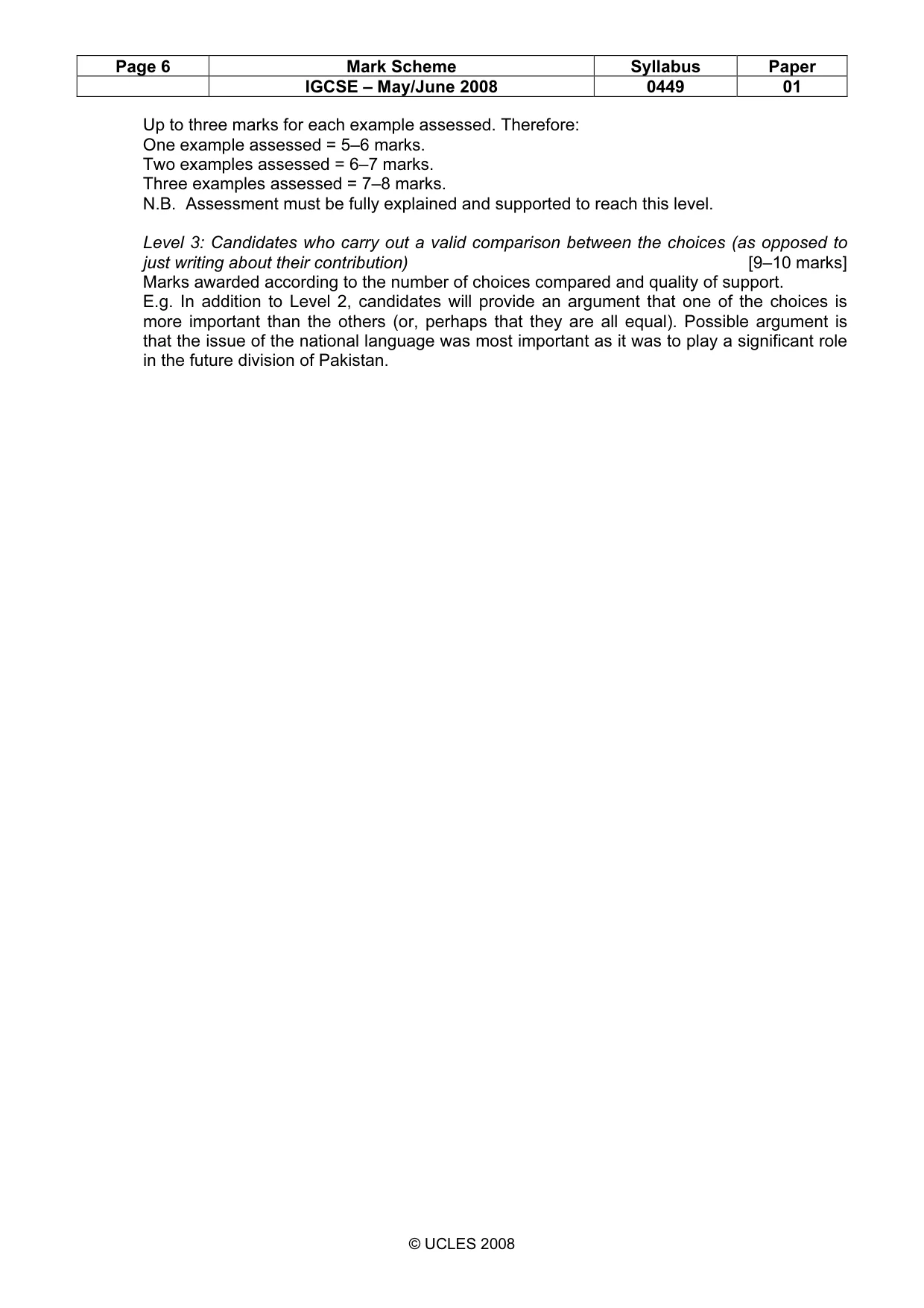
Page 6 Mark Scheme Syllabus Paper IGCSE – May/June 2008 0449 01 © UCLES 2008 Up to three marks for each example assessed. Therefore: One example assessed = 5–6 marks. Two examples assessed = 6–7 marks. Three examples assessed = 7–8 marks. N.B. Assessment must be fully explained and supported to reach this level. Level 3: Candidates who carry out a valid comparison between the choices (as opposed to just writing about their contribution) [9–10 marks] Marks awarded according to the number of choices compared and quality of support. E.g. In addition to Level 2, candidates will provide an argument that one of the choices is more important than the others (or, perhaps that they are all equal). Possible argument is that the issue of the national language was most important as it was to play a significant role in the future division of Pakistan.
What you needed in this session
Cambridge’s own grade thresholds for 2008 May/June, Paper 1 · Variant 1. A higher threshold means an easier paper — the bar moves with how the cohort did.