Cambridge IGCSE Agriculture 0600 — 2018 Oct/Nov Paper 1 · Variant 2
0600/12/O/N/18 · 100 marks · ≈113 min
The question paper and its mark scheme, free to read here and free to download. This is Cambridge’s own paper, exactly as it was sat.
Question paper16 pages

Mark scheme21 pages
Answers below. Sit the paper first if you are practising.
Paper as text
Question paper, page 1
* 9 5 9 5 0 1 9 9 7 9 * This document consists of 16 printed pages. DC (SC/FC) 149585/2 © UCLES 2018 [Turn over Cambridge International Examinations Cambridge International General Certificate of Secondary Education AGRICULTURE 0600/12 Paper 1 October/November 2018 1 hour 45 minutes Additional Materials: Answer Booklet/Paper READ THESE INSTRUCTIONS FIRST Write your Centre number, candidate number and name on all the work you hand in. Write in dark blue or black pen. You may use an HB pencil for any diagrams or graphs. Do not use staples, paper clips, glue or correction fluid. DO NOT WRITE IN ANY BARCODES. Section A Answer all questions. Electronic calculators may be used. Write your answers in the spaces provided on the Question Paper. You are advised to spend no longer than 1 hour on Section A. Section B Answer any two questions. Write your answers on the Answer Booklet/Paper provided. Enter the numbers of the Section B questions you have answered in the grid. At the end of the examination, fasten all your work securely together. The number of marks is given in brackets [ ] at the end of each question or part question. For Examiner’s Use Section A 1 2 3 4 5 6 7 8 9 Section B Total
Question paper, page 2
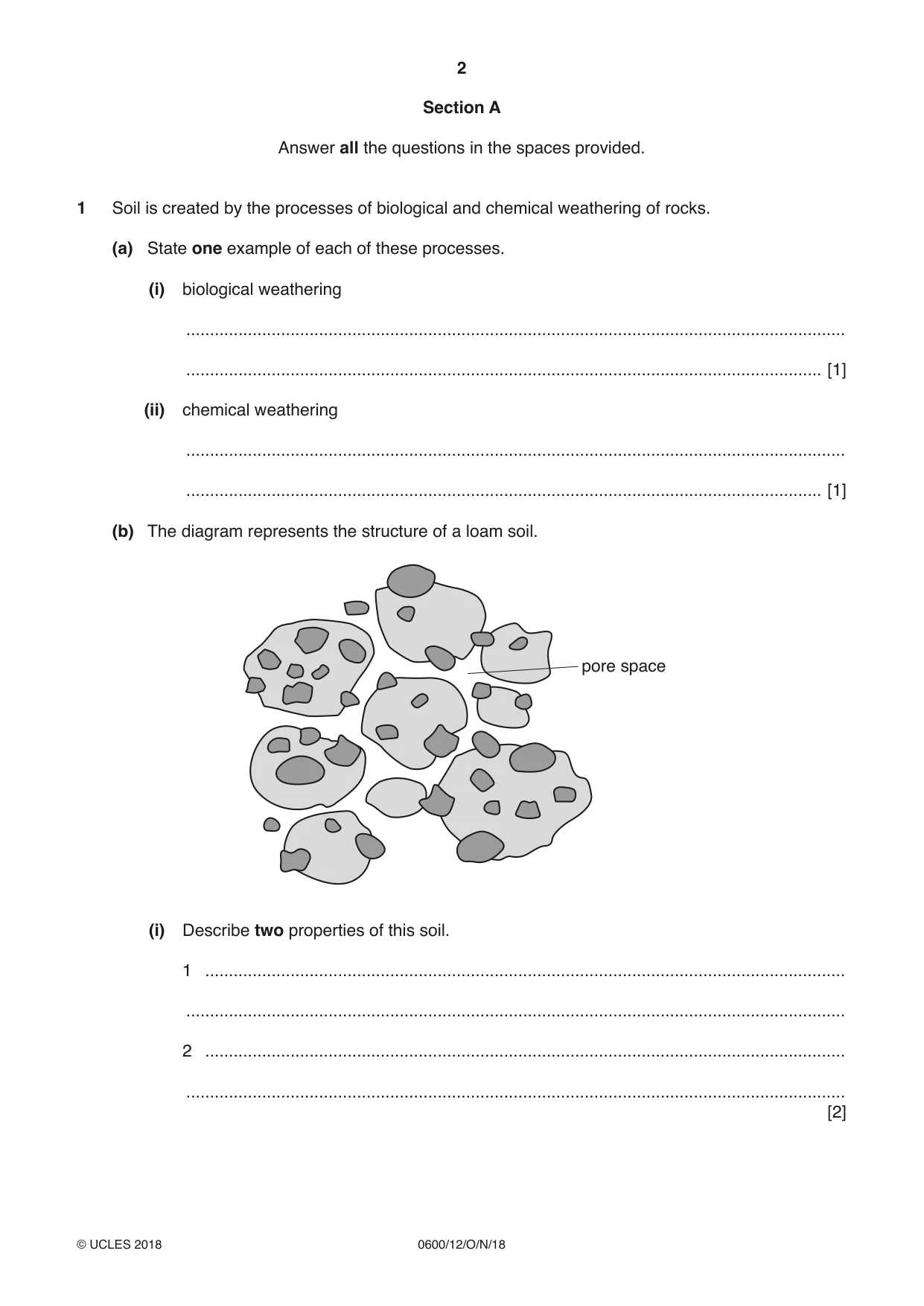
2 0600/12/O/N/18 © UCLES 2018 Section A Answer all the questions in the spaces provided. 1 Soil is created by the processes of biological and chemical weathering of rocks. (a) State one example of each of these processes. (i) biological weathering … … [1] (ii) chemical weathering … … [1] (b) The diagram represents the structure of a loam soil. pore space (i) Describe two properties of this soil. 1 … … 2 … … [2]
Question paper, page 3
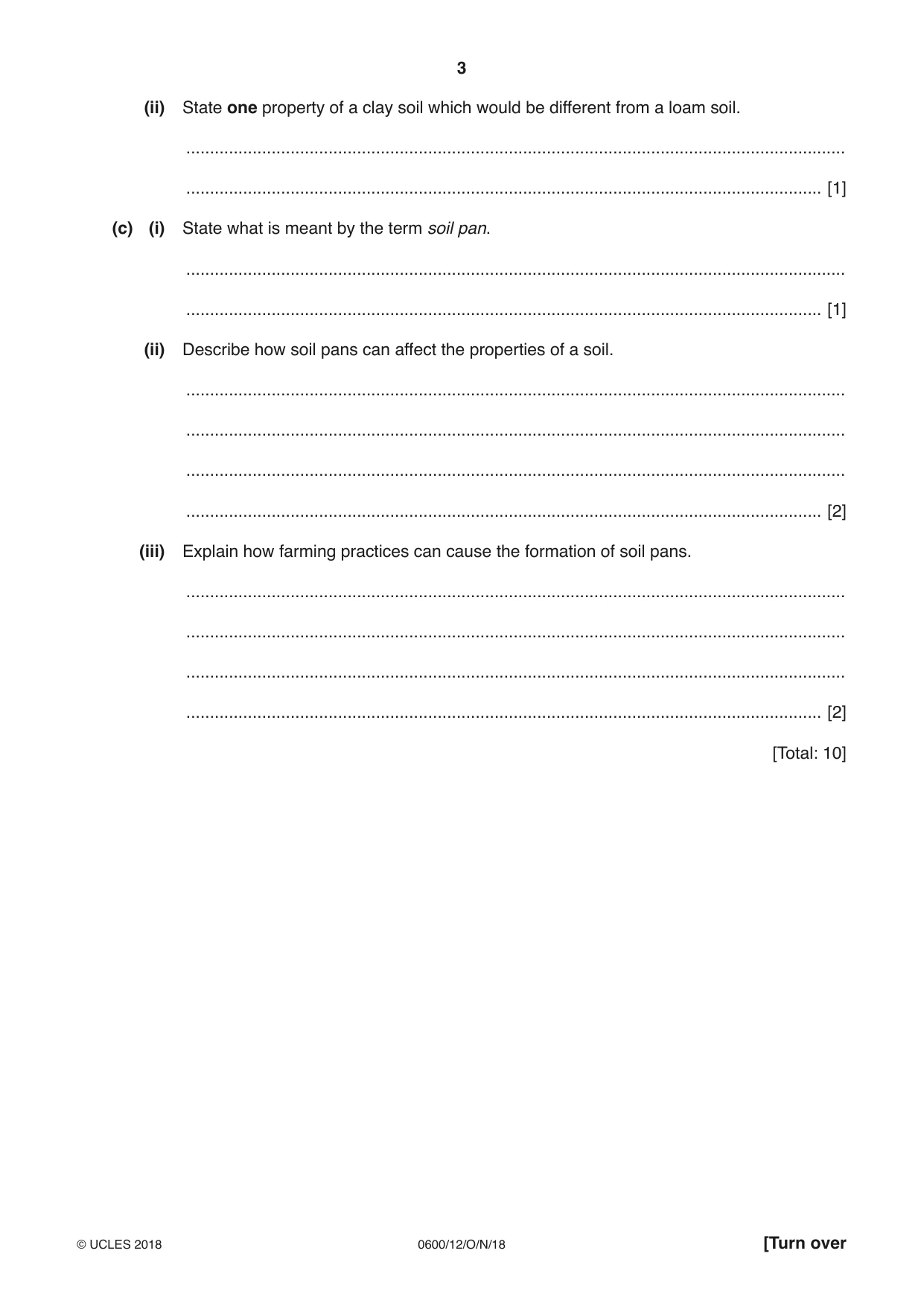
3 0600/12/O/N/18 © UCLES 2018 [Turn over (ii) State one property of a clay soil which would be different from a loam soil. … … [1] (c) (i) State what is meant by the term soil pan. … … [1] (ii) Describe how soil pans can affect the properties of a soil. … … … … [2] (iii) Explain how farming practices can cause the formation of soil pans. … … … … [2] [Total: 10]
Question paper, page 4
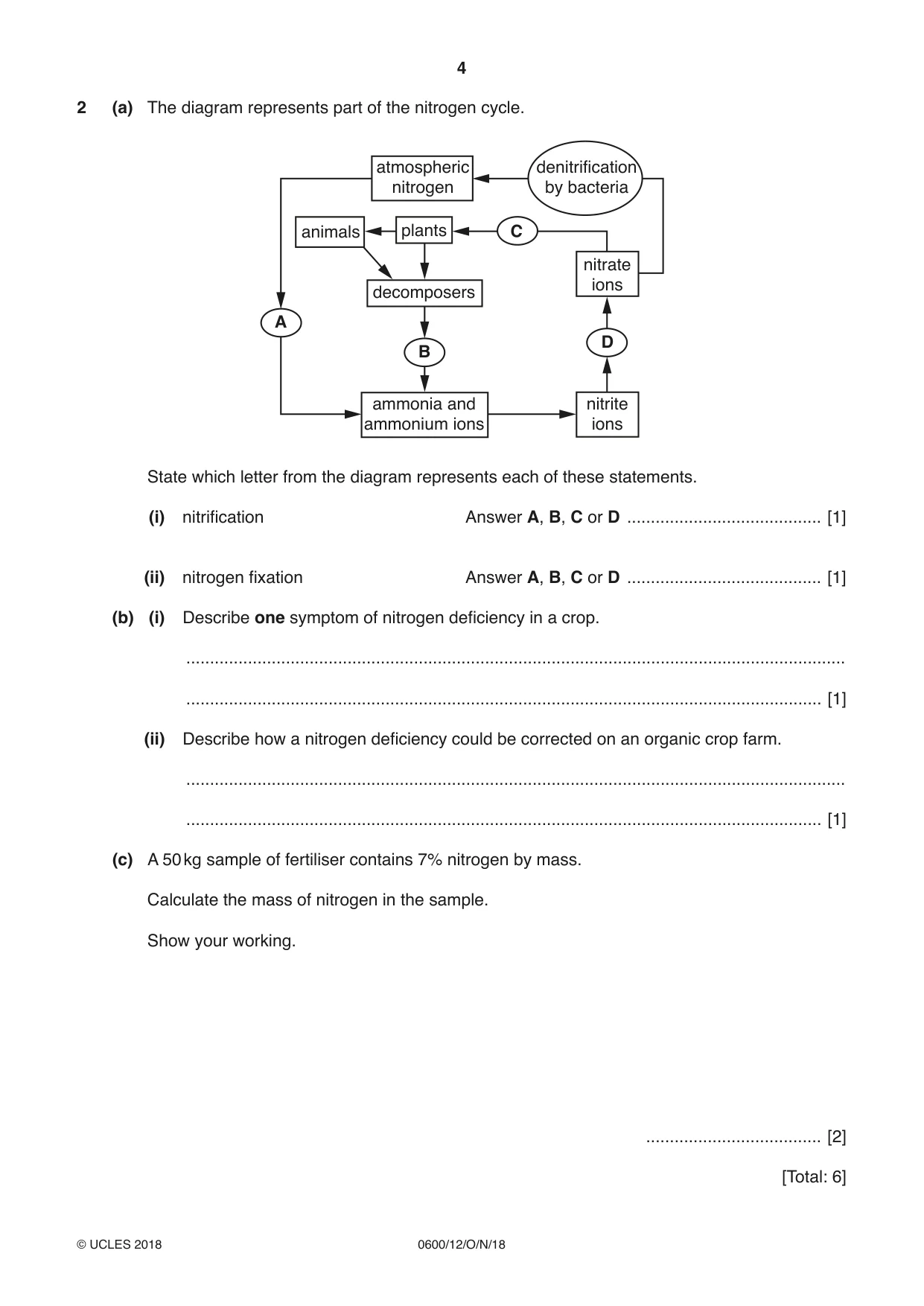
4 0600/12/O/N/18 © UCLES 2018 2 (a) The diagram represents part of the nitrogen cycle. atmospheric nitrogen denitrification by bacteria plants animals C A D decomposers B ammonia and ammonium ions nitrite ions nitrate ions State which letter from the diagram represents each of these statements. (i) nitrification Answer A, B, C or D … [1] (ii) nitrogen fixation Answer A, B, C or D … [1] (b) (i) Describe one symptom of nitrogen deficiency in a crop. … … [1] (ii) Describe how a nitrogen deficiency could be corrected on an organic crop farm. … … [1] (c) A 50 kg sample of fertiliser contains 7% nitrogen by mass. Calculate the mass of nitrogen in the sample. Show your working. … [2] [Total: 6]
Question paper, page 5
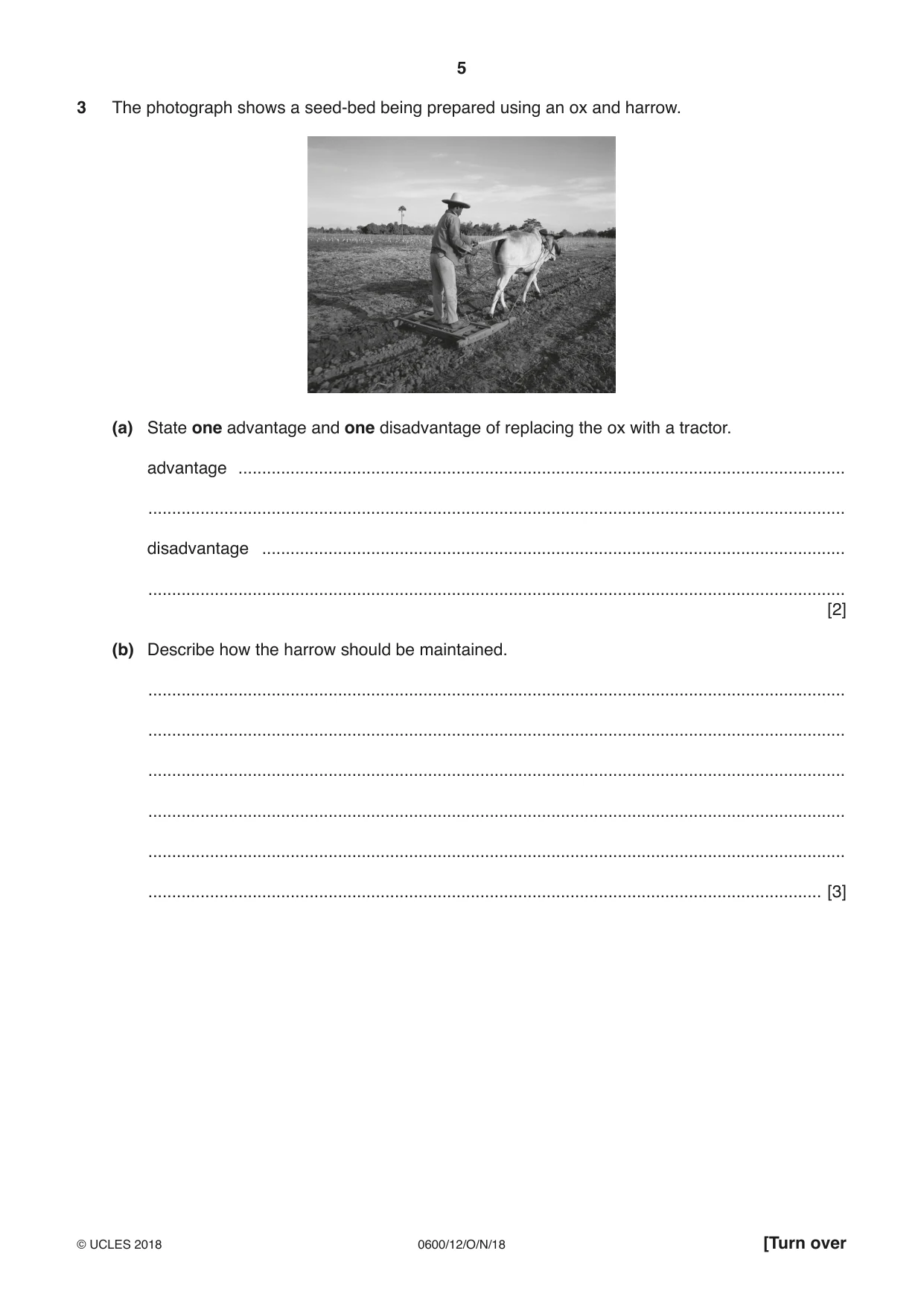
5 0600/12/O/N/18 © UCLES 2018 [Turn over 3 The photograph shows a seed-bed being prepared using an ox and harrow. (a) State one advantage and one disadvantage of replacing the ox with a tractor. advantage … … disadvantage … … [2] (b) Describe how the harrow should be maintained. … … … … … … [3]
Question paper, page 6
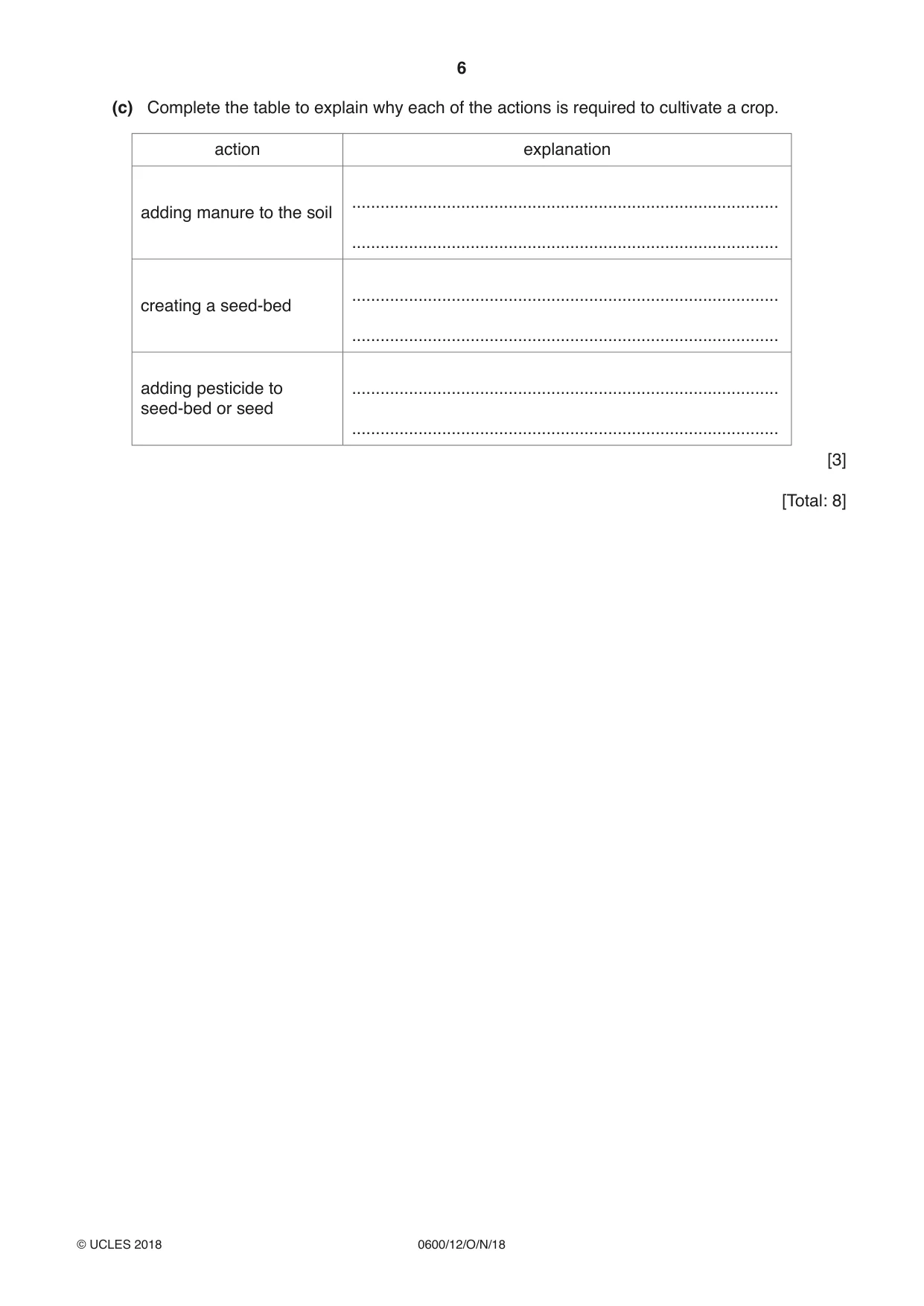
6 0600/12/O/N/18 © UCLES 2018 (c) Complete the table to explain why each of the actions is required to cultivate a crop. action explanation adding manure to the soil … … creating a seed-bed … … adding pesticide to seed-bed or seed … … [3] [Total: 8]
Question paper, page 7
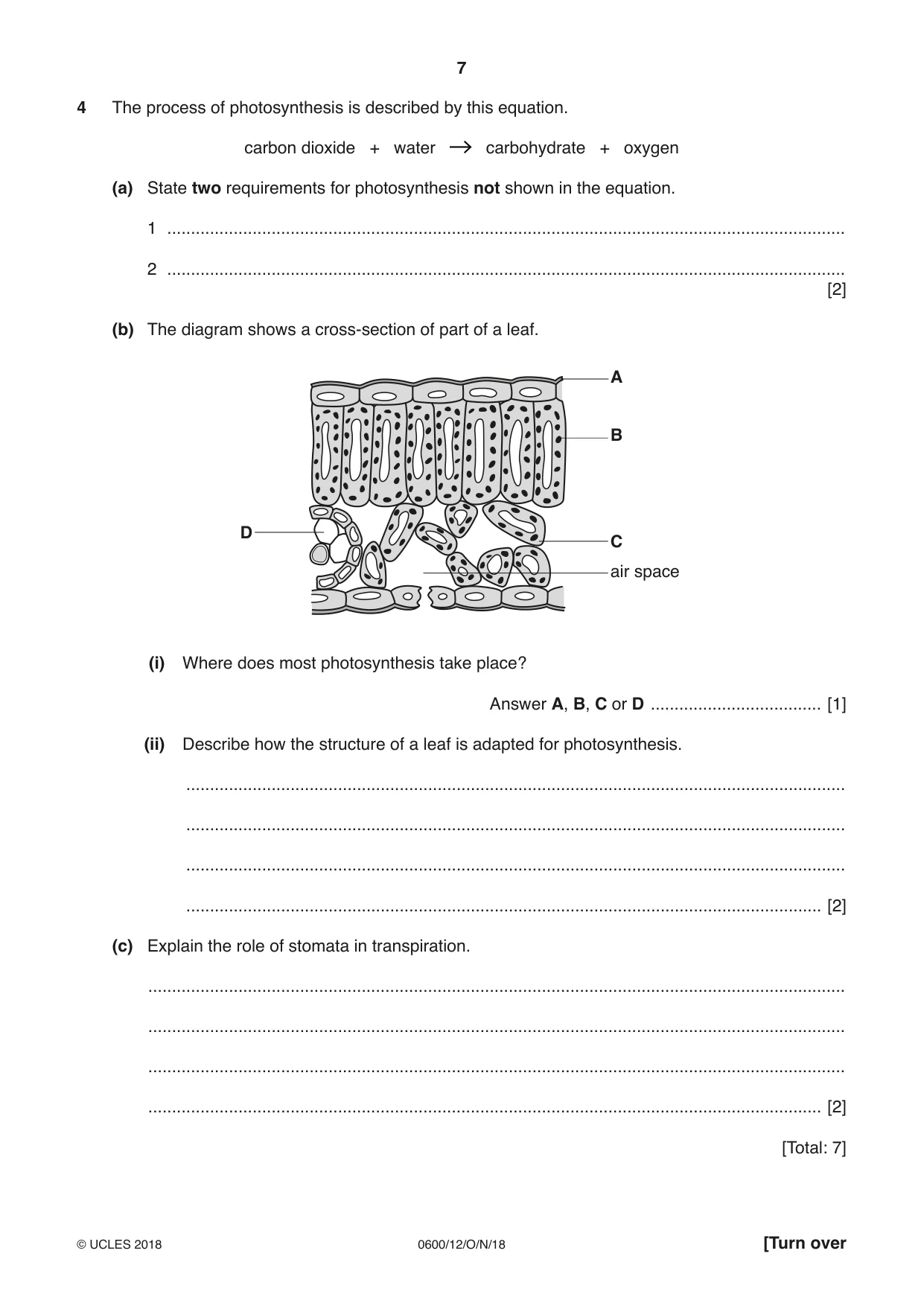
7 0600/12/O/N/18 © UCLES 2018 [Turn over 4 The process of photosynthesis is described by this equation. carbon dioxide + water carbohydrate + oxygen (a) State two requirements for photosynthesis not shown in the equation. 1 … 2 … [2] (b) The diagram shows a cross-section of part of a leaf. A B C air space D (i) Where does most photosynthesis take place? Answer A, B, C or D … [1] (ii) Describe how the structure of a leaf is adapted for photosynthesis. … … … … [2] (c) Explain the role of stomata in transpiration. … … … … [2] [Total: 7]
Question paper, page 8
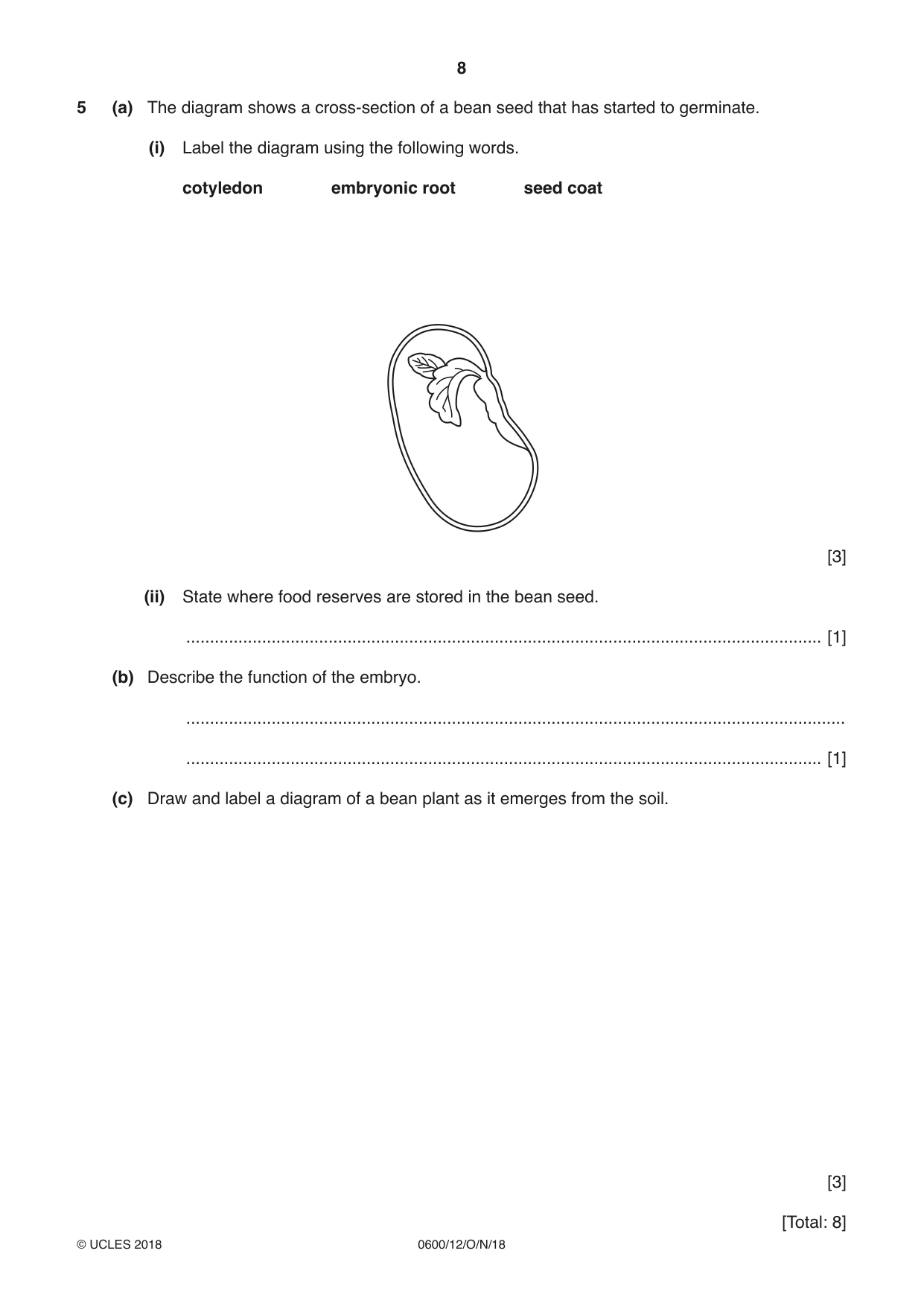
8 0600/12/O/N/18 © UCLES 2018 5 (a) The diagram shows a cross-section of a bean seed that has started to germinate. (i) Label the diagram using the following words. cotyledon embryonic root seed coat [3] (ii) State where food reserves are stored in the bean seed. … [1] (b) Describe the function of the embryo. … … [1] (c) Draw and label a diagram of a bean plant as it emerges from the soil. [3] [Total: 8]
Question paper, page 9
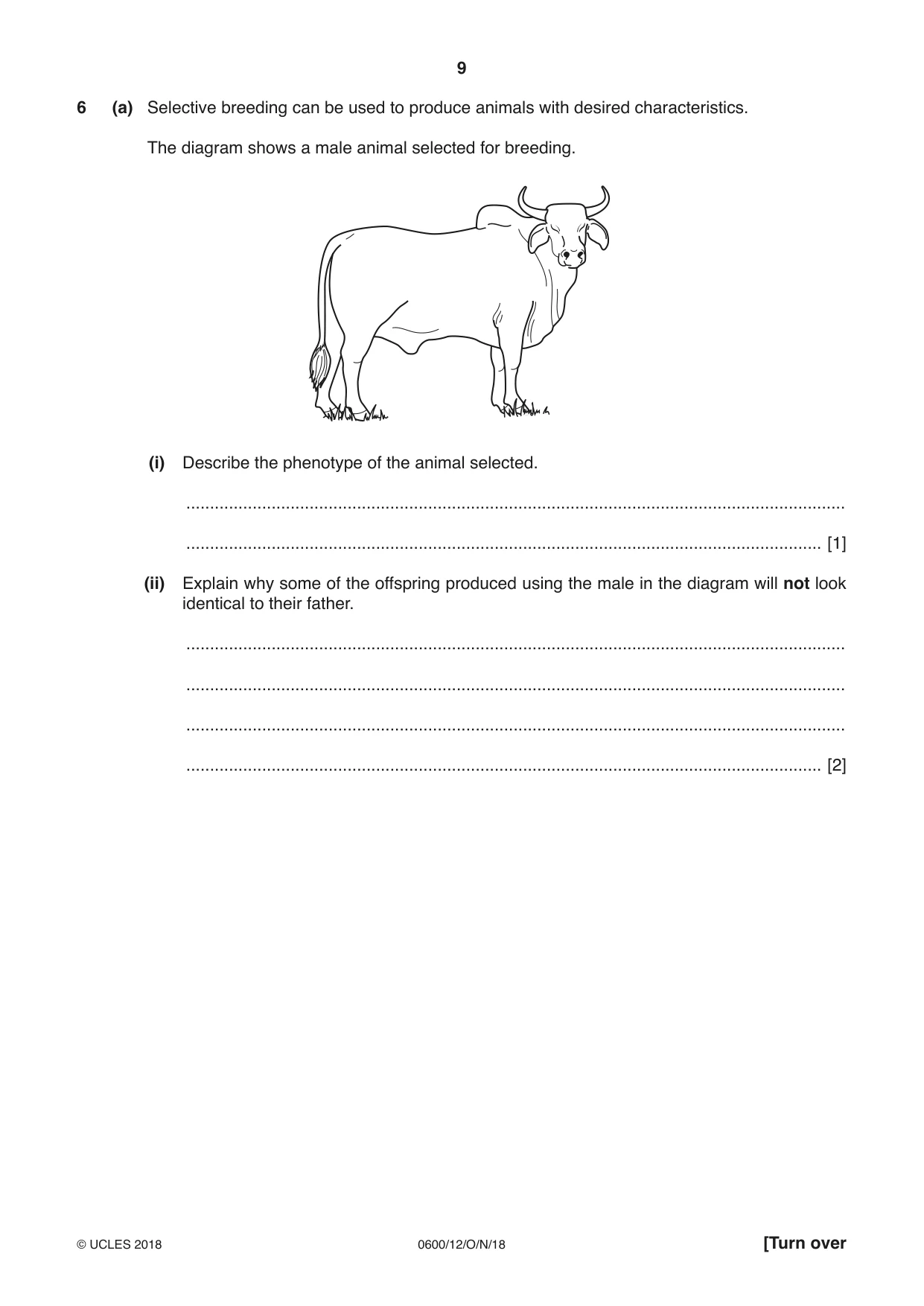
9 0600/12/O/N/18 © UCLES 2018 [Turn over 6 (a) Selective breeding can be used to produce animals with desired characteristics. The diagram shows a male animal selected for breeding. (i) Describe the phenotype of the animal selected. … … [1] (ii) Explain why some of the offspring produced using the male in the diagram will not look identical to their father. … … … … [2]
Question paper, page 10
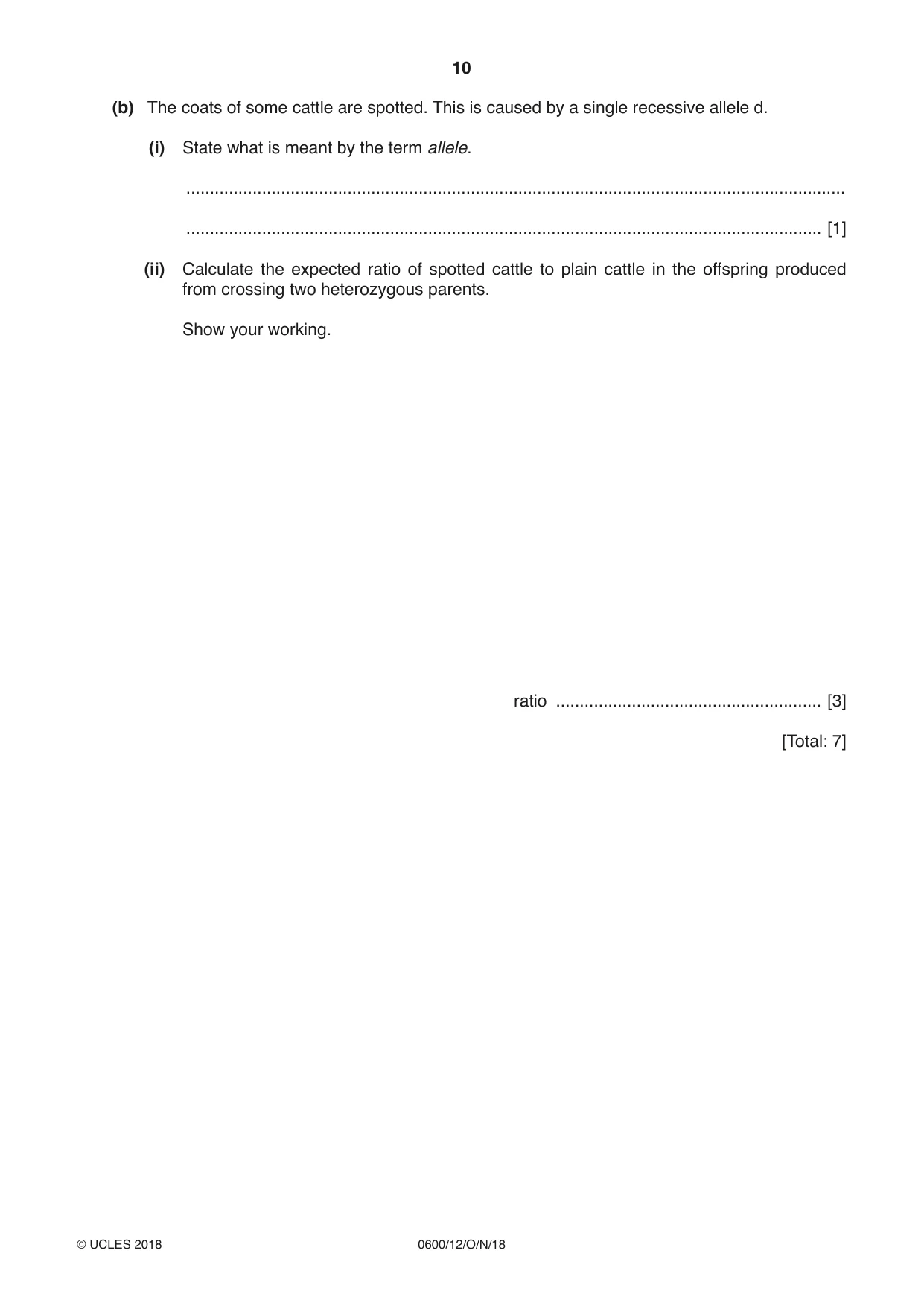
10 0600/12/O/N/18 © UCLES 2018 (b) The coats of some cattle are spotted. This is caused by a single recessive allele d. (i) State what is meant by the term allele. … … [1] (ii) Calculate the expected ratio of spotted cattle to plain cattle in the offspring produced from crossing two heterozygous parents. Show your working. ratio … [3] [Total: 7]
Question paper, page 11
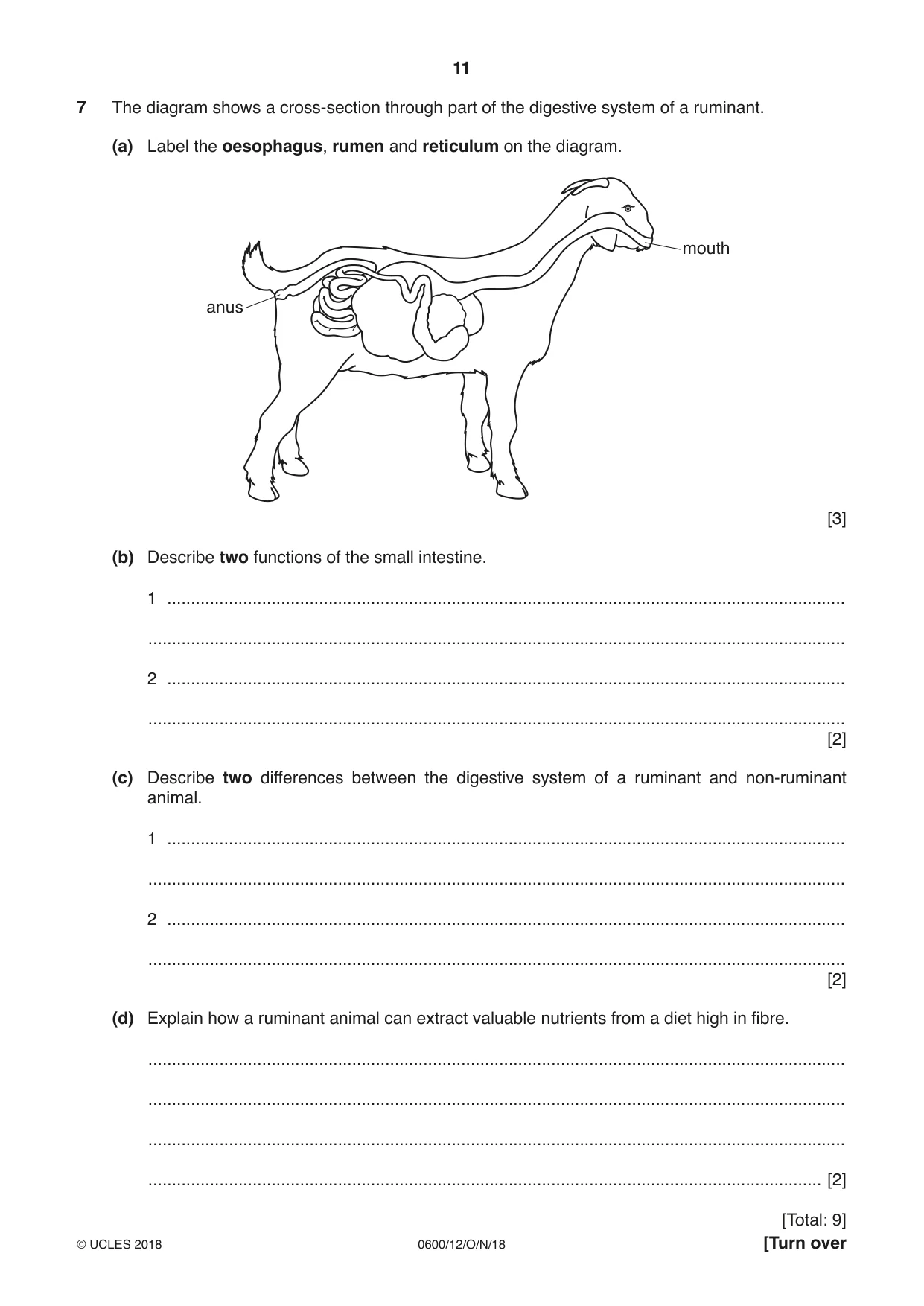
11 0600/12/O/N/18 © UCLES 2018 [Turn over 7 The diagram shows a cross-section through part of the digestive system of a ruminant. (a) Label the oesophagus, rumen and reticulum on the diagram. anus mouth [3] (b) Describe two functions of the small intestine. 1 … … 2 … … [2] (c) Describe two differences between the digestive system of a ruminant and non-ruminant animal. 1 … … 2 … … [2] (d) Explain how a ruminant animal can extract valuable nutrients from a diet high in fibre. … … … … [2] [Total: 9]
Question paper, page 12
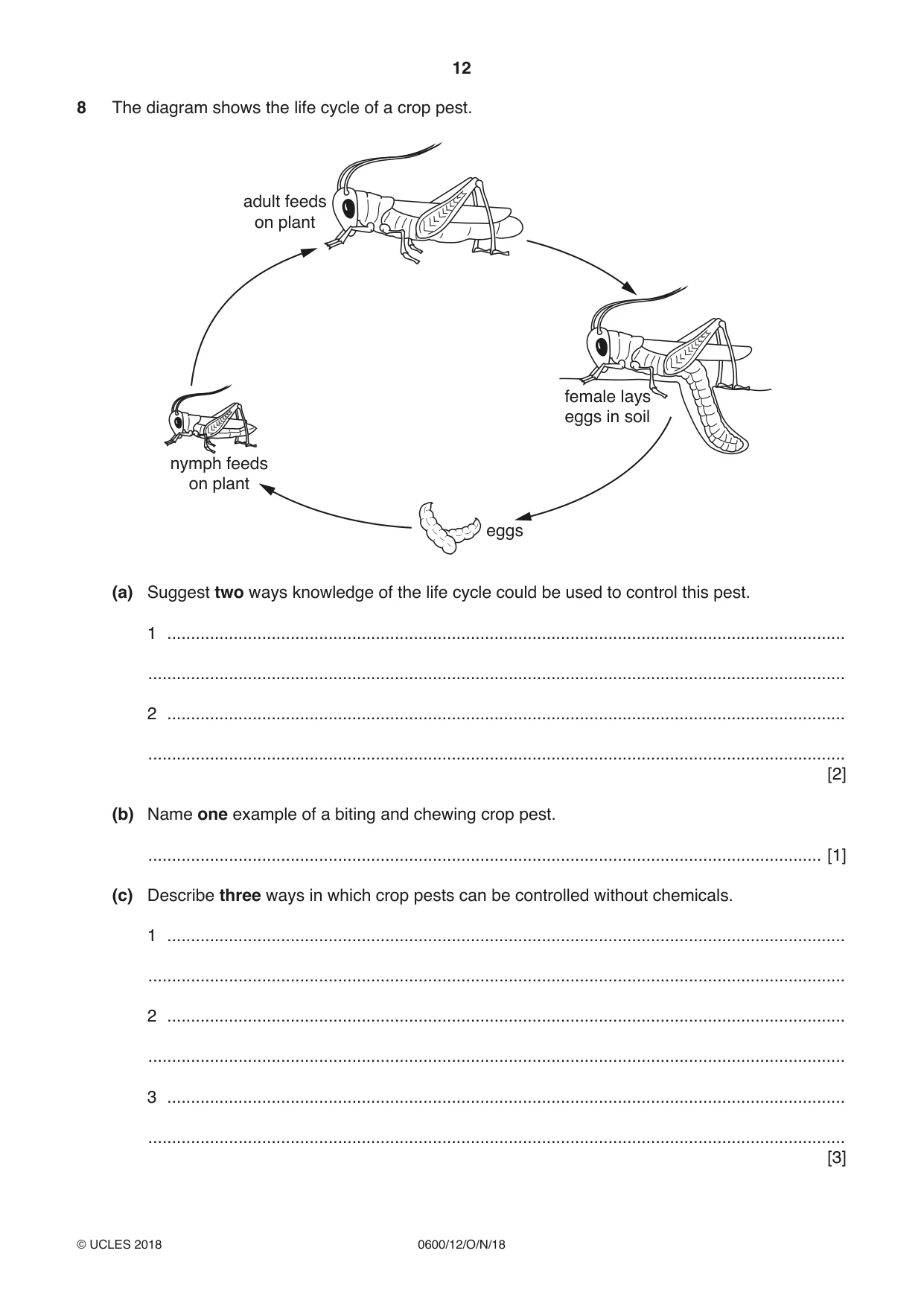
12 0600/12/O/N/18 © UCLES 2018 8 The diagram shows the life cycle of a crop pest. female lays eggs in soil adult feeds on plant eggs nymph feeds on plant (a) Suggest two ways knowledge of the life cycle could be used to control this pest. 1 … … 2 … … [2] (b) Name one example of a biting and chewing crop pest. … [1] (c) Describe three ways in which crop pests can be controlled without chemicals. 1 … … 2 … … 3 … … [3]
Question paper, page 13
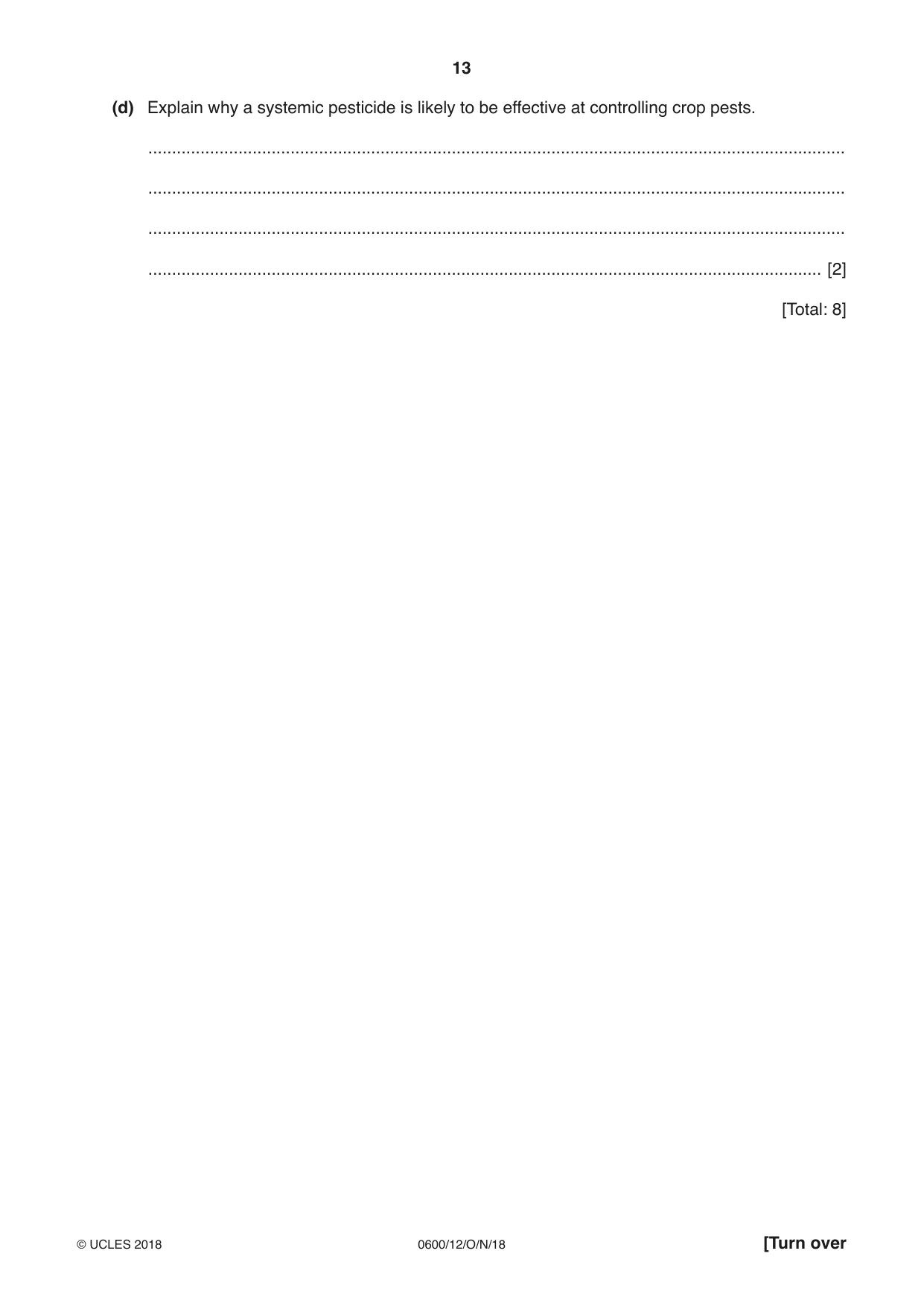
13 0600/12/O/N/18 © UCLES 2018 [Turn over (d) Explain why a systemic pesticide is likely to be effective at controlling crop pests. … … … … [2] [Total: 8]
Question paper, page 14
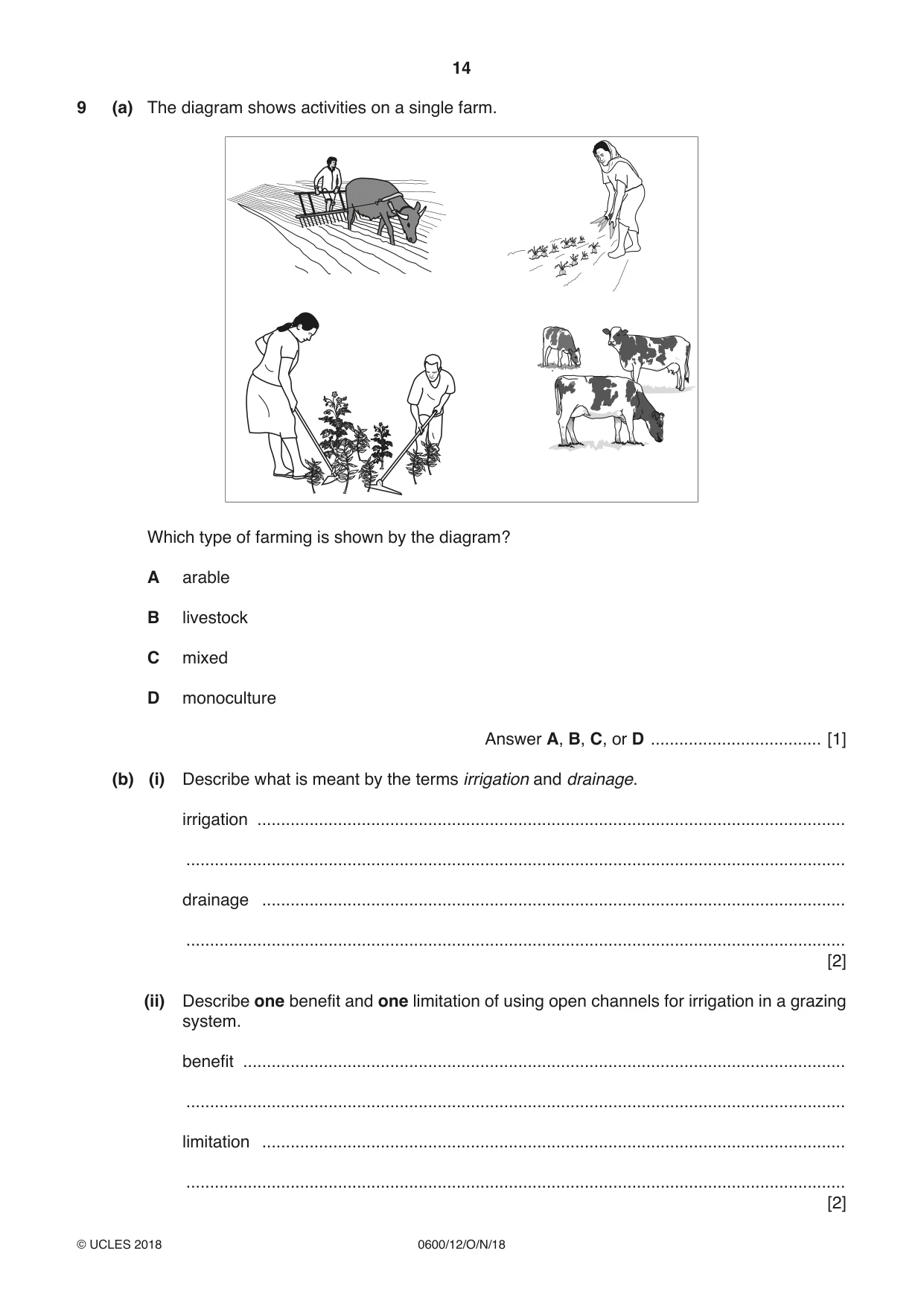
14 0600/12/O/N/18 © UCLES 2018 9 (a) The diagram shows activities on a single farm. Which type of farming is shown by the diagram? A arable B livestock C mixed D monoculture Answer A, B, C, or D … [1] (b) (i) Describe what is meant by the terms irrigation and drainage. irrigation … … drainage … … [2] (ii) Describe one benefit and one limitation of using open channels for irrigation in a grazing system. benefit … … limitation … … [2]
Question paper, page 15
15 0600/12/O/N/18 © UCLES 2018 [Turn over (iii) Explain how poor drainage can damage soils. … … … … [2] [Total: 7]
Question paper, page 16
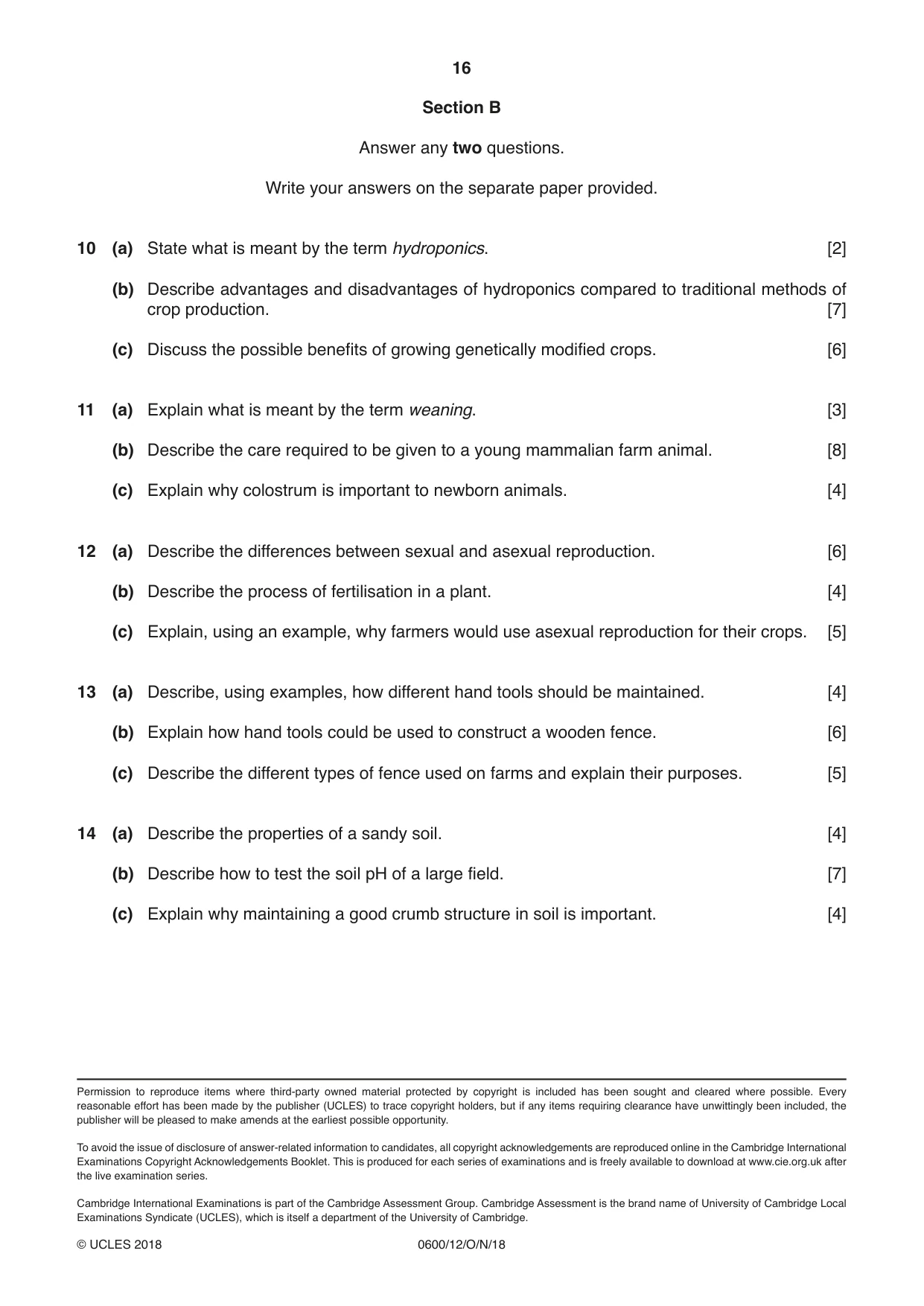
16 0600/12/O/N/18 © UCLES 2018 Section B Answer any two questions. Write your answers on the separate paper provided. 10 (a) State what is meant by the term hydroponics. [2] (b) Describe advantages and disadvantages of hydroponics compared to traditional methods of crop production. [7] (c) Discuss the possible benefits of growing genetically modified crops. [6] 11 (a) Explain what is meant by the term weaning. [3] (b) Describe the care required to be given to a young mammalian farm animal. [8] (c) Explain why colostrum is important to newborn animals. [4] 12 (a) Describe the differences between sexual and asexual reproduction. [6] (b) Describe the process of fertilisation in a plant. [4] (c) Explain, using an example, why farmers would use asexual reproduction for their crops. [5] 13 (a) Describe, using examples, how different hand tools should be maintained. [4] (b) Explain how hand tools could be used to construct a wooden fence. [6] (c) Describe the different types of fence used on farms and explain their purposes. [5] 14 (a) Describe the properties of a sandy soil. [4] (b) Describe how to test the soil pH of a large field. [7] (c) Explain why maintaining a good crumb structure in soil is important. [4] Permission to reproduce items where third-party owned material protected by copyright is included has been sought and cleared where possible. Every reasonable effort has been made by the publisher (UCLES) to trace copyright holders, but if any items requiring clearance have unwittingly been included, the publisher will be pleased to make amends at the earliest possible opportunity. To avoid the issue of disclosure of answer-related information to candidates, all copyright acknowledgements are reproduced online in the Cambridge International Examinations Copyright Acknowledgements Booklet. This is produced for each series of examinations and is freely available to download at www.cie.org.uk after the live examination series. Cambridge International Examinations is part of the Cambridge Assessment Group. Cambridge Assessment is the brand name of University of Cambridge Local Examinations Syndicate (UCLES), which is itself a department of the University of Cambridge.
Mark scheme, page 1
This document consists of 21 printed pages. © UCLES 2018 [Turn over Cambridge Assessment International Education Cambridge International General Certificate of Secondary Education AGRICULTURE 0600/12 Paper 1 October/November 2018 MARK SCHEME Maximum Mark: 100 Published This mark scheme is published as an aid to teachers and candidates, to indicate the requirements of the examination. It shows the basis on which Examiners were instructed to award marks. It does not indicate the details of the discussions that took place at an Examiners’ meeting before marking began, which would have considered the acceptability of alternative answers. Mark schemes should be read in conjunction with the question paper and the Principal Examiner Report for Teachers. Cambridge International will not enter into discussions about these mark schemes. Cambridge International is publishing the mark schemes for the October/November 2018 series for most Cambridge IGCSE™, Cambridge International A and AS Level components and some Cambridge O Level components.
Mark scheme, page 2
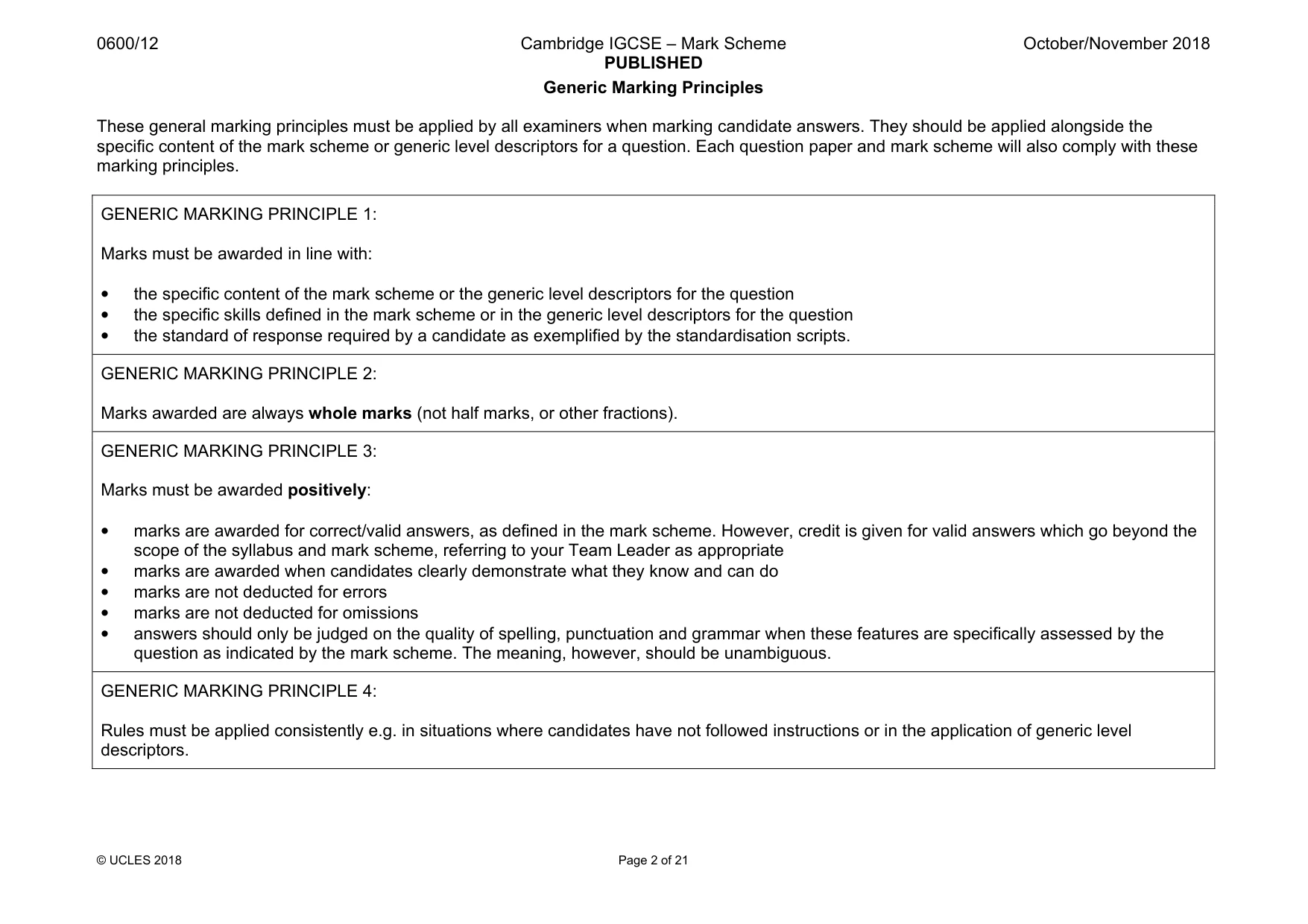
0600/12 Cambridge IGCSE – Mark Scheme PUBLISHED October/November 2018 © UCLES 2018 Page 2 of 21 Generic Marking Principles These general marking principles must be applied by all examiners when marking candidate answers. They should be applied alongside the specific content of the mark scheme or generic level descriptors for a question. Each question paper and mark scheme will also comply with these marking principles. GENERIC MARKING PRINCIPLE 1: Marks must be awarded in line with: • the specific content of the mark scheme or the generic level descriptors for the question • the specific skills defined in the mark scheme or in the generic level descriptors for the question • the standard of response required by a candidate as exemplified by the standardisation scripts. GENERIC MARKING PRINCIPLE 2: Marks awarded are always whole marks (not half marks, or other fractions). GENERIC MARKING PRINCIPLE 3: Marks must be awarded positively: • marks are awarded for correct/valid answers, as defined in the mark scheme. However, credit is given for valid answers which go beyond the scope of the syllabus and mark scheme, referring to your Team Leader as appropriate • marks are awarded when candidates clearly demonstrate what they know and can do • marks are not deducted for errors • marks are not deducted for omissions • answers should only be judged on the quality of spelling, punctuation and grammar when these features are specifically assessed by the question as indicated by the mark scheme. The meaning, however, should be unambiguous. GENERIC MARKING PRINCIPLE 4: Rules must be applied consistently e.g. in situations where candidates have not followed instructions or in the application of generic level descriptors.
Mark scheme, page 3
0600/12 Cambridge IGCSE – Mark Scheme PUBLISHED October/November 2018 © UCLES 2018 Page 3 of 21 GENERIC MARKING PRINCIPLE 5: Marks should be awarded using the full range of marks defined in the mark scheme for the question (however; the use of the full mark range may be limited according to the quality of the candidate responses seen). GENERIC MARKING PRINCIPLE 6: Marks awarded are based solely on the requirements as defined in the mark scheme. Marks should not be awarded with grade thresholds or grade descriptors in mind.
Mark scheme, page 4
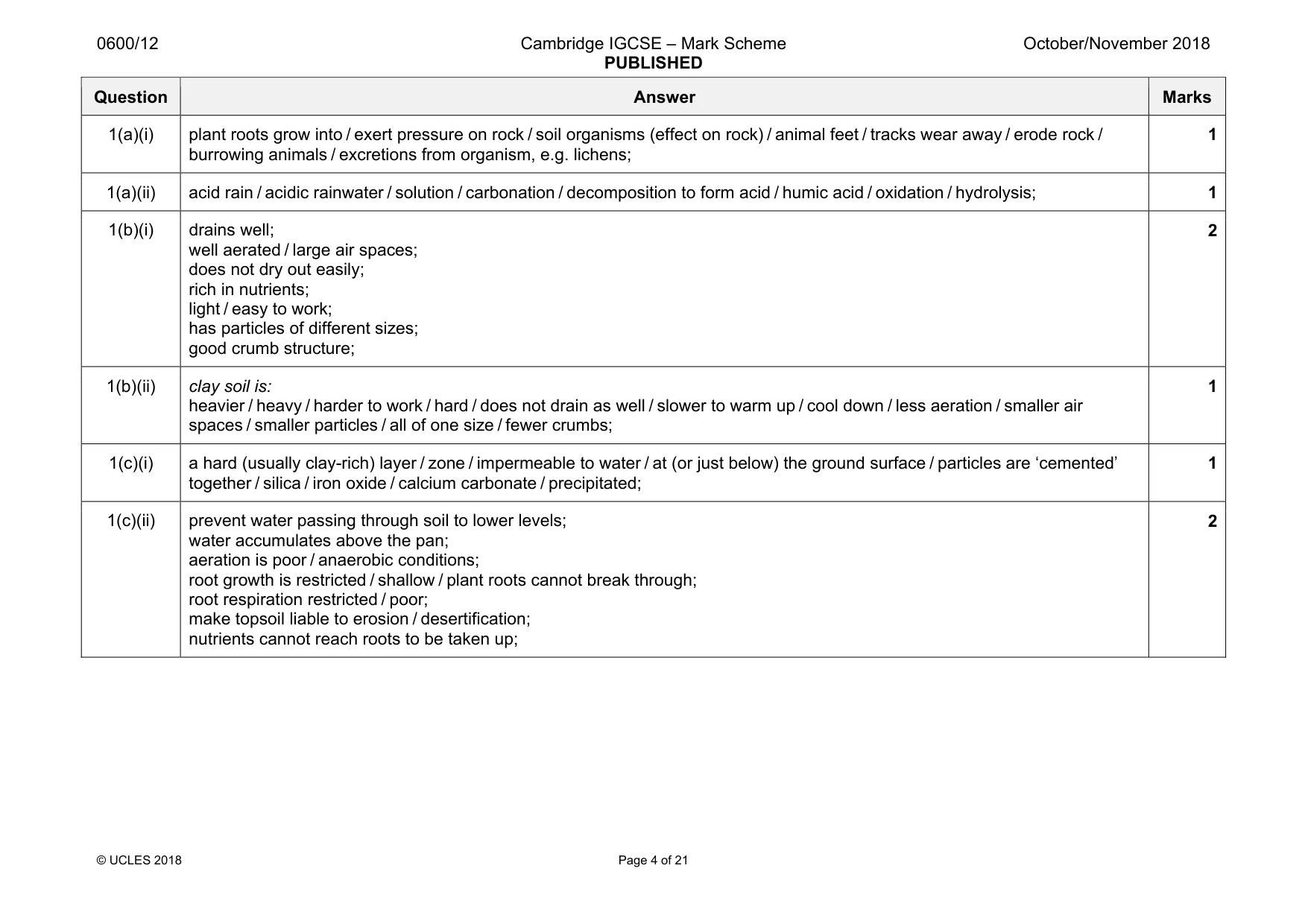
0600/12 Cambridge IGCSE – Mark Scheme PUBLISHED October/November 2018 © UCLES 2018 Page 4 of 21 Question Answer Marks 1(a)(i) plant roots grow into / exert pressure on rock / soil organisms (effect on rock) / animal feet / tracks wear away / erode rock / burrowing animals / excretions from organism, e.g. lichens; 1 1(a)(ii) acid rain / acidic rainwater / solution / carbonation / decomposition to form acid / humic acid / oxidation / hydrolysis; 1 1(b)(i) drains well; well aerated / large air spaces; does not dry out easily; rich in nutrients; light / easy to work; has particles of different sizes; good crumb structure; 2 1(b)(ii) clay soil is: heavier / heavy / harder to work / hard / does not drain as well / slower to warm up / cool down / less aeration / smaller air spaces / smaller particles / all of one size / fewer crumbs; 1 1(c)(i) a hard (usually clay-rich) layer / zone / impermeable to water / at (or just below) the ground surface / particles are ‘cemented’ together / silica / iron oxide / calcium carbonate / precipitated; 1 1(c)(ii) prevent water passing through soil to lower levels; water accumulates above the pan; aeration is poor / anaerobic conditions; root growth is restricted / shallow / plant roots cannot break through; root respiration restricted / poor; make topsoil liable to erosion / desertification; nutrients cannot reach roots to be taken up; 2
Mark scheme, page 5
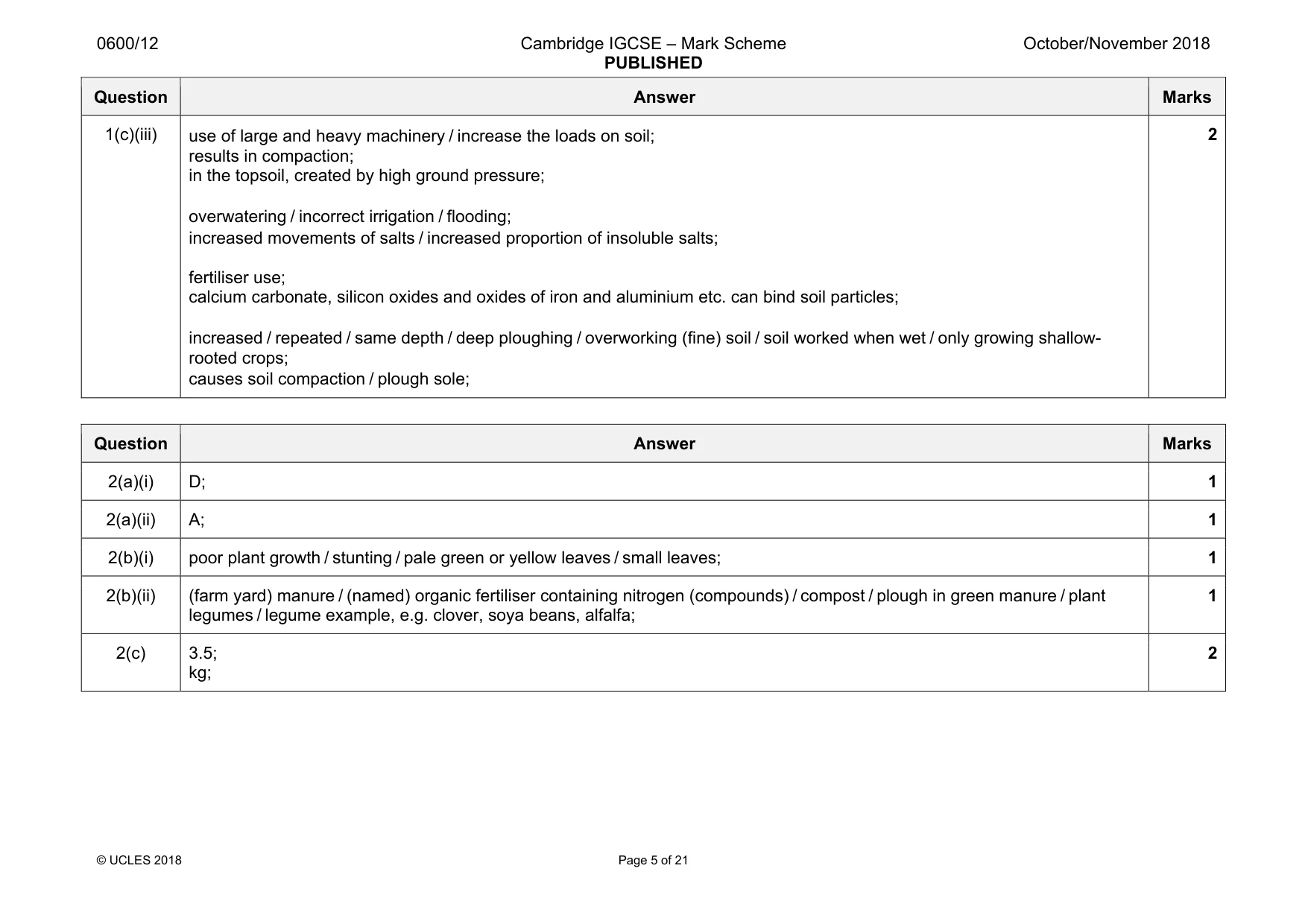
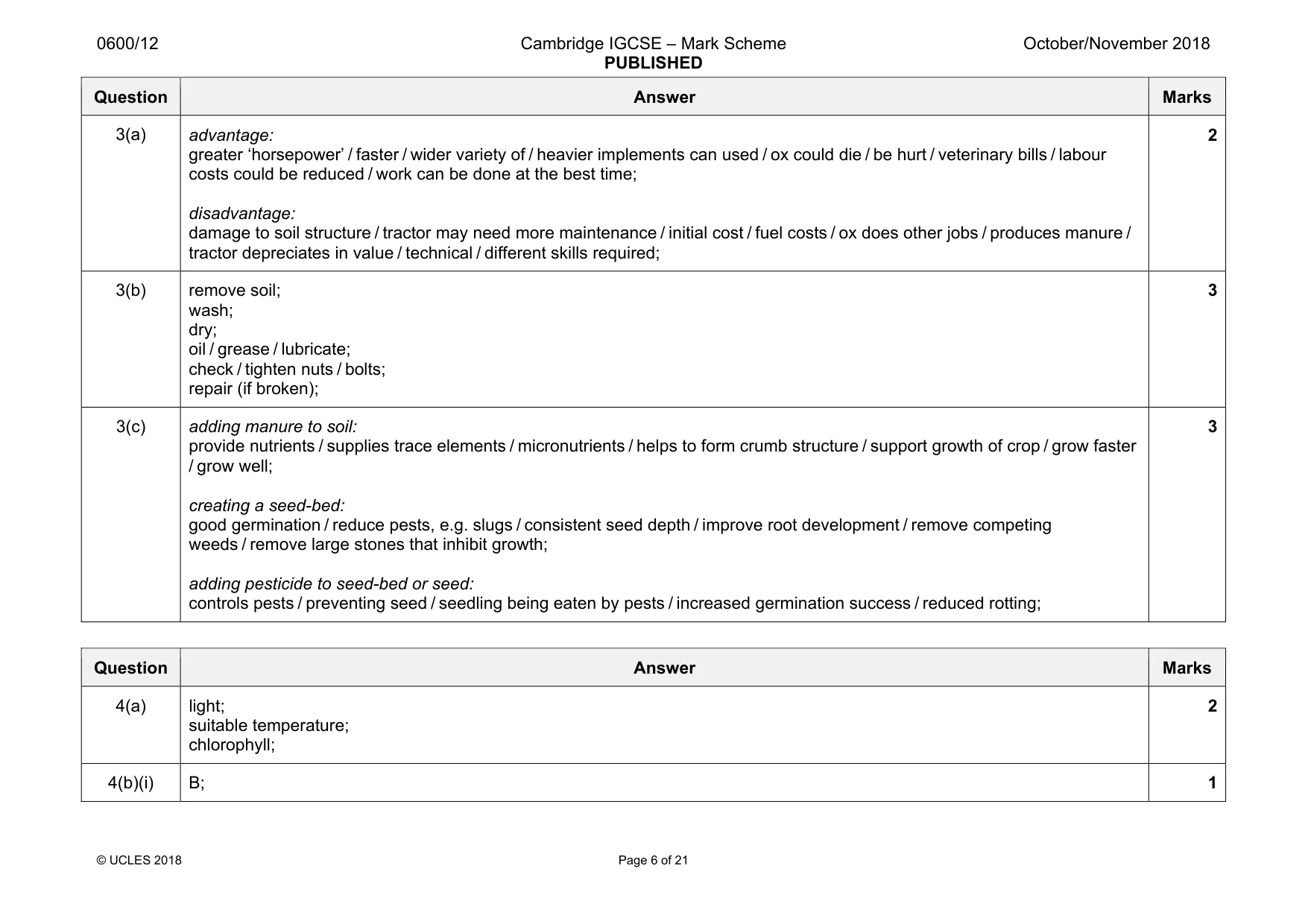
0600/12 Cambridge IGCSE – Mark Scheme PUBLISHED October/November 2018 © UCLES 2018 Page 5 of 21 Question Answer Marks 1(c)(iii) use of large and heavy machinery / increase the loads on soil; results in compaction; in the topsoil, created by high ground pressure; overwatering / incorrect irrigation / flooding; increased movements of salts / increased proportion of insoluble salts; fertiliser use; calcium carbonate, silicon oxides and oxides of iron and aluminium etc. can bind soil particles; increased / repeated / same depth / deep ploughing / overworking (fine) soil / soil worked when wet / only growing shallow- rooted crops; causes soil compaction / plough sole; 2 Question Answer Marks 2(a)(i) D; 1 2(a)(ii) A; 1 2(b)(i) poor plant growth / stunting / pale green or yellow leaves / small leaves; 1 2(b)(ii) (farm yard) manure / (named) organic fertiliser containing nitrogen (compounds) / compost / plough in green manure / plant legumes / legume example, e.g. clover, soya beans, alfalfa; 1 2(c) 3.5; kg; 2
Mark scheme, page 6
0600/12 Cambridge IGCSE – Mark Scheme PUBLISHED October/November 2018 © UCLES 2018 Page 6 of 21 Question Answer Marks 3(a) advantage: greater ‘horsepower’ / faster / wider variety of / heavier implements can used / ox could die / be hurt / veterinary bills / labour costs could be reduced / work can be done at the best time; disadvantage: damage to soil structure / tractor may need more maintenance / initial cost / fuel costs / ox does other jobs / produces manure / tractor depreciates in value / technical / different skills required; 2 3(b) remove soil; wash; dry; oil / grease / lubricate; check / tighten nuts / bolts; repair (if broken); 3 3(c) adding manure to soil: provide nutrients / supplies trace elements / micronutrients / helps to form crumb structure / support growth of crop / grow faster / grow well; creating a seed-bed: good germination / reduce pests, e.g. slugs / consistent seed depth / improve root development / remove competing weeds / remove large stones that inhibit growth; adding pesticide to seed-bed or seed: controls pests / preventing seed / seedling being eaten by pests / increased germination success / reduced rotting; 3 Question Answer Marks 4(a) light; suitable temperature; chlorophyll; 2 4(b)(i) B; 1
Mark scheme, page 7
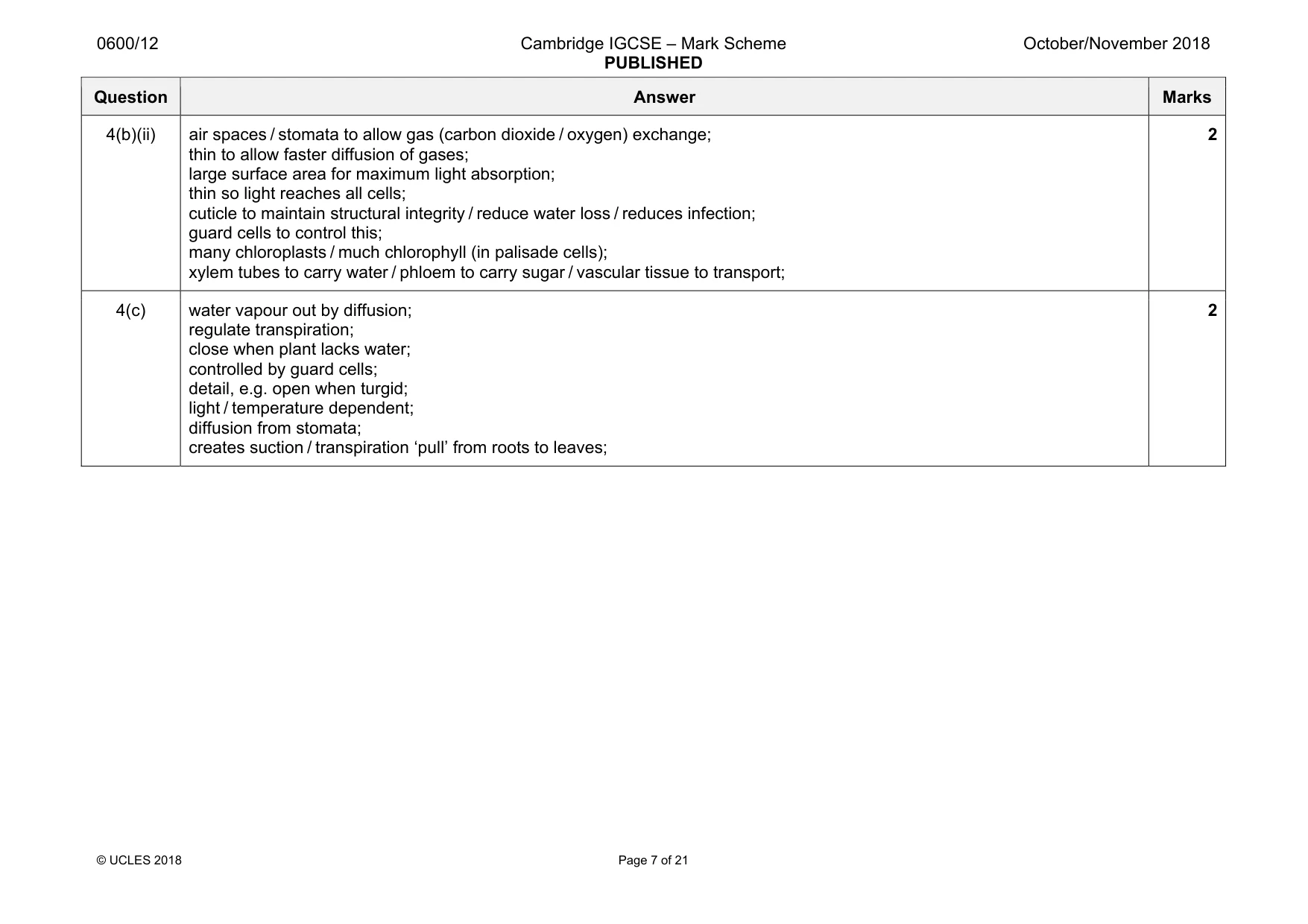
0600/12 Cambridge IGCSE – Mark Scheme PUBLISHED October/November 2018 © UCLES 2018 Page 7 of 21 Question Answer Marks 4(b)(ii) air spaces / stomata to allow gas (carbon dioxide / oxygen) exchange; thin to allow faster diffusion of gases; large surface area for maximum light absorption; thin so light reaches all cells; cuticle to maintain structural integrity / reduce water loss / reduces infection; guard cells to control this; many chloroplasts / much chlorophyll (in palisade cells); xylem tubes to carry water / phloem to carry sugar / vascular tissue to transport; 2 4(c) water vapour out by diffusion; regulate transpiration; close when plant lacks water; controlled by guard cells; detail, e.g. open when turgid; light / temperature dependent; diffusion from stomata; creates suction / transpiration ‘pull’ from roots to leaves; 2
Mark scheme, page 8
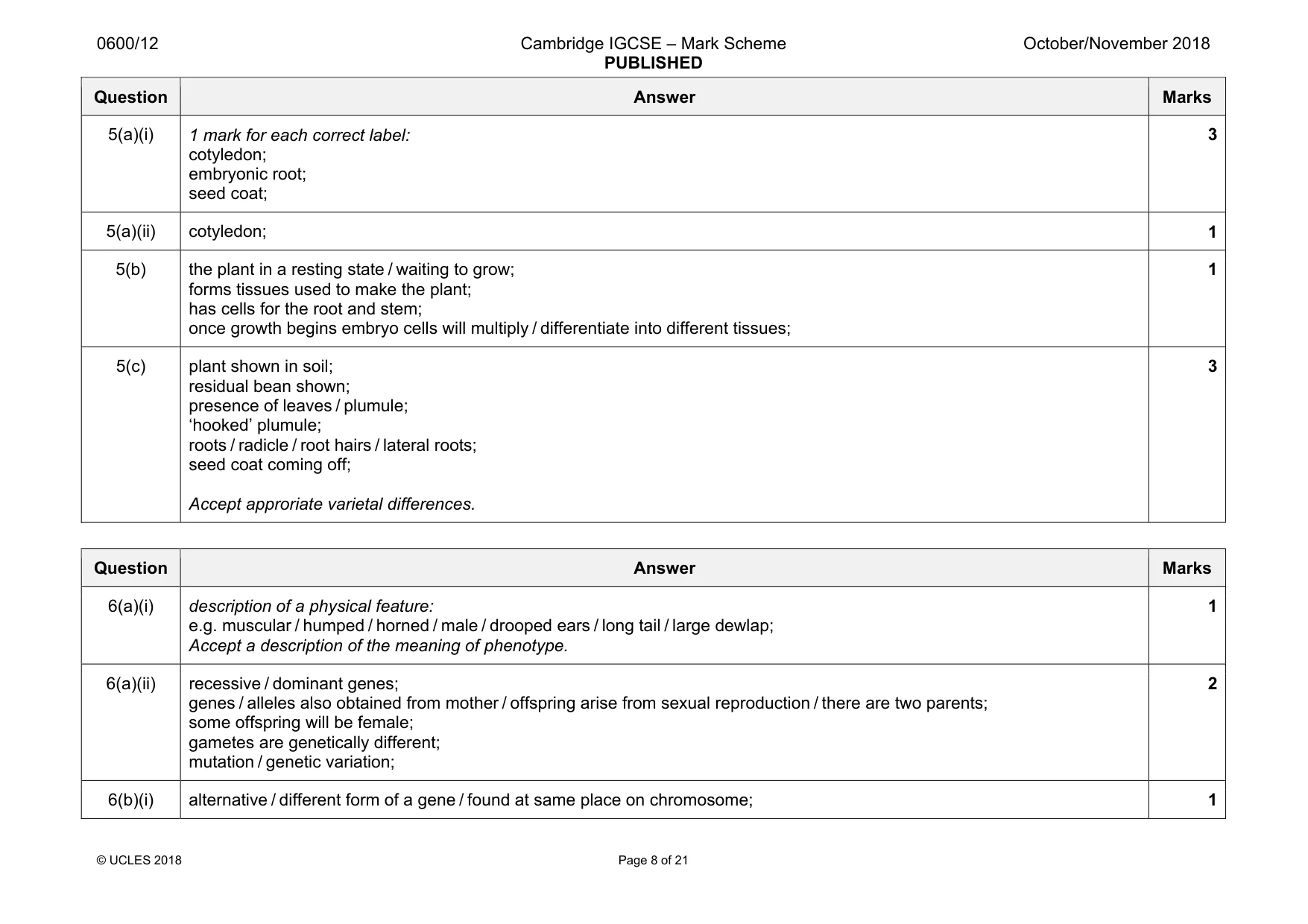
0600/12 Cambridge IGCSE – Mark Scheme PUBLISHED October/November 2018 © UCLES 2018 Page 8 of 21 Question Answer Marks 5(a)(i) 1 mark for each correct label: cotyledon; embryonic root; seed coat; 3 5(a)(ii) cotyledon; 1 5(b) the plant in a resting state / waiting to grow; forms tissues used to make the plant; has cells for the root and stem; once growth begins embryo cells will multiply / differentiate into different tissues; 1 5(c) plant shown in soil; residual bean shown; presence of leaves / plumule; ‘hooked’ plumule; roots / radicle / root hairs / lateral roots; seed coat coming off; Accept approriate varietal differences. 3 Question Answer Marks 6(a)(i) description of a physical feature: e.g. muscular / humped / horned / male / drooped ears / long tail / large dewlap; Accept a description of the meaning of phenotype. 1 6(a)(ii) recessive / dominant genes; genes / alleles also obtained from mother / offspring arise from sexual reproduction / there are two parents; some offspring will be female; gametes are genetically different; mutation / genetic variation; 2 6(b)(i) alternative / different form of a gene / found at same place on chromosome; 1
Mark scheme, page 9
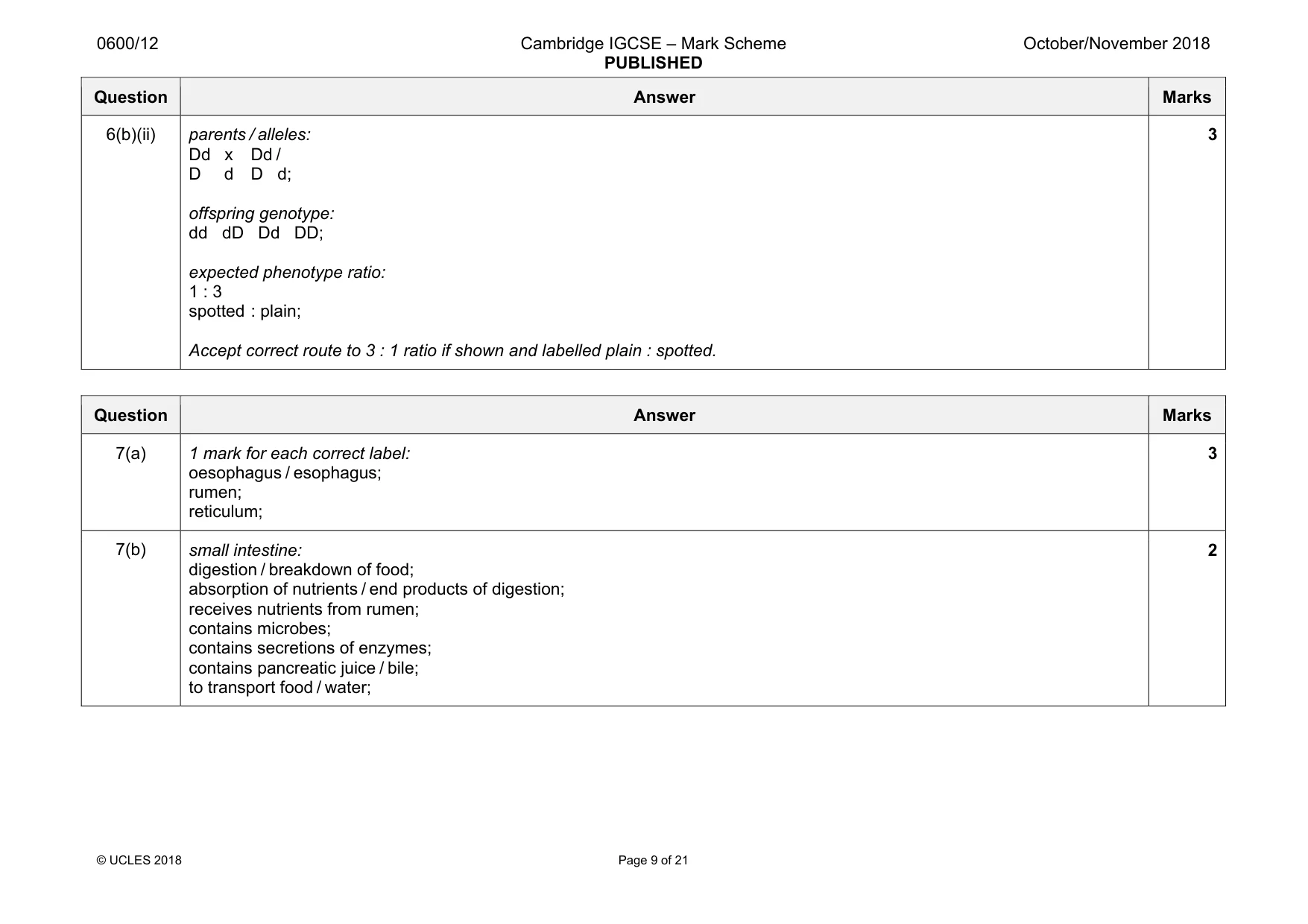
0600/12 Cambridge IGCSE – Mark Scheme PUBLISHED October/November 2018 © UCLES 2018 Page 9 of 21 Question Answer Marks 6(b)(ii) parents / alleles: Dd x Dd / D d D d; offspring genotype: dd dD Dd DD; expected phenotype ratio: 1 : 3 spotted : plain; Accept correct route to 3 : 1 ratio if shown and labelled plain : spotted. 3 Question Answer Marks 7(a) 1 mark for each correct label: oesophagus / esophagus; rumen; reticulum; 3 7(b) small intestine: digestion / breakdown of food; absorption of nutrients / end products of digestion; receives nutrients from rumen; contains microbes; contains secretions of enzymes; contains pancreatic juice / bile; to transport food / water; 2
Mark scheme, page 10
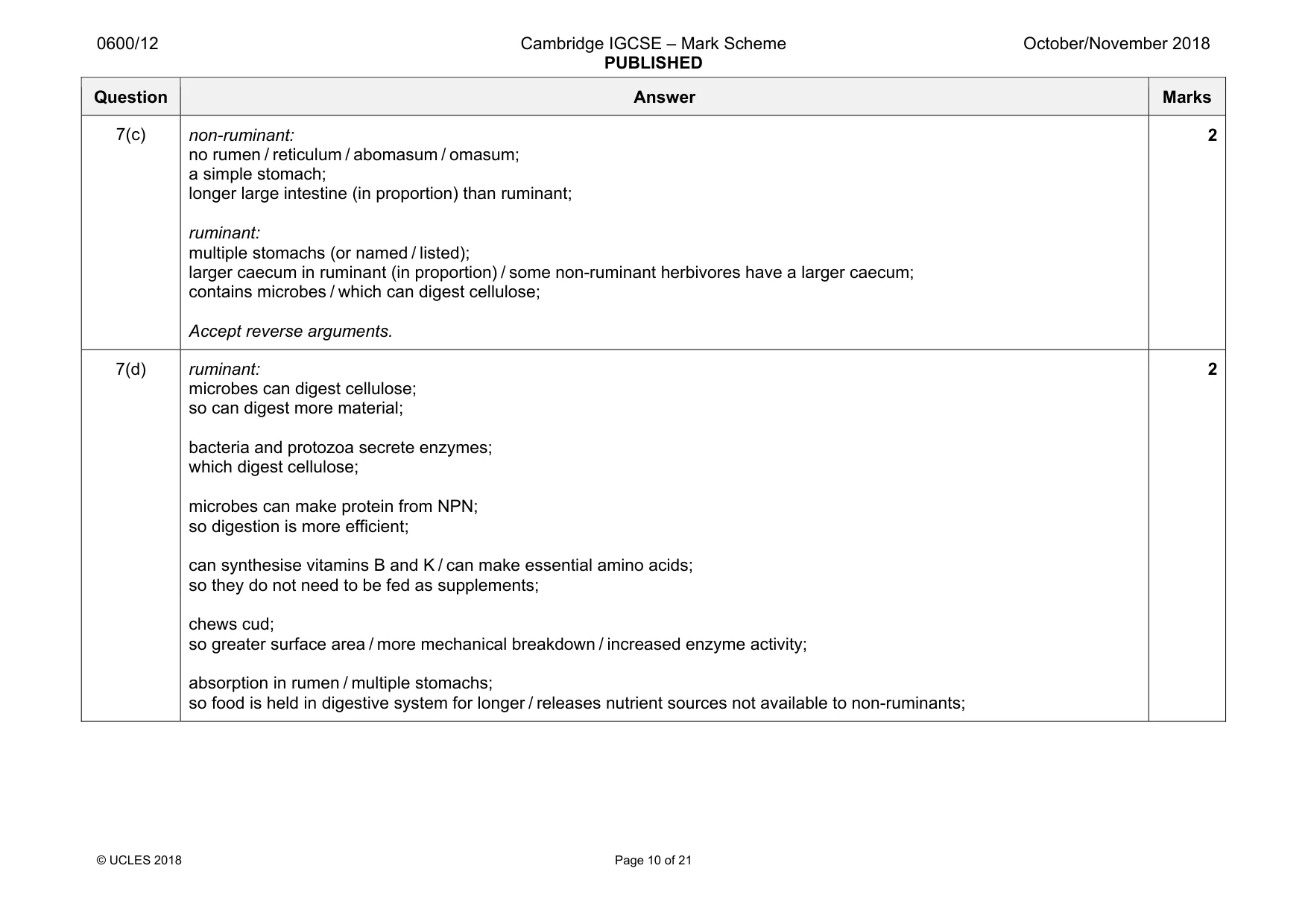
0600/12 Cambridge IGCSE – Mark Scheme PUBLISHED October/November 2018 © UCLES 2018 Page 10 of 21 Question Answer Marks 7(c) non-ruminant: no rumen / reticulum / abomasum / omasum; a simple stomach; longer large intestine (in proportion) than ruminant; ruminant: multiple stomachs (or named / listed); larger caecum in ruminant (in proportion) / some non-ruminant herbivores have a larger caecum; contains microbes / which can digest cellulose; Accept reverse arguments. 2 7(d) ruminant: microbes can digest cellulose; so can digest more material; bacteria and protozoa secrete enzymes; which digest cellulose; microbes can make protein from NPN; so digestion is more efficient; can synthesise vitamins B and K / can make essential amino acids; so they do not need to be fed as supplements; chews cud; so greater surface area / more mechanical breakdown / increased enzyme activity; absorption in rumen / multiple stomachs; so food is held in digestive system for longer / releases nutrient sources not available to non-ruminants; 2
Mark scheme, page 11
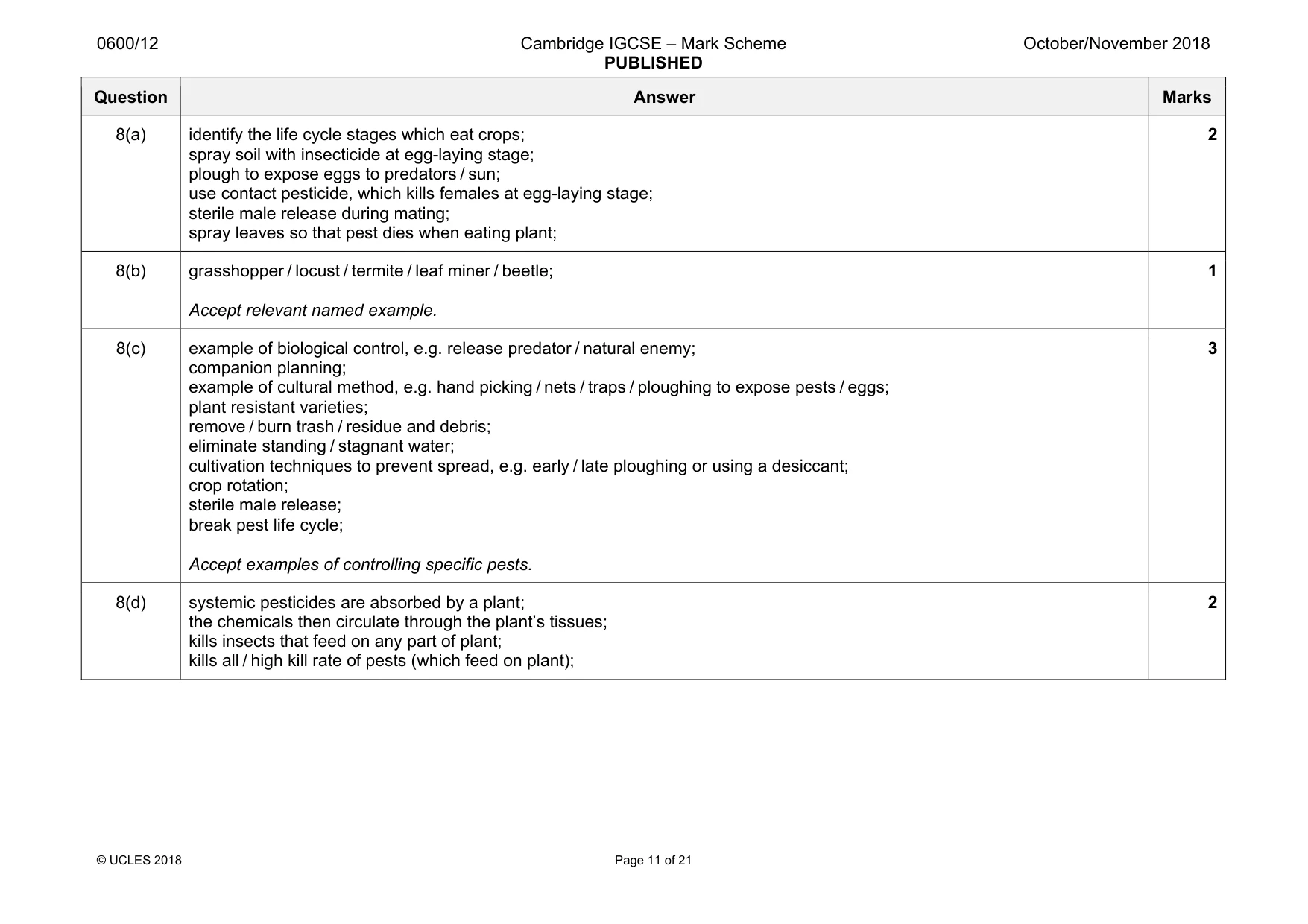
0600/12 Cambridge IGCSE – Mark Scheme PUBLISHED October/November 2018 © UCLES 2018 Page 11 of 21 Question Answer Marks 8(a) identify the life cycle stages which eat crops; spray soil with insecticide at egg-laying stage; plough to expose eggs to predators / sun; use contact pesticide, which kills females at egg-laying stage; sterile male release during mating; spray leaves so that pest dies when eating plant; 2 8(b) grasshopper / locust / termite / leaf miner / beetle; Accept relevant named example. 1 8(c) example of biological control, e.g. release predator / natural enemy; companion planning; example of cultural method, e.g. hand picking / nets / traps / ploughing to expose pests / eggs; plant resistant varieties; remove / burn trash / residue and debris; eliminate standing / stagnant water; cultivation techniques to prevent spread, e.g. early / late ploughing or using a desiccant; crop rotation; sterile male release; break pest life cycle; Accept examples of controlling specific pests. 3 8(d) systemic pesticides are absorbed by a plant; the chemicals then circulate through the plant’s tissues; kills insects that feed on any part of plant; kills all / high kill rate of pests (which feed on plant); 2
Mark scheme, page 12
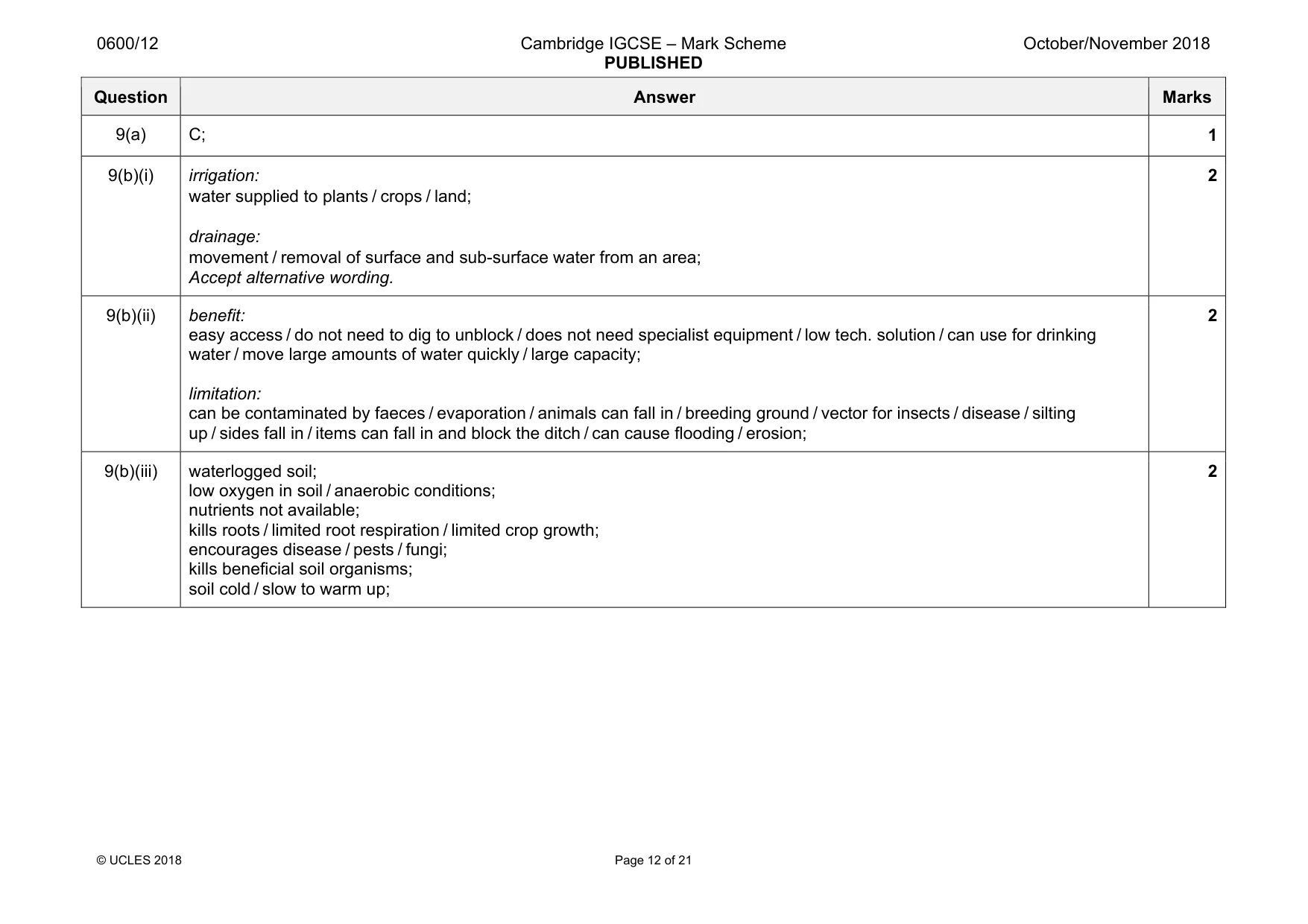
0600/12 Cambridge IGCSE – Mark Scheme PUBLISHED October/November 2018 © UCLES 2018 Page 12 of 21 Question Answer Marks 9(a) C; 1 9(b)(i) irrigation: water supplied to plants / crops / land; drainage: movement / removal of surface and sub-surface water from an area; Accept alternative wording. 2 9(b)(ii) benefit: easy access / do not need to dig to unblock / does not need specialist equipment / low tech. solution / can use for drinking water / move large amounts of water quickly / large capacity; limitation: can be contaminated by faeces / evaporation / animals can fall in / breeding ground / vector for insects / disease / silting up / sides fall in / items can fall in and block the ditch / can cause flooding / erosion; 2 9(b)(iii) waterlogged soil; low oxygen in soil / anaerobic conditions; nutrients not available; kills roots / limited root respiration / limited crop growth; encourages disease / pests / fungi; kills beneficial soil organisms; soil cold / slow to warm up; 2
Mark scheme, page 13
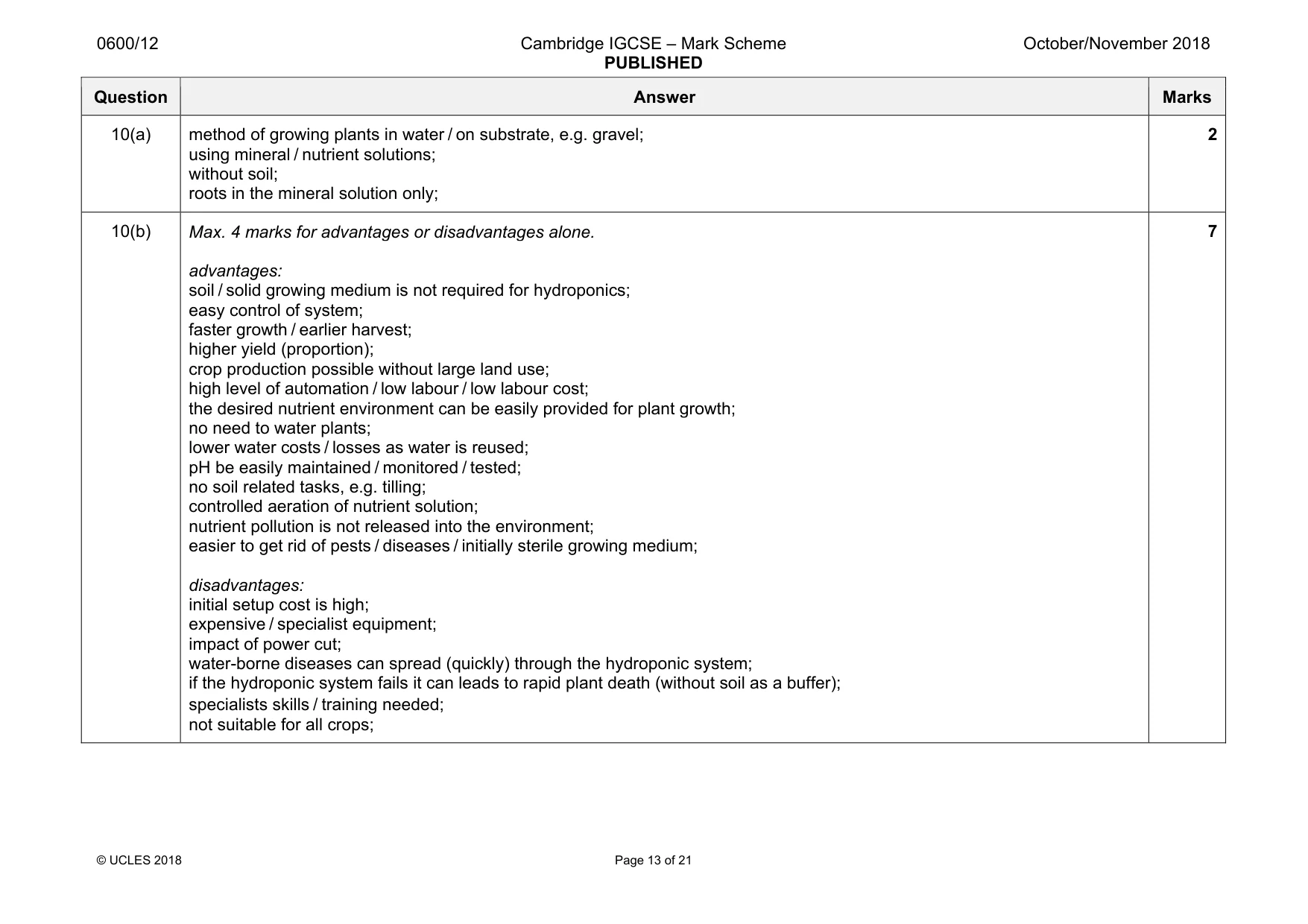
0600/12 Cambridge IGCSE – Mark Scheme PUBLISHED October/November 2018 © UCLES 2018 Page 13 of 21 Question Answer Marks 10(a) method of growing plants in water / on substrate, e.g. gravel; using mineral / nutrient solutions; without soil; roots in the mineral solution only; 2 10(b) Max. 4 marks for advantages or disadvantages alone. advantages: soil / solid growing medium is not required for hydroponics; easy control of system; faster growth / earlier harvest; higher yield (proportion); crop production possible without large land use; high level of automation / low labour / low labour cost; the desired nutrient environment can be easily provided for plant growth; no need to water plants; lower water costs / losses as water is reused; pH be easily maintained / monitored / tested; no soil related tasks, e.g. tilling; controlled aeration of nutrient solution; nutrient pollution is not released into the environment; easier to get rid of pests / diseases / initially sterile growing medium; disadvantages: initial setup cost is high; expensive / specialist equipment; impact of power cut; water-borne diseases can spread (quickly) through the hydroponic system; if the hydroponic system fails it can leads to rapid plant death (without soil as a buffer); specialists skills / training needed; not suitable for all crops; 7
Mark scheme, page 14
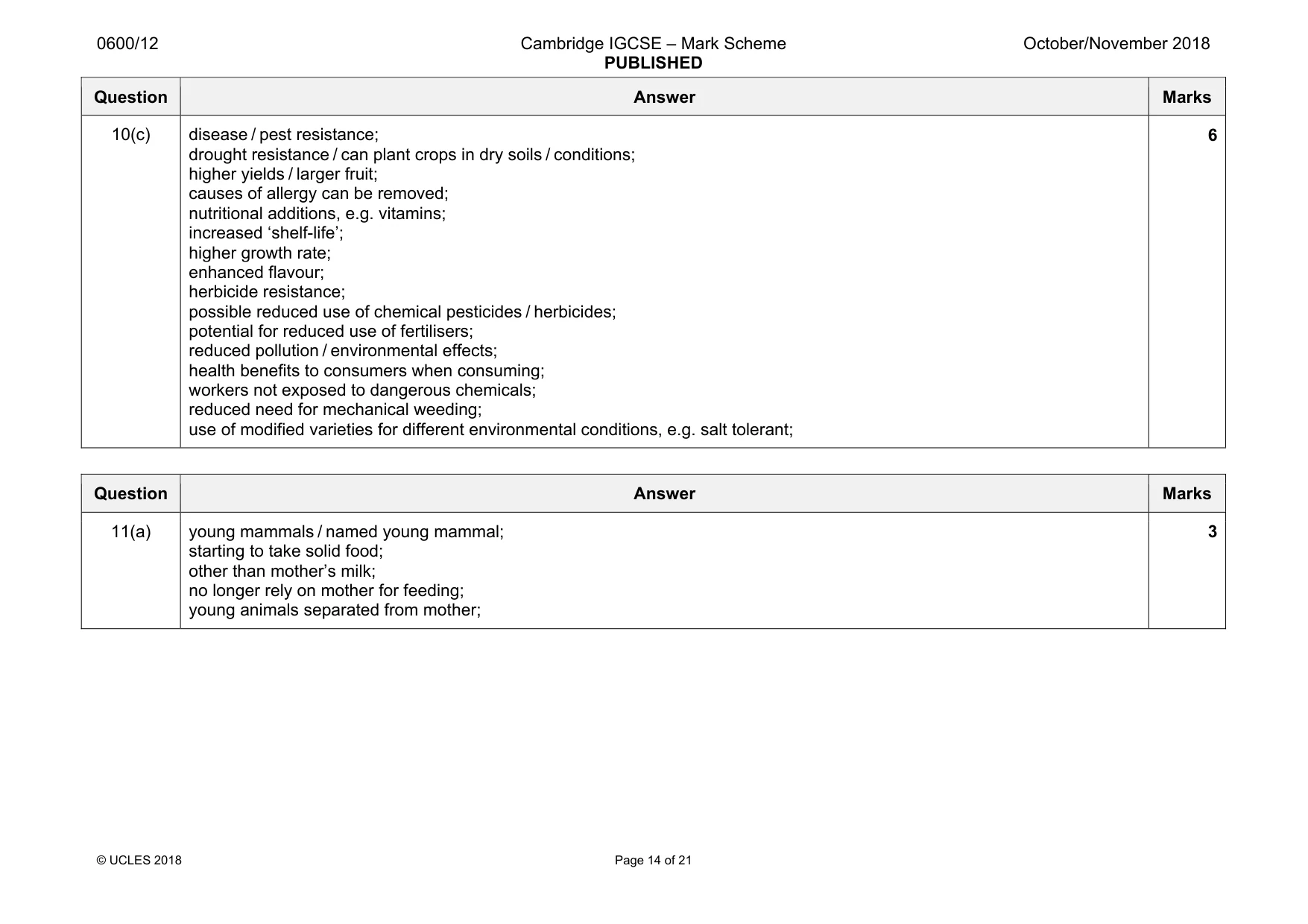
0600/12 Cambridge IGCSE – Mark Scheme PUBLISHED October/November 2018 © UCLES 2018 Page 14 of 21 Question Answer Marks 10(c) disease / pest resistance; drought resistance / can plant crops in dry soils / conditions; higher yields / larger fruit; causes of allergy can be removed; nutritional additions, e.g. vitamins; increased ‘shelf-life’; higher growth rate; enhanced flavour; herbicide resistance; possible reduced use of chemical pesticides / herbicides; potential for reduced use of fertilisers; reduced pollution / environmental effects; health benefits to consumers when consuming; workers not exposed to dangerous chemicals; reduced need for mechanical weeding; use of modified varieties for different environmental conditions, e.g. salt tolerant; 6 Question Answer Marks 11(a) young mammals / named young mammal; starting to take solid food; other than mother’s milk; no longer rely on mother for feeding; young animals separated from mother; 3
Mark scheme, page 15
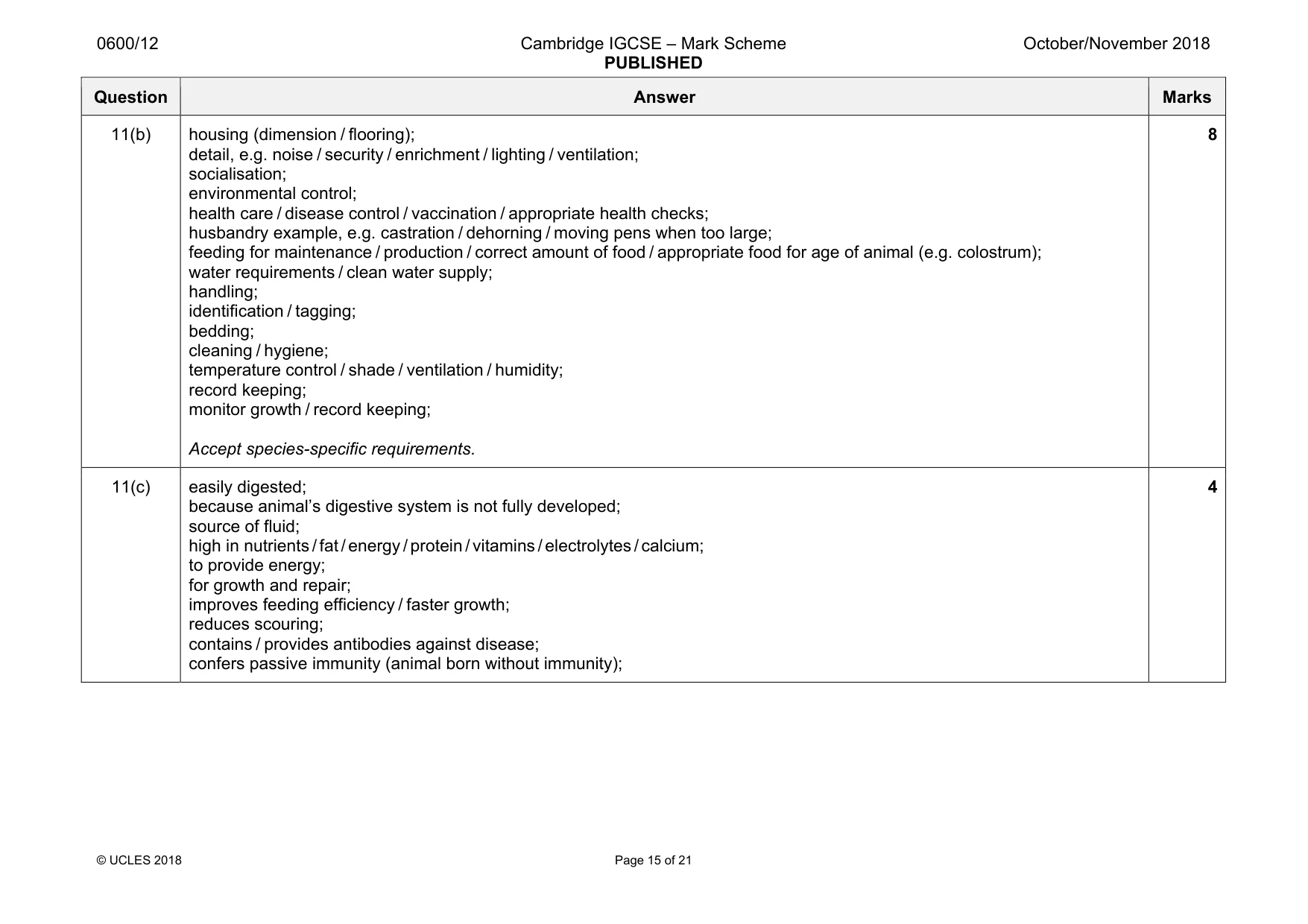
0600/12 Cambridge IGCSE – Mark Scheme PUBLISHED October/November 2018 © UCLES 2018 Page 15 of 21 Question Answer Marks 11(b) housing (dimension / flooring); detail, e.g. noise / security / enrichment / lighting / ventilation; socialisation; environmental control; health care / disease control / vaccination / appropriate health checks; husbandry example, e.g. castration / dehorning / moving pens when too large; feeding for maintenance / production / correct amount of food / appropriate food for age of animal (e.g. colostrum); water requirements / clean water supply; handling; identification / tagging; bedding; cleaning / hygiene; temperature control / shade / ventilation / humidity; record keeping; monitor growth / record keeping; Accept species-specific requirements. 8 11(c) easily digested; because animal’s digestive system is not fully developed; source of fluid; high in nutrients / fat / energy / protein / vitamins / electrolytes / calcium; to provide energy; for growth and repair; improves feeding efficiency / faster growth; reduces scouring; contains / provides antibodies against disease; confers passive immunity (animal born without immunity); 4
Mark scheme, page 16
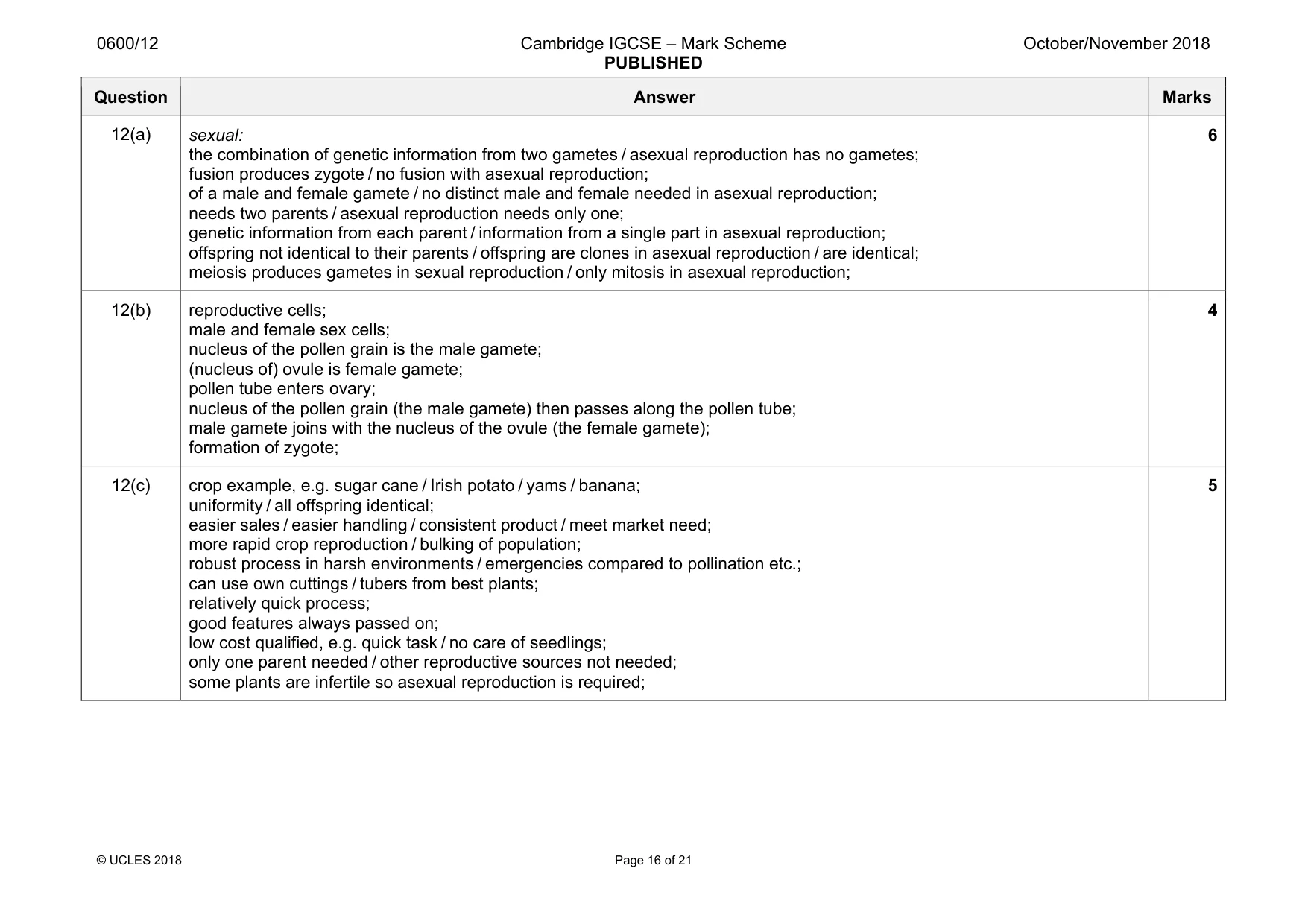
0600/12 Cambridge IGCSE – Mark Scheme PUBLISHED October/November 2018 © UCLES 2018 Page 16 of 21 Question Answer Marks 12(a) sexual: the combination of genetic information from two gametes / asexual reproduction has no gametes; fusion produces zygote / no fusion with asexual reproduction; of a male and female gamete / no distinct male and female needed in asexual reproduction; needs two parents / asexual reproduction needs only one; genetic information from each parent / information from a single part in asexual reproduction; offspring not identical to their parents / offspring are clones in asexual reproduction / are identical; meiosis produces gametes in sexual reproduction / only mitosis in asexual reproduction; 6 12(b) reproductive cells; male and female sex cells; nucleus of the pollen grain is the male gamete; (nucleus of) ovule is female gamete; pollen tube enters ovary; nucleus of the pollen grain (the male gamete) then passes along the pollen tube; male gamete joins with the nucleus of the ovule (the female gamete); formation of zygote; 4 12(c) crop example, e.g. sugar cane / Irish potato / yams / banana; uniformity / all offspring identical; easier sales / easier handling / consistent product / meet market need; more rapid crop reproduction / bulking of population; robust process in harsh environments / emergencies compared to pollination etc.; can use own cuttings / tubers from best plants; relatively quick process; good features always passed on; low cost qualified, e.g. quick task / no care of seedlings; only one parent needed / other reproductive sources not needed; some plants are infertile so asexual reproduction is required; 5
Mark scheme, page 17
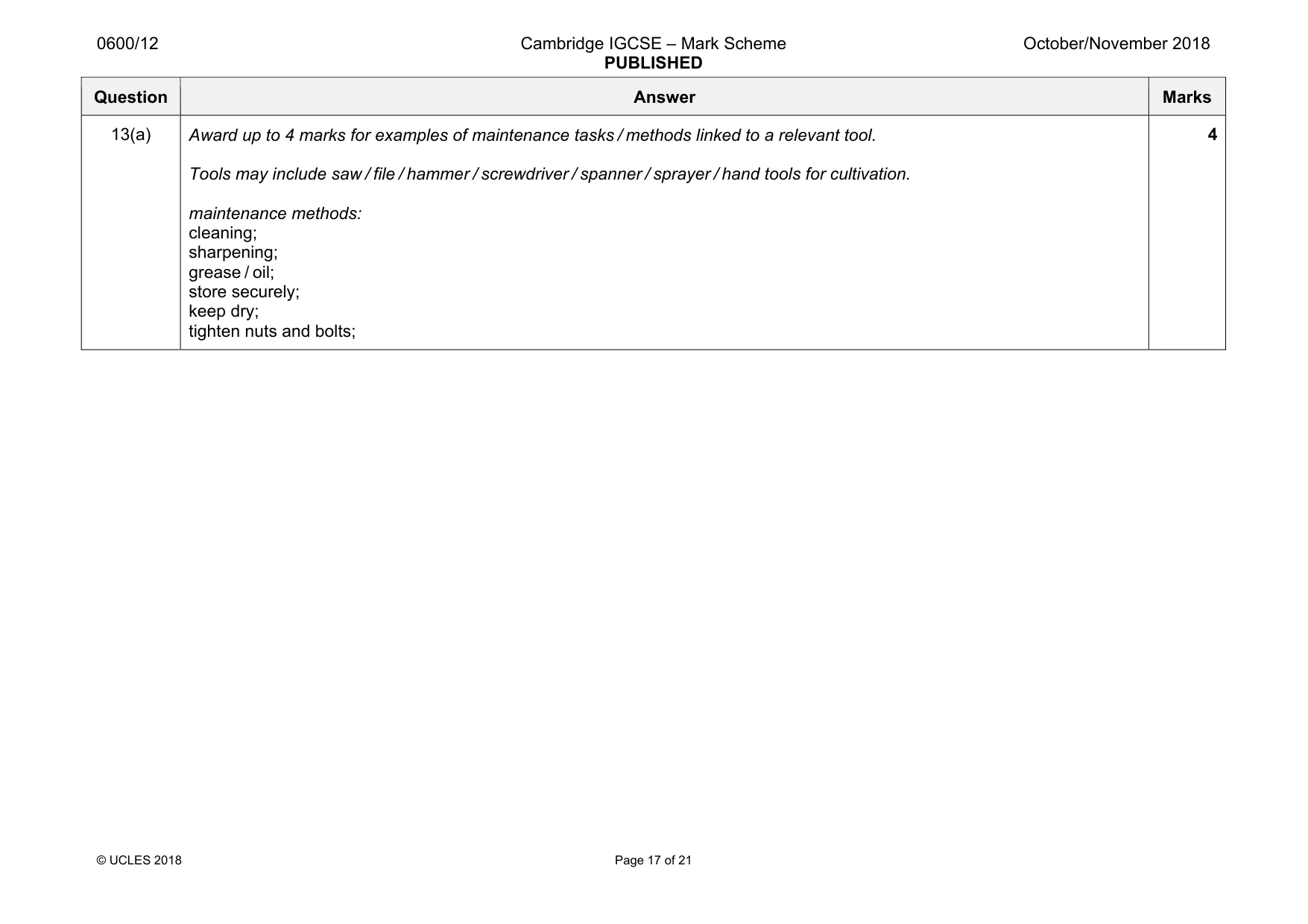
0600/12 Cambridge IGCSE – Mark Scheme PUBLISHED October/November 2018 © UCLES 2018 Page 17 of 21 Question Answer Marks 13(a) Award up to 4 marks for examples of maintenance tasks / methods linked to a relevant tool. Tools may include saw / file / hammer / screwdriver / spanner / sprayer / hand tools for cultivation. maintenance methods: cleaning; sharpening; grease / oil; store securely; keep dry; tighten nuts and bolts; 4
Mark scheme, page 18
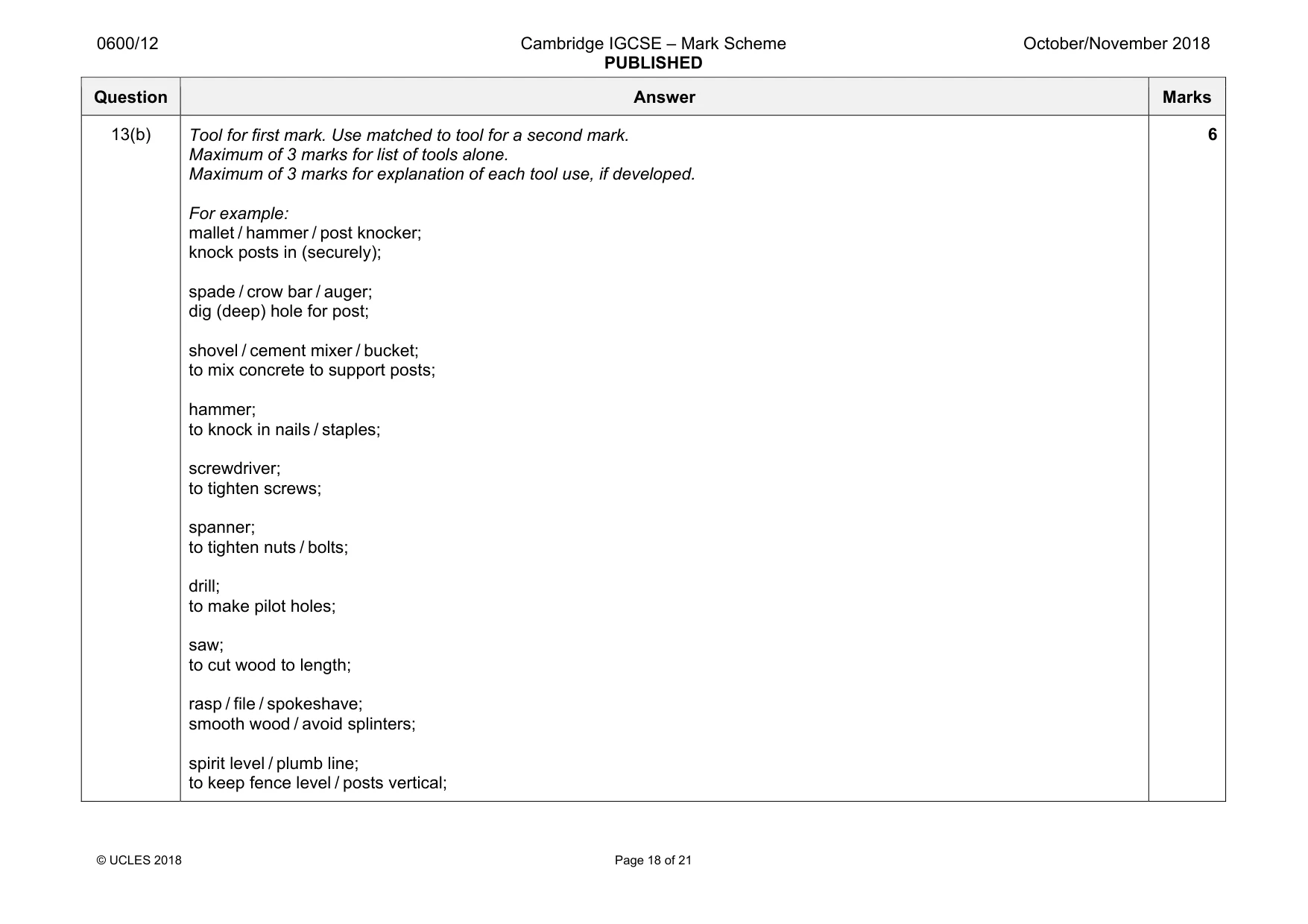
0600/12 Cambridge IGCSE – Mark Scheme PUBLISHED October/November 2018 © UCLES 2018 Page 18 of 21 Question Answer Marks 13(b) Tool for first mark. Use matched to tool for a second mark. Maximum of 3 marks for list of tools alone. Maximum of 3 marks for explanation of each tool use, if developed. For example: mallet / hammer / post knocker; knock posts in (securely); spade / crow bar / auger; dig (deep) hole for post; shovel / cement mixer / bucket; to mix concrete to support posts; hammer; to knock in nails / staples; screwdriver; to tighten screws; spanner; to tighten nuts / bolts; drill; to make pilot holes; saw; to cut wood to length; rasp / file / spokeshave; smooth wood / avoid splinters; spirit level / plumb line; to keep fence level / posts vertical; 6
Mark scheme, page 19
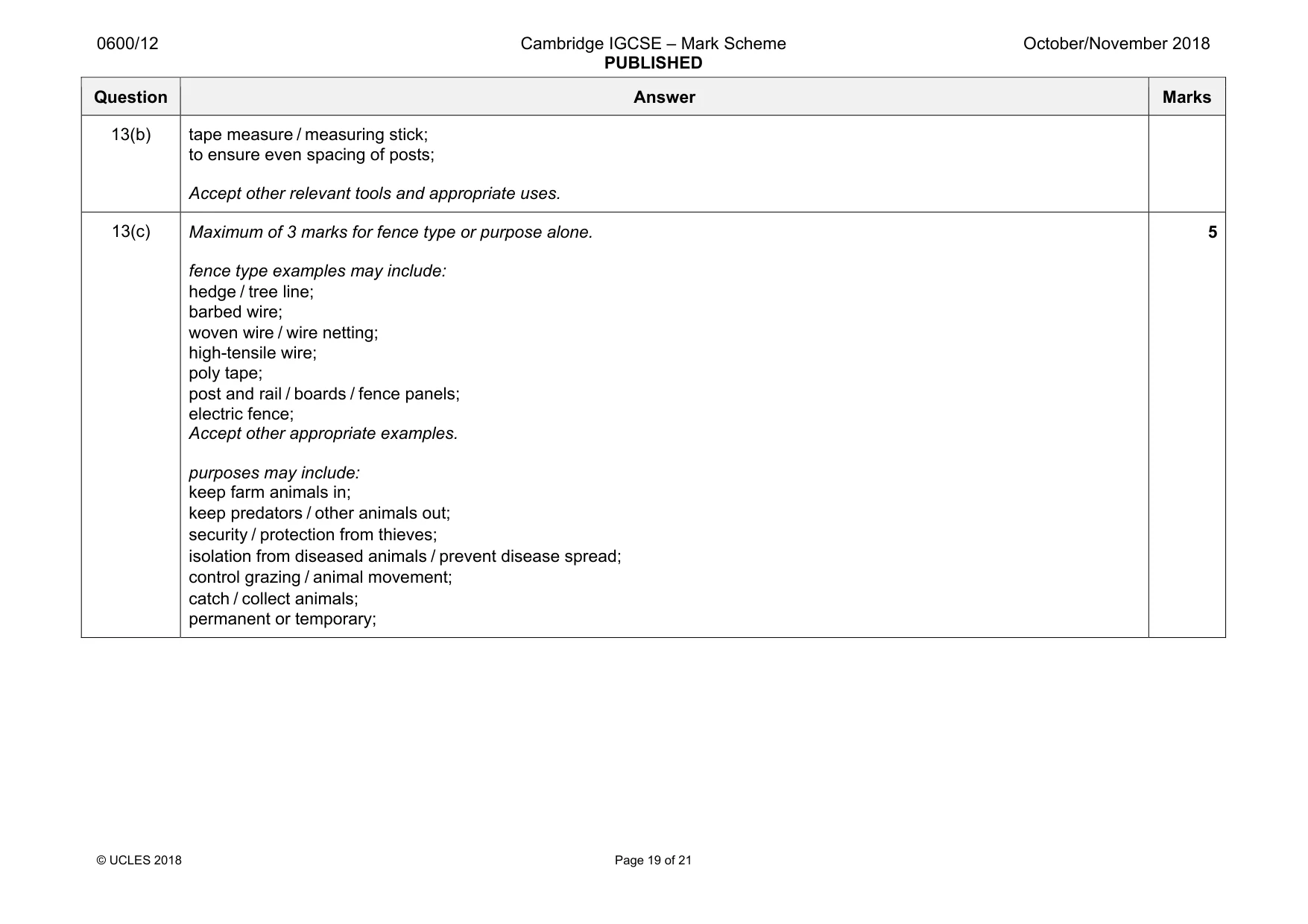
0600/12 Cambridge IGCSE – Mark Scheme PUBLISHED October/November 2018 © UCLES 2018 Page 19 of 21 Question Answer Marks 13(b) tape measure / measuring stick; to ensure even spacing of posts; Accept other relevant tools and appropriate uses. 13(c) Maximum of 3 marks for fence type or purpose alone. fence type examples may include: hedge / tree line; barbed wire; woven wire / wire netting; high-tensile wire; poly tape; post and rail / boards / fence panels; electric fence; Accept other appropriate examples. purposes may include: keep farm animals in; keep predators / other animals out; security / protection from thieves; isolation from diseased animals / prevent disease spread; control grazing / animal movement; catch / collect animals; permanent or temporary; 5
Mark scheme, page 20
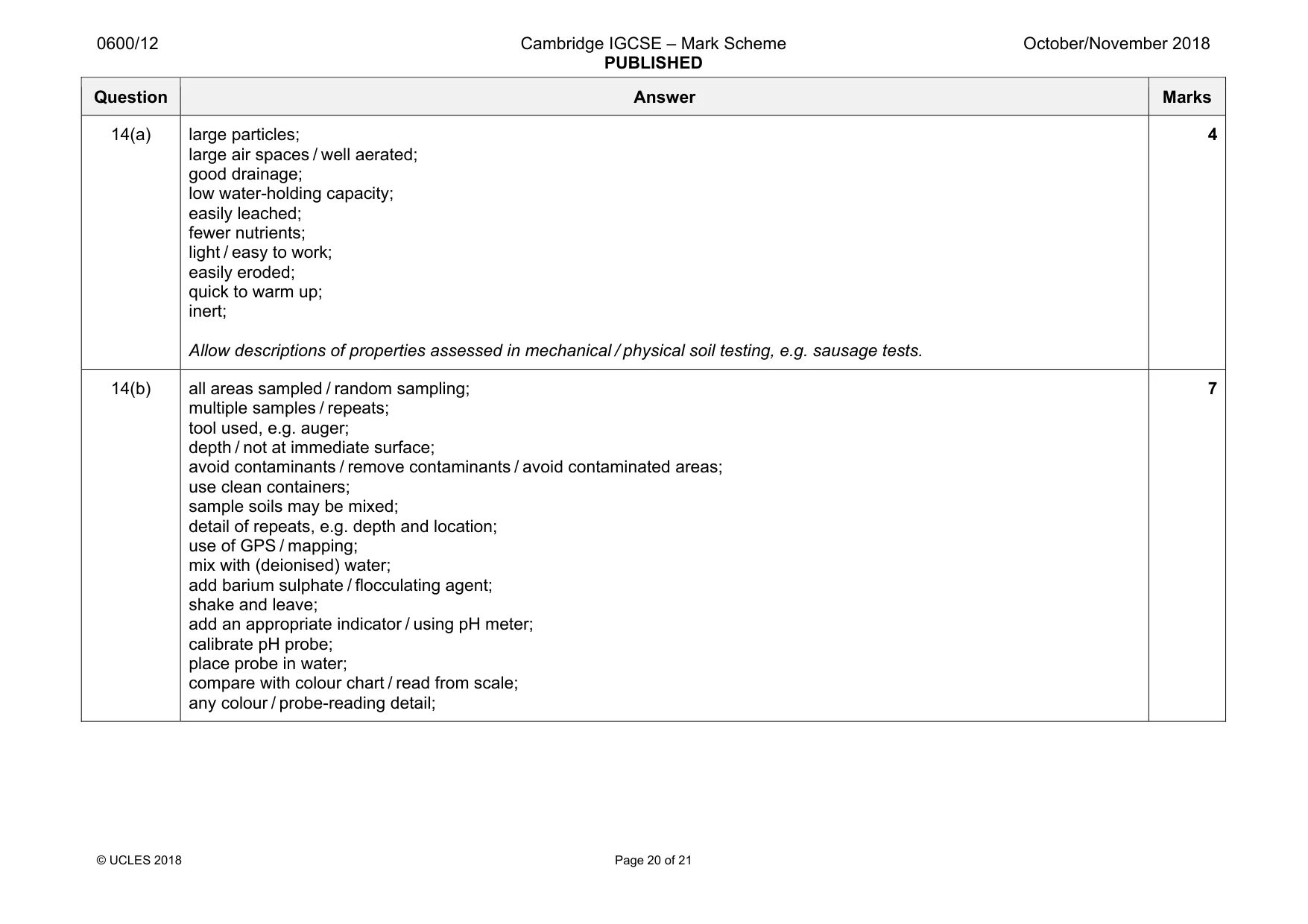
0600/12 Cambridge IGCSE – Mark Scheme PUBLISHED October/November 2018 © UCLES 2018 Page 20 of 21 Question Answer Marks 14(a) large particles; large air spaces / well aerated; good drainage; low water-holding capacity; easily leached; fewer nutrients; light / easy to work; easily eroded; quick to warm up; inert; Allow descriptions of properties assessed in mechanical / physical soil testing, e.g. sausage tests. 4 14(b) all areas sampled / random sampling; multiple samples / repeats; tool used, e.g. auger; depth / not at immediate surface; avoid contaminants / remove contaminants / avoid contaminated areas; use clean containers; sample soils may be mixed; detail of repeats, e.g. depth and location; use of GPS / mapping; mix with (deionised) water; add barium sulphate / flocculating agent; shake and leave; add an appropriate indicator / using pH meter; calibrate pH probe; place probe in water; compare with colour chart / read from scale; any colour / probe-reading detail; 7
Mark scheme, page 21
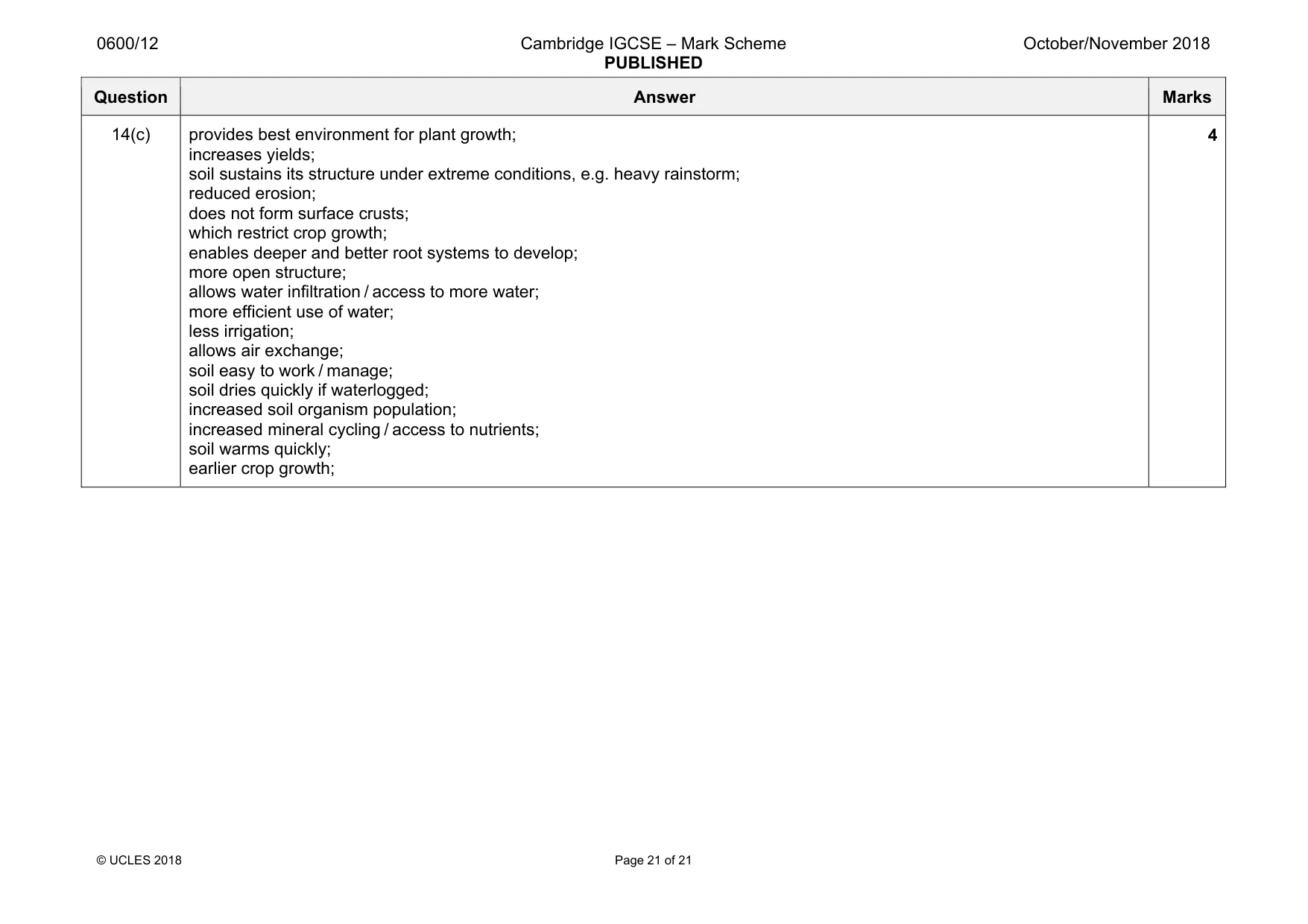
0600/12 Cambridge IGCSE – Mark Scheme PUBLISHED October/November 2018 © UCLES 2018 Page 21 of 21 Question Answer Marks 14(c) provides best environment for plant growth; increases yields; soil sustains its structure under extreme conditions, e.g. heavy rainstorm; reduced erosion; does not form surface crusts; which restrict crop growth; enables deeper and better root systems to develop; more open structure; allows water infiltration / access to more water; more efficient use of water; less irrigation; allows air exchange; soil easy to work / manage; soil dries quickly if waterlogged; increased soil organism population; increased mineral cycling / access to nutrients; soil warms quickly; earlier crop growth; 4
What you needed in this session
Cambridge’s own grade thresholds for 2018 Oct/Nov, Paper 1 · Variant 2. A higher threshold means an easier paper — the bar moves with how the cohort did.