Cambridge IGCSE Agriculture 0600 — 2023 Oct/Nov Paper 1 · Variant 2
0600/12/O/N/23 · 100 marks · ≈113 min
The question paper and its mark scheme, free to read here and free to download. This is Cambridge’s own paper, exactly as it was sat.
Question paper24 pages






Mark scheme22 pages
Answers below. Sit the paper first if you are practising.
Paper as text
Question paper, page 1
This document has 24 pages. Any blank pages are indicated. [Turn over Cambridge IGCSE™ DC (KN/FC) 312612/4 © UCLES 2023 * 1 7 5 6 1 8 1 9 9 8 * AGRICULTURE 0600/12 Paper 1 Theory October/November 2023 1 hour 45 minutes You must answer on the question paper. No additional materials are needed. INSTRUCTIONS ● Section A: answer all questions. ● Section B: answer two questions. ● Use a black or dark blue pen. You may use an HB pencil for any diagrams or graphs. ● Write your name, centre number and candidate number in the boxes at the top of the page. ● Write your answer to each question in the space provided. ● Do not use an erasable pen or correction fluid. ● Do not write on any bar codes. ● You may use a calculator. ● You should show all your working and use appropriate units. INFORMATION ● The total mark for this paper is 100. ● The number of marks for each question or part question is shown in brackets [ ].
Question paper, page 2
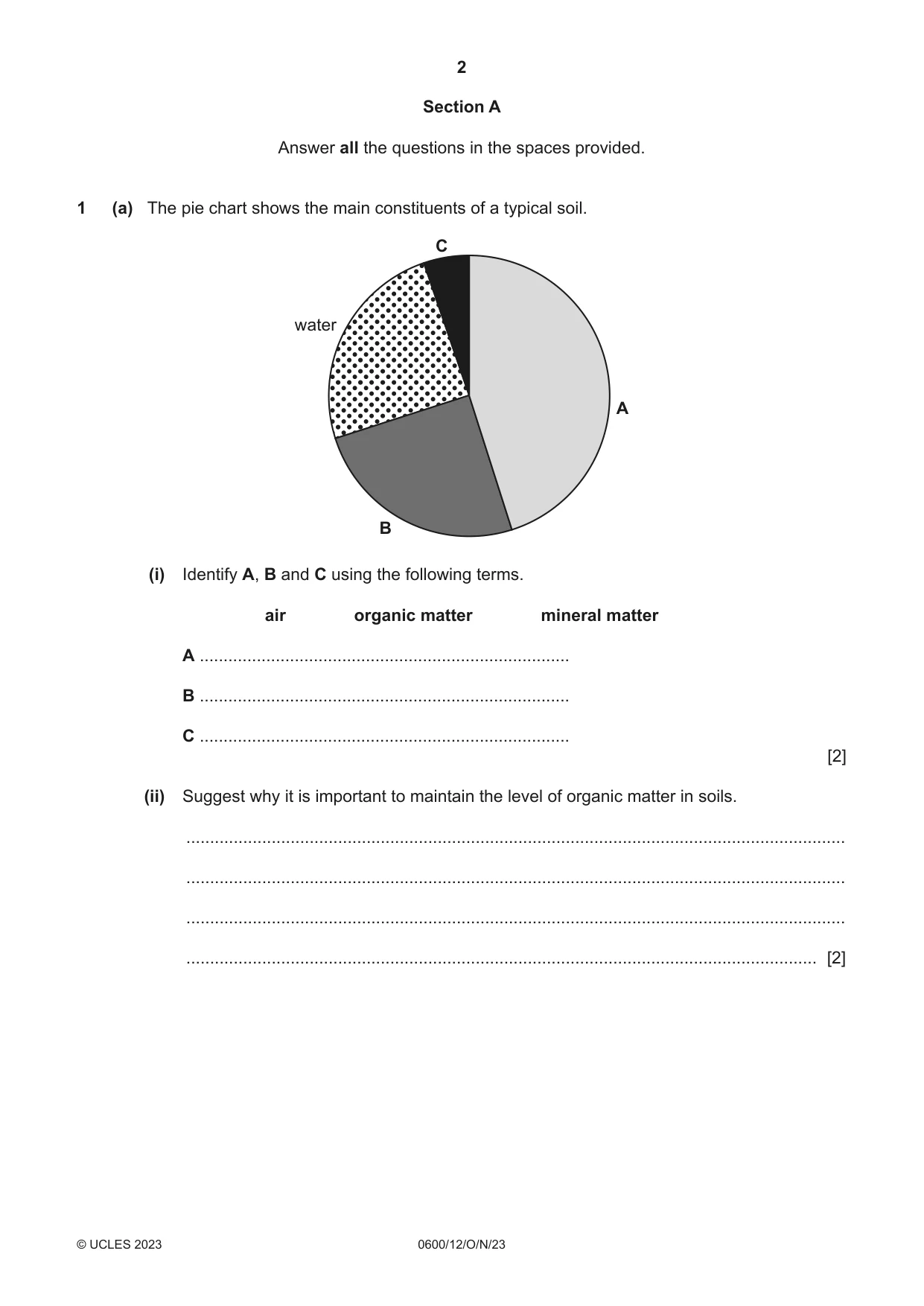
2 0600/12/O/N/23 © UCLES 2023 Section A Answer all the questions in the spaces provided. 1 (a) The pie chart shows the main constituents of a typical soil. C water A B (i) Identify A, B and C using the following terms. air organic matter mineral matter A … B … C … [2] (ii) Suggest why it is important to maintain the level of organic matter in soils. … … … … [2]
Question paper, page 3
3 0600/12/O/N/23 © UCLES 2023 [Turn over (b) Soil pans can cause poor soil drainage. (i) Suggest two methods that a farmer could use to improve drainage. 1 … … 2 … … [2] (ii) Explain two ways that waterlogged soils affect crop yield. 1 … … 2 … … [2] [Total: 8]
Question paper, page 4
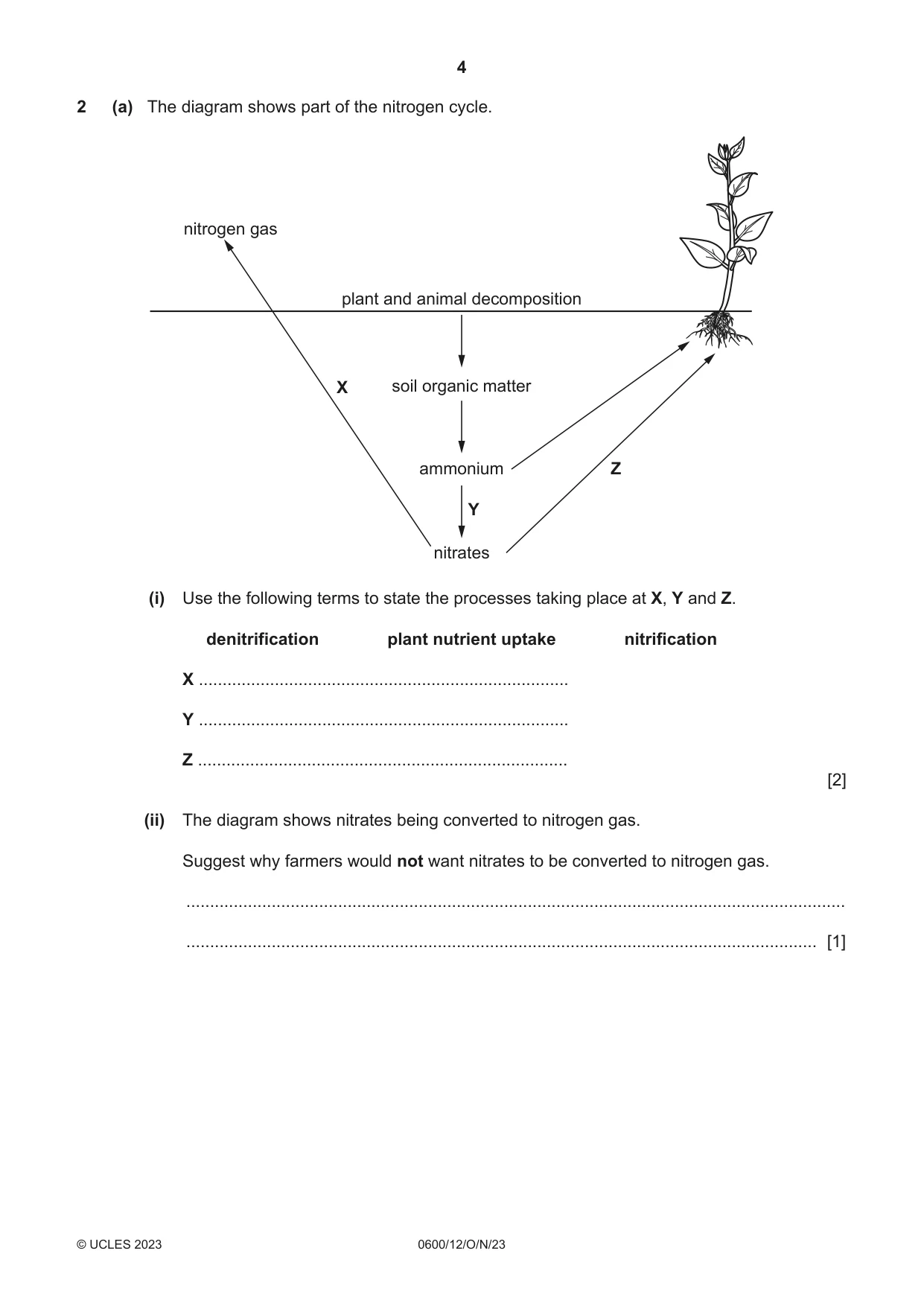
4 0600/12/O/N/23 © UCLES 2023 2 (a) The diagram shows part of the nitrogen cycle. nitrogen gas plant and animal decomposition soil organic matter ammonium nitrates X Z Y (i) Use the following terms to state the processes taking place at X, Y and Z. denitrification plant nutrient uptake nitrification X … Y … Z … [2] (ii) The diagram shows nitrates being converted to nitrogen gas. Suggest why farmers would not want nitrates to be converted to nitrogen gas. … … [1]
Question paper, page 5
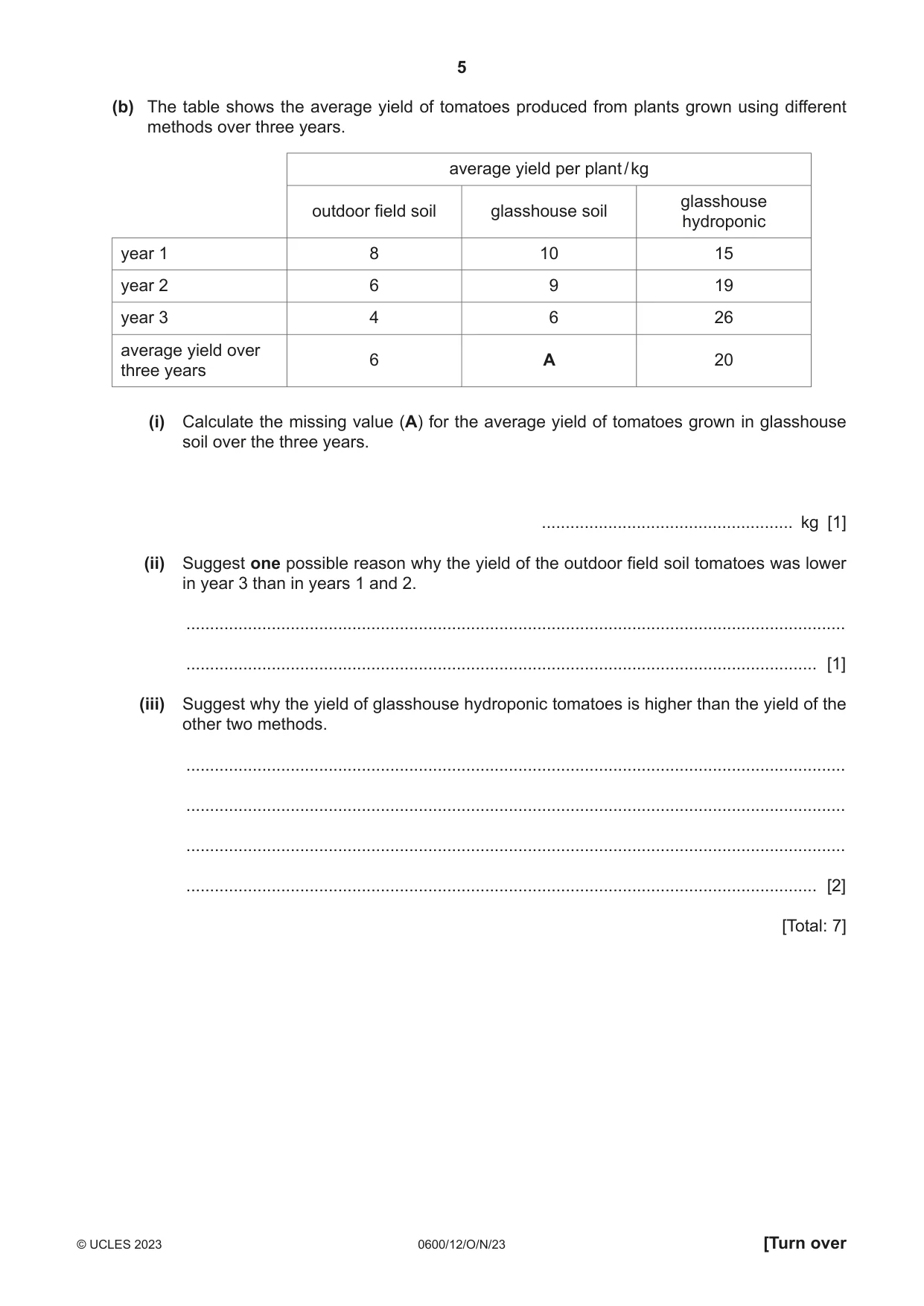
5 0600/12/O/N/23 © UCLES 2023 [Turn over (b) The table shows the average yield of tomatoes produced from plants grown using different methods over three years. average yield per plant / kg outdoor field soil glasshouse soil glasshouse hydroponic year 1 8 10 15 year 2 6 9 19 year 3 4 6 26 average yield over three years 6 A 20 (i) Calculate the missing value (A) for the average yield of tomatoes grown in glasshouse soil over the three years. … kg [1] (ii) Suggest one possible reason why the yield of the outdoor field soil tomatoes was lower in year 3 than in years 1 and 2. … … [1] (iii) Suggest why the yield of glasshouse hydroponic tomatoes is higher than the yield of the other two methods. … … … … [2] [Total: 7]
Question paper, page 6
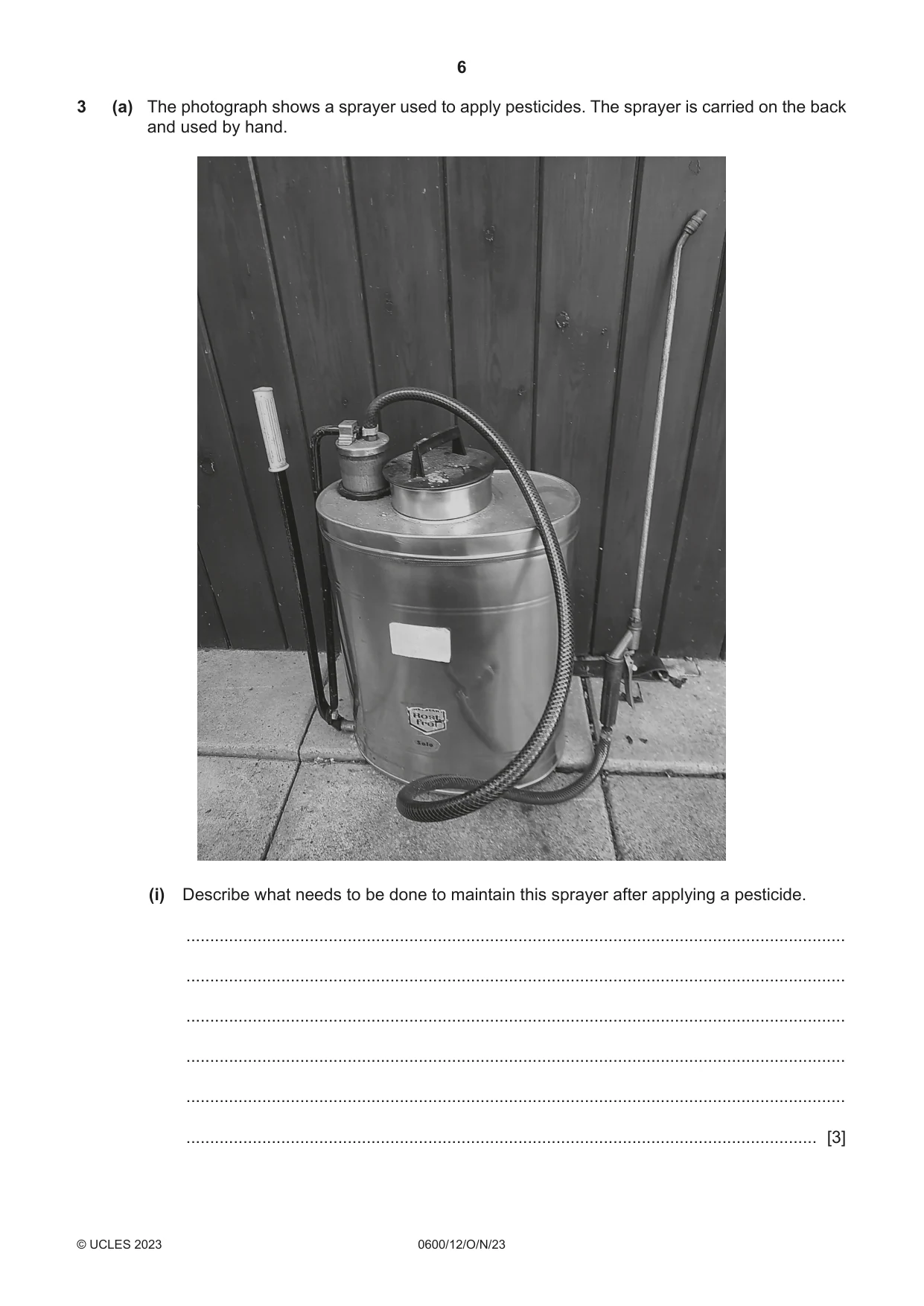
6 0600/12/O/N/23 © UCLES 2023 3 (a) The photograph shows a sprayer used to apply pesticides. The sprayer is carried on the back and used by hand. (i) Describe what needs to be done to maintain this sprayer after applying a pesticide. … … … … … … [3]
Question paper, page 7
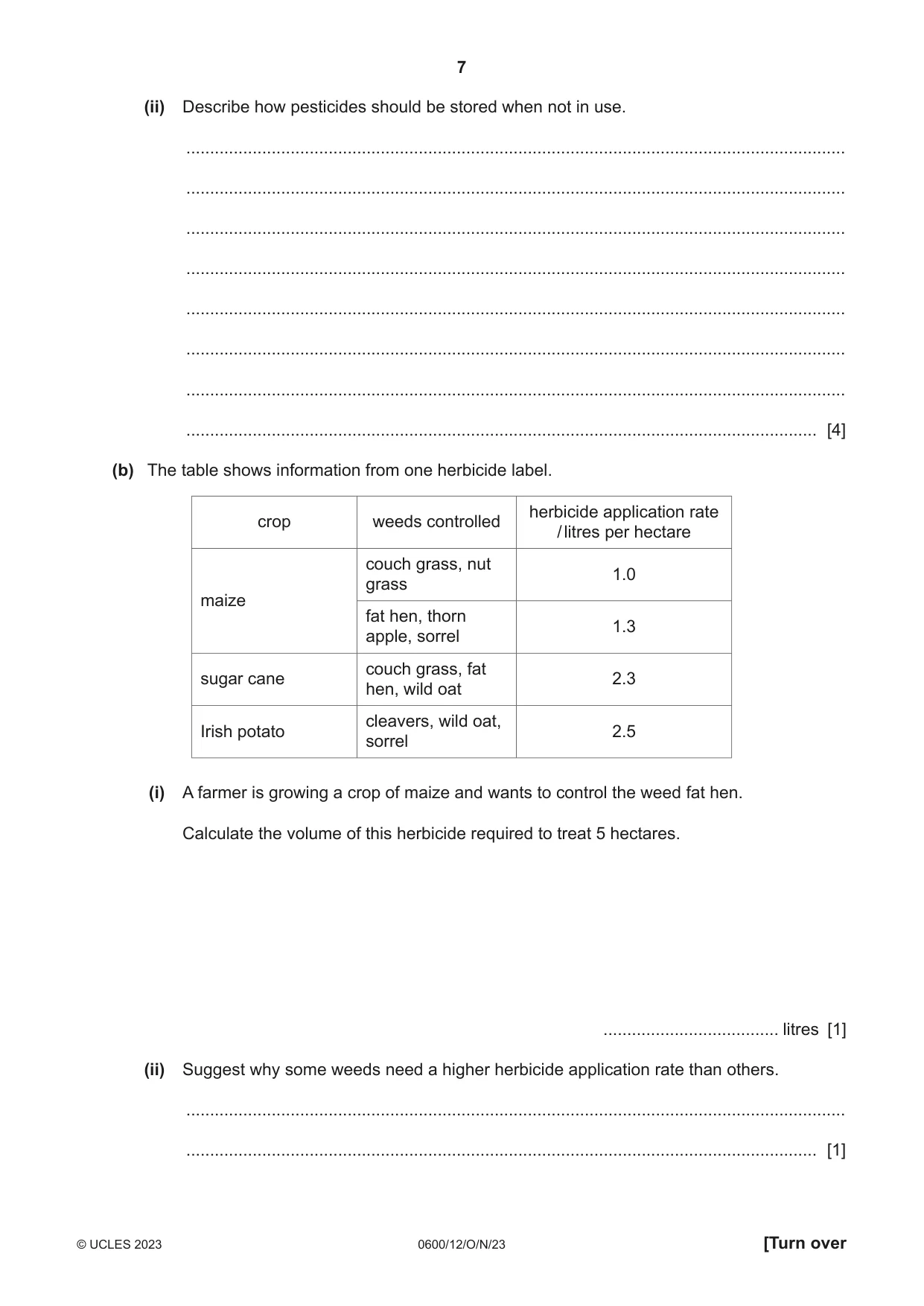
7 0600/12/O/N/23 © UCLES 2023 [Turn over (ii) Describe how pesticides should be stored when not in use. … … … … … … … … [4] (b) The table shows information from one herbicide label. crop weeds controlled herbicide application rate / litres per hectare maize couch grass, nut grass 1.0 fat hen, thorn apple, sorrel 1.3 sugar cane couch grass, fat hen, wild oat 2.3 Irish potato cleavers, wild oat, sorrel 2.5 (i) A farmer is growing a crop of maize and wants to control the weed fat hen. Calculate the volume of this herbicide required to treat 5 hectares. … litres [1] (ii) Suggest why some weeds need a higher herbicide application rate than others. … … [1]
Question paper, page 8
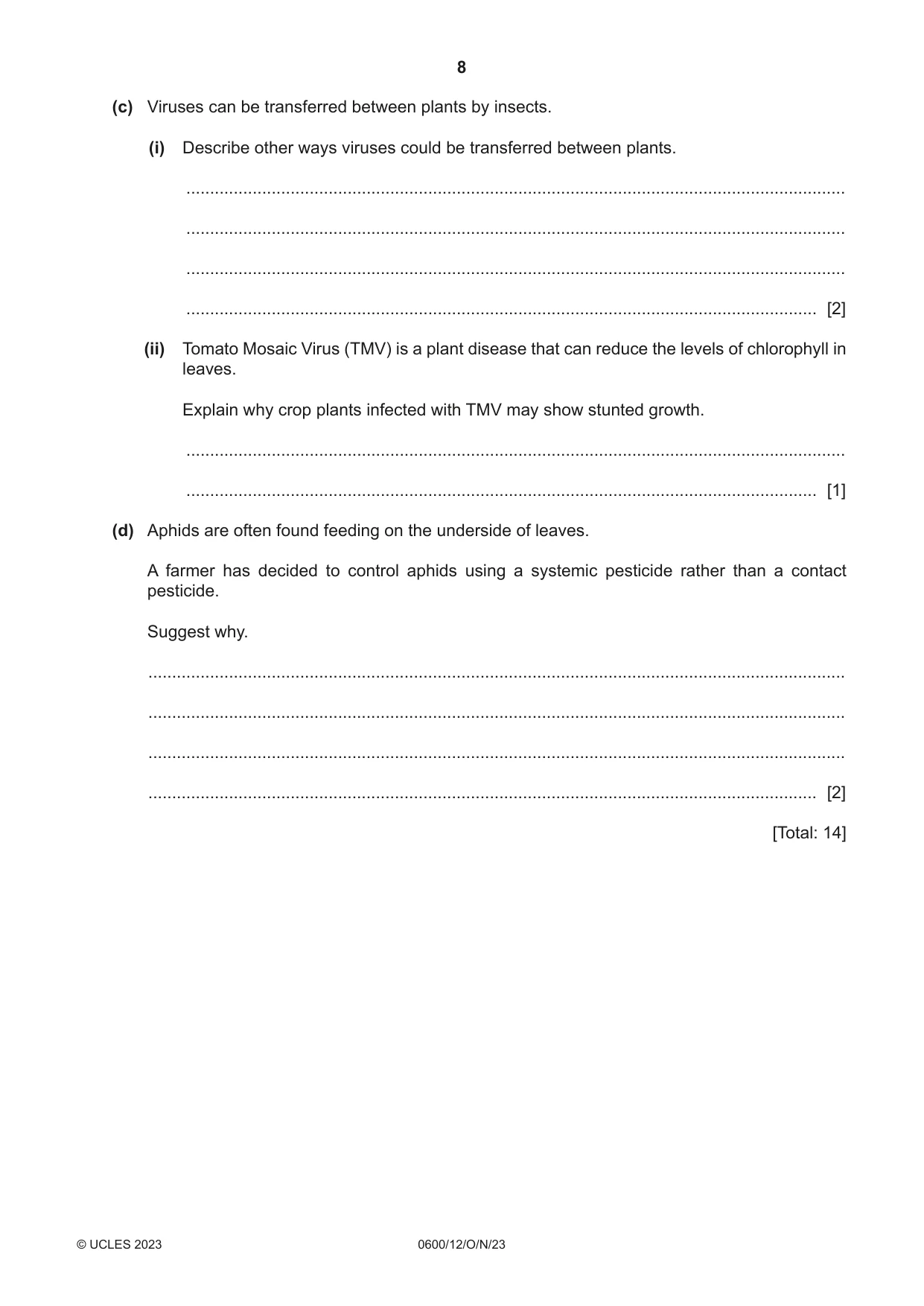
8 0600/12/O/N/23 © UCLES 2023 (c) Viruses can be transferred between plants by insects. (i) Describe other ways viruses could be transferred between plants. … … … … [2] (ii) Tomato Mosaic Virus (TMV) is a plant disease that can reduce the levels of chlorophyll in leaves. Explain why crop plants infected with TMV may show stunted growth. … … [1] (d) Aphids are often found feeding on the underside of leaves. A farmer has decided to control aphids using a systemic pesticide rather than a contact pesticide. Suggest why. … … … … [2] [Total: 14]
Question paper, page 9
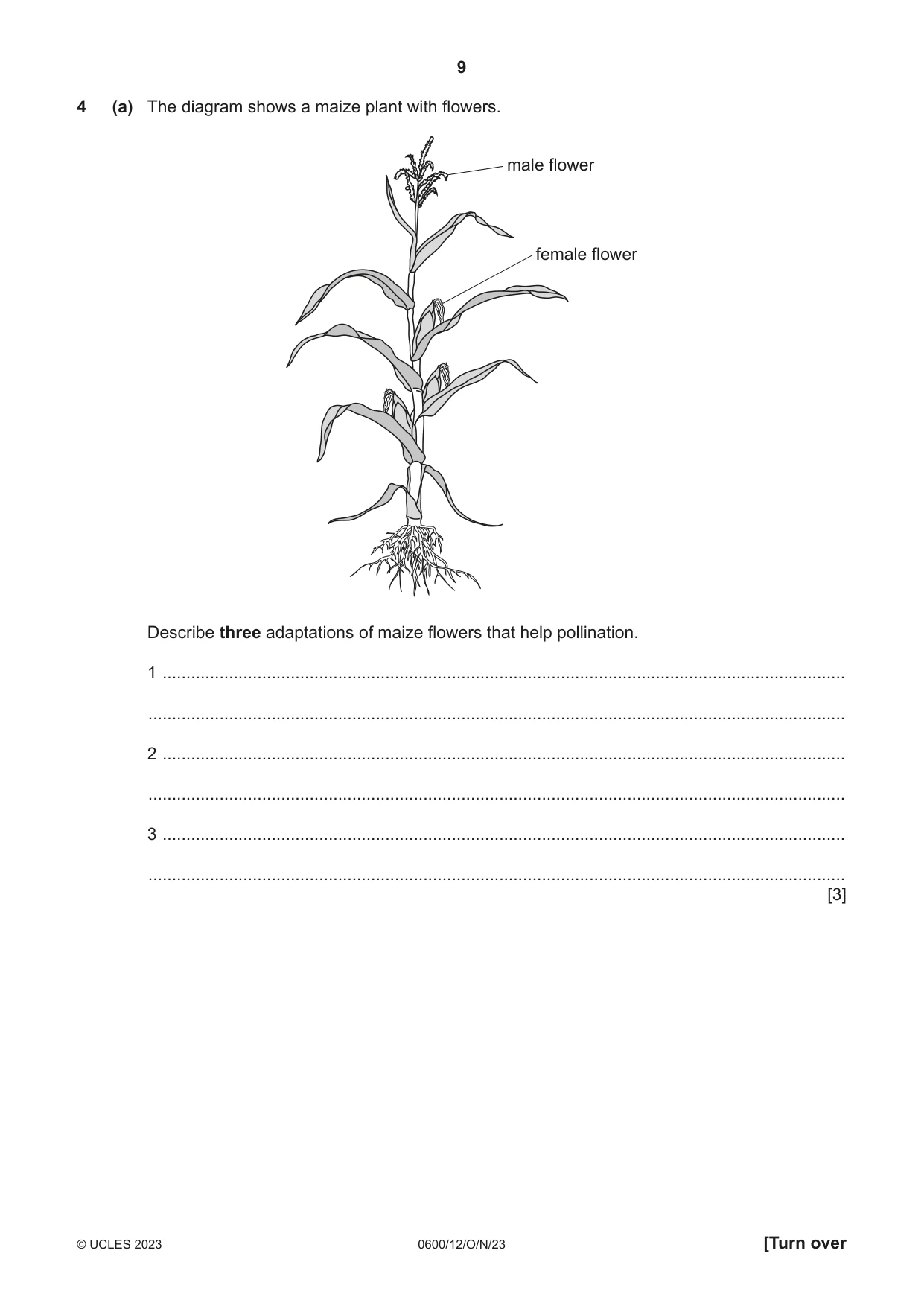
9 0600/12/O/N/23 © UCLES 2023 [Turn over 4 (a) The diagram shows a maize plant with flowers. male flower female flower Describe three adaptations of maize flowers that help pollination. 1 … … 2 … … 3 … … [3]
Question paper, page 10
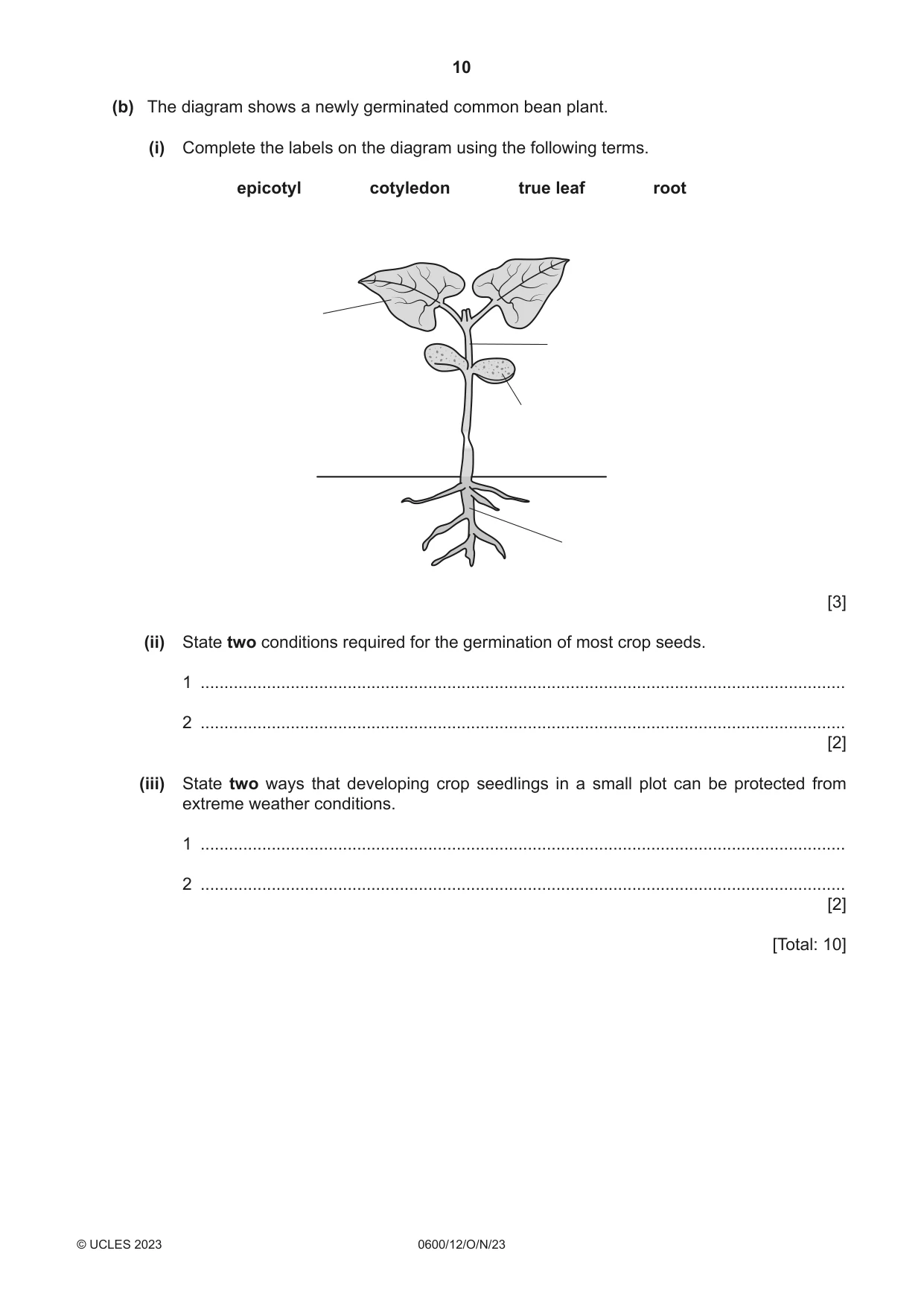
10 0600/12/O/N/23 © UCLES 2023 (b) The diagram shows a newly germinated common bean plant. (i) Complete the labels on the diagram using the following terms. epicotyl cotyledon true leaf root [3] (ii) State two conditions required for the germination of most crop seeds. 1 … 2 … [2] (iii) State two ways that developing crop seedlings in a small plot can be protected from extreme weather conditions. 1 … 2 … [2] [Total: 10]
Question paper, page 11
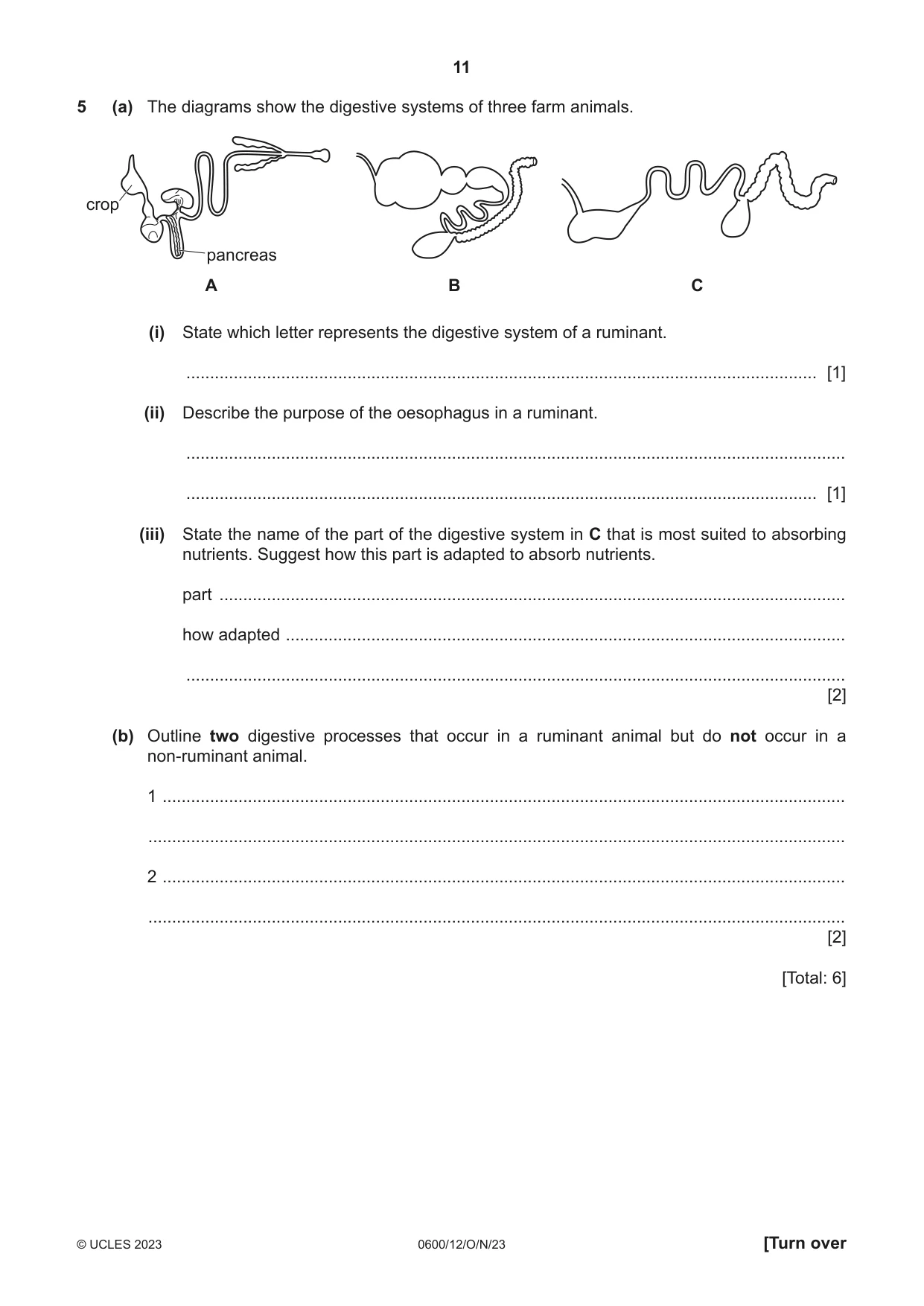
11 0600/12/O/N/23 © UCLES 2023 [Turn over 5 (a) The diagrams show the digestive systems of three farm animals. A B C crop pancreas (i) State which letter represents the digestive system of a ruminant. … [1] (ii) Describe the purpose of the oesophagus in a ruminant. … … [1] (iii) State the name of the part of the digestive system in C that is most suited to absorbing nutrients. Suggest how this part is adapted to absorb nutrients. part … how adapted … … [2] (b) Outline two digestive processes that occur in a ruminant animal but do not occur in a non-ruminant animal. 1 … … 2 … … [2] [Total: 6]
Question paper, page 12
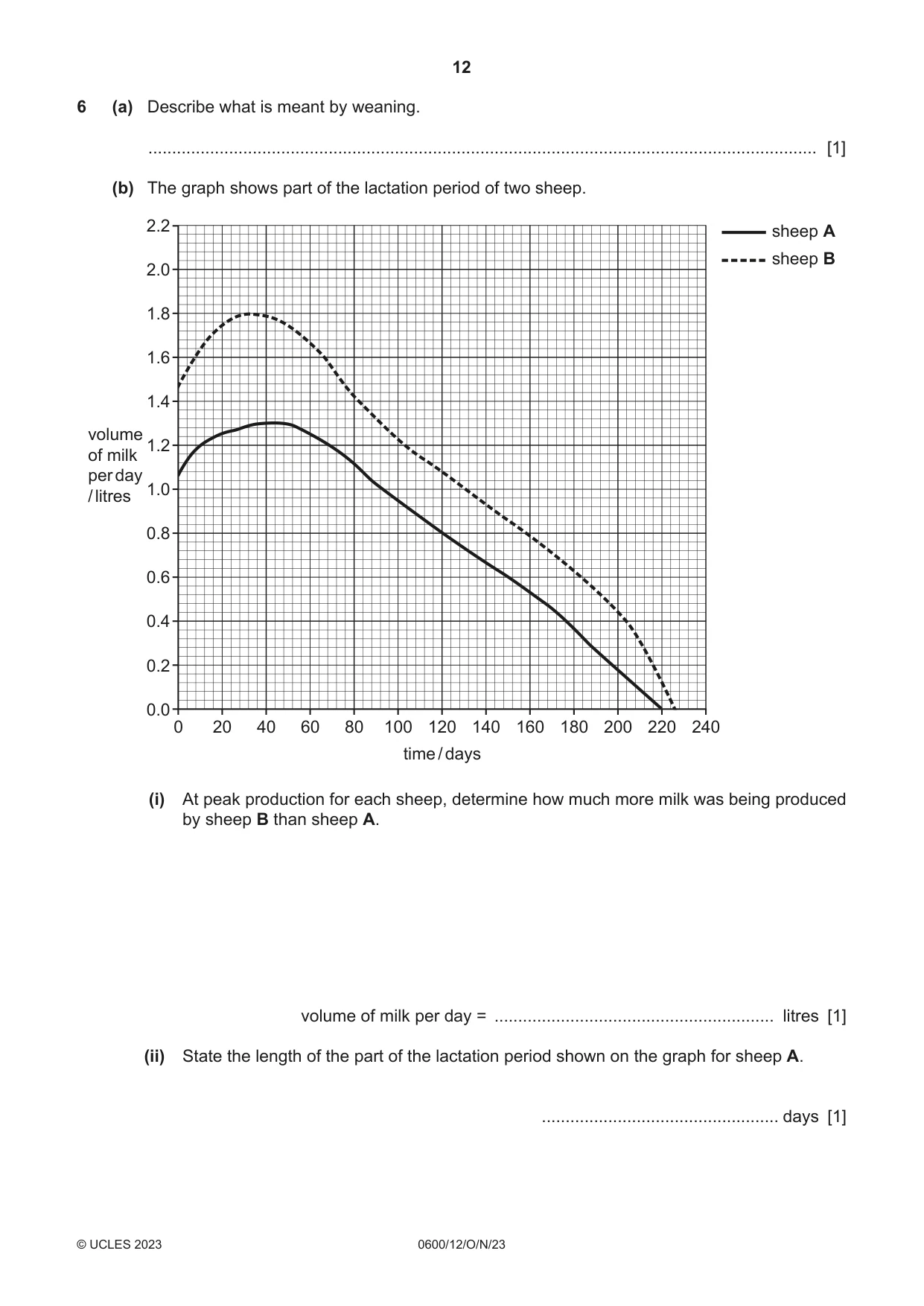
12 0600/12/O/N/23 © UCLES 2023 6 (a) Describe what is meant by weaning. … [1] (b) The graph shows part of the lactation period of two sheep. sheep A sheep B 0.0 0 20 40 60 80 100 120 time / days 140 160 180 200 220 240 0.2 0.4 0.6 0.8 1.0 1.2 volume of milk per day / litres 1.4 1.6 1.8 2.0 2.2 (i) At peak production for each sheep, determine how much more milk was being produced by sheep B than sheep A. volume of milk per day = … litres [1] (ii) State the length of the part of the lactation period shown on the graph for sheep A. … days [1]
Question paper, page 13
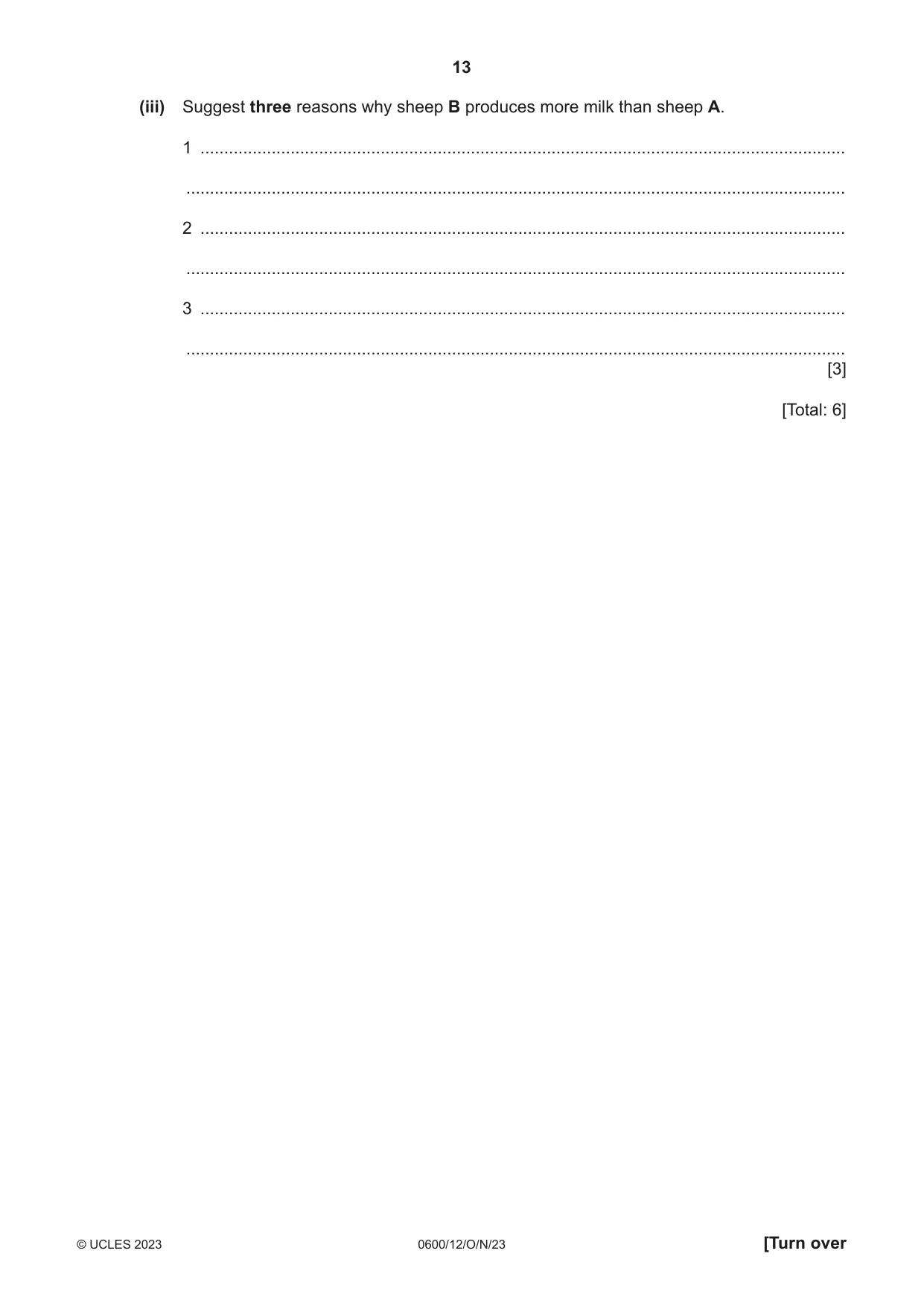
13 0600/12/O/N/23 © UCLES 2023 [Turn over (iii) Suggest three reasons why sheep B produces more milk than sheep A. 1 … … 2 … … 3 … … [3] [Total: 6]
Question paper, page 14
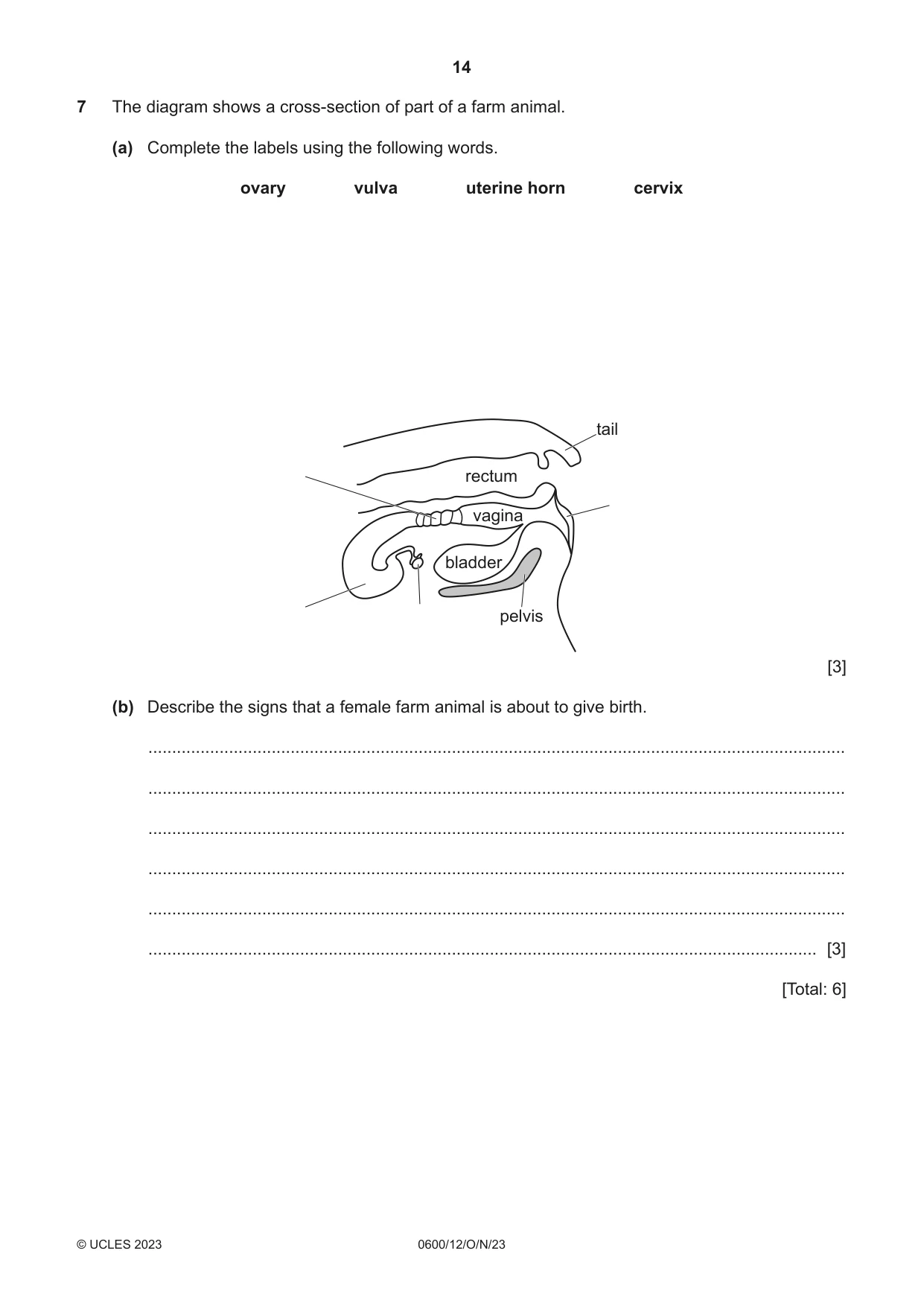
14 0600/12/O/N/23 © UCLES 2023 7 The diagram shows a cross-section of part of a farm animal. (a) Complete the labels using the following words. ovary vulva uterine horn cervix tail rectum vagina bladder pelvis [3] (b) Describe the signs that a female farm animal is about to give birth. … … … … … … [3] [Total: 6]
Question paper, page 15
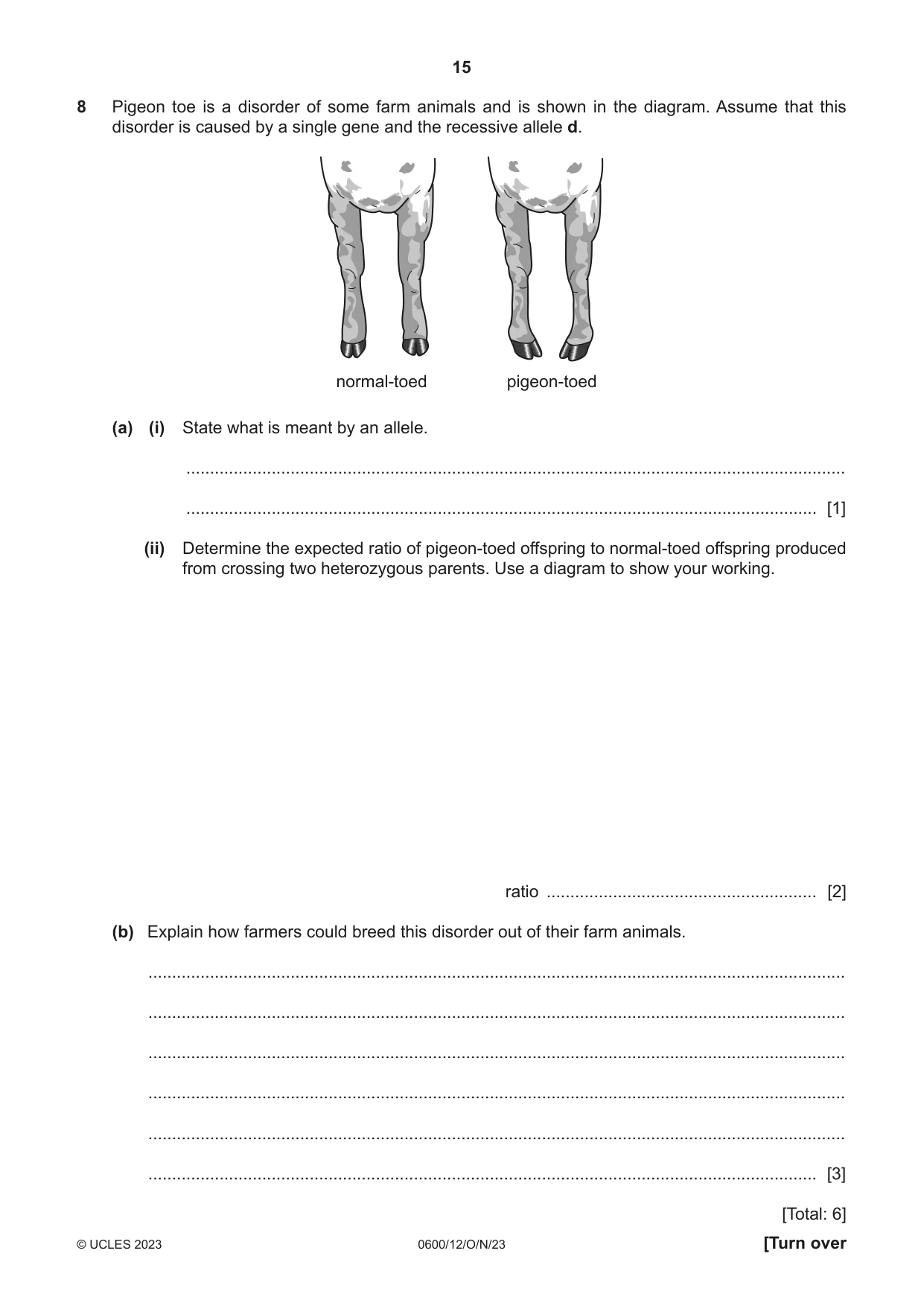
15 0600/12/O/N/23 © UCLES 2023 [Turn over 8 Pigeon toe is a disorder of some farm animals and is shown in the diagram. Assume that this disorder is caused by a single gene and the recessive allele d. normal-toed pigeon-toed (a) (i) State what is meant by an allele. … … [1] (ii) Determine the expected ratio of pigeon-toed offspring to normal-toed offspring produced from crossing two heterozygous parents. Use a diagram to show your working. ratio … [2] (b) Explain how farmers could breed this disorder out of their farm animals. … … … … … … [3] [Total: 6]
Question paper, page 16
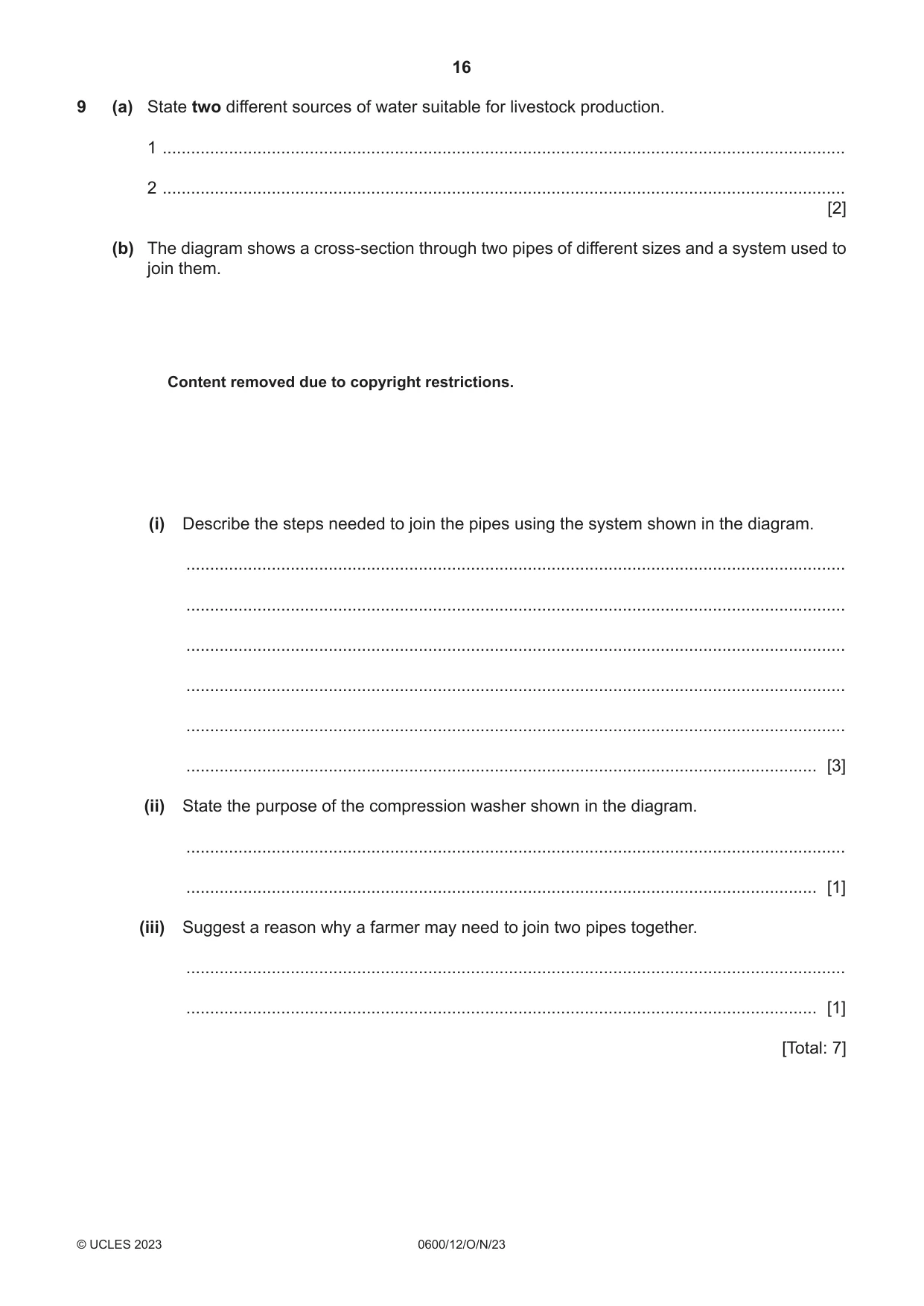
16 0600/12/O/N/23 © UCLES 2023 9 (a) State two different sources of water suitable for livestock production. 1 … 2 … [2] (b) The diagram shows a cross-section through two pipes of different sizes and a system used to join them. (i) Describe the steps needed to join the pipes using the system shown in the diagram. … … … … … … [3] (ii) State the purpose of the compression washer shown in the diagram. … … [1] (iii) Suggest a reason why a farmer may need to join two pipes together. … … [1] [Total: 7] Content removed due to copyright restrictions.
Question paper, page 17
17 0600/12/O/N/23 © UCLES 2023 Section B Answer any two questions. Write the question numbers you have chosen here: … 10 (a) Suggest how environmental damage can be caused by farmers using farm chemicals. [5] (b) Describe the life cycle of a named biting and chewing pest. [4] (c) Explain how a farmer can control pests using organic methods. [6] [Total: 15] 11 (a) Suggest the benefits of having mixed vegetation in grazing land. [4] (b) Describe the effects that overstocking may have on grassland pasture. [5] (c) Explain how farmers can increase the carrying capacity of grassland. [6] [Total: 15] 12 (a) Describe what is meant by mixed farming. [3] (b) Discuss the benefits and problems of using genetically modified (GM) crops. [7] (c) Suggest the benefits of mechanisation for a farmer. [5] [Total: 15] 13 (a) Describe the problems caused by parasites to farm livestock. [4] (b) Outline the ways farm animals can become infected by disease. [5] (c) Explain how good stockmanship can reduce the risk of parasites in livestock. [6] [Total: 15] 14 (a) (i) Describe the soil preparation for a named crop. [5] (ii) Following the planting of this crop, outline the methods a farmer can use to maintain the health and productivity of the crop. [5] (b) Suggest the factors that can affect the profitability of a crop after it is harvested. [5] [Total: 15]
Question paper, page 18
18 0600/12/O/N/23 © UCLES 2023 … … … … … … … … … … … … … … … … … … … … … … … … … … … …
Question paper, page 19
19 0600/12/O/N/23 © UCLES 2023 … … … … … … … … … … … … … … … … … … … … … … … … … … … …
Question paper, page 20
20 0600/12/O/N/23 © UCLES 2023 … … … … … … … … … … … … … … … … … … … … … … … … … … … …
Question paper, page 21
21 0600/12/O/N/23 © UCLES 2023 … … … … … … … … … … … … … … … … … … … … … … … … … … … …
Question paper, page 22
22 0600/12/O/N/23 © UCLES 2023 … … … … … … … … … … … … … … … … … … … … … … … … … … … …
Question paper, page 23
23 0600/12/O/N/23 © UCLES 2023 BLANK PAGE
Question paper, page 24
24 0600/12/O/N/23 © UCLES 2023 Permission to reproduce items where third-party owned material protected by copyright is included has been sought and cleared where possible. Every reasonable effort has been made by the publisher (UCLES) to trace copyright holders, but if any items requiring clearance have unwittingly been included, the publisher will be pleased to make amends at the earliest possible opportunity. To avoid the issue of disclosure of answer-related information to candidates, all copyright acknowledgements are reproduced online in the Cambridge Assessment International Education Copyright Acknowledgements Booklet. This is produced for each series of examinations and is freely available to download at www.cambridgeinternational.org after the live examination series. Cambridge Assessment International Education is part of Cambridge Assessment. Cambridge Assessment is the brand name of the University of Cambridge Local Examinations Syndicate (UCLES), which is a department of the University of Cambridge. BLANK PAGE
Mark scheme, page 1
This document consists of 22 printed pages. © UCLES 2023 [Turn over Cambridge IGCSE™ AGRICULTURE 0600/12 Paper 1 Theory October/November 2023 MARK SCHEME Maximum Mark: 100 Published This mark scheme is published as an aid to teachers and candidates, to indicate the requirements of the examination. It shows the basis on which Examiners were instructed to award marks. It does not indicate the details of the discussions that took place at an Examiners’ meeting before marking began, which would have considered the acceptability of alternative answers. Mark schemes should be read in conjunction with the question paper and the Principal Examiner Report for Teachers. Cambridge International will not enter into discussions about these mark schemes. Cambridge International is publishing the mark schemes for the October/November 2023 series for most Cambridge IGCSE, Cambridge International A and AS Level components, and some Cambridge O Level components.
Mark scheme, page 2
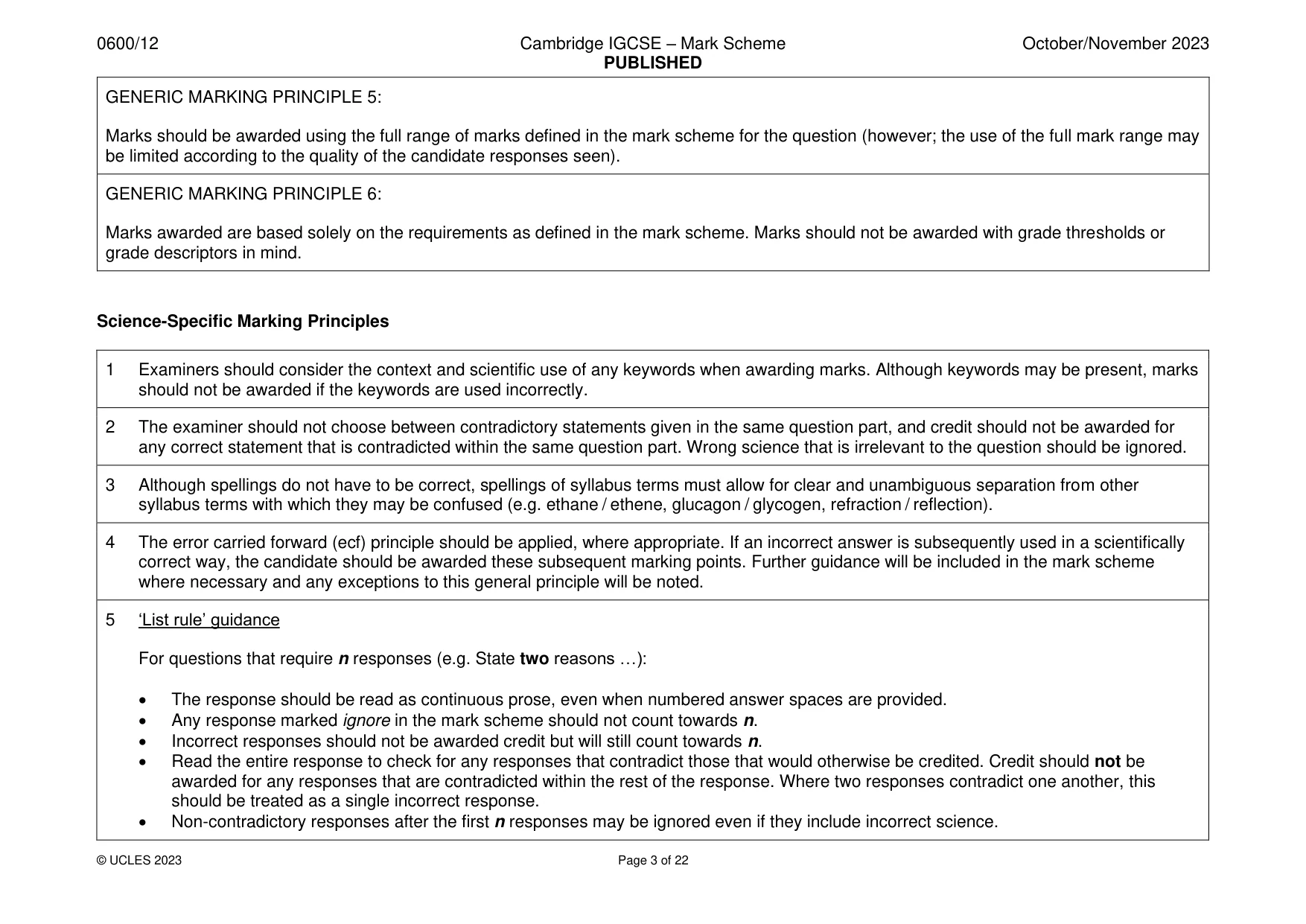
0600/12 Cambridge IGCSE – Mark Scheme PUBLISHED October/November 2023 © UCLES 2023 Page 2 of 22 Generic Marking Principles These general marking principles must be applied by all examiners when marking candidate answers. They should be applied alongside the specific content of the mark scheme or generic level descriptors for a question. Each question paper and mark scheme will also comply with these marking principles. GENERIC MARKING PRINCIPLE 1: Marks must be awarded in line with: • the specific content of the mark scheme or the generic level descriptors for the question • the specific skills defined in the mark scheme or in the generic level descriptors for the question • the standard of response required by a candidate as exemplified by the standardisation scripts. GENERIC MARKING PRINCIPLE 2: Marks awarded are always whole marks (not half marks, or other fractions). GENERIC MARKING PRINCIPLE 3: Marks must be awarded positively: • marks are awarded for correct/valid answers, as defined in the mark scheme. However, credit is given for valid answers which go beyond the scope of the syllabus and mark scheme, referring to your Team Leader as appropriate • marks are awarded when candidates clearly demonstrate what they know and can do • marks are not deducted for errors • marks are not deducted for omissions • answers should only be judged on the quality of spelling, punctuation and grammar when these features are specifically assessed by the question as indicated by the mark scheme. The meaning, however, should be unambiguous. GENERIC MARKING PRINCIPLE 4: Rules must be applied consistently, e.g. in situations where candidates have not followed instructions or in the application of generic level descriptors.
Mark scheme, page 3
0600/12 Cambridge IGCSE – Mark Scheme PUBLISHED October/November 2023 © UCLES 2023 Page 3 of 22 GENERIC MARKING PRINCIPLE 5: Marks should be awarded using the full range of marks defined in the mark scheme for the question (however; the use of the full mark range may be limited according to the quality of the candidate responses seen). GENERIC MARKING PRINCIPLE 6: Marks awarded are based solely on the requirements as defined in the mark scheme. Marks should not be awarded with grade thresholds or grade descriptors in mind. Science-Specific Marking Principles 1 Examiners should consider the context and scientific use of any keywords when awarding marks. Although keywords may be present, marks should not be awarded if the keywords are used incorrectly. 2 The examiner should not choose between contradictory statements given in the same question part, and credit should not be awarded for any correct statement that is contradicted within the same question part. Wrong science that is irrelevant to the question should be ignored. 3 Although spellings do not have to be correct, spellings of syllabus terms must allow for clear and unambiguous separation from other syllabus terms with which they may be confused (e.g. ethane / ethene, glucagon / glycogen, refraction / reflection). 4 The error carried forward (ecf) principle should be applied, where appropriate. If an incorrect answer is subsequently used in a scientifically correct way, the candidate should be awarded these subsequent marking points. Further guidance will be included in the mark scheme where necessary and any exceptions to this general principle will be noted. 5 ‘List rule’ guidance For questions that require n responses (e.g. State two reasons …): • The response should be read as continuous prose, even when numbered answer spaces are provided. • Any response marked ignore in the mark scheme should not count towards n. • Incorrect responses should not be awarded credit but will still count towards n. • Read the entire response to check for any responses that contradict those that would otherwise be credited. Credit should not be awarded for any responses that are contradicted within the rest of the response. Where two responses contradict one another, this should be treated as a single incorrect response. • Non-contradictory responses after the first n responses may be ignored even if they include incorrect science.
Mark scheme, page 4
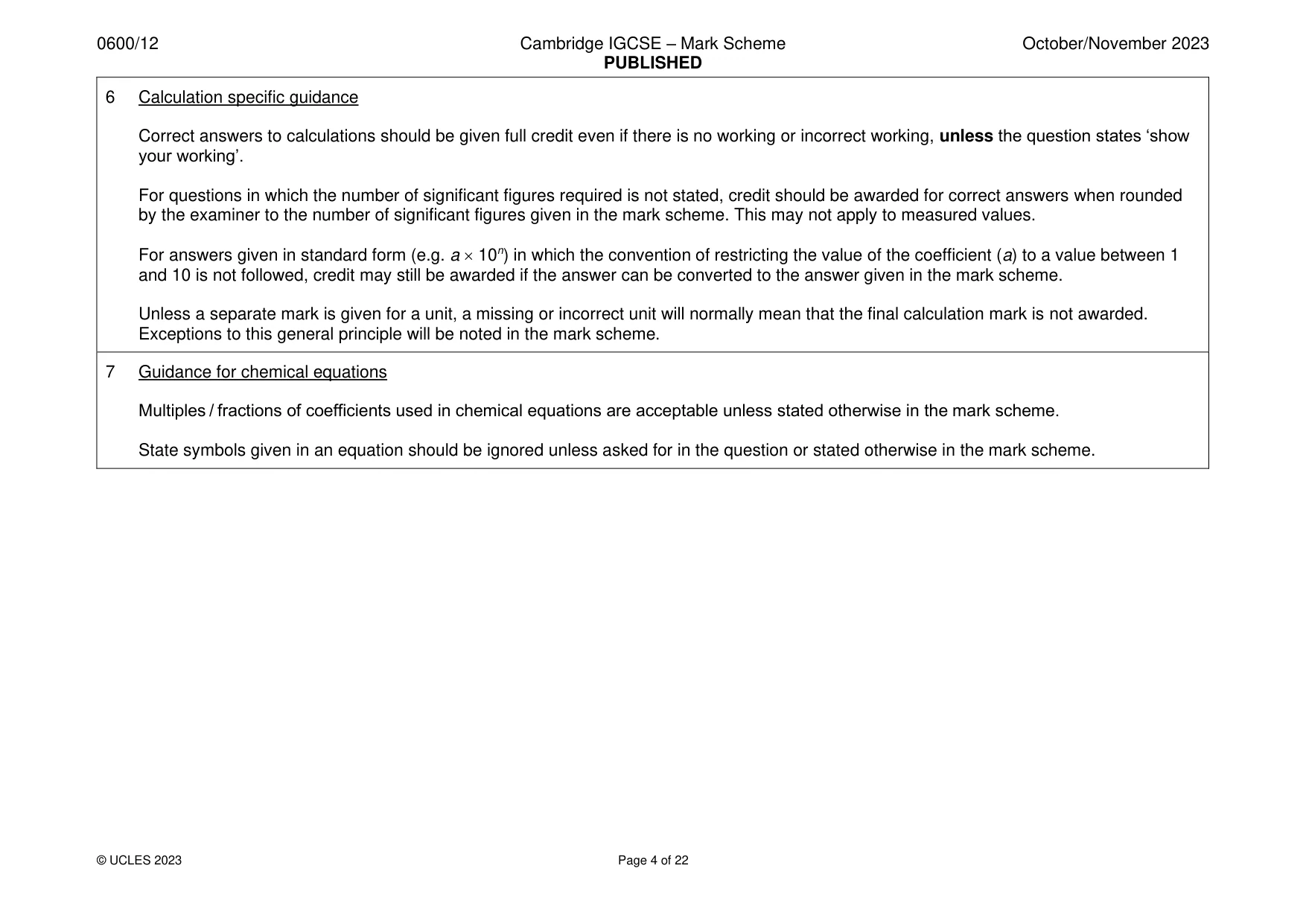
0600/12 Cambridge IGCSE – Mark Scheme PUBLISHED October/November 2023 © UCLES 2023 Page 4 of 22 6 Calculation specific guidance Correct answers to calculations should be given full credit even if there is no working or incorrect working, unless the question states ‘show your working’. For questions in which the number of significant figures required is not stated, credit should be awarded for correct answers when rounded by the examiner to the number of significant figures given in the mark scheme. This may not apply to measured values. For answers given in standard form (e.g. a 10n) in which the convention of restricting the value of the coefficient (a) to a value between 1 and 10 is not followed, credit may still be awarded if the answer can be converted to the answer given in the mark scheme. Unless a separate mark is given for a unit, a missing or incorrect unit will normally mean that the final calculation mark is not awarded. Exceptions to this general principle will be noted in the mark scheme. 7 Guidance for chemical equations Multiples / fractions of coefficients used in chemical equations are acceptable unless stated otherwise in the mark scheme. State symbols given in an equation should be ignored unless asked for in the question or stated otherwise in the mark scheme.
Mark scheme, page 5
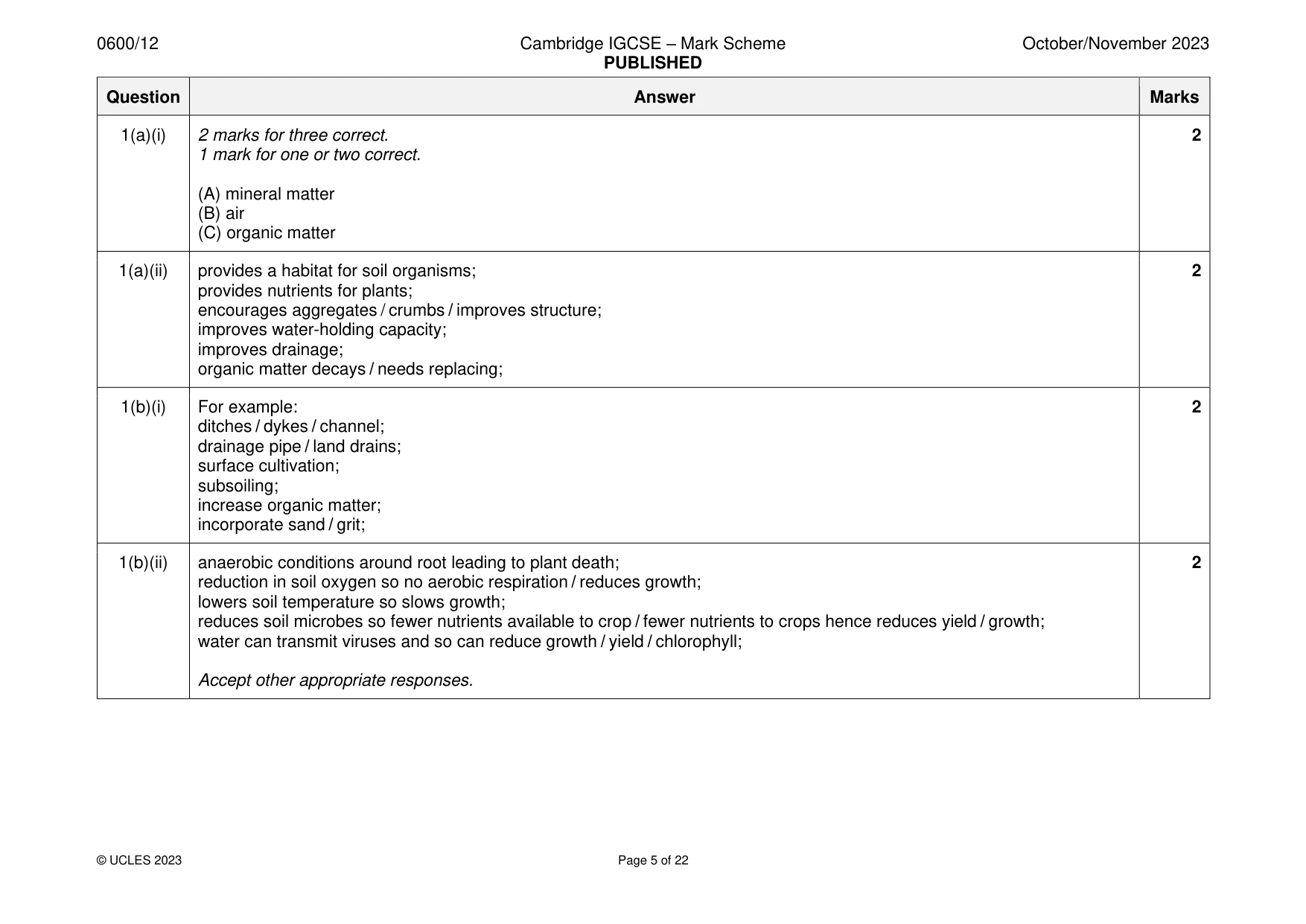
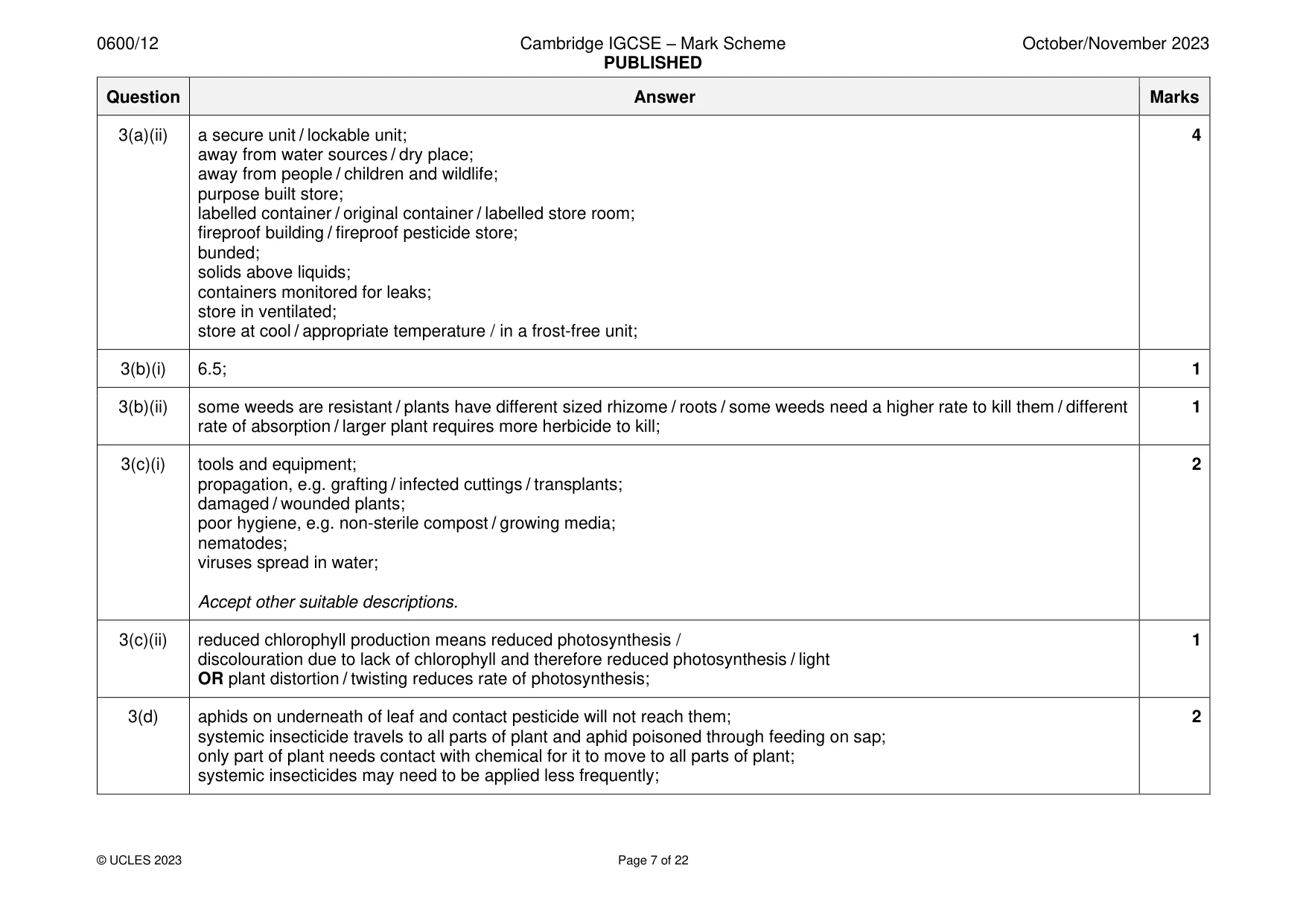
0600/12 Cambridge IGCSE – Mark Scheme PUBLISHED October/November 2023 © UCLES 2023 Page 5 of 22 Question Answer Marks 1(a)(i) 2 marks for three correct. 1 mark for one or two correct. (A) mineral matter (B) air (C) organic matter 2 1(a)(ii) provides a habitat for soil organisms; provides nutrients for plants; encourages aggregates / crumbs / improves structure; improves water-holding capacity; improves drainage; organic matter decays / needs replacing; 2 1(b)(i) For example: ditches / dykes / channel; drainage pipe / land drains; surface cultivation; subsoiling; increase organic matter; incorporate sand / grit; 2 1(b)(ii) anaerobic conditions around root leading to plant death; reduction in soil oxygen so no aerobic respiration / reduces growth; lowers soil temperature so slows growth; reduces soil microbes so fewer nutrients available to crop / fewer nutrients to crops hence reduces yield / growth; water can transmit viruses and so can reduce growth / yield / chlorophyll; Accept other appropriate responses. 2
Mark scheme, page 6
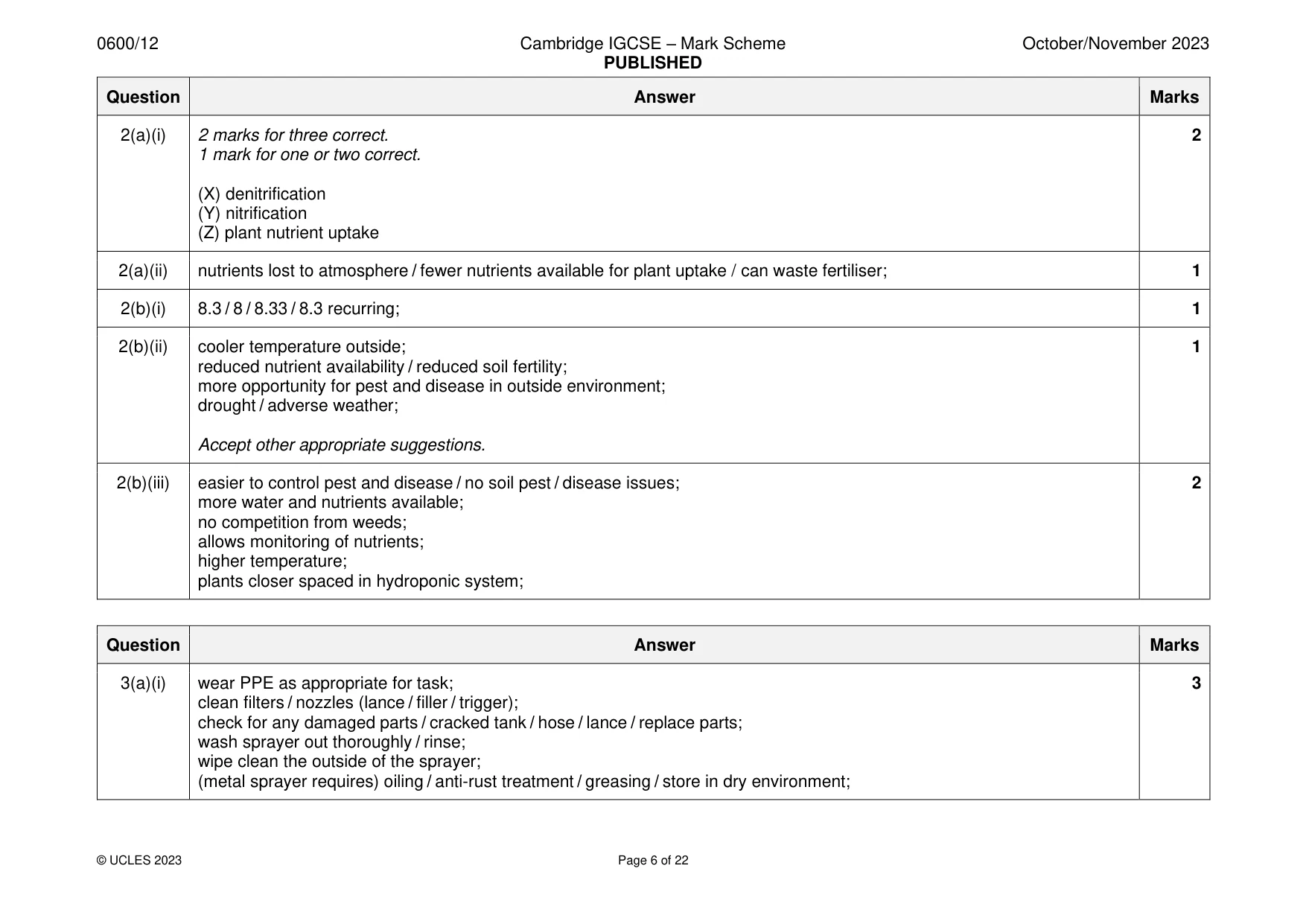
0600/12 Cambridge IGCSE – Mark Scheme PUBLISHED October/November 2023 © UCLES 2023 Page 6 of 22 Question Answer Marks 2(a)(i) 2 marks for three correct. 1 mark for one or two correct. (X) denitrification (Y) nitrification (Z) plant nutrient uptake 2 2(a)(ii) nutrients lost to atmosphere / fewer nutrients available for plant uptake / can waste fertiliser; 1 2(b)(i) 8.3 / 8 / 8.33 / 8.3 recurring; 1 2(b)(ii) cooler temperature outside; reduced nutrient availability / reduced soil fertility; more opportunity for pest and disease in outside environment; drought / adverse weather; Accept other appropriate suggestions. 1 2(b)(iii) easier to control pest and disease / no soil pest / disease issues; more water and nutrients available; no competition from weeds; allows monitoring of nutrients; higher temperature; plants closer spaced in hydroponic system; 2 Question Answer Marks 3(a)(i) wear PPE as appropriate for task; clean filters / nozzles (lance / filler / trigger); check for any damaged parts / cracked tank / hose / lance / replace parts; wash sprayer out thoroughly / rinse; wipe clean the outside of the sprayer; (metal sprayer requires) oiling / anti-rust treatment / greasing / store in dry environment; 3
Mark scheme, page 7
0600/12 Cambridge IGCSE – Mark Scheme PUBLISHED October/November 2023 © UCLES 2023 Page 7 of 22 Question Answer Marks 3(a)(ii) a secure unit / lockable unit; away from water sources / dry place; away from people / children and wildlife; purpose built store; labelled container / original container / labelled store room; fireproof building / fireproof pesticide store; bunded; solids above liquids; containers monitored for leaks; store in ventilated; store at cool / appropriate temperature / in a frost-free unit; 4 3(b)(i) 6.5; 1 3(b)(ii) some weeds are resistant / plants have different sized rhizome / roots / some weeds need a higher rate to kill them / different rate of absorption / larger plant requires more herbicide to kill; 1 3(c)(i) tools and equipment; propagation, e.g. grafting / infected cuttings / transplants; damaged / wounded plants; poor hygiene, e.g. non-sterile compost / growing media; nematodes; viruses spread in water; Accept other suitable descriptions. 2 3(c)(ii) reduced chlorophyll production means reduced photosynthesis / discolouration due to lack of chlorophyll and therefore reduced photosynthesis / light OR plant distortion / twisting reduces rate of photosynthesis; 1 3(d) aphids on underneath of leaf and contact pesticide will not reach them; systemic insecticide travels to all parts of plant and aphid poisoned through feeding on sap; only part of plant needs contact with chemical for it to move to all parts of plant; systemic insecticides may need to be applied less frequently; 2
Mark scheme, page 8
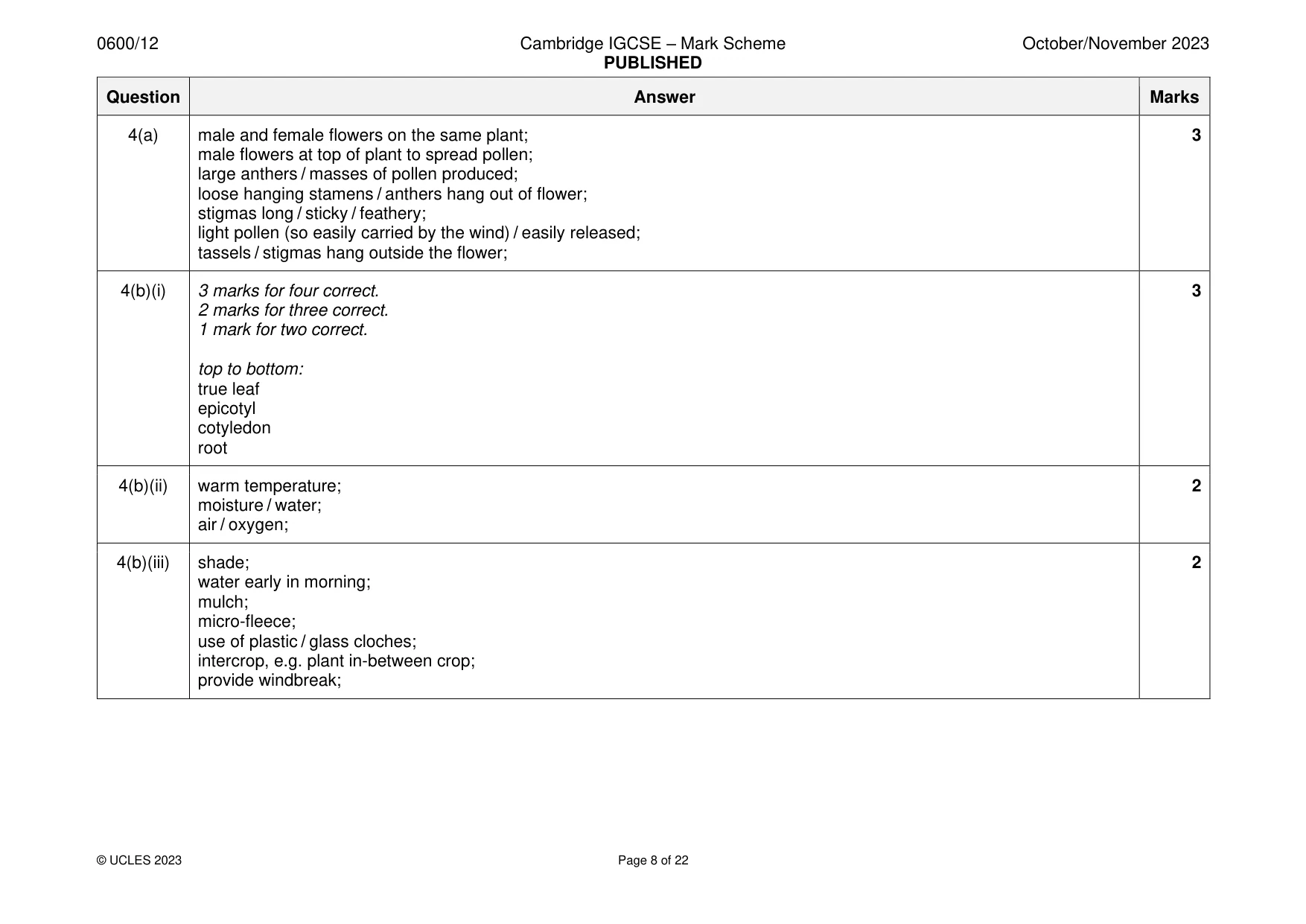
0600/12 Cambridge IGCSE – Mark Scheme PUBLISHED October/November 2023 © UCLES 2023 Page 8 of 22 Question Answer Marks 4(a) male and female flowers on the same plant; male flowers at top of plant to spread pollen; large anthers / masses of pollen produced; loose hanging stamens / anthers hang out of flower; stigmas long / sticky / feathery; light pollen (so easily carried by the wind) / easily released; tassels / stigmas hang outside the flower; 3 4(b)(i) 3 marks for four correct. 2 marks for three correct. 1 mark for two correct. top to bottom: true leaf epicotyl cotyledon root 3 4(b)(ii) warm temperature; moisture / water; air / oxygen; 2 4(b)(iii) shade; water early in morning; mulch; micro-fleece; use of plastic / glass cloches; intercrop, e.g. plant in-between crop; provide windbreak; 2
Mark scheme, page 9
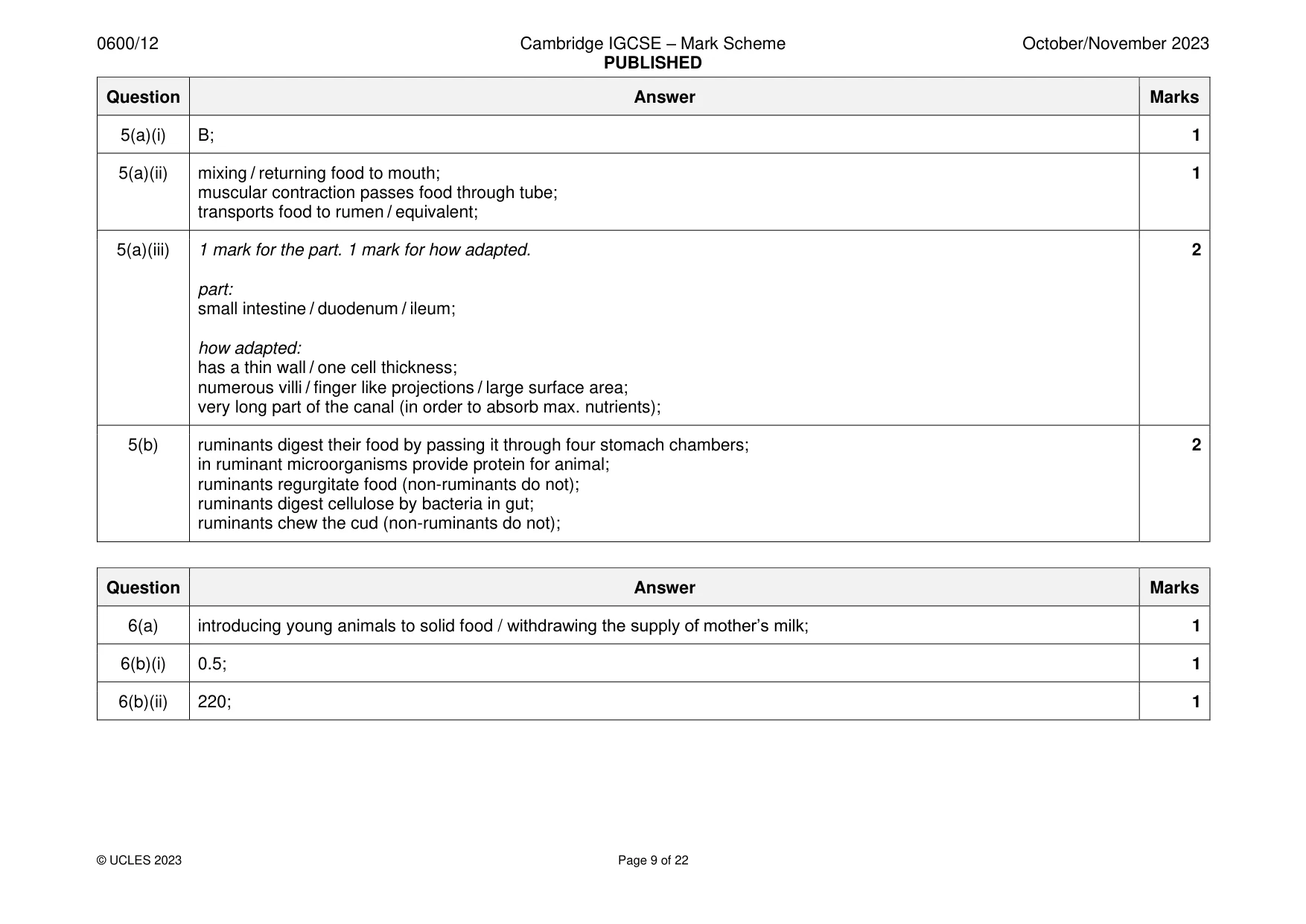
0600/12 Cambridge IGCSE – Mark Scheme PUBLISHED October/November 2023 © UCLES 2023 Page 9 of 22 Question Answer Marks 5(a)(i) B; 1 5(a)(ii) mixing / returning food to mouth; muscular contraction passes food through tube; transports food to rumen / equivalent; 1 5(a)(iii) 1 mark for the part. 1 mark for how adapted. part: small intestine / duodenum / ileum; how adapted: has a thin wall / one cell thickness; numerous villi / finger like projections / large surface area; very long part of the canal (in order to absorb max. nutrients); 2 5(b) ruminants digest their food by passing it through four stomach chambers; in ruminant microorganisms provide protein for animal; ruminants regurgitate food (non-ruminants do not); ruminants digest cellulose by bacteria in gut; ruminants chew the cud (non-ruminants do not); 2 Question Answer Marks 6(a) introducing young animals to solid food / withdrawing the supply of mother’s milk; 1 6(b)(i) 0.5; 1 6(b)(ii) 220; 1
Mark scheme, page 10
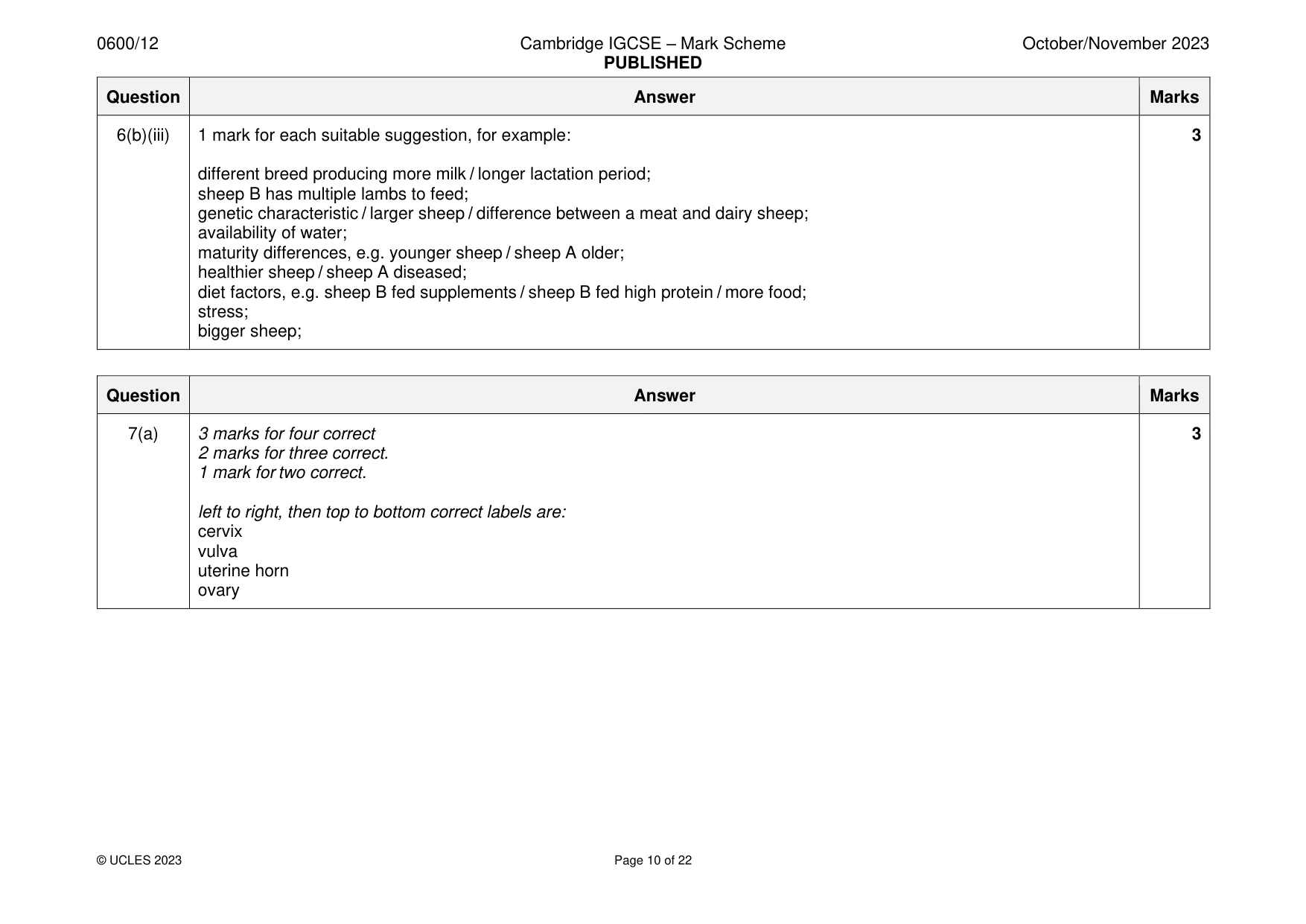
0600/12 Cambridge IGCSE – Mark Scheme PUBLISHED October/November 2023 © UCLES 2023 Page 10 of 22 Question Answer Marks 6(b)(iii) 1 mark for each suitable suggestion, for example: different breed producing more milk / longer lactation period; sheep B has multiple lambs to feed; genetic characteristic / larger sheep / difference between a meat and dairy sheep; availability of water; maturity differences, e.g. younger sheep / sheep A older; healthier sheep / sheep A diseased; diet factors, e.g. sheep B fed supplements / sheep B fed high protein / more food; stress; bigger sheep; 3 Question Answer Marks 7(a) 3 marks for four correct 2 marks for three correct. 1 mark for two correct. left to right, then top to bottom correct labels are: cervix vulva uterine horn ovary 3
Mark scheme, page 11
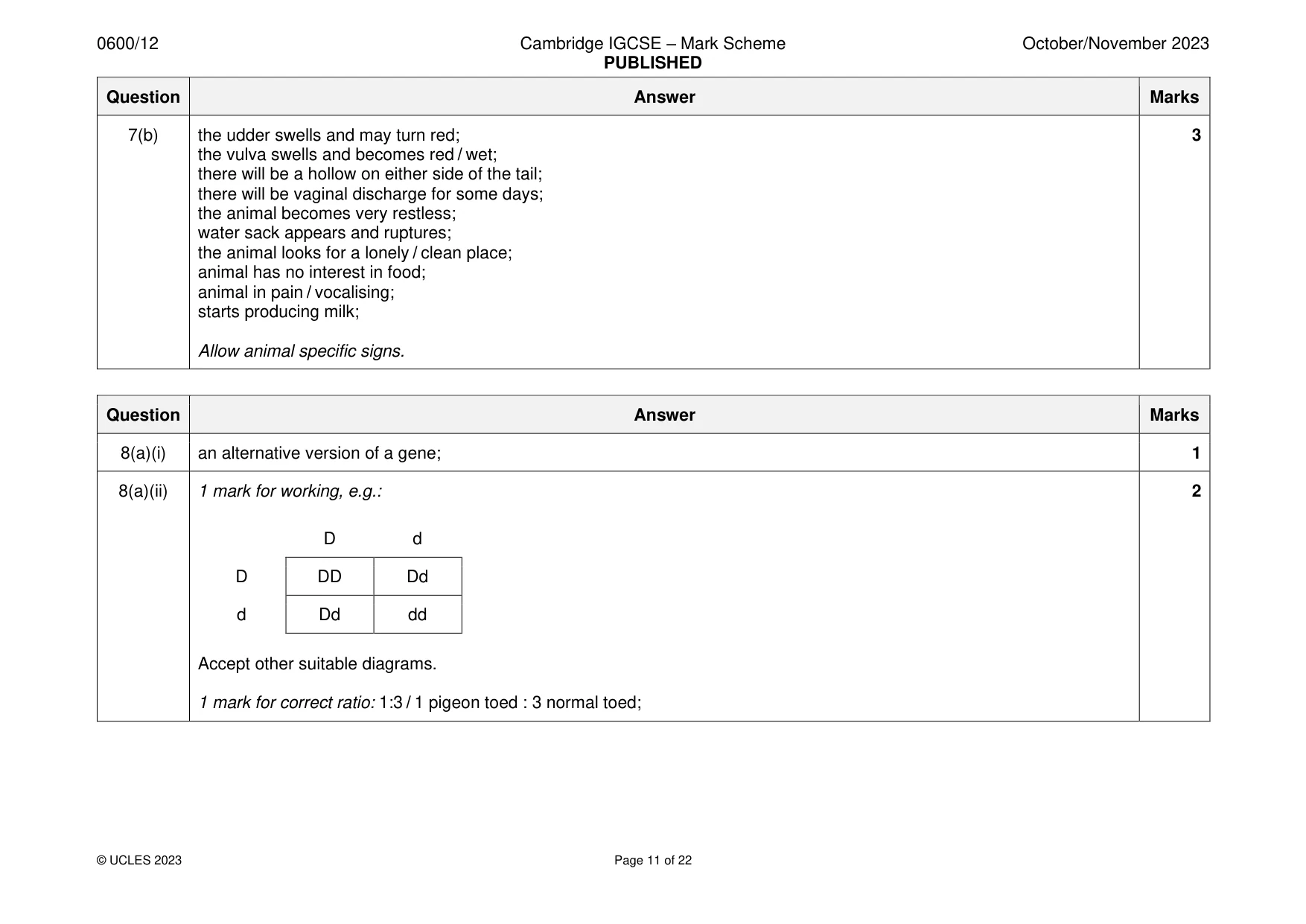
0600/12 Cambridge IGCSE – Mark Scheme PUBLISHED October/November 2023 © UCLES 2023 Page 11 of 22 Question Answer Marks 7(b) the udder swells and may turn red; the vulva swells and becomes red / wet; there will be a hollow on either side of the tail; there will be vaginal discharge for some days; the animal becomes very restless; water sack appears and ruptures; the animal looks for a lonely / clean place; animal has no interest in food; animal in pain / vocalising; starts producing milk; Allow animal specific signs. 3 Question Answer Marks 8(a)(i) an alternative version of a gene; 1 8(a)(ii) 1 mark for working, e.g.: D d D DD Dd d Dd dd Accept other suitable diagrams. 1 mark for correct ratio: 1:3 / 1 pigeon toed : 3 normal toed; 2
Mark scheme, page 12
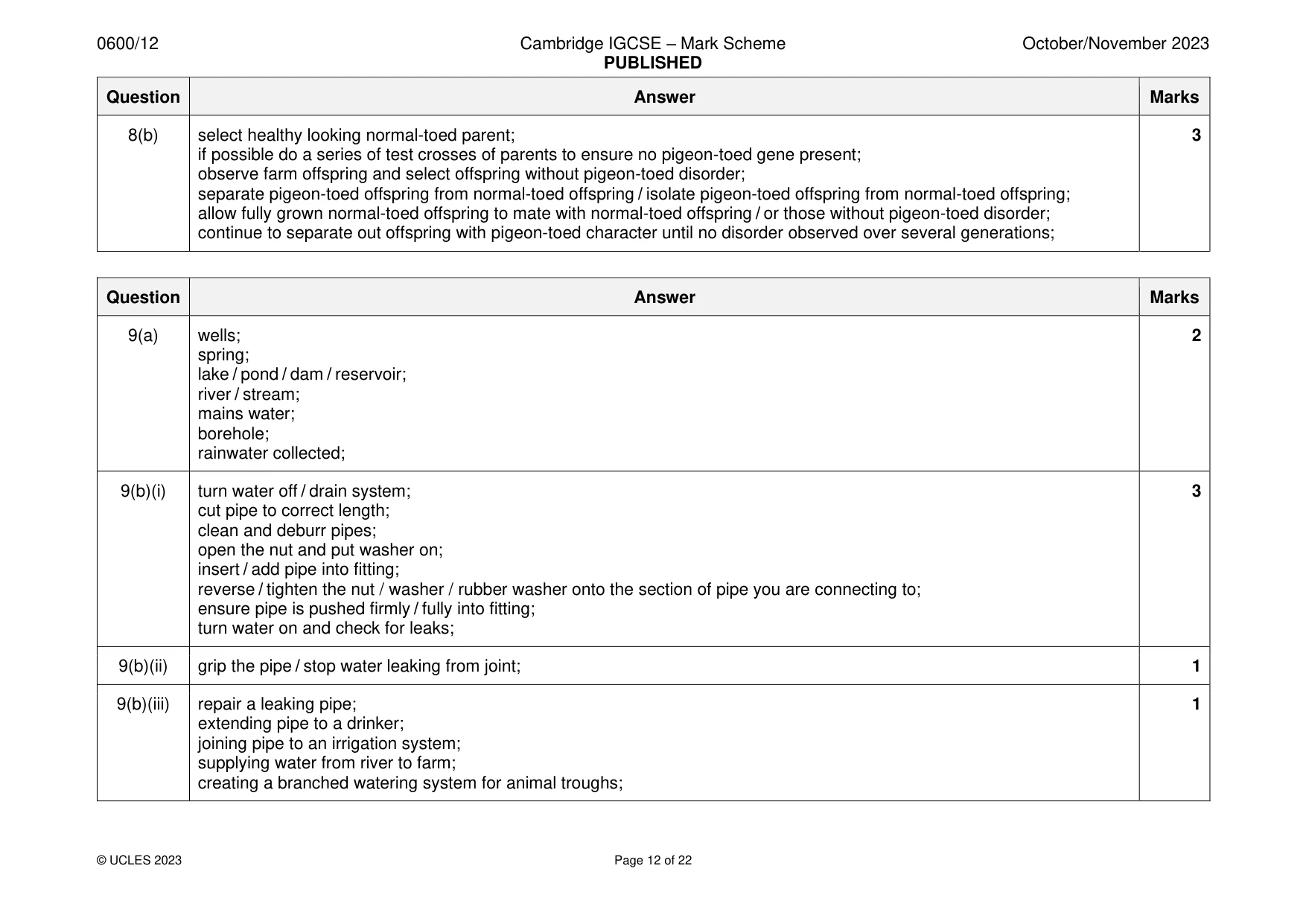
0600/12 Cambridge IGCSE – Mark Scheme PUBLISHED October/November 2023 © UCLES 2023 Page 12 of 22 Question Answer Marks 8(b) select healthy looking normal-toed parent; if possible do a series of test crosses of parents to ensure no pigeon-toed gene present; observe farm offspring and select offspring without pigeon-toed disorder; separate pigeon-toed offspring from normal-toed offspring / isolate pigeon-toed offspring from normal-toed offspring; allow fully grown normal-toed offspring to mate with normal-toed offspring / or those without pigeon-toed disorder; continue to separate out offspring with pigeon-toed character until no disorder observed over several generations; 3 Question Answer Marks 9(a) wells; spring; lake / pond / dam / reservoir; river / stream; mains water; borehole; rainwater collected; 2 9(b)(i) turn water off / drain system; cut pipe to correct length; clean and deburr pipes; open the nut and put washer on; insert / add pipe into fitting; reverse / tighten the nut / washer / rubber washer onto the section of pipe you are connecting to; ensure pipe is pushed firmly / fully into fitting; turn water on and check for leaks; 3 9(b)(ii) grip the pipe / stop water leaking from joint; 1 9(b)(iii) repair a leaking pipe; extending pipe to a drinker; joining pipe to an irrigation system; supplying water from river to farm; creating a branched watering system for animal troughs; 1
Mark scheme, page 13
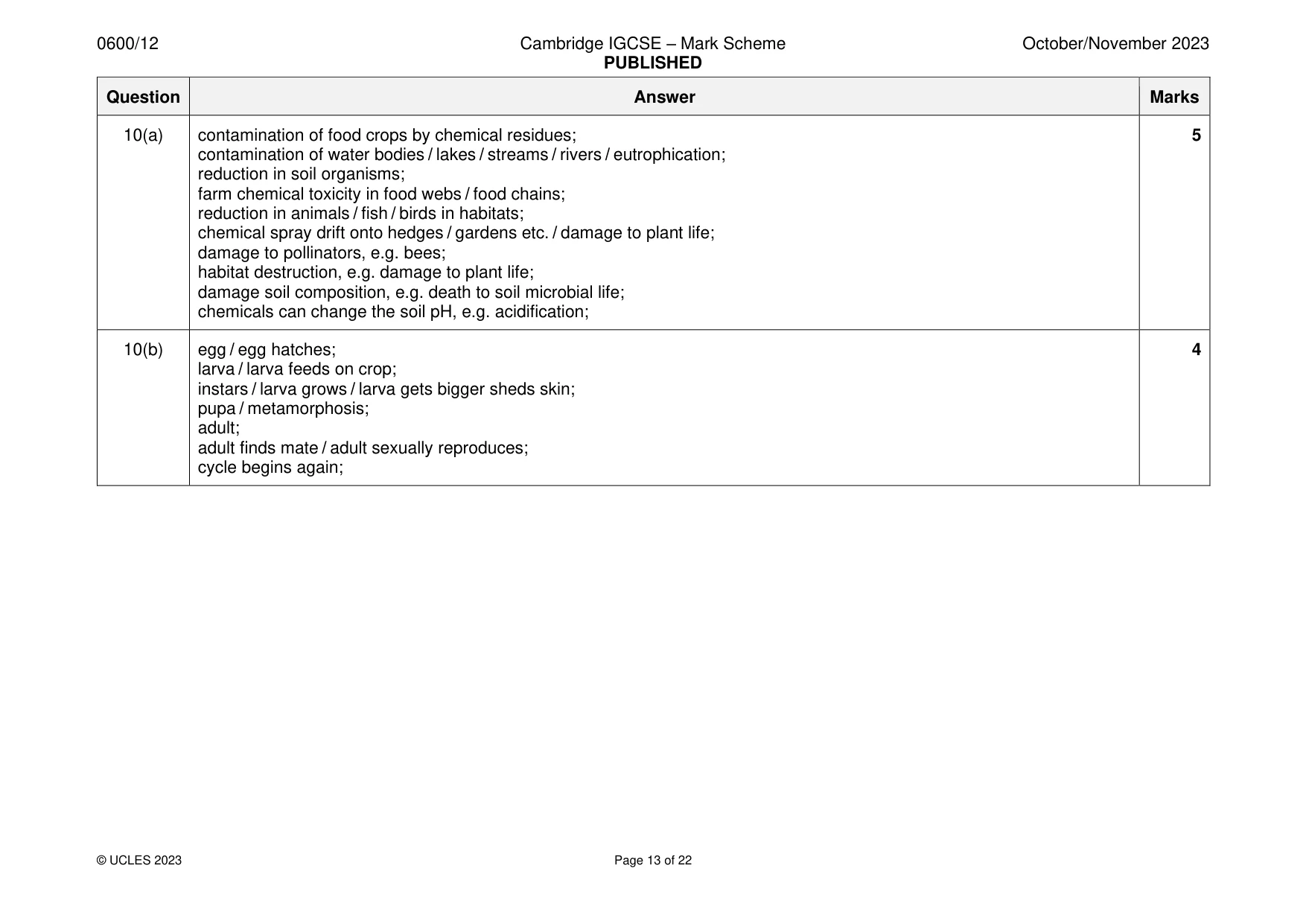
0600/12 Cambridge IGCSE – Mark Scheme PUBLISHED October/November 2023 © UCLES 2023 Page 13 of 22 Question Answer Marks 10(a) contamination of food crops by chemical residues; contamination of water bodies / lakes / streams / rivers / eutrophication; reduction in soil organisms; farm chemical toxicity in food webs / food chains; reduction in animals / fish / birds in habitats; chemical spray drift onto hedges / gardens etc. / damage to plant life; damage to pollinators, e.g. bees; habitat destruction, e.g. damage to plant life; damage soil composition, e.g. death to soil microbial life; chemicals can change the soil pH, e.g. acidification; 5 10(b) egg / egg hatches; larva / larva feeds on crop; instars / larva grows / larva gets bigger sheds skin; pupa / metamorphosis; adult; adult finds mate / adult sexually reproduces; cycle begins again; 4
Mark scheme, page 14
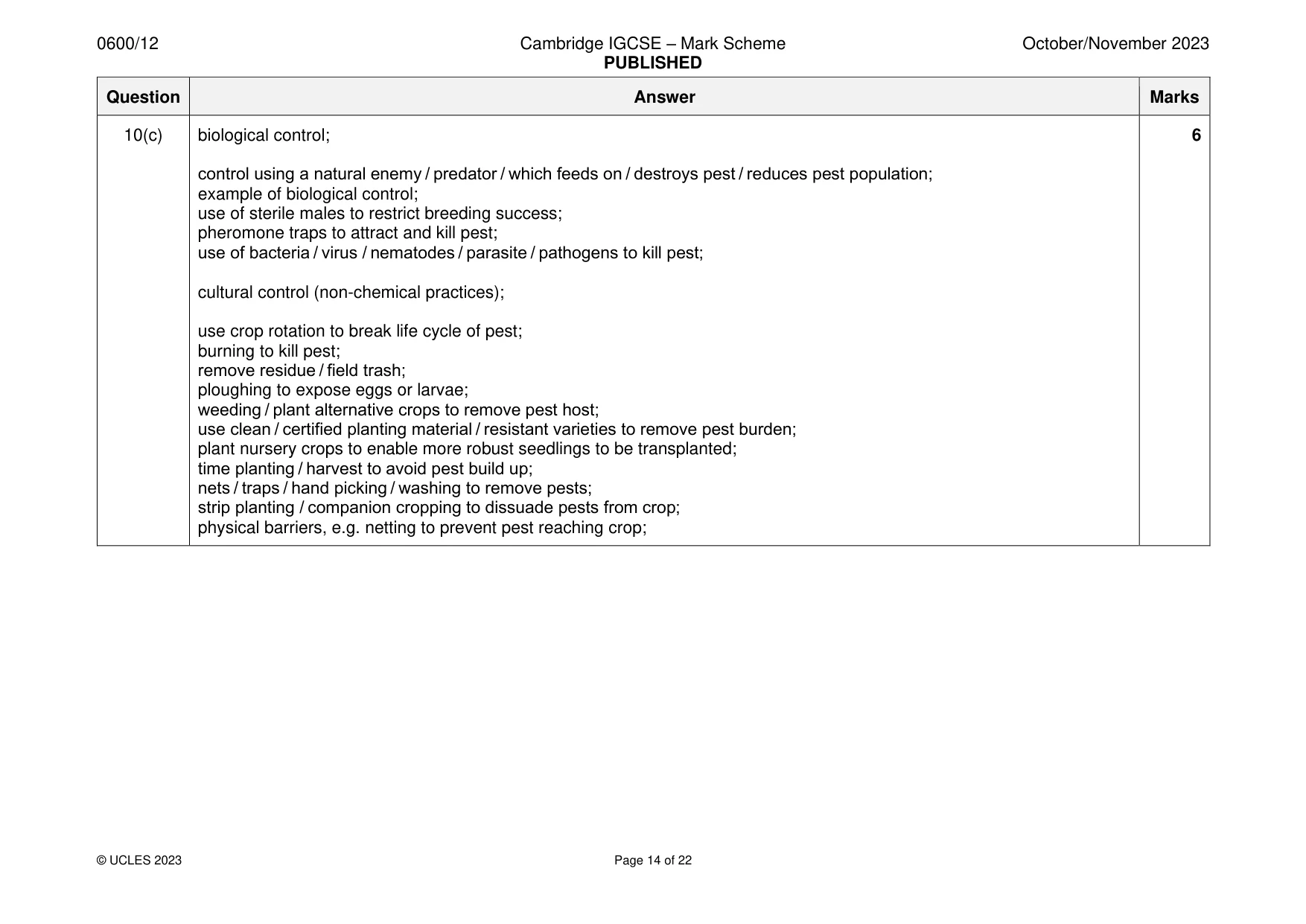
0600/12 Cambridge IGCSE – Mark Scheme PUBLISHED October/November 2023 © UCLES 2023 Page 14 of 22 Question Answer Marks 10(c) biological control; control using a natural enemy / predator / which feeds on / destroys pest / reduces pest population; example of biological control; use of sterile males to restrict breeding success; pheromone traps to attract and kill pest; use of bacteria / virus / nematodes / parasite / pathogens to kill pest; cultural control (non-chemical practices); use crop rotation to break life cycle of pest; burning to kill pest; remove residue / field trash; ploughing to expose eggs or larvae; weeding / plant alternative crops to remove pest host; use clean / certified planting material / resistant varieties to remove pest burden; plant nursery crops to enable more robust seedlings to be transplanted; time planting / harvest to avoid pest build up; nets / traps / hand picking / washing to remove pests; strip planting / companion cropping to dissuade pests from crop; physical barriers, e.g. netting to prevent pest reaching crop; 6
Mark scheme, page 15
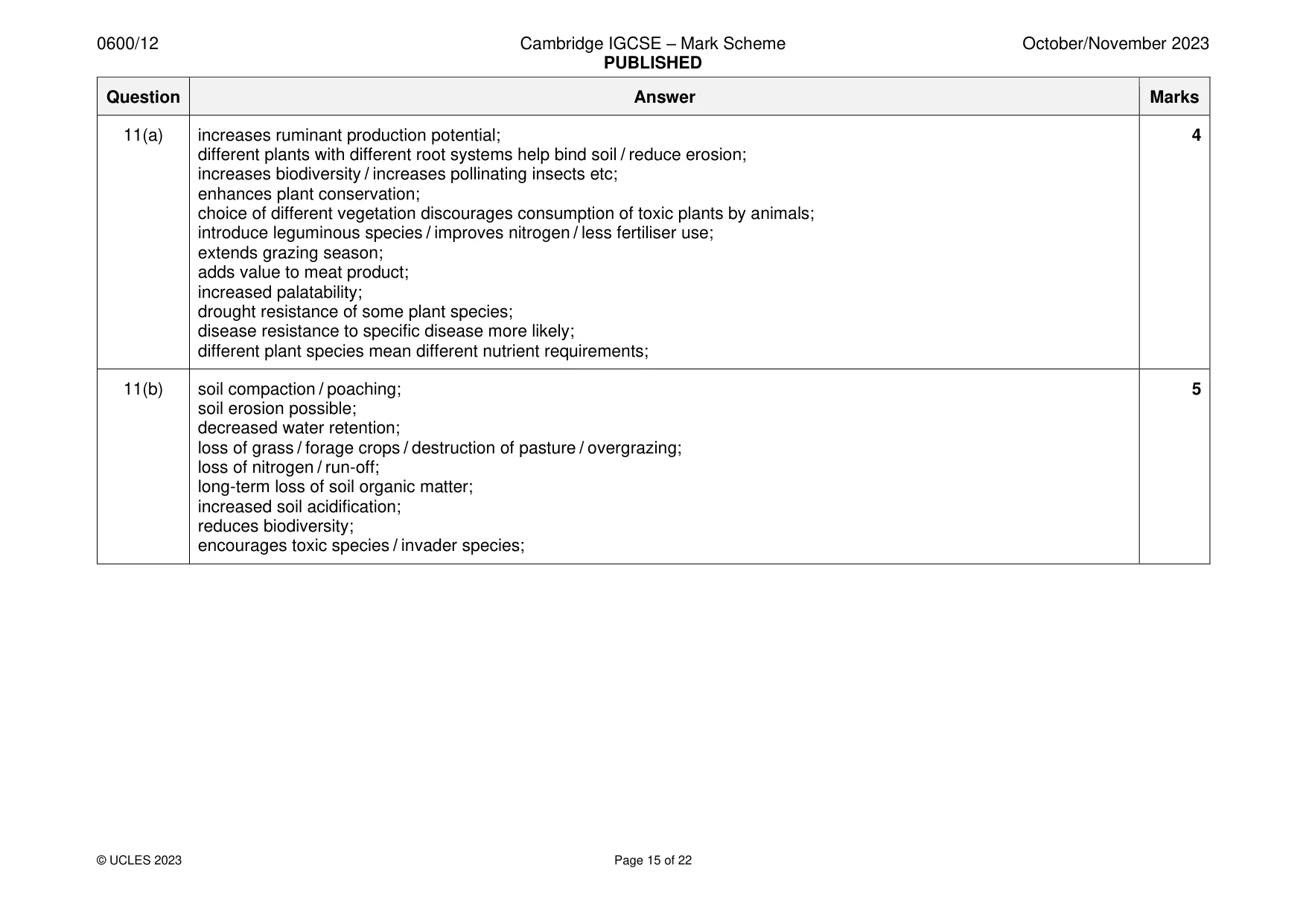
0600/12 Cambridge IGCSE – Mark Scheme PUBLISHED October/November 2023 © UCLES 2023 Page 15 of 22 Question Answer Marks 11(a) increases ruminant production potential; different plants with different root systems help bind soil / reduce erosion; increases biodiversity / increases pollinating insects etc; enhances plant conservation; choice of different vegetation discourages consumption of toxic plants by animals; introduce leguminous species / improves nitrogen / less fertiliser use; extends grazing season; adds value to meat product; increased palatability; drought resistance of some plant species; disease resistance to specific disease more likely; different plant species mean different nutrient requirements; 4 11(b) soil compaction / poaching; soil erosion possible; decreased water retention; loss of grass / forage crops / destruction of pasture / overgrazing; loss of nitrogen / run-off; long-term loss of soil organic matter; increased soil acidification; reduces biodiversity; encourages toxic species / invader species; 5
Mark scheme, page 16
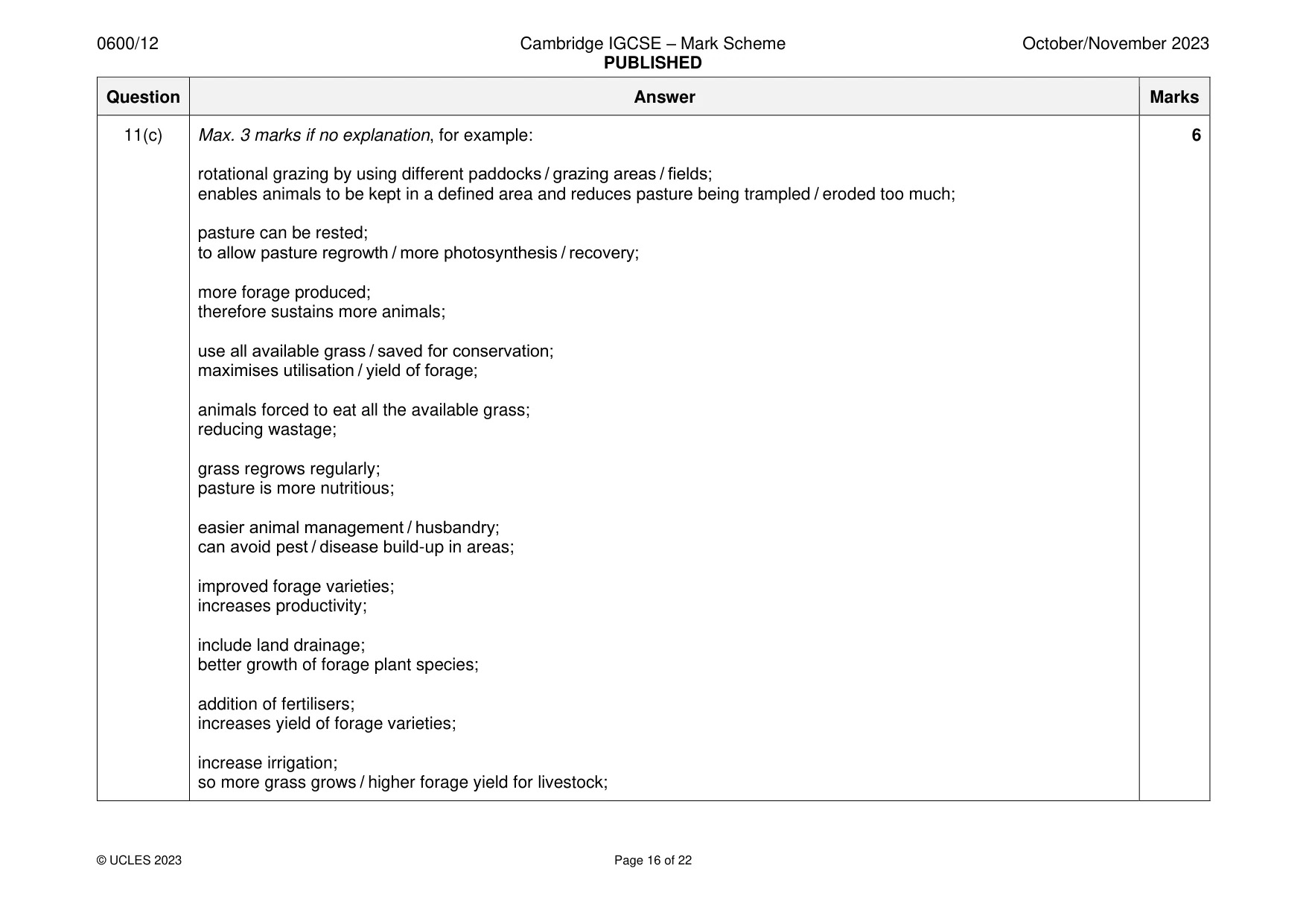
0600/12 Cambridge IGCSE – Mark Scheme PUBLISHED October/November 2023 © UCLES 2023 Page 16 of 22 Question Answer Marks 11(c) Max. 3 marks if no explanation, for example: rotational grazing by using different paddocks / grazing areas / fields; enables animals to be kept in a defined area and reduces pasture being trampled / eroded too much; pasture can be rested; to allow pasture regrowth / more photosynthesis / recovery; more forage produced; therefore sustains more animals; use all available grass / saved for conservation; maximises utilisation / yield of forage; animals forced to eat all the available grass; reducing wastage; grass regrows regularly; pasture is more nutritious; easier animal management / husbandry; can avoid pest / disease build-up in areas; improved forage varieties; increases productivity; include land drainage; better growth of forage plant species; addition of fertilisers; increases yield of forage varieties; increase irrigation; so more grass grows / higher forage yield for livestock; 6
Mark scheme, page 17
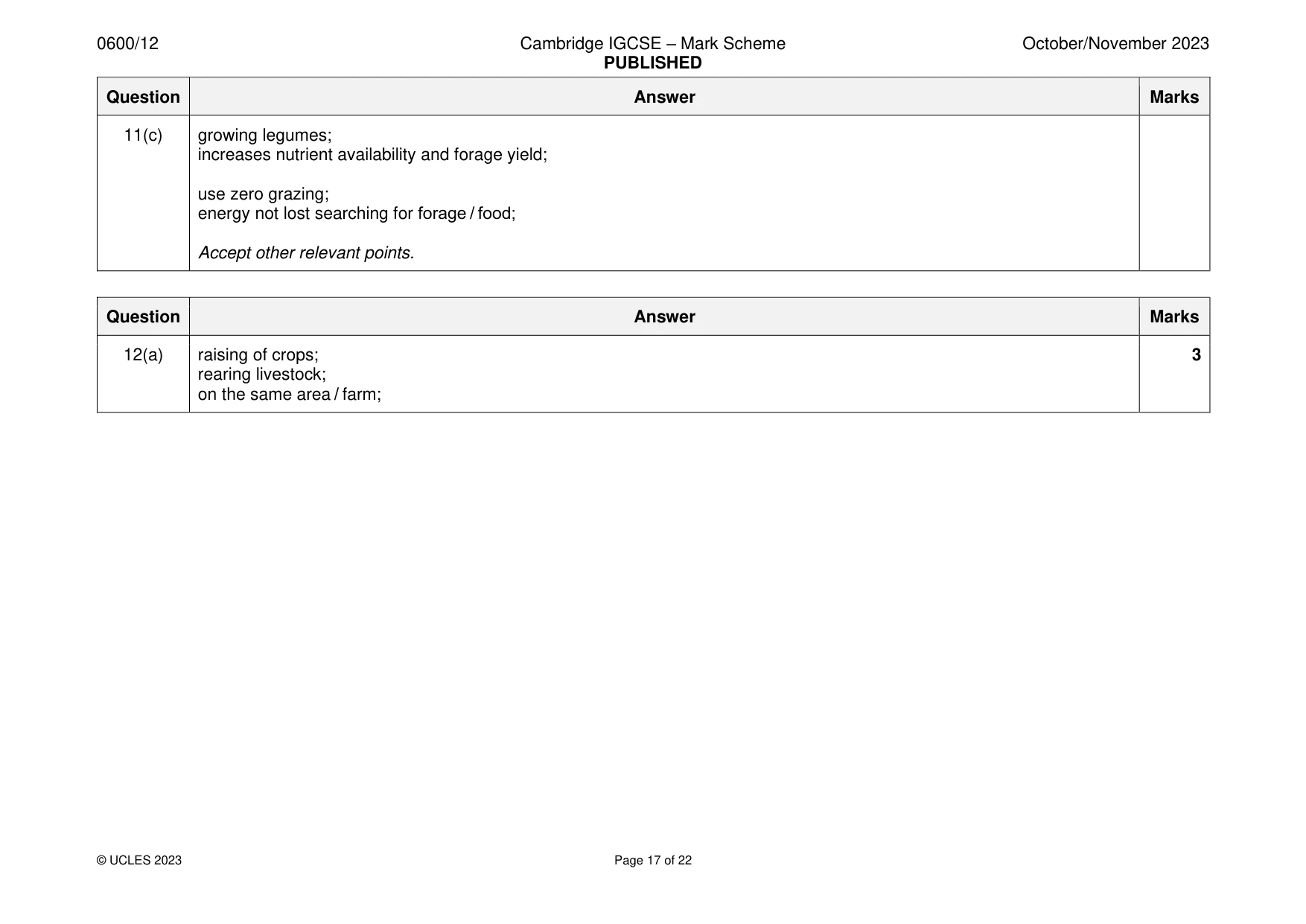
0600/12 Cambridge IGCSE – Mark Scheme PUBLISHED October/November 2023 © UCLES 2023 Page 17 of 22 Question Answer Marks 11(c) growing legumes; increases nutrient availability and forage yield; use zero grazing; energy not lost searching for forage / food; Accept other relevant points. Question Answer Marks 12(a) raising of crops; rearing livestock; on the same area / farm; 3
Mark scheme, page 18
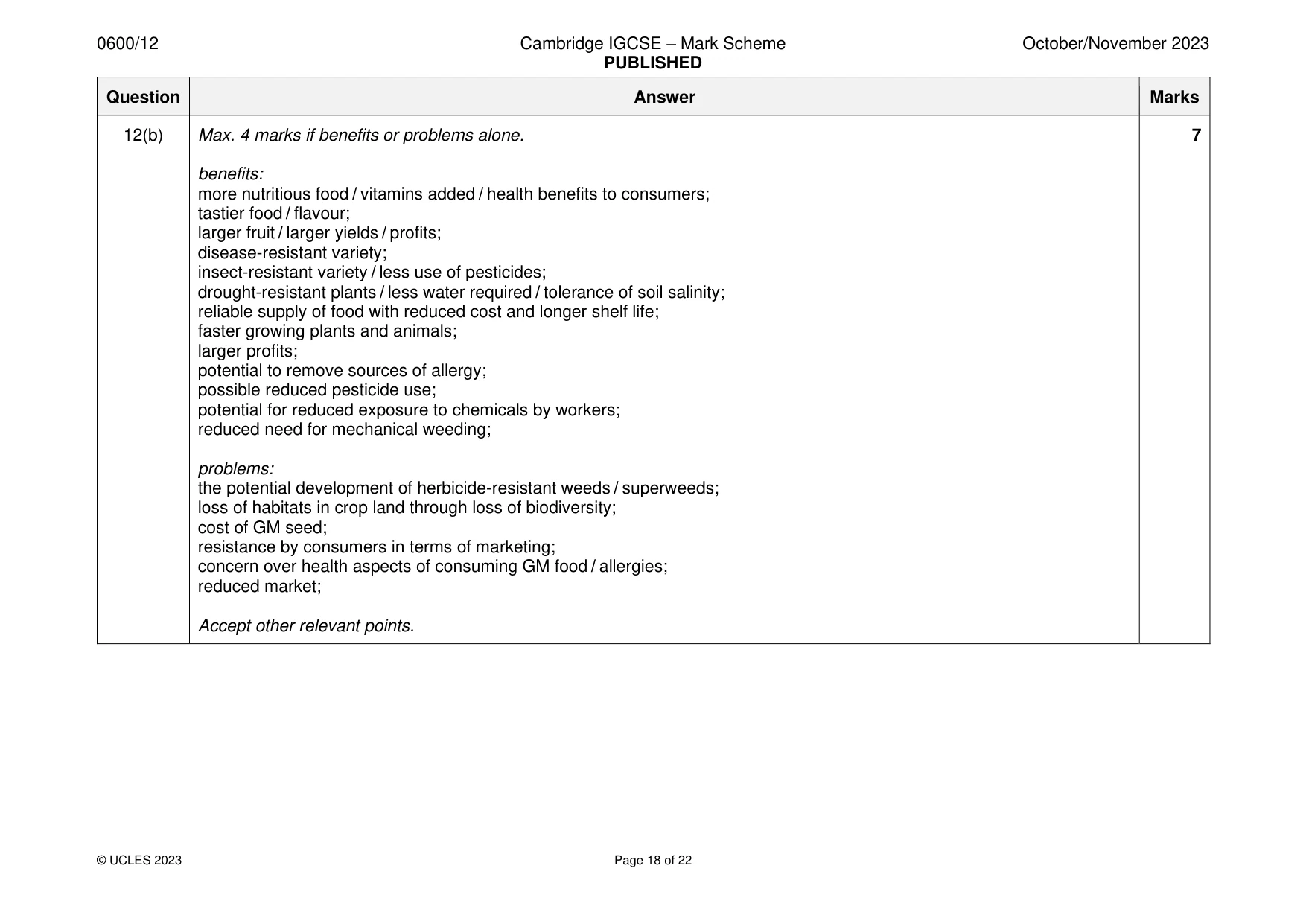
0600/12 Cambridge IGCSE – Mark Scheme PUBLISHED October/November 2023 © UCLES 2023 Page 18 of 22 Question Answer Marks 12(b) Max. 4 marks if benefits or problems alone. benefits: more nutritious food / vitamins added / health benefits to consumers; tastier food / flavour; larger fruit / larger yields / profits; disease-resistant variety; insect-resistant variety / less use of pesticides; drought-resistant plants / less water required / tolerance of soil salinity; reliable supply of food with reduced cost and longer shelf life; faster growing plants and animals; larger profits; potential to remove sources of allergy; possible reduced pesticide use; potential for reduced exposure to chemicals by workers; reduced need for mechanical weeding; problems: the potential development of herbicide-resistant weeds / superweeds; loss of habitats in crop land through loss of biodiversity; cost of GM seed; resistance by consumers in terms of marketing; concern over health aspects of consuming GM food / allergies; reduced market; Accept other relevant points. 7
Mark scheme, page 19
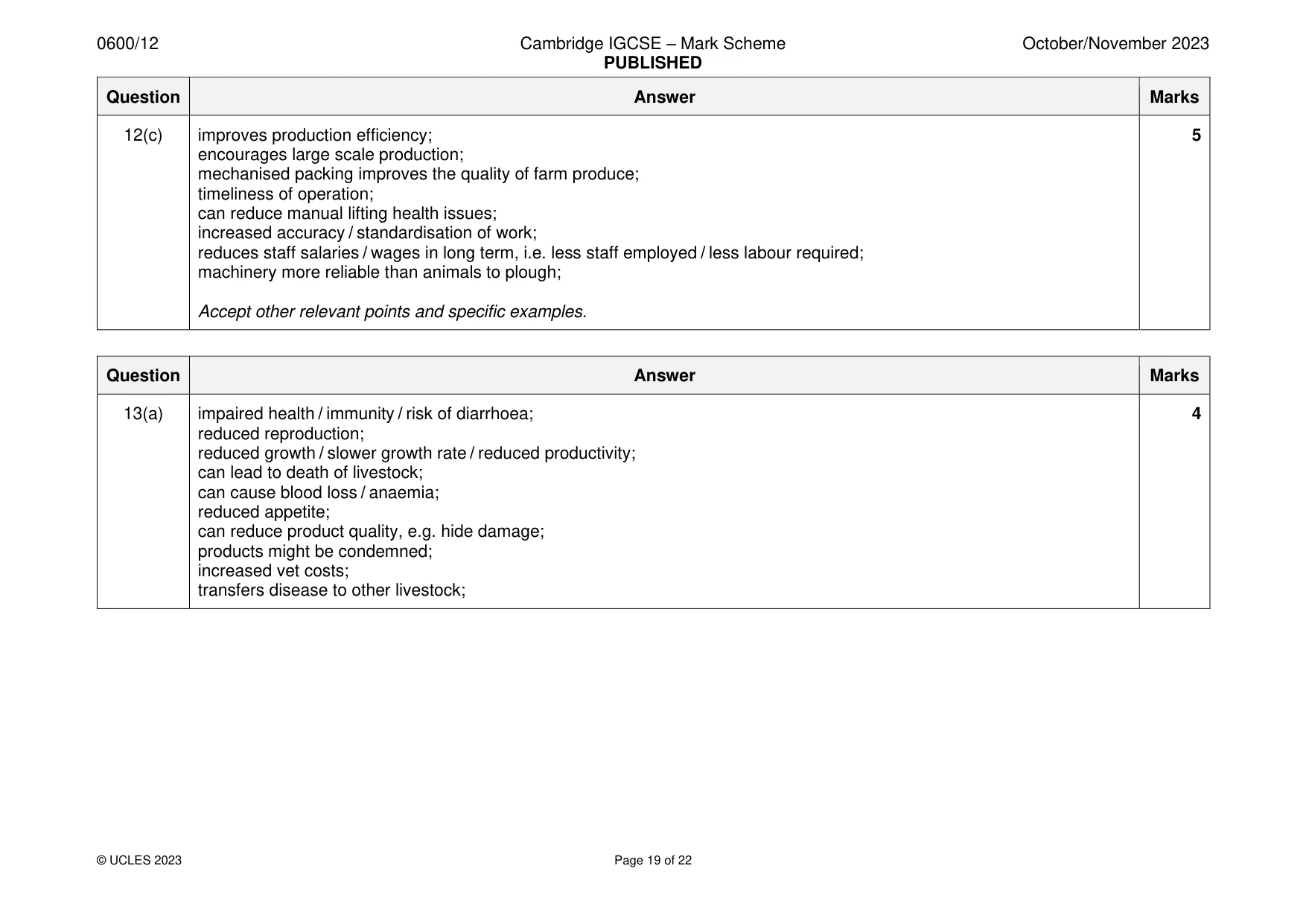
0600/12 Cambridge IGCSE – Mark Scheme PUBLISHED October/November 2023 © UCLES 2023 Page 19 of 22 Question Answer Marks 12(c) improves production efficiency; encourages large scale production; mechanised packing improves the quality of farm produce; timeliness of operation; can reduce manual lifting health issues; increased accuracy / standardisation of work; reduces staff salaries / wages in long term, i.e. less staff employed / less labour required; machinery more reliable than animals to plough; Accept other relevant points and specific examples. 5 Question Answer Marks 13(a) impaired health / immunity / risk of diarrhoea; reduced reproduction; reduced growth / slower growth rate / reduced productivity; can lead to death of livestock; can cause blood loss / anaemia; reduced appetite; can reduce product quality, e.g. hide damage; products might be condemned; increased vet costs; transfers disease to other livestock; 4
Mark scheme, page 20
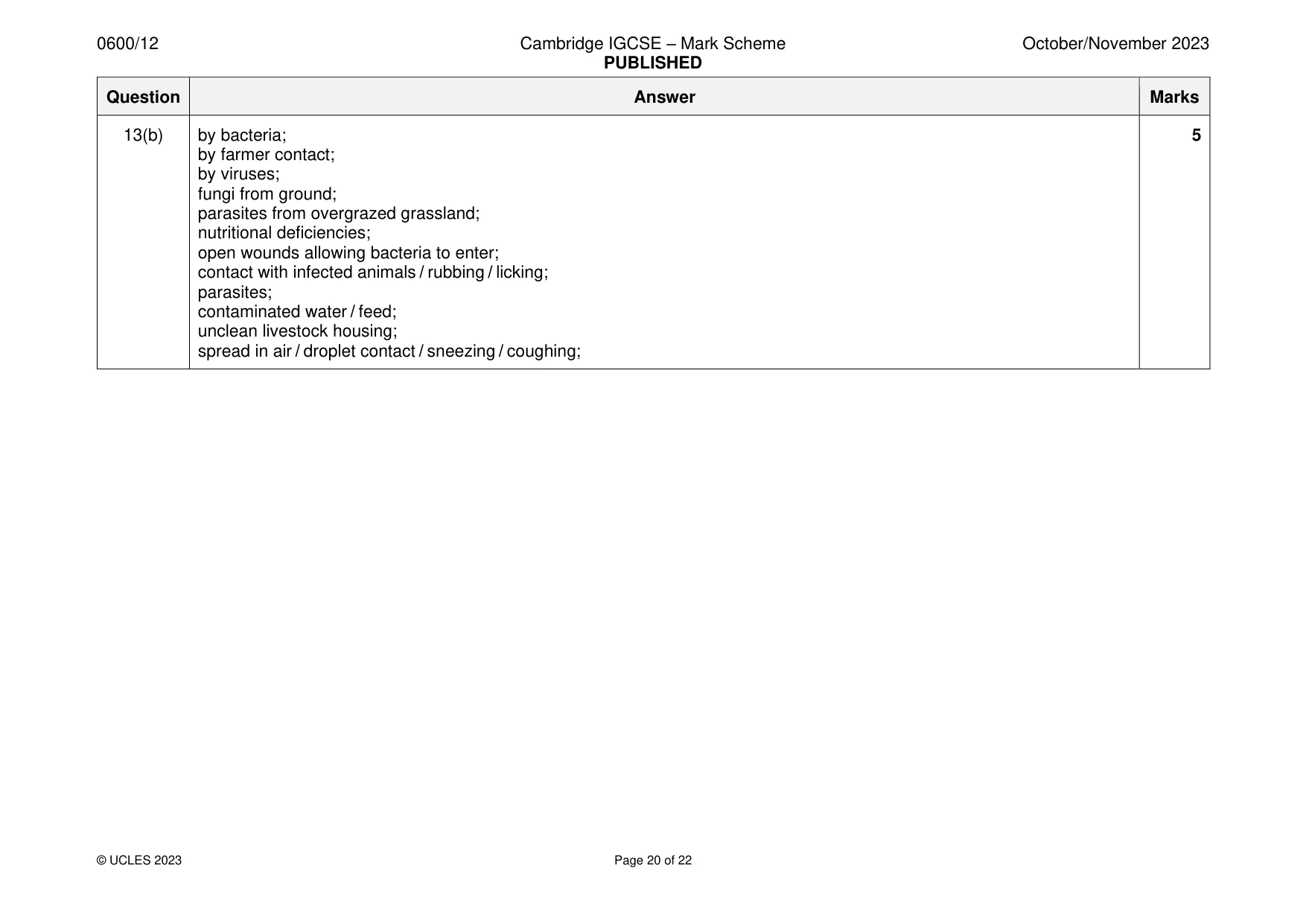
0600/12 Cambridge IGCSE – Mark Scheme PUBLISHED October/November 2023 © UCLES 2023 Page 20 of 22 Question Answer Marks 13(b) by bacteria; by farmer contact; by viruses; fungi from ground; parasites from overgrazed grassland; nutritional deficiencies; open wounds allowing bacteria to enter; contact with infected animals / rubbing / licking; parasites; contaminated water / feed; unclean livestock housing; spread in air / droplet contact / sneezing / coughing; 5
Mark scheme, page 21
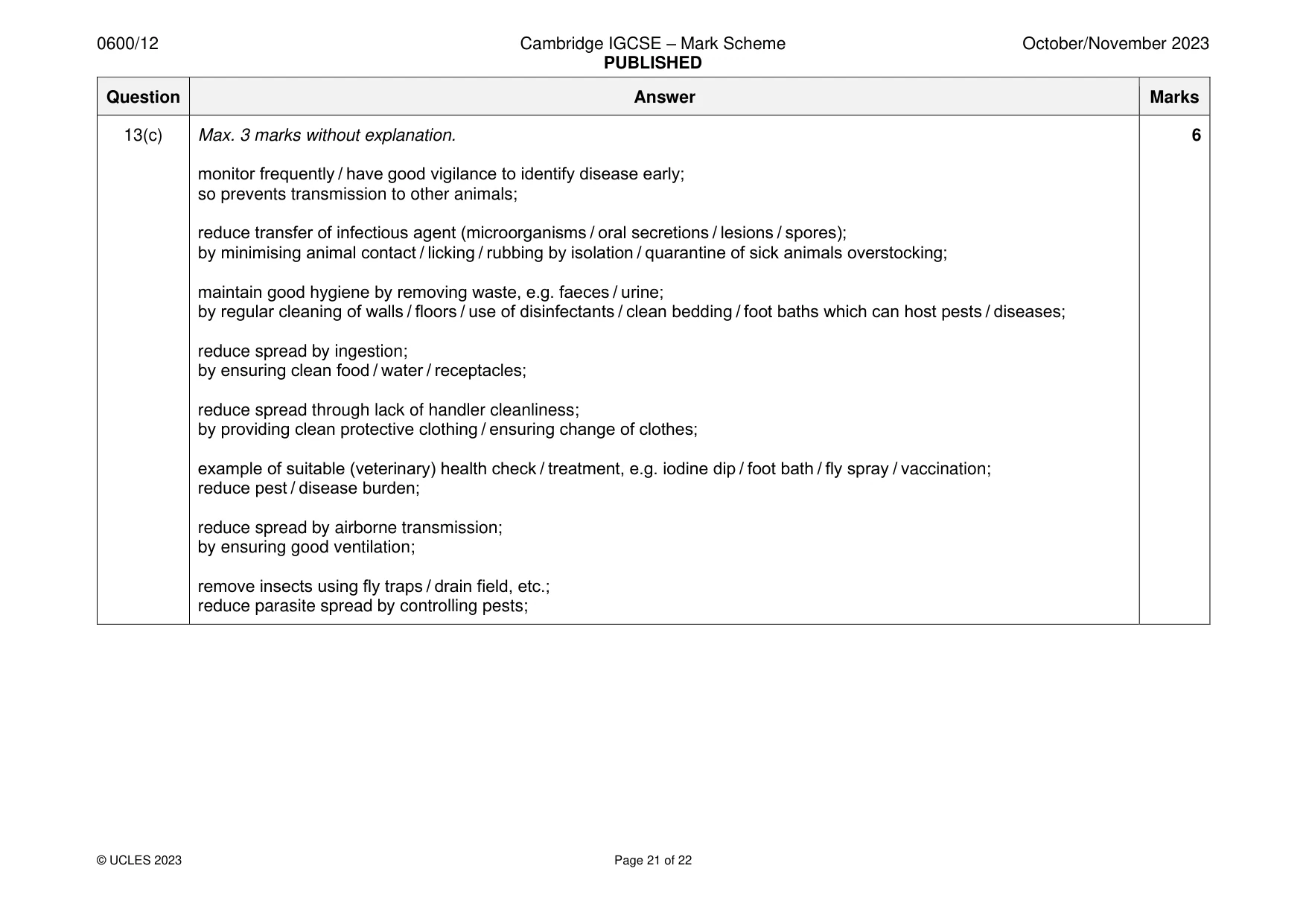
0600/12 Cambridge IGCSE – Mark Scheme PUBLISHED October/November 2023 © UCLES 2023 Page 21 of 22 Question Answer Marks 13(c) Max. 3 marks without explanation. monitor frequently / have good vigilance to identify disease early; so prevents transmission to other animals; reduce transfer of infectious agent (microorganisms / oral secretions / lesions / spores); by minimising animal contact / licking / rubbing by isolation / quarantine of sick animals overstocking; maintain good hygiene by removing waste, e.g. faeces / urine; by regular cleaning of walls / floors / use of disinfectants / clean bedding / foot baths which can host pests / diseases; reduce spread by ingestion; by ensuring clean food / water / receptacles; reduce spread through lack of handler cleanliness; by providing clean protective clothing / ensuring change of clothes; example of suitable (veterinary) health check / treatment, e.g. iodine dip / foot bath / fly spray / vaccination; reduce pest / disease burden; reduce spread by airborne transmission; by ensuring good ventilation; remove insects using fly traps / drain field, etc.; reduce parasite spread by controlling pests; 6
Mark scheme, page 22
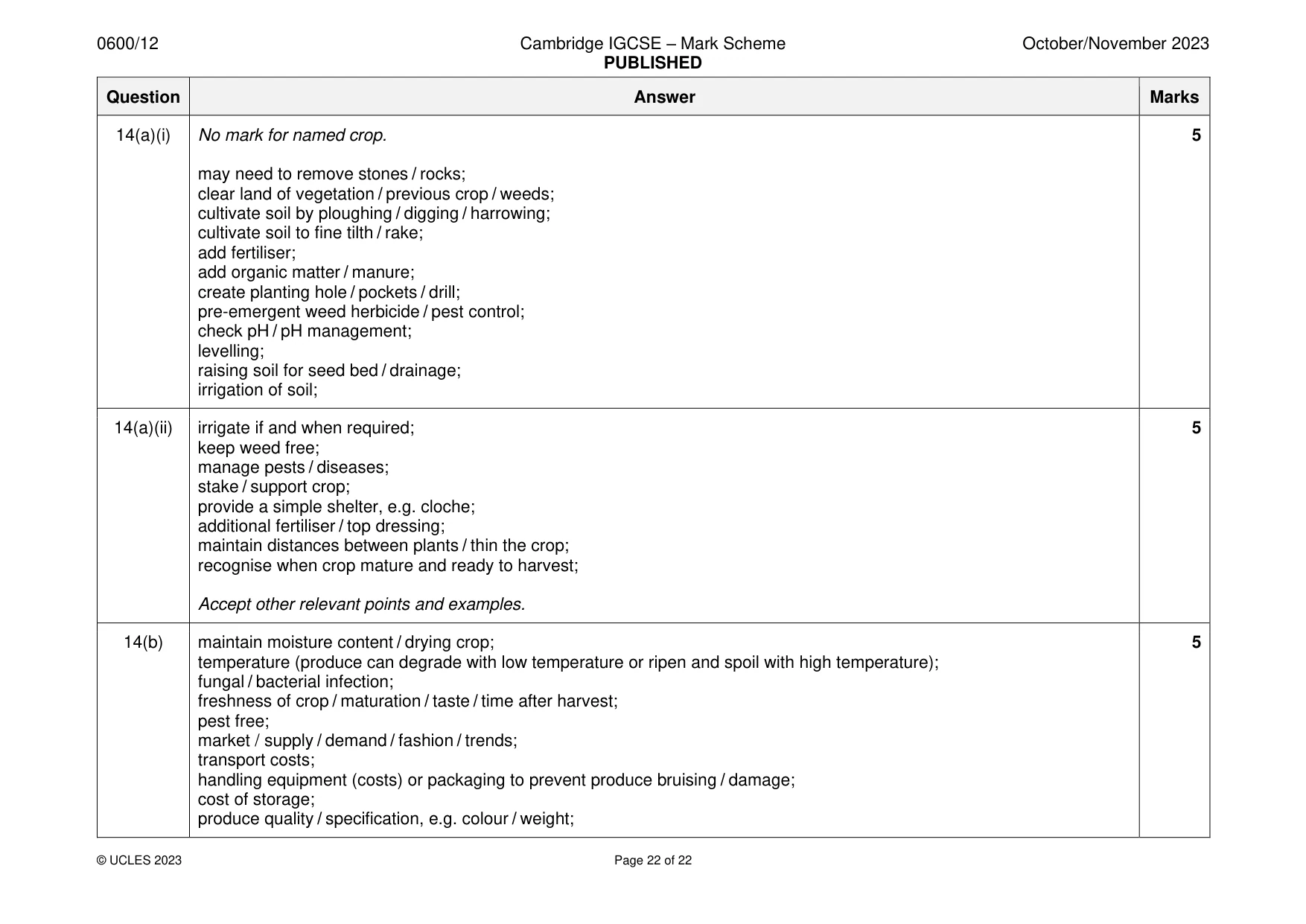
0600/12 Cambridge IGCSE – Mark Scheme PUBLISHED October/November 2023 © UCLES 2023 Page 22 of 22 Question Answer Marks 14(a)(i) No mark for named crop. may need to remove stones / rocks; clear land of vegetation / previous crop / weeds; cultivate soil by ploughing / digging / harrowing; cultivate soil to fine tilth / rake; add fertiliser; add organic matter / manure; create planting hole / pockets / drill; pre-emergent weed herbicide / pest control; check pH / pH management; levelling; raising soil for seed bed / drainage; irrigation of soil; 5 14(a)(ii) irrigate if and when required; keep weed free; manage pests / diseases; stake / support crop; provide a simple shelter, e.g. cloche; additional fertiliser / top dressing; maintain distances between plants / thin the crop; recognise when crop mature and ready to harvest; Accept other relevant points and examples. 5 14(b) maintain moisture content / drying crop; temperature (produce can degrade with low temperature or ripen and spoil with high temperature); fungal / bacterial infection; freshness of crop / maturation / taste / time after harvest; pest free; market / supply / demand / fashion / trends; transport costs; handling equipment (costs) or packaging to prevent produce bruising / damage; cost of storage; produce quality / specification, e.g. colour / weight; 5
What you needed in this session
Cambridge’s own grade thresholds for 2023 Oct/Nov, Paper 1 · Variant 2. A higher threshold means an easier paper — the bar moves with how the cohort did.