Cambridge IGCSE Agriculture 0600 — 2021 Oct/Nov Paper 1 · Variant 2
0600/12/O/N/21 · 100 marks · ≈113 min
The question paper and its mark scheme, free to read here and free to download. This is Cambridge’s own paper, exactly as it was sat.
Question paper24 pages








Mark scheme24 pages
Answers below. Sit the paper first if you are practising.
Paper as text
Question paper, page 1
This document has 24 pages. Any blank pages are indicated. Cambridge IGCSE™ DC (LK/SG) 212598/2 © UCLES 2021 [Turn over * 7 0 5 7 5 5 1 3 6 4 * AGRICULTURE 0600/12 Paper 1 Theory October/November 2021 1 hour 45 minutes You must answer on the question paper. No additional materials are needed. INSTRUCTIONS ● Section A: answer all questions. ● Section B: answer two questions. ● Use a black or dark blue pen. You may use an HB pencil for any diagrams or graphs. ● Write your name, centre number and candidate number in the boxes at the top of the page. ● Write your answer to each question in the space provided. ● Do not use an erasable pen or correction fluid. ● Do not write on any bar codes. ● You may use a calculator. ● You should show all your working and use appropriate units. INFORMATION ● The total mark for this paper is 100. ● The number of marks for each question or part question is shown in brackets [ ].
Question paper, page 2
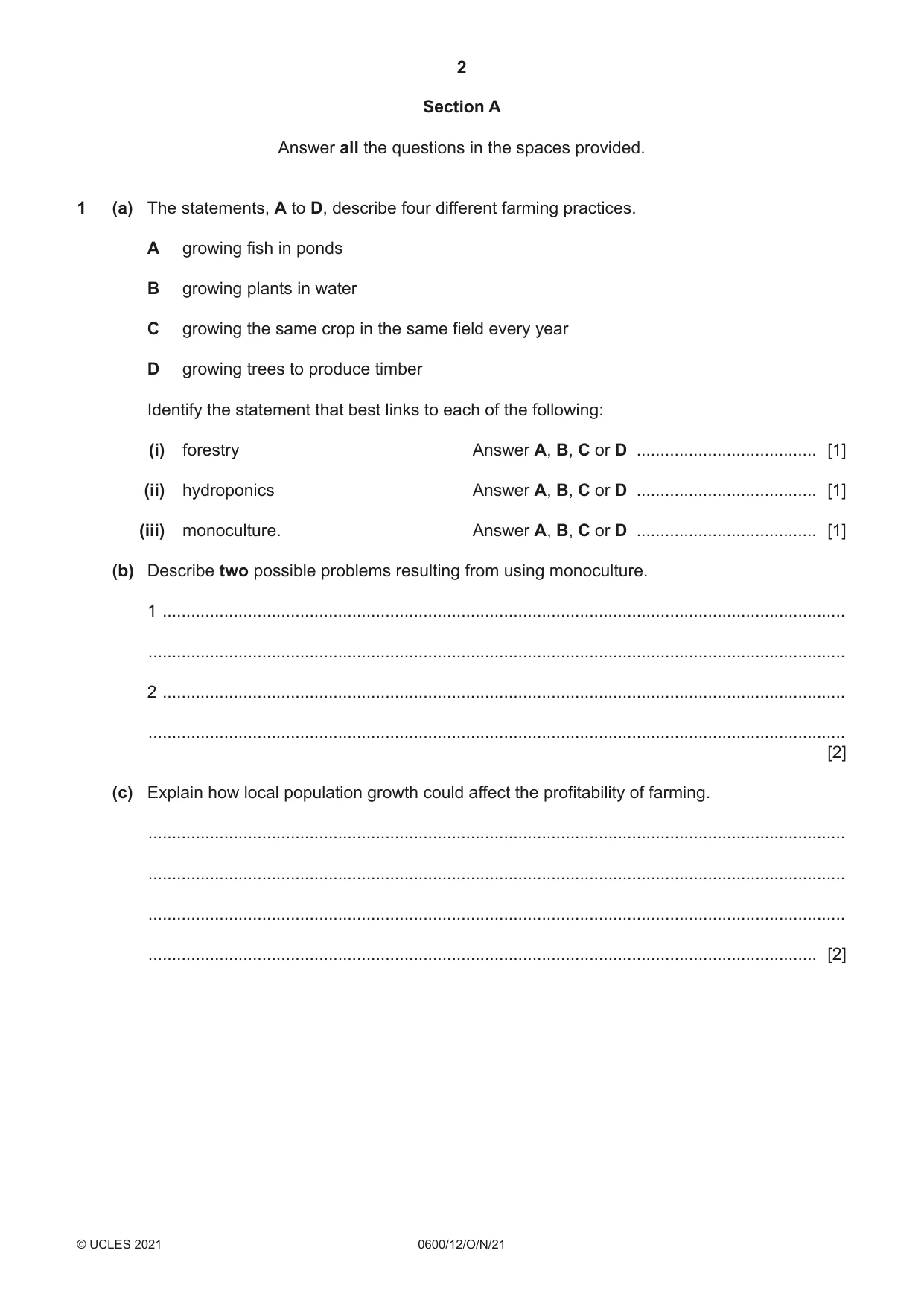
2 0600/12/O/N/21 © UCLES 2021 Section A Answer all the questions in the spaces provided. 1 (a) The statements, A to D, describe four different farming practices. A growing fish in ponds B growing plants in water C growing the same crop in the same field every year D growing trees to produce timber Identify the statement that best links to each of the following: (i) forestry Answer A, B, C or D … [1] (ii) hydroponics Answer A, B, C or D … [1] (iii) monoculture. Answer A, B, C or D … [1] (b) Describe two possible problems resulting from using monoculture. 1 … … 2 … … [2] (c) Explain how local population growth could affect the profitability of farming. … … … … [2]
Question paper, page 3
3 0600/12/O/N/21 © UCLES 2021 [Turn over (d) Suggest two economic reasons why many farmers choose to use a mixed farming system. 1 … … 2 … … [2] [Total: 9]
Question paper, page 4
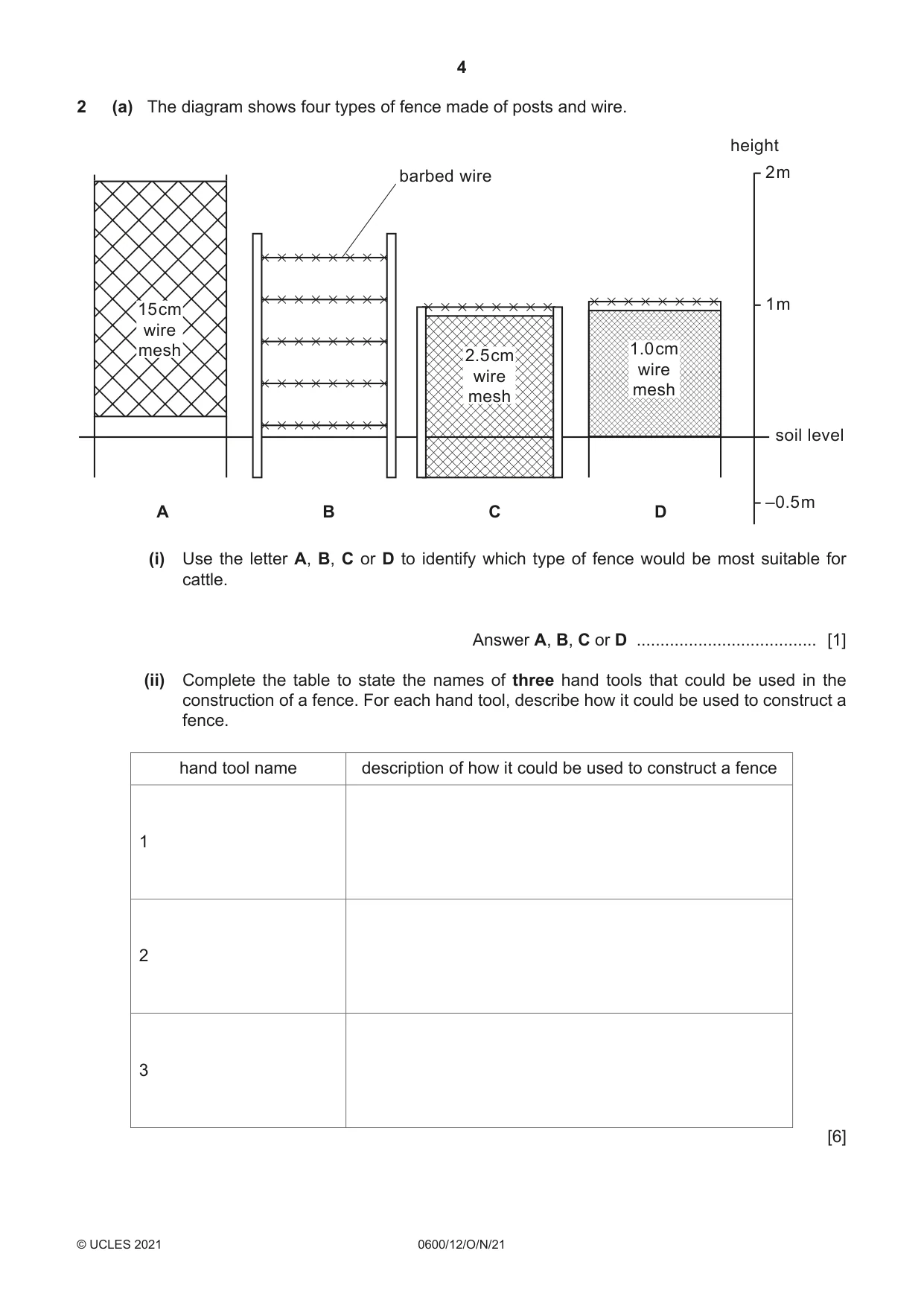
4 0600/12/O/N/21 © UCLES 2021 2 (a) The diagram shows four types of fence made of posts and wire. A B C D 15cm wire mesh 2.5cm wire mesh 1.0cm wire mesh 2m 1m –0.5m soil level height barbed wire (i) Use the letter A, B, C or D to identify which type of fence would be most suitable for cattle. Answer A, B, C or D … [1] (ii) Complete the table to state the names of three hand tools that could be used in the construction of a fence. For each hand tool, describe how it could be used to construct a fence. hand tool name description of how it could be used to construct a fence 1 2 3 [6]
Question paper, page 5
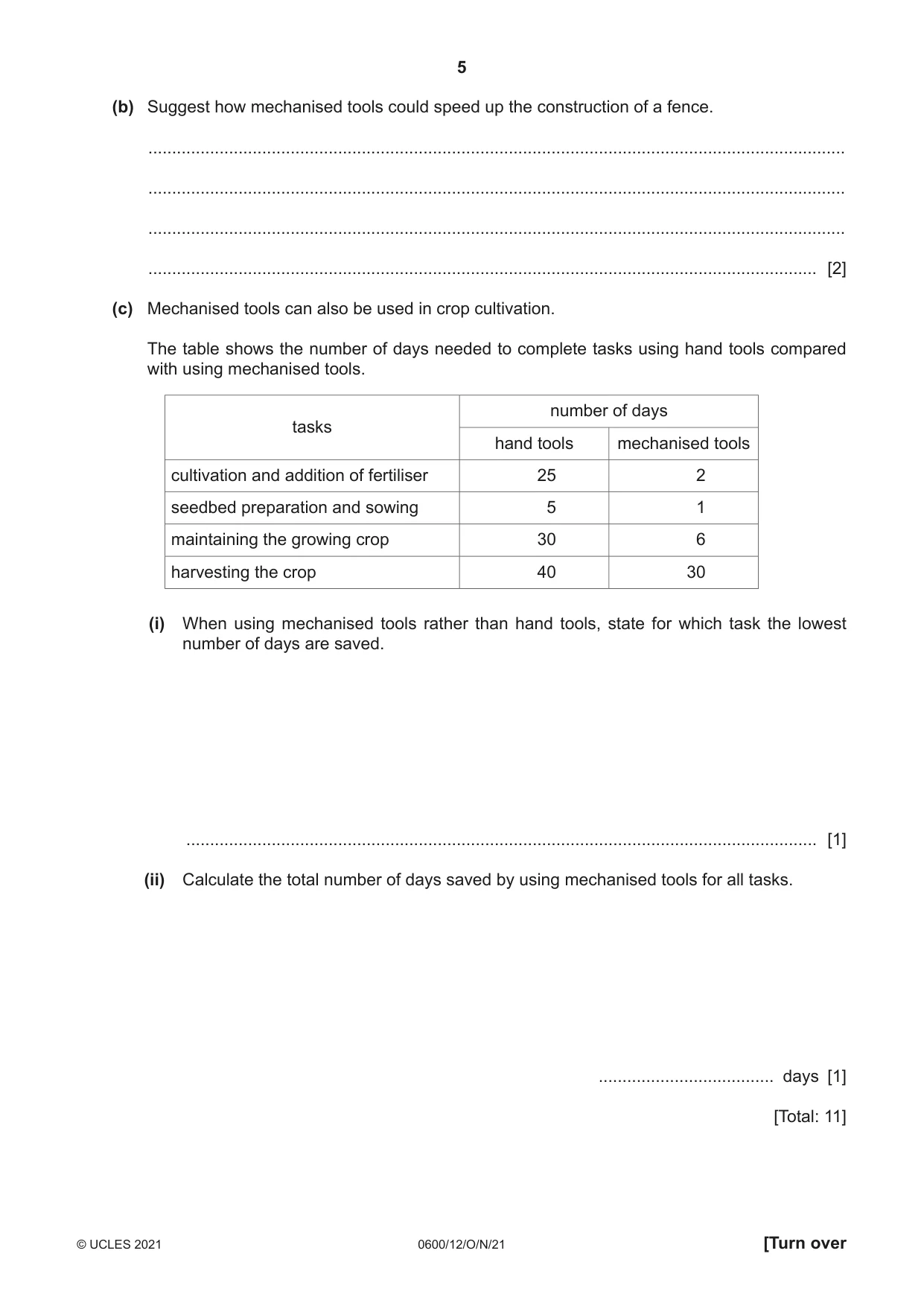
5 0600/12/O/N/21 © UCLES 2021 [Turn over (b) Suggest how mechanised tools could speed up the construction of a fence. … … … … [2] (c) Mechanised tools can also be used in crop cultivation. The table shows the number of days needed to complete tasks using hand tools compared with using mechanised tools. tasks number of days hand tools mechanised tools cultivation and addition of fertiliser 25 2 seedbed preparation and sowing 5 1 maintaining the growing crop 30 6 harvesting the crop 40 30 (i) When using mechanised tools rather than hand tools, state for which task the lowest number of days are saved. … [1] (ii) Calculate the total number of days saved by using mechanised tools for all tasks. … days [1] [Total: 11]
Question paper, page 6
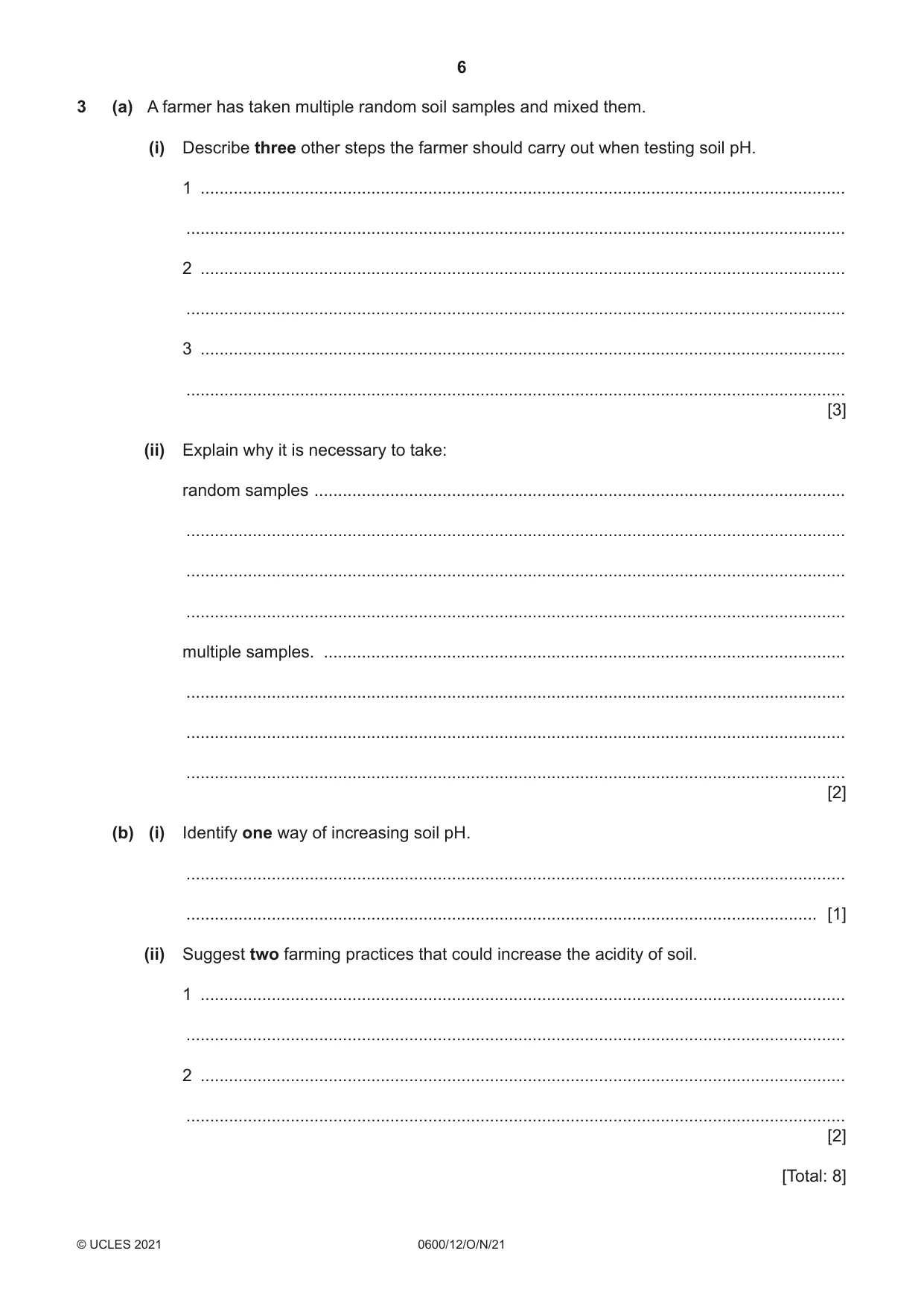
6 0600/12/O/N/21 © UCLES 2021 3 (a) A farmer has taken multiple random soil samples and mixed them. (i) Describe three other steps the farmer should carry out when testing soil pH. 1 … … 2 … … 3 … … [3] (ii) Explain why it is necessary to take: random samples … … … … multiple samples. … … … … [2] (b) (i) Identify one way of increasing soil pH. … … [1] (ii) Suggest two farming practices that could increase the acidity of soil. 1 … … 2 … … [2] [Total: 8]
Question paper, page 7
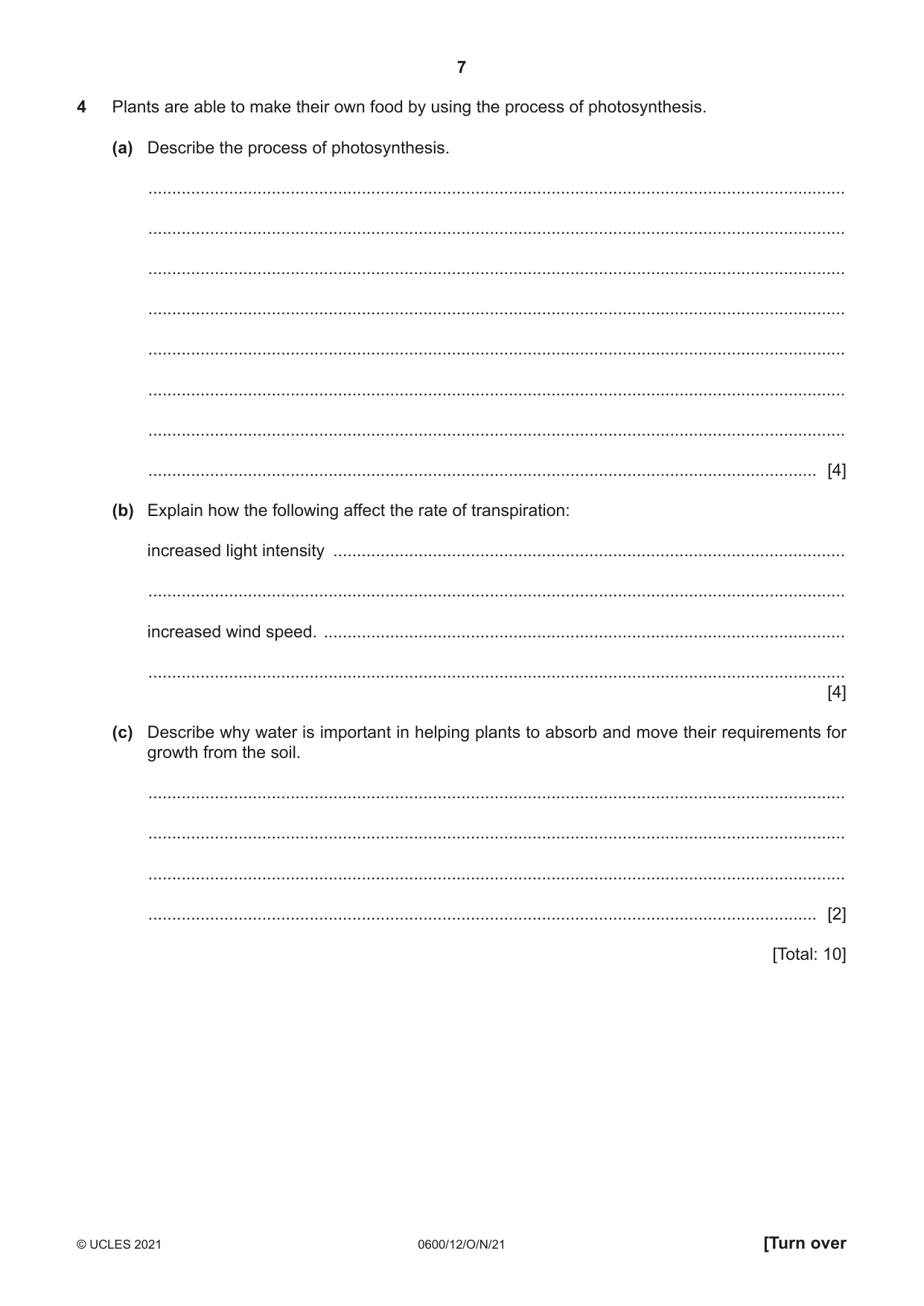
7 0600/12/O/N/21 © UCLES 2021 [Turn over 4 Plants are able to make their own food by using the process of photosynthesis. (a) Describe the process of photosynthesis. … … … … … … … … [4] (b) Explain how the following affect the rate of transpiration: increased light intensity … … increased wind speed. … … [4] (c) Describe why water is important in helping plants to absorb and move their requirements for growth from the soil. … … … … [2] [Total: 10]
Question paper, page 8
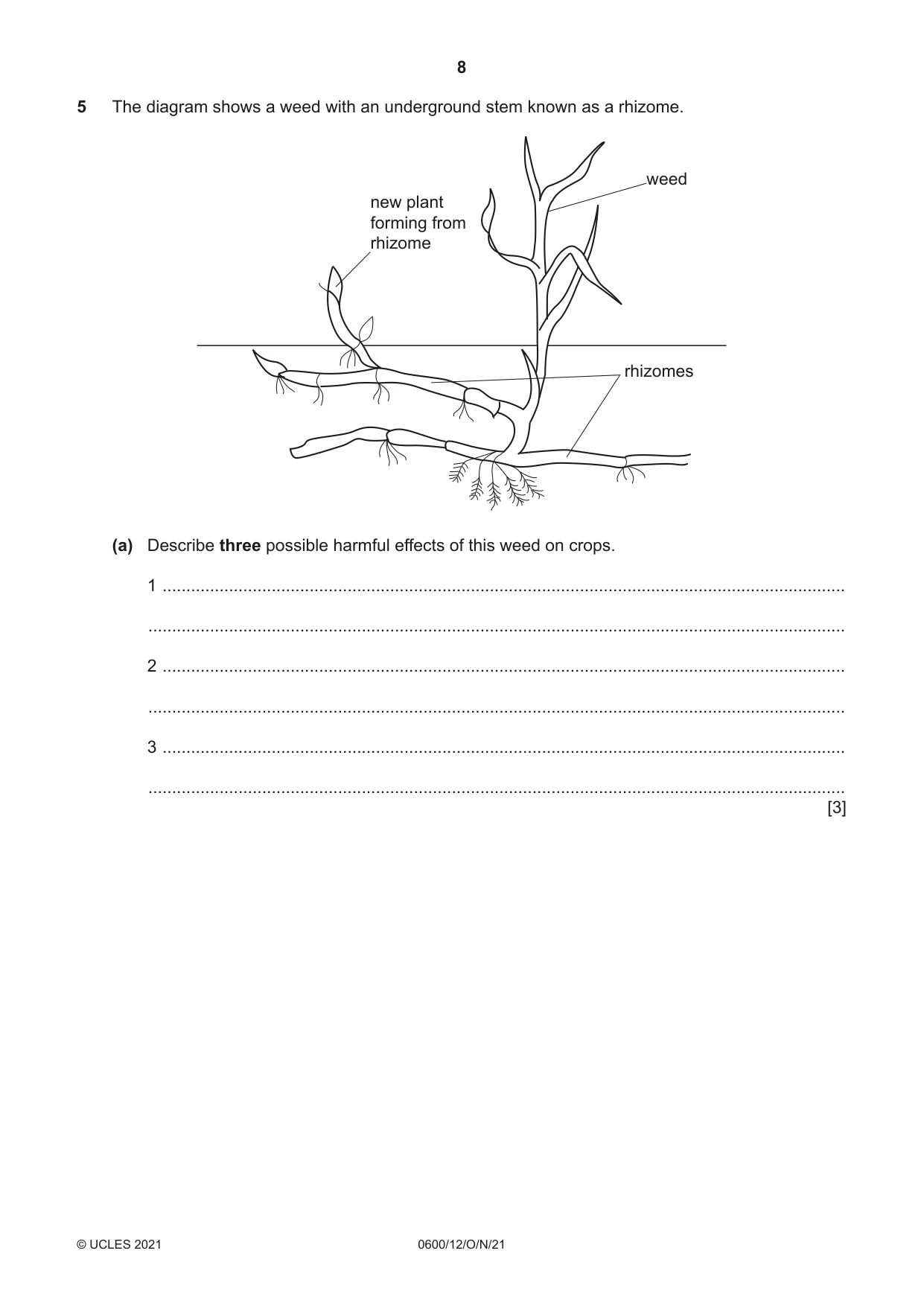
8 0600/12/O/N/21 © UCLES 2021 5 The diagram shows a weed with an underground stem known as a rhizome. rhizomes new plant forming from rhizome weed (a) Describe three possible harmful effects of this weed on crops. 1 … … 2 … … 3 … … [3]
Question paper, page 9
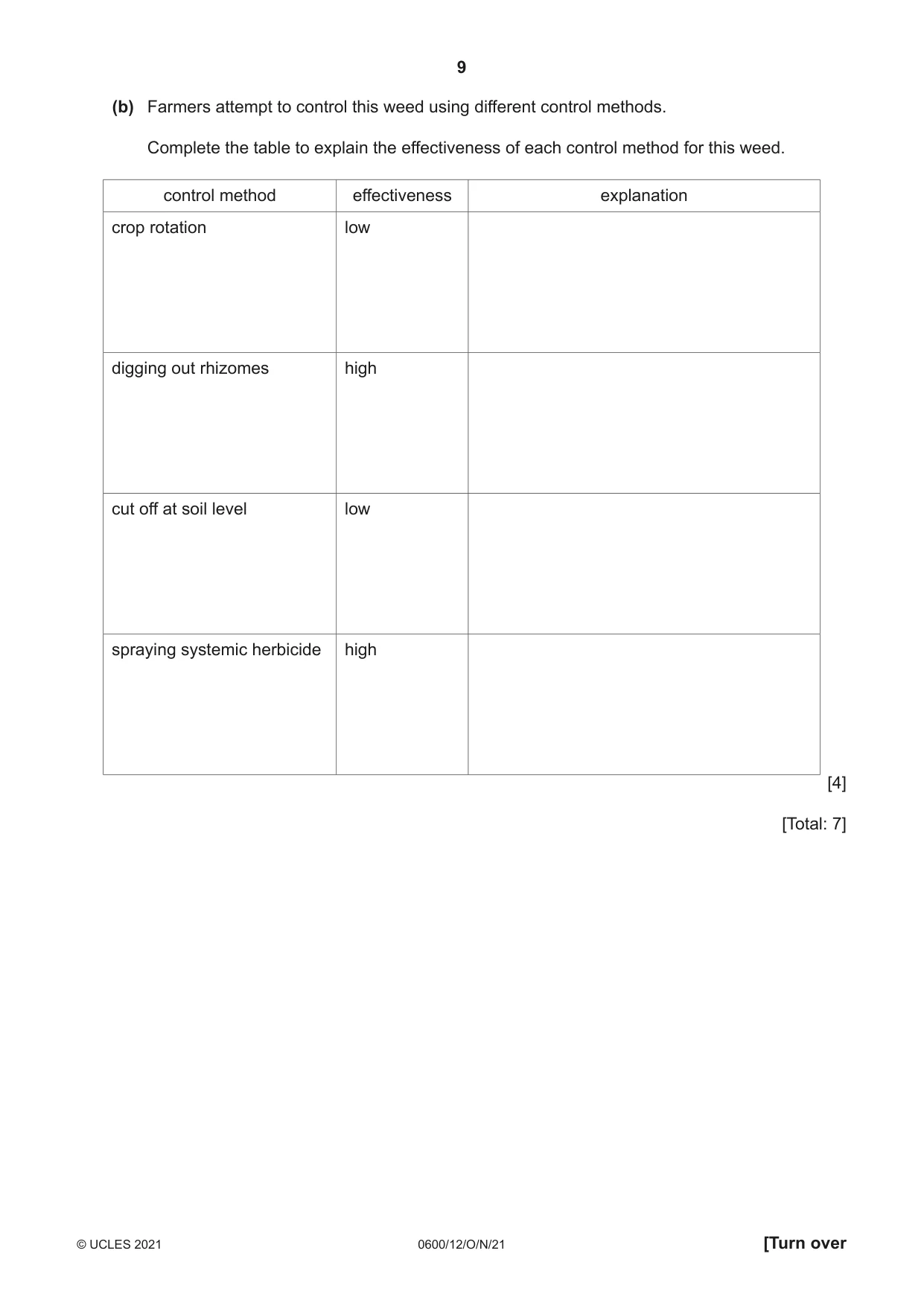
9 0600/12/O/N/21 © UCLES 2021 [Turn over (b) Farmers attempt to control this weed using different control methods. Complete the table to explain the effectiveness of each control method for this weed. control method effectiveness explanation crop rotation low digging out rhizomes high cut off at soil level low spraying systemic herbicide high [4] [Total: 7]
Question paper, page 10
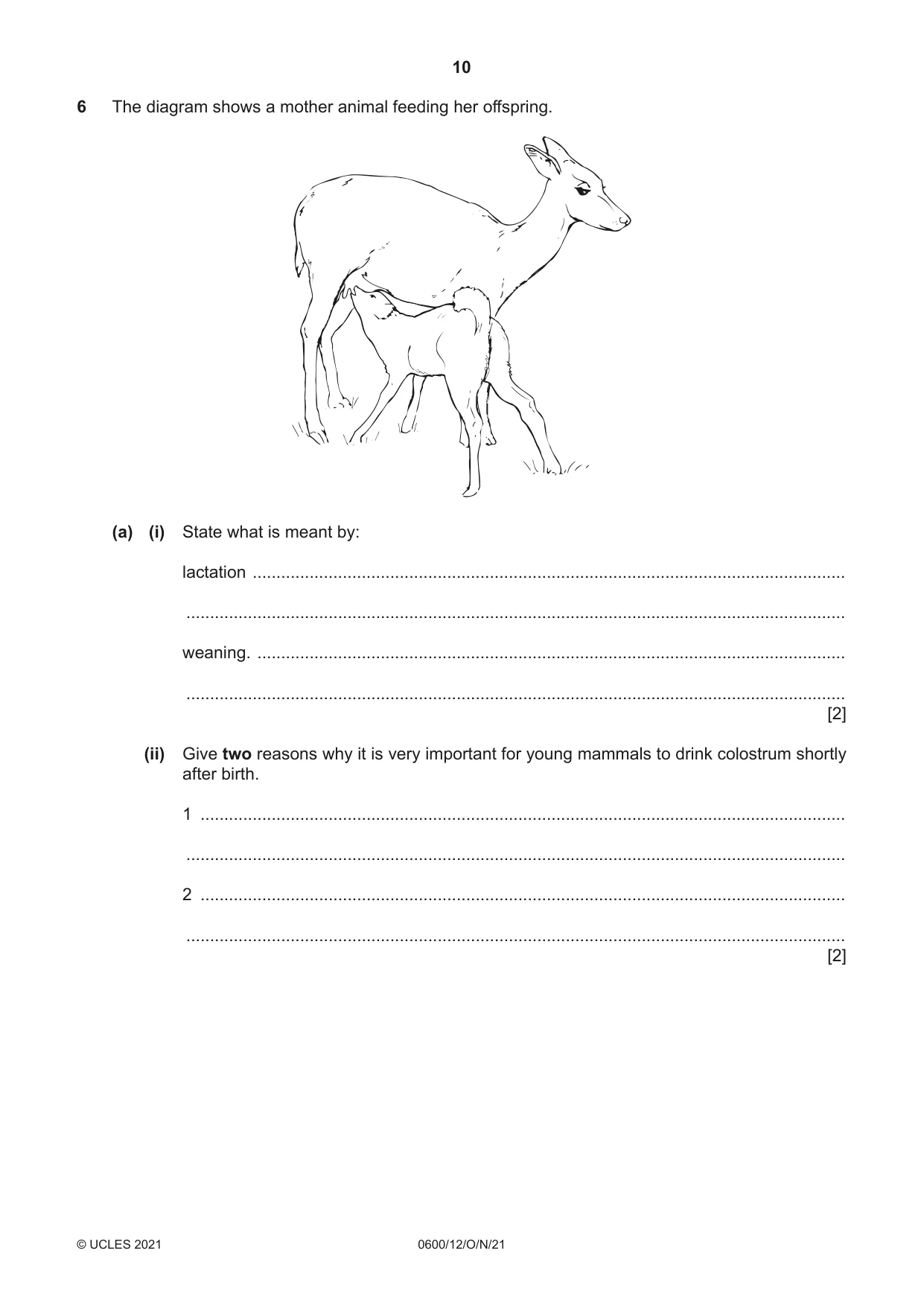
10 0600/12/O/N/21 © UCLES 2021 6 The diagram shows a mother animal feeding her offspring. (a) (i) State what is meant by: lactation … … weaning. … … [2] (ii) Give two reasons why it is very important for young mammals to drink colostrum shortly after birth. 1 … … 2 … … [2]
Question paper, page 11
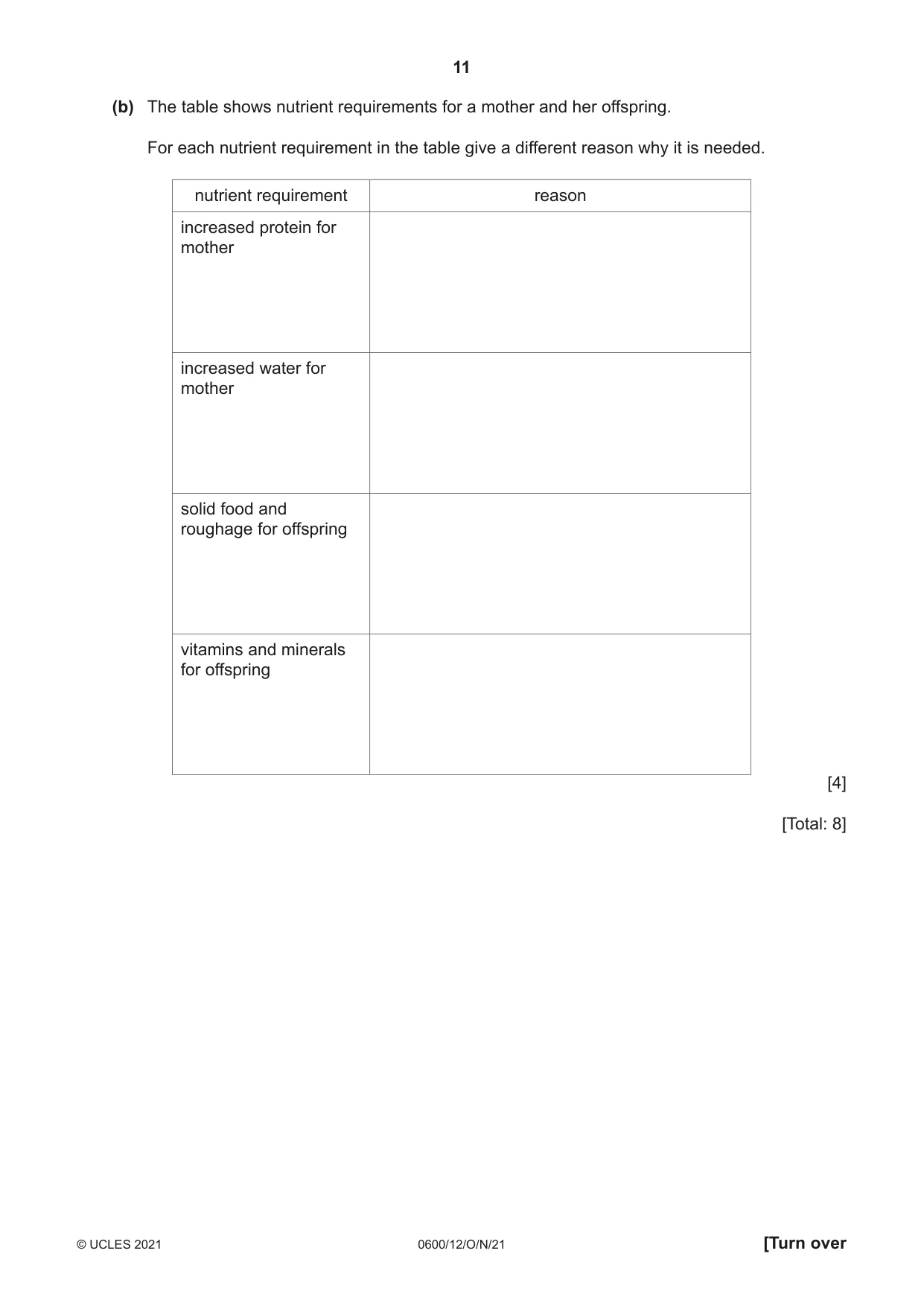
11 0600/12/O/N/21 © UCLES 2021 [Turn over (b) The table shows nutrient requirements for a mother and her offspring. For each nutrient requirement in the table give a different reason why it is needed. nutrient requirement reason increased protein for mother increased water for mother solid food and roughage for offspring vitamins and minerals for offspring [4] [Total: 8]
Question paper, page 12
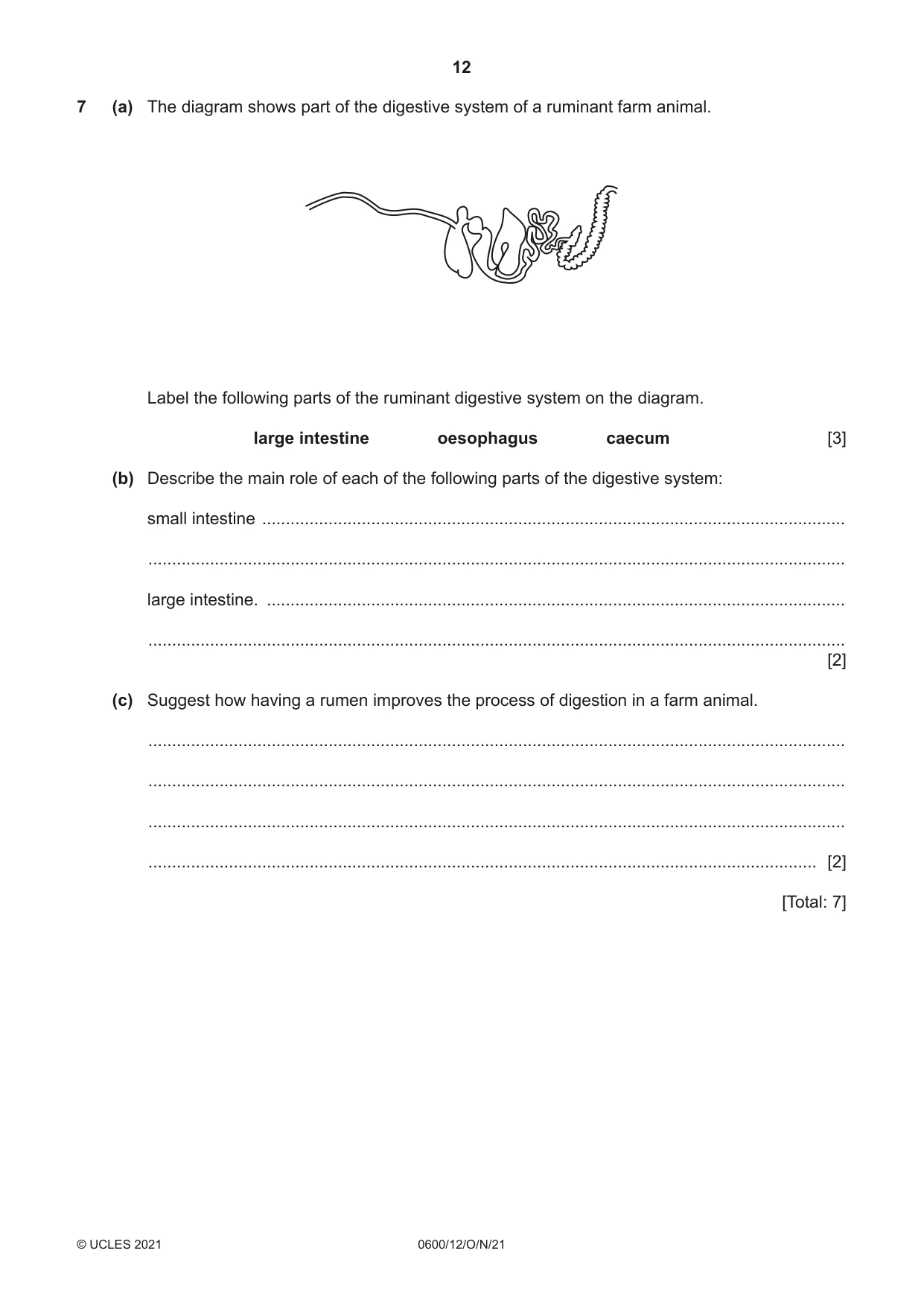
12 0600/12/O/N/21 © UCLES 2021 7 (a) The diagram shows part of the digestive system of a ruminant farm animal. Label the following parts of the ruminant digestive system on the diagram. large intestine oesophagus caecum [3] (b) Describe the main role of each of the following parts of the digestive system: small intestine … … large intestine. … … [2] (c) Suggest how having a rumen improves the process of digestion in a farm animal. … … … … [2] [Total: 7]
Question paper, page 13
13 0600/12/O/N/21 © UCLES 2021 [Turn over 8 Some large animals are kept in farm buildings. (a) Explain different reasons why each of the following are important in farm buildings: suitable bedding … … … … good ventilation. … … … … [4] (b) Suggest two other features of farm buildings that help keep animals healthy. 1 … … 2 … … [2] [Total: 6]
Question paper, page 14
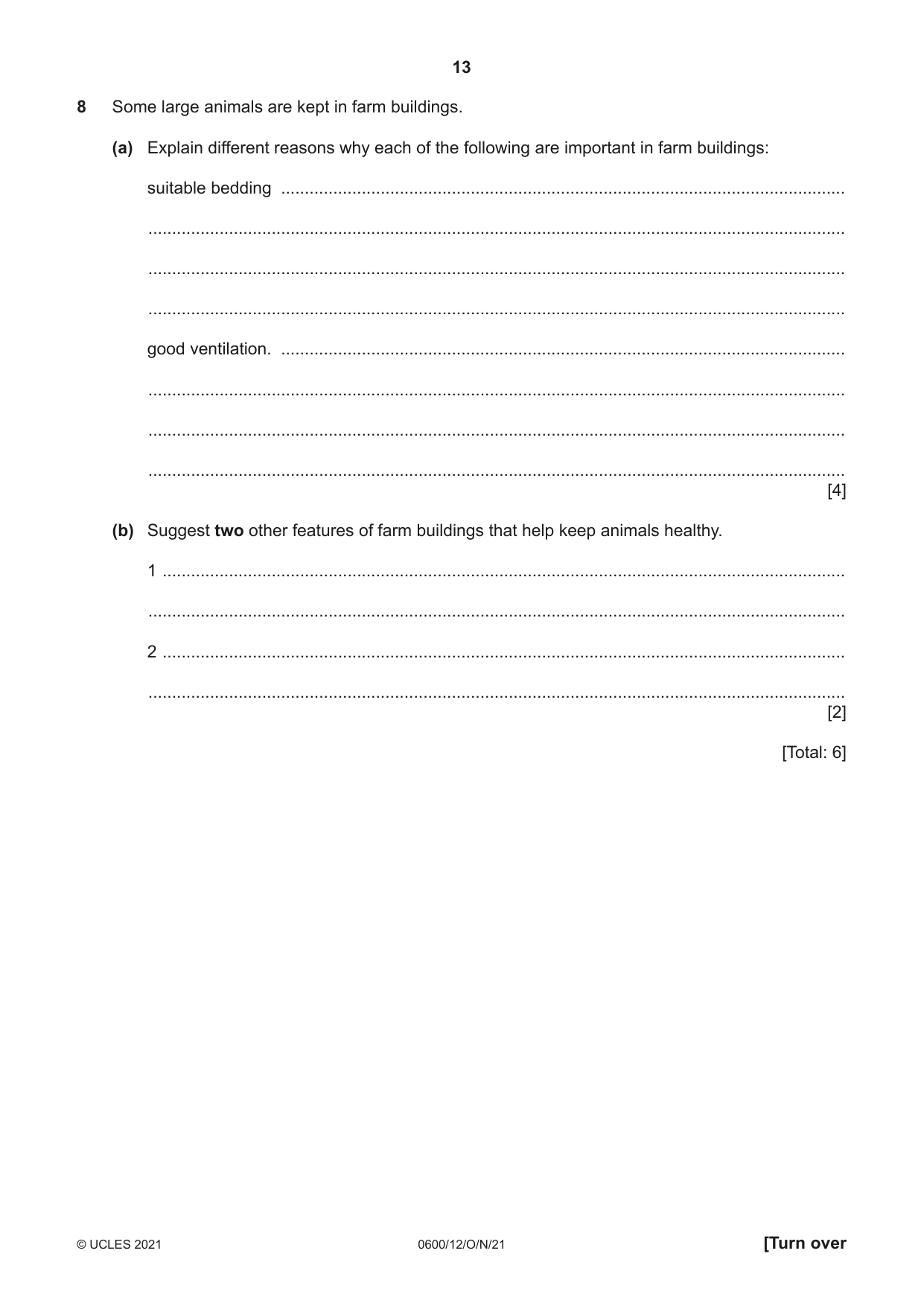
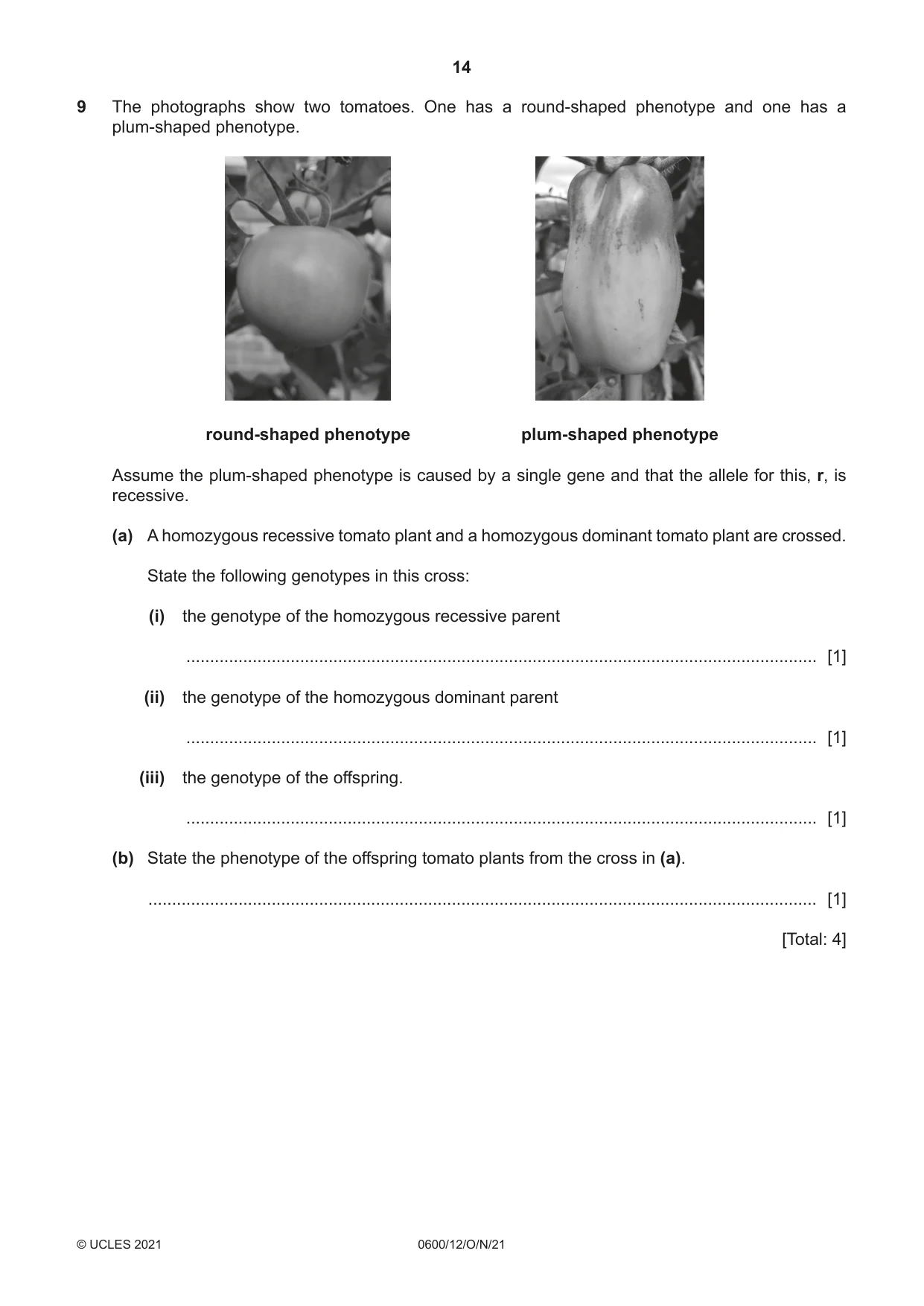
14 0600/12/O/N/21 © UCLES 2021 9 The photographs show two tomatoes. One has a round-shaped phenotype and one has a plum-shaped phenotype. round-shaped phenotype plum-shaped phenotype Assume the plum-shaped phenotype is caused by a single gene and that the allele for this, r, is recessive. (a) A homozygous recessive tomato plant and a homozygous dominant tomato plant are crossed. State the following genotypes in this cross: (i) the genotype of the homozygous recessive parent … [1] (ii) the genotype of the homozygous dominant parent … [1] (iii) the genotype of the offspring. … [1] (b) State the phenotype of the offspring tomato plants from the cross in (a). … [1] [Total: 4]
Question paper, page 15
15 0600/12/O/N/21 © UCLES 2021 [Turn over BLANK PAGE
Question paper, page 16
16 0600/12/O/N/21 © UCLES 2021 Section B Answer any two questions. Write the question numbers you have chosen here: … 10 (a) Describe what is meant by intensive grazing. [4] (b) Explain how rotational grazing increases the carrying capacity of a pasture. [5] (c) Discuss how overstocking causes problems for animal health. [6] [Total: 15] 11 (a) State the name of a piercing and sucking crop pest. Describe how the actions of this pest can reduce crop yield. [4] (b) Describe how chemicals can be used to control insect crop pests. [5] (c) Discuss, using examples, why a farmer might choose to control insect crop pests without using chemicals. [6] [Total: 15] 12 (a) Describe the properties of a loam soil. [3] (b) Describe what is meant by soil erosion. Suggest reasons why soil erosion may be more of a problem on a sandy soil than on a loam soil. [6] (c) Other than soil erosion, explain why crop yields are likely to be low when growing crops in a sandy soil. [6] [Total: 15] 13 (a) Describe what is meant by organic farming. [4] (b) Discuss how organic farming could affect farm profits. [6] (c) Explain why a farmer may choose to grow a genetically modified (GM) crop, even though the seeds are more expensive than the seeds of a non-GM crop. [5] [Total: 15] 14 (a) Describe signs of ill-health in farm livestock. [5] (b) Describe the information that should be recorded as part of good stockmanship. [5] (c) Discuss how livestock breeding could be used to minimise disease in livestock. [5] [Total: 15]
Question paper, page 17
17 0600/12/O/N/21 © UCLES 2021 … … … … … … … … … … … … … … … … … … … … … … … … … … … …
Question paper, page 18
18 0600/12/O/N/21 © UCLES 2021 … … … … … … … … … … … … … … … … … … … … … … … … … … … …
Question paper, page 19
19 0600/12/O/N/21 © UCLES 2021 … … … … … … … … … … … … … … … … … … … … … … … … … … … …
Question paper, page 20
20 0600/12/O/N/21 © UCLES 2021 … … … … … … … … … … … … … … … … … … … … … … … … … … … …
Question paper, page 21
21 0600/12/O/N/21 © UCLES 2021 … … … … … … … … … … … … … … … … … … … … … … … … … … … …
Question paper, page 22
22 0600/12/O/N/21 © UCLES 2021 BLANK PAGE
Question paper, page 23
23 0600/12/O/N/21 © UCLES 2021 BLANK PAGE
Question paper, page 24
24 0600/12/O/N/21 © UCLES 2021 Permission to reproduce items where third-party owned material protected by copyright is included has been sought and cleared where possible. Every reasonable effort has been made by the publisher (UCLES) to trace copyright holders, but if any items requiring clearance have unwittingly been included, the publisher will be pleased to make amends at the earliest possible opportunity. To avoid the issue of disclosure of answer-related information to candidates, all copyright acknowledgements are reproduced online in the Cambridge Assessment International Education Copyright Acknowledgements Booklet. This is produced for each series of examinations and is freely available to download at www.cambridgeinternational.org after the live examination series. Cambridge Assessment International Education is part of the Cambridge Assessment Group. Cambridge Assessment is the brand name of the University of Cambridge Local Examinations Syndicate (UCLES), which itself is a department of the University of Cambridge. BLANK PAGE
Mark scheme, page 1
This document consists of 24 printed pages. © UCLES 2021 [Turn over Cambridge IGCSE™ AGRICULTURE 0600/12 Paper 1 Theory October/November 2021 MARK SCHEME Maximum Mark: 100 Published This mark scheme is published as an aid to teachers and candidates, to indicate the requirements of the examination. It shows the basis on which Examiners were instructed to award marks. It does not indicate the details of the discussions that took place at an Examiners’ meeting before marking began, which would have considered the acceptability of alternative answers. Mark schemes should be read in conjunction with the question paper and the Principal Examiner Report for Teachers. Cambridge International will not enter into discussions about these mark schemes. Cambridge International is publishing the mark schemes for the October/November 2021 series for most Cambridge IGCSE™, Cambridge International A and AS Level components and some Cambridge O Level components.
Mark scheme, page 2
0600/12 Cambridge IGCSE – Mark Scheme PUBLISHED October/November 2021 © UCLES 2021 Page 2 of 24 Generic Marking Principles These general marking principles must be applied by all examiners when marking candidate answers. They should be applied alongside the specific content of the mark scheme or generic level descriptors for a question. Each question paper and mark scheme will also comply with these marking principles. GENERIC MARKING PRINCIPLE 1: Marks must be awarded in line with: • the specific content of the mark scheme or the generic level descriptors for the question • the specific skills defined in the mark scheme or in the generic level descriptors for the question • the standard of response required by a candidate as exemplified by the standardisation scripts. GENERIC MARKING PRINCIPLE 2: Marks awarded are always whole marks (not half marks, or other fractions). GENERIC MARKING PRINCIPLE 3: Marks must be awarded positively: • marks are awarded for correct/valid answers, as defined in the mark scheme. However, credit is given for valid answers which go beyond the scope of the syllabus and mark scheme, referring to your Team Leader as appropriate • marks are awarded when candidates clearly demonstrate what they know and can do • marks are not deducted for errors • marks are not deducted for omissions • answers should only be judged on the quality of spelling, punctuation and grammar when these features are specifically assessed by the question as indicated by the mark scheme. The meaning, however, should be unambiguous. GENERIC MARKING PRINCIPLE 4: Rules must be applied consistently, e.g. in situations where candidates have not followed instructions or in the application of generic level descriptors.
Mark scheme, page 3
0600/12 Cambridge IGCSE – Mark Scheme PUBLISHED October/November 2021 © UCLES 2021 Page 3 of 24 GENERIC MARKING PRINCIPLE 5: Marks should be awarded using the full range of marks defined in the mark scheme for the question (however; the use of the full mark range may be limited according to the quality of the candidate responses seen). GENERIC MARKING PRINCIPLE 6: Marks awarded are based solely on the requirements as defined in the mark scheme. Marks should not be awarded with grade thresholds or grade descriptors in mind. Science-Specific Marking Principles 1 Examiners should consider the context and scientific use of any keywords when awarding marks. Although keywords may be present, marks should not be awarded if the keywords are used incorrectly. 2 The examiner should not choose between contradictory statements given in the same question part, and credit should not be awarded for any correct statement that is contradicted within the same question part. Wrong science that is irrelevant to the question should be ignored. 3 Although spellings do not have to be correct, spellings of syllabus terms must allow for clear and unambiguous separation from other syllabus terms with which they may be confused (e.g. ethane / ethene, glucagon / glycogen, refraction / reflection). 4 The error carried forward (ecf) principle should be applied, where appropriate. If an incorrect answer is subsequently used in a scientifically correct way, the candidate should be awarded these subsequent marking points. Further guidance will be included in the mark scheme where necessary and any exceptions to this general principle will be noted. 5 ‘List rule’ guidance For questions that require n responses (e.g. State two reasons …): • The response should be read as continuous prose, even when numbered answer spaces are provided. • Any response marked ignore in the mark scheme should not count towards n. • Incorrect responses should not be awarded credit but will still count towards n. • Read the entire response to check for any responses that contradict those that would otherwise be credited. Credit should not be awarded for any responses that are contradicted within the rest of the response. Where two responses contradict one another, this should be treated as a single incorrect response. • Non-contradictory responses after the first n responses may be ignored even if they include incorrect science.
Mark scheme, page 4
0600/12 Cambridge IGCSE – Mark Scheme PUBLISHED October/November 2021 © UCLES 2021 Page 4 of 24 6 Calculation specific guidance Correct answers to calculations should be given full credit even if there is no working or incorrect working, unless the question states ‘show your working’. For questions in which the number of significant figures required is not stated, credit should be awarded for correct answers when rounded by the examiner to the number of significant figures given in the mark scheme. This may not apply to measured values. For answers given in standard form (e.g. a × 10n) in which the convention of restricting the value of the coefficient (a) to a value between 1 and 10 is not followed, credit may still be awarded if the answer can be converted to the answer given in the mark scheme. Unless a separate mark is given for a unit, a missing or incorrect unit will normally mean that the final calculation mark is not awarded. Exceptions to this general principle will be noted in the mark scheme. 7 Guidance for chemical equations Multiples / fractions of coefficients used in chemical equations are acceptable unless stated otherwise in the mark scheme. State symbols given in an equation should be ignored unless asked for in the question or stated otherwise in the mark scheme.
Mark scheme, page 5
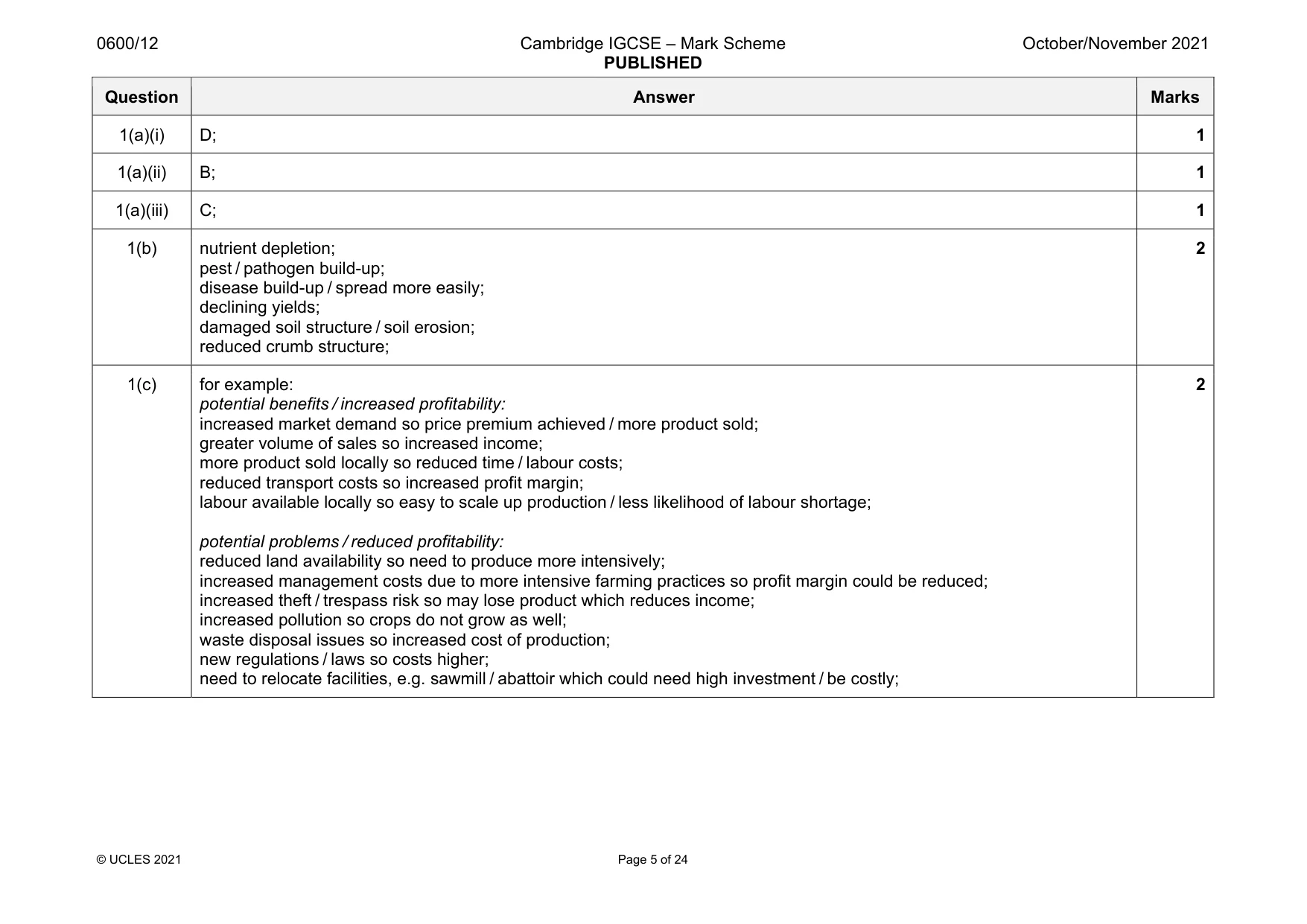
0600/12 Cambridge IGCSE – Mark Scheme PUBLISHED October/November 2021 © UCLES 2021 Page 5 of 24 Question Answer Marks 1(a)(i) D; 1 1(a)(ii) B; 1 1(a)(iii) C; 1 1(b) nutrient depletion; pest / pathogen build-up; disease build-up / spread more easily; declining yields; damaged soil structure / soil erosion; reduced crumb structure; 2 1(c) for example: potential benefits / increased profitability: increased market demand so price premium achieved / more product sold; greater volume of sales so increased income; more product sold locally so reduced time / labour costs; reduced transport costs so increased profit margin; labour available locally so easy to scale up production / less likelihood of labour shortage; potential problems / reduced profitability: reduced land availability so need to produce more intensively; increased management costs due to more intensive farming practices so profit margin could be reduced; increased theft / trespass risk so may lose product which reduces income; increased pollution so crops do not grow as well; waste disposal issues so increased cost of production; new regulations / laws so costs higher; need to relocate facilities, e.g. sawmill / abattoir which could need high investment / be costly; 2
Mark scheme, page 6
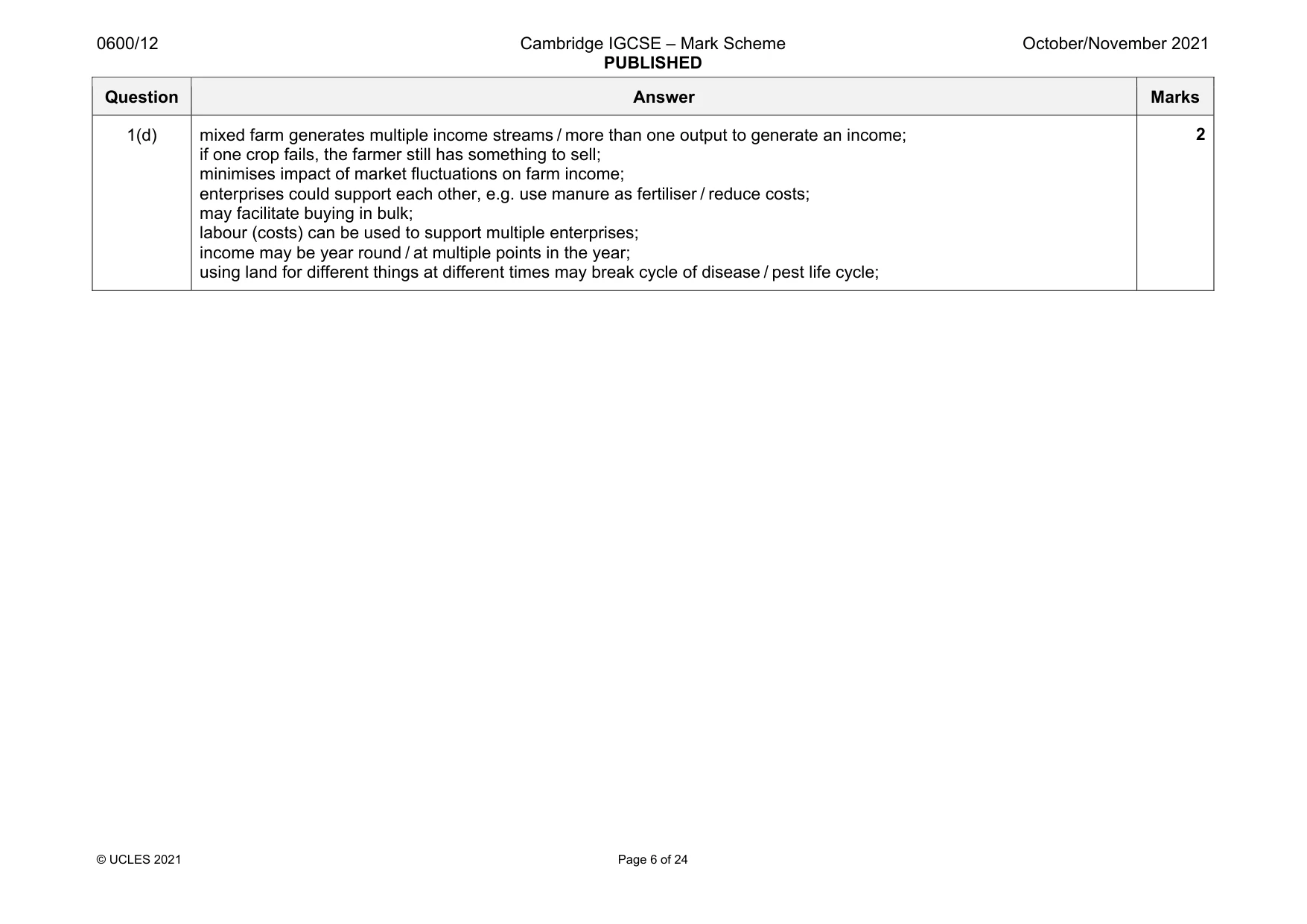
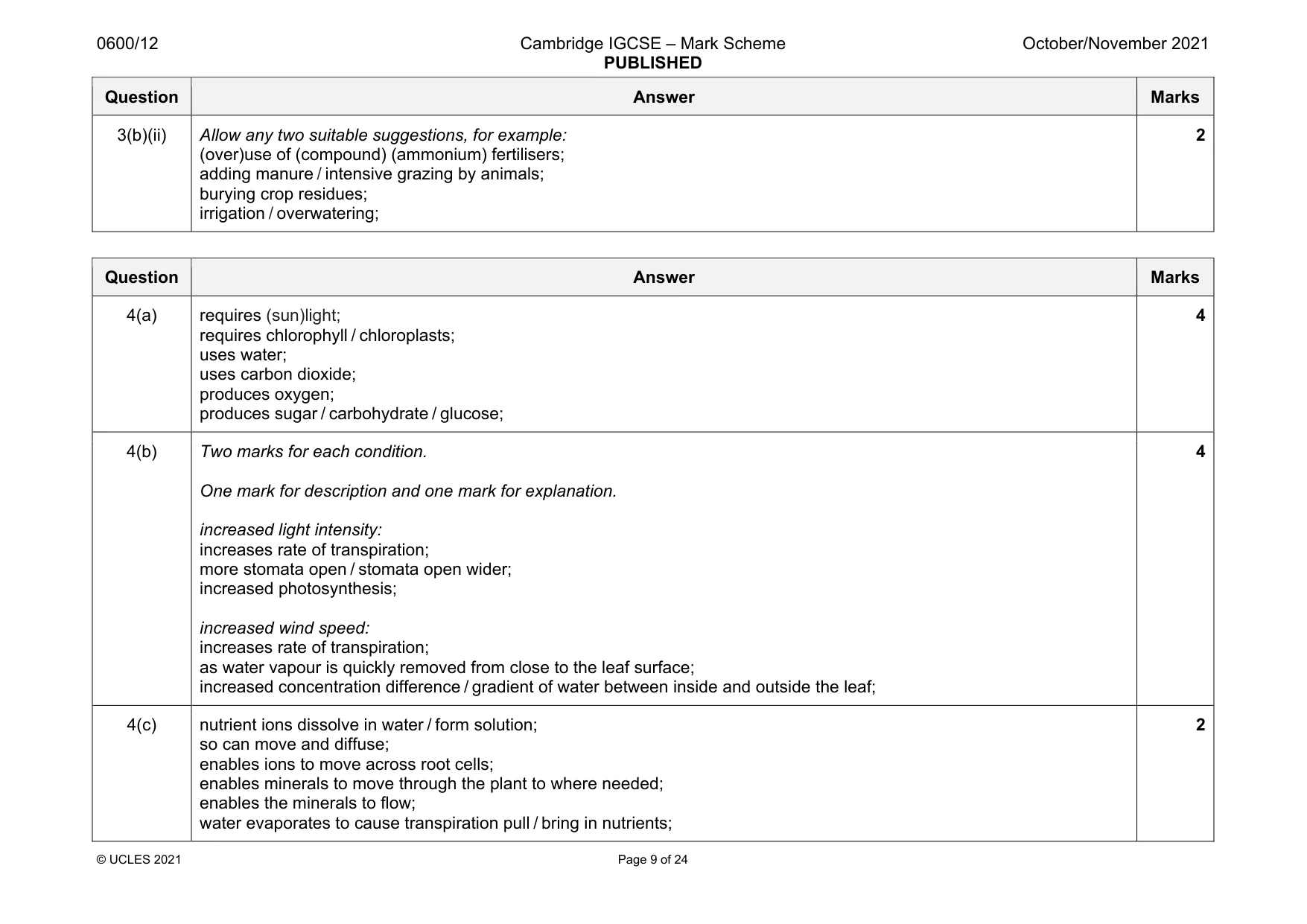
0600/12 Cambridge IGCSE – Mark Scheme PUBLISHED October/November 2021 © UCLES 2021 Page 6 of 24 Question Answer Marks 1(d) mixed farm generates multiple income streams / more than one output to generate an income; if one crop fails, the farmer still has something to sell; minimises impact of market fluctuations on farm income; enterprises could support each other, e.g. use manure as fertiliser / reduce costs; may facilitate buying in bulk; labour (costs) can be used to support multiple enterprises; income may be year round / at multiple points in the year; using land for different things at different times may break cycle of disease / pest life cycle; 2
Mark scheme, page 7
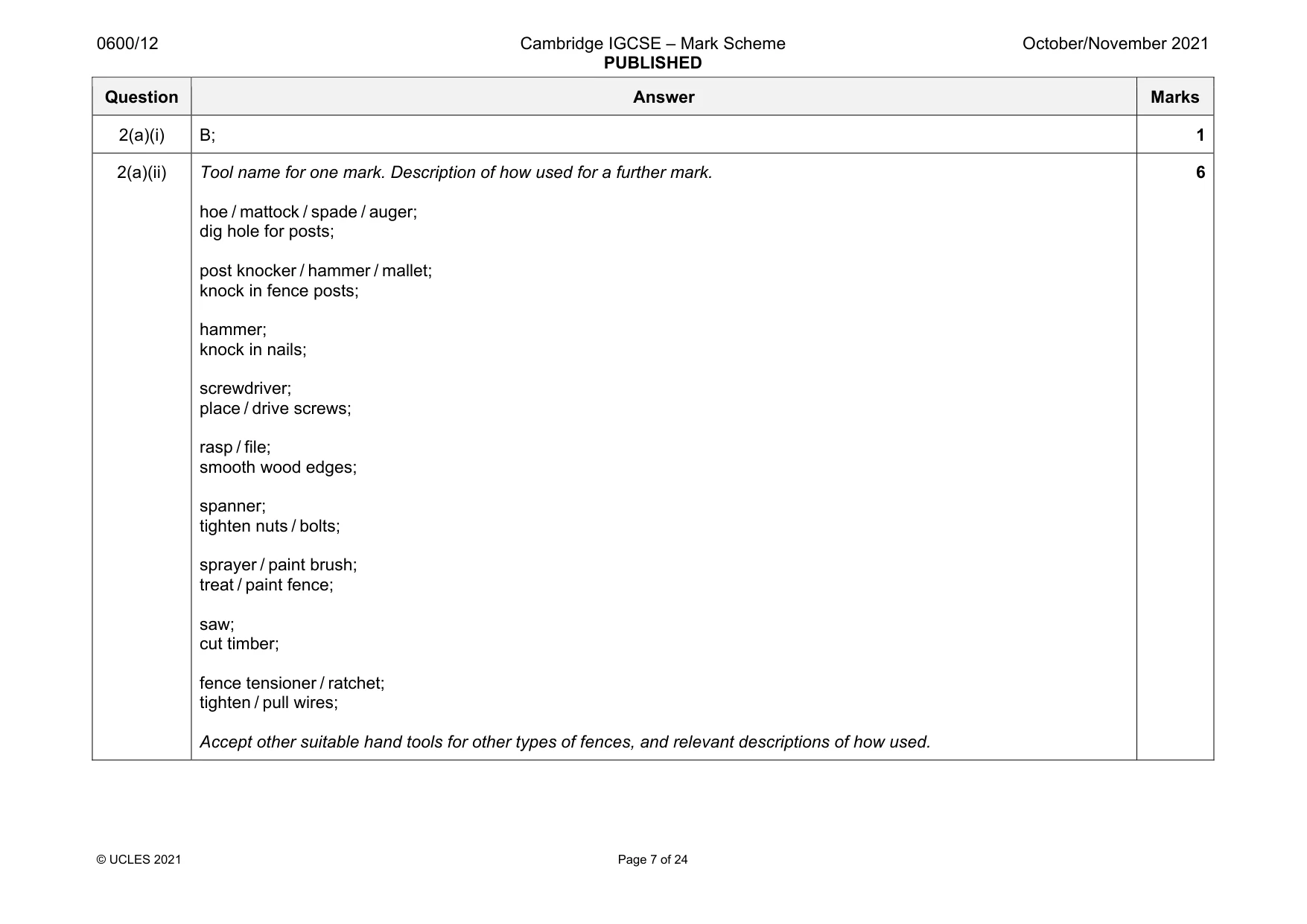
0600/12 Cambridge IGCSE – Mark Scheme PUBLISHED October/November 2021 © UCLES 2021 Page 7 of 24 Question Answer Marks 2(a)(i) B; 1 2(a)(ii) Tool name for one mark. Description of how used for a further mark. hoe / mattock / spade / auger; dig hole for posts; post knocker / hammer / mallet; knock in fence posts; hammer; knock in nails; screwdriver; place / drive screws; rasp / file; smooth wood edges; spanner; tighten nuts / bolts; sprayer / paint brush; treat / paint fence; saw; cut timber; fence tensioner / ratchet; tighten / pull wires; Accept other suitable hand tools for other types of fences, and relevant descriptions of how used. 6
Mark scheme, page 8
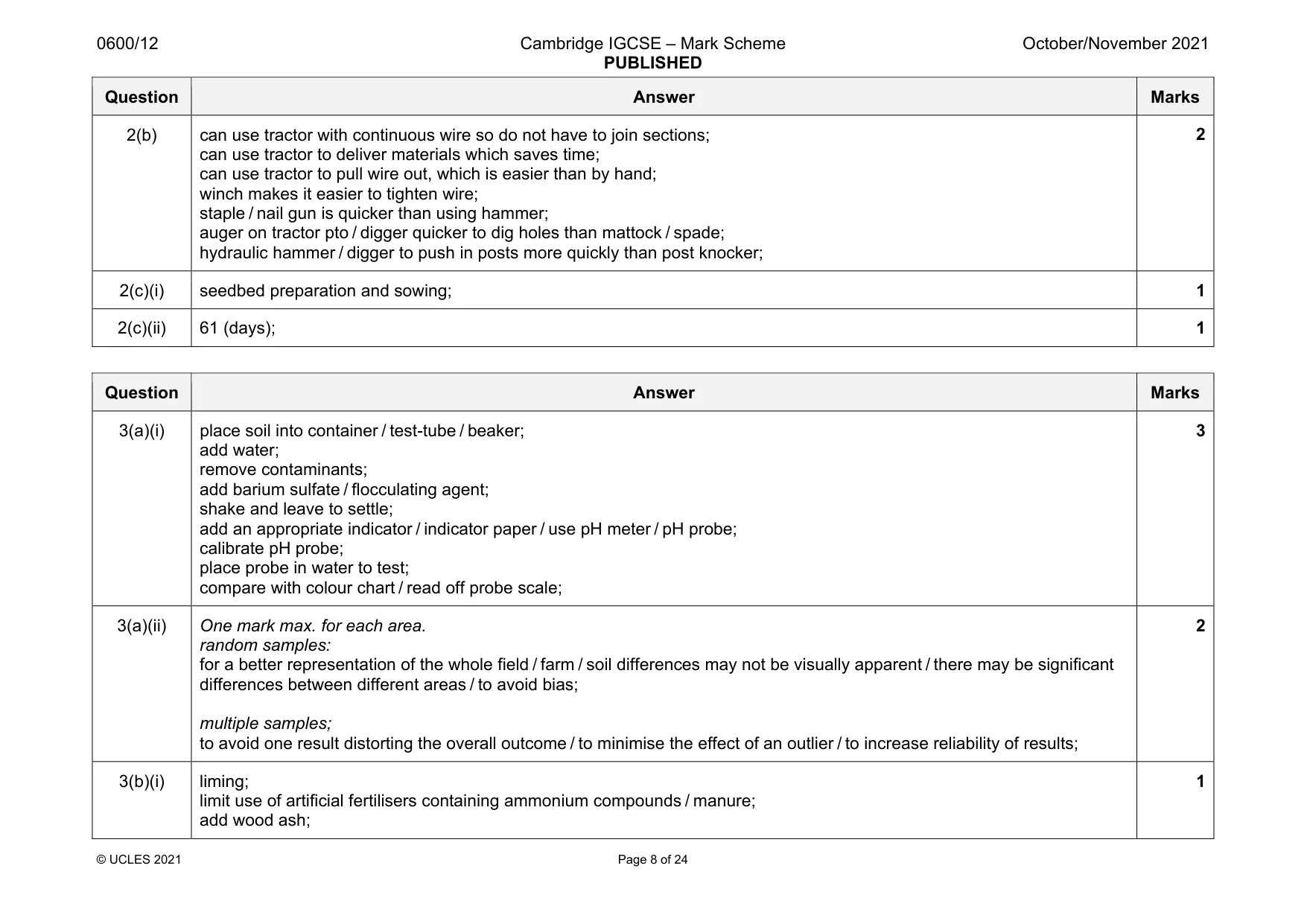
0600/12 Cambridge IGCSE – Mark Scheme PUBLISHED October/November 2021 © UCLES 2021 Page 8 of 24 Question Answer Marks 2(b) can use tractor with continuous wire so do not have to join sections; can use tractor to deliver materials which saves time; can use tractor to pull wire out, which is easier than by hand; winch makes it easier to tighten wire; staple / nail gun is quicker than using hammer; auger on tractor pto / digger quicker to dig holes than mattock / spade; hydraulic hammer / digger to push in posts more quickly than post knocker; 2 2(c)(i) seedbed preparation and sowing; 1 2(c)(ii) 61 (days); 1 Question Answer Marks 3(a)(i) place soil into container / test-tube / beaker; add water; remove contaminants; add barium sulfate / flocculating agent; shake and leave to settle; add an appropriate indicator / indicator paper / use pH meter / pH probe; calibrate pH probe; place probe in water to test; compare with colour chart / read off probe scale; 3 3(a)(ii) One mark max. for each area. random samples: for a better representation of the whole field / farm / soil differences may not be visually apparent / there may be significant differences between different areas / to avoid bias; multiple samples; to avoid one result distorting the overall outcome / to minimise the effect of an outlier / to increase reliability of results; 2 3(b)(i) liming; limit use of artificial fertilisers containing ammonium compounds / manure; add wood ash; 1
Mark scheme, page 9
0600/12 Cambridge IGCSE – Mark Scheme PUBLISHED October/November 2021 © UCLES 2021 Page 9 of 24 Question Answer Marks 3(b)(ii) Allow any two suitable suggestions, for example: (over)use of (compound) (ammonium) fertilisers; adding manure / intensive grazing by animals; burying crop residues; irrigation / overwatering; 2 Question Answer Marks 4(a) requires (sun)light; requires chlorophyll / chloroplasts; uses water; uses carbon dioxide; produces oxygen; produces sugar / carbohydrate / glucose; 4 4(b) Two marks for each condition. One mark for description and one mark for explanation. increased light intensity: increases rate of transpiration; more stomata open / stomata open wider; increased photosynthesis; increased wind speed: increases rate of transpiration; as water vapour is quickly removed from close to the leaf surface; increased concentration difference / gradient of water between inside and outside the leaf; 4 4(c) nutrient ions dissolve in water / form solution; so can move and diffuse; enables ions to move across root cells; enables minerals to move through the plant to where needed; enables the minerals to flow; water evaporates to cause transpiration pull / bring in nutrients; 2
Mark scheme, page 10
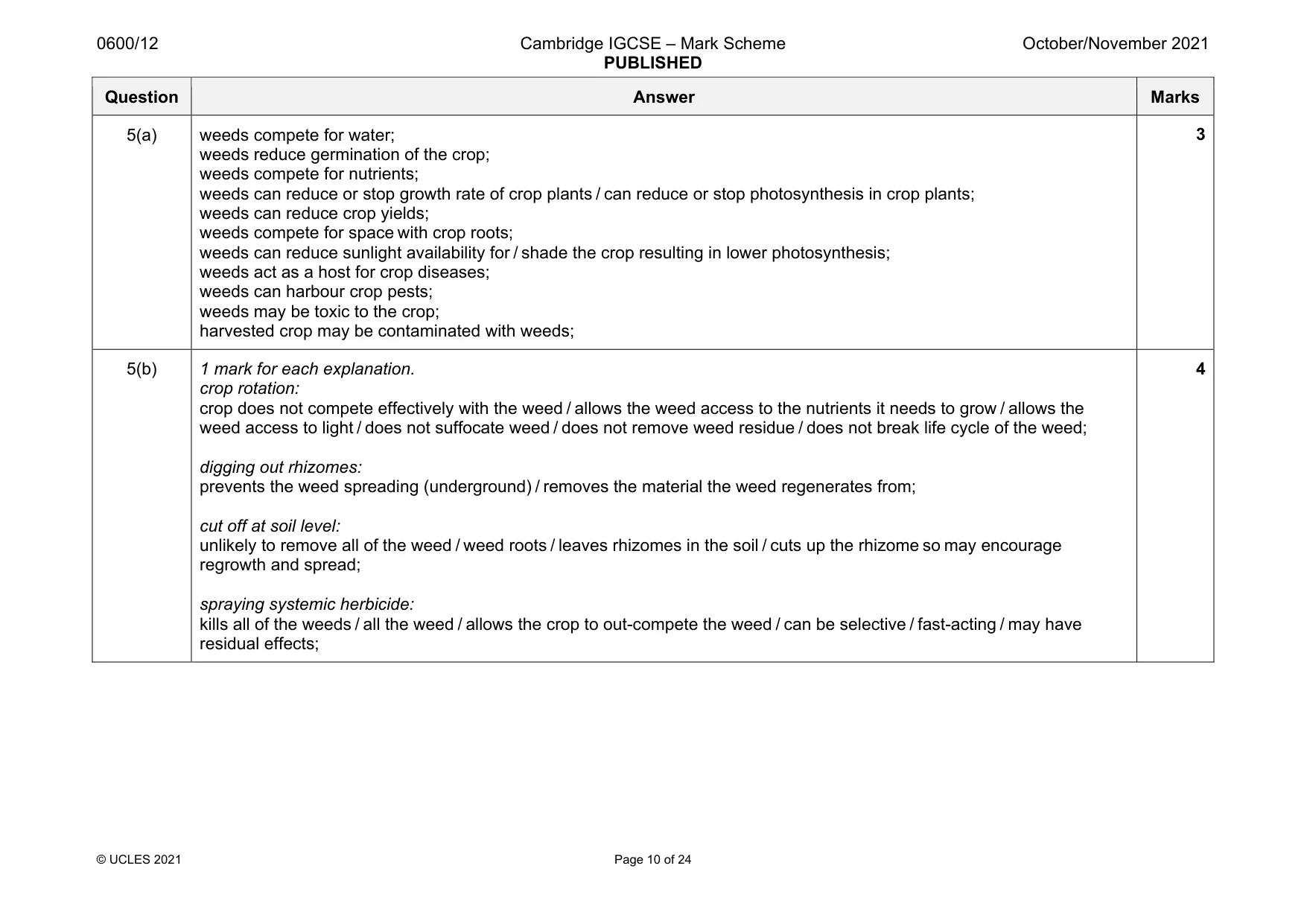
0600/12 Cambridge IGCSE – Mark Scheme PUBLISHED October/November 2021 © UCLES 2021 Page 10 of 24 Question Answer Marks 5(a) weeds compete for water; weeds reduce germination of the crop; weeds compete for nutrients; weeds can reduce or stop growth rate of crop plants / can reduce or stop photosynthesis in crop plants; weeds can reduce crop yields; weeds compete for space with crop roots; weeds can reduce sunlight availability for / shade the crop resulting in lower photosynthesis; weeds act as a host for crop diseases; weeds can harbour crop pests; weeds may be toxic to the crop; harvested crop may be contaminated with weeds; 3 5(b) 1 mark for each explanation. crop rotation: crop does not compete effectively with the weed / allows the weed access to the nutrients it needs to grow / allows the weed access to light / does not suffocate weed / does not remove weed residue / does not break life cycle of the weed; digging out rhizomes: prevents the weed spreading (underground) / removes the material the weed regenerates from; cut off at soil level: unlikely to remove all of the weed / weed roots / leaves rhizomes in the soil / cuts up the rhizome so may encourage regrowth and spread; spraying systemic herbicide: kills all of the weeds / all the weed / allows the crop to out-compete the weed / can be selective / fast-acting / may have residual effects; 4
Mark scheme, page 11
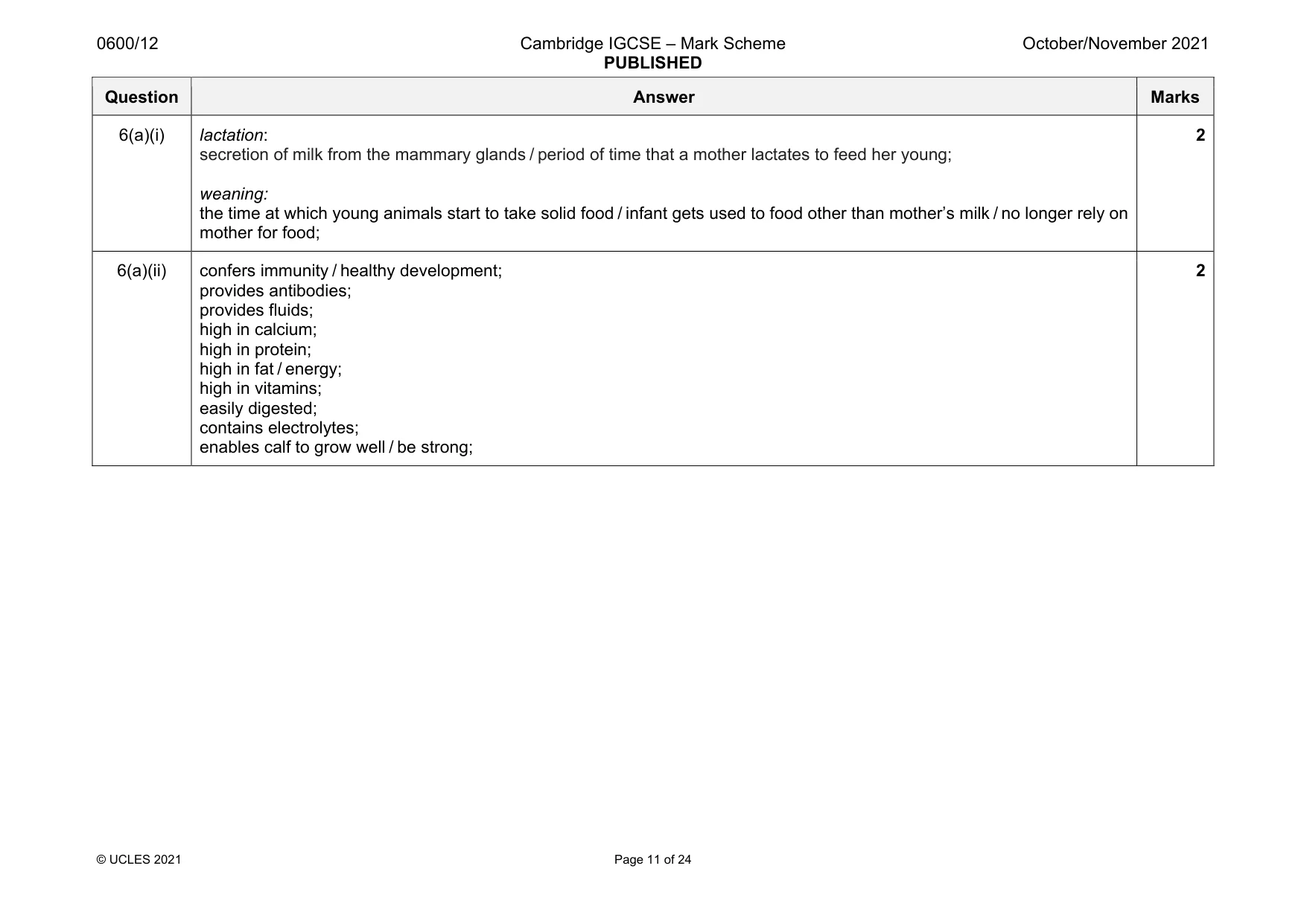
0600/12 Cambridge IGCSE – Mark Scheme PUBLISHED October/November 2021 © UCLES 2021 Page 11 of 24 Question Answer Marks 6(a)(i) lactation: secretion of milk from the mammary glands / period of time that a mother lactates to feed her young; weaning: the time at which young animals start to take solid food / infant gets used to food other than mother’s milk / no longer rely on mother for food; 2 6(a)(ii) confers immunity / healthy development; provides antibodies; provides fluids; high in calcium; high in protein; high in fat / energy; high in vitamins; easily digested; contains electrolytes; enables calf to grow well / be strong; 2
Mark scheme, page 12
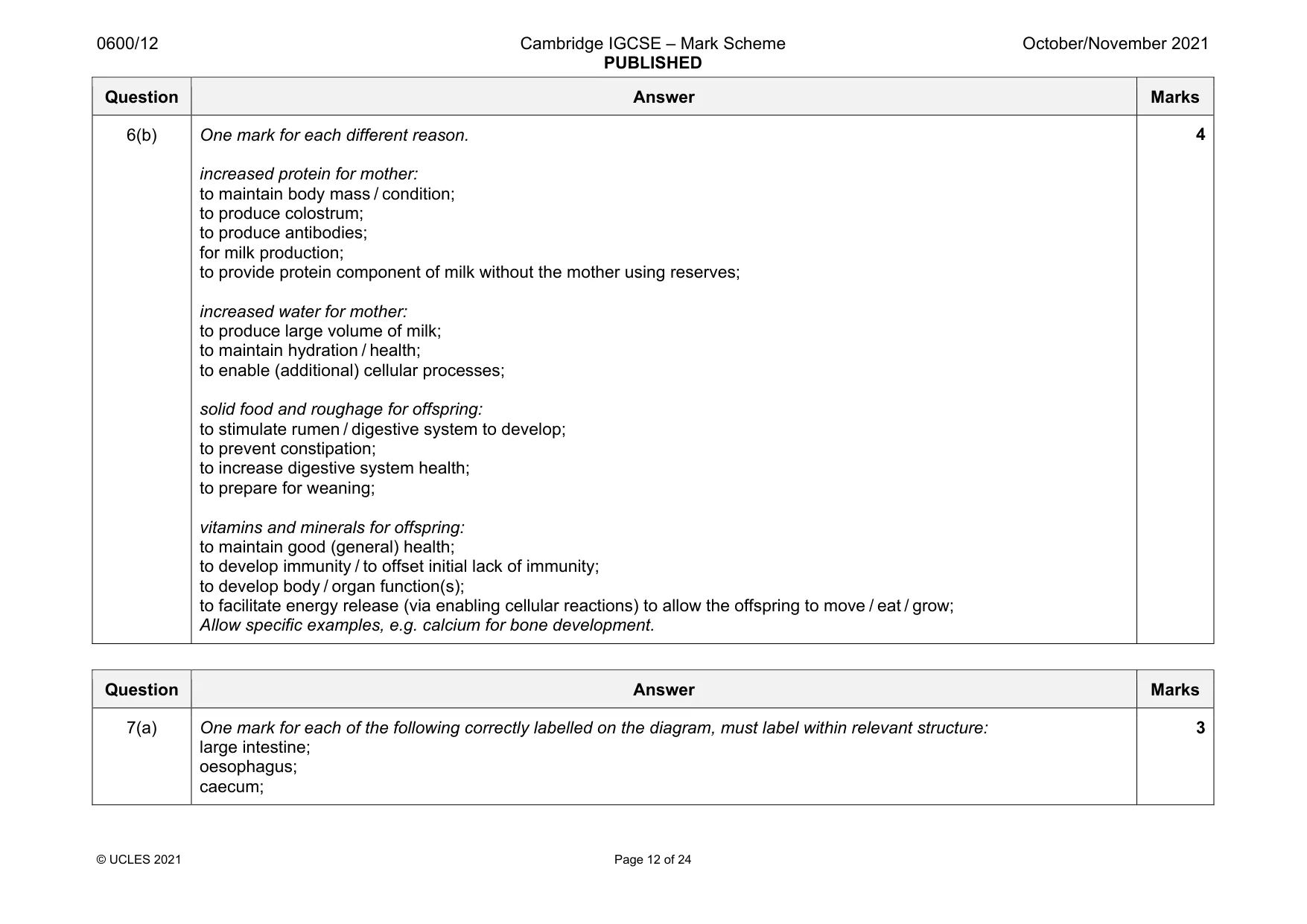
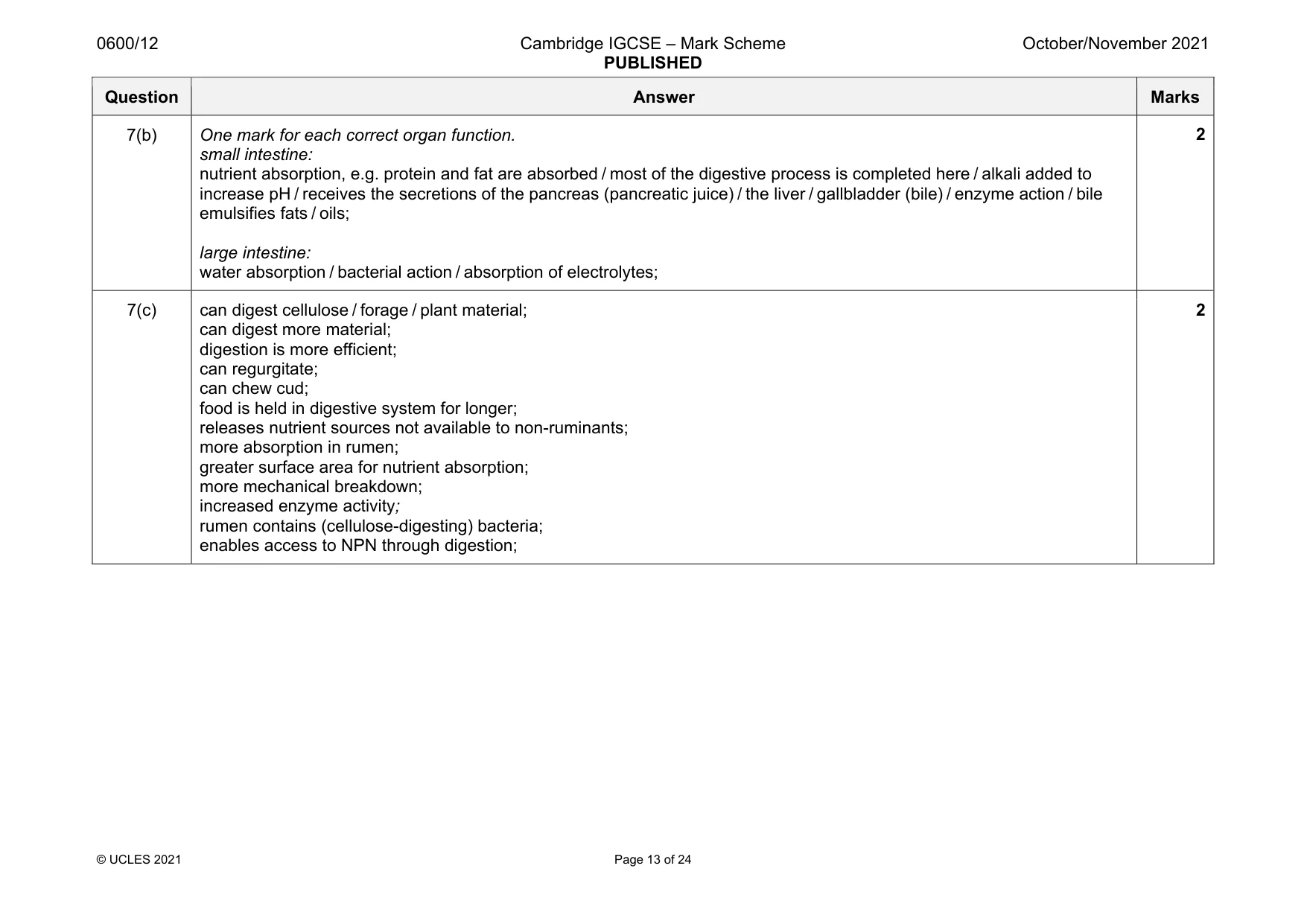
0600/12 Cambridge IGCSE – Mark Scheme PUBLISHED October/November 2021 © UCLES 2021 Page 12 of 24 Question Answer Marks 6(b) One mark for each different reason. increased protein for mother: to maintain body mass / condition; to produce colostrum; to produce antibodies; for milk production; to provide protein component of milk without the mother using reserves; increased water for mother: to produce large volume of milk; to maintain hydration / health; to enable (additional) cellular processes; solid food and roughage for offspring: to stimulate rumen / digestive system to develop; to prevent constipation; to increase digestive system health; to prepare for weaning; vitamins and minerals for offspring: to maintain good (general) health; to develop immunity / to offset initial lack of immunity; to develop body / organ function(s); to facilitate energy release (via enabling cellular reactions) to allow the offspring to move / eat / grow; Allow specific examples, e.g. calcium for bone development. 4 Question Answer Marks 7(a) One mark for each of the following correctly labelled on the diagram, must label within relevant structure: large intestine; oesophagus; caecum; 3
Mark scheme, page 13
0600/12 Cambridge IGCSE – Mark Scheme PUBLISHED October/November 2021 © UCLES 2021 Page 13 of 24 Question Answer Marks 7(b) One mark for each correct organ function. small intestine: nutrient absorption, e.g. protein and fat are absorbed / most of the digestive process is completed here / alkali added to increase pH / receives the secretions of the pancreas (pancreatic juice) / the liver / gallbladder (bile) / enzyme action / bile emulsifies fats / oils; large intestine: water absorption / bacterial action / absorption of electrolytes; 2 7(c) can digest cellulose / forage / plant material; can digest more material; digestion is more efficient; can regurgitate; can chew cud; food is held in digestive system for longer; releases nutrient sources not available to non-ruminants; more absorption in rumen; greater surface area for nutrient absorption; more mechanical breakdown; increased enzyme activity; rumen contains (cellulose-digesting) bacteria; enables access to NPN through digestion; 2
Mark scheme, page 14
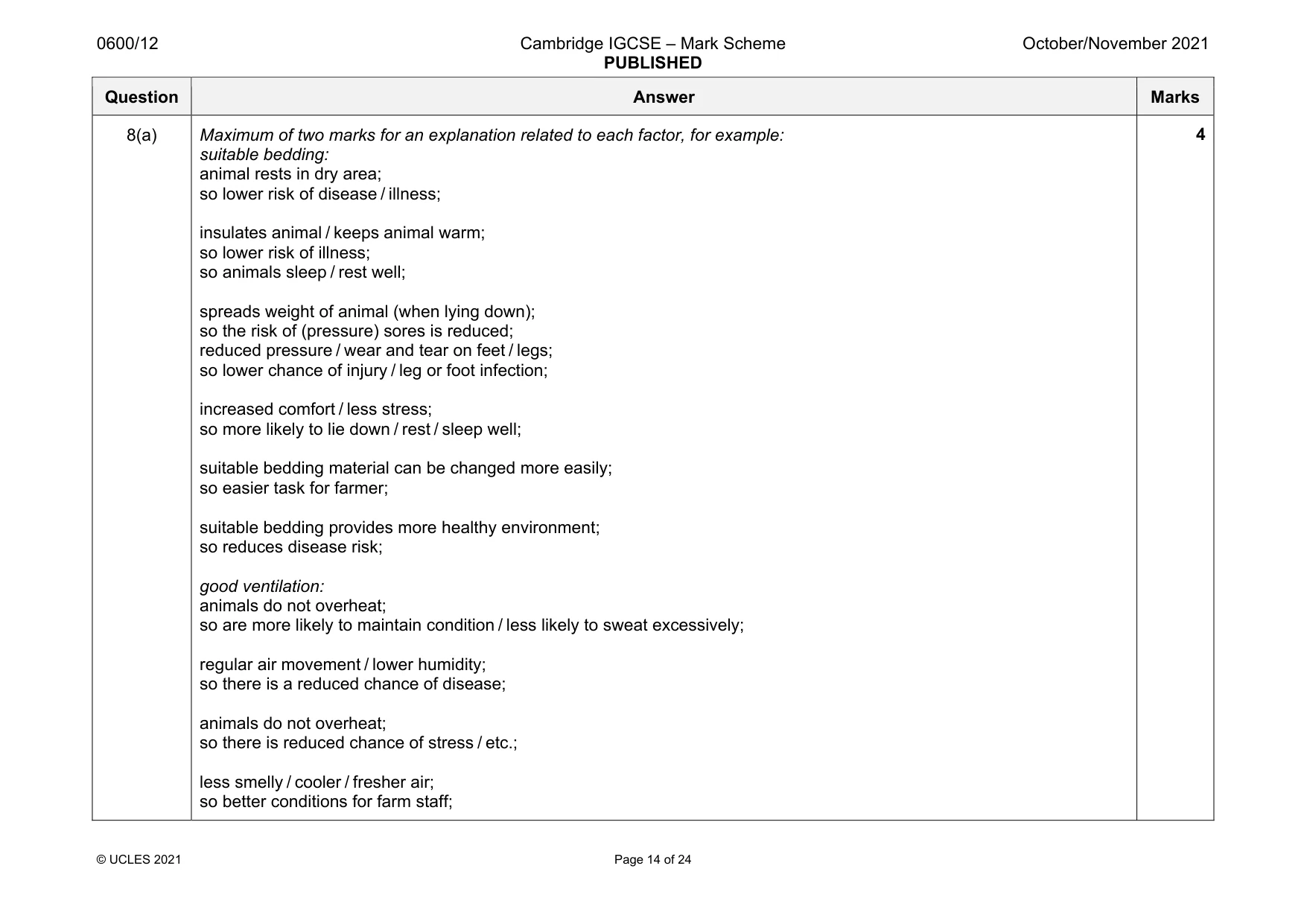
0600/12 Cambridge IGCSE – Mark Scheme PUBLISHED October/November 2021 © UCLES 2021 Page 14 of 24 Question Answer Marks 8(a) Maximum of two marks for an explanation related to each factor, for example: suitable bedding: animal rests in dry area; so lower risk of disease / illness; insulates animal / keeps animal warm; so lower risk of illness; so animals sleep / rest well; spreads weight of animal (when lying down); so the risk of (pressure) sores is reduced; reduced pressure / wear and tear on feet / legs; so lower chance of injury / leg or foot infection; increased comfort / less stress; so more likely to lie down / rest / sleep well; suitable bedding material can be changed more easily; so easier task for farmer; suitable bedding provides more healthy environment; so reduces disease risk; good ventilation: animals do not overheat; so are more likely to maintain condition / less likely to sweat excessively; regular air movement / lower humidity; so there is a reduced chance of disease; animals do not overheat; so there is reduced chance of stress / etc.; less smelly / cooler / fresher air; so better conditions for farm staff; 4
Mark scheme, page 15
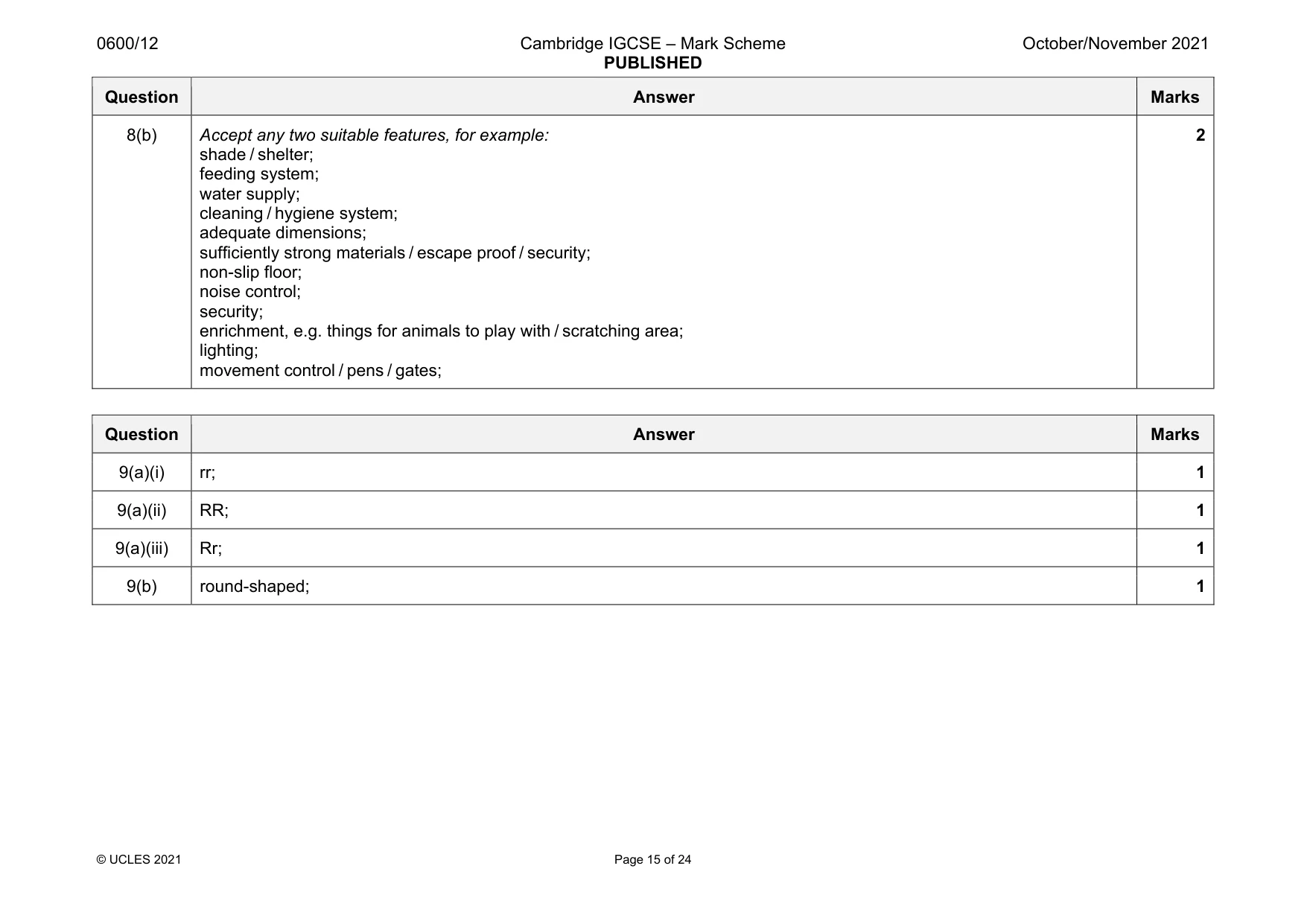
0600/12 Cambridge IGCSE – Mark Scheme PUBLISHED October/November 2021 © UCLES 2021 Page 15 of 24 Question Answer Marks 8(b) Accept any two suitable features, for example: shade / shelter; feeding system; water supply; cleaning / hygiene system; adequate dimensions; sufficiently strong materials / escape proof / security; non-slip floor; noise control; security; enrichment, e.g. things for animals to play with / scratching area; lighting; movement control / pens / gates; 2 Question Answer Marks 9(a)(i) rr; 1 9(a)(ii) RR; 1 9(a)(iii) Rr; 1 9(b) round-shaped; 1
Mark scheme, page 16
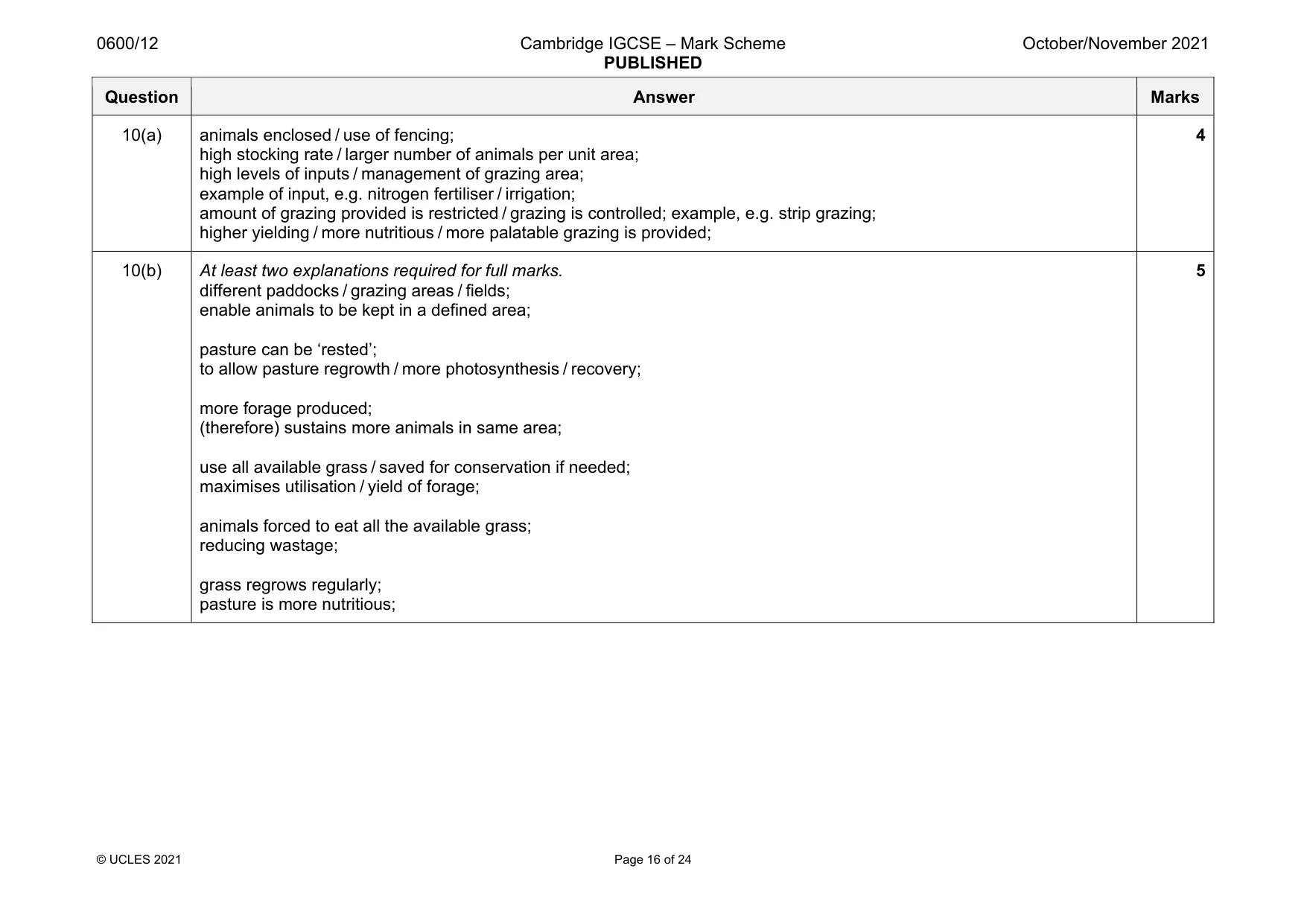
0600/12 Cambridge IGCSE – Mark Scheme PUBLISHED October/November 2021 © UCLES 2021 Page 16 of 24 Question Answer Marks 10(a) animals enclosed / use of fencing; high stocking rate / larger number of animals per unit area; high levels of inputs / management of grazing area; example of input, e.g. nitrogen fertiliser / irrigation; amount of grazing provided is restricted / grazing is controlled; example, e.g. strip grazing; higher yielding / more nutritious / more palatable grazing is provided; 4 10(b) At least two explanations required for full marks. different paddocks / grazing areas / fields; enable animals to be kept in a defined area; pasture can be ‘rested’; to allow pasture regrowth / more photosynthesis / recovery; more forage produced; (therefore) sustains more animals in same area; use all available grass / saved for conservation if needed; maximises utilisation / yield of forage; animals forced to eat all the available grass; reducing wastage; grass regrows regularly; pasture is more nutritious; 5
Mark scheme, page 17
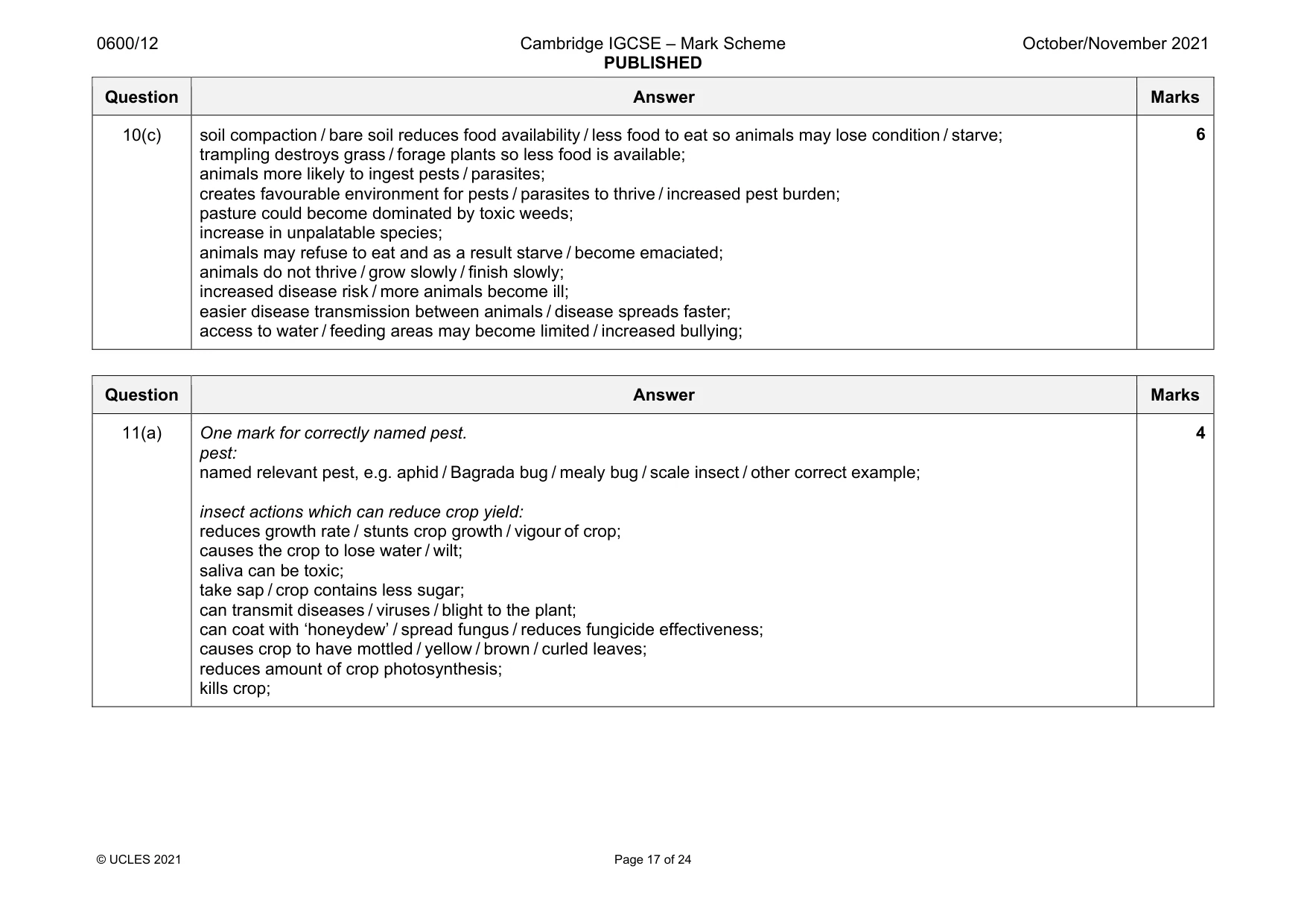
0600/12 Cambridge IGCSE – Mark Scheme PUBLISHED October/November 2021 © UCLES 2021 Page 17 of 24 Question Answer Marks 10(c) soil compaction / bare soil reduces food availability / less food to eat so animals may lose condition / starve; trampling destroys grass / forage plants so less food is available; animals more likely to ingest pests / parasites; creates favourable environment for pests / parasites to thrive / increased pest burden; pasture could become dominated by toxic weeds; increase in unpalatable species; animals may refuse to eat and as a result starve / become emaciated; animals do not thrive / grow slowly / finish slowly; increased disease risk / more animals become ill; easier disease transmission between animals / disease spreads faster; access to water / feeding areas may become limited / increased bullying; 6 Question Answer Marks 11(a) One mark for correctly named pest. pest: named relevant pest, e.g. aphid / Bagrada bug / mealy bug / scale insect / other correct example; insect actions which can reduce crop yield: reduces growth rate / stunts crop growth / vigour of crop; causes the crop to lose water / wilt; saliva can be toxic; take sap / crop contains less sugar; can transmit diseases / viruses / blight to the plant; can coat with ‘honeydew’ / spread fungus / reduces fungicide effectiveness; causes crop to have mottled / yellow / brown / curled leaves; reduces amount of crop photosynthesis; kills crop; 4
Mark scheme, page 18
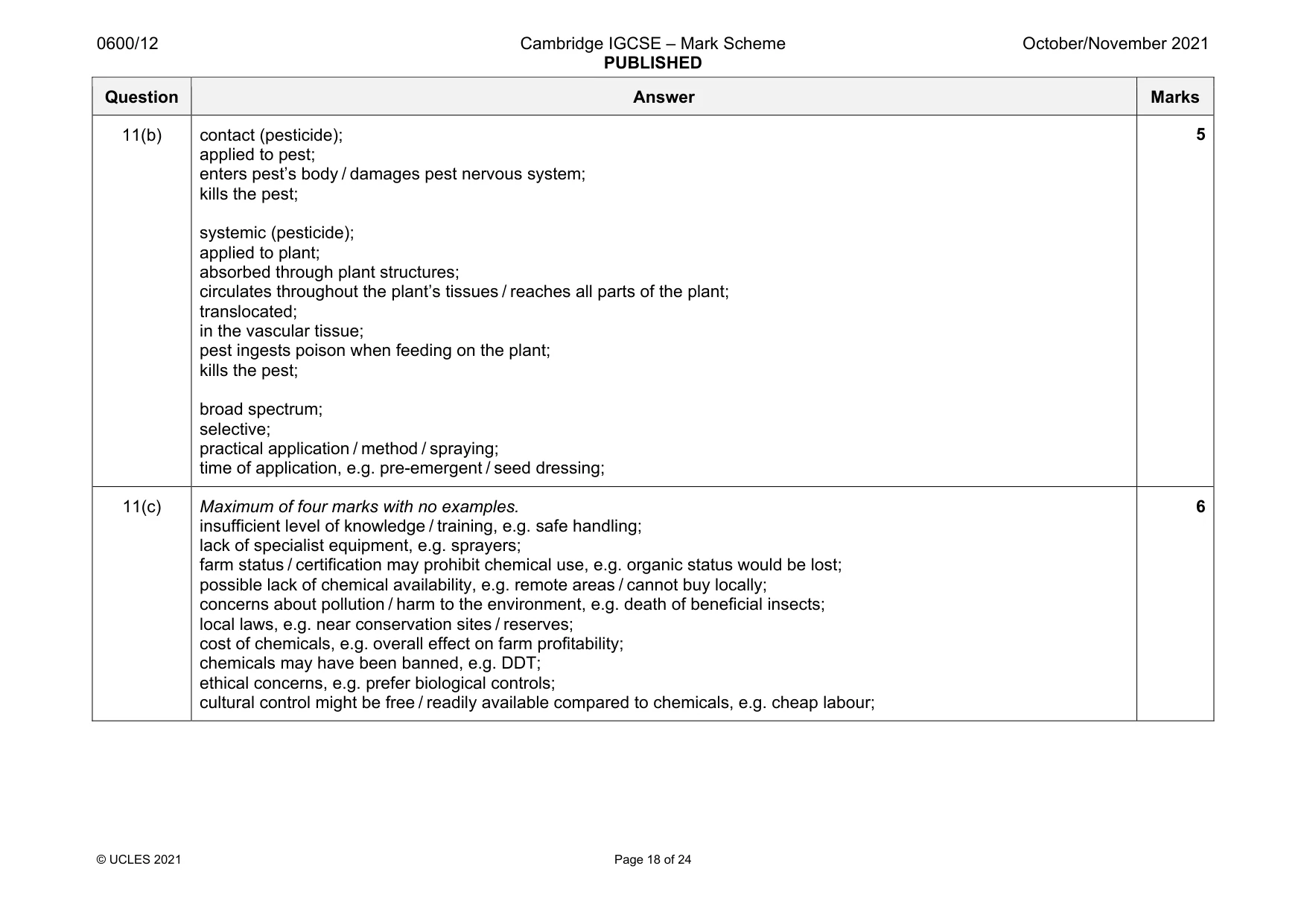
0600/12 Cambridge IGCSE – Mark Scheme PUBLISHED October/November 2021 © UCLES 2021 Page 18 of 24 Question Answer Marks 11(b) contact (pesticide); applied to pest; enters pest’s body / damages pest nervous system; kills the pest; systemic (pesticide); applied to plant; absorbed through plant structures; circulates throughout the plant’s tissues / reaches all parts of the plant; translocated; in the vascular tissue; pest ingests poison when feeding on the plant; kills the pest; broad spectrum; selective; practical application / method / spraying; time of application, e.g. pre-emergent / seed dressing; 5 11(c) Maximum of four marks with no examples. insufficient level of knowledge / training, e.g. safe handling; lack of specialist equipment, e.g. sprayers; farm status / certification may prohibit chemical use, e.g. organic status would be lost; possible lack of chemical availability, e.g. remote areas / cannot buy locally; concerns about pollution / harm to the environment, e.g. death of beneficial insects; local laws, e.g. near conservation sites / reserves; cost of chemicals, e.g. overall effect on farm profitability; chemicals may have been banned, e.g. DDT; ethical concerns, e.g. prefer biological controls; cultural control might be free / readily available compared to chemicals, e.g. cheap labour; 6
Mark scheme, page 19
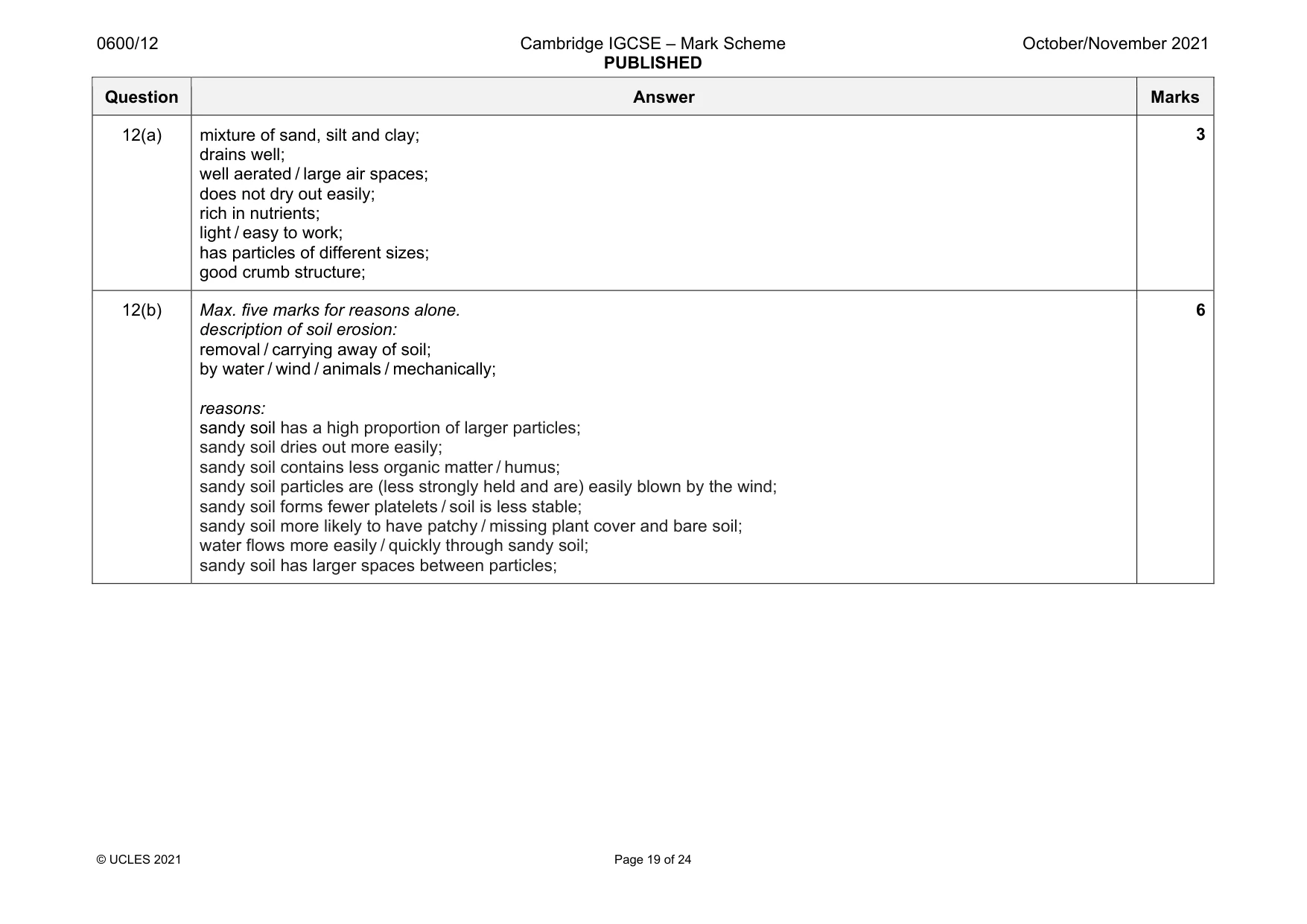
0600/12 Cambridge IGCSE – Mark Scheme PUBLISHED October/November 2021 © UCLES 2021 Page 19 of 24 Question Answer Marks 12(a) mixture of sand, silt and clay; drains well; well aerated / large air spaces; does not dry out easily; rich in nutrients; light / easy to work; has particles of different sizes; good crumb structure; 3 12(b) Max. five marks for reasons alone. description of soil erosion: removal / carrying away of soil; by water / wind / animals / mechanically; reasons: sandy soil has a high proportion of larger particles; sandy soil dries out more easily; sandy soil contains less organic matter / humus; sandy soil particles are (less strongly held and are) easily blown by the wind; sandy soil forms fewer platelets / soil is less stable; sandy soil more likely to have patchy / missing plant cover and bare soil; water flows more easily / quickly through sandy soil; sandy soil has larger spaces between particles; 6
Mark scheme, page 20
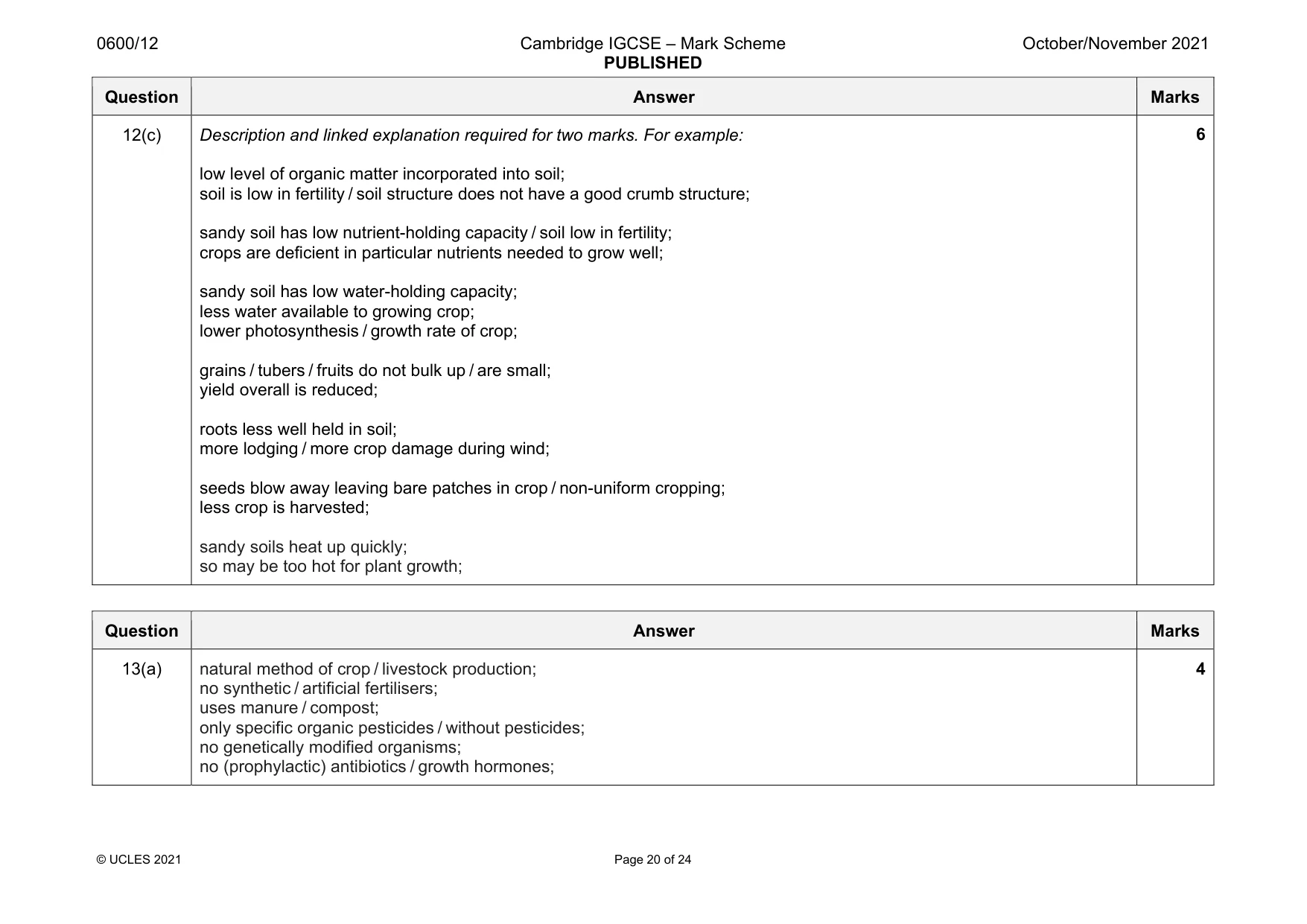
0600/12 Cambridge IGCSE – Mark Scheme PUBLISHED October/November 2021 © UCLES 2021 Page 20 of 24 Question Answer Marks 12(c) Description and linked explanation required for two marks. For example: low level of organic matter incorporated into soil; soil is low in fertility / soil structure does not have a good crumb structure; sandy soil has low nutrient-holding capacity / soil low in fertility; crops are deficient in particular nutrients needed to grow well; sandy soil has low water-holding capacity; less water available to growing crop; lower photosynthesis / growth rate of crop; grains / tubers / fruits do not bulk up / are small; yield overall is reduced; roots less well held in soil; more lodging / more crop damage during wind; seeds blow away leaving bare patches in crop / non-uniform cropping; less crop is harvested; sandy soils heat up quickly; so may be too hot for plant growth; 6 Question Answer Marks 13(a) natural method of crop / livestock production; no synthetic / artificial fertilisers; uses manure / compost; only specific organic pesticides / without pesticides; no genetically modified organisms; no (prophylactic) antibiotics / growth hormones; 4
Mark scheme, page 21
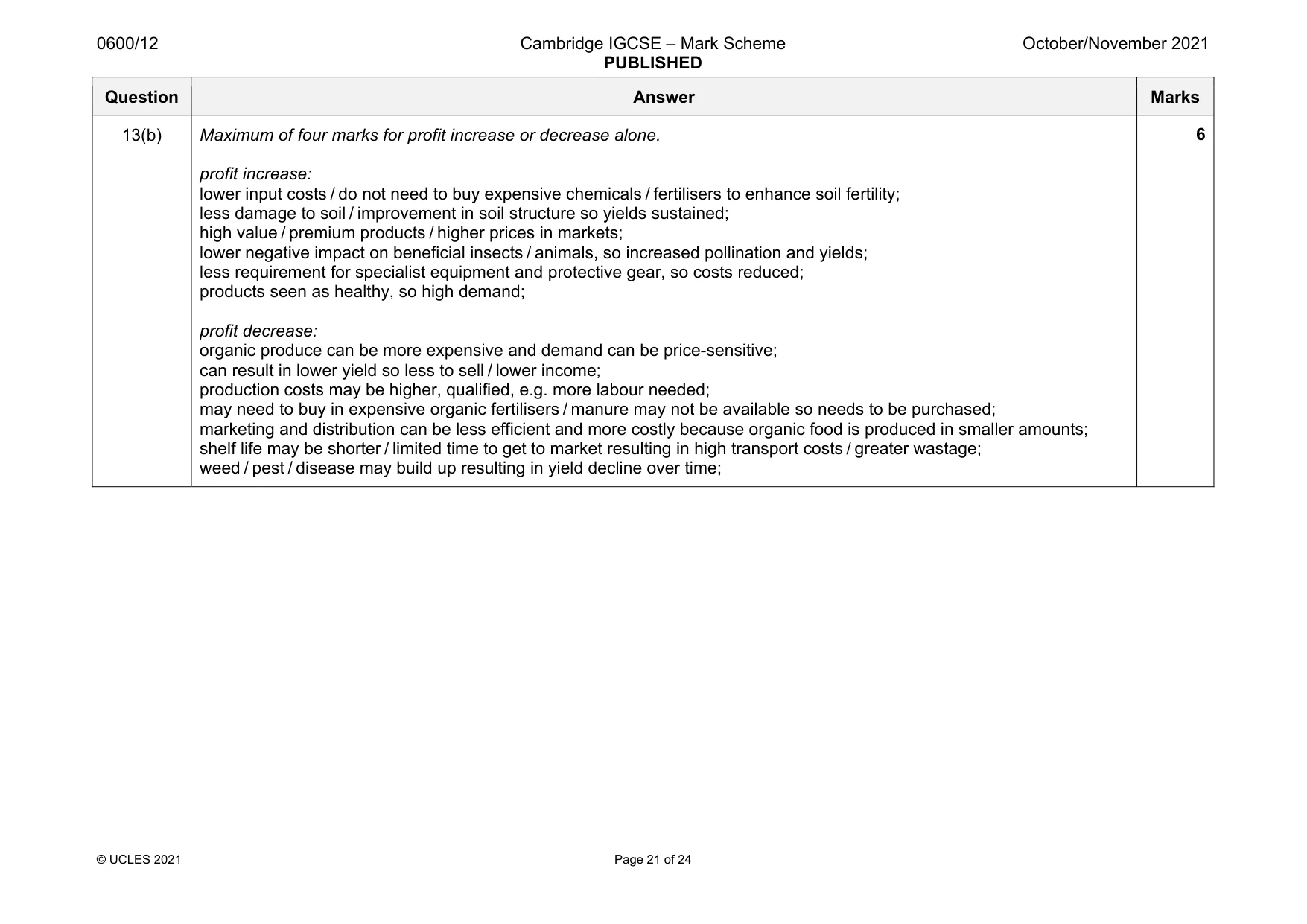
0600/12 Cambridge IGCSE – Mark Scheme PUBLISHED October/November 2021 © UCLES 2021 Page 21 of 24 Question Answer Marks 13(b) Maximum of four marks for profit increase or decrease alone. profit increase: lower input costs / do not need to buy expensive chemicals / fertilisers to enhance soil fertility; less damage to soil / improvement in soil structure so yields sustained; high value / premium products / higher prices in markets; lower negative impact on beneficial insects / animals, so increased pollination and yields; less requirement for specialist equipment and protective gear, so costs reduced; products seen as healthy, so high demand; profit decrease: organic produce can be more expensive and demand can be price-sensitive; can result in lower yield so less to sell / lower income; production costs may be higher, qualified, e.g. more labour needed; may need to buy in expensive organic fertilisers / manure may not be available so needs to be purchased; marketing and distribution can be less efficient and more costly because organic food is produced in smaller amounts; shelf life may be shorter / limited time to get to market resulting in high transport costs / greater wastage; weed / pest / disease may build up resulting in yield decline over time; 6
Mark scheme, page 22
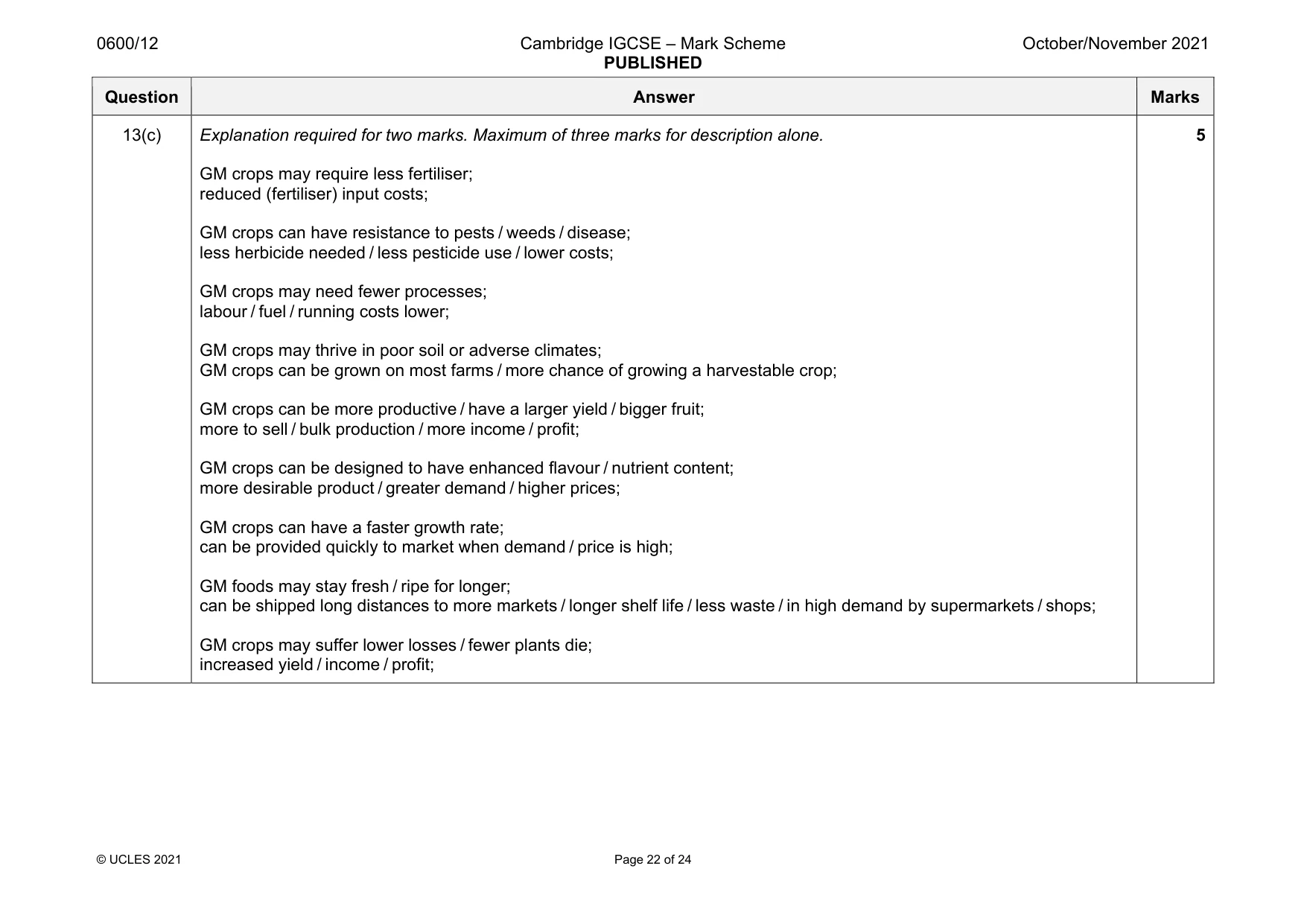
0600/12 Cambridge IGCSE – Mark Scheme PUBLISHED October/November 2021 © UCLES 2021 Page 22 of 24 Question Answer Marks 13(c) Explanation required for two marks. Maximum of three marks for description alone. GM crops may require less fertiliser; reduced (fertiliser) input costs; GM crops can have resistance to pests / weeds / disease; less herbicide needed / less pesticide use / lower costs; GM crops may need fewer processes; labour / fuel / running costs lower; GM crops may thrive in poor soil or adverse climates; GM crops can be grown on most farms / more chance of growing a harvestable crop; GM crops can be more productive / have a larger yield / bigger fruit; more to sell / bulk production / more income / profit; GM crops can be designed to have enhanced flavour / nutrient content; more desirable product / greater demand / higher prices; GM crops can have a faster growth rate; can be provided quickly to market when demand / price is high; GM foods may stay fresh / ripe for longer; can be shipped long distances to more markets / longer shelf life / less waste / in high demand by supermarkets / shops; GM crops may suffer lower losses / fewer plants die; increased yield / income / profit; 5
Mark scheme, page 23
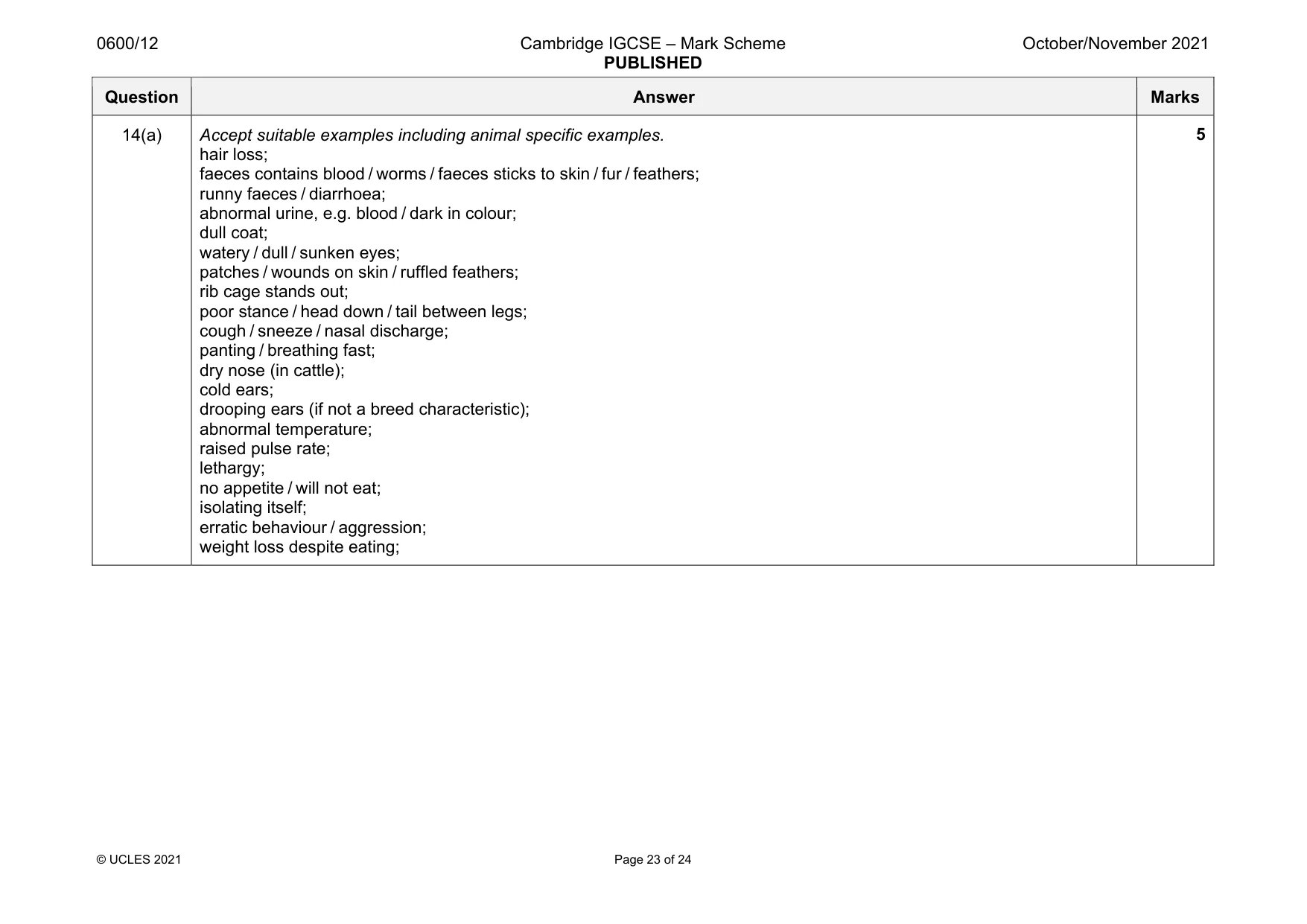
0600/12 Cambridge IGCSE – Mark Scheme PUBLISHED October/November 2021 © UCLES 2021 Page 23 of 24 Question Answer Marks 14(a) Accept suitable examples including animal specific examples. hair loss; faeces contains blood / worms / faeces sticks to skin / fur / feathers; runny faeces / diarrhoea; abnormal urine, e.g. blood / dark in colour; dull coat; watery / dull / sunken eyes; patches / wounds on skin / ruffled feathers; rib cage stands out; poor stance / head down / tail between legs; cough / sneeze / nasal discharge; panting / breathing fast; dry nose (in cattle); cold ears; drooping ears (if not a breed characteristic); abnormal temperature; raised pulse rate; lethargy; no appetite / will not eat; isolating itself; erratic behaviour / aggression; weight loss despite eating; 5
Mark scheme, page 24
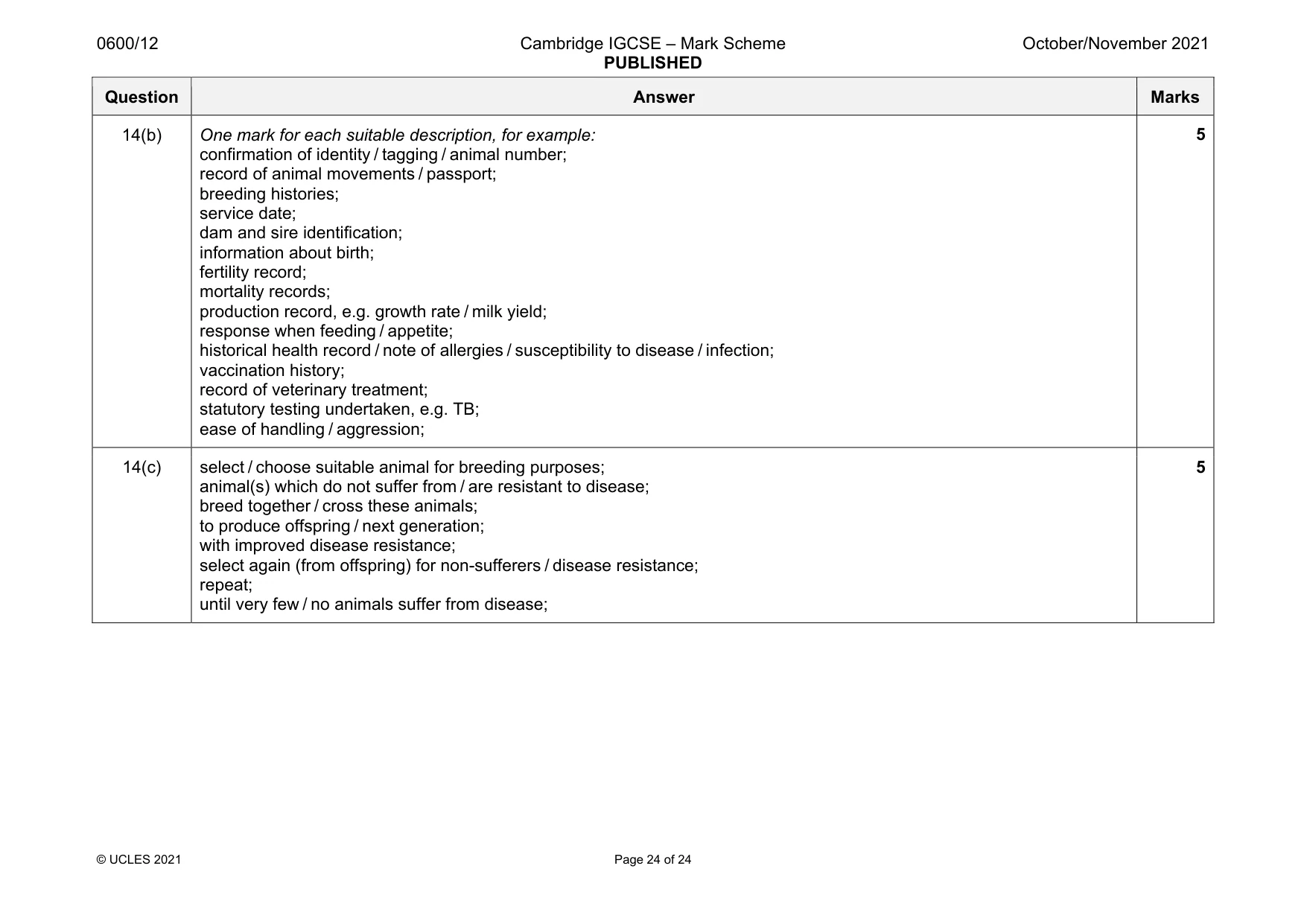
0600/12 Cambridge IGCSE – Mark Scheme PUBLISHED October/November 2021 © UCLES 2021 Page 24 of 24 Question Answer Marks 14(b) One mark for each suitable description, for example: confirmation of identity / tagging / animal number; record of animal movements / passport; breeding histories; service date; dam and sire identification; information about birth; fertility record; mortality records; production record, e.g. growth rate / milk yield; response when feeding / appetite; historical health record / note of allergies / susceptibility to disease / infection; vaccination history; record of veterinary treatment; statutory testing undertaken, e.g. TB; ease of handling / aggression; 5 14(c) select / choose suitable animal for breeding purposes; animal(s) which do not suffer from / are resistant to disease; breed together / cross these animals; to produce offspring / next generation; with improved disease resistance; select again (from offspring) for non-sufferers / disease resistance; repeat; until very few / no animals suffer from disease; 5
What you needed in this session
Cambridge’s own grade thresholds for 2021 Oct/Nov, Paper 1 · Variant 2. A higher threshold means an easier paper — the bar moves with how the cohort did.