Cambridge IGCSE Agriculture 0600 — 2020 Oct/Nov Paper 1 · Variant 2
0600/12/O/N/20 · 100 marks · ≈113 min
The question paper and its mark scheme, free to read here and free to download. This is Cambridge’s own paper, exactly as it was sat.
Question paper16 pages


Mark scheme30 pages
Answers below. Sit the paper first if you are practising.
Paper as text
Question paper, page 1
Cambridge IGCSE™ * 4 6 9 9 8 7 6 3 3 8 * This document has 16 pages. Blank pages are indicated. AGRICULTURE 0600/12 Paper 1 Theory October/November 2020 1 hour 45 minutes You must answer Section A on the question paper and Section B on the answer booklet/paper you have been given. You will need: Answer booklet/paper INSTRUCTIONS ● Section A: answer all questions. Write your answer to each question in the space provided on the question paper. ● Section B: answer two questions. Write your answer on the separate answer booklet/paper provided. ● Use a black or dark blue pen. You may use an HB pencil for any diagrams or graphs. ● Write your name, centre number and candidate number in the boxes at the top of the page. ● Do not use an erasable pen or correction fluid. ● Do not write on any bar codes. ● You may use a calculator. ● You should show all your working and use appropriate units. ● At the end of the examination, fasten all your work together. Do not use staples, paper clips or glue. INFORMATION ● The total mark for this paper is 100. ● The number of marks for each question or part question is shown in brackets [ ]. DC (LEG/TP) 182397/5 © UCLES 2020 [Turn over For Examiner’s use Section A 1 2 3 4 5 6 7 8 9 Section B Total
Question paper, page 2
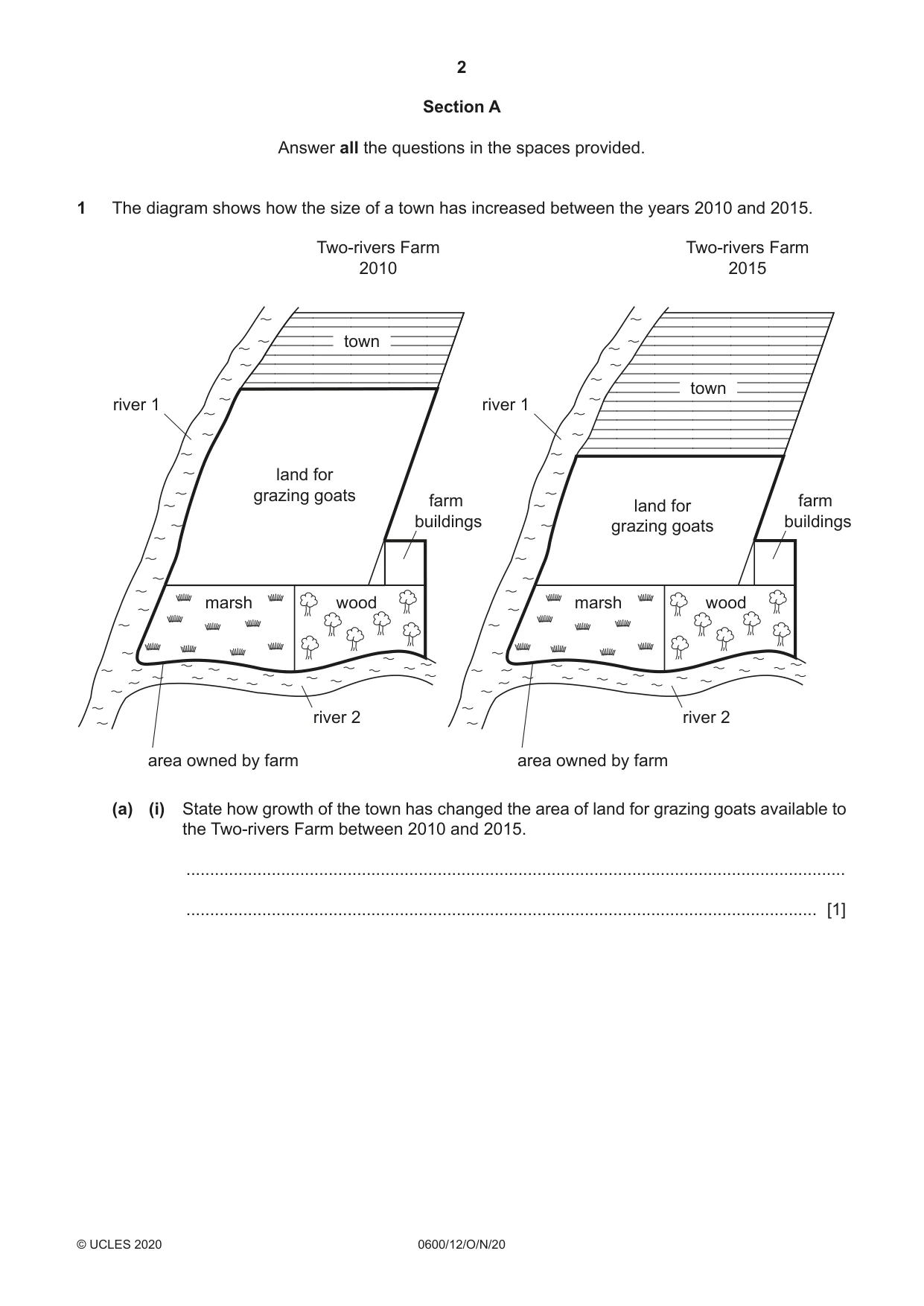
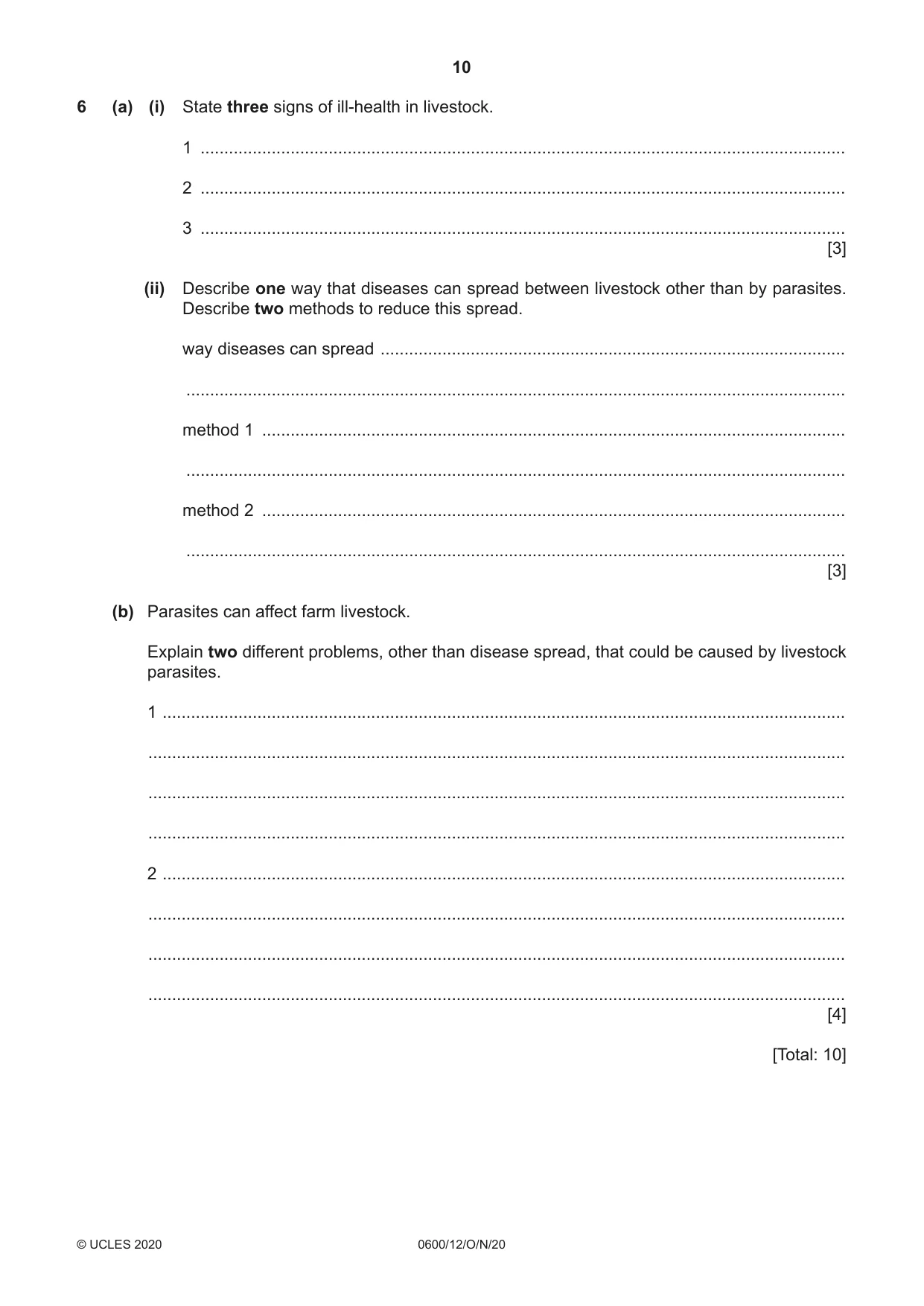
2 0600/12/O/N/20 © UCLES 2020 Section A Answer all the questions in the spaces provided. 1 The diagram shows how the size of a town has increased between the years 2010 and 2015. river 1 river 1 river 2 area owned by farm marsh wood river 2 area owned by farm marsh wood Two-rivers Farm 2010 Two-rivers Farm 2015 land for grazing goats land for grazing goats farm buildings town farm buildings town (a) (i) State how growth of the town has changed the area of land for grazing goats available to the Two-rivers Farm between 2010 and 2015. … … [1]
Question paper, page 3
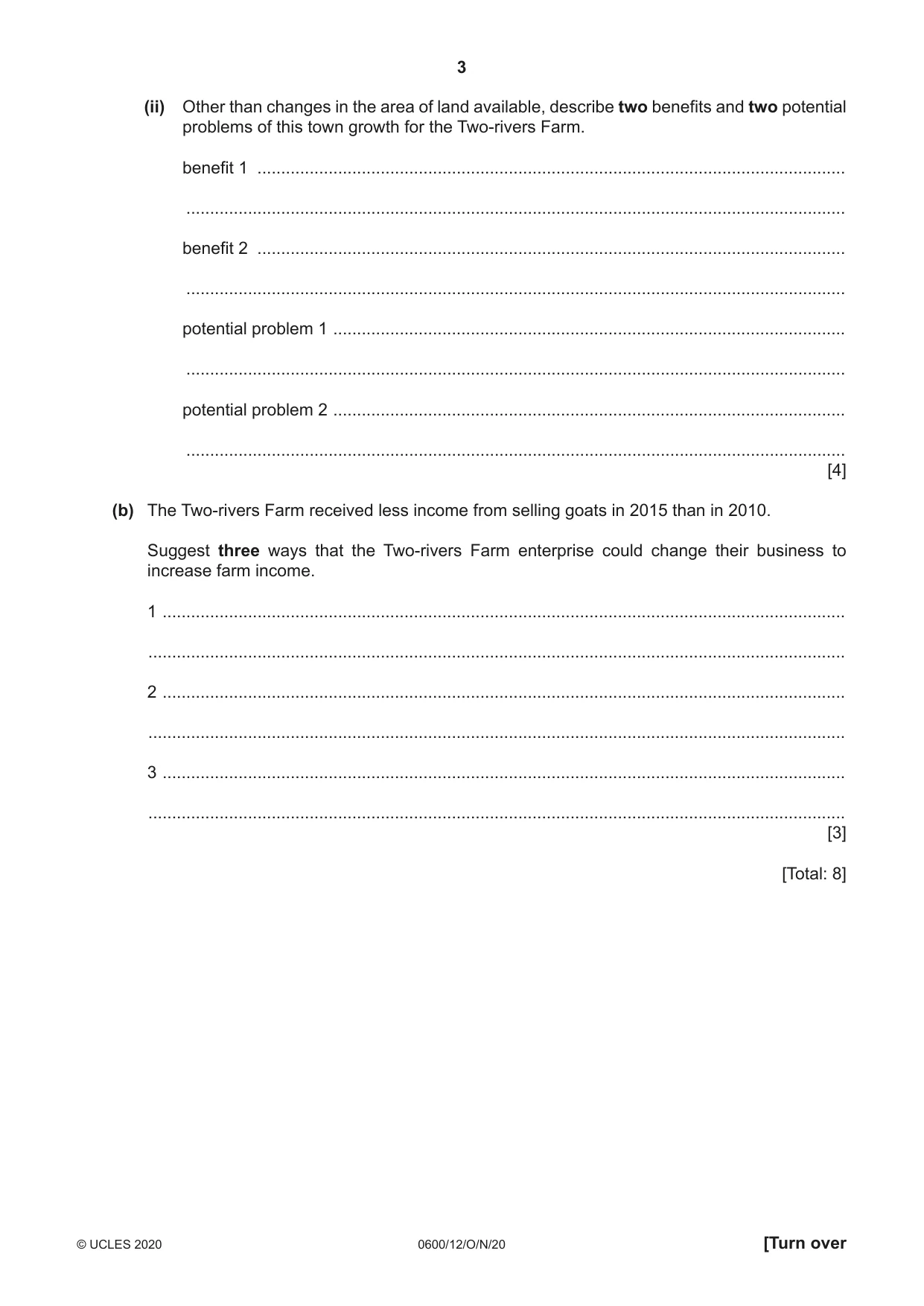
3 0600/12/O/N/20 © UCLES 2020 [Turn over (ii) Other than changes in the area of land available, describe two benefits and two potential problems of this town growth for the Two-rivers Farm. benefit 1 … … benefit 2 … … potential problem 1 … … potential problem 2 … … [4] (b) The Two-rivers Farm received less income from selling goats in 2015 than in 2010. Suggest three ways that the Two-rivers Farm enterprise could change their business to increase farm income. 1 … … 2 … … 3 … … [3] [Total: 8]
Question paper, page 4
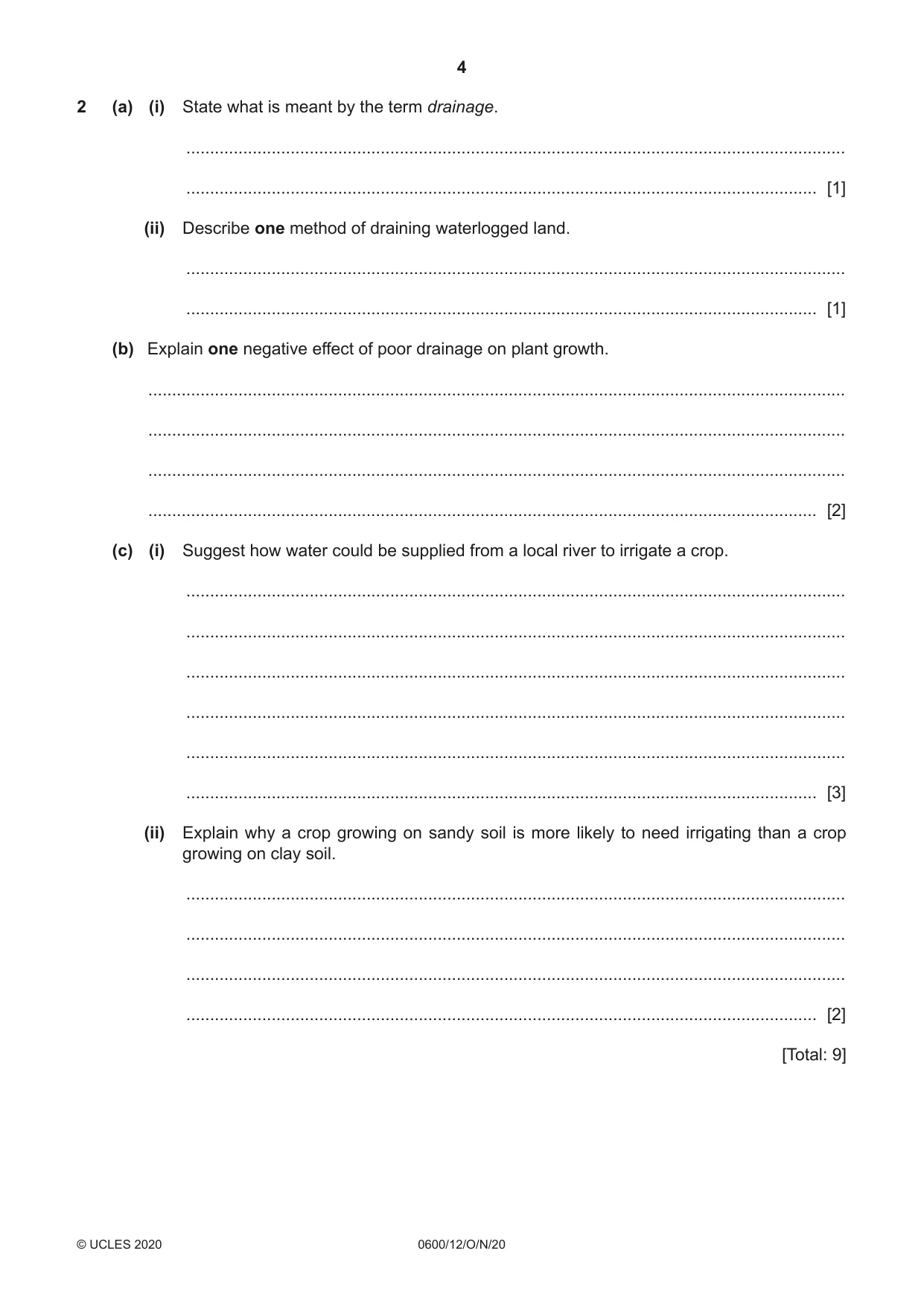
4 0600/12/O/N/20 © UCLES 2020 2 (a) (i) State what is meant by the term drainage. … … [1] (ii) Describe one method of draining waterlogged land. … … [1] (b) Explain one negative effect of poor drainage on plant growth. … … … … [2] (c) (i) Suggest how water could be supplied from a local river to irrigate a crop. … … … … … … [3] (ii) Explain why a crop growing on sandy soil is more likely to need irrigating than a crop growing on clay soil. … … … … [2] [Total: 9]
Question paper, page 5
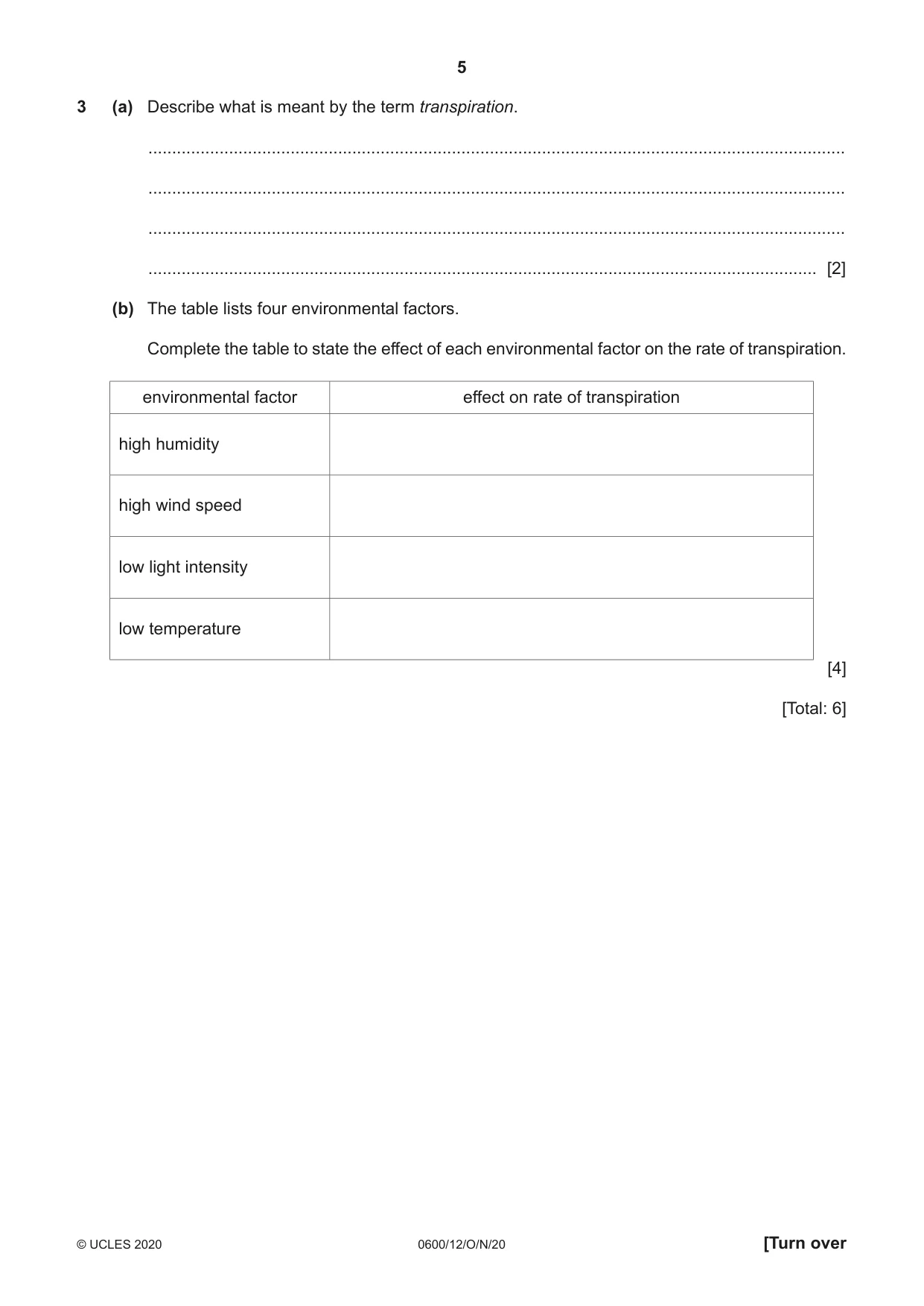
5 0600/12/O/N/20 © UCLES 2020 [Turn over 3 (a) Describe what is meant by the term transpiration. … … … … [2] (b) The table lists four environmental factors. Complete the table to state the effect of each environmental factor on the rate of transpiration. environmental factor effect on rate of transpiration high humidity high wind speed low light intensity low temperature [4] [Total: 6]
Question paper, page 6
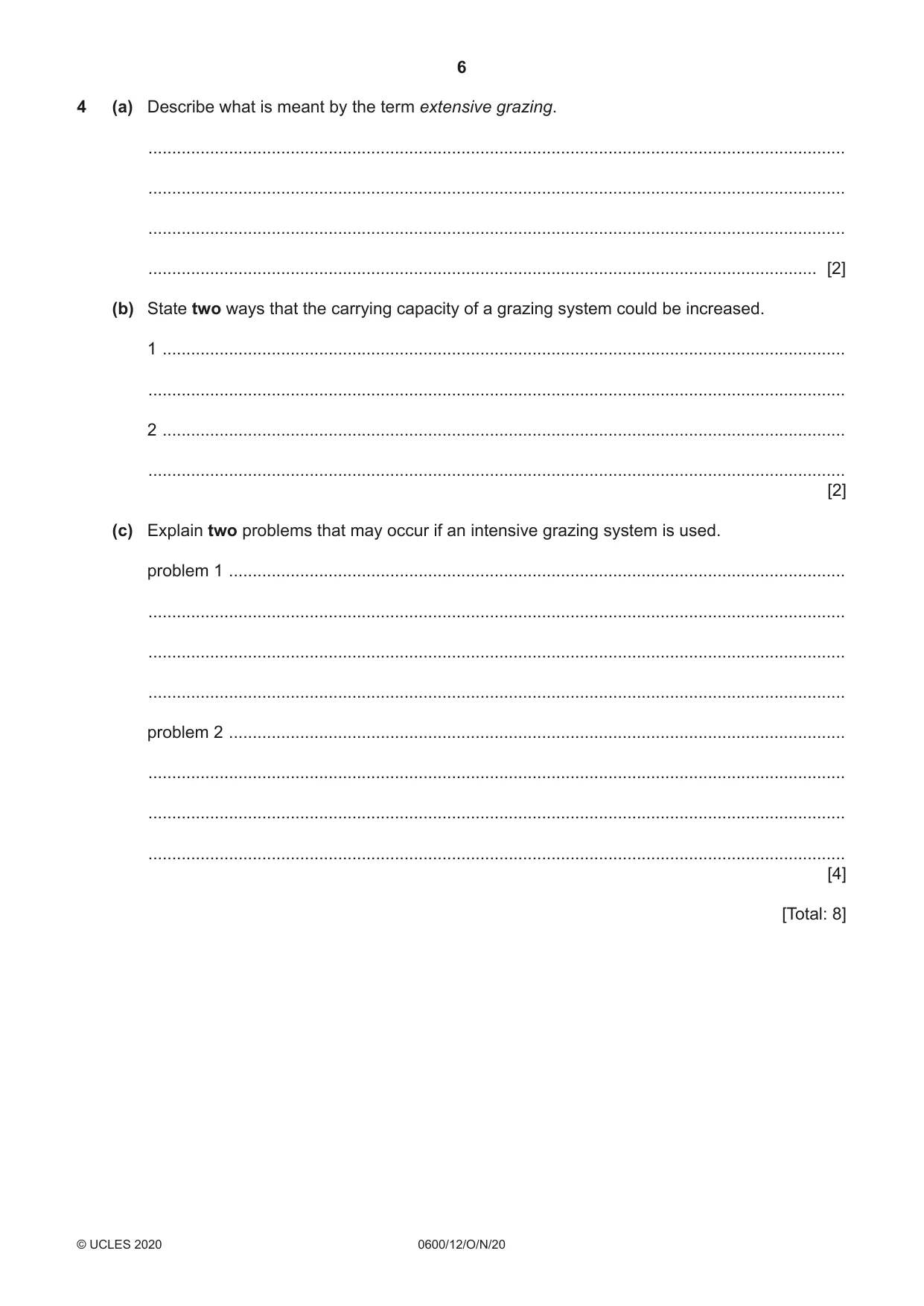
6 0600/12/O/N/20 © UCLES 2020 4 (a) Describe what is meant by the term extensive grazing. … … … … [2] (b) State two ways that the carrying capacity of a grazing system could be increased. 1 … … 2 … … [2] (c) Explain two problems that may occur if an intensive grazing system is used. problem 1 … … … … problem 2 … … … … [4] [Total: 8]
Question paper, page 7
7 0600/12/O/N/20 © UCLES 2020 [Turn over BLANK PAGE
Question paper, page 8
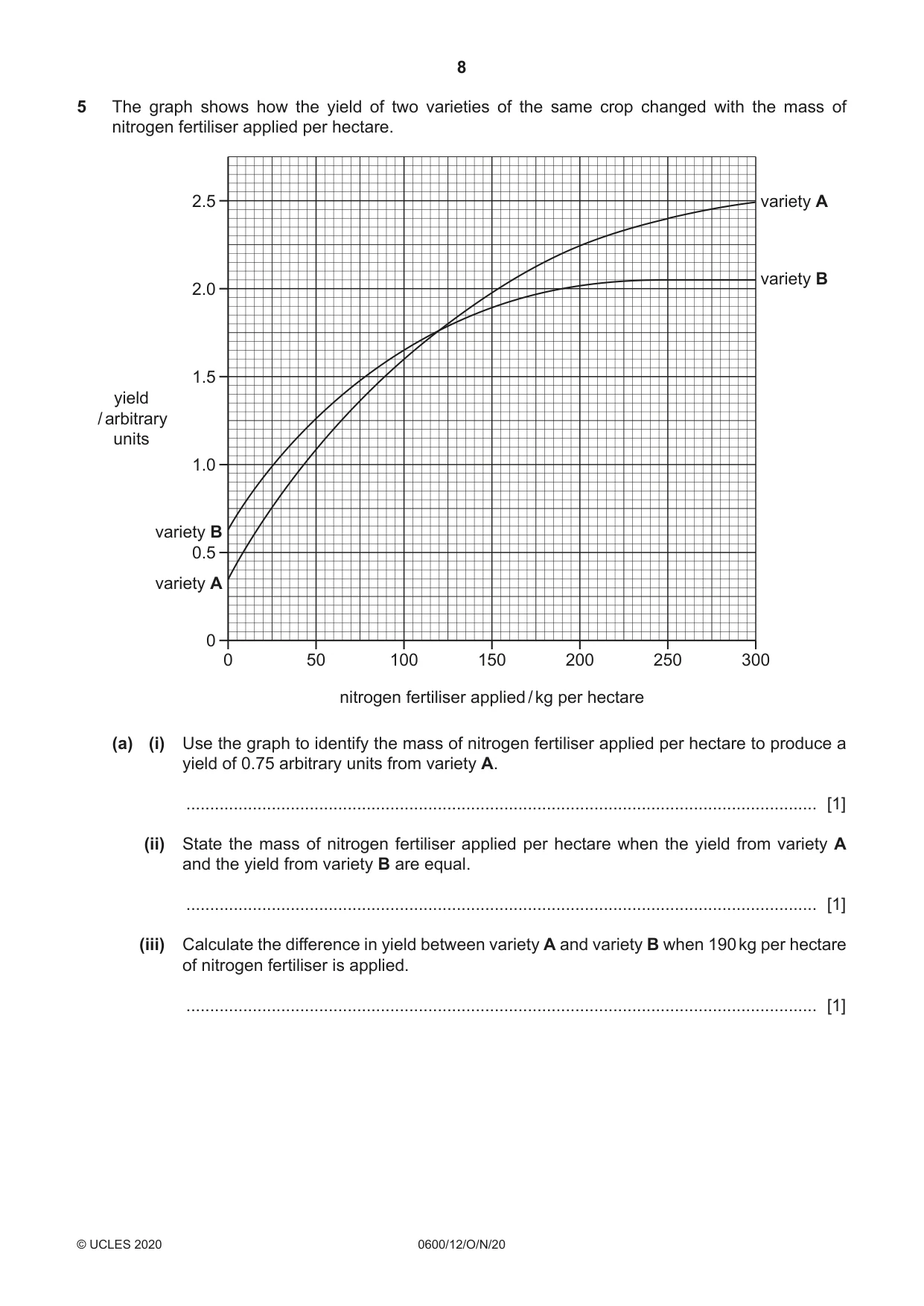
8 0600/12/O/N/20 © UCLES 2020 5 The graph shows how the yield of two varieties of the same crop changed with the mass of nitrogen fertiliser applied per hectare. 2.5 2.0 1.5 1.0 0.5 0 0 50 100 150 200 250 300 nitrogen fertiliser applied / kg per hectare yield / arbitrary units variety B variety A variety B variety A (a) (i) Use the graph to identify the mass of nitrogen fertiliser applied per hectare to produce a yield of 0.75 arbitrary units from variety A. … [1] (ii) State the mass of nitrogen fertiliser applied per hectare when the yield from variety A and the yield from variety B are equal. … [1] (iii) Calculate the difference in yield between variety A and variety B when 190 kg per hectare of nitrogen fertiliser is applied. … [1]
Question paper, page 9
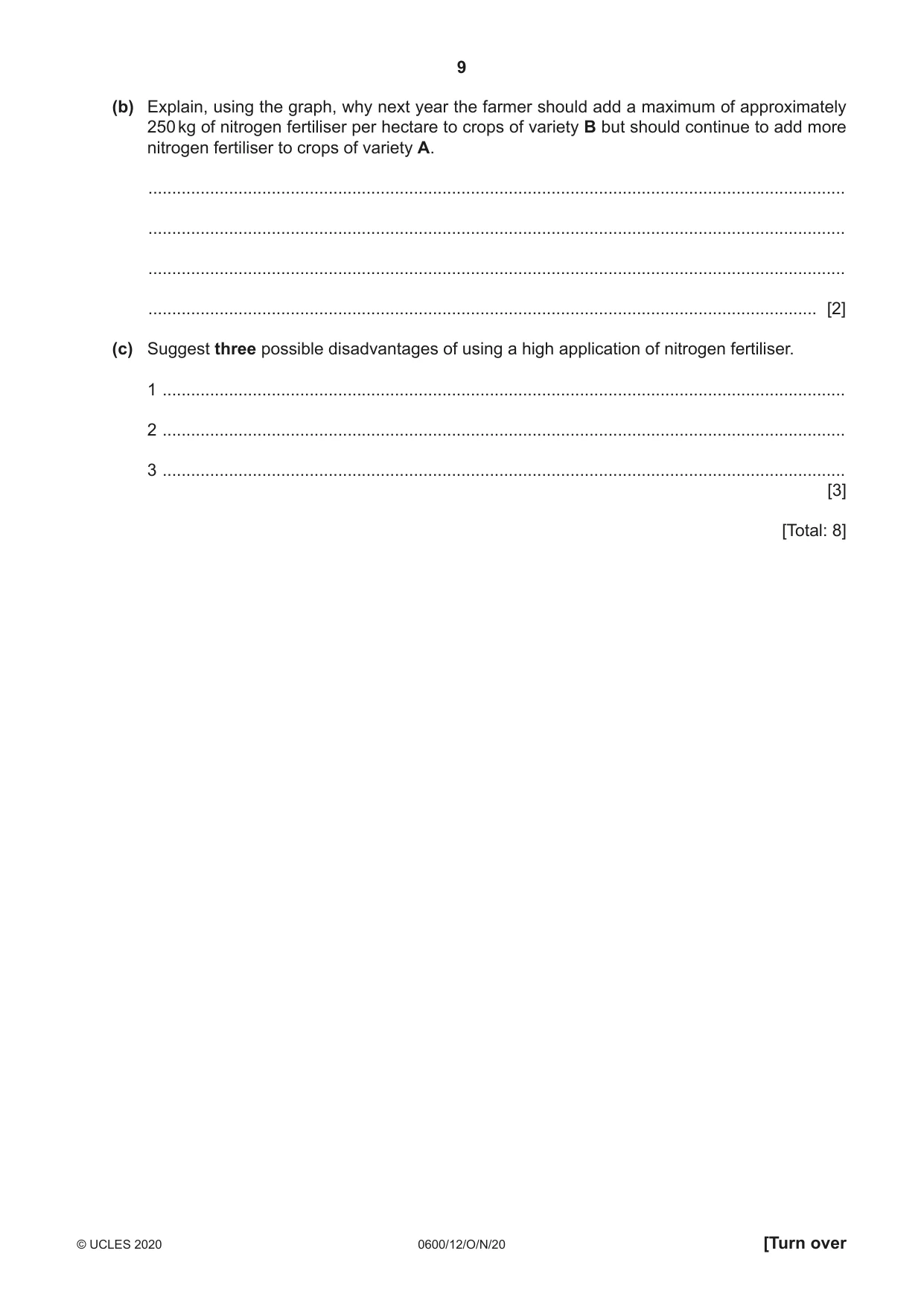
9 0600/12/O/N/20 © UCLES 2020 [Turn over (b) Explain, using the graph, why next year the farmer should add a maximum of approximately 250 kg of nitrogen fertiliser per hectare to crops of variety B but should continue to add more nitrogen fertiliser to crops of variety A. … … … … [2] (c) Suggest three possible disadvantages of using a high application of nitrogen fertiliser. 1 … 2 … 3 … [3] [Total: 8]
Question paper, page 10
10 0600/12/O/N/20 © UCLES 2020 6 (a) (i) State three signs of ill-health in livestock. 1 … 2 … 3 … [3] (ii) Describe one way that diseases can spread between livestock other than by parasites. Describe two methods to reduce this spread. way diseases can spread … … method 1 … … method 2 … … [3] (b) Parasites can affect farm livestock. Explain two different problems, other than disease spread, that could be caused by livestock parasites. 1 … … … … 2 … … … … [4] [Total: 10]
Question paper, page 11
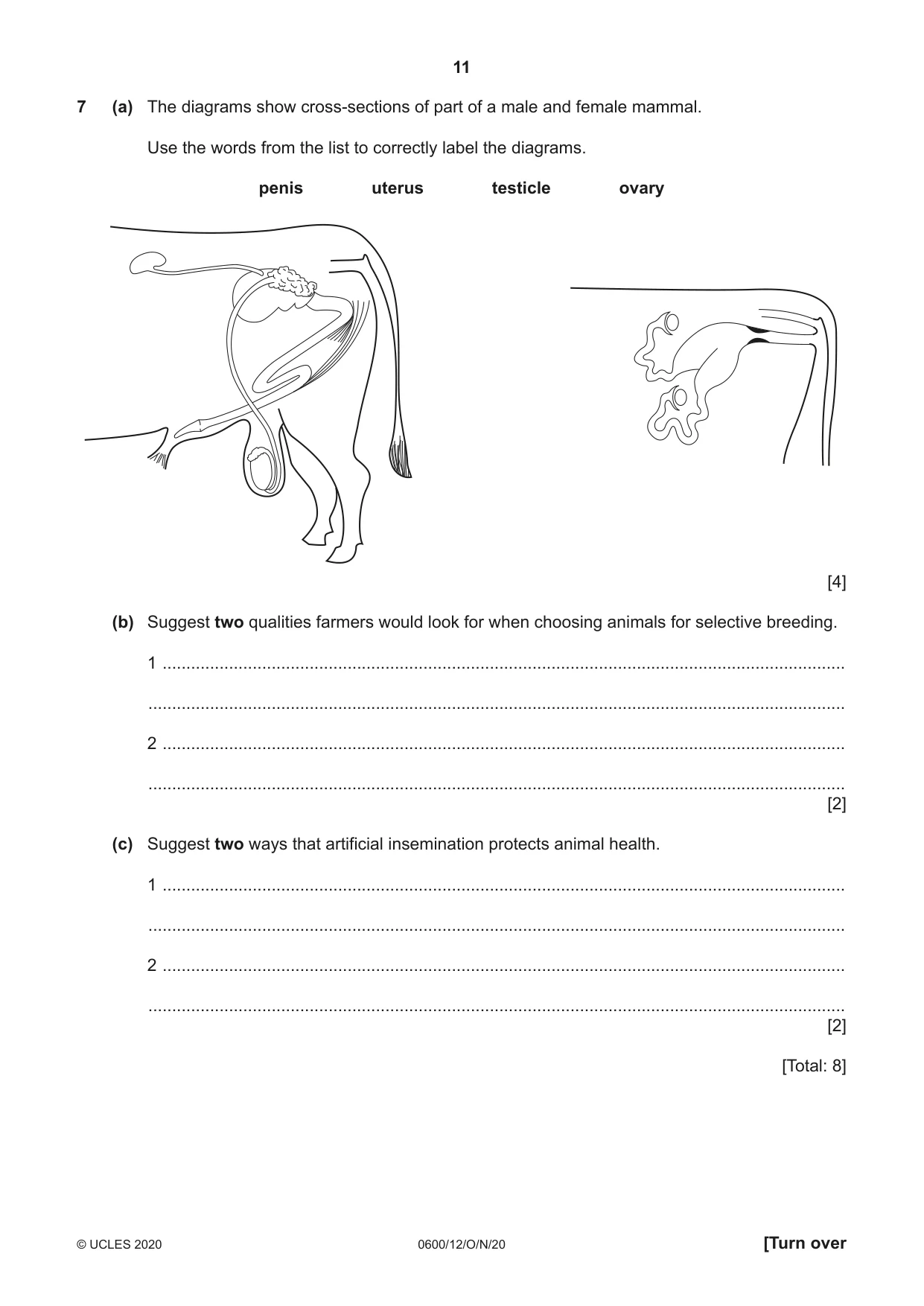
11 0600/12/O/N/20 © UCLES 2020 [Turn over 7 (a) The diagrams show cross-sections of part of a male and female mammal. Use the words from the list to correctly label the diagrams. penis uterus testicle ovary [4] (b) Suggest two qualities farmers would look for when choosing animals for selective breeding. 1 … … 2 … … [2] (c) Suggest two ways that artificial insemination protects animal health. 1 … … 2 … … [2] [Total: 8]
Question paper, page 12
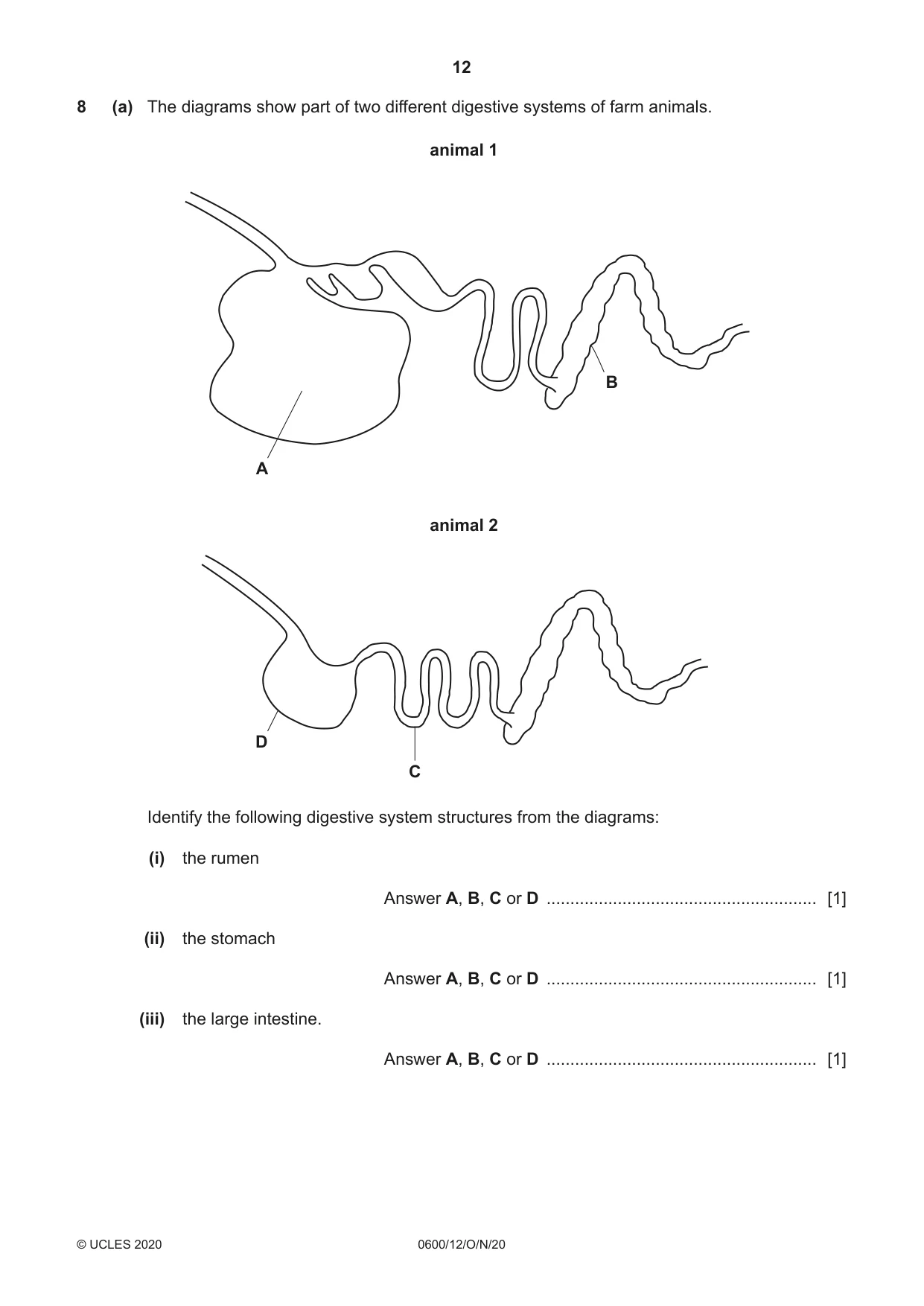
12 0600/12/O/N/20 © UCLES 2020 8 (a) The diagrams show part of two different digestive systems of farm animals. B D A C animal 1 animal 2 Identify the following digestive system structures from the diagrams: (i) the rumen Answer A, B, C or D … [1] (ii) the stomach Answer A, B, C or D … [1] (iii) the large intestine. Answer A, B, C or D … [1]
Question paper, page 13
13 0600/12/O/N/20 © UCLES 2020 [Turn over (b) Describe the role of each of the following: the small intestine … … the large intestine. … … [2] (c) Explain one advantage of a farm animal having a rumen. … … … … [2] [Total: 7]
Question paper, page 14
14 0600/12/O/N/20 © UCLES 2020 9 A single gene gives drought resistance in a crop species. The dominant allele, D, gives resistance to drought. (a) State what is meant by the term allele. … … [1] (b) (i) Complete the diagram to show the gametes present and the expected offspring genotypes produced in this cross. DD cultivar 1 drought resistant dd cultivar 2 not drought resistant gametes: parents: phenotypes: genotypes: offspring genotypes: [2] (ii) Explain why all of the resulting offspring would be expected to be drought resistant. … … … … [2] (c) Suggest why there is increasing demand for drought-resistant crops. … … [1] [Total: 6]
Question paper, page 15
15 0600/12/O/N/20 © UCLES 2020 Section B Answer any two questions. Write your answers on the separate paper provided. 10 (a) State what is meant by the term compound fertiliser and give one example of a compound fertiliser. [2] (b) Describe the nitrogen cycle and its importance to soil fertility. [7] (c) Explain how organic fertilisers improve soils. [6] [Total: 15] 11 (a) Describe how one method of biological pest control works. [3] (b) Describe how crop pests can be controlled by cultural methods. [6] (c) Explain how to store and use farm chemicals safely. [6] [Total: 15] 12 (a) Describe how weeds can spread within and between crops. [4] (b) Describe how weeds can be controlled in crops without the use of chemicals. [6] (c) Explain the problems caused by weeds in crops. [5] [Total: 15] 13 (a) Describe the properties of a loam soil. [4] (b) Describe how to test the soil pH of a field. [5] (c) Explain the dangers of excessive heat and frost to some crops. [6] [Total: 15] 14 (a) (i) Describe how a mouldboard plough, cultivator and harrow should be used to create a seedbed. [4] (ii) State the names of two other tools used for cultivation and describe how they should be maintained. [6] (b) Explain the advantages and disadvantages of farm mechanisation. [5] [Total: 15]
Question paper, page 16
16 0600/12/O/N/20 © UCLES 2020 Permission to reproduce items where third-party owned material protected by copyright is included has been sought and cleared where possible. Every reasonable effort has been made by the publisher (UCLES) to trace copyright holders, but if any items requiring clearance have unwittingly been included, the publisher will be pleased to make amends at the earliest possible opportunity. To avoid the issue of disclosure of answer-related information to candidates, all copyright acknowledgements are reproduced online in the Cambridge Assessment International Education Copyright Acknowledgements Booklet. This is produced for each series of examinations and is freely available to download at www.cambridgeinternational.org after the live examination series. Cambridge Assessment International Education is part of the Cambridge Assessment Group. Cambridge Assessment is the brand name of the University of Cambridge Local Examinations Syndicate (UCLES), which itself is a department of the University of Cambridge. BLANK PAGE
Mark scheme, page 1
This document consists of 30 printed pages. © UCLES 2020 [Turn over Cambridge IGCSE™ AGRICULTURE 0600/12 Paper 1 Theory October/November 2020 MARK SCHEME Maximum Mark: 100 Published This mark scheme is published as an aid to teachers and candidates, to indicate the requirements of the examination. It shows the basis on which Examiners were instructed to award marks. It does not indicate the details of the discussions that took place at an Examiners’ meeting before marking began, which would have considered the acceptability of alternative answers. Mark schemes should be read in conjunction with the question paper and the Principal Examiner Report for Teachers. Cambridge International will not enter into discussions about these mark schemes. Cambridge International is publishing the mark schemes for the October/November 2020 series for most Cambridge IGCSE™, Cambridge International A and AS Level and Cambridge Pre-U components, and some Cambridge O Level components.
Mark scheme, page 2
0600/12 Cambridge IGCSE – Mark Scheme PUBLISHED October/November 2020 © UCLES 2020 Page 2 of 30 Generic Marking Principles These general marking principles must be applied by all examiners when marking candidate answers. They should be applied alongside the specific content of the mark scheme or generic level descriptors for a question. Each question paper and mark scheme will also comply with these marking principles. GENERIC MARKING PRINCIPLE 1: Marks must be awarded in line with: • the specific content of the mark scheme or the generic level descriptors for the question • the specific skills defined in the mark scheme or in the generic level descriptors for the question • the standard of response required by a candidate as exemplified by the standardisation scripts. GENERIC MARKING PRINCIPLE 2: Marks awarded are always whole marks (not half marks, or other fractions). GENERIC MARKING PRINCIPLE 3: Marks must be awarded positively: • marks are awarded for correct/valid answers, as defined in the mark scheme. However, credit is given for valid answers which go beyond the scope of the syllabus and mark scheme, referring to your Team Leader as appropriate • marks are awarded when candidates clearly demonstrate what they know and can do • marks are not deducted for errors • marks are not deducted for omissions • answers should only be judged on the quality of spelling, punctuation and grammar when these features are specifically assessed by the question as indicated by the mark scheme. The meaning, however, should be unambiguous. GENERIC MARKING PRINCIPLE 4: Rules must be applied consistently, e.g. in situations where candidates have not followed instructions or in the application of generic level descriptors.
Mark scheme, page 3
0600/12 Cambridge IGCSE – Mark Scheme PUBLISHED October/November 2020 © UCLES 2020 Page 3 of 30 GENERIC MARKING PRINCIPLE 5: Marks should be awarded using the full range of marks defined in the mark scheme for the question (however; the use of the full mark range may be limited according to the quality of the candidate responses seen). GENERIC MARKING PRINCIPLE 6: Marks awarded are based solely on the requirements as defined in the mark scheme. Marks should not be awarded with grade thresholds or grade descriptors in mind. Science-Specific Marking Principles 1 Examiners should consider the context and scientific use of any keywords when awarding marks. Although keywords may be present, marks should not be awarded if the keywords are used incorrectly. 2 The examiner should not choose between contradictory statements given in the same question part, and credit should not be awarded for any correct statement that is contradicted within the same question part. Wrong science that is irrelevant to the question should be ignored. 3 Although spellings do not have to be correct, spellings of syllabus terms must allow for clear and unambiguous separation from other syllabus terms with which they may be confused (e.g. ethane / ethene, glucagon / glycogen, refraction / reflection). 4 The error carried forward (ecf) principle should be applied, where appropriate. If an incorrect answer is subsequently used in a scientifically correct way, the candidate should be awarded these subsequent marking points. Further guidance will be included in the mark scheme where necessary and any exceptions to this general principle will be noted. 5 ‘List rule’ guidance For questions that require n responses (e.g. State two reasons …): • The response should be read as continuous prose, even when numbered answer spaces are provided. • Any response marked ignore in the mark scheme should not count towards n. • Incorrect responses should not be awarded credit but will still count towards n. • Read the entire response to check for any responses that contradict those that would otherwise be credited. Credit should not be awarded for any responses that are contradicted within the rest of the response. Where two responses contradict one another, this should be treated as a single incorrect response. • Non-contradictory responses after the first n responses may be ignored even if they include incorrect science.
Mark scheme, page 4
0600/12 Cambridge IGCSE – Mark Scheme PUBLISHED October/November 2020 © UCLES 2020 Page 4 of 30 6 Calculation specific guidance Correct answers to calculations should be given full credit even if there is no working or incorrect working, unless the question states ‘show your working’. For questions in which the number of significant figures required is not stated, credit should be awarded for correct answers when rounded by the examiner to the number of significant figures given in the mark scheme. This may not apply to measured values. For answers given in standard form (e.g. a × 10n) in which the convention of restricting the value of the coefficient (a) to a value between 1 and 10 is not followed, credit may still be awarded if the answer can be converted to the answer given in the mark scheme. Unless a separate mark is given for a unit, a missing or incorrect unit will normally mean that the final calculation mark is not awarded. Exceptions to this general principle will be noted in the mark scheme. 7 Guidance for chemical equations Multiples / fractions of coefficients used in chemical equations are acceptable unless stated otherwise in the mark scheme. State symbols given in an equation should be ignored unless asked for in the question or stated otherwise in the mark scheme.
Mark scheme, page 5
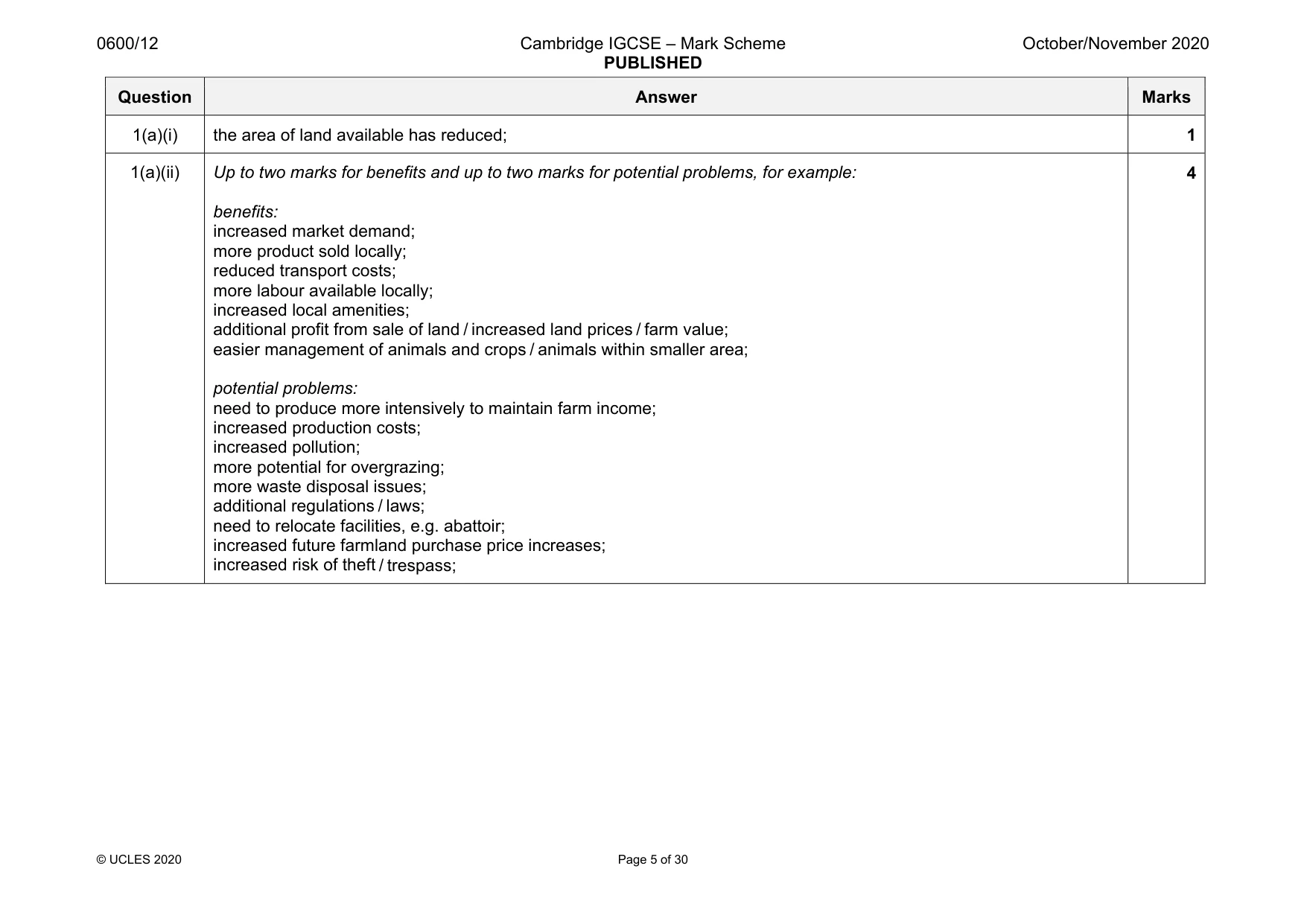
0600/12 Cambridge IGCSE – Mark Scheme PUBLISHED October/November 2020 © UCLES 2020 Page 5 of 30 Question Answer Marks 1(a)(i) the area of land available has reduced; 1 1(a)(ii) Up to two marks for benefits and up to two marks for potential problems, for example: benefits: increased market demand; more product sold locally; reduced transport costs; more labour available locally; increased local amenities; additional profit from sale of land / increased land prices / farm value; easier management of animals and crops / animals within smaller area; potential problems: need to produce more intensively to maintain farm income; increased production costs; increased pollution; more potential for overgrazing; more waste disposal issues; additional regulations / laws; need to relocate facilities, e.g. abattoir; increased future farmland purchase price increases; increased risk of theft / trespass; 4
Mark scheme, page 6
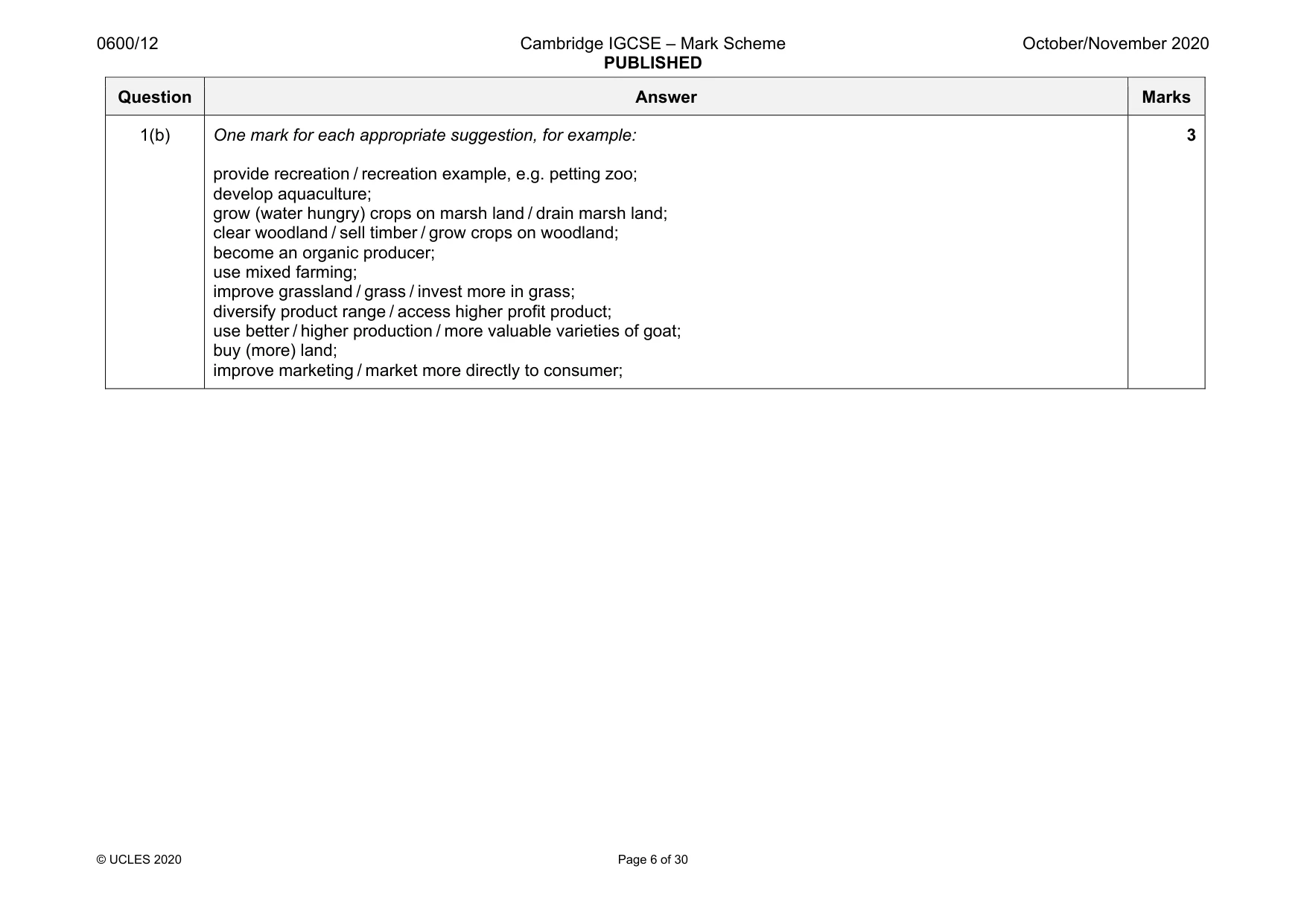
0600/12 Cambridge IGCSE – Mark Scheme PUBLISHED October/November 2020 © UCLES 2020 Page 6 of 30 Question Answer Marks 1(b) One mark for each appropriate suggestion, for example: provide recreation / recreation example, e.g. petting zoo; develop aquaculture; grow (water hungry) crops on marsh land / drain marsh land; clear woodland / sell timber / grow crops on woodland; become an organic producer; use mixed farming; improve grassland / grass / invest more in grass; diversify product range / access higher profit product; use better / higher production / more valuable varieties of goat; buy (more) land; improve marketing / market more directly to consumer; 3
Mark scheme, page 7
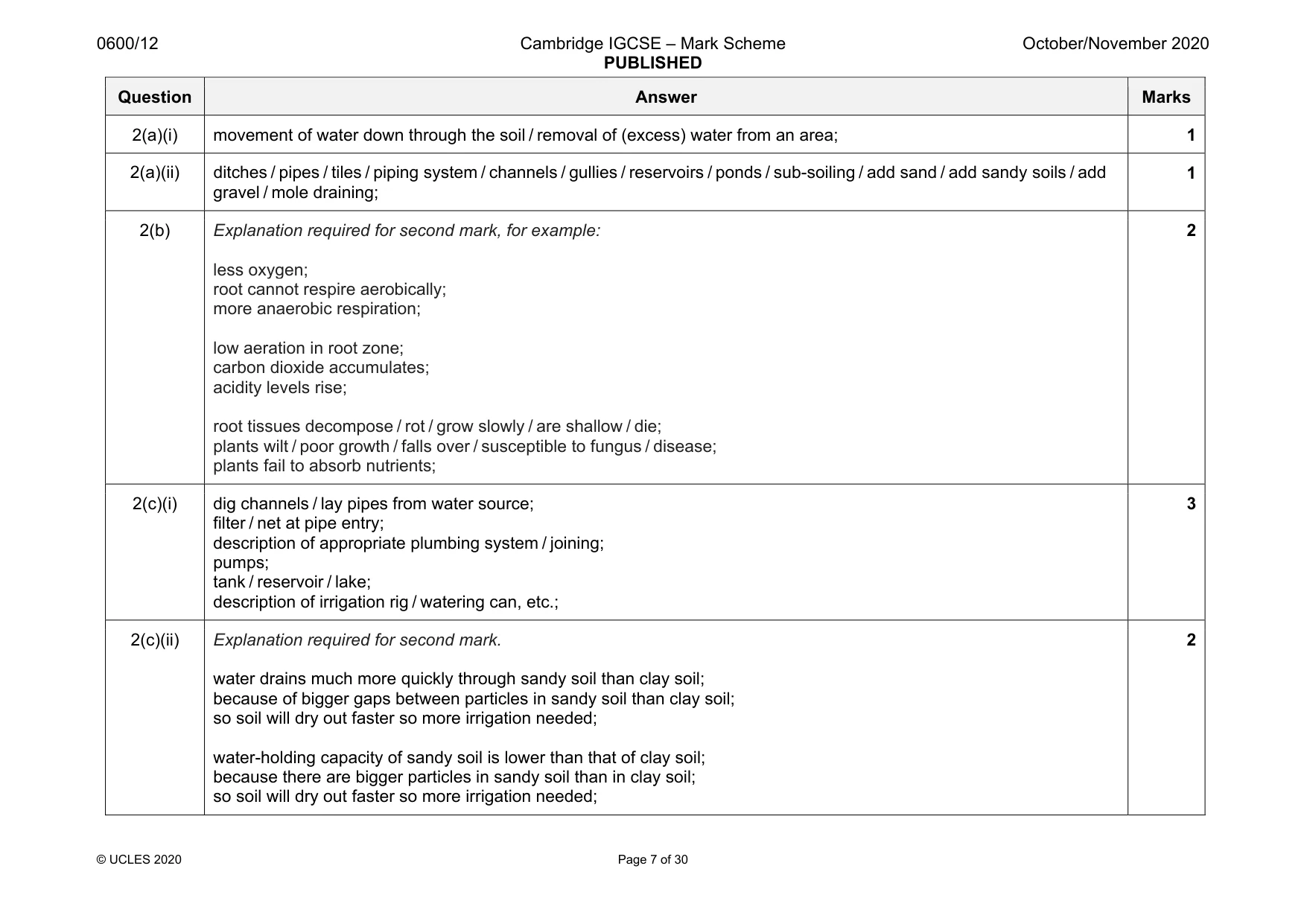
0600/12 Cambridge IGCSE – Mark Scheme PUBLISHED October/November 2020 © UCLES 2020 Page 7 of 30 Question Answer Marks 2(a)(i) movement of water down through the soil / removal of (excess) water from an area; 1 2(a)(ii) ditches / pipes / tiles / piping system / channels / gullies / reservoirs / ponds / sub-soiling / add sand / add sandy soils / add gravel / mole draining; 1 2(b) Explanation required for second mark, for example: less oxygen; root cannot respire aerobically; more anaerobic respiration; low aeration in root zone; carbon dioxide accumulates; acidity levels rise; root tissues decompose / rot / grow slowly / are shallow / die; plants wilt / poor growth / falls over / susceptible to fungus / disease; plants fail to absorb nutrients; 2 2(c)(i) dig channels / lay pipes from water source; filter / net at pipe entry; description of appropriate plumbing system / joining; pumps; tank / reservoir / lake; description of irrigation rig / watering can, etc.; 3 2(c)(ii) Explanation required for second mark. water drains much more quickly through sandy soil than clay soil; because of bigger gaps between particles in sandy soil than clay soil; so soil will dry out faster so more irrigation needed; water-holding capacity of sandy soil is lower than that of clay soil; because there are bigger particles in sandy soil than in clay soil; so soil will dry out faster so more irrigation needed; 2
Mark scheme, page 8
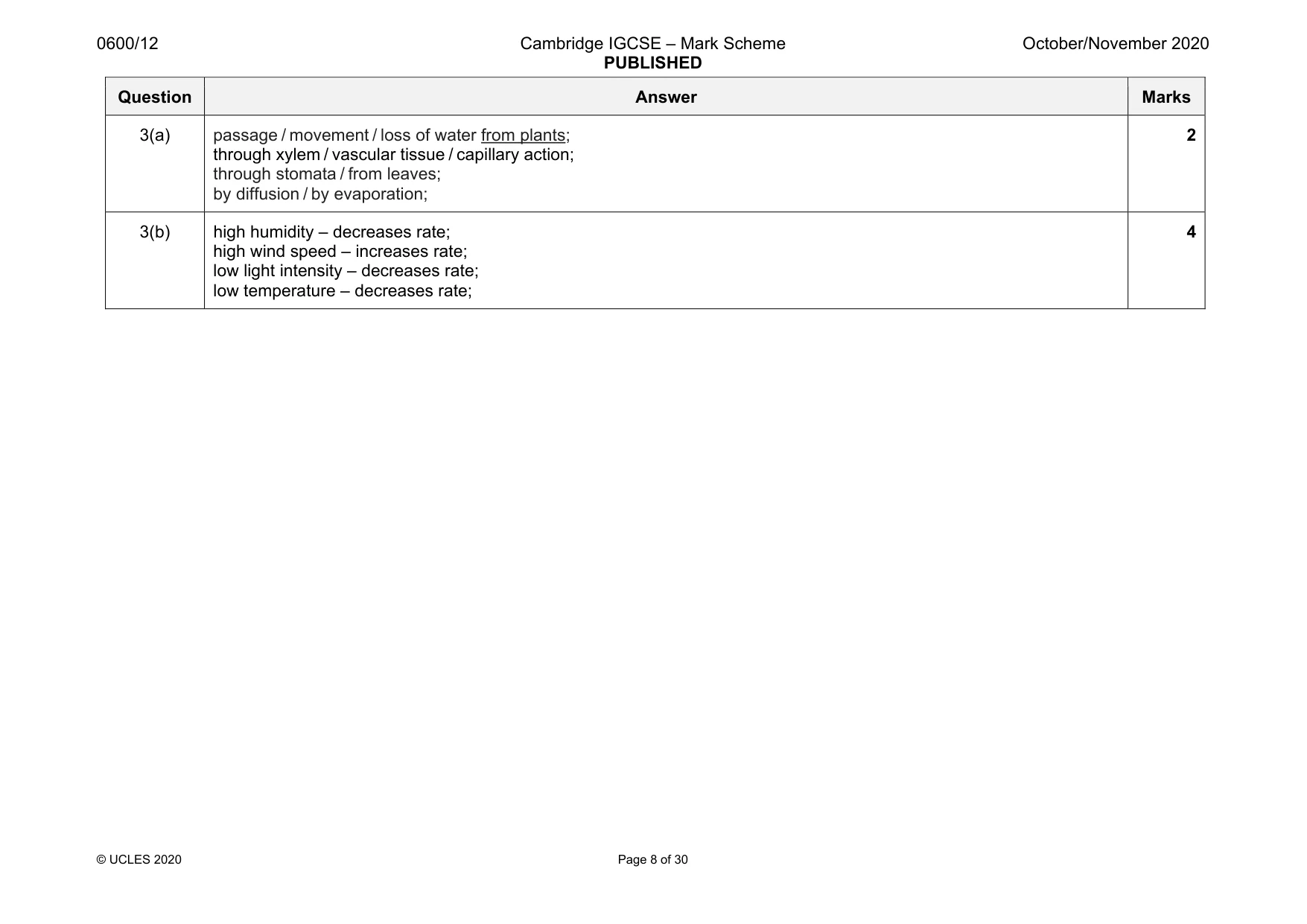
0600/12 Cambridge IGCSE – Mark Scheme PUBLISHED October/November 2020 © UCLES 2020 Page 8 of 30 Question Answer Marks 3(a) passage / movement / loss of water from plants; through xylem / vascular tissue / capillary action; through stomata / from leaves; by diffusion / by evaporation; 2 3(b) high humidity – decreases rate; high wind speed – increases rate; low light intensity – decreases rate; low temperature – decreases rate; 4
Mark scheme, page 9
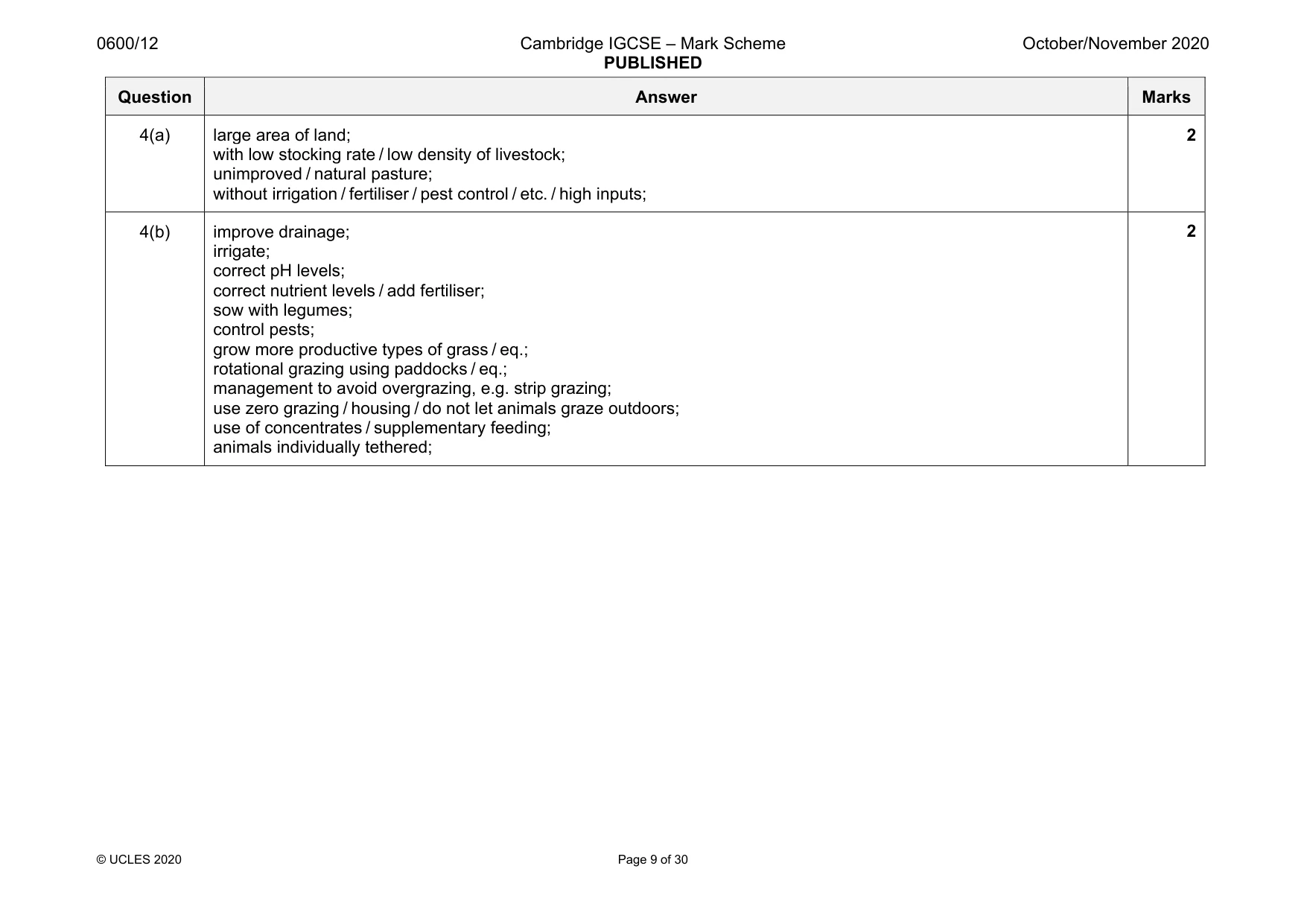
0600/12 Cambridge IGCSE – Mark Scheme PUBLISHED October/November 2020 © UCLES 2020 Page 9 of 30 Question Answer Marks 4(a) large area of land; with low stocking rate / low density of livestock; unimproved / natural pasture; without irrigation / fertiliser / pest control / etc. / high inputs; 2 4(b) improve drainage; irrigate; correct pH levels; correct nutrient levels / add fertiliser; sow with legumes; control pests; grow more productive types of grass / eq.; rotational grazing using paddocks / eq.; management to avoid overgrazing, e.g. strip grazing; use zero grazing / housing / do not let animals graze outdoors; use of concentrates / supplementary feeding; animals individually tethered; 2
Mark scheme, page 10
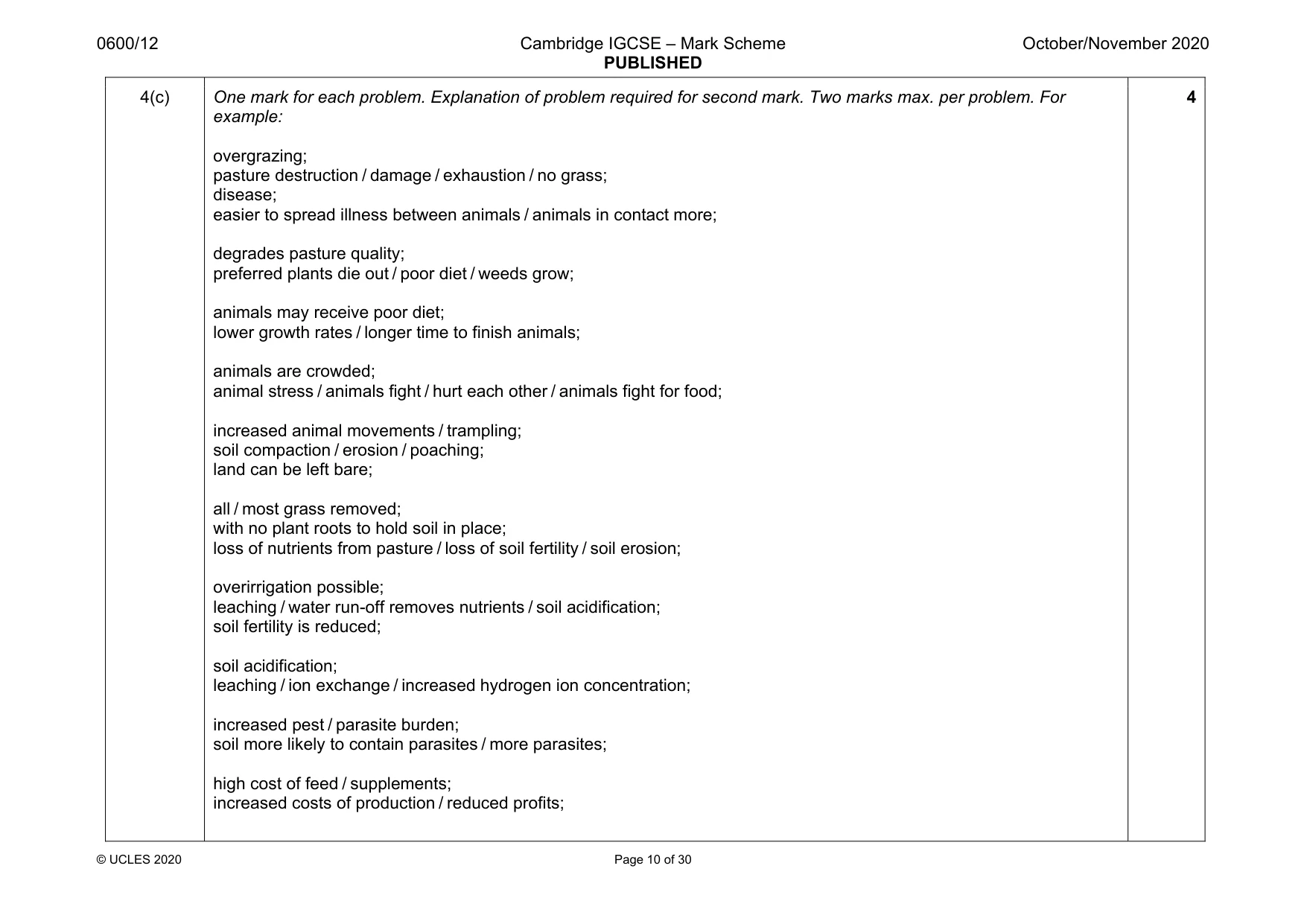
0600/12 Cambridge IGCSE – Mark Scheme PUBLISHED October/November 2020 © UCLES 2020 Page 10 of 30 4(c) One mark for each problem. Explanation of problem required for second mark. Two marks max. per problem. For example: overgrazing; pasture destruction / damage / exhaustion / no grass; disease; easier to spread illness between animals / animals in contact more; degrades pasture quality; preferred plants die out / poor diet / weeds grow; animals may receive poor diet; lower growth rates / longer time to finish animals; animals are crowded; animal stress / animals fight / hurt each other / animals fight for food; increased animal movements / trampling; soil compaction / erosion / poaching; land can be left bare; all / most grass removed; with no plant roots to hold soil in place; loss of nutrients from pasture / loss of soil fertility / soil erosion; overirrigation possible; leaching / water run-off removes nutrients / soil acidification; soil fertility is reduced; soil acidification; leaching / ion exchange / increased hydrogen ion concentration; increased pest / parasite burden; soil more likely to contain parasites / more parasites; high cost of feed / supplements; increased costs of production / reduced profits; 4
Mark scheme, page 11
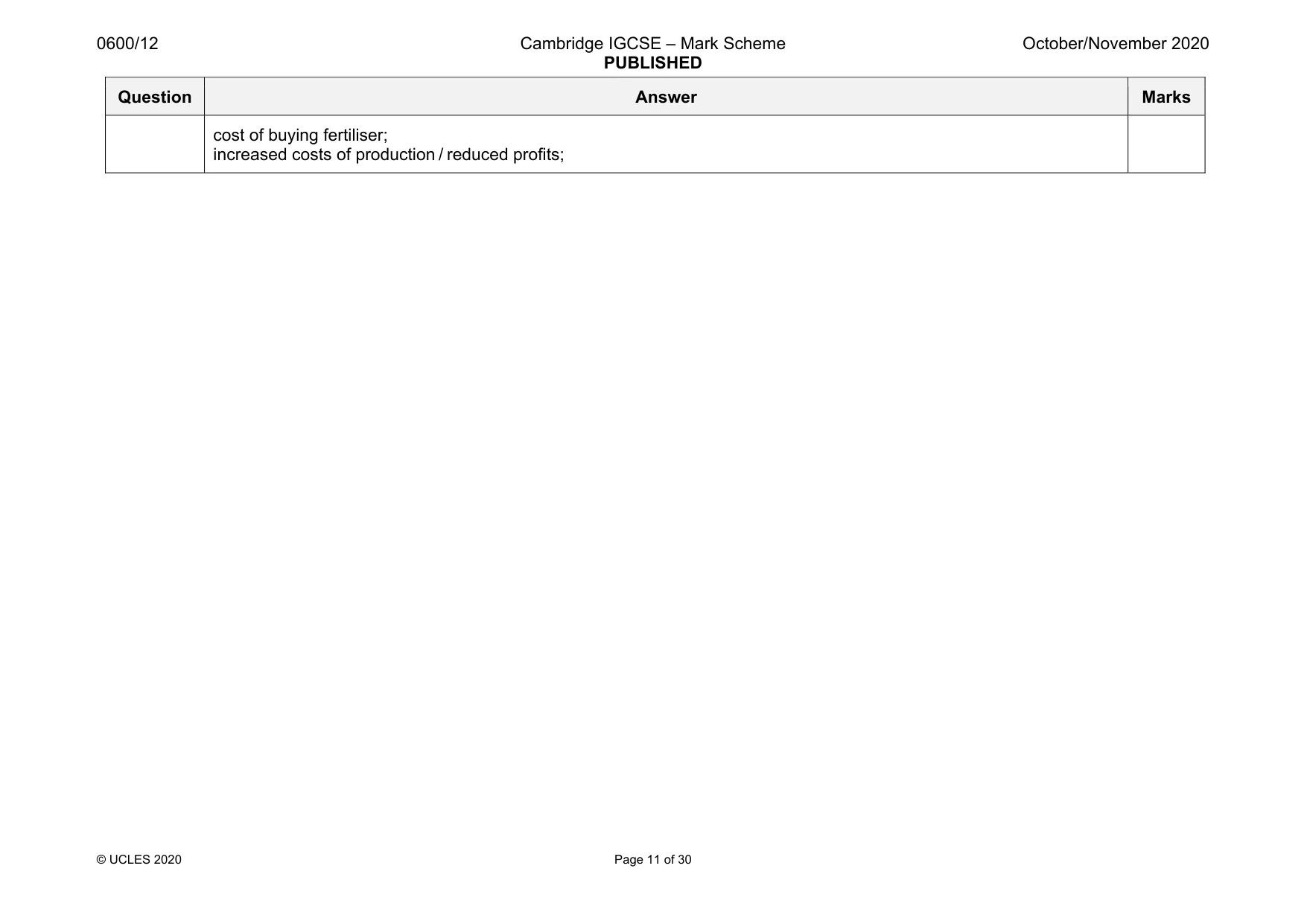
0600/12 Cambridge IGCSE – Mark Scheme PUBLISHED October/November 2020 © UCLES 2020 Page 11 of 30 Question Answer Marks cost of buying fertiliser; increased costs of production / reduced profits;
Mark scheme, page 12
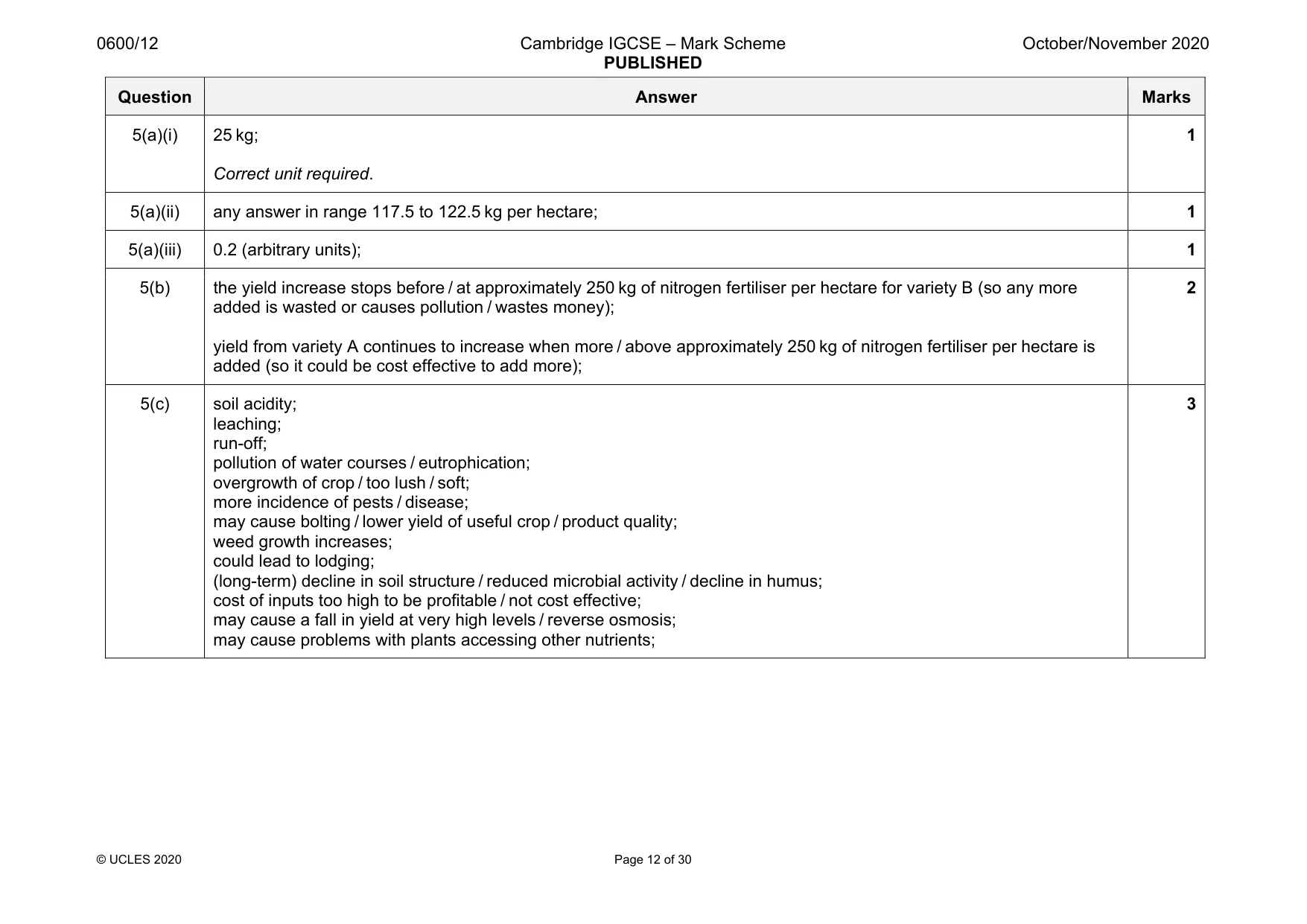
0600/12 Cambridge IGCSE – Mark Scheme PUBLISHED October/November 2020 © UCLES 2020 Page 12 of 30 Question Answer Marks 5(a)(i) 25 kg; Correct unit required. 1 5(a)(ii) any answer in range 117.5 to 122.5 kg per hectare; 1 5(a)(iii) 0.2 (arbitrary units); 1 5(b) the yield increase stops before / at approximately 250 kg of nitrogen fertiliser per hectare for variety B (so any more added is wasted or causes pollution / wastes money); yield from variety A continues to increase when more / above approximately 250 kg of nitrogen fertiliser per hectare is added (so it could be cost effective to add more); 2 5(c) soil acidity; leaching; run-off; pollution of water courses / eutrophication; overgrowth of crop / too lush / soft; more incidence of pests / disease; may cause bolting / lower yield of useful crop / product quality; weed growth increases; could lead to lodging; (long-term) decline in soil structure / reduced microbial activity / decline in humus; cost of inputs too high to be profitable / not cost effective; may cause a fall in yield at very high levels / reverse osmosis; may cause problems with plants accessing other nutrients; 3
Mark scheme, page 13
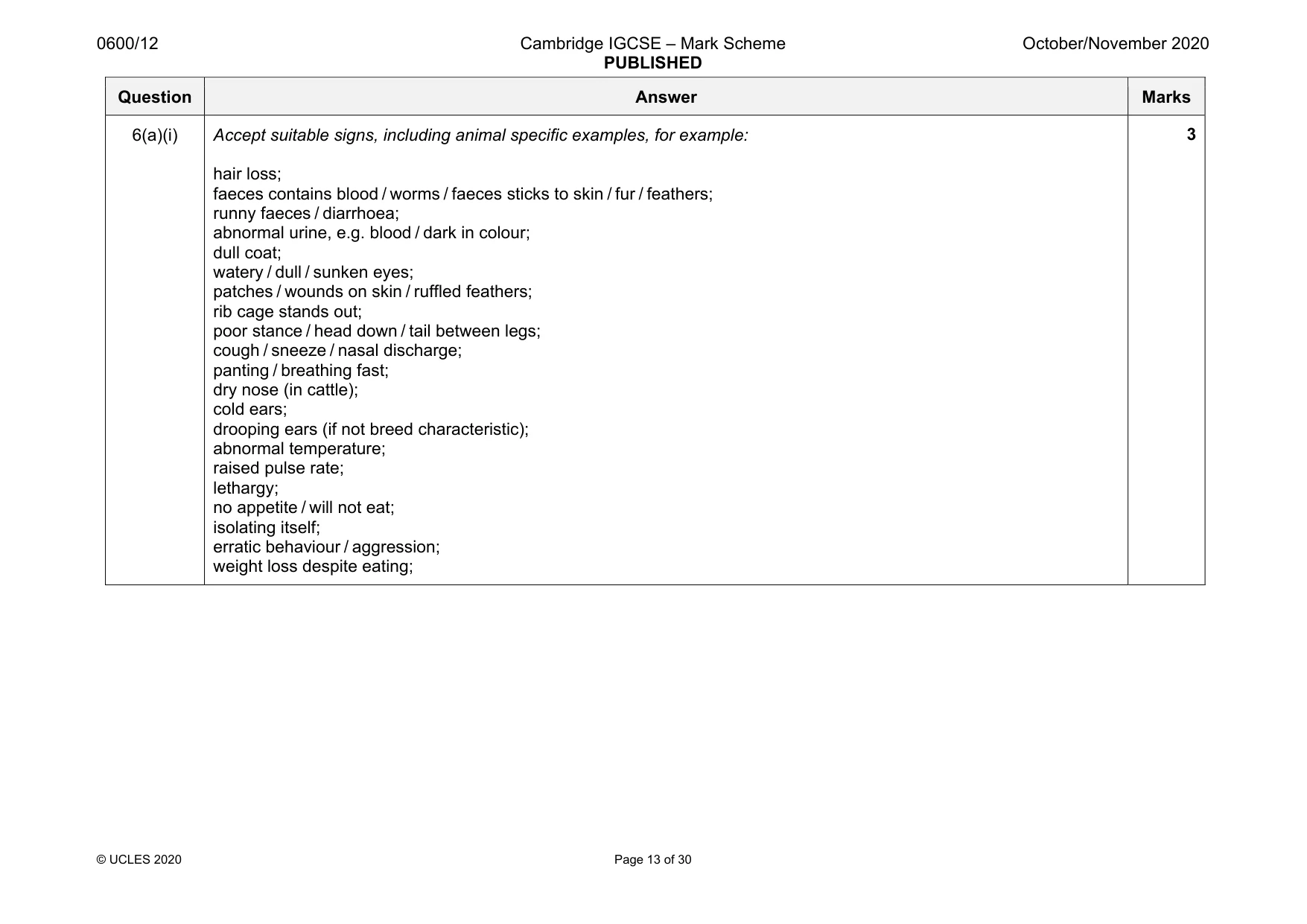
0600/12 Cambridge IGCSE – Mark Scheme PUBLISHED October/November 2020 © UCLES 2020 Page 13 of 30 Question Answer Marks 6(a)(i) Accept suitable signs, including animal specific examples, for example: hair loss; faeces contains blood / worms / faeces sticks to skin / fur / feathers; runny faeces / diarrhoea; abnormal urine, e.g. blood / dark in colour; dull coat; watery / dull / sunken eyes; patches / wounds on skin / ruffled feathers; rib cage stands out; poor stance / head down / tail between legs; cough / sneeze / nasal discharge; panting / breathing fast; dry nose (in cattle); cold ears; drooping ears (if not breed characteristic); abnormal temperature; raised pulse rate; lethargy; no appetite / will not eat; isolating itself; erratic behaviour / aggression; weight loss despite eating; 3
Mark scheme, page 14
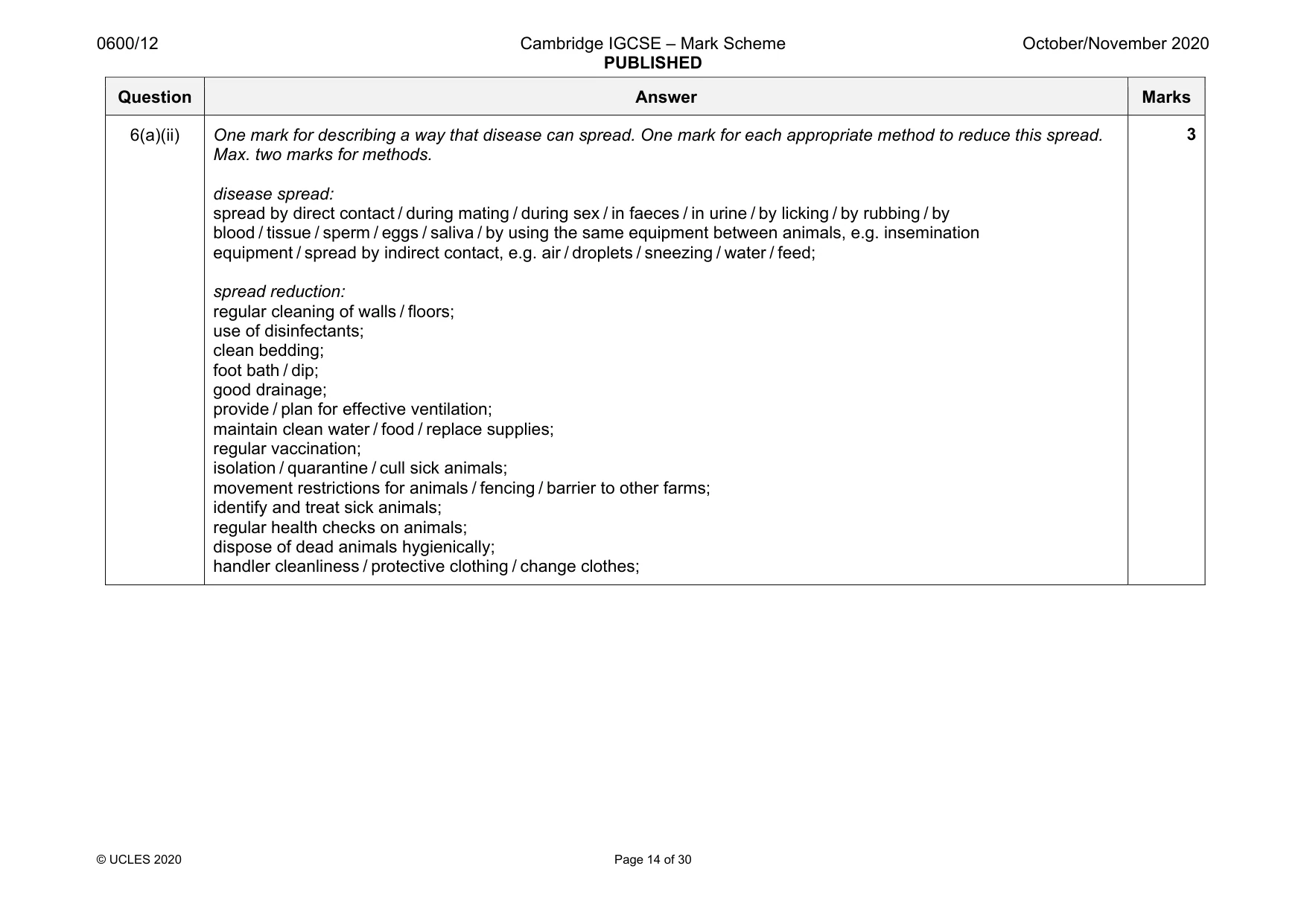
0600/12 Cambridge IGCSE – Mark Scheme PUBLISHED October/November 2020 © UCLES 2020 Page 14 of 30 Question Answer Marks 6(a)(ii) One mark for describing a way that disease can spread. One mark for each appropriate method to reduce this spread. Max. two marks for methods. disease spread: spread by direct contact / during mating / during sex / in faeces / in urine / by licking / by rubbing / by blood / tissue / sperm / eggs / saliva / by using the same equipment between animals, e.g. insemination equipment / spread by indirect contact, e.g. air / droplets / sneezing / water / feed; spread reduction: regular cleaning of walls / floors; use of disinfectants; clean bedding; foot bath / dip; good drainage; provide / plan for effective ventilation; maintain clean water / food / replace supplies; regular vaccination; isolation / quarantine / cull sick animals; movement restrictions for animals / fencing / barrier to other farms; identify and treat sick animals; regular health checks on animals; dispose of dead animals hygienically; handler cleanliness / protective clothing / change clothes; 3
Mark scheme, page 15
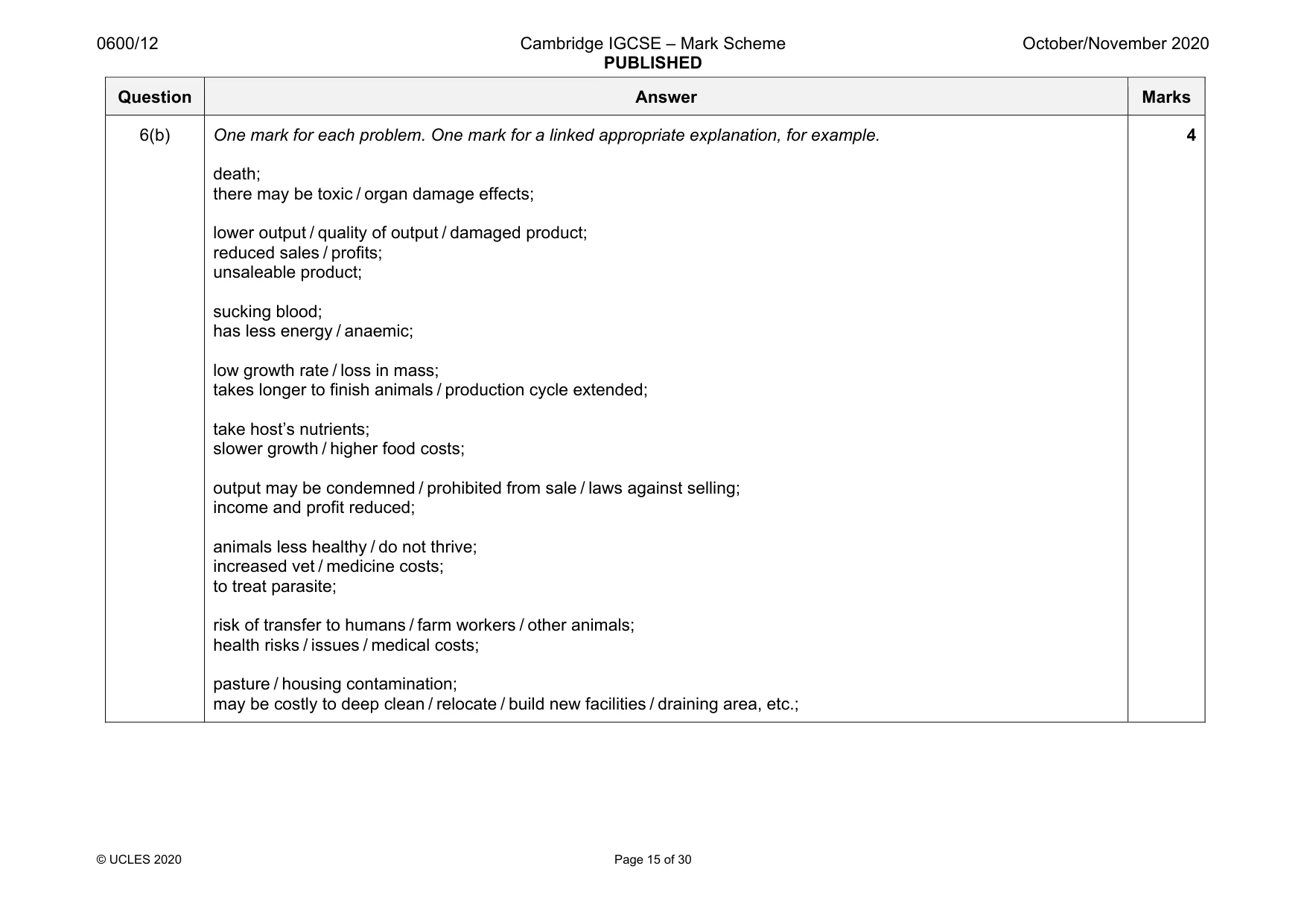
0600/12 Cambridge IGCSE – Mark Scheme PUBLISHED October/November 2020 © UCLES 2020 Page 15 of 30 Question Answer Marks 6(b) One mark for each problem. One mark for a linked appropriate explanation, for example. death; there may be toxic / organ damage effects; lower output / quality of output / damaged product; reduced sales / profits; unsaleable product; sucking blood; has less energy / anaemic; low growth rate / loss in mass; takes longer to finish animals / production cycle extended; take host’s nutrients; slower growth / higher food costs; output may be condemned / prohibited from sale / laws against selling; income and profit reduced; animals less healthy / do not thrive; increased vet / medicine costs; to treat parasite; risk of transfer to humans / farm workers / other animals; health risks / issues / medical costs; pasture / housing contamination; may be costly to deep clean / relocate / build new facilities / draining area, etc.; 4
Mark scheme, page 16
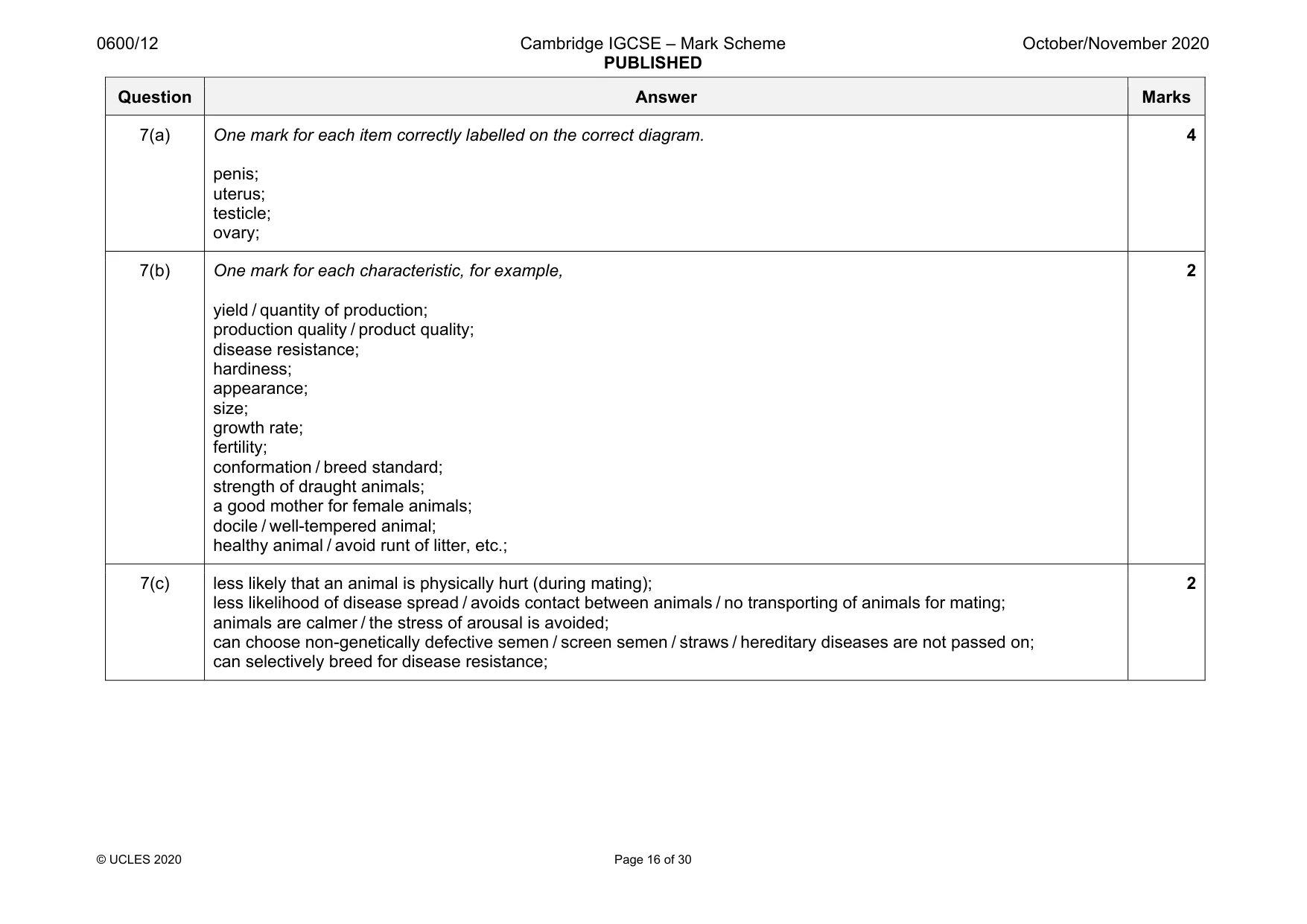
0600/12 Cambridge IGCSE – Mark Scheme PUBLISHED October/November 2020 © UCLES 2020 Page 16 of 30 Question Answer Marks 7(a) One mark for each item correctly labelled on the correct diagram. penis; uterus; testicle; ovary; 4 7(b) One mark for each characteristic, for example, yield / quantity of production; production quality / product quality; disease resistance; hardiness; appearance; size; growth rate; fertility; conformation / breed standard; strength of draught animals; a good mother for female animals; docile / well-tempered animal; healthy animal / avoid runt of litter, etc.; 2 7(c) less likely that an animal is physically hurt (during mating); less likelihood of disease spread / avoids contact between animals / no transporting of animals for mating; animals are calmer / the stress of arousal is avoided; can choose non-genetically defective semen / screen semen / straws / hereditary diseases are not passed on; can selectively breed for disease resistance; 2
Mark scheme, page 17
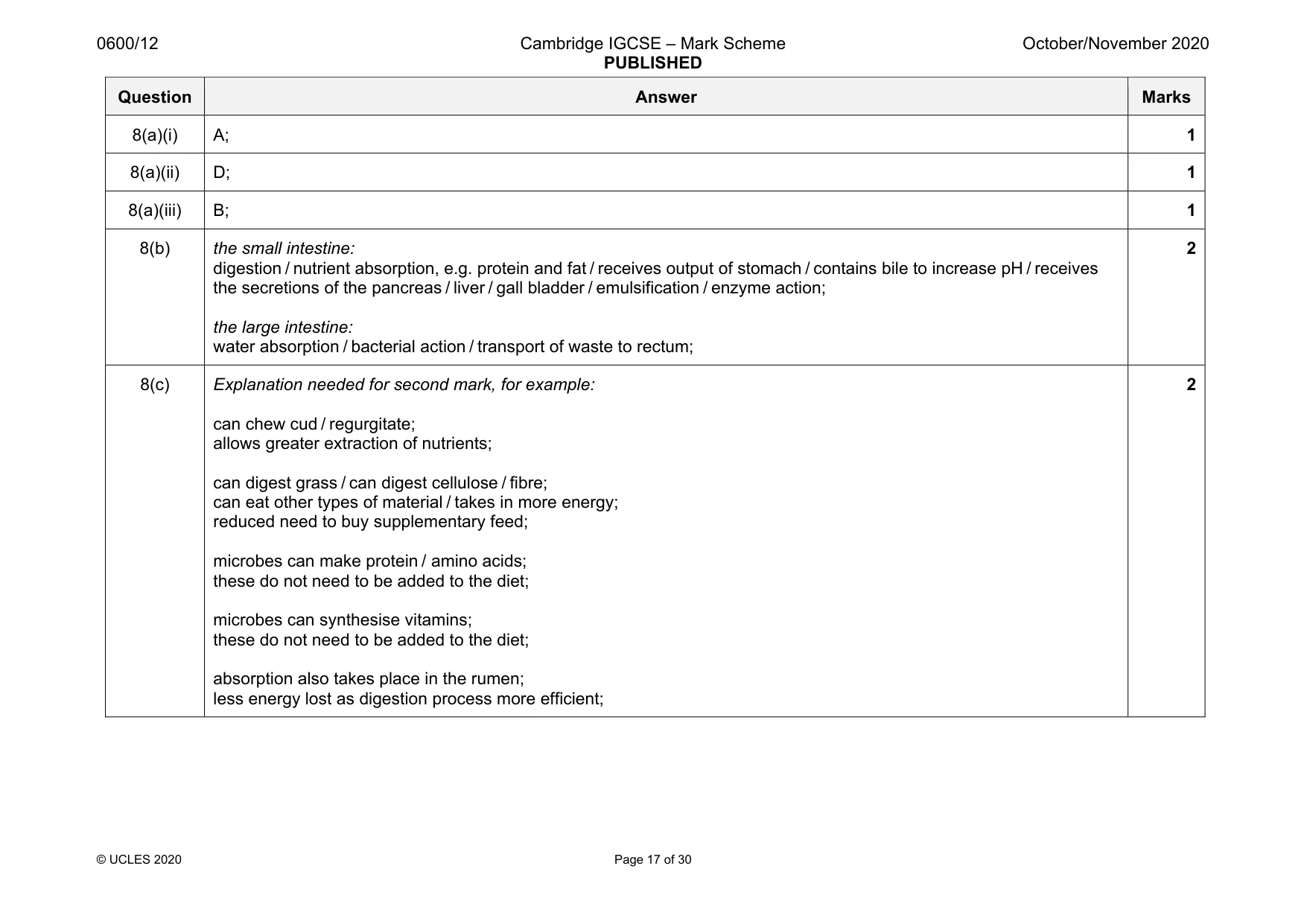
0600/12 Cambridge IGCSE – Mark Scheme PUBLISHED October/November 2020 © UCLES 2020 Page 17 of 30 Question Answer Marks 8(a)(i) A; 1 8(a)(ii) D; 1 8(a)(iii) B; 1 8(b) the small intestine: digestion / nutrient absorption, e.g. protein and fat / receives output of stomach / contains bile to increase pH / receives the secretions of the pancreas / liver / gall bladder / emulsification / enzyme action; the large intestine: water absorption / bacterial action / transport of waste to rectum; 2 8(c) Explanation needed for second mark, for example: can chew cud / regurgitate; allows greater extraction of nutrients; can digest grass / can digest cellulose / fibre; can eat other types of material / takes in more energy; reduced need to buy supplementary feed; microbes can make protein / amino acids; these do not need to be added to the diet; microbes can synthesise vitamins; these do not need to be added to the diet; absorption also takes place in the rumen; less energy lost as digestion process more efficient; 2
Mark scheme, page 18
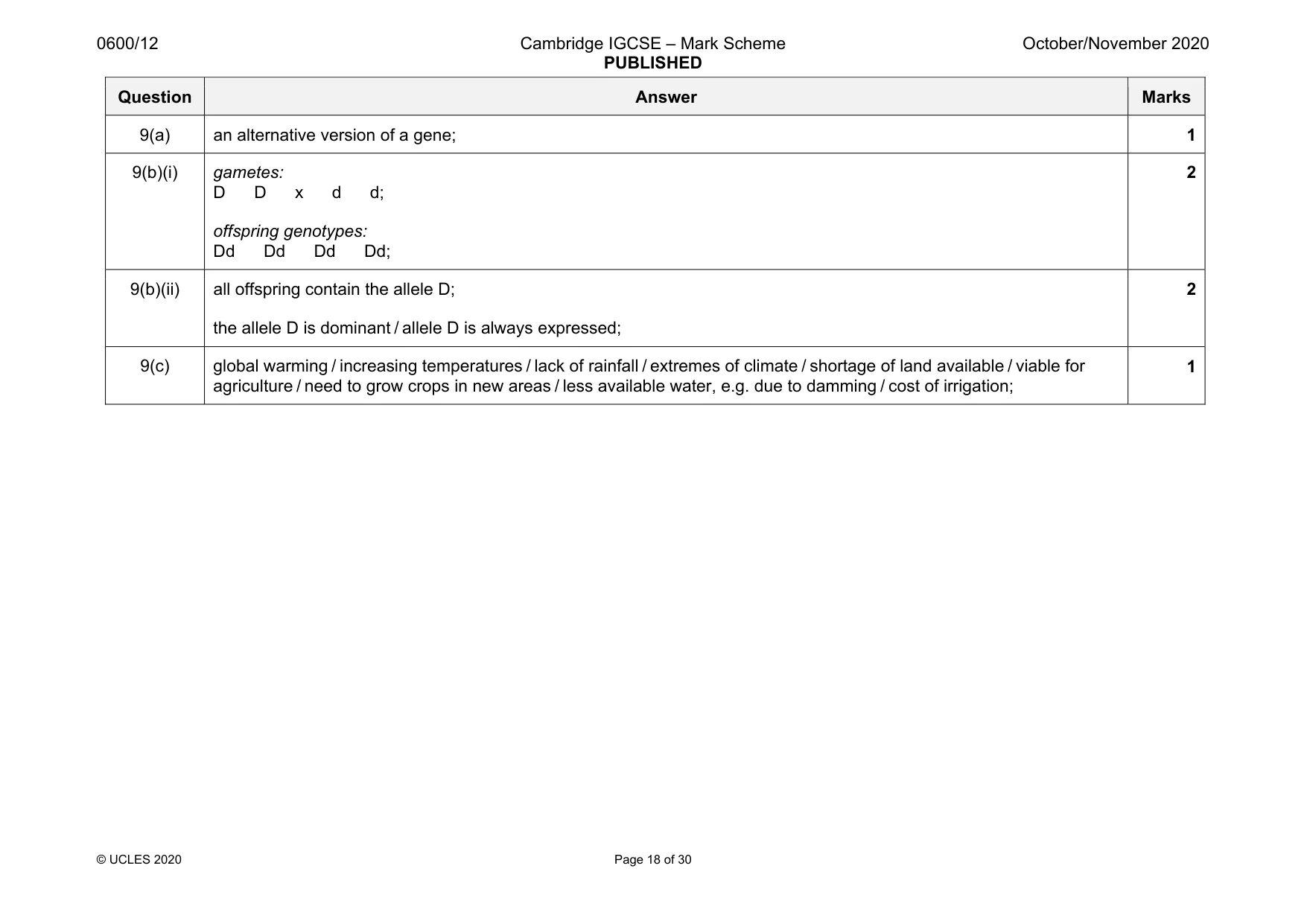
0600/12 Cambridge IGCSE – Mark Scheme PUBLISHED October/November 2020 © UCLES 2020 Page 18 of 30 Question Answer Marks 9(a) an alternative version of a gene; 1 9(b)(i) gametes: D D x d d; offspring genotypes: Dd Dd Dd Dd; 2 9(b)(ii) all offspring contain the allele D; the allele D is dominant / allele D is always expressed; 2 9(c) global warming / increasing temperatures / lack of rainfall / extremes of climate / shortage of land available / viable for agriculture / need to grow crops in new areas / less available water, e.g. due to damming / cost of irrigation; 1
Mark scheme, page 19
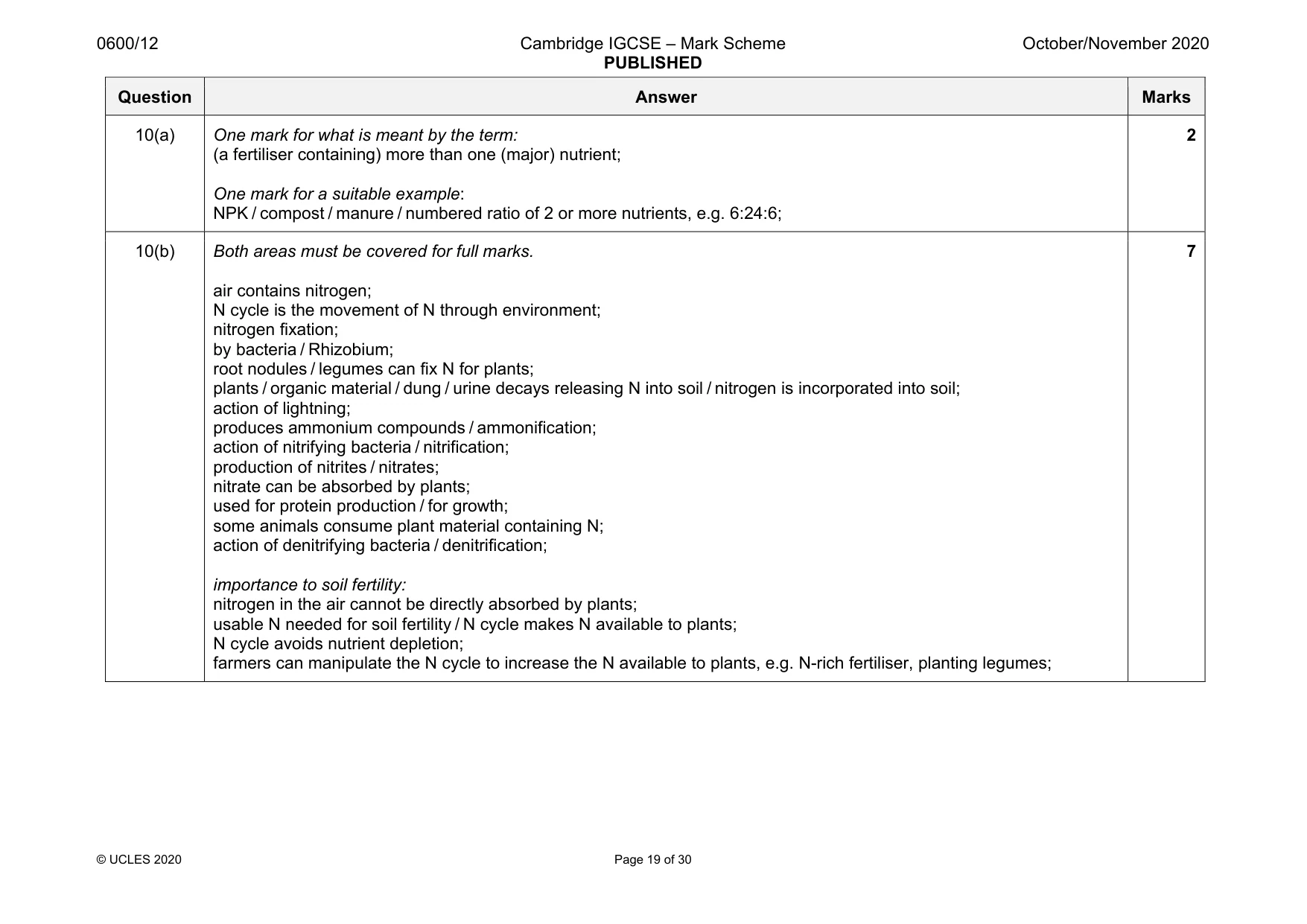
0600/12 Cambridge IGCSE – Mark Scheme PUBLISHED October/November 2020 © UCLES 2020 Page 19 of 30 Question Answer Marks 10(a) One mark for what is meant by the term: (a fertiliser containing) more than one (major) nutrient; One mark for a suitable example: NPK / compost / manure / numbered ratio of 2 or more nutrients, e.g. 6:24:6; 2 10(b) Both areas must be covered for full marks. air contains nitrogen; N cycle is the movement of N through environment; nitrogen fixation; by bacteria / Rhizobium; root nodules / legumes can fix N for plants; plants / organic material / dung / urine decays releasing N into soil / nitrogen is incorporated into soil; action of lightning; produces ammonium compounds / ammonification; action of nitrifying bacteria / nitrification; production of nitrites / nitrates; nitrate can be absorbed by plants; used for protein production / for growth; some animals consume plant material containing N; action of denitrifying bacteria / denitrification; importance to soil fertility: nitrogen in the air cannot be directly absorbed by plants; usable N needed for soil fertility / N cycle makes N available to plants; N cycle avoids nutrient depletion; farmers can manipulate the N cycle to increase the N available to plants, e.g. N-rich fertiliser, planting legumes; 7
Mark scheme, page 20
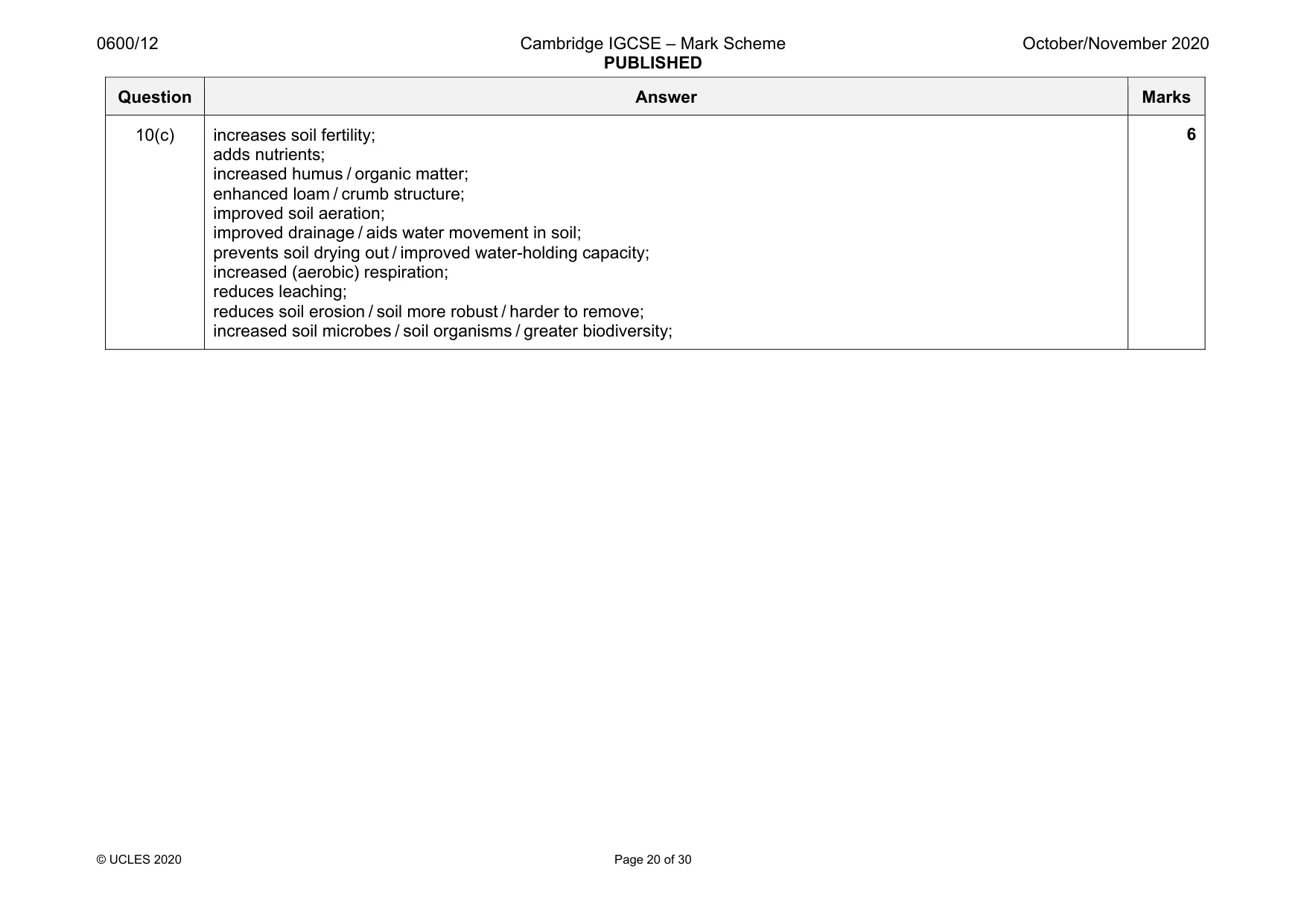
0600/12 Cambridge IGCSE – Mark Scheme PUBLISHED October/November 2020 © UCLES 2020 Page 20 of 30 Question Answer Marks 10(c) increases soil fertility; adds nutrients; increased humus / organic matter; enhanced loam / crumb structure; improved soil aeration; improved drainage / aids water movement in soil; prevents soil drying out / improved water-holding capacity; increased (aerobic) respiration; reduces leaching; reduces soil erosion / soil more robust / harder to remove; increased soil microbes / soil organisms / greater biodiversity; 6
Mark scheme, page 21
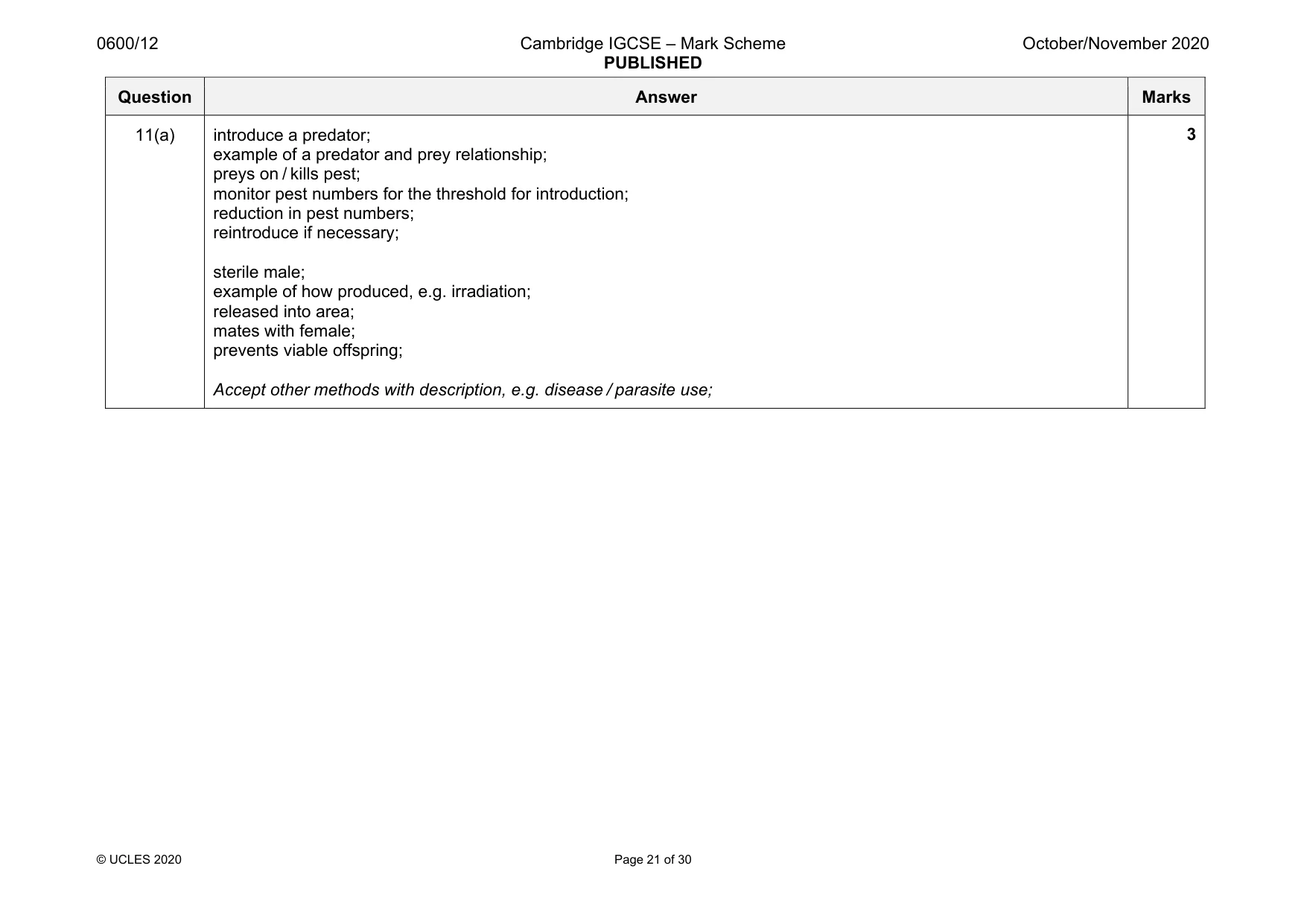
0600/12 Cambridge IGCSE – Mark Scheme PUBLISHED October/November 2020 © UCLES 2020 Page 21 of 30 Question Answer Marks 11(a) introduce a predator; example of a predator and prey relationship; preys on / kills pest; monitor pest numbers for the threshold for introduction; reduction in pest numbers; reintroduce if necessary; sterile male; example of how produced, e.g. irradiation; released into area; mates with female; prevents viable offspring; Accept other methods with description, e.g. disease / parasite use; 3
Mark scheme, page 22
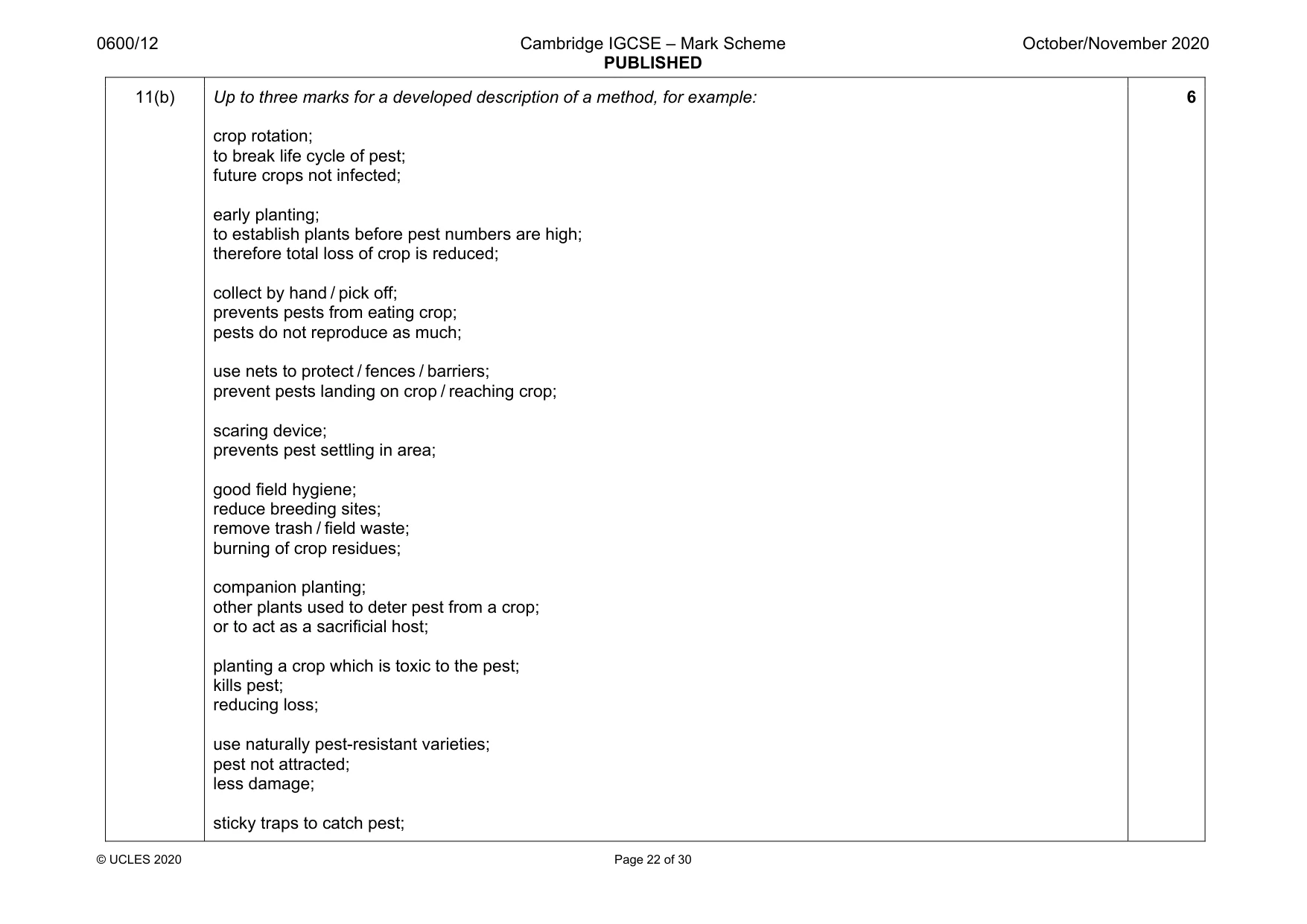
0600/12 Cambridge IGCSE – Mark Scheme PUBLISHED October/November 2020 © UCLES 2020 Page 22 of 30 11(b) Up to three marks for a developed description of a method, for example: crop rotation; to break life cycle of pest; future crops not infected; early planting; to establish plants before pest numbers are high; therefore total loss of crop is reduced; collect by hand / pick off; prevents pests from eating crop; pests do not reproduce as much; use nets to protect / fences / barriers; prevent pests landing on crop / reaching crop; scaring device; prevents pest settling in area; good field hygiene; reduce breeding sites; remove trash / field waste; burning of crop residues; companion planting; other plants used to deter pest from a crop; or to act as a sacrificial host; planting a crop which is toxic to the pest; kills pest; reducing loss; use naturally pest-resistant varieties; pest not attracted; less damage; sticky traps to catch pest; 6
Mark scheme, page 23
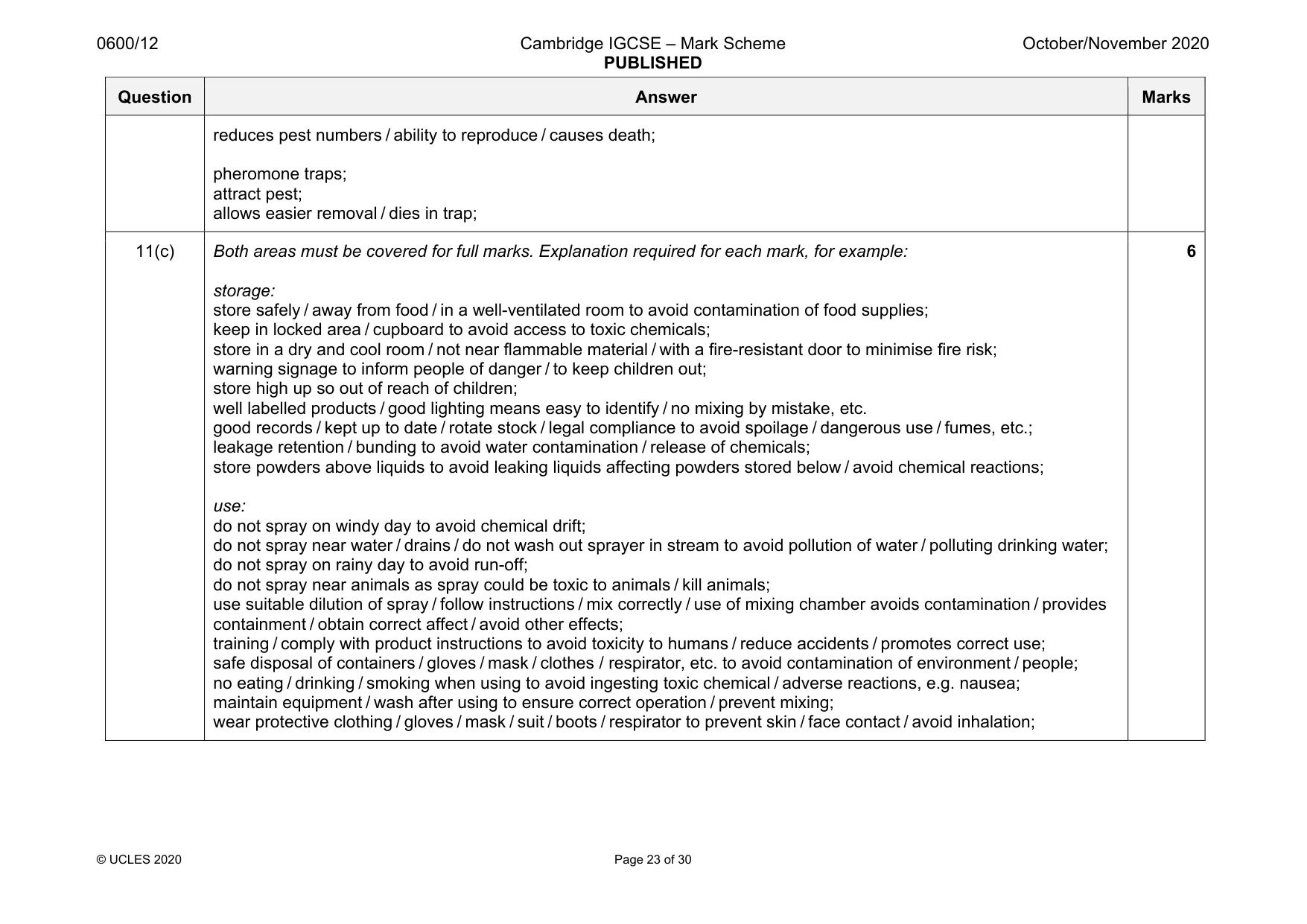
0600/12 Cambridge IGCSE – Mark Scheme PUBLISHED October/November 2020 © UCLES 2020 Page 23 of 30 Question Answer Marks reduces pest numbers / ability to reproduce / causes death; pheromone traps; attract pest; allows easier removal / dies in trap; 11(c) Both areas must be covered for full marks. Explanation required for each mark, for example: storage: store safely / away from food / in a well-ventilated room to avoid contamination of food supplies; keep in locked area / cupboard to avoid access to toxic chemicals; store in a dry and cool room / not near flammable material / with a fire-resistant door to minimise fire risk; warning signage to inform people of danger / to keep children out; store high up so out of reach of children; well labelled products / good lighting means easy to identify / no mixing by mistake, etc. good records / kept up to date / rotate stock / legal compliance to avoid spoilage / dangerous use / fumes, etc.; leakage retention / bunding to avoid water contamination / release of chemicals; store powders above liquids to avoid leaking liquids affecting powders stored below / avoid chemical reactions; use: do not spray on windy day to avoid chemical drift; do not spray near water / drains / do not wash out sprayer in stream to avoid pollution of water / polluting drinking water; do not spray on rainy day to avoid run-off; do not spray near animals as spray could be toxic to animals / kill animals; use suitable dilution of spray / follow instructions / mix correctly / use of mixing chamber avoids contamination / provides containment / obtain correct affect / avoid other effects; training / comply with product instructions to avoid toxicity to humans / reduce accidents / promotes correct use; safe disposal of containers / gloves / mask / clothes / respirator, etc. to avoid contamination of environment / people; no eating / drinking / smoking when using to avoid ingesting toxic chemical / adverse reactions, e.g. nausea; maintain equipment / wash after using to ensure correct operation / prevent mixing; wear protective clothing / gloves / mask / suit / boots / respirator to prevent skin / face contact / avoid inhalation; 6
Mark scheme, page 24
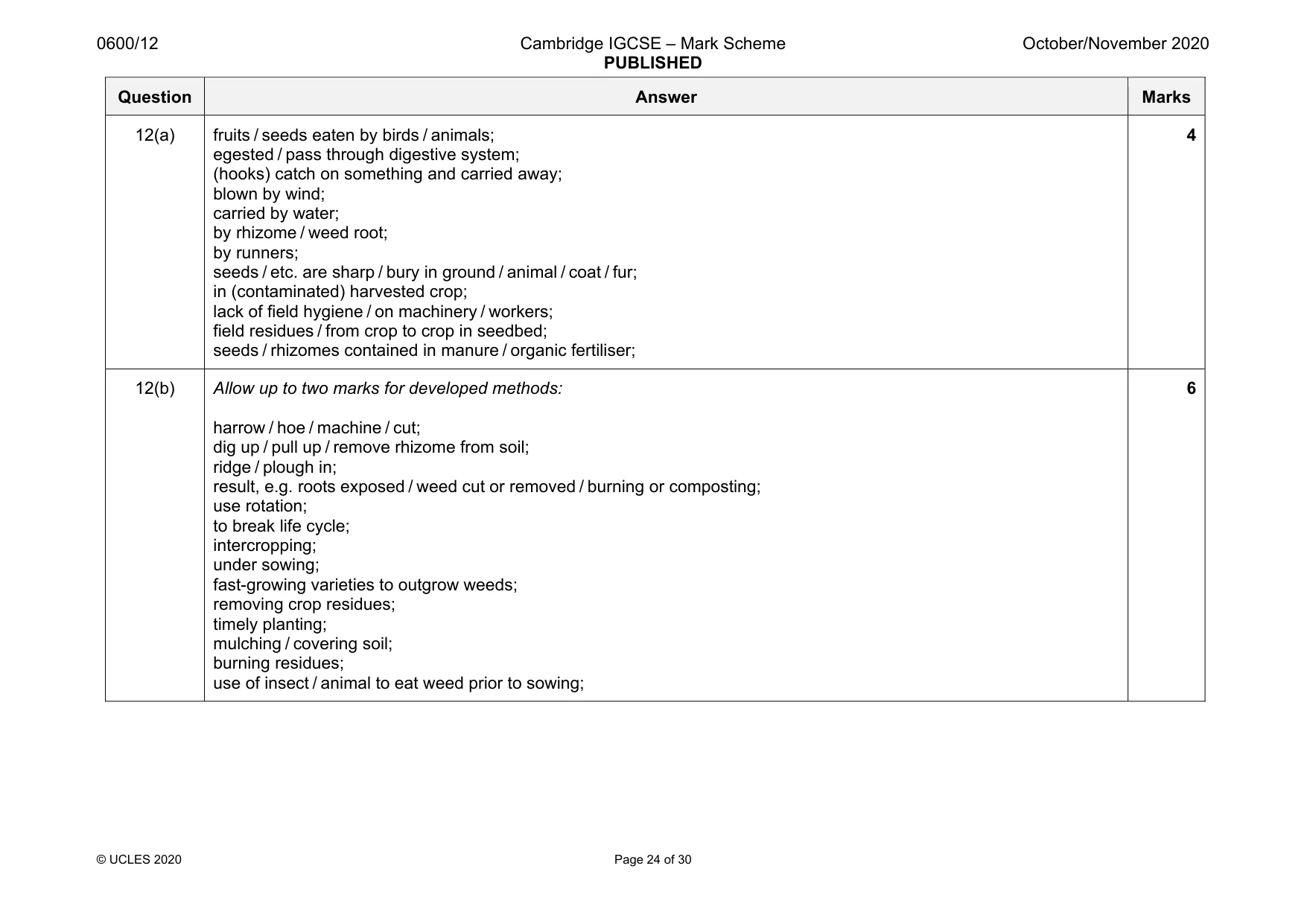
0600/12 Cambridge IGCSE – Mark Scheme PUBLISHED October/November 2020 © UCLES 2020 Page 24 of 30 Question Answer Marks 12(a) fruits / seeds eaten by birds / animals; egested / pass through digestive system; (hooks) catch on something and carried away; blown by wind; carried by water; by rhizome / weed root; by runners; seeds / etc. are sharp / bury in ground / animal / coat / fur; in (contaminated) harvested crop; lack of field hygiene / on machinery / workers; field residues / from crop to crop in seedbed; seeds / rhizomes contained in manure / organic fertiliser; 4 12(b) Allow up to two marks for developed methods: harrow / hoe / machine / cut; dig up / pull up / remove rhizome from soil; ridge / plough in; result, e.g. roots exposed / weed cut or removed / burning or composting; use rotation; to break life cycle; intercropping; under sowing; fast-growing varieties to outgrow weeds; removing crop residues; timely planting; mulching / covering soil; burning residues; use of insect / animal to eat weed prior to sowing; 6
Mark scheme, page 25
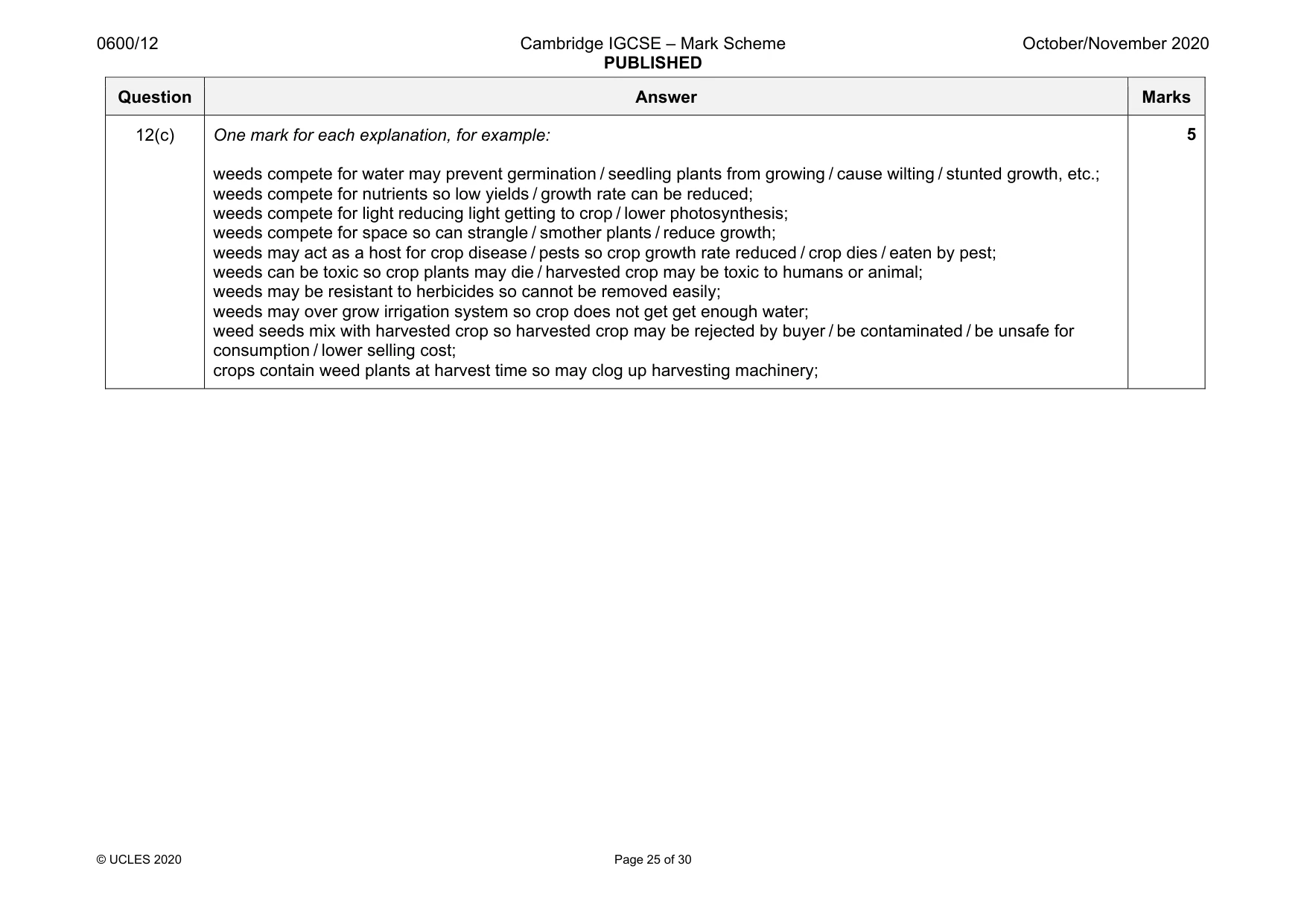
0600/12 Cambridge IGCSE – Mark Scheme PUBLISHED October/November 2020 © UCLES 2020 Page 25 of 30 Question Answer Marks 12(c) One mark for each explanation, for example: weeds compete for water may prevent germination / seedling plants from growing / cause wilting / stunted growth, etc.; weeds compete for nutrients so low yields / growth rate can be reduced; weeds compete for light reducing light getting to crop / lower photosynthesis; weeds compete for space so can strangle / smother plants / reduce growth; weeds may act as a host for crop disease / pests so crop growth rate reduced / crop dies / eaten by pest; weeds can be toxic so crop plants may die / harvested crop may be toxic to humans or animal; weeds may be resistant to herbicides so cannot be removed easily; weeds may over grow irrigation system so crop does not get get enough water; weed seeds mix with harvested crop so harvested crop may be rejected by buyer / be contaminated / be unsafe for consumption / lower selling cost; crops contain weed plants at harvest time so may clog up harvesting machinery; 5
Mark scheme, page 26
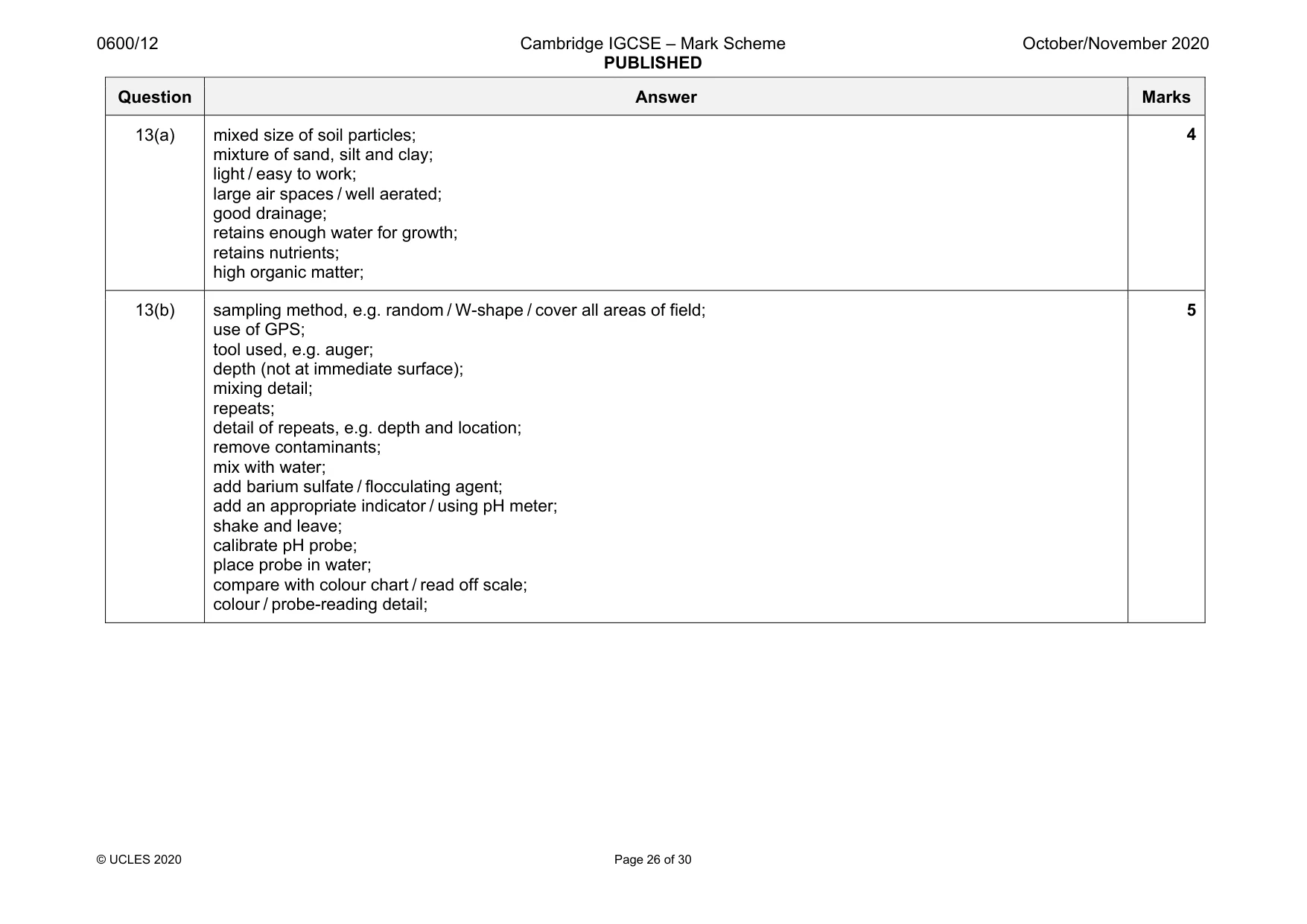
0600/12 Cambridge IGCSE – Mark Scheme PUBLISHED October/November 2020 © UCLES 2020 Page 26 of 30 Question Answer Marks 13(a) mixed size of soil particles; mixture of sand, silt and clay; light / easy to work; large air spaces / well aerated; good drainage; retains enough water for growth; retains nutrients; high organic matter; 4 13(b) sampling method, e.g. random / W-shape / cover all areas of field; use of GPS; tool used, e.g. auger; depth (not at immediate surface); mixing detail; repeats; detail of repeats, e.g. depth and location; remove contaminants; mix with water; add barium sulfate / flocculating agent; add an appropriate indicator / using pH meter; shake and leave; calibrate pH probe; place probe in water; compare with colour chart / read off scale; colour / probe-reading detail; 5
Mark scheme, page 27
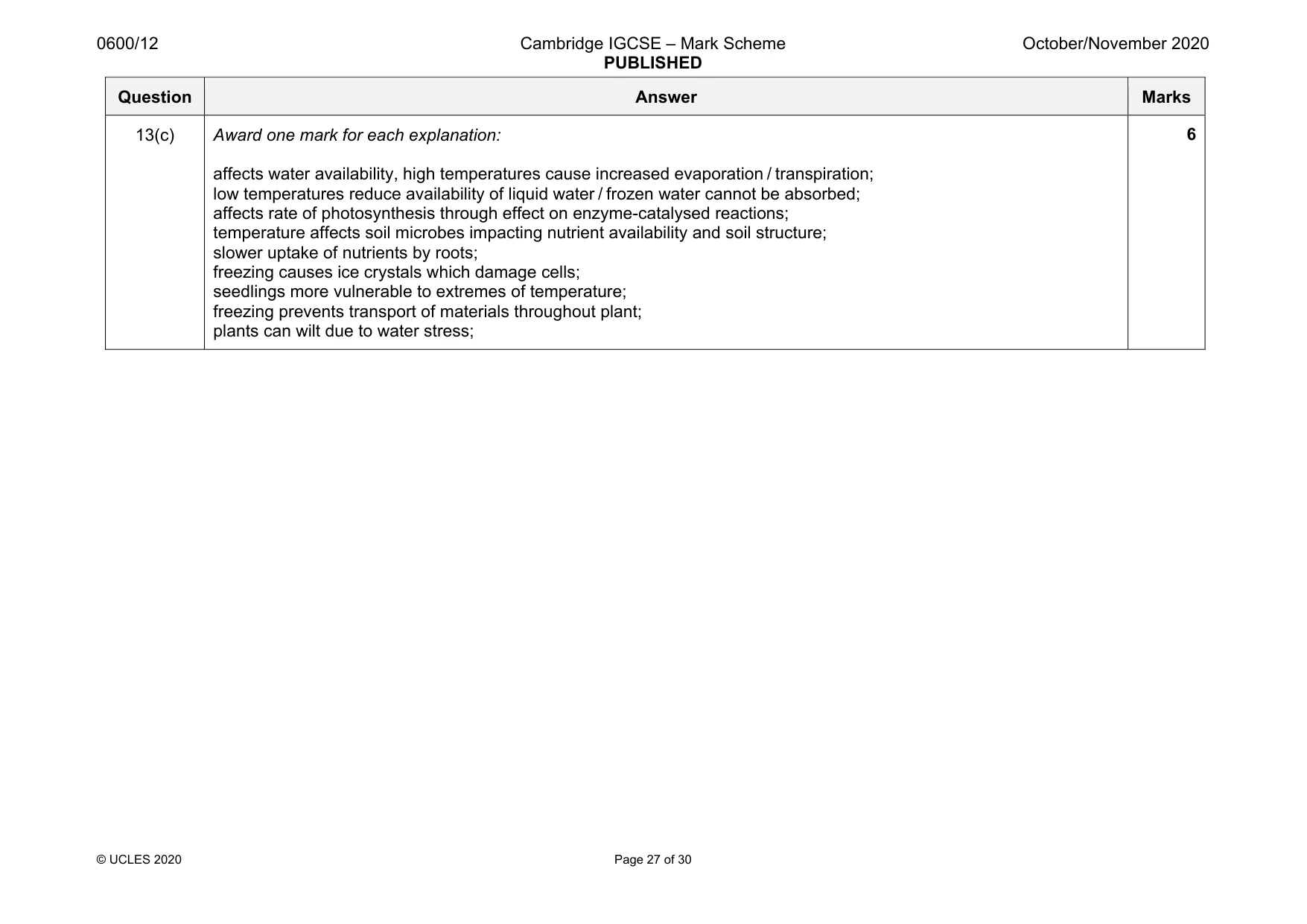
0600/12 Cambridge IGCSE – Mark Scheme PUBLISHED October/November 2020 © UCLES 2020 Page 27 of 30 Question Answer Marks 13(c) Award one mark for each explanation: affects water availability, high temperatures cause increased evaporation / transpiration; low temperatures reduce availability of liquid water / frozen water cannot be absorbed; affects rate of photosynthesis through effect on enzyme-catalysed reactions; temperature affects soil microbes impacting nutrient availability and soil structure; slower uptake of nutrients by roots; freezing causes ice crystals which damage cells; seedlings more vulnerable to extremes of temperature; freezing prevents transport of materials throughout plant; plants can wilt due to water stress; 6
Mark scheme, page 28
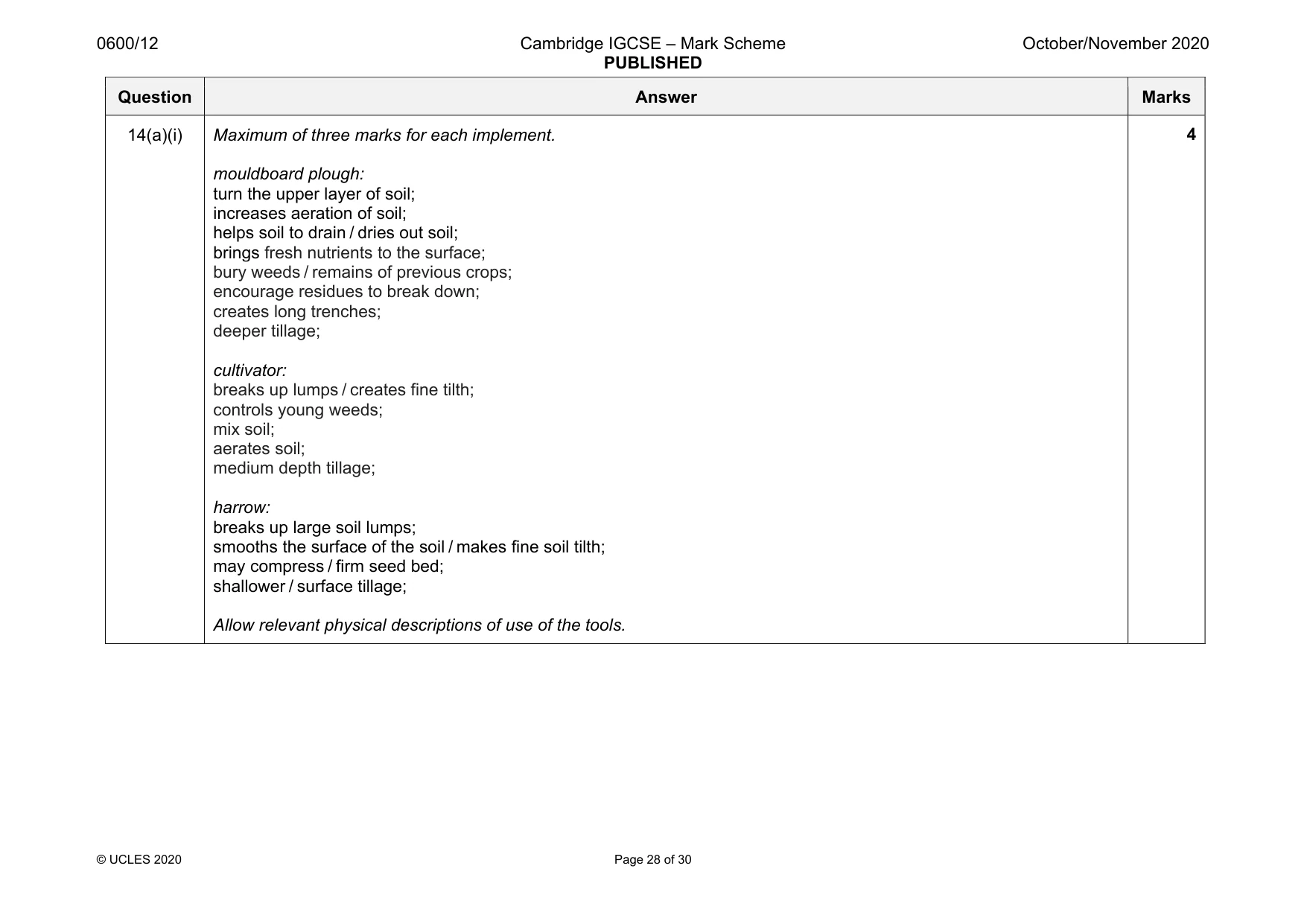
0600/12 Cambridge IGCSE – Mark Scheme PUBLISHED October/November 2020 © UCLES 2020 Page 28 of 30 Question Answer Marks 14(a)(i) Maximum of three marks for each implement. mouldboard plough: turn the upper layer of soil; increases aeration of soil; helps soil to drain / dries out soil; brings fresh nutrients to the surface; bury weeds / remains of previous crops; encourage residues to break down; creates long trenches; deeper tillage; cultivator: breaks up lumps / creates fine tilth; controls young weeds; mix soil; aerates soil; medium depth tillage; harrow: breaks up large soil lumps; smooths the surface of the soil / makes fine soil tilth; may compress / firm seed bed; shallower / surface tillage; Allow relevant physical descriptions of use of the tools. 4
Mark scheme, page 29
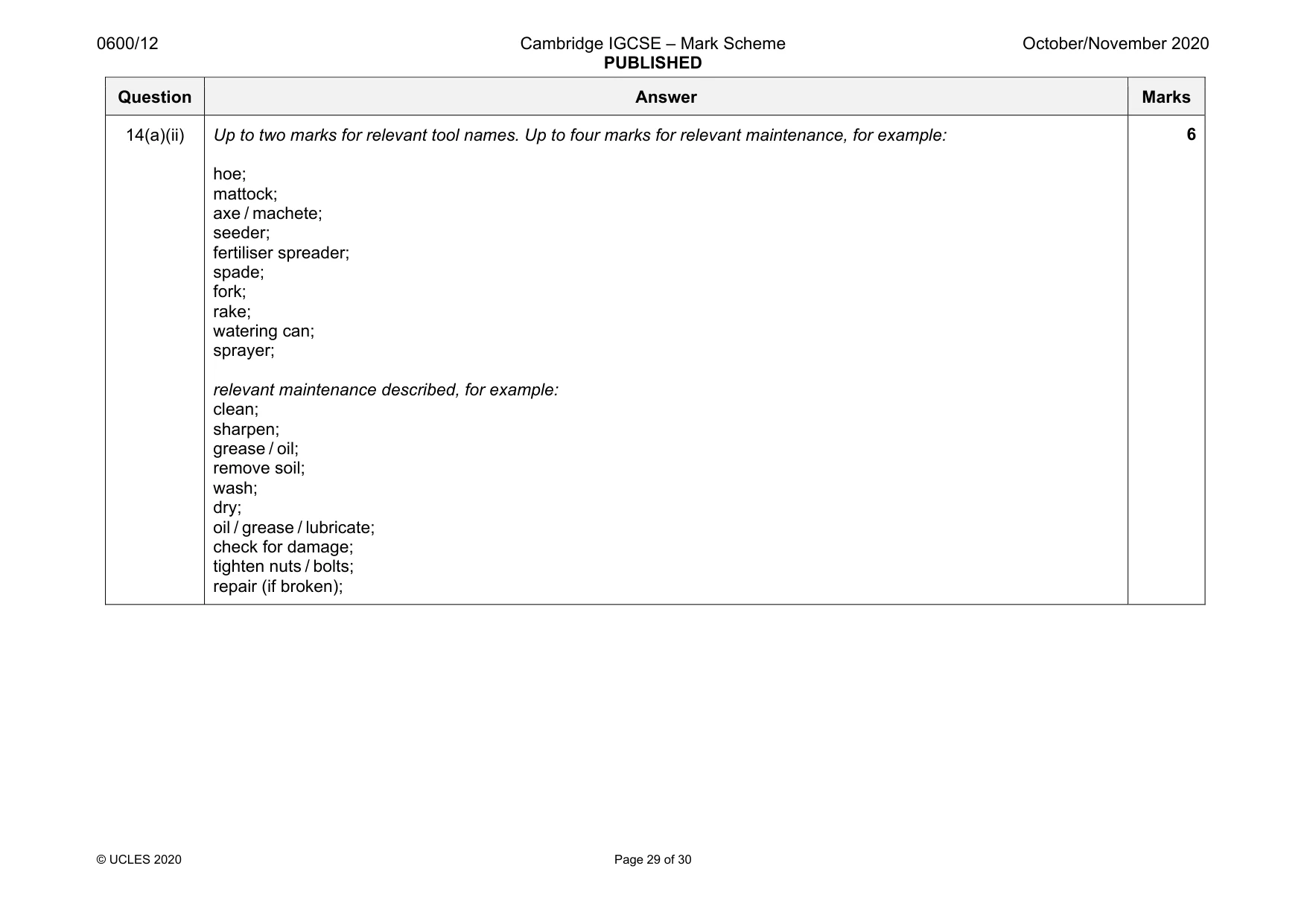
0600/12 Cambridge IGCSE – Mark Scheme PUBLISHED October/November 2020 © UCLES 2020 Page 29 of 30 Question Answer Marks 14(a)(ii) Up to two marks for relevant tool names. Up to four marks for relevant maintenance, for example: hoe; mattock; axe / machete; seeder; fertiliser spreader; spade; fork; rake; watering can; sprayer; relevant maintenance described, for example: clean; sharpen; grease / oil; remove soil; wash; dry; oil / grease / lubricate; check for damage; tighten nuts / bolts; repair (if broken); 6
Mark scheme, page 30
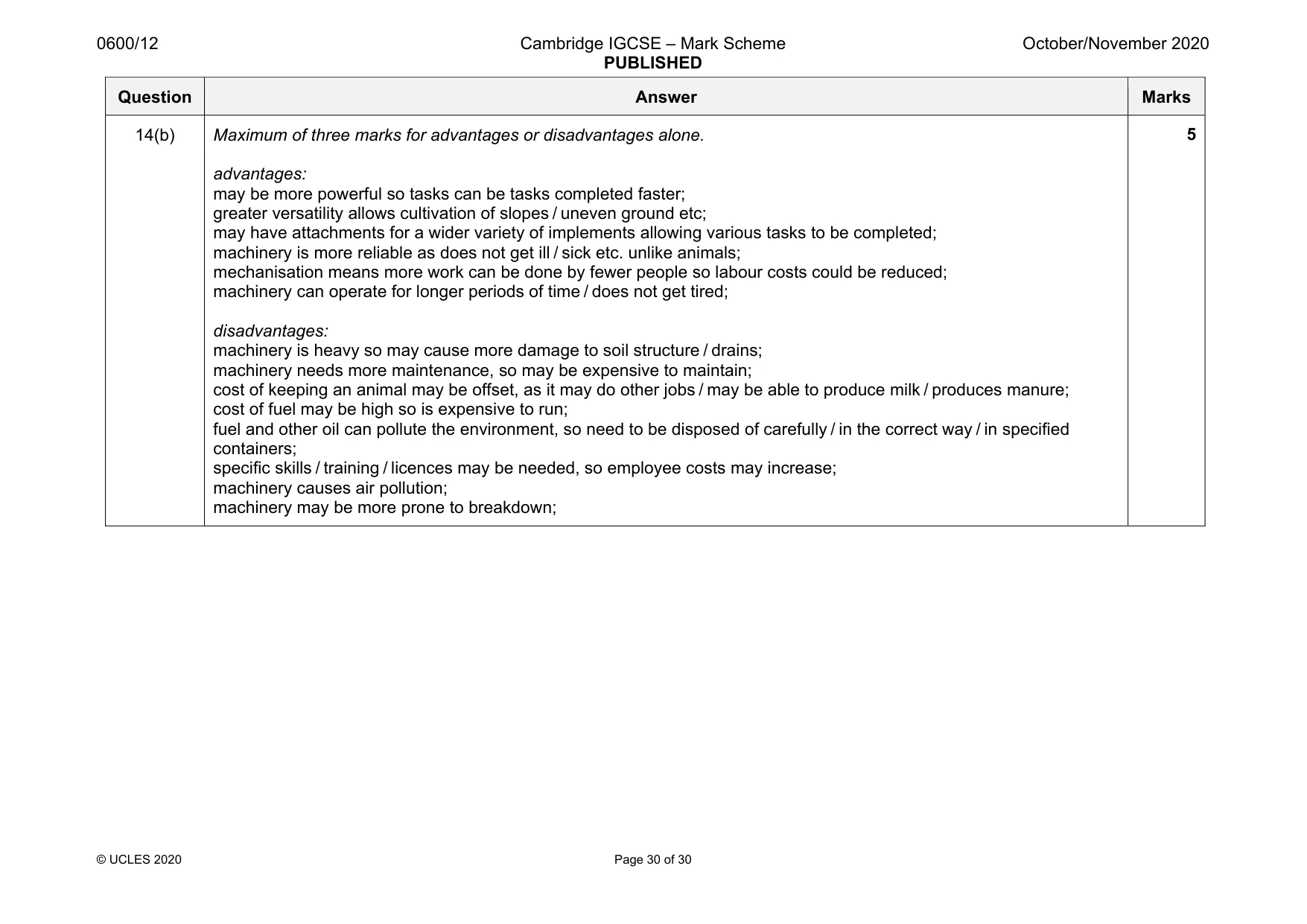
0600/12 Cambridge IGCSE – Mark Scheme PUBLISHED October/November 2020 © UCLES 2020 Page 30 of 30 Question Answer Marks 14(b) Maximum of three marks for advantages or disadvantages alone. advantages: may be more powerful so tasks can be tasks completed faster; greater versatility allows cultivation of slopes / uneven ground etc; may have attachments for a wider variety of implements allowing various tasks to be completed; machinery is more reliable as does not get ill / sick etc. unlike animals; mechanisation means more work can be done by fewer people so labour costs could be reduced; machinery can operate for longer periods of time / does not get tired; disadvantages: machinery is heavy so may cause more damage to soil structure / drains; machinery needs more maintenance, so may be expensive to maintain; cost of keeping an animal may be offset, as it may do other jobs / may be able to produce milk / produces manure; cost of fuel may be high so is expensive to run; fuel and other oil can pollute the environment, so need to be disposed of carefully / in the correct way / in specified containers; specific skills / training / licences may be needed, so employee costs may increase; machinery causes air pollution; machinery may be more prone to breakdown; 5
What you needed in this session
Cambridge’s own grade thresholds for 2020 Oct/Nov, Paper 1 · Variant 2. A higher threshold means an easier paper — the bar moves with how the cohort did.