Cambridge IGCSE Agriculture 0600 — 2018 Oct/Nov Paper 1 · Variant 1
0600/11/O/N/18 · 100 marks · ≈113 min
The question paper and its mark scheme, free to read here and free to download. This is Cambridge’s own paper, exactly as it was sat.
Question paper20 pages


Mark scheme22 pages
Answers below. Sit the paper first if you are practising.
Paper as text
Question paper, page 1
* 2 4 3 4 2 9 3 9 3 2 * This document consists of 17 printed pages and 3 blank pages. DC (CE/SG) 149584/3 © UCLES 2018 [Turn over Cambridge International Examinations Cambridge International General Certificate of Secondary Education AGRICULTURE 0600/11 Paper 1 October/November 2018 1 hour 45 minutes Additional Materials: Answer Booklet/Paper READ THESE INSTRUCTIONS FIRST Write your Centre number, candidate number and name on all the work you hand in. Write in dark blue or black pen. You may use an HB pencil for any diagrams or graphs. Do not use staples, paper clips, glue or correction fluid. DO NOT WRITE IN ANY BARCODES. Section A Answer all questions. Electronic calculators may be used. Write your answers in the spaces provided on the Question Paper. You are advised to spend no longer than 1 hour on Section A. Section B Answer any two questions. Write your answers on the Answer Booklet/Paper provided. Enter the numbers of the Section B questions you have answered in the grid. At the end of the examination, fasten all your work securely together. The number of marks is given in brackets [ ] at the end of each question or part question. For Examiner’s Use Section A 1 2 3 4 5 6 7 8 9 Section B Total
Question paper, page 2
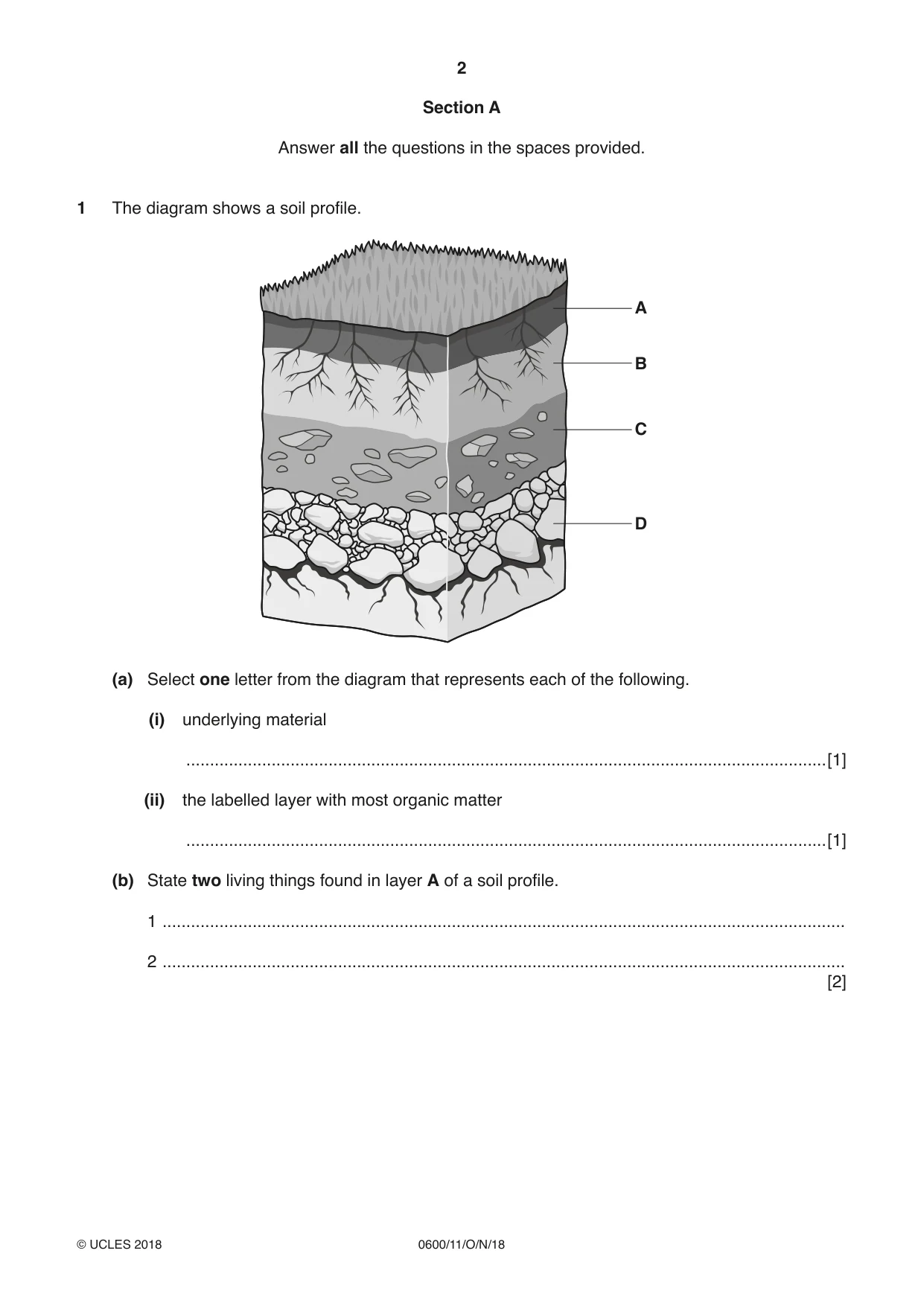
2 0600/11/O/N/18 © UCLES 2018 Section A Answer all the questions in the spaces provided. 1 The diagram shows a soil profile. D C B A (a) Select one letter from the diagram that represents each of the following. (i) underlying material …[1] (ii) the labelled layer with most organic matter …[1] (b) State two living things found in layer A of a soil profile. 1 … 2 … [2]
Question paper, page 3
3 0600/11/O/N/18 © UCLES 2018 [Turn over (c) Describe how soil is formed during the process of biological weathering. … … … … … …[3] [Total: 7]
Question paper, page 4
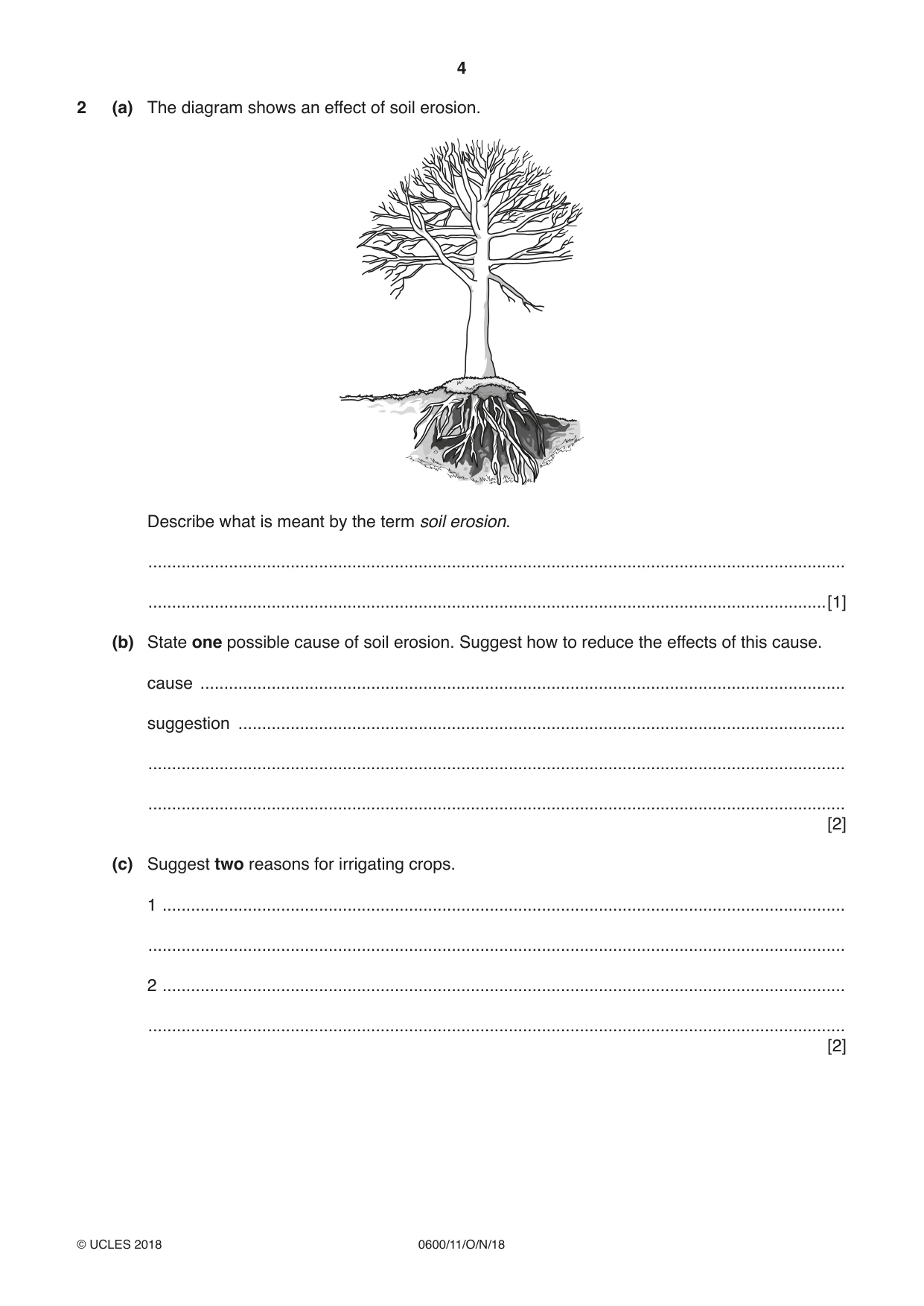
4 0600/11/O/N/18 © UCLES 2018 2 (a) The diagram shows an effect of soil erosion. Describe what is meant by the term soil erosion. … …[1] (b) State one possible cause of soil erosion. Suggest how to reduce the effects of this cause. cause … suggestion … … … [2] (c) Suggest two reasons for irrigating crops. 1 … … 2 … … [2]
Question paper, page 5
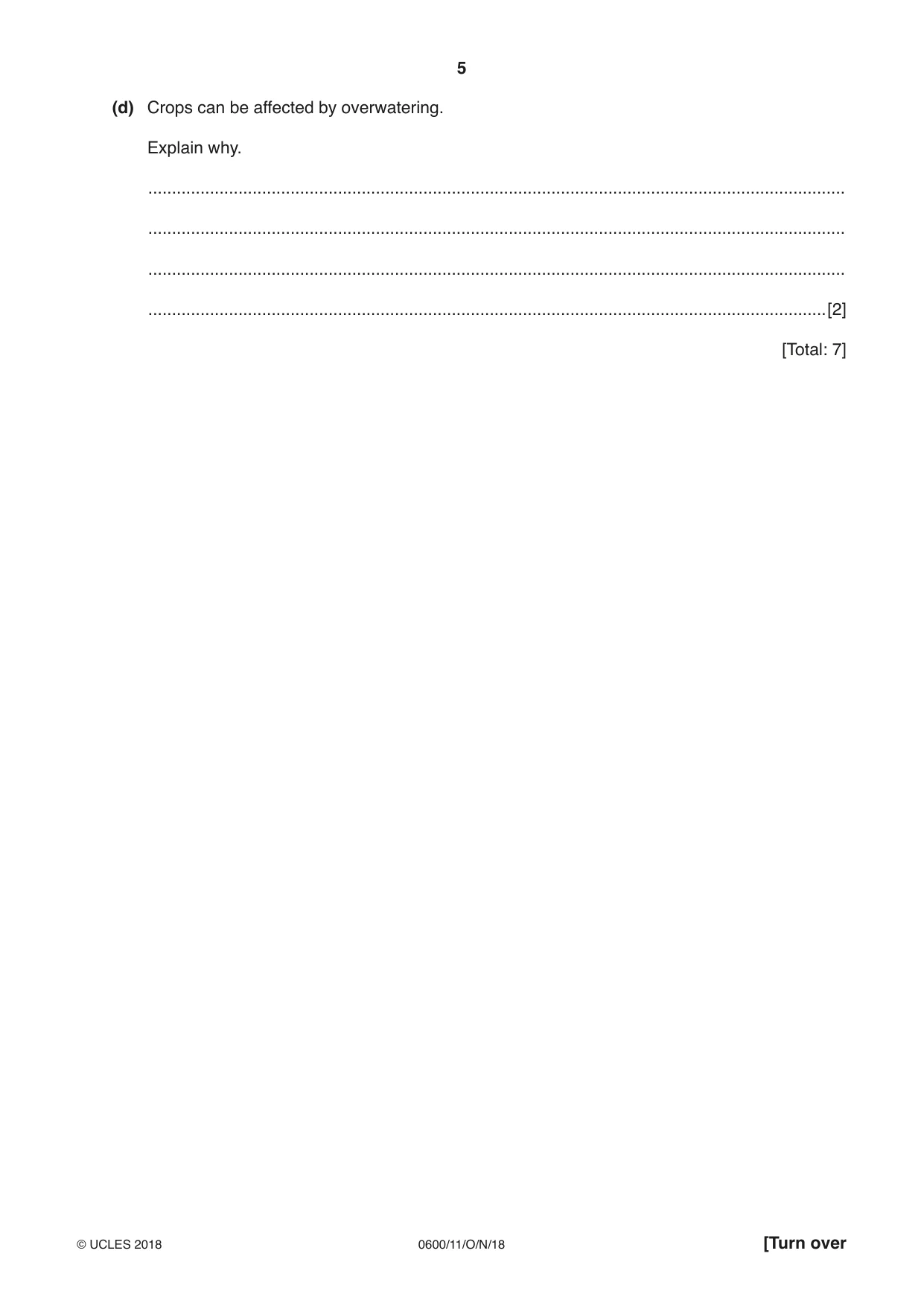
5 0600/11/O/N/18 © UCLES 2018 [Turn over (d) Crops can be affected by overwatering. Explain why. … … … …[2] [Total: 7]
Question paper, page 6
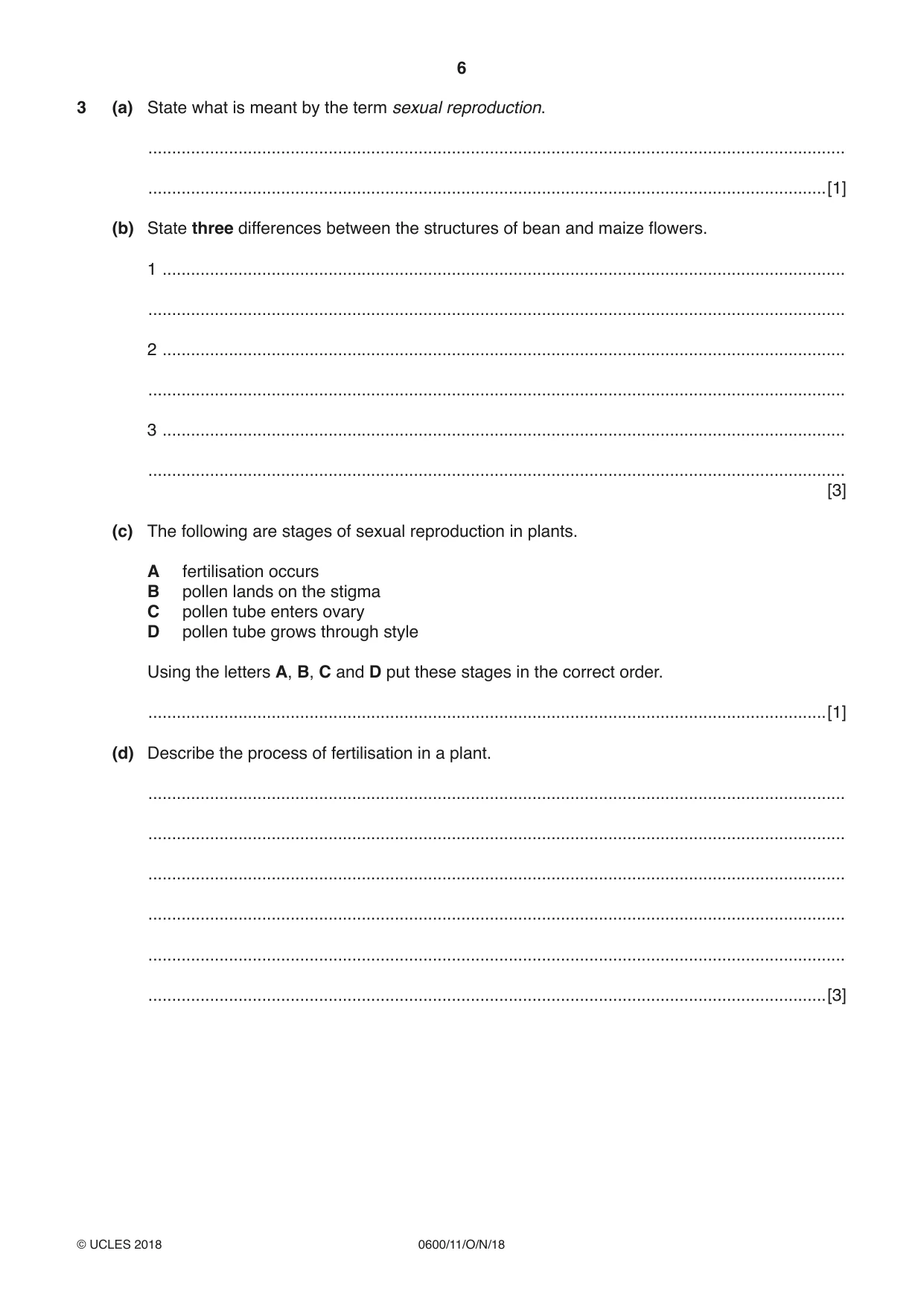
6 0600/11/O/N/18 © UCLES 2018 3 (a) State what is meant by the term sexual reproduction. … …[1] (b) State three differences between the structures of bean and maize flowers. 1 … … 2 … … 3 … … [3] (c) The following are stages of sexual reproduction in plants. A fertilisation occurs B pollen lands on the stigma C pollen tube enters ovary D pollen tube grows through style Using the letters A, B, C and D put these stages in the correct order. …[1] (d) Describe the process of fertilisation in a plant. … … … … … …[3]
Question paper, page 7
7 0600/11/O/N/18 © UCLES 2018 [Turn over (e) Some flowers are able to self-pollinate. Suggest why it is still important that insects, such as bees, pollinate flowers. … … … …[2] [Total: 10]
Question paper, page 8
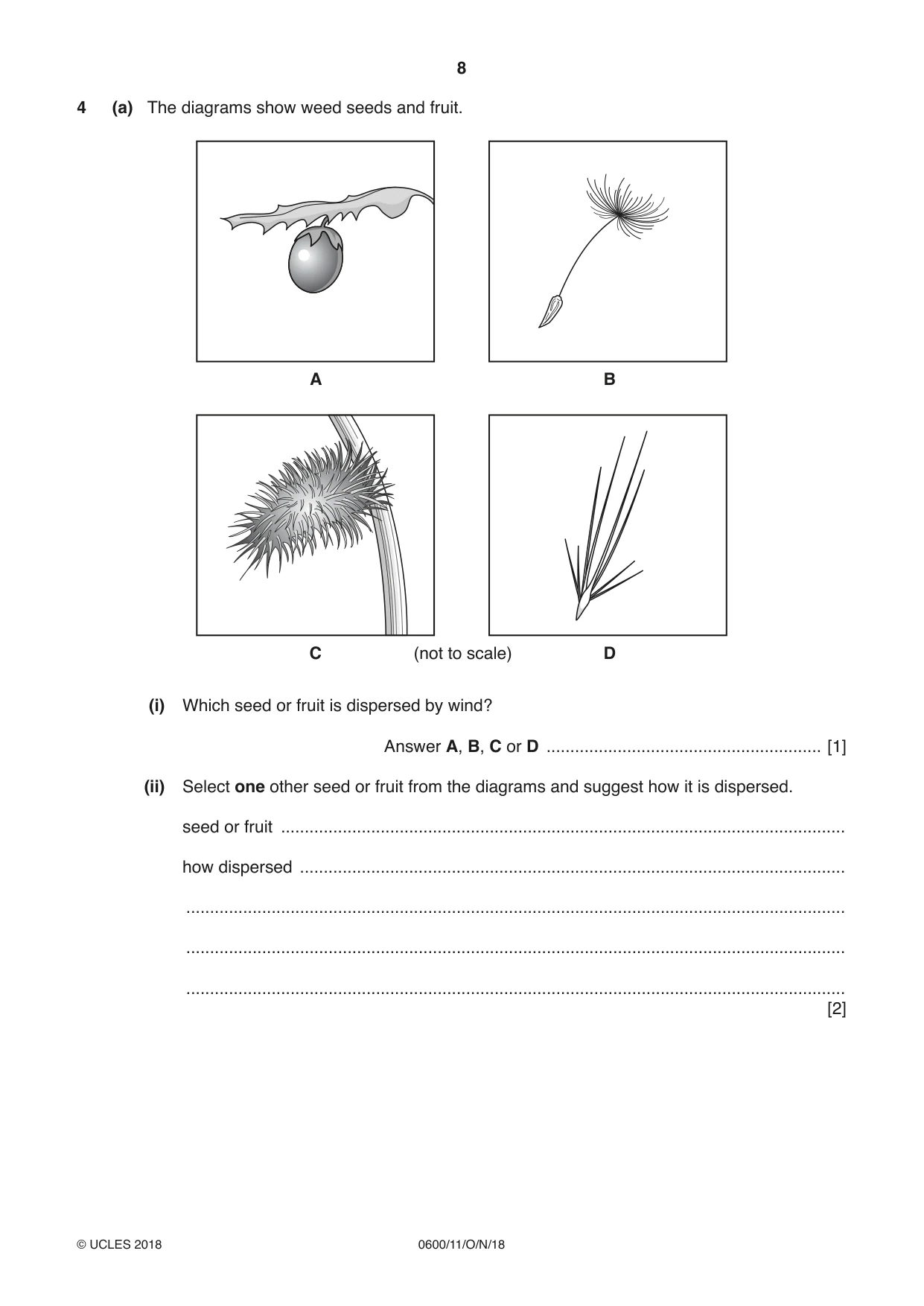
8 0600/11/O/N/18 © UCLES 2018 4 (a) The diagrams show weed seeds and fruit. B A D C (not to scale) (i) Which seed or fruit is dispersed by wind? Answer A, B, C or D … [1] (ii) Select one other seed or fruit from the diagrams and suggest how it is dispersed. seed or fruit … how dispersed … … … … [2]
Question paper, page 9
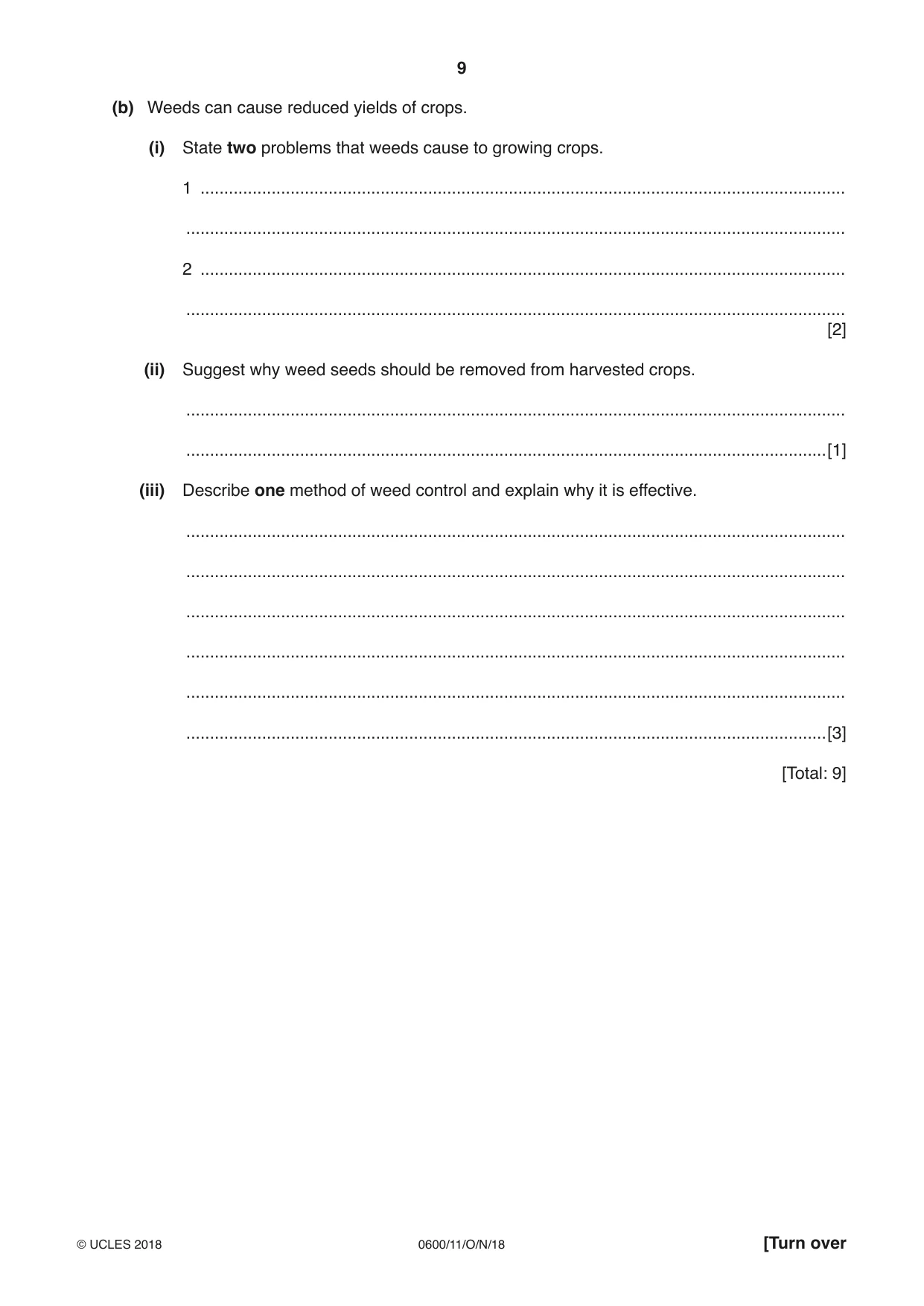
9 0600/11/O/N/18 © UCLES 2018 [Turn over (b) Weeds can cause reduced yields of crops. (i) State two problems that weeds cause to growing crops. 1 … … 2 … … [2] (ii) Suggest why weed seeds should be removed from harvested crops. … …[1] (iii) Describe one method of weed control and explain why it is effective. … … … … … …[3] [Total: 9]
Question paper, page 10
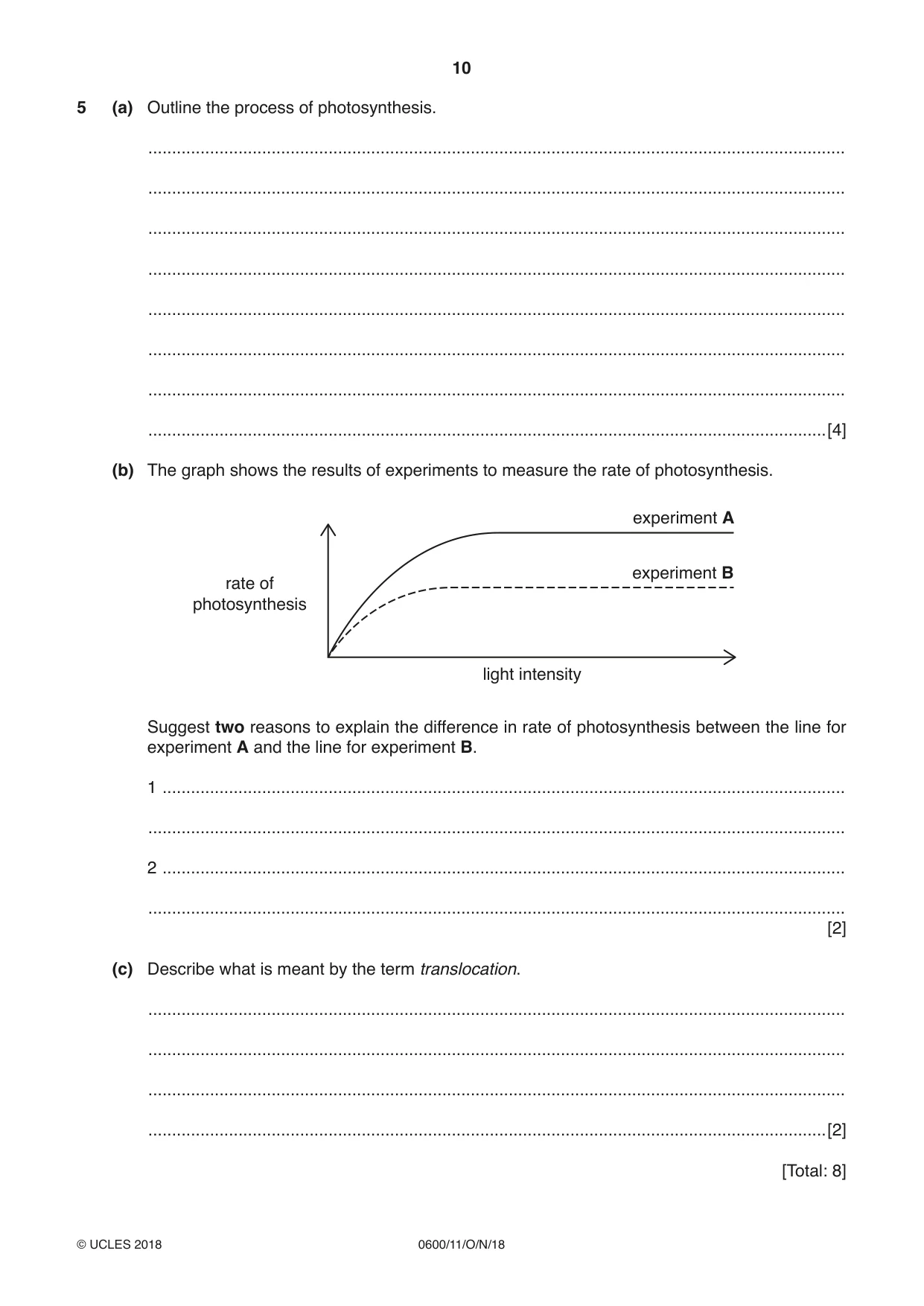
10 0600/11/O/N/18 © UCLES 2018 5 (a) Outline the process of photosynthesis. … … … … … … … …[4] (b) The graph shows the results of experiments to measure the rate of photosynthesis. rate of photosynthesis light intensity experiment A experiment B Suggest two reasons to explain the difference in rate of photosynthesis between the line for experiment A and the line for experiment B. 1 … … 2 … … [2] (c) Describe what is meant by the term translocation. … … … …[2] [Total: 8]
Question paper, page 11
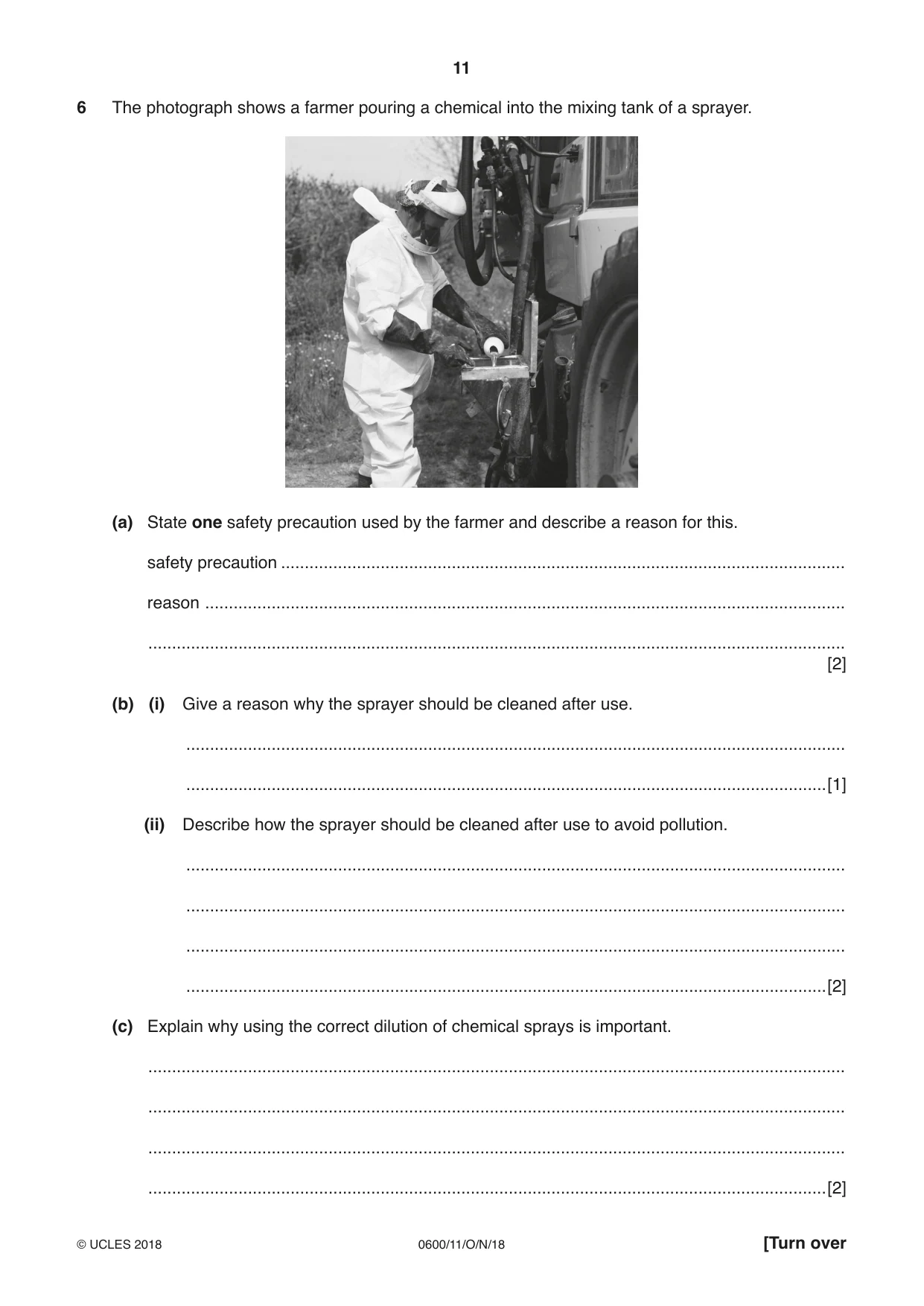
11 0600/11/O/N/18 © UCLES 2018 [Turn over 6 The photograph shows a farmer pouring a chemical into the mixing tank of a sprayer. (a) State one safety precaution used by the farmer and describe a reason for this. safety precaution … reason … … [2] (b) (i) Give a reason why the sprayer should be cleaned after use. … …[1] (ii) Describe how the sprayer should be cleaned after use to avoid pollution. … … … …[2] (c) Explain why using the correct dilution of chemical sprays is important. … … … …[2]
Question paper, page 12
12 0600/11/O/N/18 © UCLES 2018 (d) Name one type of farm chemical and suggest an alternative method that is likely to cause less damage to the environment. type of farm chemical … alternative method … … [1] [Total: 8]
Question paper, page 13
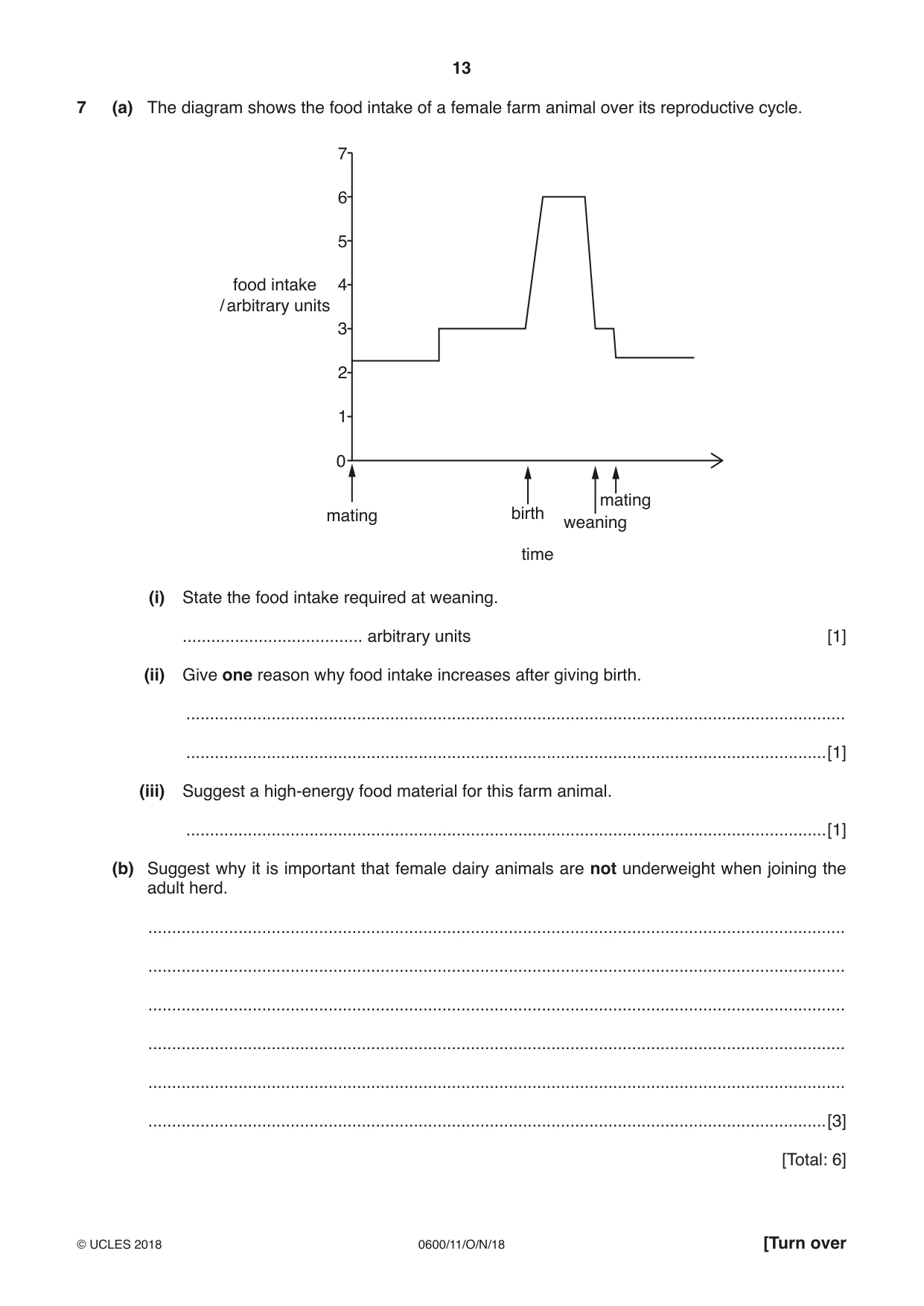
13 0600/11/O/N/18 © UCLES 2018 [Turn over 7 (a) The diagram shows the food intake of a female farm animal over its reproductive cycle. 1 0 2 3 4 5 6 7 mating birth weaning mating food intake / arbitrary units time (i) State the food intake required at weaning. … arbitrary units [1] (ii) Give one reason why food intake increases after giving birth. … …[1] (iii) Suggest a high-energy food material for this farm animal. …[1] (b) Suggest why it is important that female dairy animals are not underweight when joining the adult herd. … … … … … …[3] [Total: 6]
Question paper, page 14
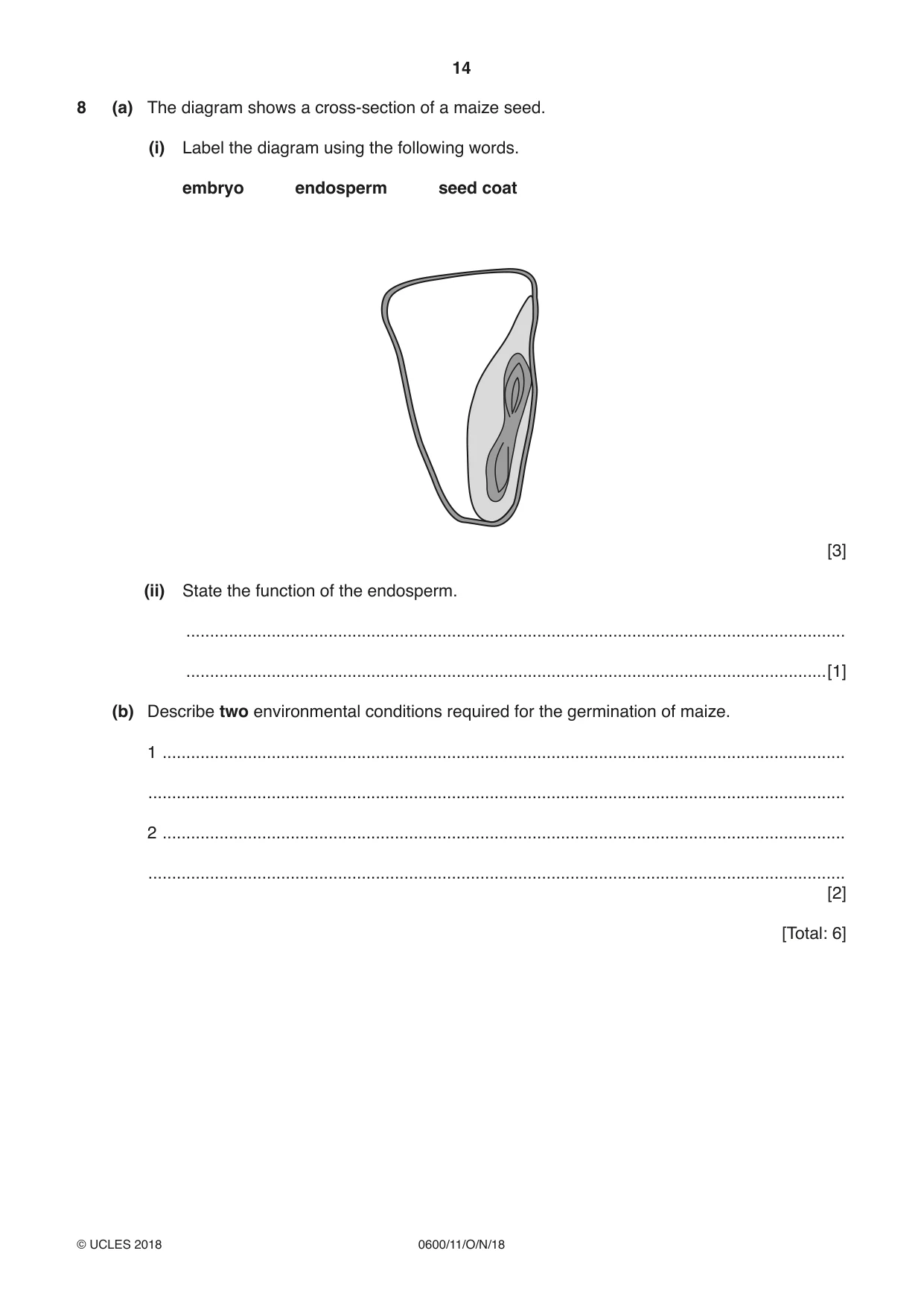
14 0600/11/O/N/18 © UCLES 2018 8 (a) The diagram shows a cross-section of a maize seed. (i) Label the diagram using the following words. embryo endosperm seed coat [3] (ii) State the function of the endosperm. … …[1] (b) Describe two environmental conditions required for the germination of maize. 1 … … 2 … … [2] [Total: 6]
Question paper, page 15
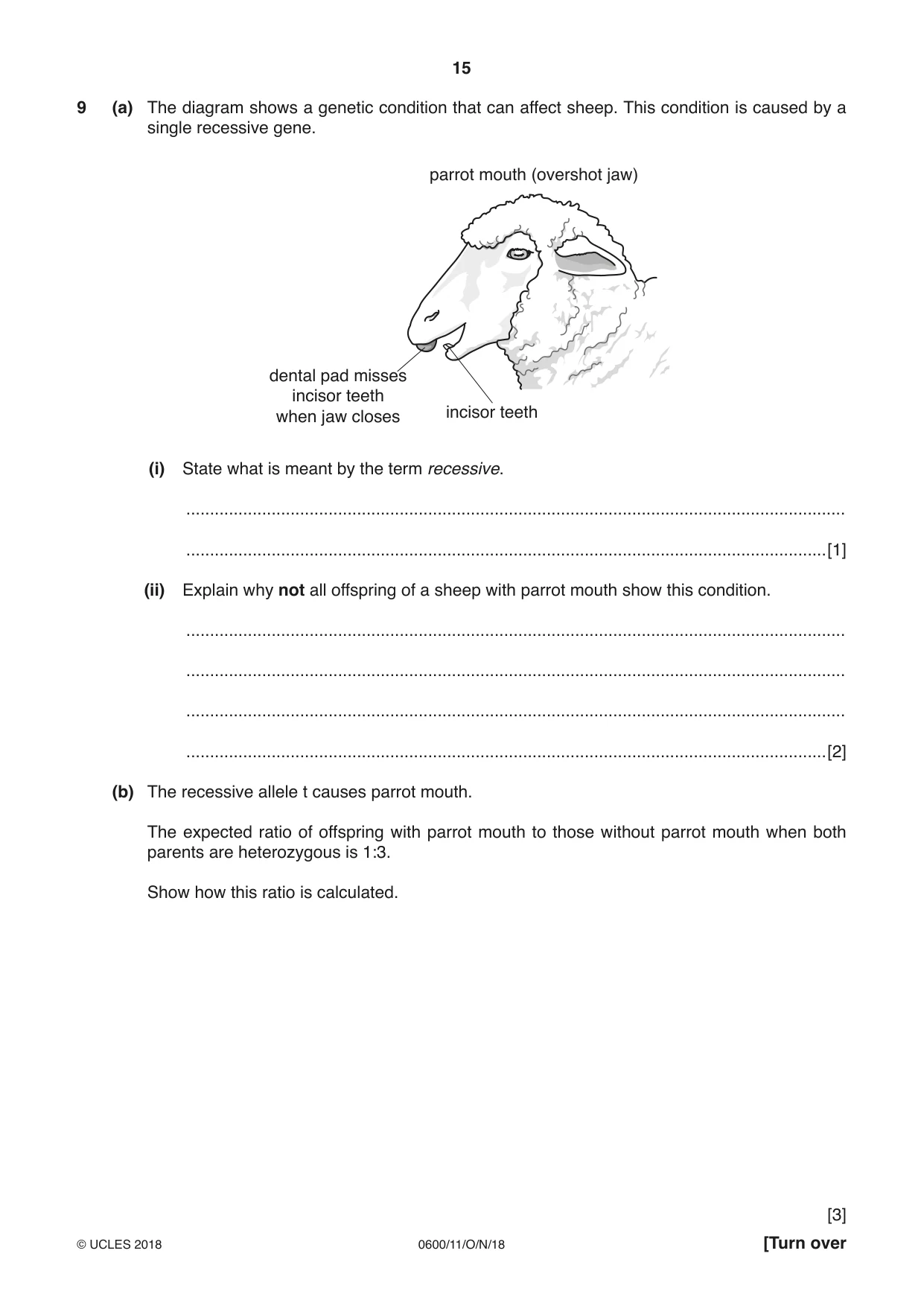
15 0600/11/O/N/18 © UCLES 2018 [Turn over 9 (a) The diagram shows a genetic condition that can affect sheep. This condition is caused by a single recessive gene. incisor teeth dental pad misses incisor teeth when jaw closes parrot mouth (overshot jaw) (i) State what is meant by the term recessive. … …[1] (ii) Explain why not all offspring of a sheep with parrot mouth show this condition. … … … …[2] (b) The recessive allele t causes parrot mouth. The expected ratio of offspring with parrot mouth to those without parrot mouth when both parents are heterozygous is 1:3. Show how this ratio is calculated. [3]
Question paper, page 16
16 0600/11/O/N/18 © UCLES 2018 (c) (i) Suggest one problem for sheep of having parrot mouth. … …[1] (ii) Describe how selective breeding could be used to produce a flock of sheep in which the condition of parrot mouth is very rare. … … … …[2] [Total: 9]
Question paper, page 17
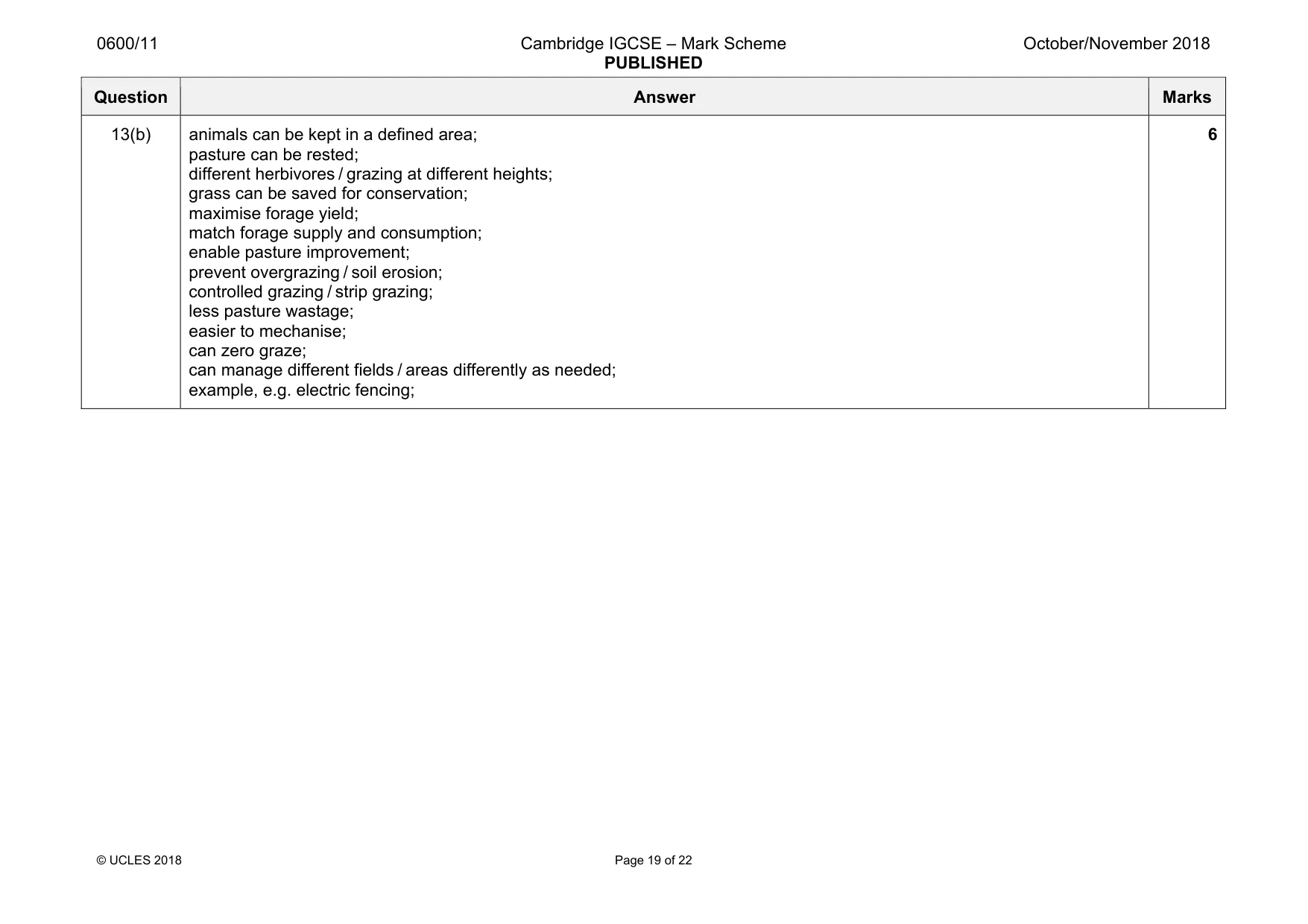
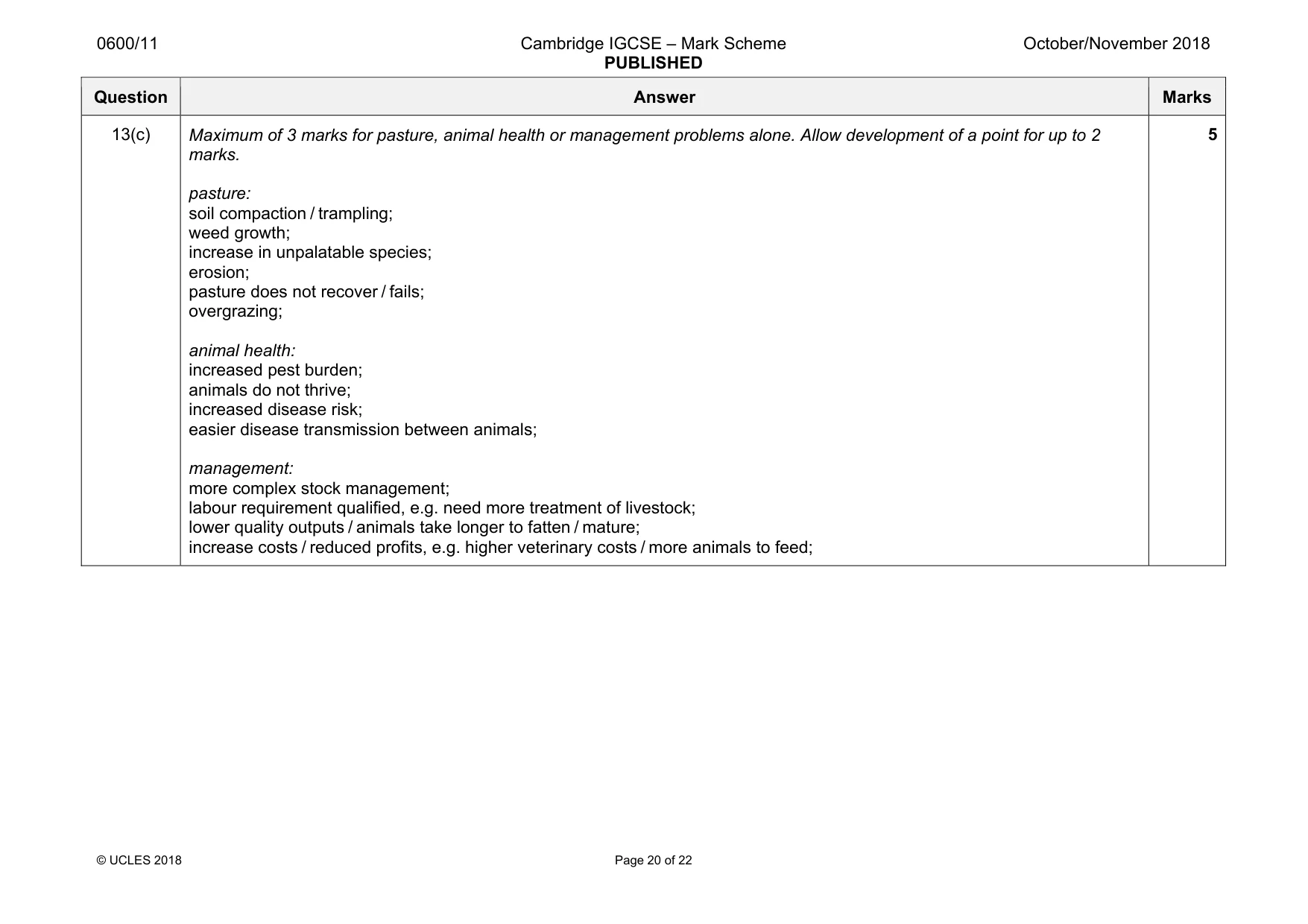
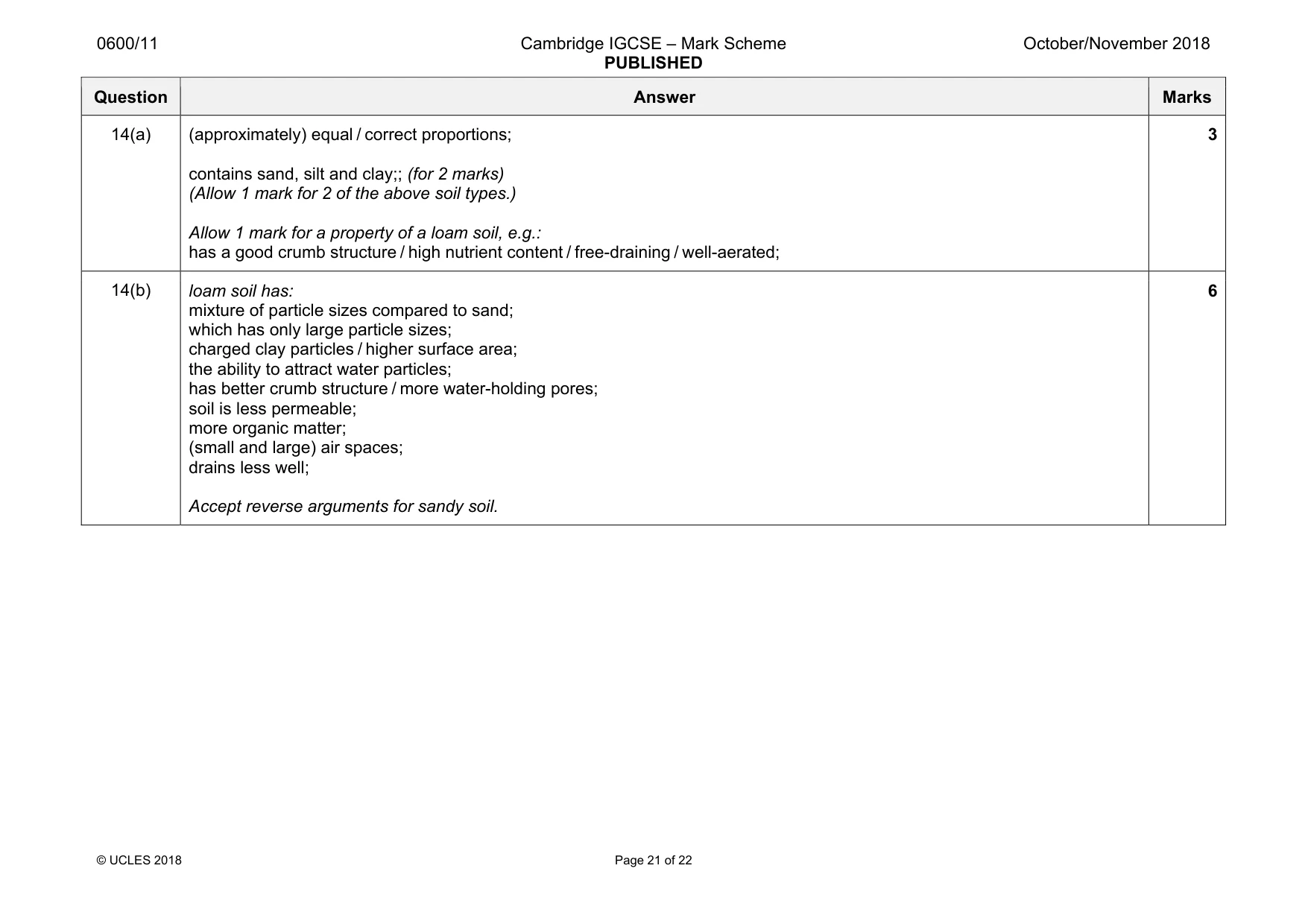
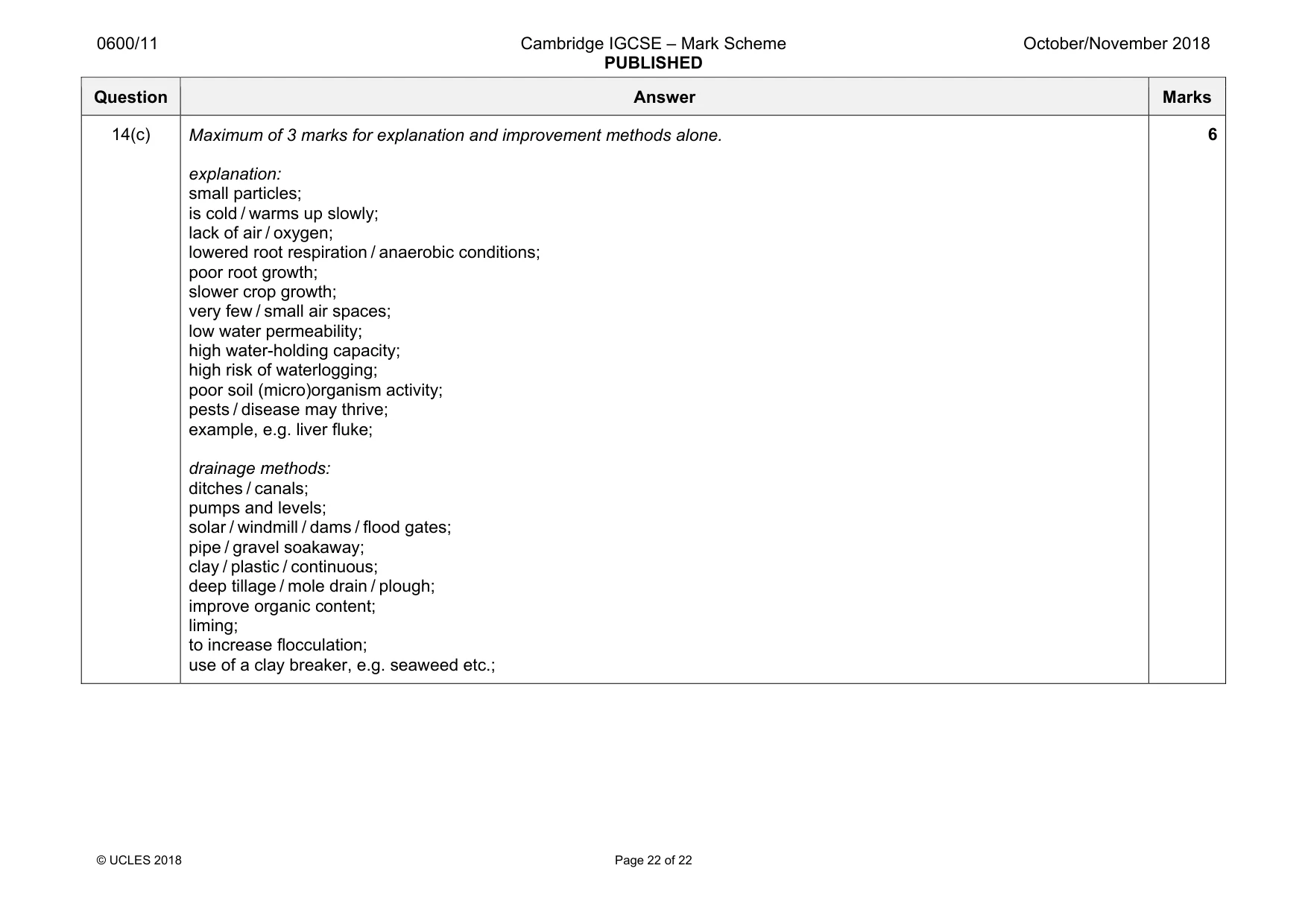
17 0600/11/O/N/18 © UCLES 2018 Section B Answer any two questions. Write your answers on the separate paper provided. 10 (a) State what is meant by the term organic farming. [3] (b) Describe the benefits and limitations of organic crop production. [7] (c) Explain how crop pests are controlled in an organic farming system. [5] 11 (a) Describe the process of transpiration. [5] (b) Describe how environmental factors affect the rate of transpiration. [4] (c) Explain how plants store the products of photosynthesis. [6] 12 (a) Explain what is meant by the term notifiable disease and suggest why some diseases are notifiable. [3] (b) Describe the different ways disease can spread between livestock. [5] (c) Explain how to reduce the spread of disease between livestock. [7] 13 (a) State what is meant by the term rotational grazing. [4] (b) Describe how the use of livestock fencing can increase carrying capacity. [6] (c) Explain the problems of overstocking. [5] 14 (a) Describe what is meant by a loam soil. [3] (b) Explain why the water-holding capacity of a loam soil differs from a sandy soil. [6] (c) Explain why an effective water-drainage system is needed in a clay soil and describe methods to improve drainage in clay soils. [6]
Question paper, page 18
18 0600/11/O/N/18 © UCLES 2018 BLANK PAGE
Question paper, page 19
19 0600/11/O/N/18 © UCLES 2018 BLANK PAGE
Question paper, page 20
20 0600/11/O/N/18 © UCLES 2018 Permission to reproduce items where third-party owned material protected by copyright is included has been sought and cleared where possible. Every reasonable effort has been made by the publisher (UCLES) to trace copyright holders, but if any items requiring clearance have unwittingly been included, the publisher will be pleased to make amends at the earliest possible opportunity. To avoid the issue of disclosure of answer-related information to candidates, all copyright acknowledgements are reproduced online in the Cambridge International Examinations Copyright Acknowledgements Booklet. This is produced for each series of examinations and is freely available to download at www.cie.org.uk after the live examination series. Cambridge International Examinations is part of the Cambridge Assessment Group. Cambridge Assessment is the brand name of University of Cambridge Local Examinations Syndicate (UCLES), which is itself a department of the University of Cambridge. BLANK PAGE
Mark scheme, page 1
This document consists of 22 printed pages. © UCLES 2018 [Turn over Cambridge Assessment International Education Cambridge International General Certificate of Secondary Education AGRICULTURE 0600/11 Paper 1 October/November 2018 MARK SCHEME Maximum Mark: 100 Published This mark scheme is published as an aid to teachers and candidates, to indicate the requirements of the examination. It shows the basis on which Examiners were instructed to award marks. It does not indicate the details of the discussions that took place at an Examiners’ meeting before marking began, which would have considered the acceptability of alternative answers. Mark schemes should be read in conjunction with the question paper and the Principal Examiner Report for Teachers. Cambridge International will not enter into discussions about these mark schemes. Cambridge International is publishing the mark schemes for the October/November 2018 series for most Cambridge IGCSE™, Cambridge International A and AS Level components and some Cambridge O Level components.
Mark scheme, page 2
0600/11 Cambridge IGCSE – Mark Scheme PUBLISHED October/November 2018 © UCLES 2018 Page 2 of 22 Generic Marking Principles These general marking principles must be applied by all examiners when marking candidate answers. They should be applied alongside the specific content of the mark scheme or generic level descriptors for a question. Each question paper and mark scheme will also comply with these marking principles. GENERIC MARKING PRINCIPLE 1: Marks must be awarded in line with: • the specific content of the mark scheme or the generic level descriptors for the question • the specific skills defined in the mark scheme or in the generic level descriptors for the question • the standard of response required by a candidate as exemplified by the standardisation scripts. GENERIC MARKING PRINCIPLE 2: Marks awarded are always whole marks (not half marks, or other fractions). GENERIC MARKING PRINCIPLE 3: Marks must be awarded positively: • marks are awarded for correct/valid answers, as defined in the mark scheme. However, credit is given for valid answers which go beyond the scope of the syllabus and mark scheme, referring to your Team Leader as appropriate • marks are awarded when candidates clearly demonstrate what they know and can do • marks are not deducted for errors • marks are not deducted for omissions • answers should only be judged on the quality of spelling, punctuation and grammar when these features are specifically assessed by the question as indicated by the mark scheme. The meaning, however, should be unambiguous. GENERIC MARKING PRINCIPLE 4: Rules must be applied consistently e.g. in situations where candidates have not followed instructions or in the application of generic level descriptors.
Mark scheme, page 3
0600/11 Cambridge IGCSE – Mark Scheme PUBLISHED October/November 2018 © UCLES 2018 Page 3 of 22 GENERIC MARKING PRINCIPLE 5: Marks should be awarded using the full range of marks defined in the mark scheme for the question (however; the use of the full mark range may be limited according to the quality of the candidate responses seen). GENERIC MARKING PRINCIPLE 6: Marks awarded are based solely on the requirements as defined in the mark scheme. Marks should not be awarded with grade thresholds or grade descriptors in mind.
Mark scheme, page 4
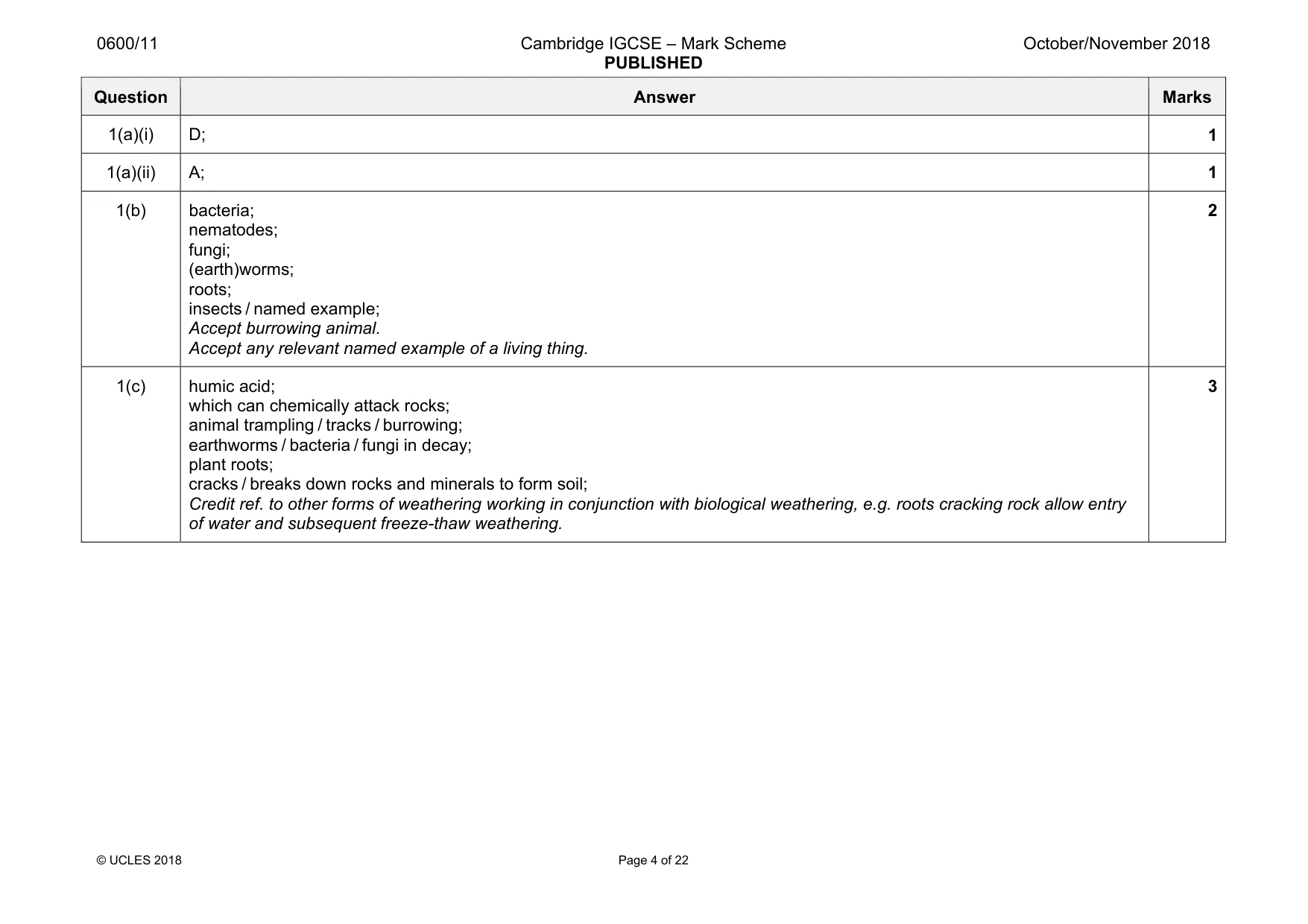
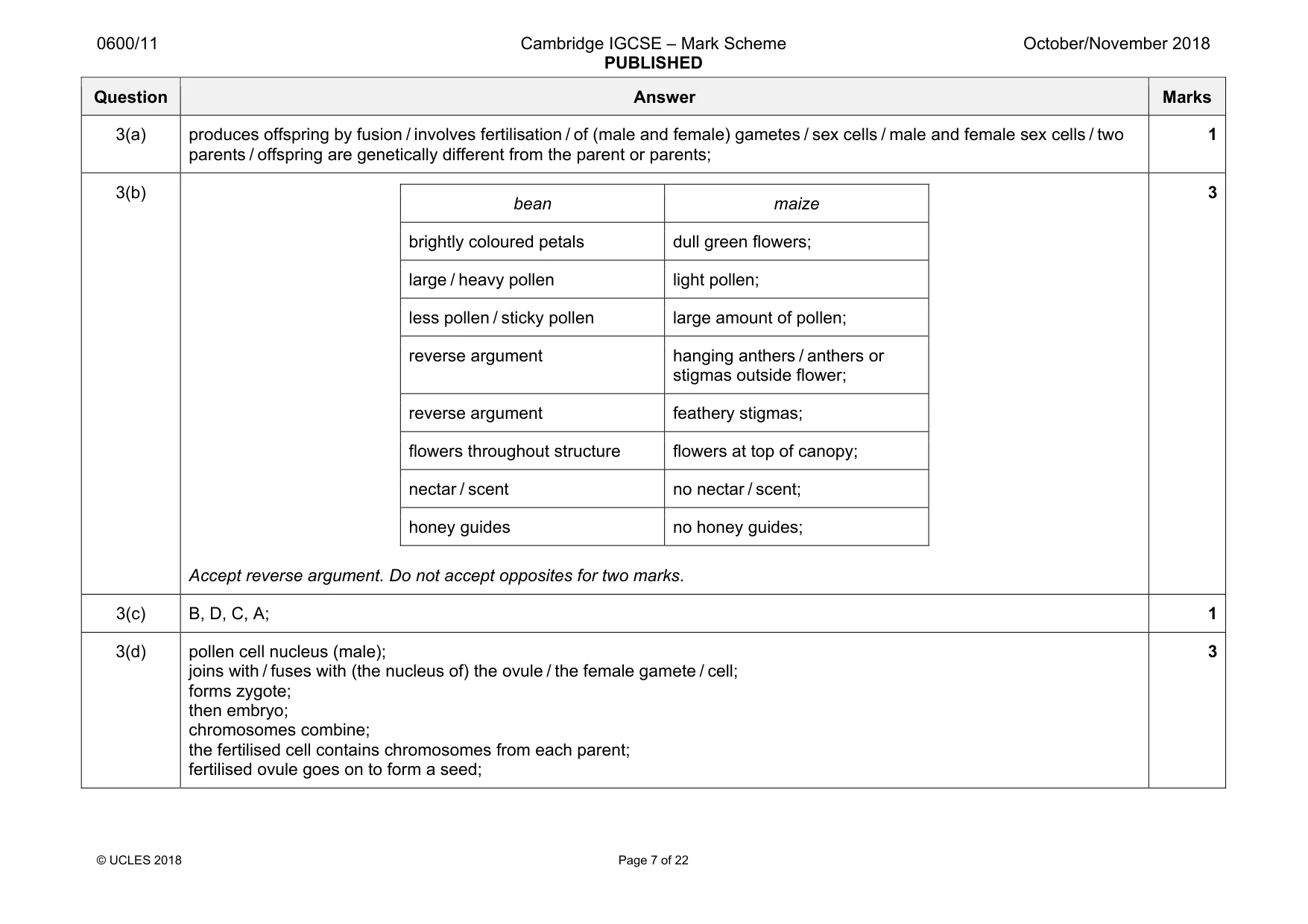
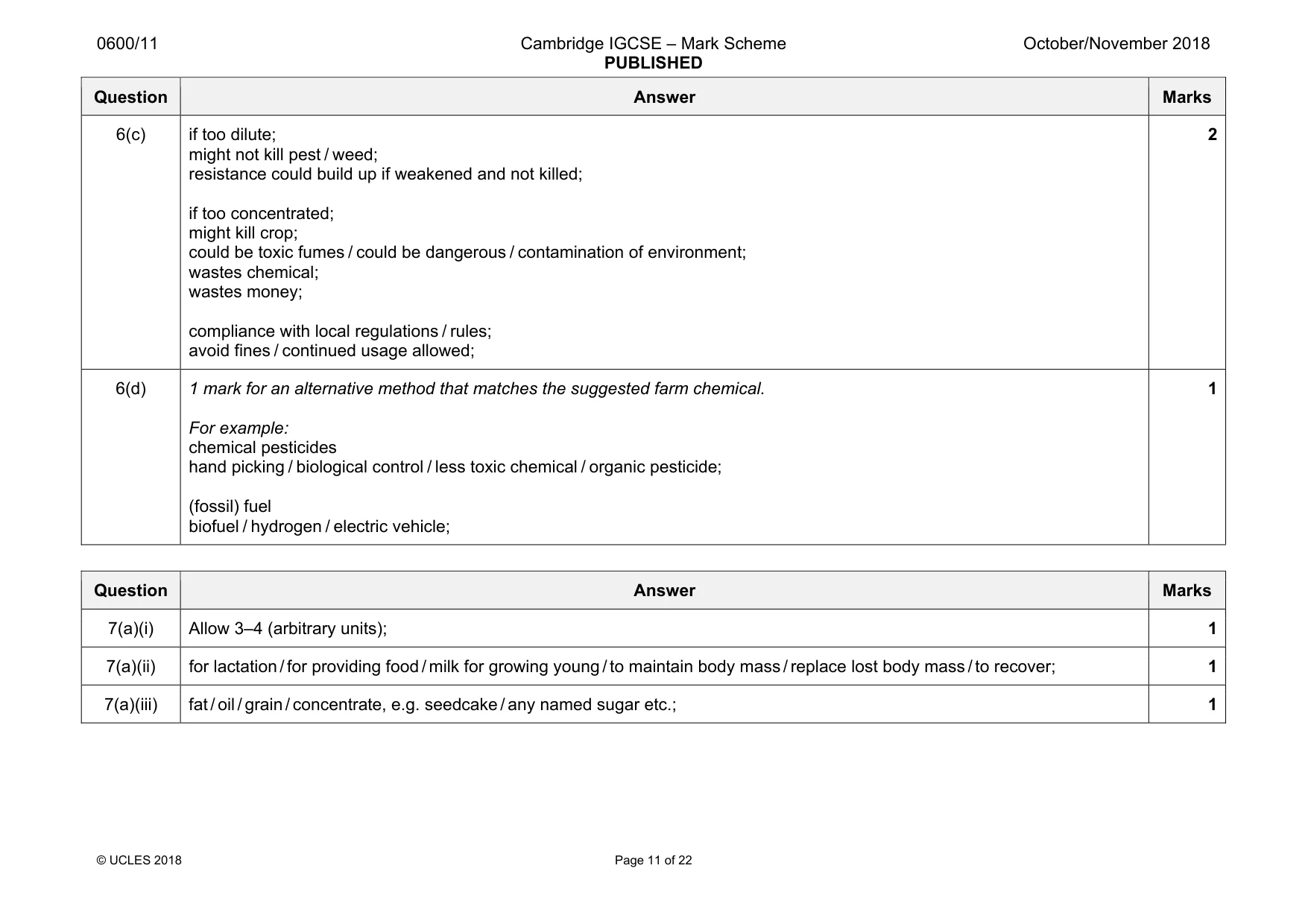
0600/11 Cambridge IGCSE – Mark Scheme PUBLISHED October/November 2018 © UCLES 2018 Page 4 of 22 Question Answer Marks 1(a)(i) D; 1 1(a)(ii) A; 1 1(b) bacteria; nematodes; fungi; (earth)worms; roots; insects / named example; Accept burrowing animal. Accept any relevant named example of a living thing. 2 1(c) humic acid; which can chemically attack rocks; animal trampling / tracks / burrowing; earthworms / bacteria / fungi in decay; plant roots; cracks / breaks down rocks and minerals to form soil; Credit ref. to other forms of weathering working in conjunction with biological weathering, e.g. roots cracking rock allow entry of water and subsequent freeze-thaw weathering. 3
Mark scheme, page 5
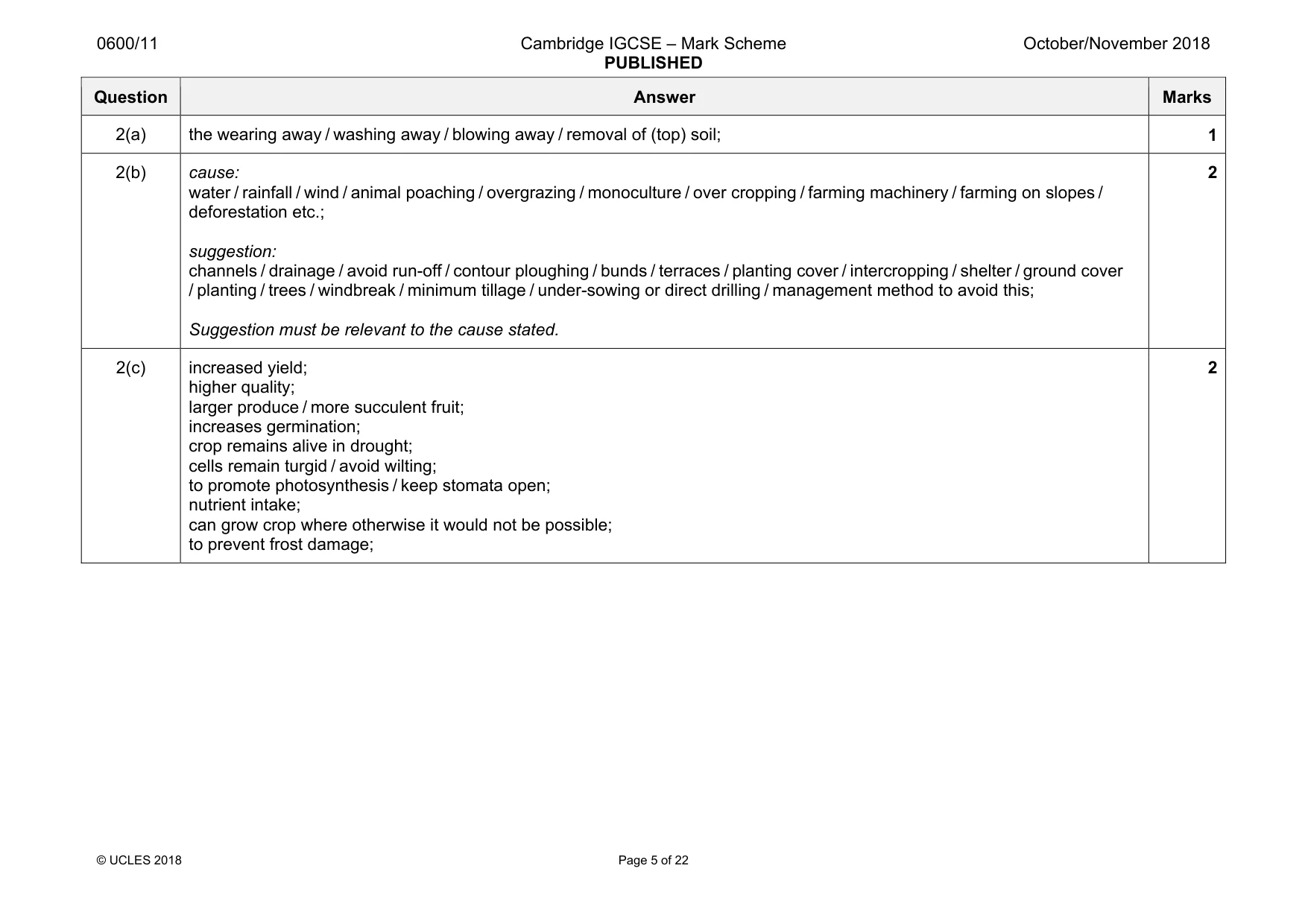
0600/11 Cambridge IGCSE – Mark Scheme PUBLISHED October/November 2018 © UCLES 2018 Page 5 of 22 Question Answer Marks 2(a) the wearing away / washing away / blowing away / removal of (top) soil; 1 2(b) cause: water / rainfall / wind / animal poaching / overgrazing / monoculture / over cropping / farming machinery / farming on slopes / deforestation etc.; suggestion: channels / drainage / avoid run-off / contour ploughing / bunds / terraces / planting cover / intercropping / shelter / ground cover / planting / trees / windbreak / minimum tillage / under-sowing or direct drilling / management method to avoid this; Suggestion must be relevant to the cause stated. 2 2(c) increased yield; higher quality; larger produce / more succulent fruit; increases germination; crop remains alive in drought; cells remain turgid / avoid wilting; to promote photosynthesis / keep stomata open; nutrient intake; can grow crop where otherwise it would not be possible; to prevent frost damage; 2
Mark scheme, page 6
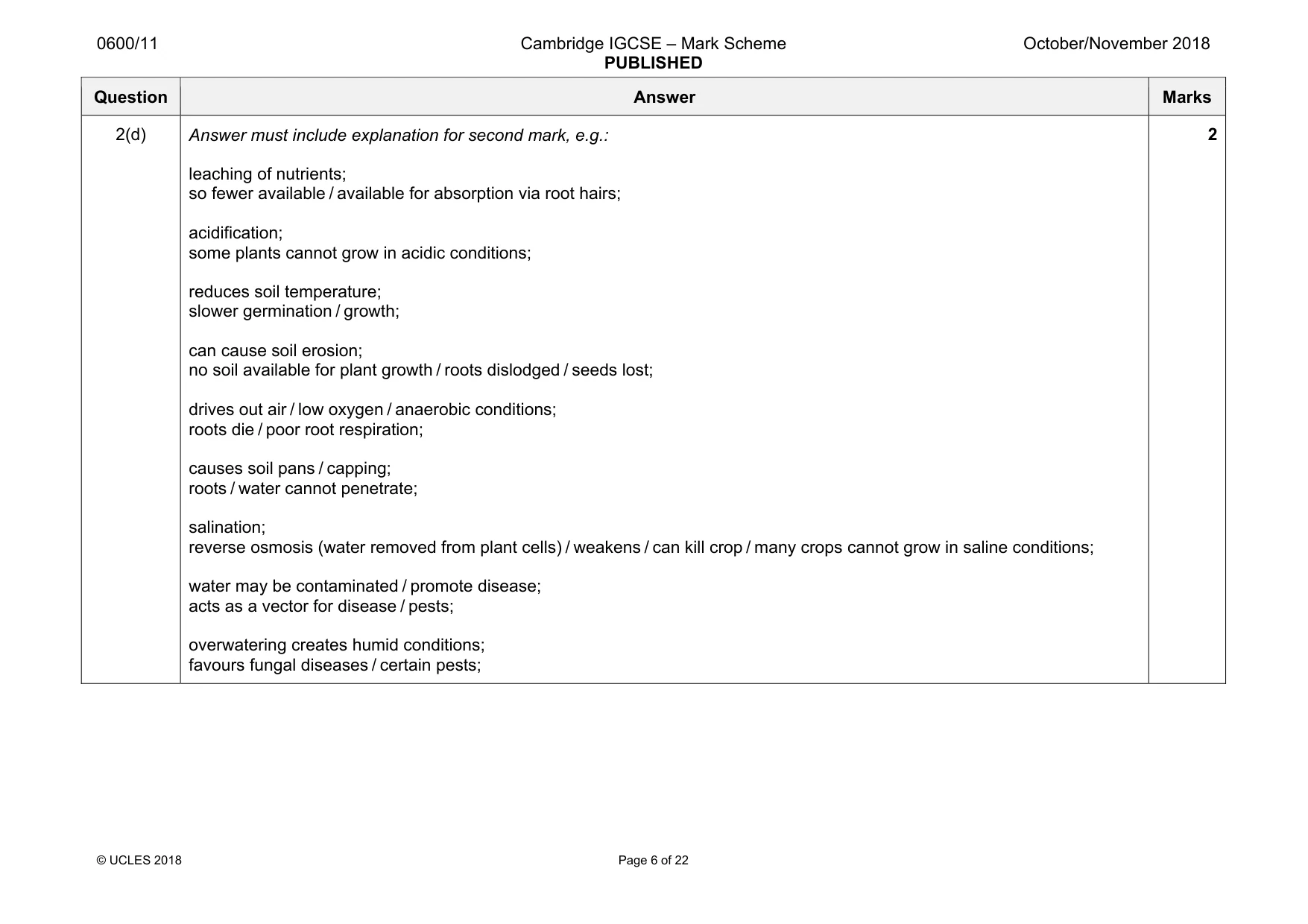
0600/11 Cambridge IGCSE – Mark Scheme PUBLISHED October/November 2018 © UCLES 2018 Page 6 of 22 Question Answer Marks 2(d) Answer must include explanation for second mark, e.g.: leaching of nutrients; so fewer available / available for absorption via root hairs; acidification; some plants cannot grow in acidic conditions; reduces soil temperature; slower germination / growth; can cause soil erosion; no soil available for plant growth / roots dislodged / seeds lost; drives out air / low oxygen / anaerobic conditions; roots die / poor root respiration; causes soil pans / capping; roots / water cannot penetrate; salination; reverse osmosis (water removed from plant cells) / weakens / can kill crop / many crops cannot grow in saline conditions; water may be contaminated / promote disease; acts as a vector for disease / pests; overwatering creates humid conditions; favours fungal diseases / certain pests; 2
Mark scheme, page 7
0600/11 Cambridge IGCSE – Mark Scheme PUBLISHED October/November 2018 © UCLES 2018 Page 7 of 22 Question Answer Marks 3(a) produces offspring by fusion / involves fertilisation / of (male and female) gametes / sex cells / male and female sex cells / two parents / offspring are genetically different from the parent or parents; 1 3(b) bean maize brightly coloured petals dull green flowers; large / heavy pollen light pollen; less pollen / sticky pollen large amount of pollen; reverse argument hanging anthers / anthers or stigmas outside flower; reverse argument feathery stigmas; flowers throughout structure flowers at top of canopy; nectar / scent no nectar / scent; honey guides no honey guides; Accept reverse argument. Do not accept opposites for two marks. 3 3(c) B, D, C, A; 1 3(d) pollen cell nucleus (male); joins with / fuses with (the nucleus of) the ovule / the female gamete / cell; forms zygote; then embryo; chromosomes combine; the fertilised cell contains chromosomes from each parent; fertilised ovule goes on to form a seed; 3
Mark scheme, page 8
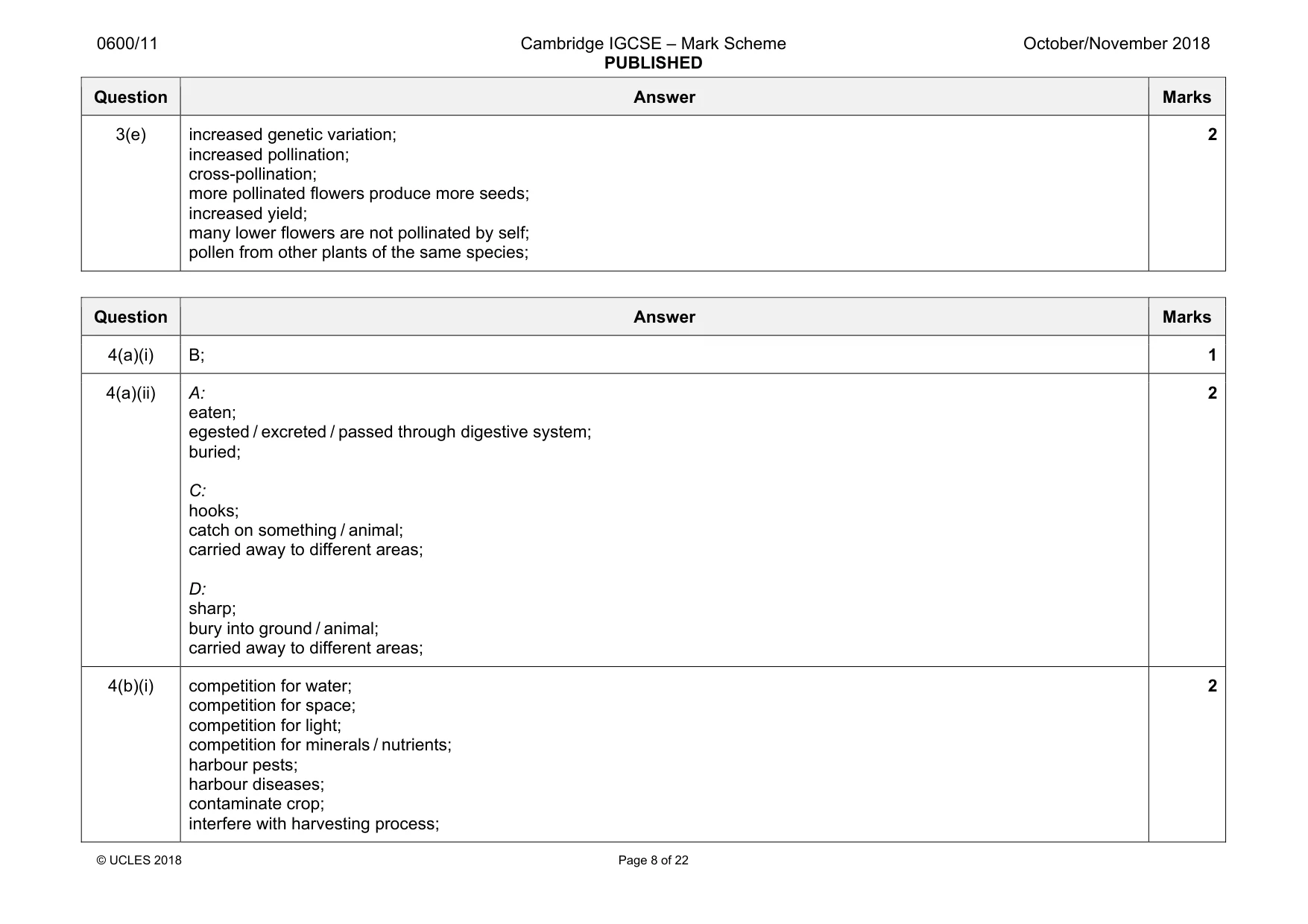
0600/11 Cambridge IGCSE – Mark Scheme PUBLISHED October/November 2018 © UCLES 2018 Page 8 of 22 Question Answer Marks 3(e) increased genetic variation; increased pollination; cross-pollination; more pollinated flowers produce more seeds; increased yield; many lower flowers are not pollinated by self; pollen from other plants of the same species; 2 Question Answer Marks 4(a)(i) B; 1 4(a)(ii) A: eaten; egested / excreted / passed through digestive system; buried; C: hooks; catch on something / animal; carried away to different areas; D: sharp; bury into ground / animal; carried away to different areas; 2 4(b)(i) competition for water; competition for space; competition for light; competition for minerals / nutrients; harbour pests; harbour diseases; contaminate crop; interfere with harvesting process; 2
Mark scheme, page 9
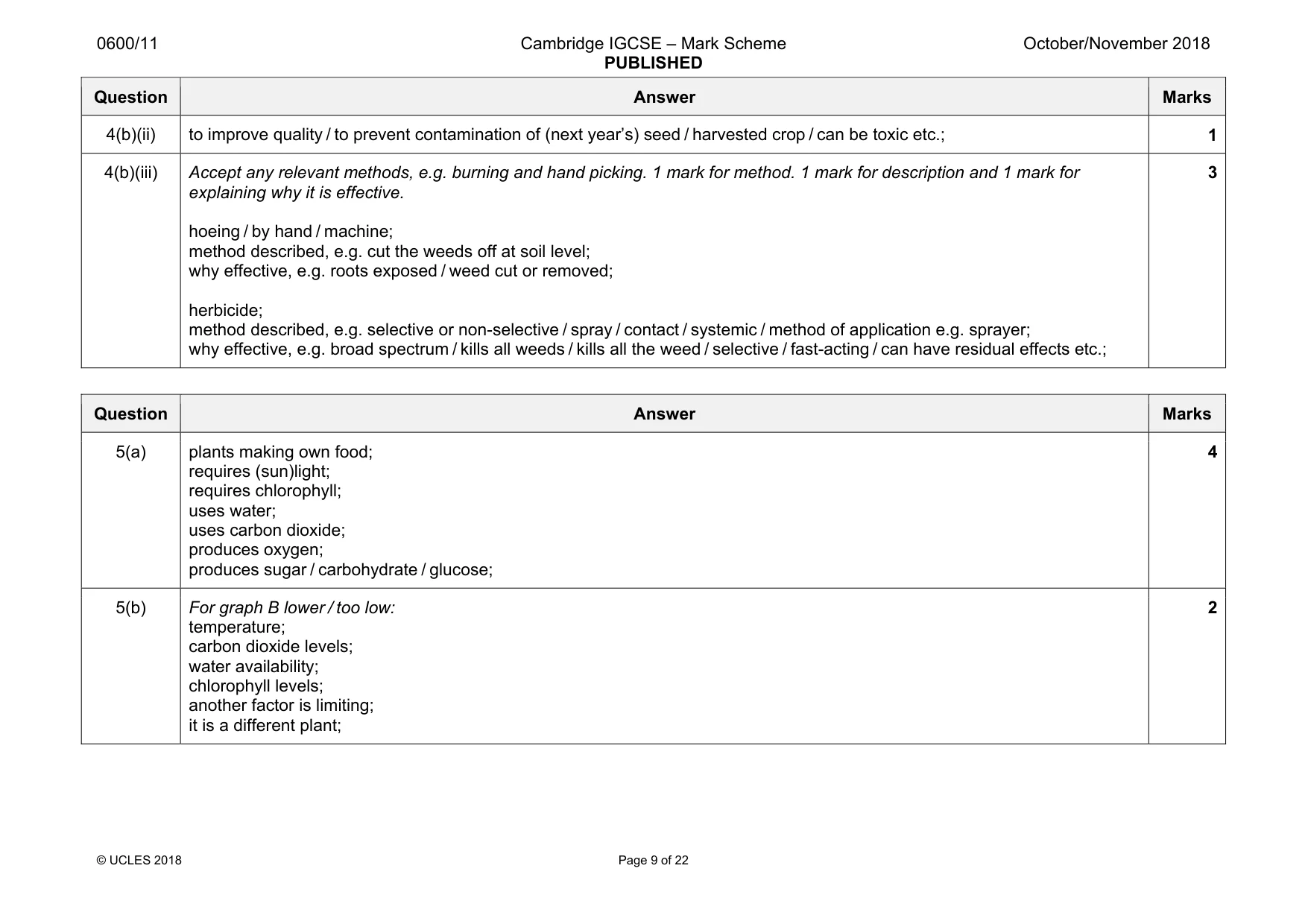
0600/11 Cambridge IGCSE – Mark Scheme PUBLISHED October/November 2018 © UCLES 2018 Page 9 of 22 Question Answer Marks 4(b)(ii) to improve quality / to prevent contamination of (next year’s) seed / harvested crop / can be toxic etc.; 1 4(b)(iii) Accept any relevant methods, e.g. burning and hand picking. 1 mark for method. 1 mark for description and 1 mark for explaining why it is effective. hoeing / by hand / machine; method described, e.g. cut the weeds off at soil level; why effective, e.g. roots exposed / weed cut or removed; herbicide; method described, e.g. selective or non-selective / spray / contact / systemic / method of application e.g. sprayer; why effective, e.g. broad spectrum / kills all weeds / kills all the weed / selective / fast-acting / can have residual effects etc.; 3 Question Answer Marks 5(a) plants making own food; requires (sun)light; requires chlorophyll; uses water; uses carbon dioxide; produces oxygen; produces sugar / carbohydrate / glucose; 4 5(b) For graph B lower / too low: temperature; carbon dioxide levels; water availability; chlorophyll levels; another factor is limiting; it is a different plant; 2
Mark scheme, page 10
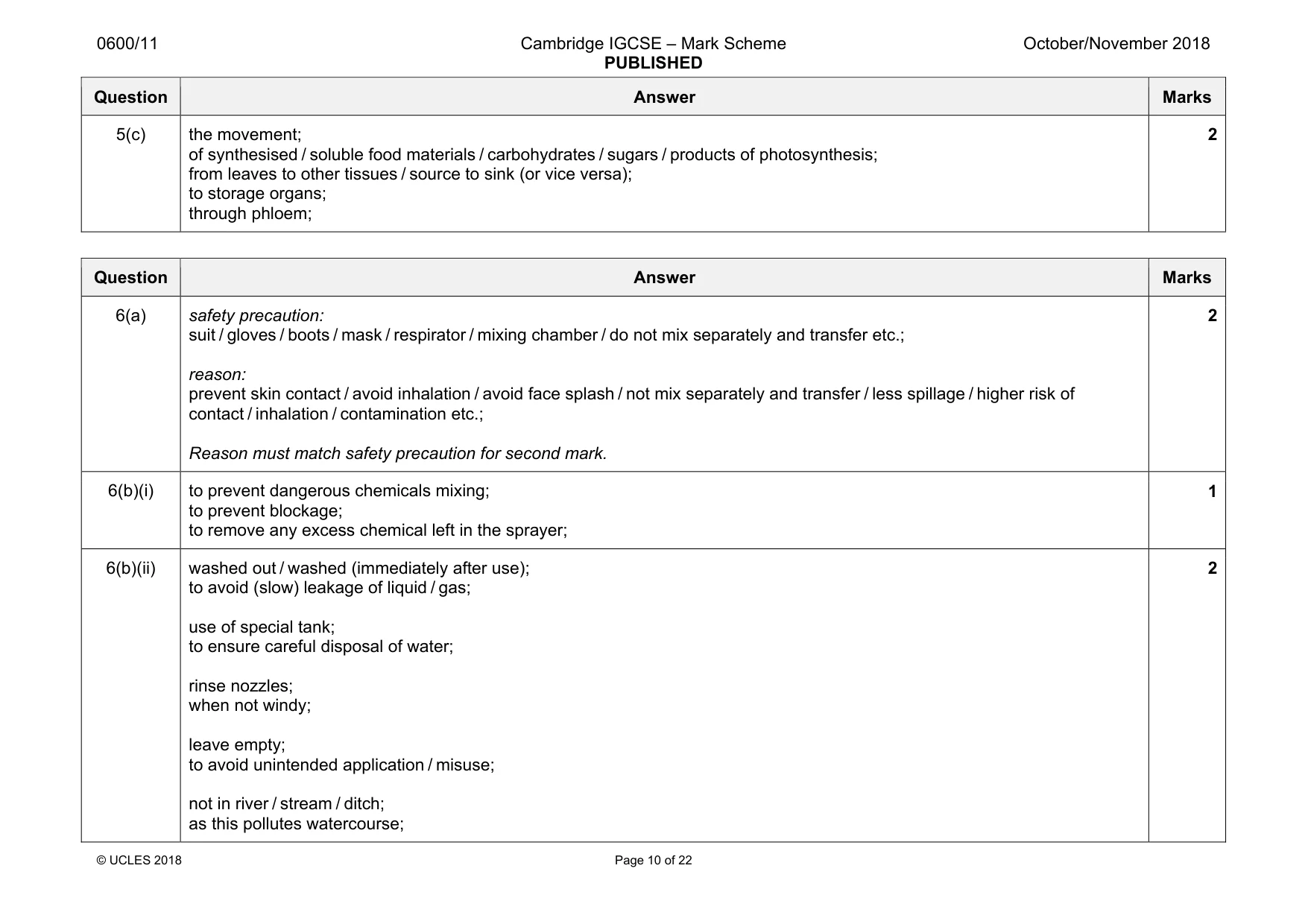
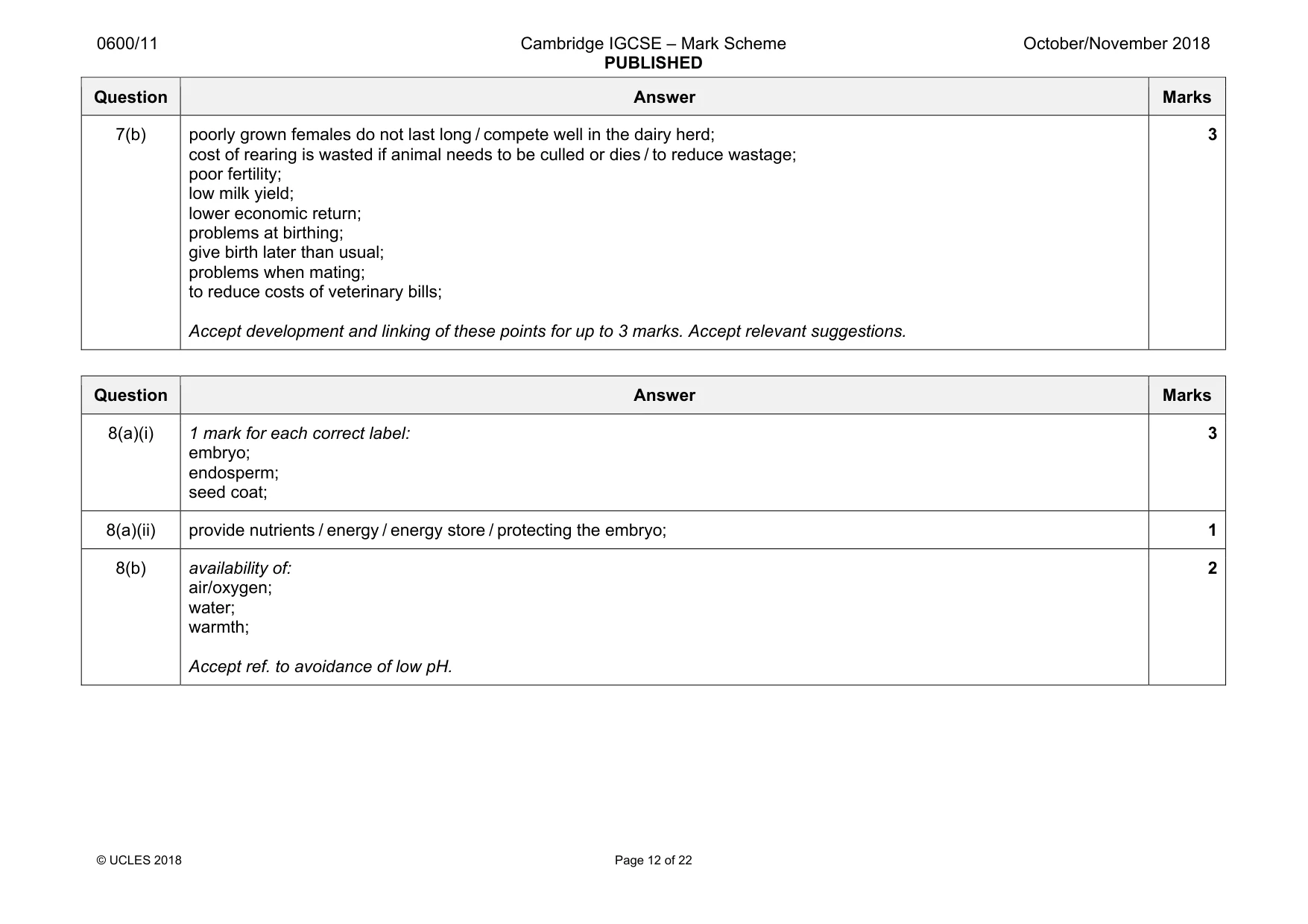
0600/11 Cambridge IGCSE – Mark Scheme PUBLISHED October/November 2018 © UCLES 2018 Page 10 of 22 Question Answer Marks 5(c) the movement; of synthesised / soluble food materials / carbohydrates / sugars / products of photosynthesis; from leaves to other tissues / source to sink (or vice versa); to storage organs; through phloem; 2 Question Answer Marks 6(a) safety precaution: suit / gloves / boots / mask / respirator / mixing chamber / do not mix separately and transfer etc.; reason: prevent skin contact / avoid inhalation / avoid face splash / not mix separately and transfer / less spillage / higher risk of contact / inhalation / contamination etc.; Reason must match safety precaution for second mark. 2 6(b)(i) to prevent dangerous chemicals mixing; to prevent blockage; to remove any excess chemical left in the sprayer; 1 6(b)(ii) washed out / washed (immediately after use); to avoid (slow) leakage of liquid / gas; use of special tank; to ensure careful disposal of water; rinse nozzles; when not windy; leave empty; to avoid unintended application / misuse; not in river / stream / ditch; as this pollutes watercourse; 2
Mark scheme, page 11
0600/11 Cambridge IGCSE – Mark Scheme PUBLISHED October/November 2018 © UCLES 2018 Page 11 of 22 Question Answer Marks 6(c) if too dilute; might not kill pest / weed; resistance could build up if weakened and not killed; if too concentrated; might kill crop; could be toxic fumes / could be dangerous / contamination of environment; wastes chemical; wastes money; compliance with local regulations / rules; avoid fines / continued usage allowed; 2 6(d) 1 mark for an alternative method that matches the suggested farm chemical. For example: chemical pesticides hand picking / biological control / less toxic chemical / organic pesticide; (fossil) fuel biofuel / hydrogen / electric vehicle; 1 Question Answer Marks 7(a)(i) Allow 3–4 (arbitrary units); 1 7(a)(ii) for lactation / for providing food / milk for growing young / to maintain body mass / replace lost body mass / to recover; 1 7(a)(iii) fat / oil/ grain / concentrate, e.g. seedcake / any named sugar etc.; 1
Mark scheme, page 12
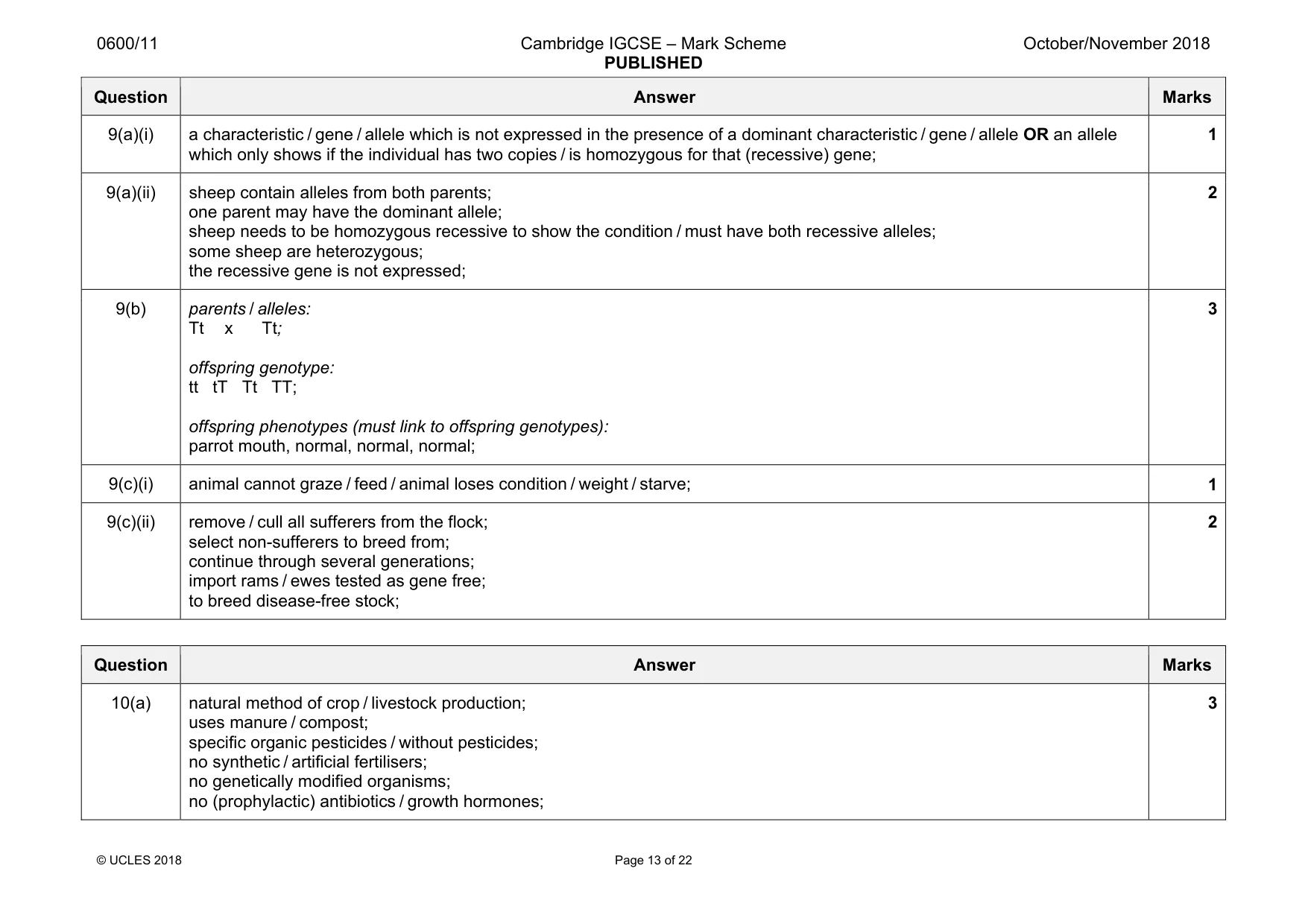
0600/11 Cambridge IGCSE – Mark Scheme PUBLISHED October/November 2018 © UCLES 2018 Page 12 of 22 Question Answer Marks 7(b) poorly grown females do not last long / compete well in the dairy herd; cost of rearing is wasted if animal needs to be culled or dies / to reduce wastage; poor fertility; low milk yield; lower economic return; problems at birthing; give birth later than usual; problems when mating; to reduce costs of veterinary bills; Accept development and linking of these points for up to 3 marks. Accept relevant suggestions. 3 Question Answer Marks 8(a)(i) 1 mark for each correct label: embryo; endosperm; seed coat; 3 8(a)(ii) provide nutrients / energy / energy store / protecting the embryo; 1 8(b) availability of: air/oxygen; water; warmth; Accept ref. to avoidance of low pH. 2
Mark scheme, page 13
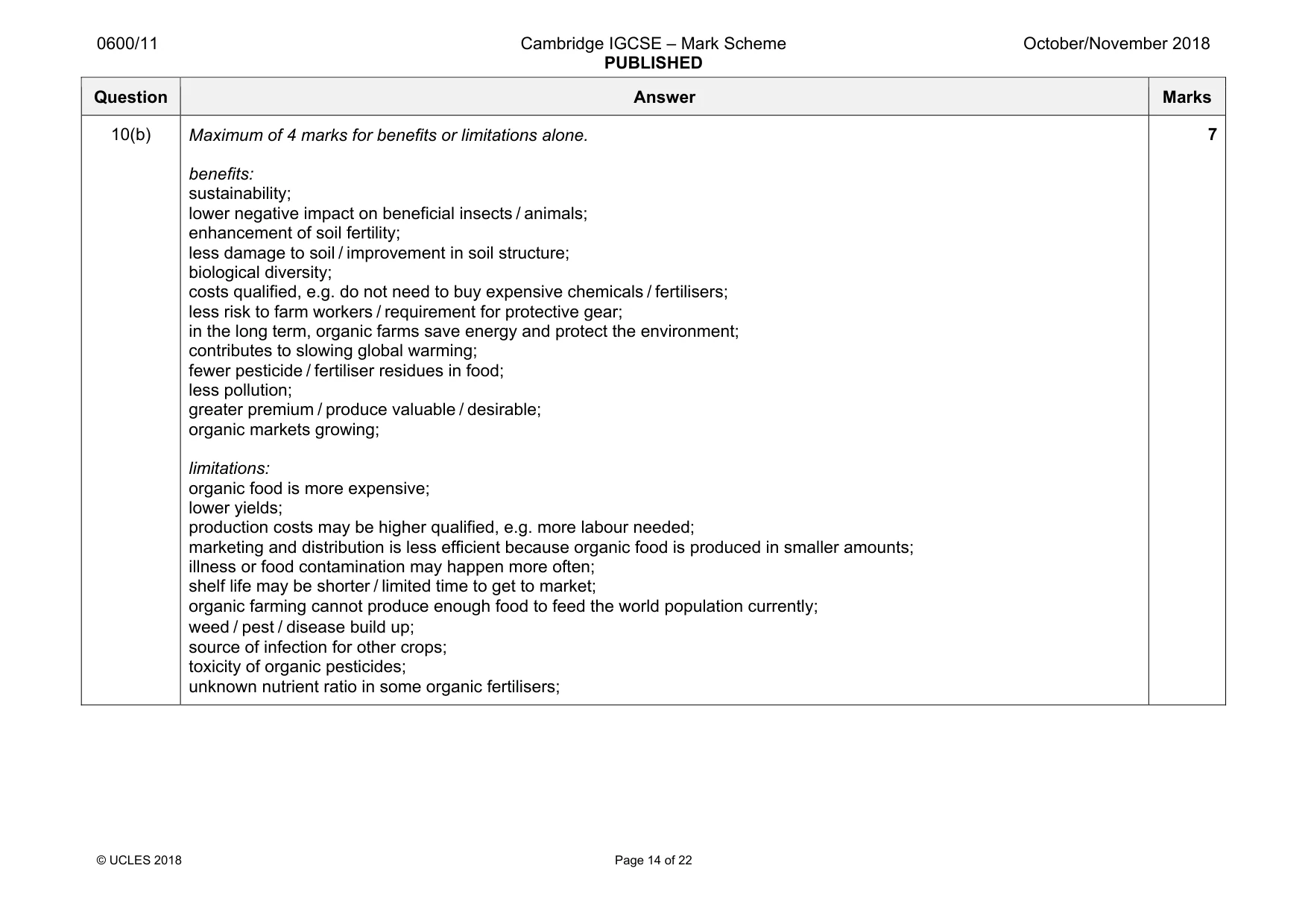
0600/11 Cambridge IGCSE – Mark Scheme PUBLISHED October/November 2018 © UCLES 2018 Page 13 of 22 Question Answer Marks 9(a)(i) a characteristic / gene / allele which is not expressed in the presence of a dominant characteristic / gene / allele OR an allele which only shows if the individual has two copies / is homozygous for that (recessive) gene; 1 9(a)(ii) sheep contain alleles from both parents; one parent may have the dominant allele; sheep needs to be homozygous recessive to show the condition / must have both recessive alleles; some sheep are heterozygous; the recessive gene is not expressed; 2 9(b) parents / alleles: Tt x Tt; offspring genotype: tt tT Tt TT; offspring phenotypes (must link to offspring genotypes): parrot mouth, normal, normal, normal; 3 9(c)(i) animal cannot graze / feed / animal loses condition / weight / starve; 1 9(c)(ii) remove / cull all sufferers from the flock; select non-sufferers to breed from; continue through several generations; import rams / ewes tested as gene free; to breed disease-free stock; 2 Question Answer Marks 10(a) natural method of crop / livestock production; uses manure / compost; specific organic pesticides / without pesticides; no synthetic / artificial fertilisers; no genetically modified organisms; no (prophylactic) antibiotics / growth hormones; 3
Mark scheme, page 14
0600/11 Cambridge IGCSE – Mark Scheme PUBLISHED October/November 2018 © UCLES 2018 Page 14 of 22 Question Answer Marks 10(b) Maximum of 4 marks for benefits or limitations alone. benefits: sustainability; lower negative impact on beneficial insects / animals; enhancement of soil fertility; less damage to soil / improvement in soil structure; biological diversity; costs qualified, e.g. do not need to buy expensive chemicals / fertilisers; less risk to farm workers / requirement for protective gear; in the long term, organic farms save energy and protect the environment; contributes to slowing global warming; fewer pesticide / fertiliser residues in food; less pollution; greater premium / produce valuable / desirable; organic markets growing; limitations: organic food is more expensive; lower yields; production costs may be higher qualified, e.g. more labour needed; marketing and distribution is less efficient because organic food is produced in smaller amounts; illness or food contamination may happen more often; shelf life may be shorter / limited time to get to market; organic farming cannot produce enough food to feed the world population currently; weed / pest / disease build up; source of infection for other crops; toxicity of organic pesticides; unknown nutrient ratio in some organic fertilisers; 7
Mark scheme, page 15
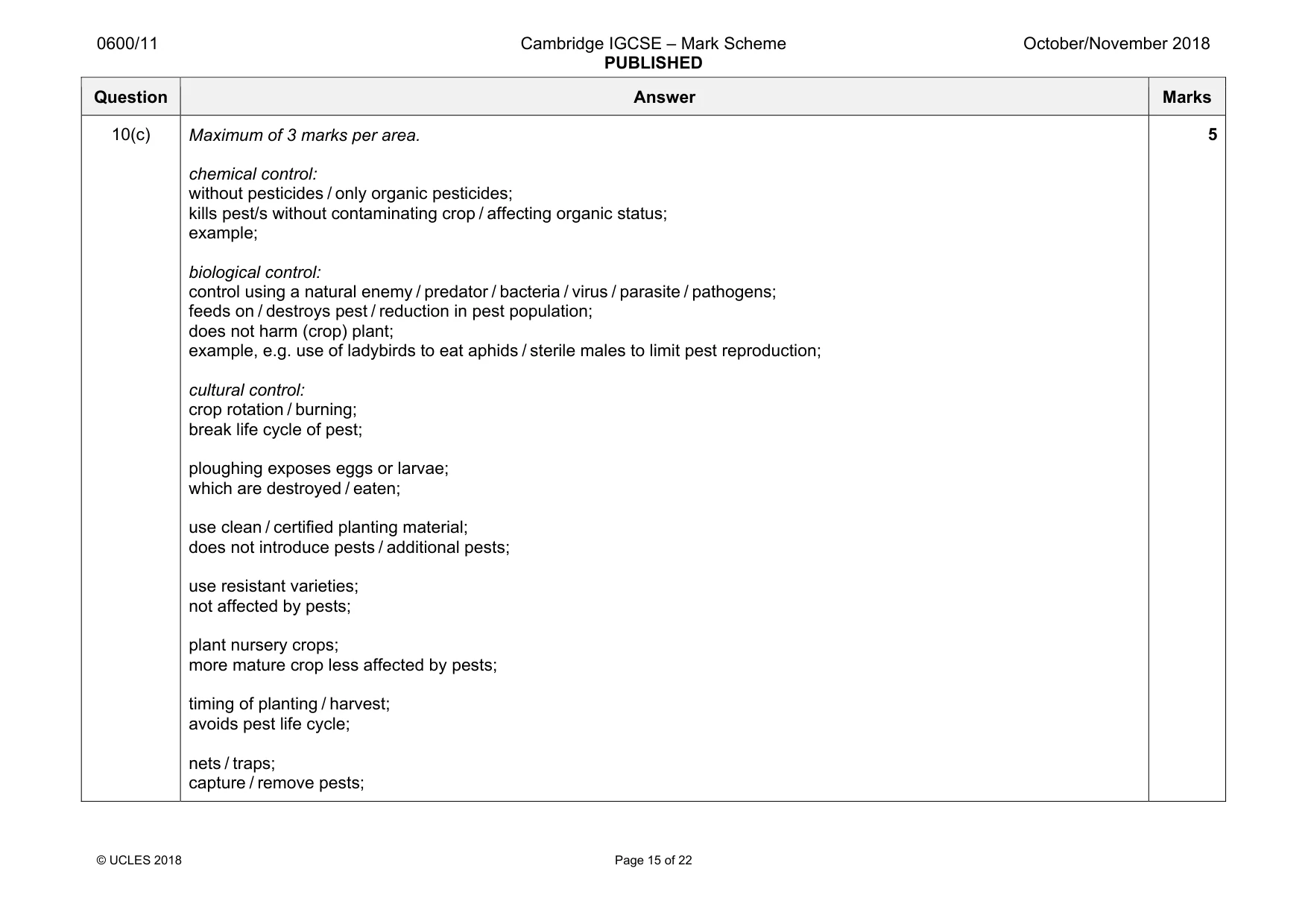
0600/11 Cambridge IGCSE – Mark Scheme PUBLISHED October/November 2018 © UCLES 2018 Page 15 of 22 Question Answer Marks 10(c) Maximum of 3 marks per area. chemical control: without pesticides / only organic pesticides; kills pest/s without contaminating crop / affecting organic status; example; biological control: control using a natural enemy / predator / bacteria / virus / parasite / pathogens; feeds on / destroys pest / reduction in pest population; does not harm (crop) plant; example, e.g. use of ladybirds to eat aphids / sterile males to limit pest reproduction; cultural control: crop rotation / burning; break life cycle of pest; ploughing exposes eggs or larvae; which are destroyed / eaten; use clean / certified planting material; does not introduce pests / additional pests; use resistant varieties; not affected by pests; plant nursery crops; more mature crop less affected by pests; timing of planting / harvest; avoids pest life cycle; nets / traps; capture / remove pests; 5
Mark scheme, page 16
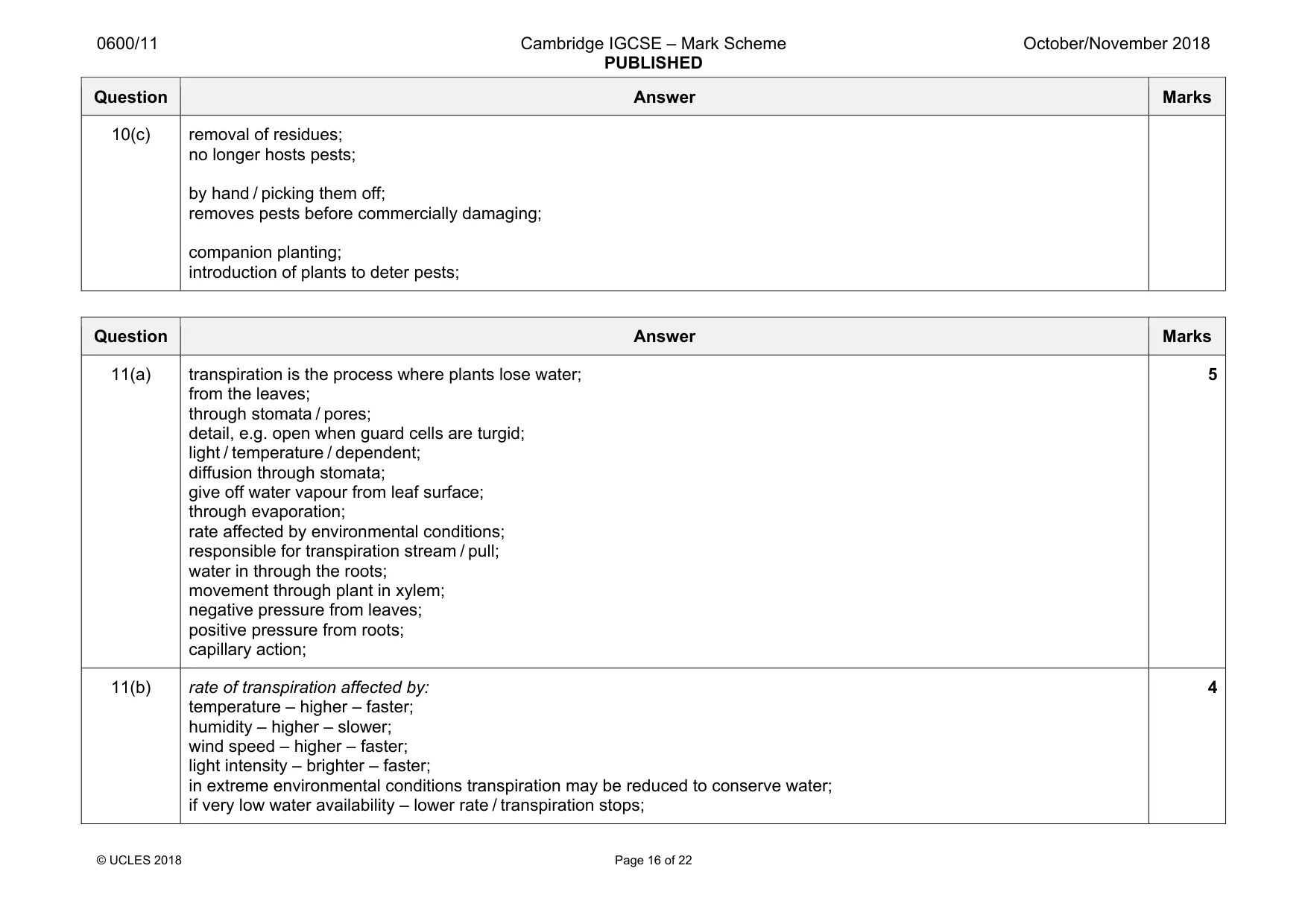
0600/11 Cambridge IGCSE – Mark Scheme PUBLISHED October/November 2018 © UCLES 2018 Page 16 of 22 Question Answer Marks 10(c) removal of residues; no longer hosts pests; by hand / picking them off; removes pests before commercially damaging; companion planting; introduction of plants to deter pests; Question Answer Marks 11(a) transpiration is the process where plants lose water; from the leaves; through stomata / pores; detail, e.g. open when guard cells are turgid; light / temperature / dependent; diffusion through stomata; give off water vapour from leaf surface; through evaporation; rate affected by environmental conditions; responsible for transpiration stream / pull; water in through the roots; movement through plant in xylem; negative pressure from leaves; positive pressure from roots; capillary action; 5 11(b) rate of transpiration affected by: temperature – higher – faster; humidity – higher – slower; wind speed – higher – faster; light intensity – brighter – faster; in extreme environmental conditions transpiration may be reduced to conserve water; if very low water availability – lower rate / transpiration stops; 4
Mark scheme, page 17
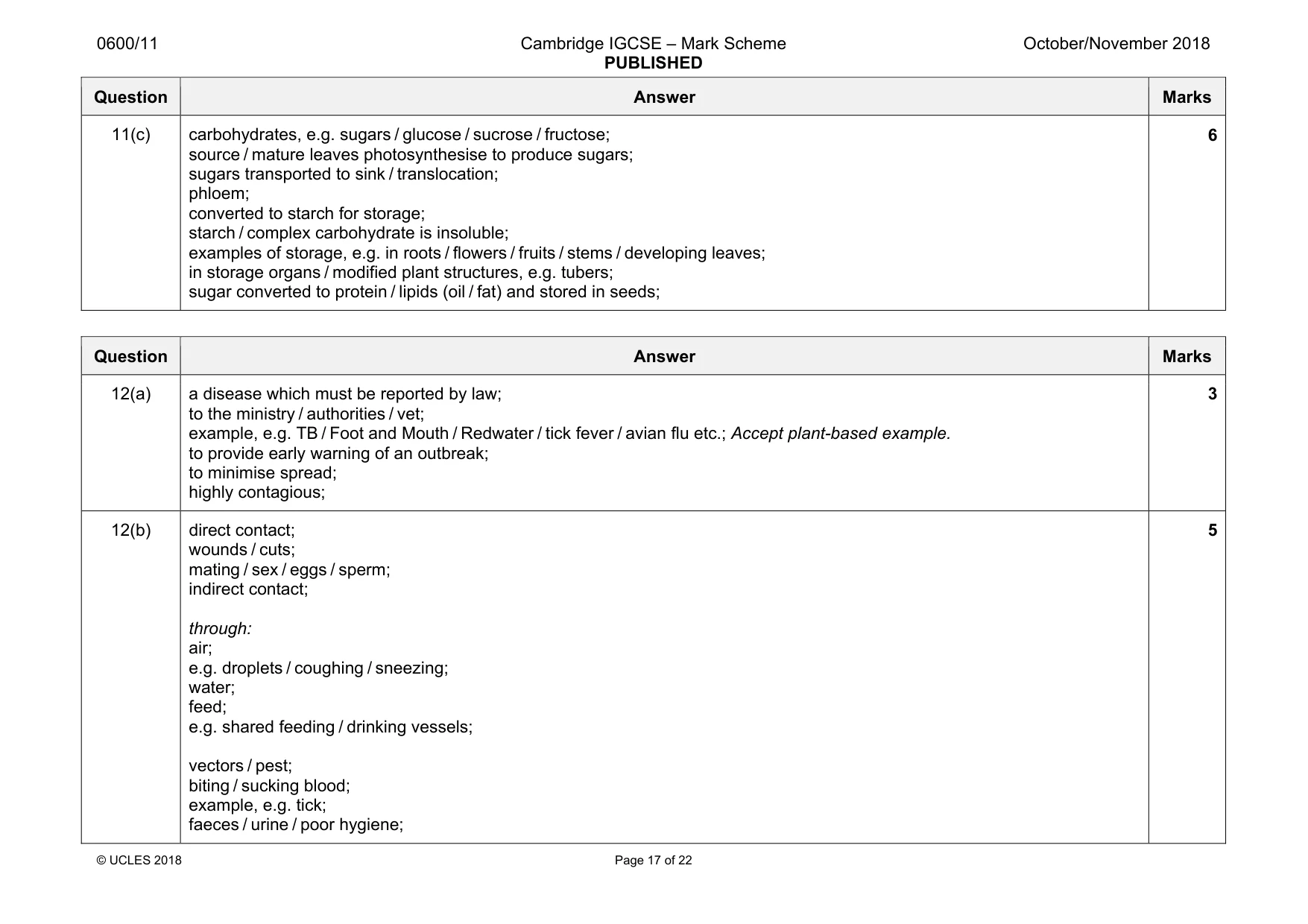
0600/11 Cambridge IGCSE – Mark Scheme PUBLISHED October/November 2018 © UCLES 2018 Page 17 of 22 Question Answer Marks 11(c) carbohydrates, e.g. sugars / glucose / sucrose / fructose; source / mature leaves photosynthesise to produce sugars; sugars transported to sink / translocation; phloem; converted to starch for storage; starch / complex carbohydrate is insoluble; examples of storage, e.g. in roots / flowers / fruits / stems / developing leaves; in storage organs / modified plant structures, e.g. tubers; sugar converted to protein / lipids (oil / fat) and stored in seeds; 6 Question Answer Marks 12(a) a disease which must be reported by law; to the ministry / authorities / vet; example, e.g. TB / Foot and Mouth / Redwater / tick fever / avian flu etc.; Accept plant-based example. to provide early warning of an outbreak; to minimise spread; highly contagious; 3 12(b) direct contact; wounds / cuts; mating / sex / eggs / sperm; indirect contact; through: air; e.g. droplets / coughing / sneezing; water; feed; e.g. shared feeding / drinking vessels; vectors / pest; biting / sucking blood; example, e.g. tick; faeces / urine / poor hygiene; 5
Mark scheme, page 18
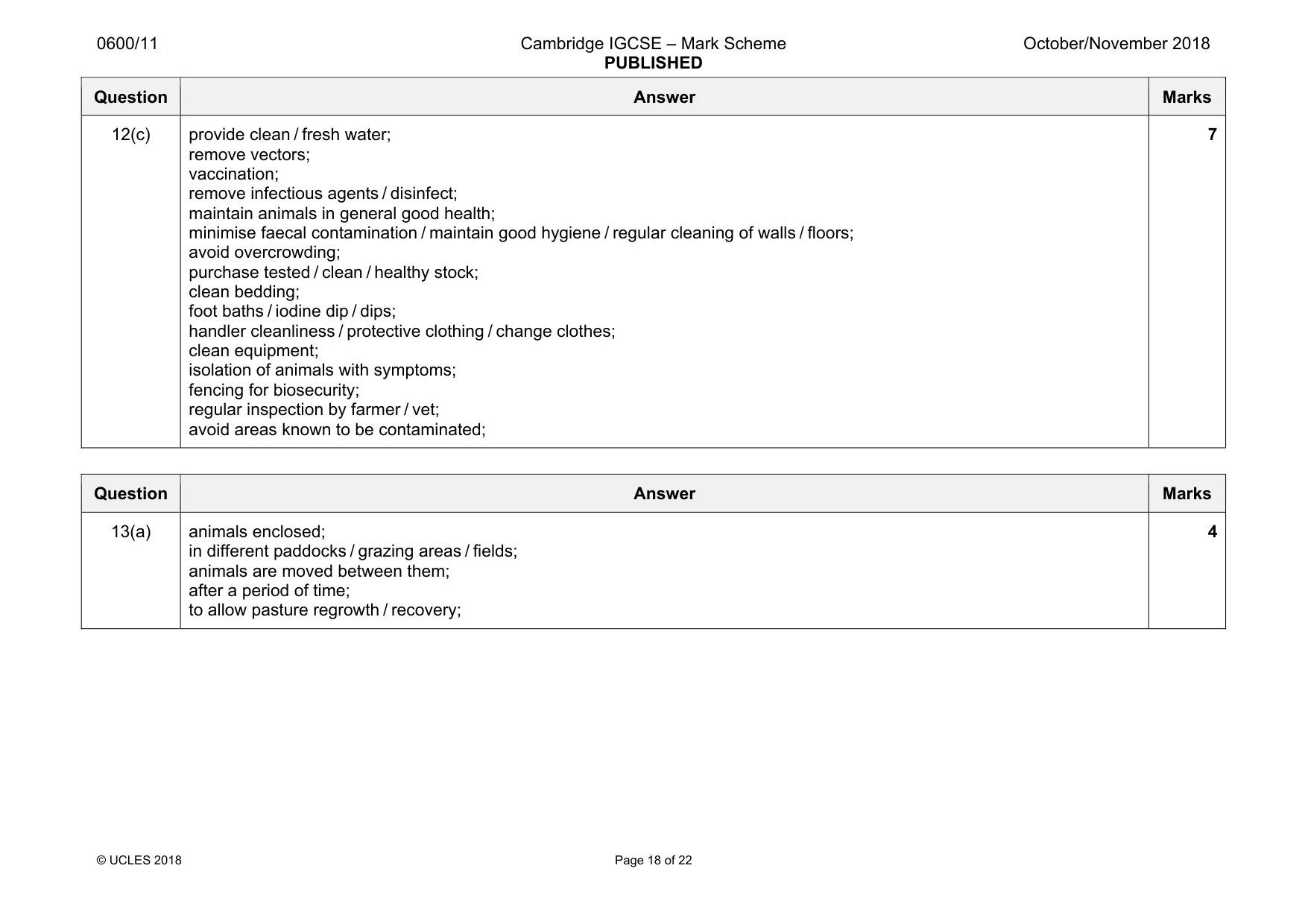
0600/11 Cambridge IGCSE – Mark Scheme PUBLISHED October/November 2018 © UCLES 2018 Page 18 of 22 Question Answer Marks 12(c) provide clean / fresh water; remove vectors; vaccination; remove infectious agents / disinfect; maintain animals in general good health; minimise faecal contamination / maintain good hygiene / regular cleaning of walls / floors; avoid overcrowding; purchase tested / clean / healthy stock; clean bedding; foot baths / iodine dip / dips; handler cleanliness / protective clothing / change clothes; clean equipment; isolation of animals with symptoms; fencing for biosecurity; regular inspection by farmer / vet; avoid areas known to be contaminated; 7 Question Answer Marks 13(a) animals enclosed; in different paddocks / grazing areas / fields; animals are moved between them; after a period of time; to allow pasture regrowth / recovery; 4
Mark scheme, page 19
0600/11 Cambridge IGCSE – Mark Scheme PUBLISHED October/November 2018 © UCLES 2018 Page 19 of 22 Question Answer Marks 13(b) animals can be kept in a defined area; pasture can be rested; different herbivores / grazing at different heights; grass can be saved for conservation; maximise forage yield; match forage supply and consumption; enable pasture improvement; prevent overgrazing / soil erosion; controlled grazing / strip grazing; less pasture wastage; easier to mechanise; can zero graze; can manage different fields / areas differently as needed; example, e.g. electric fencing; 6
Mark scheme, page 20
0600/11 Cambridge IGCSE – Mark Scheme PUBLISHED October/November 2018 © UCLES 2018 Page 20 of 22 Question Answer Marks 13(c) Maximum of 3 marks for pasture, animal health or management problems alone. Allow development of a point for up to 2 marks. pasture: soil compaction / trampling; weed growth; increase in unpalatable species; erosion; pasture does not recover / fails; overgrazing; animal health: increased pest burden; animals do not thrive; increased disease risk; easier disease transmission between animals; management: more complex stock management; labour requirement qualified, e.g. need more treatment of livestock; lower quality outputs / animals take longer to fatten / mature; increase costs / reduced profits, e.g. higher veterinary costs / more animals to feed; 5
Mark scheme, page 21
0600/11 Cambridge IGCSE – Mark Scheme PUBLISHED October/November 2018 © UCLES 2018 Page 21 of 22 Question Answer Marks 14(a) (approximately) equal / correct proportions; contains sand, silt and clay;; (for 2 marks) (Allow 1 mark for 2 of the above soil types.) Allow 1 mark for a property of a loam soil, e.g.: has a good crumb structure / high nutrient content / free-draining / well-aerated; 3 14(b) loam soil has: mixture of particle sizes compared to sand; which has only large particle sizes; charged clay particles / higher surface area; the ability to attract water particles; has better crumb structure / more water-holding pores; soil is less permeable; more organic matter; (small and large) air spaces; drains less well; Accept reverse arguments for sandy soil. 6
Mark scheme, page 22
0600/11 Cambridge IGCSE – Mark Scheme PUBLISHED October/November 2018 © UCLES 2018 Page 22 of 22 Question Answer Marks 14(c) Maximum of 3 marks for explanation and improvement methods alone. explanation: small particles; is cold / warms up slowly; lack of air / oxygen; lowered root respiration / anaerobic conditions; poor root growth; slower crop growth; very few / small air spaces; low water permeability; high water-holding capacity; high risk of waterlogging; poor soil (micro)organism activity; pests / disease may thrive; example, e.g. liver fluke; drainage methods: ditches / canals; pumps and levels; solar / windmill / dams / flood gates; pipe / gravel soakaway; clay / plastic / continuous; deep tillage / mole drain / plough; improve organic content; liming; to increase flocculation; use of a clay breaker, e.g. seaweed etc.; 6
What you needed in this session
Cambridge’s own grade thresholds for 2018 Oct/Nov, Paper 1 · Variant 1. A higher threshold means an easier paper — the bar moves with how the cohort did.