Cambridge IGCSE Agriculture 0600 — 2023 Oct/Nov Paper 1 · Variant 1
0600/11/O/N/23 · 100 marks · ≈113 min
The question paper and its mark scheme, free to read here and free to download. This is Cambridge’s own paper, exactly as it was sat.
Question paper24 pages









Mark scheme24 pages
Answers below. Sit the paper first if you are practising.
Paper as text
Question paper, page 1
This document has 24 pages. Any blank pages are indicated. [Turn over Cambridge IGCSE™ * 2 7 7 7 0 7 6 7 1 2 * DC (RW/JG) 312611/1 © UCLES 2023 AGRICULTURE 0600/11 Paper 1 Theory October/November 2023 1 hour 45 minutes You must answer on the question paper. No additional materials are needed. INSTRUCTIONS ● Section A: answer all questions. ● Section B: answer two questions. ● Use a black or dark blue pen. You may use an HB pencil for any diagrams or graphs. ● Write your name, centre number and candidate number in the boxes at the top of the page. ● Write your answer to each question in the space provided. ● Do not use an erasable pen or correction fluid. ● Do not write on any bar codes. ● You may use a calculator. ● You should show all your working and use appropriate units. INFORMATION ● The total mark for this paper is 100. ● The number of marks for each question or part question is shown in brackets [ ].
Question paper, page 2
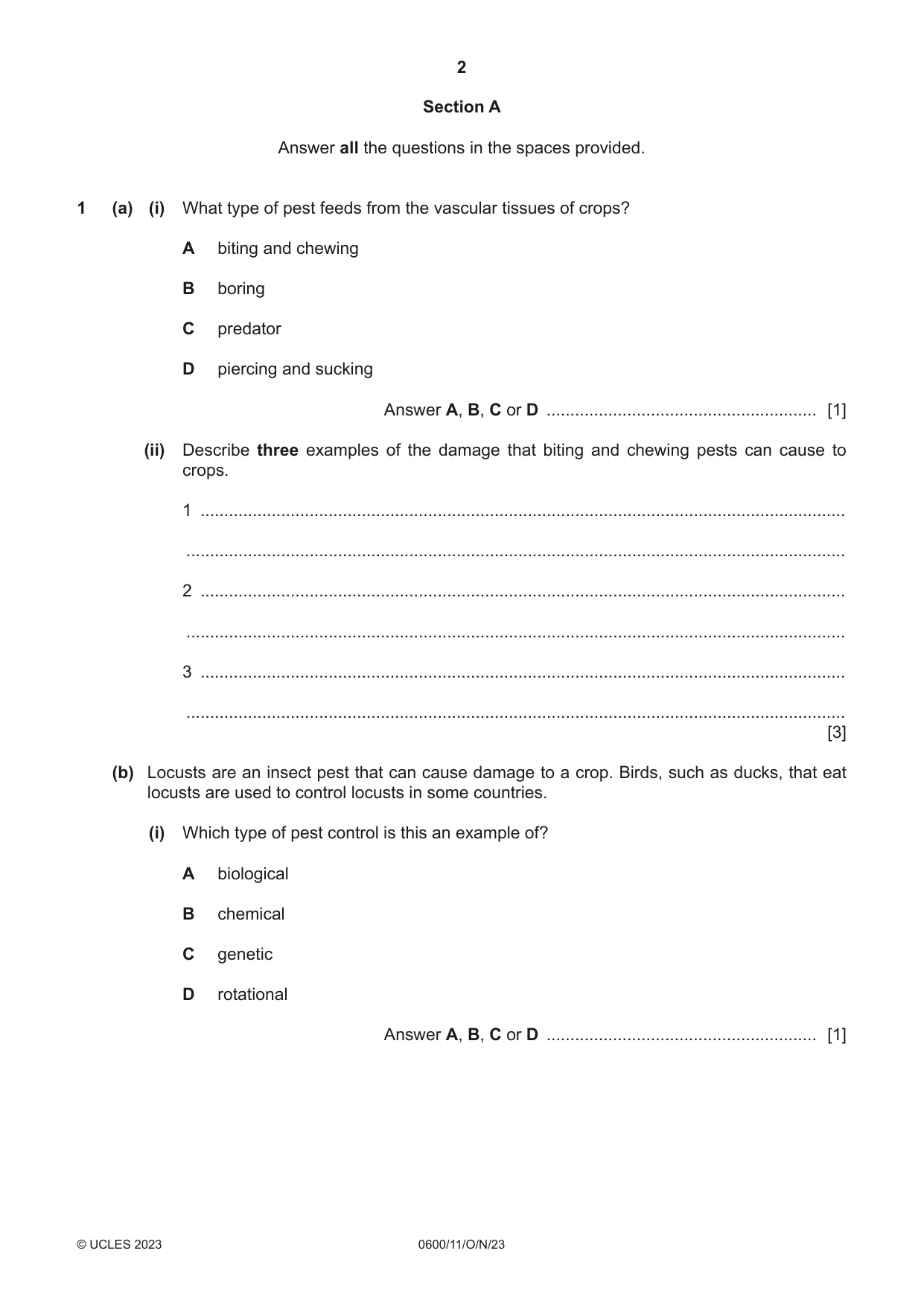
2 0600/11/O/N/23 © UCLES 2023 Section A Answer all the questions in the spaces provided. 1 (a) (i) What type of pest feeds from the vascular tissues of crops? A biting and chewing B boring C predator D piercing and sucking Answer A, B, C or D … [1] (ii) Describe three examples of the damage that biting and chewing pests can cause to crops. 1 … … 2 … … 3 … … [3] (b) Locusts are an insect pest that can cause damage to a crop. Birds, such as ducks, that eat locusts are used to control locusts in some countries. (i) Which type of pest control is this an example of? A biological B chemical C genetic D rotational Answer A, B, C or D … [1]
Question paper, page 3
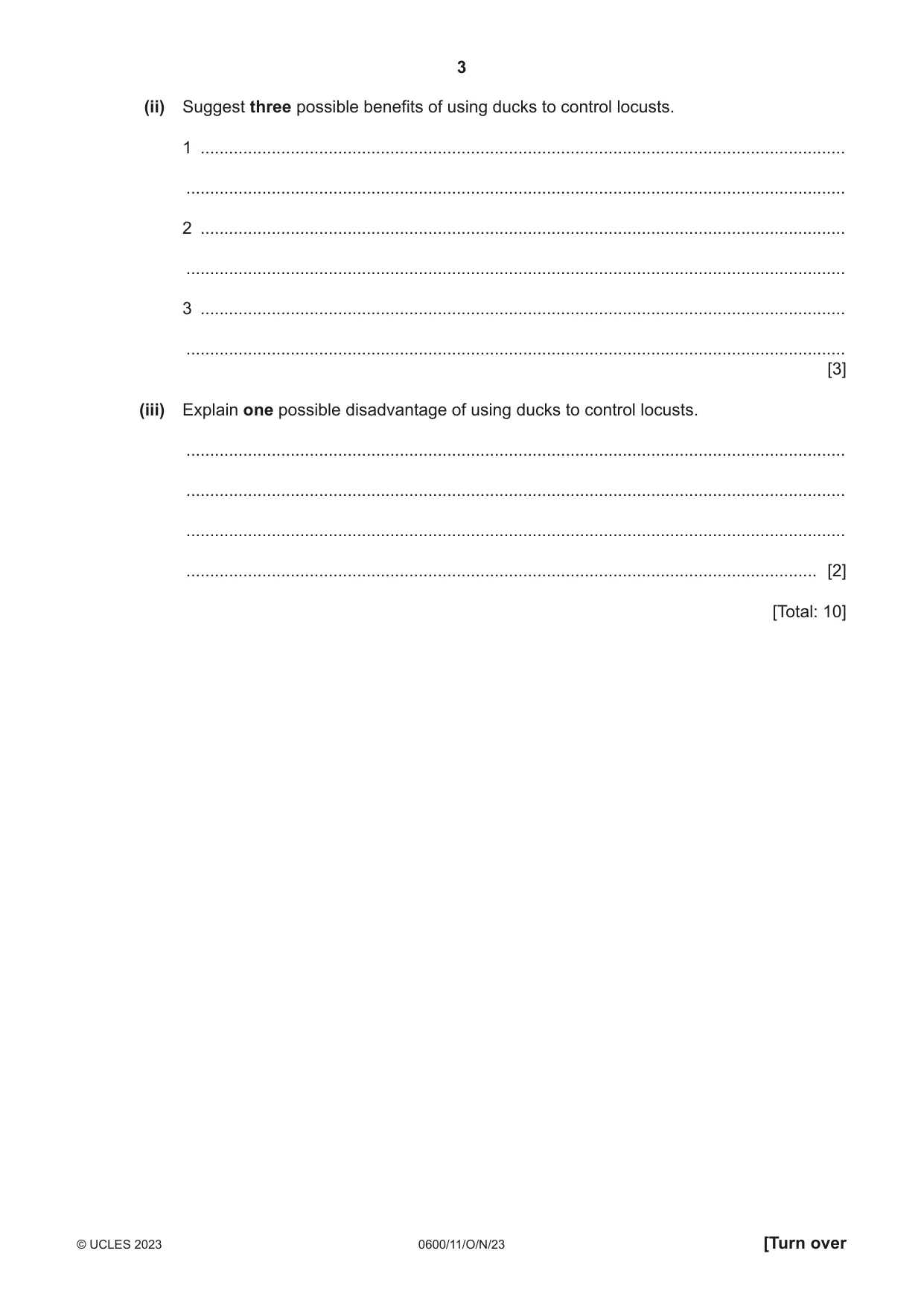
3 0600/11/O/N/23 © UCLES 2023 [Turn over (ii) Suggest three possible benefits of using ducks to control locusts. 1 … … 2 … … 3 … … [3] (iii) Explain one possible disadvantage of using ducks to control locusts. … … … … [2] [Total: 10]
Question paper, page 4
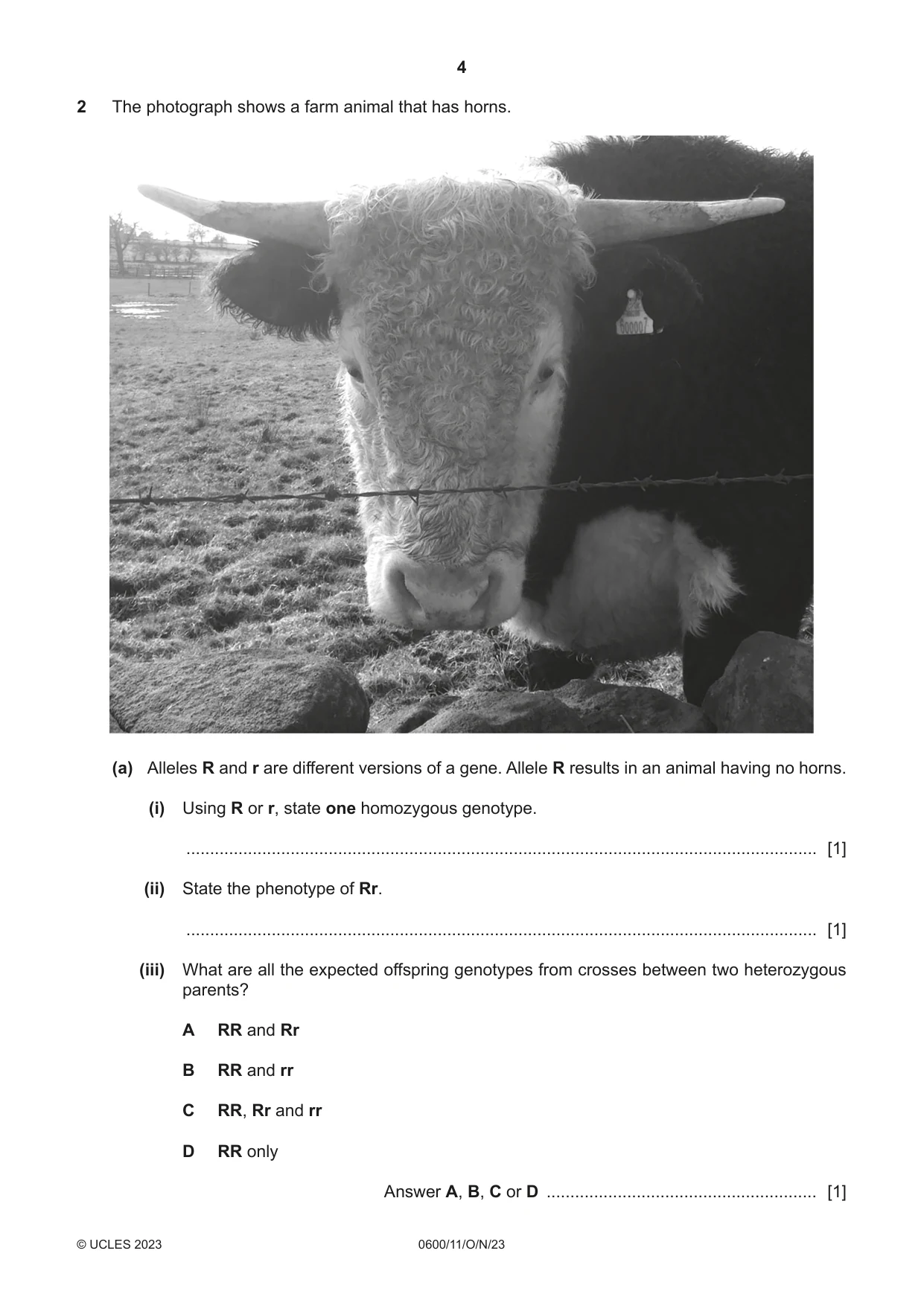
4 0600/11/O/N/23 © UCLES 2023 2 The photograph shows a farm animal that has horns. (a) Alleles R and r are different versions of a gene. Allele R results in an animal having no horns. (i) Using R or r, state one homozygous genotype. … [1] (ii) State the phenotype of Rr. … [1] (iii) What are all the expected offspring genotypes from crosses between two heterozygous parents? A RR and Rr B RR and rr C RR, Rr and rr D RR only Answer A, B, C or D … [1]
Question paper, page 5
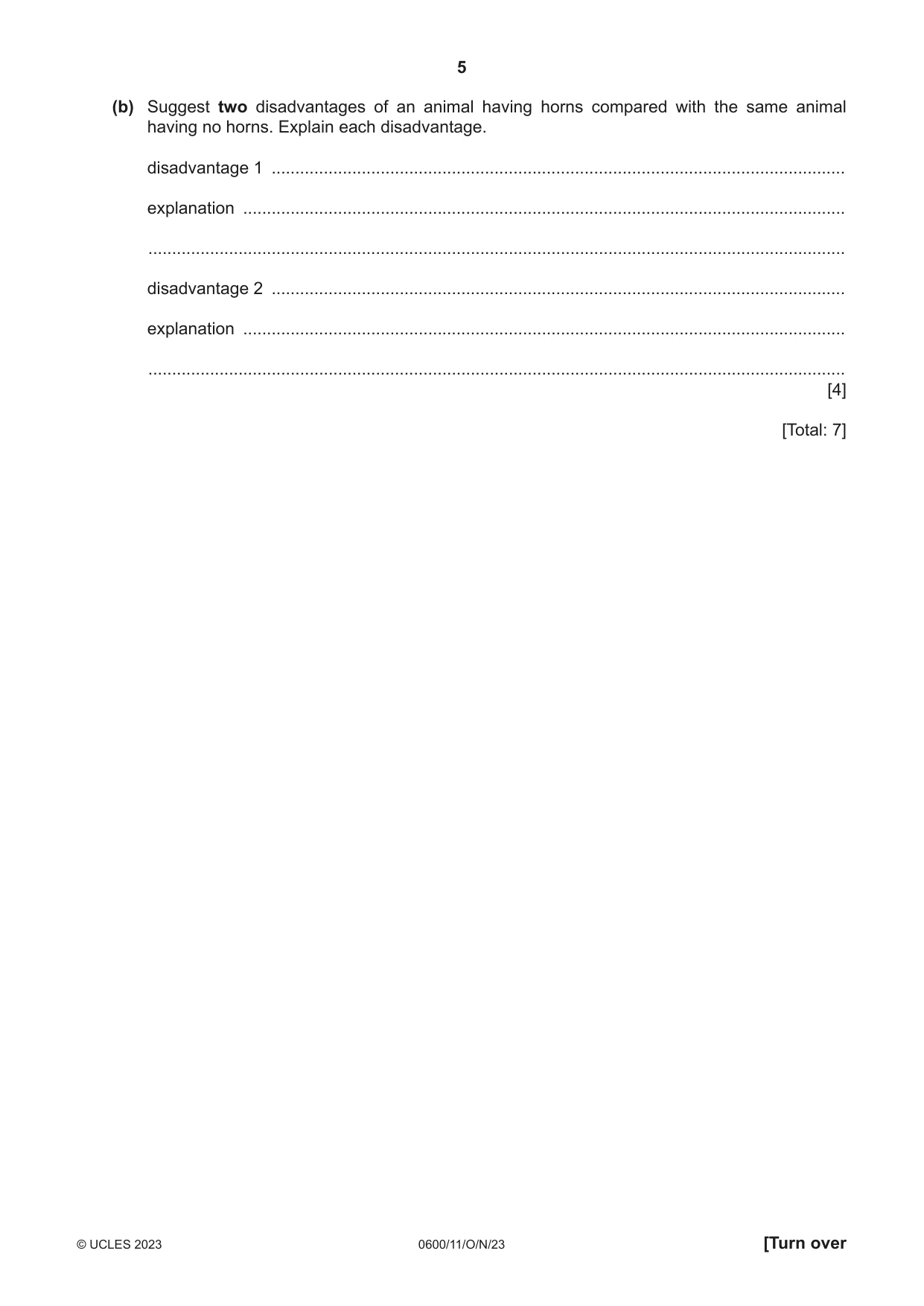
5 0600/11/O/N/23 © UCLES 2023 [Turn over (b) Suggest two disadvantages of an animal having horns compared with the same animal having no horns. Explain each disadvantage. disadvantage 1 … explanation … … disadvantage 2 … explanation … … [4] [Total: 7]
Question paper, page 6
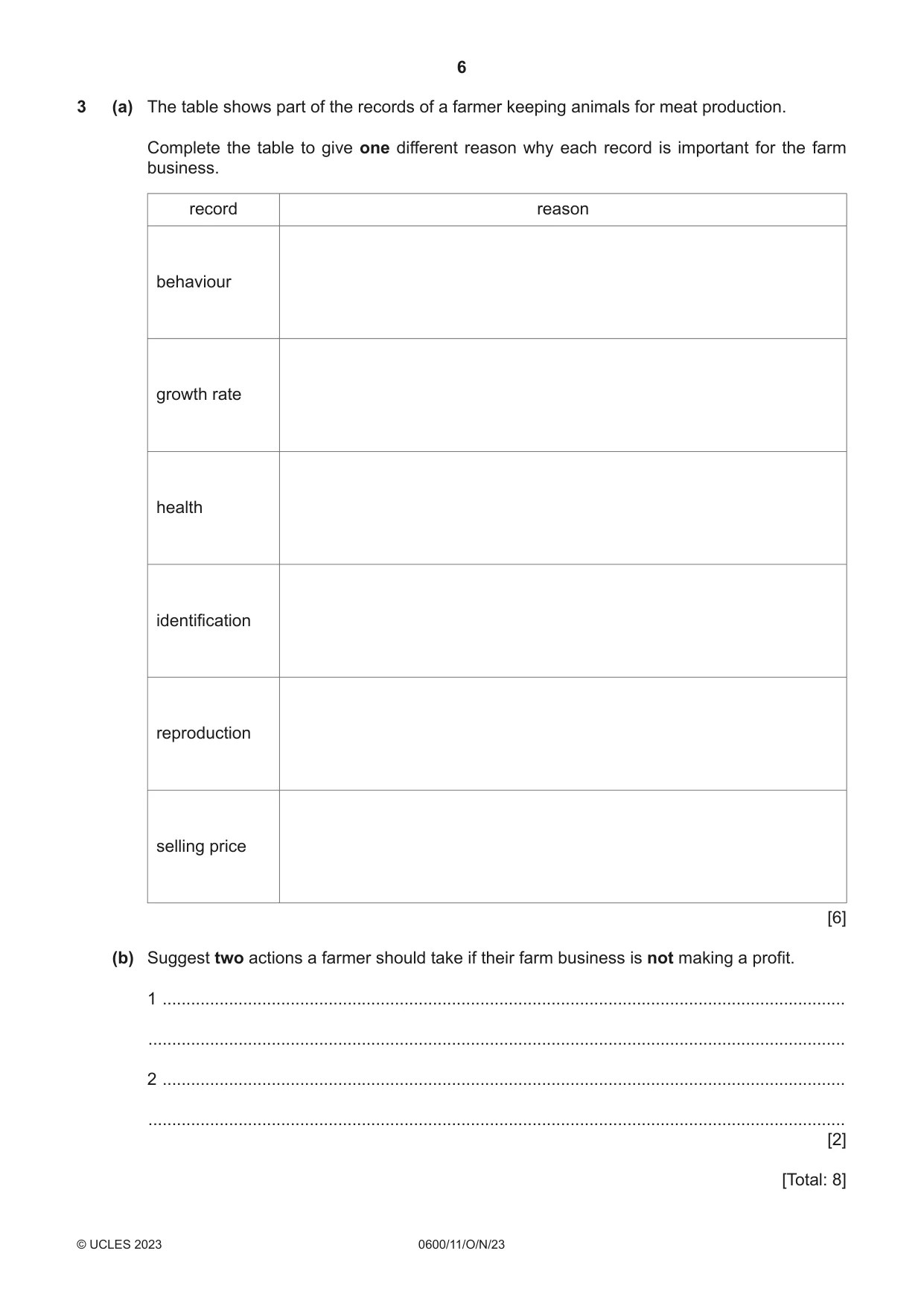
6 0600/11/O/N/23 © UCLES 2023 3 (a) The table shows part of the records of a farmer keeping animals for meat production. Complete the table to give one different reason why each record is important for the farm business. record reason behaviour growth rate health identification reproduction selling price [6] (b) Suggest two actions a farmer should take if their farm business is not making a profit. 1 … … 2 … … [2] [Total: 8]
Question paper, page 7
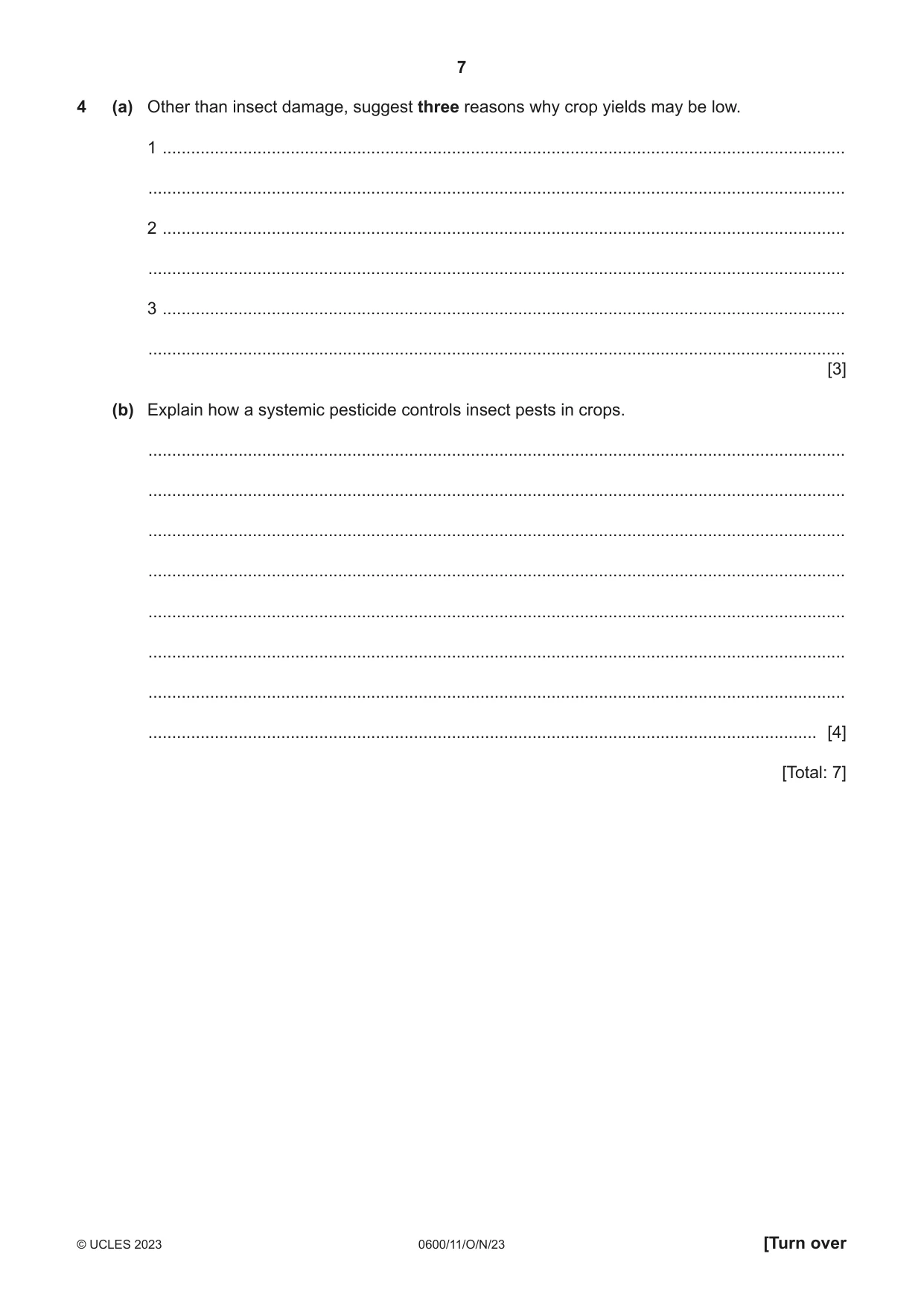
7 0600/11/O/N/23 © UCLES 2023 [Turn over 4 (a) Other than insect damage, suggest three reasons why crop yields may be low. 1 … … 2 … … 3 … … [3] (b) Explain how a systemic pesticide controls insect pests in crops. … … … … … … … … [4] [Total: 7]
Question paper, page 8
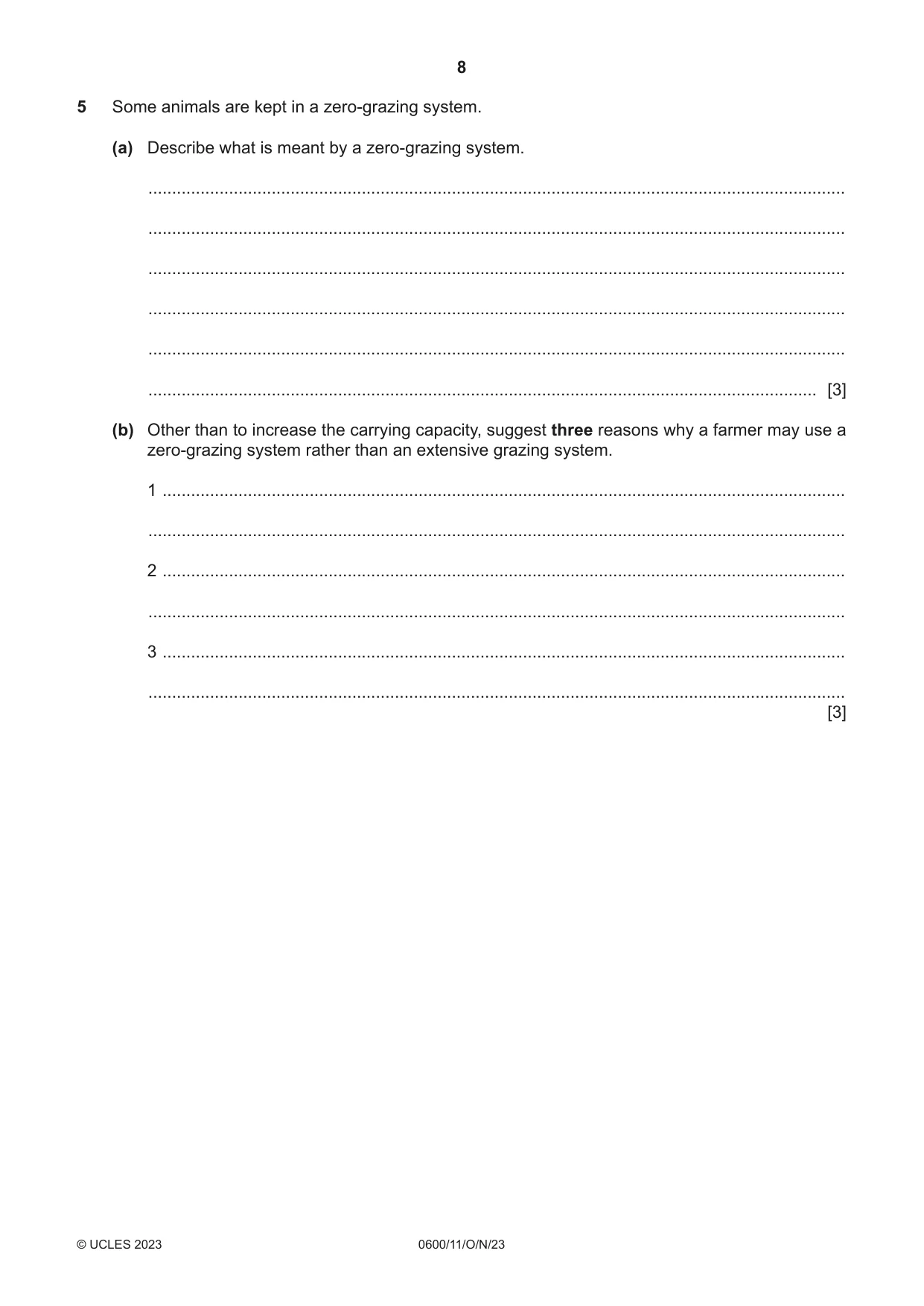
8 0600/11/O/N/23 © UCLES 2023 5 Some animals are kept in a zero‑grazing system. (a) Describe what is meant by a zero‑grazing system. … … … … … … [3] (b) Other than to increase the carrying capacity, suggest three reasons why a farmer may use a zero‑grazing system rather than an extensive grazing system. 1 … … 2 … … 3 … … [3]
Question paper, page 9
9 0600/11/O/N/23 © UCLES 2023 [Turn over (c) (i) Use a labelled diagram to show what is meant by a rotational grazing system. [3] (ii) Explain how using rotational grazing can increase the carrying capacity of a grazing system. … … … … [2] [Total: 11]
Question paper, page 10
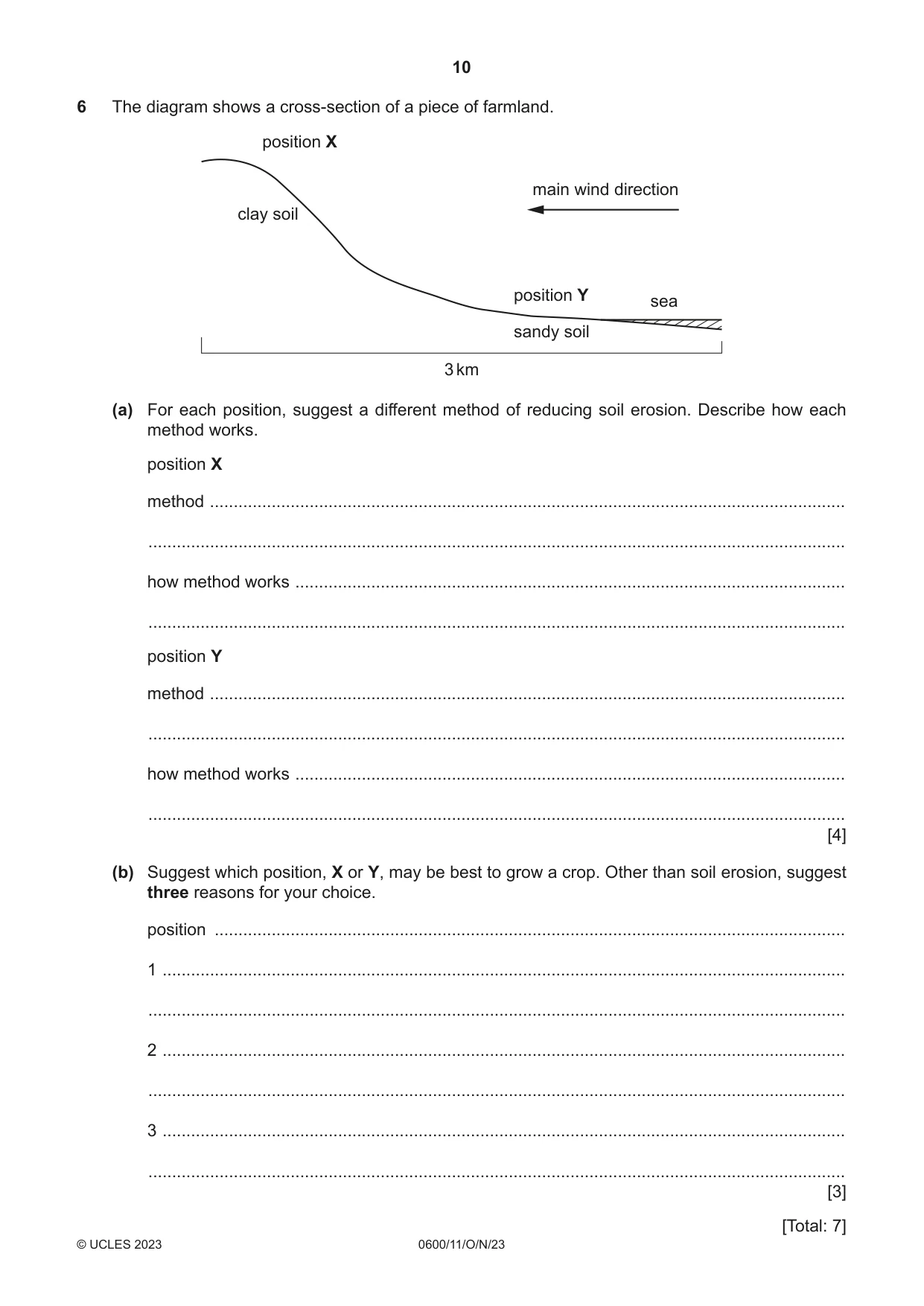
10 0600/11/O/N/23 © UCLES 2023 6 The diagram shows a cross‑section of a piece of farmland. position X position Y sea main wind direction clay soil sandy soil 3 km (a) For each position, suggest a different method of reducing soil erosion. Describe how each method works. position X method … … how method works … … position Y method … … how method works … … [4] (b) Suggest which position, X or Y, may be best to grow a crop. Other than soil erosion, suggest three reasons for your choice. position … 1 … … 2 … … 3 … … [3] [Total: 7]
Question paper, page 11
11 0600/11/O/N/23 © UCLES 2023 [Turn over BLANK PAGE
Question paper, page 12
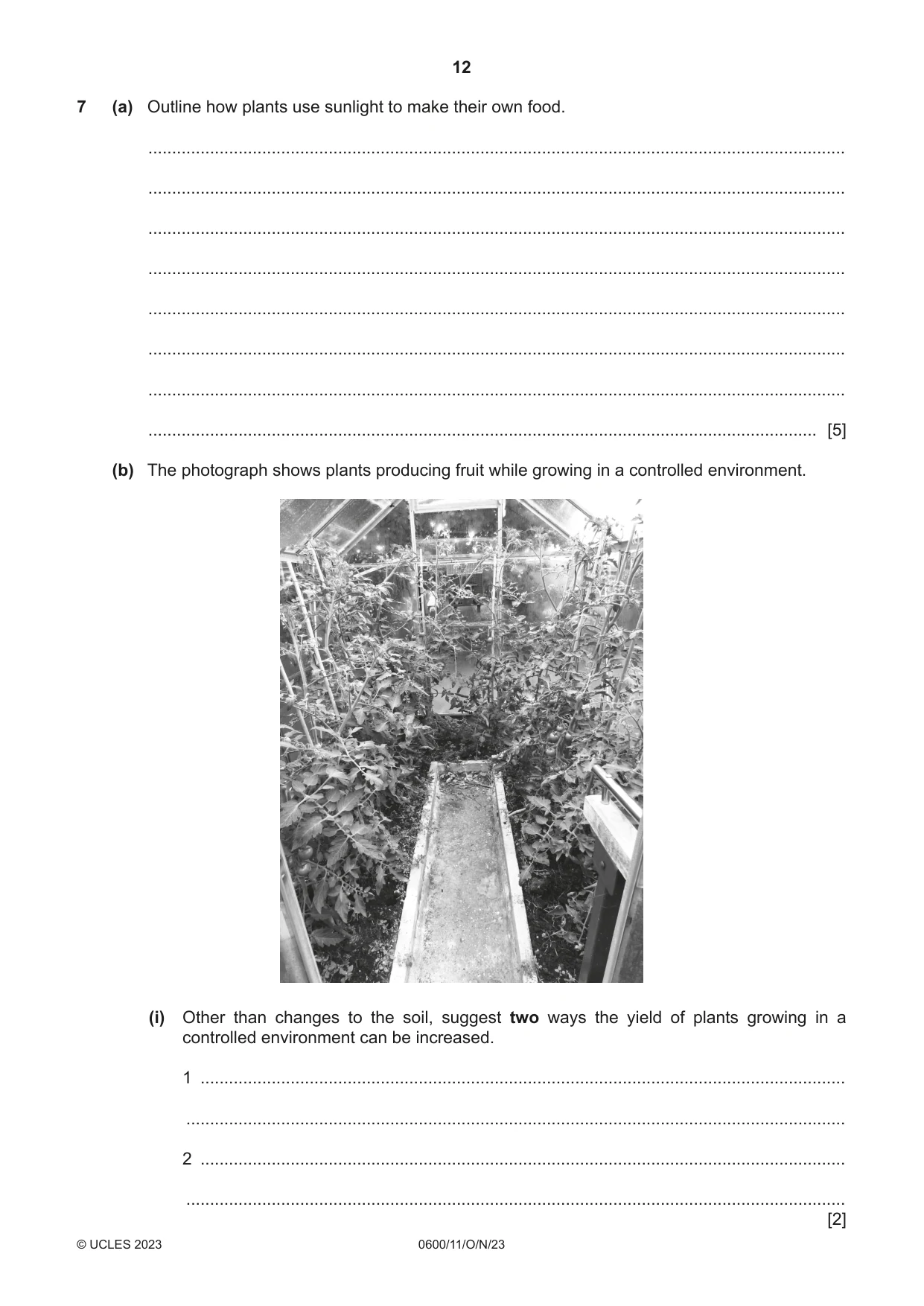
12 0600/11/O/N/23 © UCLES 2023 7 (a) Outline how plants use sunlight to make their own food. … … … … … … … … [5] (b) The photograph shows plants producing fruit while growing in a controlled environment. (i) Other than changes to the soil, suggest two ways the yield of plants growing in a controlled environment can be increased. 1 … … 2 … … [2]
Question paper, page 13
13 0600/11/O/N/23 © UCLES 2023 [Turn over (ii) Explain how the products of photosynthesis are moved to the fruits of the plants. … … … … … … [3] [Total: 10]
Question paper, page 14
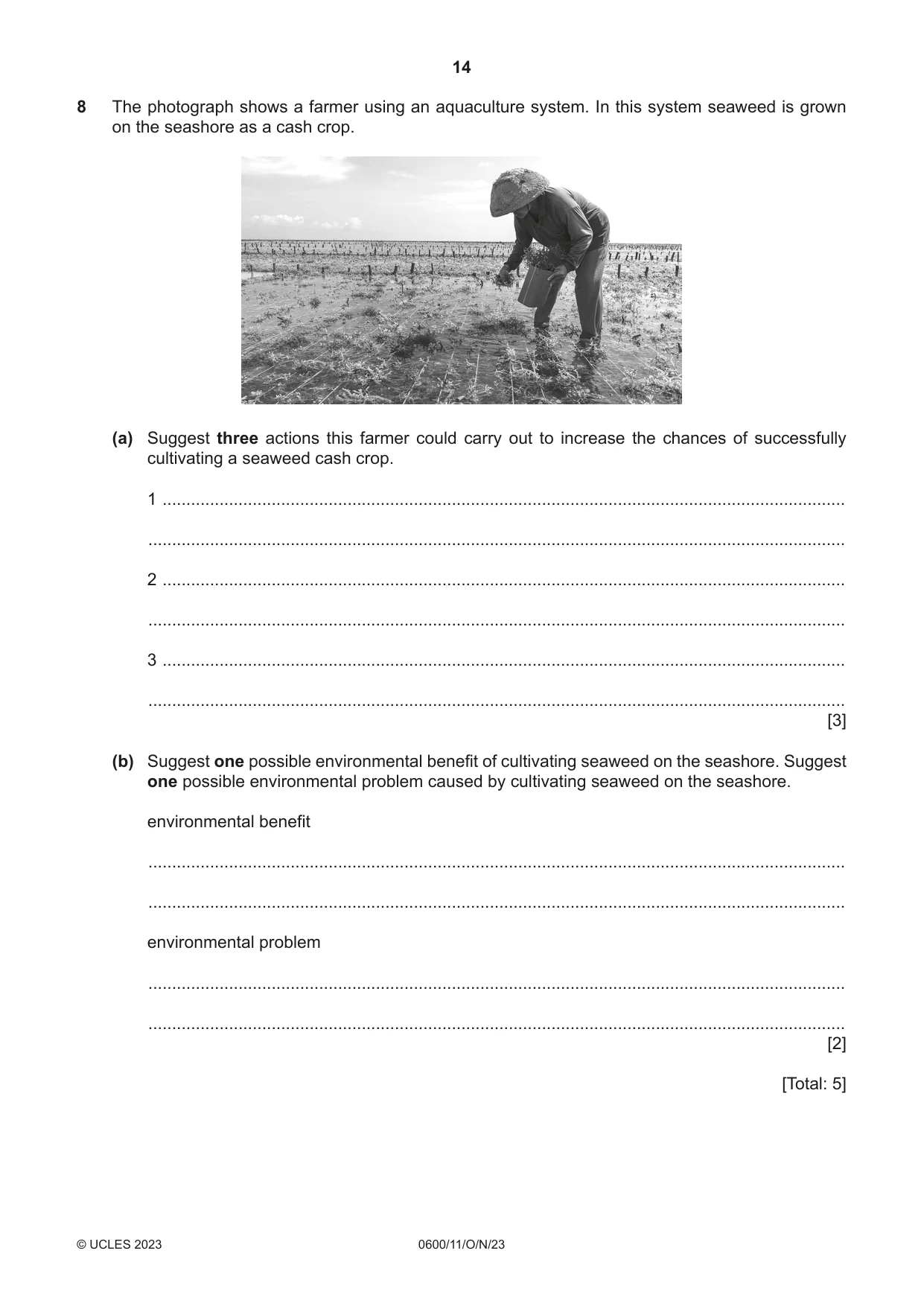
14 0600/11/O/N/23 © UCLES 2023 8 The photograph shows a farmer using an aquaculture system. In this system seaweed is grown on the seashore as a cash crop. (a) Suggest three actions this farmer could carry out to increase the chances of successfully cultivating a seaweed cash crop. 1 … … 2 … … 3 … … [3] (b) Suggest one possible environmental benefit of cultivating seaweed on the seashore. Suggest one possible environmental problem caused by cultivating seaweed on the seashore. environmental benefit … … environmental problem … … [2] [Total: 5]
Question paper, page 15
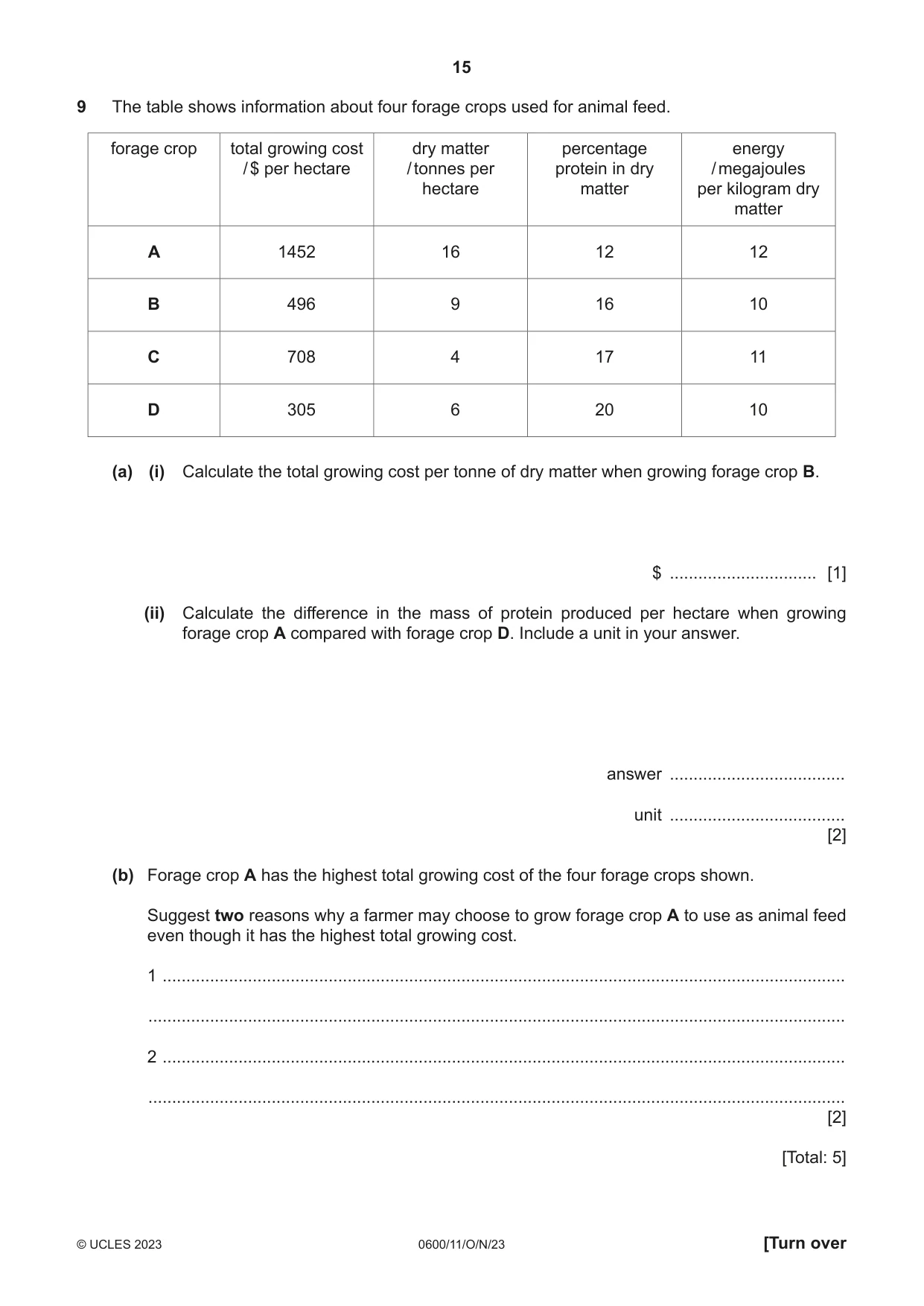
15 0600/11/O/N/23 © UCLES 2023 [Turn over 9 The table shows information about four forage crops used for animal feed. forage crop total growing cost / $ per hectare dry matter / tonnes per hectare percentage protein in dry matter energy / megajoules per kilogram dry matter A 1452 16 12 12 B 496 9 16 10 C 708 4 17 11 D 305 6 20 10 (a) (i) Calculate the total growing cost per tonne of dry matter when growing forage crop B. $ … [1] (ii) Calculate the difference in the mass of protein produced per hectare when growing forage crop A compared with forage crop D. Include a unit in your answer. answer … unit … [2] (b) Forage crop A has the highest total growing cost of the four forage crops shown. Suggest two reasons why a farmer may choose to grow forage crop A to use as animal feed even though it has the highest total growing cost. 1 … … 2 … … [2] [Total: 5]
Question paper, page 16
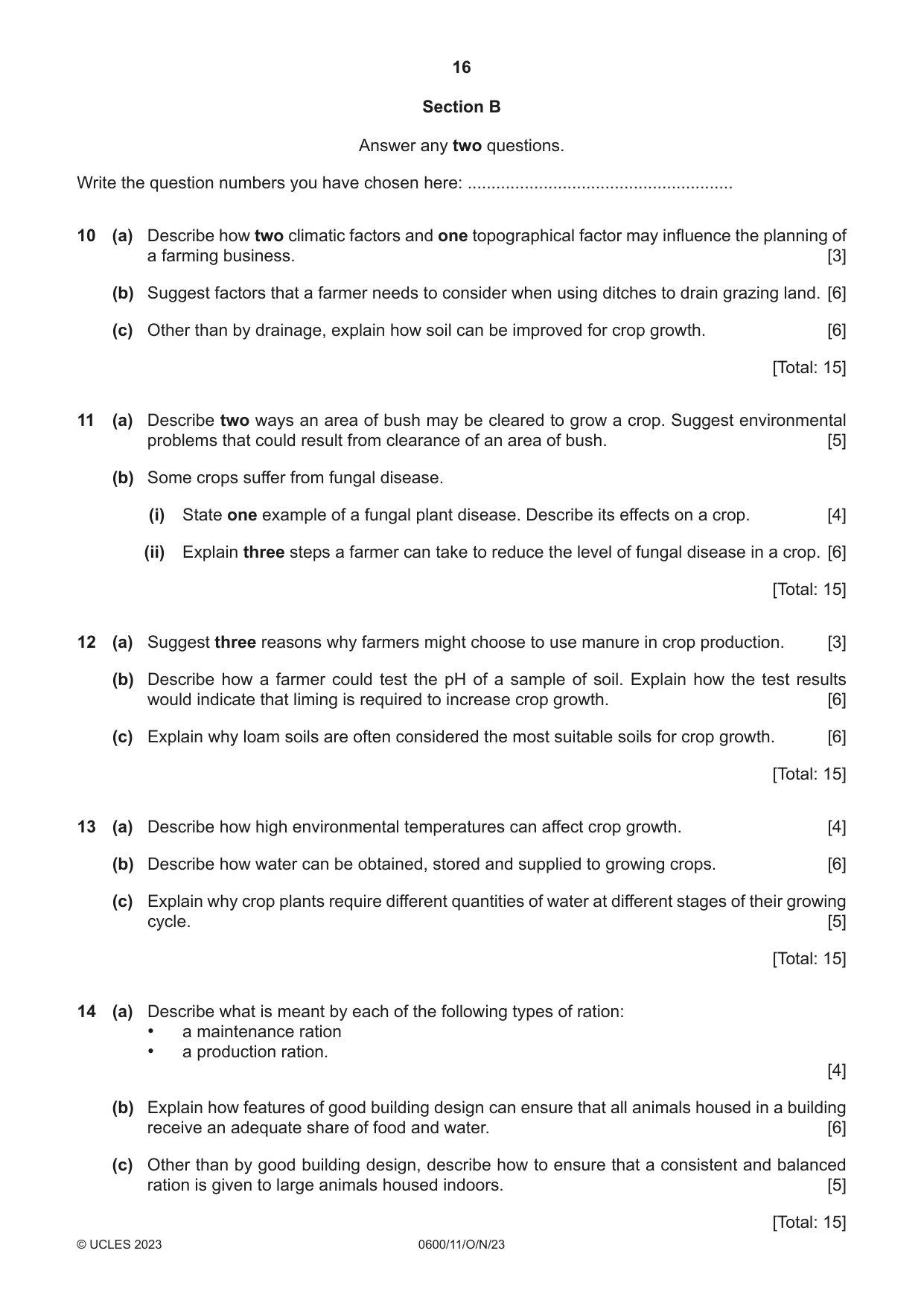
16 0600/11/O/N/23 © UCLES 2023 Section B Answer any two questions. Write the question numbers you have chosen here: … 10 (a) Describe how two climatic factors and one topographical factor may influence the planning of a farming business. [3] (b) Suggest factors that a farmer needs to consider when using ditches to drain grazing land. [6] (c) Other than by drainage, explain how soil can be improved for crop growth. [6] [Total: 15] 11 (a) Describe two ways an area of bush may be cleared to grow a crop. Suggest environmental problems that could result from clearance of an area of bush. [5] (b) Some crops suffer from fungal disease. (i) State one example of a fungal plant disease. Describe its effects on a crop. [4] (ii) Explain three steps a farmer can take to reduce the level of fungal disease in a crop. [6] [Total: 15] 12 (a) Suggest three reasons why farmers might choose to use manure in crop production. [3] (b) Describe how a farmer could test the pH of a sample of soil. Explain how the test results would indicate that liming is required to increase crop growth. [6] (c) Explain why loam soils are often considered the most suitable soils for crop growth. [6] [Total: 15] 13 (a) Describe how high environmental temperatures can affect crop growth. [4] (b) Describe how water can be obtained, stored and supplied to growing crops. [6] (c) Explain why crop plants require different quantities of water at different stages of their growing cycle. [5] [Total: 15] 14 (a) Describe what is meant by each of the following types of ration: • a maintenance ration • a production ration. [4] (b) Explain how features of good building design can ensure that all animals housed in a building receive an adequate share of food and water. [6] (c) Other than by good building design, describe how to ensure that a consistent and balanced ration is given to large animals housed indoors. [5] [Total: 15]
Question paper, page 17
17 0600/11/O/N/23 © UCLES 2023 … … … … … … … … … … … … … … … … … … … … … … … … … … … …
Question paper, page 18
18 0600/11/O/N/23 © UCLES 2023 … … … … … … … … … … … … … … … … … … … … … … … … … … … …
Question paper, page 19
19 0600/11/O/N/23 © UCLES 2023 … … … … … … … … … … … … … … … … … … … … … … … … … … … …
Question paper, page 20
20 0600/11/O/N/23 © UCLES 2023 … … … … … … … … … … … … … … … … … … … … … … … … … … … …
Question paper, page 21
21 0600/11/O/N/23 © UCLES 2023 … … … … … … … … … … … … … … … … … … … … … … … … … … … …
Question paper, page 22
22 0600/11/O/N/23 © UCLES 2023 BLANK PAGE
Question paper, page 23
23 0600/11/O/N/23 © UCLES 2023 BLANK PAGE
Question paper, page 24
24 0600/11/O/N/23 © UCLES 2023 BLANK PAGE Permission to reproduce items where third‑party owned material protected by copyright is included has been sought and cleared where possible. Every reasonable effort has been made by the publisher (UCLES) to trace copyright holders, but if any items requiring clearance have unwittingly been included, the publisher will be pleased to make amends at the earliest possible opportunity. To avoid the issue of disclosure of answer‑related information to candidates, all copyright acknowledgements are reproduced online in the Cambridge Assessment International Education Copyright Acknowledgements Booklet. This is produced for each series of examinations and is freely available to download at www.cambridgeinternational.org after the live examination series. Cambridge Assessment International Education is part of Cambridge Assessment. Cambridge Assessment is the brand name of the University of Cambridge Local Examinations Syndicate (UCLES), which is a department of the University of Cambridge.
Mark scheme, page 1
This document consists of 24 printed pages. © UCLES 2023 [Turn over Cambridge IGCSE™ AGRICULTURE 0600/11 Paper 1 Theory October/November 2023 MARK SCHEME Maximum Mark: 100 Published This mark scheme is published as an aid to teachers and candidates, to indicate the requirements of the examination. It shows the basis on which Examiners were instructed to award marks. It does not indicate the details of the discussions that took place at an Examiners’ meeting before marking began, which would have considered the acceptability of alternative answers. Mark schemes should be read in conjunction with the question paper and the Principal Examiner Report for Teachers. Cambridge International will not enter into discussions about these mark schemes. Cambridge International is publishing the mark schemes for the October/November 2023 series for most Cambridge IGCSE, Cambridge International A and AS Level components, and some Cambridge O Level components.
Mark scheme, page 2
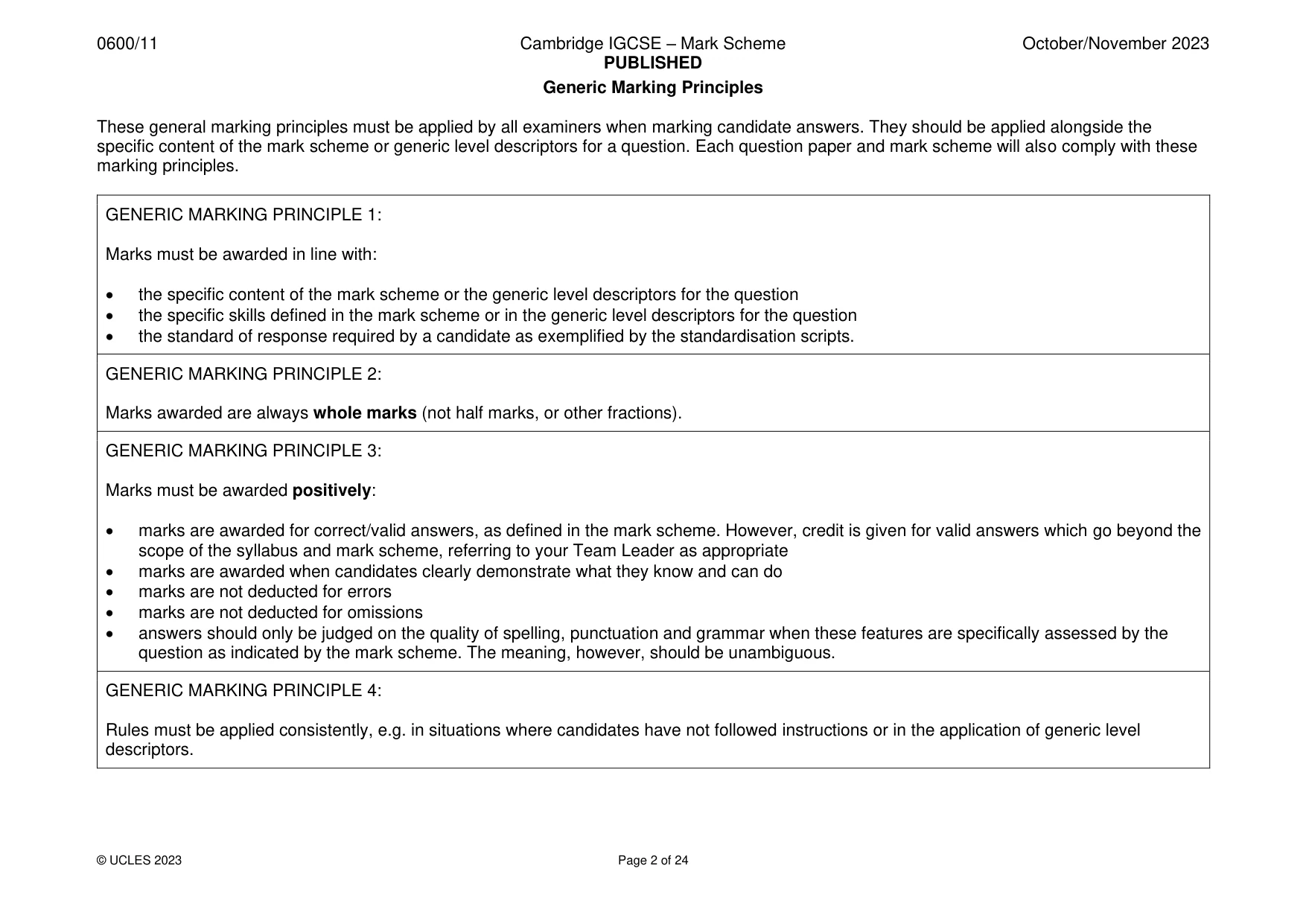
0600/11 Cambridge IGCSE – Mark Scheme PUBLISHED October/November 2023 © UCLES 2023 Page 2 of 24 Generic Marking Principles These general marking principles must be applied by all examiners when marking candidate answers. They should be applied alongside the specific content of the mark scheme or generic level descriptors for a question. Each question paper and mark scheme will also comply with these marking principles. GENERIC MARKING PRINCIPLE 1: Marks must be awarded in line with: • the specific content of the mark scheme or the generic level descriptors for the question • the specific skills defined in the mark scheme or in the generic level descriptors for the question • the standard of response required by a candidate as exemplified by the standardisation scripts. GENERIC MARKING PRINCIPLE 2: Marks awarded are always whole marks (not half marks, or other fractions). GENERIC MARKING PRINCIPLE 3: Marks must be awarded positively: • marks are awarded for correct/valid answers, as defined in the mark scheme. However, credit is given for valid answers which go beyond the scope of the syllabus and mark scheme, referring to your Team Leader as appropriate • marks are awarded when candidates clearly demonstrate what they know and can do • marks are not deducted for errors • marks are not deducted for omissions • answers should only be judged on the quality of spelling, punctuation and grammar when these features are specifically assessed by the question as indicated by the mark scheme. The meaning, however, should be unambiguous. GENERIC MARKING PRINCIPLE 4: Rules must be applied consistently, e.g. in situations where candidates have not followed instructions or in the application of generic level descriptors.
Mark scheme, page 3
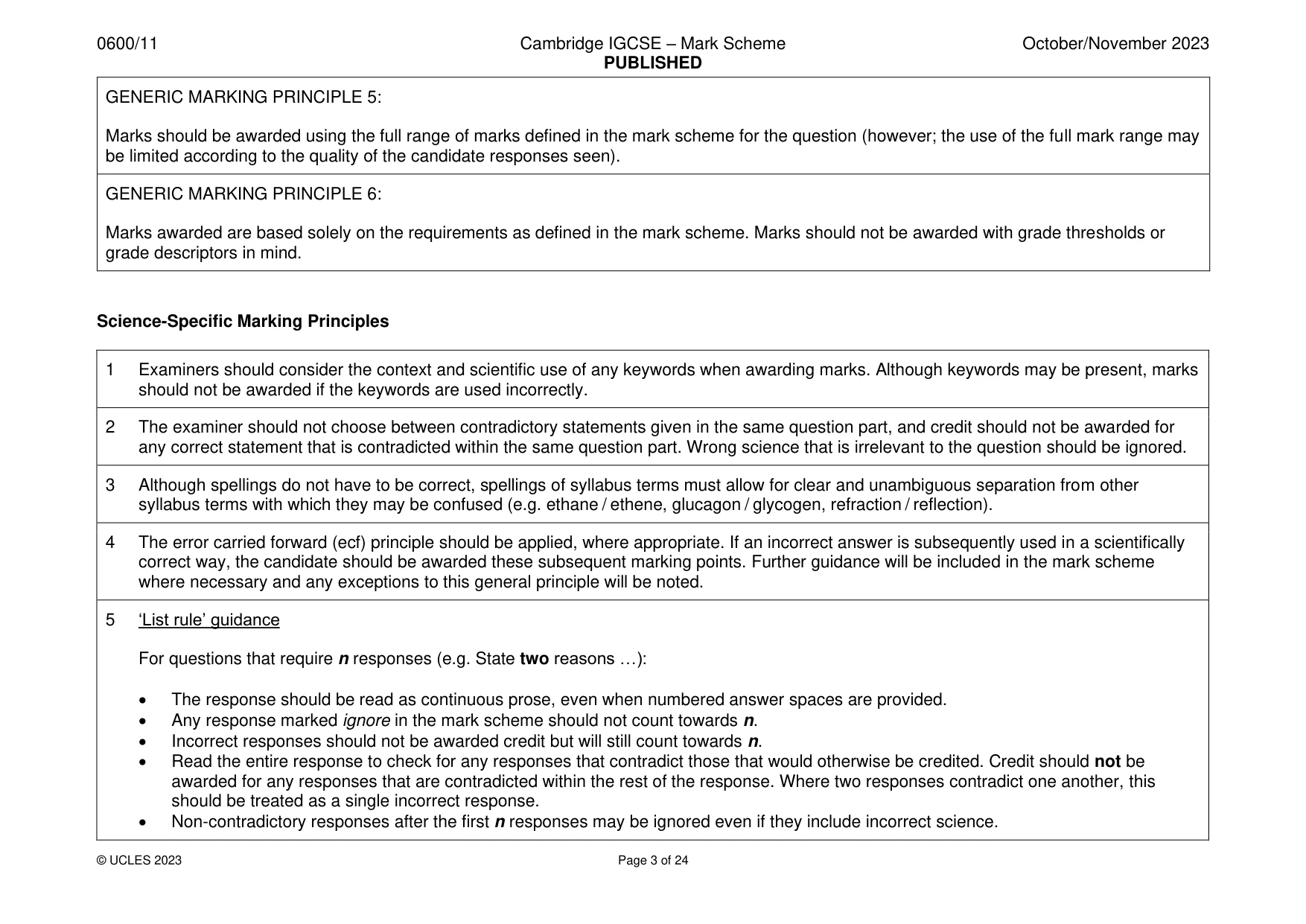
0600/11 Cambridge IGCSE – Mark Scheme PUBLISHED October/November 2023 © UCLES 2023 Page 3 of 24 GENERIC MARKING PRINCIPLE 5: Marks should be awarded using the full range of marks defined in the mark scheme for the question (however; the use of the full mark range may be limited according to the quality of the candidate responses seen). GENERIC MARKING PRINCIPLE 6: Marks awarded are based solely on the requirements as defined in the mark scheme. Marks should not be awarded with grade thresholds or grade descriptors in mind. Science-Specific Marking Principles 1 Examiners should consider the context and scientific use of any keywords when awarding marks. Although keywords may be present, marks should not be awarded if the keywords are used incorrectly. 2 The examiner should not choose between contradictory statements given in the same question part, and credit should not be awarded for any correct statement that is contradicted within the same question part. Wrong science that is irrelevant to the question should be ignored. 3 Although spellings do not have to be correct, spellings of syllabus terms must allow for clear and unambiguous separation from other syllabus terms with which they may be confused (e.g. ethane / ethene, glucagon / glycogen, refraction / reflection). 4 The error carried forward (ecf) principle should be applied, where appropriate. If an incorrect answer is subsequently used in a scientifically correct way, the candidate should be awarded these subsequent marking points. Further guidance will be included in the mark scheme where necessary and any exceptions to this general principle will be noted. 5 ‘List rule’ guidance For questions that require n responses (e.g. State two reasons …): • The response should be read as continuous prose, even when numbered answer spaces are provided. • Any response marked ignore in the mark scheme should not count towards n. • Incorrect responses should not be awarded credit but will still count towards n. • Read the entire response to check for any responses that contradict those that would otherwise be credited. Credit should not be awarded for any responses that are contradicted within the rest of the response. Where two responses contradict one another, this should be treated as a single incorrect response. • Non-contradictory responses after the first n responses may be ignored even if they include incorrect science.
Mark scheme, page 4
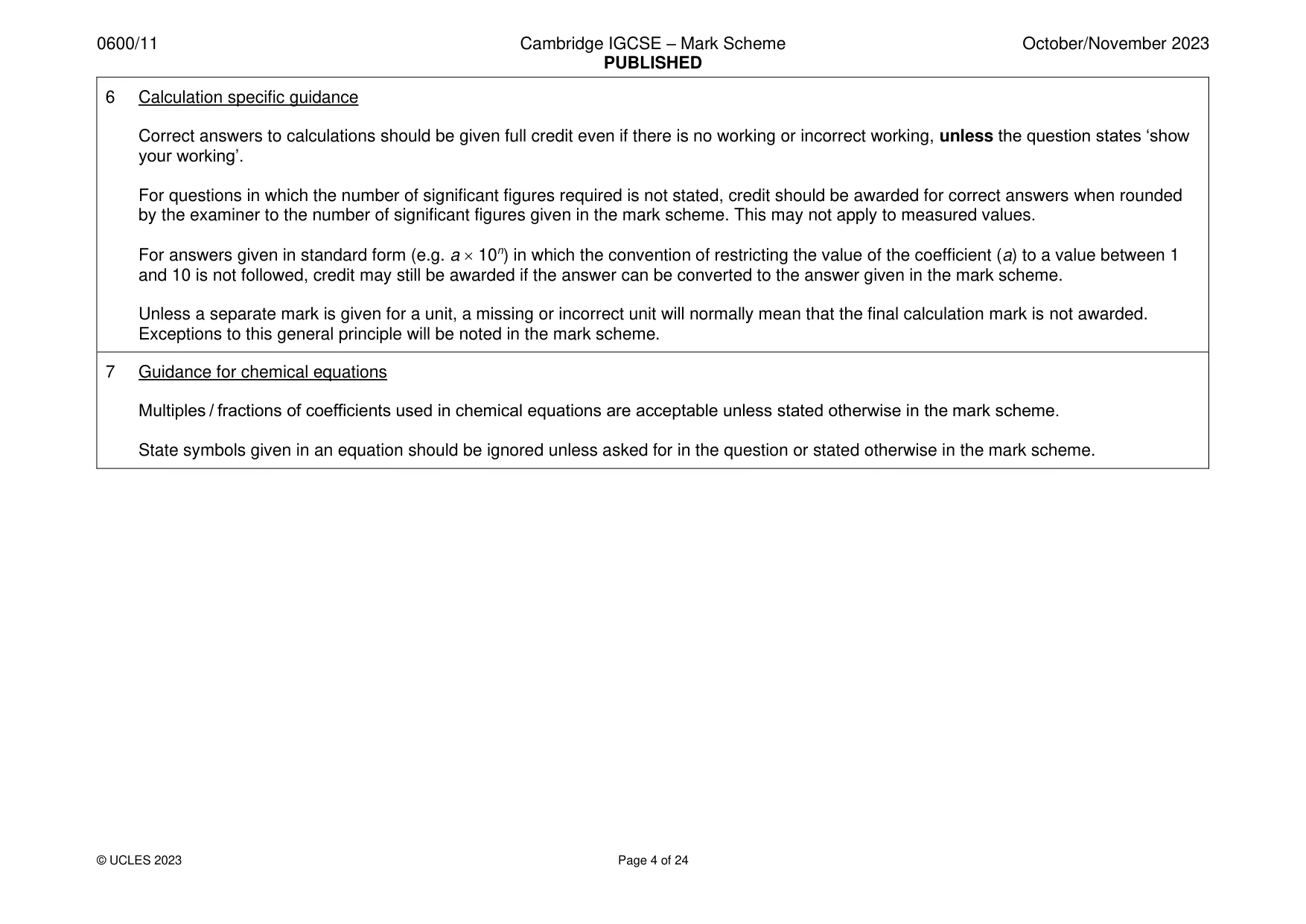
0600/11 Cambridge IGCSE – Mark Scheme PUBLISHED October/November 2023 © UCLES 2023 Page 4 of 24 6 Calculation specific guidance Correct answers to calculations should be given full credit even if there is no working or incorrect working, unless the question states ‘show your working’. For questions in which the number of significant figures required is not stated, credit should be awarded for correct answers when rounded by the examiner to the number of significant figures given in the mark scheme. This may not apply to measured values. For answers given in standard form (e.g. a 10n) in which the convention of restricting the value of the coefficient (a) to a value between 1 and 10 is not followed, credit may still be awarded if the answer can be converted to the answer given in the mark scheme. Unless a separate mark is given for a unit, a missing or incorrect unit will normally mean that the final calculation mark is not awarded. Exceptions to this general principle will be noted in the mark scheme. 7 Guidance for chemical equations Multiples / fractions of coefficients used in chemical equations are acceptable unless stated otherwise in the mark scheme. State symbols given in an equation should be ignored unless asked for in the question or stated otherwise in the mark scheme.
Mark scheme, page 5
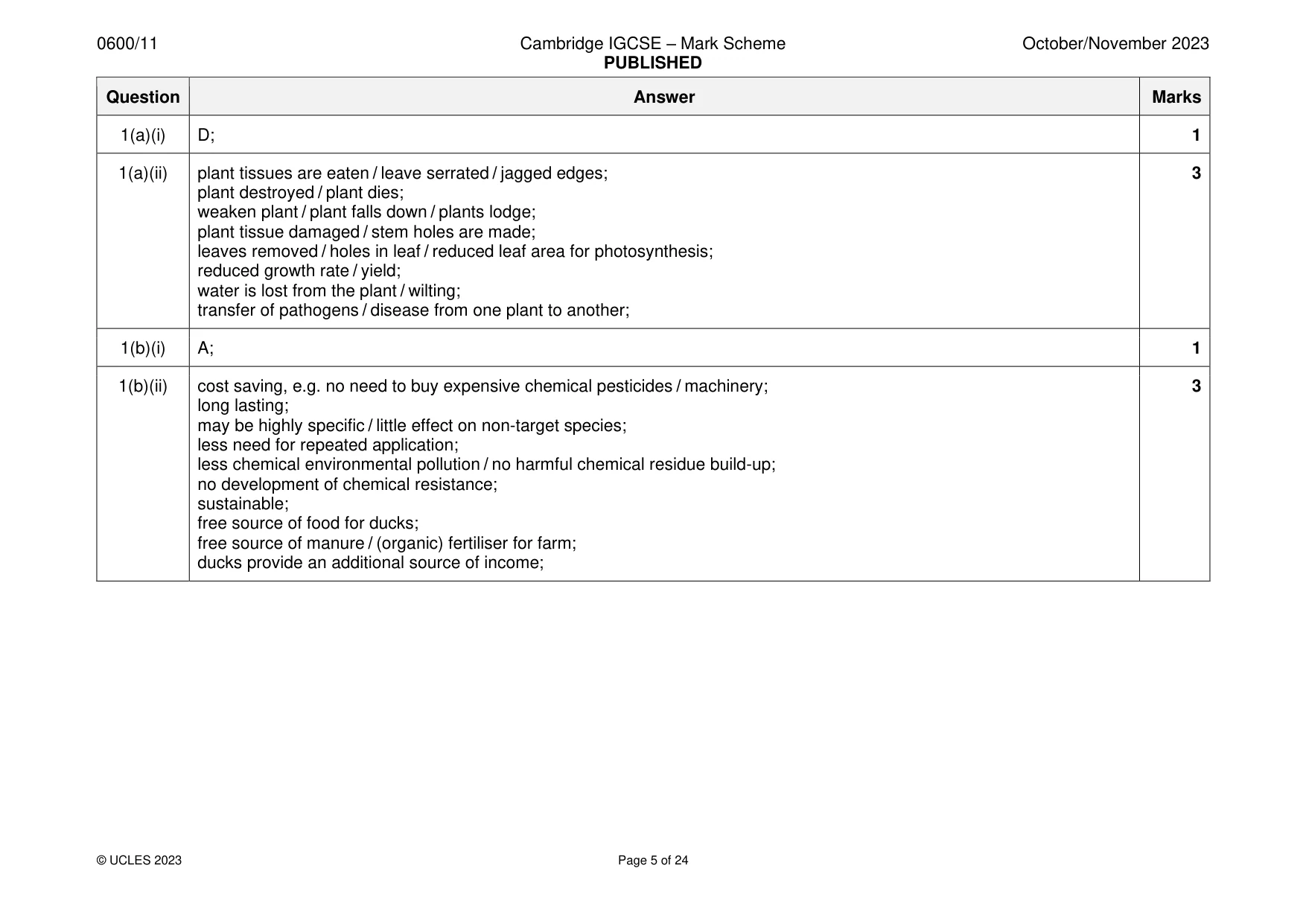
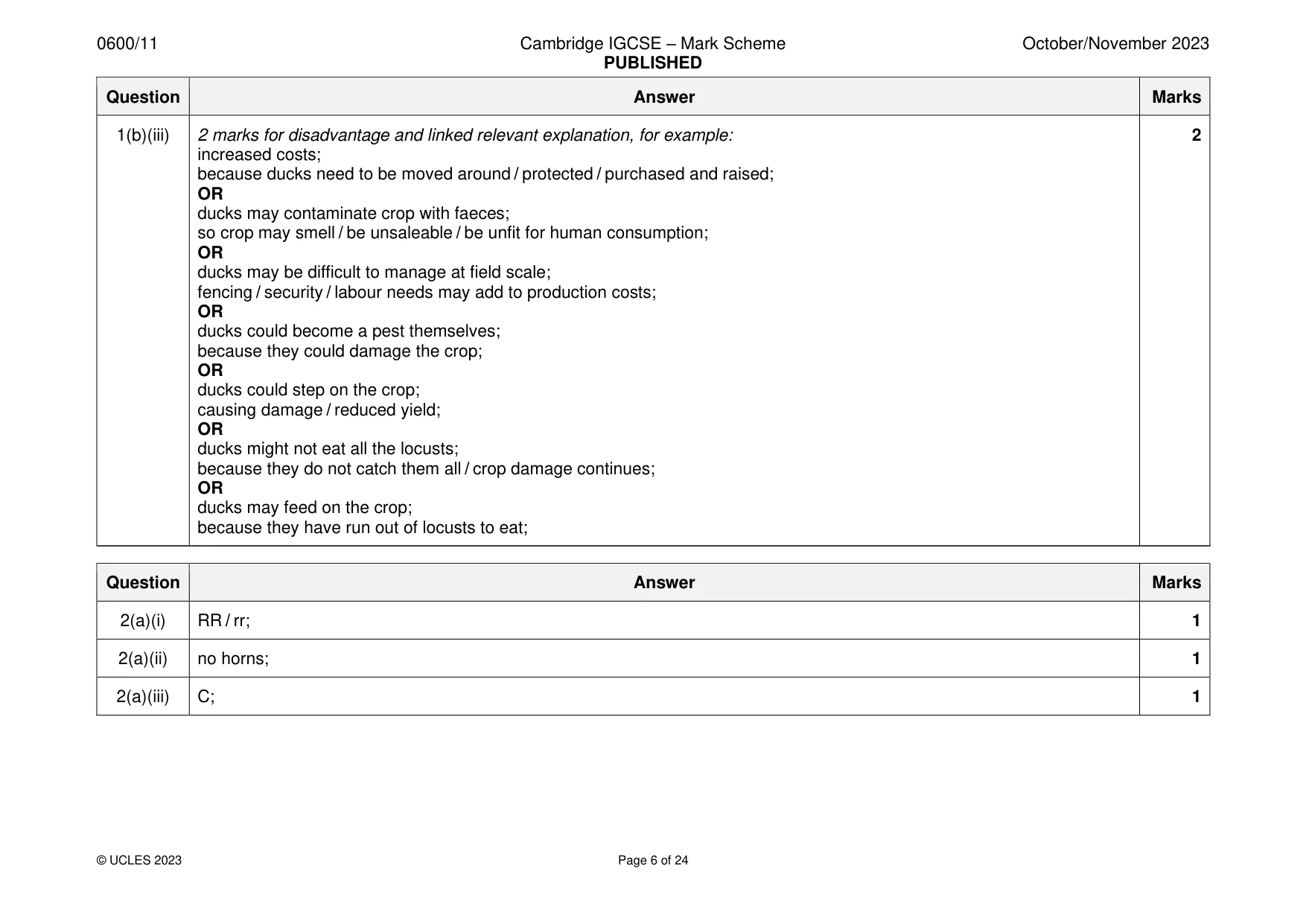
0600/11 Cambridge IGCSE – Mark Scheme PUBLISHED October/November 2023 © UCLES 2023 Page 5 of 24 Question Answer Marks 1(a)(i) D; 1 1(a)(ii) plant tissues are eaten / leave serrated / jagged edges; plant destroyed / plant dies; weaken plant / plant falls down / plants lodge; plant tissue damaged / stem holes are made; leaves removed / holes in leaf / reduced leaf area for photosynthesis; reduced growth rate / yield; water is lost from the plant / wilting; transfer of pathogens / disease from one plant to another; 3 1(b)(i) A; 1 1(b)(ii) cost saving, e.g. no need to buy expensive chemical pesticides / machinery; long lasting; may be highly specific / little effect on non-target species; less need for repeated application; less chemical environmental pollution / no harmful chemical residue build-up; no development of chemical resistance; sustainable; free source of food for ducks; free source of manure / (organic) fertiliser for farm; ducks provide an additional source of income; 3
Mark scheme, page 6
0600/11 Cambridge IGCSE – Mark Scheme PUBLISHED October/November 2023 © UCLES 2023 Page 6 of 24 Question Answer Marks 1(b)(iii) 2 marks for disadvantage and linked relevant explanation, for example: increased costs; because ducks need to be moved around / protected / purchased and raised; OR ducks may contaminate crop with faeces; so crop may smell / be unsaleable / be unfit for human consumption; OR ducks may be difficult to manage at field scale; fencing / security / labour needs may add to production costs; OR ducks could become a pest themselves; because they could damage the crop; OR ducks could step on the crop; causing damage / reduced yield; OR ducks might not eat all the locusts; because they do not catch them all / crop damage continues; OR ducks may feed on the crop; because they have run out of locusts to eat; 2 Question Answer Marks 2(a)(i) RR / rr; 1 2(a)(ii) no horns; 1 2(a)(iii) C; 1
Mark scheme, page 7
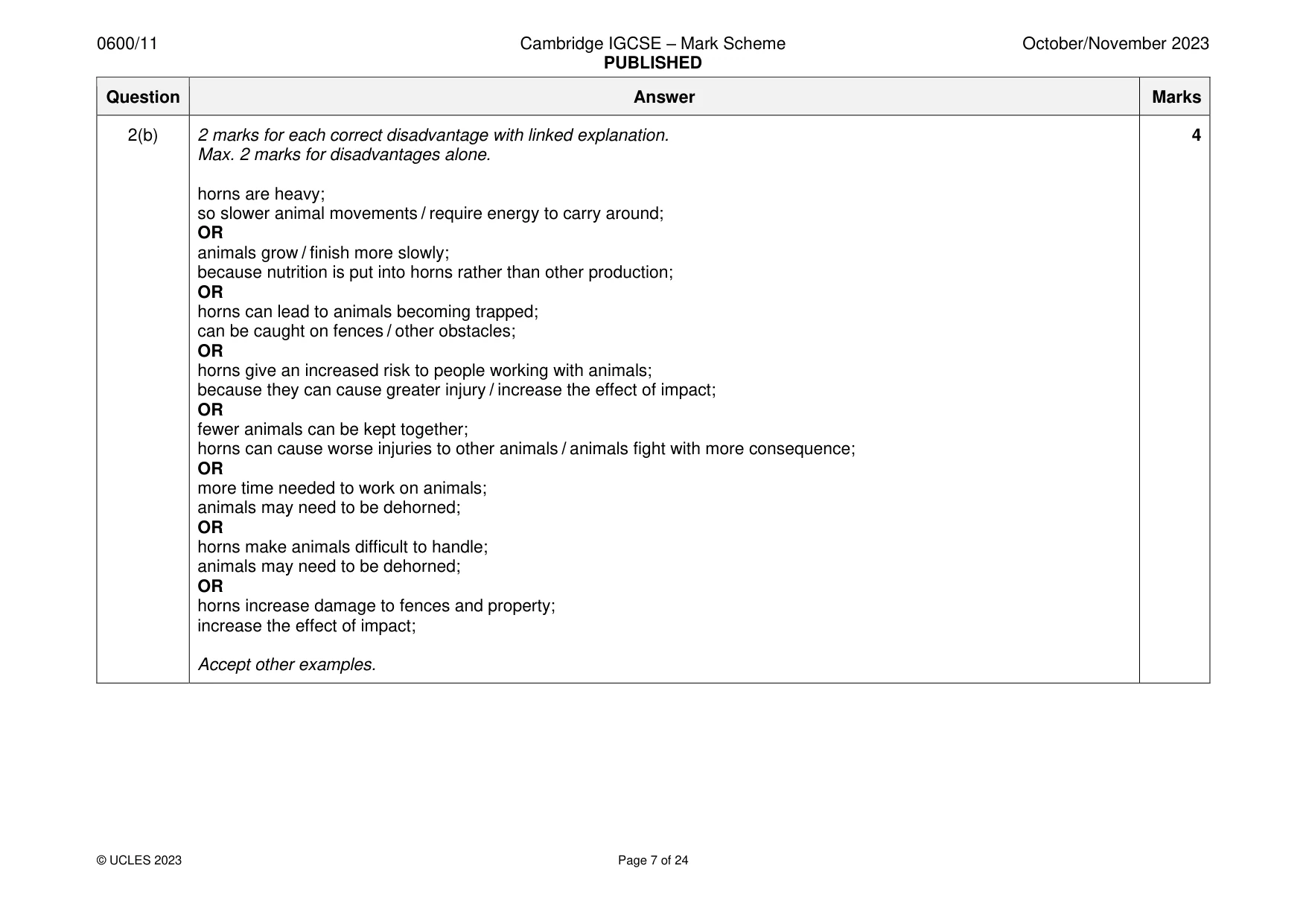
0600/11 Cambridge IGCSE – Mark Scheme PUBLISHED October/November 2023 © UCLES 2023 Page 7 of 24 Question Answer Marks 2(b) 2 marks for each correct disadvantage with linked explanation. Max. 2 marks for disadvantages alone. horns are heavy; so slower animal movements / require energy to carry around; OR animals grow / finish more slowly; because nutrition is put into horns rather than other production; OR horns can lead to animals becoming trapped; can be caught on fences / other obstacles; OR horns give an increased risk to people working with animals; because they can cause greater injury / increase the effect of impact; OR fewer animals can be kept together; horns can cause worse injuries to other animals / animals fight with more consequence; OR more time needed to work on animals; animals may need to be dehorned; OR horns make animals difficult to handle; animals may need to be dehorned; OR horns increase damage to fences and property; increase the effect of impact; Accept other examples. 4
Mark scheme, page 8
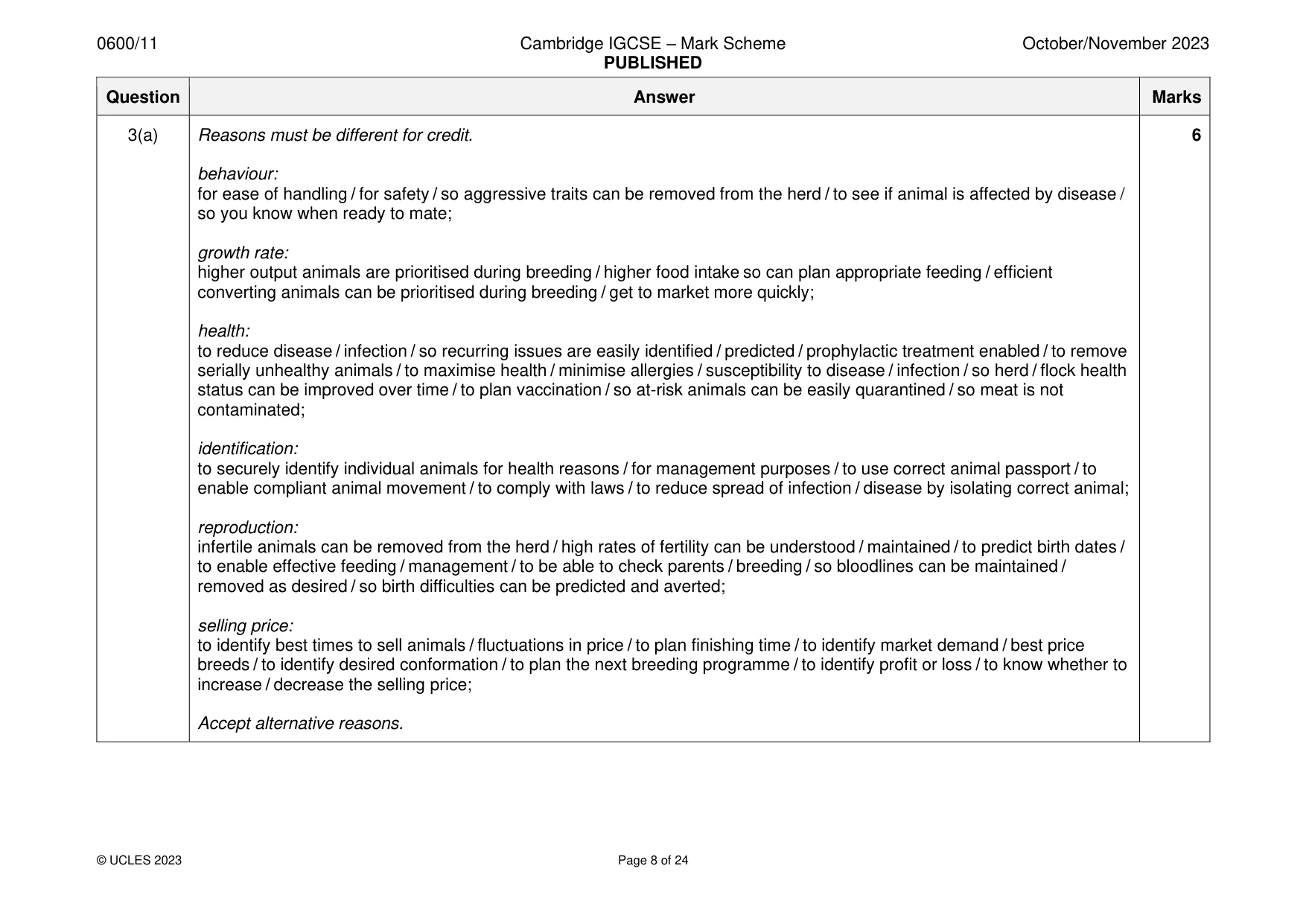
0600/11 Cambridge IGCSE – Mark Scheme PUBLISHED October/November 2023 © UCLES 2023 Page 8 of 24 Question Answer Marks 3(a) Reasons must be different for credit. behaviour: for ease of handling / for safety / so aggressive traits can be removed from the herd / to see if animal is affected by disease / so you know when ready to mate; growth rate: higher output animals are prioritised during breeding / higher food intake so can plan appropriate feeding / efficient converting animals can be prioritised during breeding / get to market more quickly; health: to reduce disease / infection / so recurring issues are easily identified / predicted / prophylactic treatment enabled / to remove serially unhealthy animals / to maximise health / minimise allergies / susceptibility to disease / infection / so herd / flock health status can be improved over time / to plan vaccination / so at-risk animals can be easily quarantined / so meat is not contaminated; identification: to securely identify individual animals for health reasons / for management purposes / to use correct animal passport / to enable compliant animal movement / to comply with laws / to reduce spread of infection / disease by isolating correct animal; reproduction: infertile animals can be removed from the herd / high rates of fertility can be understood / maintained / to predict birth dates / to enable effective feeding / management / to be able to check parents / breeding / so bloodlines can be maintained / removed as desired / so birth difficulties can be predicted and averted; selling price: to identify best times to sell animals / fluctuations in price / to plan finishing time / to identify market demand / best price breeds / to identify desired conformation / to plan the next breeding programme / to identify profit or loss / to know whether to increase / decrease the selling price; Accept alternative reasons. 6
Mark scheme, page 9
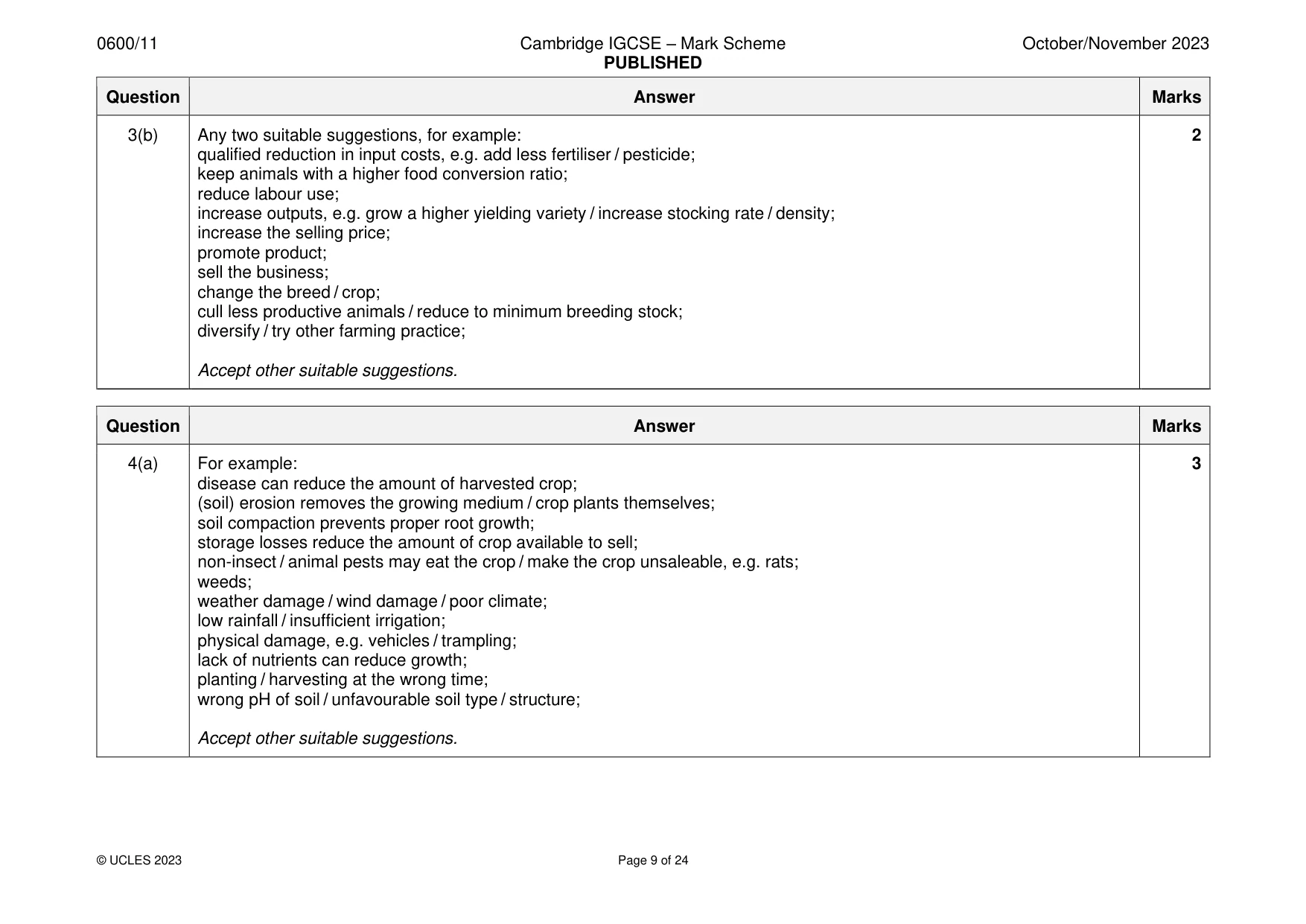
0600/11 Cambridge IGCSE – Mark Scheme PUBLISHED October/November 2023 © UCLES 2023 Page 9 of 24 Question Answer Marks 3(b) Any two suitable suggestions, for example: qualified reduction in input costs, e.g. add less fertiliser / pesticide; keep animals with a higher food conversion ratio; reduce labour use; increase outputs, e.g. grow a higher yielding variety / increase stocking rate / density; increase the selling price; promote product; sell the business; change the breed / crop; cull less productive animals / reduce to minimum breeding stock; diversify / try other farming practice; Accept other suitable suggestions. 2 Question Answer Marks 4(a) For example: disease can reduce the amount of harvested crop; (soil) erosion removes the growing medium / crop plants themselves; soil compaction prevents proper root growth; storage losses reduce the amount of crop available to sell; non-insect / animal pests may eat the crop / make the crop unsaleable, e.g. rats; weeds; weather damage / wind damage / poor climate; low rainfall / insufficient irrigation; physical damage, e.g. vehicles / trampling; lack of nutrients can reduce growth; planting / harvesting at the wrong time; wrong pH of soil / unfavourable soil type / structure; Accept other suitable suggestions. 3
Mark scheme, page 10
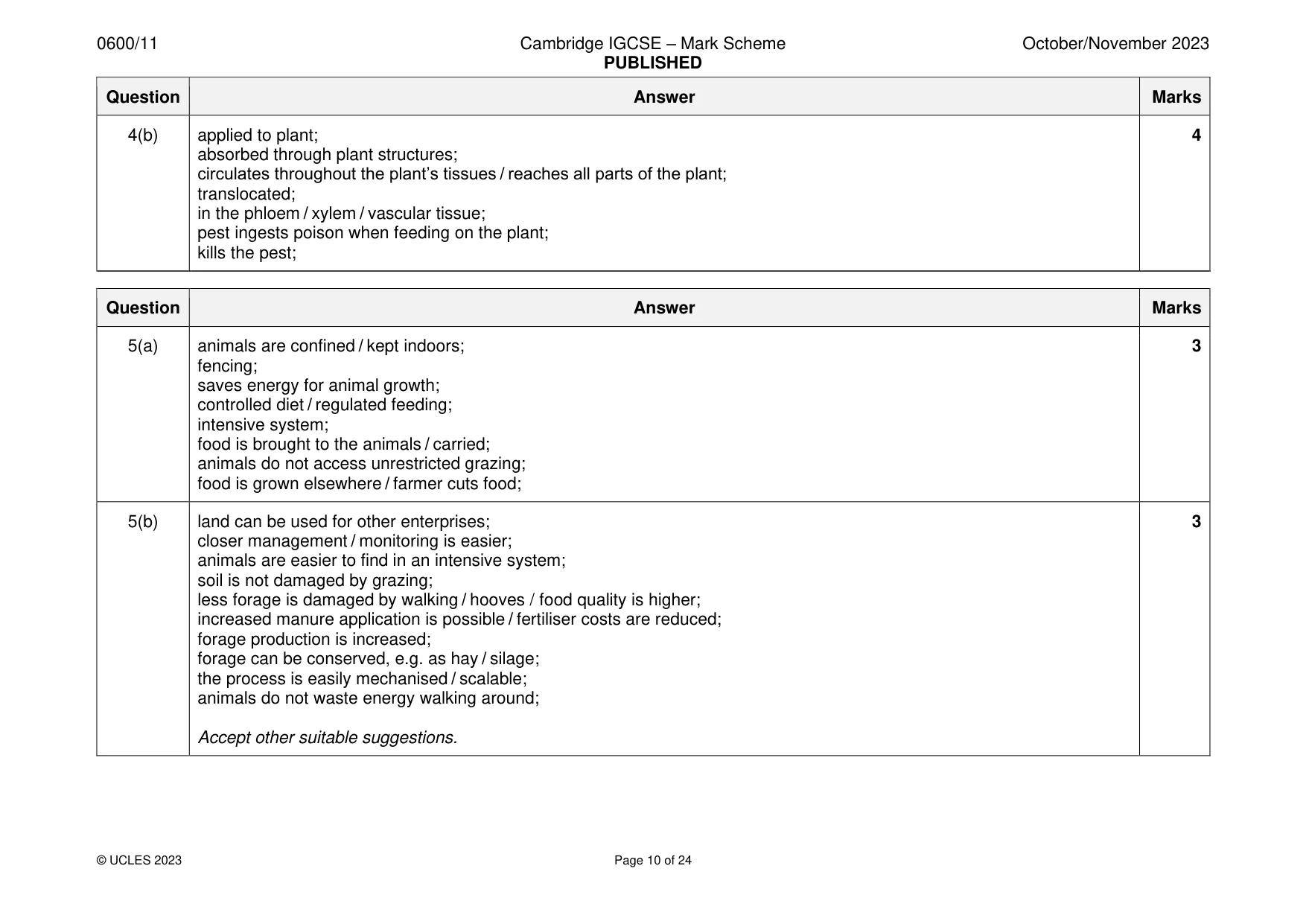
0600/11 Cambridge IGCSE – Mark Scheme PUBLISHED October/November 2023 © UCLES 2023 Page 10 of 24 Question Answer Marks 4(b) applied to plant; absorbed through plant structures; circulates throughout the plant’s tissues / reaches all parts of the plant; translocated; in the phloem / xylem / vascular tissue; pest ingests poison when feeding on the plant; kills the pest; 4 Question Answer Marks 5(a) animals are confined / kept indoors; fencing; saves energy for animal growth; controlled diet / regulated feeding; intensive system; food is brought to the animals / carried; animals do not access unrestricted grazing; food is grown elsewhere / farmer cuts food; 3 5(b) land can be used for other enterprises; closer management / monitoring is easier; animals are easier to find in an intensive system; soil is not damaged by grazing; less forage is damaged by walking / hooves / food quality is higher; increased manure application is possible / fertiliser costs are reduced; forage production is increased; forage can be conserved, e.g. as hay / silage; the process is easily mechanised / scalable; animals do not waste energy walking around; Accept other suitable suggestions. 3
Mark scheme, page 11
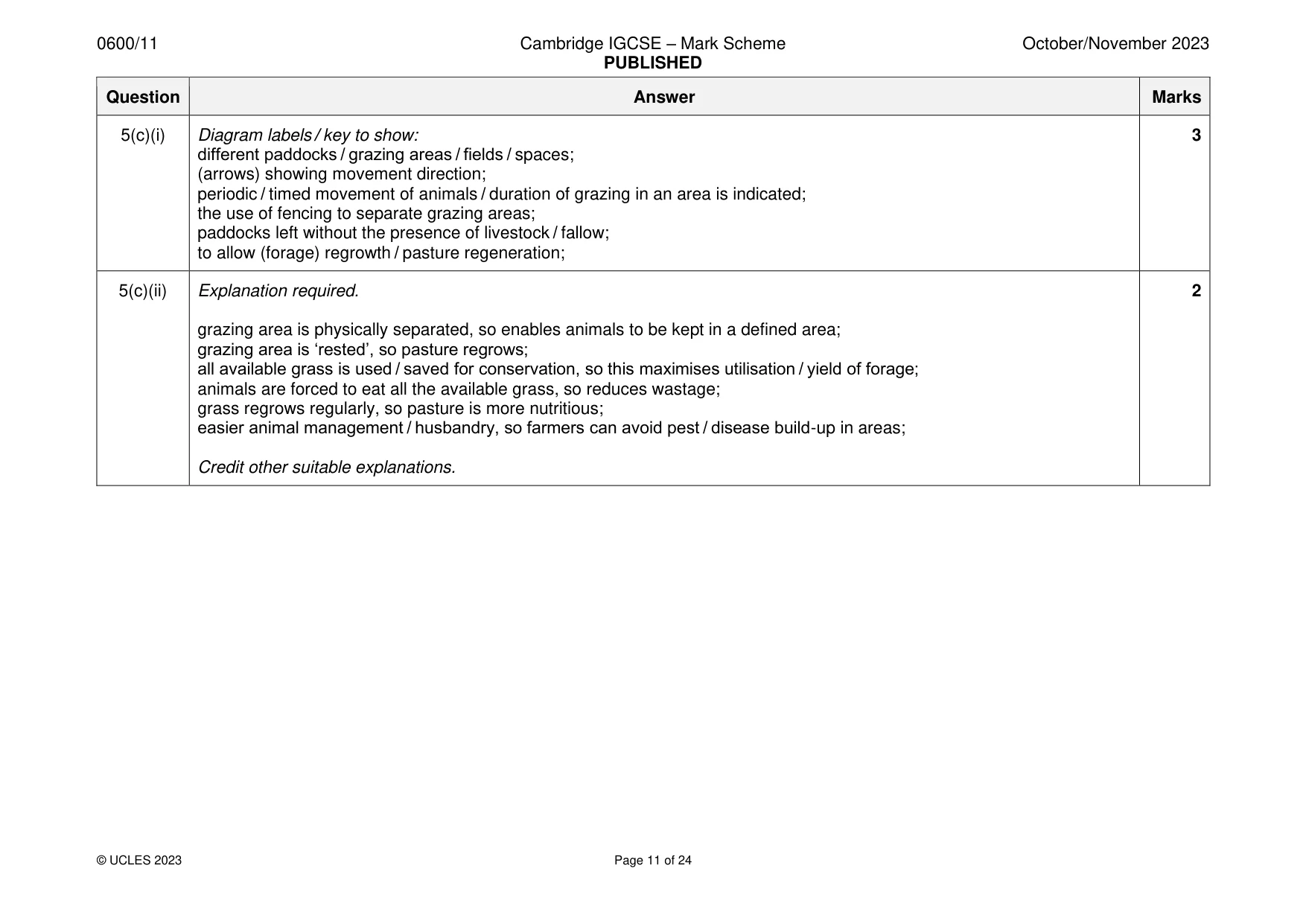
0600/11 Cambridge IGCSE – Mark Scheme PUBLISHED October/November 2023 © UCLES 2023 Page 11 of 24 Question Answer Marks 5(c)(i) Diagram labels / key to show: different paddocks / grazing areas / fields / spaces; (arrows) showing movement direction; periodic / timed movement of animals / duration of grazing in an area is indicated; the use of fencing to separate grazing areas; paddocks left without the presence of livestock / fallow; to allow (forage) regrowth / pasture regeneration; 3 5(c)(ii) Explanation required. grazing area is physically separated, so enables animals to be kept in a defined area; grazing area is ‘rested’, so pasture regrows; all available grass is used / saved for conservation, so this maximises utilisation / yield of forage; animals are forced to eat all the available grass, so reduces wastage; grass regrows regularly, so pasture is more nutritious; easier animal management / husbandry, so farmers can avoid pest / disease build-up in areas; Credit other suitable explanations. 2
Mark scheme, page 12
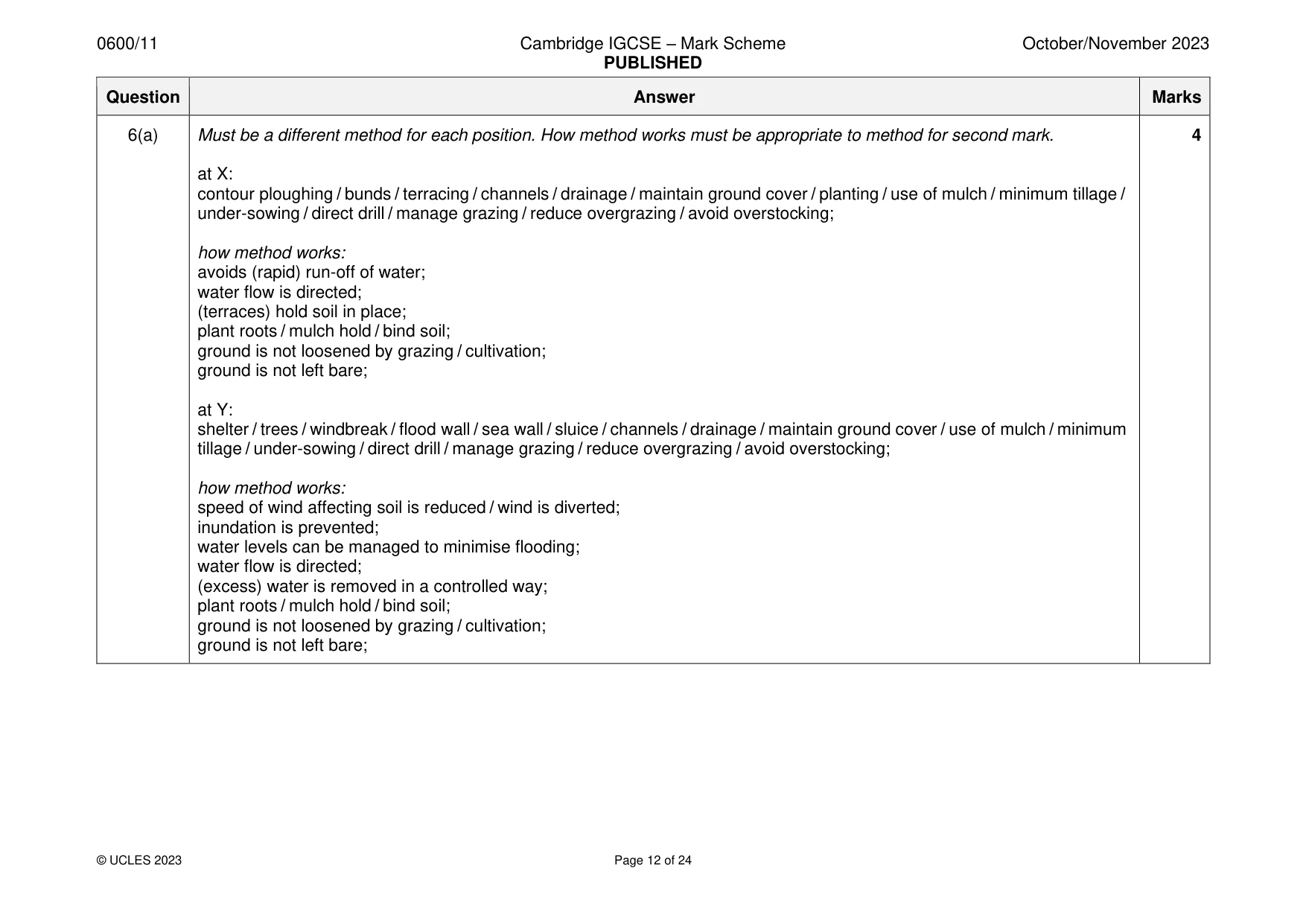
0600/11 Cambridge IGCSE – Mark Scheme PUBLISHED October/November 2023 © UCLES 2023 Page 12 of 24 Question Answer Marks 6(a) Must be a different method for each position. How method works must be appropriate to method for second mark. at X: contour ploughing / bunds / terracing / channels / drainage / maintain ground cover / planting / use of mulch / minimum tillage / under-sowing / direct drill / manage grazing / reduce overgrazing / avoid overstocking; how method works: avoids (rapid) run-off of water; water flow is directed; (terraces) hold soil in place; plant roots / mulch hold / bind soil; ground is not loosened by grazing / cultivation; ground is not left bare; at Y: shelter / trees / windbreak / flood wall / sea wall / sluice / channels / drainage / maintain ground cover / use of mulch / minimum tillage / under-sowing / direct drill / manage grazing / reduce overgrazing / avoid overstocking; how method works: speed of wind affecting soil is reduced / wind is diverted; inundation is prevented; water levels can be managed to minimise flooding; water flow is directed; (excess) water is removed in a controlled way; plant roots / mulch hold / bind soil; ground is not loosened by grazing / cultivation; ground is not left bare; 4
Mark scheme, page 13
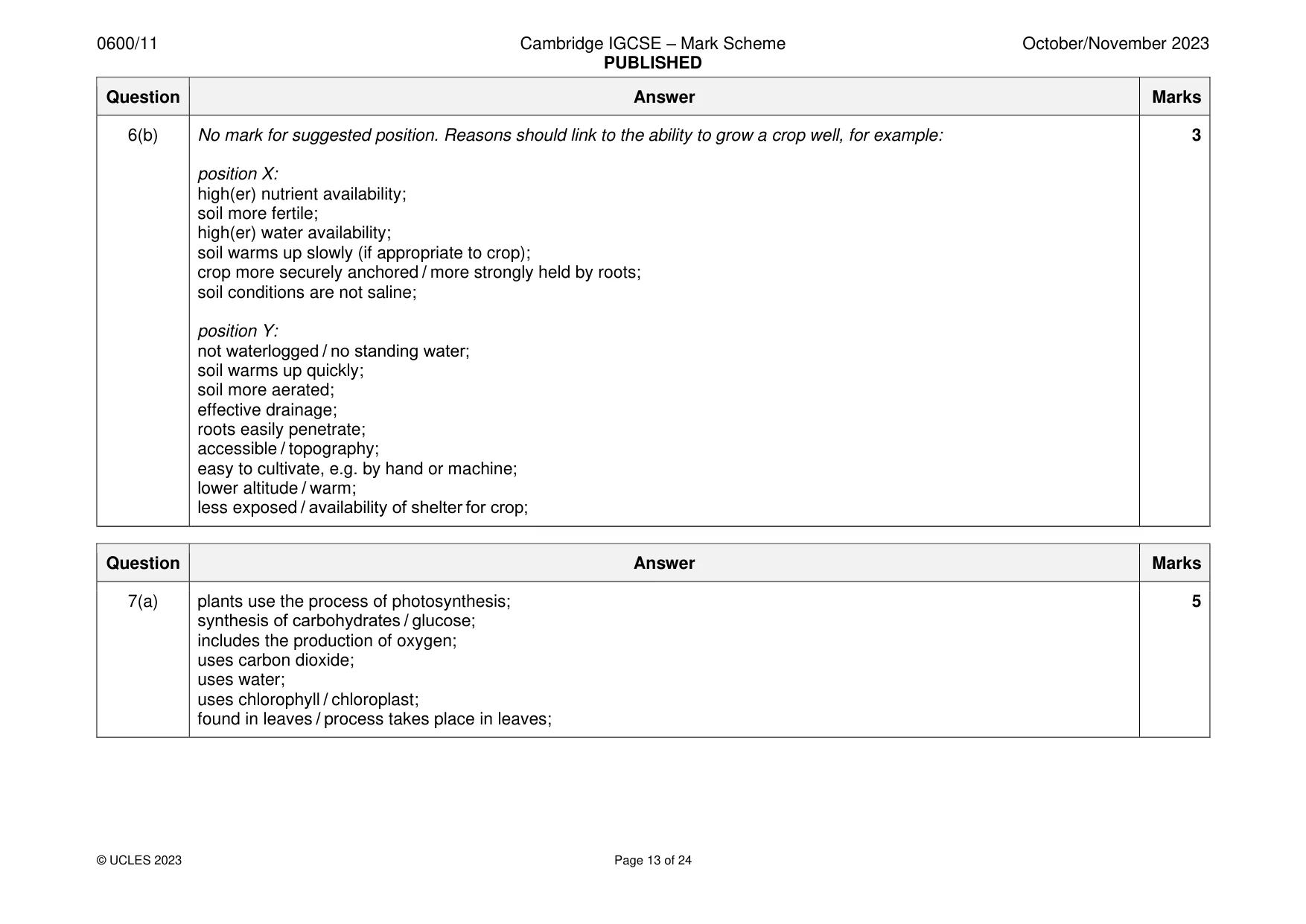
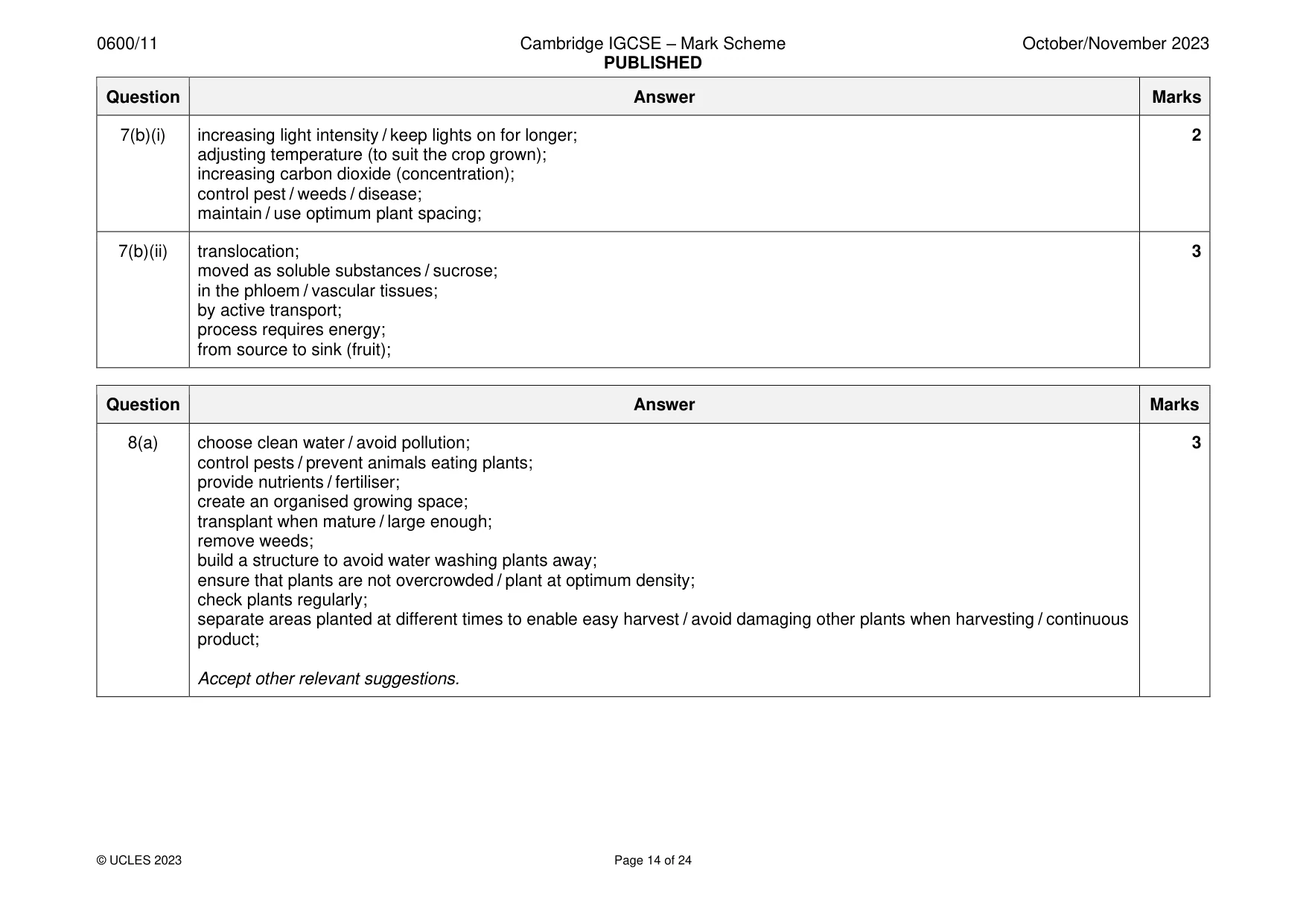
0600/11 Cambridge IGCSE – Mark Scheme PUBLISHED October/November 2023 © UCLES 2023 Page 13 of 24 Question Answer Marks 6(b) No mark for suggested position. Reasons should link to the ability to grow a crop well, for example: position X: high(er) nutrient availability; soil more fertile; high(er) water availability; soil warms up slowly (if appropriate to crop); crop more securely anchored / more strongly held by roots; soil conditions are not saline; position Y: not waterlogged / no standing water; soil warms up quickly; soil more aerated; effective drainage; roots easily penetrate; accessible / topography; easy to cultivate, e.g. by hand or machine; lower altitude / warm; less exposed / availability of shelter for crop; 3 Question Answer Marks 7(a) plants use the process of photosynthesis; synthesis of carbohydrates / glucose; includes the production of oxygen; uses carbon dioxide; uses water; uses chlorophyll / chloroplast; found in leaves / process takes place in leaves; 5
Mark scheme, page 14
0600/11 Cambridge IGCSE – Mark Scheme PUBLISHED October/November 2023 © UCLES 2023 Page 14 of 24 Question Answer Marks 7(b)(i) increasing light intensity / keep lights on for longer; adjusting temperature (to suit the crop grown); increasing carbon dioxide (concentration); control pest / weeds / disease; maintain / use optimum plant spacing; 2 7(b)(ii) translocation; moved as soluble substances / sucrose; in the phloem / vascular tissues; by active transport; process requires energy; from source to sink (fruit); 3 Question Answer Marks 8(a) choose clean water / avoid pollution; control pests / prevent animals eating plants; provide nutrients / fertiliser; create an organised growing space; transplant when mature / large enough; remove weeds; build a structure to avoid water washing plants away; ensure that plants are not overcrowded / plant at optimum density; check plants regularly; separate areas planted at different times to enable easy harvest / avoid damaging other plants when harvesting / continuous product; Accept other relevant suggestions. 3
Mark scheme, page 15
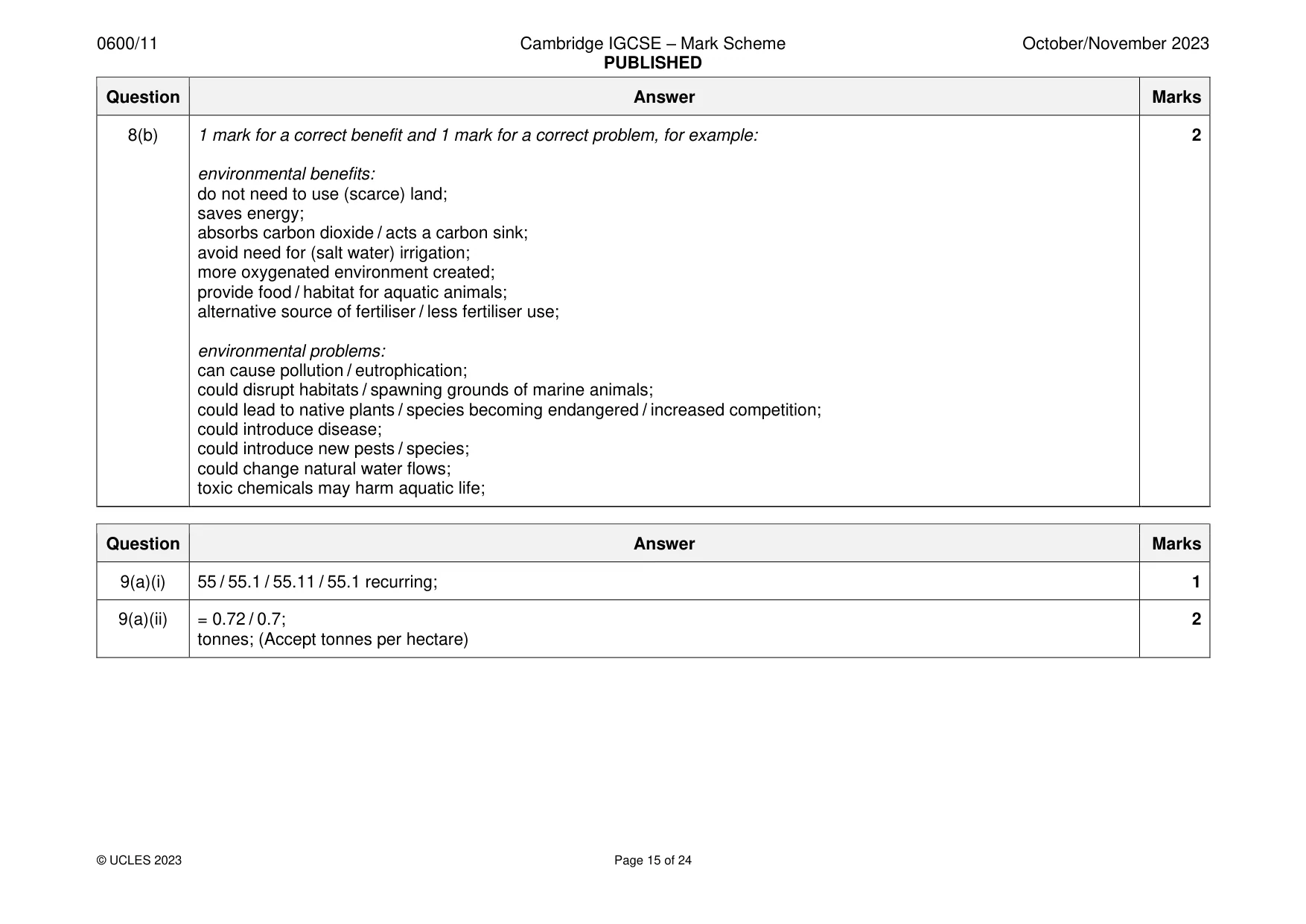
0600/11 Cambridge IGCSE – Mark Scheme PUBLISHED October/November 2023 © UCLES 2023 Page 15 of 24 Question Answer Marks 8(b) 1 mark for a correct benefit and 1 mark for a correct problem, for example: environmental benefits: do not need to use (scarce) land; saves energy; absorbs carbon dioxide / acts a carbon sink; avoid need for (salt water) irrigation; more oxygenated environment created; provide food / habitat for aquatic animals; alternative source of fertiliser / less fertiliser use; environmental problems: can cause pollution / eutrophication; could disrupt habitats / spawning grounds of marine animals; could lead to native plants / species becoming endangered / increased competition; could introduce disease; could introduce new pests / species; could change natural water flows; toxic chemicals may harm aquatic life; 2 Question Answer Marks 9(a)(i) 55 / 55.1 / 55.11 / 55.1 recurring; 1 9(a)(ii) = 0.72 / 0.7; tonnes; (Accept tonnes per hectare) 2
Mark scheme, page 16
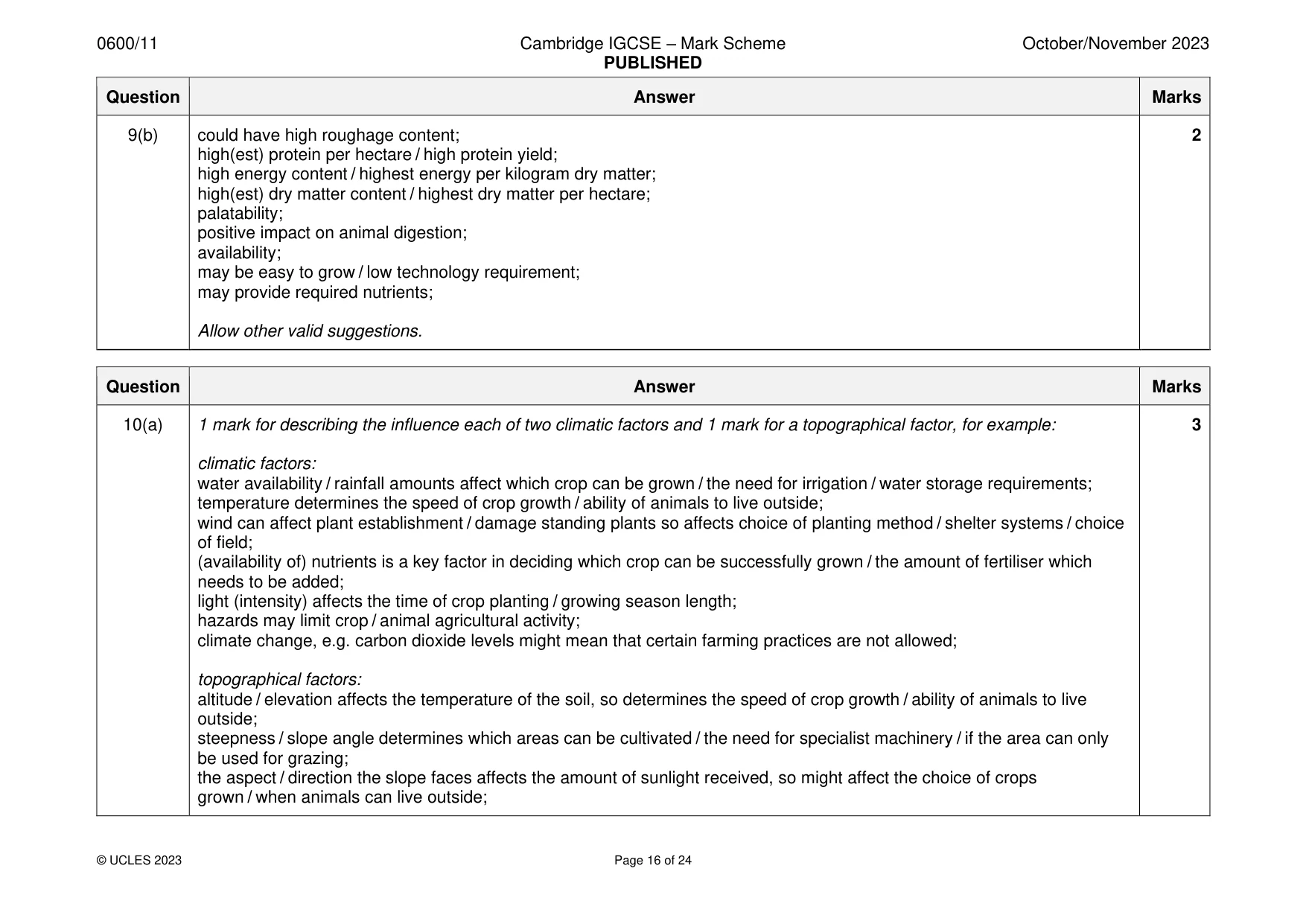
0600/11 Cambridge IGCSE – Mark Scheme PUBLISHED October/November 2023 © UCLES 2023 Page 16 of 24 Question Answer Marks 9(b) could have high roughage content; high(est) protein per hectare / high protein yield; high energy content / highest energy per kilogram dry matter; high(est) dry matter content / highest dry matter per hectare; palatability; positive impact on animal digestion; availability; may be easy to grow / low technology requirement; may provide required nutrients; Allow other valid suggestions. 2 Question Answer Marks 10(a) 1 mark for describing the influence each of two climatic factors and 1 mark for a topographical factor, for example: climatic factors: water availability / rainfall amounts affect which crop can be grown / the need for irrigation / water storage requirements; temperature determines the speed of crop growth / ability of animals to live outside; wind can affect plant establishment / damage standing plants so affects choice of planting method / shelter systems / choice of field; (availability of) nutrients is a key factor in deciding which crop can be successfully grown / the amount of fertiliser which needs to be added; light (intensity) affects the time of crop planting / growing season length; hazards may limit crop / animal agricultural activity; climate change, e.g. carbon dioxide levels might mean that certain farming practices are not allowed; topographical factors: altitude / elevation affects the temperature of the soil, so determines the speed of crop growth / ability of animals to live outside; steepness / slope angle determines which areas can be cultivated / the need for specialist machinery / if the area can only be used for grazing; the aspect / direction the slope faces affects the amount of sunlight received, so might affect the choice of crops grown / when animals can live outside; 3
Mark scheme, page 17
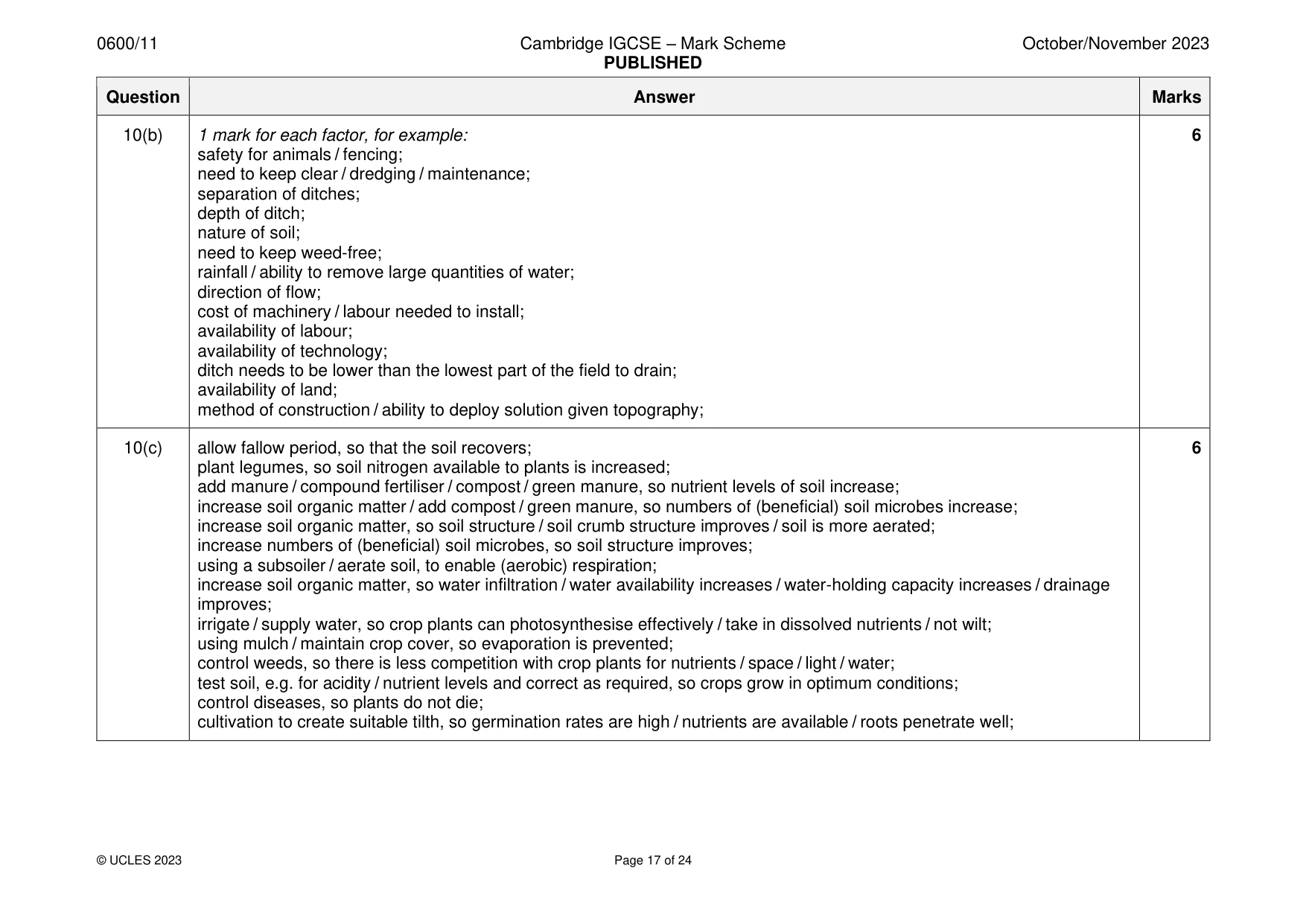
0600/11 Cambridge IGCSE – Mark Scheme PUBLISHED October/November 2023 © UCLES 2023 Page 17 of 24 Question Answer Marks 10(b) 1 mark for each factor, for example: safety for animals / fencing; need to keep clear / dredging / maintenance; separation of ditches; depth of ditch; nature of soil; need to keep weed-free; rainfall / ability to remove large quantities of water; direction of flow; cost of machinery / labour needed to install; availability of labour; availability of technology; ditch needs to be lower than the lowest part of the field to drain; availability of land; method of construction / ability to deploy solution given topography; 6 10(c) allow fallow period, so that the soil recovers; plant legumes, so soil nitrogen available to plants is increased; add manure / compound fertiliser / compost / green manure, so nutrient levels of soil increase; increase soil organic matter / add compost / green manure, so numbers of (beneficial) soil microbes increase; increase soil organic matter, so soil structure / soil crumb structure improves / soil is more aerated; increase numbers of (beneficial) soil microbes, so soil structure improves; using a subsoiler / aerate soil, to enable (aerobic) respiration; increase soil organic matter, so water infiltration / water availability increases / water-holding capacity increases / drainage improves; irrigate / supply water, so crop plants can photosynthesise effectively / take in dissolved nutrients / not wilt; using mulch / maintain crop cover, so evaporation is prevented; control weeds, so there is less competition with crop plants for nutrients / space / light / water; test soil, e.g. for acidity / nutrient levels and correct as required, so crops grow in optimum conditions; control diseases, so plants do not die; cultivation to create suitable tilth, so germination rates are high / nutrients are available / roots penetrate well; 6
Mark scheme, page 18
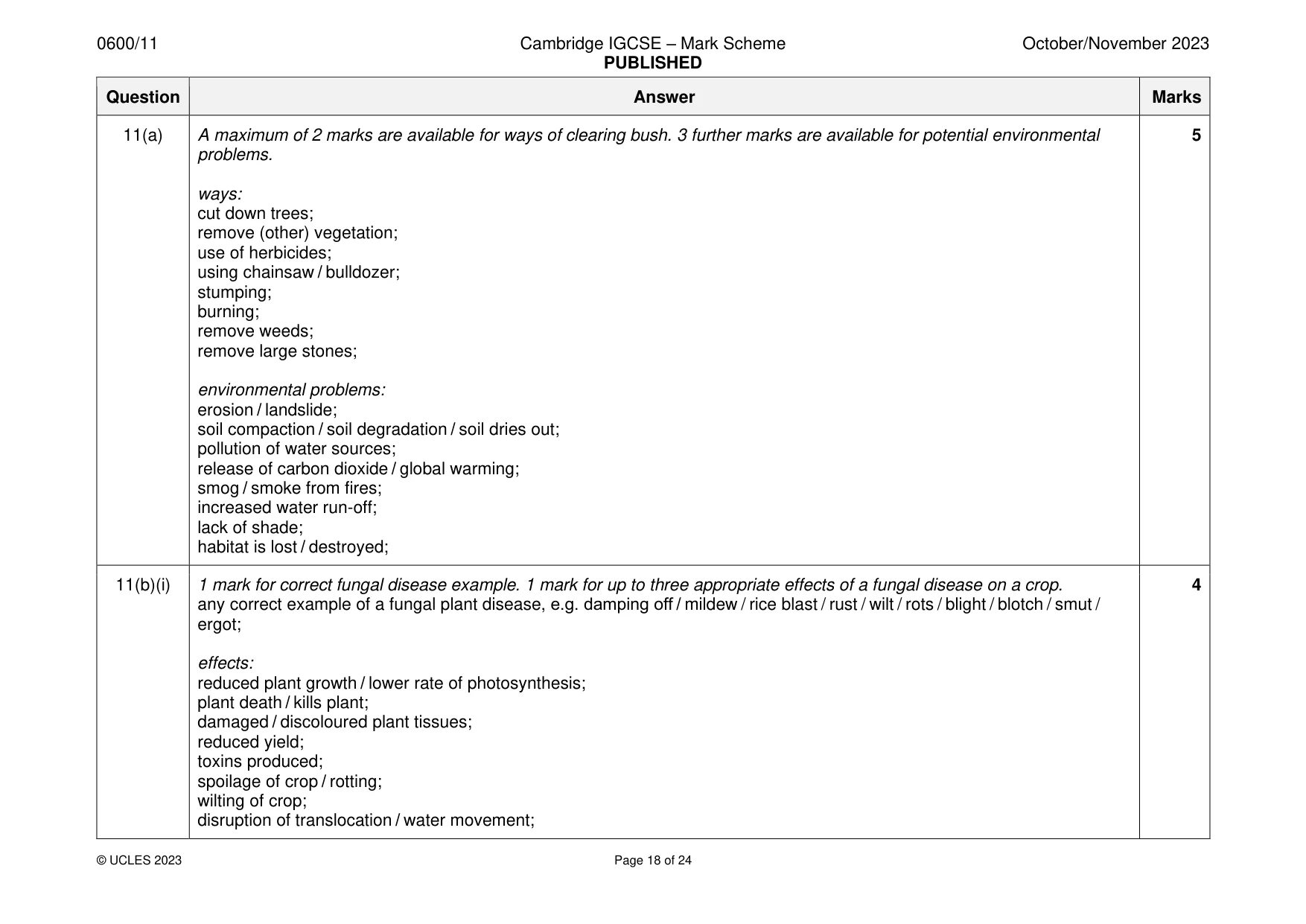
0600/11 Cambridge IGCSE – Mark Scheme PUBLISHED October/November 2023 © UCLES 2023 Page 18 of 24 Question Answer Marks 11(a) A maximum of 2 marks are available for ways of clearing bush. 3 further marks are available for potential environmental problems. ways: cut down trees; remove (other) vegetation; use of herbicides; using chainsaw / bulldozer; stumping; burning; remove weeds; remove large stones; environmental problems: erosion / landslide; soil compaction / soil degradation / soil dries out; pollution of water sources; release of carbon dioxide / global warming; smog / smoke from fires; increased water run-off; lack of shade; habitat is lost / destroyed; 5 11(b)(i) 1 mark for correct fungal disease example. 1 mark for up to three appropriate effects of a fungal disease on a crop. any correct example of a fungal plant disease, e.g. damping off / mildew / rice blast / rust / wilt / rots / blight / blotch / smut / ergot; effects: reduced plant growth / lower rate of photosynthesis; plant death / kills plant; damaged / discoloured plant tissues; reduced yield; toxins produced; spoilage of crop / rotting; wilting of crop; disruption of translocation / water movement; 4
Mark scheme, page 19
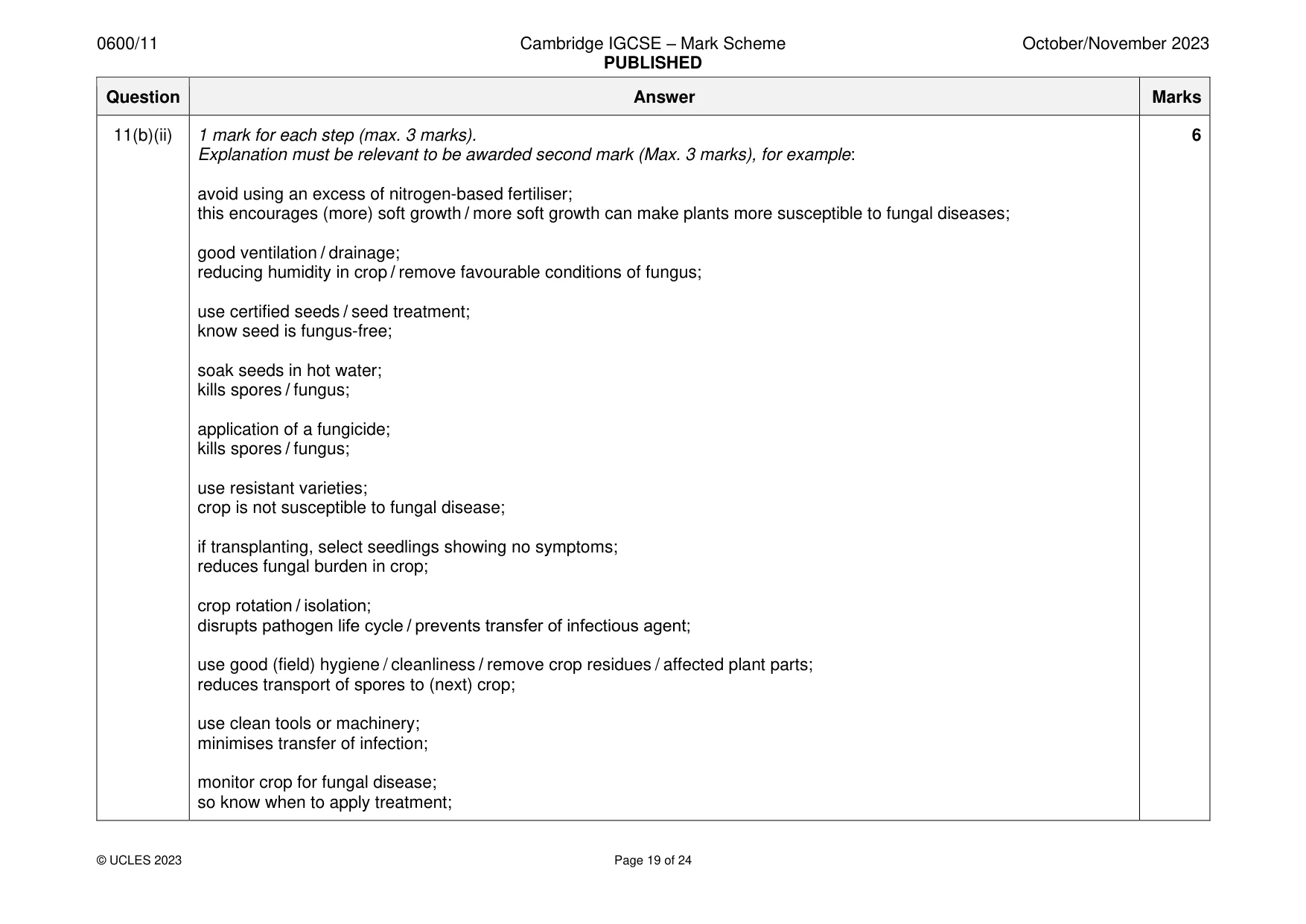
0600/11 Cambridge IGCSE – Mark Scheme PUBLISHED October/November 2023 © UCLES 2023 Page 19 of 24 Question Answer Marks 11(b)(ii) 1 mark for each step (max. 3 marks). Explanation must be relevant to be awarded second mark (Max. 3 marks), for example: avoid using an excess of nitrogen-based fertiliser; this encourages (more) soft growth / more soft growth can make plants more susceptible to fungal diseases; good ventilation / drainage; reducing humidity in crop / remove favourable conditions of fungus; use certified seeds / seed treatment; know seed is fungus-free; soak seeds in hot water; kills spores / fungus; application of a fungicide; kills spores / fungus; use resistant varieties; crop is not susceptible to fungal disease; if transplanting, select seedlings showing no symptoms; reduces fungal burden in crop; crop rotation / isolation; disrupts pathogen life cycle / prevents transfer of infectious agent; use good (field) hygiene / cleanliness / remove crop residues / affected plant parts; reduces transport of spores to (next) crop; use clean tools or machinery; minimises transfer of infection; monitor crop for fungal disease; so know when to apply treatment; 6
Mark scheme, page 20
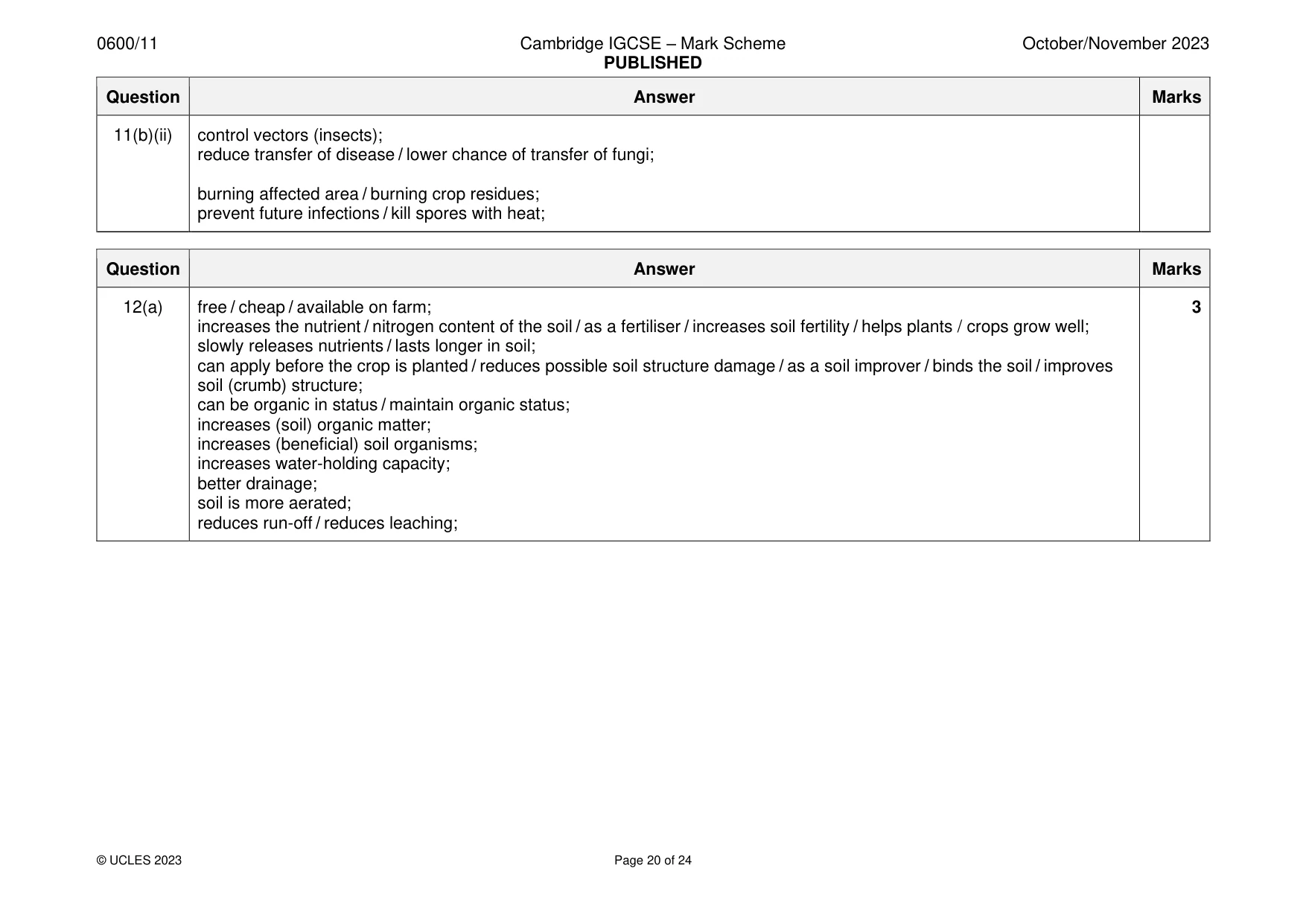
0600/11 Cambridge IGCSE – Mark Scheme PUBLISHED October/November 2023 © UCLES 2023 Page 20 of 24 Question Answer Marks 11(b)(ii) control vectors (insects); reduce transfer of disease / lower chance of transfer of fungi; burning affected area / burning crop residues; prevent future infections / kill spores with heat; Question Answer Marks 12(a) free / cheap / available on farm; increases the nutrient / nitrogen content of the soil / as a fertiliser / increases soil fertility / helps plants / crops grow well; slowly releases nutrients / lasts longer in soil; can apply before the crop is planted / reduces possible soil structure damage / as a soil improver / binds the soil / improves soil (crumb) structure; can be organic in status / maintain organic status; increases (soil) organic matter; increases (beneficial) soil organisms; increases water-holding capacity; better drainage; soil is more aerated; reduces run-off / reduces leaching; 3
Mark scheme, page 21
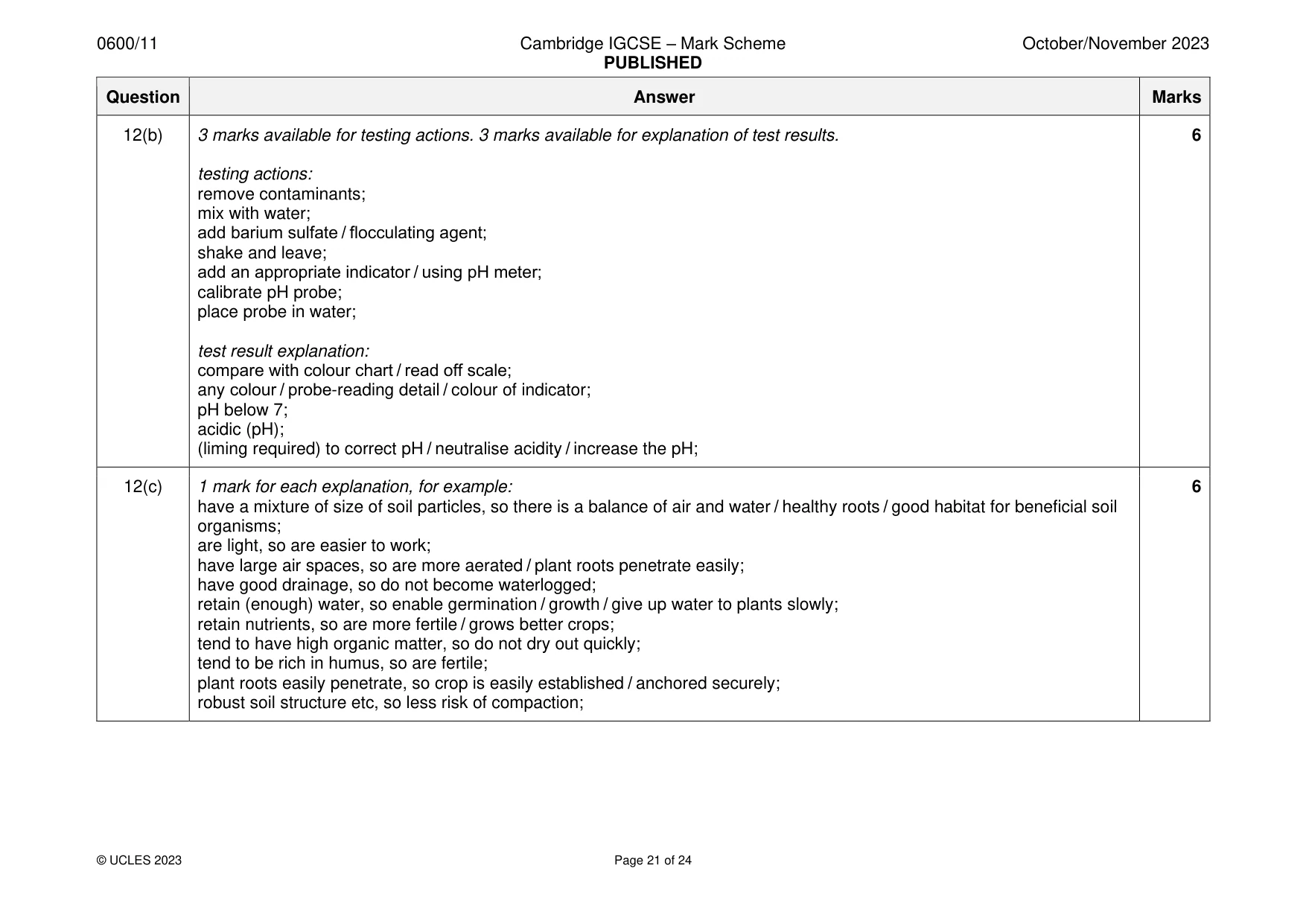
0600/11 Cambridge IGCSE – Mark Scheme PUBLISHED October/November 2023 © UCLES 2023 Page 21 of 24 Question Answer Marks 12(b) 3 marks available for testing actions. 3 marks available for explanation of test results. testing actions: remove contaminants; mix with water; add barium sulfate / flocculating agent; shake and leave; add an appropriate indicator / using pH meter; calibrate pH probe; place probe in water; test result explanation: compare with colour chart / read off scale; any colour / probe-reading detail / colour of indicator; pH below 7; acidic (pH); (liming required) to correct pH / neutralise acidity / increase the pH; 6 12(c) 1 mark for each explanation, for example: have a mixture of size of soil particles, so there is a balance of air and water / healthy roots / good habitat for beneficial soil organisms; are light, so are easier to work; have large air spaces, so are more aerated / plant roots penetrate easily; have good drainage, so do not become waterlogged; retain (enough) water, so enable germination / growth / give up water to plants slowly; retain nutrients, so are more fertile / grows better crops; tend to have high organic matter, so do not dry out quickly; tend to be rich in humus, so are fertile; plant roots easily penetrate, so crop is easily established / anchored securely; robust soil structure etc, so less risk of compaction; 6
Mark scheme, page 22
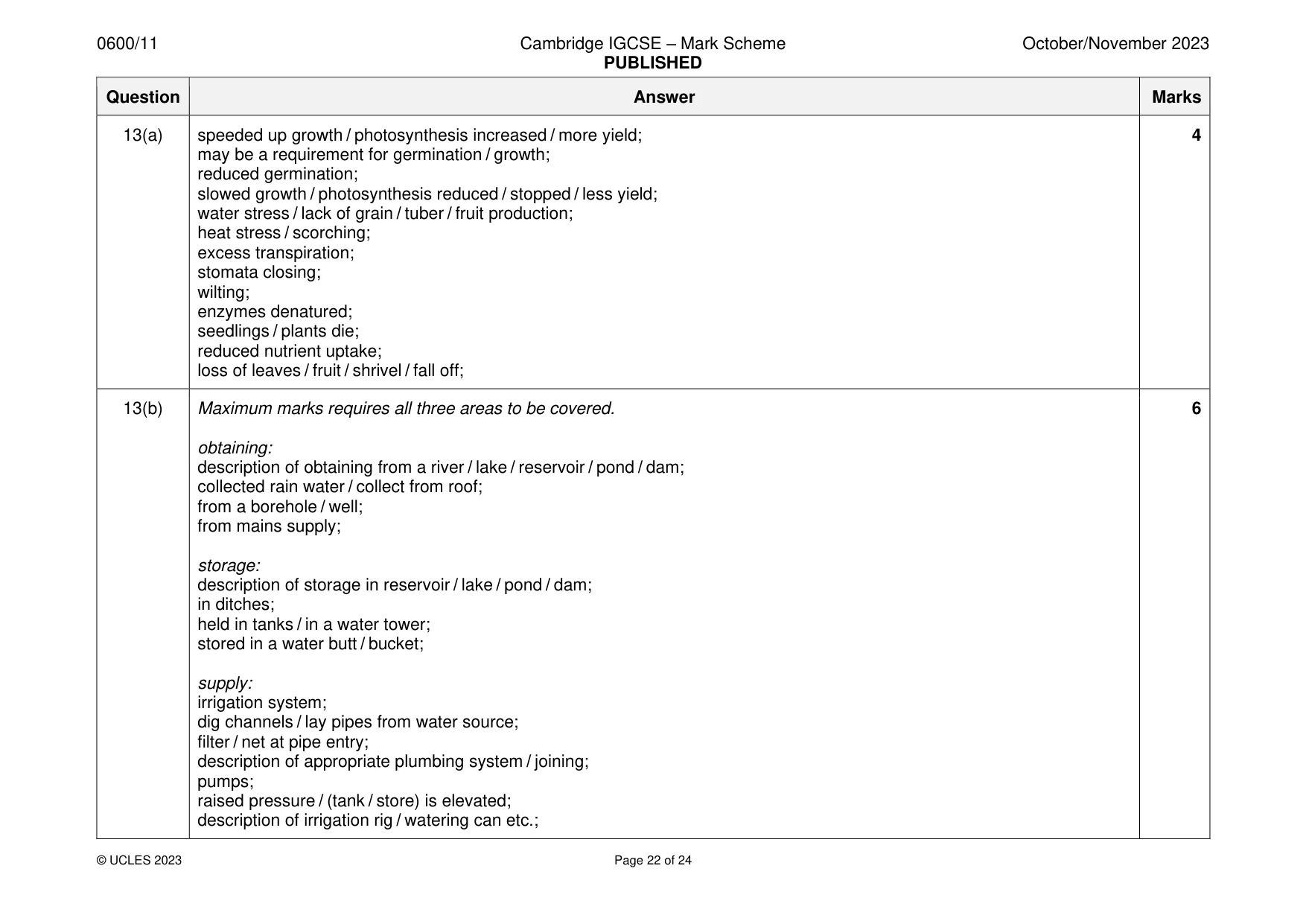
0600/11 Cambridge IGCSE – Mark Scheme PUBLISHED October/November 2023 © UCLES 2023 Page 22 of 24 Question Answer Marks 13(a) speeded up growth / photosynthesis increased / more yield; may be a requirement for germination / growth; reduced germination; slowed growth / photosynthesis reduced / stopped / less yield; water stress / lack of grain / tuber / fruit production; heat stress / scorching; excess transpiration; stomata closing; wilting; enzymes denatured; seedlings / plants die; reduced nutrient uptake; loss of leaves / fruit / shrivel / fall off; 4 13(b) Maximum marks requires all three areas to be covered. obtaining: description of obtaining from a river / lake / reservoir / pond / dam; collected rain water / collect from roof; from a borehole / well; from mains supply; storage: description of storage in reservoir / lake / pond / dam; in ditches; held in tanks / in a water tower; stored in a water butt / bucket; supply: irrigation system; dig channels / lay pipes from water source; filter / net at pipe entry; description of appropriate plumbing system / joining; pumps; raised pressure / (tank / store) is elevated; description of irrigation rig / watering can etc.; 6
Mark scheme, page 23
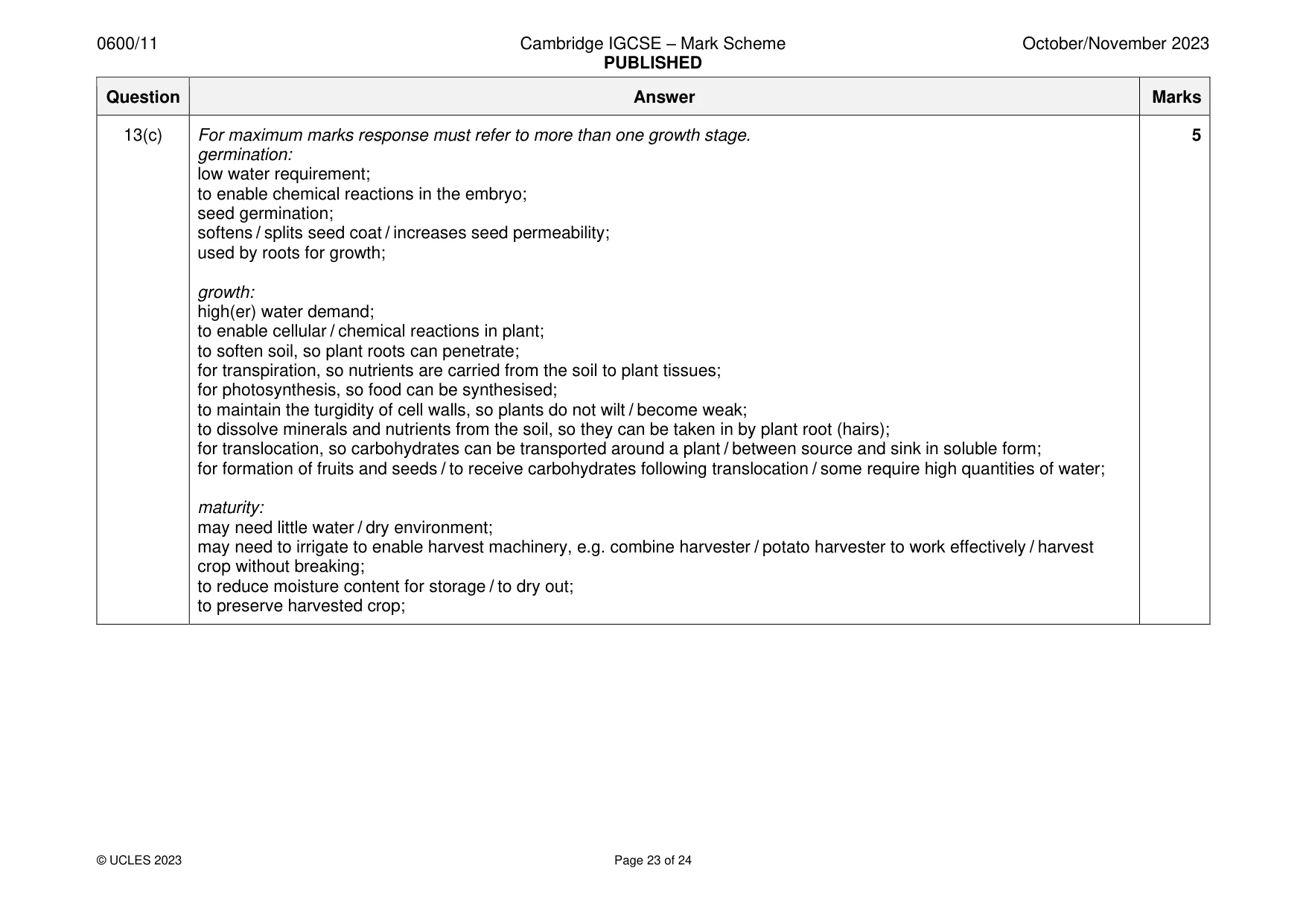
0600/11 Cambridge IGCSE – Mark Scheme PUBLISHED October/November 2023 © UCLES 2023 Page 23 of 24 Question Answer Marks 13(c) For maximum marks response must refer to more than one growth stage. germination: low water requirement; to enable chemical reactions in the embryo; seed germination; softens / splits seed coat / increases seed permeability; used by roots for growth; growth: high(er) water demand; to enable cellular / chemical reactions in plant; to soften soil, so plant roots can penetrate; for transpiration, so nutrients are carried from the soil to plant tissues; for photosynthesis, so food can be synthesised; to maintain the turgidity of cell walls, so plants do not wilt / become weak; to dissolve minerals and nutrients from the soil, so they can be taken in by plant root (hairs); for translocation, so carbohydrates can be transported around a plant / between source and sink in soluble form; for formation of fruits and seeds / to receive carbohydrates following translocation / some require high quantities of water; maturity: may need little water / dry environment; may need to irrigate to enable harvest machinery, e.g. combine harvester / potato harvester to work effectively / harvest crop without breaking; to reduce moisture content for storage / to dry out; to preserve harvested crop; 5
Mark scheme, page 24
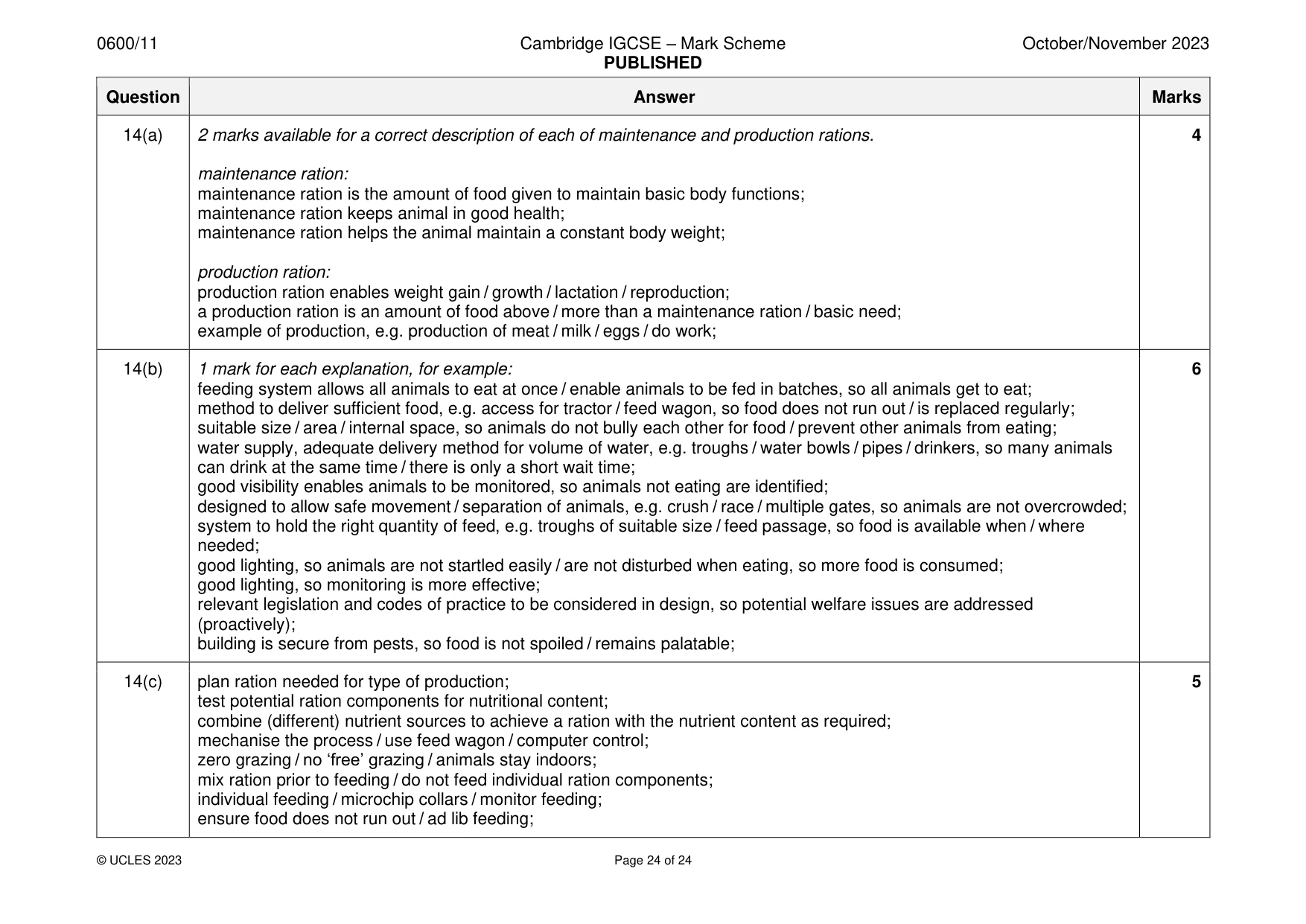
0600/11 Cambridge IGCSE – Mark Scheme PUBLISHED October/November 2023 © UCLES 2023 Page 24 of 24 Question Answer Marks 14(a) 2 marks available for a correct description of each of maintenance and production rations. maintenance ration: maintenance ration is the amount of food given to maintain basic body functions; maintenance ration keeps animal in good health; maintenance ration helps the animal maintain a constant body weight; production ration: production ration enables weight gain / growth / lactation / reproduction; a production ration is an amount of food above / more than a maintenance ration / basic need; example of production, e.g. production of meat / milk / eggs / do work; 4 14(b) 1 mark for each explanation, for example: feeding system allows all animals to eat at once / enable animals to be fed in batches, so all animals get to eat; method to deliver sufficient food, e.g. access for tractor / feed wagon, so food does not run out / is replaced regularly; suitable size / area / internal space, so animals do not bully each other for food / prevent other animals from eating; water supply, adequate delivery method for volume of water, e.g. troughs / water bowls / pipes / drinkers, so many animals can drink at the same time / there is only a short wait time; good visibility enables animals to be monitored, so animals not eating are identified; designed to allow safe movement / separation of animals, e.g. crush / race / multiple gates, so animals are not overcrowded; system to hold the right quantity of feed, e.g. troughs of suitable size / feed passage, so food is available when / where needed; good lighting, so animals are not startled easily / are not disturbed when eating, so more food is consumed; good lighting, so monitoring is more effective; relevant legislation and codes of practice to be considered in design, so potential welfare issues are addressed (proactively); building is secure from pests, so food is not spoiled / remains palatable; 6 14(c) plan ration needed for type of production; test potential ration components for nutritional content; combine (different) nutrient sources to achieve a ration with the nutrient content as required; mechanise the process / use feed wagon / computer control; zero grazing / no ‘free’ grazing / animals stay indoors; mix ration prior to feeding / do not feed individual ration components; individual feeding / microchip collars / monitor feeding; ensure food does not run out / ad lib feeding; 5
What you needed in this session
Cambridge’s own grade thresholds for 2023 Oct/Nov, Paper 1 · Variant 1. A higher threshold means an easier paper — the bar moves with how the cohort did.