Cambridge IGCSE Agriculture 0600 — 2020 Oct/Nov Paper 1 · Variant 1
0600/11/O/N/20 · 100 marks · ≈113 min
The question paper and its mark scheme, free to read here and free to download. This is Cambridge’s own paper, exactly as it was sat.
Question paper16 pages


Mark scheme25 pages
Answers below. Sit the paper first if you are practising.
Paper as text
Question paper, page 1
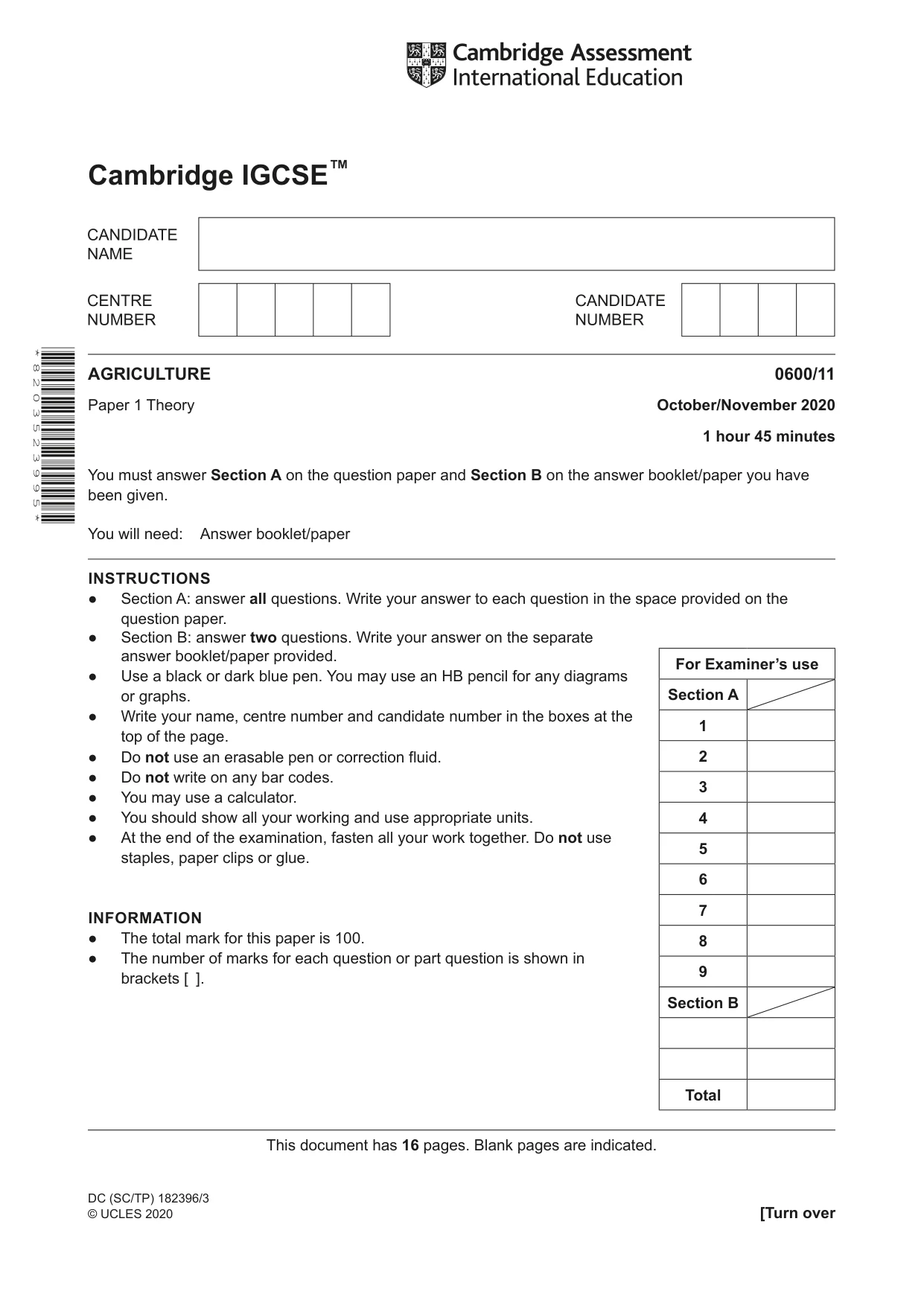
Cambridge IGCSE™ This document has 16 pages. Blank pages are indicated. DC (SC/TP) 182396/3 © UCLES 2020 [Turn over AGRICULTURE 0600/11 Paper 1 Theory October/November 2020 1 hour 45 minutes You must answer Section A on the question paper and Section B on the answer booklet/paper you have been given. You will need: Answer booklet/paper INSTRUCTIONS ● Section A: answer all questions. Write your answer to each question in the space provided on the question paper. ● Section B: answer two questions. Write your answer on the separate answer booklet/paper provided. ● Use a black or dark blue pen. You may use an HB pencil for any diagrams or graphs. ● Write your name, centre number and candidate number in the boxes at the top of the page. ● Do not use an erasable pen or correction fluid. ● Do not write on any bar codes. ● You may use a calculator. ● You should show all your working and use appropriate units. ● At the end of the examination, fasten all your work together. Do not use staples, paper clips or glue. INFORMATION ● The total mark for this paper is 100. ● The number of marks for each question or part question is shown in brackets [ ]. * 8 2 0 3 5 2 3 9 9 5 * For Examiner’s use Section A 1 2 3 4 5 6 7 8 9 Section B Total
Question paper, page 2
2 0600/11/O/N/20 © UCLES 2020 BLANK PAGE
Question paper, page 3
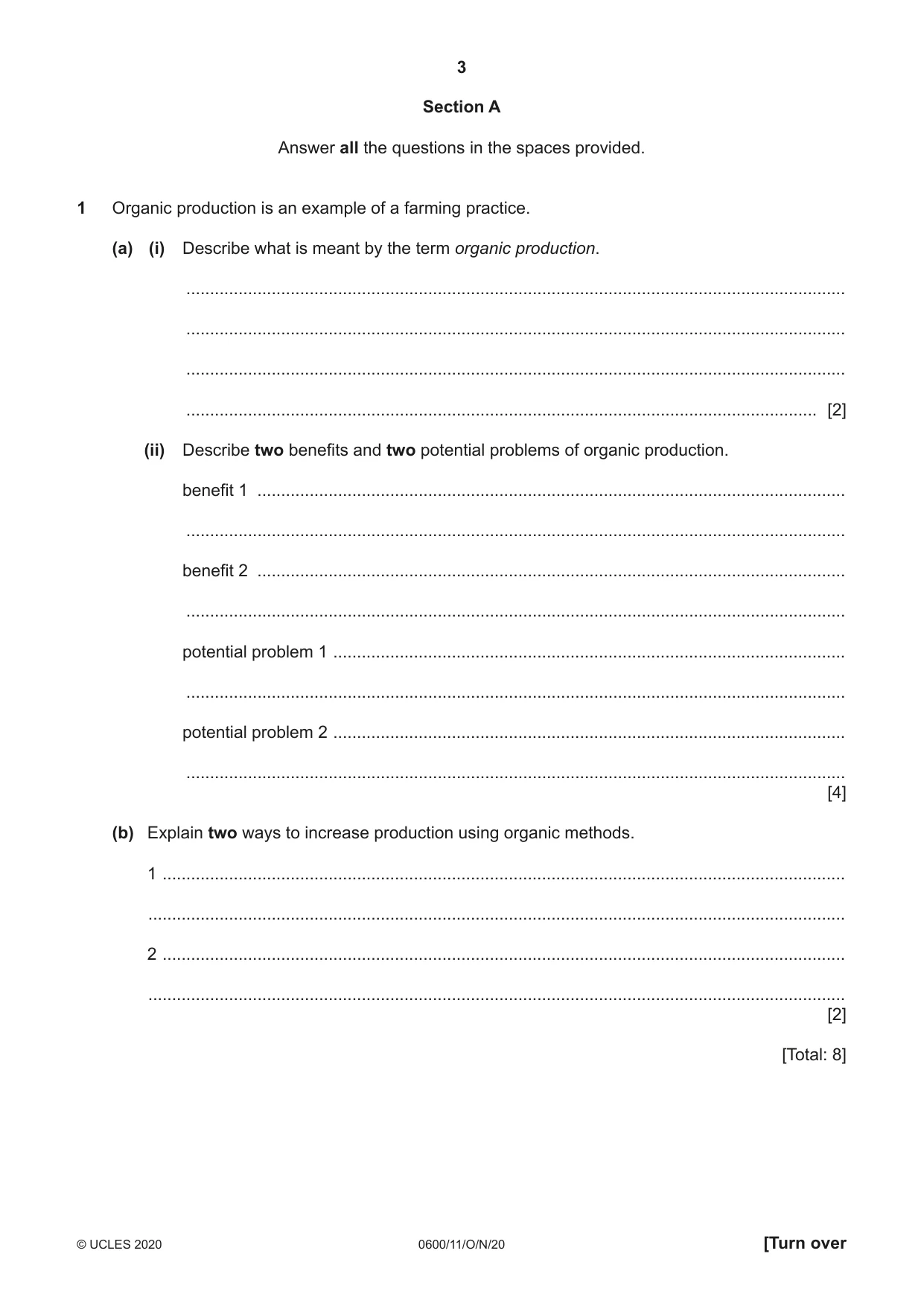
3 0600/11/O/N/20 © UCLES 2020 [Turn over Section A Answer all the questions in the spaces provided. 1 Organic production is an example of a farming practice. (a) (i) Describe what is meant by the term organic production. … … … … [2] (ii) Describe two benefits and two potential problems of organic production. benefit 1 … … benefit 2 … … potential problem 1 … … potential problem 2 … … [4] (b) Explain two ways to increase production using organic methods. 1 … … 2 … … [2] [Total: 8]
Question paper, page 4
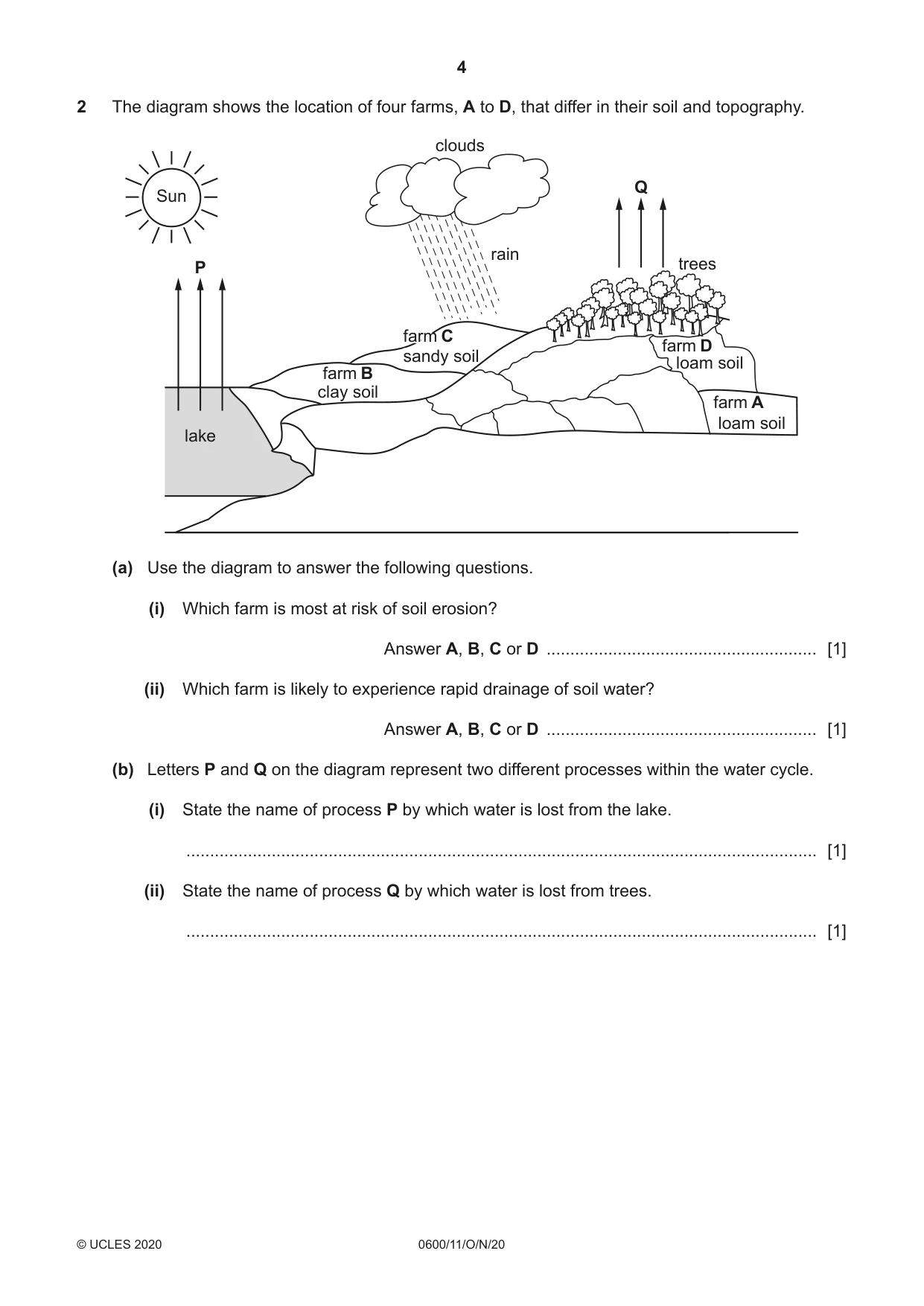
4 0600/11/O/N/20 © UCLES 2020 2 The diagram shows the location of four farms, A to D, that differ in their soil and topography. Sun Q P clouds rain trees farm B clay soil farm C sandy soil farm A loam soil lake farm D loam soil (a) Use the diagram to answer the following questions. (i) Which farm is most at risk of soil erosion? Answer A, B, C or D … [1] (ii) Which farm is likely to experience rapid drainage of soil water? Answer A, B, C or D … [1] (b) Letters P and Q on the diagram represent two different processes within the water cycle. (i) State the name of process P by which water is lost from the lake. … [1] (ii) State the name of process Q by which water is lost from trees. … [1]
Question paper, page 5
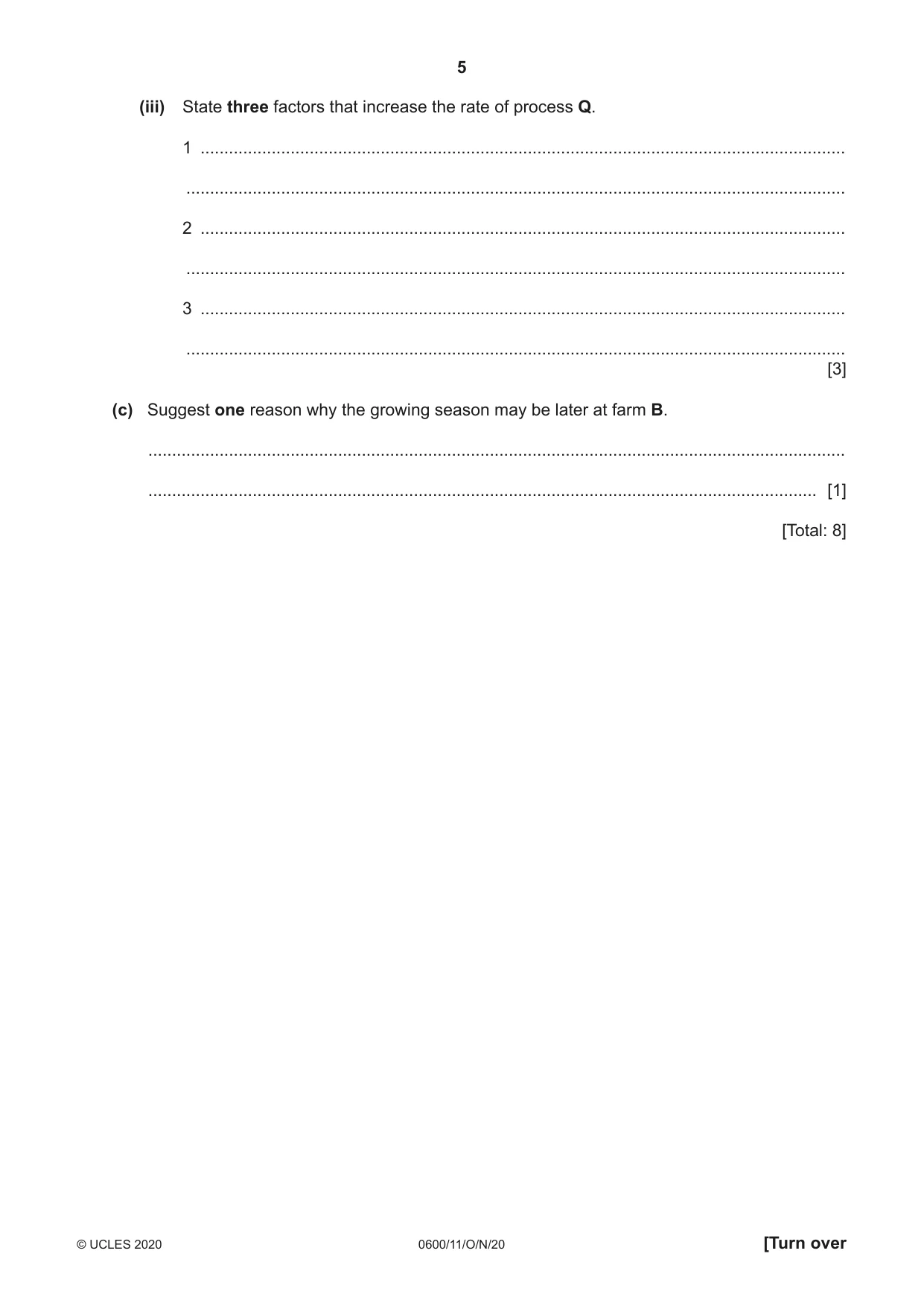
5 0600/11/O/N/20 © UCLES 2020 [Turn over (iii) State three factors that increase the rate of process Q. 1 … … 2 … … 3 … … [3] (c) Suggest one reason why the growing season may be later at farm B. … … [1] [Total: 8]
Question paper, page 6
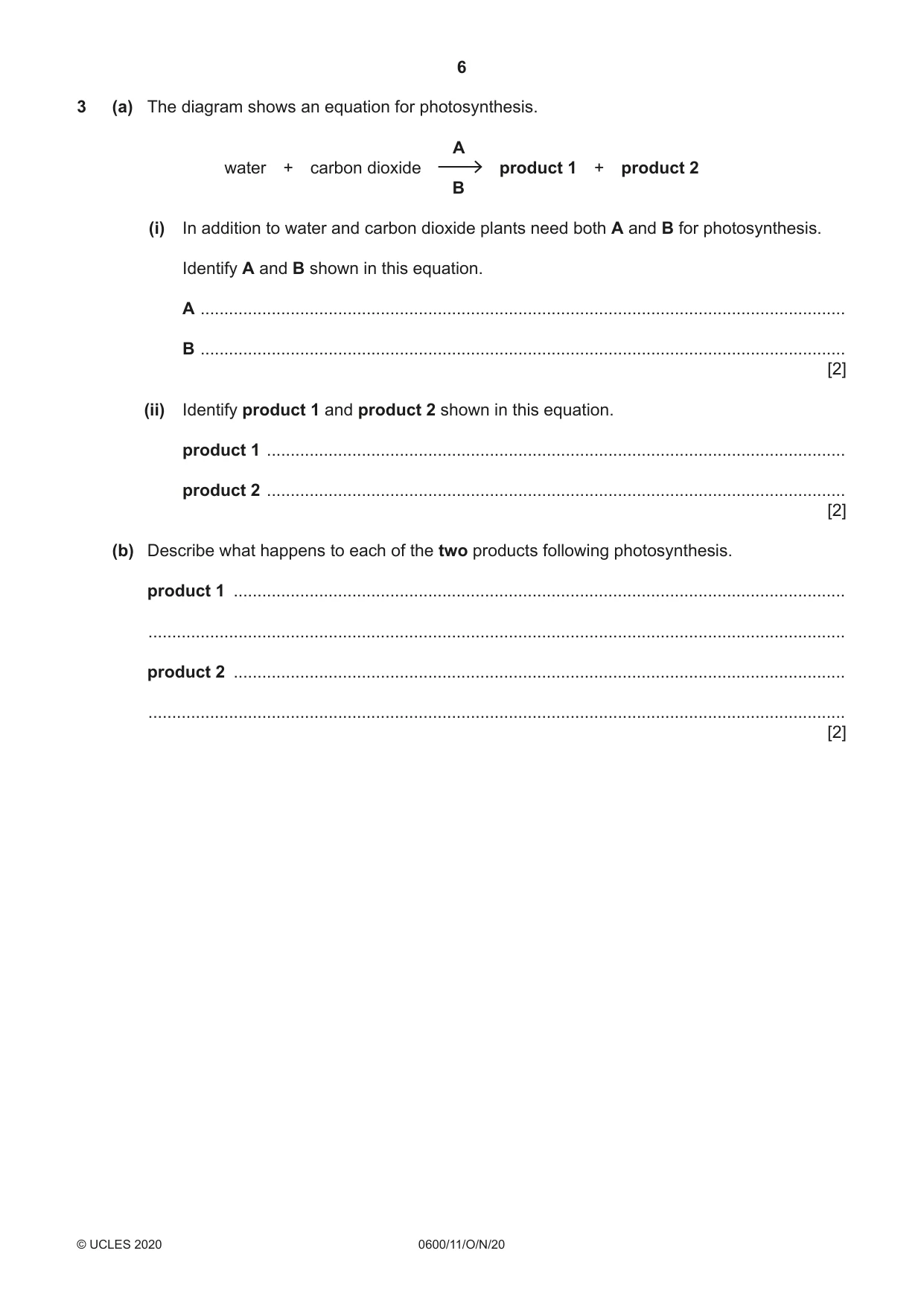
6 0600/11/O/N/20 © UCLES 2020 3 (a) The diagram shows an equation for photosynthesis. A water + carbon dioxide product 1 + product 2 B (i) In addition to water and carbon dioxide plants need both A and B for photosynthesis. Identify A and B shown in this equation. A … B … [2] (ii) Identify product 1 and product 2 shown in this equation. product 1 … product 2 … [2] (b) Describe what happens to each of the two products following photosynthesis. product 1 … … product 2 … … [2]
Question paper, page 7
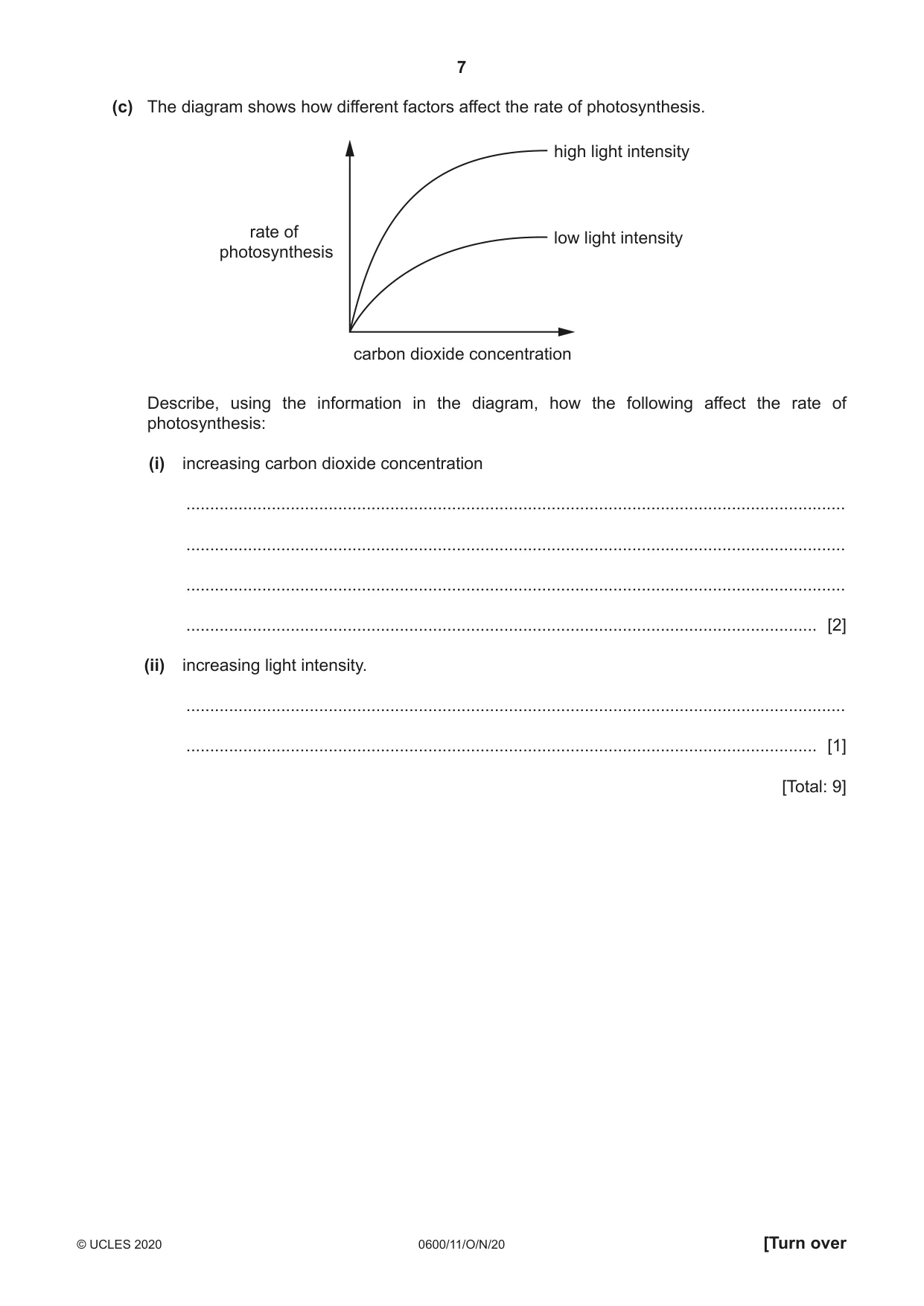
7 0600/11/O/N/20 © UCLES 2020 [Turn over (c) The diagram shows how different factors affect the rate of photosynthesis. carbon dioxide concentration rate of photosynthesis low light intensity high light intensity Describe, using the information in the diagram, how the following affect the rate of photosynthesis: (i) increasing carbon dioxide concentration … … … … [2] (ii) increasing light intensity. … … [1] [Total: 9]
Question paper, page 8
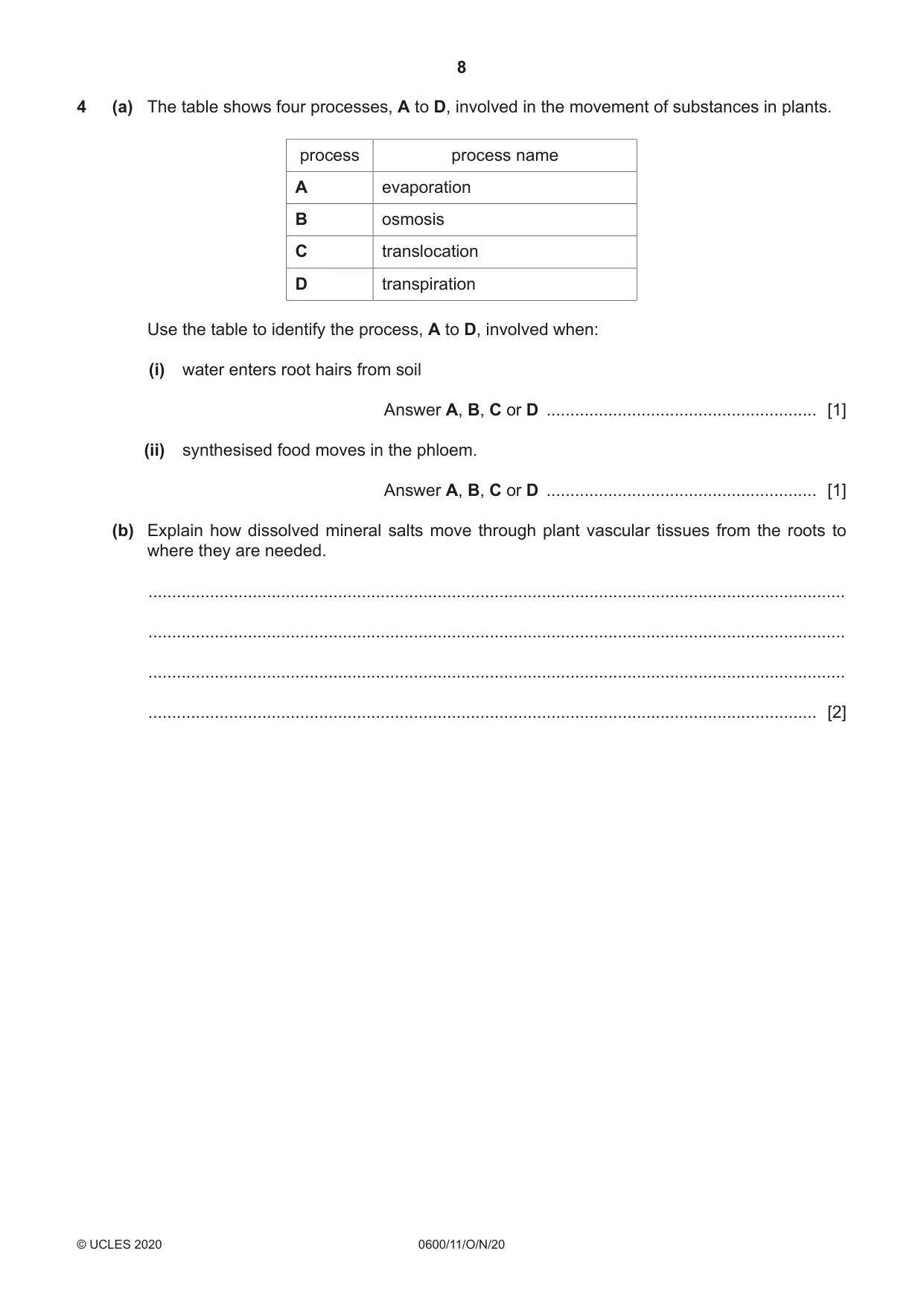
8 0600/11/O/N/20 © UCLES 2020 4 (a) The table shows four processes, A to D, involved in the movement of substances in plants. process process name A evaporation B osmosis C translocation D transpiration Use the table to identify the process, A to D, involved when: (i) water enters root hairs from soil Answer A, B, C or D … [1] (ii) synthesised food moves in the phloem. Answer A, B, C or D … [1] (b) Explain how dissolved mineral salts move through plant vascular tissues from the roots to where they are needed. … … … … [2]
Question paper, page 9
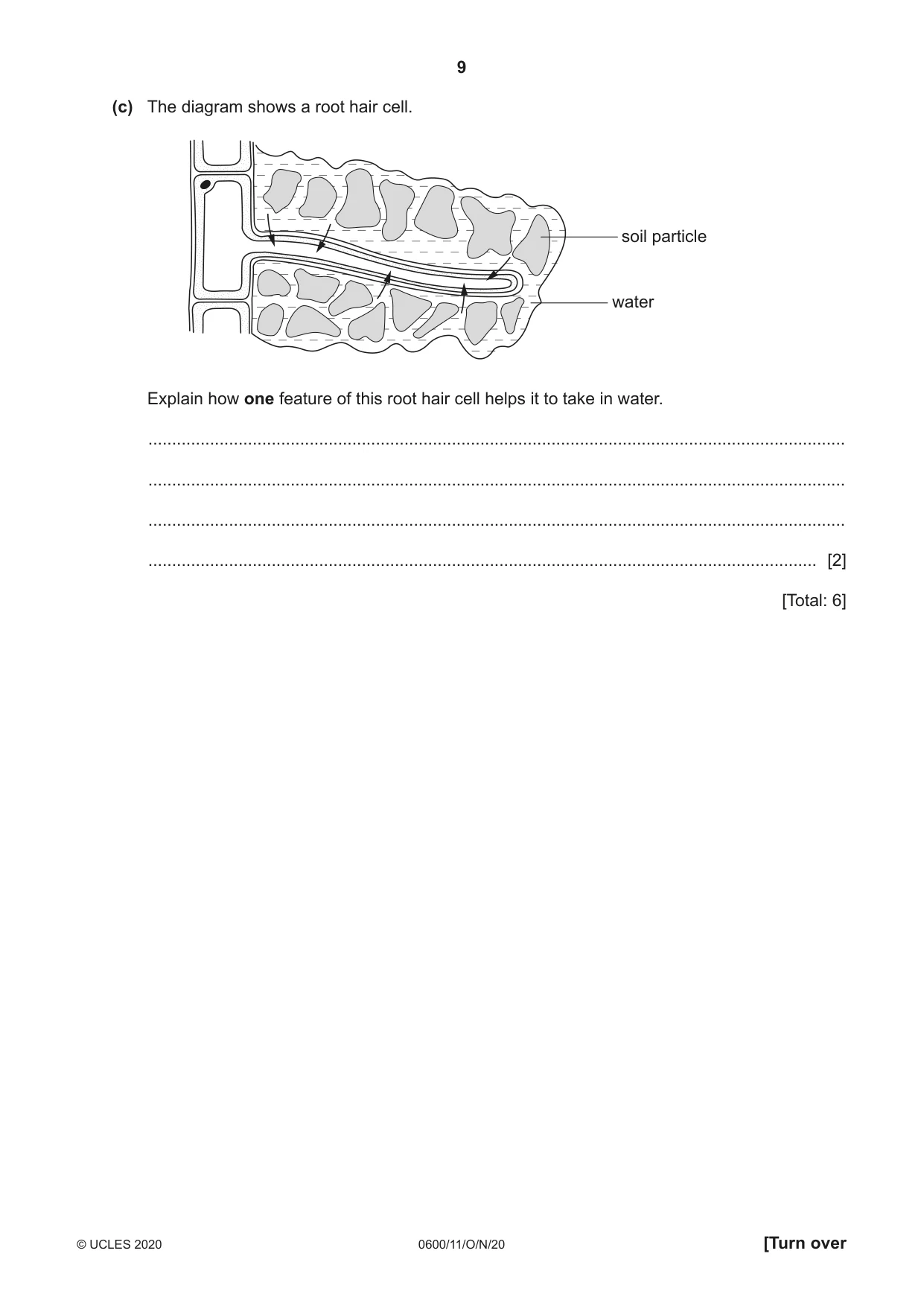
9 0600/11/O/N/20 © UCLES 2020 [Turn over (c) The diagram shows a root hair cell. soil particle water Explain how one feature of this root hair cell helps it to take in water. … … … … [2] [Total: 6]
Question paper, page 10
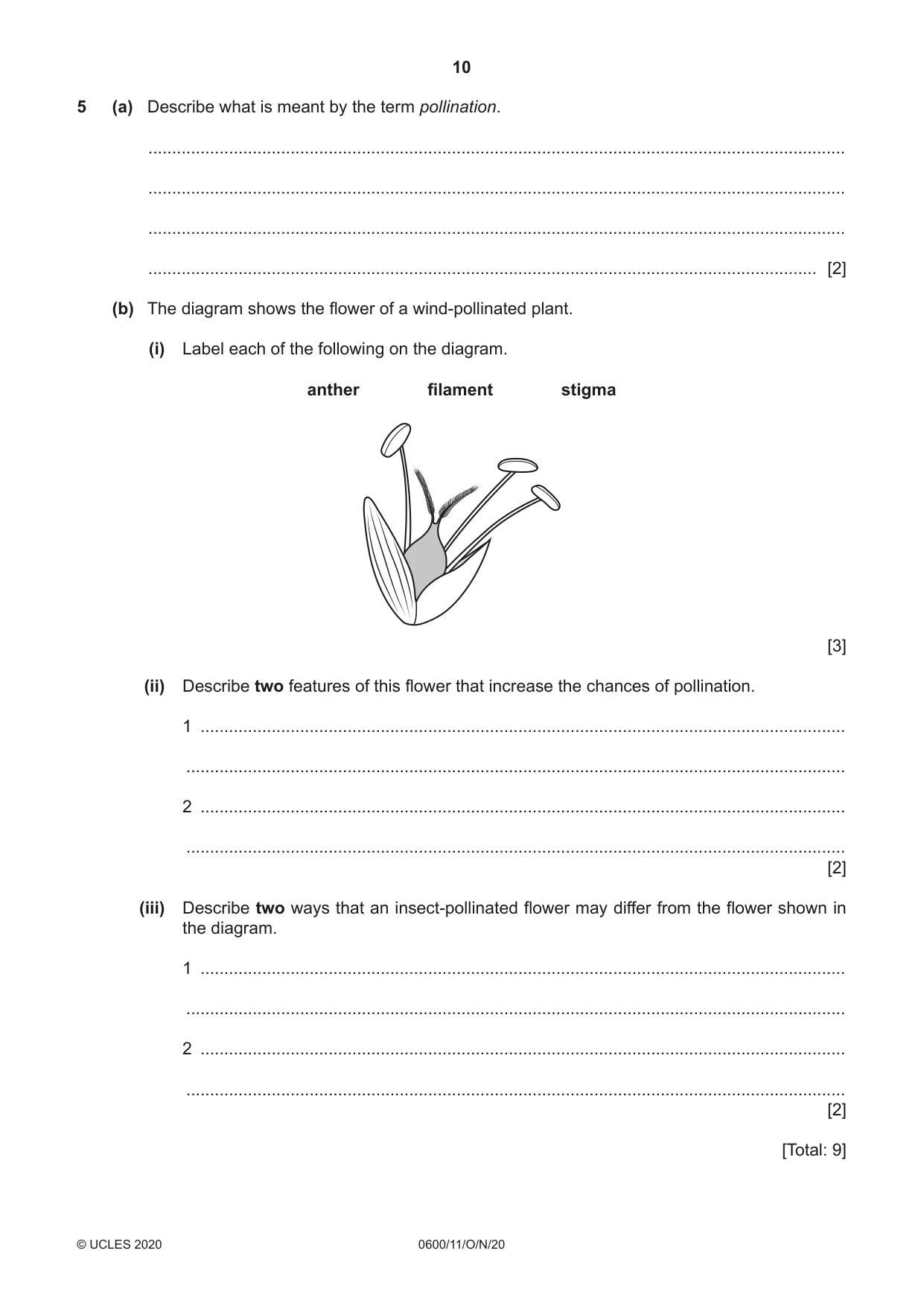
10 0600/11/O/N/20 © UCLES 2020 5 (a) Describe what is meant by the term pollination. … … … … [2] (b) The diagram shows the flower of a wind-pollinated plant. (i) Label each of the following on the diagram. anther filament stigma [3] (ii) Describe two features of this flower that increase the chances of pollination. 1 … … 2 … … [2] (iii) Describe two ways that an insect-pollinated flower may differ from the flower shown in the diagram. 1 … … 2 … … [2] [Total: 9]
Question paper, page 11
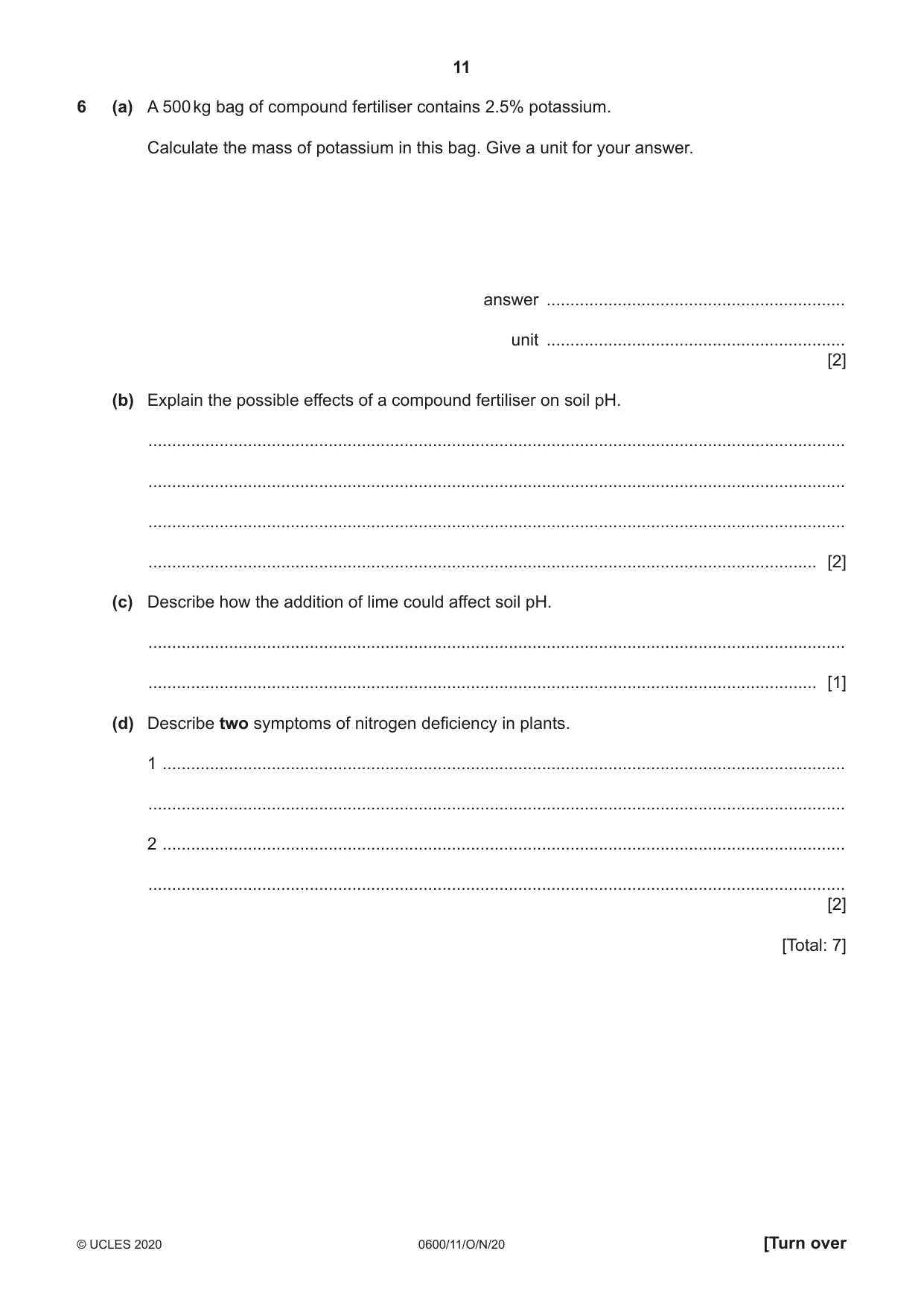
11 0600/11/O/N/20 © UCLES 2020 [Turn over 6 (a) A 500 kg bag of compound fertiliser contains 2.5% potassium. Calculate the mass of potassium in this bag. Give a unit for your answer. answer … unit … [2] (b) Explain the possible effects of a compound fertiliser on soil pH. … … … … [2] (c) Describe how the addition of lime could affect soil pH. … … [1] (d) Describe two symptoms of nitrogen deficiency in plants. 1 … … 2 … … [2] [Total: 7]
Question paper, page 12
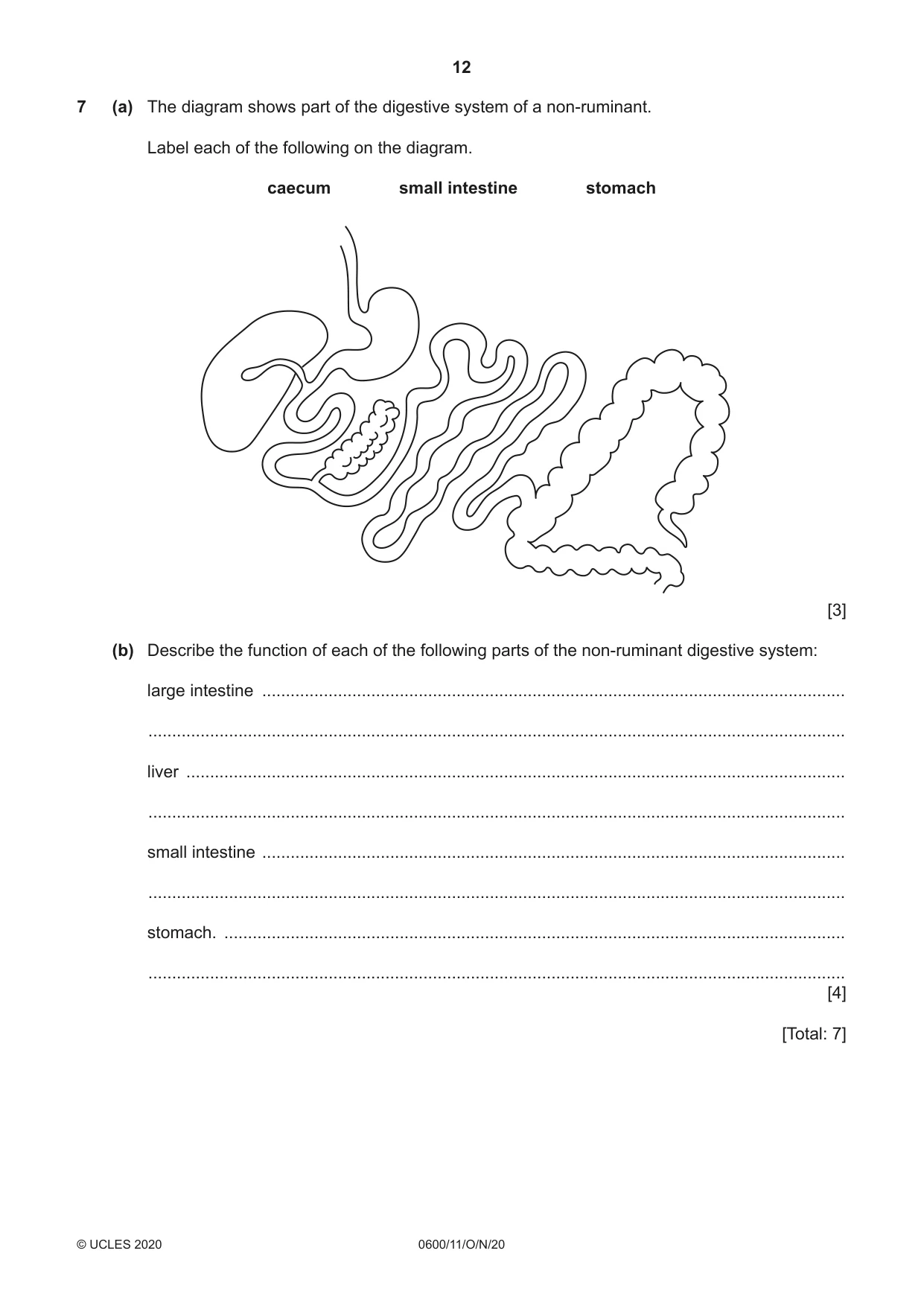
12 0600/11/O/N/20 © UCLES 2020 7 (a) The diagram shows part of the digestive system of a non-ruminant. Label each of the following on the diagram. caecum small intestine stomach [3] (b) Describe the function of each of the following parts of the non-ruminant digestive system: large intestine … … liver … … small intestine … … stomach. … … [4] [Total: 7]
Question paper, page 13
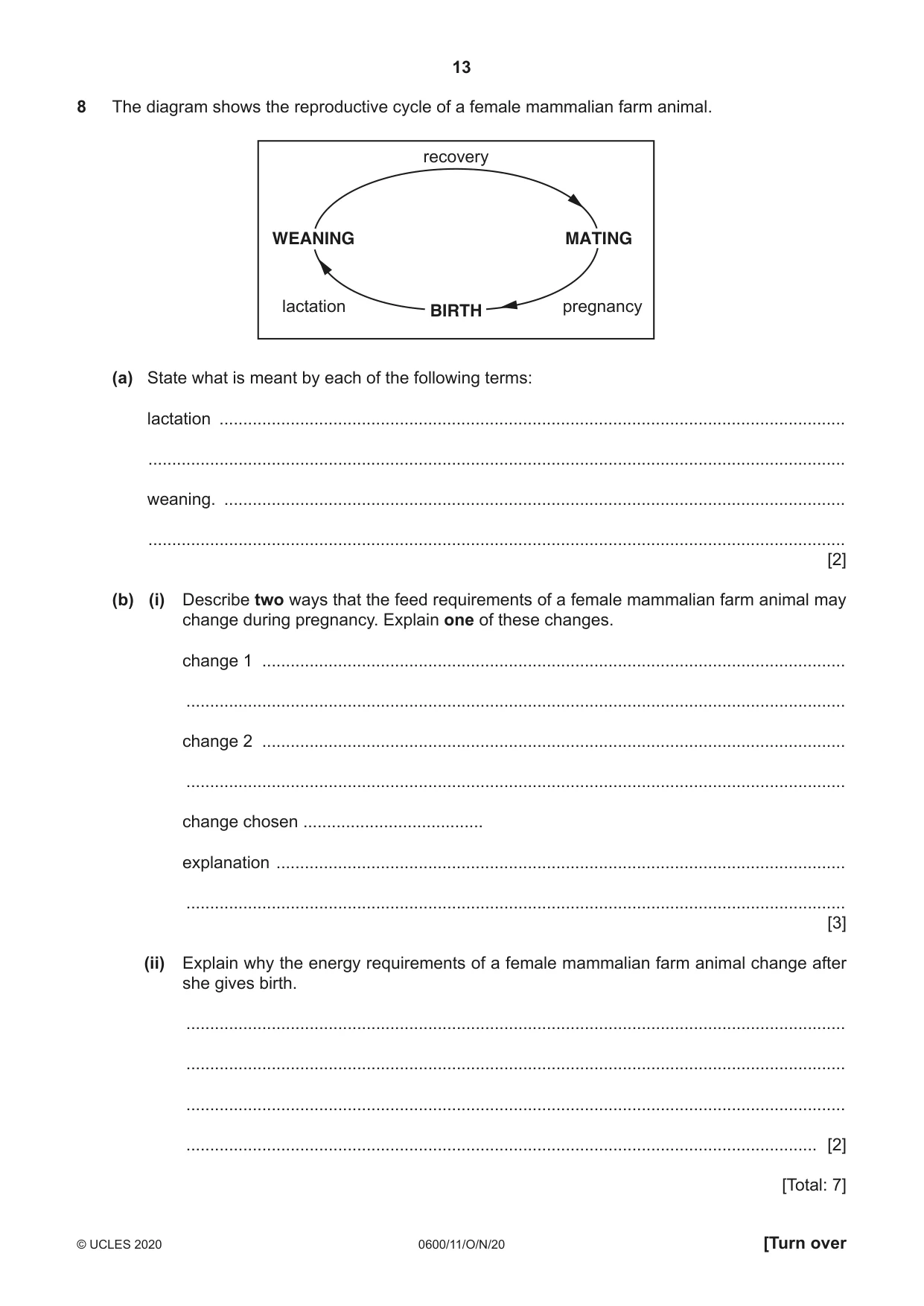
13 0600/11/O/N/20 © UCLES 2020 [Turn over 8 The diagram shows the reproductive cycle of a female mammalian farm animal. recovery BIRTH WEANING MATING lactation pregnancy (a) State what is meant by each of the following terms: lactation … … weaning. … … [2] (b) (i) Describe two ways that the feed requirements of a female mammalian farm animal may change during pregnancy. Explain one of these changes. change 1 … … change 2 … … change chosen … explanation … … [3] (ii) Explain why the energy requirements of a female mammalian farm animal change after she gives birth. … … … … [2] [Total: 7]
Question paper, page 14
14 0600/11/O/N/20 © UCLES 2020 9 Drought resistance in a plant is controlled by a single gene. The allele for drought resistance, D, is dominant. (a) State what is meant by the following terms: dominant … … heterozygous. … … [2] (b) (i) Draw a genetic diagram to show the expected ratio of offspring with drought resistance to offspring without drought resistance when crossing two heterozygous plants. [4] (ii) State the phenotype of a plant that has the genotype Dd. … … [1] (c) Suggest one characteristic, other than drought resistance, that might be bred into a crop. Explain how this might benefit a farmer. characteristic … explanation … … [2] [Total: 9]
Question paper, page 15
15 0600/11/O/N/20 © UCLES 2020 Section B Answer any two questions. Write your answers on the separate paper provided. 10 A young farmer has inherited a field that has been used for crop production for many years. Crop yields from the field are poor. (a) Suggest how the young farmer could improve the soil before they sow their first crop. [5] (b) For a named crop, explain how that crop should be planted and cared for to obtain maximum yield from the land. [5] (c) The site is very windy and dry. Describe what the farmer could do over the next few years to reduce the effect of these problems. [5] [Total: 15] 11 (a) Name a piercing and sucking crop pest and describe its effect on a crop. [4] (b) Describe how a pest could be controlled without the use of chemicals. [5] (c) Explain how growing genetically modified crops can affect farm profits. [6] [Total: 15] 12 (a) State what is meant by the term notifiable disease. Describe the action a farmer must take if a notifiable disease is suspected. [2] (b) Describe signs of ill-health in livestock. [7] (c) Explain how the spread of infectious diseases between farm animals can be reduced by good stockmanship. [6] [Total: 15] 13 (a) Explain what is meant by the term production ration. [3] (b) Describe livestock housing suitable for large farm animals. [6] (c) Explain how poorly designed livestock housing can lead to ill-health in animals. [6] [Total: 15] 14 (a) Describe how a supply of water could be obtained and stored. [4] (b) Describe how water supplied to a farm could be distributed to animals. [5] (c) Suggest why water may need to be treated to make it suitable for consumption by livestock. Describe how the water could be treated. [6] [Total: 15]
Question paper, page 16
16 0600/11/O/N/20 © UCLES 2020 Permission to reproduce items where third-party owned material protected by copyright is included has been sought and cleared where possible. Every reasonable effort has been made by the publisher (UCLES) to trace copyright holders, but if any items requiring clearance have unwittingly been included, the publisher will be pleased to make amends at the earliest possible opportunity. To avoid the issue of disclosure of answer-related information to candidates, all copyright acknowledgements are reproduced online in the Cambridge Assessment International Education Copyright Acknowledgements Booklet. This is produced for each series of examinations and is freely available to download at www.cambridgeinternational.org after the live examination series. Cambridge Assessment International Education is part of the Cambridge Assessment Group. Cambridge Assessment is the brand name of the University of Cambridge Local Examinations Syndicate (UCLES), which itself is a department of the University of Cambridge. BLANK PAGE
Mark scheme, page 1
This document consists of 25 printed pages. © UCLES 2020 [Turn over Cambridge IGCSE™ AGRICULTURE 0600/11 Paper 1 Theory October/November 2020 MARK SCHEME Maximum Mark: 100 Published This mark scheme is published as an aid to teachers and candidates, to indicate the requirements of the examination. It shows the basis on which Examiners were instructed to award marks. It does not indicate the details of the discussions that took place at an Examiners’ meeting before marking began, which would have considered the acceptability of alternative answers. Mark schemes should be read in conjunction with the question paper and the Principal Examiner Report for Teachers. Cambridge International will not enter into discussions about these mark schemes. Cambridge International is publishing the mark schemes for the October/November 2020 series for most Cambridge IGCSE™, Cambridge International A and AS Level and Cambridge Pre-U components, and some Cambridge O Level components.
Mark scheme, page 2
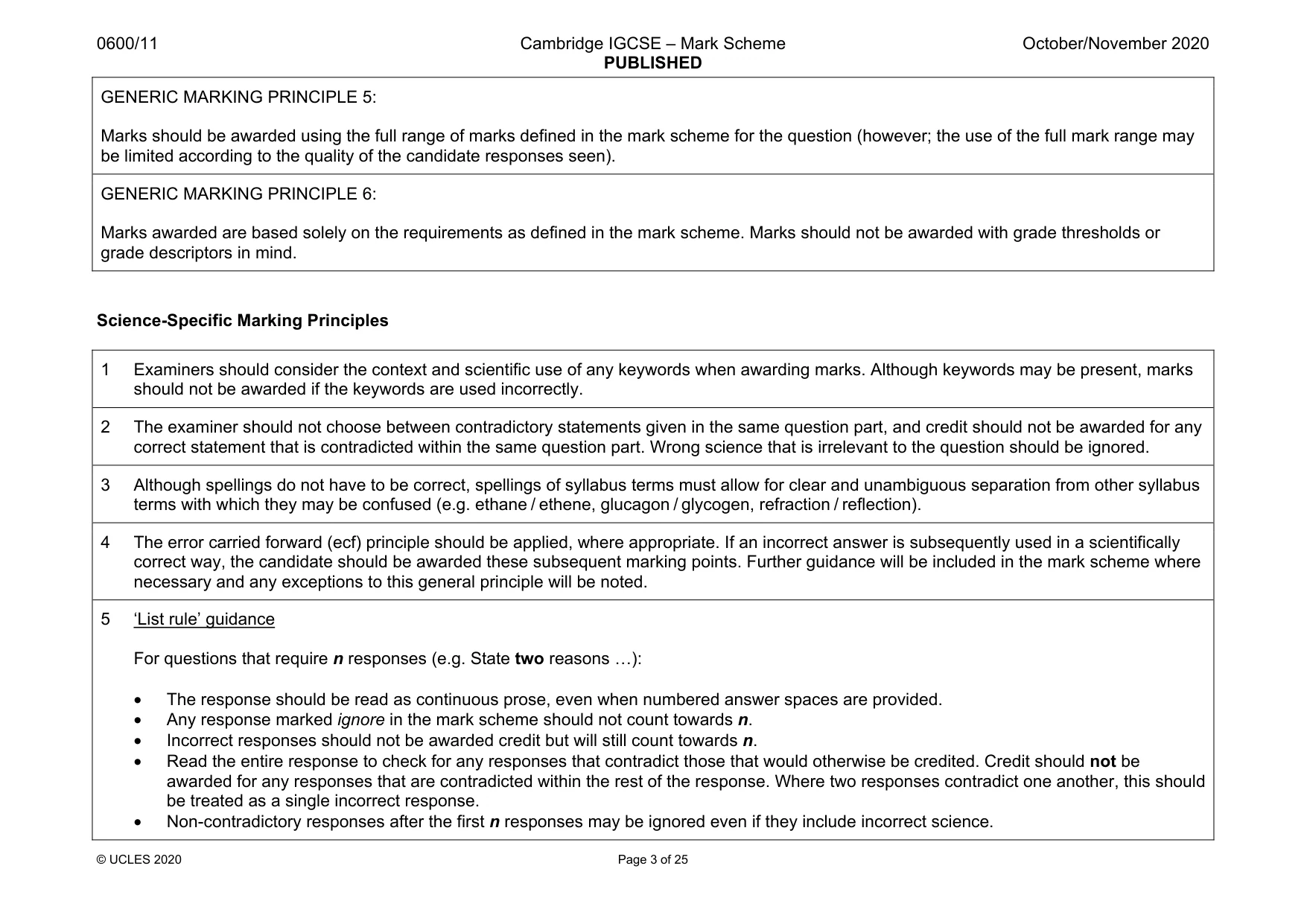
0600/11 Cambridge IGCSE – Mark Scheme PUBLISHED October/November 2020 © UCLES 2020 Page 2 of 25 Generic Marking Principles These general marking principles must be applied by all examiners when marking candidate answers. They should be applied alongside the specific content of the mark scheme or generic level descriptors for a question. Each question paper and mark scheme will also comply with these marking principles. GENERIC MARKING PRINCIPLE 1: Marks must be awarded in line with: • the specific content of the mark scheme or the generic level descriptors for the question • the specific skills defined in the mark scheme or in the generic level descriptors for the question • the standard of response required by a candidate as exemplified by the standardisation scripts. GENERIC MARKING PRINCIPLE 2: Marks awarded are always whole marks (not half marks, or other fractions). GENERIC MARKING PRINCIPLE 3: Marks must be awarded positively: • marks are awarded for correct/valid answers, as defined in the mark scheme. However, credit is given for valid answers which go beyond the scope of the syllabus and mark scheme, referring to your Team Leader as appropriate • marks are awarded when candidates clearly demonstrate what they know and can do • marks are not deducted for errors • marks are not deducted for omissions • answers should only be judged on the quality of spelling, punctuation and grammar when these features are specifically assessed by the question as indicated by the mark scheme. The meaning, however, should be unambiguous. GENERIC MARKING PRINCIPLE 4: Rules must be applied consistently, e.g. in situations where candidates have not followed instructions or in the application of generic level descriptors.
Mark scheme, page 3
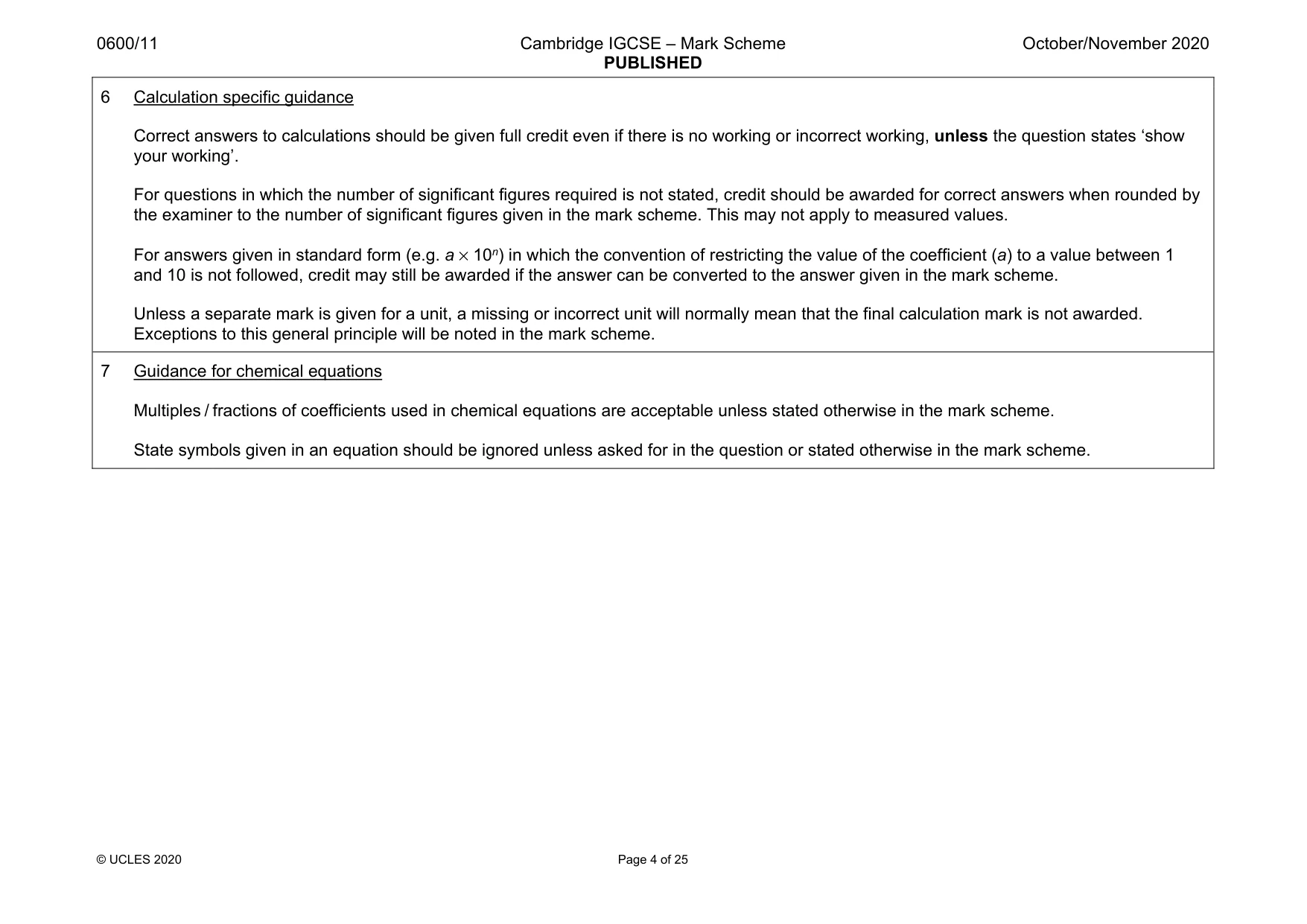
0600/11 Cambridge IGCSE – Mark Scheme PUBLISHED October/November 2020 © UCLES 2020 Page 3 of 25 GENERIC MARKING PRINCIPLE 5: Marks should be awarded using the full range of marks defined in the mark scheme for the question (however; the use of the full mark range may be limited according to the quality of the candidate responses seen). GENERIC MARKING PRINCIPLE 6: Marks awarded are based solely on the requirements as defined in the mark scheme. Marks should not be awarded with grade thresholds or grade descriptors in mind. Science-Specific Marking Principles 1 Examiners should consider the context and scientific use of any keywords when awarding marks. Although keywords may be present, marks should not be awarded if the keywords are used incorrectly. 2 The examiner should not choose between contradictory statements given in the same question part, and credit should not be awarded for any correct statement that is contradicted within the same question part. Wrong science that is irrelevant to the question should be ignored. 3 Although spellings do not have to be correct, spellings of syllabus terms must allow for clear and unambiguous separation from other syllabus terms with which they may be confused (e.g. ethane / ethene, glucagon / glycogen, refraction / reflection). 4 The error carried forward (ecf) principle should be applied, where appropriate. If an incorrect answer is subsequently used in a scientifically correct way, the candidate should be awarded these subsequent marking points. Further guidance will be included in the mark scheme where necessary and any exceptions to this general principle will be noted. 5 ‘List rule’ guidance For questions that require n responses (e.g. State two reasons …): • The response should be read as continuous prose, even when numbered answer spaces are provided. • Any response marked ignore in the mark scheme should not count towards n. • Incorrect responses should not be awarded credit but will still count towards n. • Read the entire response to check for any responses that contradict those that would otherwise be credited. Credit should not be awarded for any responses that are contradicted within the rest of the response. Where two responses contradict one another, this should be treated as a single incorrect response. • Non-contradictory responses after the first n responses may be ignored even if they include incorrect science.
Mark scheme, page 4
0600/11 Cambridge IGCSE – Mark Scheme PUBLISHED October/November 2020 © UCLES 2020 Page 4 of 25 6 Calculation specific guidance Correct answers to calculations should be given full credit even if there is no working or incorrect working, unless the question states ‘show your working’. For questions in which the number of significant figures required is not stated, credit should be awarded for correct answers when rounded by the examiner to the number of significant figures given in the mark scheme. This may not apply to measured values. For answers given in standard form (e.g. a × 10n) in which the convention of restricting the value of the coefficient (a) to a value between 1 and 10 is not followed, credit may still be awarded if the answer can be converted to the answer given in the mark scheme. Unless a separate mark is given for a unit, a missing or incorrect unit will normally mean that the final calculation mark is not awarded. Exceptions to this general principle will be noted in the mark scheme. 7 Guidance for chemical equations Multiples / fractions of coefficients used in chemical equations are acceptable unless stated otherwise in the mark scheme. State symbols given in an equation should be ignored unless asked for in the question or stated otherwise in the mark scheme.
Mark scheme, page 5
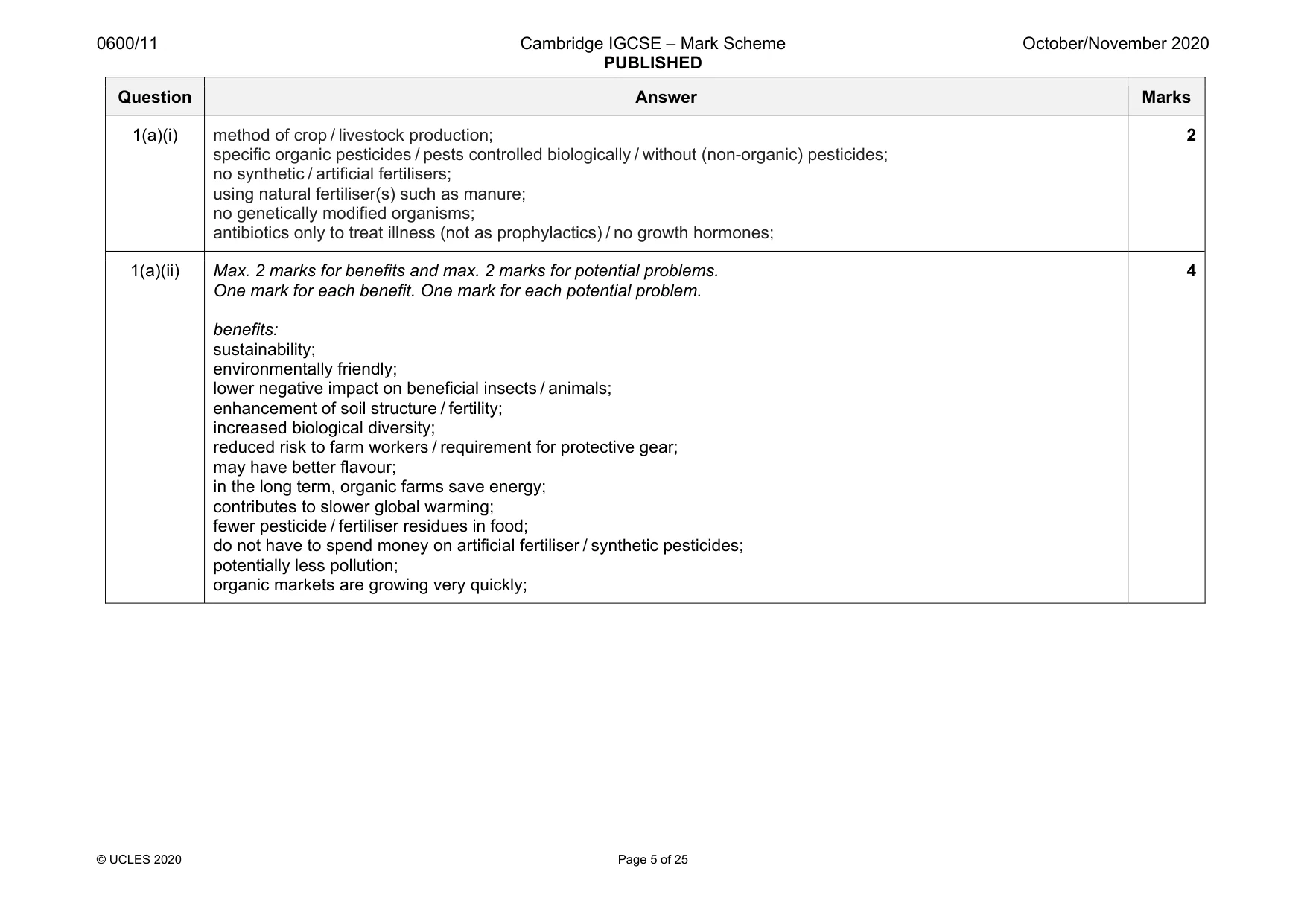
0600/11 Cambridge IGCSE – Mark Scheme PUBLISHED October/November 2020 © UCLES 2020 Page 5 of 25 Question Answer Marks 1(a)(i) method of crop / livestock production; specific organic pesticides / pests controlled biologically / without (non-organic) pesticides; no synthetic / artificial fertilisers; using natural fertiliser(s) such as manure; no genetically modified organisms; antibiotics only to treat illness (not as prophylactics) / no growth hormones; 2 1(a)(ii) Max. 2 marks for benefits and max. 2 marks for potential problems. One mark for each benefit. One mark for each potential problem. benefits: sustainability; environmentally friendly; lower negative impact on beneficial insects / animals; enhancement of soil structure / fertility; increased biological diversity; reduced risk to farm workers / requirement for protective gear; may have better flavour; in the long term, organic farms save energy; contributes to slower global warming; fewer pesticide / fertiliser residues in food; do not have to spend money on artificial fertiliser / synthetic pesticides; potentially less pollution; organic markets are growing very quickly; 4
Mark scheme, page 6
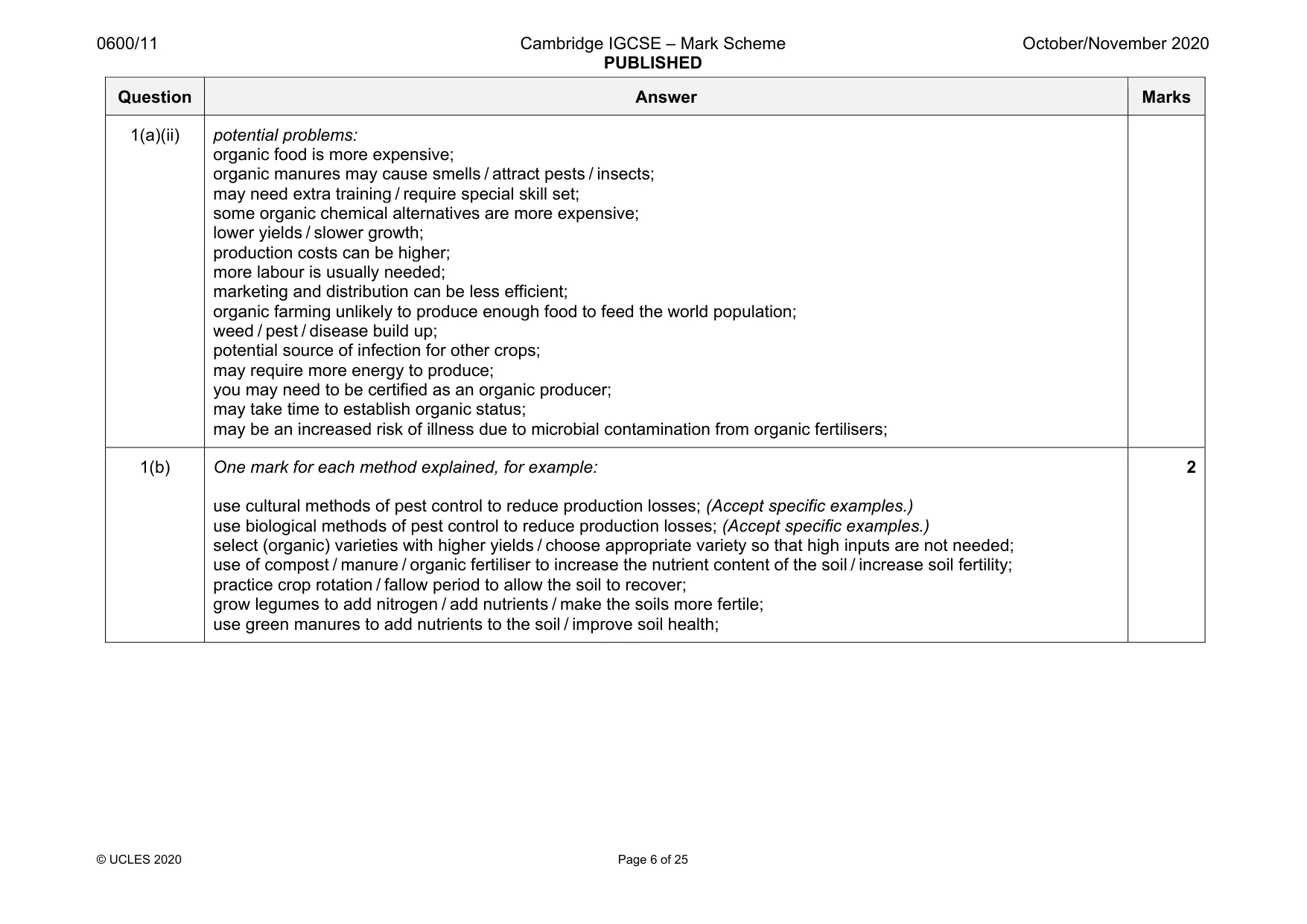
0600/11 Cambridge IGCSE – Mark Scheme PUBLISHED October/November 2020 © UCLES 2020 Page 6 of 25 Question Answer Marks 1(a)(ii) potential problems: organic food is more expensive; organic manures may cause smells / attract pests / insects; may need extra training / require special skill set; some organic chemical alternatives are more expensive; lower yields / slower growth; production costs can be higher; more labour is usually needed; marketing and distribution can be less efficient; organic farming unlikely to produce enough food to feed the world population; weed / pest / disease build up; potential source of infection for other crops; may require more energy to produce; you may need to be certified as an organic producer; may take time to establish organic status; may be an increased risk of illness due to microbial contamination from organic fertilisers; 1(b) One mark for each method explained, for example: use cultural methods of pest control to reduce production losses; (Accept specific examples.) use biological methods of pest control to reduce production losses; (Accept specific examples.) select (organic) varieties with higher yields / choose appropriate variety so that high inputs are not needed; use of compost / manure / organic fertiliser to increase the nutrient content of the soil / increase soil fertility; practice crop rotation / fallow period to allow the soil to recover; grow legumes to add nitrogen / add nutrients / make the soils more fertile; use green manures to add nutrients to the soil / improve soil health; 2
Mark scheme, page 7
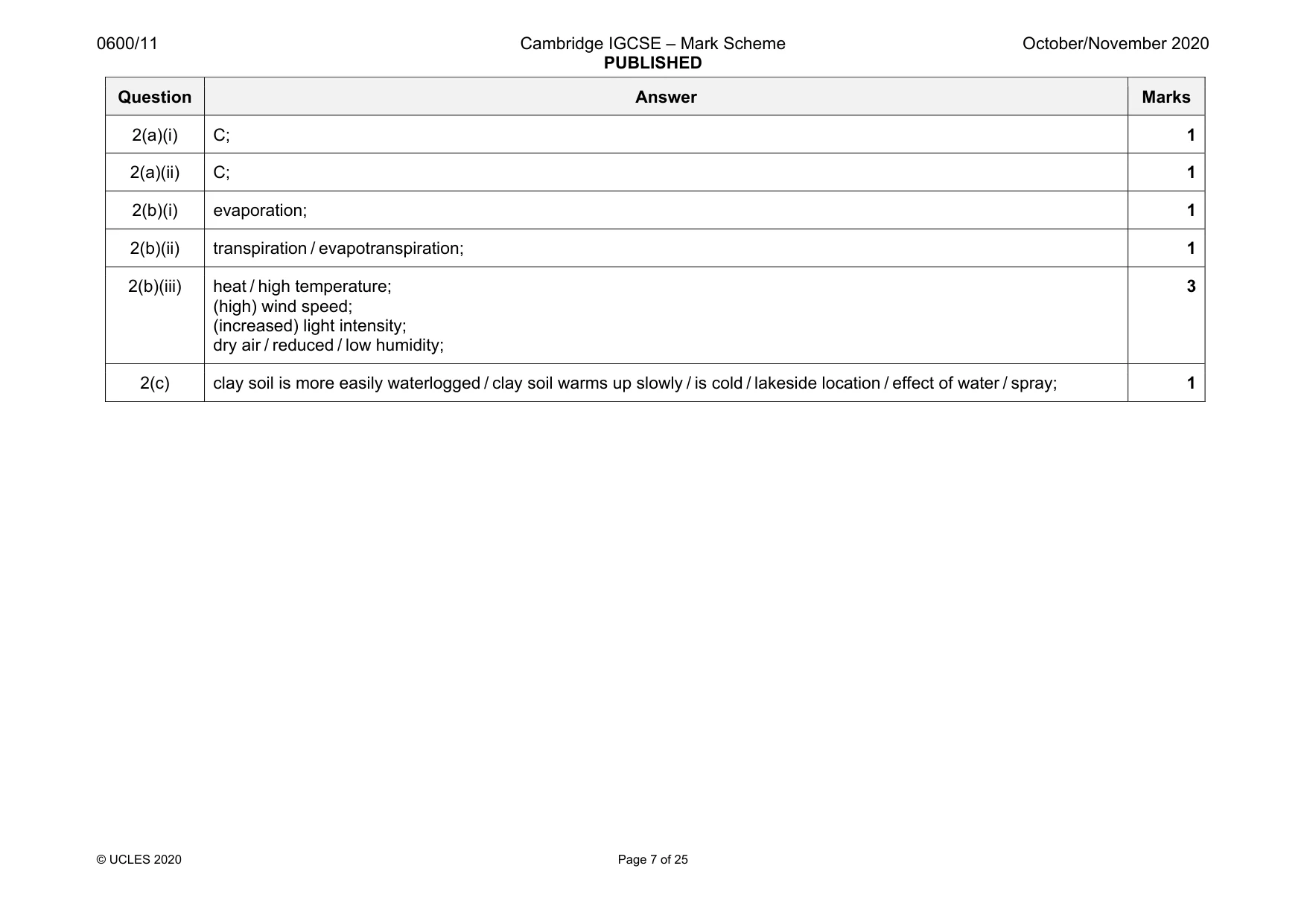
0600/11 Cambridge IGCSE – Mark Scheme PUBLISHED October/November 2020 © UCLES 2020 Page 7 of 25 Question Answer Marks 2(a)(i) C; 1 2(a)(ii) C; 1 2(b)(i) evaporation; 1 2(b)(ii) transpiration / evapotranspiration; 1 2(b)(iii) heat / high temperature; (high) wind speed; (increased) light intensity; dry air / reduced / low humidity; 3 2(c) clay soil is more easily waterlogged / clay soil warms up slowly / is cold / lakeside location / effect of water / spray; 1
Mark scheme, page 8
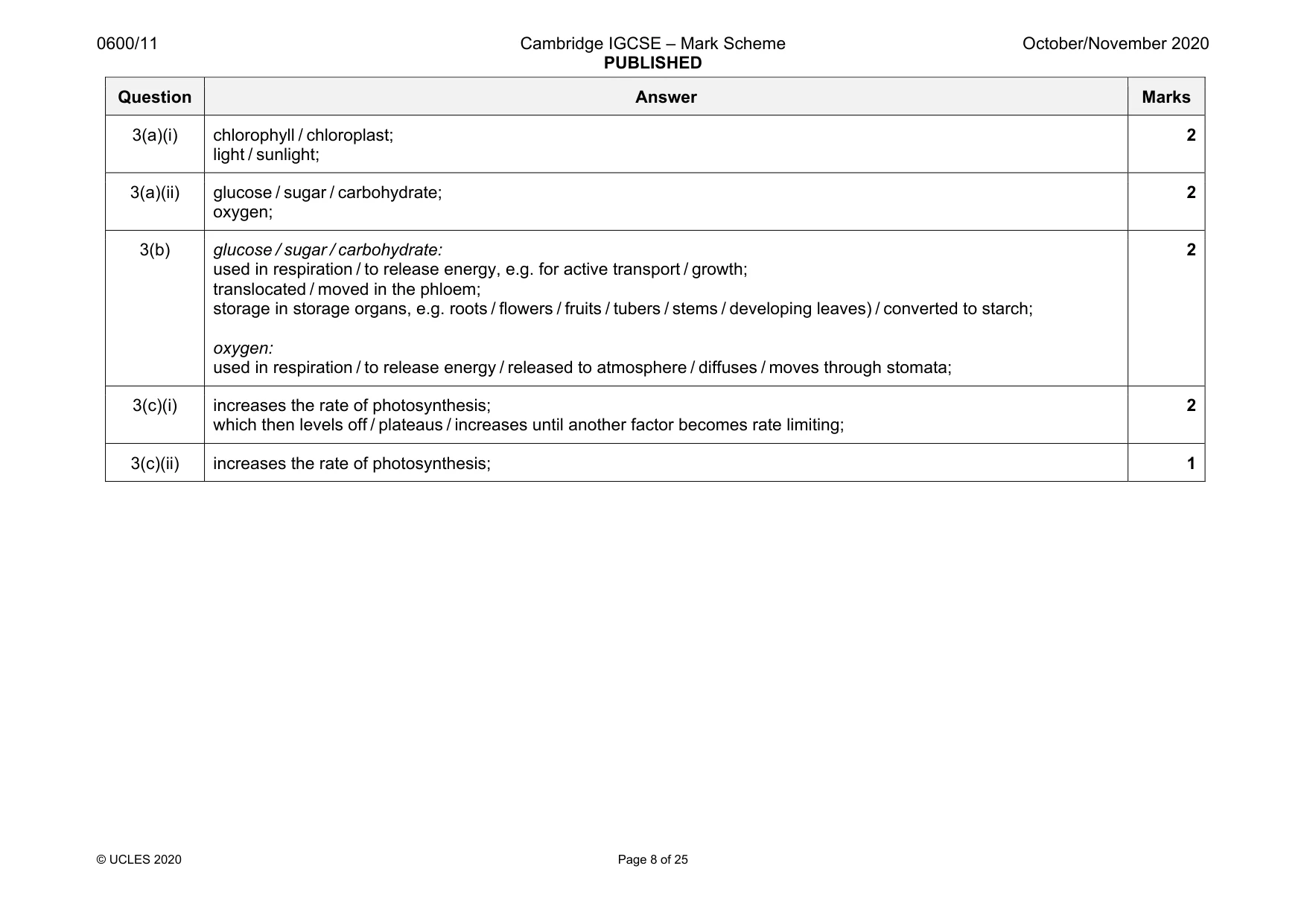
0600/11 Cambridge IGCSE – Mark Scheme PUBLISHED October/November 2020 © UCLES 2020 Page 8 of 25 Question Answer Marks 3(a)(i) chlorophyll / chloroplast; light / sunlight; 2 3(a)(ii) glucose / sugar / carbohydrate; oxygen; 2 3(b) glucose / sugar / carbohydrate: used in respiration / to release energy, e.g. for active transport / growth; translocated / moved in the phloem; storage in storage organs, e.g. roots / flowers / fruits / tubers / stems / developing leaves) / converted to starch; oxygen: used in respiration / to release energy / released to atmosphere / diffuses / moves through stomata; 2 3(c)(i) increases the rate of photosynthesis; which then levels off / plateaus / increases until another factor becomes rate limiting; 2 3(c)(ii) increases the rate of photosynthesis; 1
Mark scheme, page 9
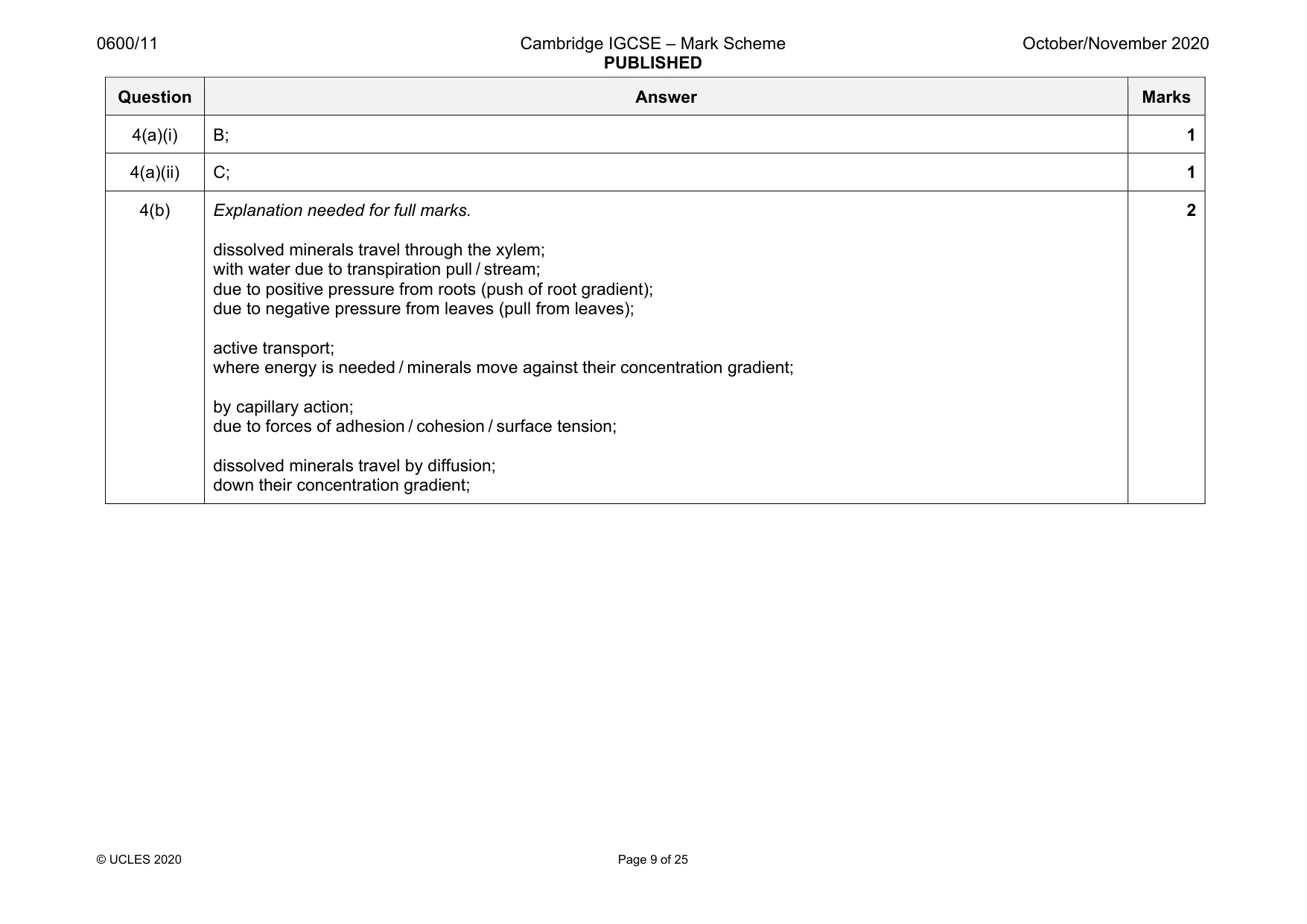
0600/11 Cambridge IGCSE – Mark Scheme PUBLISHED October/November 2020 © UCLES 2020 Page 9 of 25 Question Answer Marks 4(a)(i) B; 1 4(a)(ii) C; 1 4(b) Explanation needed for full marks. dissolved minerals travel through the xylem; with water due to transpiration pull / stream; due to positive pressure from roots (push of root gradient); due to negative pressure from leaves (pull from leaves); active transport; where energy is needed / minerals move against their concentration gradient; by capillary action; due to forces of adhesion / cohesion / surface tension; dissolved minerals travel by diffusion; down their concentration gradient; 2
Mark scheme, page 10
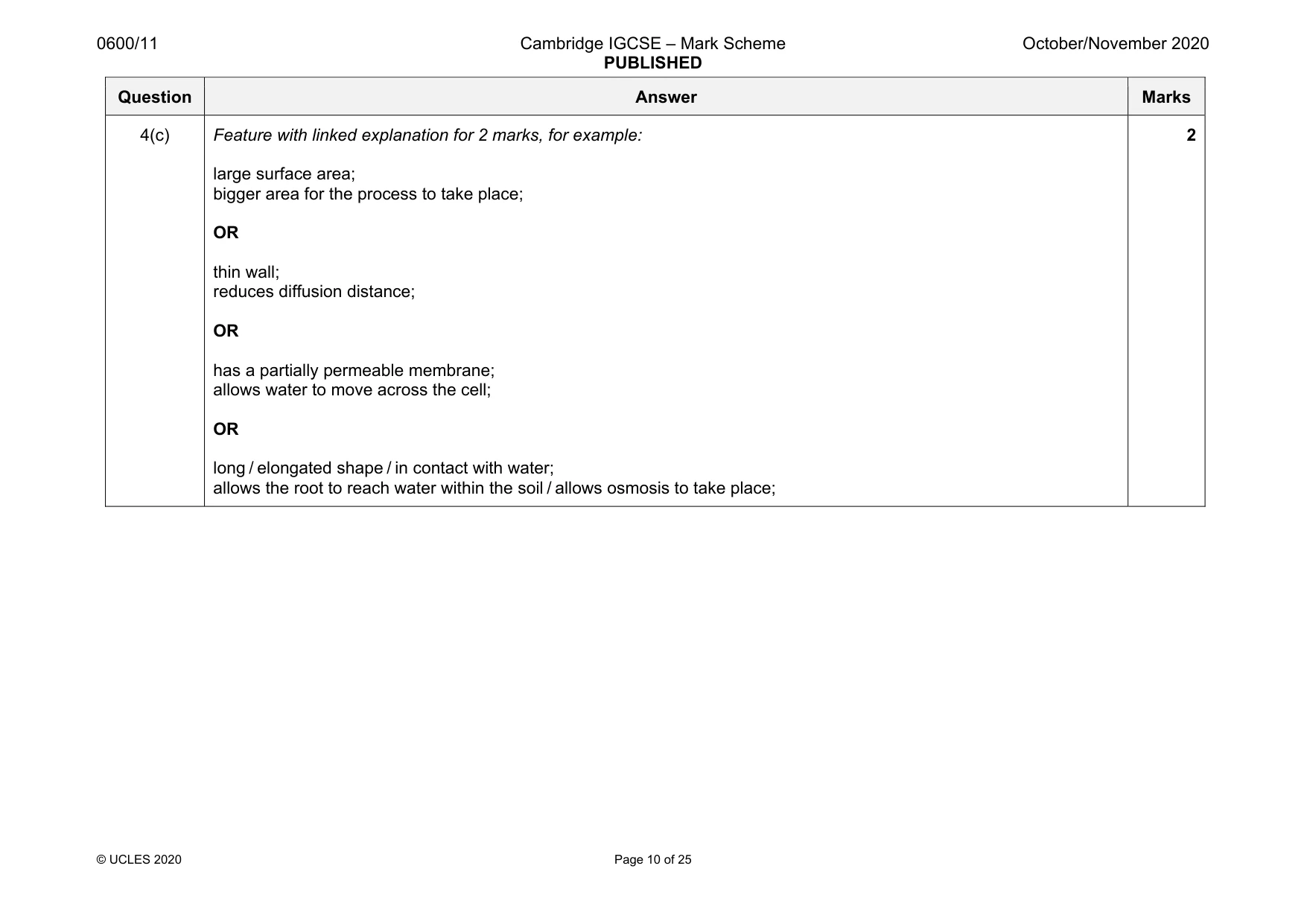
0600/11 Cambridge IGCSE – Mark Scheme PUBLISHED October/November 2020 © UCLES 2020 Page 10 of 25 Question Answer Marks 4(c) Feature with linked explanation for 2 marks, for example: large surface area; bigger area for the process to take place; OR thin wall; reduces diffusion distance; OR has a partially permeable membrane; allows water to move across the cell; OR long / elongated shape / in contact with water; allows the root to reach water within the soil / allows osmosis to take place; 2
Mark scheme, page 11
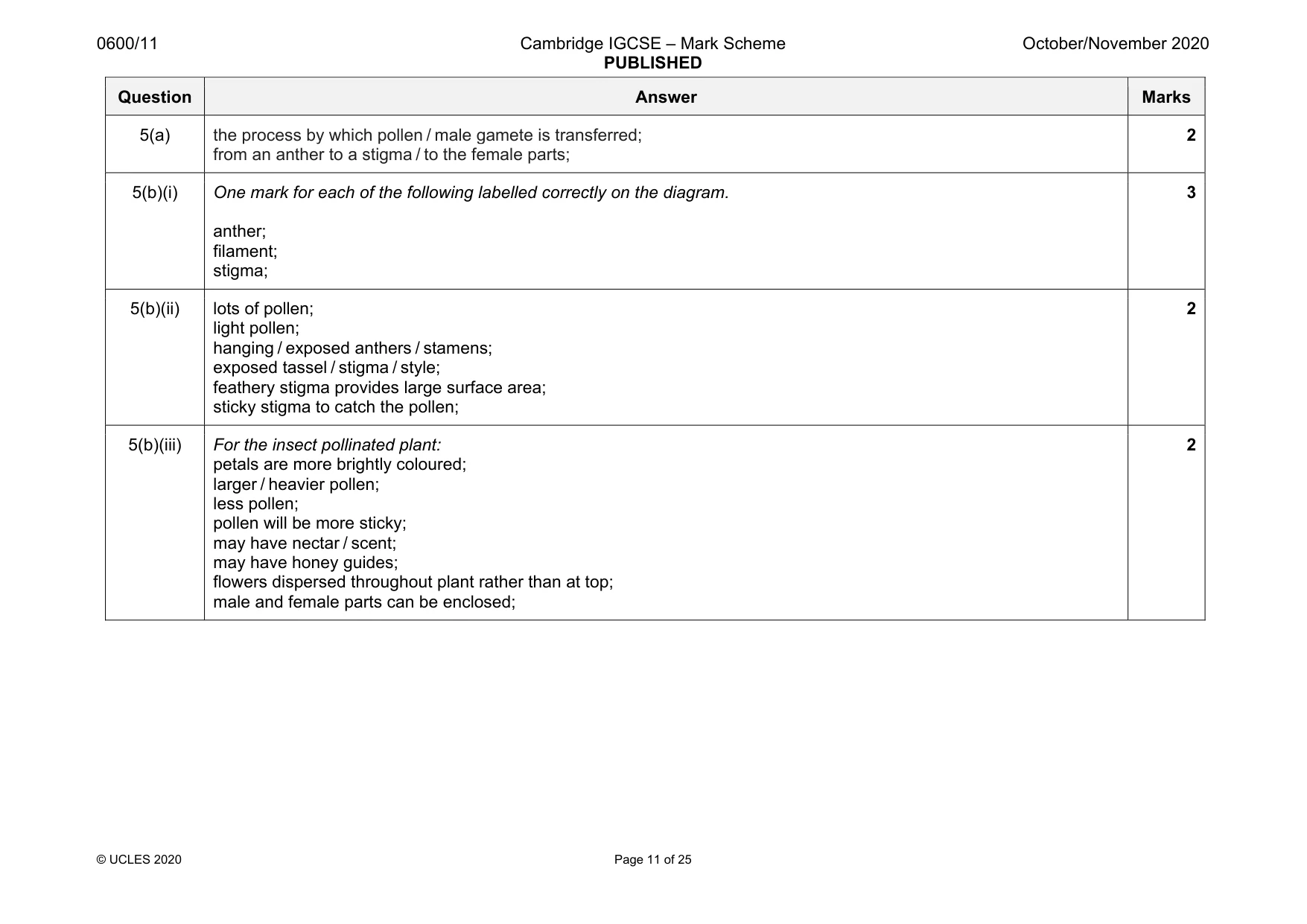
0600/11 Cambridge IGCSE – Mark Scheme PUBLISHED October/November 2020 © UCLES 2020 Page 11 of 25 Question Answer Marks 5(a) the process by which pollen / male gamete is transferred; from an anther to a stigma / to the female parts; 2 5(b)(i) One mark for each of the following labelled correctly on the diagram. anther; filament; stigma; 3 5(b)(ii) lots of pollen; light pollen; hanging / exposed anthers / stamens; exposed tassel / stigma / style; feathery stigma provides large surface area; sticky stigma to catch the pollen; 2 5(b)(iii) For the insect pollinated plant: petals are more brightly coloured; larger / heavier pollen; less pollen; pollen will be more sticky; may have nectar / scent; may have honey guides; flowers dispersed throughout plant rather than at top; male and female parts can be enclosed; 2
Mark scheme, page 12
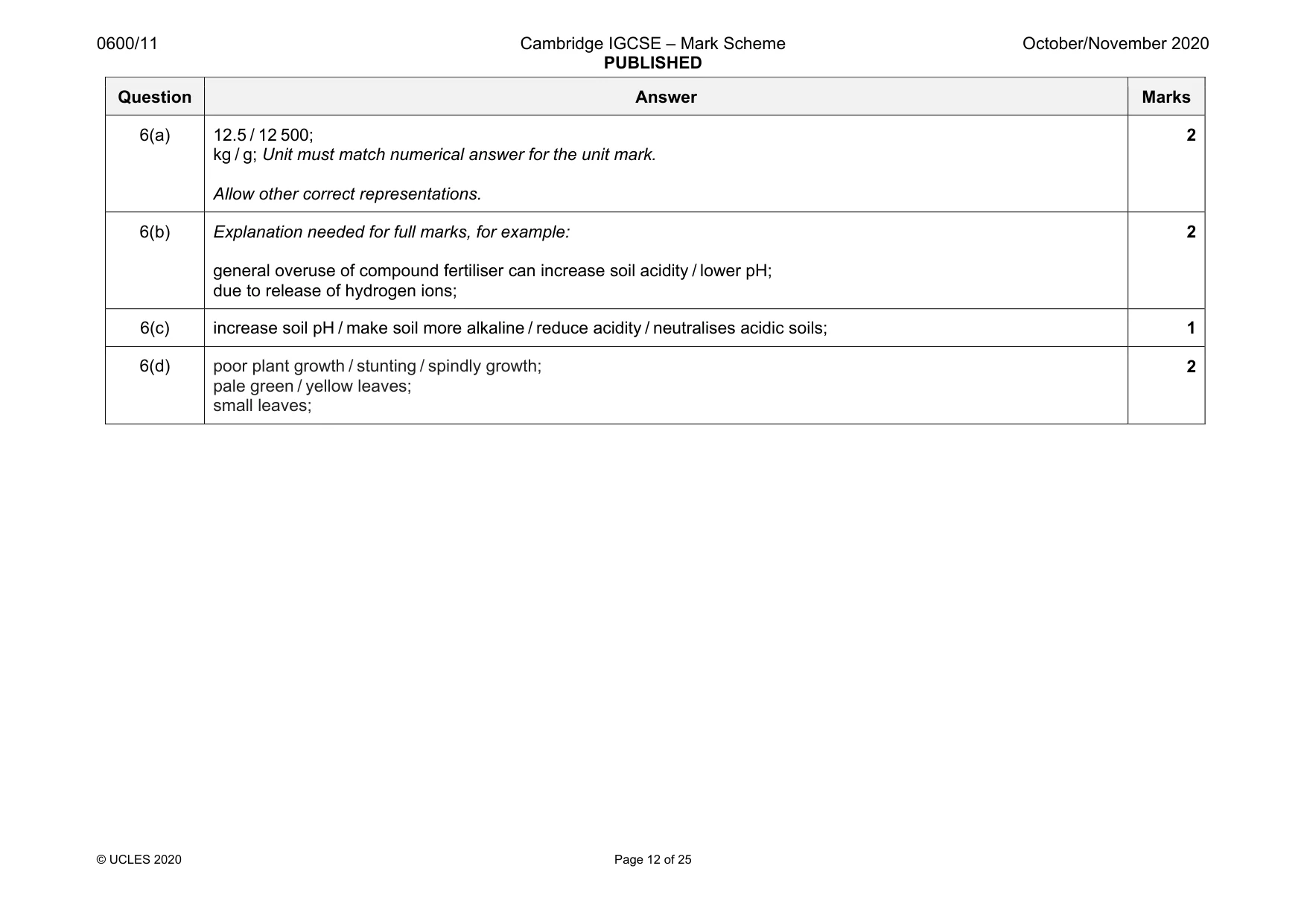
0600/11 Cambridge IGCSE – Mark Scheme PUBLISHED October/November 2020 © UCLES 2020 Page 12 of 25 Question Answer Marks 6(a) 12.5 / 12 500; kg / g; Unit must match numerical answer for the unit mark. Allow other correct representations. 2 6(b) Explanation needed for full marks, for example: general overuse of compound fertiliser can increase soil acidity / lower pH; due to release of hydrogen ions; 2 6(c) increase soil pH / make soil more alkaline / reduce acidity / neutralises acidic soils; 1 6(d) poor plant growth / stunting / spindly growth; pale green / yellow leaves; small leaves; 2
Mark scheme, page 13
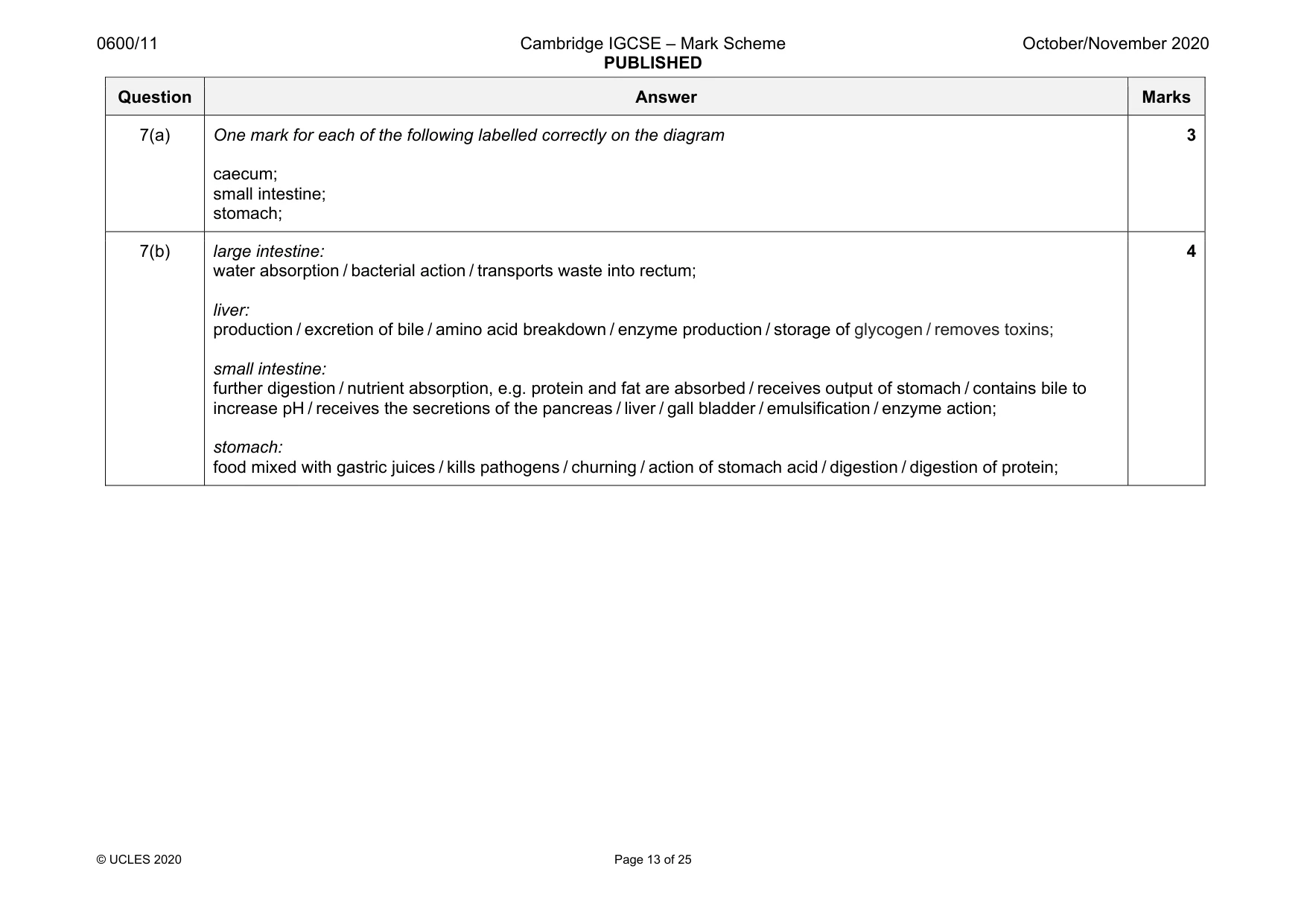
0600/11 Cambridge IGCSE – Mark Scheme PUBLISHED October/November 2020 © UCLES 2020 Page 13 of 25 Question Answer Marks 7(a) One mark for each of the following labelled correctly on the diagram caecum; small intestine; stomach; 3 7(b) large intestine: water absorption / bacterial action / transports waste into rectum; liver: production / excretion of bile / amino acid breakdown / enzyme production / storage of glycogen / removes toxins; small intestine: further digestion / nutrient absorption, e.g. protein and fat are absorbed / receives output of stomach / contains bile to increase pH / receives the secretions of the pancreas / liver / gall bladder / emulsification / enzyme action; stomach: food mixed with gastric juices / kills pathogens / churning / action of stomach acid / digestion / digestion of protein; 4
Mark scheme, page 14
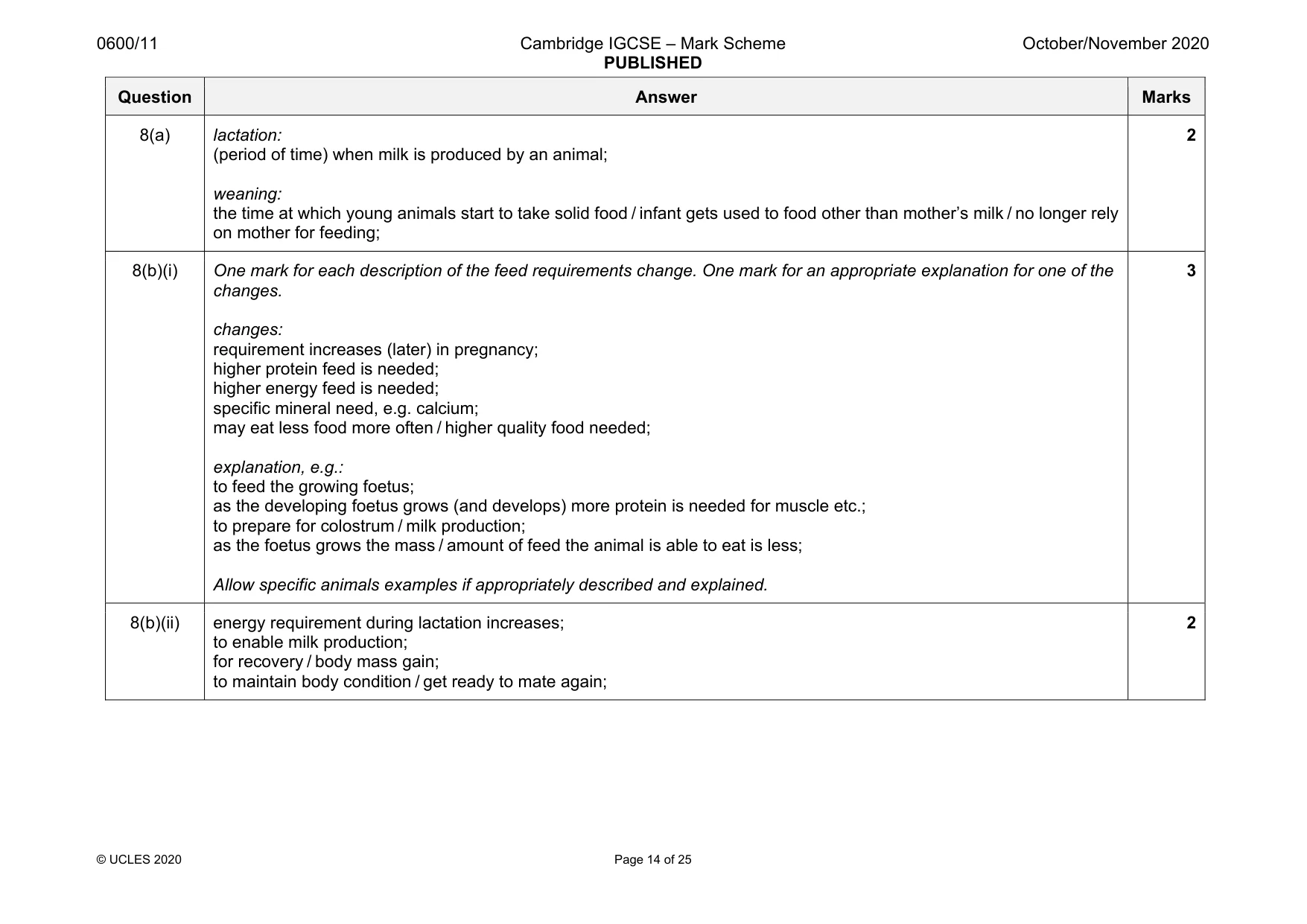
0600/11 Cambridge IGCSE – Mark Scheme PUBLISHED October/November 2020 © UCLES 2020 Page 14 of 25 Question Answer Marks 8(a) lactation: (period of time) when milk is produced by an animal; weaning: the time at which young animals start to take solid food / infant gets used to food other than mother’s milk / no longer rely on mother for feeding; 2 8(b)(i) One mark for each description of the feed requirements change. One mark for an appropriate explanation for one of the changes. changes: requirement increases (later) in pregnancy; higher protein feed is needed; higher energy feed is needed; specific mineral need, e.g. calcium; may eat less food more often / higher quality food needed; explanation, e.g.: to feed the growing foetus; as the developing foetus grows (and develops) more protein is needed for muscle etc.; to prepare for colostrum / milk production; as the foetus grows the mass / amount of feed the animal is able to eat is less; Allow specific animals examples if appropriately described and explained. 3 8(b)(ii) energy requirement during lactation increases; to enable milk production; for recovery / body mass gain; to maintain body condition / get ready to mate again; 2
Mark scheme, page 15
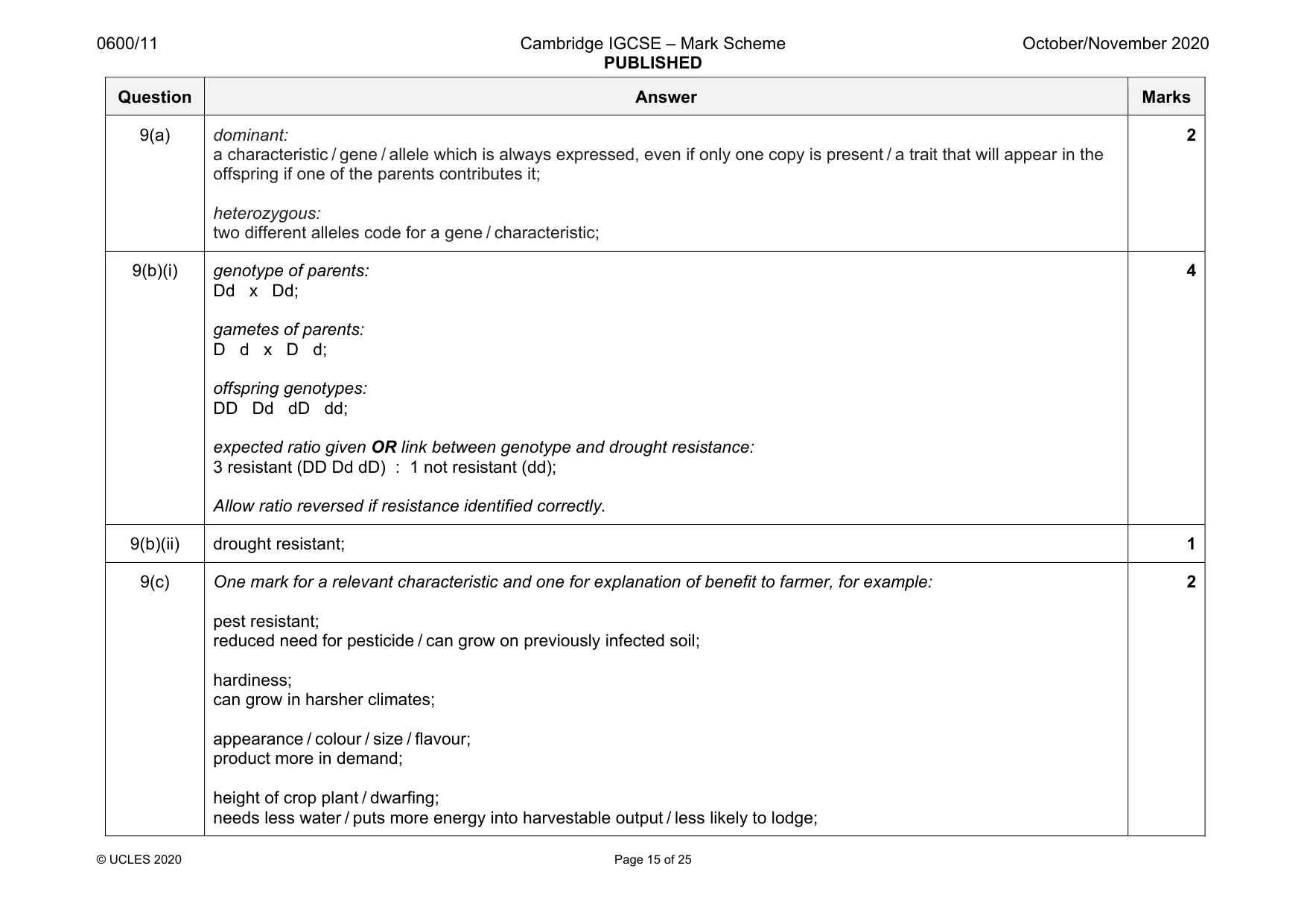
0600/11 Cambridge IGCSE – Mark Scheme PUBLISHED October/November 2020 © UCLES 2020 Page 15 of 25 Question Answer Marks 9(a) dominant: a characteristic / gene / allele which is always expressed, even if only one copy is present / a trait that will appear in the offspring if one of the parents contributes it; heterozygous: two different alleles code for a gene / characteristic; 2 9(b)(i) genotype of parents: Dd x Dd; gametes of parents: D d x D d; offspring genotypes: DD Dd dD dd; expected ratio given OR link between genotype and drought resistance: 3 resistant (DD Dd dD) : 1 not resistant (dd); Allow ratio reversed if resistance identified correctly. 4 9(b)(ii) drought resistant; 1 9(c) One mark for a relevant characteristic and one for explanation of benefit to farmer, for example: pest resistant; reduced need for pesticide / can grow on previously infected soil; hardiness; can grow in harsher climates; appearance / colour / size / flavour; product more in demand; height of crop plant / dwarfing; needs less water / puts more energy into harvestable output / less likely to lodge; 2
Mark scheme, page 16
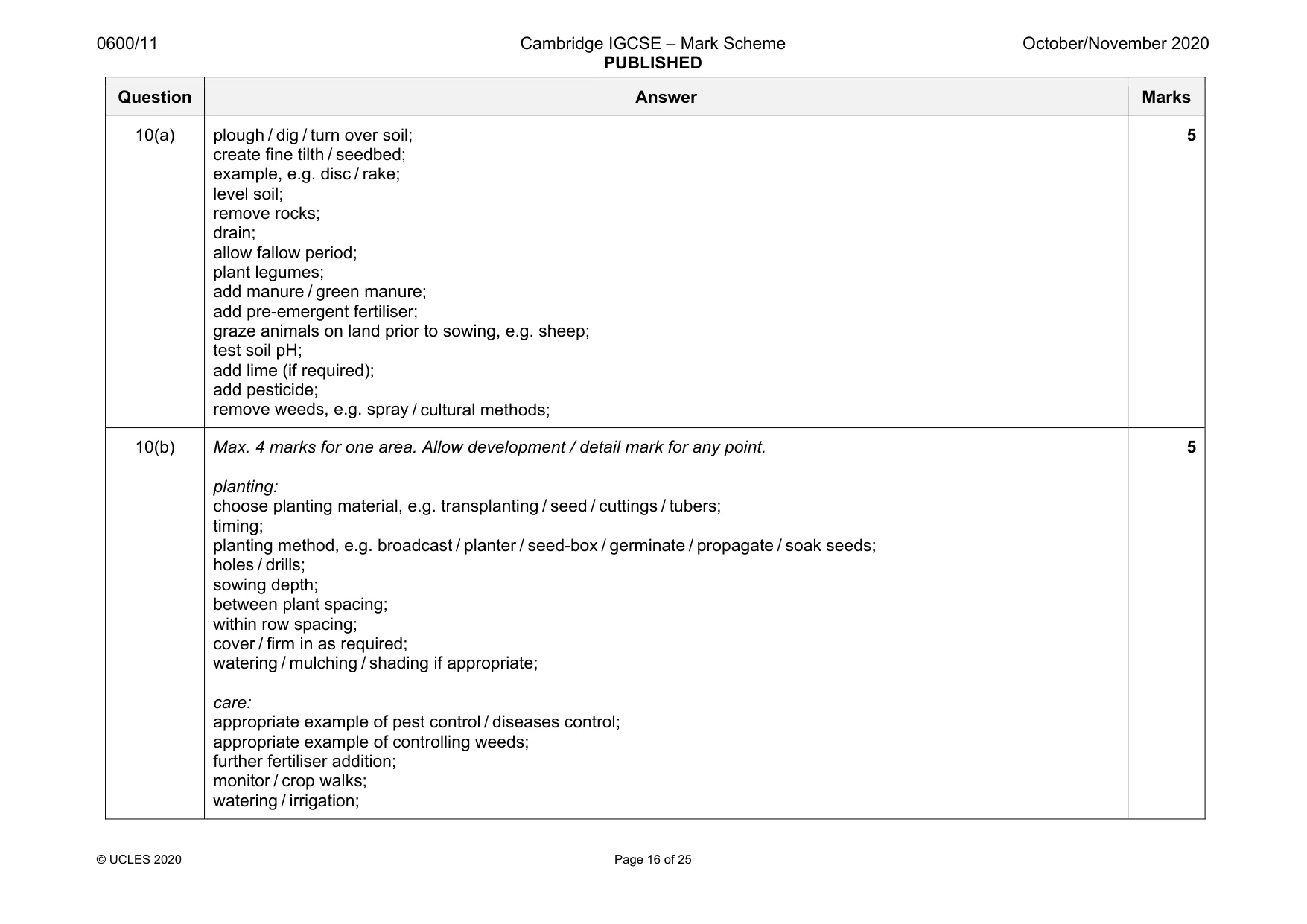
0600/11 Cambridge IGCSE – Mark Scheme PUBLISHED October/November 2020 © UCLES 2020 Page 16 of 25 Question Answer Marks 10(a) plough / dig / turn over soil; create fine tilth / seedbed; example, e.g. disc / rake; level soil; remove rocks; drain; allow fallow period; plant legumes; add manure / green manure; add pre-emergent fertiliser; graze animals on land prior to sowing, e.g. sheep; test soil pH; add lime (if required); add pesticide; remove weeds, e.g. spray / cultural methods; 5 10(b) Max. 4 marks for one area. Allow development / detail mark for any point. planting: choose planting material, e.g. transplanting / seed / cuttings / tubers; timing; planting method, e.g. broadcast / planter / seed-box / germinate / propagate / soak seeds; holes / drills; sowing depth; between plant spacing; within row spacing; cover / firm in as required; watering / mulching / shading if appropriate; care: appropriate example of pest control / diseases control; appropriate example of controlling weeds; further fertiliser addition; monitor / crop walks; watering / irrigation; 5
Mark scheme, page 17
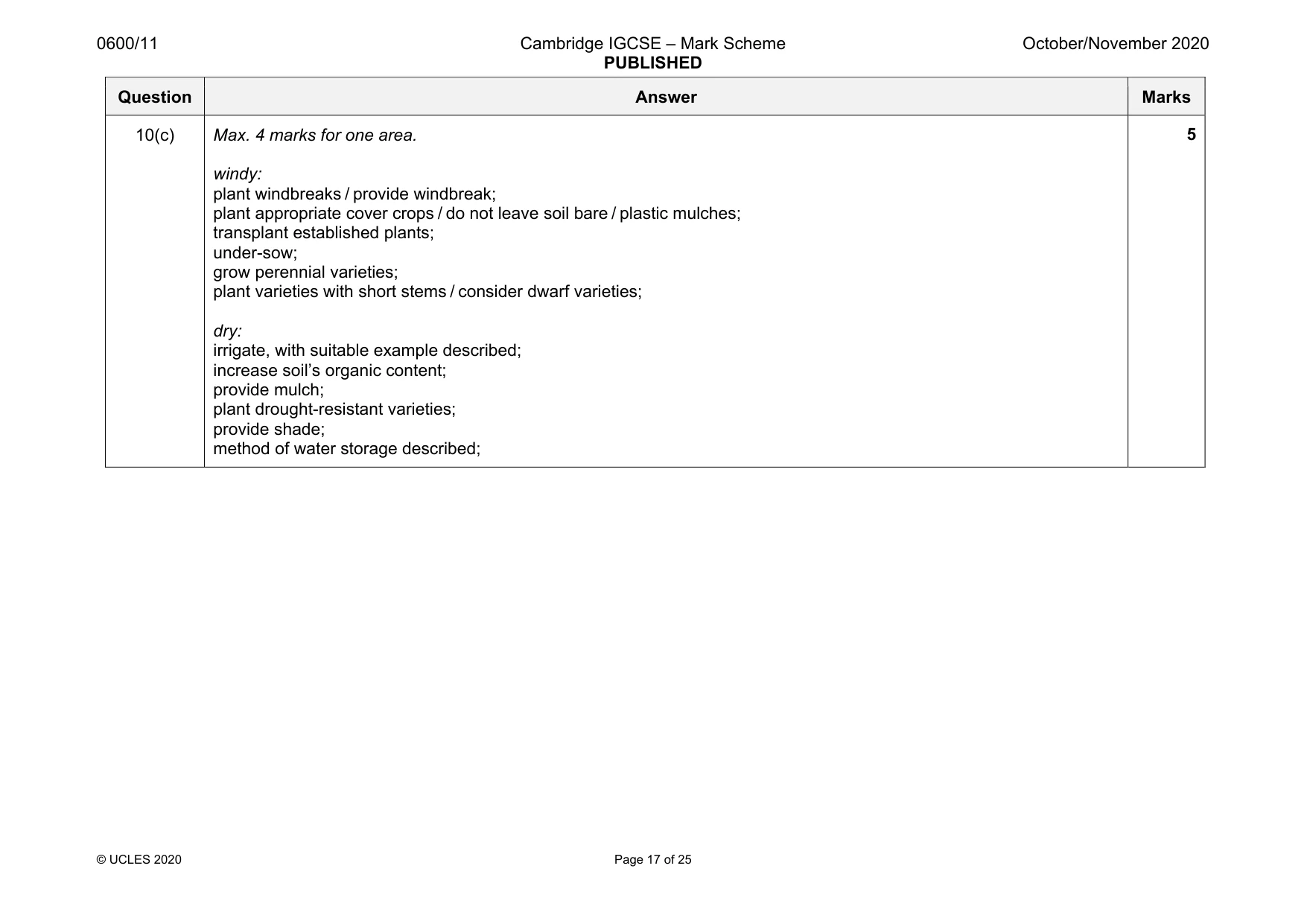
0600/11 Cambridge IGCSE – Mark Scheme PUBLISHED October/November 2020 © UCLES 2020 Page 17 of 25 Question Answer Marks 10(c) Max. 4 marks for one area. windy: plant windbreaks / provide windbreak; plant appropriate cover crops / do not leave soil bare / plastic mulches; transplant established plants; under-sow; grow perennial varieties; plant varieties with short stems / consider dwarf varieties; dry: irrigate, with suitable example described; increase soil’s organic content; provide mulch; plant drought-resistant varieties; provide shade; method of water storage described; 5
Mark scheme, page 18
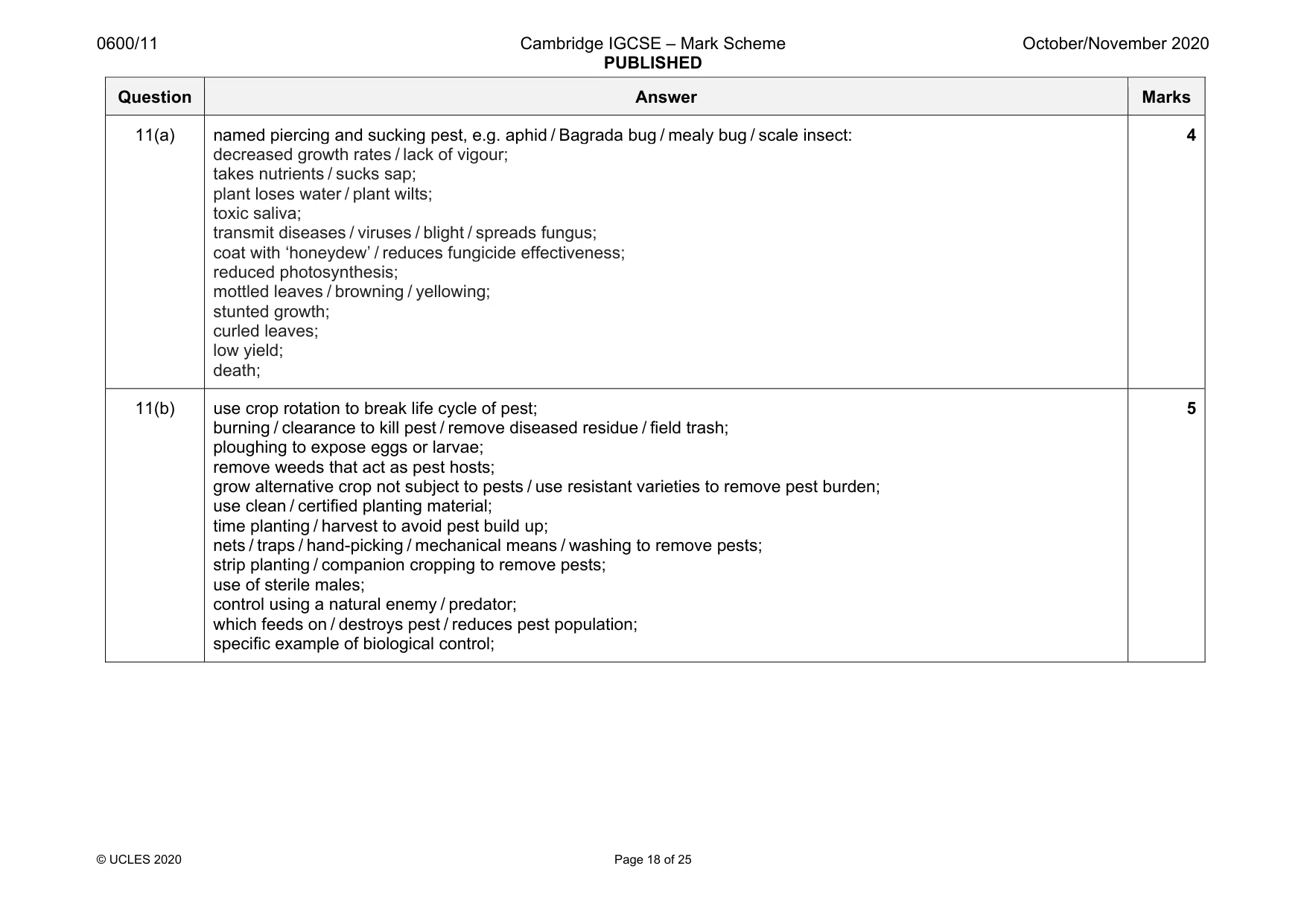
0600/11 Cambridge IGCSE – Mark Scheme PUBLISHED October/November 2020 © UCLES 2020 Page 18 of 25 Question Answer Marks 11(a) named piercing and sucking pest, e.g. aphid / Bagrada bug / mealy bug / scale insect: decreased growth rates / lack of vigour; takes nutrients / sucks sap; plant loses water / plant wilts; toxic saliva; transmit diseases / viruses / blight / spreads fungus; coat with ‘honeydew’ / reduces fungicide effectiveness; reduced photosynthesis; mottled leaves / browning / yellowing; stunted growth; curled leaves; low yield; death; 4 11(b) use crop rotation to break life cycle of pest; burning / clearance to kill pest / remove diseased residue / field trash; ploughing to expose eggs or larvae; remove weeds that act as pest hosts; grow alternative crop not subject to pests / use resistant varieties to remove pest burden; use clean / certified planting material; time planting / harvest to avoid pest build up; nets / traps / hand-picking / mechanical means / washing to remove pests; strip planting / companion cropping to remove pests; use of sterile males; control using a natural enemy / predator; which feeds on / destroys pest / reduces pest population; specific example of biological control; 5
Mark scheme, page 19
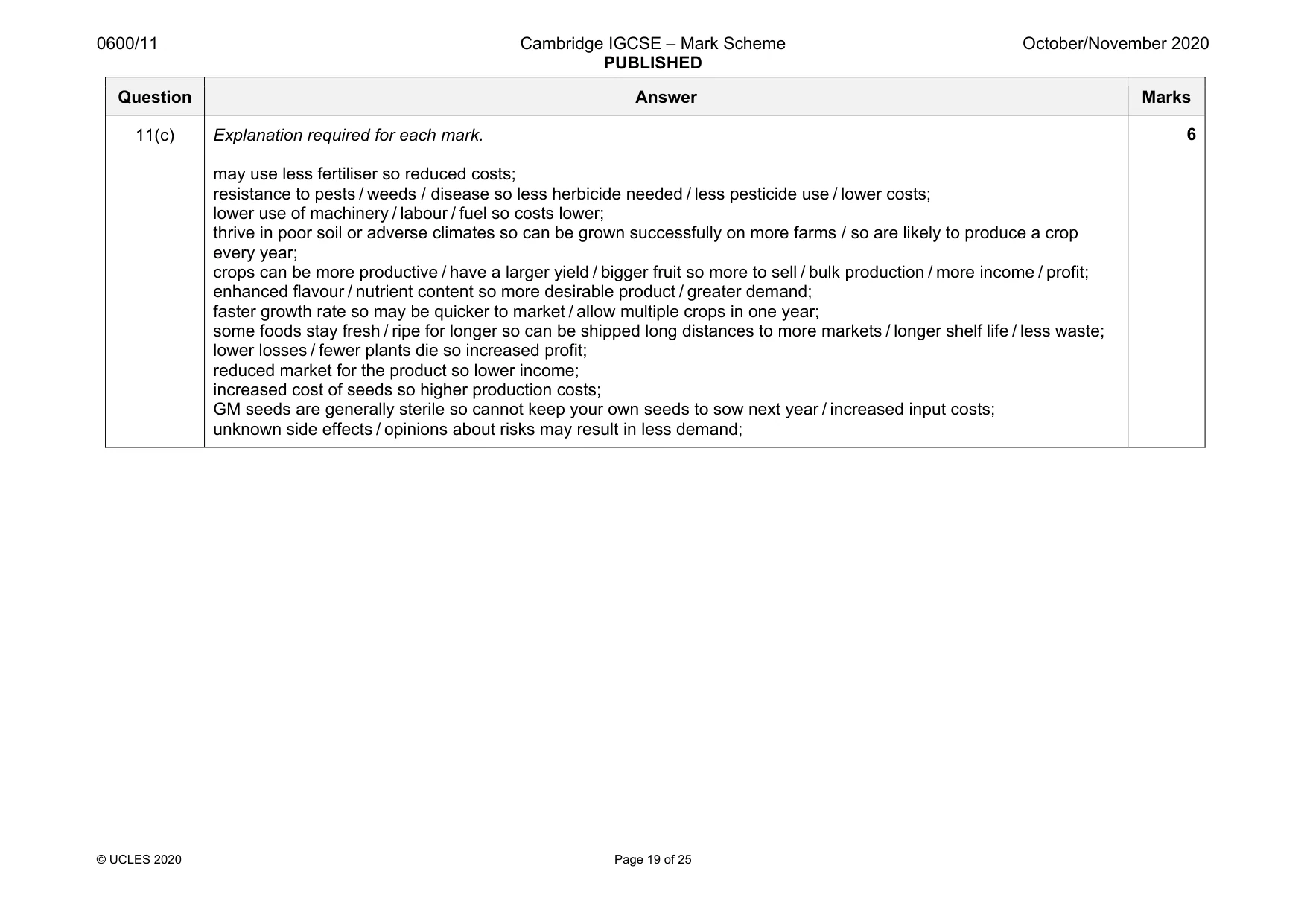
0600/11 Cambridge IGCSE – Mark Scheme PUBLISHED October/November 2020 © UCLES 2020 Page 19 of 25 Question Answer Marks 11(c) Explanation required for each mark. may use less fertiliser so reduced costs; resistance to pests / weeds / disease so less herbicide needed / less pesticide use / lower costs; lower use of machinery / labour / fuel so costs lower; thrive in poor soil or adverse climates so can be grown successfully on more farms / so are likely to produce a crop every year; crops can be more productive / have a larger yield / bigger fruit so more to sell / bulk production / more income / profit; enhanced flavour / nutrient content so more desirable product / greater demand; faster growth rate so may be quicker to market / allow multiple crops in one year; some foods stay fresh / ripe for longer so can be shipped long distances to more markets / longer shelf life / less waste; lower losses / fewer plants die so increased profit; reduced market for the product so lower income; increased cost of seeds so higher production costs; GM seeds are generally sterile so cannot keep your own seeds to sow next year / increased input costs; unknown side effects / opinions about risks may result in less demand; 6
Mark scheme, page 20
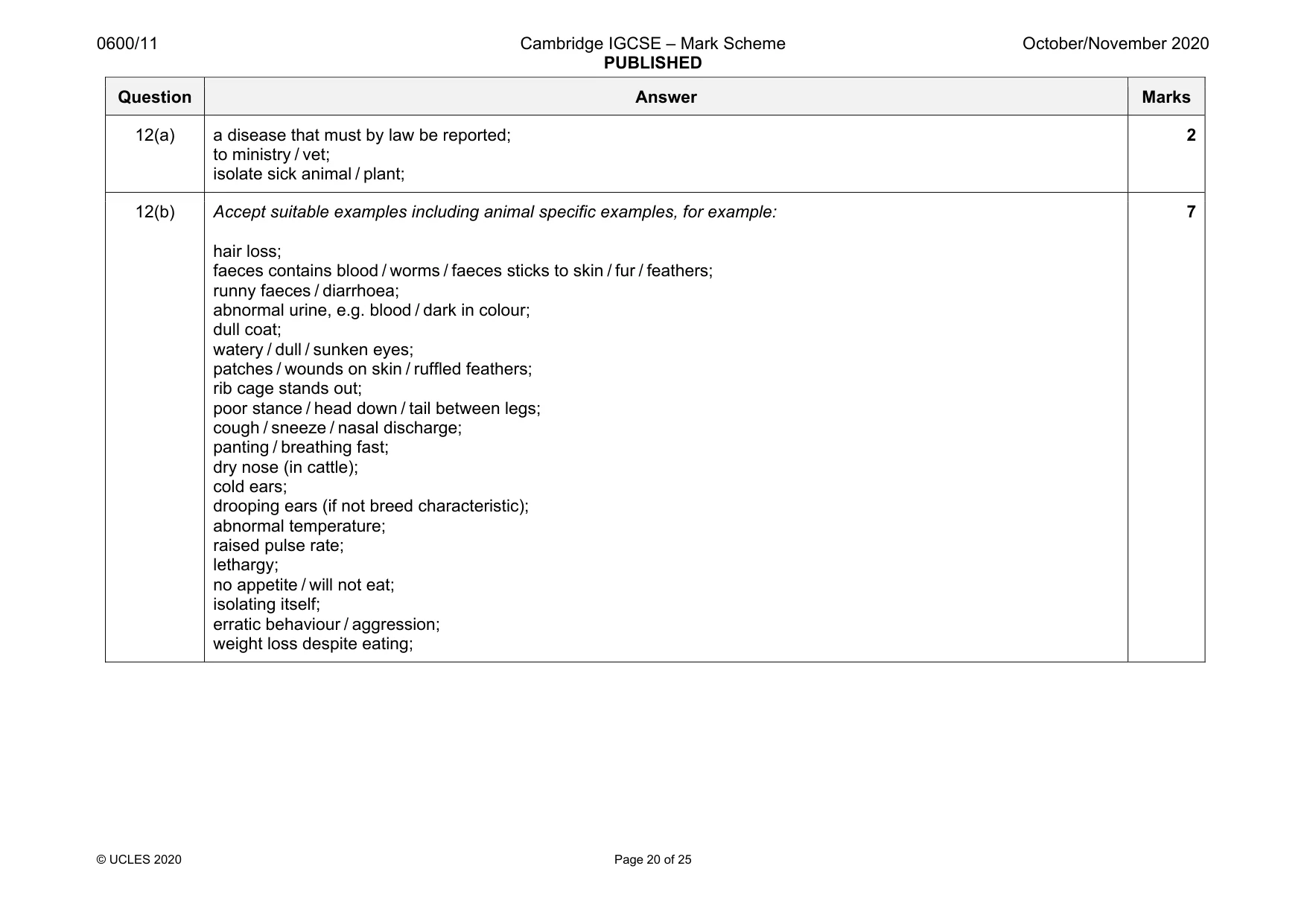
0600/11 Cambridge IGCSE – Mark Scheme PUBLISHED October/November 2020 © UCLES 2020 Page 20 of 25 Question Answer Marks 12(a) a disease that must by law be reported; to ministry / vet; isolate sick animal / plant; 2 12(b) Accept suitable examples including animal specific examples, for example: hair loss; faeces contains blood / worms / faeces sticks to skin / fur / feathers; runny faeces / diarrhoea; abnormal urine, e.g. blood / dark in colour; dull coat; watery / dull / sunken eyes; patches / wounds on skin / ruffled feathers; rib cage stands out; poor stance / head down / tail between legs; cough / sneeze / nasal discharge; panting / breathing fast; dry nose (in cattle); cold ears; drooping ears (if not breed characteristic); abnormal temperature; raised pulse rate; lethargy; no appetite / will not eat; isolating itself; erratic behaviour / aggression; weight loss despite eating; 7
Mark scheme, page 21
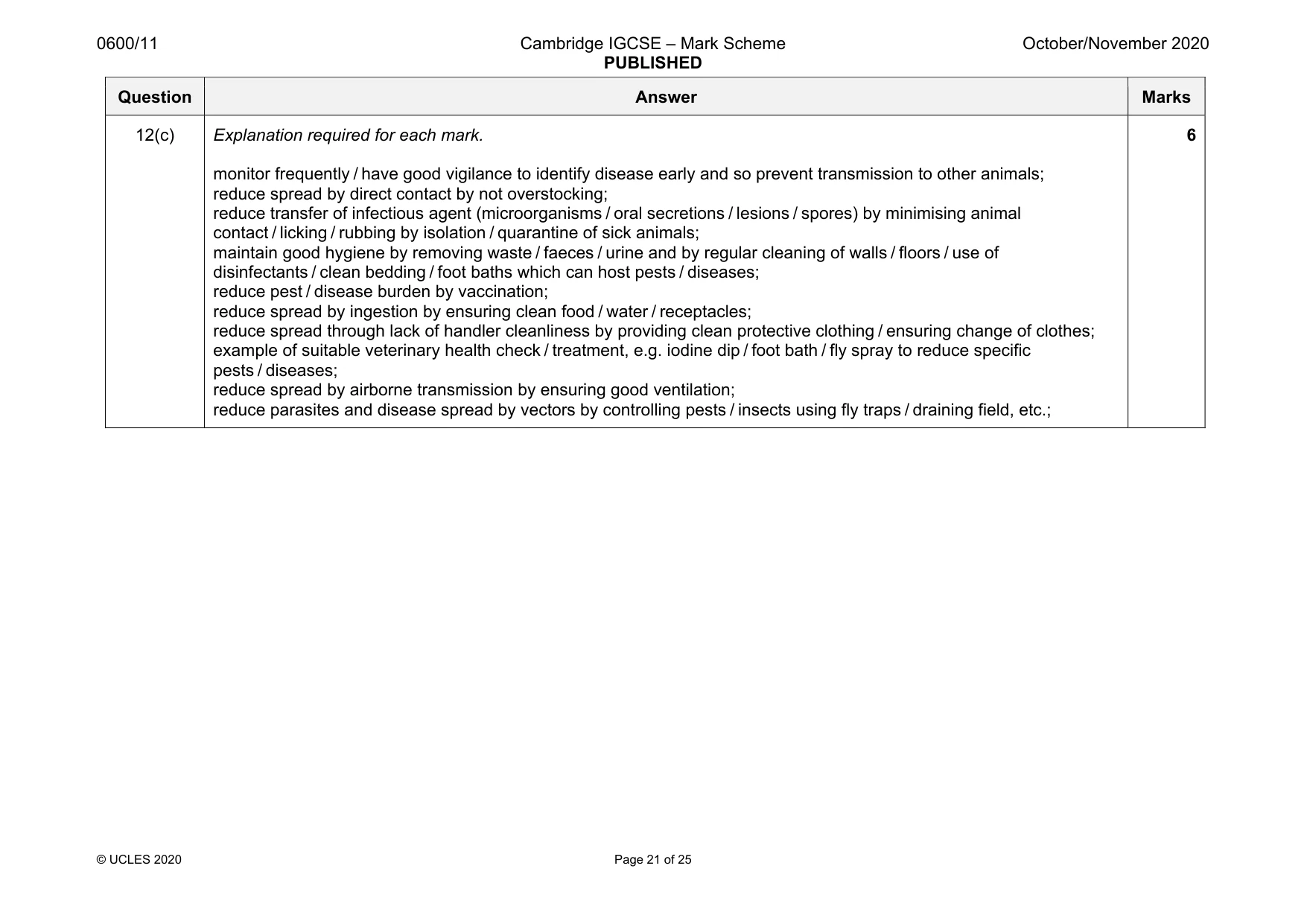
0600/11 Cambridge IGCSE – Mark Scheme PUBLISHED October/November 2020 © UCLES 2020 Page 21 of 25 Question Answer Marks 12(c) Explanation required for each mark. monitor frequently / have good vigilance to identify disease early and so prevent transmission to other animals; reduce spread by direct contact by not overstocking; reduce transfer of infectious agent (microorganisms / oral secretions / lesions / spores) by minimising animal contact / licking / rubbing by isolation / quarantine of sick animals; maintain good hygiene by removing waste / faeces / urine and by regular cleaning of walls / floors / use of disinfectants / clean bedding / foot baths which can host pests / diseases; reduce pest / disease burden by vaccination; reduce spread by ingestion by ensuring clean food / water / receptacles; reduce spread through lack of handler cleanliness by providing clean protective clothing / ensuring change of clothes; example of suitable veterinary health check / treatment, e.g. iodine dip / foot bath / fly spray to reduce specific pests / diseases; reduce spread by airborne transmission by ensuring good ventilation; reduce parasites and disease spread by vectors by controlling pests / insects using fly traps / draining field, etc.; 6
Mark scheme, page 22
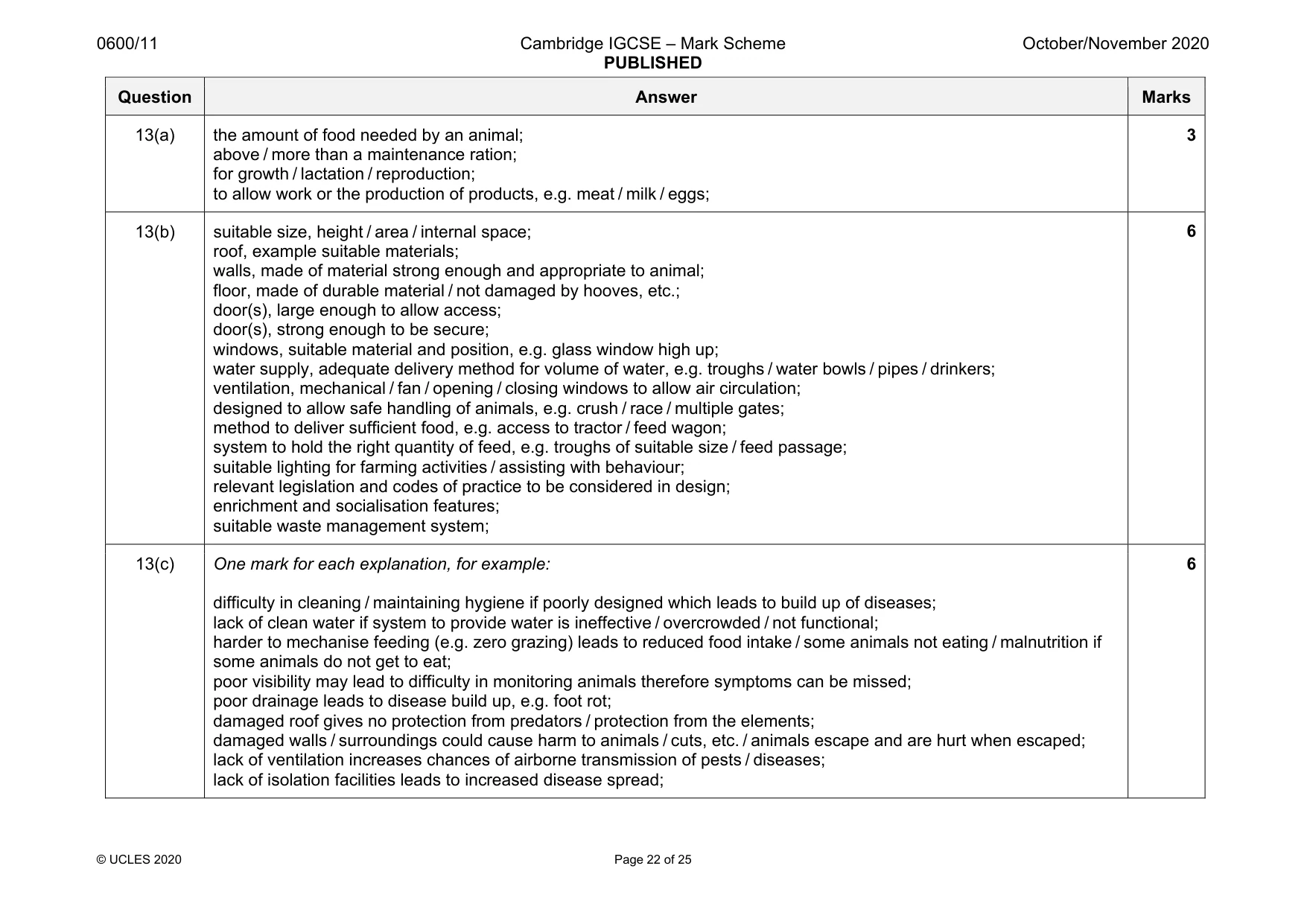
0600/11 Cambridge IGCSE – Mark Scheme PUBLISHED October/November 2020 © UCLES 2020 Page 22 of 25 Question Answer Marks 13(a) the amount of food needed by an animal; above / more than a maintenance ration; for growth / lactation / reproduction; to allow work or the production of products, e.g. meat / milk / eggs; 3 13(b) suitable size, height / area / internal space; roof, example suitable materials; walls, made of material strong enough and appropriate to animal; floor, made of durable material / not damaged by hooves, etc.; door(s), large enough to allow access; door(s), strong enough to be secure; windows, suitable material and position, e.g. glass window high up; water supply, adequate delivery method for volume of water, e.g. troughs / water bowls / pipes / drinkers; ventilation, mechanical / fan / opening / closing windows to allow air circulation; designed to allow safe handling of animals, e.g. crush / race / multiple gates; method to deliver sufficient food, e.g. access to tractor / feed wagon; system to hold the right quantity of feed, e.g. troughs of suitable size / feed passage; suitable lighting for farming activities / assisting with behaviour; relevant legislation and codes of practice to be considered in design; enrichment and socialisation features; suitable waste management system; 6 13(c) One mark for each explanation, for example: difficulty in cleaning / maintaining hygiene if poorly designed which leads to build up of diseases; lack of clean water if system to provide water is ineffective / overcrowded / not functional; harder to mechanise feeding (e.g. zero grazing) leads to reduced food intake / some animals not eating / malnutrition if some animals do not get to eat; poor visibility may lead to difficulty in monitoring animals therefore symptoms can be missed; poor drainage leads to disease build up, e.g. foot rot; damaged roof gives no protection from predators / protection from the elements; damaged walls / surroundings could cause harm to animals / cuts, etc. / animals escape and are hurt when escaped; lack of ventilation increases chances of airborne transmission of pests / diseases; lack of isolation facilities leads to increased disease spread; 6
Mark scheme, page 23
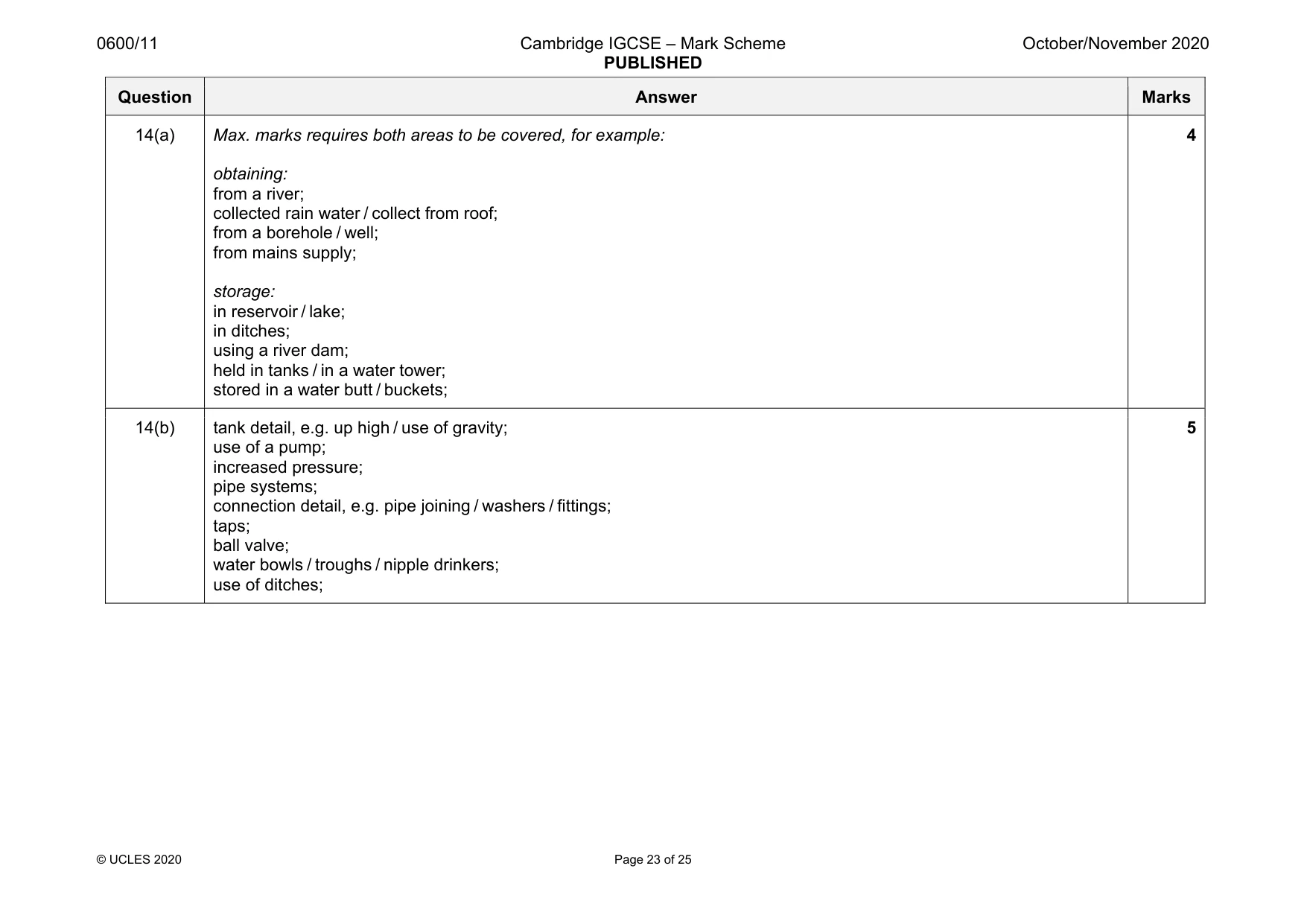
0600/11 Cambridge IGCSE – Mark Scheme PUBLISHED October/November 2020 © UCLES 2020 Page 23 of 25 Question Answer Marks 14(a) Max. marks requires both areas to be covered, for example: obtaining: from a river; collected rain water / collect from roof; from a borehole / well; from mains supply; storage: in reservoir / lake; in ditches; using a river dam; held in tanks / in a water tower; stored in a water butt / buckets; 4 14(b) tank detail, e.g. up high / use of gravity; use of a pump; increased pressure; pipe systems; connection detail, e.g. pipe joining / washers / fittings; taps; ball valve; water bowls / troughs / nipple drinkers; use of ditches; 5
Mark scheme, page 24
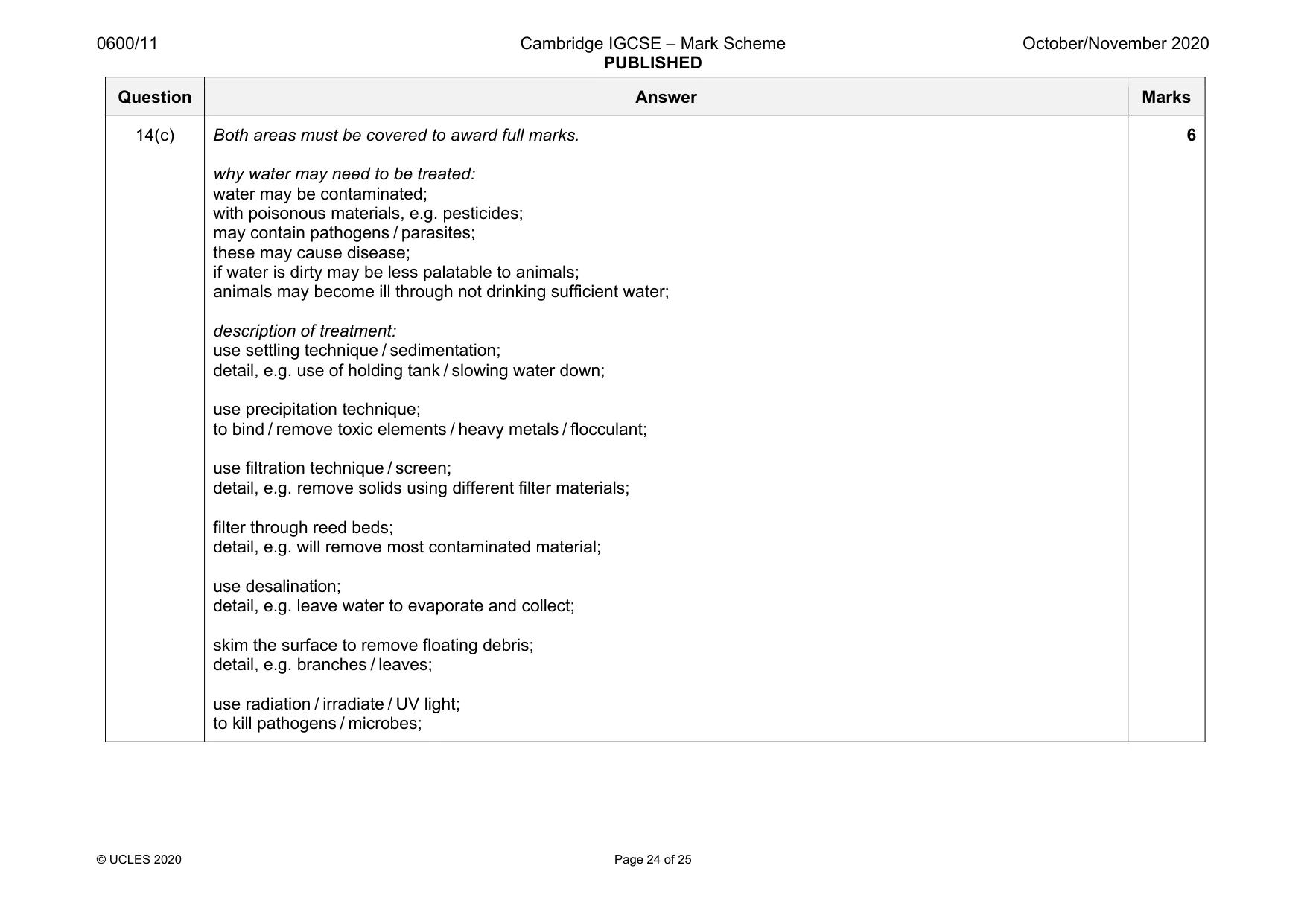
0600/11 Cambridge IGCSE – Mark Scheme PUBLISHED October/November 2020 © UCLES 2020 Page 24 of 25 Question Answer Marks 14(c) Both areas must be covered to award full marks. why water may need to be treated: water may be contaminated; with poisonous materials, e.g. pesticides; may contain pathogens / parasites; these may cause disease; if water is dirty may be less palatable to animals; animals may become ill through not drinking sufficient water; description of treatment: use settling technique / sedimentation; detail, e.g. use of holding tank / slowing water down; use precipitation technique; to bind / remove toxic elements / heavy metals / flocculant; use filtration technique / screen; detail, e.g. remove solids using different filter materials; filter through reed beds; detail, e.g. will remove most contaminated material; use desalination; detail, e.g. leave water to evaporate and collect; skim the surface to remove floating debris; detail, e.g. branches / leaves; use radiation / irradiate / UV light; to kill pathogens / microbes; 6
Mark scheme, page 25
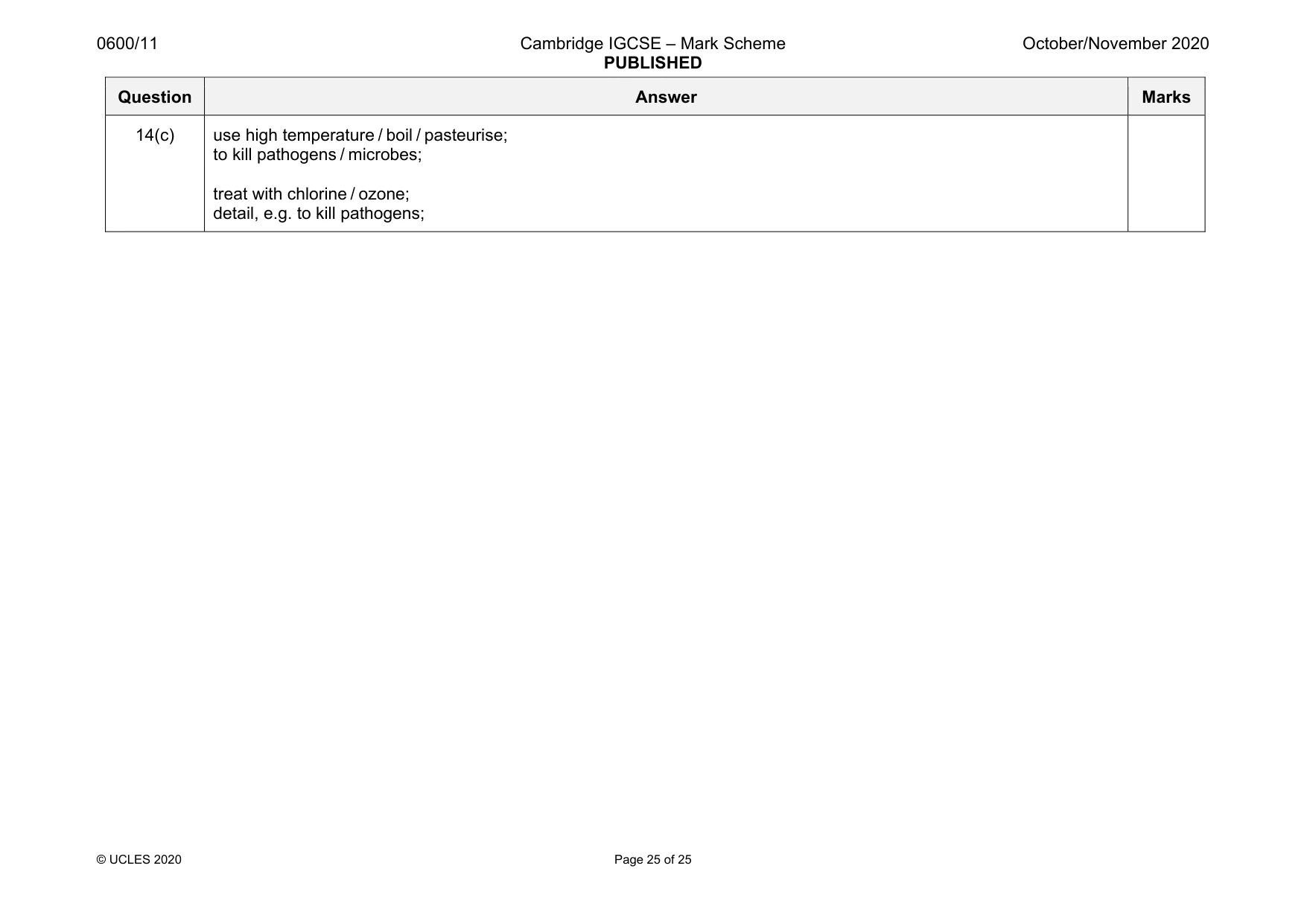
0600/11 Cambridge IGCSE – Mark Scheme PUBLISHED October/November 2020 © UCLES 2020 Page 25 of 25 Question Answer Marks 14(c) use high temperature / boil / pasteurise; to kill pathogens / microbes; treat with chlorine / ozone; detail, e.g. to kill pathogens;
What you needed in this session
Cambridge’s own grade thresholds for 2020 Oct/Nov, Paper 1 · Variant 1. A higher threshold means an easier paper — the bar moves with how the cohort did.