Cambridge IGCSE Agriculture 0600 — 2021 Oct/Nov Paper 1 · Variant 1
0600/11/O/N/21 · 100 marks · ≈113 min
The question paper and its mark scheme, free to read here and free to download. This is Cambridge’s own paper, exactly as it was sat.
Question paper24 pages







Mark scheme25 pages
Answers below. Sit the paper first if you are practising.
Paper as text
Question paper, page 1
This document has 24 pages. Any blank pages are indicated. Cambridge IGCSE™ DC (PQ/SG) 206020/2 © UCLES 2021 [Turn over * 4 9 0 9 8 8 4 1 2 4 * AGRICULTURE 0600/11 Paper 1 Theory October/November 2021 1 hour 45 minutes You must answer on the question paper. No additional materials are needed. INSTRUCTIONS ● Section A: answer all questions. ● Section B: answer two questions. ● Use a black or dark blue pen. You may use an HB pencil for any diagrams or graphs. ● Write your name, centre number and candidate number in the boxes at the top of the page. ● Write your answer to each question in the space provided. ● Do not use an erasable pen or correction fluid. ● Do not write on any bar codes. ● You may use a calculator. ● You should show all your working and use appropriate units. INFORMATION ● The total mark for this paper is 100. ● The number of marks for each question or part question is shown in brackets [ ].
Question paper, page 2
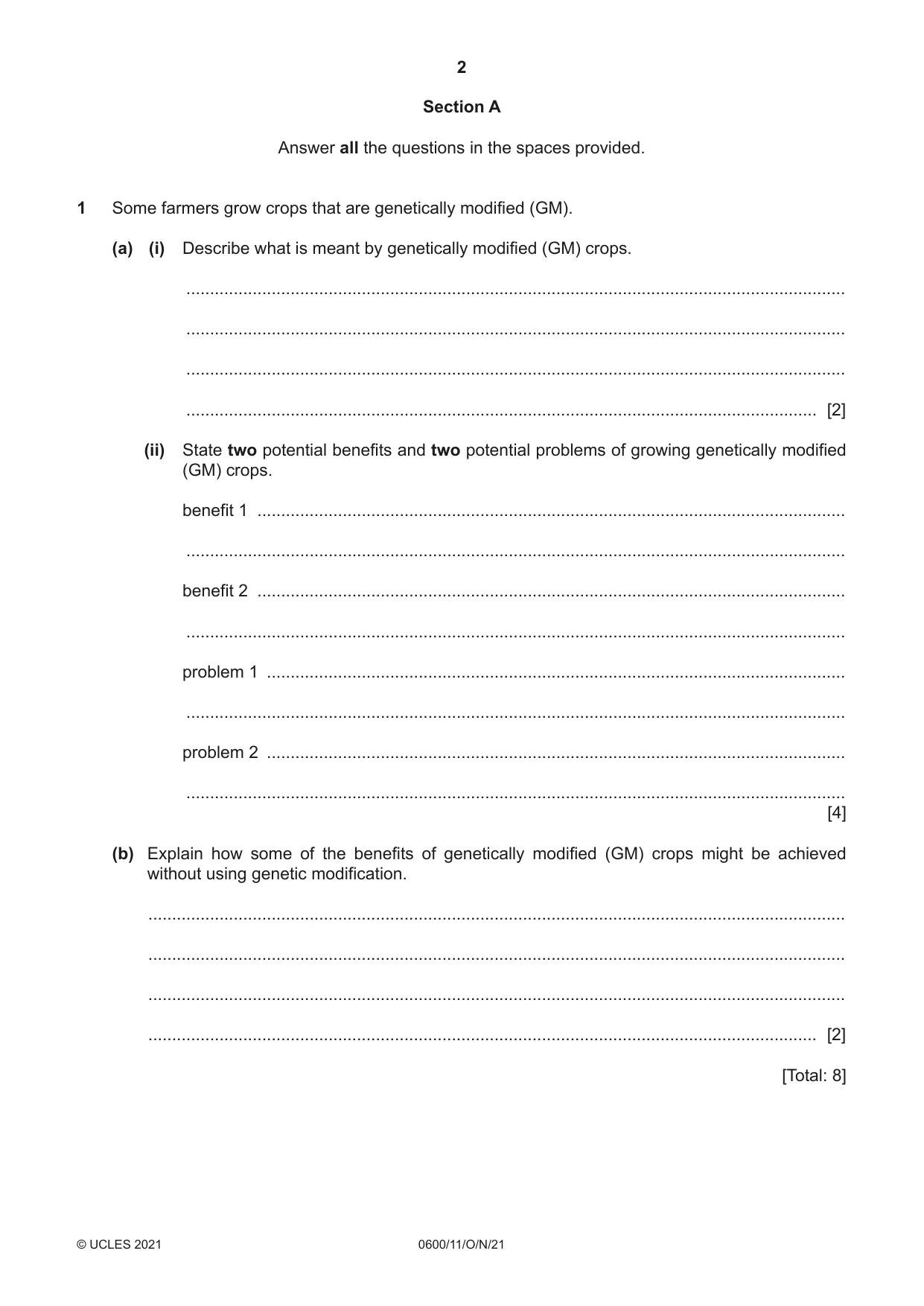
2 0600/11/O/N/21 © UCLES 2021 Section A Answer all the questions in the spaces provided. 1 Some farmers grow crops that are genetically modified (GM). (a) (i) Describe what is meant by genetically modified (GM) crops. … … … … [2] (ii) State two potential benefits and two potential problems of growing genetically modified (GM) crops. benefit 1 … … benefit 2 … … problem 1 … … problem 2 … … [4] (b) Explain how some of the benefits of genetically modified (GM) crops might be achieved without using genetic modification. … … … … [2] [Total: 8]
Question paper, page 3
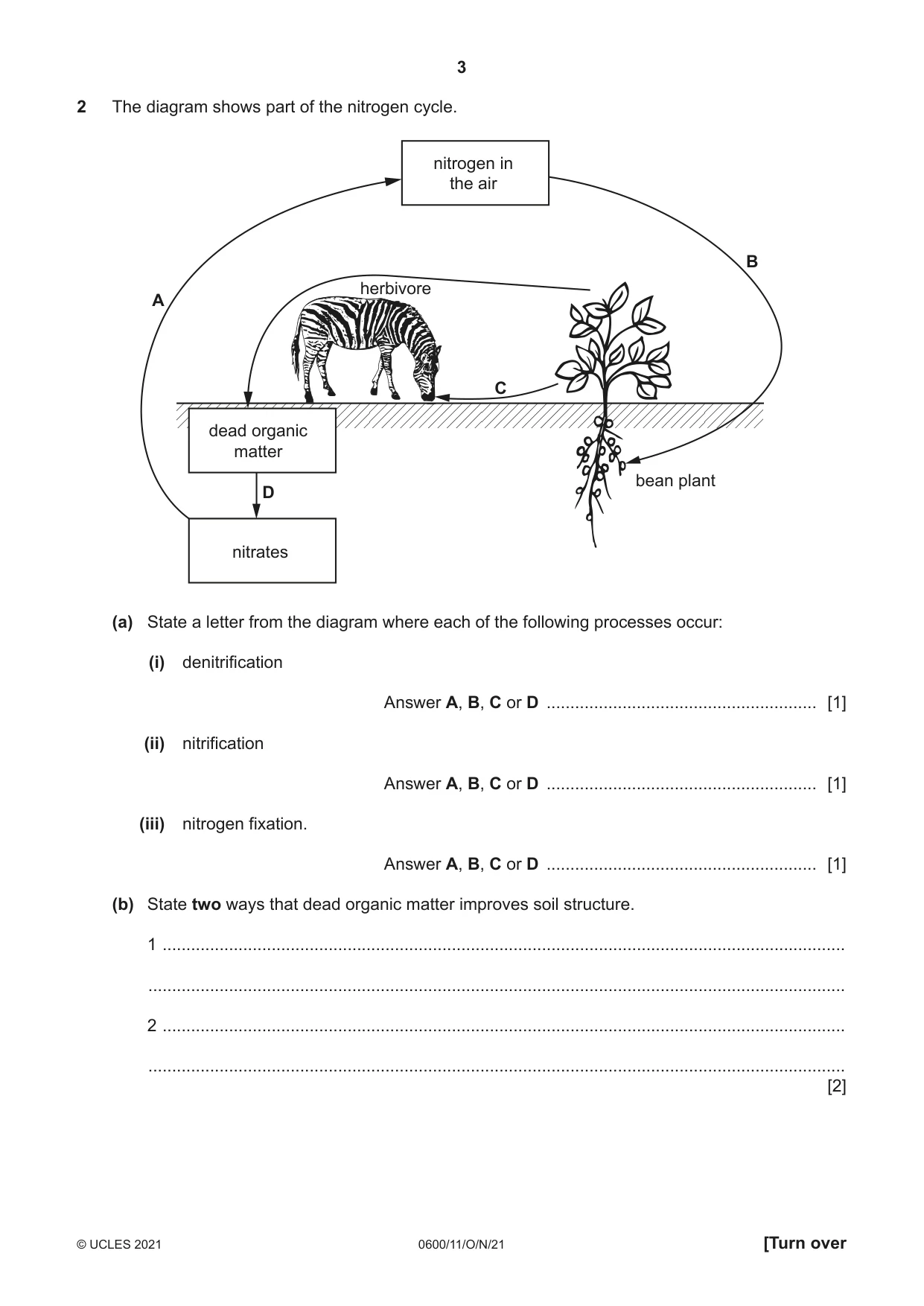
3 0600/11/O/N/21 © UCLES 2021 [Turn over 2 The diagram shows part of the nitrogen cycle. nitrogen in the air dead organic matter herbivore bean plant nitrates A B D C (a) State a letter from the diagram where each of the following processes occur: (i) denitrification Answer A, B, C or D … [1] (ii) nitrification Answer A, B, C or D … [1] (iii) nitrogen fixation. Answer A, B, C or D … [1] (b) State two ways that dead organic matter improves soil structure. 1 … … 2 … … [2]
Question paper, page 4
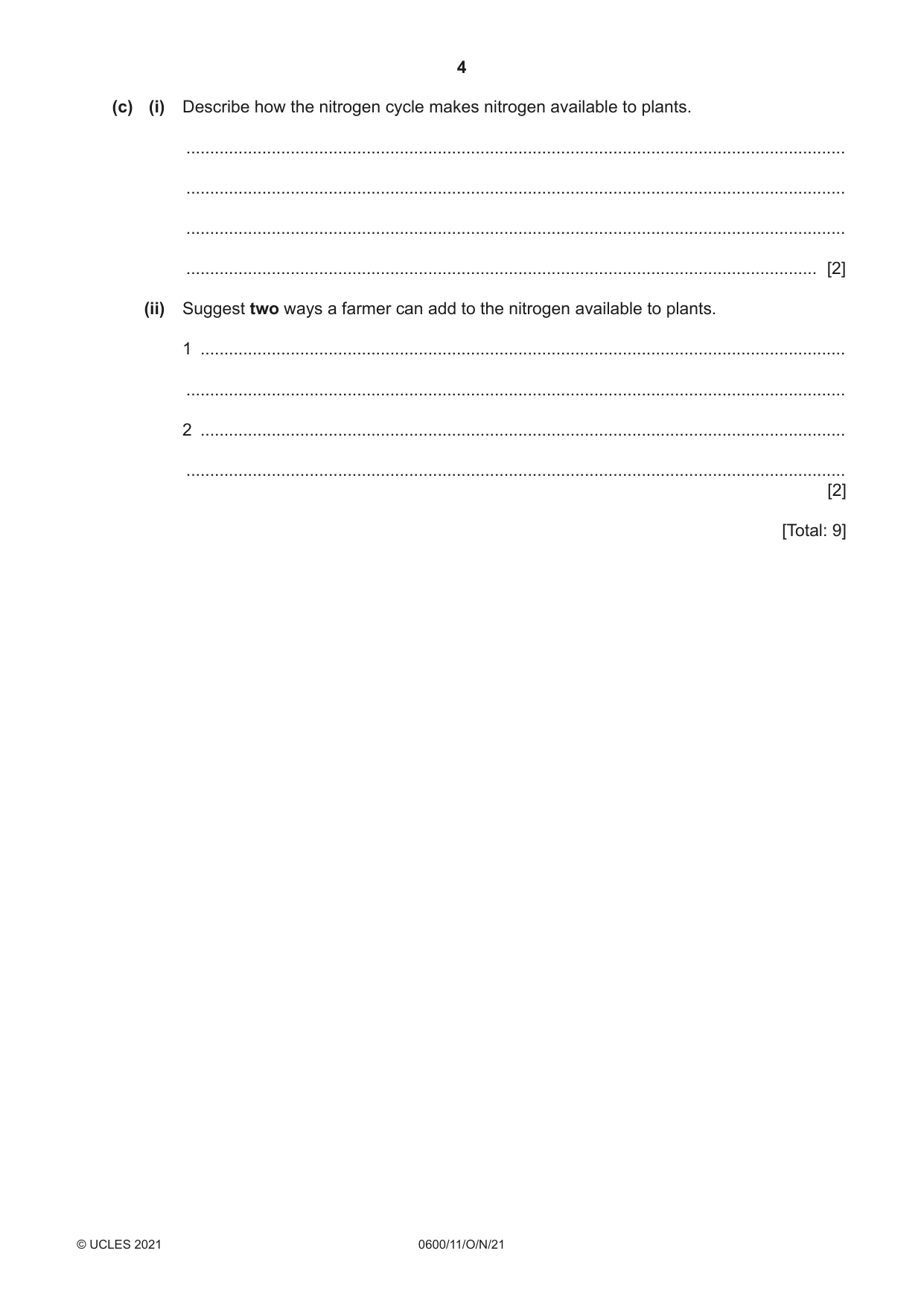
4 0600/11/O/N/21 © UCLES 2021 (c) (i) Describe how the nitrogen cycle makes nitrogen available to plants. … … … … [2] (ii) Suggest two ways a farmer can add to the nitrogen available to plants. 1 … … 2 … … [2] [Total: 9]
Question paper, page 5
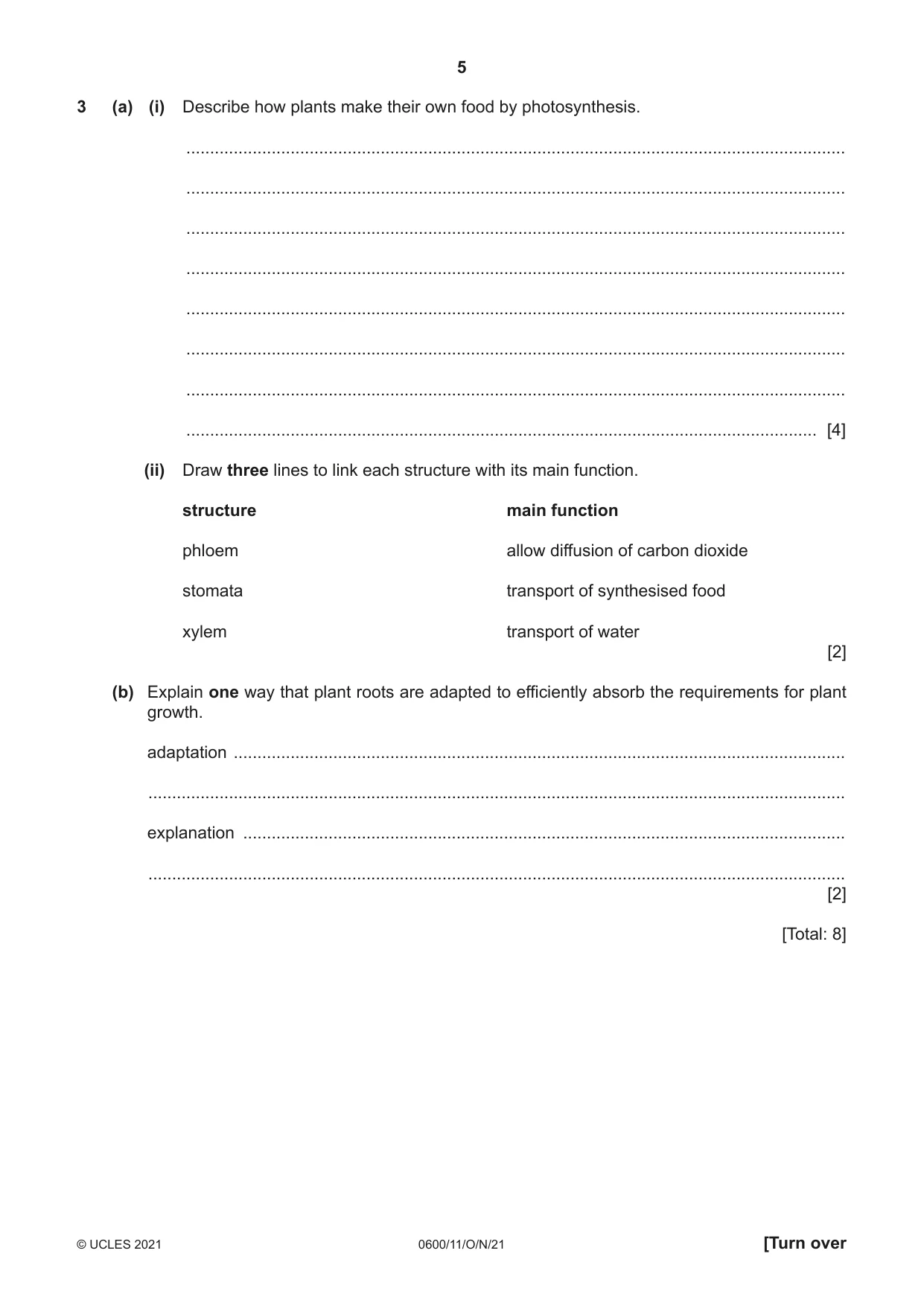
5 0600/11/O/N/21 © UCLES 2021 [Turn over 3 (a) (i) Describe how plants make their own food by photosynthesis. … … … … … … … … [4] (ii) Draw three lines to link each structure with its main function. structure main function phloem allow diffusion of carbon dioxide stomata transport of synthesised food xylem transport of water [2] (b) Explain one way that plant roots are adapted to efficiently absorb the requirements for plant growth. adaptation … … explanation … … [2] [Total: 8]
Question paper, page 6
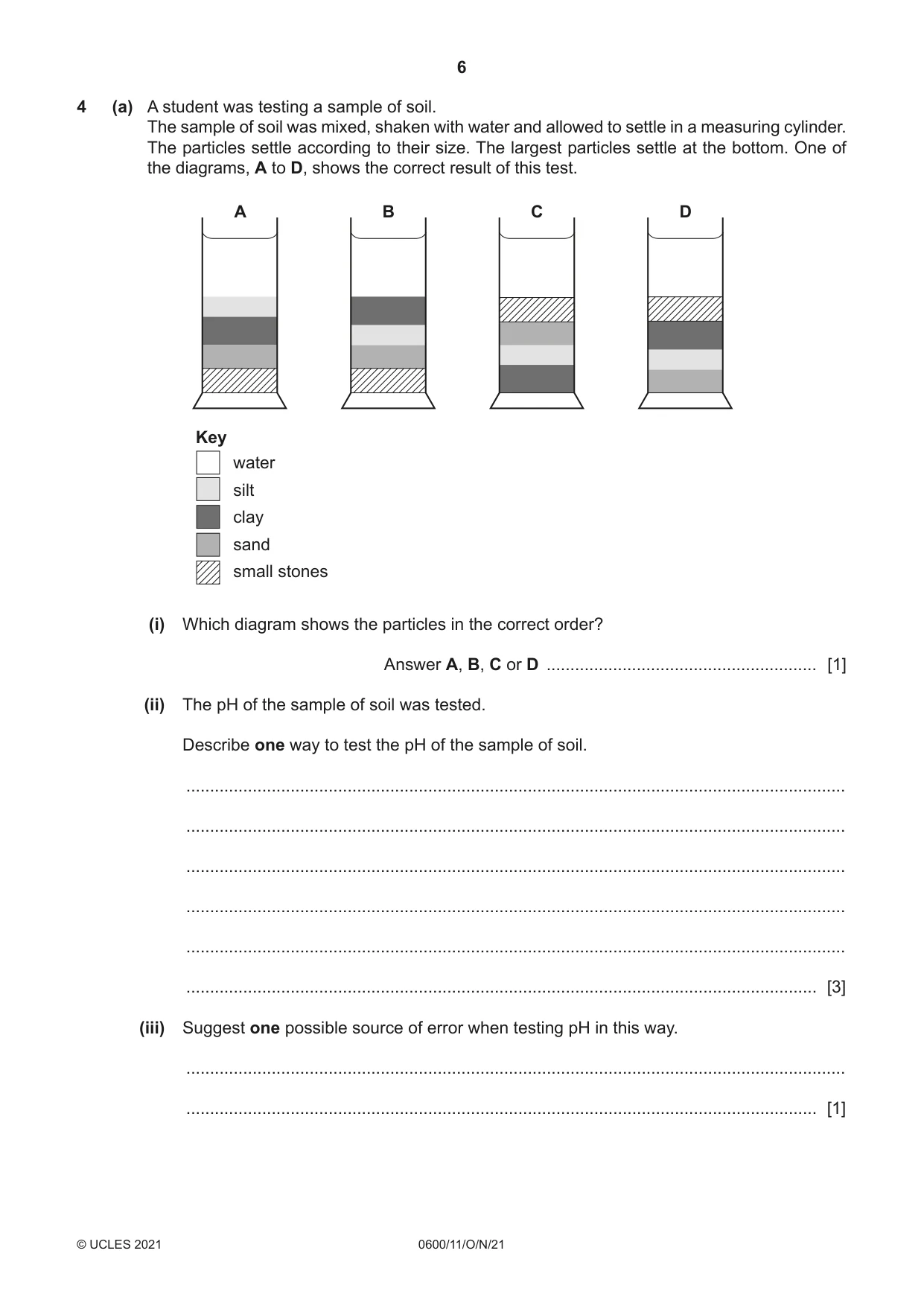
6 0600/11/O/N/21 © UCLES 2021 4 (a) A student was testing a sample of soil. The sample of soil was mixed, shaken with water and allowed to settle in a measuring cylinder. The particles settle according to their size. The largest particles settle at the bottom. One of the diagrams, A to D, shows the correct result of this test. A B C D water silt clay sand small stones Key (i) Which diagram shows the particles in the correct order? Answer A, B, C or D … [1] (ii) The pH of the sample of soil was tested. Describe one way to test the pH of the sample of soil. … … … … … … [3] (iii) Suggest one possible source of error when testing pH in this way. … … [1]
Question paper, page 7
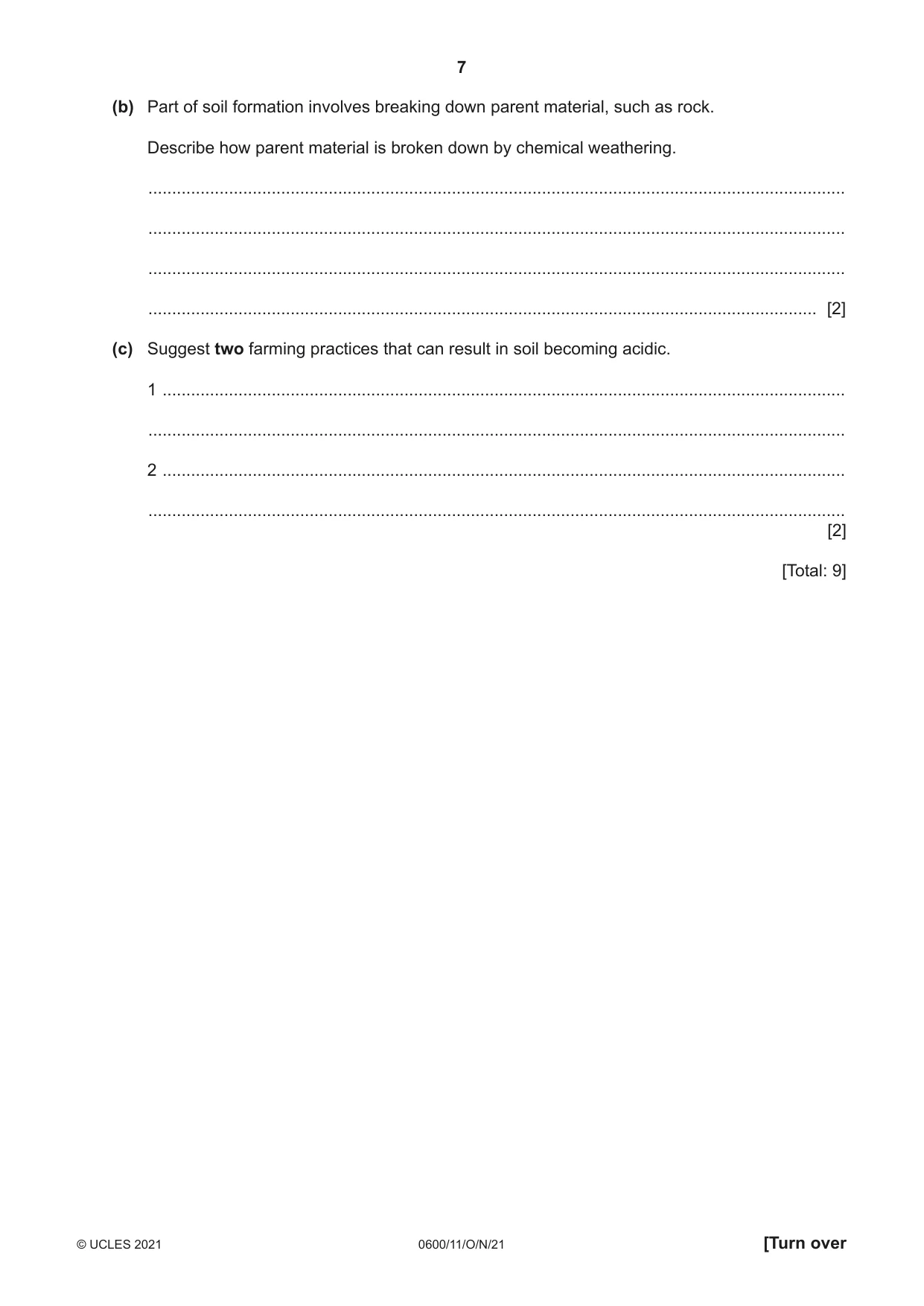
7 0600/11/O/N/21 © UCLES 2021 [Turn over (b) Part of soil formation involves breaking down parent material, such as rock. Describe how parent material is broken down by chemical weathering. … … … … [2] (c) Suggest two farming practices that can result in soil becoming acidic. 1 … … 2 … … [2] [Total: 9]
Question paper, page 8
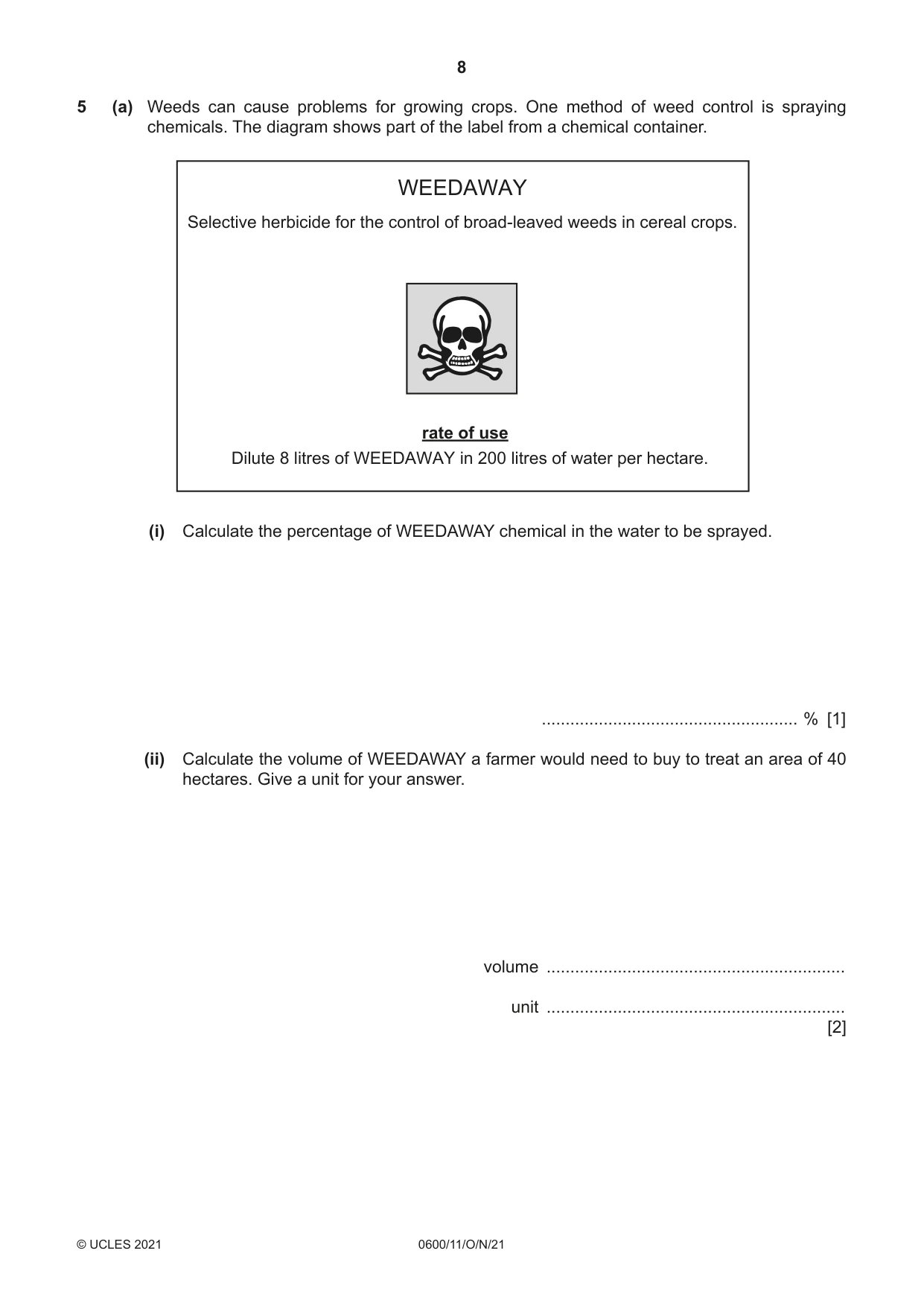
8 0600/11/O/N/21 © UCLES 2021 5 (a) Weeds can cause problems for growing crops. One method of weed control is spraying chemicals. The diagram shows part of the label from a chemical container. WEEDAWAY Selective herbicide for the control of broad-leaved weeds in cereal crops. Dilute 8 litres of WEEDAWAY in 200 litres of water per hectare. rate of use (i) Calculate the percentage of WEEDAWAY chemical in the water to be sprayed. … % [1] (ii) Calculate the volume of WEEDAWAY a farmer would need to buy to treat an area of 40 hectares. Give a unit for your answer. volume … unit … [2]
Question paper, page 9
9 0600/11/O/N/21 © UCLES 2021 [Turn over (b) The label does not show any information about the safe storage of farm chemicals. Suggest three ways to store farm chemicals safely. 1 … … 2 … … 3 … … [3] (c) Identify one weed species. Describe how the weed species can be controlled in crops without using chemicals. weed species … control method … … [2] [Total: 8]
Question paper, page 10
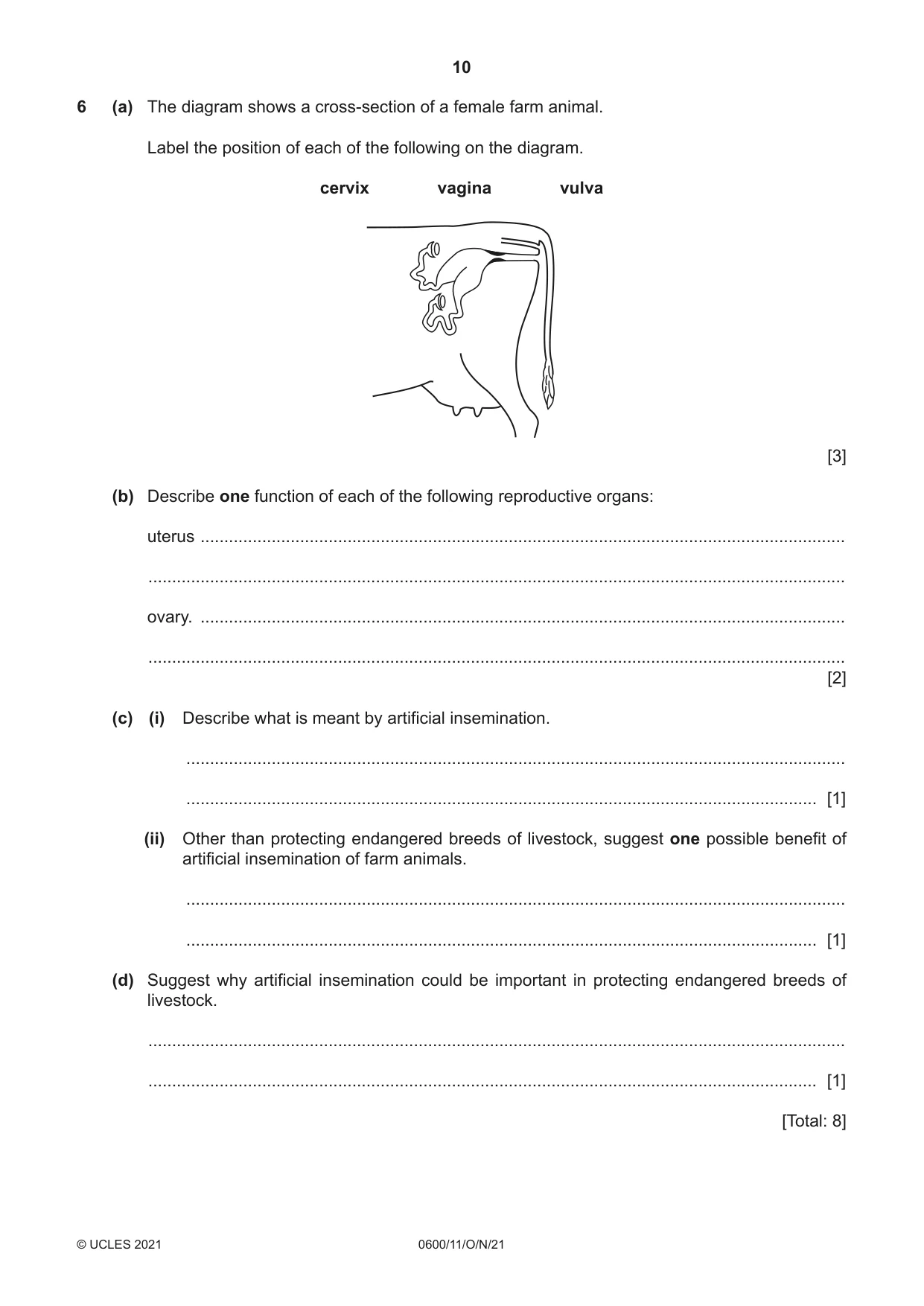
10 0600/11/O/N/21 © UCLES 2021 6 (a) The diagram shows a cross-section of a female farm animal. Label the position of each of the following on the diagram. cervix vagina vulva [3] (b) Describe one function of each of the following reproductive organs: uterus … … ovary. … … [2] (c) (i) Describe what is meant by artificial insemination. … … [1] (ii) Other than protecting endangered breeds of livestock, suggest one possible benefit of artificial insemination of farm animals. … … [1] (d) Suggest why artificial insemination could be important in protecting endangered breeds of livestock. … … [1] [Total: 8]
Question paper, page 11
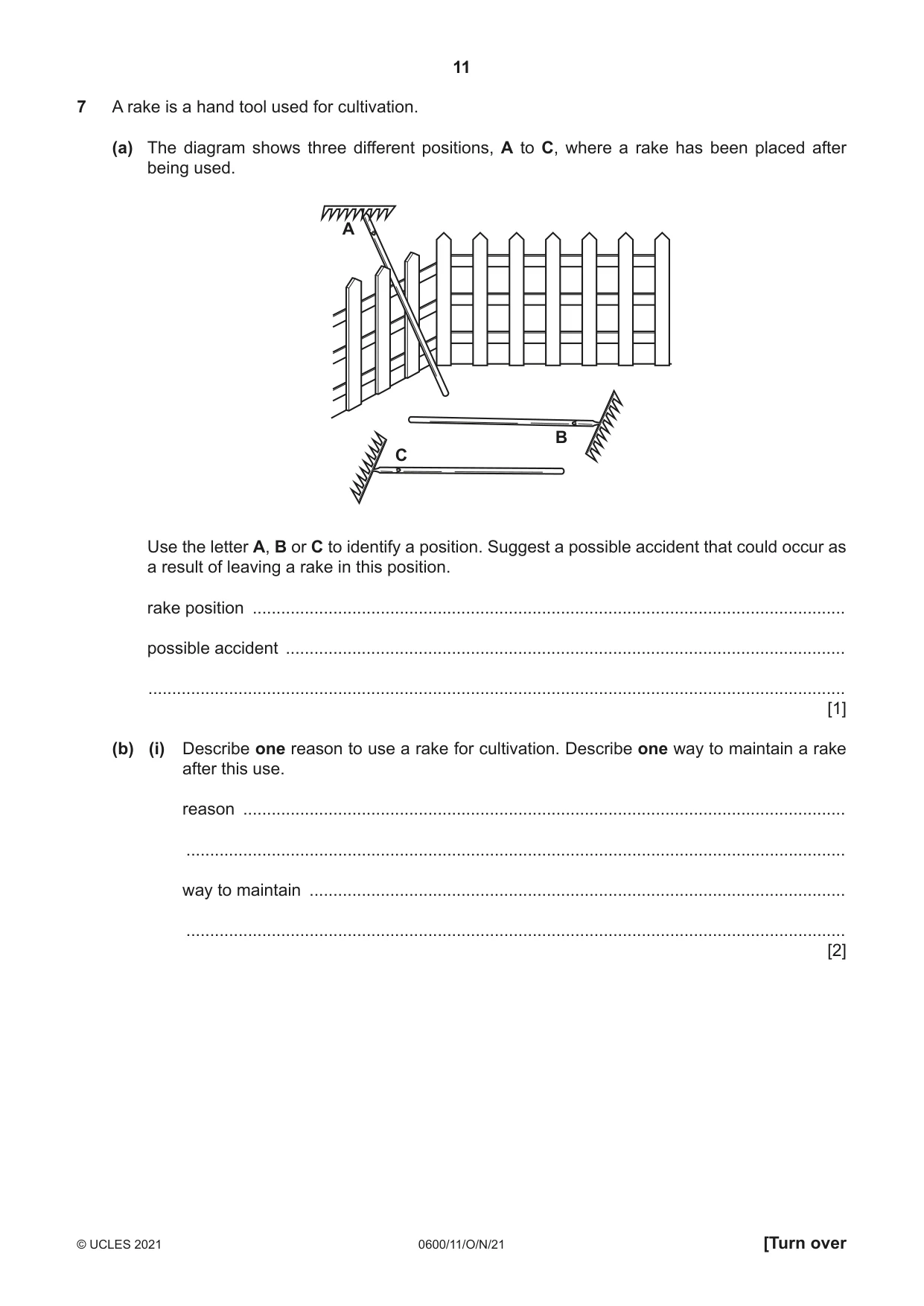
11 0600/11/O/N/21 © UCLES 2021 [Turn over 7 A rake is a hand tool used for cultivation. (a) The diagram shows three different positions, A to C, where a rake has been placed after being used. A C B Use the letter A, B or C to identify a position. Suggest a possible accident that could occur as a result of leaving a rake in this position. rake position … possible accident … … [1] (b) (i) Describe one reason to use a rake for cultivation. Describe one way to maintain a rake after this use. reason … … way to maintain … … [2]
Question paper, page 12
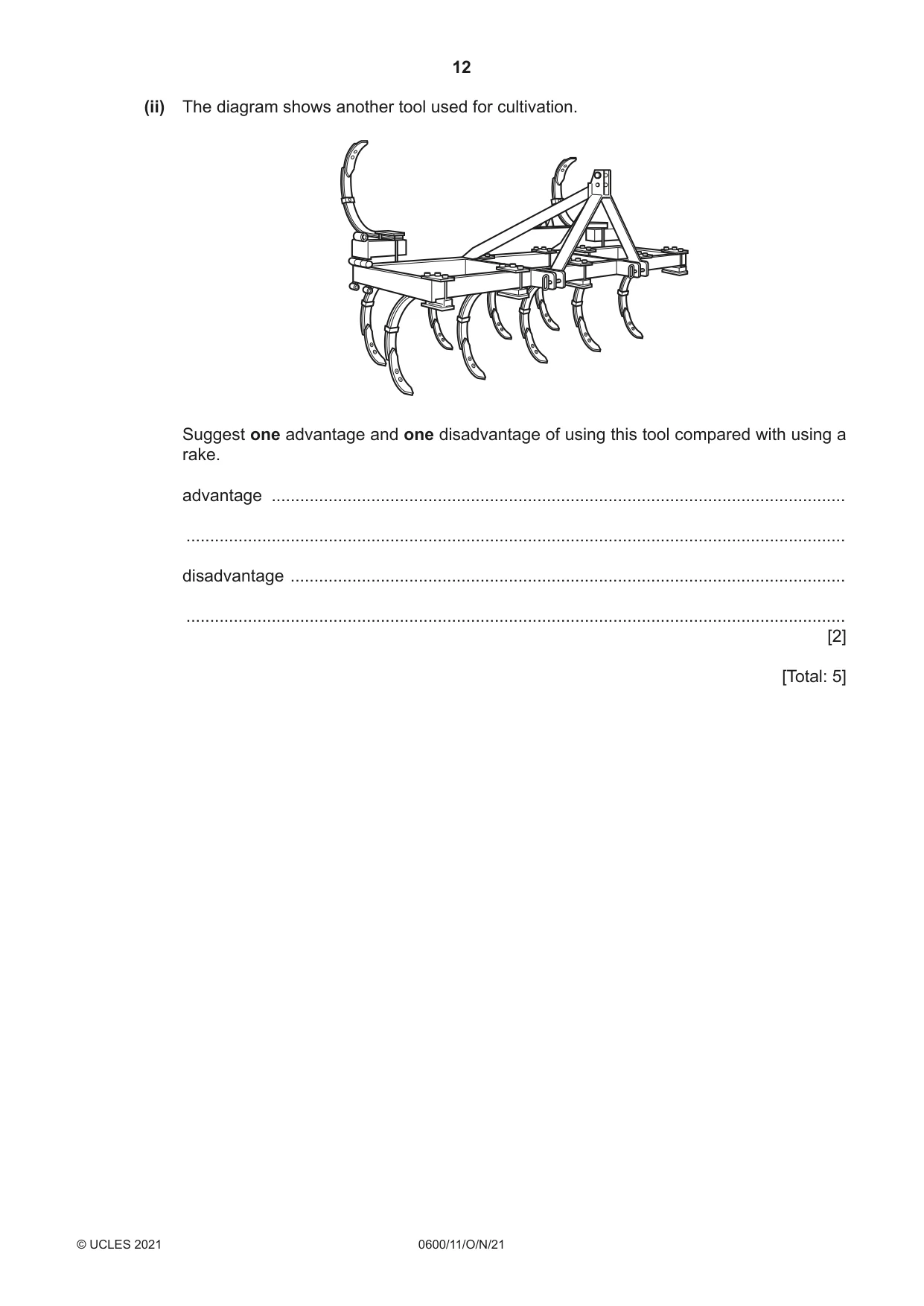
12 0600/11/O/N/21 © UCLES 2021 (ii) The diagram shows another tool used for cultivation. Suggest one advantage and one disadvantage of using this tool compared with using a rake. advantage … … disadvantage … … [2] [Total: 5]
Question paper, page 13
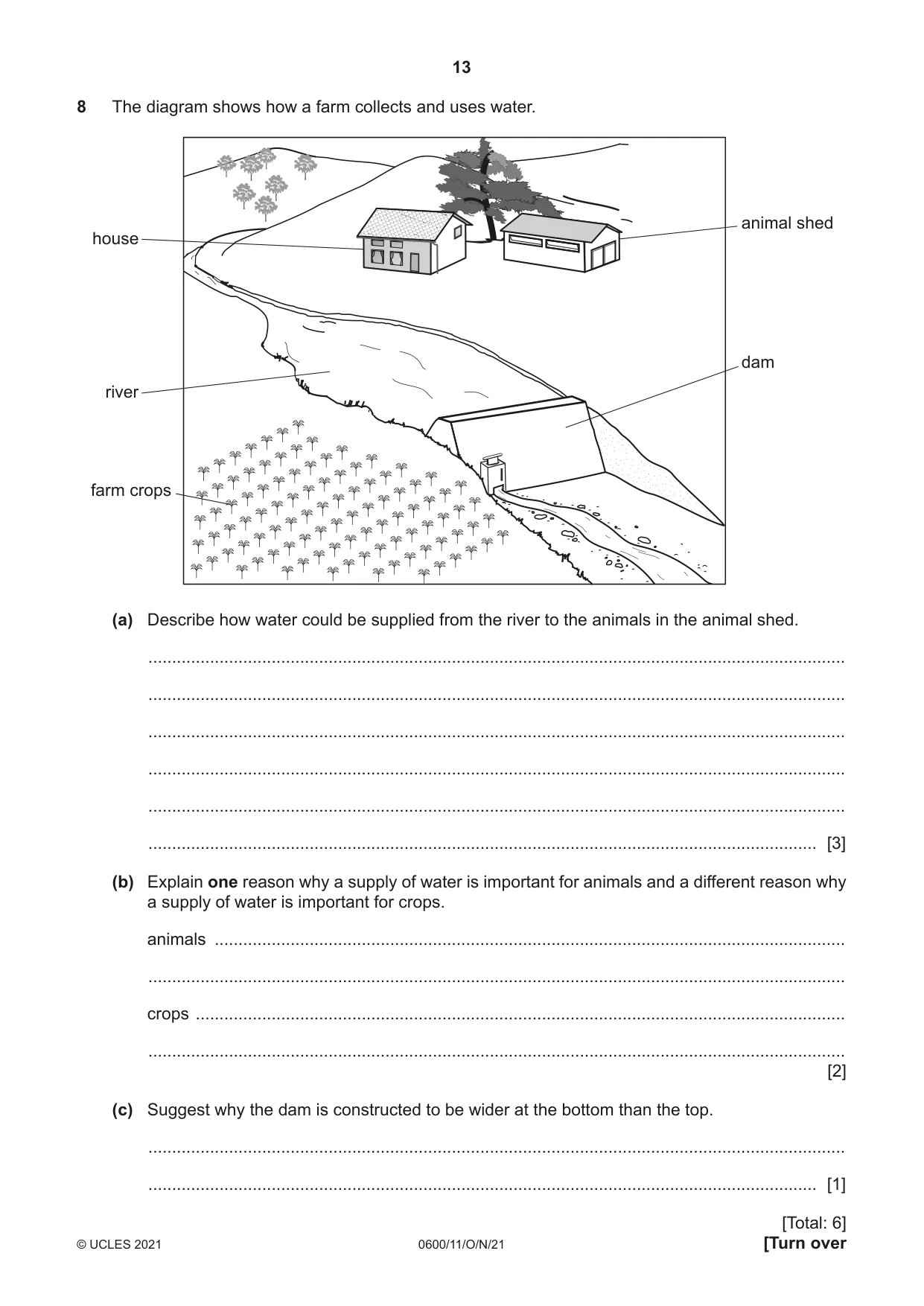
13 0600/11/O/N/21 © UCLES 2021 [Turn over 8 The diagram shows how a farm collects and uses water. farm crops river house animal shed dam (a) Describe how water could be supplied from the river to the animals in the animal shed. … … … … … … [3] (b) Explain one reason why a supply of water is important for animals and a different reason why a supply of water is important for crops. animals … … crops … … [2] (c) Suggest why the dam is constructed to be wider at the bottom than the top. … … [1] [Total: 6]
Question paper, page 14
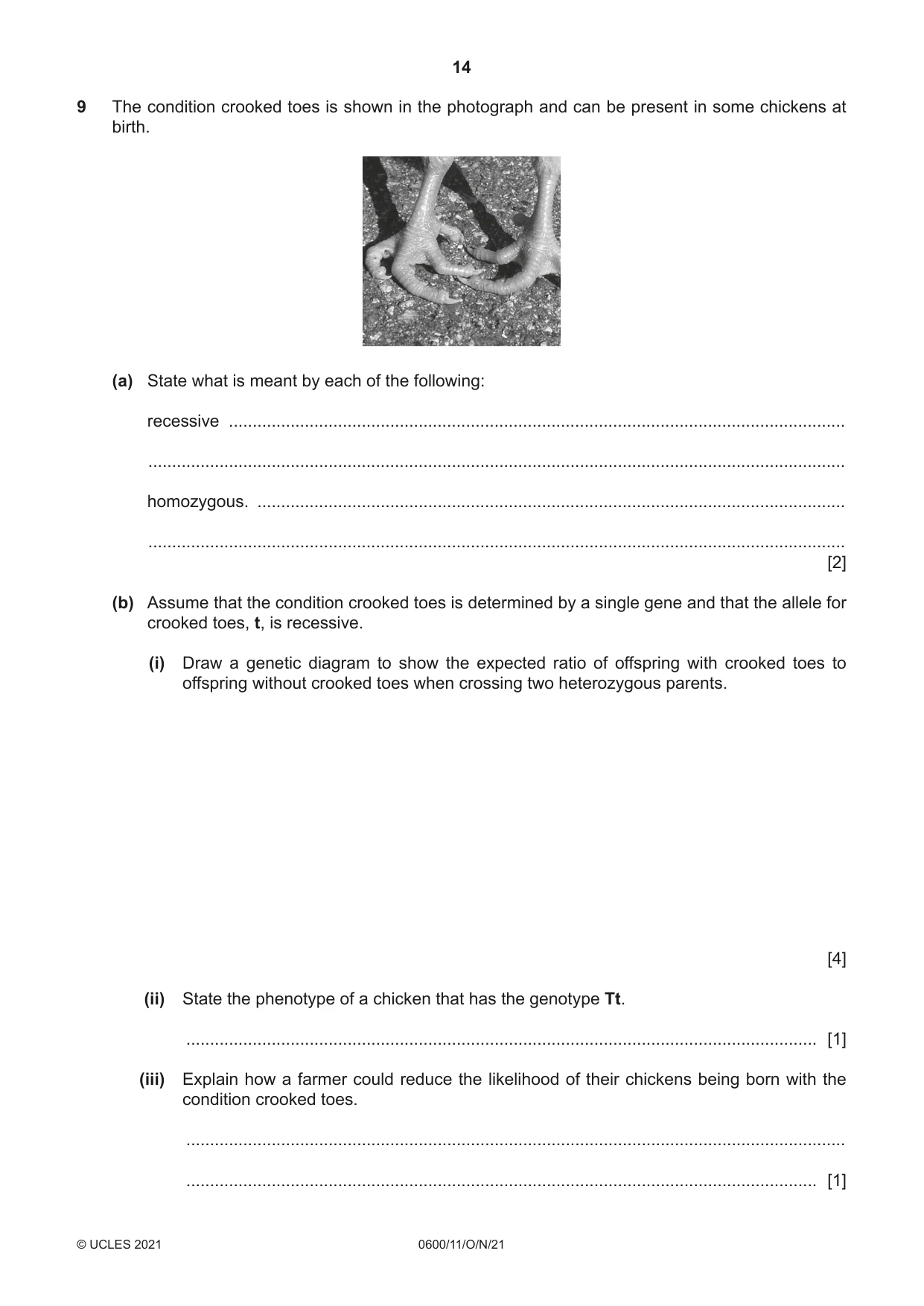
14 0600/11/O/N/21 © UCLES 2021 9 The condition crooked toes is shown in the photograph and can be present in some chickens at birth. (a) State what is meant by each of the following: recessive … … homozygous. … … [2] (b) Assume that the condition crooked toes is determined by a single gene and that the allele for crooked toes, t, is recessive. (i) Draw a genetic diagram to show the expected ratio of offspring with crooked toes to offspring without crooked toes when crossing two heterozygous parents. [4] (ii) State the phenotype of a chicken that has the genotype Tt. … [1] (iii) Explain how a farmer could reduce the likelihood of their chickens being born with the condition crooked toes. … … [1]
Question paper, page 15
15 0600/11/O/N/21 © UCLES 2021 [Turn over (iv) Suggest why chickens with crooked toes may be less likely to survive than chickens with normal toes. … … [1] [Total: 9]
Question paper, page 16
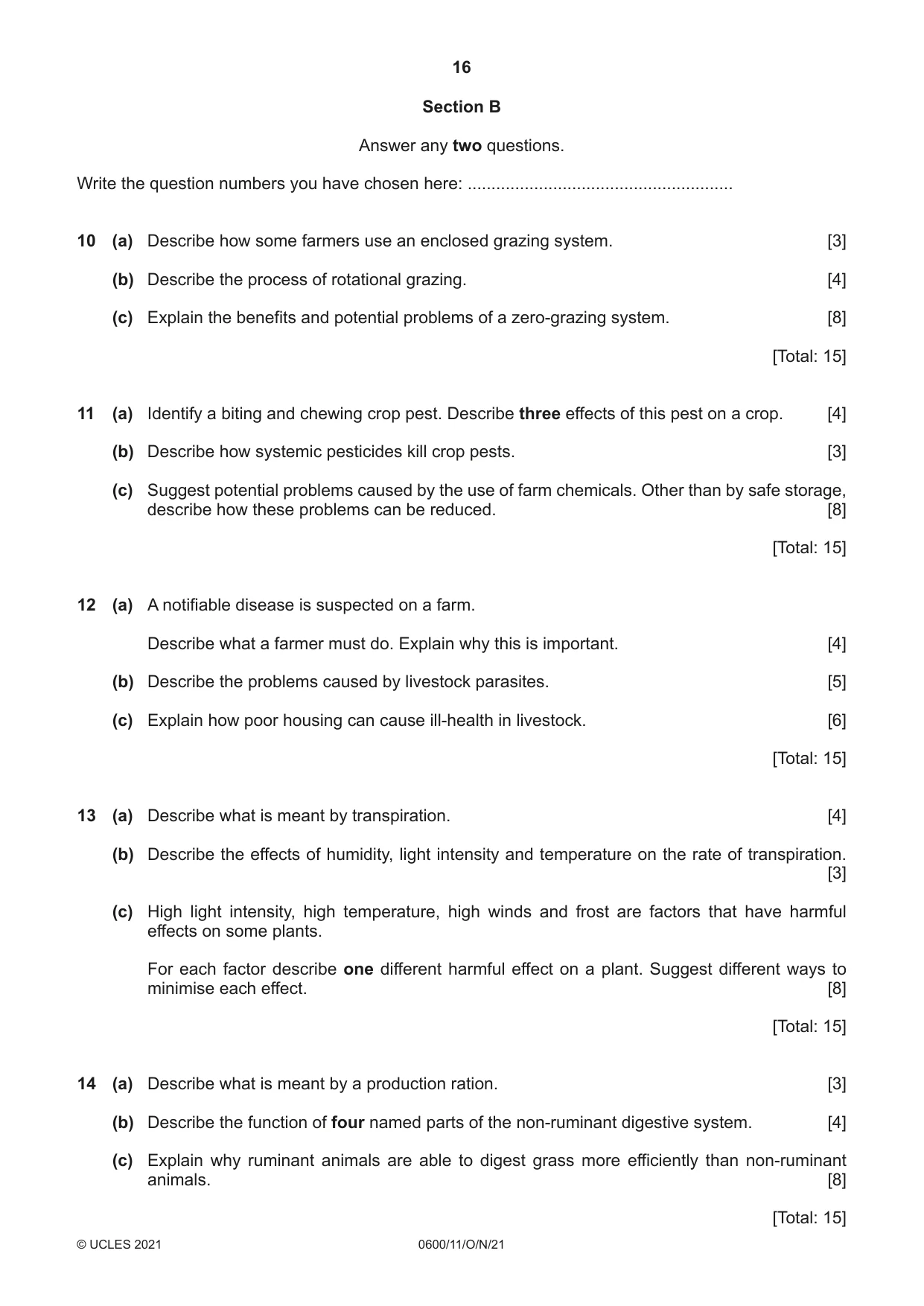
16 0600/11/O/N/21 © UCLES 2021 Section B Answer any two questions. Write the question numbers you have chosen here: … 10 (a) Describe how some farmers use an enclosed grazing system. [3] (b) Describe the process of rotational grazing. [4] (c) Explain the benefits and potential problems of a zero-grazing system. [8] [Total: 15] 11 (a) Identify a biting and chewing crop pest. Describe three effects of this pest on a crop. [4] (b) Describe how systemic pesticides kill crop pests. [3] (c) Suggest potential problems caused by the use of farm chemicals. Other than by safe storage, describe how these problems can be reduced. [8] [Total: 15] 12 (a) A notifiable disease is suspected on a farm. Describe what a farmer must do. Explain why this is important. [4] (b) Describe the problems caused by livestock parasites. [5] (c) Explain how poor housing can cause ill-health in livestock. [6] [Total: 15] 13 (a) Describe what is meant by transpiration. [4] (b) Describe the effects of humidity, light intensity and temperature on the rate of transpiration. [3] (c) High light intensity, high temperature, high winds and frost are factors that have harmful effects on some plants. For each factor describe one different harmful effect on a plant. Suggest different ways to minimise each effect. [8] [Total: 15] 14 (a) Describe what is meant by a production ration. [3] (b) Describe the function of four named parts of the non-ruminant digestive system. [4] (c) Explain why ruminant animals are able to digest grass more efficiently than non-ruminant animals. [8] [Total: 15]
Question paper, page 17
17 0600/11/O/N/21 © UCLES 2021 … … … … … … … … … … … … … … … … … … … … … … … … … … … …
Question paper, page 18
18 0600/11/O/N/21 © UCLES 2021 … … … … … … … … … … … … … … … … … … … … … … … … … … … …
Question paper, page 19
19 0600/11/O/N/21 © UCLES 2021 … … … … … … … … … … … … … … … … … … … … … … … … … … … …
Question paper, page 20
20 0600/11/O/N/21 © UCLES 2021 … … … … … … … … … … … … … … … … … … … … … … … … … … … …
Question paper, page 21
21 0600/11/O/N/21 © UCLES 2021 … … … … … … … … … … … … … … … … … … … … … … … … … … … …
Question paper, page 22
22 0600/11/O/N/21 © UCLES 2021 BLANK PAGE
Question paper, page 23
23 0600/11/O/N/21 © UCLES 2021 BLANK PAGE
Question paper, page 24
24 0600/11/O/N/21 © UCLES 2021 Permission to reproduce items where third-party owned material protected by copyright is included has been sought and cleared where possible. Every reasonable effort has been made by the publisher (UCLES) to trace copyright holders, but if any items requiring clearance have unwittingly been included, the publisher will be pleased to make amends at the earliest possible opportunity. To avoid the issue of disclosure of answer-related information to candidates, all copyright acknowledgements are reproduced online in the Cambridge Assessment International Education Copyright Acknowledgements Booklet. This is produced for each series of examinations and is freely available to download at www.cambridgeinternational.org after the live examination series. Cambridge Assessment International Education is part of the Cambridge Assessment Group. Cambridge Assessment is the brand name of the University of Cambridge Local Examinations Syndicate (UCLES), which itself is a department of the University of Cambridge. BLANK PAGE
Mark scheme, page 1
This document consists of 25 printed pages. © UCLES 2021 [Turn over Cambridge IGCSE™ AGRICULTURE 0600/11 Paper 1 Theory October/November 2021 MARK SCHEME Maximum Mark: 100 Published This mark scheme is published as an aid to teachers and candidates, to indicate the requirements of the examination. It shows the basis on which Examiners were instructed to award marks. It does not indicate the details of the discussions that took place at an Examiners’ meeting before marking began, which would have considered the acceptability of alternative answers. Mark schemes should be read in conjunction with the question paper and the Principal Examiner Report for Teachers. Cambridge International will not enter into discussions about these mark schemes. Cambridge International is publishing the mark schemes for the October/November 2021 series for most Cambridge IGCSE™, Cambridge International A and AS Level components and some Cambridge O Level components.
Mark scheme, page 2
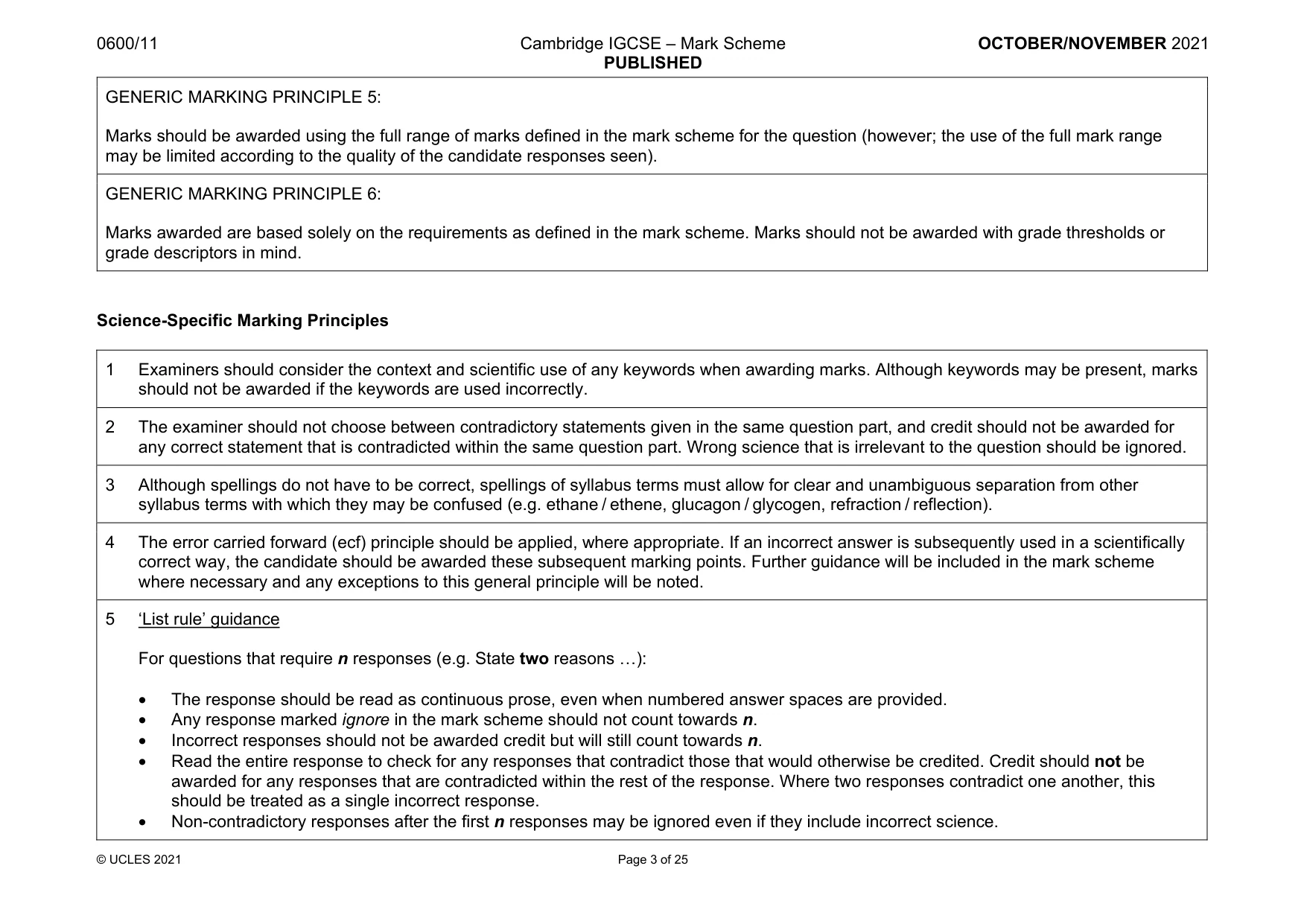
0600/11 Cambridge IGCSE – Mark Scheme PUBLISHED OCTOBER/NOVEMBER 2021 © UCLES 2021 Page 2 of 25 Generic Marking Principles These general marking principles must be applied by all examiners when marking candidate answers. They should be applied alongside the specific content of the mark scheme or generic level descriptors for a question. Each question paper and mark scheme will also comply with these marking principles. GENERIC MARKING PRINCIPLE 1: Marks must be awarded in line with: • the specific content of the mark scheme or the generic level descriptors for the question • the specific skills defined in the mark scheme or in the generic level descriptors for the question • the standard of response required by a candidate as exemplified by the standardisation scripts. GENERIC MARKING PRINCIPLE 2: Marks awarded are always whole marks (not half marks, or other fractions). GENERIC MARKING PRINCIPLE 3: Marks must be awarded positively: • marks are awarded for correct/valid answers, as defined in the mark scheme. However, credit is given for valid answers which go beyond the scope of the syllabus and mark scheme, referring to your Team Leader as appropriate • marks are awarded when candidates clearly demonstrate what they know and can do • marks are not deducted for errors • marks are not deducted for omissions • answers should only be judged on the quality of spelling, punctuation and grammar when these features are specifically assessed by the question as indicated by the mark scheme. The meaning, however, should be unambiguous. GENERIC MARKING PRINCIPLE 4: Rules must be applied consistently, e.g. in situations where candidates have not followed instructions or in the application of generic level descriptors.
Mark scheme, page 3
0600/11 Cambridge IGCSE – Mark Scheme PUBLISHED OCTOBER/NOVEMBER 2021 © UCLES 2021 Page 3 of 25 GENERIC MARKING PRINCIPLE 5: Marks should be awarded using the full range of marks defined in the mark scheme for the question (however; the use of the full mark range may be limited according to the quality of the candidate responses seen). GENERIC MARKING PRINCIPLE 6: Marks awarded are based solely on the requirements as defined in the mark scheme. Marks should not be awarded with grade thresholds or grade descriptors in mind. Science-Specific Marking Principles 1 Examiners should consider the context and scientific use of any keywords when awarding marks. Although keywords may be present, marks should not be awarded if the keywords are used incorrectly. 2 The examiner should not choose between contradictory statements given in the same question part, and credit should not be awarded for any correct statement that is contradicted within the same question part. Wrong science that is irrelevant to the question should be ignored. 3 Although spellings do not have to be correct, spellings of syllabus terms must allow for clear and unambiguous separation from other syllabus terms with which they may be confused (e.g. ethane / ethene, glucagon / glycogen, refraction / reflection). 4 The error carried forward (ecf) principle should be applied, where appropriate. If an incorrect answer is subsequently used in a scientifically correct way, the candidate should be awarded these subsequent marking points. Further guidance will be included in the mark scheme where necessary and any exceptions to this general principle will be noted. 5 ‘List rule’ guidance For questions that require n responses (e.g. State two reasons …): • The response should be read as continuous prose, even when numbered answer spaces are provided. • Any response marked ignore in the mark scheme should not count towards n. • Incorrect responses should not be awarded credit but will still count towards n. • Read the entire response to check for any responses that contradict those that would otherwise be credited. Credit should not be awarded for any responses that are contradicted within the rest of the response. Where two responses contradict one another, this should be treated as a single incorrect response. • Non-contradictory responses after the first n responses may be ignored even if they include incorrect science.
Mark scheme, page 4
0600/11 Cambridge IGCSE – Mark Scheme PUBLISHED OCTOBER/NOVEMBER 2021 © UCLES 2021 Page 4 of 25 6 Calculation specific guidance Correct answers to calculations should be given full credit even if there is no working or incorrect working, unless the question states ‘show your working’. For questions in which the number of significant figures required is not stated, credit should be awarded for correct answers when rounded by the examiner to the number of significant figures given in the mark scheme. This may not apply to measured values. For answers given in standard form (e.g. a × 10n) in which the convention of restricting the value of the coefficient (a) to a value between 1 and 10 is not followed, credit may still be awarded if the answer can be converted to the answer given in the mark scheme. Unless a separate mark is given for a unit, a missing or incorrect unit will normally mean that the final calculation mark is not awarded. Exceptions to this general principle will be noted in the mark scheme. 7 Guidance for chemical equations Multiples / fractions of coefficients used in chemical equations are acceptable unless stated otherwise in the mark scheme. State symbols given in an equation should be ignored unless asked for in the question or stated otherwise in the mark scheme.
Mark scheme, page 5
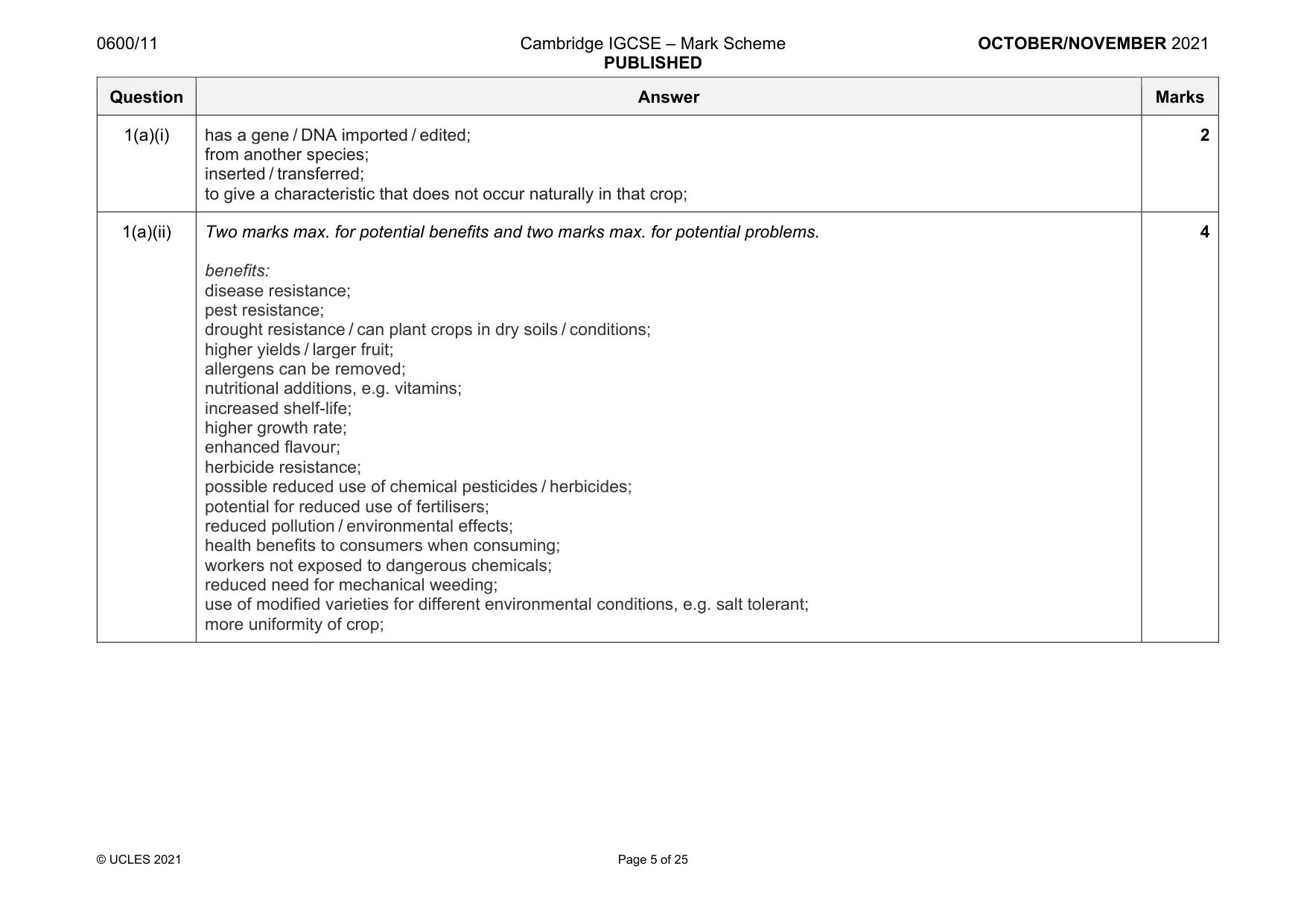
0600/11 Cambridge IGCSE – Mark Scheme PUBLISHED OCTOBER/NOVEMBER 2021 © UCLES 2021 Page 5 of 25 Question Answer Marks 1(a)(i) has a gene / DNA imported / edited; from another species; inserted / transferred; to give a characteristic that does not occur naturally in that crop; 2 1(a)(ii) Two marks max. for potential benefits and two marks max. for potential problems. benefits: disease resistance; pest resistance; drought resistance / can plant crops in dry soils / conditions; higher yields / larger fruit; allergens can be removed; nutritional additions, e.g. vitamins; increased shelf-life; higher growth rate; enhanced flavour; herbicide resistance; possible reduced use of chemical pesticides / herbicides; potential for reduced use of fertilisers; reduced pollution / environmental effects; health benefits to consumers when consuming; workers not exposed to dangerous chemicals; reduced need for mechanical weeding; use of modified varieties for different environmental conditions, e.g. salt tolerant; more uniformity of crop; 4
Mark scheme, page 6
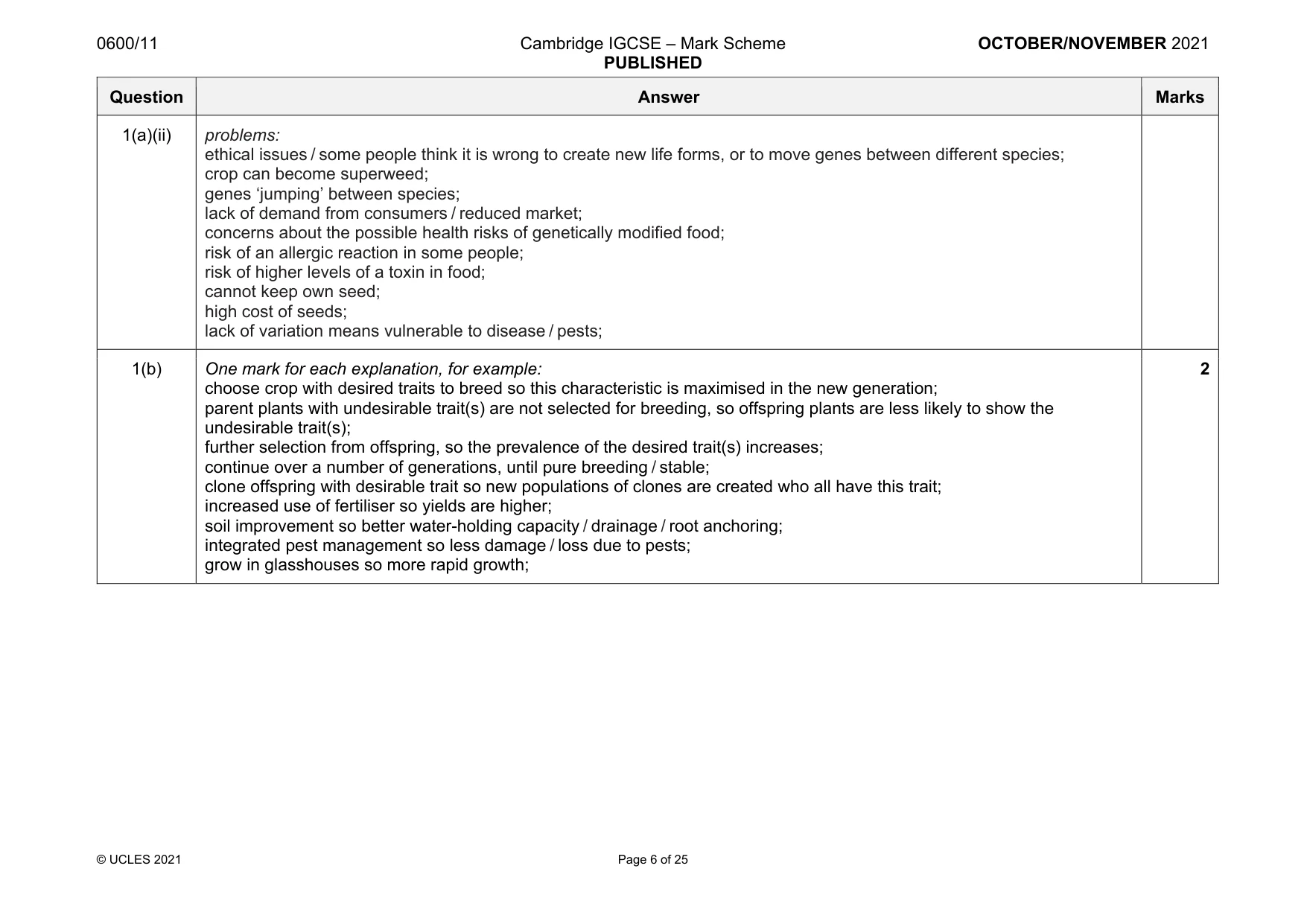
0600/11 Cambridge IGCSE – Mark Scheme PUBLISHED OCTOBER/NOVEMBER 2021 © UCLES 2021 Page 6 of 25 Question Answer Marks 1(a)(ii) problems: ethical issues / some people think it is wrong to create new life forms, or to move genes between different species; crop can become superweed; genes ‘jumping’ between species; lack of demand from consumers / reduced market; concerns about the possible health risks of genetically modified food; risk of an allergic reaction in some people; risk of higher levels of a toxin in food; cannot keep own seed; high cost of seeds; lack of variation means vulnerable to disease / pests; 1(b) One mark for each explanation, for example: choose crop with desired traits to breed so this characteristic is maximised in the new generation; parent plants with undesirable trait(s) are not selected for breeding, so offspring plants are less likely to show the undesirable trait(s); further selection from offspring, so the prevalence of the desired trait(s) increases; continue over a number of generations, until pure breeding / stable; clone offspring with desirable trait so new populations of clones are created who all have this trait; increased use of fertiliser so yields are higher; soil improvement so better water-holding capacity / drainage / root anchoring; integrated pest management so less damage / loss due to pests; grow in glasshouses so more rapid growth; 2
Mark scheme, page 7
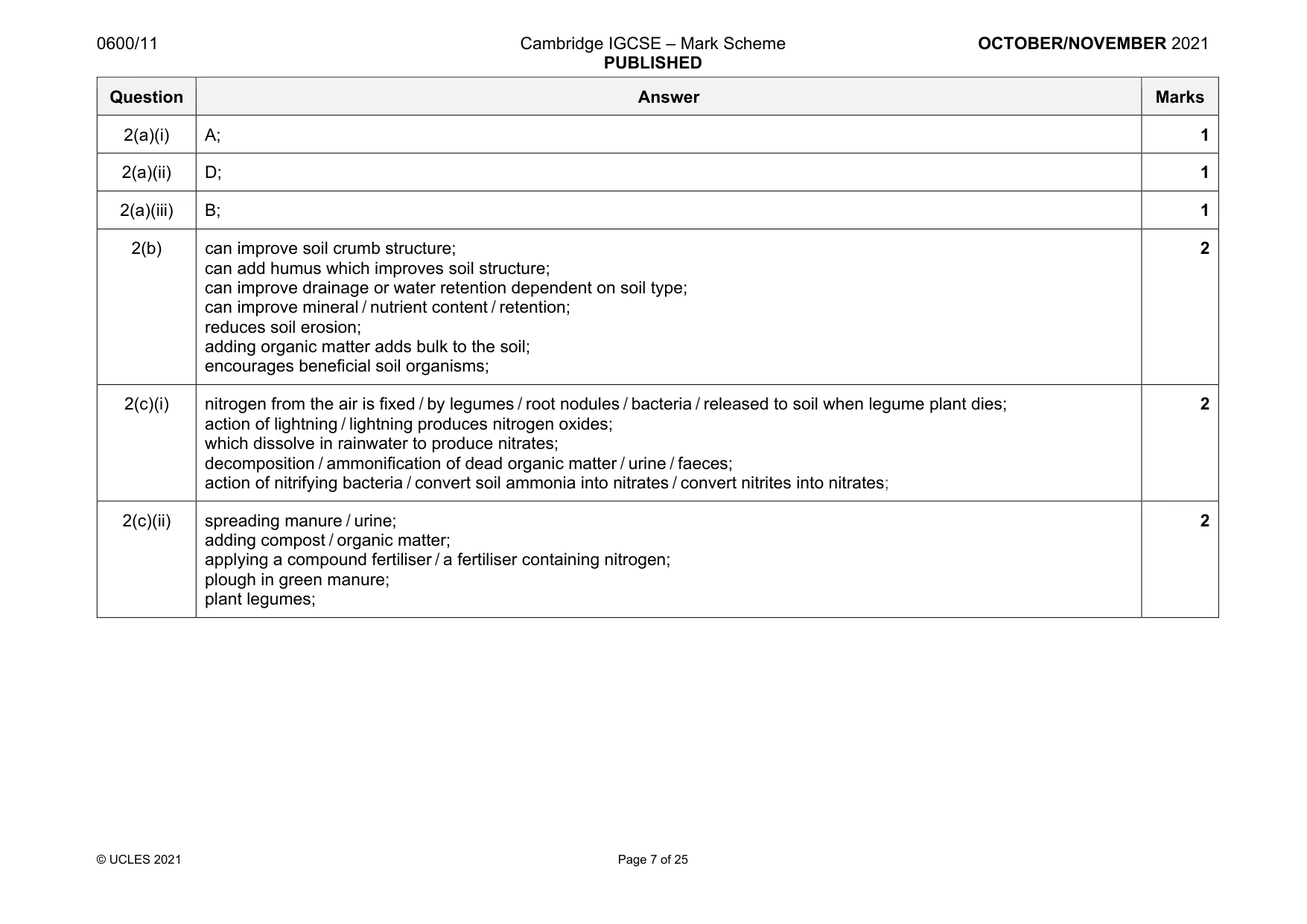
0600/11 Cambridge IGCSE – Mark Scheme PUBLISHED OCTOBER/NOVEMBER 2021 © UCLES 2021 Page 7 of 25 Question Answer Marks 2(a)(i) A; 1 2(a)(ii) D; 1 2(a)(iii) B; 1 2(b) can improve soil crumb structure; can add humus which improves soil structure; can improve drainage or water retention dependent on soil type; can improve mineral / nutrient content / retention; reduces soil erosion; adding organic matter adds bulk to the soil; encourages beneficial soil organisms; 2 2(c)(i) nitrogen from the air is fixed / by legumes / root nodules / bacteria / released to soil when legume plant dies; action of lightning / lightning produces nitrogen oxides; which dissolve in rainwater to produce nitrates; decomposition / ammonification of dead organic matter / urine / faeces; action of nitrifying bacteria / convert soil ammonia into nitrates / convert nitrites into nitrates; 2 2(c)(ii) spreading manure / urine; adding compost / organic matter; applying a compound fertiliser / a fertiliser containing nitrogen; plough in green manure; plant legumes; 2
Mark scheme, page 8
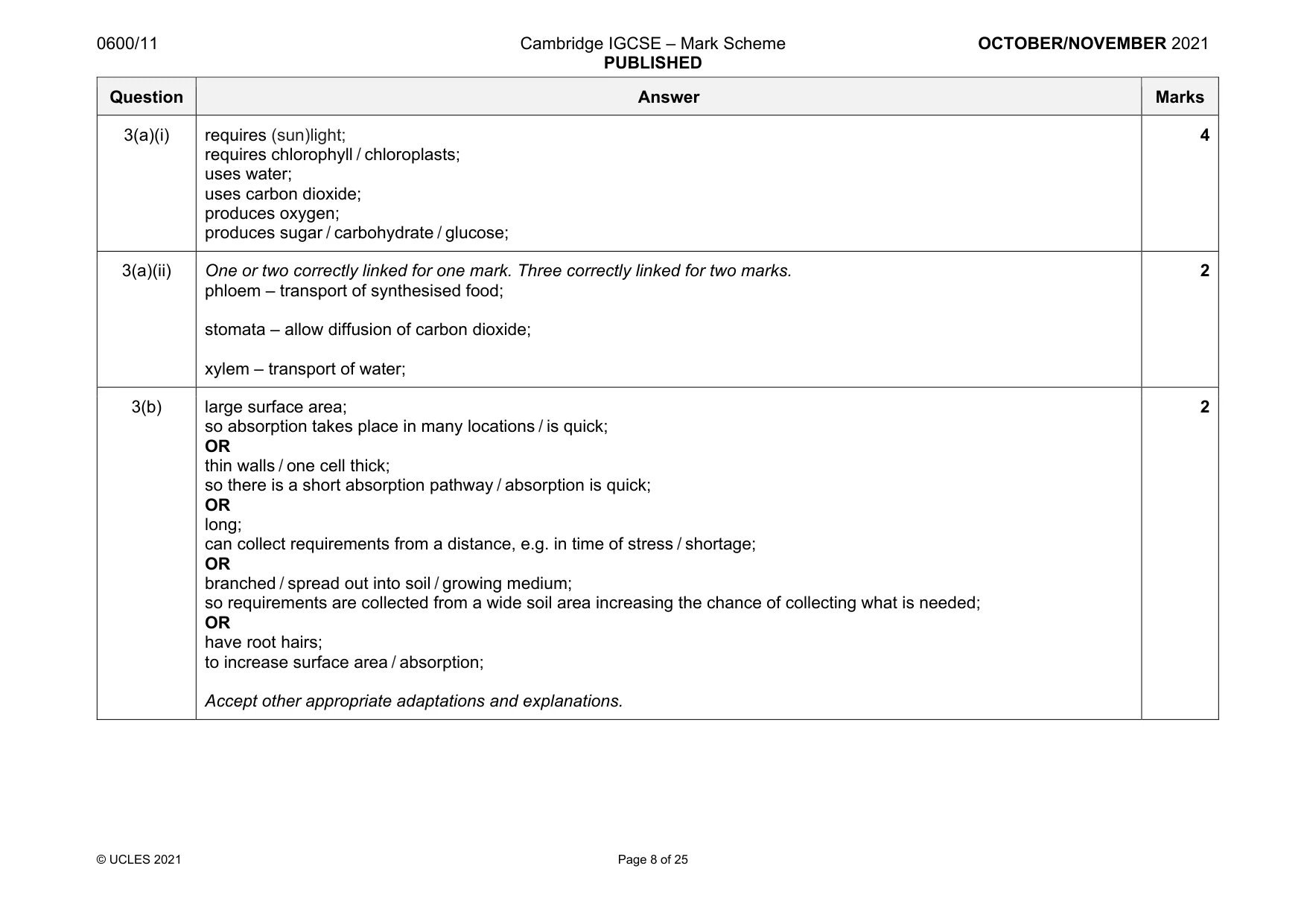
0600/11 Cambridge IGCSE – Mark Scheme PUBLISHED OCTOBER/NOVEMBER 2021 © UCLES 2021 Page 8 of 25 Question Answer Marks 3(a)(i) requires (sun)light; requires chlorophyll / chloroplasts; uses water; uses carbon dioxide; produces oxygen; produces sugar / carbohydrate / glucose; 4 3(a)(ii) One or two correctly linked for one mark. Three correctly linked for two marks. phloem – transport of synthesised food; stomata – allow diffusion of carbon dioxide; xylem – transport of water; 2 3(b) large surface area; so absorption takes place in many locations / is quick; OR thin walls / one cell thick; so there is a short absorption pathway / absorption is quick; OR long; can collect requirements from a distance, e.g. in time of stress / shortage; OR branched / spread out into soil / growing medium; so requirements are collected from a wide soil area increasing the chance of collecting what is needed; OR have root hairs; to increase surface area / absorption; Accept other appropriate adaptations and explanations. 2
Mark scheme, page 9
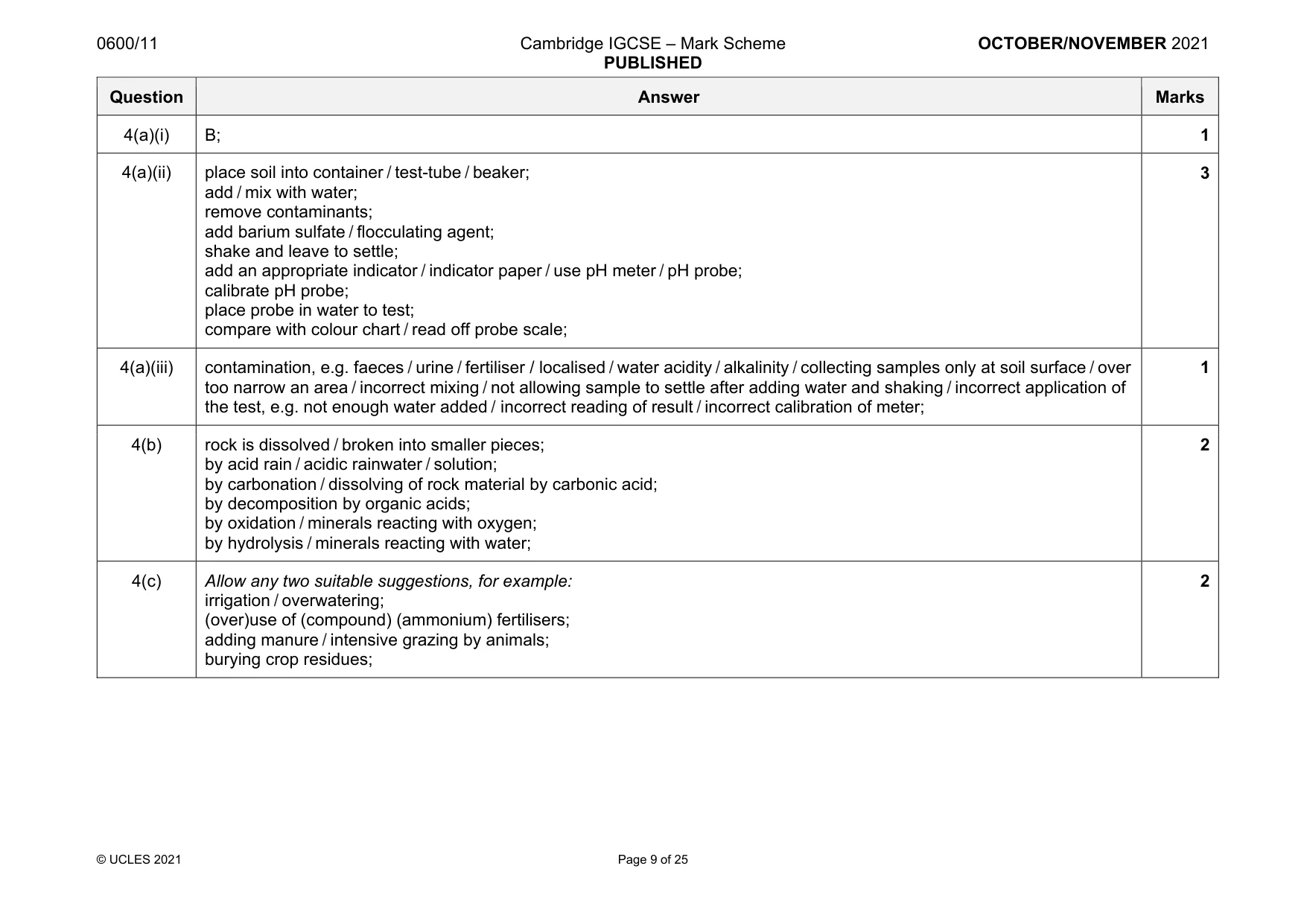
0600/11 Cambridge IGCSE – Mark Scheme PUBLISHED OCTOBER/NOVEMBER 2021 © UCLES 2021 Page 9 of 25 Question Answer Marks 4(a)(i) B; 1 4(a)(ii) place soil into container / test-tube / beaker; add / mix with water; remove contaminants; add barium sulfate / flocculating agent; shake and leave to settle; add an appropriate indicator / indicator paper / use pH meter / pH probe; calibrate pH probe; place probe in water to test; compare with colour chart / read off probe scale; 3 4(a)(iii) contamination, e.g. faeces / urine / fertiliser / localised / water acidity / alkalinity / collecting samples only at soil surface / over too narrow an area / incorrect mixing / not allowing sample to settle after adding water and shaking / incorrect application of the test, e.g. not enough water added / incorrect reading of result / incorrect calibration of meter; 1 4(b) rock is dissolved / broken into smaller pieces; by acid rain / acidic rainwater / solution; by carbonation / dissolving of rock material by carbonic acid; by decomposition by organic acids; by oxidation / minerals reacting with oxygen; by hydrolysis / minerals reacting with water; 2 4(c) Allow any two suitable suggestions, for example: irrigation / overwatering; (over)use of (compound) (ammonium) fertilisers; adding manure / intensive grazing by animals; burying crop residues; 2
Mark scheme, page 10
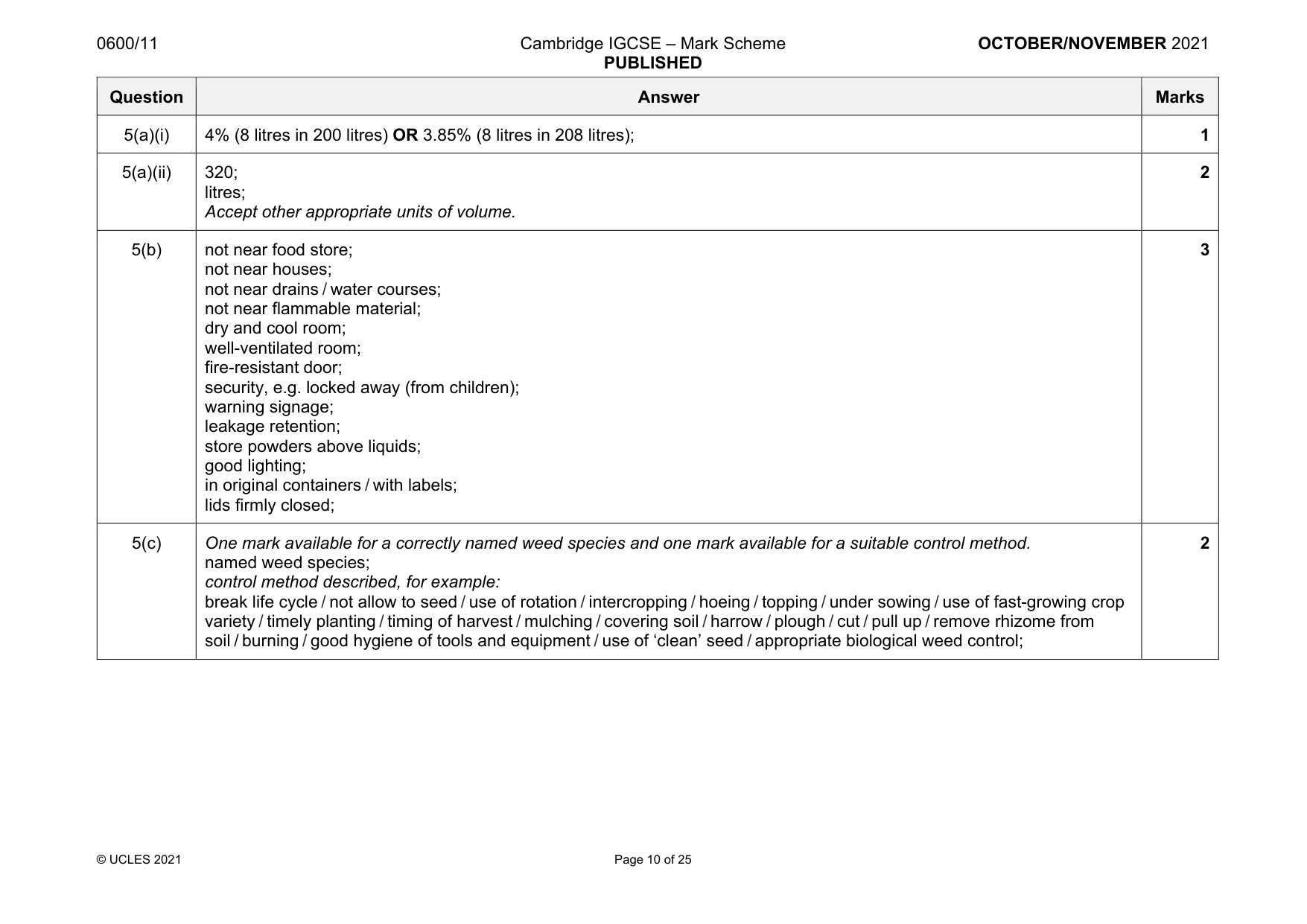
0600/11 Cambridge IGCSE – Mark Scheme PUBLISHED OCTOBER/NOVEMBER 2021 © UCLES 2021 Page 10 of 25 Question Answer Marks 5(a)(i) 4% (8 litres in 200 litres) OR 3.85% (8 litres in 208 litres); 1 5(a)(ii) 320; litres; Accept other appropriate units of volume. 2 5(b) not near food store; not near houses; not near drains / water courses; not near flammable material; dry and cool room; well-ventilated room; fire-resistant door; security, e.g. locked away (from children); warning signage; leakage retention; store powders above liquids; good lighting; in original containers / with labels; lids firmly closed; 3 5(c) One mark available for a correctly named weed species and one mark available for a suitable control method. named weed species; control method described, for example: break life cycle / not allow to seed / use of rotation / intercropping / hoeing / topping / under sowing / use of fast-growing crop variety / timely planting / timing of harvest / mulching / covering soil / harrow / plough / cut / pull up / remove rhizome from soil / burning / good hygiene of tools and equipment / use of ‘clean’ seed / appropriate biological weed control; 2
Mark scheme, page 11
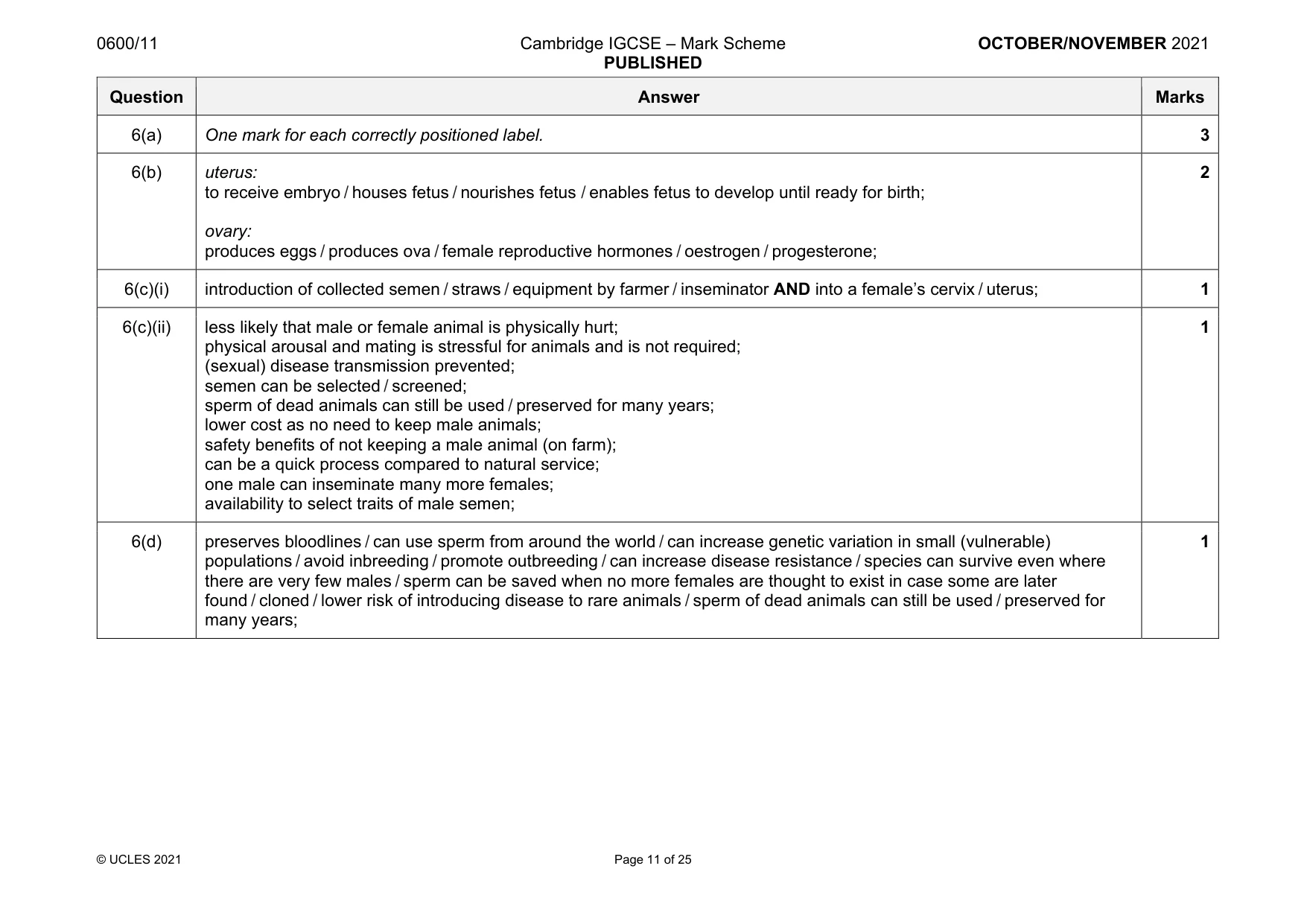
0600/11 Cambridge IGCSE – Mark Scheme PUBLISHED OCTOBER/NOVEMBER 2021 © UCLES 2021 Page 11 of 25 Question Answer Marks 6(a) One mark for each correctly positioned label. 3 6(b) uterus: to receive embryo / houses fetus / nourishes fetus / enables fetus to develop until ready for birth; ovary: produces eggs / produces ova / female reproductive hormones / oestrogen / progesterone; 2 6(c)(i) introduction of collected semen / straws / equipment by farmer / inseminator AND into a female’s cervix / uterus; 1 6(c)(ii) less likely that male or female animal is physically hurt; physical arousal and mating is stressful for animals and is not required; (sexual) disease transmission prevented; semen can be selected / screened; sperm of dead animals can still be used / preserved for many years; lower cost as no need to keep male animals; safety benefits of not keeping a male animal (on farm); can be a quick process compared to natural service; one male can inseminate many more females; availability to select traits of male semen; 1 6(d) preserves bloodlines / can use sperm from around the world / can increase genetic variation in small (vulnerable) populations / avoid inbreeding / promote outbreeding / can increase disease resistance / species can survive even where there are very few males / sperm can be saved when no more females are thought to exist in case some are later found / cloned / lower risk of introducing disease to rare animals / sperm of dead animals can still be used / preserved for many years; 1
Mark scheme, page 12
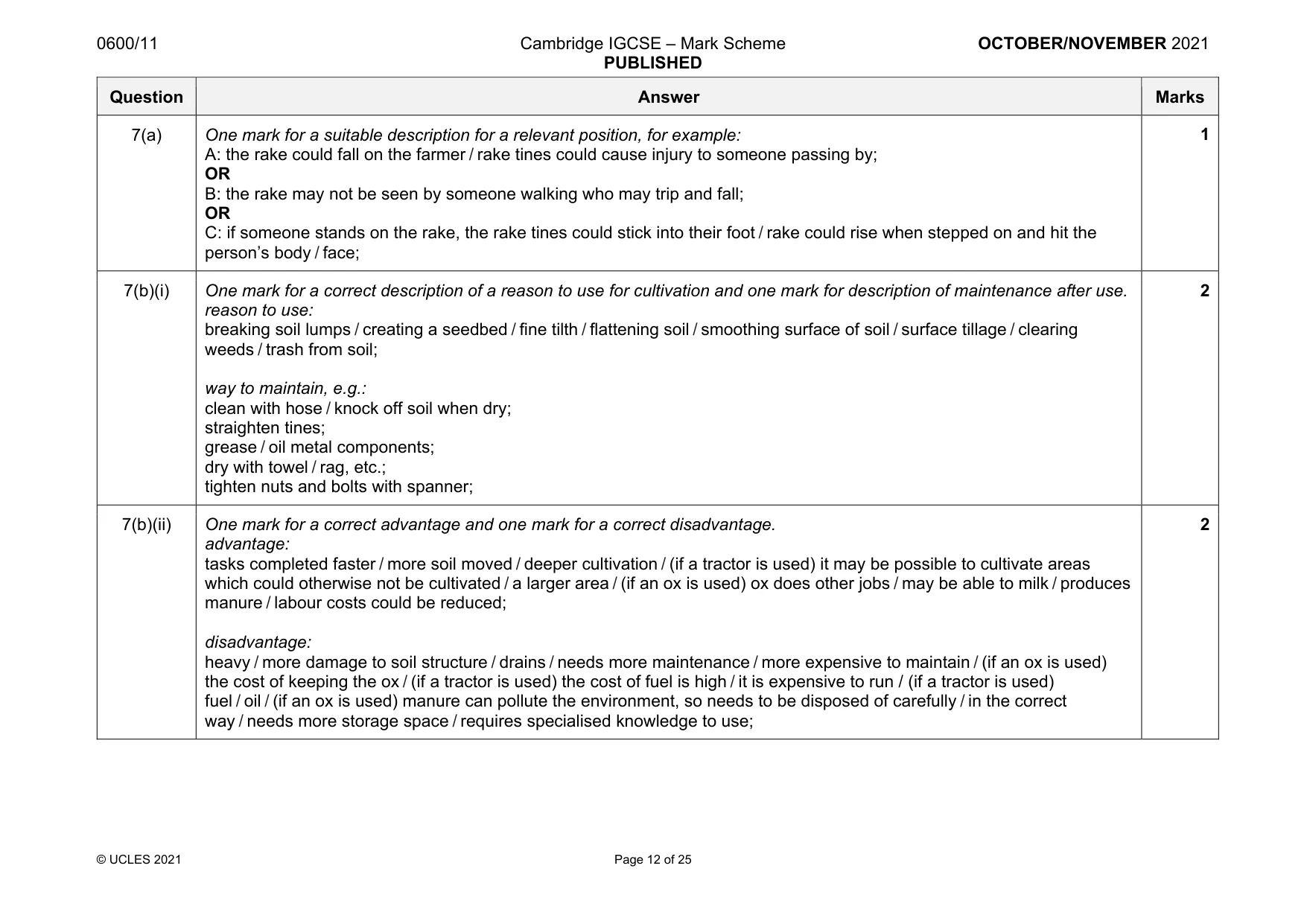
0600/11 Cambridge IGCSE – Mark Scheme PUBLISHED OCTOBER/NOVEMBER 2021 © UCLES 2021 Page 12 of 25 Question Answer Marks 7(a) One mark for a suitable description for a relevant position, for example: A: the rake could fall on the farmer / rake tines could cause injury to someone passing by; OR B: the rake may not be seen by someone walking who may trip and fall; OR C: if someone stands on the rake, the rake tines could stick into their foot / rake could rise when stepped on and hit the person’s body / face; 1 7(b)(i) One mark for a correct description of a reason to use for cultivation and one mark for description of maintenance after use. reason to use: breaking soil lumps / creating a seedbed / fine tilth / flattening soil / smoothing surface of soil / surface tillage / clearing weeds / trash from soil; way to maintain, e.g.: clean with hose / knock off soil when dry; straighten tines; grease / oil metal components; dry with towel / rag, etc.; tighten nuts and bolts with spanner; 2 7(b)(ii) One mark for a correct advantage and one mark for a correct disadvantage. advantage: tasks completed faster / more soil moved / deeper cultivation / (if a tractor is used) it may be possible to cultivate areas which could otherwise not be cultivated / a larger area / (if an ox is used) ox does other jobs / may be able to milk / produces manure / labour costs could be reduced; disadvantage: heavy / more damage to soil structure / drains / needs more maintenance / more expensive to maintain / (if an ox is used) the cost of keeping the ox / (if a tractor is used) the cost of fuel is high / it is expensive to run / (if a tractor is used) fuel / oil / (if an ox is used) manure can pollute the environment, so needs to be disposed of carefully / in the correct way / needs more storage space / requires specialised knowledge to use; 2
Mark scheme, page 13
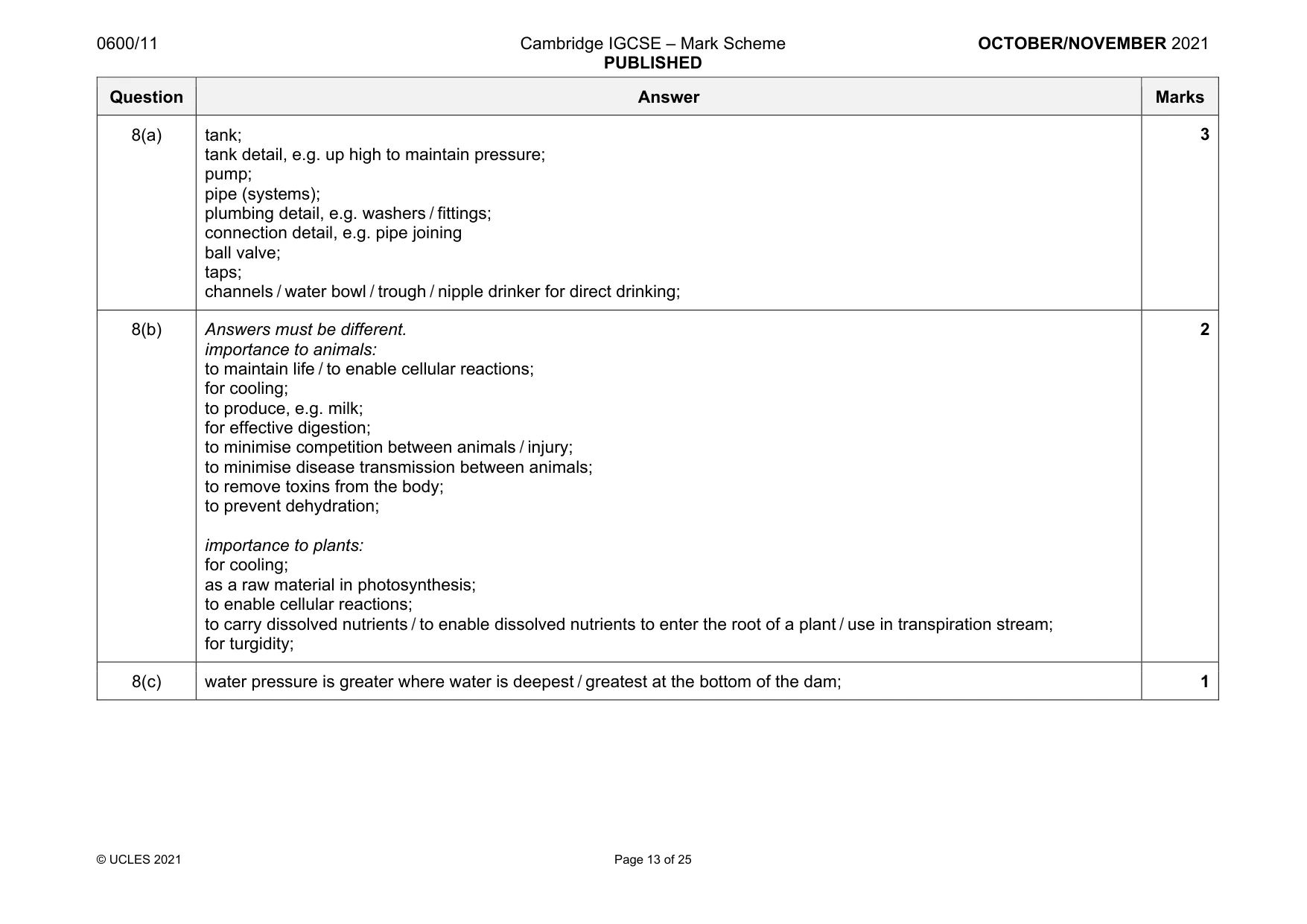
0600/11 Cambridge IGCSE – Mark Scheme PUBLISHED OCTOBER/NOVEMBER 2021 © UCLES 2021 Page 13 of 25 Question Answer Marks 8(a) tank; tank detail, e.g. up high to maintain pressure; pump; pipe (systems); plumbing detail, e.g. washers / fittings; connection detail, e.g. pipe joining ball valve; taps; channels / water bowl / trough / nipple drinker for direct drinking; 3 8(b) Answers must be different. importance to animals: to maintain life / to enable cellular reactions; for cooling; to produce, e.g. milk; for effective digestion; to minimise competition between animals / injury; to minimise disease transmission between animals; to remove toxins from the body; to prevent dehydration; importance to plants: for cooling; as a raw material in photosynthesis; to enable cellular reactions; to carry dissolved nutrients / to enable dissolved nutrients to enter the root of a plant / use in transpiration stream; for turgidity; 2 8(c) water pressure is greater where water is deepest / greatest at the bottom of the dam; 1
Mark scheme, page 14
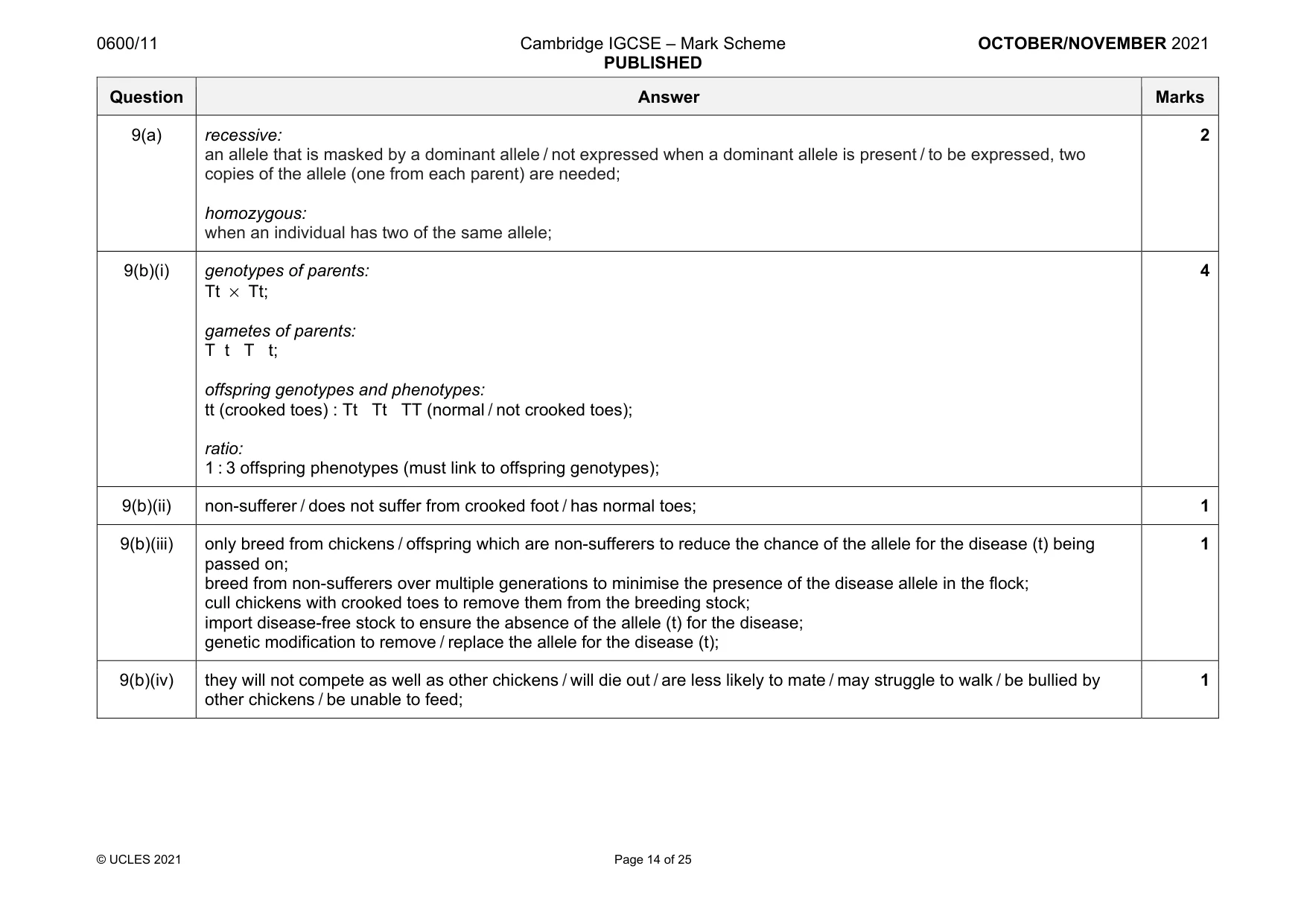
0600/11 Cambridge IGCSE – Mark Scheme PUBLISHED OCTOBER/NOVEMBER 2021 © UCLES 2021 Page 14 of 25 Question Answer Marks 9(a) recessive: an allele that is masked by a dominant allele / not expressed when a dominant allele is present / to be expressed, two copies of the allele (one from each parent) are needed; homozygous: when an individual has two of the same allele; 2 9(b)(i) genotypes of parents: Tt × Tt; gametes of parents: T t T t; offspring genotypes and phenotypes: tt (crooked toes) : Tt Tt TT (normal / not crooked toes); ratio: 1 : 3 offspring phenotypes (must link to offspring genotypes); 4 9(b)(ii) non-sufferer / does not suffer from crooked foot / has normal toes; 1 9(b)(iii) only breed from chickens / offspring which are non-sufferers to reduce the chance of the allele for the disease (t) being passed on; breed from non-sufferers over multiple generations to minimise the presence of the disease allele in the flock; cull chickens with crooked toes to remove them from the breeding stock; import disease-free stock to ensure the absence of the allele (t) for the disease; genetic modification to remove / replace the allele for the disease (t); 1 9(b)(iv) they will not compete as well as other chickens / will die out / are less likely to mate / may struggle to walk / be bullied by other chickens / be unable to feed; 1
Mark scheme, page 15
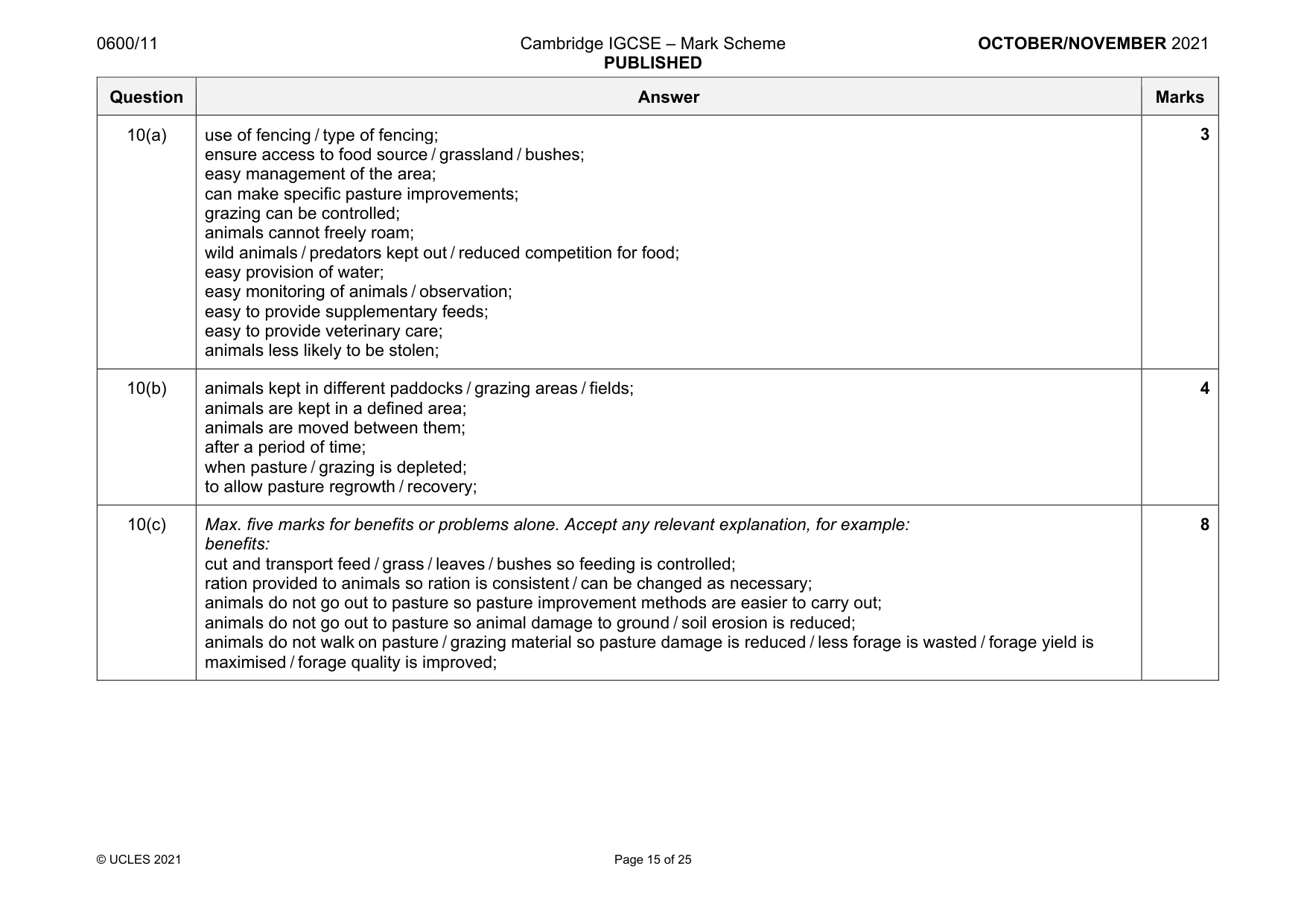
0600/11 Cambridge IGCSE – Mark Scheme PUBLISHED OCTOBER/NOVEMBER 2021 © UCLES 2021 Page 15 of 25 Question Answer Marks 10(a) use of fencing / type of fencing; ensure access to food source / grassland / bushes; easy management of the area; can make specific pasture improvements; grazing can be controlled; animals cannot freely roam; wild animals / predators kept out / reduced competition for food; easy provision of water; easy monitoring of animals / observation; easy to provide supplementary feeds; easy to provide veterinary care; animals less likely to be stolen; 3 10(b) animals kept in different paddocks / grazing areas / fields; animals are kept in a defined area; animals are moved between them; after a period of time; when pasture / grazing is depleted; to allow pasture regrowth / recovery; 4 10(c) Max. five marks for benefits or problems alone. Accept any relevant explanation, for example: benefits: cut and transport feed / grass / leaves / bushes so feeding is controlled; ration provided to animals so ration is consistent / can be changed as necessary; animals do not go out to pasture so pasture improvement methods are easier to carry out; animals do not go out to pasture so animal damage to ground / soil erosion is reduced; animals do not walk on pasture / grazing material so pasture damage is reduced / less forage is wasted / forage yield is maximised / forage quality is improved; 8
Mark scheme, page 16
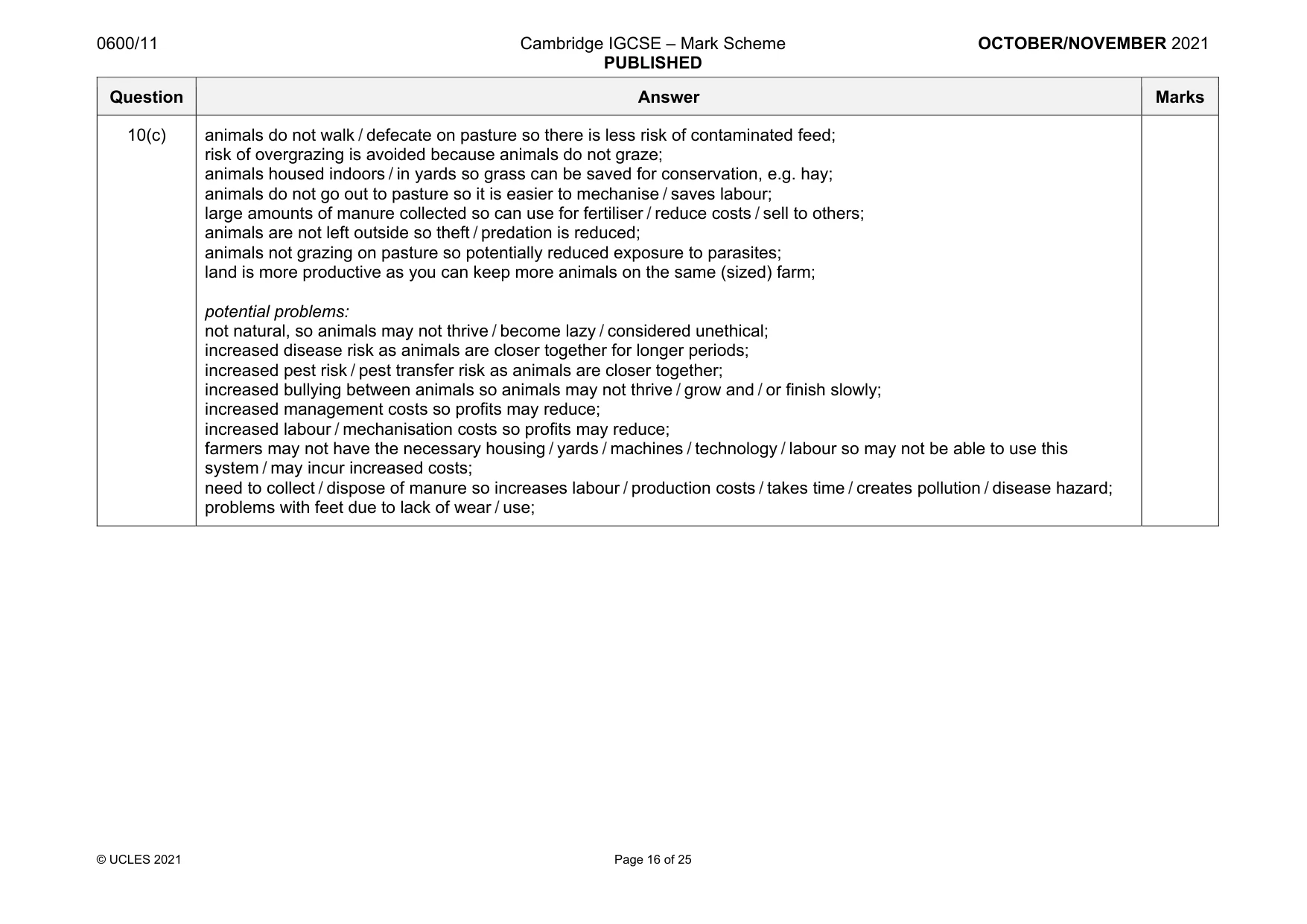
0600/11 Cambridge IGCSE – Mark Scheme PUBLISHED OCTOBER/NOVEMBER 2021 © UCLES 2021 Page 16 of 25 Question Answer Marks 10(c) animals do not walk / defecate on pasture so there is less risk of contaminated feed; risk of overgrazing is avoided because animals do not graze; animals housed indoors / in yards so grass can be saved for conservation, e.g. hay; animals do not go out to pasture so it is easier to mechanise / saves labour; large amounts of manure collected so can use for fertiliser / reduce costs / sell to others; animals are not left outside so theft / predation is reduced; animals not grazing on pasture so potentially reduced exposure to parasites; land is more productive as you can keep more animals on the same (sized) farm; potential problems: not natural, so animals may not thrive / become lazy / considered unethical; increased disease risk as animals are closer together for longer periods; increased pest risk / pest transfer risk as animals are closer together; increased bullying between animals so animals may not thrive / grow and / or finish slowly; increased management costs so profits may reduce; increased labour / mechanisation costs so profits may reduce; farmers may not have the necessary housing / yards / machines / technology / labour so may not be able to use this system / may incur increased costs; need to collect / dispose of manure so increases labour / production costs / takes time / creates pollution / disease hazard; problems with feet due to lack of wear / use;
Mark scheme, page 17
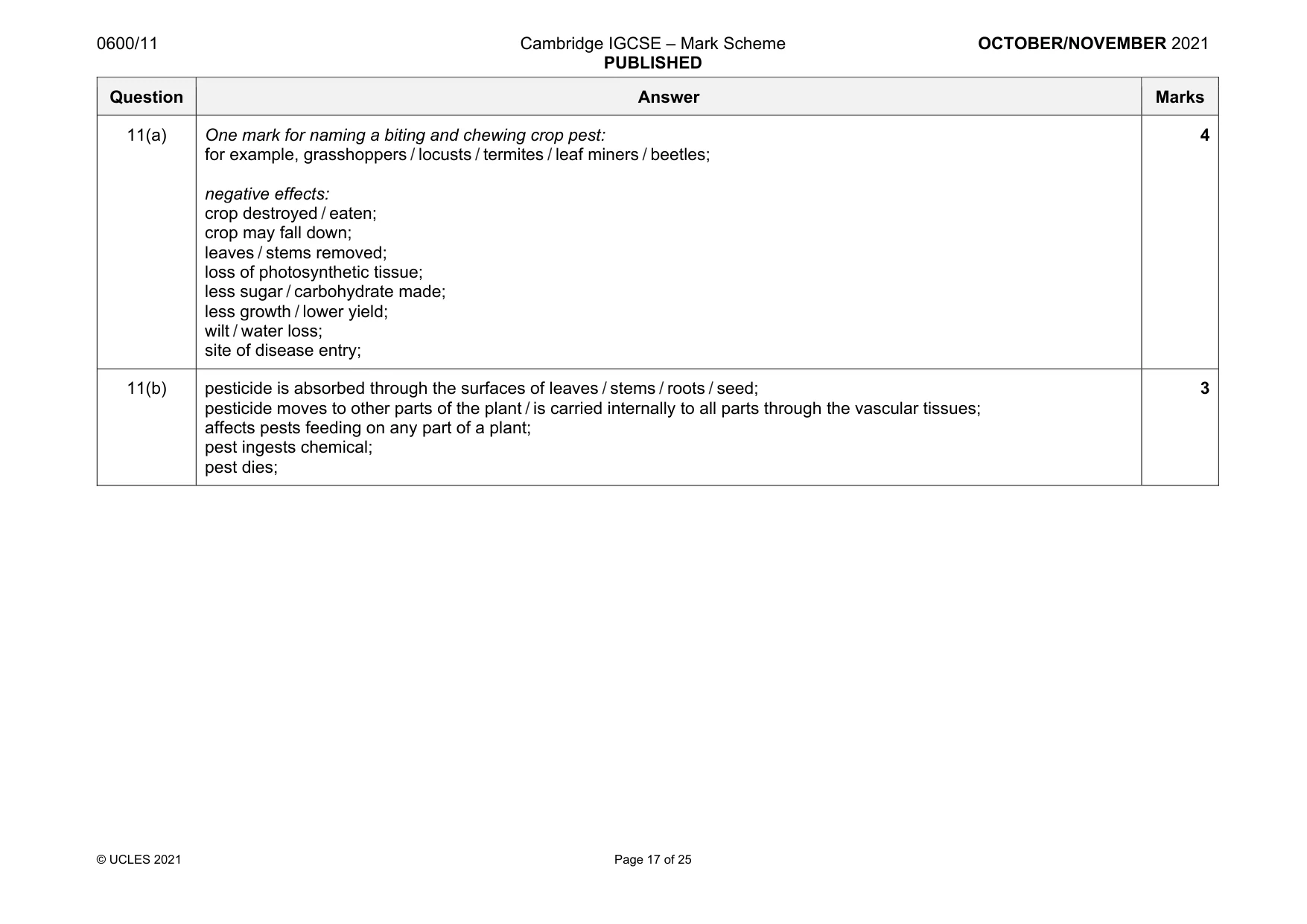
0600/11 Cambridge IGCSE – Mark Scheme PUBLISHED OCTOBER/NOVEMBER 2021 © UCLES 2021 Page 17 of 25 Question Answer Marks 11(a) One mark for naming a biting and chewing crop pest: for example, grasshoppers / locusts / termites / leaf miners / beetles; negative effects: crop destroyed / eaten; crop may fall down; leaves / stems removed; loss of photosynthetic tissue; less sugar / carbohydrate made; less growth / lower yield; wilt / water loss; site of disease entry; 4 11(b) pesticide is absorbed through the surfaces of leaves / stems / roots / seed; pesticide moves to other parts of the plant / is carried internally to all parts through the vascular tissues; affects pests feeding on any part of a plant; pest ingests chemical; pest dies; 3
Mark scheme, page 18
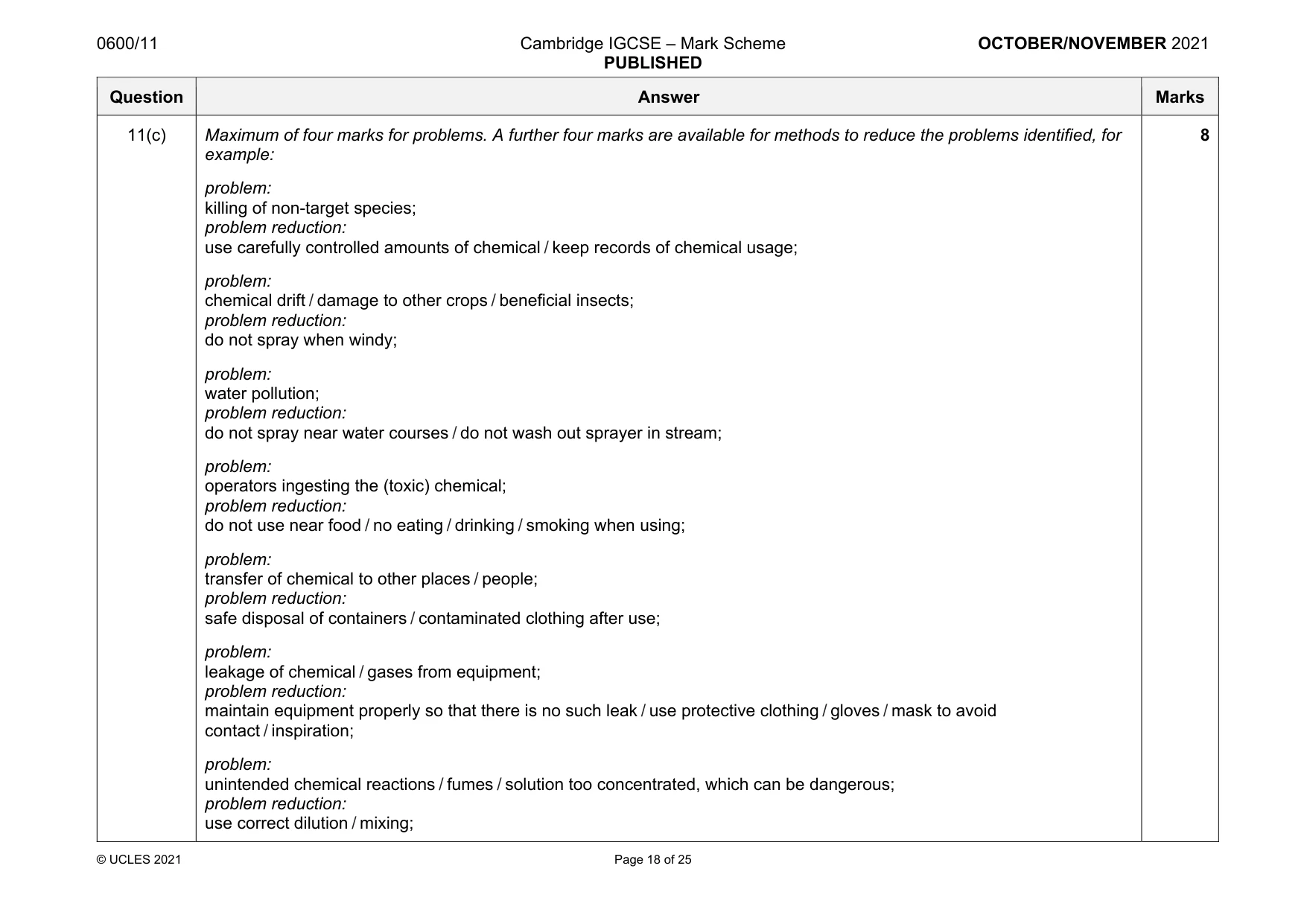
0600/11 Cambridge IGCSE – Mark Scheme PUBLISHED OCTOBER/NOVEMBER 2021 © UCLES 2021 Page 18 of 25 Question Answer Marks 11(c) Maximum of four marks for problems. A further four marks are available for methods to reduce the problems identified, for example: problem: killing of non-target species; problem reduction: use carefully controlled amounts of chemical / keep records of chemical usage; problem: chemical drift / damage to other crops / beneficial insects; problem reduction: do not spray when windy; problem: water pollution; problem reduction: do not spray near water courses / do not wash out sprayer in stream; problem: operators ingesting the (toxic) chemical; problem reduction: do not use near food / no eating / drinking / smoking when using; problem: transfer of chemical to other places / people; problem reduction: safe disposal of containers / contaminated clothing after use; problem: leakage of chemical / gases from equipment; problem reduction: maintain equipment properly so that there is no such leak / use protective clothing / gloves / mask to avoid contact / inspiration; problem: unintended chemical reactions / fumes / solution too concentrated, which can be dangerous; problem reduction: use correct dilution / mixing; 8
Mark scheme, page 19
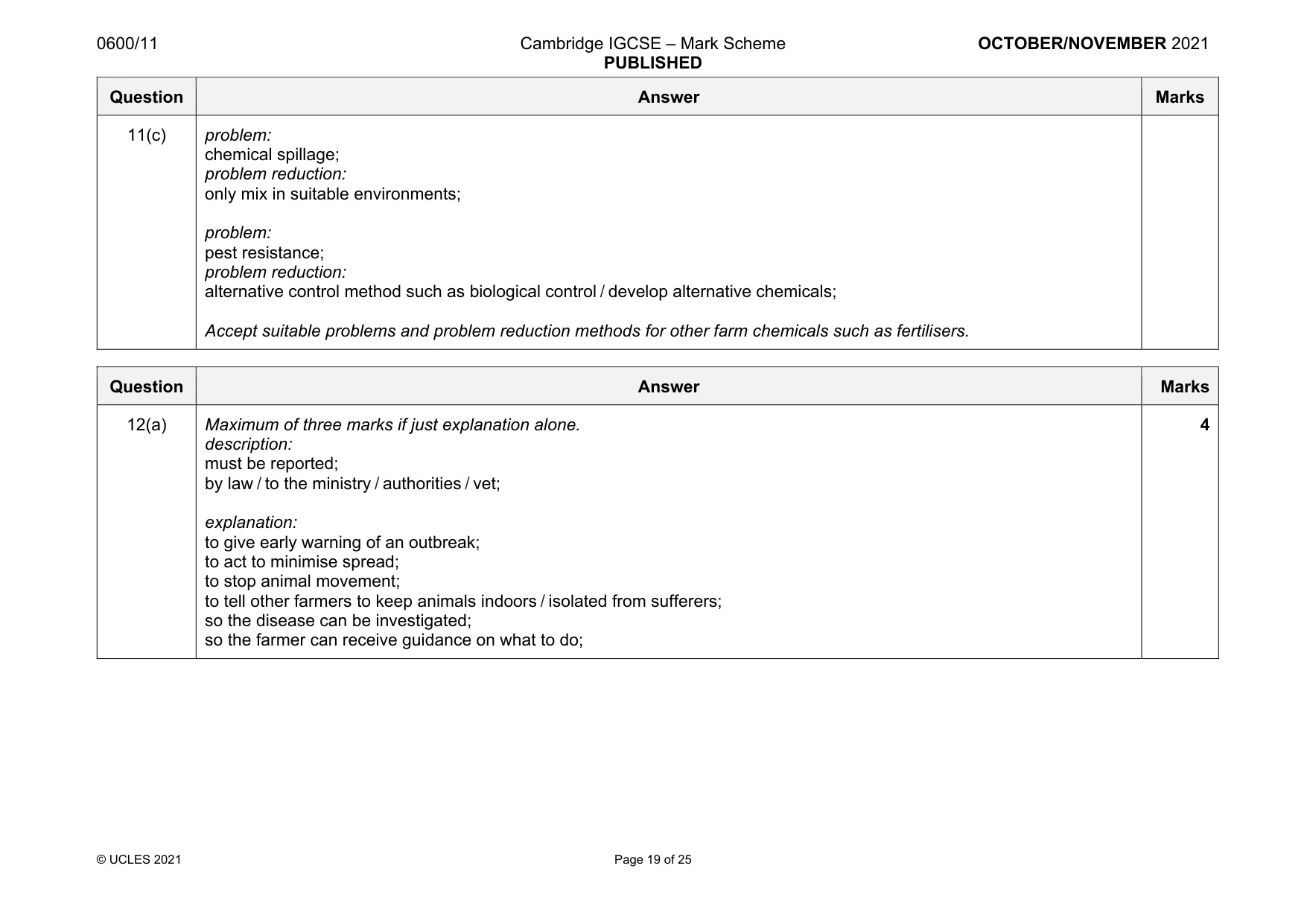
0600/11 Cambridge IGCSE – Mark Scheme PUBLISHED OCTOBER/NOVEMBER 2021 © UCLES 2021 Page 19 of 25 Question Answer Marks 11(c) problem: chemical spillage; problem reduction: only mix in suitable environments; problem: pest resistance; problem reduction: alternative control method such as biological control / develop alternative chemicals; Accept suitable problems and problem reduction methods for other farm chemicals such as fertilisers. Question Answer Marks 12(a) Maximum of three marks if just explanation alone. description: must be reported; by law / to the ministry / authorities / vet; explanation: to give early warning of an outbreak; to act to minimise spread; to stop animal movement; to tell other farmers to keep animals indoors / isolated from sufferers; so the disease can be investigated; so the farmer can receive guidance on what to do; 4
Mark scheme, page 20
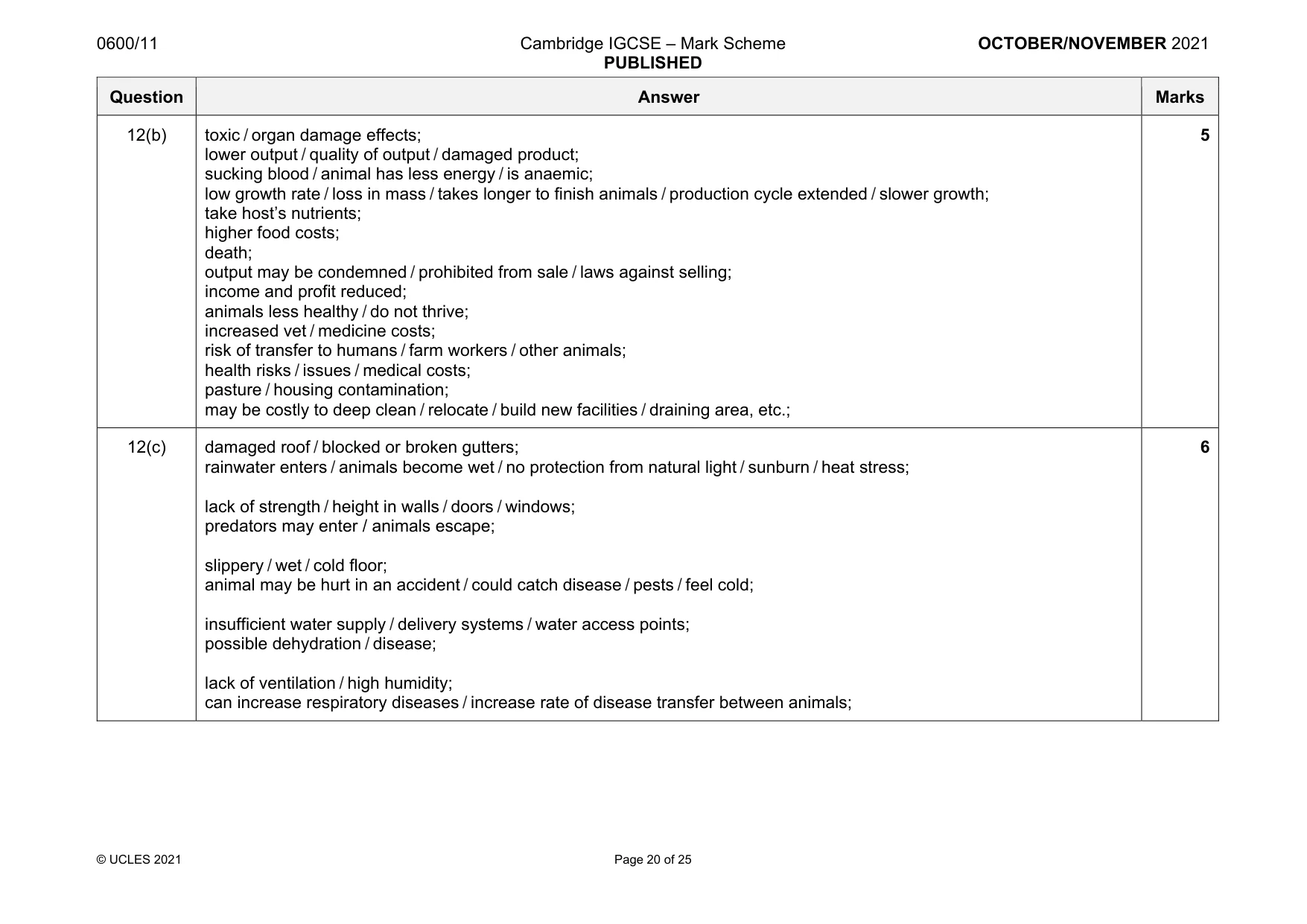
0600/11 Cambridge IGCSE – Mark Scheme PUBLISHED OCTOBER/NOVEMBER 2021 © UCLES 2021 Page 20 of 25 Question Answer Marks 12(b) toxic / organ damage effects; lower output / quality of output / damaged product; sucking blood / animal has less energy / is anaemic; low growth rate / loss in mass / takes longer to finish animals / production cycle extended / slower growth; take host’s nutrients; higher food costs; death; output may be condemned / prohibited from sale / laws against selling; income and profit reduced; animals less healthy / do not thrive; increased vet / medicine costs; risk of transfer to humans / farm workers / other animals; health risks / issues / medical costs; pasture / housing contamination; may be costly to deep clean / relocate / build new facilities / draining area, etc.; 5 12(c) damaged roof / blocked or broken gutters; rainwater enters / animals become wet / no protection from natural light / sunburn / heat stress; lack of strength / height in walls / doors / windows; predators may enter / animals escape; slippery / wet / cold floor; animal may be hurt in an accident / could catch disease / pests / feel cold; insufficient water supply / delivery systems / water access points; possible dehydration / disease; lack of ventilation / high humidity; can increase respiratory diseases / increase rate of disease transfer between animals; 6
Mark scheme, page 21
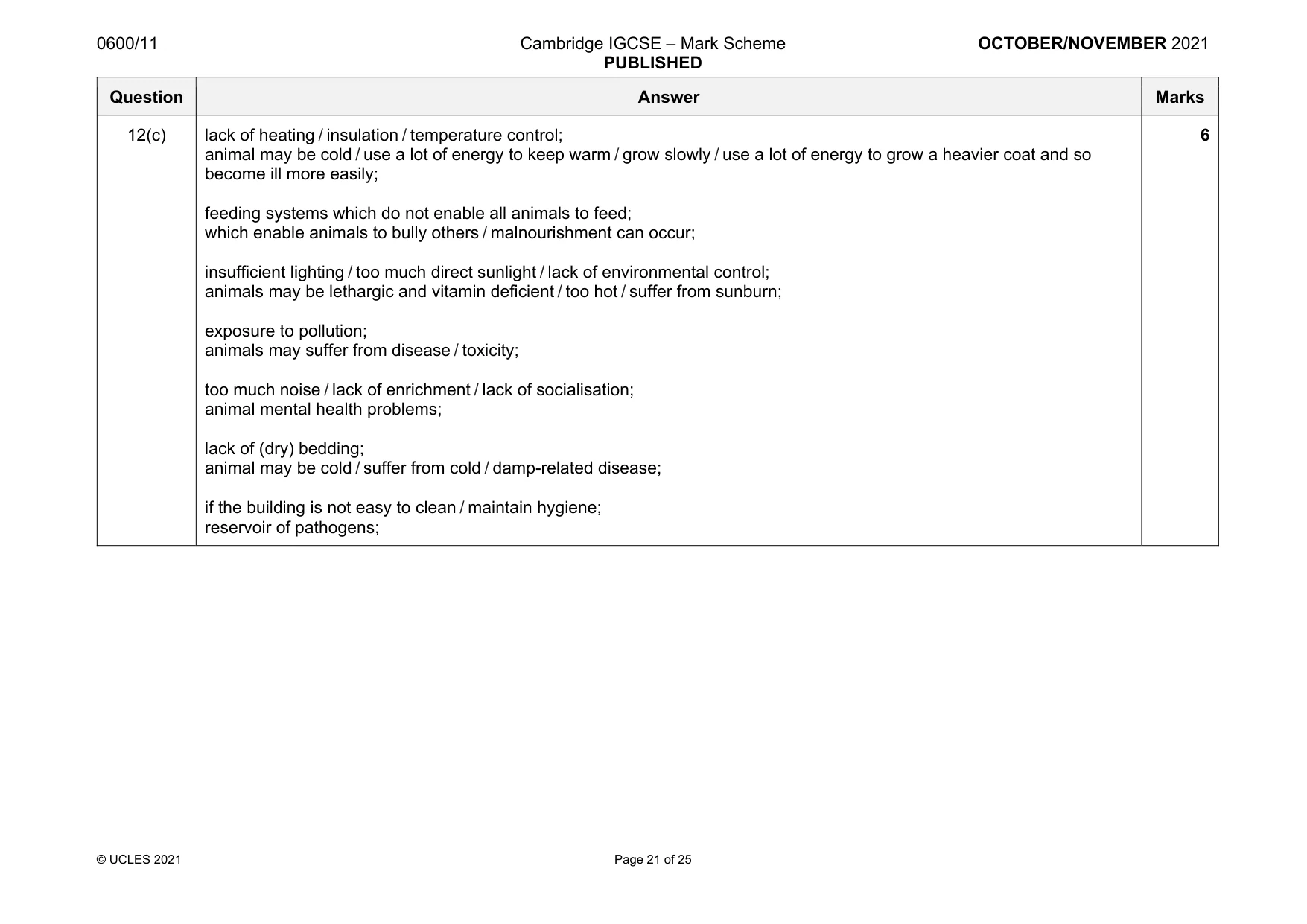
0600/11 Cambridge IGCSE – Mark Scheme PUBLISHED OCTOBER/NOVEMBER 2021 © UCLES 2021 Page 21 of 25 Question Answer Marks 12(c) lack of heating / insulation / temperature control; animal may be cold / use a lot of energy to keep warm / grow slowly / use a lot of energy to grow a heavier coat and so become ill more easily; feeding systems which do not enable all animals to feed; which enable animals to bully others / malnourishment can occur; insufficient lighting / too much direct sunlight / lack of environmental control; animals may be lethargic and vitamin deficient / too hot / suffer from sunburn; exposure to pollution; animals may suffer from disease / toxicity; too much noise / lack of enrichment / lack of socialisation; animal mental health problems; lack of (dry) bedding; animal may be cold / suffer from cold / damp-related disease; if the building is not easy to clean / maintain hygiene; reservoir of pathogens; 6
Mark scheme, page 22
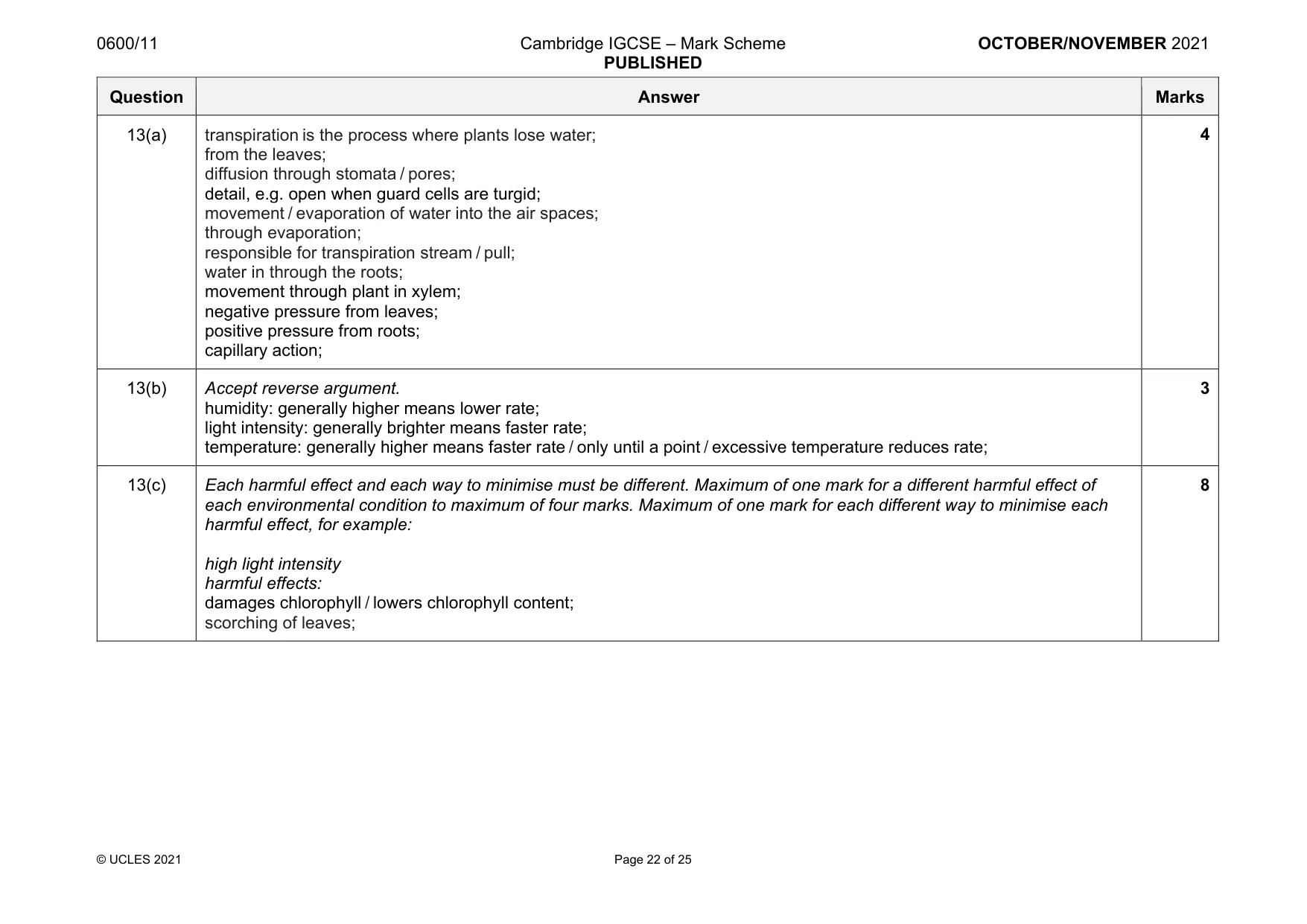
0600/11 Cambridge IGCSE – Mark Scheme PUBLISHED OCTOBER/NOVEMBER 2021 © UCLES 2021 Page 22 of 25 Question Answer Marks 13(a) transpiration is the process where plants lose water; from the leaves; diffusion through stomata / pores; detail, e.g. open when guard cells are turgid; movement / evaporation of water into the air spaces; through evaporation; responsible for transpiration stream / pull; water in through the roots; movement through plant in xylem; negative pressure from leaves; positive pressure from roots; capillary action; 4 13(b) Accept reverse argument. humidity: generally higher means lower rate; light intensity: generally brighter means faster rate; temperature: generally higher means faster rate / only until a point / excessive temperature reduces rate; 3 13(c) Each harmful effect and each way to minimise must be different. Maximum of one mark for a different harmful effect of each environmental condition to maximum of four marks. Maximum of one mark for each different way to minimise each harmful effect, for example: high light intensity harmful effects: damages chlorophyll / lowers chlorophyll content; scorching of leaves; 8
Mark scheme, page 23
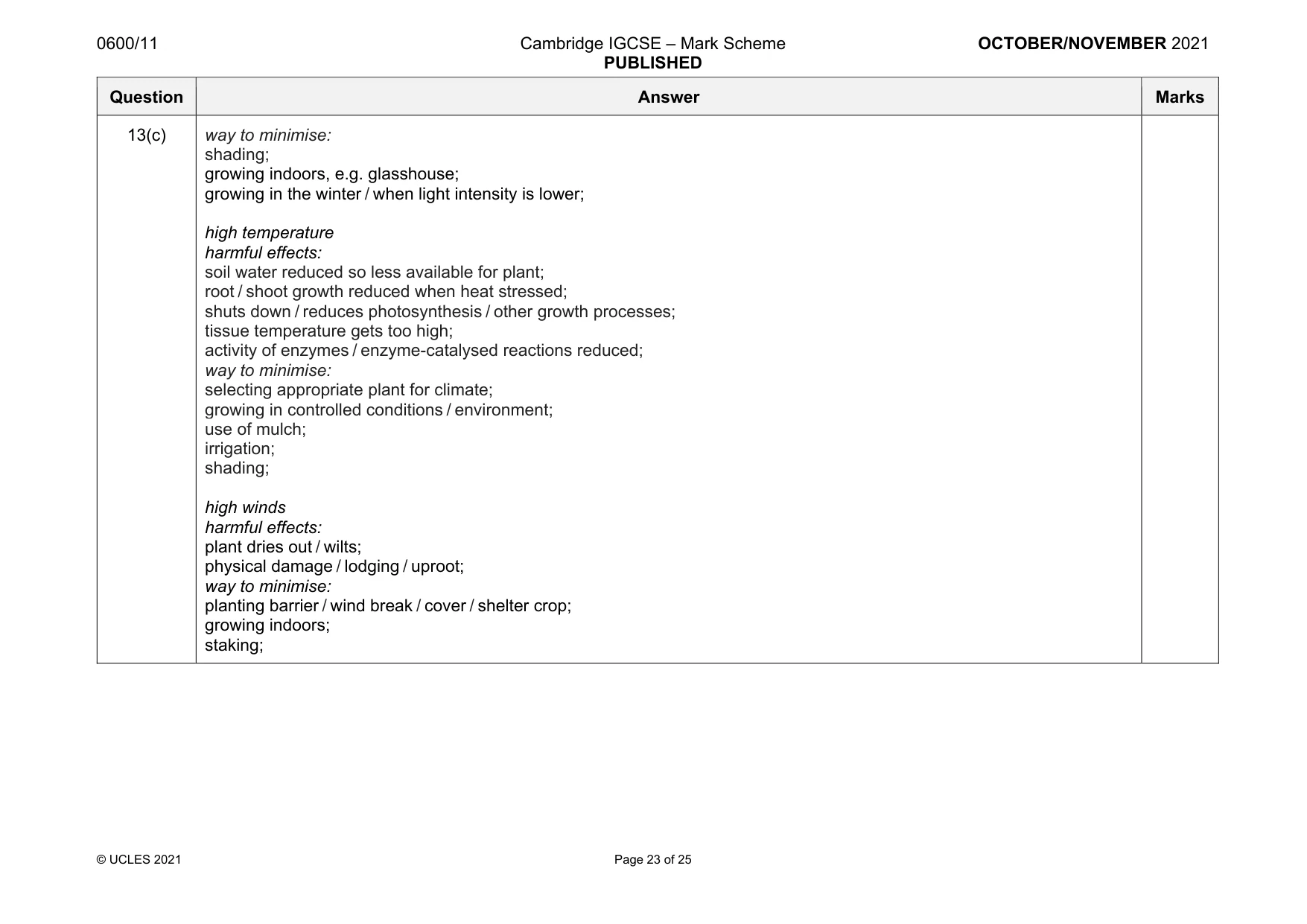
0600/11 Cambridge IGCSE – Mark Scheme PUBLISHED OCTOBER/NOVEMBER 2021 © UCLES 2021 Page 23 of 25 Question Answer Marks 13(c) way to minimise: shading; growing indoors, e.g. glasshouse; growing in the winter / when light intensity is lower; high temperature harmful effects: soil water reduced so less available for plant; root / shoot growth reduced when heat stressed; shuts down / reduces photosynthesis / other growth processes; tissue temperature gets too high; activity of enzymes / enzyme-catalysed reactions reduced; way to minimise: selecting appropriate plant for climate; growing in controlled conditions / environment; use of mulch; irrigation; shading; high winds harmful effects: plant dries out / wilts; physical damage / lodging / uproot; way to minimise: planting barrier / wind break / cover / shelter crop; growing indoors; staking;
Mark scheme, page 24
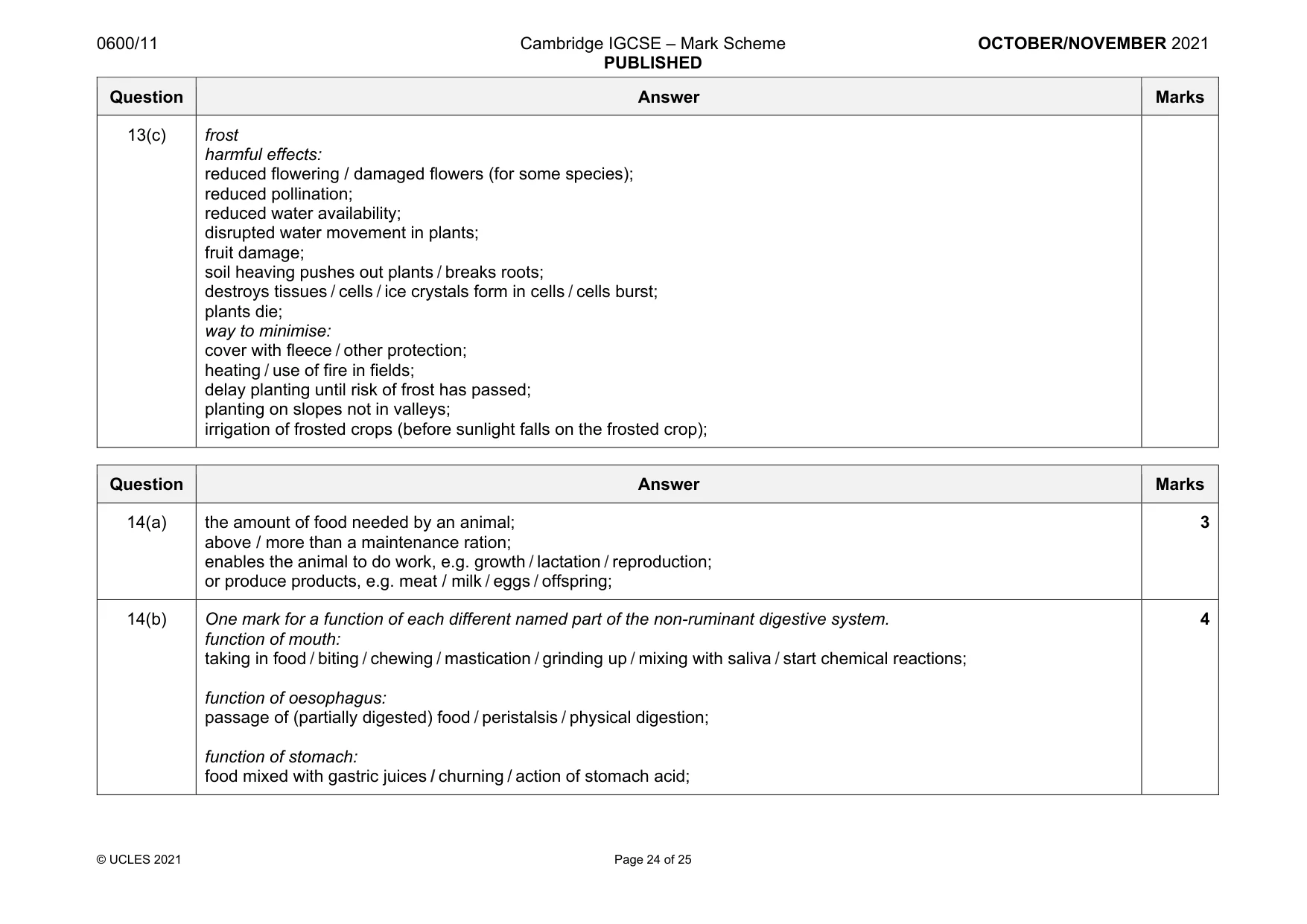
0600/11 Cambridge IGCSE – Mark Scheme PUBLISHED OCTOBER/NOVEMBER 2021 © UCLES 2021 Page 24 of 25 Question Answer Marks 13(c) frost harmful effects: reduced flowering / damaged flowers (for some species); reduced pollination; reduced water availability; disrupted water movement in plants; fruit damage; soil heaving pushes out plants / breaks roots; destroys tissues / cells / ice crystals form in cells / cells burst; plants die; way to minimise: cover with fleece / other protection; heating / use of fire in fields; delay planting until risk of frost has passed; planting on slopes not in valleys; irrigation of frosted crops (before sunlight falls on the frosted crop); Question Answer Marks 14(a) the amount of food needed by an animal; above / more than a maintenance ration; enables the animal to do work, e.g. growth / lactation / reproduction; or produce products, e.g. meat / milk / eggs / offspring; 3 14(b) One mark for a function of each different named part of the non-ruminant digestive system. function of mouth: taking in food / biting / chewing / mastication / grinding up / mixing with saliva / start chemical reactions; function of oesophagus: passage of (partially digested) food / peristalsis / physical digestion; function of stomach: food mixed with gastric juices / churning / action of stomach acid; 4
Mark scheme, page 25
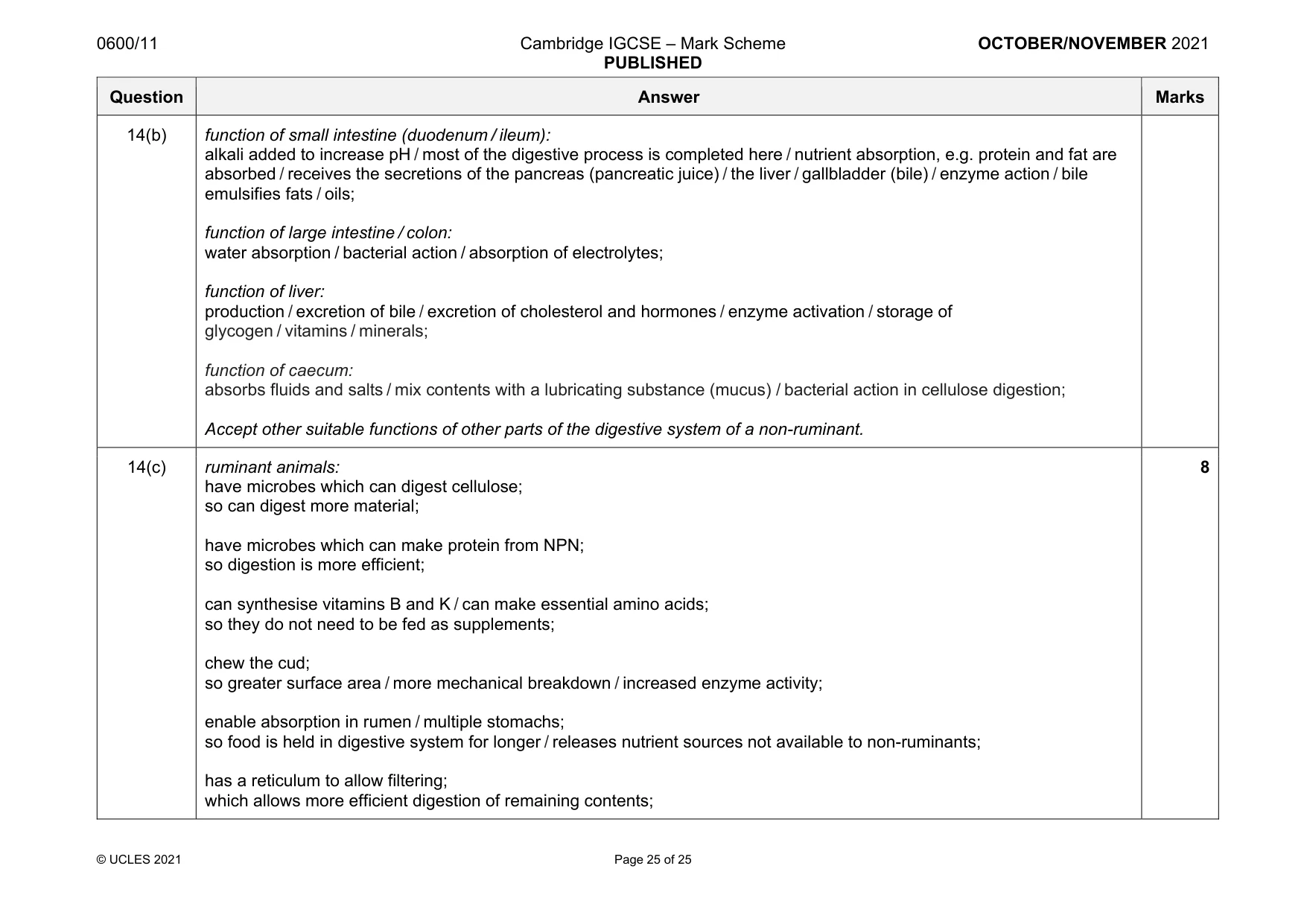
0600/11 Cambridge IGCSE – Mark Scheme PUBLISHED OCTOBER/NOVEMBER 2021 © UCLES 2021 Page 25 of 25 Question Answer Marks 14(b) function of small intestine (duodenum / ileum): alkali added to increase pH / most of the digestive process is completed here / nutrient absorption, e.g. protein and fat are absorbed / receives the secretions of the pancreas (pancreatic juice) / the liver / gallbladder (bile) / enzyme action / bile emulsifies fats / oils; function of large intestine / colon: water absorption / bacterial action / absorption of electrolytes; function of liver: production / excretion of bile / excretion of cholesterol and hormones / enzyme activation / storage of glycogen / vitamins / minerals; function of caecum: absorbs fluids and salts / mix contents with a lubricating substance (mucus) / bacterial action in cellulose digestion; Accept other suitable functions of other parts of the digestive system of a non-ruminant. 14(c) ruminant animals: have microbes which can digest cellulose; so can digest more material; have microbes which can make protein from NPN; so digestion is more efficient; can synthesise vitamins B and K / can make essential amino acids; so they do not need to be fed as supplements; chew the cud; so greater surface area / more mechanical breakdown / increased enzyme activity; enable absorption in rumen / multiple stomachs; so food is held in digestive system for longer / releases nutrient sources not available to non-ruminants; has a reticulum to allow filtering; which allows more efficient digestion of remaining contents; 8
What you needed in this session
Cambridge’s own grade thresholds for 2021 Oct/Nov, Paper 1 · Variant 1. A higher threshold means an easier paper — the bar moves with how the cohort did.