Cambridge IGCSE Agriculture 0600 — 2010 Oct/Nov Paper 3 · Variant 1
0600/31/O/N/10 · 9 questions · 80 marks · ≈90 min
The question paper and its mark scheme, free to read here and free to download. This is Cambridge’s own paper, exactly as it was sat.
Question paper16 pages


Mark scheme6 pages
Answers below. Sit the paper first if you are practising.
Questions as text
Q1 · A Zebu cow from Africa
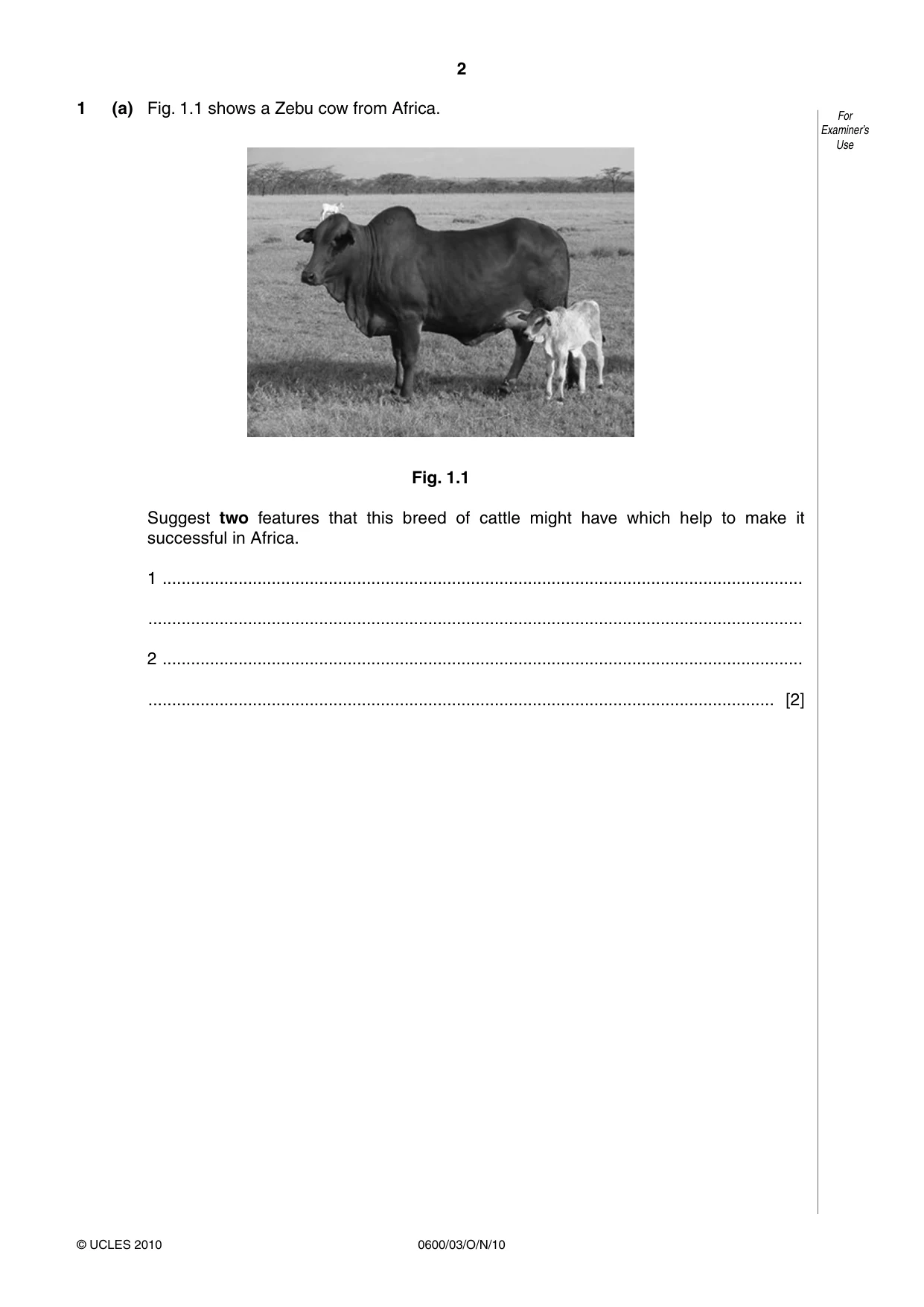
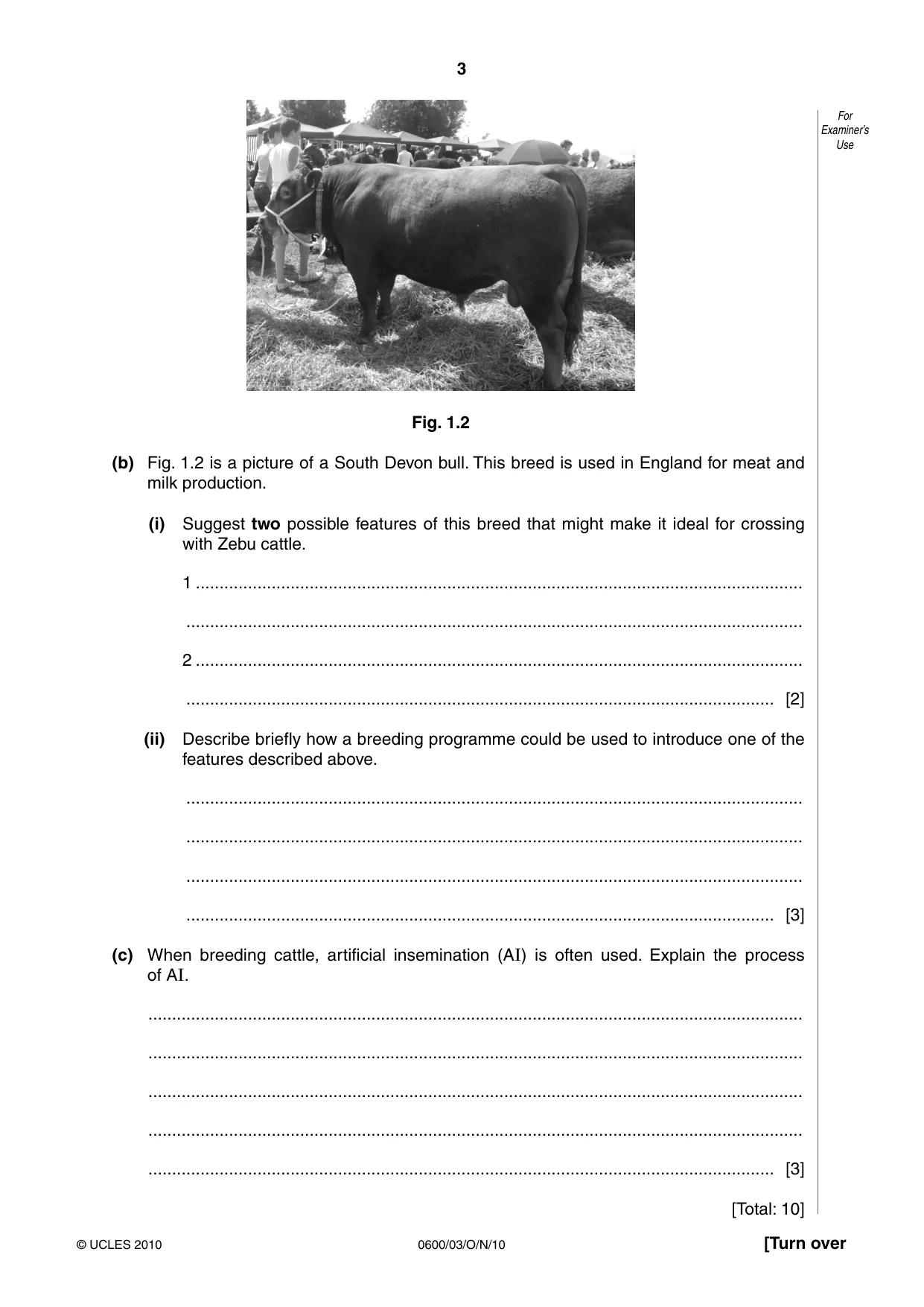
1 (a) Fig. 1.1 shows a Zebu cow from Africa. Fig. 1.1 Suggest two features that this breed of cattle might have which help to make it successful in Africa. 1 ....................................................................................................................................... .......................................................................................................................................... 2 ....................................................................................................................................... .................................................................................................................................... [2] Fig. 1.2 (b) Fig. 1.2 is a picture of a South Devon bull. This breed is used in England for meat and milk production. (i) Suggest two possible features of this breed that might make it ideal for crossing with Zebu cattle. 1 ................................................................................................................................ .................................................................................................................................. 2 ................................................................................................................................ ............................................................................................................................ [2] (ii) Describe briefly how a breeding programme could be used to introduce one of the features described above. .................................................................................................................................. .................................................................................................................................. .................................................................................................................................. ............................................................................................................................ [3] (c) When breeding cattle, artificial insemination (A ) is often used. Explain the process of A . .......................................................................................................................................... .......................................................................................................................................... .......................................................................................................................................... .......................................................................................................................................... .................................................................................................................................... [3] [Total: 10]
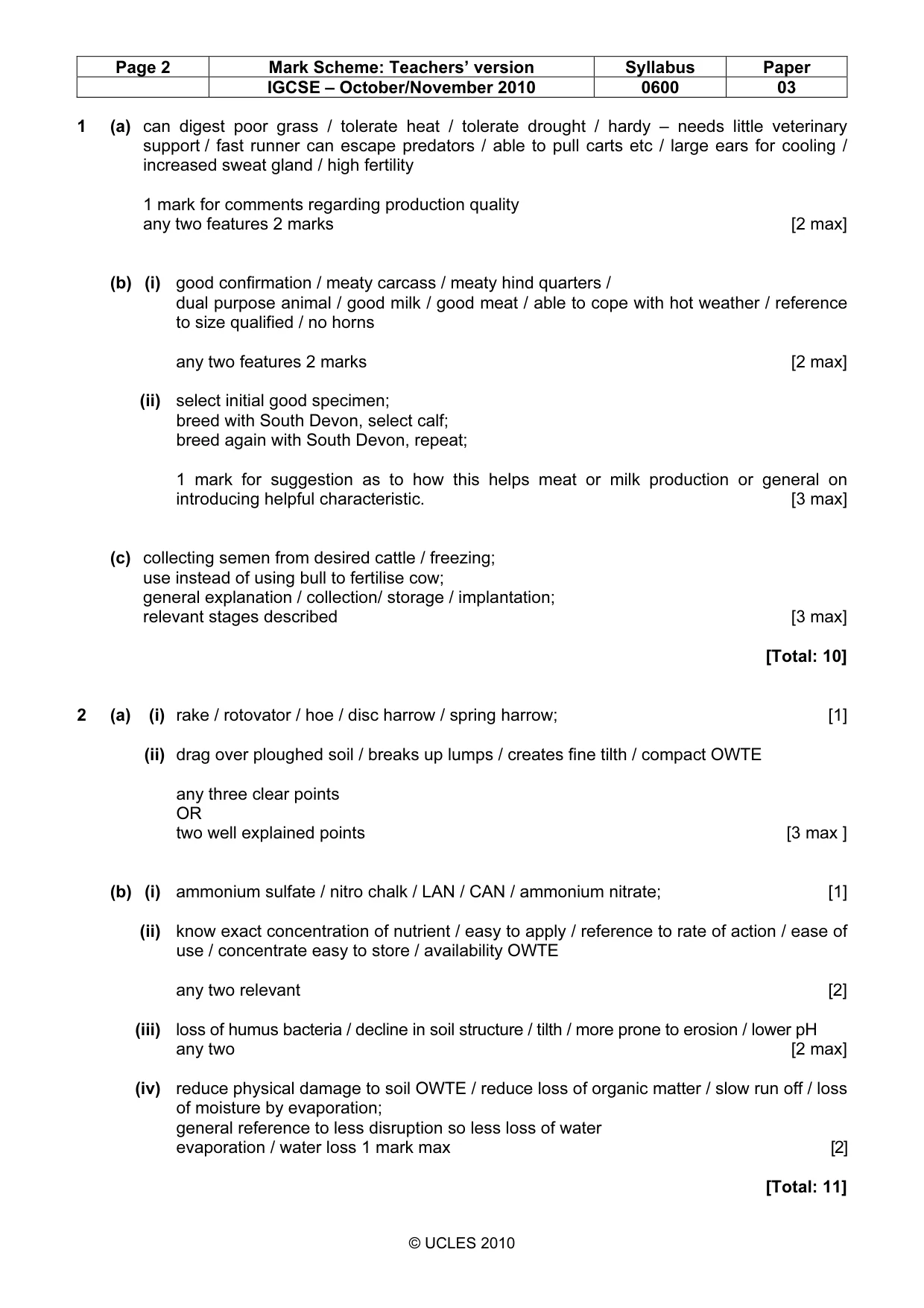
Mark scheme: 1 (a) can digest poor grass / tolerate heat / tolerate drought / hardy – needs little veterinary support / fast runner can escape predators / able to pull carts etc / large ears for cooling / increased sweat gland / high fertility 1 mark for comments regarding production quality any two features 2 marks [2 max] (b) (i) good confirmation / meaty carcass / meaty hind quarters / dual purpose animal / good milk / good meat / able to cope with hot weather / reference to size qualified / no horns any two features 2 marks [2 max] (ii) select initial good specimen; breed with South Devon, select calf; breed again with South Devon, repeat; 1 mark for suggestion as to how this helps meat or milk production or general on introducing helpful characteristic. [3 max] (c) collecting semen from desired cattle / freezing; use instead of using bull to fertilise cow; general explanation / collection/ storage / implantation; relevant stages described [3 max] [Total: 10]
Question 2
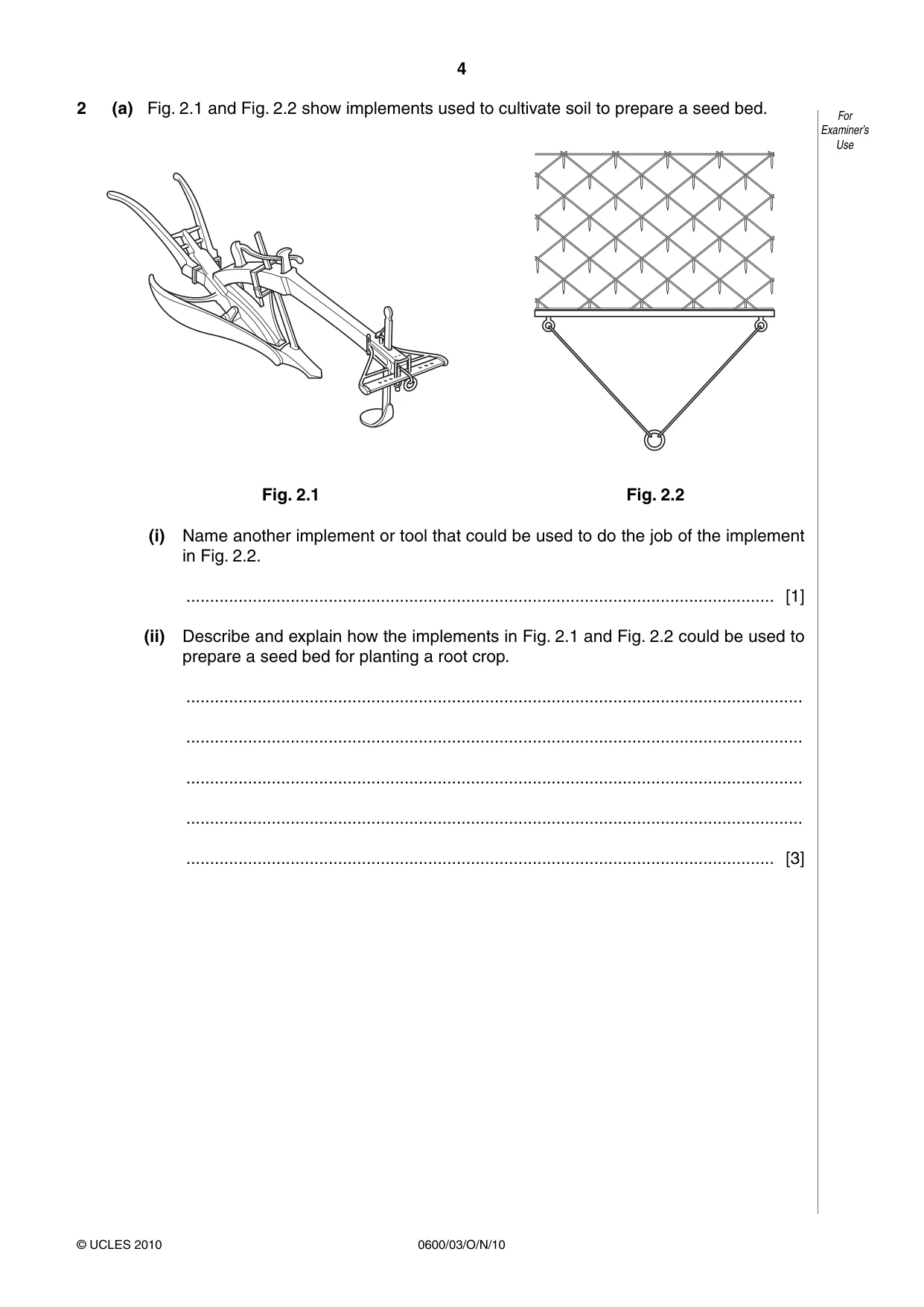
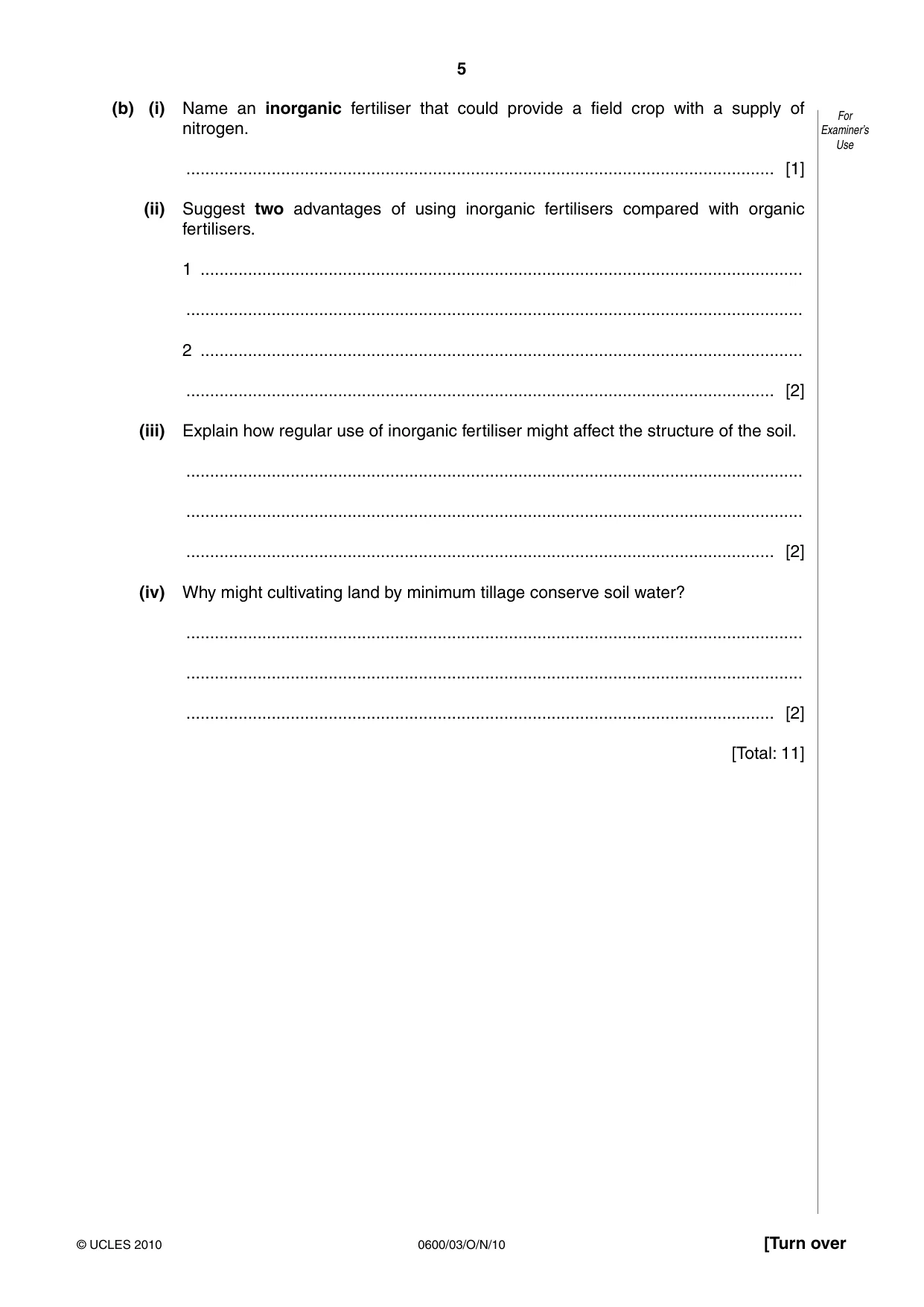
2 (a) Fig. 2.1 and Fig. 2.2 show implements used to cultivate soil to prepare a seed bed. Fig. 2.1 Fig. 2.2 (i) Name another implement or tool that could be used to do the job of the implement in Fig. 2.2. ............................................................................................................................ [1] (ii) Describe and explain how the implements in Fig. 2.1 and Fig. 2.2 could be used to prepare a seed bed for planting a root crop. .................................................................................................................................. .................................................................................................................................. .................................................................................................................................. .................................................................................................................................. ............................................................................................................................ [3] (b) (i) Name an inorganic fertiliser that could provide a field crop with a supply of nitrogen. ............................................................................................................................ [1] (ii) Suggest two advantages of using inorganic fertilisers compared with organic fertilisers. 1 ............................................................................................................................... .................................................................................................................................. 2 ............................................................................................................................... ............................................................................................................................ [2] (iii) Explain how regular use of inorganic fertiliser might affect the structure of the soil. .................................................................................................................................. .................................................................................................................................. ............................................................................................................................ [2] (iv) Why might cultivating land by minimum tillage conserve soil water? .................................................................................................................................. .................................................................................................................................. ............................................................................................................................ [2] [Total: 11]
Mark scheme: 2 (a) (i) rake / rotovator / hoe / disc harrow / spring harrow; [1] (ii) drag over ploughed soil / breaks up lumps / creates fine tilth / compact OWTE any three clear points OR two well explained points [3 max ] (b) (i) ammonium sulfate / nitro chalk / LAN / CAN / ammonium nitrate; [1] (ii) know exact concentration of nutrient / easy to apply / reference to rate of action / ease of use / concentrate easy to store / availability OWTE any two relevant [2] (iii) loss of humus bacteria / decline in soil structure / tilth / more prone to erosion / lower pH any two [2 max] (iv) reduce physical damage to soil OWTE / reduce loss of organic matter / slow run off / loss of moisture by evaporation; general reference to less disruption so less loss of water evaporation / water loss 1 mark max [2] [Total: 11] IGCSE – October/November 2010 0600 03
Question 3
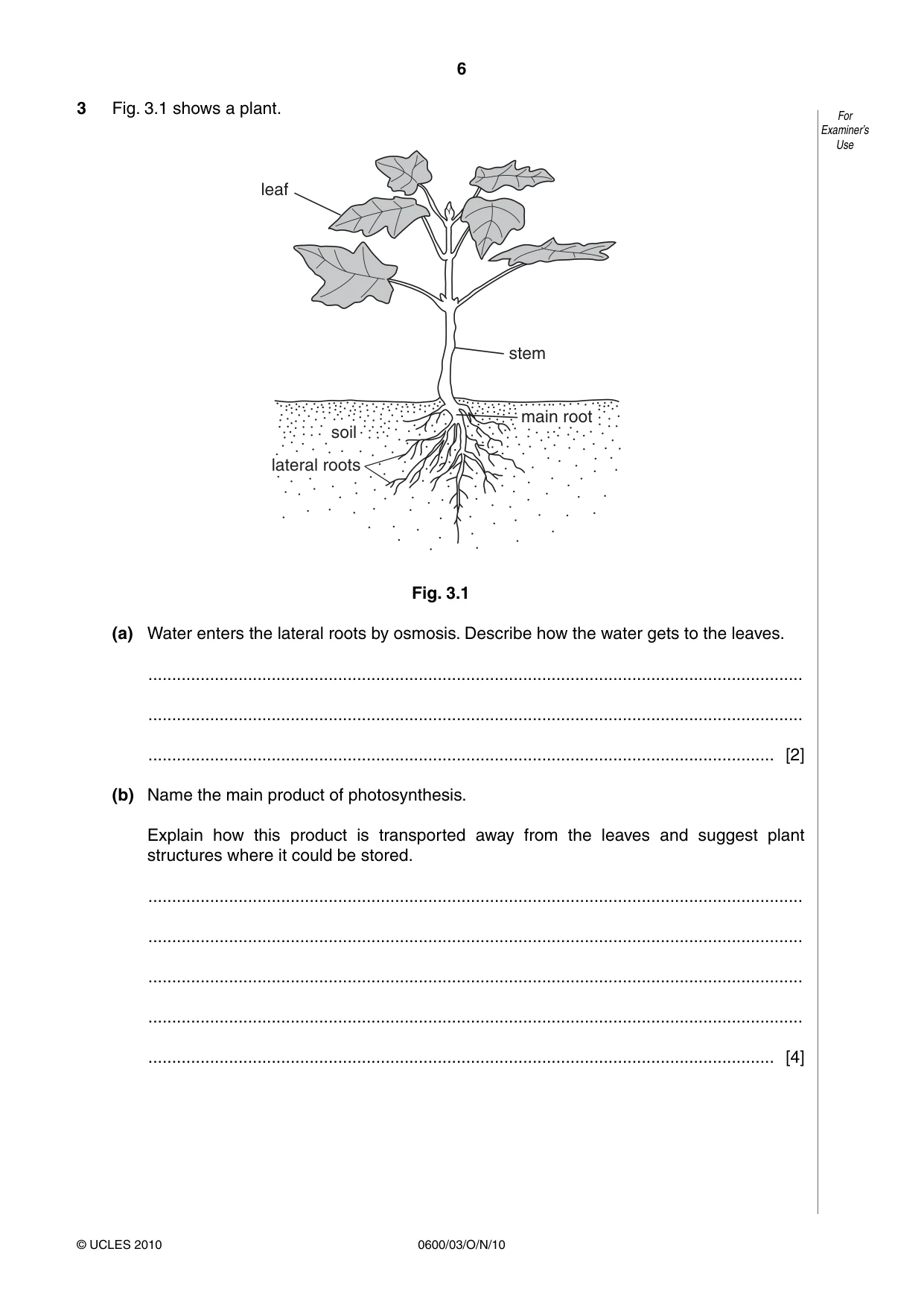
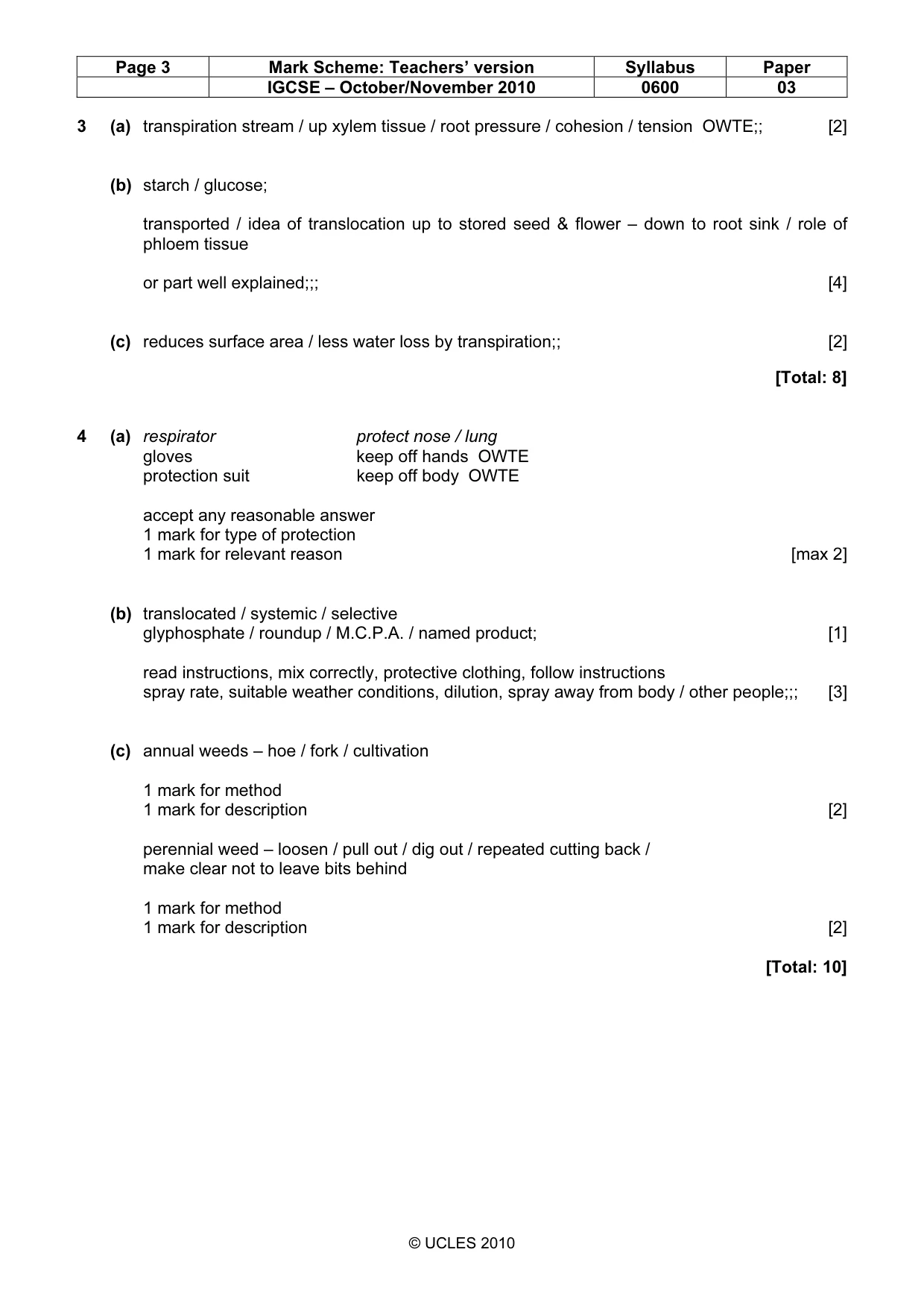
3 Fig. 3.1 shows a plant. leaf stem main root soil lateral roots Fig. 3.1 (a) Water enters the lateral roots by osmosis. Describe how the water gets to the leaves. .......................................................................................................................................... .......................................................................................................................................... .................................................................................................................................... [2] (b) Name the main product of photosynthesis. Explain how this product is transported away from the leaves and suggest plant structures where it could be stored. .......................................................................................................................................... .......................................................................................................................................... .......................................................................................................................................... .......................................................................................................................................... .................................................................................................................................... [4] (c) In dry conditions plants often wilt. Explain how this might help a plant survive a period of drought. .......................................................................................................................................... .......................................................................................................................................... .................................................................................................................................... [2] [Total: 8]
Mark scheme: 3 (a) transpiration stream / up xylem tissue / root pressure / cohesion / tension OWTE;; [2] (b) starch / glucose; transported / idea of translocation up to stored seed & flower – down to root sink / role of phloem tissue or part well explained;;; [4] (c) reduces surface area / less water loss by transpiration;; [2] [Total: 8]
Q4 · A man dressed to spray a crop
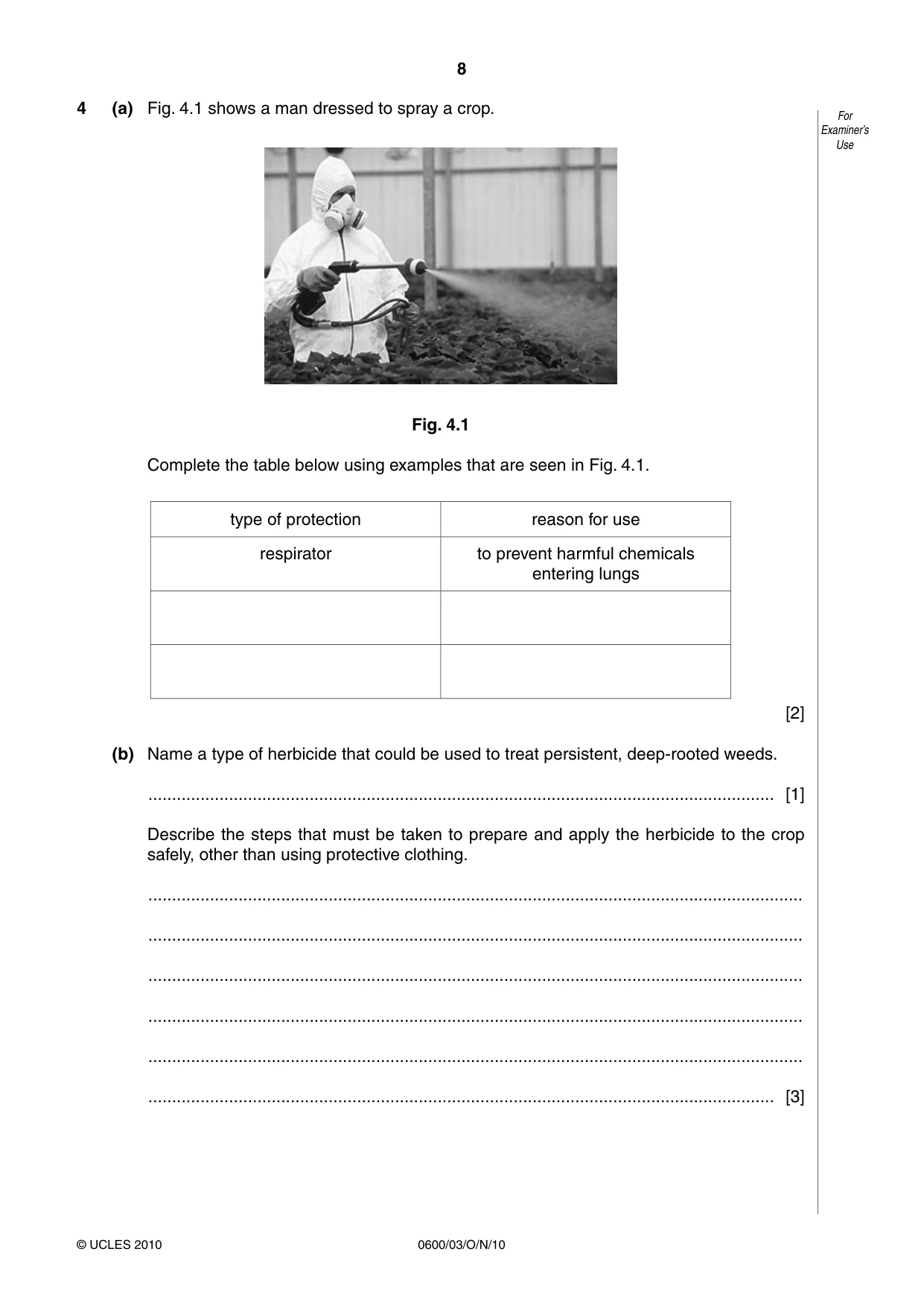
4 (a) Fig. 4.1 shows a man dressed to spray a crop. Fig. 4.1 Complete the table below using examples that are seen in Fig. 4.1. type of protection reason for use respirator to prevent harmful chemicals entering lungs [2] (b) Name a type of herbicide that could be used to treat persistent, deep-rooted weeds. .................................................................................................................................... [1] Describe the steps that must be taken to prepare and apply the herbicide to the crop safely, other than using protective clothing. .......................................................................................................................................... .......................................................................................................................................... .......................................................................................................................................... .......................................................................................................................................... .......................................................................................................................................... .................................................................................................................................... [3] (c) Weeds can also be controlled by cultivation. Describe how you would use cultivation techniques to control the following types of weed. Annual weed .................................................................................................................... .......................................................................................................................................... .......................................................................................................................................... Perennial deep-rooted weed ............................................................................................ .......................................................................................................................................... .......................................................................................................................................... .................................................................................................................................... [4] [Total: 10]
Mark scheme: 4 (a) respirator protect nose / lung gloves keep off hands OWTE protection suit keep off body OWTE accept any reasonable answer 1 mark for type of protection 1 mark for relevant reason [max 2] (b) translocated / systemic / selective glyphosphate / roundup / M.C.P.A. / named product; [1] read instructions, mix correctly, protective clothing, follow instructions spray rate, suitable weather conditions, dilution, spray away from body / other people;;; [3] (c) annual weeds – hoe / fork / cultivation 1 mark for method 1 mark for description [2] perennial weed – loosen / pull out / dig out / repeated cutting back / make clear not to leave bits behind 1 mark for method 1 mark for description [2] [Total: 10] IGCSE – October/November 2010 0600 03
Q5 · Explain the use of an antiseptic and the use of an antibiotic
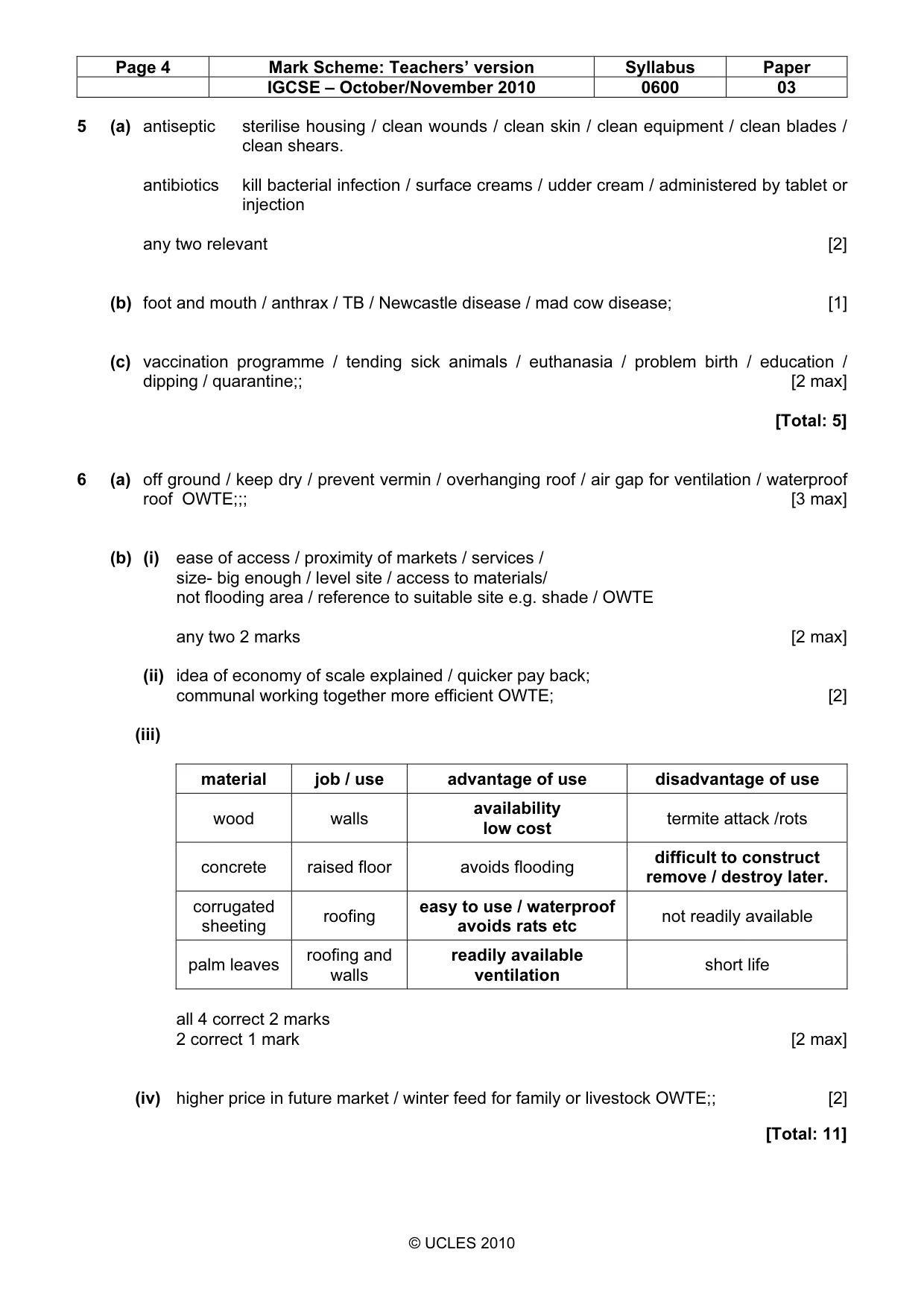
5 (a) Explain the use of an antiseptic and the use of an antibiotic. .......................................................................................................................................... .......................................................................................................................................... .......................................................................................................................................... .......................................................................................................................................... .................................................................................................................................... [2] (b) Name a notifiable disease of animals. .................................................................................................................................... [1] (c) Describe the role of your local veterinary service in the prevention of livestock diseases. .......................................................................................................................................... .......................................................................................................................................... .................................................................................................................................... [2] [Total: 5]
Mark scheme: 5 (a) antiseptic sterilise housing / clean wounds / clean skin / clean equipment / clean blades / clean shears. antibiotics kill bacterial infection / surface creams / udder cream / administered by tablet or injection any two relevant [2] (b) foot and mouth / anthrax / TB / Newcastle disease / mad cow disease; [1] (c) vaccination programme / tending sick animals / euthanasia / problem birth / education / dipping / quarantine;; [2 max] [Total: 5]
Q6 · A building used to store food crops
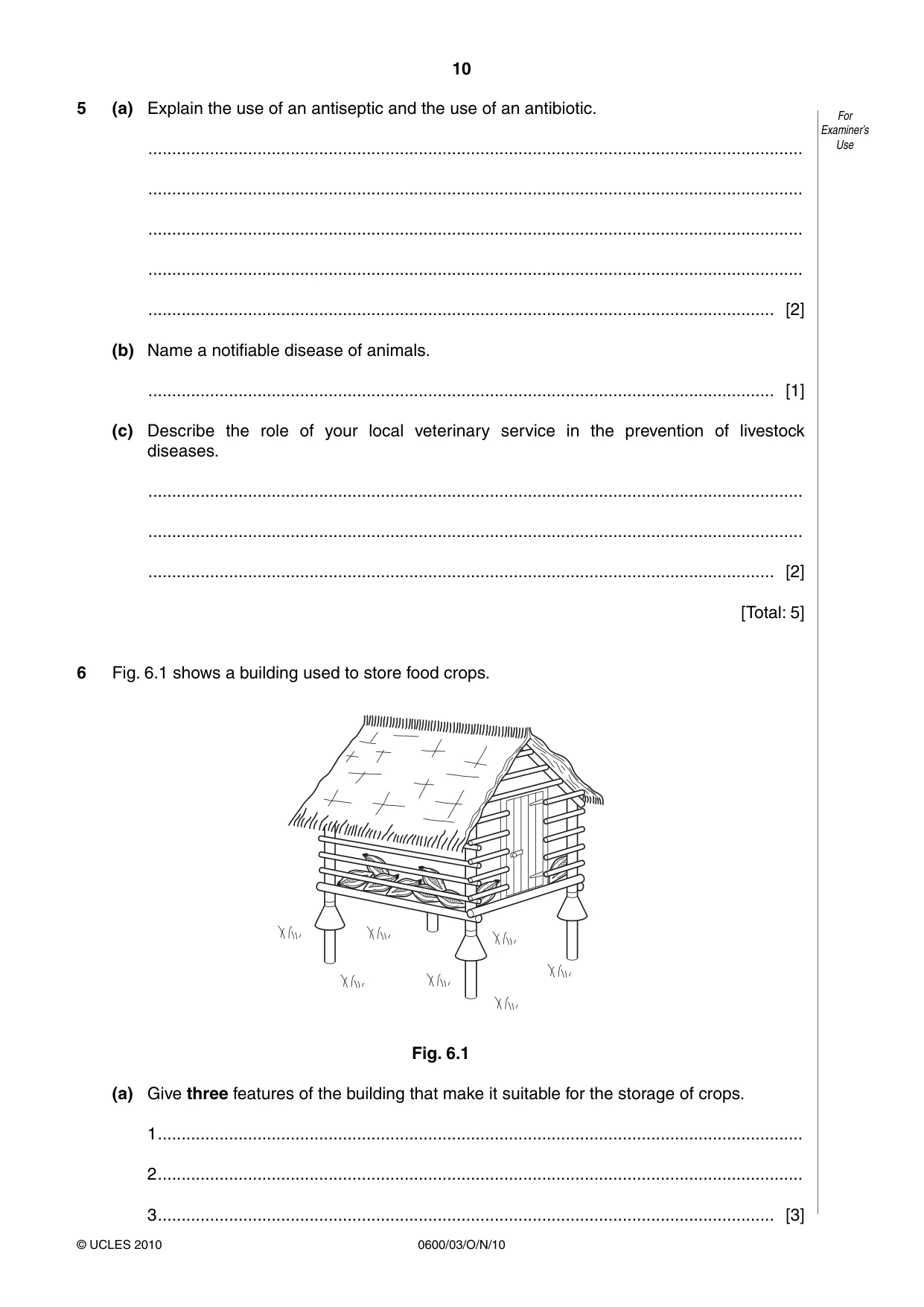
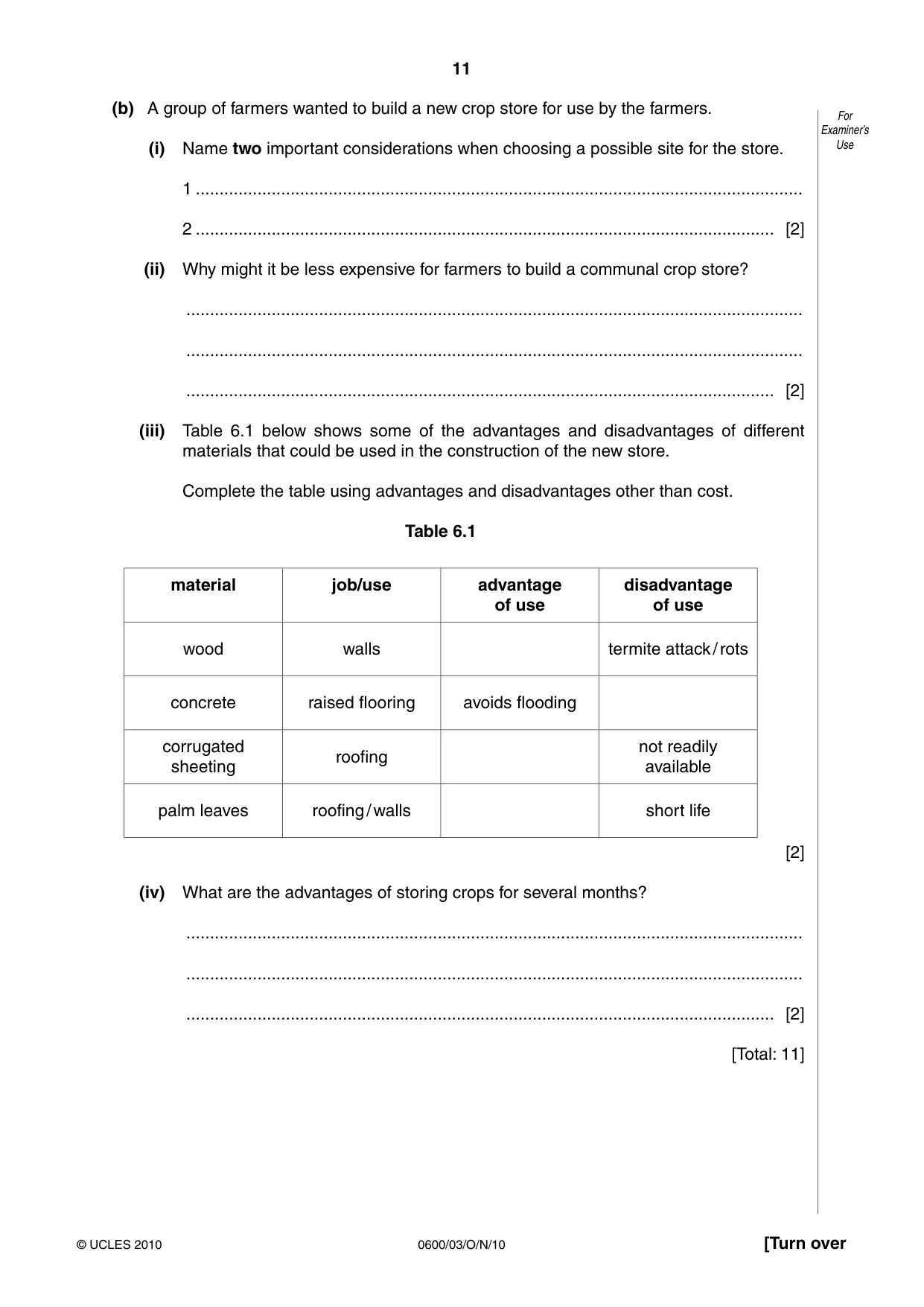
6 Fig. 6.1 shows a building used to store food crops. Fig. 6.1 (a) Give three features of the building that make it suitable for the storage of crops. 1 ........................................................................................................................................ 2 ........................................................................................................................................ 3 .................................................................................................................................. [3] (b) A group of farmers wanted to build a new crop store for use by the farmers. (i) Name two important considerations when choosing a possible site for the store. 1 ................................................................................................................................ 2 .......................................................................................................................... [2] (ii) Why might it be less expensive for farmers to build a communal crop store? .................................................................................................................................. .................................................................................................................................. ............................................................................................................................ [2] (iii) Table 6.1 below shows some of the advantages and disadvantages of different materials that could be used in the construction of the new store. Complete the table using advantages and disadvantages other than cost. Table 6.1 material job/use advantage disadvantage of use of use wood walls termite attack / rots concrete raised flooring avoids flooding corrugated not readily roofing sheeting available palm leaves roofing / walls short life [2] (iv) What are the advantages of storing crops for several months? .................................................................................................................................. .................................................................................................................................. ............................................................................................................................ [2] [Total: 11]
Mark scheme: 6 (a) off ground / keep dry / prevent vermin / overhanging roof / air gap for ventilation / waterproof roof OWTE;;; [3 max] (b) (i) ease of access / proximity of markets / services / size- big enough / level site / access to materials/ not flooding area / reference to suitable site e.g. shade / OWTE any two 2 marks [2 max] (ii) idea of economy of scale explained / quicker pay back; communal working together more efficient OWTE; [2] (iii) material job / use advantage of use disadvantage of use availability wood walls termite attack /rots low cost difficult to construct concrete raised floor avoids flooding remove / destroy later. corrugated easy to use / waterproof roofing not readily available sheeting avoids rats etc roofing and readily available palm leaves short life walls ventilation all 4 correct 2 marks 2 correct 1 mark [2 max] (iv) higher price in future market / winter feed for family or livestock OWTE;; [2] [Total: 11] IGCSE – October/November 2010 0600 03
Q7 · Some data on sheep behaviour
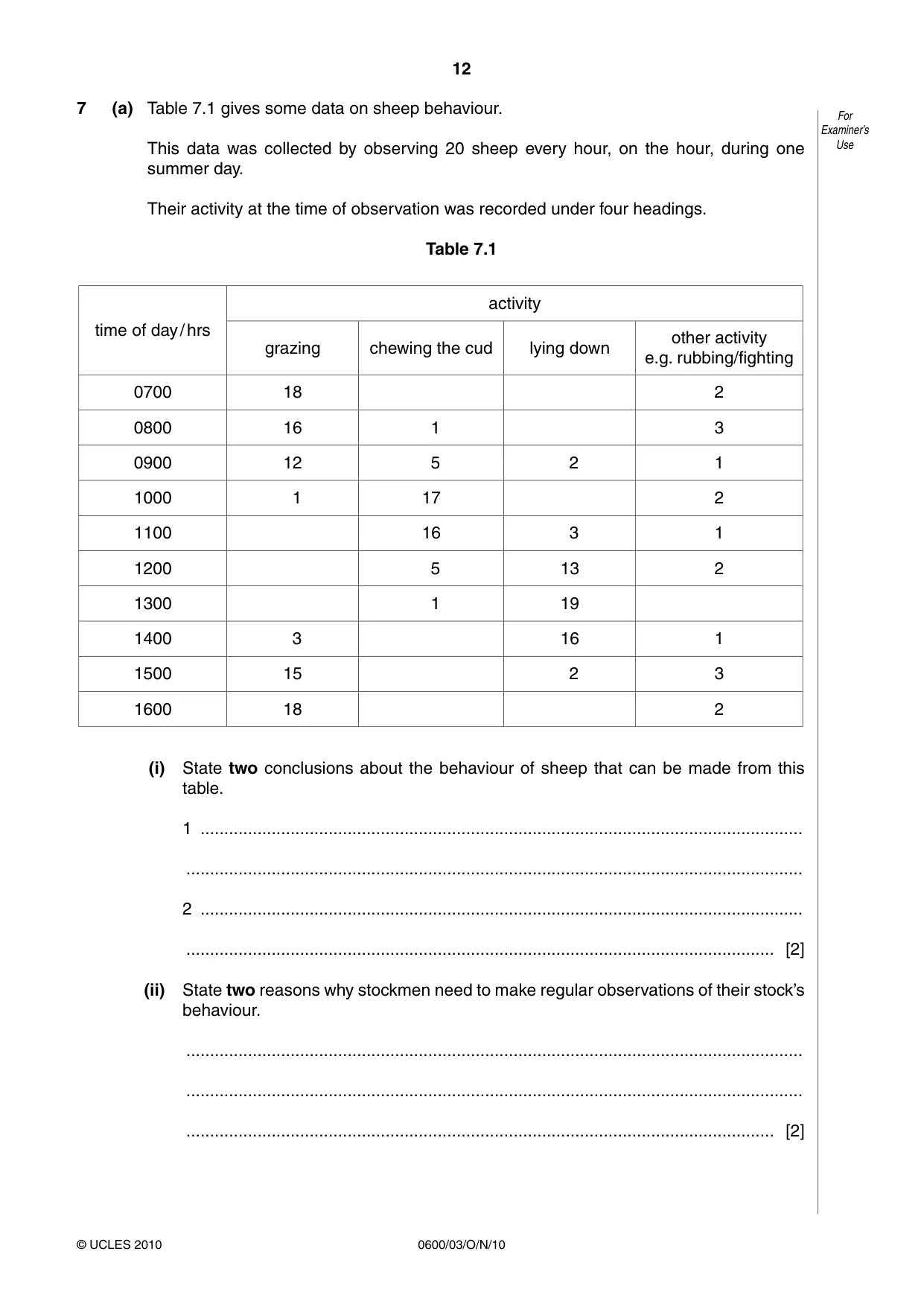
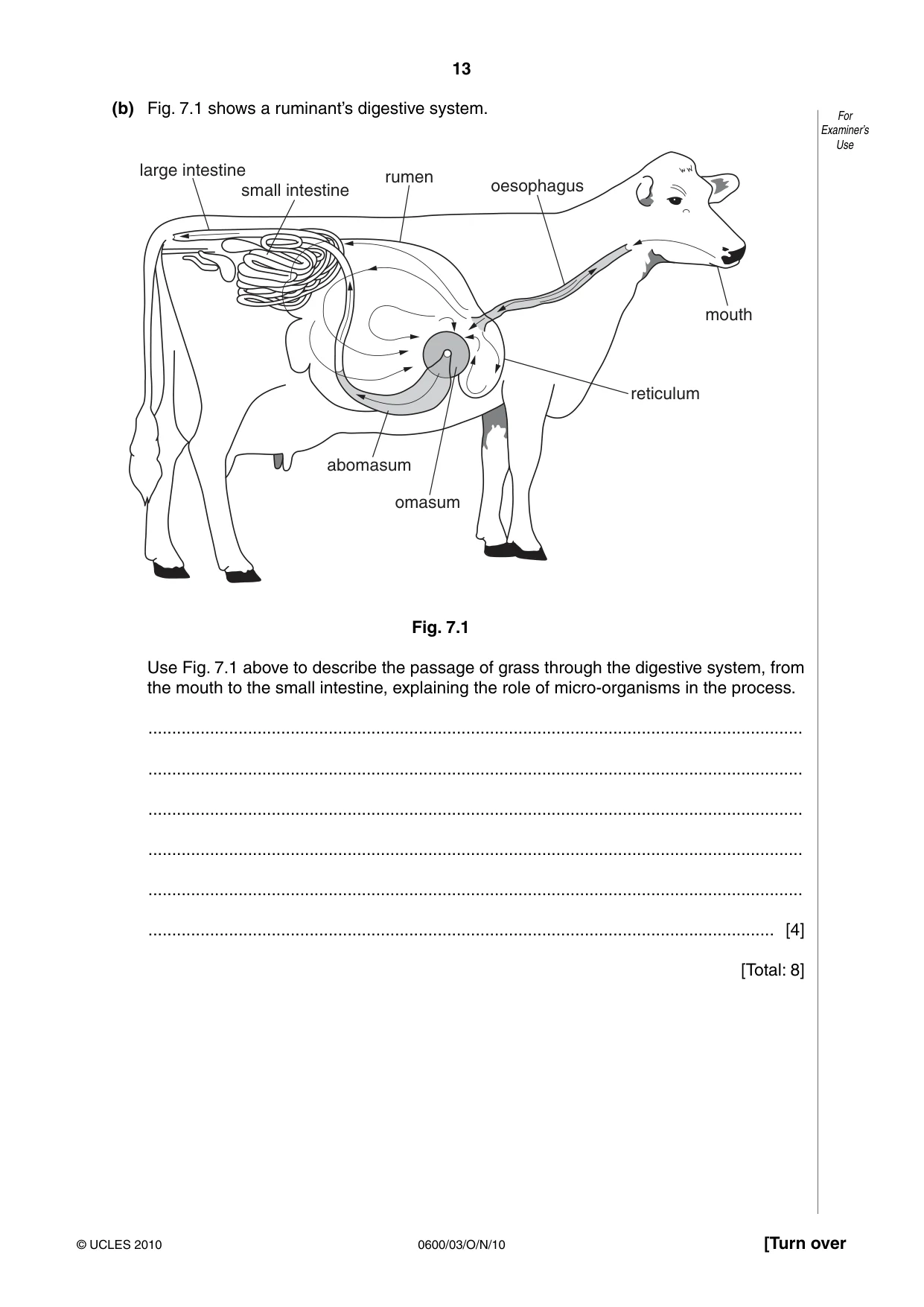
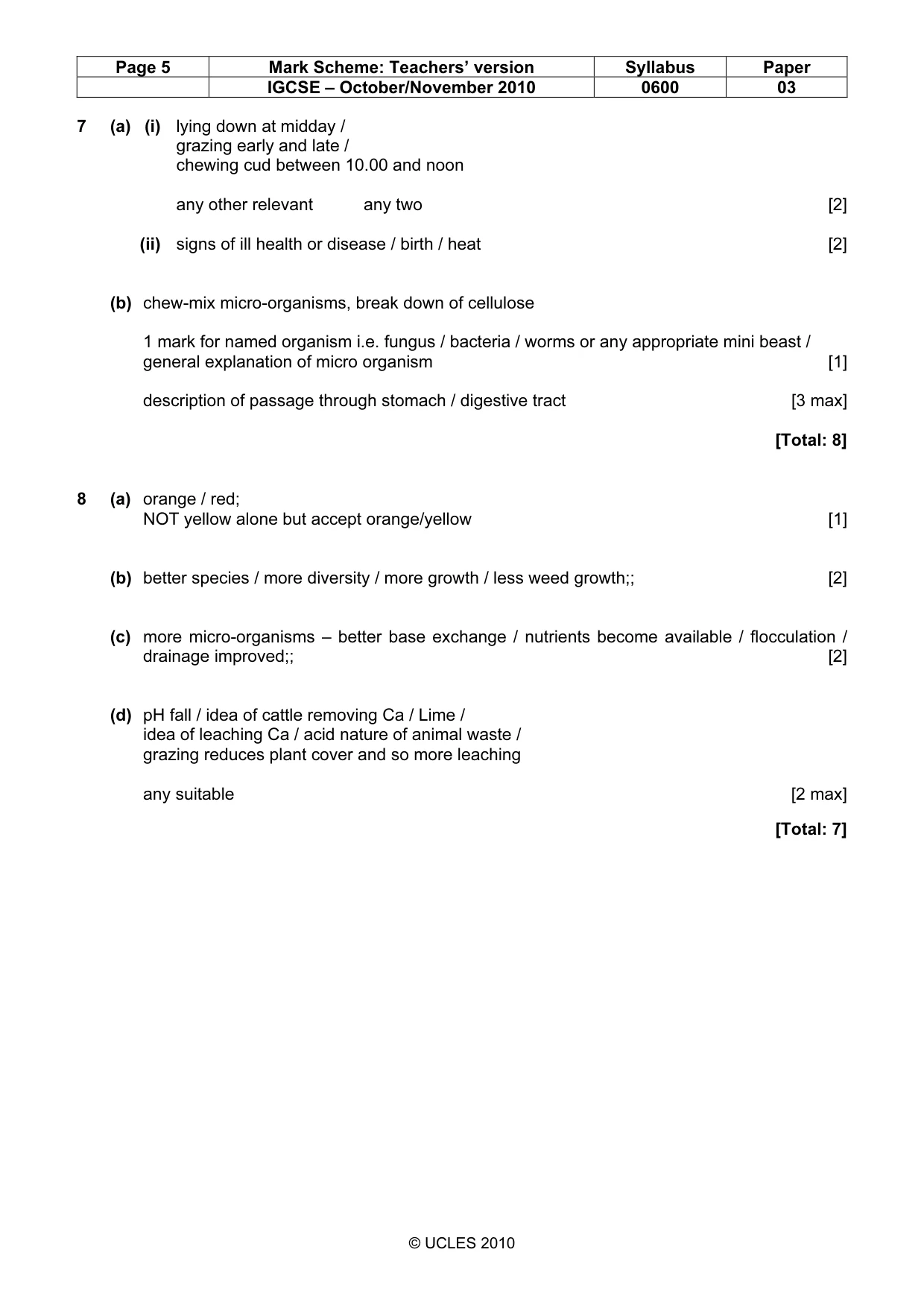
7 (a) Table 7.1 gives some data on sheep behaviour. This data was collected by observing 20 sheep every hour, on the hour, during one summer day. Their activity at the time of observation was recorded under four headings. Table 7.1 activity time of day / hrs other activity grazing chewing the cud lying down e.g. rubbing/fighting 0700 18 2 0800 16 1 3 0900 12 5 2 1 1000 1 17 2 1100 16 3 1 1200 5 13 2 1300 1 19 1400 3 16 1 1500 15 2 3 1600 18 2 (i) State two conclusions about the behaviour of sheep that can be made from this table. 1 ............................................................................................................................... .................................................................................................................................. 2 ............................................................................................................................... ............................................................................................................................ [2] (ii) State two reasons why stockmen need to make regular observations of their stock’s behaviour. .................................................................................................................................. .................................................................................................................................. ............................................................................................................................ [2] (b) Fig. 7.1 shows a ruminant’s digestive system. large intestine rumen small intestine oesophagus mouth reticulum abomasum omasum Fig. 7.1 Use Fig. 7.1 above to describe the passage of grass through the digestive system, from the mouth to the small intestine, explaining the role of micro-organisms in the process. .......................................................................................................................................... .......................................................................................................................................... .......................................................................................................................................... .......................................................................................................................................... .......................................................................................................................................... .................................................................................................................................... [4] [Total: 8]
Mark scheme: 7 (a) (i) lying down at midday / grazing early and late / chewing cud between 10.00 and noon any other relevant any two [2] (ii) signs of ill health or disease / birth / heat [2] (b) chew-mix micro-organisms, break down of cellulose 1 mark for named organism i.e. fungus / bacteria / worms or any appropriate mini beast / general explanation of micro organism [1] description of passage through stomach / digestive tract [3 max] [Total: 8]
Q8 · A pH test using a probe
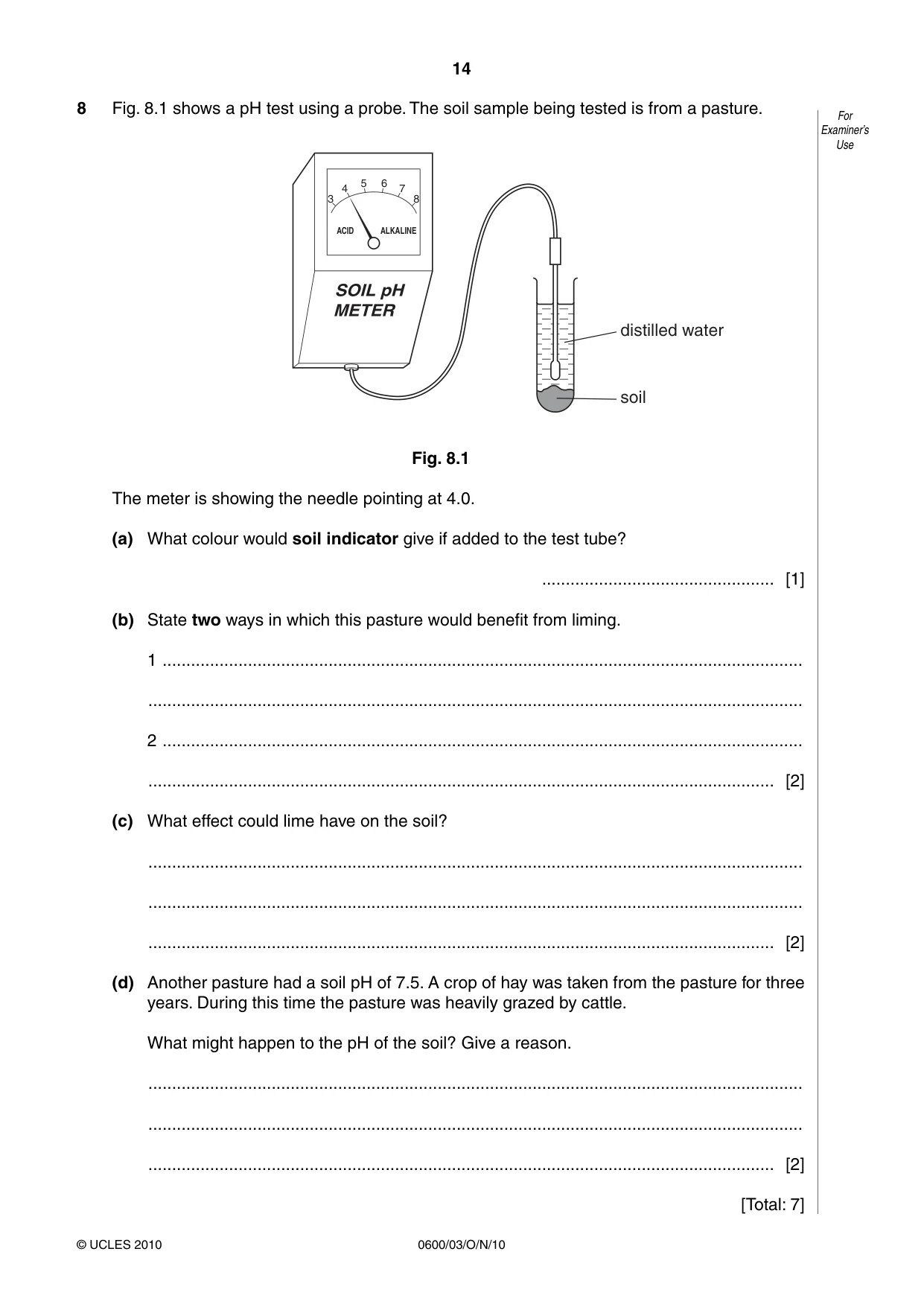
8 Fig. 8.1 shows a pH test using a probe. The soil sample being tested is from a pasture. 5 6 4 7 3 8 ACID ALKALINE SOIL pH METER distilled water soil Fig. 8.1 The meter is showing the needle pointing at 4.0. (a) What colour would soil indicator give if added to the test tube? ................................................. [1] (b) State two ways in which this pasture would benefit from liming. 1 ....................................................................................................................................... .......................................................................................................................................... 2 ....................................................................................................................................... .................................................................................................................................... [2] (c) What effect could lime have on the soil? .......................................................................................................................................... .......................................................................................................................................... .................................................................................................................................... [2] (d) Another pasture had a soil pH of 7.5. A crop of hay was taken from the pasture for three years. During this time the pasture was heavily grazed by cattle. What might happen to the pH of the soil? Give a reason. .......................................................................................................................................... .......................................................................................................................................... .................................................................................................................................... [2] [Total: 7]
Mark scheme: 8 (a) orange / red; NOT yellow alone but accept orange/yellow [1] (b) better species / more diversity / more growth / less weed growth;; [2] (c) more micro-organisms – better base exchange / nutrients become available / flocculation / drainage improved;; [2] (d) pH fall / idea of cattle removing Ca / Lime / idea of leaching Ca / acid nature of animal waste / grazing reduces plant cover and so more leaching any suitable [2 max] [Total: 7] IGCSE – October/November 2010 0600 03
Question 9
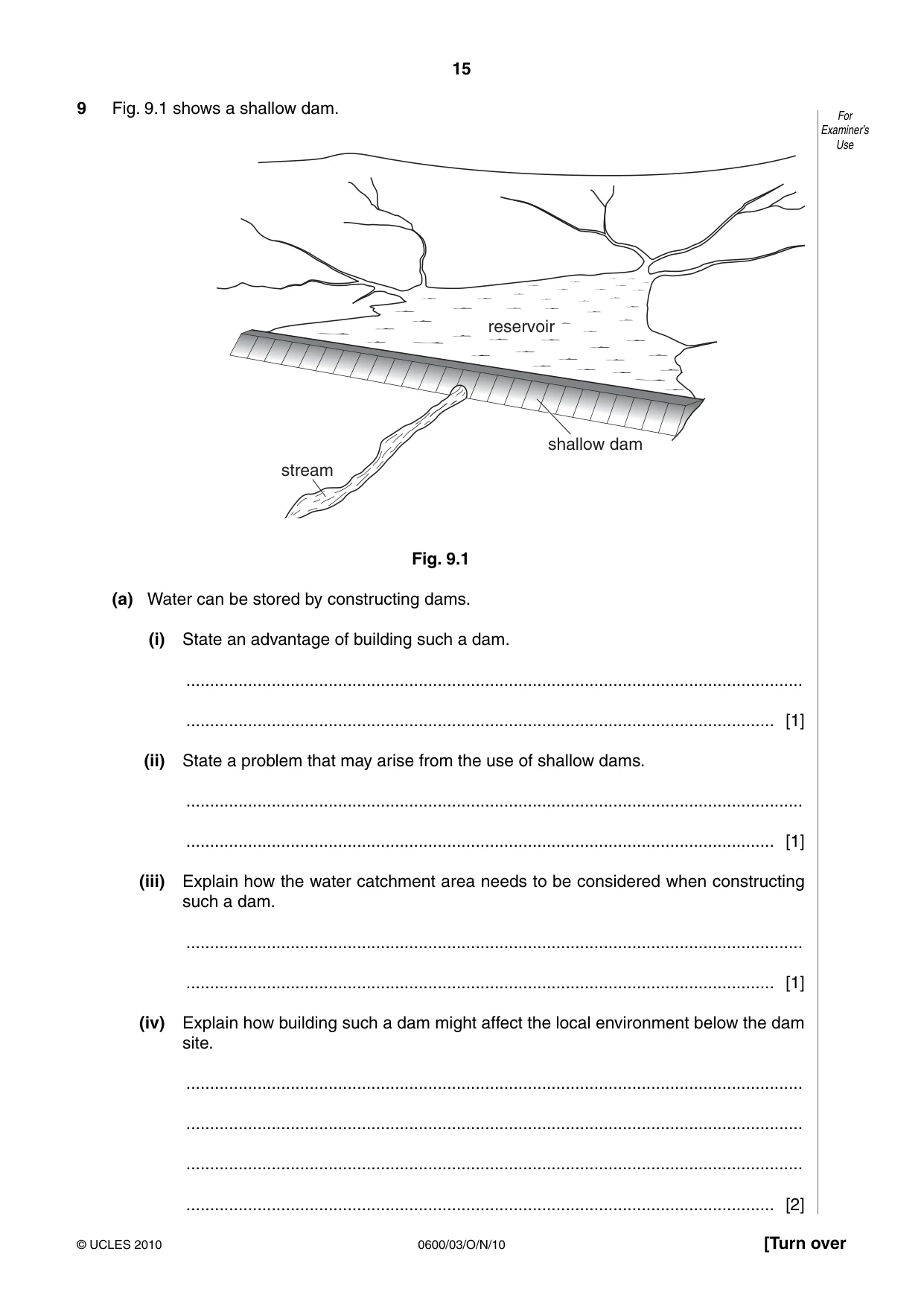
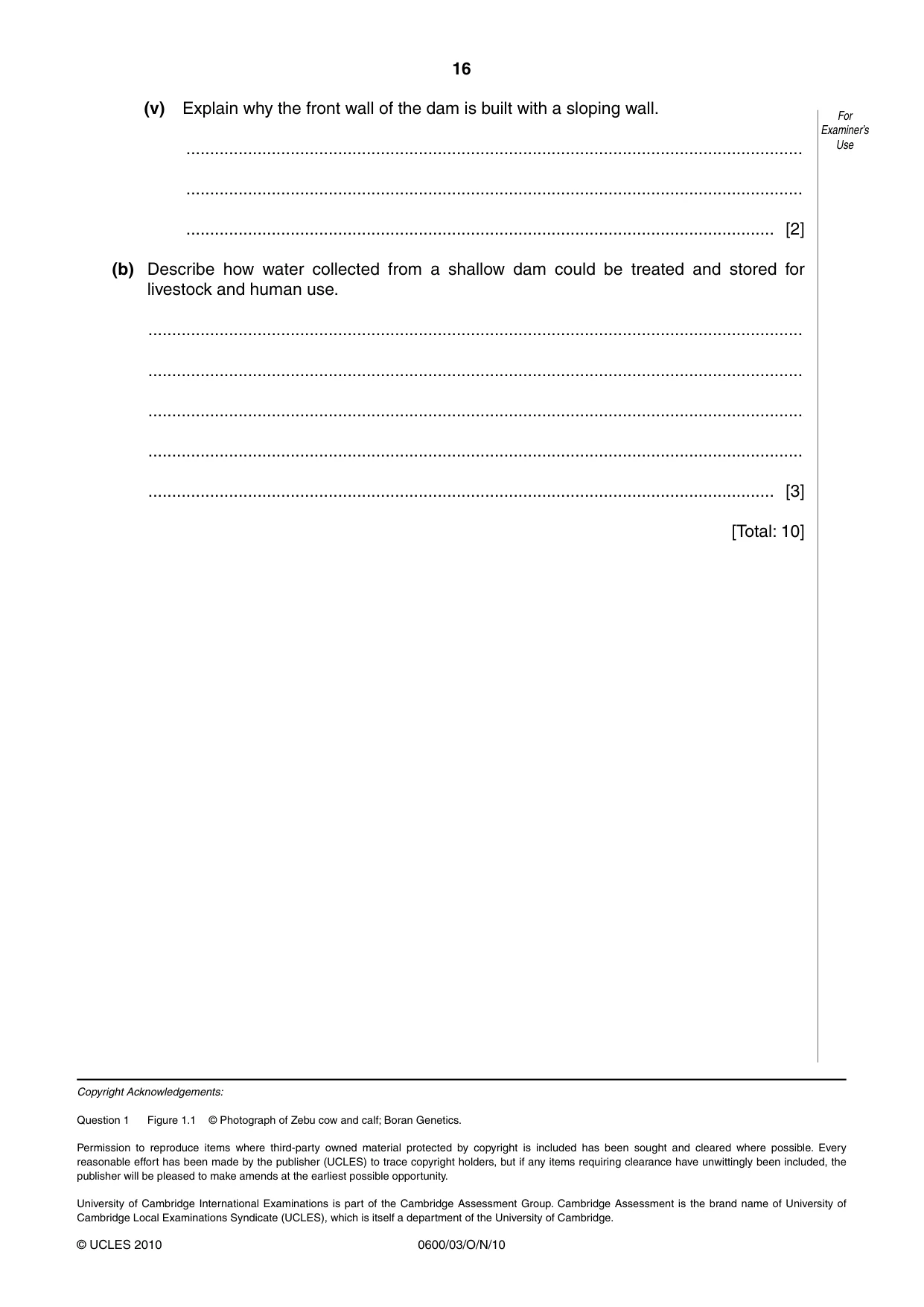
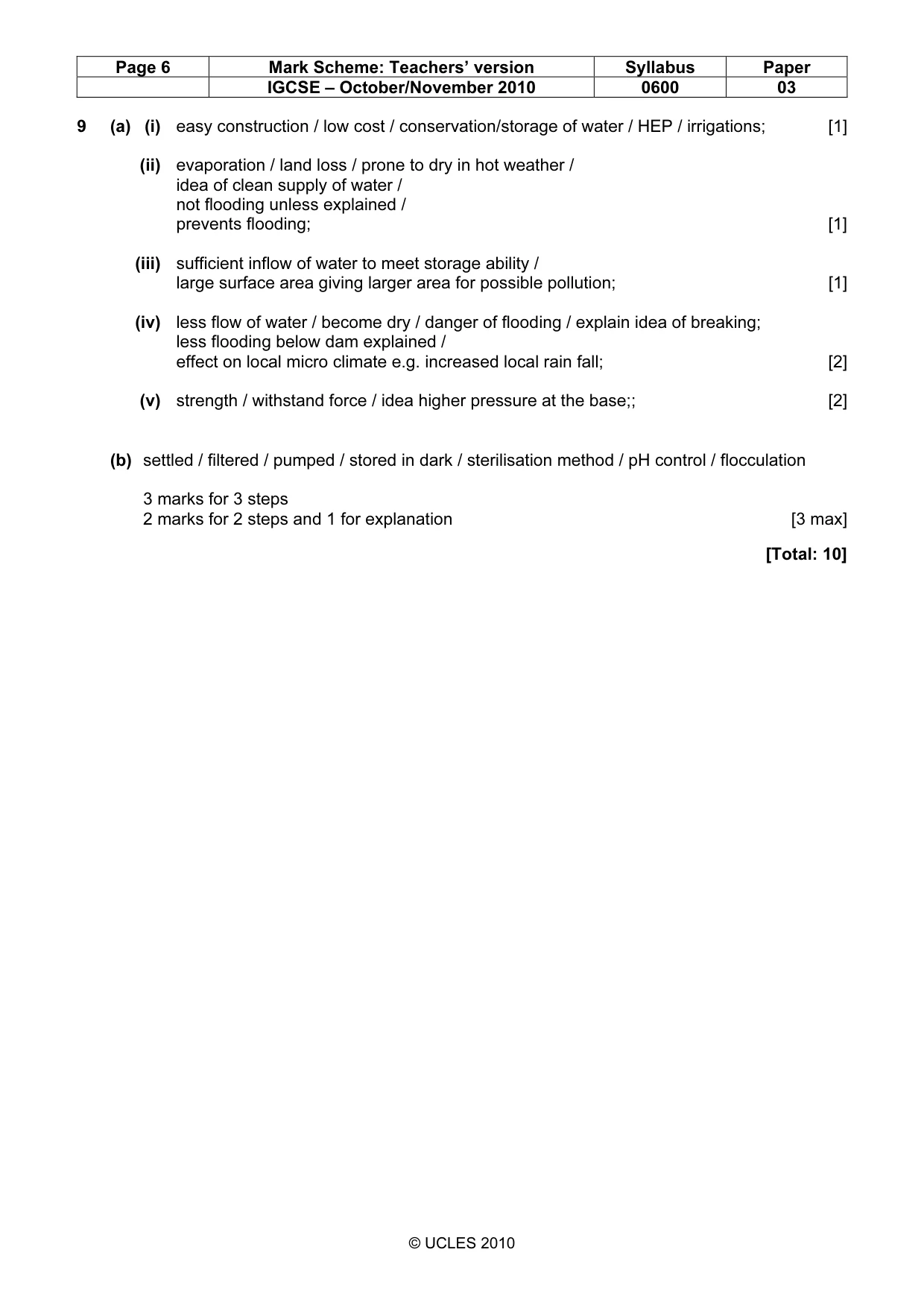
9 Fig. 9.1 shows a shallow dam. reservoir shallow dam stream Fig. 9.1 (a) Water can be stored by constructing dams. (i) State an advantage of building such a dam. .................................................................................................................................. ............................................................................................................................ [1] (ii) State a problem that may arise from the use of shallow dams. .................................................................................................................................. ............................................................................................................................ [1] (iii) Explain how the water catchment area needs to be considered when constructing such a dam. .................................................................................................................................. ............................................................................................................................ [1] (iv) Explain how building such a dam might affect the local environment below the dam site. .................................................................................................................................. .................................................................................................................................. .................................................................................................................................. ............................................................................................................................ [2] (v) Explain why the front wall of the dam is built with a sloping wall. .................................................................................................................................. .................................................................................................................................. ............................................................................................................................ [2] (b) Describe how water collected from a shallow dam could be treated and stored for livestock and human use. .......................................................................................................................................... .......................................................................................................................................... .......................................................................................................................................... .......................................................................................................................................... .................................................................................................................................... [3] [Total: 10]
Mark scheme: 9 (a) (i) easy construction / low cost / conservation/storage of water / HEP / irrigations; [1] (ii) evaporation / land loss / prone to dry in hot weather / idea of clean supply of water / not flooding unless explained / prevents flooding; [1] (iii) sufficient inflow of water to meet storage ability / large surface area giving larger area for possible pollution; [1] (iv) less flow of water / become dry / danger of flooding / explain idea of breaking; less flooding below dam explained / effect on local micro climate e.g. increased local rain fall; [2] (v) strength / withstand force / idea higher pressure at the base;; [2] (b) settled / filtered / pumped / stored in dark / sterilisation method / pH control / flocculation 3 marks for 3 steps 2 marks for 2 steps and 1 for explanation [3 max] [Total: 10]
What you needed in this session
Cambridge’s own grade thresholds for 2010 Oct/Nov, Paper 3 · Variant 1. A higher threshold means an easier paper — the bar moves with how the cohort did.