Cambridge IGCSE Agriculture 0600 — 2008 Oct/Nov Paper 3 · Variant 1
0600/31/O/N/08 · 80 marks · ≈90 min
The question paper and its mark scheme, free to read here and free to download. This is Cambridge’s own paper, exactly as it was sat.
Question paper12 pages
Mark scheme5 pages
Answers below. Sit the paper first if you are practising.
Paper as text
Question paper, page 1
This document consists of 12 printed pages. IB08 11_0600_03/2RP © UCLES 2008 [Turn over * 1385509278* For Examiner's Use 1 2 3 4 5 6 7 8 9 Total UNIVERSITY OF CAMBRIDGE INTERNATIONAL EXAMINATIONS International General Certificate of Secondary Education AGRICULTURE 0600/03 Paper 3 October/November 2008 1 hour 15 minutes Candidates answer on the Question Paper. No Additional Materials are required. READ THESE INSTRUCTIONS FIRST Write your Centre number, candidate number and name on all the work you hand in. Write in dark blue or black pen. You may use a soft pencil for any diagrams or graphs. Do not use staples, paper clips, highlighters, glue or correction fluid. DO NOT WRITE IN ANY BARCODES. Answer all questions. At the end of the examination, fasten all your work securely together. The number of marks is given in brackets [ ] at the end of each question or part question. www.XtremePapers.com
Question paper, page 2
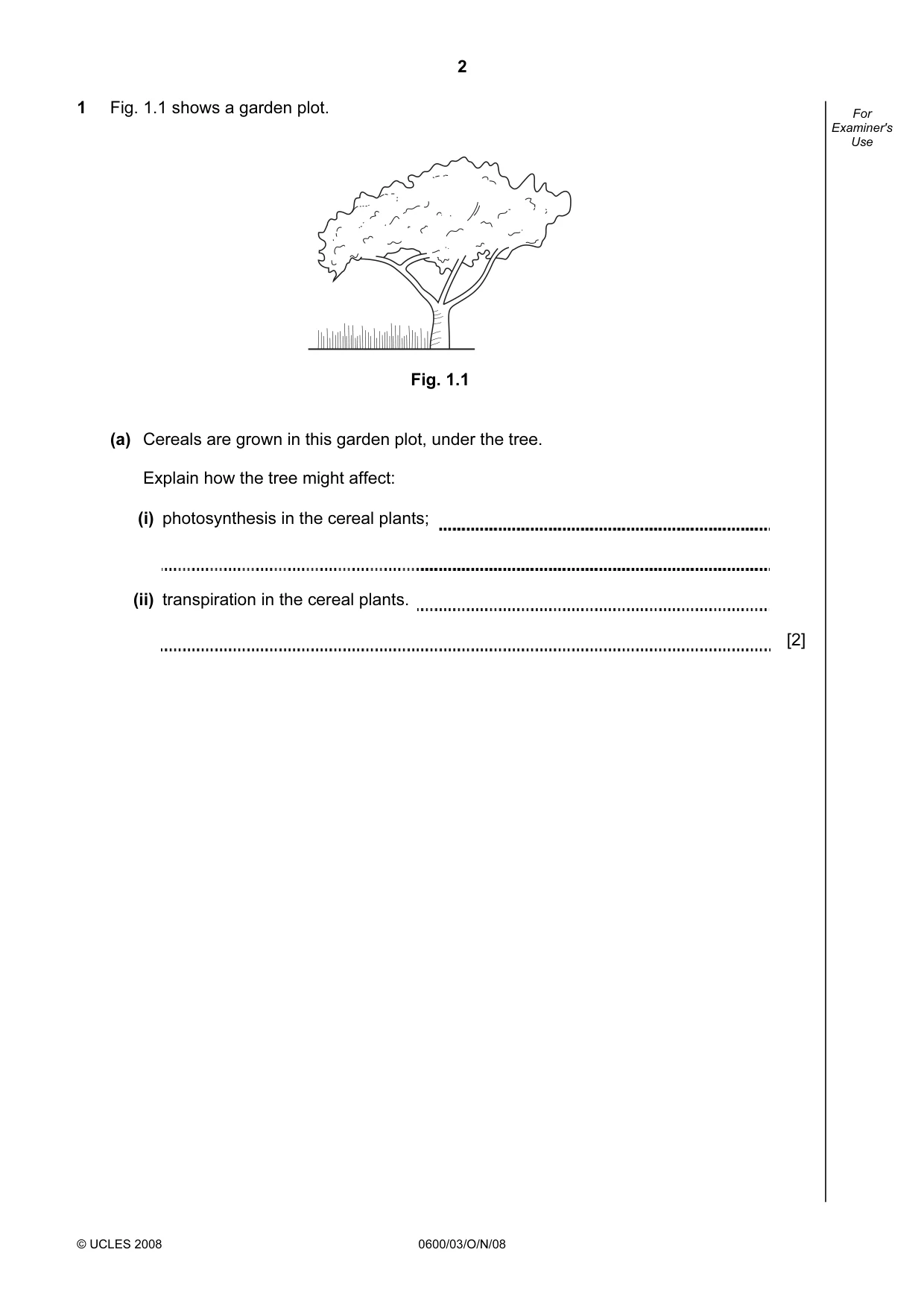
2 © UCLES 2008 0600/03/O/N/08 For Examiner's Use 1 Fig. 1.1 shows a garden plot. Fig. 1.1 (a) Cereals are grown in this garden plot, under the tree. Explain how the tree might affect: (i) photosynthesis in the cereal plants; (ii) transpiration in the cereal plants. [2]
Question paper, page 3
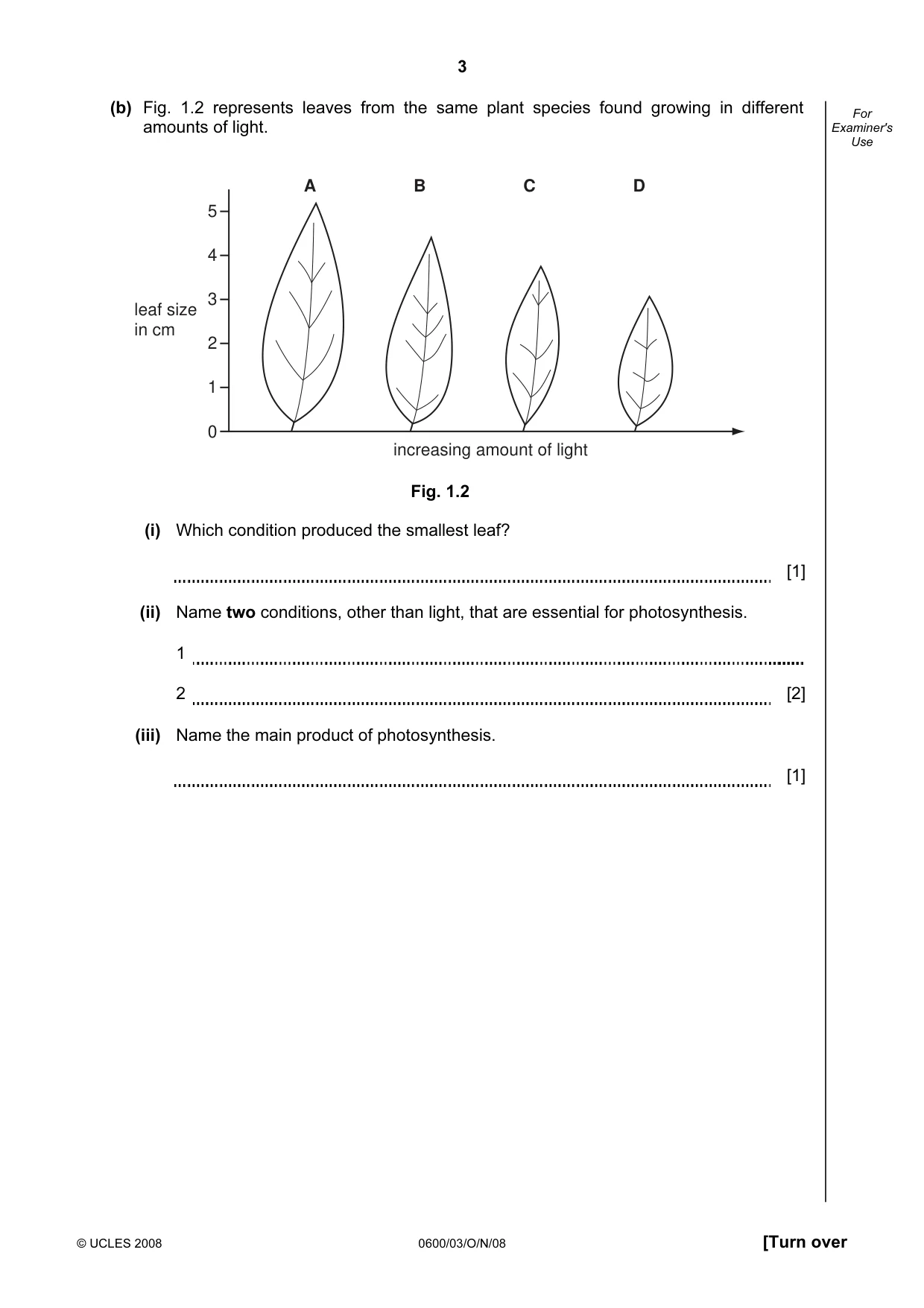
3 © UCLES 2008 0600/03/O/N/08 [Turn over For Examiner's Use (b) Fig. 1.2 represents leaves from the same plant species found growing in different amounts of light. 5 4 3 2 1 0 leaf size in cm increasing amount of light A B C D Fig. 1.2 (i) Which condition produced the smallest leaf? [1] (ii) Name two conditions, other than light, that are essential for photosynthesis. 1 2 [2] (iii) Name the main product of photosynthesis. [1]
Question paper, page 4
4 © UCLES 2008 0600/03/O/N/08 For Examiner's Use (c) (i) Name two main areas within a plant to which the product of photosynthesis may move for storage or use. 1 2 [2] (ii) For a named crop, state the part of the plant which is eaten. Name of crop Part of plant eaten [1] (iii) Describe two uses, other than food, to which some crop plants can be put. [2] [Total: 11]
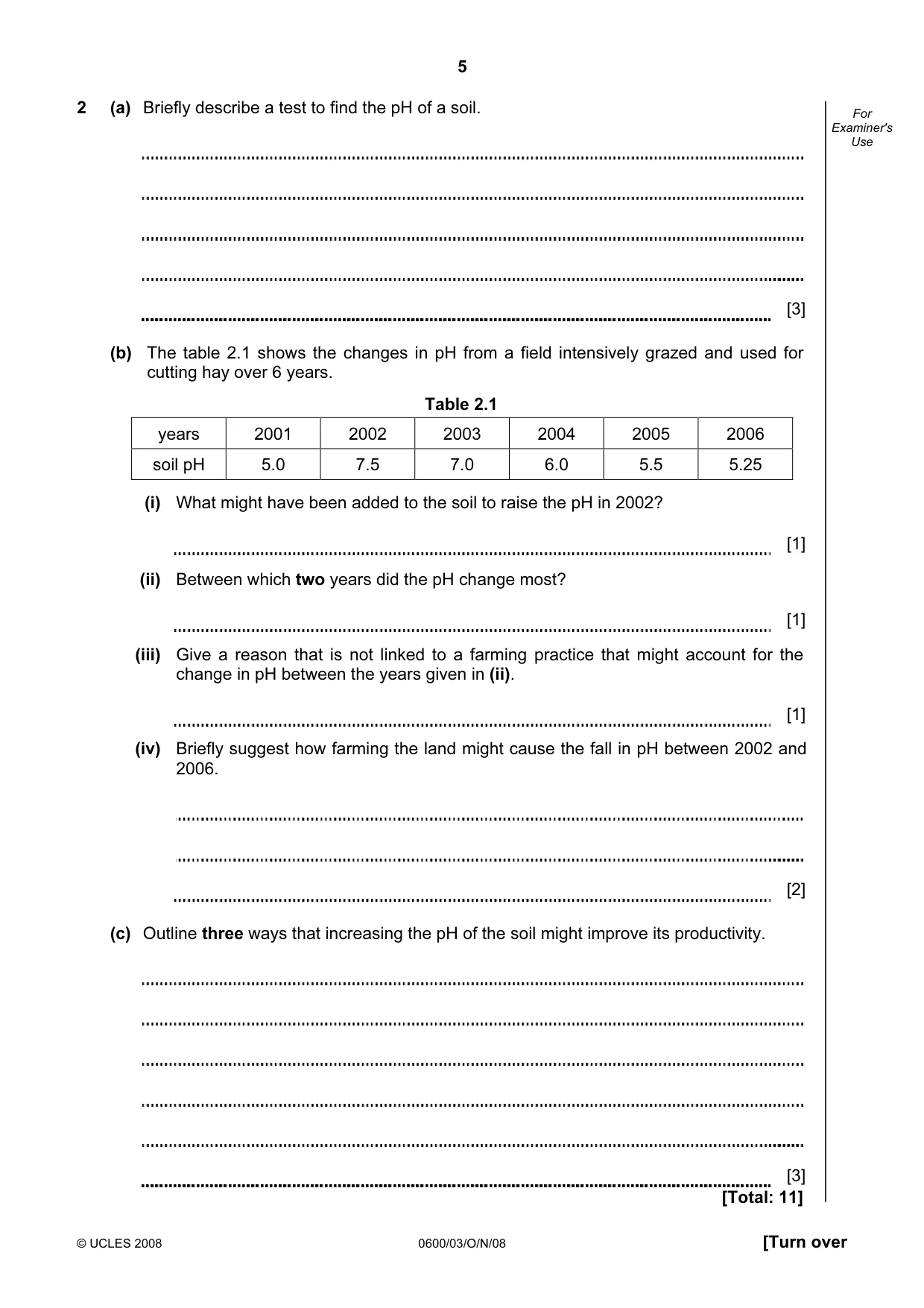
Question paper, page 5
5 © UCLES 2008 0600/03/O/N/08 [Turn over For Examiner's Use 2 (a) Briefly describe a test to find the pH of a soil. [3] (b) The table 2.1 shows the changes in pH from a field intensively grazed and used for cutting hay over 6 years. Table 2.1 years 2001 2002 2003 2004 2005 2006 soil pH 5.0 7.5 7.0 6.0 5.5 5.25 (i) What might have been added to the soil to raise the pH in 2002? [1] (ii) Between which two years did the pH change most? [1] (iii) Give a reason that is not linked to a farming practice that might account for the change in pH between the years given in (ii). [1] (iv) Briefly suggest how farming the land might cause the fall in pH between 2002 and 2006. [2] (c) Outline three ways that increasing the pH of the soil might improve its productivity. [3] [Total: 11]
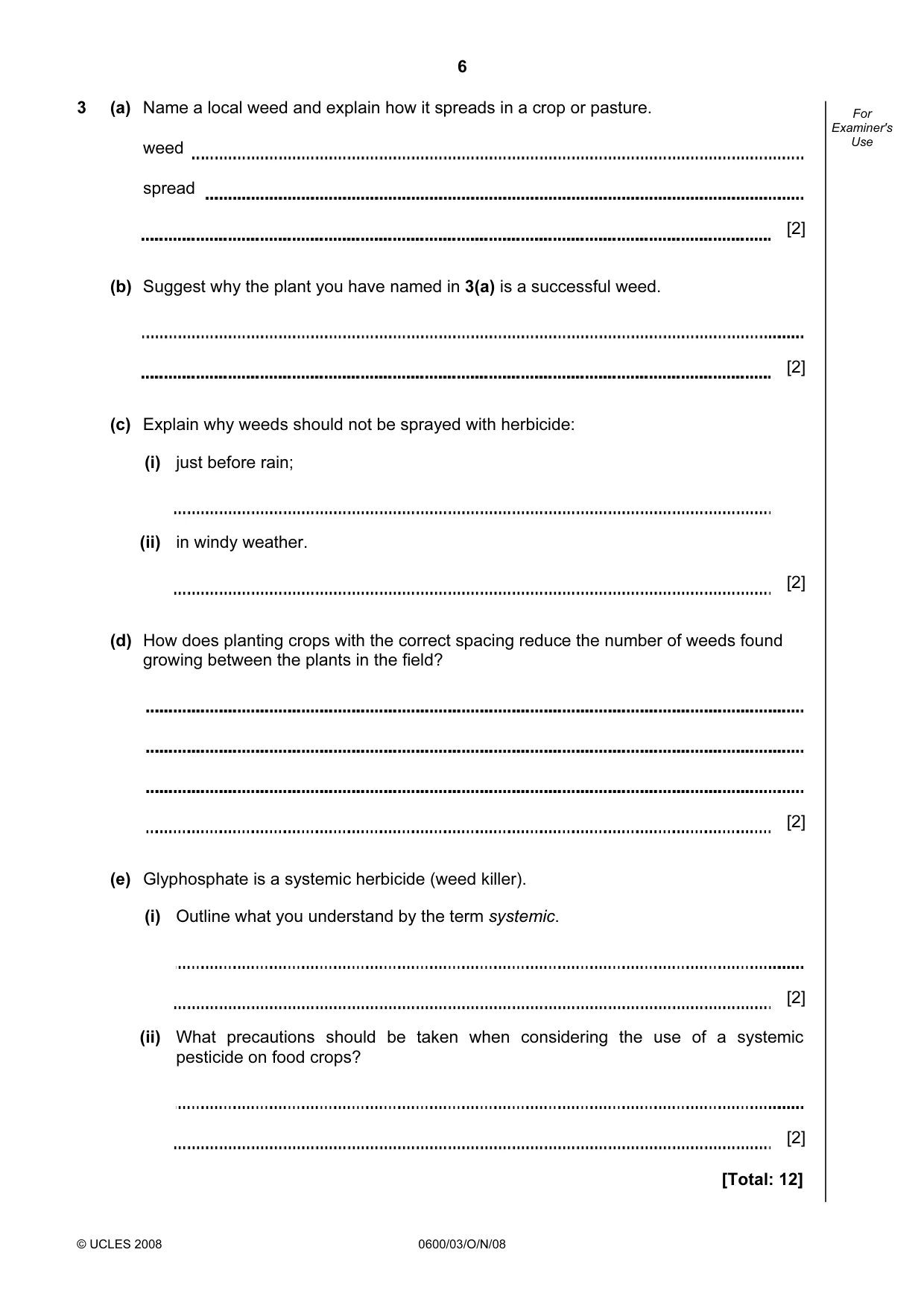
Question paper, page 6
6 © UCLES 2008 0600/03/O/N/08 For Examiner's Use 3 (a) Name a local weed and explain how it spreads in a crop or pasture. weed spread [2] (b) Suggest why the plant you have named in 3(a) is a successful weed. [2] (c) Explain why weeds should not be sprayed with herbicide: (i) just before rain; (ii) in windy weather. [2] (d) How does planting crops with the correct spacing reduce the number of weeds found growing between the plants in the field? [2] (e) Glyphosphate is a systemic herbicide (weed killer). (i) Outline what you understand by the term systemic. [2] (ii) What precautions should be taken when considering the use of a systemic pesticide on food crops? [2] [Total: 12]
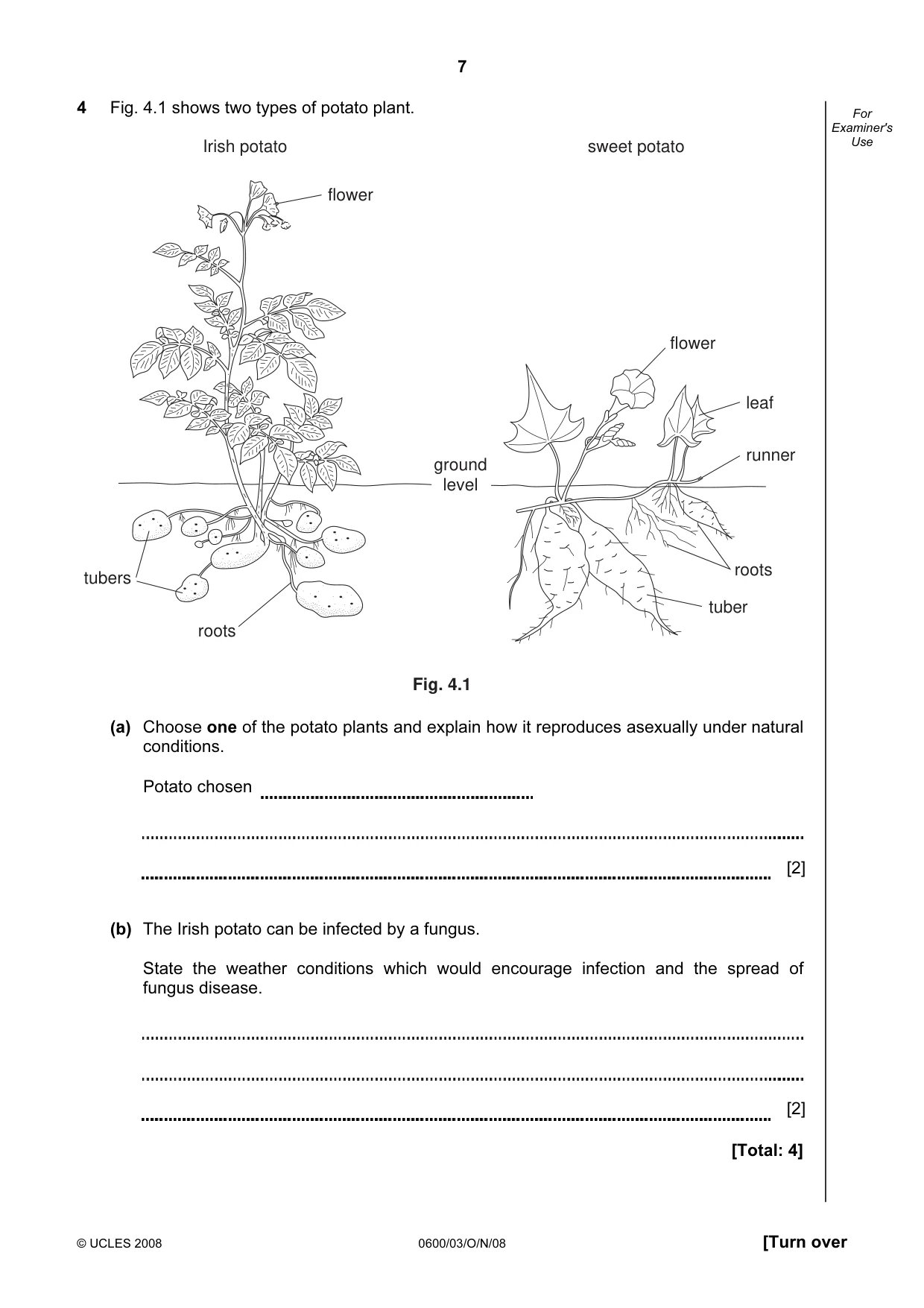
Question paper, page 7
7 © UCLES 2008 0600/03/O/N/08 [Turn over For Examiner's Use 4 Fig. 4.1 shows two types of potato plant. ground level tubers roots flower tuber roots runner leaf flower Irish potato sweet potato Fig. 4.1 (a) Choose one of the potato plants and explain how it reproduces asexually under natural conditions. Potato chosen [2] (b) The Irish potato can be infected by a fungus. State the weather conditions which would encourage infection and the spread of fungus disease. [2] [Total: 4]
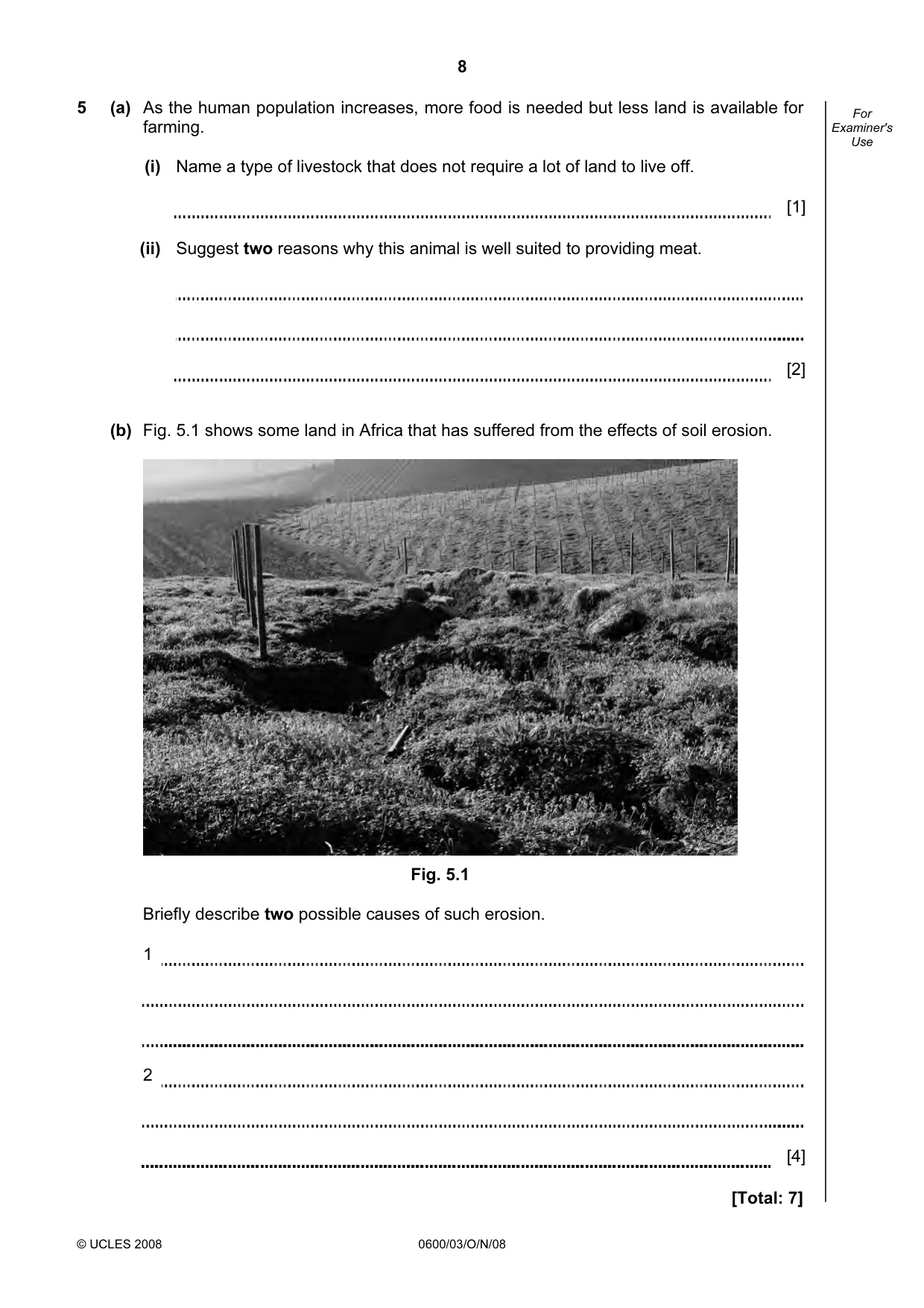
Question paper, page 8
8 © UCLES 2008 0600/03/O/N/08 For Examiner's Use 5 (a) As the human population increases, more food is needed but less land is available for farming. (i) Name a type of livestock that does not require a lot of land to live off. [1] (ii) Suggest two reasons why this animal is well suited to providing meat. [2] (b) Fig. 5.1 shows some land in Africa that has suffered from the effects of soil erosion. Fig. 5.1 Briefly describe two possible causes of such erosion. 1 2 [4] [Total: 7]
Question paper, page 9
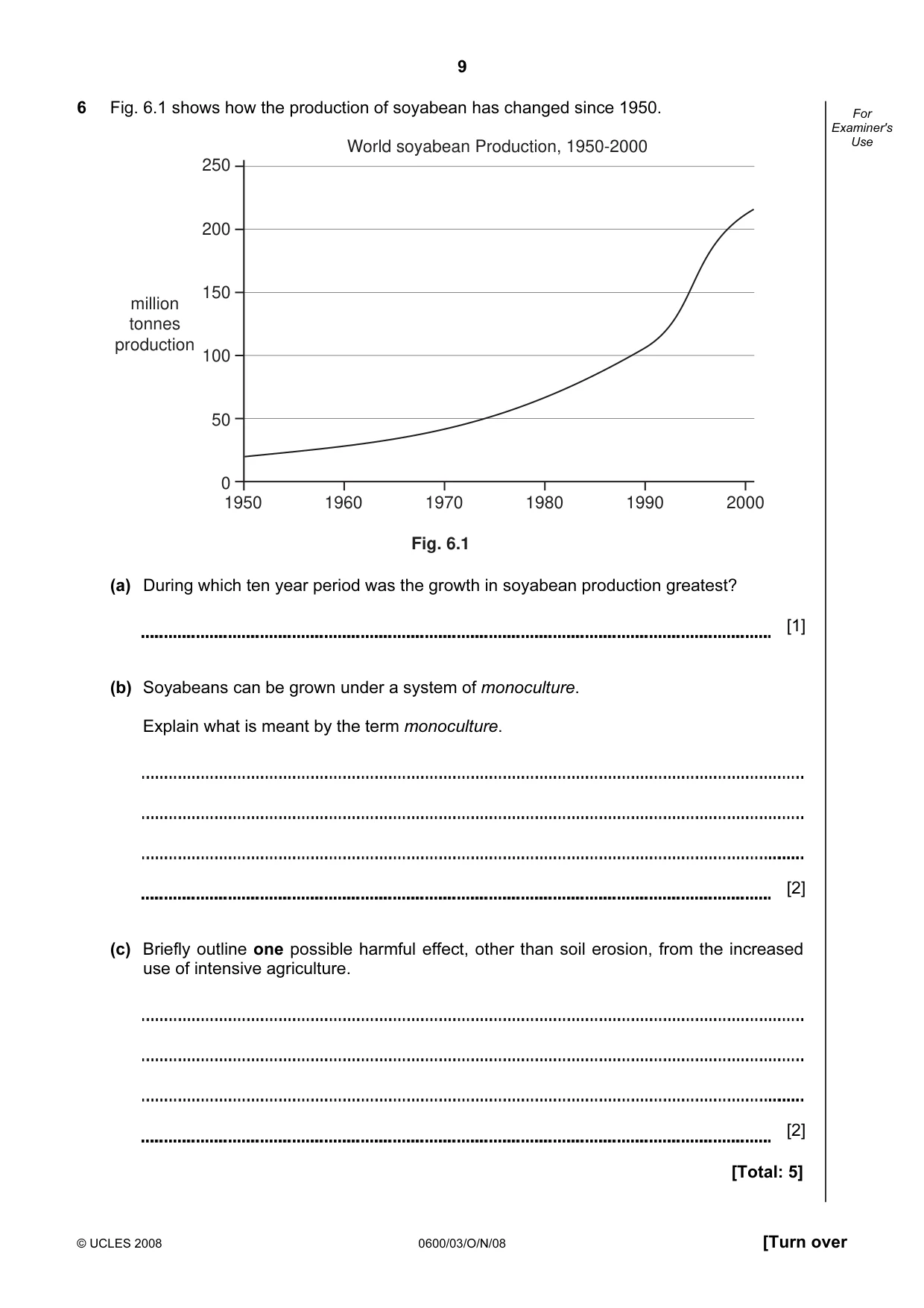
9 © UCLES 2008 0600/03/O/N/08 [Turn over For Examiner's Use 6 Fig. 6.1 shows how the production of soyabean has changed since 1950. 250 200 150 100 50 0 1950 1960 1970 1980 1990 2000 World soyabean Production, 1950-2000 Fig. 6.1 million tonnes production (a) During which ten year period was the growth in soyabean production greatest? [1] (b) Soyabeans can be grown under a system of monoculture. Explain what is meant by the term monoculture. [2] (c) Briefly outline one possible harmful effect, other than soil erosion, from the increased use of intensive agriculture. [2] [Total: 5]
Question paper, page 10
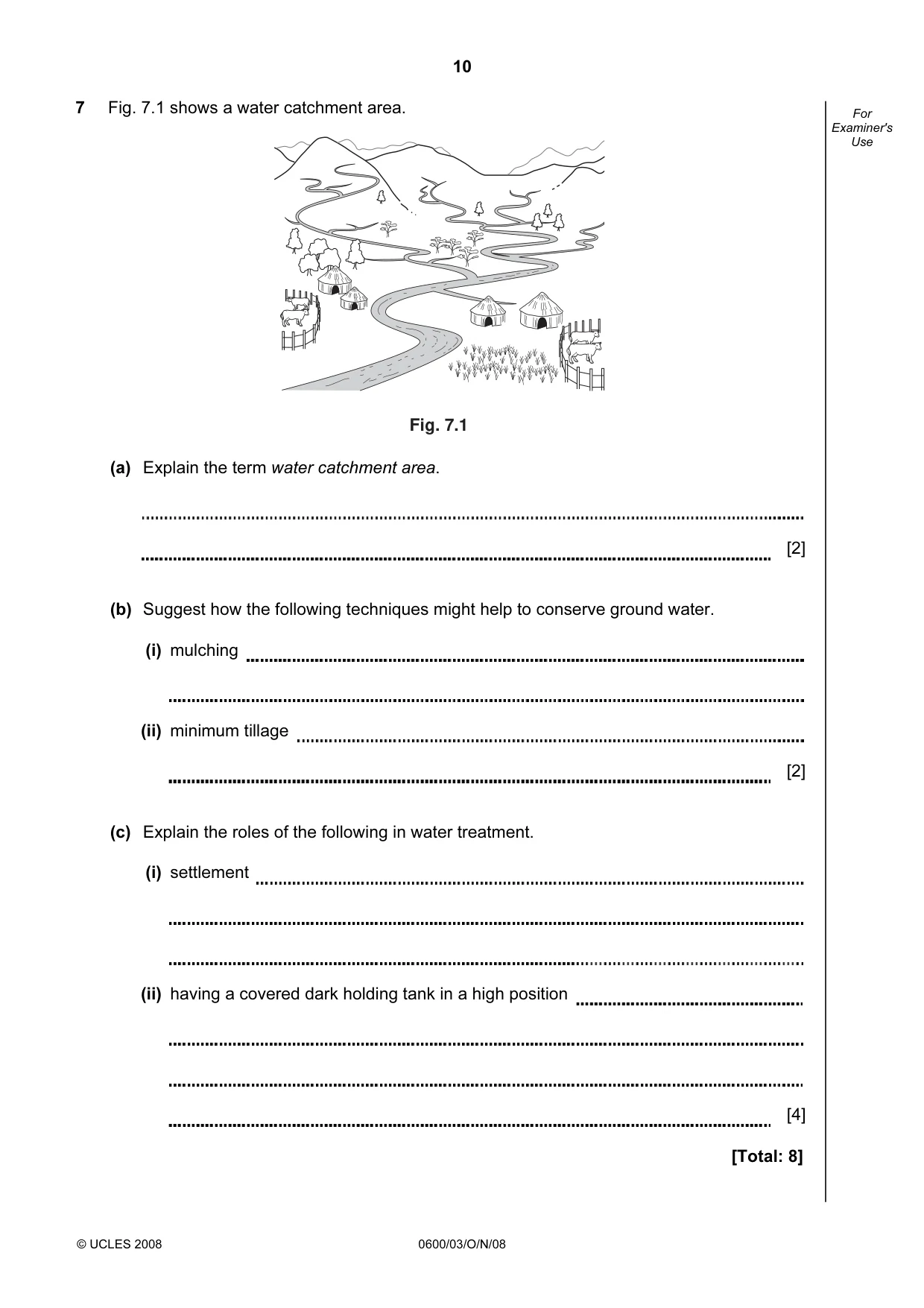
10 © UCLES 2008 0600/03/O/N/08 For Examiner's Use 7 Fig. 7.1 shows a water catchment area. Fig. 7.1 (a) Explain the term water catchment area. [2] (b) Suggest how the following techniques might help to conserve ground water. (i) mulching (ii) minimum tillage [2] (c) Explain the roles of the following in water treatment. (i) settlement (ii) having a covered dark holding tank in a high position [4] [Total: 8]
Question paper, page 11
11 © UCLES 2008 0600/03/O/N/08 [Turn over For Examiner's Use 8 (a) For a named type of animal you have studied, state three characteristics that you would select for when breeding to get improved offspring. name of animal 1 2 3 [3] (b) Farmers frequently use artificial insemination (A.I.) on their livestock. (i) Give two advantages of A.I. to the livestock farmer. 1 2 [2] (ii) Briefly explain the terms: genotype; phenotype. [2] (c) Many farm animals and crop plants give high yields but have poor disease resistance. For a named animal or crop plant describe how a breeding programme could be used to improve the disease resistance. name of crop or livestock outline breeding programme [4] [Total: 11]
Question paper, page 12
12 Permission to reproduce items where third-party owned material protected by copyright is included has been sought and cleared where possible. Every reasonable effort has been made by the publisher (UCLES) to trace copyright holders, but if any items requiring clearance have unwittingly been included, the publisher will be pleased to make amends at the earliest possible opportunity. University of Cambridge International Examinations is part of the Cambridge Assessment Group. Cambridge Assessment is the brand name of University of Cambridge Local Examinations Syndicate (UCLES), which is itself a department of the University of Cambridge. © UCLES 2008 0600/03/O/N/08 For Examiner's Use 9 (a) The owner of mixed farm has money to spend on fencing. The choices are: 1. fence around the vegetable garden; 2. fence around a paddock for goats. Discuss the economic factors that need to be considered in making a decision between choices 1 and 2. [3] (b) Farms X and Y cover the same area of similar farmland. Farm X had an input of US$ 20,000 and a profit of US$ 1500. Farm Y had an input of US$ 100,000 and a profit of US$ 6000. Which farm would you expect to be intensive? Give a reason for your answer. [2] (c) Which farm made most profit per US$ 100 of input? (Show your workings). [2] (d) Give two reasons why, when considering the purchase of a farm, you should look at more than one year’s input and profit. [4] [Total: 11]
Mark scheme, page 1
UNIVERSITY OF CAMBRIDGE INTERNATIONAL EXAMINATIONS International General Certificate of Secondary Education MARK SCHEME for the October/November 2008 question paper 0600 AGRICULTURE 0600/03 Paper 3 (Extended Theory), maximum raw mark 80 This mark scheme is published as an aid to teachers and candidates, to indicate the requirements of the examination. It shows the basis on which Examiners were instructed to award marks. It does not indicate the details of the discussions that took place at an Examiners’ meeting before marking began. All Examiners are instructed that alternative correct answers and unexpected approaches in candidates’ scripts must be given marks that fairly reflect the relevant knowledge and skills demonstrated. Mark schemes must be read in conjunction with the question papers and the report on the examination. • CIE will not enter into discussions or correspondence in connection with these mark schemes. CIE is publishing the mark schemes for the October/November 2008 question papers for most IGCSE, GCE Advanced Level and Advanced Subsidiary Level syllabuses and some Ordinary Level syllabuses. www.XtremePapers.com
Mark scheme, page 2
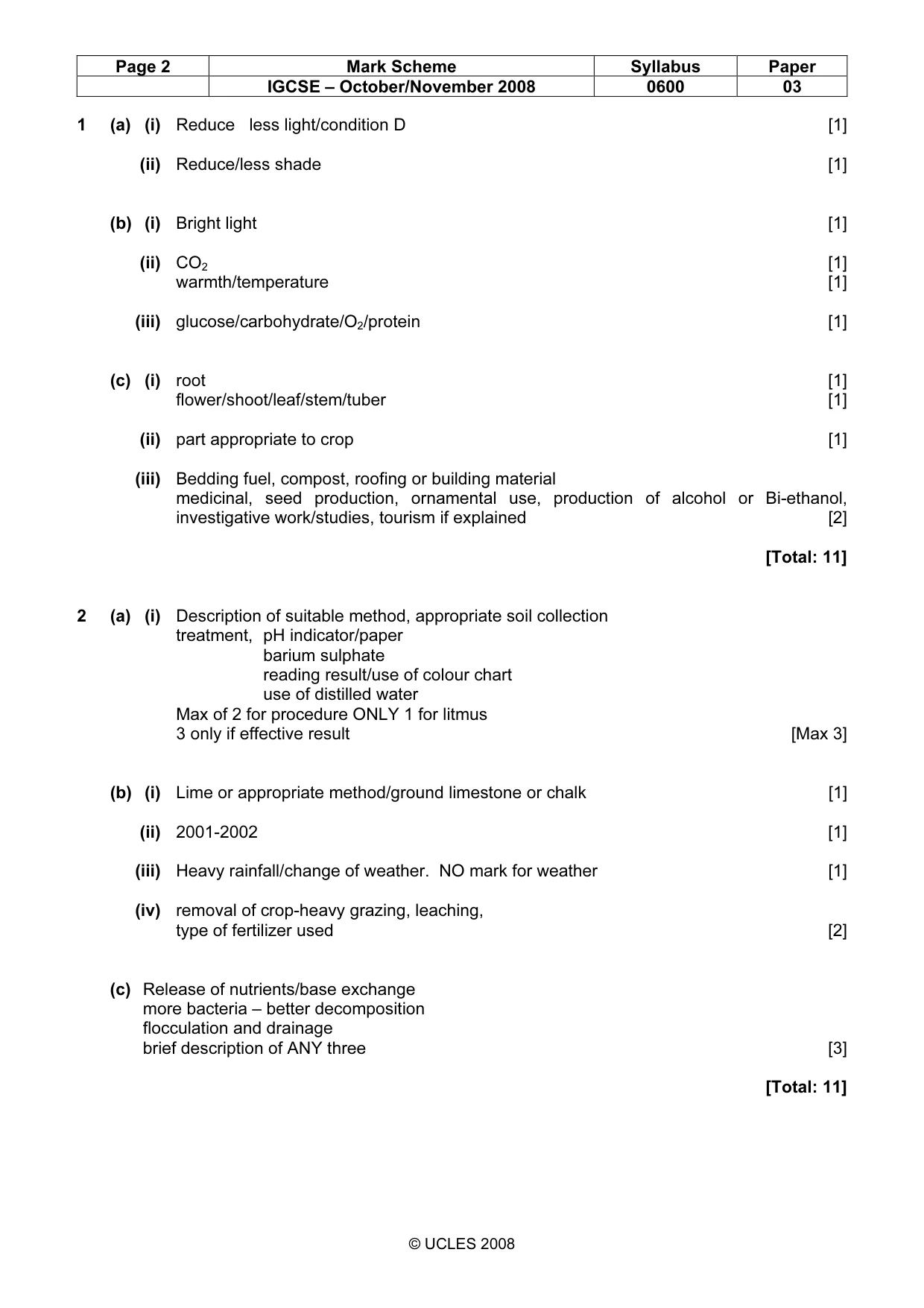
Page 2 Mark Scheme Syllabus Paper IGCSE – October/November 2008 0600 03 © UCLES 2008 1 (a) (i) Reduce less light/condition D [1] (ii) Reduce/less shade [1] (b) (i) Bright light [1] (ii) CO2 [1] warmth/temperature [1] (iii) glucose/carbohydrate/O2/protein [1] (c) (i) root [1] flower/shoot/leaf/stem/tuber [1] (ii) part appropriate to crop [1] (iii) Bedding fuel, compost, roofing or building material medicinal, seed production, ornamental use, production of alcohol or Bi-ethanol, investigative work/studies, tourism if explained [2] [Total: 11] 2 (a) (i) Description of suitable method, appropriate soil collection treatment, pH indicator/paper barium sulphate reading result/use of colour chart use of distilled water Max of 2 for procedure ONLY 1 for litmus 3 only if effective result [Max 3] (b) (i) Lime or appropriate method/ground limestone or chalk [1] (ii) 2001-2002 [1] (iii) Heavy rainfall/change of weather. NO mark for weather [1] (iv) removal of crop-heavy grazing, leaching, type of fertilizer used [2] (c) Release of nutrients/base exchange more bacteria – better decomposition flocculation and drainage brief description of ANY three [3] [Total: 11]
Mark scheme, page 3
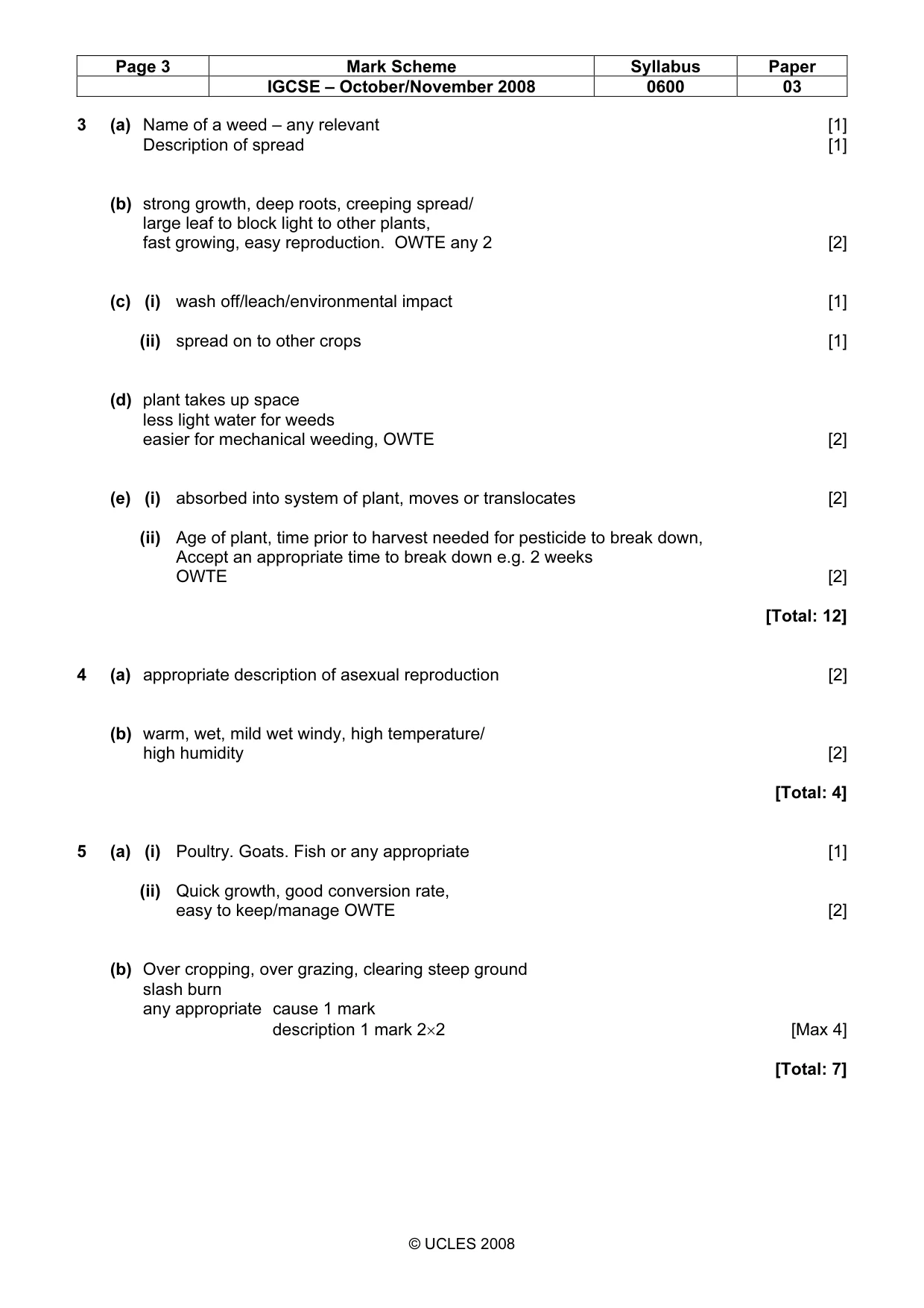
Page 3 Mark Scheme Syllabus Paper IGCSE – October/November 2008 0600 03 © UCLES 2008 3 (a) Name of a weed – any relevant [1] Description of spread [1] (b) strong growth, deep roots, creeping spread/ large leaf to block light to other plants, fast growing, easy reproduction. OWTE any 2 [2] (c) (i) wash off/leach/environmental impact [1] (ii) spread on to other crops [1] (d) plant takes up space less light water for weeds easier for mechanical weeding, OWTE [2] (e) (i) absorbed into system of plant, moves or translocates [2] (ii) Age of plant, time prior to harvest needed for pesticide to break down, Accept an appropriate time to break down e.g. 2 weeks OWTE [2] [Total: 12] 4 (a) appropriate description of asexual reproduction [2] (b) warm, wet, mild wet windy, high temperature/ high humidity [2] [Total: 4] 5 (a) (i) Poultry. Goats. Fish or any appropriate [1] (ii) Quick growth, good conversion rate, easy to keep/manage OWTE [2] (b) Over cropping, over grazing, clearing steep ground slash burn any appropriate cause 1 mark description 1 mark 2×2 [Max 4] [Total: 7]
Mark scheme, page 4
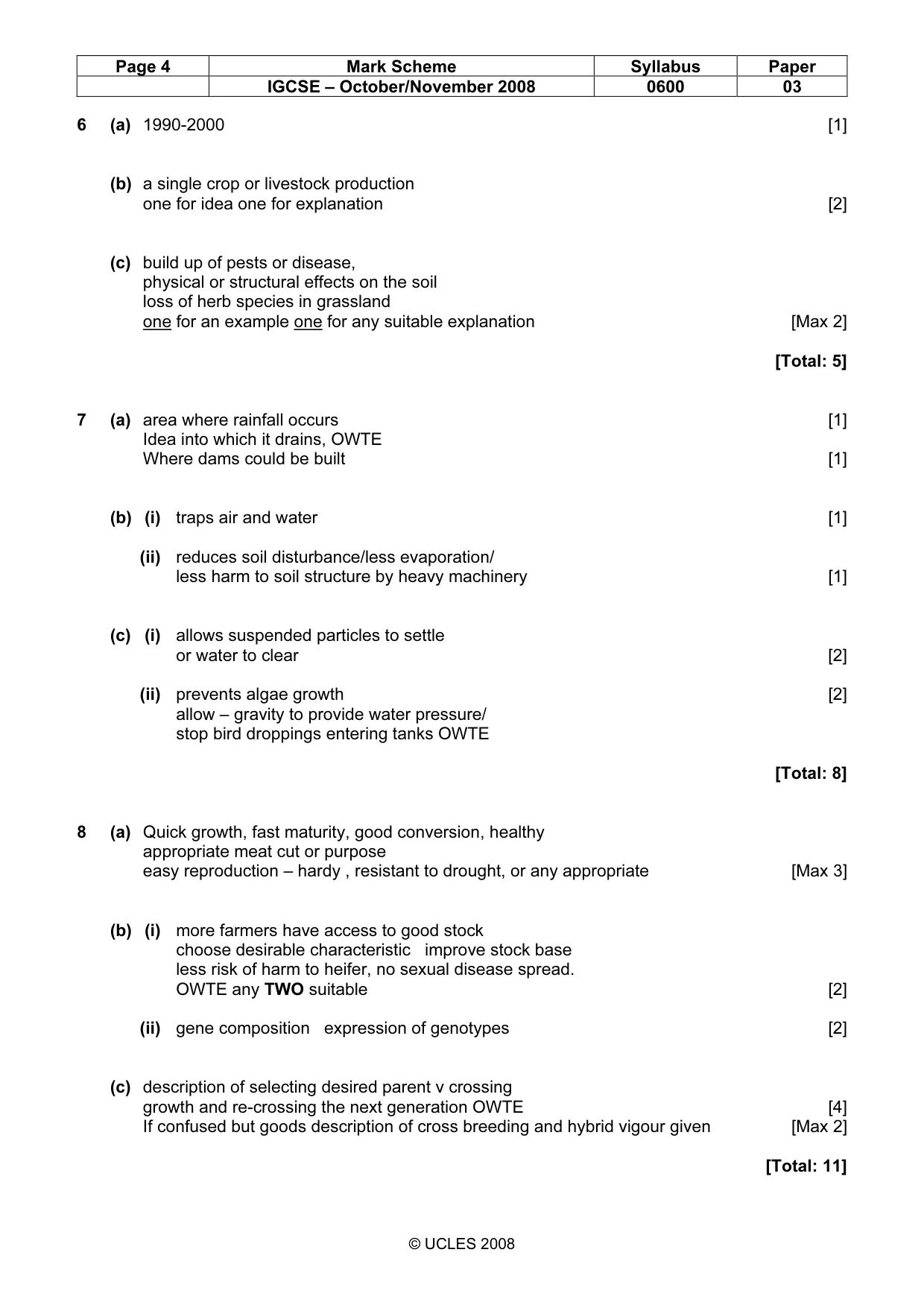
Page 4 Mark Scheme Syllabus Paper IGCSE – October/November 2008 0600 03 © UCLES 2008 6 (a) 1990-2000 [1] (b) a single crop or livestock production one for idea one for explanation [2] (c) build up of pests or disease, physical or structural effects on the soil loss of herb species in grassland one for an example one for any suitable explanation [Max 2] [Total: 5] 7 (a) area where rainfall occurs [1] Idea into which it drains, OWTE Where dams could be built [1] (b) (i) traps air and water [1] (ii) reduces soil disturbance/less evaporation/ less harm to soil structure by heavy machinery [1] (c) (i) allows suspended particles to settle or water to clear [2] (ii) prevents algae growth [2] allow – gravity to provide water pressure/ stop bird droppings entering tanks OWTE [Total: 8] 8 (a) Quick growth, fast maturity, good conversion, healthy appropriate meat cut or purpose easy reproduction – hardy , resistant to drought, or any appropriate [Max 3] (b) (i) more farmers have access to good stock choose desirable characteristic improve stock base less risk of harm to heifer, no sexual disease spread. OWTE any TWO suitable [2] (ii) gene composition expression of genotypes [2] (c) description of selecting desired parent v crossing growth and re-crossing the next generation OWTE [4] If confused but goods description of cross breeding and hybrid vigour given [Max 2] [Total: 11]
Mark scheme, page 5
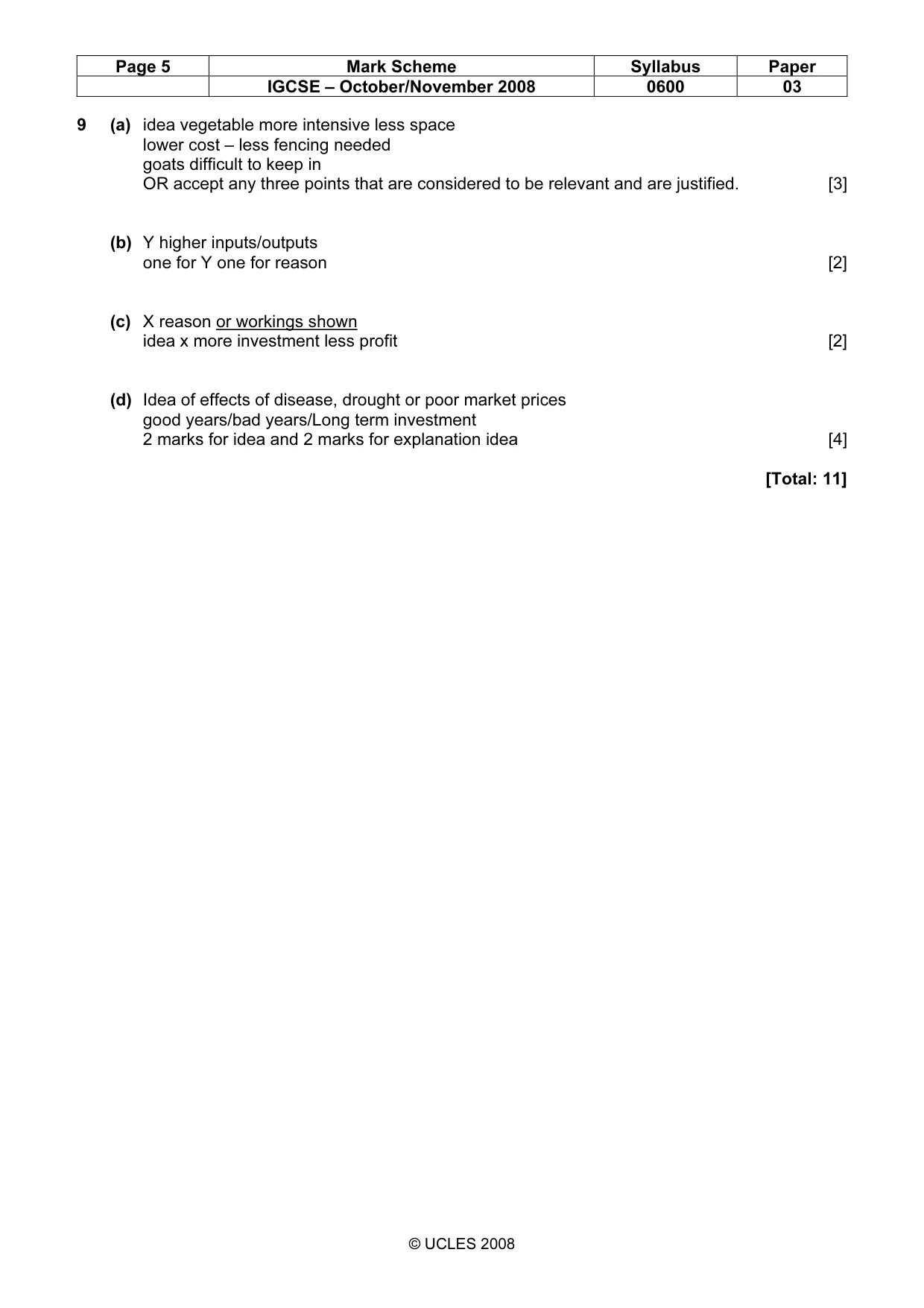
Page 5 Mark Scheme Syllabus Paper IGCSE – October/November 2008 0600 03 © UCLES 2008 9 (a) idea vegetable more intensive less space lower cost – less fencing needed goats difficult to keep in OR accept any three points that are considered to be relevant and are justified. [3] (b) Y higher inputs/outputs one for Y one for reason [2] (c) X reason or workings shown idea x more investment less profit [2] (d) Idea of effects of disease, drought or poor market prices good years/bad years/Long term investment 2 marks for idea and 2 marks for explanation idea [4] [Total: 11]
What you needed in this session
Cambridge’s own grade thresholds for 2008 Oct/Nov, Paper 3 · Variant 1. A higher threshold means an easier paper — the bar moves with how the cohort did.