Cambridge IGCSE Agriculture 0600 — 2007 Oct/Nov Paper 3 · Variant 1
0600/31/O/N/07 · 9 questions · 80 marks · ≈90 min
The question paper and its mark scheme, free to read here and free to download. This is Cambridge’s own paper, exactly as it was sat.
Question paper16 pages


Mark scheme5 pages
Answers below. Sit the paper first if you are practising.
Questions as text
Q1 · A recently settled family farm
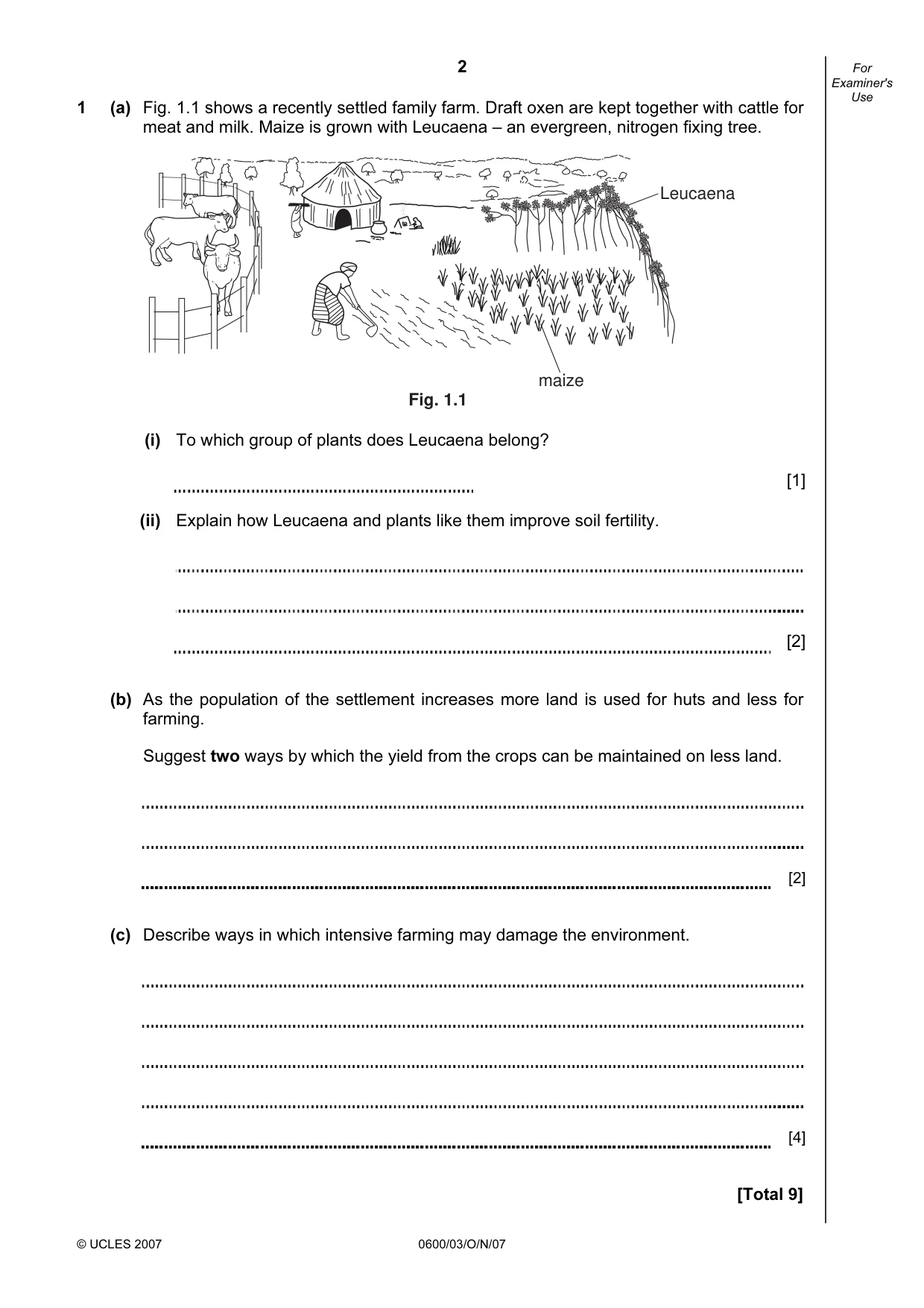
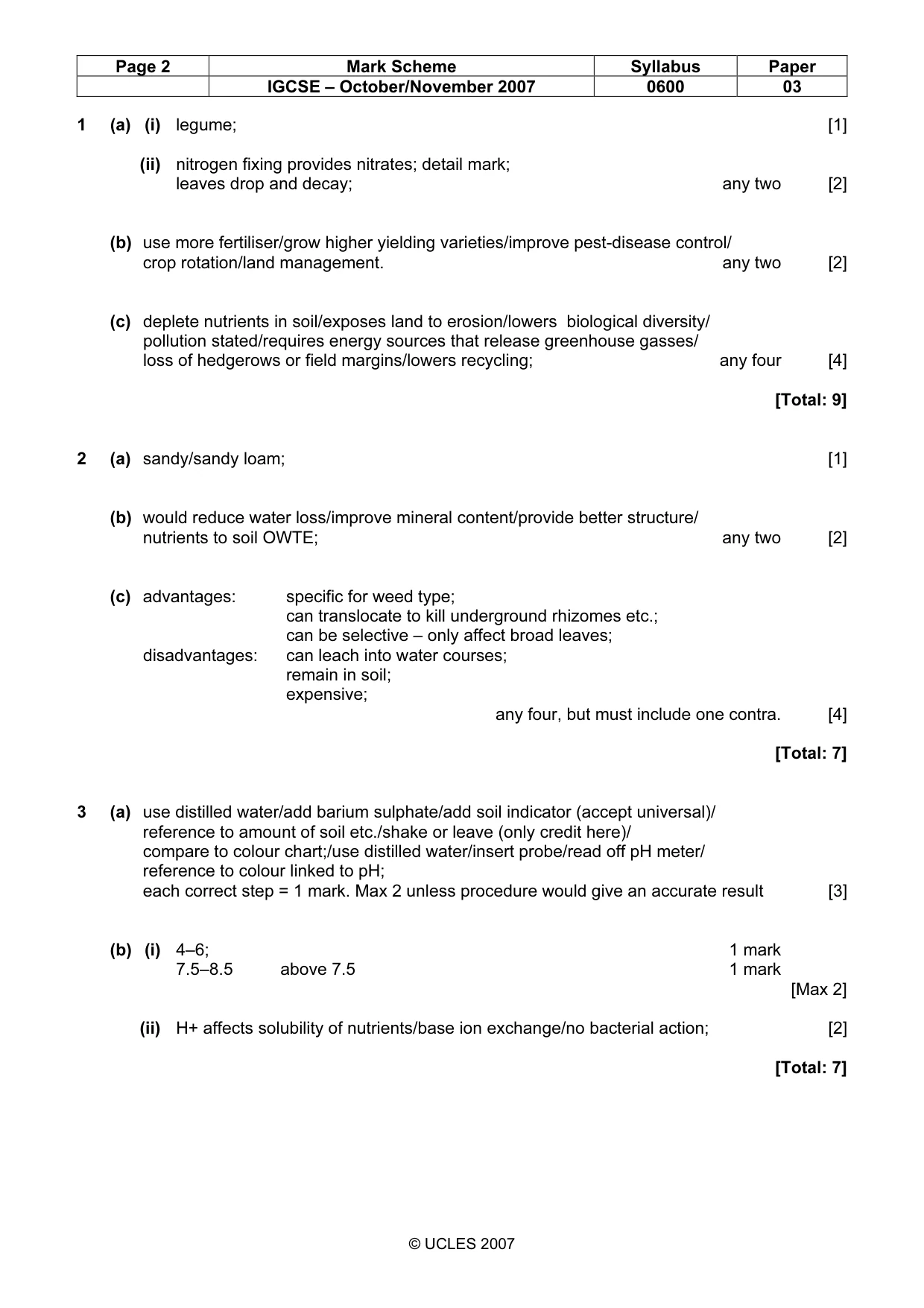
1 (a) Fig. 1.1 shows a recently settled family farm. Draft oxen are kept together with cattle for meat and milk. Maize is grown with Leucaena – an evergreen, nitrogen fixing tree. Leucaena maize Fig. 1.1 (i) To which group of plants does Leucaena belong? [1] (ii) Explain how Leucaena and plants like them improve soil fertility. [2] (b) As the population of the settlement increases more land is used for huts and less for farming. Suggest two ways by which the yield from the crops can be maintained on less land. [2] (c) Describe ways in which intensive farming may damage the environment. [4] [Total 9]
Mark scheme: 1 (a) (i) legume; [1] (ii) nitrogen fixing provides nitrates; detail mark; leaves drop and decay; any two [2] (b) use more fertiliser/grow higher yielding varieties/improve pest-disease control/ crop rotation/land management. any two [2] (c) deplete nutrients in soil/exposes land to erosion/lowers biological diversity/ pollution stated/requires energy sources that release greenhouse gasses/ loss of hedgerows or field margins/lowers recycling; any four [4] [Total: 9]
Q2 · A stack of soil sieves used to separate the parts of a soil sample
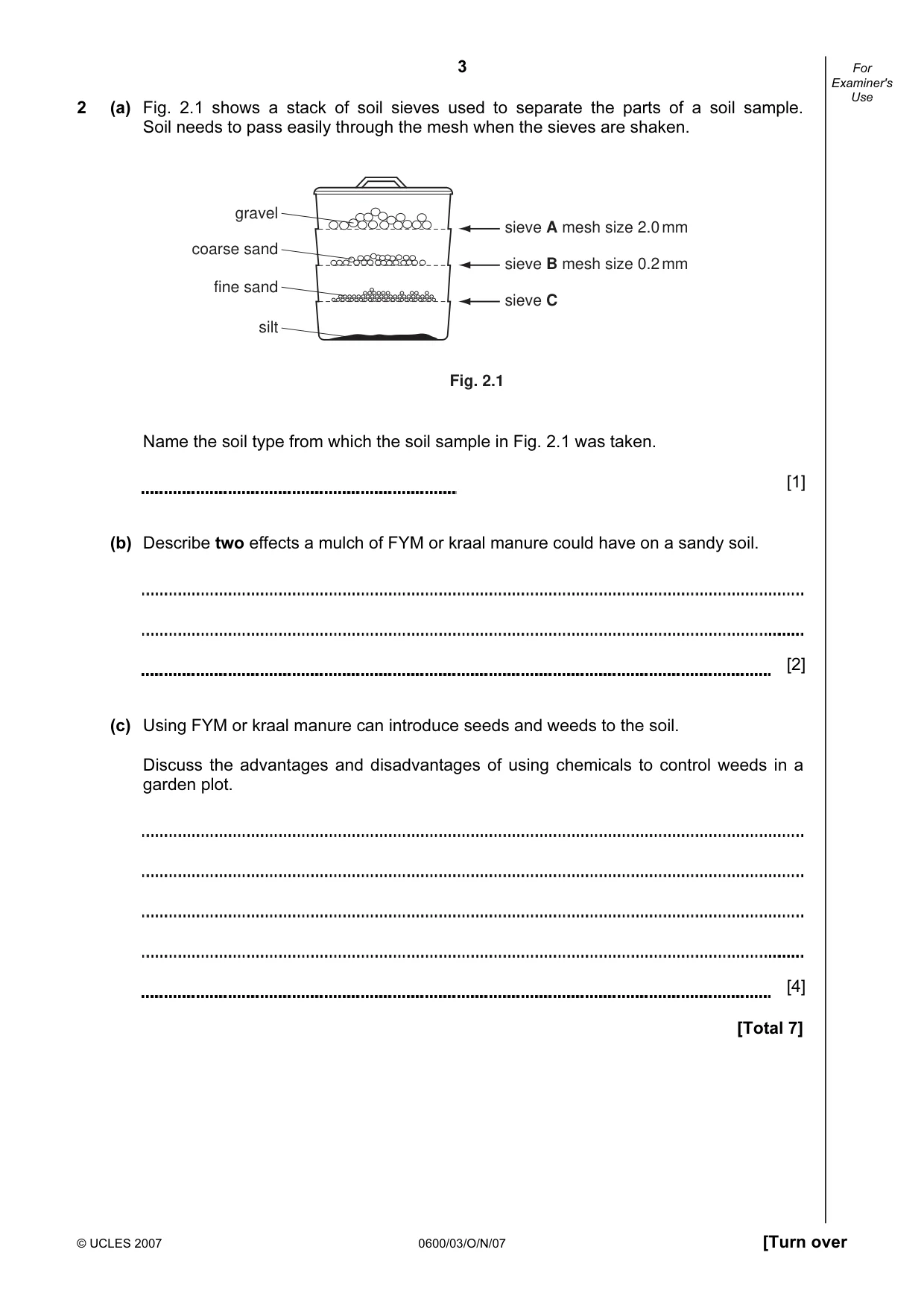
2 (a) Fig. 2.1 shows a stack of soil sieves used to separate the parts of a soil sample. Soil needs to pass easily through the mesh when the sieves are shaken. gravel sieve A mesh size 2.0 mm coarse sand sieve B mesh size 0.2 mm fine sand sieve C silt Fig. 2.1 Name the soil type from which the soil sample in Fig. 2.1 was taken. [1] (b) Describe two effects a mulch of FYM or kraal manure could have on a sandy soil. [2] (c) Using FYM or kraal manure can introduce seeds and weeds to the soil. Discuss the advantages and disadvantages of using chemicals to control weeds in a garden plot. [4] [Total 7]
Mark scheme: 2 (a) sandy/sandy loam; [1] (b) would reduce water loss/improve mineral content/provide better structure/ nutrients to soil OWTE; any two [2] (c) advantages: specific for weed type; can translocate to kill underground rhizomes etc.; can be selective – only affect broad leaves; disadvantages: can leach into water courses; remain in soil; expensive; any four, but must include one contra. [4] [Total: 7]
Q3 · Describe a method for finding the pH value of a soil sample
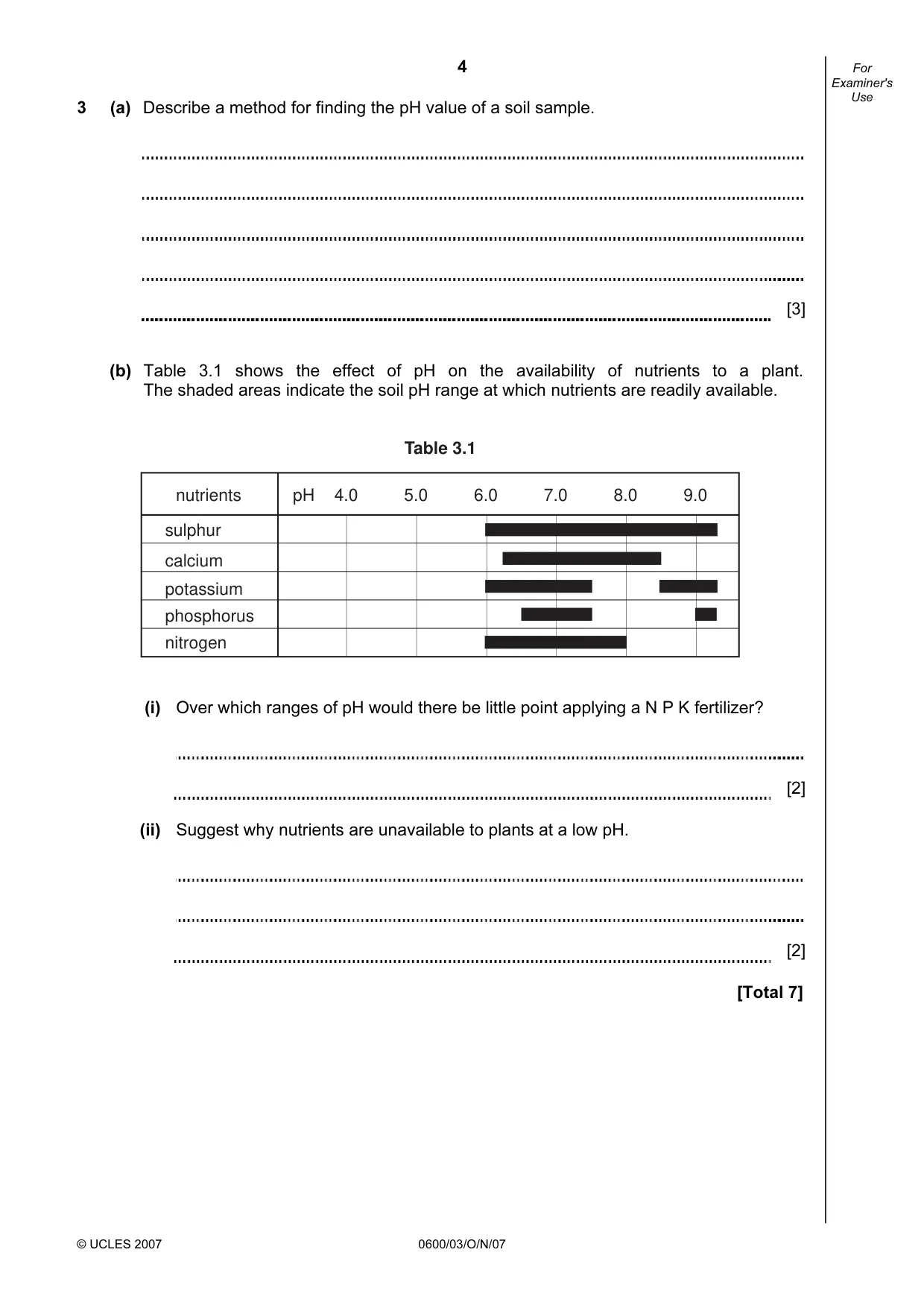
3 (a) Describe a method for finding the pH value of a soil sample. [3] (b) Table 3.1 shows the effect of pH on the availability of nutrients to a plant. The shaded areas indicate the soil pH range at which nutrients are readily available. Table 3.1 nutrients pH 4.0 5.0 6.0 7.0 8.0 9.0 sulphur calcium potassium phosphorus nitrogen (i) Over which ranges of pH would there be little point applying a N P K fertilizer? [2] (ii) Suggest why nutrients are unavailable to plants at a low pH. [2] [Total 7]
Mark scheme: 3 (a) use distilled water/add barium sulphate/add soil indicator (accept universal)/ reference to amount of soil etc./shake or leave (only credit here)/ compare to colour chart;/use distilled water/insert probe/read off pH meter/ reference to colour linked to pH; each correct step = 1 mark. Max 2 unless procedure would give an accurate result [3] (b) (i) 4–6; 1 mark 7.5–8.5 above 7.5 1 mark [Max 2] (ii) H+ affects solubility of nutrients/base ion exchange/no bacterial action; [2] [Total: 7] IGCSE – October/November 2007 0600 03
Q4 · For a named root crop state how to recognise it is ready for harvest
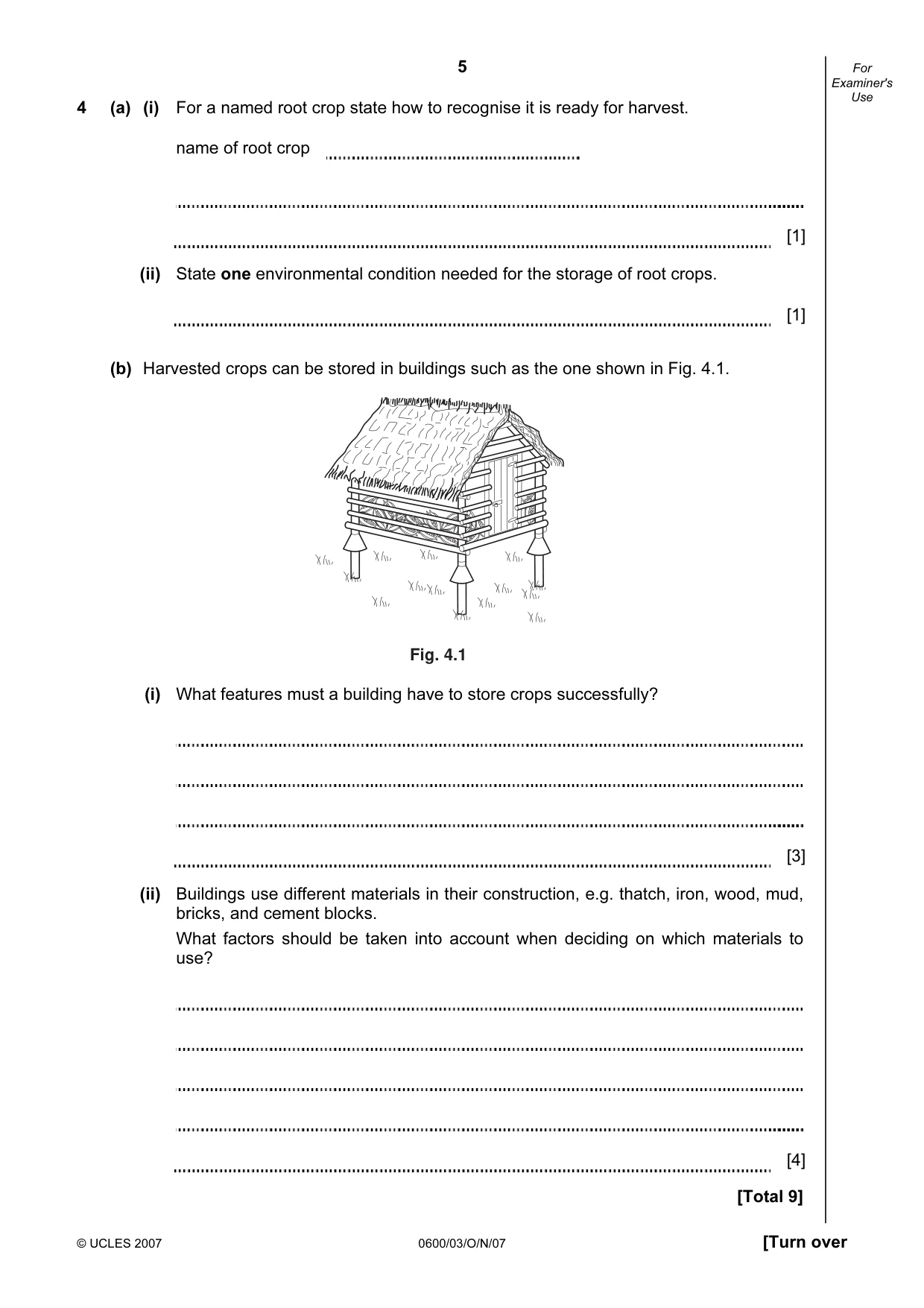
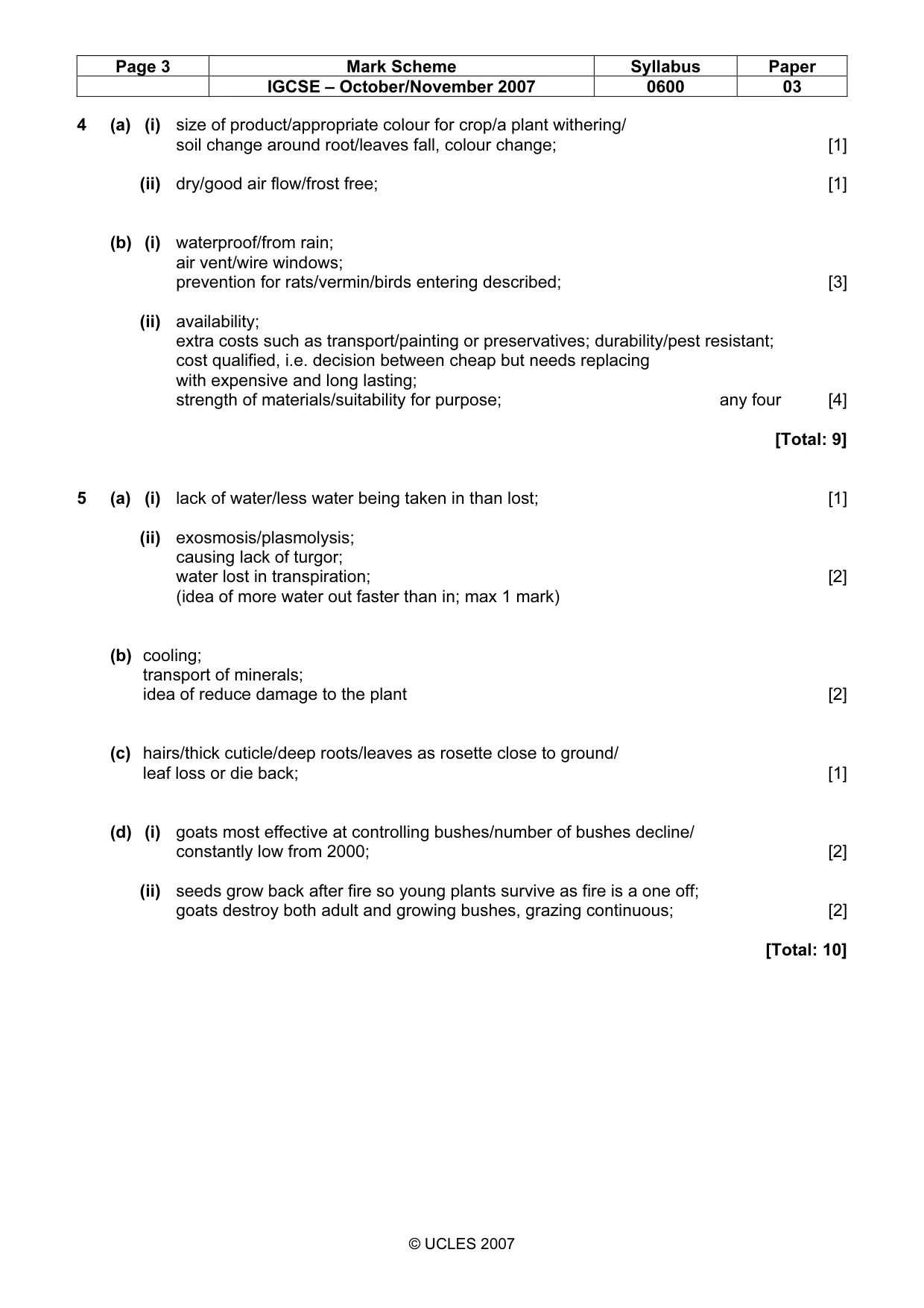
4 (a) (i) For a named root crop state how to recognise it is ready for harvest. name of root crop [1] (ii) State one environmental condition needed for the storage of root crops. [1] (b) Harvested crops can be stored in buildings such as the one shown in Fig. 4.1. Fig. 4.1 (i) What features must a building have to store crops successfully? [3] (ii) Buildings use different materials in their construction, e.g. thatch, iron, wood, mud, bricks, and cement blocks. What factors should be taken into account when deciding on which materials to use? [4] [Total 9]
Mark scheme: 4 (a) (i) size of product/appropriate colour for crop/a plant withering/ soil change around root/leaves fall, colour change; [1] (ii) dry/good air flow/frost free; [1] (b) (i) waterproof/from rain; air vent/wire windows; prevention for rats/vermin/birds entering described; [3] (ii) availability; extra costs such as transport/painting or preservatives; durability/pest resistant; cost qualified, i.e. decision between cheap but needs replacing with expensive and long lasting; strength of materials/suitability for purpose; any four [4] [Total: 9]
Q5 · What causes crop plants to wilt?
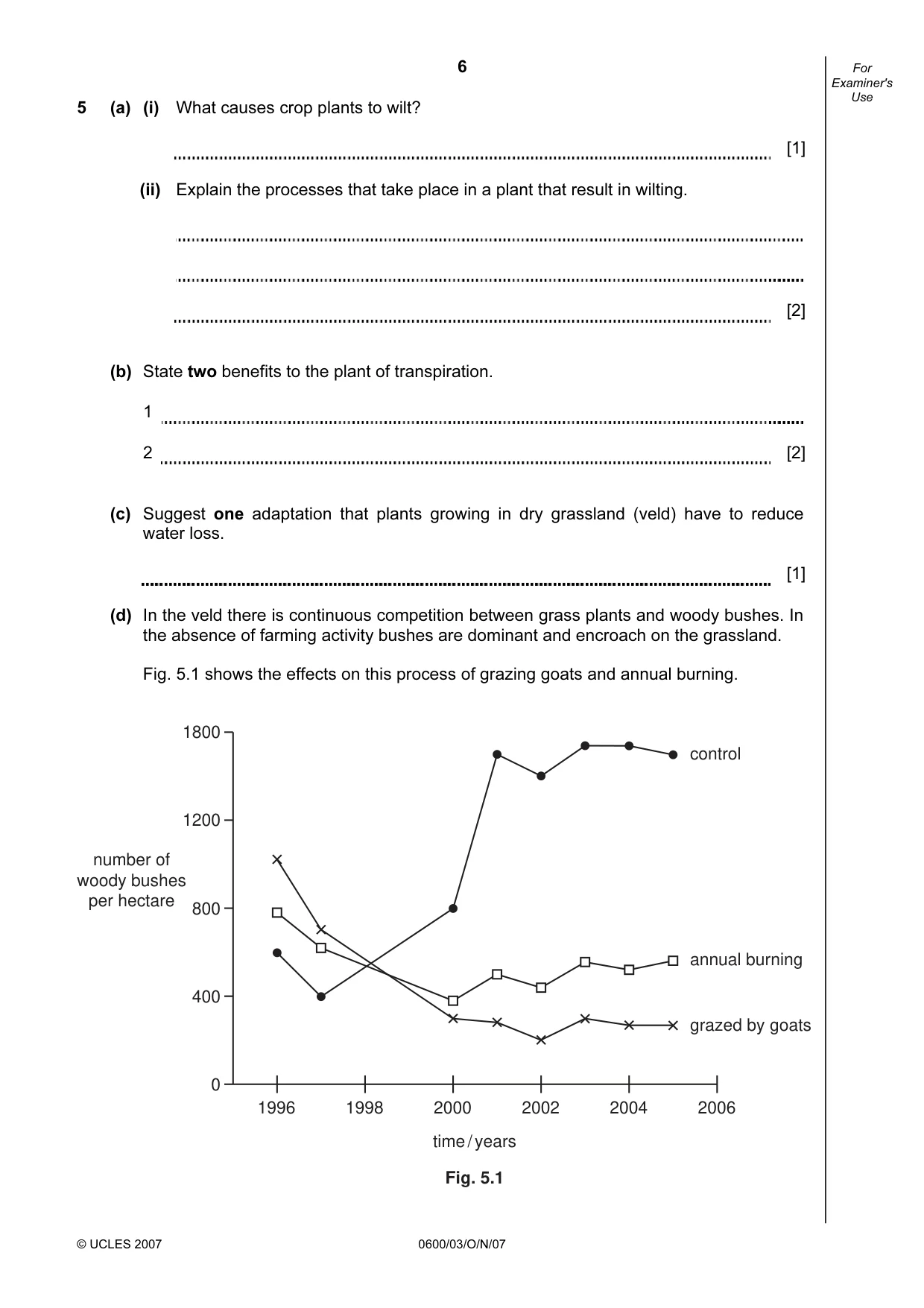
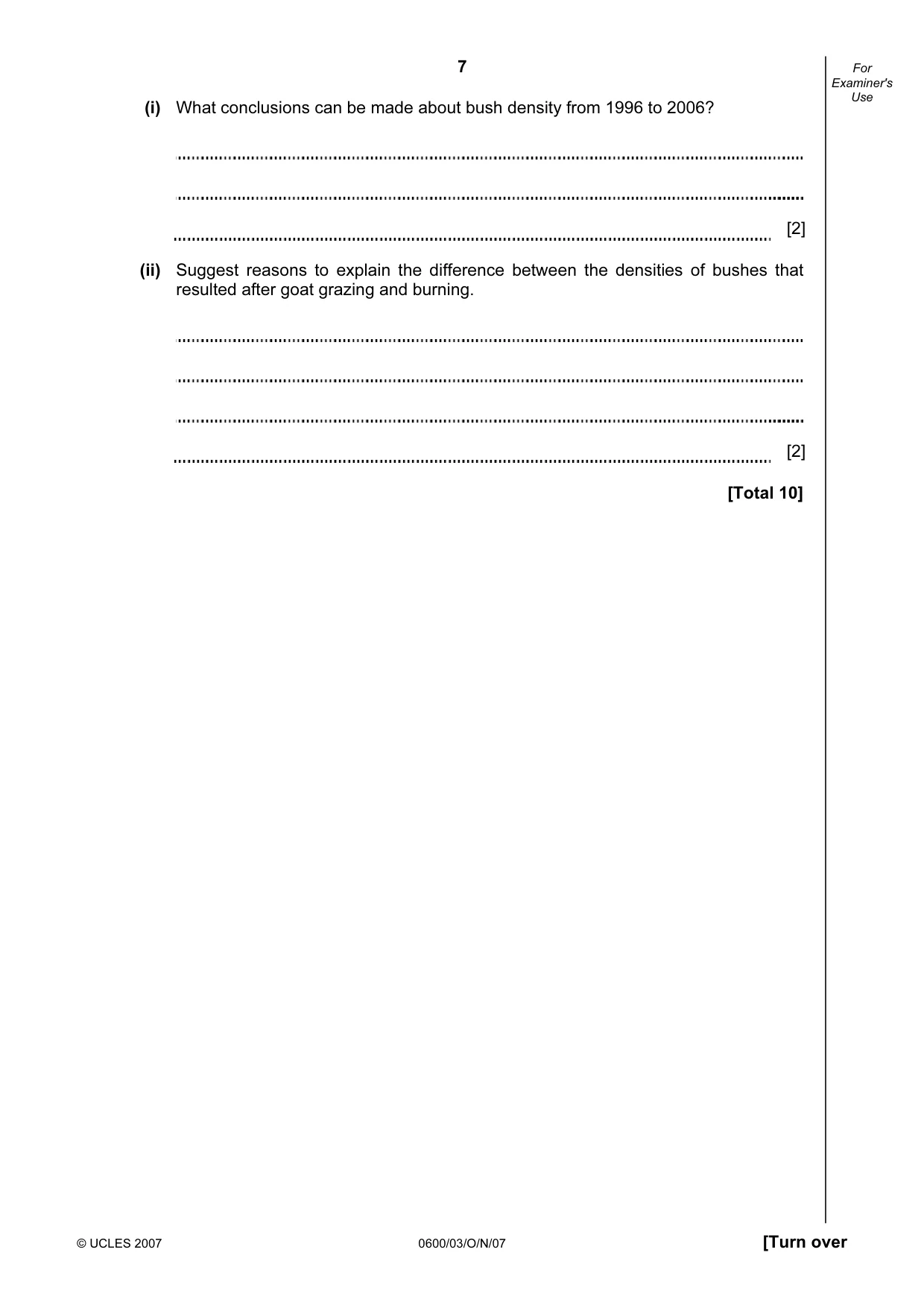
5 (a) (i) What causes crop plants to wilt? [1] (ii) Explain the processes that take place in a plant that result in wilting. [2] (b) State two benefits to the plant of transpiration. 1 2 [2] (c) Suggest one adaptation that plants growing in dry grassland (veld) have to reduce water loss. [1] (d) In the veld there is continuous competition between grass plants and woody bushes. In the absence of farming activity bushes are dominant and encroach on the grassland. Fig. 5.1 shows the effects on this process of grazing goats and annual burning. 1800 control 1200 number of woody bushes per hectare 800 annual burning 400 grazed by goats 0 1996 1998 2000 2002 2004 2006 time / years Fig. 5.1 (i) What conclusions can be made about bush density from 1996 to 2006? [2] (ii) Suggest reasons to explain the difference between the densities of bushes that resulted after goat grazing and burning. [2] [Total 10]
Mark scheme: 5 (a) (i) lack of water/less water being taken in than lost; [1] (ii) exosmosis/plasmolysis; causing lack of turgor; water lost in transpiration; [2] (idea of more water out faster than in; max 1 mark) (b) cooling; transport of minerals; idea of reduce damage to the plant [2] (c) hairs/thick cuticle/deep roots/leaves as rosette close to ground/ leaf loss or die back; [1] (d) (i) goats most effective at controlling bushes/number of bushes decline/ constantly low from 2000; [2] (ii) seeds grow back after fire so young plants survive as fire is a one off; goats destroy both adult and growing bushes, grazing continuous; [2] [Total: 10] IGCSE – October/November 2007 0600 03
Q6 · The digestive system of a donkey
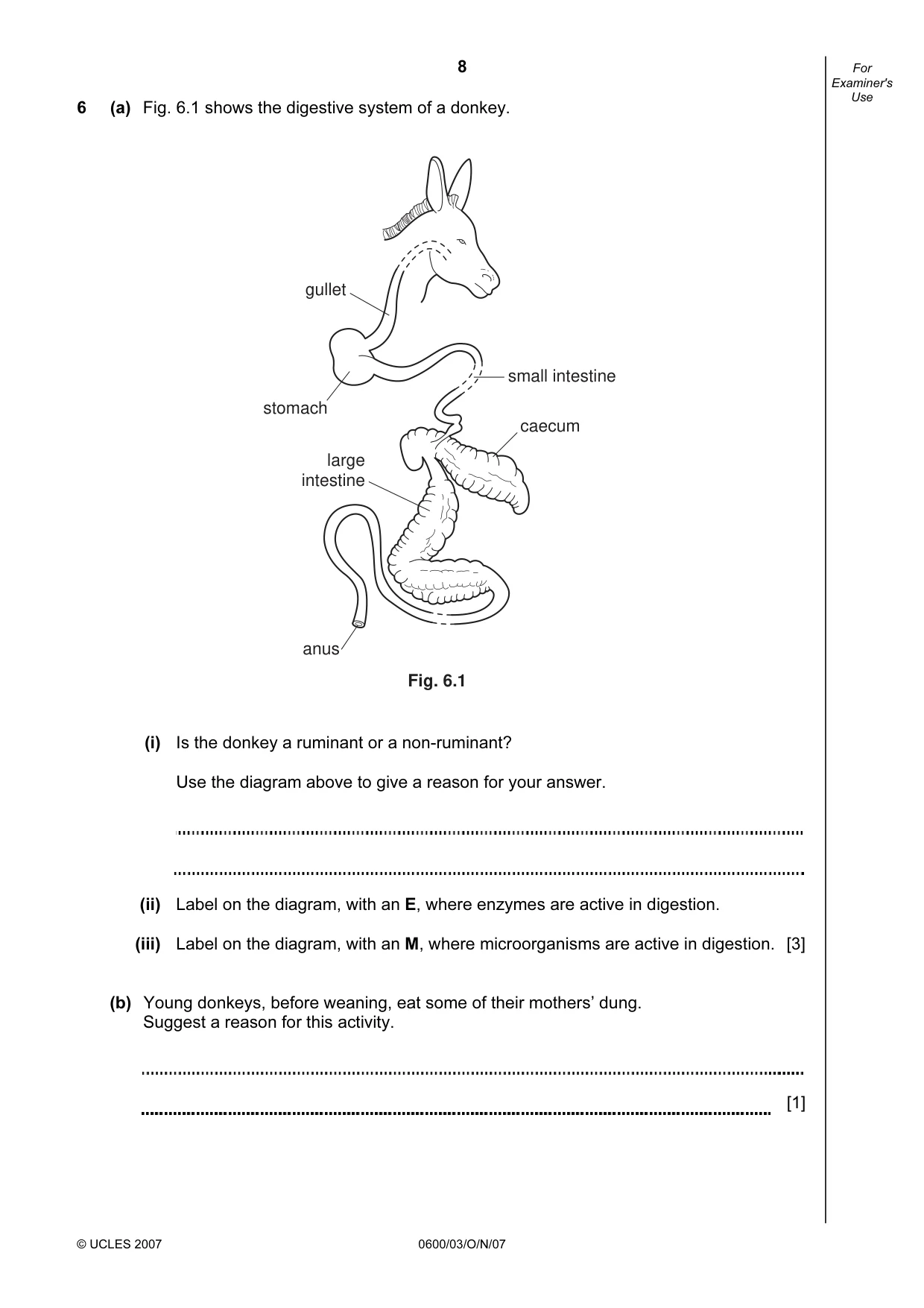
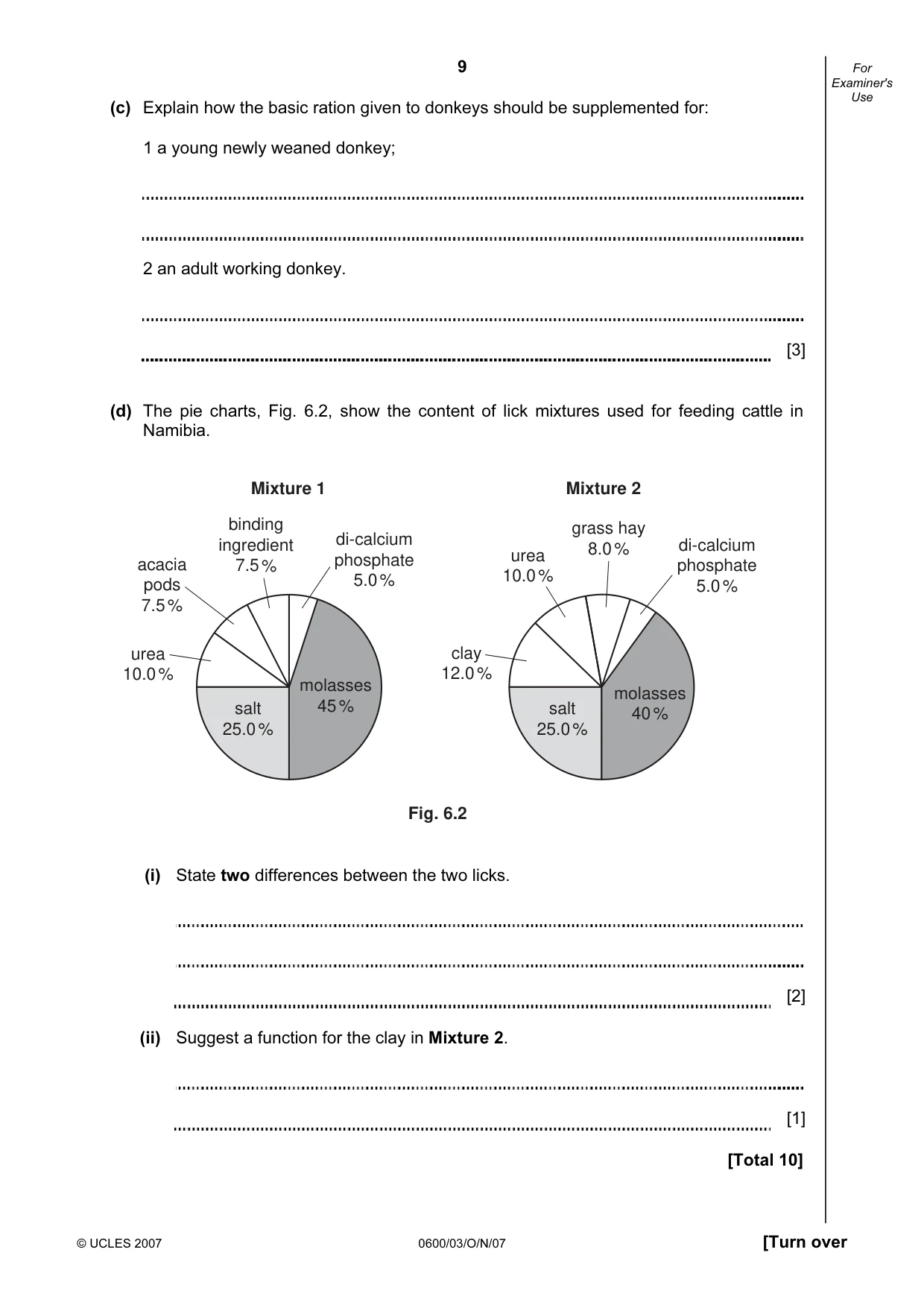
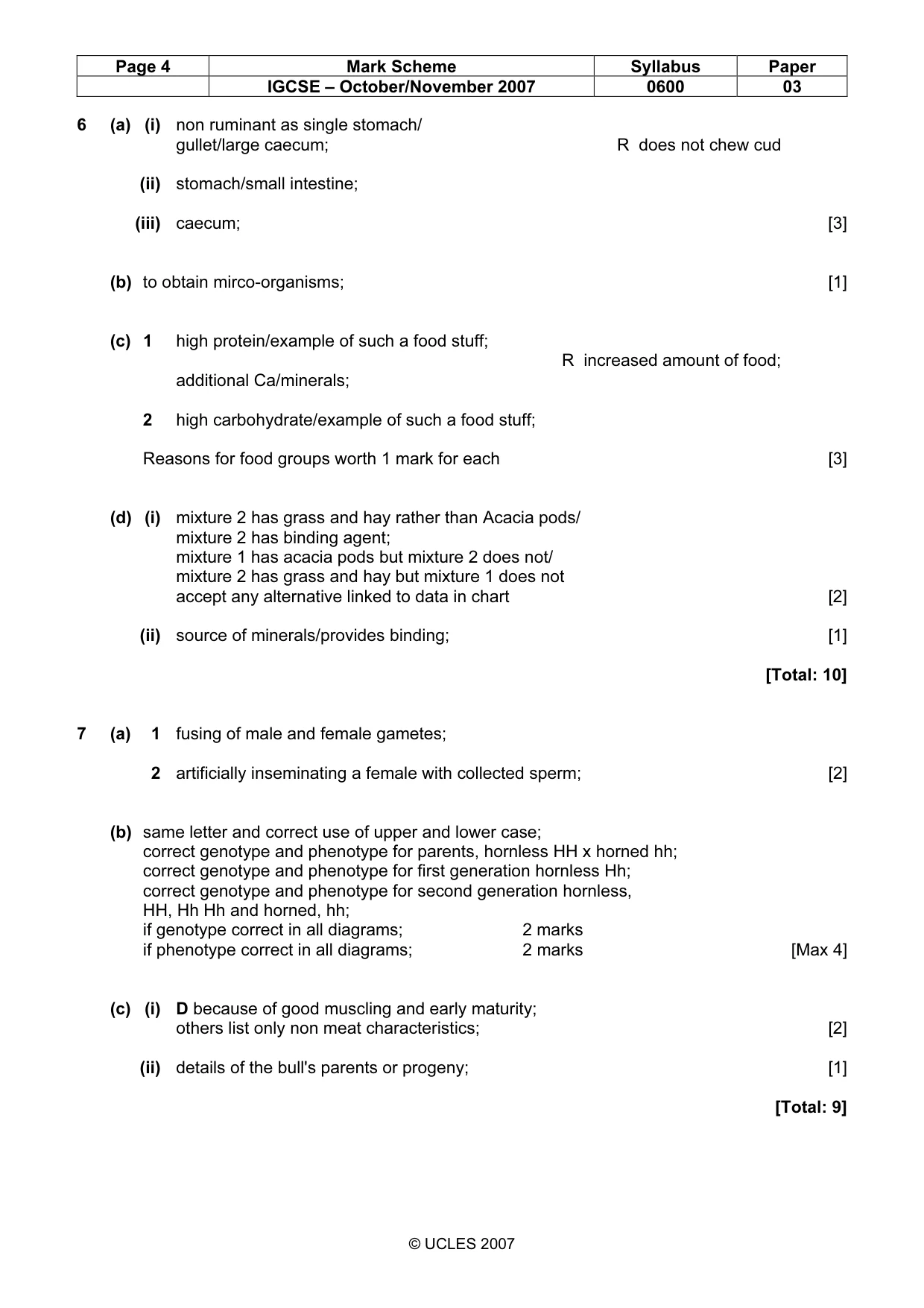
6 (a) Fig. 6.1 shows the digestive system of a donkey. gullet small intestine stomach caecum large intestine anus Fig. 6.1 (i) Is the donkey a ruminant or a non-ruminant? Use the diagram above to give a reason for your answer. (ii) Label on the diagram, with an E, where enzymes are active in digestion. (iii) Label on the diagram, with an M, where microorganisms are active in digestion. [3] (b) Young donkeys, before weaning, eat some of their mothers’ dung. Suggest a reason for this activity. [1] (c) Explain how the basic ration given to donkeys should be supplemented for: 1 a young newly weaned donkey; 2 an adult working donkey. [3] (d) The pie charts, Fig. 6.2, show the content of lick mixtures used for feeding cattle in Namibia. Mixture 1 Mixture 2 binding grass hay di-calcium ingredient 8.0 % di-calcium acacia 7.5 % phosphate urea phosphate pods 5.0 % 10.0 % 5.0 % 7.5 % urea clay 10.0 % 12.0 % molasses molasses salt 45 % salt 40 % 25.0 % 25.0 % Fig. 6.2 (i) State two differences between the two licks. [2] (ii) Suggest a function for the clay in Mixture 2. [1] [Total 10]
Mark scheme: 6 (a) (i) non ruminant as single stomach/ gullet/large caecum; R does not chew cud (ii) stomach/small intestine; (iii) caecum; [3] (b) to obtain mirco-organisms; [1] (c) 1 high protein/example of such a food stuff; R increased amount of food; additional Ca/minerals; 2 high carbohydrate/example of such a food stuff; Reasons for food groups worth 1 mark for each [3] (d) (i) mixture 2 has grass and hay rather than Acacia pods/ mixture 2 has binding agent; mixture 1 has acacia pods but mixture 2 does not/ mixture 2 has grass and hay but mixture 1 does not accept any alternative linked to data in chart [2] (ii) source of minerals/provides binding; [1] [Total: 10]
Q7 · What is meant by the following: 1 fertilisation 2 A I (artificial insemination) [2] (b)…
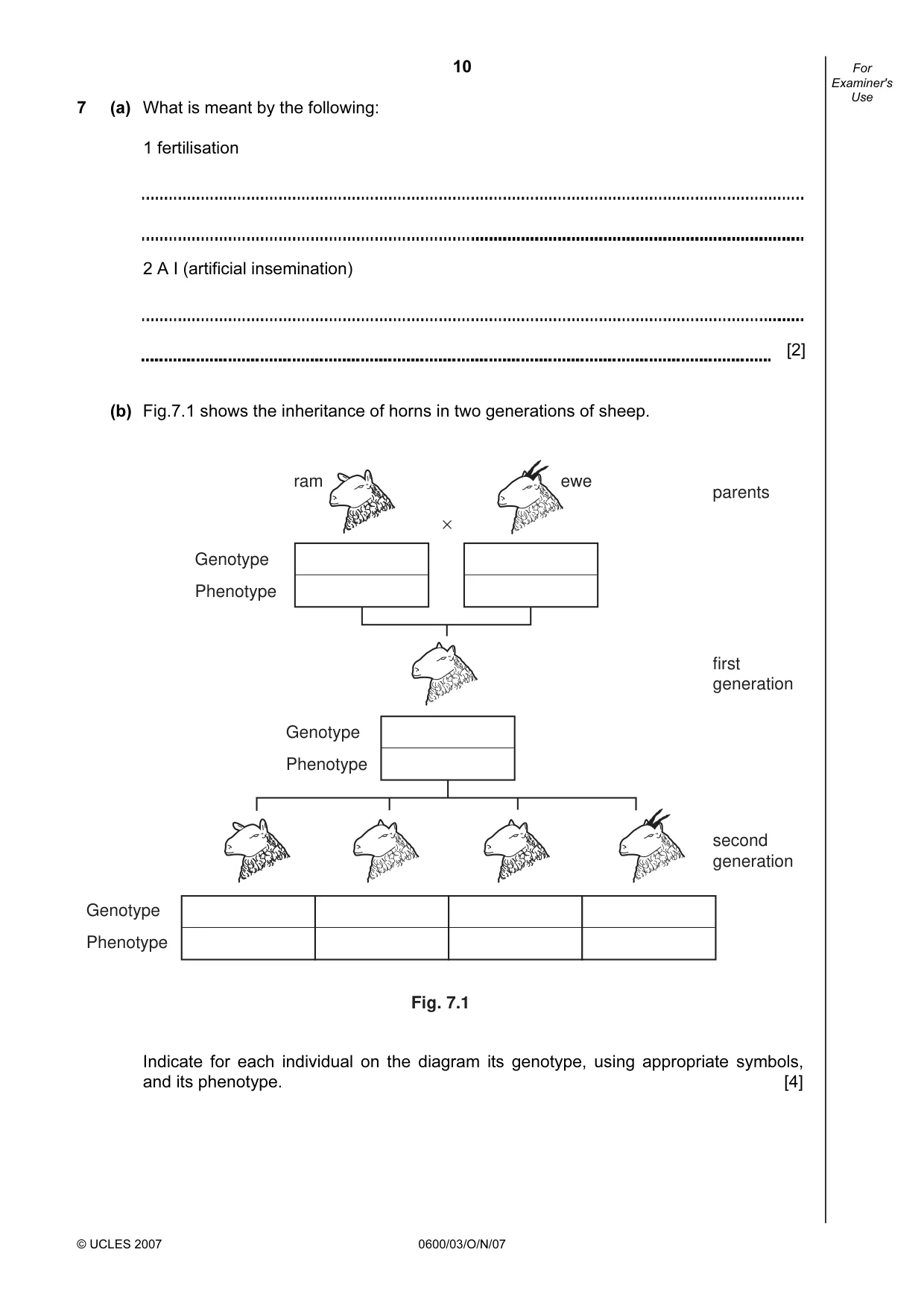
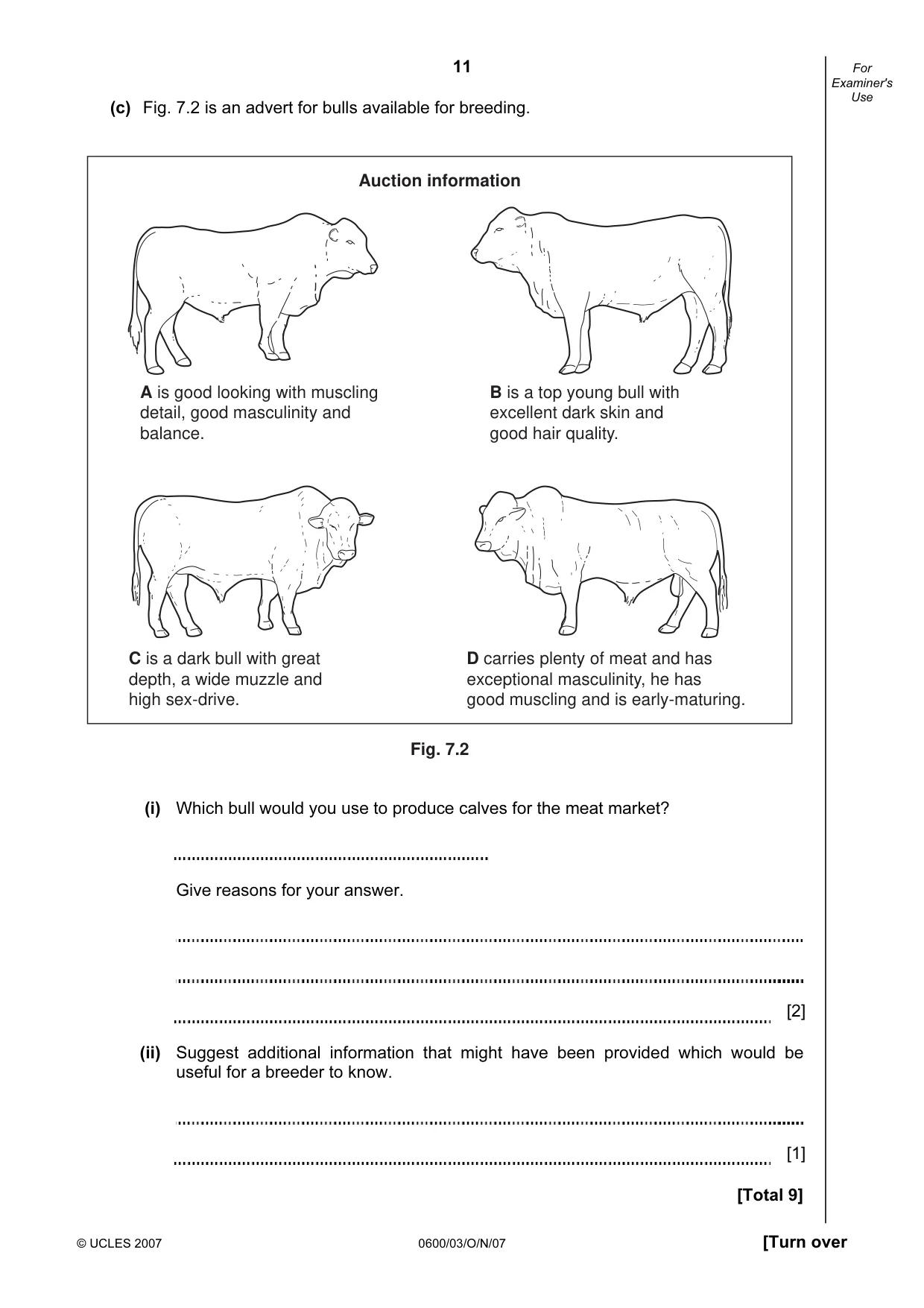
7 (a) What is meant by the following: 1 fertilisation 2 A I (artificial insemination) [2] (b) Fig.7.1 shows the inheritance of horns in two generations of sheep. ram ewe parents × Genotype Phenotype first generation Genotype Phenotype second generation Genotype Phenotype Fig. 7.1 Indicate for each individual on the diagram its genotype, using appropriate symbols, and its phenotype. [4] (c) Fig. 7.2 is an advert for bulls available for breeding. Auction information A is good looking with muscling B is a top young bull with detail, good masculinity and excellent dark skin and balance. good hair quality. C is a dark bull with great D carries plenty of meat and has depth, a wide muzzle and exceptional masculinity, he has high sex-drive. good muscling and is early-maturing. Fig. 7.2 (i) Which bull would you use to produce calves for the meat market? Give reasons for your answer. [2] (ii) Suggest additional information that might have been provided which would be useful for a breeder to know. [1] [Total 9]
Mark scheme: 7 (a) 1 fusing of male and female gametes; 2 artificially inseminating a female with collected sperm; [2] (b) same letter and correct use of upper and lower case; correct genotype and phenotype for parents, hornless HH x horned hh; correct genotype and phenotype for first generation hornless Hh; correct genotype and phenotype for second generation hornless, HH, Hh Hh and horned, hh; if genotype correct in all diagrams; 2 marks if phenotype correct in all diagrams; 2 marks [Max 4] (c) (i) D because of good muscling and early maturity; others list only non meat characteristics; [2] (ii) details of the bull's parents or progeny; [1] [Total: 9] IGCSE – October/November 2007 0600 03
Q8 · A sweet potato plant growing on the ground
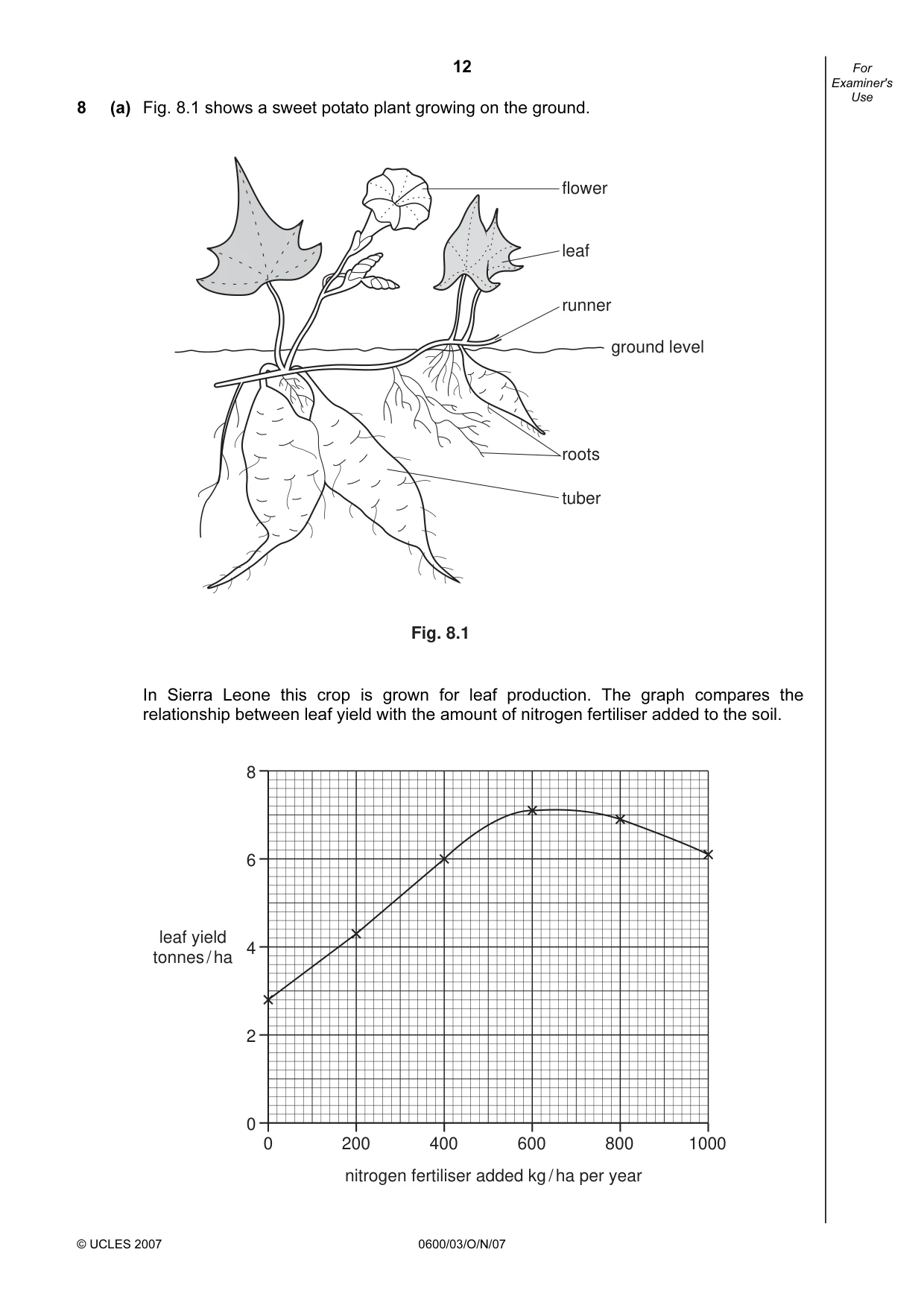
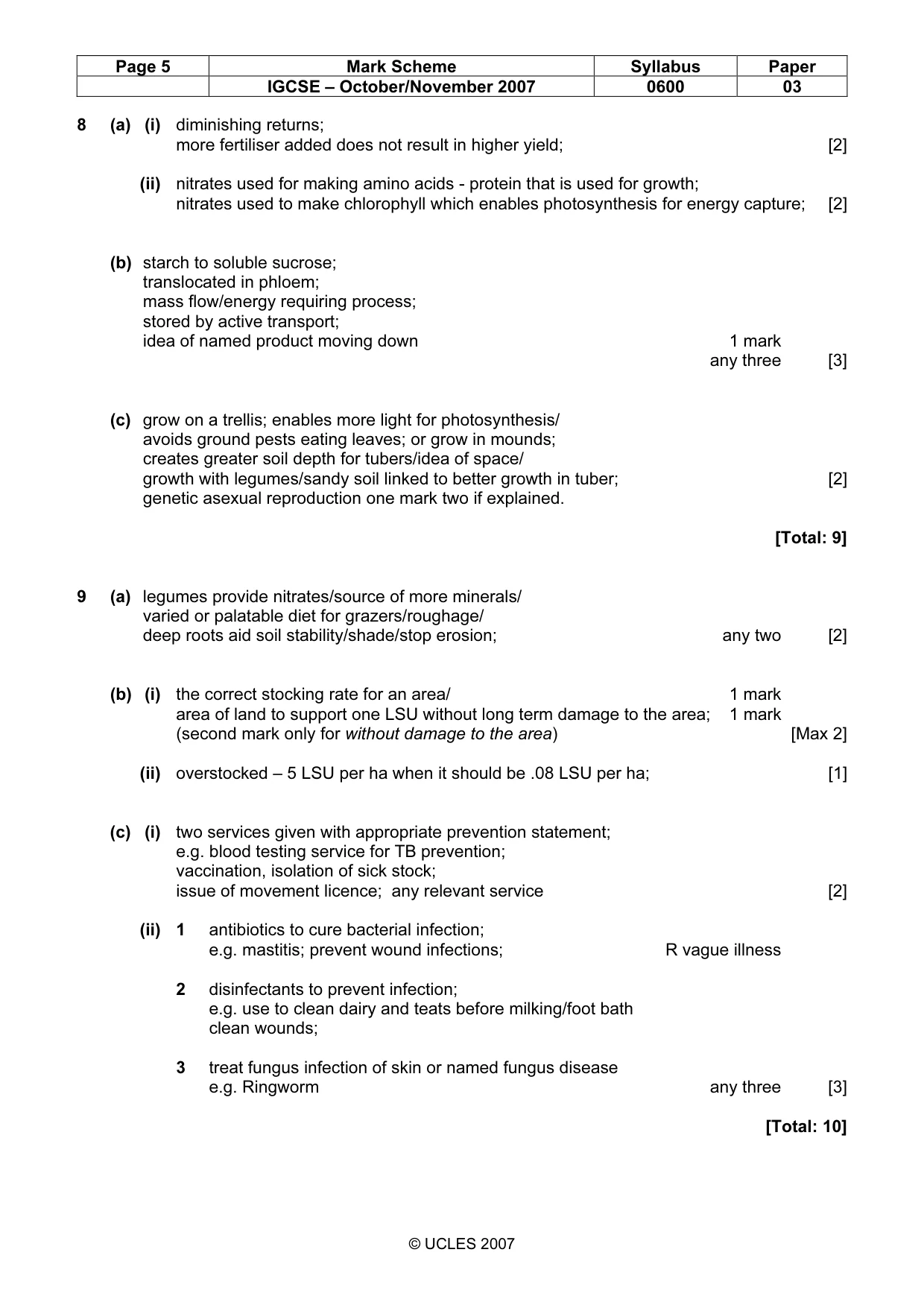
8 (a) Fig. 8.1 shows a sweet potato plant growing on the ground. flower leaf runner ground level roots tuber Fig. 8.1 In Sierra Leone this crop is grown for leaf production. The graph compares the relationship between leaf yield with the amount of nitrogen fertiliser added to the soil. 8 6 leaf yield 4 tonnes / ha 2 0 0 200 400 600 800 1000 nitrogen fertiliser added kg / ha per year (i) What principle does the graph illustrate? Explain your answer. [2] (ii) Explain fully how the use of a nitrogen fertiliser produces better growth of leaves. [2] (b) Describe how the products of photosynthesis produced in the leaves are stored in the tubers. [3] (c) Suggest a method of growing the sweet potato that could result in better leaf development and tuber growth. Explain why the system would achieve improvement. [2] [Total 9]
Mark scheme: 8 (a) (i) diminishing returns; more fertiliser added does not result in higher yield; [2] (ii) nitrates used for making amino acids - protein that is used for growth; nitrates used to make chlorophyll which enables photosynthesis for energy capture; [2] (b) starch to soluble sucrose; translocated in phloem; mass flow/energy requiring process; stored by active transport; idea of named product moving down 1 mark any three [3] (c) grow on a trellis; enables more light for photosynthesis/ avoids ground pests eating leaves; or grow in mounds; creates greater soil depth for tubers/idea of space/ growth with legumes/sandy soil linked to better growth in tuber; [2] genetic asexual reproduction one mark two if explained. [Total: 9]
Q9 · State two benefits that non-grass species could provide in pasture
9 (a) State two benefits that non-grass species could provide in pasture. 1 2 [2] (b) The stocking rate is the amount of land available for one livestock unit (LSU). One livestock unit = a cow or 6 sheep or goats. (i) State what is meant by carrying capacity. [2] (ii) In south east Botswana the stocking rate is 0.2 ha / LSU and the carrying capacity is 12 ha / LSU. Is this area of Botswana overstocked or understocked? Give a reason for your answer. [1] (c) Overstocking can result in the spread of animal disease. (i) Describe the services provided by the veterinary organisation in your area that can be used to prevent disease. [2] (ii) Explain in what circumstances you would use: 1 antibiotics 2 disinfectants 3 fungicides [3] [Total10]
Mark scheme: 9 (a) legumes provide nitrates/source of more minerals/ varied or palatable diet for grazers/roughage/ deep roots aid soil stability/shade/stop erosion; any two [2] (b) (i) the correct stocking rate for an area/ 1 mark area of land to support one LSU without long term damage to the area; 1 mark (second mark only for without damage to the area) [Max 2] (ii) overstocked – 5 LSU per ha when it should be .08 LSU per ha; [1] (c) (i) two services given with appropriate prevention statement; e.g. blood testing service for TB prevention; vaccination, isolation of sick stock; issue of movement licence; any relevant service [2] (ii) 1 antibiotics to cure bacterial infection; e.g. mastitis; prevent wound infections; R vague illness 2 disinfectants to prevent infection; e.g. use to clean dairy and teats before milking/foot bath clean wounds; 3 treat fungus infection of skin or named fungus disease e.g. Ringworm any three [3] [Total: 10]
What you needed in this session
Cambridge’s own grade thresholds for 2007 Oct/Nov, Paper 3 · Variant 1. A higher threshold means an easier paper — the bar moves with how the cohort did.