Cambridge IGCSE Accounting (9-1) 0985 — 2024 Oct/Nov Paper 2 · Variant 2
0985/22/O/N/24 · 5 questions · 100 marks · ≈113 min
The question paper and its mark scheme, free to read here and free to download. This is Cambridge’s own paper, exactly as it was sat.
Question paper24 pages



Mark scheme17 pages
Answers below. Sit the paper first if you are practising.
Questions as text
Q1 · Kalima is a trader
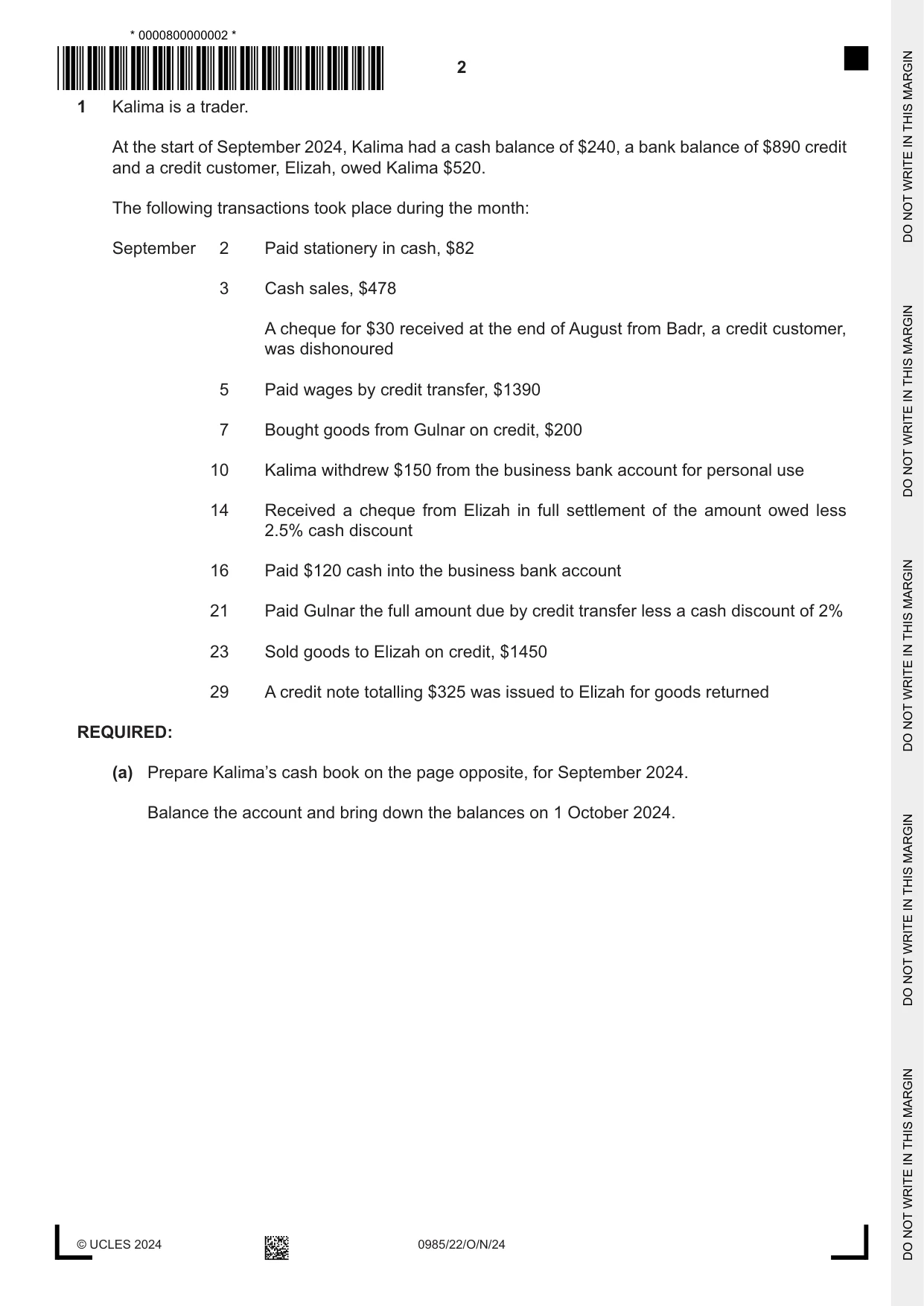
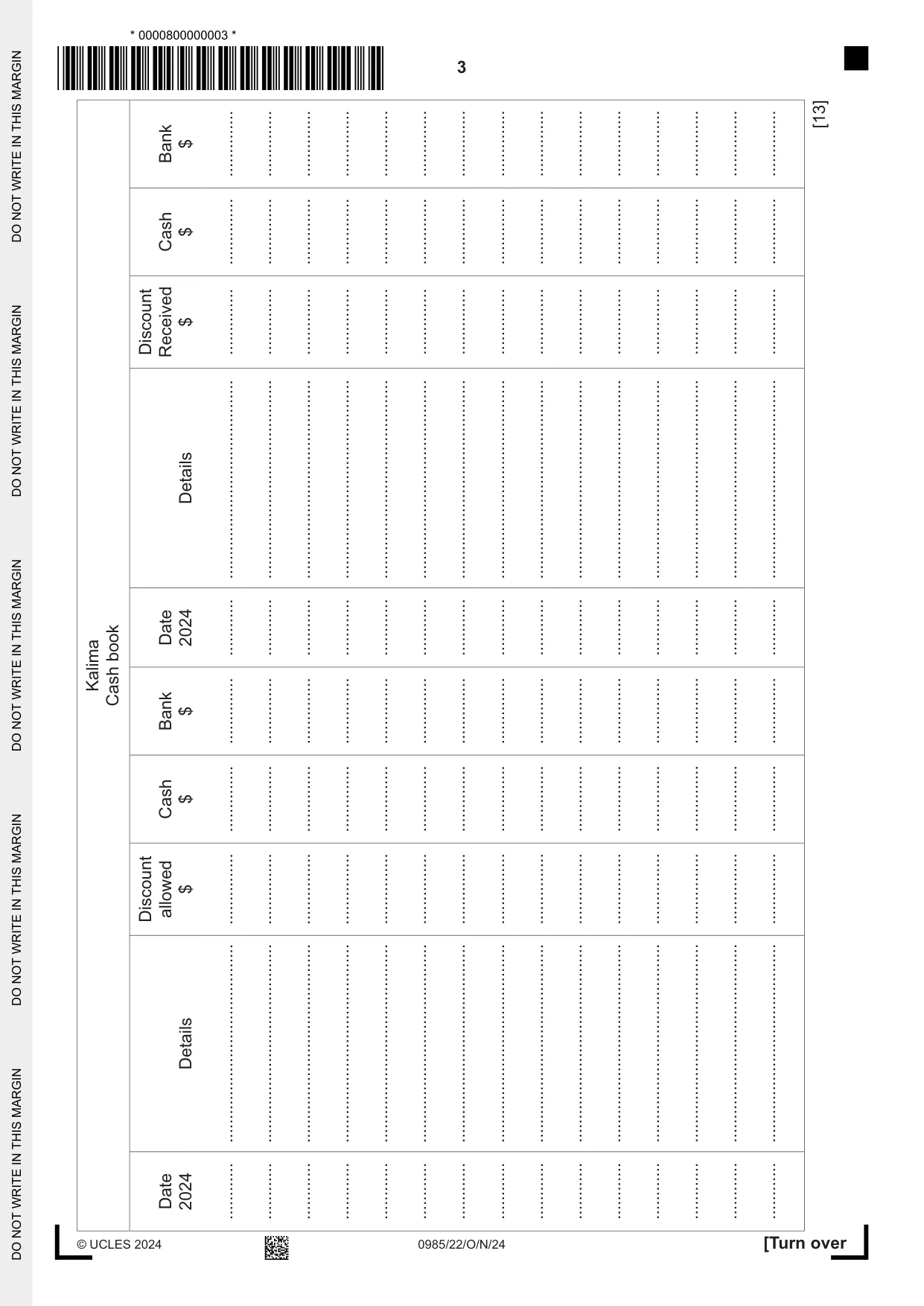
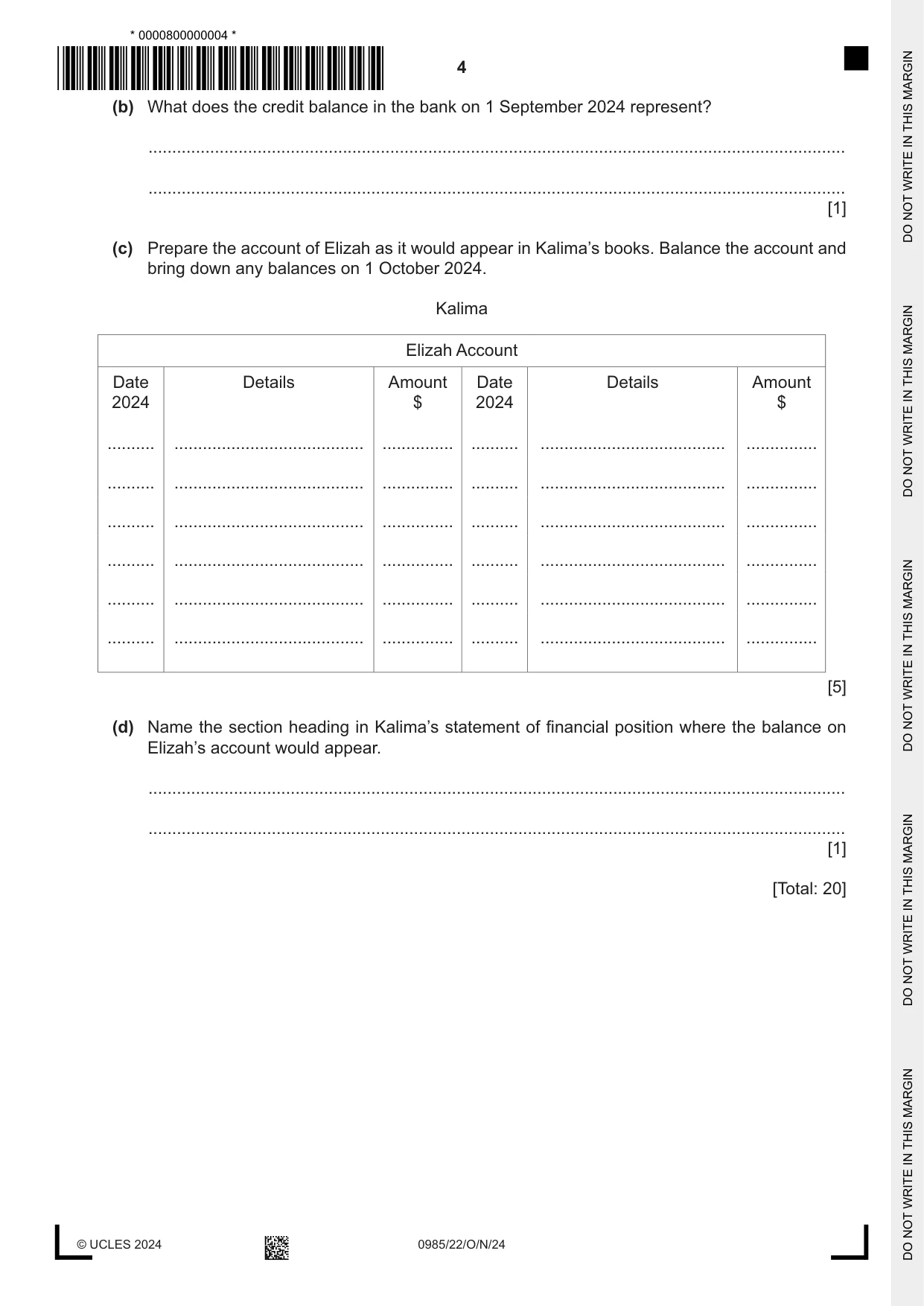
1 Kalima is a trader. At the start of September 2024, Kalima had a cash balance of $240, a bank balance of $890 credit and a credit customer, Elizah, owed Kalima $520. The following transactions took place during the month: September 2 Paid stationery in cash, $82 3 Cash sales, $478 A cheque for $30 received at the end of August from Badr, a credit customer, was dishonoured 5 Paid wages by credit transfer, $1390 7 Bought goods from Gulnar on credit, $200 10 Kalima withdrew $150 from the business bank account for personal use 14 Received a cheque from Elizah in full settlement of the amount owed less 2.5% cash discount 16 Paid $120 cash into the business bank account 21 Paid Gulnar the full amount due by credit transfer less a cash discount of 2% 23 Sold goods to Elizah on credit, $1450 29 A credit note totalling $325 was issued to Elizah for goods returned REQUIRED: (a) Prepare Kalima’s cash book on the page opposite, for September 2024. Balance the account and bring down the balances on 1 October 2024. .............. .............. .............. .......................................... ............ .............. .............. ............... .......................................... (b) What does the credit balance in the bank on 1 September 2024 represent? ................................................................................................................................................... ................................................................................................................................................... [1] (c) Prepare the account of Elizah as it would appear in Kalima’s books. Balance the account and bring down any balances on 1 October 2024. Kalima Elizah Account Date Details Amount Date Details Amount 2024 $ 2024 $ .......... ........................................ ............... .......... ....................................... ............... .......... ........................................ ............... .......... ....................................... ............... .......... ........................................ ............... .......... ....................................... ............... .......... ........................................ ............... .......... ....................................... ............... .......... ........................................ ............... .......... ....................................... ............... .......... ........................................ ............... .......... ....................................... ............... [5] (d) Name the section heading in Kalima’s statement of financial position where the balance on Elizah’s account would appear. ................................................................................................................................................... ................................................................................................................................................... [1] [Total: 20]
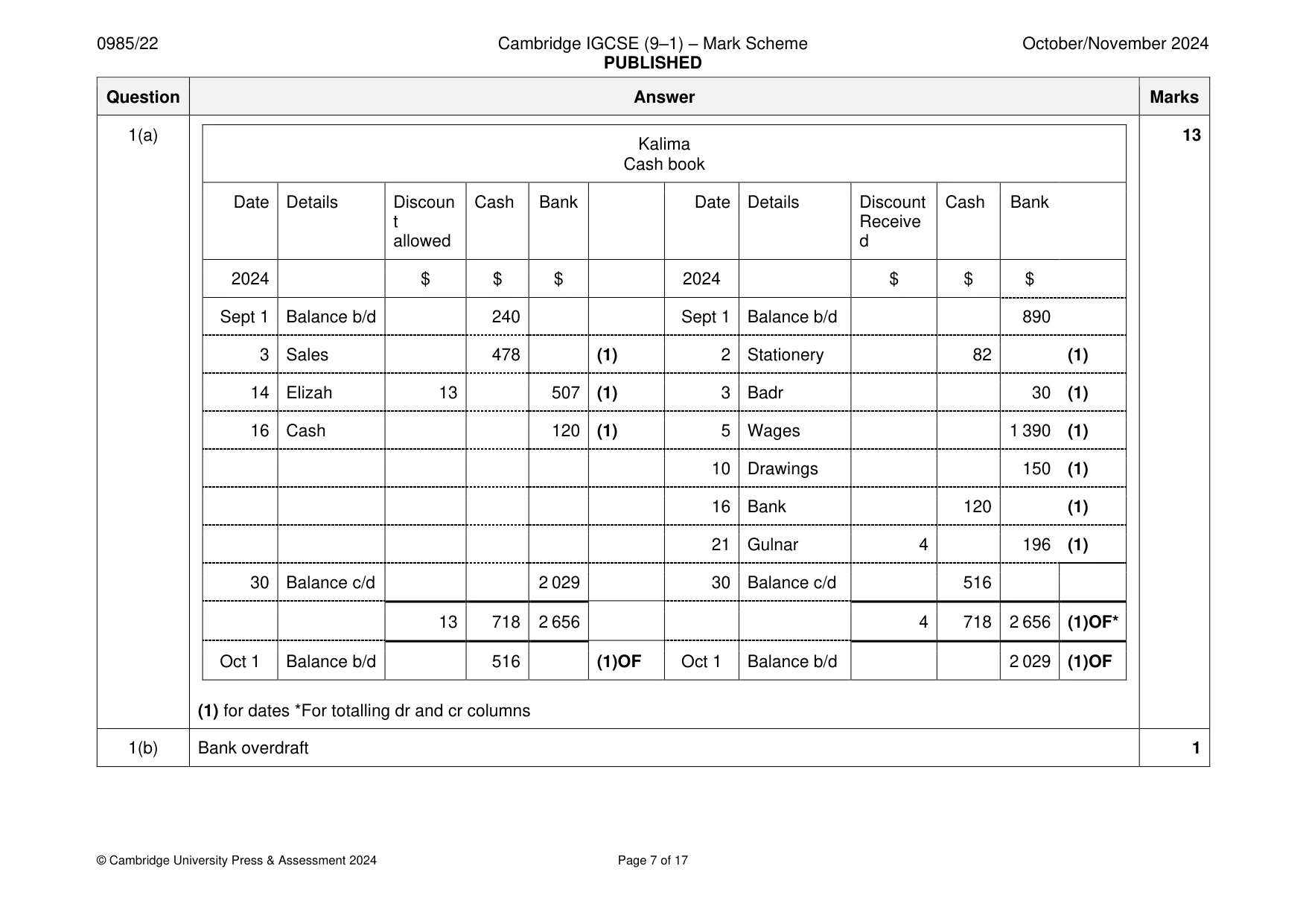
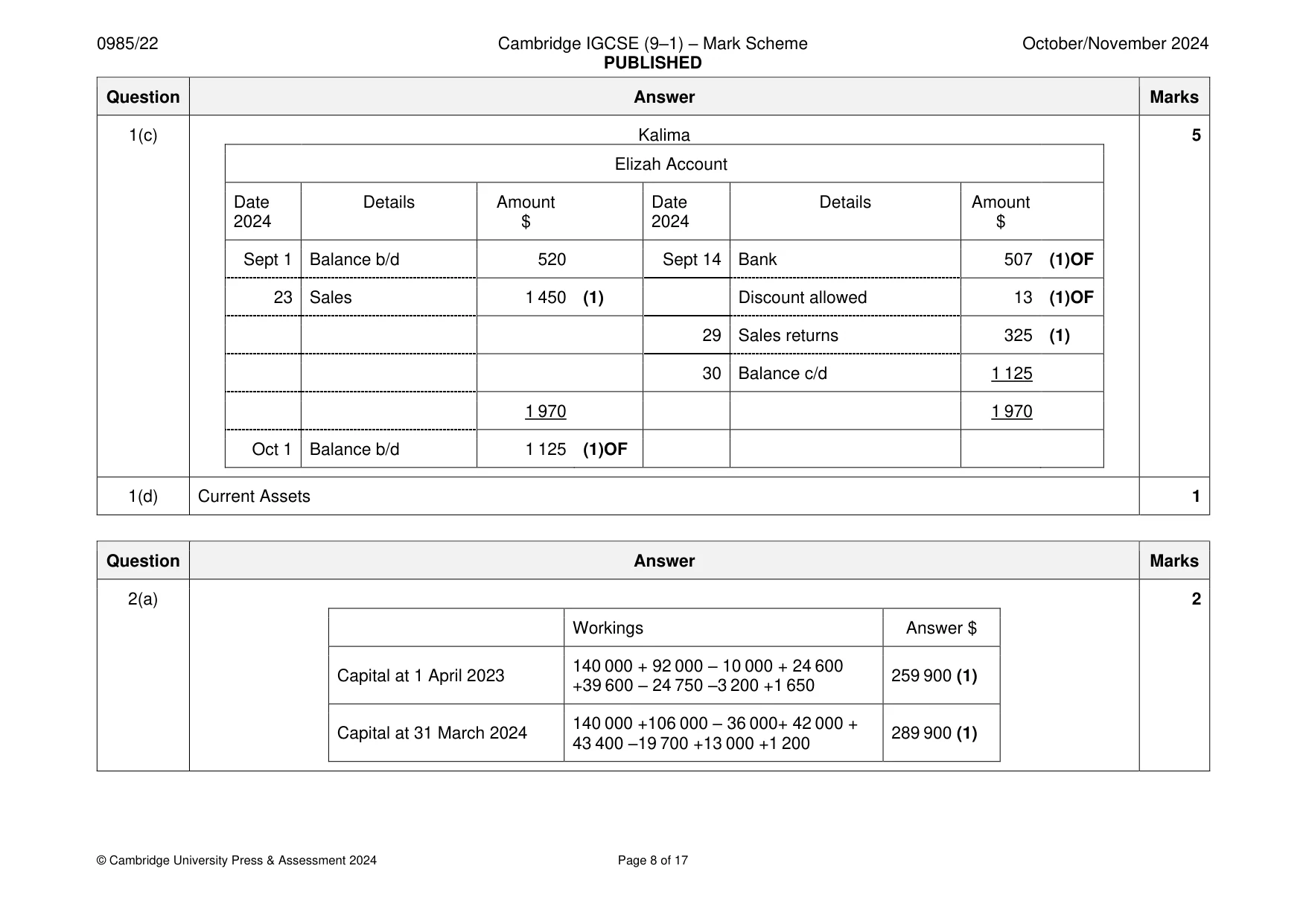
Mark scheme: Question Answer Marks 1(a) 13 Kalima Cash book Date Details Discoun Cash Bank Date Details Discount Cash Bank t Receive allowed d 2024 $ $ $ 2024 $ $ $ Sept 1 Balance b/d 240 Sept 1 Balance b/d 890 3 Sales 478 (1) 2 Stationery 82 (1) 14 Elizah 13 507 (1) 3 Badr 30 (1) 16 Cash 120 (1) 5 Wages 1 390 (1) 10 Drawings 150 (1) 16 Bank 120 (1) 21 Gulnar 4 196 (1) 30 Balance c/d 2 029 30 Balance c/d 516 13 718 2 656 4 718 2 656 (1)OF* Oct 1 Balance b/d 516 (1)OF Oct 1 Balance b/d 2 029 (1)OF (1) for dates *For totalling dr and cr columns 1(b) Bank overdraft 1 1(c) Kalima 5 Elizah Account Date Details Amount Date Details Amount 2024 $ 2024 $ Sept 1 Balance b/d 520 Sept 14 Bank 507 (1)OF 23 Sales 1 450 (1) Discount allowed 13 (1)OF 29 Sales returns 325 (1) 30 Balance c/d 1 125 1 970 1 970 Oct 1 Balance b/d 1 125 (1)OF 1(d) Current Assets 1
Q2 · Ben runs a small business but does not maintain a full set of accounting records
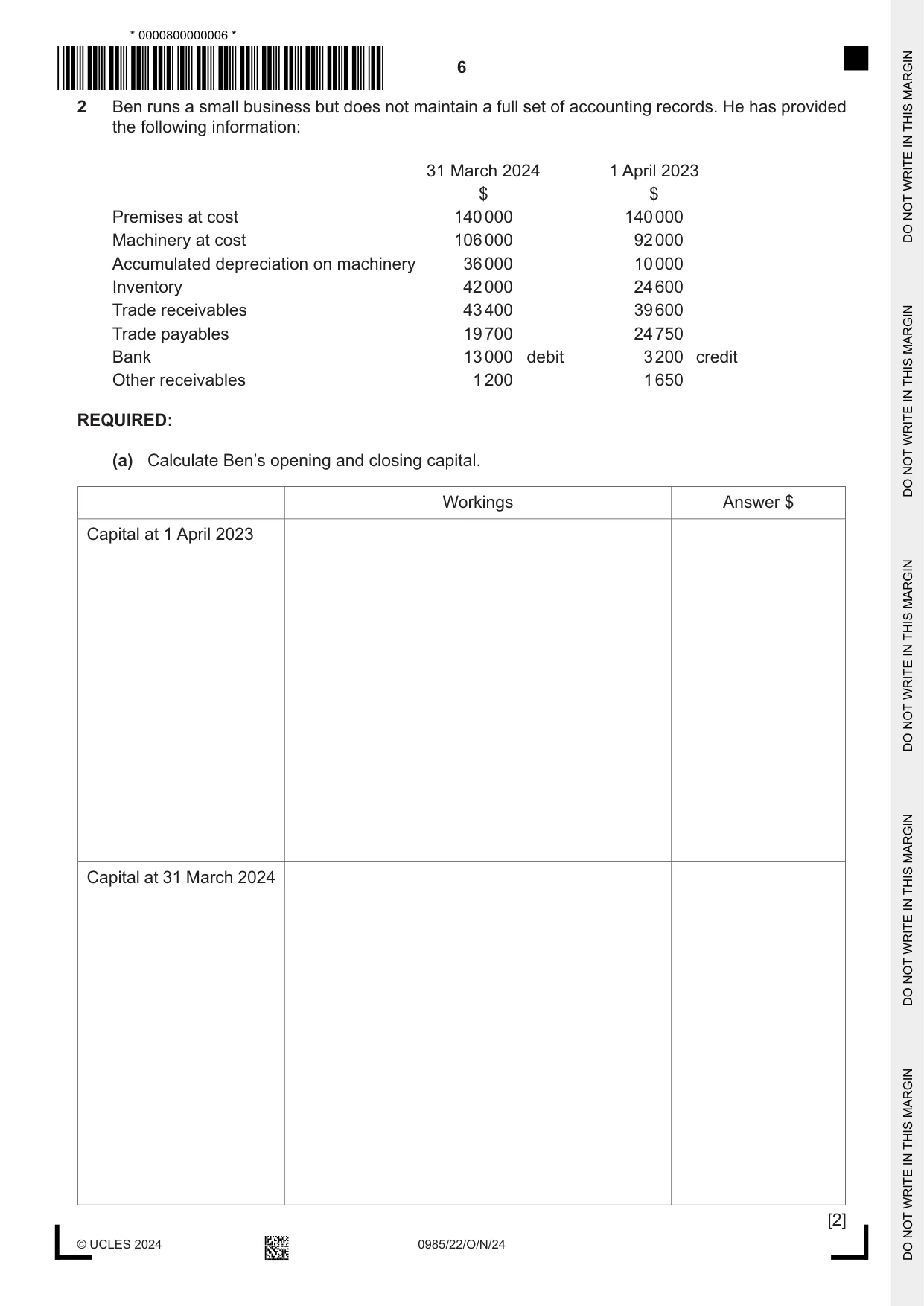
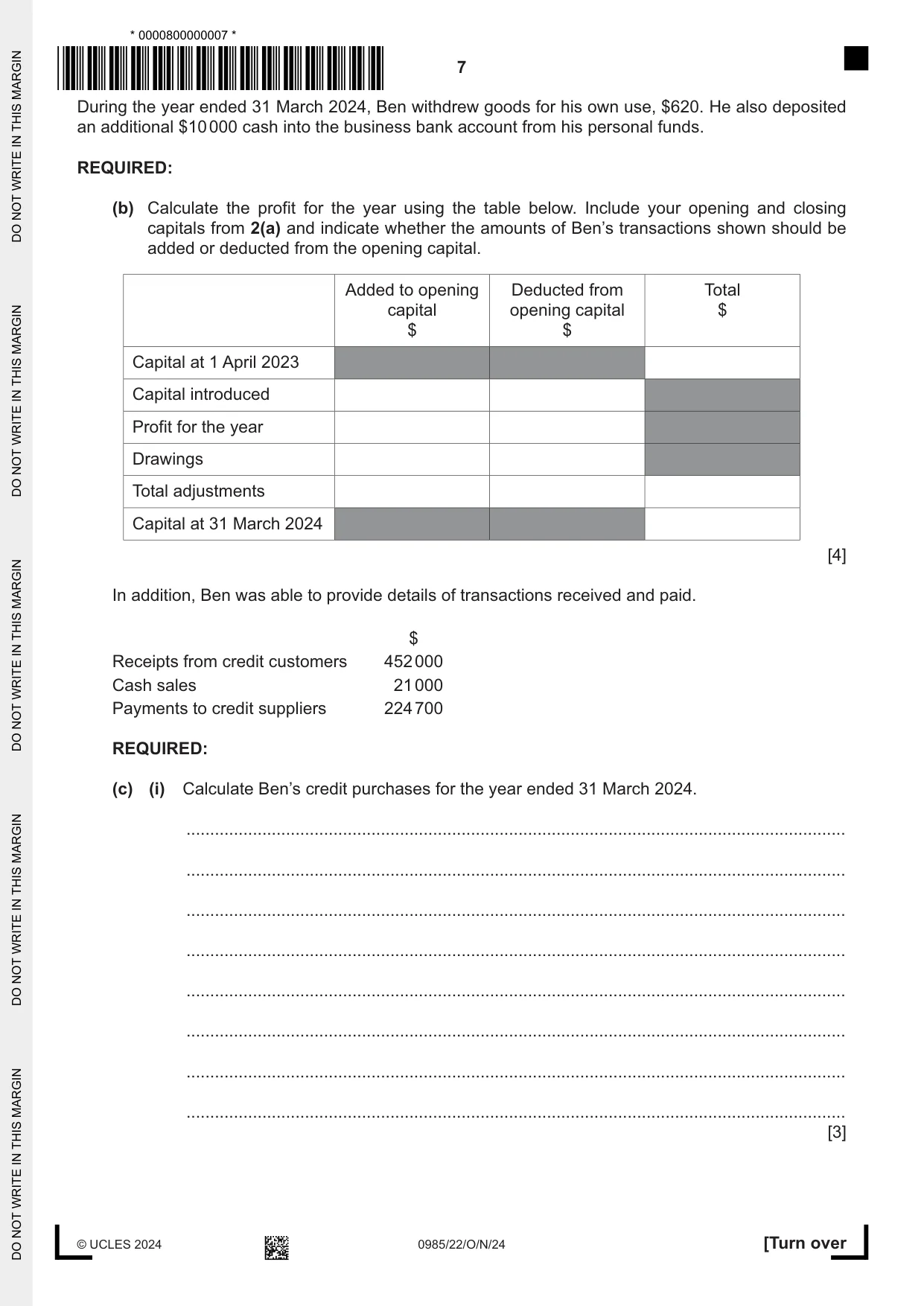
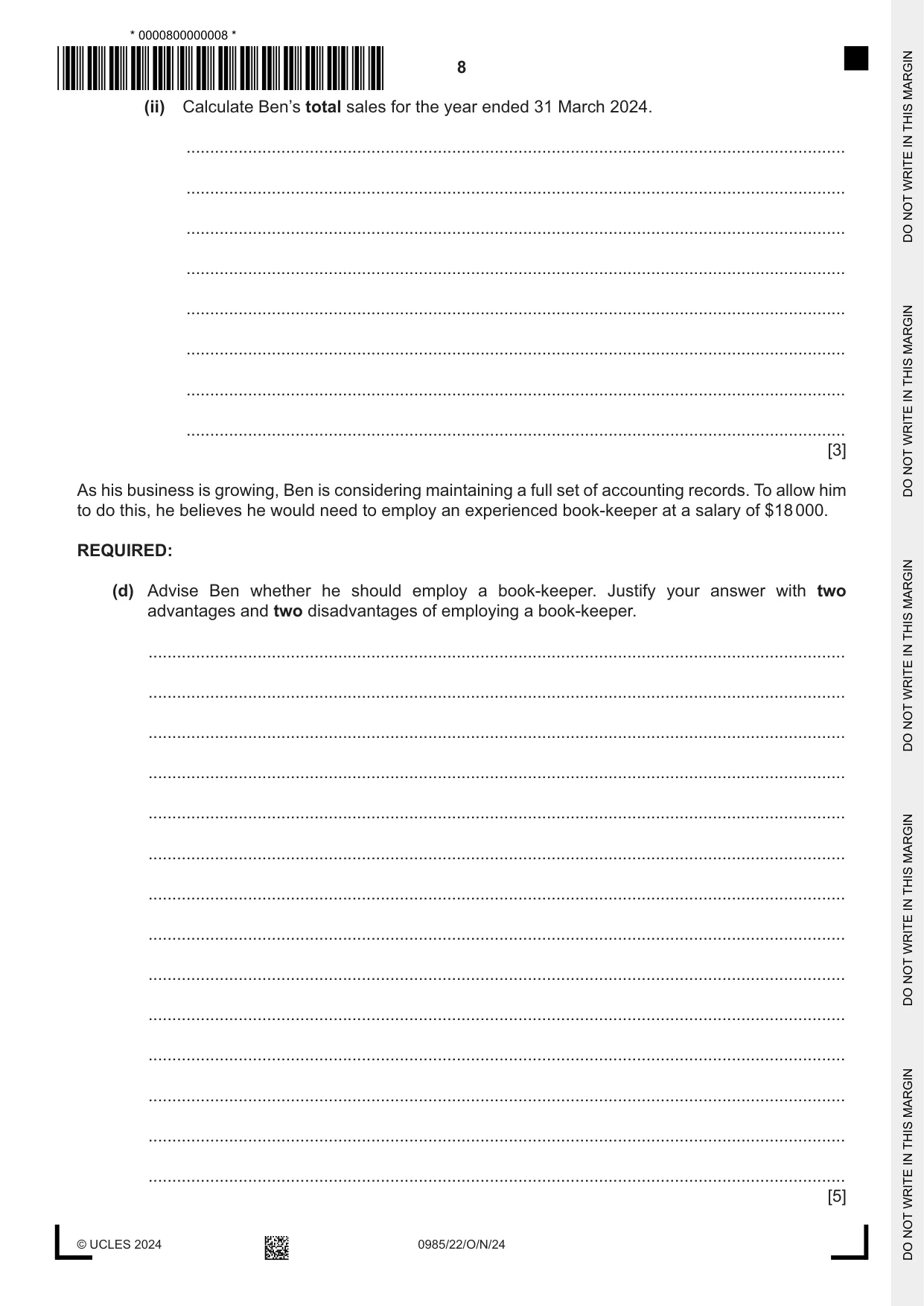
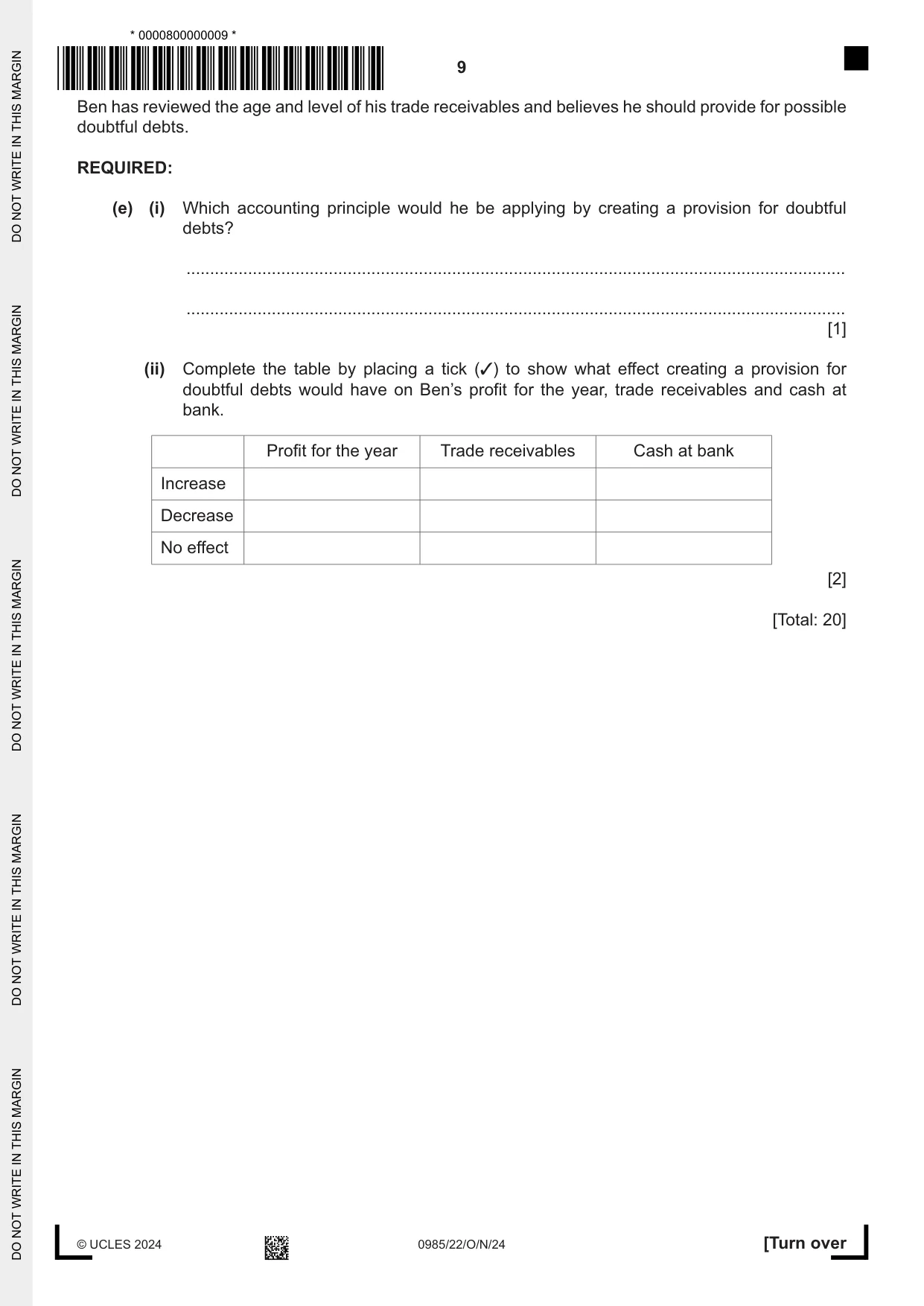
2 Ben runs a small business but does not maintain a full set of accounting records. He has provided the following information: 31 March 2024 1 April 2023 $ $ Premises at cost 140 000 140 000 Machinery at cost 106 000 92 000 Accumulated depreciation on machinery 36 000 10 000 Inventory 42 000 24 600 Trade receivables 43 400 39 600 Trade payables 19 700 24 750 Bank 13 000 debit 3 200 credit Other receivables 1 200 1 650 REQUIRED: (a) Calculate Ben’s opening and closing capital. Workings Answer $ Capital at 1 April 2023 Capital at 31 March 2024 [2] During the year ended 31 March 2024, Ben withdrew goods for his own use, $620. He also deposited an additional $10 000 cash into the business bank account from his personal funds. REQUIRED: (b) Calculate the profit for the year using the table below. Include your opening and closing capitals from 2(a) and indicate whether the amounts of Ben’s transactions shown should be added or deducted from the opening capital. Added to opening Deducted from Total capital opening capital $ $ $ Capital at 1 April 2023 Capital introduced Profit for the year Drawings Total adjustments Capital at 31 March 2024 [4] In addition, Ben was able to provide details of transactions received and paid. $ Receipts from credit customers 452 000 Cash sales 21 000 Payments to credit suppliers 224 700 REQUIRED: (c) (i) Calculate Ben’s credit purchases for the year ended 31 March 2024. ........................................................................................................................................... ........................................................................................................................................... ........................................................................................................................................... ........................................................................................................................................... ........................................................................................................................................... ........................................................................................................................................... ........................................................................................................................................... ........................................................................................................................................... [3] (ii) Calculate Ben’s total sales for the year ended 31 March 2024. ........................................................................................................................................... ........................................................................................................................................... ........................................................................................................................................... ........................................................................................................................................... ........................................................................................................................................... ........................................................................................................................................... ........................................................................................................................................... ........................................................................................................................................... [3] As his business is growing, Ben is considering maintaining a full set of accounting records. To allow him to do this, he believes he would need to employ an experienced book-keeper at a salary of $18 000. REQUIRED: (d) Advise Ben whether he should employ a book-keeper. Justify your answer with two advantages and two disadvantages of employing a book-keeper. ................................................................................................................................................... ................................................................................................................................................... ................................................................................................................................................... ................................................................................................................................................... ................................................................................................................................................... ................................................................................................................................................... ................................................................................................................................................... ................................................................................................................................................... ................................................................................................................................................... ................................................................................................................................................... ................................................................................................................................................... ................................................................................................................................................... ................................................................................................................................................... ................................................................................................................................................... [5] Ben has reviewed the age and level of his trade receivables and believes he should provide for possible doubtful debts. REQUIRED: (e) (i) Which accounting principle would he be applying by creating a provision for doubtful debts? ........................................................................................................................................... ........................................................................................................................................... [1] (ii) Complete the table by placing a tick (✓) to show what effect creating a provision for doubtful debts would have on Ben’s profit for the year, trade receivables and cash at bank. Profit for the year Trade receivables Cash at bank Increase Decrease No effect [2] [Total: 20]
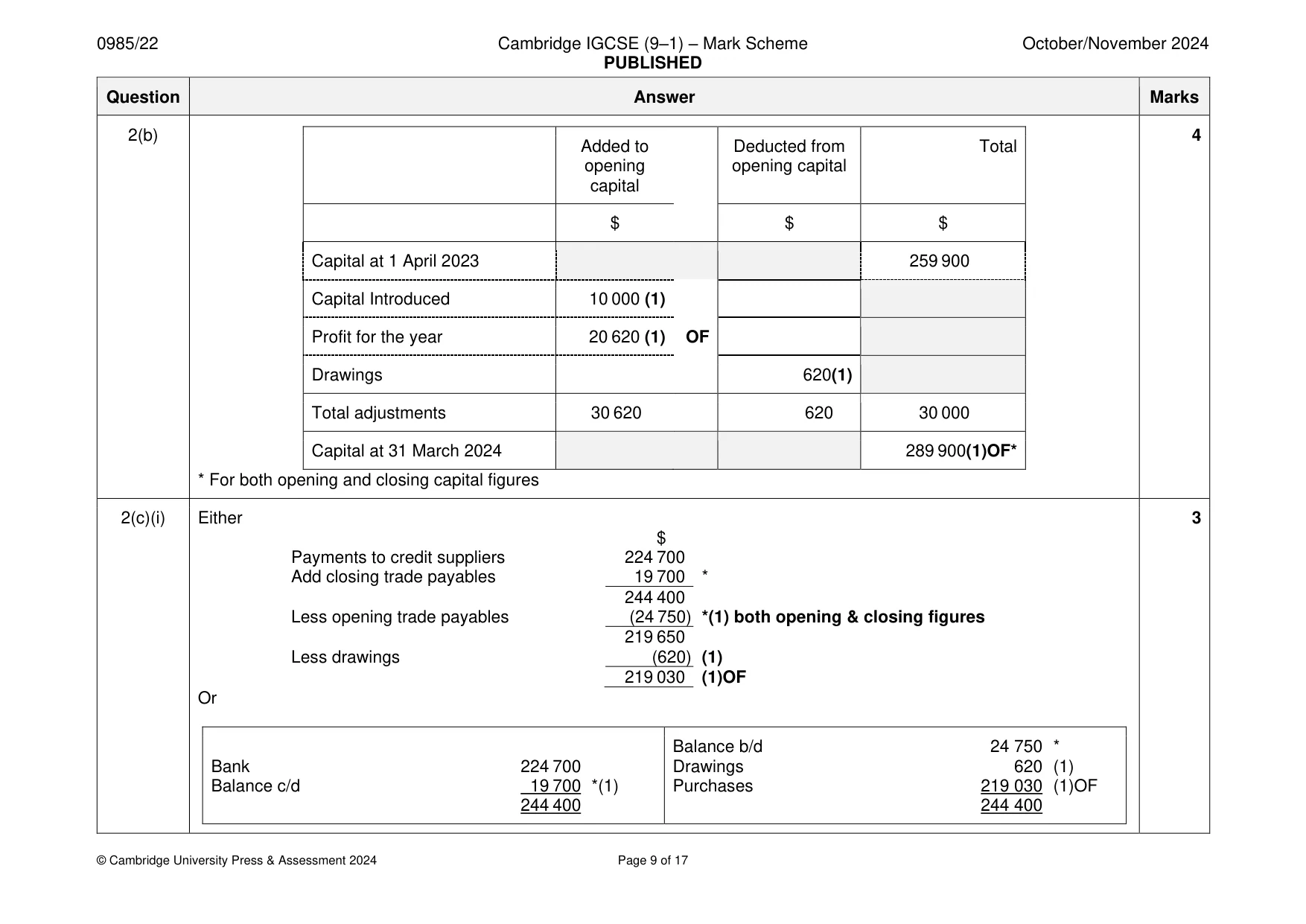
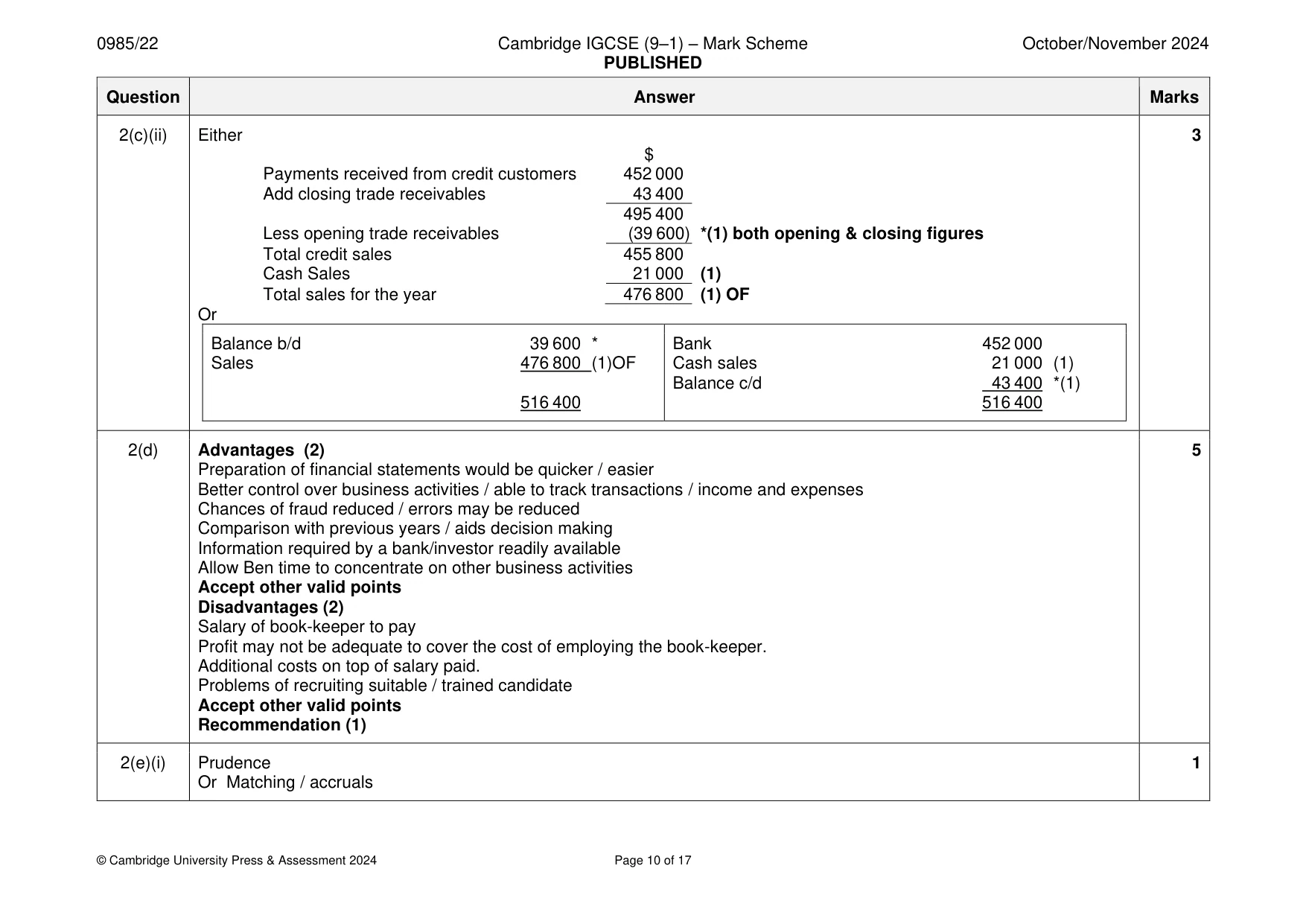
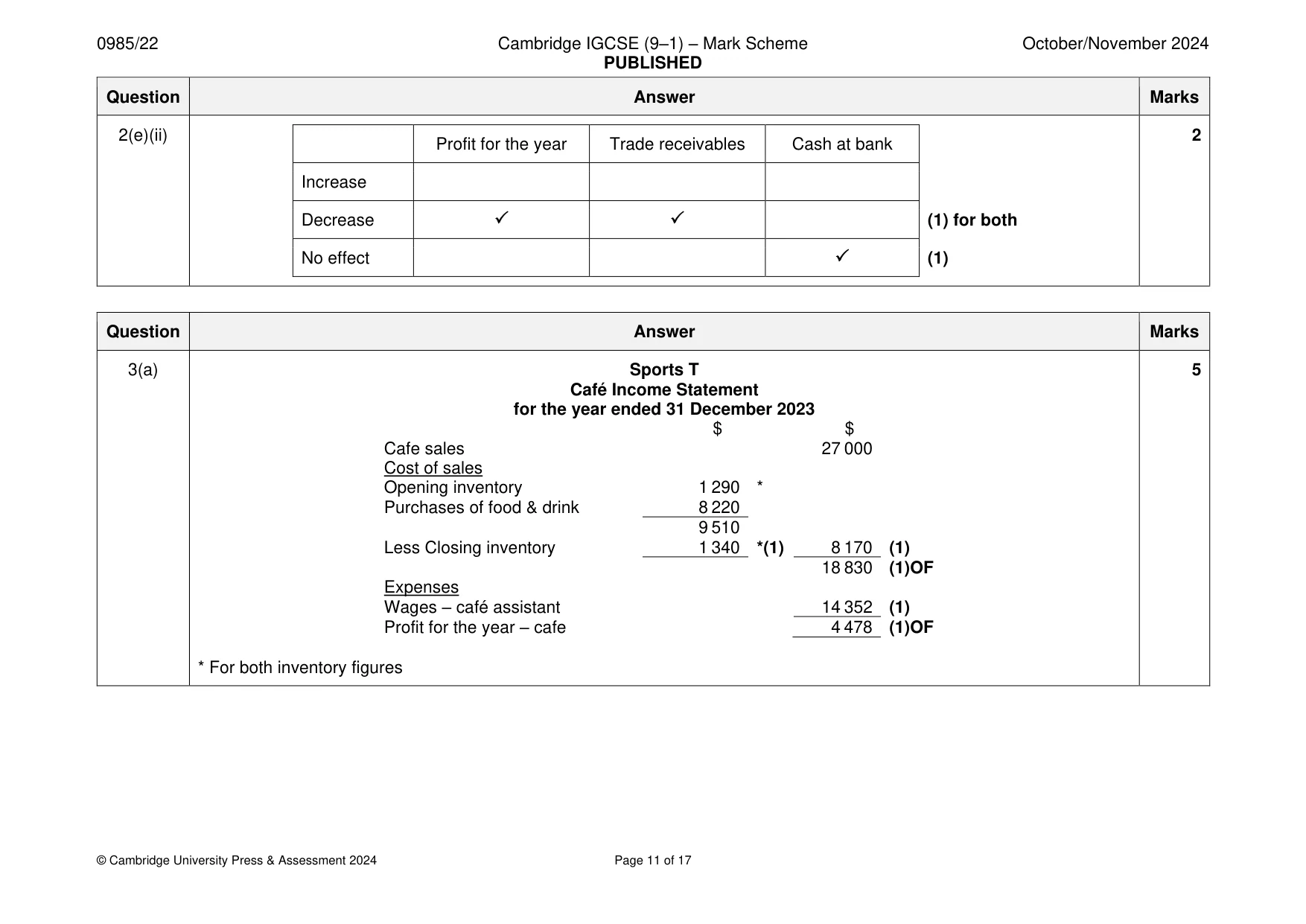
Mark scheme: 2(a) 2 Workings Answer $ 140 000 + 92 000 – 10 000 + 24 600 Capital at 1 April 2023 259 900 (1) +39 600 – 24 750 –3 200 +1 650 140 000 +106 000 – 36 000+ 42 000 + Capital at 31 March 2024 289 900 (1) 43 400 –19 700 +13 000 +1 200 2(b) 4 Added to Deducted from Total opening opening capital capital $ $ $ Capital at 1 April 2023 259 900 Capital Introduced 10 000 (1) Profit for the year 20 620 (1) OF Drawings 620(1) Total adjustments 30 620 620 30 000 Capital at 31 March 2024 289 900(1)OF* * For both opening and closing capital figures 2(c)(i) Either 3 $ Payments to credit suppliers 224 700 Add closing trade payables 19 700 * 244 400 Less opening trade payables (24 750) *(1) both opening & closing figures 219 650 Less drawings (620) (1) 219 030 (1)OF Or Balance b/d 24 750 * Bank 224 700 Drawings 620 (1) Balance c/d 19 700 *(1) Purchases 219 030 (1)OF 244 400 244 400 2(c)(ii) Either 3 $ Payments received from credit customers 452 000 Add closing trade receivables 43 400 495 400 Less opening trade receivables (39 600) *(1) both opening & closing figures Total credit sales 455 800 Cash Sales 21 000 (1) Total sales for the year 476 800 (1) OF Or Balance b/d 39 600 * Bank 452 000 Sales 476 800 (1)OF Cash sales 21 000 (1) Balance c/d 43 400 *(1) 516 400 516 400 2(d) Advantages (2) 5 Preparation of financial statements would be quicker / easier Better control over business activities / able to track transactions / income and expenses Chances of fraud reduced / errors may be reduced Comparison with previous years / aids decision making Information required by a bank/investor readily available Allow Ben time to concentrate on other business activities Accept other valid points Disadvantages (2) Salary of book-keeper to pay Profit may not be adequate to cover the cost of employing the book-keeper. Additional costs on top of salary paid. Problems of recruiting suitable / trained candidate Accept other valid points Recommendation (1) 2(e)(i) Prudence 1 Or Matching / accruals 2(e)(ii) 2 Profit for the year Trade receivables Cash at bank Increase Decrease (1) for both No effect (1)
Q3 · Sports T is a club providing sporting facilities to its members
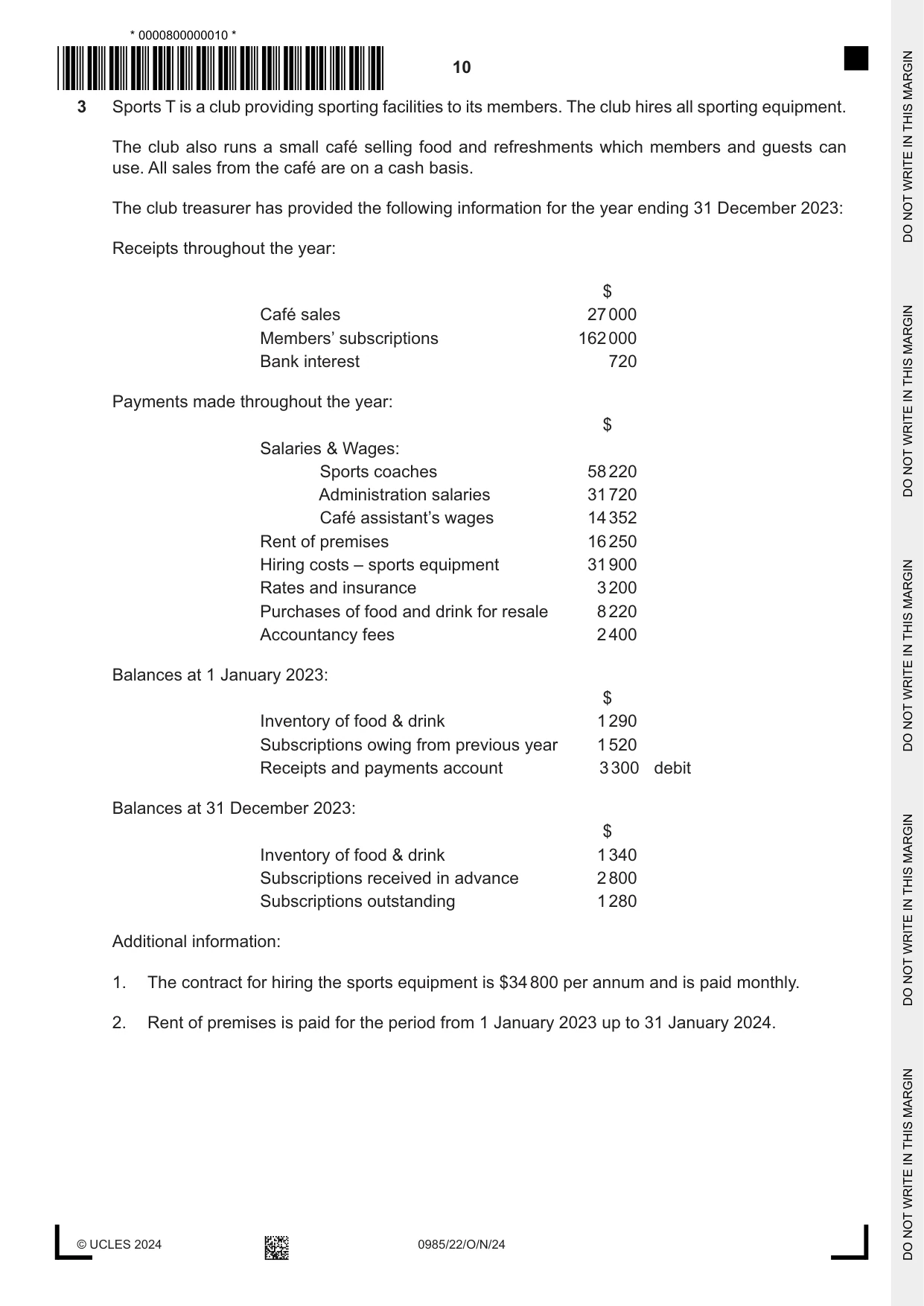
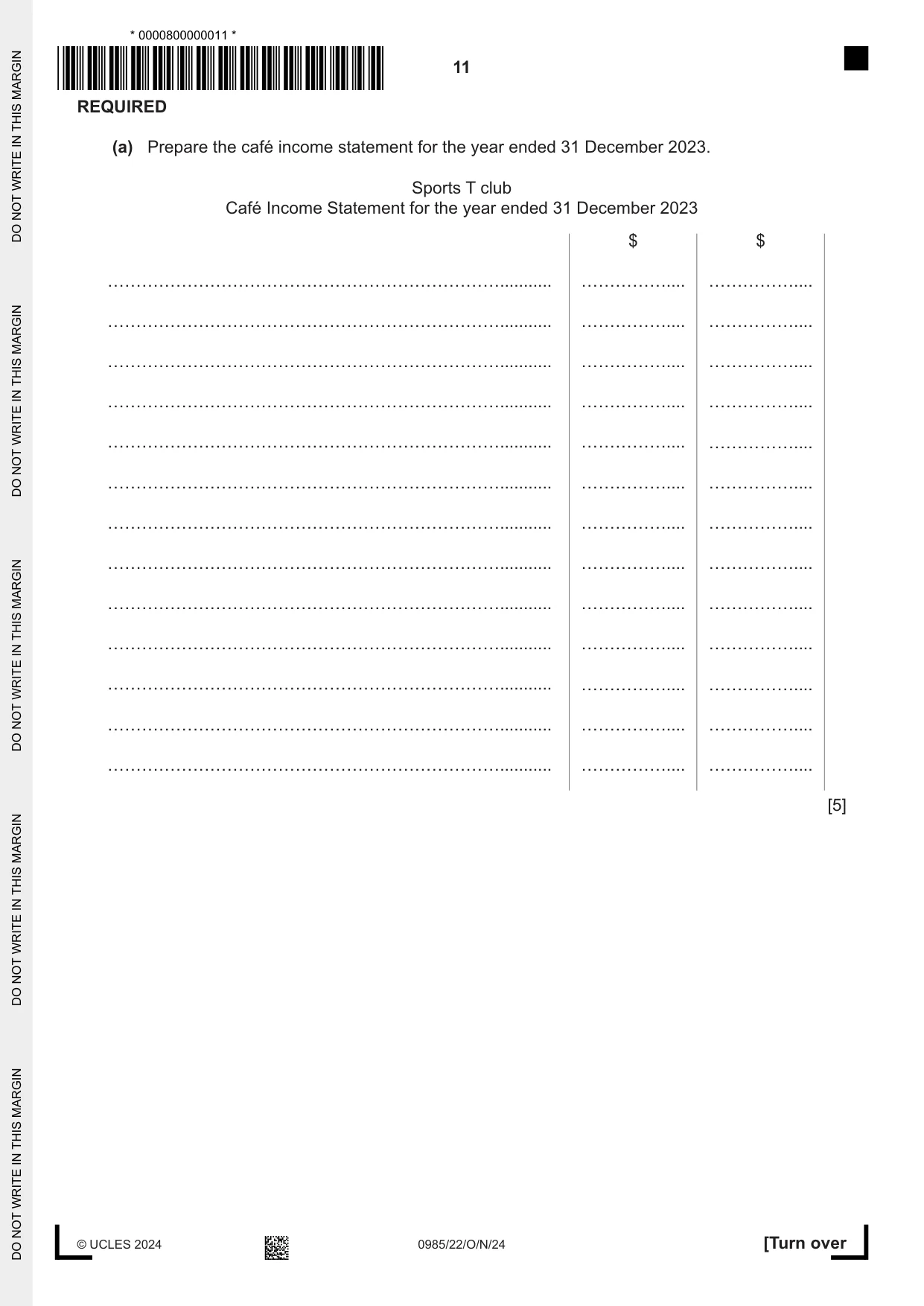
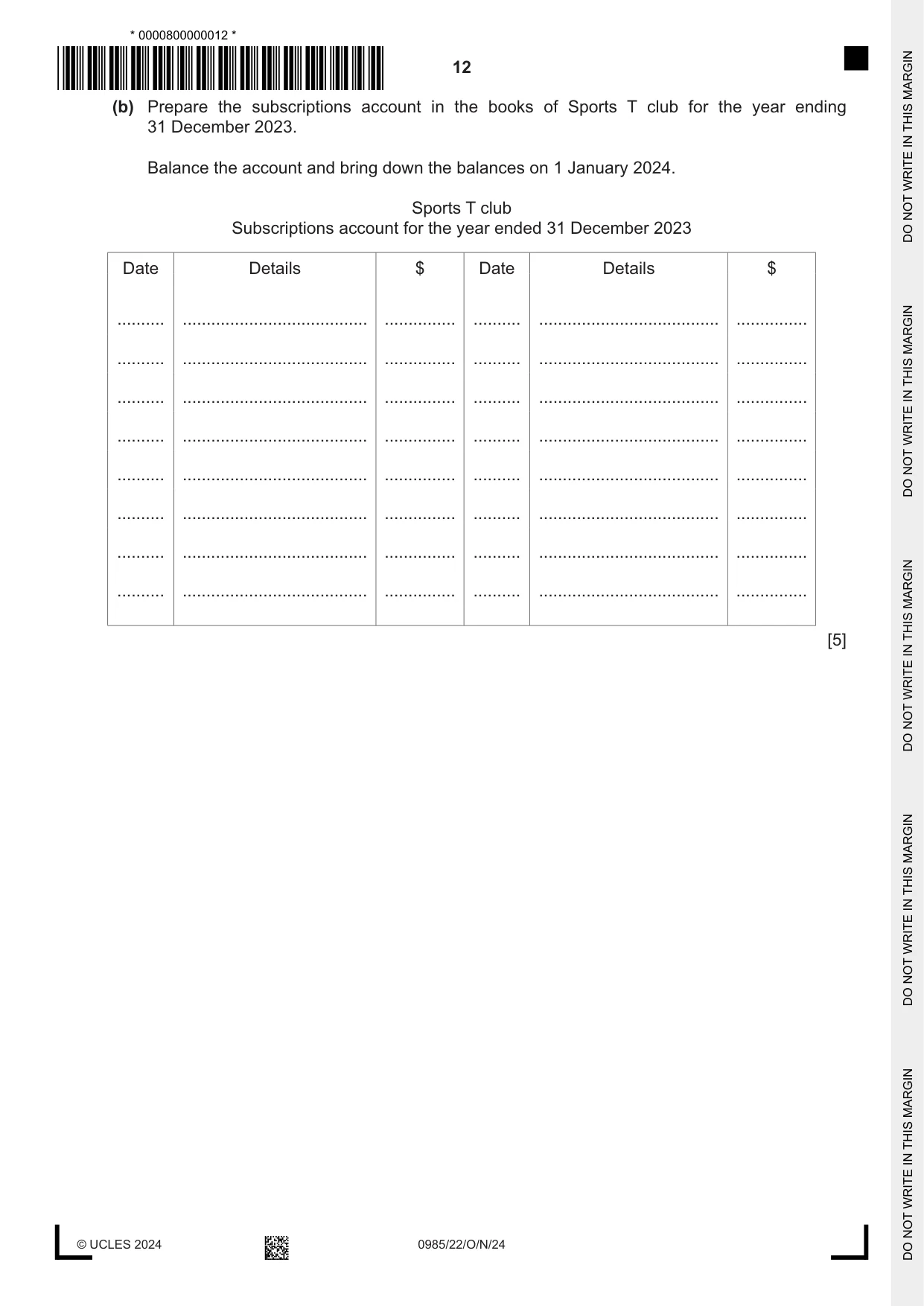
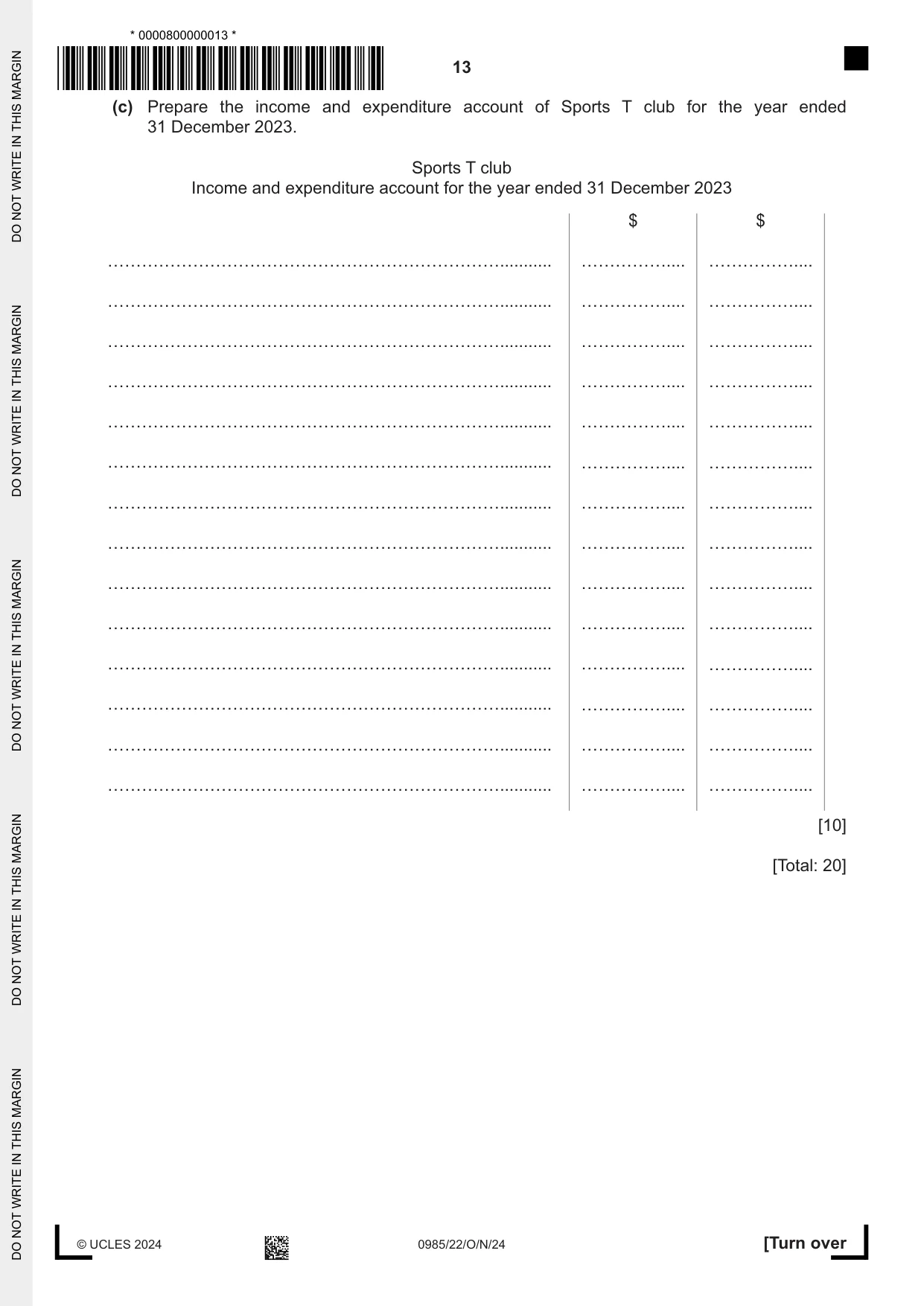
3 Sports T is a club providing sporting facilities to its members. The club hires all sporting equipment. The club also runs a small café selling food and refreshments which members and guests can use. All sales from the café are on a cash basis. The club treasurer has provided the following information for the year ending 31 December 2023: Receipts throughout the year: $ Café sales 27 000 Members’ subscriptions 162 000 Bank interest 720 Payments made throughout the year: $ Salaries & Wages: Sports coaches 58 220 Administration salaries 31 720 Café assistant’s wages 14 352 Rent of premises 16 250 Hiring costs – sports equipment 31 900 Rates and insurance 3 200 Purchases of food and drink for resale 8 220 Accountancy fees 2 400 Balances at 1 January 2023: $ Inventory of food & drink 1 290 Subscriptions owing from previous year 1 520 Receipts and payments account 3 300 debit Balances at 31 December 2023: $ Inventory of food & drink 1 340 Subscriptions received in advance 2 800 Subscriptions outstanding 1 280 Additional information: 1. The contract for hiring the sports equipment is $34 800 per annum and is paid monthly. 2. Rent of premises is paid for the period from 1 January 2023 up to 31 January 2024. REQUIRED (a) Prepare the café income statement for the year ended 31 December 2023. Sports T club Café Income Statement for the year ended 31 December 2023 $ $ ……………………………………………………………........... …………….... …………….... ……………………………………………………………........... …………….... …………….... ……………………………………………………………........... …………….... …………….... ……………………………………………………………........... …………….... …………….... ……………………………………………………………........... …………….... …………….... ……………………………………………………………........... …………….... …………….... ……………………………………………………………........... …………….... …………….... ……………………………………………………………........... …………….... …………….... ……………………………………………………………........... …………….... …………….... ……………………………………………………………........... …………….... …………….... ……………………………………………………………........... …………….... …………….... ……………………………………………………………........... …………….... …………….... ……………………………………………………………........... …………….... …………….... [5] (b) Prepare the subscriptions account in the books of Sports T club for the year ending 31 December 2023. Balance the account and bring down the balances on 1 January 2024. Sports T club Subscriptions account for the year ended 31 December 2023 Date Details $ Date Details $ .......... ....................................... ............... .......... ...................................... ............... .......... ....................................... ............... .......... ...................................... ............... .......... ....................................... ............... .......... ...................................... ............... .......... ....................................... ............... .......... ...................................... ............... .......... ....................................... ............... .......... ...................................... ............... .......... ....................................... ............... .......... ...................................... ............... .......... ....................................... ............... .......... ...................................... ............... .......... ....................................... ............... .......... ...................................... ............... [5] (c) Prepare the income and expenditure account of Sports T club for the year ended 31 December 2023. Sports T club Income and expenditure account for the year ended 31 December 2023 $ $ ……………………………………………………………........... …………….... …………….... ……………………………………………………………........... …………….... …………….... ……………………………………………………………........... …………….... …………….... ……………………………………………………………........... …………….... …………….... ……………………………………………………………........... …………….... …………….... ……………………………………………………………........... …………….... …………….... ……………………………………………………………........... …………….... …………….... ……………………………………………………………........... …………….... …………….... ……………………………………………………………........... …………….... …………….... ……………………………………………………………........... …………….... …………….... ……………………………………………………………........... …………….... …………….... ……………………………………………………………........... …………….... …………….... ……………………………………………………………........... …………….... …………….... ……………………………………………………………........... …………….... …………….... [10] [Total: 20]
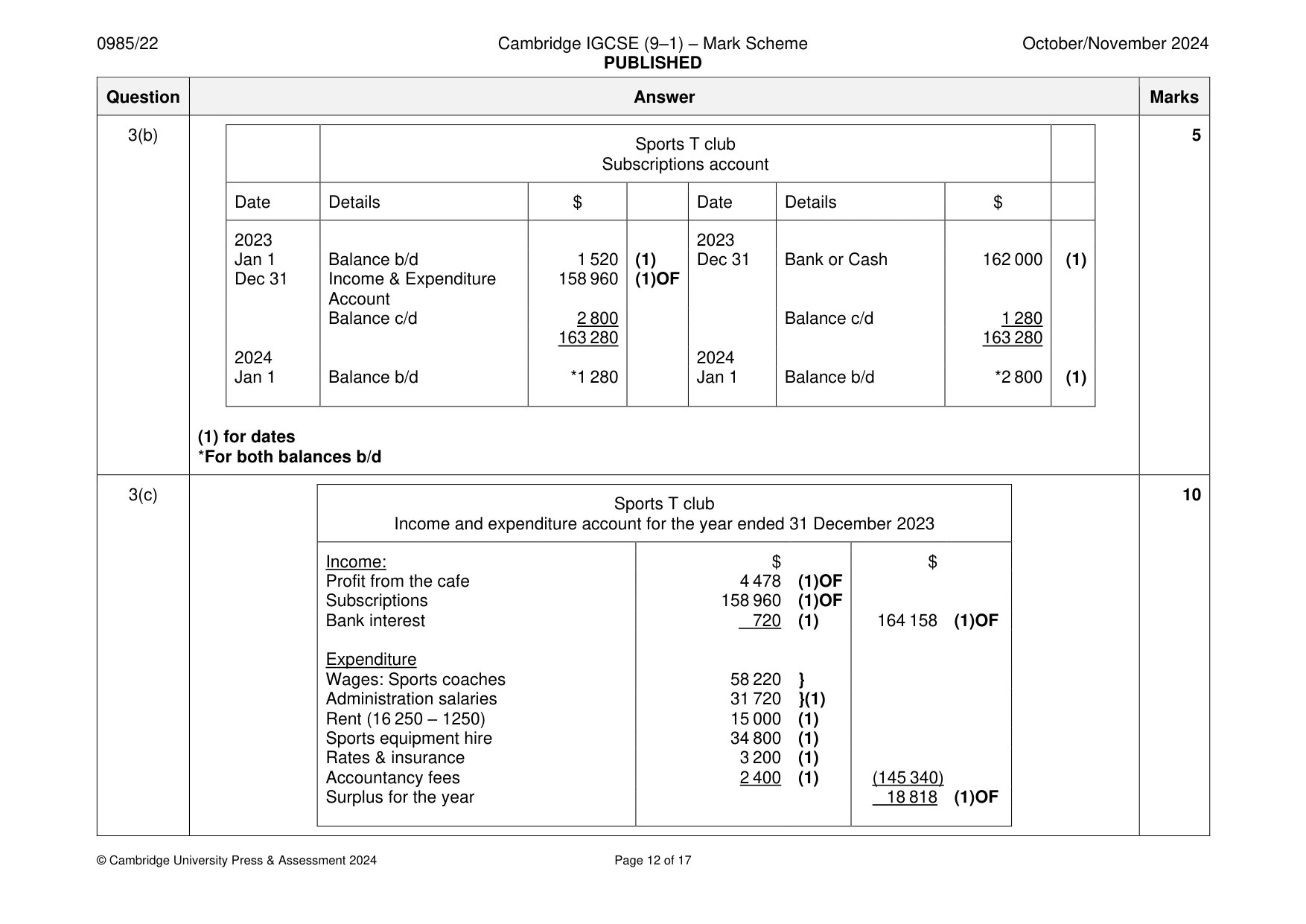
Mark scheme: 3(a) Sports T 5 Café Income Statement for the year ended 31 December 2023 $ $ Cafe sales 27 000 Cost of sales Opening inventory 1 290 * Purchases of food & drink 8 220 9 510 Less Closing inventory 1 340 *(1) 8 170 (1) 18 830 (1)OF Expenses Wages – café assistant 14 352 (1) Profit for the year – cafe 4 478 (1)OF * For both inventory figures 3(b) 5 Sports T club Subscriptions account Date Details $ Date Details $ 2023 2023 Jan 1 Balance b/d 1 520 (1) Dec 31 Bank or Cash 162 000 (1) Dec 31 Income & Expenditure 158 960 (1)OF Account Balance c/d 2 800 Balance c/d 1 280 163 280 163 280 2024 2024 Jan 1 Balance b/d *1 280 Jan 1 Balance b/d *2 800 (1) (1) for dates *For both balances b/d 3(c) 10 Sports T club Income and expenditure account for the year ended 31 December 2023 Income: $ $ Profit from the cafe 4 478 (1)OF Subscriptions 158 960 (1)OF Bank interest 720 (1) 164 158 (1)OF Expenditure Wages: Sports coaches 58 220 } Administration salaries 31 720 }(1) Rent (16 250 – 1250) 15 000 (1) Sports equipment hire 34 800 (1) Rates & insurance 3 200 (1) Accountancy fees 2 400 (1) (145 340) Surplus for the year 18 818 (1)OF
Q4 · Y Limited is a public limited company
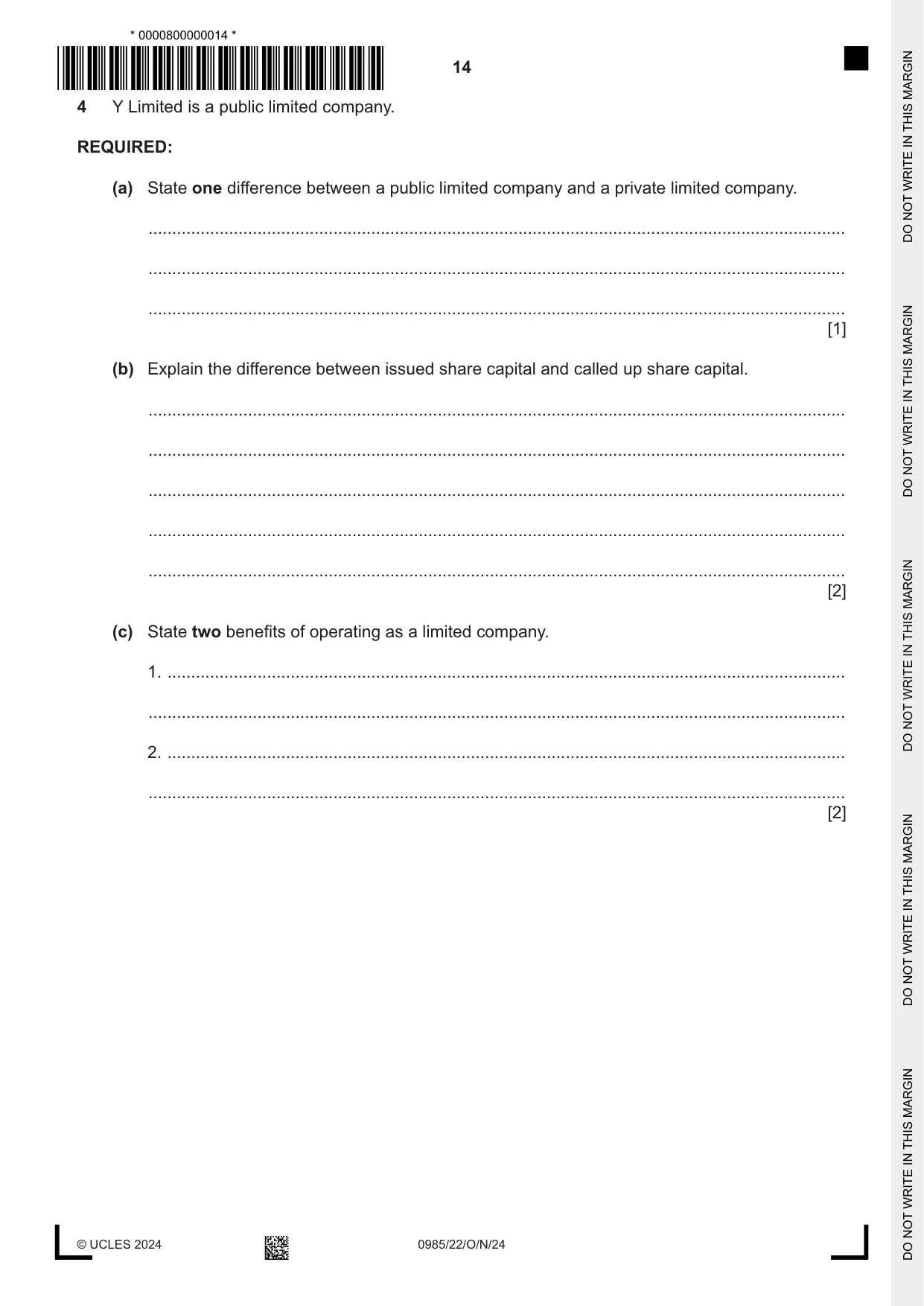
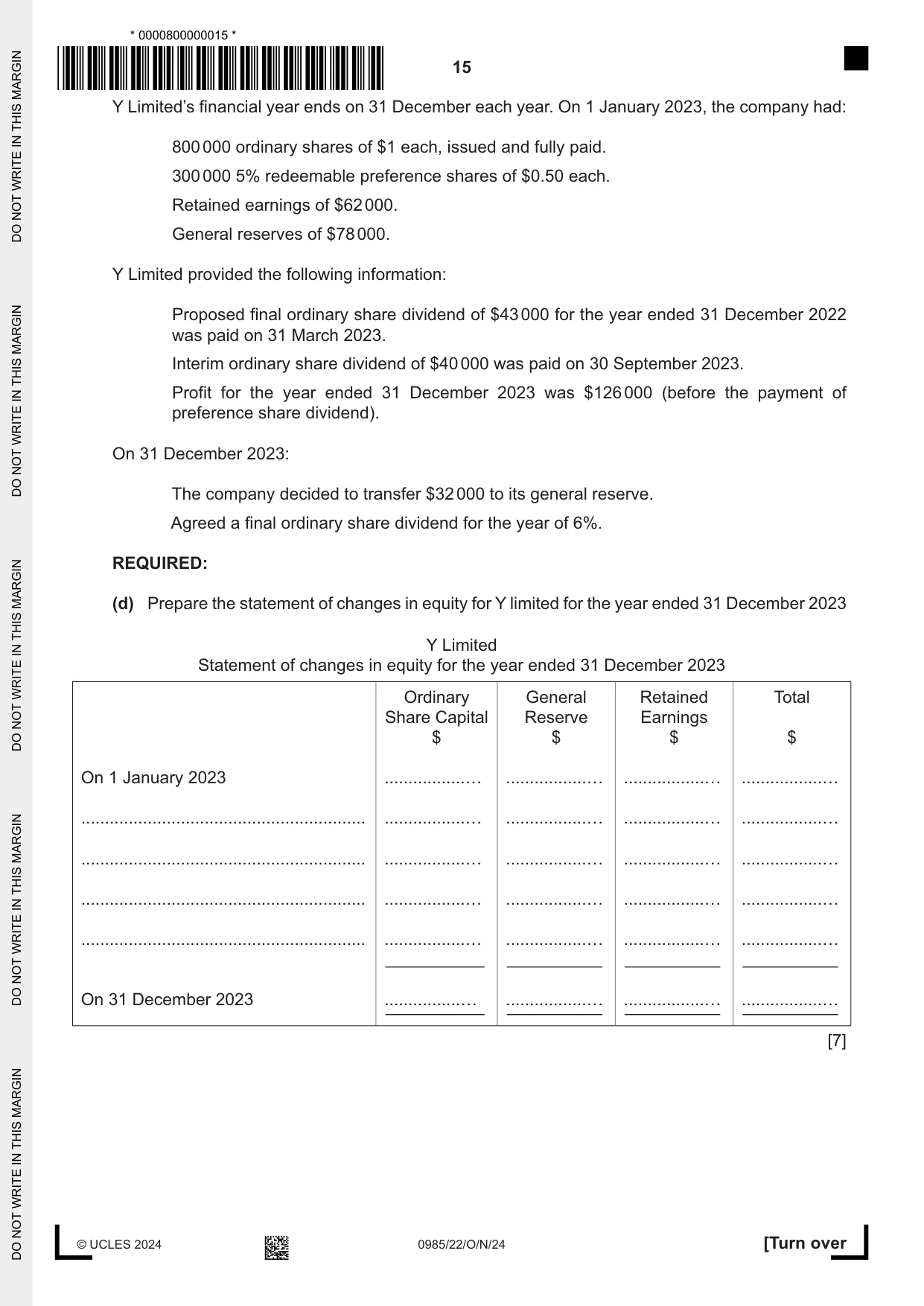
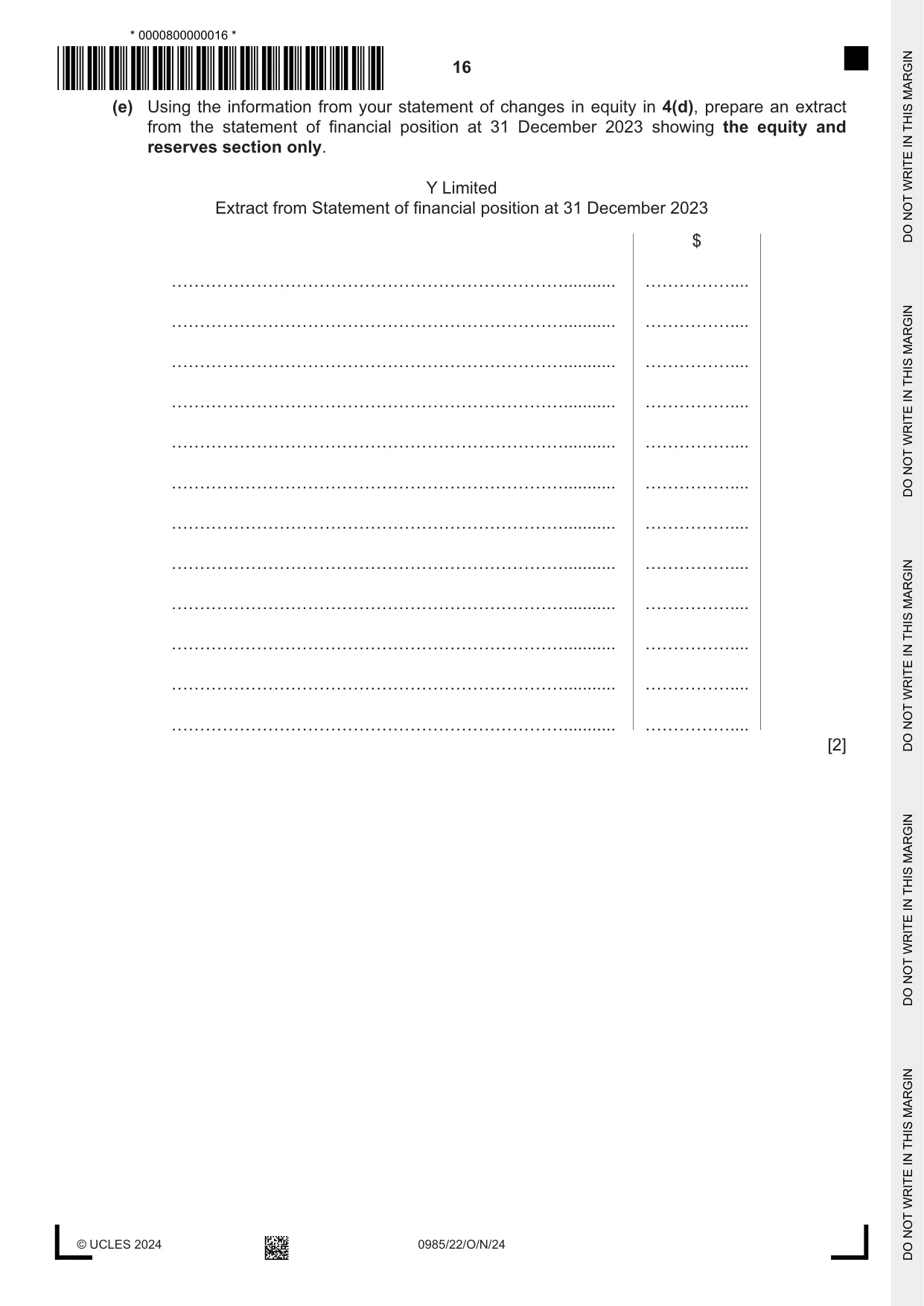
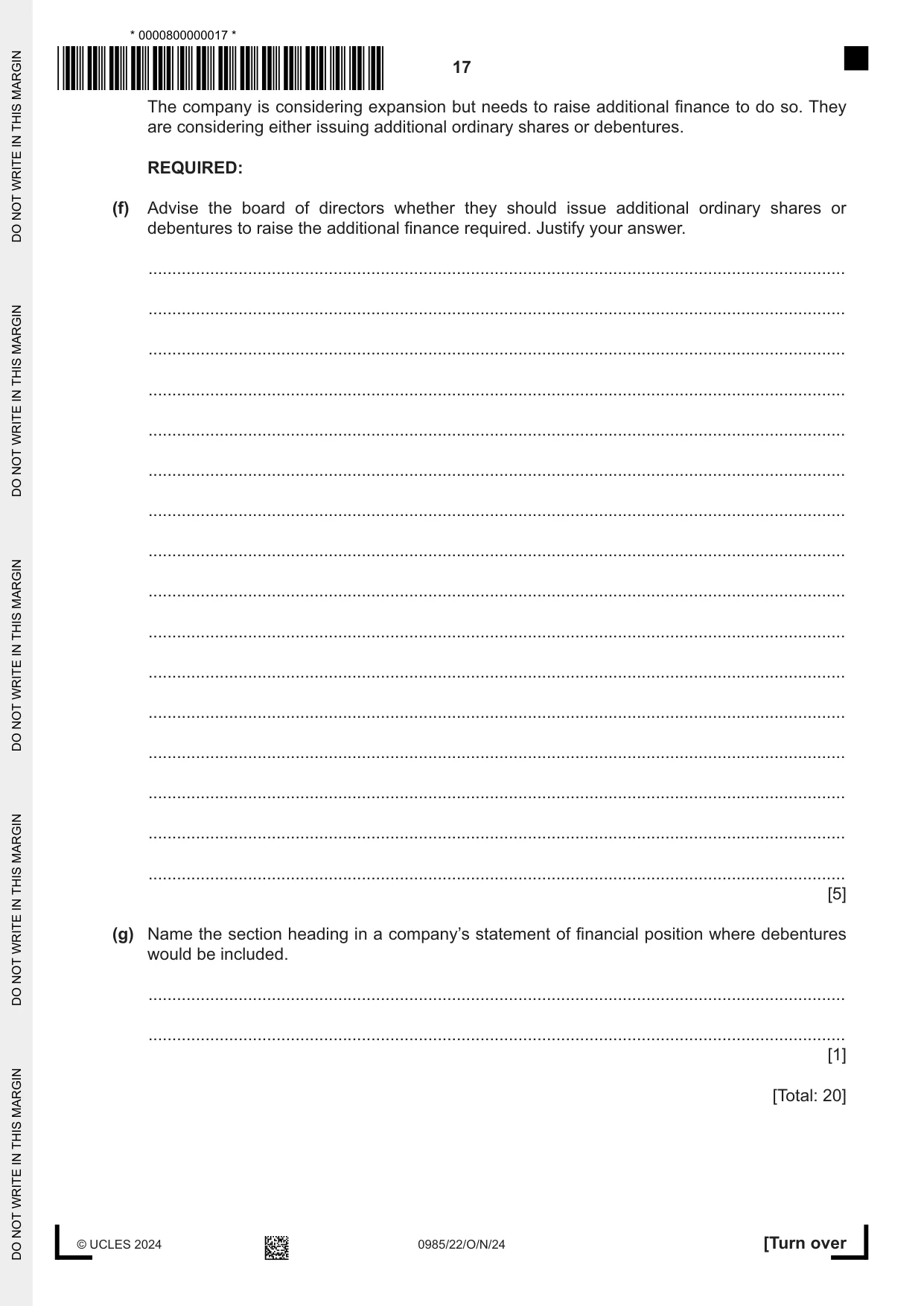
4 Y Limited is a public limited company. REQUIRED: (a) State one difference between a public limited company and a private limited company. ................................................................................................................................................... ................................................................................................................................................... ................................................................................................................................................... [1] (b) Explain the difference between issued share capital and called up share capital. ................................................................................................................................................... ................................................................................................................................................... ................................................................................................................................................... ................................................................................................................................................... ................................................................................................................................................... [2] (c) State two benefits of operating as a limited company. 1. ............................................................................................................................................... ................................................................................................................................................... 2. ............................................................................................................................................... ................................................................................................................................................... [2] Y Limited’s financial year ends on 31 December each year. On 1 January 2023, the company had: 800 000 ordinary shares of $1 each, issued and fully paid. 300 000 5% redeemable preference shares of $0.50 each. Retained earnings of $62 000. General reserves of $78 000. Y Limited provided the following information: Proposed final ordinary share dividend of $43 000 for the year ended 31 December 2022 was paid on 31 March 2023. Interim ordinary share dividend of $40 000 was paid on 30 September 2023. Profit for the year ended 31 December 2023 was $126 000 (before the payment of preference share dividend). On 31 December 2023: The company decided to transfer $32 000 to its general reserve. Agreed a final ordinary share dividend for the year of 6%. REQUIRED: (d) Prepare the statement of changes in equity for Y limited for the year ended 31 December 2023 Y Limited Statement of changes in equity for the year ended 31 December 2023 Ordinary General Retained Total Share Capital Reserve Earnings $ $ $ $ On 1 January 2023 .................… .................… .................… .................… ............................................................ .................… .................… .................… .................… ............................................................ .................… .................… .................… .................… ............................................................ .................… .................… .................… .................… ............................................................ .................… .................… .................… .................… On 31 December 2023 ................… .................… .................… .................… [7] (e) Using the information from your statement of changes in equity in 4(d), prepare an extract from the statement of financial position at 31 December 2023 showing the equity and reserves section only. Y Limited Extract from Statement of financial position at 31 December 2023 $ ……………………………………………………………........... …………….... ……………………………………………………………........... …………….... ……………………………………………………………........... …………….... ……………………………………………………………........... …………….... ……………………………………………………………........... …………….... ……………………………………………………………........... …………….... ……………………………………………………………........... …………….... ……………………………………………………………........... …………….... ……………………………………………………………........... …………….... ……………………………………………………………........... …………….... ……………………………………………………………........... …………….... ……………………………………………………………........... …………….... [2] The company is considering expansion but needs to raise additional finance to do so. They are considering either issuing additional ordinary shares or debentures. REQUIRED: (f) Advise the board of directors whether they should issue additional ordinary shares or debentures to raise the additional finance required. Justify your answer. ................................................................................................................................................... ................................................................................................................................................... ................................................................................................................................................... ................................................................................................................................................... ................................................................................................................................................... ................................................................................................................................................... ................................................................................................................................................... ................................................................................................................................................... ................................................................................................................................................... ................................................................................................................................................... ................................................................................................................................................... ................................................................................................................................................... ................................................................................................................................................... ................................................................................................................................................... ................................................................................................................................................... ................................................................................................................................................... [5] (g) Name the section heading in a company’s statement of financial position where debentures would be included. ................................................................................................................................................... ................................................................................................................................................... [1] [Total: 20]
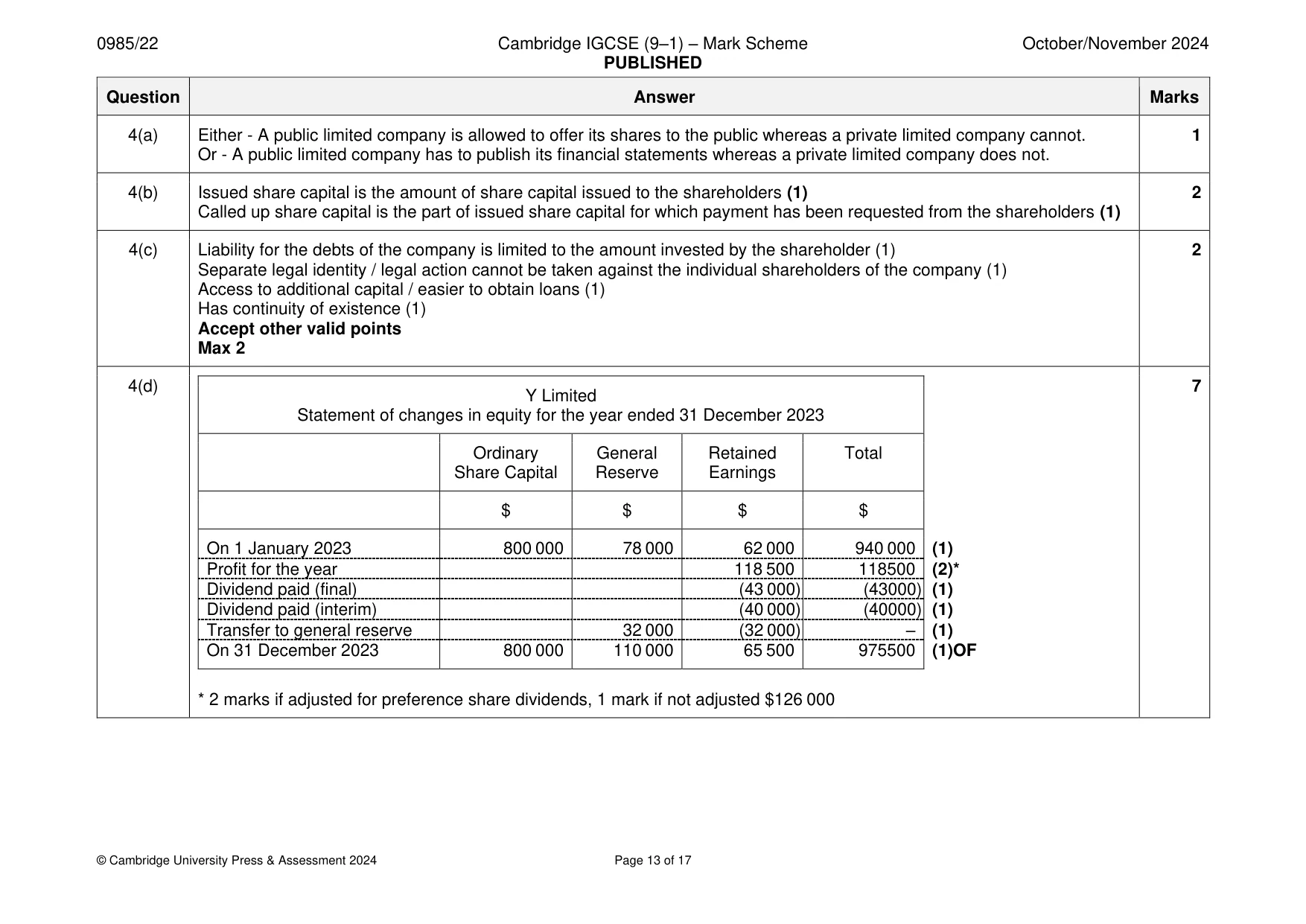
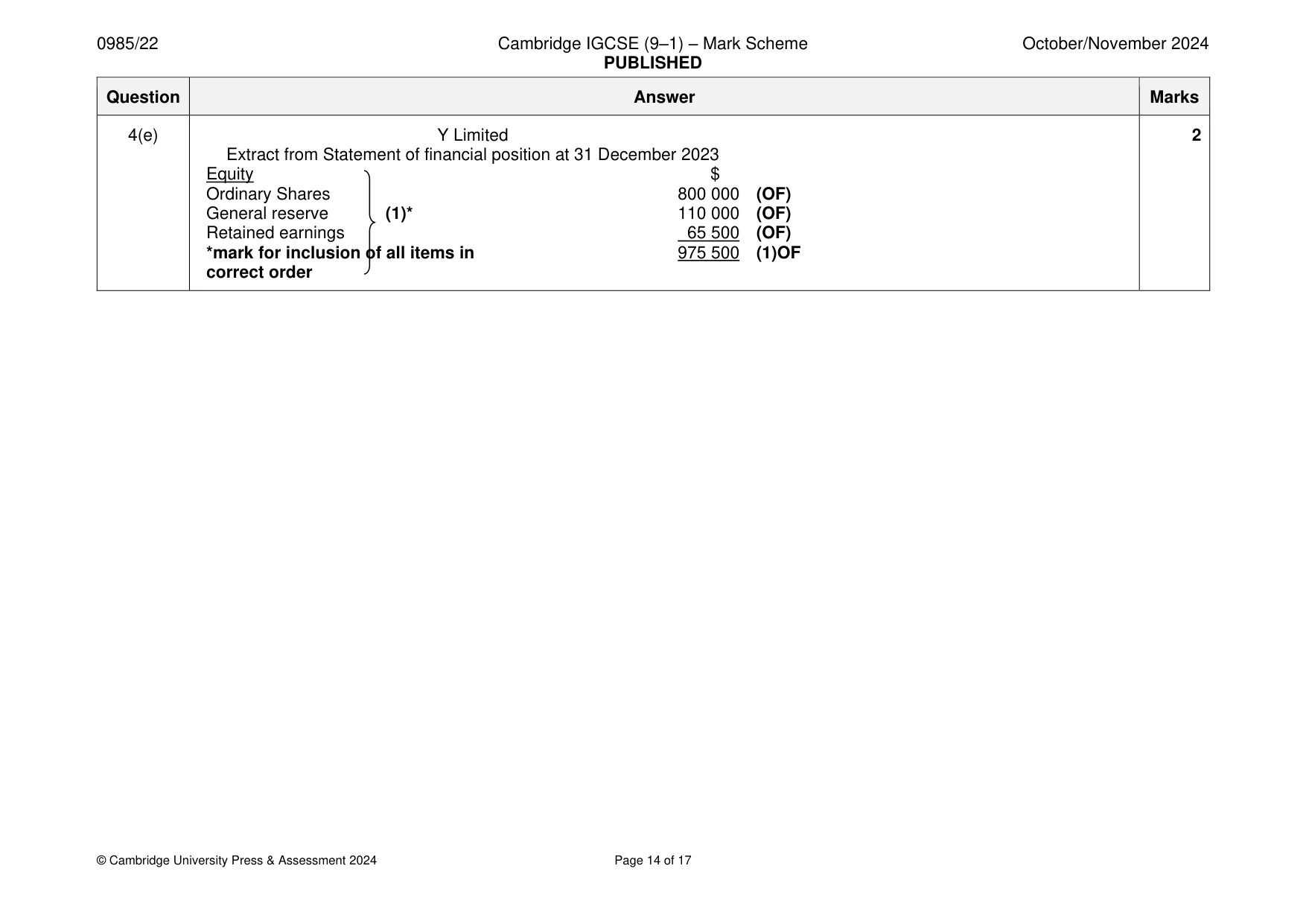
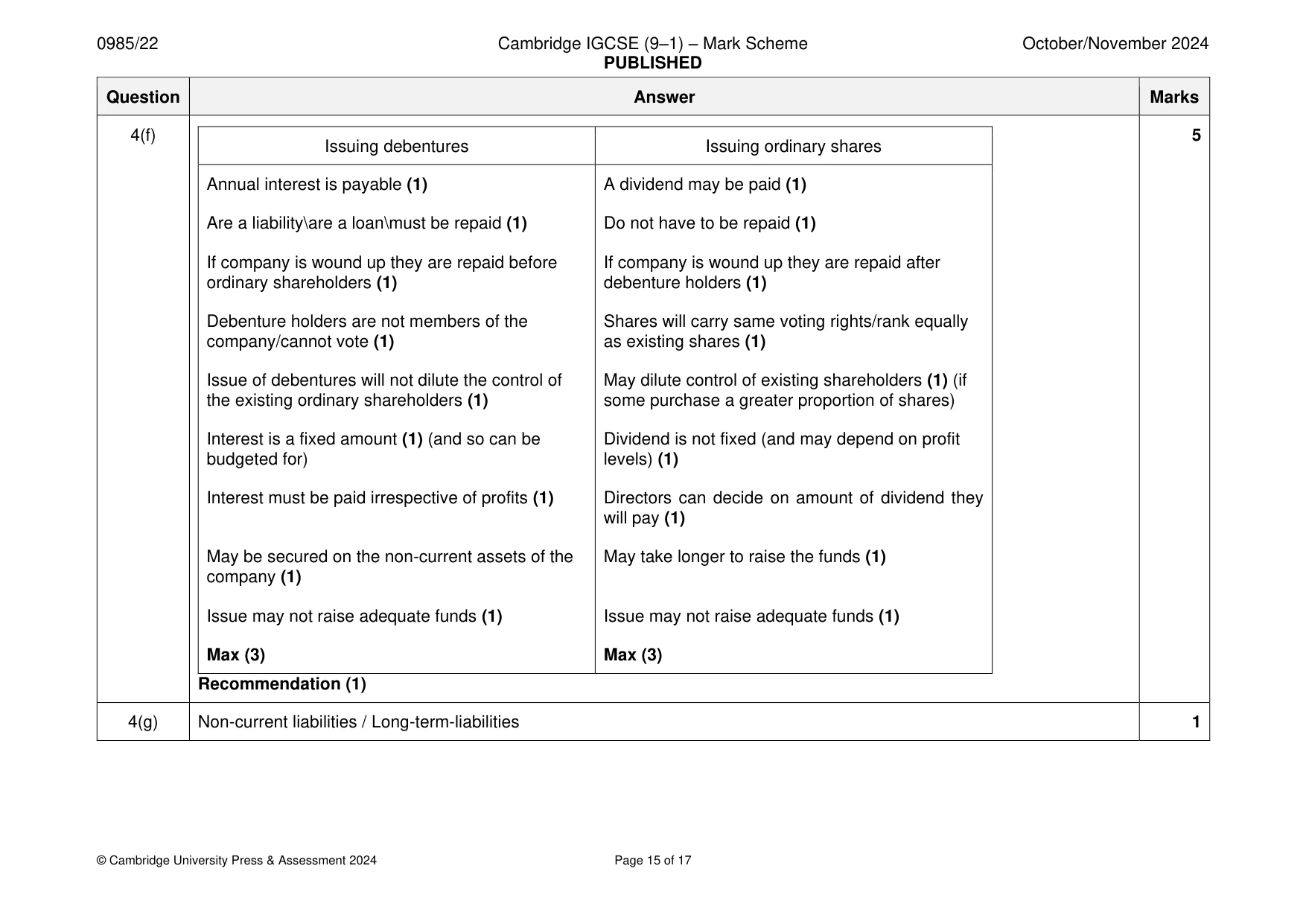
Mark scheme: 4(a) Either - A public limited company is allowed to offer its shares to the public whereas a private limited company cannot. 1 Or - A public limited company has to publish its financial statements whereas a private limited company does not. 4(b) Issued share capital is the amount of share capital issued to the shareholders (1) 2 Called up share capital is the part of issued share capital for which payment has been requested from the shareholders (1) 4(c) Liability for the debts of the company is limited to the amount invested by the shareholder (1) 2 Separate legal identity / legal action cannot be taken against the individual shareholders of the company (1) Access to additional capital / easier to obtain loans (1) Has continuity of existence (1) Accept other valid points Max 2 4(d) 7 Y Limited Statement of changes in equity for the year ended 31 December 2023 Ordinary General Retained Total Share Capital Reserve Earnings $ $ $ $ On 1 January 2023 800 000 78 000 62 000 940 000 (1) Profit for the year 118 500 118500 (2)* Dividend paid (final) (43 000) (43000) (1) Dividend paid (interim) (40 000) (40000) (1) Transfer to general reserve 32 000 (32 000) – (1) On 31 December 2023 800 000 110 000 65 500 975500 (1)OF * 2 marks if adjusted for preference share dividends, 1 mark if not adjusted $126 000 4(e) Y Limited 2 Extract from Statement of financial position at 31 December 2023 Equity $ Ordinary Shares 800 000 (OF) General reserve (1)* 110 000 (OF) Retained earnings 65 500 (OF) *mark for inclusion of all items in 975 500 (1)OF correct order 4(f) 5 Issuing debentures Issuing ordinary shares Annual interest is payable (1) A dividend may be paid (1) Are a liability\are a loan\must be repaid (1) Do not have to be repaid (1) If company is wound up they are repaid before If company is wound up they are repaid after ordinary shareholders (1) debenture holders (1) Debenture holders are not members of the Shares will carry same voting rights/rank equally company/cannot vote (1) as existing shares (1) Issue of debentures will not dilute the control of May dilute control of existing shareholders (1) (if the existing ordinary shareholders (1) some purchase a greater proportion of shares) Interest is a fixed amount (1) (and so can be Dividend is not fixed (and may depend on profit budgeted for) levels) (1) Interest must be paid irrespective of profits (1) Directors can decide on amount of dividend they will pay (1) May be secured on the non-current assets of the May take longer to raise the funds (1) company (1) Issue may not raise adequate funds (1) Issue may not raise adequate funds (1) Max (3) Max (3) Recommendation (1) 4(g) Non-current liabilities / Long-term-liabilities 1
Q5 · Azim is a wholesaler
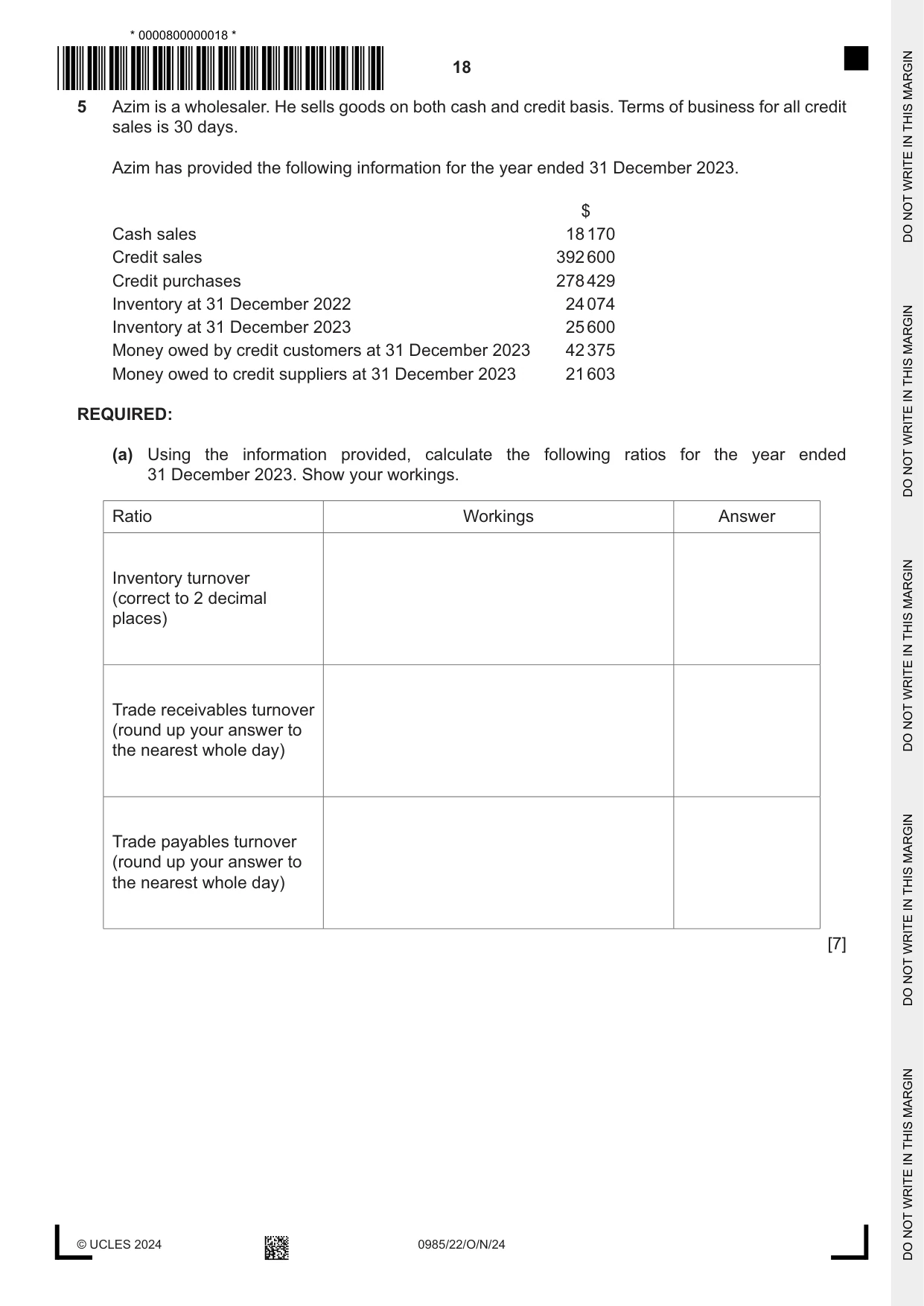
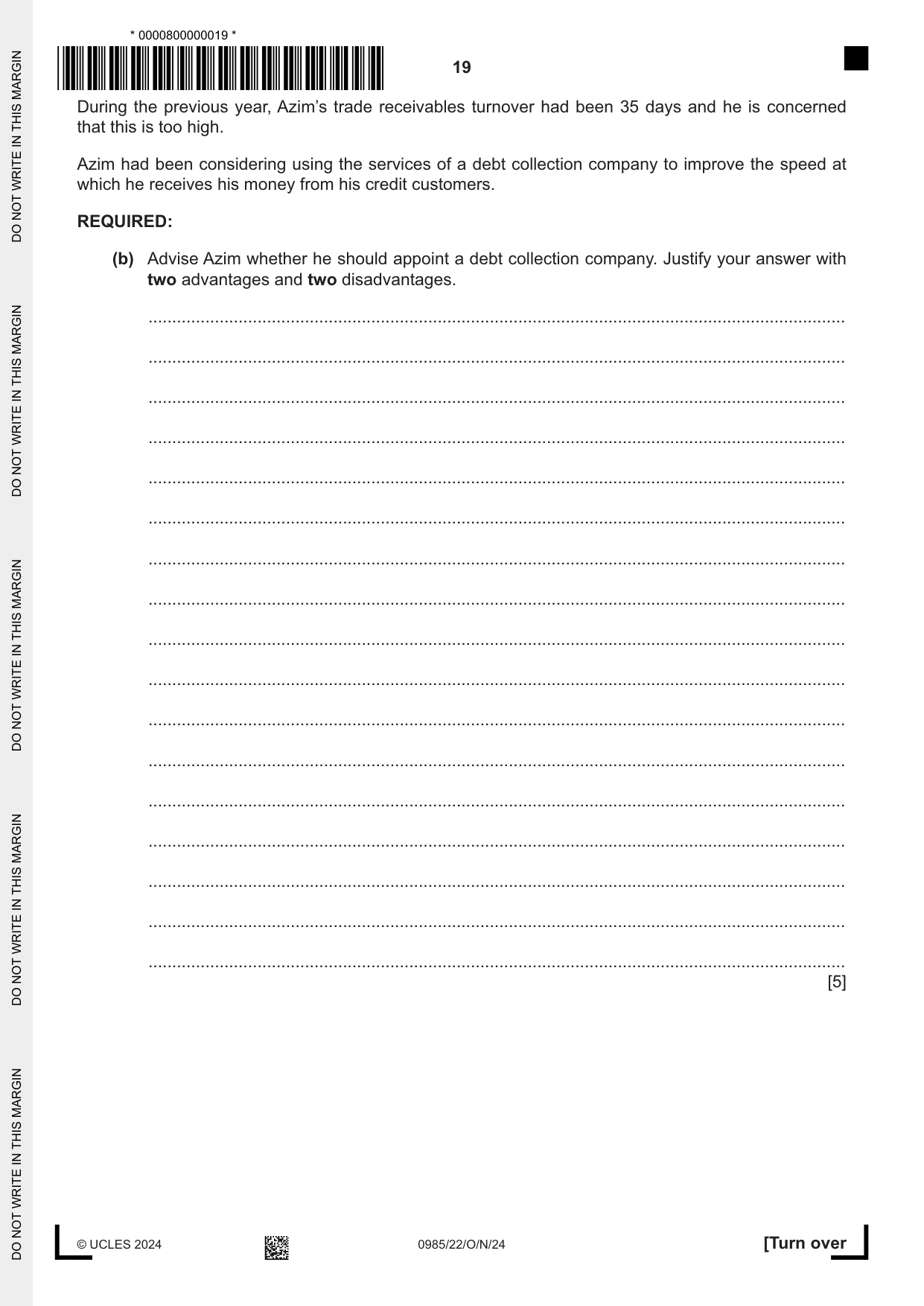
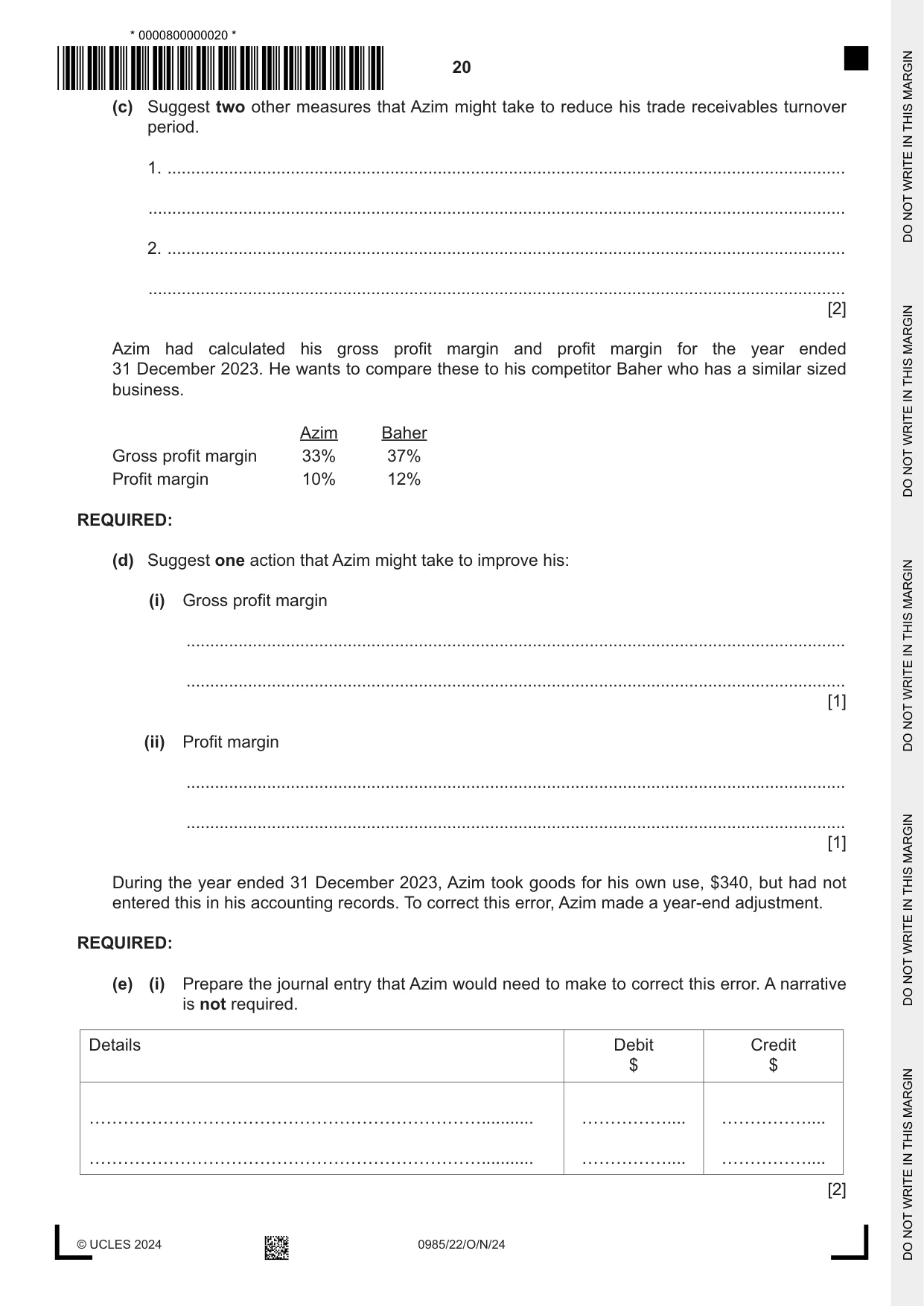
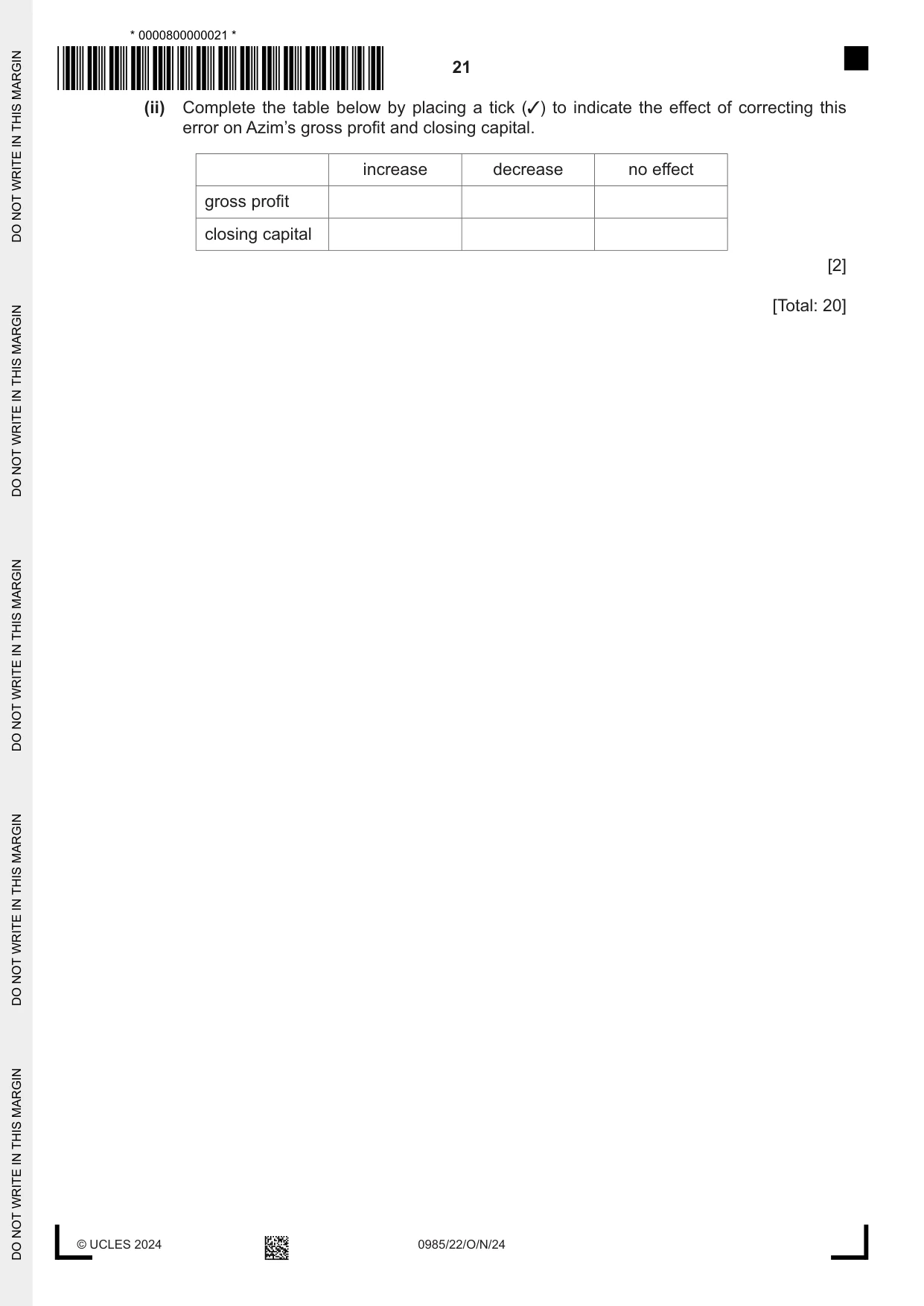
5 Azim is a wholesaler. He sells goods on both cash and credit basis. Terms of business for all credit sales is 30 days. Azim has provided the following information for the year ended 31 December 2023. $ Cash sales 18 170 Credit sales 392 600 Credit purchases 278 429 Inventory at 31 December 2022 24 074 Inventory at 31 December 2023 25 600 Money owed by credit customers at 31 December 2023 42 375 Money owed to credit suppliers at 31 December 2023 21 603 REQUIRED: (a) Using the information provided, calculate the following ratios for the year ended 31 December 2023. Show your workings. Ratio Workings Answer Inventory turnover (correct to 2 decimal places) Trade receivables turnover (round up your answer to the nearest whole day) Trade payables turnover (round up your answer to the nearest whole day) [7] During the previous year, Azim’s trade receivables turnover had been 35 days and he is concerned that this is too high. Azim had been considering using the services of a debt collection company to improve the speed at which he receives his money from his credit customers. REQUIRED: (b) Advise Azim whether he should appoint a debt collection company. Justify your answer with two advantages and two disadvantages. ................................................................................................................................................... ................................................................................................................................................... ................................................................................................................................................... ................................................................................................................................................... ................................................................................................................................................... ................................................................................................................................................... ................................................................................................................................................... ................................................................................................................................................... ................................................................................................................................................... ................................................................................................................................................... ................................................................................................................................................... ................................................................................................................................................... ................................................................................................................................................... ................................................................................................................................................... ................................................................................................................................................... ................................................................................................................................................... ................................................................................................................................................... [5] (c) Suggest two other measures that Azim might take to reduce his trade receivables turnover period. 1. ............................................................................................................................................... ................................................................................................................................................... 2. ............................................................................................................................................... ................................................................................................................................................... [2] Azim had calculated his gross profit margin and profit margin for the year ended 31 December 2023. He wants to compare these to his competitor Baher who has a similar sized business. Azim Baher Gross profit margin 33% 37% Profit margin 10% 12% REQUIRED: (d) Suggest one action that Azim might take to improve his: (i) Gross profit margin ........................................................................................................................................... ........................................................................................................................................... [1] (ii) Profit margin ........................................................................................................................................... ........................................................................................................................................... [1] During the year ended 31 December 2023, Azim took goods for his own use, $340, but had not entered this in his accounting records. To correct this error, Azim made a year-end adjustment. REQUIRED: (e) (i) Prepare the journal entry that Azim would need to make to correct this error. A narrative is not required. Details Debit Credit $ $ ……………………………………………………………........... …………….... …………….... ……………………………………………………………........... …………….... …………….... [2]
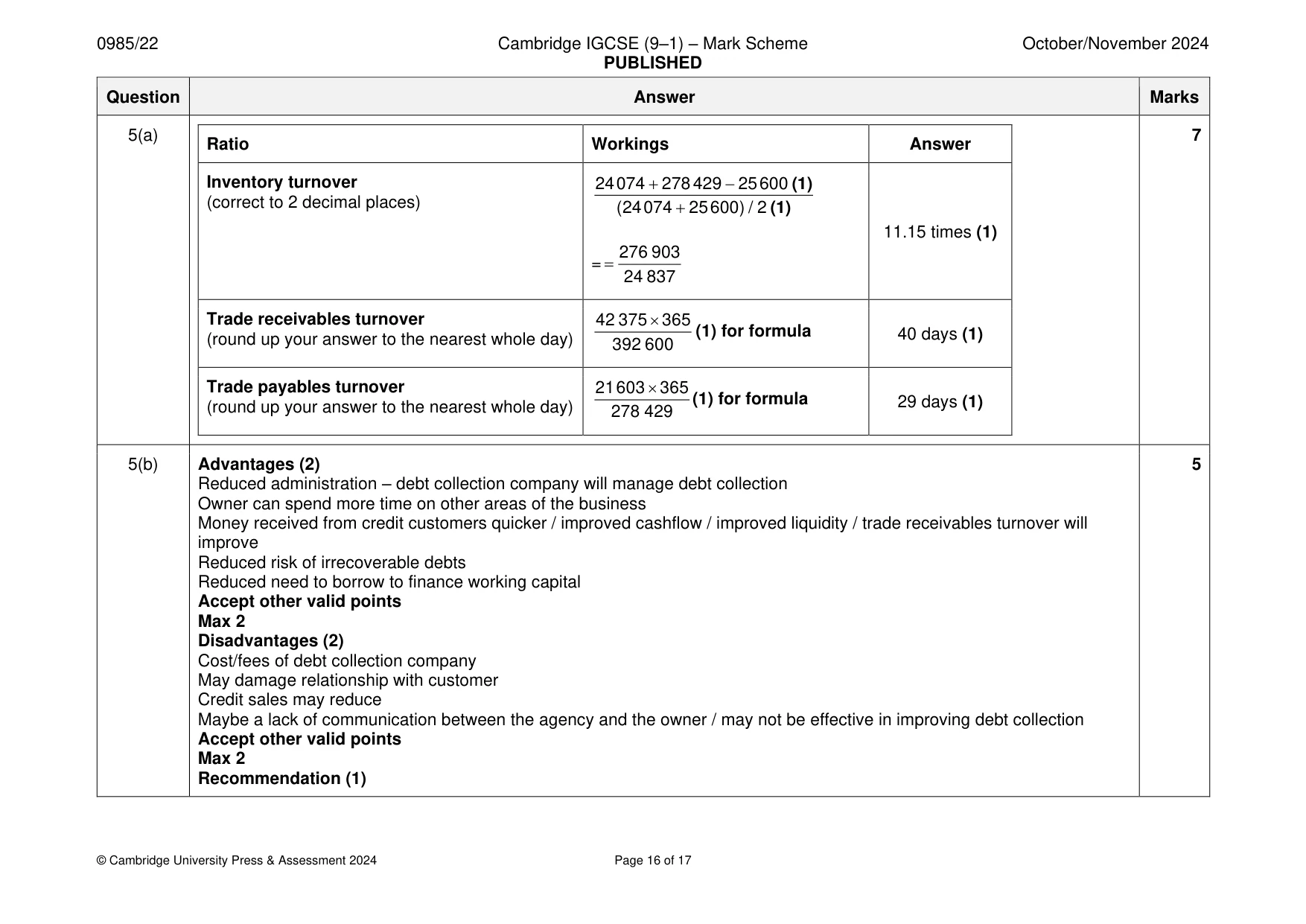
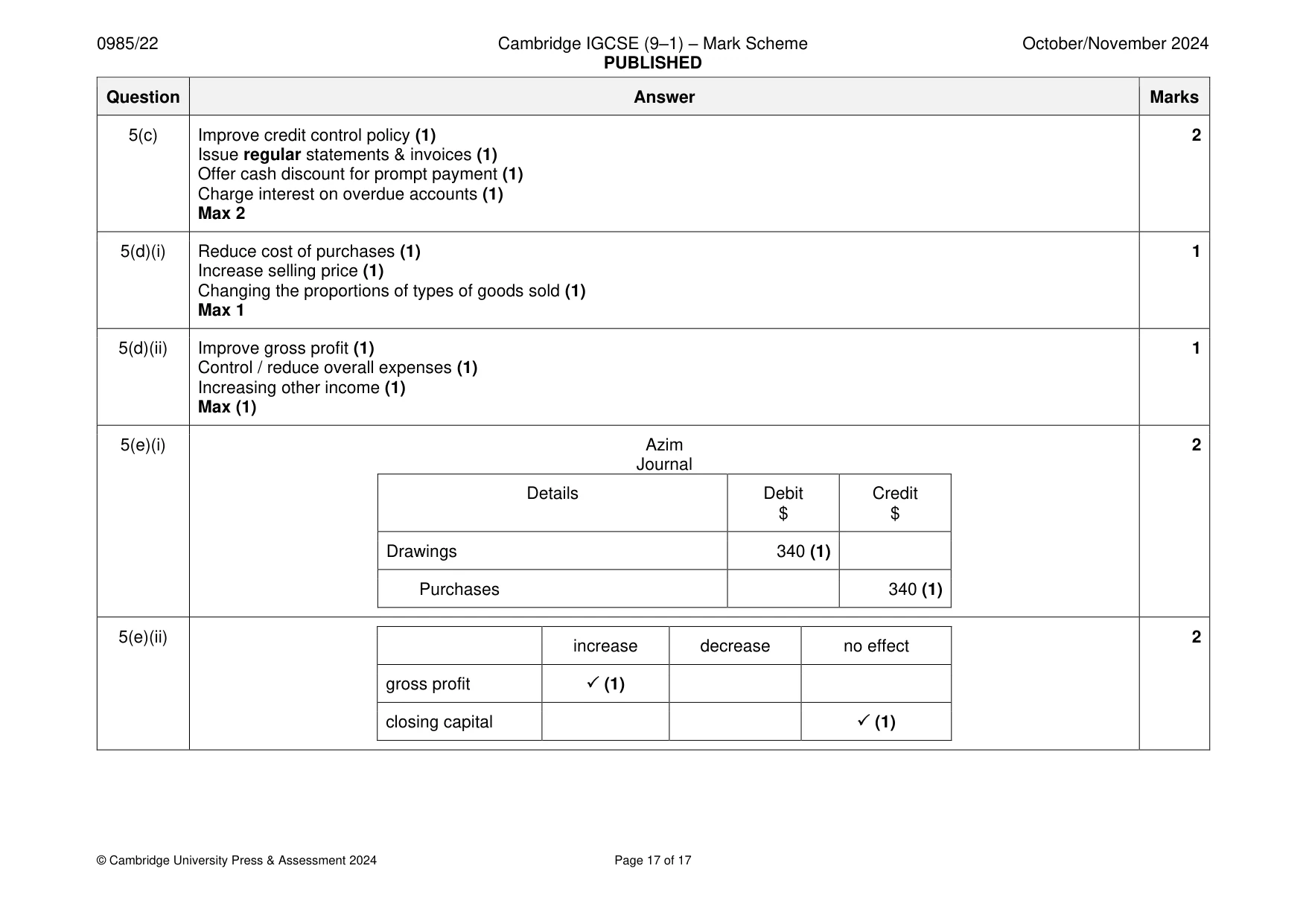
Mark scheme: 5(a) 7 Ratio Workings Answer Inventory turnover 24074 + 278429 − 25600 (1) (correct to 2 decimal places) (24074 + 25600) / 2 (1) 11.15 times (1) 276 903 = = 24 837 Trade receivables turnover 42 375 365 (1) for formula 40 days (1) (round up your answer to the nearest whole day) 392 600 Trade payables turnover 21603 365 (1) for formula 29 days (1) (round up your answer to the nearest whole day) 278 429 5(b) Advantages (2) 5 Reduced administration – debt collection company will manage debt collection Owner can spend more time on other areas of the business Money received from credit customers quicker / improved cashflow / improved liquidity / trade receivables turnover will improve Reduced risk of irrecoverable debts Reduced need to borrow to finance working capital Accept other valid points Max 2 Disadvantages (2) Cost/fees of debt collection company May damage relationship with customer Credit sales may reduce Maybe a lack of communication between the agency and the owner / may not be effective in improving debt collection Accept other valid points Max 2 Recommendation (1) 5(c) Improve credit control policy (1) 2 Issue regular statements & invoices (1) Offer cash discount for prompt payment (1) Charge interest on overdue accounts (1) Max 2 5(d)(i) Reduce cost of purchases (1) 1 Increase selling price (1) Changing the proportions of types of goods sold (1) Max 1 5(d)(ii) Improve gross profit (1) 1 Control / reduce overall expenses (1) Increasing other income (1) Max (1) 5(e)(i) Azim 2 Journal Details Debit Credit $ $ Drawings 340 (1) Purchases 340 (1) 5(e)(ii) 2 increase decrease no effect gross profit (1) closing capital (1)
What was in this paper
The subtopics covered by these 5 questions, and how many questions each got. Open one in a new tab to see every Cambridge question on it.
What you needed in this session
Cambridge’s own grade thresholds for 2024 Oct/Nov, Paper 2 · Variant 2. A higher threshold means an easier paper — the bar moves with how the cohort did.