Cambridge IGCSE Accounting 0452 — 2019 Oct/Nov Paper 1 · Variant 1
0452/11/O/N/19 · 120 marks · ≈135 min
The question paper and its mark scheme, free to read here and free to download. This is Cambridge’s own paper, exactly as it was sat.
Question paper24 pages


Mark scheme17 pages
Answers below. Sit the paper first if you are practising.
Paper as text
Question paper, page 1
This document consists of 23 printed pages and 1 blank page. DC (CJ) 188378 © UCLES 2019 [Turn over * 9 3 8 0 7 3 6 1 9 7 * ACCOUNTING 0452/11 Paper 1 October/November 2019 1 hour 45 minutes Candidates answer on the Question Paper. No Additional Materials are required. READ THESE INSTRUCTIONS FIRST Write your centre number, candidate number and name on all the work you hand in. Write in dark blue or black pen. You may use an HB pencil for any diagrams or graphs. Do not use staples, paper clips, glue or correction fluid. DO NOT WRITE IN ANY BARCODES. Answer all questions. You may use a calculator. Where layouts are to be completed, you may not need all the lines for your answer. The businesses mentioned in this Question Paper are fictitious. At the end of the examination, fasten all your work securely together. The number of marks is given in brackets [ ] at the end of each question or part question. Cambridge Assessment International Education Cambridge International General Certificate of Secondary Education
Question paper, page 2
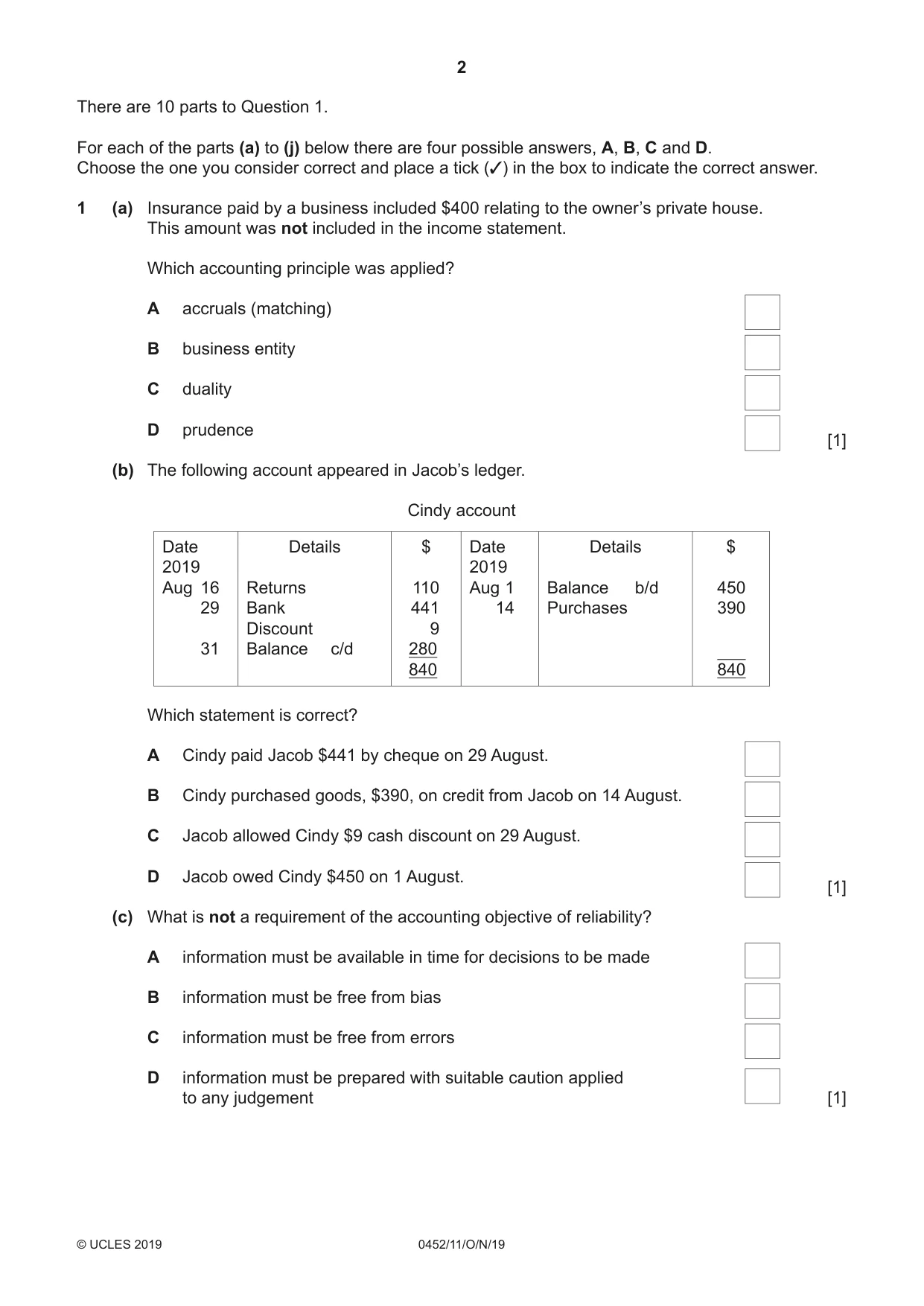
2 0452/11/O/N/19 © UCLES 2019 There are 10 parts to Question 1. For each of the parts (a) to (j) below there are four possible answers, A, B, C and D. Choose the one you consider correct and place a tick (3) in the box to indicate the correct answer. 1 (a) Insurance paid by a business included $400 relating to the owner’s private house. This amount was not included in the income statement. Which accounting principle was applied? A accruals (matching) B business entity C duality D prudence [1] (b) The following account appeared in Jacob’s ledger. Cindy account Date 2019 Aug 16 29 31 Details Returns Bank Discount Balance c/d $ 110 441 9 280 840 Date 2019 Aug 1 14 Details Balance b/d Purchases $ 450 390 840 Which statement is correct? A Cindy paid Jacob $441 by cheque on 29 August. B Cindy purchased goods, $390, on credit from Jacob on 14 August. C Jacob allowed Cindy $9 cash discount on 29 August. D Jacob owed Cindy $450 on 1 August. [1] (c) What is not a requirement of the accounting objective of reliability? A information must be available in time for decisions to be made B information must be free from bias C information must be free from errors D information must be prepared with suitable caution applied to any judgement [1]
Question paper, page 3
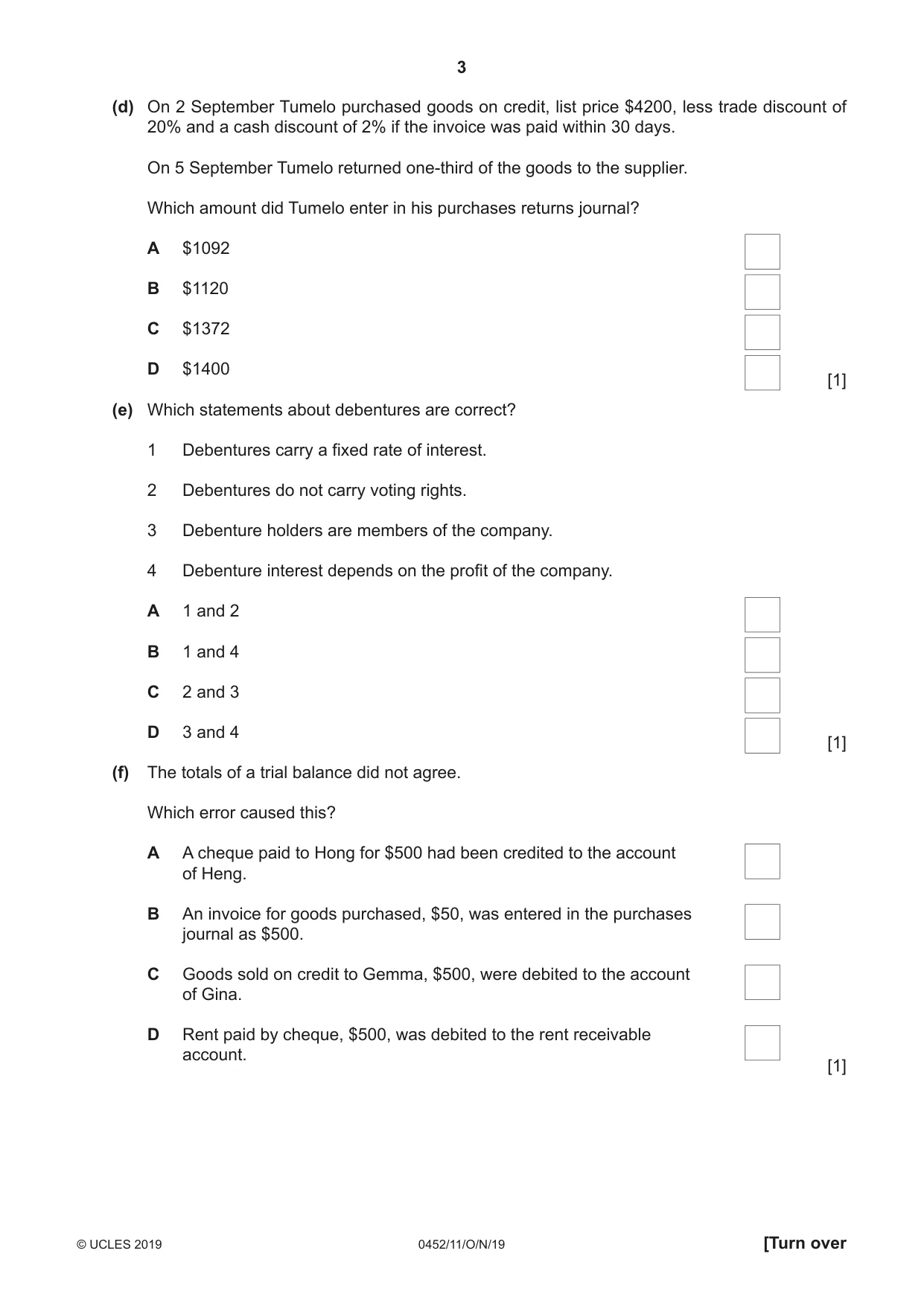
3 0452/11/O/N/19 © UCLES 2019 [Turn over (d) On 2 September Tumelo purchased goods on credit, list price $4200, less trade discount of 20% and a cash discount of 2% if the invoice was paid within 30 days. On 5 September Tumelo returned one-third of the goods to the supplier. Which amount did Tumelo enter in his purchases returns journal? A $1092 B $1120 C $1372 D $1400 [1] (e) Which statements about debentures are correct? 1 Debentures carry a fixed rate of interest. 2 Debentures do not carry voting rights. 3 Debenture holders are members of the company. 4 Debenture interest depends on the profit of the company. A 1 and 2 B 1 and 4 C 2 and 3 D 3 and 4 [1] (f) The totals of a trial balance did not agree. Which error caused this? A A cheque paid to Hong for $500 had been credited to the account of Heng. B An invoice for goods purchased, $50, was entered in the purchases journal as $500. C Goods sold on credit to Gemma, $500, were debited to the account of Gina. D Rent paid by cheque, $500, was debited to the rent receivable account. [1]
Question paper, page 4
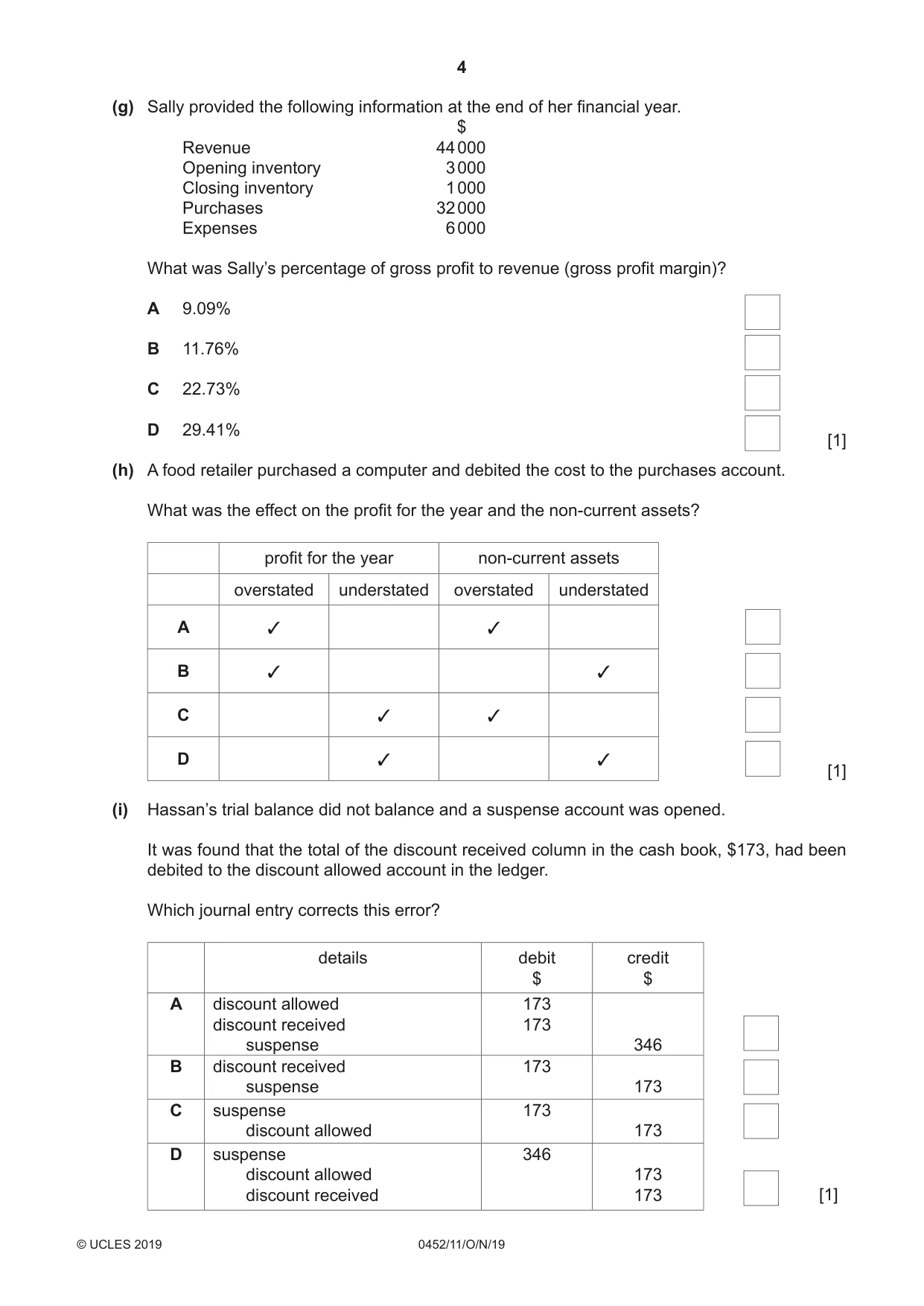
4 0452/11/O/N/19 © UCLES 2019 (g) Sally provided the following information at the end of her financial year. $ Revenue 44 000 Opening inventory 3 000 Closing inventory 1 000 Purchases 32 000 Expenses 6 000 What was Sally’s percentage of gross profit to revenue (gross profit margin)? A 9.09% B 11.76% C 22.73% D 29.41% [1] (h) A food retailer purchased a computer and debited the cost to the purchases account. What was the effect on the profit for the year and the non-current assets? profit for the year non-current assets overstated understated overstated understated A 3 3 B 3 3 C 3 3 D 3 3 [1] (i) Hassan’s trial balance did not balance and a suspense account was opened. It was found that the total of the discount received column in the cash book, $173, had been debited to the discount allowed account in the ledger. Which journal entry corrects this error? details debit $ credit $ A discount allowed discount received suspense 173 173 346 B discount received suspense 173 173 C suspense discount allowed 173 173 D suspense discount allowed discount received 346 173 173 [1]
Question paper, page 5
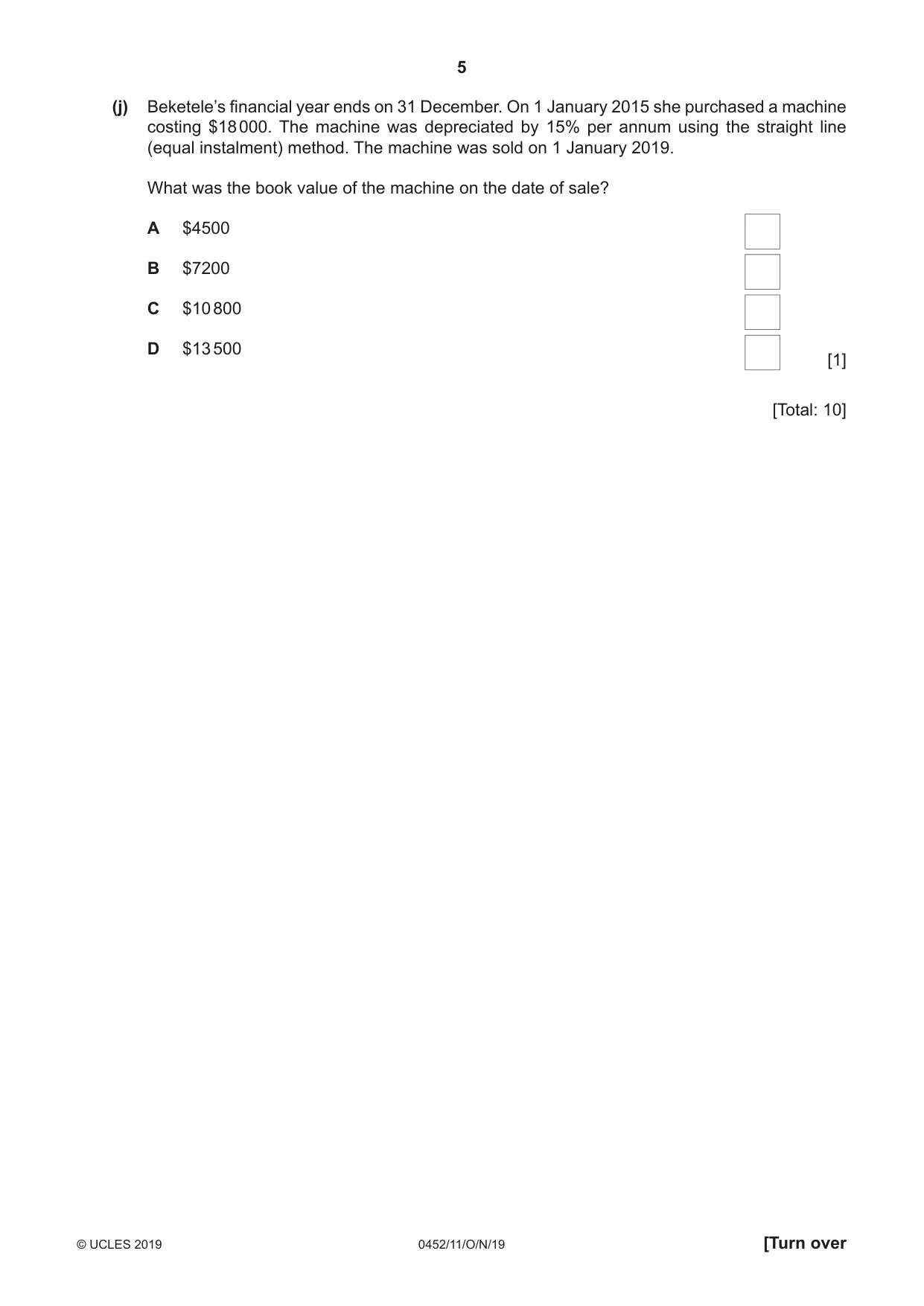
5 0452/11/O/N/19 © UCLES 2019 [Turn over (j) Beketele’s financial year ends on 31 December. On 1 January 2015 she purchased a machine costing $18 000. The machine was depreciated by 15% per annum using the straight line (equal instalment) method. The machine was sold on 1 January 2019. What was the book value of the machine on the date of sale? A $4500 B $7200 C $10 800 D $13 500 [1] [Total: 10]
Question paper, page 6
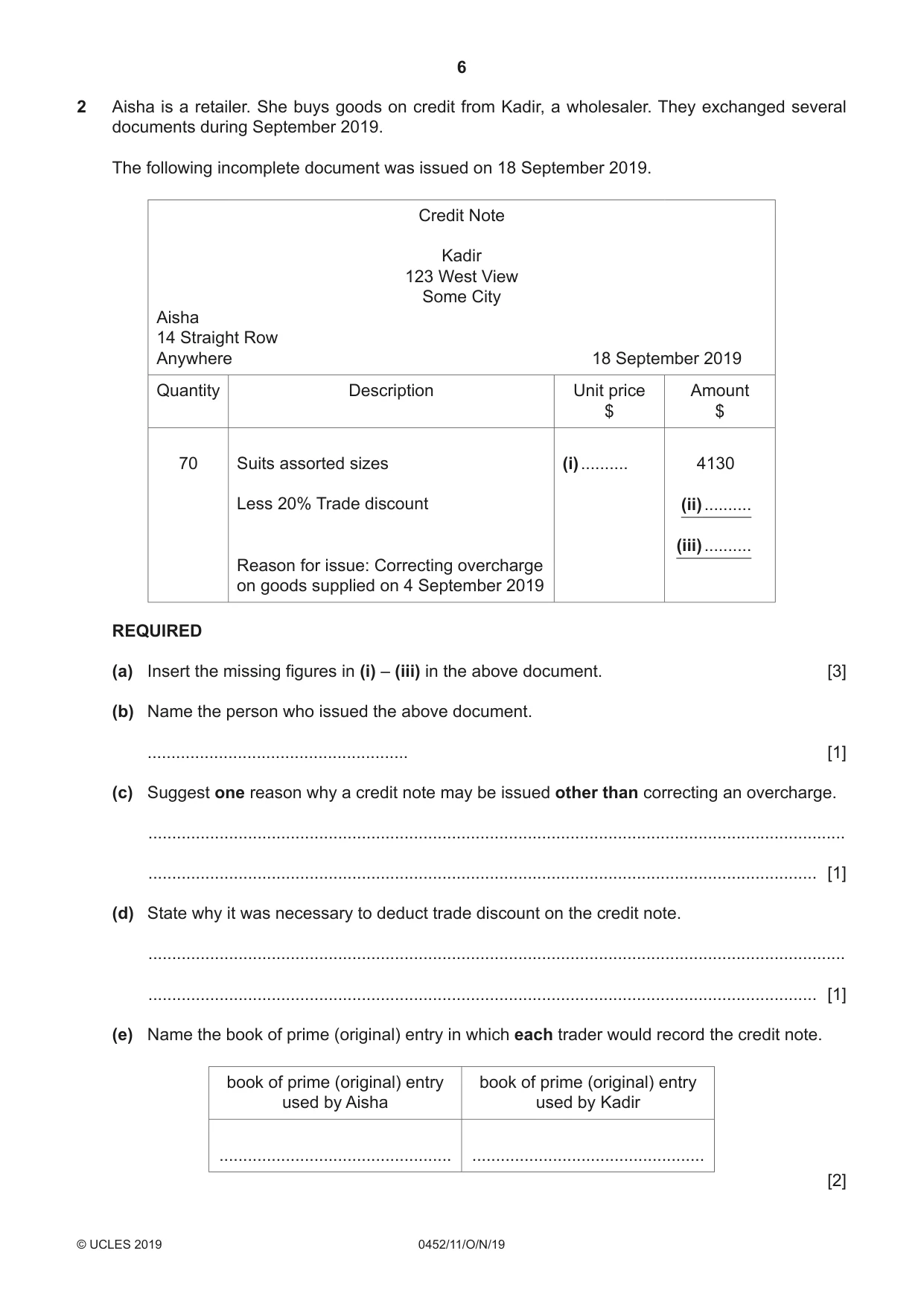
6 0452/11/O/N/19 © UCLES 2019 2 Aisha is a retailer. She buys goods on credit from Kadir, a wholesaler. They exchanged several documents during September 2019. The following incomplete document was issued on 18 September 2019. Credit Note Kadir 123 West View Some City Aisha 14 Straight Row Anywhere 18 September 2019 Quantity Description Unit price $ Amount $ 70 Suits assorted sizes Less 20% Trade discount Reason for issue: Correcting overcharge on goods supplied on 4 September 2019 (i) … 4130 (ii) … (iii) … REQUIRED (a) Insert the missing figures in (i) – (iii) in the above document. [3] (b) Name the person who issued the above document. … [1] (c) Suggest one reason why a credit note may be issued other than correcting an overcharge. … … [1] (d) State why it was necessary to deduct trade discount on the credit note. … … [1] (e) Name the book of prime (original) entry in which each trader would record the credit note. book of prime (original) entry used by Aisha book of prime (original) entry used by Kadir … … [2]
Question paper, page 7
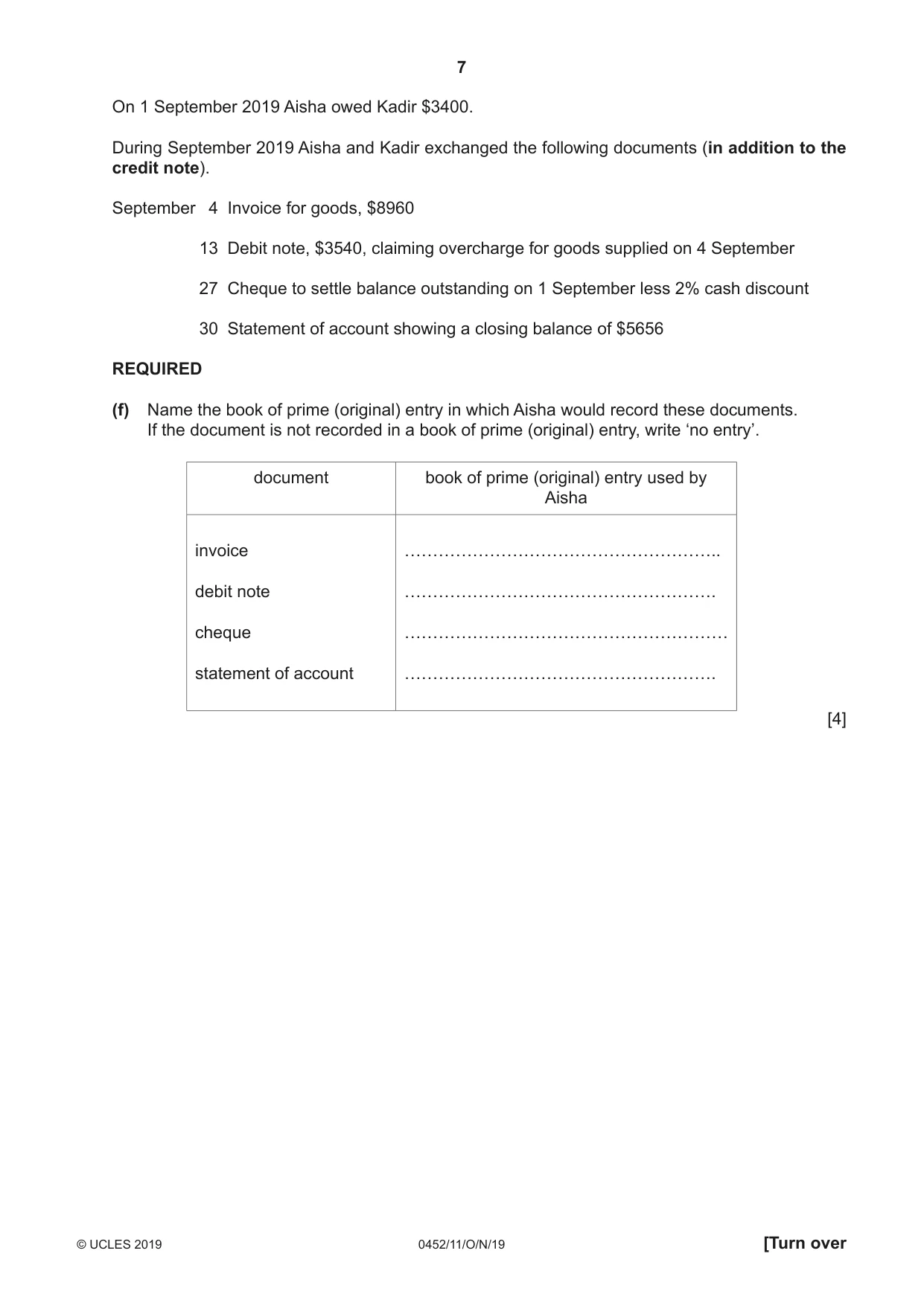
7 0452/11/O/N/19 © UCLES 2019 [Turn over On 1 September 2019 Aisha owed Kadir $3400. During September 2019 Aisha and Kadir exchanged the following documents (in addition to the credit note). September 4 Invoice for goods, $8960 13 Debit note, $3540, claiming overcharge for goods supplied on 4 September 27 Cheque to settle balance outstanding on 1 September less 2% cash discount 30 Statement of account showing a closing balance of $5656 REQUIRED (f) Name the book of prime (original) entry in which Aisha would record these documents. If the document is not recorded in a book of prime (original) entry, write ‘no entry’. document book of prime (original) entry used by Aisha invoice debit note cheque statement of account ……………………………………………….. ………………………………………………. ………………………………………………… ………………………………………………. [4]
Question paper, page 8
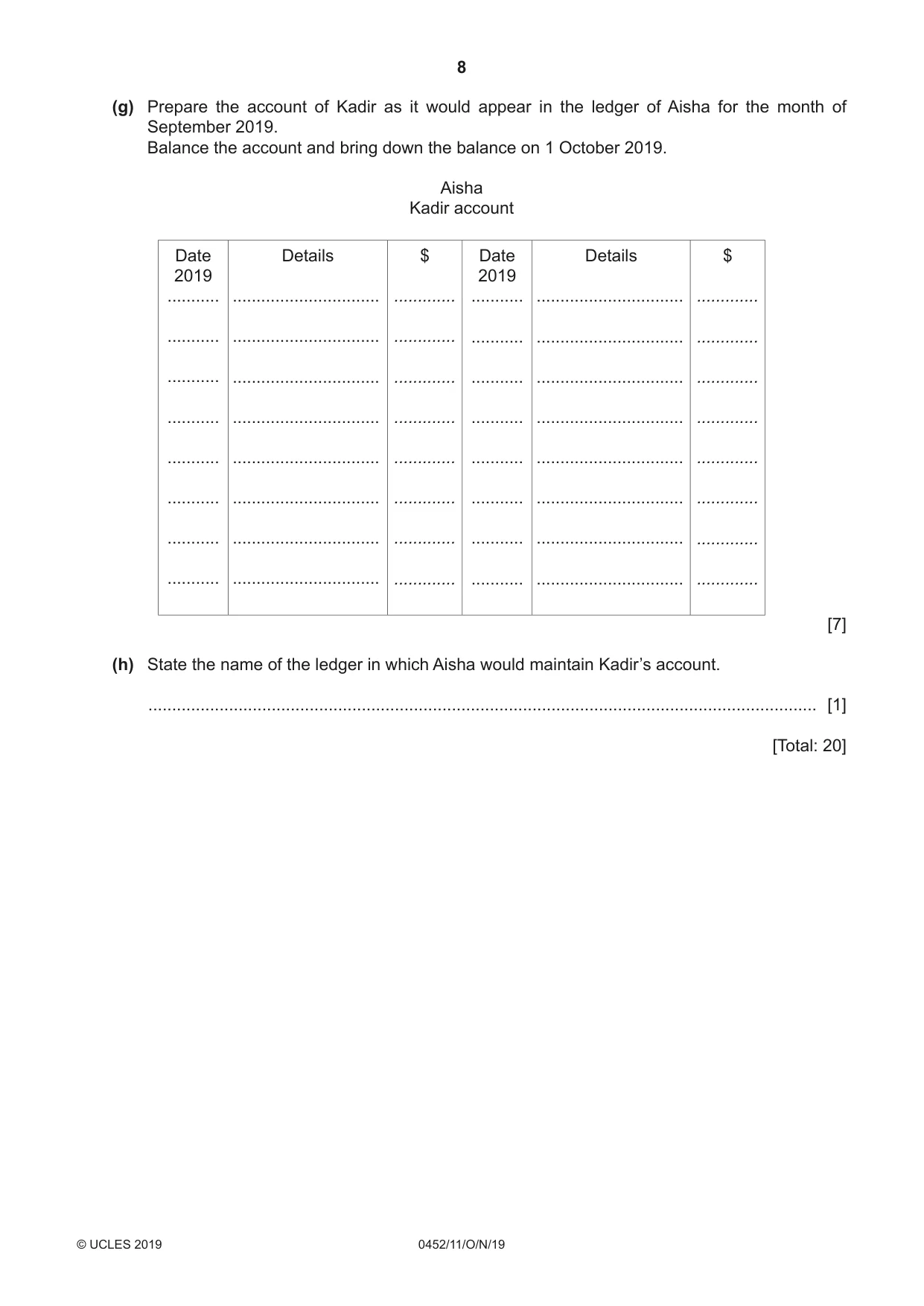
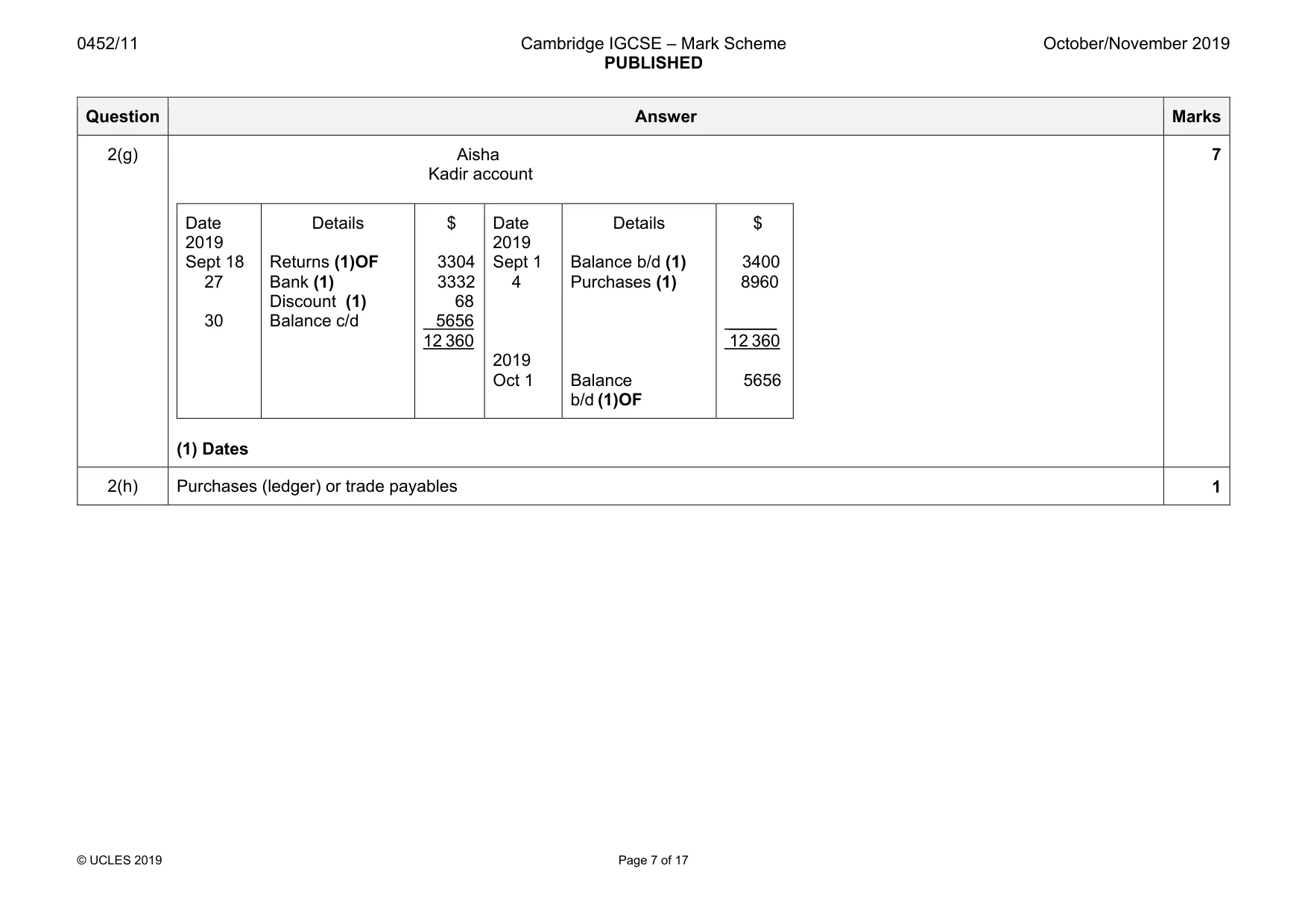
8 0452/11/O/N/19 © UCLES 2019 (g) Prepare the account of Kadir as it would appear in the ledger of Aisha for the month of September 2019. Balance the account and bring down the balance on 1 October 2019. Aisha Kadir account Date 2019 … … … … … … … … Details … … … … … … … … $ … … … … … … … … Date 2019 … … … … … … … … Details … … … … … … … … $ … … … … … … … … [7] (h) State the name of the ledger in which Aisha would maintain Kadir’s account. … [1] [Total: 20]
Question paper, page 9
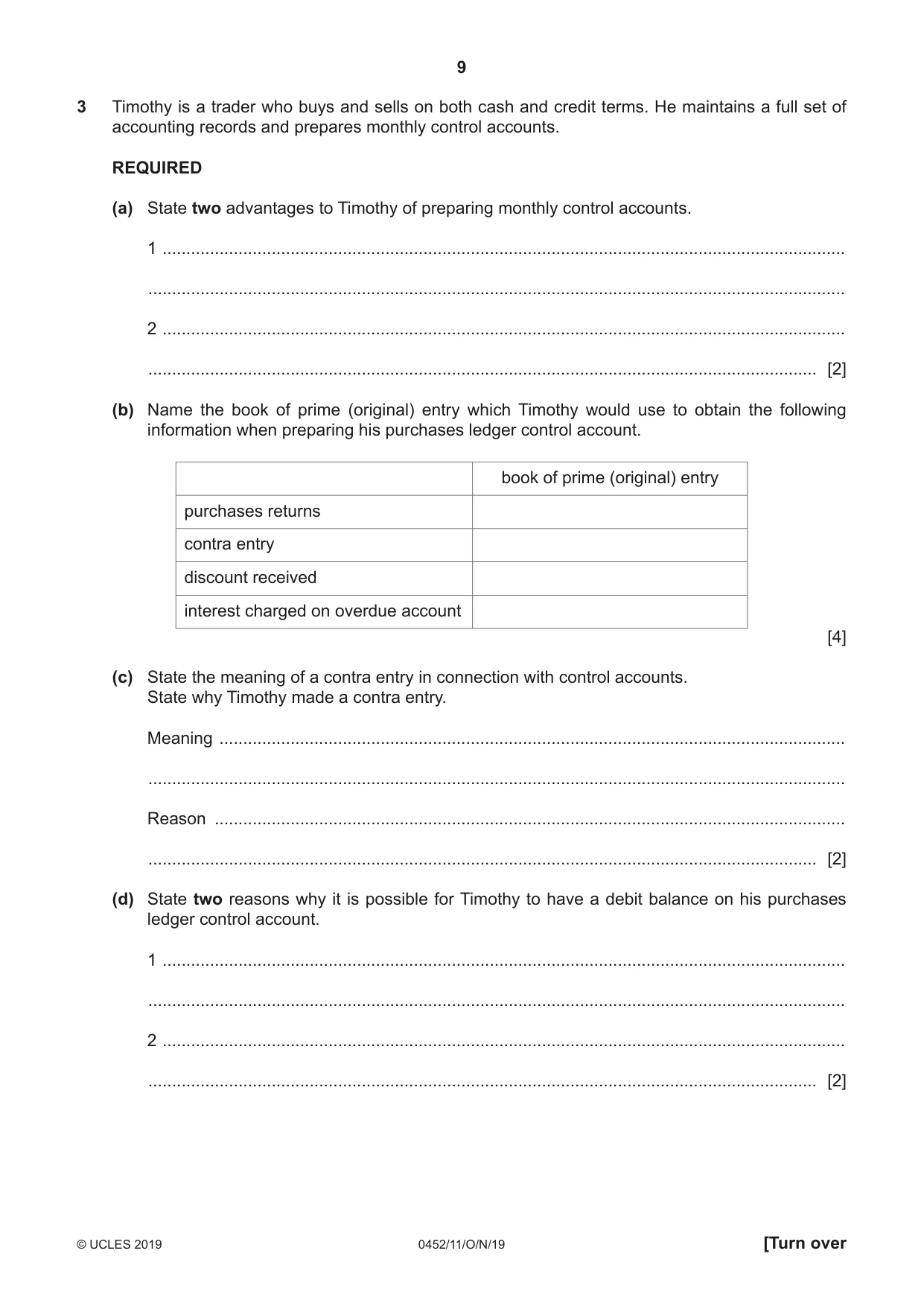
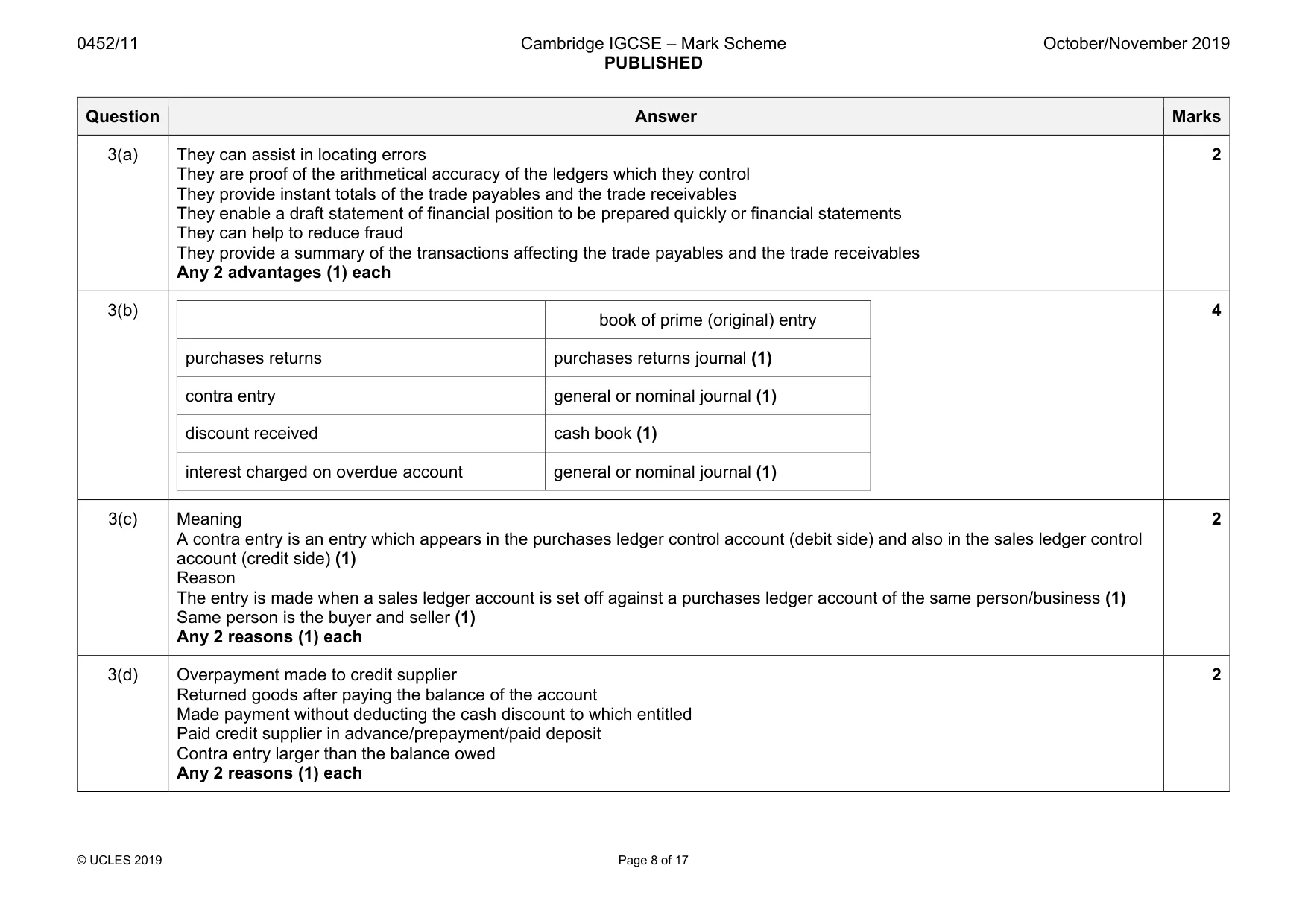
9 0452/11/O/N/19 © UCLES 2019 [Turn over 3 Timothy is a trader who buys and sells on both cash and credit terms. He maintains a full set of accounting records and prepares monthly control accounts. REQUIRED (a) State two advantages to Timothy of preparing monthly control accounts. 1 … … 2 … … [2] (b) Name the book of prime (original) entry which Timothy would use to obtain the following information when preparing his purchases ledger control account. book of prime (original) entry purchases returns contra entry discount received interest charged on overdue account [4] (c) State the meaning of a contra entry in connection with control accounts. State why Timothy made a contra entry. Meaning … … Reason … … [2] (d) State two reasons why it is possible for Timothy to have a debit balance on his purchases ledger control account. 1 … … 2 … … [2]
Question paper, page 10
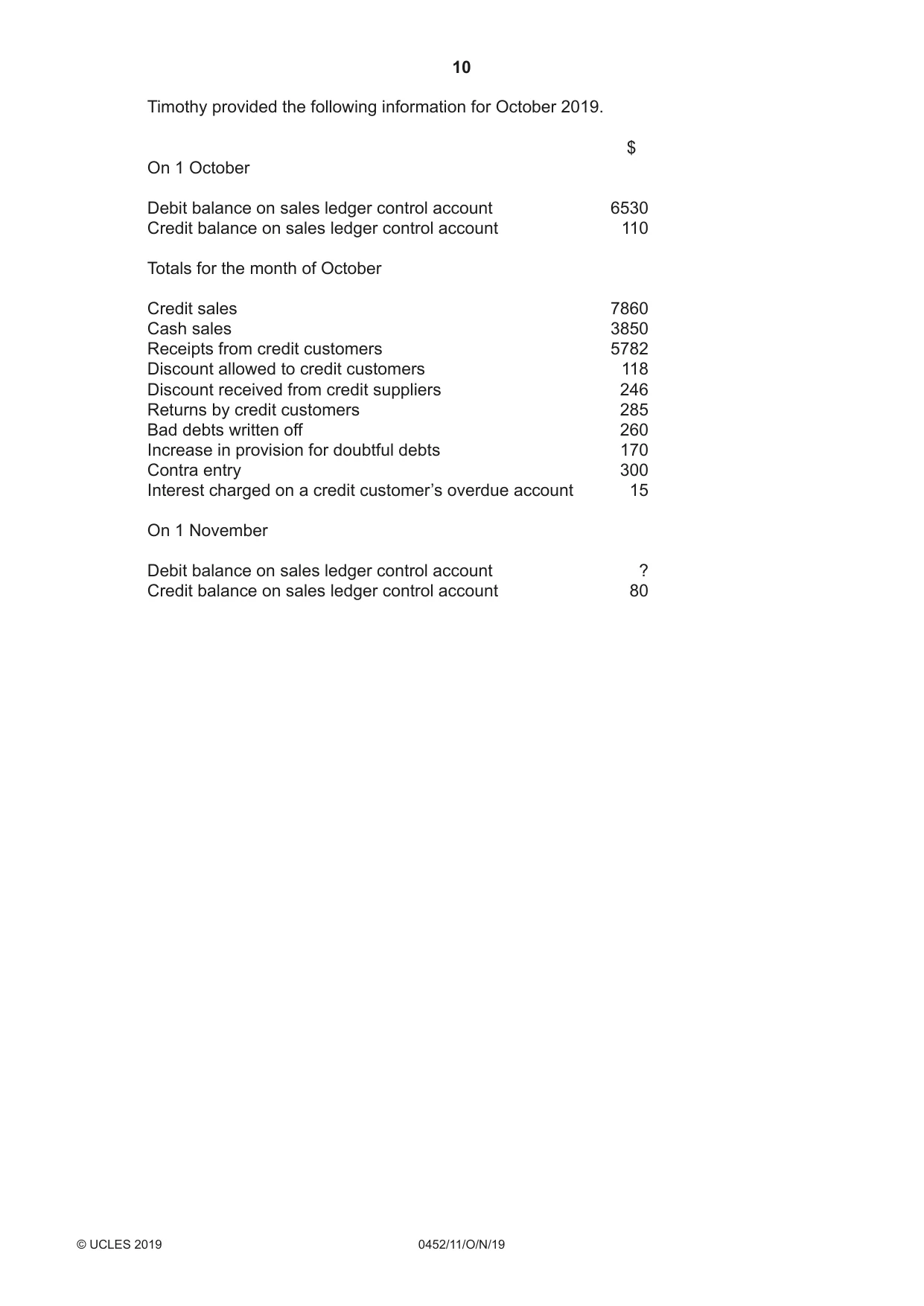
10 0452/11/O/N/19 © UCLES 2019 Timothy provided the following information for October 2019. $ On 1 October Debit balance on sales ledger control account 6530 Credit balance on sales ledger control account 110 Totals for the month of October Credit sales 7860 Cash sales 3850 Receipts from credit customers 5782 Discount allowed to credit customers 118 Discount received from credit suppliers 246 Returns by credit customers 285 Bad debts written off 260 Increase in provision for doubtful debts 170 Contra entry 300 Interest charged on a credit customer’s overdue account 15 On 1 November Debit balance on sales ledger control account ? Credit balance on sales ledger control account 80
Question paper, page 11
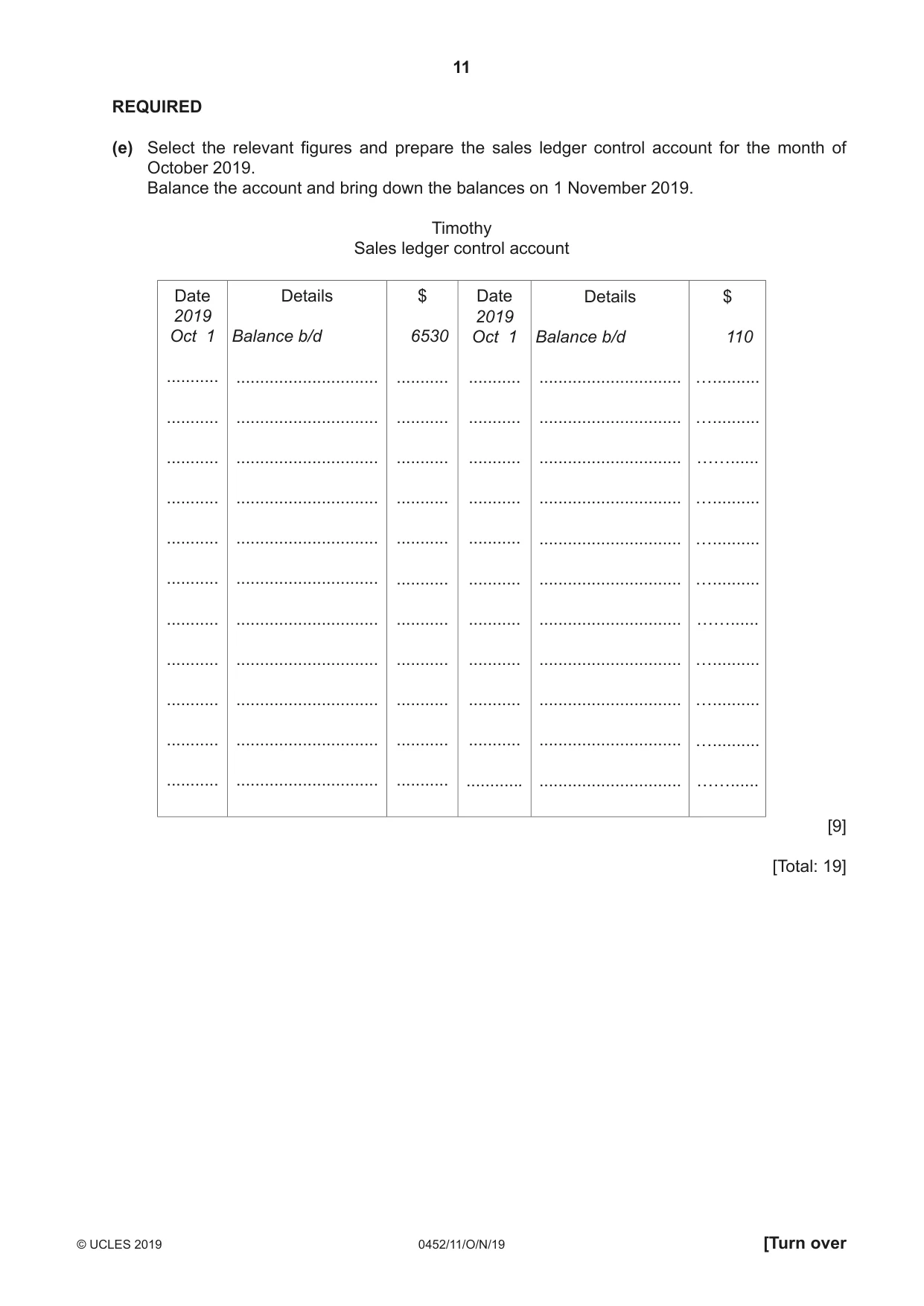
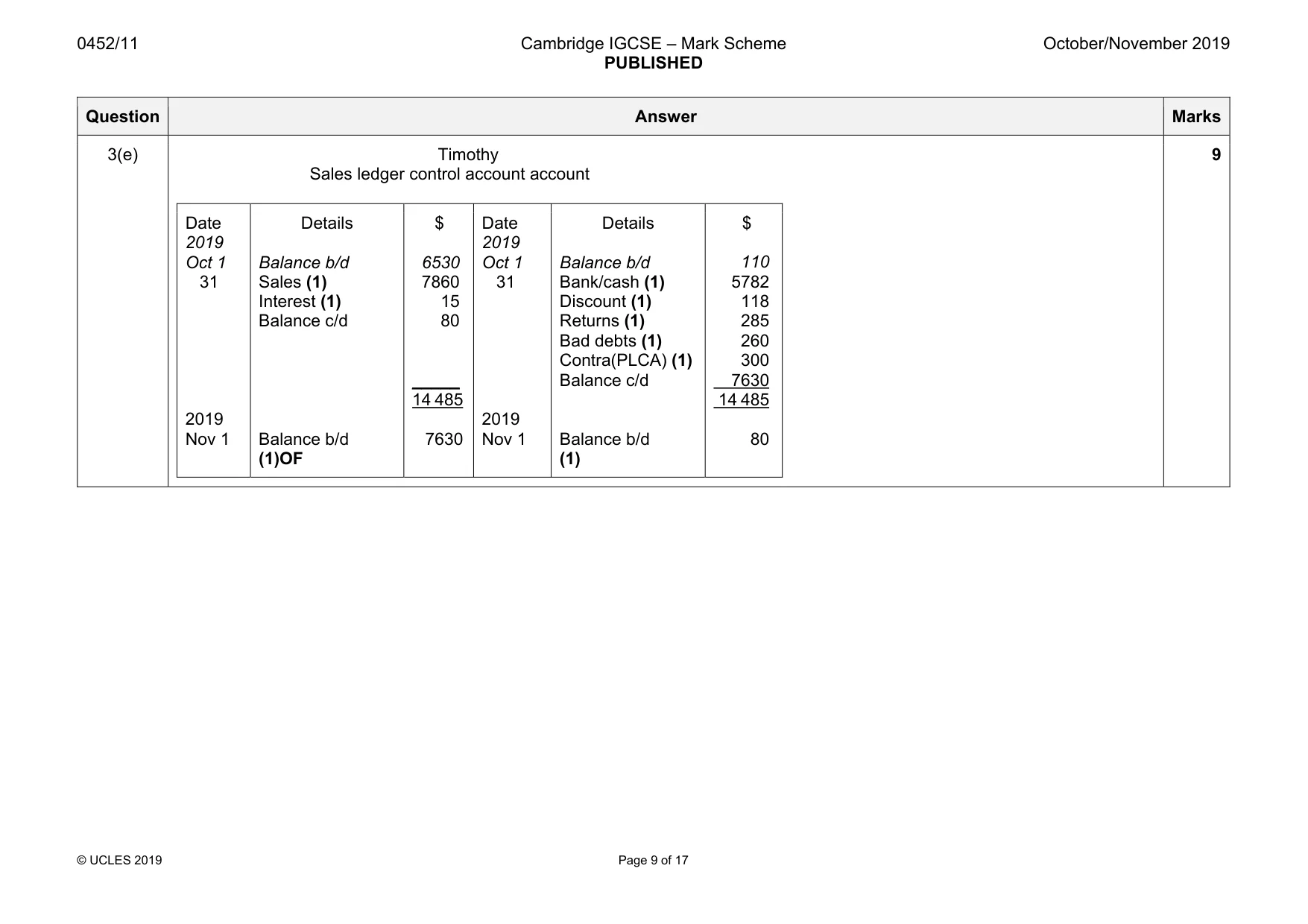
11 0452/11/O/N/19 © UCLES 2019 [Turn over REQUIRED (e) Select the relevant figures and prepare the sales ledger control account for the month of October 2019. Balance the account and bring down the balances on 1 November 2019. Timothy Sales ledger control account Date 2019 Oct 1 … … … … … … … … … … … Details Balance b/d … … … … … … … … … … … $ 6530 … … … … … … … … … … … Date 2019 Oct 1 … … … … … … … … … … … Details Balance b/d … … … … … … … … … … … $ 110 …… …… ……… …… …… …… ……… …… …… …… ……… [9] [Total: 19]
Question paper, page 12
12 0452/11/O/N/19 © UCLES 2019 Question 4 is on the next page.
Question paper, page 13
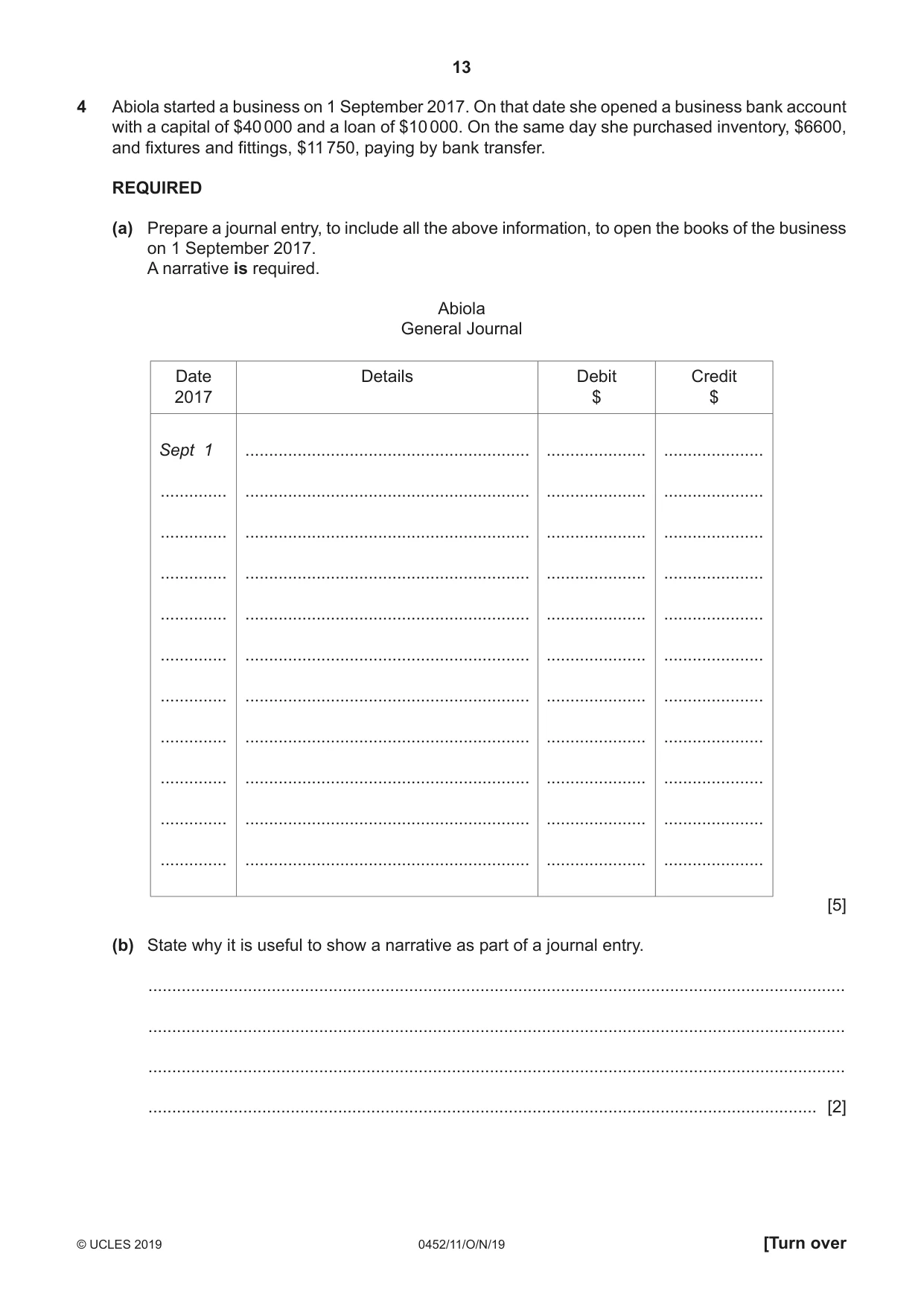
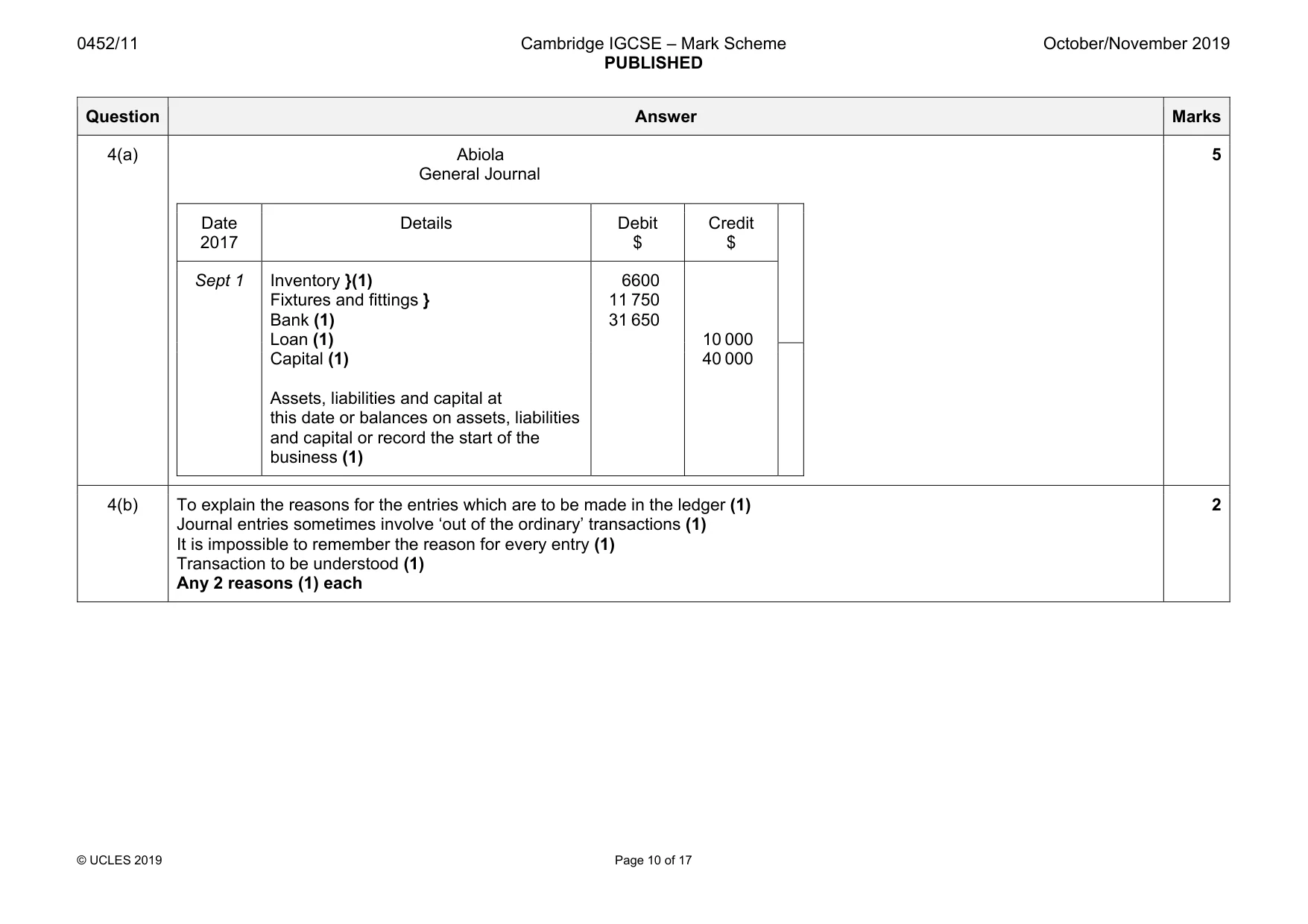
13 0452/11/O/N/19 © UCLES 2019 [Turn over 4 Abiola started a business on 1 September 2017. On that date she opened a business bank account with a capital of $40 000 and a loan of $10 000. On the same day she purchased inventory, $6600, and fixtures and fittings, $11 750, paying by bank transfer. REQUIRED (a) Prepare a journal entry, to include all the above information, to open the books of the business on 1 September 2017. A narrative is required. Abiola General Journal Date 2017 Details Debit $ Credit $ Sept 1 … … … … … … … … … … … … … … … … … … … … … … … … … … … … … … … … … … … … … … … … … … … [5] (b) State why it is useful to show a narrative as part of a journal entry. … … … … [2]
Question paper, page 14
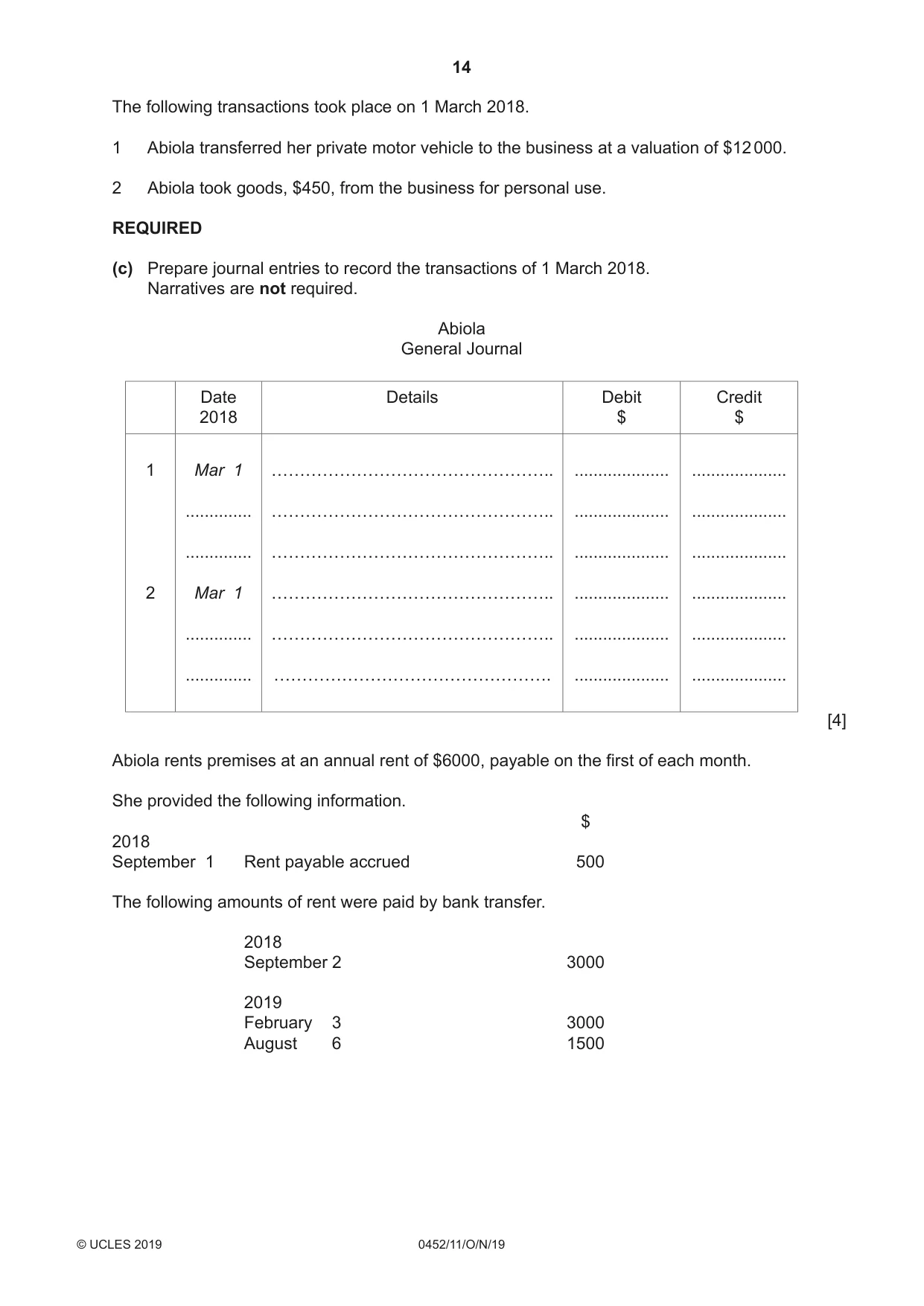
14 0452/11/O/N/19 © UCLES 2019 The following transactions took place on 1 March 2018. 1 Abiola transferred her private motor vehicle to the business at a valuation of $12 000. 2 Abiola took goods, $450, from the business for personal use. REQUIRED (c) Prepare journal entries to record the transactions of 1 March 2018. Narratives are not required. Abiola General Journal Date 2018 Details Debit $ Credit $ 1 2 Mar 1 … … Mar 1 … … ………………………………………….. ………………………………………….. ………………………………………….. ………………………………………….. ………………………………………….. …………………………………………. … … … … … … … … … … … … [4] Abiola rents premises at an annual rent of $6000, payable on the first of each month. She provided the following information. $ 2018 September 1 Rent payable accrued 500 The following amounts of rent were paid by bank transfer. 2018 September 2 3000 2019 February 3 3000 August 6 1500
Question paper, page 15
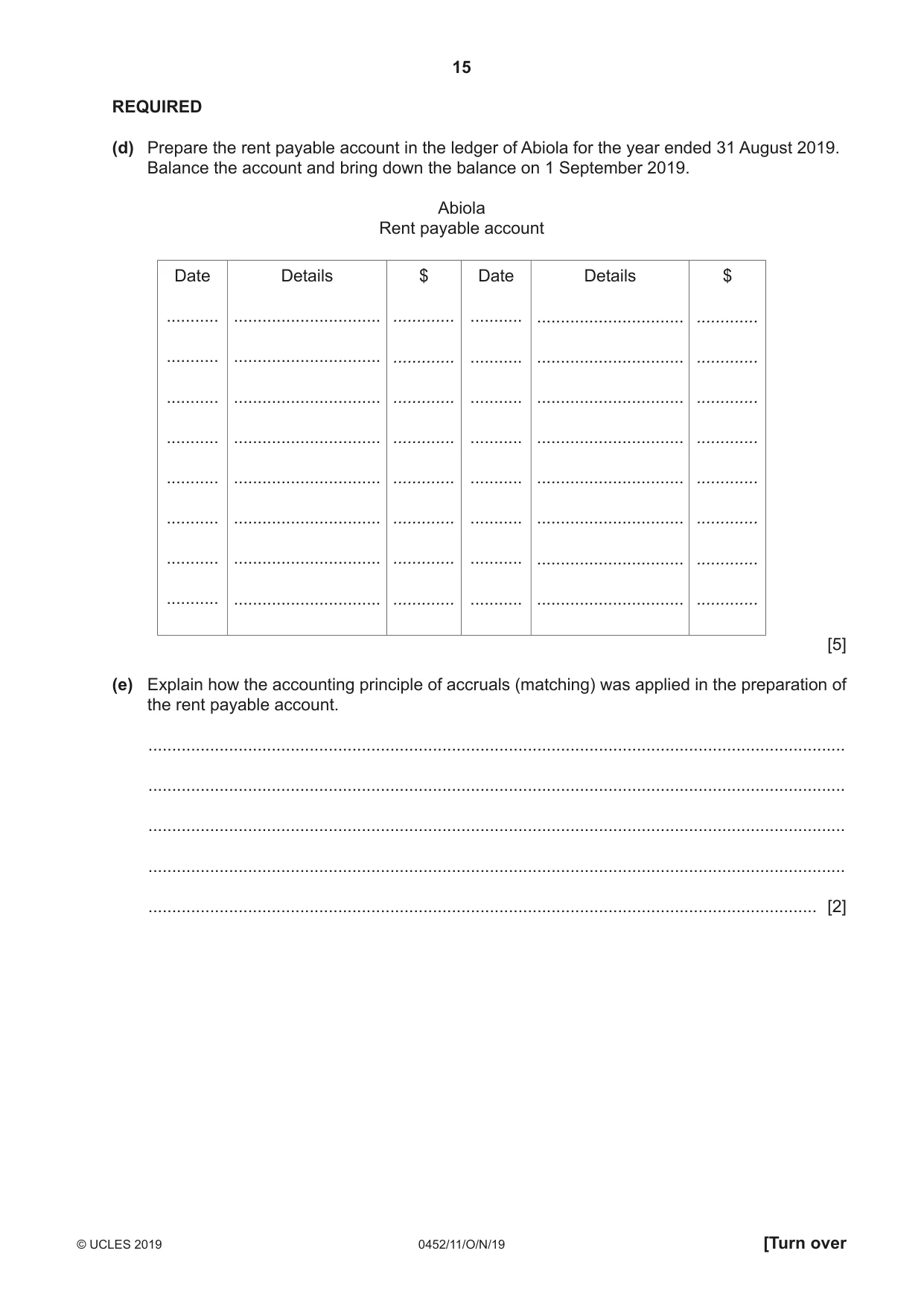
15 0452/11/O/N/19 © UCLES 2019 [Turn over REQUIRED (d) Prepare the rent payable account in the ledger of Abiola for the year ended 31 August 2019. Balance the account and bring down the balance on 1 September 2019. Abiola Rent payable account Date … … … … … … … … Details … … … … … … … … $ … … … … … … … … Date … … … … … … … … Details … … … … … … … … $ … … … … … … … … [5] (e) Explain how the accounting principle of accruals (matching) was applied in the preparation of the rent payable account. … … … … … [2]
Question paper, page 16
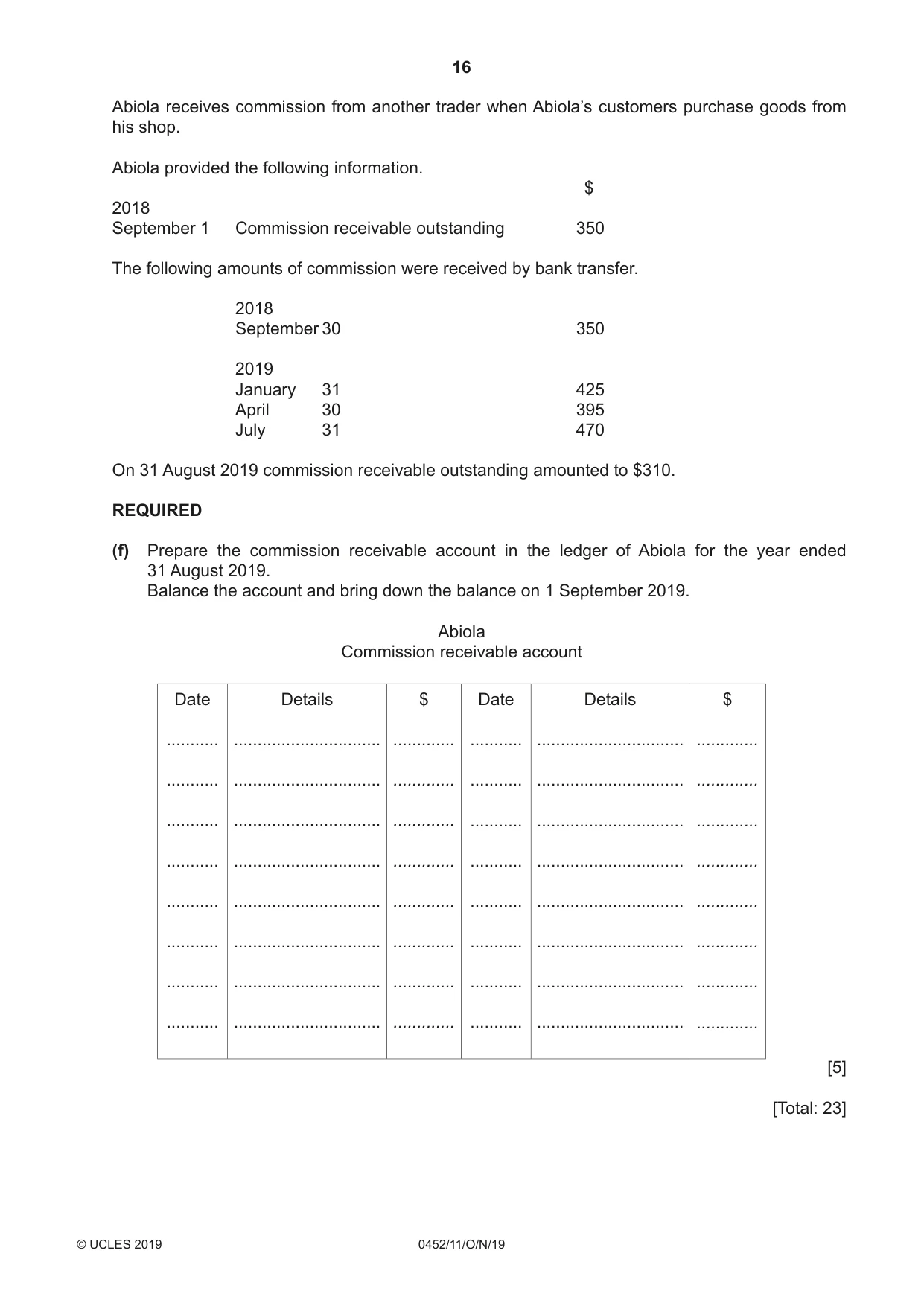
16 0452/11/O/N/19 © UCLES 2019 Abiola receives commission from another trader when Abiola’s customers purchase goods from his shop. Abiola provided the following information. $ 2018 September 1 Commission receivable outstanding 350 The following amounts of commission were received by bank transfer. 2018 September 30 350 2019 January 31 425 April 30 395 July 31 470 On 31 August 2019 commission receivable outstanding amounted to $310. REQUIRED (f) Prepare the commission receivable account in the ledger of Abiola for the year ended 31 August 2019. Balance the account and bring down the balance on 1 September 2019. Abiola Commission receivable account Date … … … … … … … … Details … … … … … … … … $ … … … … … … … … Date … … … … … … … … Details … … … … … … … … $ … … … … … … … … [5] [Total: 23]
Question paper, page 17
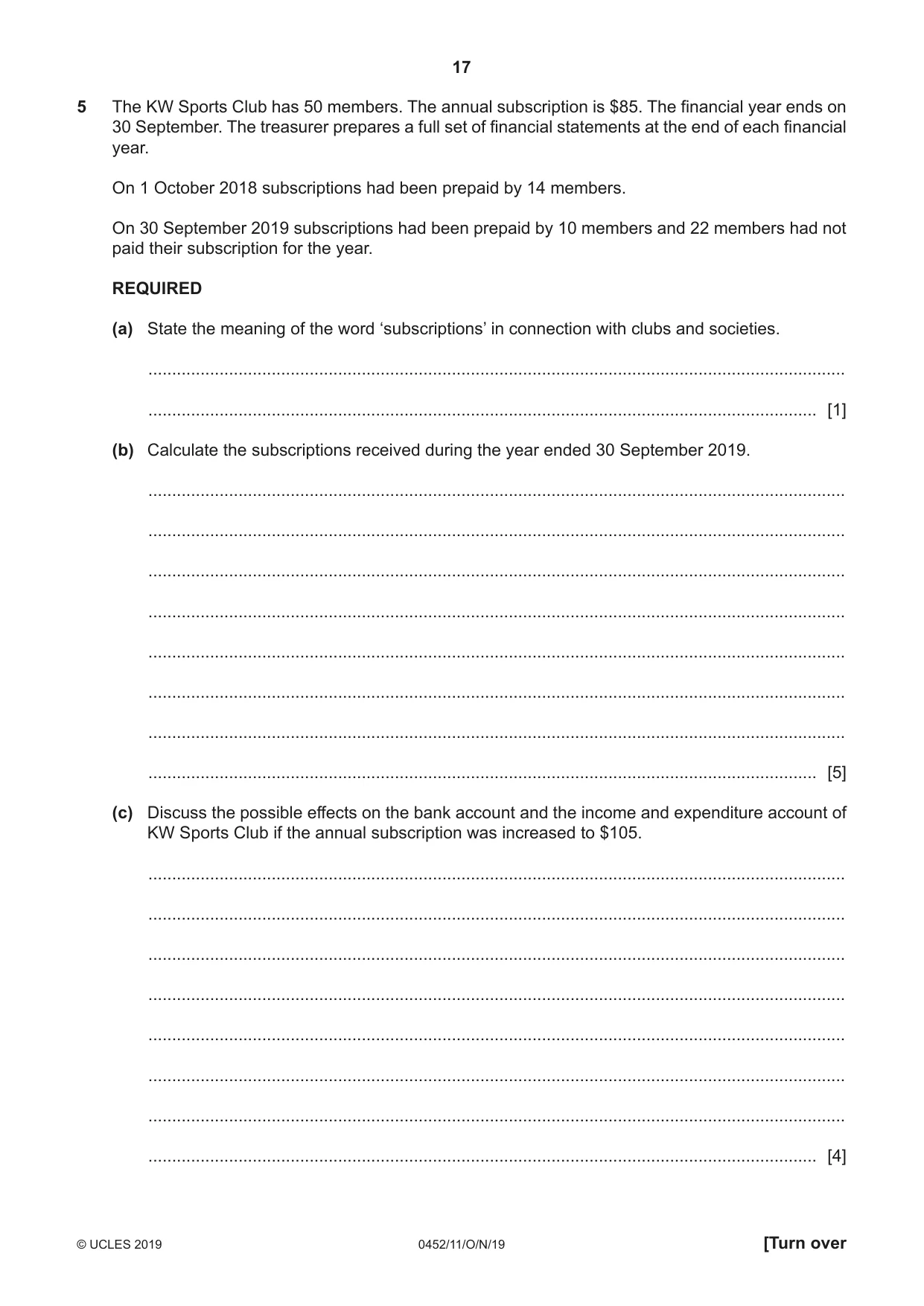
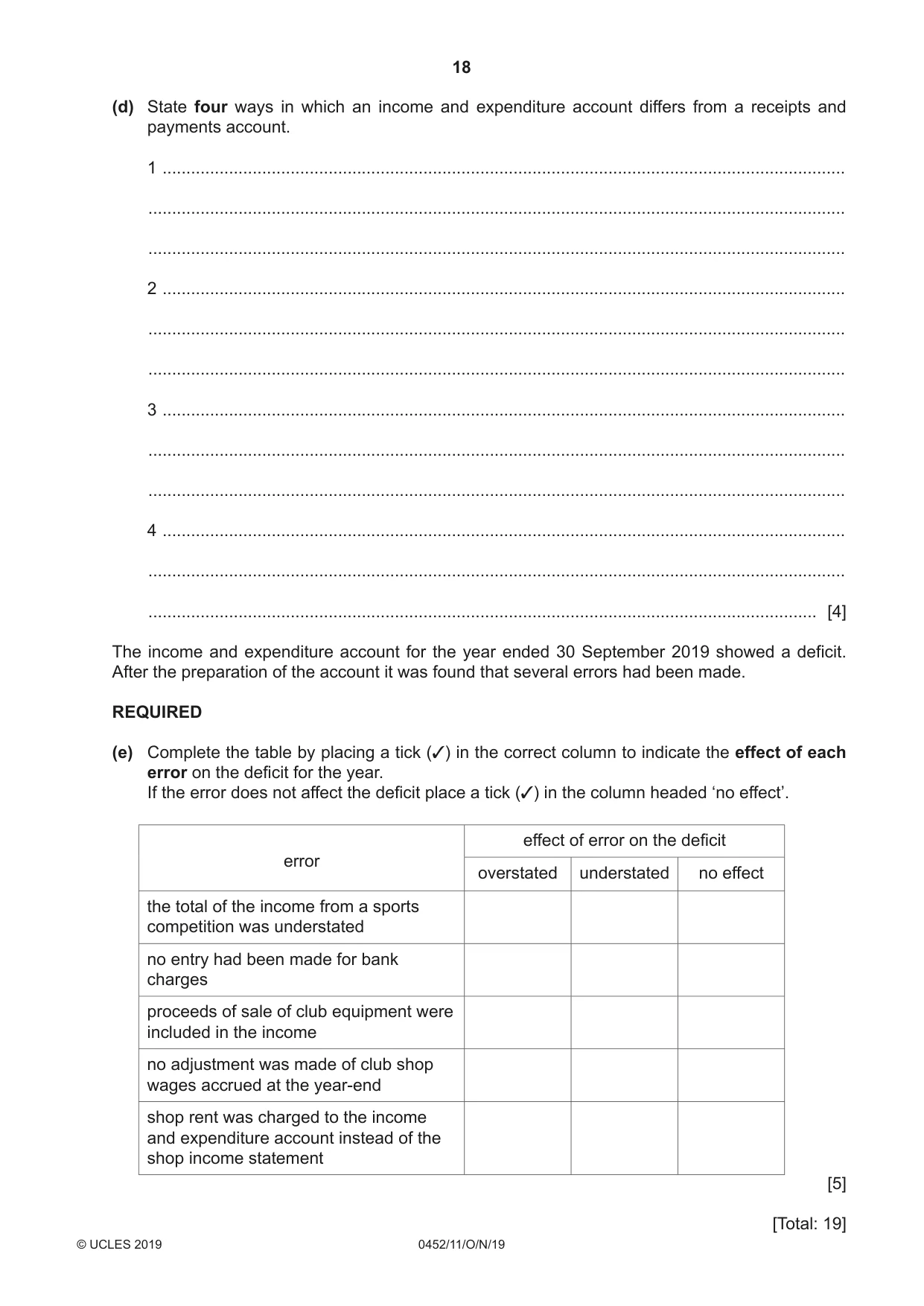
17 0452/11/O/N/19 © UCLES 2019 [Turn over 5 The KW Sports Club has 50 members. The annual subscription is $85. The financial year ends on 30 September. The treasurer prepares a full set of financial statements at the end of each financial year. On 1 October 2018 subscriptions had been prepaid by 14 members. On 30 September 2019 subscriptions had been prepaid by 10 members and 22 members had not paid their subscription for the year. REQUIRED (a) State the meaning of the word ‘subscriptions’ in connection with clubs and societies. … … [1] (b) Calculate the subscriptions received during the year ended 30 September 2019. … … … … … … … … [5] (c) Discuss the possible effects on the bank account and the income and expenditure account of KW Sports Club if the annual subscription was increased to $105. … … … … … … … … [4]
Question paper, page 18
18 0452/11/O/N/19 © UCLES 2019 (d) State four ways in which an income and expenditure account differs from a receipts and payments account. 1 … … … 2 … … … 3 … … … 4 … … … [4] The income and expenditure account for the year ended 30 September 2019 showed a deficit. After the preparation of the account it was found that several errors had been made. REQUIRED (e) Complete the table by placing a tick (3) in the correct column to indicate the effect of each error on the deficit for the year. If the error does not affect the deficit place a tick (3) in the column headed ‘no effect’. error effect of error on the deficit overstated understated no effect the total of the income from a sports competition was understated no entry had been made for bank charges proceeds of sale of club equipment were included in the income no adjustment was made of club shop wages accrued at the year-end shop rent was charged to the income and expenditure account instead of the shop income statement [5] [Total: 19]
Question paper, page 19
19 0452/11/O/N/19 © UCLES 2019 [Turn over PLEASE TURN OVER
Question paper, page 20
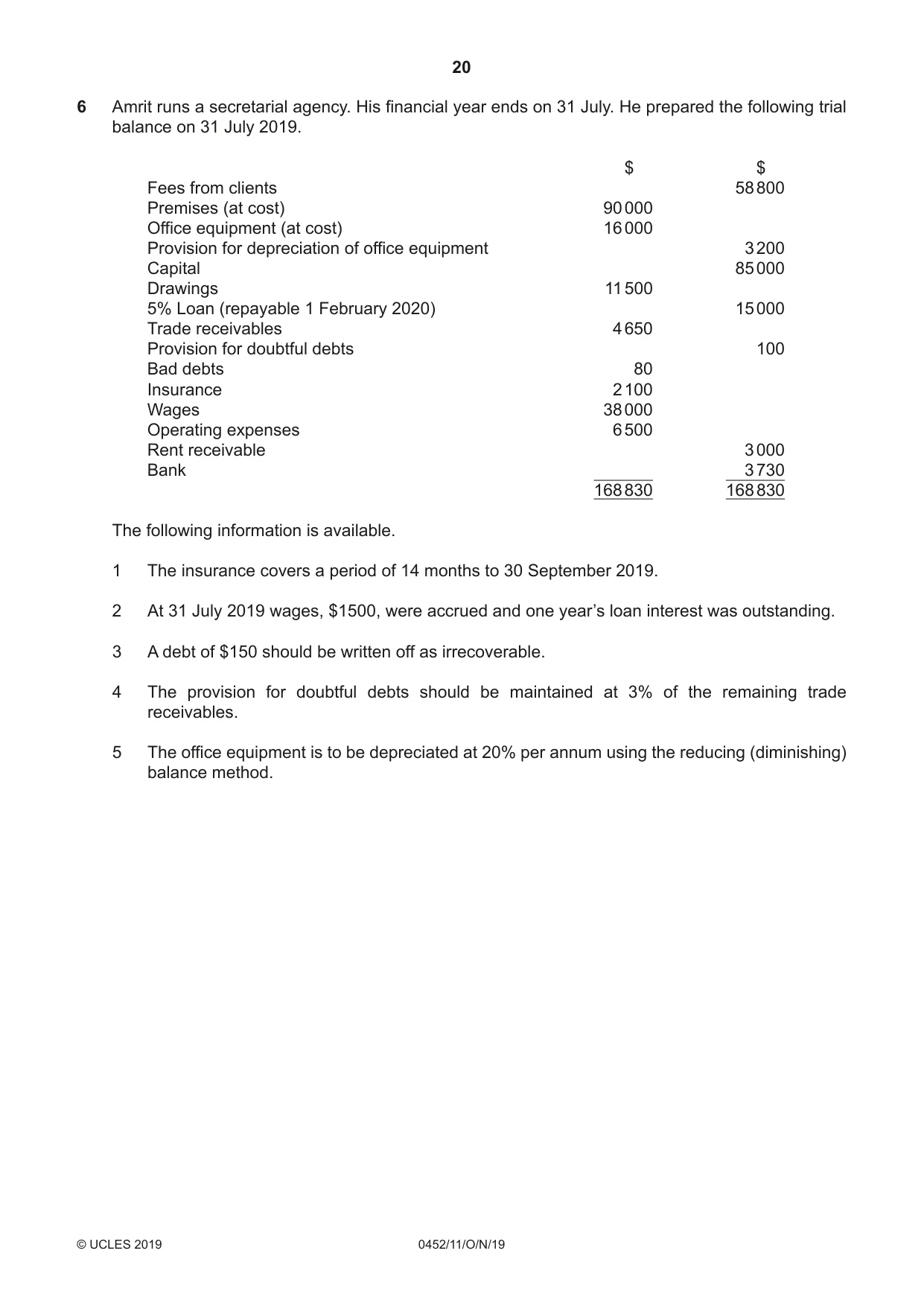
20 0452/11/O/N/19 © UCLES 2019 6 Amrit runs a secretarial agency. His financial year ends on 31 July. He prepared the following trial balance on 31 July 2019. $ $ Fees from clients 58 800 Premises (at cost) 90 000 Office equipment (at cost) 16 000 Provision for depreciation of office equipment 3 200 Capital 85 000 Drawings 11 500 5% Loan (repayable 1 February 2020) 15 000 Trade receivables 4 650 Provision for doubtful debts 100 Bad debts 80 Insurance 2 100 Wages 38 000 Operating expenses 6 500 Rent receivable 3 000 Bank 3 730 168 830 168 830 The following information is available. 1 The insurance covers a period of 14 months to 30 September 2019. 2 At 31 July 2019 wages, $1500, were accrued and one year’s loan interest was outstanding. 3 A debt of $150 should be written off as irrecoverable. 4 The provision for doubtful debts should be maintained at 3% of the remaining trade receivables. 5 The office equipment is to be depreciated at 20% per annum using the reducing (diminishing) balance method.
Question paper, page 21
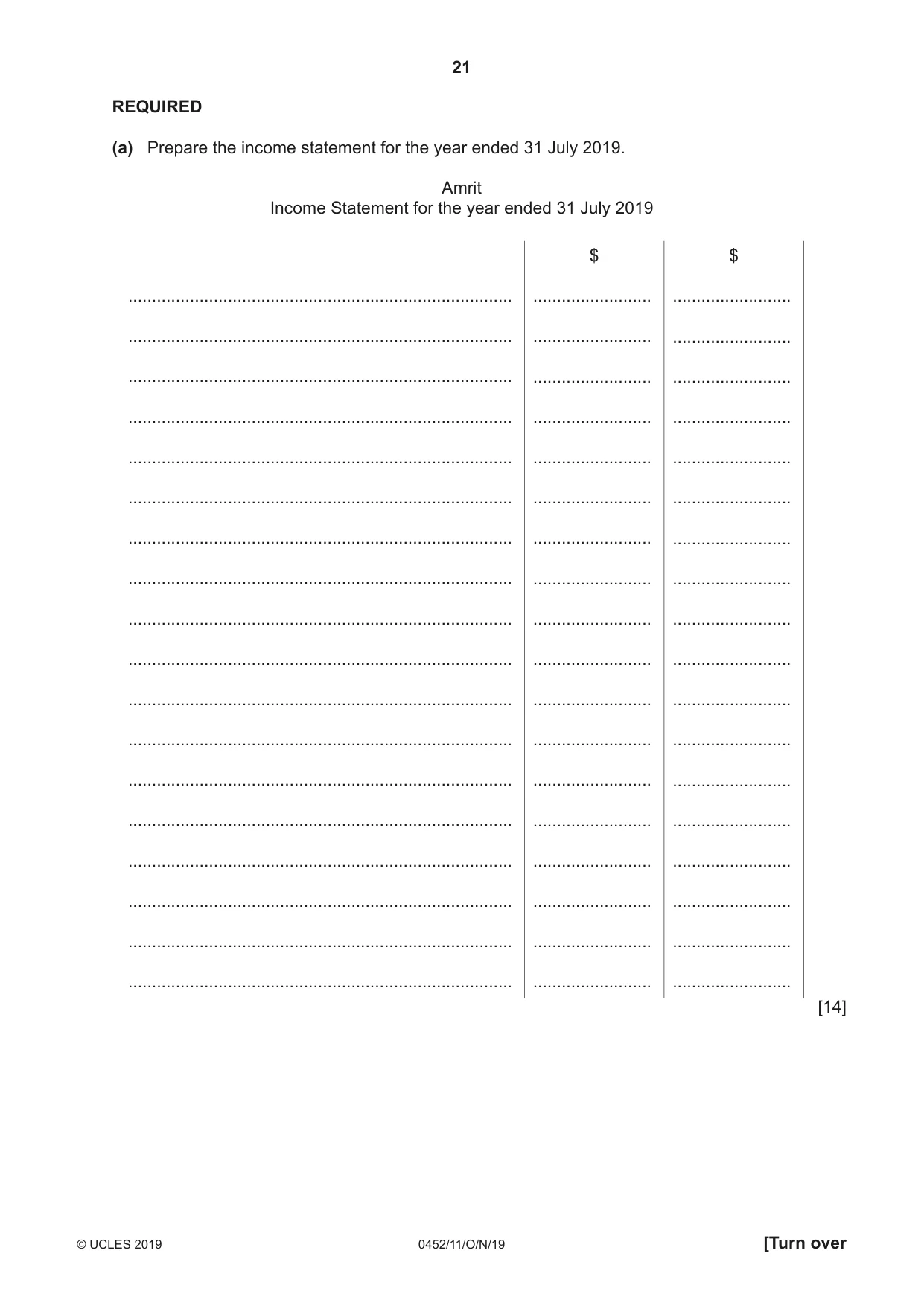
21 0452/11/O/N/19 © UCLES 2019 [Turn over REQUIRED (a) Prepare the income statement for the year ended 31 July 2019. Amrit Income Statement for the year ended 31 July 2019 … … … … … … … … … … … … … … … … … … $ … … … … … … … … … … … … … … … … … … $ … … … … … … … … … … … … … … … … … … [14]
Question paper, page 22
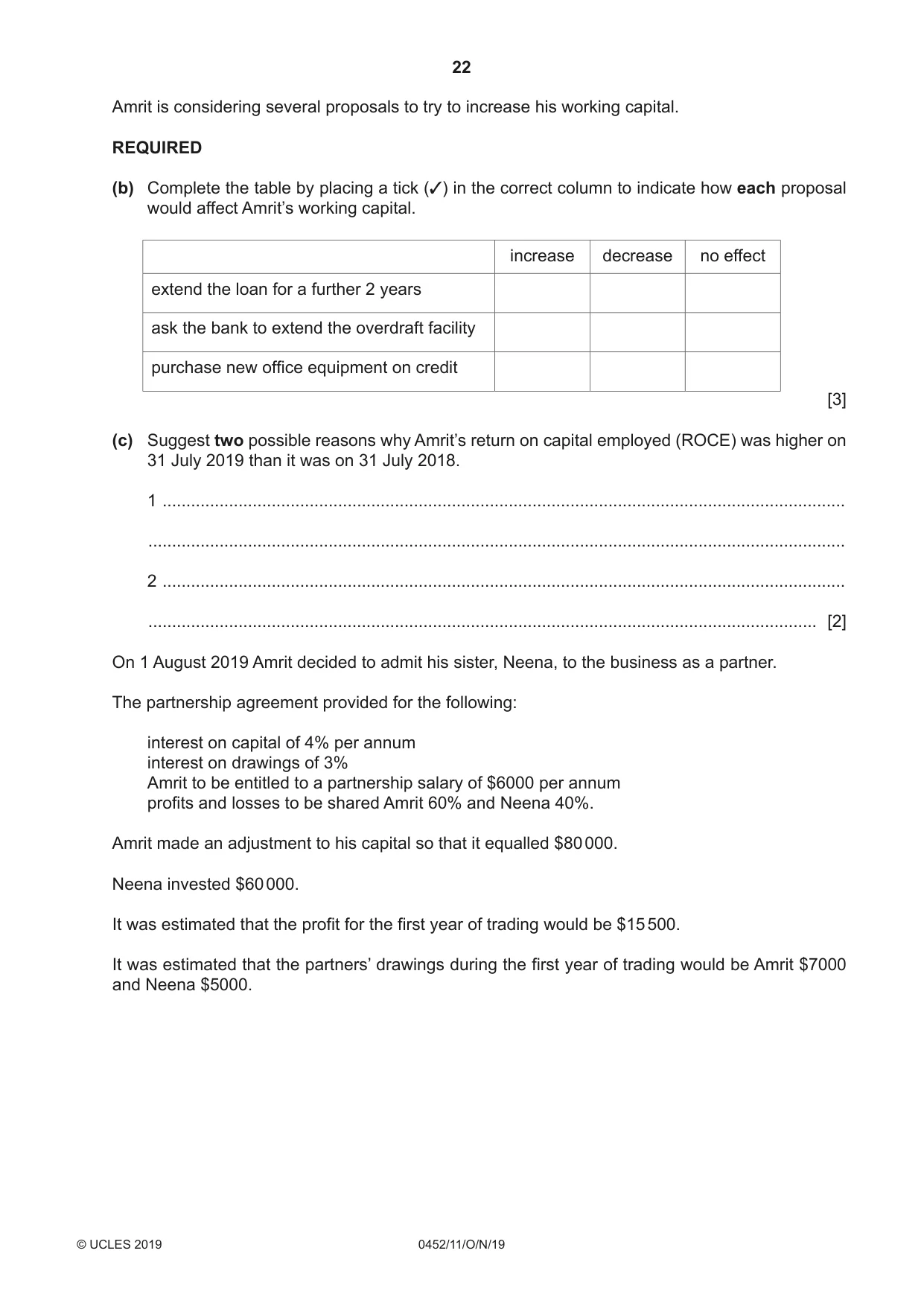
22 0452/11/O/N/19 © UCLES 2019 Amrit is considering several proposals to try to increase his working capital. REQUIRED (b) Complete the table by placing a tick (3) in the correct column to indicate how each proposal would affect Amrit’s working capital. increase decrease no effect extend the loan for a further 2 years ask the bank to extend the overdraft facility purchase new office equipment on credit [3] (c) Suggest two possible reasons why Amrit’s return on capital employed (ROCE) was higher on 31 July 2019 than it was on 31 July 2018. 1 … … 2 … … [2] On 1 August 2019 Amrit decided to admit his sister, Neena, to the business as a partner. The partnership agreement provided for the following: interest on capital of 4% per annum interest on drawings of 3% Amrit to be entitled to a partnership salary of $6000 per annum profits and losses to be shared Amrit 60% and Neena 40%. Amrit made an adjustment to his capital so that it equalled $80 000. Neena invested $60 000. It was estimated that the profit for the first year of trading would be $15 500. It was estimated that the partners’ drawings during the first year of trading would be Amrit $7000 and Neena $5000.
Question paper, page 23
23 0452/11/O/N/19 © UCLES 2019 REQUIRED (d) State two advantages to Amrit of being a partner rather than a sole trader. 1 … … 2 … … [2] (e) State two disadvantages to Amrit of being a partner rather than a sole trader. 1 … … 2 … … [2] (f) Complete the estimated profit and loss appropriation account for the year ending 31 July 2020. Amrit and Neena Estimated Profit and Loss Appropriation Account for the year ending 31 July 2020 Estimated profit for the year Interest on drawings Amrit Neena Interest on capital Amrit Neena Partnership salary Amrit Share of profit/loss Amrit Neena $ … … … … … … … … … … $ 15 500 … … … … … … … … … … [6] [Total: 29]
Question paper, page 24
24 0452/11/O/N/19 © UCLES 2019 Permission to reproduce items where third-party owned material protected by copyright is included has been sought and cleared where possible. Every reasonable effort has been made by the publisher (UCLES) to trace copyright holders, but if any items requiring clearance have unwittingly been included, the publisher will be pleased to make amends at the earliest possible opportunity. To avoid the issue of disclosure of answer-related information to candidates, all copyright acknowledgements are reproduced online in the Cambridge Assessment International Education Copyright Acknowledgements Booklet. This is produced for each series of examinations and is freely available to download at www.cambridgeinternational.org after the live examination series. Cambridge Assessment International Education is part of the Cambridge Assessment Group. Cambridge Assessment is the brand name of the University of Cambridge Local Examinations Syndicate (UCLES), which itself is a department of the University of Cambridge. BLANK PAGE
Mark scheme, page 1
This document consists of 17 printed pages. © UCLES 2019 [Turn over Cambridge Assessment International Education Cambridge International General Certificate of Secondary Education ACCOUNTING 0452/11 Paper 1 October/November 2019 MARK SCHEME Maximum Mark: 120 Published This mark scheme is published as an aid to teachers and candidates, to indicate the requirements of the examination. It shows the basis on which Examiners were instructed to award marks. It does not indicate the details of the discussions that took place at an Examiners’ meeting before marking began, which would have considered the acceptability of alternative answers. Mark schemes should be read in conjunction with the question paper and the Principal Examiner Report for Teachers. Cambridge International will not enter into discussions about these mark schemes. Cambridge International is publishing the mark schemes for the October/November 2019 series for most Cambridge IGCSE™, Cambridge International A and AS Level components and some Cambridge O Level components.
Mark scheme, page 2
0452/11 Cambridge IGCSE – Mark Scheme PUBLISHED October/November 2019 © UCLES 2019 Page 2 of 17 Generic Marking Principles These general marking principles must be applied by all examiners when marking candidate answers. They should be applied alongside the specific content of the mark scheme or generic level descriptors for a question. Each question paper and mark scheme will also comply with these marking principles. GENERIC MARKING PRINCIPLE 1: Marks must be awarded in line with: • the specific content of the mark scheme or the generic level descriptors for the question • the specific skills defined in the mark scheme or in the generic level descriptors for the question • the standard of response required by a candidate as exemplified by the standardisation scripts. GENERIC MARKING PRINCIPLE 2: Marks awarded are always whole marks (not half marks, or other fractions). GENERIC MARKING PRINCIPLE 3: Marks must be awarded positively: • marks are awarded for correct/valid answers, as defined in the mark scheme. However, credit is given for valid answers which go beyond the scope of the syllabus and mark scheme, referring to your Team Leader as appropriate • marks are awarded when candidates clearly demonstrate what they know and can do • marks are not deducted for errors • marks are not deducted for omissions • answers should only be judged on the quality of spelling, punctuation and grammar when these features are specifically assessed by the question as indicated by the mark scheme. The meaning, however, should be unambiguous. GENERIC MARKING PRINCIPLE 4: Rules must be applied consistently e.g. in situations where candidates have not followed instructions or in the application of generic level descriptors.
Mark scheme, page 3
0452/11 Cambridge IGCSE – Mark Scheme PUBLISHED October/November 2019 © UCLES 2019 Page 3 of 17 GENERIC MARKING PRINCIPLE 5: Marks should be awarded using the full range of marks defined in the mark scheme for the question (however; the use of the full mark range may be limited according to the quality of the candidate responses seen). GENERIC MARKING PRINCIPLE 6: Marks awarded are based solely on the requirements as defined in the mark scheme. Marks should not be awarded with grade thresholds or grade descriptors in mind.
Mark scheme, page 4
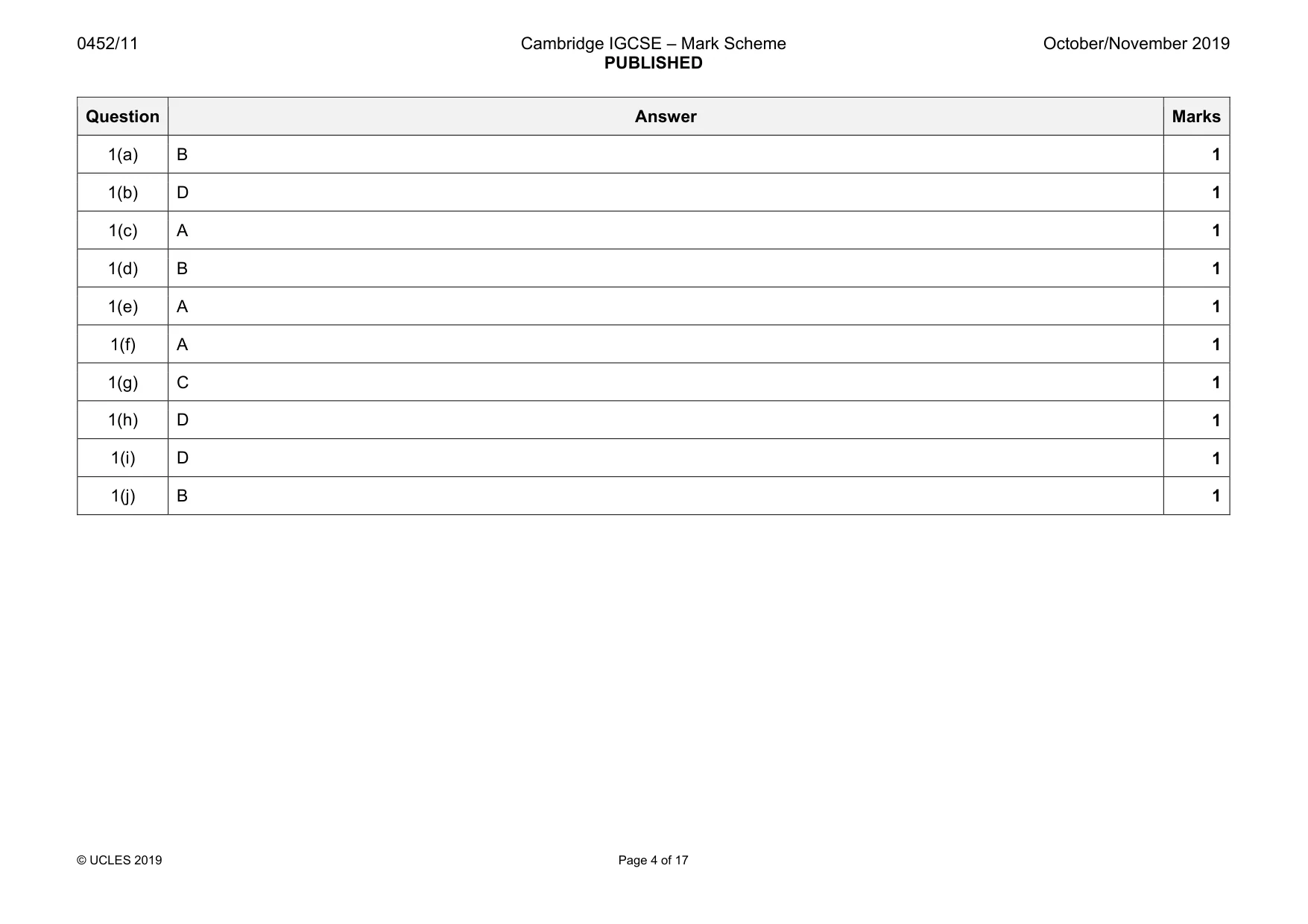
0452/11 Cambridge IGCSE – Mark Scheme PUBLISHED October/November 2019 © UCLES 2019 Page 4 of 17 Question Answer Marks 1(a) B 1 1(b) D 1 1(c) A 1 1(d) B 1 1(e) A 1 1(f) A 1 1(g) C 1 1(h) D 1 1(i) D 1 1(j) B 1
Mark scheme, page 5
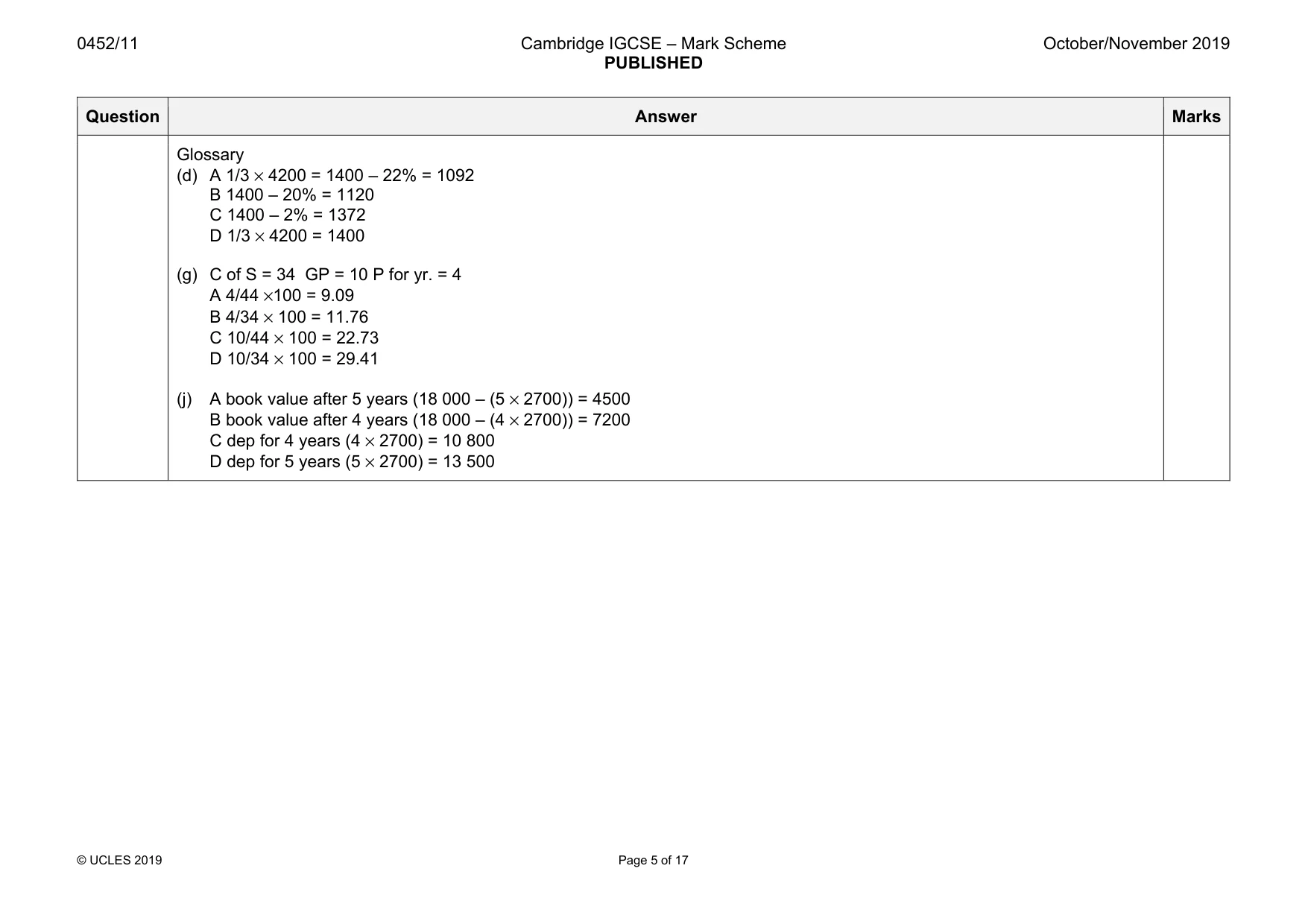
0452/11 Cambridge IGCSE – Mark Scheme PUBLISHED October/November 2019 © UCLES 2019 Page 5 of 17 Question Answer Marks Glossary (d) A 1/3 × 4200 = 1400 – 22% = 1092 B 1400 – 20% = 1120 C 1400 – 2% = 1372 D 1/3 × 4200 = 1400 (g) C of S = 34 GP = 10 P for yr. = 4 A 4/44 ×100 = 9.09 B 4/34 × 100 = 11.76 C 10/44 × 100 = 22.73 D 10/34 × 100 = 29.41 (j) A book value after 5 years (18 000 – (5 × 2700)) = 4500 B book value after 4 years (18 000 – (4 × 2700)) = 7200 C dep for 4 years (4 × 2700) = 10 800 D dep for 5 years (5 × 2700) = 13 500
Mark scheme, page 6
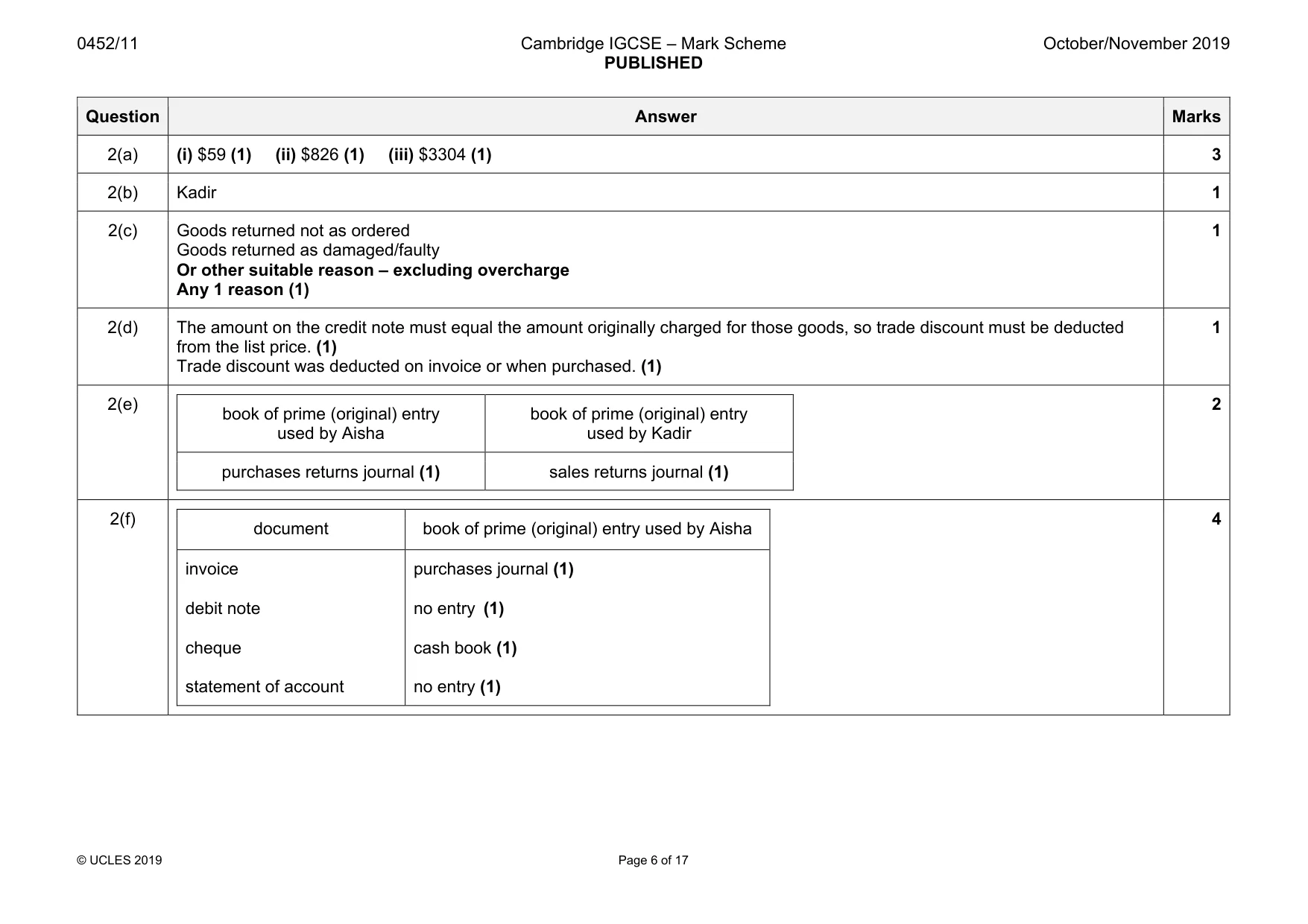
0452/11 Cambridge IGCSE – Mark Scheme PUBLISHED October/November 2019 © UCLES 2019 Page 6 of 17 Question Answer Marks 2(a) (i) $59 (1) (ii) $826 (1) (iii) $3304 (1) 3 2(b) Kadir 1 2(c) Goods returned not as ordered Goods returned as damaged/faulty Or other suitable reason – excluding overcharge Any 1 reason (1) 1 2(d) The amount on the credit note must equal the amount originally charged for those goods, so trade discount must be deducted from the list price. (1) Trade discount was deducted on invoice or when purchased. (1) 1 2(e) book of prime (original) entry used by Aisha book of prime (original) entry used by Kadir purchases returns journal (1) sales returns journal (1) 2 2(f) document book of prime (original) entry used by Aisha invoice debit note cheque statement of account purchases journal (1) no entry (1) cash book (1) no entry (1) 4
Mark scheme, page 7
0452/11 Cambridge IGCSE – Mark Scheme PUBLISHED October/November 2019 © UCLES 2019 Page 7 of 17 Question Answer Marks 2(g) Aisha Kadir account Date 2019 Sept 18 27 30 Details Returns (1)OF Bank (1) Discount (1) Balance c/d $ 3304 3332 68 5656 12 360 Date 2019 Sept 1 4 2019 Oct 1 Details Balance b/d (1) Purchases (1) Balance b/d (1)OF $ 3400 8960 _____ 12 360 5656 (1) Dates 7 2(h) Purchases (ledger) or trade payables 1
Mark scheme, page 8
0452/11 Cambridge IGCSE – Mark Scheme PUBLISHED October/November 2019 © UCLES 2019 Page 8 of 17 Question Answer Marks 3(a) They can assist in locating errors They are proof of the arithmetical accuracy of the ledgers which they control They provide instant totals of the trade payables and the trade receivables They enable a draft statement of financial position to be prepared quickly or financial statements They can help to reduce fraud They provide a summary of the transactions affecting the trade payables and the trade receivables Any 2 advantages (1) each 2 3(b) book of prime (original) entry purchases returns purchases returns journal (1) contra entry general or nominal journal (1) discount received cash book (1) interest charged on overdue account general or nominal journal (1) 4 3(c) Meaning A contra entry is an entry which appears in the purchases ledger control account (debit side) and also in the sales ledger control account (credit side) (1) Reason The entry is made when a sales ledger account is set off against a purchases ledger account of the same person/business (1) Same person is the buyer and seller (1) Any 2 reasons (1) each 2 3(d) Overpayment made to credit supplier Returned goods after paying the balance of the account Made payment without deducting the cash discount to which entitled Paid credit supplier in advance/prepayment/paid deposit Contra entry larger than the balance owed Any 2 reasons (1) each 2
Mark scheme, page 9
0452/11 Cambridge IGCSE – Mark Scheme PUBLISHED October/November 2019 © UCLES 2019 Page 9 of 17 Question Answer Marks 3(e) Timothy Sales ledger control account account Date 2019 Oct 1 31 2019 Nov 1 Details Balance b/d Sales (1) Interest (1) Balance c/d Balance b/d (1)OF $ 6530 7860 15 80 _____ 14 485 7630 Date 2019 Oct 1 31 2019 Nov 1 Details Balance b/d Bank/cash (1) Discount (1) Returns (1) Bad debts (1) Contra(PLCA) (1) Balance c/d Balance b/d (1) $ 110 5782 118 285 260 300 7630 14 485 80 9
Mark scheme, page 10
0452/11 Cambridge IGCSE – Mark Scheme PUBLISHED October/November 2019 © UCLES 2019 Page 10 of 17 Question Answer Marks 4(a) Abiola General Journal Date 2017 Details Debit $ Credit $ Sept 1 Inventory }(1) Fixtures and fittings } Bank (1) Loan (1) Capital (1) Assets, liabilities and capital at this date or balances on assets, liabilities and capital or record the start of the business (1) 6600 11 750 31 650 _____ 10 000 40 000 5 4(b) To explain the reasons for the entries which are to be made in the ledger (1) Journal entries sometimes involve ‘out of the ordinary’ transactions (1) It is impossible to remember the reason for every entry (1) Transaction to be understood (1) Any 2 reasons (1) each 2
Mark scheme, page 11
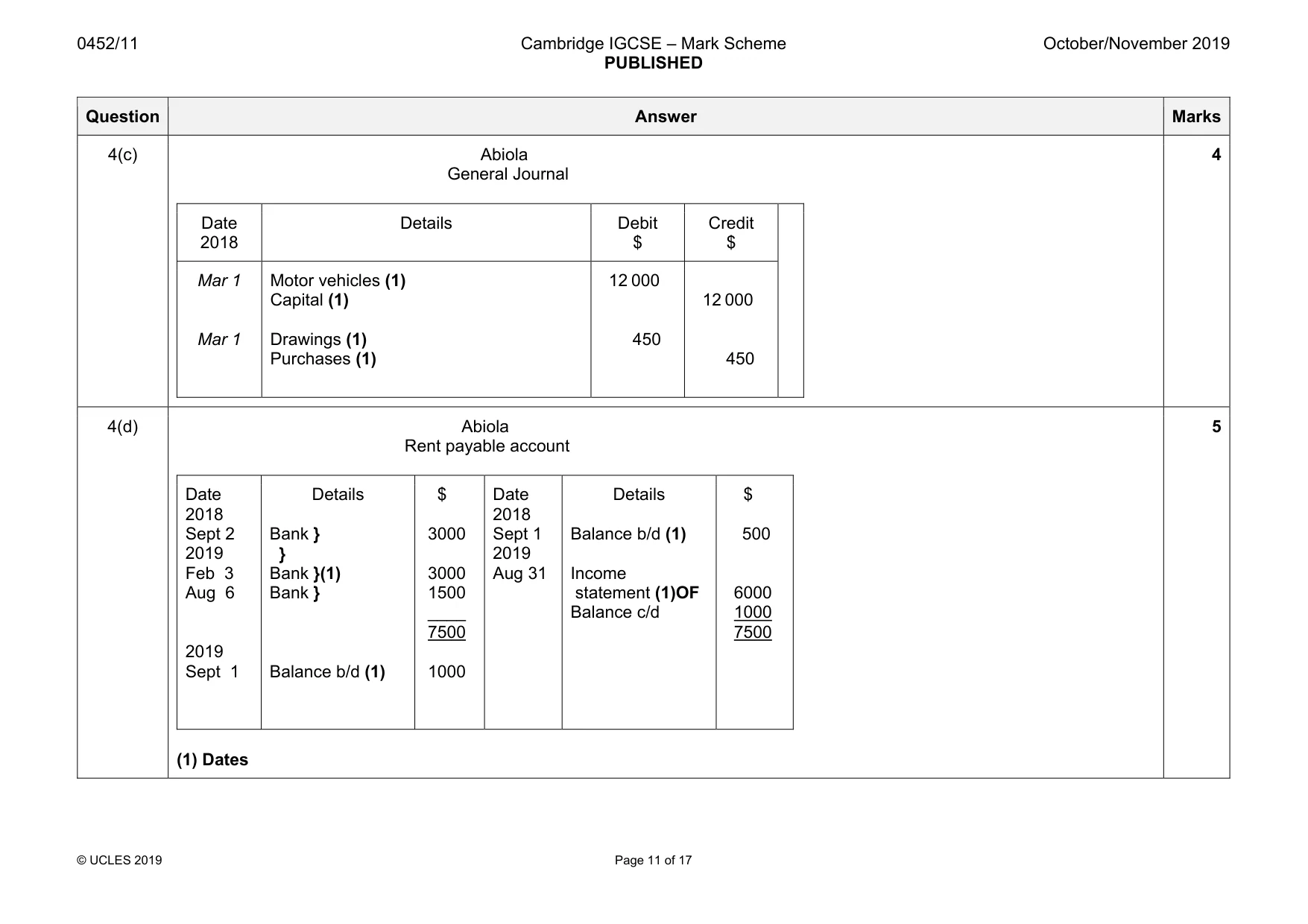
0452/11 Cambridge IGCSE – Mark Scheme PUBLISHED October/November 2019 © UCLES 2019 Page 11 of 17 Question Answer Marks 4(c) Abiola General Journal Date 2018 Details Debit $ Credit $ Mar 1 Mar 1 Motor vehicles (1) Capital (1) Drawings (1) Purchases (1) 12 000 450 12 000 450 4 4(d) Abiola Rent payable account Date 2018 Sept 2 2019 Feb 3 Aug 6 2019 Sept 1 Details Bank } } Bank }(1) Bank } Balance b/d (1) $ 3000 3000 1500 ____ 7500 1000 Date 2018 Sept 1 2019 Aug 31 Details Balance b/d (1) Income statement (1)OF Balance c/d $ 500 6000 1000 7500 (1) Dates 5
Mark scheme, page 12
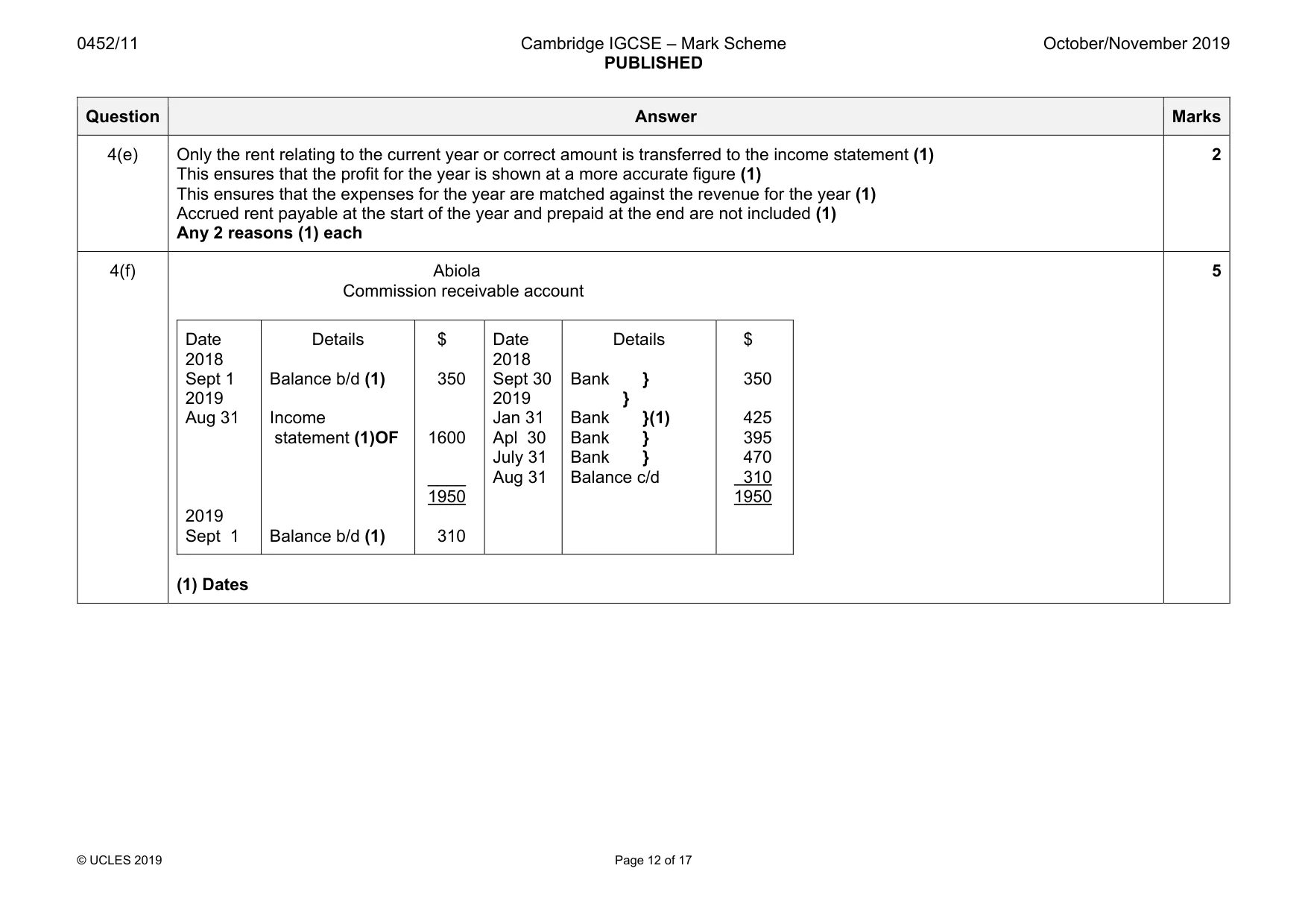
0452/11 Cambridge IGCSE – Mark Scheme PUBLISHED October/November 2019 © UCLES 2019 Page 12 of 17 Question Answer Marks 4(e) Only the rent relating to the current year or correct amount is transferred to the income statement (1) This ensures that the profit for the year is shown at a more accurate figure (1) This ensures that the expenses for the year are matched against the revenue for the year (1) Accrued rent payable at the start of the year and prepaid at the end are not included (1) Any 2 reasons (1) each 2 4(f) Abiola Commission receivable account Date 2018 Sept 1 2019 Aug 31 2019 Sept 1 Details Balance b/d (1) Income statement (1)OF Balance b/d (1) $ 350 1600 ____ 1950 310 Date 2018 Sept 30 2019 Jan 31 Apl 30 July 31 Aug 31 Details Bank } } Bank }(1) Bank } Bank } Balance c/d $ 350 425 395 470 310 1950 (1) Dates 5
Mark scheme, page 13
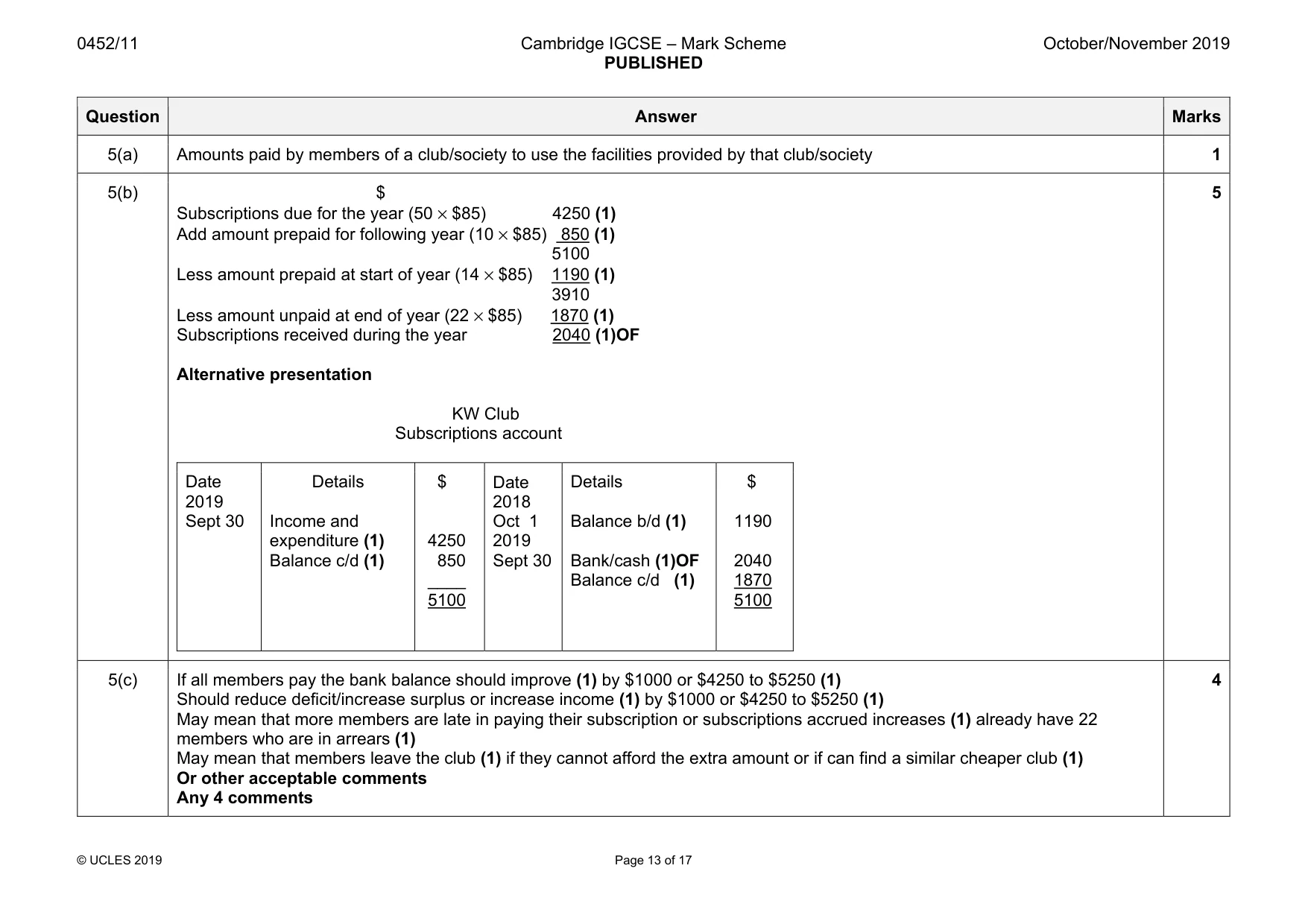
0452/11 Cambridge IGCSE – Mark Scheme PUBLISHED October/November 2019 © UCLES 2019 Page 13 of 17 Question Answer Marks 5(a) Amounts paid by members of a club/society to use the facilities provided by that club/society 1 5(b) $ Subscriptions due for the year (50 × $85) 4250 (1) Add amount prepaid for following year (10 × $85) 850 (1) 5100 Less amount prepaid at start of year (14 × $85) 1190 (1) 3910 Less amount unpaid at end of year (22 × $85) 1870 (1) Subscriptions received during the year 2040 (1)OF Alternative presentation KW Club Subscriptions account Date 2019 Sept 30 Details Income and expenditure (1) Balance c/d (1) $ 4250 850 ____ 5100 Date 2018 Oct 1 2019 Sept 30 Details Balance b/d (1) Bank/cash (1)OF Balance c/d (1) $ 1190 2040 1870 5100 5 5(c) If all members pay the bank balance should improve (1) by $1000 or $4250 to $5250 (1) Should reduce deficit/increase surplus or increase income (1) by $1000 or $4250 to $5250 (1) May mean that more members are late in paying their subscription or subscriptions accrued increases (1) already have 22 members who are in arrears (1) May mean that members leave the club (1) if they cannot afford the extra amount or if can find a similar cheaper club (1) Or other acceptable comments Any 4 comments 4
Mark scheme, page 14
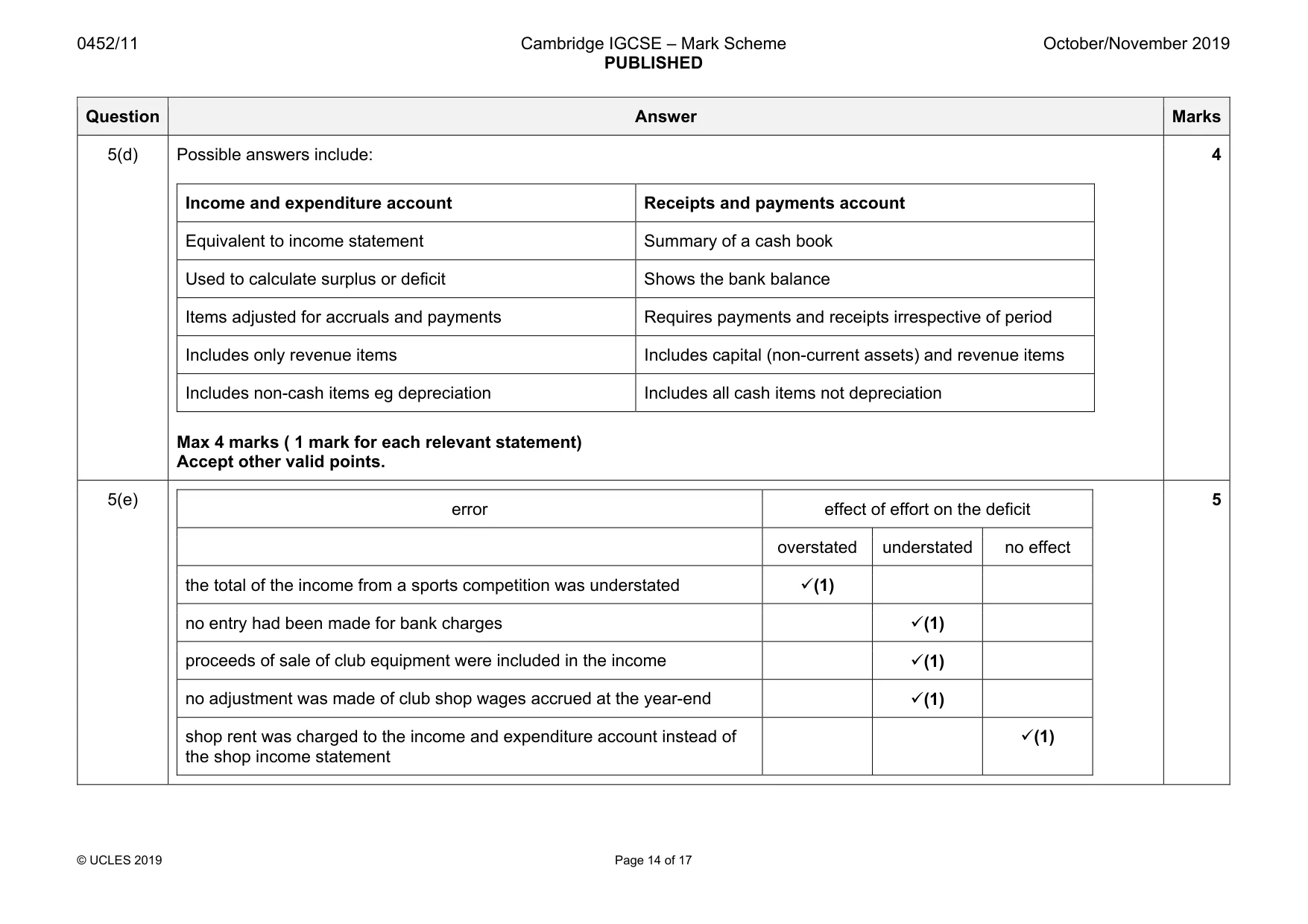
0452/11 Cambridge IGCSE – Mark Scheme PUBLISHED October/November 2019 © UCLES 2019 Page 14 of 17 Question Answer Marks 5(d) Possible answers include: Income and expenditure account Receipts and payments account Equivalent to income statement Summary of a cash book Used to calculate surplus or deficit Shows the bank balance Items adjusted for accruals and payments Requires payments and receipts irrespective of period Includes only revenue items Includes capital (non-current assets) and revenue items Includes non-cash items eg depreciation Includes all cash items not depreciation Max 4 marks ( 1 mark for each relevant statement) Accept other valid points. 4 5(e) error effect of effort on the deficit overstated understated no effect the total of the income from a sports competition was understated 9(1) no entry had been made for bank charges 9(1) proceeds of sale of club equipment were included in the income 9(1) no adjustment was made of club shop wages accrued at the year-end 9(1) shop rent was charged to the income and expenditure account instead of the shop income statement 9(1) 5
Mark scheme, page 15
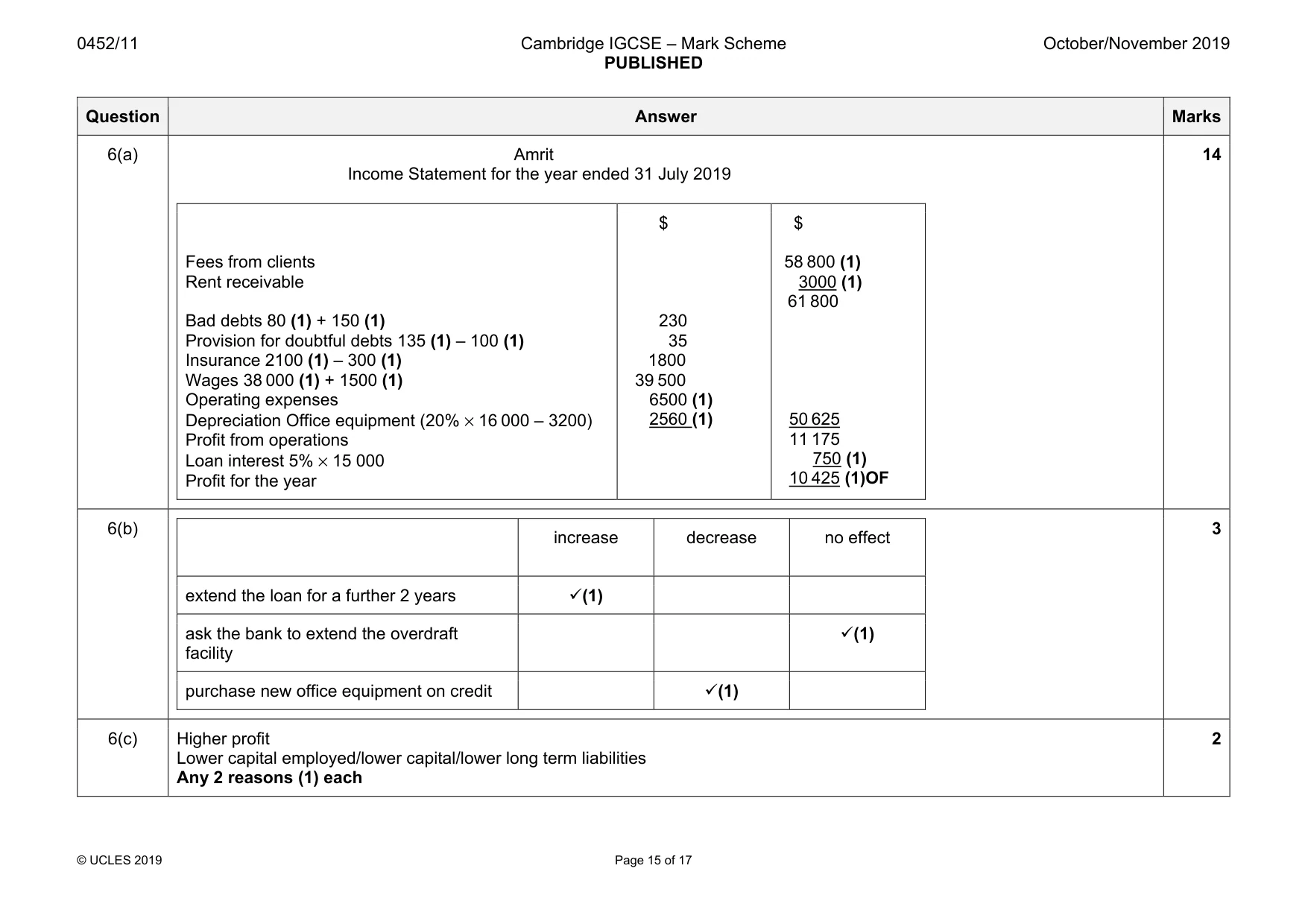
0452/11 Cambridge IGCSE – Mark Scheme PUBLISHED October/November 2019 © UCLES 2019 Page 15 of 17 Question Answer Marks 6(a) Amrit Income Statement for the year ended 31 July 2019 Fees from clients Rent receivable Bad debts 80 (1) + 150 (1) Provision for doubtful debts 135 (1) – 100 (1) Insurance 2100 (1) – 300 (1) Wages 38 000 (1) + 1500 (1) Operating expenses Depreciation Office equipment (20% × 16 000 – 3200) Profit from operations Loan interest 5% × 15 000 Profit for the year $ 230 35 1800 39 500 6500 (1) 2560 (1) $ 58 800 (1) 3000 (1) 61 800 50 625 11 175 750 (1) 10 425 (1)OF 14 6(b) increase decrease no effect extend the loan for a further 2 years 9(1) ask the bank to extend the overdraft facility 9(1) purchase new office equipment on credit 9(1) 3 6(c) Higher profit Lower capital employed/lower capital/lower long term liabilities Any 2 reasons (1) each 2
Mark scheme, page 16
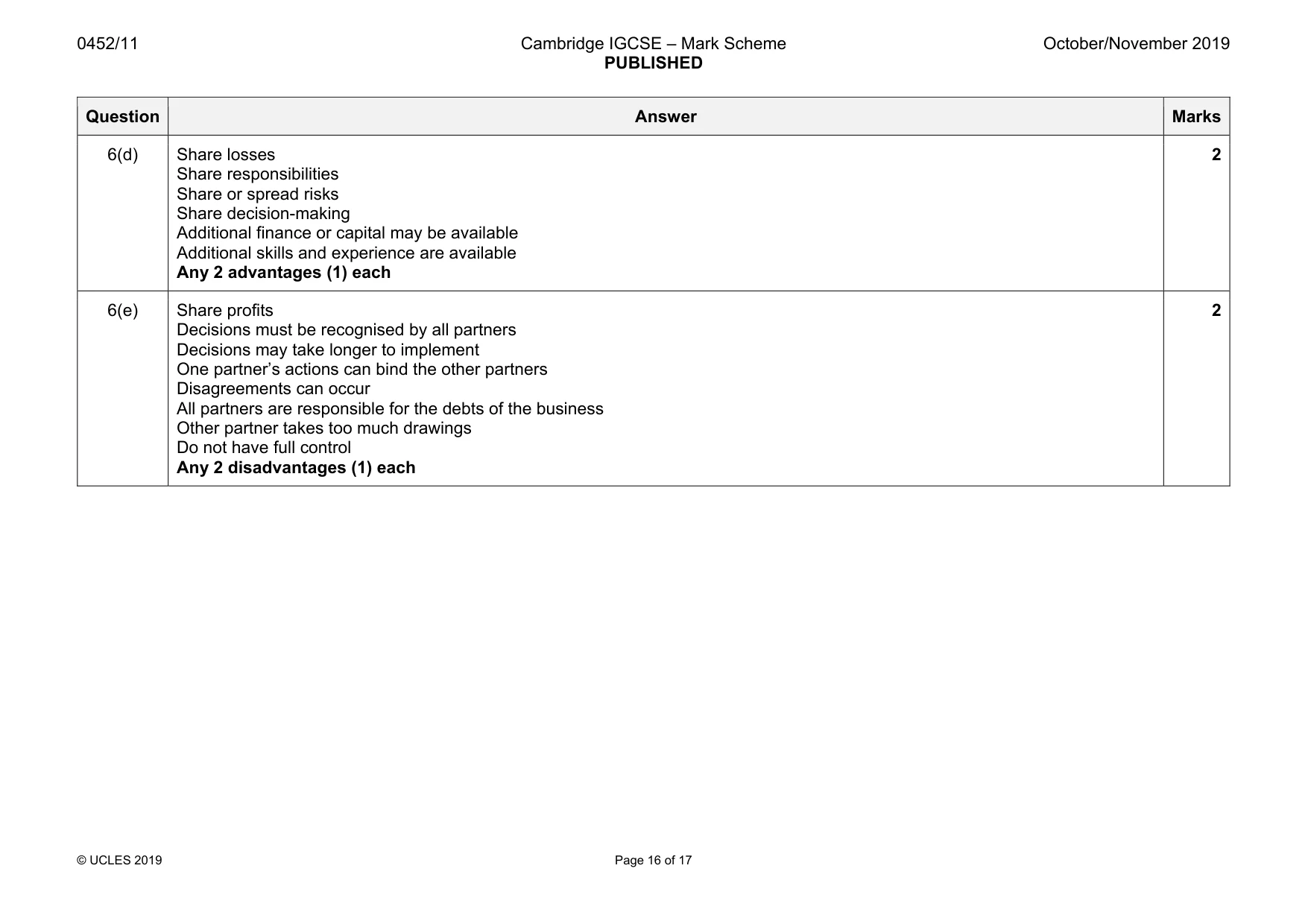
0452/11 Cambridge IGCSE – Mark Scheme PUBLISHED October/November 2019 © UCLES 2019 Page 16 of 17 Question Answer Marks 6(d) Share losses Share responsibilities Share or spread risks Share decision-making Additional finance or capital may be available Additional skills and experience are available Any 2 advantages (1) each 2 6(e) Share profits Decisions must be recognised by all partners Decisions may take longer to implement One partner’s actions can bind the other partners Disagreements can occur All partners are responsible for the debts of the business Other partner takes too much drawings Do not have full control Any 2 disadvantages (1) each 2
Mark scheme, page 17
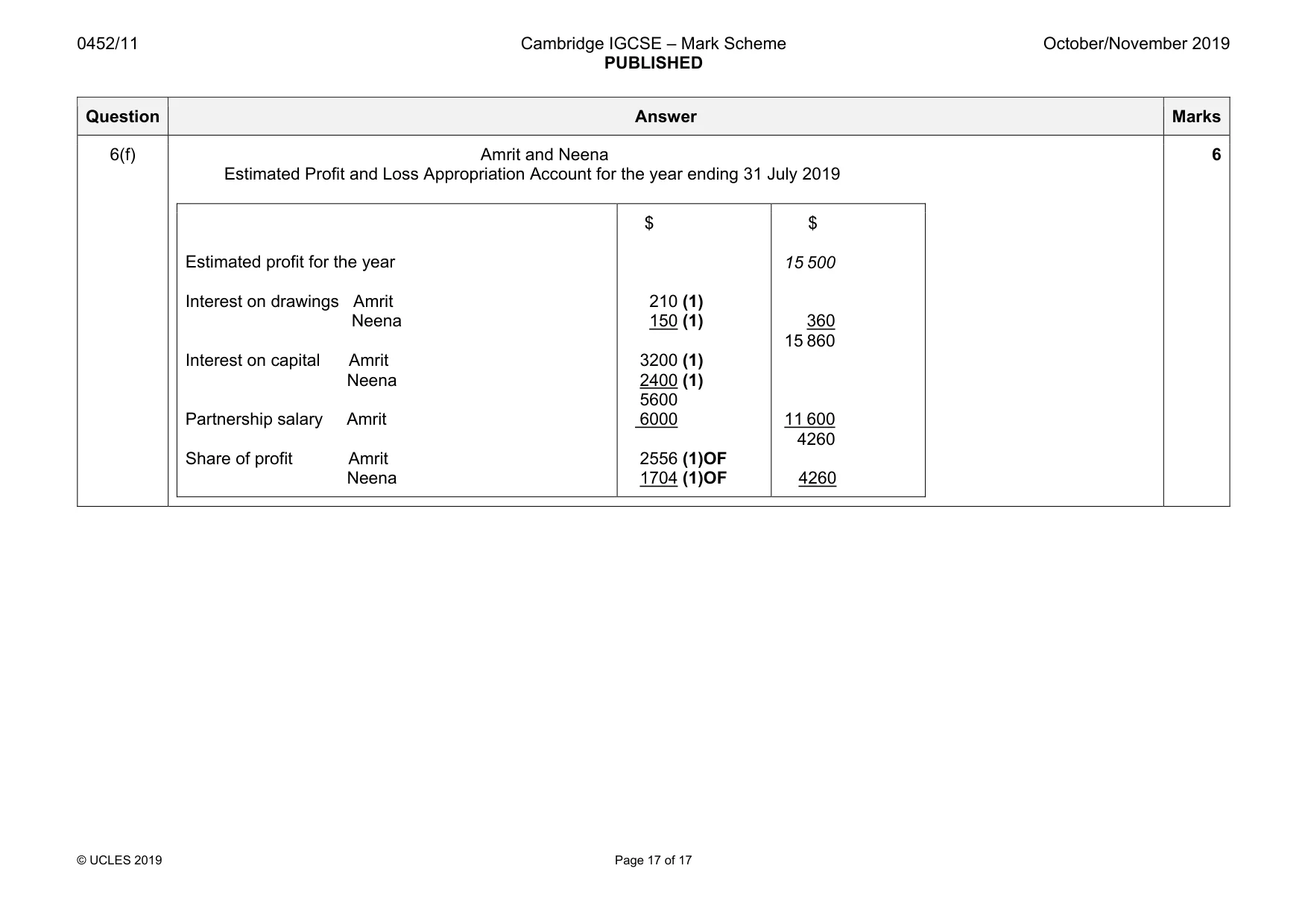
0452/11 Cambridge IGCSE – Mark Scheme PUBLISHED October/November 2019 © UCLES 2019 Page 17 of 17 Question Answer Marks 6(f) Amrit and Neena Estimated Profit and Loss Appropriation Account for the year ending 31 July 2019 Estimated profit for the year Interest on drawings Amrit Neena Interest on capital Amrit Neena Partnership salary Amrit Share of profit Amrit Neena $ 210 (1) 150 (1) 3200 (1) 2400 (1) 5600 6000 2556 (1)OF 1704 (1)OF $ 15 500 360 15 860 11 600 4260 4260 6
What you needed in this session
Cambridge’s own grade thresholds for 2019 Oct/Nov, Paper 1 · Variant 1. A higher threshold means an easier paper — the bar moves with how the cohort did.