Cambridge IGCSE Accounting 0452 — 2019 May/June Paper 1 · Variant 1
0452/11/M/J/19 · 120 marks · ≈135 min
The question paper and its mark scheme, free to read here and free to download. This is Cambridge’s own paper, exactly as it was sat.
Question paper24 pages



Mark scheme17 pages
Answers below. Sit the paper first if you are practising.
Paper as text
Question paper, page 1
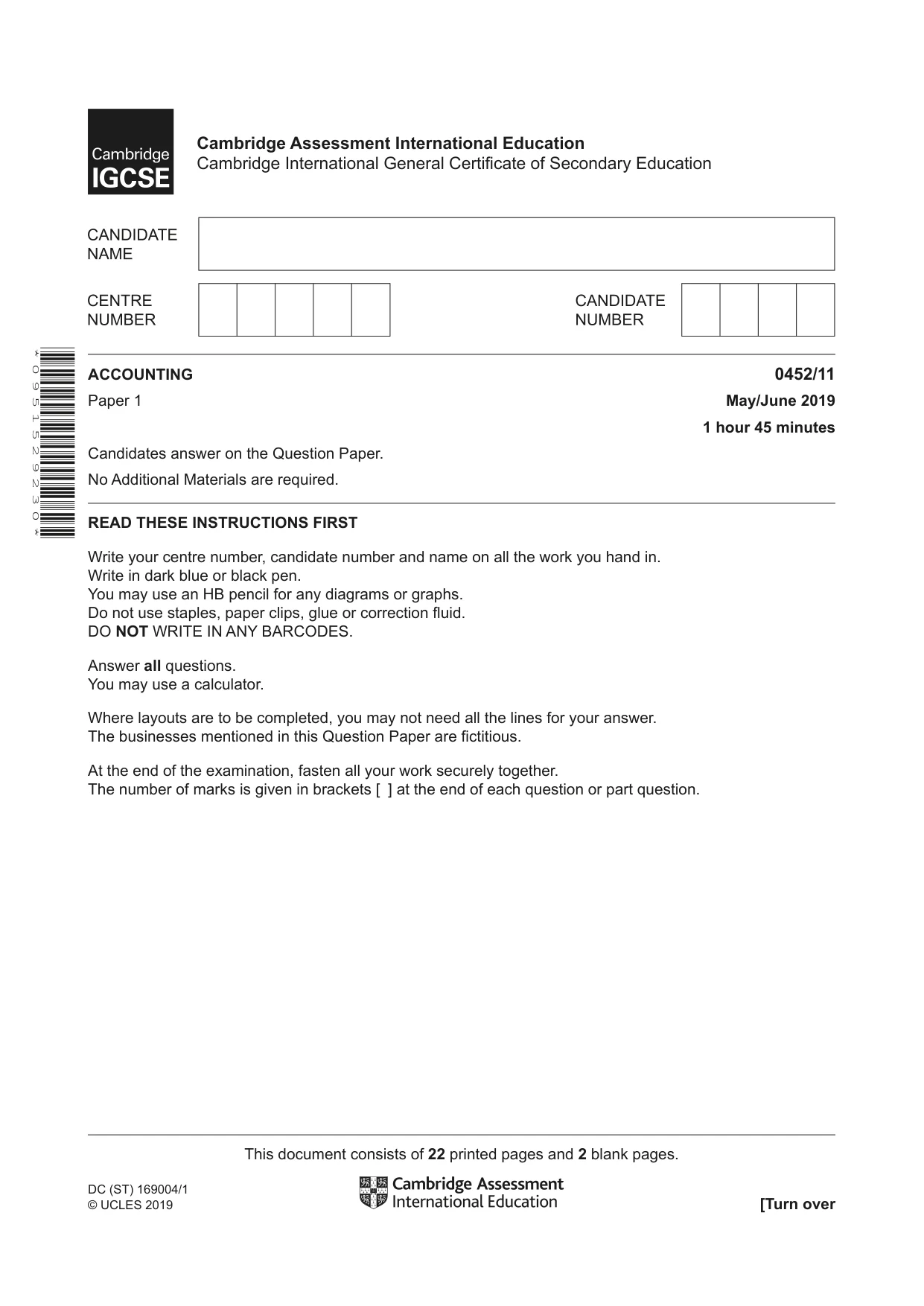
This document consists of 22 printed pages and 2 blank pages. DC (ST) 169004/1 © UCLES 2019 [Turn over * 0 9 5 1 5 2 9 2 3 0 * ACCOUNTING 0452/11 Paper 1 May/June 2019 1 hour 45 minutes Candidates answer on the Question Paper. No Additional Materials are required. READ THESE INSTRUCTIONS FIRST Write your centre number, candidate number and name on all the work you hand in. Write in dark blue or black pen. You may use an HB pencil for any diagrams or graphs. Do not use staples, paper clips, glue or correction fluid. DO NOT WRITE IN ANY BARCODES. Answer all questions. You may use a calculator. Where layouts are to be completed, you may not need all the lines for your answer. The businesses mentioned in this Question Paper are fictitious. At the end of the examination, fasten all your work securely together. The number of marks is given in brackets [ ] at the end of each question or part question. Cambridge Assessment International Education Cambridge International General Certificate of Secondary Education
Question paper, page 2
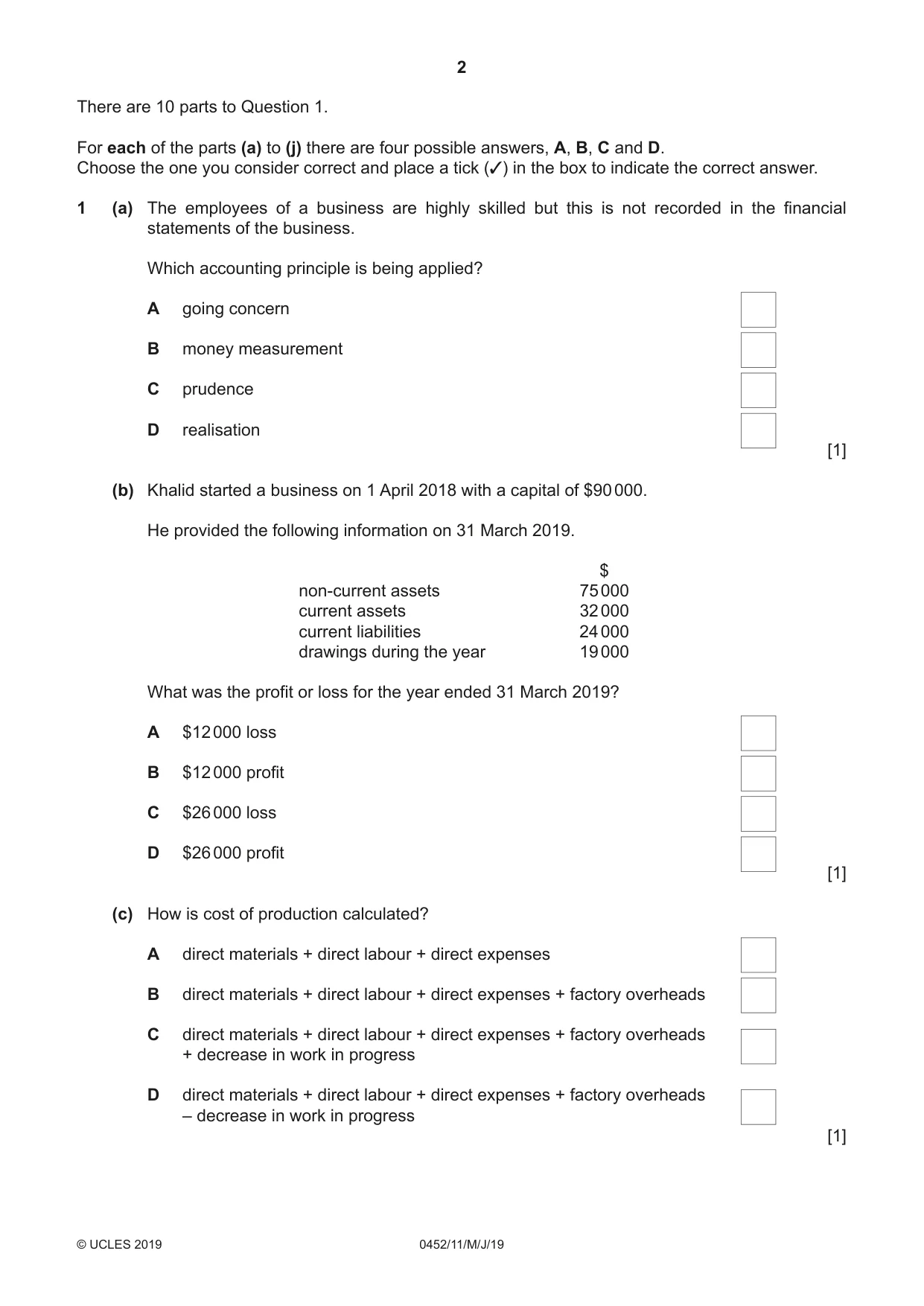
2 0452/11/M/J/19 © UCLES 2019 There are 10 parts to Question 1. For each of the parts (a) to (j) there are four possible answers, A, B, C and D. Choose the one you consider correct and place a tick (3) in the box to indicate the correct answer. 1 (a) The employees of a business are highly skilled but this is not recorded in the financial statements of the business. Which accounting principle is being applied? A going concern B money measurement C prudence D realisation [1] (b) Khalid started a business on 1 April 2018 with a capital of $90 000. He provided the following information on 31 March 2019. $ non-current assets 75 000 current assets 32 000 current liabilities 24 000 drawings during the year 19 000 What was the profit or loss for the year ended 31 March 2019? A $12 000 loss B $12 000 profit C $26 000 loss D $26 000 profit [1] (c) How is cost of production calculated? A direct materials + direct labour + direct expenses B direct materials + direct labour + direct expenses + factory overheads C direct materials + direct labour + direct expenses + factory overheads + decrease in work in progress D direct materials + direct labour + direct expenses + factory overheads – decrease in work in progress [1]
Question paper, page 3
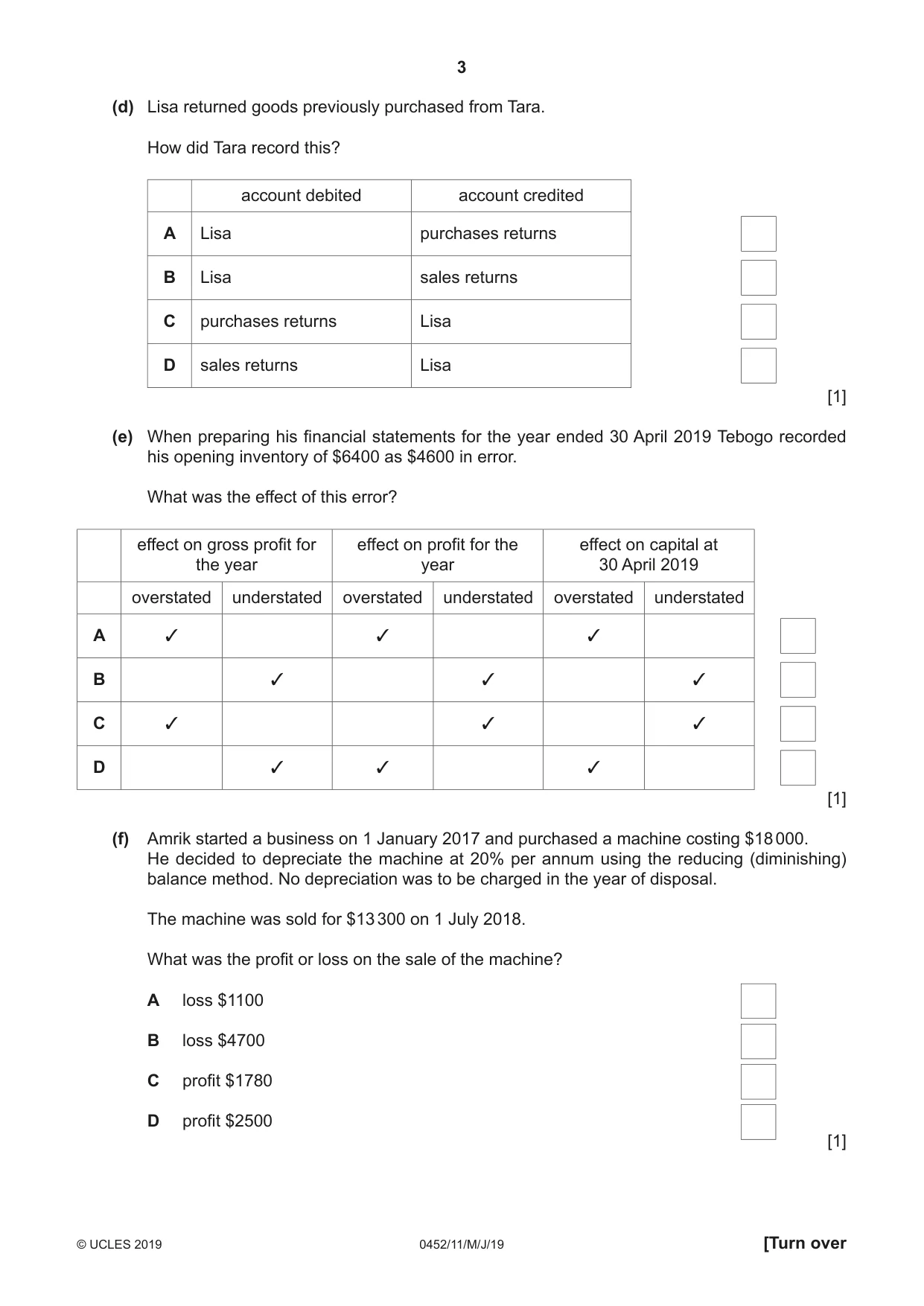
3 0452/11/M/J/19 © UCLES 2019 [Turn over (d) Lisa returned goods previously purchased from Tara. How did Tara record this? account debited account credited A Lisa purchases returns B Lisa sales returns C purchases returns Lisa D sales returns Lisa [1] (e) When preparing his financial statements for the year ended 30 April 2019 Tebogo recorded his opening inventory of $6400 as $4600 in error. What was the effect of this error? effect on gross profit for the year effect on profit for the year effect on capital at 30 April 2019 overstated understated overstated understated overstated understated A 3 3 3 B 3 3 3 C 3 3 3 D 3 3 3 [1] (f) Amrik started a business on 1 January 2017 and purchased a machine costing $18 000. He decided to depreciate the machine at 20% per annum using the reducing (diminishing) balance method. No depreciation was to be charged in the year of disposal. The machine was sold for $13 300 on 1 July 2018. What was the profit or loss on the sale of the machine? A loss $1100 B loss $4700 C profit $1780 D profit $2500 [1]
Question paper, page 4
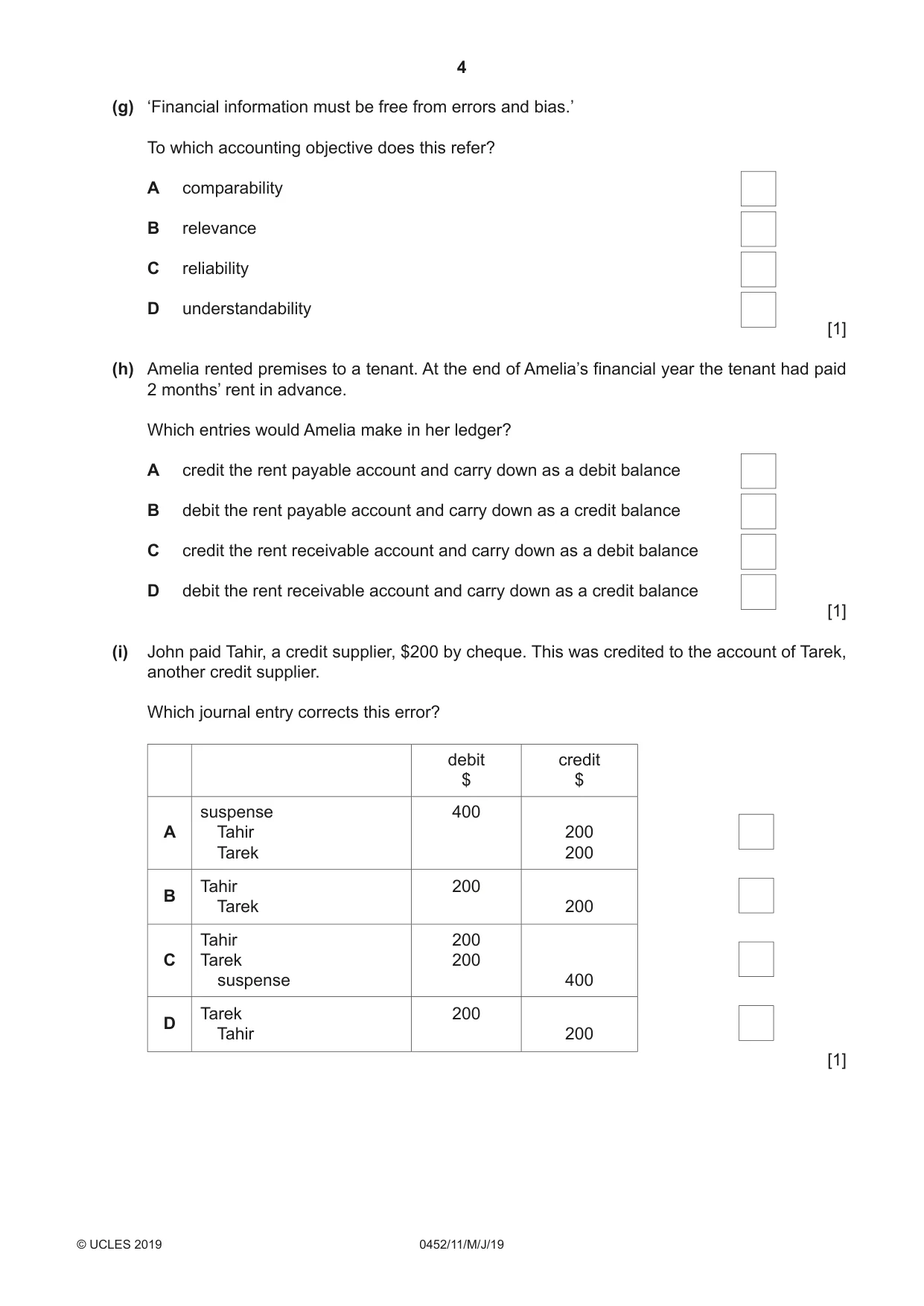
4 0452/11/M/J/19 © UCLES 2019 (g) ‘Financial information must be free from errors and bias.’ To which accounting objective does this refer? A comparability B relevance C reliability D understandability [1] (h) Amelia rented premises to a tenant. At the end of Amelia’s financial year the tenant had paid 2 months’ rent in advance. Which entries would Amelia make in her ledger? A credit the rent payable account and carry down as a debit balance B debit the rent payable account and carry down as a credit balance C credit the rent receivable account and carry down as a debit balance D debit the rent receivable account and carry down as a credit balance [1] (i) John paid Tahir, a credit supplier, $200 by cheque. This was credited to the account of Tarek, another credit supplier. Which journal entry corrects this error? debit $ credit $ A suspense Tahir Tarek 400 200 200 B Tahir Tarek 200 200 C Tahir Tarek suspense 200 200 400 D Tarek Tahir 200 200 [1]
Question paper, page 5
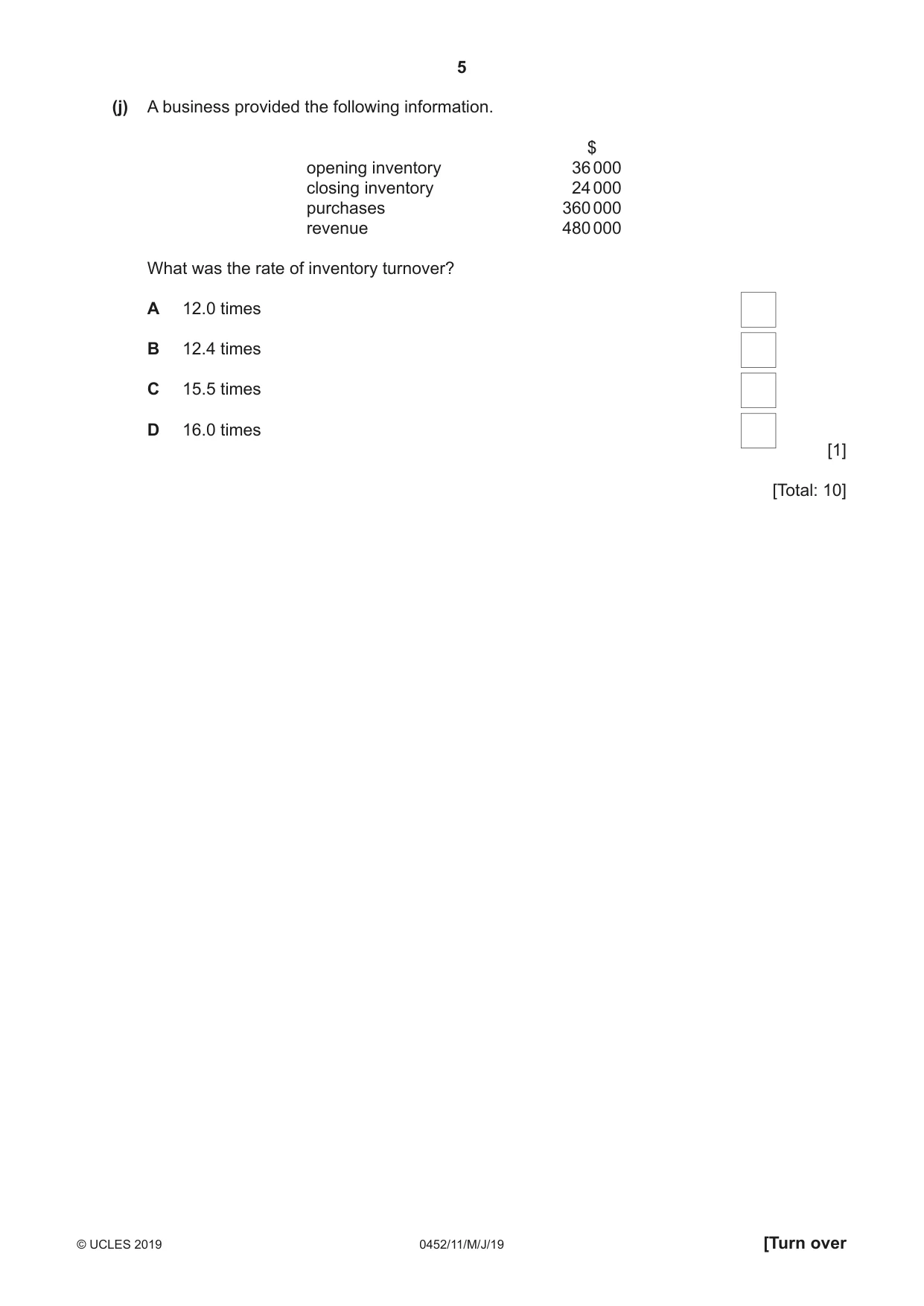
5 0452/11/M/J/19 © UCLES 2019 [Turn over (j) A business provided the following information. $ opening inventory 36 000 closing inventory 24 000 purchases 360 000 revenue 480 000 What was the rate of inventory turnover? A 12.0 times B 12.4 times C 15.5 times D 16.0 times [1] [Total: 10]
Question paper, page 6
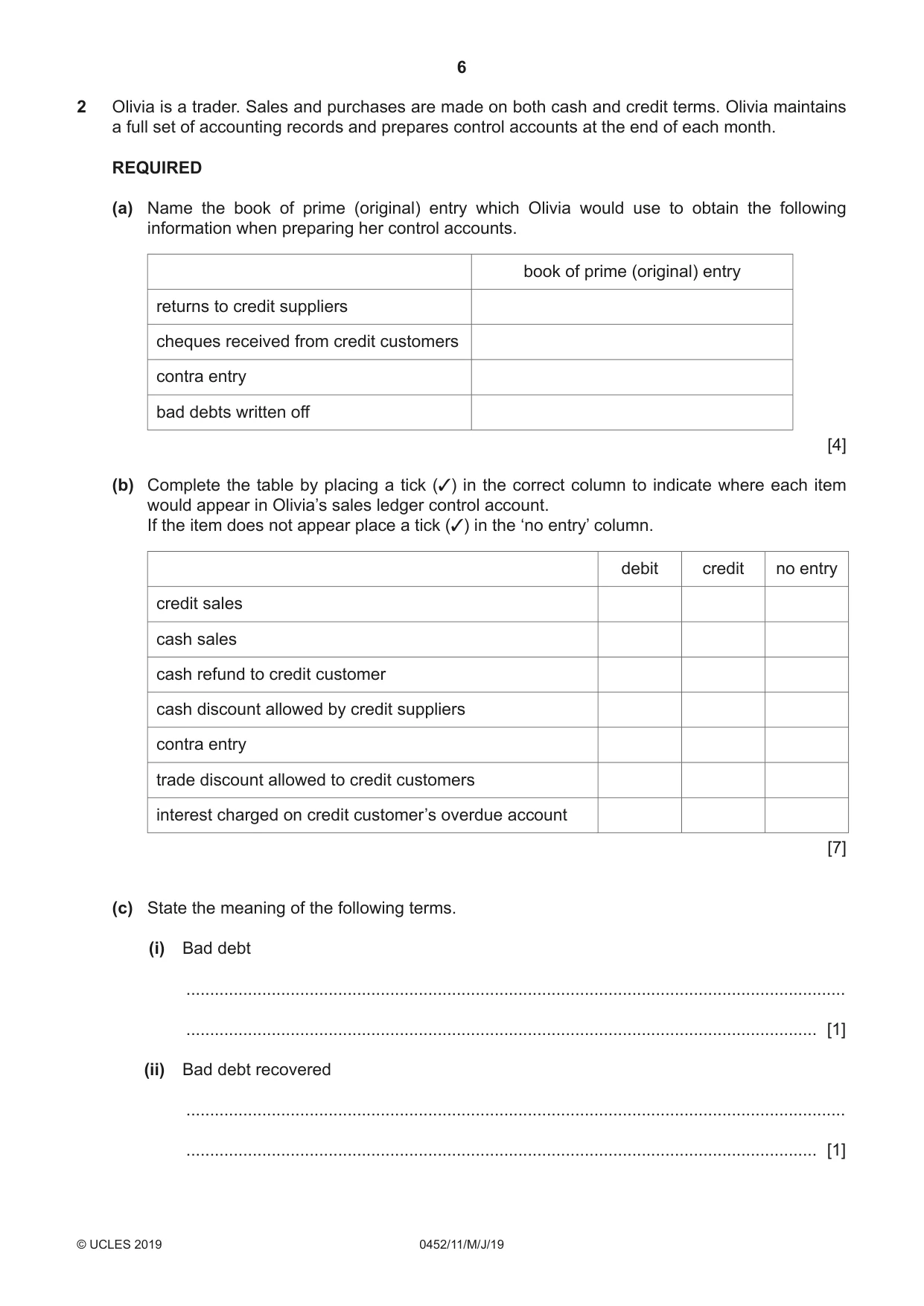
6 0452/11/M/J/19 © UCLES 2019 2 Olivia is a trader. Sales and purchases are made on both cash and credit terms. Olivia maintains a full set of accounting records and prepares control accounts at the end of each month. REQUIRED (a) Name the book of prime (original) entry which Olivia would use to obtain the following information when preparing her control accounts. book of prime (original) entry returns to credit suppliers cheques received from credit customers contra entry bad debts written off [4] (b) Complete the table by placing a tick (3) in the correct column to indicate where each item would appear in Olivia’s sales ledger control account. If the item does not appear place a tick (3) in the ‘no entry’ column. debit credit no entry credit sales cash sales cash refund to credit customer cash discount allowed by credit suppliers contra entry trade discount allowed to credit customers interest charged on credit customer’s overdue account [7] (c) State the meaning of the following terms. (i) Bad debt … … [1] (ii) Bad debt recovered … … [1]
Question paper, page 7
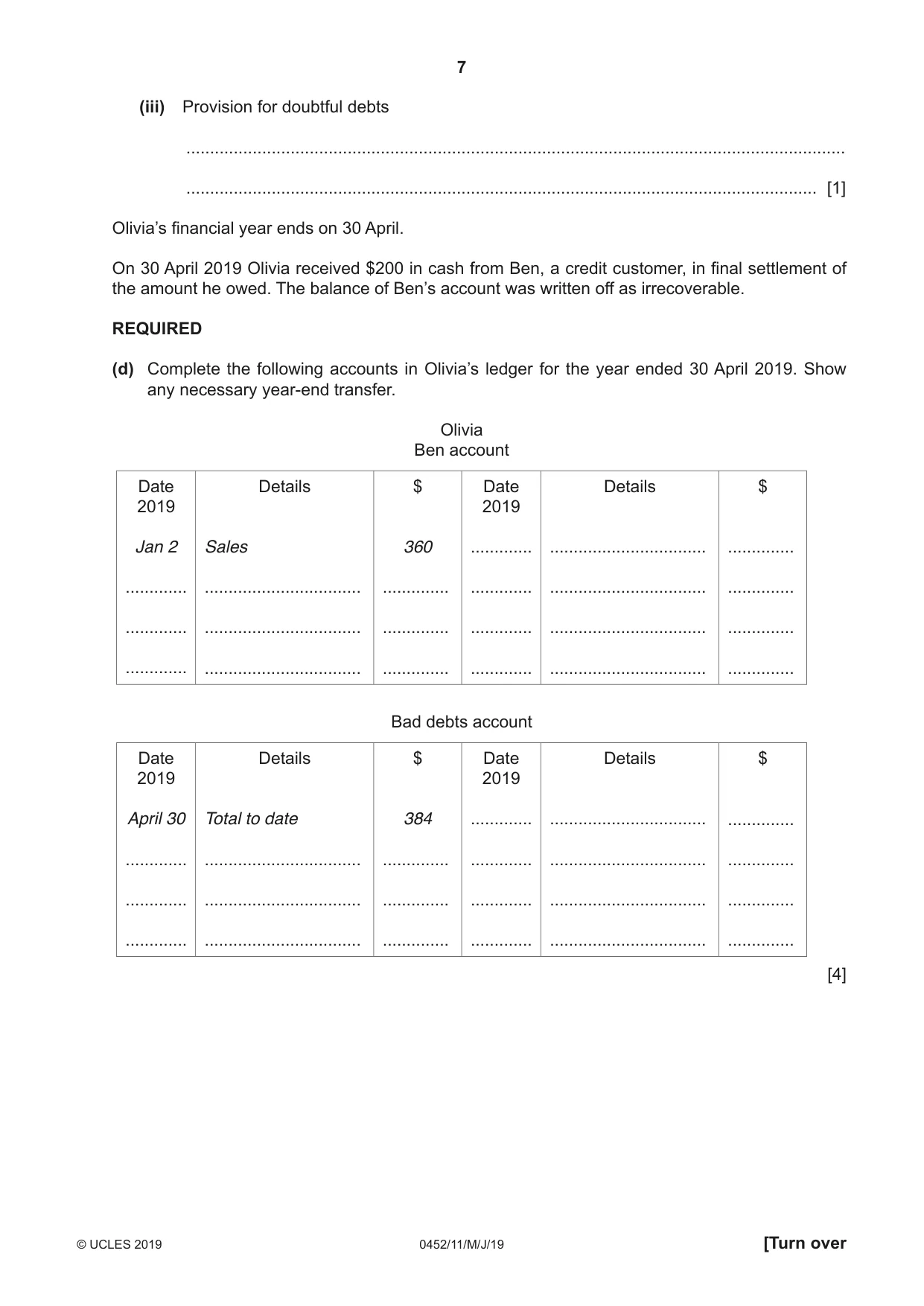
7 0452/11/M/J/19 © UCLES 2019 [Turn over (iii) Provision for doubtful debts … … [1] Olivia’s financial year ends on 30 April. On 30 April 2019 Olivia received $200 in cash from Ben, a credit customer, in final settlement of the amount he owed. The balance of Ben’s account was written off as irrecoverable. REQUIRED (d) Complete the following accounts in Olivia’s ledger for the year ended 30 April 2019. Show any necessary year-end transfer. Olivia Ben account Date 2019 Jan 2 … … … Details Sales … … … $ 360 … … … Date 2019 … … … … Details … … … … $ … … … … Bad debts account Date 2019 April 30 … … … Details Total to date … … … $ 384 … … … Date 2019 … … … … Details … … … … $ … … … … [4]
Question paper, page 8
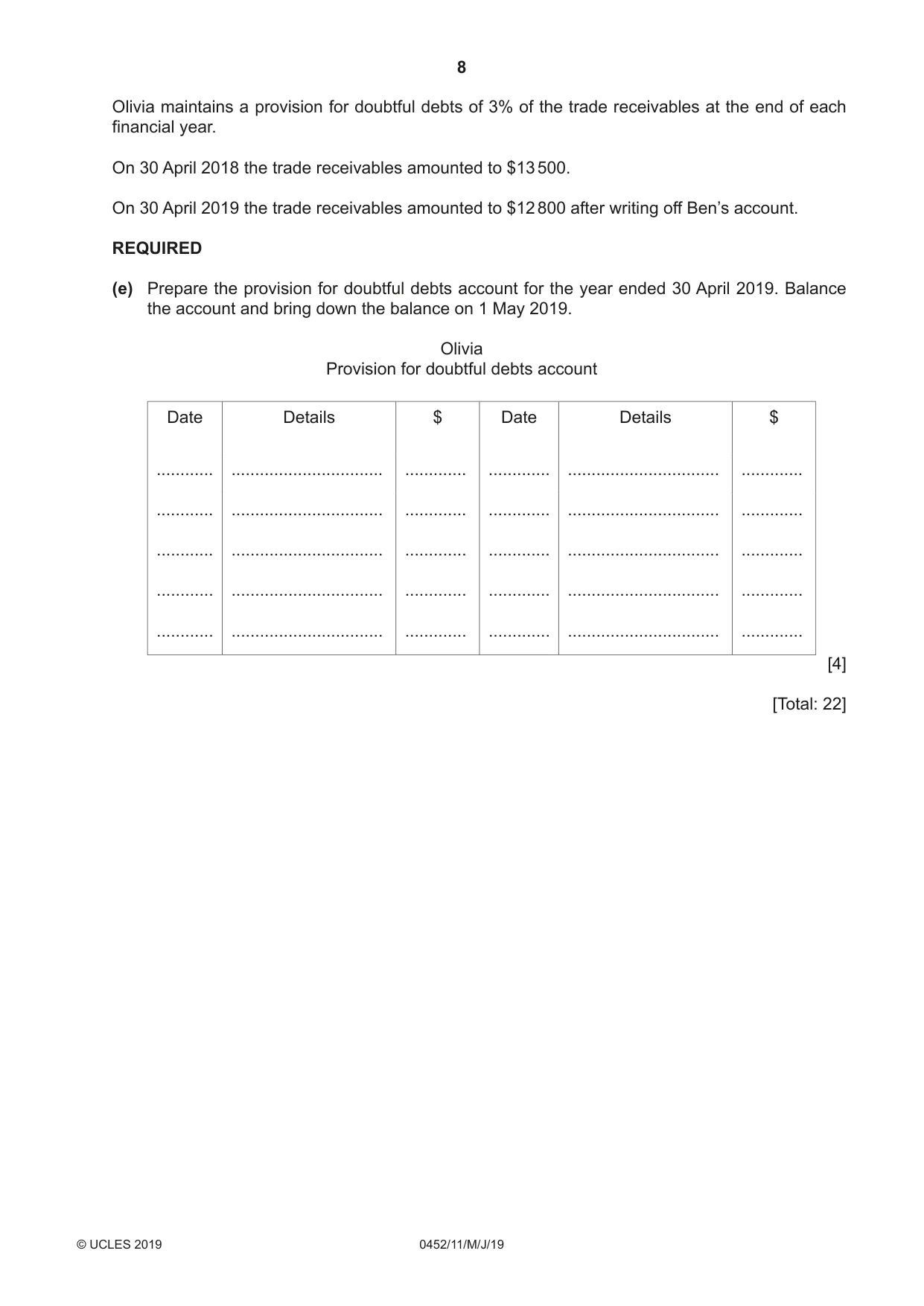
8 0452/11/M/J/19 © UCLES 2019 Olivia maintains a provision for doubtful debts of 3% of the trade receivables at the end of each financial year. On 30 April 2018 the trade receivables amounted to $13 500. On 30 April 2019 the trade receivables amounted to $12 800 after writing off Ben’s account. REQUIRED (e) Prepare the provision for doubtful debts account for the year ended 30 April 2019. Balance the account and bring down the balance on 1 May 2019. Olivia Provision for doubtful debts account Date Details $ Date Details $ … … … … … … … … … … … … … … … … … … … … … … … … … … … … … … [4] [Total: 22]
Question paper, page 9
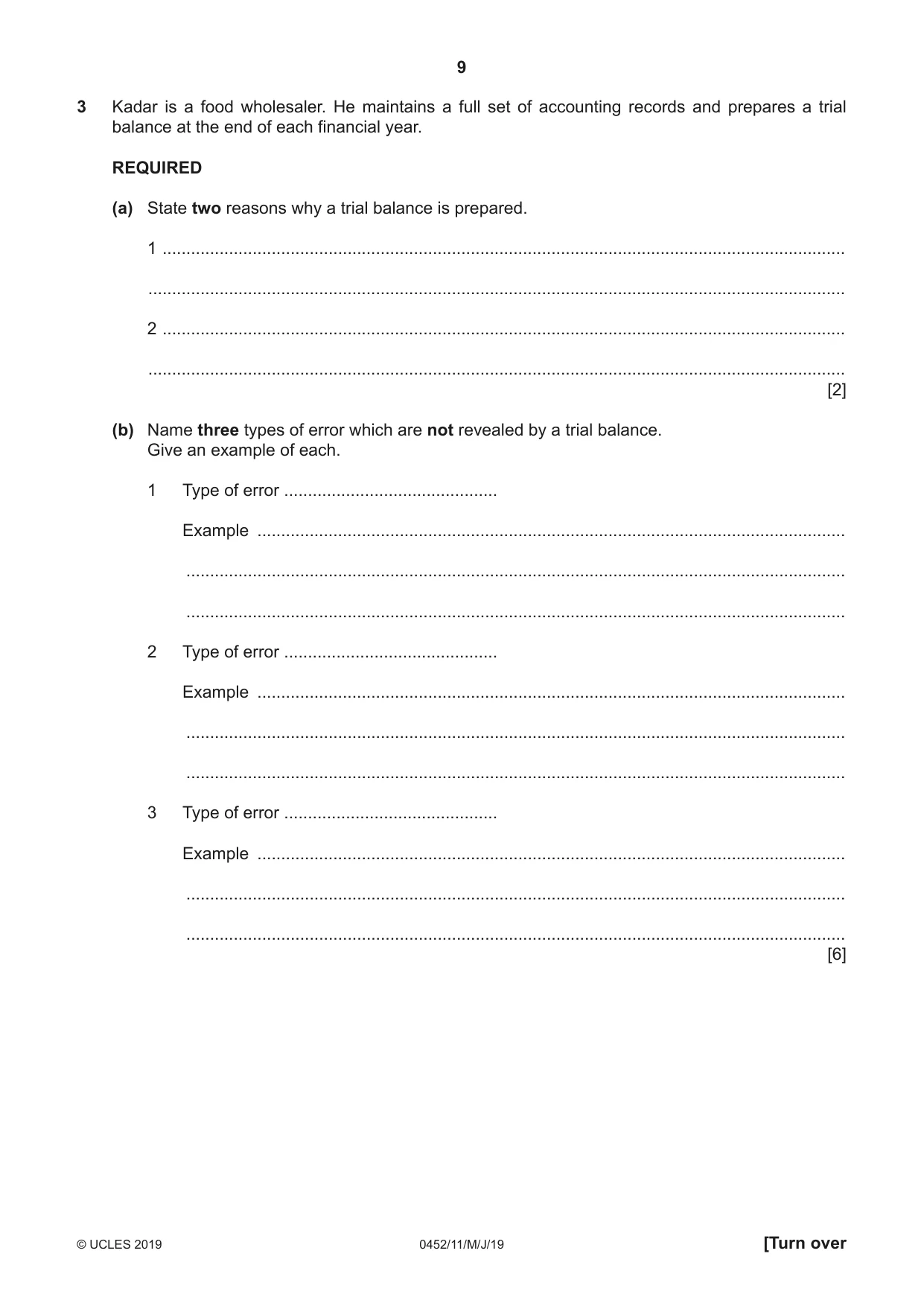
9 0452/11/M/J/19 © UCLES 2019 [Turn over 3 Kadar is a food wholesaler. He maintains a full set of accounting records and prepares a trial balance at the end of each financial year. REQUIRED (a) State two reasons why a trial balance is prepared. 1 … … 2 … … [2] (b) Name three types of error which are not revealed by a trial balance. Give an example of each. 1 Type of error … Example … … … 2 Type of error … Example … … … 3 Type of error … Example … … … [6]
Question paper, page 10
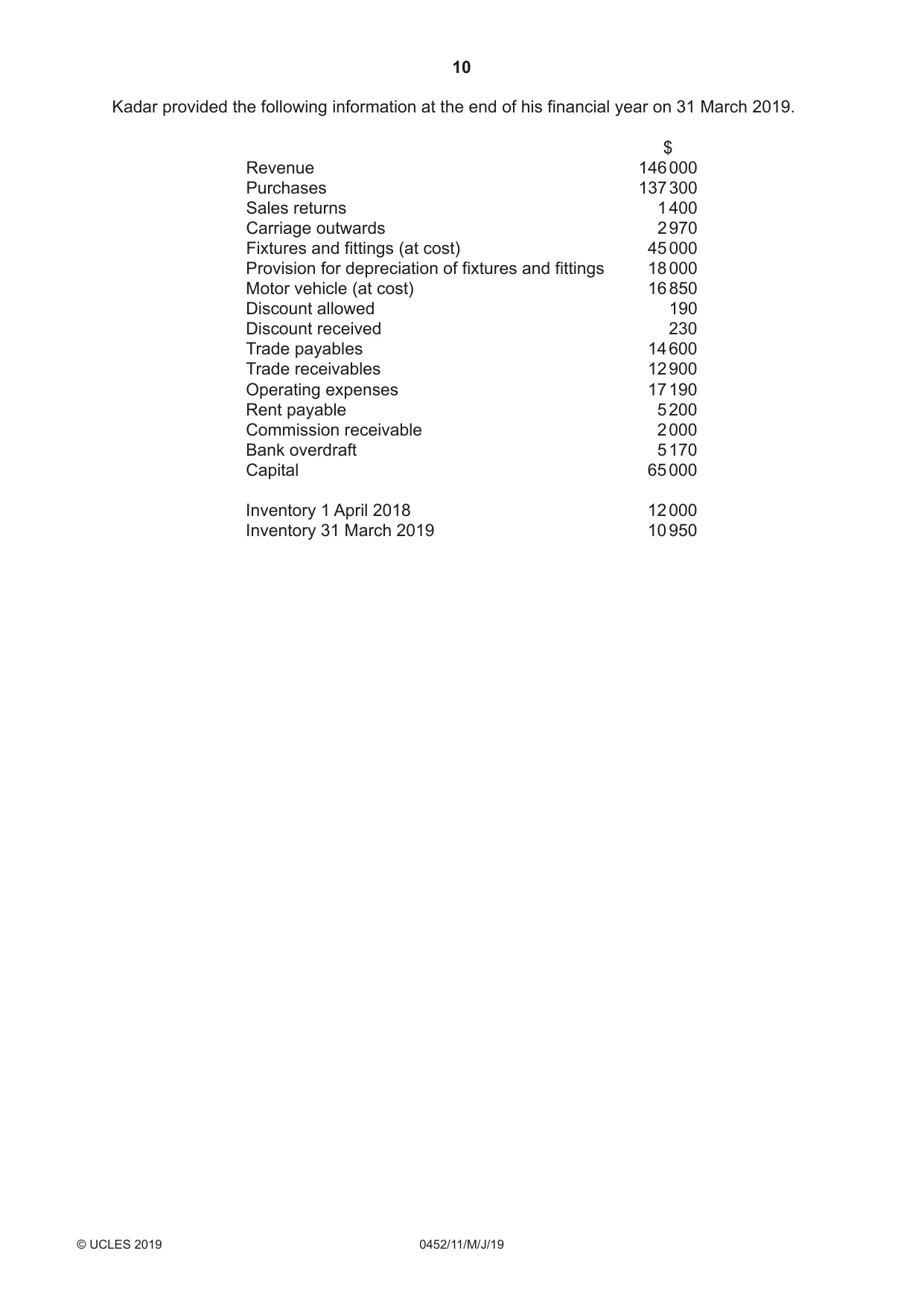
10 0452/11/M/J/19 © UCLES 2019 Kadar provided the following information at the end of his financial year on 31 March 2019. $ Revenue 146 000 Purchases 137 300 Sales returns 1 400 Carriage outwards 2 970 Fixtures and fittings (at cost) 45 000 Provision for depreciation of fixtures and fittings 18 000 Motor vehicle (at cost) 16 850 Discount allowed 190 Discount received 230 Trade payables 14 600 Trade receivables 12 900 Operating expenses 17 190 Rent payable 5 200 Commission receivable 2 000 Bank overdraft 5 170 Capital 65 000 Inventory 1 April 2018 12 000 Inventory 31 March 2019 10 950
Question paper, page 11
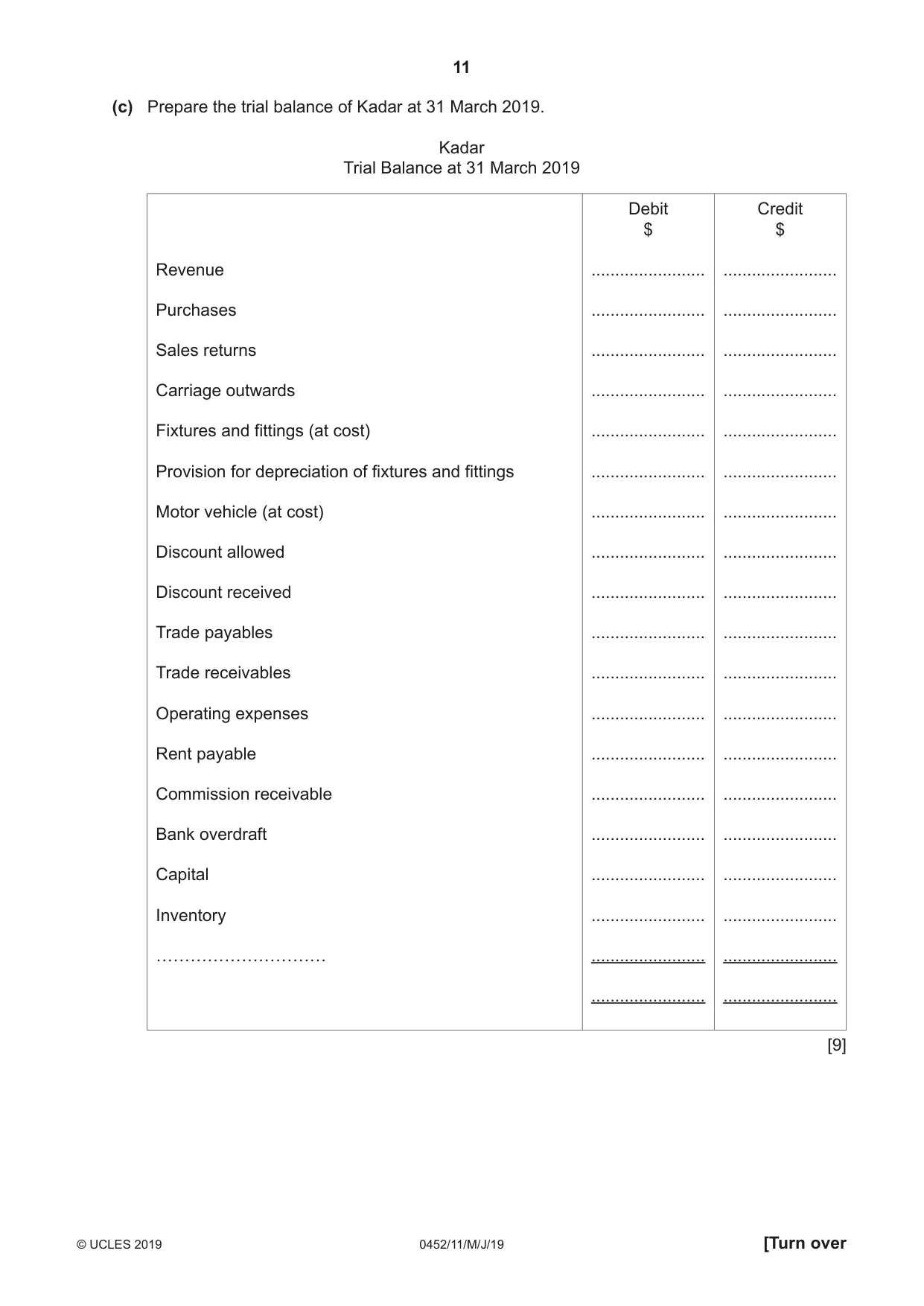
11 0452/11/M/J/19 © UCLES 2019 [Turn over (c) Prepare the trial balance of Kadar at 31 March 2019. Kadar Trial Balance at 31 March 2019 Revenue Purchases Sales returns Carriage outwards Fixtures and fittings (at cost) Provision for depreciation of fixtures and fittings Motor vehicle (at cost) Discount allowed Discount received Trade payables Trade receivables Operating expenses Rent payable Commission receivable Bank overdraft Capital Inventory ………………………… Debit $ … … … … … … … … … … … … … … … … … … … Credit $ … … … … … … … … … … … … … … … … … … … [9]
Question paper, page 12
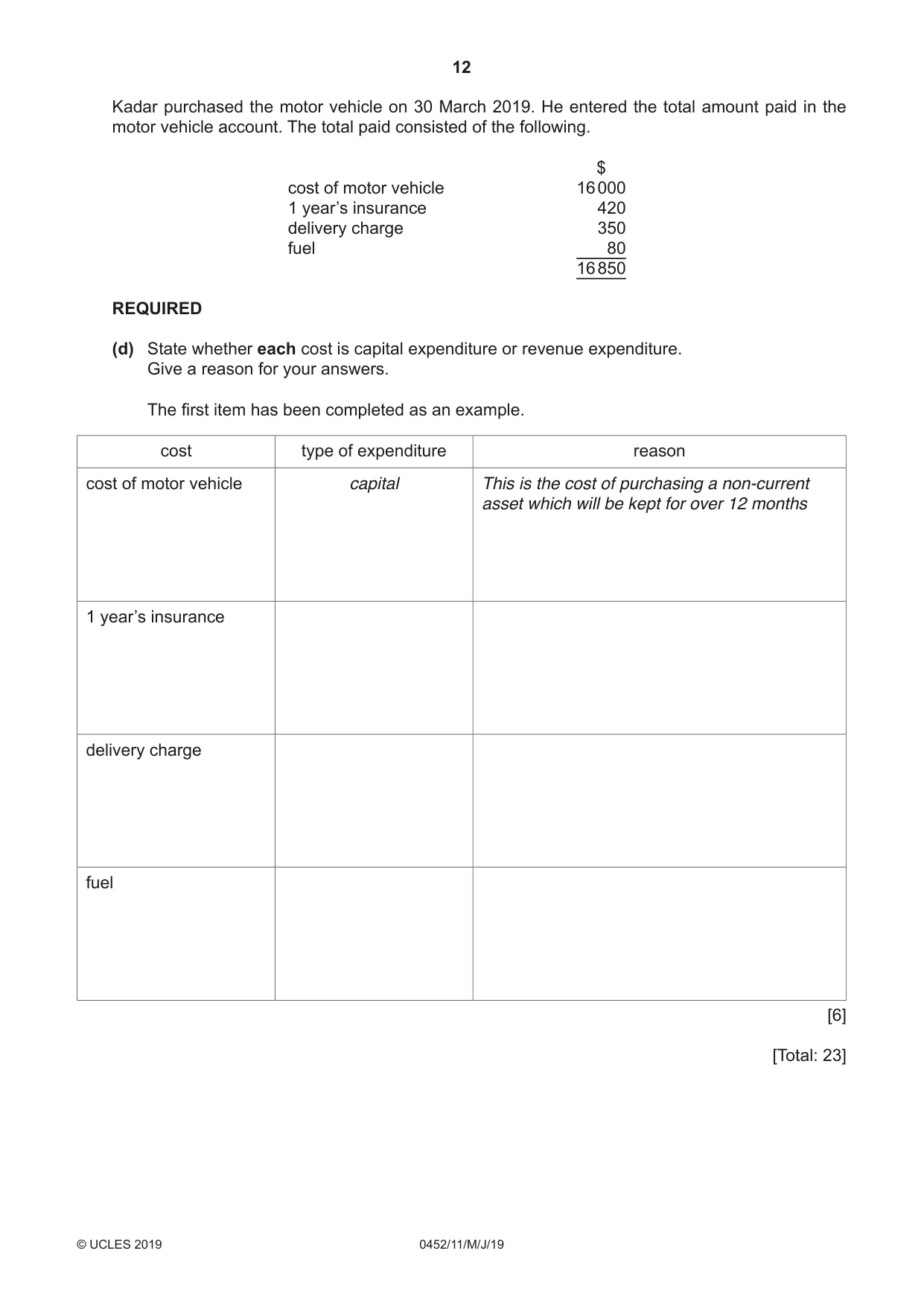
12 0452/11/M/J/19 © UCLES 2019 Kadar purchased the motor vehicle on 30 March 2019. He entered the total amount paid in the motor vehicle account. The total paid consisted of the following. $ cost of motor vehicle 16 000 1 year’s insurance 420 delivery charge 350 fuel 80 16 850 REQUIRED (d) State whether each cost is capital expenditure or revenue expenditure. Give a reason for your answers. The first item has been completed as an example. cost type of expenditure reason cost of motor vehicle capital This is the cost of purchasing a non-current asset which will be kept for over 12 months 1 year’s insurance delivery charge fuel [6] [Total: 23]
Question paper, page 13
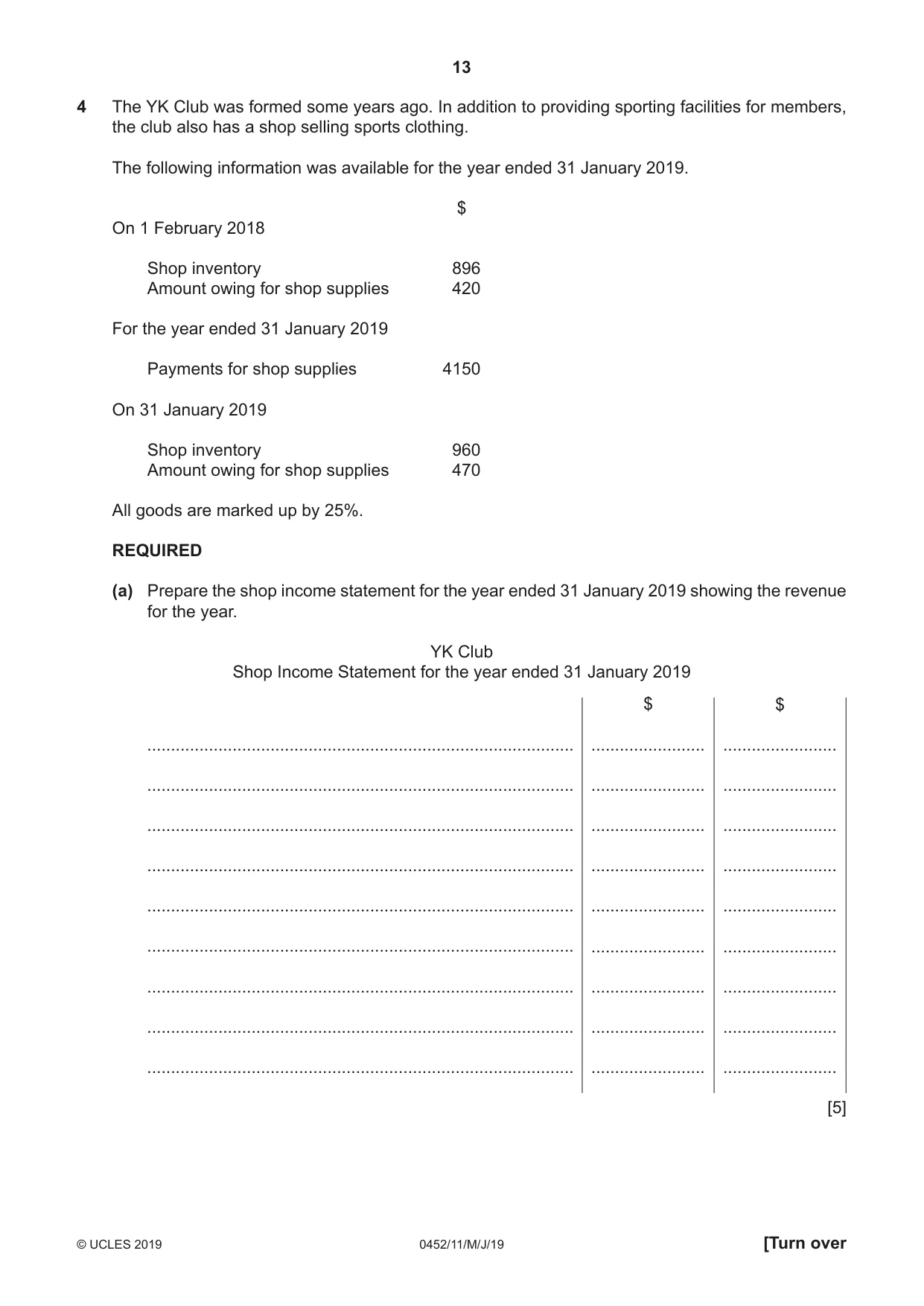
13 0452/11/M/J/19 © UCLES 2019 [Turn over 4 The YK Club was formed some years ago. In addition to providing sporting facilities for members, the club also has a shop selling sports clothing. The following information was available for the year ended 31 January 2019. $ On 1 February 2018 Shop inventory 896 Amount owing for shop supplies 420 For the year ended 31 January 2019 Payments for shop supplies 4150 On 31 January 2019 Shop inventory 960 Amount owing for shop supplies 470 All goods are marked up by 25%. REQUIRED (a) Prepare the shop income statement for the year ended 31 January 2019 showing the revenue for the year. YK Club Shop Income Statement for the year ended 31 January 2019 … … … … … … … … … $ … … … … … … … … … $ … … … … … … … … … [5]
Question paper, page 14
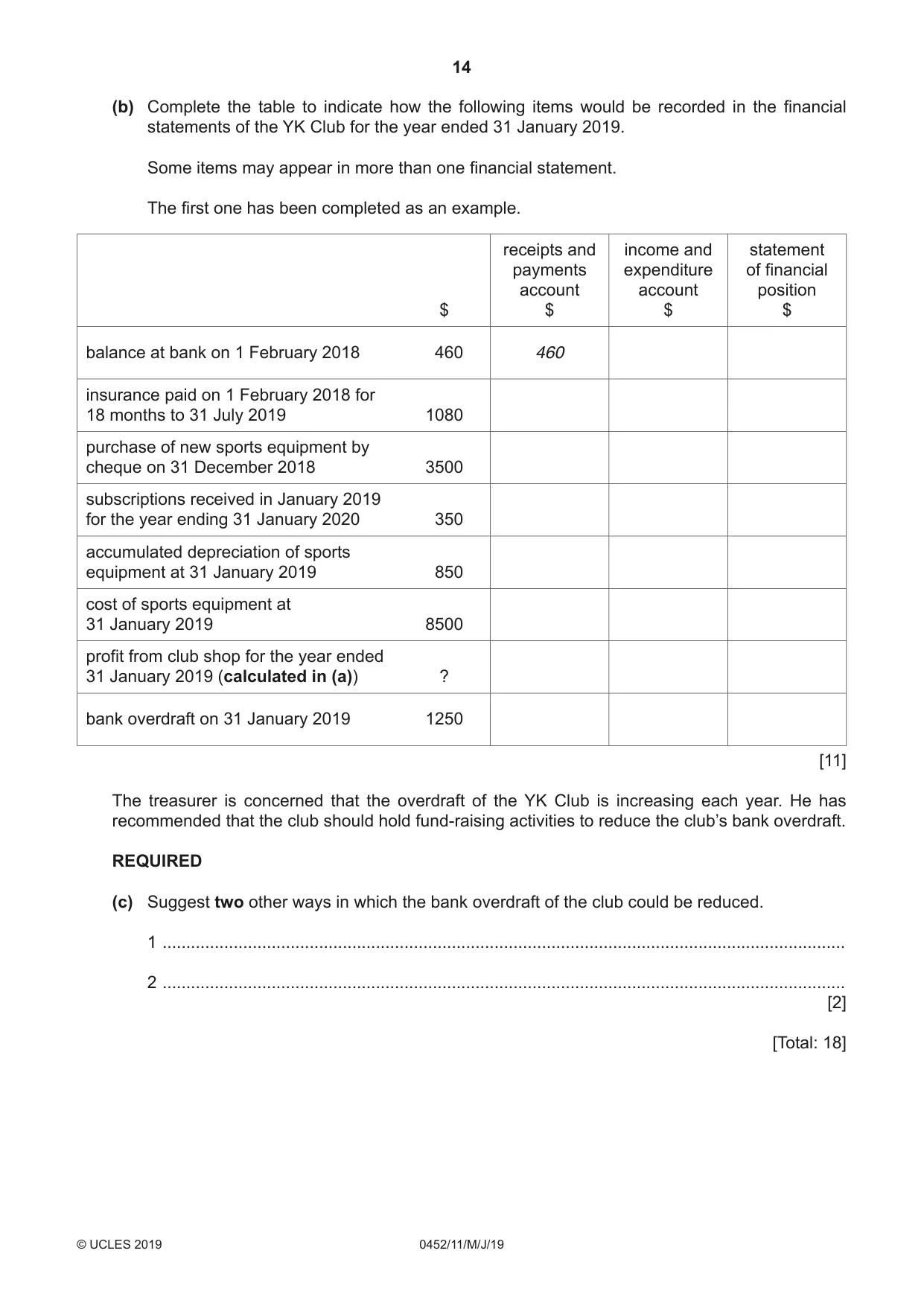
14 0452/11/M/J/19 © UCLES 2019 (b) Complete the table to indicate how the following items would be recorded in the financial statements of the YK Club for the year ended 31 January 2019. Some items may appear in more than one financial statement. The first one has been completed as an example. $ receipts and payments account $ income and expenditure account $ statement of financial position $ balance at bank on 1 February 2018 460 460 insurance paid on 1 February 2018 for 18 months to 31 July 2019 1080 purchase of new sports equipment by cheque on 31 December 2018 3500 subscriptions received in January 2019 for the year ending 31 January 2020 350 accumulated depreciation of sports equipment at 31 January 2019 850 cost of sports equipment at 31 January 2019 8500 profit from club shop for the year ended 31 January 2019 (calculated in (a)) ? bank overdraft on 31 January 2019 1250 [11] The treasurer is concerned that the overdraft of the YK Club is increasing each year. He has recommended that the club should hold fund-raising activities to reduce the club’s bank overdraft. REQUIRED (c) Suggest two other ways in which the bank overdraft of the club could be reduced. 1 … 2 … [2] [Total: 18]
Question paper, page 15
15 0452/11/M/J/19 © UCLES 2019 [Turn over PLEASE TURN OVER
Question paper, page 16
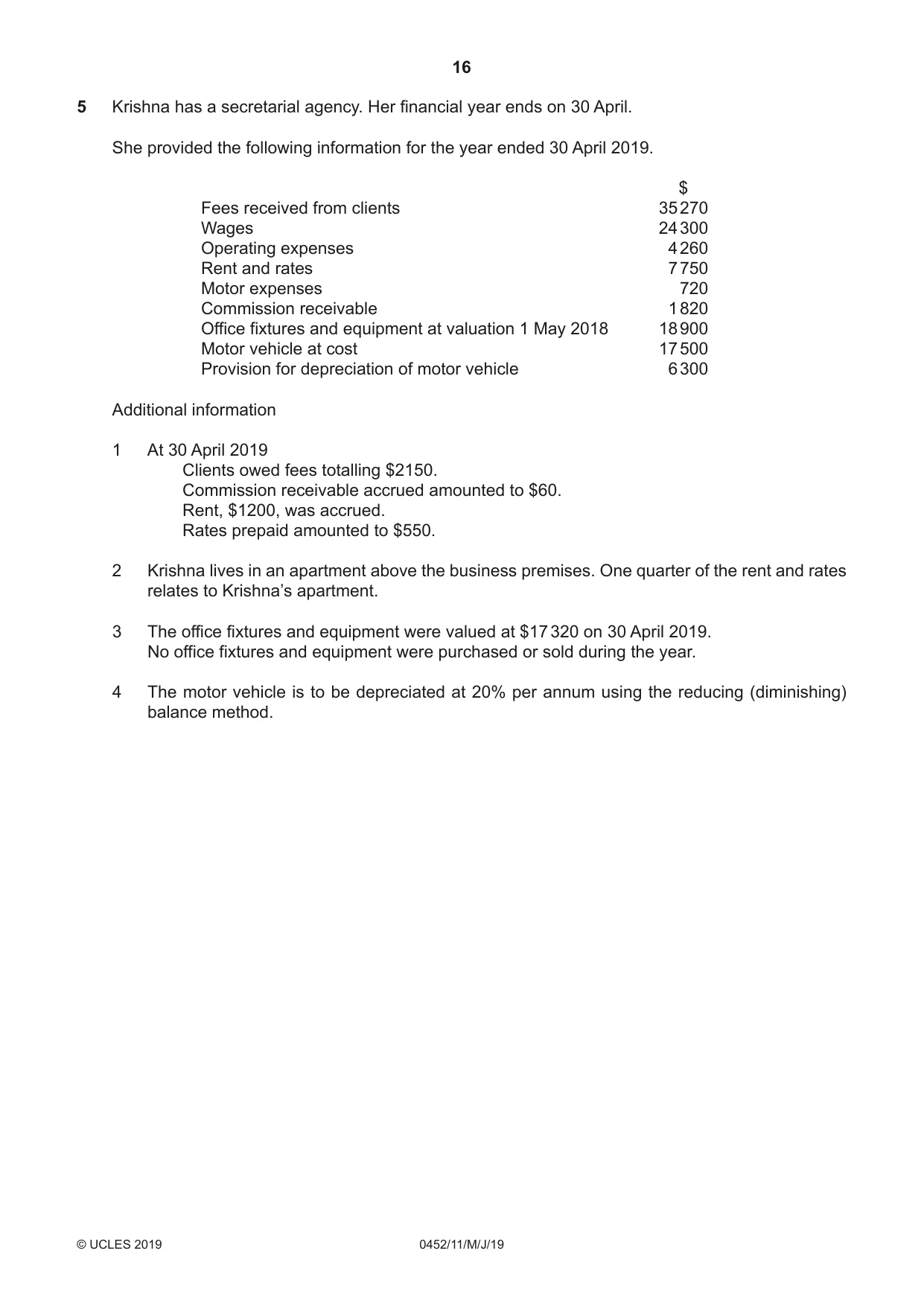
16 0452/11/M/J/19 © UCLES 2019 5 Krishna has a secretarial agency. Her financial year ends on 30 April. She provided the following information for the year ended 30 April 2019. $ Fees received from clients 35 270 Wages 24 300 Operating expenses 4 260 Rent and rates 7 750 Motor expenses 720 Commission receivable 1 820 Office fixtures and equipment at valuation 1 May 2018 18 900 Motor vehicle at cost 17 500 Provision for depreciation of motor vehicle 6 300 Additional information 1 At 30 April 2019 Clients owed fees totalling $2150. Commission receivable accrued amounted to $60. Rent, $1200, was accrued. Rates prepaid amounted to $550. 2 Krishna lives in an apartment above the business premises. One quarter of the rent and rates relates to Krishna’s apartment. 3 The office fixtures and equipment were valued at $17 320 on 30 April 2019. No office fixtures and equipment were purchased or sold during the year. 4 The motor vehicle is to be depreciated at 20% per annum using the reducing (diminishing) balance method.
Question paper, page 17
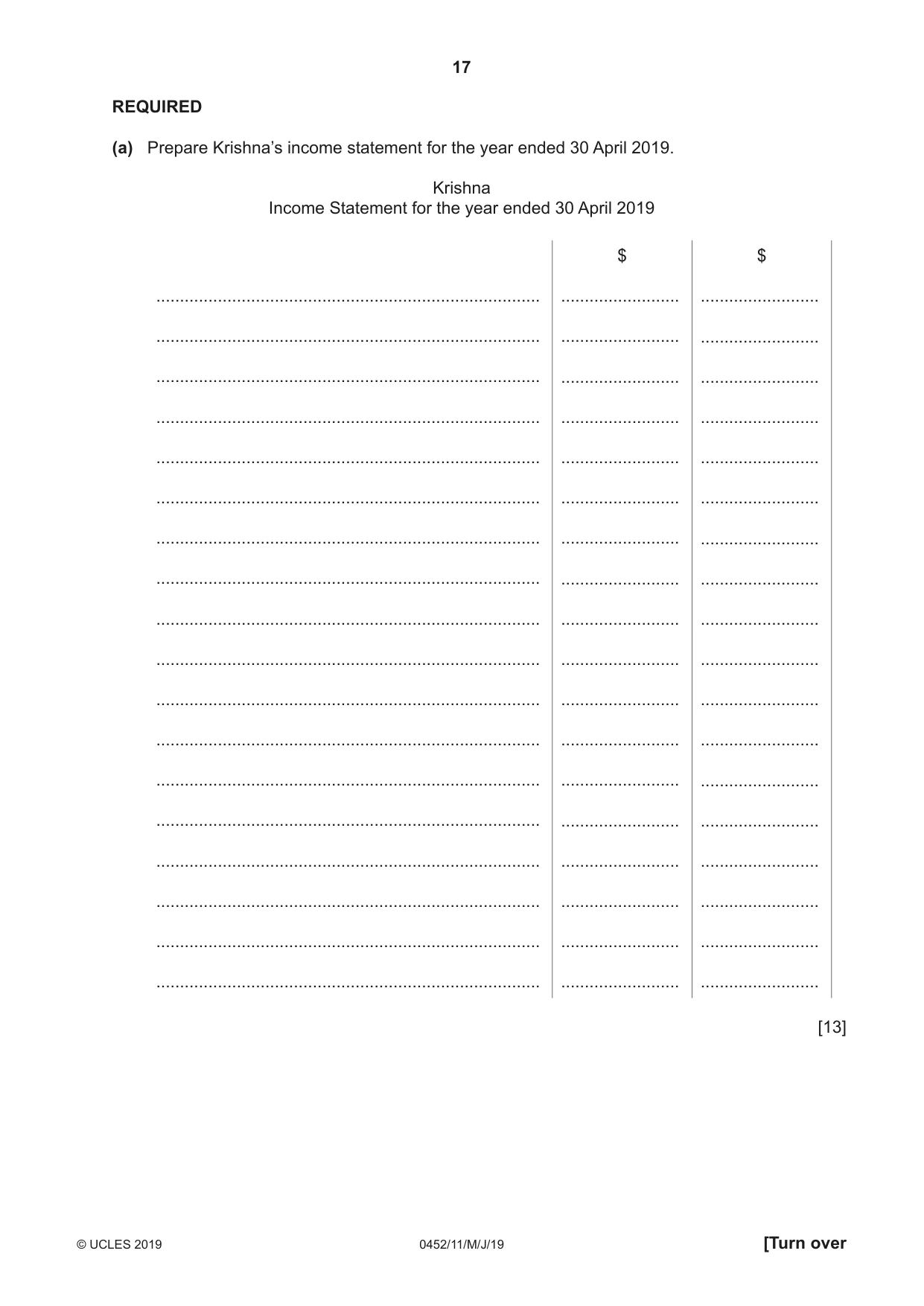
17 0452/11/M/J/19 © UCLES 2019 [Turn over REQUIRED (a) Prepare Krishna’s income statement for the year ended 30 April 2019. Krishna Income Statement for the year ended 30 April 2019 … … … … … … … … … … … … … … … … … … $ … … … … … … … … … … … … … … … … … … $ … … … … … … … … … … … … … … … … … … [13]
Question paper, page 18
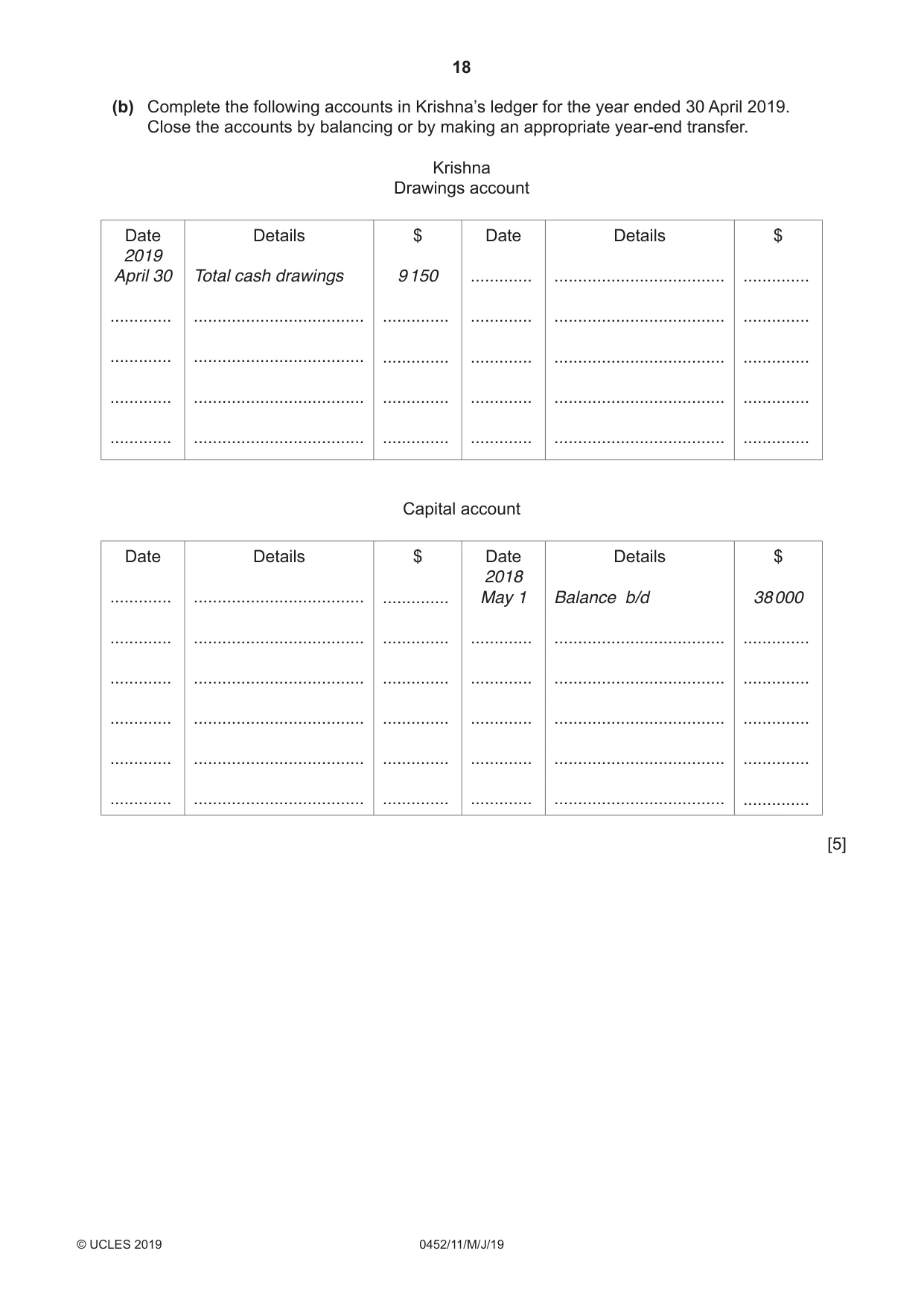
18 0452/11/M/J/19 © UCLES 2019 (b) Complete the following accounts in Krishna’s ledger for the year ended 30 April 2019. Close the accounts by balancing or by making an appropriate year-end transfer. Krishna Drawings account Date 2019 April 30 … … … … Details Total cash drawings … … … … $ 9 150 … … … … Date … … … … … Details … … … … … $ … … … … … Capital account Date … … … … … … Details … … … … … … $ … … … … … … Date 2018 May 1 … … … … … Details Balance b/d … … … … … $ 38 000 … … … … … [5]
Question paper, page 19
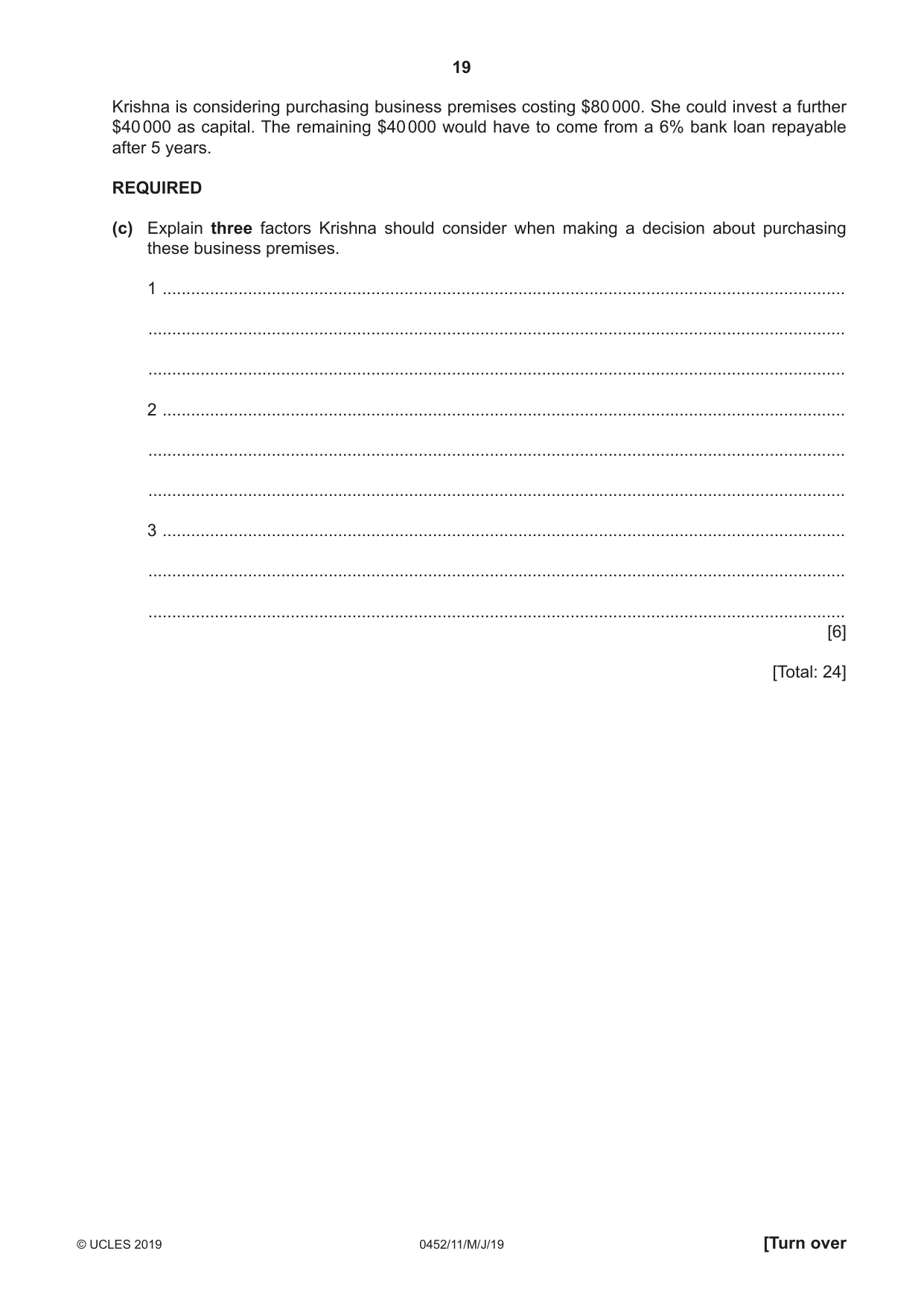
19 0452/11/M/J/19 © UCLES 2019 [Turn over Krishna is considering purchasing business premises costing $80 000. She could invest a further $40 000 as capital. The remaining $40 000 would have to come from a 6% bank loan repayable after 5 years. REQUIRED (c) Explain three factors Krishna should consider when making a decision about purchasing these business premises. 1 … … … 2 … … … 3 … … … [6] [Total: 24]
Question paper, page 20
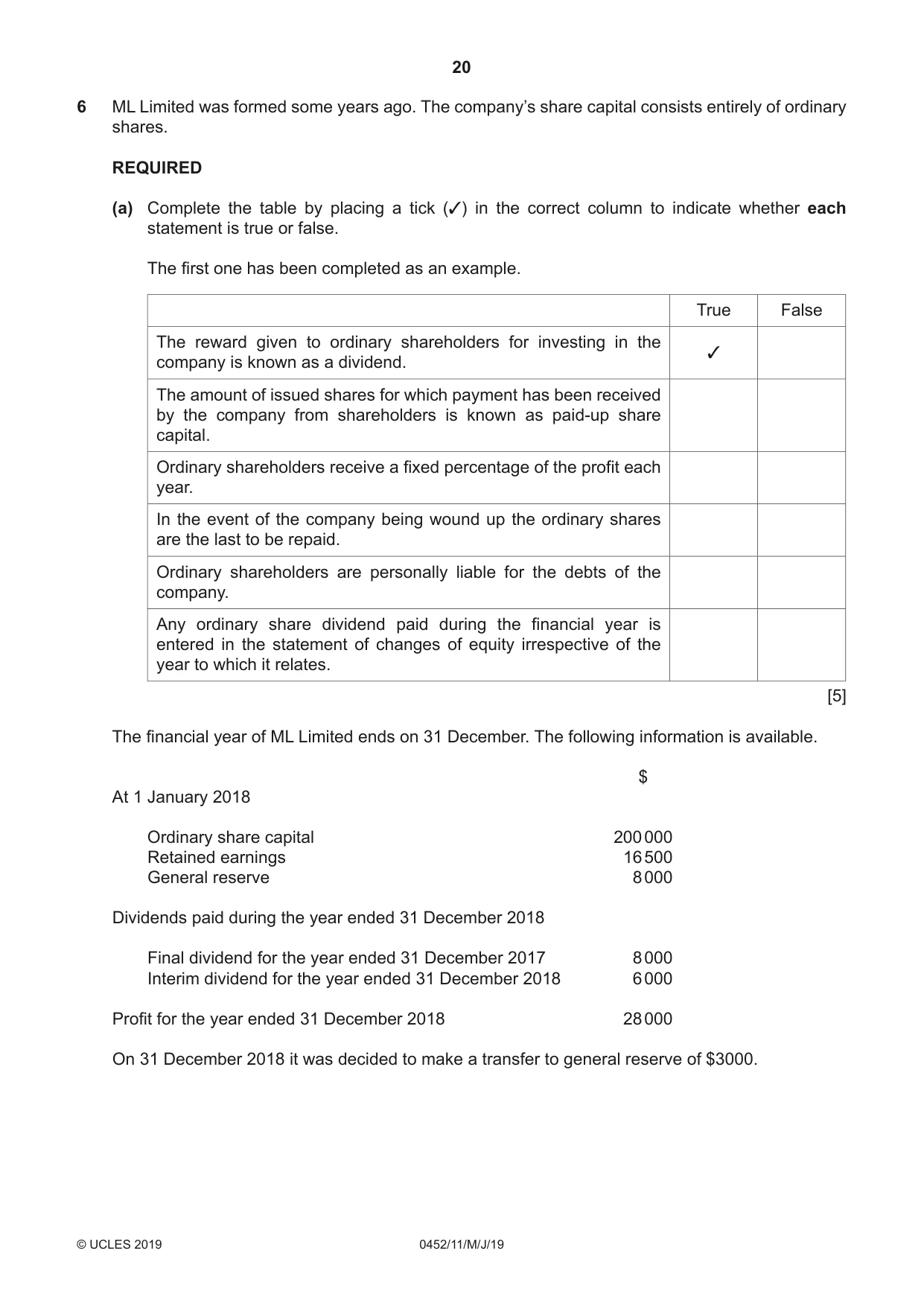
20 0452/11/M/J/19 © UCLES 2019 6 ML Limited was formed some years ago. The company’s share capital consists entirely of ordinary shares. REQUIRED (a) Complete the table by placing a tick (3) in the correct column to indicate whether each statement is true or false. The first one has been completed as an example. True False The reward given to ordinary shareholders for investing in the company is known as a dividend. 3 The amount of issued shares for which payment has been received by the company from shareholders is known as paid-up share capital. Ordinary shareholders receive a fixed percentage of the profit each year. In the event of the company being wound up the ordinary shares are the last to be repaid. Ordinary shareholders are personally liable for the debts of the company. Any ordinary share dividend paid during the financial year is entered in the statement of changes of equity irrespective of the year to which it relates. [5] The financial year of ML Limited ends on 31 December. The following information is available. $ At 1 January 2018 Ordinary share capital 200 000 Retained earnings 16 500 General reserve 8 000 Dividends paid during the year ended 31 December 2018 Final dividend for the year ended 31 December 2017 8 000 Interim dividend for the year ended 31 December 2018 6 000 Profit for the year ended 31 December 2018 28 000 On 31 December 2018 it was decided to make a transfer to general reserve of $3000.
Question paper, page 21
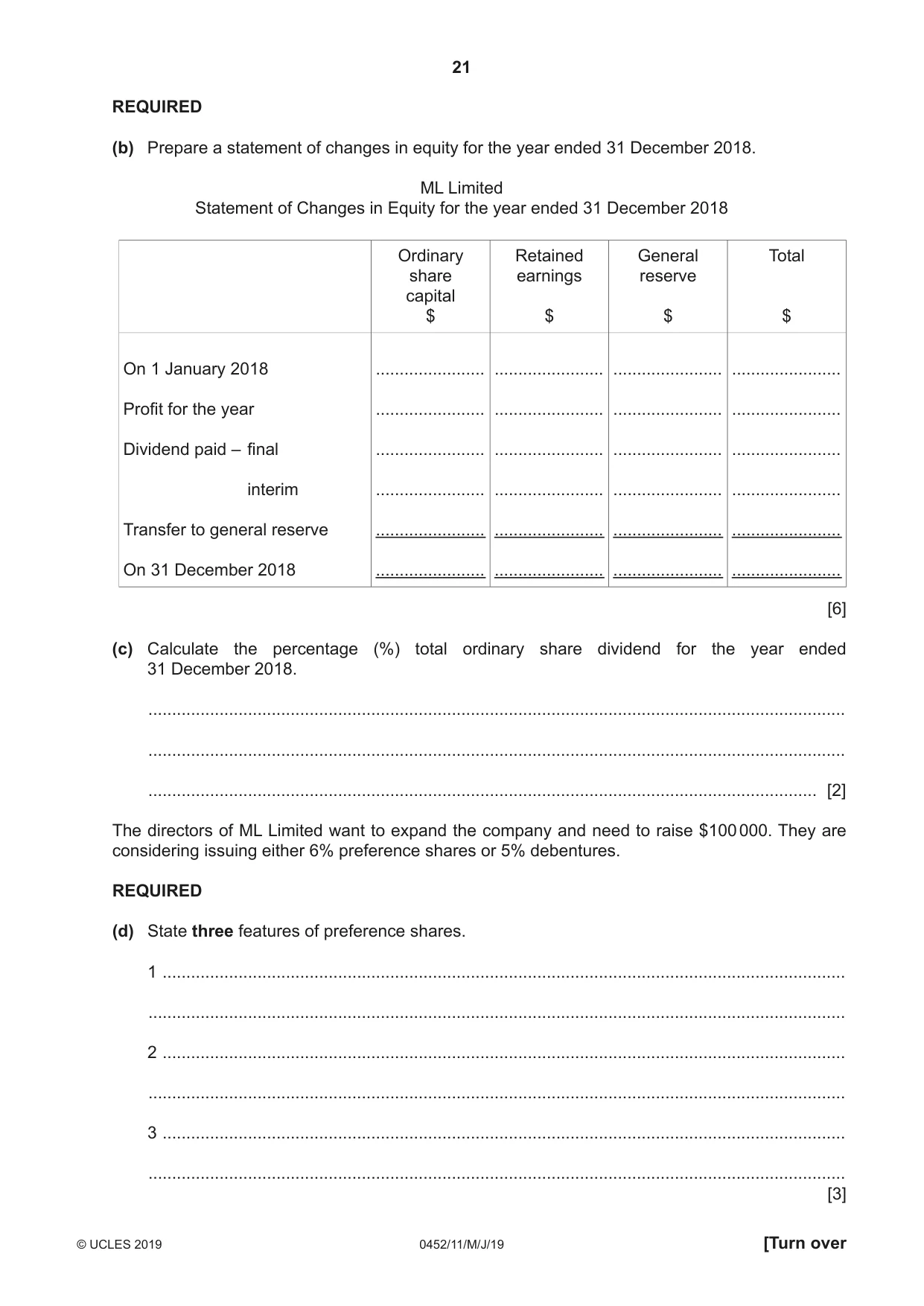
21 0452/11/M/J/19 © UCLES 2019 [Turn over REQUIRED (b) Prepare a statement of changes in equity for the year ended 31 December 2018. ML Limited Statement of Changes in Equity for the year ended 31 December 2018 Ordinary share capital $ Retained earnings $ General reserve $ Total $ On 1 January 2018 Profit for the year Dividend paid – final interim Transfer to general reserve On 31 December 2018 … … … … … … … … … … … … … … … … … … … … … … … … [6] (c) Calculate the percentage (%) total ordinary share dividend for the year ended 31 December 2018. … … … [2] The directors of ML Limited want to expand the company and need to raise $100 000. They are considering issuing either 6% preference shares or 5% debentures. REQUIRED (d) State three features of preference shares. 1 … … 2 … … 3 … … [3]
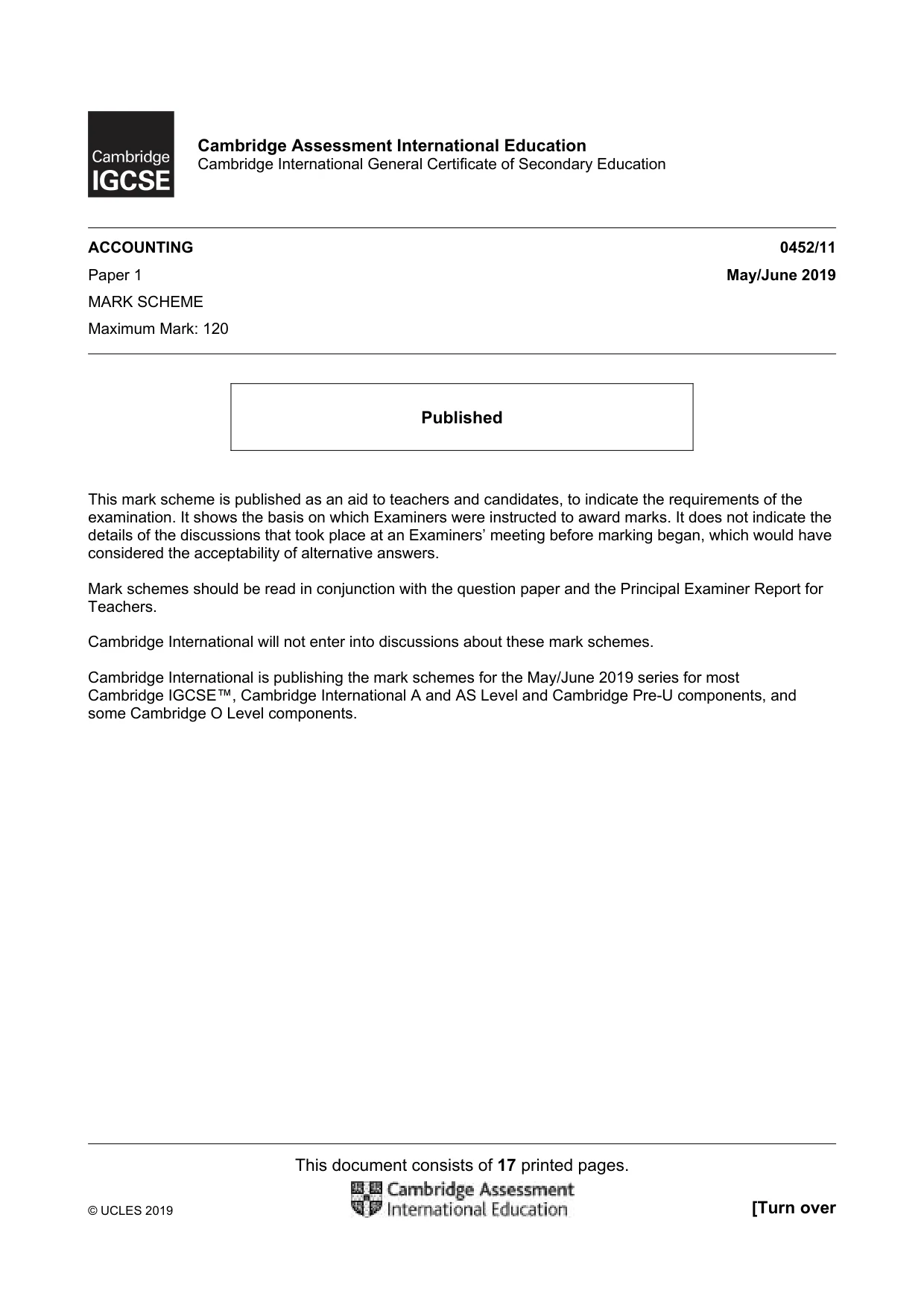
Question paper, page 22
22 0452/11/M/J/19 © UCLES 2019 (e) State three features of debentures. 1 … … 2 … … 3 … … [3] (f) Complete the table to indicate the effect of raising the funds from an issue of 5% debentures on 1 January 2019. Where there is no effect place a tick (3) in the ‘no effect’ column. The first one has been completed as an example. increase $ decrease $ no effect effect on balance at bank 100 000 effect on non-current liabilities effect on working capital effect on equity at 1 January 2019 effect on annual profits [4] [Total: 23]
Question paper, page 23
23 0452/11/M/J/19 © UCLES 2019 BLANK PAGE
Question paper, page 24
24 0452/11/M/J/19 © UCLES 2019 Permission to reproduce items where third-party owned material protected by copyright is included has been sought and cleared where possible. Every reasonable effort has been made by the publisher (UCLES) to trace copyright holders, but if any items requiring clearance have unwittingly been included, the publisher will be pleased to make amends at the earliest possible opportunity. To avoid the issue of disclosure of answer-related information to candidates, all copyright acknowledgements are reproduced online in the Cambridge Assessment International Education Copyright Acknowledgements Booklet. This is produced for each series of examinations and is freely available to download at www.cambridgeinternational.org after the live examination series. Cambridge Assessment International Education is part of the Cambridge Assessment Group. Cambridge Assessment is the brand name of the University of Cambridge Local Examinations Syndicate (UCLES), which itself is a department of the University of Cambridge. BLANK PAGE
Mark scheme, page 1
This document consists of 17 printed pages. © UCLES 2019 [Turn over Cambridge Assessment International Education Cambridge International General Certificate of Secondary Education ACCOUNTING 0452/11 Paper 1 May/June 2019 MARK SCHEME Maximum Mark: 120 Published This mark scheme is published as an aid to teachers and candidates, to indicate the requirements of the examination. It shows the basis on which Examiners were instructed to award marks. It does not indicate the details of the discussions that took place at an Examiners’ meeting before marking began, which would have considered the acceptability of alternative answers. Mark schemes should be read in conjunction with the question paper and the Principal Examiner Report for Teachers. Cambridge International will not enter into discussions about these mark schemes. Cambridge International is publishing the mark schemes for the May/June 2019 series for most Cambridge IGCSE™, Cambridge International A and AS Level and Cambridge Pre-U components, and some Cambridge O Level components.
Mark scheme, page 2
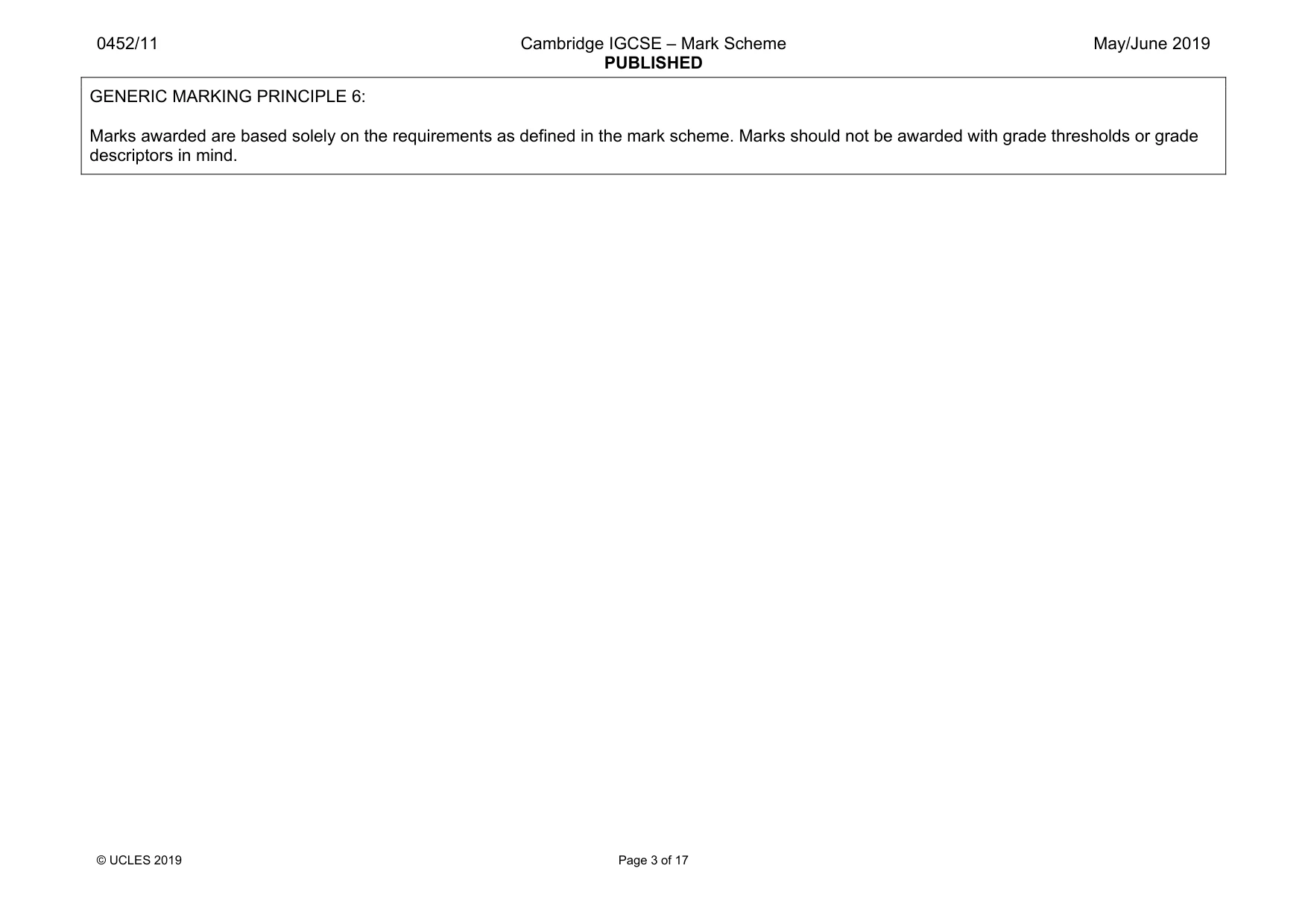
0452/11 Cambridge IGCSE – Mark Scheme PUBLISHED May/June 2019 © UCLES 2019 Page 2 of 17 Generic Marking Principles These general marking principles must be applied by all examiners when marking candidate answers. They should be applied alongside the specific content of the mark scheme or generic level descriptors for a question. Each question paper and mark scheme will also comply with these marking principles. GENERIC MARKING PRINCIPLE 1: Marks must be awarded in line with: • the specific content of the mark scheme or the generic level descriptors for the question • the specific skills defined in the mark scheme or in the generic level descriptors for the question • the standard of response required by a candidate as exemplified by the standardisation scripts. GENERIC MARKING PRINCIPLE 2: Marks awarded are always whole marks (not half marks, or other fractions). GENERIC MARKING PRINCIPLE 3: Marks must be awarded positively: • marks are awarded for correct/valid answers, as defined in the mark scheme. However, credit is given for valid answers which go beyond the scope of the syllabus and mark scheme, referring to your Team Leader as appropriate • marks are awarded when candidates clearly demonstrate what they know and can do • marks are not deducted for errors • marks are not deducted for omissions • answers should only be judged on the quality of spelling, punctuation and grammar when these features are specifically assessed by the question as indicated by the mark scheme. The meaning, however, should be unambiguous. GENERIC MARKING PRINCIPLE 4: Rules must be applied consistently e.g. in situations where candidates have not followed instructions or in the application of generic level descriptors. GENERIC MARKING PRINCIPLE 5: Marks should be awarded using the full range of marks defined in the mark scheme for the question (however; the use of the full mark range may be limited according to the quality of the candidate responses seen).
Mark scheme, page 3
0452/11 Cambridge IGCSE – Mark Scheme PUBLISHED May/June 2019 © UCLES 2019 Page 3 of 17 GENERIC MARKING PRINCIPLE 6: Marks awarded are based solely on the requirements as defined in the mark scheme. Marks should not be awarded with grade thresholds or grade descriptors in mind.
Mark scheme, page 4
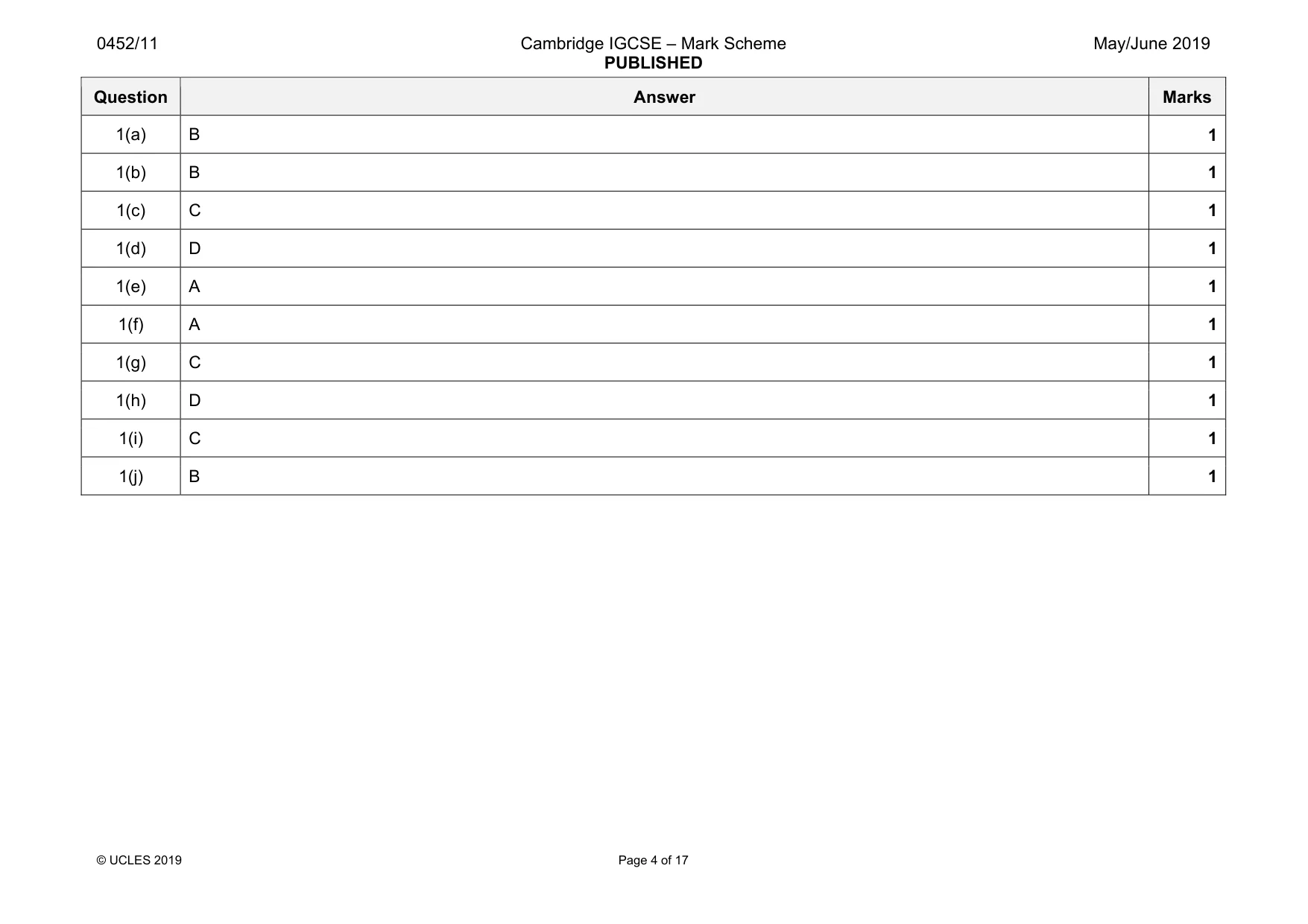
0452/11 Cambridge IGCSE – Mark Scheme PUBLISHED May/June 2019 © UCLES 2019 Page 4 of 17 Question Answer Marks 1(a) B 1 1(b) B 1 1(c) C 1 1(d) D 1 1(e) A 1 1(f) A 1 1(g) C 1 1(h) D 1 1(i) C 1 1(j) B 1
Mark scheme, page 5
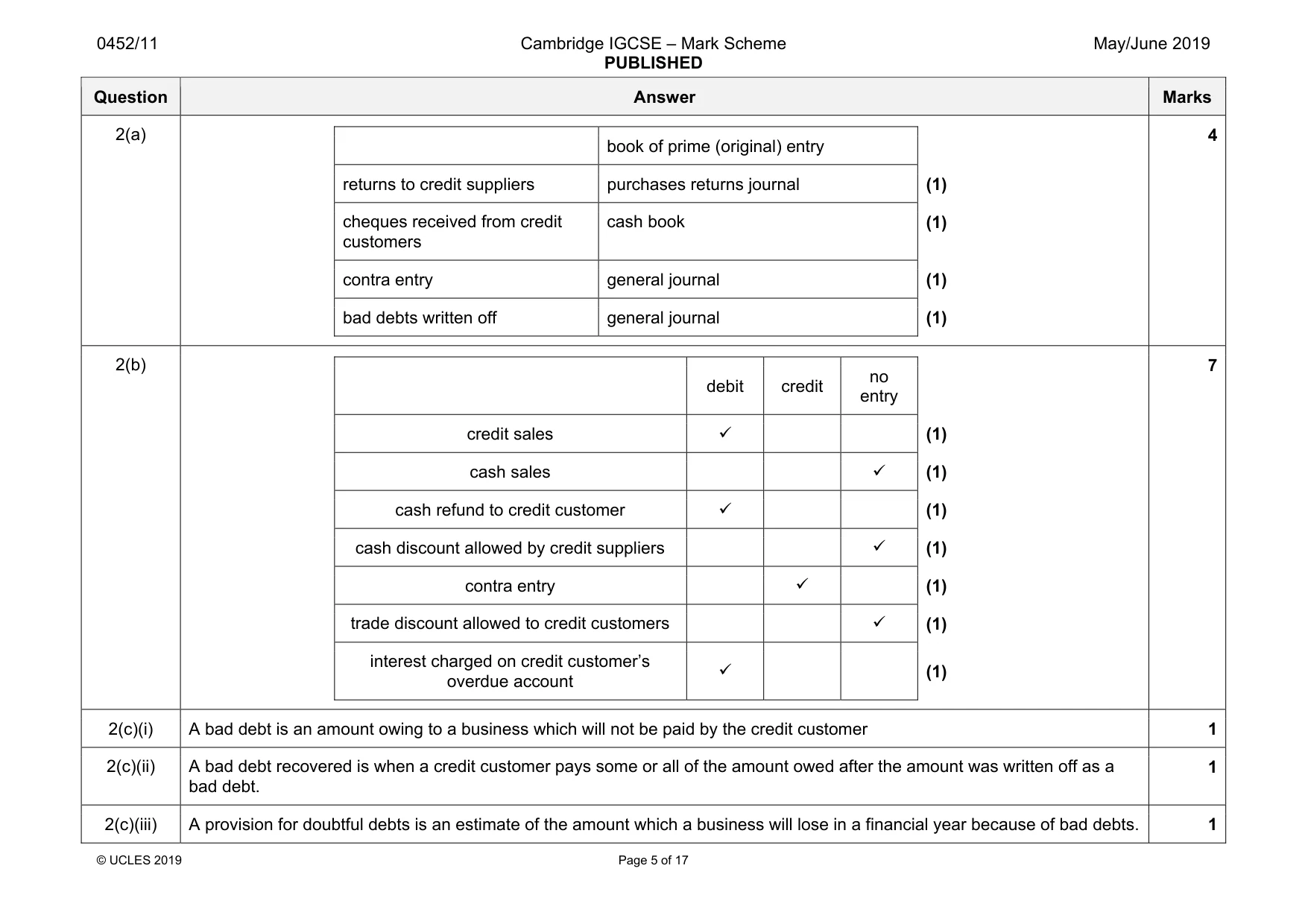
0452/11 Cambridge IGCSE – Mark Scheme PUBLISHED May/June 2019 © UCLES 2019 Page 5 of 17 Question Answer Marks 2(a) book of prime (original) entry returns to credit suppliers purchases returns journal (1) cheques received from credit customers cash book (1) contra entry general journal (1) bad debts written off general journal (1) 4 2(b) debit credit no entry credit sales 9 (1) cash sales 9 (1) cash refund to credit customer 9 (1) cash discount allowed by credit suppliers 9 (1) contra entry 9 (1) trade discount allowed to credit customers 9 (1) interest charged on credit customer’s overdue account 9 (1) 7 2(c)(i) A bad debt is an amount owing to a business which will not be paid by the credit customer 1 2(c)(ii) A bad debt recovered is when a credit customer pays some or all of the amount owed after the amount was written off as a bad debt. 1 2(c)(iii) A provision for doubtful debts is an estimate of the amount which a business will lose in a financial year because of bad debts. 1
Mark scheme, page 6
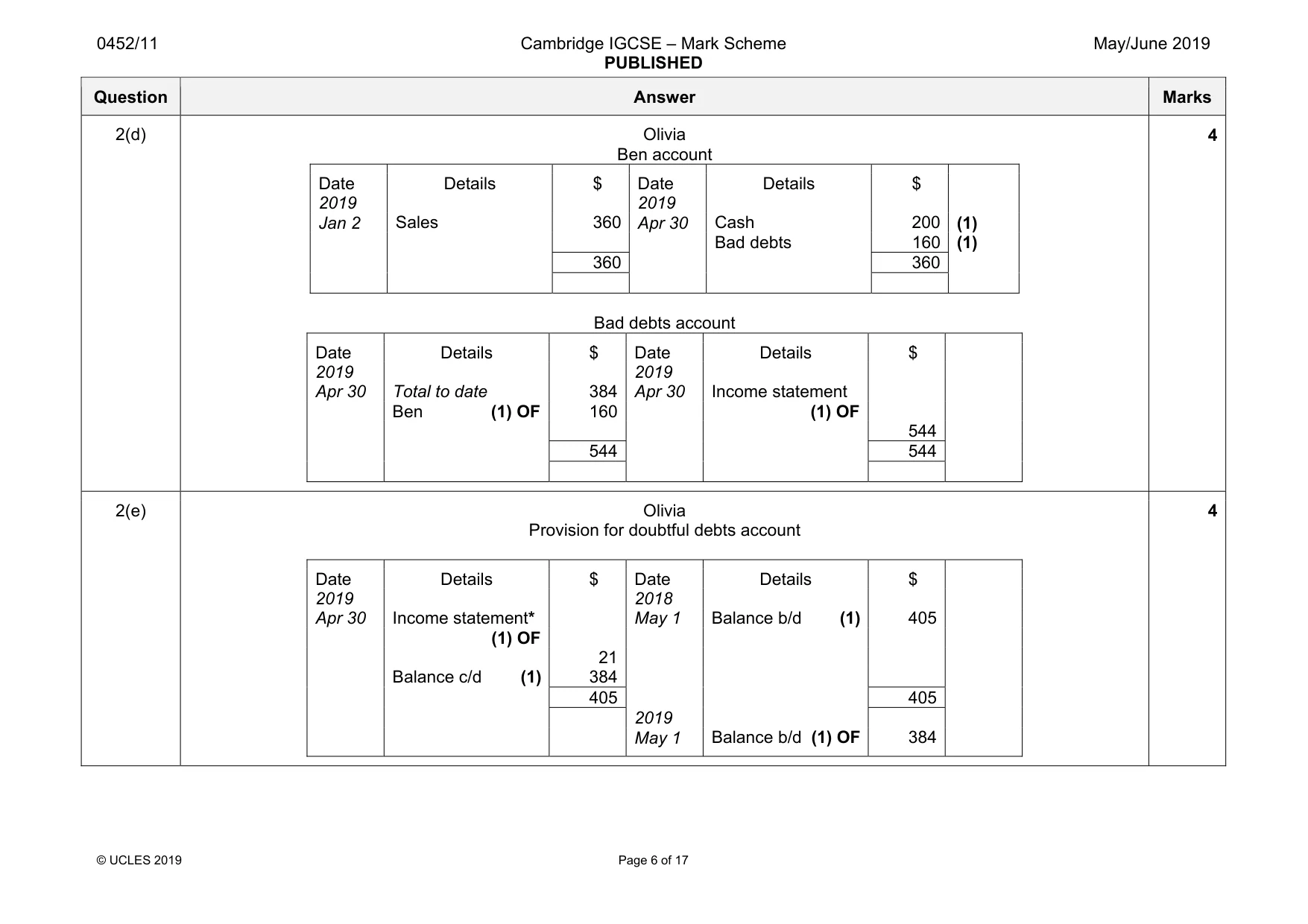
0452/11 Cambridge IGCSE – Mark Scheme PUBLISHED May/June 2019 © UCLES 2019 Page 6 of 17 Question Answer Marks 2(d) Olivia Ben account Date Details $00 Date Details $00 2019 2019 Jan 2 Sales 360 Apr 30 Cash 200 (1) Bad debts 160 (1) 360 360 Bad debts account Date Details $00 Date Details $00 2019 2019 Apr 30 Total to date 384 Apr 30 Income statement Ben (1) OF 160 (1) OF 544 544 544 4 2(e) Olivia Provision for doubtful debts account Date Details $00 Date Details $00 2019 2018 Apr 30 Income statement* May 1 Balance b/d (1) 405 (1) OF 21 Balance c/d (1) 384 405 405 2019 May 1 Balance b/d (1) OF 384 4
Mark scheme, page 7
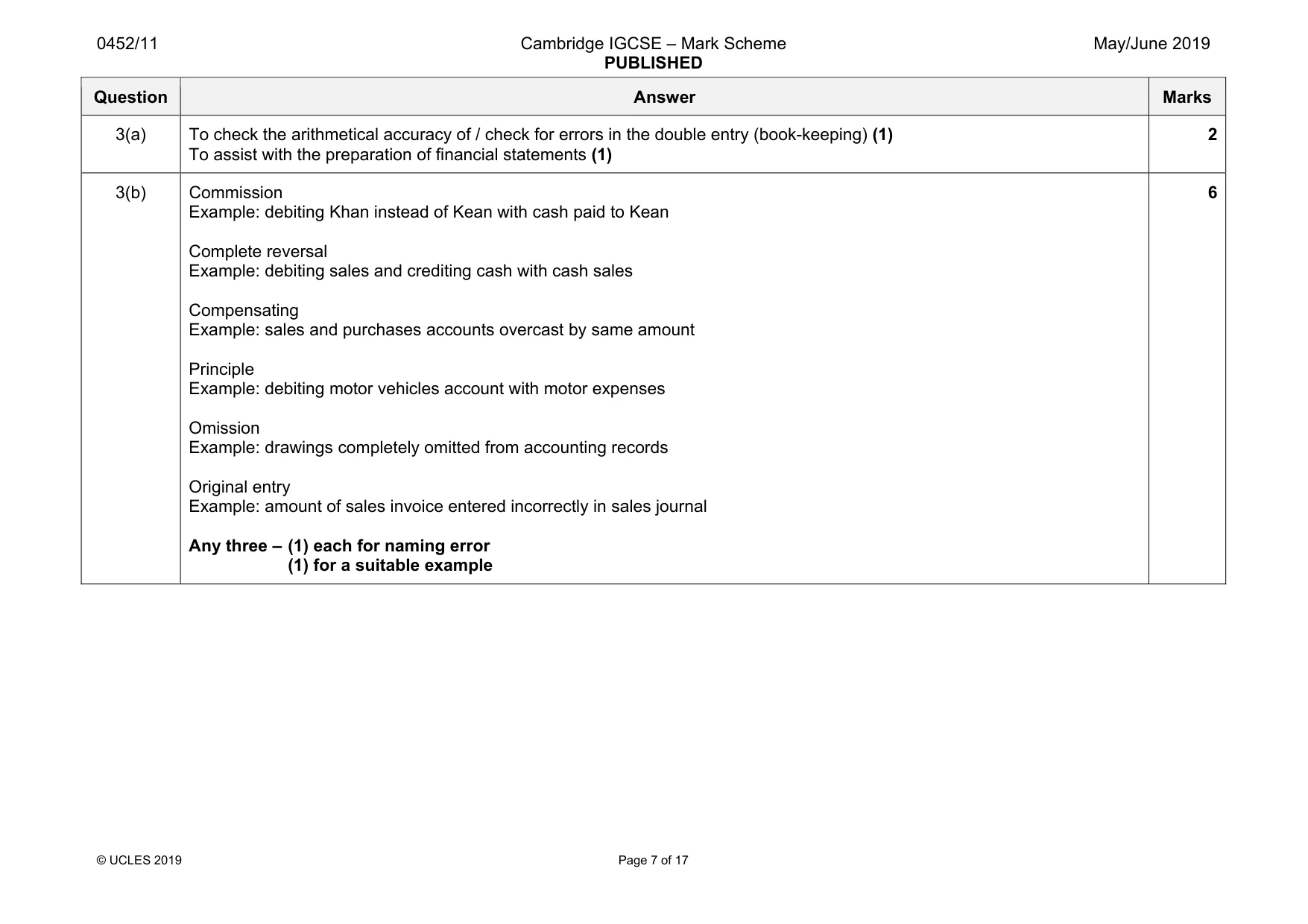
0452/11 Cambridge IGCSE – Mark Scheme PUBLISHED May/June 2019 © UCLES 2019 Page 7 of 17 Question Answer Marks 3(a) To check the arithmetical accuracy of / check for errors in the double entry (book-keeping) (1) To assist with the preparation of financial statements (1) 2 3(b) Commission Example: debiting Khan instead of Kean with cash paid to Kean Complete reversal Example: debiting sales and crediting cash with cash sales Compensating Example: sales and purchases accounts overcast by same amount Principle Example: debiting motor vehicles account with motor expenses Omission Example: drawings completely omitted from accounting records Original entry Example: amount of sales invoice entered incorrectly in sales journal Any three – (1) each for naming error (1) for a suitable example 6
Mark scheme, page 8
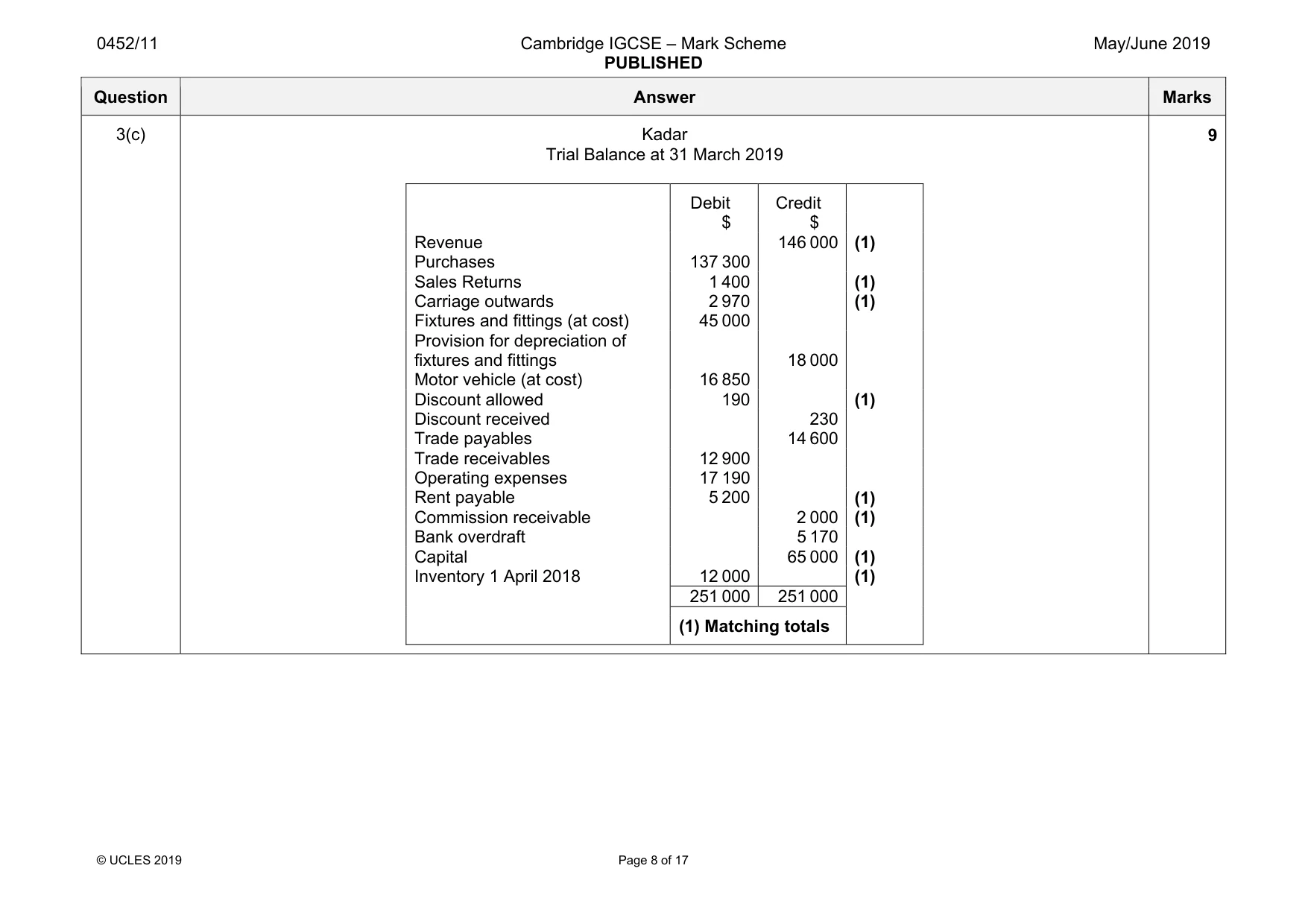
0452/11 Cambridge IGCSE – Mark Scheme PUBLISHED May/June 2019 © UCLES 2019 Page 8 of 17 Question Answer Marks 3(c) Kadar Trial Balance at 31 March 2019 Debit Credit $00 $00 Revenue 146 000 (1) Purchases 137 300 Sales Returns 1 400 (1) Carriage outwards 2 970 (1) Fixtures and fittings (at cost) 45 000 Provision for depreciation of fixtures and fittings 18 000 Motor vehicle (at cost) 16 850 Discount allowed 190 (1) Discount received 230 Trade payables 14 600 Trade receivables 12 900 Operating expenses 17 190 Rent payable 5 200 (1) Commission receivable 2 000 (1) Bank overdraft 5 170 Capital 65 000 (1) Inventory 1 April 2018 12 000 (1) 251 000 251 000 (1) Matching totals 9
Mark scheme, page 9
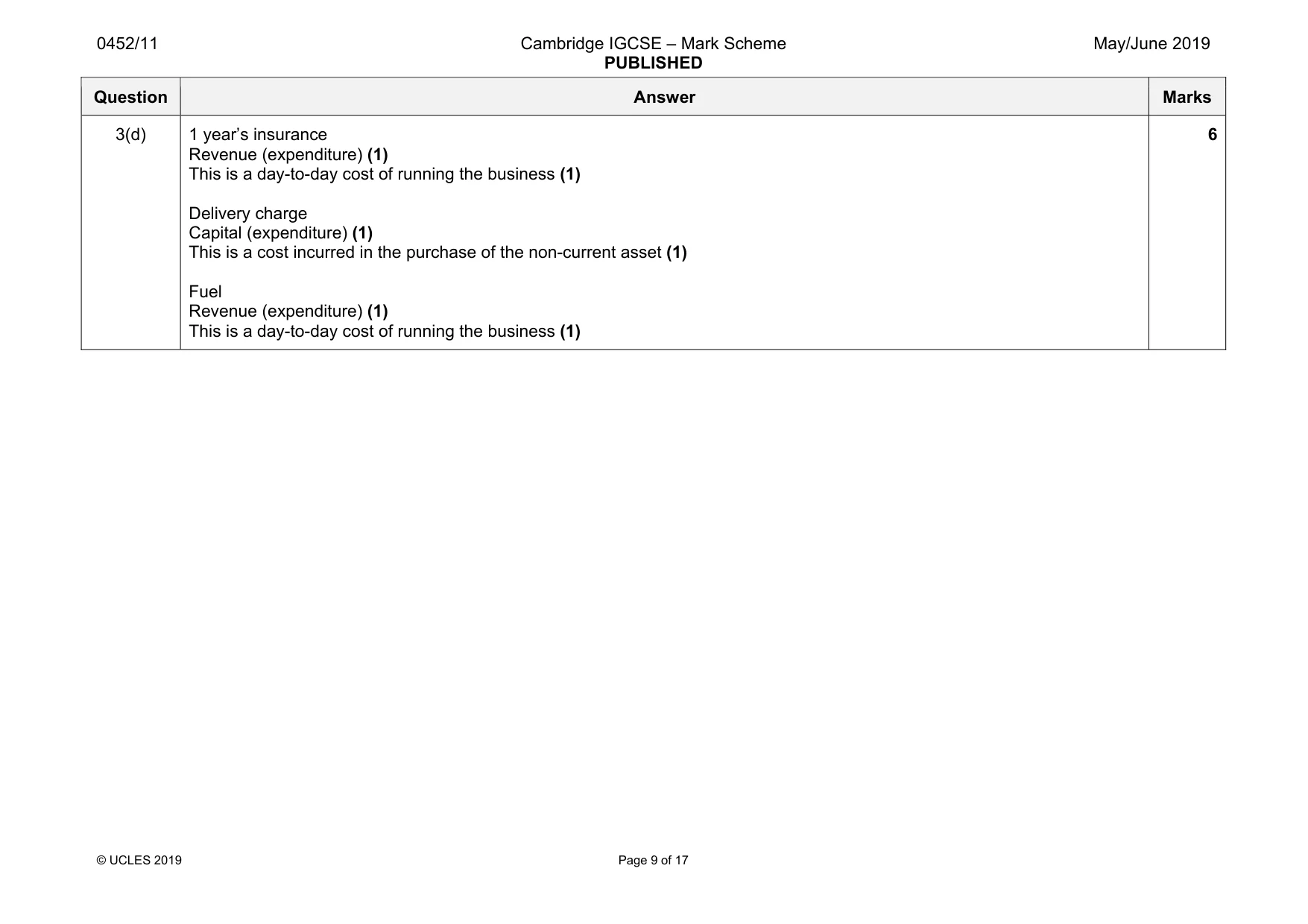
0452/11 Cambridge IGCSE – Mark Scheme PUBLISHED May/June 2019 © UCLES 2019 Page 9 of 17 Question Answer Marks 3(d) 1 year’s insurance Revenue (expenditure) (1) This is a day-to-day cost of running the business (1) Delivery charge Capital (expenditure) (1) This is a cost incurred in the purchase of the non-current asset (1) Fuel Revenue (expenditure) (1) This is a day-to-day cost of running the business (1) 6
Mark scheme, page 10
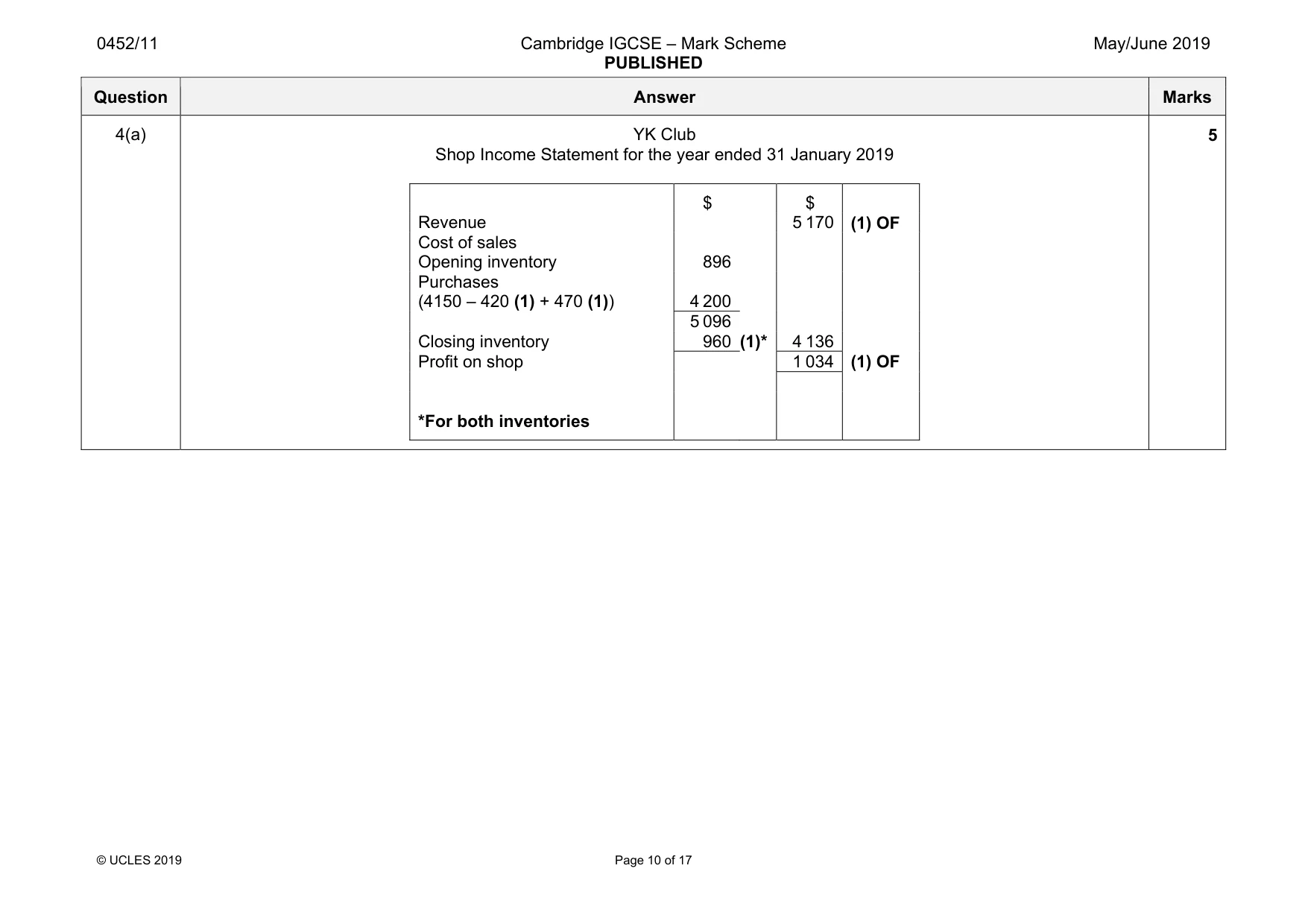
0452/11 Cambridge IGCSE – Mark Scheme PUBLISHED May/June 2019 © UCLES 2019 Page 10 of 17 Question Answer Marks 4(a) YK Club Shop Income Statement for the year ended 31 January 2019 $00 $00 Revenue 5 170 (1) OF Cost of sales Opening inventory 896 Purchases (4150 – 420 (1) + 470 (1)) 4 200 5 096 Closing inventory 960 (1)* 4 136 Profit on shop 1 034 (1) OF *For both inventories 5
Mark scheme, page 11
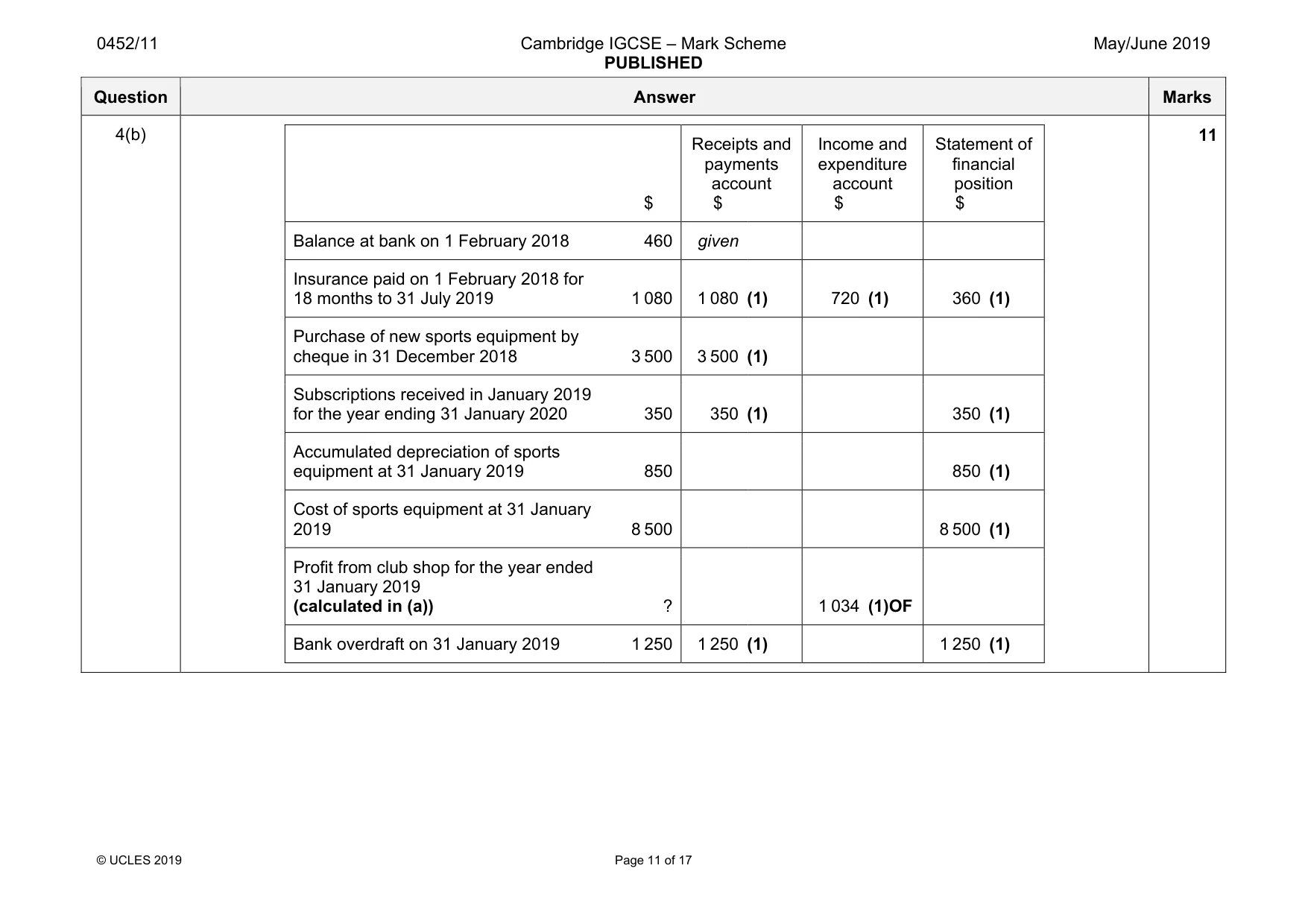
0452/11 Cambridge IGCSE – Mark Scheme PUBLISHED May/June 2019 © UCLES 2019 Page 11 of 17 Question Answer Marks 4(b) $ Receipts and payments account $ Income and expenditure account $ Statement of financial position $ Balance at bank on 1 February 2018 460 given Insurance paid on 1 February 2018 for 18 months to 31 July 2019 1 080 1 080 (1) 720 (1) 360 (1) Purchase of new sports equipment by cheque in 31 December 2018 3 500 3 500 (1) Subscriptions received in January 2019 for the year ending 31 January 2020 350 350 (1) 350 (1) Accumulated depreciation of sports equipment at 31 January 2019 850 850 (1) Cost of sports equipment at 31 January 2019 8 500 8 500 (1) Profit from club shop for the year ended 31 January 2019 (calculated in (a)) ? 1 034 (1)OF Bank overdraft on 31 January 2019 1 250 1 250 (1) 1 250 (1) 11
Mark scheme, page 12
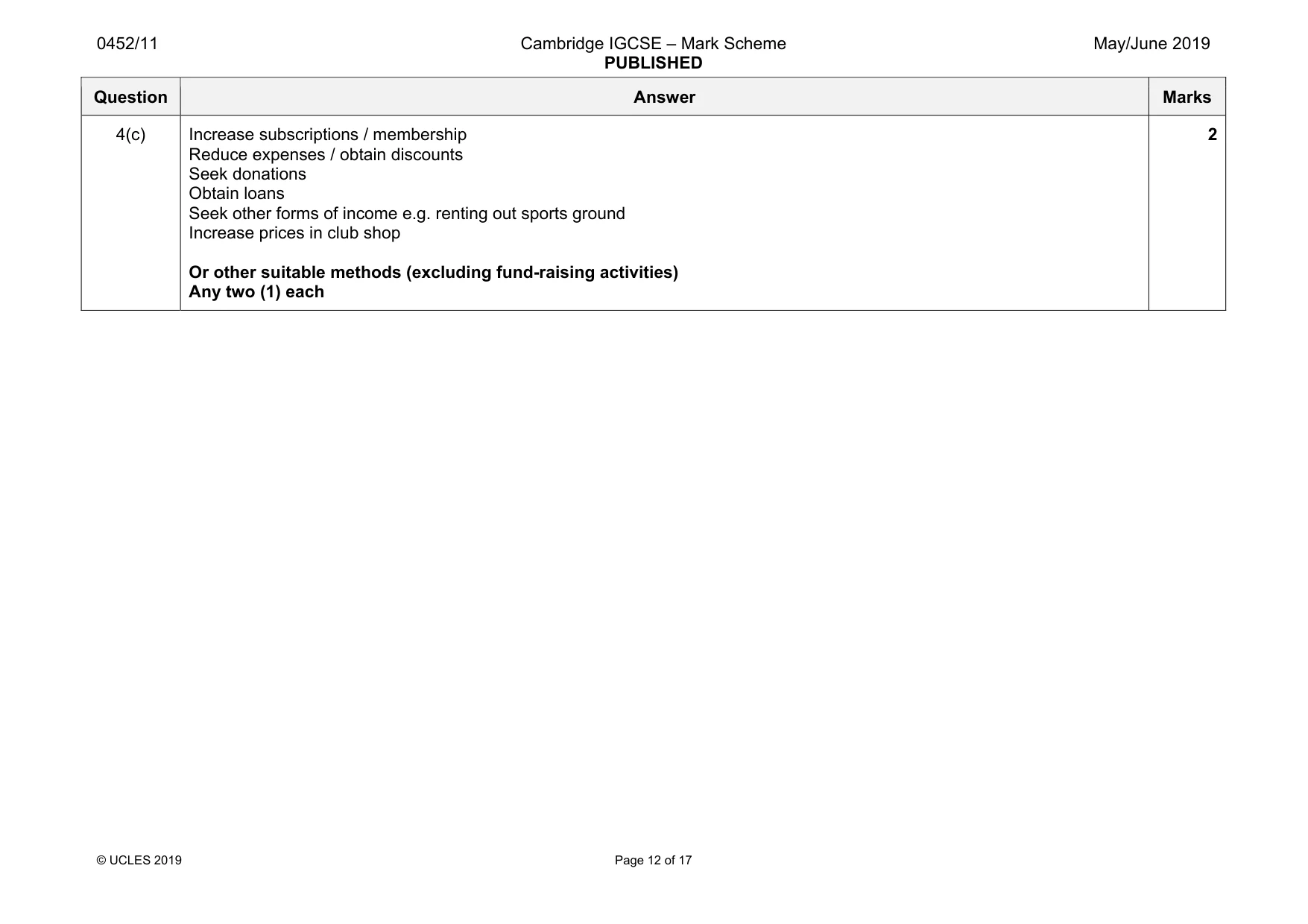
0452/11 Cambridge IGCSE – Mark Scheme PUBLISHED May/June 2019 © UCLES 2019 Page 12 of 17 Question Answer Marks 4(c) Increase subscriptions / membership Reduce expenses / obtain discounts Seek donations Obtain loans Seek other forms of income e.g. renting out sports ground Increase prices in club shop Or other suitable methods (excluding fund-raising activities) Any two (1) each 2
Mark scheme, page 13
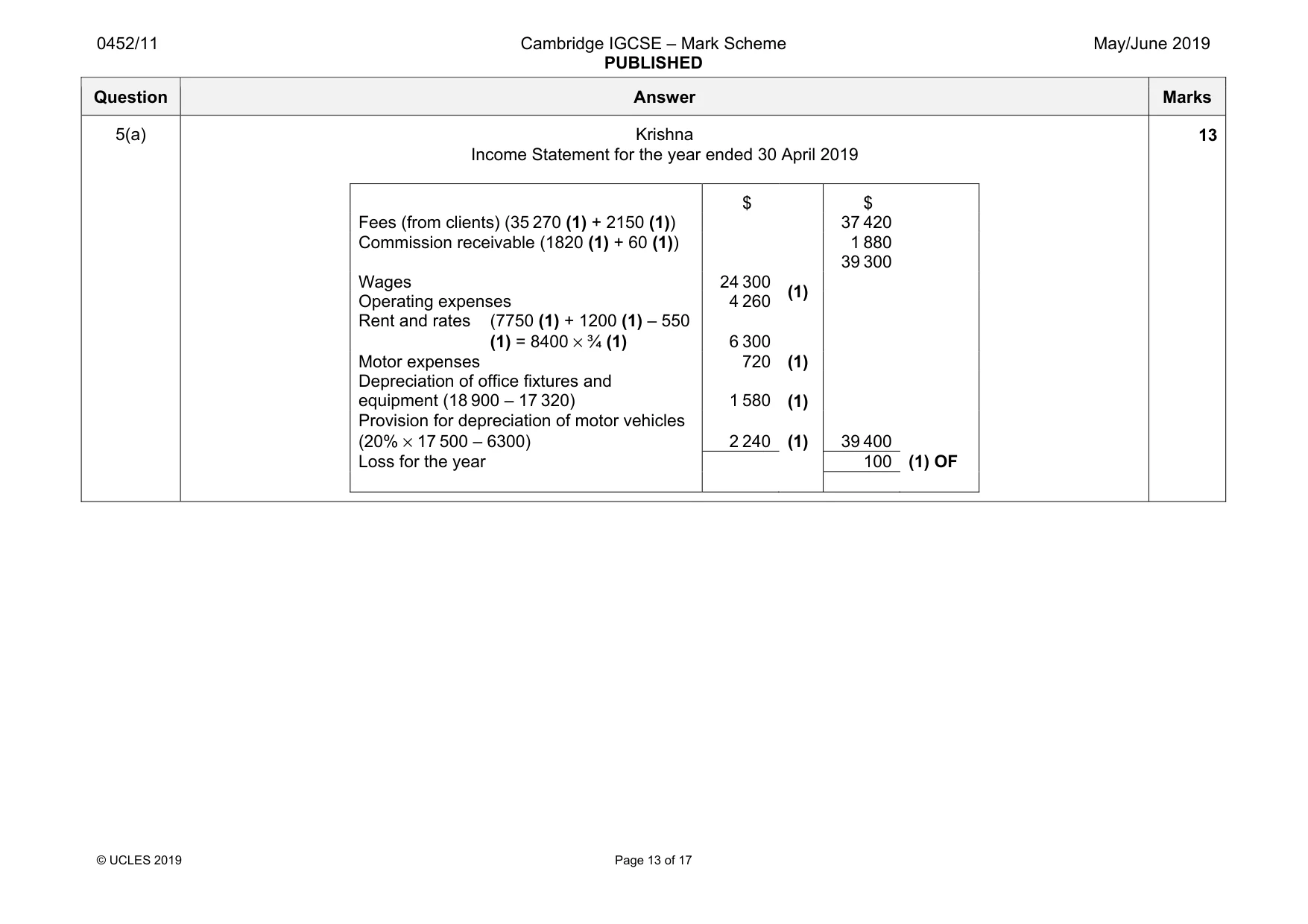
0452/11 Cambridge IGCSE – Mark Scheme PUBLISHED May/June 2019 © UCLES 2019 Page 13 of 17 Question Answer Marks 5(a) Krishna Income Statement for the year ended 30 April 2019 $00 $00 Fees (from clients) (35 270 (1) + 2150 (1)) 37 420 Commission receivable (1820 (1) + 60 (1)) 1 880 39 300 Wages 24 300 (1) Operating expenses 4 260 Rent and rates (7750 (1) + 1200 (1) – 550 (1) = 8400 × ¾ (1) 6 300 Motor expenses 720 (1) Depreciation of office fixtures and equipment (18 900 – 17 320) 1 580 (1) Provision for depreciation of motor vehicles (20% × 17 500 – 6300) 2 240 (1) 39 400 Loss for the year 100 (1) OF 13
Mark scheme, page 14
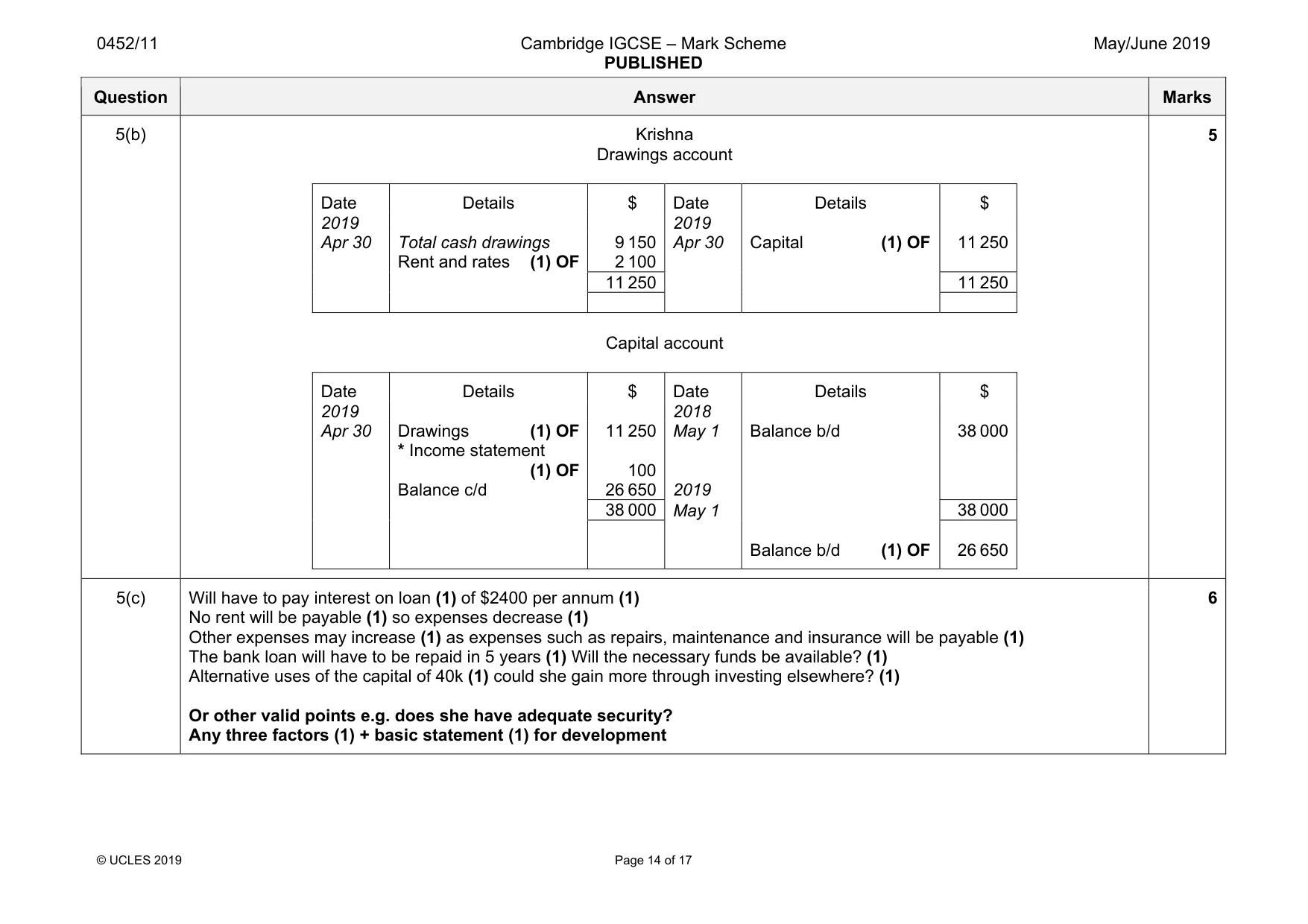
0452/11 Cambridge IGCSE – Mark Scheme PUBLISHED May/June 2019 © UCLES 2019 Page 14 of 17 Question Answer Marks 5(b) Krishna Drawings account Date Details $00 Date Details $00 2019 2019 Apr 30 Total cash drawings 9 150 Apr 30 Capital (1) OF 11 250 Rent and rates (1) OF 2 100 11 250 11 250 Capital account Date Details $00 Date Details $00 2019 2018 Apr 30 Drawings (1) OF 11 250 May 1 Balance b/d 38 000 * Income statement (1) OF 100 Balance c/d 26 650 2019 38 000 May 1 38 000 Balance b/d (1) OF 26 650 5 5(c) Will have to pay interest on loan (1) of $2400 per annum (1) No rent will be payable (1) so expenses decrease (1) Other expenses may increase (1) as expenses such as repairs, maintenance and insurance will be payable (1) The bank loan will have to be repaid in 5 years (1) Will the necessary funds be available? (1) Alternative uses of the capital of 40k (1) could she gain more through investing elsewhere? (1) Or other valid points e.g. does she have adequate security? Any three factors (1) + basic statement (1) for development 6
Mark scheme, page 15
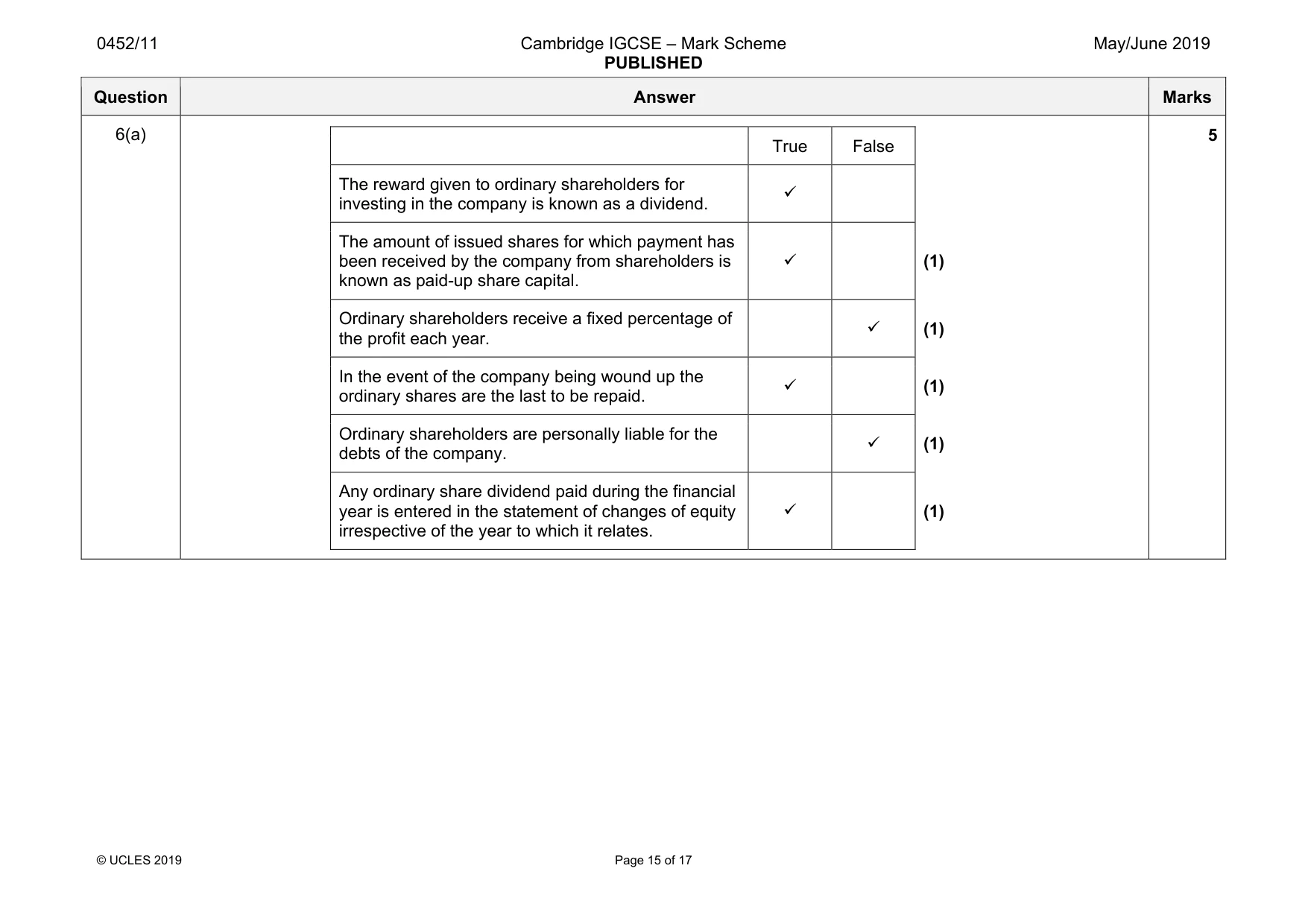
0452/11 Cambridge IGCSE – Mark Scheme PUBLISHED May/June 2019 © UCLES 2019 Page 15 of 17 Question Answer Marks 6(a) True False The reward given to ordinary shareholders for investing in the company is known as a dividend. 9 The amount of issued shares for which payment has been received by the company from shareholders is known as paid-up share capital. 9 (1) Ordinary shareholders receive a fixed percentage of the profit each year. 9 (1) In the event of the company being wound up the ordinary shares are the last to be repaid. 9 (1) Ordinary shareholders are personally liable for the debts of the company. 9 (1) Any ordinary share dividend paid during the financial year is entered in the statement of changes of equity irrespective of the year to which it relates. 9 (1) 5
Mark scheme, page 16
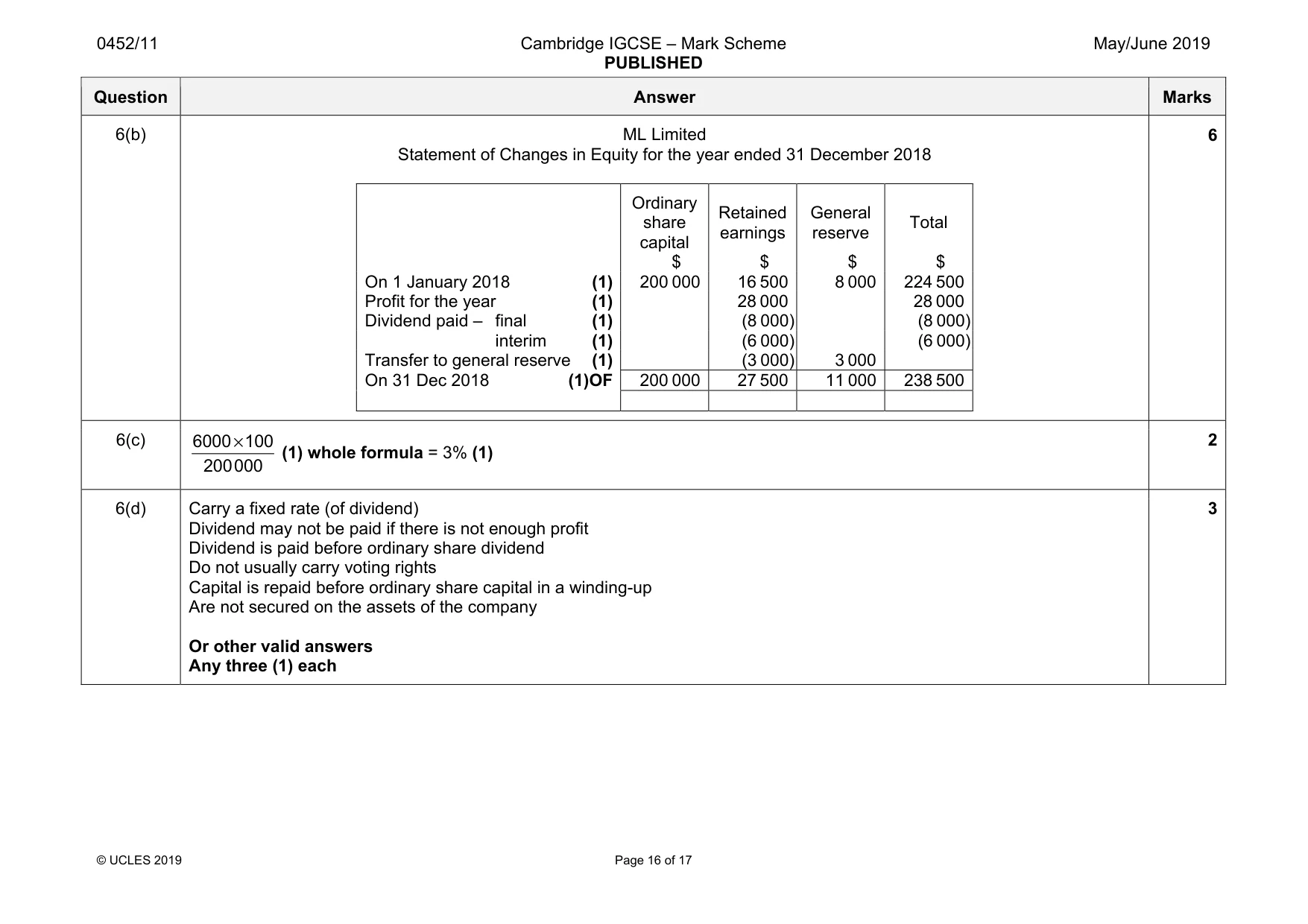
0452/11 Cambridge IGCSE – Mark Scheme PUBLISHED May/June 2019 © UCLES 2019 Page 16 of 17 Question Answer Marks 6(b) ML Limited Statement of Changes in Equity for the year ended 31 December 2018 Ordinary share capital Retained earnings General reserve Total $00 $00 $00 $00 On 1 January 2018 (1) 200 000 16 500 8 000 224 500 Profit for the year (1) 28 000 28 000 Dividend paid – final (1) (8 000) (8 000) interim (1) (6 000) (6 000) Transfer to general reserve (1) (3 000) 3 000 On 31 Dec 2018 (1)OF 200 000 27 500 11 000 238 500 6 6(c) 6000 100 200000 × (1) whole formula = 3% (1) 2 6(d) Carry a fixed rate (of dividend) Dividend may not be paid if there is not enough profit Dividend is paid before ordinary share dividend Do not usually carry voting rights Capital is repaid before ordinary share capital in a winding-up Are not secured on the assets of the company Or other valid answers Any three (1) each 3
Mark scheme, page 17
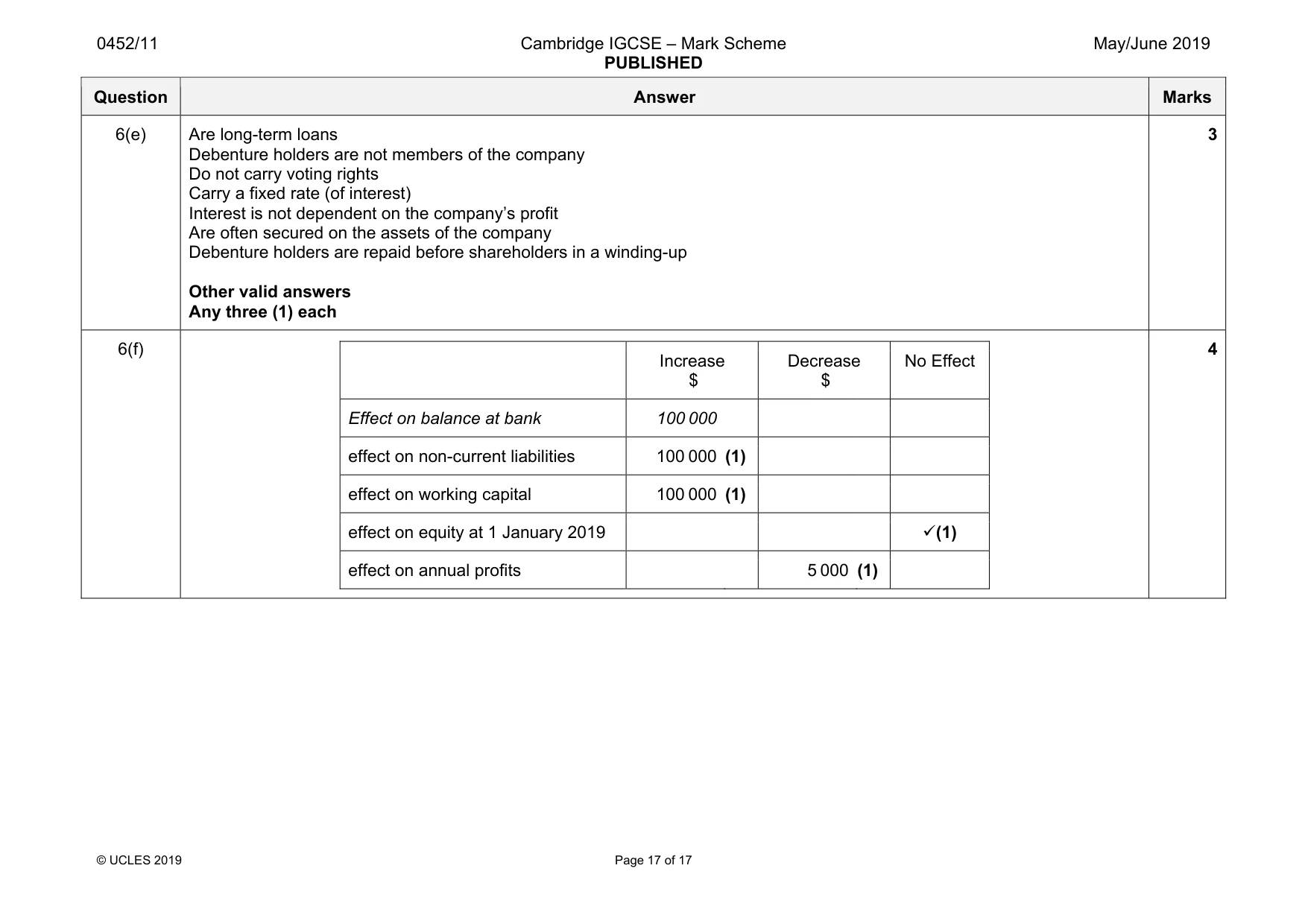
0452/11 Cambridge IGCSE – Mark Scheme PUBLISHED May/June 2019 © UCLES 2019 Page 17 of 17 Question Answer Marks 6(e) Are long-term loans Debenture holders are not members of the company Do not carry voting rights Carry a fixed rate (of interest) Interest is not dependent on the company’s profit Are often secured on the assets of the company Debenture holders are repaid before shareholders in a winding-up Other valid answers Any three (1) each 3 6(f) Increase $ Decrease $ No Effect Effect on balance at bank 100 000 effect on non-current liabilities 100 000 (1) effect on working capital 100 000 (1) effect on equity at 1 January 2019 9(1) effect on annual profits 5 000 (1) 4
What you needed in this session
Cambridge’s own grade thresholds for 2019 May/June, Paper 1 · Variant 1. A higher threshold means an easier paper — the bar moves with how the cohort did.