Cambridge IGCSE Accounting 0452 — 2018 Oct/Nov Paper 2 · Variant 2
0452/22/O/N/18 · 6 questions · 120 marks · ≈135 min
The question paper and its mark scheme, free to read here and free to download. This is Cambridge’s own paper, exactly as it was sat.
Question paper24 pages



Mark scheme12 pages
Answers below. Sit the paper first if you are practising.
Questions as text
Q1 · Rajinder owns an engineering business
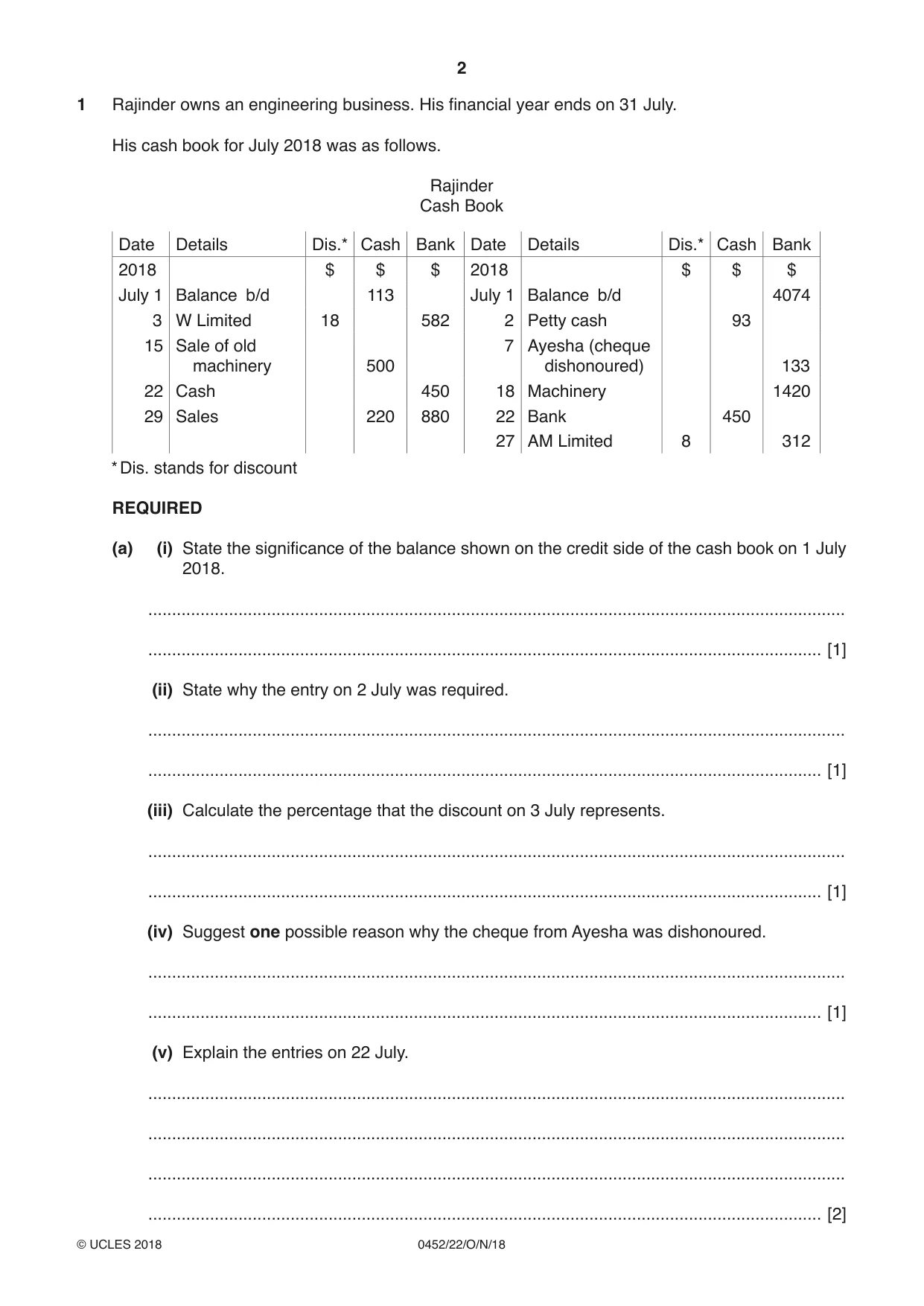
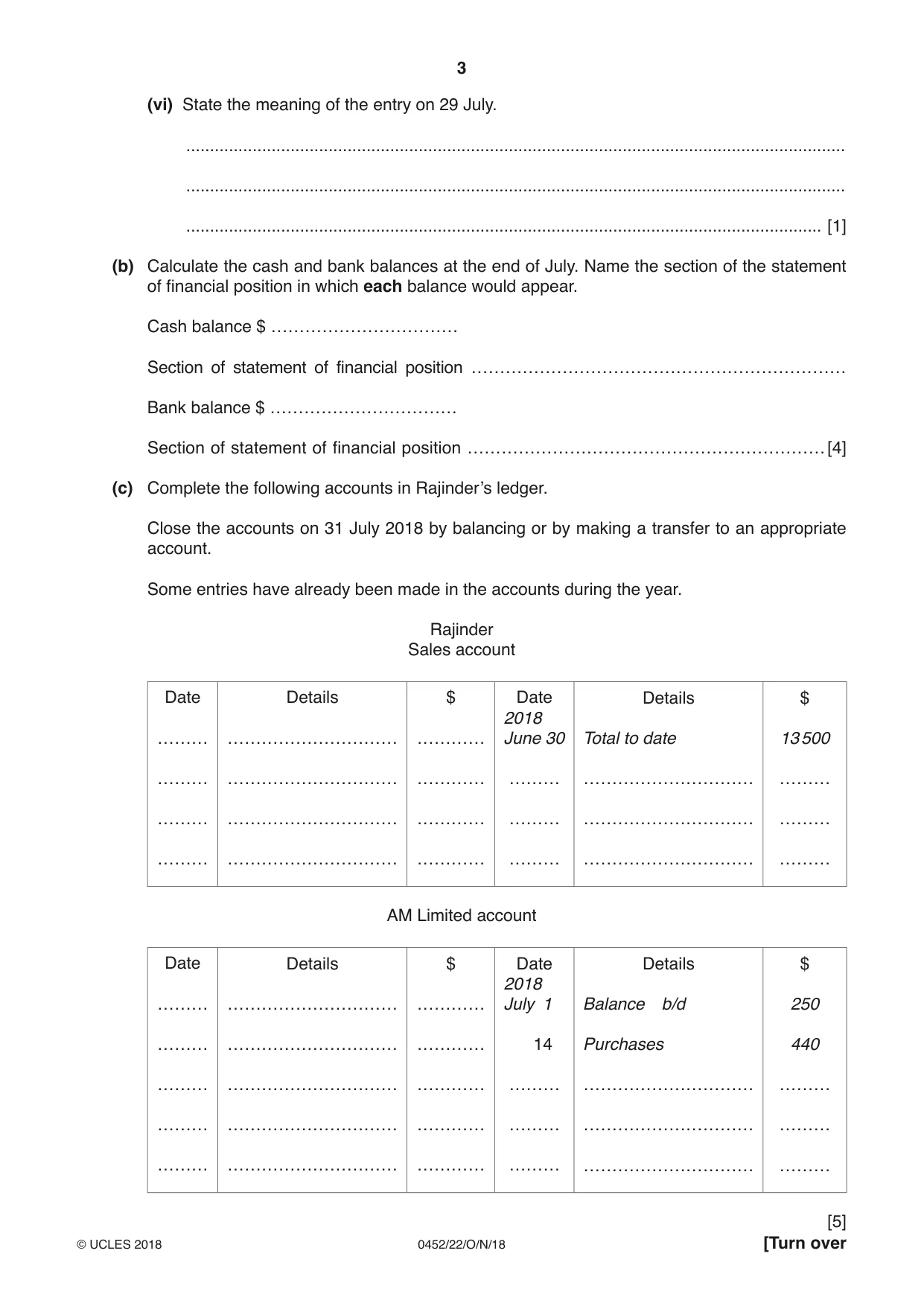
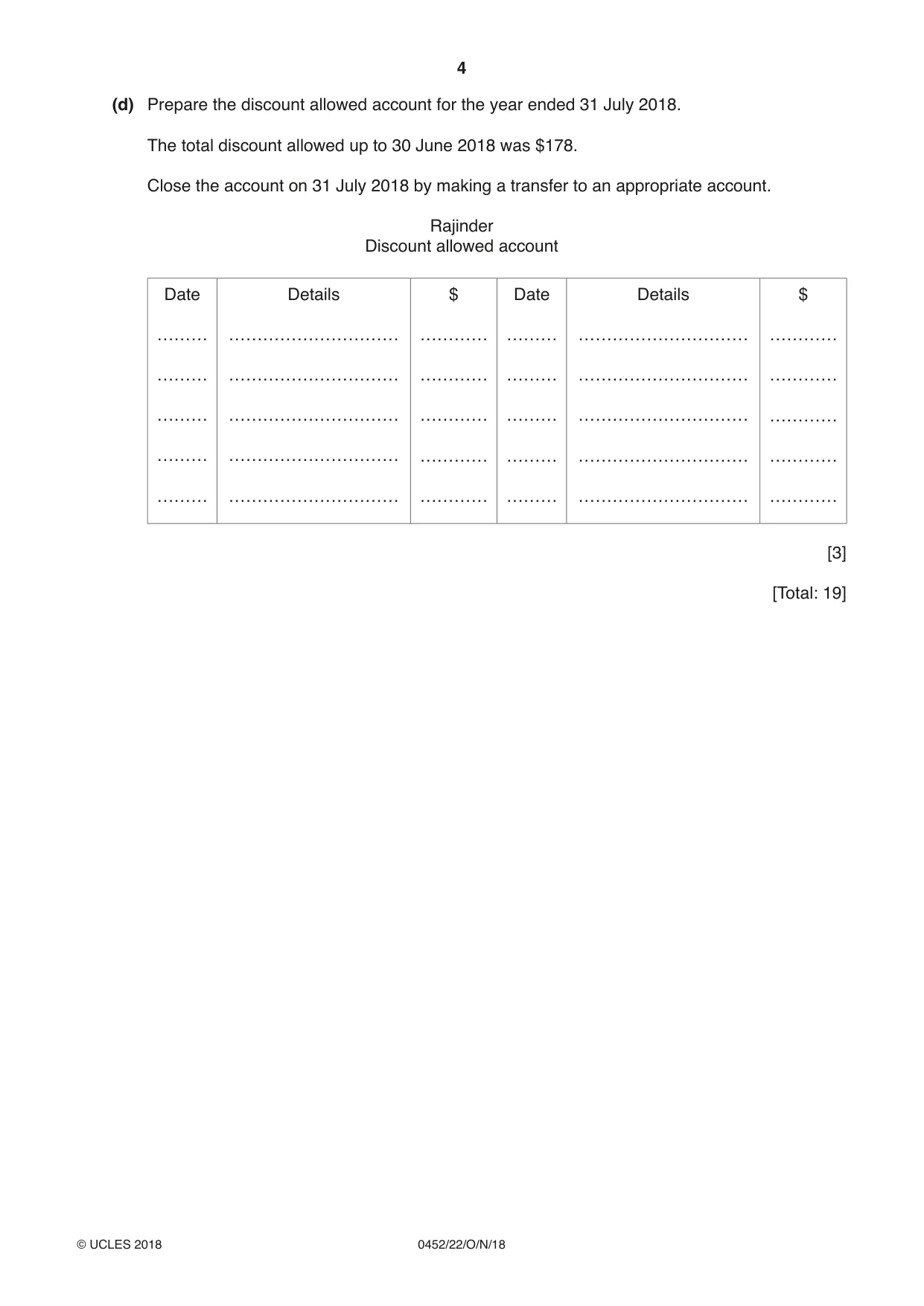
1 Rajinder owns an engineering business. His financial year ends on 31 July. His cash book for July 2018 was as follows. Rajinder Cash Book Date Details Dis.* Cash Bank Date Details Dis.* Cash Bank 2018 $ $ $ 2018 $ $ $ July 1 Balance b/d 113 July 1 Balance b/d 4074 3 W Limited 18 582 2 Petty cash 193 15 Sale of old 7 Ayesha (cheque machinery 500 dishonoured) 1133 22 Cash 450 18 Machinery 1420 29 Sales 220 880 22 Bank 450 27 AM Limited 8 1312 * Dis. stands for discount REQUIRED (a) ii(i) State the significance of the balance shown on the credit side of the cash book on 1 July 2018. ................................................................................................................................................... .............................................................................................................................................. [1] i(ii) State why the entry on 2 July was required. ................................................................................................................................................... .............................................................................................................................................. [1] (iii) Calculate the percentage that the discount on 3 July represents. ................................................................................................................................................... .............................................................................................................................................. [1] (iv) Suggest one possible reason why the cheque from Ayesha was dishonoured. ................................................................................................................................................... .............................................................................................................................................. [1] i(v) Explain the entries on 22 July. ................................................................................................................................................... ................................................................................................................................................... ................................................................................................................................................... .............................................................................................................................................. [2] (vi) State the meaning of the entry on 29 July. ........................................................................................................................................... ........................................................................................................................................... ...................................................................................................................................... [1] (b) Calculate the cash and bank balances at the end of July. Name the section of the statement of financial position in which each balance would appear. Cash balance $ …………………………… Section of statement of financial position ………………………………………………………… Bank balance $ …………………………… Section of statement of financial position ……………………………………………………… [4] (c) Complete the following accounts in Rajinder’s ledger. Close the accounts on 31 July 2018 by balancing or by making a transfer to an appropriate account. Some entries have already been made in the accounts during the year. Rajinder Sales account Date Details $ Date Details $ 2018 ……… ………… June 30 Total to date 13 500 ……… ………… ……… ……… ……… ………… ……… ……… ……… ………… ……… ……… AM Limited account Date Details $ Date Details $ 2018 ……… ………… July 1 Balance b/d 250 ……… ………… 14 Purchases 440 ……… ………… ……… ……… ……… ………… ……… ……… ……… ………… ……… ……… (d) Prepare the discount allowed account for the year ended 31 July 2018. The total discount allowed up to 30 June 2018 was $178. Close the account on 31 July 2018 by making a transfer to an appropriate account. Rajinder Discount allowed account Date Details $ Date Details $ ……… ………… ……… ………… ……… ………… ……… ………… ……… ………… ……… ………… ……… ………… ……… ………… ……… ………… ……… ………… [3] [Total: 19]
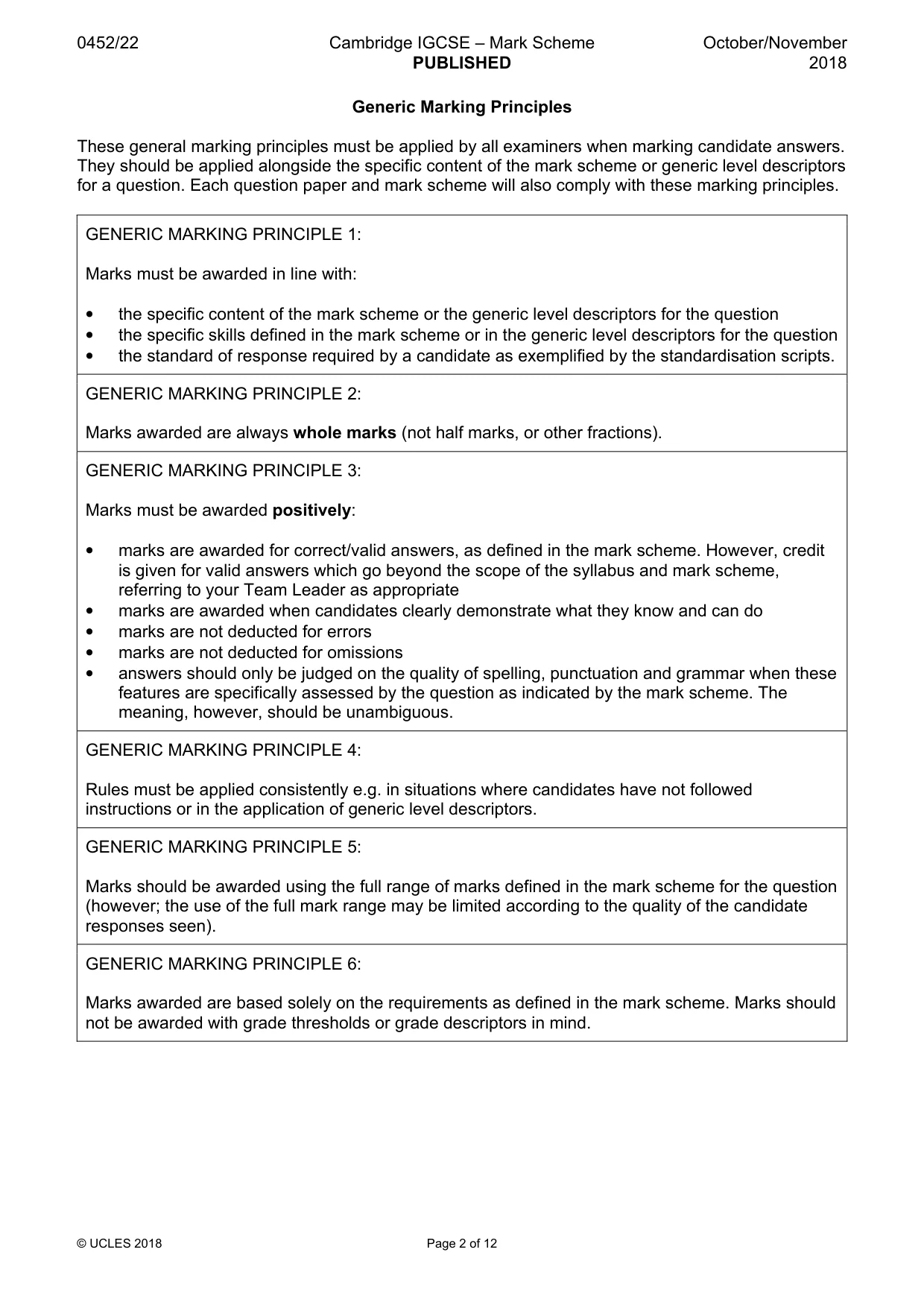
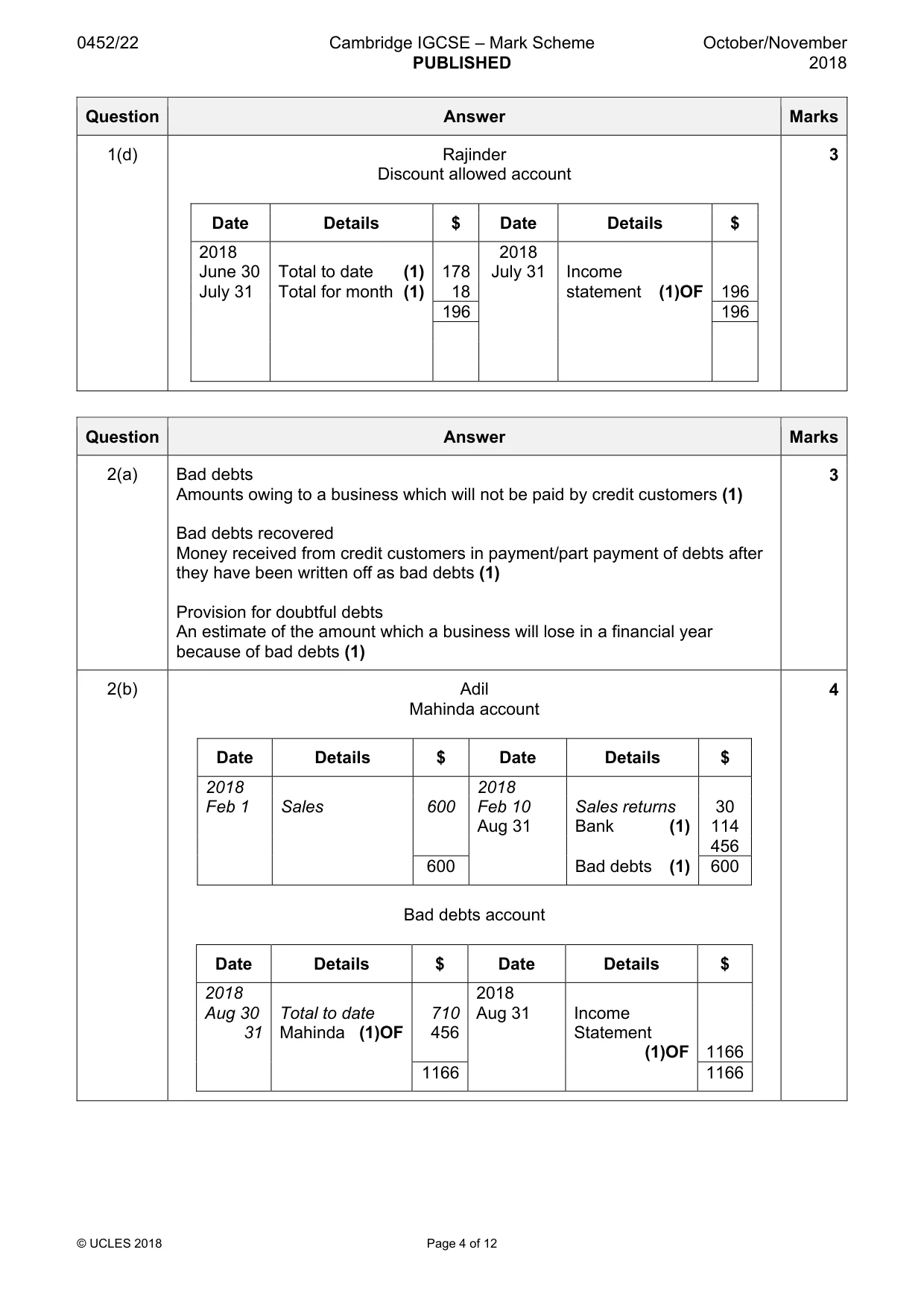
Mark scheme: Question Answer Marks 1(a)(i) This represents an overdraft/what the trader owes the bank on that date 1 1(a)(ii) To restore the petty cash balance to the imprest amount 1 1(a)(iii) 3% 1 1(a)(iv) Not enough money in the account 1 Cheque unsigned/incorrect signature Amount in words and figures disagree Cheque undated/out of date/wrong date Takes account in to unauthorised overdraft Or other acceptable reason Any 1 reason (1) 1(a)(v) This is a contra entry (1) 2 Money has been transferred from the cash into the bank account (1) 1(a)(vi) Money was received from selling goods for $1100. Of this, $220 was paid into 1 the cash account and $880 paid into bank account. 1(b) Cash balance $290 (1) 4 Current asset (1) Bank balance $4027 (1) Current liability (1) 1(c) Rajinder 5 Sales account Date Details $ Date Details $ 2018 2018 July 31 Income June 30 Total to date 13 500 statement (1)OF 14 600 July 29 Cash/bank (1) 1 100 14 600 14 600 AM Limited account Date Details $ Date Details $ 2018 2018 July 27 Bank (1) 312 July 1 Balance b/d 250 Discount (1) 8 14 Purchases 440 31 Balance c/d 370 690 690 2018 Aug 1 Balance b/d (1)OF 370 1(d) Rajinder 3 Discount allowed account Date Details $ Date Details $ 2018 2018 June 30 Total to date (1) 178 July 31 Income July 31 Total for month (1) 18 statement (1)OF 196 196 196
Q2 · Adil is a wholesaler
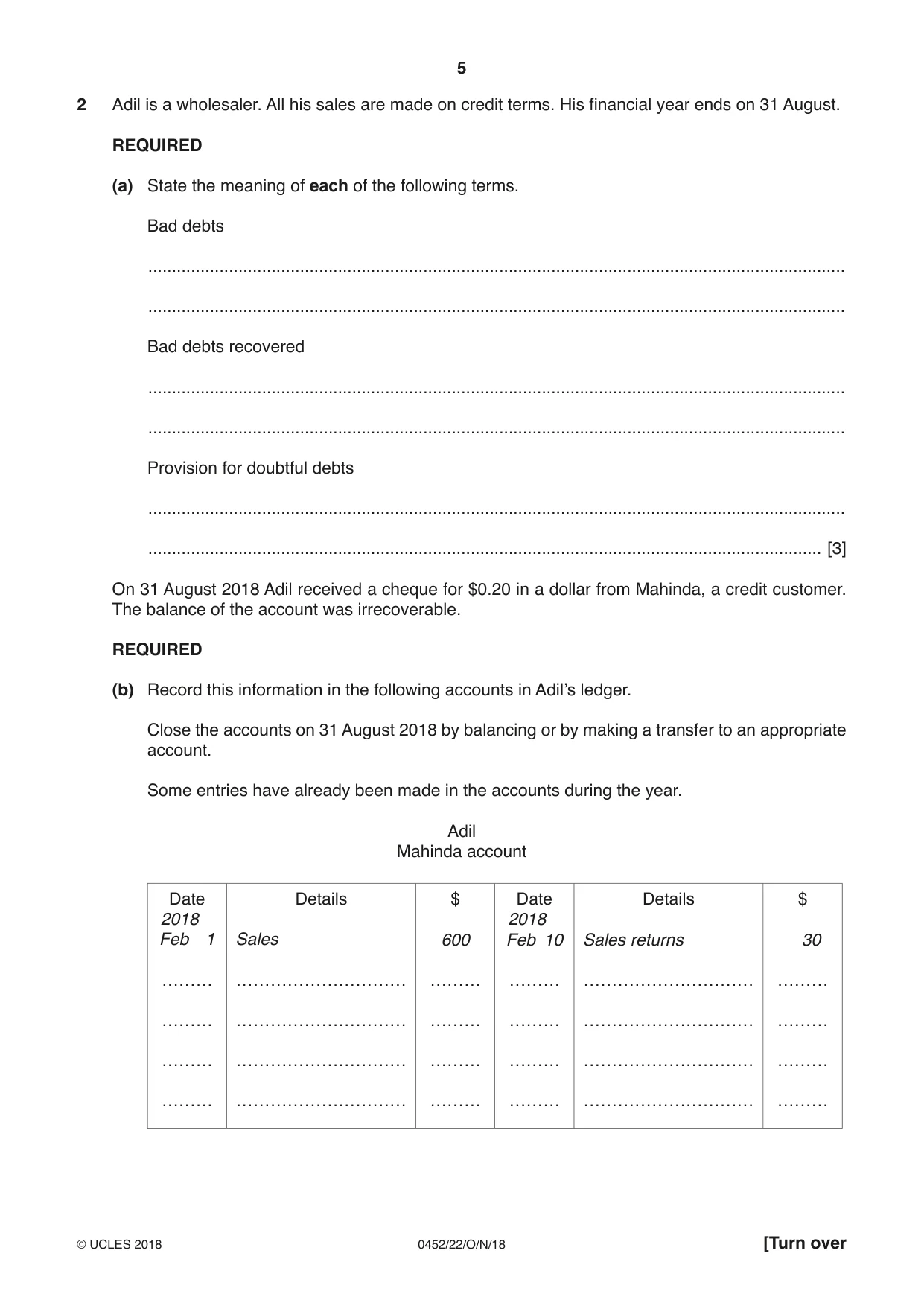
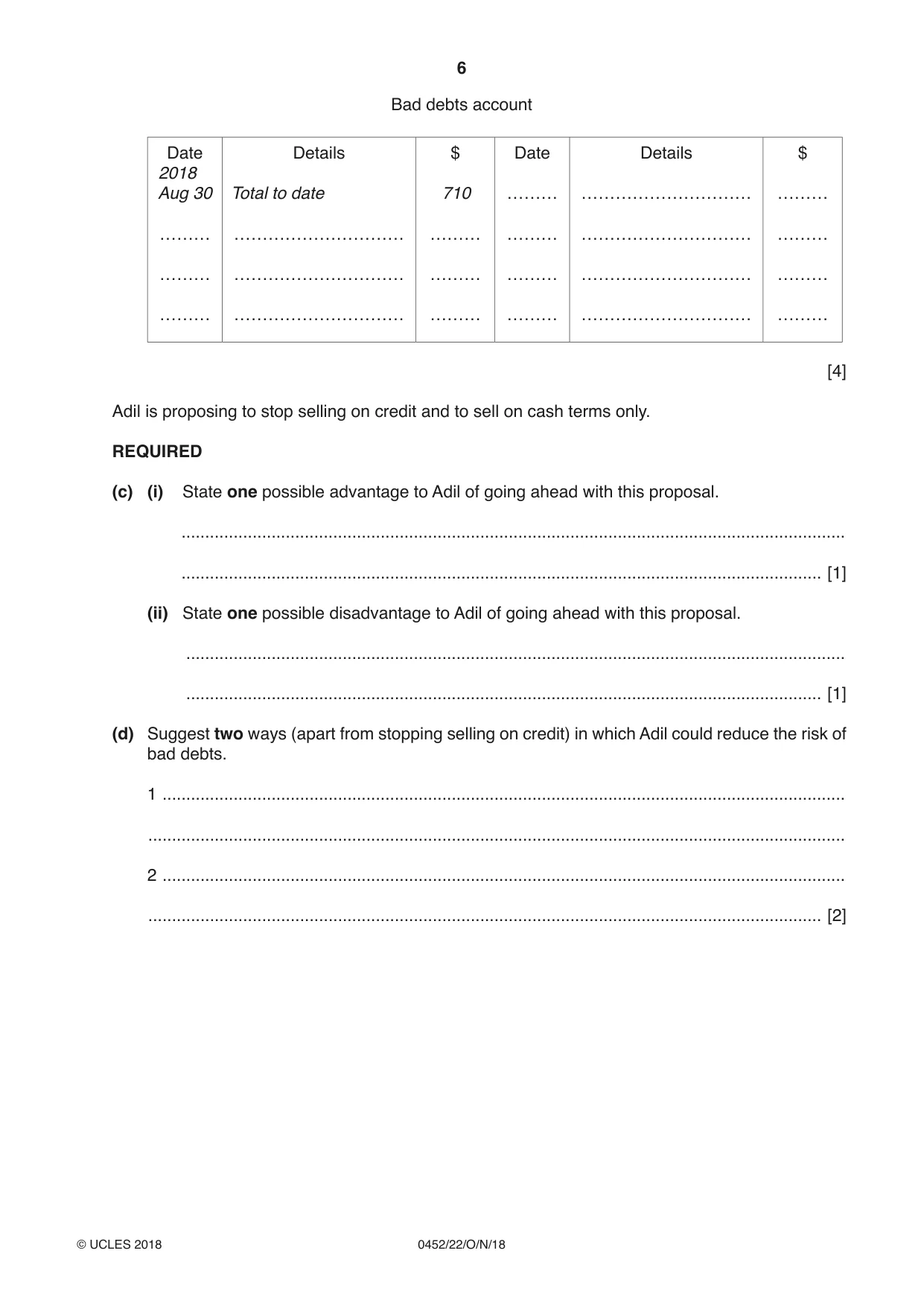
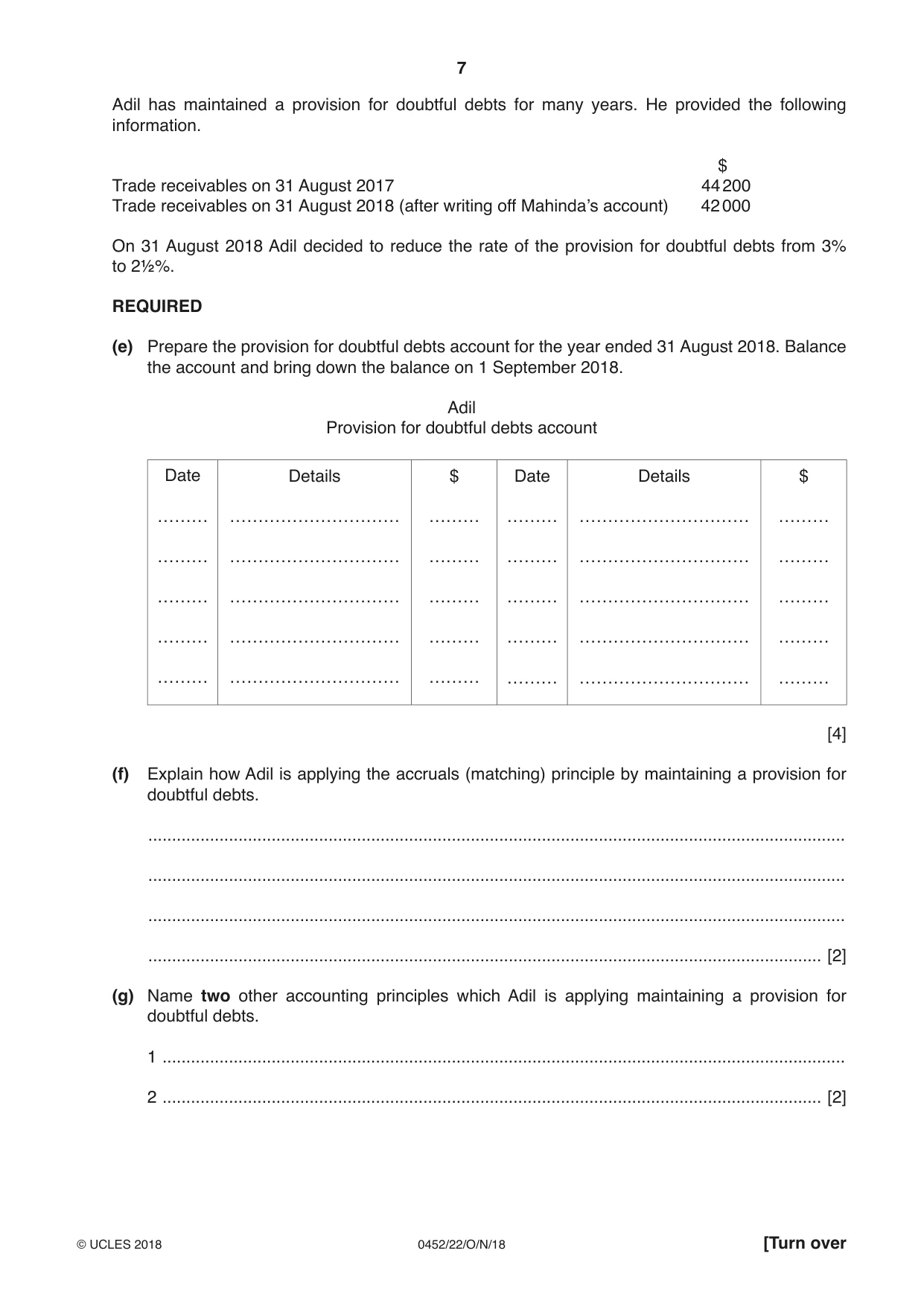
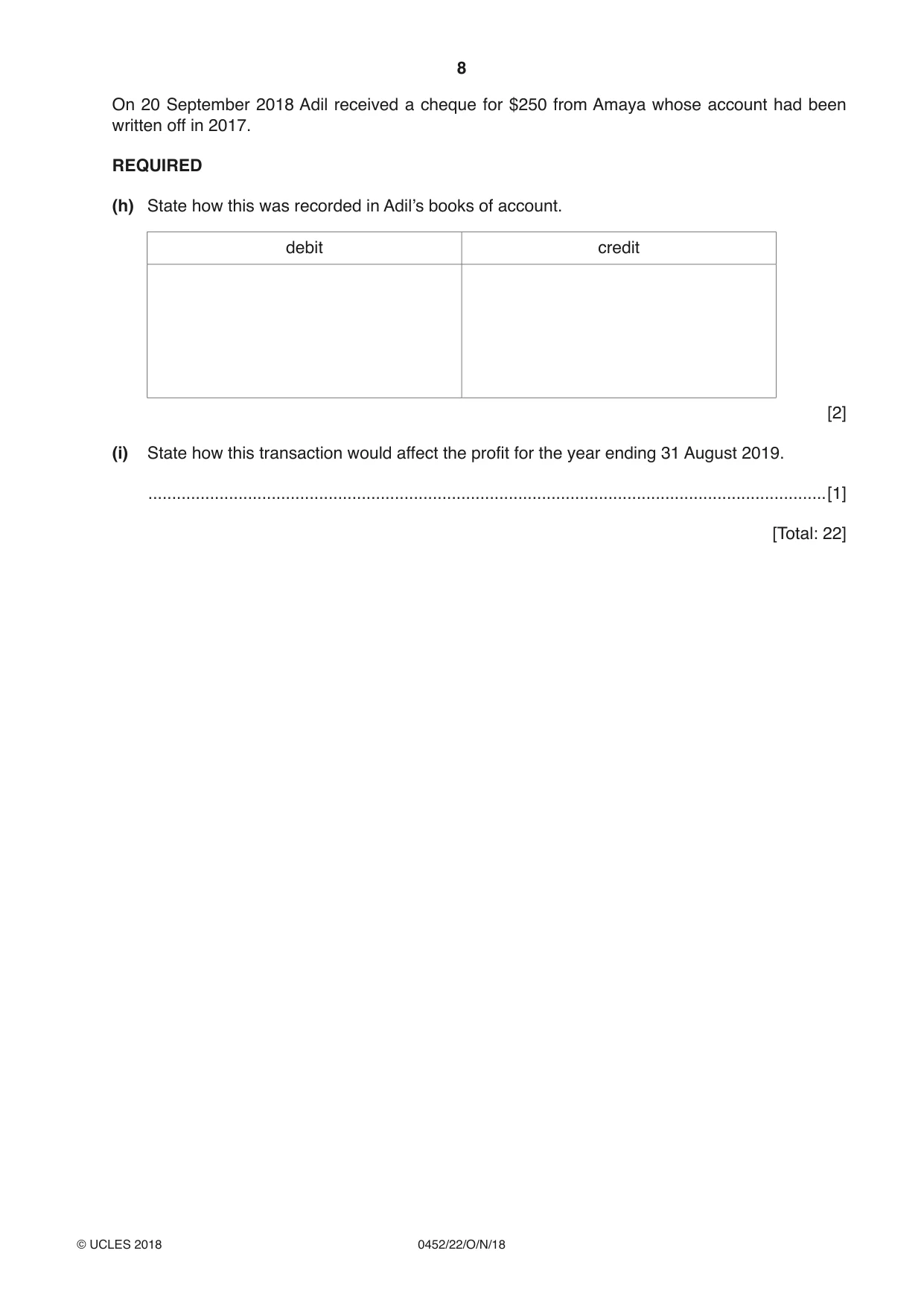
2 Adil is a wholesaler. All his sales are made on credit terms. His financial year ends on 31 August. REQUIRED (a) State the meaning of each of the following terms. Bad debts ................................................................................................................................................... ................................................................................................................................................... Bad debts recovered ................................................................................................................................................... ................................................................................................................................................... Provision for doubtful debts ................................................................................................................................................... .............................................................................................................................................. [3] On 31 August 2018 Adil received a cheque for $0.20 in a dollar from Mahinda, a credit customer. The balance of the account was irrecoverable. REQUIRED (b) Record this information in the following accounts in Adil’s ledger. Close the accounts on 31 August 2018 by balancing or by making a transfer to an appropriate account. Some entries have already been made in the accounts during the year. Adil Mahinda account Date Details $ Date Details $ 2018 2018 Feb 1 Sales 600 Feb 10 Sales returns 30 ……… ……… ……… ……… ……… ……… ……… ……… ……… ……… ……… ……… ……… ……… ……… ……… Bad debts account Date Details $ Date Details $ 2018 Aug 30 Total to date 710 ……… ……… ……… ……… ……… ……… ……… ……… ……… ……… ……… ……… ……… ……… [4] Adil is proposing to stop selling on credit and to sell on cash terms only. REQUIRED (c) (i) State one possible advantage to Adil of going ahead with this proposal. ............................................................................................................................................ ....................................................................................................................................... [1] (ii) State one possible disadvantage to Adil of going ahead with this proposal. ........................................................................................................................................... ...................................................................................................................................... [1] (d) Suggest two ways (apart from stopping selling on credit) in which Adil could reduce the risk of bad debts. 1 ................................................................................................................................................ ................................................................................................................................................... 2 ................................................................................................................................................ .............................................................................................................................................. [2] Adil has maintained a provision for doubtful debts for many years. He provided the following information. $ Trade receivables on 31 August 2017 44 200 Trade receivables on 31 August 2018 (after writing off Mahinda’s account) 42 000 On 31 August 2018 Adil decided to reduce the rate of the provision for doubtful debts from 3% to 2½%. REQUIRED (e) Prepare the provision for doubtful debts account for the year ended 31 August 2018. Balance the account and bring down the balance on 1 September 2018. Adil Provision for doubtful debts account Date Details $ Date Details $ ……… ……… ……… ……… ……… ……… ……… ……… ……… ……… ……… ……… ……… ……… ……… ……… ……… ……… ……… ……… [4] (f) Explain how Adil is applying the accruals (matching) principle by maintaining a provision for doubtful debts. ................................................................................................................................................... ................................................................................................................................................... ................................................................................................................................................... .............................................................................................................................................. [2] (g) Name two other accounting principles which Adil is applying maintaining a provision for doubtful debts. 1 ................................................................................................................................................ 2 ........................................................................................................................................... [2] On 20 September 2018 Adil received a cheque for $250 from Amaya whose account had been written off in 2017. REQUIRED (h) State how this was recorded in Adil’s books of account. debit credit [2] (i) State how this transaction would affect the profit for the year ending 31 August 2019. ...............................................................................................................................................[1] [Total: 22] PLEASE TURN OVER
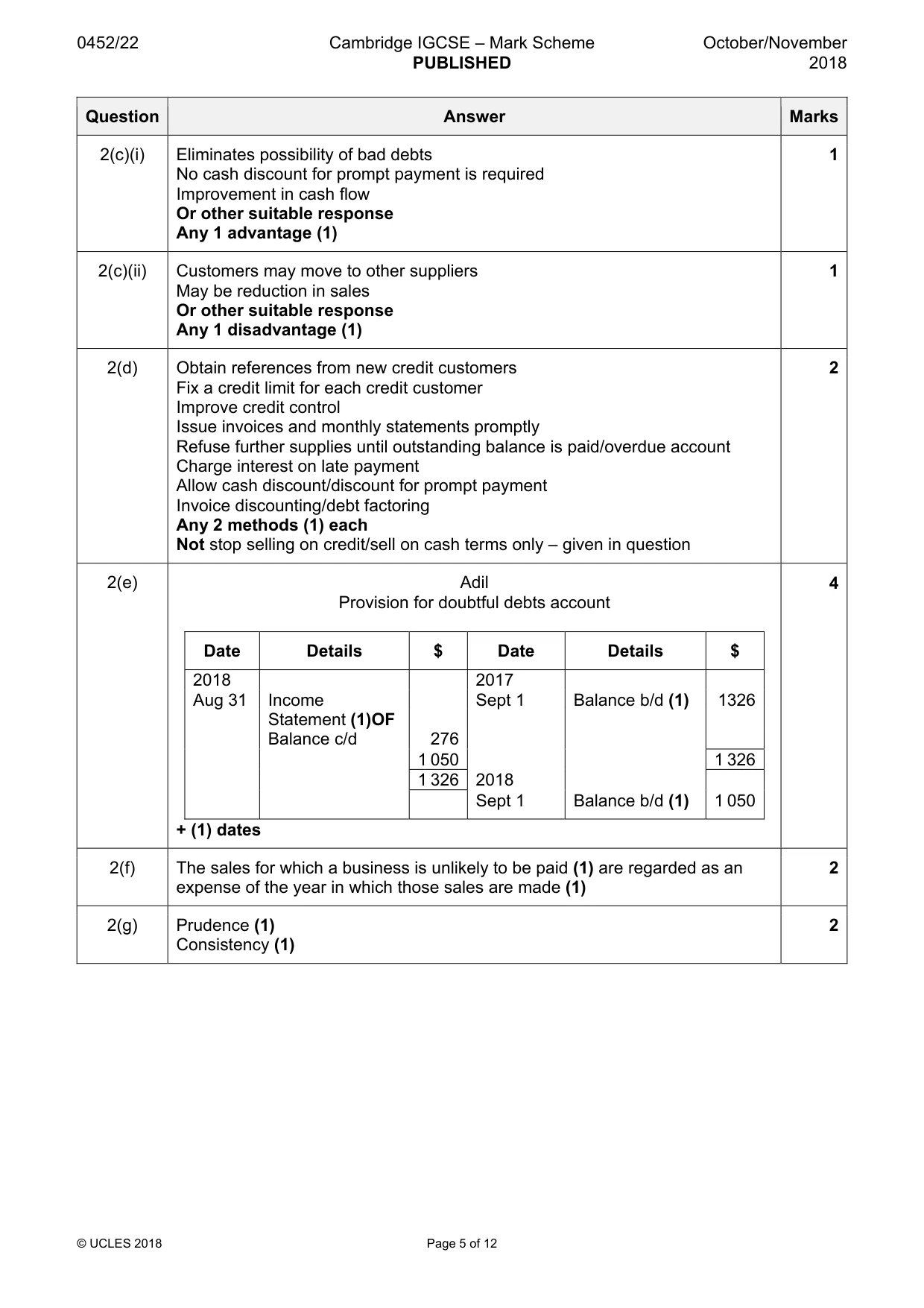
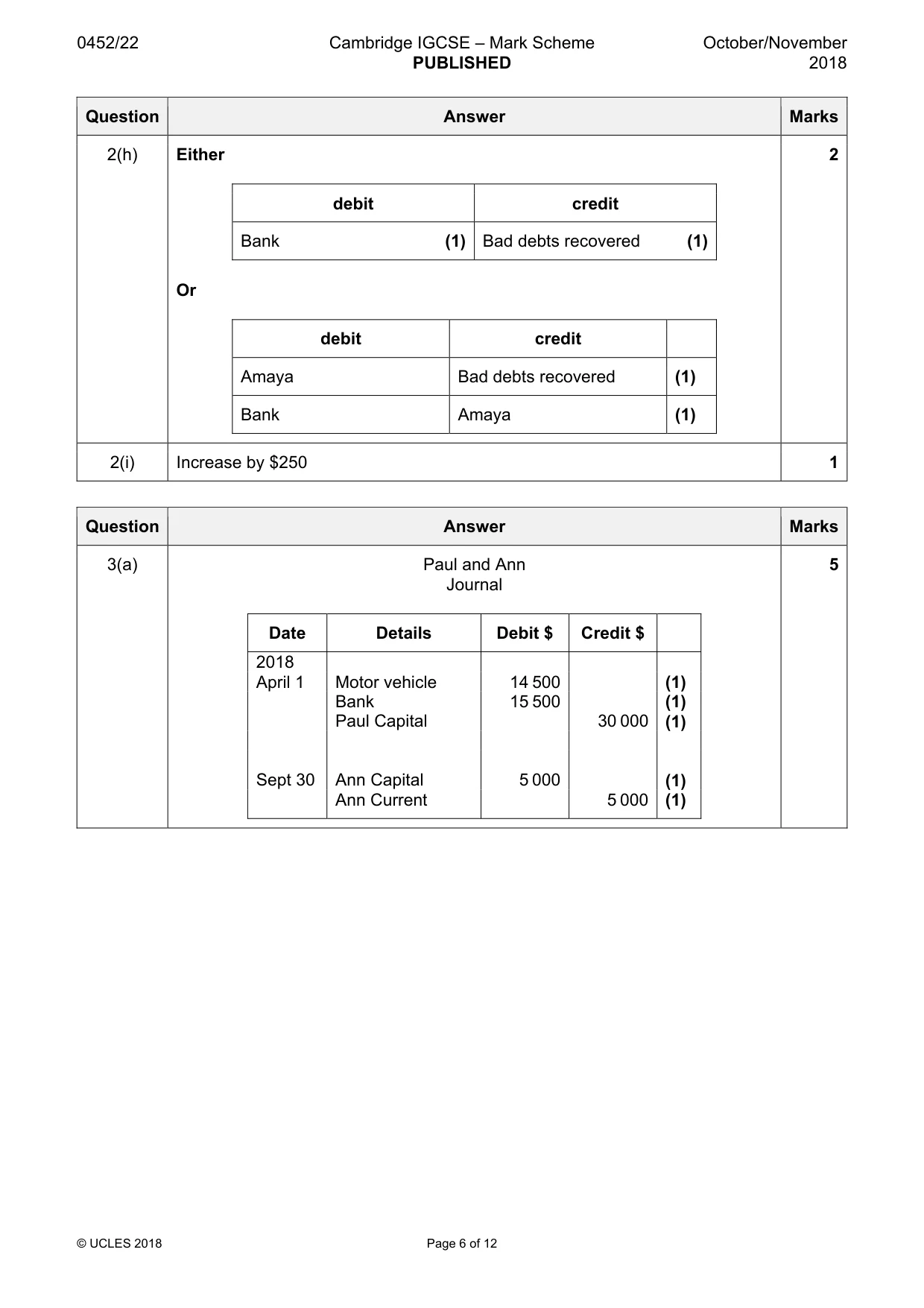
Mark scheme: 2(a) Bad debts 3 Amounts owing to a business which will not be paid by credit customers (1) Bad debts recovered Money received from credit customers in payment/part payment of debts after they have been written off as bad debts (1) Provision for doubtful debts An estimate of the amount which a business will lose in a financial year because of bad debts (1) 2(b) Adil 4 Mahinda account Date Details $ Date Details $ 2018 2018 Feb 1 Sales 600 Feb 10 Sales returns 30 Aug 31 Bank (1) 114 456 600 Bad debts (1) 600 Bad debts account Date Details $ Date Details $ 2018 2018 Aug 30 Total to date 710 Aug 31 Income 31 Mahinda (1)OF 456 Statement (1)OF 1166 1166 1166 2(c)(i) Eliminates possibility of bad debts 1 No cash discount for prompt payment is required Improvement in cash flow Or other suitable response Any 1 advantage (1) 2(c)(ii) Customers may move to other suppliers 1 May be reduction in sales Or other suitable response Any 1 disadvantage (1) 2(d) Obtain references from new credit customers 2 Fix a credit limit for each credit customer Improve credit control Issue invoices and monthly statements promptly Refuse further supplies until outstanding balance is paid/overdue account Charge interest on late payment Allow cash discount/discount for prompt payment Invoice discounting/debt factoring Any 2 methods (1) each Not stop selling on credit/sell on cash terms only – given in question 2(e) Adil 4 Provision for doubtful debts account Date Details $ Date Details $ 2018 2017 Aug 31 Income Sept 1 Balance b/d (1) 1326 Statement (1)OF Balance c/d 276 1 050 1 326 1 326 2018 Sept 1 Balance b/d (1) 1 050 + (1) dates 2(f) The sales for which a business is unlikely to be paid (1) are regarded as an 2 expense of the year in which those sales are made (1) 2(g) Prudence (1) 2 Consistency (1) 2(h) Either 2 debit credit Bank (1) Bad debts recovered (1) Or debit credit Amaya Bad debts recovered (1) Bank Amaya (1) 2(i) Increase by $250 1
More questions on Irrecoverable debts and allowance for irrecoverable debts
Q3 · Paul and Ann are in partnership
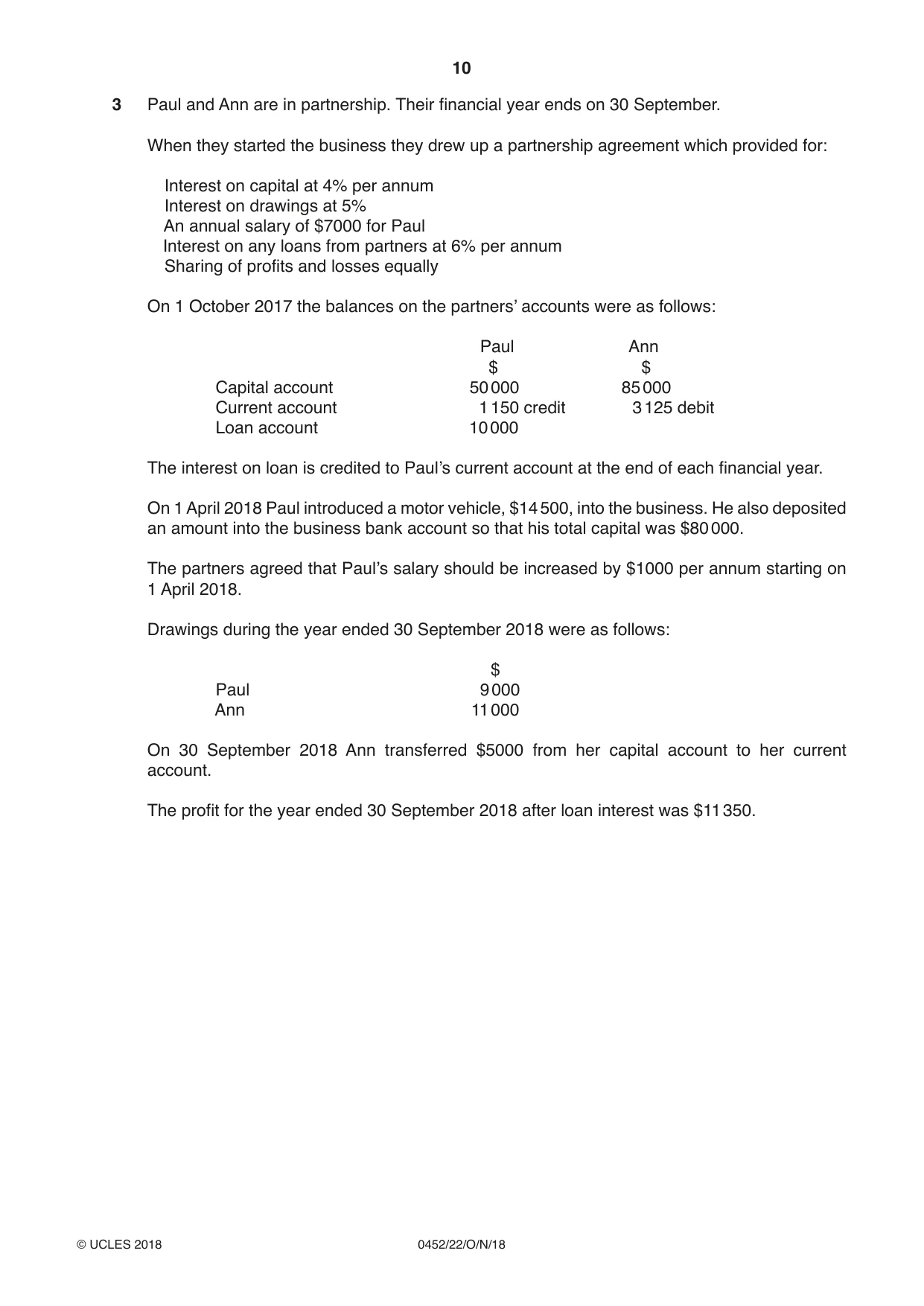
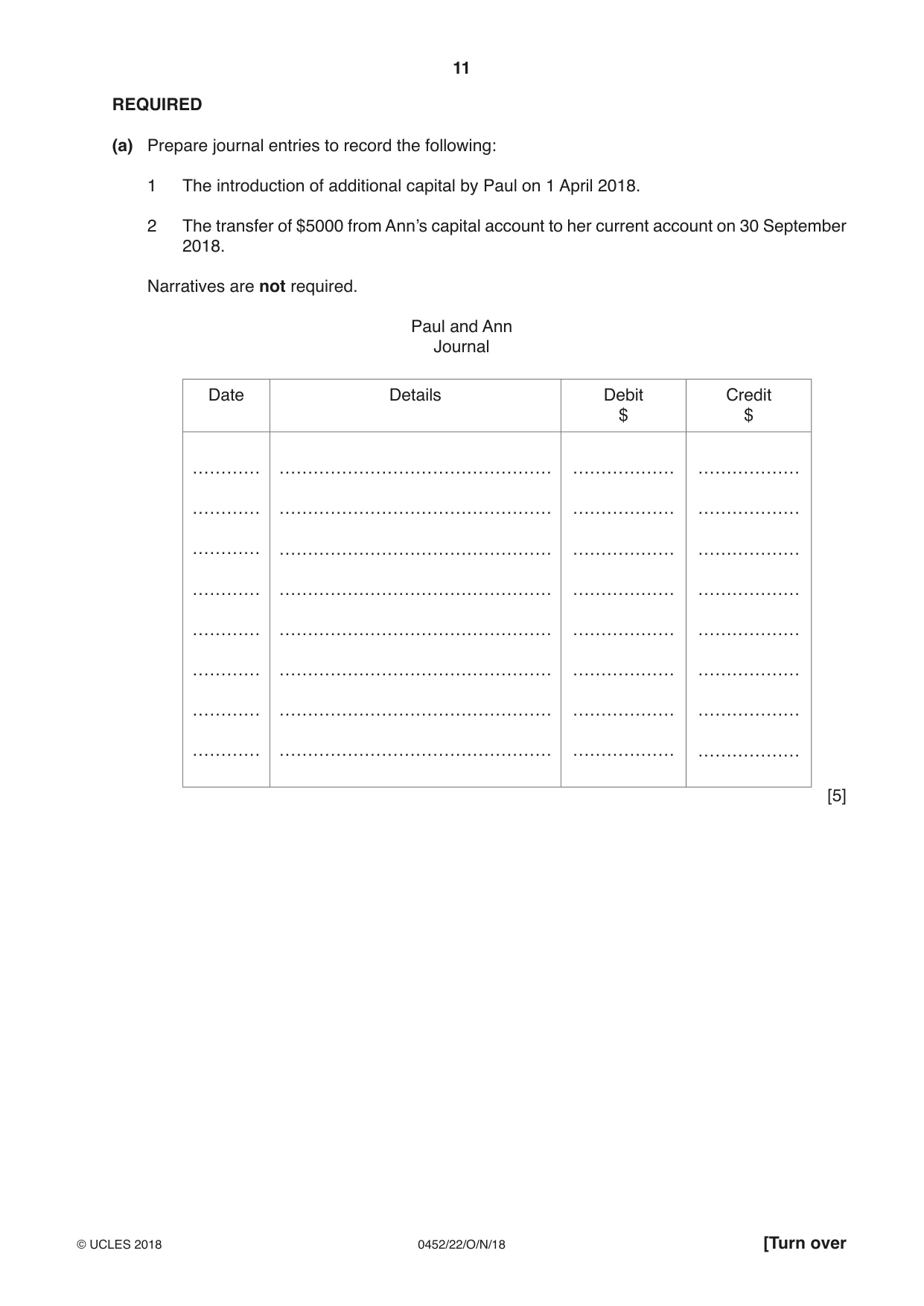
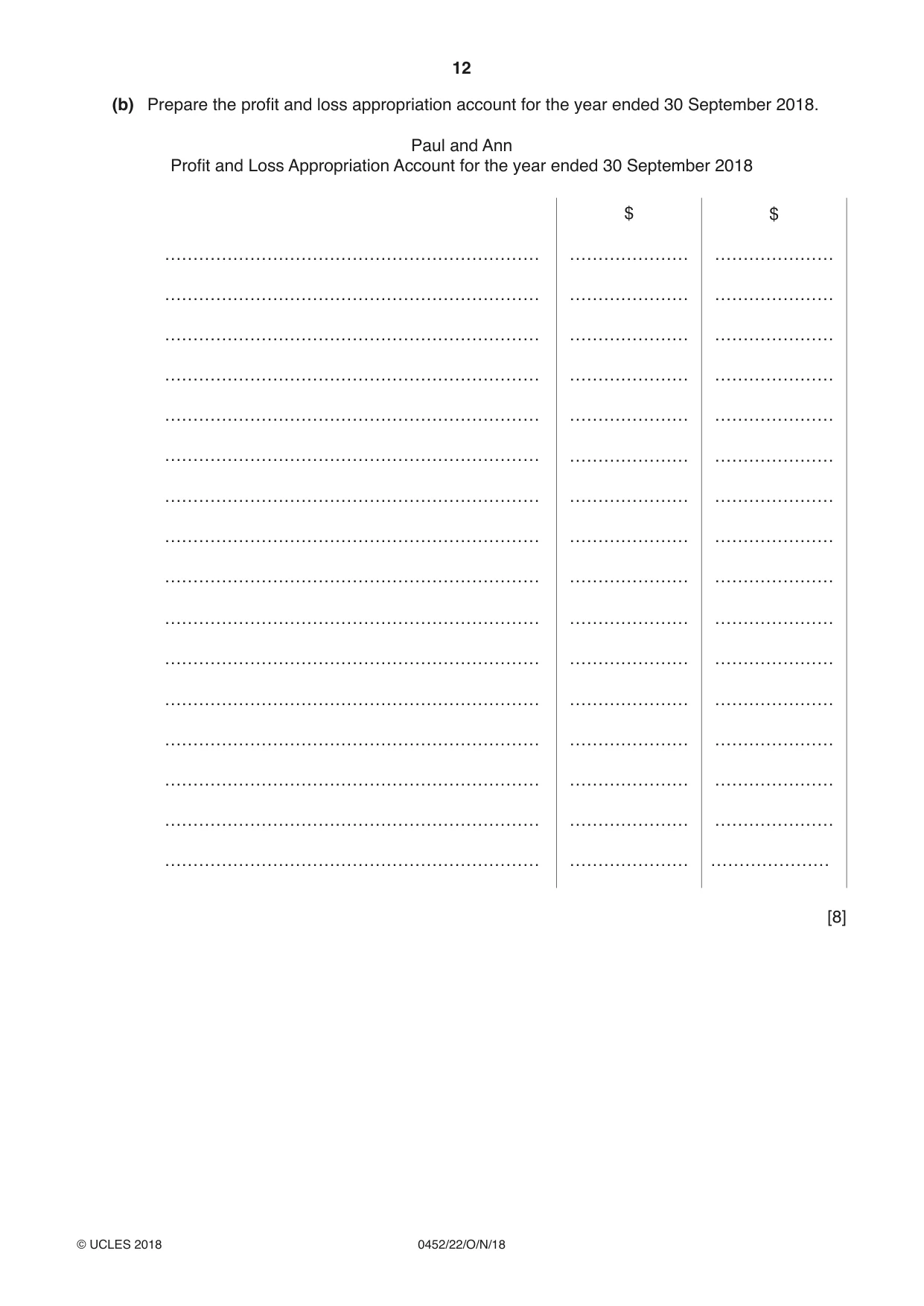
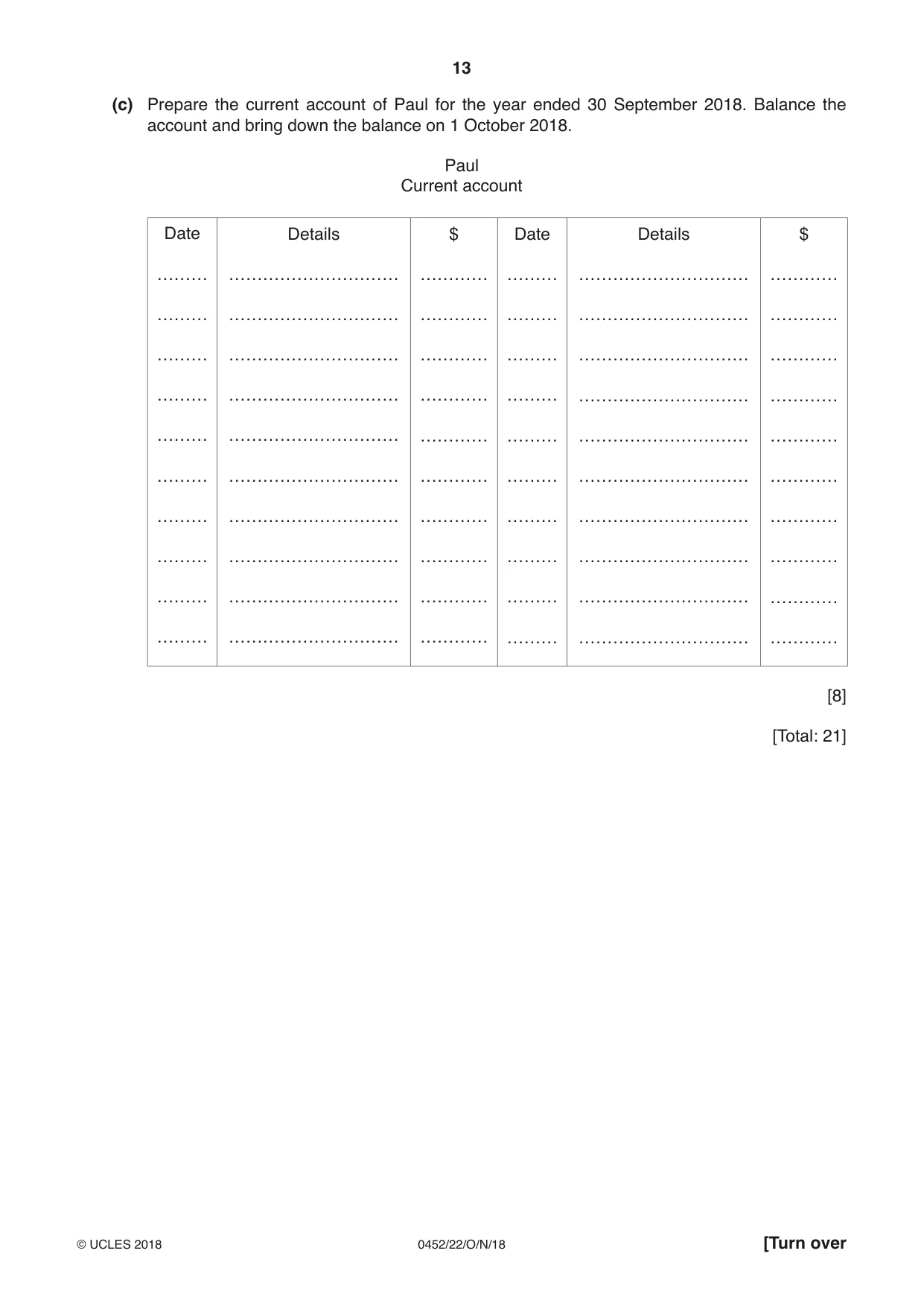
3 Paul and Ann are in partnership. Their financial year ends on 30 September. When they started the business they drew up a partnership agreement which provided for: Interest on capital at 4% per annum Interest on drawings at 5% An annual salary of $7000 for Paul Interest on any loans from partners at 6% per annum Sharing of profits and losses equally On 1 October 2017 the balances on the partners’ accounts were as follows: Paul Ann $ $ Capital account 50 000 85 000 Current account 1 150 credit 3 125 debit Loan account 10 000 The interest on loan is credited to Paul’s current account at the end of each financial year. On 1 April 2018 Paul introduced a motor vehicle, $14 500, into the business. He also deposited an amount into the business bank account so that his total capital was $80 000. The partners agreed that Paul’s salary should be increased by $1000 per annum starting on 1 April 2018. Drawings during the year ended 30 September 2018 were as follows: $ Paul 9 000 Ann 11 000 On 30 September 2018 Ann transferred $5000 from her capital account to her current account. The profit for the year ended 30 September 2018 after loan interest was $11 350. REQUIRED (a) Prepare journal entries to record the following: 1 The introduction of additional capital by Paul on 1 April 2018. 2 The transfer of $5000 from Ann’s capital account to her current account on 30 September 2018. Narratives are not required. Paul and Ann Journal Date Details Debit Credit $ $ ………… ……………… ……………… ………… ……………… ……………… ………… ……………… ……………… ………… ……………… ……………… ………… ……………… ……………… ………… ……………… ……………… ………… ……………… ……………… ………… ……………… ……………… [5] (b) Prepare the profit and loss appropriation account for the year ended 30 September 2018. Paul and Ann Profit and Loss Appropriation Account for the year ended 30 September 2018 $ $ ………………… ………………… ………………… ………………… ………………… ………………… ………………… ………………… ………………… ………………… ………………… ………………… ………………… ………………… ………………… ………………… ………………… ………………… ………………… ………………… ………………… ………………… ………………… ………………… ………………… ………………… ………………… ………………… ………………… ………………… ………………… ………………… [8] (c) Prepare the current account of Paul for the year ended 30 September 2018. Balance the account and bring down the balance on 1 October 2018. Paul Current account Date Details $ Date Details $ ……… ………… ……… ………… ……… ………… ……… ………… ……… ………… ……… ………… ……… ………… ……… ………… ……… ………… ……… ………… ……… ………… ……… ………… ……… ………… ……… ………… ……… ………… ……… ………… ……… ………… ……… ………… ……… ………… ……… ………… [8] [Total: 21]
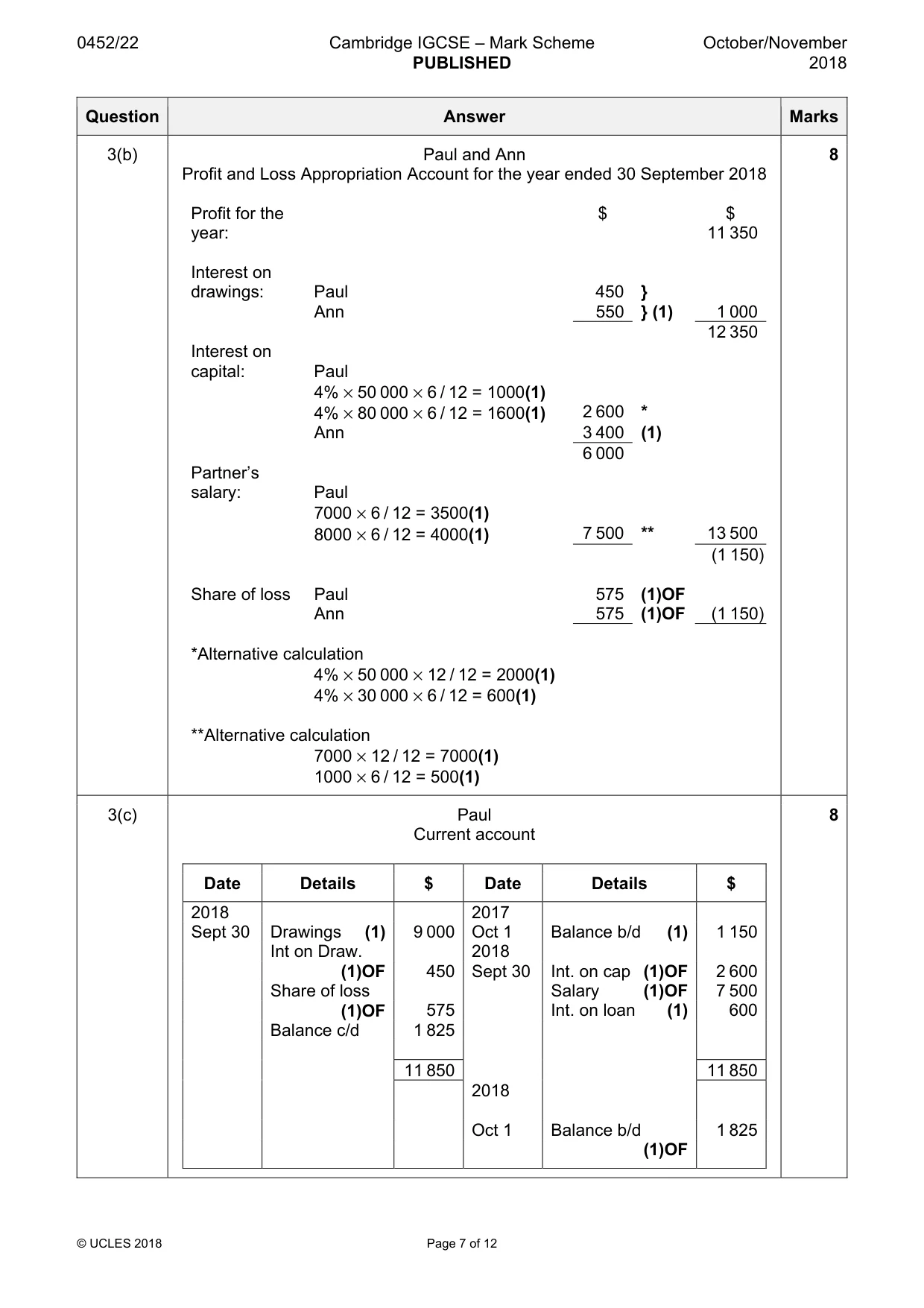
Mark scheme: 3(a) Paul and Ann 5 Journal Date Details Debit $ Credit $ 2018 April 1 Motor vehicle 14 500 (1) Bank 15 500 (1) Paul Capital 30 000 (1) Sept 30 Ann Capital 5 000 (1) Ann Current 5 000 (1) 3(b) Paul and Ann 8 Profit and Loss Appropriation Account for the year ended 30 September 2018 Profit for the $ $ year: 11 350 Interest on drawings: Paul 450 } Ann 550 } (1) 1 000 12 350 Interest on capital: Paul 4% × 50 000 × 6 / 12 = 1000(1) 4% × 80 000 × 6 / 12 = 1600(1) 2 600 * Ann 3 400 (1) 6 000 Partner’s salary: Paul 7000 × 6 / 12 = 3500(1) 8000 × 6 / 12 = 4000(1) 7 500 ** 13 500 (1 150) Share of loss Paul 575 (1)OF Ann 575 (1)OF (1 150) *Alternative calculation 4% × 50 000 × 12 / 12 = 2000(1) 4% × 30 000 × 6 / 12 = 600(1) **Alternative calculation 7000 × 12 / 12 = 7000(1) 1000 × 6 / 12 = 500(1) 3(c) Paul 8 Current account Date Details $ Date Details $ 2018 2017 Sept 30 Drawings (1) 9 000 Oct 1 Balance b/d (1) 1 150 Int on Draw. 2018 (1)OF 450 Sept 30 Int. on cap (1)OF 2 600 Share of loss Salary (1)OF 7 500 (1)OF 575 Int. on loan (1) 600 Balance c/d 1 825 11 850 11 850 2018 Oct 1 Balance b/d 1 825 (1)OF
Q4 · The financial year of LS Limited ends on 30 June
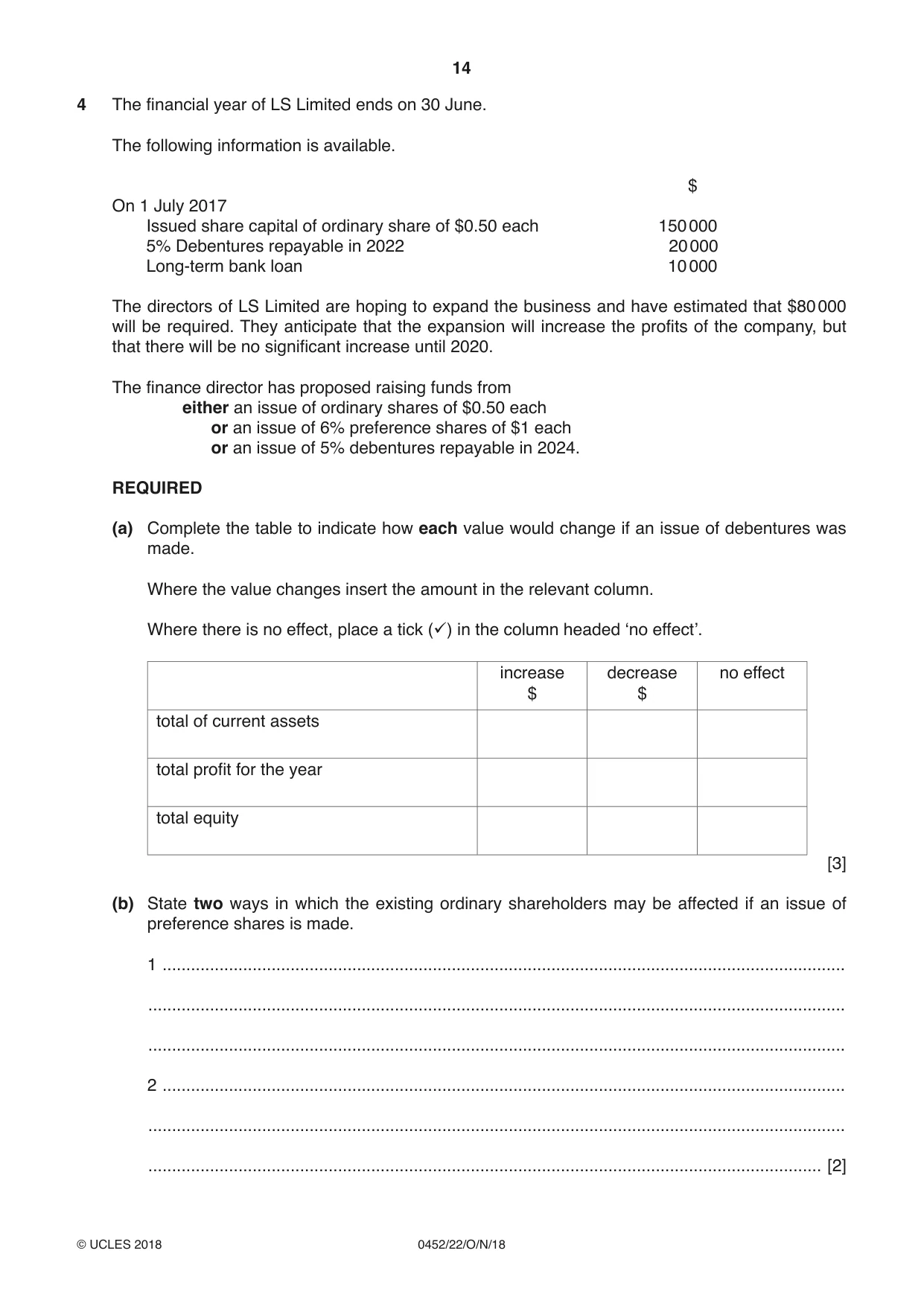
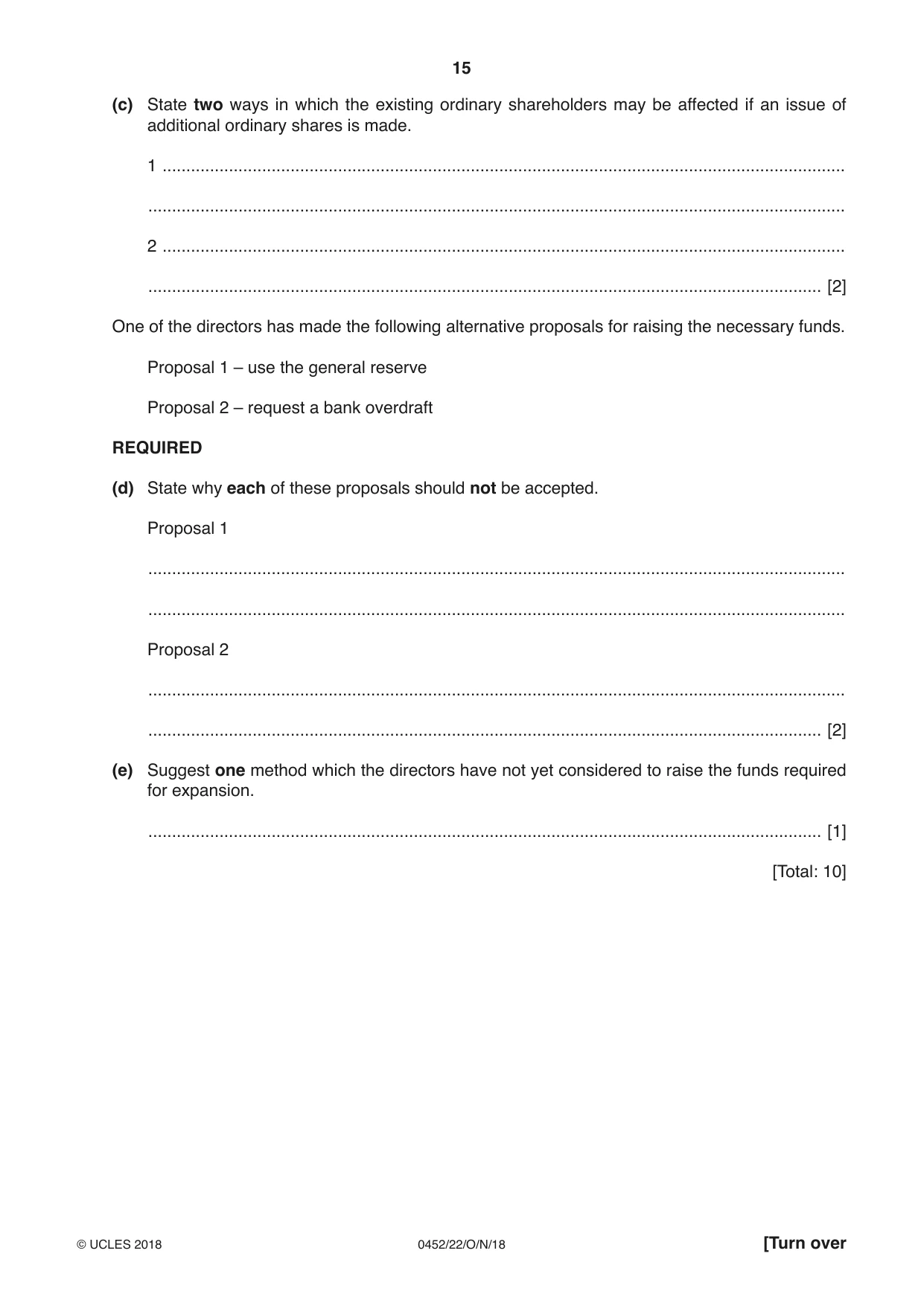
4 The financial year of LS Limited ends on 30 June. The following information is available. $ On 1 July 2017 Issued share capital of ordinary share of $0.50 each 150 000 5% Debentures repayable in 2022 20 000 Long-term bank loan 10 000 The directors of LS Limited are hoping to expand the business and have estimated that $80 000 will be required. They anticipate that the expansion will increase the profits of the company, but that there will be no significant increase until 2020. The finance director has proposed raising funds from either an issue of ordinary shares of $0.50 each or an issue of 6% preference shares of $1 each or an issue of 5% debentures repayable in 2024. REQUIRED (a) Complete the table to indicate how each value would change if an issue of debentures was made. Where the value changes insert the amount in the relevant column. Where there is no effect, place a tick () in the column headed ‘no effect’. increase decrease no effect $ $ total of current assets total profit for the year total equity [3] (b) State two ways in which the existing ordinary shareholders may be affected if an issue of preference shares is made. 1 ................................................................................................................................................ ................................................................................................................................................... ................................................................................................................................................... 2 ................................................................................................................................................ ................................................................................................................................................... .............................................................................................................................................. [2] (c) State two ways in which the existing ordinary shareholders may be affected if an issue of additional ordinary shares is made. 1 ................................................................................................................................................ ................................................................................................................................................... 2 ................................................................................................................................................ .............................................................................................................................................. [2] One of the directors has made the following alternative proposals for raising the necessary funds. Proposal 1 – use the general reserve Proposal 2 – request a bank overdraft REQUIRED (d) State why each of these proposals should not be accepted. Proposal 1 ................................................................................................................................................... ................................................................................................................................................... Proposal 2 ................................................................................................................................................... .............................................................................................................................................. [2] (e) Suggest one method which the directors have not yet considered to raise the funds required for expansion. .............................................................................................................................................. [1] [Total: 10]
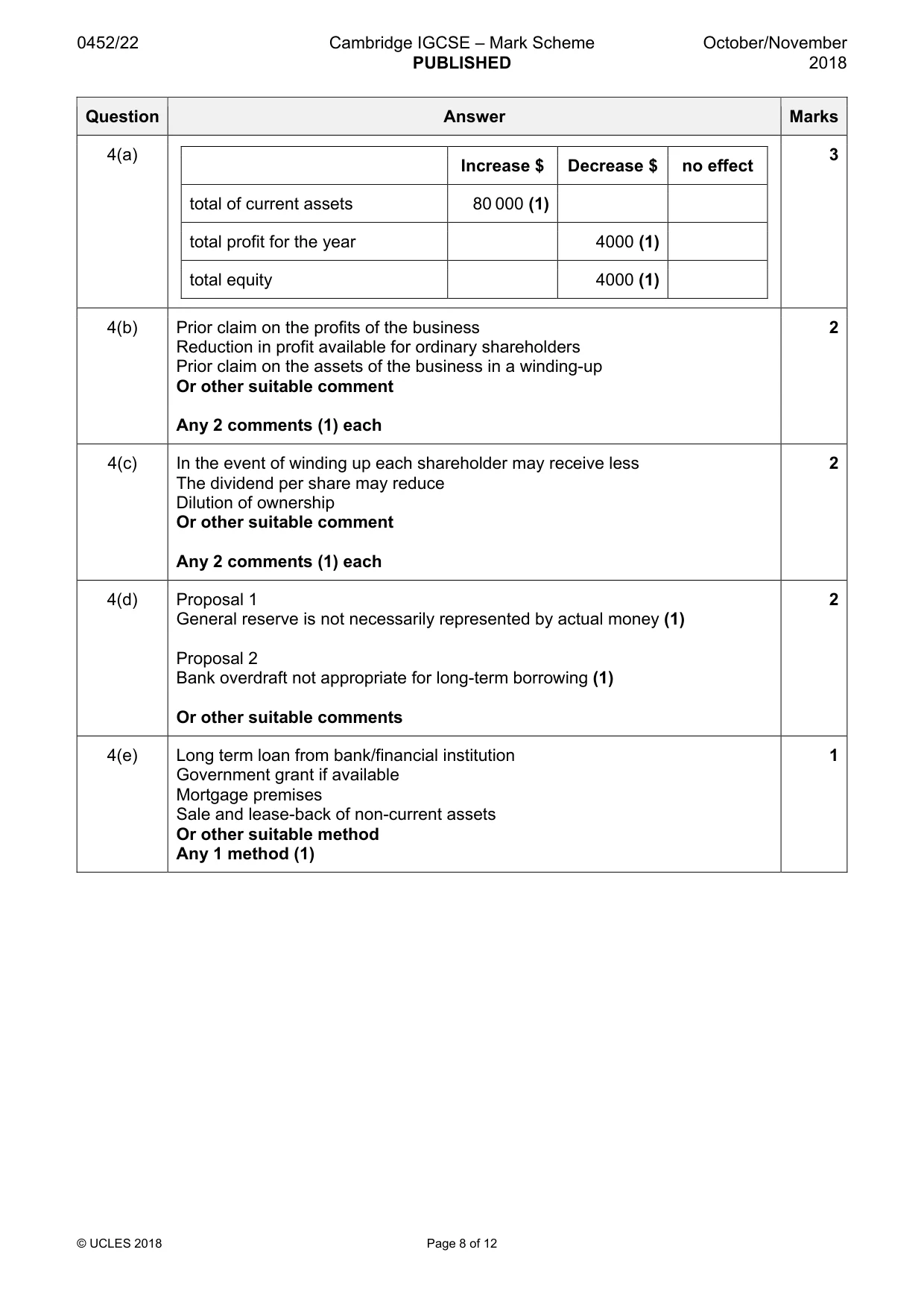
Mark scheme: 4(a) 3 Increase $ Decrease $ no effect total of current assets 80 000 (1) total profit for the year 4000 (1) total equity 4000 (1) 4(b) Prior claim on the profits of the business 2 Reduction in profit available for ordinary shareholders Prior claim on the assets of the business in a winding-up Or other suitable comment Any 2 comments (1) each 4(c) In the event of winding up each shareholder may receive less 2 The dividend per share may reduce Dilution of ownership Or other suitable comment Any 2 comments (1) each 4(d) Proposal 1 2 General reserve is not necessarily represented by actual money (1) Proposal 2 Bank overdraft not appropriate for long-term borrowing (1) Or other suitable comments 4(e) Long term loan from bank/financial institution 1 Government grant if available Mortgage premises Sale and lease-back of non-current assets Or other suitable method Any 1 method (1)
Q5 · Mariam is a trader
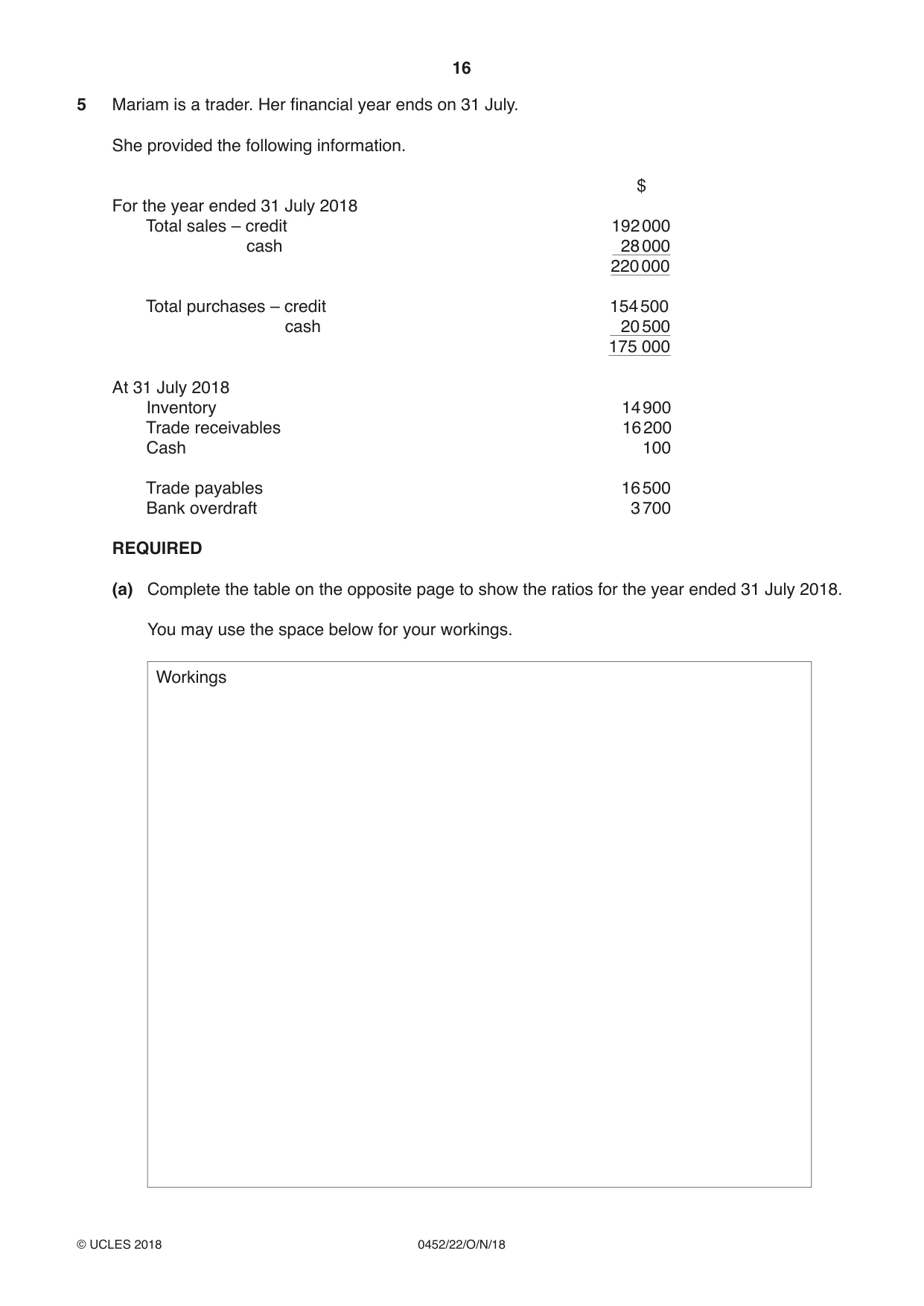
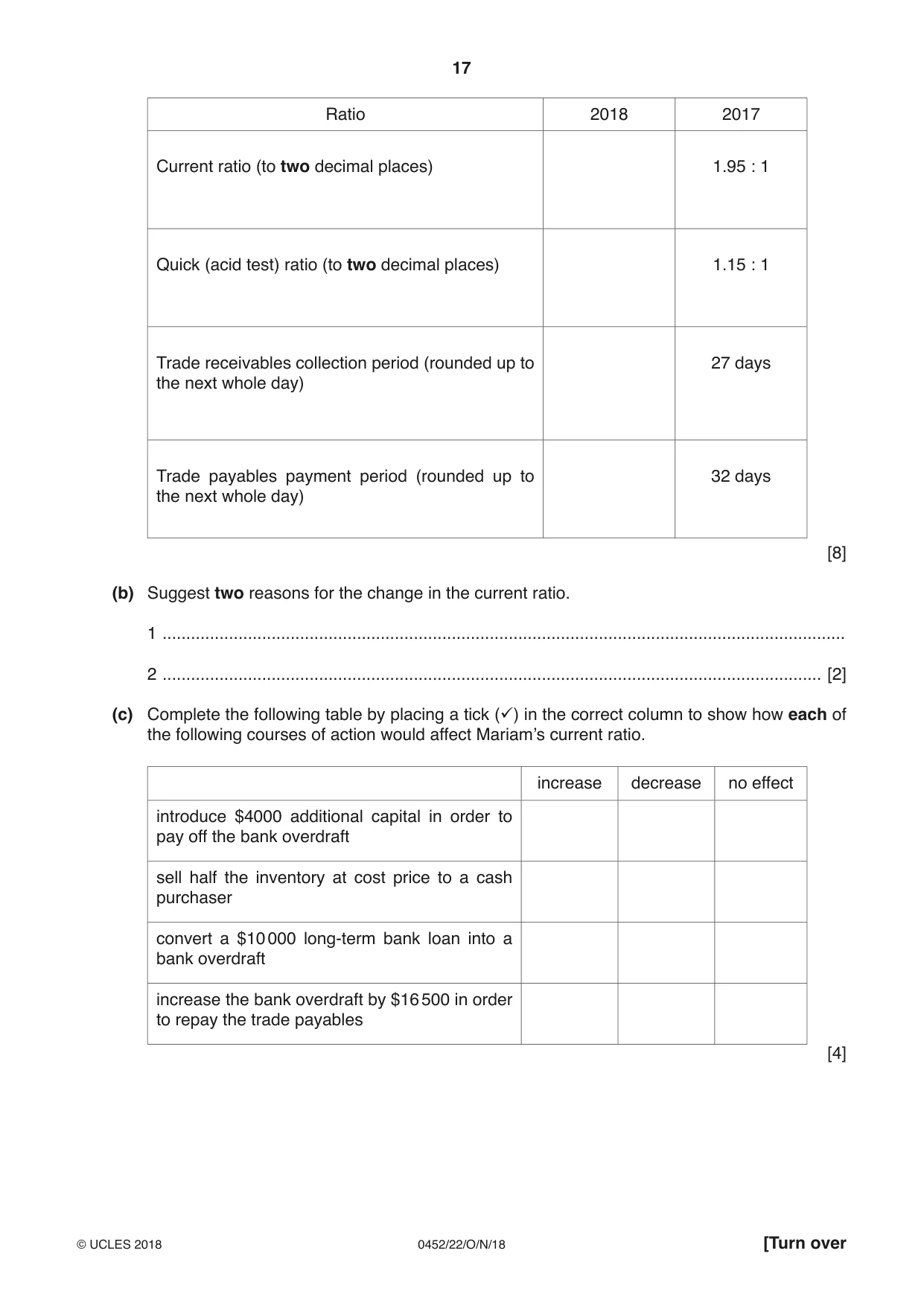
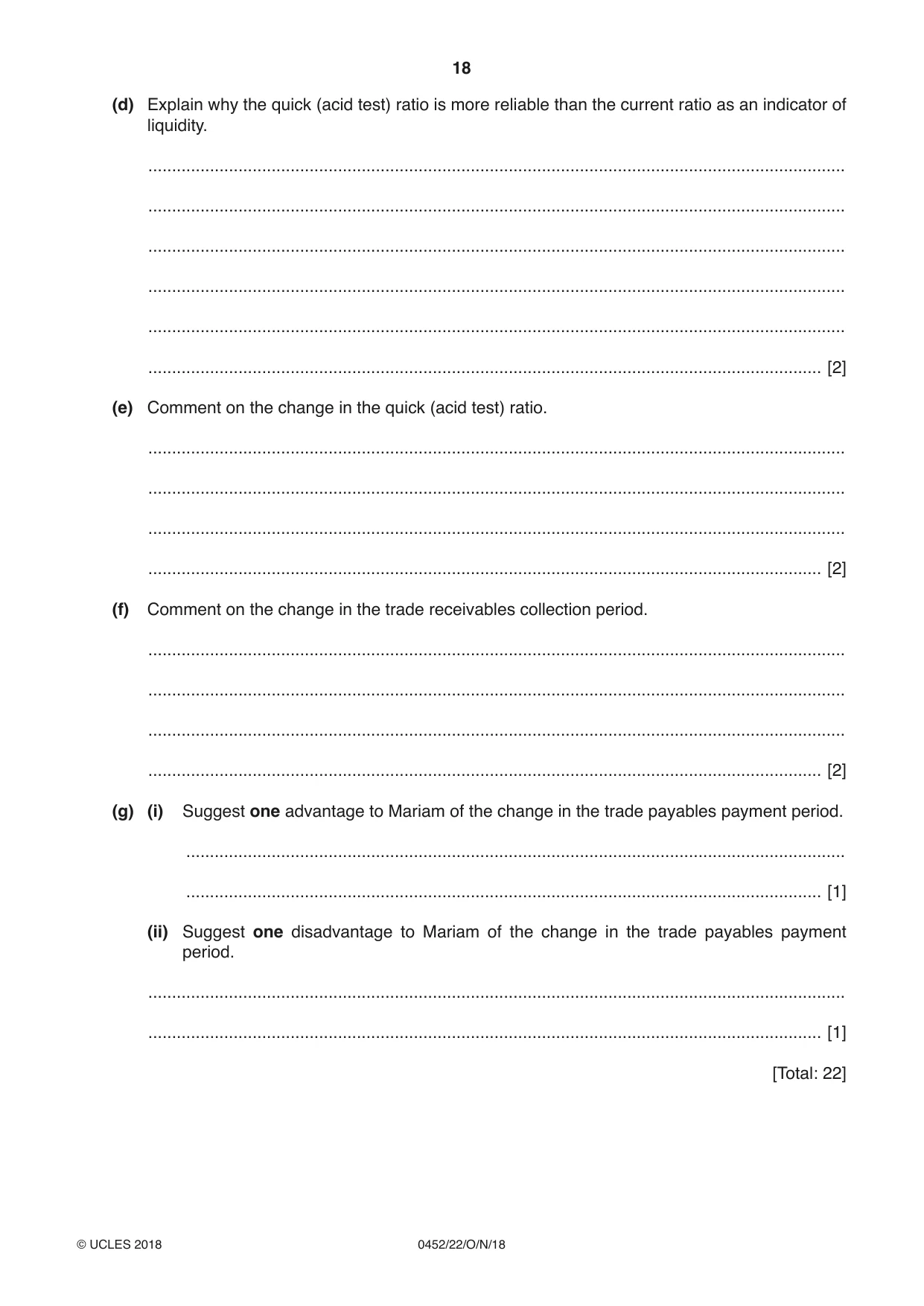
5 Mariam is a trader. Her financial year ends on 31 July. She provided the following information. $ For the year ended 31 July 2018 Total sales – credit 192 000 cash 28 000 220 000 Total purchases – credit 154 500 cash 20 500 175 000 At 31 July 2018 Inventory 14 900 Trade receivables 16 200 Cash 100 Trade payables 16 500 Bank overdraft 3 700 REQUIRED (a) Complete the table on the opposite page to show the ratios for the year ended 31 July 2018. You may use the space below for your workings. Workings Ratio 2018 2017 Current ratio (to two decimal places) 1.95 : 1 Quick (acid test) ratio (to two decimal places) 1.15 : 1 Trade receivables collection period (rounded up to 27 days the next whole day) Trade payables payment period (rounded up to 32 days the next whole day) [8] (b) Suggest two reasons for the change in the current ratio. 1 ................................................................................................................................................ 2 ........................................................................................................................................... [2] (c) Complete the following table by placing a tick () in the correct column to show how each of the following courses of action would affect Mariam’s current ratio. increase decrease no effect introduce $4000 additional capital in order to pay off the bank overdraft sell half the inventory at cost price to a cash purchaser convert a $10 000 long-term bank loan into a bank overdraft increase the bank overdraft by $16 500 in order to repay the trade payables [4] (d) Explain why the quick (acid test) ratio is more reliable than the current ratio as an indicator of liquidity. ................................................................................................................................................... ................................................................................................................................................... ................................................................................................................................................... ................................................................................................................................................... ................................................................................................................................................... .............................................................................................................................................. [2] (e) Comment on the change in the quick (acid test) ratio. ................................................................................................................................................... ................................................................................................................................................... ................................................................................................................................................... .............................................................................................................................................. [2] (f) Comment on the change in the trade receivables collection period. ................................................................................................................................................... ................................................................................................................................................... ................................................................................................................................................... .............................................................................................................................................. [2] (g) (i) Suggest one advantage to Mariam of the change in the trade payables payment period. ........................................................................................................................................... ...................................................................................................................................... [1] (ii) Suggest one disadvantage to Mariam of the change in the trade payables payment period. ................................................................................................................................................... .............................................................................................................................................. [1] [Total: 22]
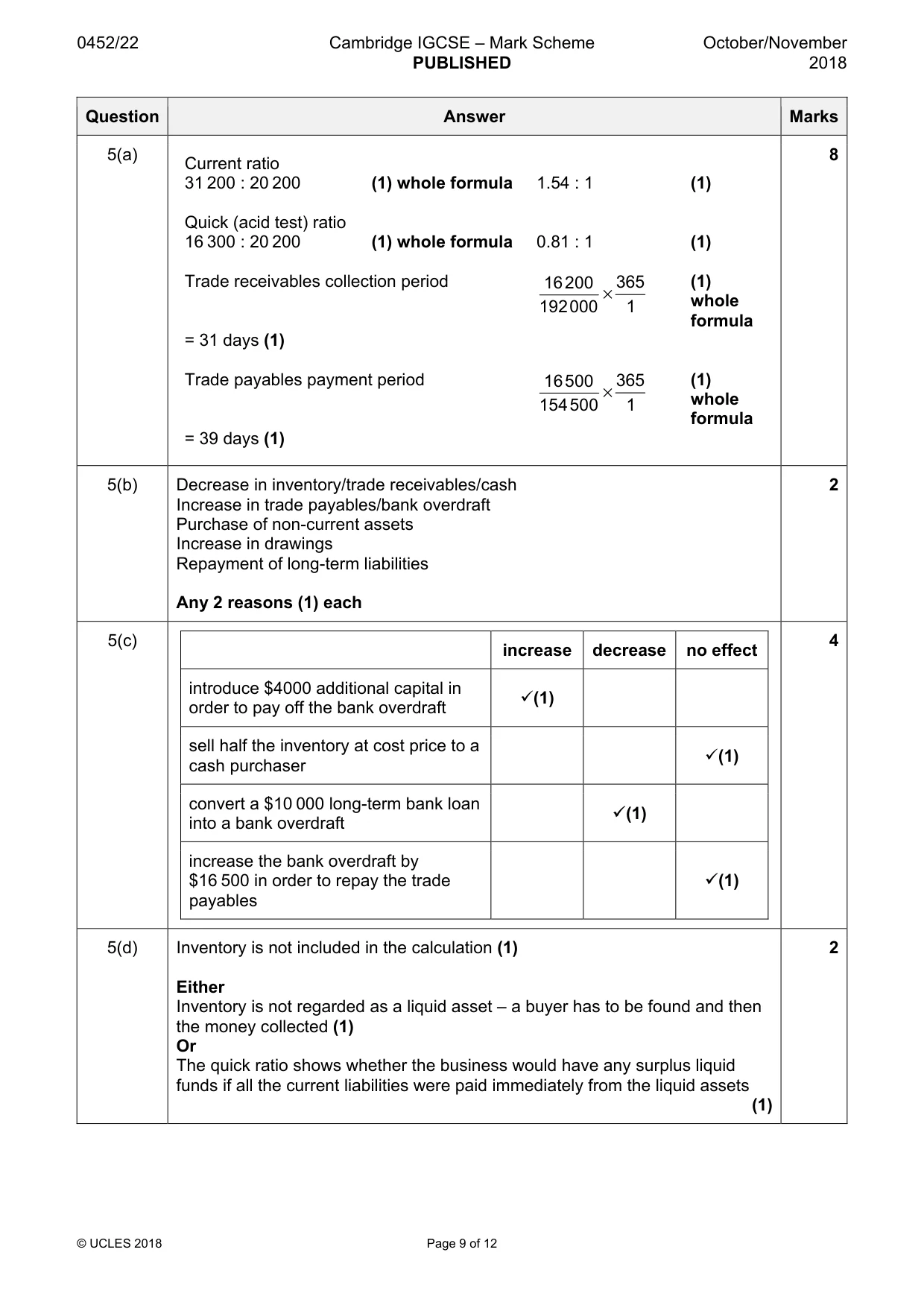
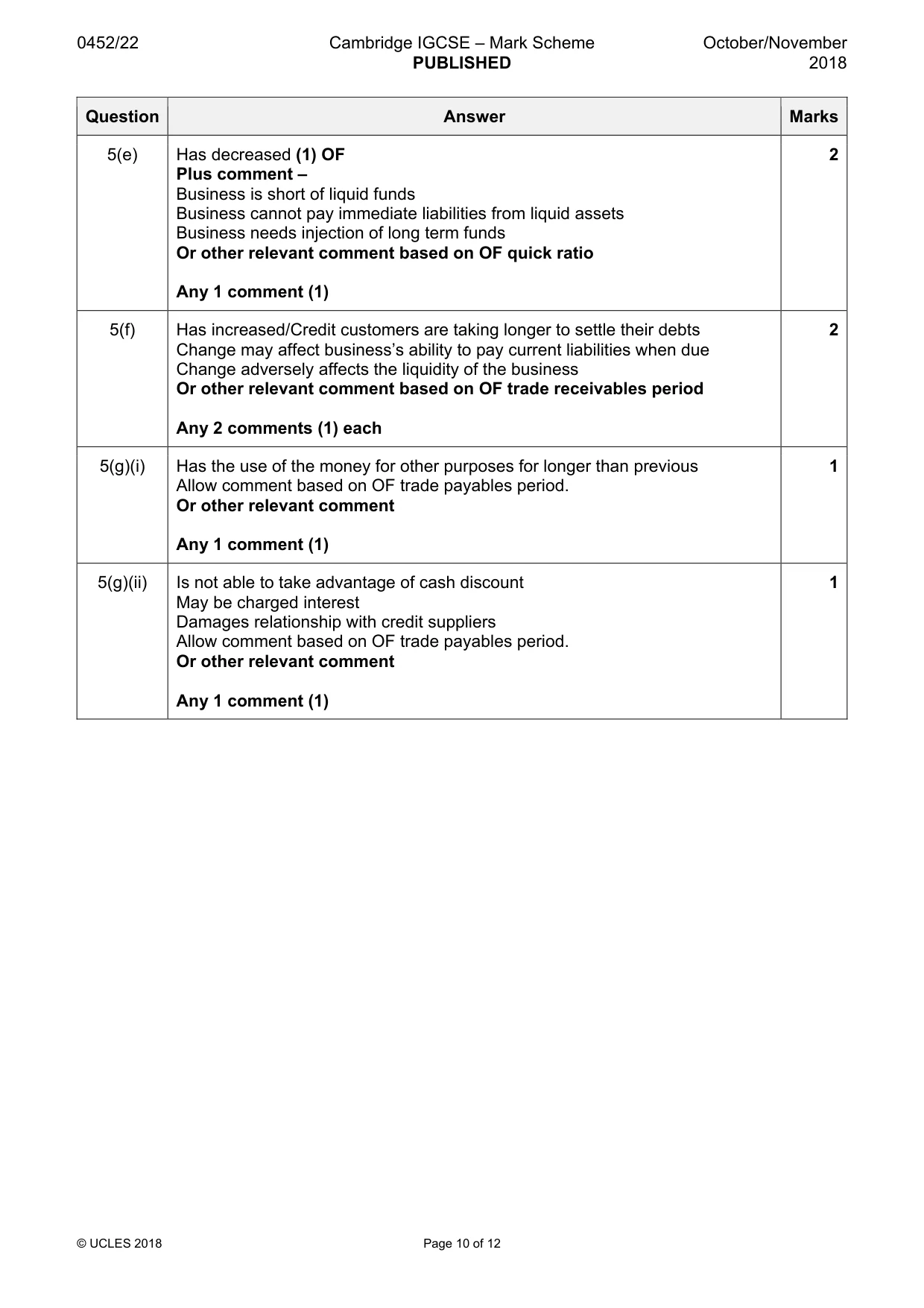
Mark scheme: 5(a) 8 Current ratio 31 200 : 20 200 (1) whole formula 1.54 : 1 (1) Quick (acid test) ratio 16 300 : 20 200 (1) whole formula 0.81 : 1 (1) Trade receivables collection period 16200 365 (1) × whole 192000 1 formula = 31 days (1) Trade payables payment period 16500 365 (1) × whole 154500 1 formula = 39 days (1) 5(b) Decrease in inventory/trade receivables/cash 2 Increase in trade payables/bank overdraft Purchase of non-current assets Increase in drawings Repayment of long-term liabilities Any 2 reasons (1) each 5(c) 4 increase decrease no effect introduce $4000 additional capital in 9(1) order to pay off the bank overdraft sell half the inventory at cost price to a 9(1) cash purchaser convert a $10 000 long-term bank loan 9(1) into a bank overdraft increase the bank overdraft by $16 500 in order to repay the trade 9(1) payables 5(d) Inventory is not included in the calculation (1) 2 Either Inventory is not regarded as a liquid asset – a buyer has to be found and then the money collected (1) Or The quick ratio shows whether the business would have any surplus liquid funds if all the current liabilities were paid immediately from the liquid assets (1) 5(e) Has decreased (1) OF 2 Plus comment – Business is short of liquid funds Business cannot pay immediate liabilities from liquid assets Business needs injection of long term funds Or other relevant comment based on OF quick ratio Any 1 comment (1) 5(f) Has increased/Credit customers are taking longer to settle their debts 2 Change may affect business’s ability to pay current liabilities when due Change adversely affects the liquidity of the business Or other relevant comment based on OF trade receivables period Any 2 comments (1) each 5(g)(i) Has the use of the money for other purposes for longer than previous 1 Allow comment based on OF trade payables period. Or other relevant comment Any 1 comment (1) 5(g)(ii) Is not able to take advantage of cash discount 1 May be charged interest Damages relationship with credit suppliers Allow comment based on OF trade payables period. Or other relevant comment Any 1 comment (1)
More questions on Calculation and understanding of accounting ratios
Q6 · Priti opened a retail food store on 1 October 2017
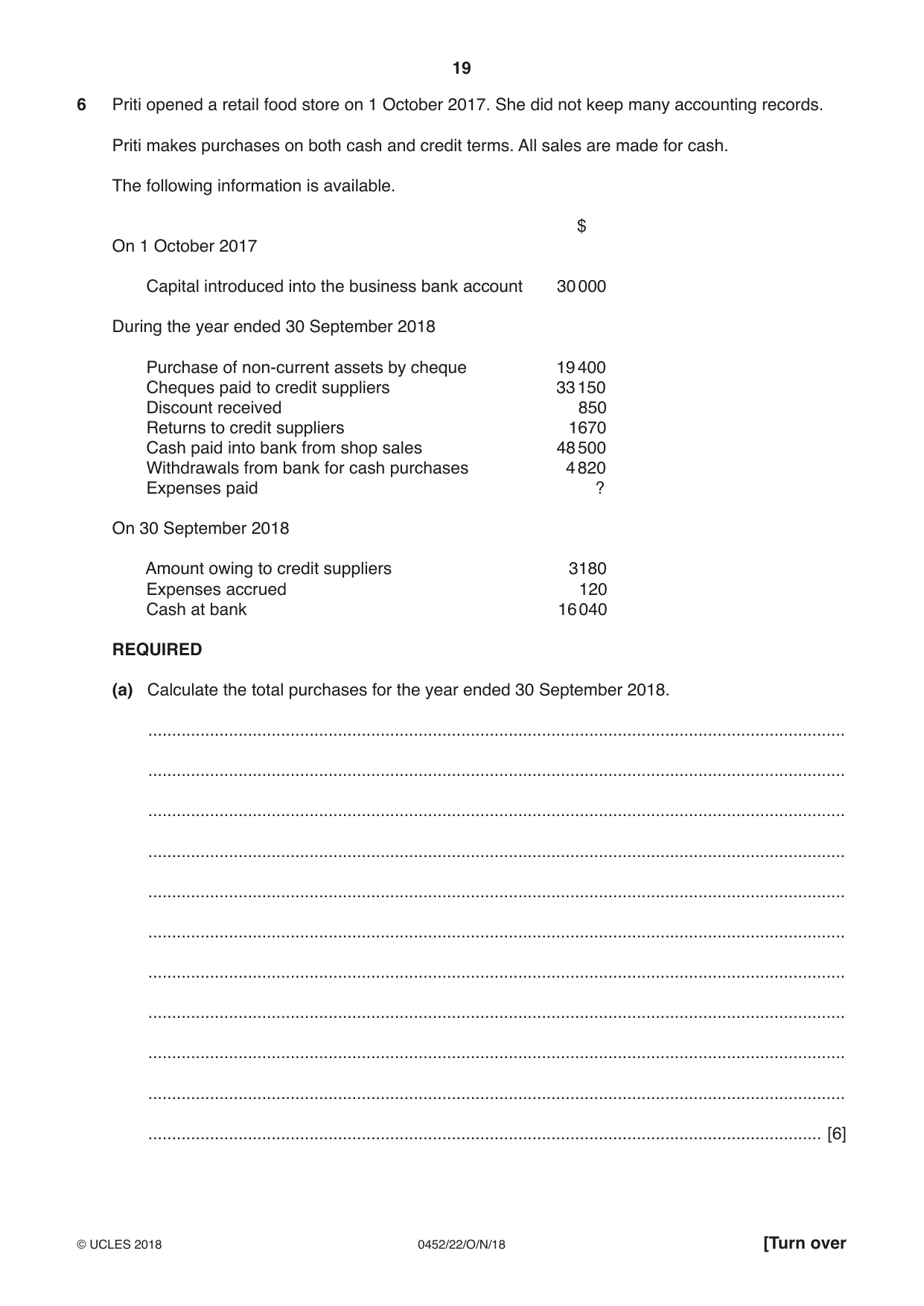
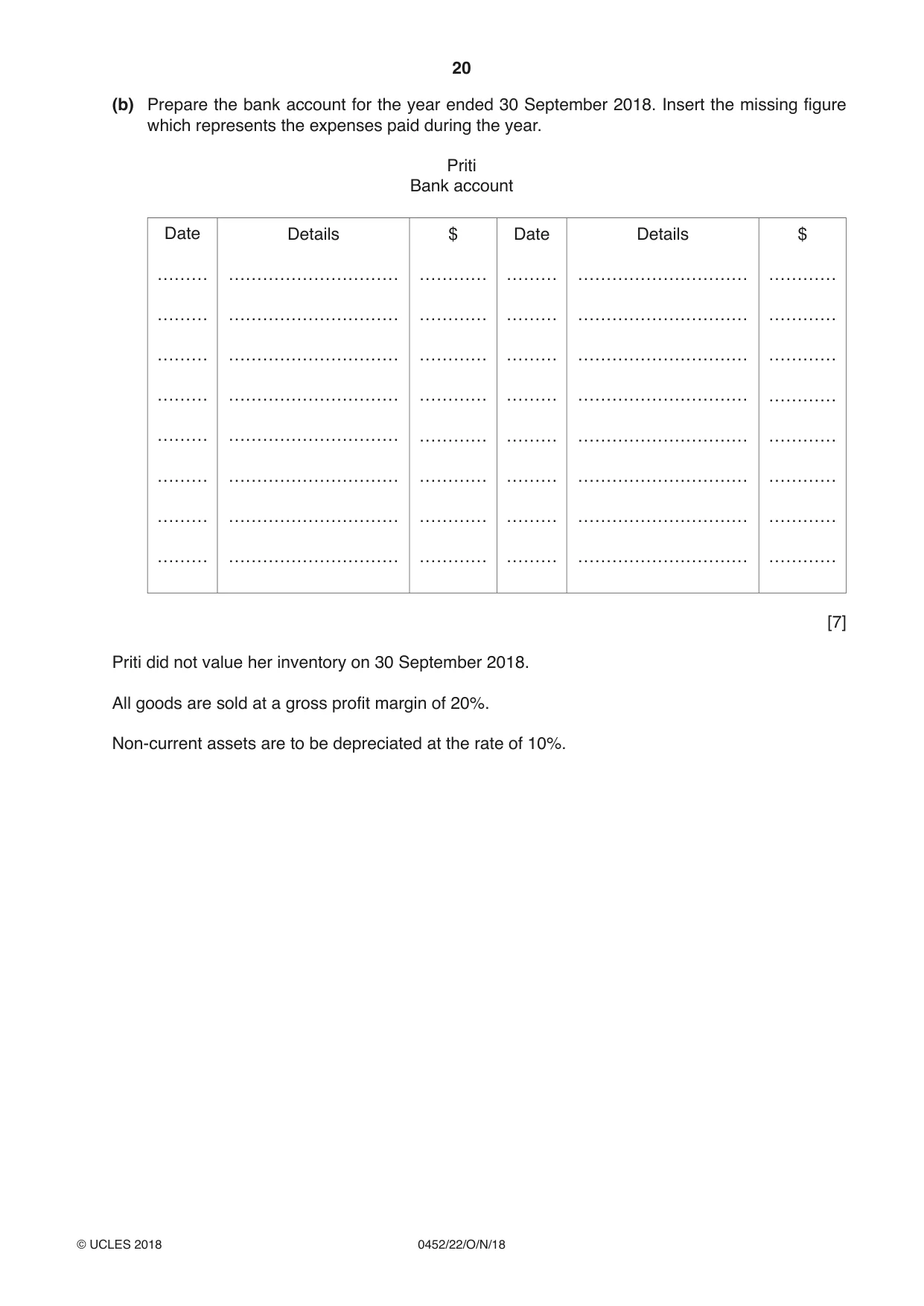
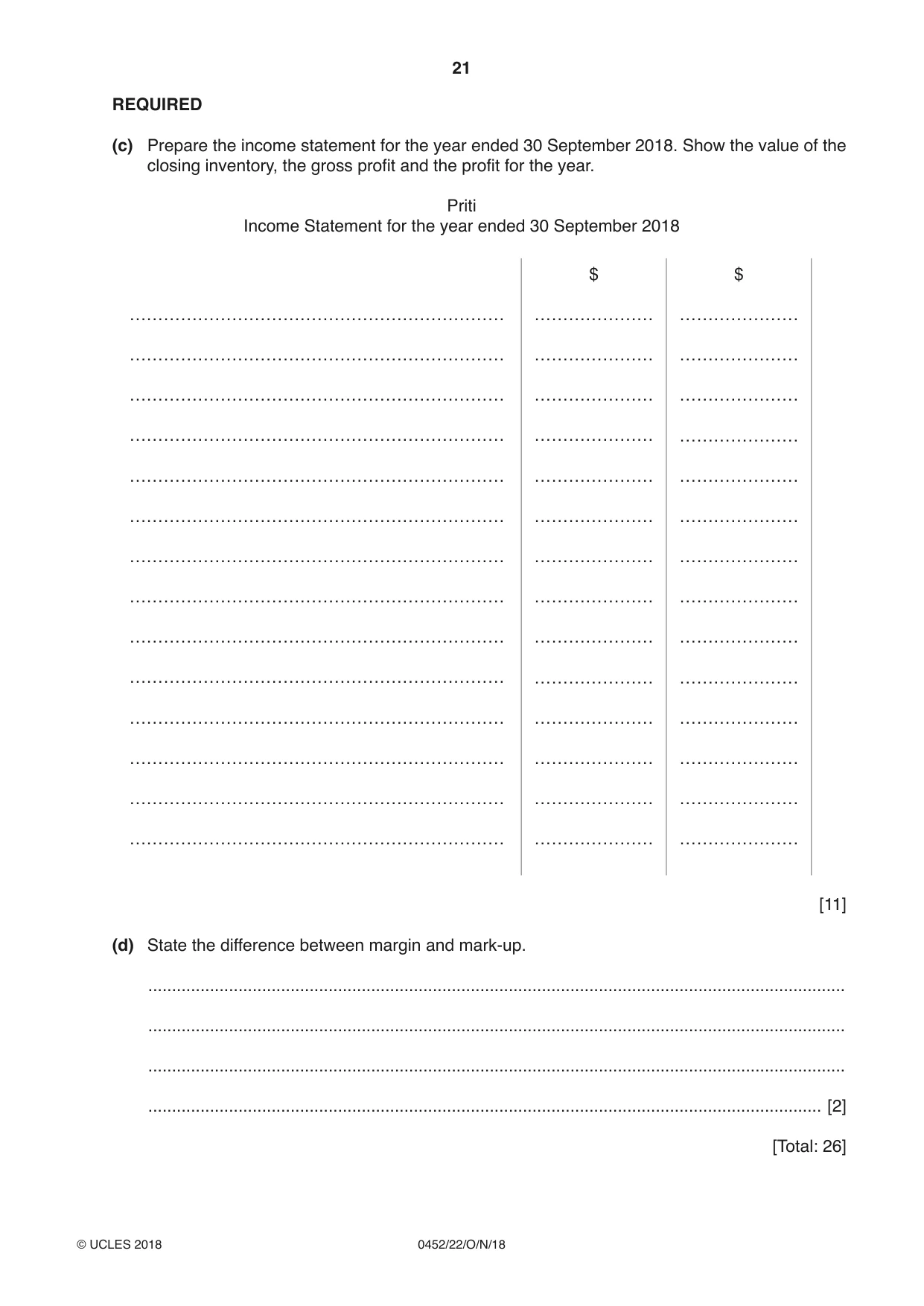
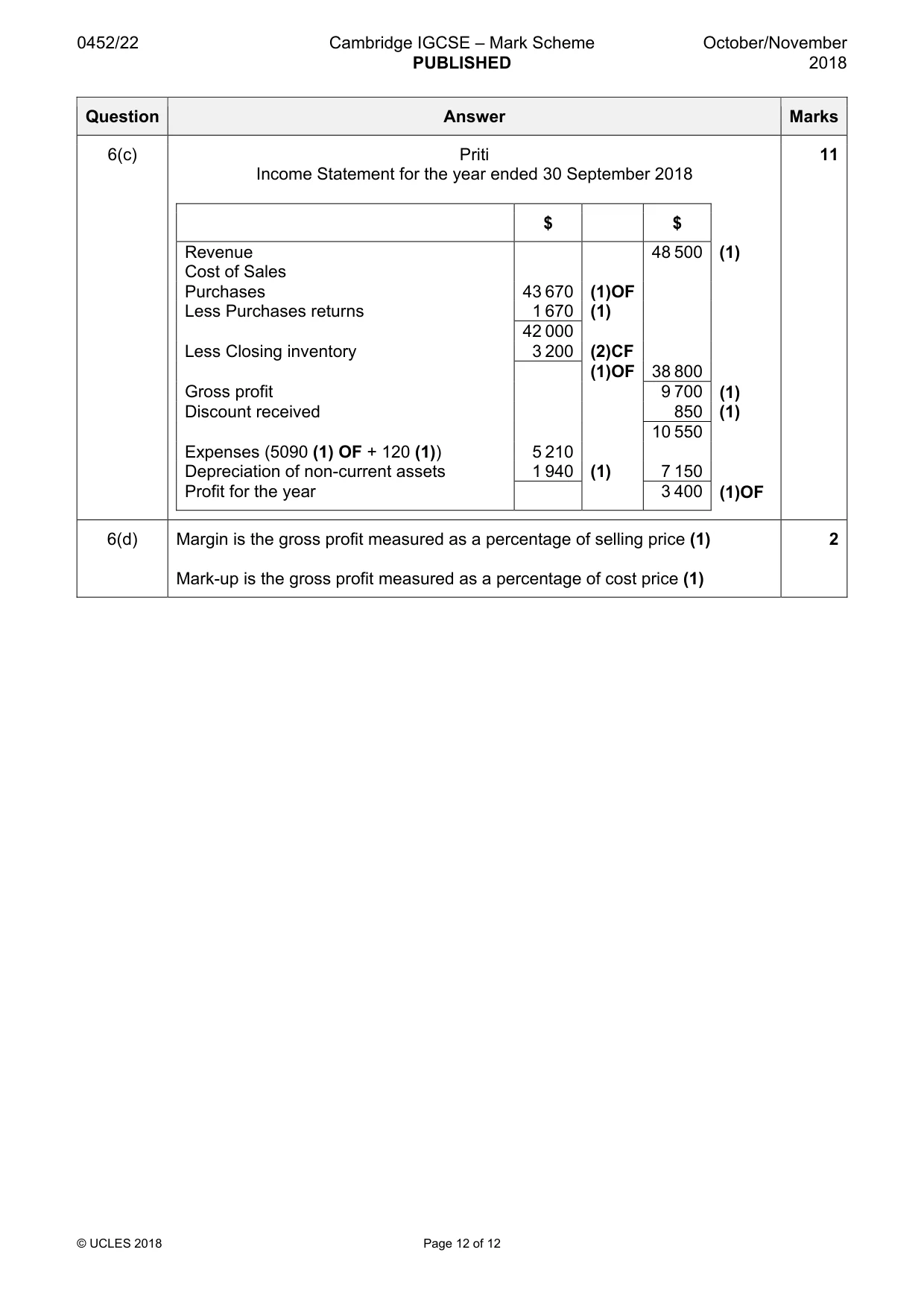
6 Priti opened a retail food store on 1 October 2017. She did not keep many accounting records. Priti makes purchases on both cash and credit terms. All sales are made for cash. The following information is available. $ On 1 October 2017 Capital introduced into the business bank account 30 000 During the year ended 30 September 2018 Purchase of non-current assets by cheque 19 400 Cheques paid to credit suppliers 33 150 Discount received 850 Returns to credit suppliers 1670 Cash paid into bank from shop sales 48 500 Withdrawals from bank for cash purchases 4 820 Expenses paid ? On 30 September 2018 Amount owing to credit suppliers 3180 Expenses accrued 120 Cash at bank 16 040 REQUIRED (a) Calculate the total purchases for the year ended 30 September 2018. ................................................................................................................................................... ................................................................................................................................................... ................................................................................................................................................... ................................................................................................................................................... ................................................................................................................................................... ................................................................................................................................................... ................................................................................................................................................... ................................................................................................................................................... ................................................................................................................................................... ................................................................................................................................................... .............................................................................................................................................. [6] (b) Prepare the bank account for the year ended 30 September 2018. Insert the missing figure which represents the expenses paid during the year. Priti Bank account Date Details $ Date Details $ ……… ………… ……… ………… ……… ………… ……… ………… ……… ………… ……… ………… ……… ………… ……… ………… ……… ………… ……… ………… ……… ………… ……… ………… ……… ………… ……… ………… ……… ………… ……… ………… [7] Priti did not value her inventory on 30 September 2018. All goods are sold at a gross profit margin of 20%. Non-current assets are to be depreciated at the rate of 10%. REQUIRED (c) Prepare the income statement for the year ended 30 September 2018. Show the value of the closing inventory, the gross profit and the profit for the year. Priti Income Statement for the year ended 30 September 2018 $ $ ………………… ………………… ………………… ………………… ………………… ………………… ………………… ………………… ………………… ………………… ………………… ………………… ………………… ………………… ………………… ………………… ………………… ………………… ………………… ………………… ………………… ………………… ………………… ………………… ………………… ………………… ………………… ………………… [11] (d) State the difference between margin and mark-up. ................................................................................................................................................... ................................................................................................................................................... ................................................................................................................................................... .............................................................................................................................................. [2] [Total: 26]
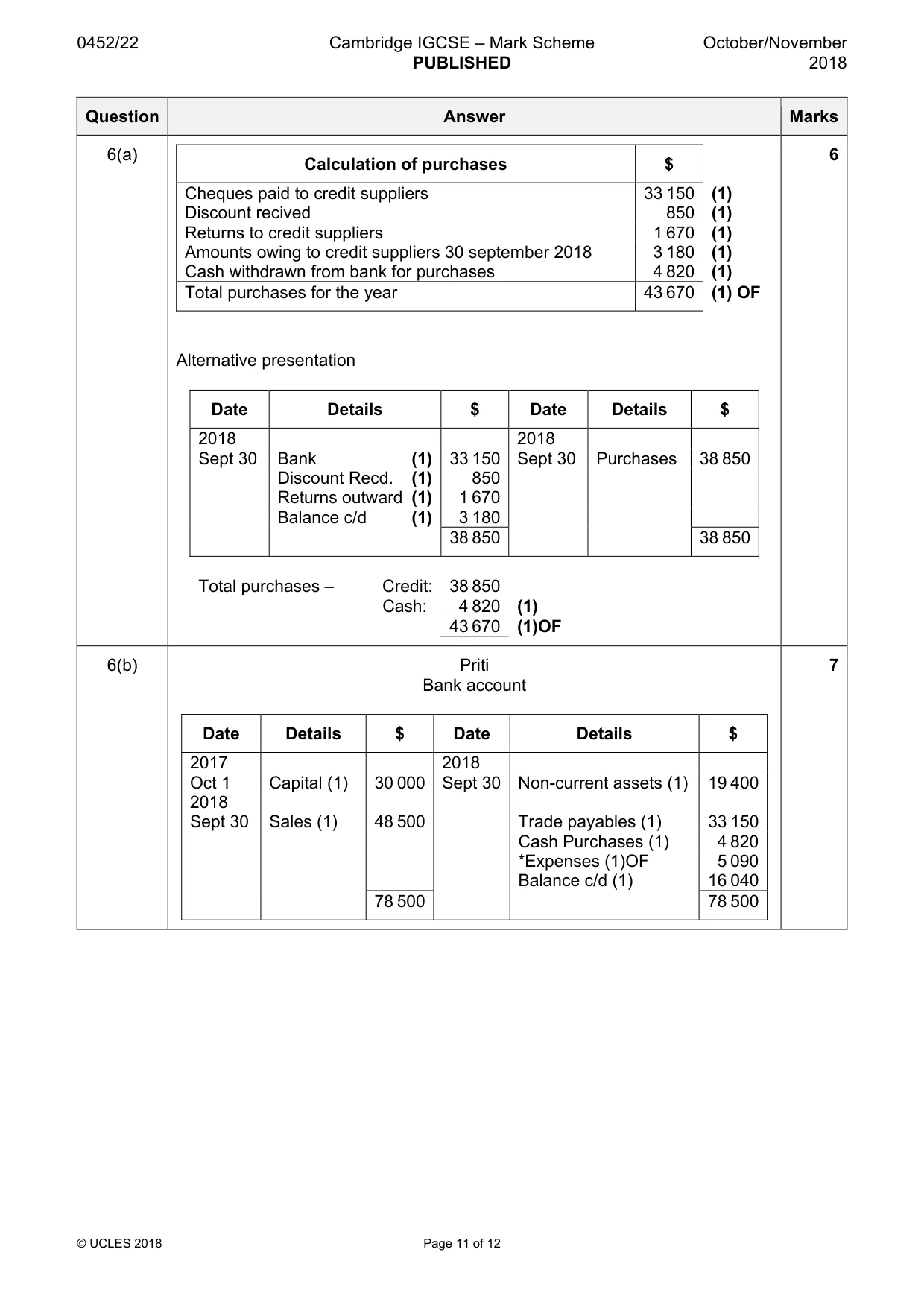
Mark scheme: 6(a) 6 Calculation of purchases $ Cheques paid to credit suppliers 33 150 (1) Discount recived 850 (1) Returns to credit suppliers 1 670 (1) Amounts owing to credit suppliers 30 september 2018 3 180 (1) Cash withdrawn from bank for purchases 4 820 (1) Total purchases for the year 43 670 (1) OF Alternative presentation Date Details $ Date Details $ 2018 2018 Sept 30 Bank (1) 33 150 Sept 30 Purchases 38 850 Discount Recd. (1) 850 Returns outward (1) 1 670 Balance c/d (1) 3 180 38 850 38 850 Total purchases – Credit: 38 850 Cash: 4 820 (1) 43 670 (1)OF 6(b) Priti 7 Bank account Date Details $ Date Details $ 2017 2018 Oct 1 Capital (1) 30 000 Sept 30 Non-current assets (1) 19 400 2018 Sept 30 Sales (1) 48 500 Trade payables (1) 33 150 Cash Purchases (1) 4 820 *Expenses (1)OF 5 090 Balance c/d (1) 16 040 78 500 78 500 6(c) Priti 11 Income Statement for the year ended 30 September 2018 $ $ Revenue 48 500 (1) Cost of Sales Purchases 43 670 (1)OF Less Purchases returns 1 670 (1) 42 000 Less Closing inventory 3 200 (2)CF (1)OF 38 800 Gross profit 9 700 (1) Discount received 850 (1) 10 550 Expenses (5090 (1) OF + 120 (1)) 5 210 Depreciation of non-current assets 1 940 (1) 7 150 Profit for the year 3 400 (1)OF 6(d) Margin is the gross profit measured as a percentage of selling price (1) 2 Mark-up is the gross profit measured as a percentage of cost price (1)
What was in this paper
The subtopics covered by these 6 questions, and how many questions each got. Open one in a new tab to see every Cambridge question on it.
What you needed in this session
Cambridge’s own grade thresholds for 2018 Oct/Nov, Paper 2 · Variant 2. A higher threshold means an easier paper — the bar moves with how the cohort did.