Cambridge IGCSE Accounting 0452 — 2018 May/June Paper 1 · Variant 1
0452/11/M/J/18 · 120 marks · ≈135 min
The question paper and its mark scheme, free to read here and free to download. This is Cambridge’s own paper, exactly as it was sat.
Question paper24 pages



Mark scheme17 pages
Answers below. Sit the paper first if you are practising.
Paper as text
Question paper, page 1
This document consists of 22 printed pages and 2 blank pages. DC (RCL (DF)) 148225/3 © UCLES 2018 [Turn over Cambridge International Examinations Cambridge International General Certificate of Secondary Education * 1 6 2 6 0 3 4 7 9 8 * ACCOUNTING 0452/11 Paper 1 May/June 2018 1 hour 45 minutes Candidates answer on the Question Paper. No Additional Materials are required. READ THESE INSTRUCTIONS FIRST Write your Centre number, candidate number and name on all the work you hand in. Write in dark blue or black pen. You may use an HB pencil for any diagrams or graphs. Do not use staples, paper clips, glue or correction fluid. DO NOT WRITE IN ANY BARCODES. Answer all questions. You may use a calculator. Where layouts are to be completed, you may not need all the lines for your answer. The businesses mentioned in this Question Paper are fictitious. At the end of the examination, fasten all your work securely together. The number of marks is given in brackets [ ] at the end of each question or part question.
Question paper, page 2
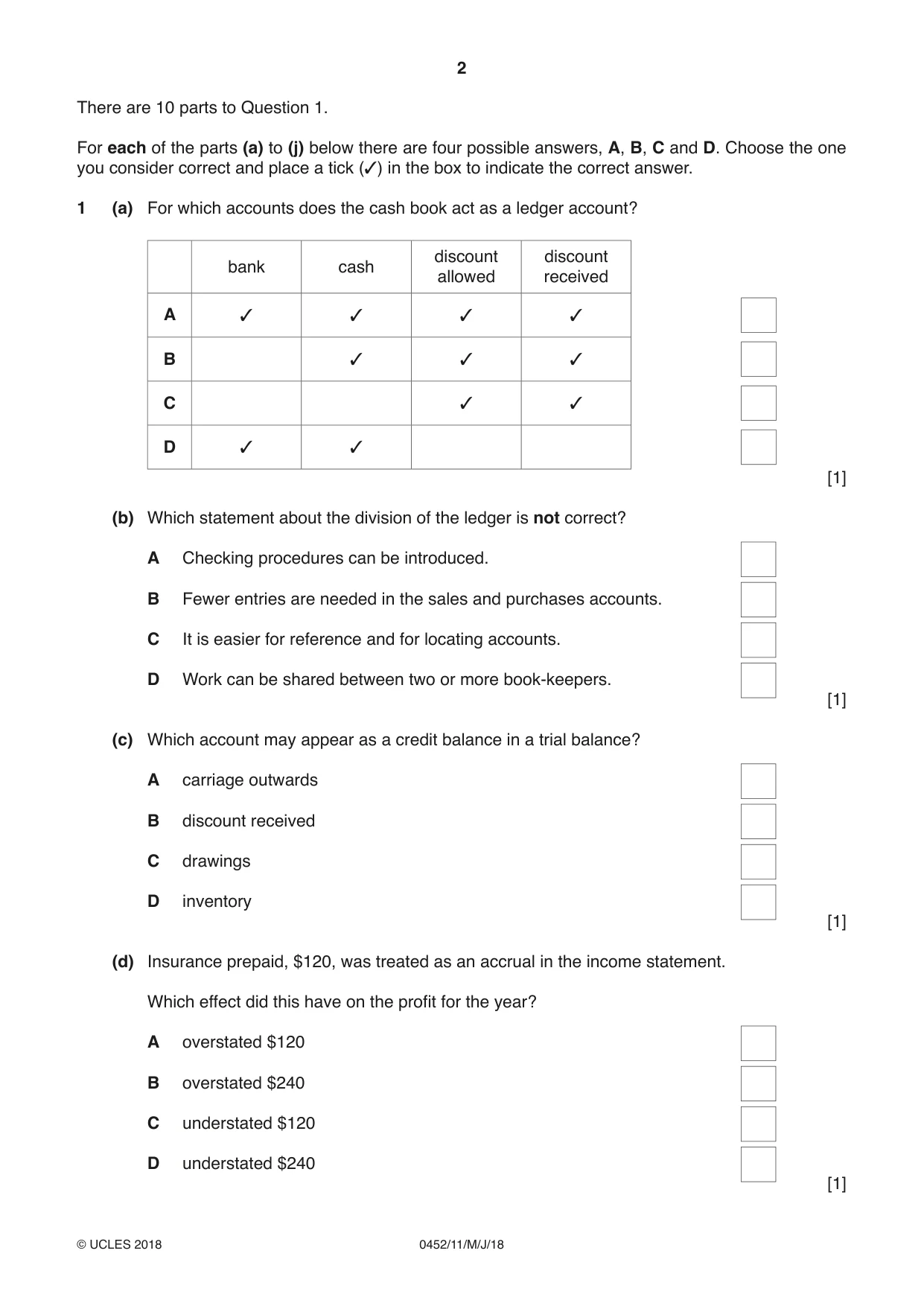
2 0452/11/M/J/18 © UCLES 2018 There are 10 parts to Question 1. For each of the parts (a) to (j) below there are four possible answers, A, B, C and D. Choose the one you consider correct and place a tick (✓) in the box to indicate the correct answer. 1 (a) For which accounts does the cash book act as a ledger account? bank cash discount allowed discount received A ✓ ✓ ✓ ✓ B ✓ ✓ ✓ C ✓ ✓ D ✓ ✓ [1] (b) Which statement about the division of the ledger is not correct? A Checking procedures can be introduced. B Fewer entries are needed in the sales and purchases accounts. C It is easier for reference and for locating accounts. D Work can be shared between two or more book-keepers. [1] (c) Which account may appear as a credit balance in a trial balance? A carriage outwards B discount received C drawings D inventory [1] (d) Insurance prepaid, $120, was treated as an accrual in the income statement. Which effect did this have on the profit for the year? A overstated $120 B overstated $240 C understated $120 D understated $240 [1]
Question paper, page 3
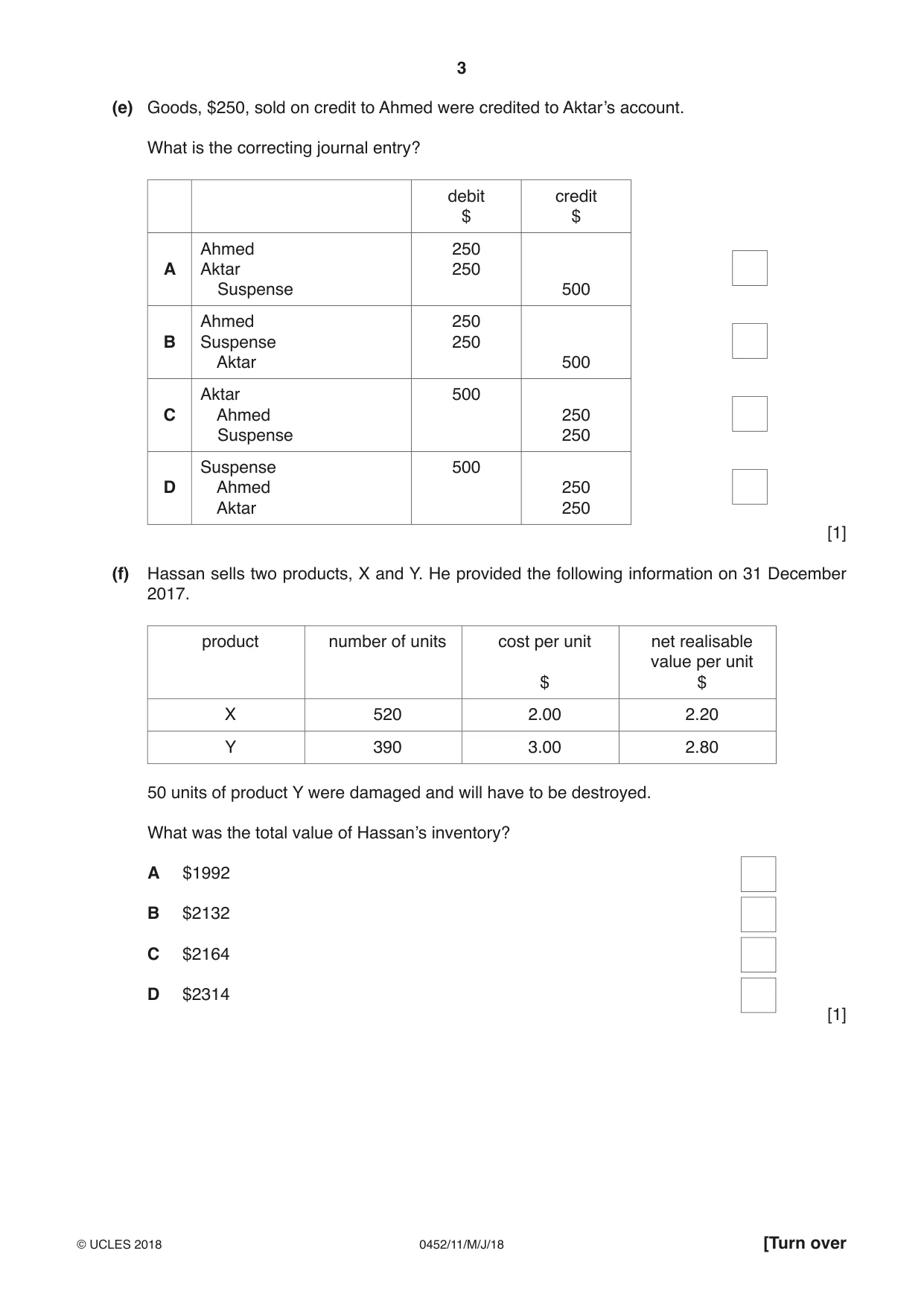
3 0452/11/M/J/18 © UCLES 2018 [Turn over (e) Goods, $250, sold on credit to Ahmed were credited to Aktar’s account. What is the correcting journal entry? debit $ credit $ A Ahmed Aktar Suspense 250 250 500 B Ahmed Suspense Aktar 250 250 500 C Aktar Ahmed Suspense 500 250 250 D Suspense Ahmed Aktar 500 250 250 [1] (f) Hassan sells two products, X and Y. He provided the following information on 31 December 2017. product number of units cost per unit $ net realisable value per unit $ X 520 2.00 2.20 Y 390 3.00 2.80 50 units of product Y were damaged and will have to be destroyed. What was the total value of Hassan’s inventory? A $1992 B $2132 C $2164 D $2314 [1]
Question paper, page 4
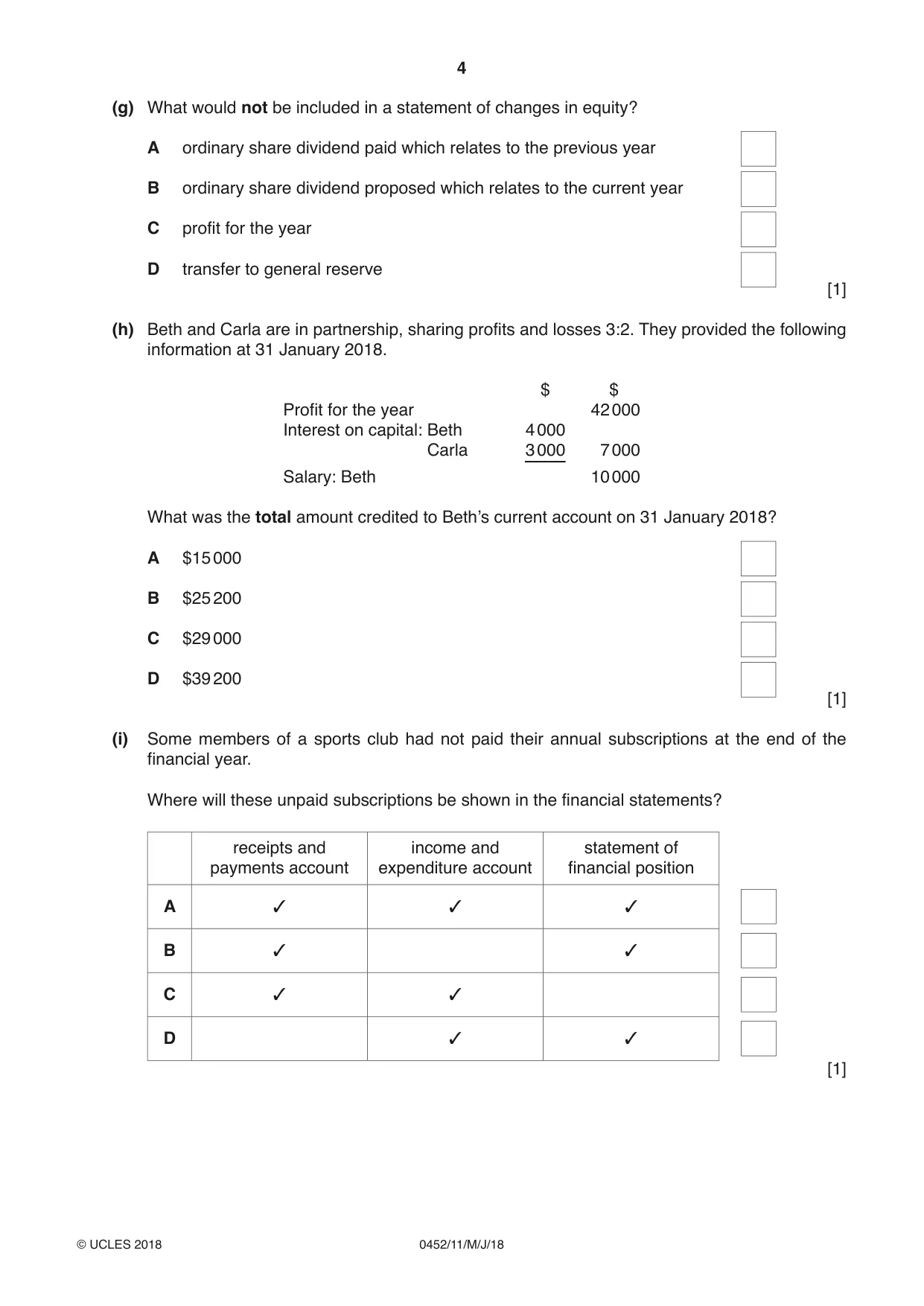
4 0452/11/M/J/18 © UCLES 2018 (g) What would not be included in a statement of changes in equity? A ordinary share dividend paid which relates to the previous year B ordinary share dividend proposed which relates to the current year C profit for the year D transfer to general reserve [1] (h) Beth and Carla are in partnership, sharing profits and losses 3:2. They provided the following information at 31 January 2018. $ $ Profit for the year 42 000 Interest on capital: Beth Carla 4 000 3 000 7 000 Salary: Beth 10 000 What was the total amount credited to Beth’s current account on 31 January 2018? A $15 000 B $25 200 C $29 000 D $39 200 [1] (i) Some members of a sports club had not paid their annual subscriptions at the end of the financial year. Where will these unpaid subscriptions be shown in the financial statements? receipts and payments account income and expenditure account statement of financial position A ✓ ✓ ✓ B ✓ ✓ C ✓ ✓ D ✓ ✓ [1]
Question paper, page 5
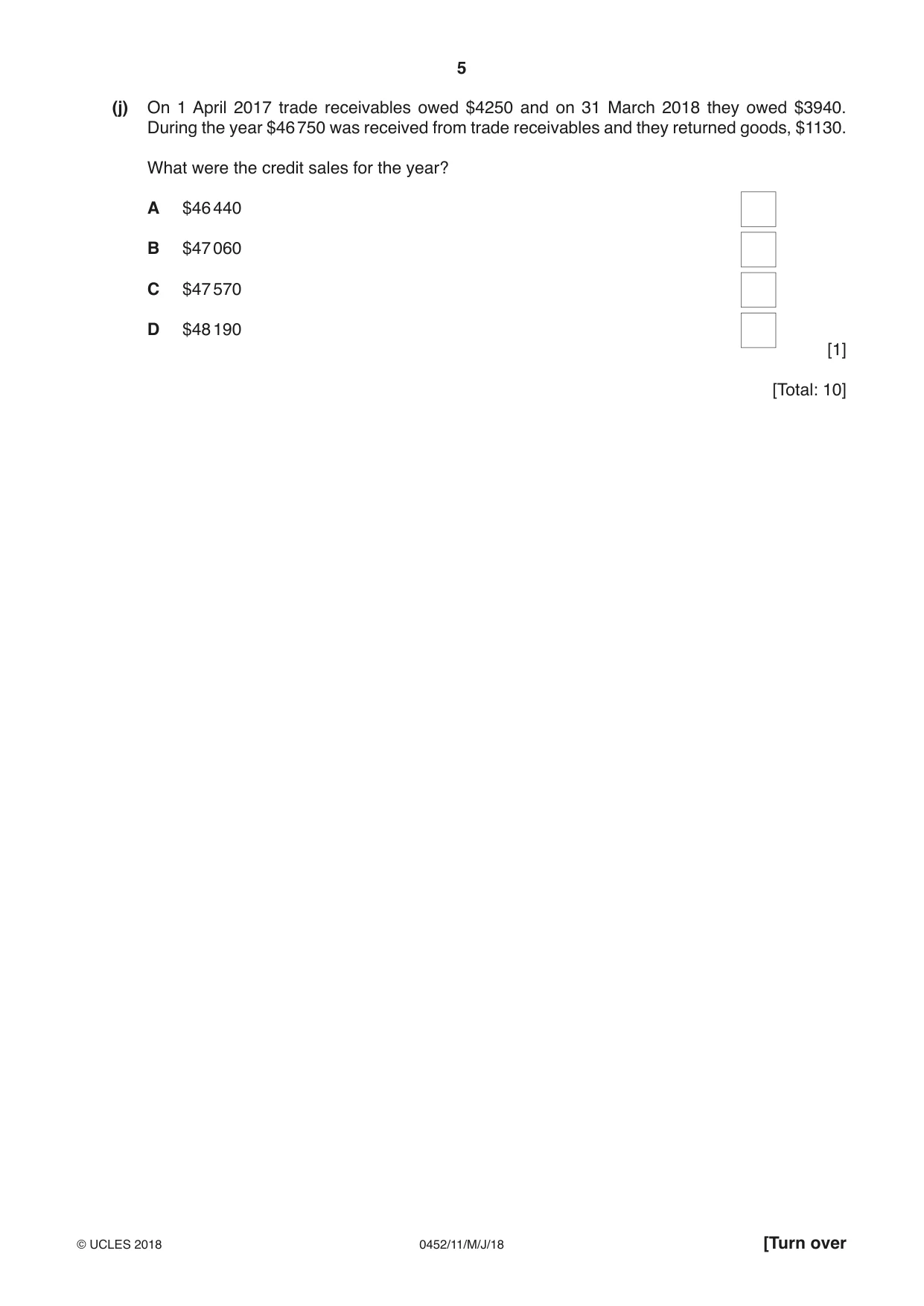
5 0452/11/M/J/18 © UCLES 2018 [Turn over (j) On 1 April 2017 trade receivables owed $4250 and on 31 March 2018 they owed $3940. During the year $46 750 was received from trade receivables and they returned goods, $1130. What were the credit sales for the year? A $46 440 B $47 060 C $47 570 D $48 190 [1] [Total: 10]
Question paper, page 6
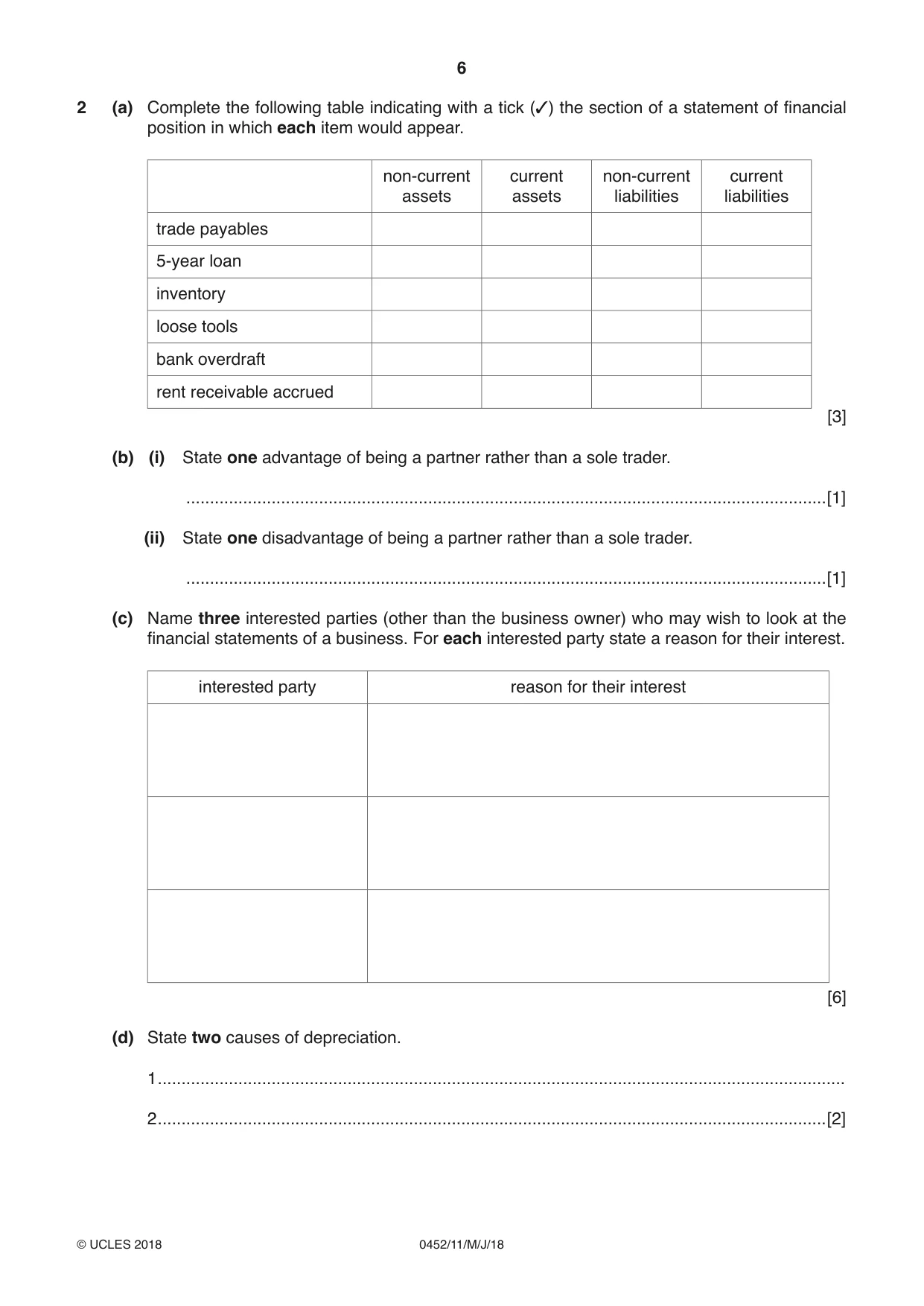
6 0452/11/M/J/18 © UCLES 2018 2 (a) Complete the following table indicating with a tick (✓) the section of a statement of financial position in which each item would appear. non-current assets current assets non-current liabilities current liabilities trade payables 5-year loan inventory loose tools bank overdraft rent receivable accrued [3] (b) (i) State one advantage of being a partner rather than a sole trader. …[1] (ii) State one disadvantage of being a partner rather than a sole trader. …[1] (c) Name three interested parties (other than the business owner) who may wish to look at the financial statements of a business. For each interested party state a reason for their interest. interested party reason for their interest [6] (d) State two causes of depreciation. 1 … 2 …[2]
Question paper, page 7
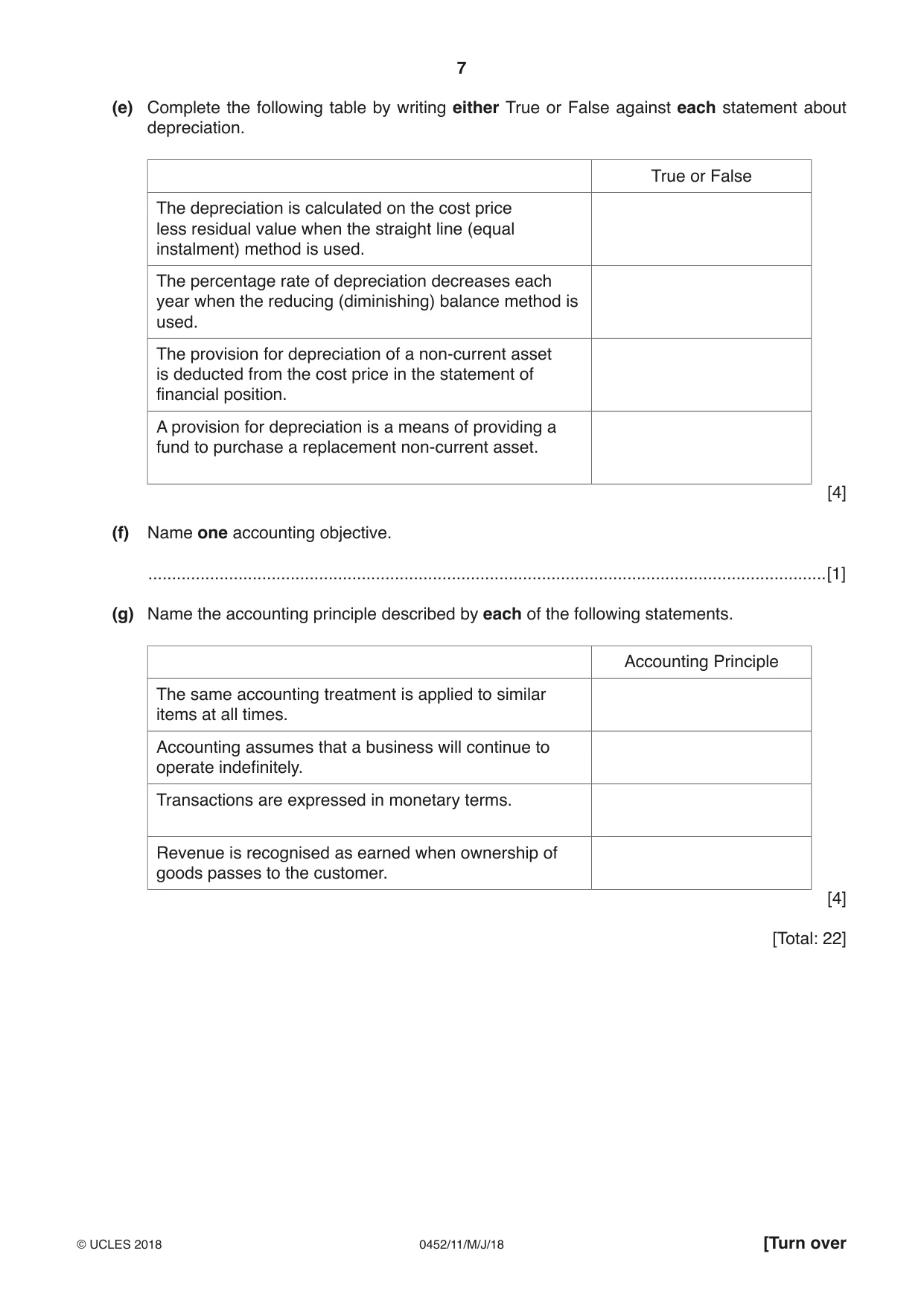
7 0452/11/M/J/18 © UCLES 2018 [Turn over (e) Complete the following table by writing either True or False against each statement about depreciation. True or False The depreciation is calculated on the cost price less residual value when the straight line (equal instalment) method is used. The percentage rate of depreciation decreases each year when the reducing (diminishing) balance method is used. The provision for depreciation of a non-current asset is deducted from the cost price in the statement of financial position. A provision for depreciation is a means of providing a fund to purchase a replacement non-current asset. [4] (f) Name one accounting objective. …[1] (g) Name the accounting principle described by each of the following statements. Accounting Principle The same accounting treatment is applied to similar items at all times. Accounting assumes that a business will continue to operate indefinitely. Transactions are expressed in monetary terms. Revenue is recognised as earned when ownership of goods passes to the customer. [4] [Total: 22]
Question paper, page 8
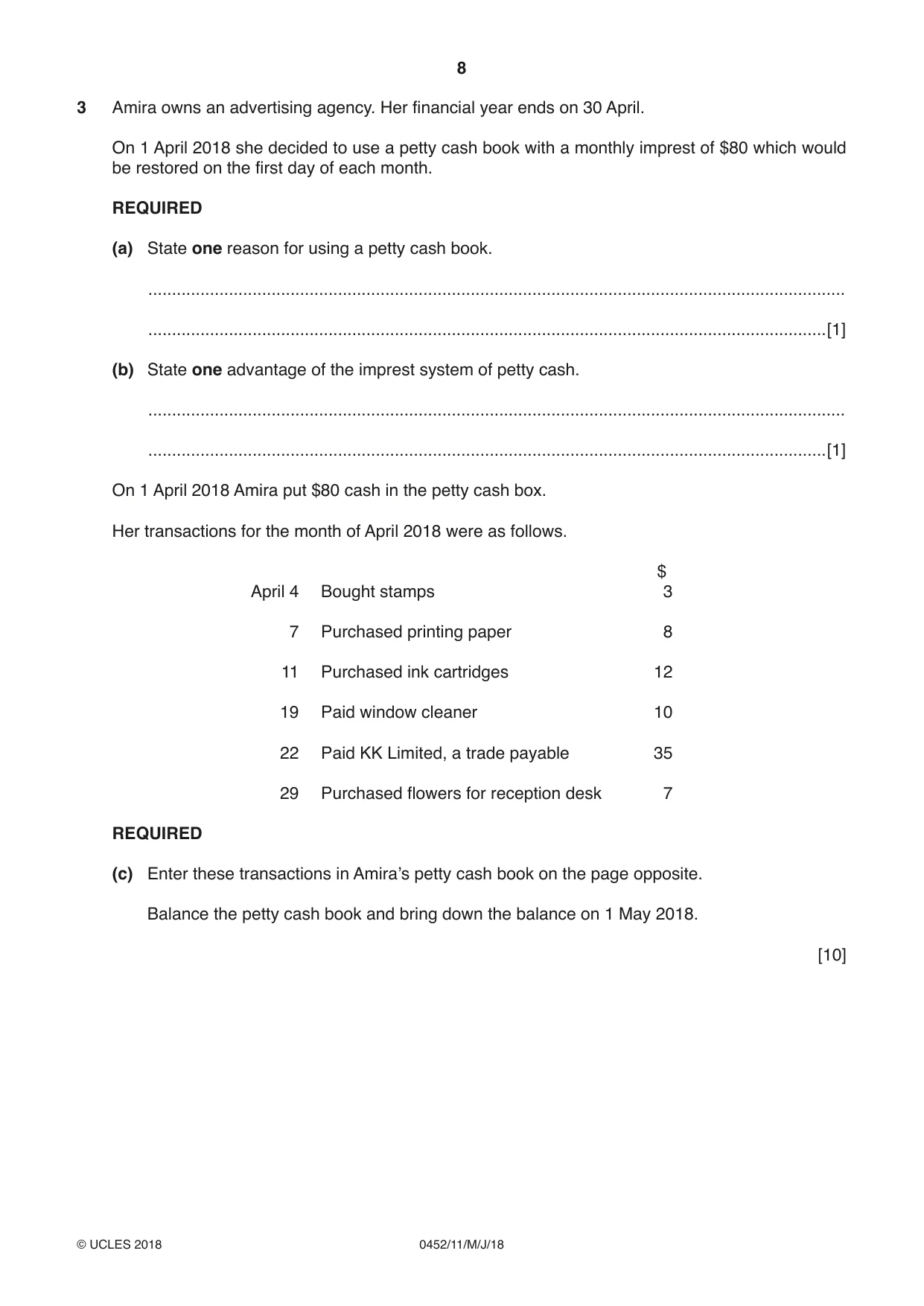
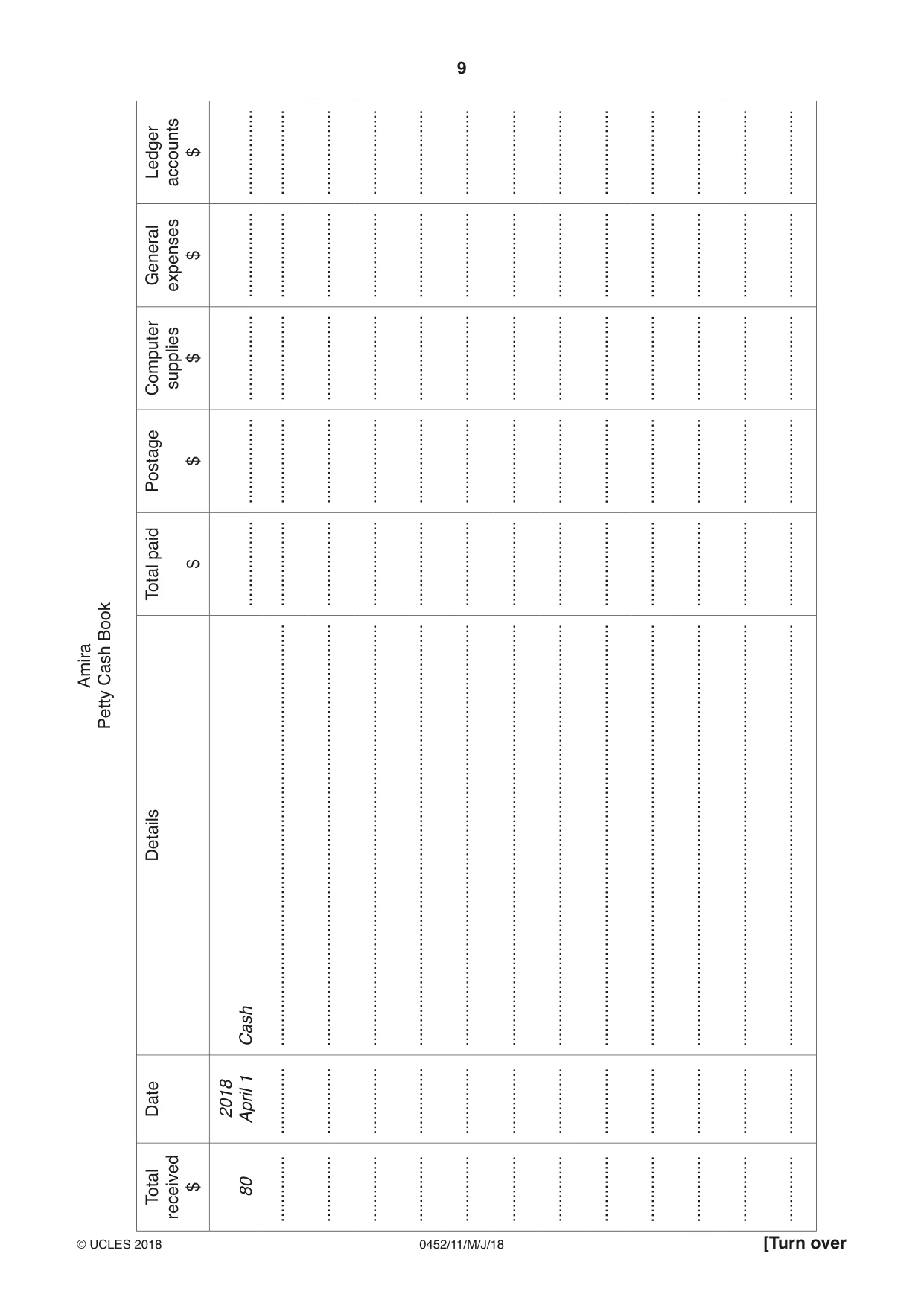
8 0452/11/M/J/18 © UCLES 2018 3 Amira owns an advertising agency. Her financial year ends on 30 April. On 1 April 2018 she decided to use a petty cash book with a monthly imprest of $80 which would be restored on the first day of each month. REQUIRED (a) State one reason for using a petty cash book. … …[1] (b) State one advantage of the imprest system of petty cash. … …[1] On 1 April 2018 Amira put $80 cash in the petty cash box. Her transactions for the month of April 2018 were as follows. $ April 4 Bought stamps 3 7 Purchased printing paper 8 11 Purchased ink cartridges 12 19 Paid window cleaner 10 22 Paid KK Limited, a trade payable 35 29 Purchased flowers for reception desk 7 REQUIRED (c) Enter these transactions in Amira’s petty cash book on the page opposite. Balance the petty cash book and bring down the balance on 1 May 2018. [10]
Question paper, page 9
9 0452/11/M/J/18 © UCLES 2018 [Turn over Amira Petty Cash Book Total received $ Date Details Total paid $ Postage $ Computer supplies $ General expenses $ Ledger accounts $ 80 2018 April 1 Cash … … … … … … … … … … … … … … … … … … … … … … … … … … … … … … … … … … … … … … … … … … … … … … … … … … … … … … … … … … … … … … … … … … … … … … … … … … … … … … … … … … … … … … … … … … … … … … … … … … … … …
Question paper, page 10
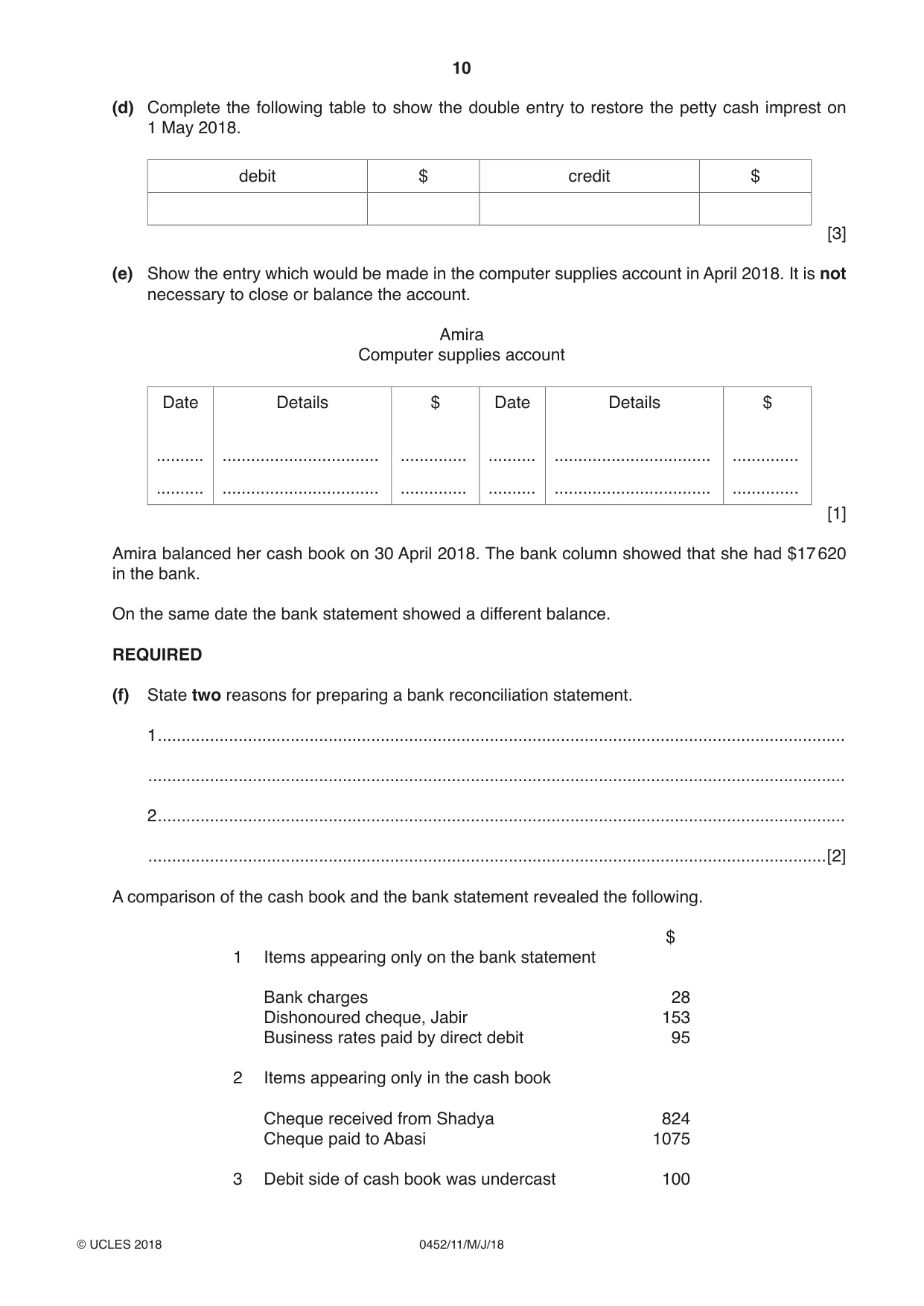
10 0452/11/M/J/18 © UCLES 2018 (d) Complete the following table to show the double entry to restore the petty cash imprest on 1 May 2018. debit $ credit $ [3] (e) Show the entry which would be made in the computer supplies account in April 2018. It is not necessary to close or balance the account. Amira Computer supplies account Date Details $ Date Details $ … … … … … … … … … … … … [1] Amira balanced her cash book on 30 April 2018. The bank column showed that she had $17 620 in the bank. On the same date the bank statement showed a different balance. REQUIRED (f) State two reasons for preparing a bank reconciliation statement. 1 … … 2 … …[2] A comparison of the cash book and the bank statement revealed the following. $ 1 Items appearing only on the bank statement Bank charges 28 Dishonoured cheque, Jabir 153 Business rates paid by direct debit 95 2 Items appearing only in the cash book Cheque received from Shadya 824 Cheque paid to Abasi 1075 3 Debit side of cash book was undercast 100
Question paper, page 11
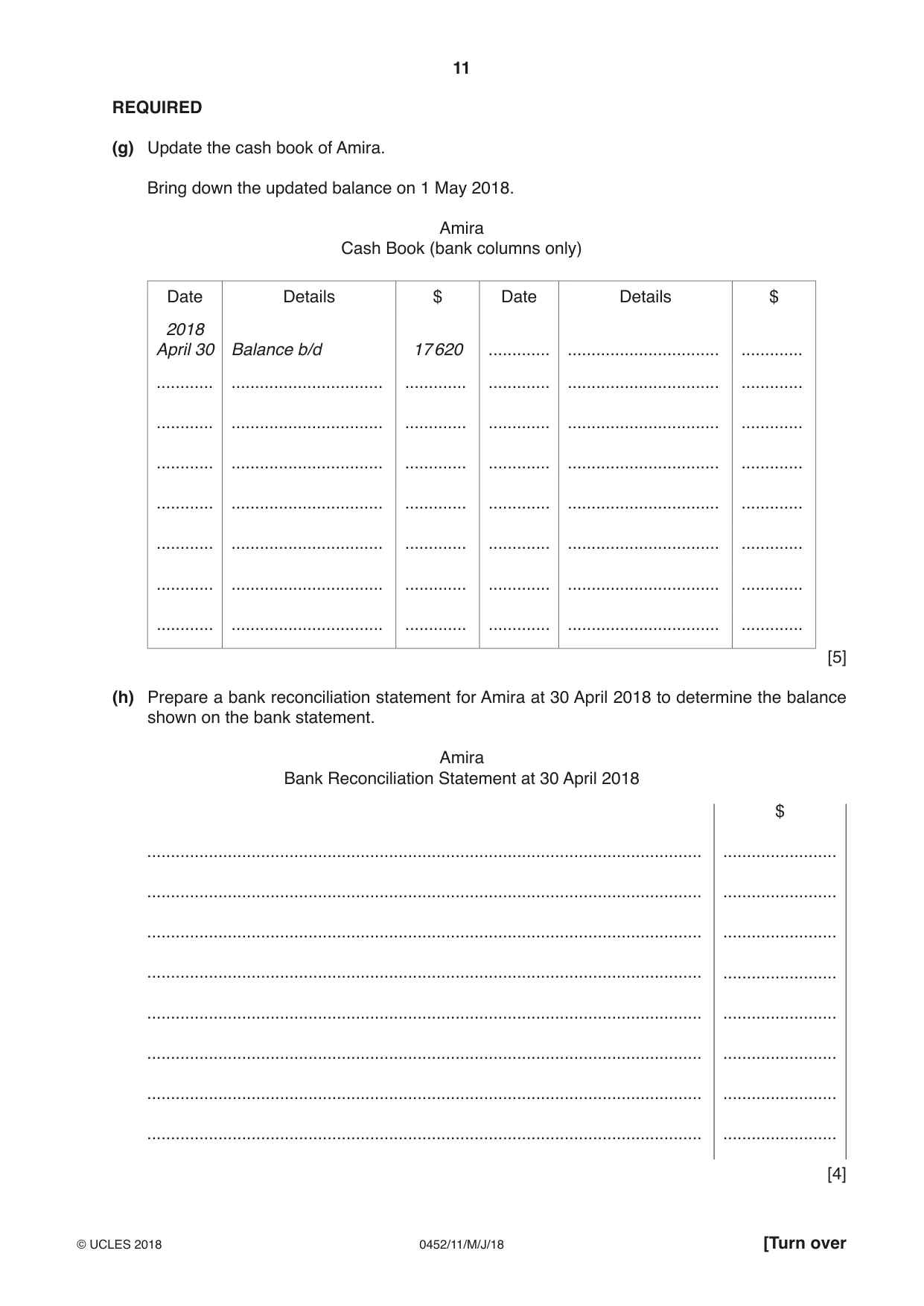
11 0452/11/M/J/18 © UCLES 2018 [Turn over REQUIRED (g) Update the cash book of Amira. Bring down the updated balance on 1 May 2018. Amira Cash Book (bank columns only) Date Details $ Date Details $ 2018 April 30 Balance b/d 17 620 … … … … … … … … … … … … … … … … … … … … … … … … … … … … … … … … … … … … … … … … … … … … … [5] (h) Prepare a bank reconciliation statement for Amira at 30 April 2018 to determine the balance shown on the bank statement. Amira Bank Reconciliation Statement at 30 April 2018 … … … … … … … … $ … … … … … … … … [4]
Question paper, page 12
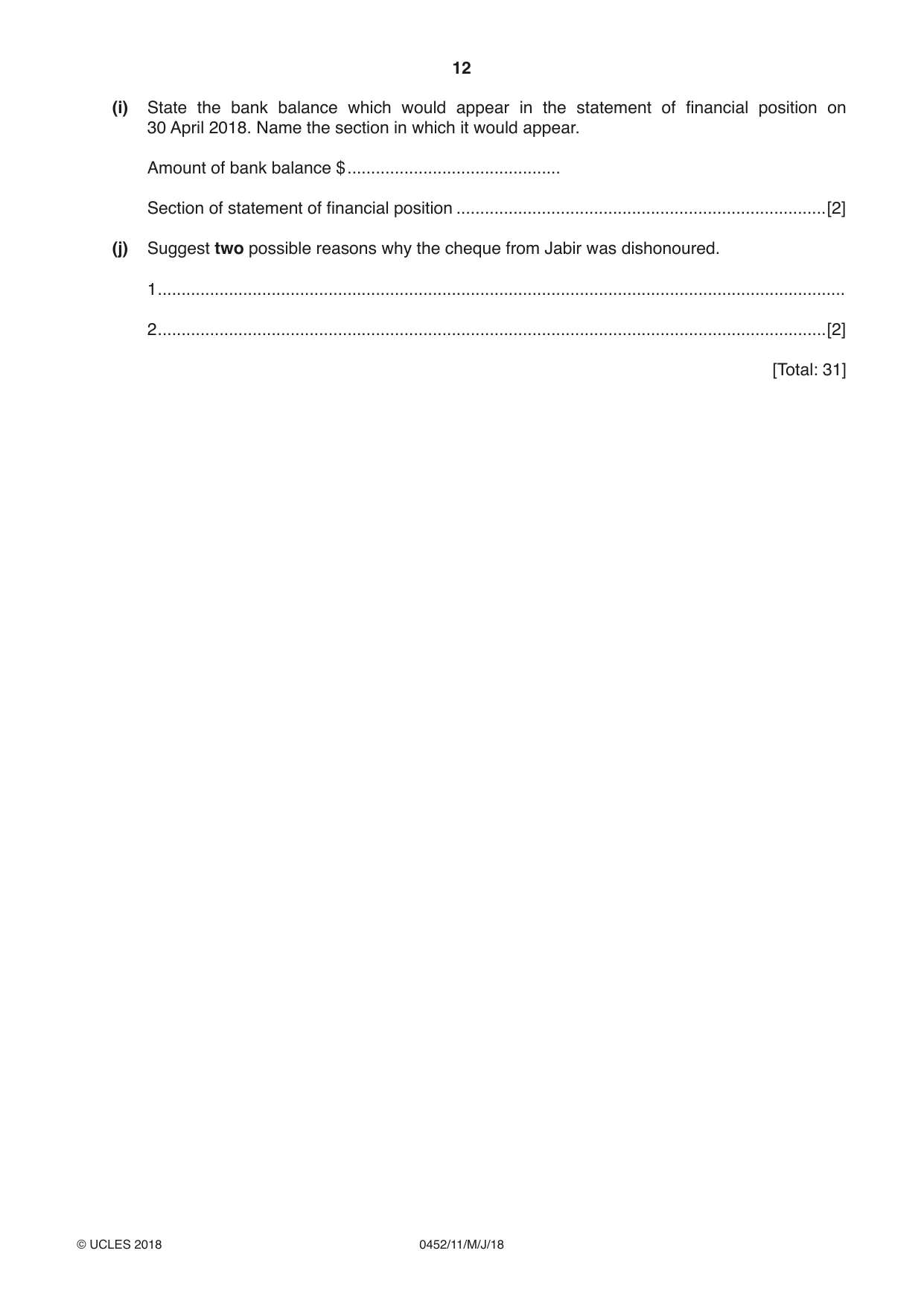
12 0452/11/M/J/18 © UCLES 2018 (i) State the bank balance which would appear in the statement of financial position on 30 April 2018. Name the section in which it would appear. Amount of bank balance $ … Section of statement of financial position …[2] (j) Suggest two possible reasons why the cheque from Jabir was dishonoured. 1 … 2 …[2] [Total: 31]
Question paper, page 13
13 0452/11/M/J/18 © UCLES 2018 [Turn over PLEASE TURN OVER
Question paper, page 14
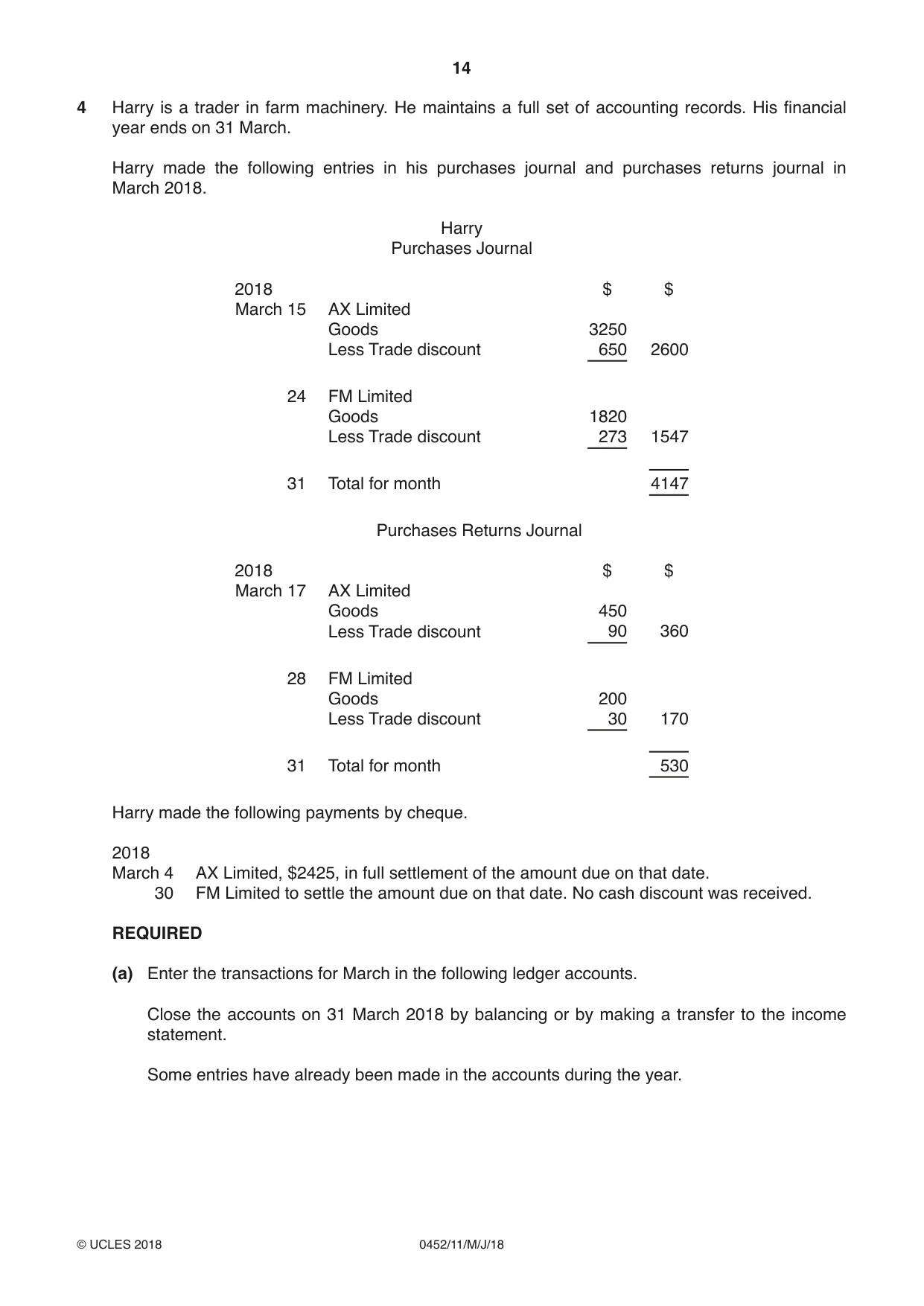
14 0452/11/M/J/18 © UCLES 2018 4 Harry is a trader in farm machinery. He maintains a full set of accounting records. His financial year ends on 31 March. Harry made the following entries in his purchases journal and purchases returns journal in March 2018. Harry Purchases Journal 2018 $ $ March 15 AX Limited Goods 3250 Less Trade discount 650 2600 24 FM Limited Goods 1820 Less Trade discount 273 1547 31 Total for month 4147 Purchases Returns Journal 2018 $ $ March 17 AX Limited Goods 450 Less Trade discount 90 360 28 FM Limited Goods 200 Less Trade discount 30 170 31 Total for month 530 Harry made the following payments by cheque. 2018 March 4 AX Limited, $2425, in full settlement of the amount due on that date. 30 FM Limited to settle the amount due on that date. No cash discount was received. REQUIRED (a) Enter the transactions for March in the following ledger accounts. Close the accounts on 31 March 2018 by balancing or by making a transfer to the income statement. Some entries have already been made in the accounts during the year.
Question paper, page 15
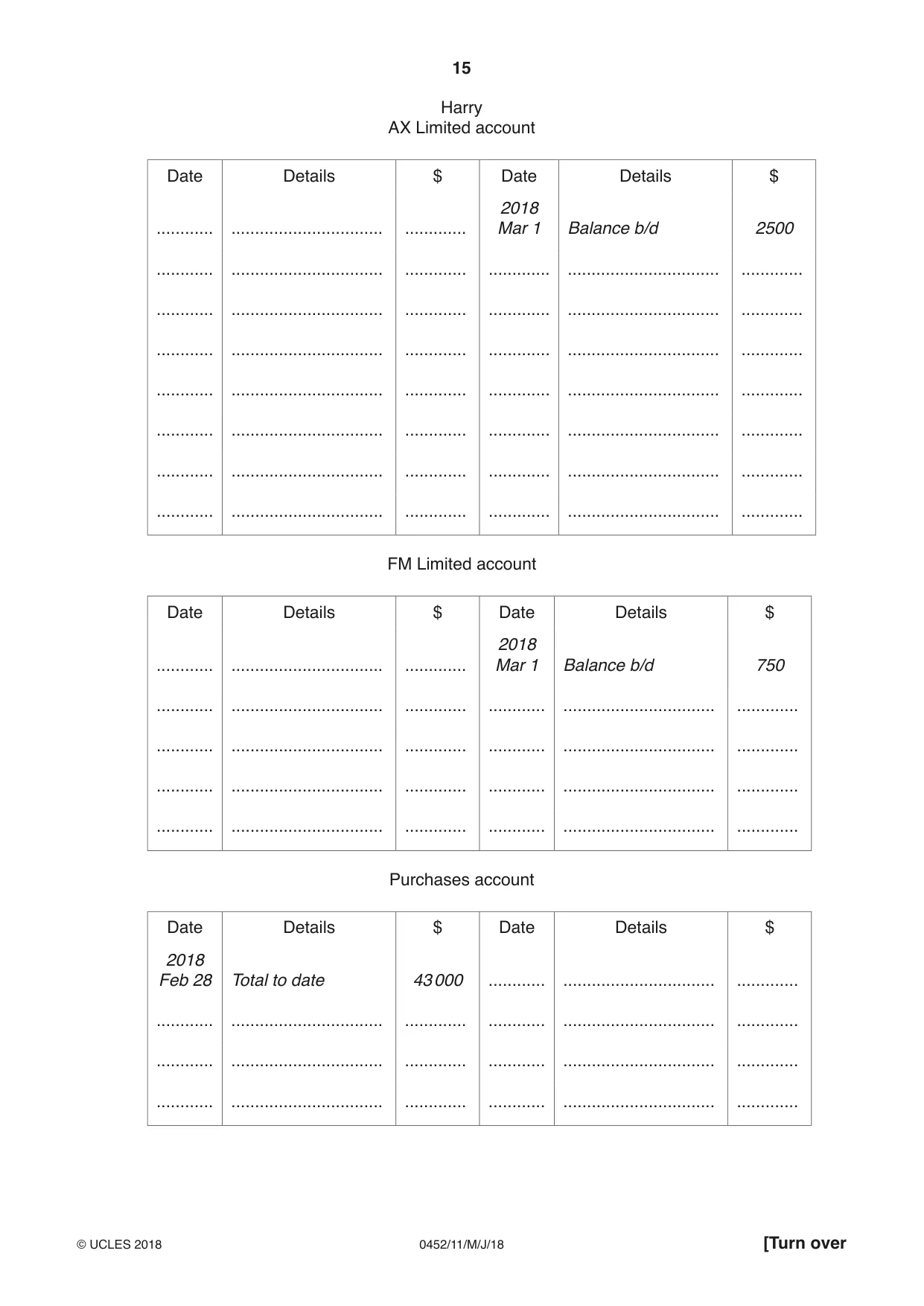
15 0452/11/M/J/18 © UCLES 2018 [Turn over Harry AX Limited account Date Details $ Date Details $ … … … 2018 Mar 1 Balance b/d 2500 … … … … … … … … … … … … … … … … … … … … … … … … … … … … … … … … … … … … … … … … … … FM Limited account Date Details $ Date Details $ … … … 2018 Mar 1 Balance b/d 750 … … … … … … … … … … … … … … … … … … … … … … … … Purchases account Date Details $ Date Details $ 2018 Feb 28 Total to date 43 000 … … … … … … … … … … … … … … … … … … … … …
Question paper, page 16
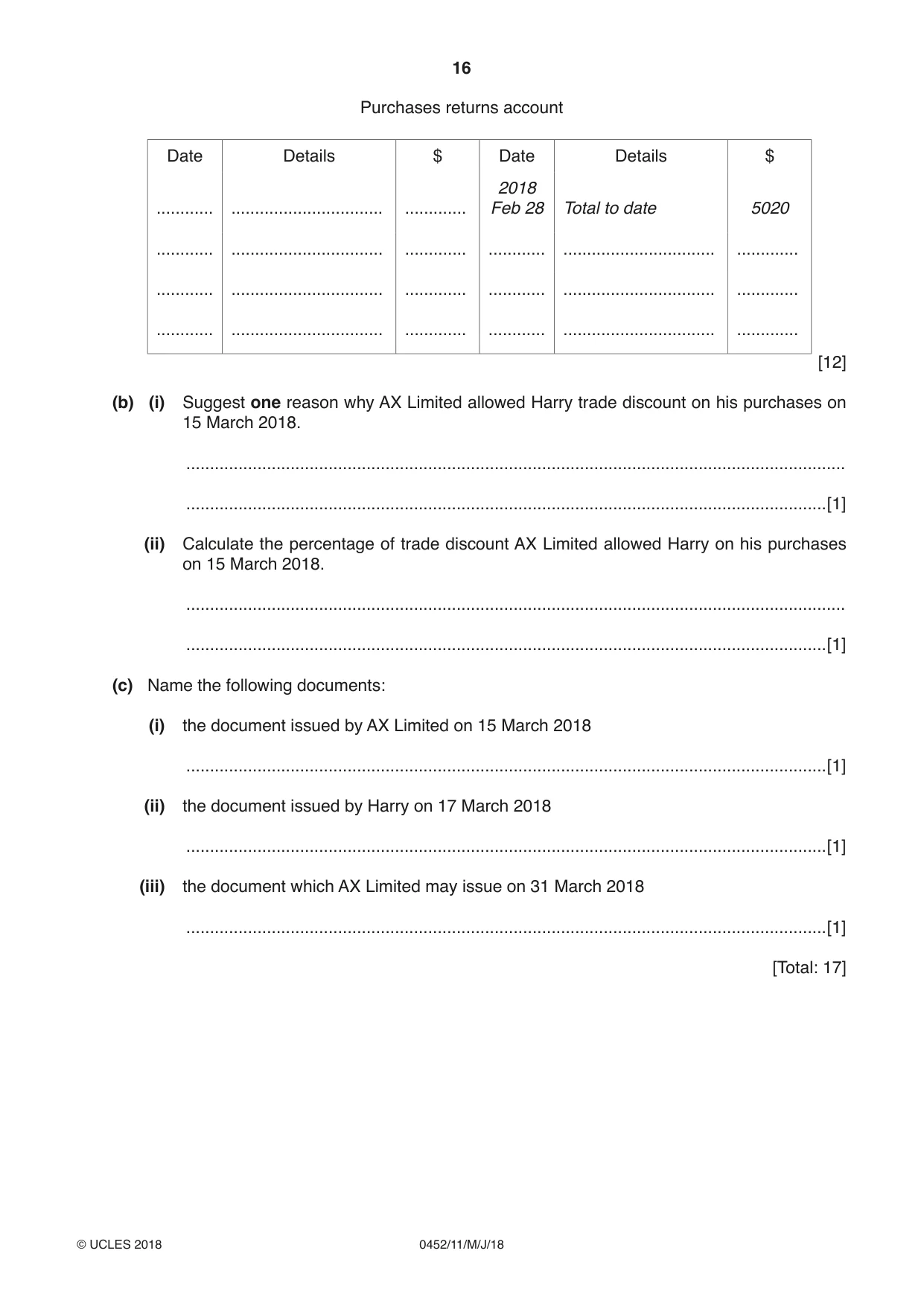
16 0452/11/M/J/18 © UCLES 2018 Purchases returns account Date Details $ Date Details $ … … … 2018 Feb 28 Total to date 5020 … … … … … … … … … … … … … … … … … … [12] (b) (i) Suggest one reason why AX Limited allowed Harry trade discount on his purchases on 15 March 2018. … …[1] (ii) Calculate the percentage of trade discount AX Limited allowed Harry on his purchases on 15 March 2018. … …[1] (c) Name the following documents: (i) the document issued by AX Limited on 15 March 2018 …[1] (ii) the document issued by Harry on 17 March 2018 …[1] (iii) the document which AX Limited may issue on 31 March 2018 …[1] [Total: 17]
Question paper, page 17
17 0452/11/M/J/18 © UCLES 2018 [Turn over PLEASE TURN OVER
Question paper, page 18
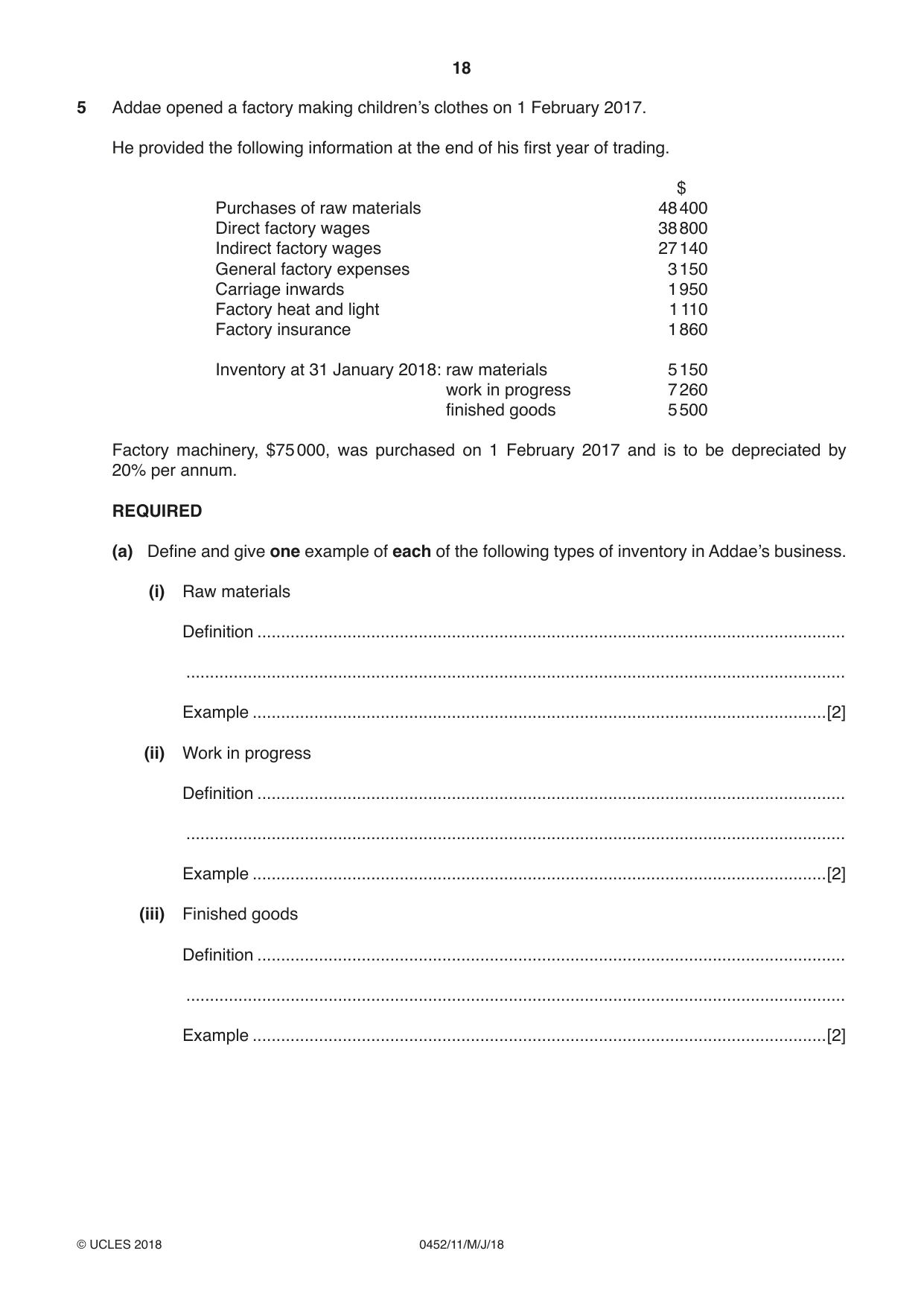
18 0452/11/M/J/18 © UCLES 2018 5 Addae opened a factory making children’s clothes on 1 February 2017. He provided the following information at the end of his first year of trading. $ Purchases of raw materials 48 400 Direct factory wages 38 800 Indirect factory wages 27 140 General factory expenses 3 150 Carriage inwards 1 950 Factory heat and light 1 110 Factory insurance 1 860 Inventory at 31 January 2018: raw materials work in progress finished goods 5 150 7 260 5 500 Factory machinery, $75 000, was purchased on 1 February 2017 and is to be depreciated by 20% per annum. REQUIRED (a) Define and give one example of each of the following types of inventory in Addae’s business. (i) Raw materials Definition … … Example …[2] (ii) Work in progress Definition … … Example …[2] (iii) Finished goods Definition … … Example …[2]
Question paper, page 19
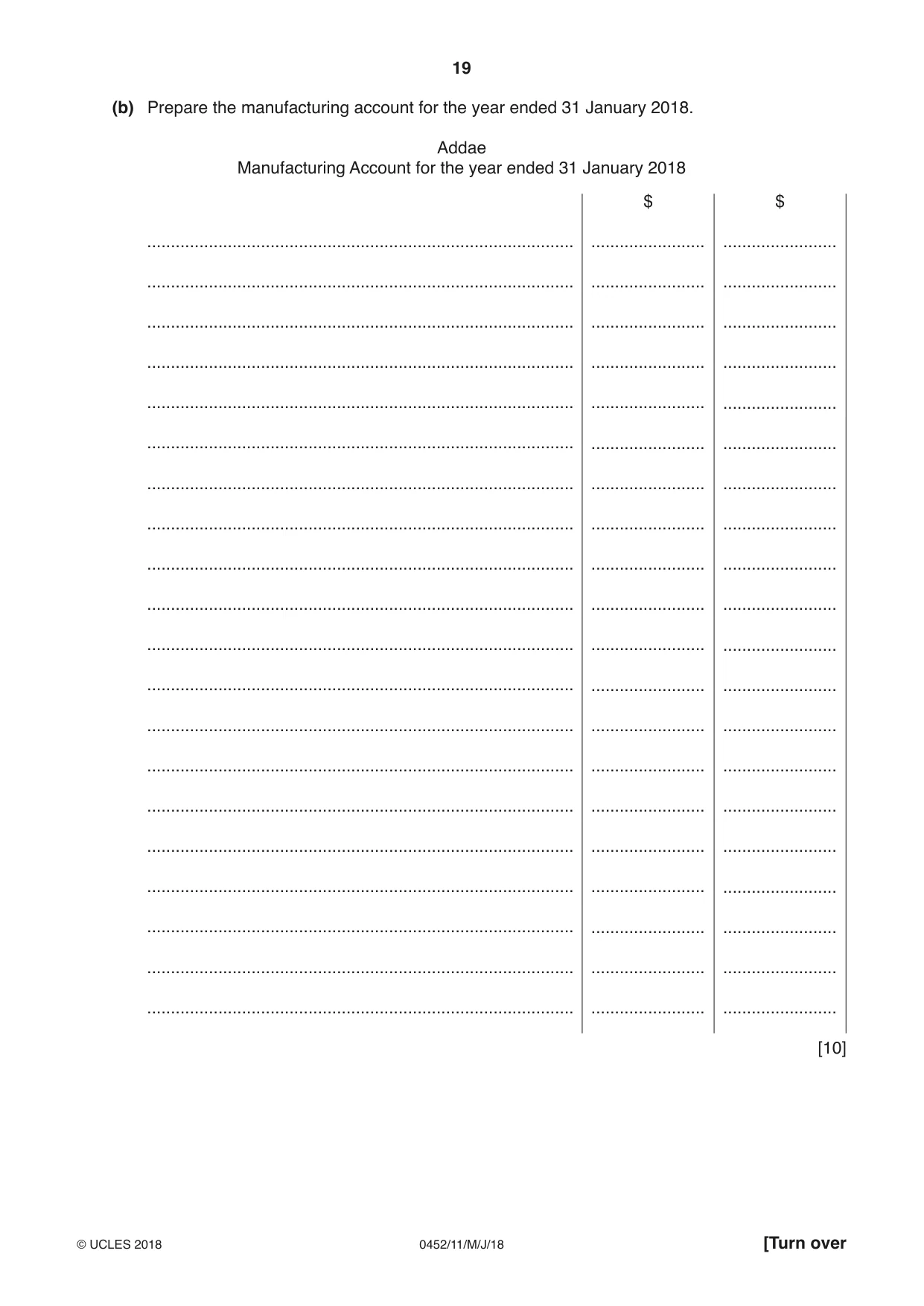
19 0452/11/M/J/18 © UCLES 2018 [Turn over (b) Prepare the manufacturing account for the year ended 31 January 2018. Addae Manufacturing Account for the year ended 31 January 2018 … … … … … … … … … … … … … … … … … … … … $ … … … … … … … … … … … … … … … … … … … … $ … … … … … … … … … … … … … … … … … … … … [10]
Question paper, page 20
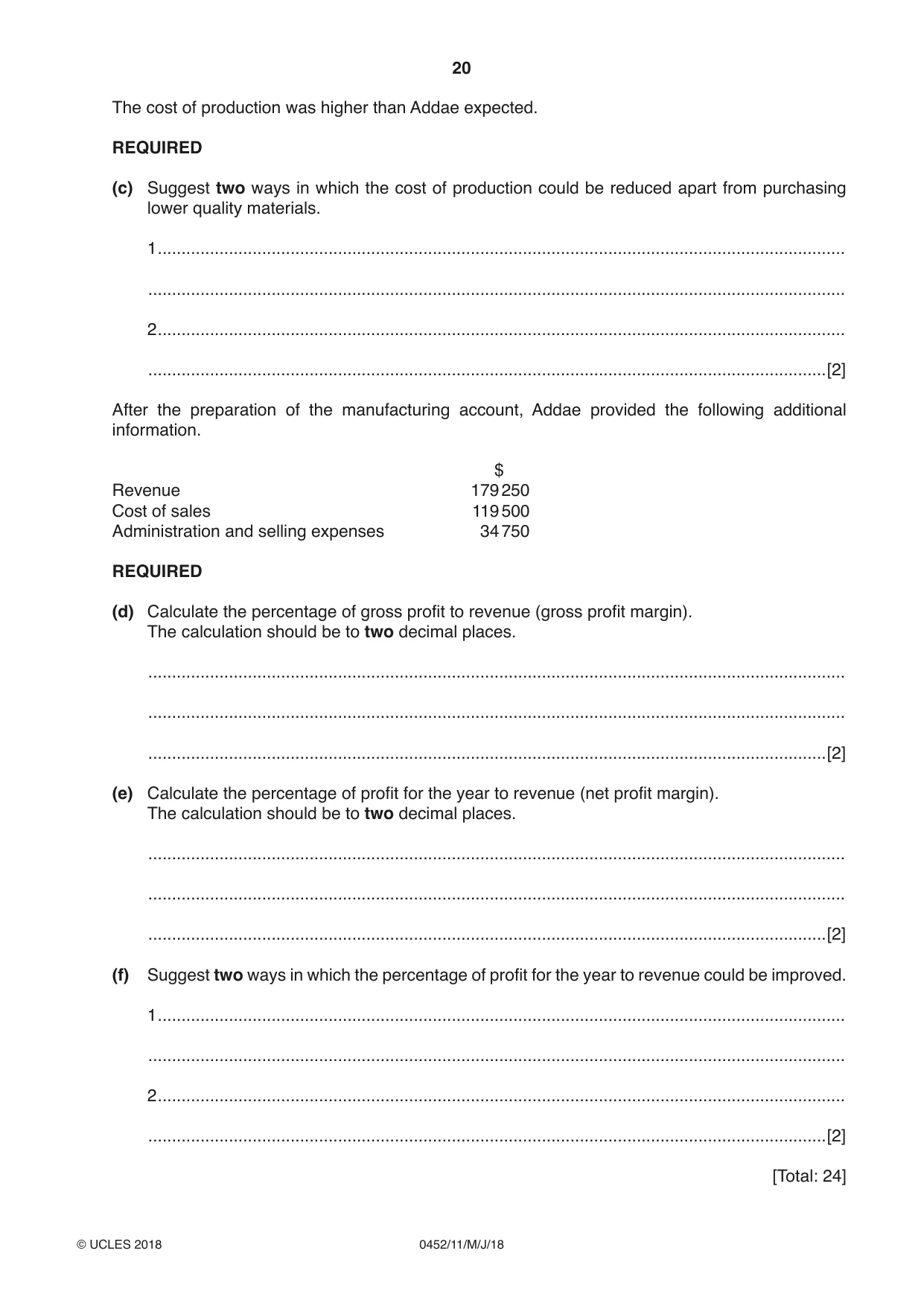
20 0452/11/M/J/18 © UCLES 2018 The cost of production was higher than Addae expected. REQUIRED (c) Suggest two ways in which the cost of production could be reduced apart from purchasing lower quality materials. 1 … … 2 … …[2] After the preparation of the manufacturing account, Addae provided the following additional information. $ Revenue 179 250 Cost of sales 119 500 Administration and selling expenses 34 750 REQUIRED (d) Calculate the percentage of gross profit to revenue (gross profit margin). The calculation should be to two decimal places. … … …[2] (e) Calculate the percentage of profit for the year to revenue (net profit margin). The calculation should be to two decimal places. … … …[2] (f) Suggest two ways in which the percentage of profit for the year to revenue could be improved. 1 … … 2 … …[2] [Total: 24]
Question paper, page 21
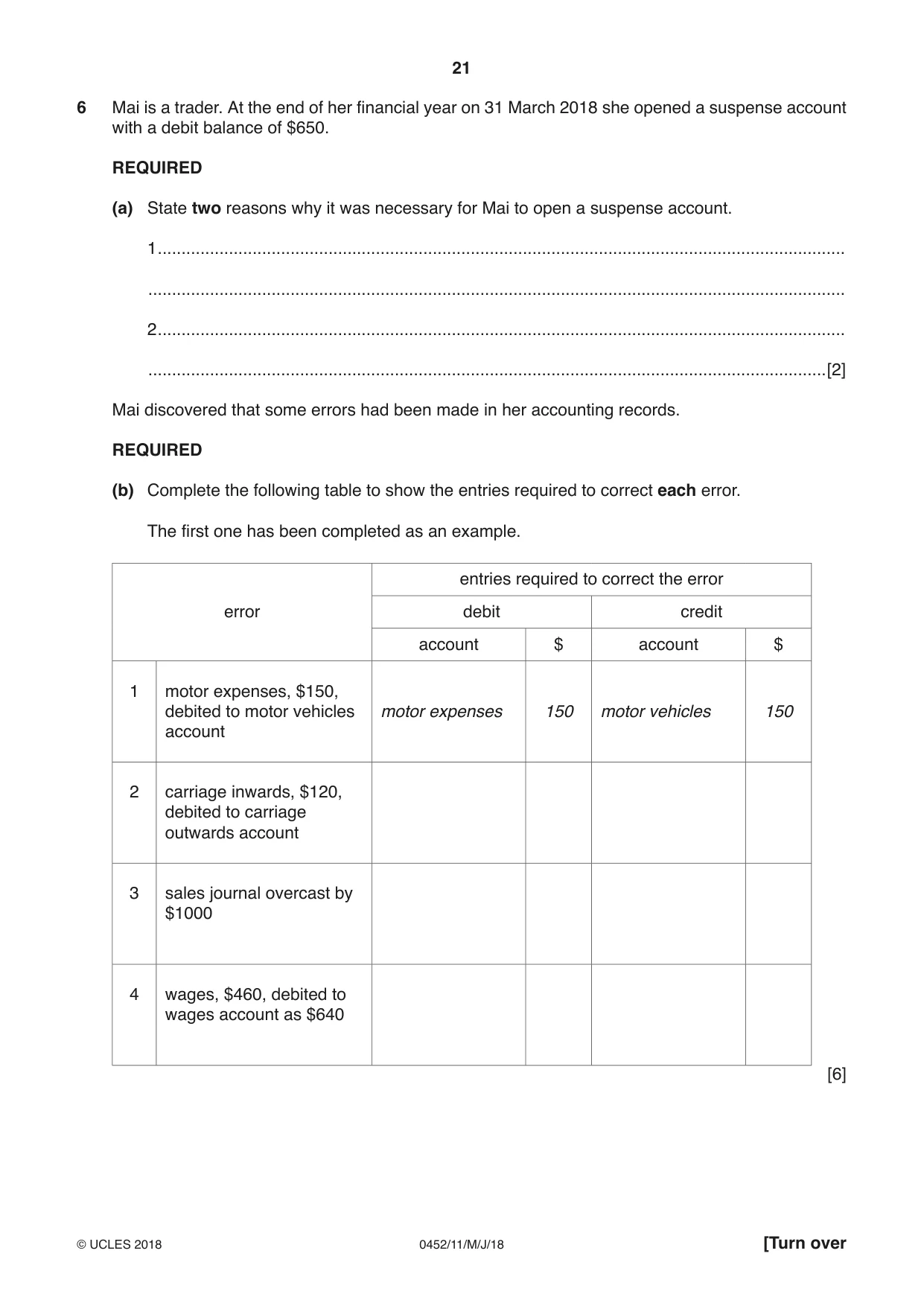
21 0452/11/M/J/18 © UCLES 2018 [Turn over 6 Mai is a trader. At the end of her financial year on 31 March 2018 she opened a suspense account with a debit balance of $650. REQUIRED (a) State two reasons why it was necessary for Mai to open a suspense account. 1 … … 2 … …[2] Mai discovered that some errors had been made in her accounting records. REQUIRED (b) Complete the following table to show the entries required to correct each error. The first one has been completed as an example. error entries required to correct the error debit credit account $ account $ 1 motor expenses, $150, debited to motor vehicles account motor expenses 150 motor vehicles 150 2 carriage inwards, $120, debited to carriage outwards account 3 sales journal overcast by $1000 4 wages, $460, debited to wages account as $640 [6]
Question paper, page 22
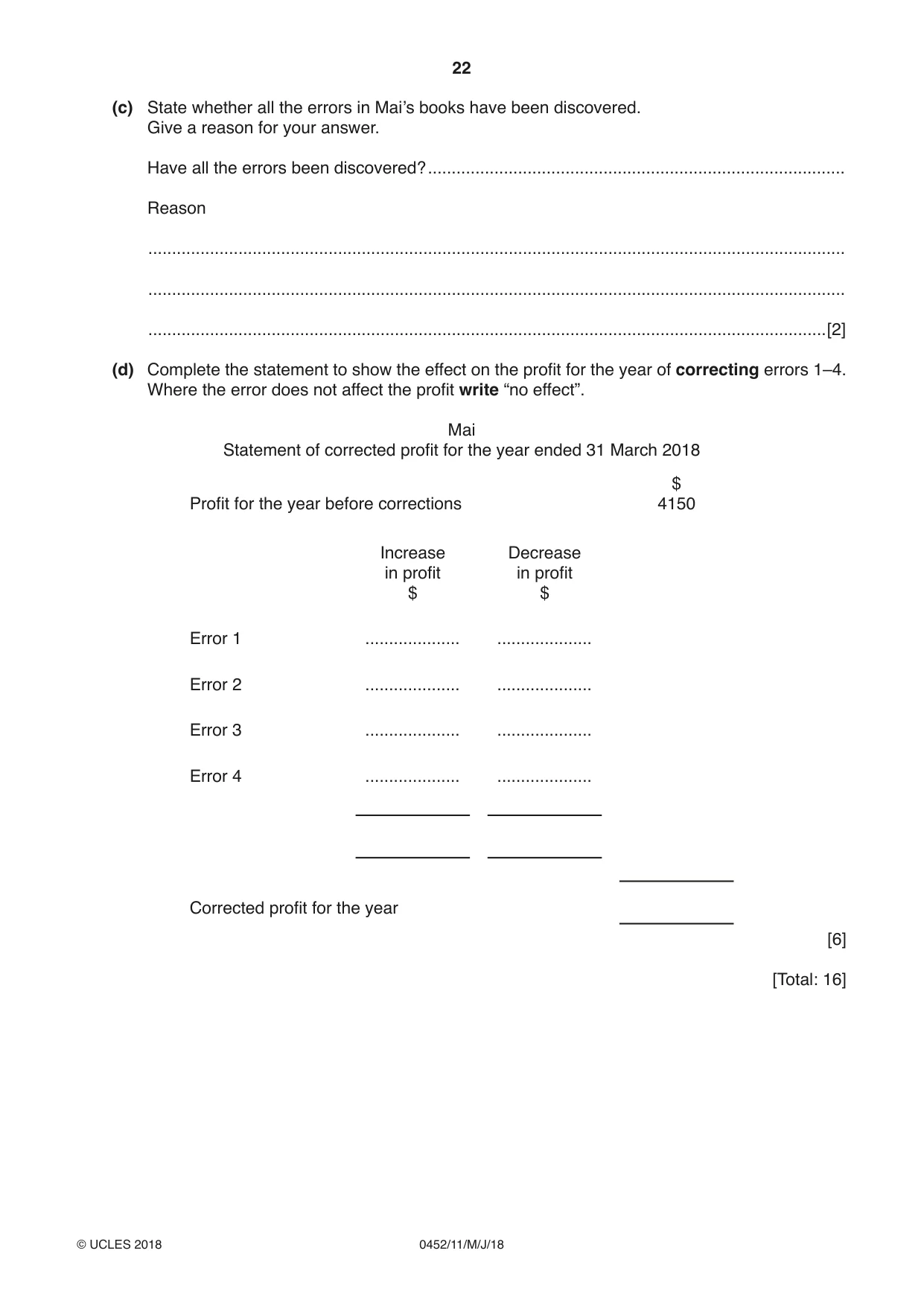
22 0452/11/M/J/18 © UCLES 2018 (c) State whether all the errors in Mai’s books have been discovered. Give a reason for your answer. Have all the errors been discovered? … Reason … … …[2] (d) Complete the statement to show the effect on the profit for the year of correcting errors 1–4. Where the error does not affect the profit write “no effect”. Mai Statement of corrected profit for the year ended 31 March 2018 $ Profit for the year before corrections 4150 Increase in profit $ Decrease in profit $ Error 1 … … Error 2 … … Error 3 … … Error 4 … … Corrected profit for the year [6] [Total: 16]
Question paper, page 23
23 0452/11/M/J/18 © UCLES 2018 BLANK PAGE
Question paper, page 24
24 0452/11/M/J/18 © UCLES 2018 Permission to reproduce items where third-party owned material protected by copyright is included has been sought and cleared where possible. Every reasonable effort has been made by the publisher (UCLES) to trace copyright holders, but if any items requiring clearance have unwittingly been included, the publisher will be pleased to make amends at the earliest possible opportunity. To avoid the issue of disclosure of answer-related information to candidates, all copyright acknowledgements are reproduced online in the Cambridge International Examinations Copyright Acknowledgements Booklet. This is produced for each series of examinations and is freely available to download at www.cie.org.uk after the live examination series. Cambridge International Examinations is part of the Cambridge Assessment Group. Cambridge Assessment is the brand name of University of Cambridge Local Examinations Syndicate (UCLES), which is itself a department of the University of Cambridge. BLANK PAGE
Mark scheme, page 1
IGCSE™ is a registered trademark. This document consists of 17 printed pages. © UCLES 2018 [Turn over Cambridge Assessment International Education Cambridge International General Certificate of Secondary Education ACCOUNTING 0452/11 Paper 1 May/June 2018 MARK SCHEME Maximum Mark: 120 Published This mark scheme is published as an aid to teachers and candidates, to indicate the requirements of the examination. It shows the basis on which Examiners were instructed to award marks. It does not indicate the details of the discussions that took place at an Examiners’ meeting before marking began, which would have considered the acceptability of alternative answers. Mark schemes should be read in conjunction with the question paper and the Principal Examiner Report for Teachers. Cambridge International will not enter into discussions about these mark schemes. Cambridge International is publishing the mark schemes for the May/June 2018 series for most Cambridge IGCSE™, Cambridge International A and AS Level and Cambridge Pre-U components, and some Cambridge O Level components.
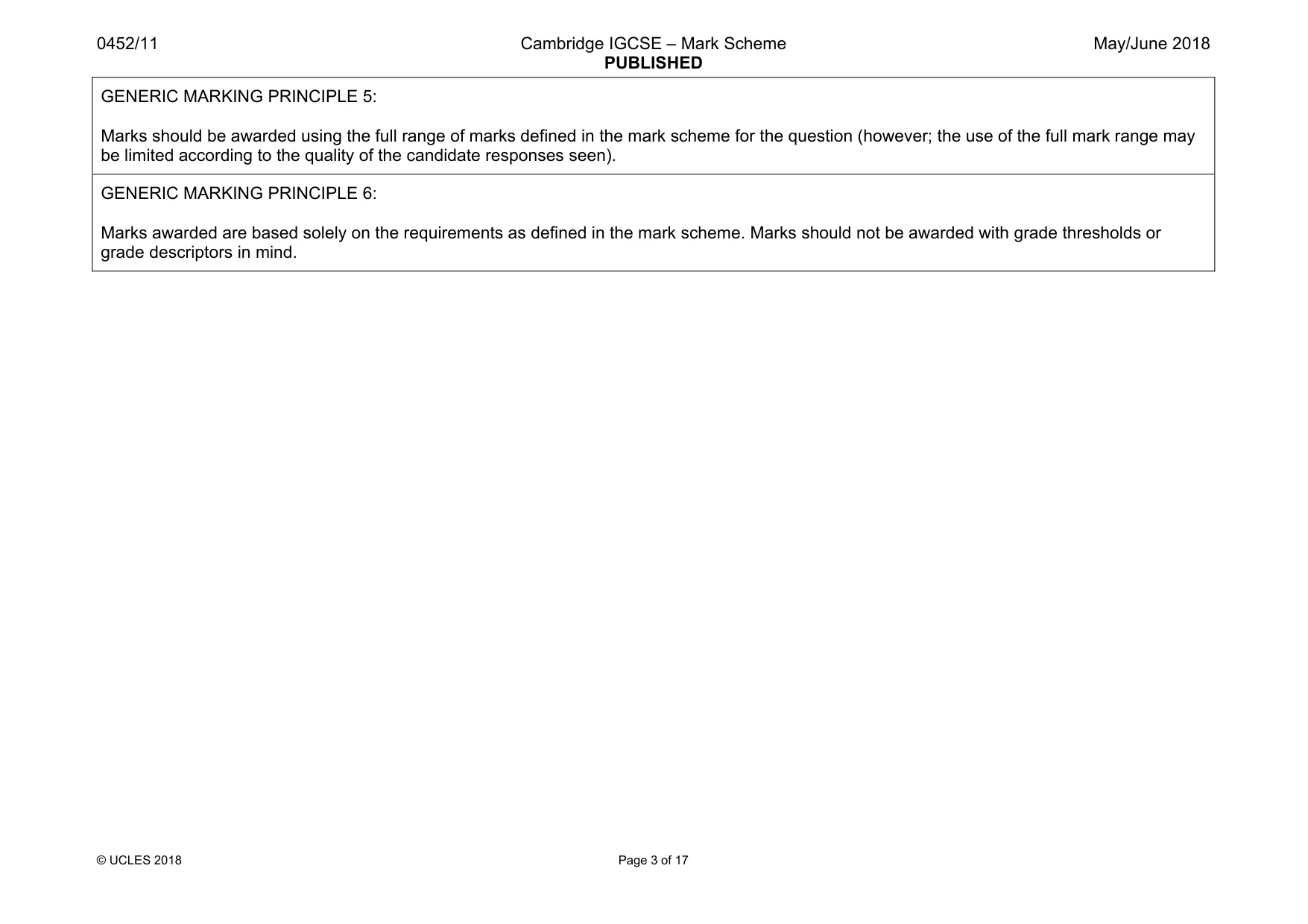
Mark scheme, page 2
0452/11 Cambridge IGCSE – Mark Scheme PUBLISHED May/June 2018 © UCLES 2018 Page 2 of 17 Generic Marking Principles These general marking principles must be applied by all examiners when marking candidate answers. They should be applied alongside the specific content of the mark scheme or generic level descriptors for a question. Each question paper and mark scheme will also comply with these marking principles. GENERIC MARKING PRINCIPLE 1: Marks must be awarded in line with: • the specific content of the mark scheme or the generic level descriptors for the question • the specific skills defined in the mark scheme or in the generic level descriptors for the question • the standard of response required by a candidate as exemplified by the standardisation scripts. GENERIC MARKING PRINCIPLE 2: Marks awarded are always whole marks (not half marks, or other fractions). GENERIC MARKING PRINCIPLE 3: Marks must be awarded positively: • marks are awarded for correct/valid answers, as defined in the mark scheme. However, credit is given for valid answers which go beyond the scope of the syllabus and mark scheme, referring to your Team Leader as appropriate • marks are awarded when candidates clearly demonstrate what they know and can do • marks are not deducted for errors • marks are not deducted for omissions • answers should only be judged on the quality of spelling, punctuation and grammar when these features are specifically assessed by the question as indicated by the mark scheme. The meaning, however, should be unambiguous. GENERIC MARKING PRINCIPLE 4: Rules must be applied consistently e.g. in situations where candidates have not followed instructions or in the application of generic level descriptors.
Mark scheme, page 3
0452/11 Cambridge IGCSE – Mark Scheme PUBLISHED May/June 2018 © UCLES 2018 Page 3 of 17 GENERIC MARKING PRINCIPLE 5: Marks should be awarded using the full range of marks defined in the mark scheme for the question (however; the use of the full mark range may be limited according to the quality of the candidate responses seen). GENERIC MARKING PRINCIPLE 6: Marks awarded are based solely on the requirements as defined in the mark scheme. Marks should not be awarded with grade thresholds or grade descriptors in mind.
Mark scheme, page 4
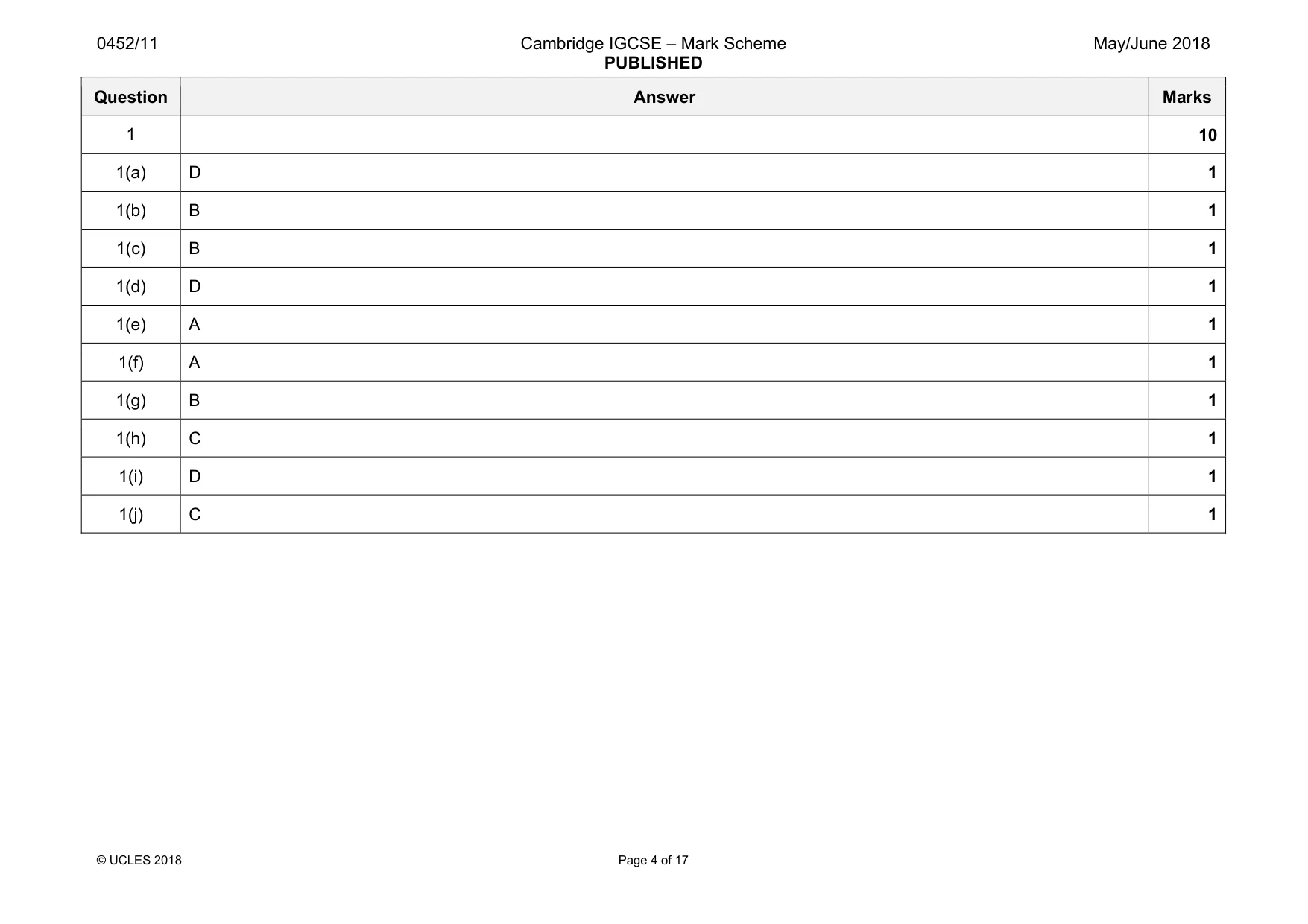
0452/11 Cambridge IGCSE – Mark Scheme PUBLISHED May/June 2018 © UCLES 2018 Page 4 of 17 Question Answer Marks 1 10 1(a) D 1 1(b) B 1 1(c) B 1 1(d) D 1 1(e) A 1 1(f) A 1 1(g) B 1 1(h) C 1 1(i) D 1 1(j) C 1
Mark scheme, page 5
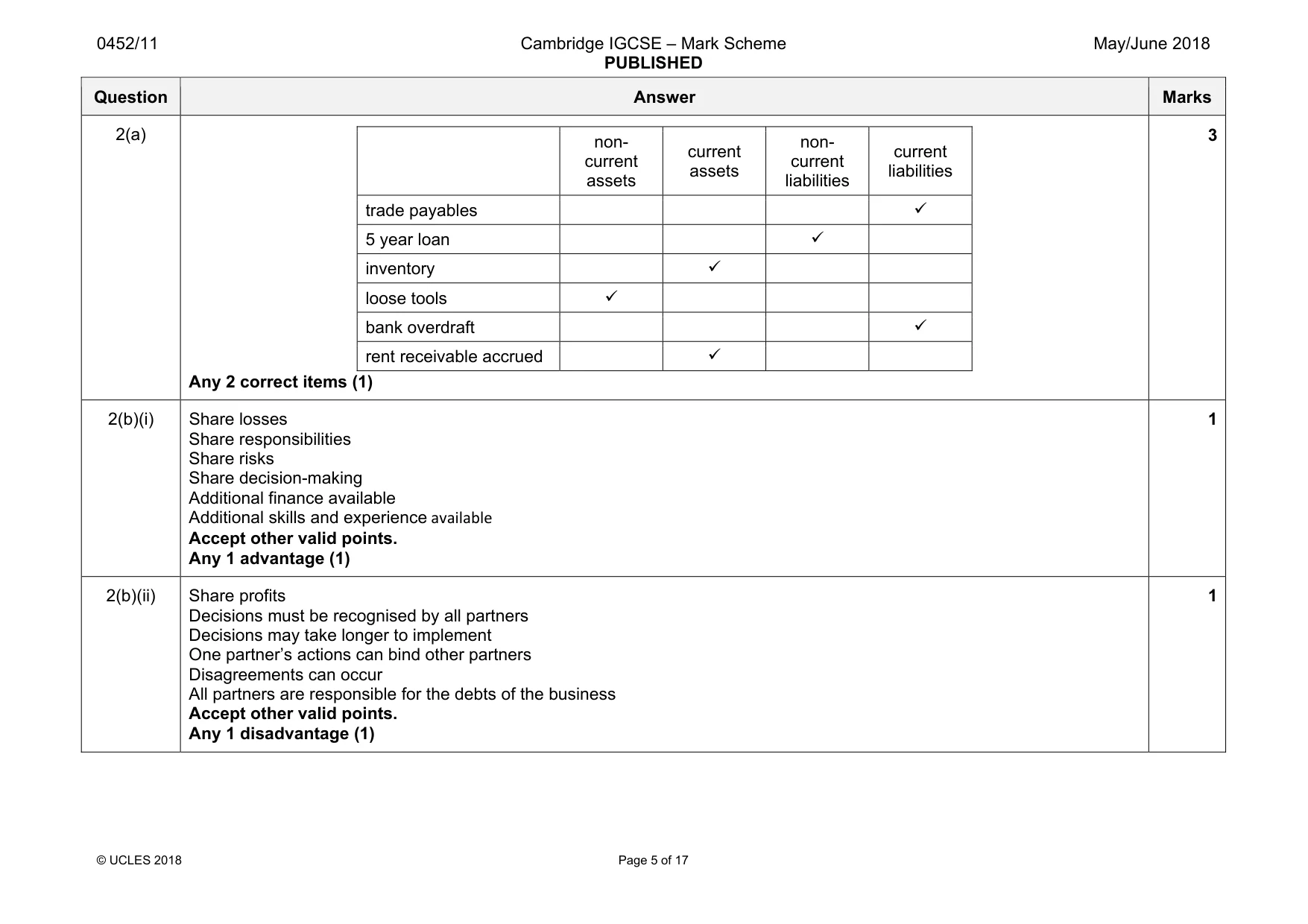
0452/11 Cambridge IGCSE – Mark Scheme PUBLISHED May/June 2018 © UCLES 2018 Page 5 of 17 Question Answer Marks 2(a) non- current assets current assets non- current liabilities current liabilities trade payables 9 5 year loan 9 inventory 9 loose tools 9 bank overdraft 9 rent receivable accrued 9 Any 2 correct items (1) 3 2(b)(i) Share losses Share responsibilities Share risks Share decision-making Additional finance available Additional skills and experience available Accept other valid points. Any 1 advantage (1) 1 2(b)(ii) Share profits Decisions must be recognised by all partners Decisions may take longer to implement One partner’s actions can bind other partners Disagreements can occur All partners are responsible for the debts of the business Accept other valid points. Any 1 disadvantage (1) 1
Mark scheme, page 6
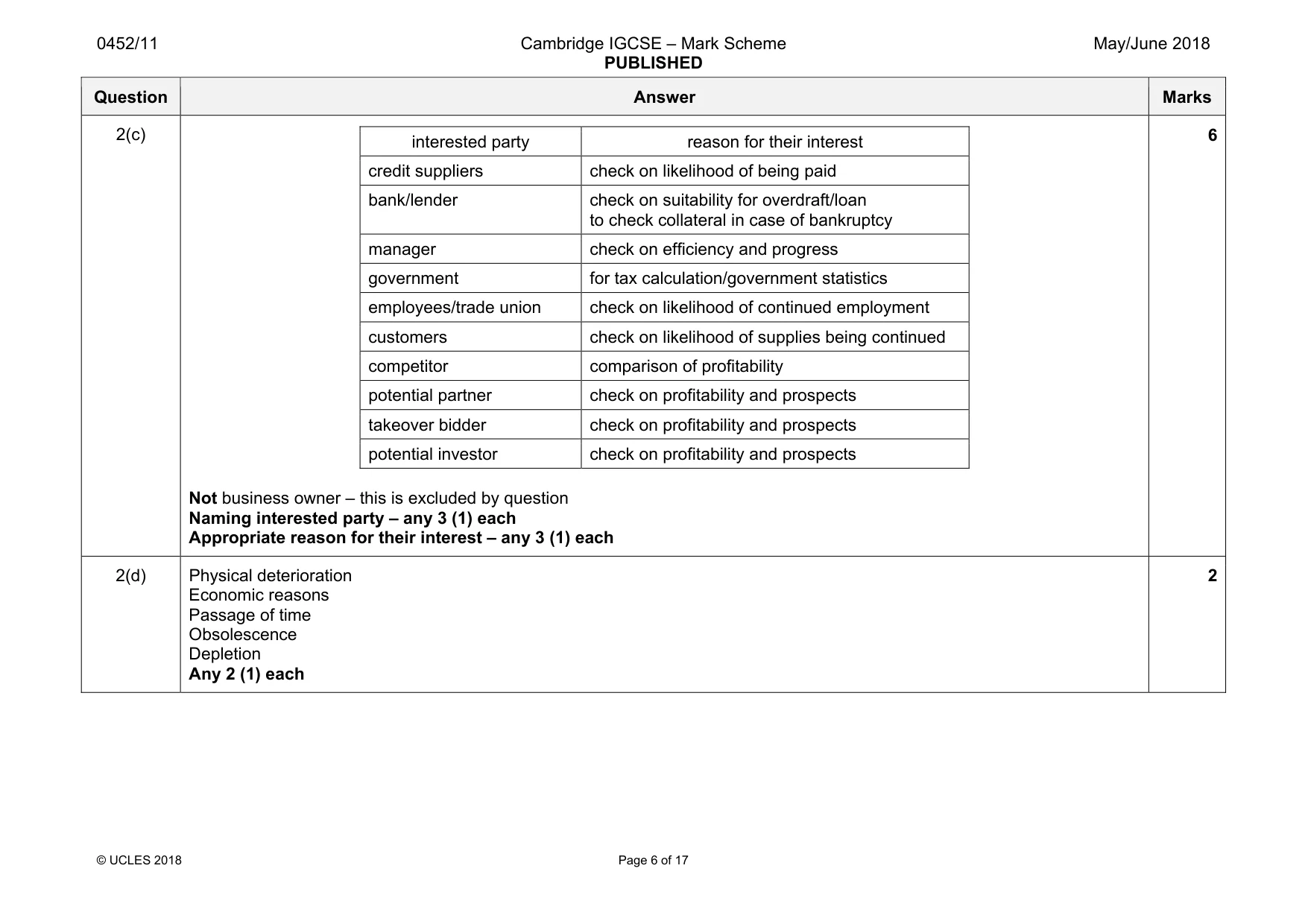
0452/11 Cambridge IGCSE – Mark Scheme PUBLISHED May/June 2018 © UCLES 2018 Page 6 of 17 Question Answer Marks 2(c) interested party reason for their interest credit suppliers check on likelihood of being paid bank/lender check on suitability for overdraft/loan to check collateral in case of bankruptcy manager check on efficiency and progress government for tax calculation/government statistics employees/trade union check on likelihood of continued employment customers check on likelihood of supplies being continued competitor comparison of profitability potential partner check on profitability and prospects takeover bidder check on profitability and prospects potential investor check on profitability and prospects Not business owner – this is excluded by question Naming interested party – any 3 (1) each Appropriate reason for their interest – any 3 (1) each 6 2(d) Physical deterioration Economic reasons Passage of time Obsolescence Depletion Any 2 (1) each 2
Mark scheme, page 7
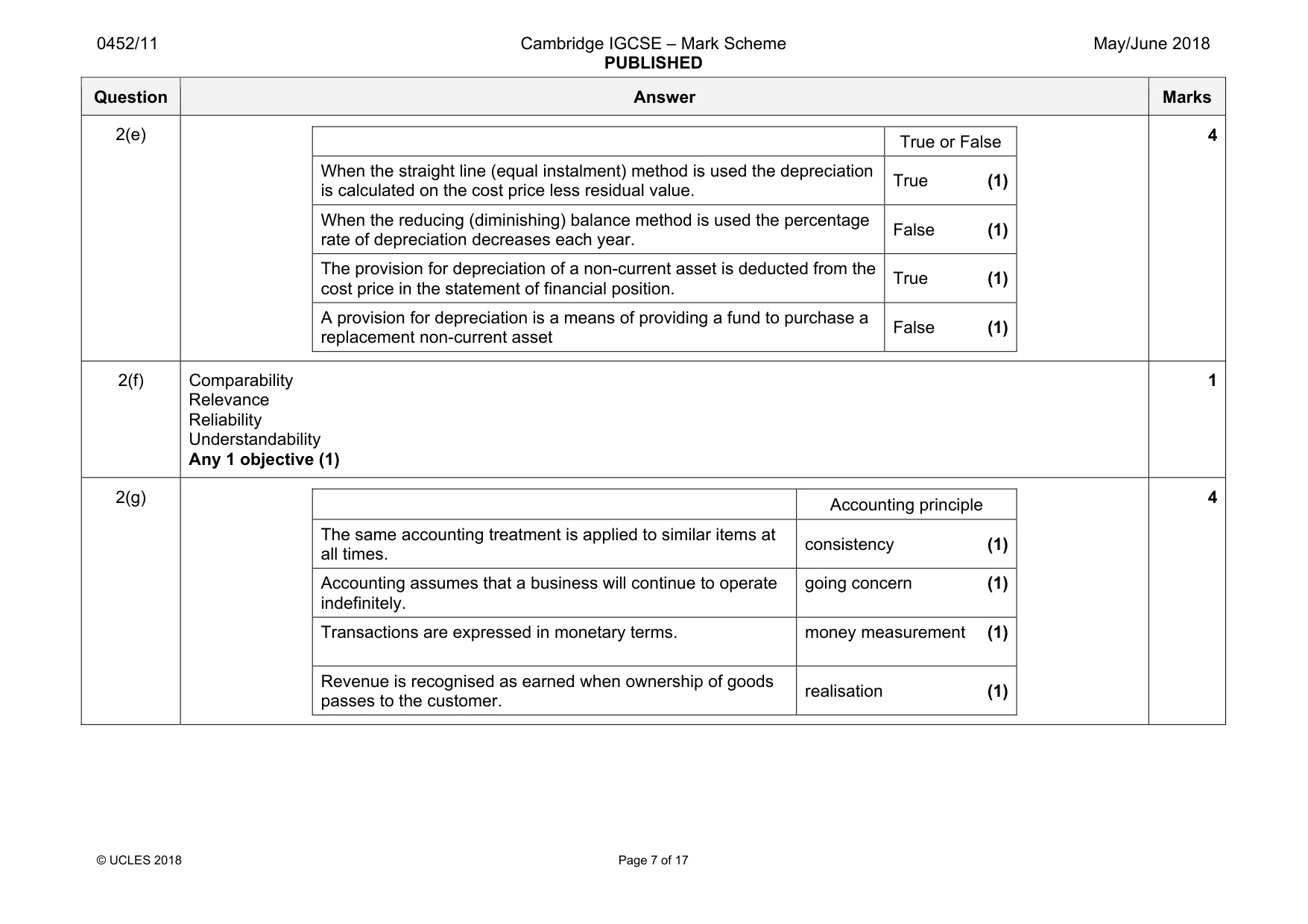
0452/11 Cambridge IGCSE – Mark Scheme PUBLISHED May/June 2018 © UCLES 2018 Page 7 of 17 Question Answer Marks 2(e) True or False When the straight line (equal instalment) method is used the depreciation is calculated on the cost price less residual value. True (1) When the reducing (diminishing) balance method is used the percentage rate of depreciation decreases each year. False (1) The provision for depreciation of a non-current asset is deducted from the cost price in the statement of financial position. True (1) A provision for depreciation is a means of providing a fund to purchase a replacement non-current asset False (1) 4 2(f) Comparability Relevance Reliability Understandability Any 1 objective (1) 1 2(g) Accounting principle The same accounting treatment is applied to similar items at all times. consistency (1) Accounting assumes that a business will continue to operate indefinitely. going concern (1) Transactions are expressed in monetary terms. money measurement (1) Revenue is recognised as earned when ownership of goods passes to the customer. realisation (1) 4
Mark scheme, page 8
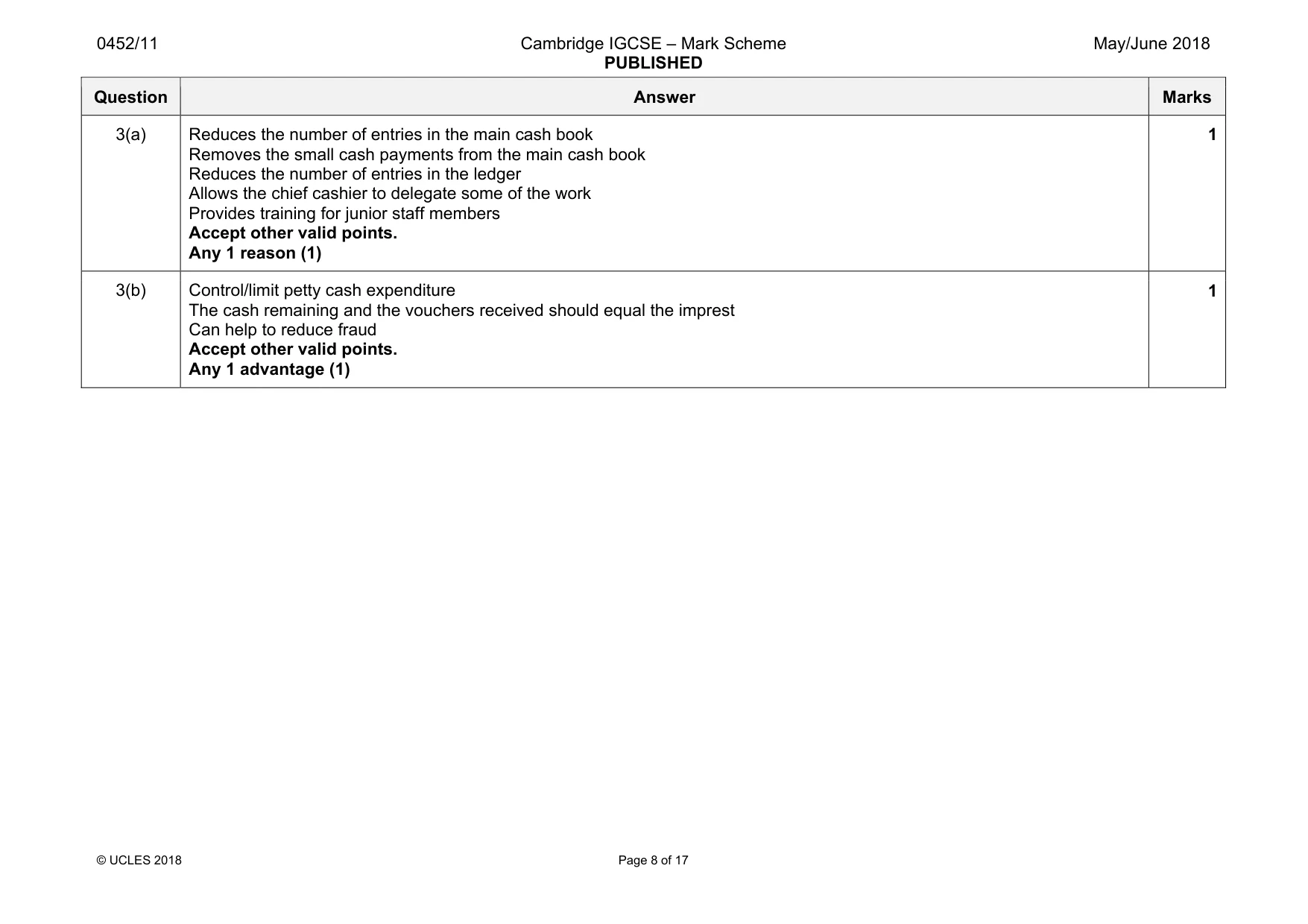
0452/11 Cambridge IGCSE – Mark Scheme PUBLISHED May/June 2018 © UCLES 2018 Page 8 of 17 Question Answer Marks 3(a) Reduces the number of entries in the main cash book Removes the small cash payments from the main cash book Reduces the number of entries in the ledger Allows the chief cashier to delegate some of the work Provides training for junior staff members Accept other valid points. Any 1 reason (1) 1 3(b) Control/limit petty cash expenditure The cash remaining and the vouchers received should equal the imprest Can help to reduce fraud Accept other valid points. Any 1 advantage (1) 1
Mark scheme, page 9
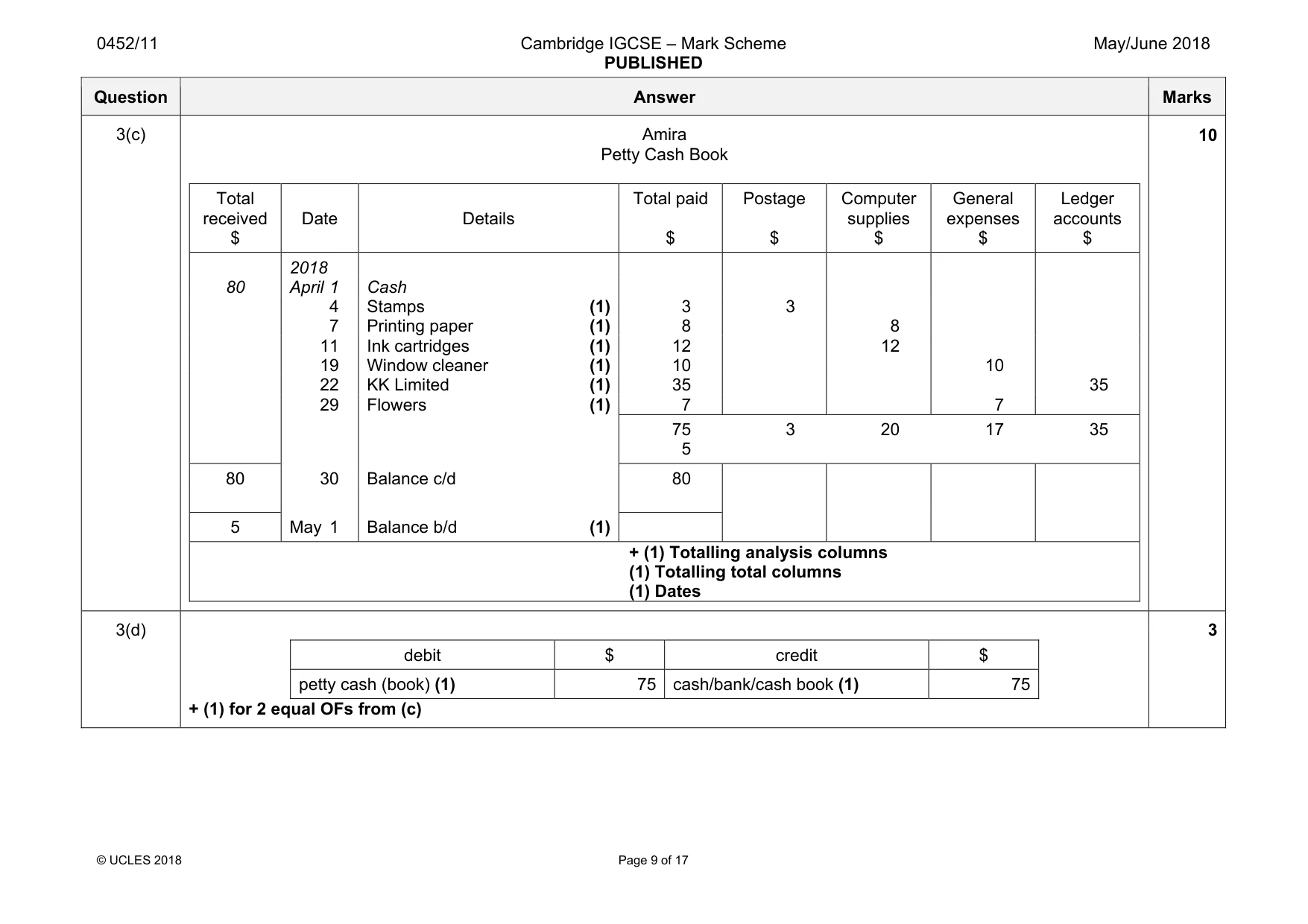
0452/11 Cambridge IGCSE – Mark Scheme PUBLISHED May/June 2018 © UCLES 2018 Page 9 of 17 Question Answer Marks 3(c) Amira Petty Cash Book Total received $ Date Details Total paid $ Postage $ Computer supplies $ General expenses $ Ledger accounts $ 2018 80 April 1 Cash 4 Stamps (1) 3 3 7 Printing paper (1) 8 8 11 Ink cartridges (1) 12 12 19 Window cleaner (1) 10 10 22 KK Limited (1) 35 35 29 Flowers (1) 7 7 75 5 3 20 17 35 80 30 Balance c/d 80 5 May 1 Balance b/d (1) + (1) Totalling analysis columns (1) Totalling total columns (1) Dates 10 3(d) debit $ credit $ petty cash (book) (1) 75 cash/bank/cash book (1) 75 + (1) for 2 equal OFs from (c) 3
Mark scheme, page 10
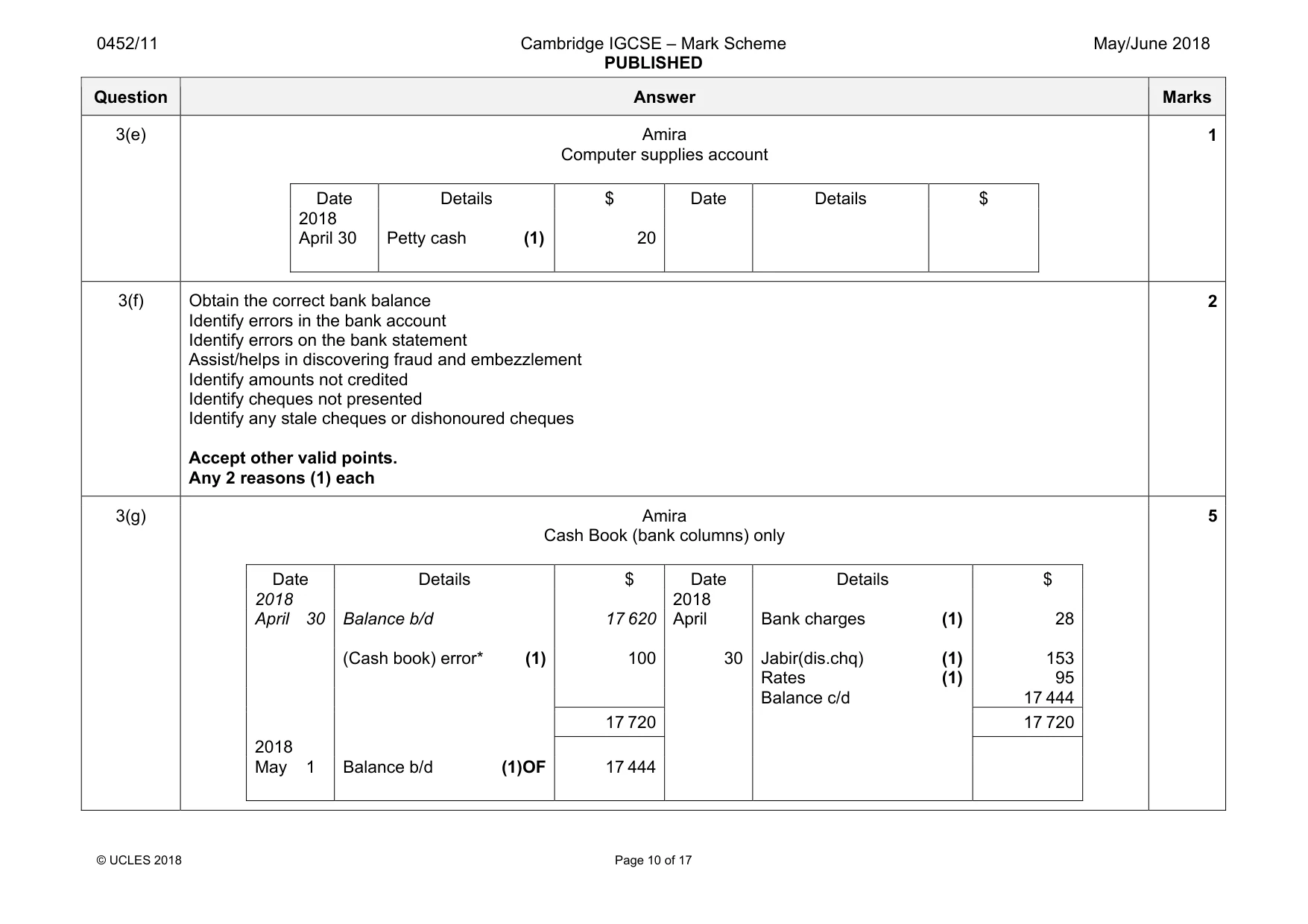
0452/11 Cambridge IGCSE – Mark Scheme PUBLISHED May/June 2018 © UCLES 2018 Page 10 of 17 Question Answer Marks 3(e) Amira Computer supplies account Date Details $ Date Details $ 2018 April 30 Petty cash (1) 20 1 3(f) Obtain the correct bank balance Identify errors in the bank account Identify errors on the bank statement Assist/helps in discovering fraud and embezzlement Identify amounts not credited Identify cheques not presented Identify any stale cheques or dishonoured cheques Accept other valid points. Any 2 reasons (1) each 2 3(g) Amira Cash Book (bank columns) only Date Details $ Date Details $ 2018 2018 April 30 Balance b/d 17 620 April Bank charges (1) 28 (Cash book) error* (1) 100 30 Jabir(dis.chq) (1) 153 Rates (1) 95 Balance c/d 17 444 17 720 17 720 2018 May 1 Balance b/d (1)OF 17 444 5
Mark scheme, page 11
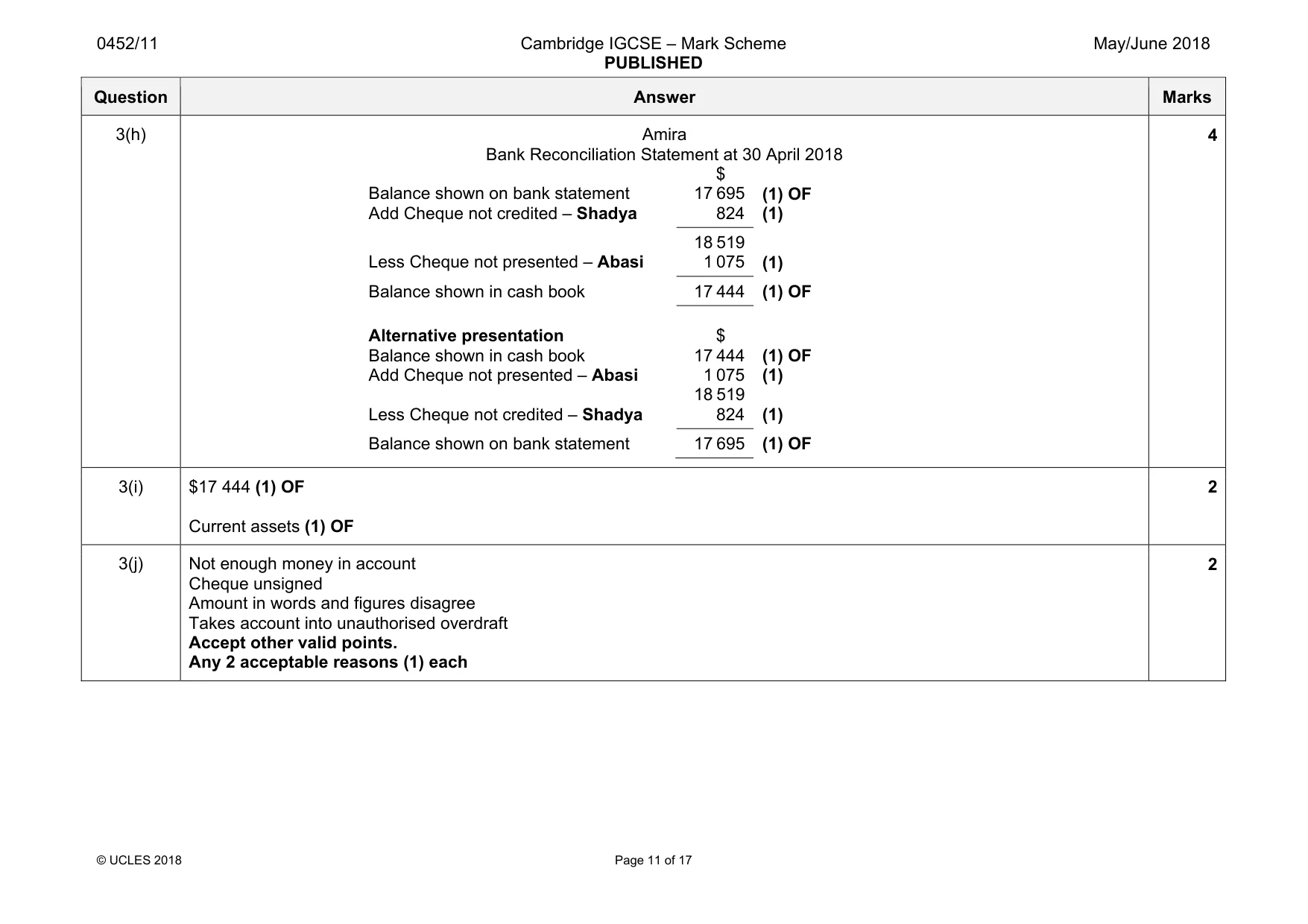
0452/11 Cambridge IGCSE – Mark Scheme PUBLISHED May/June 2018 © UCLES 2018 Page 11 of 17 Question Answer Marks 3(h) Amira Bank Reconciliation Statement at 30 April 2018 $ Balance shown on bank statement 17 695 (1) OF Add Cheque not credited – Shadya 824 (1) 18 519 Less Cheque not presented – Abasi 1 075 (1) Balance shown in cash book 17 444 (1) OF Alternative presentation $ Balance shown in cash book 17 444 (1) OF Add Cheque not presented – Abasi 1 075 (1) 18 519 Less Cheque not credited – Shadya 824 (1) Balance shown on bank statement 17 695 (1) OF 4 3(i) $17 444 (1) OF Current assets (1) OF 2 3(j) Not enough money in account Cheque unsigned Amount in words and figures disagree Takes account into unauthorised overdraft Accept other valid points. Any 2 acceptable reasons (1) each 2
Mark scheme, page 12
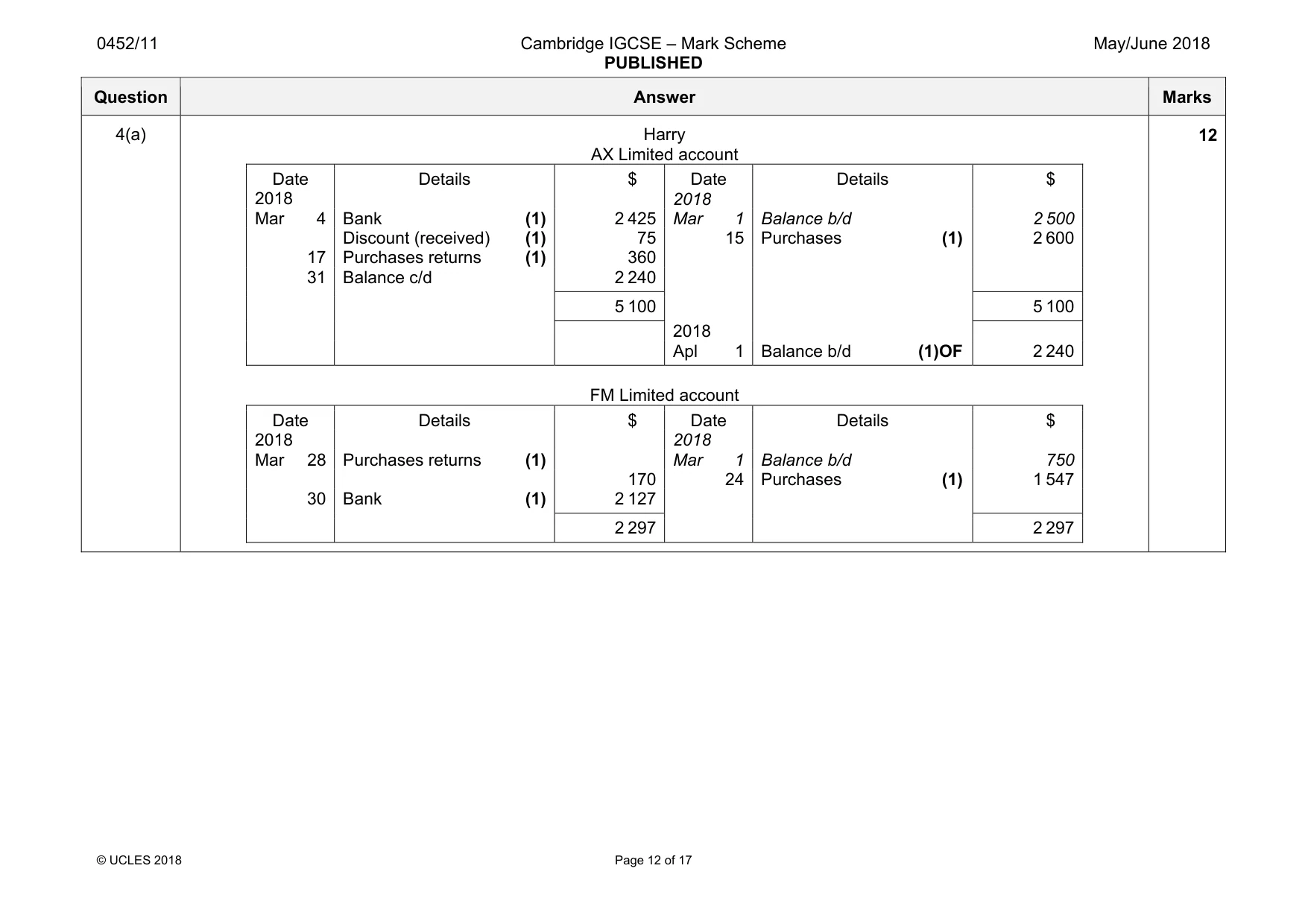
0452/11 Cambridge IGCSE – Mark Scheme PUBLISHED May/June 2018 © UCLES 2018 Page 12 of 17 Question Answer Marks 4(a) Harry AX Limited account Date Details $ Date Details $ 2018 2018 Mar 4 Bank (1) 2 425 Mar 1 Balance b/d 2 500 Discount (received) (1) 75 15 Purchases (1) 2 600 17 Purchases returns (1) 360 31 Balance c/d 2 240 5 100 5 100 2018 Apl 1 Balance b/d (1)OF 2 240 FM Limited account Date Details $ Date Details $ 2018 2018 Mar 28 Purchases returns (1) Mar 1 Balance b/d 750 170 24 Purchases (1) 1 547 30 Bank (1) 2 127 2 297 2 297 12
Mark scheme, page 13
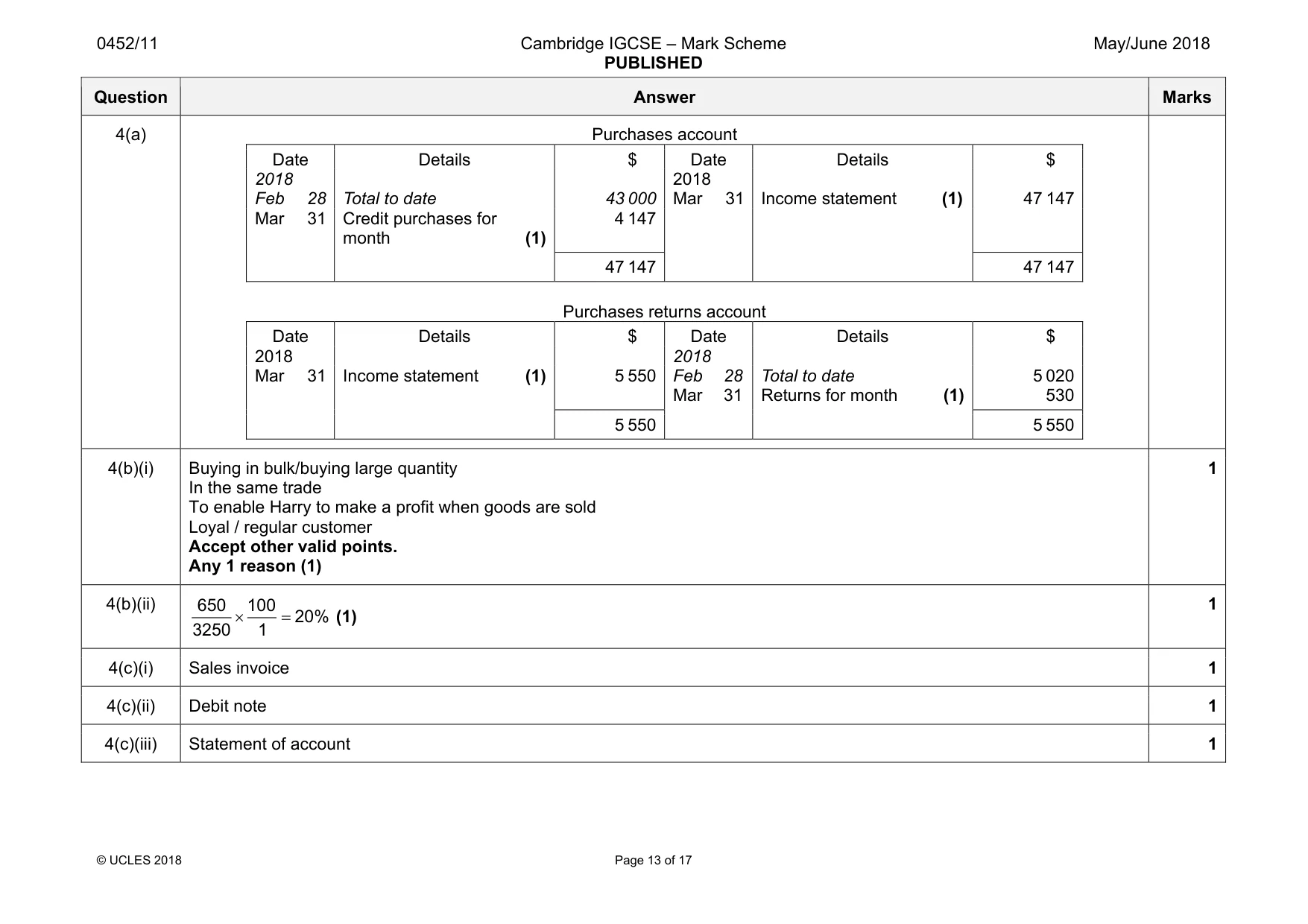
0452/11 Cambridge IGCSE – Mark Scheme PUBLISHED May/June 2018 © UCLES 2018 Page 13 of 17 Question Answer Marks 4(a) Purchases account Date Details $ Date Details $ 2018 2018 Feb 28 Total to date 43 000 Mar 31 Income statement (1) 47 147 Mar 31 Credit purchases for month (1) 4 147 47 147 47 147 Purchases returns account Date Details $ Date Details $ 2018 2018 Mar 31 Income statement (1) 5 550 Feb 28 Total to date 5 020 Mar 31 Returns for month (1) 530 5 550 5 550 4(b)(i) Buying in bulk/buying large quantity In the same trade To enable Harry to make a profit when goods are sold Loyal / regular customer Accept other valid points. Any 1 reason (1) 1 4(b)(ii) 650 100 20% 3250 1 × = (1) 1 4(c)(i) Sales invoice 1 4(c)(ii) Debit note 1 4(c)(iii) Statement of account 1
Mark scheme, page 14
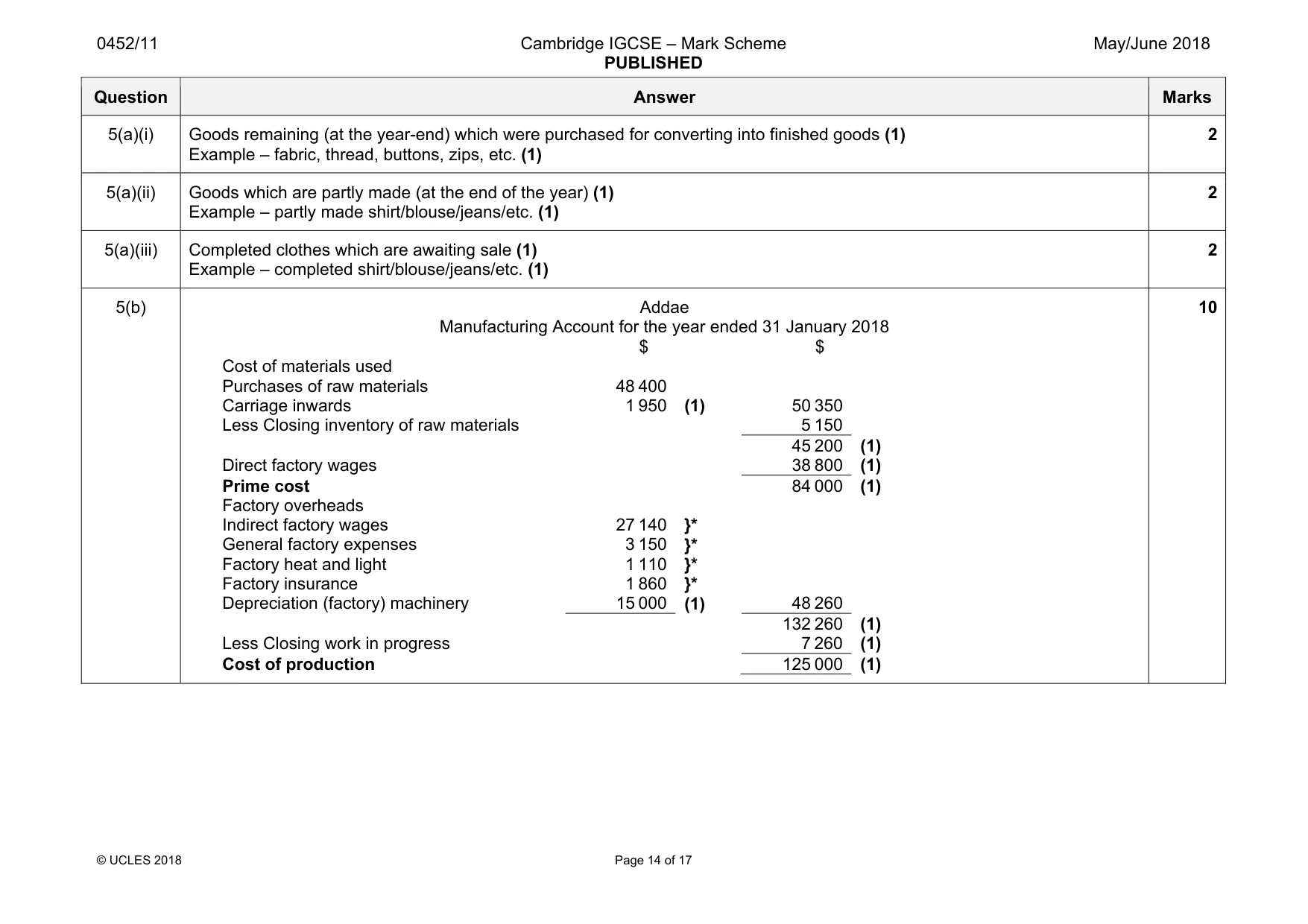
0452/11 Cambridge IGCSE – Mark Scheme PUBLISHED May/June 2018 © UCLES 2018 Page 14 of 17 Question Answer Marks 5(a)(i) Goods remaining (at the year-end) which were purchased for converting into finished goods (1) Example – fabric, thread, buttons, zips, etc. (1) 2 5(a)(ii) Goods which are partly made (at the end of the year) (1) Example – partly made shirt/blouse/jeans/etc. (1) 2 5(a)(iii) Completed clothes which are awaiting sale (1) Example – completed shirt/blouse/jeans/etc. (1) 2 5(b) Addae Manufacturing Account for the year ended 31 January 2018 $ $ Cost of materials used Purchases of raw materials 48 400 Carriage inwards 1 950 (1) 50 350 Less Closing inventory of raw materials 5 150 45 200 (1) Direct factory wages 38 800 (1) Prime cost 84 000 (1) Factory overheads Indirect factory wages 27 140 }* General factory expenses 3 150 }* Factory heat and light 1 110 }* Factory insurance 1 860 }* Depreciation (factory) machinery 15 000 (1) 48 260 132 260 (1) Less Closing work in progress 7 260 (1) Cost of production 125 000 (1) 10
Mark scheme, page 15
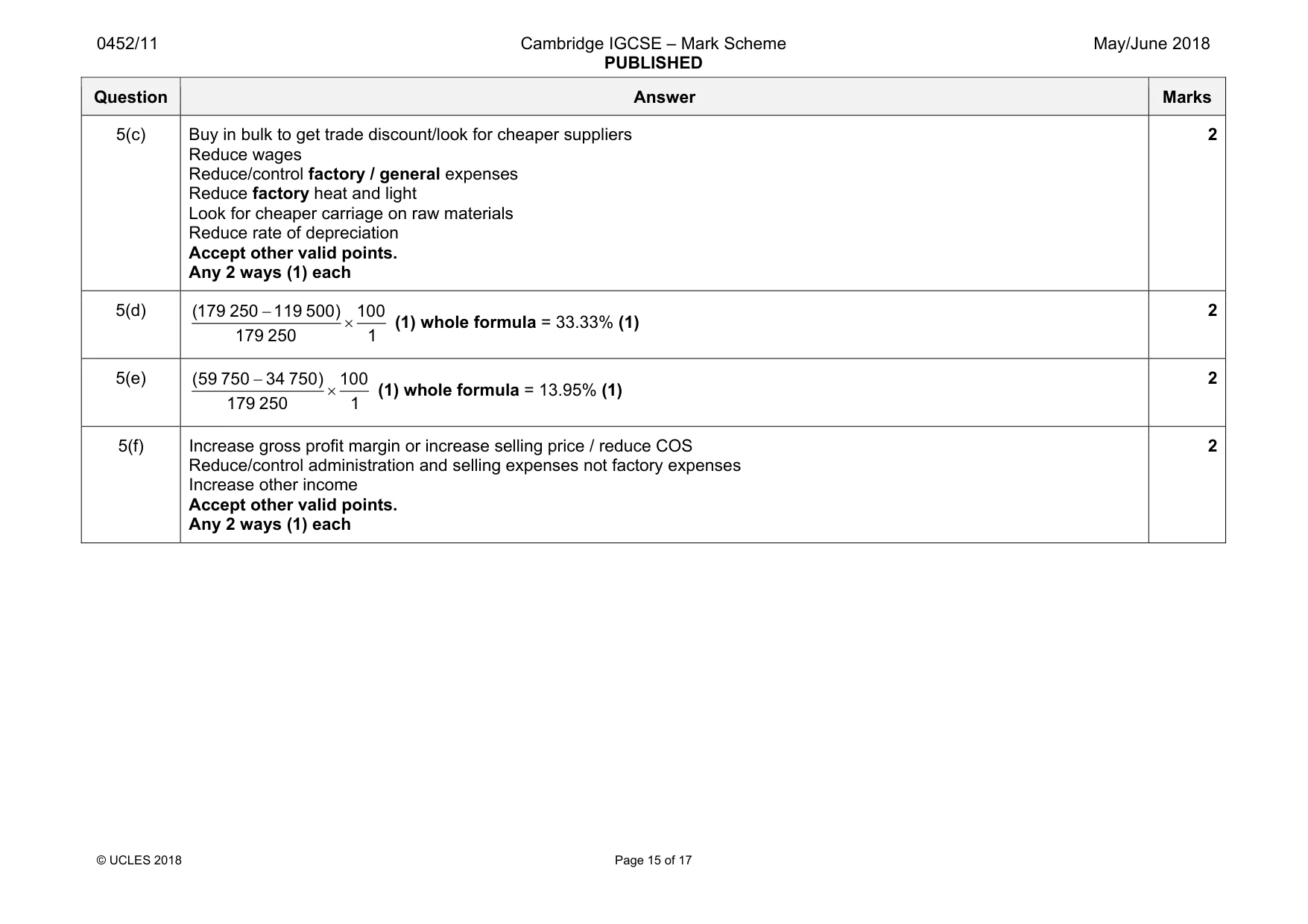
0452/11 Cambridge IGCSE – Mark Scheme PUBLISHED May/June 2018 © UCLES 2018 Page 15 of 17 Question Answer Marks 5(c) Buy in bulk to get trade discount/look for cheaper suppliers Reduce wages Reduce/control factory / general expenses Reduce factory heat and light Look for cheaper carriage on raw materials Reduce rate of depreciation Accept other valid points. Any 2 ways (1) each 2 5(d) (179 250 119 500) 100 179 250 1 − × (1) whole formula = 33.33% (1) 2 5(e) (59 750 34 750) 100 179 250 1 − × (1) whole formula = 13.95% (1) 2 5(f) Increase gross profit margin or increase selling price / reduce COS Reduce/control administration and selling expenses not factory expenses Increase other income Accept other valid points. Any 2 ways (1) each 2
Mark scheme, page 16
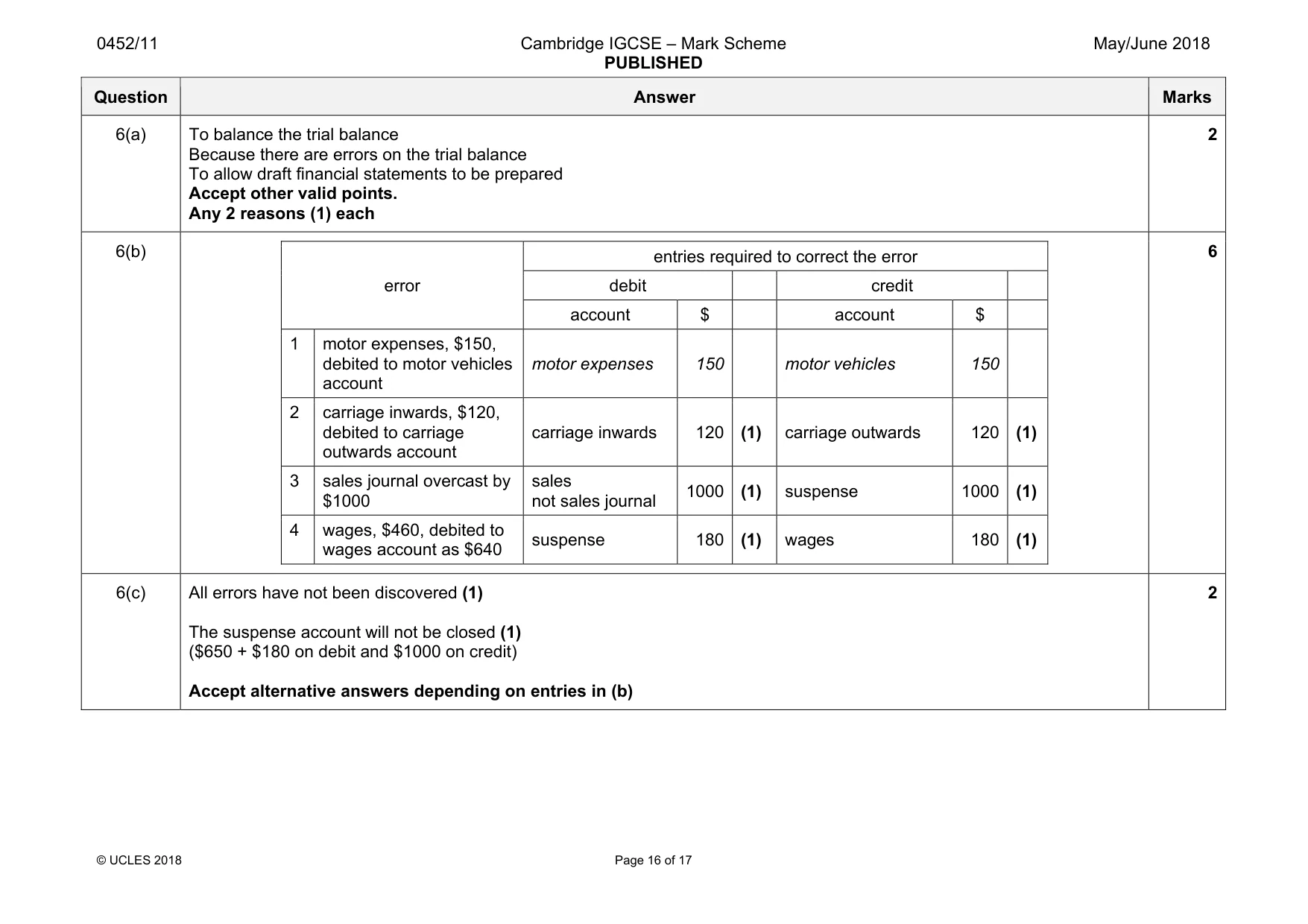
0452/11 Cambridge IGCSE – Mark Scheme PUBLISHED May/June 2018 © UCLES 2018 Page 16 of 17 Question Answer Marks 6(a) To balance the trial balance Because there are errors on the trial balance To allow draft financial statements to be prepared Accept other valid points. Any 2 reasons (1) each 2 6(b) error entries required to correct the error debit credit account $ account $ 1 motor expenses, $150, debited to motor vehicles account motor expenses 150 motor vehicles 150 2 carriage inwards, $120, debited to carriage outwards account carriage inwards 120 (1) carriage outwards 120 (1) 3 sales journal overcast by $1000 sales not sales journal 1000 (1) suspense 1000 (1) 4 wages, $460, debited to wages account as $640 suspense 180 (1) wages 180 (1) 6 6(c) All errors have not been discovered (1) The suspense account will not be closed (1) ($650 + $180 on debit and $1000 on credit) Accept alternative answers depending on entries in (b) 2
Mark scheme, page 17
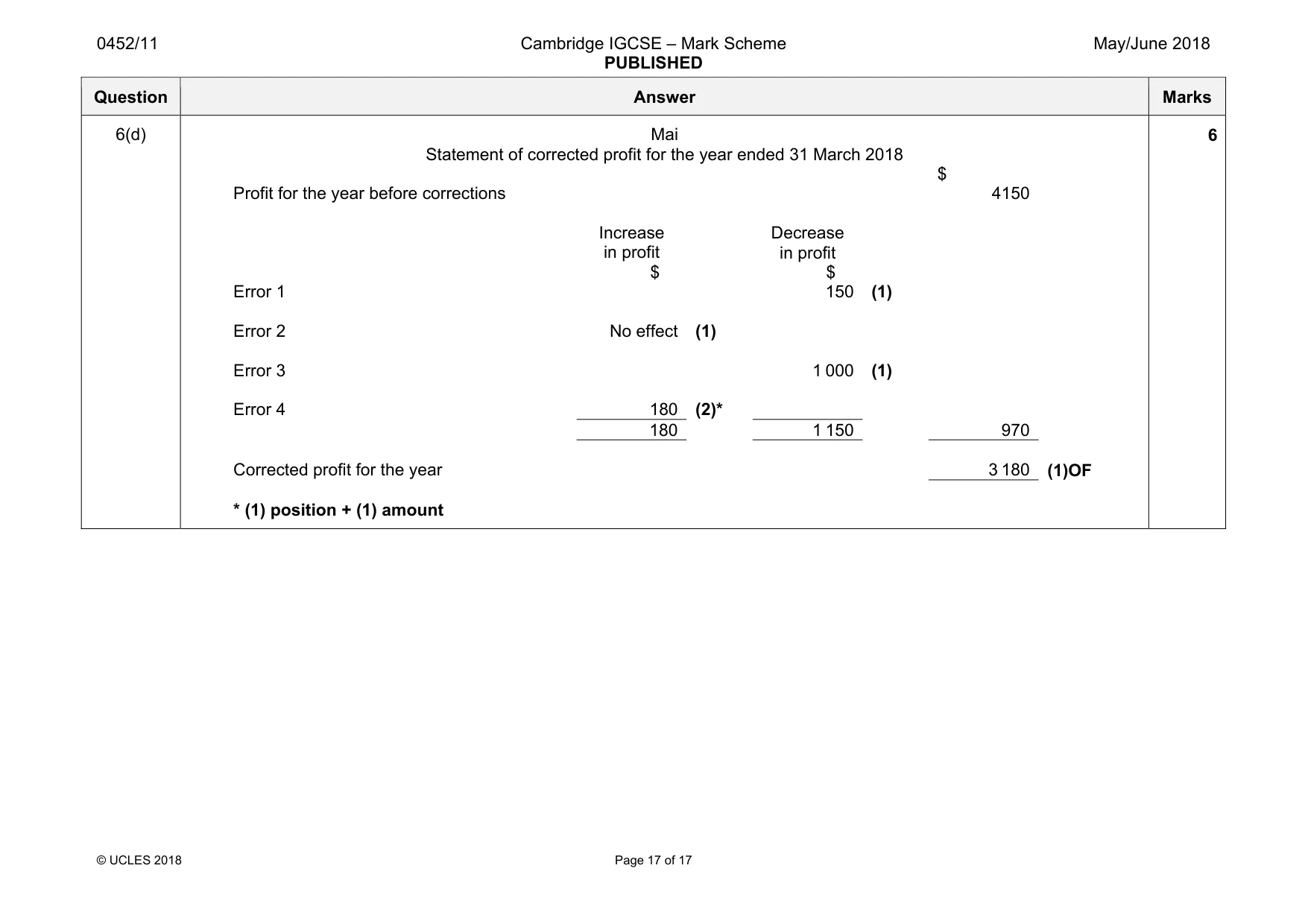
0452/11 Cambridge IGCSE – Mark Scheme PUBLISHED May/June 2018 © UCLES 2018 Page 17 of 17 Question Answer Marks 6(d) Mai Statement of corrected profit for the year ended 31 March 2018 $ Profit for the year before corrections 4150 Increase in profit $ Decrease in profit $ Error 1 150 (1) Error 2 No effect (1) Error 3 1 000 (1) Error 4 180 (2)* 180 1 150 970 Corrected profit for the year 3 180 (1)OF * (1) position + (1) amount 6
What you needed in this session
Cambridge’s own grade thresholds for 2018 May/June, Paper 1 · Variant 1. A higher threshold means an easier paper — the bar moves with how the cohort did.