Cambridge IGCSE Accounting 0452 — 2018 May/June Paper 1 · Variant 3
0452/13/M/J/18 · 120 marks · ≈135 min
The question paper and its mark scheme, free to read here and free to download. This is Cambridge’s own paper, exactly as it was sat.
Question paper20 pages

Mark scheme14 pages
Answers below. Sit the paper first if you are practising.
Paper as text
Question paper, page 1
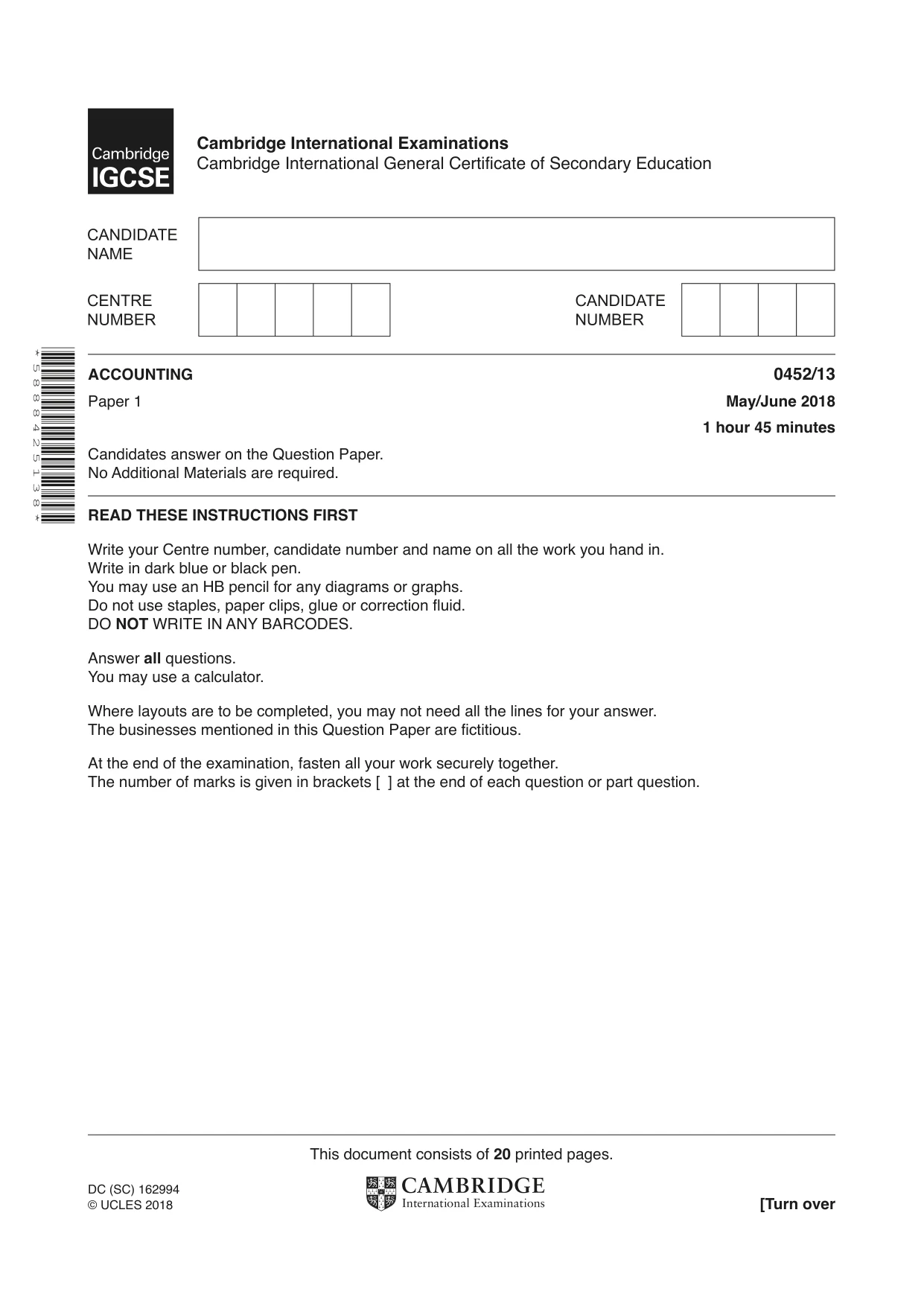
This document consists of 20 printed pages. DC (SC) 162994 © UCLES 2018 [Turn over Cambridge International Examinations Cambridge International General Certificate of Secondary Education * 5 8 8 8 4 2 5 1 3 8 * ACCOUNTING 0452/13 Paper 1 May/June 2018 1 hour 45 minutes Candidates answer on the Question Paper. No Additional Materials are required. READ THESE INSTRUCTIONS FIRST Write your Centre number, candidate number and name on all the work you hand in. Write in dark blue or black pen. You may use an HB pencil for any diagrams or graphs. Do not use staples, paper clips, glue or correction fluid. DO NOT WRITE IN ANY BARCODES. Answer all questions. You may use a calculator. Where layouts are to be completed, you may not need all the lines for your answer. The businesses mentioned in this Question Paper are fictitious. At the end of the examination, fasten all your work securely together. The number of marks is given in brackets [ ] at the end of each question or part question.
Question paper, page 2
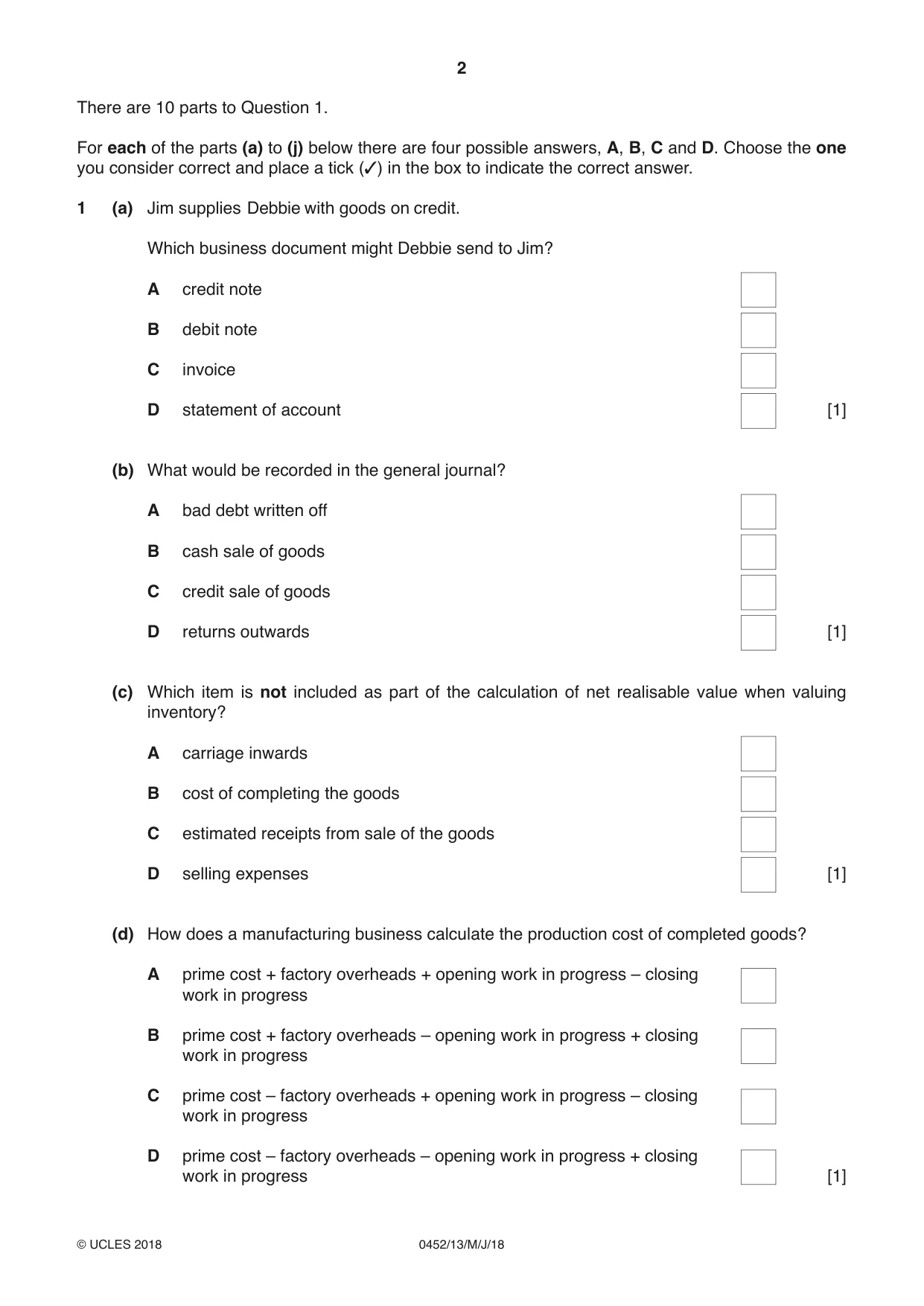
2 0452/13/M/J/18 © UCLES 2018 There are 10 parts to Question 1. For each of the parts (a) to (j) below there are four possible answers, A, B, C and D. Choose the one you consider correct and place a tick (✓) in the box to indicate the correct answer. 1 (a) Jim supplies Debbie with goods on credit. Which business document might Debbie send to Jim? A credit note B debit note C invoice D statement of account [1] (b) What would be recorded in the general journal? A bad debt written off B cash sale of goods C credit sale of goods D returns outwards [1] (c) Which item is not included as part of the calculation of net realisable value when valuing inventory? A carriage inwards B cost of completing the goods C estimated receipts from sale of the goods D selling expenses [1] (d) How does a manufacturing business calculate the production cost of completed goods? A prime cost + factory overheads + opening work in progress – closing work in progress B prime cost + factory overheads – opening work in progress + closing work in progress C prime cost – factory overheads + opening work in progress – closing work in progress D prime cost – factory overheads – opening work in progress + closing work in progress [1]
Question paper, page 3
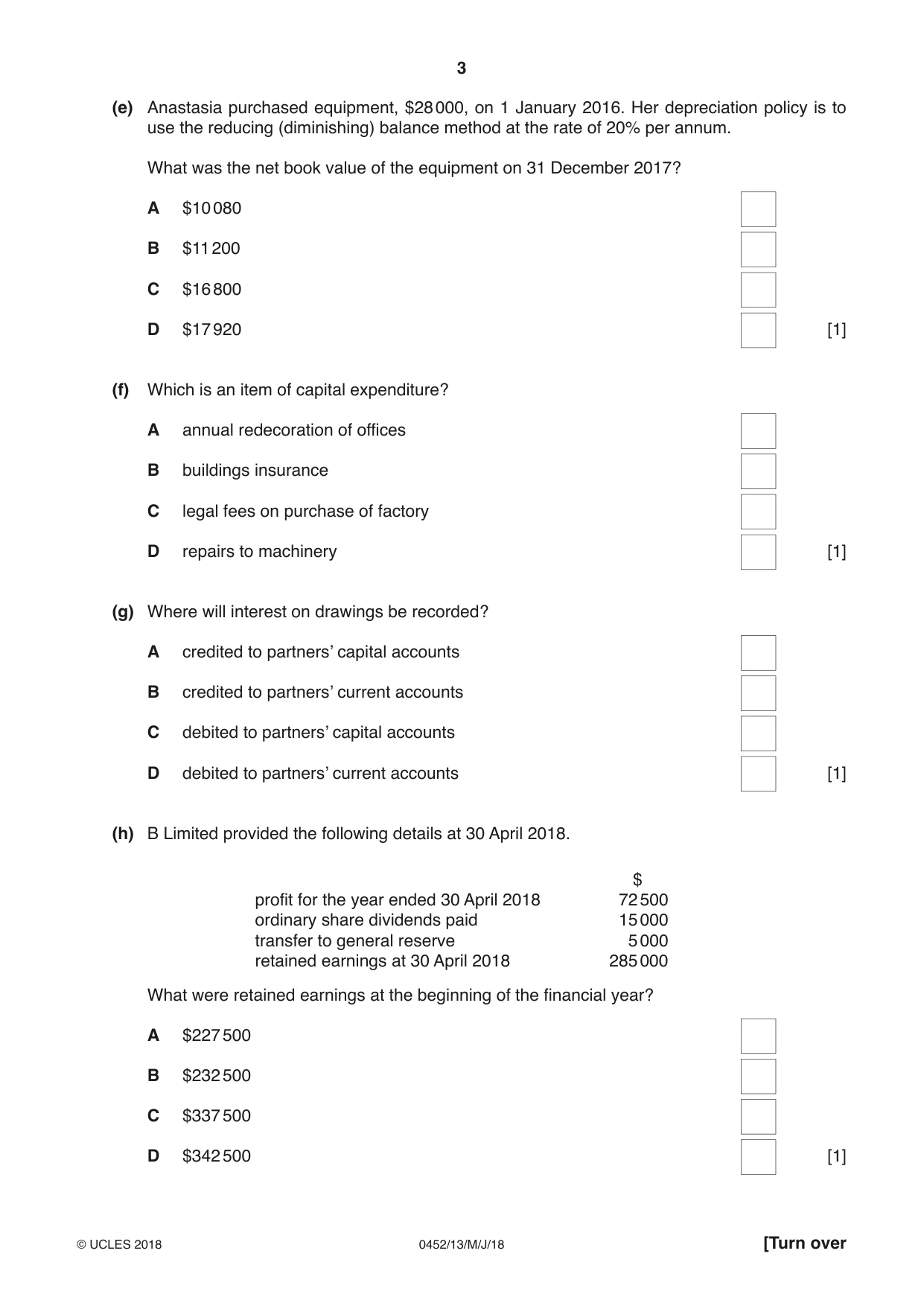
3 0452/13/M/J/18 © UCLES 2018 [Turn over (e) Anastasia purchased equipment, $28 000, on 1 January 2016. Her depreciation policy is to use the reducing (diminishing) balance method at the rate of 20% per annum. What was the net book value of the equipment on 31 December 2017? A $10 080 B $11 200 C $16 800 D $17 920 [1] (f) Which is an item of capital expenditure? A annual redecoration of offices B buildings insurance C legal fees on purchase of factory D repairs to machinery [1] (g) Where will interest on drawings be recorded? A credited to partners’ capital accounts B credited to partners’ current accounts C debited to partners’ capital accounts D debited to partners’ current accounts [1] (h) B Limited provided the following details at 30 April 2018. $ profit for the year ended 30 April 2018 72 500 ordinary share dividends paid 15 000 transfer to general reserve 5 000 retained earnings at 30 April 2018 285 000 What were retained earnings at the beginning of the financial year? A $227 500 B $232 500 C $337 500 D $342 500 [1]
Question paper, page 4
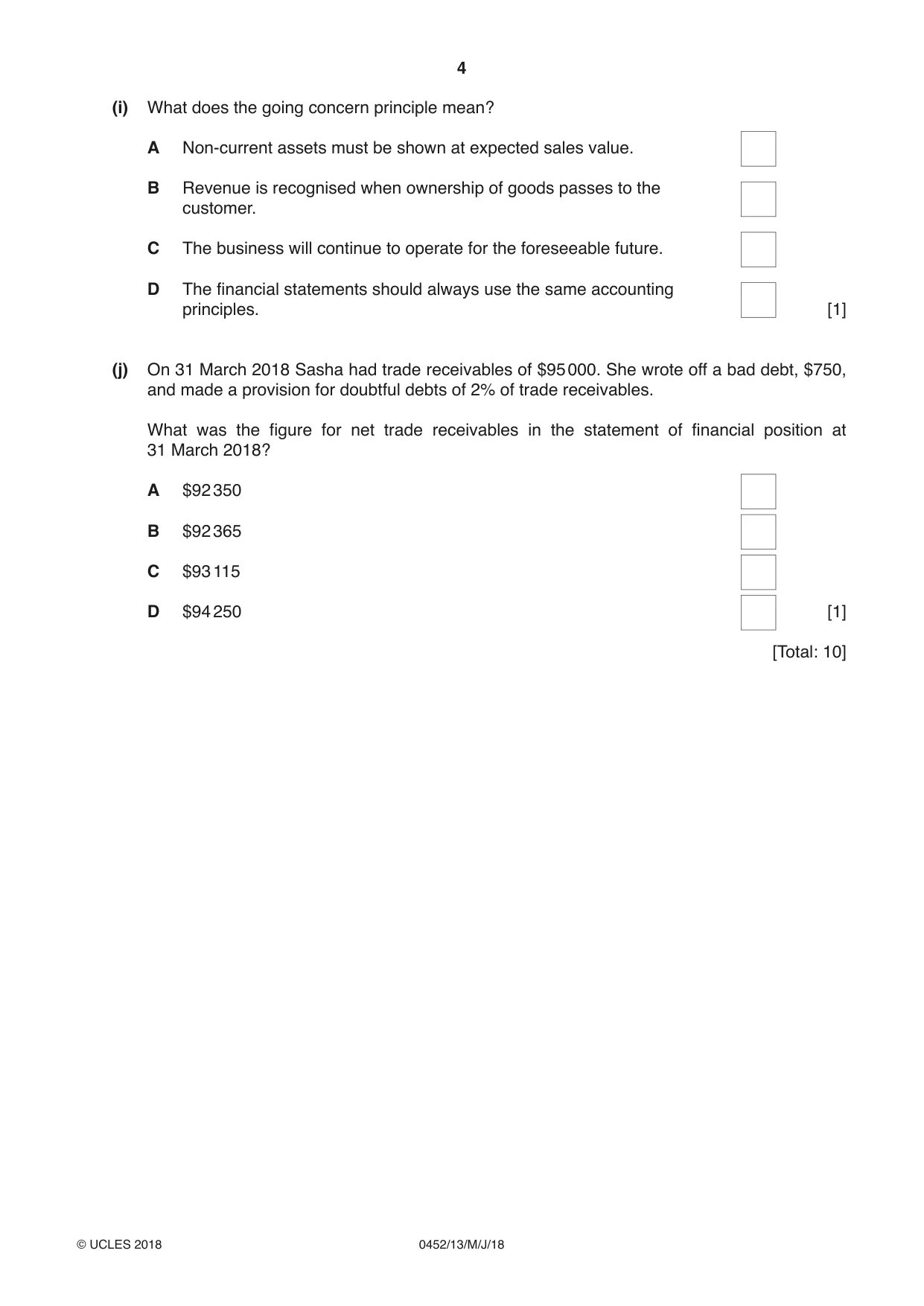
4 0452/13/M/J/18 © UCLES 2018 (i) What does the going concern principle mean? A Non-current assets must be shown at expected sales value. B Revenue is recognised when ownership of goods passes to the customer. C The business will continue to operate for the foreseeable future. D The financial statements should always use the same accounting principles. [1] (j) On 31 March 2018 Sasha had trade receivables of $95 000. She wrote off a bad debt, $750, and made a provision for doubtful debts of 2% of trade receivables. What was the figure for net trade receivables in the statement of financial position at 31 March 2018? A $92 350 B $92 365 C $93 115 D $94 250 [1] [Total: 10]
Question paper, page 5
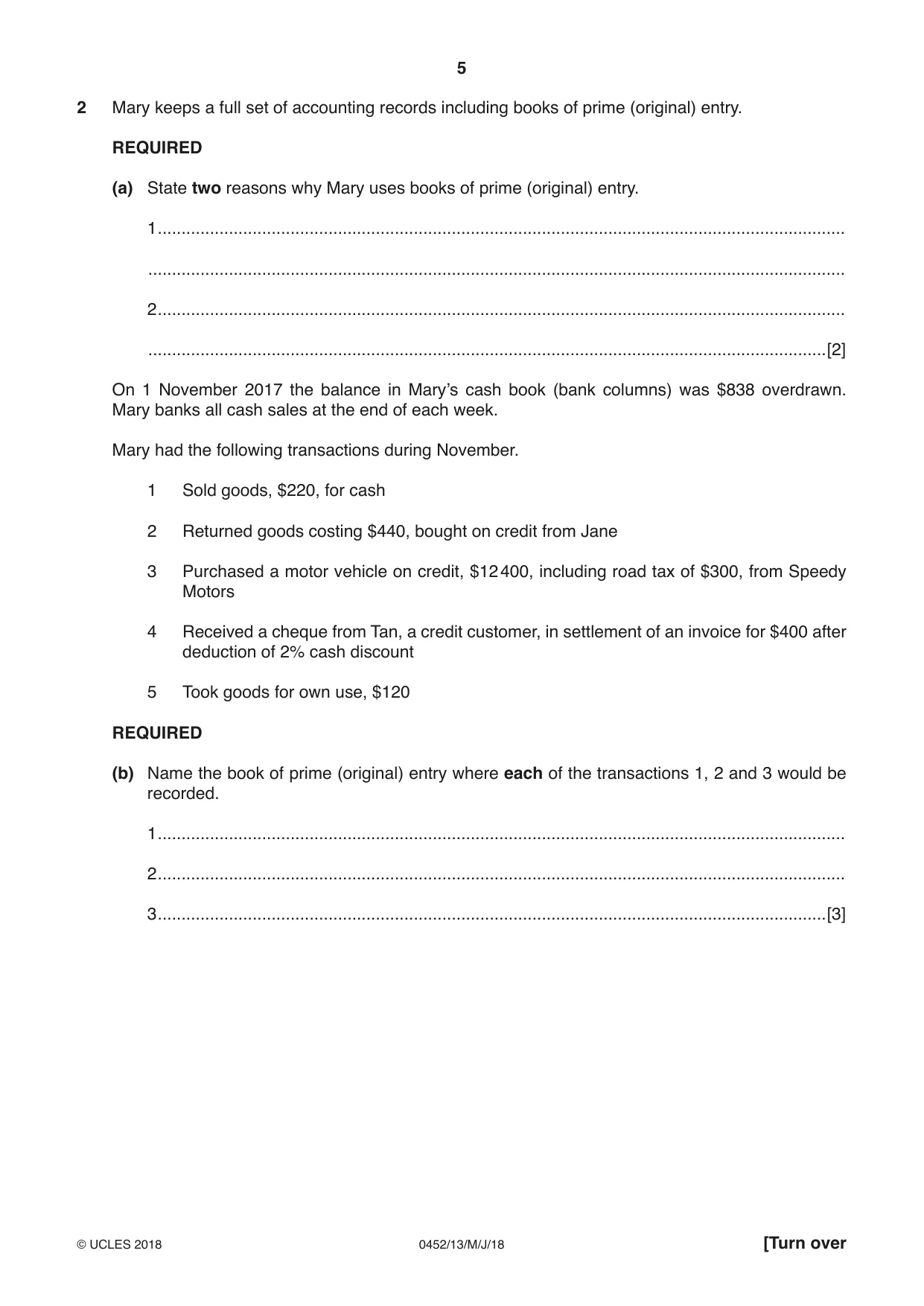
5 0452/13/M/J/18 © UCLES 2018 [Turn over 2 Mary keeps a full set of accounting records including books of prime (original) entry. REQUIRED (a) State two reasons why Mary uses books of prime (original) entry. 1 … … 2 … …[2] On 1 November 2017 the balance in Mary’s cash book (bank columns) was $838 overdrawn. Mary banks all cash sales at the end of each week. Mary had the following transactions during November. 1 Sold goods, $220, for cash 2 Returned goods costing $440, bought on credit from Jane 3 Purchased a motor vehicle on credit, $12 400, including road tax of $300, from Speedy Motors 4 Received a cheque from Tan, a credit customer, in settlement of an invoice for $400 after deduction of 2% cash discount 5 Took goods for own use, $120 REQUIRED (b) Name the book of prime (original) entry where each of the transactions 1, 2 and 3 would be recorded. 1 … 2 … 3 …[3]
Question paper, page 6
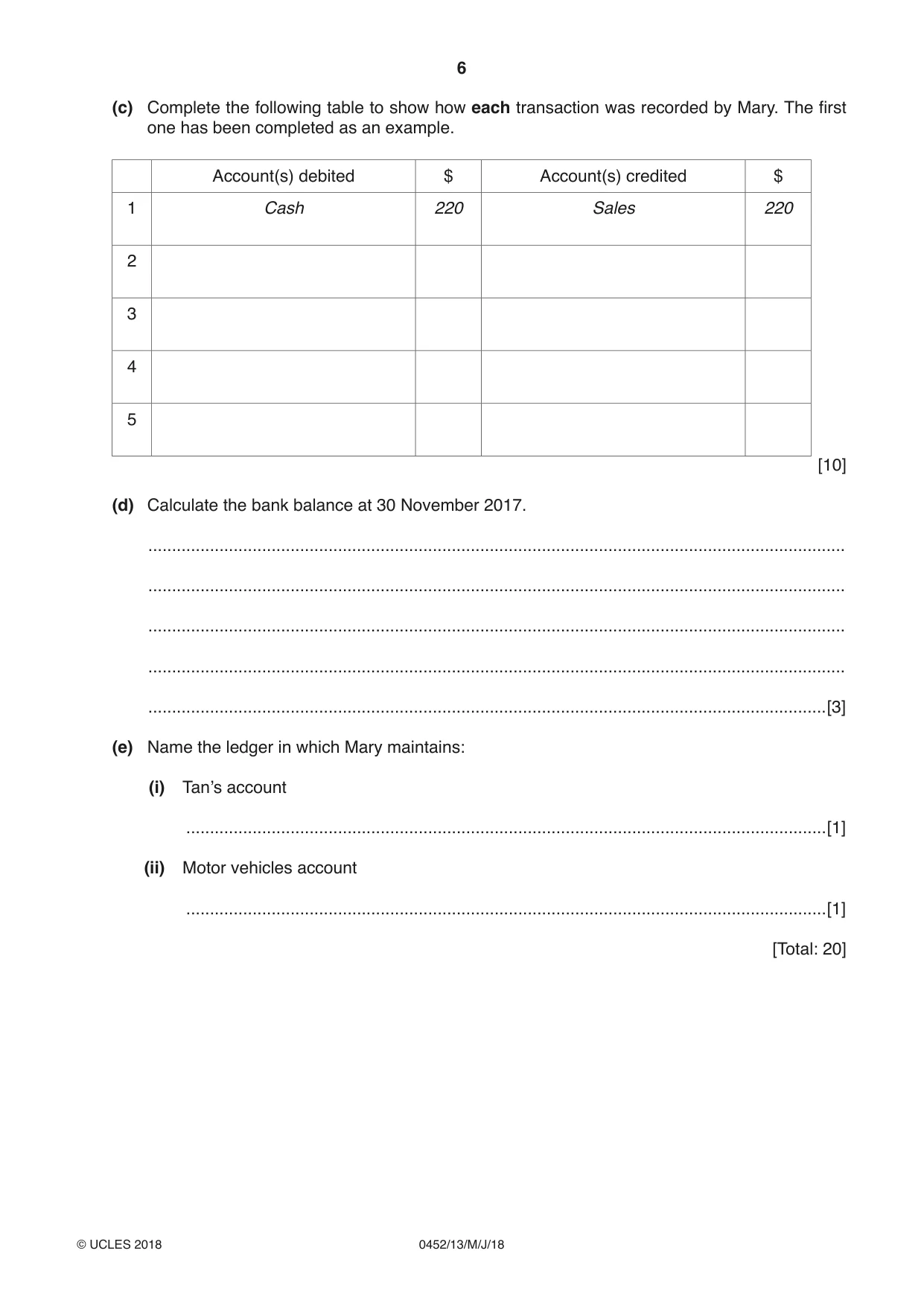
6 0452/13/M/J/18 © UCLES 2018 (c) Complete the following table to show how each transaction was recorded by Mary. The first one has been completed as an example. Account(s) debited $ Account(s) credited $ 1 Cash 220 Sales 220 2 3 4 5 [10] (d) Calculate the bank balance at 30 November 2017. … … … … …[3] (e) Name the ledger in which Mary maintains: (i) Tan’s account …[1] (ii) Motor vehicles account …[1] [Total: 20]
Question paper, page 7
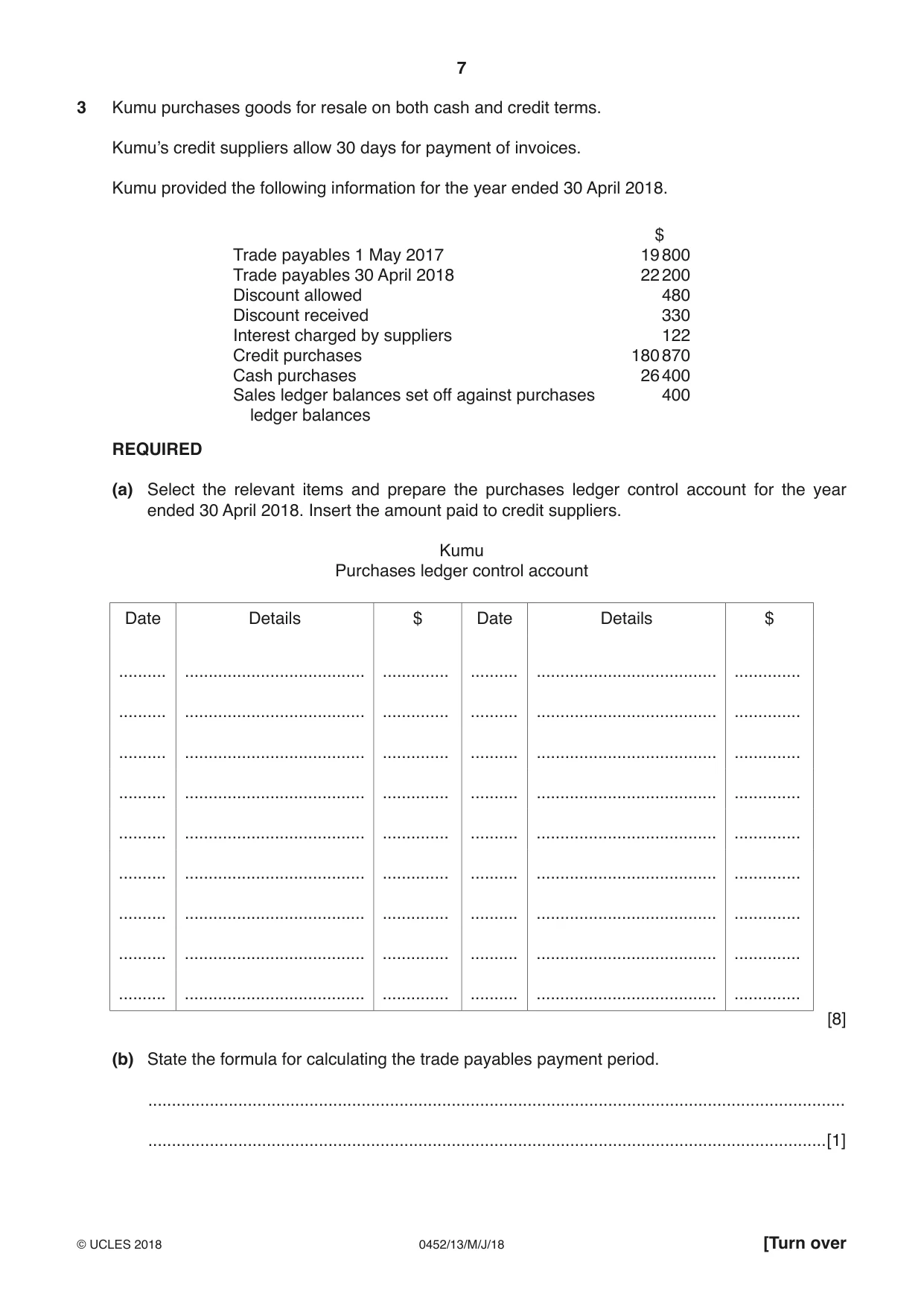
7 0452/13/M/J/18 © UCLES 2018 [Turn over 3 Kumu purchases goods for resale on both cash and credit terms. Kumu’s credit suppliers allow 30 days for payment of invoices. Kumu provided the following information for the year ended 30 April 2018. $ Trade payables 1 May 2017 19 800 Trade payables 30 April 2018 22 200 Discount allowed 480 Discount received 330 Interest charged by suppliers 122 Credit purchases 180 870 Cash purchases 26 400 Sales ledger balances set off against purchases ledger balances 400 REQUIRED (a) Select the relevant items and prepare the purchases ledger control account for the year ended 30 April 2018. Insert the amount paid to credit suppliers. Kumu Purchases ledger control account Date Details $ Date Details $ … … … … … … … … … … … … … … … … … … … … … … … … … … … … … … … … … … … … … … … … … … … … … … … … … … … … … … [8] (b) State the formula for calculating the trade payables payment period. … …[1]
Question paper, page 8
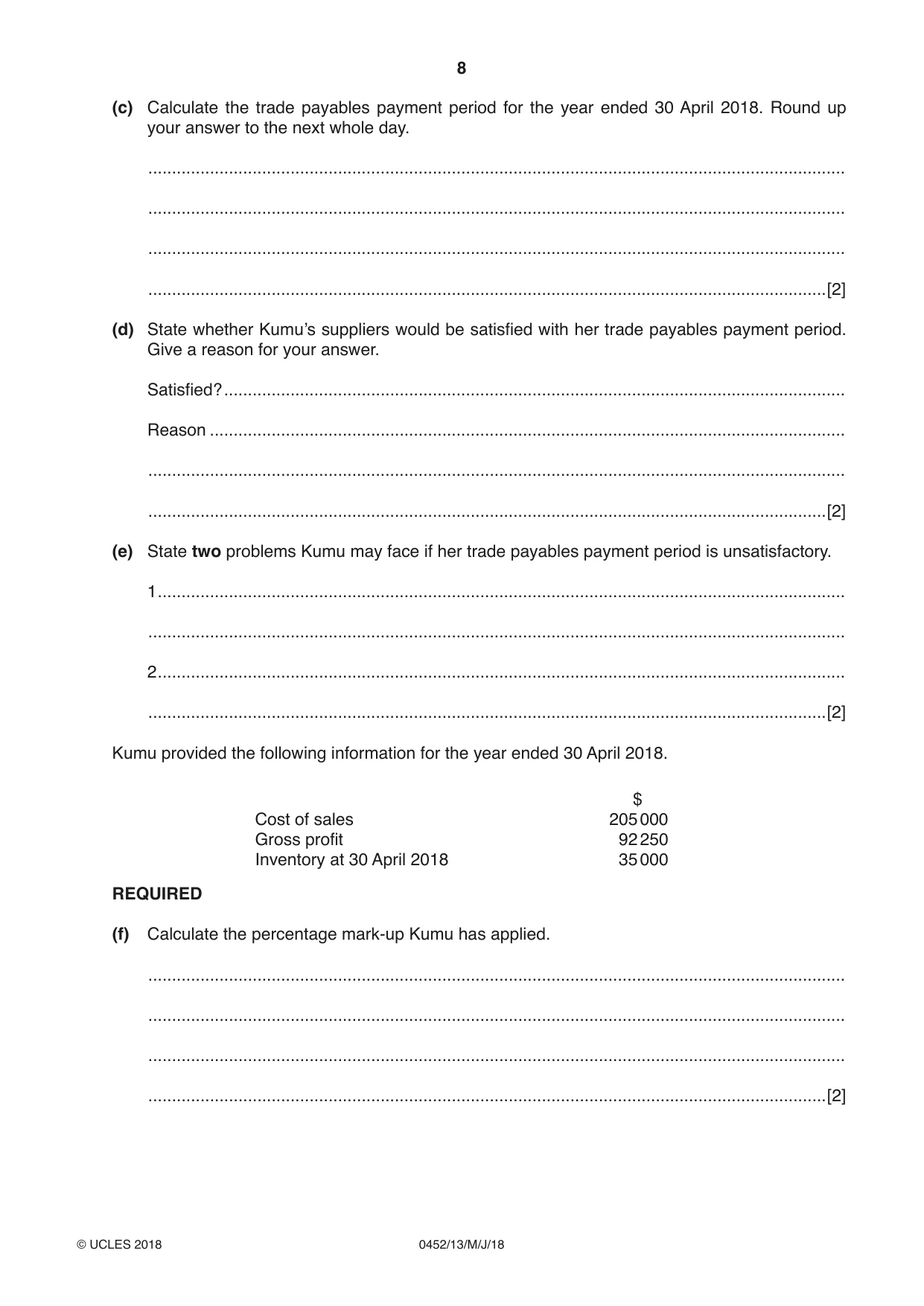
8 0452/13/M/J/18 © UCLES 2018 (c) Calculate the trade payables payment period for the year ended 30 April 2018. Round up your answer to the next whole day. … … … …[2] (d) State whether Kumu’s suppliers would be satisfied with her trade payables payment period. Give a reason for your answer. Satisfied? … Reason … … …[2] (e) State two problems Kumu may face if her trade payables payment period is unsatisfactory. 1 … … 2 … …[2] Kumu provided the following information for the year ended 30 April 2018. $ Cost of sales 205 000 Gross profit 92 250 Inventory at 30 April 2018 35 000 REQUIRED (f) Calculate the percentage mark-up Kumu has applied. … … … …[2]
Question paper, page 9
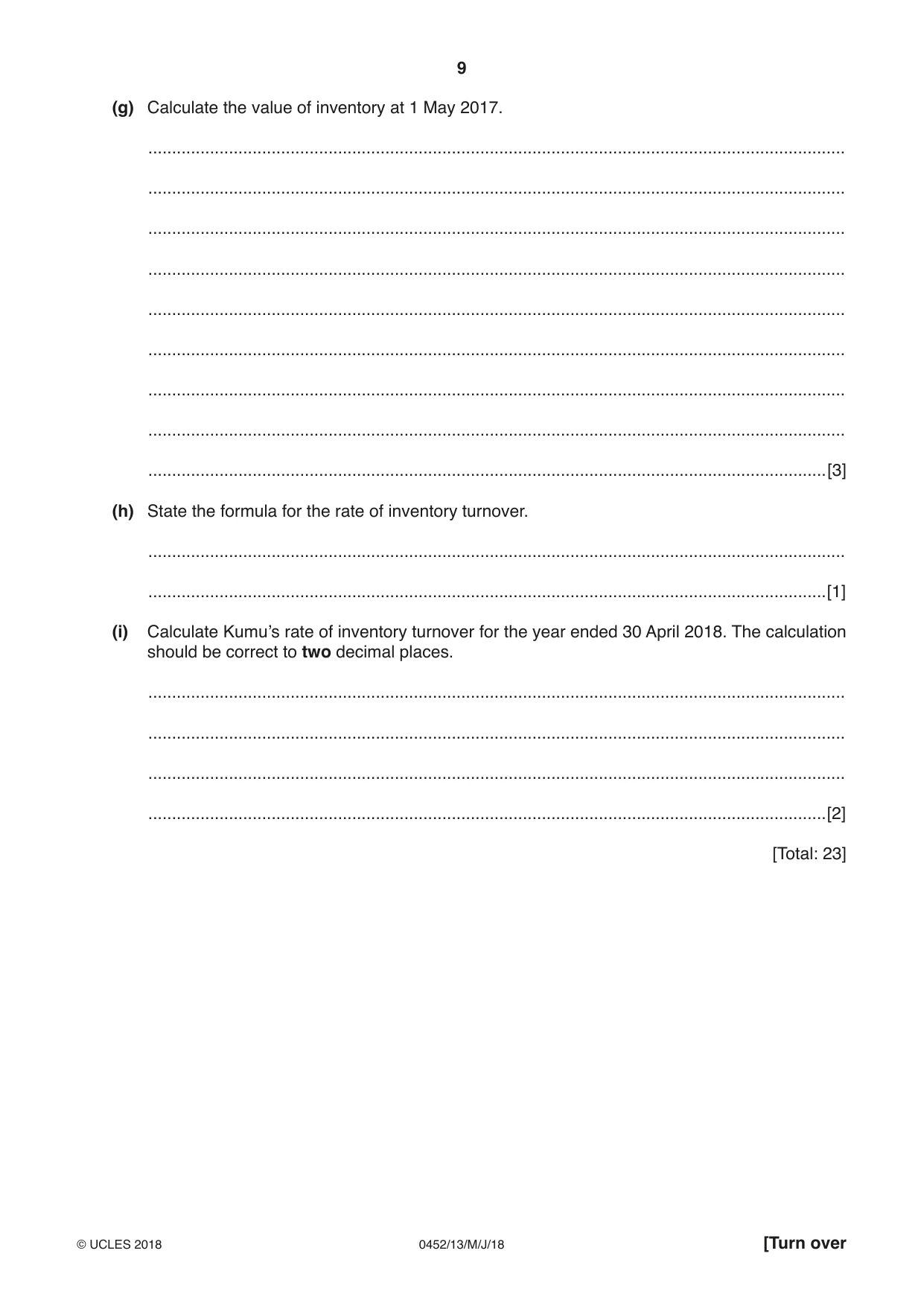
9 0452/13/M/J/18 © UCLES 2018 [Turn over (g) Calculate the value of inventory at 1 May 2017. … … … … … … … … …[3] (h) State the formula for the rate of inventory turnover. … …[1] (i) Calculate Kumu’s rate of inventory turnover for the year ended 30 April 2018. The calculation should be correct to two decimal places. … … … …[2] [Total: 23]
Question paper, page 10
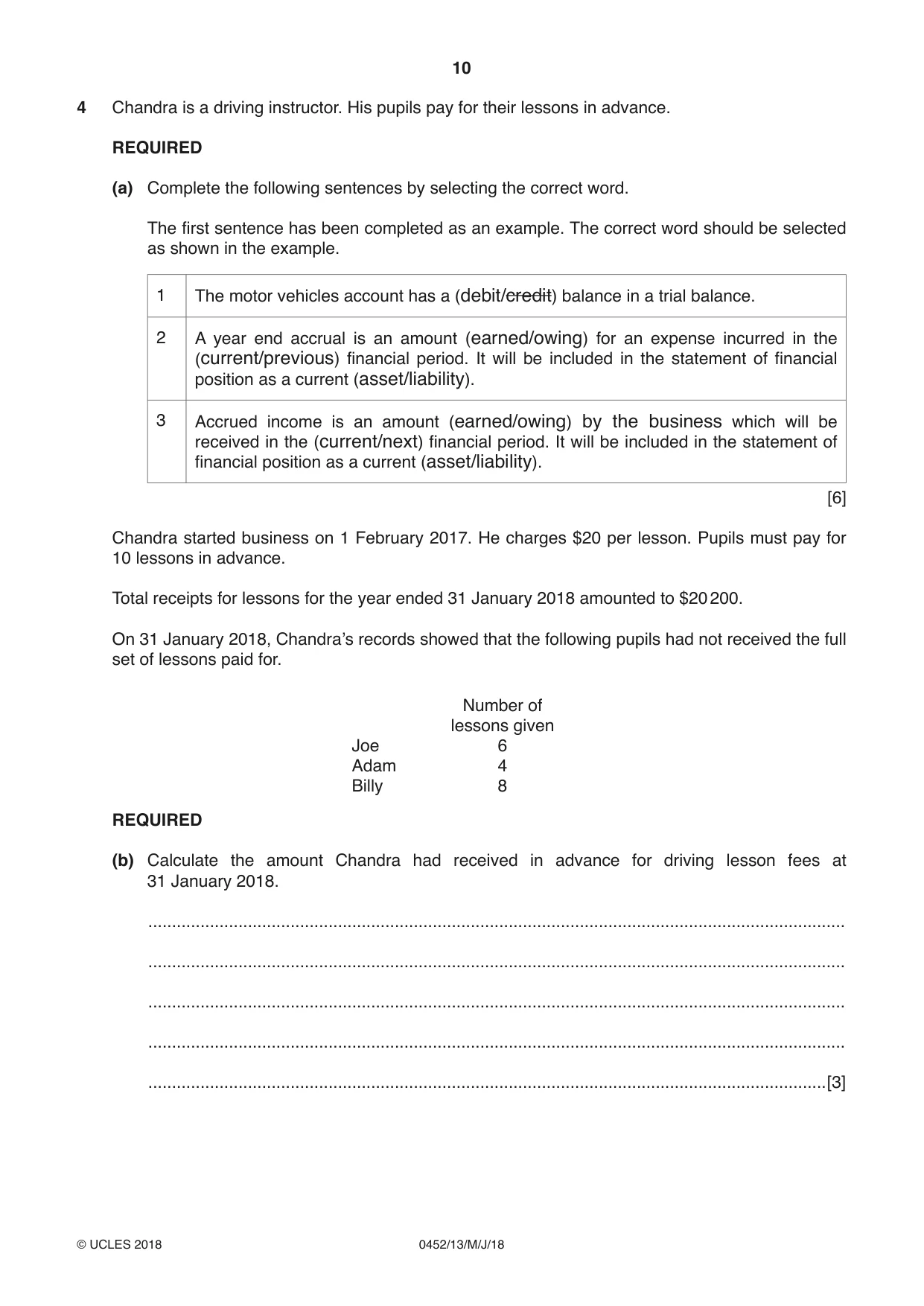
10 0452/13/M/J/18 © UCLES 2018 4 Chandra is a driving instructor. His pupils pay for their lessons in advance. REQUIRED (a) Complete the following sentences by selecting the correct word. The first sentence has been completed as an example. The correct word should be selected as shown in the example. 1 The motor vehicles account has a (debit/credit) balance in a trial balance. 2 A year end accrual is an amount (earned/owing) for an expense incurred in the (current/previous) financial period. It will be included in the statement of financial position as a current (asset/liability). 3 Accrued income is an amount (earned/owing) by the business which will be received in the (current/next) financial period. It will be included in the statement of financial position as a current (asset/liability). [6] Chandra started business on 1 February 2017. He charges $20 per lesson. Pupils must pay for 10 lessons in advance. Total receipts for lessons for the year ended 31 January 2018 amounted to $20 200. On 31 January 2018, Chandra’s records showed that the following pupils had not received the full set of lessons paid for. Number of lessons given Joe 6 Adam 4 Billy 8 REQUIRED (b) Calculate the amount Chandra had received in advance for driving lesson fees at 31 January 2018. … … … … …[3]
Question paper, page 11
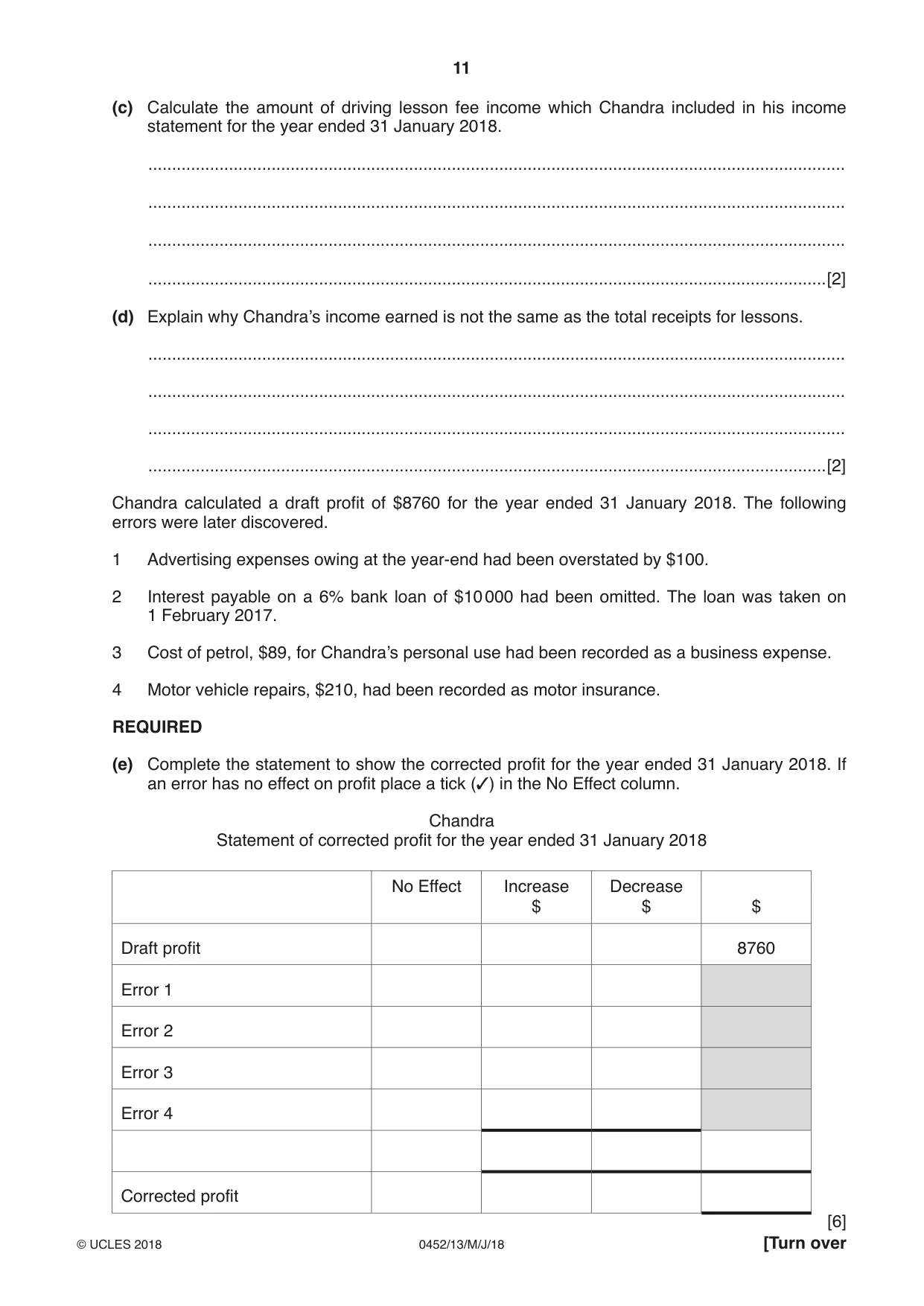
11 0452/13/M/J/18 © UCLES 2018 [Turn over (c) Calculate the amount of driving lesson fee income which Chandra included in his income statement for the year ended 31 January 2018. … … … …[2] (d) Explain why Chandra’s income earned is not the same as the total receipts for lessons. … … … …[2] Chandra calculated a draft profit of $8760 for the year ended 31 January 2018. The following errors were later discovered. 1 Advertising expenses owing at the year-end had been overstated by $100. 2 Interest payable on a 6% bank loan of $10 000 had been omitted. The loan was taken on 1 February 2017. 3 Cost of petrol, $89, for Chandra’s personal use had been recorded as a business expense. 4 Motor vehicle repairs, $210, had been recorded as motor insurance. REQUIRED (e) Complete the statement to show the corrected profit for the year ended 31 January 2018. If an error has no effect on profit place a tick (✓) in the No Effect column. Chandra Statement of corrected profit for the year ended 31 January 2018 No Effect Increase $ Decrease $ $ Draft profit 8760 Error 1 Error 2 Error 3 Error 4 Corrected profit [6]
Question paper, page 12
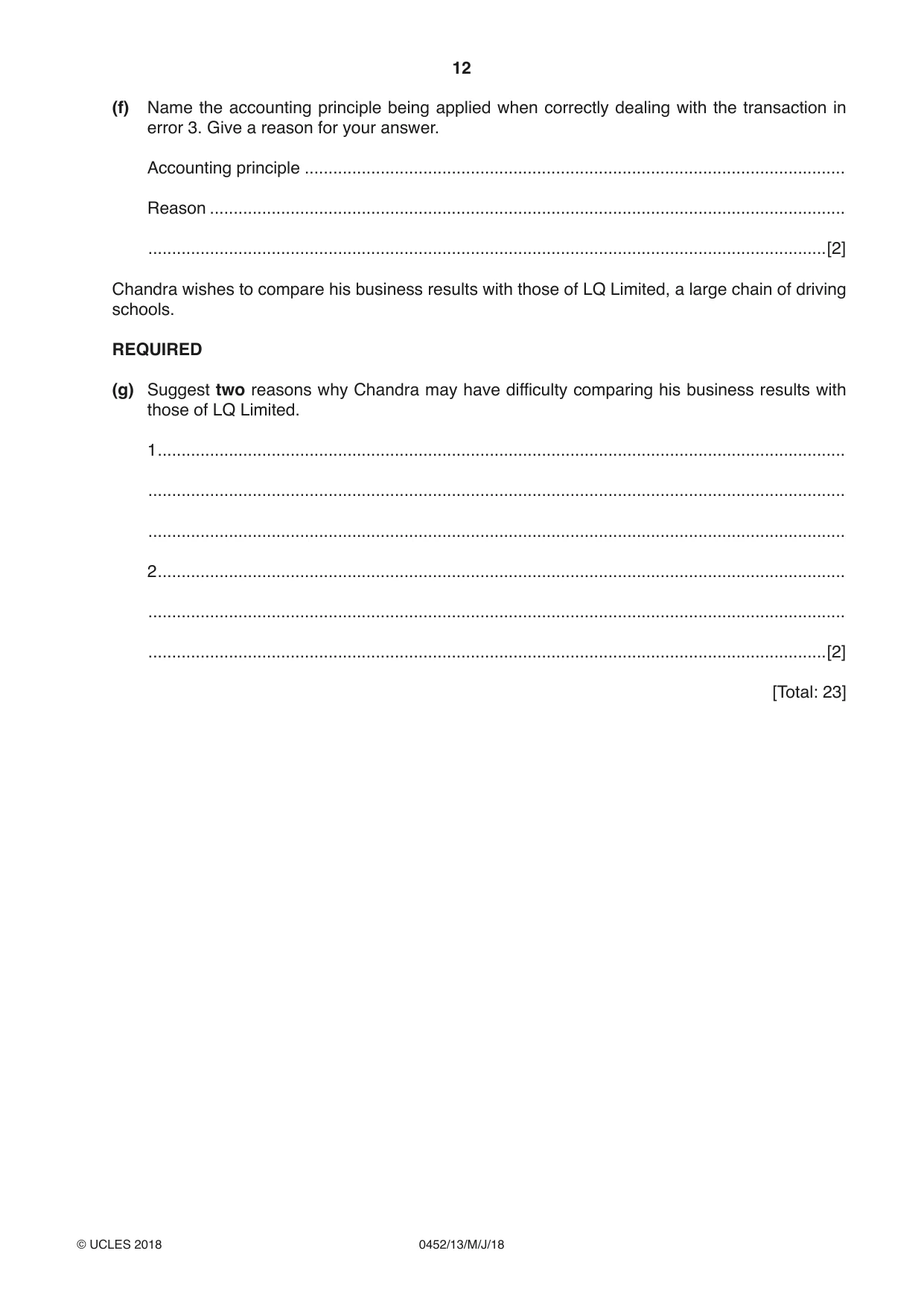
12 0452/13/M/J/18 © UCLES 2018 (f) Name the accounting principle being applied when correctly dealing with the transaction in error 3. Give a reason for your answer. Accounting principle … Reason … …[2] Chandra wishes to compare his business results with those of LQ Limited, a large chain of driving schools. REQUIRED (g) Suggest two reasons why Chandra may have difficulty comparing his business results with those of LQ Limited. 1 … … … 2 … … …[2] [Total: 23]
Question paper, page 13
13 0452/13/M/J/18 © UCLES 2018 [Turn over PLEASE TURN OVER
Question paper, page 14
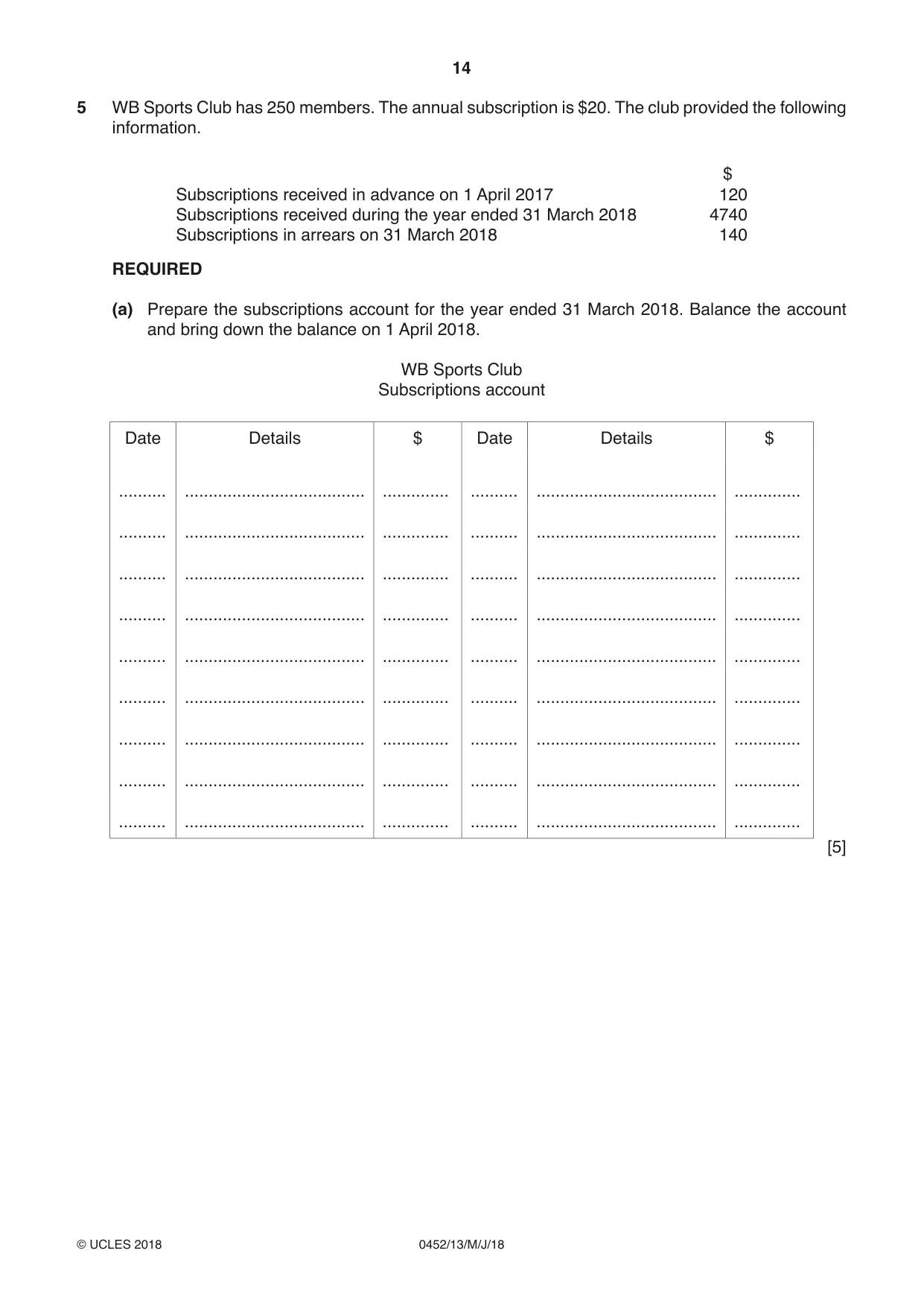
14 0452/13/M/J/18 © UCLES 2018 5 WB Sports Club has 250 members. The annual subscription is $20. The club provided the following information. $ Subscriptions received in advance on 1 April 2017 120 Subscriptions received during the year ended 31 March 2018 4740 Subscriptions in arrears on 31 March 2018 140 REQUIRED (a) Prepare the subscriptions account for the year ended 31 March 2018. Balance the account and bring down the balance on 1 April 2018. WB Sports Club Subscriptions account Date Details $ Date Details $ … … … … … … … … … … … … … … … … … … … … … … … … … … … … … … … … … … … … … … … … … … … … … … … … … … … … … … [5]
Question paper, page 15
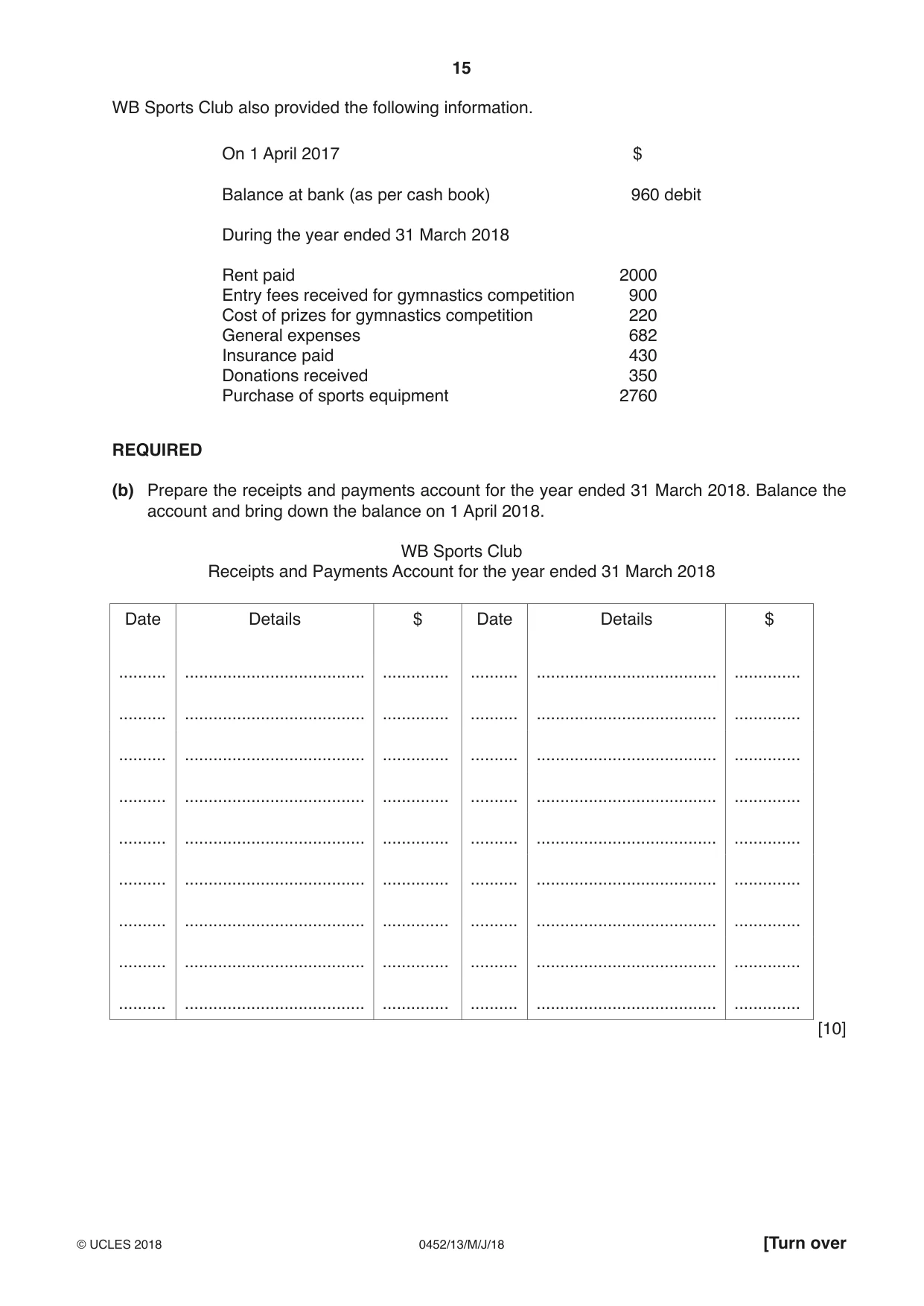
15 0452/13/M/J/18 © UCLES 2018 [Turn over WB Sports Club also provided the following information. On 1 April 2017 $ Balance at bank (as per cash book) 960 debit During the year ended 31 March 2018 Rent paid 2000 Entry fees received for gymnastics competition 900 Cost of prizes for gymnastics competition 220 General expenses 682 Insurance paid 430 Donations received 350 Purchase of sports equipment 2760 REQUIRED (b) Prepare the receipts and payments account for the year ended 31 March 2018. Balance the account and bring down the balance on 1 April 2018. WB Sports Club Receipts and Payments Account for the year ended 31 March 2018 Date Details $ Date Details $ … … … … … … … … … … … … … … … … … … … … … … … … … … … … … … … … … … … … … … … … … … … … … … … … … … … … … … [10]
Question paper, page 16
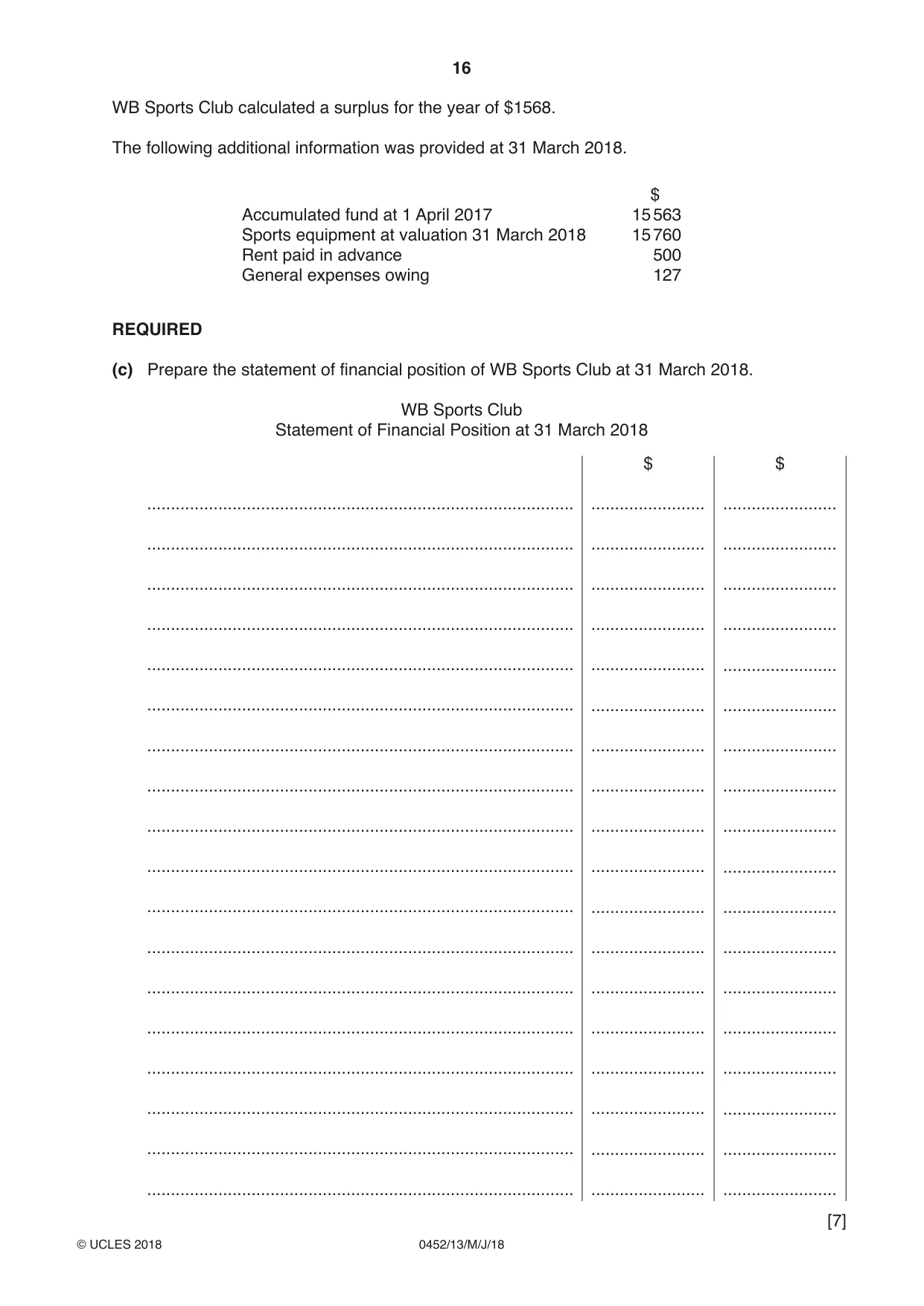
16 0452/13/M/J/18 © UCLES 2018 WB Sports Club calculated a surplus for the year of $1568. The following additional information was provided at 31 March 2018. $ Accumulated fund at 1 April 2017 15 563 Sports equipment at valuation 31 March 2018 15 760 Rent paid in advance 500 General expenses owing 127 REQUIRED (c) Prepare the statement of financial position of WB Sports Club at 31 March 2018. WB Sports Club Statement of Financial Position at 31 March 2018 … … … … … … … … … … … … … … … … … … $ … … … … … … … … … … … … … … … … … … $ … … … … … … … … … … … … … … … … … … [7]
Question paper, page 17
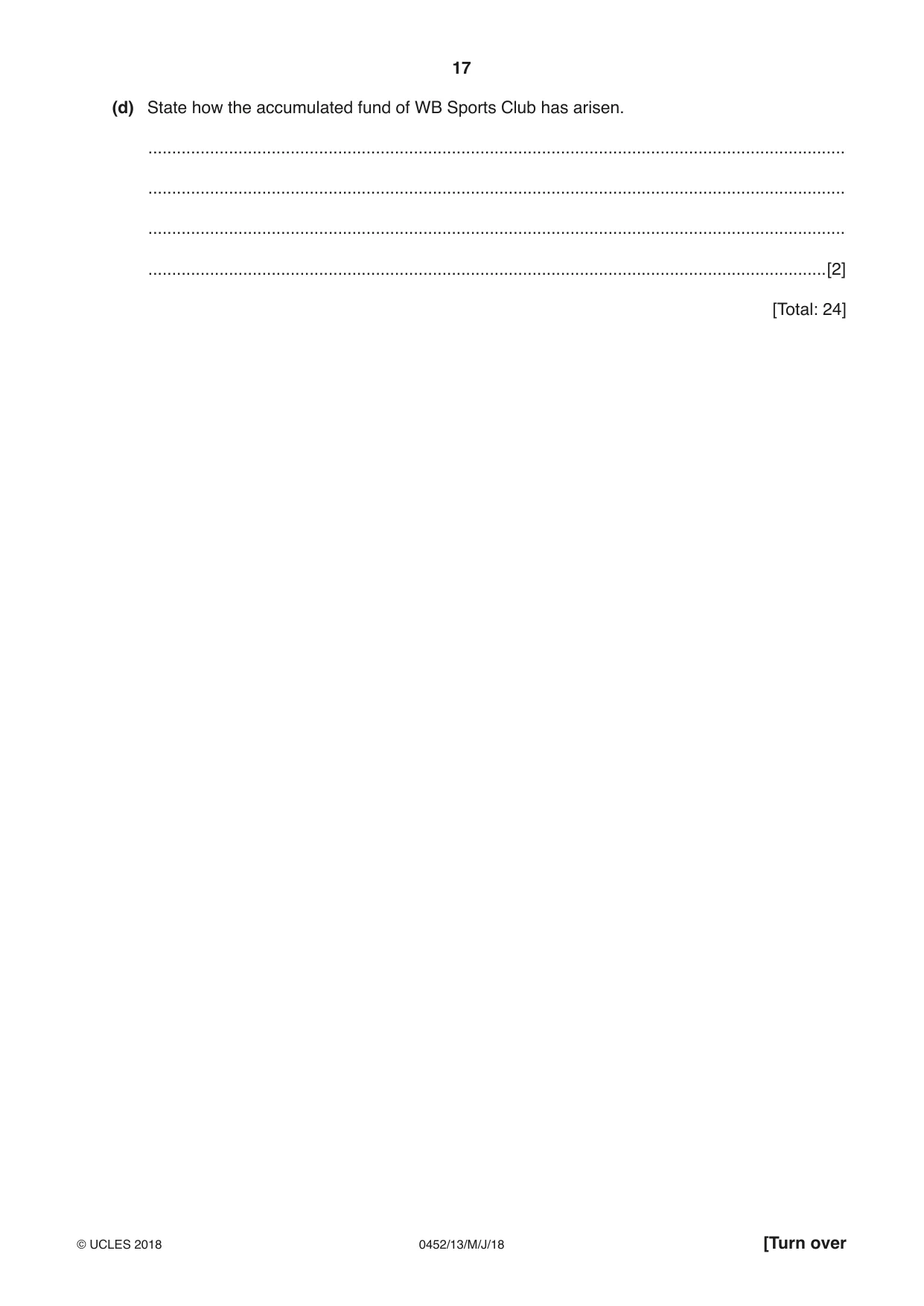
17 0452/13/M/J/18 © UCLES 2018 [Turn over (d) State how the accumulated fund of WB Sports Club has arisen. … … … …[2] [Total: 24]
Question paper, page 18
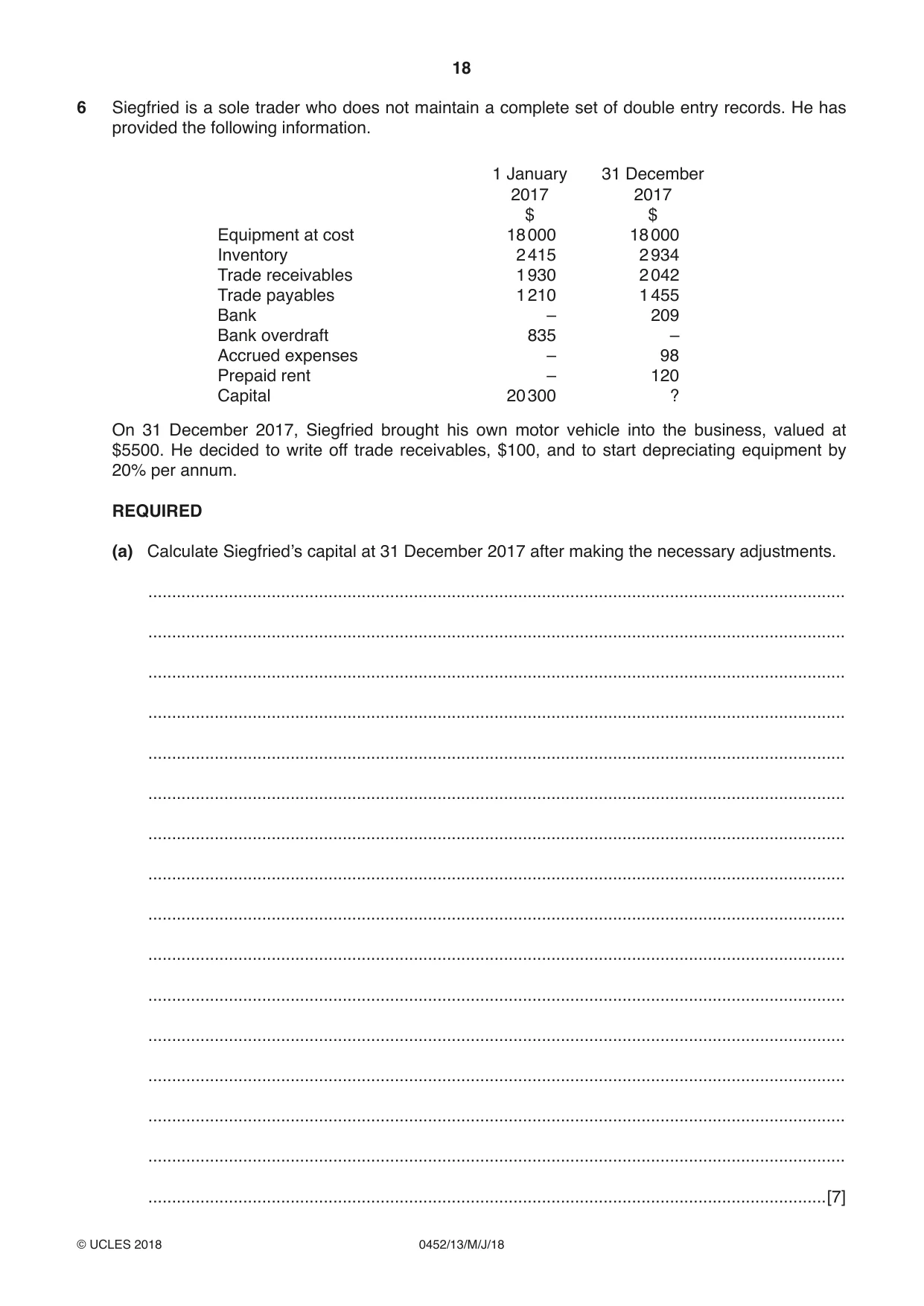
18 0452/13/M/J/18 © UCLES 2018 6 Siegfried is a sole trader who does not maintain a complete set of double entry records. He has provided the following information. 1 January 31 December 2017 2017 $ $ Equipment at cost 18 000 18 000 Inventory 2 415 2 934 Trade receivables 1 930 2 042 Trade payables 1 210 1 455 Bank – 209 Bank overdraft 835 – Accrued expenses – 98 Prepaid rent – 120 Capital 20 300 ? On 31 December 2017, Siegfried brought his own motor vehicle into the business, valued at $5500. He decided to write off trade receivables, $100, and to start depreciating equipment by 20% per annum. REQUIRED (a) Calculate Siegfried’s capital at 31 December 2017 after making the necessary adjustments. … … … … … … … … … … … … … … … …[7]
Question paper, page 19
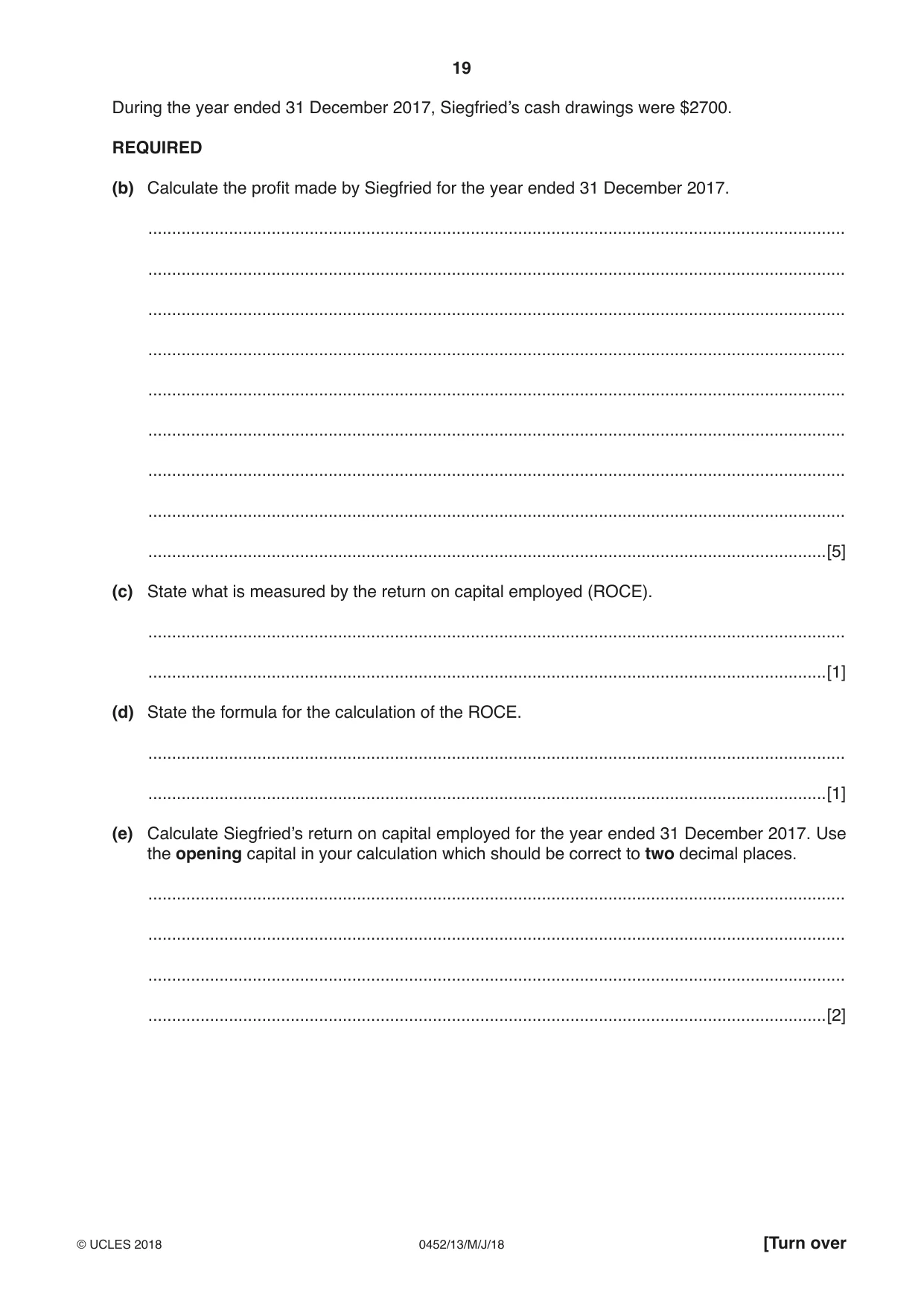
19 0452/13/M/J/18 © UCLES 2018 [Turn over During the year ended 31 December 2017, Siegfried’s cash drawings were $2700. REQUIRED (b) Calculate the profit made by Siegfried for the year ended 31 December 2017. … … … … … … … … …[5] (c) State what is measured by the return on capital employed (ROCE). … …[1] (d) State the formula for the calculation of the ROCE. … …[1] (e) Calculate Siegfried’s return on capital employed for the year ended 31 December 2017. Use the opening capital in your calculation which should be correct to two decimal places. … … … …[2]
Question paper, page 20
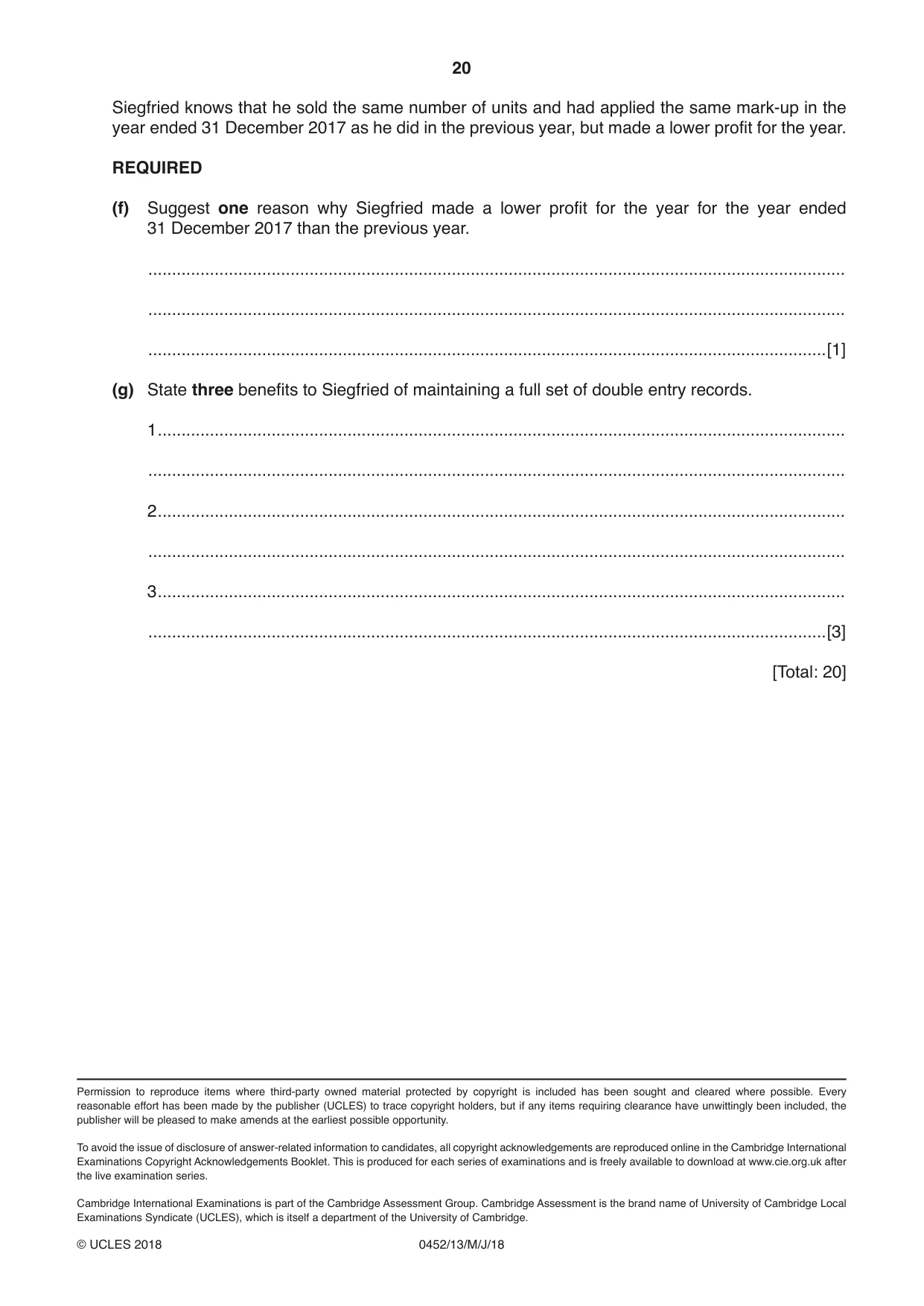
20 0452/13/M/J/18 © UCLES 2018 Permission to reproduce items where third-party owned material protected by copyright is included has been sought and cleared where possible. Every reasonable effort has been made by the publisher (UCLES) to trace copyright holders, but if any items requiring clearance have unwittingly been included, the publisher will be pleased to make amends at the earliest possible opportunity. To avoid the issue of disclosure of answer-related information to candidates, all copyright acknowledgements are reproduced online in the Cambridge International Examinations Copyright Acknowledgements Booklet. This is produced for each series of examinations and is freely available to download at www.cie.org.uk after the live examination series. Cambridge International Examinations is part of the Cambridge Assessment Group. Cambridge Assessment is the brand name of University of Cambridge Local Examinations Syndicate (UCLES), which is itself a department of the University of Cambridge. Siegfried knows that he sold the same number of units and had applied the same mark-up in the year ended 31 December 2017 as he did in the previous year, but made a lower profit for the year. REQUIRED (f) Suggest one reason why Siegfried made a lower profit for the year for the year ended 31 December 2017 than the previous year. … … …[1] (g) State three benefits to Siegfried of maintaining a full set of double entry records. 1 … … 2 … … 3 … …[3] [Total: 20]
Mark scheme, page 1
IGCSE™ is a registered trademark. This document consists of 14 printed pages. © UCLES 2018 [Turn over Cambridge Assessment International Education Cambridge International General Certificate of Secondary Education ACCOUNTING 0452/13 Paper 1 May/June 2018 MARK SCHEME Maximum Mark: 120 Published This mark scheme is published as an aid to teachers and candidates, to indicate the requirements of the examination. It shows the basis on which Examiners were instructed to award marks. It does not indicate the details of the discussions that took place at an Examiners’ meeting before marking began, which would have considered the acceptability of alternative answers. Mark schemes should be read in conjunction with the question paper and the Principal Examiner Report for Teachers. Cambridge International will not enter into discussions about these mark schemes. Cambridge International is publishing the mark schemes for the May/June 2018 series for most Cambridge IGCSE™, Cambridge International A and AS Level and Cambridge Pre-U components, and some Cambridge O Level components.
Mark scheme, page 2
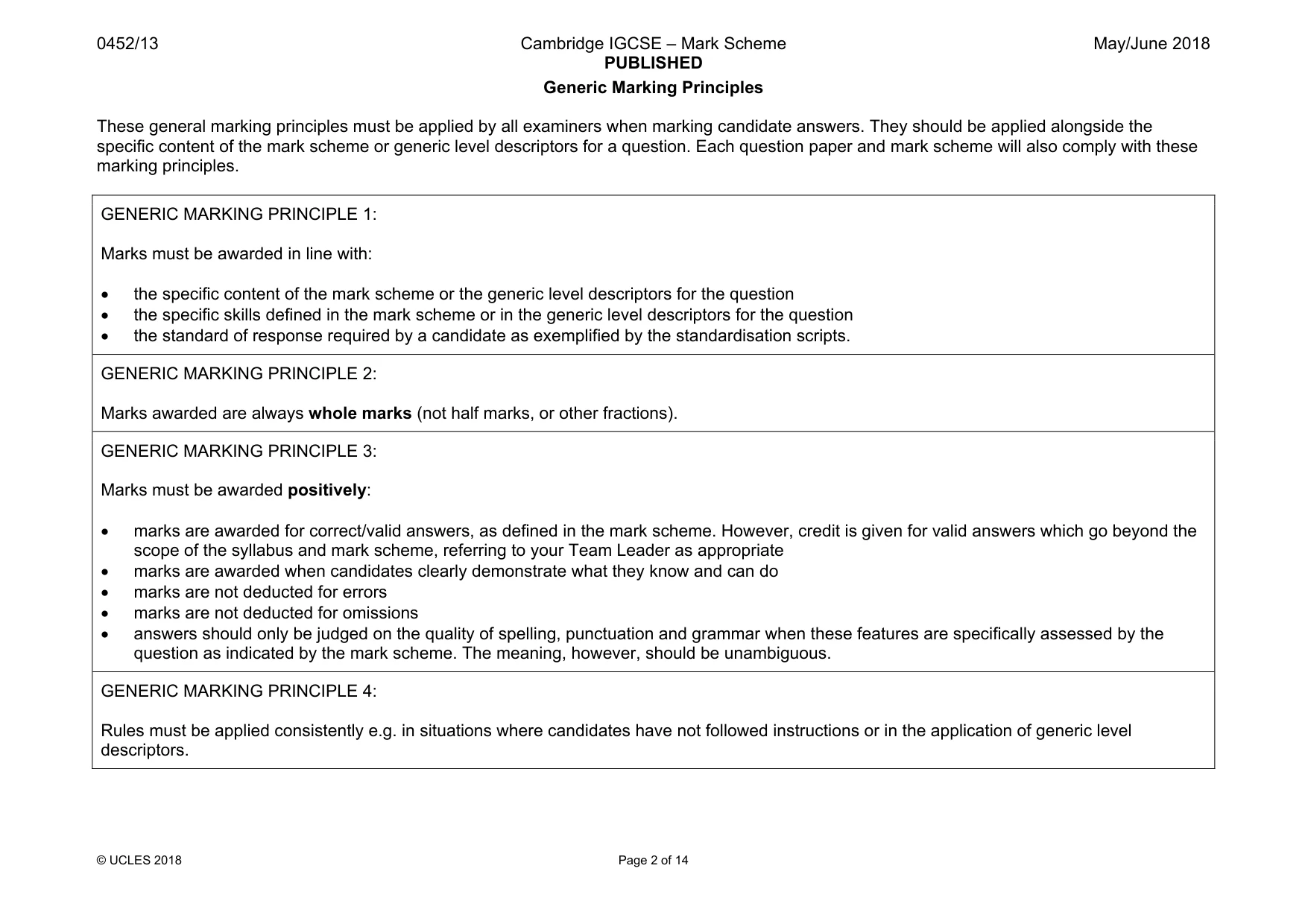
0452/13 Cambridge IGCSE – Mark Scheme PUBLISHED May/June 2018 © UCLES 2018 Page 2 of 14 Generic Marking Principles These general marking principles must be applied by all examiners when marking candidate answers. They should be applied alongside the specific content of the mark scheme or generic level descriptors for a question. Each question paper and mark scheme will also comply with these marking principles. GENERIC MARKING PRINCIPLE 1: Marks must be awarded in line with: • the specific content of the mark scheme or the generic level descriptors for the question • the specific skills defined in the mark scheme or in the generic level descriptors for the question • the standard of response required by a candidate as exemplified by the standardisation scripts. GENERIC MARKING PRINCIPLE 2: Marks awarded are always whole marks (not half marks, or other fractions). GENERIC MARKING PRINCIPLE 3: Marks must be awarded positively: • marks are awarded for correct/valid answers, as defined in the mark scheme. However, credit is given for valid answers which go beyond the scope of the syllabus and mark scheme, referring to your Team Leader as appropriate • marks are awarded when candidates clearly demonstrate what they know and can do • marks are not deducted for errors • marks are not deducted for omissions • answers should only be judged on the quality of spelling, punctuation and grammar when these features are specifically assessed by the question as indicated by the mark scheme. The meaning, however, should be unambiguous. GENERIC MARKING PRINCIPLE 4: Rules must be applied consistently e.g. in situations where candidates have not followed instructions or in the application of generic level descriptors.
Mark scheme, page 3
0452/13 Cambridge IGCSE – Mark Scheme PUBLISHED May/June 2018 © UCLES 2018 Page 3 of 14 GENERIC MARKING PRINCIPLE 5: Marks should be awarded using the full range of marks defined in the mark scheme for the question (however; the use of the full mark range may be limited according to the quality of the candidate responses seen). GENERIC MARKING PRINCIPLE 6: Marks awarded are based solely on the requirements as defined in the mark scheme. Marks should not be awarded with grade thresholds or grade descriptors in mind.
Mark scheme, page 4
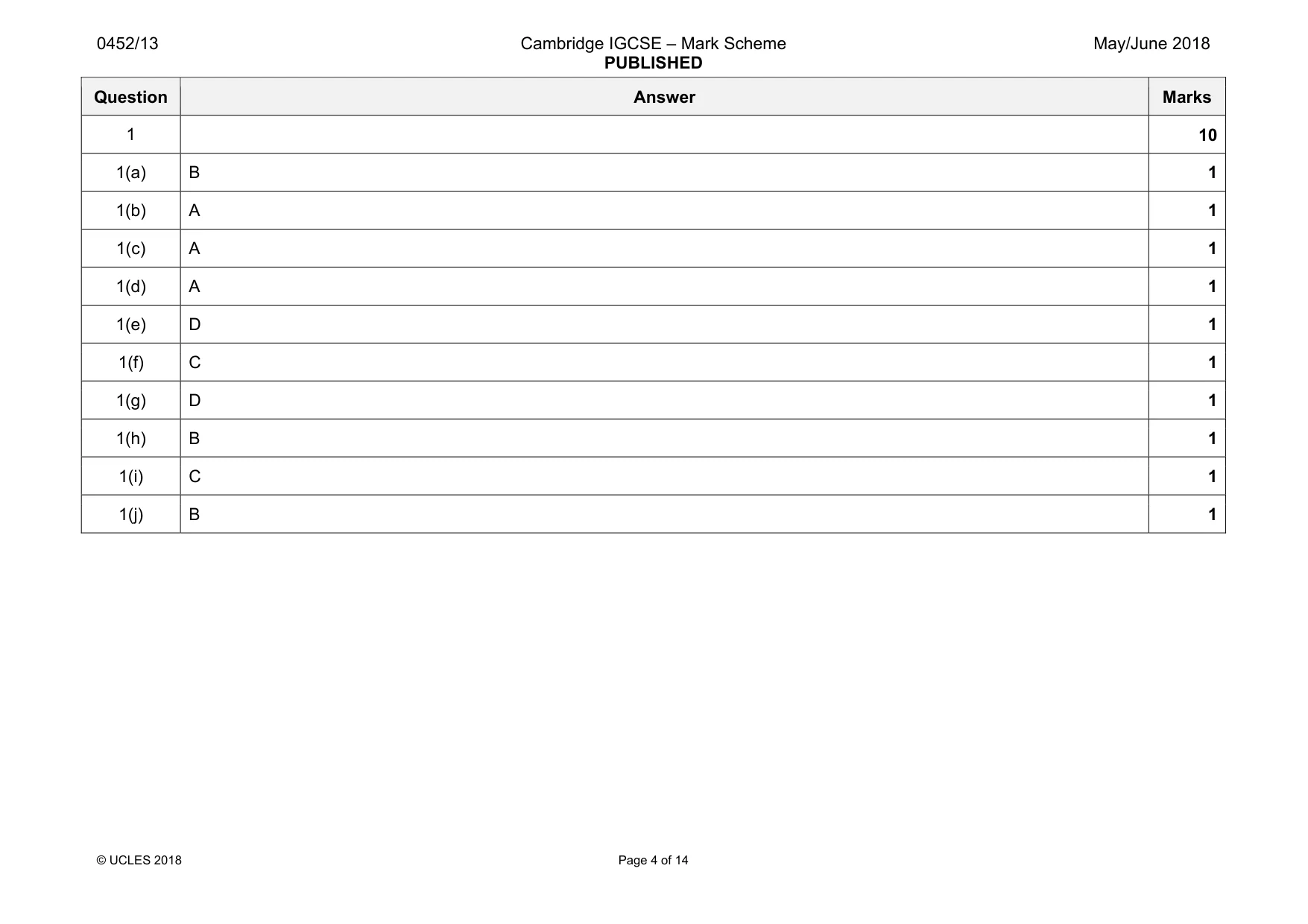
0452/13 Cambridge IGCSE – Mark Scheme PUBLISHED May/June 2018 © UCLES 2018 Page 4 of 14 Question Answer Marks 1 10 1(a) B 1 1(b) A 1 1(c) A 1 1(d) A 1 1(e) D 1 1(f) C 1 1(g) D 1 1(h) B 1 1(i) C 1 1(j) B 1
Mark scheme, page 5
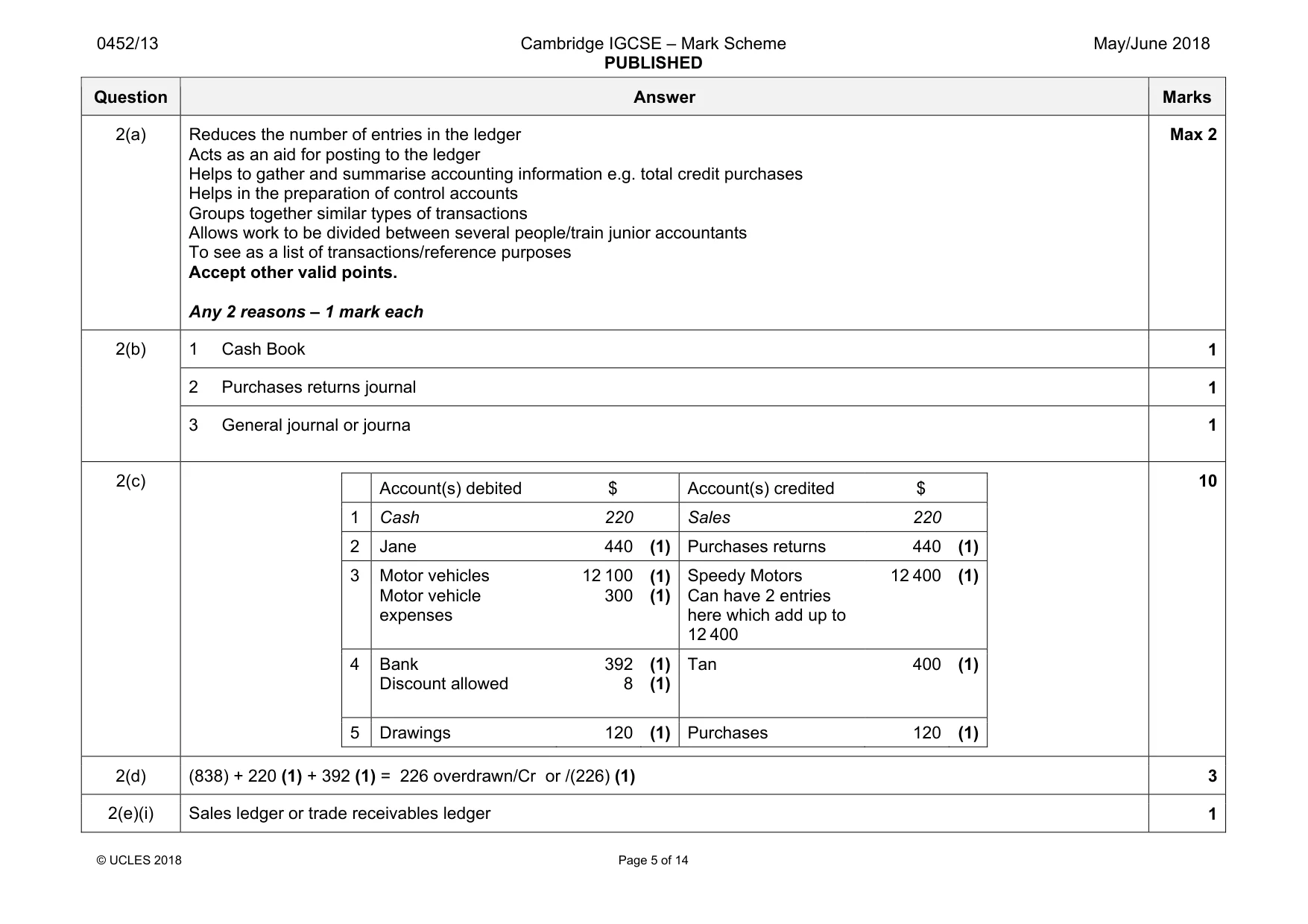
0452/13 Cambridge IGCSE – Mark Scheme PUBLISHED May/June 2018 © UCLES 2018 Page 5 of 14 Question Answer Marks 2(a) Reduces the number of entries in the ledger Acts as an aid for posting to the ledger Helps to gather and summarise accounting information e.g. total credit purchases Helps in the preparation of control accounts Groups together similar types of transactions Allows work to be divided between several people/train junior accountants To see as a list of transactions/reference purposes Accept other valid points. Any 2 reasons – 1 mark each Max 2 2(b) 1 Cash Book 1 2 Purchases returns journal 1 3 General journal or journa 1 2(c) Account(s) debited $ Account(s) credited $ 1 Cash 220 Sales 220 2 Jane 440 (1) Purchases returns 440 (1) 3 Motor vehicles Motor vehicle expenses 12 100 300 (1) (1) Speedy Motors Can have 2 entries here which add up to 12 400 12 400 (1) 4 Bank Discount allowed 392 8 (1) (1) Tan 400 (1) 5 Drawings 120 (1) Purchases 120 (1) 10 2(d) (838) + 220 (1) + 392 (1) = 226 overdrawn/Cr or /(226) (1) 3 2(e)(i) Sales ledger or trade receivables ledger 1
Mark scheme, page 6
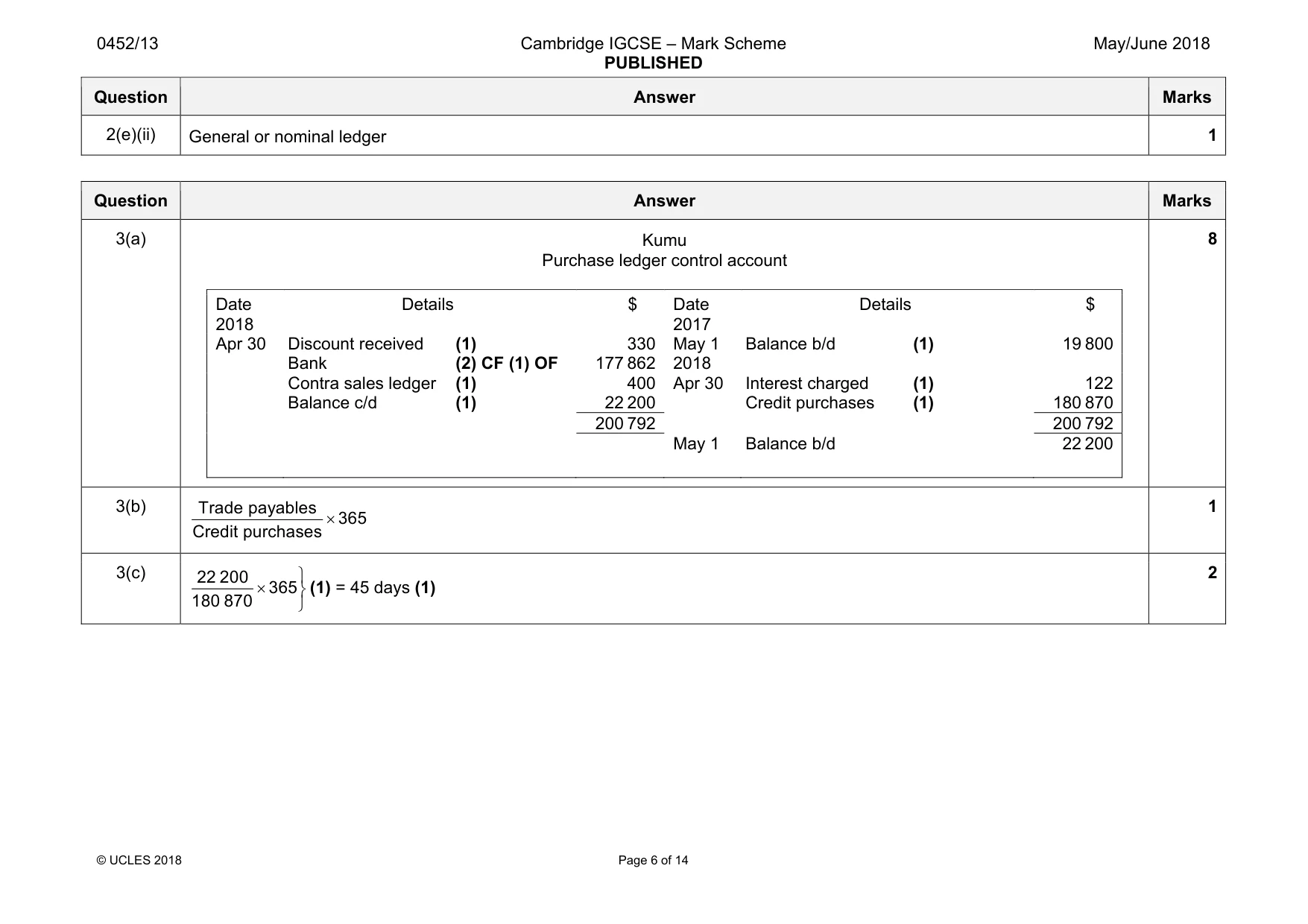
0452/13 Cambridge IGCSE – Mark Scheme PUBLISHED May/June 2018 © UCLES 2018 Page 6 of 14 Question Answer Marks 2(e)(ii) General or nominal ledger 1 Question Answer Marks 3(a) Kumu Purchase ledger control account Date 2018 Details $ Date 2017 Details $ Apr 30 Discount received (1) 330 May 1 Balance b/d (1) 19 800 Bank (2) CF (1) OF 177 862 2018 Contra sales ledger (1) 400 Apr 30 Interest charged (1) 122 Balance c/d (1) 22 200 Credit purchases (1) 180 870 200 792 200 792 May 1 Balance b/d 22 200 8 3(b) × Trade payables 365 Credit purchases 1 3(c) × 22 200 365 180 870 (1) = 45 days (1) 2
Mark scheme, page 7
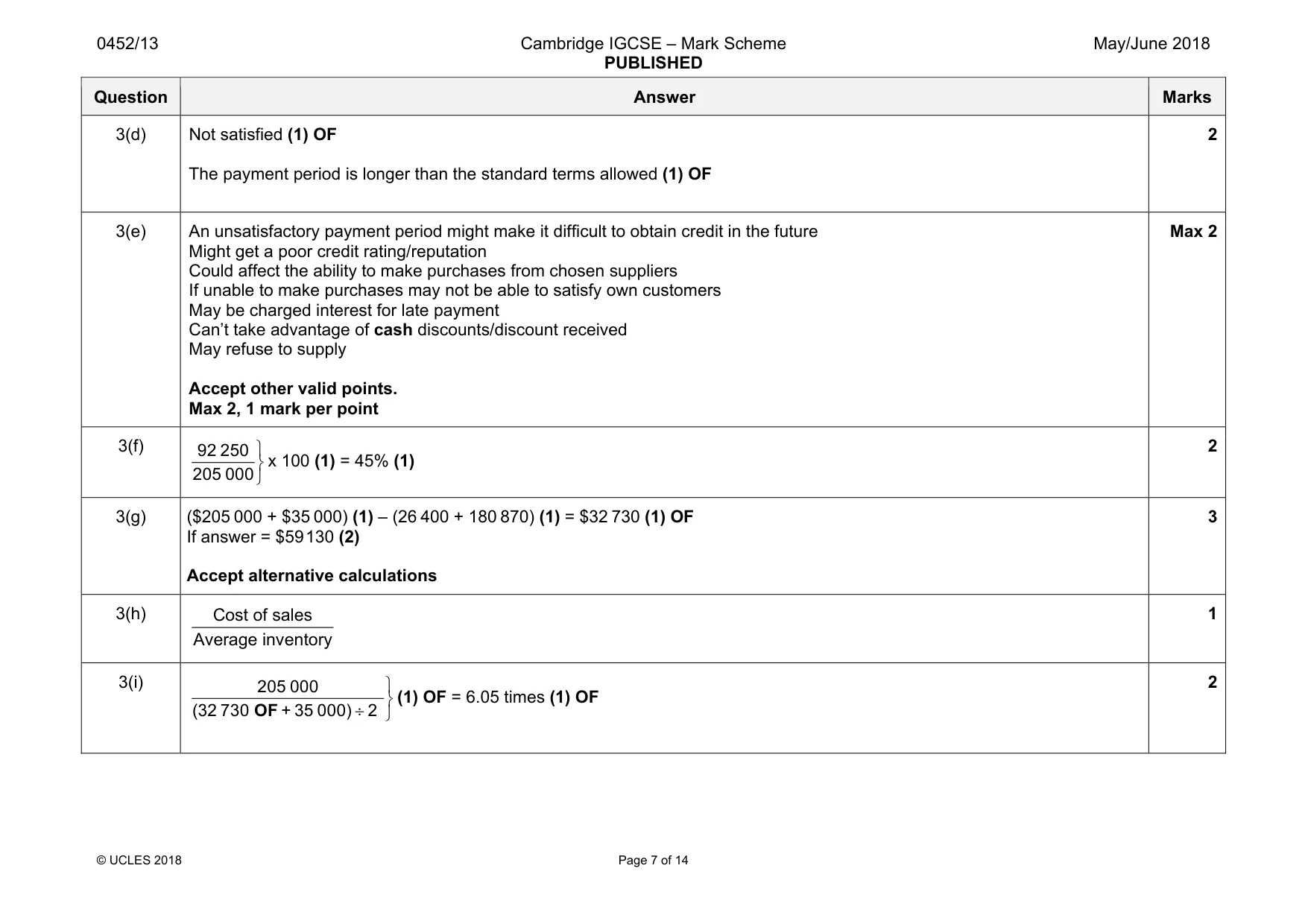
0452/13 Cambridge IGCSE – Mark Scheme PUBLISHED May/June 2018 © UCLES 2018 Page 7 of 14 Question Answer Marks 3(d) Not satisfied (1) OF The payment period is longer than the standard terms allowed (1) OF 2 3(e) An unsatisfactory payment period might make it difficult to obtain credit in the future Might get a poor credit rating/reputation Could affect the ability to make purchases from chosen suppliers If unable to make purchases may not be able to satisfy own customers May be charged interest for late payment Can’t take advantage of cash discounts/discount received May refuse to supply Accept other valid points. Max 2, 1 mark per point Max 2 3(f) 92 250 205 000 x 100 (1) = 45% (1) 2 3(g) ($205 000 + $35 000) (1) – (26 400 + 180 870) (1) = $32 730 (1) OF If answer = $59 130 (2) Accept alternative calculations 3 3(h) Cost of sales Average inventory 1 3(i) ÷ 205 000 (32 730 + 35 000) 2 OF (1) OF = 6.05 times (1) OF 2
Mark scheme, page 8
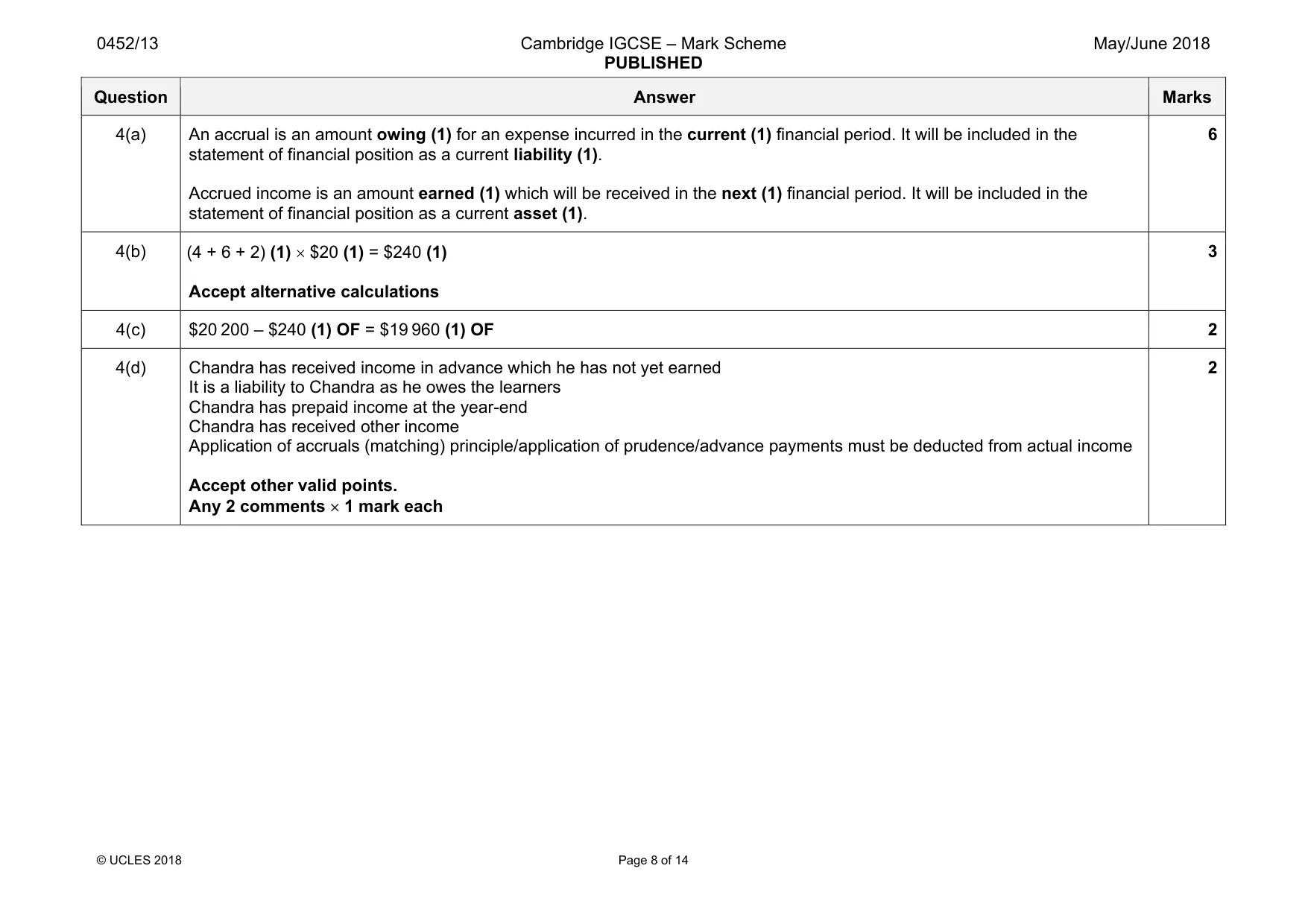
0452/13 Cambridge IGCSE – Mark Scheme PUBLISHED May/June 2018 © UCLES 2018 Page 8 of 14 Question Answer Marks 4(a) An accrual is an amount owing (1) for an expense incurred in the current (1) financial period. It will be included in the statement of financial position as a current liability (1). Accrued income is an amount earned (1) which will be received in the next (1) financial period. It will be included in the statement of financial position as a current asset (1). 6 4(b) (4 + 6 + 2) (1) × $20 (1) = $240 (1) Accept alternative calculations 3 4(c) $20 200 – $240 (1) OF = $19 960 (1) OF 2 4(d) Chandra has received income in advance which he has not yet earned It is a liability to Chandra as he owes the learners Chandra has prepaid income at the year-end Chandra has received other income Application of accruals (matching) principle/application of prudence/advance payments must be deducted from actual income Accept other valid points. Any 2 comments × 1 mark each 2
Mark scheme, page 9
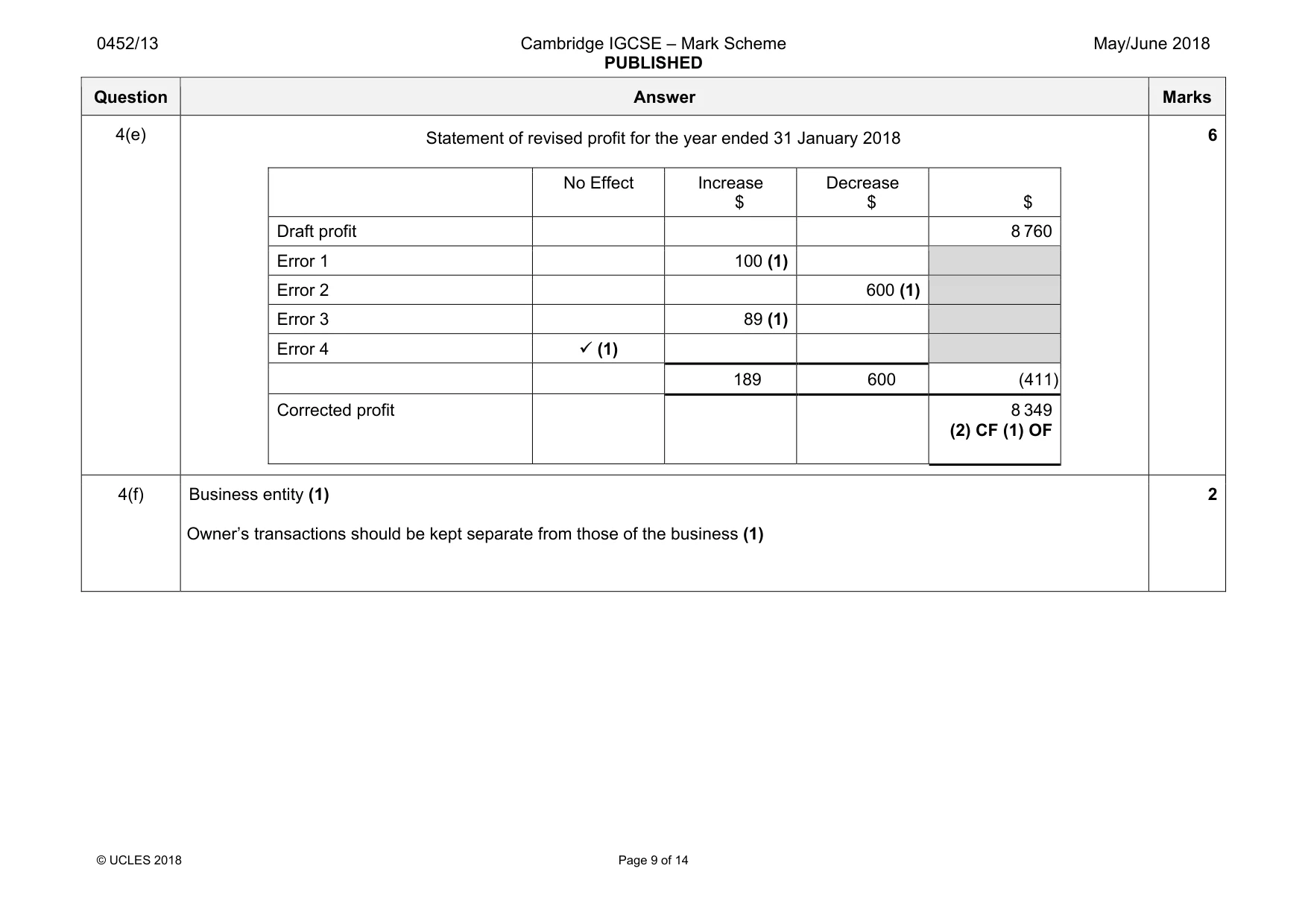
0452/13 Cambridge IGCSE – Mark Scheme PUBLISHED May/June 2018 © UCLES 2018 Page 9 of 14 Question Answer Marks 4(e) Statement of revised profit for the year ended 31 January 2018 No Effect Increase $ Decrease $ $ Draft profit 8 760 Error 1 100 (1) Error 2 600 (1) Error 3 89 (1) Error 4 9 (1) 189 600 (411) Corrected profit 8 349 (2) CF (1) OF 6 4(f) Business entity (1) Owner’s transactions should be kept separate from those of the business (1) 2
Mark scheme, page 10
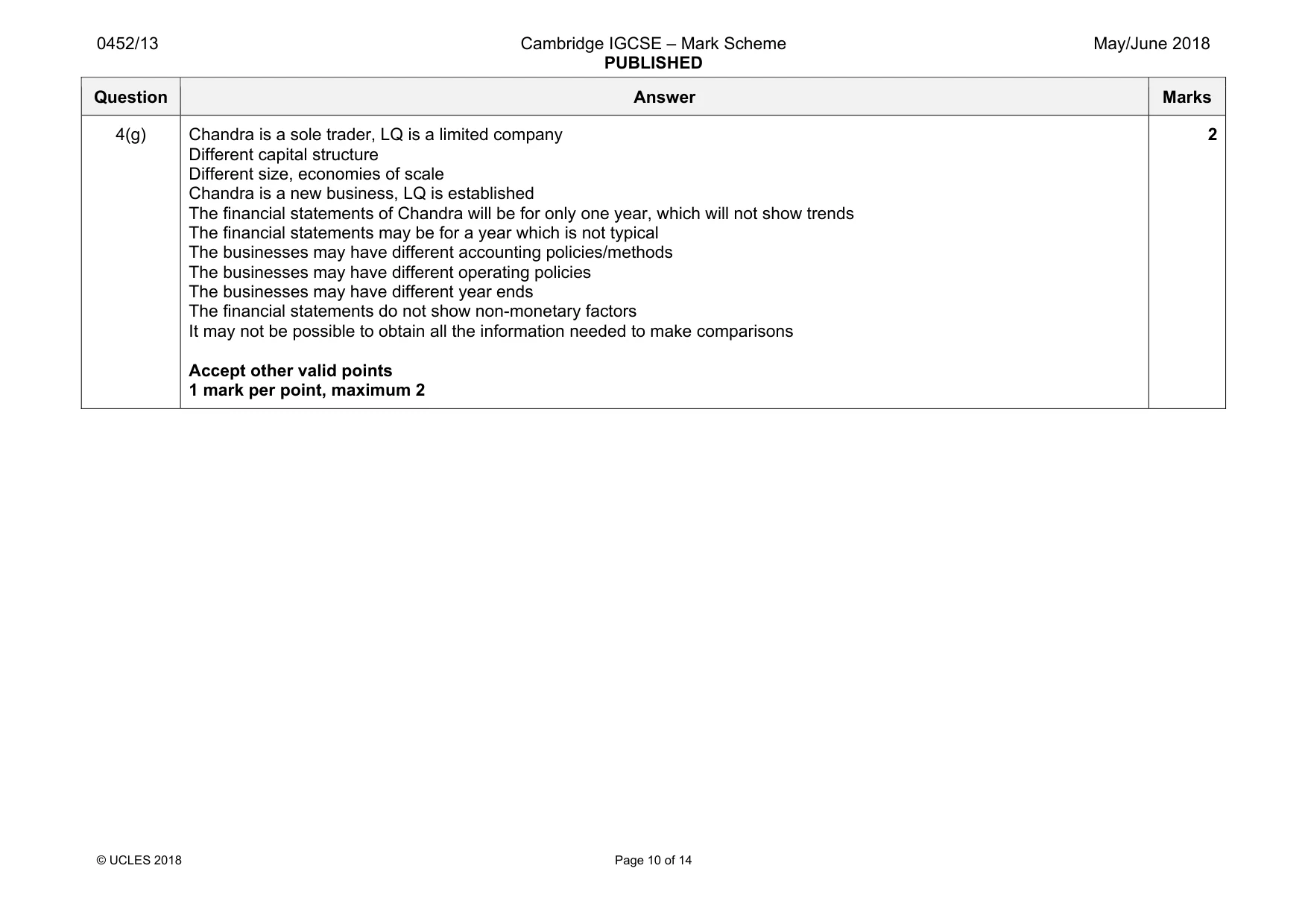
0452/13 Cambridge IGCSE – Mark Scheme PUBLISHED May/June 2018 © UCLES 2018 Page 10 of 14 Question Answer Marks 4(g) Chandra is a sole trader, LQ is a limited company Different capital structure Different size, economies of scale Chandra is a new business, LQ is established The financial statements of Chandra will be for only one year, which will not show trends The financial statements may be for a year which is not typical The businesses may have different accounting policies/methods The businesses may have different operating policies The businesses may have different year ends The financial statements do not show non-monetary factors It may not be possible to obtain all the information needed to make comparisons Accept other valid points 1 mark per point, maximum 2 2
Mark scheme, page 11
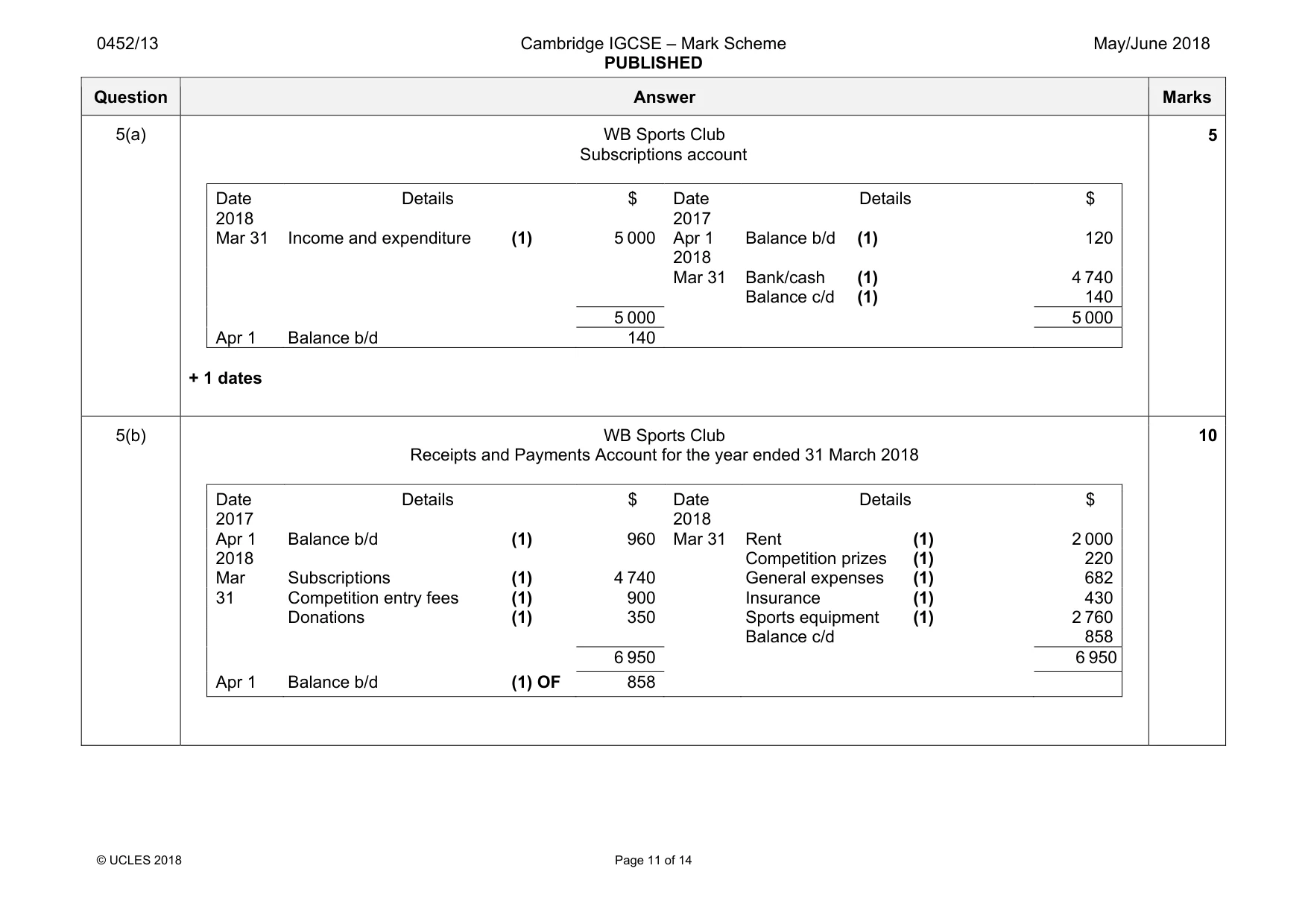
0452/13 Cambridge IGCSE – Mark Scheme PUBLISHED May/June 2018 © UCLES 2018 Page 11 of 14 Question Answer Marks 5(a) WB Sports Club Subscriptions account Date 2018 Details $ Date 2017 Details $ Mar 31 Income and expenditure (1) 5 000 Apr 1 Balance b/d (1) 120 2018 Mar 31 Bank/cash (1) 4 740 Balance c/d (1) 140 5 000 5 000 Apr 1 Balance b/d 140 + 1 dates 5 5(b) WB Sports Club Receipts and Payments Account for the year ended 31 March 2018 Date 2017 Details $ Date 2018 Details $ Apr 1 Balance b/d (1) 960 Mar 31 Rent (1) 2 000 2018 Competition prizes (1) 220 Mar Subscriptions (1) 4 740 General expenses (1) 682 31 Competition entry fees (1) 900 Insurance (1) 430 Donations (1) 350 Sports equipment (1) 2 760 Balance c/d 858 6 950 6 950 Apr 1 Balance b/d (1) OF 858 10
Mark scheme, page 12
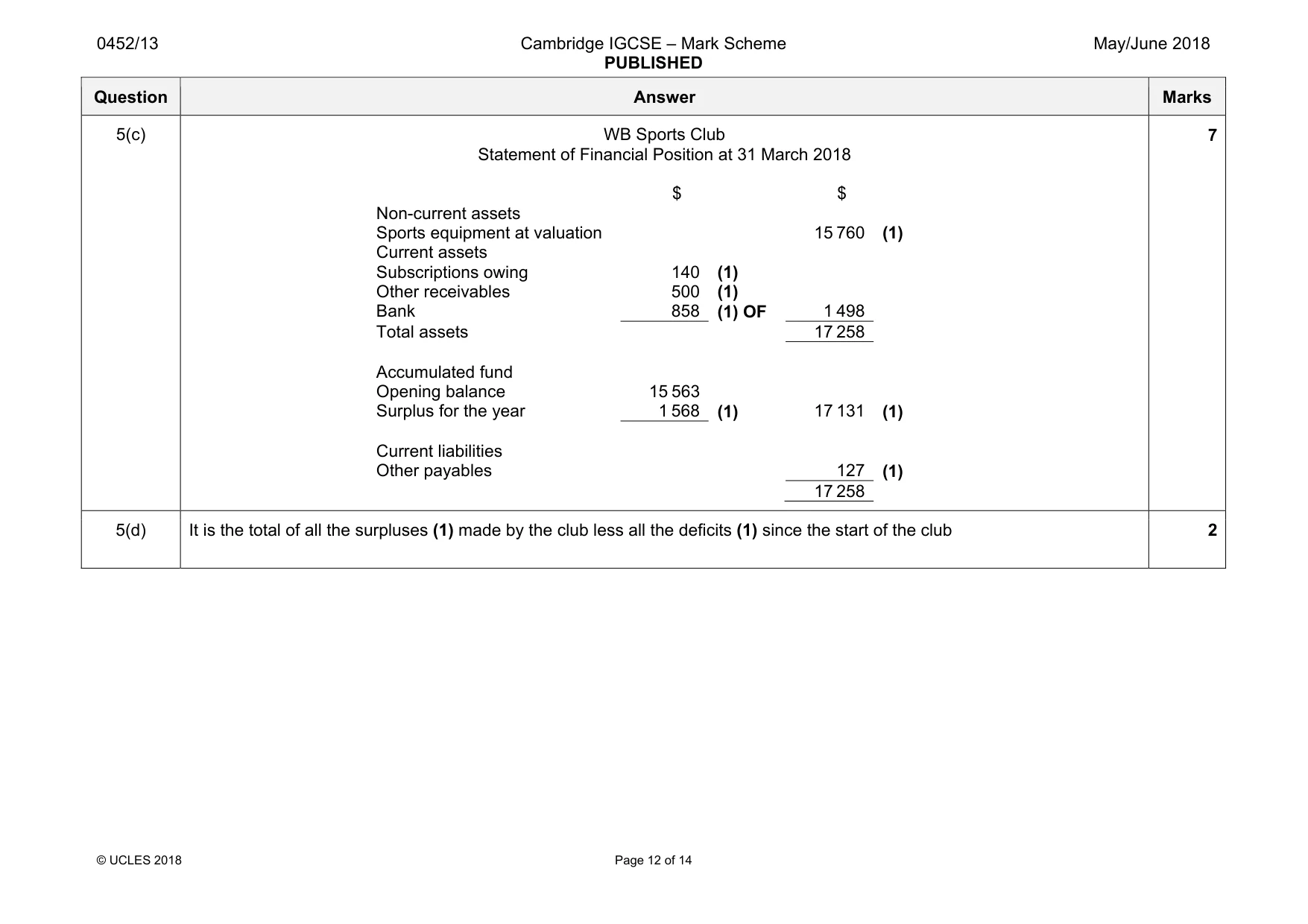
0452/13 Cambridge IGCSE – Mark Scheme PUBLISHED May/June 2018 © UCLES 2018 Page 12 of 14 Question Answer Marks 5(c) WB Sports Club Statement of Financial Position at 31 March 2018 $ $ Non-current assets Sports equipment at valuation 15 760 (1) Current assets Subscriptions owing 140 (1) Other receivables 500 (1) Bank 858 (1) OF 1 498 Total assets 17 258 Accumulated fund Opening balance 15 563 Surplus for the year 1 568 (1) 17 131 (1) Current liabilities Other payables 127 (1) 17 258 7 5(d) It is the total of all the surpluses (1) made by the club less all the deficits (1) since the start of the club 2
Mark scheme, page 13
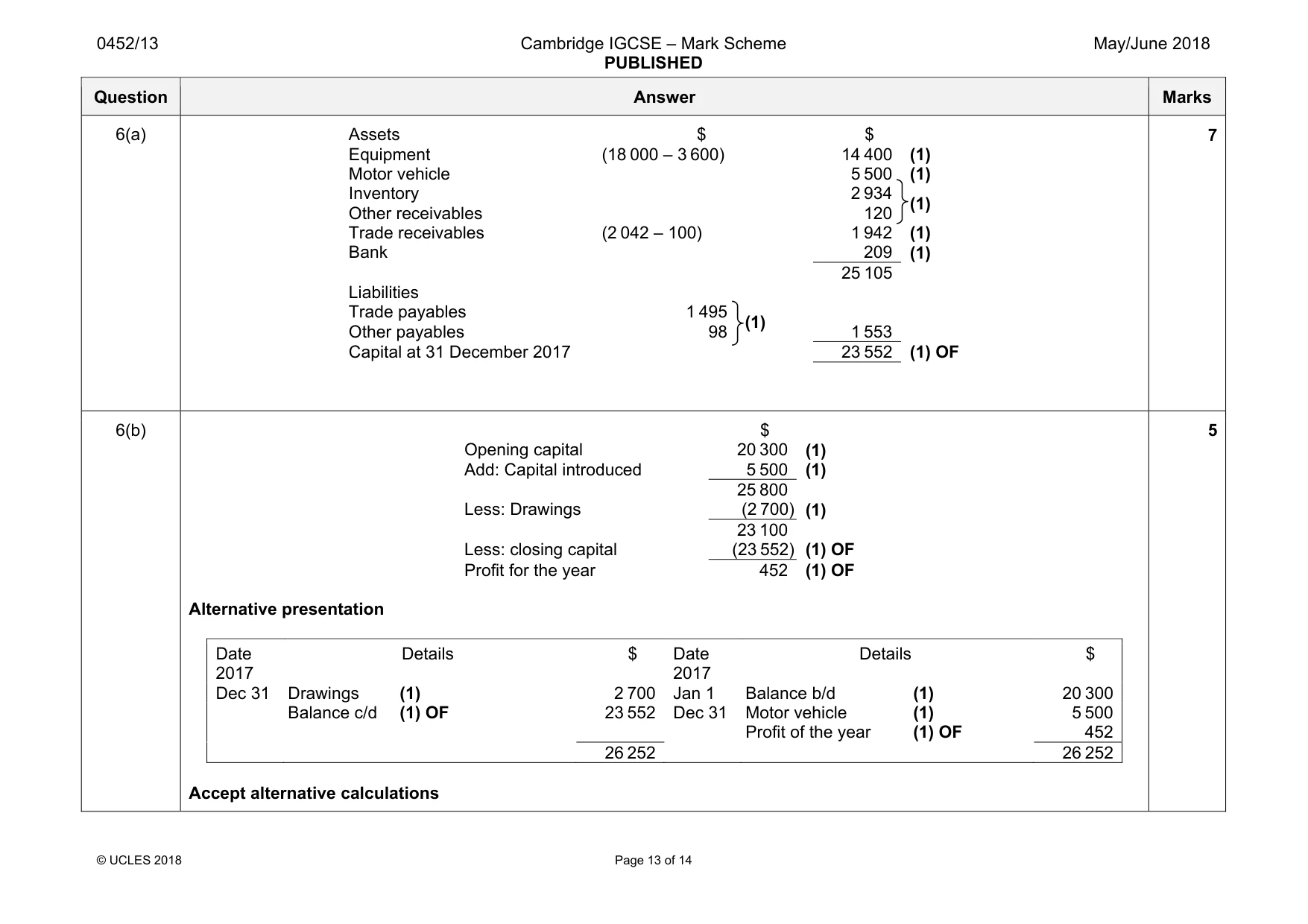
0452/13 Cambridge IGCSE – Mark Scheme PUBLISHED May/June 2018 © UCLES 2018 Page 13 of 14 Question Answer Marks 6(a) Assets $ $ Equipment (18 000 – 3 600) 14 400 (1) Motor vehicle 5 500 (1) Inventory 2 934 (1) Other receivables 120 Trade receivables (2 042 – 100) 1 942 (1) Bank 209 (1) 25 105 Liabilities Trade payables 1 495 (1) Other payables 98 1 553 Capital at 31 December 2017 23 552 (1) OF 7 6(b) $ Opening capital 20 300 (1) Add: Capital introduced 5 500 (1) 25 800 Less: Drawings (2 700) (1) 23 100 Less: closing capital (23 552) (1) OF Profit for the year 452 (1) OF Alternative presentation Date 2017 Details $ Date 2017 Details $ Dec 31 Drawings (1) 2 700 Jan 1 Balance b/d (1) 20 300 Balance c/d (1) OF 23 552 Dec 31 Motor vehicle (1) 5 500 Profit of the year (1) OF 452 26 252 26 252 Accept alternative calculations 5
Mark scheme, page 14
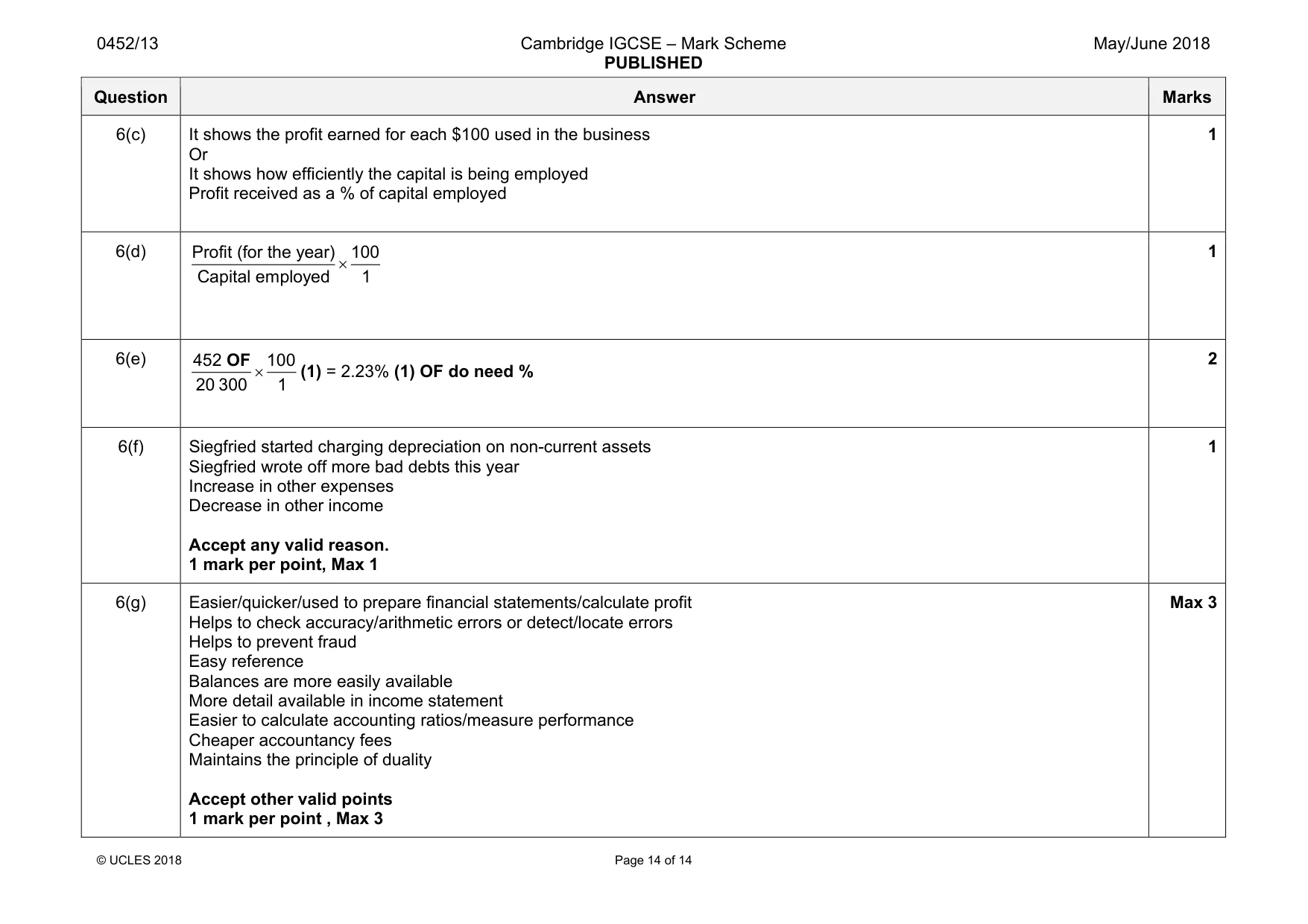
0452/13 Cambridge IGCSE – Mark Scheme PUBLISHED May/June 2018 © UCLES 2018 Page 14 of 14 Question Answer Marks 6(c) It shows the profit earned for each $100 used in the business Or It shows how efficiently the capital is being employed Profit received as a % of capital employed 1 6(d) × Profit (for the year) 100 Capital employed 1 1 6(e) × 452 100 20 300 1 OF (1) = 2.23% (1) OF do need % 2 6(f) Siegfried started charging depreciation on non-current assets Siegfried wrote off more bad debts this year Increase in other expenses Decrease in other income Accept any valid reason. 1 mark per point, Max 1 1 6(g) Easier/quicker/used to prepare financial statements/calculate profit Helps to check accuracy/arithmetic errors or detect/locate errors Helps to prevent fraud Easy reference Balances are more easily available More detail available in income statement Easier to calculate accounting ratios/measure performance Cheaper accountancy fees Maintains the principle of duality Accept other valid points 1 mark per point , Max 3 Max 3
What you needed in this session
Cambridge’s own grade thresholds for 2018 May/June, Paper 1 · Variant 3. A higher threshold means an easier paper — the bar moves with how the cohort did.