Cambridge IGCSE Accounting 0452 — 2017 Oct/Nov Paper 1 · Variant 1
0452/11/O/N/17 · 120 marks · ≈135 min
The question paper and its mark scheme, free to read here and free to download. This is Cambridge’s own paper, exactly as it was sat.
Question paper20 pages
Mark scheme13 pages
Answers below. Sit the paper first if you are practising.
Paper as text
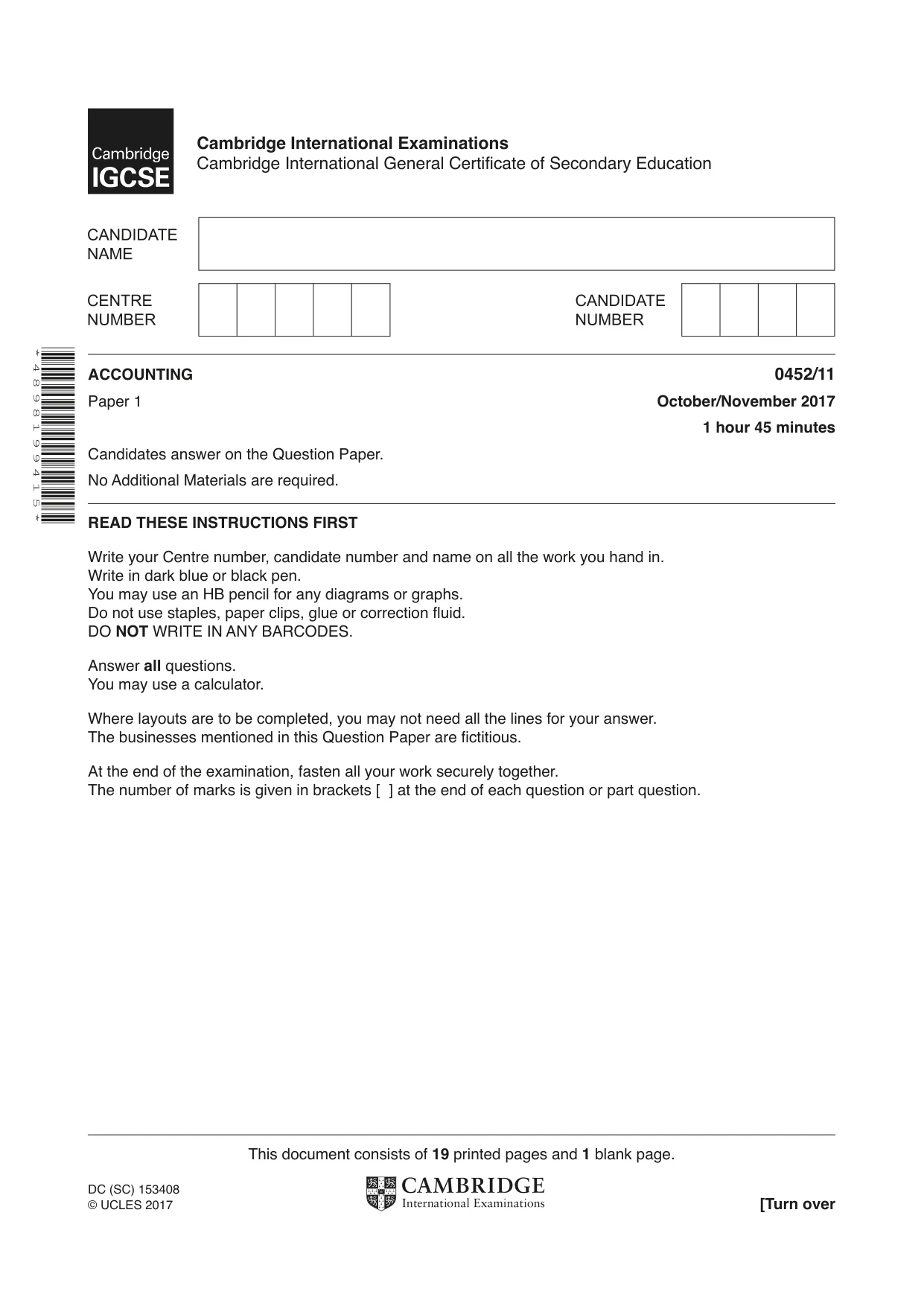
Question paper, page 1
* 4 8 9 8 1 9 9 4 1 5 * This document consists of 19 printed pages and 1 blank page. DC (SC) 153408 © UCLES 2017 [Turn over Cambridge International Examinations Cambridge International General Certificate of Secondary Education ACCOUNTING 0452/11 Paper 1 October/November 2017 1 hour 45 minutes Candidates answer on the Question Paper. No Additional Materials are required. READ THESE INSTRUCTIONS FIRST Write your Centre number, candidate number and name on all the work you hand in. Write in dark blue or black pen. You may use an HB pencil for any diagrams or graphs. Do not use staples, paper clips, glue or correction fluid. DO NOT WRITE IN ANY BARCODES. Answer all questions. You may use a calculator. Where layouts are to be completed, you may not need all the lines for your answer. The businesses mentioned in this Question Paper are fictitious. At the end of the examination, fasten all your work securely together. The number of marks is given in brackets [ ] at the end of each question or part question.
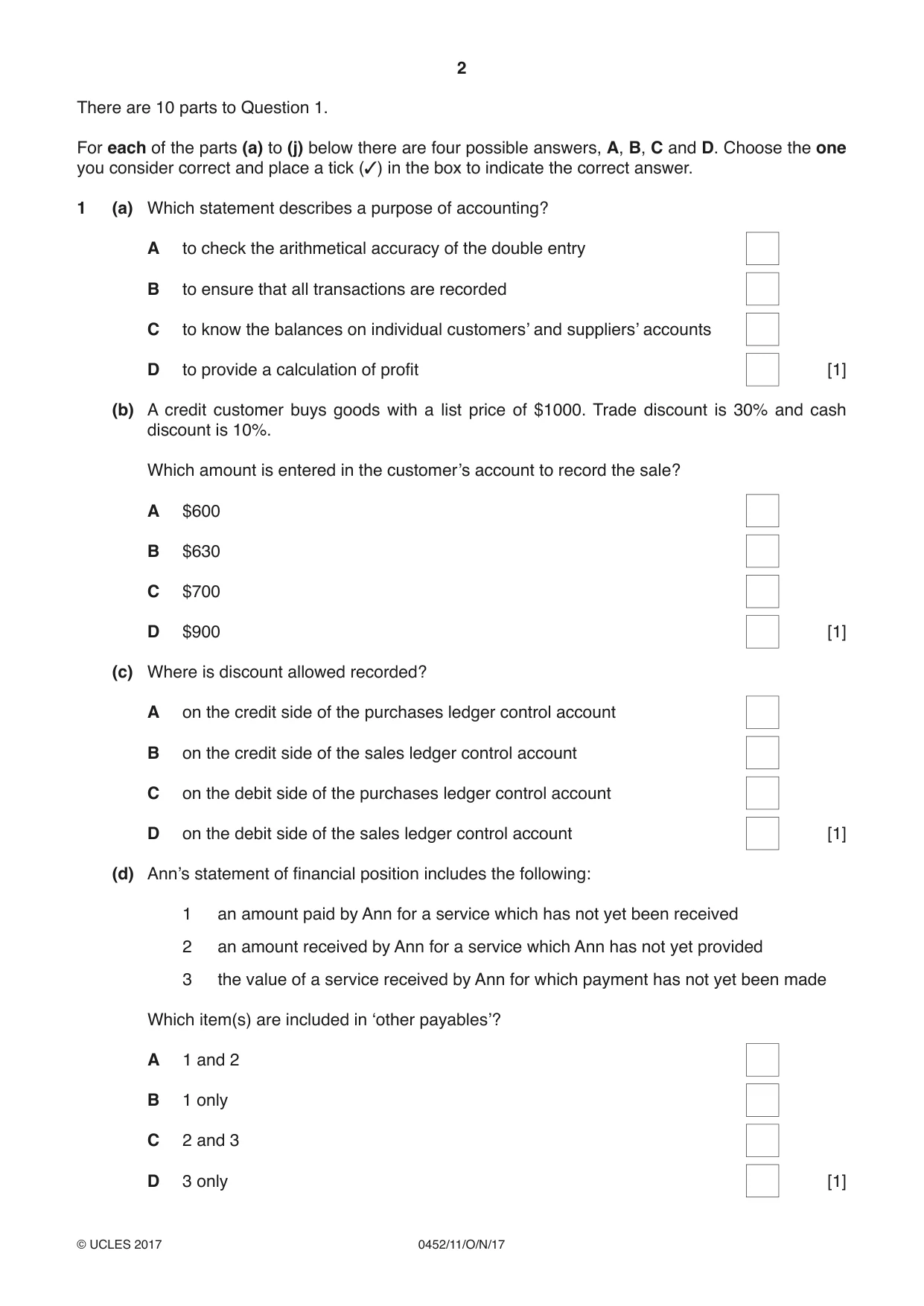
Question paper, page 2
2 0452/11/O/N/17 © UCLES 2017 There are 10 parts to Question 1. For each of the parts (a) to (j) below there are four possible answers, A, B, C and D. Choose the one you consider correct and place a tick (3) in the box to indicate the correct answer. 1 (a) Which statement describes a purpose of accounting? A to check the arithmetical accuracy of the double entry B to ensure that all transactions are recorded C to know the balances on individual customers’ and suppliers’ accounts D to provide a calculation of profit [1] (b) A credit customer buys goods with a list price of $1000. Trade discount is 30% and cash discount is 10%. Which amount is entered in the customer’s account to record the sale? A $600 B $630 C $700 D $900 [1] (c) Where is discount allowed recorded? A on the credit side of the purchases ledger control account B on the credit side of the sales ledger control account C on the debit side of the purchases ledger control account D on the debit side of the sales ledger control account [1] (d) Ann’s statement of financial position includes the following: 1 an amount paid by Ann for a service which has not yet been received 2 an amount received by Ann for a service which Ann has not yet provided 3 the value of a service received by Ann for which payment has not yet been made Which item(s) are included in ‘other payables’? A 1 and 2 B 1 only C 2 and 3 D 3 only [1]
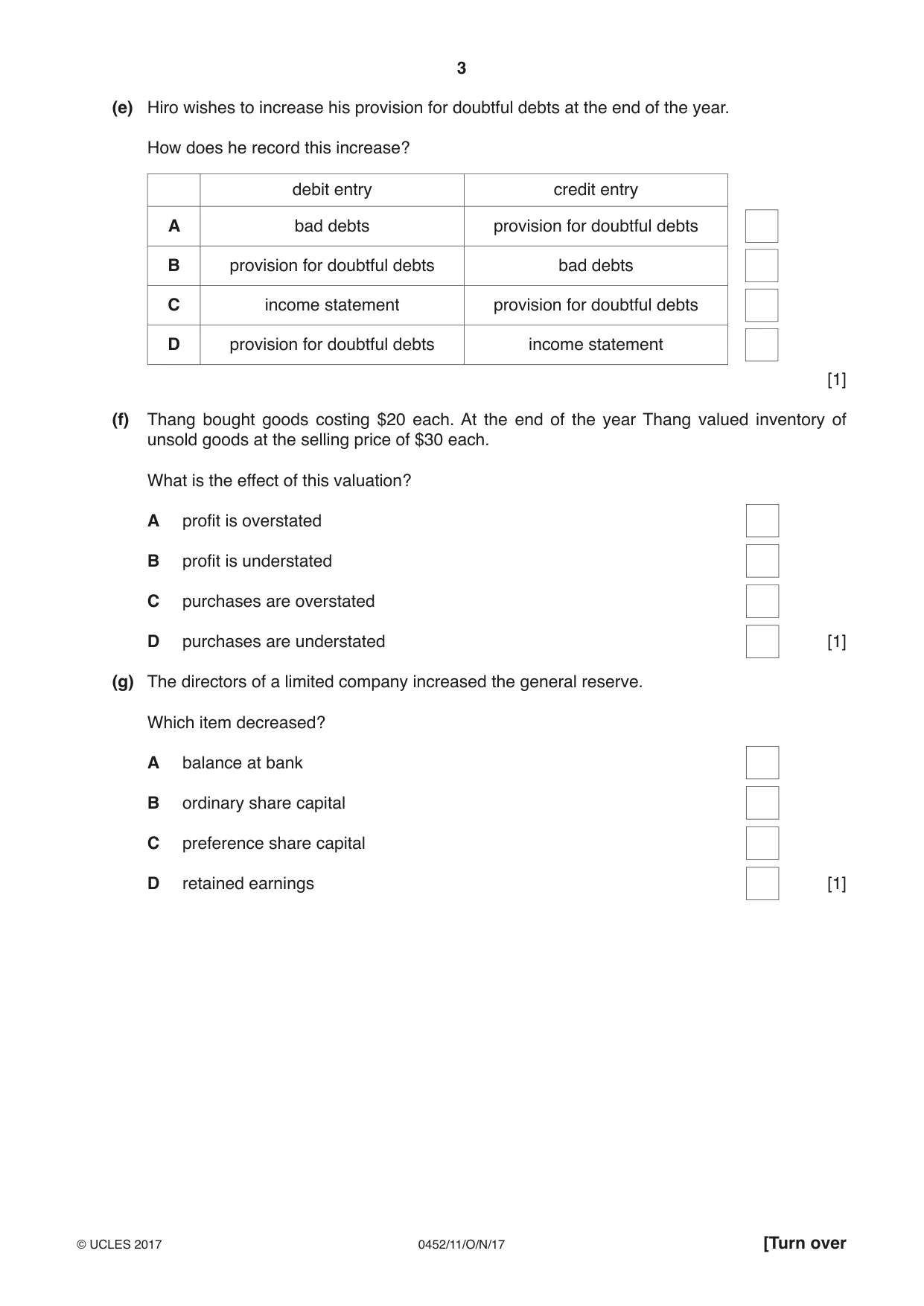
Question paper, page 3
3 0452/11/O/N/17 © UCLES 2017 [Turn over (e) Hiro wishes to increase his provision for doubtful debts at the end of the year. How does he record this increase? debit entry credit entry A bad debts provision for doubtful debts B provision for doubtful debts bad debts C income statement provision for doubtful debts D provision for doubtful debts income statement [1] (f) Thang bought goods costing $20 each. At the end of the year Thang valued inventory of unsold goods at the selling price of $30 each. What is the effect of this valuation? A profit is overstated B profit is understated C purchases are overstated D purchases are understated [1] (g) The directors of a limited company increased the general reserve. Which item decreased? A balance at bank B ordinary share capital C preference share capital D retained earnings [1]
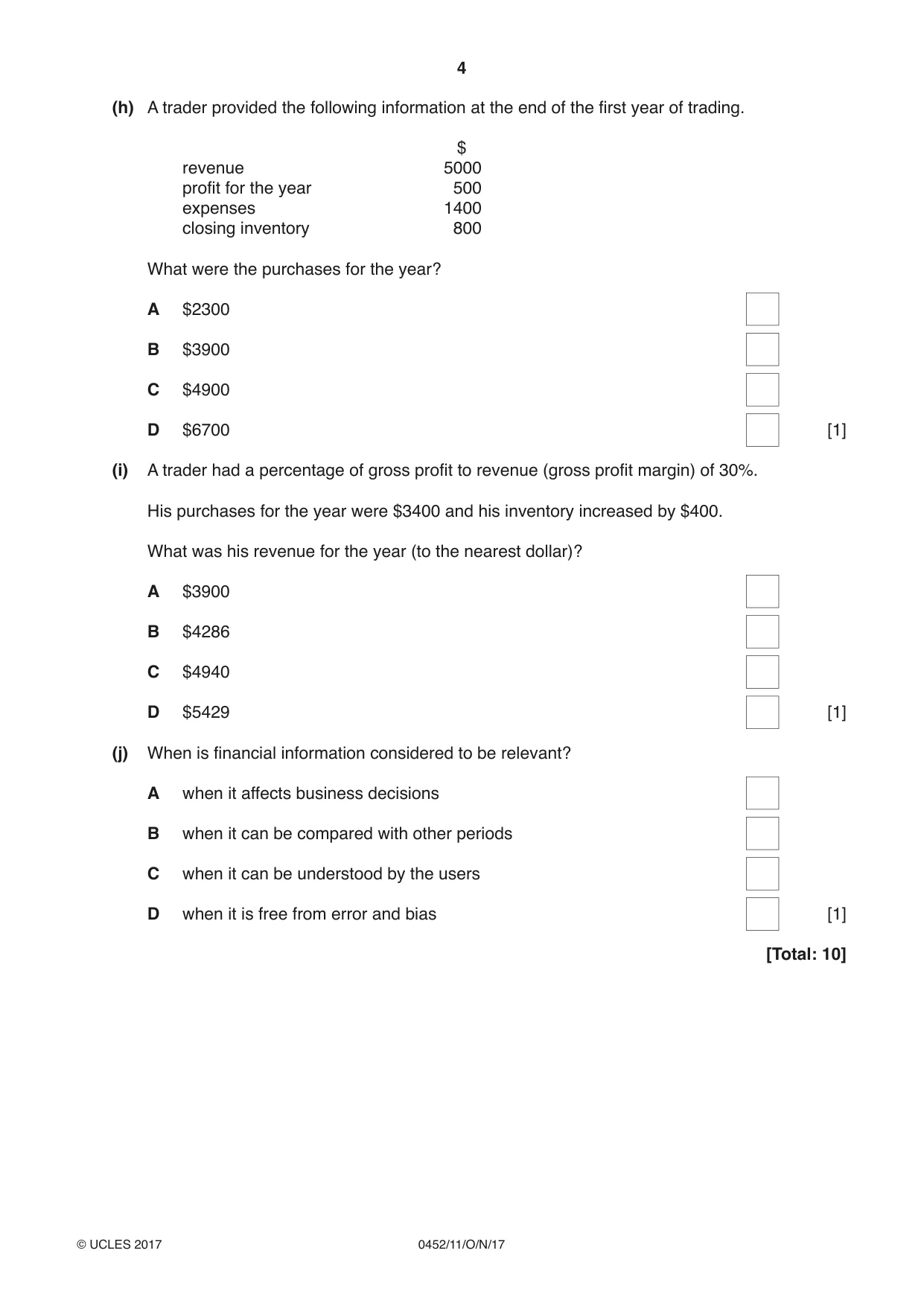
Question paper, page 4
4 0452/11/O/N/17 © UCLES 2017 (h) A trader provided the following information at the end of the first year of trading. $ revenue 5000 profit for the year 500 expenses 1400 closing inventory 800 What were the purchases for the year? A $2300 B $3900 C $4900 D $6700 [1] (i) A trader had a percentage of gross profit to revenue (gross profit margin) of 30%. His purchases for the year were $3400 and his inventory increased by $400. What was his revenue for the year (to the nearest dollar)? A $3900 B $4286 C $4940 D $5429 [1] (j) When is financial information considered to be relevant? A when it affects business decisions B when it can be compared with other periods C when it can be understood by the users D when it is free from error and bias [1] [Total: 10]
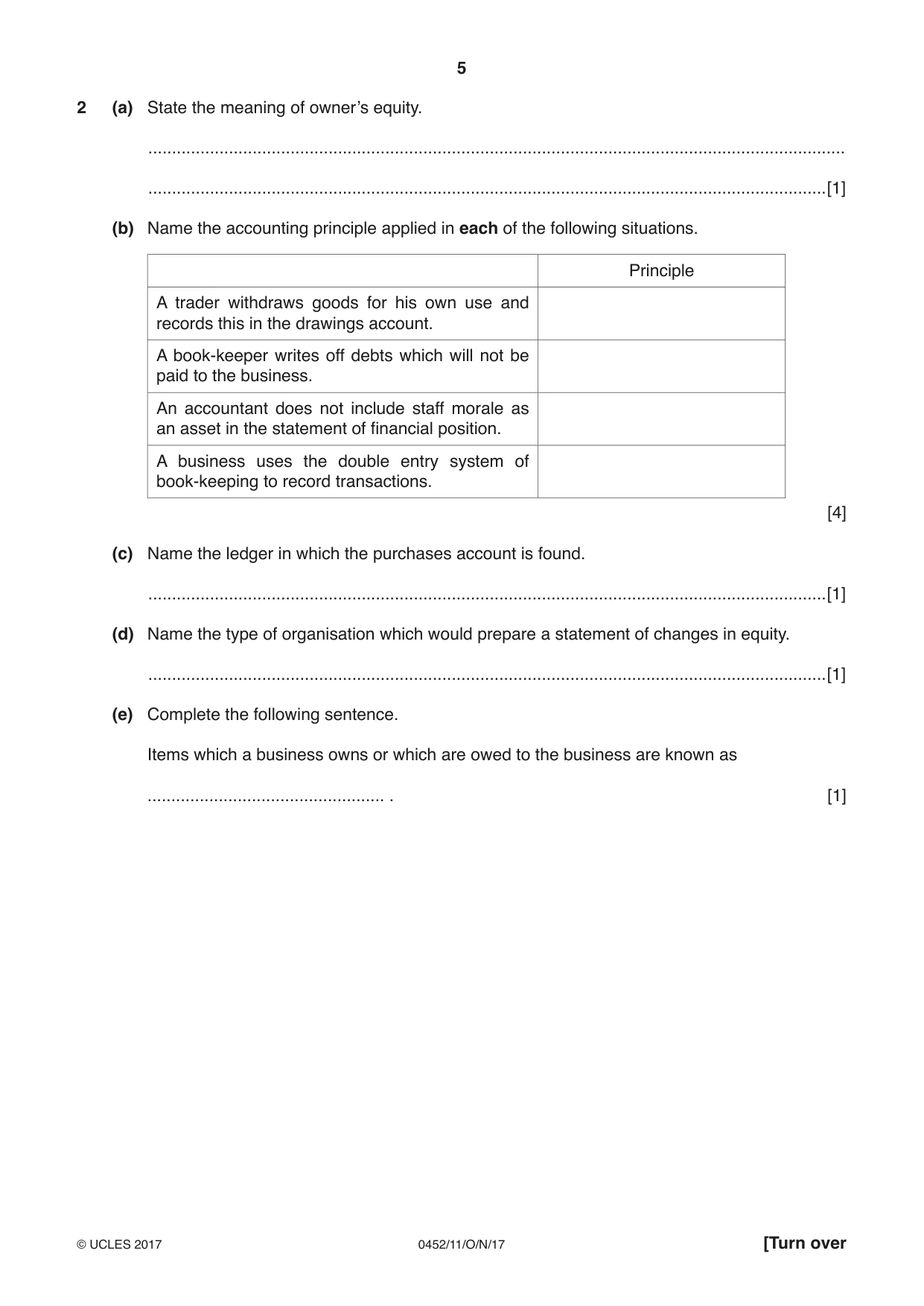
Question paper, page 5
5 0452/11/O/N/17 © UCLES 2017 [Turn over 2 (a) State the meaning of owner’s equity. … …[1] (b) Name the accounting principle applied in each of the following situations. Principle A trader withdraws goods for his own use and records this in the drawings account. A book-keeper writes off debts which will not be paid to the business. An accountant does not include staff morale as an asset in the statement of financial position. A business uses the double entry system of book-keeping to record transactions. [4] (c) Name the ledger in which the purchases account is found. …[1] (d) Name the type of organisation which would prepare a statement of changes in equity. …[1] (e) Complete the following sentence. Items which a business owns or which are owed to the business are known as … . [1]
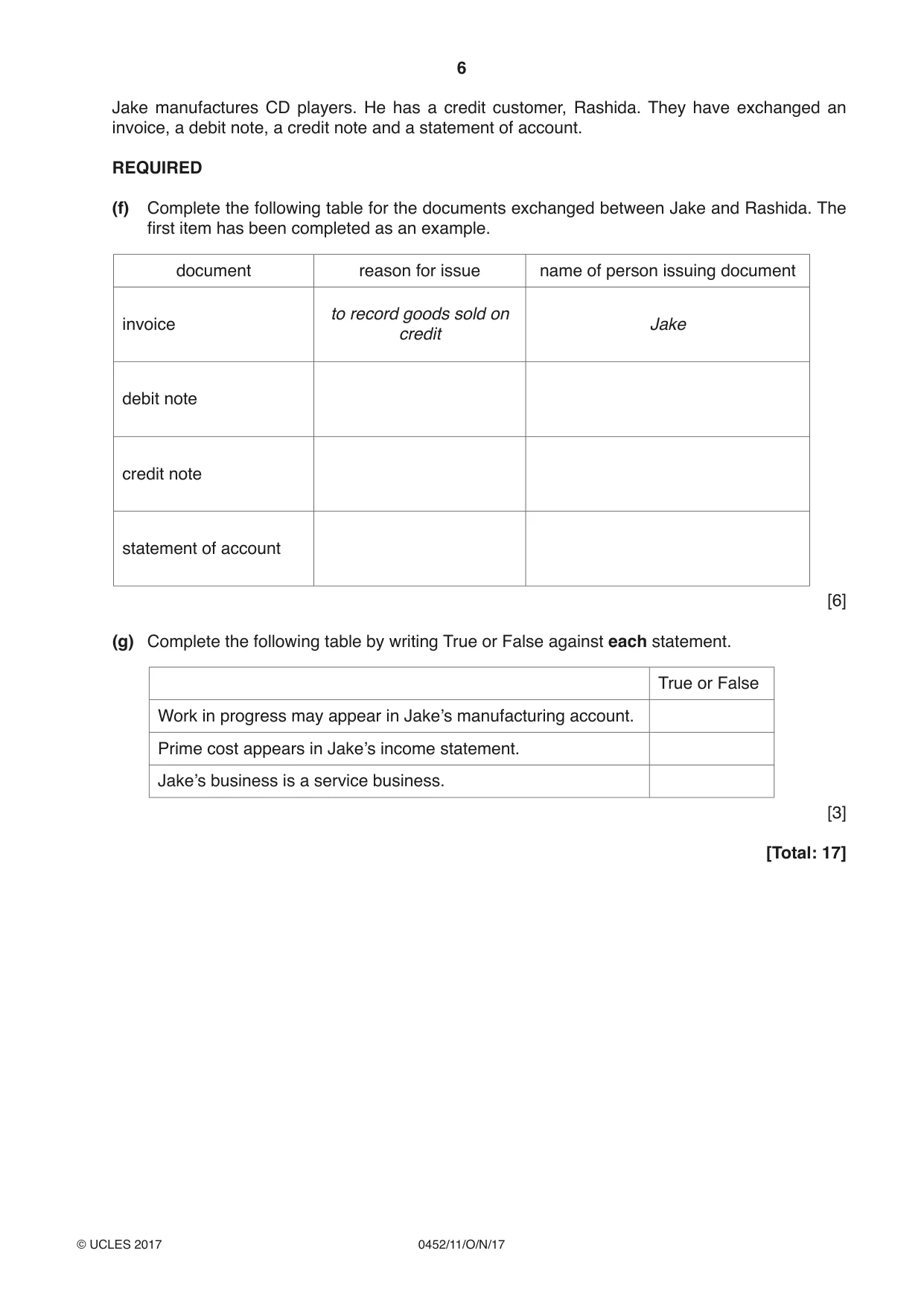
Question paper, page 6
6 0452/11/O/N/17 © UCLES 2017 Jake manufactures CD players. He has a credit customer, Rashida. They have exchanged an invoice, a debit note, a credit note and a statement of account. REQUIRED (f) Complete the following table for the documents exchanged between Jake and Rashida. The first item has been completed as an example. document reason for issue name of person issuing document invoice to record goods sold on credit Jake debit note credit note statement of account [6] (g) Complete the following table by writing True or False against each statement. True or False Work in progress may appear in Jake’s manufacturing account. Prime cost appears in Jake’s income statement. Jake’s business is a service business. [3] [Total: 17]
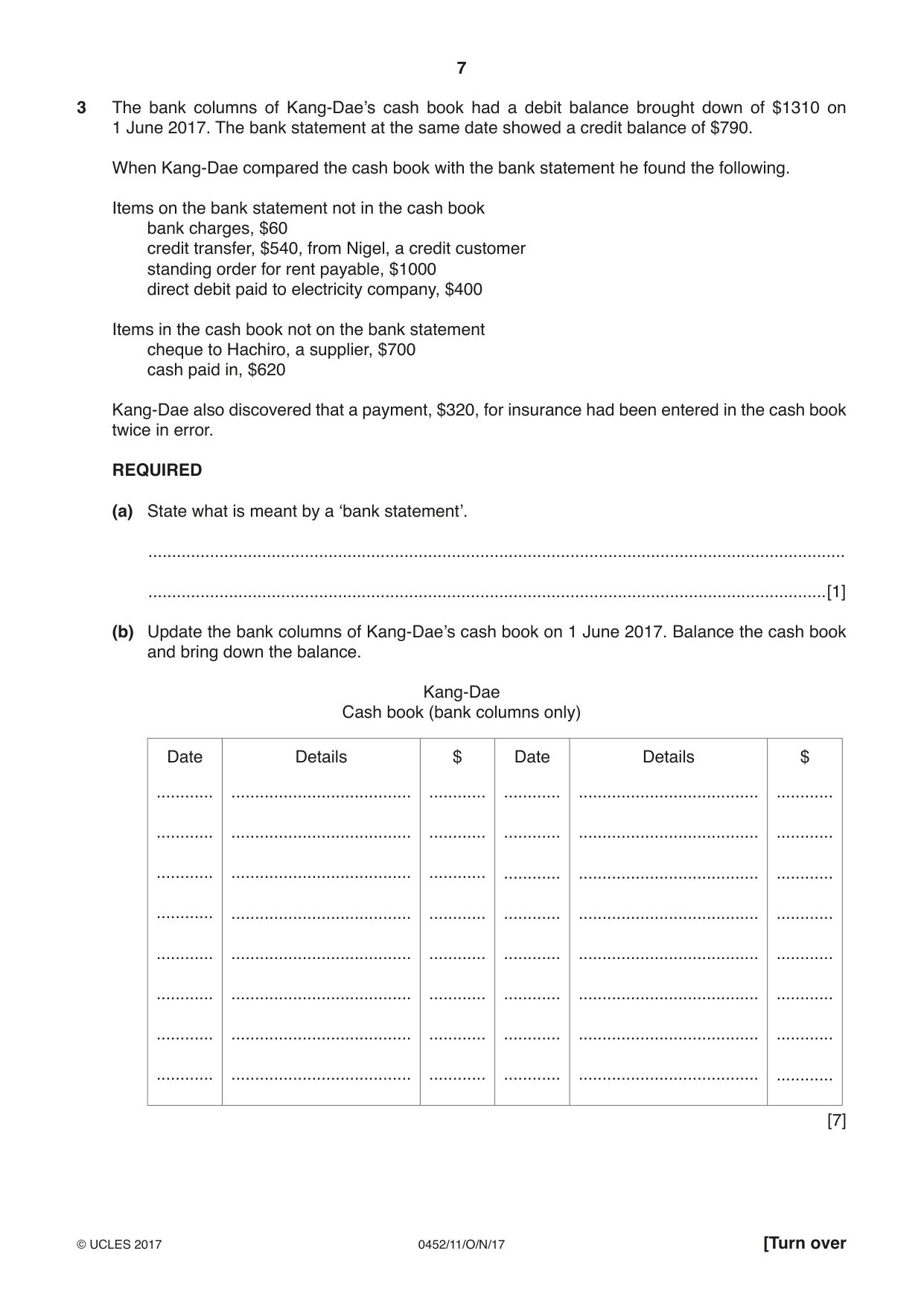
Question paper, page 7
7 0452/11/O/N/17 © UCLES 2017 [Turn over 3 The bank columns of Kang-Dae’s cash book had a debit balance brought down of $1310 on 1 June 2017. The bank statement at the same date showed a credit balance of $790. When Kang-Dae compared the cash book with the bank statement he found the following. Items on the bank statement not in the cash book bank charges, $60 credit transfer, $540, from Nigel, a credit customer standing order for rent payable, $1000 direct debit paid to electricity company, $400 Items in the cash book not on the bank statement cheque to Hachiro, a supplier, $700 cash paid in, $620 Kang-Dae also discovered that a payment, $320, for insurance had been entered in the cash book twice in error. REQUIRED (a) State what is meant by a ‘bank statement’. … …[1] (b) Update the bank columns of Kang-Dae’s cash book on 1 June 2017. Balance the cash book and bring down the balance. Kang-Dae Cash book (bank columns only) Date Details $ Date Details $ … … … … … … … … … … … … … … … … … … … … … … … … … … … … … … … … … … … … … … … … … … … … … … … … [7]
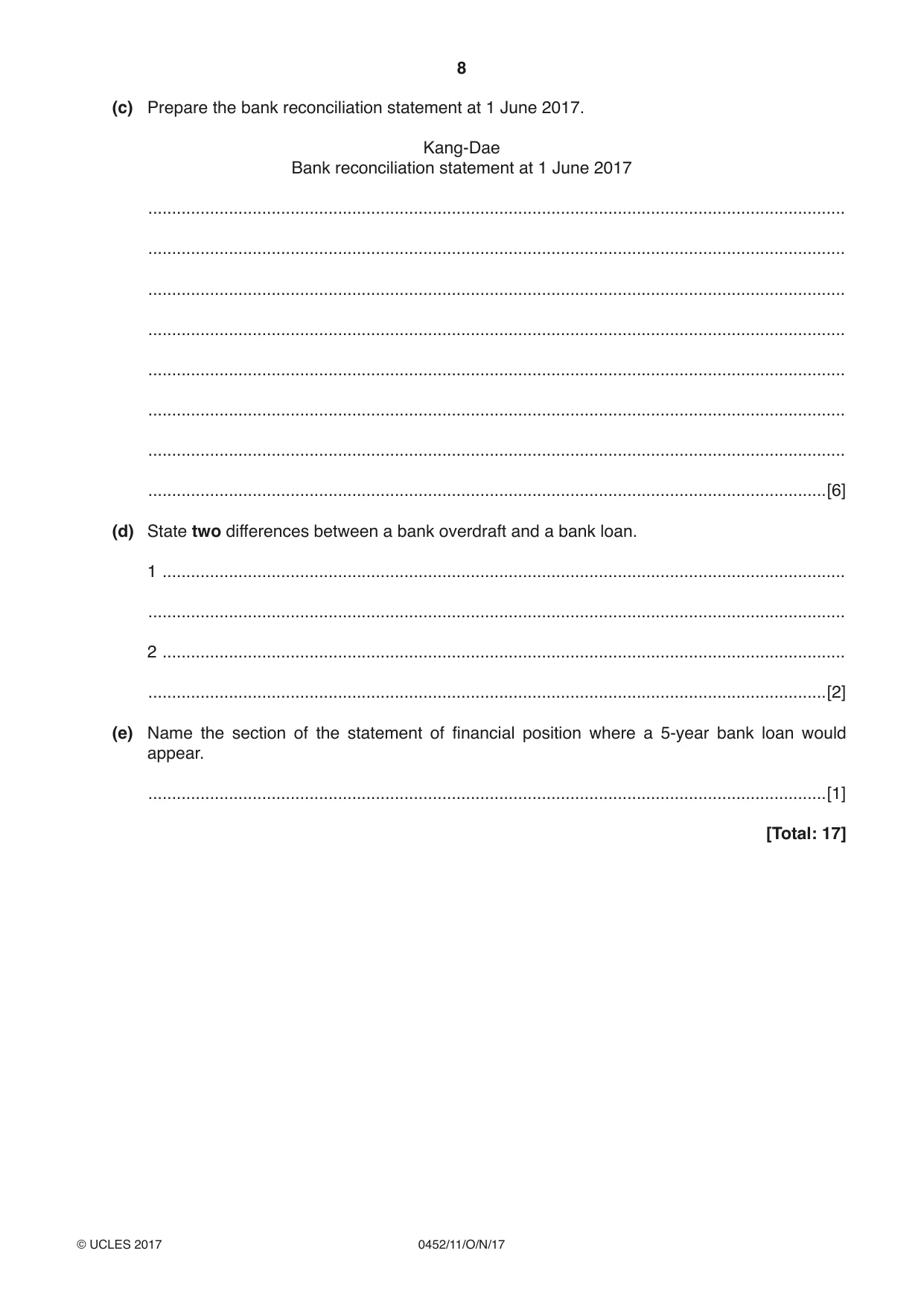
Question paper, page 8
8 0452/11/O/N/17 © UCLES 2017 (c) Prepare the bank reconciliation statement at 1 June 2017. Kang-Dae Bank reconciliation statement at 1 June 2017 … … … … … … … …[6] (d) State two differences between a bank overdraft and a bank loan. 1 … … 2 … …[2] (e) Name the section of the statement of financial position where a 5-year bank loan would appear. …[1] [Total: 17]
Question paper, page 9
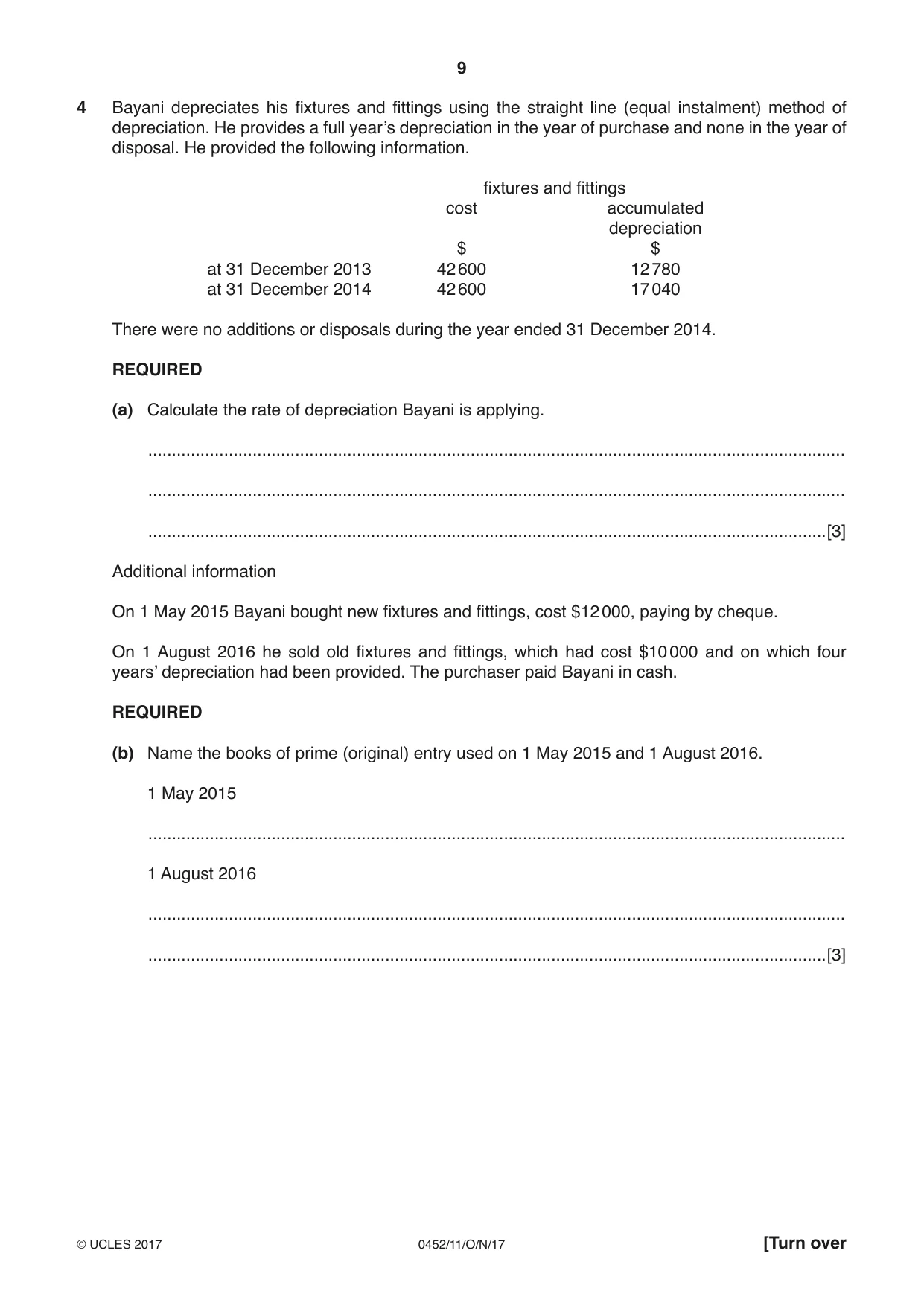
9 0452/11/O/N/17 © UCLES 2017 [Turn over 4 Bayani depreciates his fixtures and fittings using the straight line (equal instalment) method of depreciation. He provides a full year’s depreciation in the year of purchase and none in the year of disposal. He provided the following information. fixtures and fittings cost accumulated depreciation $ $ at 31 December 2013 42 600 12 780 at 31 December 2014 42 600 17 040 There were no additions or disposals during the year ended 31 December 2014. REQUIRED (a) Calculate the rate of depreciation Bayani is applying. … … …[3] Additional information On 1 May 2015 Bayani bought new fixtures and fittings, cost $12 000, paying by cheque. On 1 August 2016 he sold old fixtures and fittings, which had cost $10 000 and on which four years’ depreciation had been provided. The purchaser paid Bayani in cash. REQUIRED (b) Name the books of prime (original) entry used on 1 May 2015 and 1 August 2016. 1 May 2015 … 1 August 2016 … …[3]
Question paper, page 10
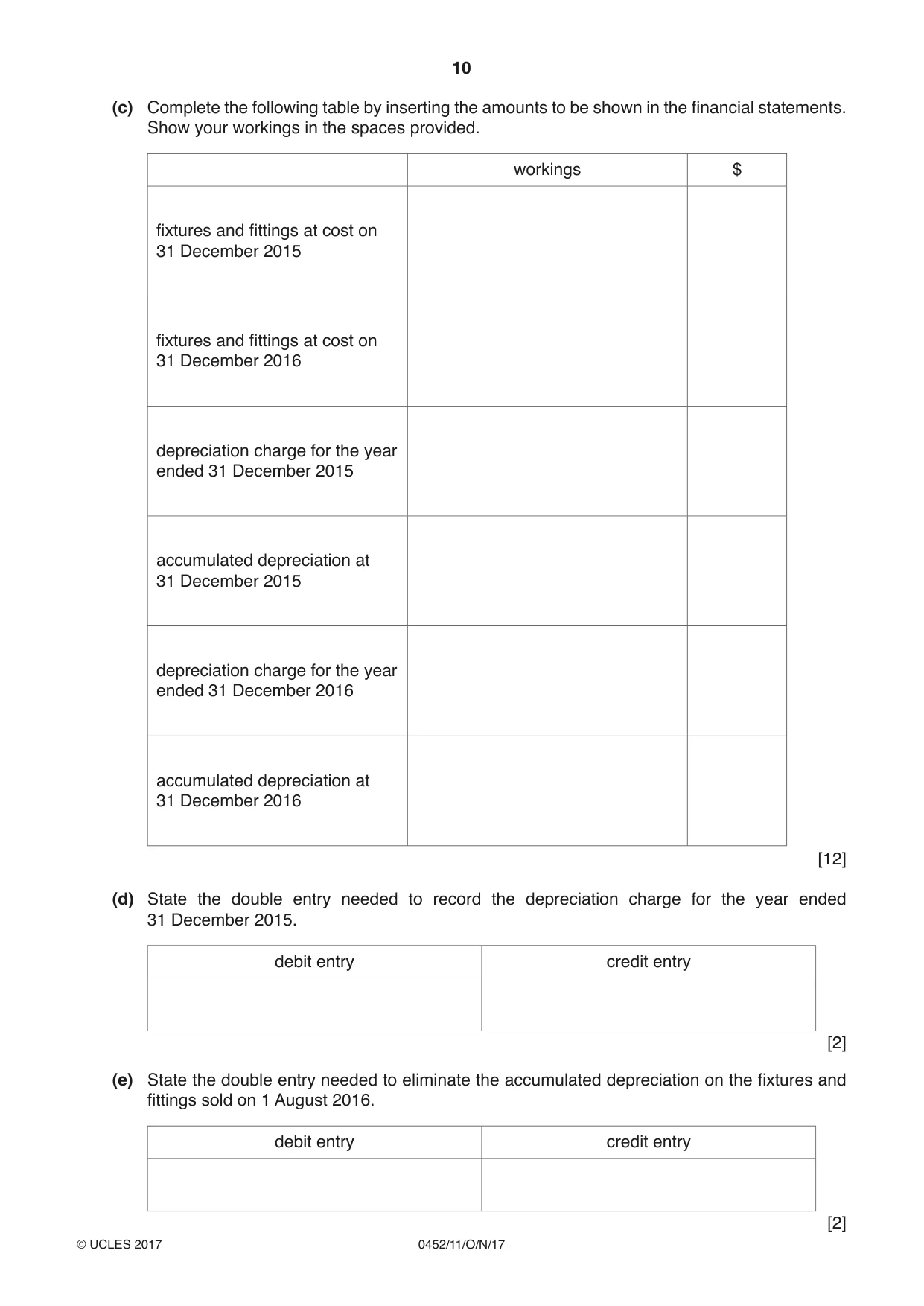
10 0452/11/O/N/17 © UCLES 2017 (c) Complete the following table by inserting the amounts to be shown in the financial statements. Show your workings in the spaces provided. workings $ fixtures and fittings at cost on 31 December 2015 fixtures and fittings at cost on 31 December 2016 depreciation charge for the year ended 31 December 2015 accumulated depreciation at 31 December 2015 depreciation charge for the year ended 31 December 2016 accumulated depreciation at 31 December 2016 [12] (d) State the double entry needed to record the depreciation charge for the year ended 31 December 2015. debit entry credit entry [2] (e) State the double entry needed to eliminate the accumulated depreciation on the fixtures and fittings sold on 1 August 2016. debit entry credit entry [2]
Question paper, page 11
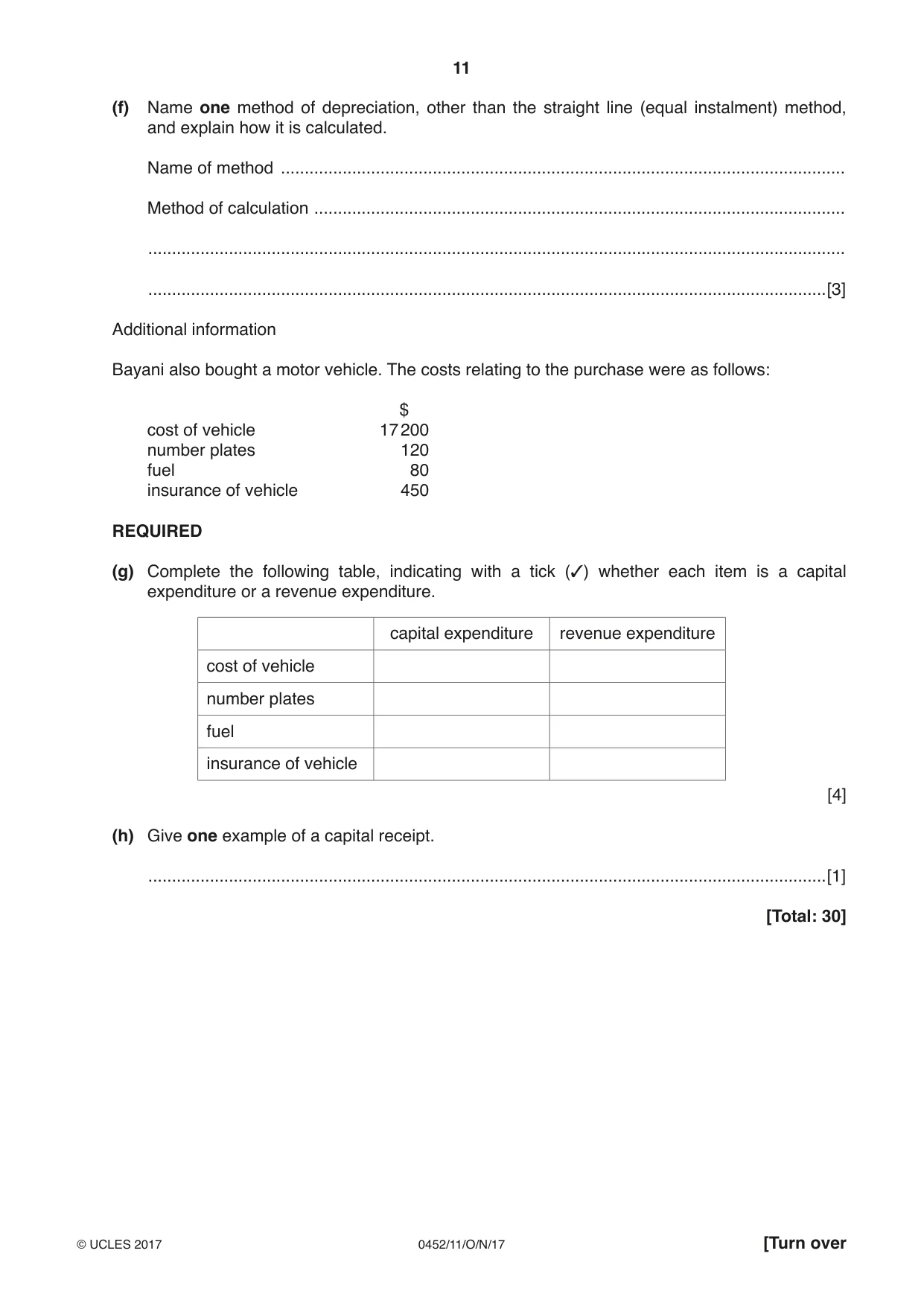
11 0452/11/O/N/17 © UCLES 2017 [Turn over (f) Name one method of depreciation, other than the straight line (equal instalment) method, and explain how it is calculated. Name of method … Method of calculation … … …[3] Additional information Bayani also bought a motor vehicle. The costs relating to the purchase were as follows: $ cost of vehicle 17 200 number plates 120 fuel 80 insurance of vehicle 450 REQUIRED (g) Complete the following table, indicating with a tick (3) whether each item is a capital expenditure or a revenue expenditure. capital expenditure revenue expenditure cost of vehicle number plates fuel insurance of vehicle [4] (h) Give one example of a capital receipt. …[1] [Total: 30]
Question paper, page 12
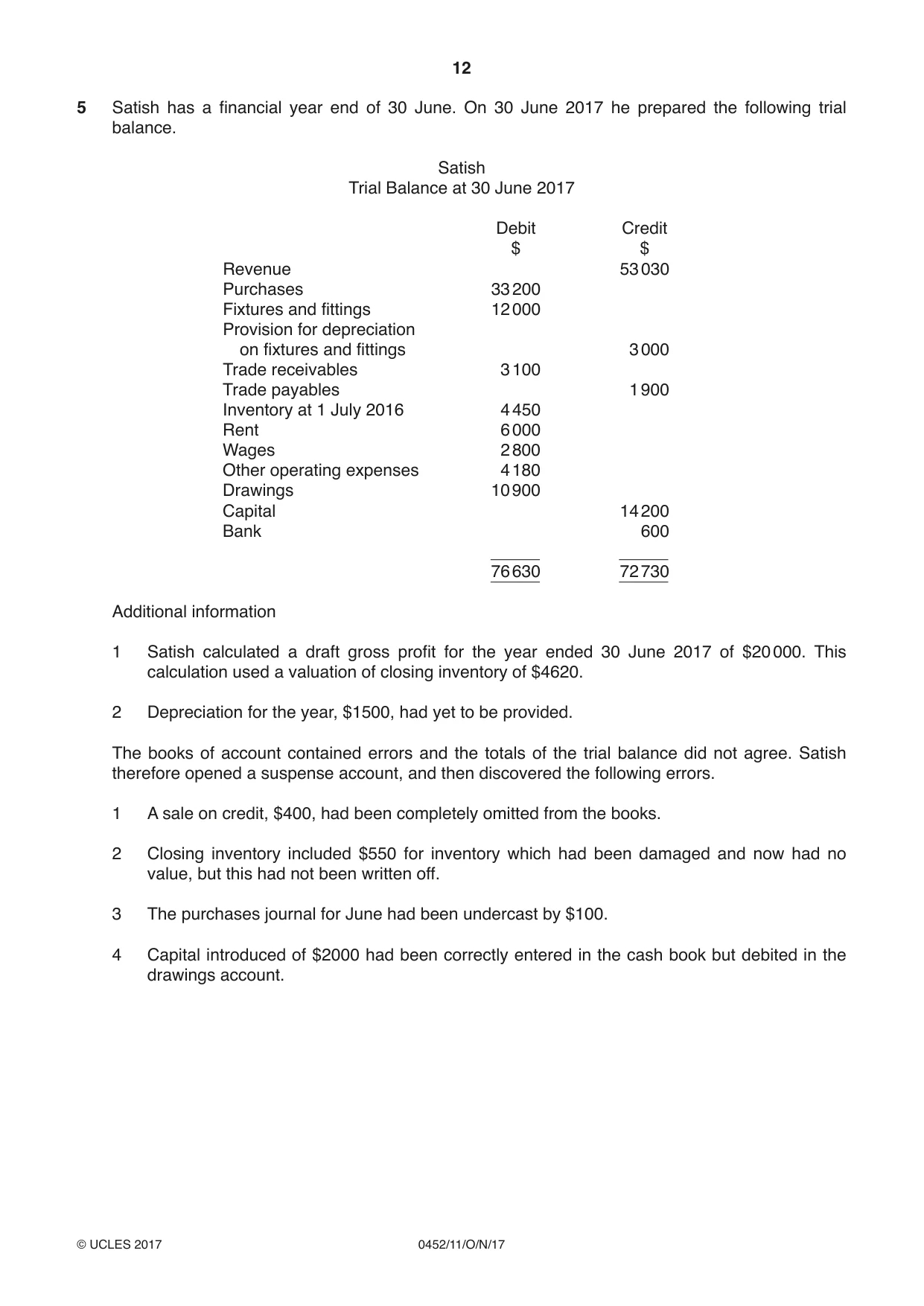
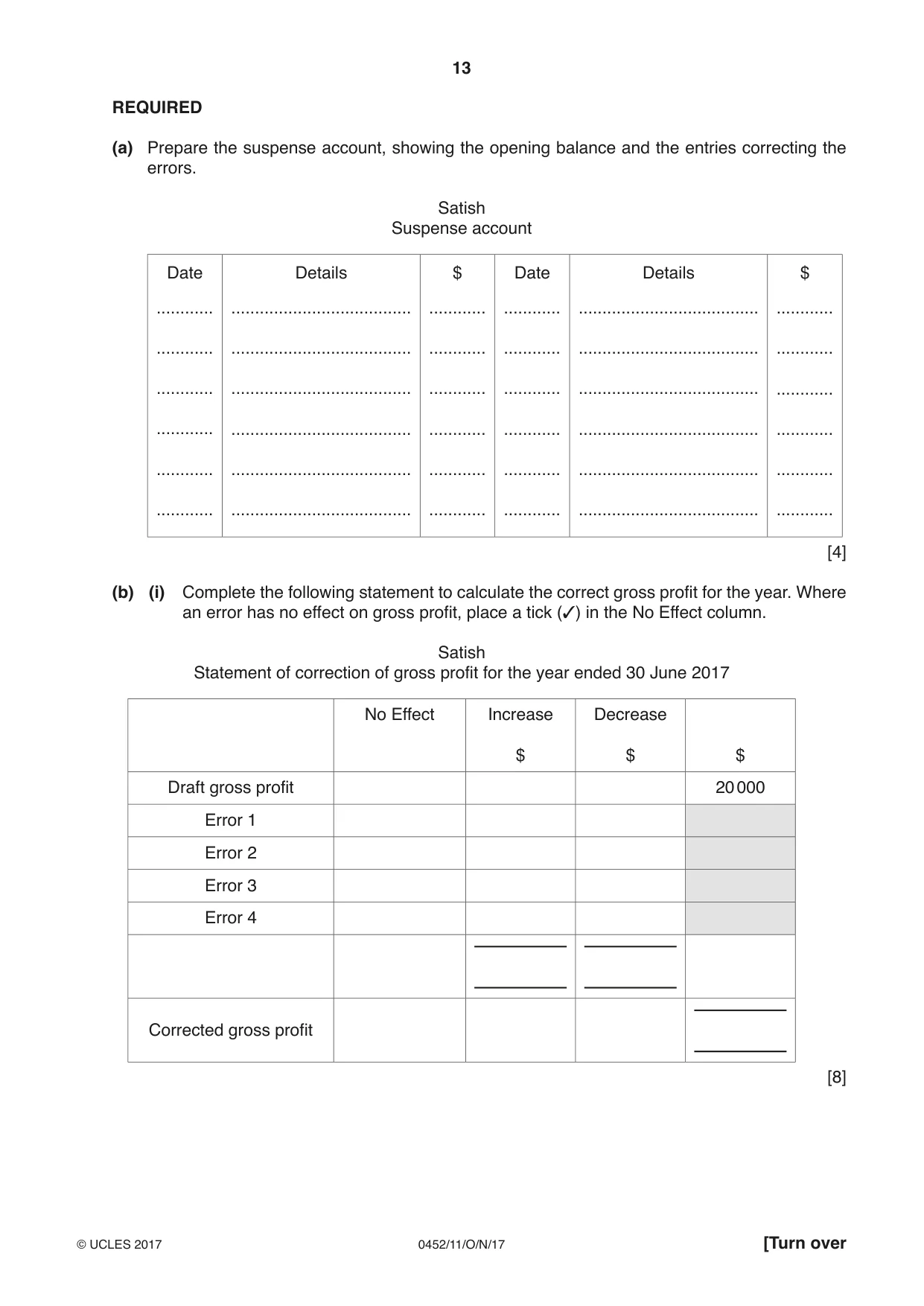
12 0452/11/O/N/17 © UCLES 2017 5 Satish has a financial year end of 30 June. On 30 June 2017 he prepared the following trial balance. Satish Trial Balance at 30 June 2017 Debit Credit $ $ Revenue 53 030 Purchases 33 200 Fixtures and fittings 12 000 Provision for depreciation on fixtures and fittings 3 000 Trade receivables 3 100 Trade payables 1 900 Inventory at 1 July 2016 4 450 Rent 6 000 Wages 2 800 Other operating expenses 4 180 Drawings 10 900 Capital 14 200 Bank 600 76 630 72 730 Additional information 1 Satish calculated a draft gross profit for the year ended 30 June 2017 of $20 000. This calculation used a valuation of closing inventory of $4620. 2 Depreciation for the year, $1500, had yet to be provided. The books of account contained errors and the totals of the trial balance did not agree. Satish therefore opened a suspense account, and then discovered the following errors. 1 A sale on credit, $400, had been completely omitted from the books. 2 Closing inventory included $550 for inventory which had been damaged and now had no value, but this had not been written off. 3 The purchases journal for June had been undercast by $100. 4 Capital introduced of $2000 had been correctly entered in the cash book but debited in the drawings account.
Question paper, page 13
13 0452/11/O/N/17 © UCLES 2017 [Turn over REQUIRED (a) Prepare the suspense account, showing the opening balance and the entries correcting the errors. Satish Suspense account Date Details $ Date Details $ … … … … … … … … … … … … … … … … … … … … … … … … … … … … … … … … … … … … [4] (b) (i) Complete the following statement to calculate the correct gross profit for the year. Where an error has no effect on gross profit, place a tick (3) in the No Effect column. Satish Statement of correction of gross profit for the year ended 30 June 2017 No Effect Increase $ Decrease $ $ Draft gross profit 20 000 Error 1 Error 2 Error 3 Error 4 Corrected gross profit [8]
Question paper, page 14
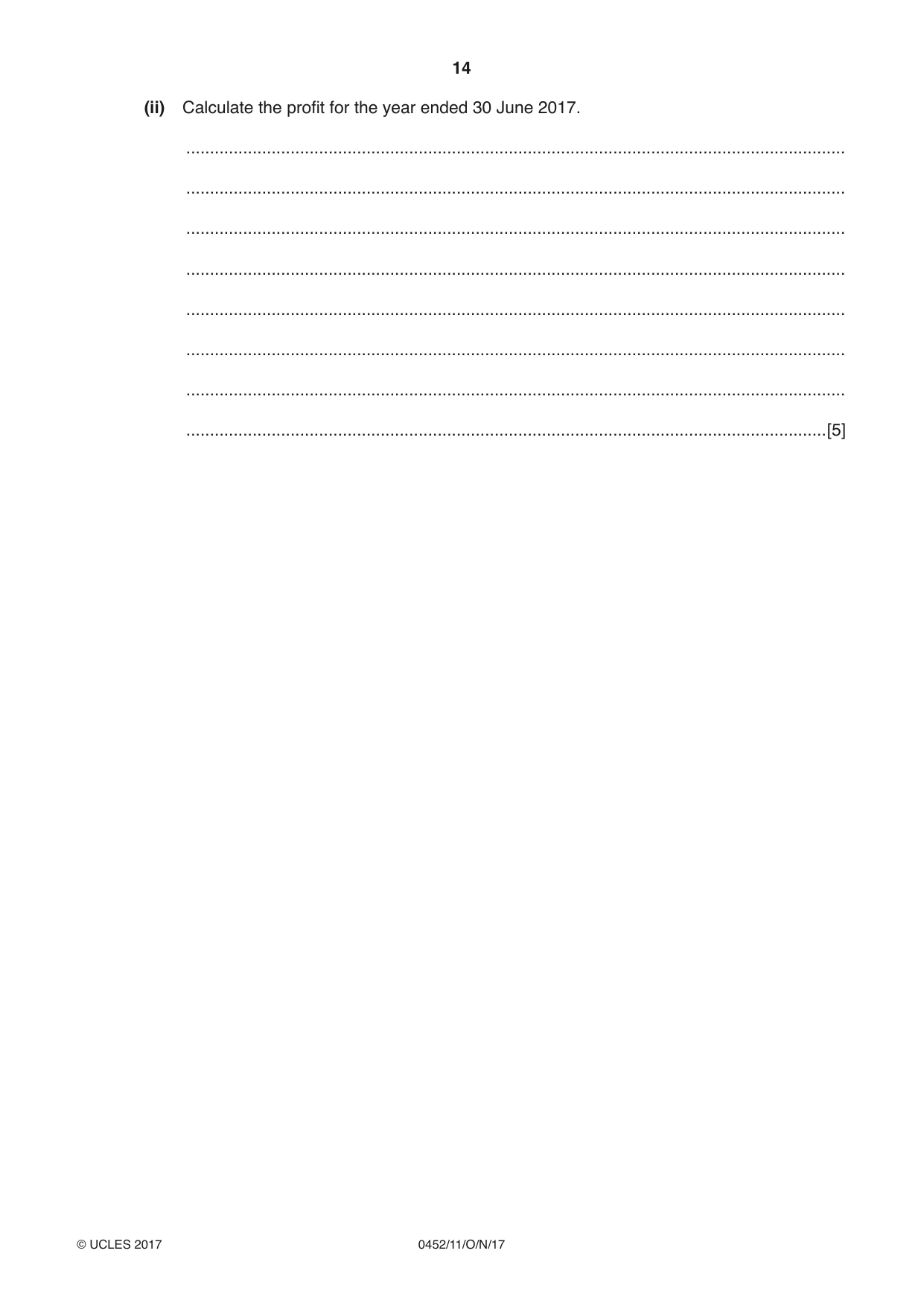
14 0452/11/O/N/17 © UCLES 2017 (ii) Calculate the profit for the year ended 30 June 2017. … … … … … … … …[5]
Question paper, page 15
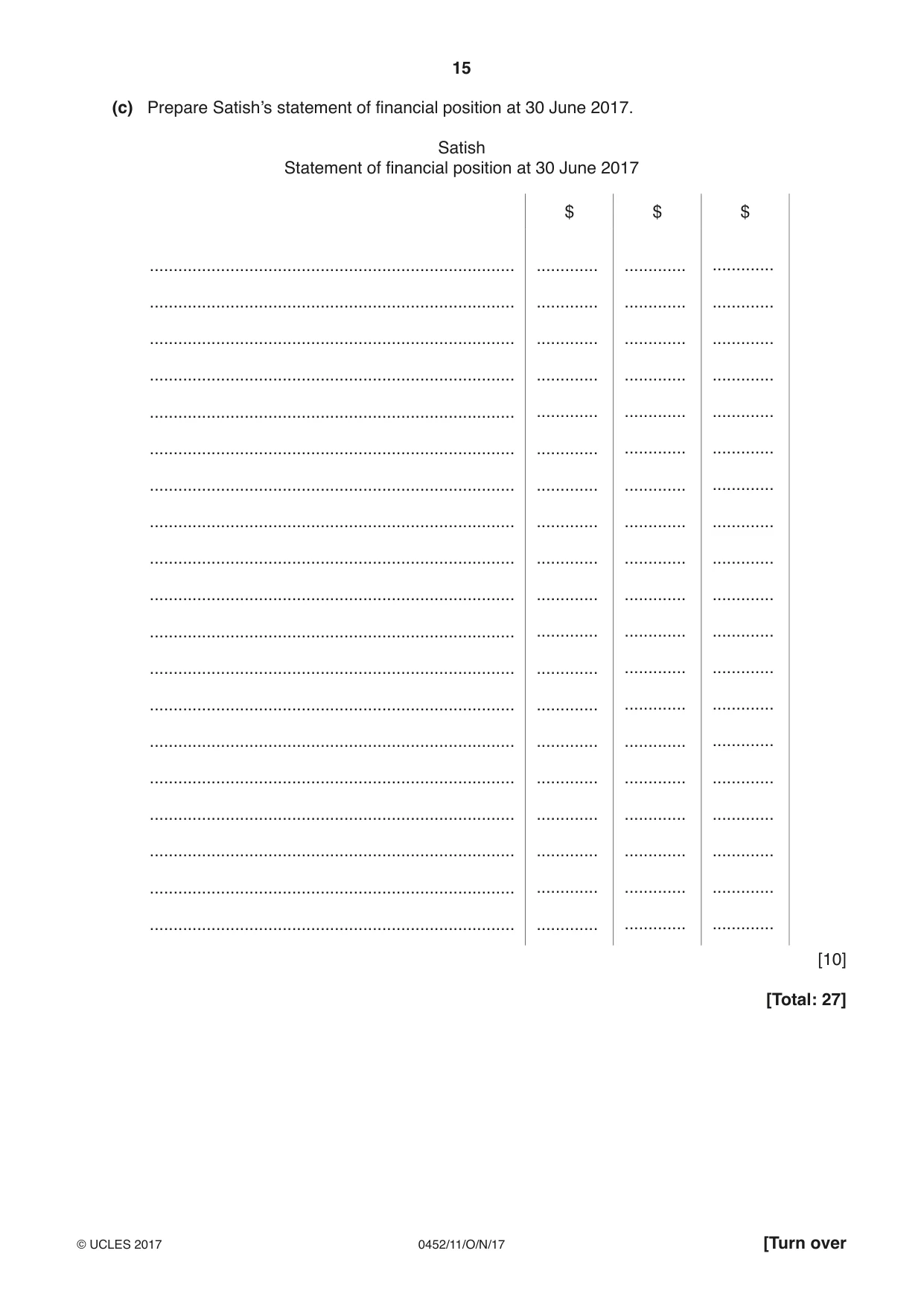
15 0452/11/O/N/17 © UCLES 2017 [Turn over (c) Prepare Satish’s statement of financial position at 30 June 2017. Satish Statement of financial position at 30 June 2017 $ $ $ … … … … … … … … … … … … … … … … … … … … … … … … … … … … … … … … … … … … … … … … … … … … … … … … … … … … … … … … … … … … … … … … … … … … … … … … … … … … [10] [Total: 27]
Question paper, page 16
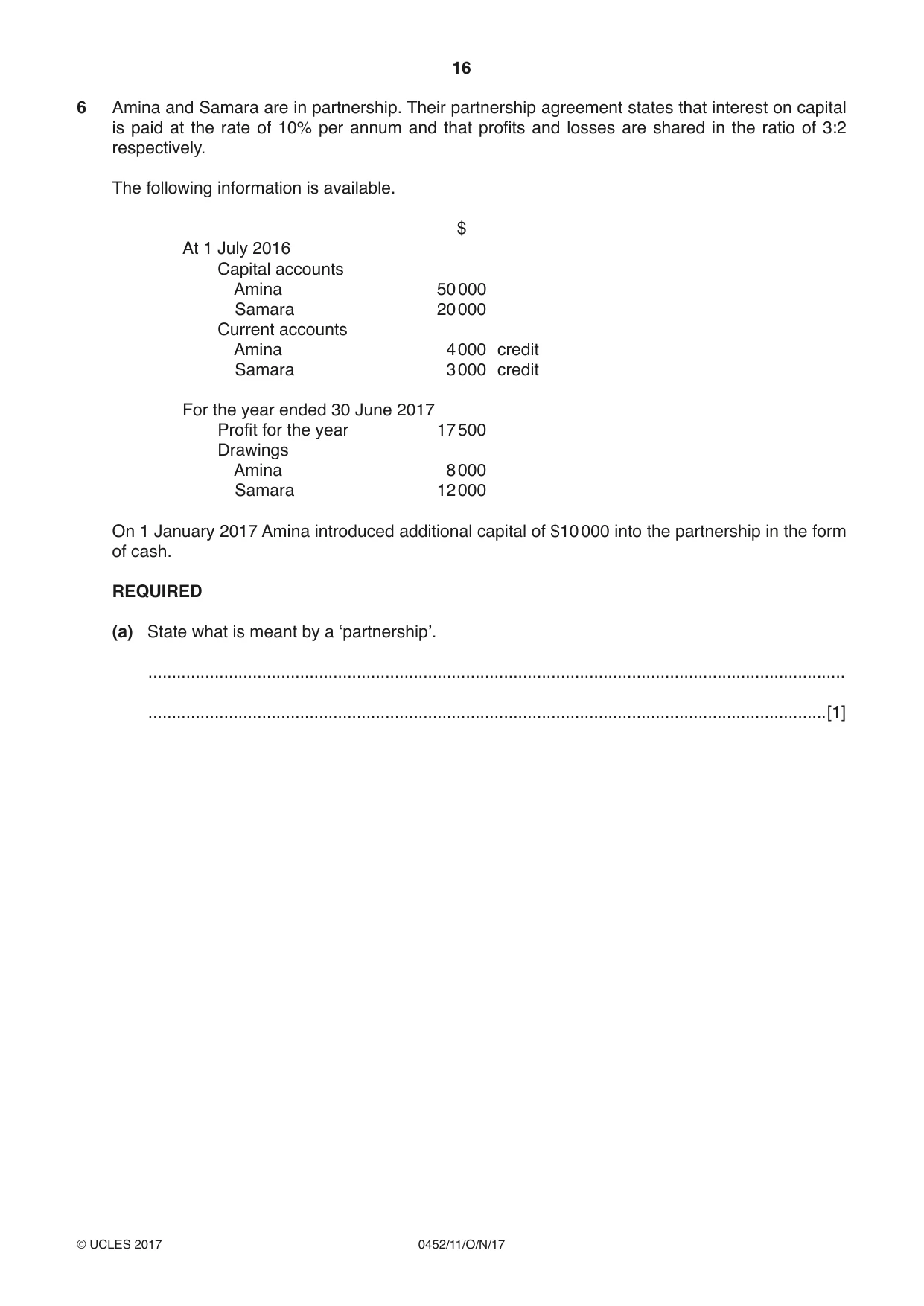
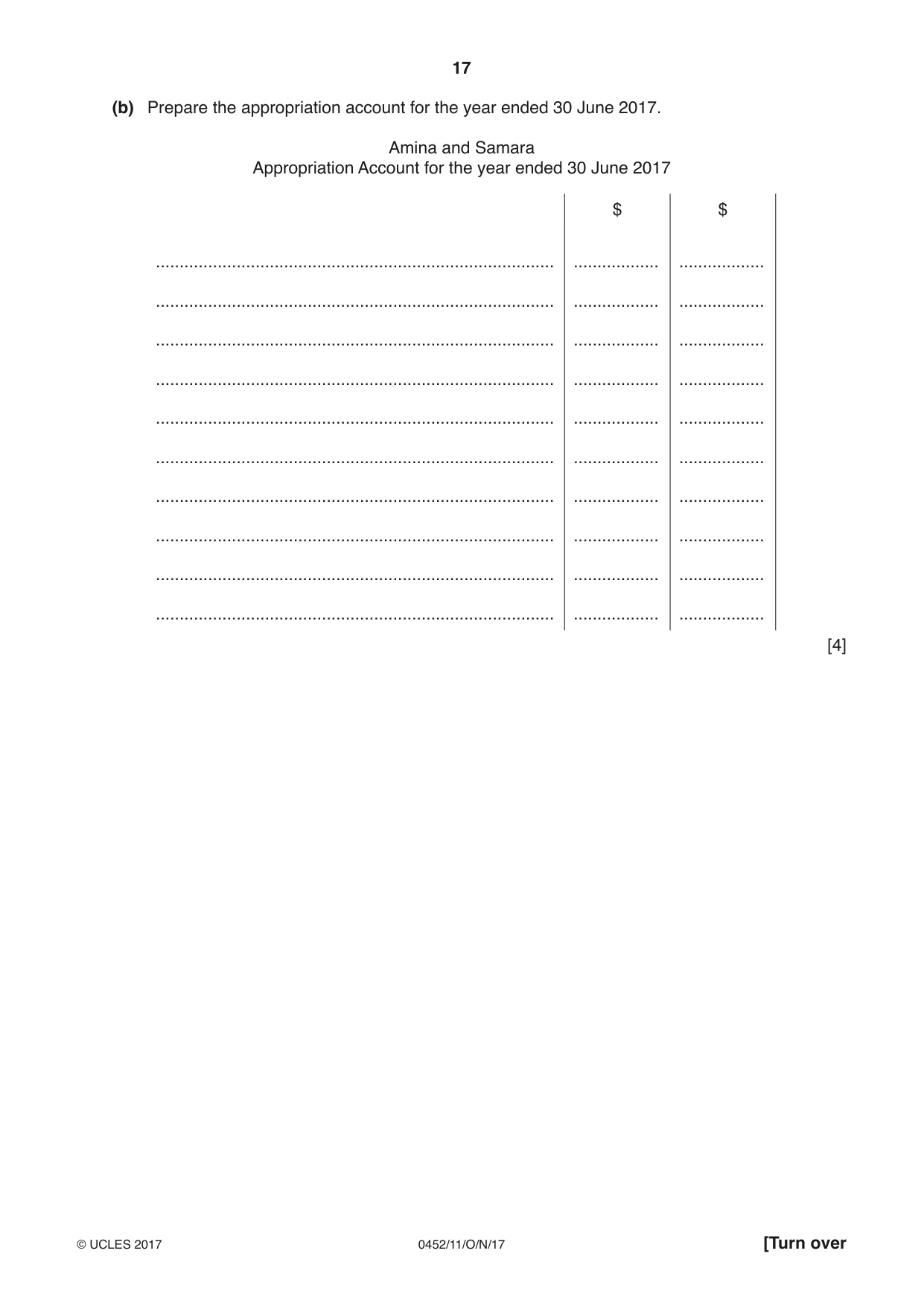
16 0452/11/O/N/17 © UCLES 2017 6 Amina and Samara are in partnership. Their partnership agreement states that interest on capital is paid at the rate of 10% per annum and that profits and losses are shared in the ratio of 3:2 respectively. The following information is available. $ At 1 July 2016 Capital accounts Amina 50 000 Samara 20 000 Current accounts Amina 4 000 credit Samara 3 000 credit For the year ended 30 June 2017 Profit for the year 17 500 Drawings Amina 8 000 Samara 12 000 On 1 January 2017 Amina introduced additional capital of $10 000 into the partnership in the form of cash. REQUIRED (a) State what is meant by a ‘partnership’. … …[1]
Question paper, page 17
17 0452/11/O/N/17 © UCLES 2017 [Turn over (b) Prepare the appropriation account for the year ended 30 June 2017. Amina and Samara Appropriation Account for the year ended 30 June 2017 $ $ … … … … … … … … … … … … … … … … … … … … … … … … … … … … … … [4]
Question paper, page 18
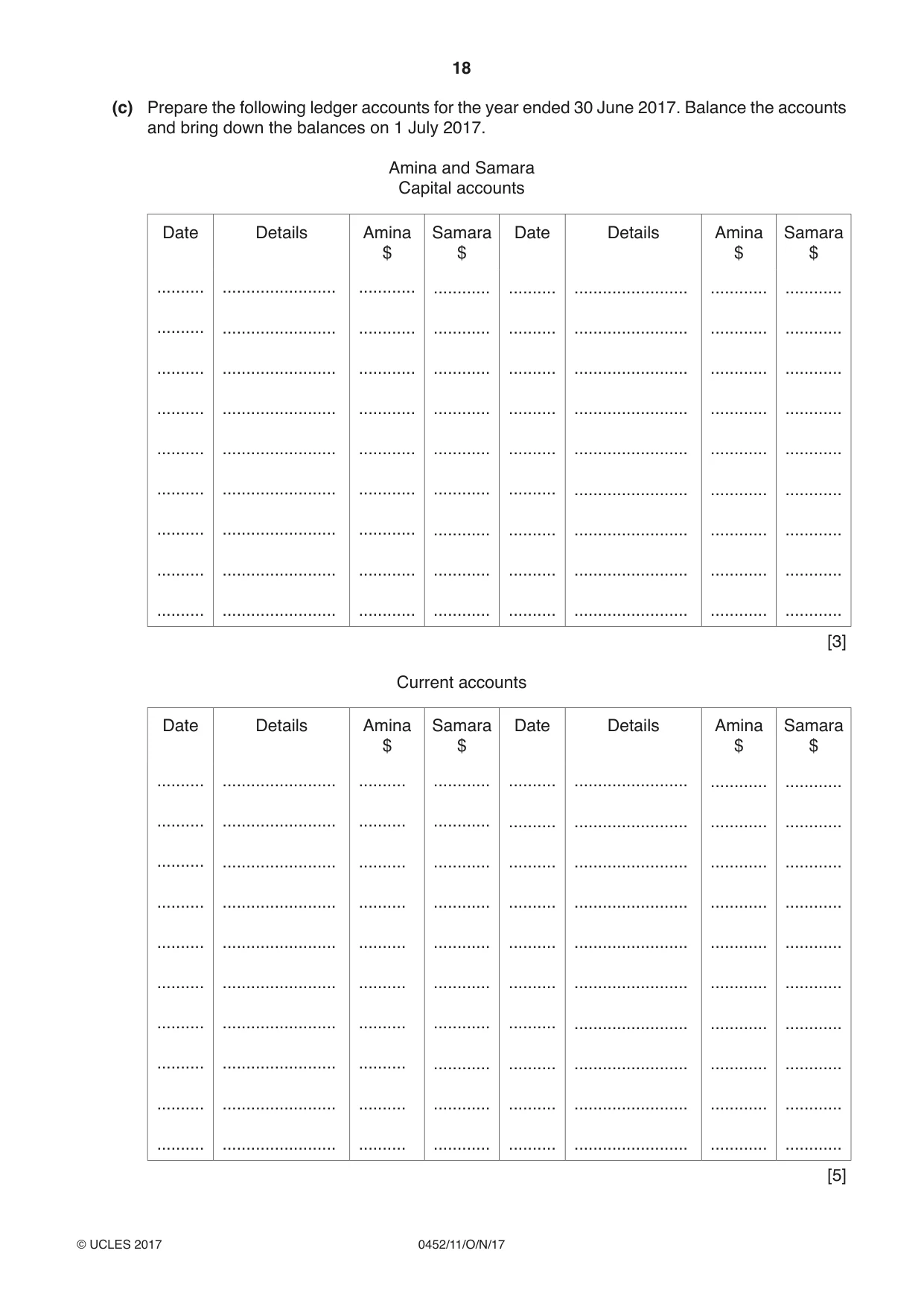
18 0452/11/O/N/17 © UCLES 2017 (c) Prepare the following ledger accounts for the year ended 30 June 2017. Balance the accounts and bring down the balances on 1 July 2017. Amina and Samara Capital accounts Date Details Amina $ Samara $ Date Details Amina $ Samara $ … … … … … … … … … … … … … … … … … … … … … … … … … … … … … … … … … … … … … … … … … … … … … … … … … … … … … … … … … … … … … … … … … … … … … … … … [3] Current accounts Date Details Amina $ Samara $ Date Details Amina $ Samara $ … … … … … … … … … … … … … … … … … … … … … … … … … … … … … … … … … … … … … … … … … … … … … … … … … … … … … … … … … … … … … … … … … … … … … … … … … … … … … … … … [5]
Question paper, page 19
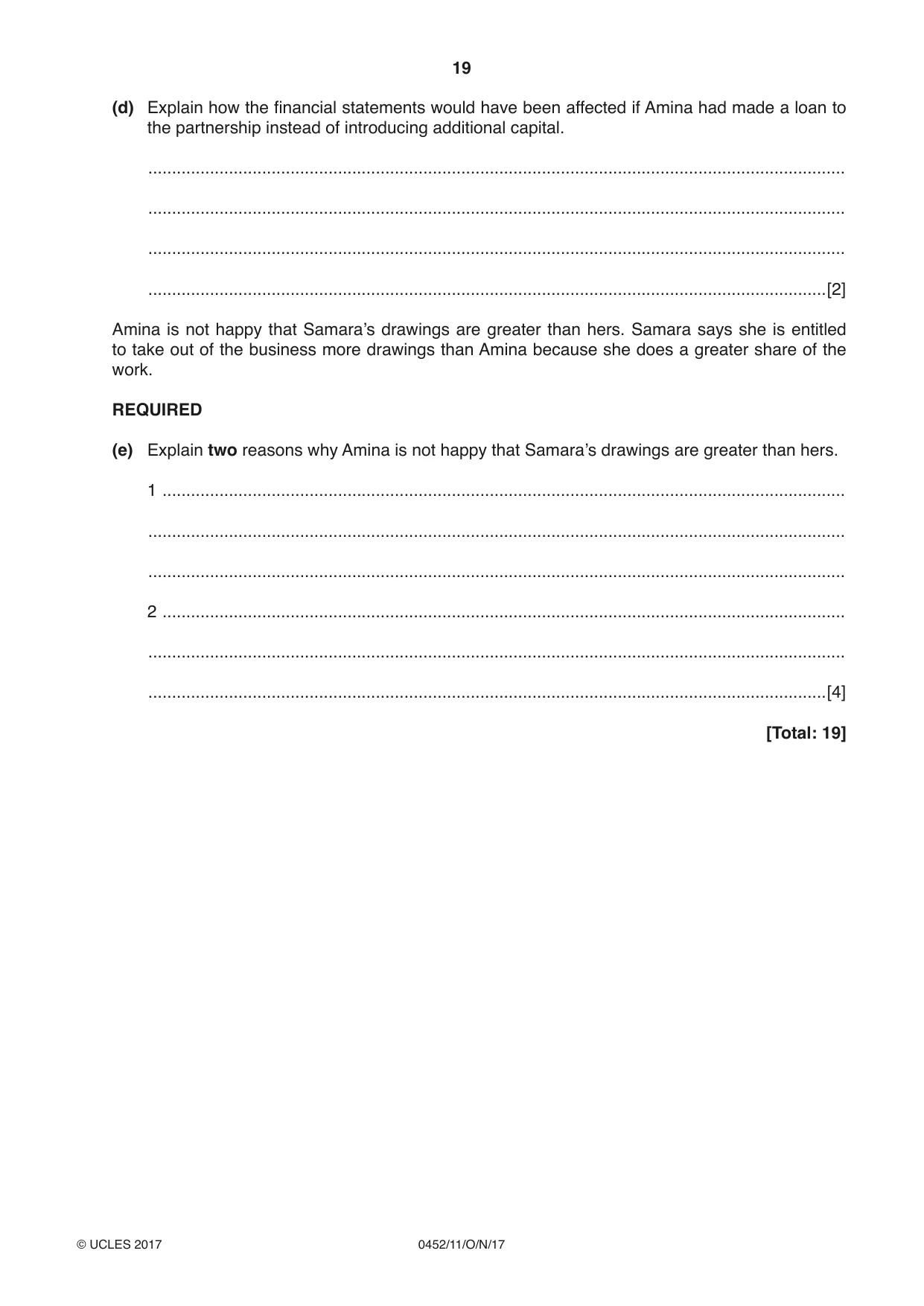
19 0452/11/O/N/17 © UCLES 2017 (d) Explain how the financial statements would have been affected if Amina had made a loan to the partnership instead of introducing additional capital. … … … …[2] Amina is not happy that Samara’s drawings are greater than hers. Samara says she is entitled to take out of the business more drawings than Amina because she does a greater share of the work. REQUIRED (e) Explain two reasons why Amina is not happy that Samara’s drawings are greater than hers. 1 … … … 2 … … …[4] [Total: 19]
Question paper, page 20
20 0452/11/O/N/17 © UCLES 2017 Permission to reproduce items where third-party owned material protected by copyright is included has been sought and cleared where possible. Every reasonable effort has been made by the publisher (UCLES) to trace copyright holders, but if any items requiring clearance have unwittingly been included, the publisher will be pleased to make amends at the earliest possible opportunity. To avoid the issue of disclosure of answer-related information to candidates, all copyright acknowledgements are reproduced online in the Cambridge International Examinations Copyright Acknowledgements Booklet. This is produced for each series of examinations and is freely available to download at www.cie.org.uk after the live examination series. Cambridge International Examinations is part of the Cambridge Assessment Group. Cambridge Assessment is the brand name of University of Cambridge Local Examinations Syndicate (UCLES), which is itself a department of the University of Cambridge. BLANK PAGE
Mark scheme, page 1
® IGCSE is a registered trademark. This document consists of 13 printed pages. © UCLES 2017 [Turn over Cambridge Assessment International Education Cambridge International General Certificate of Secondary Education ACCOUNTING 0452/11 Paper 1 October/November 2017 MARK SCHEME Maximum Mark: 120 Published This mark scheme is published as an aid to teachers and candidates, to indicate the requirements of the examination. It shows the basis on which Examiners were instructed to award marks. It does not indicate the details of the discussions that took place at an Examiners’ meeting before marking began, which would have considered the acceptability of alternative answers. Mark schemes should be read in conjunction with the question paper and the Principal Examiner Report for Teachers. Cambridge International will not enter into discussions about these mark schemes. Cambridge International is publishing the mark schemes for the October/November 2017 series for most Cambridge IGCSE®, Cambridge International A and AS Level components and some Cambridge O Level components.
Mark scheme, page 2
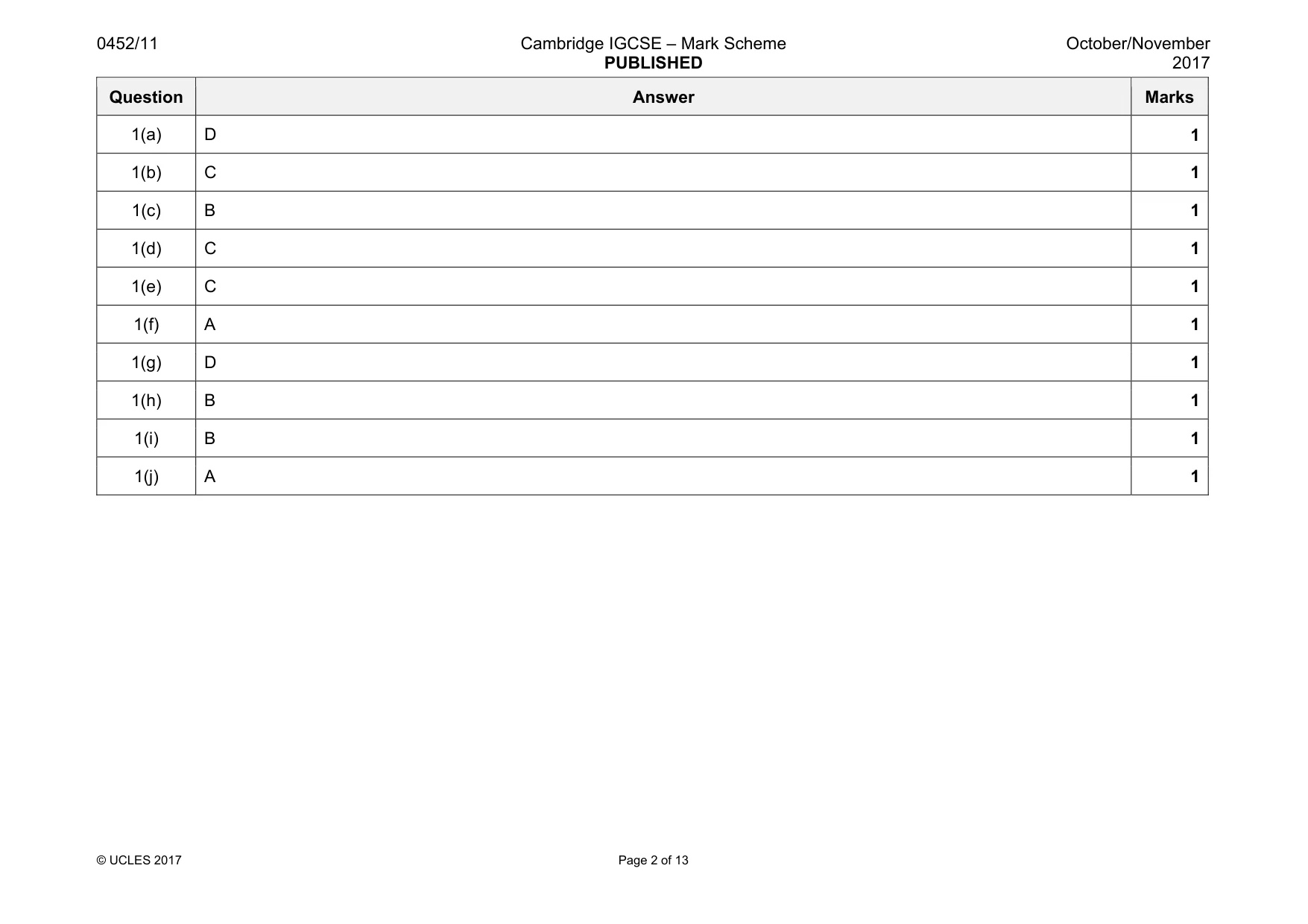
0452/11 Cambridge IGCSE – Mark Scheme PUBLISHED October/November 2017 © UCLES 2017 Page 2 of 13 Question Answer Marks 1(a) D 1 1(b) C 1 1(c) B 1 1(d) C 1 1(e) C 1 1(f) A 1 1(g) D 1 1(h) B 1 1(i) B 1 1(j) A 1
Mark scheme, page 3
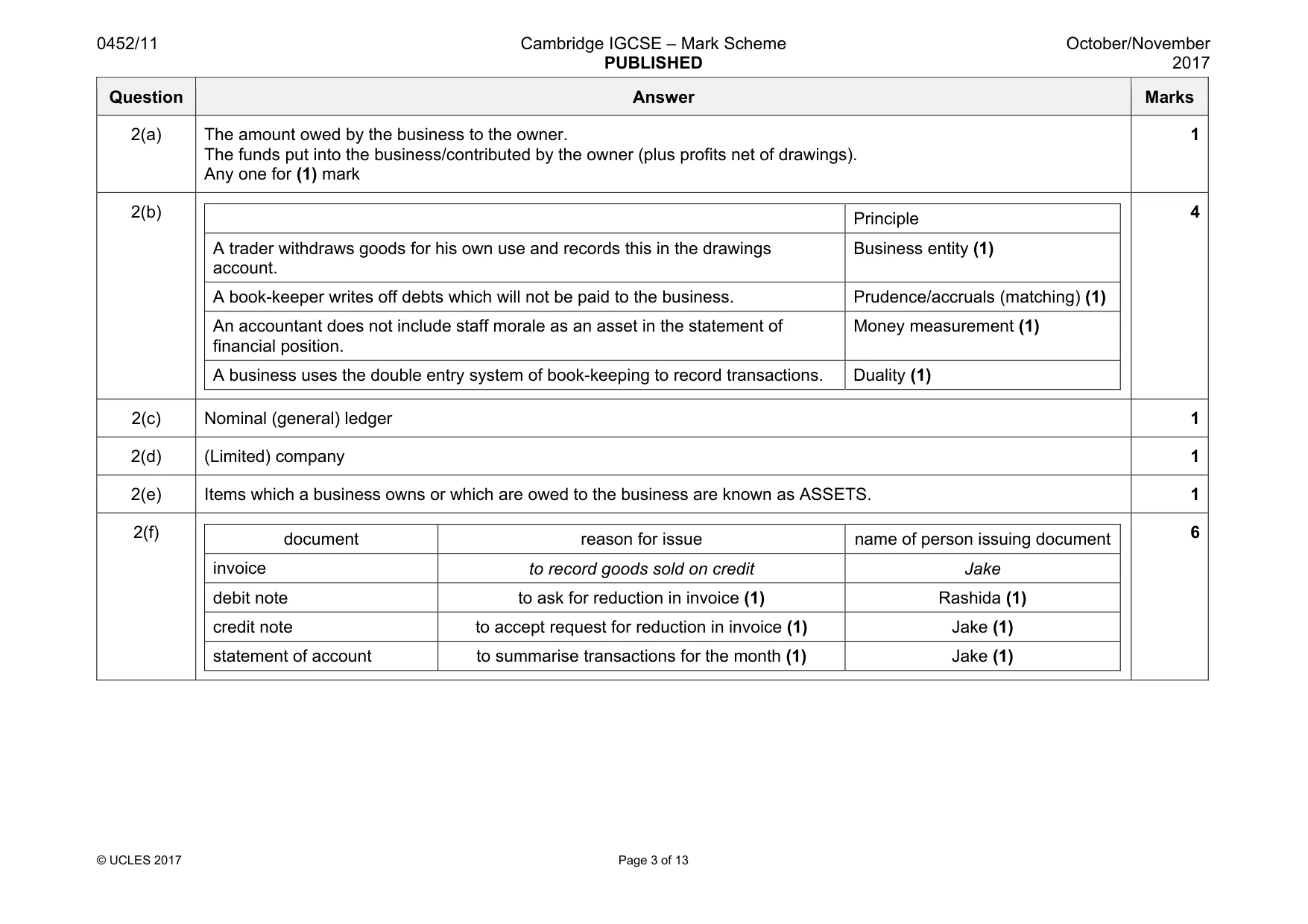
0452/11 Cambridge IGCSE – Mark Scheme PUBLISHED October/November 2017 © UCLES 2017 Page 3 of 13 Question Answer Marks 2(a) The amount owed by the business to the owner. The funds put into the business/contributed by the owner (plus profits net of drawings). Any one for (1) mark 1 2(b) Principle A trader withdraws goods for his own use and records this in the drawings account. Business entity (1) A book-keeper writes off debts which will not be paid to the business. Prudence/accruals (matching) (1) An accountant does not include staff morale as an asset in the statement of financial position. Money measurement (1) A business uses the double entry system of book-keeping to record transactions. Duality (1) 4 2(c) Nominal (general) ledger 1 2(d) (Limited) company 1 2(e) Items which a business owns or which are owed to the business are known as ASSETS. 1 2(f) document reason for issue name of person issuing document invoice to record goods sold on credit Jake debit note to ask for reduction in invoice (1) Rashida (1) credit note to accept request for reduction in invoice (1) Jake (1) statement of account to summarise transactions for the month (1) Jake (1) 6
Mark scheme, page 4
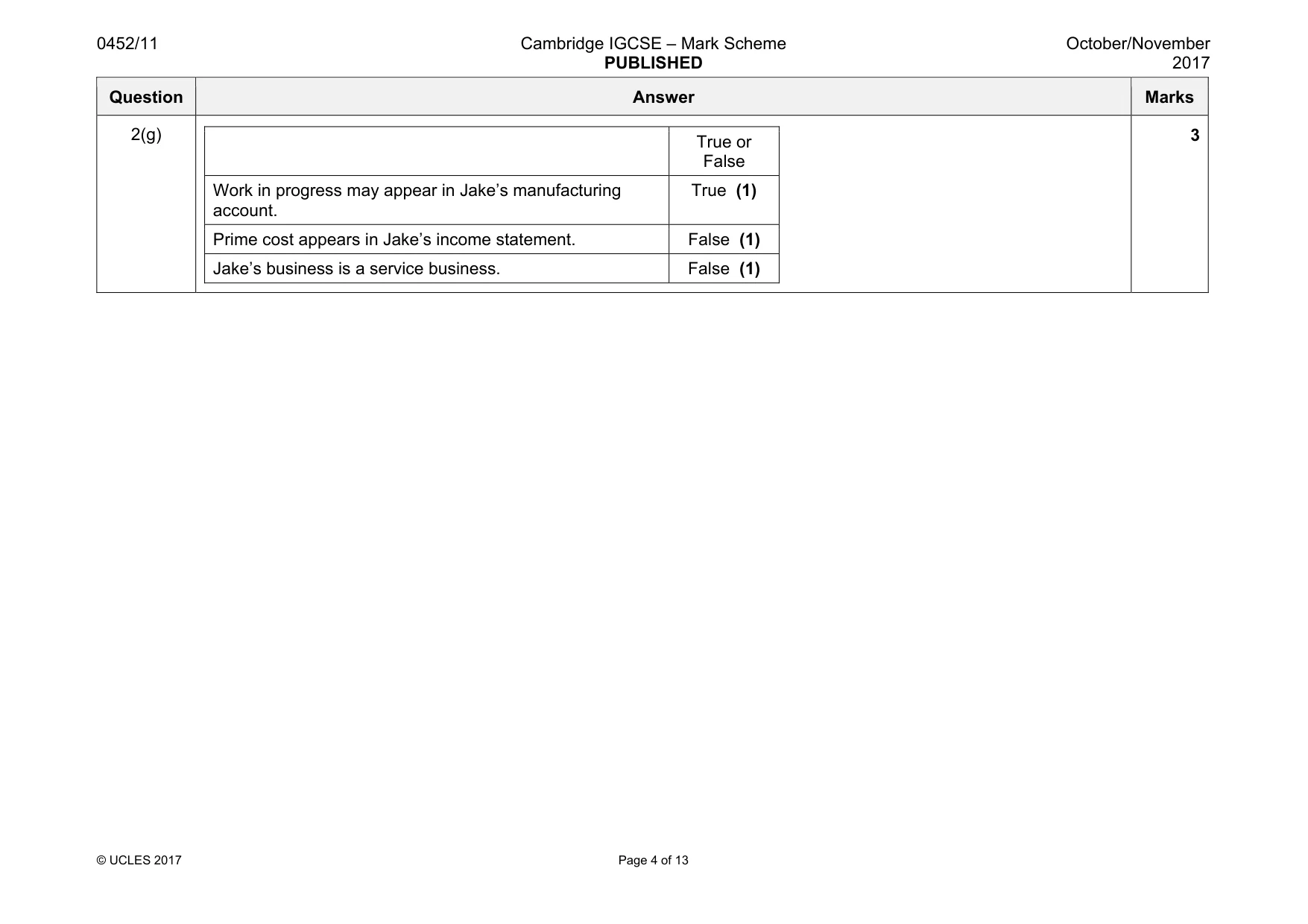
0452/11 Cambridge IGCSE – Mark Scheme PUBLISHED October/November 2017 © UCLES 2017 Page 4 of 13 Question Answer Marks 2(g) True or False Work in progress may appear in Jake’s manufacturing account. True (1) Prime cost appears in Jake’s income statement. False (1) Jake’s business is a service business. False (1) 3
Mark scheme, page 5
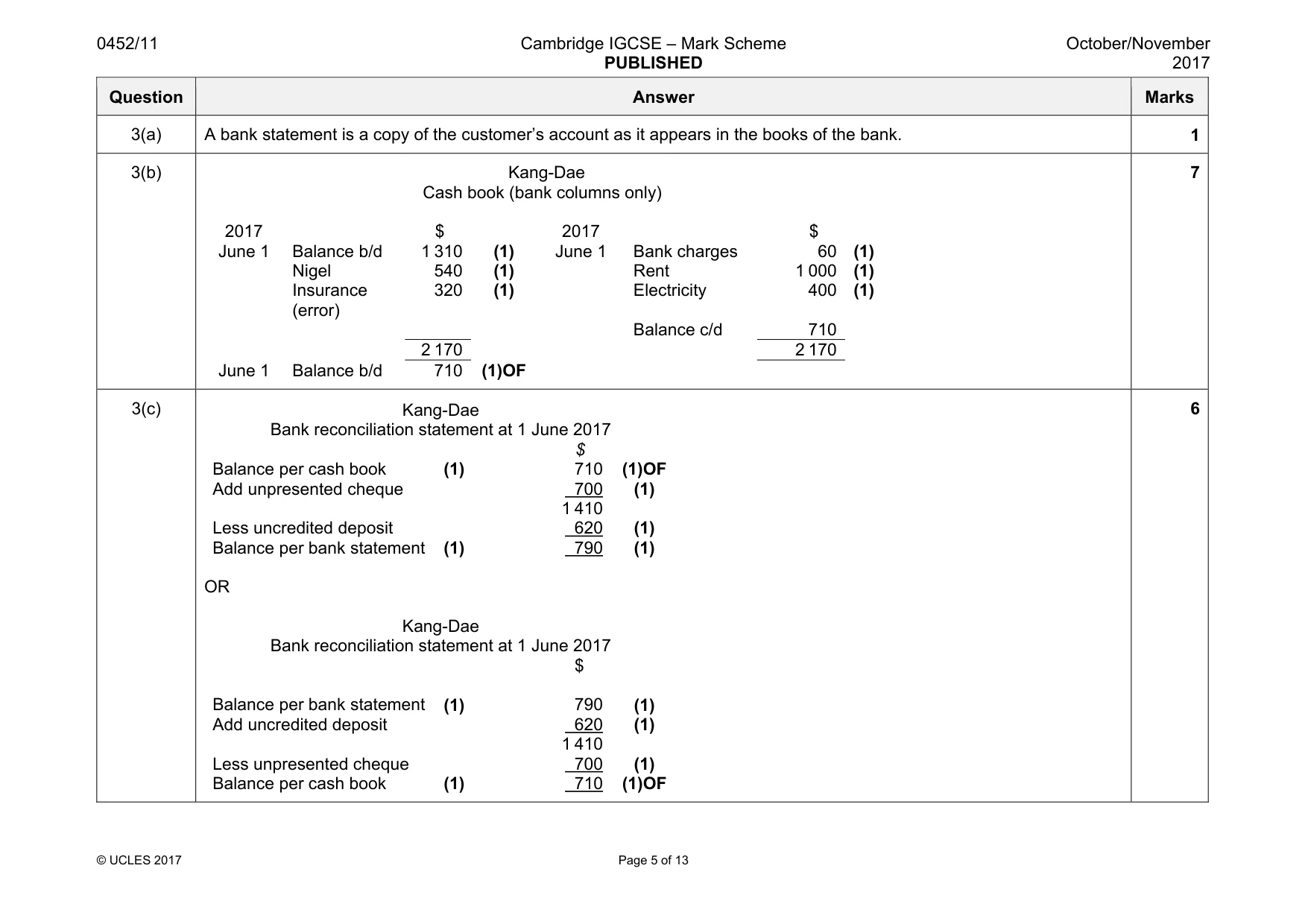
0452/11 Cambridge IGCSE – Mark Scheme PUBLISHED October/November 2017 © UCLES 2017 Page 5 of 13 Question Answer Marks 3(a) A bank statement is a copy of the customer’s account as it appears in the books of the bank. 1 3(b) Kang-Dae Cash book (bank columns only) 2017 $ 2017 $ June 1 Balance b/d 1 310 (1) June 1 Bank charges 60 (1) Nigel 540 (1) Rent 1 000 (1) Insurance (error) 320 (1) Electricity 400 (1) Balance c/d 710 2 170 2 170 June 1 Balance b/d 710 (1)OF 7 3(c) Kang-Dae Bank reconciliation statement at 1 June 2017 $ Balance per cash book (1) 710 (1)OF Add unpresented cheque 700 (1) 1 410 Less uncredited deposit 620 (1) Balance per bank statement (1) 790 (1) OR Kang-Dae Bank reconciliation statement at 1 June 2017 $ Balance per bank statement (1) 790 (1) Add uncredited deposit 620 (1) 1 410 Less unpresented cheque 700 (1) Balance per cash book (1) 710 (1)OF 6
Mark scheme, page 6
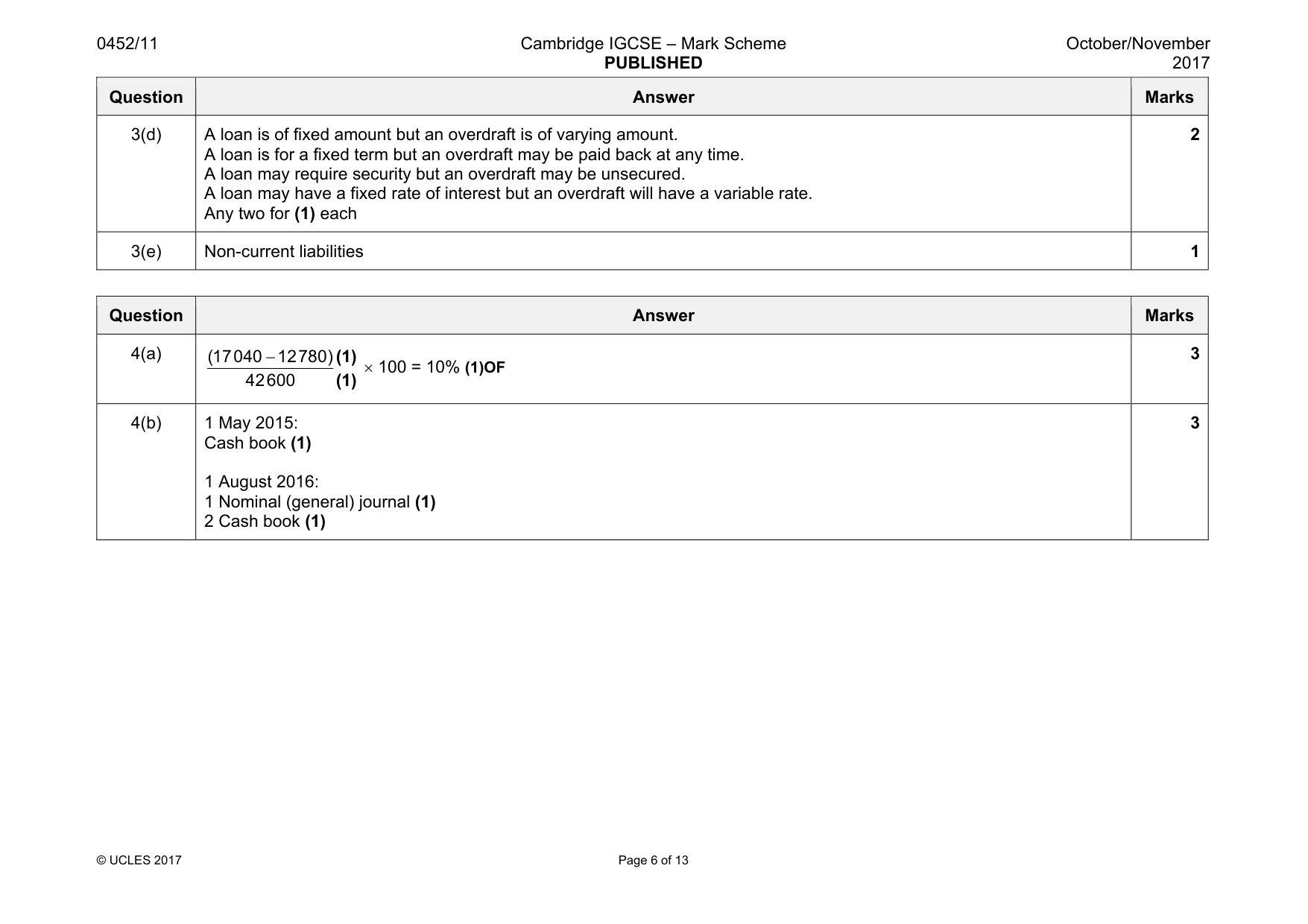
0452/11 Cambridge IGCSE – Mark Scheme PUBLISHED October/November 2017 © UCLES 2017 Page 6 of 13 Question Answer Marks 3(d) A loan is of fixed amount but an overdraft is of varying amount. A loan is for a fixed term but an overdraft may be paid back at any time. A loan may require security but an overdraft may be unsecured. A loan may have a fixed rate of interest but an overdraft will have a variable rate. Any two for (1) each 2 3(e) Non-current liabilities 1 Question Answer Marks 4(a) (17040 12780) 42600 − (1) (1) × 100 = 10% (1)OF 3 4(b) 1 May 2015: Cash book (1) 1 August 2016: 1 Nominal (general) journal (1) 2 Cash book (1) 3
Mark scheme, page 7
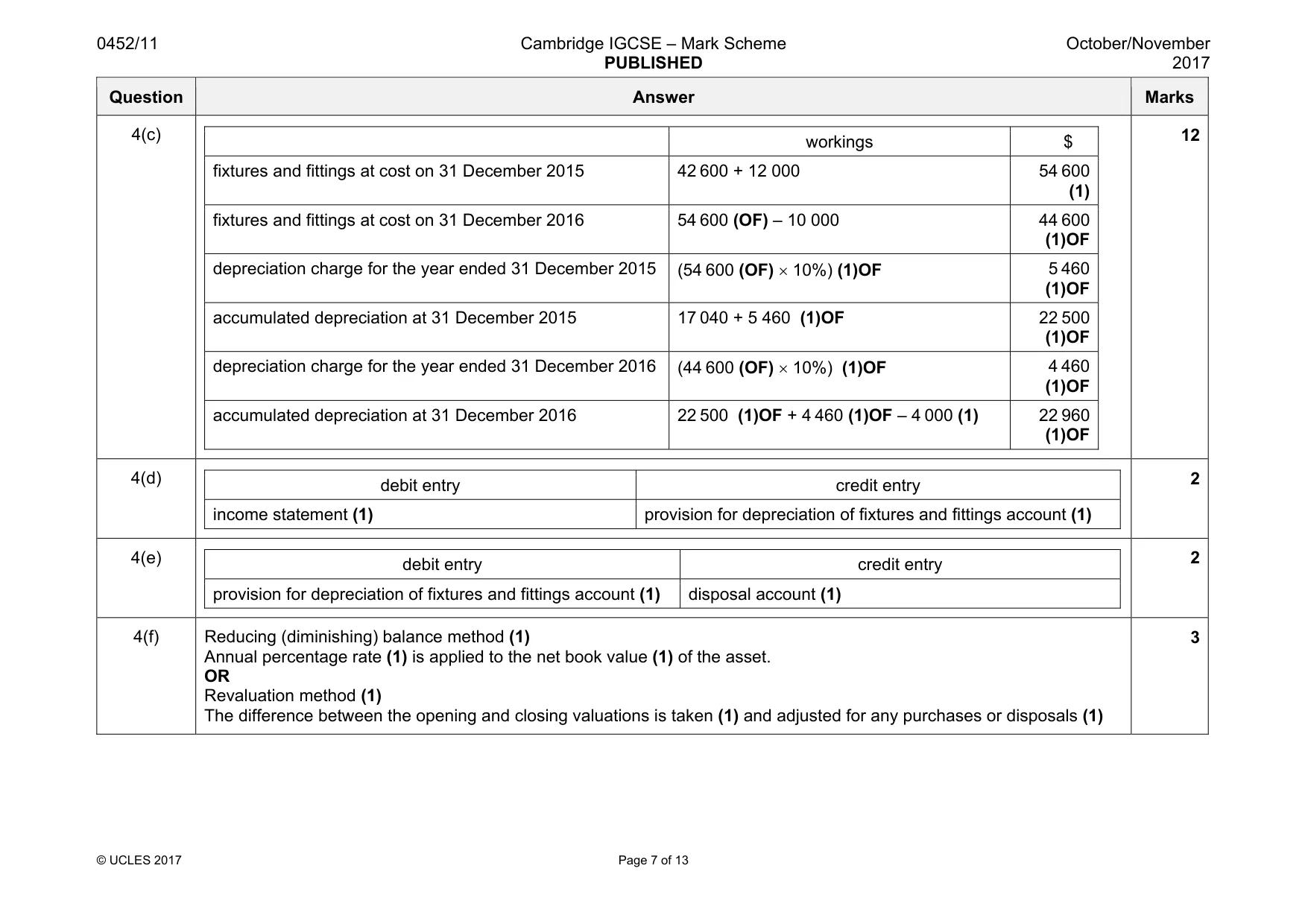
0452/11 Cambridge IGCSE – Mark Scheme PUBLISHED October/November 2017 © UCLES 2017 Page 7 of 13 Question Answer Marks 4(c) workings $ fixtures and fittings at cost on 31 December 2015 42 600 + 12 000 54 600 (1) fixtures and fittings at cost on 31 December 2016 54 600 (OF) – 10 000 44 600 (1)OF depreciation charge for the year ended 31 December 2015 (54 600 (OF) × 10%) (1)OF 5 460 (1)OF accumulated depreciation at 31 December 2015 17 040 + 5 460 (1)OF 22 500 (1)OF depreciation charge for the year ended 31 December 2016 (44 600 (OF) × 10%) (1)OF 4 460 (1)OF accumulated depreciation at 31 December 2016 22 500 (1)OF + 4 460 (1)OF – 4 000 (1) 22 960 (1)OF 12 4(d) debit entry credit entry income statement (1) provision for depreciation of fixtures and fittings account (1) 2 4(e) debit entry credit entry provision for depreciation of fixtures and fittings account (1) disposal account (1) 2 4(f) Reducing (diminishing) balance method (1) Annual percentage rate (1) is applied to the net book value (1) of the asset. OR Revaluation method (1) The difference between the opening and closing valuations is taken (1) and adjusted for any purchases or disposals (1) 3
Mark scheme, page 8
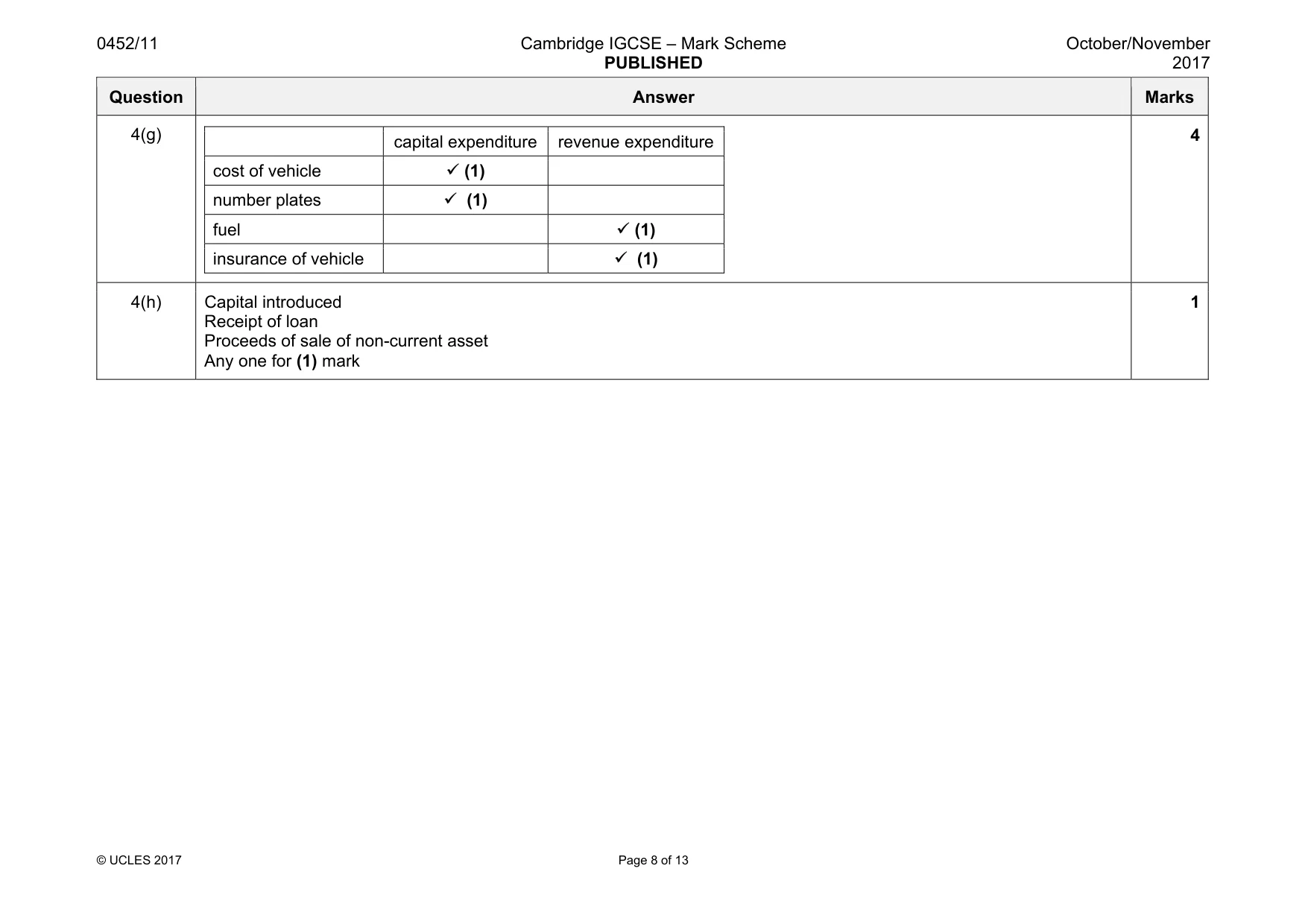
0452/11 Cambridge IGCSE – Mark Scheme PUBLISHED October/November 2017 © UCLES 2017 Page 8 of 13 Question Answer Marks 4(g) capital expenditure revenue expenditure cost of vehicle 9 (1) number plates 9 (1) fuel 9 (1) insurance of vehicle 9 (1) 4 4(h) Capital introduced Receipt of loan Proceeds of sale of non-current asset Any one for (1) mark 1
Mark scheme, page 9
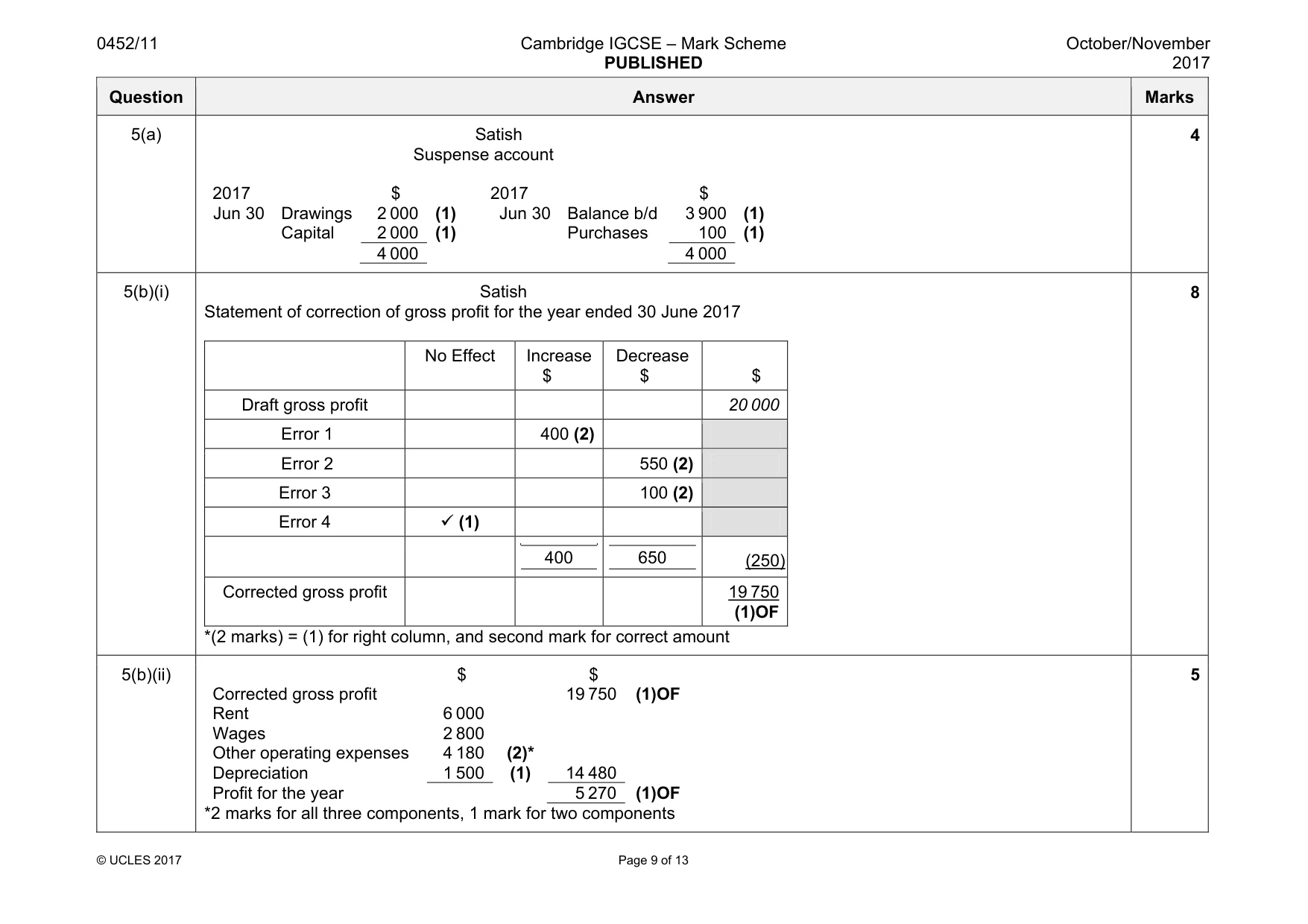
0452/11 Cambridge IGCSE – Mark Scheme PUBLISHED October/November 2017 © UCLES 2017 Page 9 of 13 Question Answer Marks 5(a) Satish Suspense account 2017 $ 2017 $ Jun 30 Drawings 2 000 (1) Jun 30 Balance b/d 3 900 (1) Capital 2 000 (1) Purchases 100 (1) 4 000 4 000 4 5(b)(i) Satish Statement of correction of gross profit for the year ended 30 June 2017 No Effect Increase $ Decrease $ $ Draft gross profit 20 000 Error 1 400 (2) Error 2 550 (2) Error 3 100 (2) Error 4 9 (1) 400 650 (250) Corrected gross profit 19 750 (1)OF *(2 marks) = (1) for right column, and second mark for correct amount 8 5(b)(ii) $ $ Corrected gross profit 19 750 (1)OF Rent 6 000 Wages 2 800 Other operating expenses 4 180 (2)* Depreciation 1 500 (1) 14 480 Profit for the year 5 270 (1)OF *2 marks for all three components, 1 mark for two components 5
Mark scheme, page 10
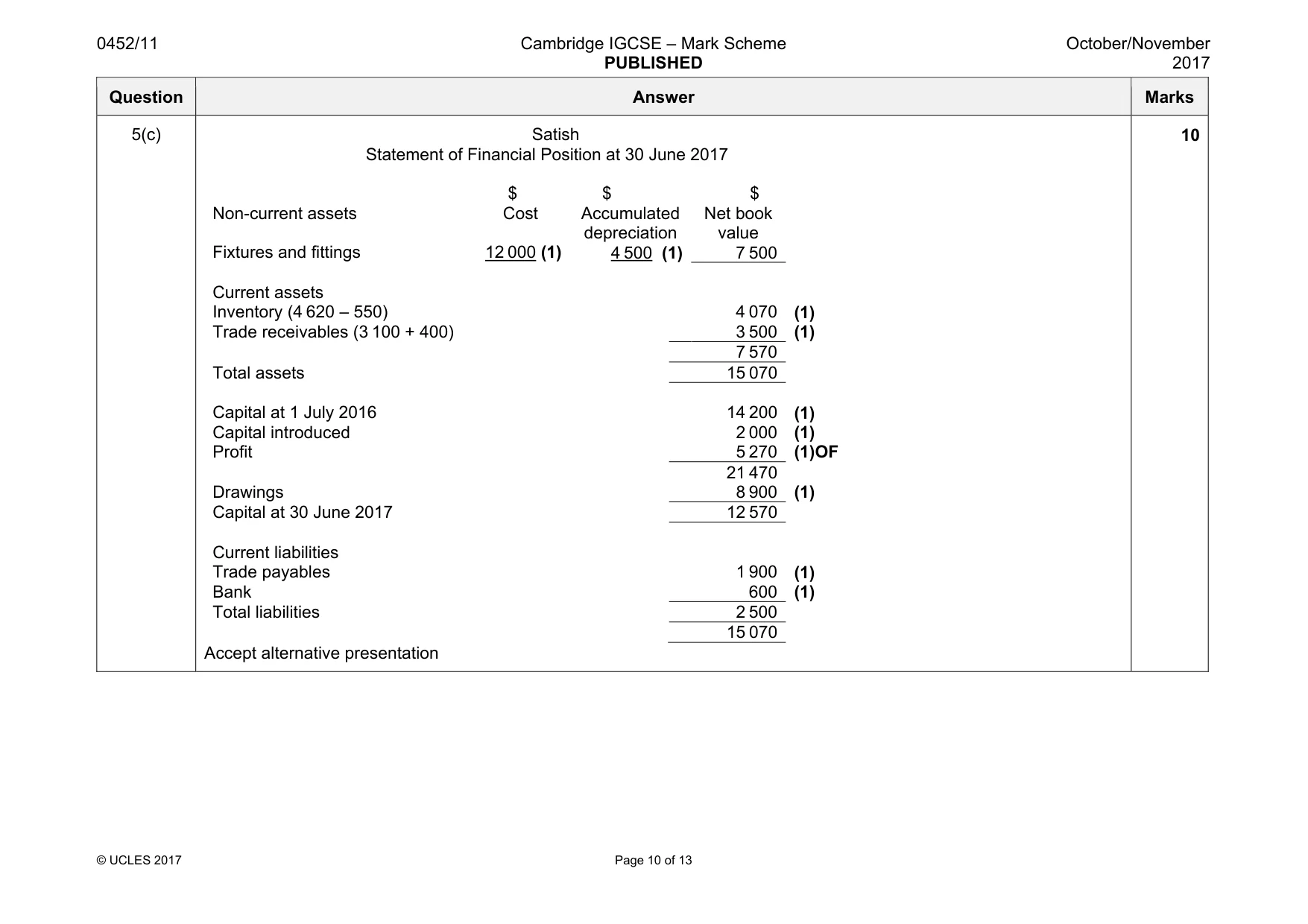
0452/11 Cambridge IGCSE – Mark Scheme PUBLISHED October/November 2017 © UCLES 2017 Page 10 of 13 Question Answer Marks 5(c) Satish Statement of Financial Position at 30 June 2017 $ $ $ Non-current assets Cost Accumulated Net book depreciation value Fixtures and fittings 12 000 (1) 4 500 (1) 7 500 Current assets Inventory (4 620 – 550) 4 070 (1) Trade receivables (3 100 + 400) 3 500 (1) 7 570 Total assets 15 070 Capital at 1 July 2016 14 200 (1) Capital introduced 2 000 (1) Profit 5 270 (1)OF 21 470 Drawings 8 900 (1) Capital at 30 June 2017 12 570 Current liabilities Trade payables 1 900 (1) Bank 600 (1) Total liabilities 2 500 15 070 Accept alternative presentation 10
Mark scheme, page 11
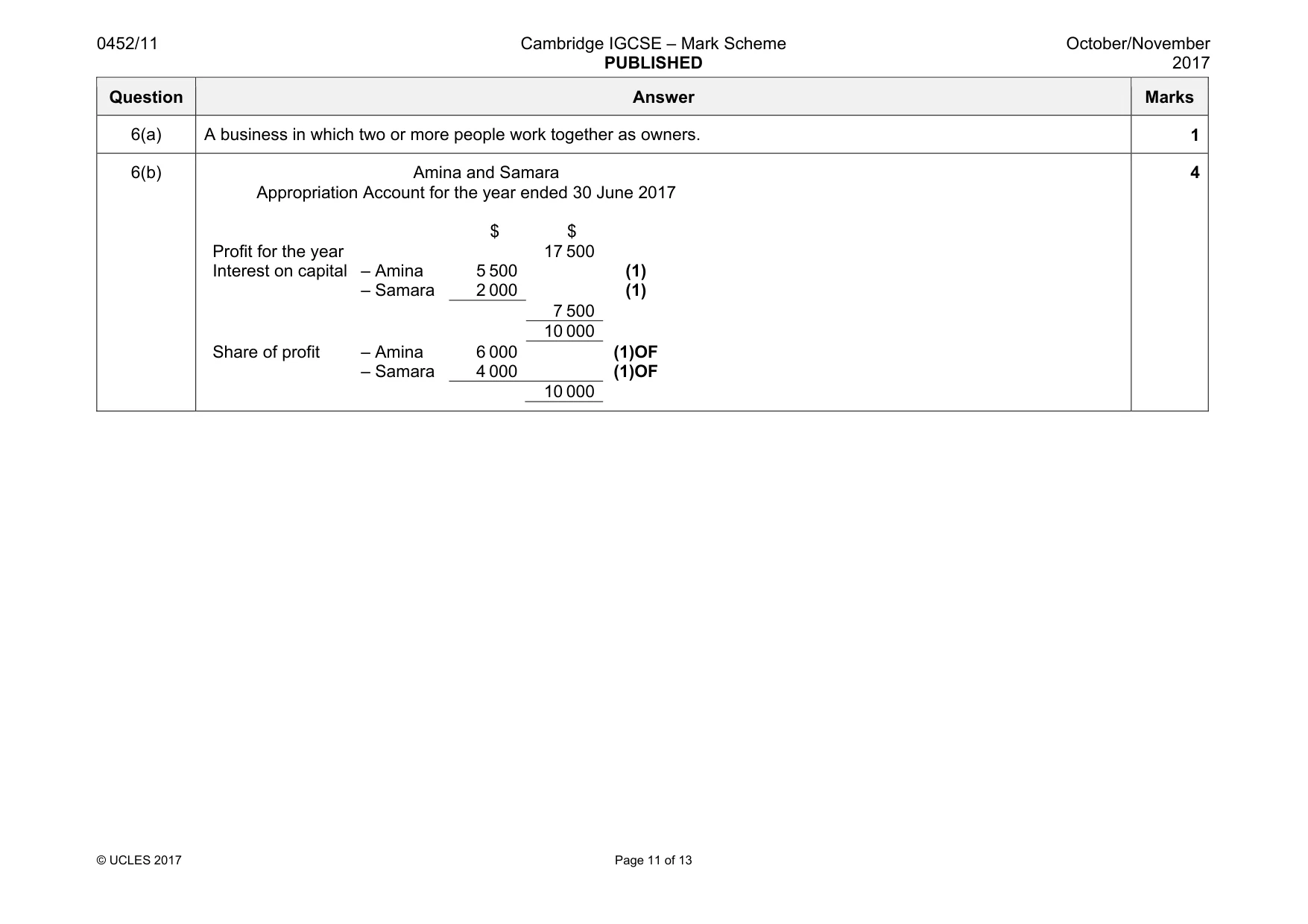
0452/11 Cambridge IGCSE – Mark Scheme PUBLISHED October/November 2017 © UCLES 2017 Page 11 of 13 Question Answer Marks 6(a) A business in which two or more people work together as owners. 1 6(b) Amina and Samara Appropriation Account for the year ended 30 June 2017 $ $ Profit for the year 17 500 Interest on capital – Amina 5 500 (1) – Samara 2 000 (1) 7 500 10 000 Share of profit – Amina 6 000 (1)OF – Samara 4 000 (1)OF 10 000 4
Mark scheme, page 12
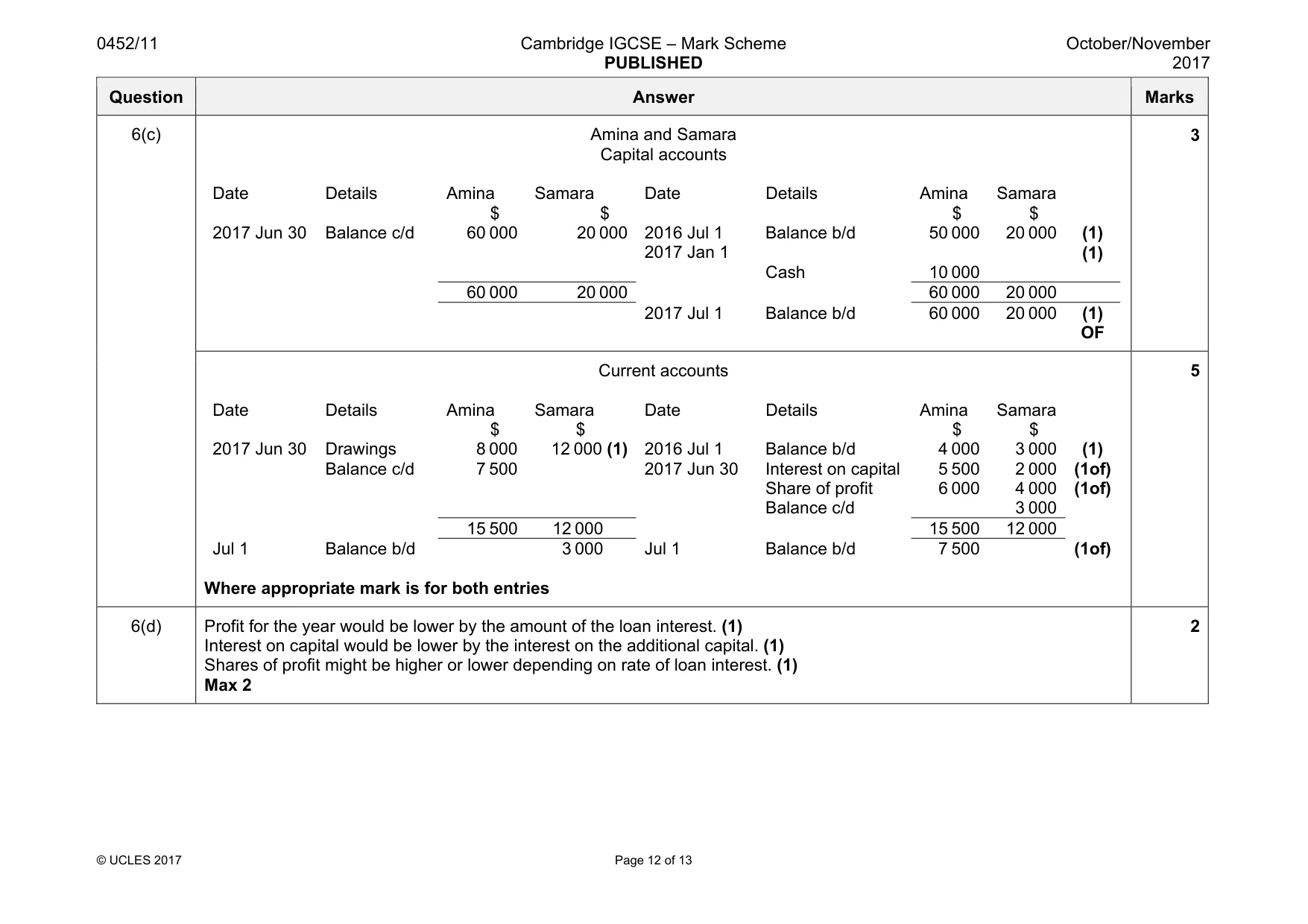
0452/11 Cambridge IGCSE – Mark Scheme PUBLISHED October/November 2017 © UCLES 2017 Page 12 of 13 Question Answer Marks 6(c) Amina and Samara Capital accounts Date Details Amina Samara Date Details Amina Samara $ $ $ $ 2017 Jun 30 Balance c/d 60 000 20 000 2016 Jul 1 Balance b/d 50 000 20 000 (1) 2017 Jan 1 Cash 10 000 (1) 60 000 20 000 60 000 20 000 2017 Jul 1 Balance b/d 60 000 20 000 (1) OF 3 Current accounts Date Details Amina Samara Date Details Amina Samara $ $ $ $ 2017 Jun 30 Drawings 8 000 12 000 (1) 2016 Jul 1 Balance b/d 4 000 3 000 (1) Balance c/d 7 500 2017 Jun 30 Interest on capital 5 500 2 000 (1of) Share of profit 6 000 4 000 (1of) Balance c/d 3 000 15 500 12 000 15 500 12 000 Jul 1 Balance b/d 3 000 Jul 1 Balance b/d 7 500 (1of) Where appropriate mark is for both entries 5 6(d) Profit for the year would be lower by the amount of the loan interest. (1) Interest on capital would be lower by the interest on the additional capital. (1) Shares of profit might be higher or lower depending on rate of loan interest. (1) Max 2 2
Mark scheme, page 13
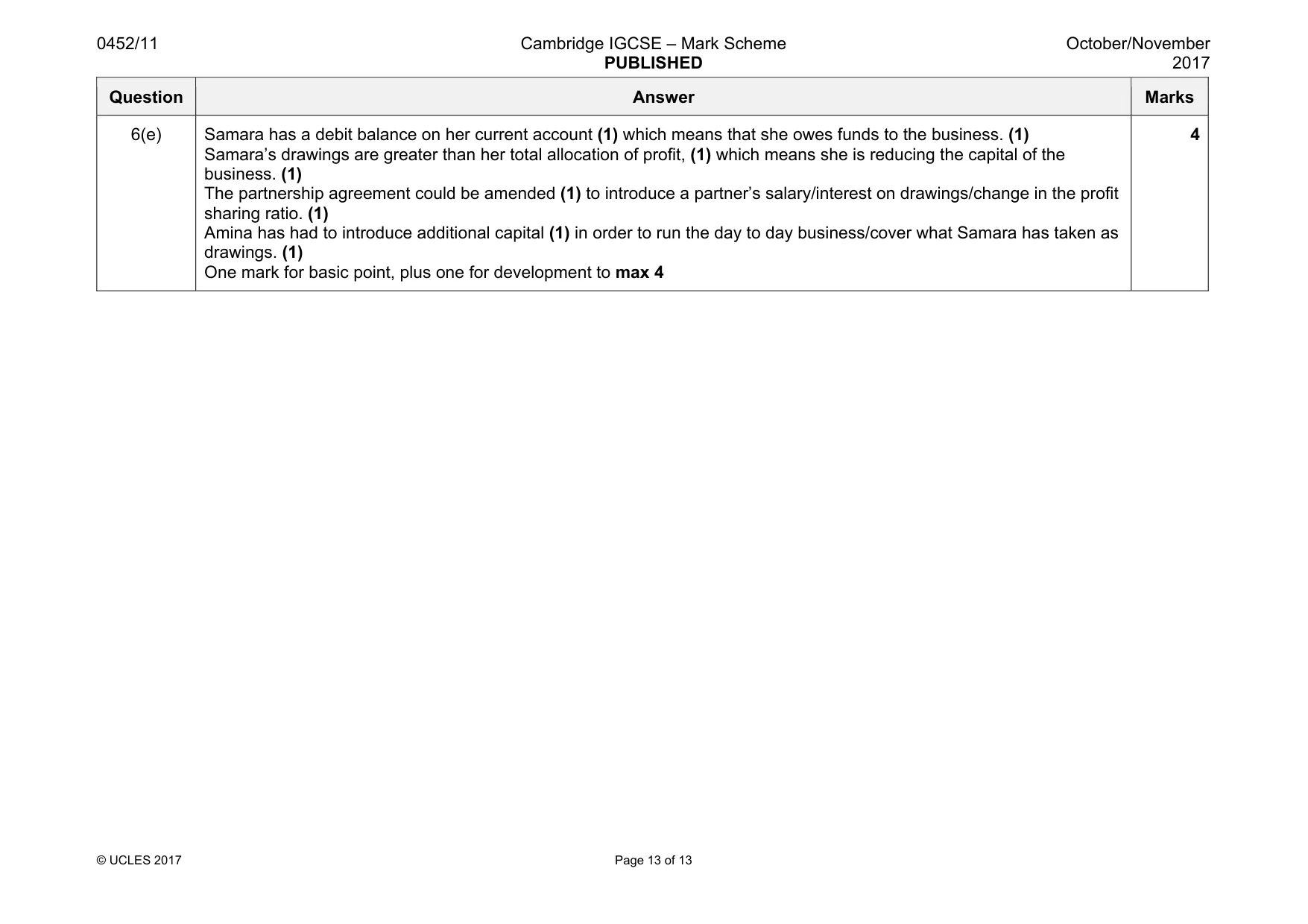
0452/11 Cambridge IGCSE – Mark Scheme PUBLISHED October/November 2017 © UCLES 2017 Page 13 of 13 Question Answer Marks 6(e) Samara has a debit balance on her current account (1) which means that she owes funds to the business. (1) Samara’s drawings are greater than her total allocation of profit, (1) which means she is reducing the capital of the business. (1) The partnership agreement could be amended (1) to introduce a partner’s salary/interest on drawings/change in the profit sharing ratio. (1) Amina has had to introduce additional capital (1) in order to run the day to day business/cover what Samara has taken as drawings. (1) One mark for basic point, plus one for development to max 4 4
What you needed in this session
Cambridge’s own grade thresholds for 2017 Oct/Nov, Paper 1 · Variant 1. A higher threshold means an easier paper — the bar moves with how the cohort did.