Cambridge IGCSE Accounting 0452 — 2017 Oct/Nov Paper 1 · Variant 2
0452/12/O/N/17 · 120 marks · ≈135 min
The question paper and its mark scheme, free to read here and free to download. This is Cambridge’s own paper, exactly as it was sat.
Question paper20 pages
Mark scheme7 pages
Answers below. Sit the paper first if you are practising.
Paper as text
Question paper, page 1
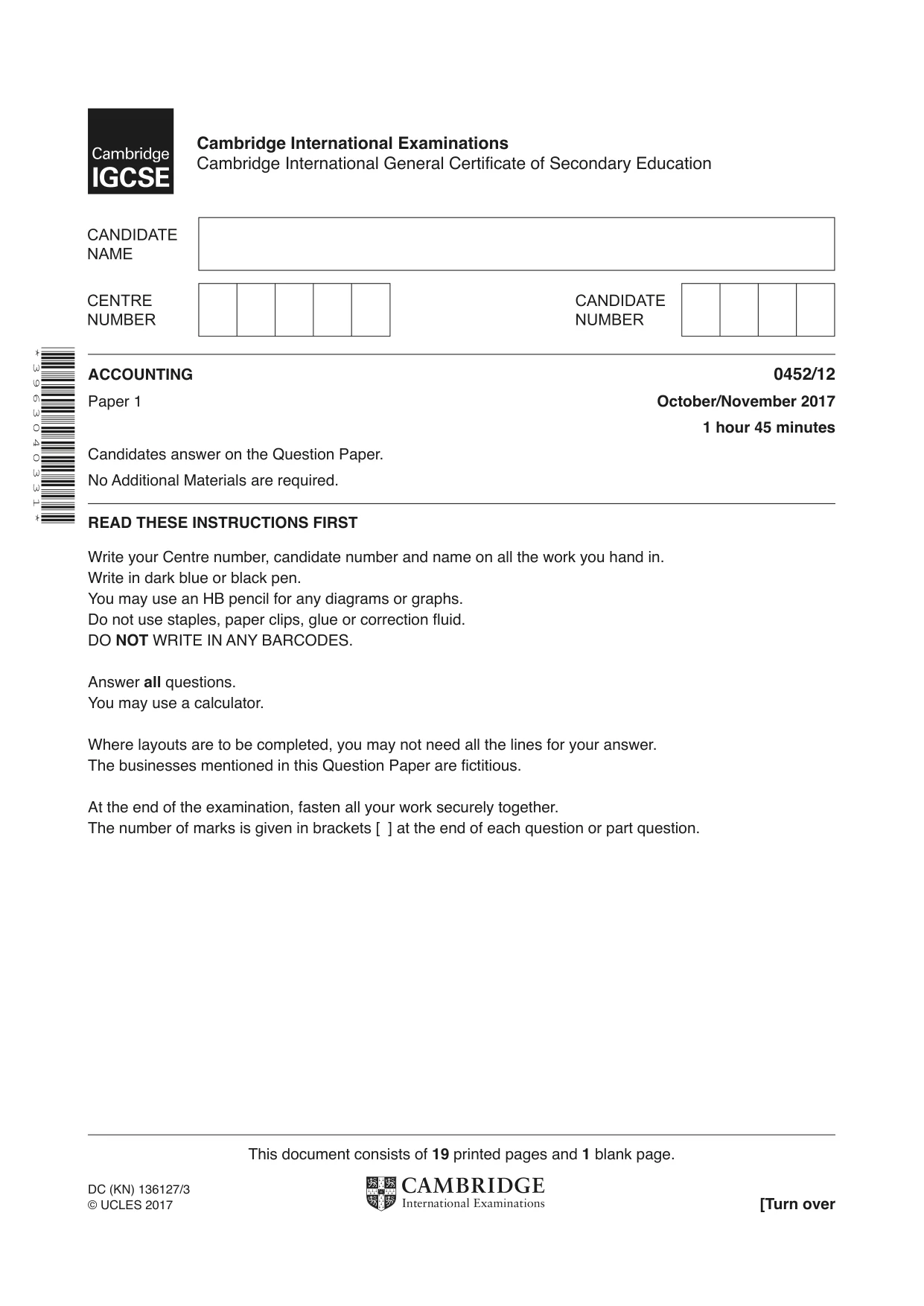
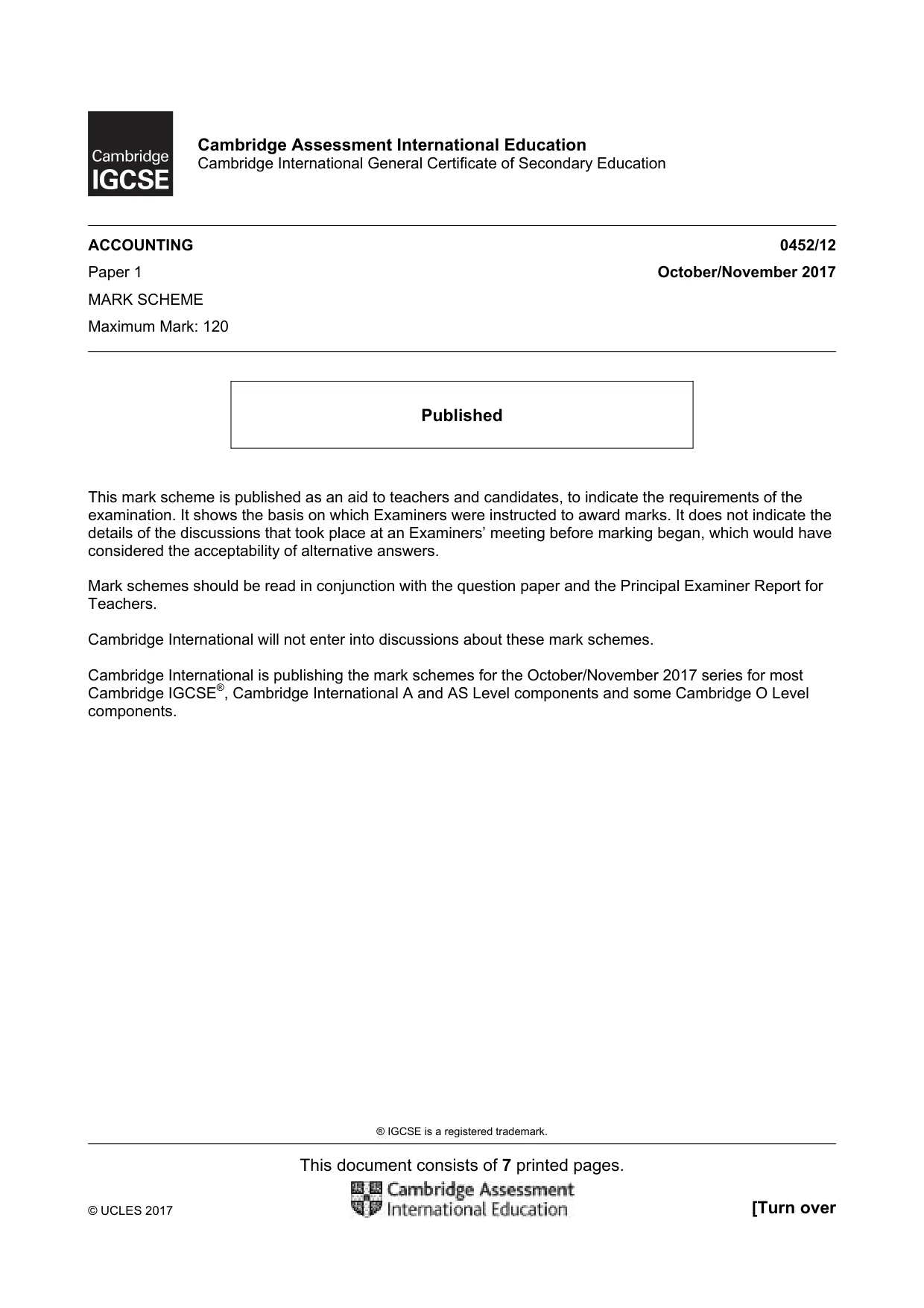
* 3 9 6 3 0 4 0 3 3 1 * This document consists of 19 printed pages and 1 blank page. DC (KN) 136127/3 © UCLES 2017 [Turn over ACCOUNTING 0452/12 Paper 1 October/November 2017 1 hour 45 minutes Candidates answer on the Question Paper. No Additional Materials are required. READ THESE INSTRUCTIONS FIRST Write your Centre number, candidate number and name on all the work you hand in. Write in dark blue or black pen. You may use an HB pencil for any diagrams or graphs. Do not use staples, paper clips, glue or correction fluid. DO NOT WRITE IN ANY BARCODES. Answer all questions. You may use a calculator. Where layouts are to be completed, you may not need all the lines for your answer. The businesses mentioned in this Question Paper are fictitious. At the end of the examination, fasten all your work securely together. The number of marks is given in brackets [ ] at the end of each question or part question. Cambridge International Examinations Cambridge International General Certificate of Secondary Education
Question paper, page 2
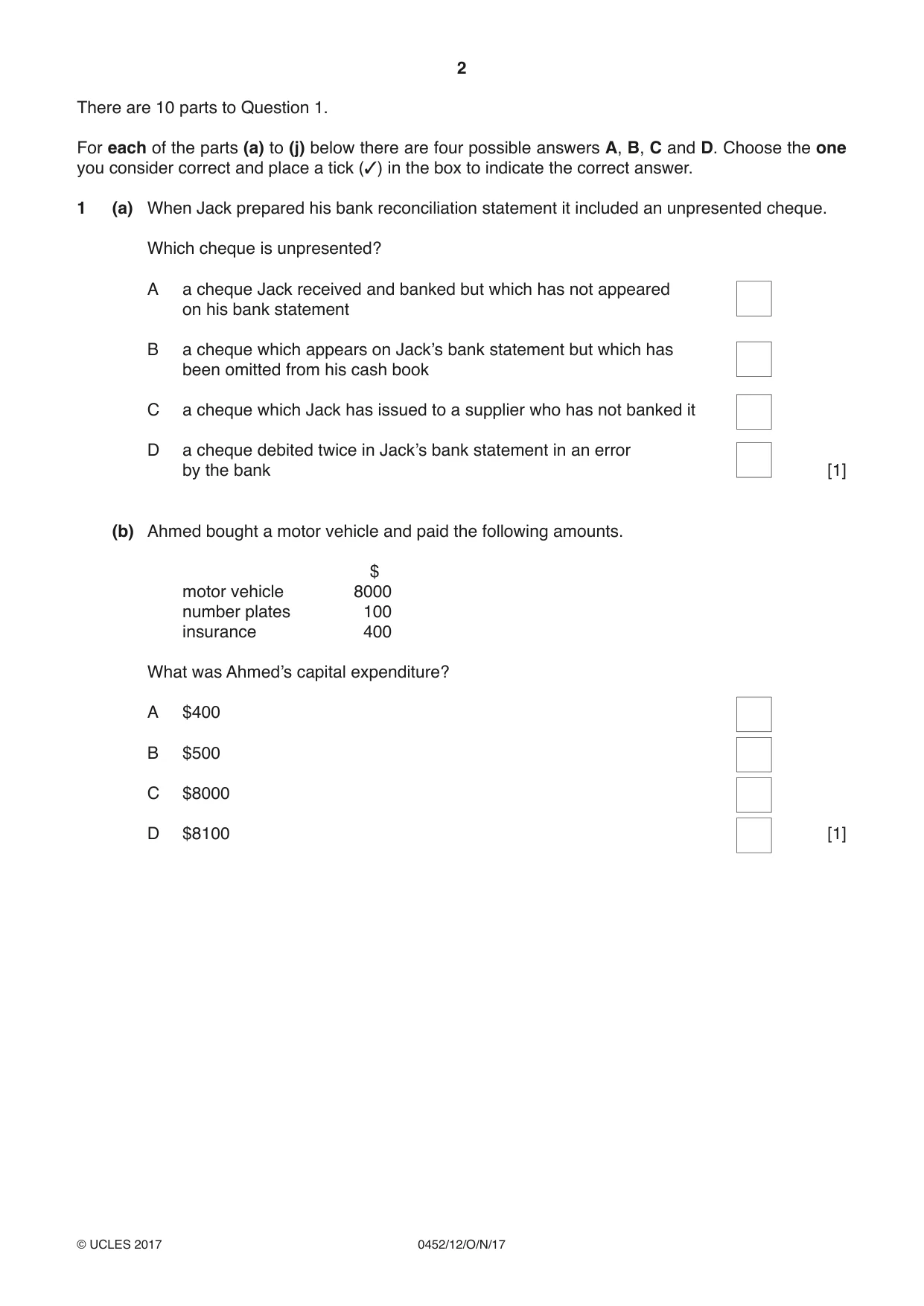
2 0452/12/O/N/17 © UCLES 2017 There are 10 parts to Question 1. For each of the parts (a) to (j) below there are four possible answers A, B, C and D. Choose the one you consider correct and place a tick (3) in the box to indicate the correct answer. 1 (a) When Jack prepared his bank reconciliation statement it included an unpresented cheque. Which cheque is unpresented? A a cheque Jack received and banked but which has not appeared on his bank statement B a cheque which appears on Jack’s bank statement but which has been omitted from his cash book C a cheque which Jack has issued to a supplier who has not banked it D a cheque debited twice in Jack’s bank statement in an error by the bank [1] (b) Ahmed bought a motor vehicle and paid the following amounts. $ motor vehicle 8000 number plates 100 insurance 400 What was Ahmed’s capital expenditure? A $400 B $500 C $8000 D $8100 [1]
Question paper, page 3
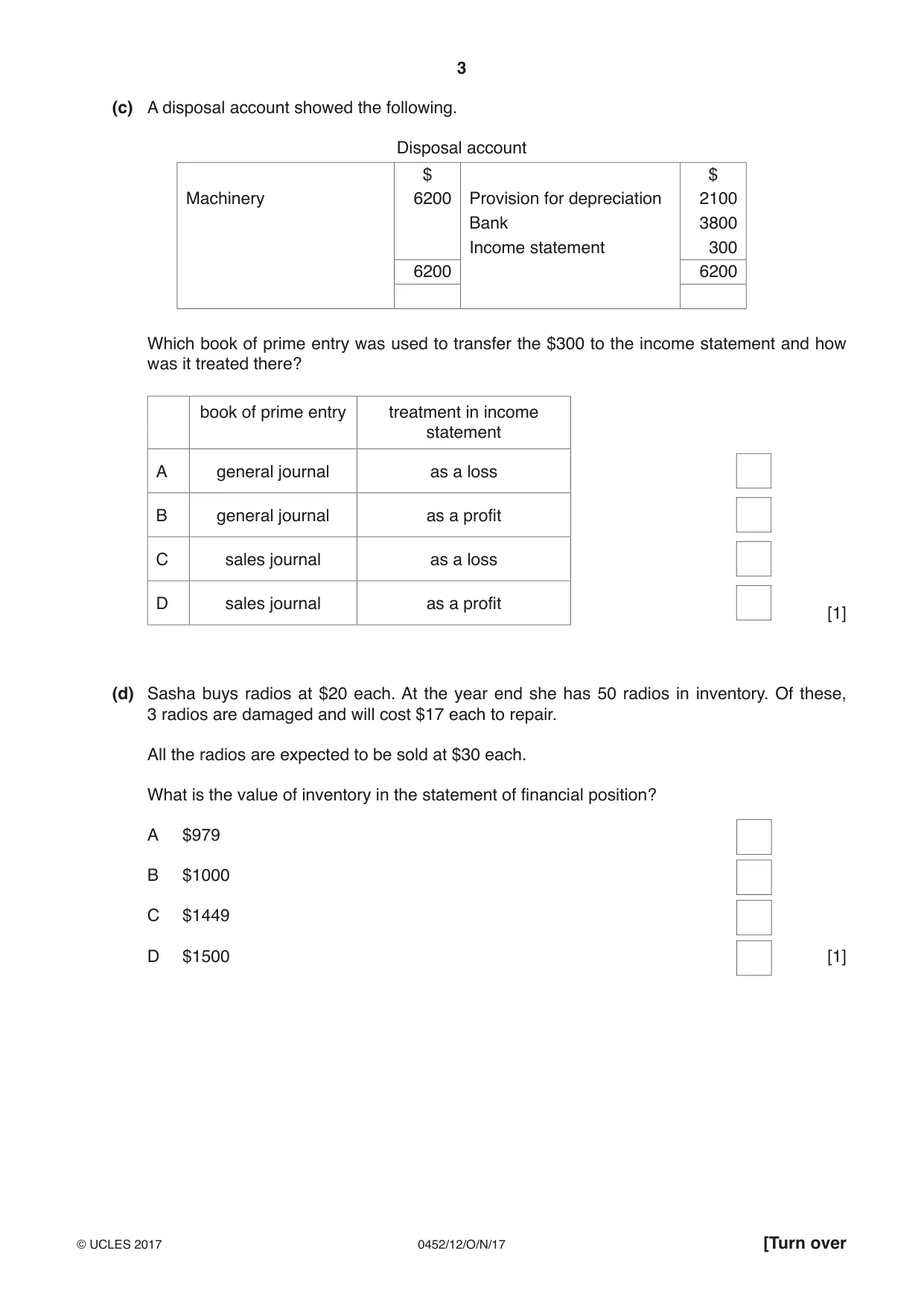
3 0452/12/O/N/17 © UCLES 2017 [Turn over (c) A disposal account showed the following. Disposal account $ $ Machinery 6200 Provision for depreciation 2100 Bank 3800 Income statement 300 6200 6200 Which book of prime entry was used to transfer the $300 to the income statement and how was it treated there? book of prime entry treatment in income statement A general journal as a loss B general journal as a profit C sales journal as a loss D sales journal as a profit [1] (d) Sasha buys radios at $20 each. At the year end she has 50 radios in inventory. Of these, 3 radios are damaged and will cost $17 each to repair. All the radios are expected to be sold at $30 each. What is the value of inventory in the statement of financial position? A $979 B $1000 C $1449 D $1500 [1]
Question paper, page 4
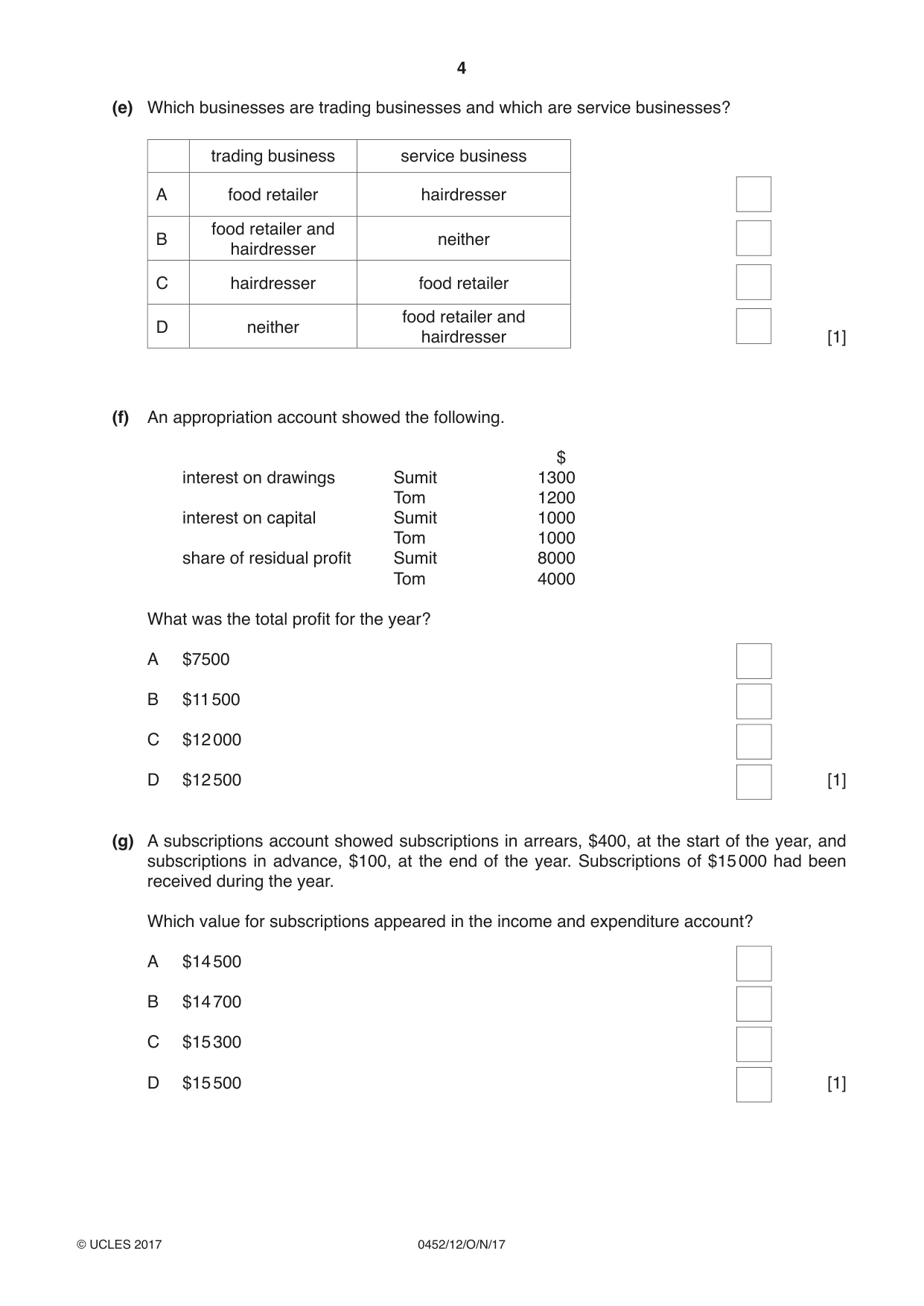
4 0452/12/O/N/17 © UCLES 2017 (e) Which businesses are trading businesses and which are service businesses? trading business service business A food retailer hairdresser B food retailer and hairdresser neither C hairdresser food retailer D neither food retailer and hairdresser [1] (f) An appropriation account showed the following. $ interest on drawings Sumit 1300 Tom 1200 interest on capital Sumit 1000 Tom 1000 share of residual profit Sumit 8000 Tom 4000 What was the total profit for the year? A $7500 B $11 500 C $12 000 D $12 500 [1] (g) A subscriptions account showed subscriptions in arrears, $400, at the start of the year, and subscriptions in advance, $100, at the end of the year. Subscriptions of $15 000 had been received during the year. Which value for subscriptions appeared in the income and expenditure account? A $14 500 B $14 700 C $15 300 D $15 500 [1]
Question paper, page 5
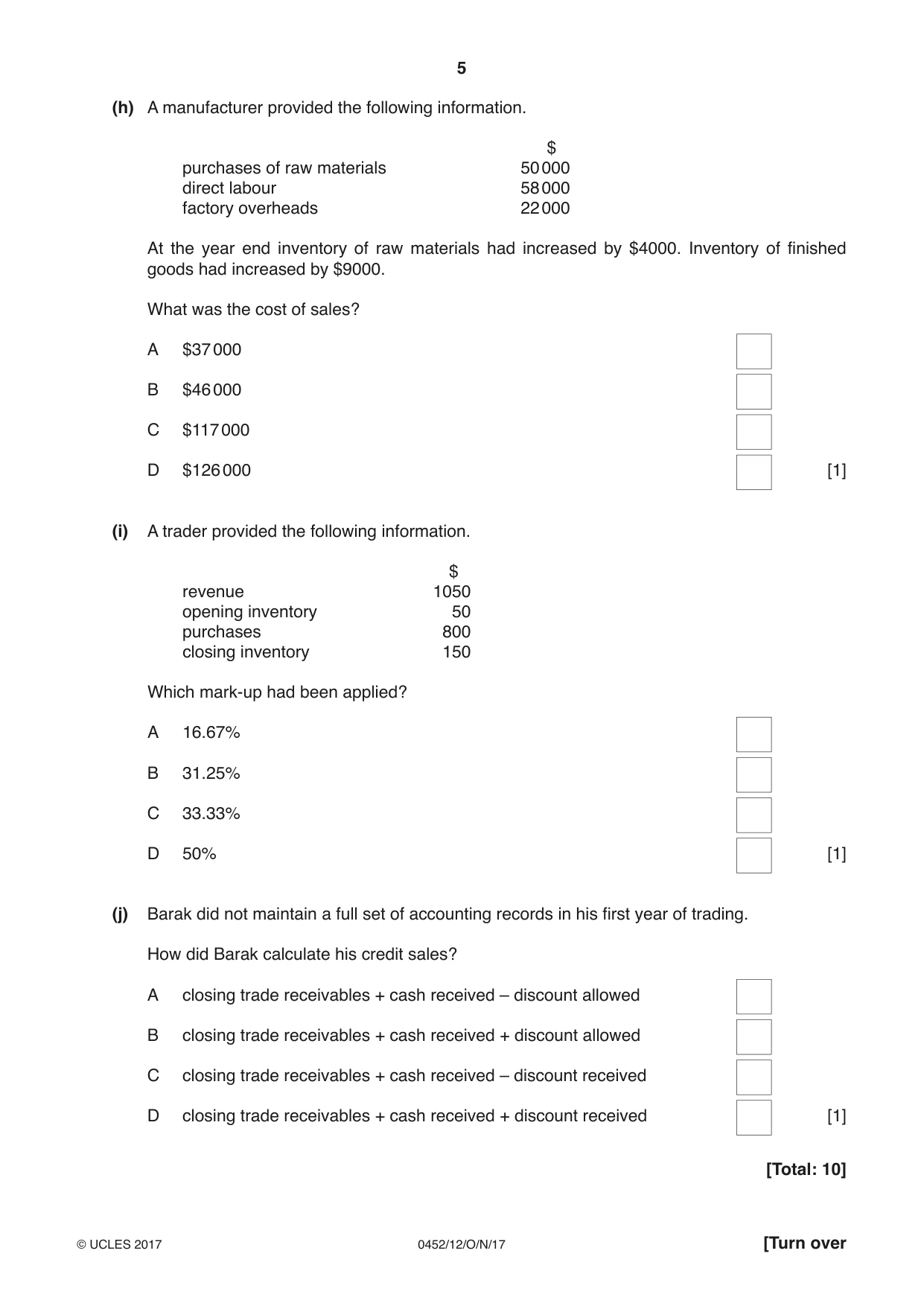
5 0452/12/O/N/17 © UCLES 2017 [Turn over (h) A manufacturer provided the following information. $ purchases of raw materials 50 000 direct labour 58 000 factory overheads 22 000 At the year end inventory of raw materials had increased by $4000. Inventory of finished goods had increased by $9000. What was the cost of sales? A $37 000 B $46 000 C $117 000 D $126 000 [1] (i) A trader provided the following information. $ revenue 1050 opening inventory 50 purchases 800 closing inventory 150 Which mark-up had been applied? A 16.67% B 31.25% C 33.33% D 50% [1] (j) Barak did not maintain a full set of accounting records in his first year of trading. How did Barak calculate his credit sales? A closing trade receivables + cash received – discount allowed B closing trade receivables + cash received + discount allowed C closing trade receivables + cash received – discount received D closing trade receivables + cash received + discount received [1] [Total: 10]
Question paper, page 6
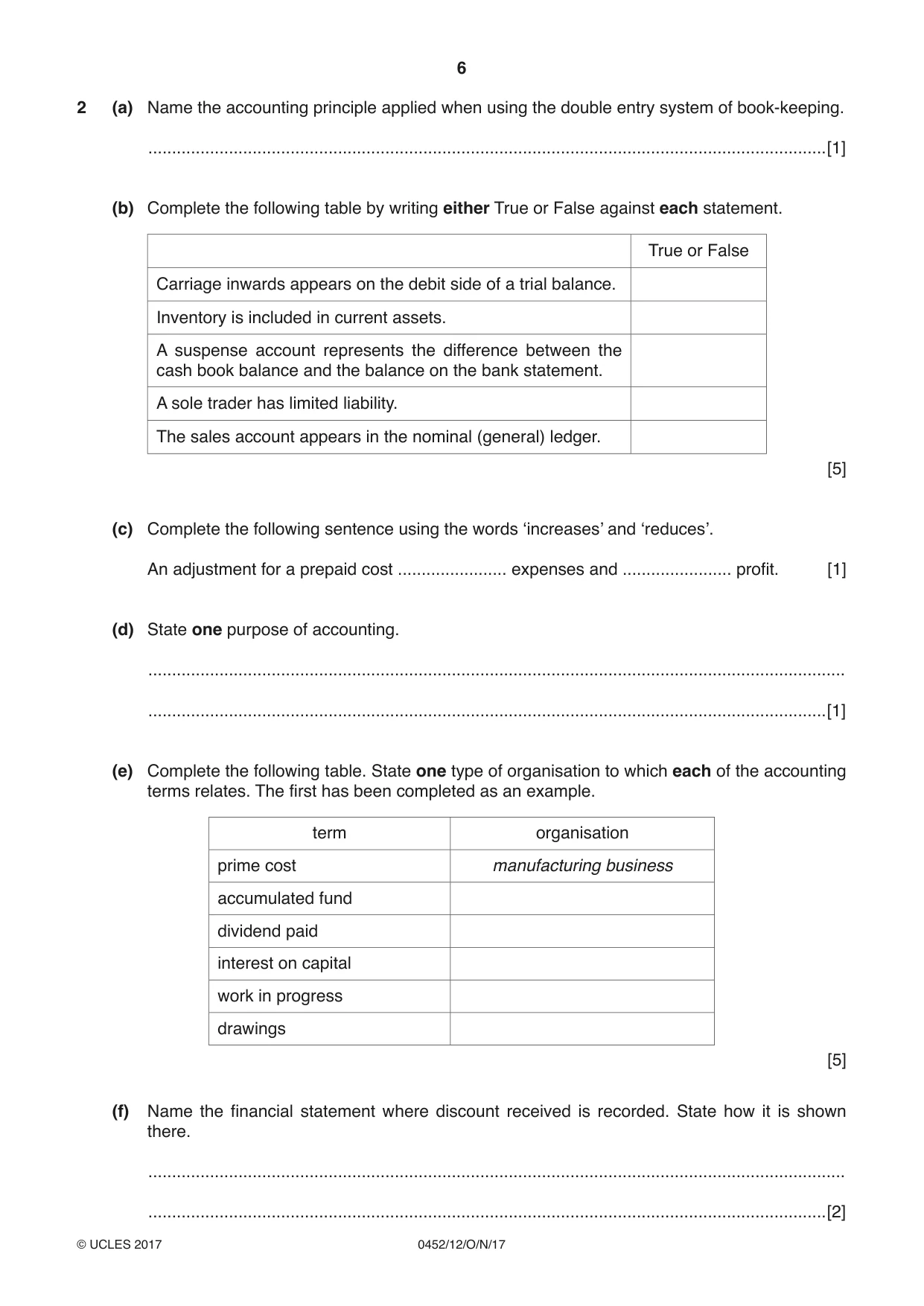
6 0452/12/O/N/17 © UCLES 2017 2 (a) Name the accounting principle applied when using the double entry system of book-keeping. …[1] (b) Complete the following table by writing either True or False against each statement. True or False Carriage inwards appears on the debit side of a trial balance. Inventory is included in current assets. A suspense account represents the difference between the cash book balance and the balance on the bank statement. A sole trader has limited liability. The sales account appears in the nominal (general) ledger. [5] (c) Complete the following sentence using the words ‘increases’ and ‘reduces’. An adjustment for a prepaid cost … expenses and … profit. [1] (d) State one purpose of accounting. … …[1] (e) Complete the following table. State one type of organisation to which each of the accounting terms relates. The first has been completed as an example. term organisation prime cost manufacturing business accumulated fund dividend paid interest on capital work in progress drawings [5] (f) Name the financial statement where discount received is recorded. State how it is shown there. … …[2]
Question paper, page 7
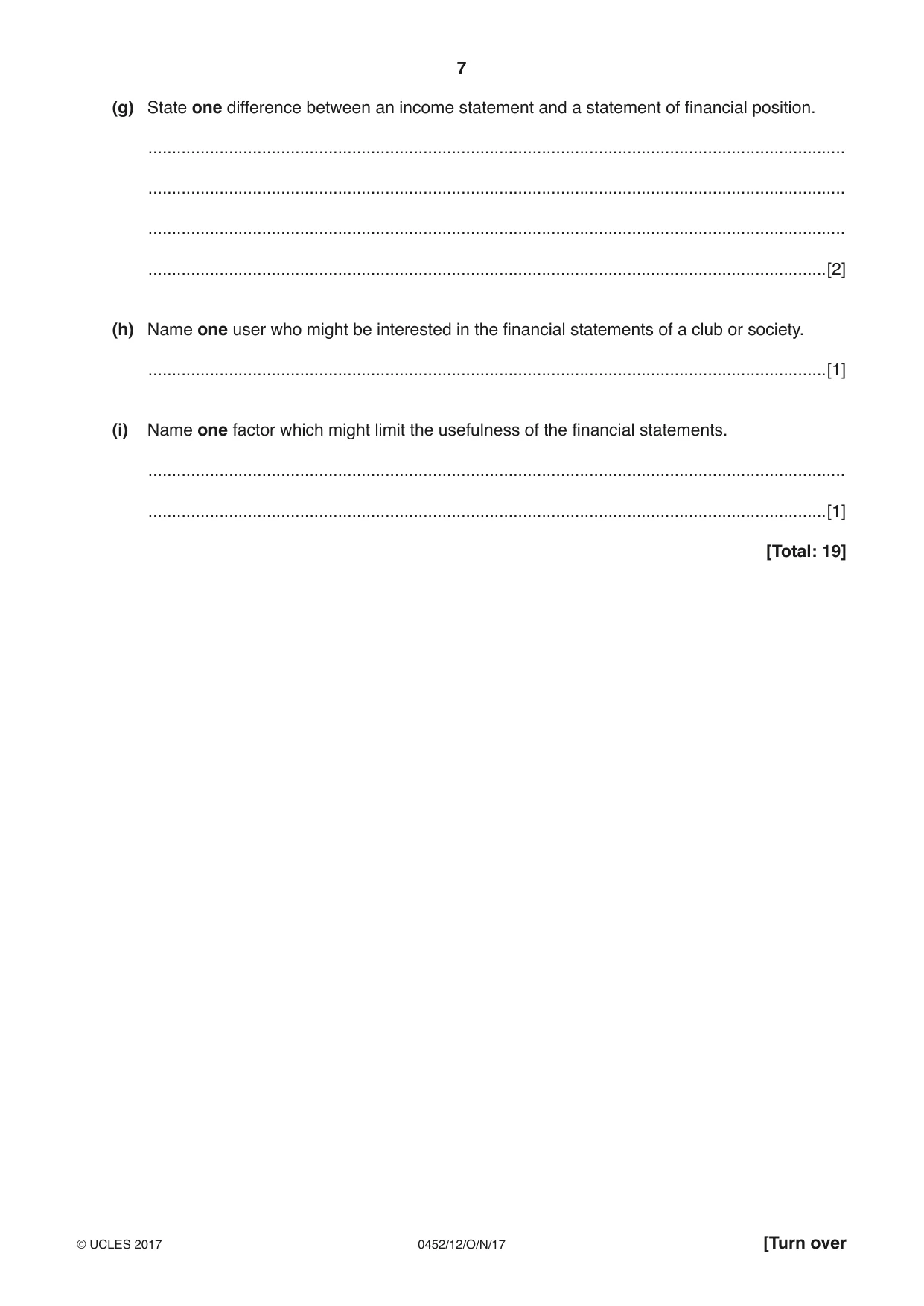
7 0452/12/O/N/17 © UCLES 2017 [Turn over (g) State one difference between an income statement and a statement of financial position. … … … …[2] (h) Name one user who might be interested in the financial statements of a club or society. …[1] (i) Name one factor which might limit the usefulness of the financial statements. … …[1] [Total: 19]
Question paper, page 8
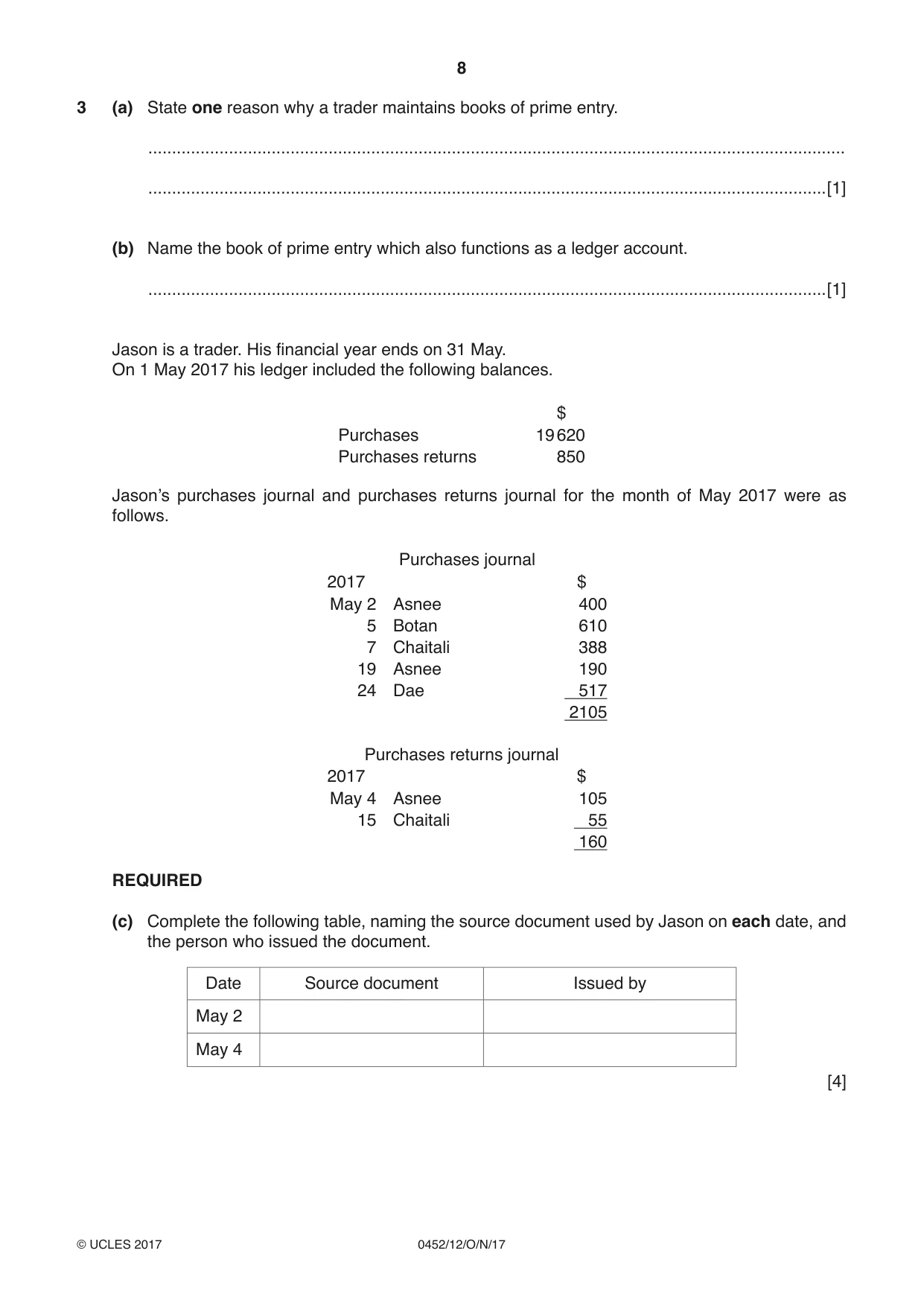
8 0452/12/O/N/17 © UCLES 2017 3 (a) State one reason why a trader maintains books of prime entry. … …[1] (b) Name the book of prime entry which also functions as a ledger account. …[1] Jason is a trader. His financial year ends on 31 May. On 1 May 2017 his ledger included the following balances. $ Purchases 19 620 Purchases returns 850 Jason’s purchases journal and purchases returns journal for the month of May 2017 were as follows. Purchases journal 2017 $ May 2 Asnee 400 5 Botan 610 7 Chaitali 388 19 Asnee 190 24 Dae 517 2105 Purchases returns journal 2017 $ May 4 Asnee 105 15 Chaitali 55 160 REQUIRED (c) Complete the following table, naming the source document used by Jason on each date, and the person who issued the document. Date Source document Issued by May 2 May 4 [4]
Question paper, page 9
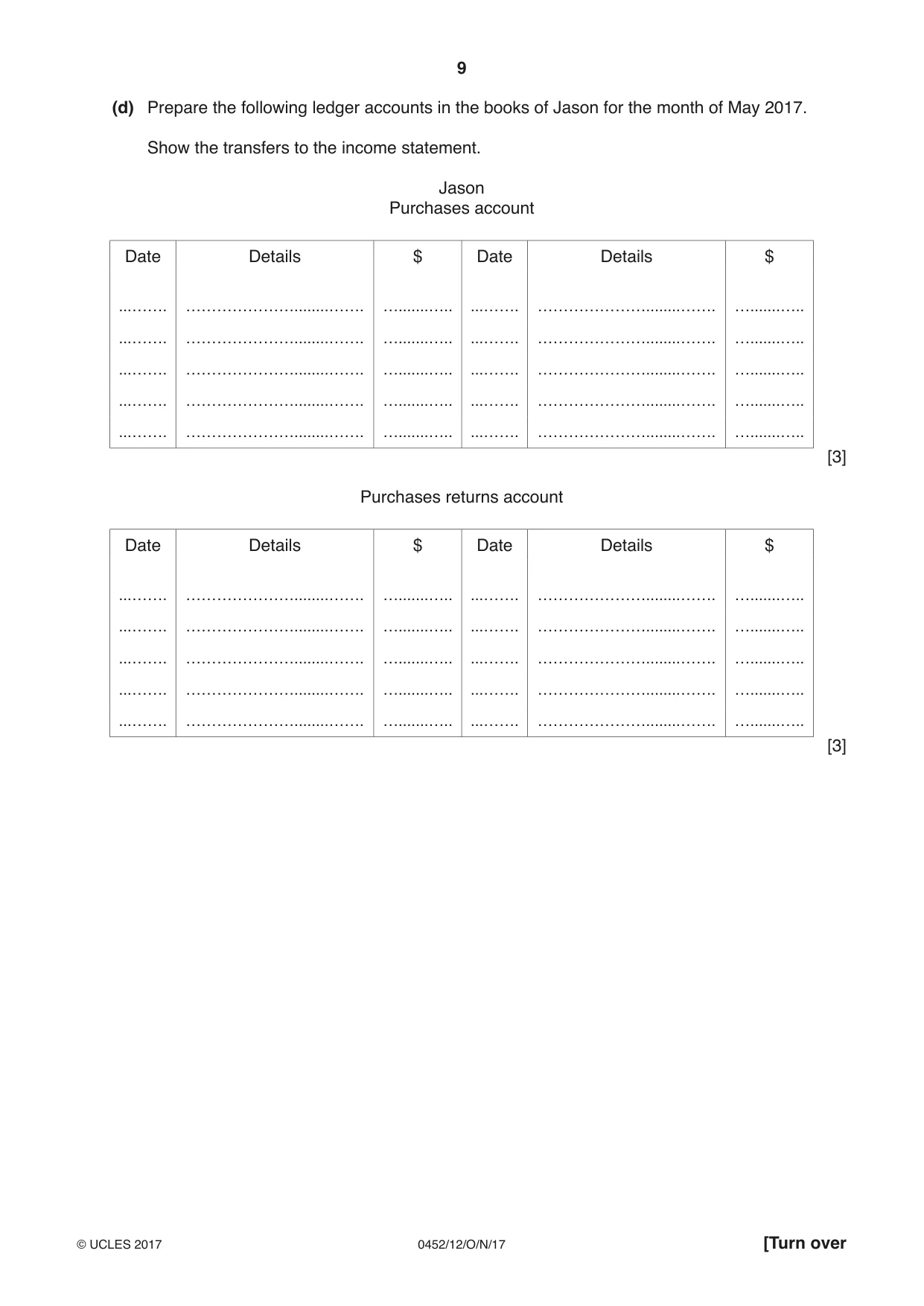
9 0452/12/O/N/17 © UCLES 2017 [Turn over (d) Prepare the following ledger accounts in the books of Jason for the month of May 2017. Show the transfers to the income statement. Jason Purchases account Date Details $ Date Details $ ...……. …………………………. ……….. ...……. …………………………. ……….. ...……. …………………………. ……….. ...……. …………………………. ……….. ...……. …………………………. ……….. ...……. …………………………. ……….. ...……. …………………………. ……….. ...……. …………………………. ……….. ...……. …………………………. ……….. ...……. …………………………. ……….. [3] Purchases returns account Date Details $ Date Details $ ...……. …………………………. ……….. ...……. …………………………. ……….. ...……. …………………………. ……….. ...……. …………………………. ……….. ...……. …………………………. ……….. ...……. …………………………. ……….. ...……. …………………………. ……….. ...……. …………………………. ……….. ...……. …………………………. ……….. ...……. …………………………. ……….. [3]
Question paper, page 10
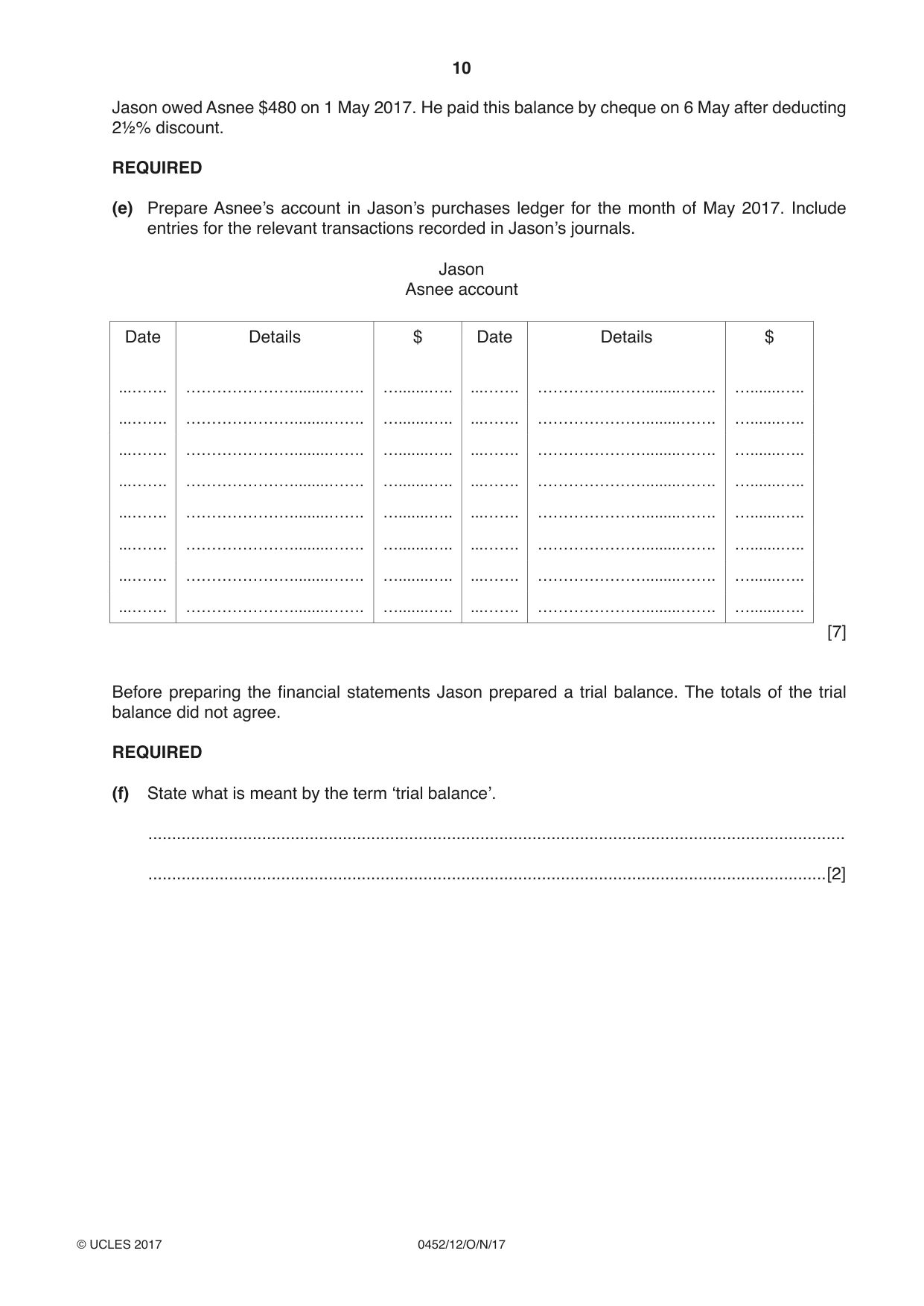
10 0452/12/O/N/17 © UCLES 2017 Jason owed Asnee $480 on 1 May 2017. He paid this balance by cheque on 6 May after deducting 2½% discount. REQUIRED (e) Prepare Asnee’s account in Jason’s purchases ledger for the month of May 2017. Include entries for the relevant transactions recorded in Jason’s journals. Jason Asnee account Date Details $ Date Details $ ...……. …………………………. ……….. ...……. …………………………. ……….. ...……. …………………………. ……….. ...……. …………………………. ……….. ...……. …………………………. ……….. ...……. …………………………. ……….. ...……. …………………………. ……….. ...……. …………………………. ……….. ...……. …………………………. ……….. ...……. …………………………. ……….. ...……. …………………………. ……….. ...……. …………………………. ……….. ...……. …………………………. ……….. ...……. …………………………. ……….. ...……. …………………………. ……….. ...……. …………………………. ……….. [7] Before preparing the financial statements Jason prepared a trial balance. The totals of the trial balance did not agree. REQUIRED (f) State what is meant by the term ‘trial balance’. … …[2]
Question paper, page 11
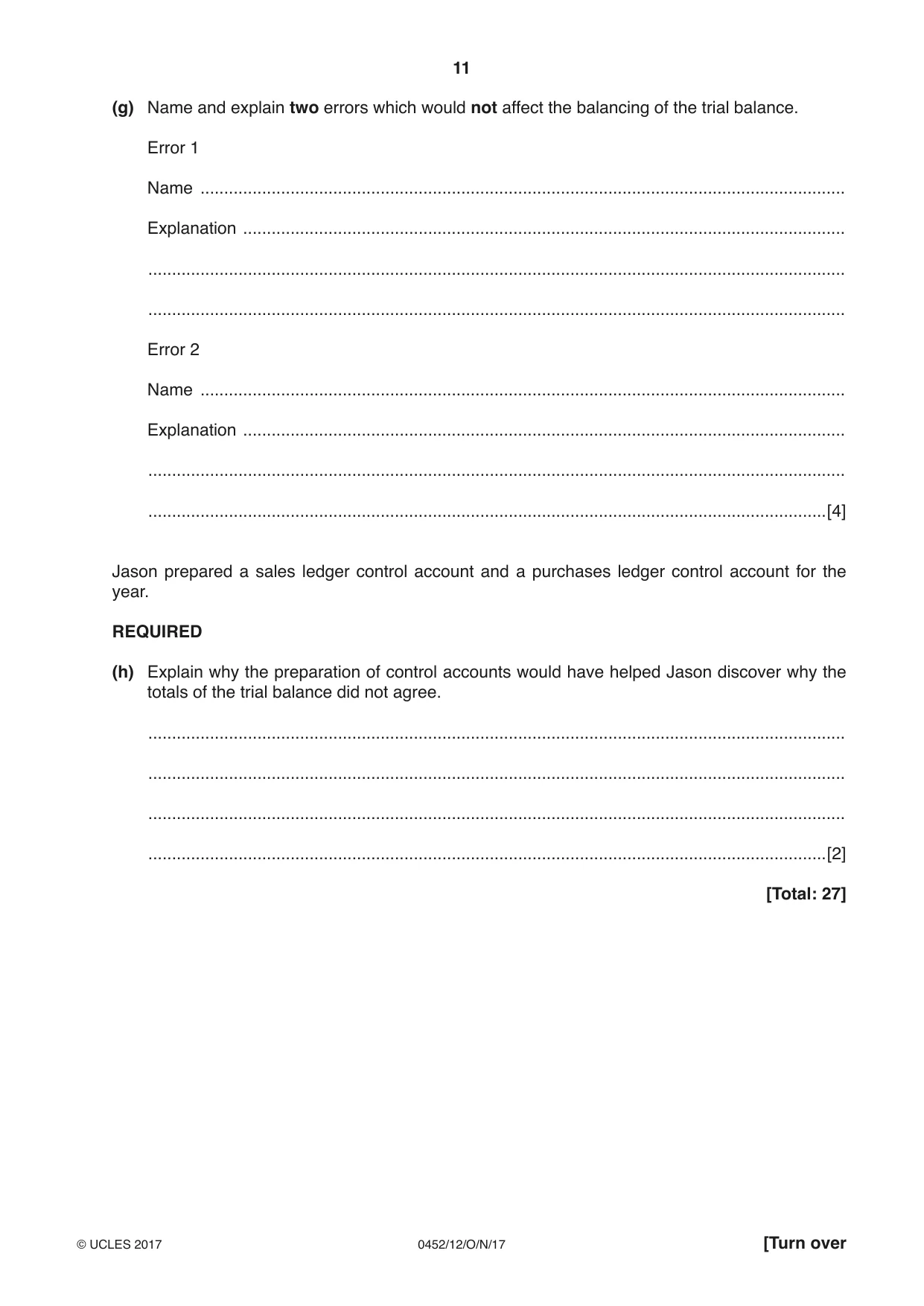
11 0452/12/O/N/17 © UCLES 2017 [Turn over (g) Name and explain two errors which would not affect the balancing of the trial balance. Error 1 Name … Explanation … … … Error 2 Name … Explanation … … …[4] Jason prepared a sales ledger control account and a purchases ledger control account for the year. REQUIRED (h) Explain why the preparation of control accounts would have helped Jason discover why the totals of the trial balance did not agree. … … … …[2] [Total: 27]
Question paper, page 12
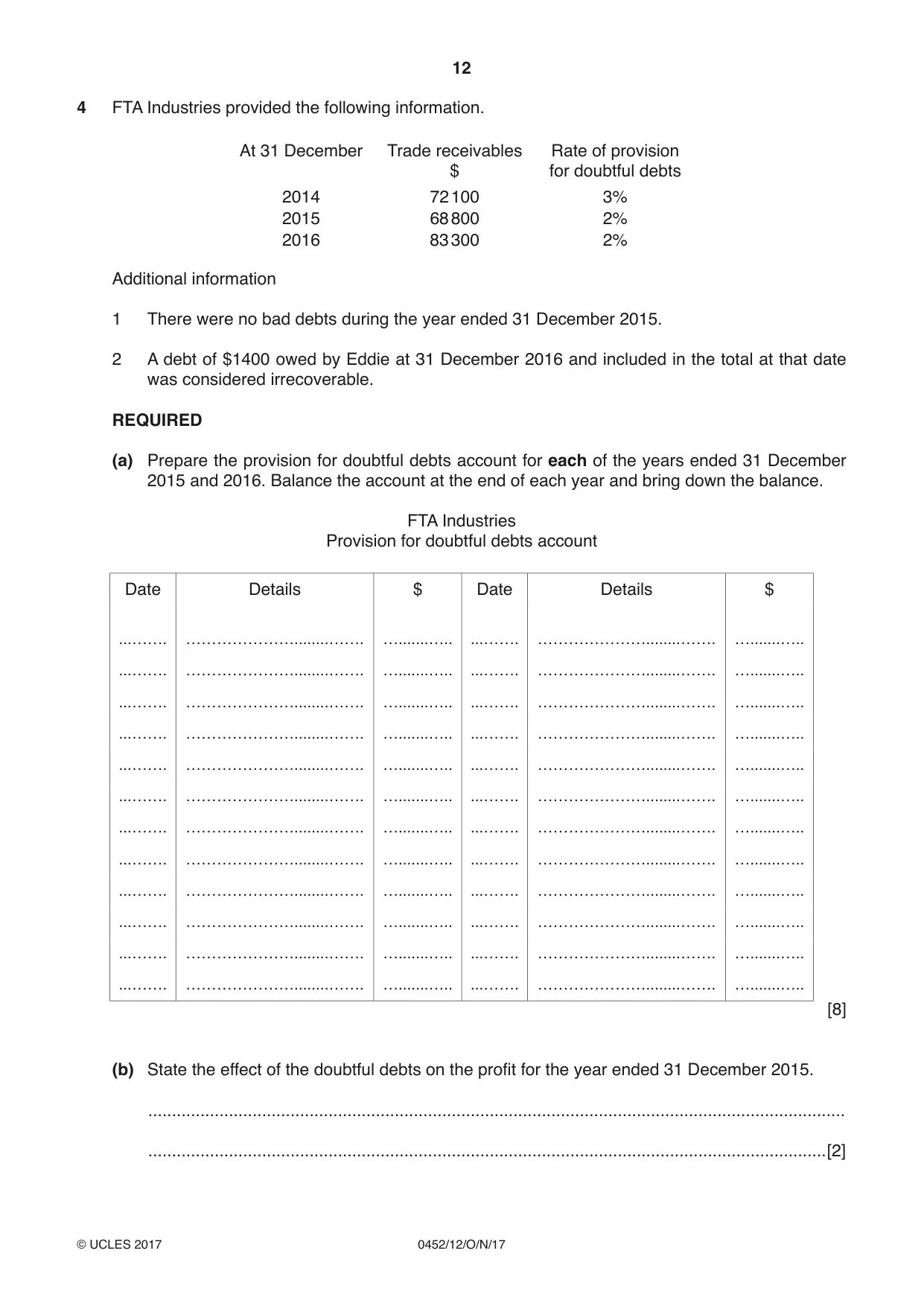
12 0452/12/O/N/17 © UCLES 2017 4 FTA Industries provided the following information. At 31 December Trade receivables $ Rate of provision for doubtful debts 2014 72 100 3% 2015 68 800 2% 2016 83 300 2% Additional information 1 There were no bad debts during the year ended 31 December 2015. 2 A debt of $1400 owed by Eddie at 31 December 2016 and included in the total at that date was considered irrecoverable. REQUIRED (a) Prepare the provision for doubtful debts account for each of the years ended 31 December 2015 and 2016. Balance the account at the end of each year and bring down the balance. FTA Industries Provision for doubtful debts account Date Details $ Date Details $ ...……. …………………………. ……….. ...……. …………………………. ……….. ...……. …………………………. ……….. ...……. …………………………. ……….. ...……. …………………………. ……….. ...……. …………………………. ……….. ...……. …………………………. ……….. ...……. …………………………. ……….. ...……. …………………………. ……….. ...……. …………………………. ……….. ...……. …………………………. ……….. ...……. …………………………. ……….. ...……. …………………………. ……….. ...……. …………………………. ……….. ...……. …………………………. ……….. ...……. …………………………. ……….. ...……. …………………………. ……….. ...……. …………………………. ……….. ...……. …………………………. ……….. ...……. …………………………. ……….. ...……. …………………………. ……….. ...……. …………………………. ……….. ...……. …………………………. ……….. ...……. …………………………. ……….. [8] (b) State the effect of the doubtful debts on the profit for the year ended 31 December 2015. … …[2]
Question paper, page 13
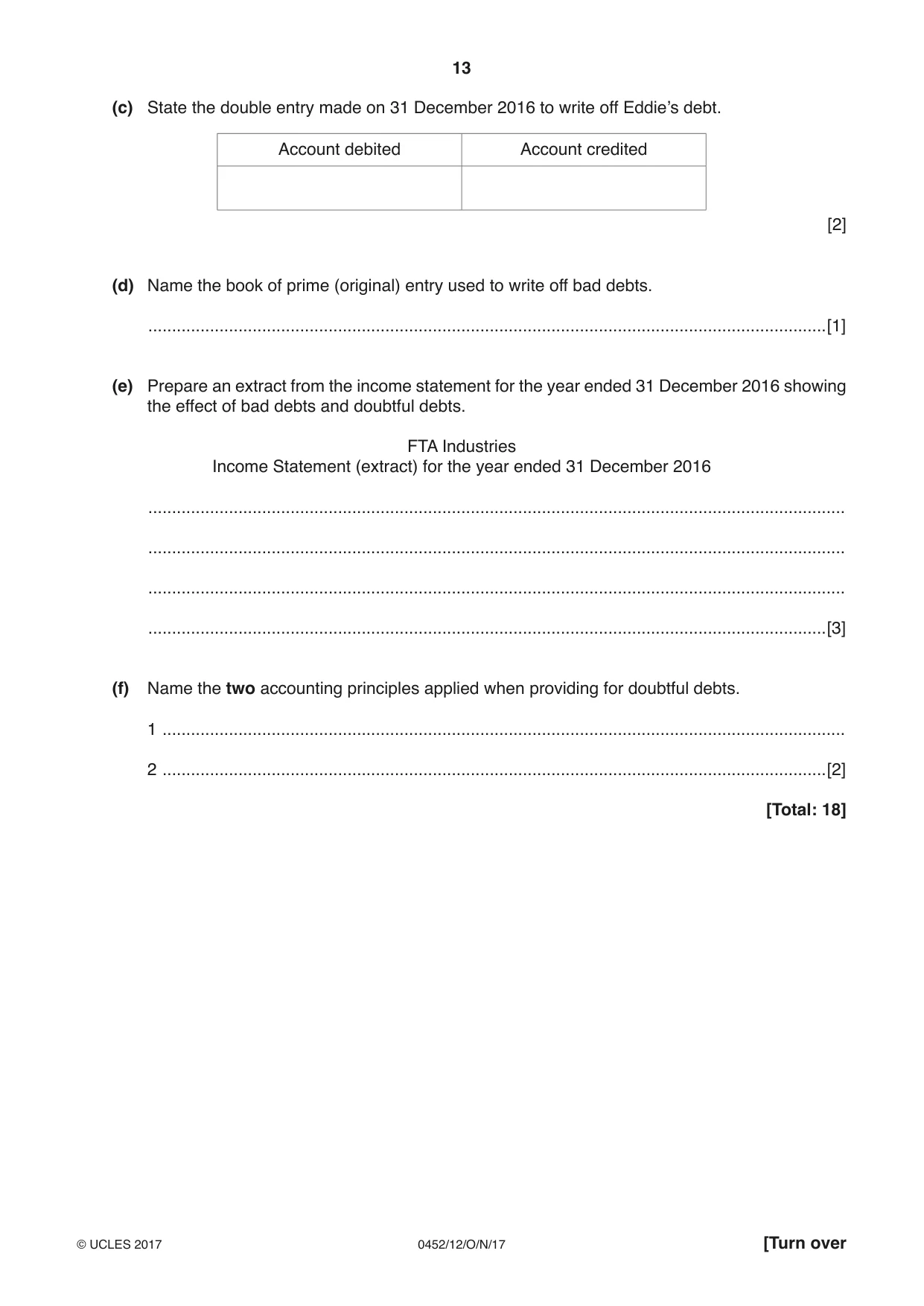
13 0452/12/O/N/17 © UCLES 2017 [Turn over (c) State the double entry made on 31 December 2016 to write off Eddie’s debt. Account debited Account credited [2] (d) Name the book of prime (original) entry used to write off bad debts. …[1] (e) Prepare an extract from the income statement for the year ended 31 December 2016 showing the effect of bad debts and doubtful debts. FTA Industries Income Statement (extract) for the year ended 31 December 2016 … … … …[3] (f) Name the two accounting principles applied when providing for doubtful debts. 1 … 2 …[2] [Total: 18]
Question paper, page 14
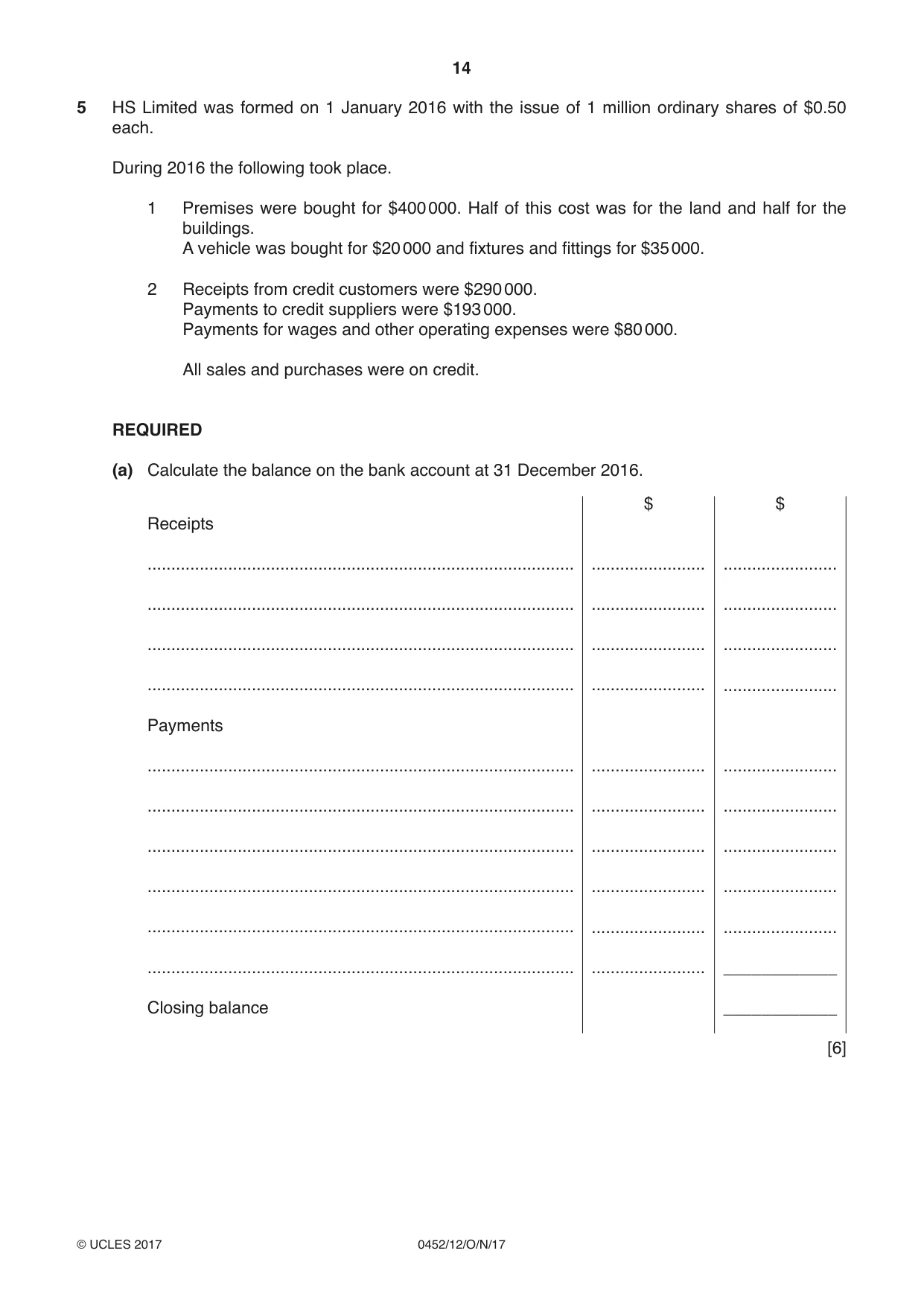
14 0452/12/O/N/17 © UCLES 2017 5 HS Limited was formed on 1 January 2016 with the issue of 1 million ordinary shares of $0.50 each. During 2016 the following took place. 1 Premises were bought for $400 000. Half of this cost was for the land and half for the buildings. A vehicle was bought for $20 000 and fixtures and fittings for $35 000. 2 Receipts from credit customers were $290 000. Payments to credit suppliers were $193 000. Payments for wages and other operating expenses were $80 000. All sales and purchases were on credit. REQUIRED (a) Calculate the balance on the bank account at 31 December 2016. Receipts … … … … Payments … … … … … … Closing balance $ … … … … … … … … … … $ … … … … … … … … … ____________ ____________ [6]
Question paper, page 15
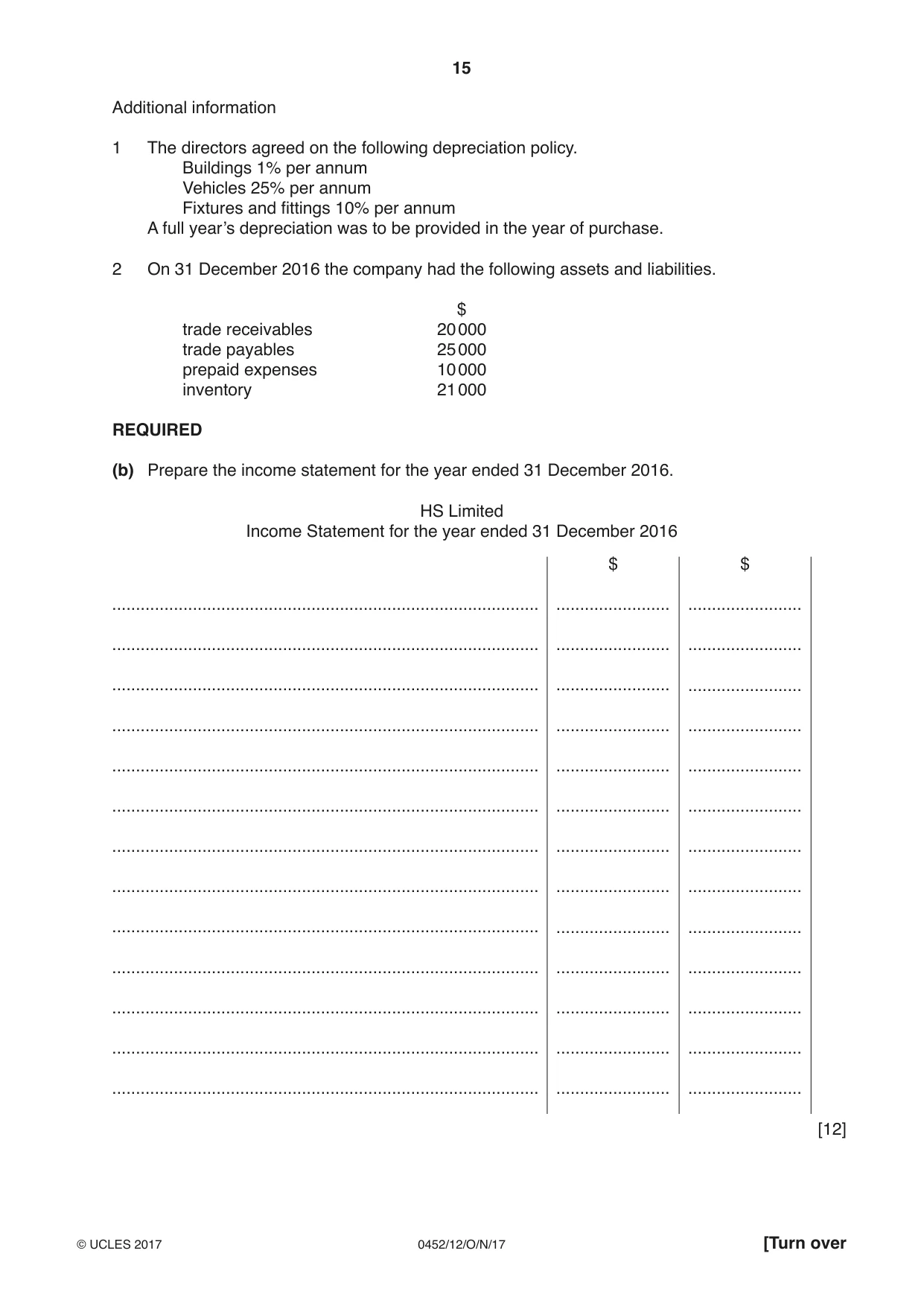
15 0452/12/O/N/17 © UCLES 2017 [Turn over Additional information 1 The directors agreed on the following depreciation policy. Buildings 1% per annum Vehicles 25% per annum Fixtures and fittings 10% per annum A full year’s depreciation was to be provided in the year of purchase. 2 On 31 December 2016 the company had the following assets and liabilities. $ trade receivables 20 000 trade payables 25 000 prepaid expenses 10 000 inventory 21 000 REQUIRED (b) Prepare the income statement for the year ended 31 December 2016. HS Limited Income Statement for the year ended 31 December 2016 … … … … … … … … … … … … … $ … … … … … … … … … … … … … $ … … … … … … … … … … … … … [12]
Question paper, page 16
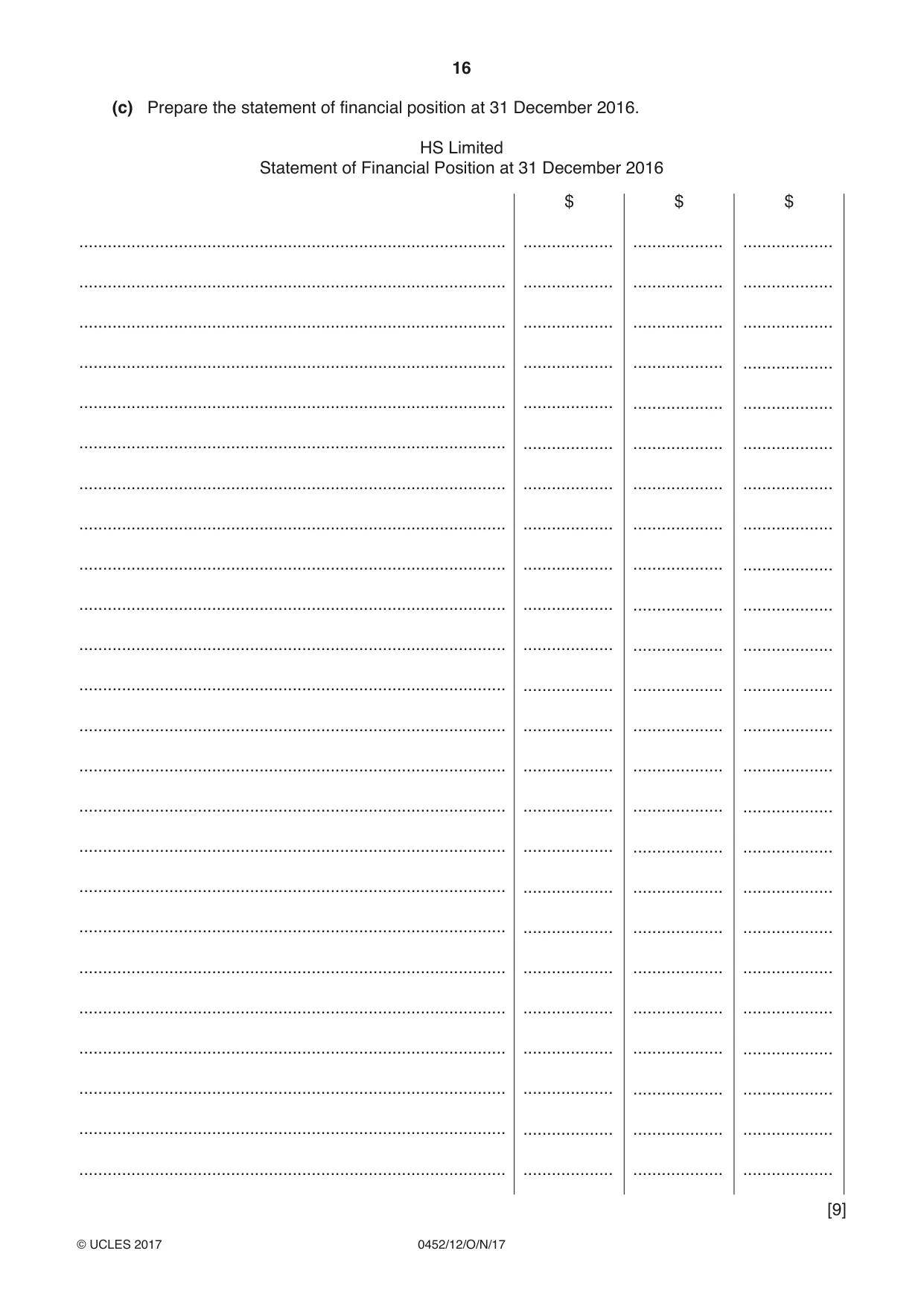
16 0452/12/O/N/17 © UCLES 2017 (c) Prepare the statement of financial position at 31 December 2016. HS Limited Statement of Financial Position at 31 December 2016 … … … … … … … … … … … … … … … … … … … … … … … … $ … … … … … … … … … … … … … … … … … … … … … … … … $ … … … … … … … … … … … … … … … … … … … … … … … … $ … … … … … … … … … … … … … … … … … … … … … … … … [9]
Question paper, page 17
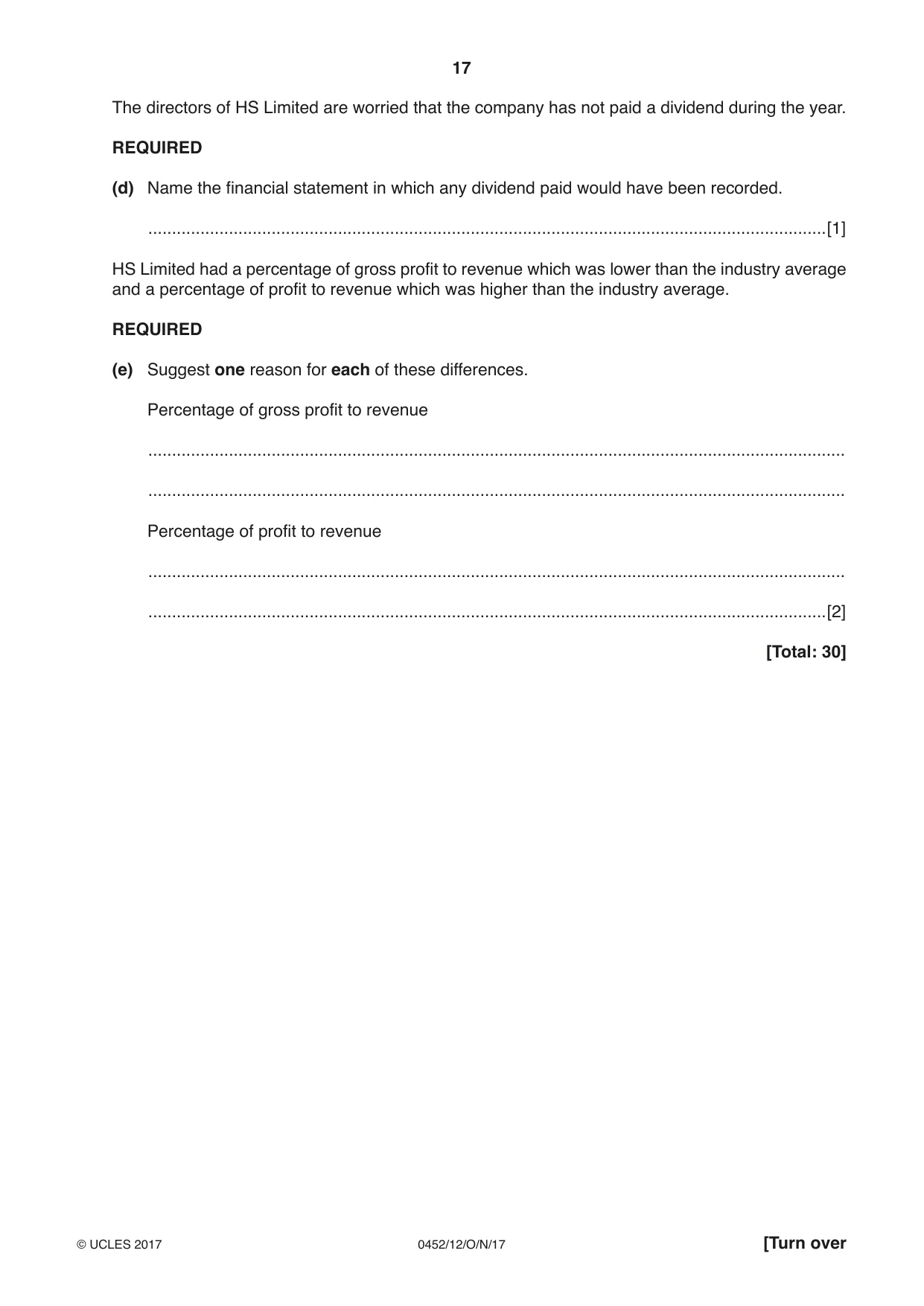
17 0452/12/O/N/17 © UCLES 2017 [Turn over The directors of HS Limited are worried that the company has not paid a dividend during the year. REQUIRED (d) Name the financial statement in which any dividend paid would have been recorded. …[1] HS Limited had a percentage of gross profit to revenue which was lower than the industry average and a percentage of profit to revenue which was higher than the industry average. REQUIRED (e) Suggest one reason for each of these differences. Percentage of gross profit to revenue … … Percentage of profit to revenue … …[2] [Total: 30]
Question paper, page 18
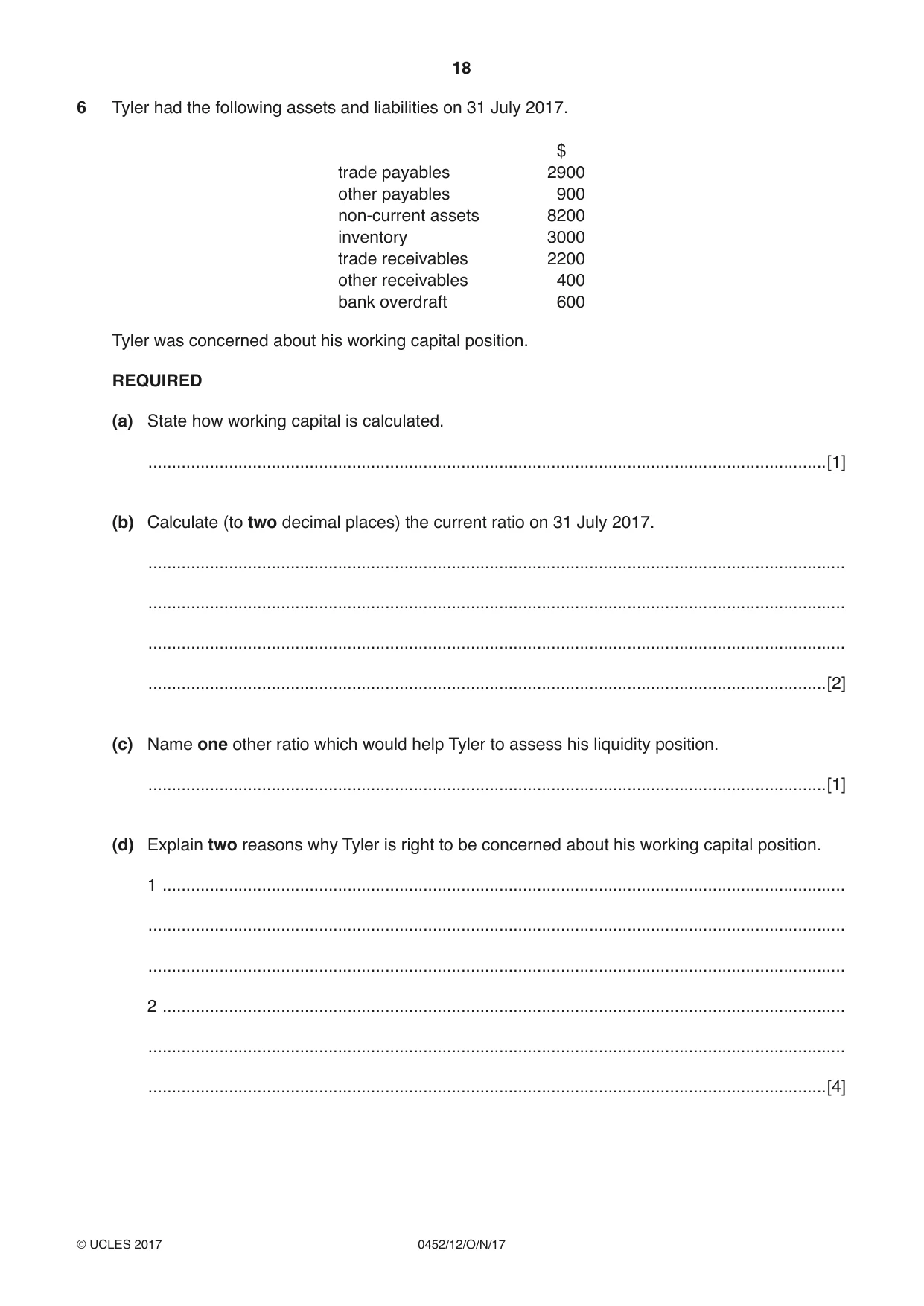
18 0452/12/O/N/17 © UCLES 2017 6 Tyler had the following assets and liabilities on 31 July 2017. $ trade payables 2900 other payables 900 non-current assets 8200 inventory 3000 trade receivables 2200 other receivables 400 bank overdraft 600 Tyler was concerned about his working capital position. REQUIRED (a) State how working capital is calculated. …[1] (b) Calculate (to two decimal places) the current ratio on 31 July 2017. … … … …[2] (c) Name one other ratio which would help Tyler to assess his liquidity position. …[1] (d) Explain two reasons why Tyler is right to be concerned about his working capital position. 1 … … … 2 … … …[4]
Question paper, page 19
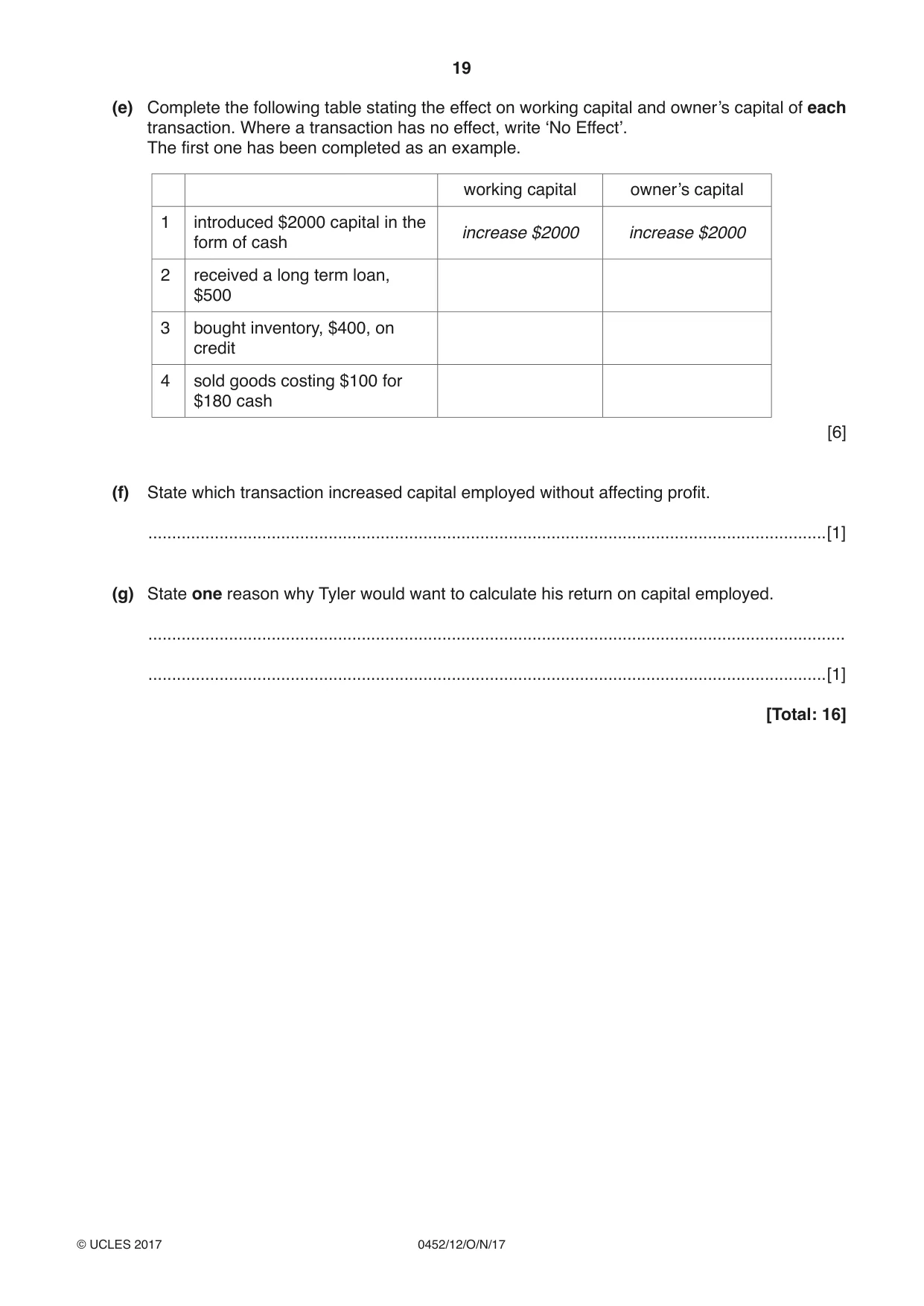
19 0452/12/O/N/17 © UCLES 2017 (e) Complete the following table stating the effect on working capital and owner’s capital of each transaction. Where a transaction has no effect, write ‘No Effect’. The first one has been completed as an example. working capital owner’s capital 1 introduced $2000 capital in the form of cash increase $2000 increase $2000 2 received a long term loan, $500 3 bought inventory, $400, on credit 4 sold goods costing $100 for $180 cash [6] (f) State which transaction increased capital employed without affecting profit. …[1] (g) State one reason why Tyler would want to calculate his return on capital employed. … …[1] [Total: 16]
Question paper, page 20
20 0452/12/O/N/17 © UCLES 2017 Permission to reproduce items where third-party owned material protected by copyright is included has been sought and cleared where possible. Every reasonable effort has been made by the publisher (UCLES) to trace copyright holders, but if any items requiring clearance have unwittingly been included, the publisher will be pleased to make amends at the earliest possible opportunity. To avoid the issue of disclosure of answer-related information to candidates, all copyright acknowledgements are reproduced online in the Cambridge International Examinations Copyright Acknowledgements Booklet. This is produced for each series of examinations and is freely available to download at www.cie.org.uk after the live examination series. Cambridge International Examinations is part of the Cambridge Assessment Group. Cambridge Assessment is the brand name of University of Cambridge Local Examinations Syndicate (UCLES), which is itself a department of the University of Cambridge. BLANK PAGE
Mark scheme, page 1
® IGCSE is a registered trademark. This document consists of 7 printed pages. © UCLES 2017 [Turn over Cambridge Assessment International Education Cambridge International General Certificate of Secondary Education ACCOUNTING 0452/12 Paper 1 October/November 2017 MARK SCHEME Maximum Mark: 120 Published This mark scheme is published as an aid to teachers and candidates, to indicate the requirements of the examination. It shows the basis on which Examiners were instructed to award marks. It does not indicate the details of the discussions that took place at an Examiners’ meeting before marking began, which would have considered the acceptability of alternative answers. Mark schemes should be read in conjunction with the question paper and the Principal Examiner Report for Teachers. Cambridge International will not enter into discussions about these mark schemes. Cambridge International is publishing the mark schemes for the October/November 2017 series for most Cambridge IGCSE®, Cambridge International A and AS Level components and some Cambridge O Level components.
Mark scheme, page 2
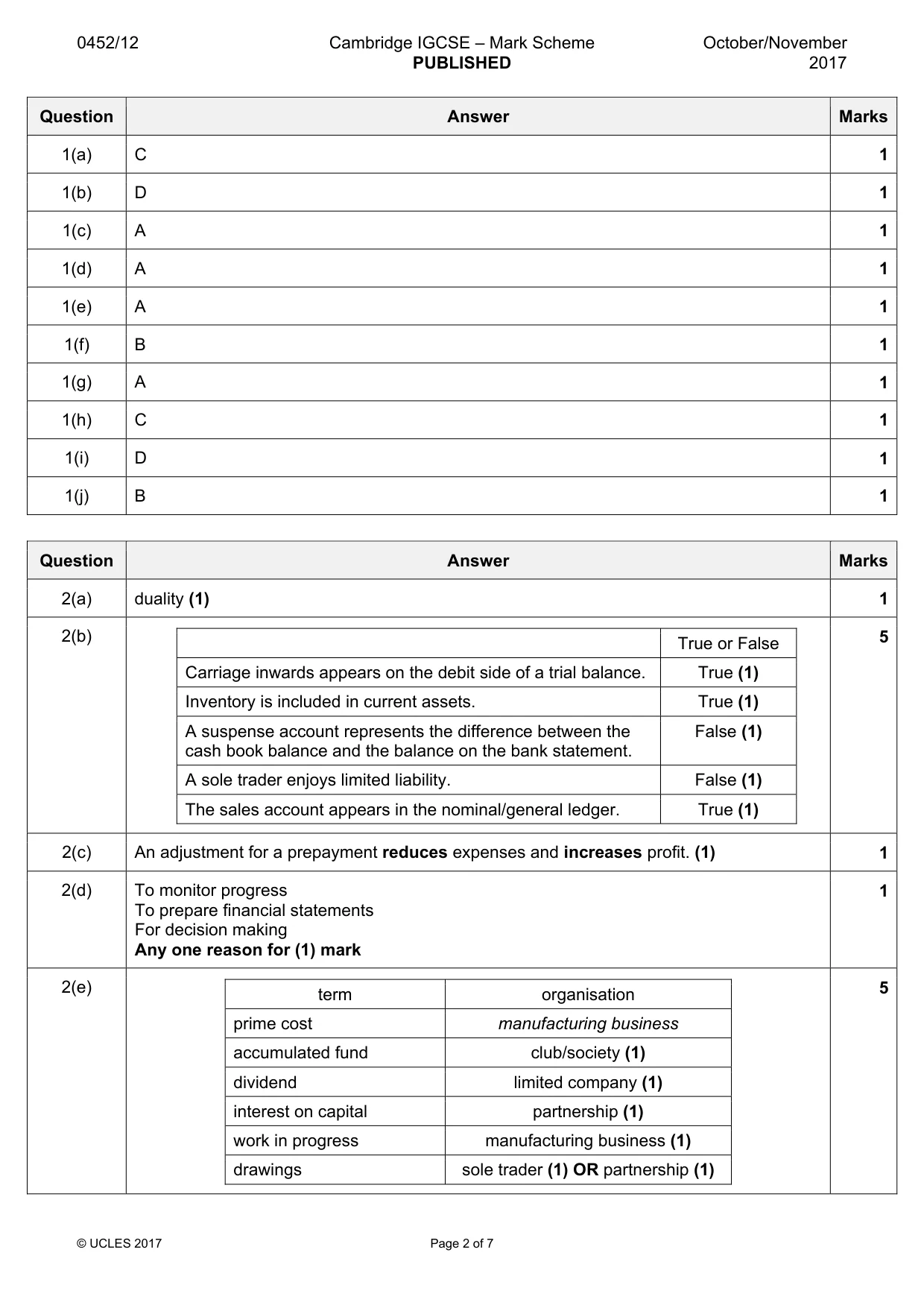
0452/12 Cambridge IGCSE – Mark Scheme PUBLISHED October/November 2017 © UCLES 2017 Page 2 of 7 Question Answer Marks 1(a) C 1 1(b) D 1 1(c) A 1 1(d) A 1 1(e) A 1 1(f) B 1 1(g) A 1 1(h) C 1 1(i) D 1 1(j) B 1 Question Answer Marks 2(a) duality (1) 1 2(b) True or False Carriage inwards appears on the debit side of a trial balance. True (1) Inventory is included in current assets. True (1) A suspense account represents the difference between the cash book balance and the balance on the bank statement. False (1) A sole trader enjoys limited liability. False (1) The sales account appears in the nominal/general ledger. True (1) 5 2(c) An adjustment for a prepayment reduces expenses and increases profit. (1) 1 2(d) To monitor progress To prepare financial statements For decision making Any one reason for (1) mark 1 2(e) term organisation prime cost manufacturing business accumulated fund club/society (1) dividend limited company (1) interest on capital partnership (1) work in progress manufacturing business (1) drawings sole trader (1) OR partnership (1) 5
Mark scheme, page 3
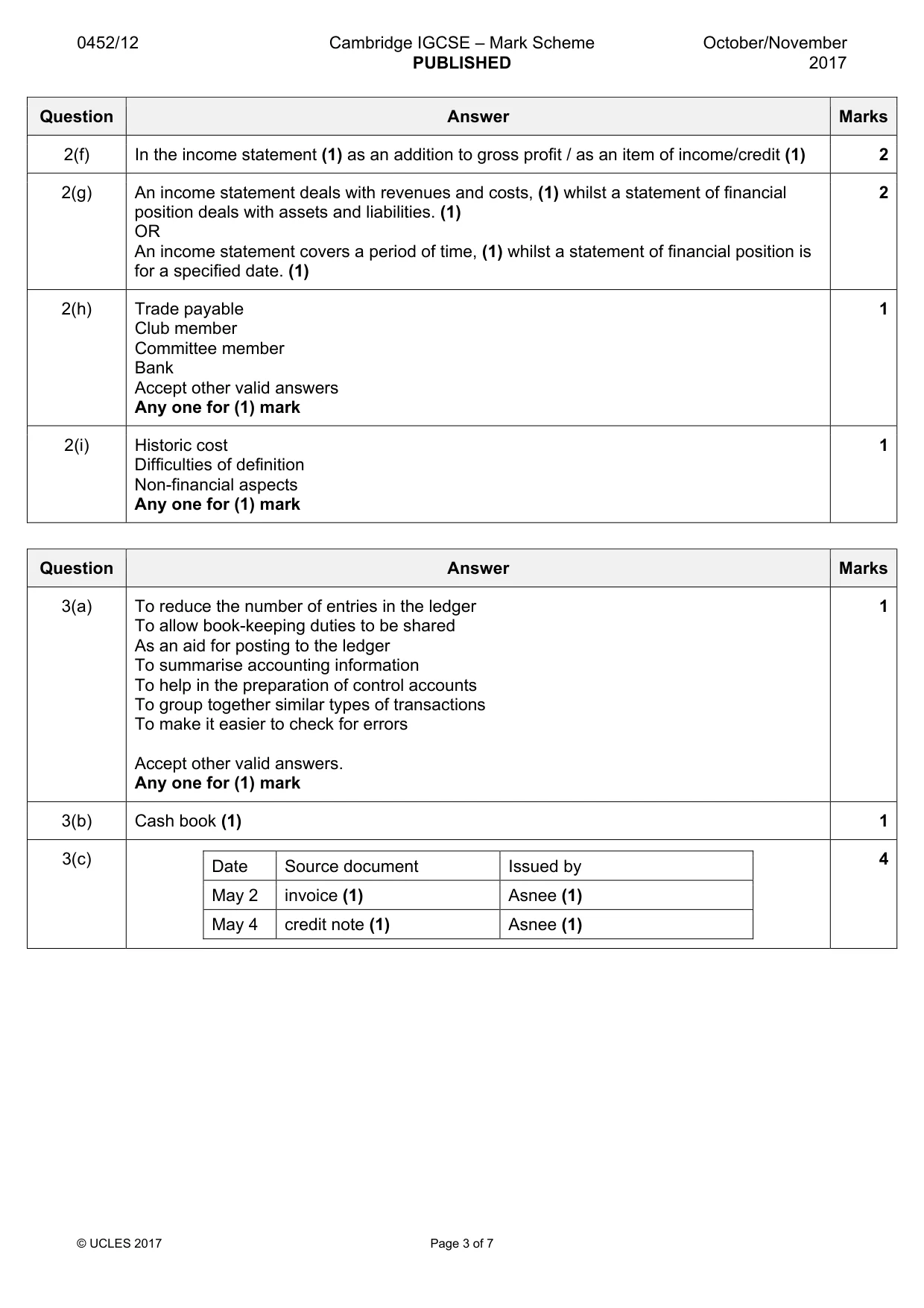
0452/12 Cambridge IGCSE – Mark Scheme PUBLISHED October/November 2017 © UCLES 2017 Page 3 of 7 Question Answer Marks 2(f) In the income statement (1) as an addition to gross profit / as an item of income/credit (1) 2 2(g) An income statement deals with revenues and costs, (1) whilst a statement of financial position deals with assets and liabilities. (1) OR An income statement covers a period of time, (1) whilst a statement of financial position is for a specified date. (1) 2 2(h) Trade payable Club member Committee member Bank Accept other valid answers Any one for (1) mark 1 2(i) Historic cost Difficulties of definition Non-financial aspects Any one for (1) mark 1 Question Answer Marks 3(a) To reduce the number of entries in the ledger To allow book-keeping duties to be shared As an aid for posting to the ledger To summarise accounting information To help in the preparation of control accounts To group together similar types of transactions To make it easier to check for errors Accept other valid answers. Any one for (1) mark 1 3(b) Cash book (1) 1 3(c) Date Source document Issued by May 2 invoice (1) Asnee (1) May 4 credit note (1) Asnee (1) 4
Mark scheme, page 4
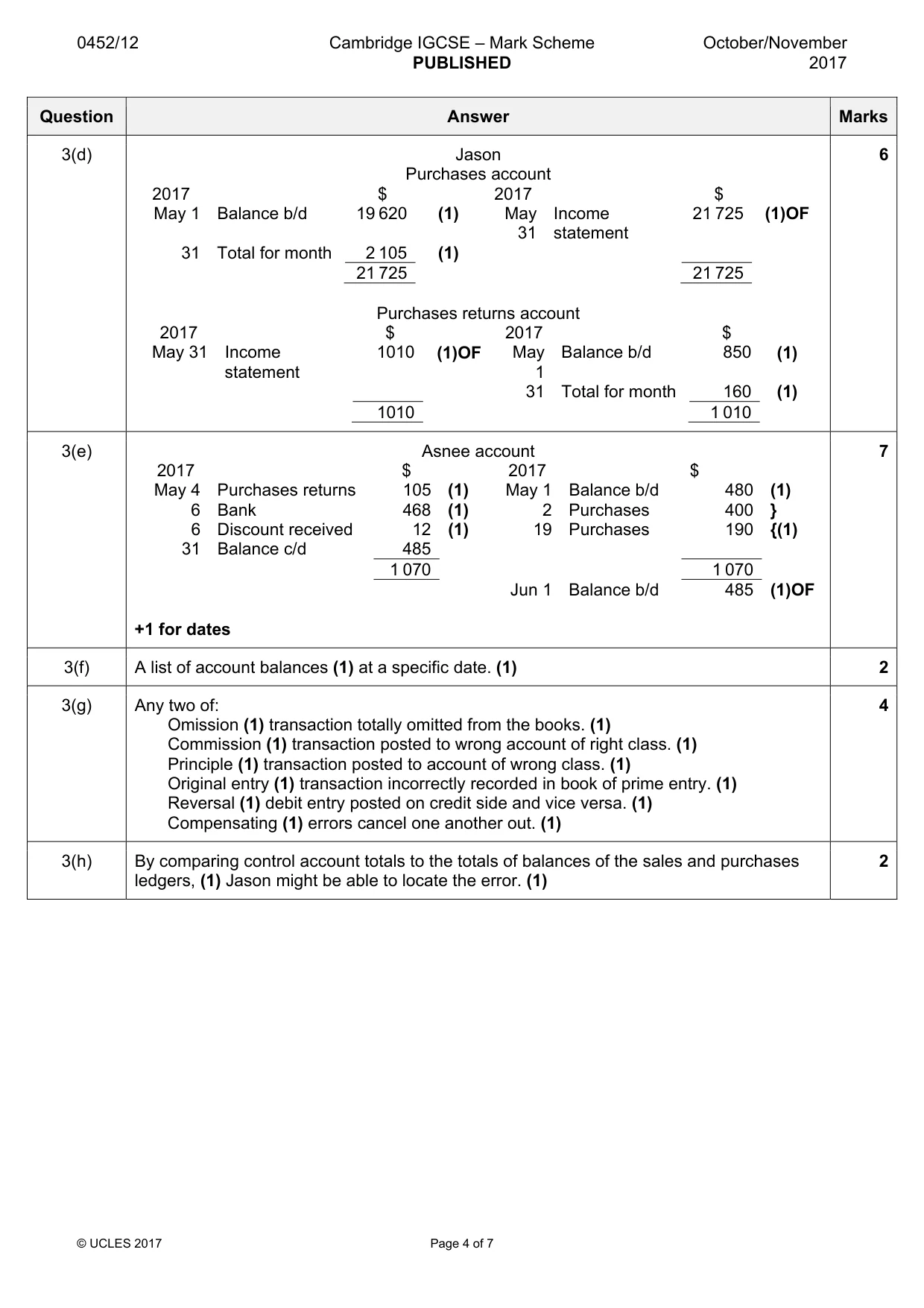
0452/12 Cambridge IGCSE – Mark Scheme PUBLISHED October/November 2017 © UCLES 2017 Page 4 of 7 Question Answer Marks 3(d) Jason Purchases account 2017 $ 2017 $ May 1 Balance b/d 19 620 (1) May 31 Income statement 21 725 (1)OF 31 Total for month 2 105 (1) 21 725 21 725 Purchases returns account 2017 $ 2017 $ May 31 Income statement 1010 (1)OF May 1 Balance b/d 850 (1) 31 Total for month 160 (1) 1010 1 010 6 3(e) Asnee account 2017 $ 2017 $ May 4 Purchases returns 105 (1) May 1 Balance b/d 480 (1) 6 Bank 468 (1) 2 Purchases 400 } 6 Discount received 12 (1) 19 Purchases 190 {(1) 31 Balance c/d 485 1 070 1 070 Jun 1 Balance b/d 485 (1)OF +1 for dates 7 3(f) A list of account balances (1) at a specific date. (1) 2 3(g) Any two of: Omission (1) transaction totally omitted from the books. (1) Commission (1) transaction posted to wrong account of right class. (1) Principle (1) transaction posted to account of wrong class. (1) Original entry (1) transaction incorrectly recorded in book of prime entry. (1) Reversal (1) debit entry posted on credit side and vice versa. (1) Compensating (1) errors cancel one another out. (1) 4 3(h) By comparing control account totals to the totals of balances of the sales and purchases ledgers, (1) Jason might be able to locate the error. (1) 2
Mark scheme, page 5
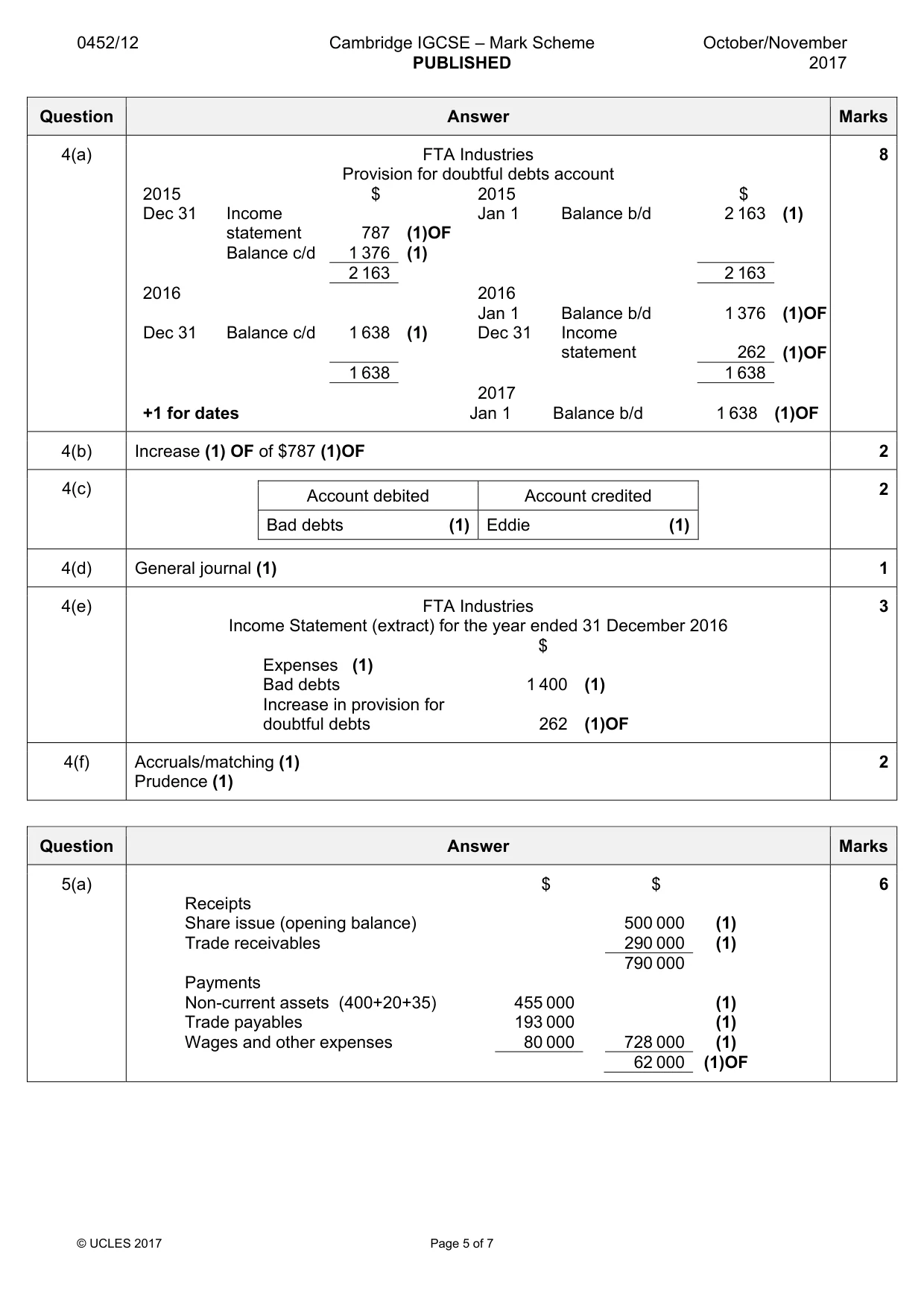
0452/12 Cambridge IGCSE – Mark Scheme PUBLISHED October/November 2017 © UCLES 2017 Page 5 of 7 Question Answer Marks 4(a) FTA Industries Provision for doubtful debts account 2015 $ 2015 $ Dec 31 Income statement 787 (1)OF Jan 1 Balance b/d 2 163 (1) Balance c/d 1 376 (1) 2 163 2 163 2016 2016 Jan 1 Balance b/d 1 376 (1)OF Dec 31 Balance c/d 1 638 (1) Dec 31 Income statement 262 (1)OF 1 638 1 638 2017 +1 for dates Jan 1 Balance b/d 1 638 (1)OF 8 4(b) Increase (1) OF of $787 (1)OF 2 4(c) Account debited Account credited Bad debts (1) Eddie (1) 2 4(d) General journal (1) 1 4(e) FTA Industries Income Statement (extract) for the year ended 31 December 2016 $ Expenses (1) Bad debts 1 400 (1) Increase in provision for doubtful debts 262 (1)OF 3 4(f) Accruals/matching (1) Prudence (1) 2 Question Answer Marks 5(a) $ $ Receipts Share issue (opening balance) 500 000 (1) Trade receivables 290 000 (1) 790 000 Payments Non-current assets (400+20+35) 455 000 (1) Trade payables 193 000 (1) Wages and other expenses 80 000 728 000 (1) 62 000 (1)OF 6
Mark scheme, page 6
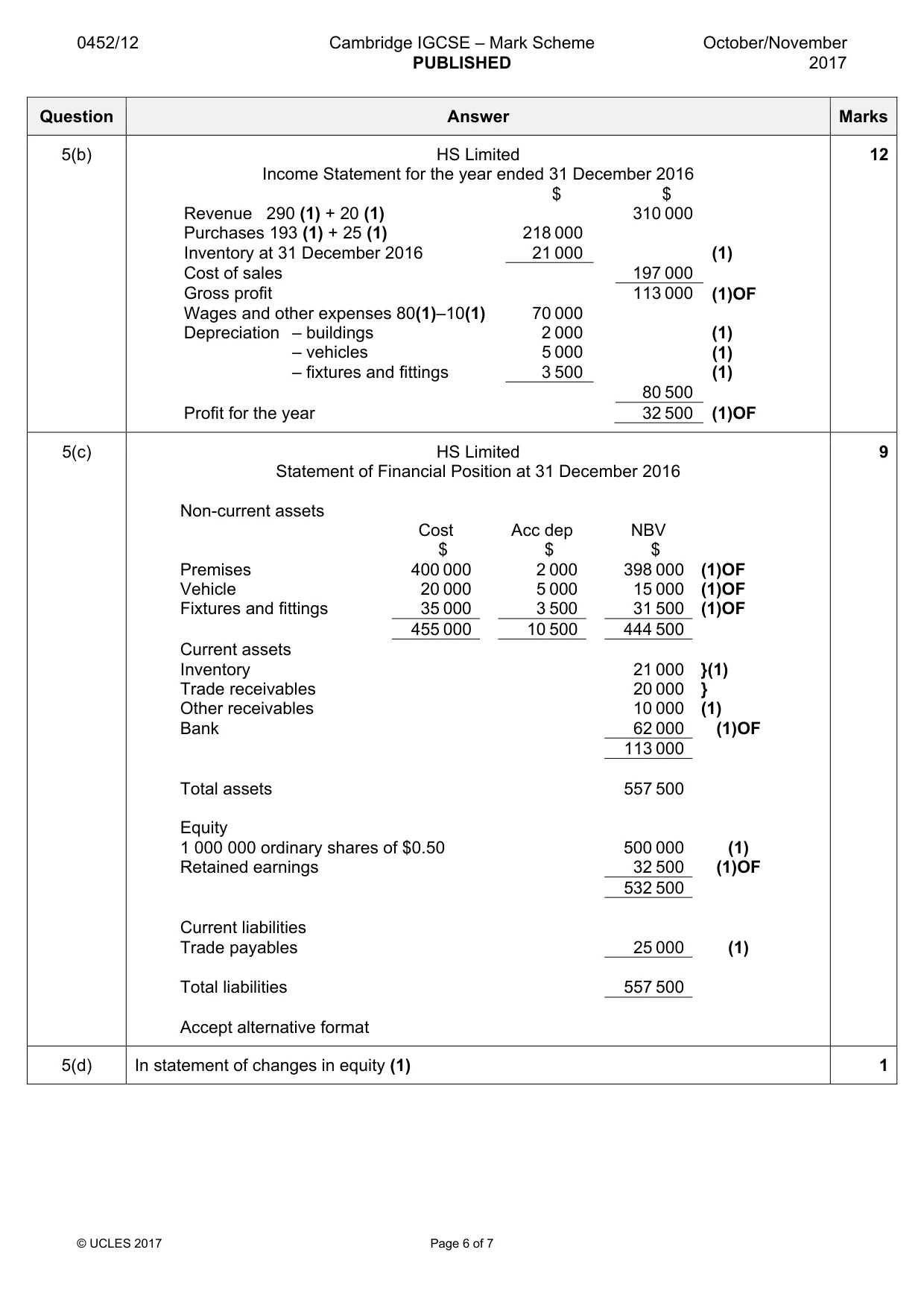
0452/12 Cambridge IGCSE – Mark Scheme PUBLISHED October/November 2017 © UCLES 2017 Page 6 of 7 Question Answer Marks 5(b) HS Limited Income Statement for the year ended 31 December 2016 $ $ Revenue 290 (1) + 20 (1) 310 000 Purchases 193 (1) + 25 (1) 218 000 Inventory at 31 December 2016 21 000 (1) Cost of sales 197 000 Gross profit 113 000 (1)OF Wages and other expenses 80(1)–10(1) 70 000 Depreciation – buildings 2 000 (1) – vehicles 5 000 (1) – fixtures and fittings 3 500 (1) 80 500 Profit for the year 32 500 (1)OF 12 5(c) HS Limited Statement of Financial Position at 31 December 2016 Non-current assets Cost $ Acc dep $ NBV $ Premises 400 000 2 000 398 000 (1)OF Vehicle 20 000 5 000 15 000 (1)OF Fixtures and fittings 35 000 3 500 31 500 (1)OF 455 000 10 500 444 500 Current assets Inventory 21 000 }(1) Trade receivables 20 000 } Other receivables 10 000 (1) Bank 62 000 (1)OF 113 000 Total assets 557 500 Equity 1 000 000 ordinary shares of $0.50 500 000 (1) Retained earnings 32 500 (1)OF 532 500 Current liabilities Trade payables 25 000 (1) Total liabilities 557 500 Accept alternative format 9 5(d) In statement of changes in equity (1) 1
Mark scheme, page 7
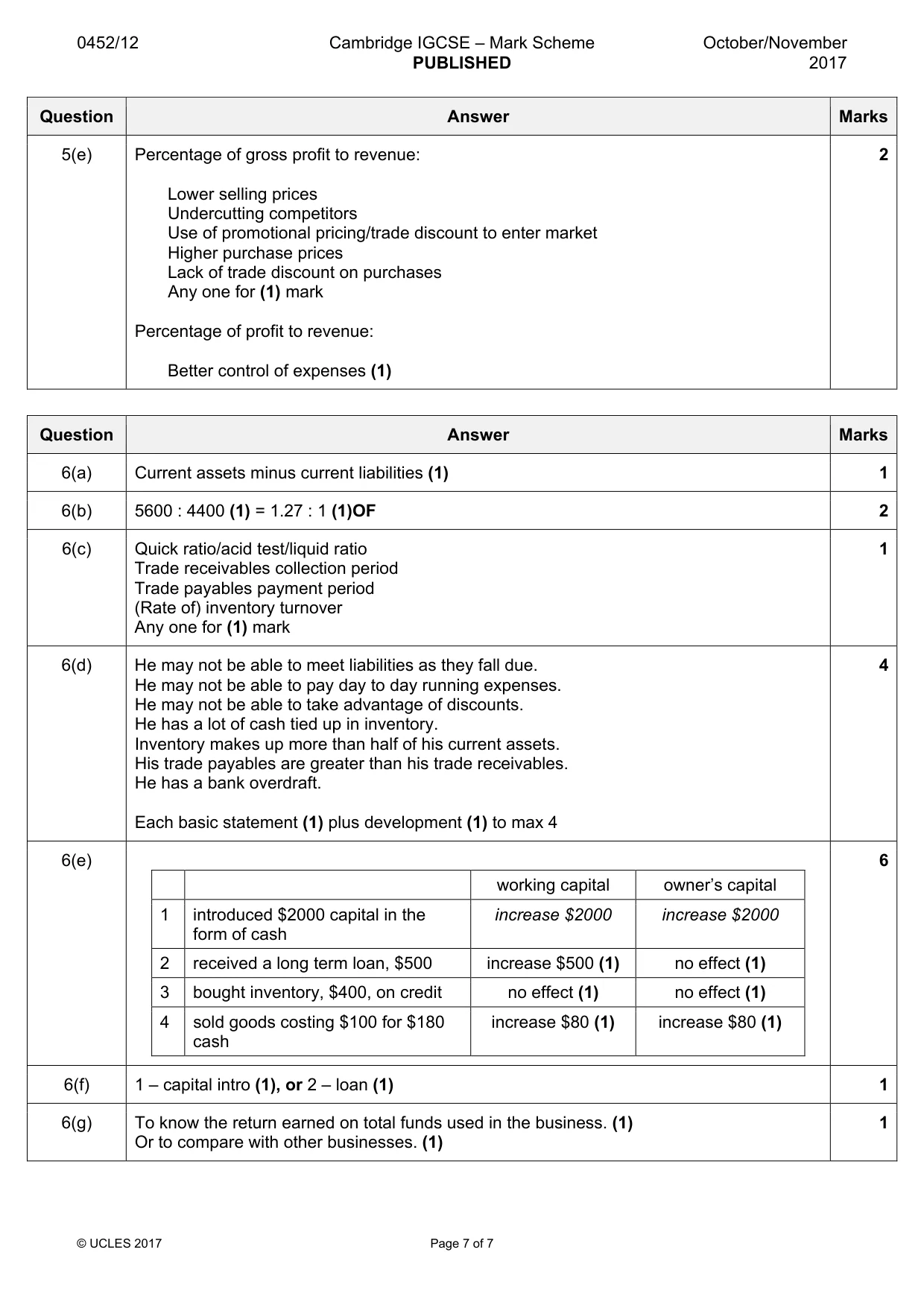
0452/12 Cambridge IGCSE – Mark Scheme PUBLISHED October/November 2017 © UCLES 2017 Page 7 of 7 Question Answer Marks 5(e) Percentage of gross profit to revenue: Lower selling prices Undercutting competitors Use of promotional pricing/trade discount to enter market Higher purchase prices Lack of trade discount on purchases Any one for (1) mark Percentage of profit to revenue: Better control of expenses (1) 2 Question Answer Marks 6(a) Current assets minus current liabilities (1) 1 6(b) 5600 : 4400 (1) = 1.27 : 1 (1)OF 2 6(c) Quick ratio/acid test/liquid ratio Trade receivables collection period Trade payables payment period (Rate of) inventory turnover Any one for (1) mark 1 6(d) He may not be able to meet liabilities as they fall due. He may not be able to pay day to day running expenses. He may not be able to take advantage of discounts. He has a lot of cash tied up in inventory. Inventory makes up more than half of his current assets. His trade payables are greater than his trade receivables. He has a bank overdraft. Each basic statement (1) plus development (1) to max 4 4 6(e) working capital owner’s capital 1 introduced $2000 capital in the form of cash increase $2000 increase $2000 2 received a long term loan, $500 increase $500 (1) no effect (1) 3 bought inventory, $400, on credit no effect (1) no effect (1) 4 sold goods costing $100 for $180 cash increase $80 (1) increase $80 (1) 6 6(f) 1 – capital intro (1), or 2 – loan (1) 1 6(g) To know the return earned on total funds used in the business. (1) Or to compare with other businesses. (1) 1
What you needed in this session
Cambridge’s own grade thresholds for 2017 Oct/Nov, Paper 1 · Variant 2. A higher threshold means an easier paper — the bar moves with how the cohort did.