Cambridge IGCSE Accounting 0452 — 2017 May/June Paper 1 · Variant 1
0452/11/M/J/17 · 120 marks · ≈135 min
The question paper and its mark scheme, free to read here and free to download. This is Cambridge’s own paper, exactly as it was sat.
Question paper20 pages
Mark scheme11 pages
Answers below. Sit the paper first if you are practising.
Paper as text
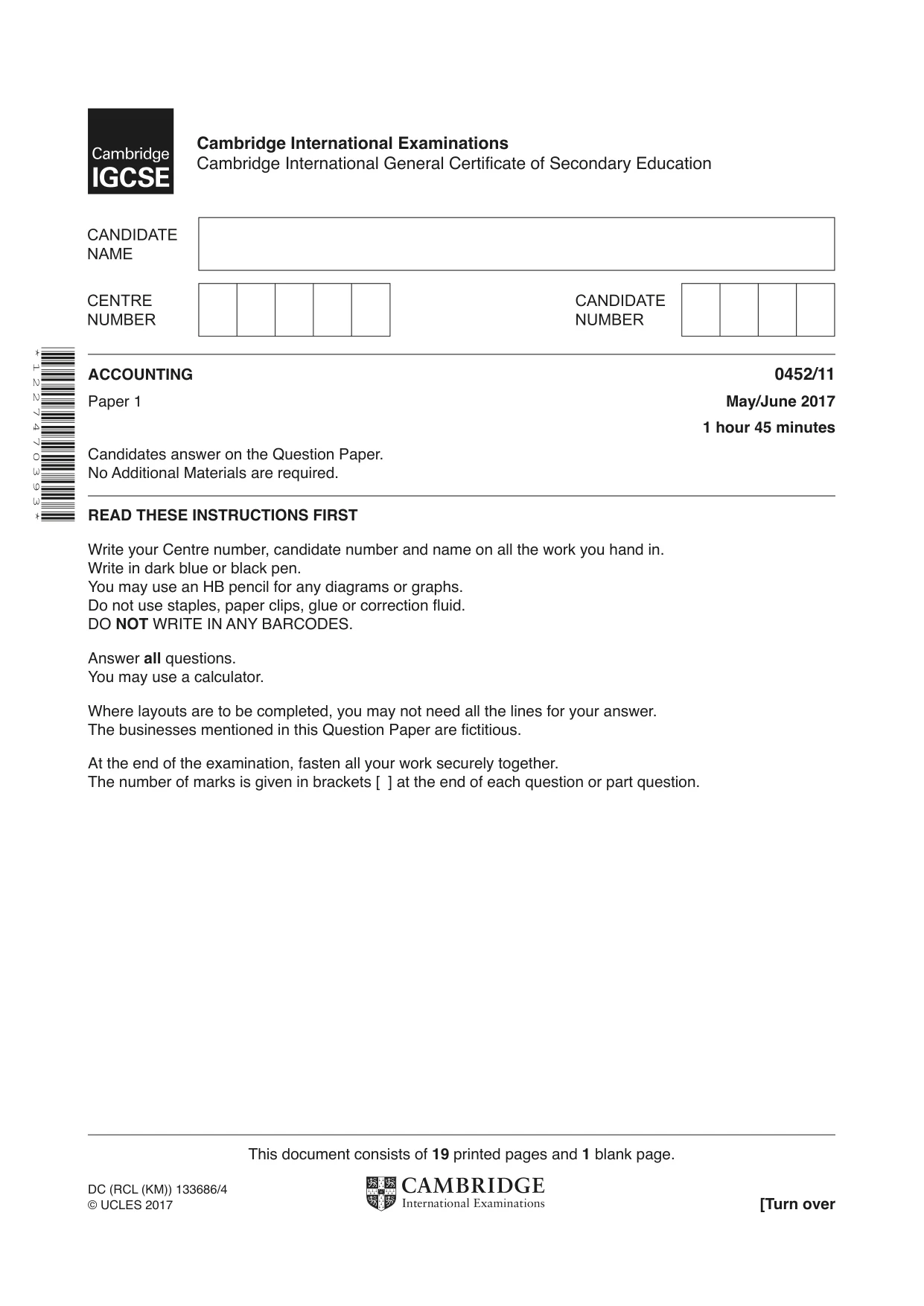
Question paper, page 1
This document consists of 19 printed pages and 1 blank page. DC (RCL (KM)) 133686/4 © UCLES 2017 [Turn over Cambridge International Examinations Cambridge International General Certificate of Secondary Education * 1 2 2 7 4 7 0 3 9 3 * ACCOUNTING 0452/11 Paper 1 May/June 2017 1 hour 45 minutes Candidates answer on the Question Paper. No Additional Materials are required. READ THESE INSTRUCTIONS FIRST Write your Centre number, candidate number and name on all the work you hand in. Write in dark blue or black pen. You may use an HB pencil for any diagrams or graphs. Do not use staples, paper clips, glue or correction fluid. DO NOT WRITE IN ANY BARCODES. Answer all questions. You may use a calculator. Where layouts are to be completed, you may not need all the lines for your answer. The businesses mentioned in this Question Paper are fictitious. At the end of the examination, fasten all your work securely together. The number of marks is given in brackets [ ] at the end of each question or part question.
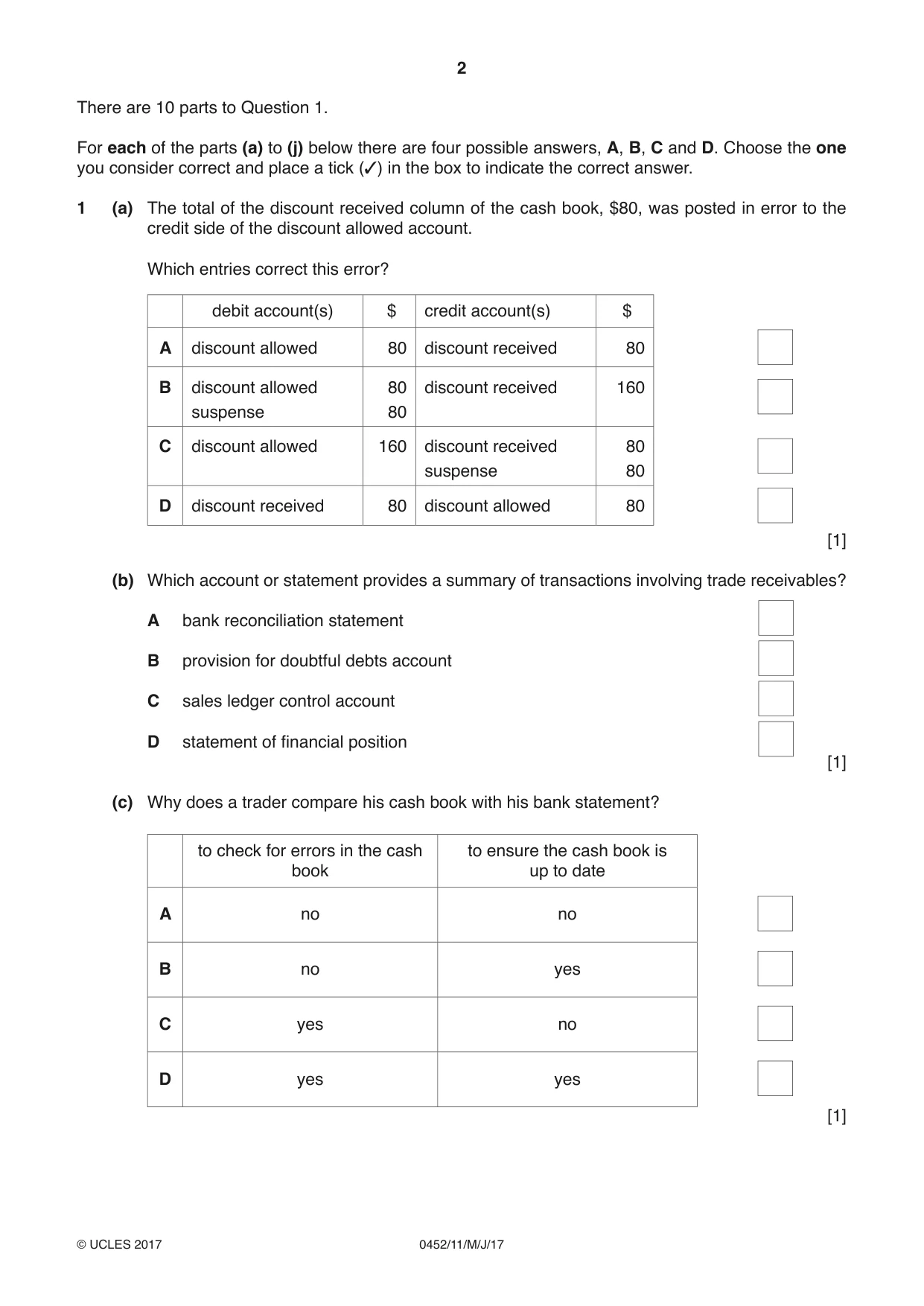
Question paper, page 2
2 0452/11/M/J/17 © UCLES 2017 There are 10 parts to Question 1. For each of the parts (a) to (j) below there are four possible answers, A, B, C and D. Choose the one you consider correct and place a tick (✓) in the box to indicate the correct answer. 1 (a) The total of the discount received column of the cash book, $80, was posted in error to the credit side of the discount allowed account. Which entries correct this error? debit account(s) $ credit account(s) $ A discount allowed 80 discount received 80 B discount allowed suspense 80 80 discount received 160 C discount allowed 160 discount received suspense 80 80 D discount received 80 discount allowed 80 [1] (b) Which account or statement provides a summary of transactions involving trade receivables? A bank reconciliation statement B provision for doubtful debts account C sales ledger control account D statement of financial position [1] (c) Why does a trader compare his cash book with his bank statement? to check for errors in the cash book to ensure the cash book is up to date A no no B no yes C yes no D yes yes [1]
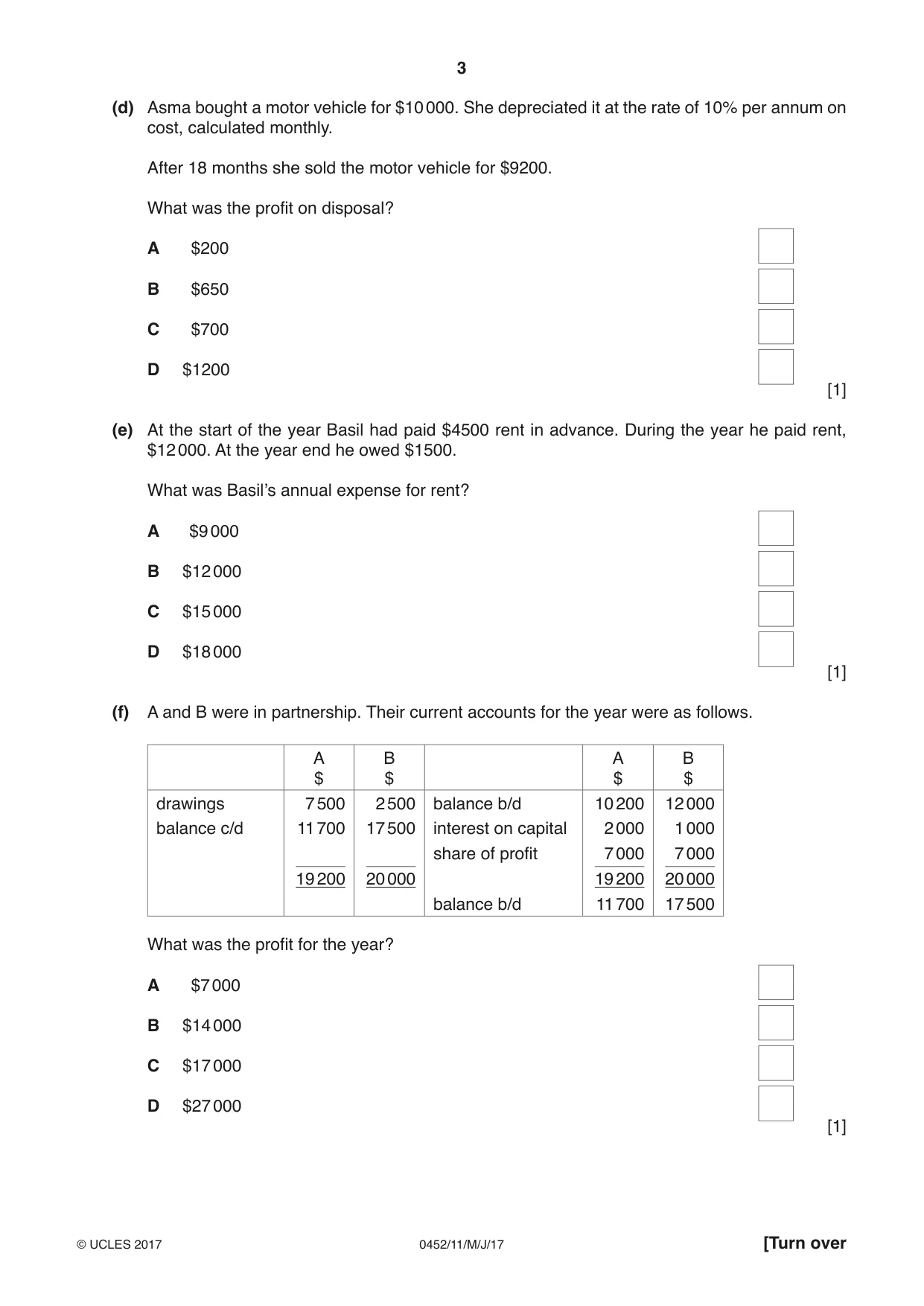
Question paper, page 3
3 0452/11/M/J/17 © UCLES 2017 [Turn over (d) Asma bought a motor vehicle for $10 000. She depreciated it at the rate of 10% per annum on cost, calculated monthly. After 18 months she sold the motor vehicle for $9200. What was the profit on disposal? A $200 B $650 C $700 D $1200 [1] (e) At the start of the year Basil had paid $4500 rent in advance. During the year he paid rent, $12 000. At the year end he owed $1500. What was Basil’s annual expense for rent? A $9 000 B $12 000 C $15 000 D $18 000 [1] (f) A and B were in partnership. Their current accounts for the year were as follows. A $ B $ A $ B $ drawings 7 500 2 500 balance b/d 10 200 12 000 balance c/d 11 700 17 500 interest on capital 2 000 1 000 share of profit 7 000 7 000 19 200 20 000 19 200 20 000 balance b/d 11 700 17 500 What was the profit for the year? A $7 000 B $14 000 C $17 000 D $27 000 [1]
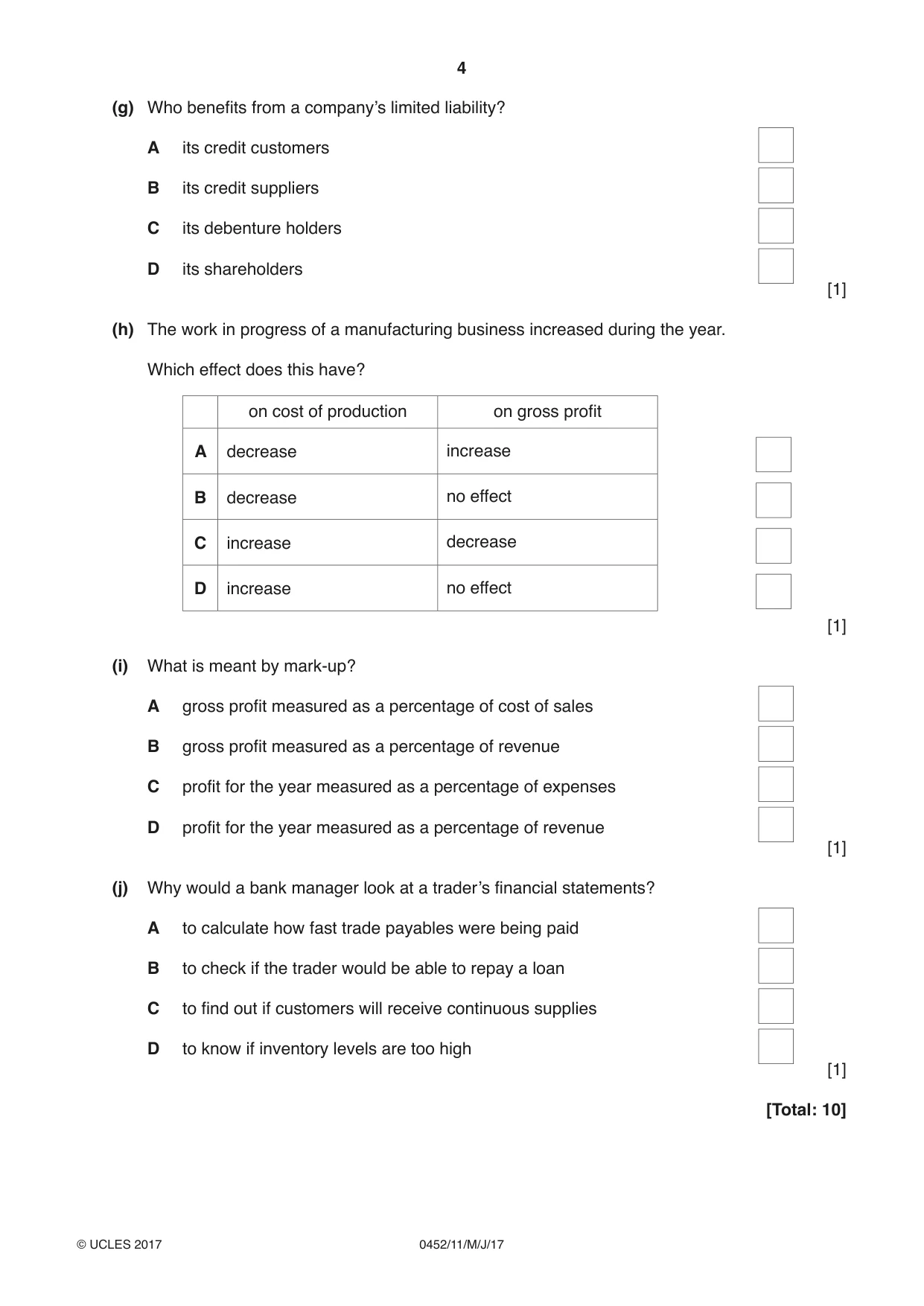
Question paper, page 4
4 0452/11/M/J/17 © UCLES 2017 (g) Who benefits from a company’s limited liability? A its credit customers B its credit suppliers C its debenture holders D its shareholders [1] (h) The work in progress of a manufacturing business increased during the year. Which effect does this have? on cost of production on gross profit A decrease increase B decrease no effect C increase decrease D increase no effect [1] (i) What is meant by mark-up? A gross profit measured as a percentage of cost of sales B gross profit measured as a percentage of revenue C profit for the year measured as a percentage of expenses D profit for the year measured as a percentage of revenue [1] (j) Why would a bank manager look at a trader’s financial statements? A to calculate how fast trade payables were being paid B to check if the trader would be able to repay a loan C to find out if customers will receive continuous supplies D to know if inventory levels are too high [1] [Total: 10]
Question paper, page 5
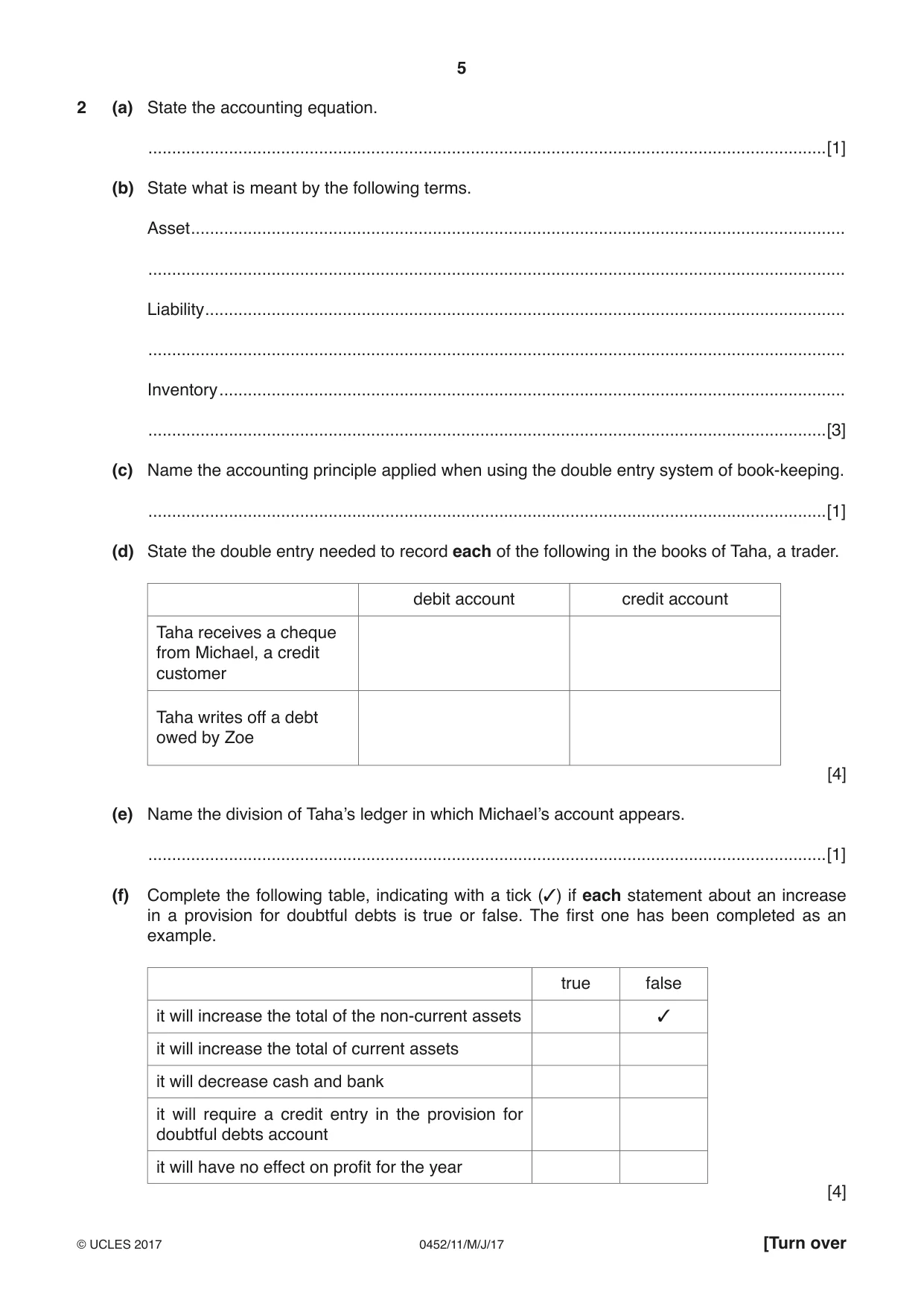
5 0452/11/M/J/17 © UCLES 2017 [Turn over 2 (a) State the accounting equation. …[1] (b) State what is meant by the following terms. Asset … … Liability … … Inventory … …[3] (c) Name the accounting principle applied when using the double entry system of book-keeping. …[1] (d) State the double entry needed to record each of the following in the books of Taha, a trader. debit account credit account Taha receives a cheque from Michael, a credit customer Taha writes off a debt owed by Zoe [4] (e) Name the division of Taha’s ledger in which Michael’s account appears. …[1] (f) Complete the following table, indicating with a tick (✓) if each statement about an increase in a provision for doubtful debts is true or false. The first one has been completed as an example. true false it will increase the total of the non-current assets ✓ it will increase the total of current assets it will decrease cash and bank it will require a credit entry in the provision for doubtful debts account it will have no effect on profit for the year [4]
Question paper, page 6
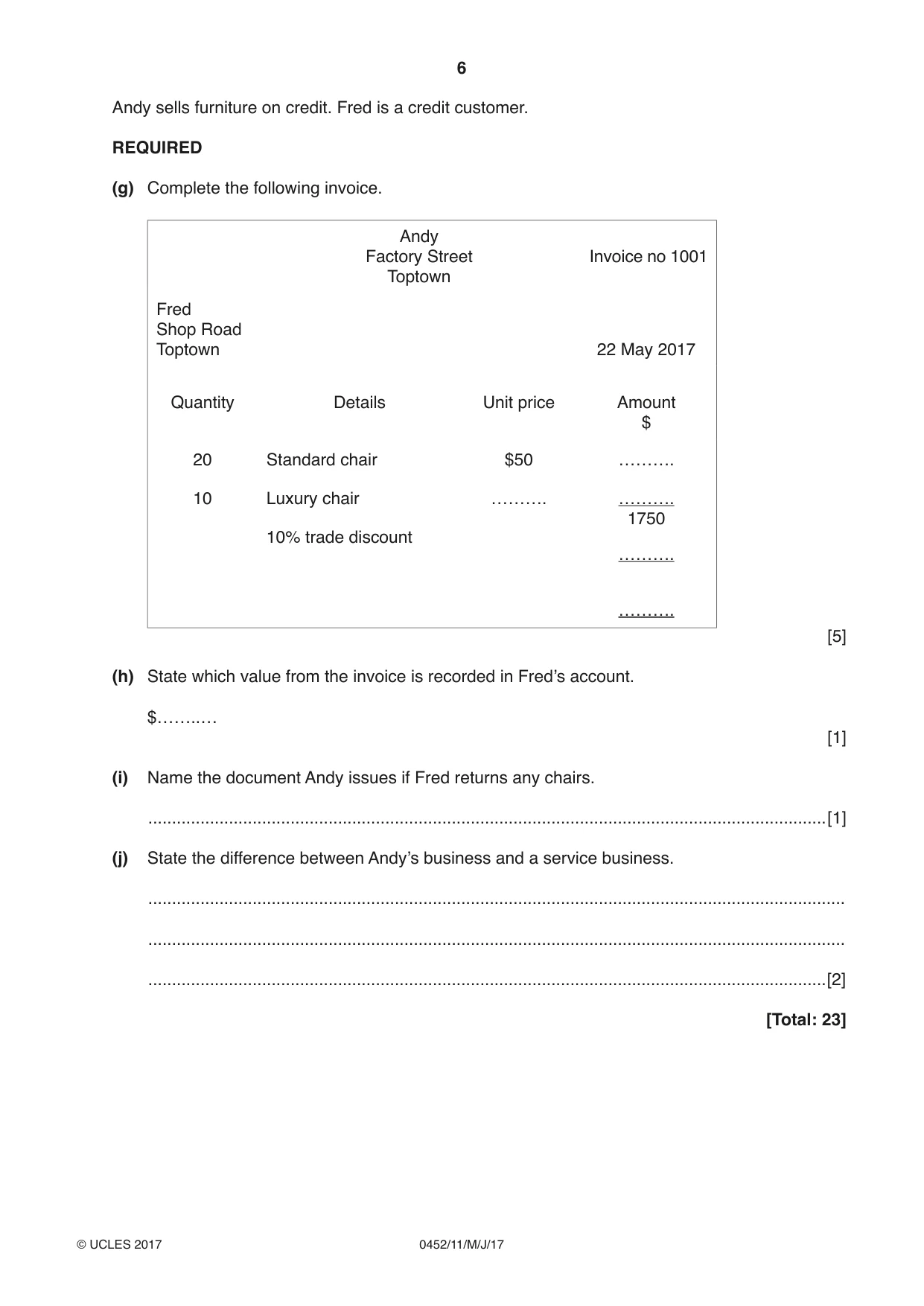
6 0452/11/M/J/17 © UCLES 2017 Andy sells furniture on credit. Fred is a credit customer. REQUIRED (g) Complete the following invoice. Andy Factory Street Toptown Invoice no 1001 Fred Shop Road Toptown 22 May 2017 Quantity Details Unit price Amount $ 20 Standard chair $50 ………. 10 Luxury chair 10% trade discount ………. ………. 1750 ………. ………. [5] (h) State which value from the invoice is recorded in Fred’s account. $……..… [1] (i) Name the document Andy issues if Fred returns any chairs. …[1] (j) State the difference between Andy’s business and a service business. … … …[2] [Total: 23]
Question paper, page 7
7 0452/11/M/J/17 © UCLES 2017 [Turn over Question 3 is on the next page.
Question paper, page 8
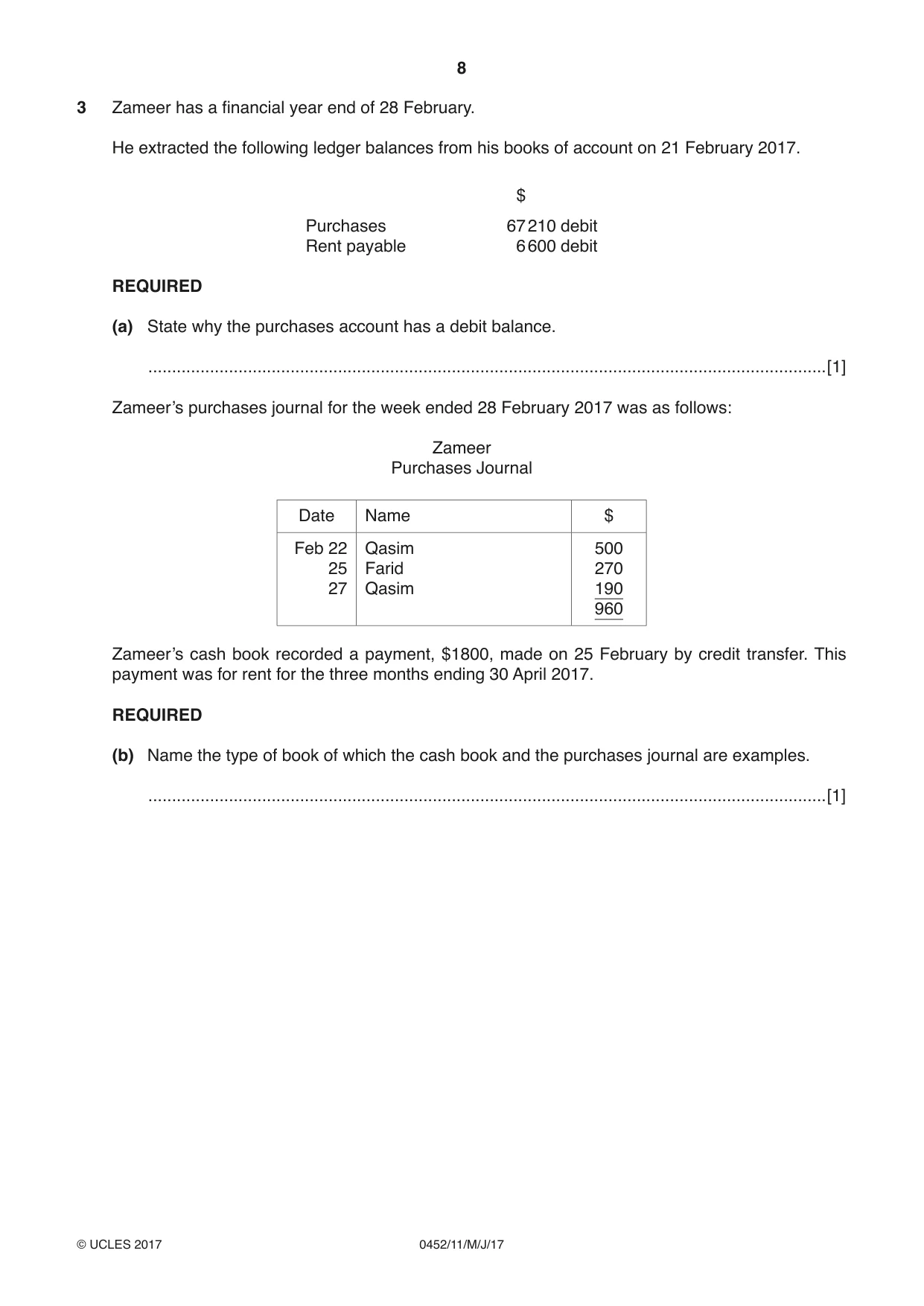
8 0452/11/M/J/17 © UCLES 2017 3 Zameer has a financial year end of 28 February. He extracted the following ledger balances from his books of account on 21 February 2017. $ Purchases Rent payable 67 210 6 600 debit debit REQUIRED (a) State why the purchases account has a debit balance. …[1] Zameer’s purchases journal for the week ended 28 February 2017 was as follows: Zameer Purchases Journal Date Name $ Feb 22 25 27 Qasim Farid Qasim 500 270 190 960 Zameer’s cash book recorded a payment, $1800, made on 25 February by credit transfer. This payment was for rent for the three months ending 30 April 2017. REQUIRED (b) Name the type of book of which the cash book and the purchases journal are examples. …[1]
Question paper, page 9
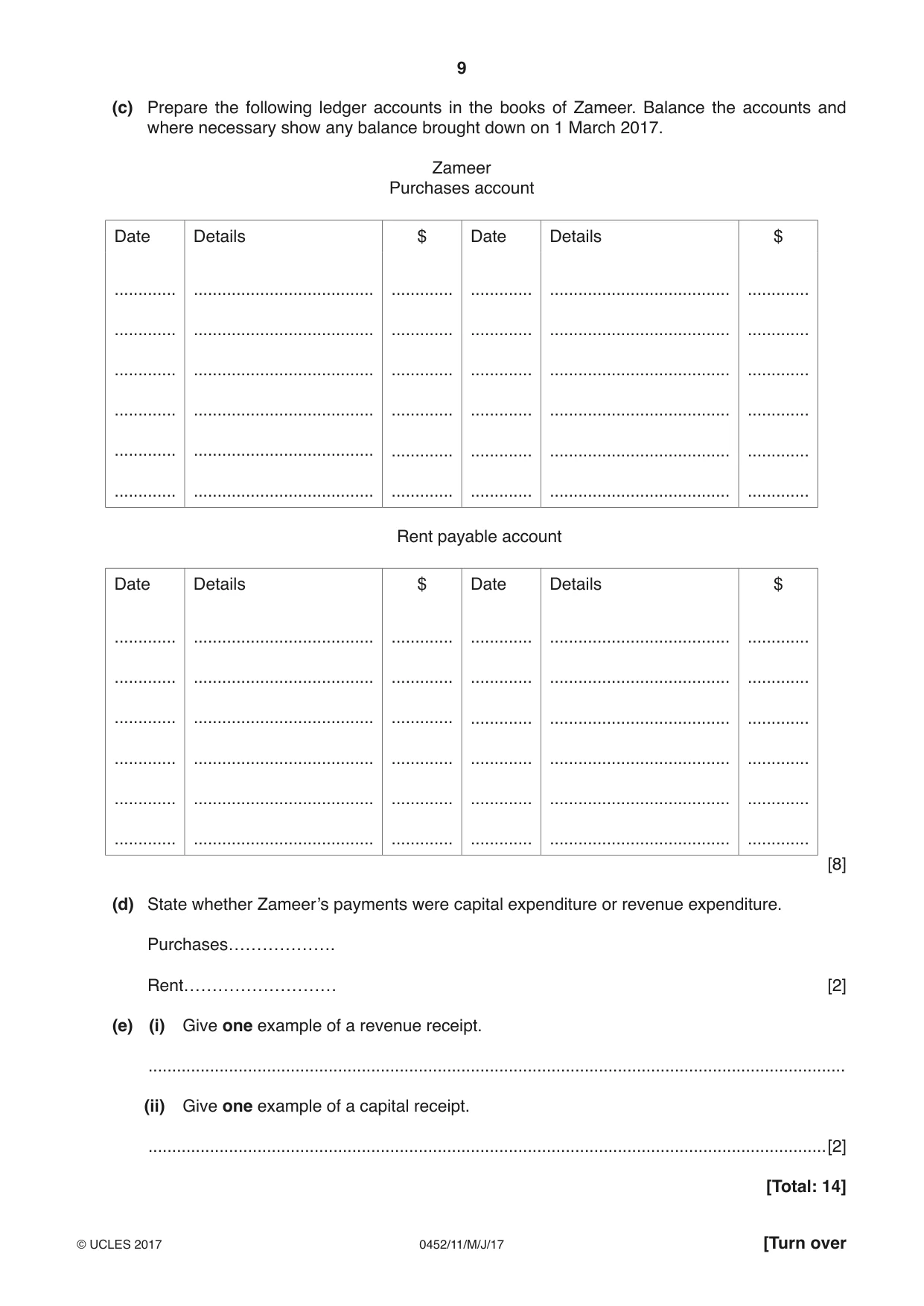
9 0452/11/M/J/17 © UCLES 2017 [Turn over (c) Prepare the following ledger accounts in the books of Zameer. Balance the accounts and where necessary show any balance brought down on 1 March 2017. Zameer Purchases account Date Details $ Date Details $ … … … … … … … … … … … … … … … … … … … … … … … … … … … … … … … … … … … … Rent payable account Date Details $ Date Details $ … … … … … … … … … … … … … … … … … … … … … … … … … … … … … … … … … … … … [8] (d) State whether Zameer’s payments were capital expenditure or revenue expenditure. Purchases………………. Rent……………………… [2] (e) (i) Give one example of a revenue receipt. … (ii) Give one example of a capital receipt. …[2] [Total: 14]
Question paper, page 10
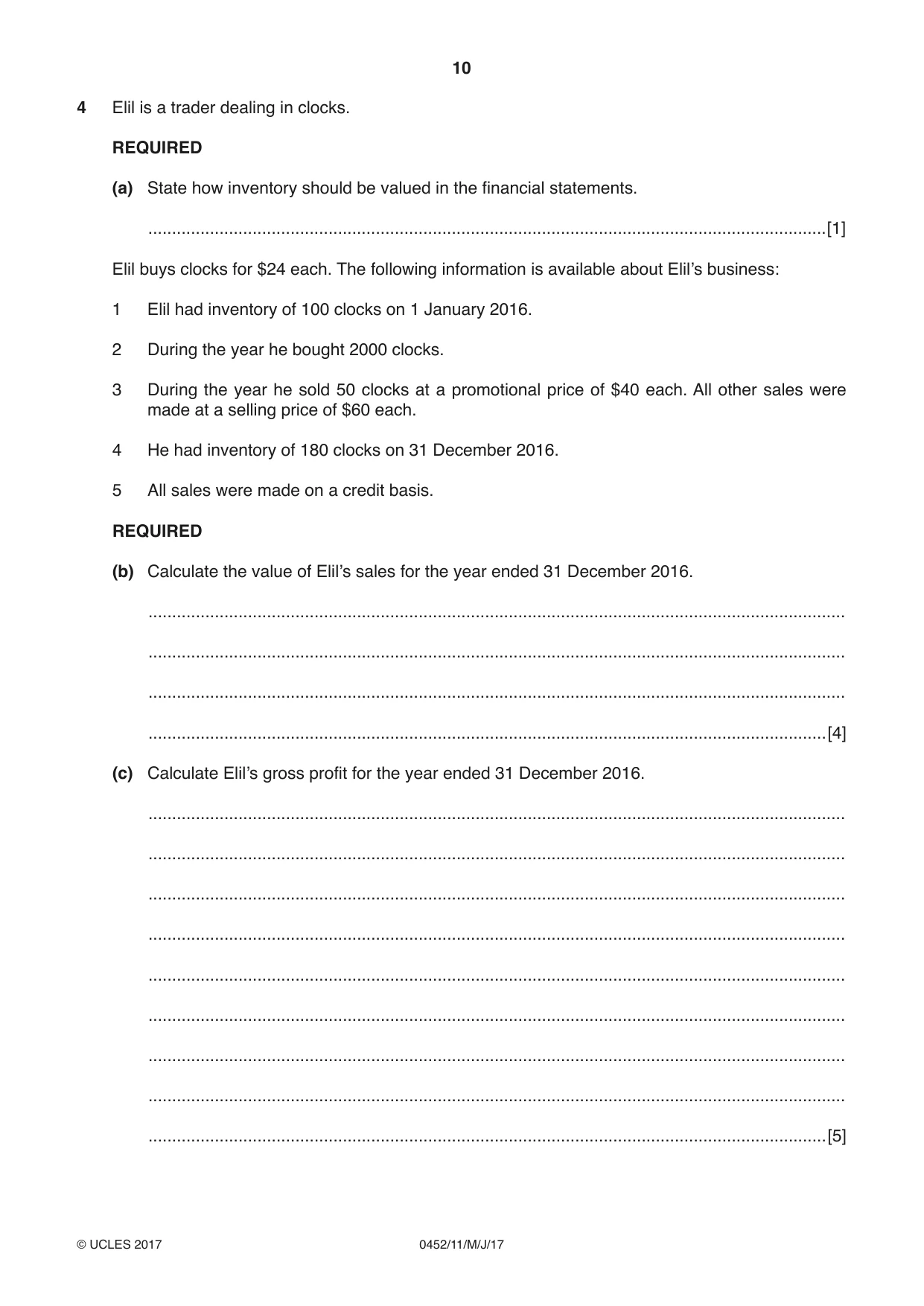
10 0452/11/M/J/17 © UCLES 2017 4 Elil is a trader dealing in clocks. REQUIRED (a) State how inventory should be valued in the financial statements. …[1] Elil buys clocks for $24 each. The following information is available about Elil’s business: 1 Elil had inventory of 100 clocks on 1 January 2016. 2 During the year he bought 2000 clocks. 3 During the year he sold 50 clocks at a promotional price of $40 each. All other sales were made at a selling price of $60 each. 4 He had inventory of 180 clocks on 31 December 2016. 5 All sales were made on a credit basis. REQUIRED (b) Calculate the value of Elil’s sales for the year ended 31 December 2016. … … … …[4] (c) Calculate Elil’s gross profit for the year ended 31 December 2016. … … … … … … … … …[5]
Question paper, page 11
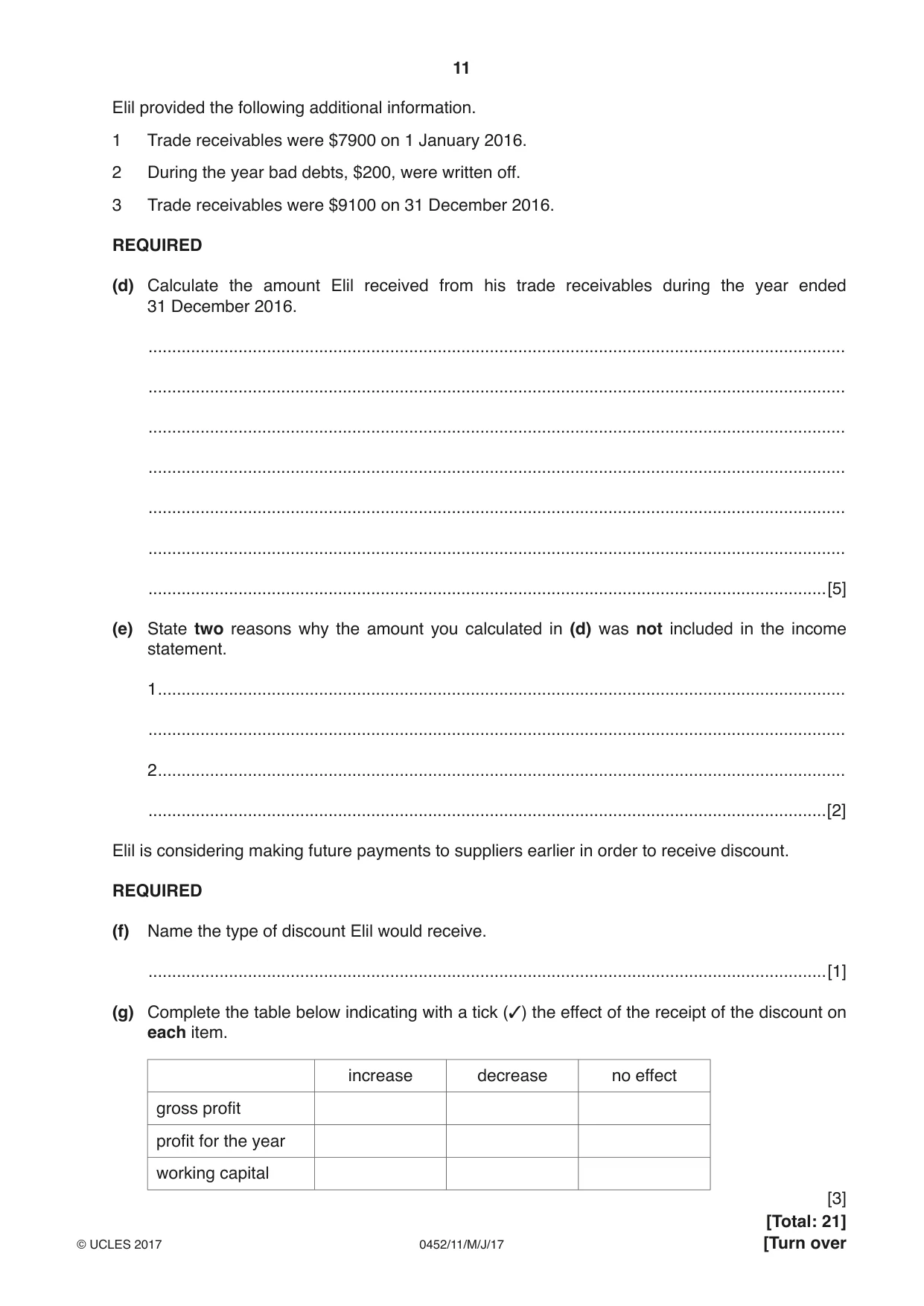
11 0452/11/M/J/17 © UCLES 2017 [Turn over Elil provided the following additional information. 1 Trade receivables were $7900 on 1 January 2016. 2 During the year bad debts, $200, were written off. 3 Trade receivables were $9100 on 31 December 2016. REQUIRED (d) Calculate the amount Elil received from his trade receivables during the year ended 31 December 2016. … … … … … … …[5] (e) State two reasons why the amount you calculated in (d) was not included in the income statement. 1 … … 2 … …[2] Elil is considering making future payments to suppliers earlier in order to receive discount. REQUIRED (f) Name the type of discount Elil would receive. …[1] (g) Complete the table below indicating with a tick (✓) the effect of the receipt of the discount on each item. increase decrease no effect gross profit profit for the year working capital [3] [Total: 21]
Question paper, page 12
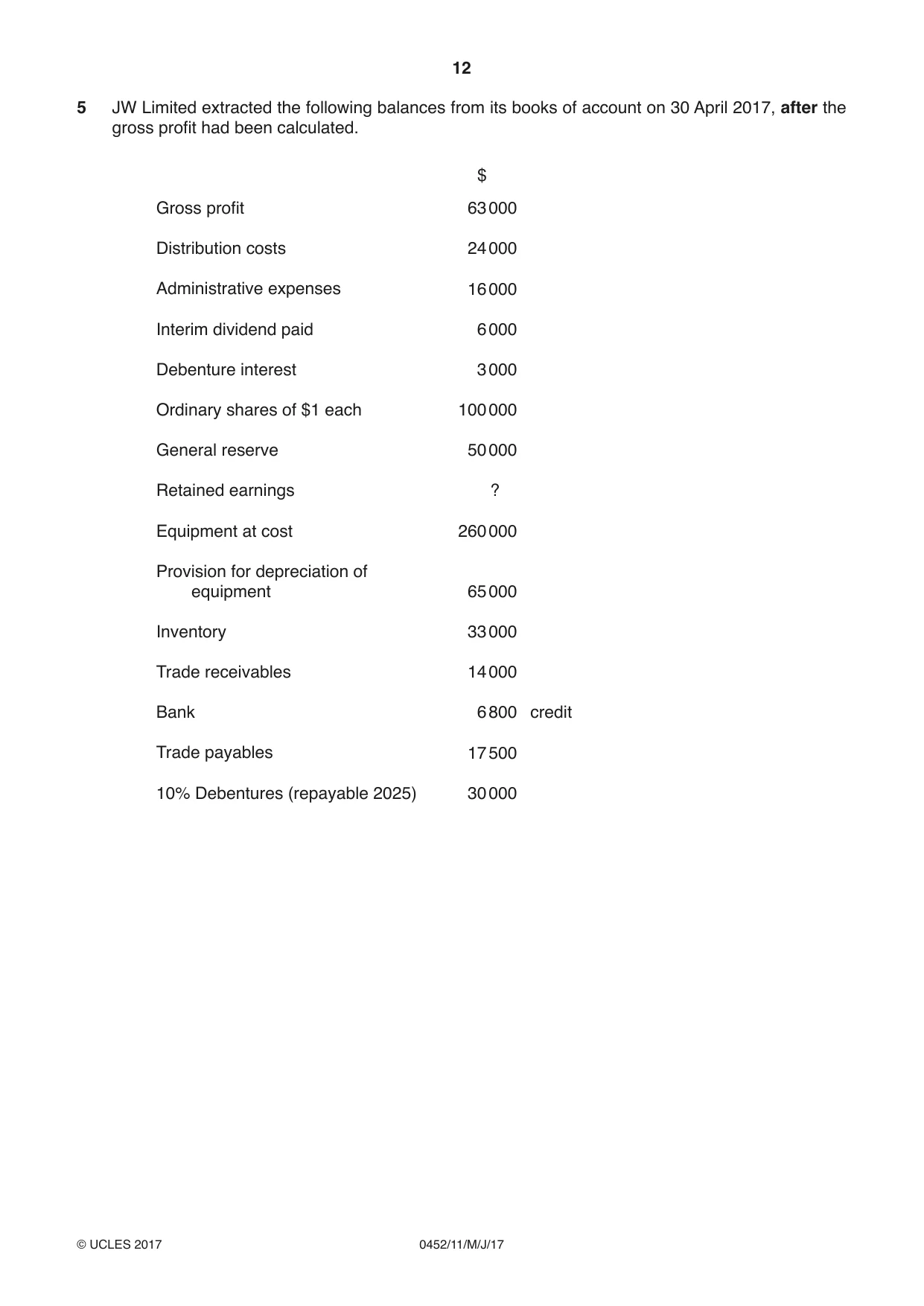
12 0452/11/M/J/17 © UCLES 2017 5 JW Limited extracted the following balances from its books of account on 30 April 2017, after the gross profit had been calculated. $ Gross profit Distribution costs Administrative expenses Interim dividend paid Debenture interest Ordinary shares of $1 each General reserve Retained earnings Equipment at cost Provision for depreciation of equipment Inventory Trade receivables Bank Trade payables 10% Debentures (repayable 2025) 63 000 24 000 16 000 6 000 3 000 100 000 50 000 ? 260 000 65 000 33 000 14 000 6 800 17 500 30 000 credit
Question paper, page 13
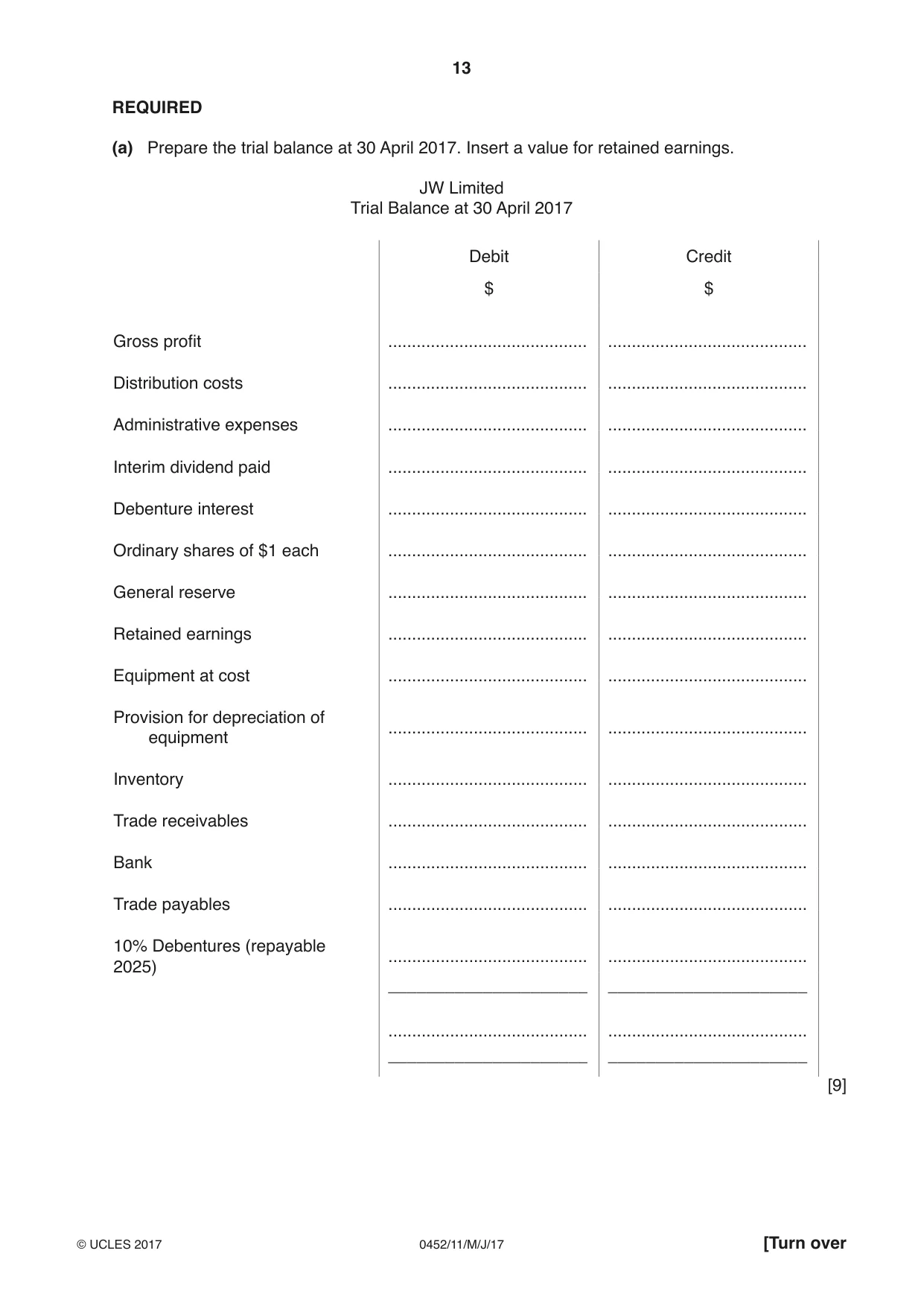
13 0452/11/M/J/17 © UCLES 2017 [Turn over REQUIRED (a) Prepare the trial balance at 30 April 2017. Insert a value for retained earnings. JW Limited Trial Balance at 30 April 2017 Debit Credit $ $ Gross profit … … Distribution costs … … Administrative expenses … … Interim dividend paid … … Debenture interest … … Ordinary shares of $1 each … … General reserve … … Retained earnings … … Equipment at cost … … Provision for depreciation of equipment … … Inventory … … Trade receivables … … Bank … … Trade payables … … 10% Debentures (repayable 2025) … … _____________________ … _____________________ _____________________ … _____________________ [9]
Question paper, page 14
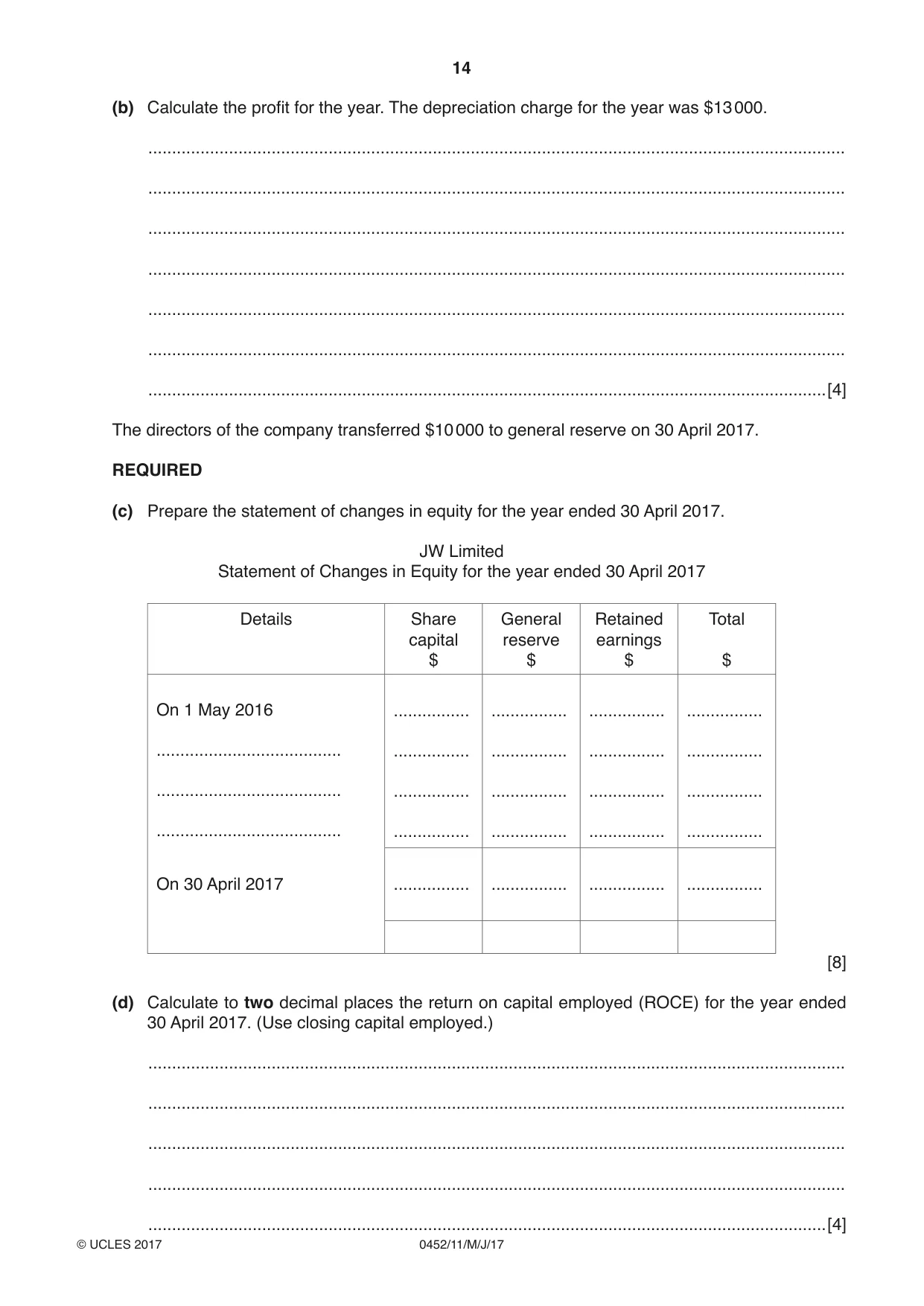
14 0452/11/M/J/17 © UCLES 2017 (b) Calculate the profit for the year. The depreciation charge for the year was $13 000. … … … … … … …[4] The directors of the company transferred $10 000 to general reserve on 30 April 2017. REQUIRED (c) Prepare the statement of changes in equity for the year ended 30 April 2017. JW Limited Statement of Changes in Equity for the year ended 30 April 2017 Details Share capital $ General reserve $ Retained earnings $ Total $ On 1 May 2016 … … … On 30 April 2017 … … … … … … … … … … … … … … … … … … … … [8] (d) Calculate to two decimal places the return on capital employed (ROCE) for the year ended 30 April 2017. (Use closing capital employed.) … … … … …[4]
Question paper, page 15
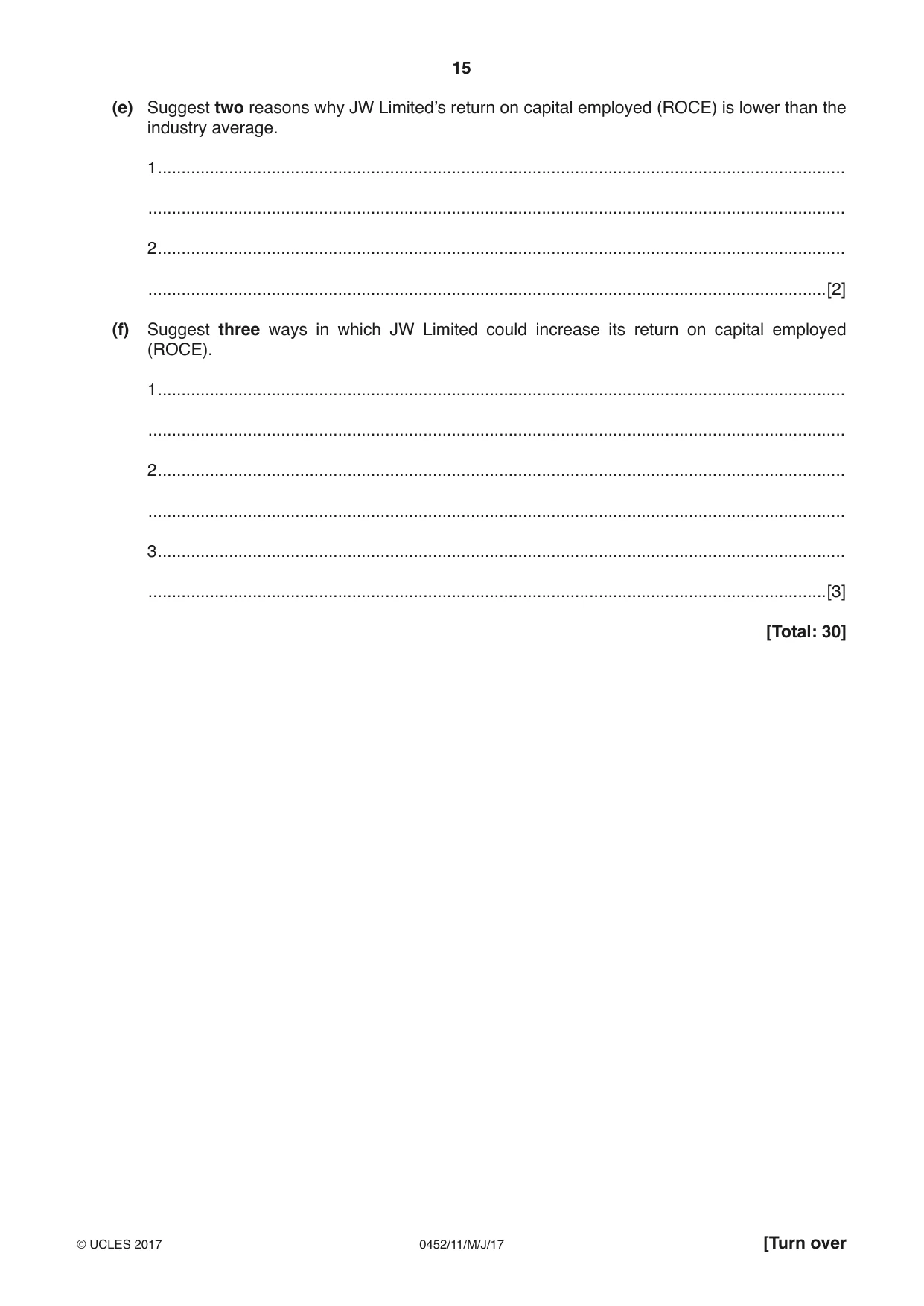
15 0452/11/M/J/17 © UCLES 2017 [Turn over (e) Suggest two reasons why JW Limited’s return on capital employed (ROCE) is lower than the industry average. 1 … … 2 … …[2] (f) Suggest three ways in which JW Limited could increase its return on capital employed (ROCE). 1 … … 2 … … 3 … …[3] [Total: 30]
Question paper, page 16
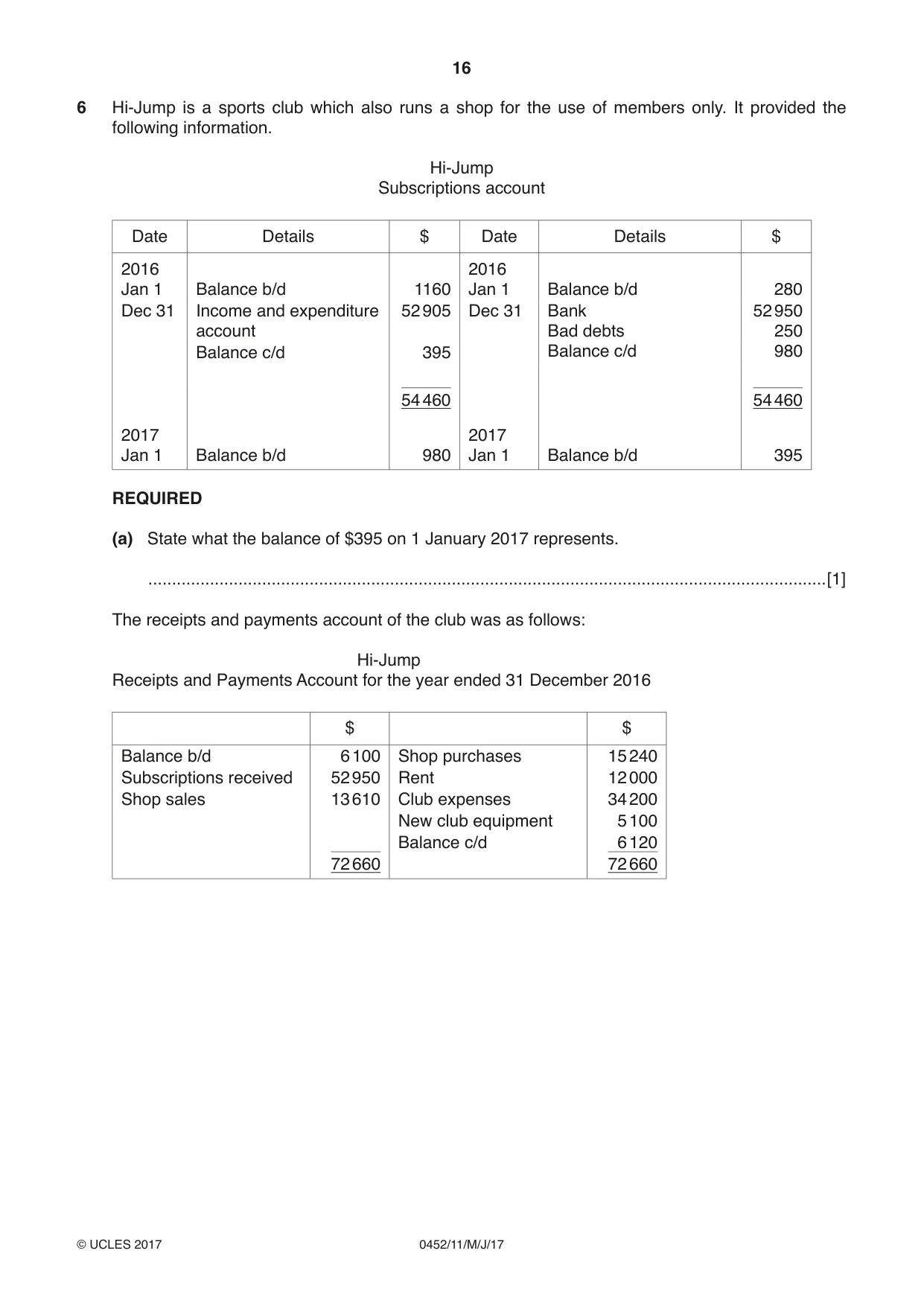
16 0452/11/M/J/17 © UCLES 2017 6 Hi-Jump is a sports club which also runs a shop for the use of members only. It provided the following information. Hi-Jump Subscriptions account Date Details $ Date Details $ 2016 Jan 1 Balance b/d 1160 2016 Jan 1 Balance b/d 280 Dec 31 Income and expenditure account 52 905 Dec 31 Bank Bad debts Balance c/d 52 950 250 980 Balance c/d 395 54 460 54 460 2017 Jan 1 Balance b/d 980 2017 Jan 1 Balance b/d 395 REQUIRED (a) State what the balance of $395 on 1 January 2017 represents. …[1] The receipts and payments account of the club was as follows: Hi-Jump Receipts and Payments Account for the year ended 31 December 2016 $ $ Balance b/d 6 100 Shop purchases 15 240 Subscriptions received 52 950 Rent 12 000 Shop sales 13 610 Club expenses 34 200 New club equipment 5 100 Balance c/d 6 120 72 660 72 660
Question paper, page 17
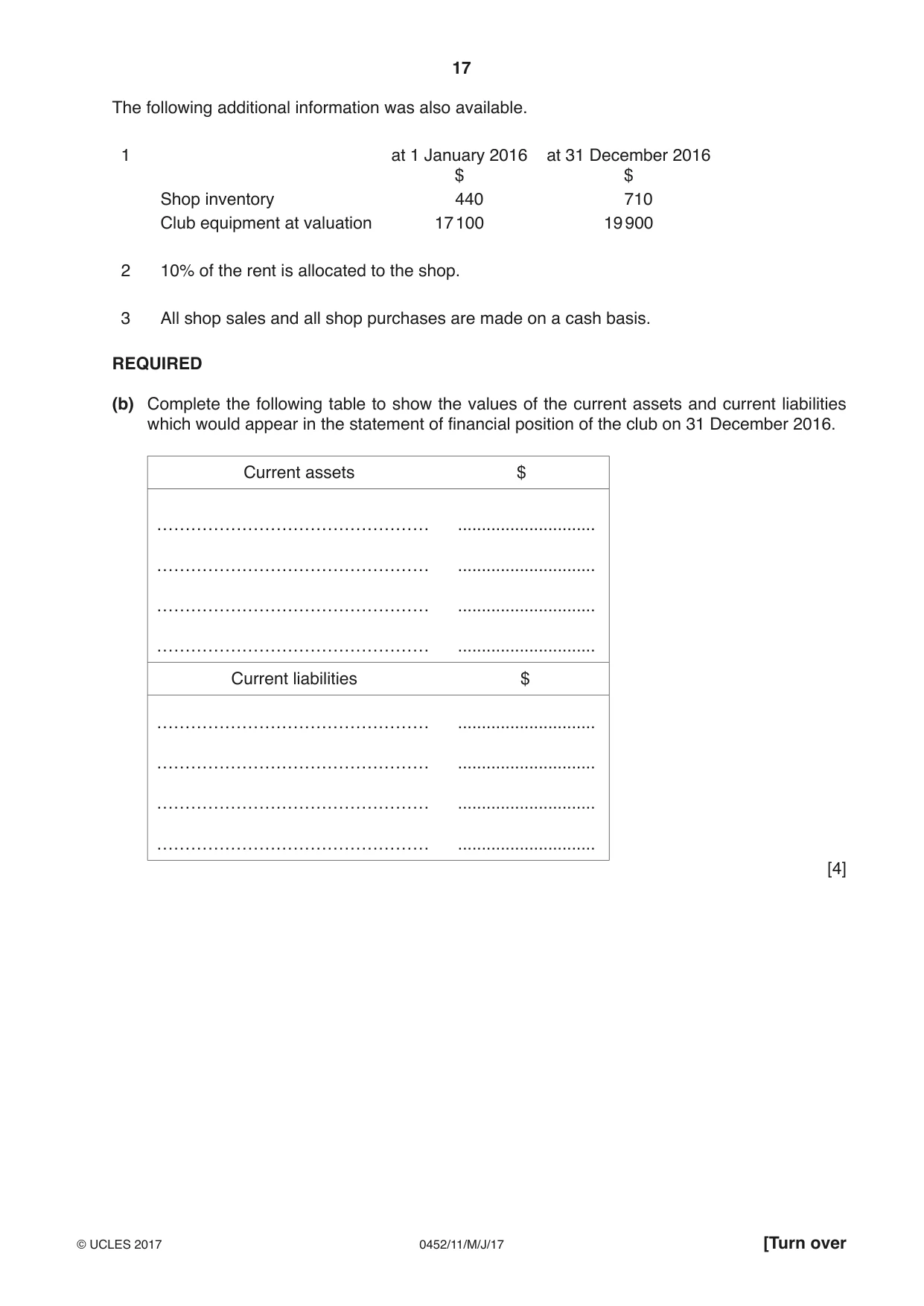
17 0452/11/M/J/17 © UCLES 2017 [Turn over The following additional information was also available. 1 at 1 January 2016 $ at 31 December 2016 $ Shop inventory 440 710 Club equipment at valuation 17 100 19 900 2 10% of the rent is allocated to the shop. 3 All shop sales and all shop purchases are made on a cash basis. REQUIRED (b) Complete the following table to show the values of the current assets and current liabilities which would appear in the statement of financial position of the club on 31 December 2016. Current assets $ ………………………………………… … ………………………………………… … ………………………………………… … ………………………………………… … Current liabilities $ ………………………………………… … ………………………………………… … ………………………………………… … ………………………………………… … [4]
Question paper, page 18
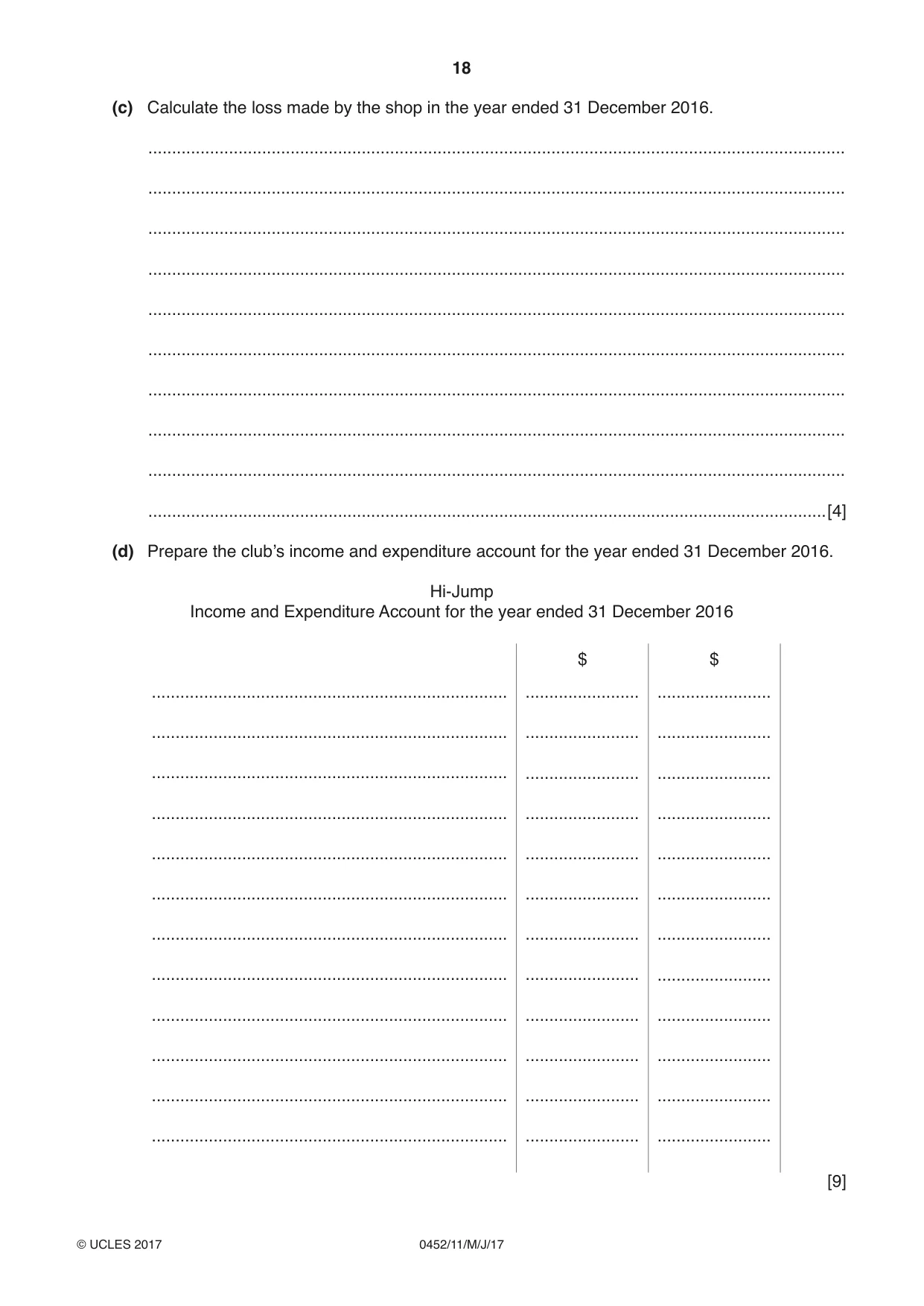
18 0452/11/M/J/17 © UCLES 2017 (c) Calculate the loss made by the shop in the year ended 31 December 2016. … … … … … … … … … …[4] (d) Prepare the club’s income and expenditure account for the year ended 31 December 2016. Hi-Jump Income and Expenditure Account for the year ended 31 December 2016 $ $ … … … … … … … … … … … … … … … … … … … … … … … … … … … … … … … … … … … … [9]
Question paper, page 19
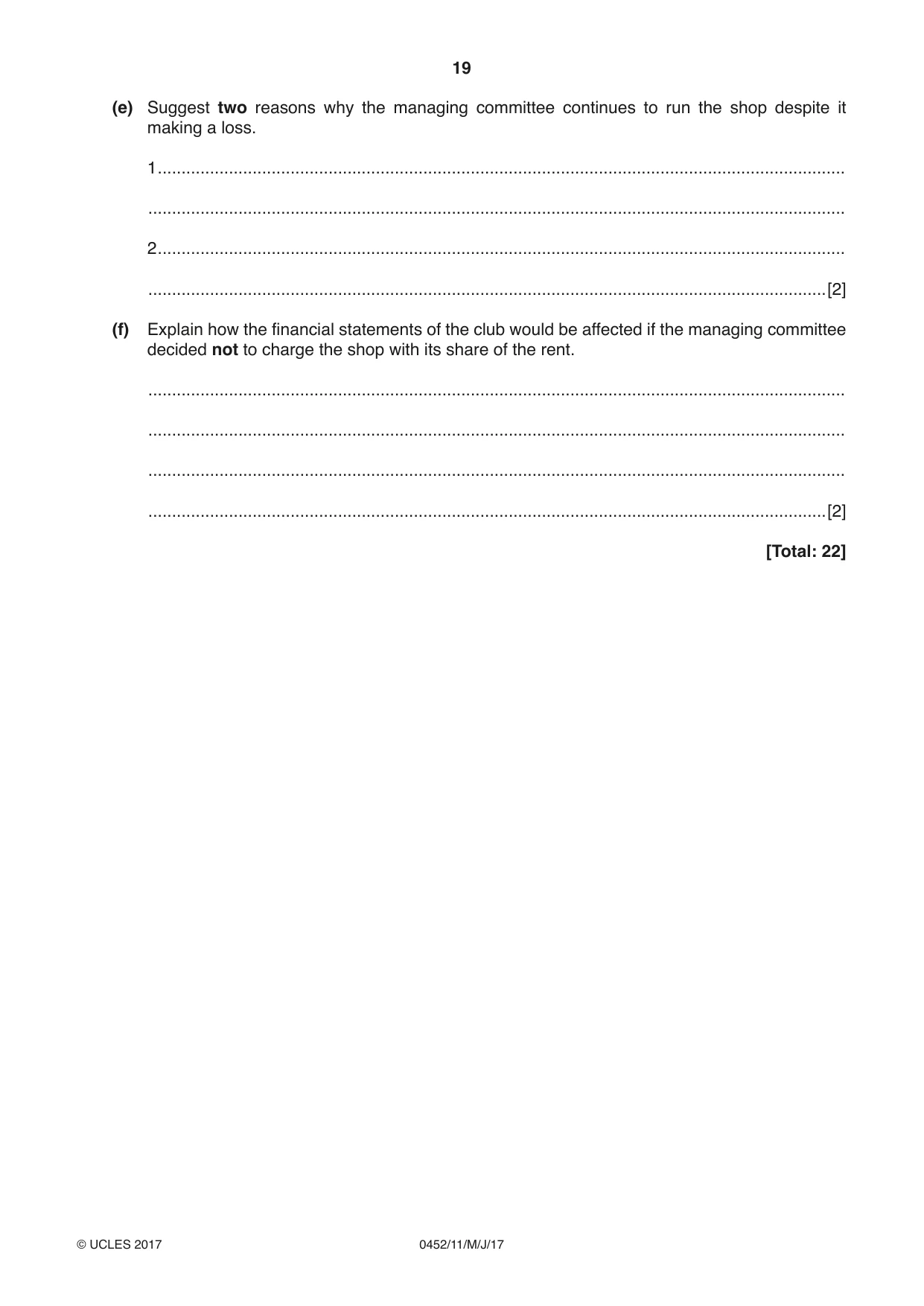
19 0452/11/M/J/17 © UCLES 2017 (e) Suggest two reasons why the managing committee continues to run the shop despite it making a loss. 1 … … 2 … …[2] (f) Explain how the financial statements of the club would be affected if the managing committee decided not to charge the shop with its share of the rent. … … … …[2] [Total: 22]
Question paper, page 20
20 0452/11/M/J/17 © UCLES 2017 Permission to reproduce items where third-party owned material protected by copyright is included has been sought and cleared where possible. Every reasonable effort has been made by the publisher (UCLES) to trace copyright holders, but if any items requiring clearance have unwittingly been included, the publisher will be pleased to make amends at the earliest possible opportunity. To avoid the issue of disclosure of answer-related information to candidates, all copyright acknowledgements are reproduced online in the Cambridge International Examinations Copyright Acknowledgements Booklet. This is produced for each series of examinations and is freely available to download at www.cie.org.uk after the live examination series. Cambridge International Examinations is part of the Cambridge Assessment Group. Cambridge Assessment is the brand name of University of Cambridge Local Examinations Syndicate (UCLES), which is itself a department of the University of Cambridge. BLANK PAGE
Mark scheme, page 1
® IGCSE is a registered trademark. This document consists of 11 printed pages. © UCLES 2017 [Turn over Cambridge International Examinations Cambridge International General Certificate of Secondary Education ACCOUNTING 0452/11 Paper 1 May/June 2017 MARK SCHEME Maximum Mark: 120 Published This mark scheme is published as an aid to teachers and candidates, to indicate the requirements of the examination. It shows the basis on which Examiners were instructed to award marks. It does not indicate the details of the discussions that took place at an Examiners’ meeting before marking began, which would have considered the acceptability of alternative answers. Mark schemes should be read in conjunction with the question paper and the Principal Examiner Report for Teachers. Cambridge will not enter into discussions about these mark schemes. Cambridge is publishing the mark schemes for the May/June 2017 series for most Cambridge IGCSE®, Cambridge International A and AS Level and Cambridge Pre-U components, and some Cambridge O Level components.
Mark scheme, page 2
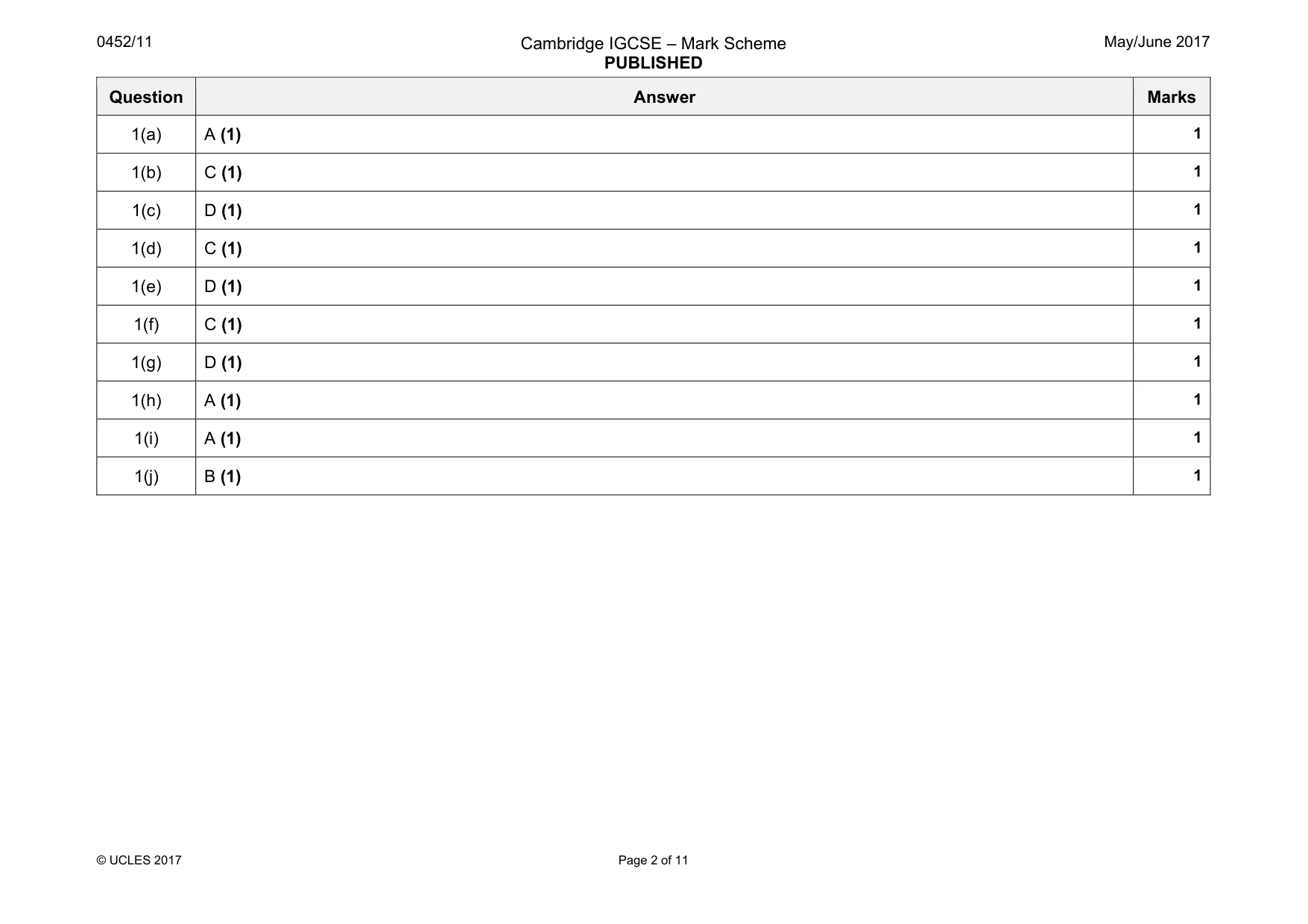
0452/11 Cambridge IGCSE – Mark Scheme PUBLISHED May/June 2017 © UCLES 2017 Page 2 of 11 Question Answer Marks 1(a) A (1) 1 1(b) C (1) 1 1(c) D (1) 1 1(d) C (1) 1 1(e) D (1) 1 1(f) C (1) 1 1(g) D (1) 1 1(h) A (1) 1 1(i) A (1) 1 1(j) B (1) 1
Mark scheme, page 3
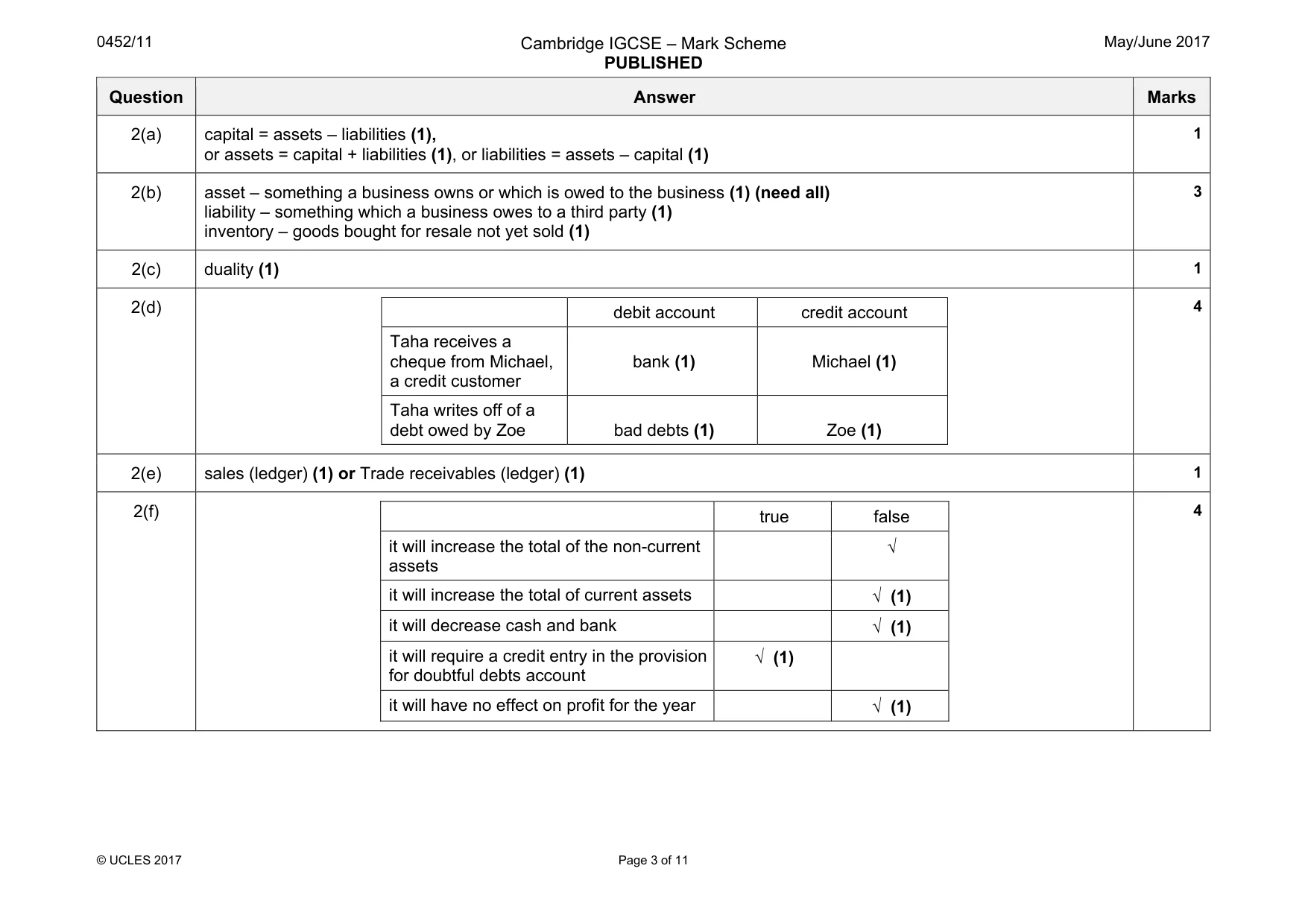
0452/11 Cambridge IGCSE – Mark Scheme PUBLISHED May/June 2017 © UCLES 2017 Page 3 of 11 Question Answer Marks 2(a) capital = assets – liabilities (1), or assets = capital + liabilities (1), or liabilities = assets – capital (1) 1 2(b) asset – something a business owns or which is owed to the business (1) (need all) liability – something which a business owes to a third party (1) inventory – goods bought for resale not yet sold (1) 3 2(c) duality (1) 1 2(d) debit account credit account Taha receives a cheque from Michael, a credit customer bank (1) Michael (1) Taha writes off of a debt owed by Zoe bad debts (1) Zoe (1) 4 2(e) sales (ledger) (1) or Trade receivables (ledger) (1) 1 2(f) true false it will increase the total of the non-current assets √ it will increase the total of current assets √ (1) it will decrease cash and bank √ (1) it will require a credit entry in the provision for doubtful debts account √ (1) it will have no effect on profit for the year √ (1) 4
Mark scheme, page 4
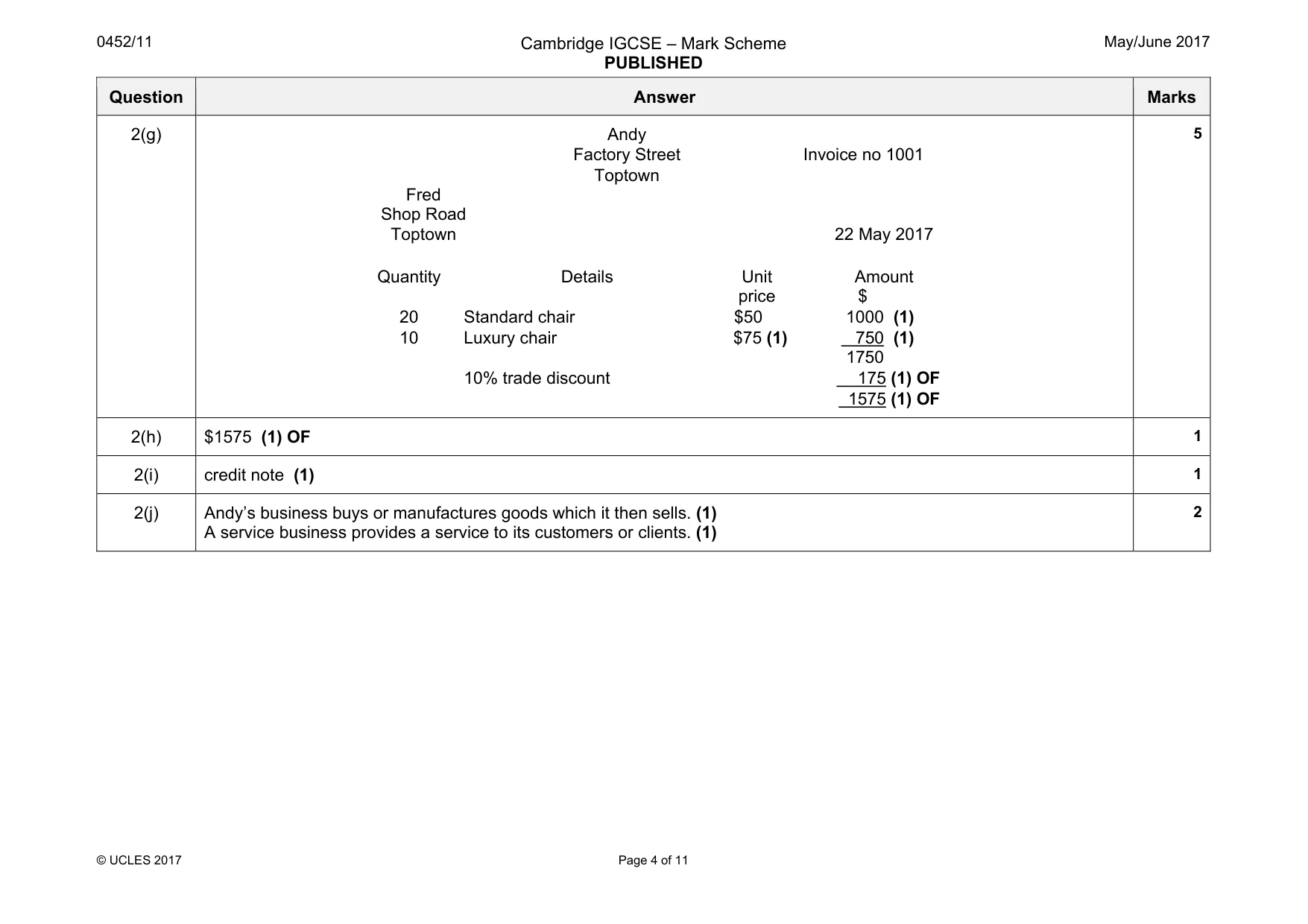
0452/11 Cambridge IGCSE – Mark Scheme PUBLISHED May/June 2017 © UCLES 2017 Page 4 of 11 Question Answer Marks 2(g) Andy Factory Street Invoice no 1001 Toptown Fred Shop Road Toptown 22 May 2017 Quantity Details Unit price Amount $ 20 Standard chair $50 1000 (1) 10 Luxury chair $75 (1) 750 (1) 1750 10% trade discount 175 (1) OF 1575 (1) OF 5 2(h) $1575 (1) OF 1 2(i) credit note (1) 1 2(j) Andy’s business buys or manufactures goods which it then sells. (1) A service business provides a service to its customers or clients. (1) 2
Mark scheme, page 5
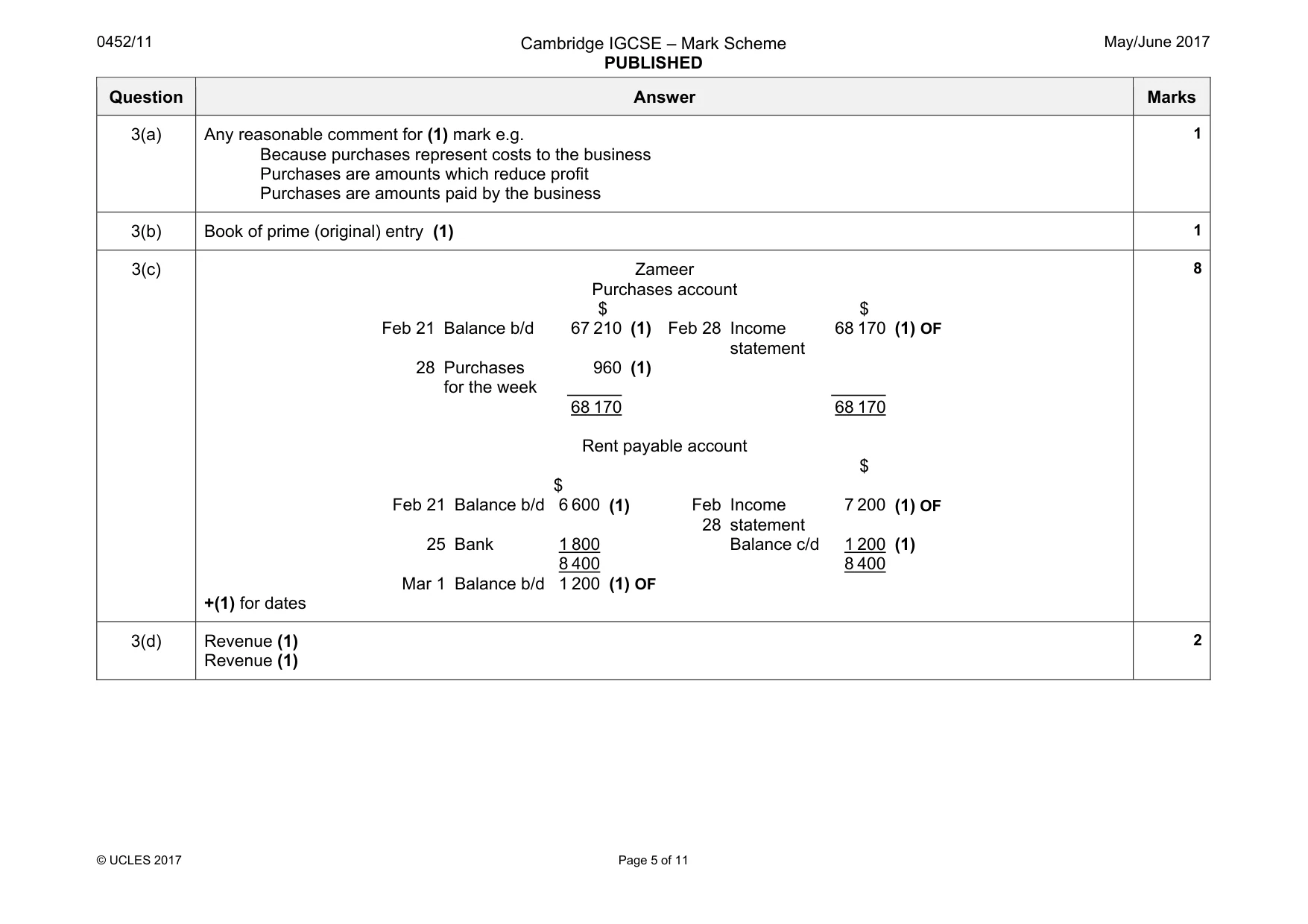
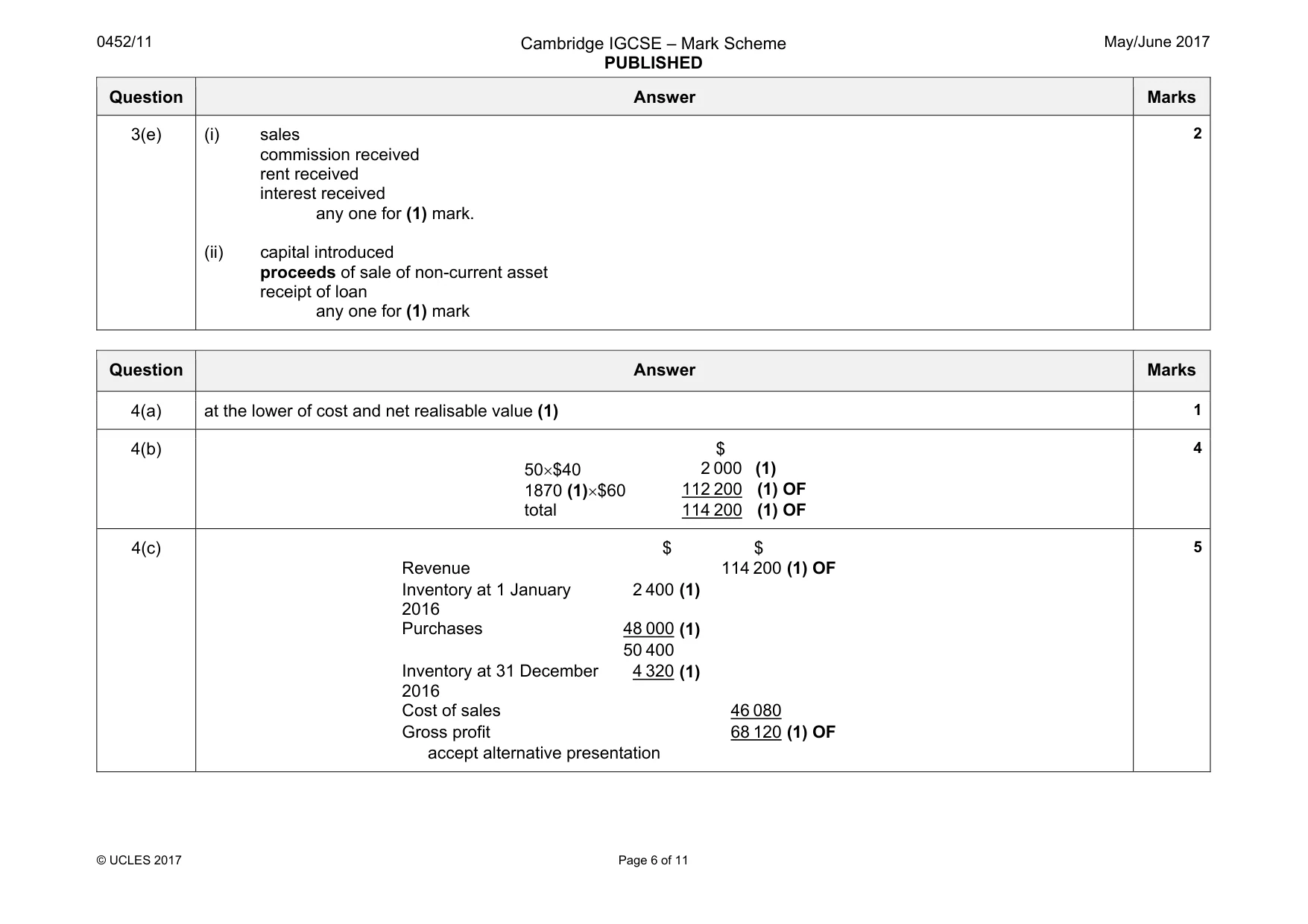
0452/11 Cambridge IGCSE – Mark Scheme PUBLISHED May/June 2017 © UCLES 2017 Page 5 of 11 Question Answer Marks 3(a) Any reasonable comment for (1) mark e.g. Because purchases represent costs to the business Purchases are amounts which reduce profit Purchases are amounts paid by the business 1 3(b) Book of prime (original) entry (1) 1 3(c) Zameer Purchases account $ $ Feb 21 Balance b/d 67 210 (1) Feb 28 Income statement 68 170 (1) OF 28 Purchases for the week 960 (1) 68 170 68 170 Rent payable account $ $ Feb 21 Balance b/d 6 600 (1) Feb 28 Income statement 7 200 (1) OF 25 Bank 1 800 Balance c/d 1 200 (1) 8 400 8 400 Mar 1 Balance b/d 1 200 (1) OF +(1) for dates 8 3(d) Revenue (1) Revenue (1) 2
Mark scheme, page 6
0452/11 Cambridge IGCSE – Mark Scheme PUBLISHED May/June 2017 © UCLES 2017 Page 6 of 11 Question Answer Marks 3(e) (i) sales commission received rent received interest received any one for (1) mark. (ii) capital introduced proceeds of sale of non-current asset receipt of loan any one for (1) mark 2 Question Answer Marks 4(a) at the lower of cost and net realisable value (1) 1 4(b) $ 50×$40 2 000 (1) 1870 (1)×$60 112 200 (1) OF total 114 200 (1) OF 4 4(c) $ $ Revenue 114 200 (1) OF Inventory at 1 January 2016 2 400 (1) Purchases 48 000 (1) 50 400 Inventory at 31 December 2016 4 320 (1) Cost of sales 46 080 Gross profit 68 120 (1) OF accept alternative presentation 5
Mark scheme, page 7
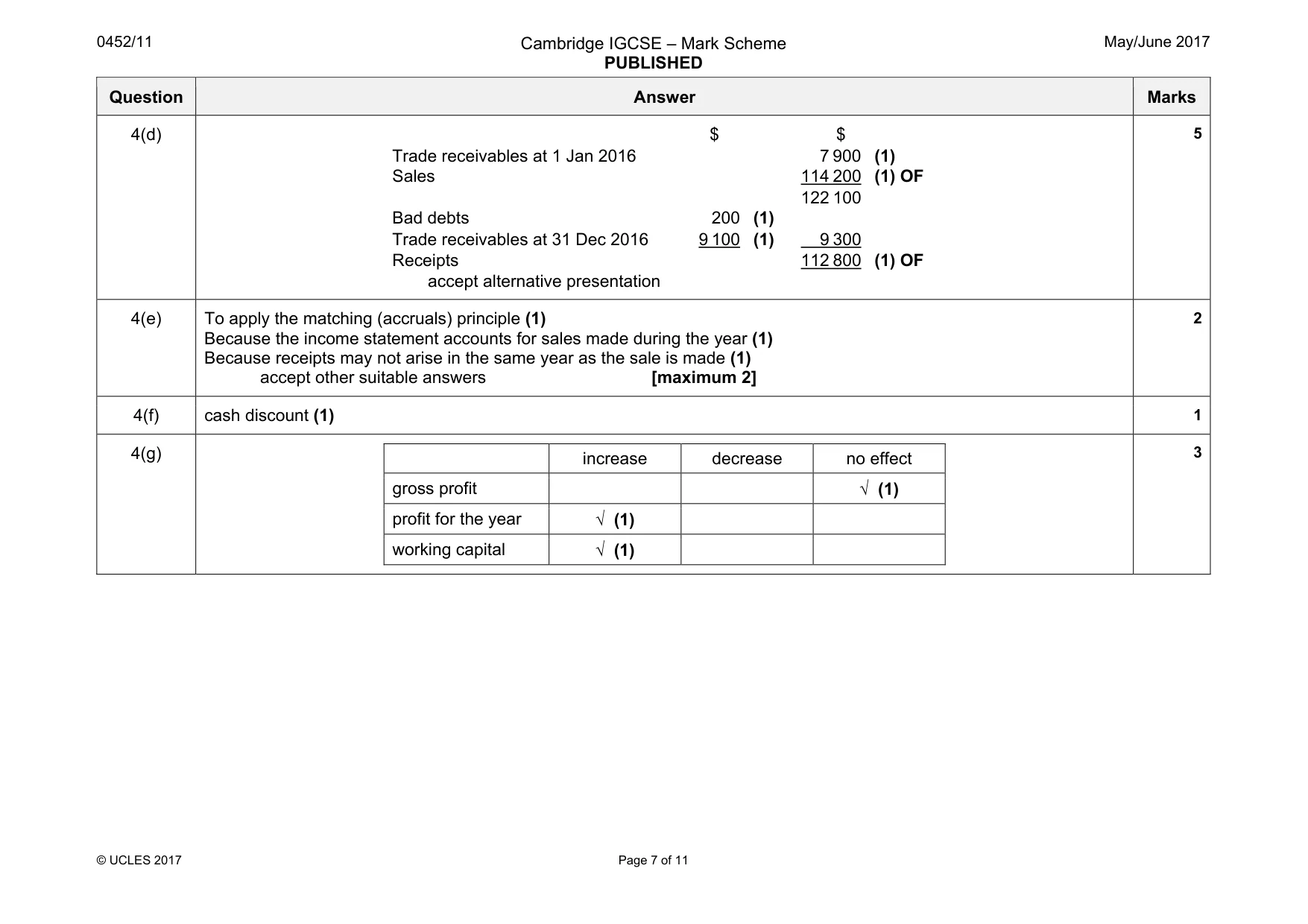
0452/11 Cambridge IGCSE – Mark Scheme PUBLISHED May/June 2017 © UCLES 2017 Page 7 of 11 Question Answer Marks 4(d) $ $ Trade receivables at 1 Jan 2016 7 900 (1) Sales 114 200 (1) OF 122 100 Bad debts 200 (1) Trade receivables at 31 Dec 2016 9 100 (1) 9 300 Receipts 112 800 (1) OF accept alternative presentation 5 4(e) To apply the matching (accruals) principle (1) Because the income statement accounts for sales made during the year (1) Because receipts may not arise in the same year as the sale is made (1) accept other suitable answers [maximum 2] 2 4(f) cash discount (1) 1 4(g) increase decrease no effect gross profit √ (1) profit for the year √ (1) working capital √ (1) 3
Mark scheme, page 8
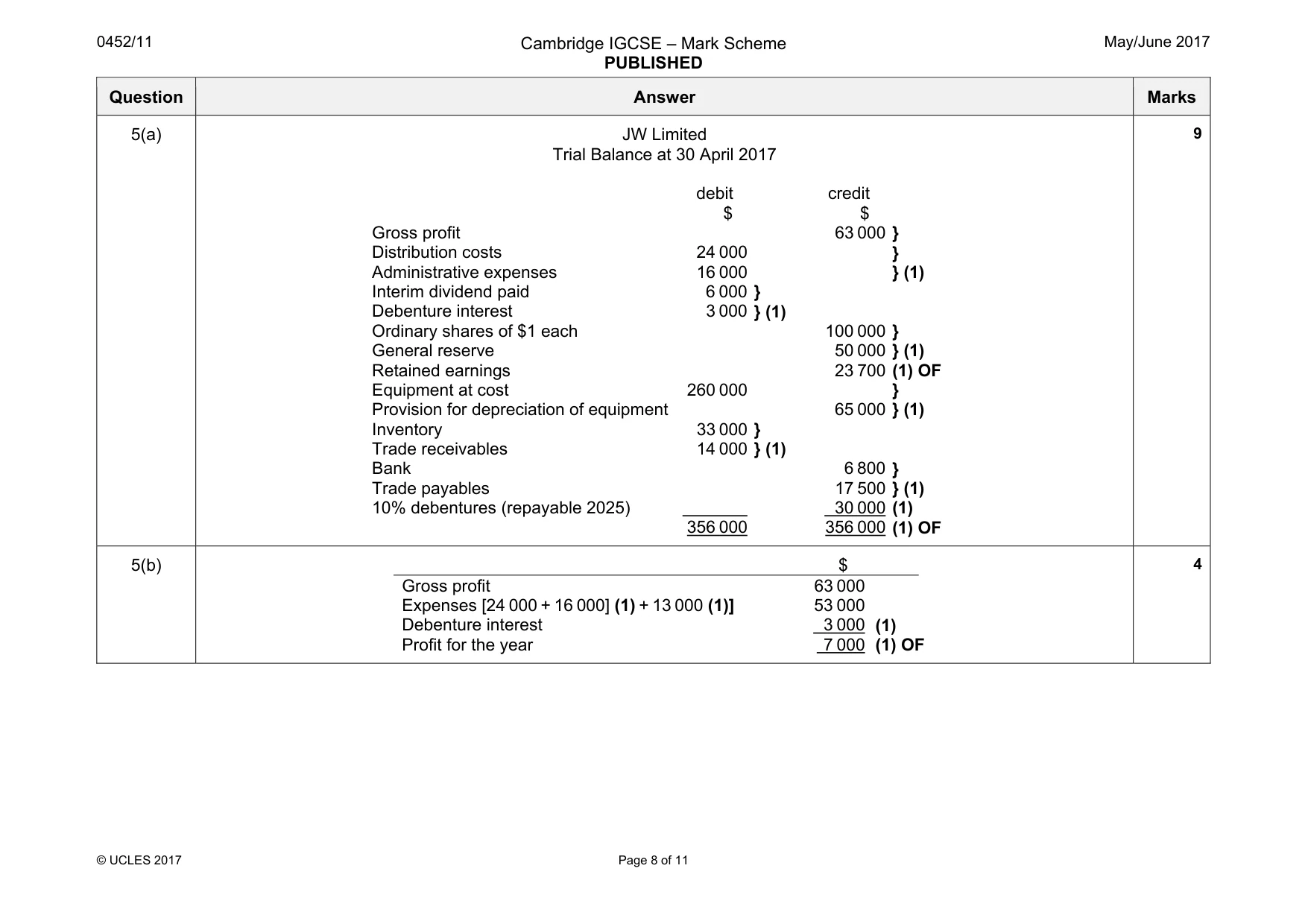
0452/11 Cambridge IGCSE – Mark Scheme PUBLISHED May/June 2017 © UCLES 2017 Page 8 of 11 Question Answer Marks 5(a) JW Limited Trial Balance at 30 April 2017 debit credit $ $ Gross profit 63 000 } Distribution costs 24 000 } Administrative expenses 16 000 } (1) Interim dividend paid 6 000 } Debenture interest 3 000 } (1) Ordinary shares of $1 each 100 000 } General reserve 50 000 } (1) Retained earnings 23 700 (1) OF Equipment at cost 260 000 } Provision for depreciation of equipment 65 000 } (1) Inventory 33 000 } Trade receivables 14 000 } (1) Bank 6 800 } Trade payables 17 500 } (1) 10% debentures (repayable 2025) 30 000 (1) 356 000 356 000 (1) OF 9 5(b) $ Gross profit 63 000 Expenses [24 000 + 16 000] (1) + 13 000 (1)] 53 000 Debenture interest 3 000 (1) Profit for the year 7 000 (1) OF 4
Mark scheme, page 9
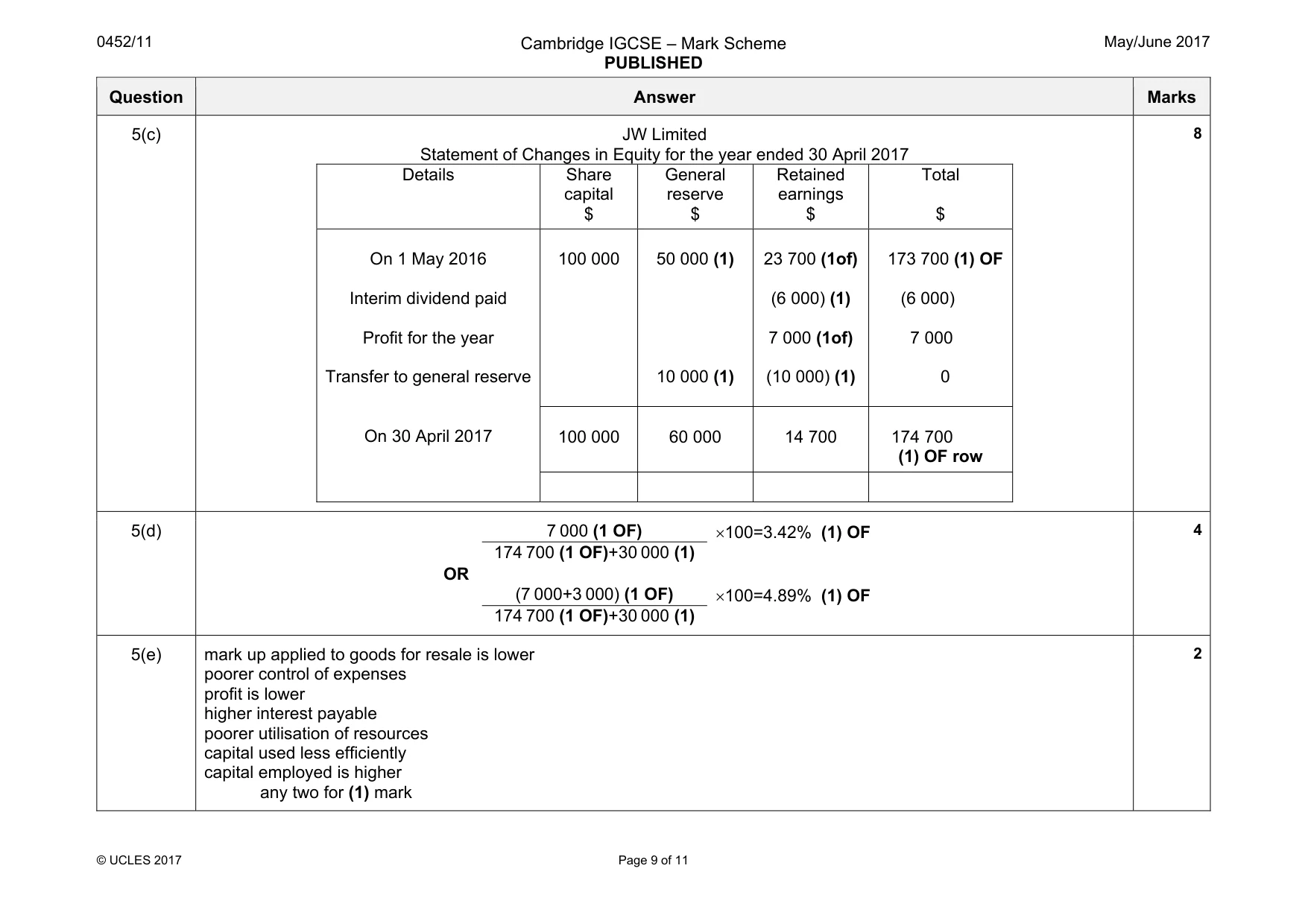
0452/11 Cambridge IGCSE – Mark Scheme PUBLISHED May/June 2017 © UCLES 2017 Page 9 of 11 Question Answer Marks 5(c) JW Limited Statement of Changes in Equity for the year ended 30 April 2017 Details Share capital $ General reserve $ Retained earnings $ Total $ On 1 May 2016 Interim dividend paid Profit for the year Transfer to general reserve On 30 April 2017 100 000 50 000 (1) 10 000 (1) 23 700 (1of) (6 000) (1) 7 000 (1of) (10 000) (1) 173 700 (1) OF (6 000) 7 000 0 100 000 60 000 14 700 174 700 (1) OF row 8 5(d) 7 000 (1 OF) ×100=3.42% (1) OF 174 700 (1 OF)+30 000 (1) OR (7 000+3 000) (1 OF) ×100=4.89% (1) OF 174 700 (1 OF)+30 000 (1) 4 5(e) mark up applied to goods for resale is lower poorer control of expenses profit is lower higher interest payable poorer utilisation of resources capital used less efficiently capital employed is higher any two for (1) mark 2
Mark scheme, page 10
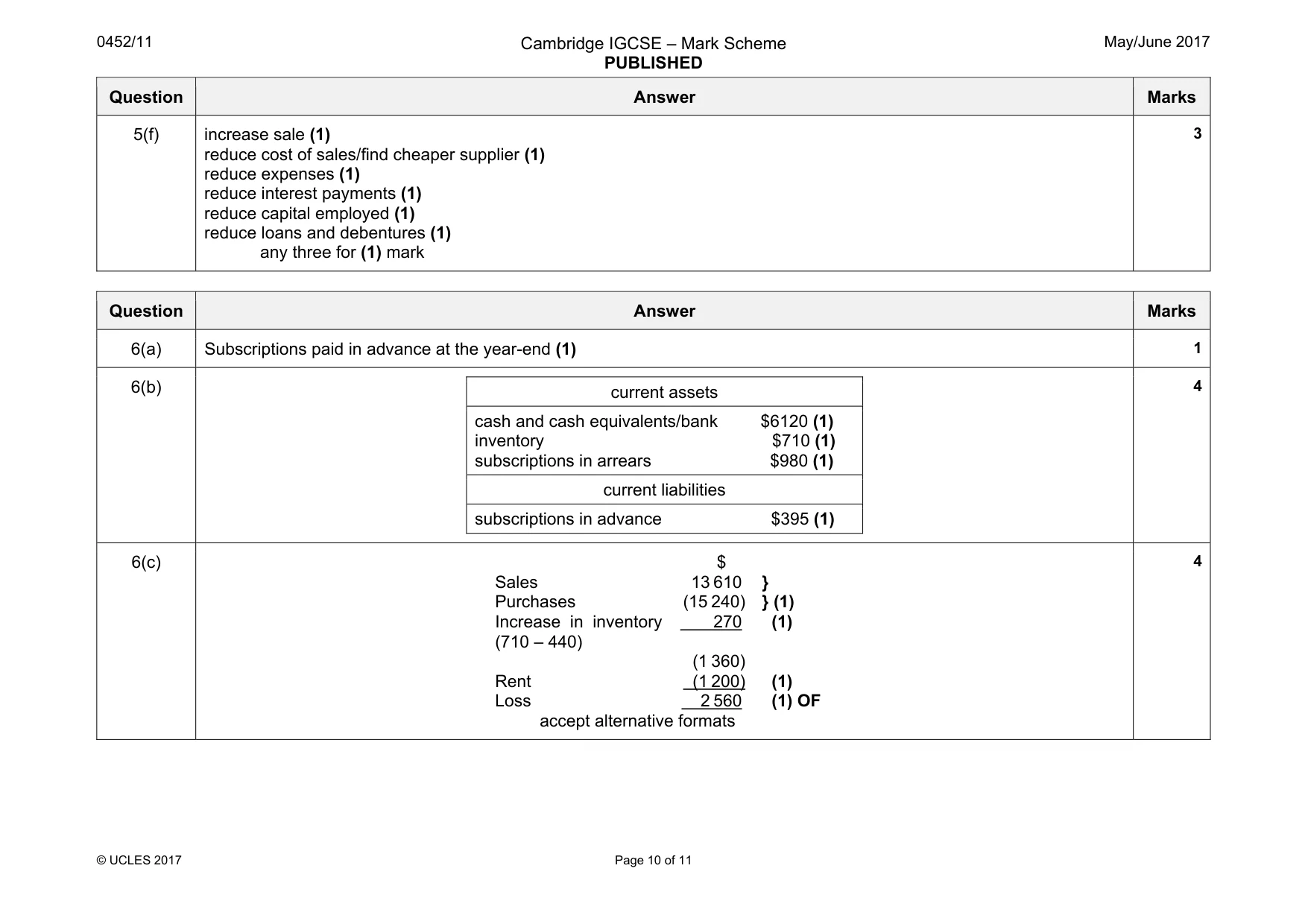
0452/11 Cambridge IGCSE – Mark Scheme PUBLISHED May/June 2017 © UCLES 2017 Page 10 of 11 Question Answer Marks 5(f) increase sale (1) reduce cost of sales/find cheaper supplier (1) reduce expenses (1) reduce interest payments (1) reduce capital employed (1) reduce loans and debentures (1) any three for (1) mark 3 Question Answer Marks 6(a) Subscriptions paid in advance at the year-end (1) 1 6(b) current assets cash and cash equivalents/bank $6120 (1) inventory $710 (1) subscriptions in arrears $980 (1) current liabilities subscriptions in advance $395 (1) 4 6(c) $ Sales 13 610 } Purchases (15 240) } (1) Increase in inventory (710 – 440) 270 (1) (1 360) Rent (1 200) (1) Loss 2 560 (1) OF accept alternative formats 4
Mark scheme, page 11
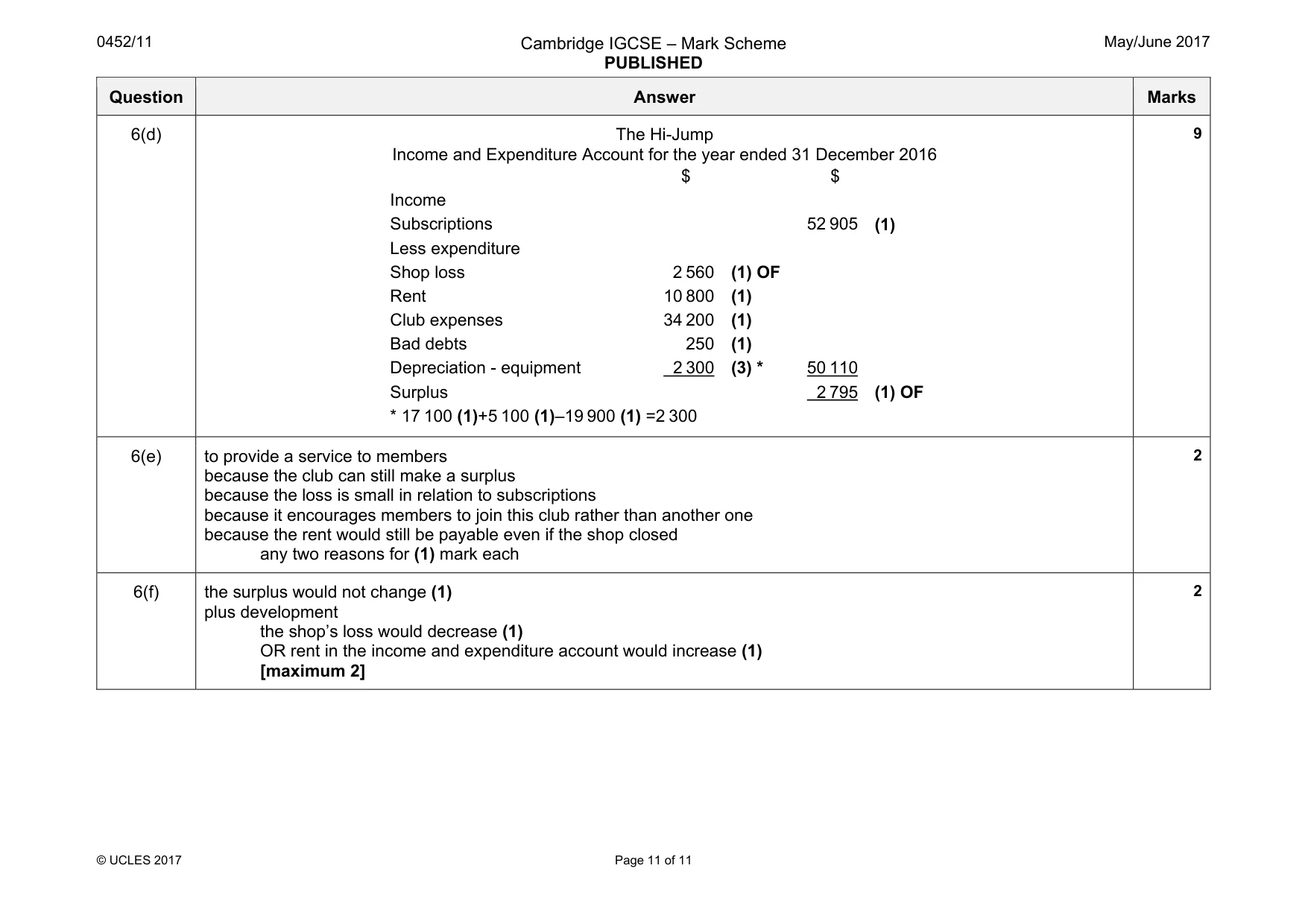
0452/11 Cambridge IGCSE – Mark Scheme PUBLISHED May/June 2017 © UCLES 2017 Page 11 of 11 Question Answer Marks 6(d) The Hi-Jump Income and Expenditure Account for the year ended 31 December 2016 $ $ Income Subscriptions 52 905 (1) Less expenditure Shop loss 2 560 (1) OF Rent 10 800 (1) Club expenses 34 200 (1) Bad debts 250 (1) Depreciation - equipment 2 300 (3) * 50 110 Surplus 2 795 (1) OF * 17 100 (1)+5 100 (1)–19 900 (1) =2 300 9 6(e) to provide a service to members because the club can still make a surplus because the loss is small in relation to subscriptions because it encourages members to join this club rather than another one because the rent would still be payable even if the shop closed any two reasons for (1) mark each 2 6(f) the surplus would not change (1) plus development the shop’s loss would decrease (1) OR rent in the income and expenditure account would increase (1) [maximum 2] 2
What you needed in this session
Cambridge’s own grade thresholds for 2017 May/June, Paper 1 · Variant 1. A higher threshold means an easier paper — the bar moves with how the cohort did.