Cambridge IGCSE Accounting 0452 — 2016 Oct/Nov Paper 2 · Variant 3
0452/23/O/N/16 · 120 marks · ≈135 min
The question paper and its mark scheme, free to read here and free to download. This is Cambridge’s own paper, exactly as it was sat.
Question paper20 pages
Mark scheme11 pages
Answers below. Sit the paper first if you are practising.
Paper as text
Question paper, page 1
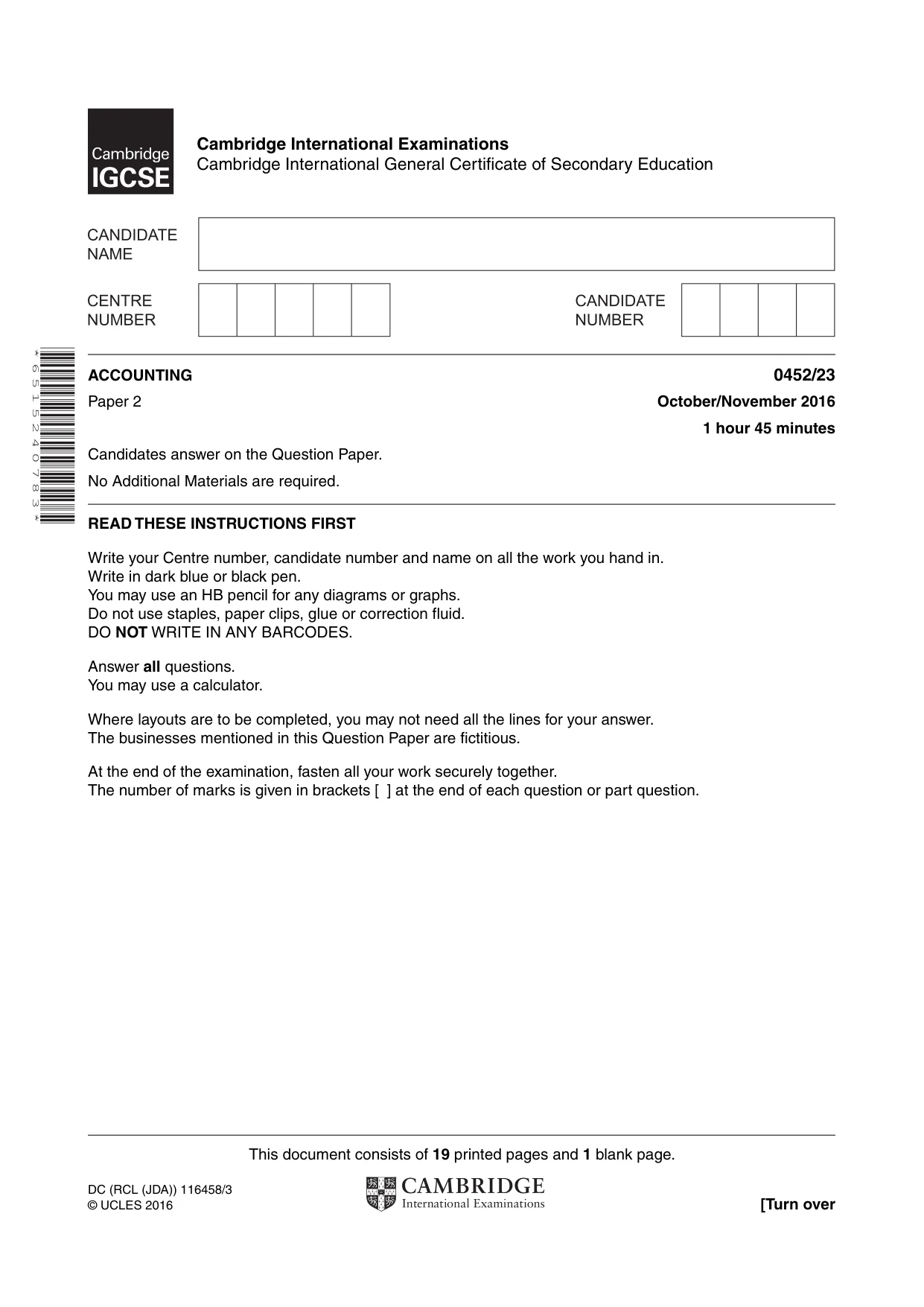
This document consists of 19 printed pages and 1 blank page. DC (RCL (JDA)) 116458/3 © UCLES 2016 [Turn over Cambridge International Examinations Cambridge International General Certificate of Secondary Education * 6 5 1 5 2 4 0 7 8 3 * ACCOUNTING 0452/23 Paper 2 October/November 2016 1 hour 45 minutes Candidates answer on the Question Paper. No Additional Materials are required. READ THESE INSTRUCTIONS FIRST Write your Centre number, candidate number and name on all the work you hand in. Write in dark blue or black pen. You may use an HB pencil for any diagrams or graphs. Do not use staples, paper clips, glue or correction fluid. DO NOT WRITE IN ANY BARCODES. Answer all questions. You may use a calculator. Where layouts are to be completed, you may not need all the lines for your answer. The businesses mentioned in this Question Paper are fictitious. At the end of the examination, fasten all your work securely together. The number of marks is given in brackets [ ] at the end of each question or part question.
Question paper, page 2
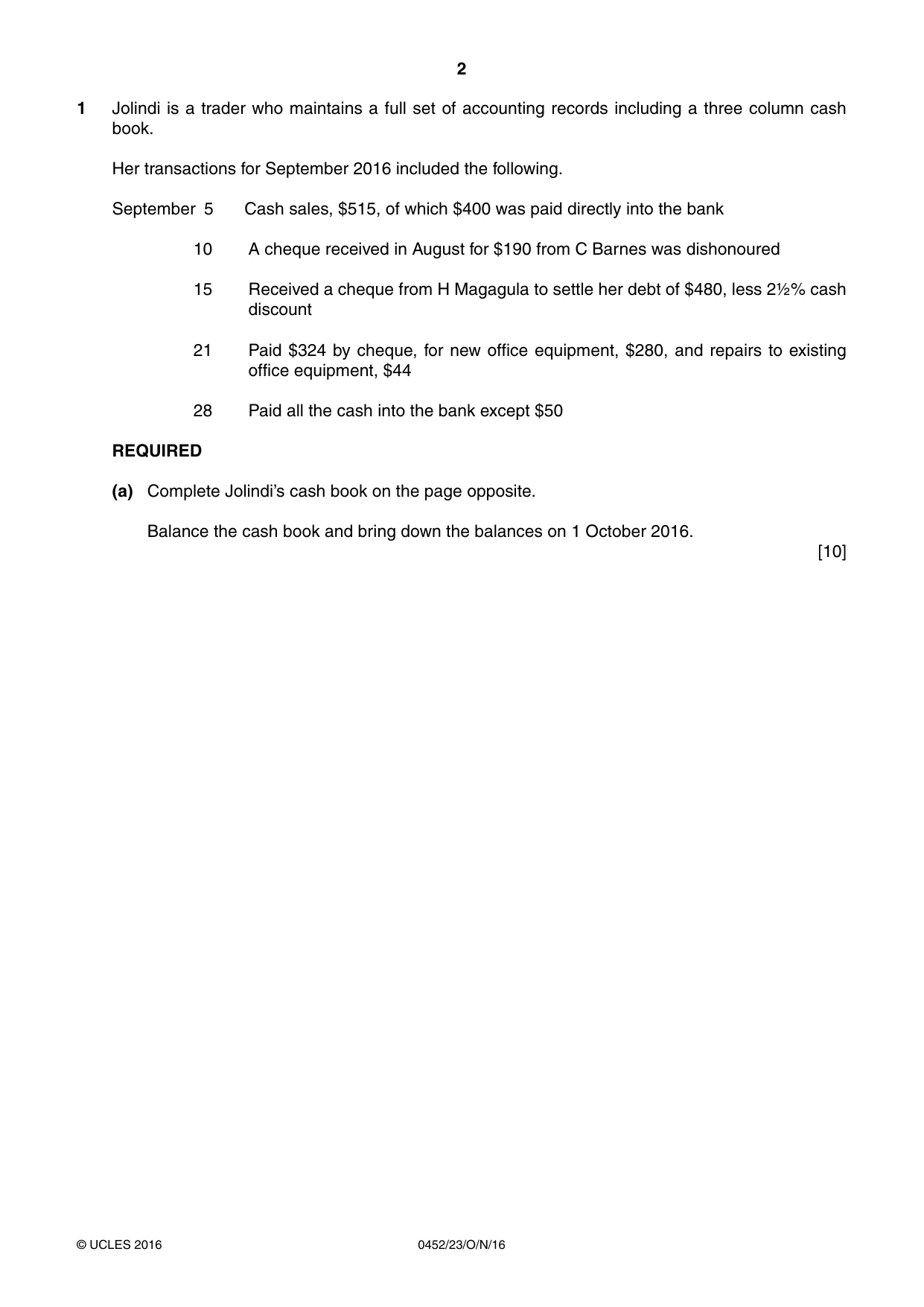
2 0452/23/O/N/16 © UCLES 2016 1 Jolindi is a trader who maintains a full set of accounting records including a three column cash book. Her transactions for September 2016 included the following. September 5 Cash sales, $515, of which $400 was paid directly into the bank 10 A cheque received in August for $190 from C Barnes was dishonoured 15 Received a cheque from H Magagula to settle her debt of $480, less 2½% cash discount 21 Paid $324 by cheque, for new office equipment, $280, and repairs to existing office equipment, $44 28 Paid all the cash into the bank except $50 REQUIRED (a) Complete Jolindi’s cash book on the page opposite. Balance the cash book and bring down the balances on 1 October 2016. [10]
Question paper, page 3
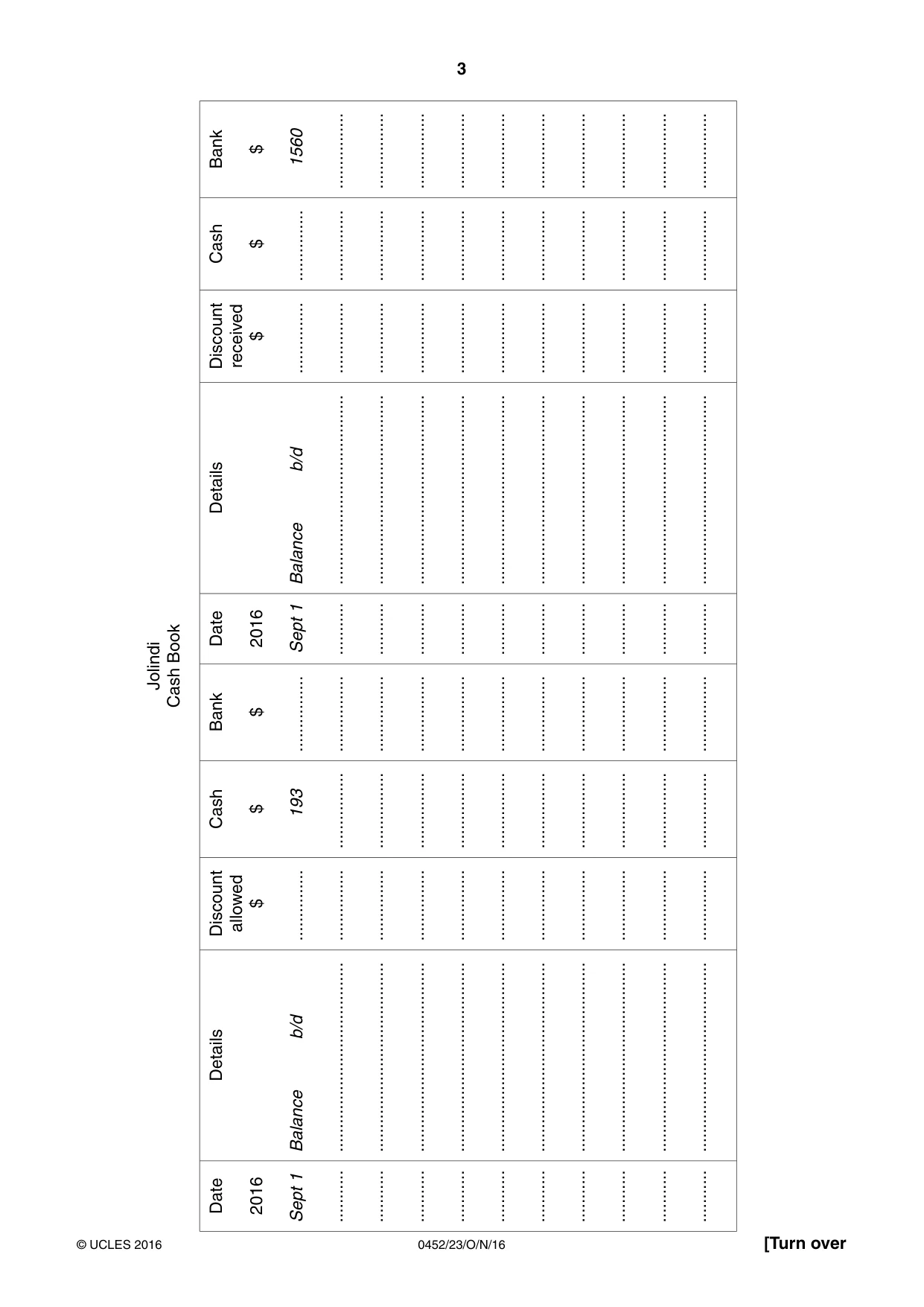
3 0452/23/O/N/16 © UCLES 2016 [Turn over Jolindi Cash Book Date 2016 Sept 1 … … … … … … … … … … Details Balance b/d … … … … … … … … … … Discount allowed $ … … … … … … … … … … … Cash $ 193 … … … … … … … … … … Bank $ … … … … … … … … … … … Date 2016 Sept 1 … … … … … … … … … … Details Balance b/d … … … … … … … … … … Discount received $ … … … … … … … … … … … Cash $ … … … … … … … … … … … Bank $ 1560 … … … … … … … … … …
Question paper, page 4
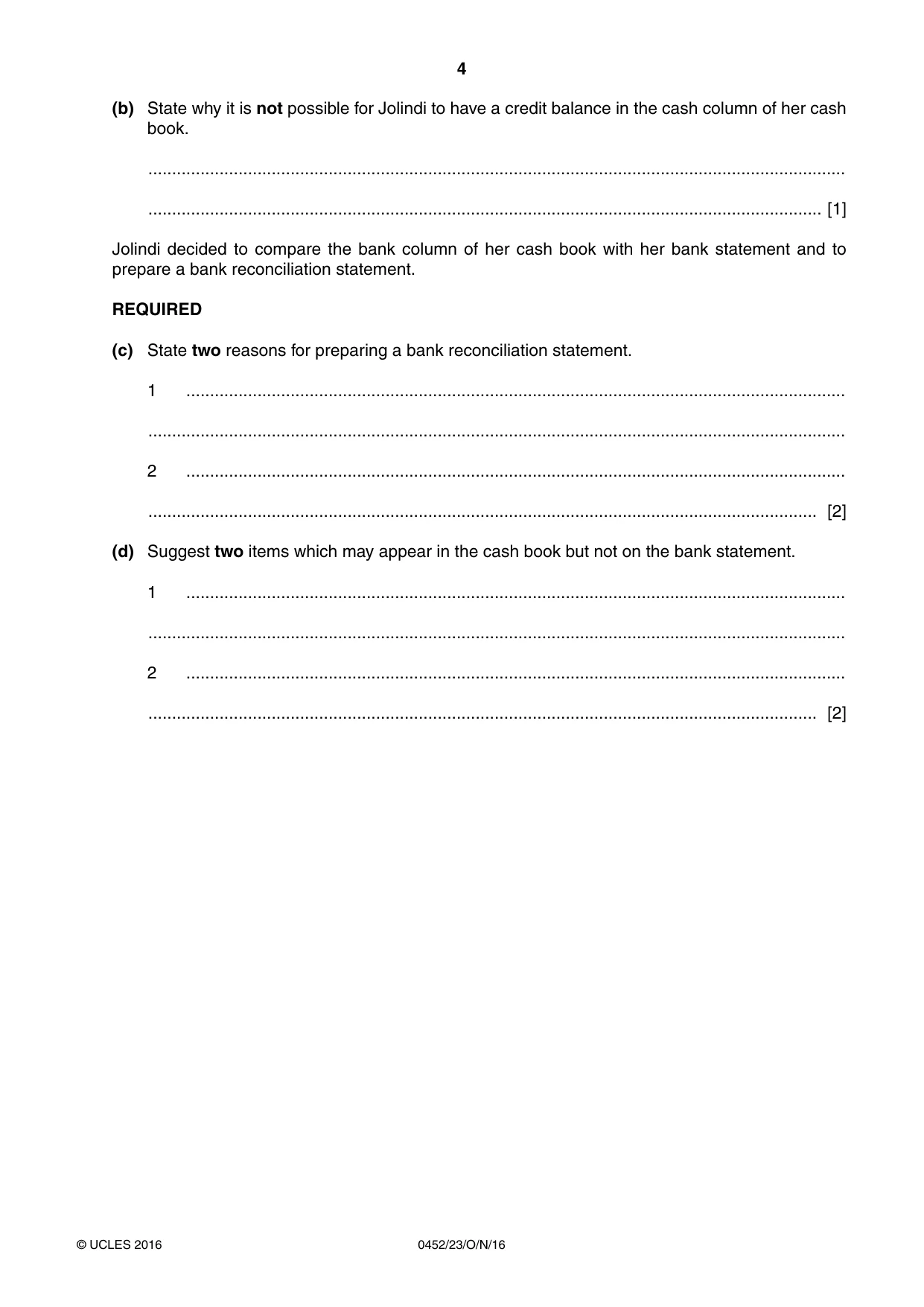
4 0452/23/O/N/16 © UCLES 2016 (b) State why it is not possible for Jolindi to have a credit balance in the cash column of her cash book. … … [1] Jolindi decided to compare the bank column of her cash book with her bank statement and to prepare a bank reconciliation statement. REQUIRED (c) State two reasons for preparing a bank reconciliation statement. 1 … … 2 … … [2] (d) Suggest two items which may appear in the cash book but not on the bank statement. 1 … … 2 … … [2]
Question paper, page 5
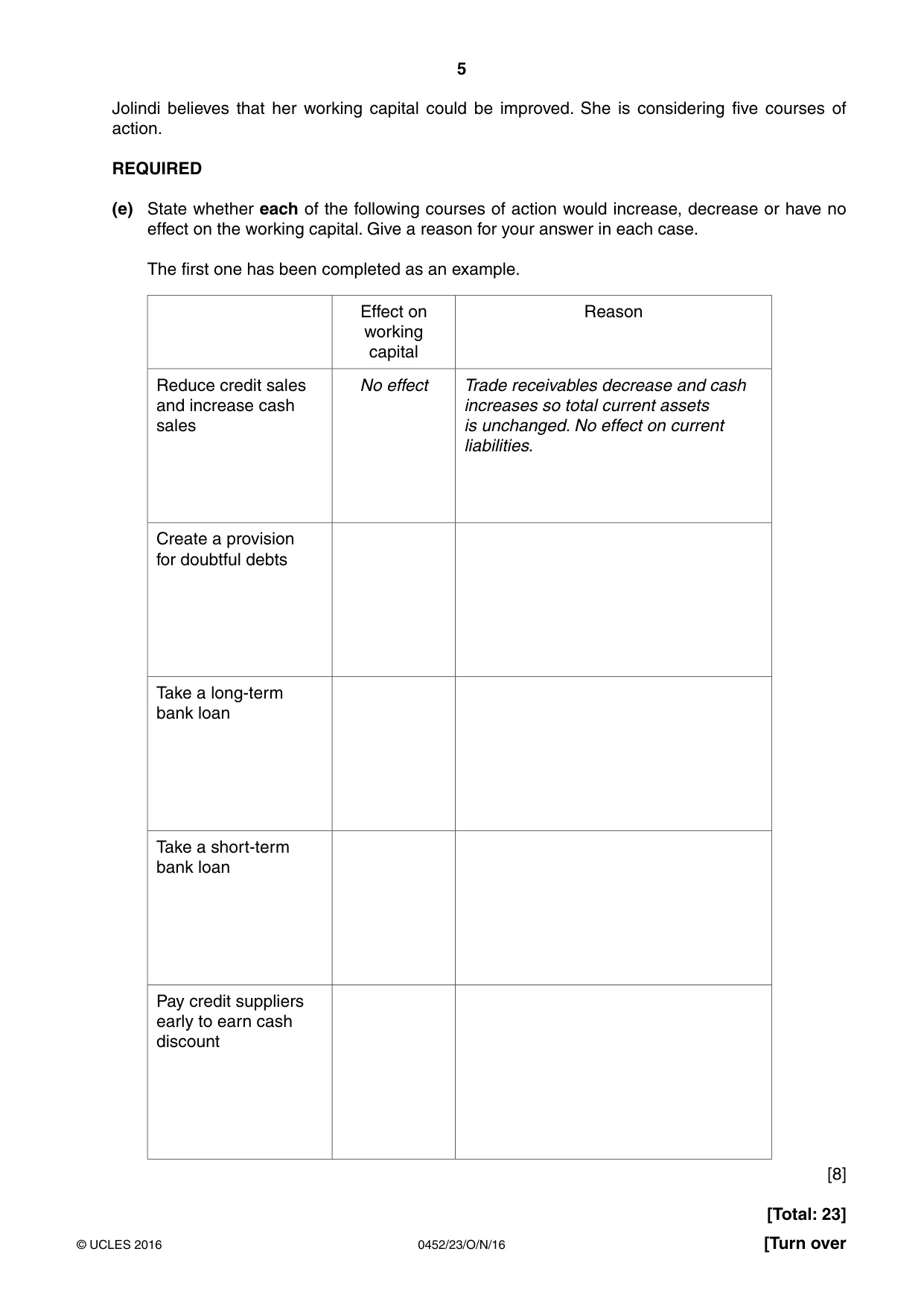
5 0452/23/O/N/16 © UCLES 2016 [Turn over Jolindi believes that her working capital could be improved. She is considering five courses of action. REQUIRED (e) State whether each of the following courses of action would increase, decrease or have no effect on the working capital. Give a reason for your answer in each case. The first one has been completed as an example. Effect on working capital Reason Reduce credit sales and increase cash sales No effect Trade receivables decrease and cash increases so total current assets is unchanged. No effect on current liabilities. Create a provision for doubtful debts Take a long-term bank loan Take a short-term bank loan Pay credit suppliers early to earn cash discount [8] [Total: 23]
Question paper, page 6
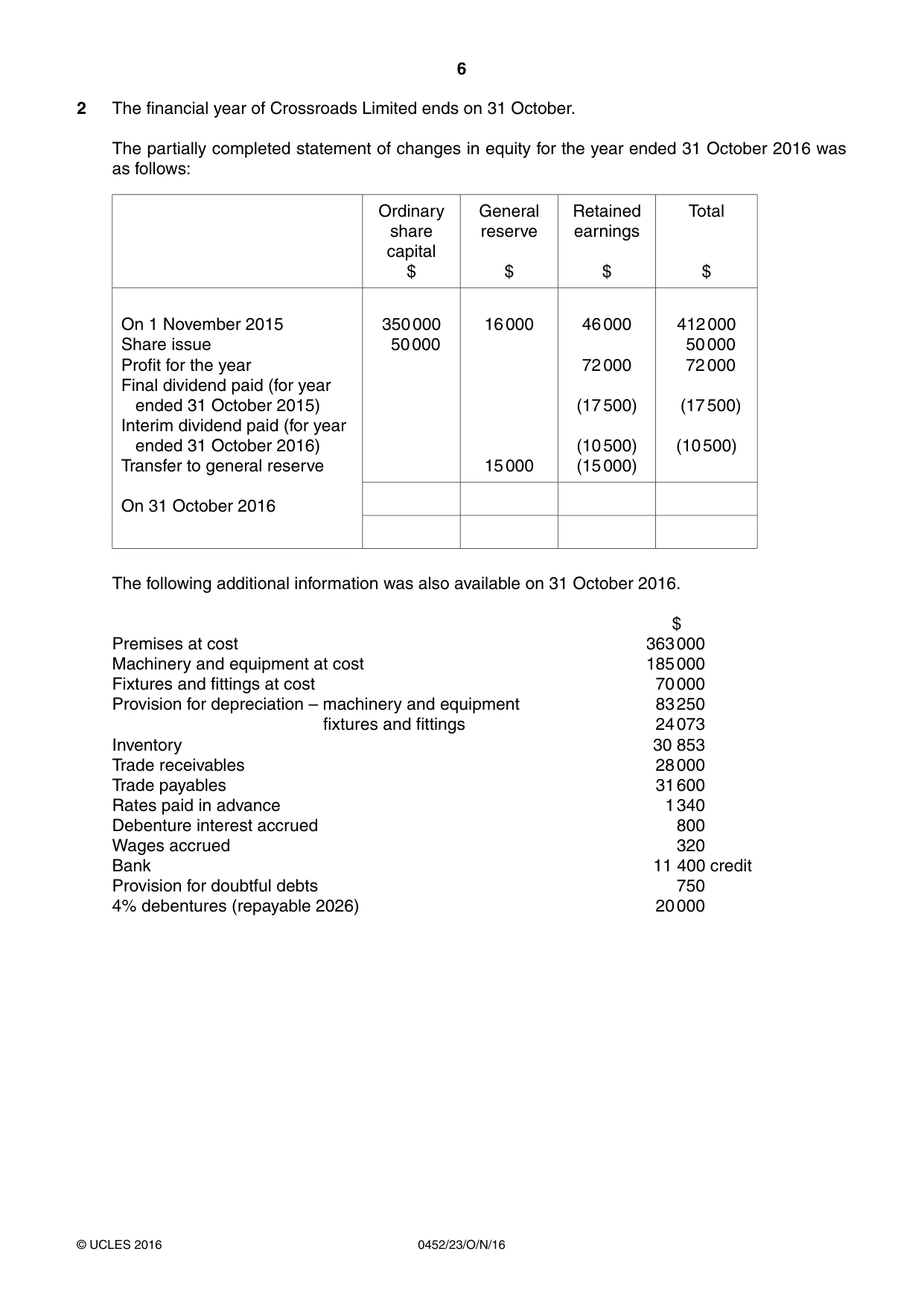
6 0452/23/O/N/16 © UCLES 2016 2 The financial year of Crossroads Limited ends on 31 October. The partially completed statement of changes in equity for the year ended 31 October 2016 was as follows: Ordinary share capital $ General reserve $ Retained earnings $ Total $ On 1 November 2015 Share issue Profit for the year Final dividend paid (for year ended 31 October 2015) Interim dividend paid (for year ended 31 October 2016) Transfer to general reserve On 31 October 2016 350 000 50 000 16 000 15 000 46 000 72 000 (17 500) (10 500) (15 000) 412 000 50 000 72 000 (17 500) (10 500) The following additional information was also available on 31 October 2016. $ Premises at cost 363 000 Machinery and equipment at cost 185 000 Fixtures and fittings at cost 70 000 Provision for depreciation – machinery and equipment 83 250 fixtures and fittings 24 073 Inventory 30 853 Trade receivables 28 000 Trade payables 31 600 Rates paid in advance 1 340 Debenture interest accrued 800 Wages accrued 320 Bank 11 400 credit Provision for doubtful debts 750 4% debentures (repayable 2026) 20 000
Question paper, page 7
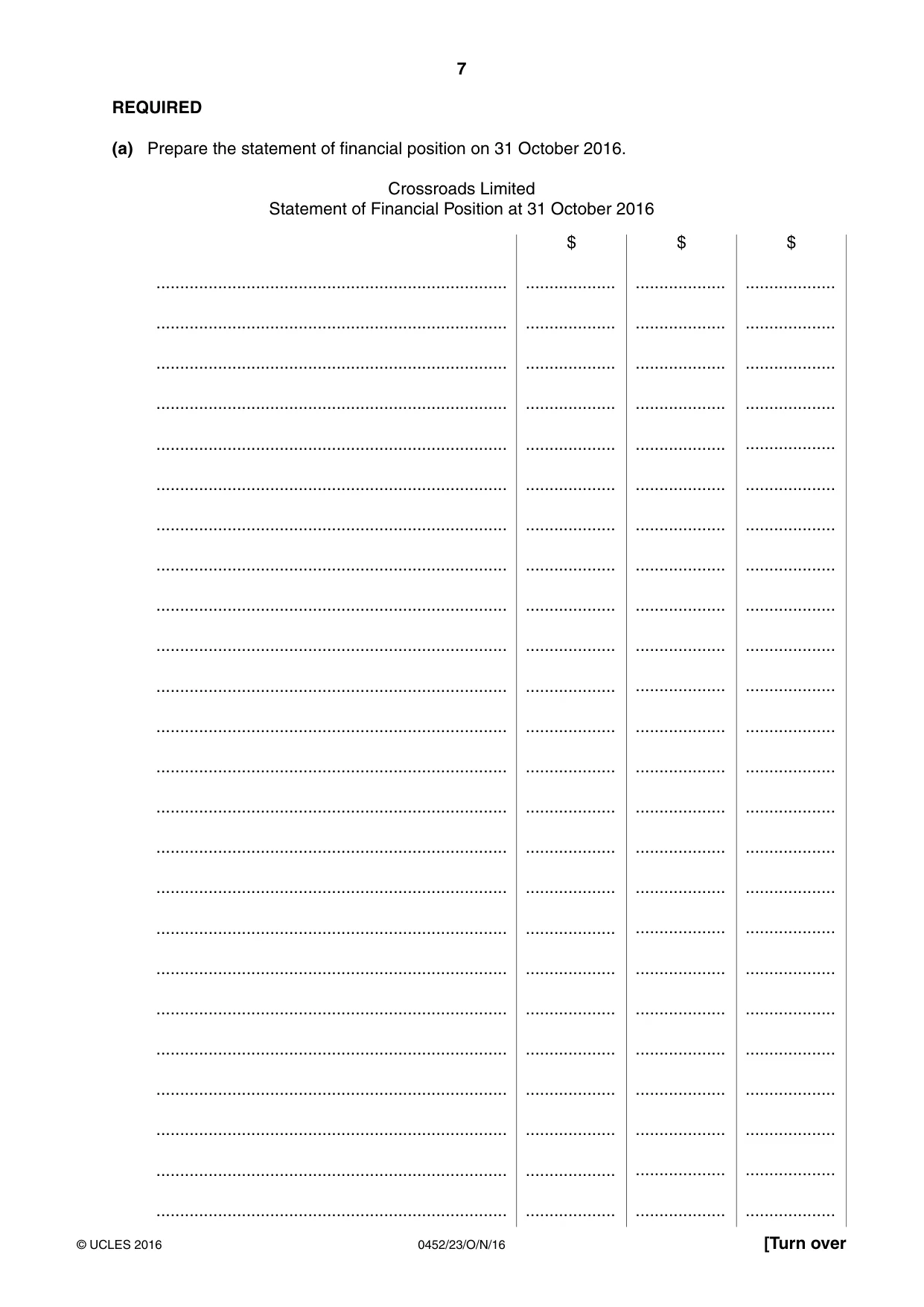
7 0452/23/O/N/16 © UCLES 2016 [Turn over REQUIRED (a) Prepare the statement of financial position on 31 October 2016. Crossroads Limited Statement of Financial Position at 31 October 2016 … … … … … … … … … … … … … … … … … … … … … … … … $ … … … … … … … … … … … … … … … … … … … … … … … … $ … … … … … … … … … … … … … … … … … … … … … … … … $ … … … … … … … … … … … … … … … … … … … … … … … …
Question paper, page 8
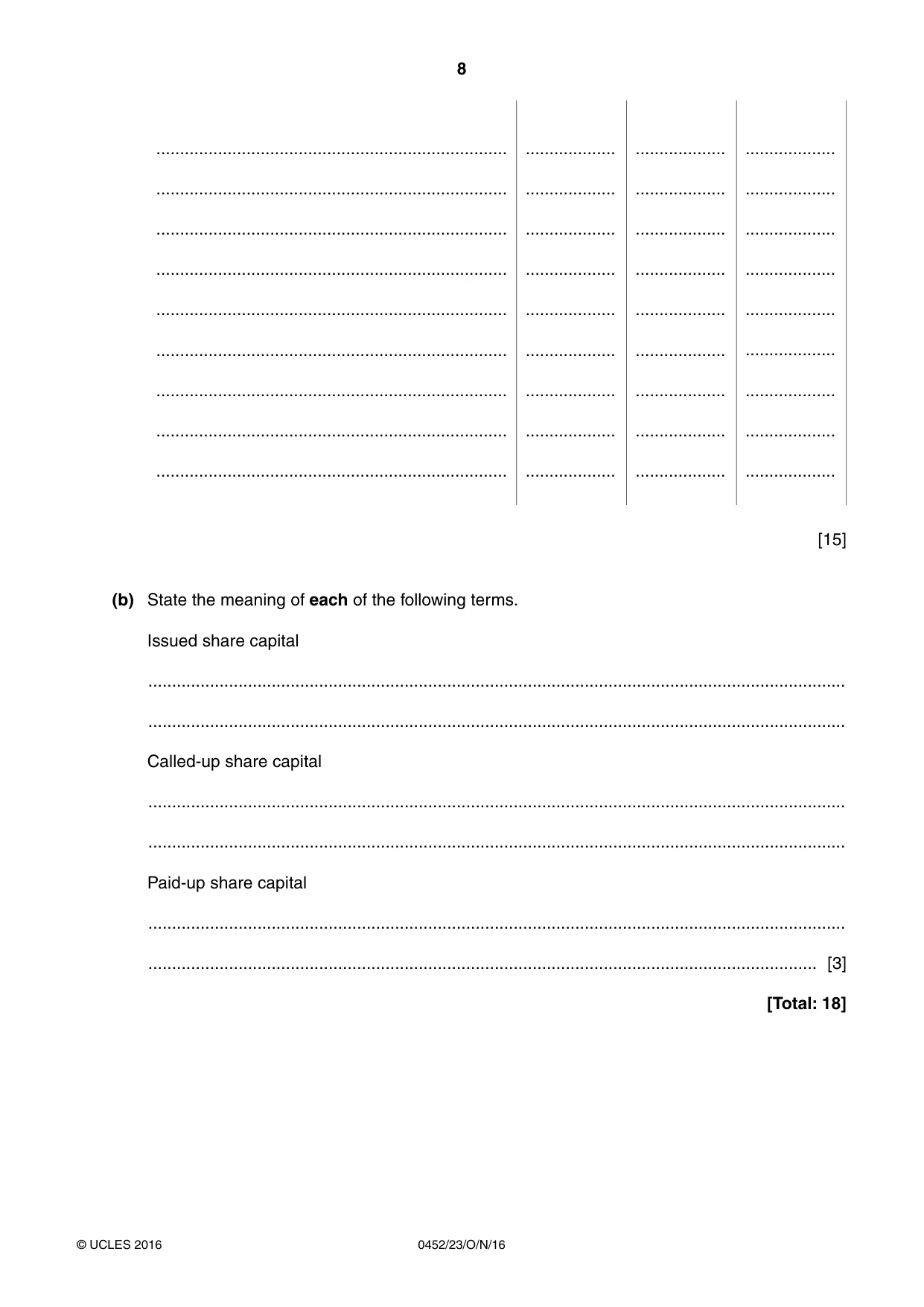
8 0452/23/O/N/16 © UCLES 2016 … … … … … … … … … … … … … … … … … … … … … … … … … … … … … … … … … … … … [15] (b) State the meaning of each of the following terms. Issued share capital … … Called-up share capital … … Paid-up share capital … … [3] [Total: 18]
Question paper, page 9
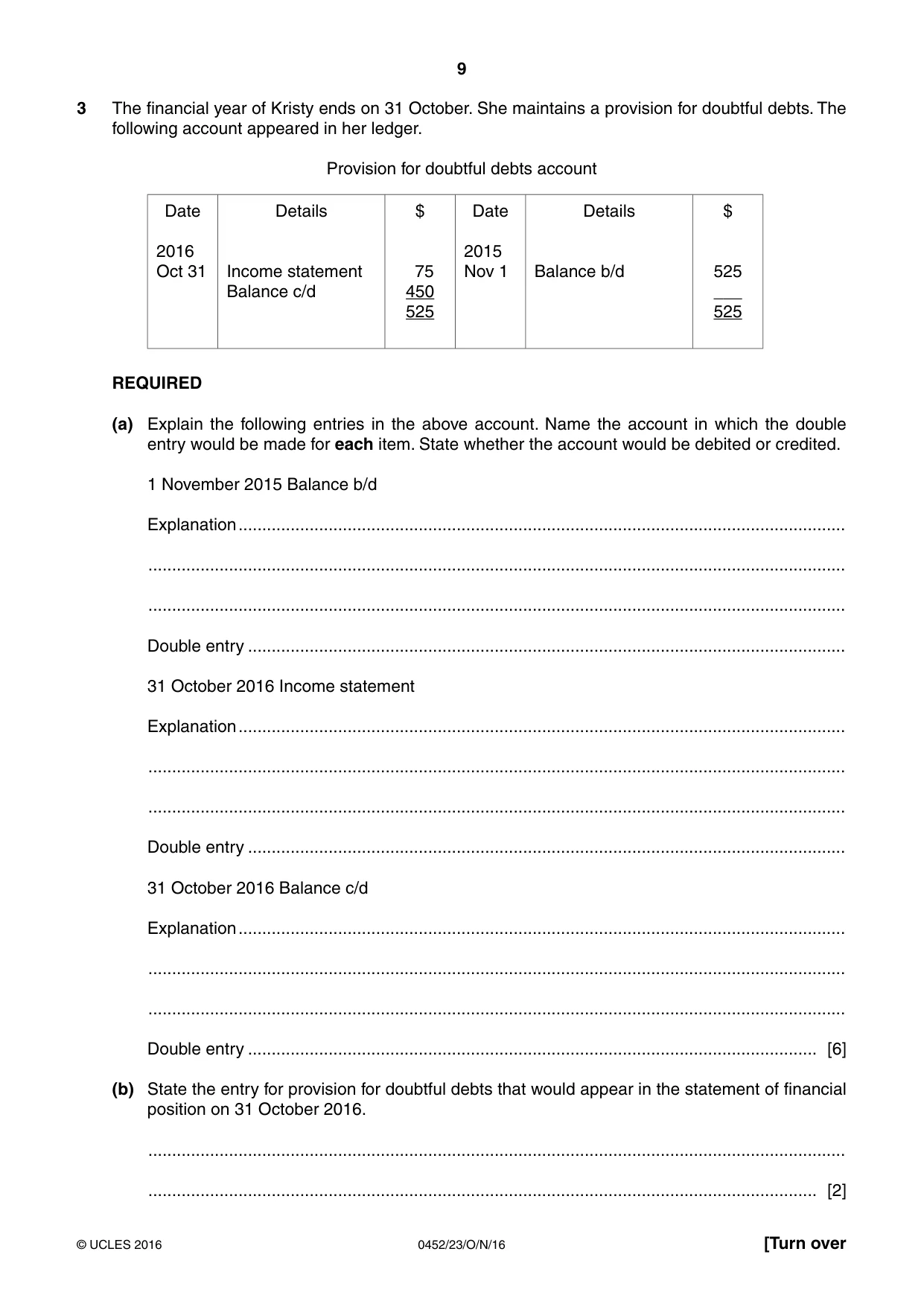
9 0452/23/O/N/16 © UCLES 2016 [Turn over 3 The financial year of Kristy ends on 31 October. She maintains a provision for doubtful debts. The following account appeared in her ledger. Provision for doubtful debts account Date 2016 Oct 31 Details Income statement Balance c/d $ 75 450 525 Date 2015 Nov 1 Details Balance b/d $ 525 ___ 525 REQUIRED (a) Explain the following entries in the above account. Name the account in which the double entry would be made for each item. State whether the account would be debited or credited. 1 November 2015 Balance b/d Explanation … … … Double entry … 31 October 2016 Income statement Explanation … … … Double entry … 31 October 2016 Balance c/d Explanation … … … Double entry … [6] (b) State the entry for provision for doubtful debts that would appear in the statement of financial position on 31 October 2016. … … [2]
Question paper, page 10
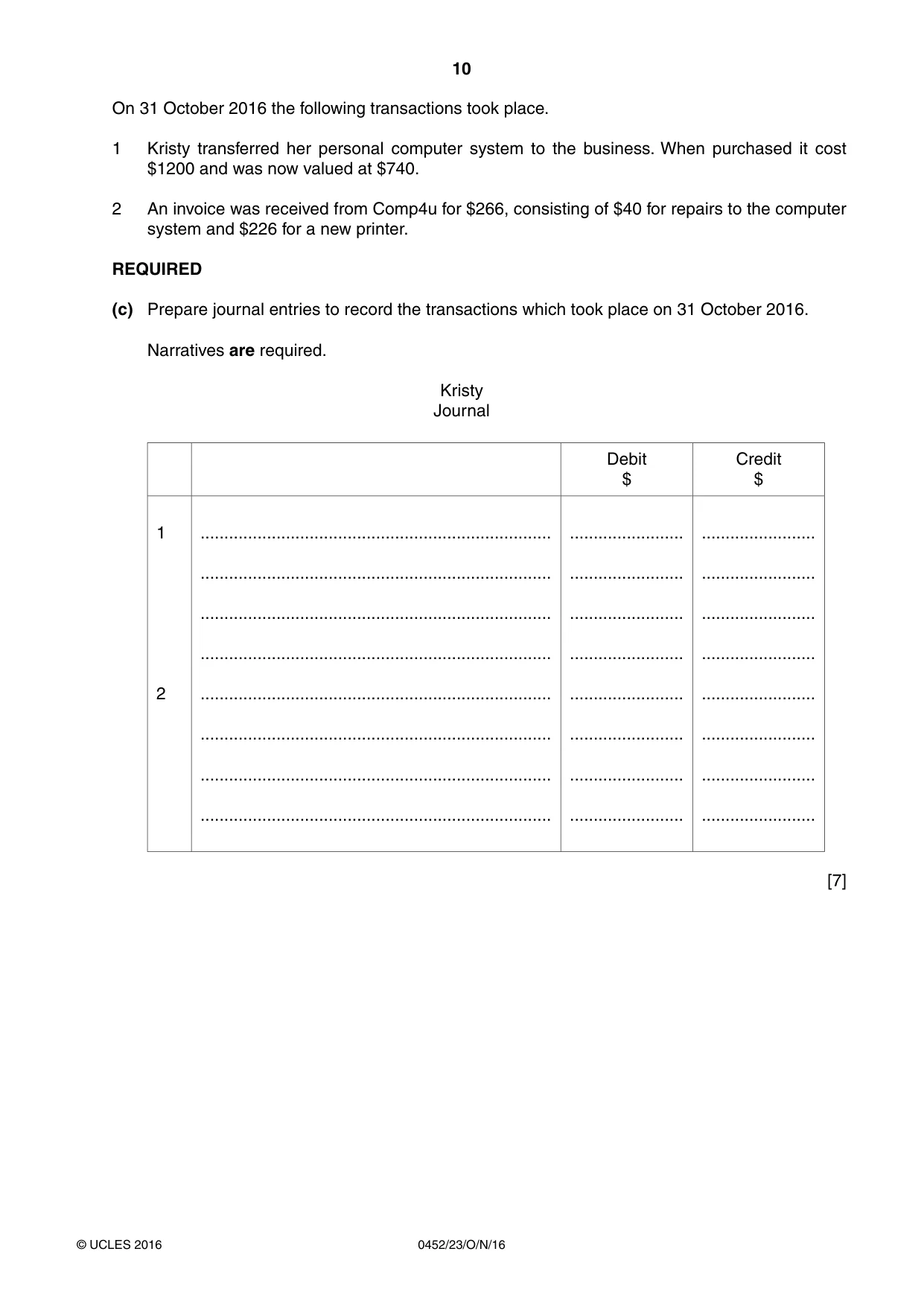
10 0452/23/O/N/16 © UCLES 2016 On 31 October 2016 the following transactions took place. 1 Kristy transferred her personal computer system to the business. When purchased it cost $1200 and was now valued at $740. 2 An invoice was received from Comp4u for $266, consisting of $40 for repairs to the computer system and $226 for a new printer. REQUIRED (c) Prepare journal entries to record the transactions which took place on 31 October 2016. Narratives are required. Kristy Journal Debit $ Credit $ 1 2 … … … … … … … … … … … … … … … … … … … … … … … … [7]
Question paper, page 11
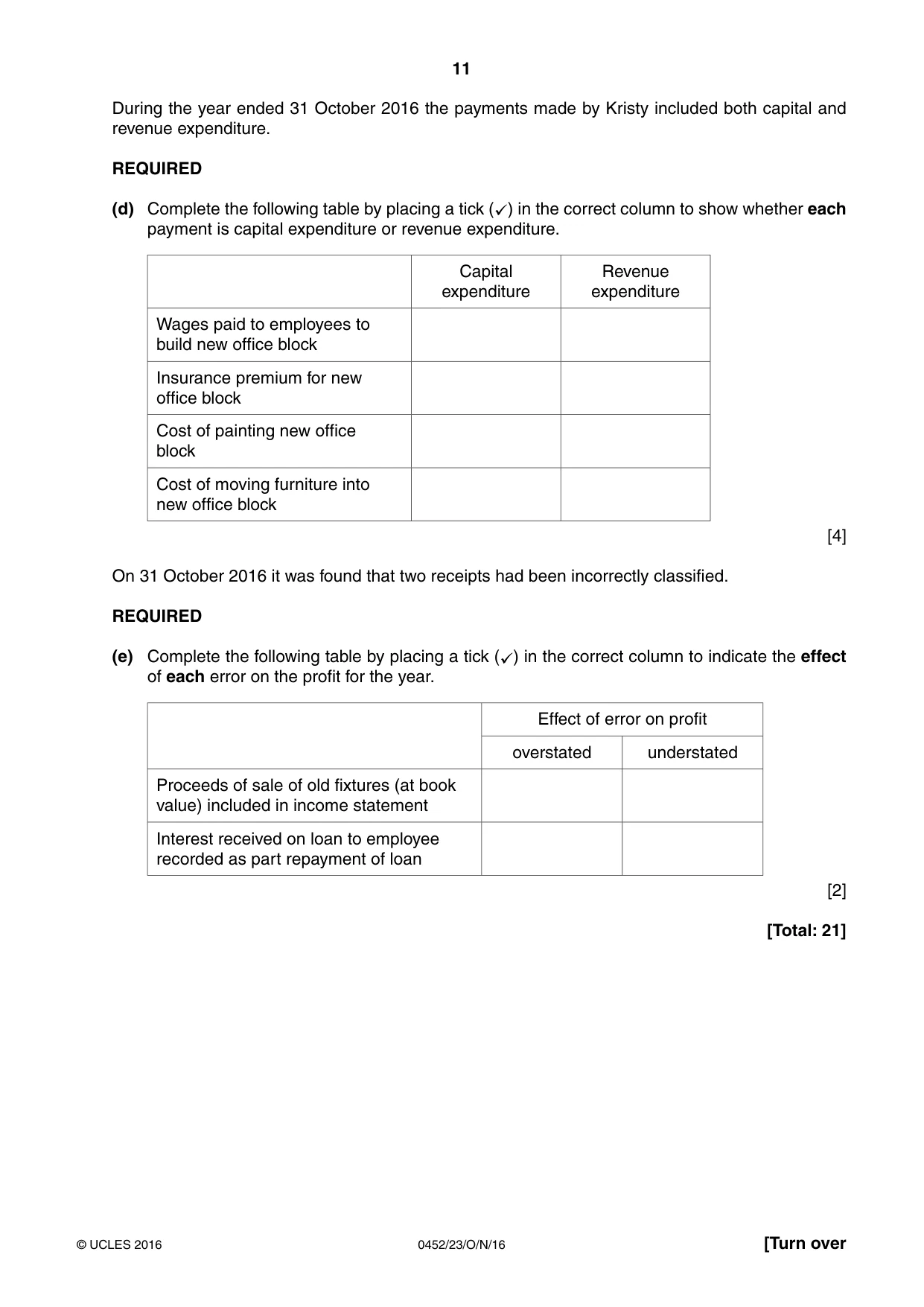
11 0452/23/O/N/16 © UCLES 2016 [Turn over During the year ended 31 October 2016 the payments made by Kristy included both capital and revenue expenditure. REQUIRED (d) Complete the following table by placing a tick () in the correct column to show whether each payment is capital expenditure or revenue expenditure. Capital expenditure Revenue expenditure Wages paid to employees to build new office block Insurance premium for new office block Cost of painting new office block Cost of moving furniture into new office block [4] On 31 October 2016 it was found that two receipts had been incorrectly classified. REQUIRED (e) Complete the following table by placing a tick () in the correct column to indicate the effect of each error on the profit for the year. Effect of error on profit overstated understated Proceeds of sale of old fixtures (at book value) included in income statement Interest received on loan to employee recorded as part repayment of loan [2] [Total: 21]
Question paper, page 12
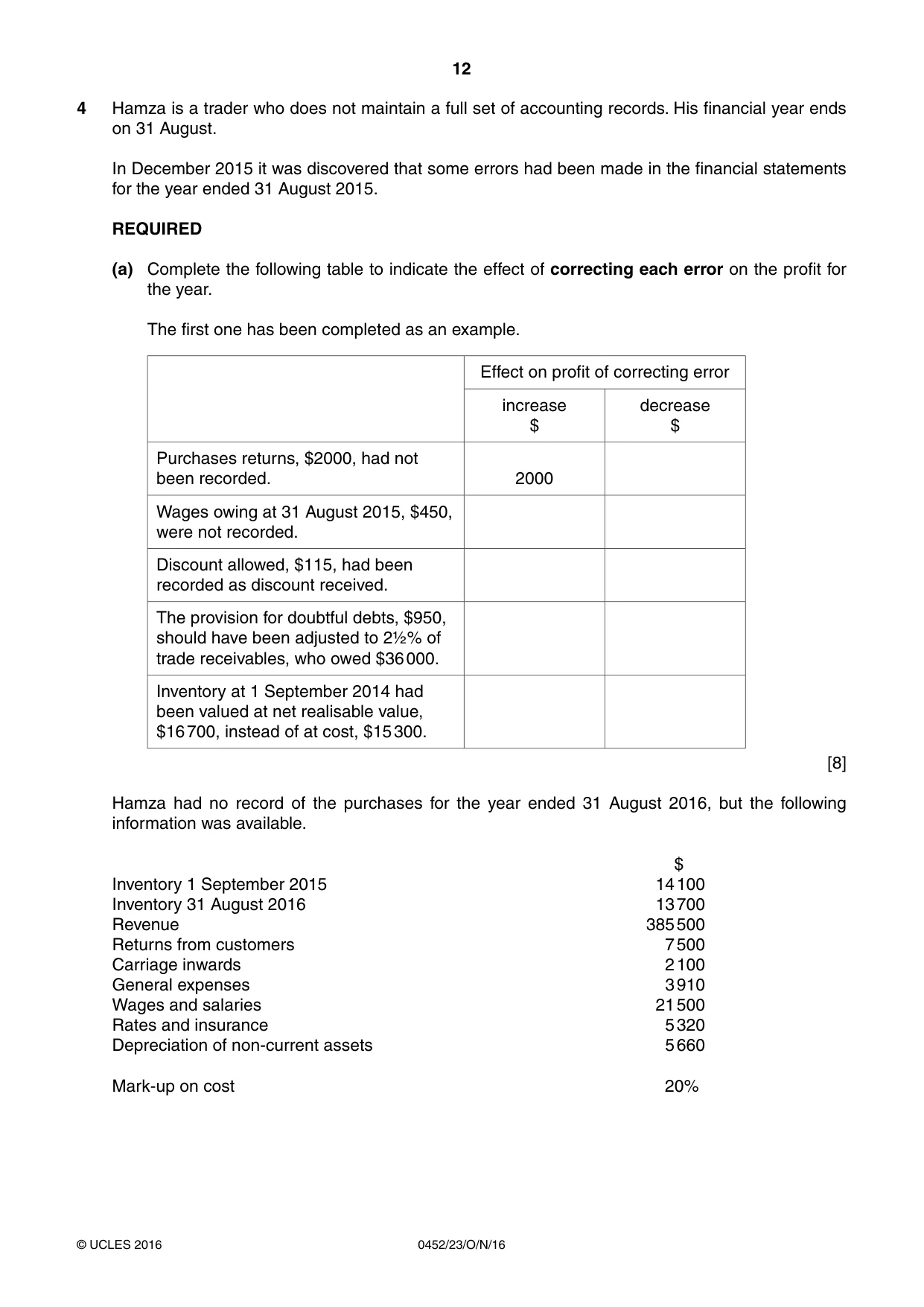
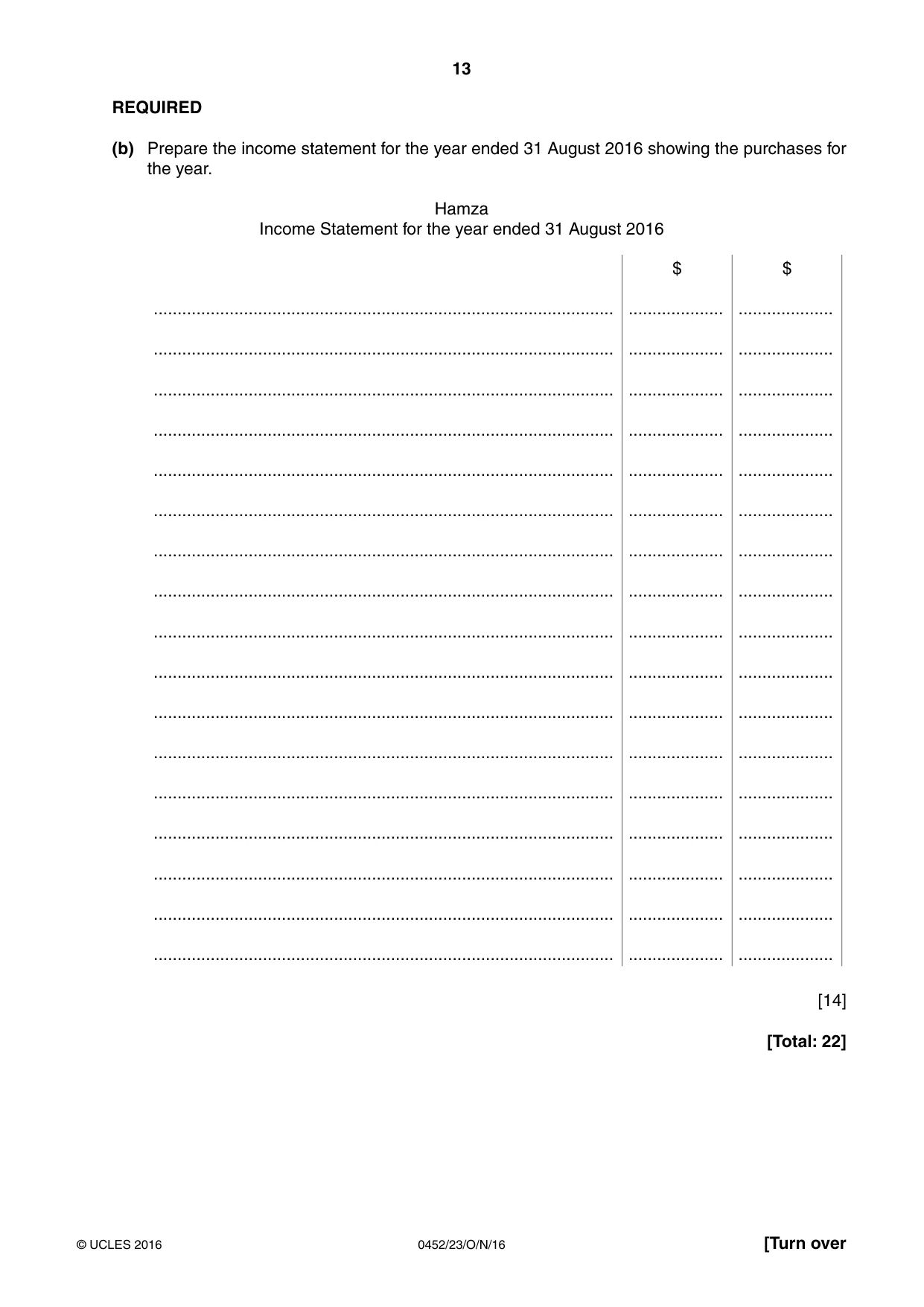
12 0452/23/O/N/16 © UCLES 2016 4 Hamza is a trader who does not maintain a full set of accounting records. His financial year ends on 31 August. In December 2015 it was discovered that some errors had been made in the financial statements for the year ended 31 August 2015. REQUIRED (a) Complete the following table to indicate the effect of correcting each error on the profit for the year. The first one has been completed as an example. Effect on profit of correcting error increase $ decrease $ Purchases returns, $2000, had not been recorded. 2000 Wages owing at 31 August 2015, $450, were not recorded. Discount allowed, $115, had been recorded as discount received. The provision for doubtful debts, $950, should have been adjusted to 2½% of trade receivables, who owed $36 000. Inventory at 1 September 2014 had been valued at net realisable value, $16 700, instead of at cost, $15 300. [8] Hamza had no record of the purchases for the year ended 31 August 2016, but the following information was available. $ Inventory 1 September 2015 14 100 Inventory 31 August 2016 13 700 Revenue 385 500 Returns from customers 7 500 Carriage inwards 2 100 General expenses 3 910 Wages and salaries 21 500 Rates and insurance 5 320 Depreciation of non-current assets 5 660 Mark-up on cost 20%
Question paper, page 13
13 0452/23/O/N/16 © UCLES 2016 [Turn over REQUIRED (b) Prepare the income statement for the year ended 31 August 2016 showing the purchases for the year. Hamza Income Statement for the year ended 31 August 2016 … … … … … … … … … … … … … … … … … $ … … … … … … … … … … … … … … … … … $ … … … … … … … … … … … … … … … … … [14] [Total: 22]
Question paper, page 14
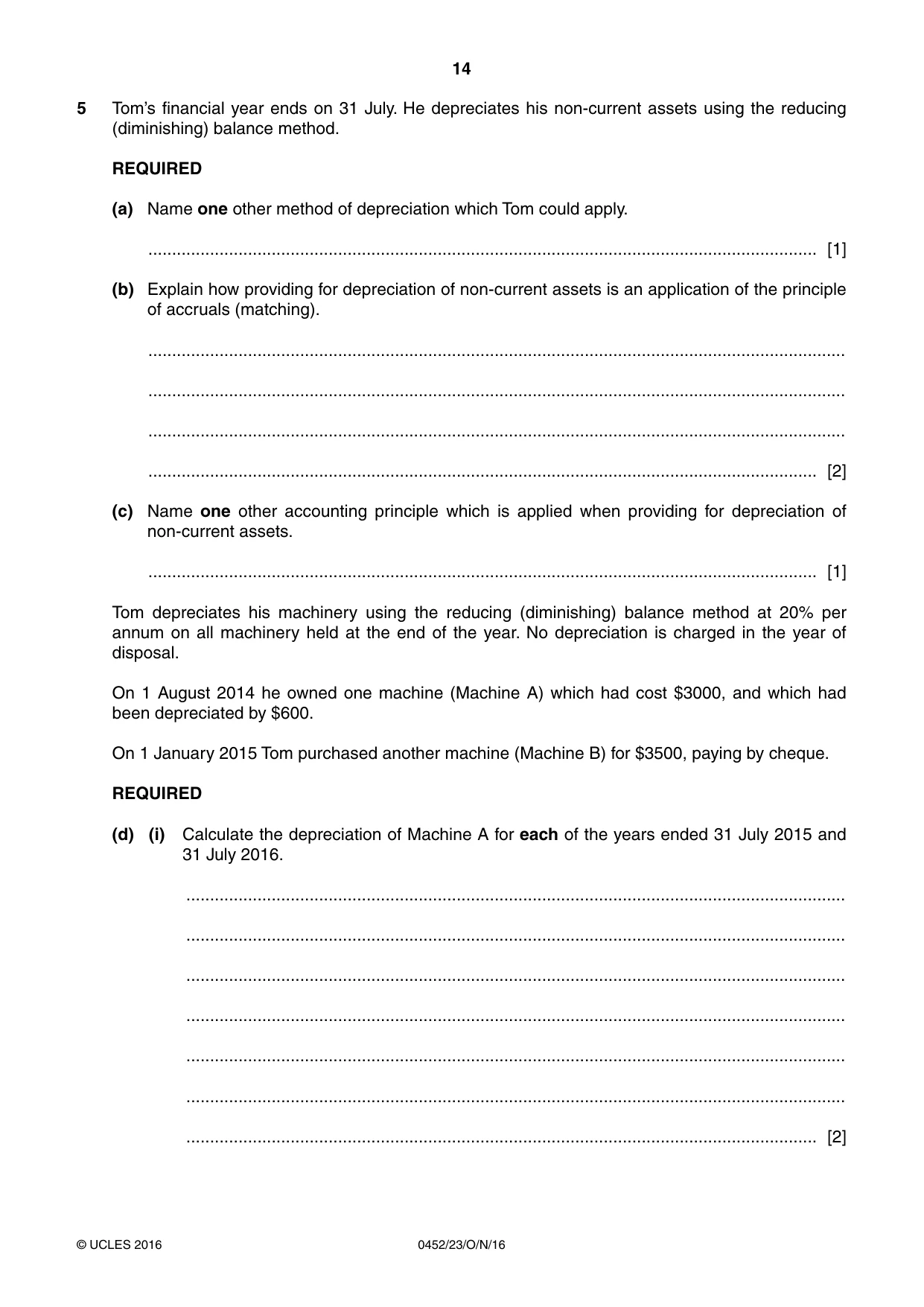
14 0452/23/O/N/16 © UCLES 2016 5 Tom’s financial year ends on 31 July. He depreciates his non-current assets using the reducing (diminishing) balance method. REQUIRED (a) Name one other method of depreciation which Tom could apply. … [1] (b) Explain how providing for depreciation of non-current assets is an application of the principle of accruals (matching). … … … … [2] (c) Name one other accounting principle which is applied when providing for depreciation of non-current assets. … [1] Tom depreciates his machinery using the reducing (diminishing) balance method at 20% per annum on all machinery held at the end of the year. No depreciation is charged in the year of disposal. On 1 August 2014 he owned one machine (Machine A) which had cost $3000, and which had been depreciated by $600. On 1 January 2015 Tom purchased another machine (Machine B) for $3500, paying by cheque. REQUIRED (d) (i) Calculate the depreciation of Machine A for each of the years ended 31 July 2015 and 31 July 2016. … … … … … … … [2]
Question paper, page 15
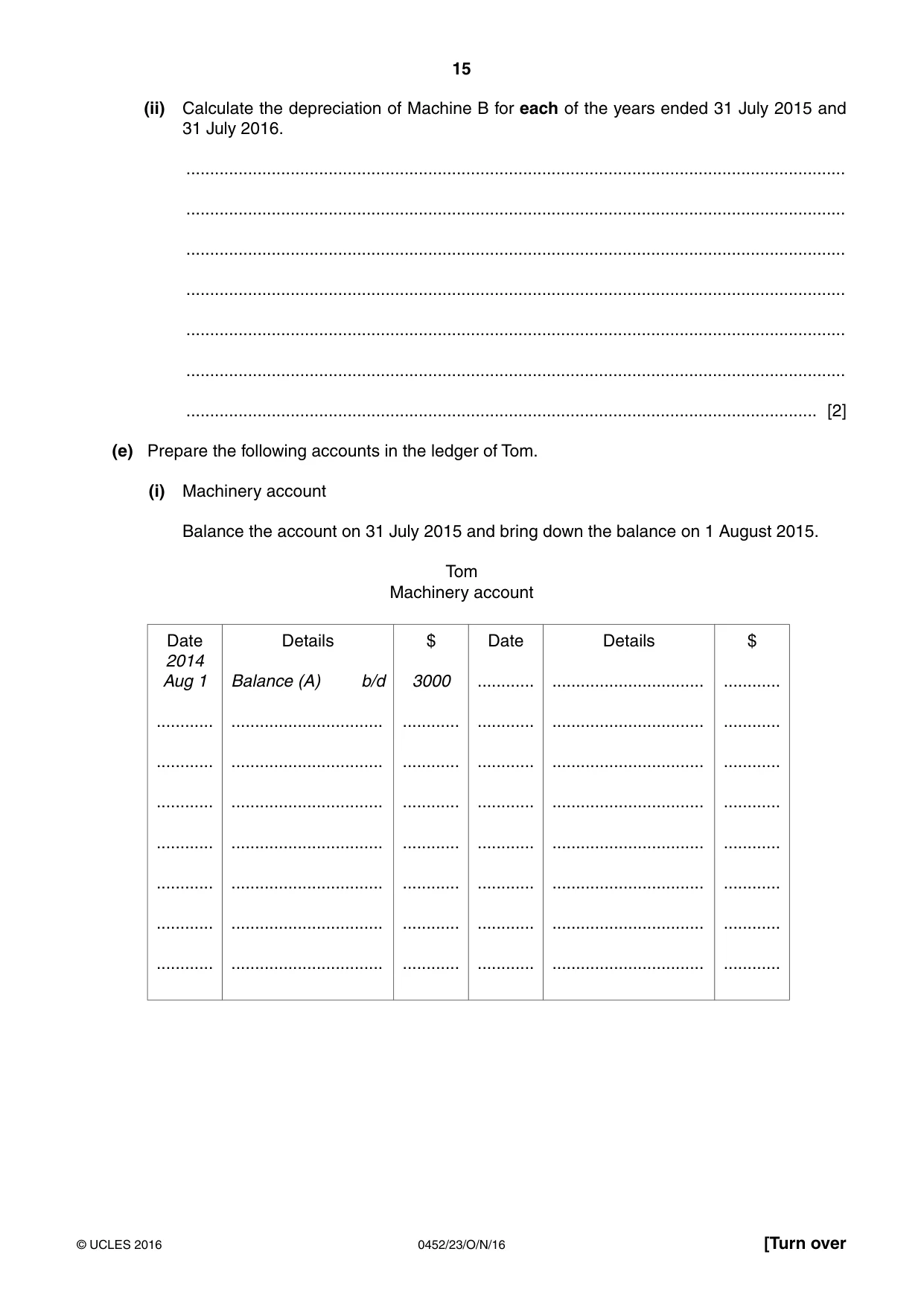
15 0452/23/O/N/16 © UCLES 2016 [Turn over (ii) Calculate the depreciation of Machine B for each of the years ended 31 July 2015 and 31 July 2016. … … … … … … … [2] (e) Prepare the following accounts in the ledger of Tom. (i) Machinery account Balance the account on 31 July 2015 and bring down the balance on 1 August 2015. Tom Machinery account Date 2014 Aug 1 … … … … … … … Details Balance (A) b/d … … … … … … … $ 3000 … … … … … … … Date … … … … … … … … Details … … … … … … … … $ … … … … … … … …
Question paper, page 16
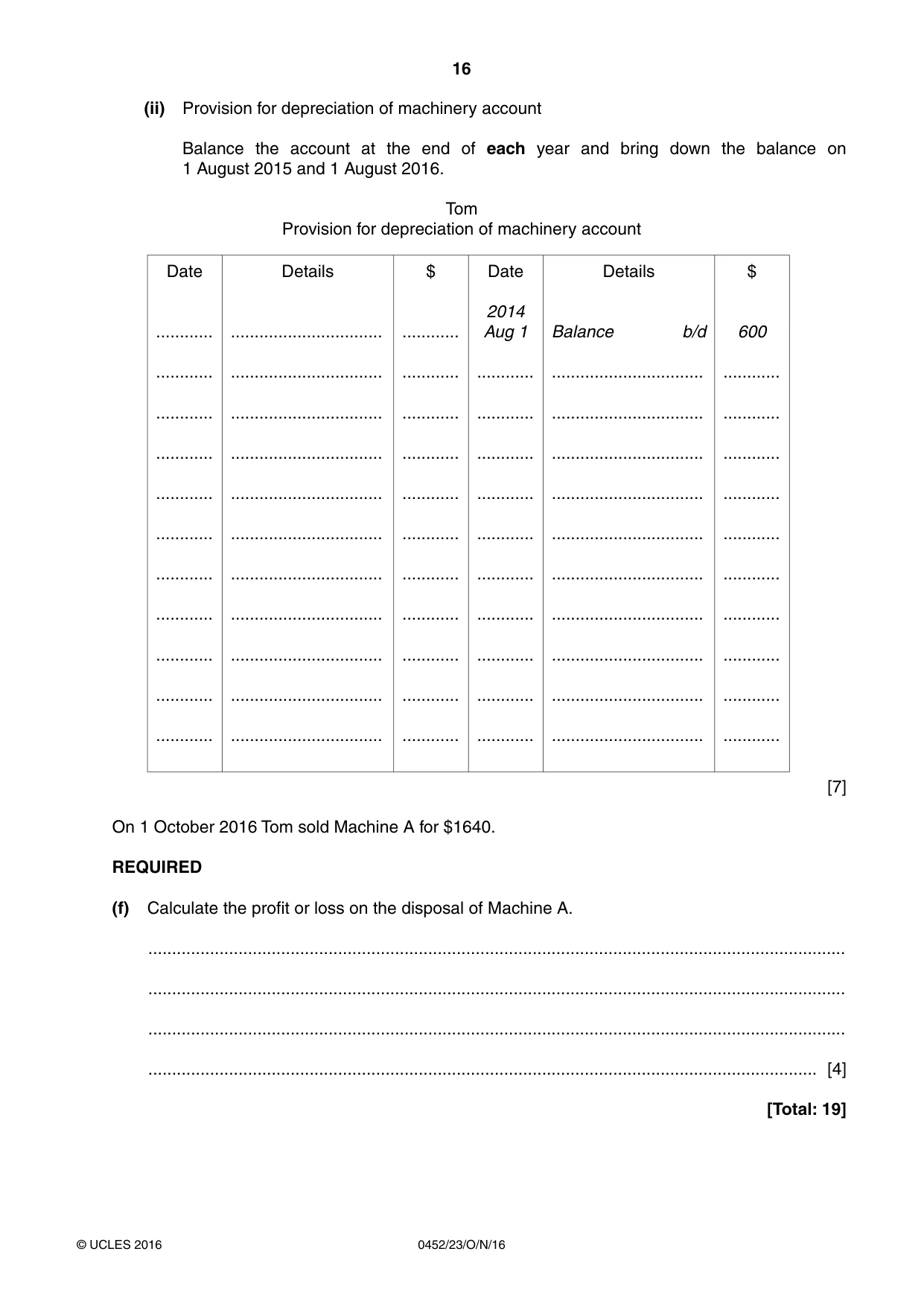
16 0452/23/O/N/16 © UCLES 2016 (ii) Provision for depreciation of machinery account Balance the account at the end of each year and bring down the balance on 1 August 2015 and 1 August 2016. Tom Provision for depreciation of machinery account Date … … … … … … … … … … … Details … … … … … … … … … … … $ … … … … … … … … … … … Date 2014 Aug 1 … … … … … … … … … … Details Balance b/d … … … … … … … … … … $ 600 … … … … … … … … … … [7] On 1 October 2016 Tom sold Machine A for $1640. REQUIRED (f) Calculate the profit or loss on the disposal of Machine A. … … … … [4] [Total: 19]
Question paper, page 17
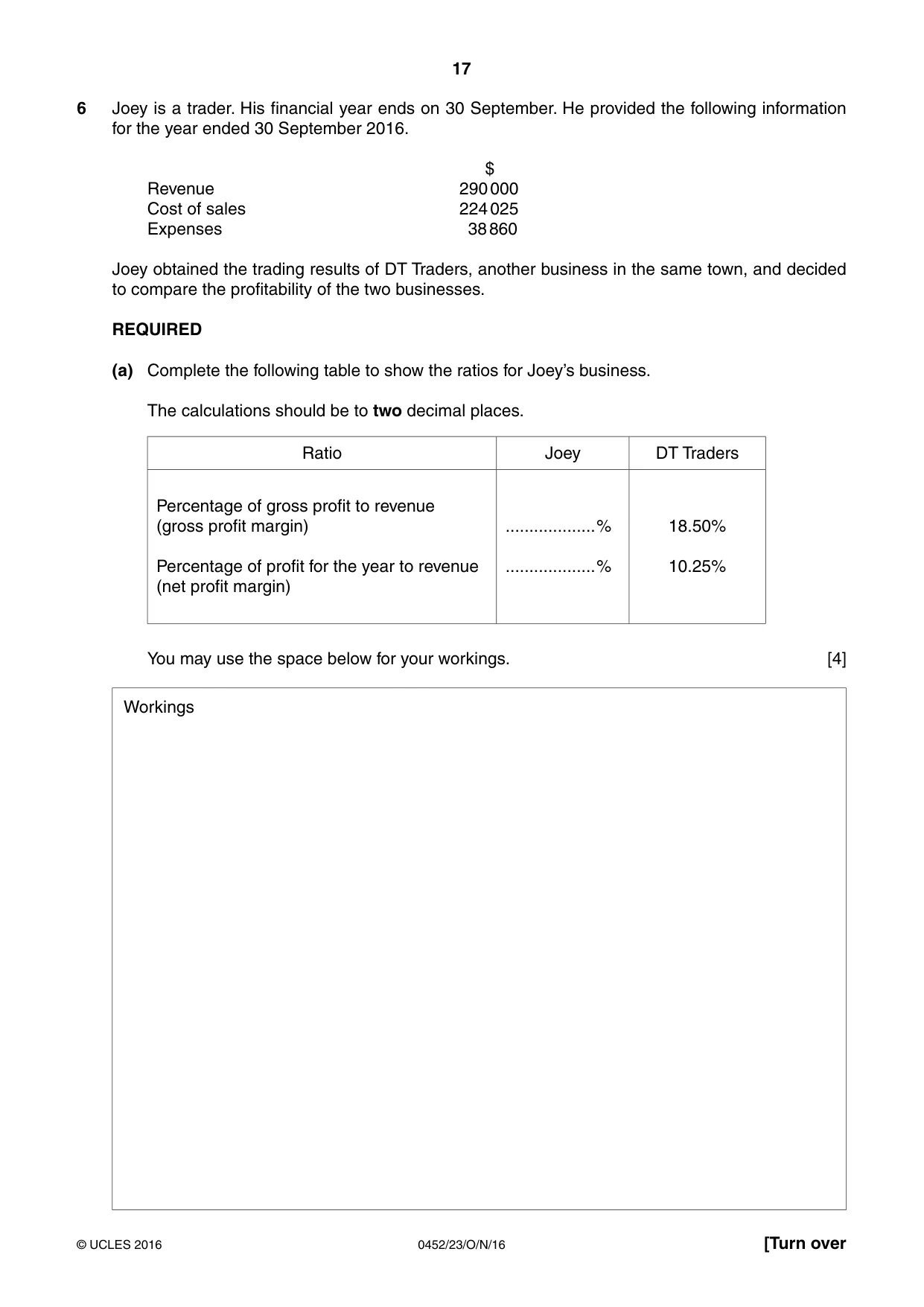
17 0452/23/O/N/16 © UCLES 2016 [Turn over 6 Joey is a trader. His financial year ends on 30 September. He provided the following information for the year ended 30 September 2016. $ Revenue 290 000 Cost of sales 224 025 Expenses 38 860 Joey obtained the trading results of DT Traders, another business in the same town, and decided to compare the profitability of the two businesses. REQUIRED (a) Complete the following table to show the ratios for Joey’s business. The calculations should be to two decimal places. Ratio Joey DT Traders Percentage of gross profit to revenue (gross profit margin) Percentage of profit for the year to revenue (net profit margin) …% …% 18.50% 10.25% You may use the space below for your workings. [4] Workings
Question paper, page 18
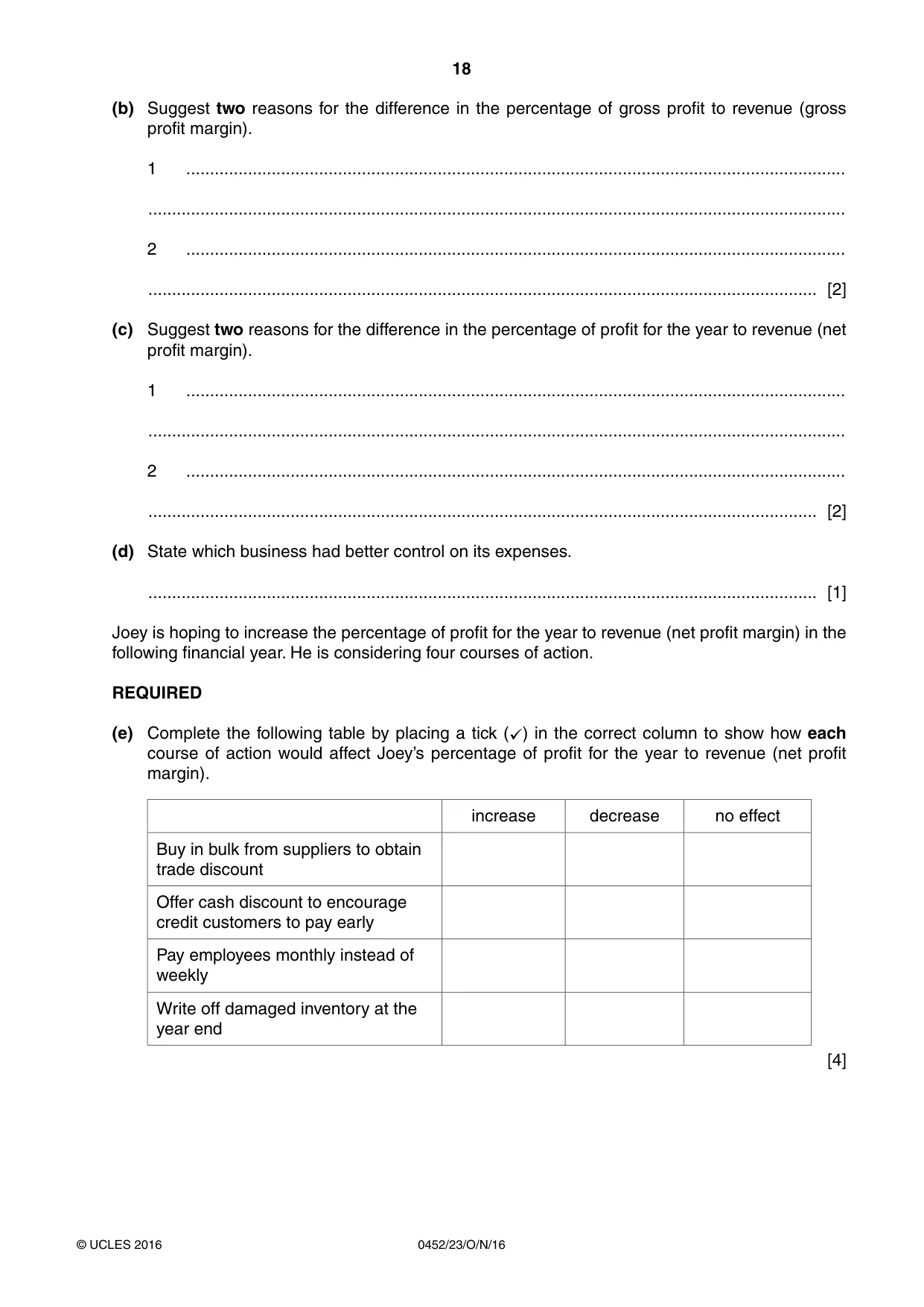
18 0452/23/O/N/16 © UCLES 2016 (b) Suggest two reasons for the difference in the percentage of gross profit to revenue (gross profit margin). 1 … … 2 … … [2] (c) Suggest two reasons for the difference in the percentage of profit for the year to revenue (net profit margin). 1 … … 2 … … [2] (d) State which business had better control on its expenses. … [1] Joey is hoping to increase the percentage of profit for the year to revenue (net profit margin) in the following financial year. He is considering four courses of action. REQUIRED (e) Complete the following table by placing a tick () in the correct column to show how each course of action would affect Joey’s percentage of profit for the year to revenue (net profit margin). increase decrease no effect Buy in bulk from suppliers to obtain trade discount Offer cash discount to encourage credit customers to pay early Pay employees monthly instead of weekly Write off damaged inventory at the year end [4]
Question paper, page 19
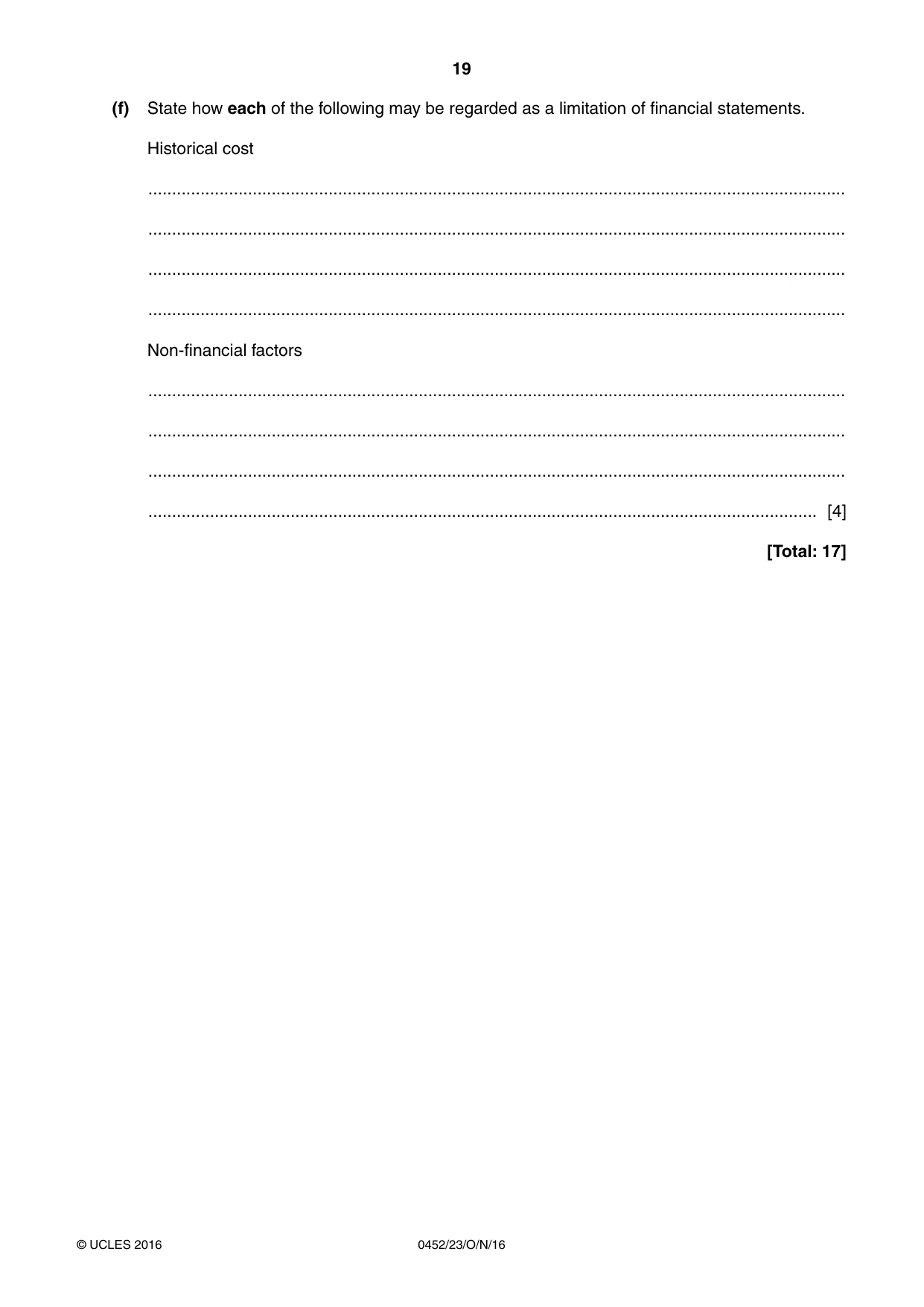
19 0452/23/O/N/16 © UCLES 2016 (f) State how each of the following may be regarded as a limitation of financial statements. Historical cost … … … … Non-financial factors … … … … [4] [Total: 17]
Question paper, page 20
20 0452/23/O/N/16 © UCLES 2016 Permission to reproduce items where third-party owned material protected by copyright is included has been sought and cleared where possible. Every reasonable effort has been made by the publisher (UCLES) to trace copyright holders, but if any items requiring clearance have unwittingly been included, the publisher will be pleased to make amends at the earliest possible opportunity. To avoid the issue of disclosure of answer-related information to candidates, all copyright acknowledgements are reproduced online in the Cambridge International Examinations Copyright Acknowledgements Booklet. This is produced for each series of examinations and is freely available to download at www.cie.org.uk after the live examination series. Cambridge International Examinations is part of the Cambridge Assessment Group. Cambridge Assessment is the brand name of University of Cambridge Local Examinations Syndicate (UCLES), which is itself a department of the University of Cambridge. BLANK PAGE
Mark scheme, page 1
® IGCSE is the registered trademark of Cambridge International Examinations. This document consists of 11 printed pages. © UCLES 2016 [Turn over Cambridge International Examinations Cambridge International General Certificate of Secondary Education ACCOUNTING 0452/23 Paper 2 October/November 2016 MARK SCHEME Maximum Mark: 120 Published This mark scheme is published as an aid to teachers and candidates, to indicate the requirements of the examination. It shows the basis on which Examiners were instructed to award marks. It does not indicate the details of the discussions that took place at an Examiners’ meeting before marking began, which would have considered the acceptability of alternative answers. Mark schemes should be read in conjunction with the question paper and the Principal Examiner Report for Teachers. Cambridge will not enter into discussions about these mark schemes. Cambridge is publishing the mark schemes for the October/November 2016 series for most Cambridge IGCSE®, Cambridge International A and AS Level components and some Cambridge O Level components.
Mark scheme, page 2
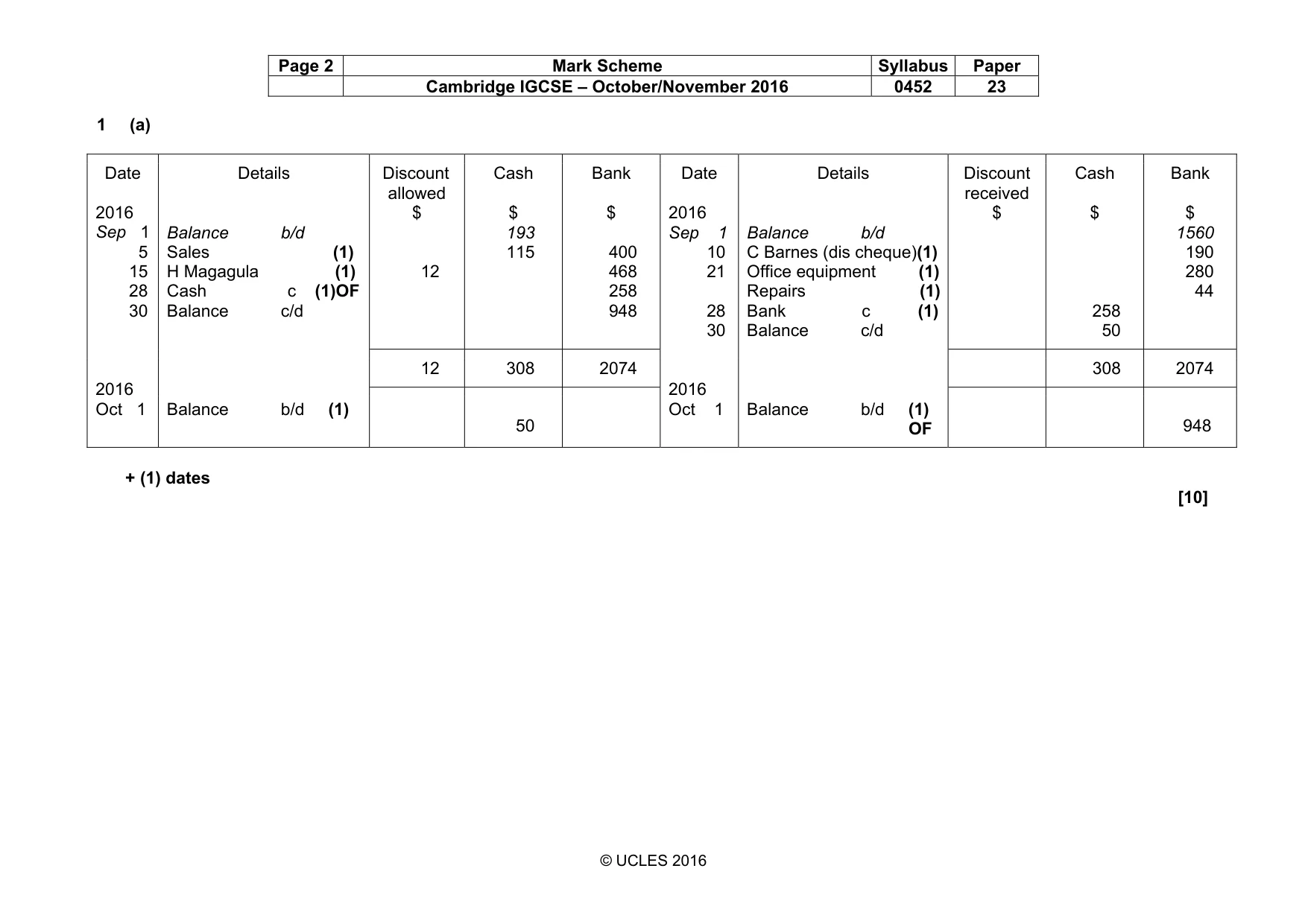
Page 2 Mark Scheme Syllabus Paper Cambridge IGCSE – October/November 2016 0452 23 © UCLES 2016 1 (a) Date 2016 Sep 1 5 15 28 30 2016 Oct 1 Details Balance b/d Sales (1) H Magagula (1) Cash c (1)OF Balance c/d Balance b/d (1) Discount allowed $ 12 Cash $ 193 115 Bank $ 400 468 258 948 Date 2016 Sep 1 10 21 28 30 2016 Oct 1 Details Balance b/d C Barnes (dis cheque)(1) Office equipment (1) Repairs (1) Bank c (1) Balance c/d Balance b/d (1) OF Discount received $ Cash $ 258 50 Bank $ 1560 190 280 44 12 308 2074 308 2074 50 948 + (1) dates [10]
Mark scheme, page 3
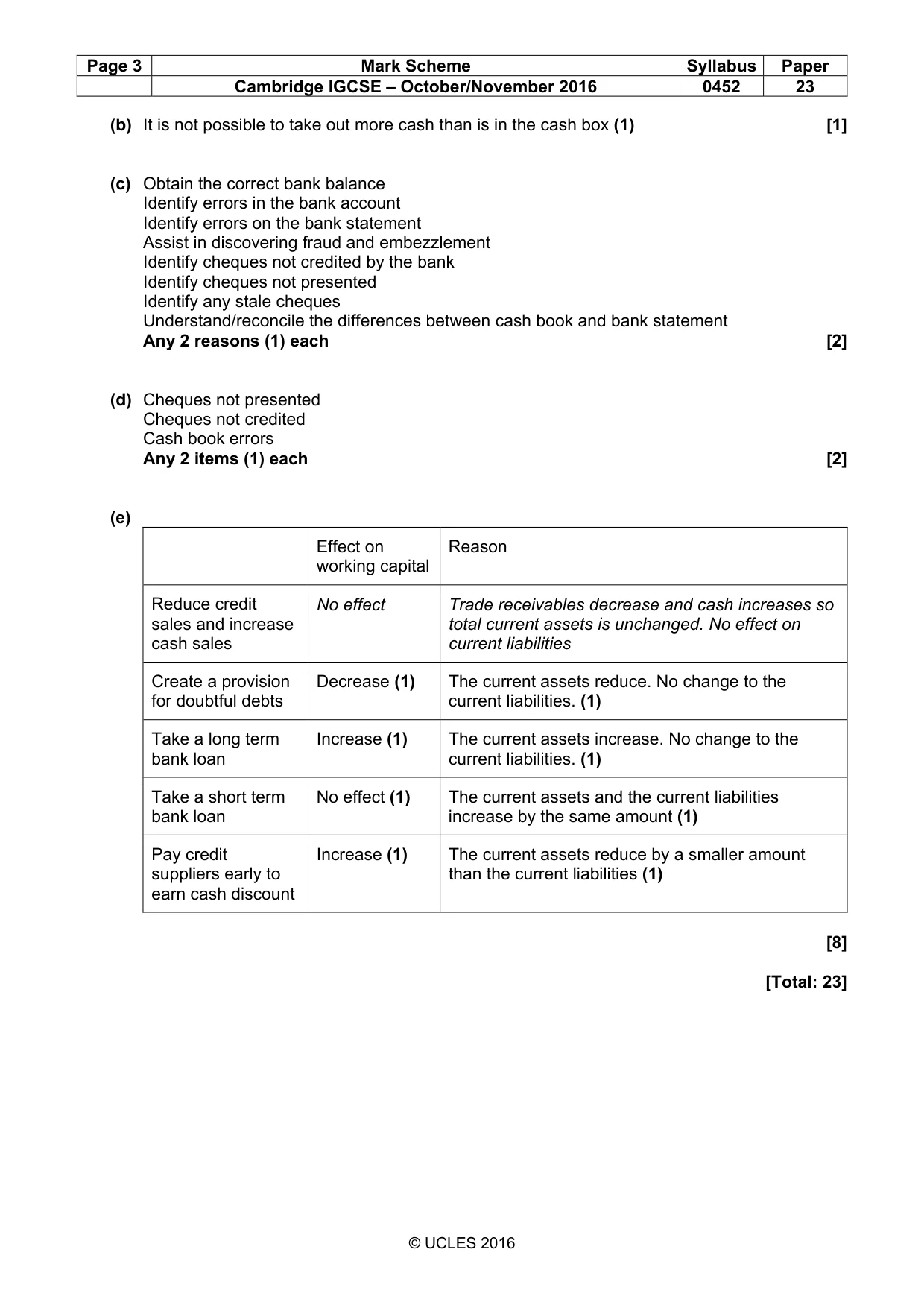
Page 3 Mark Scheme Syllabus Paper Cambridge IGCSE – October/November 2016 0452 23 © UCLES 2016 (b) It is not possible to take out more cash than is in the cash box (1) [1] (c) Obtain the correct bank balance Identify errors in the bank account Identify errors on the bank statement Assist in discovering fraud and embezzlement Identify cheques not credited by the bank Identify cheques not presented Identify any stale cheques Understand/reconcile the differences between cash book and bank statement Any 2 reasons (1) each [2] (d) Cheques not presented Cheques not credited Cash book errors Any 2 items (1) each [2] (e) Effect on working capital Reason Reduce credit sales and increase cash sales No effect Trade receivables decrease and cash increases so total current assets is unchanged. No effect on current liabilities Create a provision for doubtful debts Decrease (1) The current assets reduce. No change to the current liabilities. (1) Take a long term bank loan Increase (1) The current assets increase. No change to the current liabilities. (1) Take a short term bank loan No effect (1) The current assets and the current liabilities increase by the same amount (1) Pay credit suppliers early to earn cash discount Increase (1) The current assets reduce by a smaller amount than the current liabilities (1) [8] [Total: 23]
Mark scheme, page 4
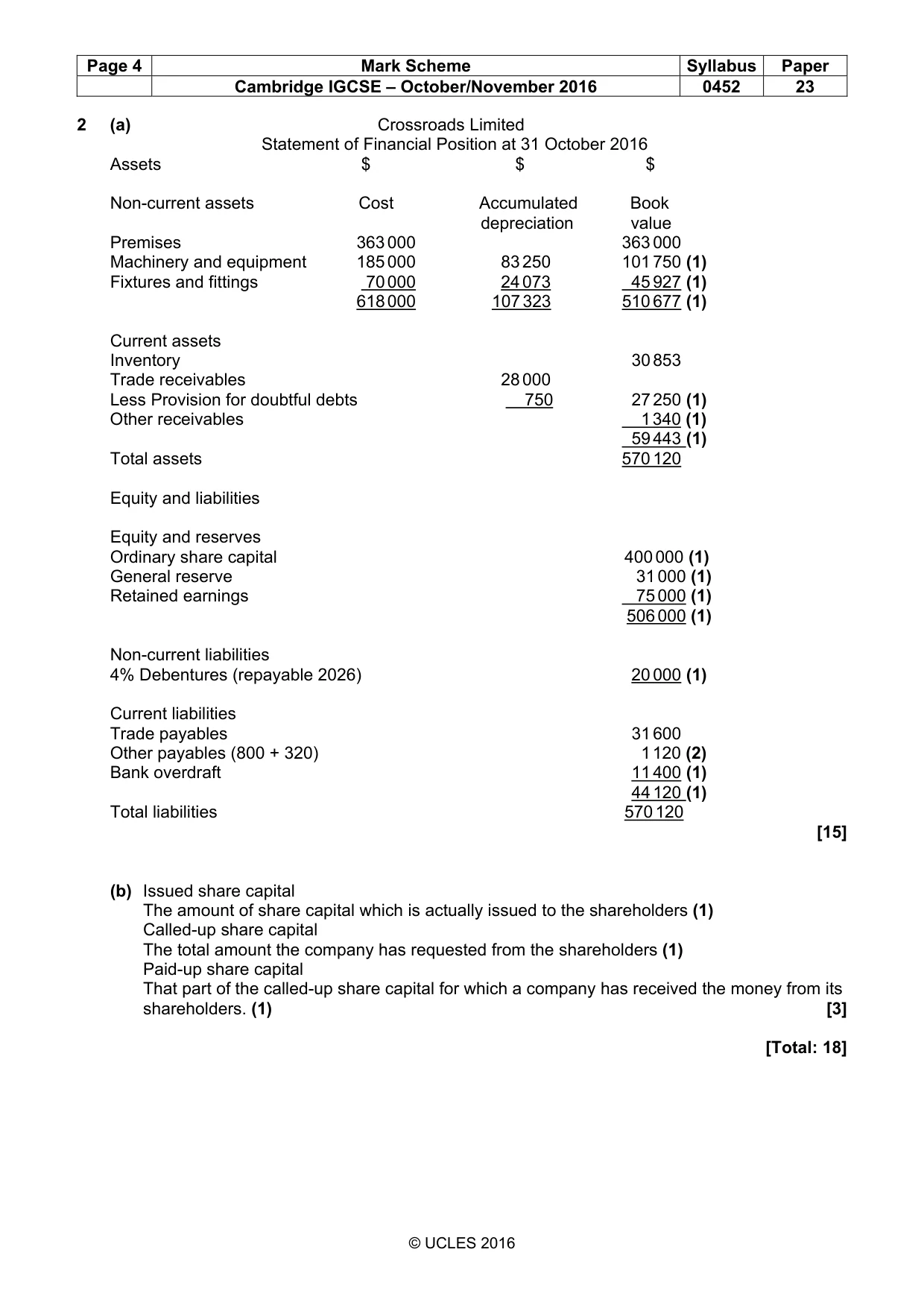
Page 4 Mark Scheme Syllabus Paper Cambridge IGCSE – October/November 2016 0452 23 © UCLES 2016 2 (a) Crossroads Limited Statement of Financial Position at 31 October 2016 Assets $ $ $ Non-current assets Cost Accumulated Book depreciation value Premises 363 000 363 000 Machinery and equipment 185 000 83 250 101 750 (1) Fixtures and fittings 70 000 24 073 45 927 (1) 618 000 107 323 510 677 (1) Current assets Inventory 30 853 Trade receivables 28 000 Less Provision for doubtful debts 750 27 250 (1) Other receivables 1 340 (1) 59 443 (1) Total assets 570 120 Equity and liabilities Equity and reserves Ordinary share capital 400 000 (1) General reserve 31 000 (1) Retained earnings 75 000 (1) 506 000 (1) Non-current liabilities 4% Debentures (repayable 2026) 20 000 (1) Current liabilities Trade payables 31 600 Other payables (800 + 320) 1 120 (2) Bank overdraft 11 400 (1) 44 120 (1) Total liabilities 570 120 [15] (b) Issued share capital The amount of share capital which is actually issued to the shareholders (1) Called-up share capital The total amount the company has requested from the shareholders (1) Paid-up share capital That part of the called-up share capital for which a company has received the money from its shareholders. (1) [3] [Total: 18]
Mark scheme, page 5
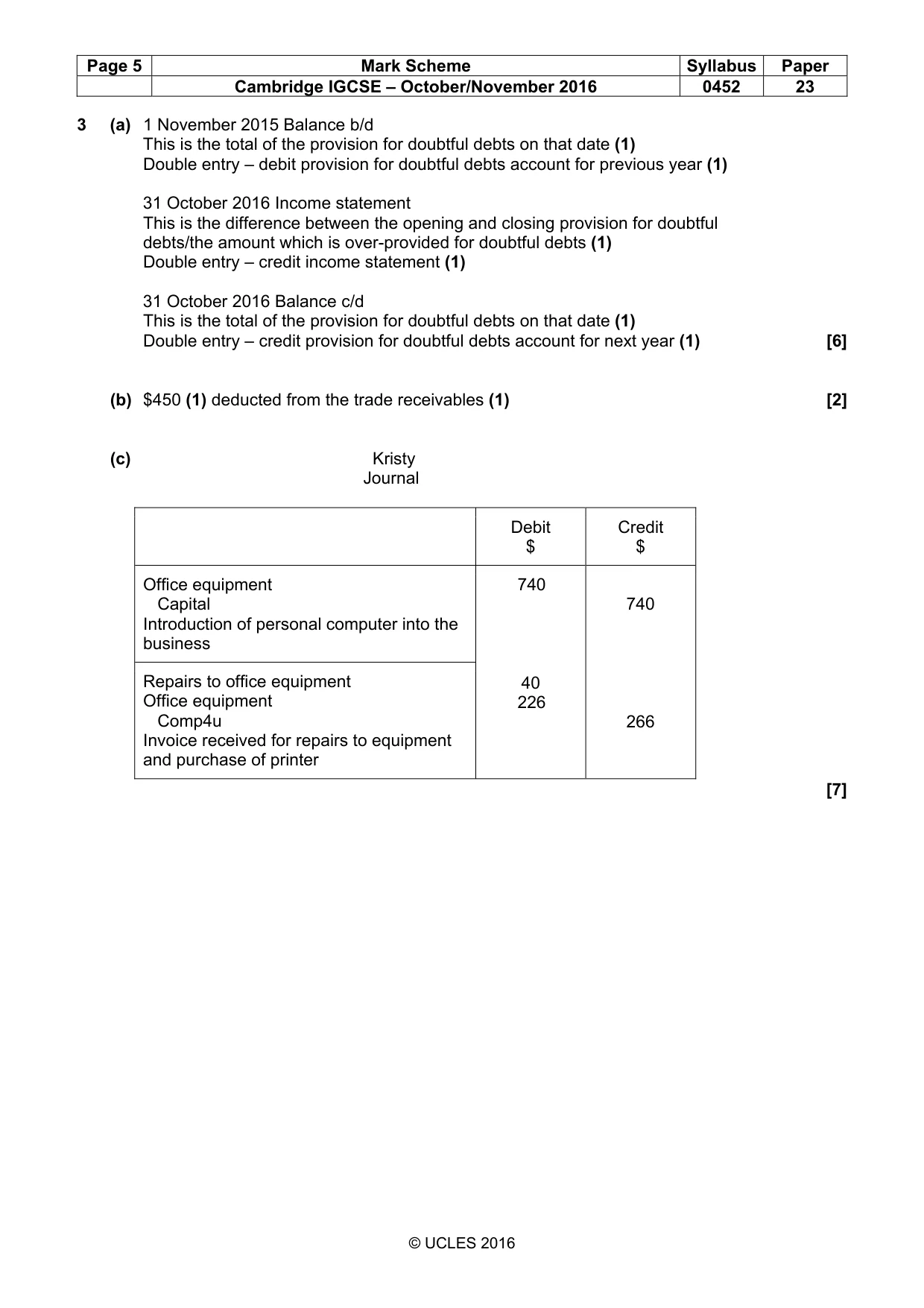
Page 5 Mark Scheme Syllabus Paper Cambridge IGCSE – October/November 2016 0452 23 © UCLES 2016 3 (a) 1 November 2015 Balance b/d This is the total of the provision for doubtful debts on that date (1) Double entry – debit provision for doubtful debts account for previous year (1) 31 October 2016 Income statement This is the difference between the opening and closing provision for doubtful debts/the amount which is over-provided for doubtful debts (1) Double entry – credit income statement (1) 31 October 2016 Balance c/d This is the total of the provision for doubtful debts on that date (1) Double entry – credit provision for doubtful debts account for next year (1) [6] (b) $450 (1) deducted from the trade receivables (1) [2] (c) Kristy Journal Debit $ Credit $ Office equipment Capital Introduction of personal computer into the business 740 40 226 740 266 Repairs to office equipment Office equipment Comp4u Invoice received for repairs to equipment and purchase of printer [7]
Mark scheme, page 6
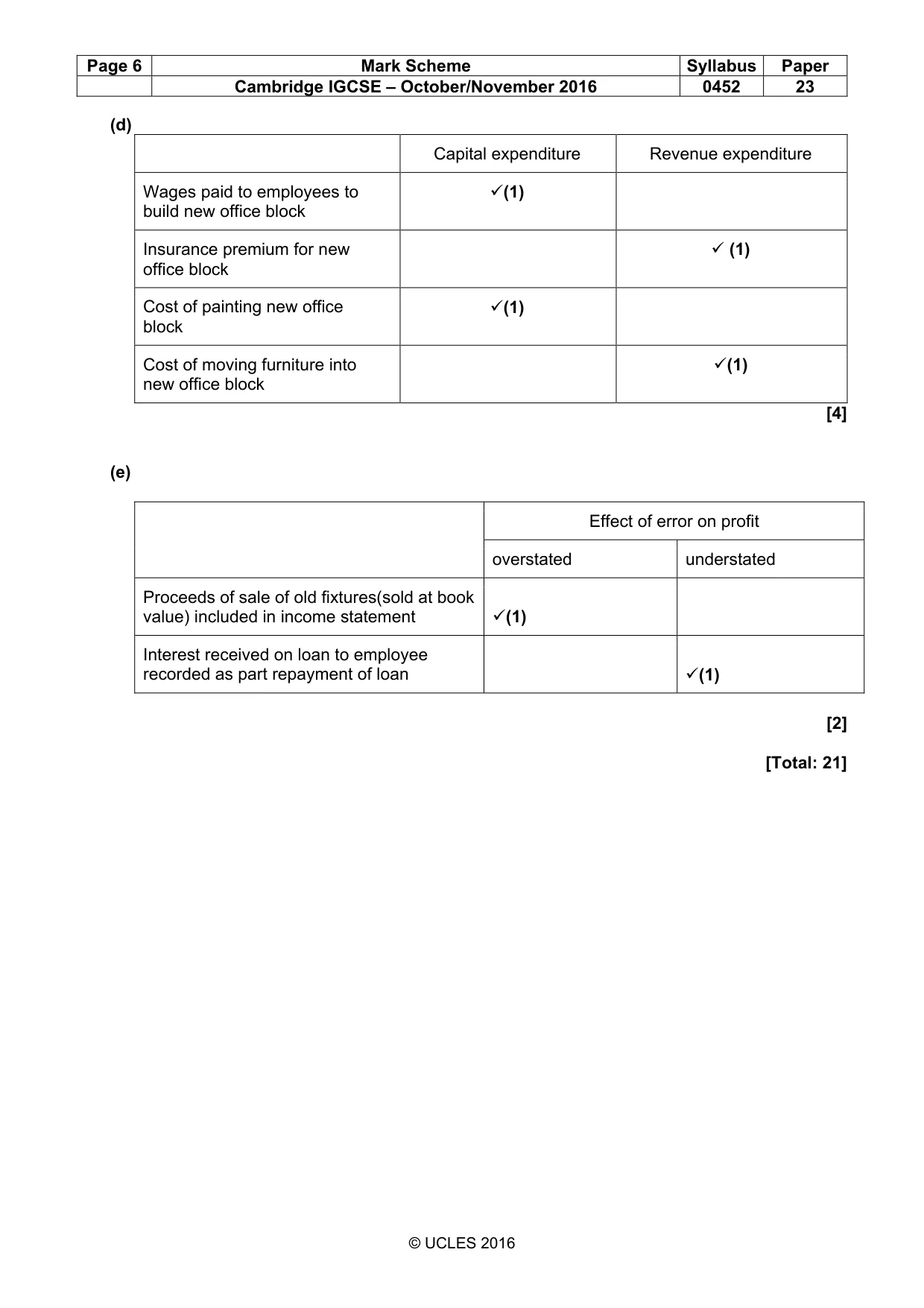
Page 6 Mark Scheme Syllabus Paper Cambridge IGCSE – October/November 2016 0452 23 © UCLES 2016 (d) Capital expenditure Revenue expenditure Wages paid to employees to build new office block 9(1) Insurance premium for new office block 9 (1) Cost of painting new office block 9(1) Cost of moving furniture into new office block 9(1) [4] (e) Effect of error on profit overstated understated Proceeds of sale of old fixtures(sold at book value) included in income statement 9(1) Interest received on loan to employee recorded as part repayment of loan 9(1) [2] [Total: 21]
Mark scheme, page 7
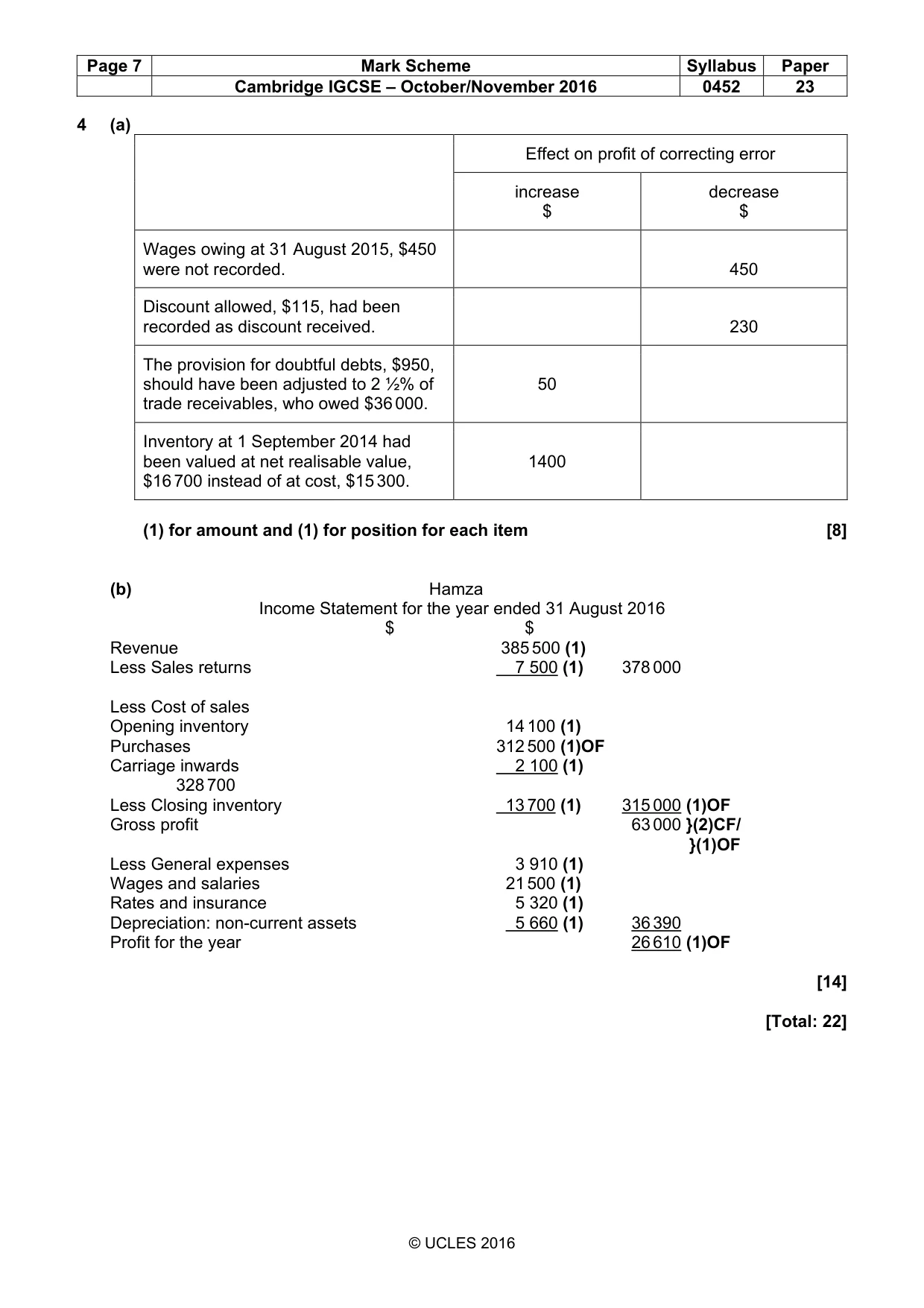
Page 7 Mark Scheme Syllabus Paper Cambridge IGCSE – October/November 2016 0452 23 © UCLES 2016 4 (a) Effect on profit of correcting error increase $ decrease $ Wages owing at 31 August 2015, $450 were not recorded. 450 Discount allowed, $115, had been recorded as discount received. 230 The provision for doubtful debts, $950, should have been adjusted to 2 ½% of trade receivables, who owed $36 000. 50 Inventory at 1 September 2014 had been valued at net realisable value, $16 700 instead of at cost, $15 300. 1400 (1) for amount and (1) for position for each item [8] (b) Hamza Income Statement for the year ended 31 August 2016 $ $ Revenue 385 500 (1) Less Sales returns 7 500 (1) 378 000 Less Cost of sales Opening inventory 14 100 (1) Purchases 312 500 (1)OF Carriage inwards 2 100 (1) 328 700 Less Closing inventory 13 700 (1) 315 000 (1)OF Gross profit 63 000 }(2)CF/ }(1)OF Less General expenses 3 910 (1) Wages and salaries 21 500 (1) Rates and insurance 5 320 (1) Depreciation: non-current assets 5 660 (1) 36 390 Profit for the year 26 610 (1)OF [14] [Total: 22]
Mark scheme, page 8
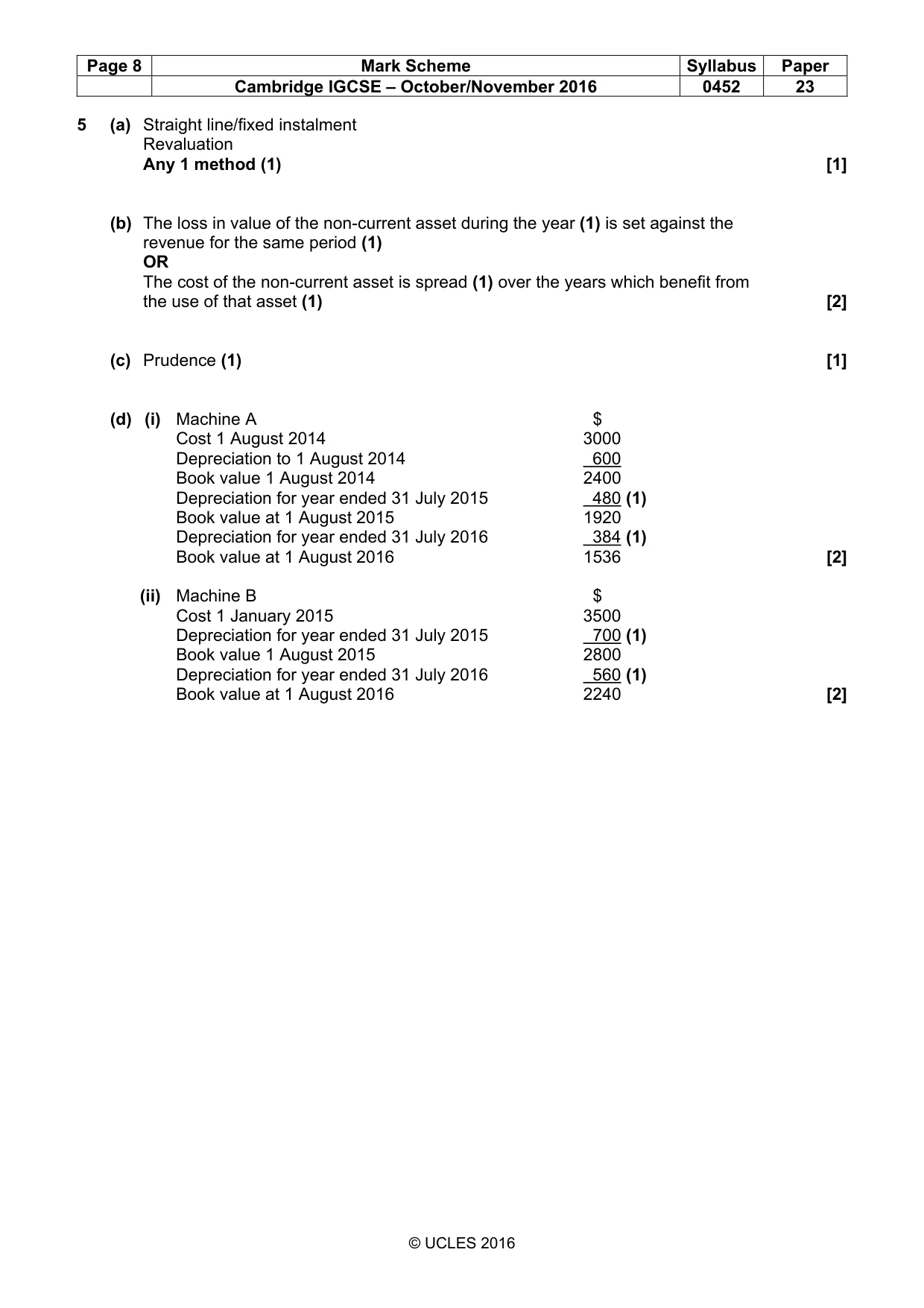
Page 8 Mark Scheme Syllabus Paper Cambridge IGCSE – October/November 2016 0452 23 © UCLES 2016 5 (a) Straight line/fixed instalment Revaluation Any 1 method (1) [1] (b) The loss in value of the non-current asset during the year (1) is set against the revenue for the same period (1) OR The cost of the non-current asset is spread (1) over the years which benefit from the use of that asset (1) [2] (c) Prudence (1) [1] (d) (i) Machine A $ Cost 1 August 2014 3000 Depreciation to 1 August 2014 600 Book value 1 August 2014 2400 Depreciation for year ended 31 July 2015 480 (1) Book value at 1 August 2015 1920 Depreciation for year ended 31 July 2016 384 (1) Book value at 1 August 2016 1536 [2] (ii) Machine B $ Cost 1 January 2015 3500 Depreciation for year ended 31 July 2015 700 (1) Book value 1 August 2015 2800 Depreciation for year ended 31 July 2016 560 (1) Book value at 1 August 2016 2240 [2]
Mark scheme, page 9
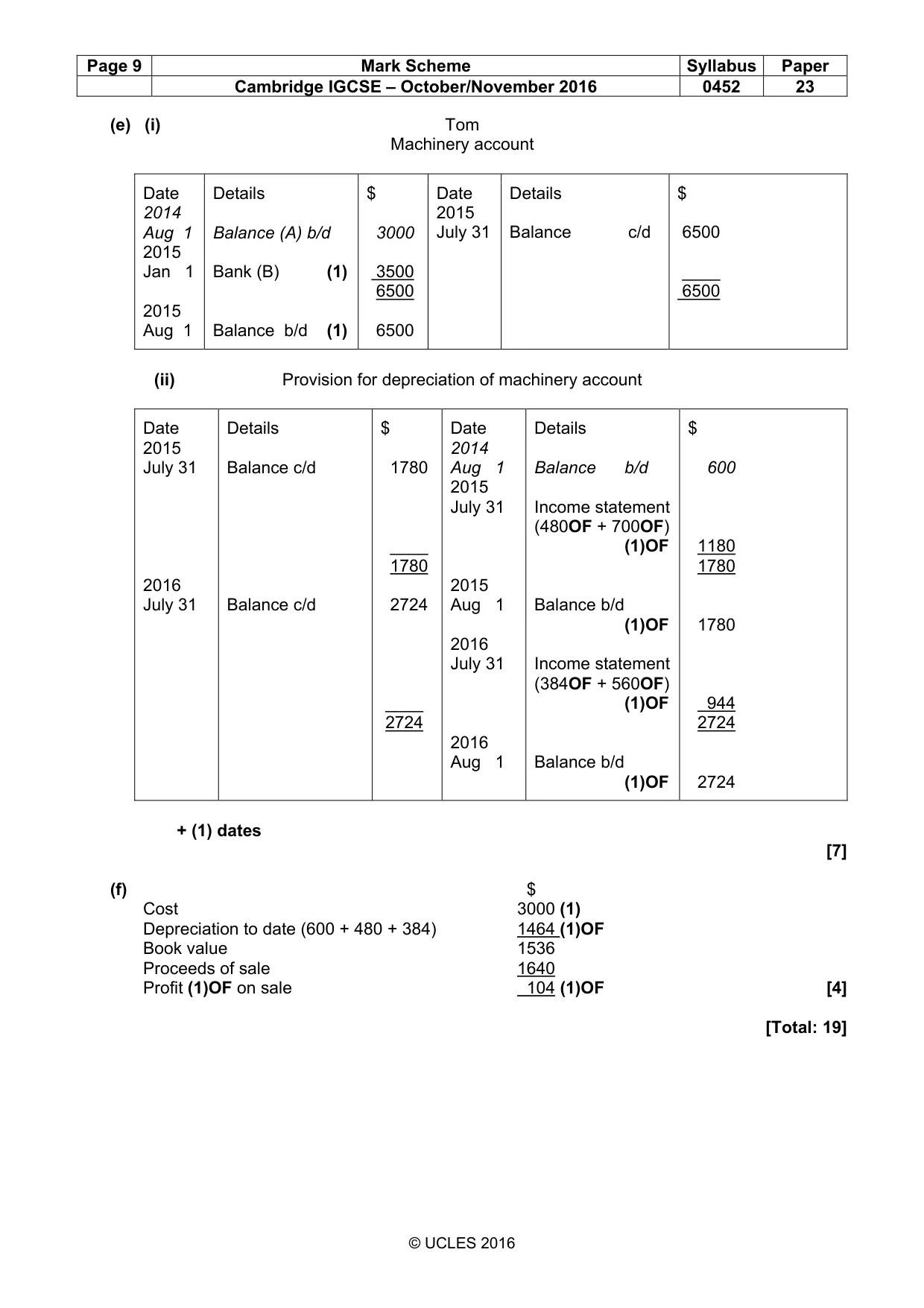
Page 9 Mark Scheme Syllabus Paper Cambridge IGCSE – October/November 2016 0452 23 © UCLES 2016 (e) (i) Tom Machinery account Date 2014 Aug 1 2015 Jan 1 2015 Aug 1 Details Balance (A) b/d Bank (B) (1) Balance b/d (1) $ 3000 3500 6500 6500 Date 2015 July 31 Details Balance c/d $ 6500 ____ 6500 (ii) Provision for depreciation of machinery account Date 2015 July 31 2016 July 31 Details Balance c/d Balance c/d $ 1780 ____ 1780 2724 ____ 2724 Date 2014 Aug 1 2015 July 31 2015 Aug 1 2016 July 31 2016 Aug 1 Details Balance b/d Income statement (480OF + 700OF) (1)OF Balance b/d (1)OF Income statement (384OF + 560OF) (1)OF Balance b/d (1)OF $ 600 1180 1780 1780 944 2724 2724 + (1) dates [7] (f) $ Cost 3000 (1) Depreciation to date (600 + 480 + 384) 1464 (1)OF Book value 1536 Proceeds of sale 1640 Profit (1)OF on sale 104 (1)OF [4] [Total: 19]
Mark scheme, page 10
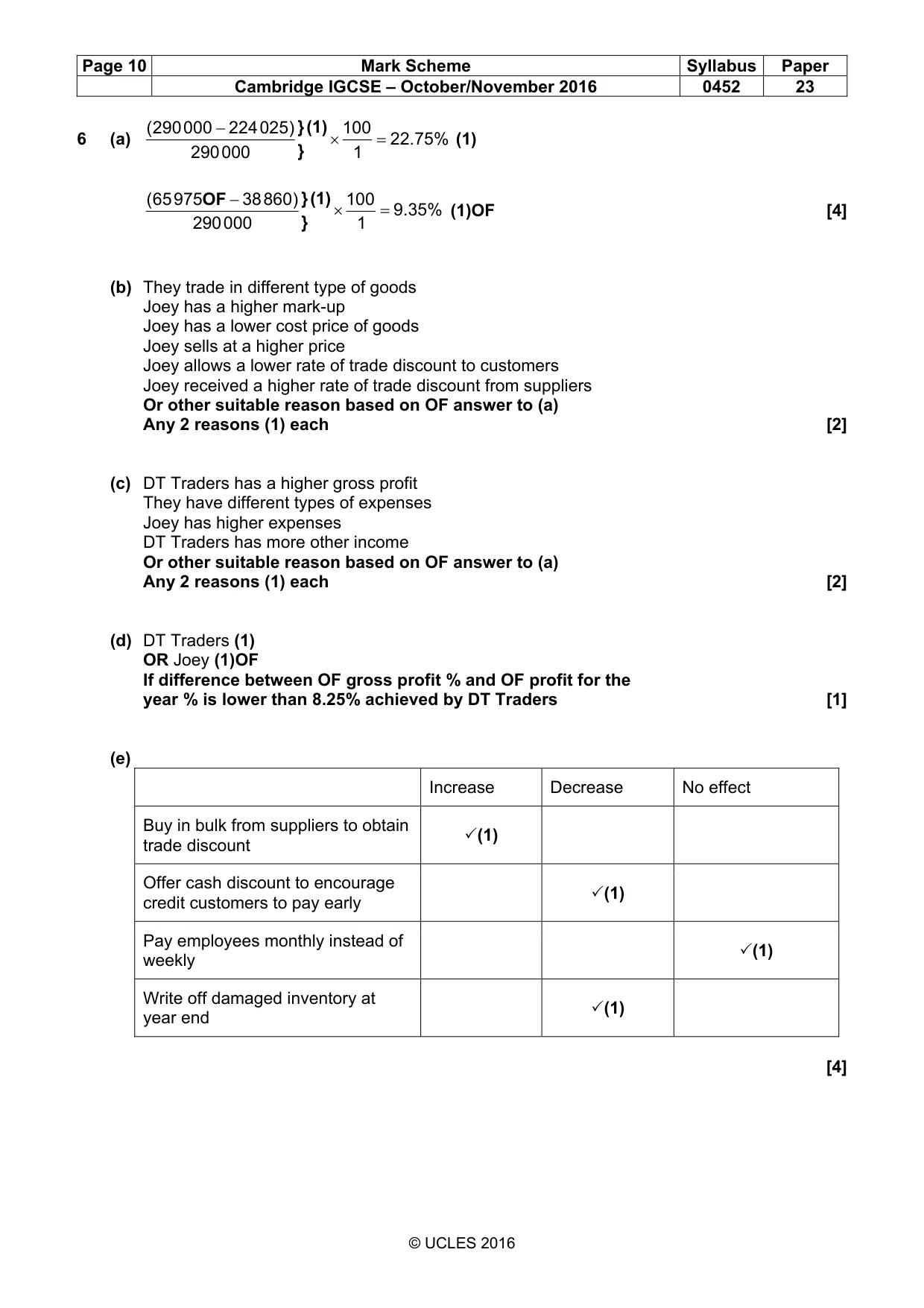
Page 10 Mark Scheme Syllabus Paper Cambridge IGCSE – October/November 2016 0452 23 © UCLES 2016 6 (a) (290000 224025) 100 22.75% 290000 1 − × = }(1) } (1) (65975 38860) 100 9.35% 290000 1 − × = }(1) OF } (1)OF [4] (b) They trade in different type of goods Joey has a higher mark-up Joey has a lower cost price of goods Joey sells at a higher price Joey allows a lower rate of trade discount to customers Joey received a higher rate of trade discount from suppliers Or other suitable reason based on OF answer to (a) Any 2 reasons (1) each [2] (c) DT Traders has a higher gross profit They have different types of expenses Joey has higher expenses DT Traders has more other income Or other suitable reason based on OF answer to (a) Any 2 reasons (1) each [2] (d) DT Traders (1) OR Joey (1)OF If difference between OF gross profit % and OF profit for the year % is lower than 8.25% achieved by DT Traders [1] (e) Increase Decrease No effect Buy in bulk from suppliers to obtain trade discount 3(1) Offer cash discount to encourage credit customers to pay early 3(1) Pay employees monthly instead of weekly 3(1) Write off damaged inventory at year end 3(1) [4]
Mark scheme, page 11
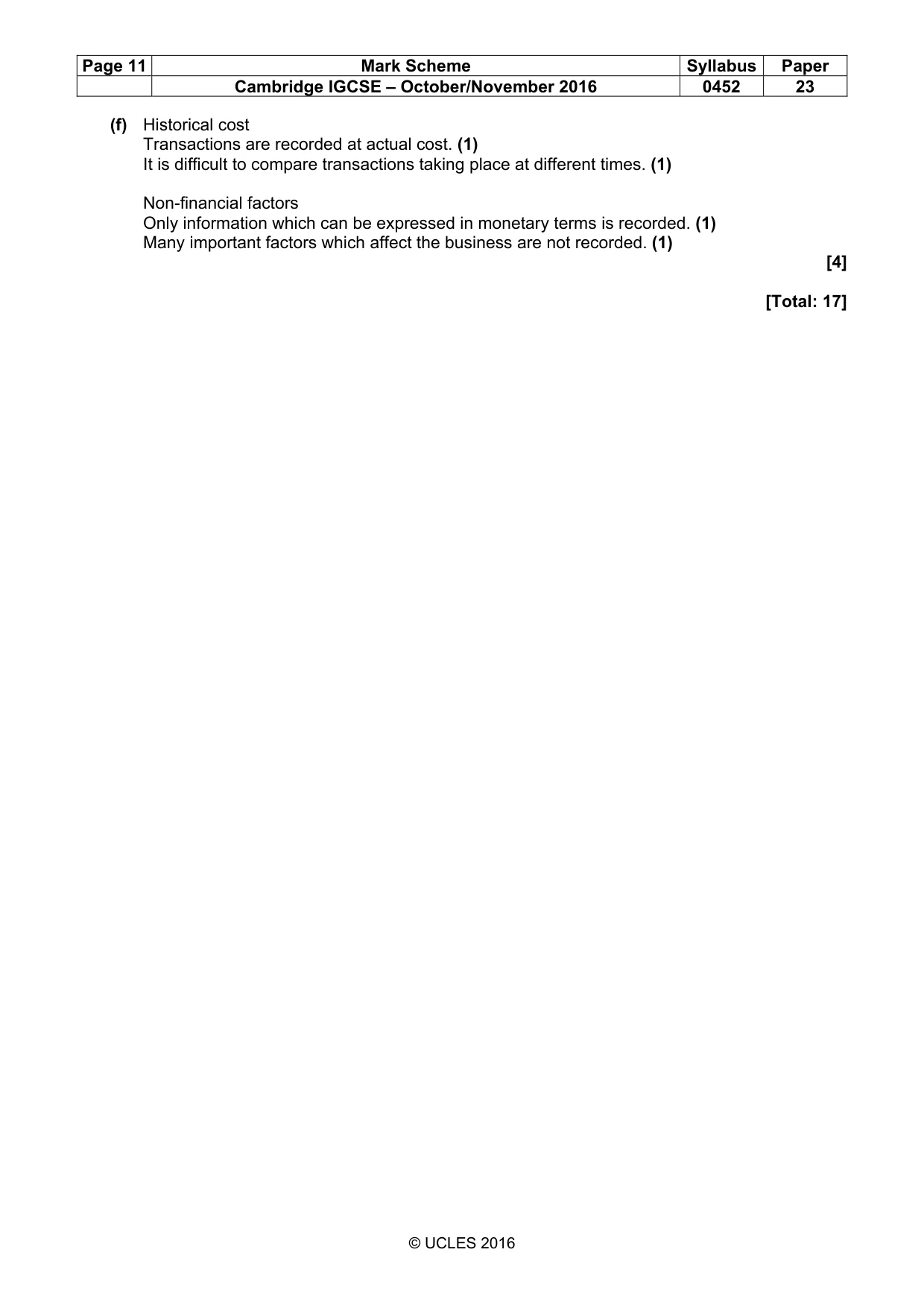
Page 11 Mark Scheme Syllabus Paper Cambridge IGCSE – October/November 2016 0452 23 © UCLES 2016 (f) Historical cost Transactions are recorded at actual cost. (1) It is difficult to compare transactions taking place at different times. (1) Non-financial factors Only information which can be expressed in monetary terms is recorded. (1) Many important factors which affect the business are not recorded. (1) [4] [Total: 17]
What you needed in this session
Cambridge’s own grade thresholds for 2016 Oct/Nov, Paper 2 · Variant 3. A higher threshold means an easier paper — the bar moves with how the cohort did.